Cambridge IGCSE Islamiyat 0493 — 2016 May/June Paper 2 · Variant 1
0493/21/M/J/16 · 50 marks · ≈56 min
The question paper and its mark scheme, free to read here and free to download. This is Cambridge’s own paper, exactly as it was sat.
Question paper16 pages









Mark scheme6 pages
Answers below. Sit the paper first if you are practising.
Paper as text
Question paper, page 1
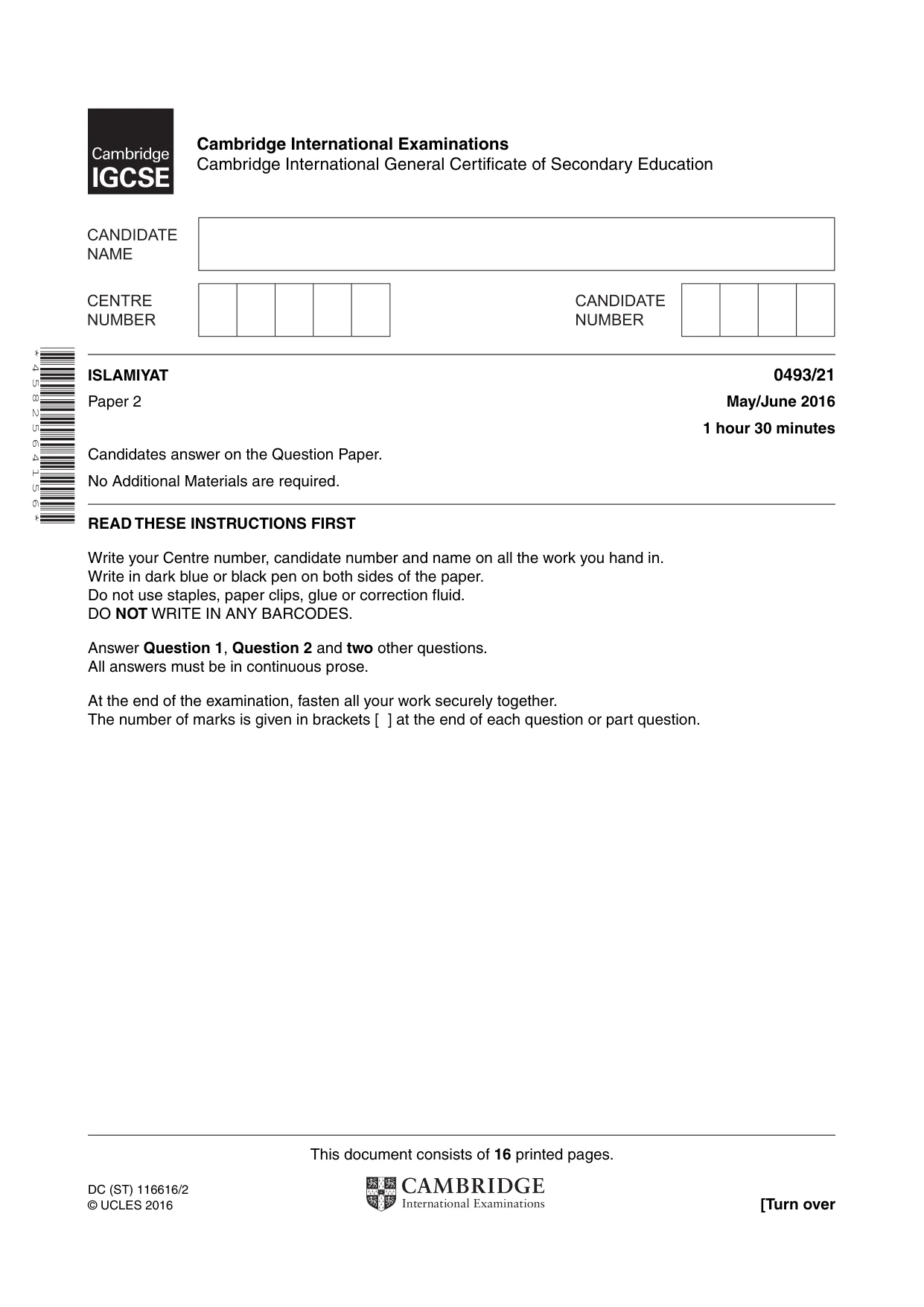
This document consists of 16 printed pages. DC (ST) 116616/2 © UCLES 2016 [Turn over Cambridge International Examinations Cambridge International General Certificate of Secondary Education * 4 5 8 2 5 6 4 1 5 6 * ISLAMIYAT 0493/21 Paper 2 May/June 2016 1 hour 30 minutes Candidates answer on the Question Paper. No Additional Materials are required. READ THESE INSTRUCTIONS FIRST Write your Centre number, candidate number and name on all the work you hand in. Write in dark blue or black pen on both sides of the paper. Do not use staples, paper clips, glue or correction fluid. DO NOT WRITE IN ANY BARCODES. Answer Question 1, Question 2 and two other questions. All answers must be in continuous prose. At the end of the examination, fasten all your work securely together. The number of marks is given in brackets [ ] at the end of each question or part question.
Question paper, page 2
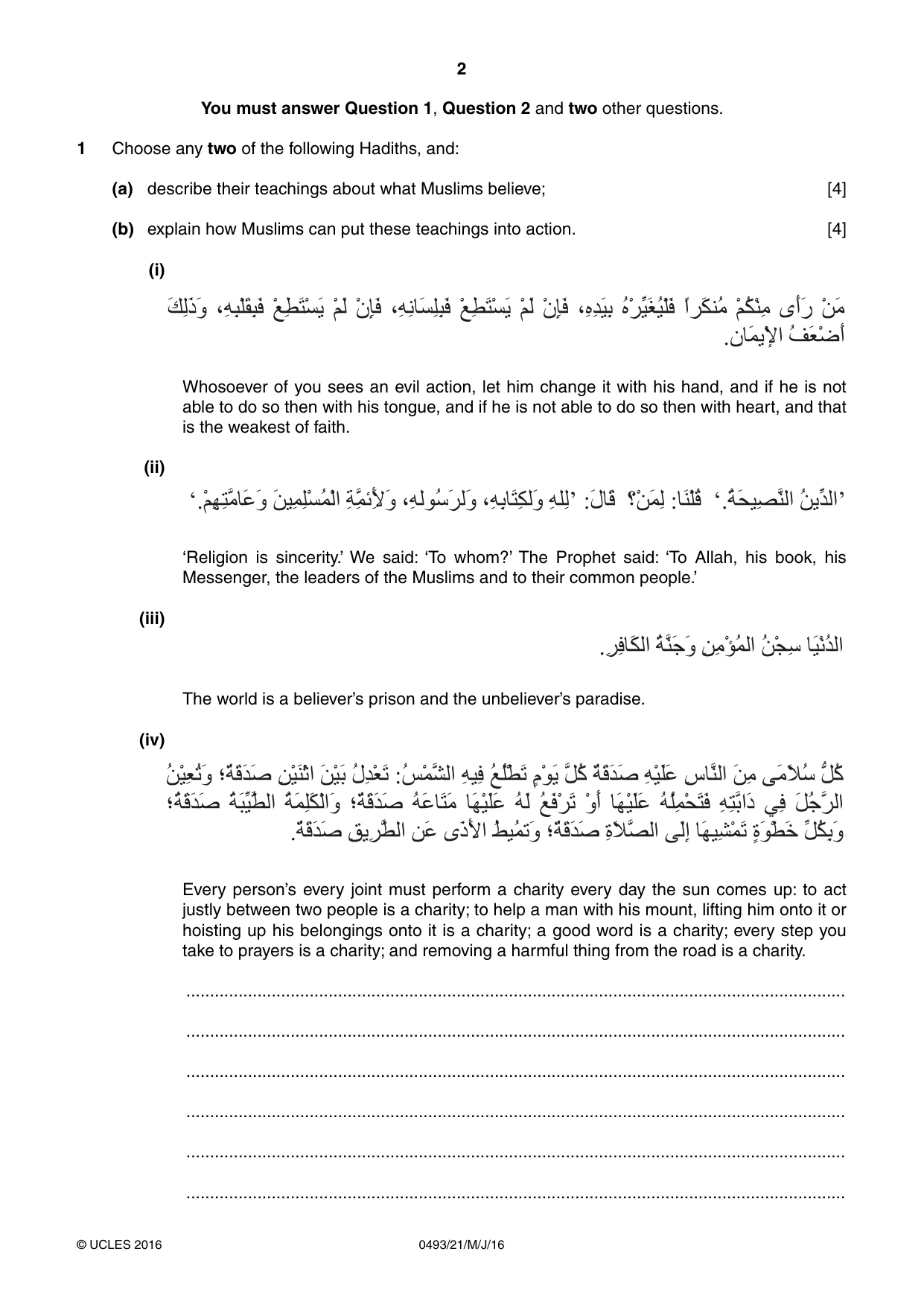
2 0493/21/M/J/16 © UCLES 2016 You must answer Question 1, Question 2 and two other questions. 1 Choose any two of the following Hadiths, and: (a) describe their teachings about what Muslims believe; [4] (b) explain how Muslims can put these teachings into action. [4] (i) ˶Β˸Ϡ˴Ϙ˶Β˴ϓ ˸ϊ˶τ˴Θ˸δ˴ϳ ˸Ϣ˴ϟ ˸ϥ˶Έ˴ϓ ˬ˶Ϫ˶ϧΎ˴δ˶Ϡ˶Β˴ϓ ˸ϊ˶τ˴Θ˸δ˴ϳ ˸Ϣ˴ϟ ˸ϥ˶Έ˴ϓ ˬ˶ϩ˶Ϊ˴ϴ˶Α ˵ϩ˸ή͋ϴ˴ϐ˵ϴ˸Ϡ˴ϓ ˱ή˴ϜϨ˵ϣ ˸Ϣ˵Ϝ˸Ϩ˶ϣ ϯ˴˴έ ˸Ϧ˴ϣ ˴Ϛ˶ϟ˴Ϋ˴ϭ ˬ˶Ϫ .ϥΎ˴Ϥϳ˸Ϲ ˵ϒ˴ό˸ο˴ Whosoever of you sees an evil action, let him change it with his hand, and if he is not able to do so then with his tongue, and if he is not able to do so then with heart, and that is the weakest of faith. (ii) ’ .˵Δ˴Τϴ˶μ͉Ϩϟ ˵Ϧϳ͋Ϊϟ ‘ :˴ϝΎ˴ϗ ˮ˸Ϧ˴Ϥ˶ϟ :Ύ˴Ϩ˸Ϡ˵ϗ ’ ͉ϣΎ˴ϋ˴ϭ ˴Ϧϴ˶Ϥ˶Ϡ˸δ˵Ϥ˸ϟ ˶Δ͉˶Ϥ˶˴Ϸ˴ϭ ˬ˶ϪϟϮ˵γ˴ήϟ˴ϭ ˬ˶Ϫ˶ΑΎ˴Θ˶Ϝϟ˴ϭ ˶ϪϠ˶ϟ .˸Ϣ˶Ϭ˶Θ ‘ ‘Religion is sincerity.’ We said: ‘To whom?’ The Prophet said: ‘To Allah, his book, his Messenger, the leaders of the Muslims and to their common people.’ (iii) .˶ή˶ϓΎ˴Ϝϟ ˵Δ͉Ϩ˴Ο˴ϭ ˶Ϧ˶ϣ˸Ά˵Ϥϟ ˵Ϧ˸Π˶γ Ύ˴ϴ˸ϧ˵Ϊϟ The world is a believer’s prison and the unbeliever’s paradise. (iv) ˵Η˴ϭ ˭˲Δ˴ϗ˴Ϊ˴λ ˶Ϧ˸ϴ˴Ϩ˸Λ ˴Ϧ˸ϴ˴Α ˵ϝ˶Ϊ˸ό˴Η :˵β˸Ϥ͉θϟ ˶Ϫϴ˶ϓ ˵ϊ˵Ϡ˸τ˴Η ˳ϡ˸Ϯ˴ϳ ͉Ϟ˵ϛ ˲Δ˴ϗ˴Ϊ˴λ ˶Ϫ˸ϴ˴Ϡ˴ϋ ˶αΎ͉Ϩϟ ˴Ϧ˶ϣ ϰ˴ϣ˴ϼ˵γ ͊Ϟ˵ϛ ˵Ϧ˸ϴ˶ό ˴Η ˸ϭ˴ Ύ˴Ϭ˸ϴ˴Ϡ˴ϋ ˵Ϫ˵Ϡ˶Ϥ˸Τ˴Θ˴ϓ ˶Ϫ˶Θ͉Α˴Ω ϲ˶ϓ ˴Ϟ˵Ο͉ήϟ ˭˵Δ˴ϗ˴Ϊ˴λ ˵Δ˴Β͋ϴ͉τϟ ˵Δ˴Ϥ˶Ϡ˴Ϝ˸ϟ˴ϭ ˭˲Δ˴ϗ˴Ϊ˴λ ˵Ϫ˴ϋΎ˴Θ˴ϣ Ύ˴Ϭ˸ϴ˴Ϡ˴ϋ ˵Ϫ˴ϟ ˵ϊ˴ϓ˸ή .˲Δ˴ϗ˴Ϊ˴λ ˶ϖϳ˶ή͉τϟ Ϧ˴ϋ ϯ˴Ϋ˴Ϸ ˵ςϴ˵ϤΗ˴ϭ ˭˲Δ˴ϗ˴Ϊ˴λ ˶Γ˴ϼ͉μϟ ϰ˴ϟ˶· Ύ˴Ϭϴ˶θ˸Ϥ˴Η ˳Γ˴Ϯ˸τ˴Χ ͋Ϟ˵Ϝ˶Α˴ϭ Every person’s every joint must perform a charity every day the sun comes up: to act justly between two people is a charity; to help a man with his mount, lifting him onto it or hoisting up his belongings onto it is a charity; a good word is a charity; every step you take to prayers is a charity; and removing a harmful thing from the road is a charity. … … … … … …
Question paper, page 3
3 0493/21/M/J/16 © UCLES 2016 [Turn over … … … … … … … … … … … … … … … … … … … … … … … … … … … …
Question paper, page 4
4 0493/21/M/J/16 © UCLES 2016 … … … … … … … … … … … … … … … … … … … … … … … … … … … …
Question paper, page 5
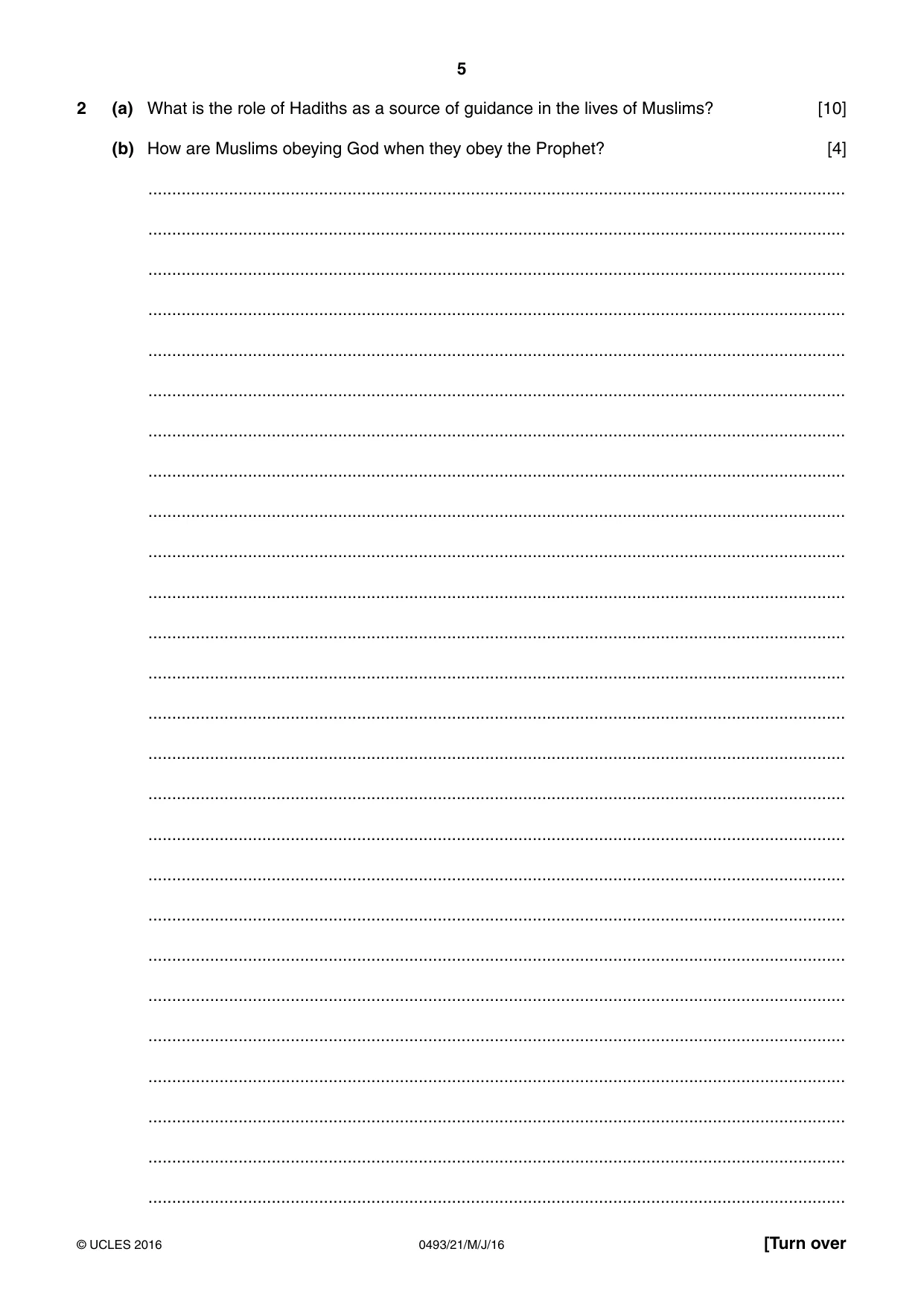
5 0493/21/M/J/16 © UCLES 2016 [Turn over 2 (a) What is the role of Hadiths as a source of guidance in the lives of Muslims? [10] (b) How are Muslims obeying God when they obey the Prophet? [4] … … … … … … … … … … … … … … … … … … … … … … … … … …
Question paper, page 6
6 0493/21/M/J/16 © UCLES 2016 … … … … … … … … … … … … … … … … … … … … … … … … … … … …
Question paper, page 7
7 0493/21/M/J/16 © UCLES 2016 [Turn over … … … … … … … … … … … … … … … … … … … … … … … … … … … …
Question paper, page 8
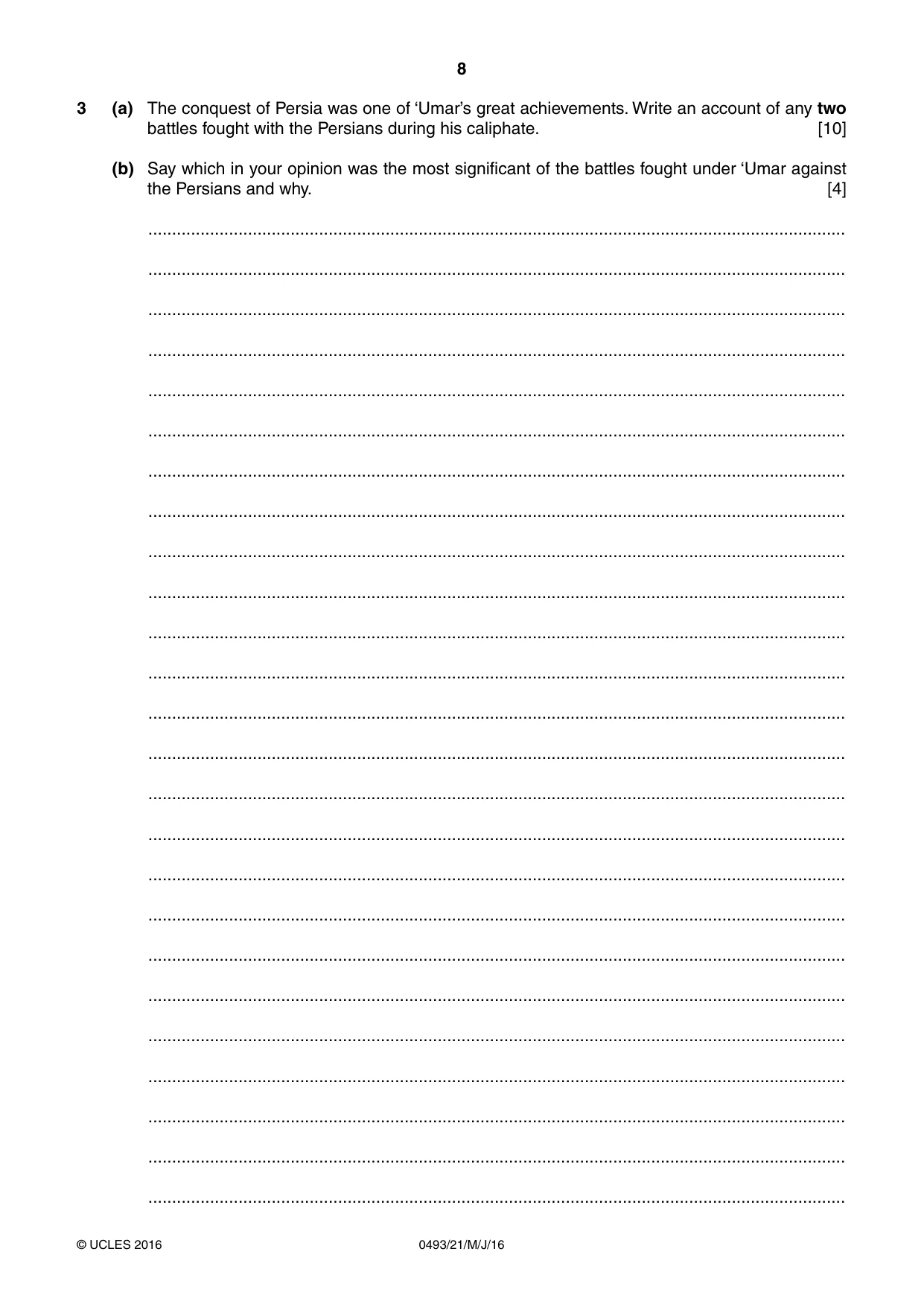
8 0493/21/M/J/16 © UCLES 2016 3 (a) The conquest of Persia was one of ‘Umar’s great achievements. Write an account of any two battles fought with the Persians during his caliphate. [10] (b) Say which in your opinion was the most significant of the battles fought under ‘Umar against the Persians and why. [4] … … … … … … … … … … … … … … … … … … … … … … … … …
Question paper, page 9
9 0493/21/M/J/16 © UCLES 2016 [Turn over … … … … … … … … … … … … … … … … … … … … … … … … … … … …
Question paper, page 10
10 0493/21/M/J/16 © UCLES 2016 … … … … … … … … … … … … … … … … … … … … … … … … … … … …
Question paper, page 11
11 0493/21/M/J/16 © UCLES 2016 [Turn over 4 (a) (i) Outline the main teachings in the Qur’an and Prophetic Hadiths about prayer (salat) as the foundation of Islam. (ii) Describe how Muslims prepare themselves for prayer. [10] (b) Why should meeting for congregational prayers be more advantageous than performing prayer alone? [4] … … … … … … … … … … … … … … … … … … … … … … … …
Question paper, page 12
12 0493/21/M/J/16 © UCLES 2016 … … … … … … … … … … … … … … … … … … … … … … … … … … … …
Question paper, page 13
13 0493/21/M/J/16 © UCLES 2016 [Turn over … … … … … … … … … … … … … … … … … … … … … … … … … … … …
Question paper, page 14
14 0493/21/M/J/16 © UCLES 2016 5 (a) Muslims believe that God alone is Lord, that He alone should be worshipped and that His names and attributes are unique to Him. Outline Muslim beliefs in the oneness of God. [10] (b) Why has God repeatedly warned Muslims against committing shirk? [4] … … … … … … … … … … … … … … … … … … … … … … … … … …
Question paper, page 15
15 0493/21/M/J/16 © UCLES 2016 [Turn over … … … … … … … … … … … … … … … … … … … … … … … … … … … …
Question paper, page 16
16 0493/21/M/J/16 © UCLES 2016 Permission to reproduce items where third-party owned material protected by copyright is included has been sought and cleared where possible. Every reasonable effort has been made by the publisher (UCLES) to trace copyright holders, but if any items requiring clearance have unwittingly been included, the publisher will be pleased to make amends at the earliest possible opportunity. To avoid the issue of disclosure of answer-related information to candidates, all copyright acknowledgements are reproduced online in the Cambridge International Examinations Copyright Acknowledgements Booklet. This is produced for each series of examinations and is freely available to download at www.cie.org.uk after the live examination series. Cambridge International Examinations is part of the Cambridge Assessment Group. Cambridge Assessment is the brand name of University of Cambridge Local Examinations Syndicate (UCLES), which is itself a department of the University of Cambridge. … … … … … … … … … … … … … … … … … … … … … … …
Mark scheme, page 1
® IGCSE is the registered trademark of Cambridge International Examinations. This document consists of 6 printed pages. © UCLES 2016 [Turn over Cambridge International Examinations Cambridge International General Certificate of Secondary Education ISLAMIYAT 0493/21 Paper 2 May/June 2016 MARK SCHEME Maximum Mark: 50 Published This mark scheme is published as an aid to teachers and candidates, to indicate the requirements of the examination. It shows the basis on which Examiners were instructed to award marks. It does not indicate the details of the discussions that took place at an Examiners’ meeting before marking began, which would have considered the acceptability of alternative answers. Mark schemes should be read in conjunction with the question paper and the Principal Examiner Report for Teachers. Cambridge will not enter into discussions about these mark schemes. Cambridge is publishing the mark schemes for the May/June 2016 series for most Cambridge IGCSE®, Cambridge International A and AS Level components and some Cambridge O Level components.
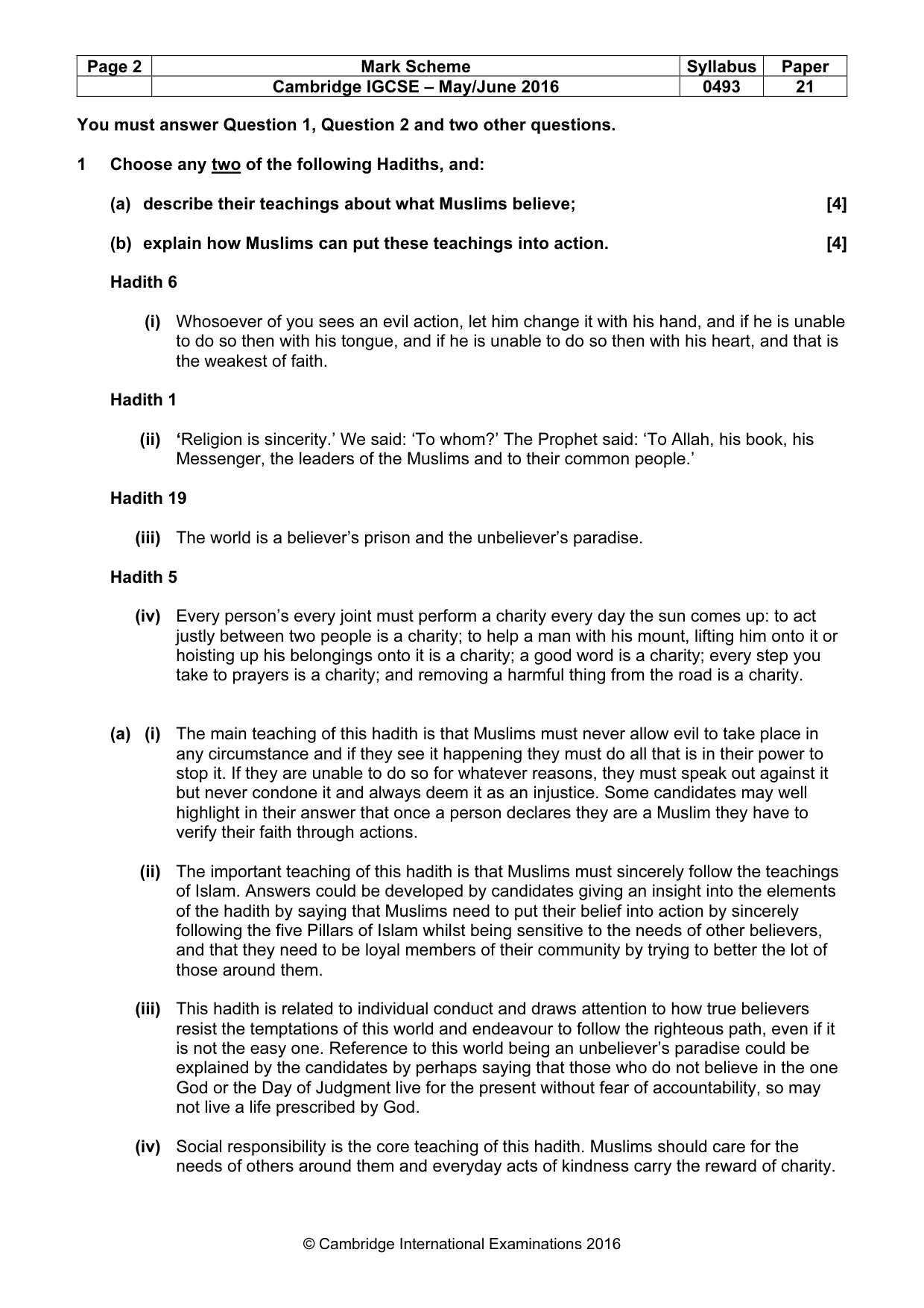
Mark scheme, page 2
Page 2 Mark Scheme Syllabus Paper Cambridge IGCSE – May/June 2016 0493 21 © Cambridge International Examinations 2016 You must answer Question 1, Question 2 and two other questions. 1 Choose any two of the following Hadiths, and: (a) describe their teachings about what Muslims believe; [4] (b) explain how Muslims can put these teachings into action. [4] Hadith 6 (i) Whosoever of you sees an evil action, let him change it with his hand, and if he is unable to do so then with his tongue, and if he is unable to do so then with his heart, and that is the weakest of faith. Hadith 1 (ii) ‘Religion is sincerity.’ We said: ‘To whom?’ The Prophet said: ‘To Allah, his book, his Messenger, the leaders of the Muslims and to their common people.’ Hadith 19 (iii) The world is a believer’s prison and the unbeliever’s paradise. Hadith 5 (iv) Every person’s every joint must perform a charity every day the sun comes up: to act justly between two people is a charity; to help a man with his mount, lifting him onto it or hoisting up his belongings onto it is a charity; a good word is a charity; every step you take to prayers is a charity; and removing a harmful thing from the road is a charity. (a) (i) The main teaching of this hadith is that Muslims must never allow evil to take place in any circumstance and if they see it happening they must do all that is in their power to stop it. If they are unable to do so for whatever reasons, they must speak out against it but never condone it and always deem it as an injustice. Some candidates may well highlight in their answer that once a person declares they are a Muslim they have to verify their faith through actions. (ii) The important teaching of this hadith is that Muslims must sincerely follow the teachings of Islam. Answers could be developed by candidates giving an insight into the elements of the hadith by saying that Muslims need to put their belief into action by sincerely following the five Pillars of Islam whilst being sensitive to the needs of other believers, and that they need to be loyal members of their community by trying to better the lot of those around them. (iii) This hadith is related to individual conduct and draws attention to how true believers resist the temptations of this world and endeavour to follow the righteous path, even if it is not the easy one. Reference to this world being an unbeliever’s paradise could be explained by the candidates by perhaps saying that those who do not believe in the one God or the Day of Judgment live for the present without fear of accountability, so may not live a life prescribed by God. (iv) Social responsibility is the core teaching of this hadith. Muslims should care for the needs of others around them and everyday acts of kindness carry the reward of charity.
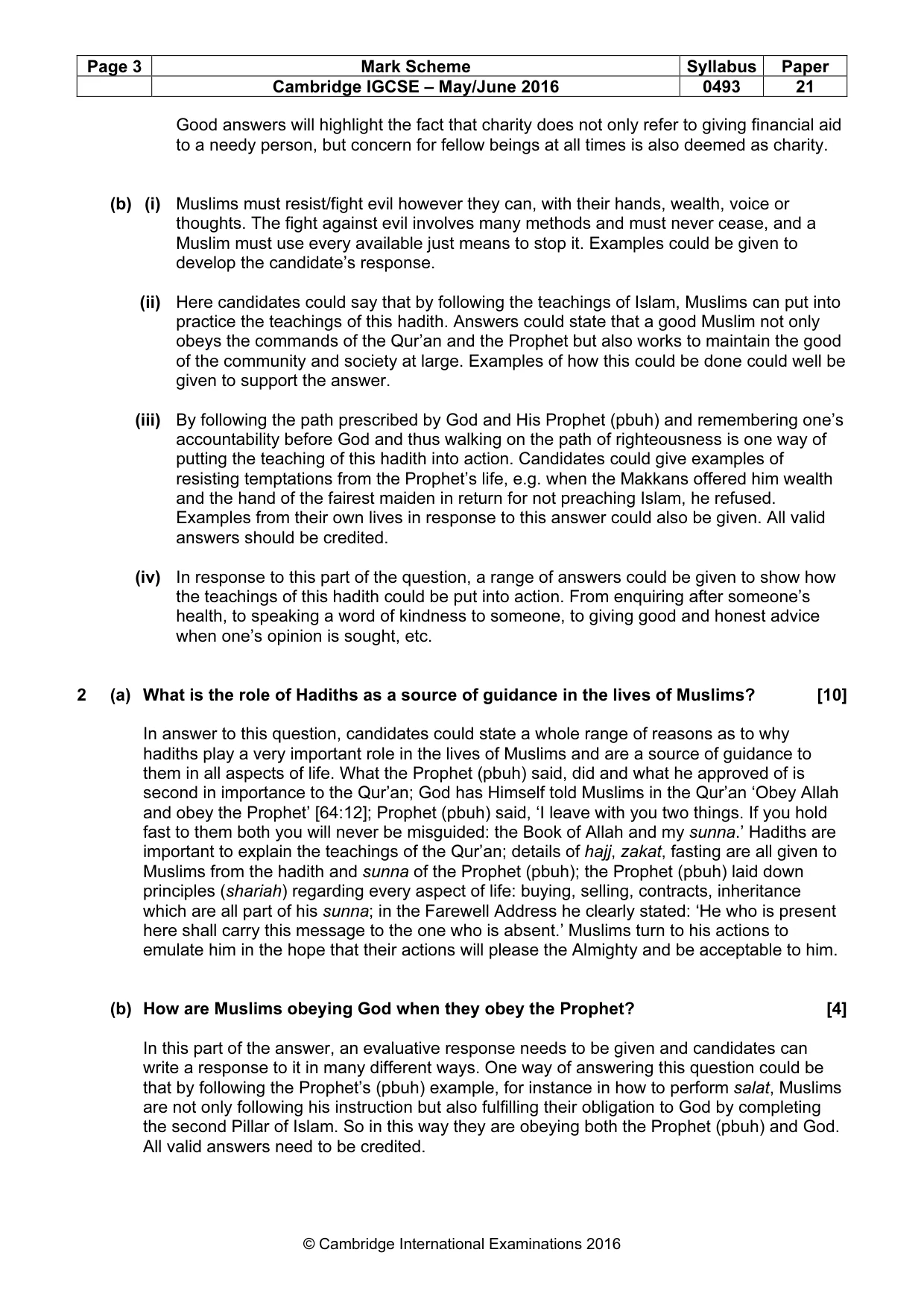
Mark scheme, page 3
Page 3 Mark Scheme Syllabus Paper Cambridge IGCSE – May/June 2016 0493 21 © Cambridge International Examinations 2016 Good answers will highlight the fact that charity does not only refer to giving financial aid to a needy person, but concern for fellow beings at all times is also deemed as charity. (b) (i) Muslims must resist/fight evil however they can, with their hands, wealth, voice or thoughts. The fight against evil involves many methods and must never cease, and a Muslim must use every available just means to stop it. Examples could be given to develop the candidate’s response. (ii) Here candidates could say that by following the teachings of Islam, Muslims can put into practice the teachings of this hadith. Answers could state that a good Muslim not only obeys the commands of the Qur’an and the Prophet but also works to maintain the good of the community and society at large. Examples of how this could be done could well be given to support the answer. (iii) By following the path prescribed by God and His Prophet (pbuh) and remembering one’s accountability before God and thus walking on the path of righteousness is one way of putting the teaching of this hadith into action. Candidates could give examples of resisting temptations from the Prophet’s life, e.g. when the Makkans offered him wealth and the hand of the fairest maiden in return for not preaching Islam, he refused. Examples from their own lives in response to this answer could also be given. All valid answers should be credited. (iv) In response to this part of the question, a range of answers could be given to show how the teachings of this hadith could be put into action. From enquiring after someone’s health, to speaking a word of kindness to someone, to giving good and honest advice when one’s opinion is sought, etc. 2 (a) What is the role of Hadiths as a source of guidance in the lives of Muslims? [10] In answer to this question, candidates could state a whole range of reasons as to why hadiths play a very important role in the lives of Muslims and are a source of guidance to them in all aspects of life. What the Prophet (pbuh) said, did and what he approved of is second in importance to the Qur’an; God has Himself told Muslims in the Qur’an ‘Obey Allah and obey the Prophet’ [64:12]; Prophet (pbuh) said, ‘I leave with you two things. If you hold fast to them both you will never be misguided: the Book of Allah and my sunna.’ Hadiths are important to explain the teachings of the Qur’an; details of hajj, zakat, fasting are all given to Muslims from the hadith and sunna of the Prophet (pbuh); the Prophet (pbuh) laid down principles (shariah) regarding every aspect of life: buying, selling, contracts, inheritance which are all part of his sunna; in the Farewell Address he clearly stated: ‘He who is present here shall carry this message to the one who is absent.’ Muslims turn to his actions to emulate him in the hope that their actions will please the Almighty and be acceptable to him. (b) How are Muslims obeying God when they obey the Prophet? [4] In this part of the answer, an evaluative response needs to be given and candidates can write a response to it in many different ways. One way of answering this question could be that by following the Prophet’s (pbuh) example, for instance in how to perform salat, Muslims are not only following his instruction but also fulfilling their obligation to God by completing the second Pillar of Islam. So in this way they are obeying both the Prophet (pbuh) and God. All valid answers need to be credited.
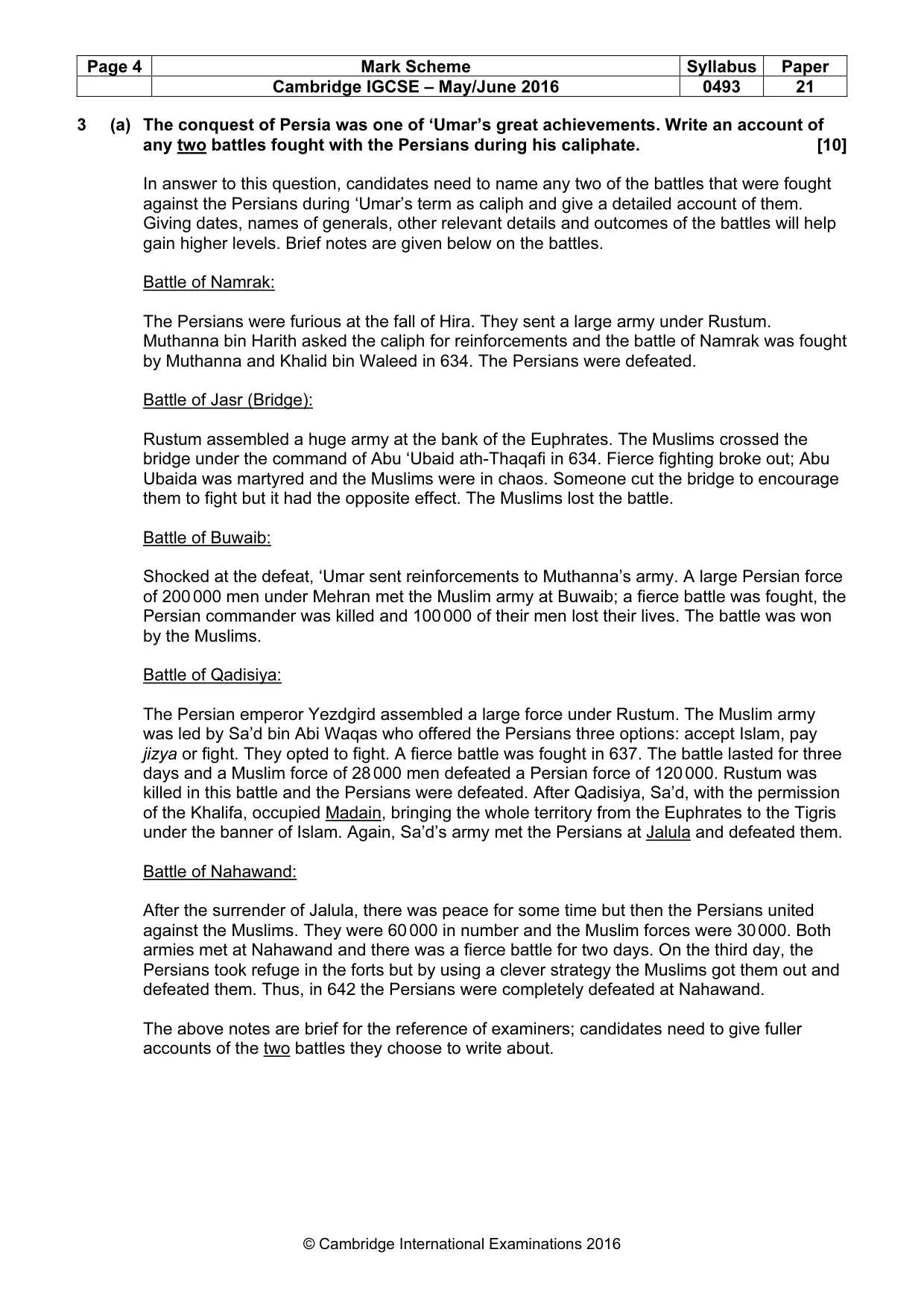
Mark scheme, page 4
Page 4 Mark Scheme Syllabus Paper Cambridge IGCSE – May/June 2016 0493 21 © Cambridge International Examinations 2016 3 (a) The conquest of Persia was one of ‘Umar’s great achievements. Write an account of any two battles fought with the Persians during his caliphate. [10] In answer to this question, candidates need to name any two of the battles that were fought against the Persians during ‘Umar’s term as caliph and give a detailed account of them. Giving dates, names of generals, other relevant details and outcomes of the battles will help gain higher levels. Brief notes are given below on the battles. Battle of Namrak: The Persians were furious at the fall of Hira. They sent a large army under Rustum. Muthanna bin Harith asked the caliph for reinforcements and the battle of Namrak was fought by Muthanna and Khalid bin Waleed in 634. The Persians were defeated. Battle of Jasr (Bridge): Rustum assembled a huge army at the bank of the Euphrates. The Muslims crossed the bridge under the command of Abu ‘Ubaid ath-Thaqafi in 634. Fierce fighting broke out; Abu Ubaida was martyred and the Muslims were in chaos. Someone cut the bridge to encourage them to fight but it had the opposite effect. The Muslims lost the battle. Battle of Buwaib: Shocked at the defeat, ‘Umar sent reinforcements to Muthanna’s army. A large Persian force of 200 000 men under Mehran met the Muslim army at Buwaib; a fierce battle was fought, the Persian commander was killed and 100 000 of their men lost their lives. The battle was won by the Muslims. Battle of Qadisiya: The Persian emperor Yezdgird assembled a large force under Rustum. The Muslim army was led by Sa’d bin Abi Waqas who offered the Persians three options: accept Islam, pay jizya or fight. They opted to fight. A fierce battle was fought in 637. The battle lasted for three days and a Muslim force of 28 000 men defeated a Persian force of 120 000. Rustum was killed in this battle and the Persians were defeated. After Qadisiya, Sa’d, with the permission of the Khalifa, occupied Madain, bringing the whole territory from the Euphrates to the Tigris under the banner of Islam. Again, Sa’d’s army met the Persians at Jalula and defeated them. Battle of Nahawand: After the surrender of Jalula, there was peace for some time but then the Persians united against the Muslims. They were 60 000 in number and the Muslim forces were 30 000. Both armies met at Nahawand and there was a fierce battle for two days. On the third day, the Persians took refuge in the forts but by using a clever strategy the Muslims got them out and defeated them. Thus, in 642 the Persians were completely defeated at Nahawand. The above notes are brief for the reference of examiners; candidates need to give fuller accounts of the two battles they choose to write about.
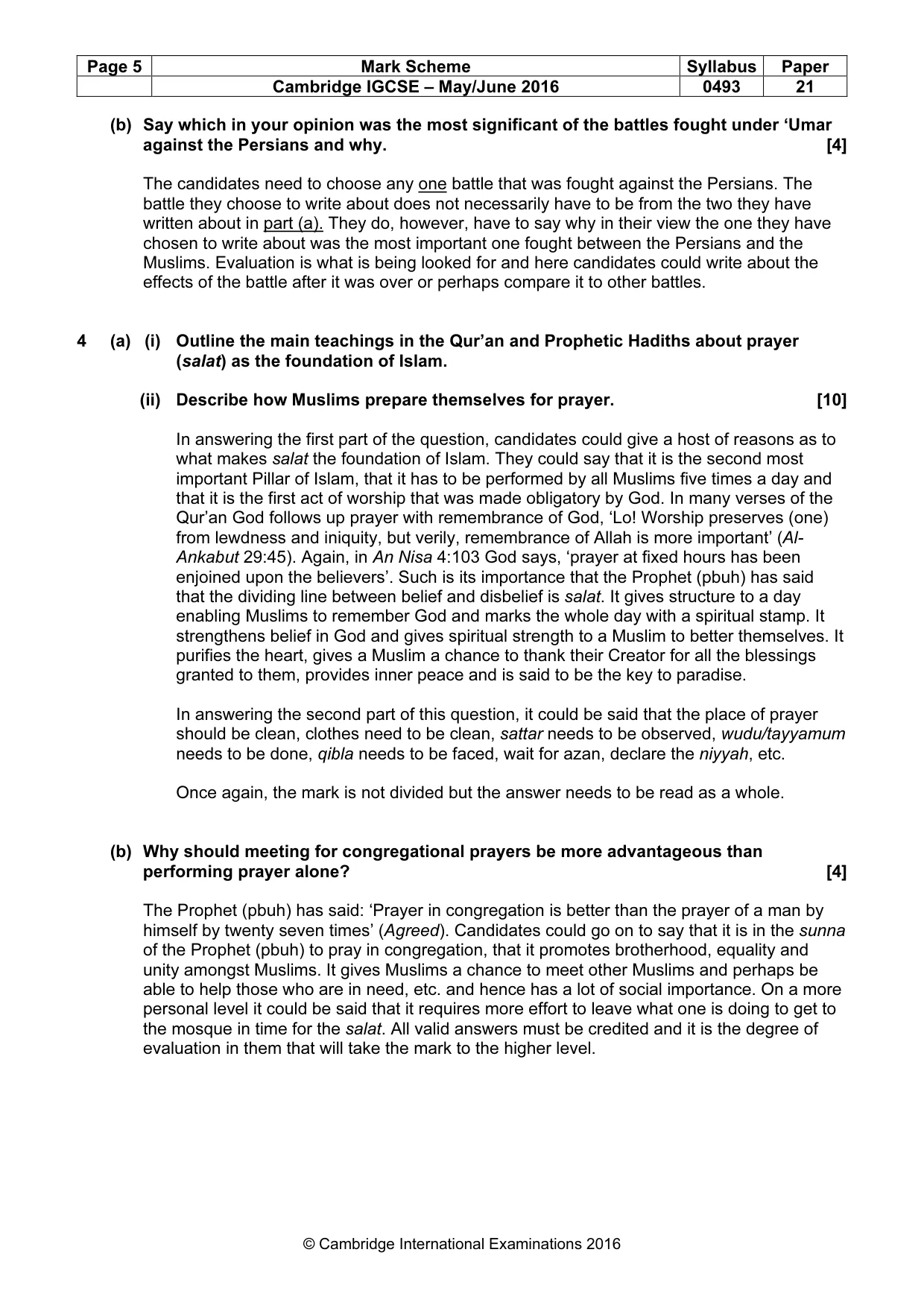
Mark scheme, page 5
Page 5 Mark Scheme Syllabus Paper Cambridge IGCSE – May/June 2016 0493 21 © Cambridge International Examinations 2016 (b) Say which in your opinion was the most significant of the battles fought under ‘Umar against the Persians and why. [4] The candidates need to choose any one battle that was fought against the Persians. The battle they choose to write about does not necessarily have to be from the two they have written about in part (a). They do, however, have to say why in their view the one they have chosen to write about was the most important one fought between the Persians and the Muslims. Evaluation is what is being looked for and here candidates could write about the effects of the battle after it was over or perhaps compare it to other battles. 4 (a) (i) Outline the main teachings in the Qur’an and Prophetic Hadiths about prayer (salat) as the foundation of Islam. (ii) Describe how Muslims prepare themselves for prayer. [10] In answering the first part of the question, candidates could give a host of reasons as to what makes salat the foundation of Islam. They could say that it is the second most important Pillar of Islam, that it has to be performed by all Muslims five times a day and that it is the first act of worship that was made obligatory by God. In many verses of the Qur’an God follows up prayer with remembrance of God, ‘Lo! Worship preserves (one) from lewdness and iniquity, but verily, remembrance of Allah is more important’ (Al- Ankabut 29:45). Again, in An Nisa 4:103 God says, ‘prayer at fixed hours has been enjoined upon the believers’. Such is its importance that the Prophet (pbuh) has said that the dividing line between belief and disbelief is salat. It gives structure to a day enabling Muslims to remember God and marks the whole day with a spiritual stamp. It strengthens belief in God and gives spiritual strength to a Muslim to better themselves. It purifies the heart, gives a Muslim a chance to thank their Creator for all the blessings granted to them, provides inner peace and is said to be the key to paradise. In answering the second part of this question, it could be said that the place of prayer should be clean, clothes need to be clean, sattar needs to be observed, wudu/tayyamum needs to be done, qibla needs to be faced, wait for azan, declare the niyyah, etc. Once again, the mark is not divided but the answer needs to be read as a whole. (b) Why should meeting for congregational prayers be more advantageous than performing prayer alone? [4] The Prophet (pbuh) has said: ‘Prayer in congregation is better than the prayer of a man by himself by twenty seven times’ (Agreed). Candidates could go on to say that it is in the sunna of the Prophet (pbuh) to pray in congregation, that it promotes brotherhood, equality and unity amongst Muslims. It gives Muslims a chance to meet other Muslims and perhaps be able to help those who are in need, etc. and hence has a lot of social importance. On a more personal level it could be said that it requires more effort to leave what one is doing to get to the mosque in time for the salat. All valid answers must be credited and it is the degree of evaluation in them that will take the mark to the higher level.
Mark scheme, page 6
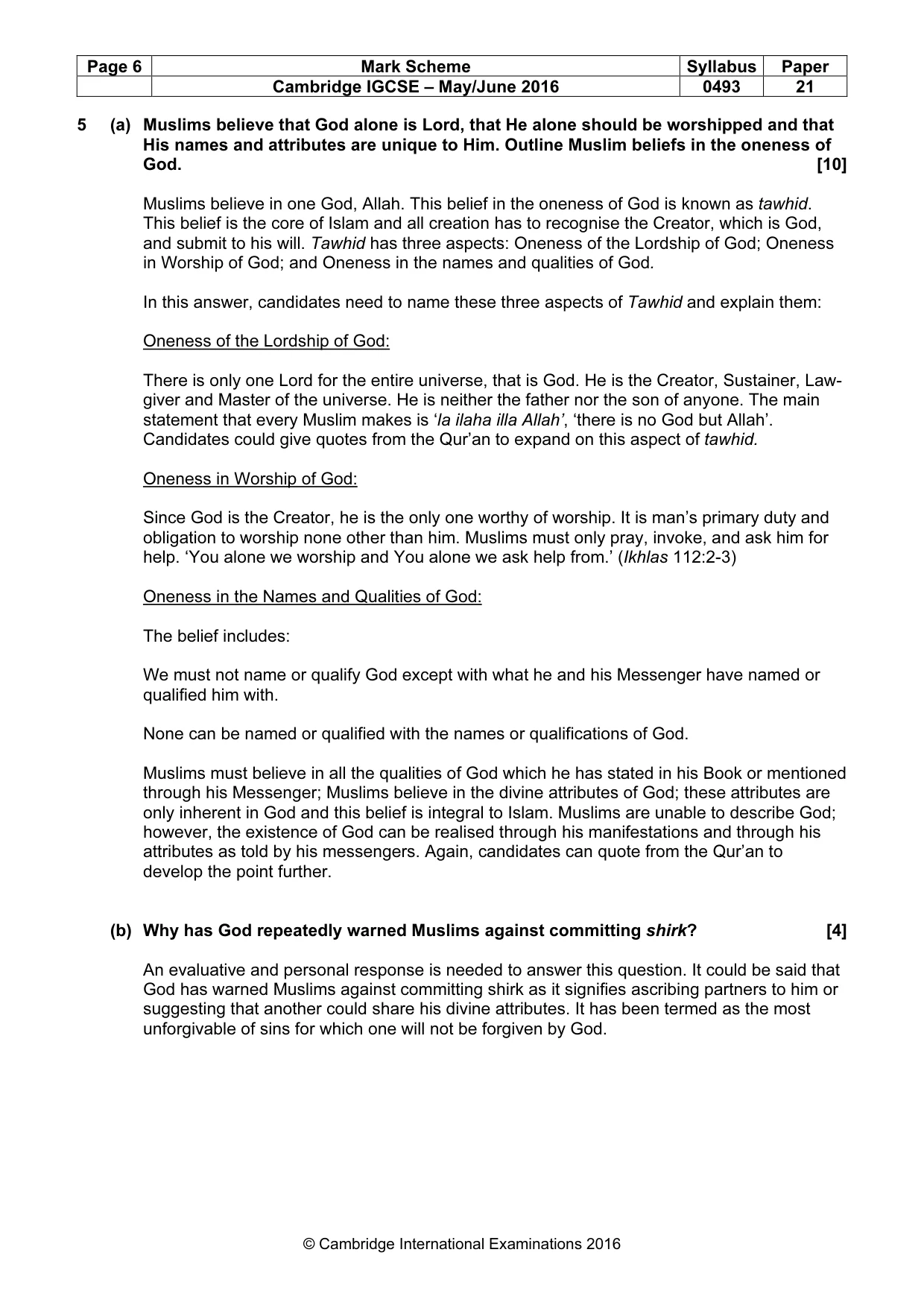
Page 6 Mark Scheme Syllabus Paper Cambridge IGCSE – May/June 2016 0493 21 © Cambridge International Examinations 2016 5 (a) Muslims believe that God alone is Lord, that He alone should be worshipped and that His names and attributes are unique to Him. Outline Muslim beliefs in the oneness of God. [10] Muslims believe in one God, Allah. This belief in the oneness of God is known as tawhid. This belief is the core of Islam and all creation has to recognise the Creator, which is God, and submit to his will. Tawhid has three aspects: Oneness of the Lordship of God; Oneness in Worship of God; and Oneness in the names and qualities of God. In this answer, candidates need to name these three aspects of Tawhid and explain them: Oneness of the Lordship of God: There is only one Lord for the entire universe, that is God. He is the Creator, Sustainer, Law- giver and Master of the universe. He is neither the father nor the son of anyone. The main statement that every Muslim makes is ‘la ilaha illa Allah’, ‘there is no God but Allah’. Candidates could give quotes from the Qur’an to expand on this aspect of tawhid. Oneness in Worship of God: Since God is the Creator, he is the only one worthy of worship. It is man’s primary duty and obligation to worship none other than him. Muslims must only pray, invoke, and ask him for help. ‘You alone we worship and You alone we ask help from.’ (Ikhlas 112:2-3) Oneness in the Names and Qualities of God: The belief includes: We must not name or qualify God except with what he and his Messenger have named or qualified him with. None can be named or qualified with the names or qualifications of God. Muslims must believe in all the qualities of God which he has stated in his Book or mentioned through his Messenger; Muslims believe in the divine attributes of God; these attributes are only inherent in God and this belief is integral to Islam. Muslims are unable to describe God; however, the existence of God can be realised through his manifestations and through his attributes as told by his messengers. Again, candidates can quote from the Qur’an to develop the point further. (b) Why has God repeatedly warned Muslims against committing shirk? [4] An evaluative and personal response is needed to answer this question. It could be said that God has warned Muslims against committing shirk as it signifies ascribing partners to him or suggesting that another could share his divine attributes. It has been termed as the most unforgivable of sins for which one will not be forgiven by God.
What you needed in this session
Cambridge’s own grade thresholds for 2016 May/June, Paper 2 · Variant 1. A higher threshold means an easier paper — the bar moves with how the cohort did.