Cambridge IGCSE Islamiyat 0493 — 2013 May/June Paper 4 · Variant 2
0493/42/M/J/13 · 50 marks · ≈56 min
The question paper and its mark scheme, free to read here and free to download. This is Cambridge’s own paper, exactly as it was sat.
Question paper17 pages
Mark scheme7 pages
Answers below. Sit the paper first if you are practising.
Paper as text
Question paper, page 1
PAPA CAMBRIDGE UNIVERSITY OF CAMBRIDGE INTERNATIONAL EXAMINATIONS International General Certificate of Secondary Education 0493 ISLAMIYAT 0493/42 Paper 42 Due to a security breach we required all candidates in Pakistan who sat the paper for 0493/02 to attend a re-sit examination in June 2013. Candidates outside of Pakistan sat only the original paper and were not involved in a re-sit.
Question paper, page 2
PAPA CAMBRIDGE This document consists of 16 printed pages. DC (NH) 67490/1 © UCLES 2013 [Turn over UNIVERSITY OF CAMBRIDGE INTERNATIONAL EXAMINATIONS General Certificate of Education Ordinary Level * 4 0 0 4 9 9 8 3 8 5 * ISLAMIYAT 2058/22 Paper 2 October/November 2013 1 hour 30 minutes Candidates answer on the Question Paper. No Additional Materials are required. READ THESE INSTRUCTIONS FIRST Write your Centre number, candidate number and name on all the work you hand in. Write in dark blue or black pen on both sides of the paper. Do not use staples, paper clips, highlighters, glue or correction fluid. DO NOT WRITE IN ANY BARCODES. Answer Question 1, Question 2 and two other questions. All answers must be in continuous prose. At the end of the examination, fasten all your work securely together. The number of marks is given in brackets [ ] at the end of each question or part question. For Examiner’s Use 1 2 3 4 5 Total
Question paper, page 3
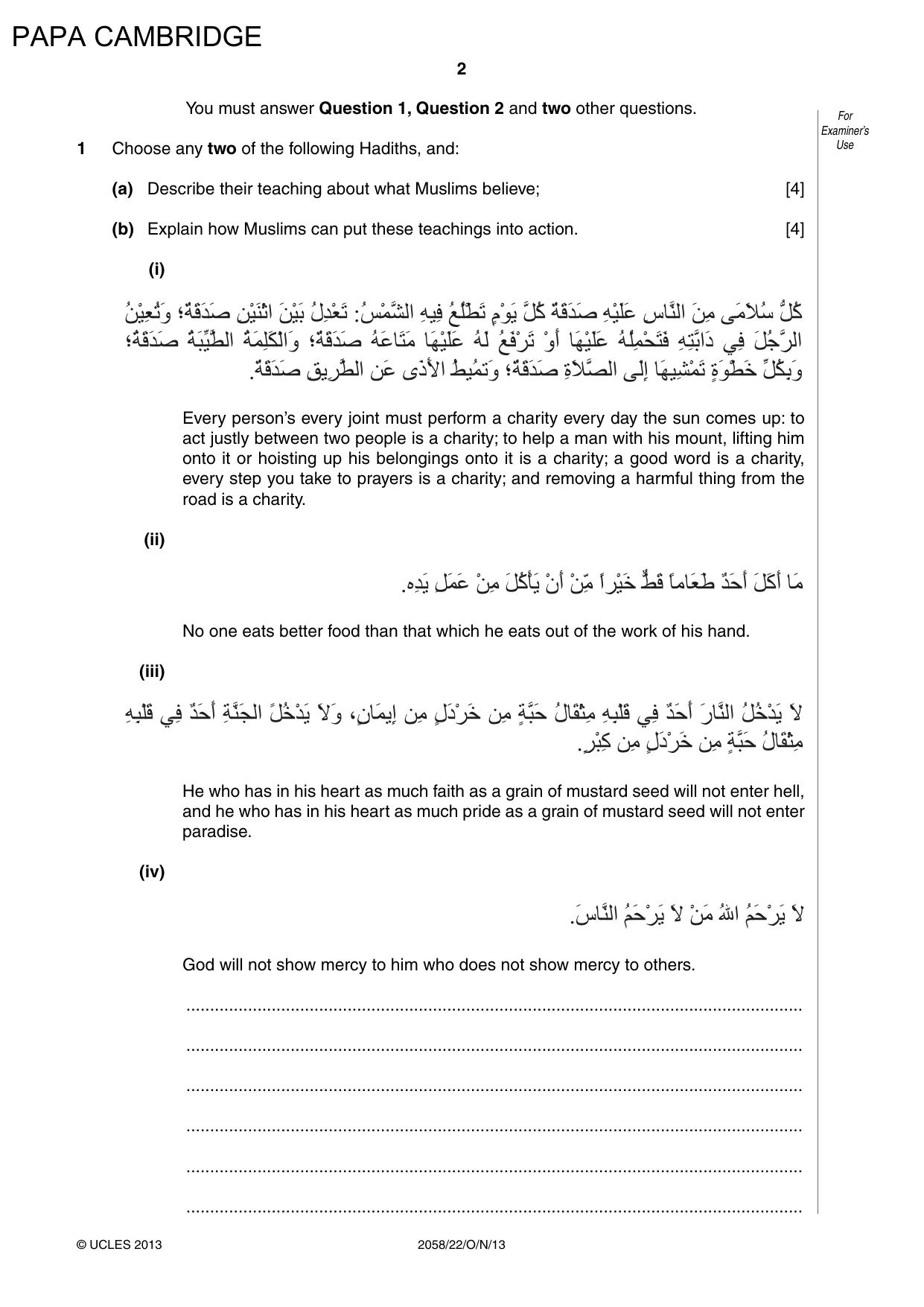
PAPA CAMBRIDGE 2 2058/22/O/N/13 © UCLES 2013 For Examiner’s Use You must answer Question 1, Question 2 and two other questions. 1 Choose any two of the following Hadiths, and: (a) Describe their teaching about what Muslims believe; [4] (b) Explain how Muslims can put these teachings into action. [4] (i) ˵β˸Ϥ͉θϟ ˶Ϫϴ˶ϓ ˵ϊ˵Ϡ˸τ˴Η ˳ϡ˸Ϯ˴ϳ ͉Ϟ˵ϛ ˲Δ˴ϗ˴Ϊ˴λ ˶Ϫ˸ϴ˴Ϡ˴ϋ ˶αΎ͉Ϩϟ ˴Ϧ˶ϣ ϰ˴ϣ˴ϼ˵γ ͊Ϟ˵ϛ : ˵Ϧ˸ϴ˶ό˵Η˴ϭ ˭˲Δ˴ϗ˴Ϊ˴λ ˶Ϧ˸ϴ˴Ϩ˸Λ ˴Ϧ˸ϴ˴Α ˵ϝ˶Ϊ˸ό˴Η ˵Δ˴Β͋ϴ͉τϟ ˵Δ˴Ϥ˶Ϡ˴Ϝ˸ϟ˴ϭ ˭˲Δ˴ϗ˴Ϊ˴λ ˵Ϫ˴ϋΎ˴Θ˴ϣ Ύ˴Ϭ˸ϴ˴Ϡ˴ϋ ˵Ϫ˴ϟ ˵ϊ˴ϓ˸ή˴Η ˸ϭ˴ Ύ˴Ϭ˸ϴ˴Ϡ˴ϋ ˵Ϫ˵Ϡ˶Ϥ˸Τ˴Θ˴ϓ ˶Ϫ˶Θ͉Α˴Ω ϲ˶ϓ ˴Ϟ˵Ο͉ήϟ ˭˵Δ˴ϗ˴Ϊ˴λ ˲Δ˴ϗ˴Ϊ˴λ ˶ϖϳ˶ή͉τϟ Ϧ˴ϋ ϯ˴Ϋ˴Ϸ ˵ςϴ˵ϤΗ˴ϭ ˭˲Δ˴ϗ˴Ϊ˴λ ˶Γ˴ϼ͉μϟ ϰ˴ϟ˶· Ύ˴Ϭϴ˶θ˸Ϥ˴Η ˳Γ˴Ϯ˸τ˴Χ ͋Ϟ˵Ϝ˶Α˴ϭ . Every person’s every joint must perform a charity every day the sun comes up: to act justly between two people is a charity; to help a man with his mount, lifting him onto it or hoisting up his belongings onto it is a charity; a good word is a charity, every step you take to prayers is a charity; and removing a harmful thing from the road is a charity. (ii) ϩ˶Ϊ˴ϳ ˶Ϟ˴Ϥ˴ϋ ˸Ϧ˶ϣ ˴Ϟ˵ϛ˸΄˴ϳ ˸ϥ˴ ˸Ϧ˷˶ϣ ˱ή˸ϴ˴Χ ͇ς˴ϗ ˱ΎϣΎ˴ό˴σ ˲Ϊ˴Σ˴ ˴Ϟ˴ϛ˴ Ύ˴ϣ . No one eats better food than that which he eats out of the work of his hand. (iii) Ϧ˶ϣ ˳ϝ˴Ω˸ή˴Χ Ϧ˶ϣ ˳Δ͉Β˴Σ ˵ϝΎ˴Ϙ˸Μ˶ϣ ˶Ϫ˶Β˸Ϡ˴ϗ ϲ˶ϓ ˲Ϊ˴Σ˴ ˴έΎ͉Ϩϟ ˵Ϟ˵Χ˸Ϊ˴ϳ ˴ϻ ˶Ϫ˶Β˸Ϡ˴ϗ ϲ˶ϓ ˲Ϊ˴Σ˴ ˶Δ͉Ϩ˴Πϟ ˱Ϟ˵Χ˸Ϊ˴ϳ ˴ϻ˴ϭ ˬ˳ϥΎ˴Ϥϳ˶· ˳ή˸Β˶ϛ Ϧ˶ϣ ˳ϝ˴Ω˸ή˴Χ Ϧ˶ϣ ˳Δ͉Β˴Σ ˵ϝΎ˴Ϙ˸Μ˶ϣ . He who has in his heart as much faith as a grain of mustard seed will not enter hell, and he who has in his heart as much pride as a grain of mustard seed will not enter paradise. (iv) ˴αΎ͉Ϩϟ ˵Ϣ˴Σ˸ή˴ϳ ˴ϻ ˸Ϧ˴ϣ ˵Ϳ ˵Ϣ˴Σ˸ή˴ϳ ˴ϻ . God will not show mercy to him who does not show mercy to others. … … … … … …
Question paper, page 4
PAPA CAMBRIDGE 3 2058/22/O/N/13 © UCLES 2013 [Turn over For Examiner’s Use … … … … … … … … … … … … … … … … … … … … … … … … … … … …
Question paper, page 5
PAPA CAMBRIDGE 4 2058/22/O/N/13 © UCLES 2013 For Examiner’s Use … … … … … … … … … … … … … … … … … … … … … … … … … … … …
Question paper, page 6
PAPA CAMBRIDGE 5 2058/22/O/N/13 © UCLES 2013 [Turn over For Examiner’s Use 2 (a) From the set Hadiths outline the Prophet’s teachings about the conduct of the individual in the community. [10] (b) How does following the example of the Prophet in one’s behaviour towards others affect the community? [4] … … … … … … … … … … … … … … … … … … … … … … … … …
Question paper, page 7
PAPA CAMBRIDGE 6 2058/22/O/N/13 © UCLES 2013 For Examiner’s Use … … … … … … … … … … … … … … … … … … … … … … … … … … … …
Question paper, page 8
PAPA CAMBRIDGE 7 2058/22/O/N/13 © UCLES 2013 [Turn over For Examiner’s Use … … … … … … … … … … … … … … … … … … … … … … … … … … … …
Question paper, page 9
PAPA CAMBRIDGE 8 2058/22/O/N/13 © UCLES 2013 For Examiner’s Use 3 (a) Outline the main observances of the annual pilgrimage (Hajj ). [10] (b) How does Hajj encourage a sense of equality amongst Muslims? [4] … … … … … … … … … … … … … … … … … … … … … … … … … …
Question paper, page 10
PAPA CAMBRIDGE 9 2058/22/O/N/13 © UCLES 2013 [Turn over For Examiner’s Use … … … … … … … … … … … … … … … … … … … … … … … … … … … …
Question paper, page 11
PAPA CAMBRIDGE 10 2058/22/O/N/13 © UCLES 2013 For Examiner’s Use … … … … … … … … … … … … … … … … … … … … … … … … … … … …
Question paper, page 12
PAPA CAMBRIDGE 11 2058/22/O/N/13 © UCLES 2013 [Turn over For Examiner’s Use 4 (a) Describe how and why Muslims celebrate Eid al-Fitr and Eid al-Adha. [10] (b) How do the two Eids bring the Muslim community together? [4] … … … … … … … … … … … … … … … … … … … … … … … … … …
Question paper, page 13
PAPA CAMBRIDGE 12 2058/22/O/N/13 © UCLES 2013 For Examiner’s Use … … … … … … … … … … … … … … … … … … … … … … … … … … … …
Question paper, page 14
PAPA CAMBRIDGE 13 2058/22/O/N/13 © UCLES 2013 [Turn over For Examiner’s Use … … … … … … … … … … … … … … … … … … … … … … … … … … … …
Question paper, page 15
PAPA CAMBRIDGE 14 2058/22/O/N/13 © UCLES 2013 For Examiner’s Use 5 (a) Give an account of the following two battles fought during the rule of ‘Umar: • Battle of Qadisiya; • Battle of Yarmuk [10] (b) Was ‘Umar better as a military leader or as an administrator? [4] … … … … … … … … … … … … … … … … … … … … … … … … …
Question paper, page 16
PAPA CAMBRIDGE 15 2058/22/O/N/13 © UCLES 2013 [Turn over For Examiner’s Use … … … … … … … … … … … … … … … … … … … … … … … … … … … …
Question paper, page 17
PAPA CAMBRIDGE 16 2058/22/O/N/13 © UCLES 2013 For Examiner’s Use Permission to reproduce items where third-party owned material protected by copyright is included has been sought and cleared where possible. Every reasonable effort has been made by the publisher (UCLES) to trace copyright holders, but if any items requiring clearance have unwittingly been included, the publisher will be pleased to make amends at the earliest possible opportunity. University of Cambridge International Examinations is part of the Cambridge Assessment Group. Cambridge Assessment is the brand name of University of Cambridge Local Examinations Syndicate (UCLES), which is itself a department of the University of Cambridge. … … … … … … … … … … … … … … … … … … … … … … … … …
Mark scheme, page 1
PAPA CAMBRIDGE UNIVERSITY OF CAMBRIDGE INTERNATIONAL EXAMINATIONS International General Certificate of Secondary Education 0493 ISLAMIYAT 0493/42 Paper 42 Due to a security breach we required all candidates in Pakistan who sat the paper for 0493/02 to attend a re-sit examination in June 2013. Candidates outside of Pakistan sat only the original paper and were not involved in a re-sit.
Mark scheme, page 2
PAPA CAMBRIDGE CAMBRIDGE INTERNATIONAL EXAMINATIONS International General Certificate of Secondary Education MARK SCHEME for the May/June 2013 series 0493 ISLAMIYAT 0493/42 Paper 2, maximum raw mark 50 This mark scheme is published as an aid to teachers and candidates, to indicate the requirements of the examination. It shows the basis on which Examiners were instructed to award marks. It does not indicate the details of the discussions that took place at an Examiners’ meeting before marking began, which would have considered the acceptability of alternative answers. Mark schemes should be read in conjunction with the question paper and the Principal Examiner Report for Teachers. Cambridge will not enter into discussions about these mark schemes. Cambridge is publishing the mark schemes for the May/June 2013 series for most IGCSE, GCE Advanced Level and Advanced Subsidiary Level components and some Ordinary Level components.
Mark scheme, page 3
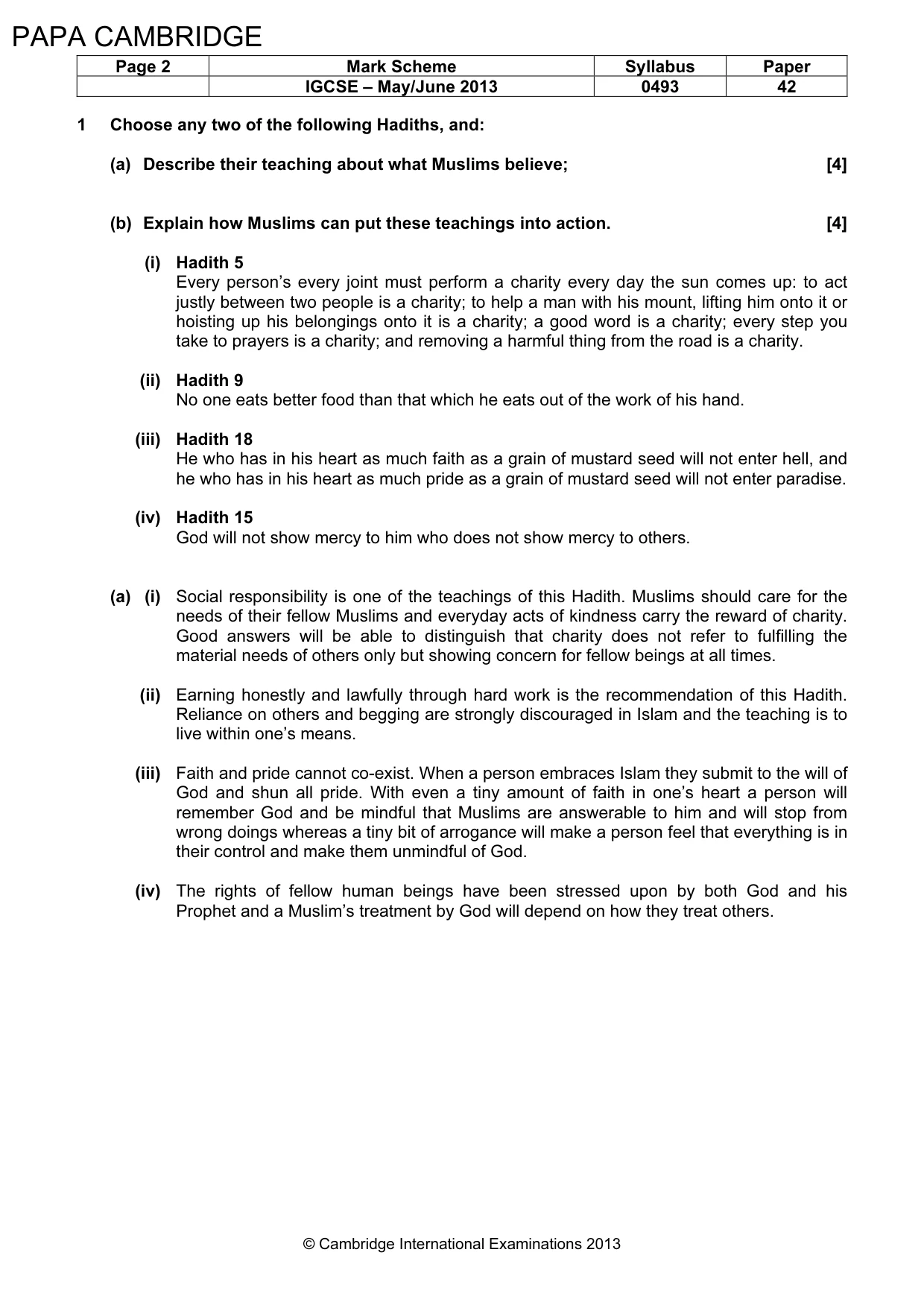
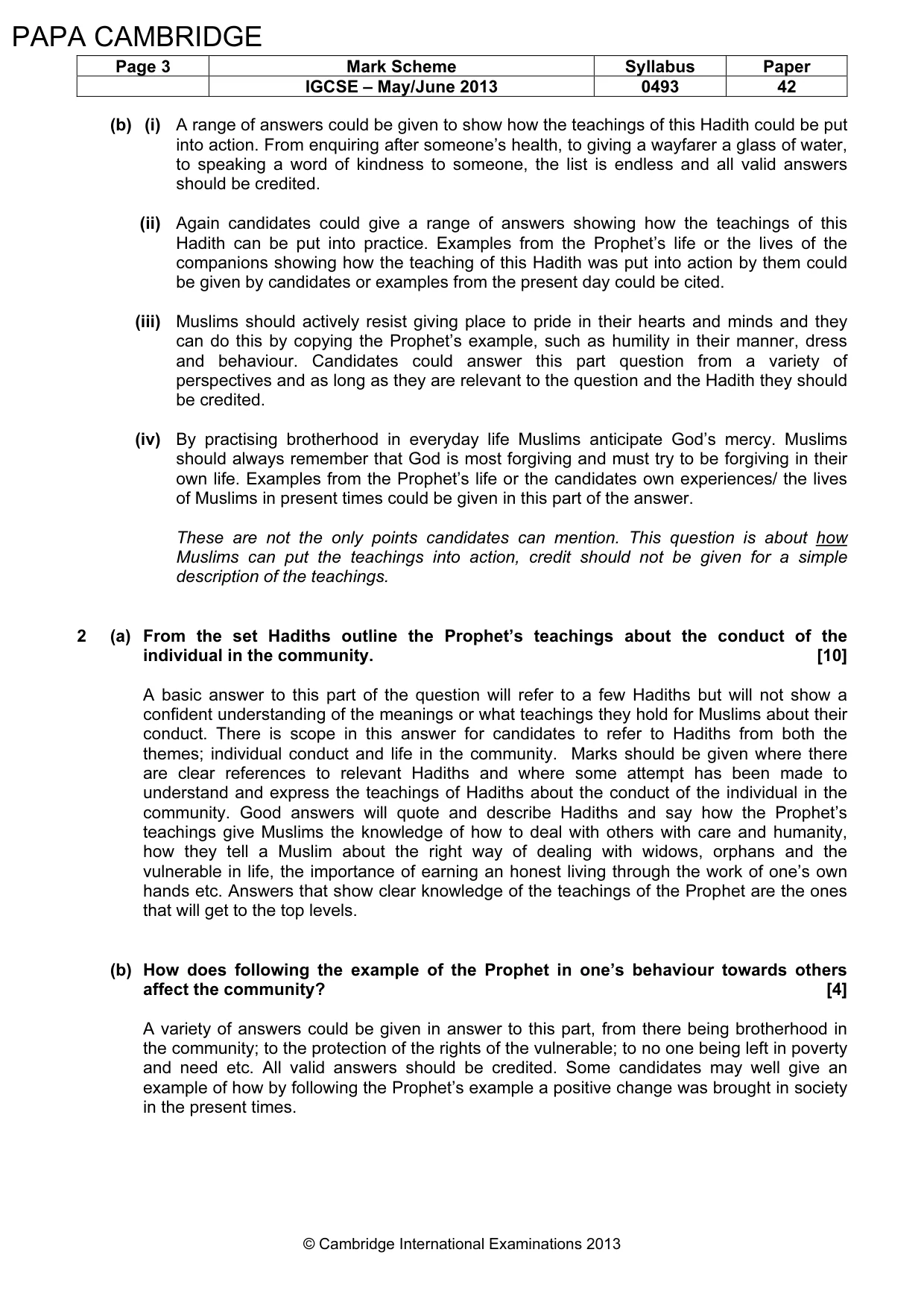
PAPA CAMBRIDGE Page 2 Mark Scheme Syllabus Paper IGCSE – May/June 2013 0493 42 © Cambridge International Examinations 2013 1 Choose any two of the following Hadiths, and: (a) Describe their teaching about what Muslims believe; [4] (b) Explain how Muslims can put these teachings into action. [4] (i) Hadith 5 Every person’s every joint must perform a charity every day the sun comes up: to act justly between two people is a charity; to help a man with his mount, lifting him onto it or hoisting up his belongings onto it is a charity; a good word is a charity; every step you take to prayers is a charity; and removing a harmful thing from the road is a charity. (ii) Hadith 9 No one eats better food than that which he eats out of the work of his hand. (iii) Hadith 18 He who has in his heart as much faith as a grain of mustard seed will not enter hell, and he who has in his heart as much pride as a grain of mustard seed will not enter paradise. (iv) Hadith 15 God will not show mercy to him who does not show mercy to others. (a) (i) Social responsibility is one of the teachings of this Hadith. Muslims should care for the needs of their fellow Muslims and everyday acts of kindness carry the reward of charity. Good answers will be able to distinguish that charity does not refer to fulfilling the material needs of others only but showing concern for fellow beings at all times. (ii) Earning honestly and lawfully through hard work is the recommendation of this Hadith. Reliance on others and begging are strongly discouraged in Islam and the teaching is to live within one’s means. (iii) Faith and pride cannot co-exist. When a person embraces Islam they submit to the will of God and shun all pride. With even a tiny amount of faith in one’s heart a person will remember God and be mindful that Muslims are answerable to him and will stop from wrong doings whereas a tiny bit of arrogance will make a person feel that everything is in their control and make them unmindful of God. (iv) The rights of fellow human beings have been stressed upon by both God and his Prophet and a Muslim’s treatment by God will depend on how they treat others.
Mark scheme, page 4
PAPA CAMBRIDGE Page 3 Mark Scheme Syllabus Paper IGCSE – May/June 2013 0493 42 © Cambridge International Examinations 2013 (b) (i) A range of answers could be given to show how the teachings of this Hadith could be put into action. From enquiring after someone’s health, to giving a wayfarer a glass of water, to speaking a word of kindness to someone, the list is endless and all valid answers should be credited. (ii) Again candidates could give a range of answers showing how the teachings of this Hadith can be put into practice. Examples from the Prophet’s life or the lives of the companions showing how the teaching of this Hadith was put into action by them could be given by candidates or examples from the present day could be cited. (iii) Muslims should actively resist giving place to pride in their hearts and minds and they can do this by copying the Prophet’s example, such as humility in their manner, dress and behaviour. Candidates could answer this part question from a variety of perspectives and as long as they are relevant to the question and the Hadith they should be credited. (iv) By practising brotherhood in everyday life Muslims anticipate God’s mercy. Muslims should always remember that God is most forgiving and must try to be forgiving in their own life. Examples from the Prophet’s life or the candidates own experiences/ the lives of Muslims in present times could be given in this part of the answer. These are not the only points candidates can mention. This question is about how Muslims can put the teachings into action, credit should not be given for a simple description of the teachings. 2 (a) From the set Hadiths outline the Prophet’s teachings about the conduct of the individual in the community. [10] A basic answer to this part of the question will refer to a few Hadiths but will not show a confident understanding of the meanings or what teachings they hold for Muslims about their conduct. There is scope in this answer for candidates to refer to Hadiths from both the themes; individual conduct and life in the community. Marks should be given where there are clear references to relevant Hadiths and where some attempt has been made to understand and express the teachings of Hadiths about the conduct of the individual in the community. Good answers will quote and describe Hadiths and say how the Prophet’s teachings give Muslims the knowledge of how to deal with others with care and humanity, how they tell a Muslim about the right way of dealing with widows, orphans and the vulnerable in life, the importance of earning an honest living through the work of one’s own hands etc. Answers that show clear knowledge of the teachings of the Prophet are the ones that will get to the top levels. (b) How does following the example of the Prophet in one’s behaviour towards others affect the community? [4] A variety of answers could be given in answer to this part, from there being brotherhood in the community; to the protection of the rights of the vulnerable; to no one being left in poverty and need etc. All valid answers should be credited. Some candidates may well give an example of how by following the Prophet’s example a positive change was brought in society in the present times.
Mark scheme, page 5
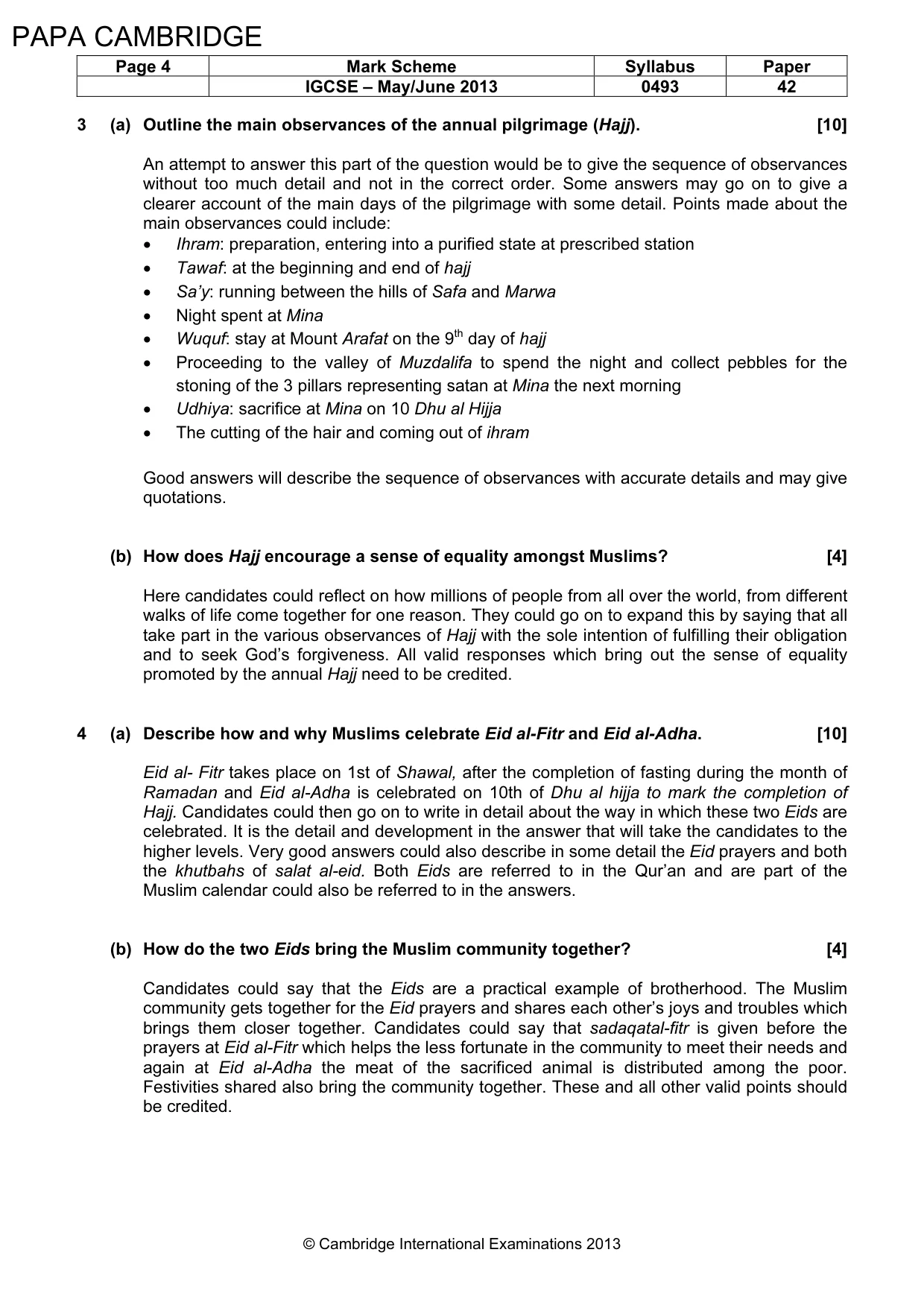
PAPA CAMBRIDGE Page 4 Mark Scheme Syllabus Paper IGCSE – May/June 2013 0493 42 © Cambridge International Examinations 2013 3 (a) Outline the main observances of the annual pilgrimage (Hajj). [10] An attempt to answer this part of the question would be to give the sequence of observances without too much detail and not in the correct order. Some answers may go on to give a clearer account of the main days of the pilgrimage with some detail. Points made about the main observances could include: • Ihram: preparation, entering into a purified state at prescribed station • Tawaf: at the beginning and end of hajj • Sa’y: running between the hills of Safa and Marwa • Night spent at Mina • Wuquf: stay at Mount Arafat on the 9th day of hajj • Proceeding to the valley of Muzdalifa to spend the night and collect pebbles for the stoning of the 3 pillars representing satan at Mina the next morning • Udhiya: sacrifice at Mina on 10 Dhu al Hijja • The cutting of the hair and coming out of ihram Good answers will describe the sequence of observances with accurate details and may give quotations. (b) How does Hajj encourage a sense of equality amongst Muslims? [4] Here candidates could reflect on how millions of people from all over the world, from different walks of life come together for one reason. They could go on to expand this by saying that all take part in the various observances of Hajj with the sole intention of fulfilling their obligation and to seek God’s forgiveness. All valid responses which bring out the sense of equality promoted by the annual Hajj need to be credited. 4 (a) Describe how and why Muslims celebrate Eid al-Fitr and Eid al-Adha. [10] Eid al- Fitr takes place on 1st of Shawal, after the completion of fasting during the month of Ramadan and Eid al-Adha is celebrated on 10th of Dhu al hijja to mark the completion of Hajj. Candidates could then go on to write in detail about the way in which these two Eids are celebrated. It is the detail and development in the answer that will take the candidates to the higher levels. Very good answers could also describe in some detail the Eid prayers and both the khutbahs of salat al-eid. Both Eids are referred to in the Qur’an and are part of the Muslim calendar could also be referred to in the answers. (b) How do the two Eids bring the Muslim community together? [4] Candidates could say that the Eids are a practical example of brotherhood. The Muslim community gets together for the Eid prayers and shares each other’s joys and troubles which brings them closer together. Candidates could say that sadaqatal-fitr is given before the prayers at Eid al-Fitr which helps the less fortunate in the community to meet their needs and again at Eid al-Adha the meat of the sacrificed animal is distributed among the poor. Festivities shared also bring the community together. These and all other valid points should be credited.
Mark scheme, page 6
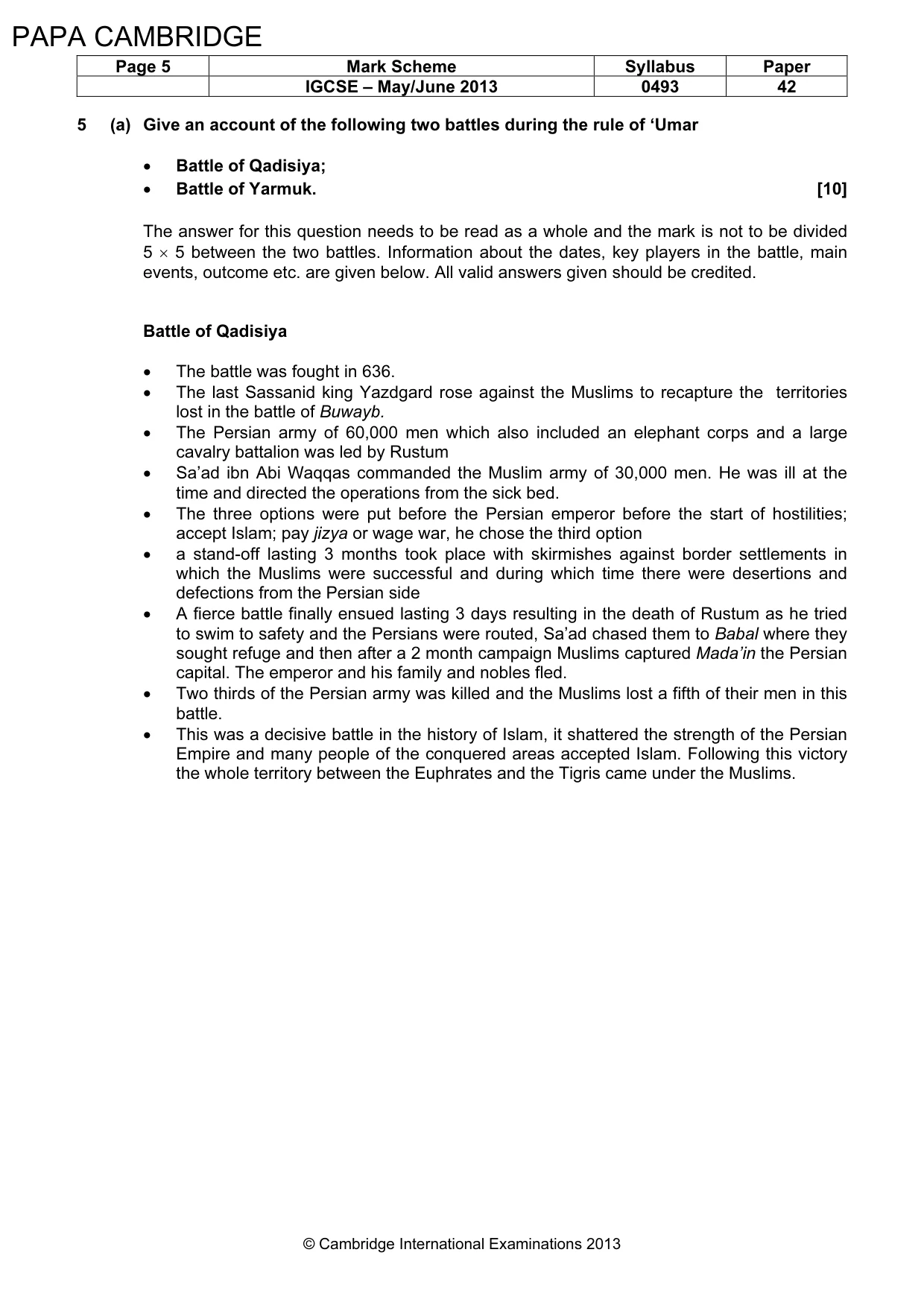
PAPA CAMBRIDGE Page 5 Mark Scheme Syllabus Paper IGCSE – May/June 2013 0493 42 © Cambridge International Examinations 2013 5 (a) Give an account of the following two battles during the rule of ‘Umar • Battle of Qadisiya; • Battle of Yarmuk. [10] The answer for this question needs to be read as a whole and the mark is not to be divided 5 × 5 between the two battles. Information about the dates, key players in the battle, main events, outcome etc. are given below. All valid answers given should be credited. Battle of Qadisiya • The battle was fought in 636. • The last Sassanid king Yazdgard rose against the Muslims to recapture the territories lost in the battle of Buwayb. • The Persian army of 60,000 men which also included an elephant corps and a large cavalry battalion was led by Rustum • Sa’ad ibn Abi Waqqas commanded the Muslim army of 30,000 men. He was ill at the time and directed the operations from the sick bed. • The three options were put before the Persian emperor before the start of hostilities; accept Islam; pay jizya or wage war, he chose the third option • a stand-off lasting 3 months took place with skirmishes against border settlements in which the Muslims were successful and during which time there were desertions and defections from the Persian side • A fierce battle finally ensued lasting 3 days resulting in the death of Rustum as he tried to swim to safety and the Persians were routed, Sa’ad chased them to Babal where they sought refuge and then after a 2 month campaign Muslims captured Mada’in the Persian capital. The emperor and his family and nobles fled. • Two thirds of the Persian army was killed and the Muslims lost a fifth of their men in this battle. • This was a decisive battle in the history of Islam, it shattered the strength of the Persian Empire and many people of the conquered areas accepted Islam. Following this victory the whole territory between the Euphrates and the Tigris came under the Muslims.
Mark scheme, page 7
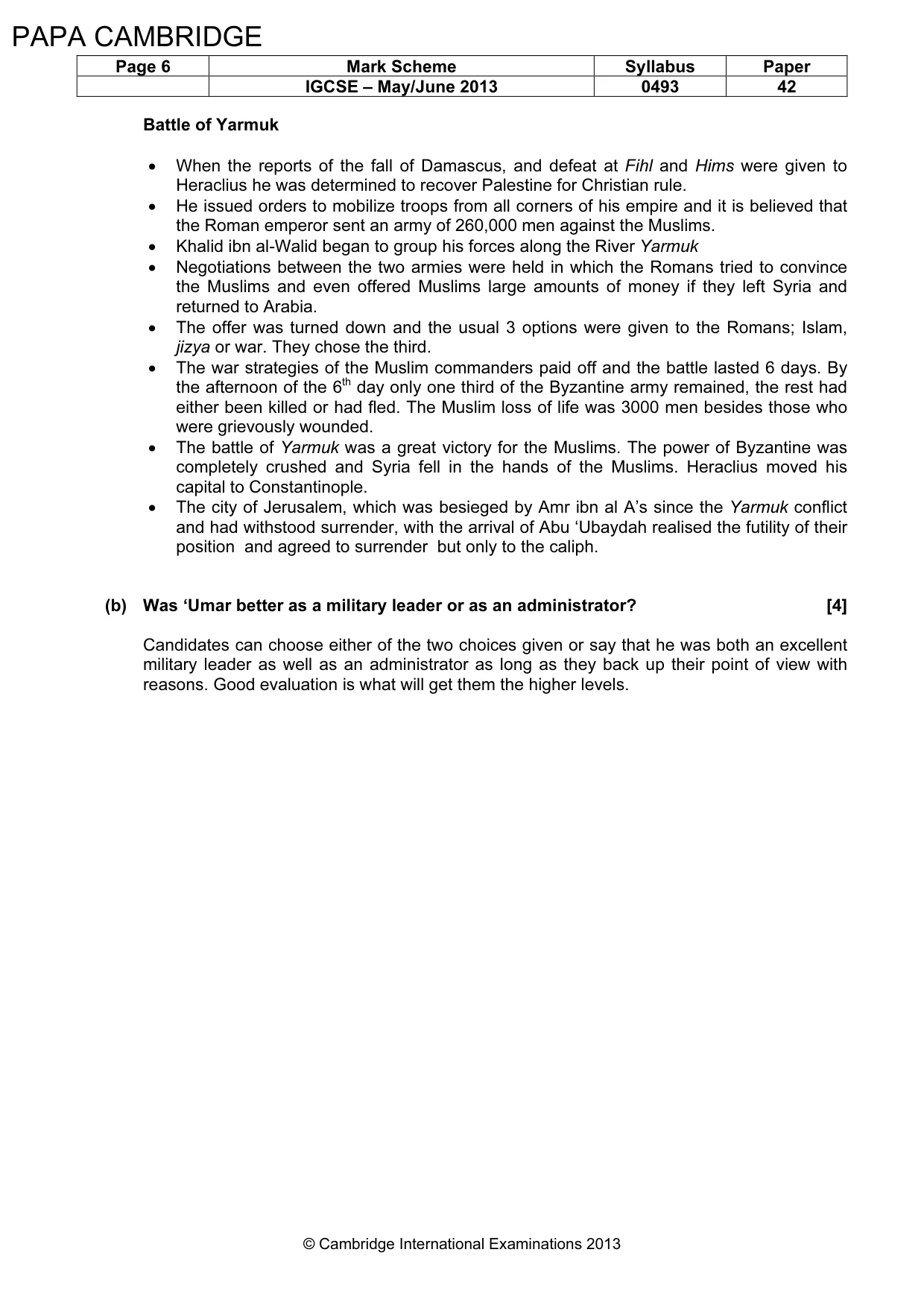
PAPA CAMBRIDGE Page 6 Mark Scheme Syllabus Paper IGCSE – May/June 2013 0493 42 © Cambridge International Examinations 2013 Battle of Yarmuk • When the reports of the fall of Damascus, and defeat at Fihl and Hims were given to Heraclius he was determined to recover Palestine for Christian rule. • He issued orders to mobilize troops from all corners of his empire and it is believed that the Roman emperor sent an army of 260,000 men against the Muslims. • Khalid ibn al-Walid began to group his forces along the River Yarmuk • Negotiations between the two armies were held in which the Romans tried to convince the Muslims and even offered Muslims large amounts of money if they left Syria and returned to Arabia. • The offer was turned down and the usual 3 options were given to the Romans; Islam, jizya or war. They chose the third. • The war strategies of the Muslim commanders paid off and the battle lasted 6 days. By the afternoon of the 6th day only one third of the Byzantine army remained, the rest had either been killed or had fled. The Muslim loss of life was 3000 men besides those who were grievously wounded. • The battle of Yarmuk was a great victory for the Muslims. The power of Byzantine was completely crushed and Syria fell in the hands of the Muslims. Heraclius moved his capital to Constantinople. • The city of Jerusalem, which was besieged by Amr ibn al A’s since the Yarmuk conflict and had withstood surrender, with the arrival of Abu ‘Ubaydah realised the futility of their position and agreed to surrender but only to the caliph. (b) Was ‘Umar better as a military leader or as an administrator? [4] Candidates can choose either of the two choices given or say that he was both an excellent military leader as well as an administrator as long as they back up their point of view with reasons. Good evaluation is what will get them the higher levels.
What you needed in this session
Cambridge’s own grade thresholds for 2013 May/June, Paper 4 · Variant 2. A higher threshold means an easier paper — the bar moves with how the cohort did.