Cambridge IGCSE Islamiyat 0493 — 2013 May/June Paper 2 · Variant 1
0493/21/M/J/13 · 50 marks · ≈56 min
The question paper and its mark scheme, free to read here and free to download. This is Cambridge’s own paper, exactly as it was sat.
Question paper17 pages
Mark scheme6 pages
Answers below. Sit the paper first if you are practising.
Paper as text
Question paper, page 1
PAPA CAMBRIDGE UNIVERSITY OF CAMBRIDGE INTERNATIONAL EXAMINATIONS International General Certificate of Secondary Education 0493 ISLAMIYAT 0493/02 Paper 2 Due to a security breach we required all candidates in Pakistan who sat the paper for 0493/02 to attend a re-sit examination in June 2013. Candidates outside of Pakistan sat only the original paper and were not involved in a re-sit.
Question paper, page 2
PAPA CAMBRIDGE This document consists of 16 printed pages. DC (DAK/JF) 75665 © UCLES 2013 [Turn over UNIVERSITY OF CAMBRIDGE INTERNATIONAL EXAMINATIONS International General Certificate of Secondary Education * 3 3 3 0 8 0 2 1 2 5 * ISLAMIYAT 0493/02 Paper 2 May/June 2013 1 hour 30 minutes Candidates answer on the Question Paper. No Additional Materials are required. READ THESE INSTRUCTIONS FIRST Write your Centre number, candidate number and name on all the work you hand in. Write in dark blue or black pen on both sides of the paper. Do not use staples, paper clips, highlighters, glue or correction fluid. DO NOT WRITE IN ANY BARCODES. Answer Question 1, Question 2 and two other questions. All answers must be in continuous prose. At the end of the examination, fasten all your work securely together. The number of marks is given in brackets [ ] at the end of each question or part question. For Examiner’s Use 1 2 3 4 5 Total
Question paper, page 3
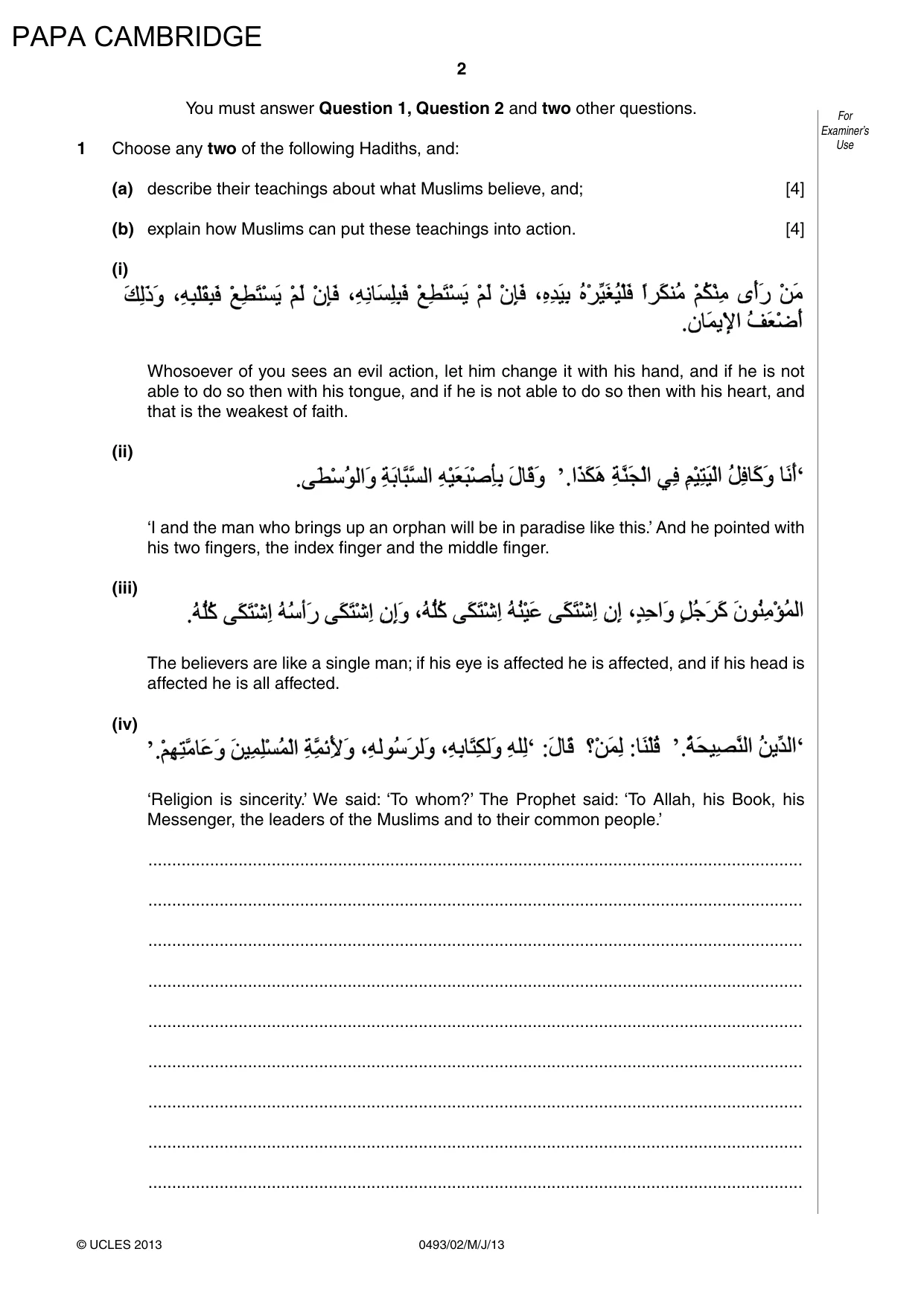
PAPA CAMBRIDGE 2 0493/02/M/J/13 © UCLES 2013 For Examiner’s Use You must answer Question 1, Question 2 and two other questions. 1 Choose any two of the following Hadiths, and: (a) describe their teachings about what Muslims believe, and; [4] (b) explain how Muslims can put these teachings into action. [4] (i) Whosoever of you sees an evil action, let him change it with his hand, and if he is not able to do so then with his tongue, and if he is not able to do so then with his heart, and that is the weakest of faith. (ii) ‘I and the man who brings up an orphan will be in paradise like this.’ And he pointed with his two fingers, the index finger and the middle finger. (iii) The believers are like a single man; if his eye is affected he is affected, and if his head is affected he is all affected. (iv) ‘Religion is sincerity.’ We said: ‘To whom?’ The Prophet said: ‘To Allah, his Book, his Messenger, the leaders of the Muslims and to their common people.’ … … … … … … … … …
Question paper, page 4
PAPA CAMBRIDGE 3 0493/02/M/J/13 © UCLES 2013 [Turn over For Examiner’s Use … … … … … … … … … … … … … … … … … … … … … … … … … … … …
Question paper, page 5
PAPA CAMBRIDGE 4 0493/02/M/J/13 © UCLES 2013 For Examiner’s Use … … … … … … … … … … … … … … … … … … … … … … … … … … … …
Question paper, page 6
PAPA CAMBRIDGE 5 0493/02/M/J/13 © UCLES 2013 [Turn over For Examiner’s Use 2 (a) Why do Muslims need to know about the Prophet’s Hadiths and what benefit do they hope to get by following his sunna? [10] (b) Briefly discuss why the need arose during the early Islamic period to compile the Hadiths of the Prophet. [4] … … … … … … … … … … … … … … … … … … … … … … … … …
Question paper, page 7
PAPA CAMBRIDGE 6 0493/02/M/J/13 © UCLES 2013 For Examiner’s Use … … … … … … … … … … … … … … … … … … … … … … … … … … … …
Question paper, page 8
PAPA CAMBRIDGE 7 0493/02/M/J/13 © UCLES 2013 [Turn over For Examiner’s Use … … … … … … … … … … … … … … … … … … … … … … … … … … … …
Question paper, page 9
PAPA CAMBRIDGE 8 0493/02/M/J/13 © UCLES 2013 For Examiner’s Use 3 (a) Which important battles were fought during the caliphate of ‘Ali? Write a descriptive account of each. [10] (b) ‘ ‘Ali was the right ruler for the time’. Briefly discuss this statement. [4] … … … … … … … … … … … … … … … … … … … … … … … … … …
Question paper, page 10
PAPA CAMBRIDGE 9 0493/02/M/J/13 © UCLES 2013 [Turn over For Examiner’s Use … … … … … … … … … … … … … … … … … … … … … … … … … … … …
Question paper, page 11
PAPA CAMBRIDGE 10 0493/02/M/J/13 © UCLES 2013 For Examiner’s Use … … … … … … … … … … … … … … … … … … … … … … … … … … … …
Question paper, page 12
PAPA CAMBRIDGE 11 0493/02/M/J/13 © UCLES 2013 [Turn over For Examiner’s Use 4 (a) Outline the Muslim teaching about belief in the oneness of God (tawhid). [10] (b) Why is associating partners with God (shirk) regarded as a great sin? [4] … … … … … … … … … … … … … … … … … … … … … … … … … …
Question paper, page 13
PAPA CAMBRIDGE 12 0493/02/M/J/13 © UCLES 2013 For Examiner’s Use … … … … … … … … … … … … … … … … … … … … … … … … … … … …
Question paper, page 14
PAPA CAMBRIDGE 13 0493/02/M/J/13 © UCLES 2013 [Turn over For Examiner’s Use … … … … … … … … … … … … … … … … … … … … … … … … … … … …
Question paper, page 15
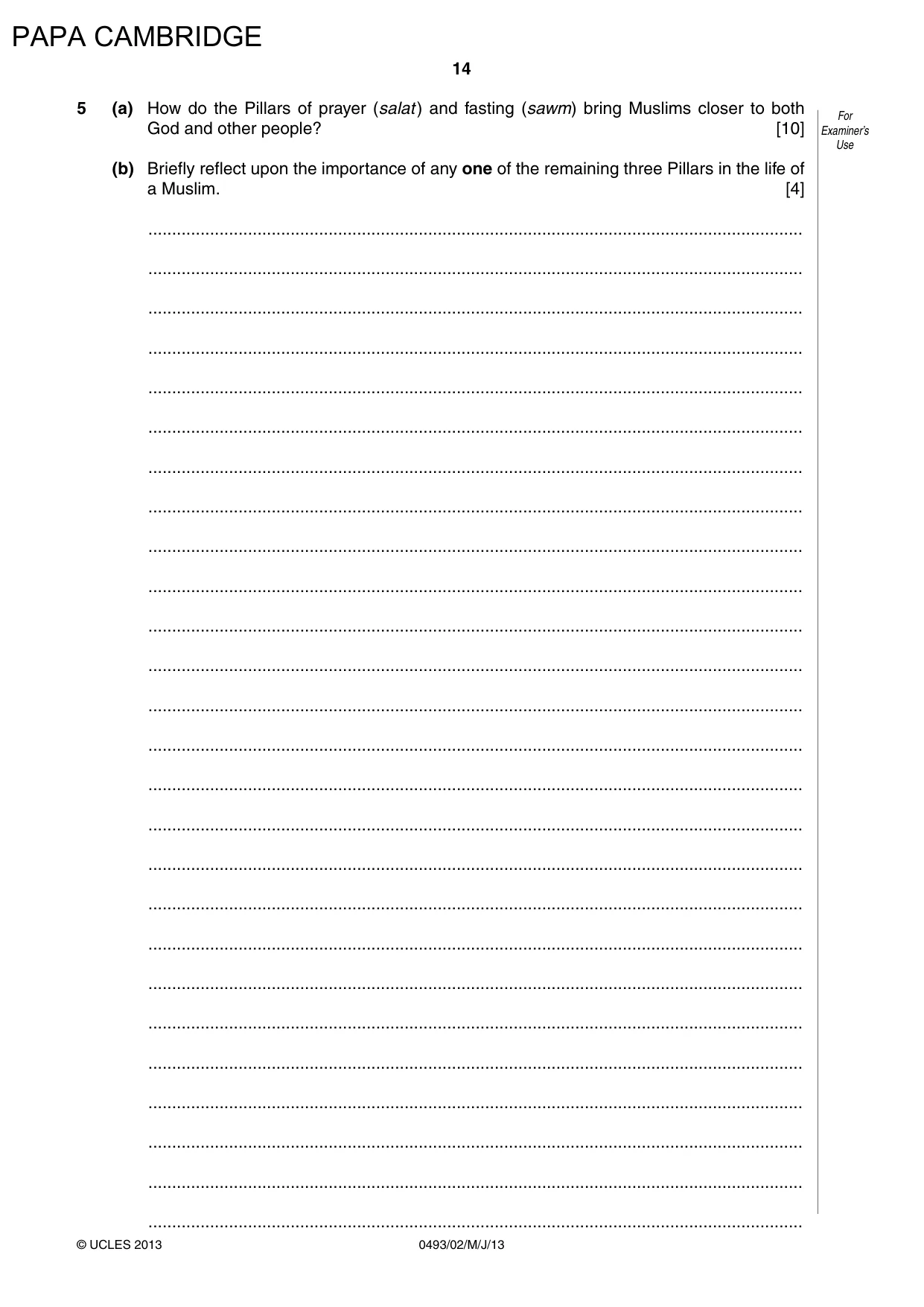
PAPA CAMBRIDGE 14 0493/02/M/J/13 © UCLES 2013 For Examiner’s Use 5 (a) How do the Pillars of prayer (salat ) and fasting (sawm) bring Muslims closer to both God and other people? [10] (b) Briefly reflect upon the importance of any one of the remaining three Pillars in the life of a Muslim. [4] … … … … … … … … … … … … … … … … … … … … … … … … … …
Question paper, page 16
PAPA CAMBRIDGE 15 0493/02/M/J/13 © UCLES 2013 [Turn over For Examiner’s Use … … … … … … … … … … … … … … … … … … … … … … … … … … … …
Question paper, page 17
PAPA CAMBRIDGE 16 0493/02/M/J/13 © UCLES 2013 For Examiner’s Use Permission to reproduce items where third-party owned material protected by copyright is included has been sought and cleared where possible. Every reasonable effort has been made by the publisher (UCLES) to trace copyright holders, but if any items requiring clearance have unwittingly been included, the publisher will be pleased to make amends at the earliest possible opportunity. University of Cambridge International Examinations is part of the Cambridge Assessment Group. Cambridge Assessment is the brand name of University of Cambridge Local Examinations Syndicate (UCLES), which is itself a department of the University of Cambridge. … … … … … … … … … … … … … … … … … … … … … … … … …
Mark scheme, page 1
PAPA CAMBRIDGE UNIVERSITY OF CAMBRIDGE INTERNATIONAL EXAMINATIONS International General Certificate of Secondary Education 0493 ISLAMIYAT 0493/02 Paper 2 Due to a security breach we required all candidates in Pakistan who sat the paper for 0493/02 to attend a re-sit examination in June 2013. Candidates outside of Pakistan sat only the original paper and were not involved in a re-sit.
Mark scheme, page 2
PAPA CAMBRIDGE CAMBRIDGE INTERNATIONAL EXAMINATIONS International General Certificate of Secondary Education MARK SCHEME for the May/June 2013 series 0493 ISLAMIYAT 0493/02 Paper 2, maximum raw mark 50 This mark scheme is published as an aid to teachers and candidates, to indicate the requirements of the examination. It shows the basis on which Examiners were instructed to award marks. It does not indicate the details of the discussions that took place at an Examiners’ meeting before marking began, which would have considered the acceptability of alternative answers. Mark schemes should be read in conjunction with the question paper and the Principal Examiner Report for Teachers. Cambridge will not enter into discussions about these mark schemes. Cambridge is publishing the mark schemes for the May/June 2013 series for most IGCSE, GCE Advanced Level and Advanced Subsidiary Level components and some Ordinary Level components.
Mark scheme, page 3
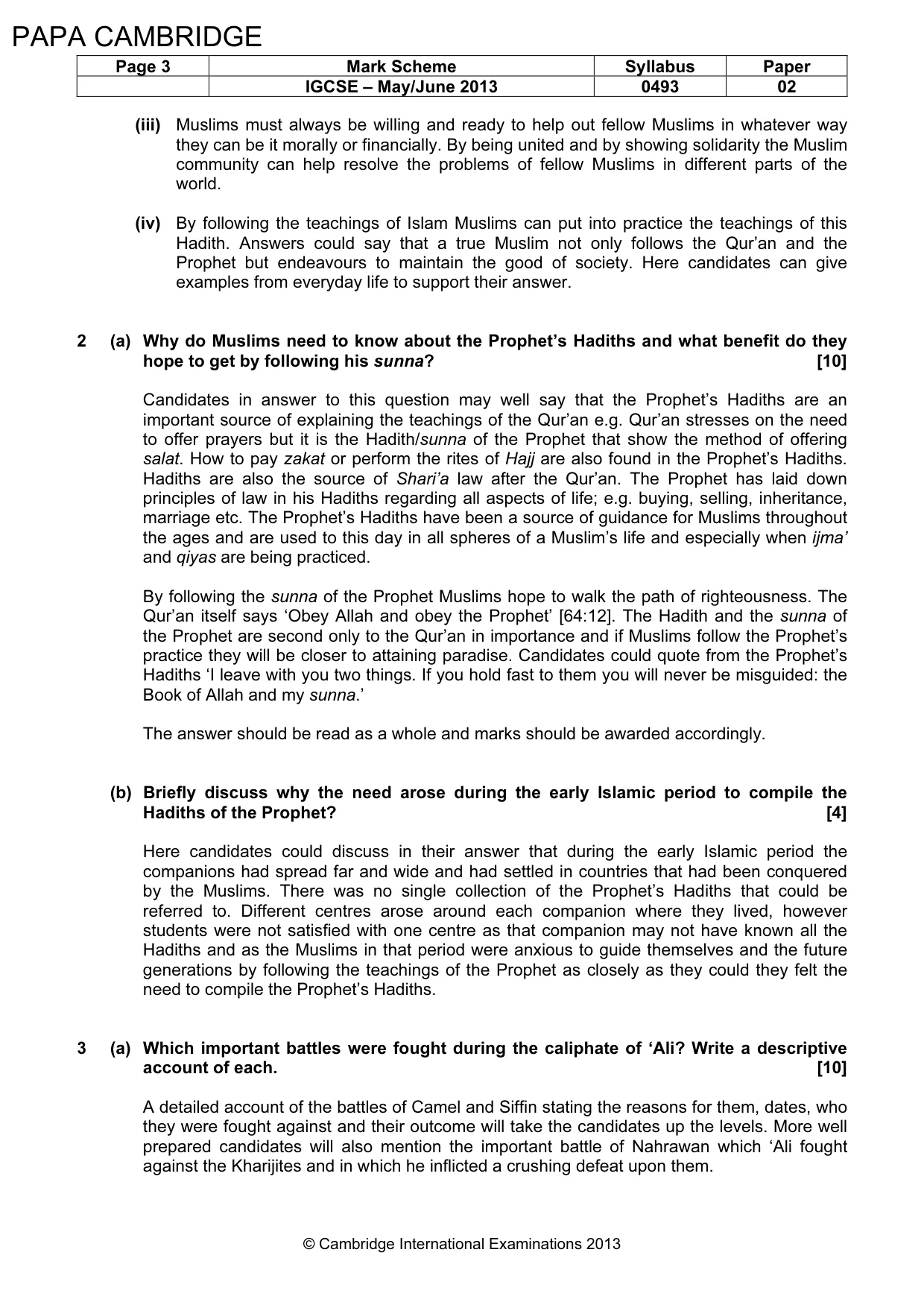
PAPA CAMBRIDGE Page 2 Mark Scheme Syllabus Paper IGCSE – May/June 2013 0493 02 © Cambridge International Examinations 2013 1 Choose any two of the following Hadiths, and: (a) Describe their teaching about what Muslims believe; [4] (b) Explain how Muslims can put these teachings into action. [4] (i) Whosoever of you sees an evil action, let him change it with his hand, and if he is not able to do so then with his tongue, and if he is not able to do so then with his heart, and that is the weakest of faith. (ii) ‘I and the man who brings up an orphan will be in paradise like this’. And he pointed with his two fingers, the index finger and the middle finger. (iii) The believers are like a single man; if his eye is affected he is affected, and if his head is affected he is all affected. (iv) ‘Religion is sincerity’. We said: ‘To whom?’ The Prophet said: ‘To Allah, His Book, His Messenger, the leaders of the Muslims and to their common people. (a) (i) The main teaching of this Hadith is that Muslims should not allow evil to take place in any circumstance and when they do see it taking place they should do all that is in their power to stop it. This they can do by any lawful means available to them and if they are unable to prevent it from taking place they should not give in to its power and at the very least always condemn it. (ii) The Prophet has promised a great reward for those who care for orphans and look after their needs in this Hadith. Those Muslims who follow the Prophet’s recommendation of caring for orphans will find themselves close to the Prophet in Paradise. (iii) Brotherhood is a key element in Muslim belief. The essence of this Hadith is to teach Muslims about community relations and how they should feel and act towards fellow believers. Some answers could draw comparisons with the Hadith to state that just as the head is the command centre and thus vital to humans, brotherhood is essential to all Muslims. Others could write about how Muslims are joined in brotherhood by their common faith and the sufferings of one affects the community as a whole. (iv) The all important teaching of this Hadith is that Muslims must follow the teachings of Islam. Answers which are likely to get to the higher levels may well give an insight into the elements of the Hadith by stating that Muslims must be loyal to the basic teachings of Islam and whilst sincerely following the five pillars should be sensitive to the needs of other believers and at the same time be loyal members of their community. (b) (i) A Muslims fight against evil should never stop, they should fight the evil confronting them using their hands, or voices or even their thoughts. The fight against evil involves many methods and they could be given in the answer. Examples from everyday life could be cited by candidates to show how Muslims can or are resisting the evil they face. (ii) Muslims must always be willing to look after the needs of orphans and do whatever they can to help them. Examples of sponsoring orphans in different parts of the world through aid agencies could be given or other examples that reflect the care and support given to them in society or in the candidate’s personal life could be cited here.
Mark scheme, page 4
PAPA CAMBRIDGE Page 3 Mark Scheme Syllabus Paper IGCSE – May/June 2013 0493 02 © Cambridge International Examinations 2013 (iii) Muslims must always be willing and ready to help out fellow Muslims in whatever way they can be it morally or financially. By being united and by showing solidarity the Muslim community can help resolve the problems of fellow Muslims in different parts of the world. (iv) By following the teachings of Islam Muslims can put into practice the teachings of this Hadith. Answers could say that a true Muslim not only follows the Qur’an and the Prophet but endeavours to maintain the good of society. Here candidates can give examples from everyday life to support their answer. 2 (a) Why do Muslims need to know about the Prophet’s Hadiths and what benefit do they hope to get by following his sunna? [10] Candidates in answer to this question may well say that the Prophet’s Hadiths are an important source of explaining the teachings of the Qur’an e.g. Qur’an stresses on the need to offer prayers but it is the Hadith/sunna of the Prophet that show the method of offering salat. How to pay zakat or perform the rites of Hajj are also found in the Prophet’s Hadiths. Hadiths are also the source of Shari’a law after the Qur’an. The Prophet has laid down principles of law in his Hadiths regarding all aspects of life; e.g. buying, selling, inheritance, marriage etc. The Prophet’s Hadiths have been a source of guidance for Muslims throughout the ages and are used to this day in all spheres of a Muslim’s life and especially when ijma’ and qiyas are being practiced. By following the sunna of the Prophet Muslims hope to walk the path of righteousness. The Qur’an itself says ‘Obey Allah and obey the Prophet’ [64:12]. The Hadith and the sunna of the Prophet are second only to the Qur’an in importance and if Muslims follow the Prophet’s practice they will be closer to attaining paradise. Candidates could quote from the Prophet’s Hadiths ‘I leave with you two things. If you hold fast to them you will never be misguided: the Book of Allah and my sunna.’ The answer should be read as a whole and marks should be awarded accordingly. (b) Briefly discuss why the need arose during the early Islamic period to compile the Hadiths of the Prophet? [4] Here candidates could discuss in their answer that during the early Islamic period the companions had spread far and wide and had settled in countries that had been conquered by the Muslims. There was no single collection of the Prophet’s Hadiths that could be referred to. Different centres arose around each companion where they lived, however students were not satisfied with one centre as that companion may not have known all the Hadiths and as the Muslims in that period were anxious to guide themselves and the future generations by following the teachings of the Prophet as closely as they could they felt the need to compile the Prophet’s Hadiths. 3 (a) Which important battles were fought during the caliphate of ‘Ali? Write a descriptive account of each. [10] A detailed account of the battles of Camel and Siffin stating the reasons for them, dates, who they were fought against and their outcome will take the candidates up the levels. More well prepared candidates will also mention the important battle of Nahrawan which ‘Ali fought against the Kharijites and in which he inflicted a crushing defeat upon them.
Mark scheme, page 5
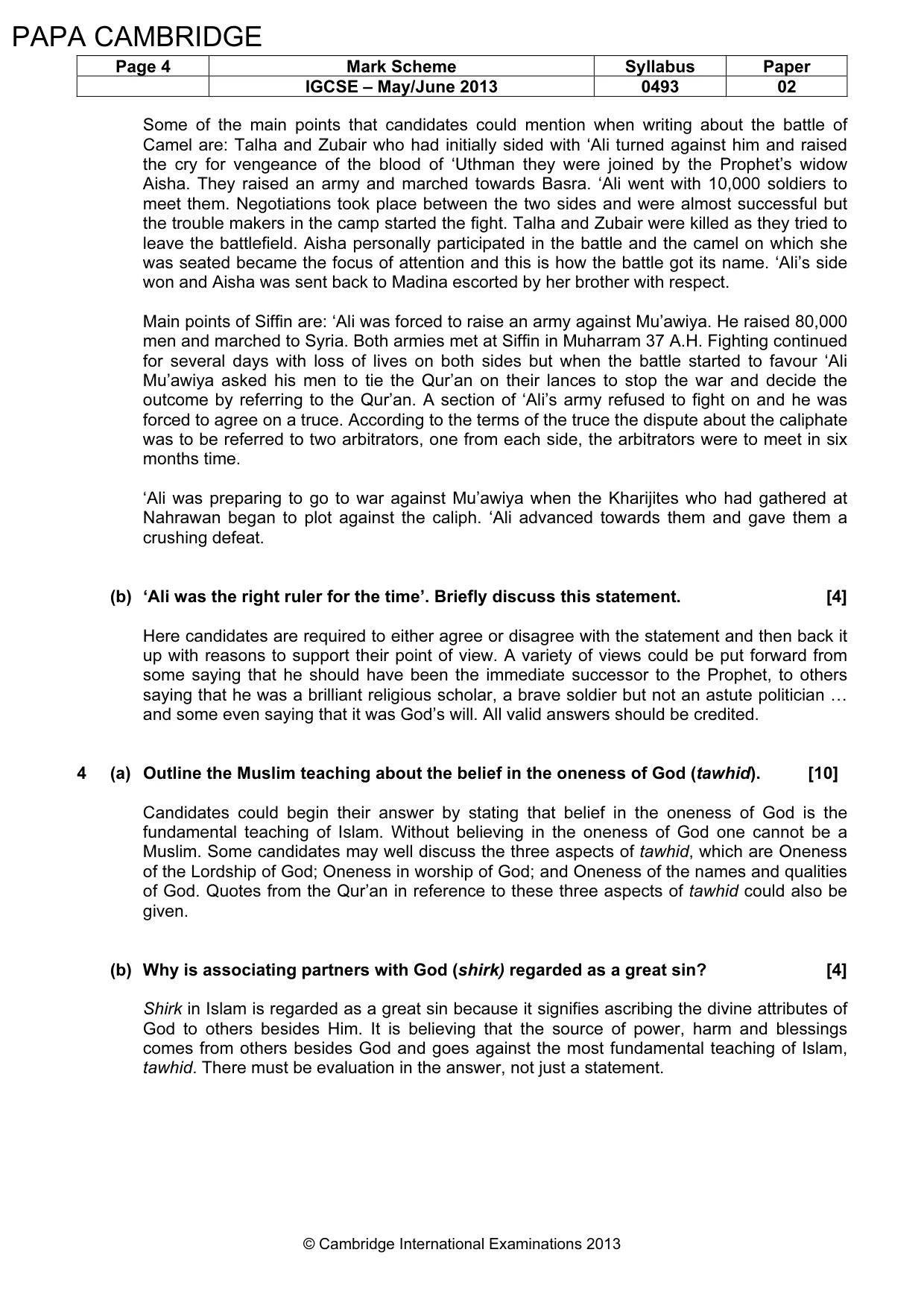
PAPA CAMBRIDGE Page 4 Mark Scheme Syllabus Paper IGCSE – May/June 2013 0493 02 © Cambridge International Examinations 2013 Some of the main points that candidates could mention when writing about the battle of Camel are: Talha and Zubair who had initially sided with ‘Ali turned against him and raised the cry for vengeance of the blood of ‘Uthman they were joined by the Prophet’s widow Aisha. They raised an army and marched towards Basra. ‘Ali went with 10,000 soldiers to meet them. Negotiations took place between the two sides and were almost successful but the trouble makers in the camp started the fight. Talha and Zubair were killed as they tried to leave the battlefield. Aisha personally participated in the battle and the camel on which she was seated became the focus of attention and this is how the battle got its name. ‘Ali’s side won and Aisha was sent back to Madina escorted by her brother with respect. Main points of Siffin are: ‘Ali was forced to raise an army against Mu’awiya. He raised 80,000 men and marched to Syria. Both armies met at Siffin in Muharram 37 A.H. Fighting continued for several days with loss of lives on both sides but when the battle started to favour ‘Ali Mu’awiya asked his men to tie the Qur’an on their lances to stop the war and decide the outcome by referring to the Qur’an. A section of ‘Ali’s army refused to fight on and he was forced to agree on a truce. According to the terms of the truce the dispute about the caliphate was to be referred to two arbitrators, one from each side, the arbitrators were to meet in six months time. ‘Ali was preparing to go to war against Mu’awiya when the Kharijites who had gathered at Nahrawan began to plot against the caliph. ‘Ali advanced towards them and gave them a crushing defeat. (b) ‘Ali was the right ruler for the time’. Briefly discuss this statement. [4] Here candidates are required to either agree or disagree with the statement and then back it up with reasons to support their point of view. A variety of views could be put forward from some saying that he should have been the immediate successor to the Prophet, to others saying that he was a brilliant religious scholar, a brave soldier but not an astute politician … and some even saying that it was God’s will. All valid answers should be credited. 4 (a) Outline the Muslim teaching about the belief in the oneness of God (tawhid). [10] Candidates could begin their answer by stating that belief in the oneness of God is the fundamental teaching of Islam. Without believing in the oneness of God one cannot be a Muslim. Some candidates may well discuss the three aspects of tawhid, which are Oneness of the Lordship of God; Oneness in worship of God; and Oneness of the names and qualities of God. Quotes from the Qur’an in reference to these three aspects of tawhid could also be given. (b) Why is associating partners with God (shirk) regarded as a great sin? [4] Shirk in Islam is regarded as a great sin because it signifies ascribing the divine attributes of God to others besides Him. It is believing that the source of power, harm and blessings comes from others besides God and goes against the most fundamental teaching of Islam, tawhid. There must be evaluation in the answer, not just a statement.
Mark scheme, page 6
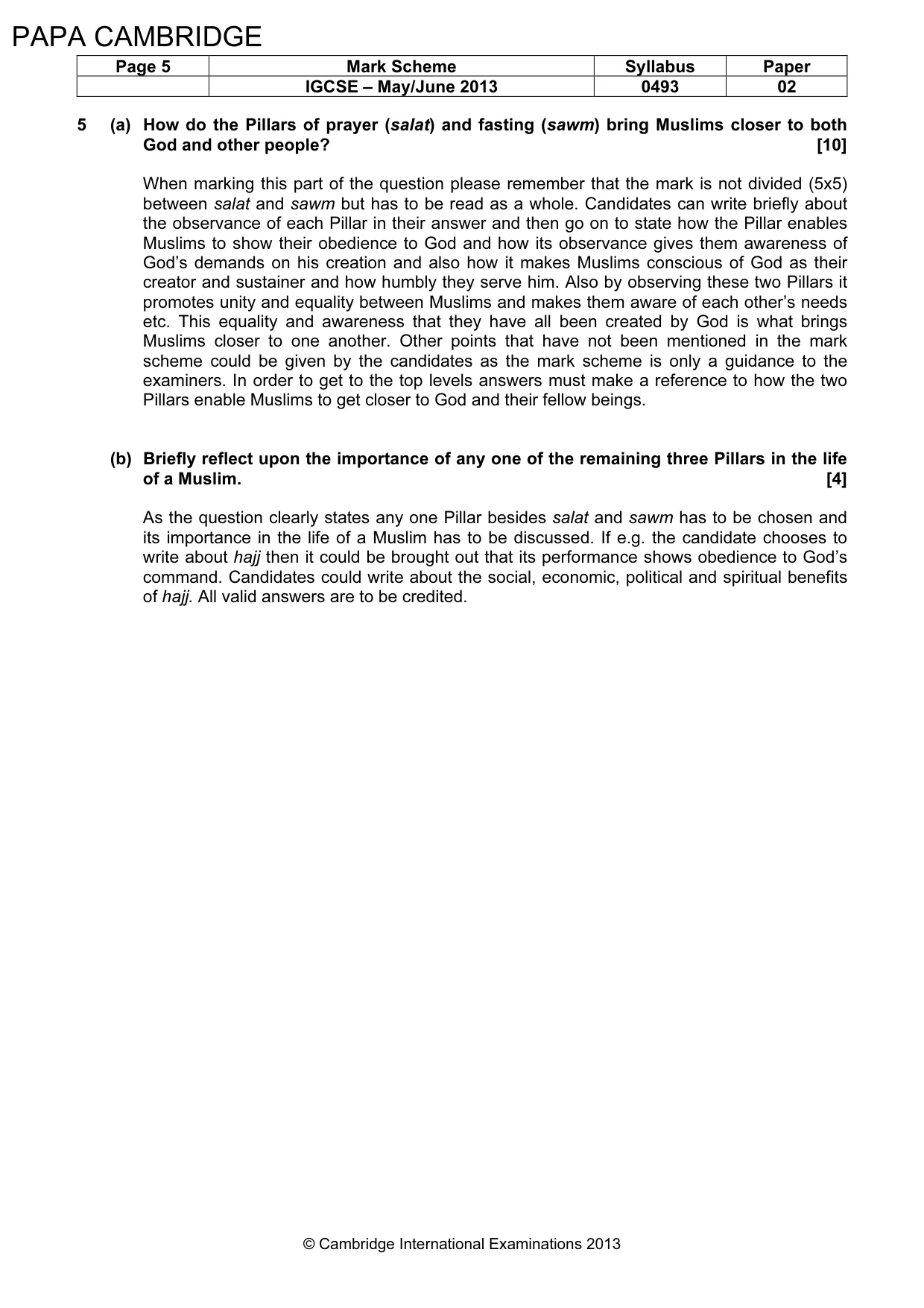
PAPA CAMBRIDGE Page 5 Mark Scheme Syllabus Paper IGCSE – May/June 2013 0493 02 © Cambridge International Examinations 2013 5 (a) How do the Pillars of prayer (salat) and fasting (sawm) bring Muslims closer to both God and other people? [10] When marking this part of the question please remember that the mark is not divided (5x5) between salat and sawm but has to be read as a whole. Candidates can write briefly about the observance of each Pillar in their answer and then go on to state how the Pillar enables Muslims to show their obedience to God and how its observance gives them awareness of God’s demands on his creation and also how it makes Muslims conscious of God as their creator and sustainer and how humbly they serve him. Also by observing these two Pillars it promotes unity and equality between Muslims and makes them aware of each other’s needs etc. This equality and awareness that they have all been created by God is what brings Muslims closer to one another. Other points that have not been mentioned in the mark scheme could be given by the candidates as the mark scheme is only a guidance to the examiners. In order to get to the top levels answers must make a reference to how the two Pillars enable Muslims to get closer to God and their fellow beings. (b) Briefly reflect upon the importance of any one of the remaining three Pillars in the life of a Muslim. [4] As the question clearly states any one Pillar besides salat and sawm has to be chosen and its importance in the life of a Muslim has to be discussed. If e.g. the candidate chooses to write about hajj then it could be brought out that its performance shows obedience to God’s command. Candidates could write about the social, economic, political and spiritual benefits of hajj. All valid answers are to be credited.
What you needed in this session
Cambridge’s own grade thresholds for 2013 May/June, Paper 2 · Variant 1. A higher threshold means an easier paper — the bar moves with how the cohort did.