Cambridge IGCSE History BES 0416 — 2018 Oct/Nov Paper 1 · Variant 3
0416/13/O/N/18 · 60 marks · ≈68 min
The question paper and its mark scheme, free to read here and free to download. This is Cambridge’s own paper, exactly as it was sat.
Question paper12 pages


Mark scheme74 pages
Answers below. Sit the paper first if you are practising.
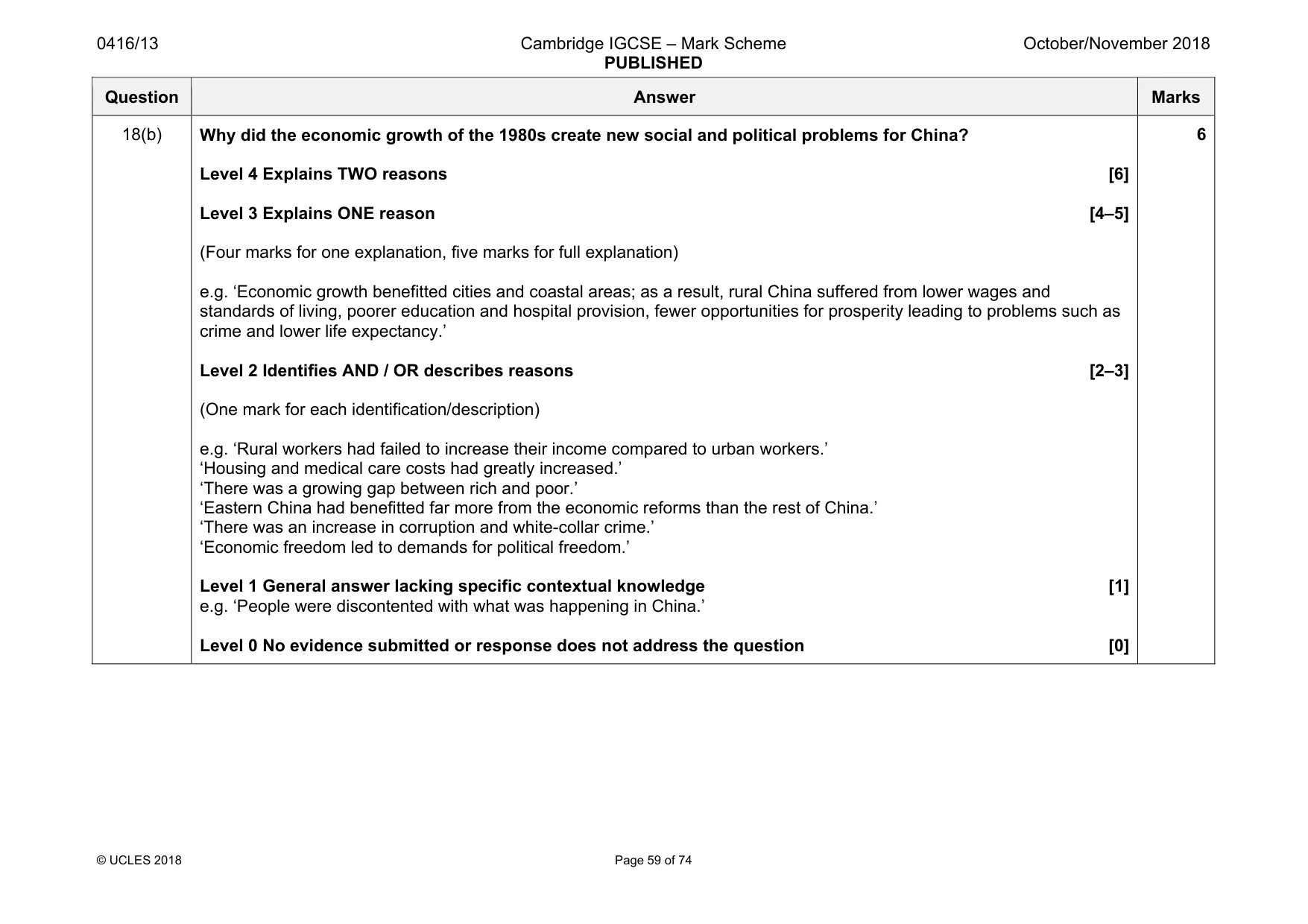
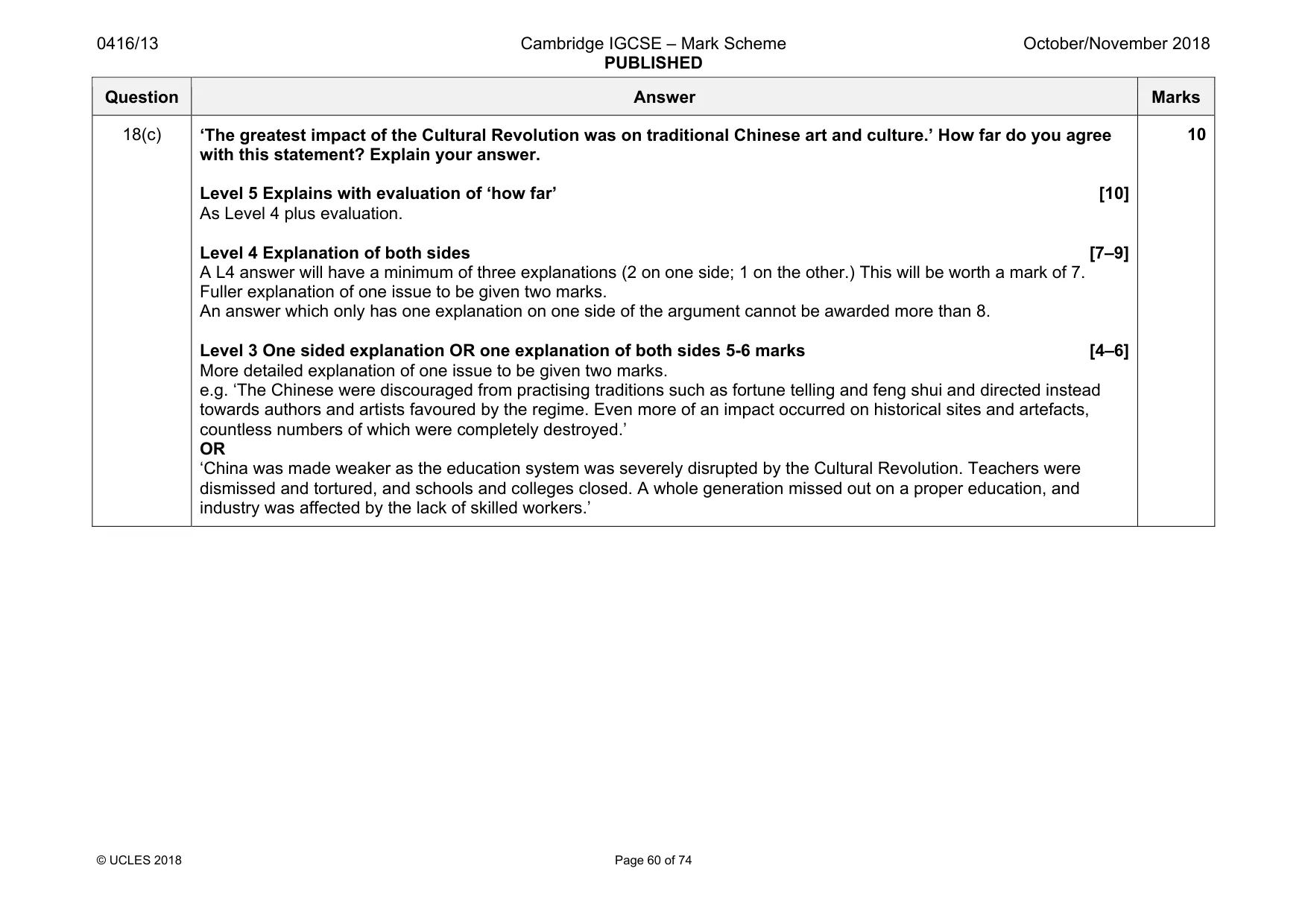
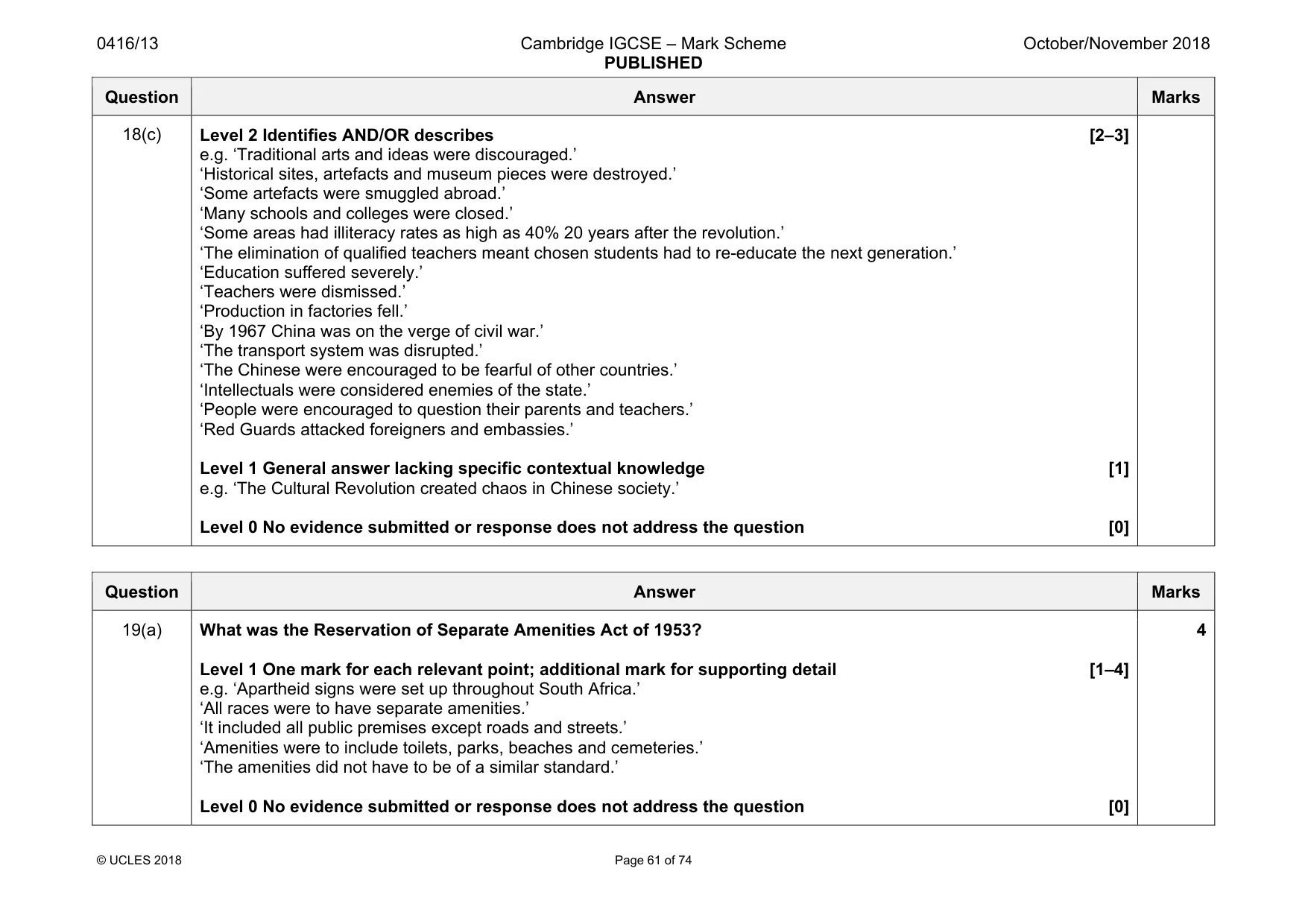
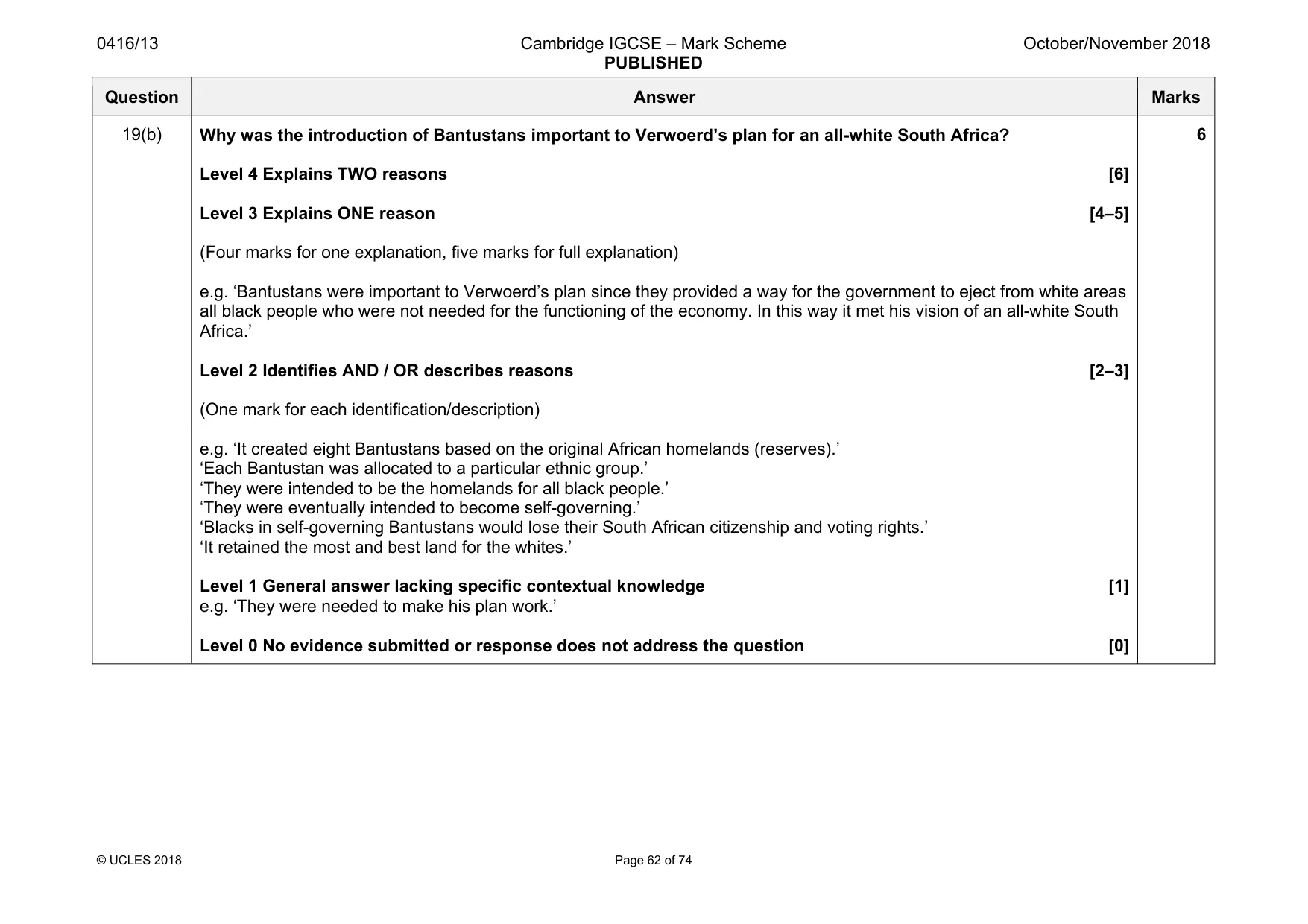
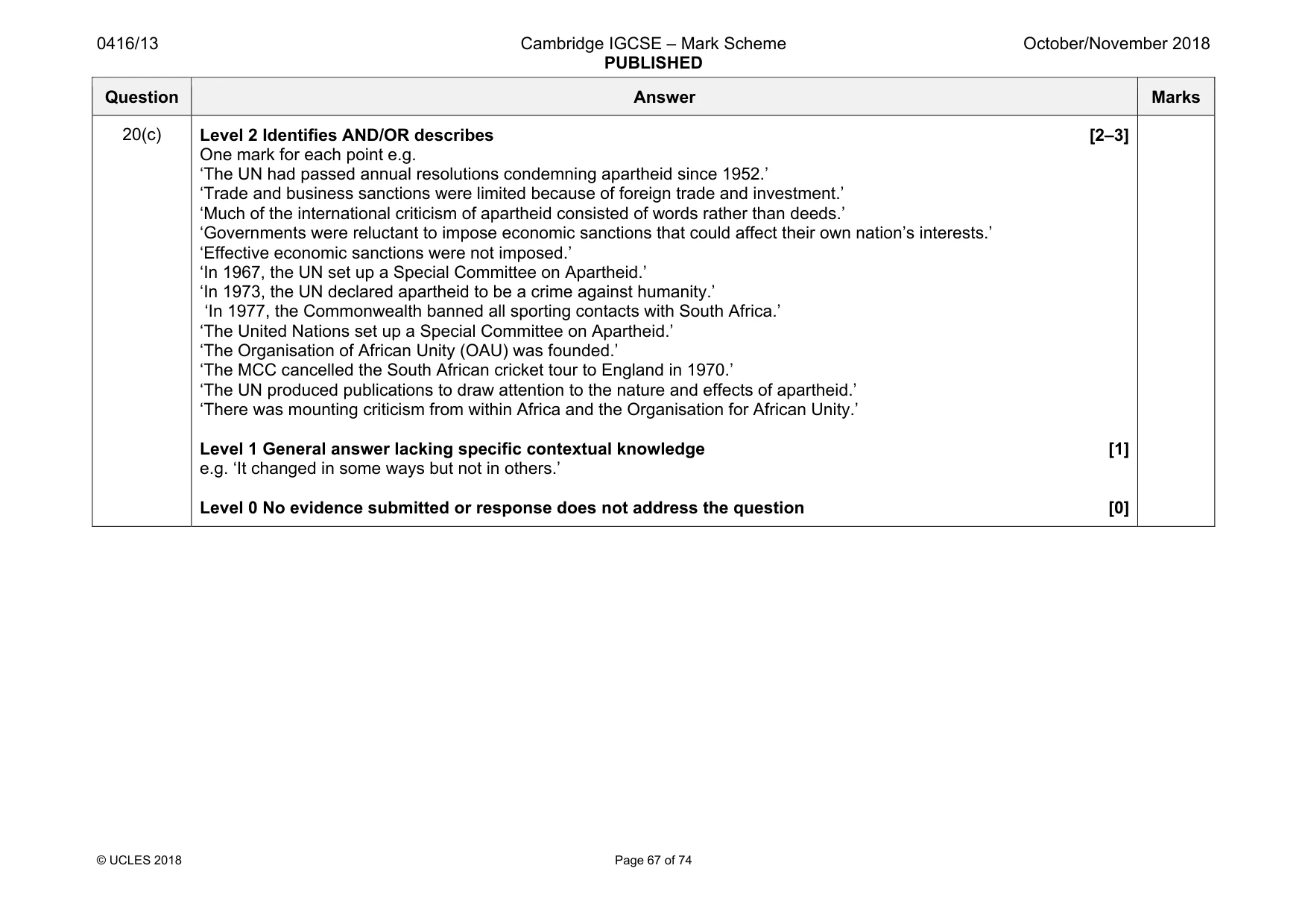
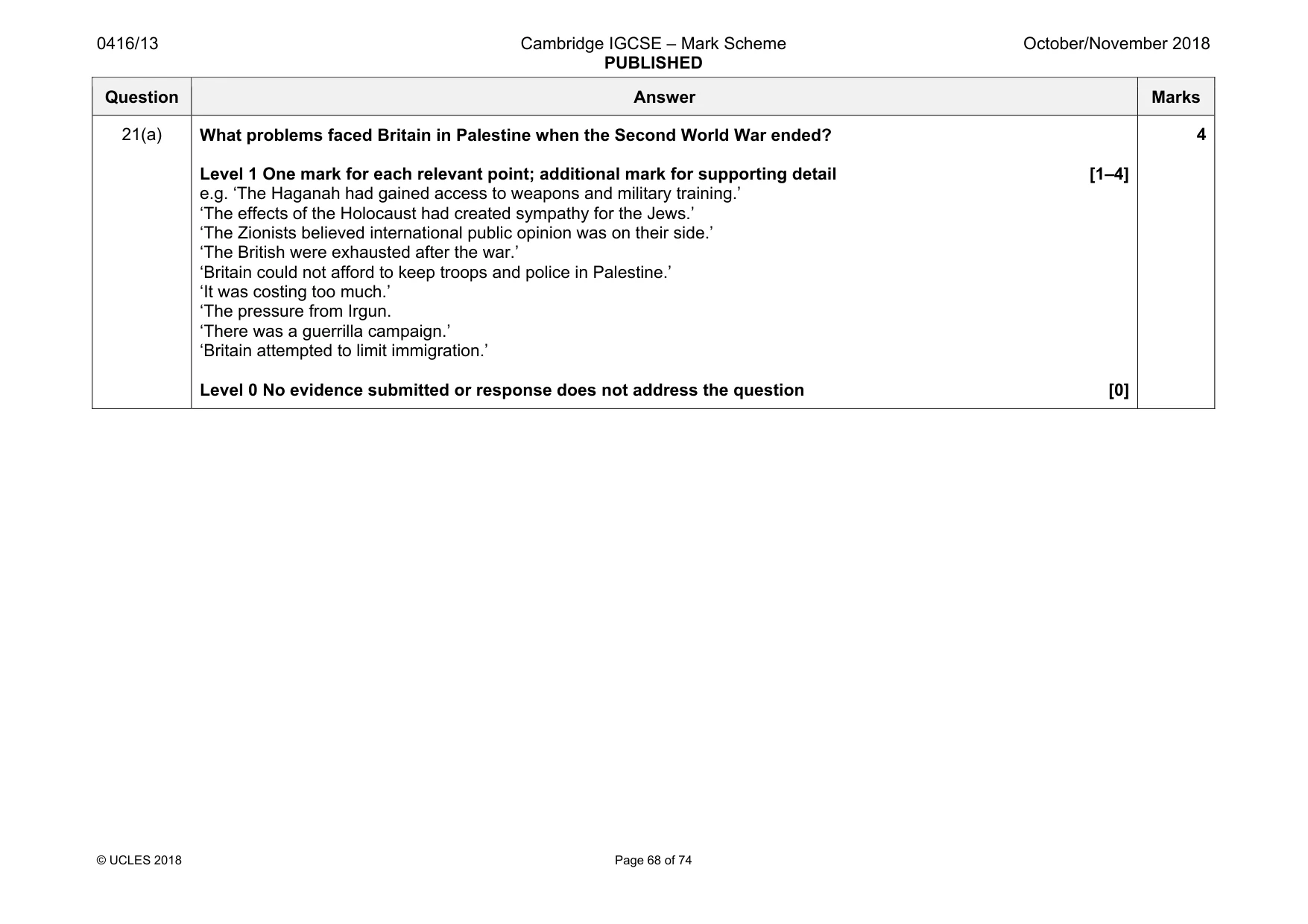
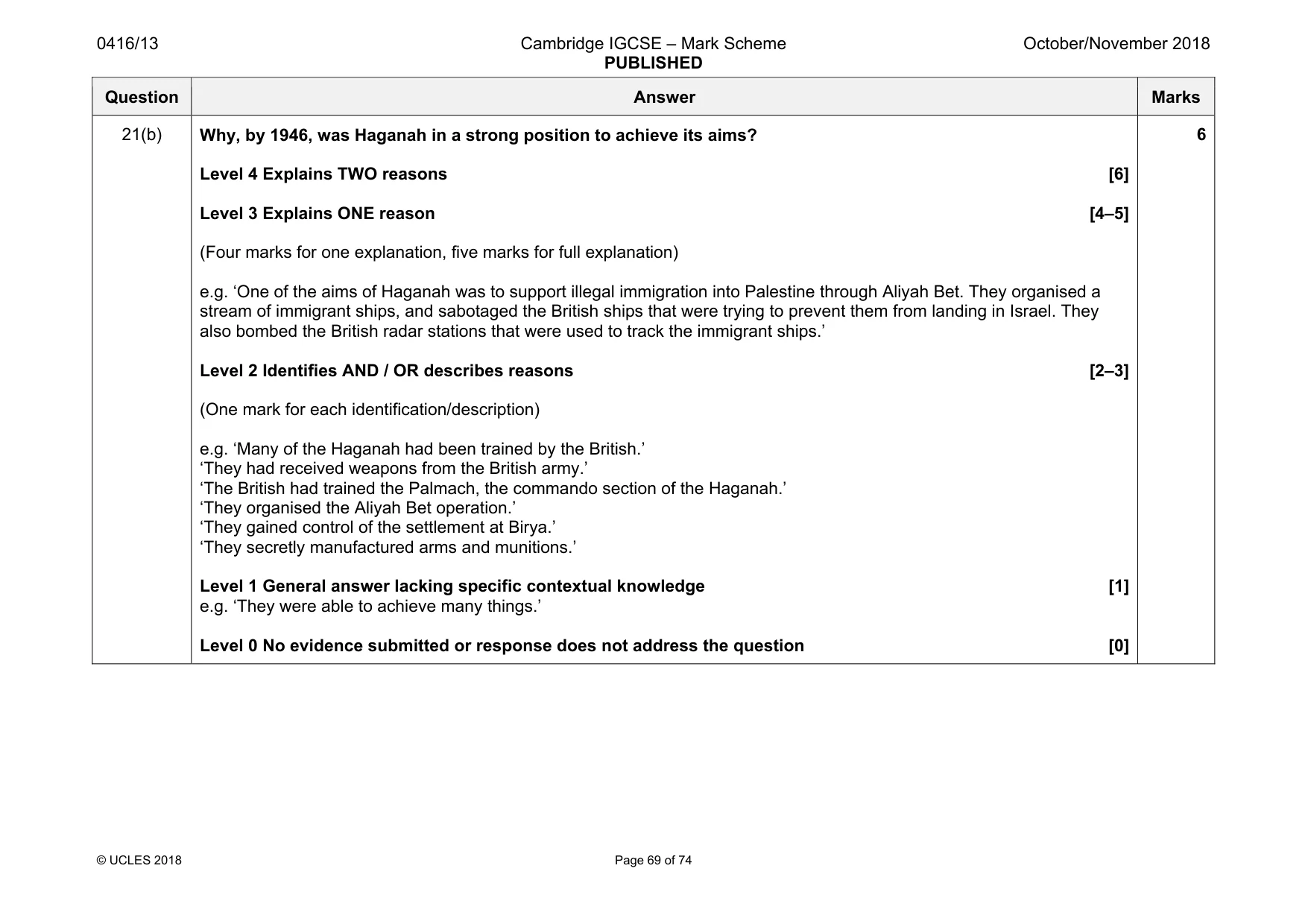
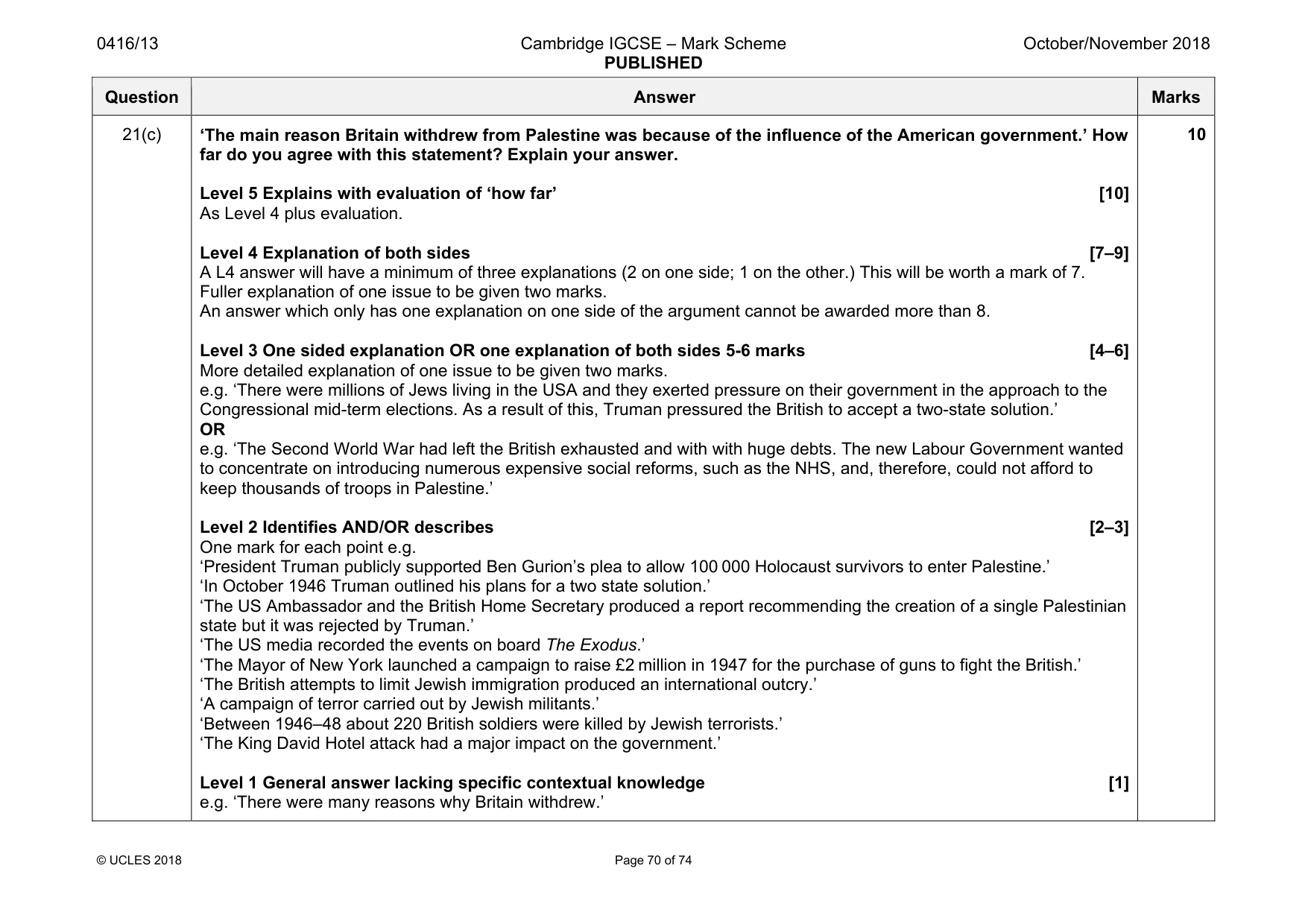
Paper as text
Question paper, page 1
This document consists of 10 printed pages, 2 blank pages and 1 Insert. DC (RW) 169852 © UCLES 2018 [Turn over Cambridge International Examinations Cambridge International General Certificate of Secondary Education * 5 2 1 3 8 6 9 6 4 1 * HISTORY (US) 0416/13 Paper 1 October/November 2018 2 hours No Additional Materials are required. READ THESE INSTRUCTIONS FIRST An answer booklet is provided inside this question paper. You should follow the instructions on the front cover of the answer booklet. If you need additional answer paper ask the test administrator for a continuation booklet. Answer three questions. Section A (Core Content) Answer any two questions. Section B (Depth Studies) Answer any one question. The number of points is given in brackets [ ] at the end of each question or part question.
Question paper, page 2
2 0416/13/O/N/18 © UCLES 2018 SECTION A: CORE CONTENT Answer any two questions from this Section. 1 Individuals and countries tried to prevent Italian unification. (a) Describe Garibaldi’s landing in Sicily in 1860. [4] (b) Why was Cavour concerned about the activities of Garibaldi in 1860? [6] (c) How great a threat was Austria to Italian unification? Explain your answer. [10] 2 Bismarck was able to take opportunities that arose after he came to power. (a) What was the North German Confederation? [4] (b) Why did the German revolutions of 1848–49 fail? [6] (c) Was Bismarck successful because he was prepared to use force or because he was cunning and devious? Explain your answer. [10] 3 The impact of Reconstruction was wide ranging. (a) What did Lincoln want to achieve with regard to Reconstruction? [4] (b) Why was the Presidential election of 1860 a concern for the South? [6] (c) ‘Economic improvement was the most important impact of Reconstruction in the South.’ How far do you agree with this statement? Explain your answer. [10] 4 The assassination of Archduke Franz Ferdinand brought Europe to the brink of war. (a) Describe the role of Princip in the assassination of Archduke Franz Ferdinand. [4] (b) Why, within 30 days of the assassination of Archduke Franz Ferdinand, had war begun in Europe? [6] (c) ‘Quarrels over Morocco (1905–6 and 1911) were more important in increasing Great Power tension before 1914 than were the Balkan Wars (1912–13).’ How far do you agree with this statement? Explain your answer. [10]
Question paper, page 3
3 0416/13/O/N/18 © UCLES 2018 [Turn over 5 The peace settlements drawn up at Versailles were not universally accepted. (a) Under the terms of the treaties, what happened to land lost by the Austro-Hungarian Empire? [4] (b) Why could Germany’s reaction to the Treaty of Versailles be seen as unreasonable? [6] (c) ‘The Greek occupation of Smyrna was the main reason for Turkish outrage at the terms of the Treaty of Sèvres.’ How far do you agree with this statement? Explain your answer. [10] 6 The effectiveness of the League of Nations was challenged by events in the 1930s. (a) Describe the actions taken by Haile Selassie in an attempt to save his country from Italian conquest. [4] (b) Why were the League’s sanctions against Italy for invading Abyssinia ineffective? [6] (c) ‘It was the World Depression, and not increasing militarism, that made the work of the League in the 1930s more difficult.’ How far do you agree with this statement? Explain your answer. [10] 7 After the Second World War the USA followed a policy of containment. (a) What was the attitude of the USA toward the Communist invasion of South Korea? [4] (b) Why did Kennedy decide to impose a blockade of Cuba? [6] (c) ‘Neither side emerged from the Cuban Missile Crisis the winner.’ How far do you agree with this statement? Explain your answer. [10] 8 People living in the Gulf region were affected by the political tension that existed in the area. (a) Describe the storming of the US embassy in Iran in November 1979. [4] (b) Why was Ayatollah Khomeini popular with the Iranian people? [6] (c) ‘The main reason Saddam Hussein was able to come to power in Iraq was his use of terror.’ How far do you agree with this statement? Explain your answer. [10]
Question paper, page 4
4 0416/13/O/N/18 © UCLES 2018 SECTION B: DEPTH STUDIES Answer any one question from this Section. DEPTH STUDY A: THE FIRST WORLD WAR, 1914–18 9 On the Western Front the war became one of attrition. (a) What were the limitations of aircraft when they were introduced on the Western Front? [4] (b) Why was artillery fire important in relation to trench warfare? [6] (c) ‘Mud was the worst aspect of trench warfare.’ How far do you agree with this statement? Explain your answer. [10] 10 The war impacted on the civilian population in Britain. (a) What were conscientious objectors? [4] (b) Why was much of the propaganda used by the government during the war targeted on women? [6] (c) ‘The formation of “Pals Battalions” was the main reason Britain was able to recruit volunteers for the army.’ How far do you agree with this statement? Explain your answer. [10]
Question paper, page 5
5 0416/13/O/N/18 © UCLES 2018 [Turn over DEPTH STUDY B: GERMANY, 1918–45 11 Hitler’s domination of Germany was complete by 1934. (a) What were the benefits of the Enabling Act for Hitler? [4] (b) Why, in 1932, did Hindenburg not appoint Hitler to the position of Chancellor? [6] (c) ‘Hitler’s fear that the army would launch a coup against him was the main reason for the Night of the Long Knives.’ How far do you agree with this statement? Explain your answer. [10] 12 Life in Germany changed under the Nazis. (a) In what ways did the Nazis discriminate against Jews within German society? [4] (b) Why was the use of the radio a successful method of controlling the German people? [6] (c) ‘Economic improvements were more successful than the use of terror in enabling the Nazis to control the German people.’ How far do you agree with this statement? Explain your answer. [10]
Question paper, page 6
6 0416/13/O/N/18 © UCLES 2018 DEPTH STUDY C: RUSSIA, 1905–41 13 Tsar Nicholas II failed to retain the support of the Russian people. (a) By 1905 what difficulties faced Tsar Nicholas II in ruling the Russian people? [4] (b) Why was Russia’s agriculture under Tsar Nicholas II in need of reform? [6] (c) ‘Political repression was the main reason for the revolution of March 1917.’ How far do you agree with this statement? Explain your answer. [10] 14 Collectivization was an important aspect of Stalin’s plans for the USSR. (a) Describe the main features of collectivization. [4] (b) Why did Stalin need to reorganize farming in the USSR? [6] (c) ‘Collectivization increased the well-being of the Russian people.’ How far do you agree with this statement? Explain your answer. [10]
Question paper, page 7
7 0416/13/O/N/18 © UCLES 2018 [Turn over DEPTH STUDY D: THE USA, 1919–41 15 In the 1920s, existing ideas and values were challenged in the USA. (a) In what ways did the car industry contribute to the ‘Roaring Twenties’? [4] (b) Why did new forms of entertainment become increasingly popular in the 1920s? [6] (c) ‘US society was becoming more tolerant in the 1920s.’ How far do you agree with this statement? Explain your answer. [10] 16 Weaknesses in the American economy from the late 1920s had various causes and disastrous effects. (a) What happened to the Bonus Marchers in 1932? [4] (b) Why were agricultural areas affected badly by the Depression? [6] (c) ‘It was the banks that caused the Wall Street Crash.’ How far do you agree with this statement? Explain your answer. [10]
Question paper, page 8
8 0416/13/O/N/18 © UCLES 2018 DEPTH STUDY E: CHINA, c.1930–c.1990 17 China’s relations with other countries were variable. (a) In what ways was Hong Kong affected by the development of China as a Communist state? [4] (b) Why was the death of Stalin a turning point in China-USSR relations? [6] (c) ‘By the time of Mao’s death China was an important power, but not yet a superpower.’ How far do you agree with this statement? Explain your answer. [10] 18 Life for the people of Communist China has frequently changed. (a) Describe the policy introduced from 1979 in an effort to control population growth. [4] (b) Why did the economic growth of the 1980s create new social and political problems for China? [6] (c) ‘The greatest impact of the Cultural Revolution was on traditional Chinese art and culture.’ How far do you agree with this statement? Explain your answer. [10]
Question paper, page 9
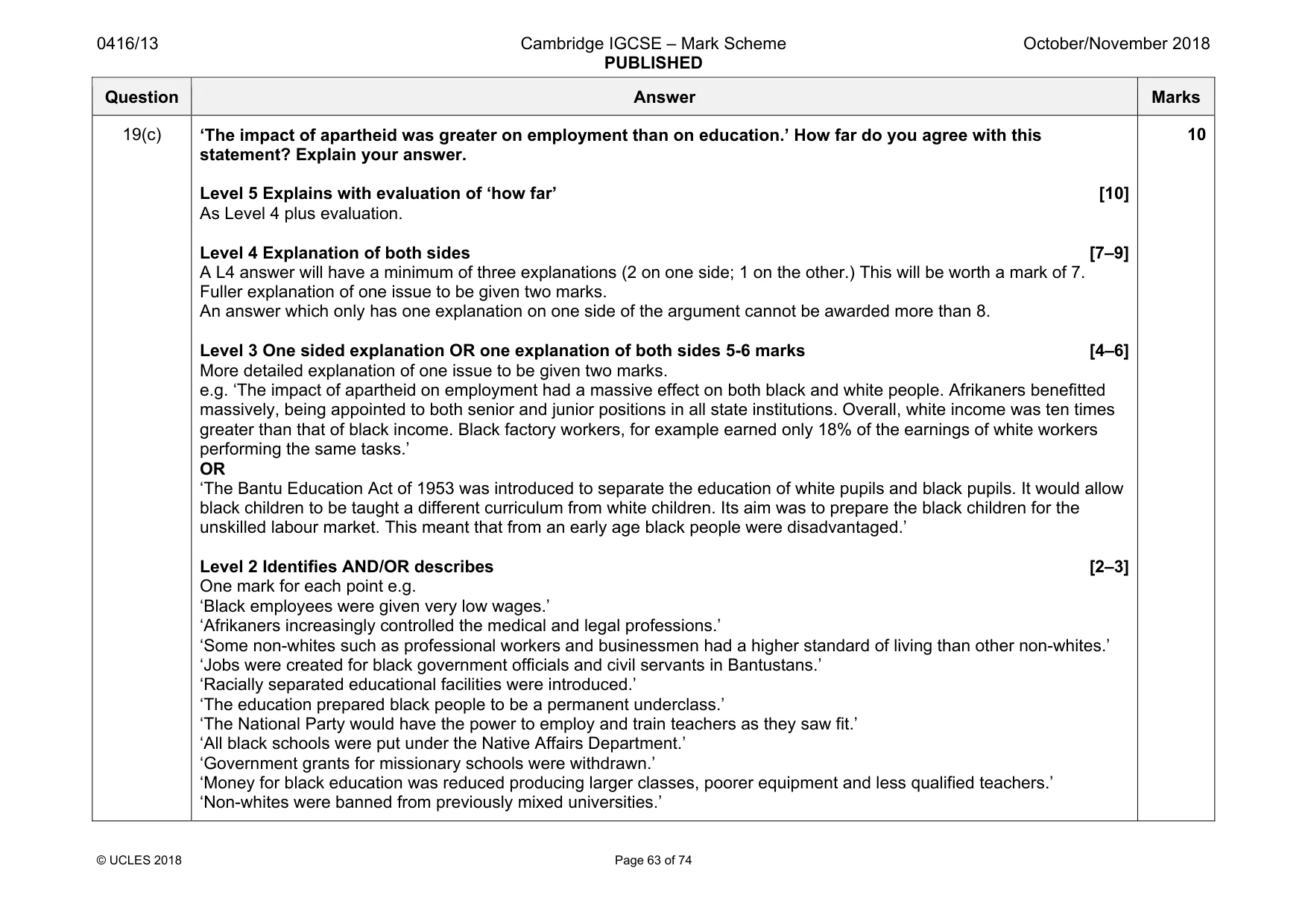
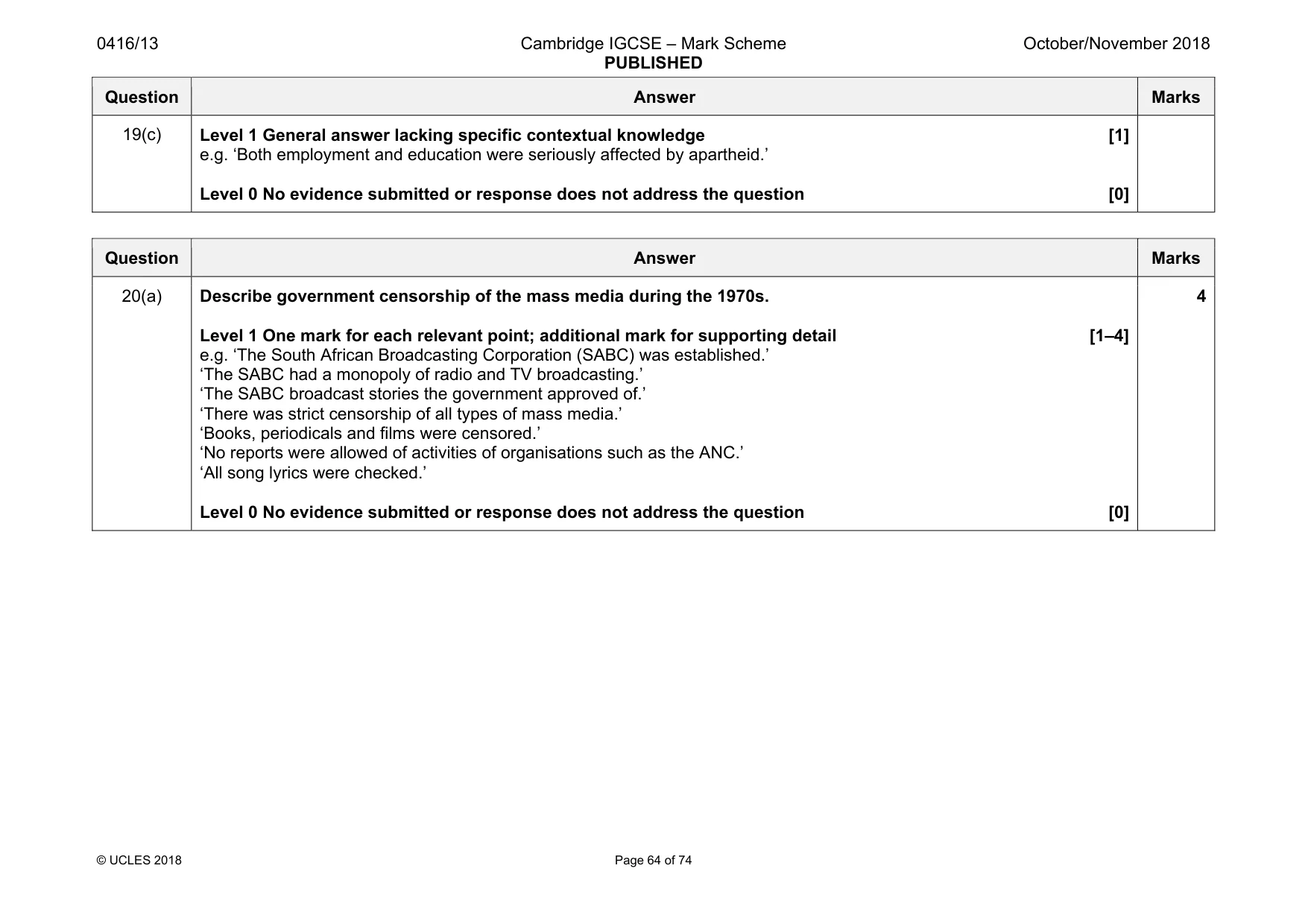
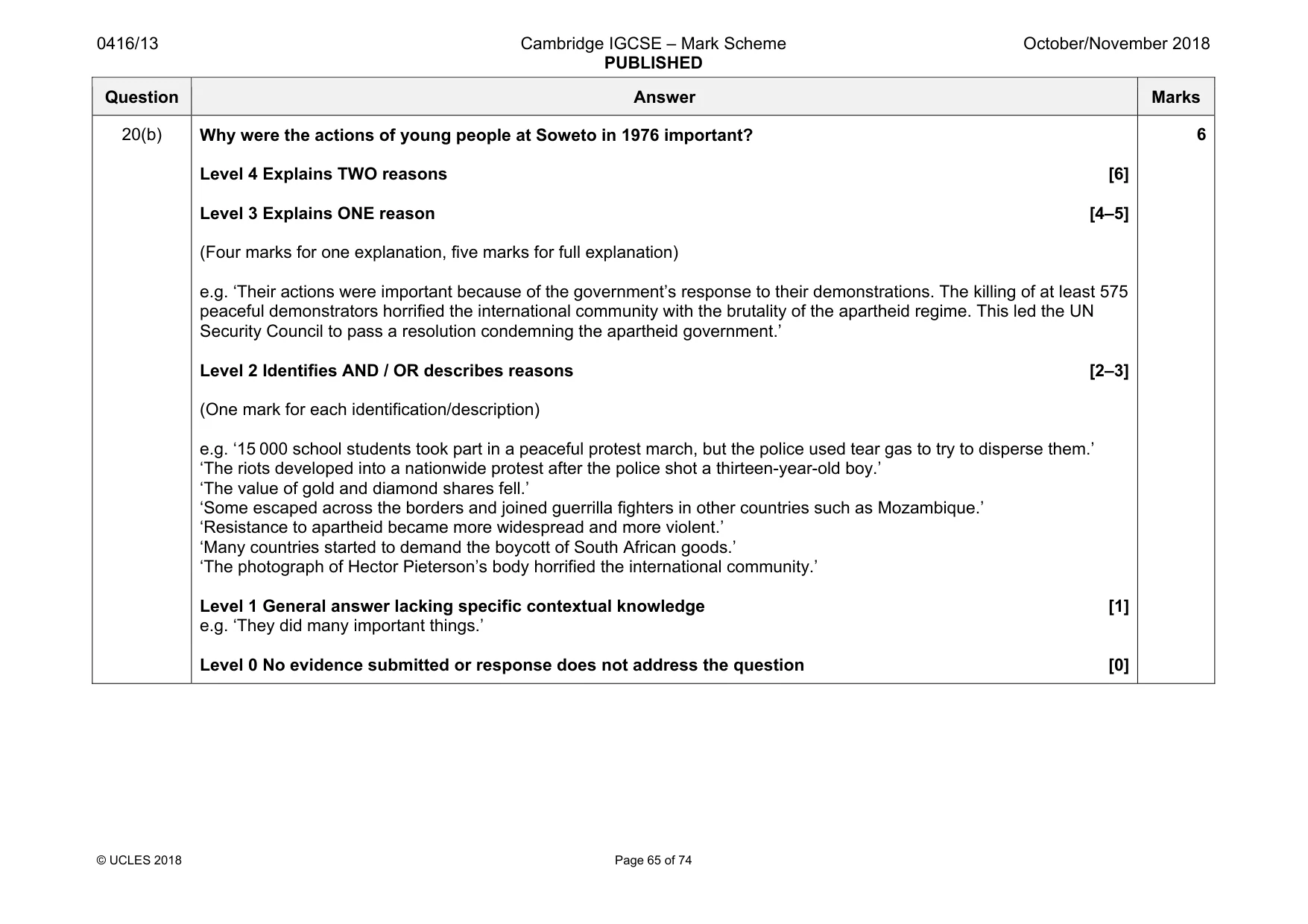
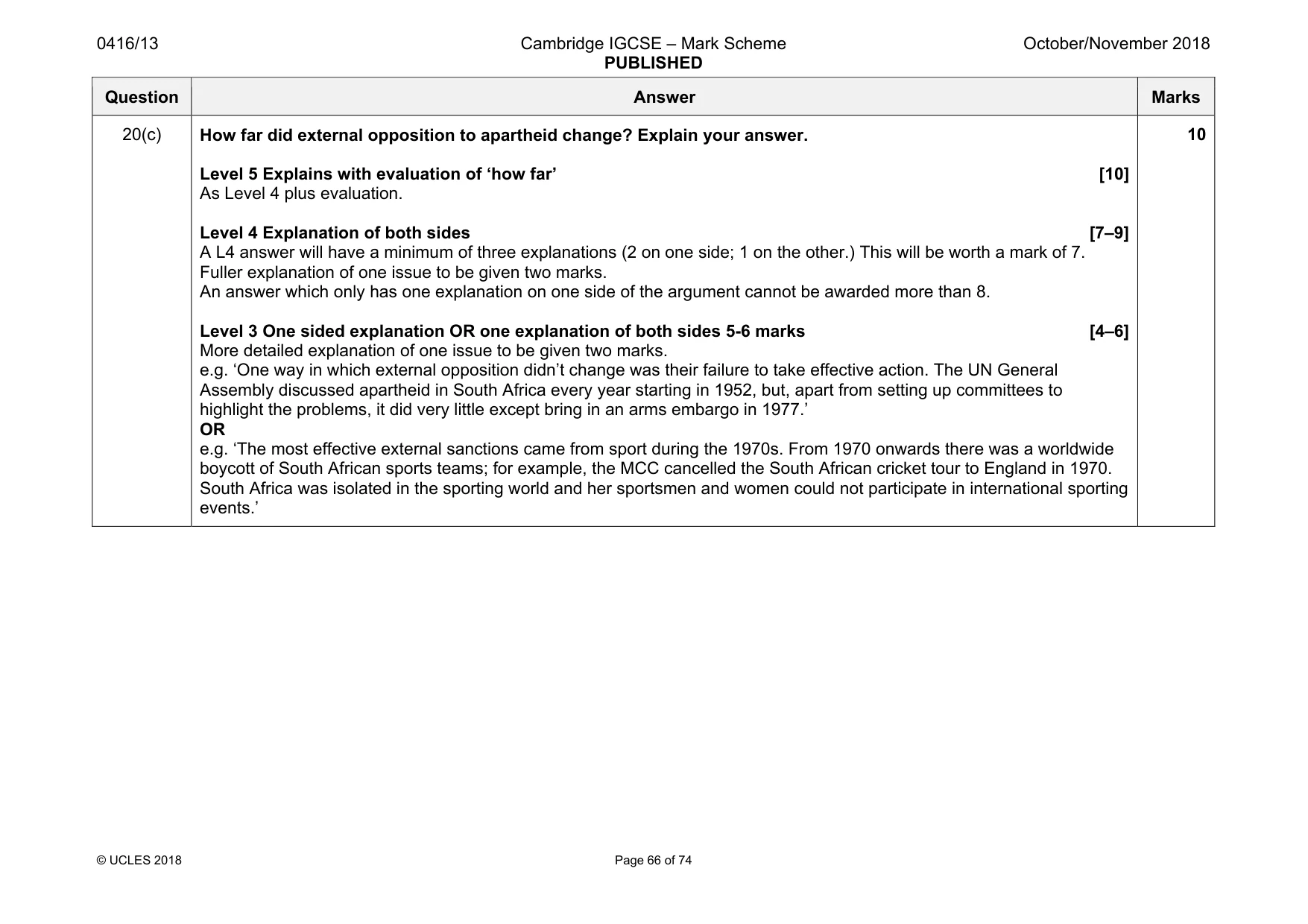
9 0416/13/O/N/18 © UCLES 2018 [Turn over DEPTH STUDY F: SOUTH AFRICA, c.1940–c.1994 19 With the election of the National Party in 1948 came the introduction of the policy of apartheid. (a) What was the Reservation of Separate Amenities Act of 1953? [4] (b) Why was the introduction of Bantustans important to Verwoerd’s plan for an all-white South Africa? [6] (c) ‘The impact of apartheid was greater on employment than on education.’ How far do you agree with this statement? Explain your answer. [10] 20 Strict enforcement of apartheid policies was met by increasing opposition after 1966. (a) Describe government censorship of the mass media during the 1970s. [4] (b) Why were the actions of young people at Soweto in 1976 important? [6] (c) How far did external opposition to apartheid change? Explain your answer. [10]
Question paper, page 10
10 0416/13/O/N/18 © UCLES 2018 DEPTH STUDY G: ISRAELIS AND PALESTINIANS SINCE 1945 21 Britain found Palestine difficult to deal with. (a) What problems faced Britain in Palestine when the Second World War ended? [4] (b) Why, by 1946, was Haganah in a strong position to achieve its aims? [6] (c) ‘The main reason Britain withdrew from Palestine was because of the influence of the American government.’ How far do you agree with this statement? Explain your answer. [10] 22 Attempts at achieving peace in the Middle East remained unfulfilled. (a) What were the main points of Arafat’s speech at the United Nations in 1974? [4] (b) Why was the 1978 Camp David framework for peace a major breakthrough? [6] (c) ‘An increase in the support for Hamas proved to be the greatest obstacle to peace in the Middle East.’ How far do you agree with this statement? Explain your answer. [10]
Question paper, page 11
11 0416/13/O/N/18 © UCLES 2018 BLANK PAGE
Question paper, page 12
12 0416/13/O/N/18 © UCLES 2018 BLANK PAGE Permission to reproduce items where third-party owned material protected by copyright is included has been sought and cleared where possible. Every reasonable effort has been made by the publisher (UCLES) to trace copyright holders, but if any items requiring clearance have unwittingly been included, the publisher will be pleased to make amends at the earliest possible opportunity. To avoid the issue of disclosure of answer-related information to candidates, all copyright acknowledgements are reproduced online in the Cambridge International Examinations Copyright Acknowledgements Booklet. This is produced for each series of examinations and is freely available to download at www.cie.org.uk after the live examination series. Cambridge International Examinations is part of the Cambridge Assessment Group. Cambridge Assessment is the brand name of University of Cambridge Local Examinations Syndicate (UCLES), which is itself a department of the University of Cambridge.
Mark scheme, page 1
This document consists of 74 printed pages. © UCLES 2018 [Turn over Cambridge Assessment International Education Cambridge International General Certificate of Secondary Education HISTORY (US) 0416/13 Paper 1 October/November 2018 MARK SCHEME Maximum Mark: 60 Published This mark scheme is published as an aid to teachers and candidates, to indicate the requirements of the examination. It shows the basis on which Examiners were instructed to award marks. It does not indicate the details of the discussions that took place at an Examiners’ meeting before marking began, which would have considered the acceptability of alternative answers. Mark schemes should be read in conjunction with the question paper and the Principal Examiner Report for Teachers. Cambridge International will not enter into discussions about these mark schemes. Cambridge International is publishing the mark schemes for the October/November 2018 series for most Cambridge IGCSE™, Cambridge International A and AS Level components and some Cambridge O Level components.
Mark scheme, page 2
0416/13 Cambridge IGCSE – Mark Scheme PUBLISHED October/November 2018 © UCLES 2018 Page 2 of 74 Generic Marking Principles These general marking principles must be applied by all examiners when marking candidate answers. They should be applied alongside the specific content of the mark scheme or generic level descriptors for a question. Each question paper and mark scheme will also comply with these marking principles. GENERIC MARKING PRINCIPLE 1: Marks must be awarded in line with: • the specific content of the mark scheme or the generic level descriptors for the question • the specific skills defined in the mark scheme or in the generic level descriptors for the question • the standard of response required by a candidate as exemplified by the standardisation scripts. GENERIC MARKING PRINCIPLE 2: Marks awarded are always whole marks (not half marks, or other fractions). GENERIC MARKING PRINCIPLE 3: Marks must be awarded positively: • marks are awarded for correct/valid answers, as defined in the mark scheme. However, credit is given for valid answers which go beyond the scope of the syllabus and mark scheme, referring to your Team Leader as appropriate • marks are awarded when candidates clearly demonstrate what they know and can do • marks are not deducted for errors • marks are not deducted for omissions • answers should only be judged on the quality of spelling, punctuation and grammar when these features are specifically assessed by the question as indicated by the mark scheme. The meaning, however, should be unambiguous. GENERIC MARKING PRINCIPLE 4: Rules must be applied consistently e.g. in situations where candidates have not followed instructions or in the application of generic level descriptors.
Mark scheme, page 3
0416/13 Cambridge IGCSE – Mark Scheme PUBLISHED October/November 2018 © UCLES 2018 Page 3 of 74 GENERIC MARKING PRINCIPLE 5: Marks should be awarded using the full range of marks defined in the mark scheme for the question (however; the use of the full mark range may be limited according to the quality of the candidate responses seen). GENERIC MARKING PRINCIPLE 6: Marks awarded are based solely on the requirements as defined in the mark scheme. Marks should not be awarded with grade thresholds or grade descriptors in mind.
Mark scheme, page 4
0416/13 Cambridge IGCSE – Mark Scheme PUBLISHED October/November 2018 © UCLES 2018 Page 4 of 74 GENERAL INSTRUCTIONS Applying the Mark Scheme • When marking a response the overall criterion to be considered should be – ‘How good is this response to this question?’ • The level descriptor should be used to decide the level into which the quality of the answer fits. • Exhaustive lists of possible facts are not given in the mark scheme, as there is often a choice of factual knowledge that candidates may use. • WHERE EXAMPLES OF RESPONSES ARE GIVEN, THESE ARE NOT PRESCRIPTIVE, BUT ARE INTENDED AS A GUIDE. It is not possible to cover every possible type of response within a levels of response mark scheme and examiners are expected to use their professional judgement at all times in ensuring that responses are placed in the correct level and given an appropriate mark within that level. • Marking must be positive. Marks must not be deducted for inaccurate or irrelevant parts of answers. In itself, poor use of historical terminology, spelling, grammar or handwriting does not affect the mark. The overall quality of the answer to the question should be judged. • If a candidate reaches a particular level, s/he must be rewarded with a mark within that level. It is not necessary to work through the levels. • The full range of marks should be used. Do not be afraid to award full marks or no marks. Failure to do this will seriously affect the distribution of marks. Be prepared to reward candidates who show any level of understanding. The mark scheme starts from basic acceptable response. Where a band of marks is indicated for a level, these marks should be used with reference to the development of the answer within that level. Assessment Objectives (a) recall, description (b) recall, explanation (c) recall, explanation and analysis
Mark scheme, page 5
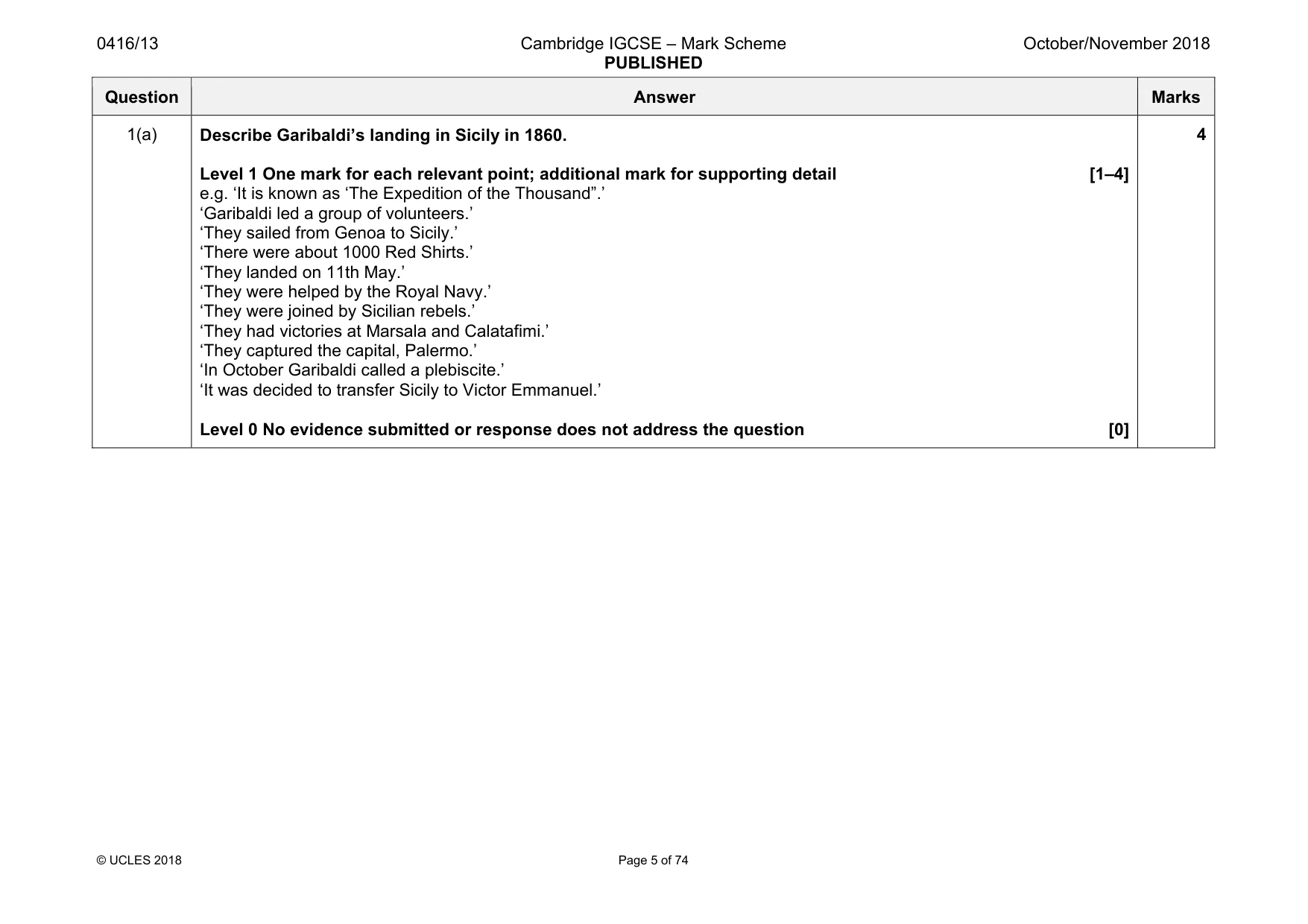
0416/13 Cambridge IGCSE – Mark Scheme PUBLISHED October/November 2018 © UCLES 2018 Page 5 of 74 Question Answer Marks 1(a) Describe Garibaldi’s landing in Sicily in 1860. Level 1 One mark for each relevant point; additional mark for supporting detail [1–4] e.g. ‘It is known as ‘The Expedition of the Thousand”.’ ‘Garibaldi led a group of volunteers.’ ‘They sailed from Genoa to Sicily.’ ‘There were about 1000 Red Shirts.’ ‘They landed on 11th May.’ ‘They were helped by the Royal Navy.’ ‘They were joined by Sicilian rebels.’ ‘They had victories at Marsala and Calatafimi.’ ‘They captured the capital, Palermo.’ ‘In October Garibaldi called a plebiscite.’ ‘It was decided to transfer Sicily to Victor Emmanuel.’ Level 0 No evidence submitted or response does not address the question [0] 4
Mark scheme, page 6
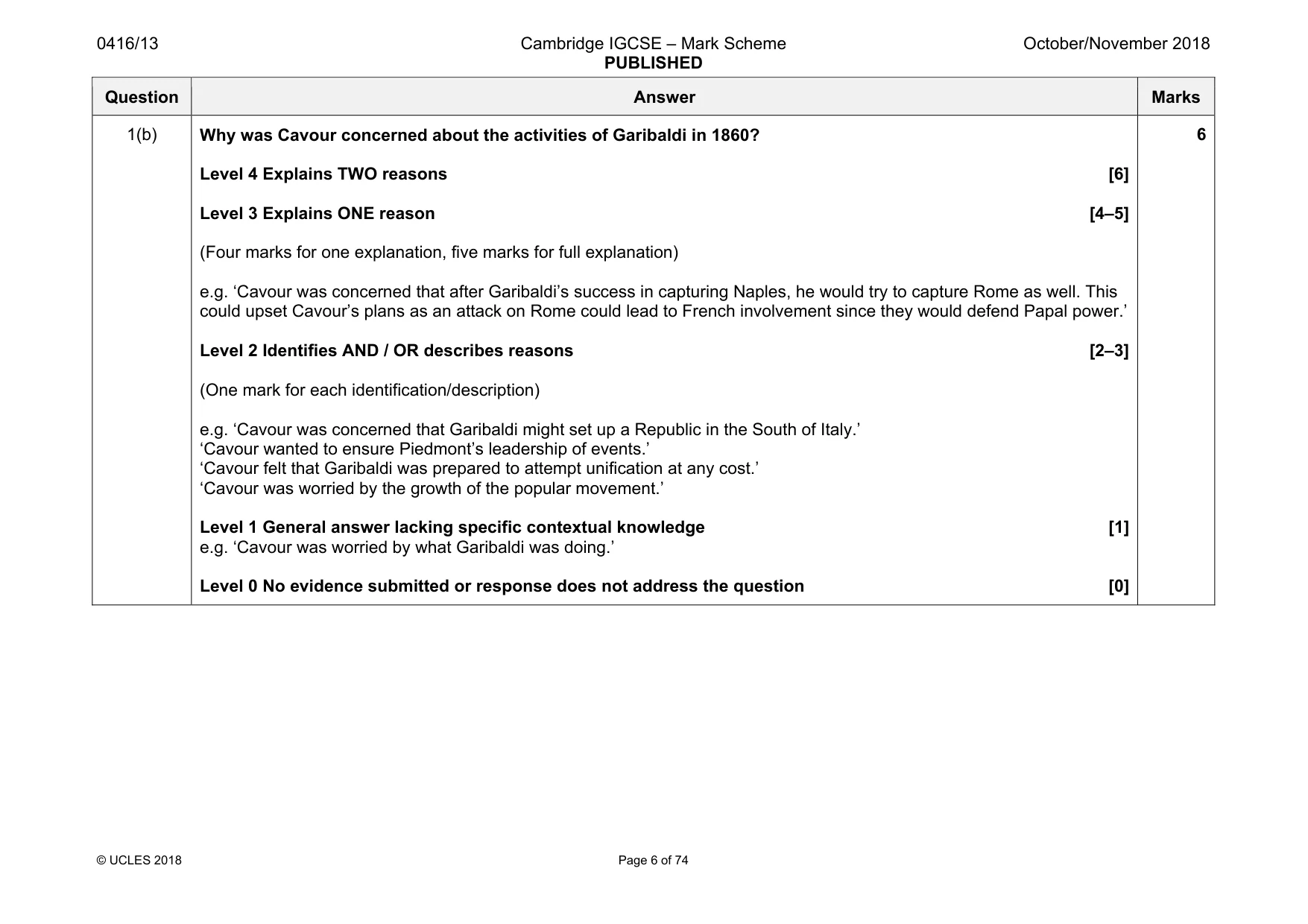
0416/13 Cambridge IGCSE – Mark Scheme PUBLISHED October/November 2018 © UCLES 2018 Page 6 of 74 Question Answer Marks 1(b) Why was Cavour concerned about the activities of Garibaldi in 1860? Level 4 Explains TWO reasons [6] Level 3 Explains ONE reason [4–5] (Four marks for one explanation, five marks for full explanation) e.g. ‘Cavour was concerned that after Garibaldi’s success in capturing Naples, he would try to capture Rome as well. This could upset Cavour’s plans as an attack on Rome could lead to French involvement since they would defend Papal power.’ Level 2 Identifies AND / OR describes reasons [2–3] (One mark for each identification/description) e.g. ‘Cavour was concerned that Garibaldi might set up a Republic in the South of Italy.’ ‘Cavour wanted to ensure Piedmont’s leadership of events.’ ‘Cavour felt that Garibaldi was prepared to attempt unification at any cost.’ ‘Cavour was worried by the growth of the popular movement.’ Level 1 General answer lacking specific contextual knowledge [1] e.g. ‘Cavour was worried by what Garibaldi was doing.’ Level 0 No evidence submitted or response does not address the question [0] 6
Mark scheme, page 7
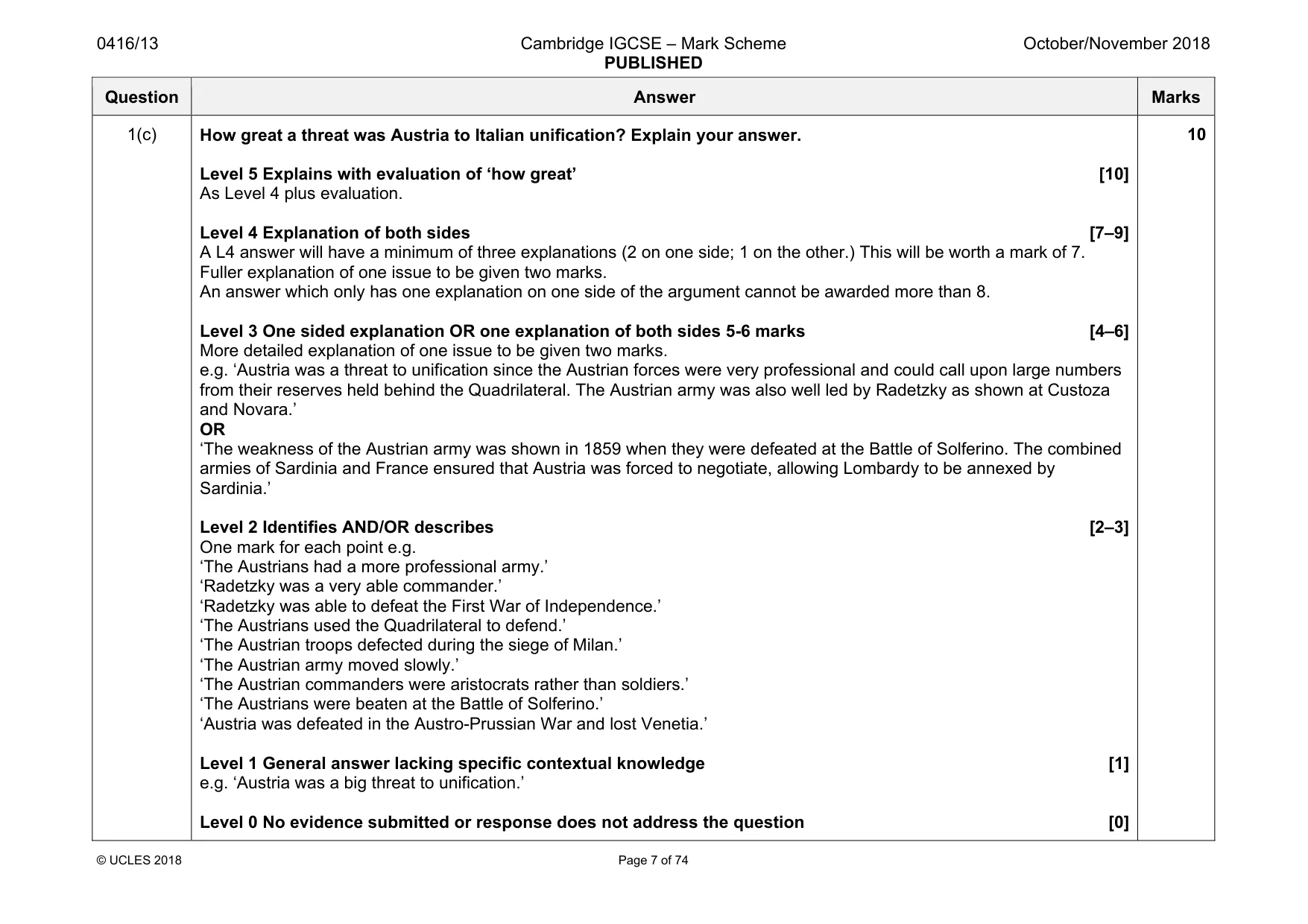
0416/13 Cambridge IGCSE – Mark Scheme PUBLISHED October/November 2018 © UCLES 2018 Page 7 of 74 Question Answer Marks 1(c) How great a threat was Austria to Italian unification? Explain your answer. Level 5 Explains with evaluation of ‘how great’ [10] As Level 4 plus evaluation. Level 4 Explanation of both sides [7–9] A L4 answer will have a minimum of three explanations (2 on one side; 1 on the other.) This will be worth a mark of 7. Fuller explanation of one issue to be given two marks. An answer which only has one explanation on one side of the argument cannot be awarded more than 8. Level 3 One sided explanation OR one explanation of both sides 5-6 marks [4–6] More detailed explanation of one issue to be given two marks. e.g. ‘Austria was a threat to unification since the Austrian forces were very professional and could call upon large numbers from their reserves held behind the Quadrilateral. The Austrian army was also well led by Radetzky as shown at Custoza and Novara.’ OR ‘The weakness of the Austrian army was shown in 1859 when they were defeated at the Battle of Solferino. The combined armies of Sardinia and France ensured that Austria was forced to negotiate, allowing Lombardy to be annexed by Sardinia.’ Level 2 Identifies AND/OR describes [2–3] One mark for each point e.g. ‘The Austrians had a more professional army.’ ‘Radetzky was a very able commander.’ ‘Radetzky was able to defeat the First War of Independence.’ ‘The Austrians used the Quadrilateral to defend.’ ‘The Austrian troops defected during the siege of Milan.’ ‘The Austrian army moved slowly.’ ‘The Austrian commanders were aristocrats rather than soldiers.’ ‘The Austrians were beaten at the Battle of Solferino.’ ‘Austria was defeated in the Austro-Prussian War and lost Venetia.’ Level 1 General answer lacking specific contextual knowledge [1] e.g. ‘Austria was a big threat to unification.’ Level 0 No evidence submitted or response does not address the question [0] 10
Mark scheme, page 8
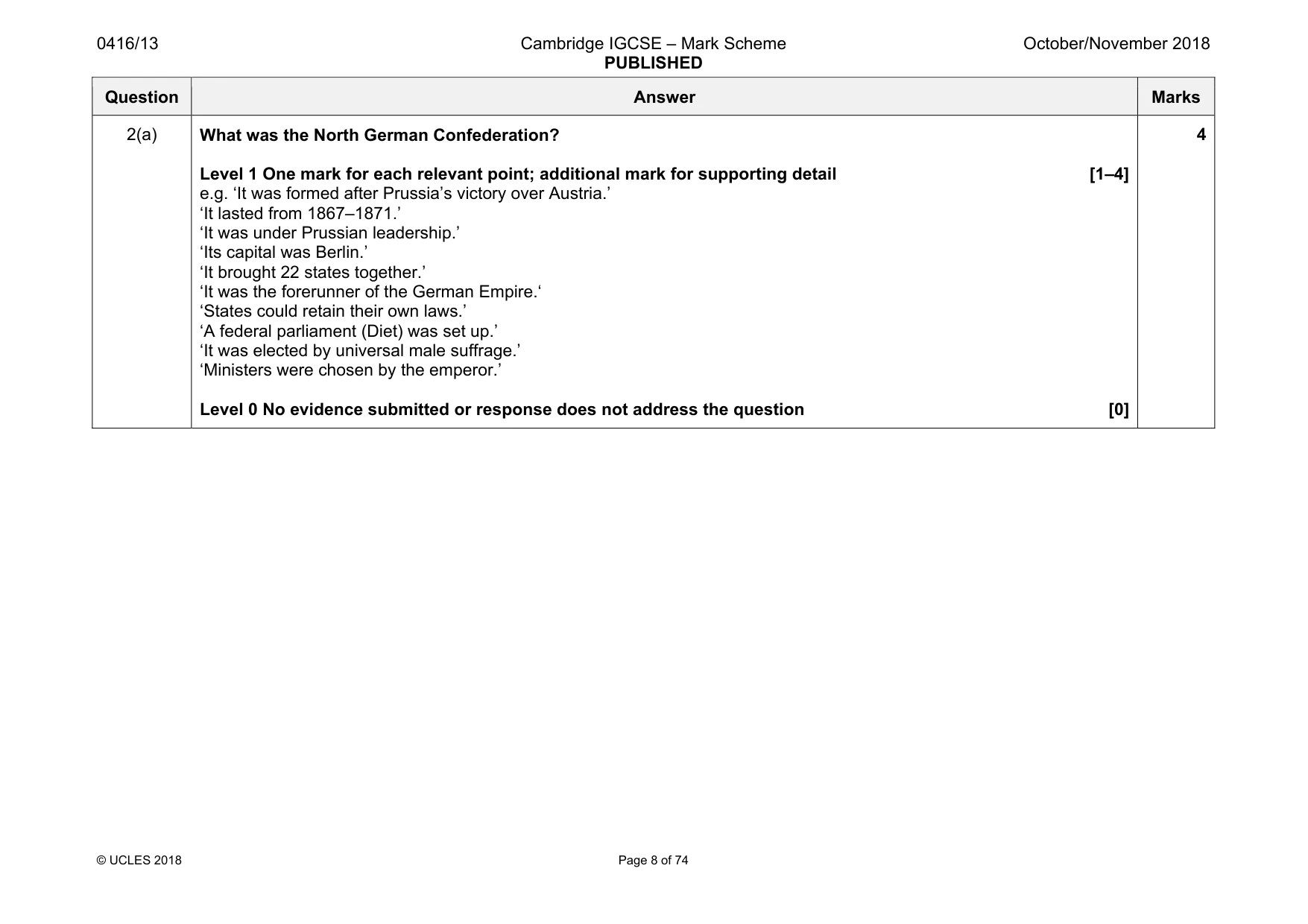
0416/13 Cambridge IGCSE – Mark Scheme PUBLISHED October/November 2018 © UCLES 2018 Page 8 of 74 Question Answer Marks 2(a) What was the North German Confederation? Level 1 One mark for each relevant point; additional mark for supporting detail [1–4] e.g. ‘It was formed after Prussia’s victory over Austria.’ ‘It lasted from 1867–1871.’ ‘It was under Prussian leadership.’ ‘Its capital was Berlin.’ ‘It brought 22 states together.’ ‘It was the forerunner of the German Empire.‘ ‘States could retain their own laws.’ ‘A federal parliament (Diet) was set up.’ ‘It was elected by universal male suffrage.’ ‘Ministers were chosen by the emperor.’ Level 0 No evidence submitted or response does not address the question [0] 4
Mark scheme, page 9
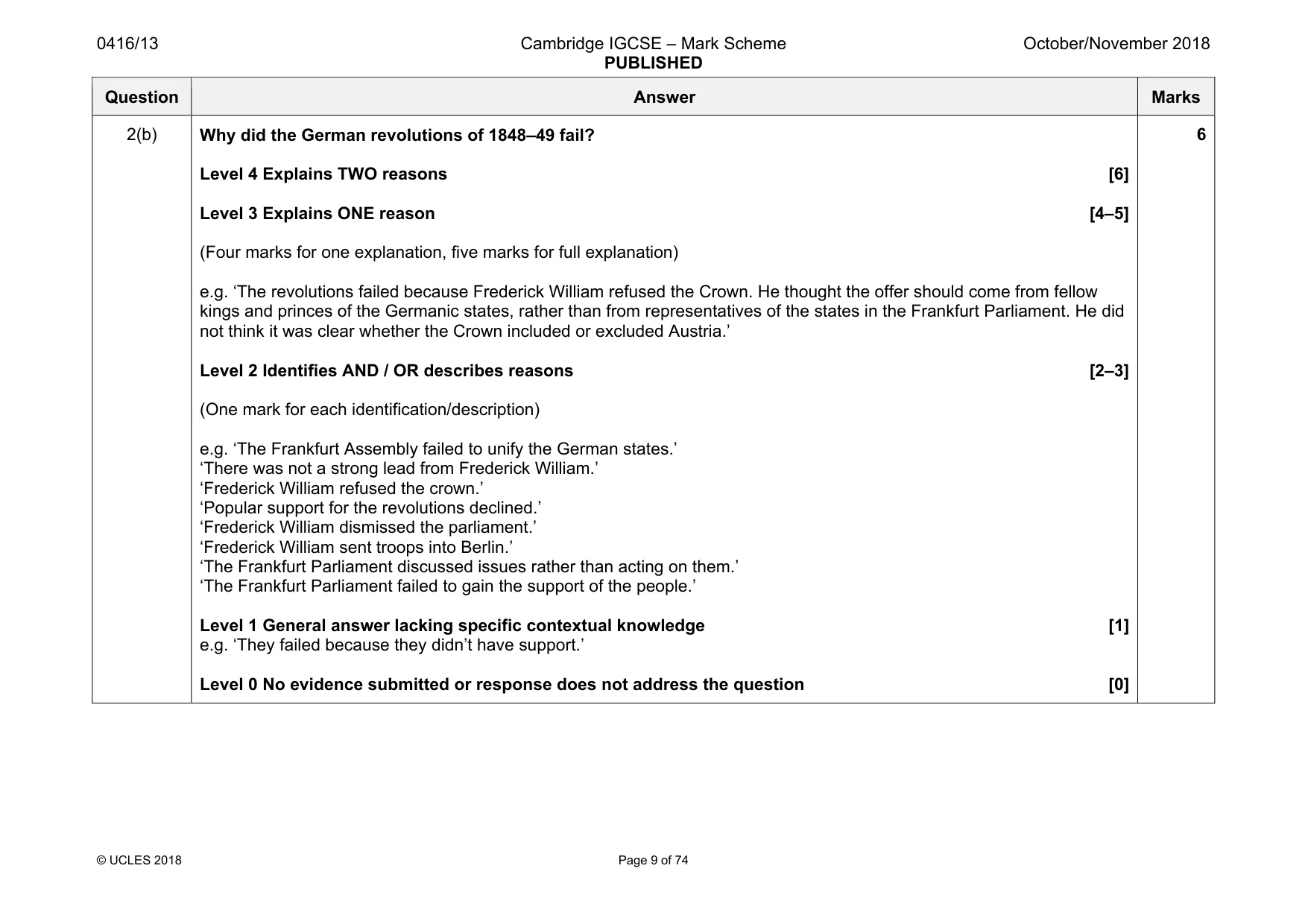
0416/13 Cambridge IGCSE – Mark Scheme PUBLISHED October/November 2018 © UCLES 2018 Page 9 of 74 Question Answer Marks 2(b) Why did the German revolutions of 1848–49 fail? Level 4 Explains TWO reasons [6] Level 3 Explains ONE reason [4–5] (Four marks for one explanation, five marks for full explanation) e.g. ‘The revolutions failed because Frederick William refused the Crown. He thought the offer should come from fellow kings and princes of the Germanic states, rather than from representatives of the states in the Frankfurt Parliament. He did not think it was clear whether the Crown included or excluded Austria.’ Level 2 Identifies AND / OR describes reasons [2–3] (One mark for each identification/description) e.g. ‘The Frankfurt Assembly failed to unify the German states.’ ‘There was not a strong lead from Frederick William.’ ‘Frederick William refused the crown.’ ‘Popular support for the revolutions declined.’ ‘Frederick William dismissed the parliament.’ ‘Frederick William sent troops into Berlin.’ ‘The Frankfurt Parliament discussed issues rather than acting on them.’ ‘The Frankfurt Parliament failed to gain the support of the people.’ Level 1 General answer lacking specific contextual knowledge [1] e.g. ‘They failed because they didn’t have support.’ Level 0 No evidence submitted or response does not address the question [0] 6
Mark scheme, page 10
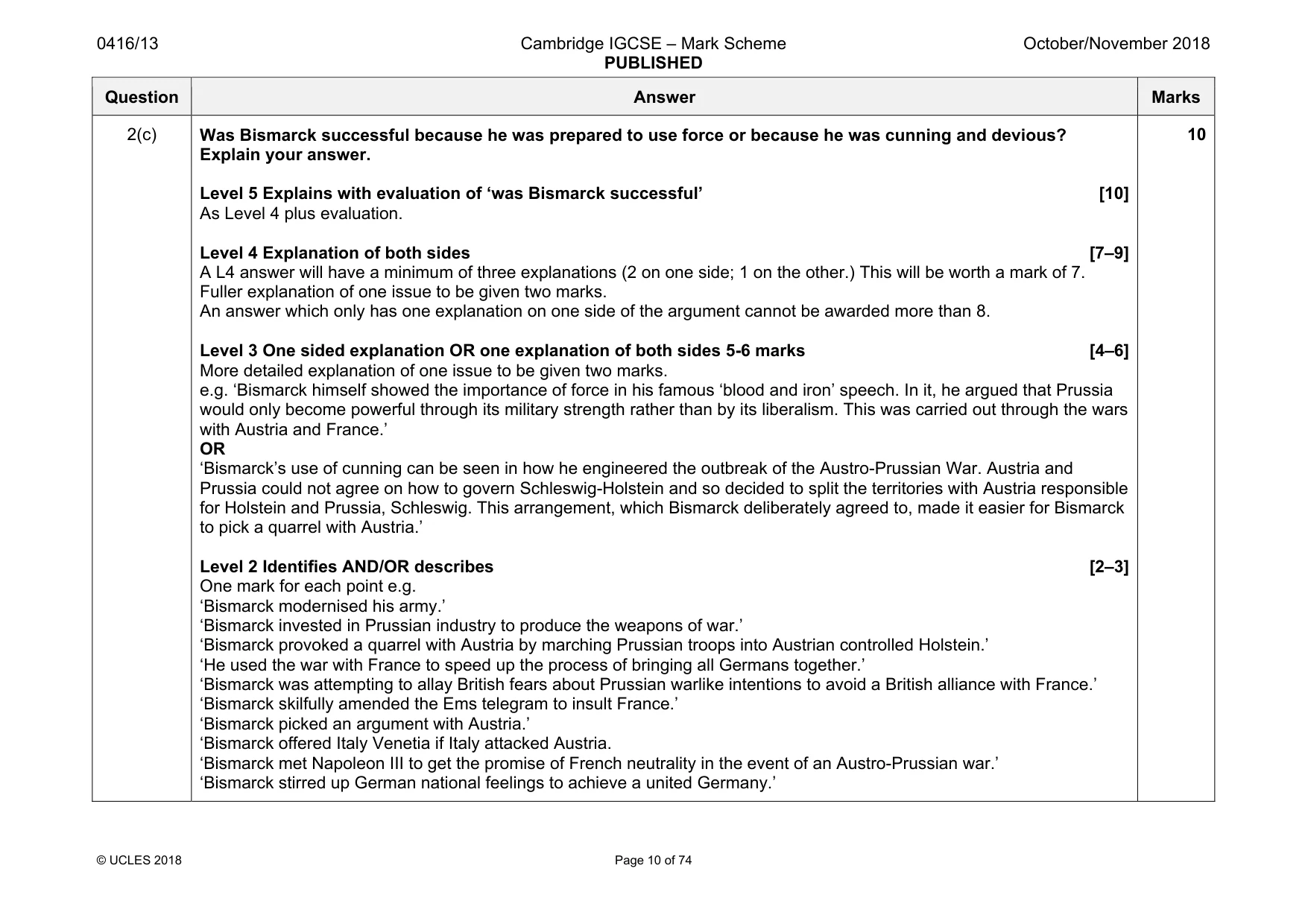
0416/13 Cambridge IGCSE – Mark Scheme PUBLISHED October/November 2018 © UCLES 2018 Page 10 of 74 Question Answer Marks 2(c) Was Bismarck successful because he was prepared to use force or because he was cunning and devious? Explain your answer. Level 5 Explains with evaluation of ‘was Bismarck successful’ [10] As Level 4 plus evaluation. Level 4 Explanation of both sides [7–9] A L4 answer will have a minimum of three explanations (2 on one side; 1 on the other.) This will be worth a mark of 7. Fuller explanation of one issue to be given two marks. An answer which only has one explanation on one side of the argument cannot be awarded more than 8. Level 3 One sided explanation OR one explanation of both sides 5-6 marks [4–6] More detailed explanation of one issue to be given two marks. e.g. ‘Bismarck himself showed the importance of force in his famous ‘blood and iron’ speech. In it, he argued that Prussia would only become powerful through its military strength rather than by its liberalism. This was carried out through the wars with Austria and France.’ OR ‘Bismarck’s use of cunning can be seen in how he engineered the outbreak of the Austro-Prussian War. Austria and Prussia could not agree on how to govern Schleswig-Holstein and so decided to split the territories with Austria responsible for Holstein and Prussia, Schleswig. This arrangement, which Bismarck deliberately agreed to, made it easier for Bismarck to pick a quarrel with Austria.’ Level 2 Identifies AND/OR describes [2–3] One mark for each point e.g. ‘Bismarck modernised his army.’ ‘Bismarck invested in Prussian industry to produce the weapons of war.’ ‘Bismarck provoked a quarrel with Austria by marching Prussian troops into Austrian controlled Holstein.’ ‘He used the war with France to speed up the process of bringing all Germans together.’ ‘Bismarck was attempting to allay British fears about Prussian warlike intentions to avoid a British alliance with France.’ ‘Bismarck skilfully amended the Ems telegram to insult France.’ ‘Bismarck picked an argument with Austria.’ ‘Bismarck offered Italy Venetia if Italy attacked Austria. ‘Bismarck met Napoleon III to get the promise of French neutrality in the event of an Austro-Prussian war.’ ‘Bismarck stirred up German national feelings to achieve a united Germany.’ 10
Mark scheme, page 11
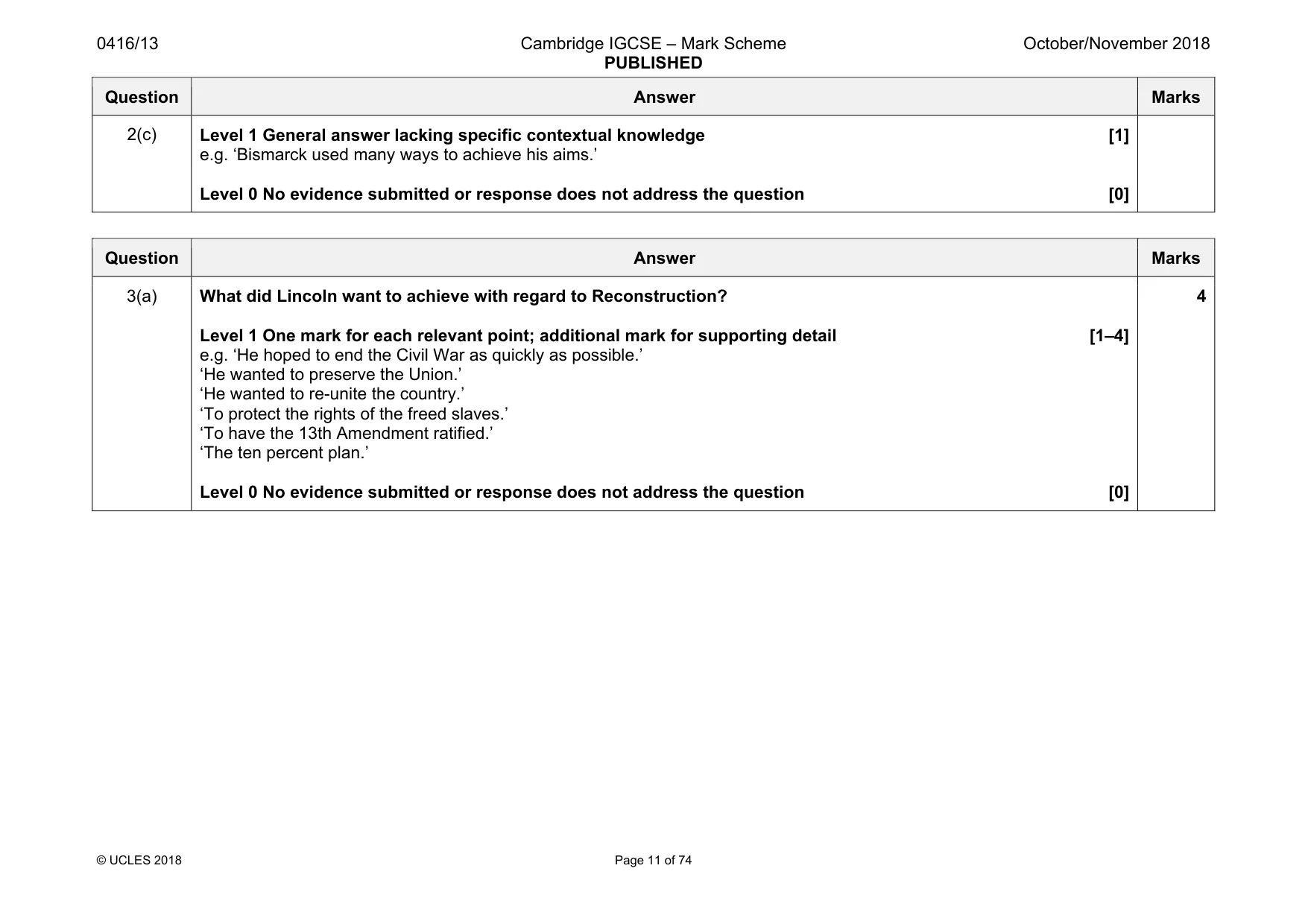
0416/13 Cambridge IGCSE – Mark Scheme PUBLISHED October/November 2018 © UCLES 2018 Page 11 of 74 Question Answer Marks 2(c) Level 1 General answer lacking specific contextual knowledge [1] e.g. ‘Bismarck used many ways to achieve his aims.’ Level 0 No evidence submitted or response does not address the question [0] Question Answer Marks 3(a) What did Lincoln want to achieve with regard to Reconstruction? Level 1 One mark for each relevant point; additional mark for supporting detail [1–4] e.g. ‘He hoped to end the Civil War as quickly as possible.’ ‘He wanted to preserve the Union.’ ‘He wanted to re-unite the country.’ ‘To protect the rights of the freed slaves.’ ‘To have the 13th Amendment ratified.’ ‘The ten percent plan.’ Level 0 No evidence submitted or response does not address the question [0] 4
Mark scheme, page 12
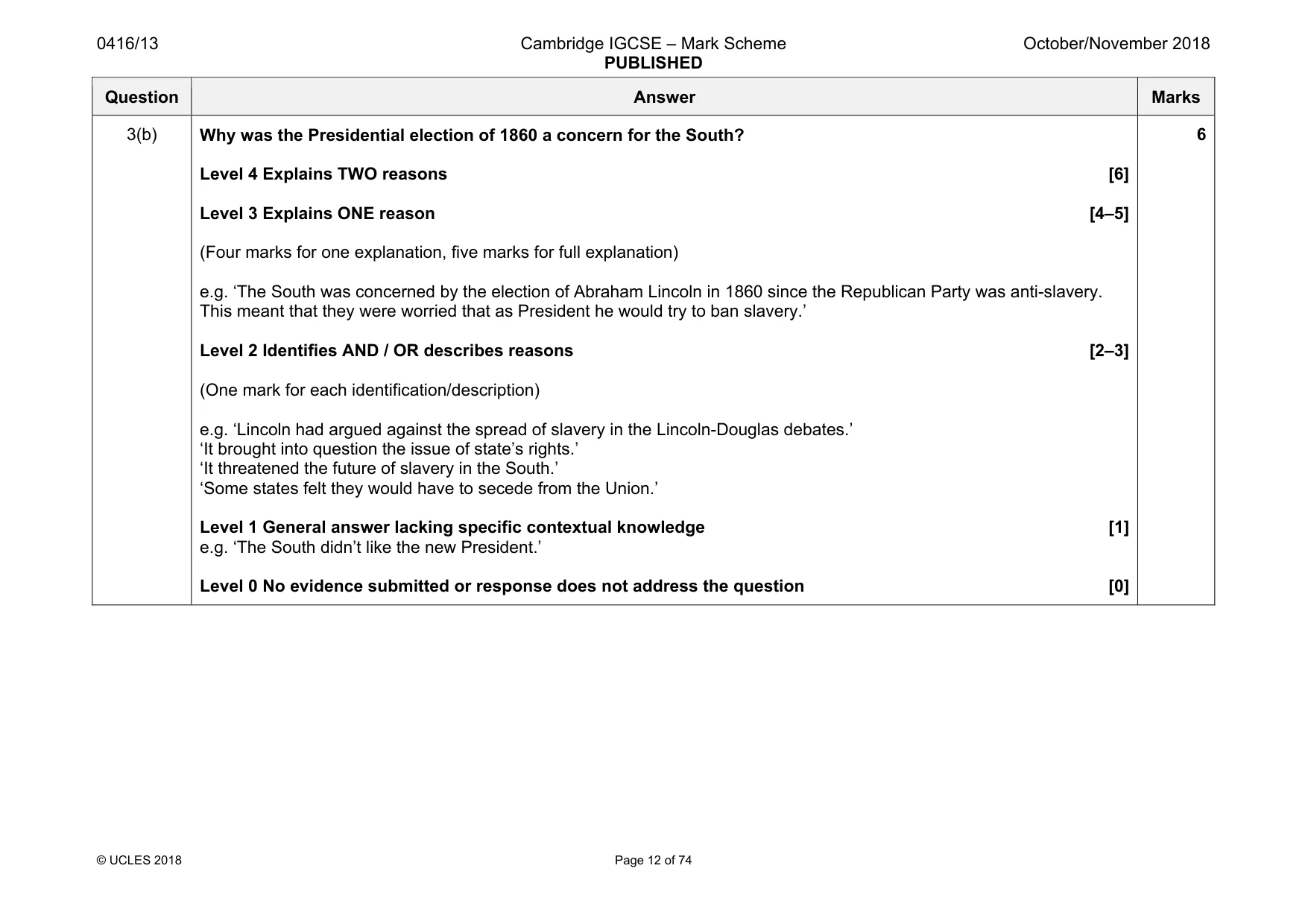
0416/13 Cambridge IGCSE – Mark Scheme PUBLISHED October/November 2018 © UCLES 2018 Page 12 of 74 Question Answer Marks 3(b) Why was the Presidential election of 1860 a concern for the South? Level 4 Explains TWO reasons [6] Level 3 Explains ONE reason [4–5] (Four marks for one explanation, five marks for full explanation) e.g. ‘The South was concerned by the election of Abraham Lincoln in 1860 since the Republican Party was anti-slavery. This meant that they were worried that as President he would try to ban slavery.’ Level 2 Identifies AND / OR describes reasons [2–3] (One mark for each identification/description) e.g. ‘Lincoln had argued against the spread of slavery in the Lincoln-Douglas debates.’ ‘It brought into question the issue of state’s rights.’ ‘It threatened the future of slavery in the South.’ ‘Some states felt they would have to secede from the Union.’ Level 1 General answer lacking specific contextual knowledge [1] e.g. ‘The South didn’t like the new President.’ Level 0 No evidence submitted or response does not address the question [0] 6
Mark scheme, page 13
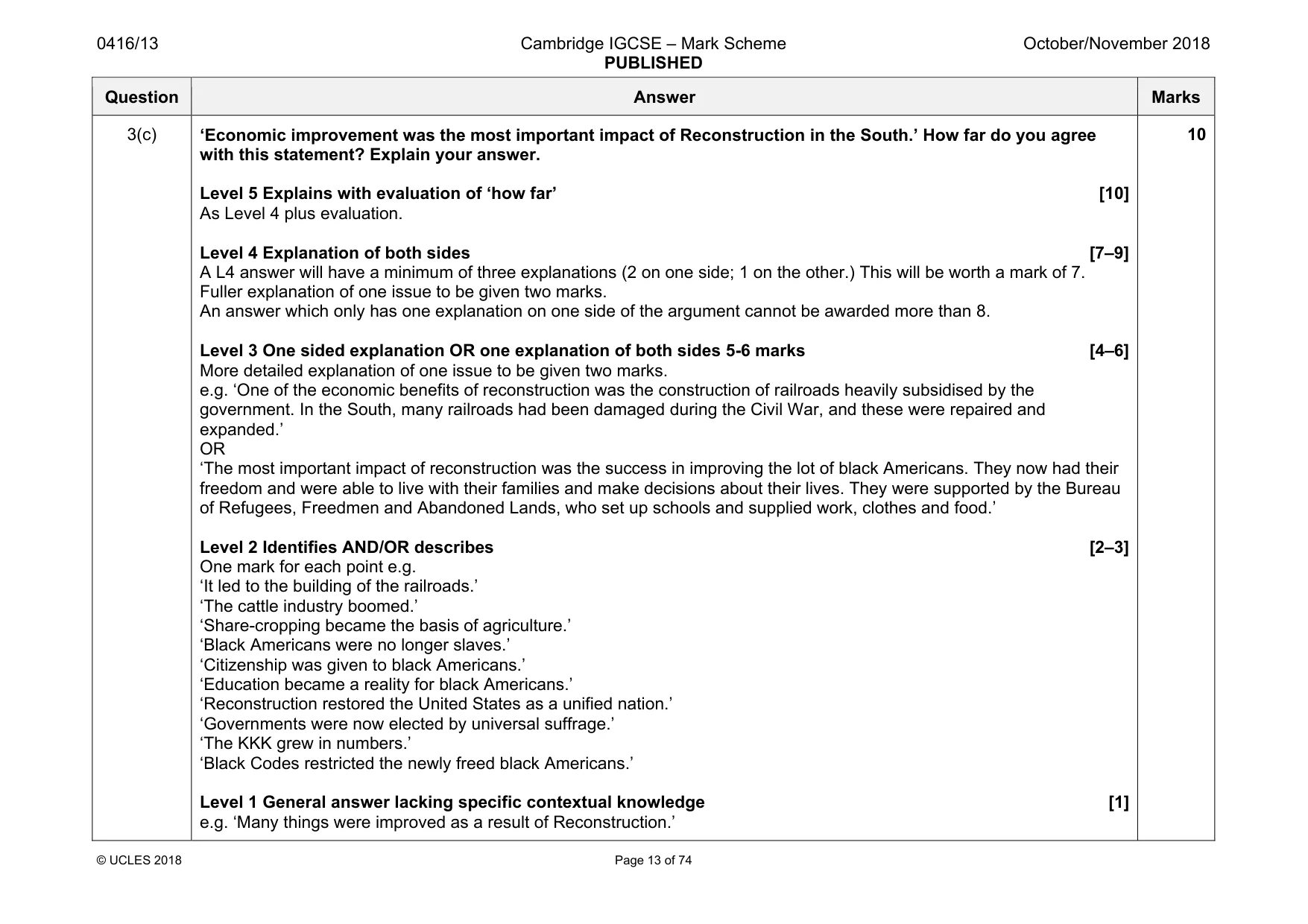
0416/13 Cambridge IGCSE – Mark Scheme PUBLISHED October/November 2018 © UCLES 2018 Page 13 of 74 Question Answer Marks 3(c) ‘Economic improvement was the most important impact of Reconstruction in the South.’ How far do you agree with this statement? Explain your answer. Level 5 Explains with evaluation of ‘how far’ [10] As Level 4 plus evaluation. Level 4 Explanation of both sides [7–9] A L4 answer will have a minimum of three explanations (2 on one side; 1 on the other.) This will be worth a mark of 7. Fuller explanation of one issue to be given two marks. An answer which only has one explanation on one side of the argument cannot be awarded more than 8. Level 3 One sided explanation OR one explanation of both sides 5-6 marks [4–6] More detailed explanation of one issue to be given two marks. e.g. ‘One of the economic benefits of reconstruction was the construction of railroads heavily subsidised by the government. In the South, many railroads had been damaged during the Civil War, and these were repaired and expanded.’ OR ‘The most important impact of reconstruction was the success in improving the lot of black Americans. They now had their freedom and were able to live with their families and make decisions about their lives. They were supported by the Bureau of Refugees, Freedmen and Abandoned Lands, who set up schools and supplied work, clothes and food.’ Level 2 Identifies AND/OR describes [2–3] One mark for each point e.g. ‘It led to the building of the railroads.’ ‘The cattle industry boomed.’ ‘Share-cropping became the basis of agriculture.’ ‘Black Americans were no longer slaves.’ ‘Citizenship was given to black Americans.’ ‘Education became a reality for black Americans.’ ‘Reconstruction restored the United States as a unified nation.’ ‘Governments were now elected by universal suffrage.’ ‘The KKK grew in numbers.’ ‘Black Codes restricted the newly freed black Americans.’ Level 1 General answer lacking specific contextual knowledge [1] e.g. ‘Many things were improved as a result of Reconstruction.’ 10
Mark scheme, page 14
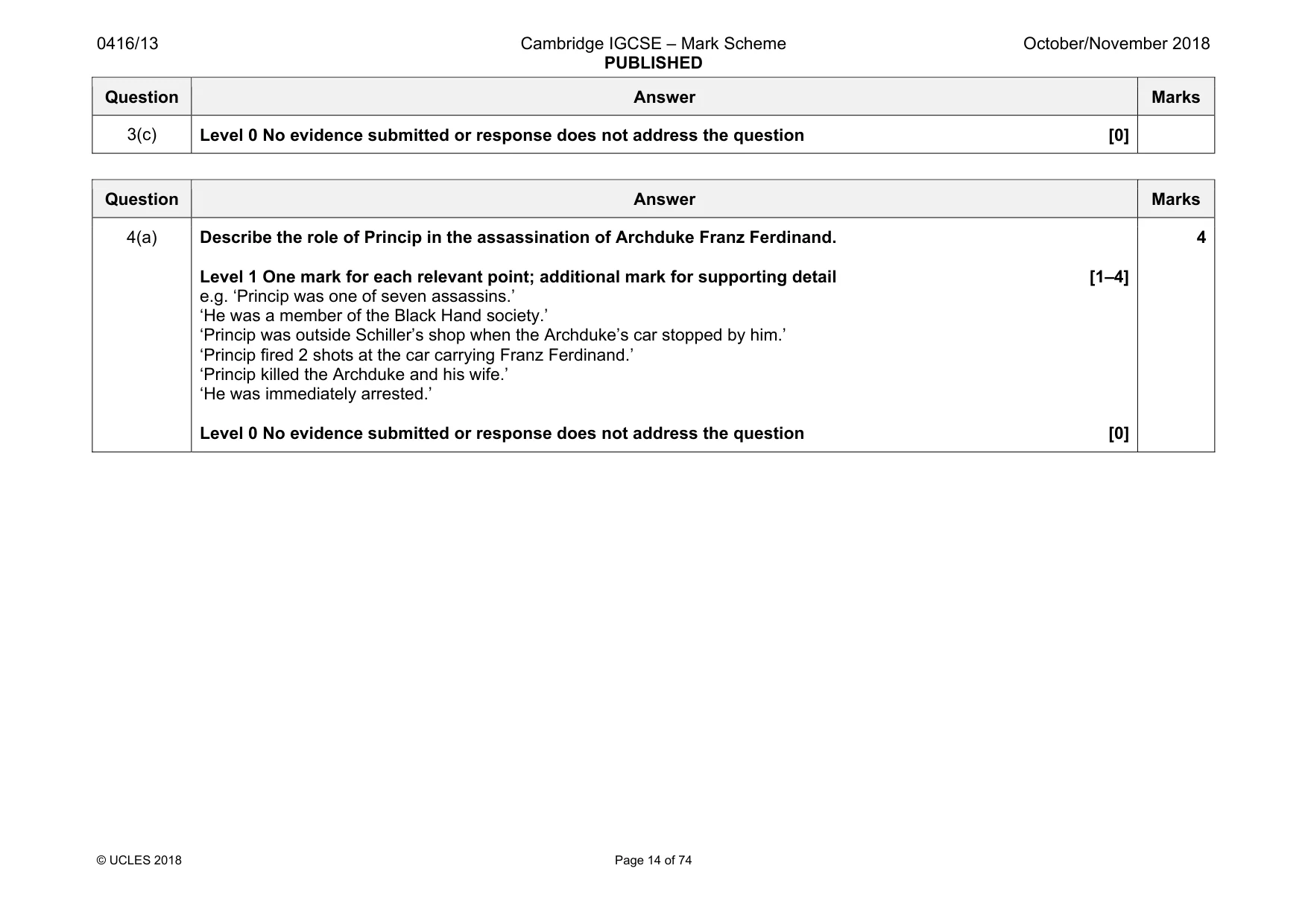
0416/13 Cambridge IGCSE – Mark Scheme PUBLISHED October/November 2018 © UCLES 2018 Page 14 of 74 Question Answer Marks 3(c) Level 0 No evidence submitted or response does not address the question [0] Question Answer Marks 4(a) Describe the role of Princip in the assassination of Archduke Franz Ferdinand. Level 1 One mark for each relevant point; additional mark for supporting detail [1–4] e.g. ‘Princip was one of seven assassins.’ ‘He was a member of the Black Hand society.’ ‘Princip was outside Schiller’s shop when the Archduke’s car stopped by him.’ ‘Princip fired 2 shots at the car carrying Franz Ferdinand.’ ‘Princip killed the Archduke and his wife.’ ‘He was immediately arrested.’ Level 0 No evidence submitted or response does not address the question [0] 4
Mark scheme, page 15
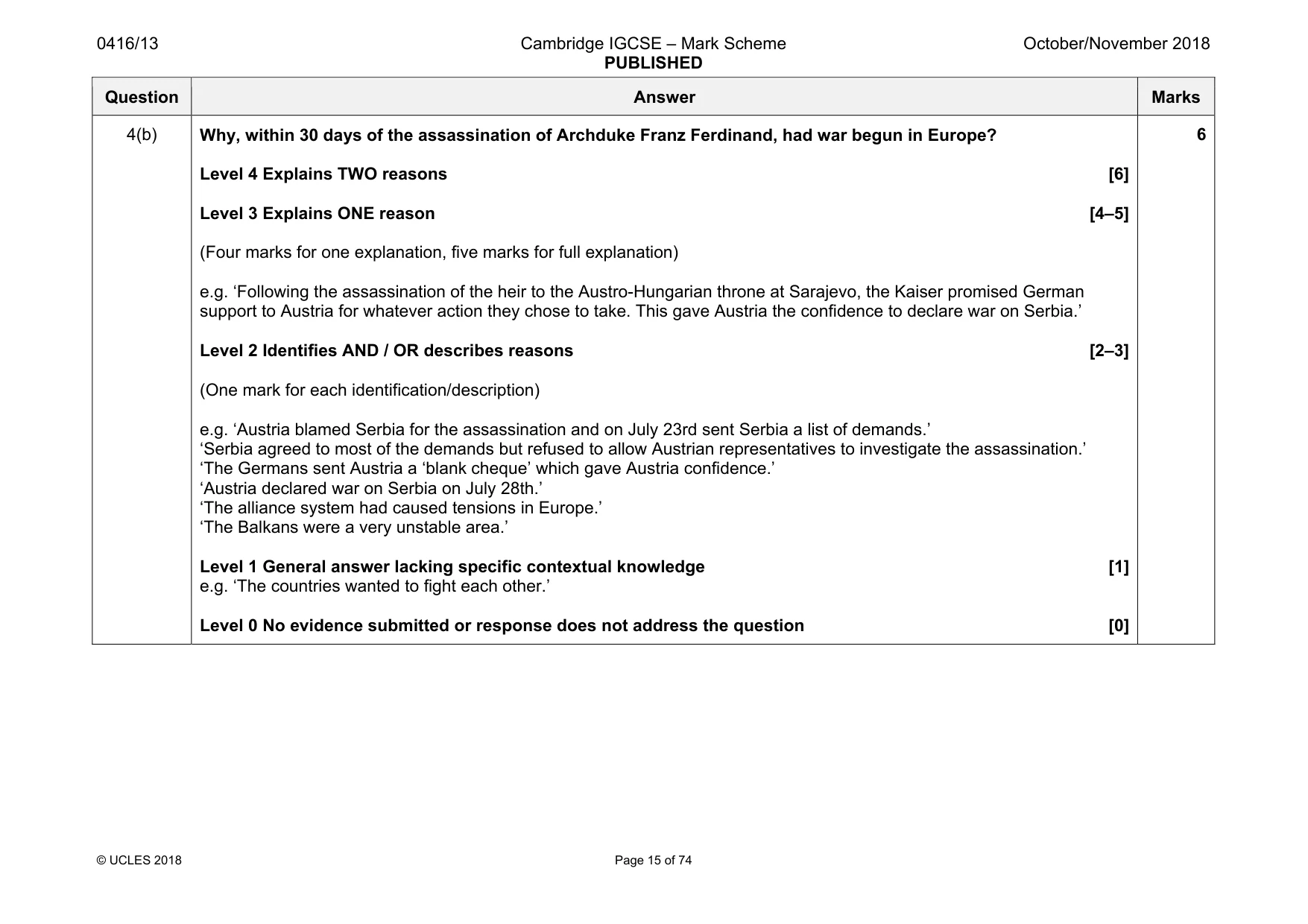
0416/13 Cambridge IGCSE – Mark Scheme PUBLISHED October/November 2018 © UCLES 2018 Page 15 of 74 Question Answer Marks 4(b) Why, within 30 days of the assassination of Archduke Franz Ferdinand, had war begun in Europe? Level 4 Explains TWO reasons [6] Level 3 Explains ONE reason [4–5] (Four marks for one explanation, five marks for full explanation) e.g. ‘Following the assassination of the heir to the Austro-Hungarian throne at Sarajevo, the Kaiser promised German support to Austria for whatever action they chose to take. This gave Austria the confidence to declare war on Serbia.’ Level 2 Identifies AND / OR describes reasons [2–3] (One mark for each identification/description) e.g. ‘Austria blamed Serbia for the assassination and on July 23rd sent Serbia a list of demands.’ ‘Serbia agreed to most of the demands but refused to allow Austrian representatives to investigate the assassination.’ ‘The Germans sent Austria a ‘blank cheque’ which gave Austria confidence.’ ‘Austria declared war on Serbia on July 28th.’ ‘The alliance system had caused tensions in Europe.’ ‘The Balkans were a very unstable area.’ Level 1 General answer lacking specific contextual knowledge [1] e.g. ‘The countries wanted to fight each other.’ Level 0 No evidence submitted or response does not address the question [0] 6
Mark scheme, page 16
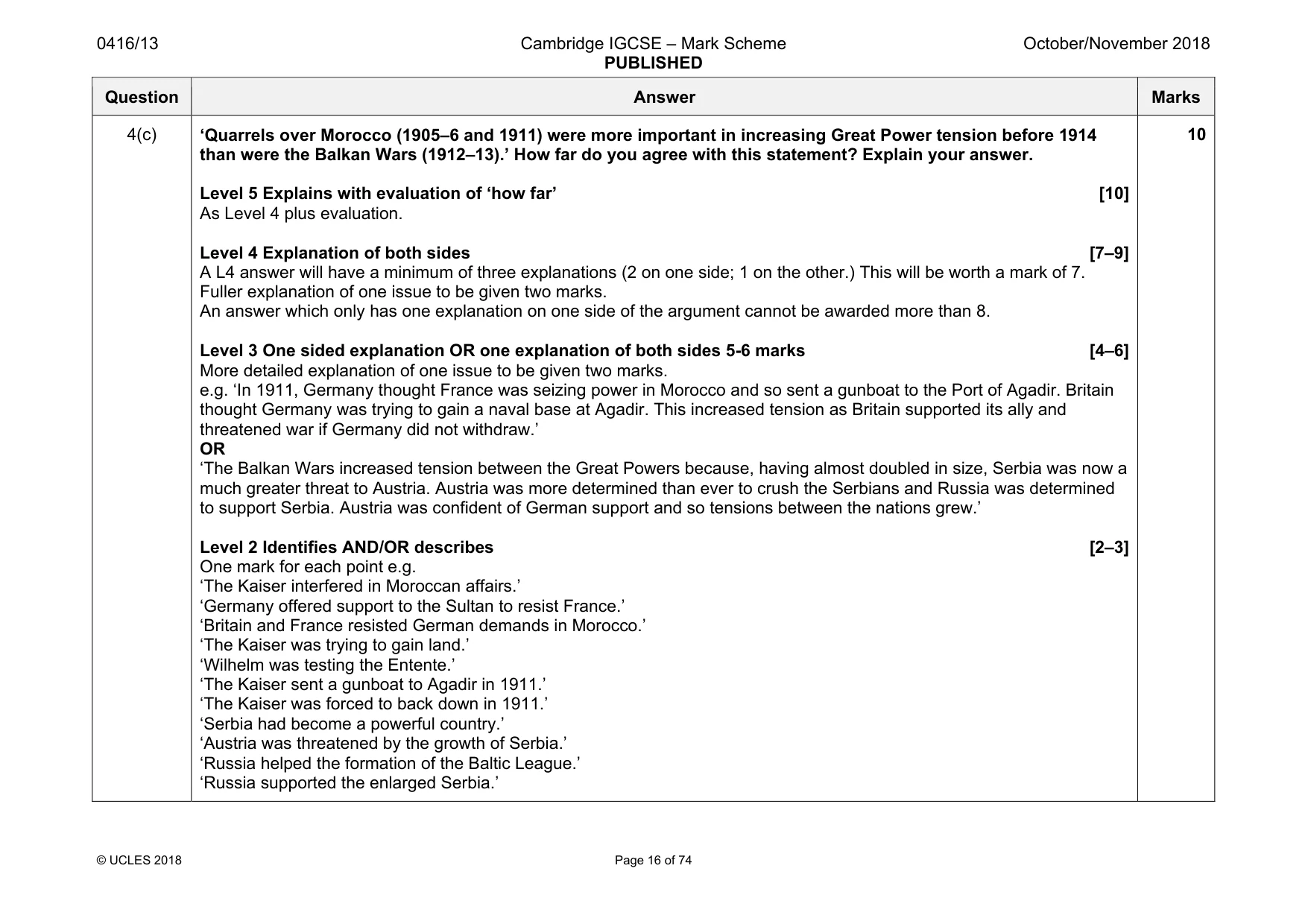
0416/13 Cambridge IGCSE – Mark Scheme PUBLISHED October/November 2018 © UCLES 2018 Page 16 of 74 Question Answer Marks 4(c) ‘Quarrels over Morocco (1905–6 and 1911) were more important in increasing Great Power tension before 1914 than were the Balkan Wars (1912–13).’ How far do you agree with this statement? Explain your answer. Level 5 Explains with evaluation of ‘how far’ [10] As Level 4 plus evaluation. Level 4 Explanation of both sides [7–9] A L4 answer will have a minimum of three explanations (2 on one side; 1 on the other.) This will be worth a mark of 7. Fuller explanation of one issue to be given two marks. An answer which only has one explanation on one side of the argument cannot be awarded more than 8. Level 3 One sided explanation OR one explanation of both sides 5-6 marks [4–6] More detailed explanation of one issue to be given two marks. e.g. ‘In 1911, Germany thought France was seizing power in Morocco and so sent a gunboat to the Port of Agadir. Britain thought Germany was trying to gain a naval base at Agadir. This increased tension as Britain supported its ally and threatened war if Germany did not withdraw.’ OR ‘The Balkan Wars increased tension between the Great Powers because, having almost doubled in size, Serbia was now a much greater threat to Austria. Austria was more determined than ever to crush the Serbians and Russia was determined to support Serbia. Austria was confident of German support and so tensions between the nations grew.’ Level 2 Identifies AND/OR describes [2–3] One mark for each point e.g. ‘The Kaiser interfered in Moroccan affairs.’ ‘Germany offered support to the Sultan to resist France.’ ‘Britain and France resisted German demands in Morocco.’ ‘The Kaiser was trying to gain land.’ ‘Wilhelm was testing the Entente.’ ‘The Kaiser sent a gunboat to Agadir in 1911.’ ‘The Kaiser was forced to back down in 1911.’ ‘Serbia had become a powerful country.’ ‘Austria was threatened by the growth of Serbia.’ ‘Russia helped the formation of the Baltic League.’ ‘Russia supported the enlarged Serbia.’ 10
Mark scheme, page 17
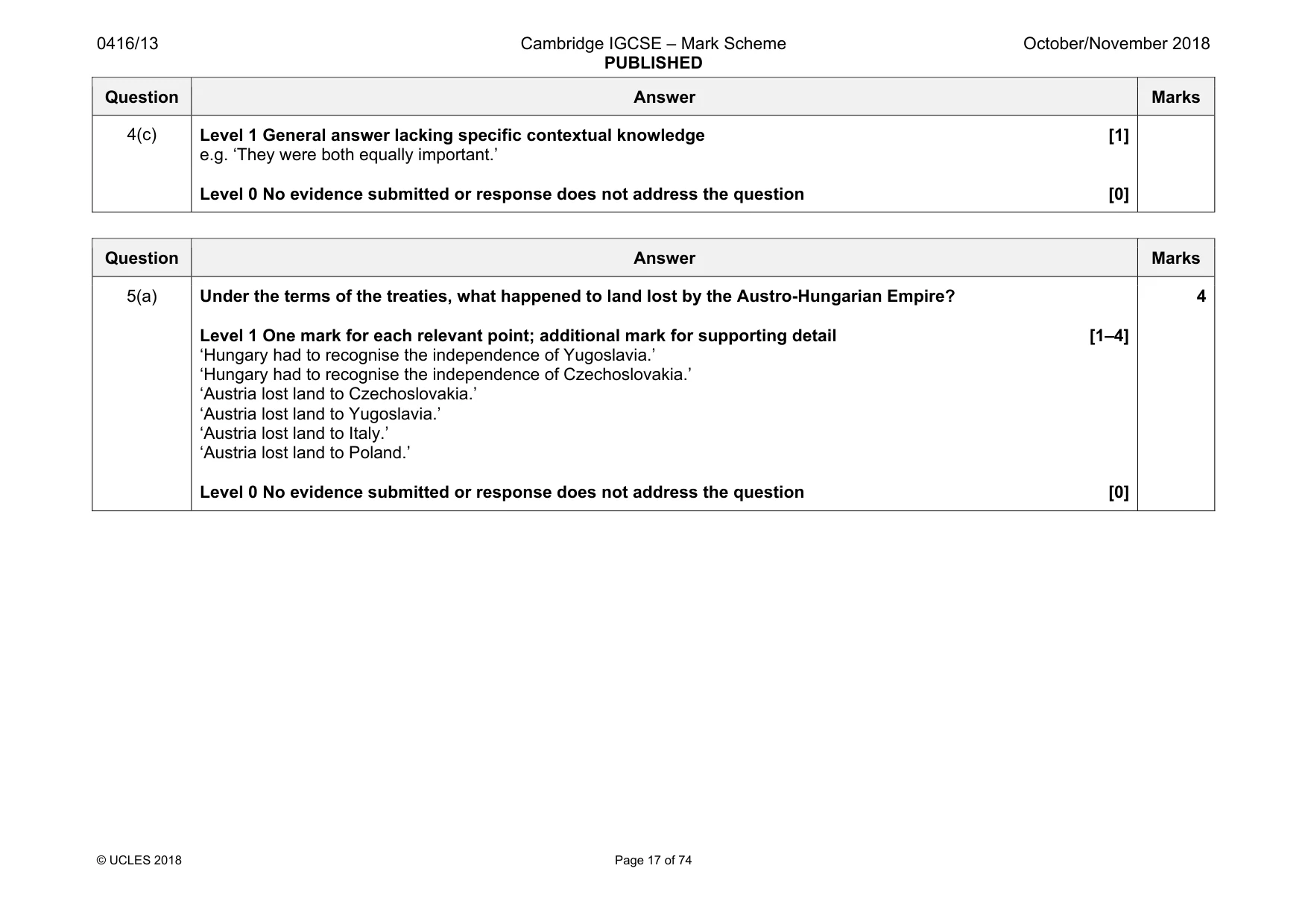
0416/13 Cambridge IGCSE – Mark Scheme PUBLISHED October/November 2018 © UCLES 2018 Page 17 of 74 Question Answer Marks 4(c) Level 1 General answer lacking specific contextual knowledge [1] e.g. ‘They were both equally important.’ Level 0 No evidence submitted or response does not address the question [0] Question Answer Marks 5(a) Under the terms of the treaties, what happened to land lost by the Austro-Hungarian Empire? Level 1 One mark for each relevant point; additional mark for supporting detail [1–4] ‘Hungary had to recognise the independence of Yugoslavia.’ ‘Hungary had to recognise the independence of Czechoslovakia.’ ‘Austria lost land to Czechoslovakia.’ ‘Austria lost land to Yugoslavia.’ ‘Austria lost land to Italy.’ ‘Austria lost land to Poland.’ Level 0 No evidence submitted or response does not address the question [0] 4
Mark scheme, page 18
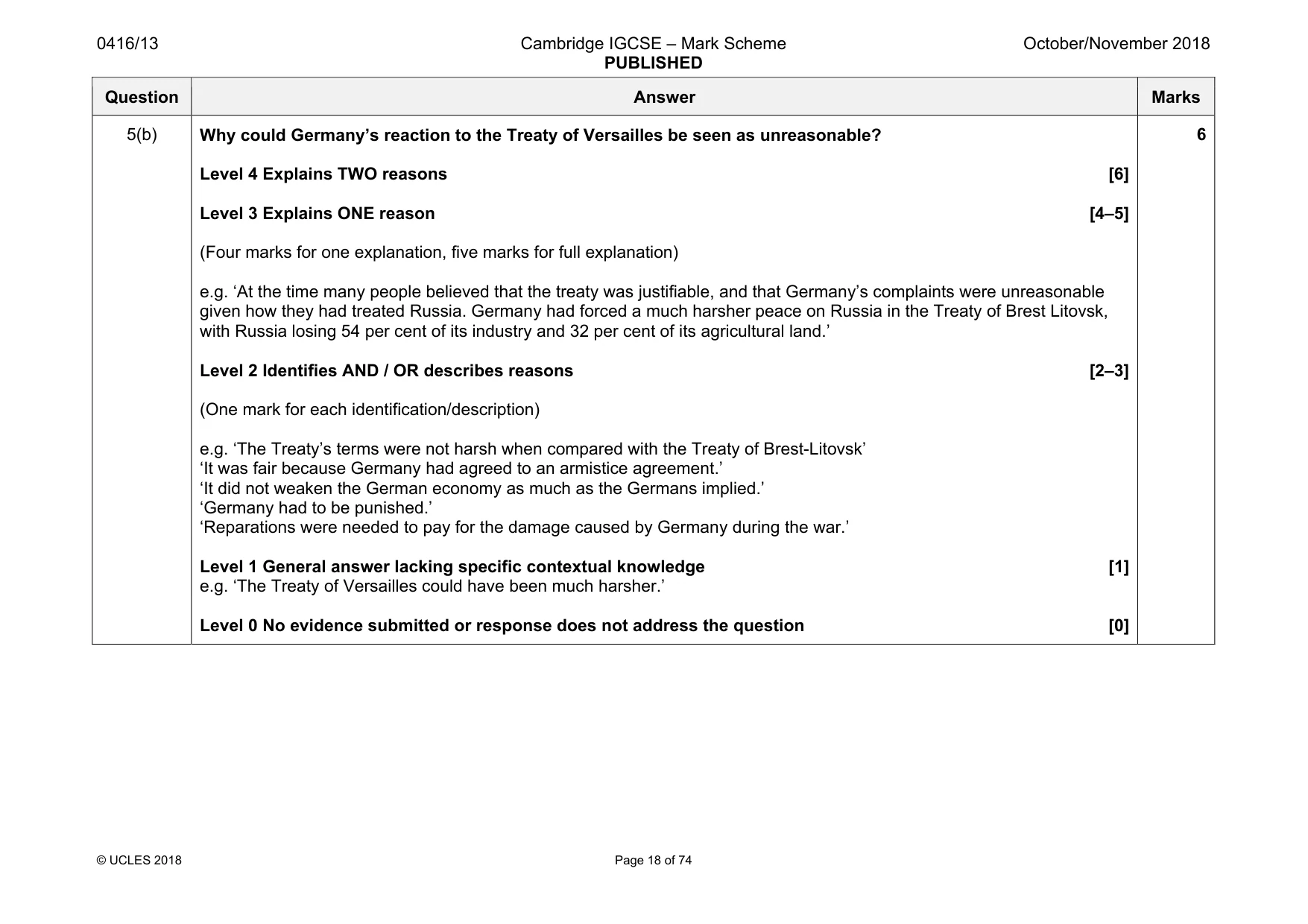
0416/13 Cambridge IGCSE – Mark Scheme PUBLISHED October/November 2018 © UCLES 2018 Page 18 of 74 Question Answer Marks 5(b) Why could Germany’s reaction to the Treaty of Versailles be seen as unreasonable? Level 4 Explains TWO reasons [6] Level 3 Explains ONE reason [4–5] (Four marks for one explanation, five marks for full explanation) e.g. ‘At the time many people believed that the treaty was justifiable, and that Germany’s complaints were unreasonable given how they had treated Russia. Germany had forced a much harsher peace on Russia in the Treaty of Brest Litovsk, with Russia losing 54 per cent of its industry and 32 per cent of its agricultural land.’ Level 2 Identifies AND / OR describes reasons [2–3] (One mark for each identification/description) e.g. ‘The Treaty’s terms were not harsh when compared with the Treaty of Brest-Litovsk’ ‘It was fair because Germany had agreed to an armistice agreement.’ ‘It did not weaken the German economy as much as the Germans implied.’ ‘Germany had to be punished.’ ‘Reparations were needed to pay for the damage caused by Germany during the war.’ Level 1 General answer lacking specific contextual knowledge [1] e.g. ‘The Treaty of Versailles could have been much harsher.’ Level 0 No evidence submitted or response does not address the question [0] 6
Mark scheme, page 19
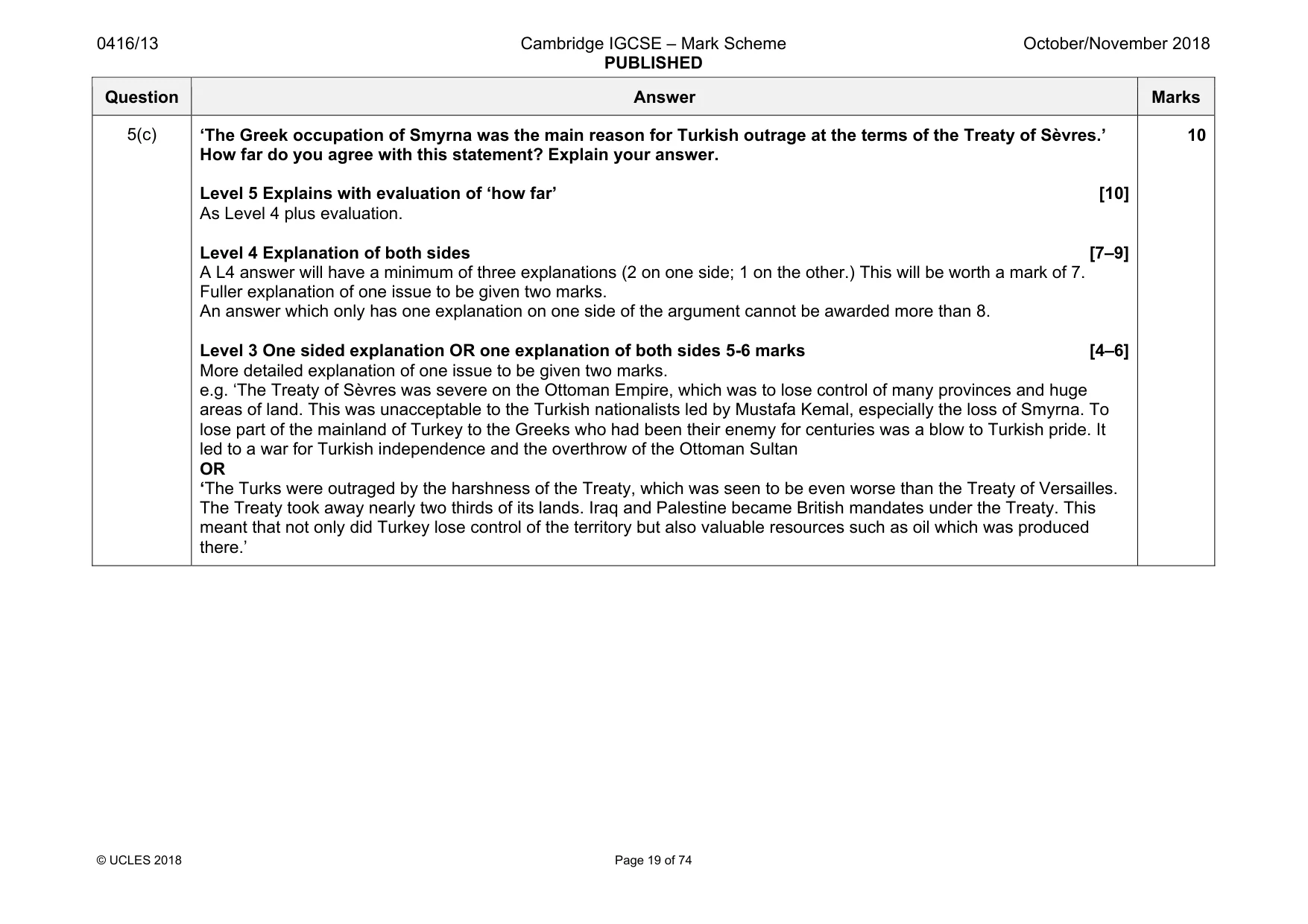
0416/13 Cambridge IGCSE – Mark Scheme PUBLISHED October/November 2018 © UCLES 2018 Page 19 of 74 Question Answer Marks 5(c) ‘The Greek occupation of Smyrna was the main reason for Turkish outrage at the terms of the Treaty of Sèvres.’ How far do you agree with this statement? Explain your answer. Level 5 Explains with evaluation of ‘how far’ [10] As Level 4 plus evaluation. Level 4 Explanation of both sides [7–9] A L4 answer will have a minimum of three explanations (2 on one side; 1 on the other.) This will be worth a mark of 7. Fuller explanation of one issue to be given two marks. An answer which only has one explanation on one side of the argument cannot be awarded more than 8. Level 3 One sided explanation OR one explanation of both sides 5-6 marks [4–6] More detailed explanation of one issue to be given two marks. e.g. ‘The Treaty of Sèvres was severe on the Ottoman Empire, which was to lose control of many provinces and huge areas of land. This was unacceptable to the Turkish nationalists led by Mustafa Kemal, especially the loss of Smyrna. To lose part of the mainland of Turkey to the Greeks who had been their enemy for centuries was a blow to Turkish pride. It led to a war for Turkish independence and the overthrow of the Ottoman Sultan OR ‘The Turks were outraged by the harshness of the Treaty, which was seen to be even worse than the Treaty of Versailles. The Treaty took away nearly two thirds of its lands. Iraq and Palestine became British mandates under the Treaty. This meant that not only did Turkey lose control of the territory but also valuable resources such as oil which was produced there.’ 10
Mark scheme, page 20
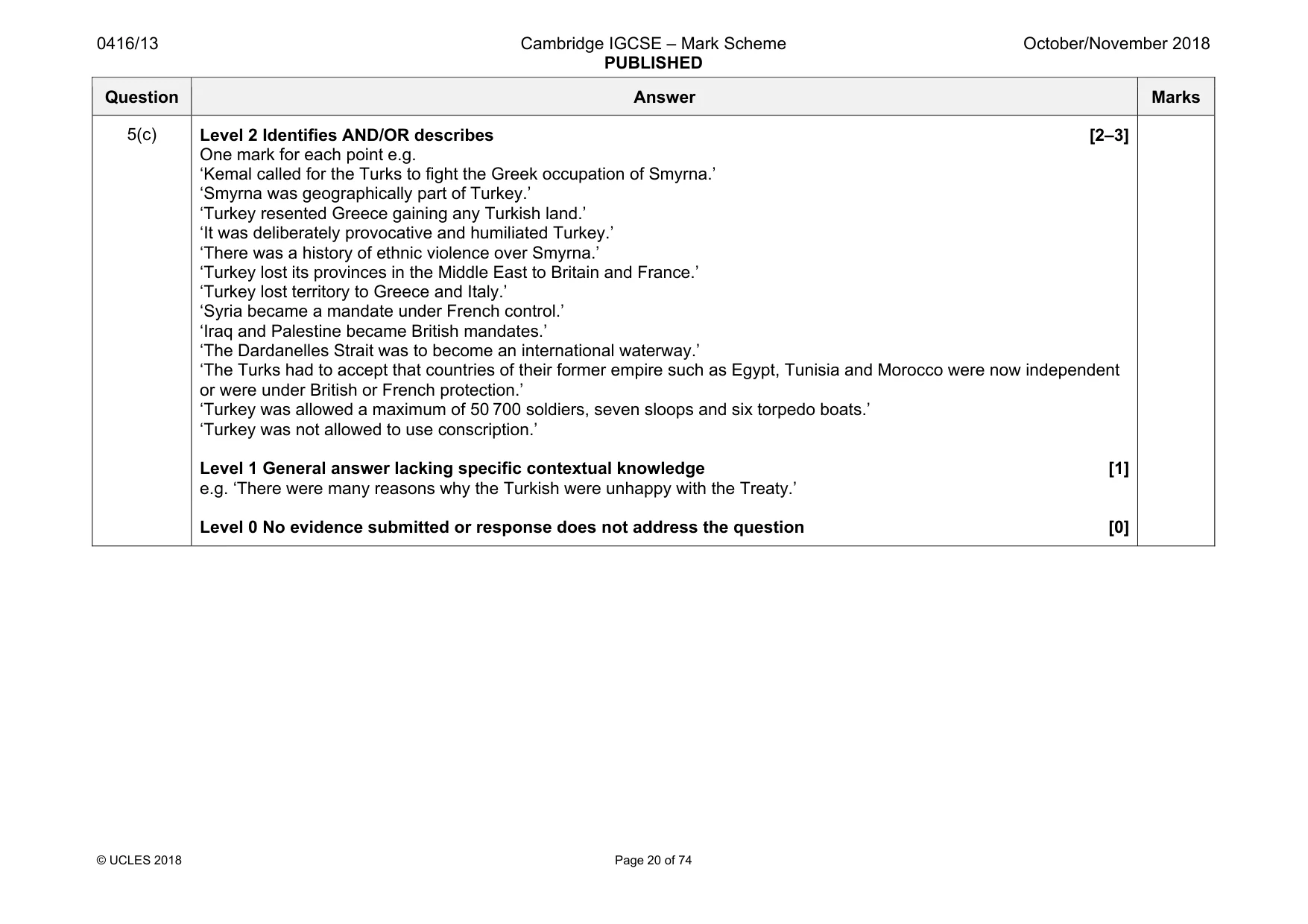
0416/13 Cambridge IGCSE – Mark Scheme PUBLISHED October/November 2018 © UCLES 2018 Page 20 of 74 Question Answer Marks 5(c) Level 2 Identifies AND/OR describes [2–3] One mark for each point e.g. ‘Kemal called for the Turks to fight the Greek occupation of Smyrna.’ ‘Smyrna was geographically part of Turkey.’ ‘Turkey resented Greece gaining any Turkish land.’ ‘It was deliberately provocative and humiliated Turkey.’ ‘There was a history of ethnic violence over Smyrna.’ ‘Turkey lost its provinces in the Middle East to Britain and France.’ ‘Turkey lost territory to Greece and Italy.’ ‘Syria became a mandate under French control.’ ‘Iraq and Palestine became British mandates.’ ‘The Dardanelles Strait was to become an international waterway.’ ‘The Turks had to accept that countries of their former empire such as Egypt, Tunisia and Morocco were now independent or were under British or French protection.’ ‘Turkey was allowed a maximum of 50 700 soldiers, seven sloops and six torpedo boats.’ ‘Turkey was not allowed to use conscription.’ Level 1 General answer lacking specific contextual knowledge [1] e.g. ‘There were many reasons why the Turkish were unhappy with the Treaty.’ Level 0 No evidence submitted or response does not address the question [0]
Mark scheme, page 21
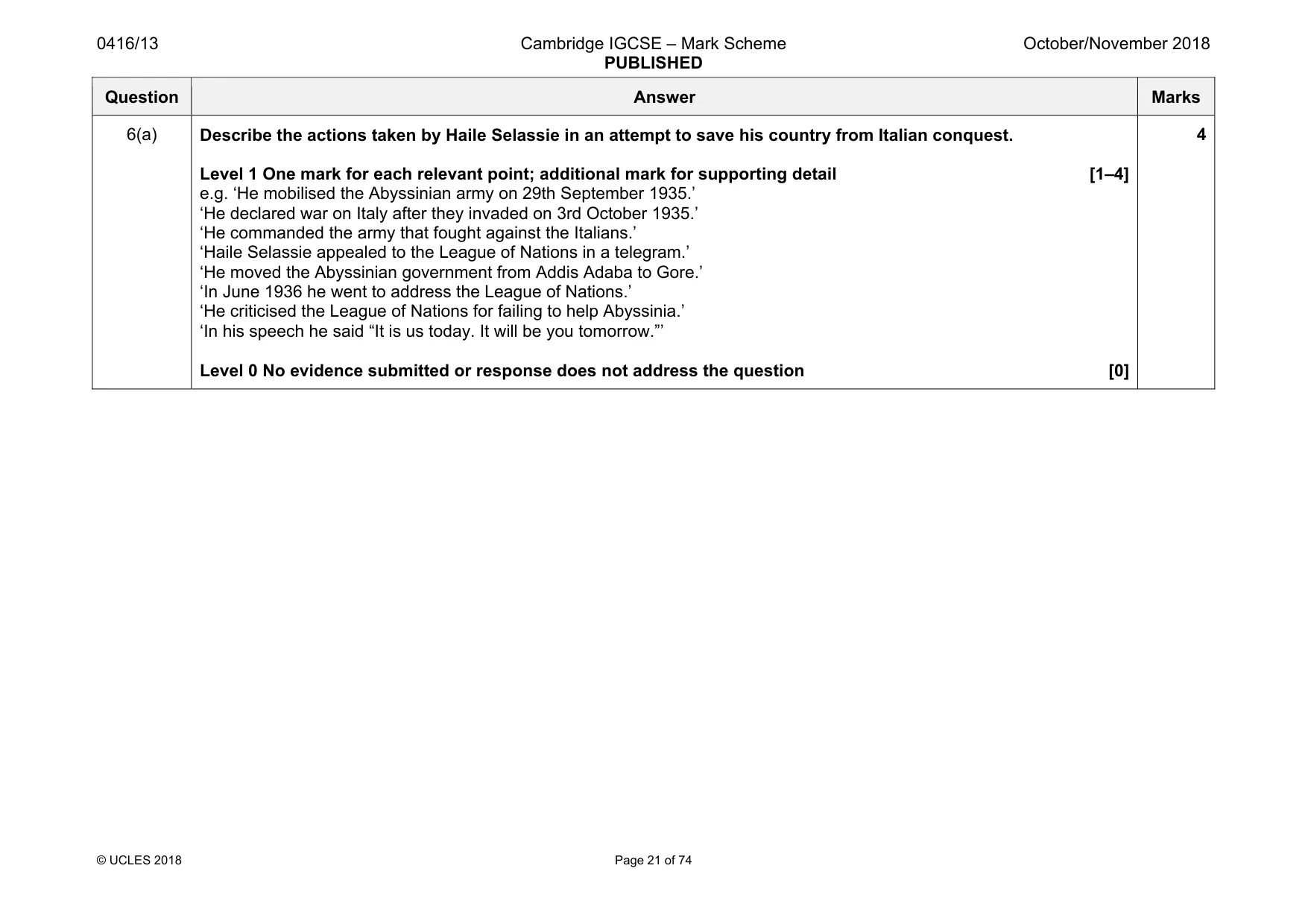
0416/13 Cambridge IGCSE – Mark Scheme PUBLISHED October/November 2018 © UCLES 2018 Page 21 of 74 Question Answer Marks 6(a) Describe the actions taken by Haile Selassie in an attempt to save his country from Italian conquest. Level 1 One mark for each relevant point; additional mark for supporting detail [1–4] e.g. ‘He mobilised the Abyssinian army on 29th September 1935.’ ‘He declared war on Italy after they invaded on 3rd October 1935.’ ‘He commanded the army that fought against the Italians.’ ‘Haile Selassie appealed to the League of Nations in a telegram.’ ‘He moved the Abyssinian government from Addis Adaba to Gore.’ ‘In June 1936 he went to address the League of Nations.’ ‘He criticised the League of Nations for failing to help Abyssinia.’ ‘In his speech he said “It is us today. It will be you tomorrow.”’ Level 0 No evidence submitted or response does not address the question [0] 4
Mark scheme, page 22
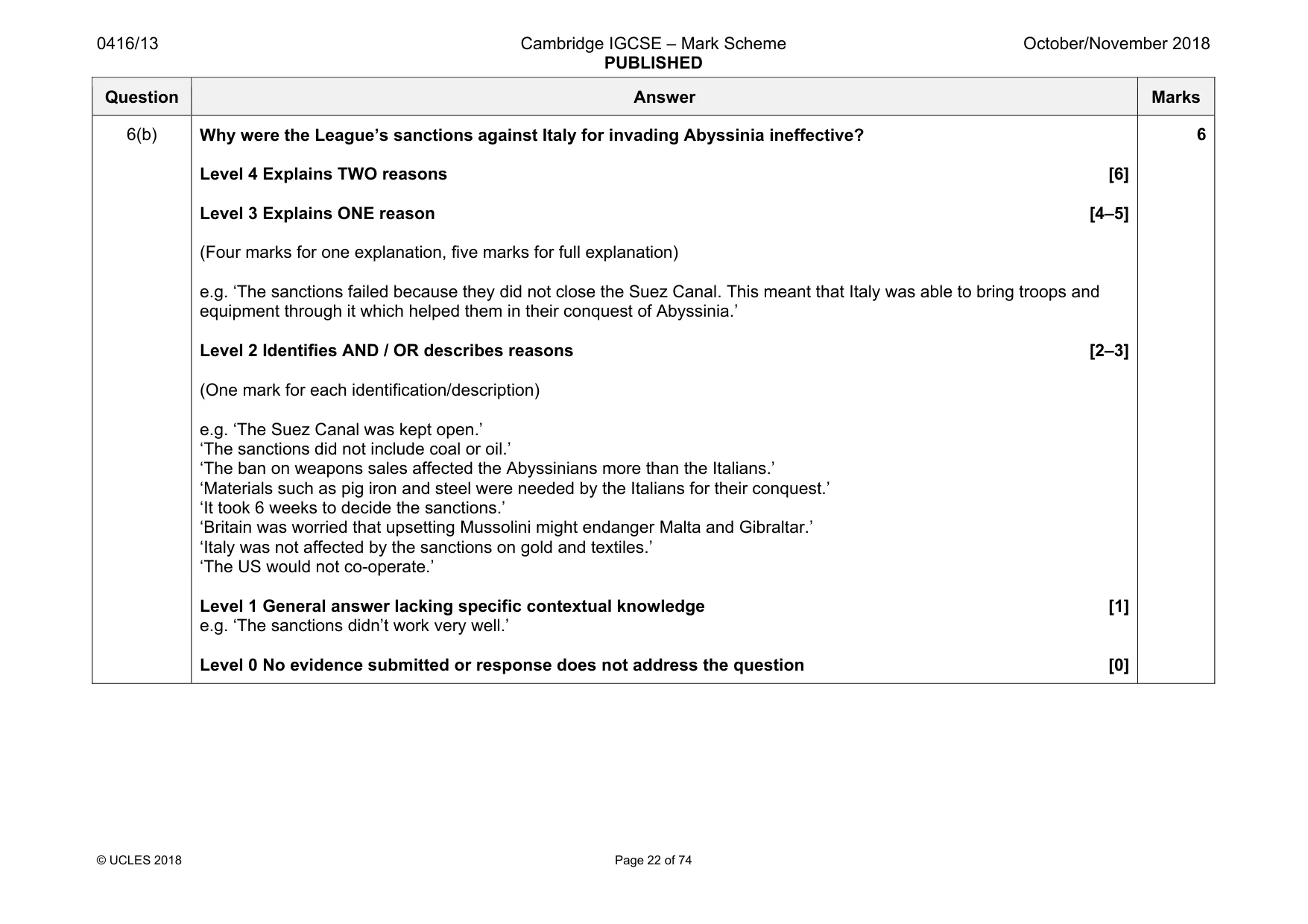
0416/13 Cambridge IGCSE – Mark Scheme PUBLISHED October/November 2018 © UCLES 2018 Page 22 of 74 Question Answer Marks 6(b) Why were the League’s sanctions against Italy for invading Abyssinia ineffective? Level 4 Explains TWO reasons [6] Level 3 Explains ONE reason [4–5] (Four marks for one explanation, five marks for full explanation) e.g. ‘The sanctions failed because they did not close the Suez Canal. This meant that Italy was able to bring troops and equipment through it which helped them in their conquest of Abyssinia.’ Level 2 Identifies AND / OR describes reasons [2–3] (One mark for each identification/description) e.g. ‘The Suez Canal was kept open.’ ‘The sanctions did not include coal or oil.’ ‘The ban on weapons sales affected the Abyssinians more than the Italians.’ ‘Materials such as pig iron and steel were needed by the Italians for their conquest.’ ‘It took 6 weeks to decide the sanctions.’ ‘Britain was worried that upsetting Mussolini might endanger Malta and Gibraltar.’ ‘Italy was not affected by the sanctions on gold and textiles.’ ‘The US would not co-operate.’ Level 1 General answer lacking specific contextual knowledge [1] e.g. ‘The sanctions didn’t work very well.’ Level 0 No evidence submitted or response does not address the question [0] 6
Mark scheme, page 23
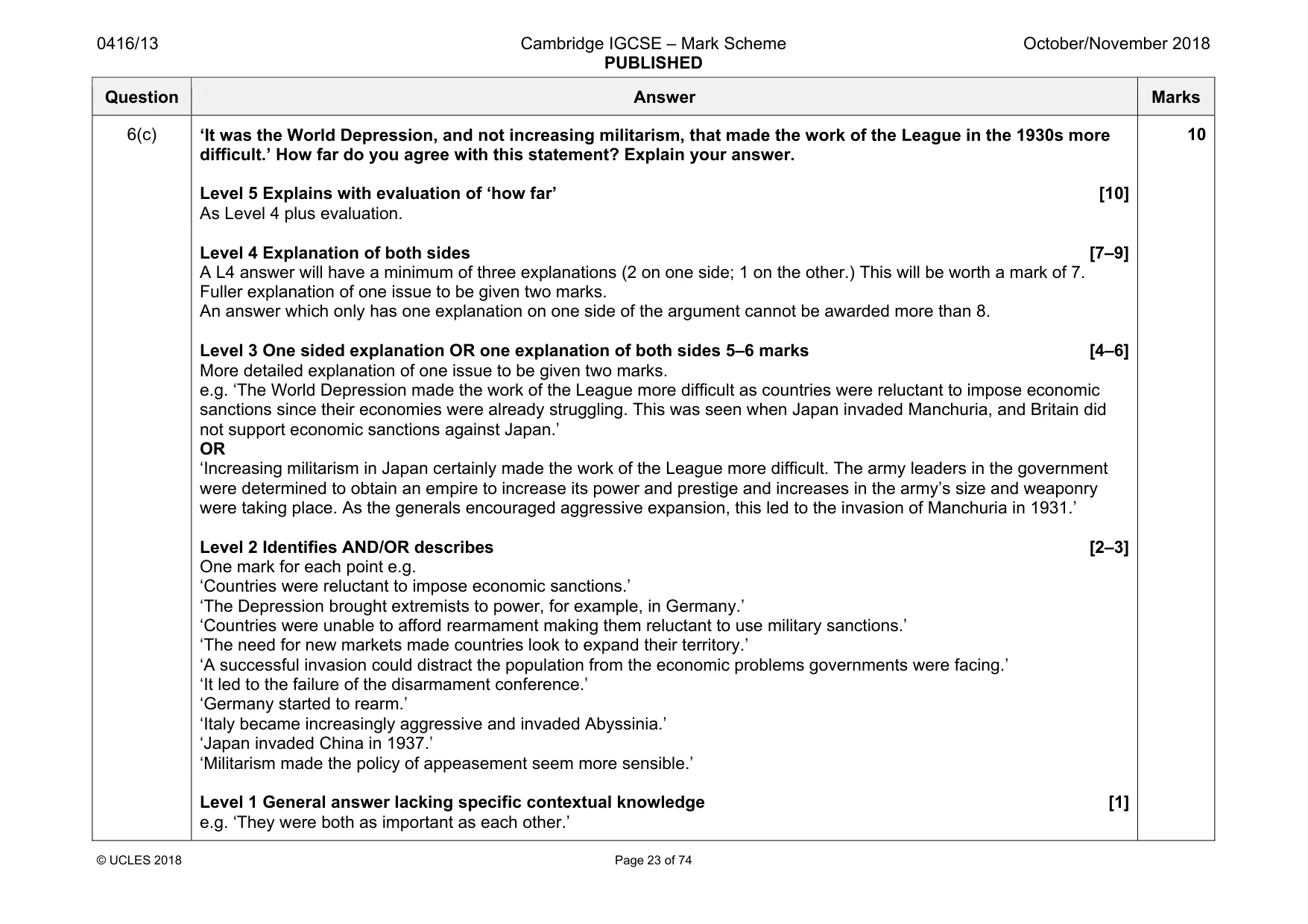
0416/13 Cambridge IGCSE – Mark Scheme PUBLISHED October/November 2018 © UCLES 2018 Page 23 of 74 Question Answer Marks 6(c) ‘It was the World Depression, and not increasing militarism, that made the work of the League in the 1930s more difficult.’ How far do you agree with this statement? Explain your answer. Level 5 Explains with evaluation of ‘how far’ [10] As Level 4 plus evaluation. Level 4 Explanation of both sides [7–9] A L4 answer will have a minimum of three explanations (2 on one side; 1 on the other.) This will be worth a mark of 7. Fuller explanation of one issue to be given two marks. An answer which only has one explanation on one side of the argument cannot be awarded more than 8. Level 3 One sided explanation OR one explanation of both sides 5–6 marks [4–6] More detailed explanation of one issue to be given two marks. e.g. ‘The World Depression made the work of the League more difficult as countries were reluctant to impose economic sanctions since their economies were already struggling. This was seen when Japan invaded Manchuria, and Britain did not support economic sanctions against Japan.’ OR ‘Increasing militarism in Japan certainly made the work of the League more difficult. The army leaders in the government were determined to obtain an empire to increase its power and prestige and increases in the army’s size and weaponry were taking place. As the generals encouraged aggressive expansion, this led to the invasion of Manchuria in 1931.’ Level 2 Identifies AND/OR describes [2–3] One mark for each point e.g. ‘Countries were reluctant to impose economic sanctions.’ ‘The Depression brought extremists to power, for example, in Germany.’ ‘Countries were unable to afford rearmament making them reluctant to use military sanctions.’ ‘The need for new markets made countries look to expand their territory.’ ‘A successful invasion could distract the population from the economic problems governments were facing.’ ‘It led to the failure of the disarmament conference.’ ‘Germany started to rearm.’ ‘Italy became increasingly aggressive and invaded Abyssinia.’ ‘Japan invaded China in 1937.’ ‘Militarism made the policy of appeasement seem more sensible.’ Level 1 General answer lacking specific contextual knowledge [1] e.g. ‘They were both as important as each other.’ 10
Mark scheme, page 24
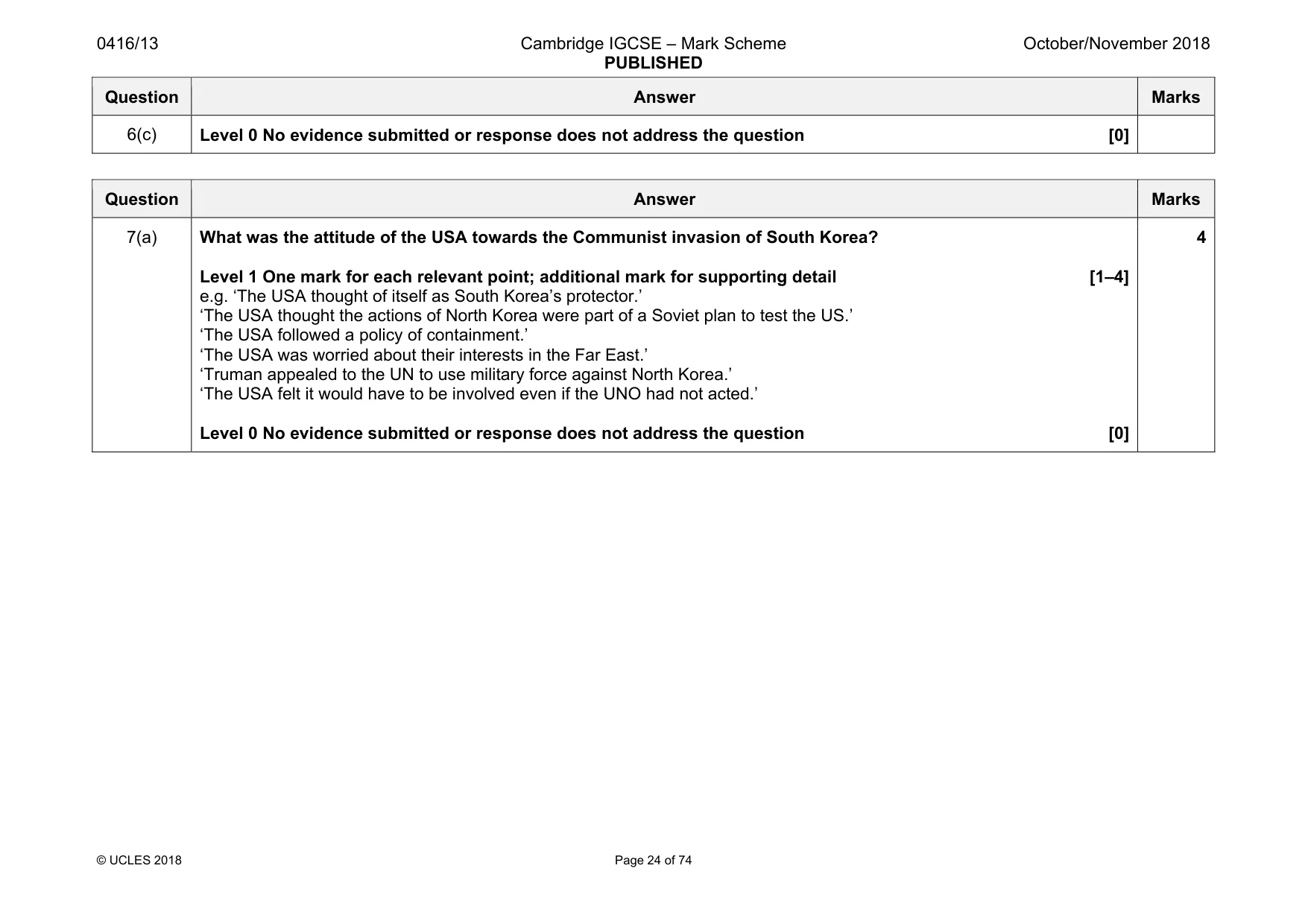
0416/13 Cambridge IGCSE – Mark Scheme PUBLISHED October/November 2018 © UCLES 2018 Page 24 of 74 Question Answer Marks 6(c) Level 0 No evidence submitted or response does not address the question [0] Question Answer Marks 7(a) What was the attitude of the USA towards the Communist invasion of South Korea? Level 1 One mark for each relevant point; additional mark for supporting detail [1–4] e.g. ‘The USA thought of itself as South Korea’s protector.’ ‘The USA thought the actions of North Korea were part of a Soviet plan to test the US.’ ‘The USA followed a policy of containment.’ ‘The USA was worried about their interests in the Far East.’ ‘Truman appealed to the UN to use military force against North Korea.’ ‘The USA felt it would have to be involved even if the UNO had not acted.’ Level 0 No evidence submitted or response does not address the question [0] 4
Mark scheme, page 25
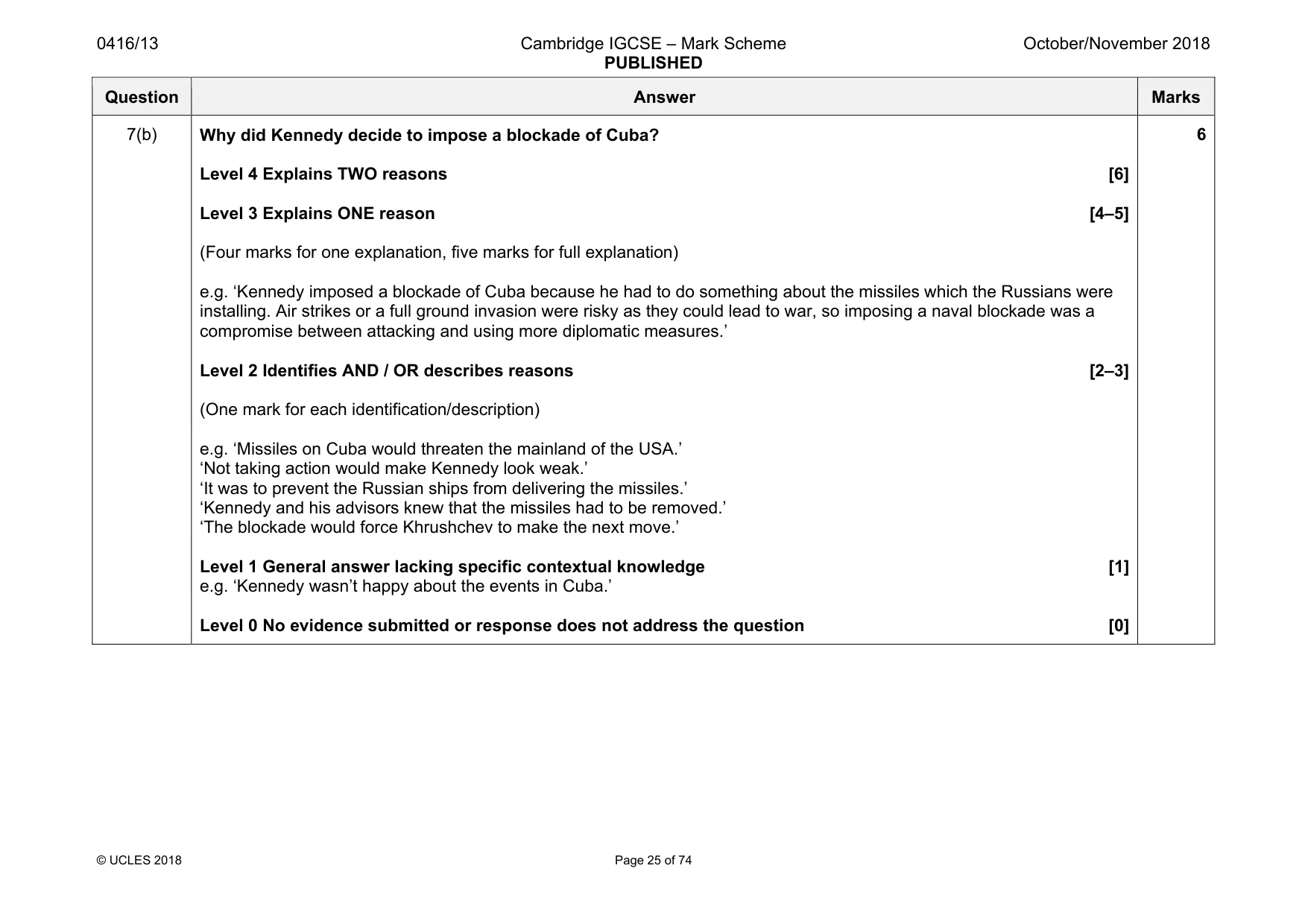
0416/13 Cambridge IGCSE – Mark Scheme PUBLISHED October/November 2018 © UCLES 2018 Page 25 of 74 Question Answer Marks 7(b) Why did Kennedy decide to impose a blockade of Cuba? Level 4 Explains TWO reasons [6] Level 3 Explains ONE reason [4–5] (Four marks for one explanation, five marks for full explanation) e.g. ‘Kennedy imposed a blockade of Cuba because he had to do something about the missiles which the Russians were installing. Air strikes or a full ground invasion were risky as they could lead to war, so imposing a naval blockade was a compromise between attacking and using more diplomatic measures.’ Level 2 Identifies AND / OR describes reasons [2–3] (One mark for each identification/description) e.g. ‘Missiles on Cuba would threaten the mainland of the USA.’ ‘Not taking action would make Kennedy look weak.’ ‘It was to prevent the Russian ships from delivering the missiles.’ ‘Kennedy and his advisors knew that the missiles had to be removed.’ ‘The blockade would force Khrushchev to make the next move.’ Level 1 General answer lacking specific contextual knowledge [1] e.g. ‘Kennedy wasn’t happy about the events in Cuba.’ Level 0 No evidence submitted or response does not address the question [0] 6
Mark scheme, page 26
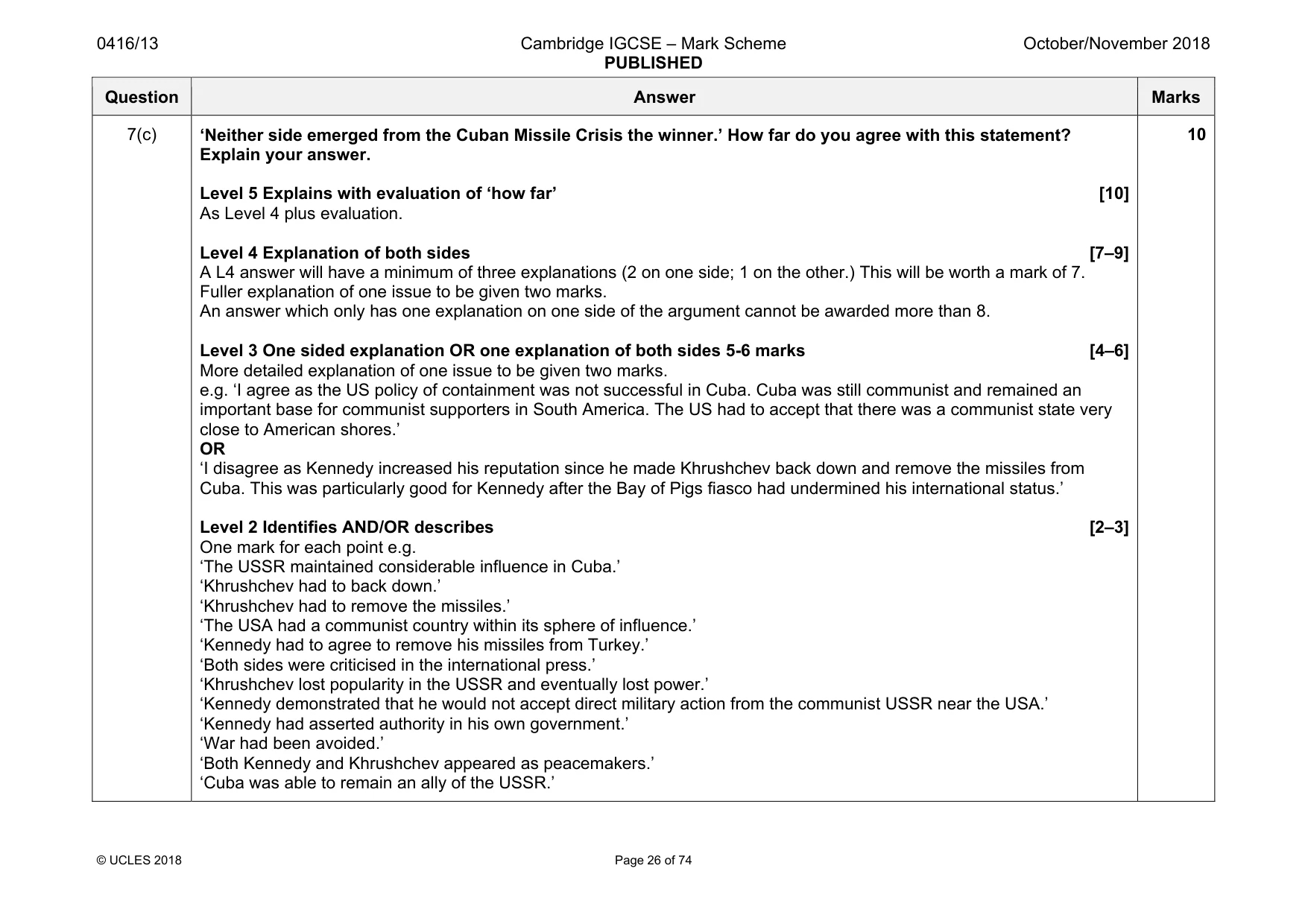
0416/13 Cambridge IGCSE – Mark Scheme PUBLISHED October/November 2018 © UCLES 2018 Page 26 of 74 Question Answer Marks 7(c) ‘Neither side emerged from the Cuban Missile Crisis the winner.’ How far do you agree with this statement? Explain your answer. Level 5 Explains with evaluation of ‘how far’ [10] As Level 4 plus evaluation. Level 4 Explanation of both sides [7–9] A L4 answer will have a minimum of three explanations (2 on one side; 1 on the other.) This will be worth a mark of 7. Fuller explanation of one issue to be given two marks. An answer which only has one explanation on one side of the argument cannot be awarded more than 8. Level 3 One sided explanation OR one explanation of both sides 5-6 marks [4–6] More detailed explanation of one issue to be given two marks. e.g. ‘I agree as the US policy of containment was not successful in Cuba. Cuba was still communist and remained an important base for communist supporters in South America. The US had to accept that there was a communist state very close to American shores.’ OR ‘I disagree as Kennedy increased his reputation since he made Khrushchev back down and remove the missiles from Cuba. This was particularly good for Kennedy after the Bay of Pigs fiasco had undermined his international status.’ Level 2 Identifies AND/OR describes [2–3] One mark for each point e.g. ‘The USSR maintained considerable influence in Cuba.’ ‘Khrushchev had to back down.’ ‘Khrushchev had to remove the missiles.’ ‘The USA had a communist country within its sphere of influence.’ ‘Kennedy had to agree to remove his missiles from Turkey.’ ‘Both sides were criticised in the international press.’ ‘Khrushchev lost popularity in the USSR and eventually lost power.’ ‘Kennedy demonstrated that he would not accept direct military action from the communist USSR near the USA.’ ‘Kennedy had asserted authority in his own government.’ ‘War had been avoided.’ ‘Both Kennedy and Khrushchev appeared as peacemakers.’ ‘Cuba was able to remain an ally of the USSR.’ 10
Mark scheme, page 27
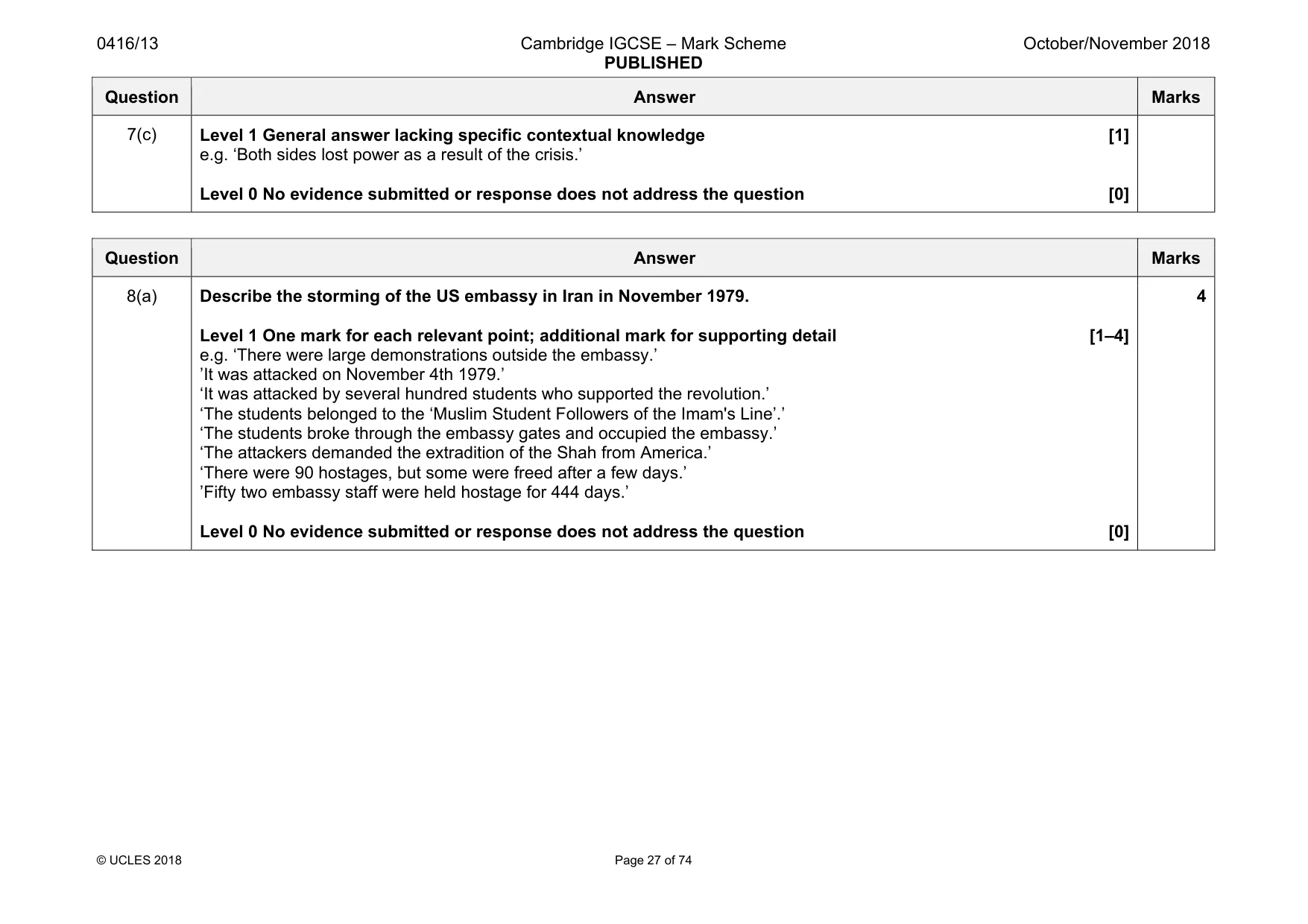
0416/13 Cambridge IGCSE – Mark Scheme PUBLISHED October/November 2018 © UCLES 2018 Page 27 of 74 Question Answer Marks 7(c) Level 1 General answer lacking specific contextual knowledge [1] e.g. ‘Both sides lost power as a result of the crisis.’ Level 0 No evidence submitted or response does not address the question [0] Question Answer Marks 8(a) Describe the storming of the US embassy in Iran in November 1979. Level 1 One mark for each relevant point; additional mark for supporting detail [1–4] e.g. ‘There were large demonstrations outside the embassy.’ ’It was attacked on November 4th 1979.’ ‘It was attacked by several hundred students who supported the revolution.’ ‘The students belonged to the ‘Muslim Student Followers of the Imam's Line’.’ ‘The students broke through the embassy gates and occupied the embassy.’ ‘The attackers demanded the extradition of the Shah from America.’ ‘There were 90 hostages, but some were freed after a few days.’ ’Fifty two embassy staff were held hostage for 444 days.’ Level 0 No evidence submitted or response does not address the question [0] 4
Mark scheme, page 28
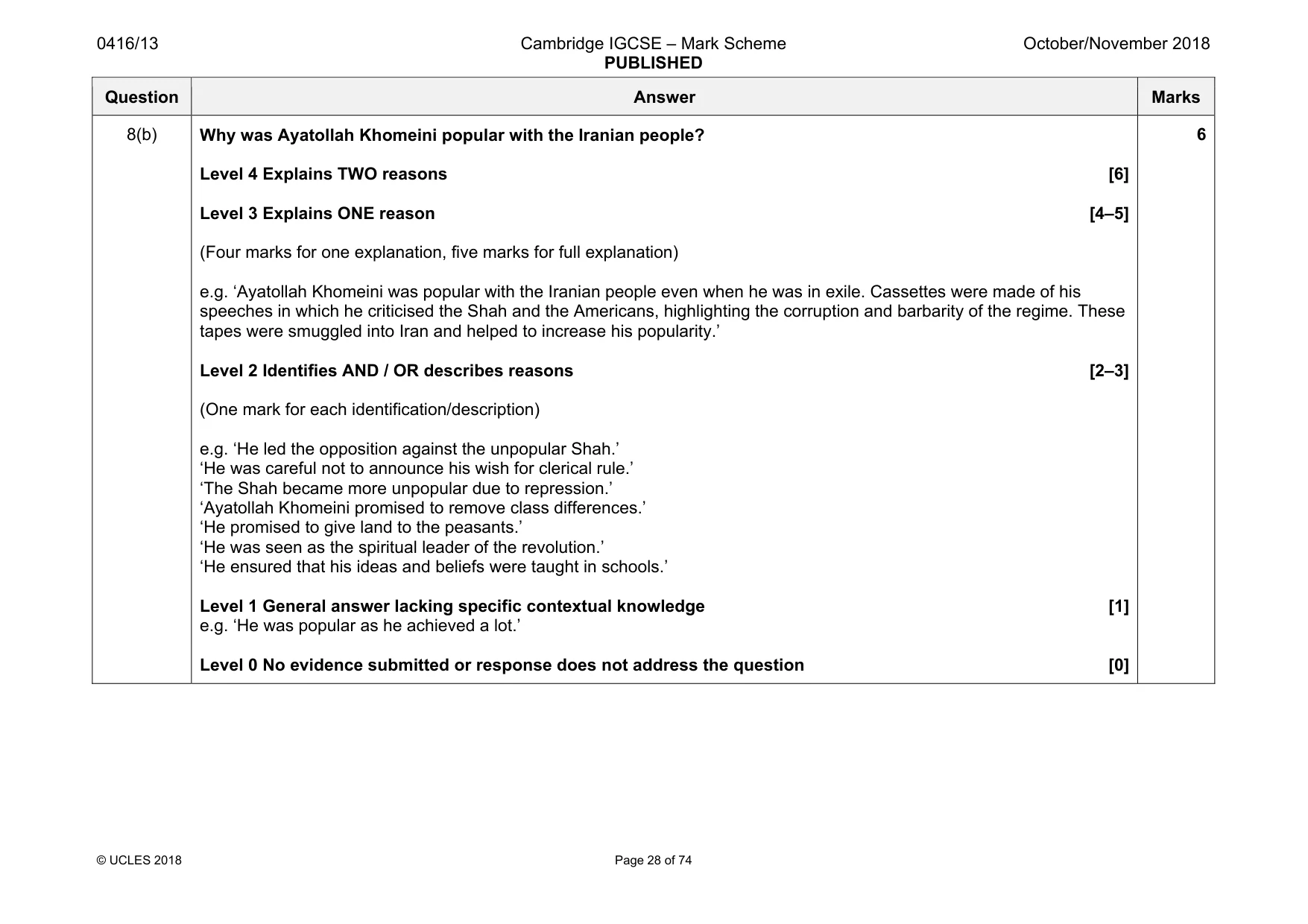
0416/13 Cambridge IGCSE – Mark Scheme PUBLISHED October/November 2018 © UCLES 2018 Page 28 of 74 Question Answer Marks 8(b) Why was Ayatollah Khomeini popular with the Iranian people? Level 4 Explains TWO reasons [6] Level 3 Explains ONE reason [4–5] (Four marks for one explanation, five marks for full explanation) e.g. ‘Ayatollah Khomeini was popular with the Iranian people even when he was in exile. Cassettes were made of his speeches in which he criticised the Shah and the Americans, highlighting the corruption and barbarity of the regime. These tapes were smuggled into Iran and helped to increase his popularity.’ Level 2 Identifies AND / OR describes reasons [2–3] (One mark for each identification/description) e.g. ‘He led the opposition against the unpopular Shah.’ ‘He was careful not to announce his wish for clerical rule.’ ‘The Shah became more unpopular due to repression.’ ‘Ayatollah Khomeini promised to remove class differences.’ ‘He promised to give land to the peasants.’ ‘He was seen as the spiritual leader of the revolution.’ ‘He ensured that his ideas and beliefs were taught in schools.’ Level 1 General answer lacking specific contextual knowledge [1] e.g. ‘He was popular as he achieved a lot.’ Level 0 No evidence submitted or response does not address the question [0] 6
Mark scheme, page 29
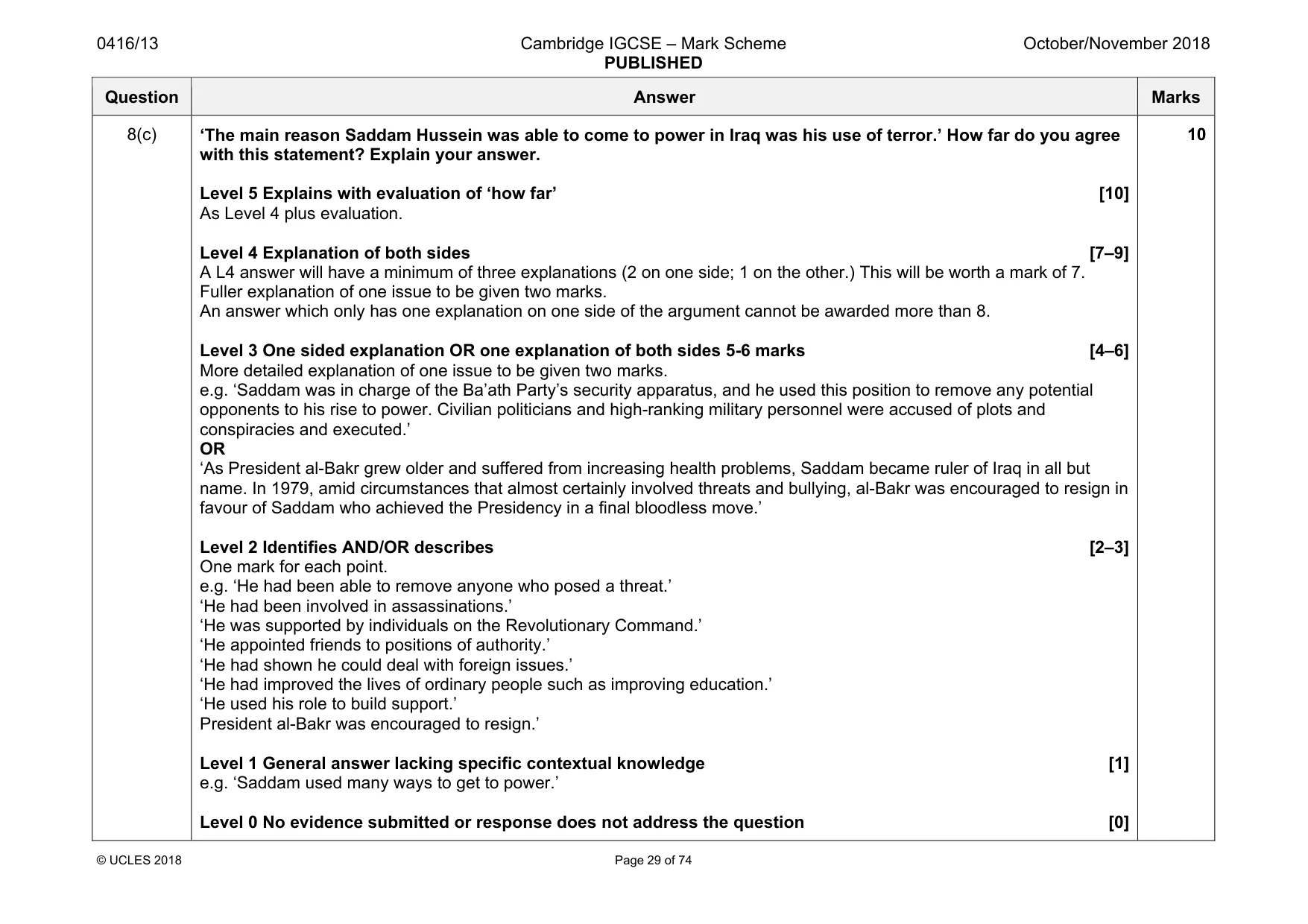
0416/13 Cambridge IGCSE – Mark Scheme PUBLISHED October/November 2018 © UCLES 2018 Page 29 of 74 Question Answer Marks 8(c) ‘The main reason Saddam Hussein was able to come to power in Iraq was his use of terror.’ How far do you agree with this statement? Explain your answer. Level 5 Explains with evaluation of ‘how far’ [10] As Level 4 plus evaluation. Level 4 Explanation of both sides [7–9] A L4 answer will have a minimum of three explanations (2 on one side; 1 on the other.) This will be worth a mark of 7. Fuller explanation of one issue to be given two marks. An answer which only has one explanation on one side of the argument cannot be awarded more than 8. Level 3 One sided explanation OR one explanation of both sides 5-6 marks [4–6] More detailed explanation of one issue to be given two marks. e.g. ‘Saddam was in charge of the Ba’ath Party’s security apparatus, and he used this position to remove any potential opponents to his rise to power. Civilian politicians and high-ranking military personnel were accused of plots and conspiracies and executed.’ OR ‘As President al-Bakr grew older and suffered from increasing health problems, Saddam became ruler of Iraq in all but name. In 1979, amid circumstances that almost certainly involved threats and bullying, al-Bakr was encouraged to resign in favour of Saddam who achieved the Presidency in a final bloodless move.’ Level 2 Identifies AND/OR describes [2–3] One mark for each point. e.g. ‘He had been able to remove anyone who posed a threat.’ ‘He had been involved in assassinations.’ ‘He was supported by individuals on the Revolutionary Command.’ ‘He appointed friends to positions of authority.’ ‘He had shown he could deal with foreign issues.’ ‘He had improved the lives of ordinary people such as improving education.’ ‘He used his role to build support.’ President al-Bakr was encouraged to resign.’ Level 1 General answer lacking specific contextual knowledge [1] e.g. ‘Saddam used many ways to get to power.’ Level 0 No evidence submitted or response does not address the question [0] 10
Mark scheme, page 30
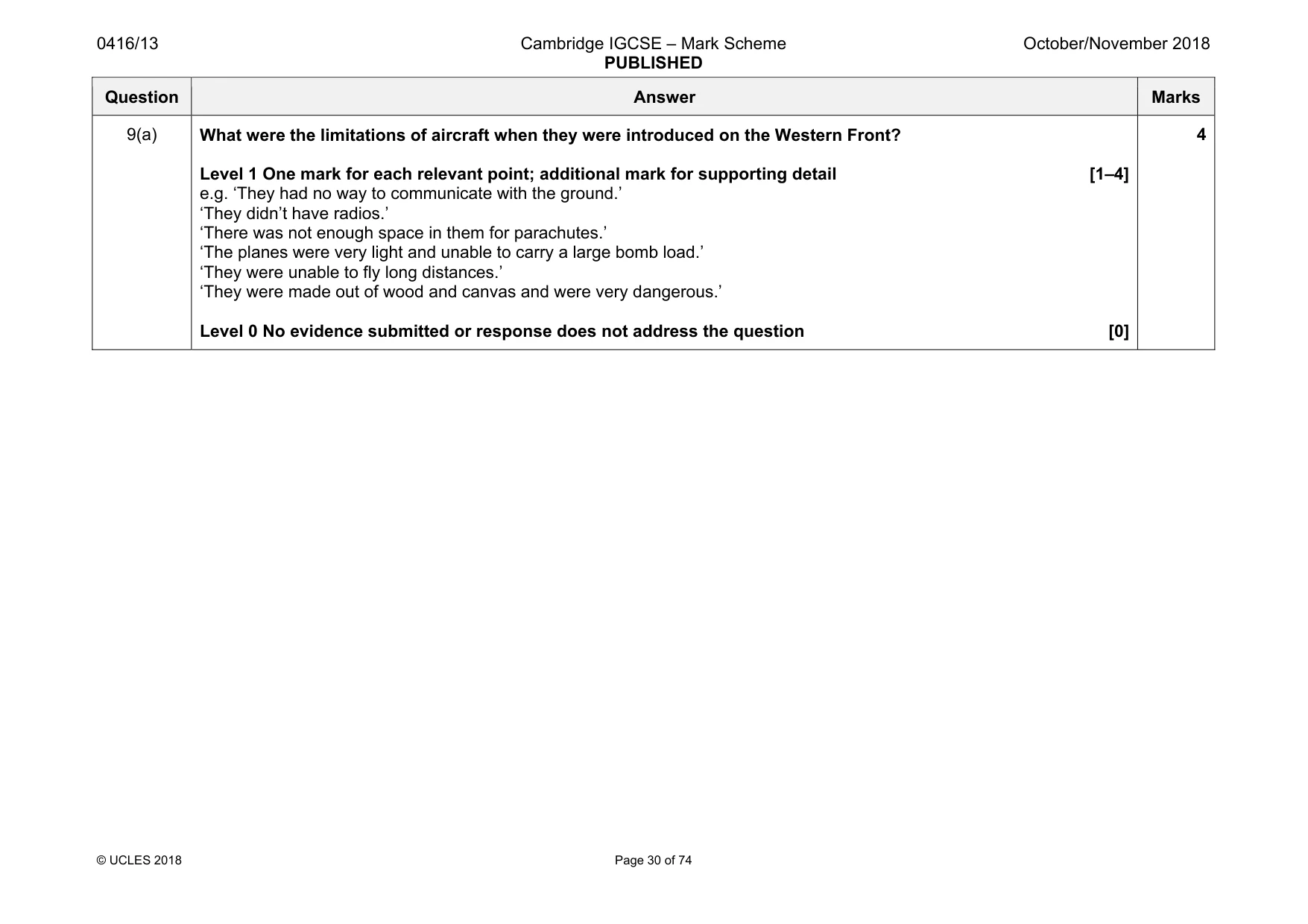
0416/13 Cambridge IGCSE – Mark Scheme PUBLISHED October/November 2018 © UCLES 2018 Page 30 of 74 Question Answer Marks 9(a) What were the limitations of aircraft when they were introduced on the Western Front? Level 1 One mark for each relevant point; additional mark for supporting detail [1–4] e.g. ‘They had no way to communicate with the ground.’ ‘They didn’t have radios.’ ‘There was not enough space in them for parachutes.’ ‘The planes were very light and unable to carry a large bomb load.’ ‘They were unable to fly long distances.’ ‘They were made out of wood and canvas and were very dangerous.’ Level 0 No evidence submitted or response does not address the question [0] 4
Mark scheme, page 31
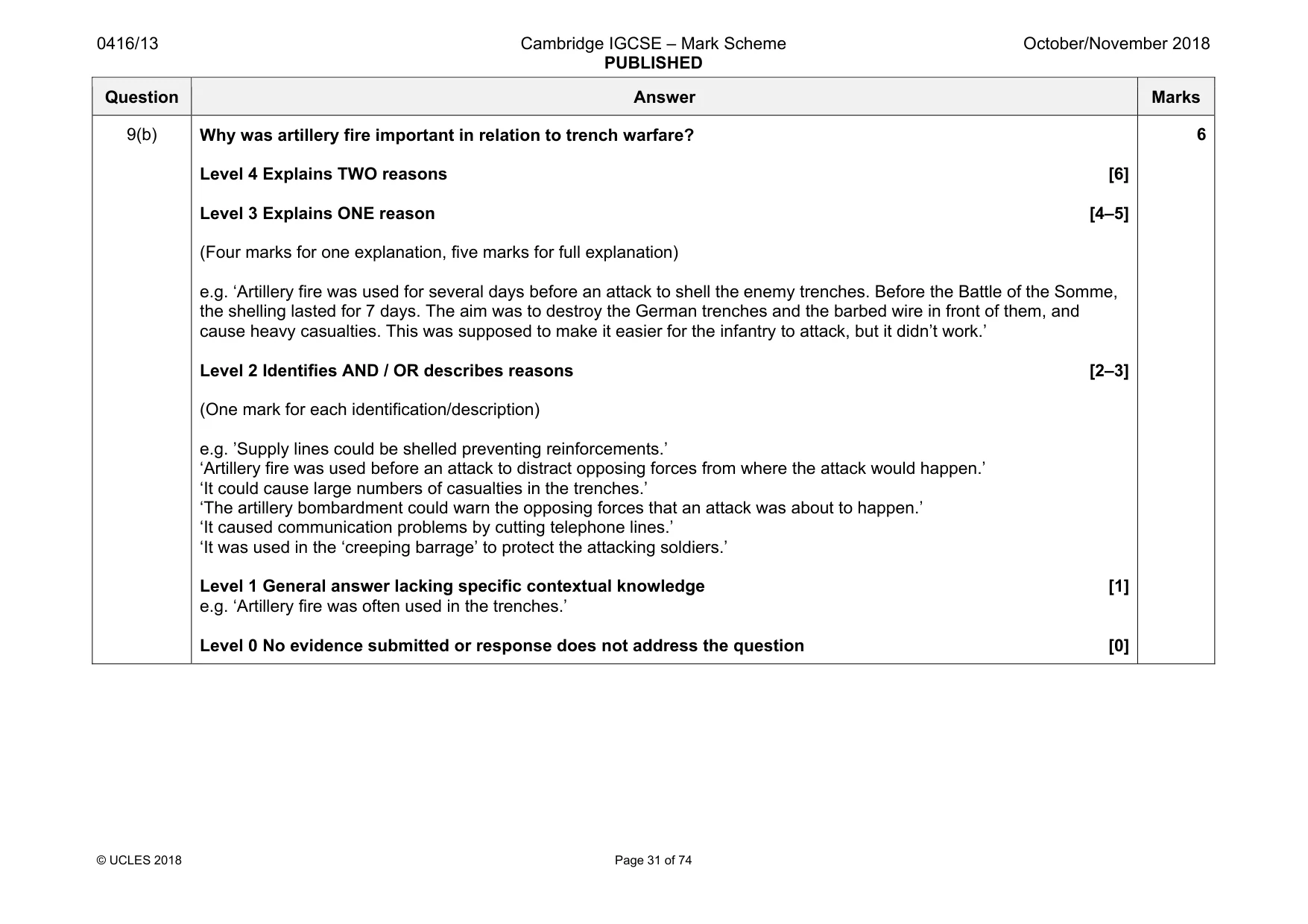
0416/13 Cambridge IGCSE – Mark Scheme PUBLISHED October/November 2018 © UCLES 2018 Page 31 of 74 Question Answer Marks 9(b) Why was artillery fire important in relation to trench warfare? Level 4 Explains TWO reasons [6] Level 3 Explains ONE reason [4–5] (Four marks for one explanation, five marks for full explanation) e.g. ‘Artillery fire was used for several days before an attack to shell the enemy trenches. Before the Battle of the Somme, the shelling lasted for 7 days. The aim was to destroy the German trenches and the barbed wire in front of them, and cause heavy casualties. This was supposed to make it easier for the infantry to attack, but it didn’t work.’ Level 2 Identifies AND / OR describes reasons [2–3] (One mark for each identification/description) e.g. ’Supply lines could be shelled preventing reinforcements.’ ‘Artillery fire was used before an attack to distract opposing forces from where the attack would happen.’ ‘It could cause large numbers of casualties in the trenches.’ ‘The artillery bombardment could warn the opposing forces that an attack was about to happen.’ ‘It caused communication problems by cutting telephone lines.’ ‘It was used in the ‘creeping barrage’ to protect the attacking soldiers.’ Level 1 General answer lacking specific contextual knowledge [1] e.g. ‘Artillery fire was often used in the trenches.’ Level 0 No evidence submitted or response does not address the question [0] 6
Mark scheme, page 32
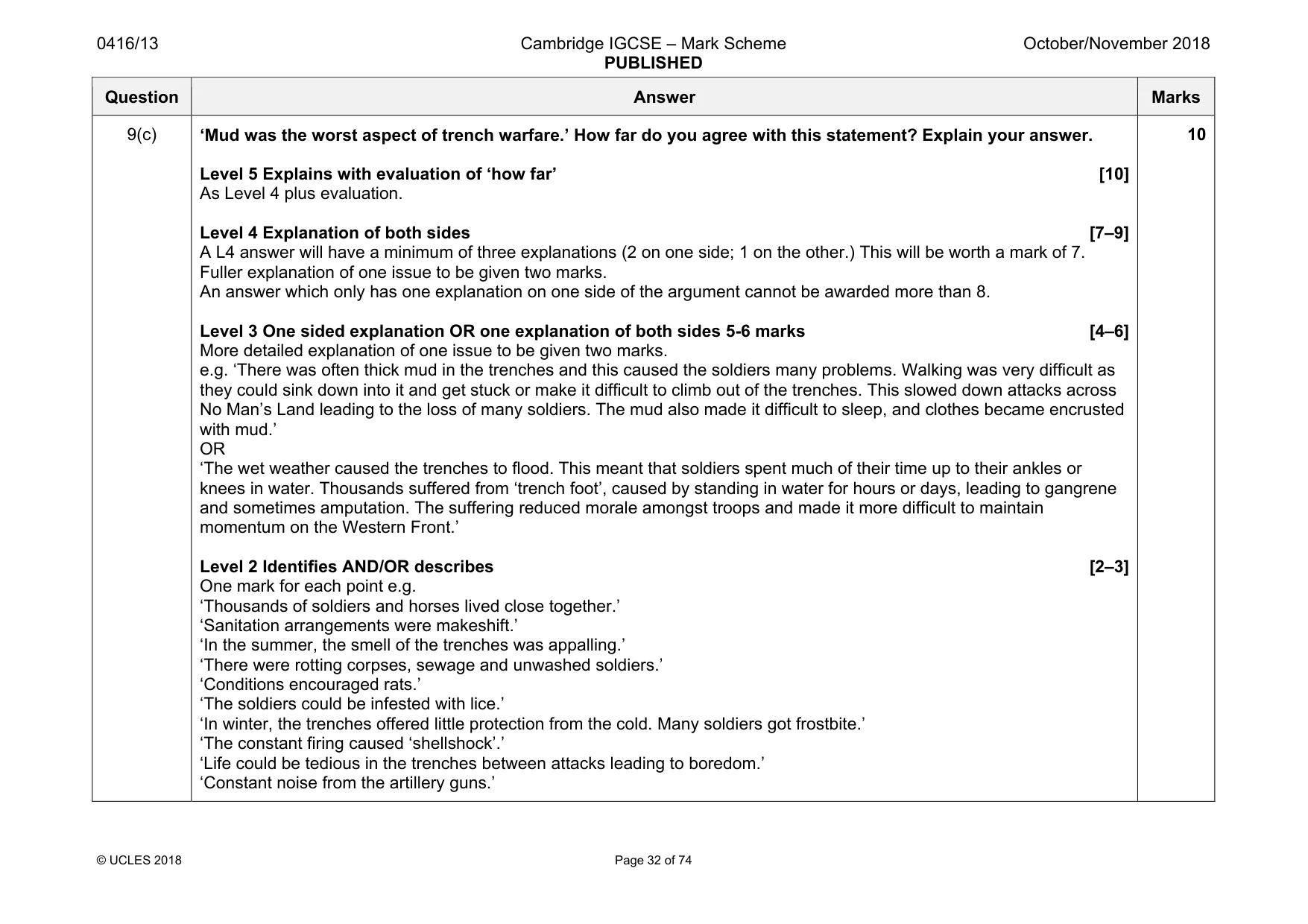
0416/13 Cambridge IGCSE – Mark Scheme PUBLISHED October/November 2018 © UCLES 2018 Page 32 of 74 Question Answer Marks 9(c) ‘Mud was the worst aspect of trench warfare.’ How far do you agree with this statement? Explain your answer. Level 5 Explains with evaluation of ‘how far’ [10] As Level 4 plus evaluation. Level 4 Explanation of both sides [7–9] A L4 answer will have a minimum of three explanations (2 on one side; 1 on the other.) This will be worth a mark of 7. Fuller explanation of one issue to be given two marks. An answer which only has one explanation on one side of the argument cannot be awarded more than 8. Level 3 One sided explanation OR one explanation of both sides 5-6 marks [4–6] More detailed explanation of one issue to be given two marks. e.g. ‘There was often thick mud in the trenches and this caused the soldiers many problems. Walking was very difficult as they could sink down into it and get stuck or make it difficult to climb out of the trenches. This slowed down attacks across No Man’s Land leading to the loss of many soldiers. The mud also made it difficult to sleep, and clothes became encrusted with mud.’ OR ‘The wet weather caused the trenches to flood. This meant that soldiers spent much of their time up to their ankles or knees in water. Thousands suffered from ‘trench foot’, caused by standing in water for hours or days, leading to gangrene and sometimes amputation. The suffering reduced morale amongst troops and made it more difficult to maintain momentum on the Western Front.’ Level 2 Identifies AND/OR describes [2–3] One mark for each point e.g. ‘Thousands of soldiers and horses lived close together.’ ‘Sanitation arrangements were makeshift.’ ‘In the summer, the smell of the trenches was appalling.’ ‘There were rotting corpses, sewage and unwashed soldiers.’ ‘Conditions encouraged rats.’ ‘The soldiers could be infested with lice.’ ‘In winter, the trenches offered little protection from the cold. Many soldiers got frostbite.’ ‘The constant firing caused ‘shellshock’.’ ‘Life could be tedious in the trenches between attacks leading to boredom.’ ‘Constant noise from the artillery guns.’ 10
Mark scheme, page 33
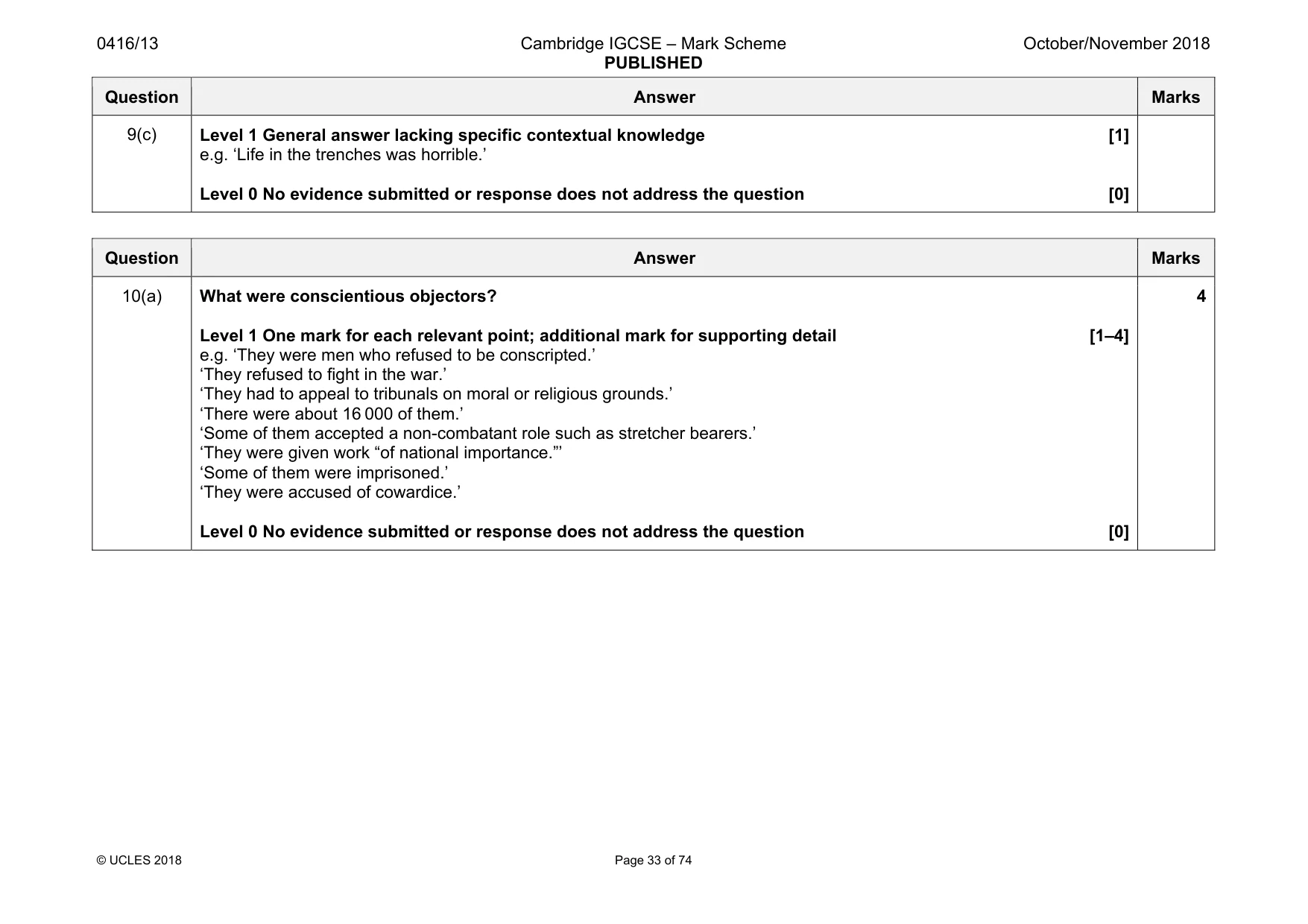
0416/13 Cambridge IGCSE – Mark Scheme PUBLISHED October/November 2018 © UCLES 2018 Page 33 of 74 Question Answer Marks 9(c) Level 1 General answer lacking specific contextual knowledge [1] e.g. ‘Life in the trenches was horrible.’ Level 0 No evidence submitted or response does not address the question [0] Question Answer Marks 10(a) What were conscientious objectors? Level 1 One mark for each relevant point; additional mark for supporting detail [1–4] e.g. ‘They were men who refused to be conscripted.’ ‘They refused to fight in the war.’ ‘They had to appeal to tribunals on moral or religious grounds.’ ‘There were about 16 000 of them.’ ‘Some of them accepted a non-combatant role such as stretcher bearers.’ ‘They were given work “of national importance.”’ ‘Some of them were imprisoned.’ ‘They were accused of cowardice.’ Level 0 No evidence submitted or response does not address the question [0] 4
Mark scheme, page 34
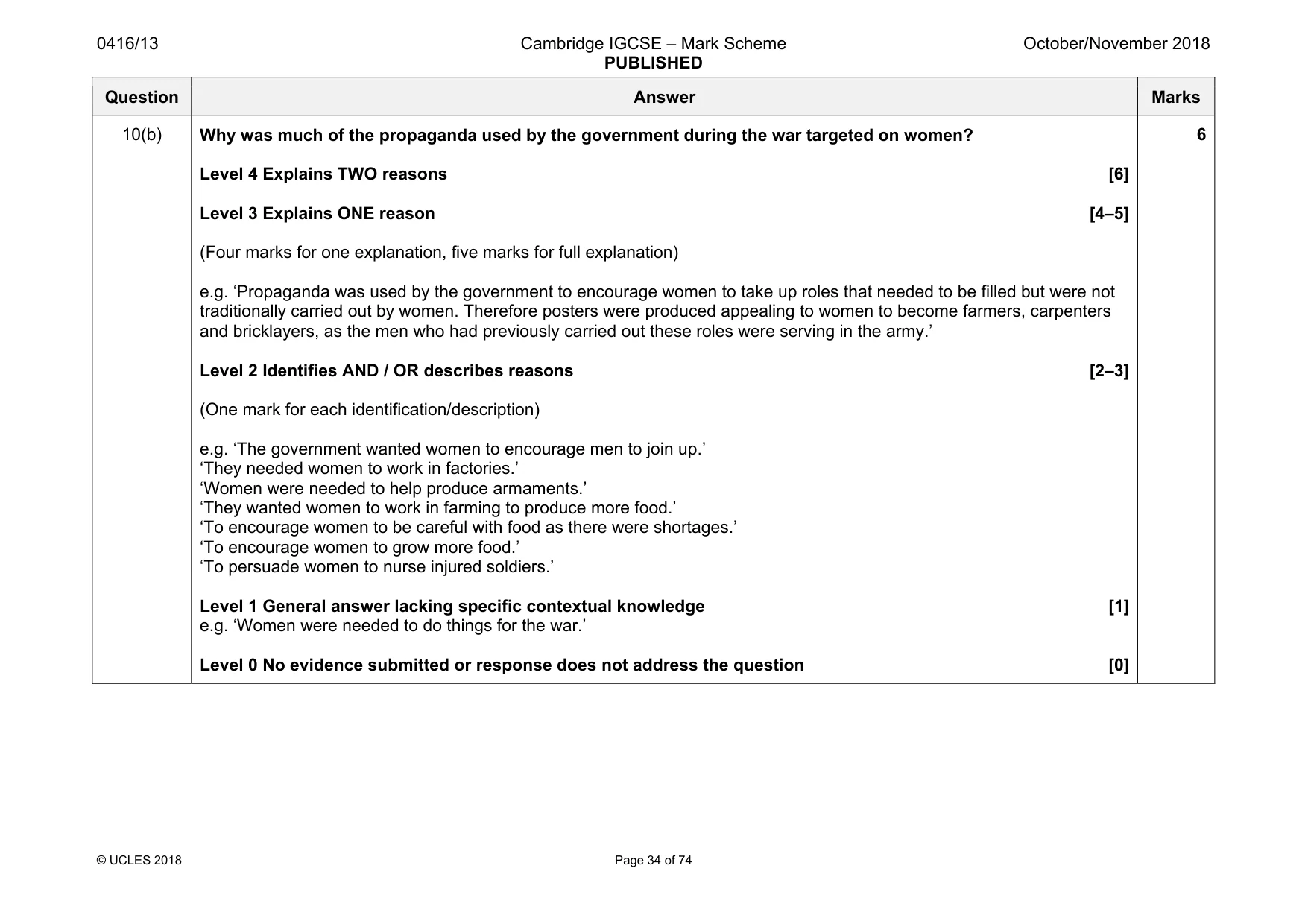
0416/13 Cambridge IGCSE – Mark Scheme PUBLISHED October/November 2018 © UCLES 2018 Page 34 of 74 Question Answer Marks 10(b) Why was much of the propaganda used by the government during the war targeted on women? Level 4 Explains TWO reasons [6] Level 3 Explains ONE reason [4–5] (Four marks for one explanation, five marks for full explanation) e.g. ‘Propaganda was used by the government to encourage women to take up roles that needed to be filled but were not traditionally carried out by women. Therefore posters were produced appealing to women to become farmers, carpenters and bricklayers, as the men who had previously carried out these roles were serving in the army.’ Level 2 Identifies AND / OR describes reasons [2–3] (One mark for each identification/description) e.g. ‘The government wanted women to encourage men to join up.’ ‘They needed women to work in factories.’ ‘Women were needed to help produce armaments.’ ‘They wanted women to work in farming to produce more food.’ ‘To encourage women to be careful with food as there were shortages.’ ‘To encourage women to grow more food.’ ‘To persuade women to nurse injured soldiers.’ Level 1 General answer lacking specific contextual knowledge [1] e.g. ‘Women were needed to do things for the war.’ Level 0 No evidence submitted or response does not address the question [0] 6
Mark scheme, page 35
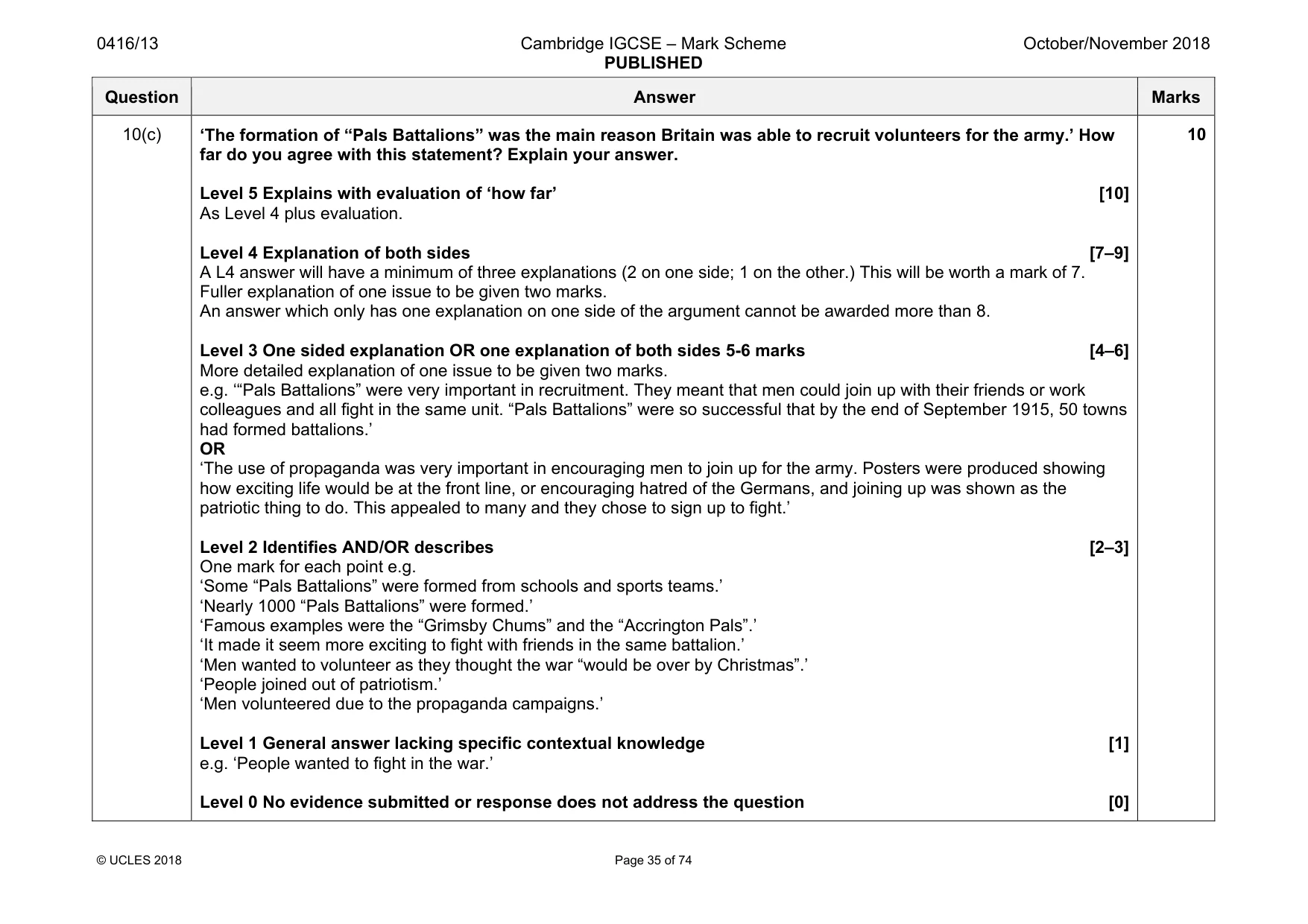
0416/13 Cambridge IGCSE – Mark Scheme PUBLISHED October/November 2018 © UCLES 2018 Page 35 of 74 Question Answer Marks 10(c) ‘The formation of “Pals Battalions” was the main reason Britain was able to recruit volunteers for the army.’ How far do you agree with this statement? Explain your answer. Level 5 Explains with evaluation of ‘how far’ [10] As Level 4 plus evaluation. Level 4 Explanation of both sides [7–9] A L4 answer will have a minimum of three explanations (2 on one side; 1 on the other.) This will be worth a mark of 7. Fuller explanation of one issue to be given two marks. An answer which only has one explanation on one side of the argument cannot be awarded more than 8. Level 3 One sided explanation OR one explanation of both sides 5-6 marks [4–6] More detailed explanation of one issue to be given two marks. e.g. ‘“Pals Battalions” were very important in recruitment. They meant that men could join up with their friends or work colleagues and all fight in the same unit. “Pals Battalions” were so successful that by the end of September 1915, 50 towns had formed battalions.’ OR ‘The use of propaganda was very important in encouraging men to join up for the army. Posters were produced showing how exciting life would be at the front line, or encouraging hatred of the Germans, and joining up was shown as the patriotic thing to do. This appealed to many and they chose to sign up to fight.’ Level 2 Identifies AND/OR describes [2–3] One mark for each point e.g. ‘Some “Pals Battalions” were formed from schools and sports teams.’ ‘Nearly 1000 “Pals Battalions” were formed.’ ‘Famous examples were the “Grimsby Chums” and the “Accrington Pals”.’ ‘It made it seem more exciting to fight with friends in the same battalion.’ ‘Men wanted to volunteer as they thought the war “would be over by Christmas”.’ ‘People joined out of patriotism.’ ‘Men volunteered due to the propaganda campaigns.’ Level 1 General answer lacking specific contextual knowledge [1] e.g. ‘People wanted to fight in the war.’ Level 0 No evidence submitted or response does not address the question [0] 10
Mark scheme, page 36
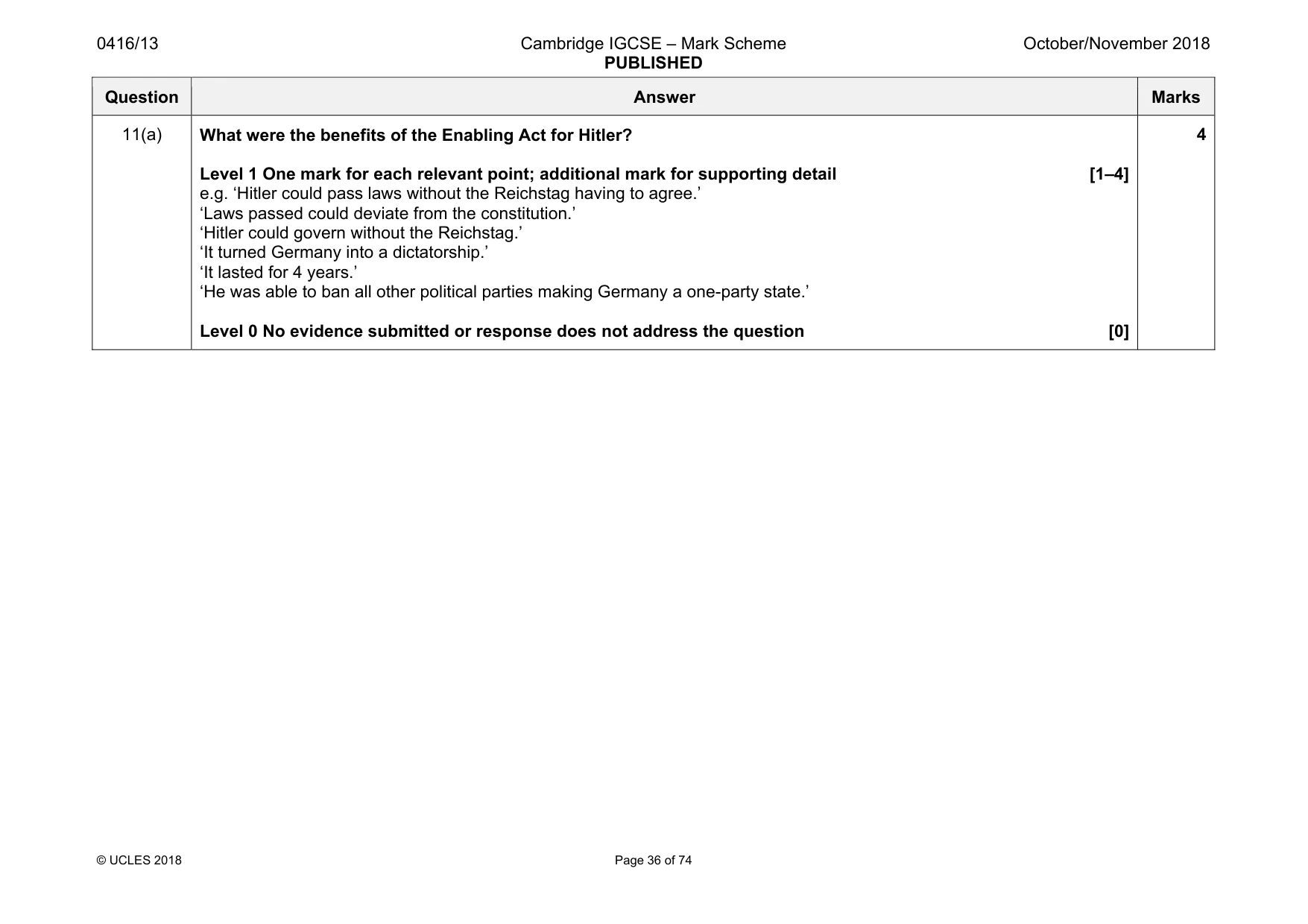
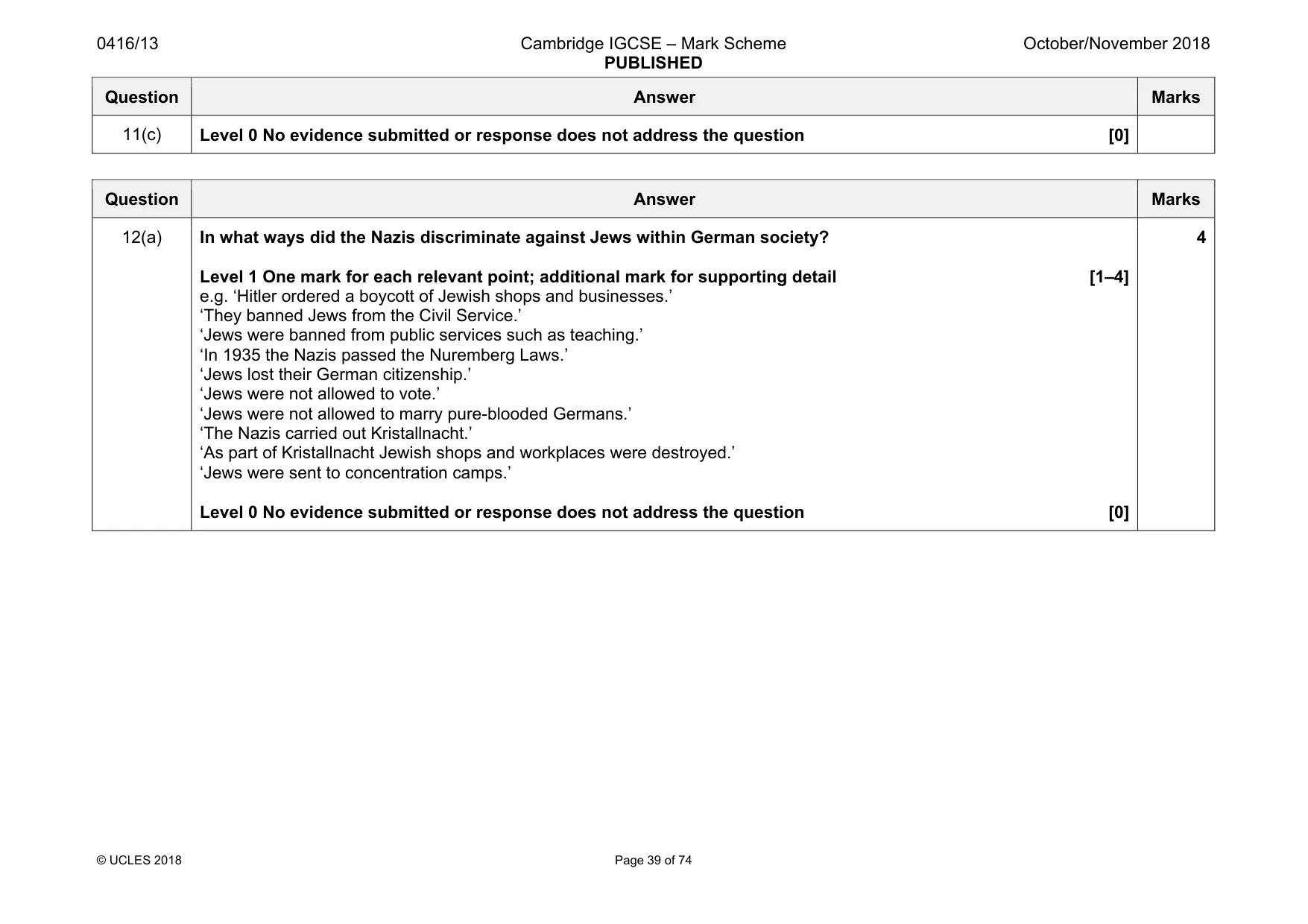
0416/13 Cambridge IGCSE – Mark Scheme PUBLISHED October/November 2018 © UCLES 2018 Page 36 of 74 Question Answer Marks 11(a) What were the benefits of the Enabling Act for Hitler? Level 1 One mark for each relevant point; additional mark for supporting detail [1–4] e.g. ‘Hitler could pass laws without the Reichstag having to agree.’ ‘Laws passed could deviate from the constitution.’ ‘Hitler could govern without the Reichstag.’ ‘It turned Germany into a dictatorship.’ ‘It lasted for 4 years.’ ‘He was able to ban all other political parties making Germany a one-party state.’ Level 0 No evidence submitted or response does not address the question [0] 4
Mark scheme, page 37
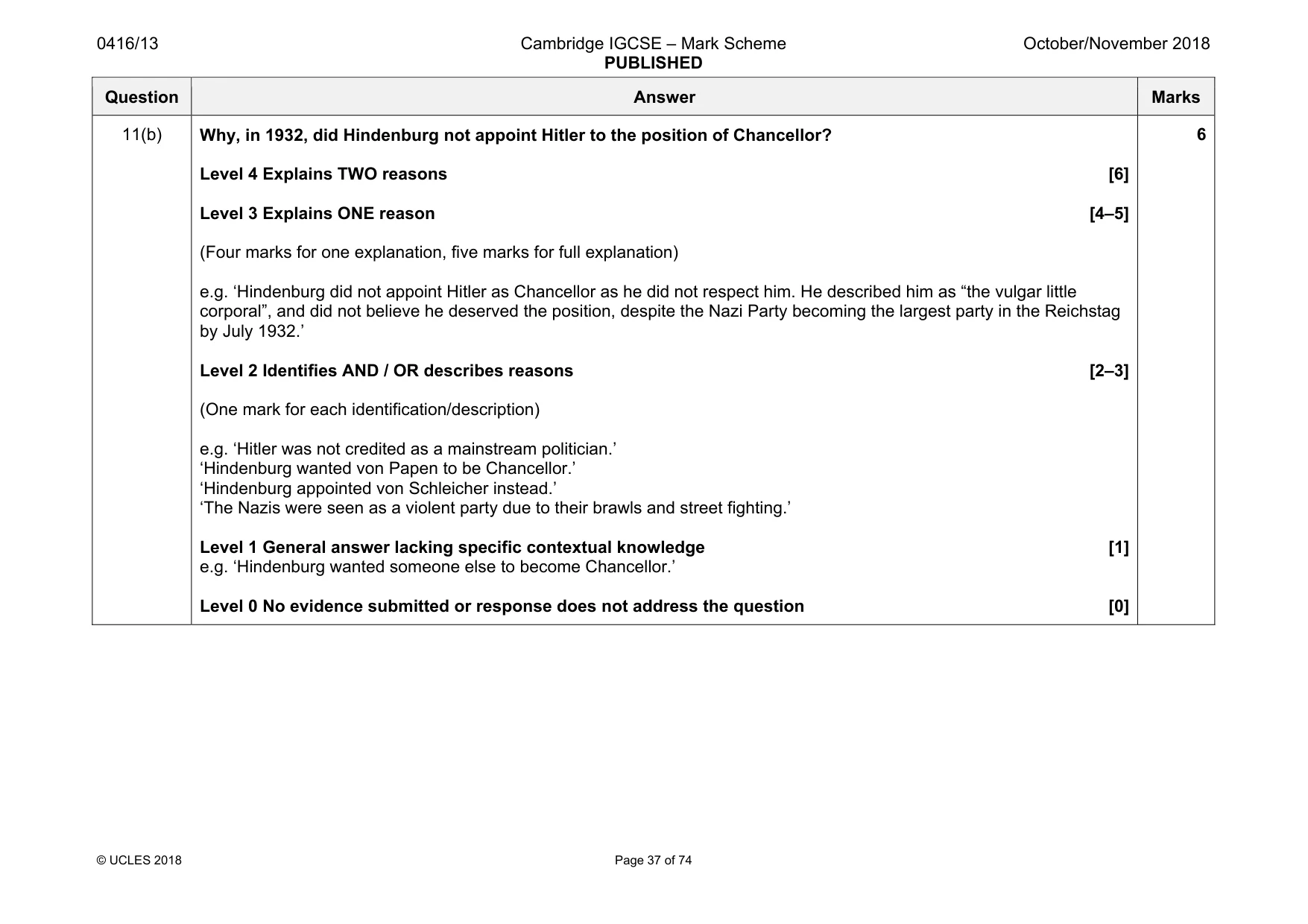
0416/13 Cambridge IGCSE – Mark Scheme PUBLISHED October/November 2018 © UCLES 2018 Page 37 of 74 Question Answer Marks 11(b) Why, in 1932, did Hindenburg not appoint Hitler to the position of Chancellor? Level 4 Explains TWO reasons [6] Level 3 Explains ONE reason [4–5] (Four marks for one explanation, five marks for full explanation) e.g. ‘Hindenburg did not appoint Hitler as Chancellor as he did not respect him. He described him as “the vulgar little corporal”, and did not believe he deserved the position, despite the Nazi Party becoming the largest party in the Reichstag by July 1932.’ Level 2 Identifies AND / OR describes reasons [2–3] (One mark for each identification/description) e.g. ‘Hitler was not credited as a mainstream politician.’ ‘Hindenburg wanted von Papen to be Chancellor.’ ‘Hindenburg appointed von Schleicher instead.’ ‘The Nazis were seen as a violent party due to their brawls and street fighting.’ Level 1 General answer lacking specific contextual knowledge [1] e.g. ‘Hindenburg wanted someone else to become Chancellor.’ Level 0 No evidence submitted or response does not address the question [0] 6
Mark scheme, page 38
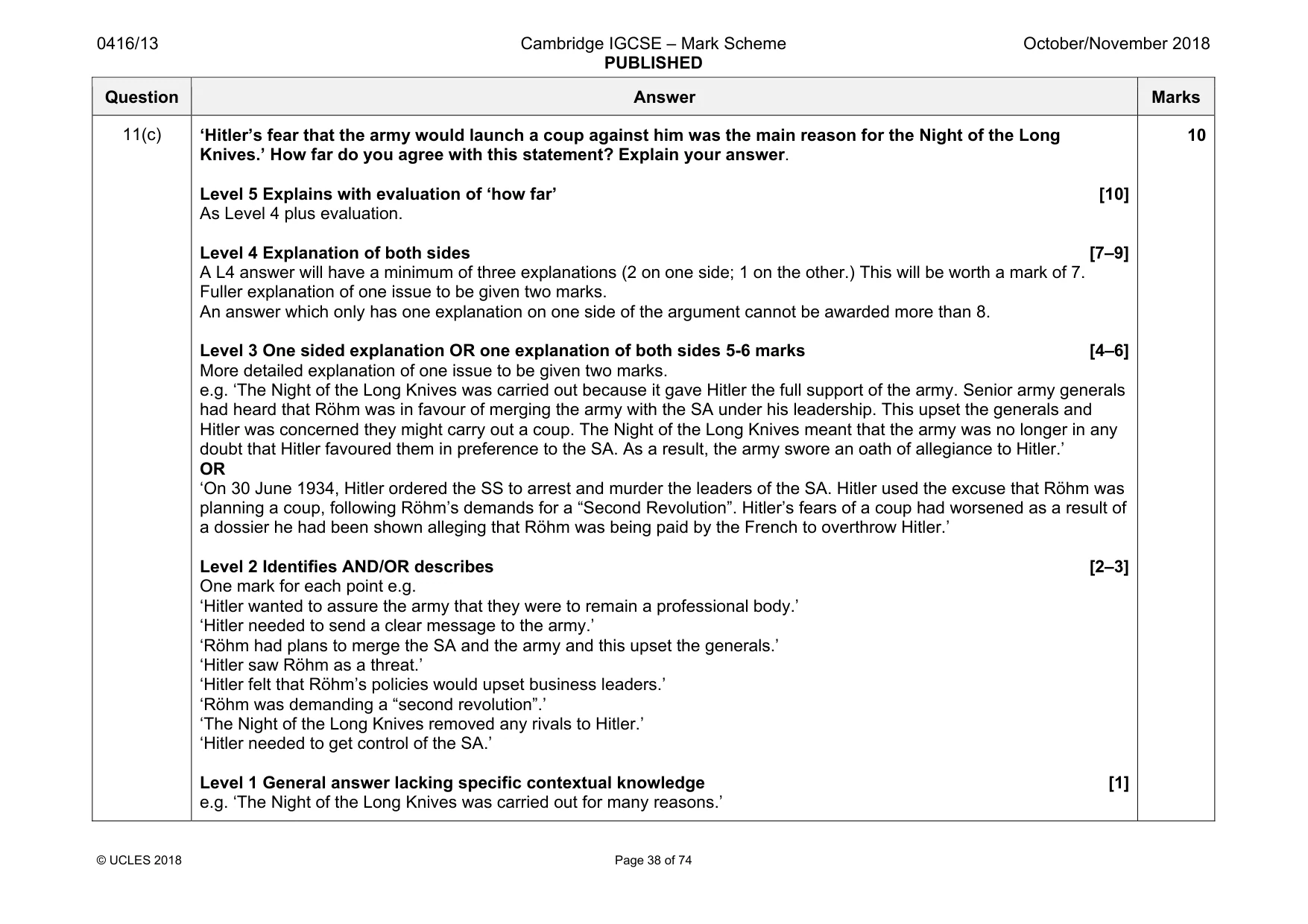
0416/13 Cambridge IGCSE – Mark Scheme PUBLISHED October/November 2018 © UCLES 2018 Page 38 of 74 Question Answer Marks 11(c) ‘Hitler’s fear that the army would launch a coup against him was the main reason for the Night of the Long Knives.’ How far do you agree with this statement? Explain your answer. Level 5 Explains with evaluation of ‘how far’ [10] As Level 4 plus evaluation. Level 4 Explanation of both sides [7–9] A L4 answer will have a minimum of three explanations (2 on one side; 1 on the other.) This will be worth a mark of 7. Fuller explanation of one issue to be given two marks. An answer which only has one explanation on one side of the argument cannot be awarded more than 8. Level 3 One sided explanation OR one explanation of both sides 5-6 marks [4–6] More detailed explanation of one issue to be given two marks. e.g. ‘The Night of the Long Knives was carried out because it gave Hitler the full support of the army. Senior army generals had heard that Röhm was in favour of merging the army with the SA under his leadership. This upset the generals and Hitler was concerned they might carry out a coup. The Night of the Long Knives meant that the army was no longer in any doubt that Hitler favoured them in preference to the SA. As a result, the army swore an oath of allegiance to Hitler.’ OR ‘On 30 June 1934, Hitler ordered the SS to arrest and murder the leaders of the SA. Hitler used the excuse that Röhm was planning a coup, following Röhm’s demands for a “Second Revolution”. Hitler’s fears of a coup had worsened as a result of a dossier he had been shown alleging that Röhm was being paid by the French to overthrow Hitler.’ Level 2 Identifies AND/OR describes [2–3] One mark for each point e.g. ‘Hitler wanted to assure the army that they were to remain a professional body.’ ‘Hitler needed to send a clear message to the army.’ ‘Röhm had plans to merge the SA and the army and this upset the generals.’ ‘Hitler saw Röhm as a threat.’ ‘Hitler felt that Röhm’s policies would upset business leaders.’ ‘Röhm was demanding a “second revolution”.’ ‘The Night of the Long Knives removed any rivals to Hitler.’ ‘Hitler needed to get control of the SA.’ Level 1 General answer lacking specific contextual knowledge [1] e.g. ‘The Night of the Long Knives was carried out for many reasons.’ 10
Mark scheme, page 39
0416/13 Cambridge IGCSE – Mark Scheme PUBLISHED October/November 2018 © UCLES 2018 Page 39 of 74 Question Answer Marks 11(c) Level 0 No evidence submitted or response does not address the question [0] Question Answer Marks 12(a) In what ways did the Nazis discriminate against Jews within German society? Level 1 One mark for each relevant point; additional mark for supporting detail [1–4] e.g. ‘Hitler ordered a boycott of Jewish shops and businesses.’ ‘They banned Jews from the Civil Service.’ ‘Jews were banned from public services such as teaching.’ ‘In 1935 the Nazis passed the Nuremberg Laws.’ ‘Jews lost their German citizenship.’ ‘Jews were not allowed to vote.’ ‘Jews were not allowed to marry pure-blooded Germans.’ ‘The Nazis carried out Kristallnacht.’ ‘As part of Kristallnacht Jewish shops and workplaces were destroyed.’ ‘Jews were sent to concentration camps.’ Level 0 No evidence submitted or response does not address the question [0] 4
Mark scheme, page 40
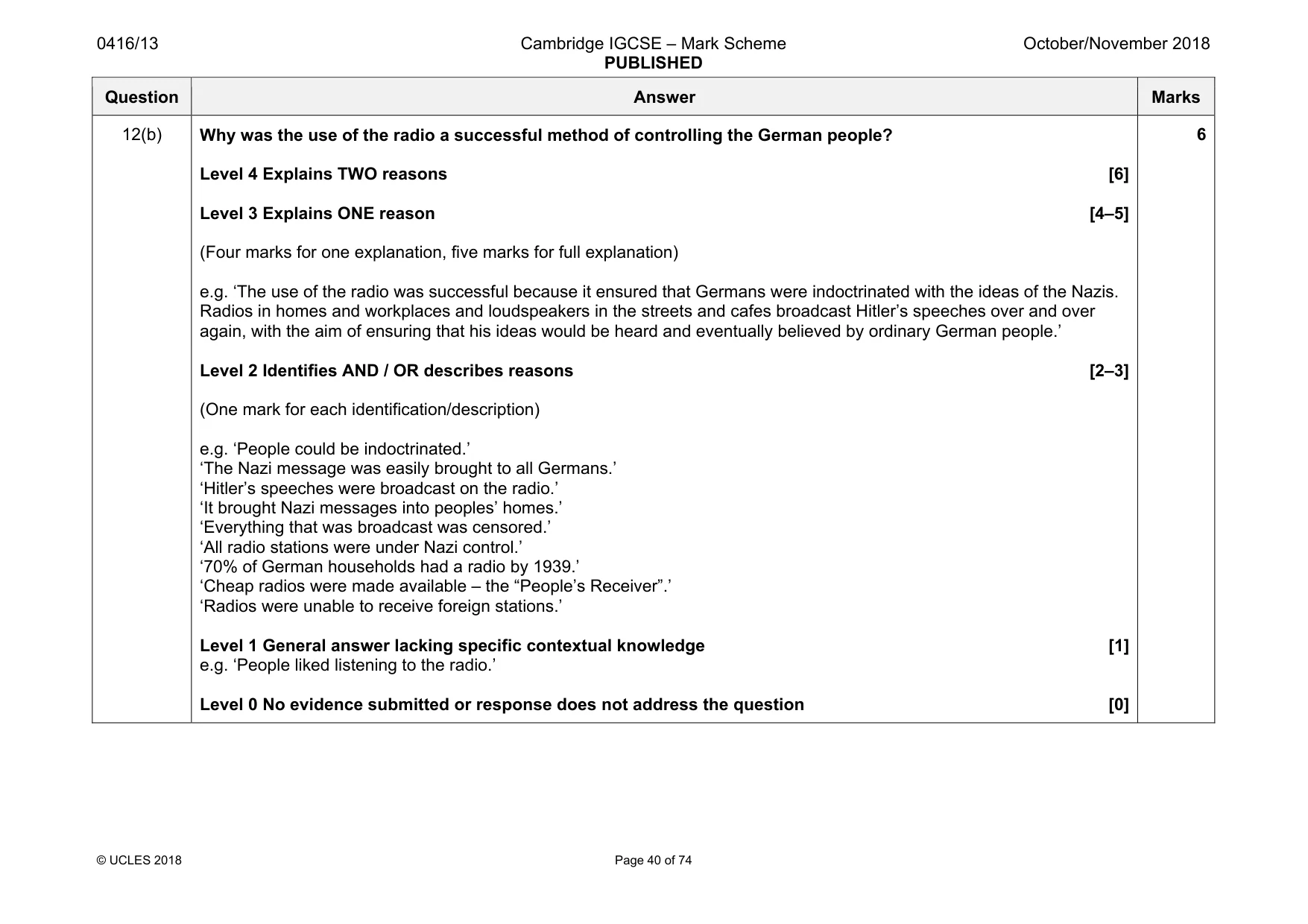
0416/13 Cambridge IGCSE – Mark Scheme PUBLISHED October/November 2018 © UCLES 2018 Page 40 of 74 Question Answer Marks 12(b) Why was the use of the radio a successful method of controlling the German people? Level 4 Explains TWO reasons [6] Level 3 Explains ONE reason [4–5] (Four marks for one explanation, five marks for full explanation) e.g. ‘The use of the radio was successful because it ensured that Germans were indoctrinated with the ideas of the Nazis. Radios in homes and workplaces and loudspeakers in the streets and cafes broadcast Hitler’s speeches over and over again, with the aim of ensuring that his ideas would be heard and eventually believed by ordinary German people.’ Level 2 Identifies AND / OR describes reasons [2–3] (One mark for each identification/description) e.g. ‘People could be indoctrinated.’ ‘The Nazi message was easily brought to all Germans.’ ‘Hitler’s speeches were broadcast on the radio.’ ‘It brought Nazi messages into peoples’ homes.’ ‘Everything that was broadcast was censored.’ ‘All radio stations were under Nazi control.’ ‘70% of German households had a radio by 1939.’ ‘Cheap radios were made available – the “People’s Receiver”.’ ‘Radios were unable to receive foreign stations.’ Level 1 General answer lacking specific contextual knowledge [1] e.g. ‘People liked listening to the radio.’ Level 0 No evidence submitted or response does not address the question [0] 6
Mark scheme, page 41
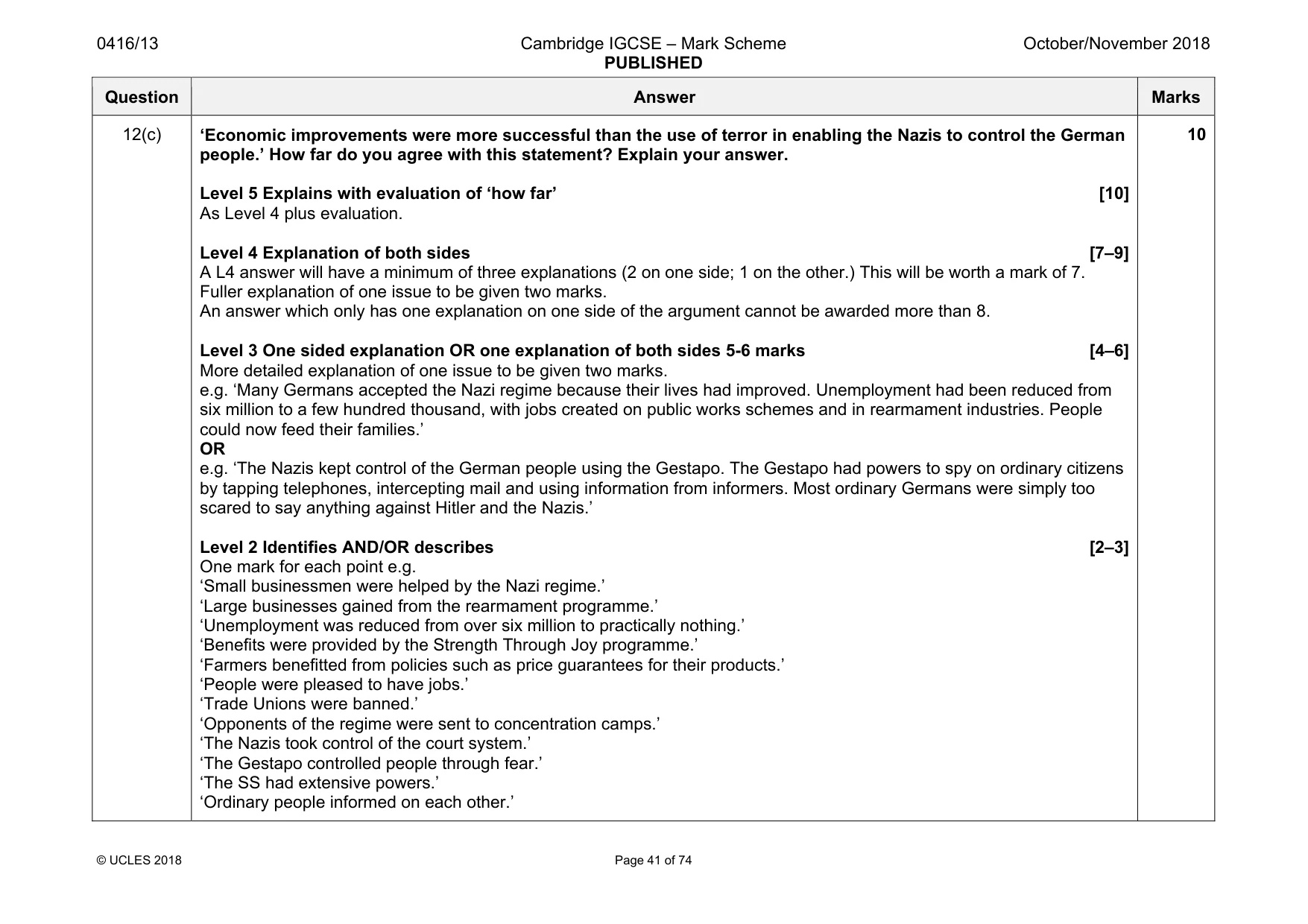
0416/13 Cambridge IGCSE – Mark Scheme PUBLISHED October/November 2018 © UCLES 2018 Page 41 of 74 Question Answer Marks 12(c) ‘Economic improvements were more successful than the use of terror in enabling the Nazis to control the German people.’ How far do you agree with this statement? Explain your answer. Level 5 Explains with evaluation of ‘how far’ [10] As Level 4 plus evaluation. Level 4 Explanation of both sides [7–9] A L4 answer will have a minimum of three explanations (2 on one side; 1 on the other.) This will be worth a mark of 7. Fuller explanation of one issue to be given two marks. An answer which only has one explanation on one side of the argument cannot be awarded more than 8. Level 3 One sided explanation OR one explanation of both sides 5-6 marks [4–6] More detailed explanation of one issue to be given two marks. e.g. ‘Many Germans accepted the Nazi regime because their lives had improved. Unemployment had been reduced from six million to a few hundred thousand, with jobs created on public works schemes and in rearmament industries. People could now feed their families.’ OR e.g. ‘The Nazis kept control of the German people using the Gestapo. The Gestapo had powers to spy on ordinary citizens by tapping telephones, intercepting mail and using information from informers. Most ordinary Germans were simply too scared to say anything against Hitler and the Nazis.’ Level 2 Identifies AND/OR describes [2–3] One mark for each point e.g. ‘Small businessmen were helped by the Nazi regime.’ ‘Large businesses gained from the rearmament programme.’ ‘Unemployment was reduced from over six million to practically nothing.’ ‘Benefits were provided by the Strength Through Joy programme.’ ‘Farmers benefitted from policies such as price guarantees for their products.’ ‘People were pleased to have jobs.’ ‘Trade Unions were banned.’ ‘Opponents of the regime were sent to concentration camps.’ ‘The Nazis took control of the court system.’ ‘The Gestapo controlled people through fear.’ ‘The SS had extensive powers.’ ‘Ordinary people informed on each other.’ 10
Mark scheme, page 42
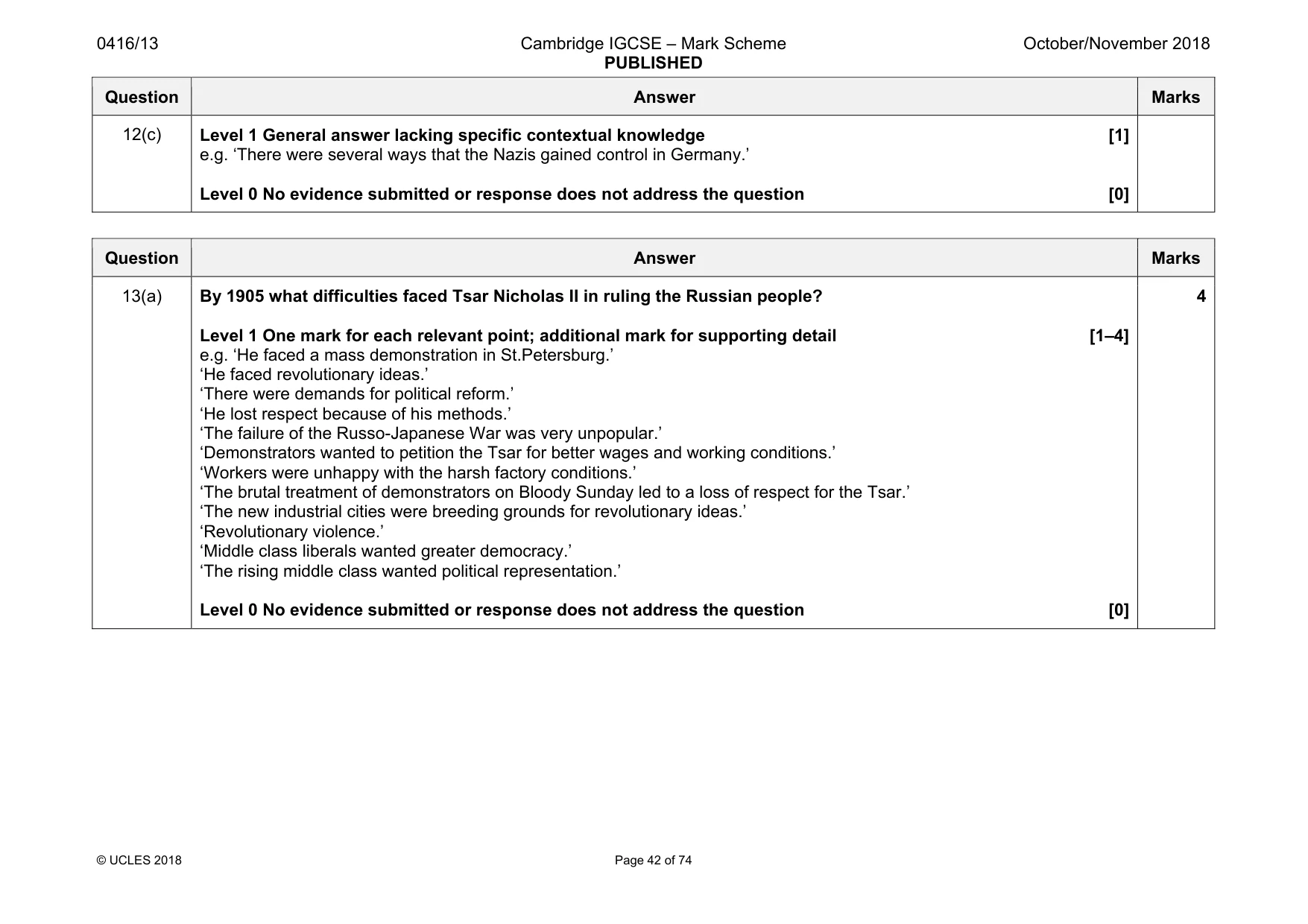
0416/13 Cambridge IGCSE – Mark Scheme PUBLISHED October/November 2018 © UCLES 2018 Page 42 of 74 Question Answer Marks 12(c) Level 1 General answer lacking specific contextual knowledge [1] e.g. ‘There were several ways that the Nazis gained control in Germany.’ Level 0 No evidence submitted or response does not address the question [0] Question Answer Marks 13(a) By 1905 what difficulties faced Tsar Nicholas II in ruling the Russian people? Level 1 One mark for each relevant point; additional mark for supporting detail [1–4] e.g. ‘He faced a mass demonstration in St.Petersburg.’ ‘He faced revolutionary ideas.’ ‘There were demands for political reform.’ ‘He lost respect because of his methods.’ ‘The failure of the Russo-Japanese War was very unpopular.’ ‘Demonstrators wanted to petition the Tsar for better wages and working conditions.’ ‘Workers were unhappy with the harsh factory conditions.’ ‘The brutal treatment of demonstrators on Bloody Sunday led to a loss of respect for the Tsar.’ ‘The new industrial cities were breeding grounds for revolutionary ideas.’ ‘Revolutionary violence.’ ‘Middle class liberals wanted greater democracy.’ ‘The rising middle class wanted political representation.’ Level 0 No evidence submitted or response does not address the question [0] 4
Mark scheme, page 43
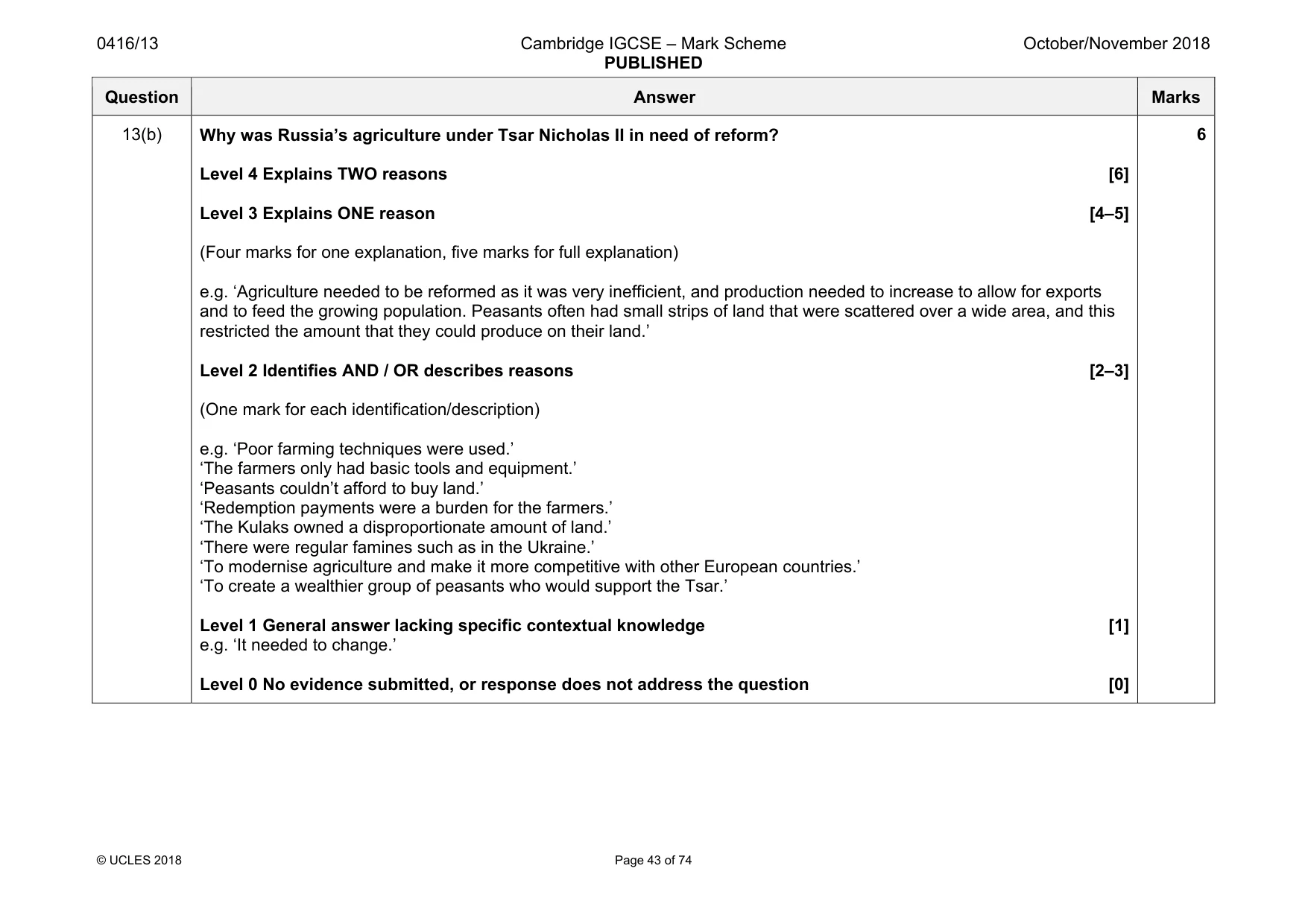
0416/13 Cambridge IGCSE – Mark Scheme PUBLISHED October/November 2018 © UCLES 2018 Page 43 of 74 Question Answer Marks 13(b) Why was Russia’s agriculture under Tsar Nicholas II in need of reform? Level 4 Explains TWO reasons [6] Level 3 Explains ONE reason [4–5] (Four marks for one explanation, five marks for full explanation) e.g. ‘Agriculture needed to be reformed as it was very inefficient, and production needed to increase to allow for exports and to feed the growing population. Peasants often had small strips of land that were scattered over a wide area, and this restricted the amount that they could produce on their land.’ Level 2 Identifies AND / OR describes reasons [2–3] (One mark for each identification/description) e.g. ‘Poor farming techniques were used.’ ‘The farmers only had basic tools and equipment.’ ‘Peasants couldn’t afford to buy land.’ ‘Redemption payments were a burden for the farmers.’ ‘The Kulaks owned a disproportionate amount of land.’ ‘There were regular famines such as in the Ukraine.’ ‘To modernise agriculture and make it more competitive with other European countries.’ ‘To create a wealthier group of peasants who would support the Tsar.’ Level 1 General answer lacking specific contextual knowledge [1] e.g. ‘It needed to change.’ Level 0 No evidence submitted, or response does not address the question [0] 6
Mark scheme, page 44
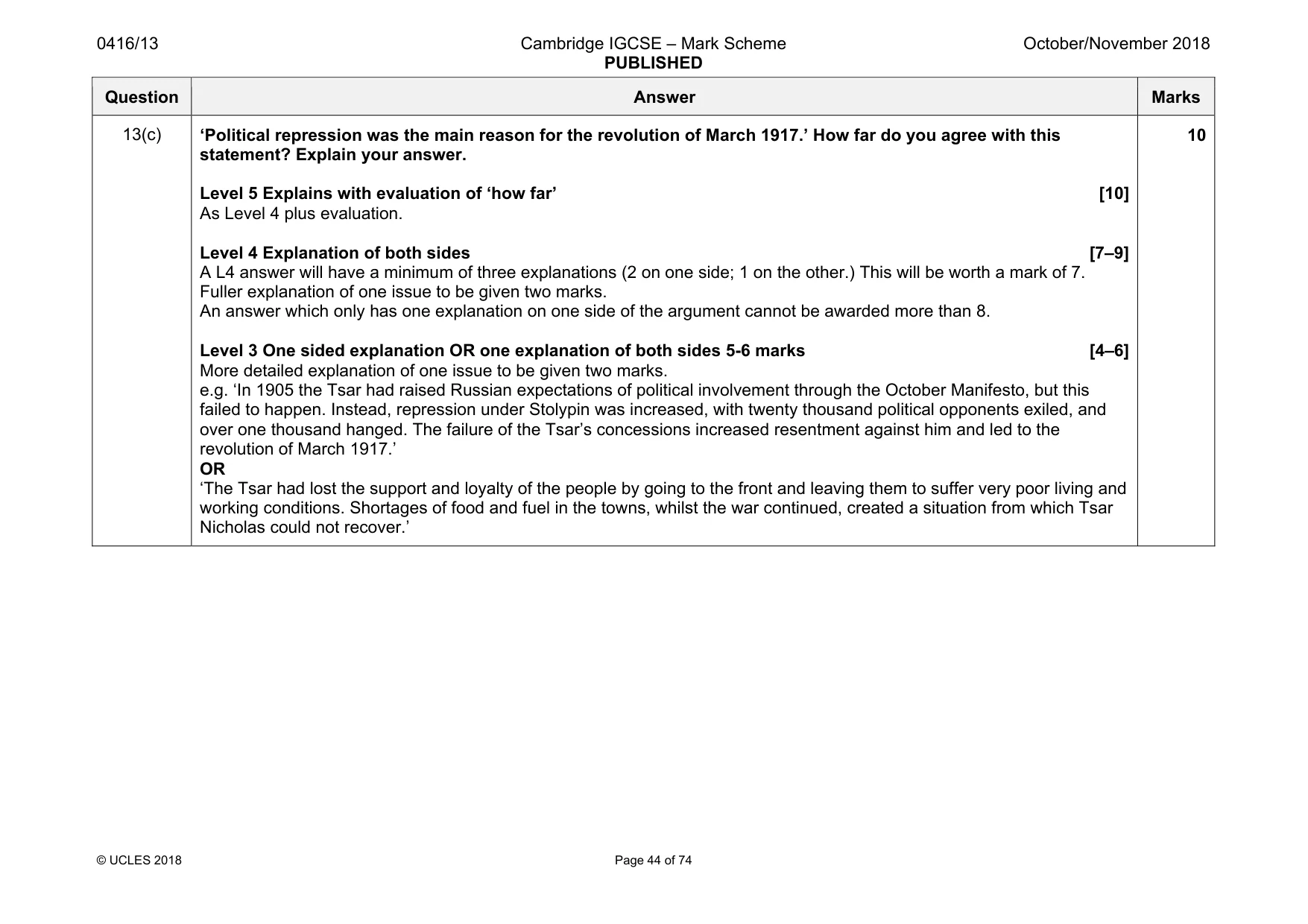
0416/13 Cambridge IGCSE – Mark Scheme PUBLISHED October/November 2018 © UCLES 2018 Page 44 of 74 Question Answer Marks 13(c) ‘Political repression was the main reason for the revolution of March 1917.’ How far do you agree with this statement? Explain your answer. Level 5 Explains with evaluation of ‘how far’ [10] As Level 4 plus evaluation. Level 4 Explanation of both sides [7–9] A L4 answer will have a minimum of three explanations (2 on one side; 1 on the other.) This will be worth a mark of 7. Fuller explanation of one issue to be given two marks. An answer which only has one explanation on one side of the argument cannot be awarded more than 8. Level 3 One sided explanation OR one explanation of both sides 5-6 marks [4–6] More detailed explanation of one issue to be given two marks. e.g. ‘In 1905 the Tsar had raised Russian expectations of political involvement through the October Manifesto, but this failed to happen. Instead, repression under Stolypin was increased, with twenty thousand political opponents exiled, and over one thousand hanged. The failure of the Tsar’s concessions increased resentment against him and led to the revolution of March 1917.’ OR ‘The Tsar had lost the support and loyalty of the people by going to the front and leaving them to suffer very poor living and working conditions. Shortages of food and fuel in the towns, whilst the war continued, created a situation from which Tsar Nicholas could not recover.’ 10
Mark scheme, page 45
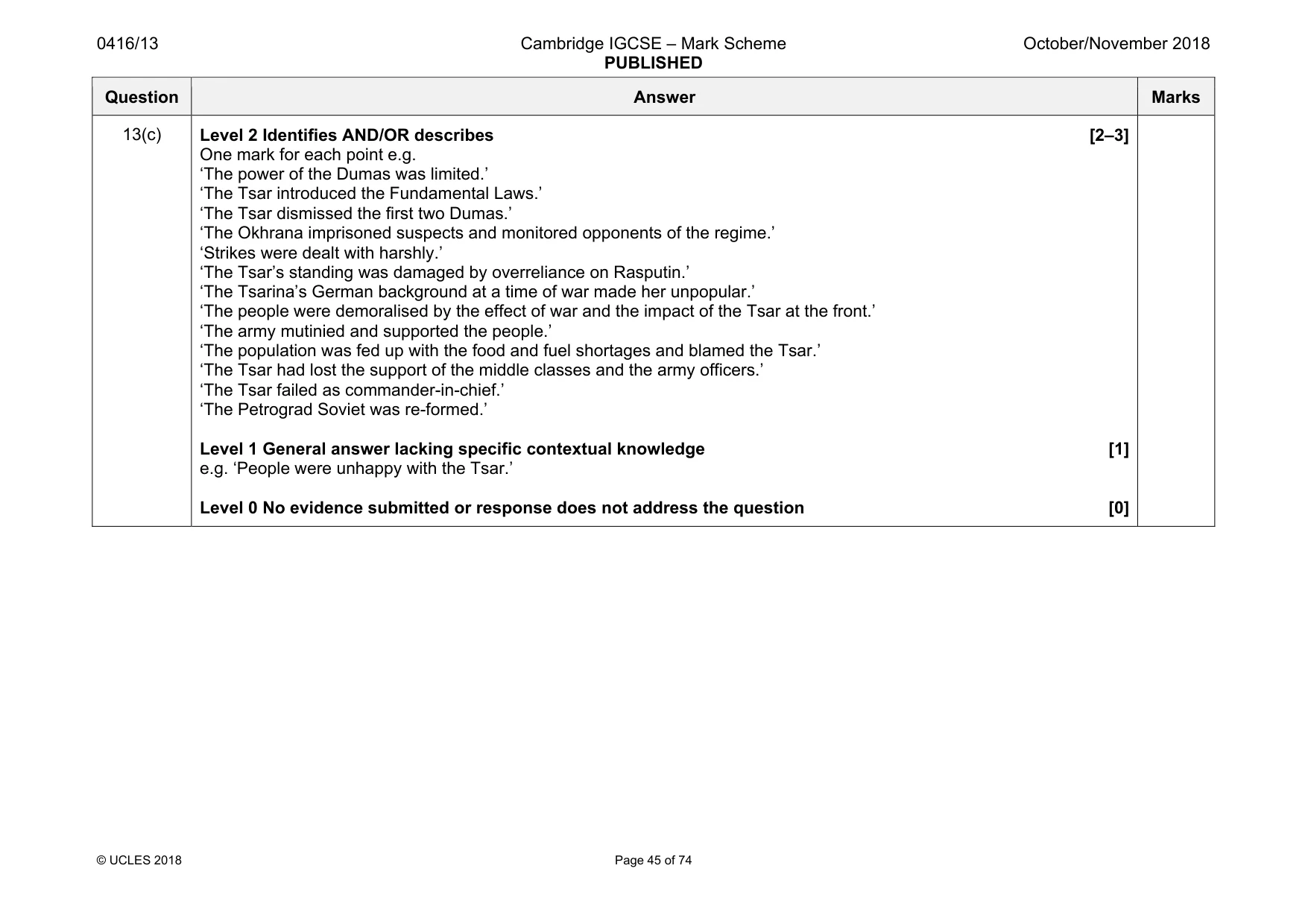
0416/13 Cambridge IGCSE – Mark Scheme PUBLISHED October/November 2018 © UCLES 2018 Page 45 of 74 Question Answer Marks 13(c) Level 2 Identifies AND/OR describes [2–3] One mark for each point e.g. ‘The power of the Dumas was limited.’ ‘The Tsar introduced the Fundamental Laws.’ ‘The Tsar dismissed the first two Dumas.’ ‘The Okhrana imprisoned suspects and monitored opponents of the regime.’ ‘Strikes were dealt with harshly.’ ‘The Tsar’s standing was damaged by overreliance on Rasputin.’ ‘The Tsarina’s German background at a time of war made her unpopular.’ ‘The people were demoralised by the effect of war and the impact of the Tsar at the front.’ ‘The army mutinied and supported the people.’ ‘The population was fed up with the food and fuel shortages and blamed the Tsar.’ ‘The Tsar had lost the support of the middle classes and the army officers.’ ‘The Tsar failed as commander-in-chief.’ ‘The Petrograd Soviet was re-formed.’ Level 1 General answer lacking specific contextual knowledge [1] e.g. ‘People were unhappy with the Tsar.’ Level 0 No evidence submitted or response does not address the question [0]
Mark scheme, page 46
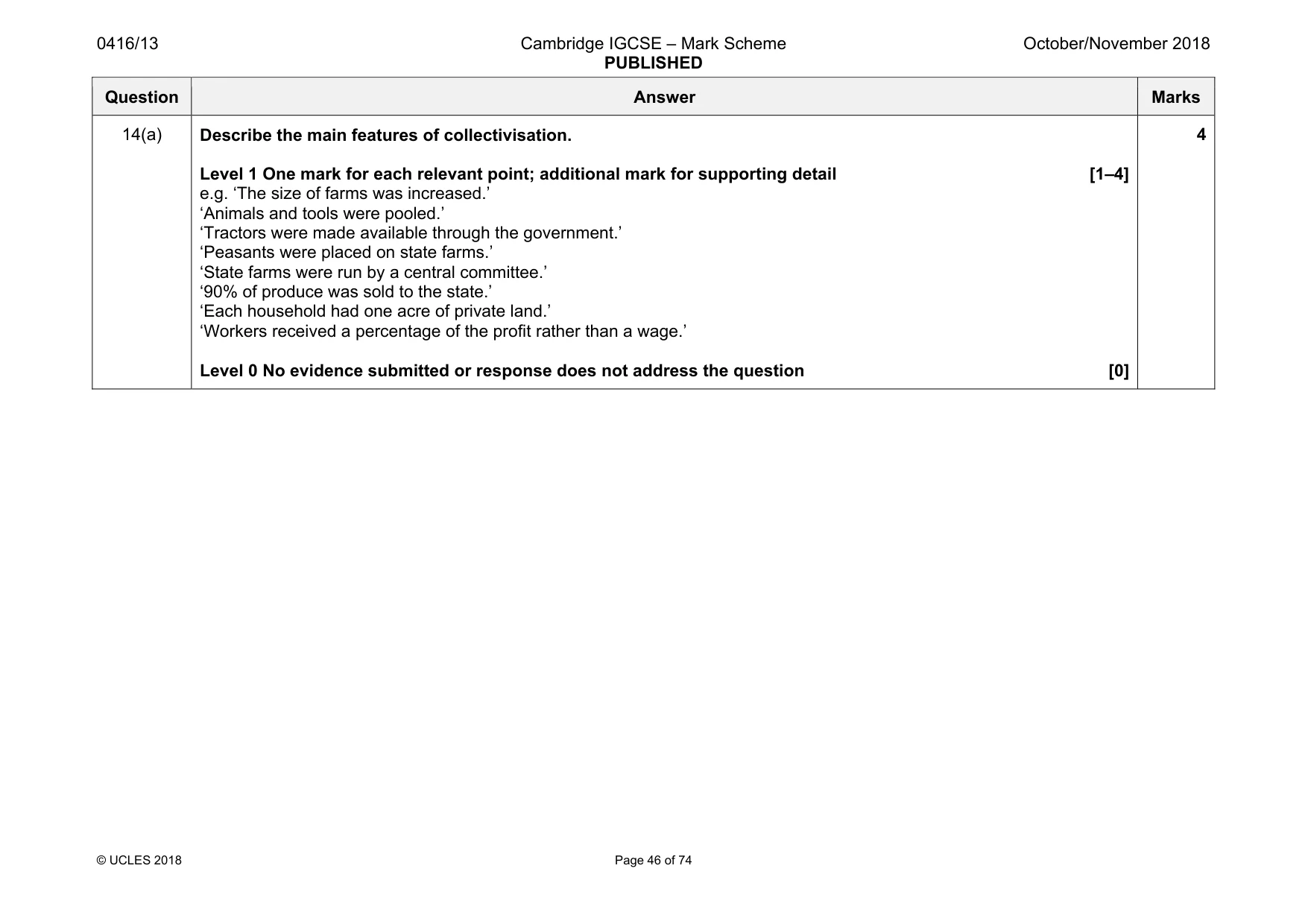
0416/13 Cambridge IGCSE – Mark Scheme PUBLISHED October/November 2018 © UCLES 2018 Page 46 of 74 Question Answer Marks 14(a) Describe the main features of collectivisation. Level 1 One mark for each relevant point; additional mark for supporting detail [1–4] e.g. ‘The size of farms was increased.’ ‘Animals and tools were pooled.’ ‘Tractors were made available through the government.’ ‘Peasants were placed on state farms.’ ‘State farms were run by a central committee.’ ‘90% of produce was sold to the state.’ ‘Each household had one acre of private land.’ ‘Workers received a percentage of the profit rather than a wage.’ Level 0 No evidence submitted or response does not address the question [0] 4
Mark scheme, page 47
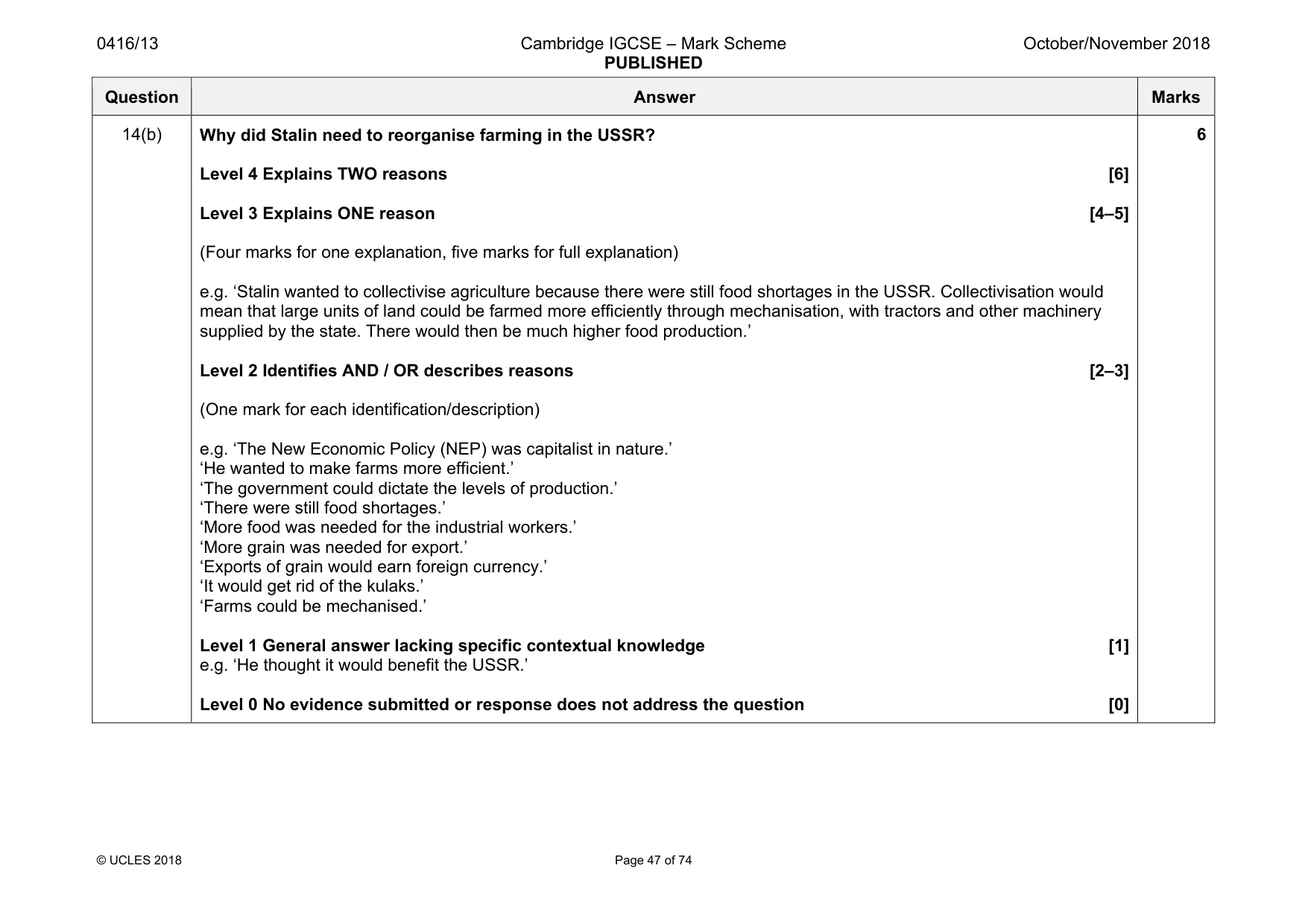
0416/13 Cambridge IGCSE – Mark Scheme PUBLISHED October/November 2018 © UCLES 2018 Page 47 of 74 Question Answer Marks 14(b) Why did Stalin need to reorganise farming in the USSR? Level 4 Explains TWO reasons [6] Level 3 Explains ONE reason [4–5] (Four marks for one explanation, five marks for full explanation) e.g. ‘Stalin wanted to collectivise agriculture because there were still food shortages in the USSR. Collectivisation would mean that large units of land could be farmed more efficiently through mechanisation, with tractors and other machinery supplied by the state. There would then be much higher food production.’ Level 2 Identifies AND / OR describes reasons [2–3] (One mark for each identification/description) e.g. ‘The New Economic Policy (NEP) was capitalist in nature.’ ‘He wanted to make farms more efficient.’ ‘The government could dictate the levels of production.’ ‘There were still food shortages.’ ‘More food was needed for the industrial workers.’ ‘More grain was needed for export.’ ‘Exports of grain would earn foreign currency.’ ‘It would get rid of the kulaks.’ ‘Farms could be mechanised.’ Level 1 General answer lacking specific contextual knowledge [1] e.g. ‘He thought it would benefit the USSR.’ Level 0 No evidence submitted or response does not address the question [0] 6
Mark scheme, page 48
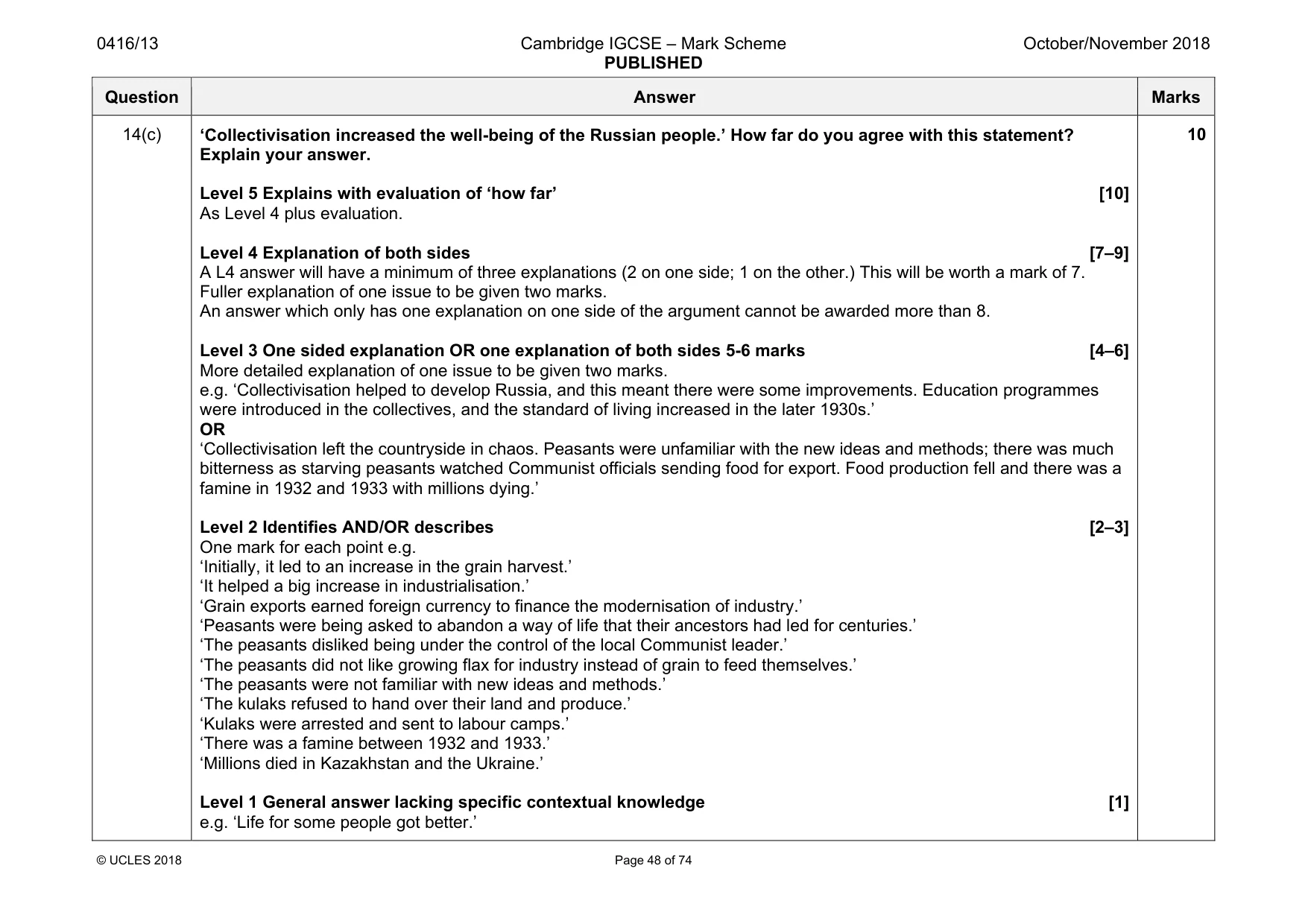
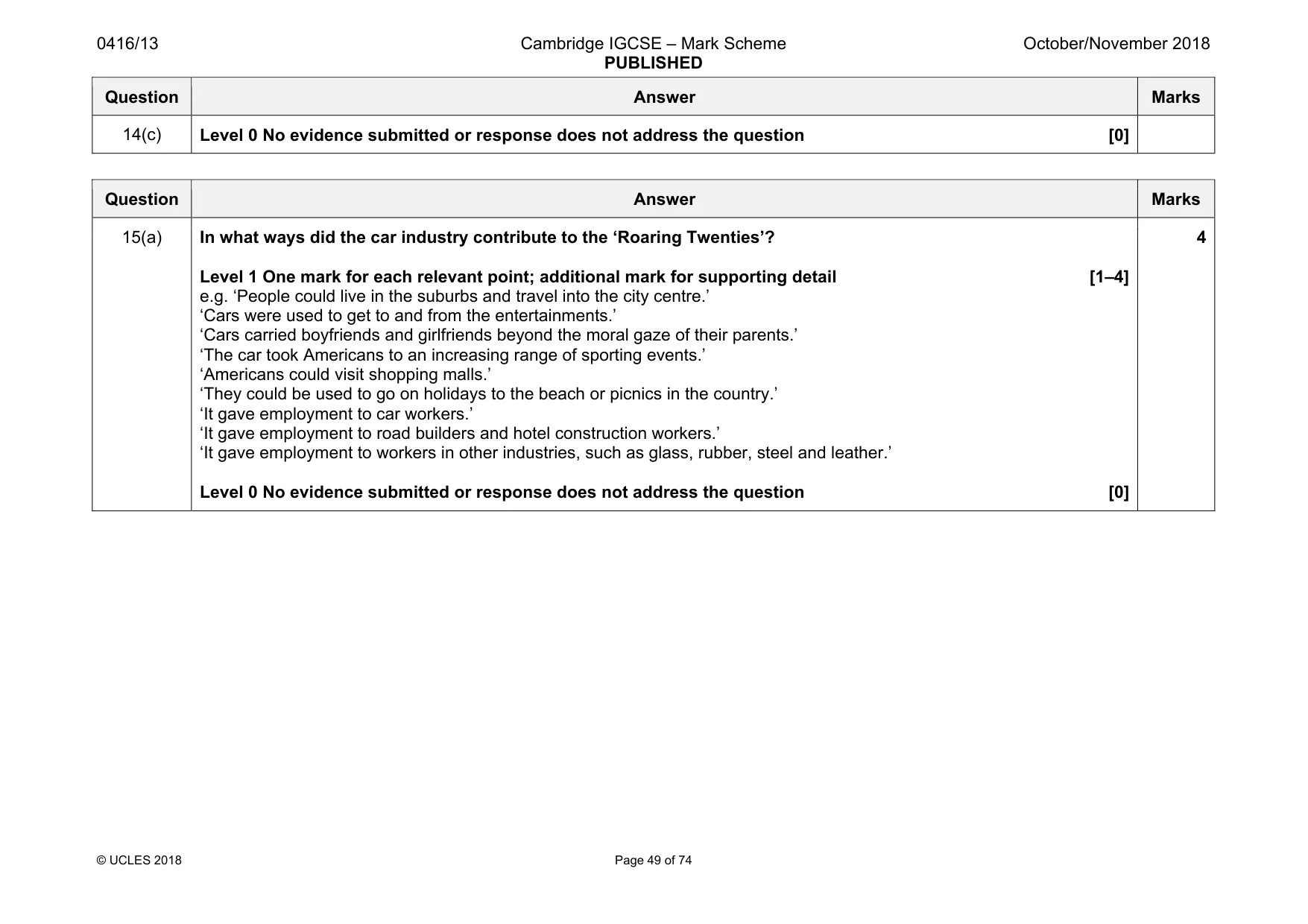
0416/13 Cambridge IGCSE – Mark Scheme PUBLISHED October/November 2018 © UCLES 2018 Page 48 of 74 Question Answer Marks 14(c) ‘Collectivisation increased the well-being of the Russian people.’ How far do you agree with this statement? Explain your answer. Level 5 Explains with evaluation of ‘how far’ [10] As Level 4 plus evaluation. Level 4 Explanation of both sides [7–9] A L4 answer will have a minimum of three explanations (2 on one side; 1 on the other.) This will be worth a mark of 7. Fuller explanation of one issue to be given two marks. An answer which only has one explanation on one side of the argument cannot be awarded more than 8. Level 3 One sided explanation OR one explanation of both sides 5-6 marks [4–6] More detailed explanation of one issue to be given two marks. e.g. ‘Collectivisation helped to develop Russia, and this meant there were some improvements. Education programmes were introduced in the collectives, and the standard of living increased in the later 1930s.’ OR ‘Collectivisation left the countryside in chaos. Peasants were unfamiliar with the new ideas and methods; there was much bitterness as starving peasants watched Communist officials sending food for export. Food production fell and there was a famine in 1932 and 1933 with millions dying.’ Level 2 Identifies AND/OR describes [2–3] One mark for each point e.g. ‘Initially, it led to an increase in the grain harvest.’ ‘It helped a big increase in industrialisation.’ ‘Grain exports earned foreign currency to finance the modernisation of industry.’ ‘Peasants were being asked to abandon a way of life that their ancestors had led for centuries.’ ‘The peasants disliked being under the control of the local Communist leader.’ ‘The peasants did not like growing flax for industry instead of grain to feed themselves.’ ‘The peasants were not familiar with new ideas and methods.’ ‘The kulaks refused to hand over their land and produce.’ ‘Kulaks were arrested and sent to labour camps.’ ‘There was a famine between 1932 and 1933.’ ‘Millions died in Kazakhstan and the Ukraine.’ Level 1 General answer lacking specific contextual knowledge [1] e.g. ‘Life for some people got better.’ 10
Mark scheme, page 49
0416/13 Cambridge IGCSE – Mark Scheme PUBLISHED October/November 2018 © UCLES 2018 Page 49 of 74 Question Answer Marks 14(c) Level 0 No evidence submitted or response does not address the question [0] Question Answer Marks 15(a) In what ways did the car industry contribute to the ‘Roaring Twenties’? Level 1 One mark for each relevant point; additional mark for supporting detail [1–4] e.g. ‘People could live in the suburbs and travel into the city centre.’ ‘Cars were used to get to and from the entertainments.’ ‘Cars carried boyfriends and girlfriends beyond the moral gaze of their parents.’ ‘The car took Americans to an increasing range of sporting events.’ ‘Americans could visit shopping malls.’ ‘They could be used to go on holidays to the beach or picnics in the country.’ ‘It gave employment to car workers.’ ‘It gave employment to road builders and hotel construction workers.’ ‘It gave employment to workers in other industries, such as glass, rubber, steel and leather.’ Level 0 No evidence submitted or response does not address the question [0] 4
Mark scheme, page 50
0416/13 Cambridge IGCSE – Mark Scheme PUBLISHED October/November 2018 © UCLES 2018 Page 50 of 74 Question Answer Marks 15(b) Why did new forms of entertainment become increasingly popular in the 1920s? Level 4 Explains TWO reasons [6] Level 3 Explains ONE reason [4–5] (Four marks for one explanation, five marks for full explanation) e.g. ‘The Jazz Age was a time when jazz appealed to young white Americans because they thought it was exciting and modern. This was matched by opportunities to visit jazz clubs as a result of increased leisure time and prosperity.’ Level 2 Identifies AND / OR describes reasons [2–3] (One mark for each identification/description) e.g. ‘Cinema provided escapism.’ ‘The arrival of ‘talkies’ made cinema increasingly popular.’ ‘People were keen to see the new cinema celebrities.’ ‘Most people had more leisure time.’ ‘People had more disposable income.’ ‘Radios could be purchased in instalments.’ ‘The first ‘talkie’ movie was released in 1927.’ ‘Radios produced the age of the great dance bands, such as the band led by Joe Candullo.’ ‘The Jazz Age was a time when jazz became linked with dance music.’ ‘It was a time when nightclubs became popular, such as the Cotton Club of Harlem.’ Level 1 General answer lacking specific contextual knowledge [1] e.g. ‘It gave people something to do.’ Level 0 No evidence submitted or response does not address the question [0] 6
Mark scheme, page 51
0416/13 Cambridge IGCSE – Mark Scheme PUBLISHED October/November 2018 © UCLES 2018 Page 51 of 74 Question Answer Marks 15(c) ‘US society was becoming more tolerant in the 1920s.’ How far do you agree with this statement? Explain your answer. Level 5 Explains with evaluation of ‘how far’ [10] As Level 4 plus evaluation. Level 4 Explanation of both sides [7–9] A L4 answer will have a minimum of three explanations (2 on one side; 1 on the other.) This will be worth a mark of 7. Fuller explanation of one issue to be given two marks. An answer which only has one explanation on one side of the argument cannot be awarded more than 8. Level 3 One sided explanation OR one explanation of both sides 5-6 marks [4–6] More detailed explanation of one issue to be given two marks. e.g. ‘There was more tolerance for women in the 1920s. Contraception reduced the size of families, and labour-saving devices allowed more women to work making them financially independent. This financial independence allowed a change in the traditional restrictive role. Women wore more daring clothes. They smoked in public and went out with men, without a chaperone.’ OR ‘People in 1920s America showed intolerance as they were scared by the idea that communism could take hold in their country. This ‘Red Scare’ meant immigrants, anyone with extreme political views and anyone who was not a WASP could be targeted. Trade unionists, black Americans, Jews, Catholics and almost all minority groups were accused of being communists.’ 10
Mark scheme, page 52
0416/13 Cambridge IGCSE – Mark Scheme PUBLISHED October/November 2018 © UCLES 2018 Page 52 of 74 Question Answer Marks 15(c) Level 2 Identifies AND/OR describes [2–3] One mark for each point e.g. ‘Women had greater freedom.’ ‘Attitudes towards sex and contraception were changing.’ ‘New tastes in entertainment were growing.’ ‘The Ku Klux Klan fuelled intolerance.’ ‘There was discrimination against black Americans.’ ‘Prohibition showed intolerance towards some groups in society.’ ‘Americans thought eastern European immigrants were all communists.’ ‘Immigration laws discriminated against certain national groups.’ ‘Socialist organisations were raided.’ ‘Socialist books and pamphlets were seized.’ ‘Sacco and Vanzetti were victims of the Red Scare.’ ‘The Monkey Trial highlighted religious intolerance.’ Level 1 General answer lacking specific contextual knowledge [1] e.g. ‘Not everyone was tolerant in the 1920s.’ Level 0 No evidence submitted or response does not address the question [0] Question Answer Marks 16(a) What happened to the Bonus Marchers in 1932? Level 1 One mark for each relevant point; additional mark for supporting detail [1–4] e.g. ‘They did not receive their war pensions.’ ‘Hoover refused to meet the marchers.’ ‘Hoover ordered the police to remove the Bonus Army from their camp.’ ‘Hoover instructed MacArthur to treat the veterans with respect.’ ‘MacArthur used cavalry, tanks, tear gas and infantry with fixed bayonets.’ ‘Two veterans died.’ ‘A thousand veterans were injured.’ ‘Their camp was burned.’ Level 0 No evidence submitted or response does not address the question [0] 4
Mark scheme, page 53
0416/13 Cambridge IGCSE – Mark Scheme PUBLISHED October/November 2018 © UCLES 2018 Page 53 of 74 Question Answer Marks 16(b) Why were agricultural areas affected badly by the Depression? Level 4 Explains TWO reasons [6] Level 3 Explains ONE reason [4–5] (Four marks for one explanation, five marks for full explanation) e.g. ‘Even before the Depression agricultural areas had been suffering from falling prices due to over production and increased competition. The Depression made the situation worse as people living in towns could no longer afford to buy so much food, and so prices just kept on falling.’ Level 2 Identifies AND / OR describes reasons [2–3] (One mark for each identification/description) e.g. ‘It cost more to take an animal to market than a farmer could sell it for.’ ‘Exports fell as other countries were also hit by the Depression.’ ‘American tariffs affected international trade, including agricultural produce.’ ‘Farmers faced eviction.’ Level 1 General answer lacking specific contextual knowledge [1] e.g. ‘The countryside always suffered a lot.’ Level 0 No evidence submitted or response does not address the question [0] 6
Mark scheme, page 54
0416/13 Cambridge IGCSE – Mark Scheme PUBLISHED October/November 2018 © UCLES 2018 Page 54 of 74 Question Answer Marks 16(c) ‘It was the banks that caused the Wall Street Crash.’ How far do you agree with this statement? Explain your answer. Level 5 Explains with evaluation of ‘how far’ [10] As Level 4 plus evaluation. Level 4 Explanation of both sides [7–9] A L4 answer will have a minimum of three explanations (2 on one side; 1 on the other.) This will be worth a mark of 7. Fuller explanation of one issue to be given two marks. An answer which only has one explanation on one side of the argument cannot be awarded more than 8. Level 3 One sided explanation OR one explanation of both sides 5-6 marks [4–6] More detailed explanation of one issue to be given two marks. e.g. ‘It can be said that banks caused the Wall Street Crash since they lent speculators too much money and this encouraged speculation. In 1929, banks had lent speculators $9 billion, and this caused share prices to rise to artificially high levels. Once the share prices started falling, this led to panic and the failure of many banks.’ OR ‘It was speculators who caused the Wall Street Crash. On the stock market, everything depended on confidence in the share prices rising. During the 1920s, the economy was booming, and this encouraged speculators to invest in shares for a short time to make a quick profit as the shares rose in value. When the economy started to stall, many speculators were caught with shares that had lost value. It led to panic selling as speculators tried to cut their losses.’ Level 2 Identifies AND/OR describes [2–3] One mark for each point e.g. ‘Banks were lending money to speculators.’ ‘Share were being bought “on the margin”.’ ‘Banks would loan up to 90 per cent of the share price.’ ‘Weaknesses were evident in the US economy before the Crash.’ ‘Traditional trades were already declining.’ ‘There was over-production of consumer goods.’ ‘The USA was unable to export since European countries had imposed tariffs in response to American tariffs.’ ‘People lost confidence in the stock market.’ ‘Speculation was risky since it depended on the stock market rising.’ ‘Banks had loaned too much money to investors. 10
Mark scheme, page 55
0416/13 Cambridge IGCSE – Mark Scheme PUBLISHED October/November 2018 © UCLES 2018 Page 55 of 74 Question Answer Marks 16(c) Level 1 General answer lacking specific contextual knowledge [1] e.g. ‘There were many reasons why the Wall Street Crash happened.’ Level 0 No evidence submitted or response does not address the question [0] Question Answer Marks 17(a) In what ways was Hong Kong affected by the development of China as a Communist state? Level 1 One mark for each relevant point; additional mark for supporting detail [1–4] e.g. ‘When the People’s Republic of China was proclaimed in 1949, many migrants fled to Hong Kong.’ ‘Many felt safe in Hong Kong from the persecution of the Communist Party.’ ‘Many businesses in major Chinese cities moved to Hong Kong.’ ‘China left the territory alone.’ ‘China did not want to clash with the British.’ ‘During the 1980s, Hong Kong started to work with China on a series of joint projects,’ ‘Hong Kong and China started trading projects together.’ ‘It was agreed that Hong Kong would revert back to Chinese authority in 1997.’ ‘On 1st of July 1997, Hong Kong became China’s Special Administrative Region.’ Level 0 No evidence submitted or response does not address the question [0] 4
Mark scheme, page 56
0416/13 Cambridge IGCSE – Mark Scheme PUBLISHED October/November 2018 © UCLES 2018 Page 56 of 74 Question Answer Marks 17(b) Why was the death of Stalin a turning point in China-USSR relations? Level 4 Explains TWO reasons [6] Level 3 Explains ONE reason [4–5] (Four marks for one explanation, five marks for full explanation) e.g. ‘When Stalin died, the new leader of the USSR was Khrushchev. At first relations between the new leaders were good, but gradually deteriorated. Khrushchev denounced Stalin, stating that Stalin’s rule as a dictator in total control of the USSR had been wrong. Mao was appalled at this public repudiation of a socialist hero, and also saw this statement as a personal attack on his method of ruling China. Relations worsened.’ Level 2 Identifies AND / OR describes reasons [2–3] (One mark for each identification/description) e.g. ‘There was a successful visit to China by Khrushchev.’ ‘The USSR formally handed over Lishun naval base to China.’ ‘The USSR gave technical aid and loans for the first Five-Year Plan.’ ‘Mao did not like Khrushchev.’ ‘Khrushchev denounced Stalin.’ ‘The USSR would not help China militarily.’ ‘Following Stalin’s death in 1953, Mao became suspicious of Khrushchev’s efforts to improve relations with the West.’ ‘China and the USSR broke their friendship treaty in 1960.’ Level 1 General answer lacking specific contextual knowledge [1] e.g. ‘The new leader of the USSR was not popular in China.’ Level 0 No evidence submitted or response does not address the question [0] 6
Mark scheme, page 57
0416/13 Cambridge IGCSE – Mark Scheme PUBLISHED October/November 2018 © UCLES 2018 Page 57 of 74 Question Answer Marks 17(c) ‘By the time of Mao’s death China was an important power, but not yet a superpower.’ How far do you agree with this statement? Explain your answer. Level 5 Explains with evaluation of ‘how far’ [10] As Level 4 plus evaluation. Level 4 Explanation of both sides [7–9] A L4 answer will have a minimum of three explanations (2 on one side; 1 on the other.) This will be worth a mark of 7. Fuller explanation of one issue to be given two marks. An answer which only has one explanation on one side of the argument cannot be awarded more than 8. Level 3 One sided explanation OR one explanation of both sides 5-6 marks [4–6] More detailed explanation of one issue to be given two marks. e.g. ‘China could be considered a superpower since by 1976 they were a nuclear power. They had tested their first hydrogen bomb in 1967, and this meant they were capable of producing nuclear weapons.’ OR ‘The Cultural Revolution caused chaos in all walks of life and resulted in a loss of production both in industry and agriculture. This was hardly the symbol of a superpower. It took years to put right the damage done to the economy.’ Level 2 Identifies AND/OR describes [2–3] One mark for each point e.g. ‘It was a powerful nation with a population of nearly 100 million.’ ‘It was recognised by the United Nations.’ ‘It was an important nation in discussions with the USA and Soviet Union.’ ‘It dominated Asia.’ ‘It was an important ally to Korea and Vietnam.’ ‘It controlled Tibet.’ ‘Output increased under the First Five Year Plan.’ ‘Inflation was stopped.’ ‘China was an atomic power.’ ‘By 1976, China was not a great trading nation.’ ‘Its economy was undeveloped.’ ‘It lagged behind the Soviet Union and the USA industrially and militarily.’ ‘It didn’t have much influence over other states.’ 10
Mark scheme, page 58
0416/13 Cambridge IGCSE – Mark Scheme PUBLISHED October/November 2018 © UCLES 2018 Page 58 of 74 Question Answer Marks 17(c) Level 1 General answer lacking specific contextual knowledge [1] e.g. ‘It was in some ways but not in others.’ Level 0 No evidence submitted or response does not address the question [0] Question Answer Marks 18(a) Describe the policy introduced from 1979 in an effort to control population growth. Level 1 One mark for each relevant point; additional mark for supporting detail [1–4] e.g. ‘It is known as the ‘One Child Policy’.’ ‘It was an attempt to reduce the population to 700 million.’ ‘Families were only allowed to have one child.’ ‘There were some cases where a couple could have a second child, such as when both parents were single children.’ ‘Couples were fined for having more than one child.’ ‘Women were required to have an IUD fitted after the birth of their first child.’ ‘It was very unpopular, particularly in the rural areas.’ ‘Some women were forcibly sterilised.’ ‘It resulted in more boys than girls being born in China.’ Level 0 No evidence submitted or response does not address the question [0] 4
Mark scheme, page 59
0416/13 Cambridge IGCSE – Mark Scheme PUBLISHED October/November 2018 © UCLES 2018 Page 59 of 74 Question Answer Marks 18(b) Why did the economic growth of the 1980s create new social and political problems for China? Level 4 Explains TWO reasons [6] Level 3 Explains ONE reason [4–5] (Four marks for one explanation, five marks for full explanation) e.g. ‘Economic growth benefitted cities and coastal areas; as a result, rural China suffered from lower wages and standards of living, poorer education and hospital provision, fewer opportunities for prosperity leading to problems such as crime and lower life expectancy.’ Level 2 Identifies AND / OR describes reasons [2–3] (One mark for each identification/description) e.g. ‘Rural workers had failed to increase their income compared to urban workers.’ ‘Housing and medical care costs had greatly increased.’ ‘There was a growing gap between rich and poor.’ ‘Eastern China had benefitted far more from the economic reforms than the rest of China.’ ‘There was an increase in corruption and white-collar crime.’ ‘Economic freedom led to demands for political freedom.’ Level 1 General answer lacking specific contextual knowledge [1] e.g. ‘People were discontented with what was happening in China.’ Level 0 No evidence submitted or response does not address the question [0] 6
Mark scheme, page 60
0416/13 Cambridge IGCSE – Mark Scheme PUBLISHED October/November 2018 © UCLES 2018 Page 60 of 74 Question Answer Marks 18(c) ‘The greatest impact of the Cultural Revolution was on traditional Chinese art and culture.’ How far do you agree with this statement? Explain your answer. Level 5 Explains with evaluation of ‘how far’ [10] As Level 4 plus evaluation. Level 4 Explanation of both sides [7–9] A L4 answer will have a minimum of three explanations (2 on one side; 1 on the other.) This will be worth a mark of 7. Fuller explanation of one issue to be given two marks. An answer which only has one explanation on one side of the argument cannot be awarded more than 8. Level 3 One sided explanation OR one explanation of both sides 5-6 marks [4–6] More detailed explanation of one issue to be given two marks. e.g. ‘The Chinese were discouraged from practising traditions such as fortune telling and feng shui and directed instead towards authors and artists favoured by the regime. Even more of an impact occurred on historical sites and artefacts, countless numbers of which were completely destroyed.’ OR ‘China was made weaker as the education system was severely disrupted by the Cultural Revolution. Teachers were dismissed and tortured, and schools and colleges closed. A whole generation missed out on a proper education, and industry was affected by the lack of skilled workers.’ 10
Mark scheme, page 61
0416/13 Cambridge IGCSE – Mark Scheme PUBLISHED October/November 2018 © UCLES 2018 Page 61 of 74 Question Answer Marks 18(c) Level 2 Identifies AND/OR describes [2–3] e.g. ‘Traditional arts and ideas were discouraged.’ ‘Historical sites, artefacts and museum pieces were destroyed.’ ‘Some artefacts were smuggled abroad.’ ‘Many schools and colleges were closed.’ ‘Some areas had illiteracy rates as high as 40% 20 years after the revolution.’ ‘The elimination of qualified teachers meant chosen students had to re-educate the next generation.’ ‘Education suffered severely.’ ‘Teachers were dismissed.’ ‘Production in factories fell.’ ‘By 1967 China was on the verge of civil war.’ ‘The transport system was disrupted.’ ‘The Chinese were encouraged to be fearful of other countries.’ ‘Intellectuals were considered enemies of the state.’ ‘People were encouraged to question their parents and teachers.’ ‘Red Guards attacked foreigners and embassies.’ Level 1 General answer lacking specific contextual knowledge [1] e.g. ‘The Cultural Revolution created chaos in Chinese society.’ Level 0 No evidence submitted or response does not address the question [0] Question Answer Marks 19(a) What was the Reservation of Separate Amenities Act of 1953? Level 1 One mark for each relevant point; additional mark for supporting detail [1–4] e.g. ‘Apartheid signs were set up throughout South Africa.’ ‘All races were to have separate amenities.’ ‘It included all public premises except roads and streets.’ ‘Amenities were to include toilets, parks, beaches and cemeteries.’ ‘The amenities did not have to be of a similar standard.’ Level 0 No evidence submitted or response does not address the question [0] 4
Mark scheme, page 62
0416/13 Cambridge IGCSE – Mark Scheme PUBLISHED October/November 2018 © UCLES 2018 Page 62 of 74 Question Answer Marks 19(b) Why was the introduction of Bantustans important to Verwoerd’s plan for an all-white South Africa? Level 4 Explains TWO reasons [6] Level 3 Explains ONE reason [4–5] (Four marks for one explanation, five marks for full explanation) e.g. ‘Bantustans were important to Verwoerd’s plan since they provided a way for the government to eject from white areas all black people who were not needed for the functioning of the economy. In this way it met his vision of an all-white South Africa.’ Level 2 Identifies AND / OR describes reasons [2–3] (One mark for each identification/description) e.g. ‘It created eight Bantustans based on the original African homelands (reserves).’ ‘Each Bantustan was allocated to a particular ethnic group.’ ‘They were intended to be the homelands for all black people.’ ‘They were eventually intended to become self-governing.’ ‘Blacks in self-governing Bantustans would lose their South African citizenship and voting rights.’ ‘It retained the most and best land for the whites.’ Level 1 General answer lacking specific contextual knowledge [1] e.g. ‘They were needed to make his plan work.’ Level 0 No evidence submitted or response does not address the question [0] 6
Mark scheme, page 63
0416/13 Cambridge IGCSE – Mark Scheme PUBLISHED October/November 2018 © UCLES 2018 Page 63 of 74 Question Answer Marks 19(c) ‘The impact of apartheid was greater on employment than on education.’ How far do you agree with this statement? Explain your answer. Level 5 Explains with evaluation of ‘how far’ [10] As Level 4 plus evaluation. Level 4 Explanation of both sides [7–9] A L4 answer will have a minimum of three explanations (2 on one side; 1 on the other.) This will be worth a mark of 7. Fuller explanation of one issue to be given two marks. An answer which only has one explanation on one side of the argument cannot be awarded more than 8. Level 3 One sided explanation OR one explanation of both sides 5-6 marks [4–6] More detailed explanation of one issue to be given two marks. e.g. ‘The impact of apartheid on employment had a massive effect on both black and white people. Afrikaners benefitted massively, being appointed to both senior and junior positions in all state institutions. Overall, white income was ten times greater than that of black income. Black factory workers, for example earned only 18% of the earnings of white workers performing the same tasks.’ OR ‘The Bantu Education Act of 1953 was introduced to separate the education of white pupils and black pupils. It would allow black children to be taught a different curriculum from white children. Its aim was to prepare the black children for the unskilled labour market. This meant that from an early age black people were disadvantaged.’ Level 2 Identifies AND/OR describes [2–3] One mark for each point e.g. ‘Black employees were given very low wages.’ ‘Afrikaners increasingly controlled the medical and legal professions.’ ‘Some non-whites such as professional workers and businessmen had a higher standard of living than other non-whites.’ ‘Jobs were created for black government officials and civil servants in Bantustans.’ ‘Racially separated educational facilities were introduced.’ ‘The education prepared black people to be a permanent underclass.’ ‘The National Party would have the power to employ and train teachers as they saw fit.’ ‘All black schools were put under the Native Affairs Department.’ ‘Government grants for missionary schools were withdrawn.’ ‘Money for black education was reduced producing larger classes, poorer equipment and less qualified teachers.’ ‘Non-whites were banned from previously mixed universities.’ 10
Mark scheme, page 64
0416/13 Cambridge IGCSE – Mark Scheme PUBLISHED October/November 2018 © UCLES 2018 Page 64 of 74 Question Answer Marks 19(c) Level 1 General answer lacking specific contextual knowledge [1] e.g. ‘Both employment and education were seriously affected by apartheid.’ Level 0 No evidence submitted or response does not address the question [0] Question Answer Marks 20(a) Describe government censorship of the mass media during the 1970s. Level 1 One mark for each relevant point; additional mark for supporting detail [1–4] e.g. ‘The South African Broadcasting Corporation (SABC) was established.’ ‘The SABC had a monopoly of radio and TV broadcasting.’ ‘The SABC broadcast stories the government approved of.’ ‘There was strict censorship of all types of mass media.’ ‘Books, periodicals and films were censored.’ ‘No reports were allowed of activities of organisations such as the ANC.’ ‘All song lyrics were checked.’ Level 0 No evidence submitted or response does not address the question [0] 4
Mark scheme, page 65
0416/13 Cambridge IGCSE – Mark Scheme PUBLISHED October/November 2018 © UCLES 2018 Page 65 of 74 Question Answer Marks 20(b) Why were the actions of young people at Soweto in 1976 important? Level 4 Explains TWO reasons [6] Level 3 Explains ONE reason [4–5] (Four marks for one explanation, five marks for full explanation) e.g. ‘Their actions were important because of the government’s response to their demonstrations. The killing of at least 575 peaceful demonstrators horrified the international community with the brutality of the apartheid regime. This led the UN Security Council to pass a resolution condemning the apartheid government.’ Level 2 Identifies AND / OR describes reasons [2–3] (One mark for each identification/description) e.g. ‘15 000 school students took part in a peaceful protest march, but the police used tear gas to try to disperse them.’ ‘The riots developed into a nationwide protest after the police shot a thirteen-year-old boy.’ ‘The value of gold and diamond shares fell.’ ‘Some escaped across the borders and joined guerrilla fighters in other countries such as Mozambique.’ ‘Resistance to apartheid became more widespread and more violent.’ ‘Many countries started to demand the boycott of South African goods.’ ‘The photograph of Hector Pieterson’s body horrified the international community.’ Level 1 General answer lacking specific contextual knowledge [1] e.g. ‘They did many important things.’ Level 0 No evidence submitted or response does not address the question [0] 6
Mark scheme, page 66
0416/13 Cambridge IGCSE – Mark Scheme PUBLISHED October/November 2018 © UCLES 2018 Page 66 of 74 Question Answer Marks 20(c) How far did external opposition to apartheid change? Explain your answer. Level 5 Explains with evaluation of ‘how far’ [10] As Level 4 plus evaluation. Level 4 Explanation of both sides [7–9] A L4 answer will have a minimum of three explanations (2 on one side; 1 on the other.) This will be worth a mark of 7. Fuller explanation of one issue to be given two marks. An answer which only has one explanation on one side of the argument cannot be awarded more than 8. Level 3 One sided explanation OR one explanation of both sides 5-6 marks [4–6] More detailed explanation of one issue to be given two marks. e.g. ‘One way in which external opposition didn’t change was their failure to take effective action. The UN General Assembly discussed apartheid in South Africa every year starting in 1952, but, apart from setting up committees to highlight the problems, it did very little except bring in an arms embargo in 1977.’ OR e.g. ‘The most effective external sanctions came from sport during the 1970s. From 1970 onwards there was a worldwide boycott of South African sports teams; for example, the MCC cancelled the South African cricket tour to England in 1970. South Africa was isolated in the sporting world and her sportsmen and women could not participate in international sporting events.’ 10
Mark scheme, page 67
0416/13 Cambridge IGCSE – Mark Scheme PUBLISHED October/November 2018 © UCLES 2018 Page 67 of 74 Question Answer Marks 20(c) Level 2 Identifies AND/OR describes [2–3] One mark for each point e.g. ‘The UN had passed annual resolutions condemning apartheid since 1952.’ ‘Trade and business sanctions were limited because of foreign trade and investment.’ ‘Much of the international criticism of apartheid consisted of words rather than deeds.’ ‘Governments were reluctant to impose economic sanctions that could affect their own nation’s interests.’ ‘Effective economic sanctions were not imposed.’ ‘In 1967, the UN set up a Special Committee on Apartheid.’ ‘In 1973, the UN declared apartheid to be a crime against humanity.’ ‘In 1977, the Commonwealth banned all sporting contacts with South Africa.’ ‘The United Nations set up a Special Committee on Apartheid.’ ‘The Organisation of African Unity (OAU) was founded.’ ‘The MCC cancelled the South African cricket tour to England in 1970.’ ‘The UN produced publications to draw attention to the nature and effects of apartheid.’ ‘There was mounting criticism from within Africa and the Organisation for African Unity.’ Level 1 General answer lacking specific contextual knowledge [1] e.g. ‘It changed in some ways but not in others.’ Level 0 No evidence submitted or response does not address the question [0]
Mark scheme, page 68
0416/13 Cambridge IGCSE – Mark Scheme PUBLISHED October/November 2018 © UCLES 2018 Page 68 of 74 Question Answer Marks 21(a) What problems faced Britain in Palestine when the Second World War ended? Level 1 One mark for each relevant point; additional mark for supporting detail [1–4] e.g. ‘The Haganah had gained access to weapons and military training.’ ‘The effects of the Holocaust had created sympathy for the Jews.’ ‘The Zionists believed international public opinion was on their side.’ ‘The British were exhausted after the war.’ ‘Britain could not afford to keep troops and police in Palestine.’ ‘It was costing too much.’ ‘The pressure from Irgun. ‘There was a guerrilla campaign.’ ‘Britain attempted to limit immigration.’ Level 0 No evidence submitted or response does not address the question [0] 4
Mark scheme, page 69
0416/13 Cambridge IGCSE – Mark Scheme PUBLISHED October/November 2018 © UCLES 2018 Page 69 of 74 Question Answer Marks 21(b) Why, by 1946, was Haganah in a strong position to achieve its aims? Level 4 Explains TWO reasons [6] Level 3 Explains ONE reason [4–5] (Four marks for one explanation, five marks for full explanation) e.g. ‘One of the aims of Haganah was to support illegal immigration into Palestine through Aliyah Bet. They organised a stream of immigrant ships, and sabotaged the British ships that were trying to prevent them from landing in Israel. They also bombed the British radar stations that were used to track the immigrant ships.’ Level 2 Identifies AND / OR describes reasons [2–3] (One mark for each identification/description) e.g. ‘Many of the Haganah had been trained by the British.’ ‘They had received weapons from the British army.’ ‘The British had trained the Palmach, the commando section of the Haganah.’ ‘They organised the Aliyah Bet operation.’ ‘They gained control of the settlement at Birya.’ ‘They secretly manufactured arms and munitions.’ Level 1 General answer lacking specific contextual knowledge [1] e.g. ‘They were able to achieve many things.’ Level 0 No evidence submitted or response does not address the question [0] 6
Mark scheme, page 70
0416/13 Cambridge IGCSE – Mark Scheme PUBLISHED October/November 2018 © UCLES 2018 Page 70 of 74 Question Answer Marks 21(c) ‘The main reason Britain withdrew from Palestine was because of the influence of the American government.’ How far do you agree with this statement? Explain your answer. Level 5 Explains with evaluation of ‘how far’ [10] As Level 4 plus evaluation. Level 4 Explanation of both sides [7–9] A L4 answer will have a minimum of three explanations (2 on one side; 1 on the other.) This will be worth a mark of 7. Fuller explanation of one issue to be given two marks. An answer which only has one explanation on one side of the argument cannot be awarded more than 8. Level 3 One sided explanation OR one explanation of both sides 5-6 marks [4–6] More detailed explanation of one issue to be given two marks. e.g. ‘There were millions of Jews living in the USA and they exerted pressure on their government in the approach to the Congressional mid-term elections. As a result of this, Truman pressured the British to accept a two-state solution.’ OR e.g. ‘The Second World War had left the British exhausted and with with huge debts. The new Labour Government wanted to concentrate on introducing numerous expensive social reforms, such as the NHS, and, therefore, could not afford to keep thousands of troops in Palestine.’ Level 2 Identifies AND/OR describes [2–3] One mark for each point e.g. ‘President Truman publicly supported Ben Gurion’s plea to allow 100 000 Holocaust survivors to enter Palestine.’ ‘In October 1946 Truman outlined his plans for a two state solution.’ ‘The US Ambassador and the British Home Secretary produced a report recommending the creation of a single Palestinian state but it was rejected by Truman.’ ‘The US media recorded the events on board The Exodus.’ ‘The Mayor of New York launched a campaign to raise £2 million in 1947 for the purchase of guns to fight the British.’ ‘The British attempts to limit Jewish immigration produced an international outcry.’ ‘A campaign of terror carried out by Jewish militants.’ ‘Between 1946–48 about 220 British soldiers were killed by Jewish terrorists.’ ‘The King David Hotel attack had a major impact on the government.’ Level 1 General answer lacking specific contextual knowledge [1] e.g. ‘There were many reasons why Britain withdrew.’ 10
Mark scheme, page 71
0416/13 Cambridge IGCSE – Mark Scheme PUBLISHED October/November 2018 © UCLES 2018 Page 71 of 74 Question Answer Marks 21(c) Level 0 No evidence submitted or response does not address the question [0] Question Answer Marks 22(a) What were the main points of Arafat’s speech at the United Nations in 1974? Level 1 One mark for each relevant point; additional mark for supporting detail [1–4] e.g. ‘He asked for help to create an independent Palestinian state.’ ‘He stressed commitment of the Palestinians to peace with Israel.’ ‘He called for two independent states.’ ‘The Palestinian state would contain Muslims, Jews and Christians.’ ‘He talked about Zionist aggression.’ ‘He asked for American support for the Palestinian cause.’ ‘He emphasised the impact of Jewish immigration on the Palestinians.’ ‘He argued that the PLO represented the wishes of the Palestinian people.’ ‘He said that he did “not wish one drop of either Arab or Jewish blood to be shed”.’ ‘He said that he came bearing an olive branch and a gun.’ Level 0 No evidence submitted or response does not address the question [0] 4
Mark scheme, page 72
0416/13 Cambridge IGCSE – Mark Scheme PUBLISHED October/November 2018 © UCLES 2018 Page 72 of 74 Question Answer Marks 22(b) Why was the 1978 Camp David framework for peace a major breakthrough? Level 4 Explains TWO reasons [6] Level 3 Explains ONE reason [4–5] (Four marks for one explanation, five marks for full explanation) e.g. ‘The Camp David talks led to the Treaty of Washington and peace between Israel and Egypt. Both countries recognised the other’s right to exist. Sadat, Begin and Carter had struck a peace between two rivals. It demonstrated to the Arab world that deals could be done with Israel.’ Level 2 Identifies AND / OR describes reasons [2–3] (One mark for each identification/description) e.g. ‘It began a new age of Arab-Israeli relations.’ ‘It helped show that Israel and Arab states could come to agreements.’ ‘It led to the Treaty of Washington in March 1979.’ ‘It started diplomatic relations between Israel and Egypt.’ ‘It decided that Israel should withdraw from the Sinai Peninsula within three years.’ ‘It started commercial flights between Israel and Egypt.’ ‘It decided there should be further meetings to resolve the Palestinian question, including Jordan and a representative from the Palestinian people.’ ‘It decided that there would be a five-year transitional period of Israeli withdrawal from the West Bank and Gaza.’ Level 1 General answer lacking specific contextual knowledge [1] e.g. ‘Many important things were decided.’ Level 0 No evidence submitted or response does not address the question [0] 6
Mark scheme, page 73
0416/13 Cambridge IGCSE – Mark Scheme PUBLISHED October/November 2018 © UCLES 2018 Page 73 of 74 Question Answer Marks 22(c) ‘An increase in the support for Hamas proved to be the greatest obstacle to peace in the Middle East.’ How far do you agree with this statement? Explain your answer. Level 5 Explains with evaluation of ‘how far’ [10] As Level 4 plus evaluation. Level 4 Explanation of both sides [7–9] A L4 answer will have a minimum of three explanations (2 on one side; 1 on the other.) This will be worth a mark of 7. Fuller explanation of one issue to be given two marks. An answer which only has one explanation on one side of the argument cannot be awarded more than 8. Level 3 One sided explanation OR one explanation of both sides 5-6 marks [4–6] More detailed explanation of one issue to be given two marks. e.g. ‘In 2006 Hamas won a majority in the Palestinian parliament. The Hamas majority in the parliament refused to recognise the state of Israel. As a result, Israel, the USA and European governments refused to have dealings with Hamas. This stalled the peace process yet again.’ OR ‘The issue of Jewish settlements on the West Bank remains the greatest obstacle to peace. These continue to expand under both hard-line and more moderate Israeli governments. This is preventing the emergence of a viable Palestinian state, and therefore peace in the Middle East.’ 10
Mark scheme, page 74
0416/13 Cambridge IGCSE – Mark Scheme PUBLISHED October/November 2018 © UCLES 2018 Page 74 of 74 Question Answer Marks 22(c) Level 2 Identifies AND/OR describes [2–3] One mark for each point e.g. ‘The suicide bombings of Hamas made the Israeli government take a harder line, such as curfews and closing border crossings.’ ‘Hamas opposed the Oslo Accords.’ ‘Hamas opposed the peace process because they believed that the Palestinians gained little.’ ‘Hamas has an aim to destroy the state of Israel.’ ‘Hamas refused to recognise the state of Israel.’ ‘Hamas embarked on a campaign of suicide bombings.’ ‘The building of Jewish settlements in the occupied territories involved the seizure of ‘Palestinian land and demolition of their homes.’ ‘There was no Israeli recognition of Palestine’s right to an independent Palestinian state.’ ‘The lack of leadership from the United Nations.’ ‘The USA’s failure to insist Israel obeys UN resolutions.’ ‘Israeli troops remain in the West Bank.’ ‘Israel has bombed Hamas targets in Gaza.’ ‘Israel has built a security wall and barrier around the West Bank.’ ‘The USA can have much influence over Israel but has not chosen to use it.’ Level 1 General answer lacking specific contextual knowledge [1] e.g. ‘Hamas was strong and that didn’t help the peace process.’ Level 0 No evidence submitted or response does not address the question [0]
What you needed in this session
Cambridge’s own grade thresholds for 2018 Oct/Nov, Paper 1 · Variant 3. A higher threshold means an easier paper — the bar moves with how the cohort did.