Cambridge IGCSE History (9-1) 0977 — 2018 May/June Paper 1 · Variant 2
0977/12/M/J/18 · 60 marks · ≈68 min
The question paper and its mark scheme, free to read here and free to download. This is Cambridge’s own paper, exactly as it was sat.
Question paper12 pages

Mark scheme92 pages
Answers below. Sit the paper first if you are practising.
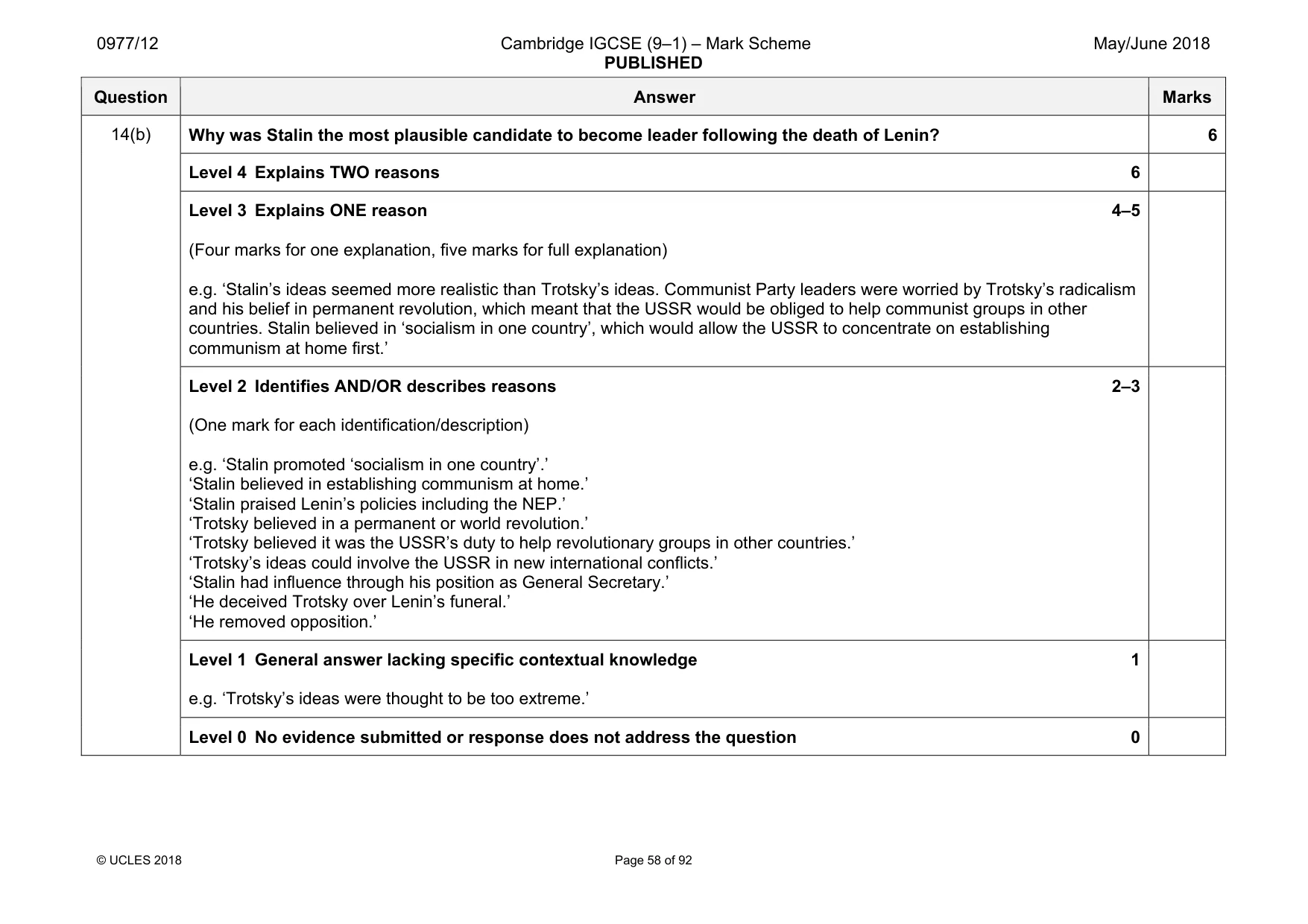
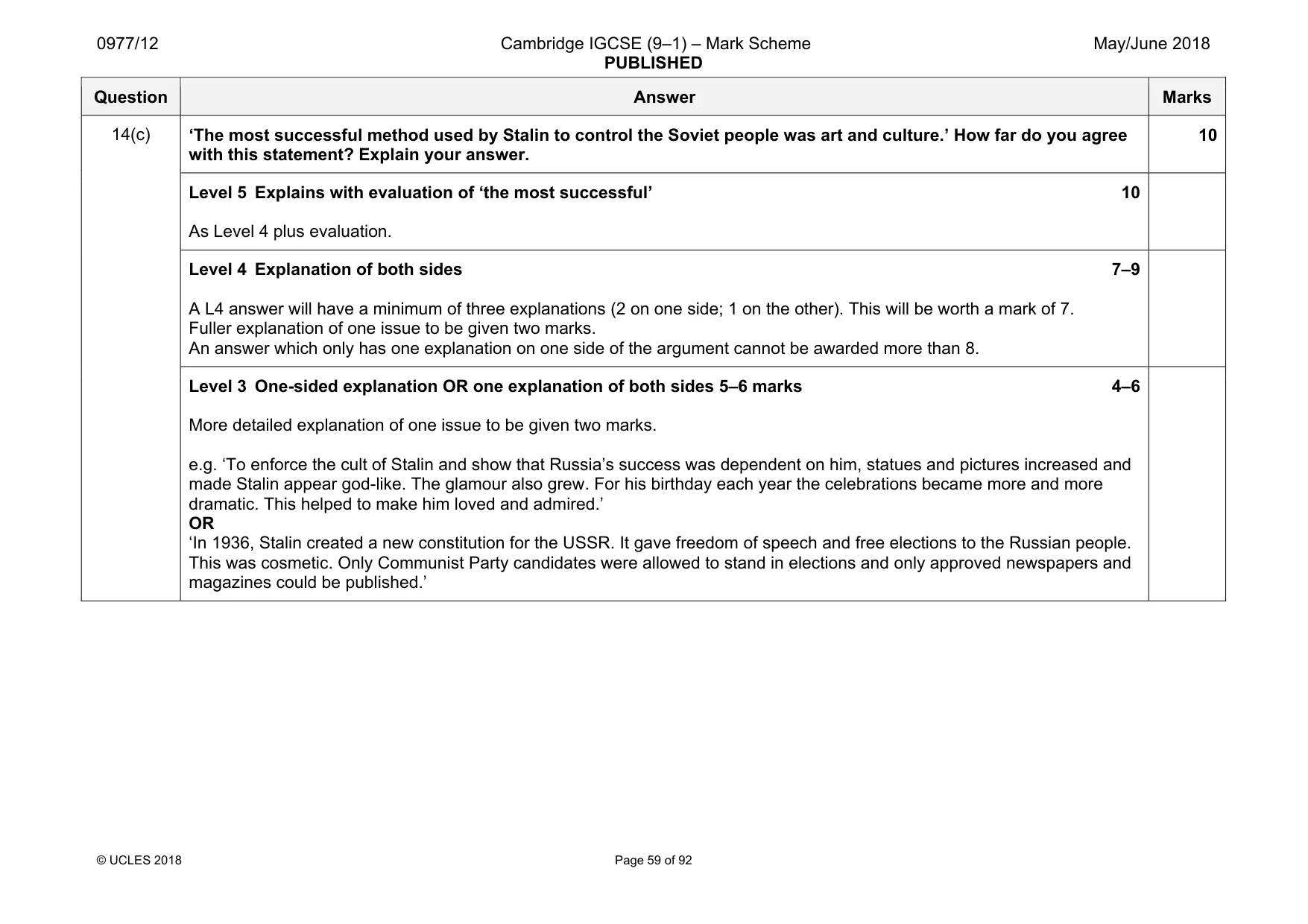
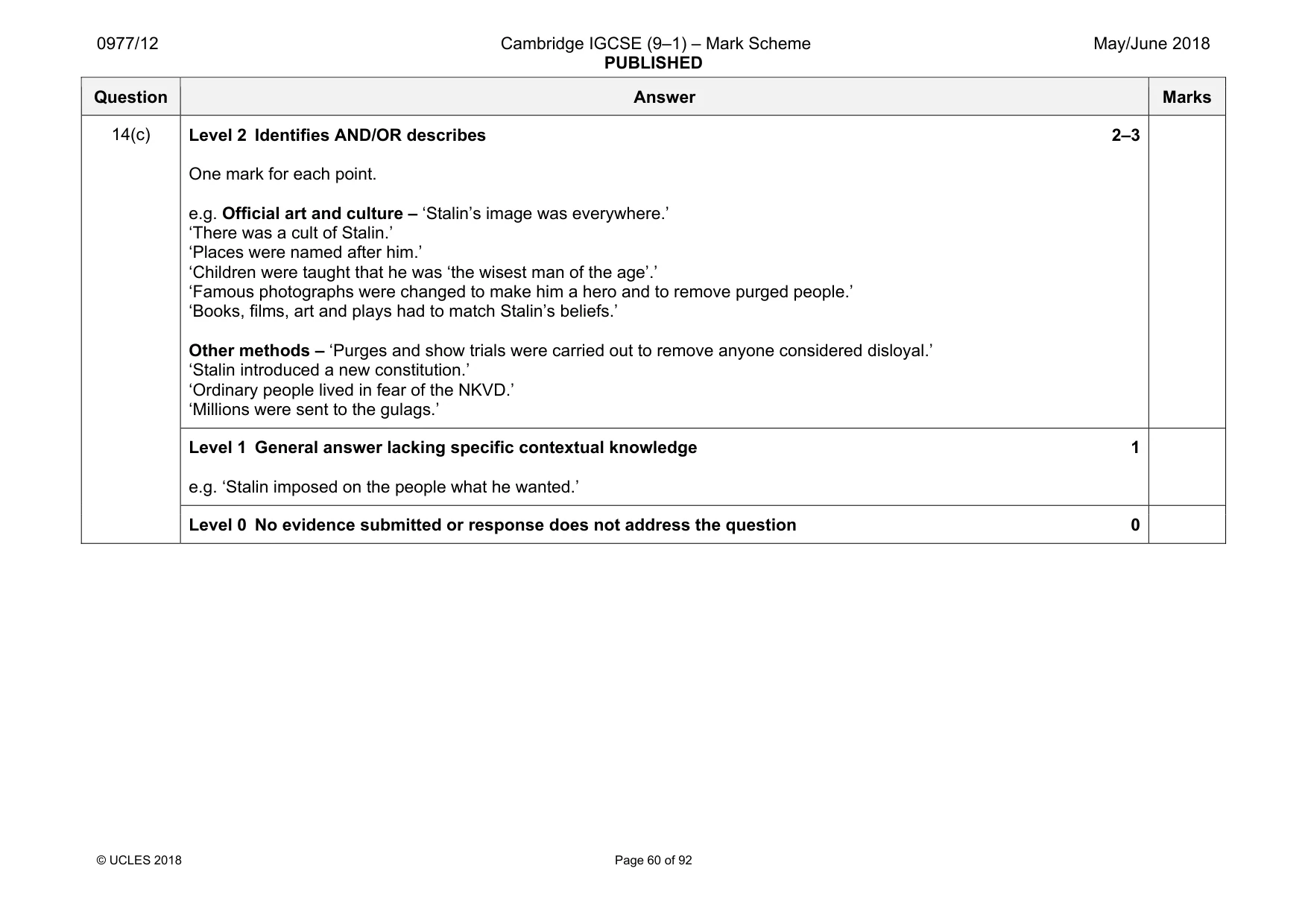
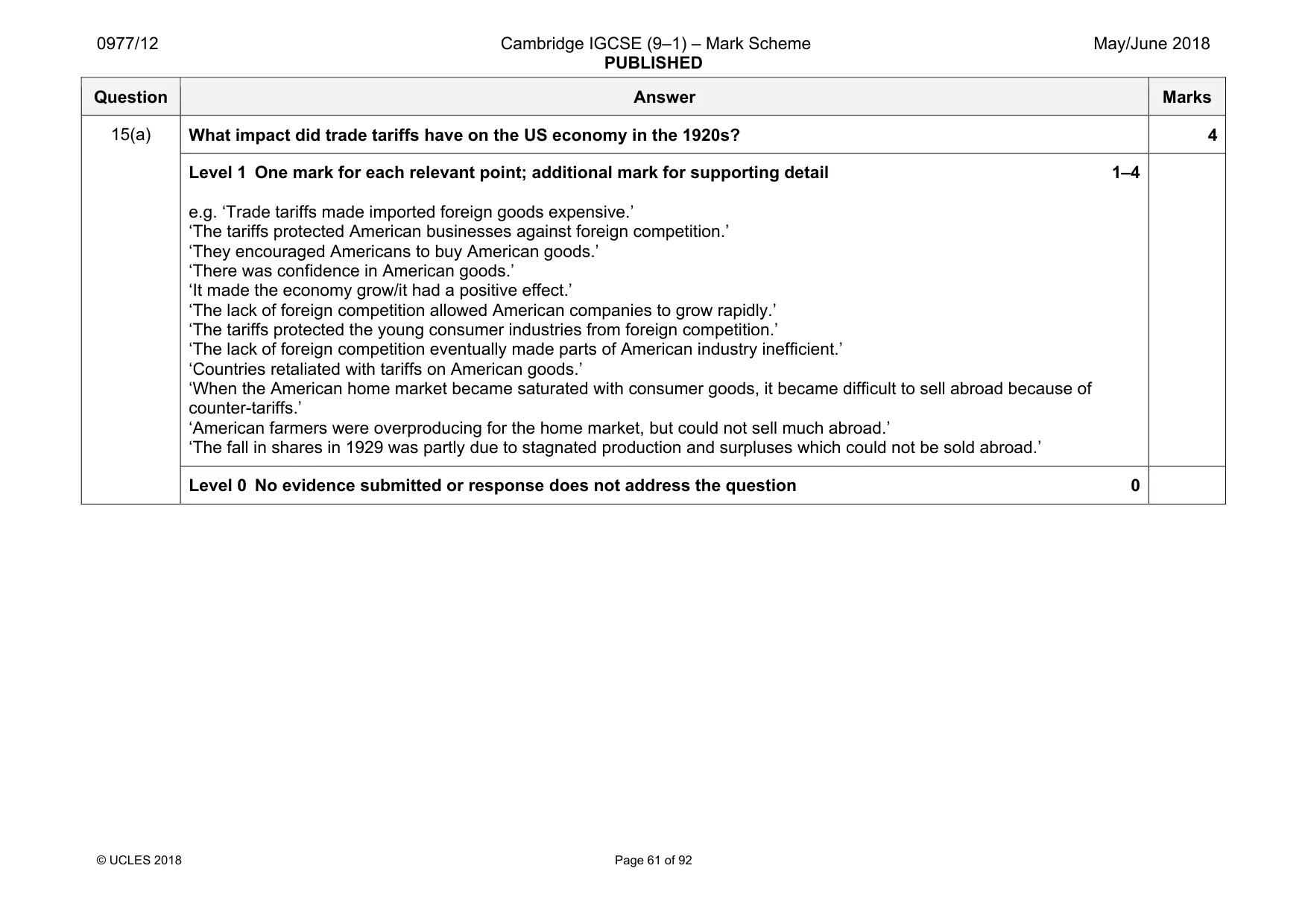
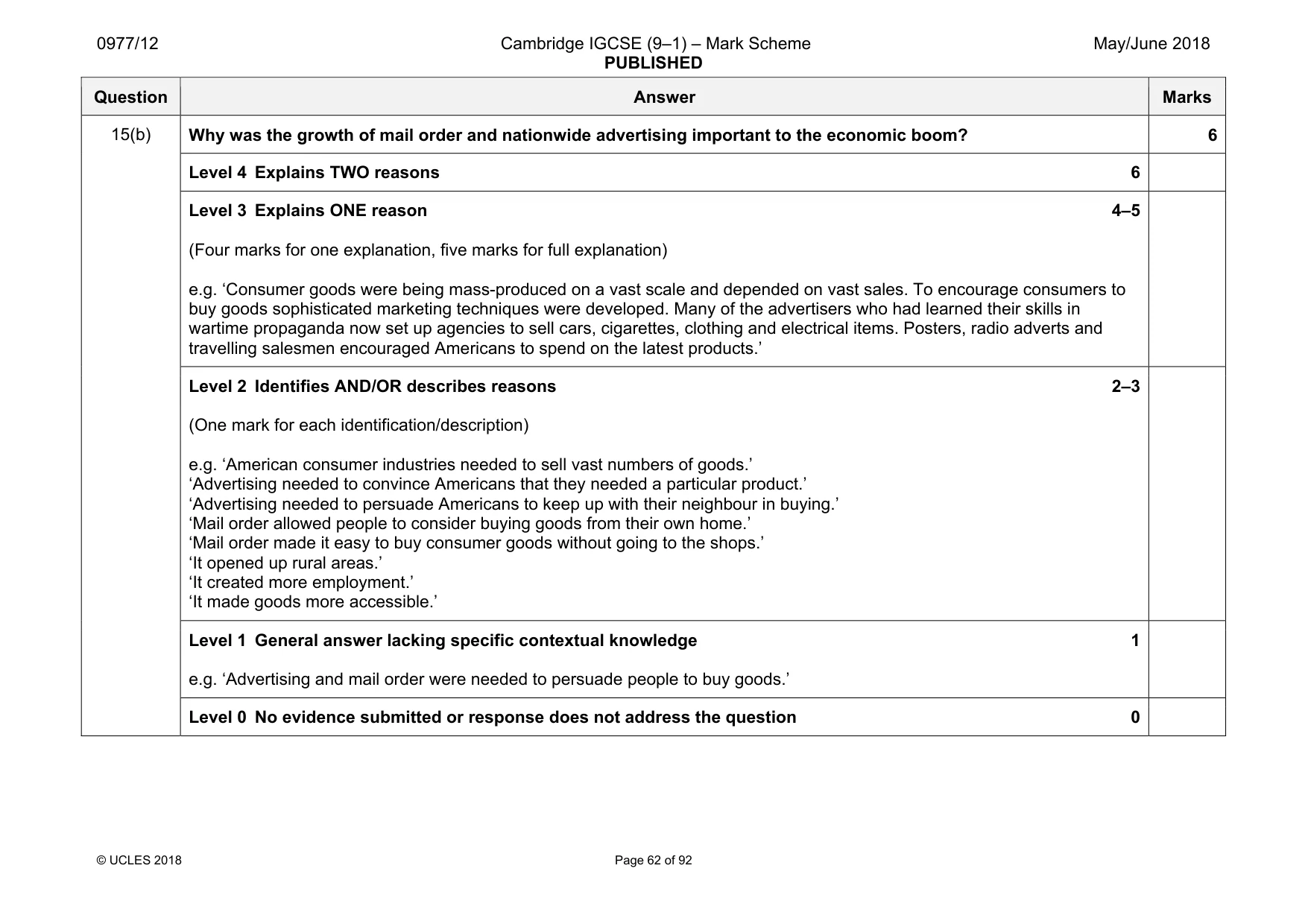
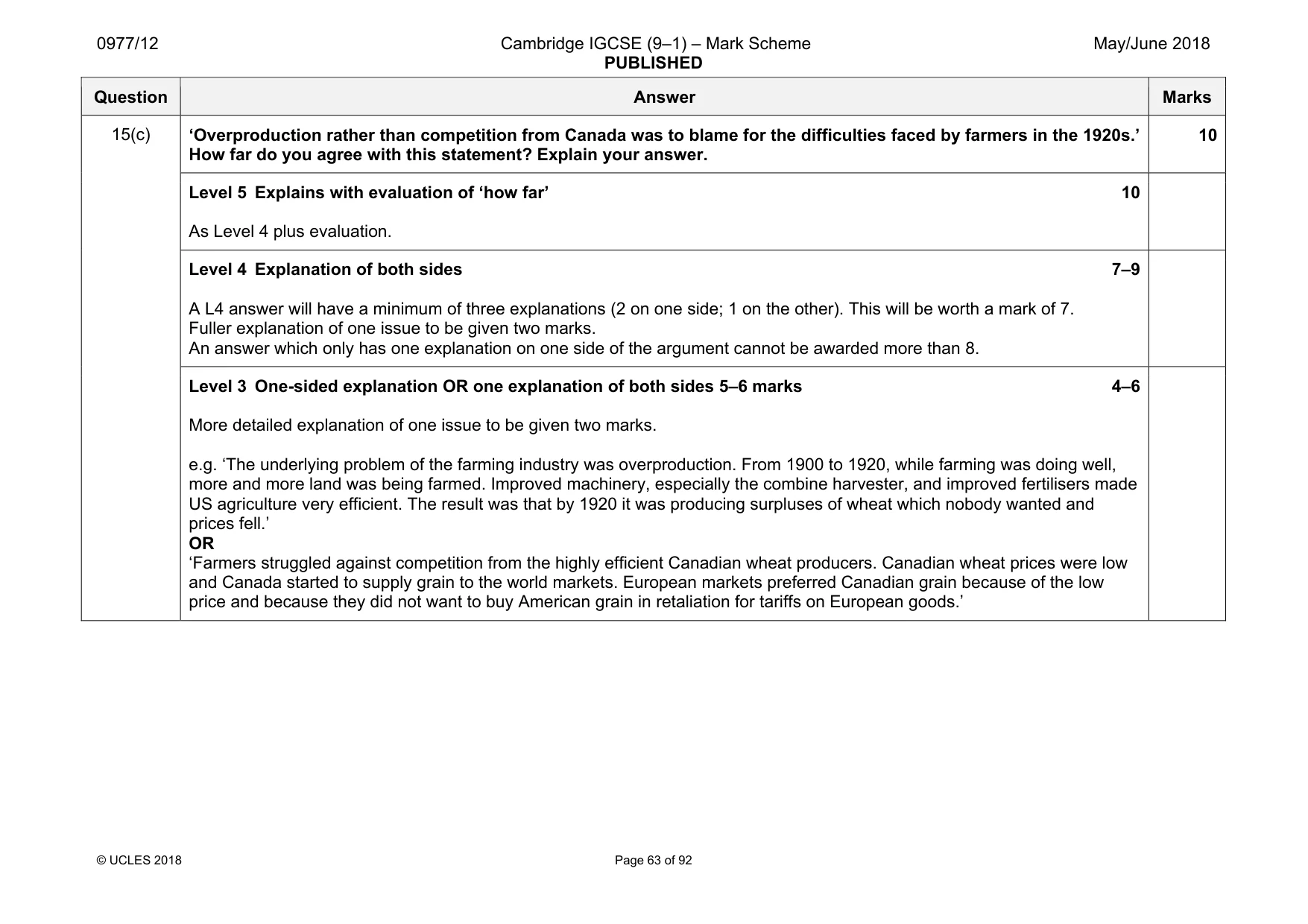
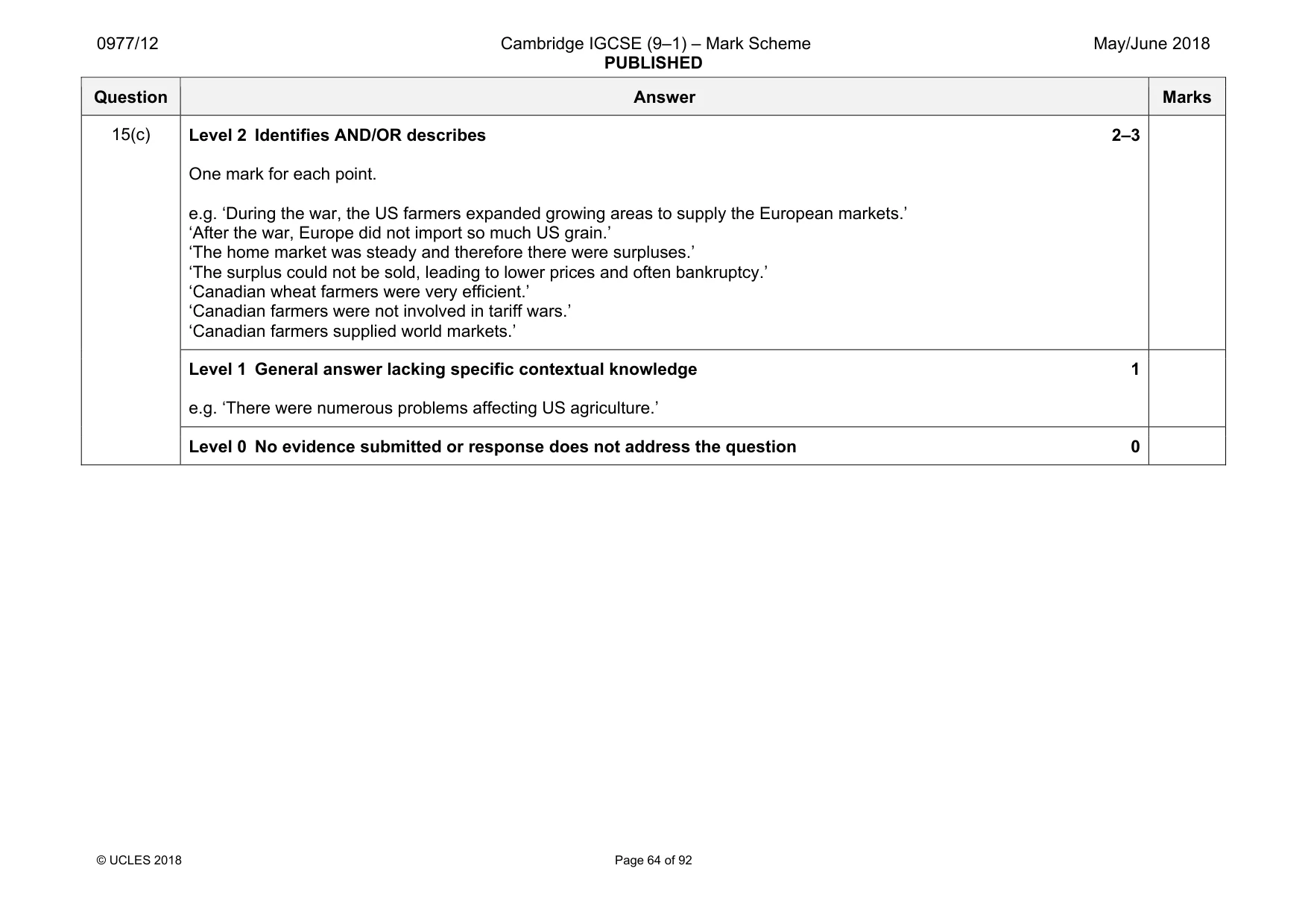
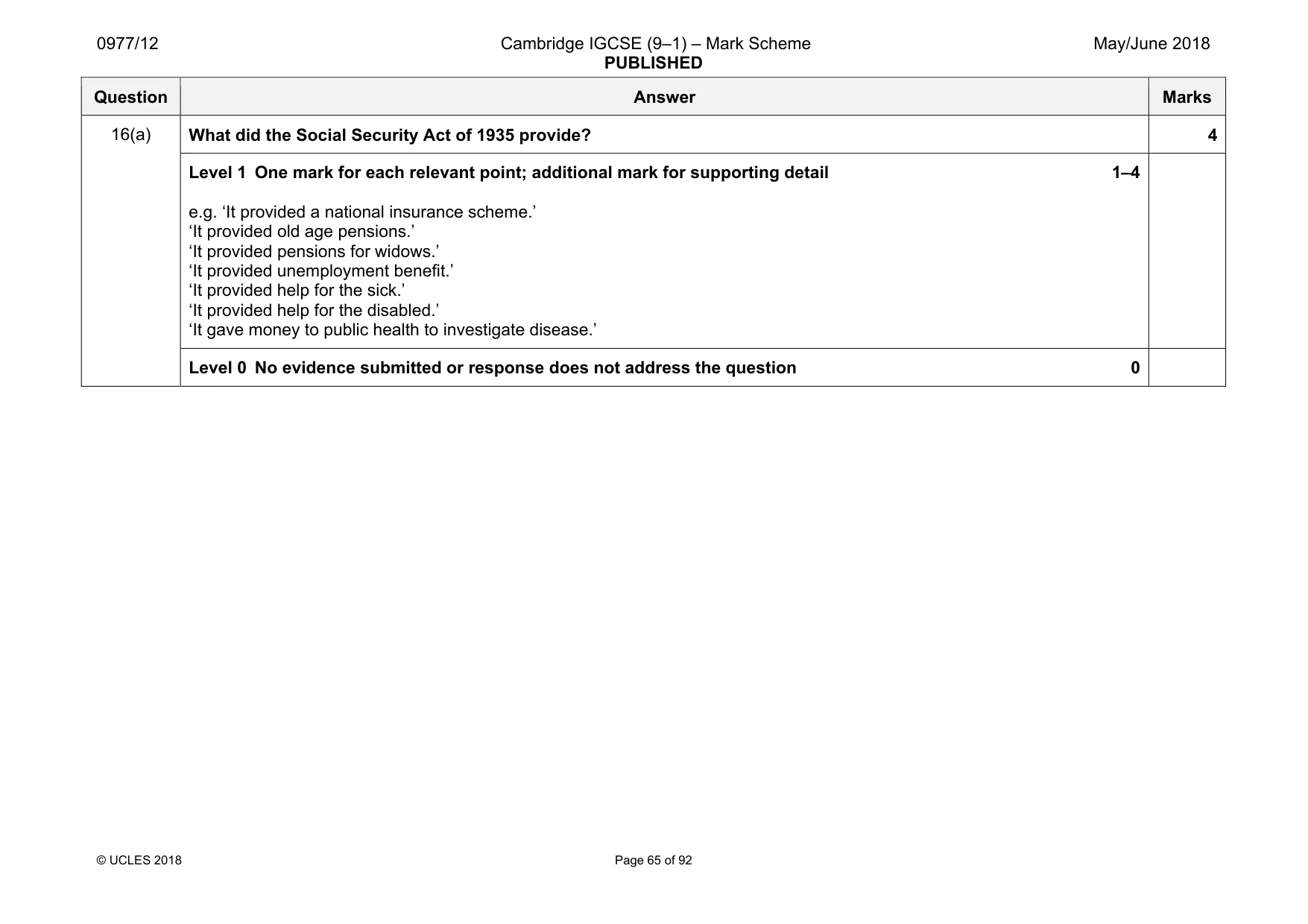
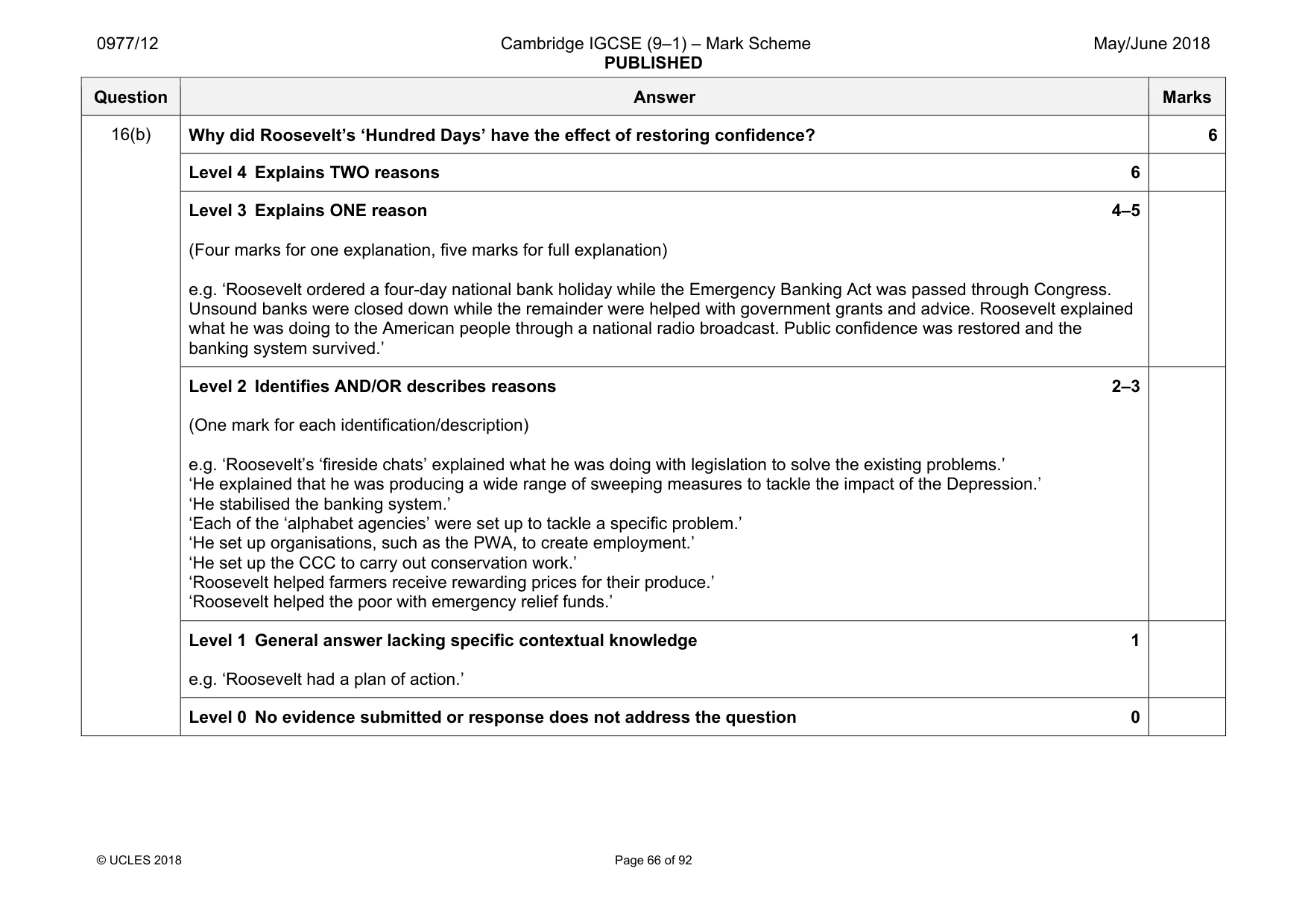
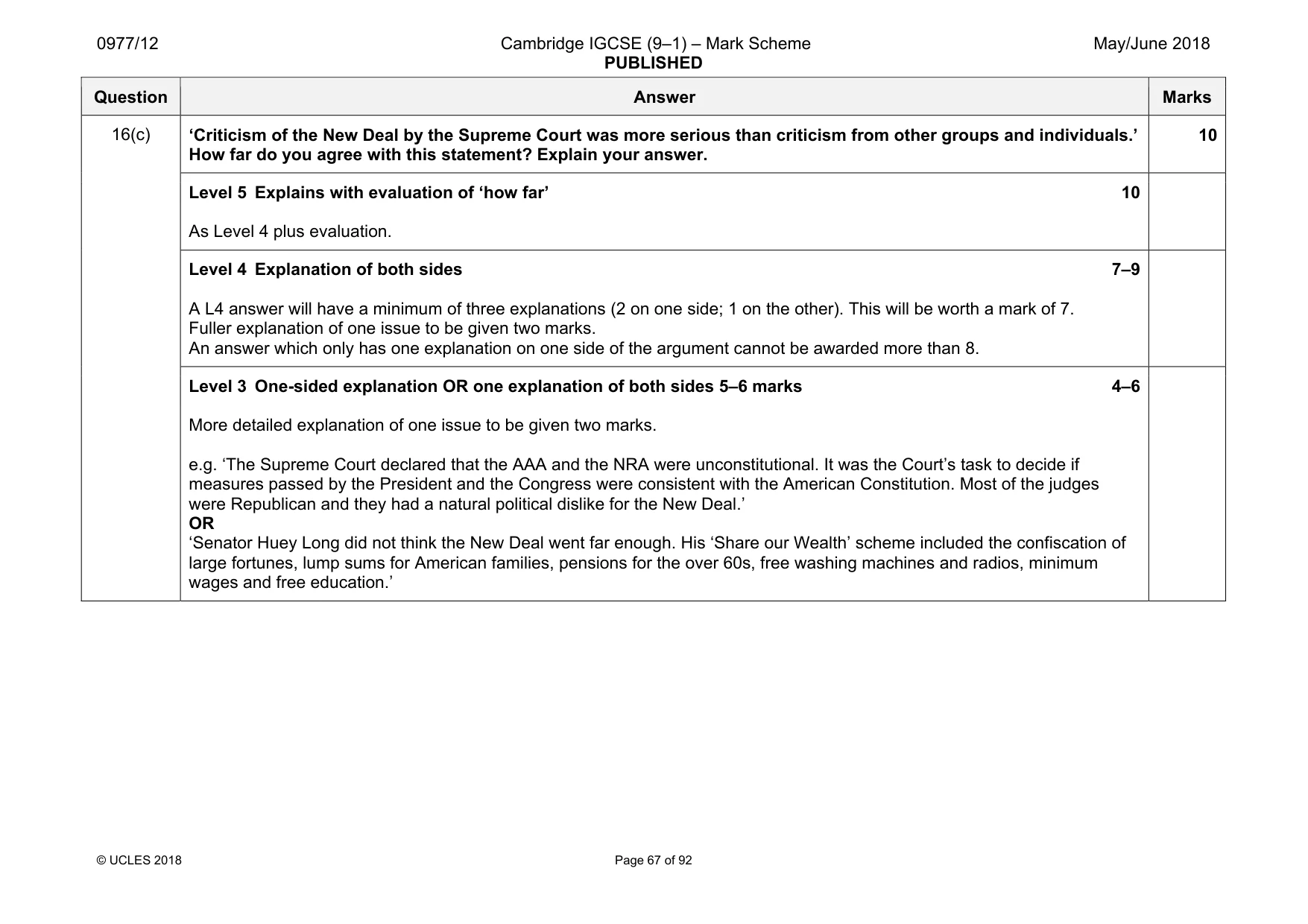
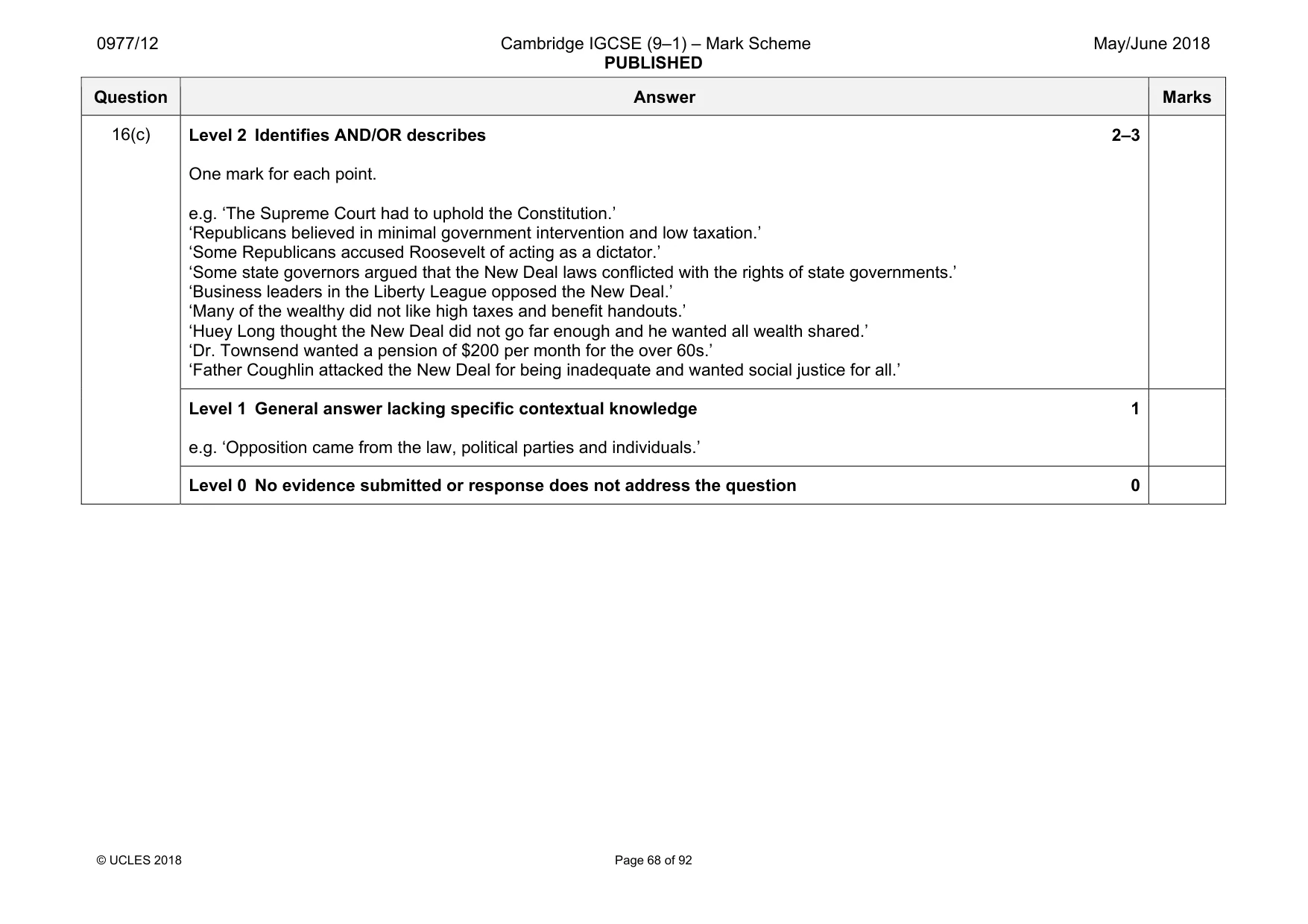
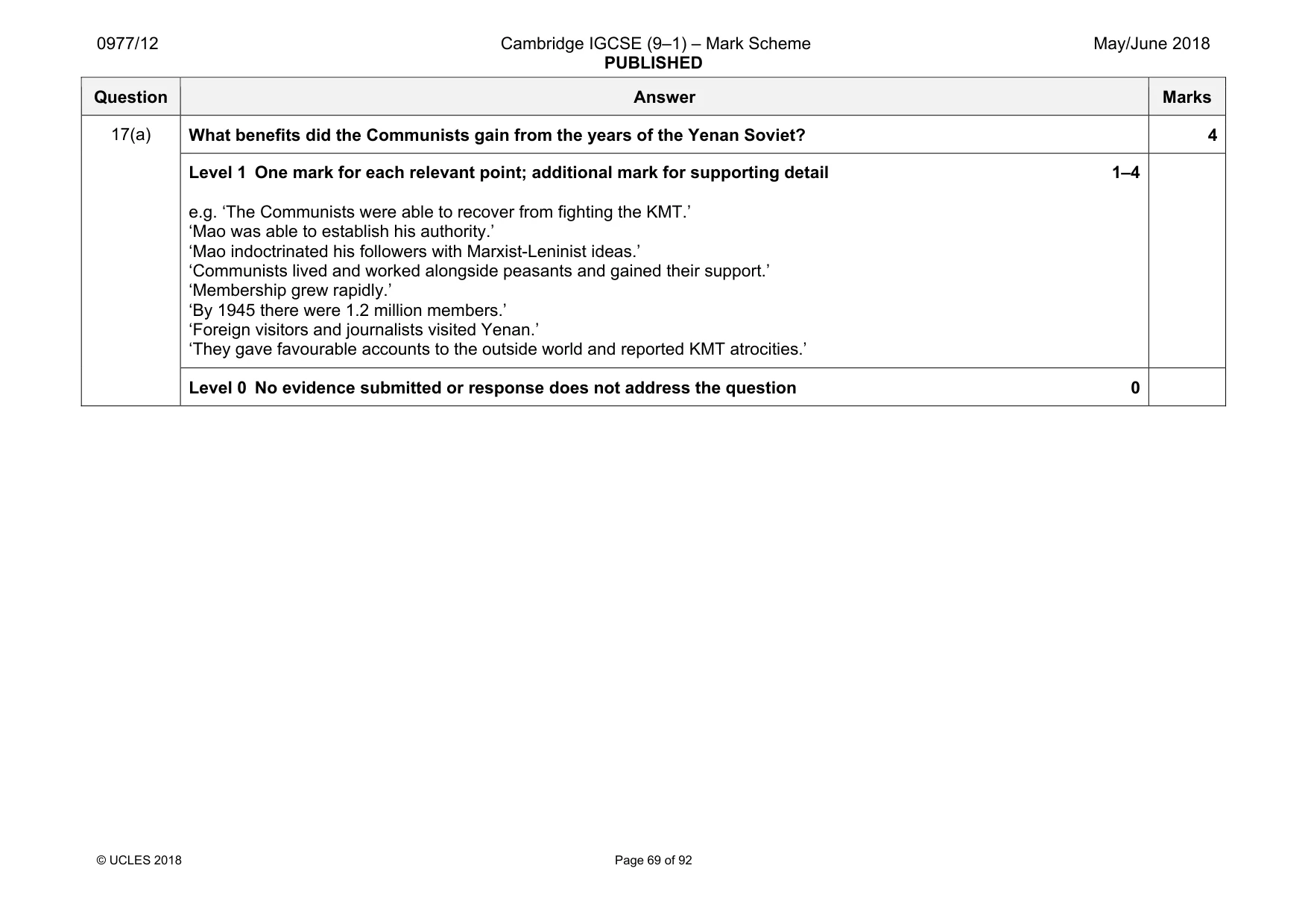
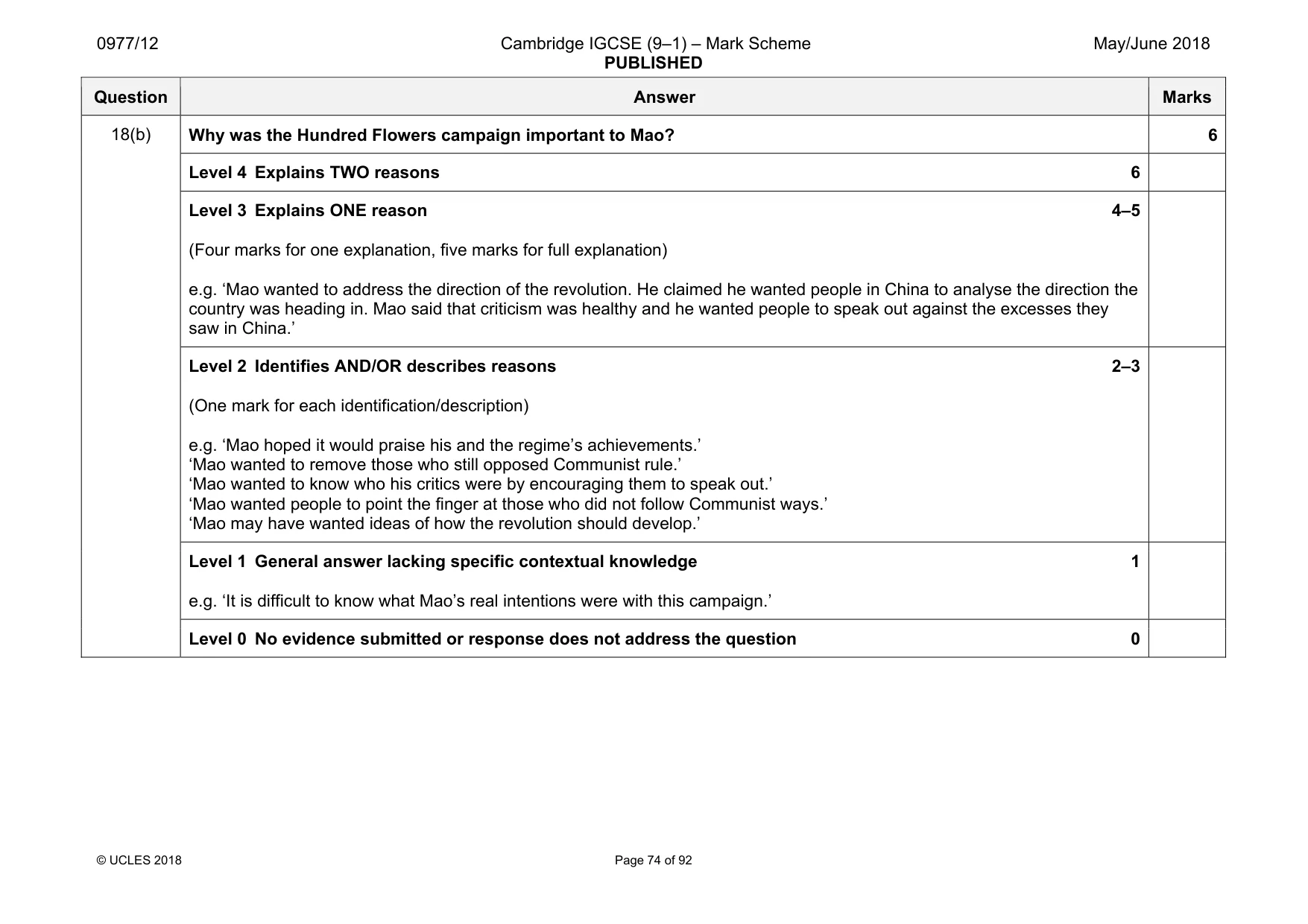
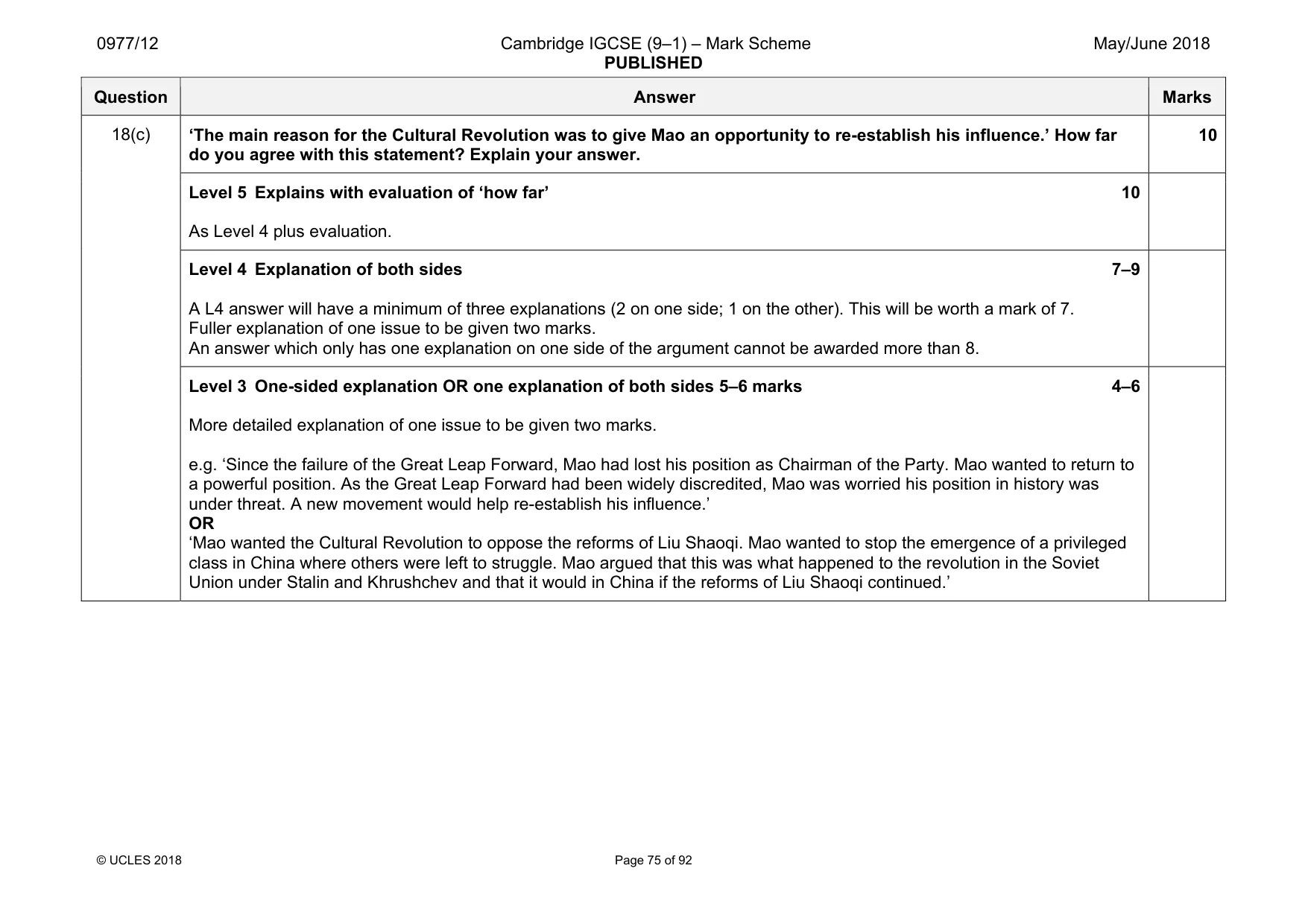
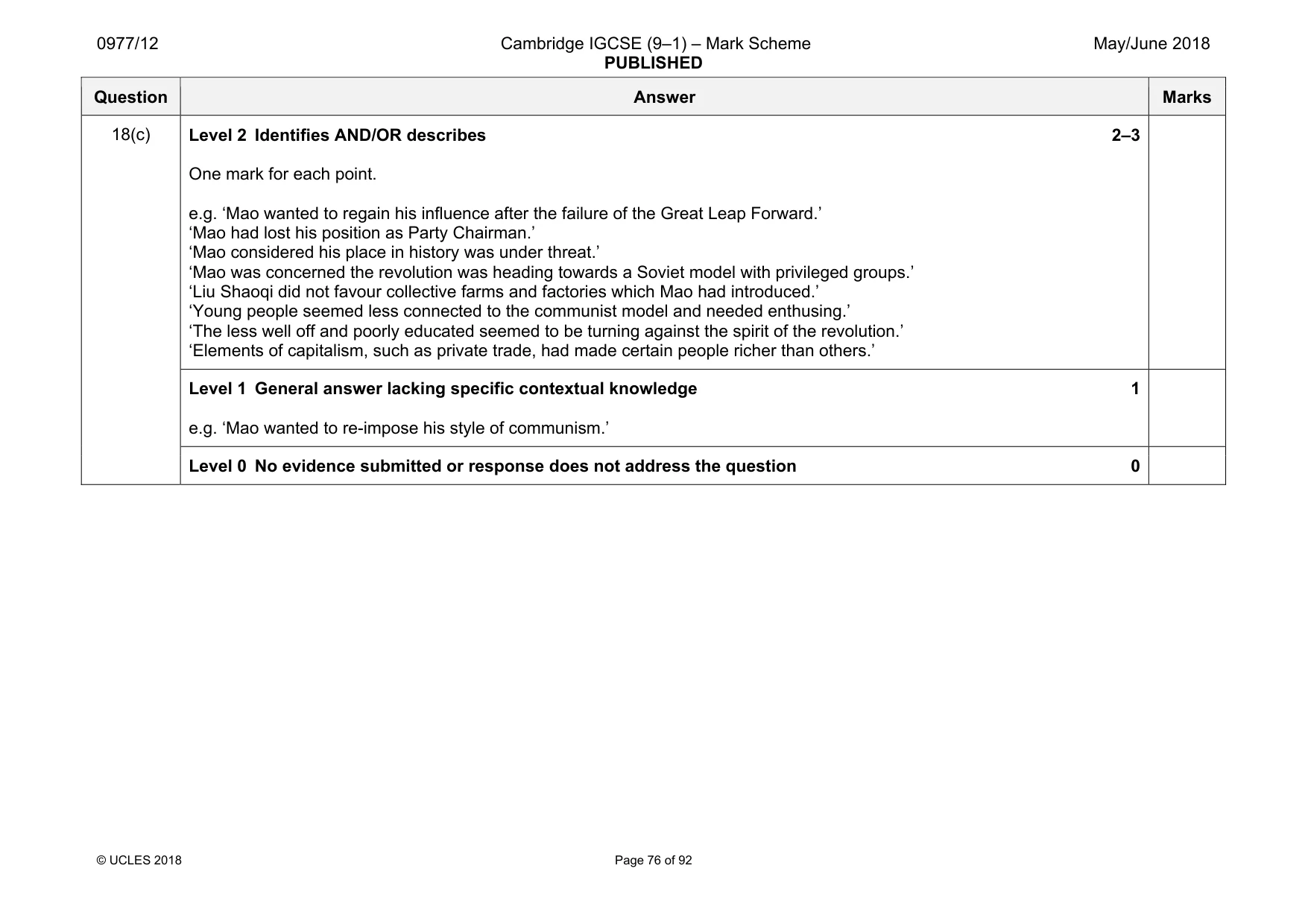
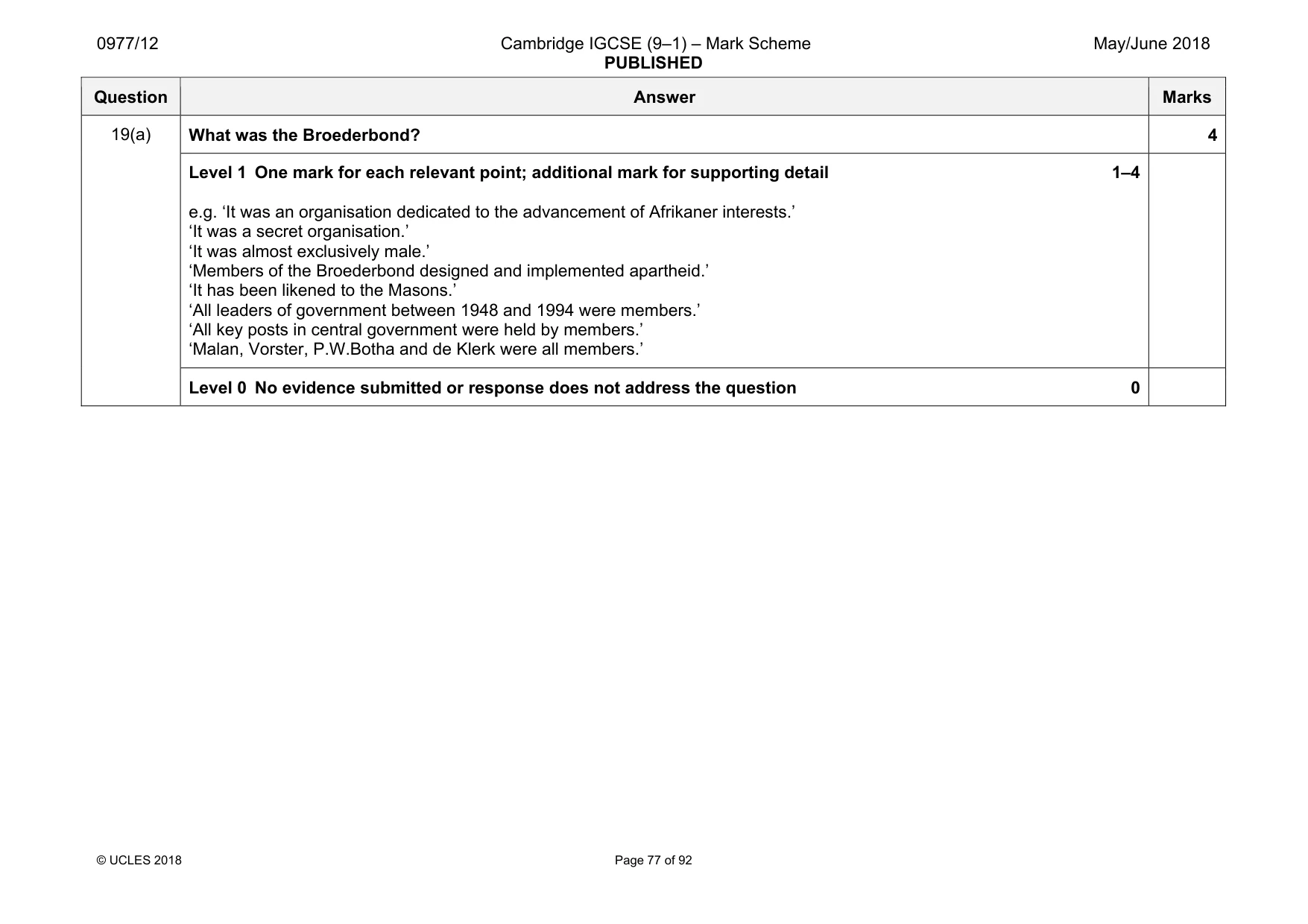
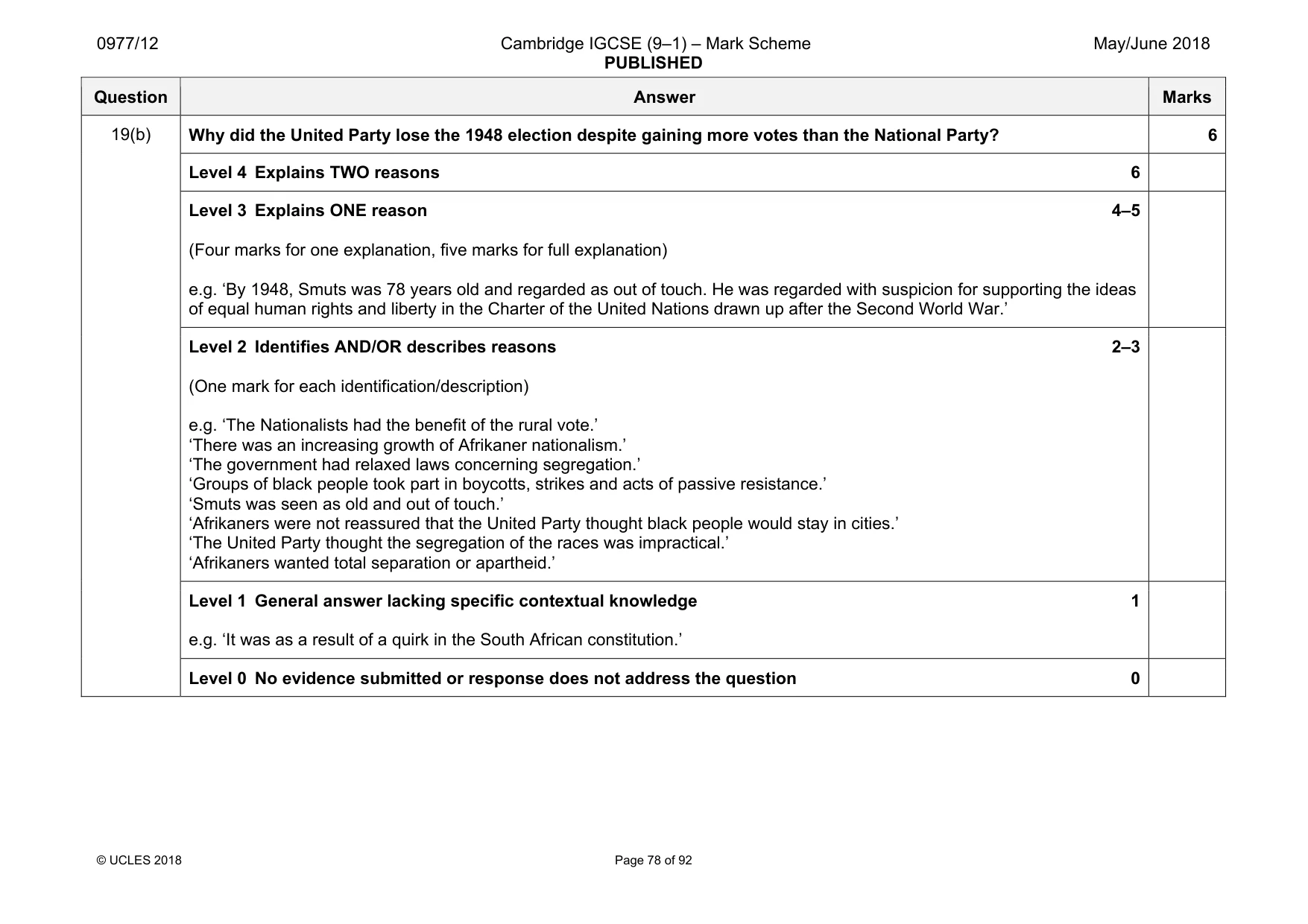
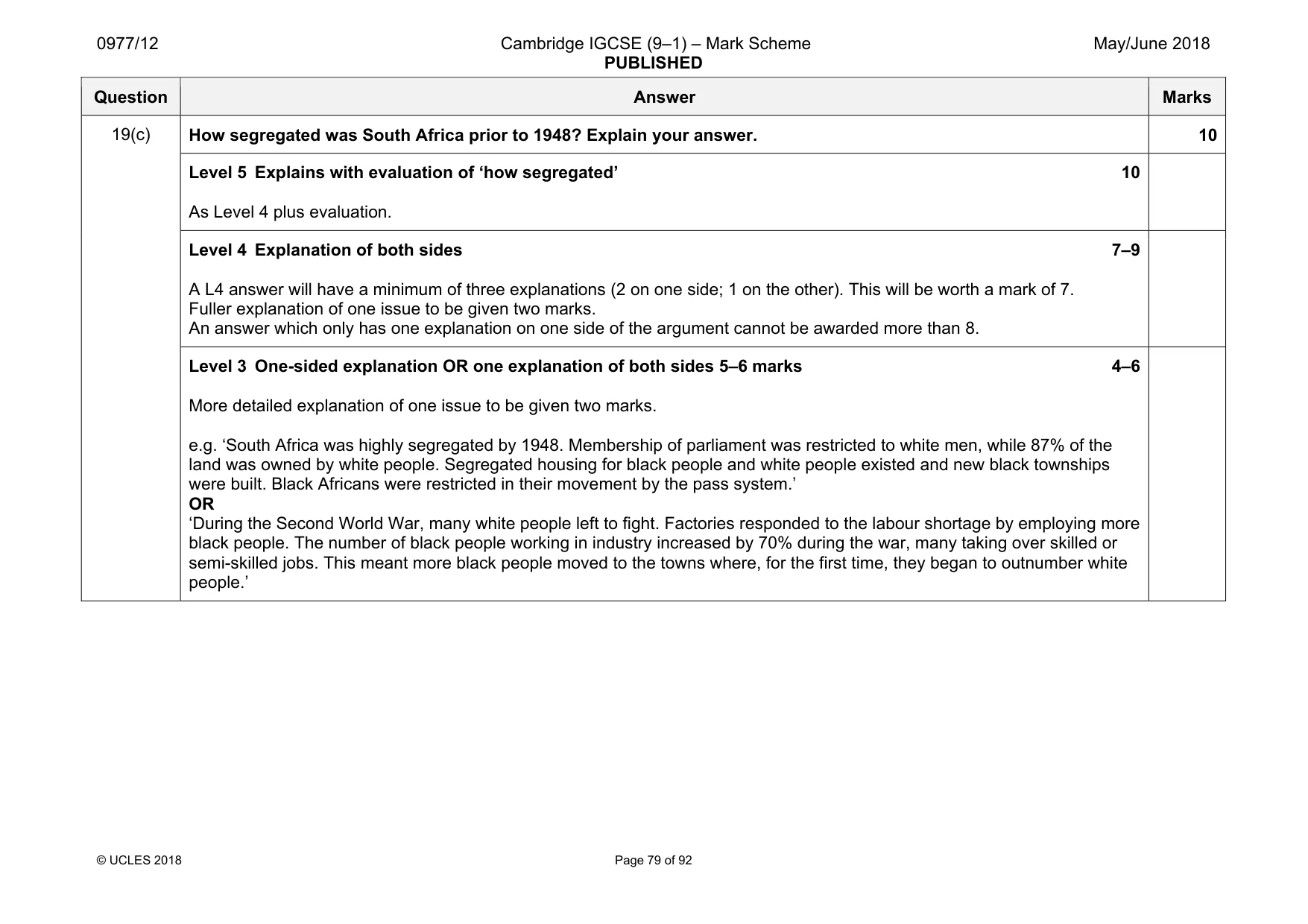
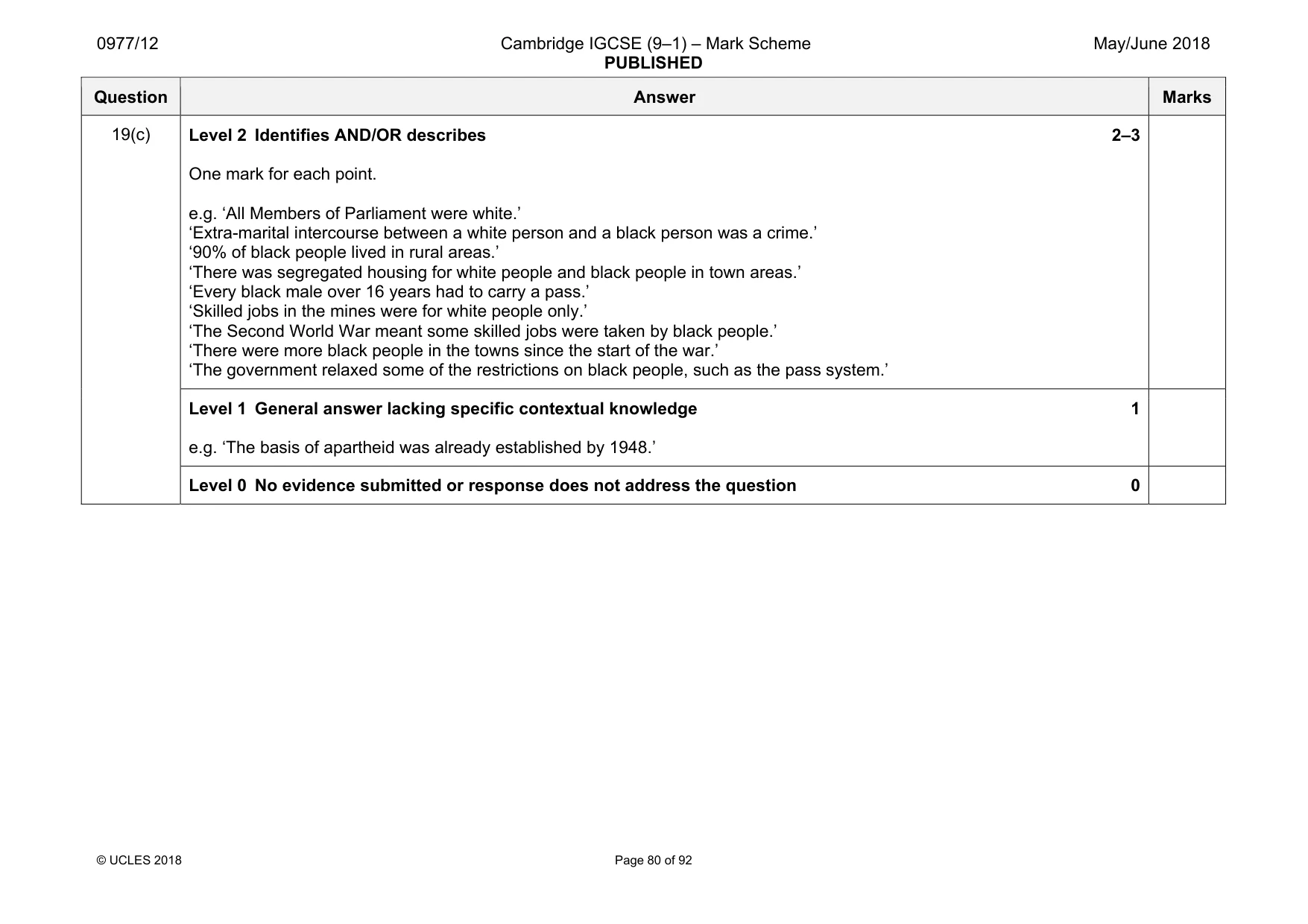
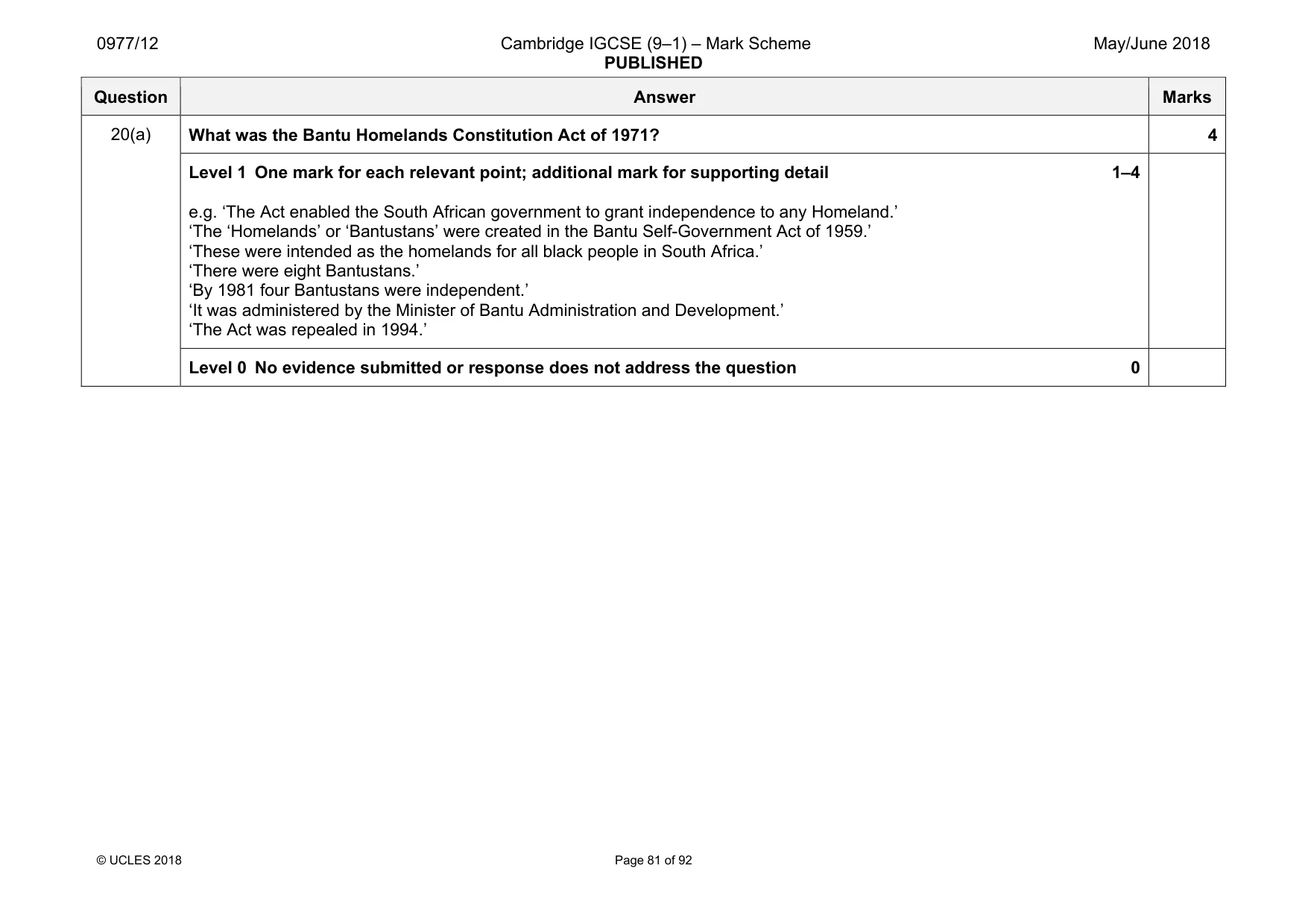
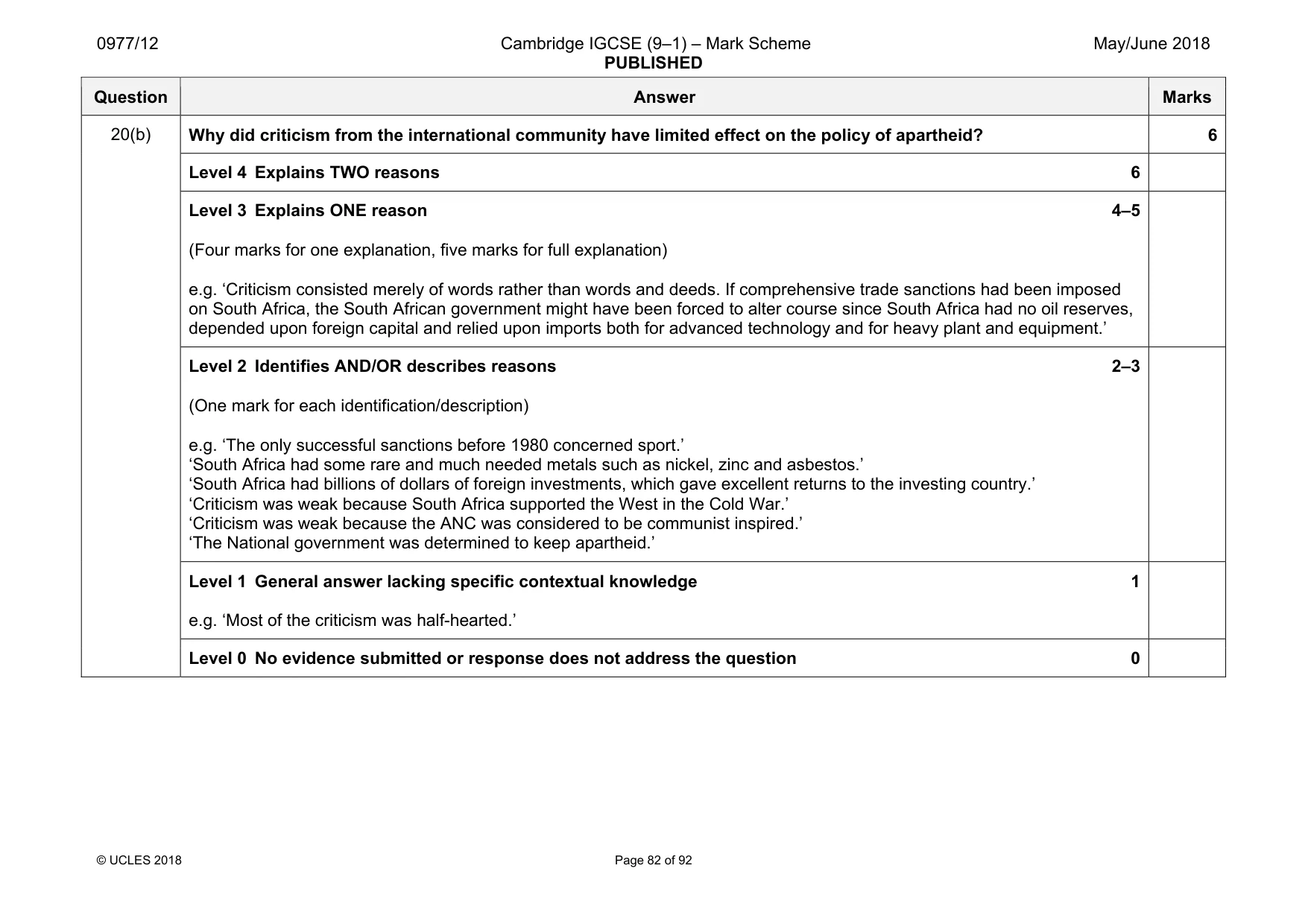
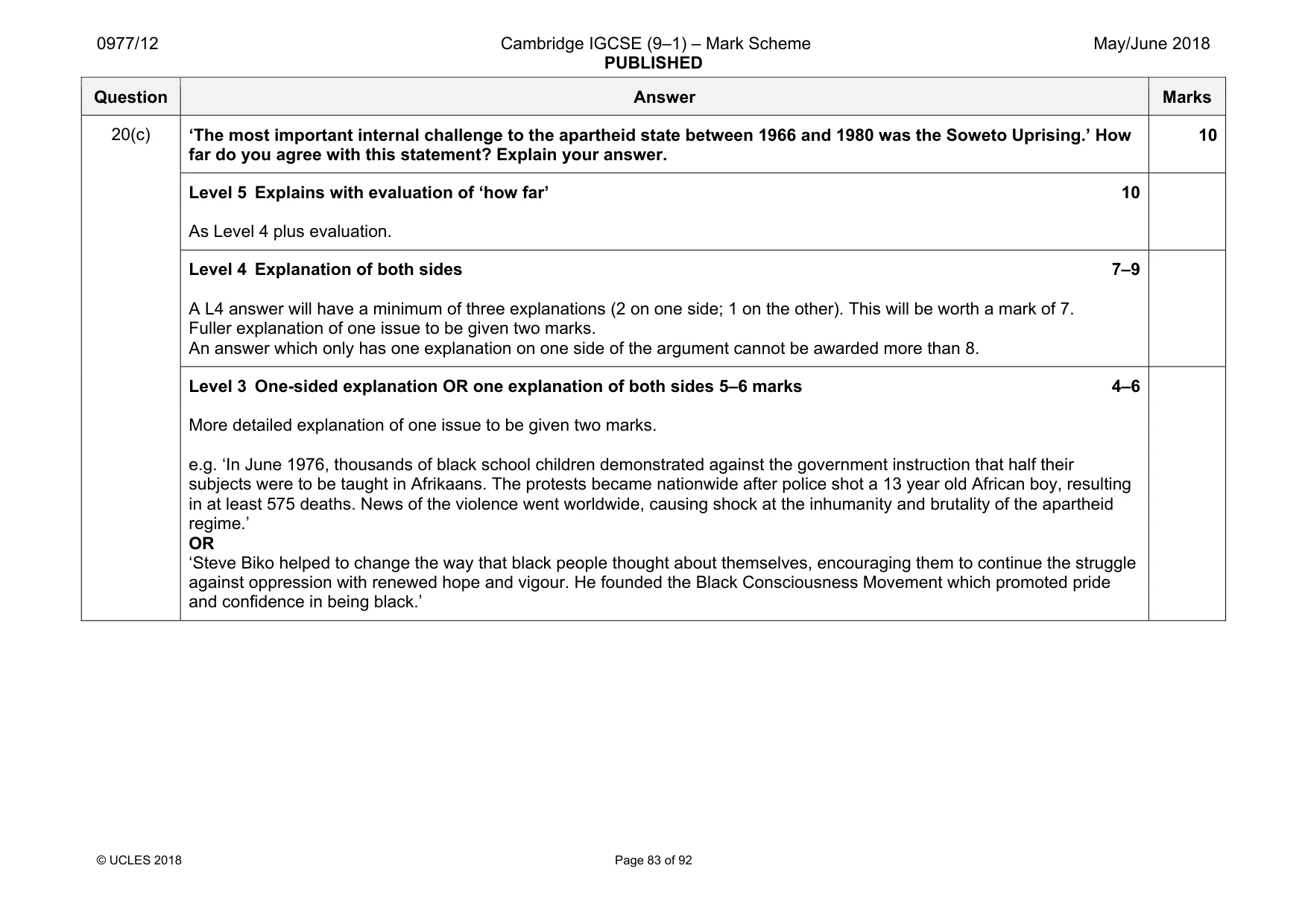
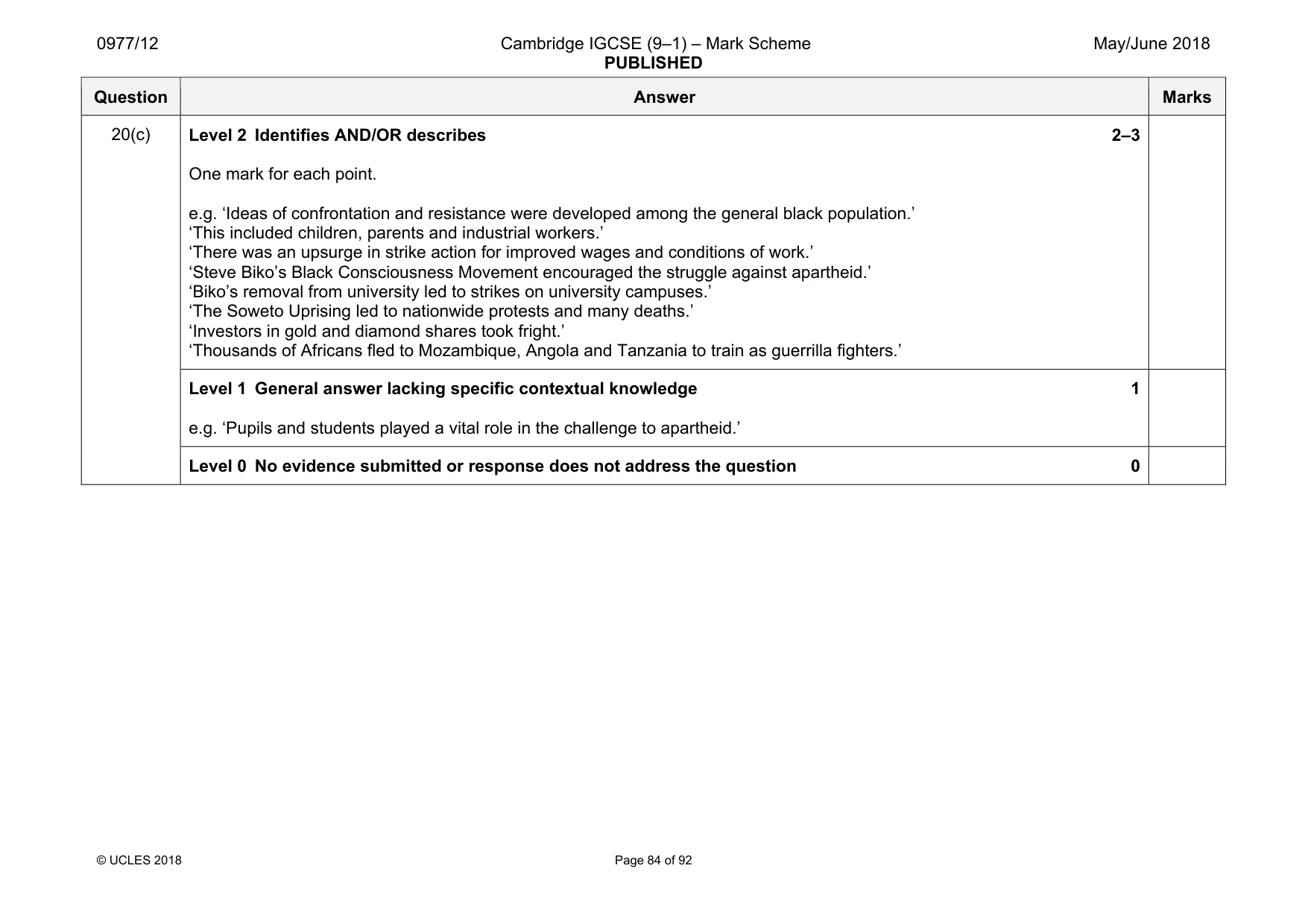
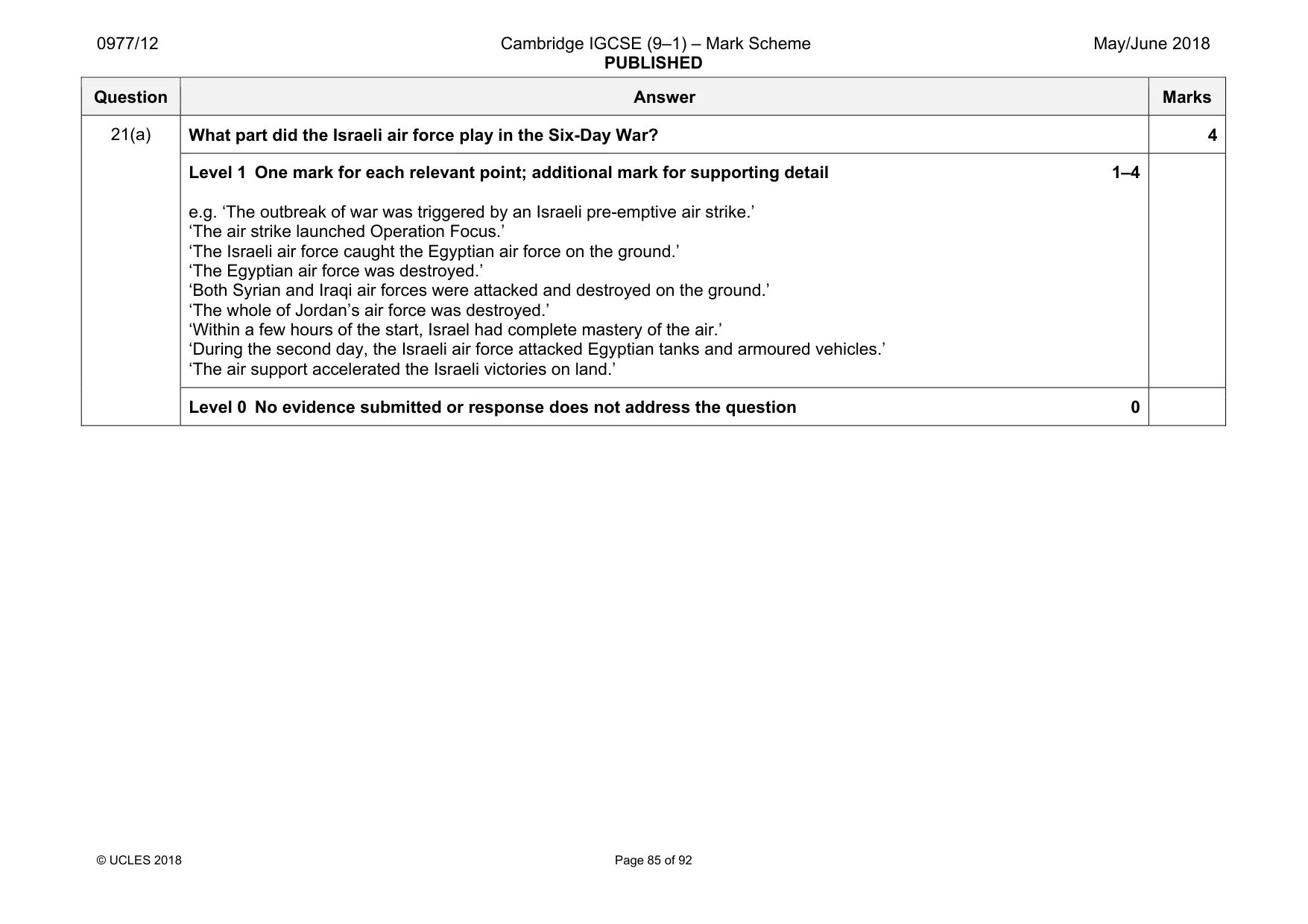
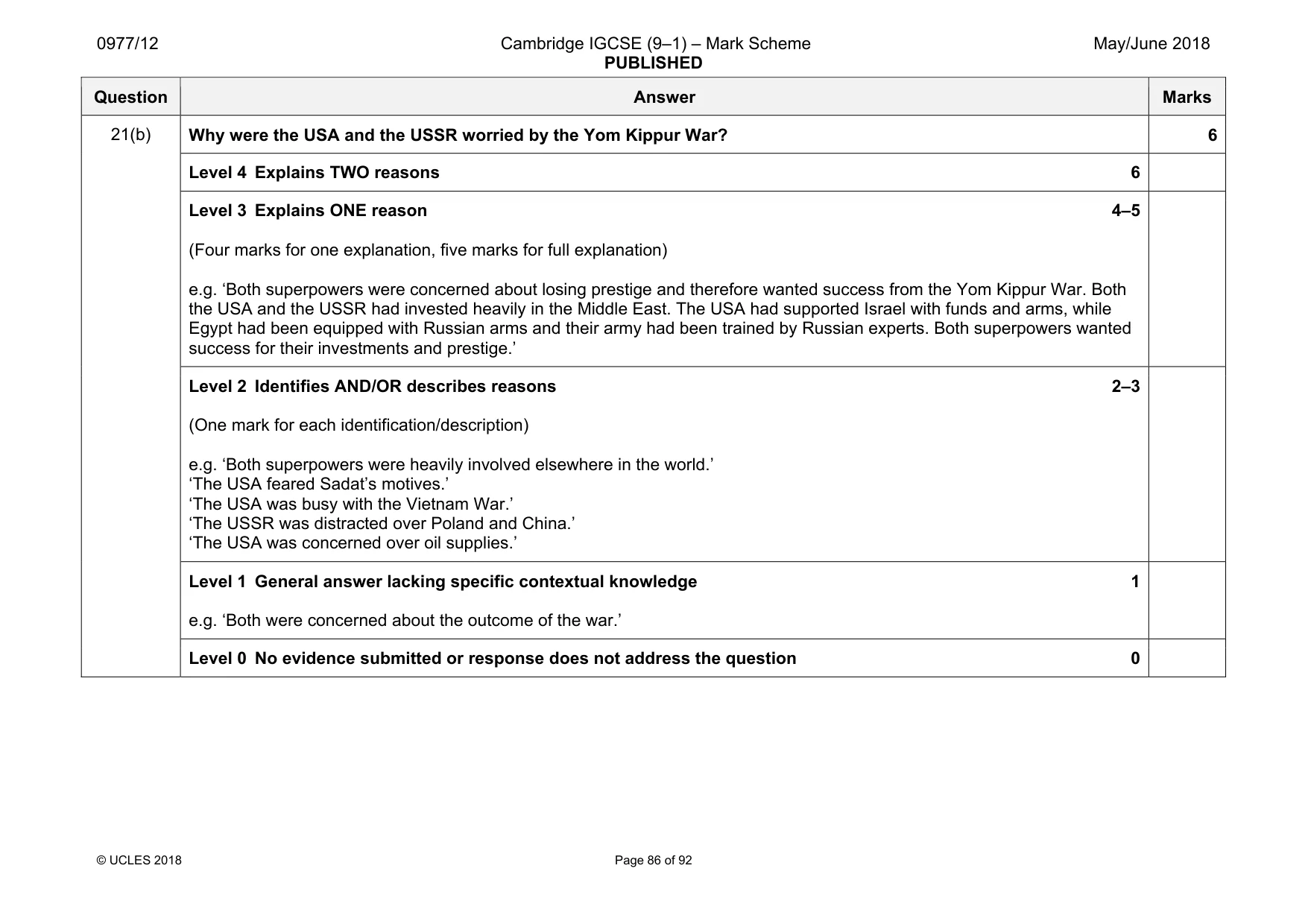
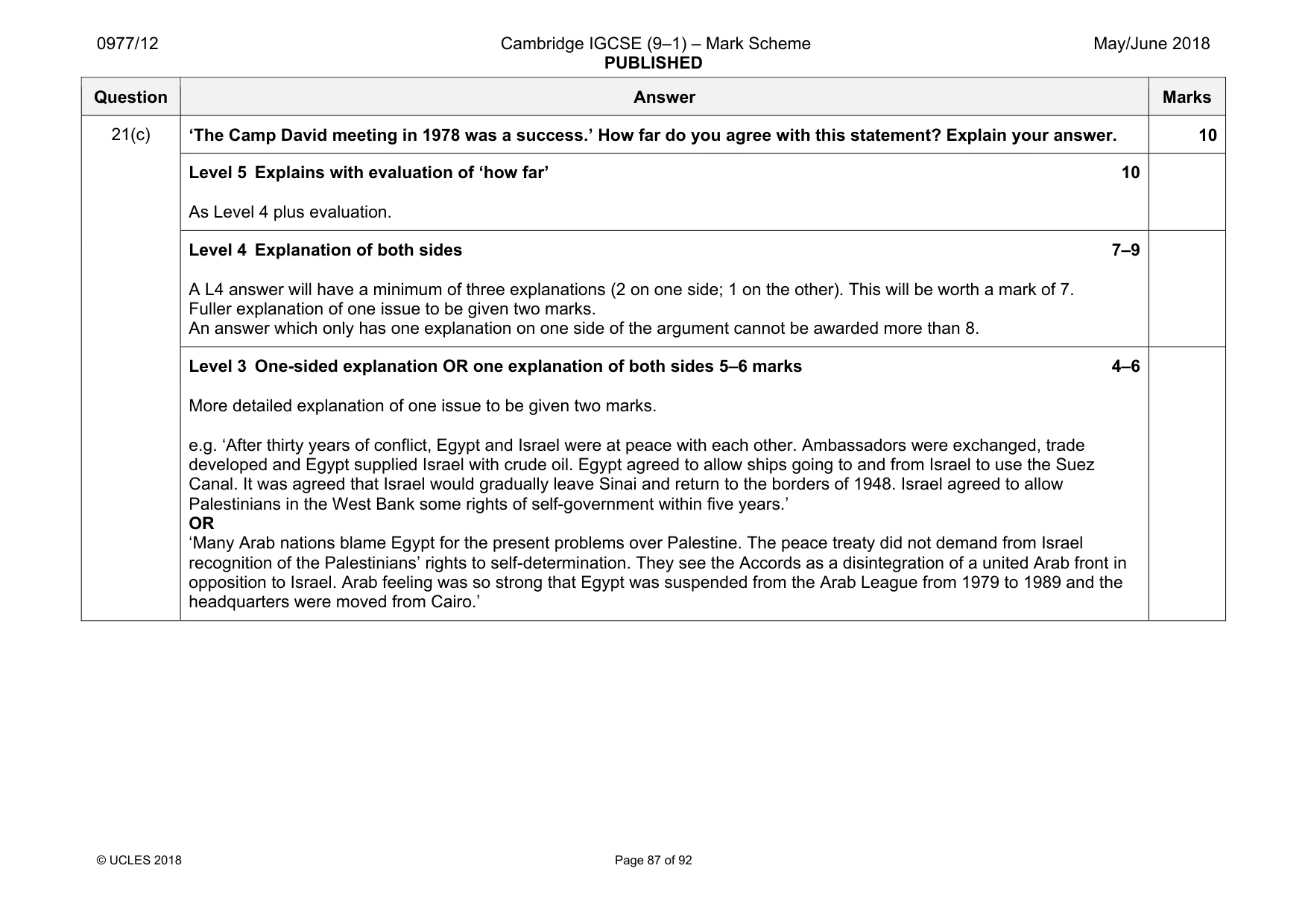
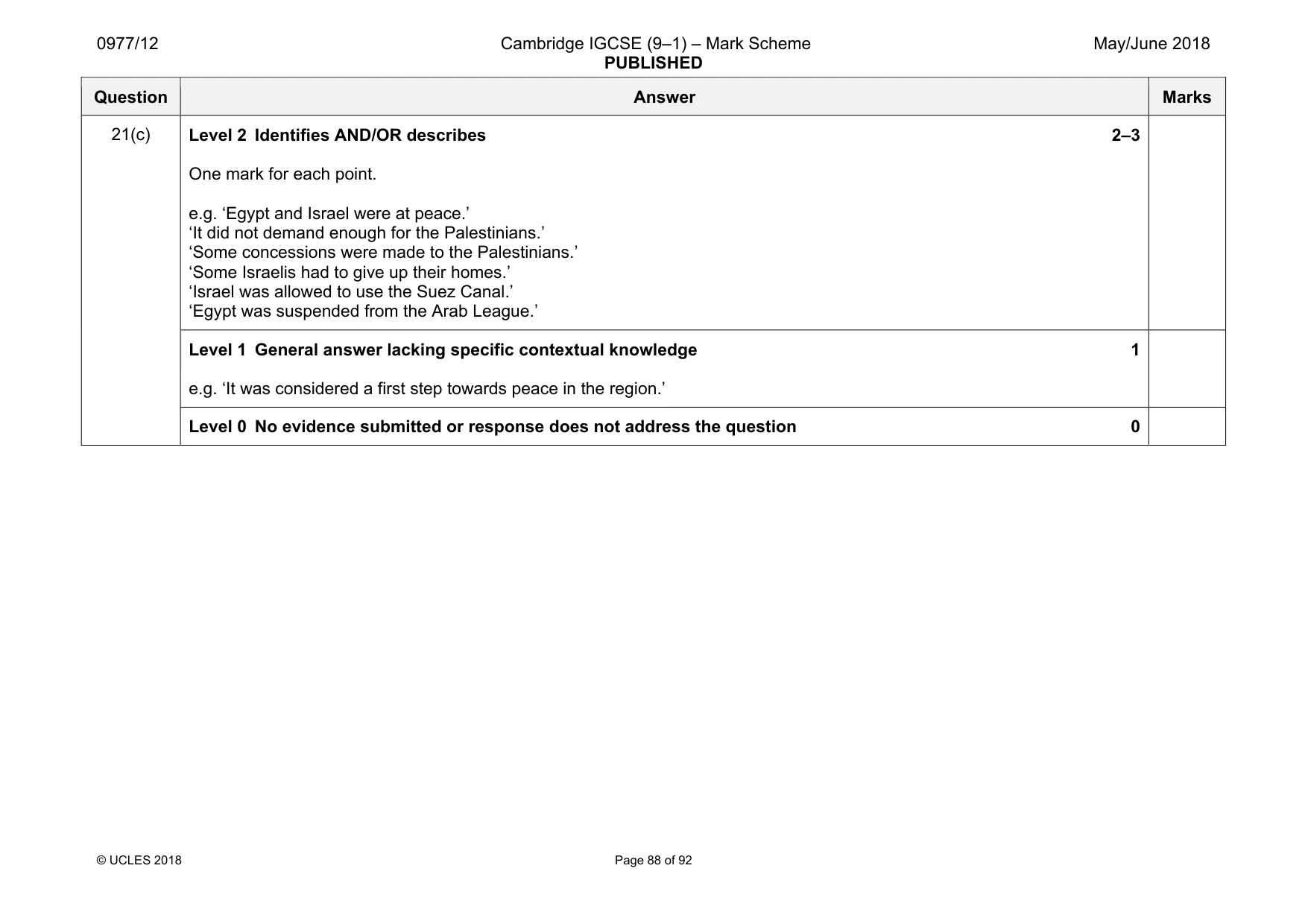
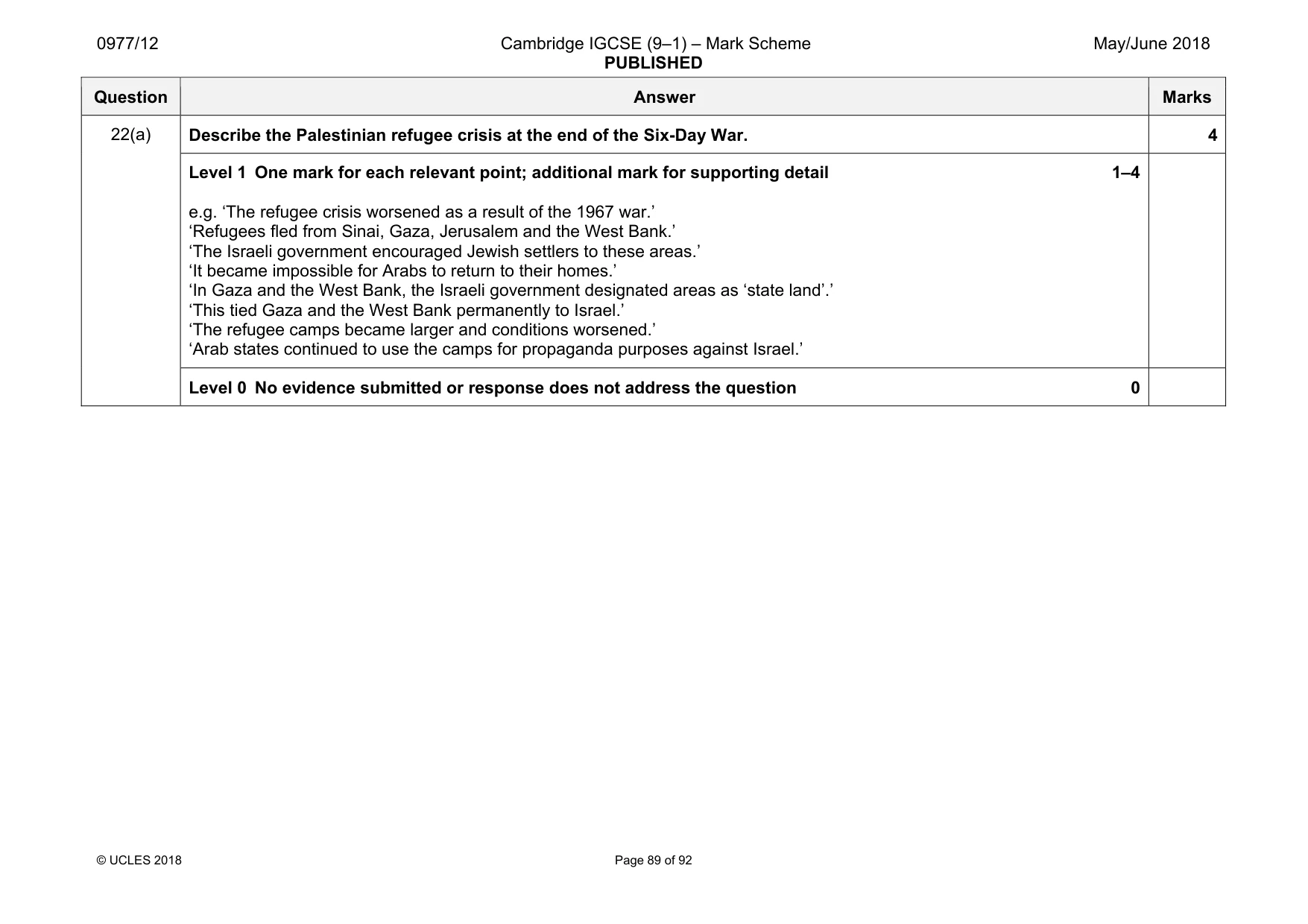
Paper as text
Question paper, page 1
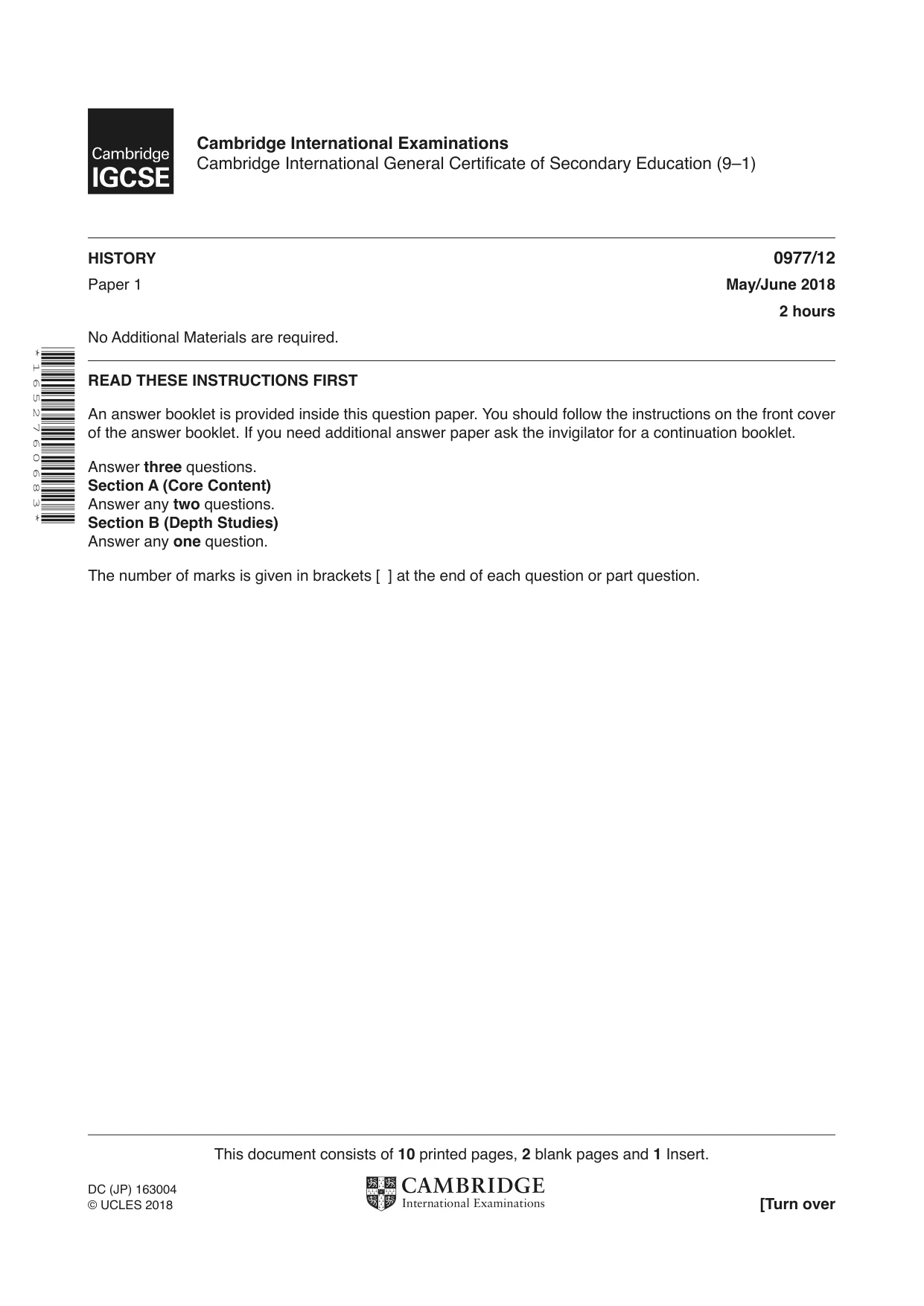
* 1 6 5 2 7 6 0 6 8 3 * This document consists of 10 printed pages, 2 blank pages and 1 Insert. DC (JP) 163004 © UCLES 2018 [Turn over Cambridge International Examinations Cambridge International General Certificate of Secondary Education (9–1) HISTORY 0977/12 Paper 1 May/June 2018 2 hours No Additional Materials are required. READ THESE INSTRUCTIONS FIRST An answer booklet is provided inside this question paper. You should follow the instructions on the front cover of the answer booklet. If you need additional answer paper ask the invigilator for a continuation booklet. Answer three questions. Section A (Core Content) Answer any two questions. Section B (Depth Studies) Answer any one question. The number of marks is given in brackets [ ] at the end of each question or part question.
Question paper, page 2
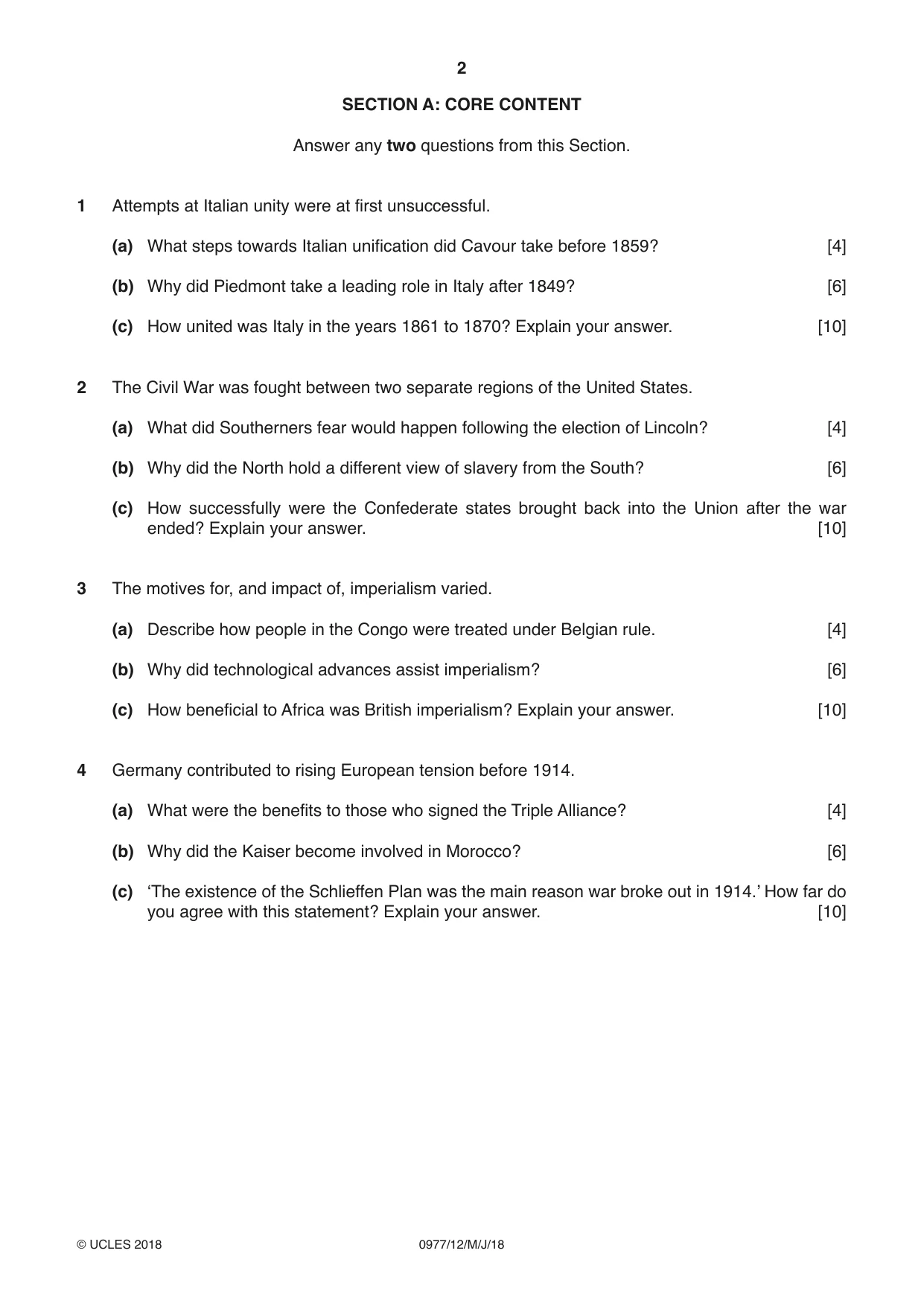
2 0977/12/M/J/18 © UCLES 2018 SECTION A: CORE CONTENT Answer any two questions from this Section. 1 Attempts at Italian unity were at first unsuccessful. (a) What steps towards Italian unification did Cavour take before 1859? [4] (b) Why did Piedmont take a leading role in Italy after 1849? [6] (c) How united was Italy in the years 1861 to 1870? Explain your answer. [10] 2 The Civil War was fought between two separate regions of the United States. (a) What did Southerners fear would happen following the election of Lincoln? [4] (b) Why did the North hold a different view of slavery from the South? [6] (c) How successfully were the Confederate states brought back into the Union after the war ended? Explain your answer. [10] 3 The motives for, and impact of, imperialism varied. (a) Describe how people in the Congo were treated under Belgian rule. [4] (b) Why did technological advances assist imperialism? [6] (c) How beneficial to Africa was British imperialism? Explain your answer. [10] 4 Germany contributed to rising European tension before 1914. (a) What were the benefits to those who signed the Triple Alliance? [4] (b) Why did the Kaiser become involved in Morocco? [6] (c) ‘The existence of the Schlieffen Plan was the main reason war broke out in 1914.’ How far do you agree with this statement? Explain your answer. [10]
Question paper, page 3
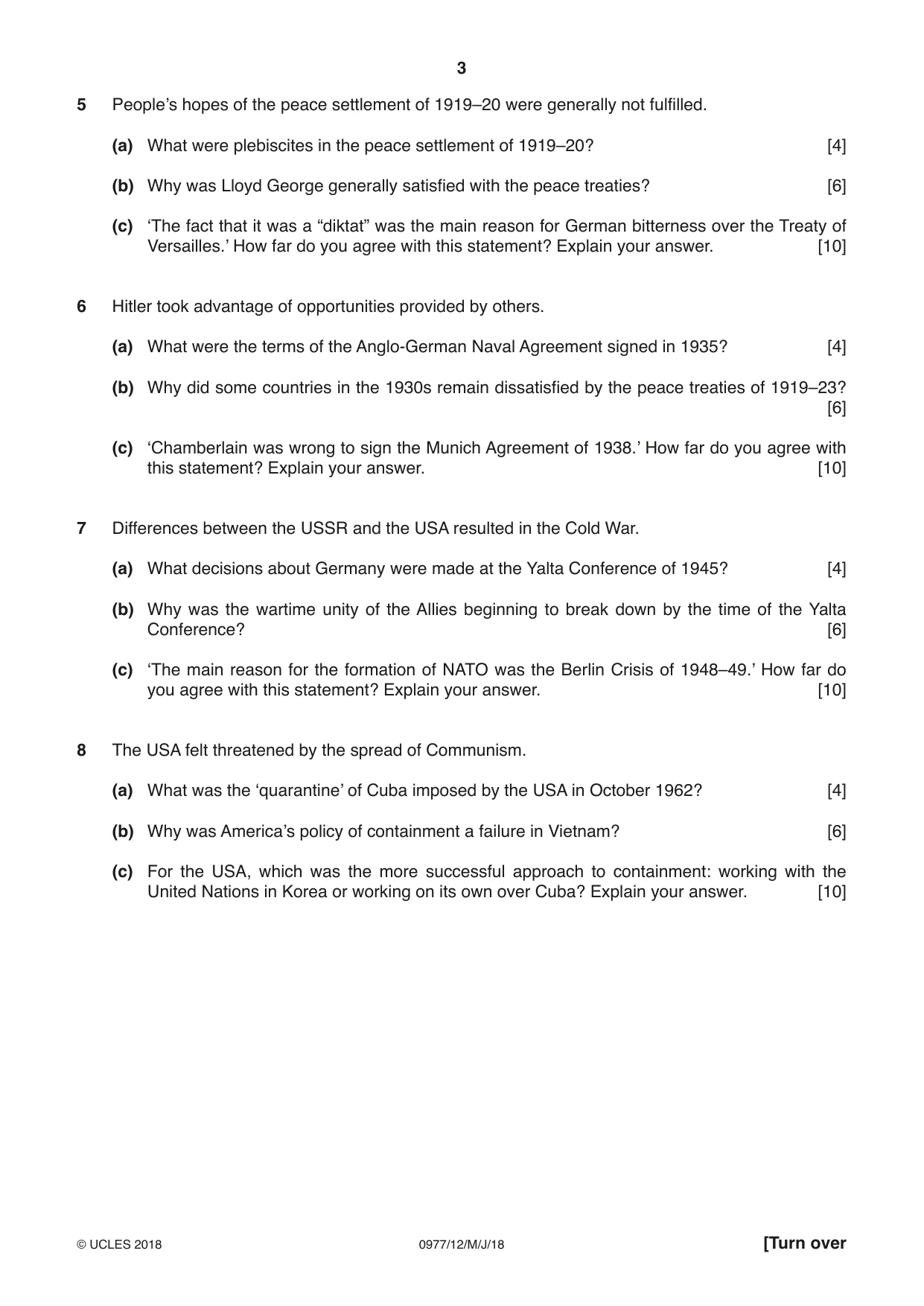
3 0977/12/M/J/18 © UCLES 2018 [Turn over 5 People’s hopes of the peace settlement of 1919–20 were generally not fulfilled. (a) What were plebiscites in the peace settlement of 1919–20? [4] (b) Why was Lloyd George generally satisfied with the peace treaties? [6] (c) ‘The fact that it was a “diktat” was the main reason for German bitterness over the Treaty of Versailles.’ How far do you agree with this statement? Explain your answer. [10] 6 Hitler took advantage of opportunities provided by others. (a) What were the terms of the Anglo-German Naval Agreement signed in 1935? [4] (b) Why did some countries in the 1930s remain dissatisfied by the peace treaties of 1919–23? [6] (c) ‘Chamberlain was wrong to sign the Munich Agreement of 1938.’ How far do you agree with this statement? Explain your answer. [10] 7 Differences between the USSR and the USA resulted in the Cold War. (a) What decisions about Germany were made at the Yalta Conference of 1945? [4] (b) Why was the wartime unity of the Allies beginning to break down by the time of the Yalta Conference? [6] (c) ‘The main reason for the formation of NATO was the Berlin Crisis of 1948–49.’ How far do you agree with this statement? Explain your answer. [10] 8 The USA felt threatened by the spread of Communism. (a) What was the ‘quarantine’ of Cuba imposed by the USA in October 1962? [4] (b) Why was America’s policy of containment a failure in Vietnam? [6] (c) For the USA, which was the more successful approach to containment: working with the United Nations in Korea or working on its own over Cuba? Explain your answer. [10]
Question paper, page 4
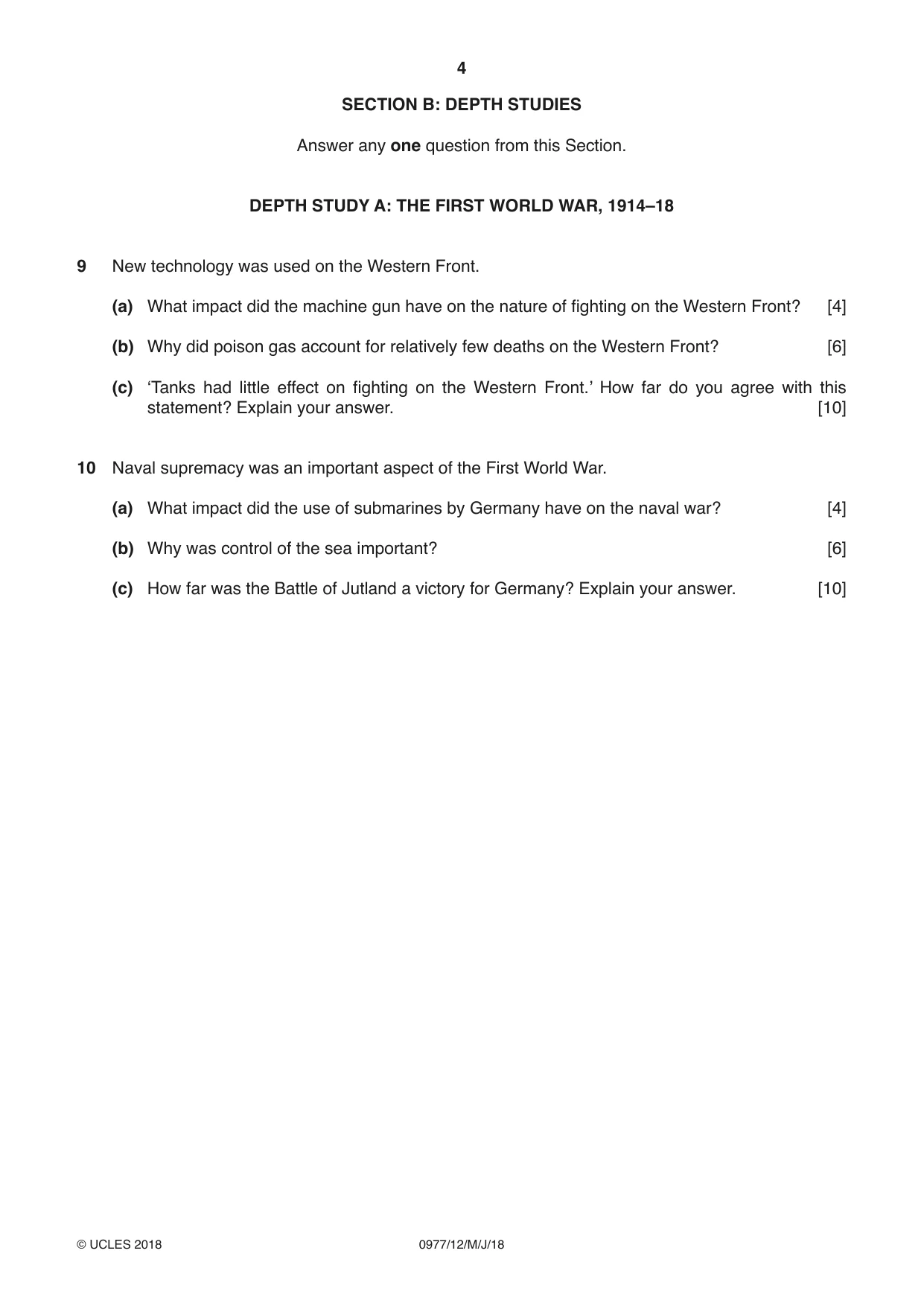
4 0977/12/M/J/18 © UCLES 2018 SECTION B: DEPTH STUDIES Answer any one question from this Section. DEPTH STUDY A: THE FIRST WORLD WAR, 1914–18 9 New technology was used on the Western Front. (a) What impact did the machine gun have on the nature of fighting on the Western Front? [4] (b) Why did poison gas account for relatively few deaths on the Western Front? [6] (c) ‘Tanks had little effect on fighting on the Western Front.’ How far do you agree with this statement? Explain your answer. [10] 10 Naval supremacy was an important aspect of the First World War. (a) What impact did the use of submarines by Germany have on the naval war? [4] (b) Why was control of the sea important? [6] (c) How far was the Battle of Jutland a victory for Germany? Explain your answer. [10]
Question paper, page 5
5 0977/12/M/J/18 © UCLES 2018 [Turn over DEPTH STUDY B: GERMANY, 1918–45 11 Germany faced difficulties at the end of the First World War. (a) What impact did the Spartacists have on the German Republic? [4] (b) Why were the Freikorps important in the early years of the Weimar Republic? [6] (c) ‘The main achievement of Weimar Germany after 1923 was economic recovery.’ How far do you agree with this statement? Explain your answer. [10] 12 Different forms of control were used by the Nazis. (a) In what ways were the Berlin Olympics a success for Goebbels? [4] (b) Why did the Nazis want to control the hearts and minds of young people? [6] (c) ‘The use by the Nazis of mass media and culture was more effective than the secret police in controlling the German people.’ How far do you agree with this statement? Explain your answer. [10]
Question paper, page 6
6 0977/12/M/J/18 © UCLES 2018 DEPTH STUDY C: RUSSIA, 1905–41 13 The Tsarist regime lost the support of the Russian people. (a) What was the impact of the Russo-Japanese War of 1904–05 on the people of Russia? [4] (b) Why did the Dumas fail to turn Russia into a parliamentary democracy? [6] (c) How important was the Tsarina’s friendship with Rasputin in the collapse of the Tsarist regime? Explain your answer. [10] 14 Stalin took action to remain in power. (a) What was the New Economic Policy? [4] (b) Why was Stalin the most plausible candidate to become leader following the death of Lenin? [6] (c) ‘The most successful method used by Stalin to control the Soviet people was art and culture.’ How far do you agree with this statement? Explain your answer. [10]
Question paper, page 7
7 0977/12/M/J/18 © UCLES 2018 [Turn over DEPTH STUDY D: THE USA, 1919–41 15 Some sections of the US economy benefited more from the 1920s boom than others. (a) What impact did trade tariffs have on the US economy in the 1920s? [4] (b) Why was the growth of mail order and nationwide advertising important to the economic boom? [6] (c) ‘Overproduction rather than competition from Canada was to blame for the difficulties faced by farmers in the 1920s.’ How far do you agree with this statement? Explain your answer. [10] 16 There were both positive and negative reactions to the New Deal. (a) What did the Social Security Act of 1935 provide? [4] (b) Why did Roosevelt’s ‘Hundred Days’ have the effect of restoring confidence? [6] (c) ‘Criticism of the New Deal by the Supreme Court was more serious than criticism from other groups and individuals.’ How far do you agree with this statement? Explain your answer. [10]
Question paper, page 8
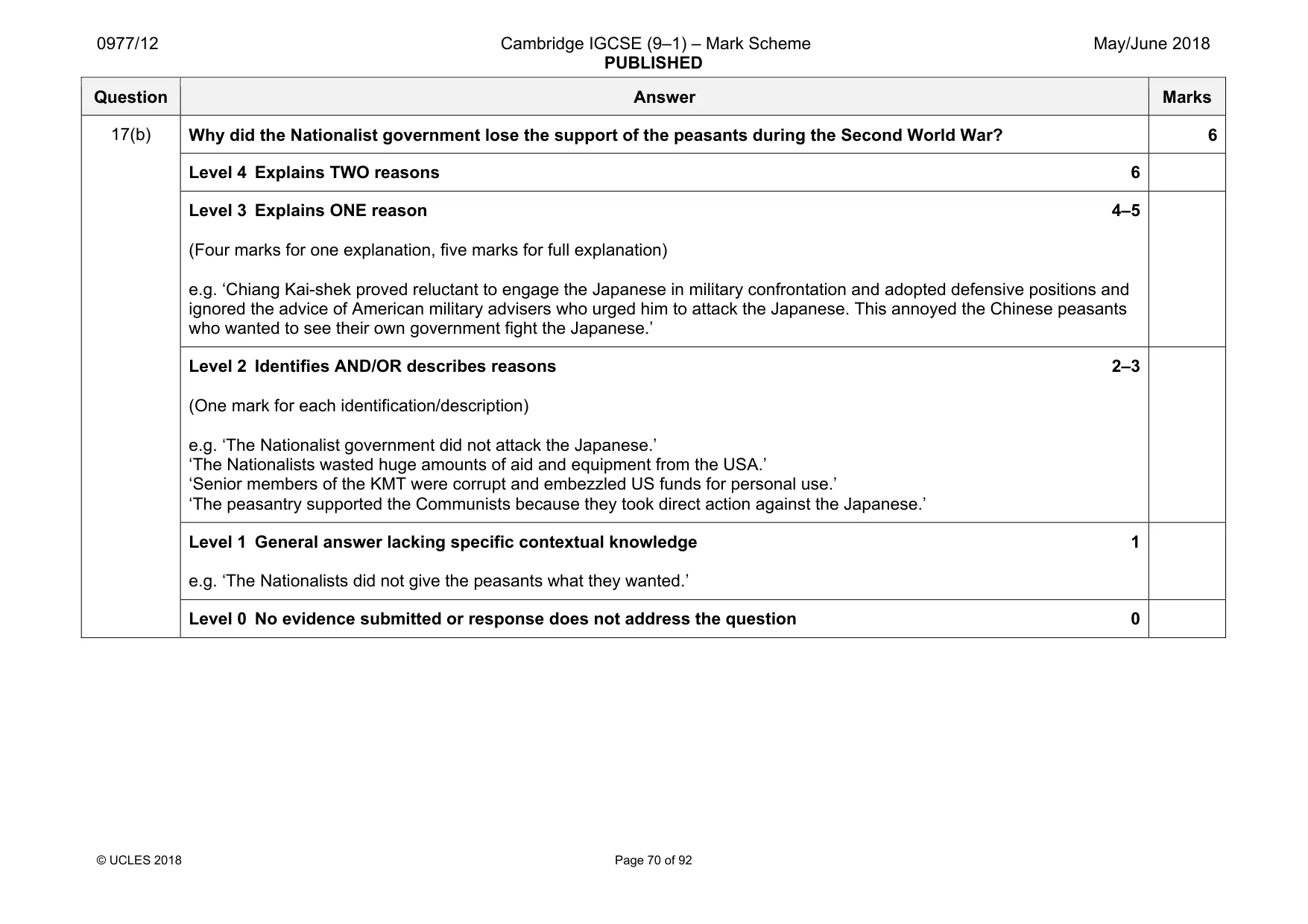
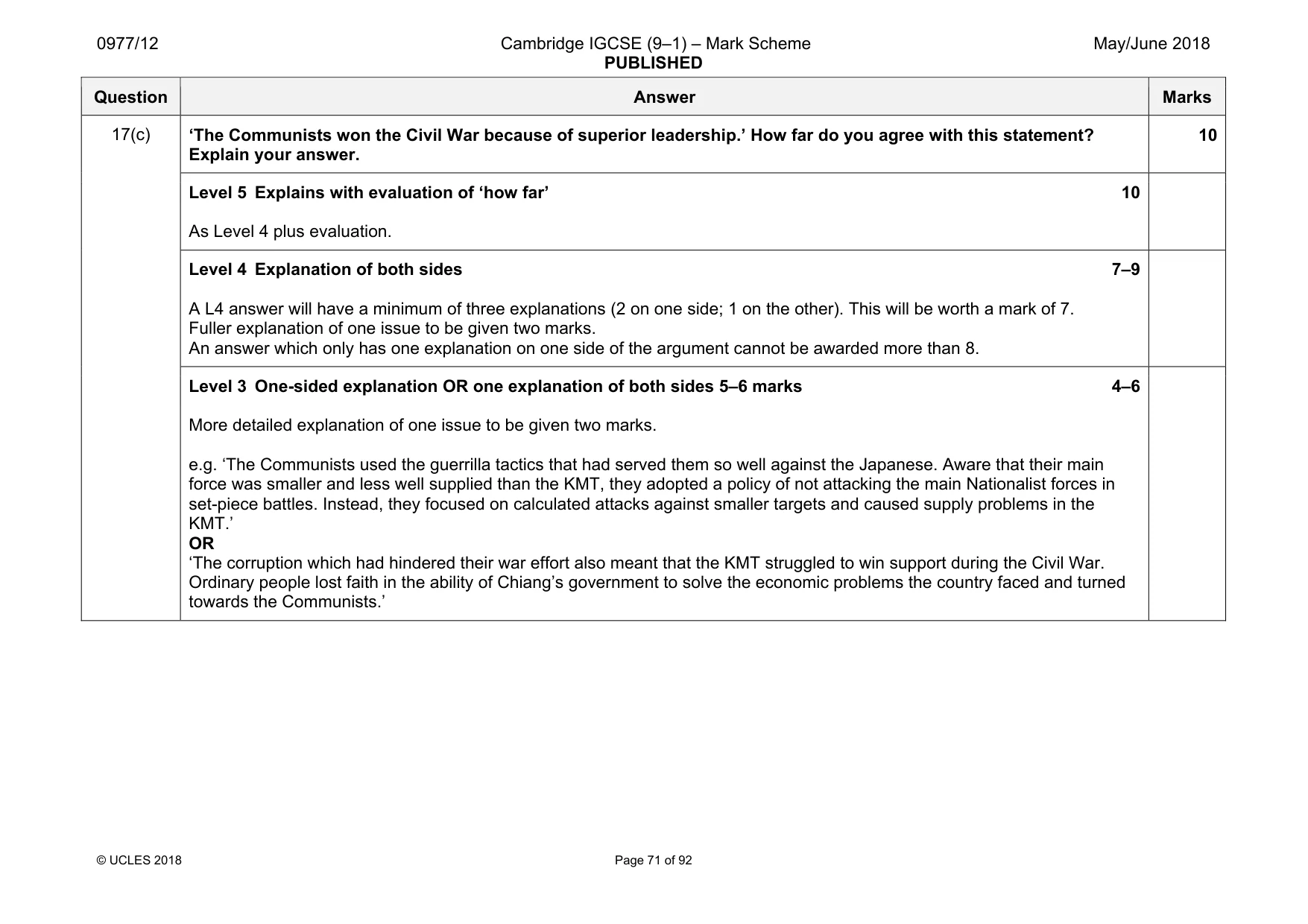
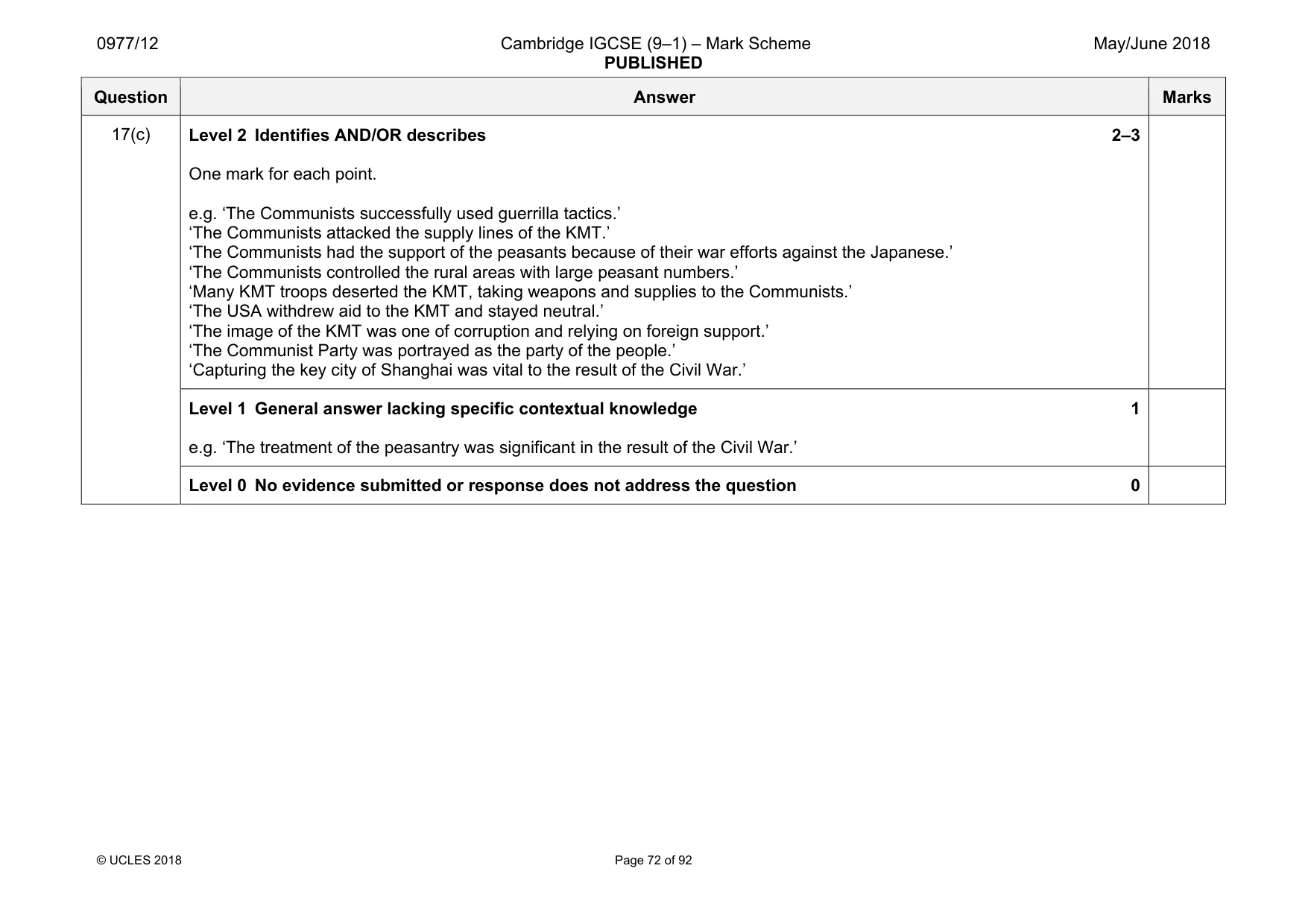
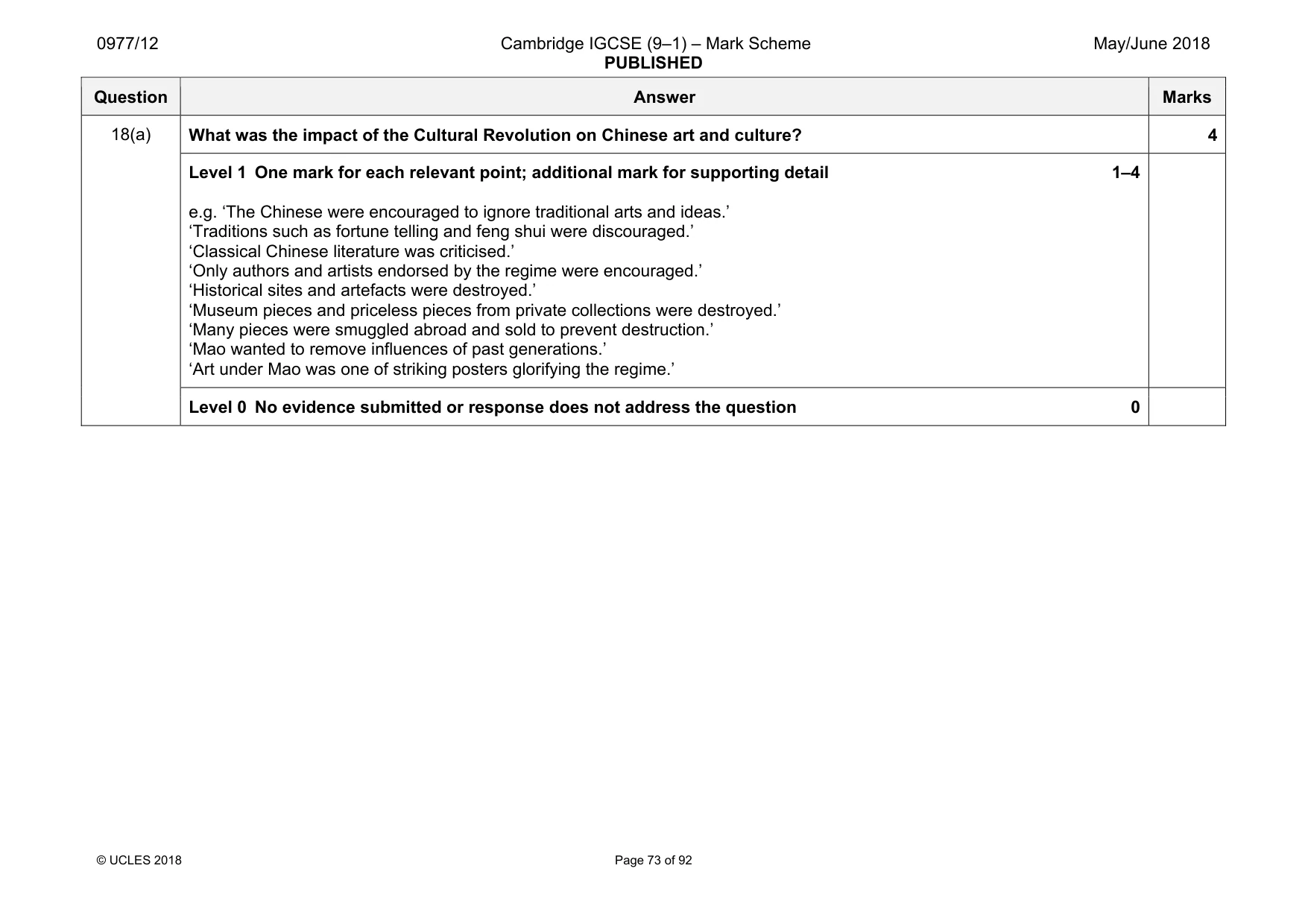
8 0977/12/M/J/18 © UCLES 2018 DEPTH STUDY E: CHINA, c.1930–c.1990 17 In the years before 1949 support for the Communists was increasing. (a) What benefits did the Communists gain from the years of the Yenan Soviet? [4] (b) Why did the Nationalist government lose the support of the peasants during the Second World War? [6] (c) ‘The Communists won the Civil War because of superior leadership.’ How far do you agree with this statement? Explain your answer. [10] 18 Communist rule of China was repressive. (a) What was the impact of the Cultural Revolution on Chinese art and culture? [4] (b) Why was the Hundred Flowers campaign important to Mao? [6] (c) ‘The main reason for the Cultural Revolution was to give Mao an opportunity to re-establish his influence.’ How far do you agree with this statement? Explain your answer. [10]
Question paper, page 9
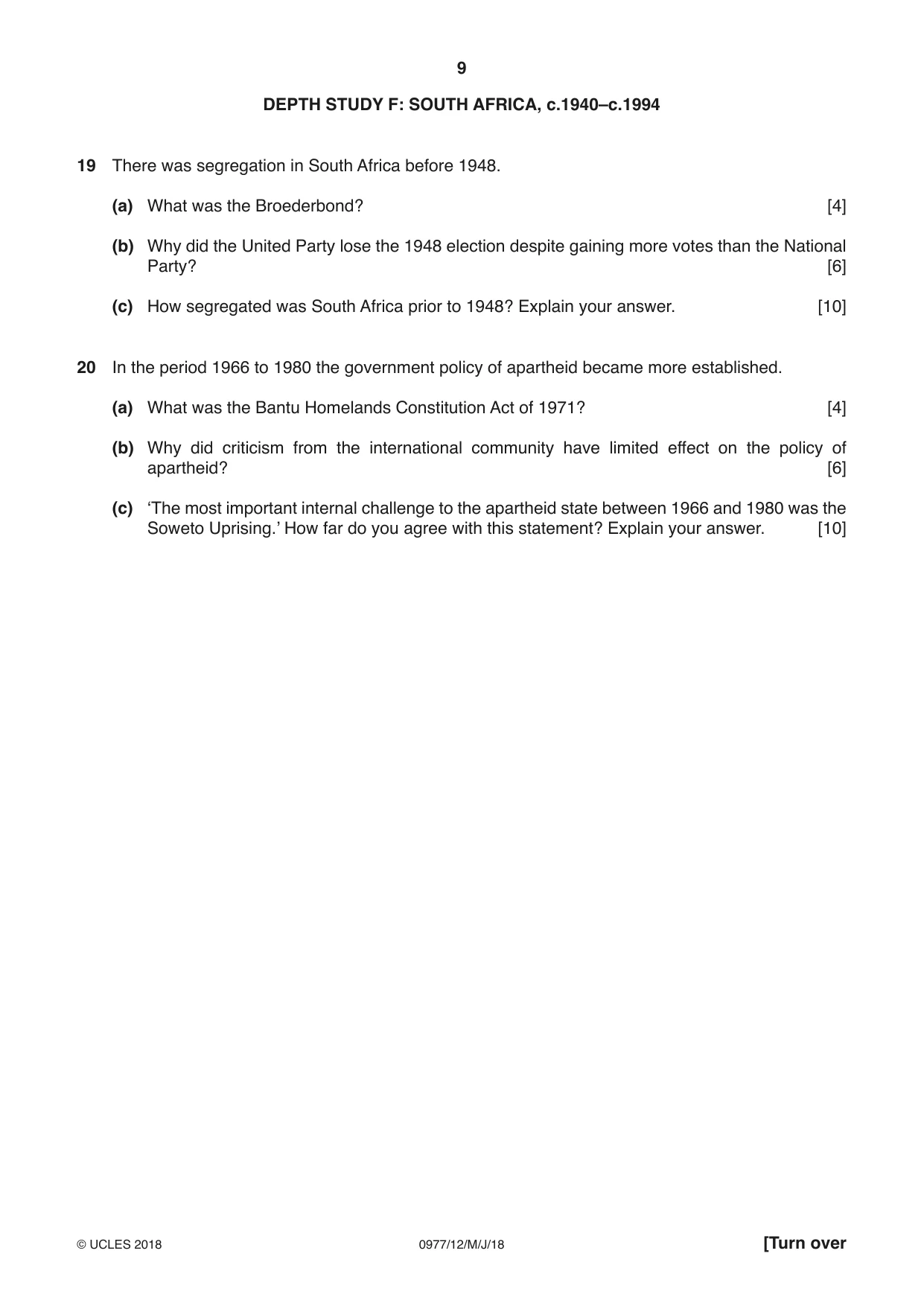
9 0977/12/M/J/18 © UCLES 2018 [Turn over DEPTH STUDY F: SOUTH AFRICA, c.1940–c.1994 19 There was segregation in South Africa before 1948. (a) What was the Broederbond? [4] (b) Why did the United Party lose the 1948 election despite gaining more votes than the National Party? [6] (c) How segregated was South Africa prior to 1948? Explain your answer. [10] 20 In the period 1966 to 1980 the government policy of apartheid became more established. (a) What was the Bantu Homelands Constitution Act of 1971? [4] (b) Why did criticism from the international community have limited effect on the policy of apartheid? [6] (c) ‘The most important internal challenge to the apartheid state between 1966 and 1980 was the Soweto Uprising.’ How far do you agree with this statement? Explain your answer. [10]
Question paper, page 10
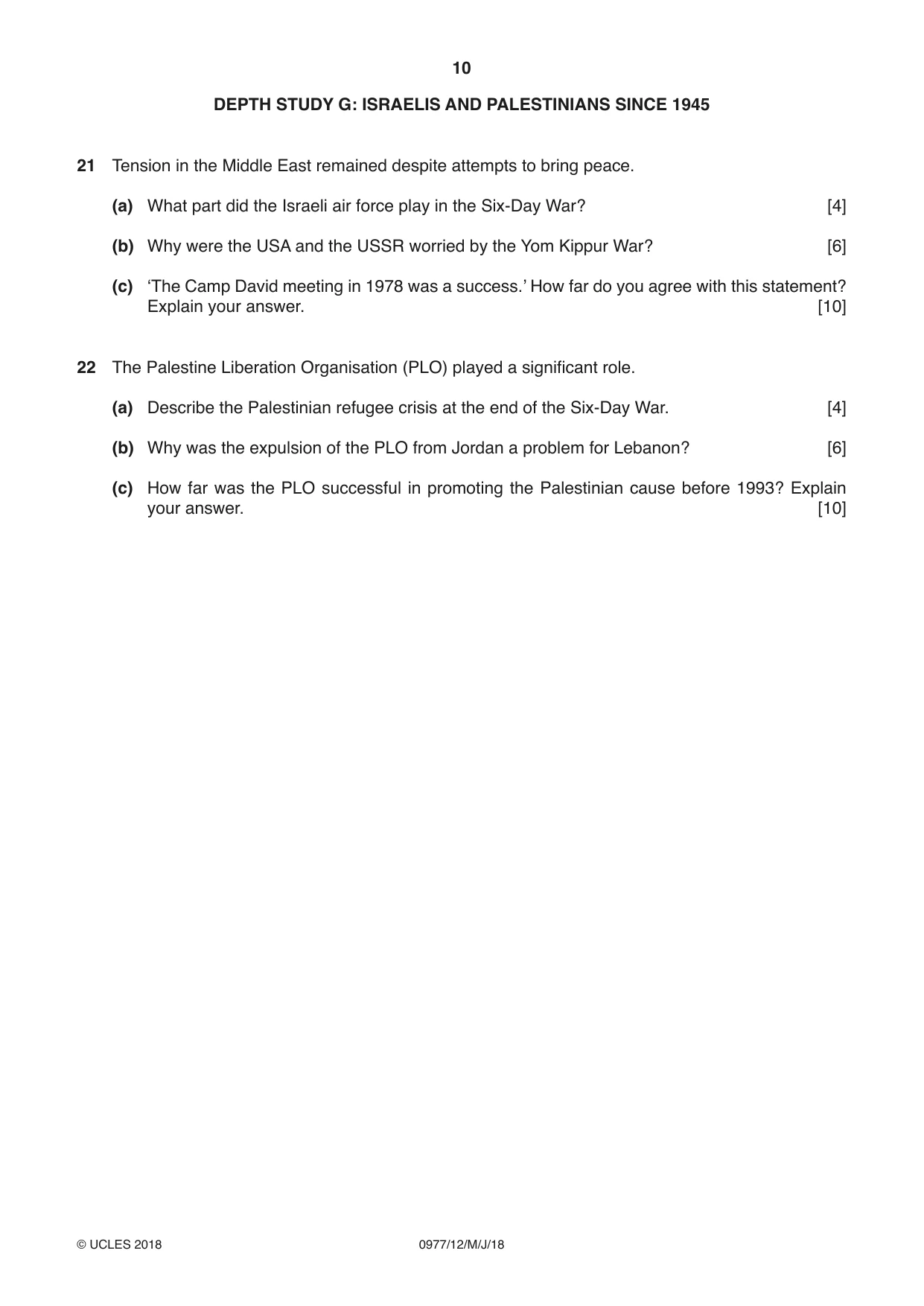
10 0977/12/M/J/18 © UCLES 2018 DEPTH STUDY G: ISRAELIS AND PALESTINIANS SINCE 1945 21 Tension in the Middle East remained despite attempts to bring peace. (a) What part did the Israeli air force play in the Six-Day War? [4] (b) Why were the USA and the USSR worried by the Yom Kippur War? [6] (c) ‘The Camp David meeting in 1978 was a success.’ How far do you agree with this statement? Explain your answer. [10] 22 The Palestine Liberation Organisation (PLO) played a significant role. (a) Describe the Palestinian refugee crisis at the end of the Six-Day War. [4] (b) Why was the expulsion of the PLO from Jordan a problem for Lebanon? [6] (c) How far was the PLO successful in promoting the Palestinian cause before 1993? Explain your answer. [10]
Question paper, page 11
11 0977/12/M/J/18 © UCLES 2018 BLANK PAGE
Question paper, page 12
12 0977/12/M/J/18 © UCLES 2018 Permission to reproduce items where third-party owned material protected by copyright is included has been sought and cleared where possible. Every reasonable effort has been made by the publisher (UCLES) to trace copyright holders, but if any items requiring clearance have unwittingly been included, the publisher will be pleased to make amends at the earliest possible opportunity. To avoid the issue of disclosure of answer-related information to candidates, all copyright acknowledgements are reproduced online in the Cambridge International Examinations Copyright Acknowledgements Booklet. This is produced for each series of examinations and is freely available to download at www.cie.org.uk after the live examination series. Cambridge International Examinations is part of the Cambridge Assessment Group. Cambridge Assessment is the brand name of University of Cambridge Local Examinations Syndicate (UCLES), which is itself a department of the University of Cambridge. BLANK PAGE
Mark scheme, page 1
IGCSE™ is a registered trademark. This document consists of 92 printed pages. © UCLES 2018 [Turn over Cambridge Assessment International Education Cambridge International General Certificate of Secondary Education (9–1) HISTORY 0977/12 Paper 1 May/June 2018 MARK SCHEME Maximum Mark: 60 Published This mark scheme is published as an aid to teachers and candidates, to indicate the requirements of the examination. It shows the basis on which Examiners were instructed to award marks. It does not indicate the details of the discussions that took place at an Examiners’ meeting before marking began, which would have considered the acceptability of alternative answers. Mark schemes should be read in conjunction with the question paper and the Principal Examiner Report for Teachers. Cambridge International will not enter into discussions about these mark schemes. Cambridge International is publishing the mark schemes for the May/June 2018 series for most Cambridge IGCSE™, Cambridge International A and AS Level and Cambridge Pre-U components, and some Cambridge O Level components.
Mark scheme, page 2
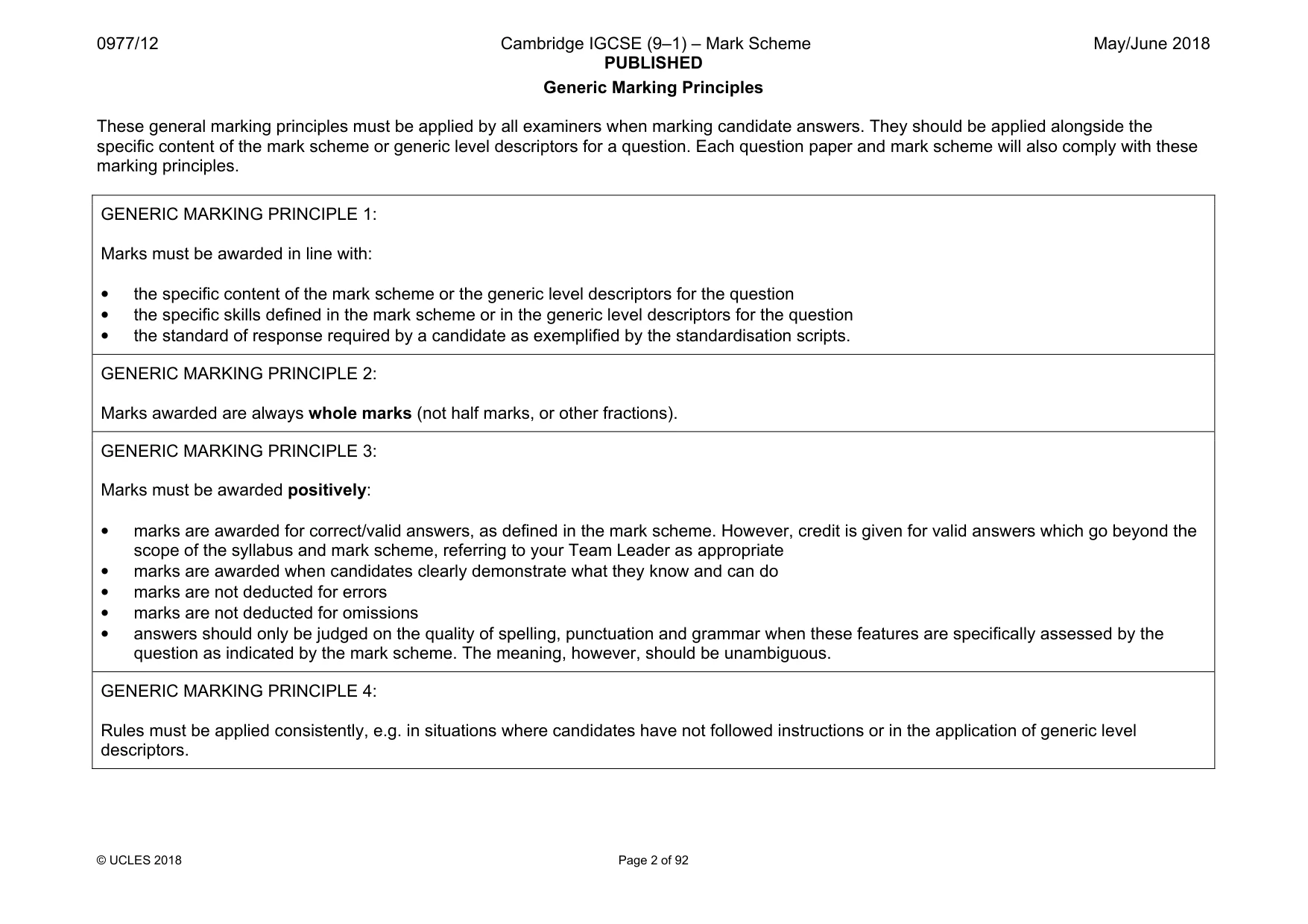
0977/12 Cambridge IGCSE (9–1) – Mark Scheme PUBLISHED May/June 2018 © UCLES 2018 Page 2 of 92 Generic Marking Principles These general marking principles must be applied by all examiners when marking candidate answers. They should be applied alongside the specific content of the mark scheme or generic level descriptors for a question. Each question paper and mark scheme will also comply with these marking principles. GENERIC MARKING PRINCIPLE 1: Marks must be awarded in line with: • the specific content of the mark scheme or the generic level descriptors for the question • the specific skills defined in the mark scheme or in the generic level descriptors for the question • the standard of response required by a candidate as exemplified by the standardisation scripts. GENERIC MARKING PRINCIPLE 2: Marks awarded are always whole marks (not half marks, or other fractions). GENERIC MARKING PRINCIPLE 3: Marks must be awarded positively: • marks are awarded for correct/valid answers, as defined in the mark scheme. However, credit is given for valid answers which go beyond the scope of the syllabus and mark scheme, referring to your Team Leader as appropriate • marks are awarded when candidates clearly demonstrate what they know and can do • marks are not deducted for errors • marks are not deducted for omissions • answers should only be judged on the quality of spelling, punctuation and grammar when these features are specifically assessed by the question as indicated by the mark scheme. The meaning, however, should be unambiguous. GENERIC MARKING PRINCIPLE 4: Rules must be applied consistently, e.g. in situations where candidates have not followed instructions or in the application of generic level descriptors.
Mark scheme, page 3
0977/12 Cambridge IGCSE (9–1) – Mark Scheme PUBLISHED May/June 2018 © UCLES 2018 Page 3 of 92 GENERIC MARKING PRINCIPLE 5: Marks should be awarded using the full range of marks defined in the mark scheme for the question (however, the use of the full mark range may be limited according to the quality of the candidate responses seen). GENERIC MARKING PRINCIPLE 6: Marks awarded are based solely on the requirements as defined in the mark scheme. Marks should not be awarded with grade thresholds or grade descriptors in mind.
Mark scheme, page 4
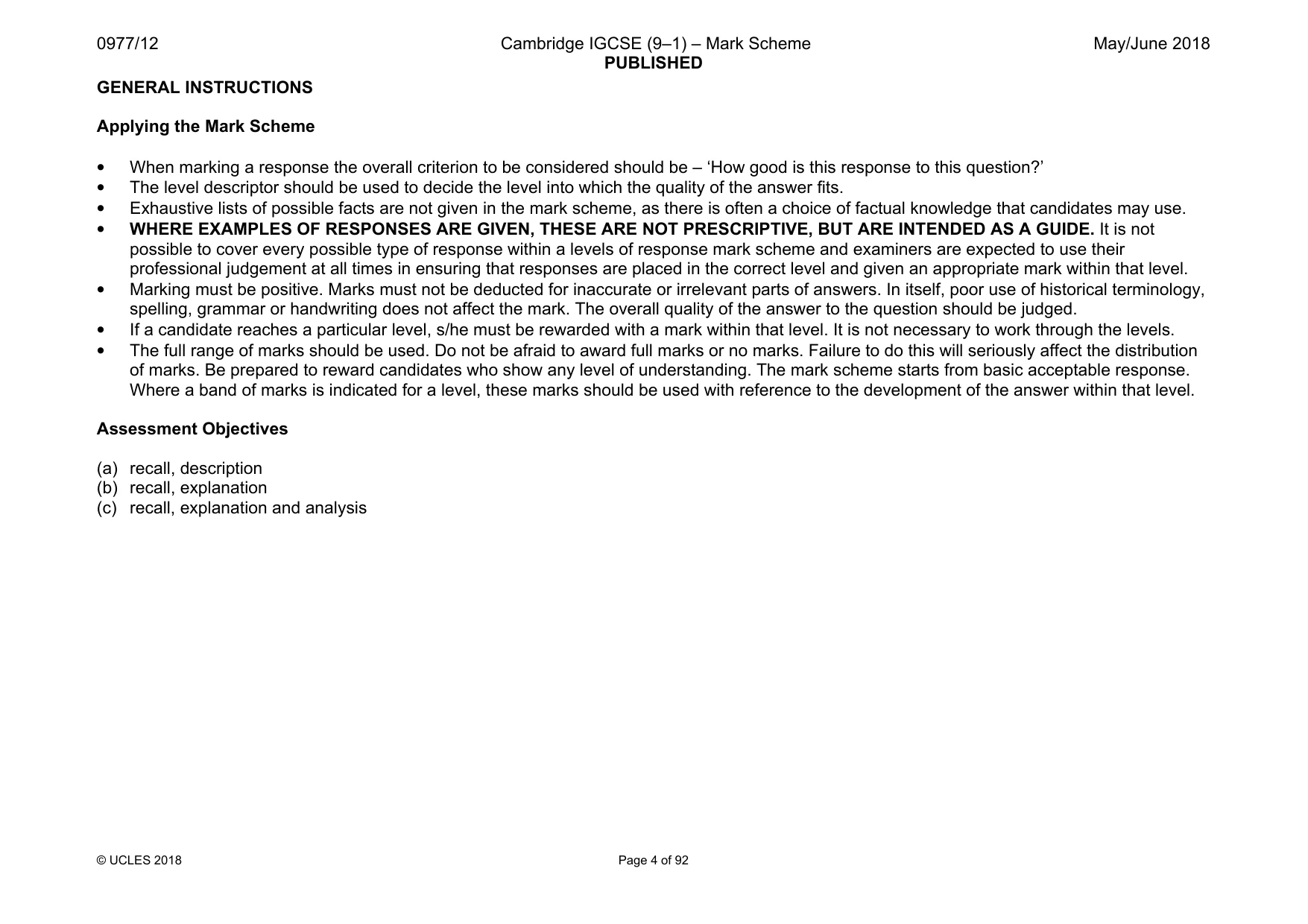
0977/12 Cambridge IGCSE (9–1) – Mark Scheme PUBLISHED May/June 2018 © UCLES 2018 Page 4 of 92 GENERAL INSTRUCTIONS Applying the Mark Scheme • When marking a response the overall criterion to be considered should be – ‘How good is this response to this question?’ • The level descriptor should be used to decide the level into which the quality of the answer fits. • Exhaustive lists of possible facts are not given in the mark scheme, as there is often a choice of factual knowledge that candidates may use. • WHERE EXAMPLES OF RESPONSES ARE GIVEN, THESE ARE NOT PRESCRIPTIVE, BUT ARE INTENDED AS A GUIDE. It is not possible to cover every possible type of response within a levels of response mark scheme and examiners are expected to use their professional judgement at all times in ensuring that responses are placed in the correct level and given an appropriate mark within that level. • Marking must be positive. Marks must not be deducted for inaccurate or irrelevant parts of answers. In itself, poor use of historical terminology, spelling, grammar or handwriting does not affect the mark. The overall quality of the answer to the question should be judged. • If a candidate reaches a particular level, s/he must be rewarded with a mark within that level. It is not necessary to work through the levels. • The full range of marks should be used. Do not be afraid to award full marks or no marks. Failure to do this will seriously affect the distribution of marks. Be prepared to reward candidates who show any level of understanding. The mark scheme starts from basic acceptable response. Where a band of marks is indicated for a level, these marks should be used with reference to the development of the answer within that level. Assessment Objectives (a) recall, description (b) recall, explanation (c) recall, explanation and analysis
Mark scheme, page 5
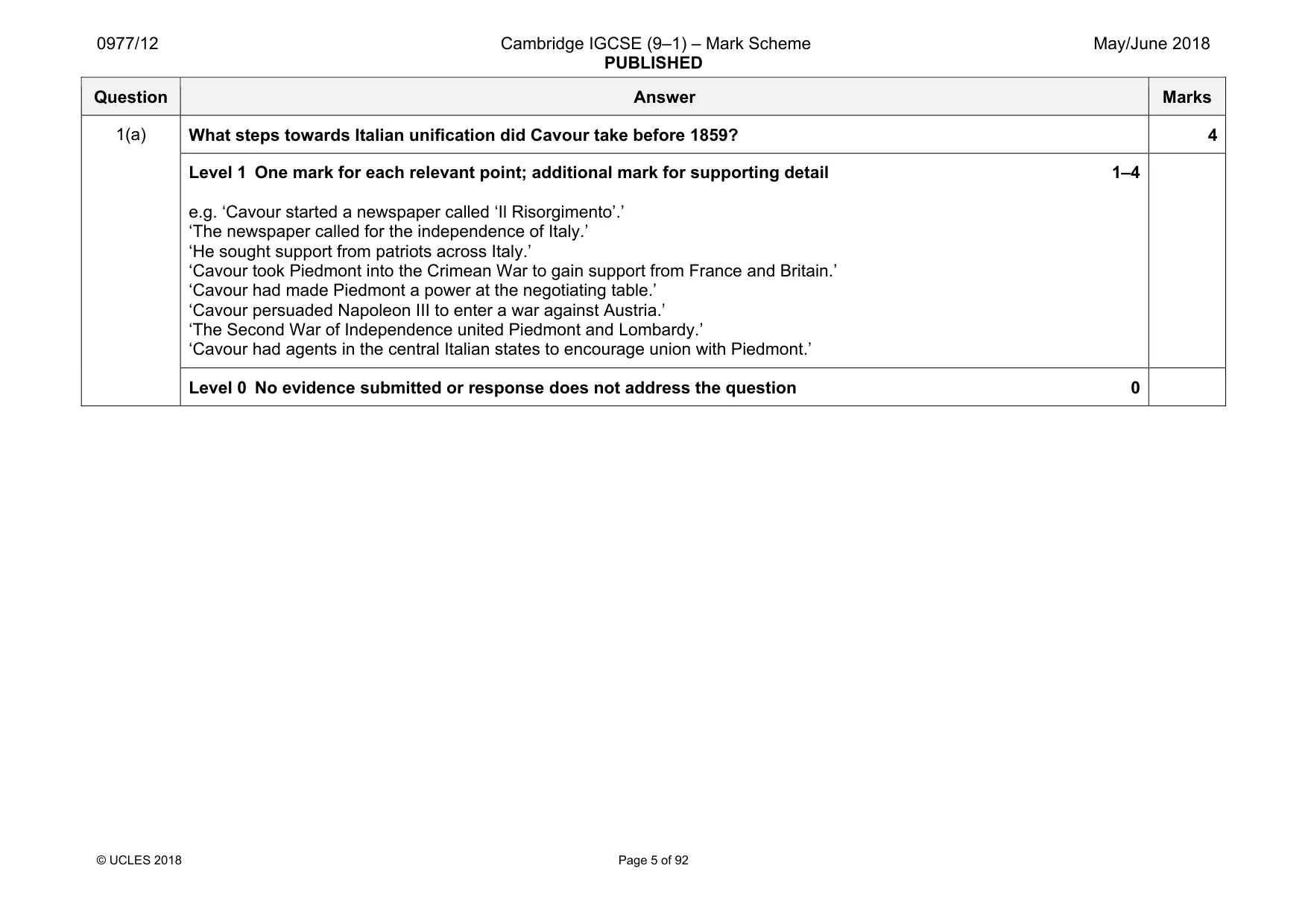
0977/12 Cambridge IGCSE (9–1) – Mark Scheme PUBLISHED May/June 2018 © UCLES 2018 Page 5 of 92 Question Answer Marks 1(a) What steps towards Italian unification did Cavour take before 1859? 4 Level 1 One mark for each relevant point; additional mark for supporting detail 1–4 e.g. ‘Cavour started a newspaper called ‘Il Risorgimento’.’ ‘The newspaper called for the independence of Italy.’ ‘He sought support from patriots across Italy.’ ‘Cavour took Piedmont into the Crimean War to gain support from France and Britain.’ ‘Cavour had made Piedmont a power at the negotiating table.’ ‘Cavour persuaded Napoleon III to enter a war against Austria.’ ‘The Second War of Independence united Piedmont and Lombardy.’ ‘Cavour had agents in the central Italian states to encourage union with Piedmont.’ Level 0 No evidence submitted or response does not address the question 0
Mark scheme, page 6
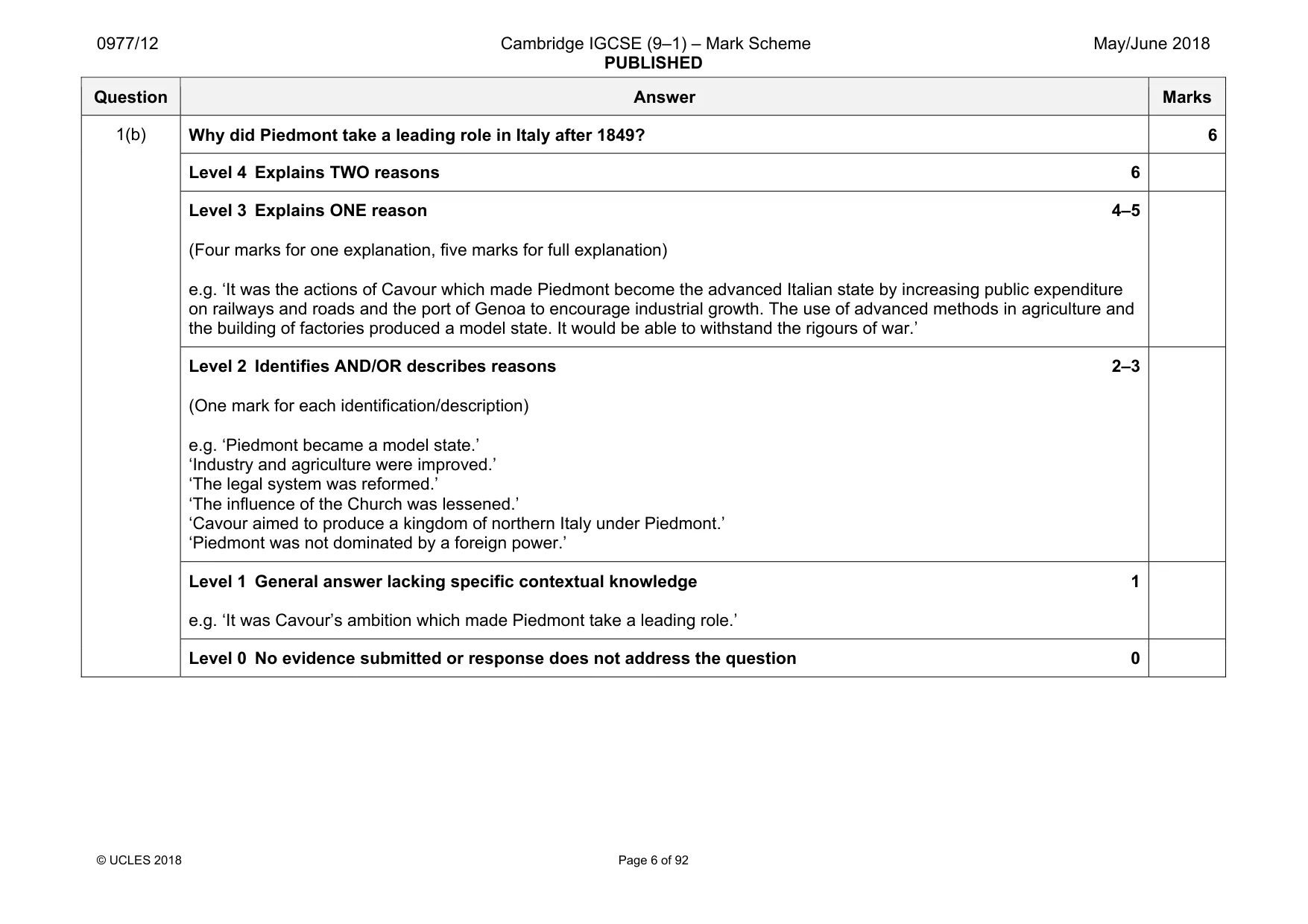
0977/12 Cambridge IGCSE (9–1) – Mark Scheme PUBLISHED May/June 2018 © UCLES 2018 Page 6 of 92 Question Answer Marks 1(b) Why did Piedmont take a leading role in Italy after 1849? 6 Level 4 Explains TWO reasons 6 Level 3 Explains ONE reason 4–5 (Four marks for one explanation, five marks for full explanation) e.g. ‘It was the actions of Cavour which made Piedmont become the advanced Italian state by increasing public expenditure on railways and roads and the port of Genoa to encourage industrial growth. The use of advanced methods in agriculture and the building of factories produced a model state. It would be able to withstand the rigours of war.’ Level 2 Identifies AND/OR describes reasons 2–3 (One mark for each identification/description) e.g. ‘Piedmont became a model state.’ ‘Industry and agriculture were improved.’ ‘The legal system was reformed.’ ‘The influence of the Church was lessened.’ ‘Cavour aimed to produce a kingdom of northern Italy under Piedmont.’ ‘Piedmont was not dominated by a foreign power.’ Level 1 General answer lacking specific contextual knowledge 1 e.g. ‘It was Cavour’s ambition which made Piedmont take a leading role.’ Level 0 No evidence submitted or response does not address the question 0
Mark scheme, page 7
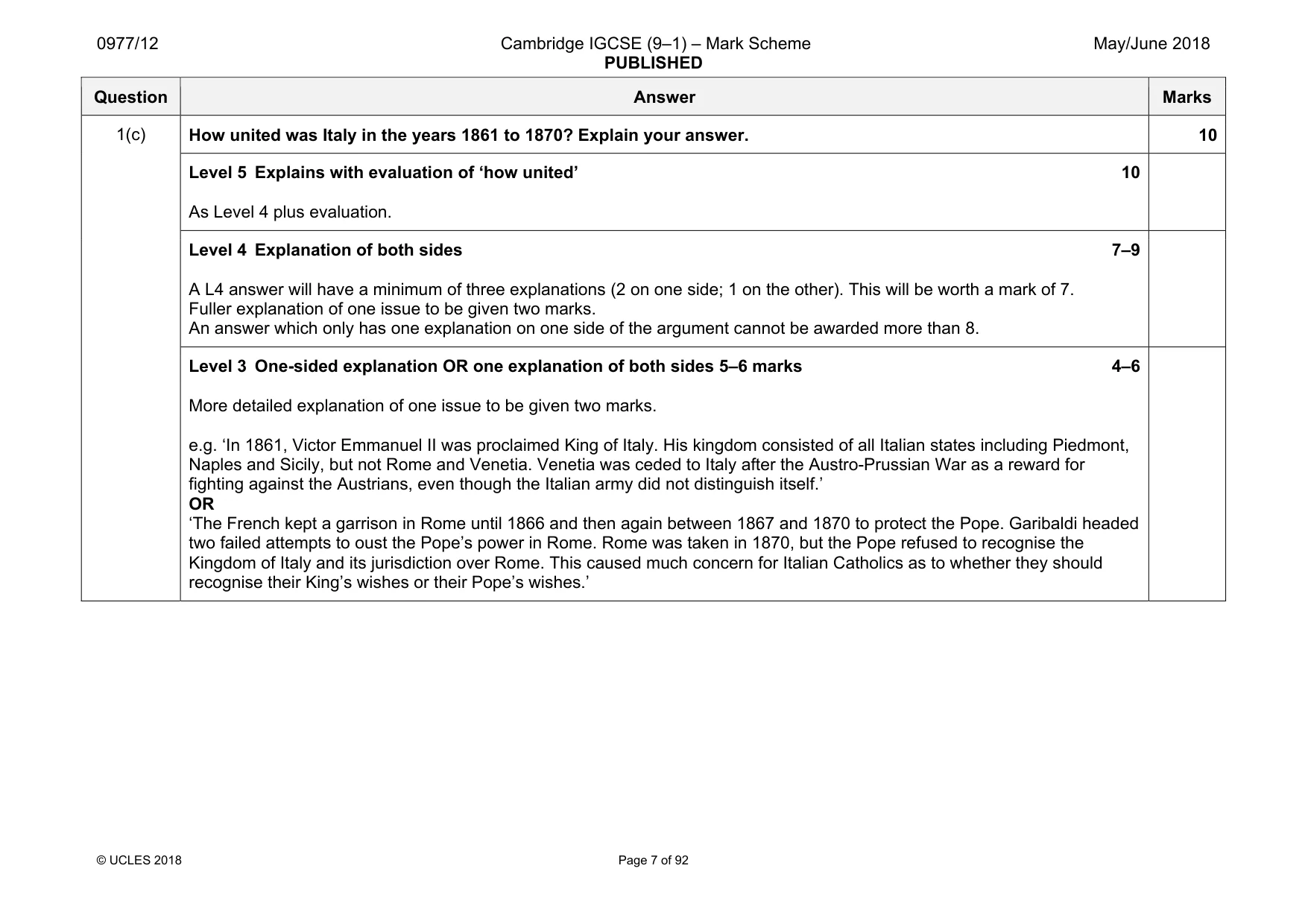
0977/12 Cambridge IGCSE (9–1) – Mark Scheme PUBLISHED May/June 2018 © UCLES 2018 Page 7 of 92 Question Answer Marks 1(c) How united was Italy in the years 1861 to 1870? Explain your answer. 10 Level 5 Explains with evaluation of ‘how united’ 10 As Level 4 plus evaluation. Level 4 Explanation of both sides 7–9 A L4 answer will have a minimum of three explanations (2 on one side; 1 on the other). This will be worth a mark of 7. Fuller explanation of one issue to be given two marks. An answer which only has one explanation on one side of the argument cannot be awarded more than 8. Level 3 One-sided explanation OR one explanation of both sides 5–6 marks 4–6 More detailed explanation of one issue to be given two marks. e.g. ‘In 1861, Victor Emmanuel II was proclaimed King of Italy. His kingdom consisted of all Italian states including Piedmont, Naples and Sicily, but not Rome and Venetia. Venetia was ceded to Italy after the Austro-Prussian War as a reward for fighting against the Austrians, even though the Italian army did not distinguish itself.’ OR ‘The French kept a garrison in Rome until 1866 and then again between 1867 and 1870 to protect the Pope. Garibaldi headed two failed attempts to oust the Pope’s power in Rome. Rome was taken in 1870, but the Pope refused to recognise the Kingdom of Italy and its jurisdiction over Rome. This caused much concern for Italian Catholics as to whether they should recognise their King’s wishes or their Pope’s wishes.’
Mark scheme, page 8
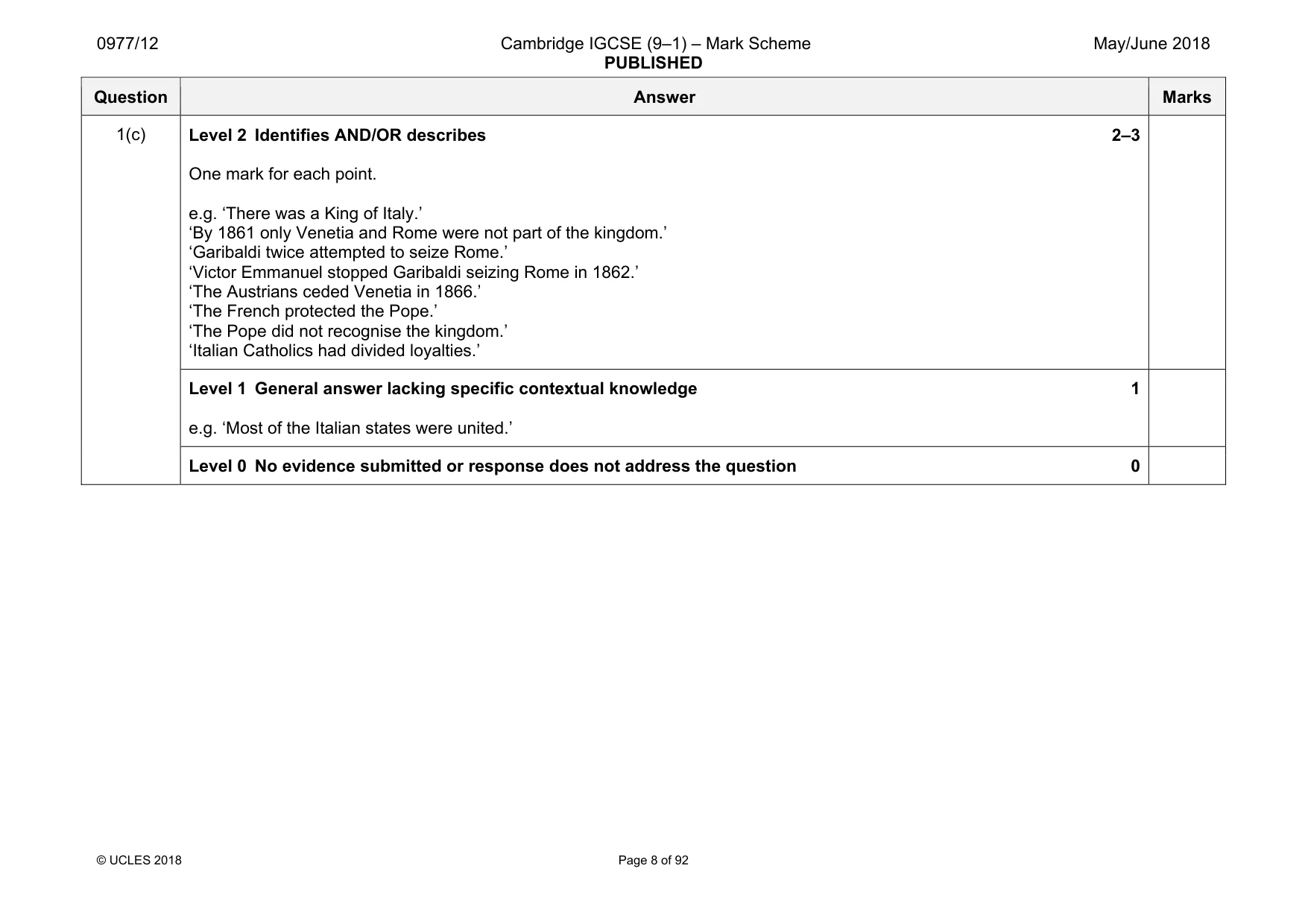
0977/12 Cambridge IGCSE (9–1) – Mark Scheme PUBLISHED May/June 2018 © UCLES 2018 Page 8 of 92 Question Answer Marks 1(c) Level 2 Identifies AND/OR describes 2–3 One mark for each point. e.g. ‘There was a King of Italy.’ ‘By 1861 only Venetia and Rome were not part of the kingdom.’ ‘Garibaldi twice attempted to seize Rome.’ ‘Victor Emmanuel stopped Garibaldi seizing Rome in 1862.’ ‘The Austrians ceded Venetia in 1866.’ ‘The French protected the Pope.’ ‘The Pope did not recognise the kingdom.’ ‘Italian Catholics had divided loyalties.’ Level 1 General answer lacking specific contextual knowledge 1 e.g. ‘Most of the Italian states were united.’ Level 0 No evidence submitted or response does not address the question 0
Mark scheme, page 9
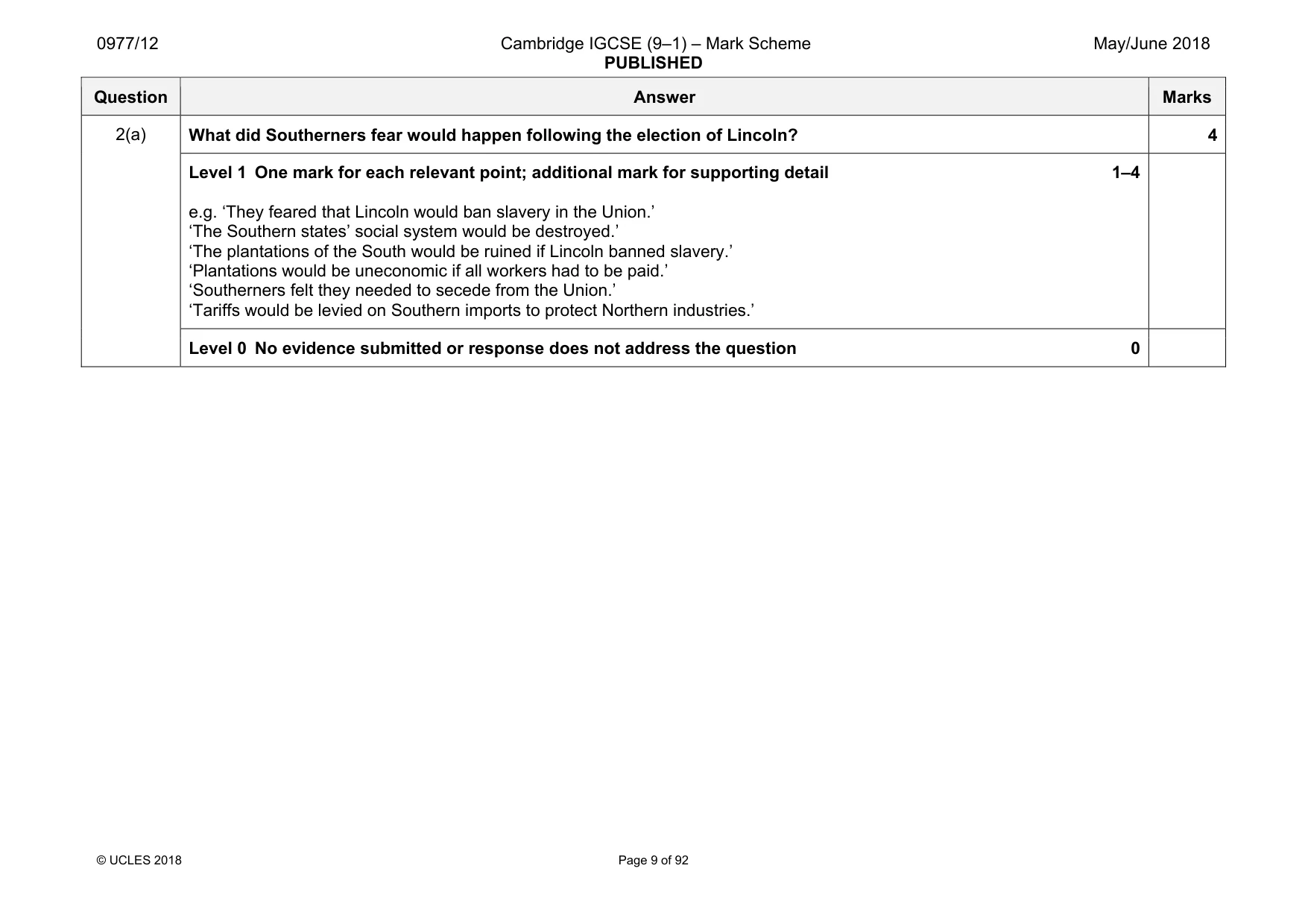
0977/12 Cambridge IGCSE (9–1) – Mark Scheme PUBLISHED May/June 2018 © UCLES 2018 Page 9 of 92 Question Answer Marks 2(a) What did Southerners fear would happen following the election of Lincoln? 4 Level 1 One mark for each relevant point; additional mark for supporting detail 1–4 e.g. ‘They feared that Lincoln would ban slavery in the Union.’ ‘The Southern states’ social system would be destroyed.’ ‘The plantations of the South would be ruined if Lincoln banned slavery.’ ‘Plantations would be uneconomic if all workers had to be paid.’ ‘Southerners felt they needed to secede from the Union.’ ‘Tariffs would be levied on Southern imports to protect Northern industries.’ Level 0 No evidence submitted or response does not address the question 0
Mark scheme, page 10
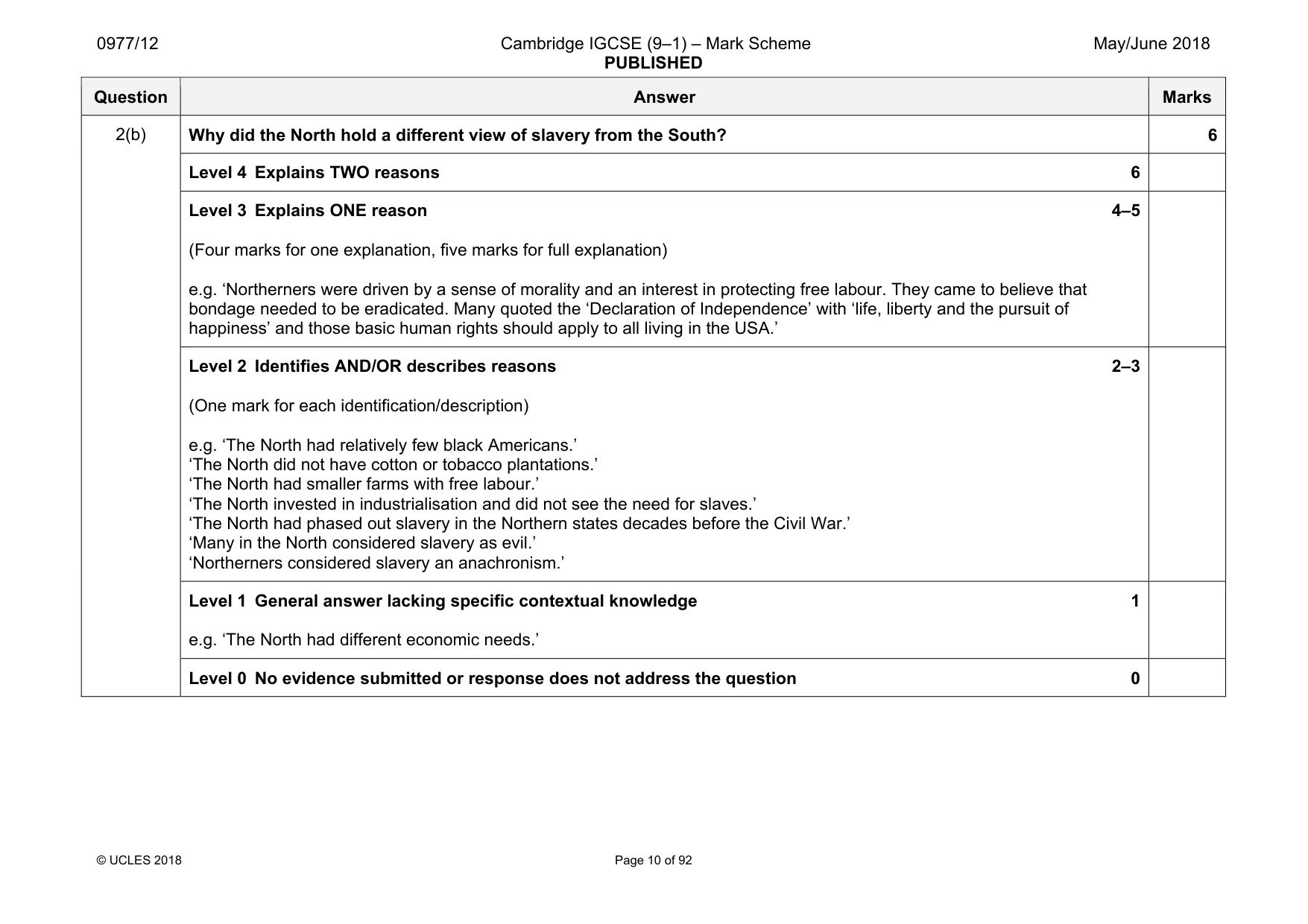
0977/12 Cambridge IGCSE (9–1) – Mark Scheme PUBLISHED May/June 2018 © UCLES 2018 Page 10 of 92 Question Answer Marks 2(b) Why did the North hold a different view of slavery from the South? 6 Level 4 Explains TWO reasons 6 Level 3 Explains ONE reason 4–5 (Four marks for one explanation, five marks for full explanation) e.g. ‘Northerners were driven by a sense of morality and an interest in protecting free labour. They came to believe that bondage needed to be eradicated. Many quoted the ‘Declaration of Independence’ with ‘life, liberty and the pursuit of happiness’ and those basic human rights should apply to all living in the USA.’ Level 2 Identifies AND/OR describes reasons 2–3 (One mark for each identification/description) e.g. ‘The North had relatively few black Americans.’ ‘The North did not have cotton or tobacco plantations.’ ‘The North had smaller farms with free labour.’ ‘The North invested in industrialisation and did not see the need for slaves.’ ‘The North had phased out slavery in the Northern states decades before the Civil War.’ ‘Many in the North considered slavery as evil.’ ‘Northerners considered slavery an anachronism.’ Level 1 General answer lacking specific contextual knowledge 1 e.g. ‘The North had different economic needs.’ Level 0 No evidence submitted or response does not address the question 0
Mark scheme, page 11
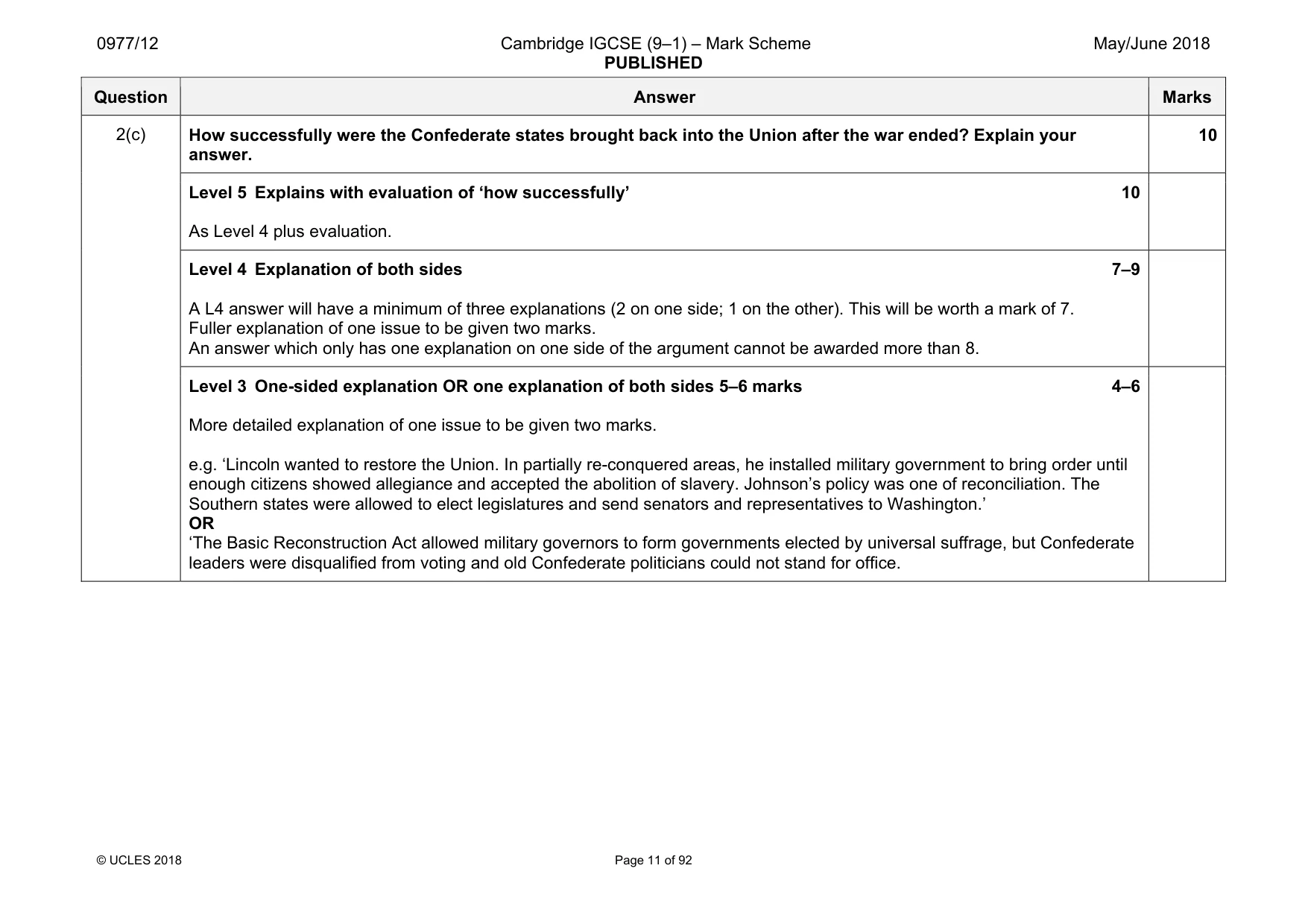
0977/12 Cambridge IGCSE (9–1) – Mark Scheme PUBLISHED May/June 2018 © UCLES 2018 Page 11 of 92 Question Answer Marks 2(c) How successfully were the Confederate states brought back into the Union after the war ended? Explain your answer. 10 Level 5 Explains with evaluation of ‘how successfully’ 10 As Level 4 plus evaluation. Level 4 Explanation of both sides 7–9 A L4 answer will have a minimum of three explanations (2 on one side; 1 on the other). This will be worth a mark of 7. Fuller explanation of one issue to be given two marks. An answer which only has one explanation on one side of the argument cannot be awarded more than 8. Level 3 One-sided explanation OR one explanation of both sides 5–6 marks 4–6 More detailed explanation of one issue to be given two marks. e.g. ‘Lincoln wanted to restore the Union. In partially re-conquered areas, he installed military government to bring order until enough citizens showed allegiance and accepted the abolition of slavery. Johnson’s policy was one of reconciliation. The Southern states were allowed to elect legislatures and send senators and representatives to Washington.’ OR ‘The Basic Reconstruction Act allowed military governors to form governments elected by universal suffrage, but Confederate leaders were disqualified from voting and old Confederate politicians could not stand for office.
Mark scheme, page 12
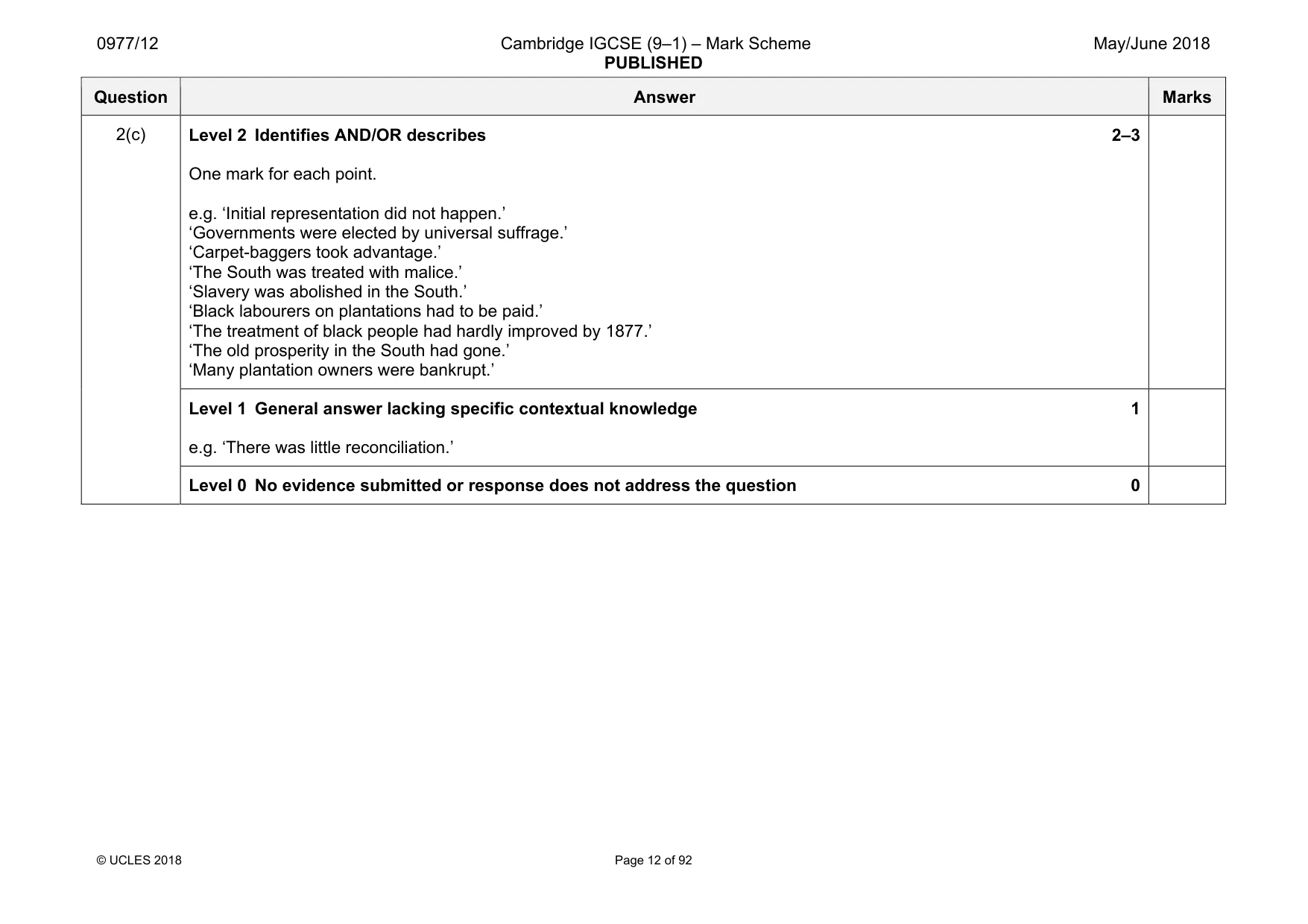
0977/12 Cambridge IGCSE (9–1) – Mark Scheme PUBLISHED May/June 2018 © UCLES 2018 Page 12 of 92 Question Answer Marks 2(c) Level 2 Identifies AND/OR describes 2–3 One mark for each point. e.g. ‘Initial representation did not happen.’ ‘Governments were elected by universal suffrage.’ ‘Carpet-baggers took advantage.’ ‘The South was treated with malice.’ ‘Slavery was abolished in the South.’ ‘Black labourers on plantations had to be paid.’ ‘The treatment of black people had hardly improved by 1877.’ ‘The old prosperity in the South had gone.’ ‘Many plantation owners were bankrupt.’ Level 1 General answer lacking specific contextual knowledge 1 e.g. ‘There was little reconciliation.’ Level 0 No evidence submitted or response does not address the question 0
Mark scheme, page 13
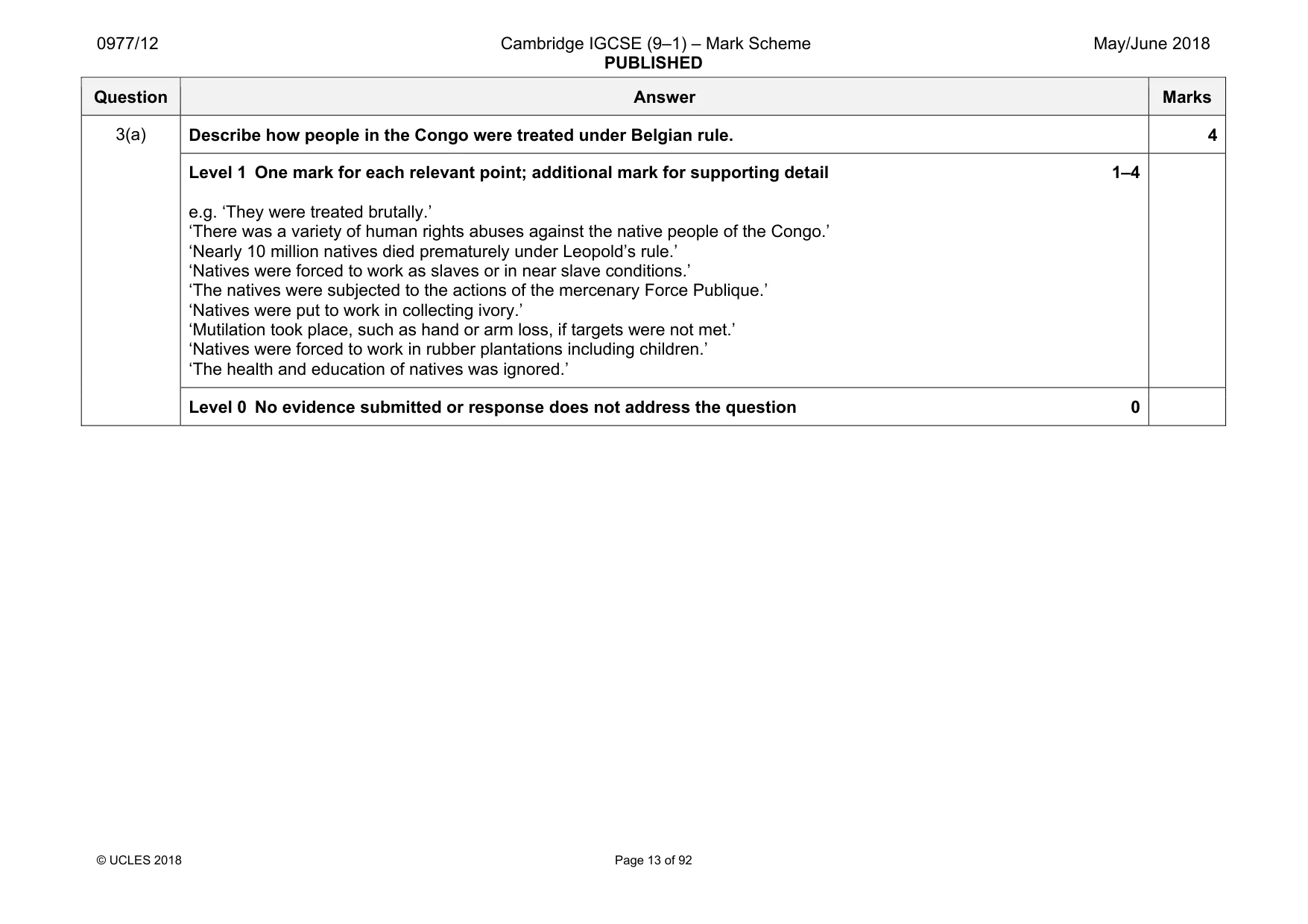
0977/12 Cambridge IGCSE (9–1) – Mark Scheme PUBLISHED May/June 2018 © UCLES 2018 Page 13 of 92 Question Answer Marks 3(a) Describe how people in the Congo were treated under Belgian rule. 4 Level 1 One mark for each relevant point; additional mark for supporting detail 1–4 e.g. ‘They were treated brutally.’ ‘There was a variety of human rights abuses against the native people of the Congo.’ ‘Nearly 10 million natives died prematurely under Leopold’s rule.’ ‘Natives were forced to work as slaves or in near slave conditions.’ ‘The natives were subjected to the actions of the mercenary Force Publique.’ ‘Natives were put to work in collecting ivory.’ ‘Mutilation took place, such as hand or arm loss, if targets were not met.’ ‘Natives were forced to work in rubber plantations including children.’ ‘The health and education of natives was ignored.’ Level 0 No evidence submitted or response does not address the question 0
Mark scheme, page 14
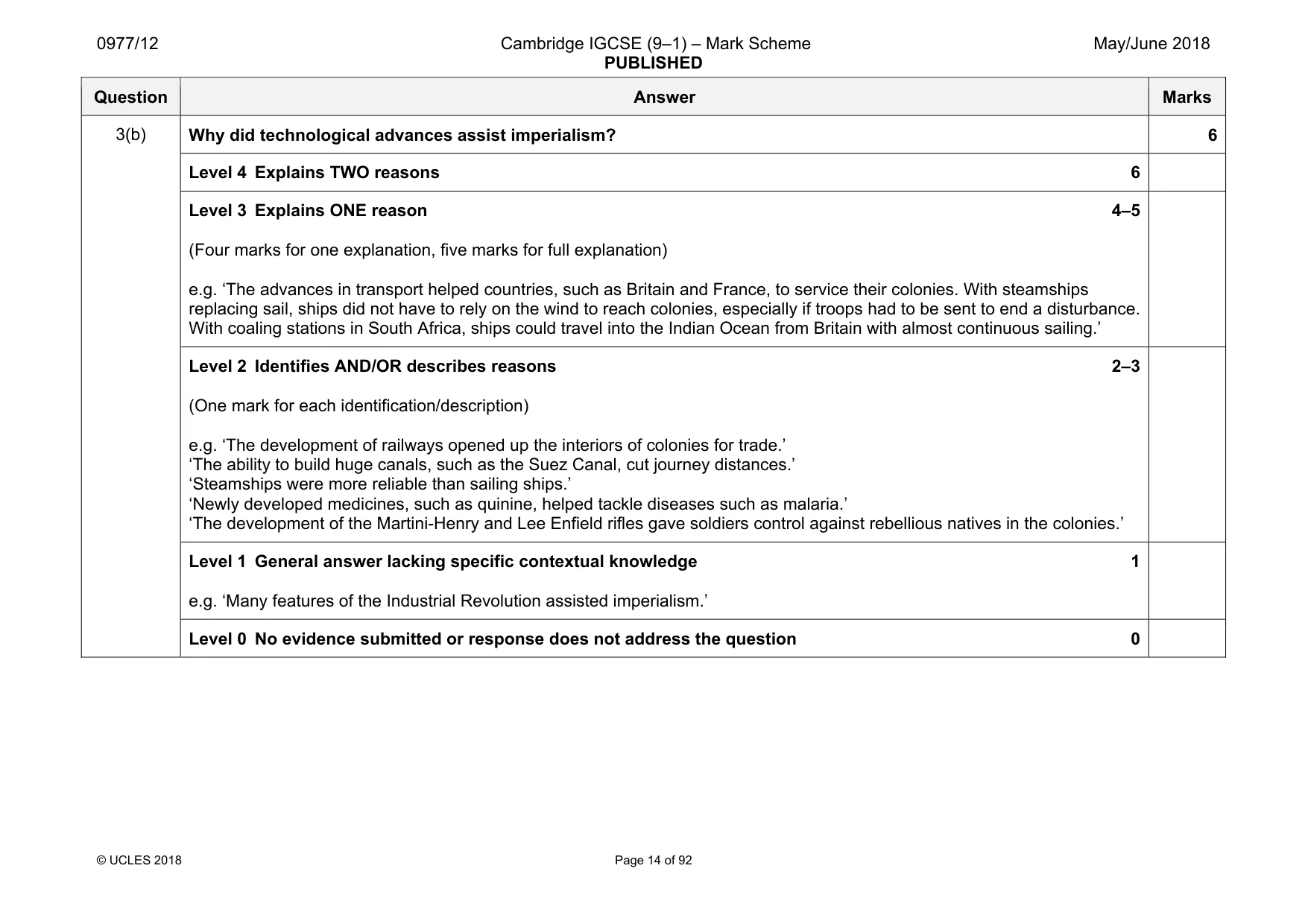
0977/12 Cambridge IGCSE (9–1) – Mark Scheme PUBLISHED May/June 2018 © UCLES 2018 Page 14 of 92 Question Answer Marks 3(b) Why did technological advances assist imperialism? 6 Level 4 Explains TWO reasons 6 Level 3 Explains ONE reason 4–5 (Four marks for one explanation, five marks for full explanation) e.g. ‘The advances in transport helped countries, such as Britain and France, to service their colonies. With steamships replacing sail, ships did not have to rely on the wind to reach colonies, especially if troops had to be sent to end a disturbance. With coaling stations in South Africa, ships could travel into the Indian Ocean from Britain with almost continuous sailing.’ Level 2 Identifies AND/OR describes reasons 2–3 (One mark for each identification/description) e.g. ‘The development of railways opened up the interiors of colonies for trade.’ ‘The ability to build huge canals, such as the Suez Canal, cut journey distances.’ ‘Steamships were more reliable than sailing ships.’ ‘Newly developed medicines, such as quinine, helped tackle diseases such as malaria.’ ‘The development of the Martini-Henry and Lee Enfield rifles gave soldiers control against rebellious natives in the colonies.’ Level 1 General answer lacking specific contextual knowledge 1 e.g. ‘Many features of the Industrial Revolution assisted imperialism.’ Level 0 No evidence submitted or response does not address the question 0
Mark scheme, page 15
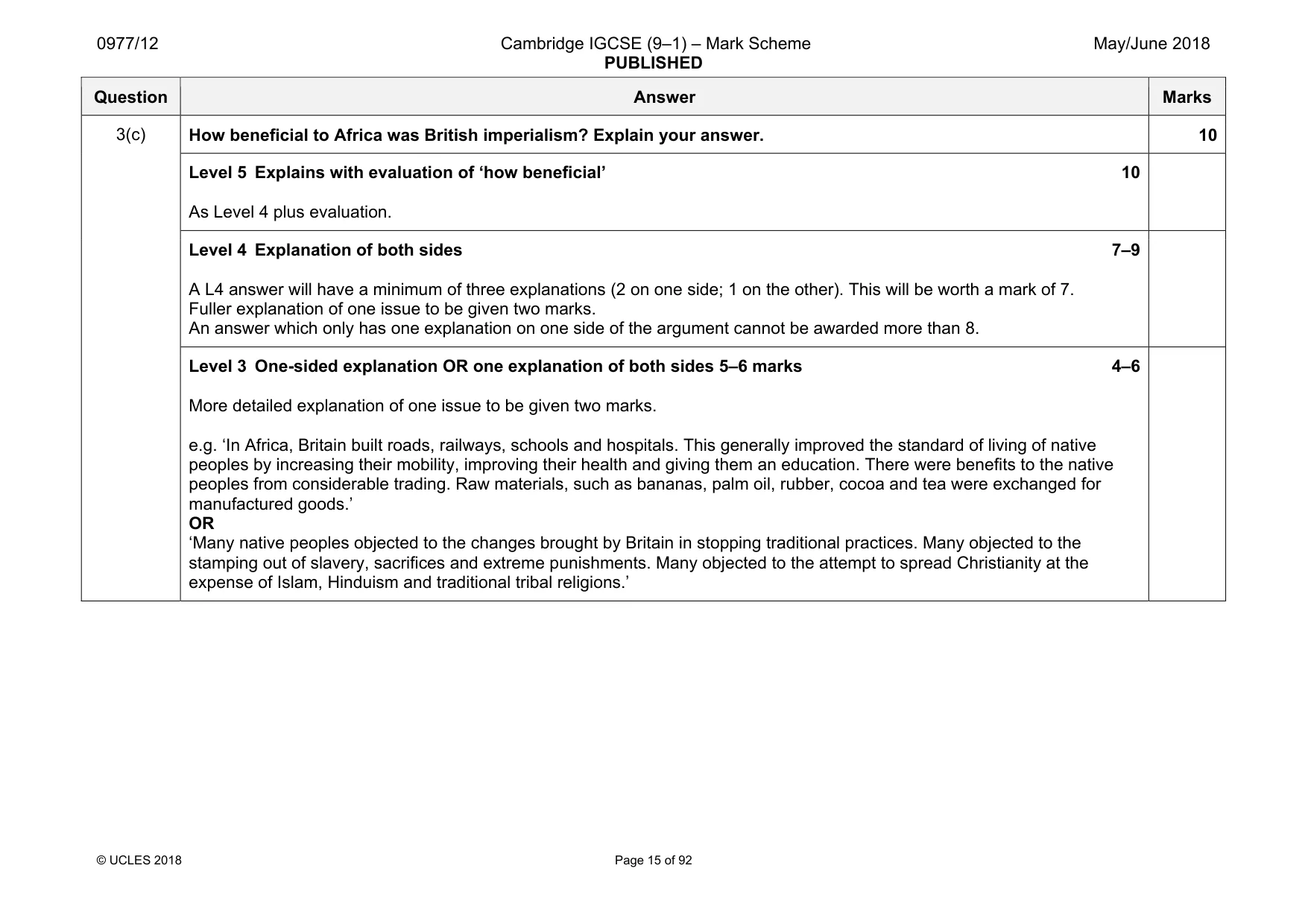
0977/12 Cambridge IGCSE (9–1) – Mark Scheme PUBLISHED May/June 2018 © UCLES 2018 Page 15 of 92 Question Answer Marks 3(c) How beneficial to Africa was British imperialism? Explain your answer. 10 Level 5 Explains with evaluation of ‘how beneficial’ 10 As Level 4 plus evaluation. Level 4 Explanation of both sides 7–9 A L4 answer will have a minimum of three explanations (2 on one side; 1 on the other). This will be worth a mark of 7. Fuller explanation of one issue to be given two marks. An answer which only has one explanation on one side of the argument cannot be awarded more than 8. Level 3 One-sided explanation OR one explanation of both sides 5–6 marks 4–6 More detailed explanation of one issue to be given two marks. e.g. ‘In Africa, Britain built roads, railways, schools and hospitals. This generally improved the standard of living of native peoples by increasing their mobility, improving their health and giving them an education. There were benefits to the native peoples from considerable trading. Raw materials, such as bananas, palm oil, rubber, cocoa and tea were exchanged for manufactured goods.’ OR ‘Many native peoples objected to the changes brought by Britain in stopping traditional practices. Many objected to the stamping out of slavery, sacrifices and extreme punishments. Many objected to the attempt to spread Christianity at the expense of Islam, Hinduism and traditional tribal religions.’
Mark scheme, page 16
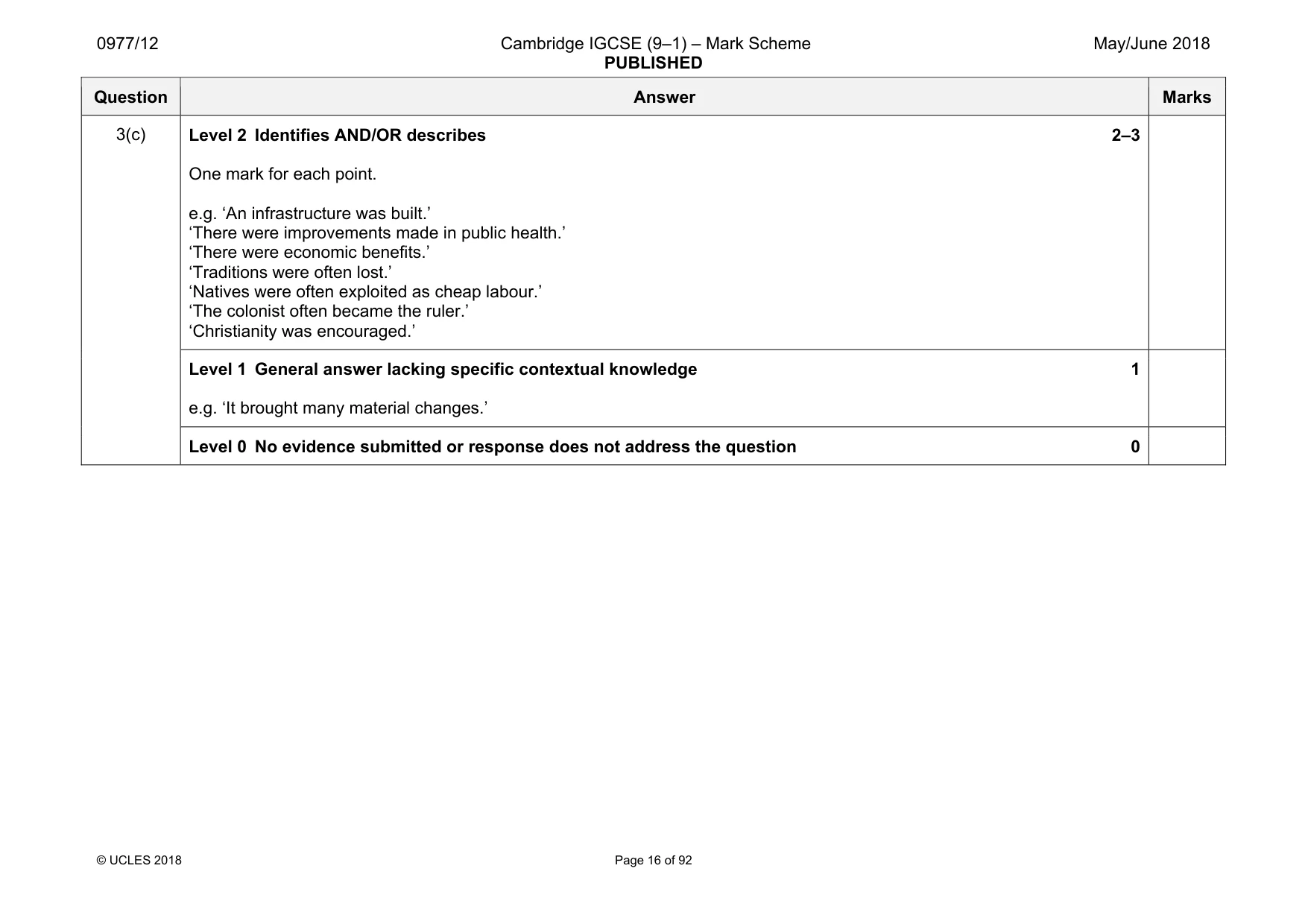
0977/12 Cambridge IGCSE (9–1) – Mark Scheme PUBLISHED May/June 2018 © UCLES 2018 Page 16 of 92 Question Answer Marks 3(c) Level 2 Identifies AND/OR describes 2–3 One mark for each point. e.g. ‘An infrastructure was built.’ ‘There were improvements made in public health.’ ‘There were economic benefits.’ ‘Traditions were often lost.’ ‘Natives were often exploited as cheap labour.’ ‘The colonist often became the ruler.’ ‘Christianity was encouraged.’ Level 1 General answer lacking specific contextual knowledge 1 e.g. ‘It brought many material changes.’ Level 0 No evidence submitted or response does not address the question 0
Mark scheme, page 17
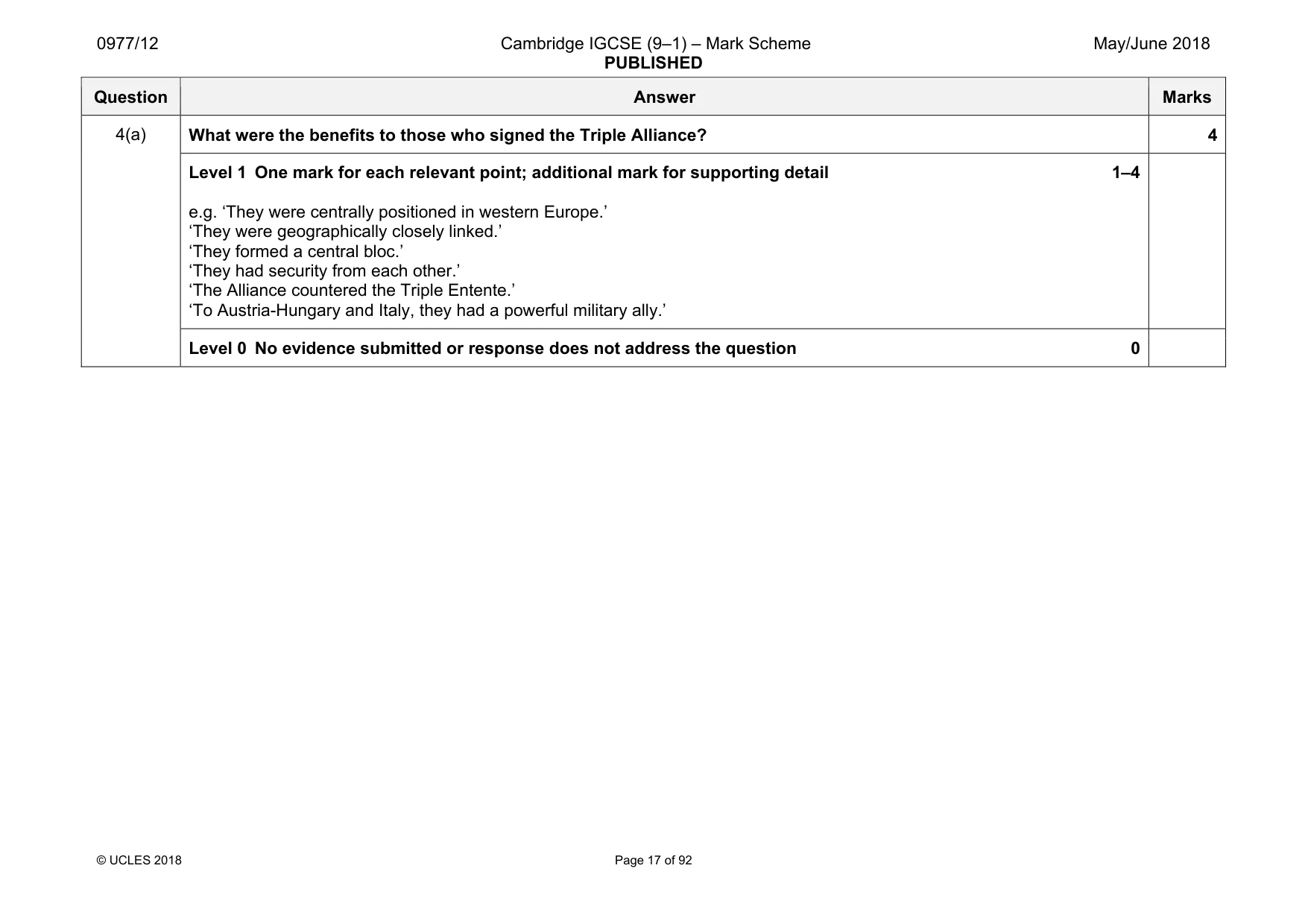
0977/12 Cambridge IGCSE (9–1) – Mark Scheme PUBLISHED May/June 2018 © UCLES 2018 Page 17 of 92 Question Answer Marks 4(a) What were the benefits to those who signed the Triple Alliance? 4 Level 1 One mark for each relevant point; additional mark for supporting detail 1–4 e.g. ‘They were centrally positioned in western Europe.’ ‘They were geographically closely linked.’ ‘They formed a central bloc.’ ‘They had security from each other.’ ‘The Alliance countered the Triple Entente.’ ‘To Austria-Hungary and Italy, they had a powerful military ally.’ Level 0 No evidence submitted or response does not address the question 0
Mark scheme, page 18
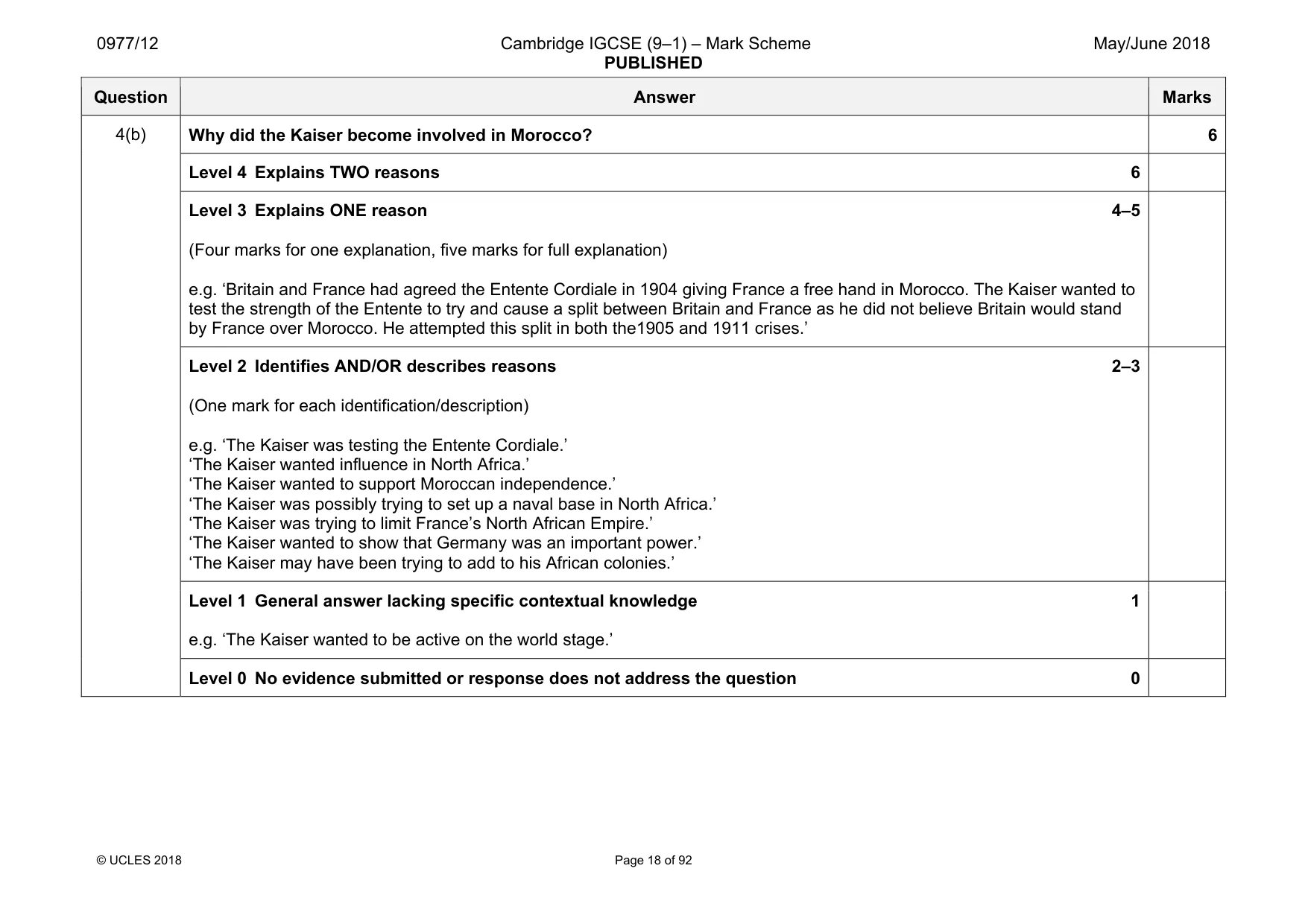
0977/12 Cambridge IGCSE (9–1) – Mark Scheme PUBLISHED May/June 2018 © UCLES 2018 Page 18 of 92 Question Answer Marks 4(b) Why did the Kaiser become involved in Morocco? 6 Level 4 Explains TWO reasons 6 Level 3 Explains ONE reason 4–5 (Four marks for one explanation, five marks for full explanation) e.g. ‘Britain and France had agreed the Entente Cordiale in 1904 giving France a free hand in Morocco. The Kaiser wanted to test the strength of the Entente to try and cause a split between Britain and France as he did not believe Britain would stand by France over Morocco. He attempted this split in both the1905 and 1911 crises.’ Level 2 Identifies AND/OR describes reasons 2–3 (One mark for each identification/description) e.g. ‘The Kaiser was testing the Entente Cordiale.’ ‘The Kaiser wanted influence in North Africa.’ ‘The Kaiser wanted to support Moroccan independence.’ ‘The Kaiser was possibly trying to set up a naval base in North Africa.’ ‘The Kaiser was trying to limit France’s North African Empire.’ ‘The Kaiser wanted to show that Germany was an important power.’ ‘The Kaiser may have been trying to add to his African colonies.’ Level 1 General answer lacking specific contextual knowledge 1 e.g. ‘The Kaiser wanted to be active on the world stage.’ Level 0 No evidence submitted or response does not address the question 0
Mark scheme, page 19
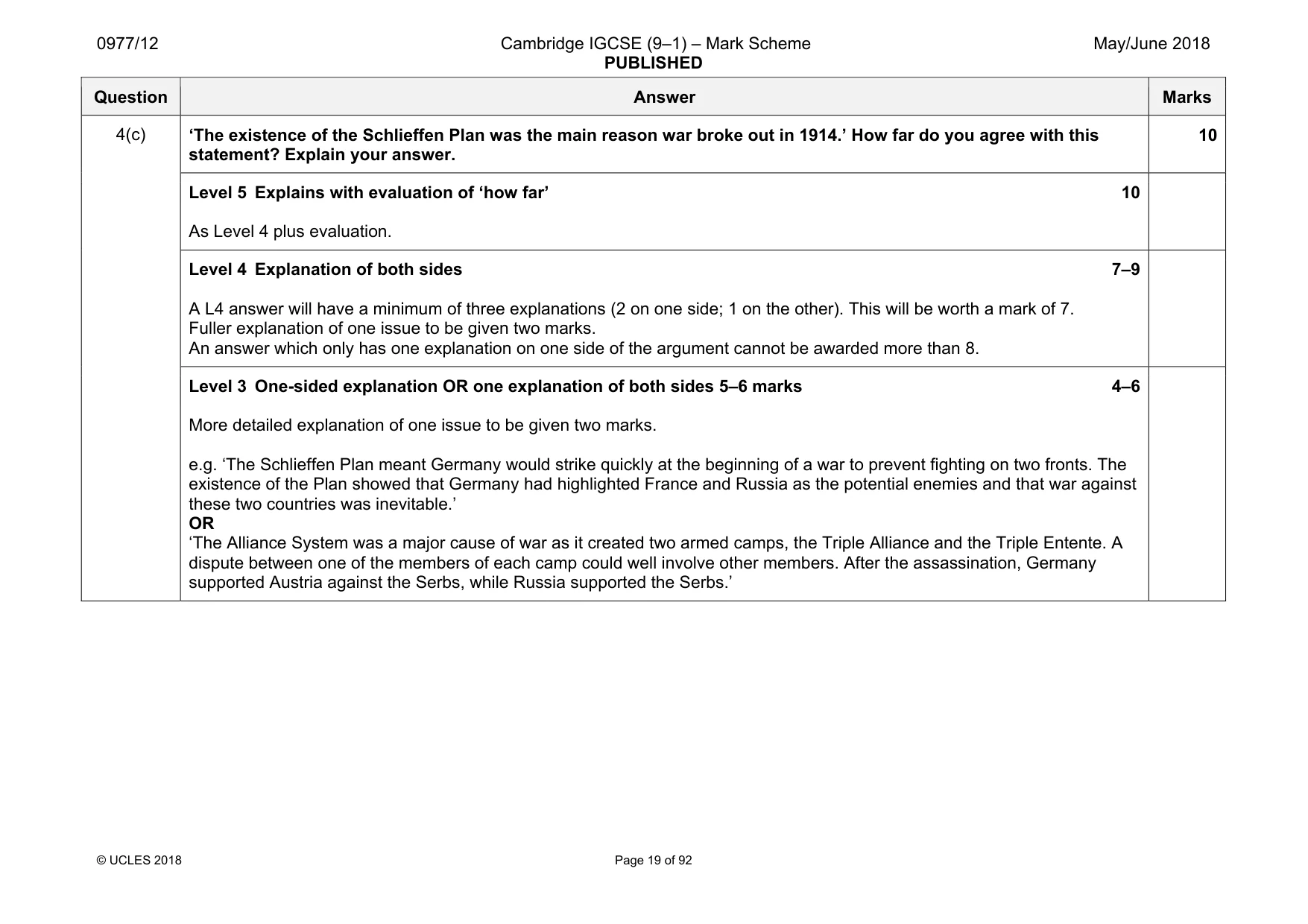
0977/12 Cambridge IGCSE (9–1) – Mark Scheme PUBLISHED May/June 2018 © UCLES 2018 Page 19 of 92 Question Answer Marks 4(c) ‘The existence of the Schlieffen Plan was the main reason war broke out in 1914.’ How far do you agree with this statement? Explain your answer. 10 Level 5 Explains with evaluation of ‘how far’ 10 As Level 4 plus evaluation. Level 4 Explanation of both sides 7–9 A L4 answer will have a minimum of three explanations (2 on one side; 1 on the other). This will be worth a mark of 7. Fuller explanation of one issue to be given two marks. An answer which only has one explanation on one side of the argument cannot be awarded more than 8. Level 3 One-sided explanation OR one explanation of both sides 5–6 marks 4–6 More detailed explanation of one issue to be given two marks. e.g. ‘The Schlieffen Plan meant Germany would strike quickly at the beginning of a war to prevent fighting on two fronts. The existence of the Plan showed that Germany had highlighted France and Russia as the potential enemies and that war against these two countries was inevitable.’ OR ‘The Alliance System was a major cause of war as it created two armed camps, the Triple Alliance and the Triple Entente. A dispute between one of the members of each camp could well involve other members. After the assassination, Germany supported Austria against the Serbs, while Russia supported the Serbs.’
Mark scheme, page 20
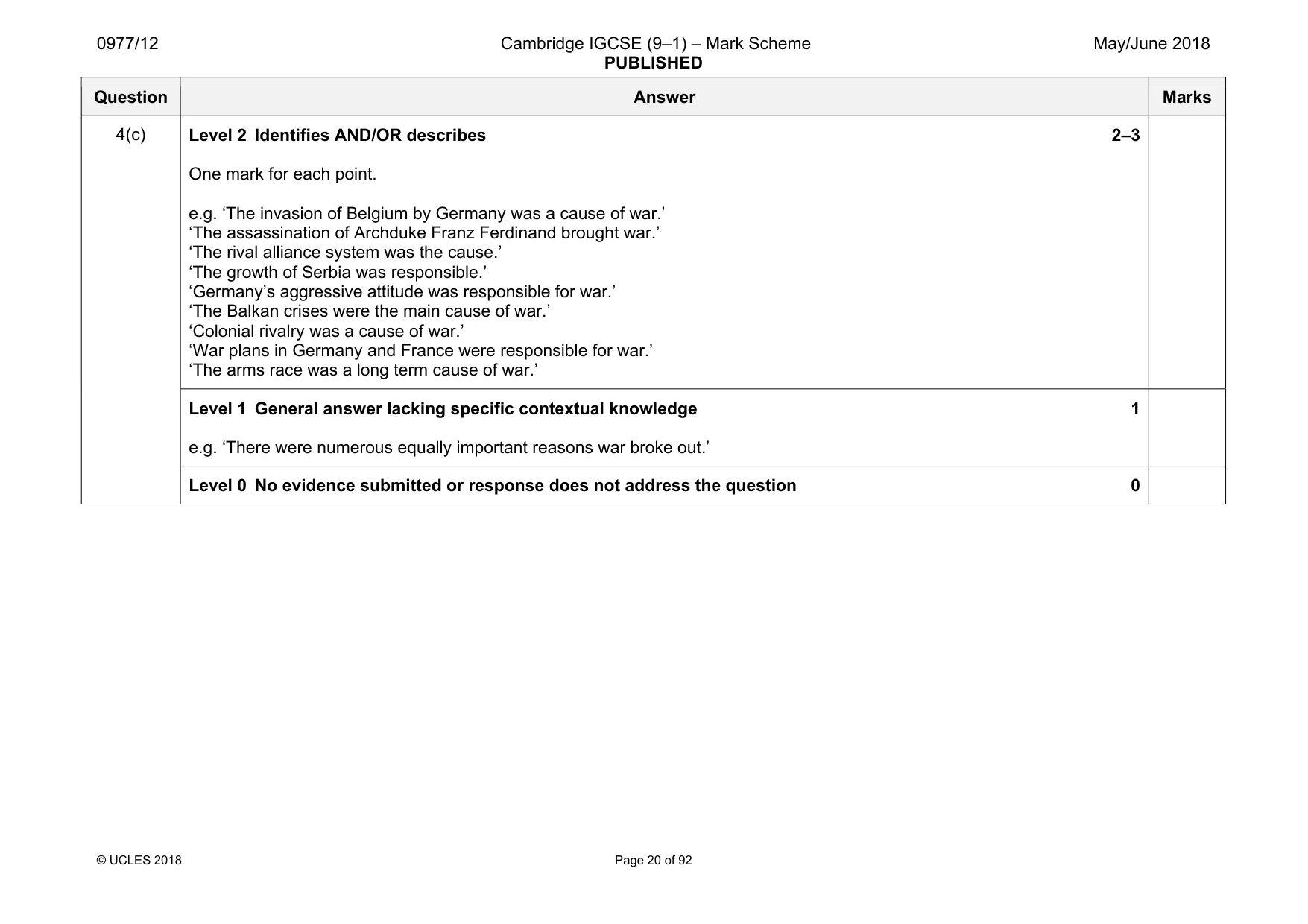
0977/12 Cambridge IGCSE (9–1) – Mark Scheme PUBLISHED May/June 2018 © UCLES 2018 Page 20 of 92 Question Answer Marks 4(c) Level 2 Identifies AND/OR describes 2–3 One mark for each point. e.g. ‘The invasion of Belgium by Germany was a cause of war.’ ‘The assassination of Archduke Franz Ferdinand brought war.’ ‘The rival alliance system was the cause.’ ‘The growth of Serbia was responsible.’ ‘Germany’s aggressive attitude was responsible for war.’ ‘The Balkan crises were the main cause of war.’ ‘Colonial rivalry was a cause of war.’ ‘War plans in Germany and France were responsible for war.’ ‘The arms race was a long term cause of war.’ Level 1 General answer lacking specific contextual knowledge 1 e.g. ‘There were numerous equally important reasons war broke out.’ Level 0 No evidence submitted or response does not address the question 0
Mark scheme, page 21
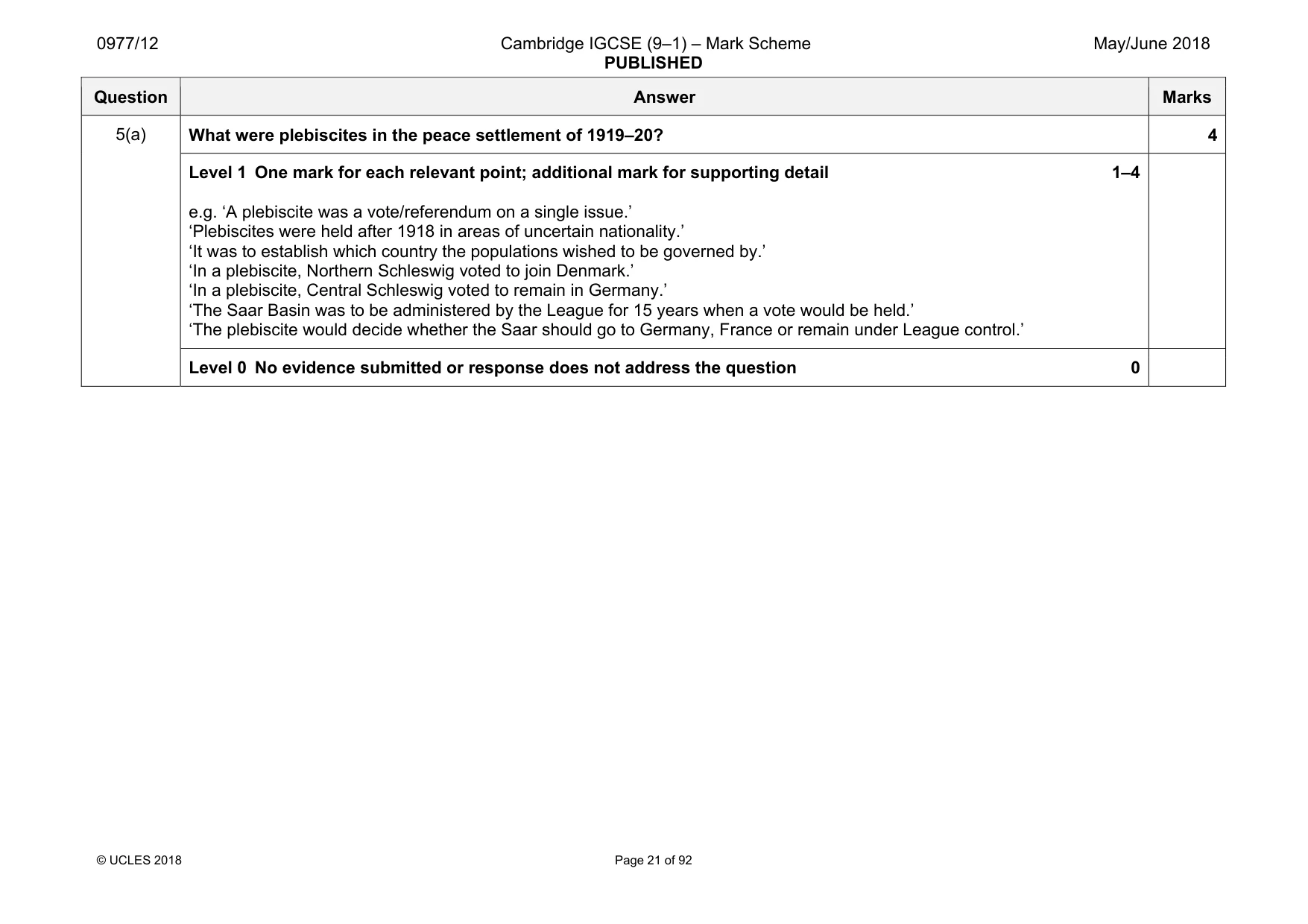
0977/12 Cambridge IGCSE (9–1) – Mark Scheme PUBLISHED May/June 2018 © UCLES 2018 Page 21 of 92 Question Answer Marks 5(a) What were plebiscites in the peace settlement of 1919–20? 4 Level 1 One mark for each relevant point; additional mark for supporting detail 1–4 e.g. ‘A plebiscite was a vote/referendum on a single issue.’ ‘Plebiscites were held after 1918 in areas of uncertain nationality.’ ‘It was to establish which country the populations wished to be governed by.’ ‘In a plebiscite, Northern Schleswig voted to join Denmark.’ ‘In a plebiscite, Central Schleswig voted to remain in Germany.’ ‘The Saar Basin was to be administered by the League for 15 years when a vote would be held.’ ‘The plebiscite would decide whether the Saar should go to Germany, France or remain under League control.’ Level 0 No evidence submitted or response does not address the question 0
Mark scheme, page 22
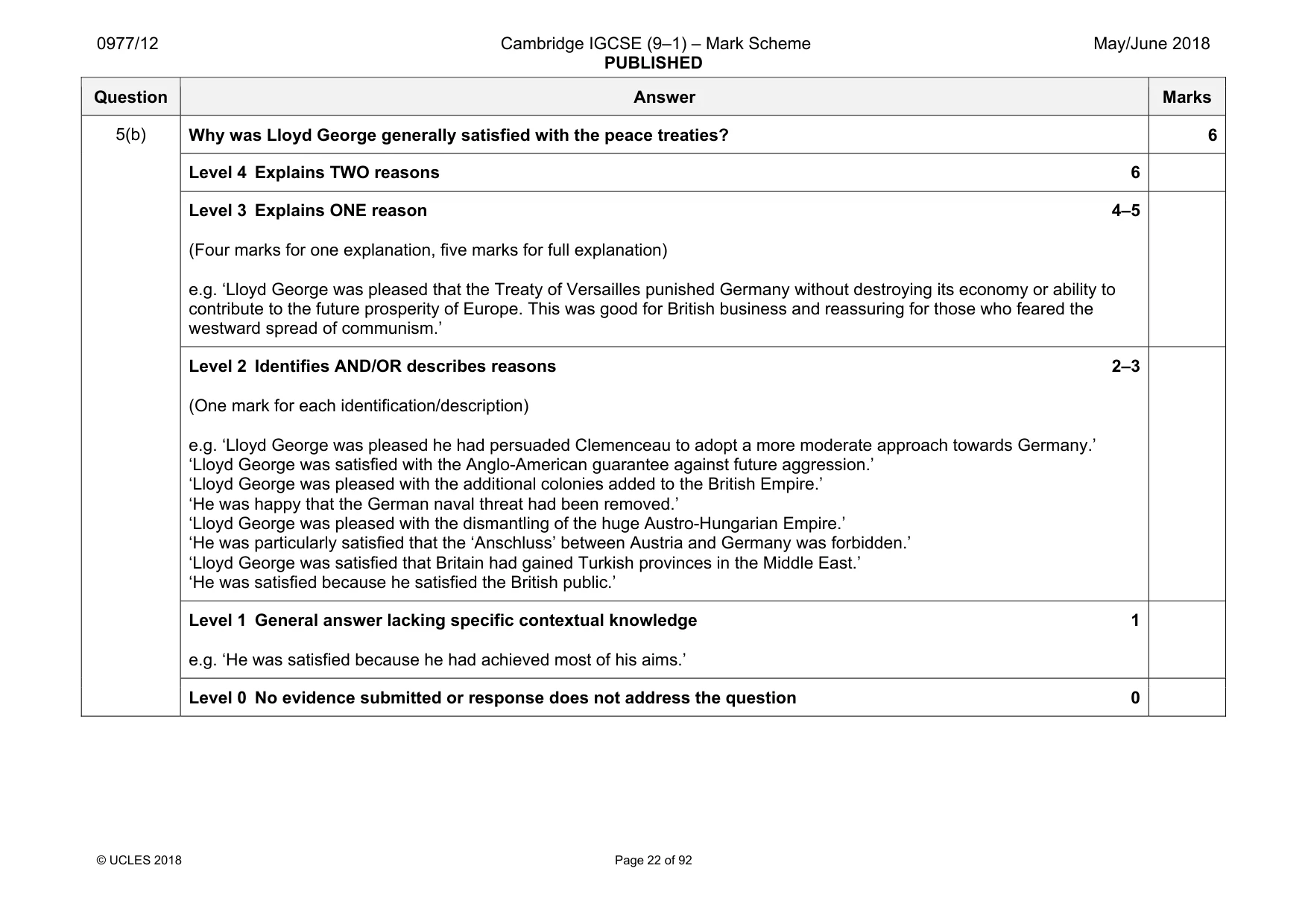
0977/12 Cambridge IGCSE (9–1) – Mark Scheme PUBLISHED May/June 2018 © UCLES 2018 Page 22 of 92 Question Answer Marks 5(b) Why was Lloyd George generally satisfied with the peace treaties? 6 Level 4 Explains TWO reasons 6 Level 3 Explains ONE reason 4–5 (Four marks for one explanation, five marks for full explanation) e.g. ‘Lloyd George was pleased that the Treaty of Versailles punished Germany without destroying its economy or ability to contribute to the future prosperity of Europe. This was good for British business and reassuring for those who feared the westward spread of communism.’ Level 2 Identifies AND/OR describes reasons 2–3 (One mark for each identification/description) e.g. ‘Lloyd George was pleased he had persuaded Clemenceau to adopt a more moderate approach towards Germany.’ ‘Lloyd George was satisfied with the Anglo-American guarantee against future aggression.’ ‘Lloyd George was pleased with the additional colonies added to the British Empire.’ ‘He was happy that the German naval threat had been removed.’ ‘Lloyd George was pleased with the dismantling of the huge Austro-Hungarian Empire.’ ‘He was particularly satisfied that the ‘Anschluss’ between Austria and Germany was forbidden.’ ‘Lloyd George was satisfied that Britain had gained Turkish provinces in the Middle East.’ ‘He was satisfied because he satisfied the British public.’ Level 1 General answer lacking specific contextual knowledge 1 e.g. ‘He was satisfied because he had achieved most of his aims.’ Level 0 No evidence submitted or response does not address the question 0
Mark scheme, page 23
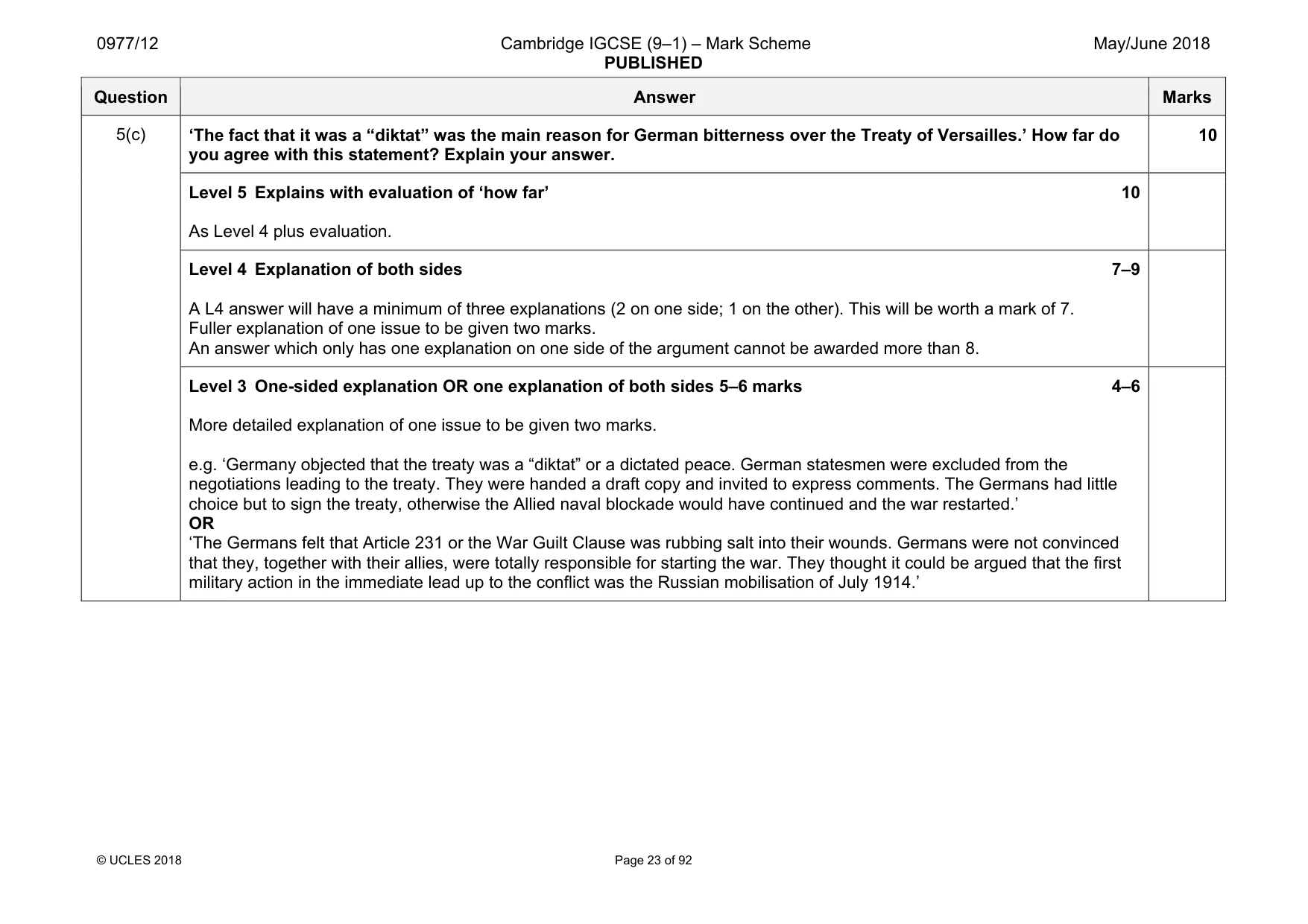
0977/12 Cambridge IGCSE (9–1) – Mark Scheme PUBLISHED May/June 2018 © UCLES 2018 Page 23 of 92 Question Answer Marks 5(c) ‘The fact that it was a “diktat” was the main reason for German bitterness over the Treaty of Versailles.’ How far do you agree with this statement? Explain your answer. 10 Level 5 Explains with evaluation of ‘how far’ 10 As Level 4 plus evaluation. Level 4 Explanation of both sides 7–9 A L4 answer will have a minimum of three explanations (2 on one side; 1 on the other). This will be worth a mark of 7. Fuller explanation of one issue to be given two marks. An answer which only has one explanation on one side of the argument cannot be awarded more than 8. Level 3 One-sided explanation OR one explanation of both sides 5–6 marks 4–6 More detailed explanation of one issue to be given two marks. e.g. ‘Germany objected that the treaty was a “diktat” or a dictated peace. German statesmen were excluded from the negotiations leading to the treaty. They were handed a draft copy and invited to express comments. The Germans had little choice but to sign the treaty, otherwise the Allied naval blockade would have continued and the war restarted.’ OR ‘The Germans felt that Article 231 or the War Guilt Clause was rubbing salt into their wounds. Germans were not convinced that they, together with their allies, were totally responsible for starting the war. They thought it could be argued that the first military action in the immediate lead up to the conflict was the Russian mobilisation of July 1914.’
Mark scheme, page 24
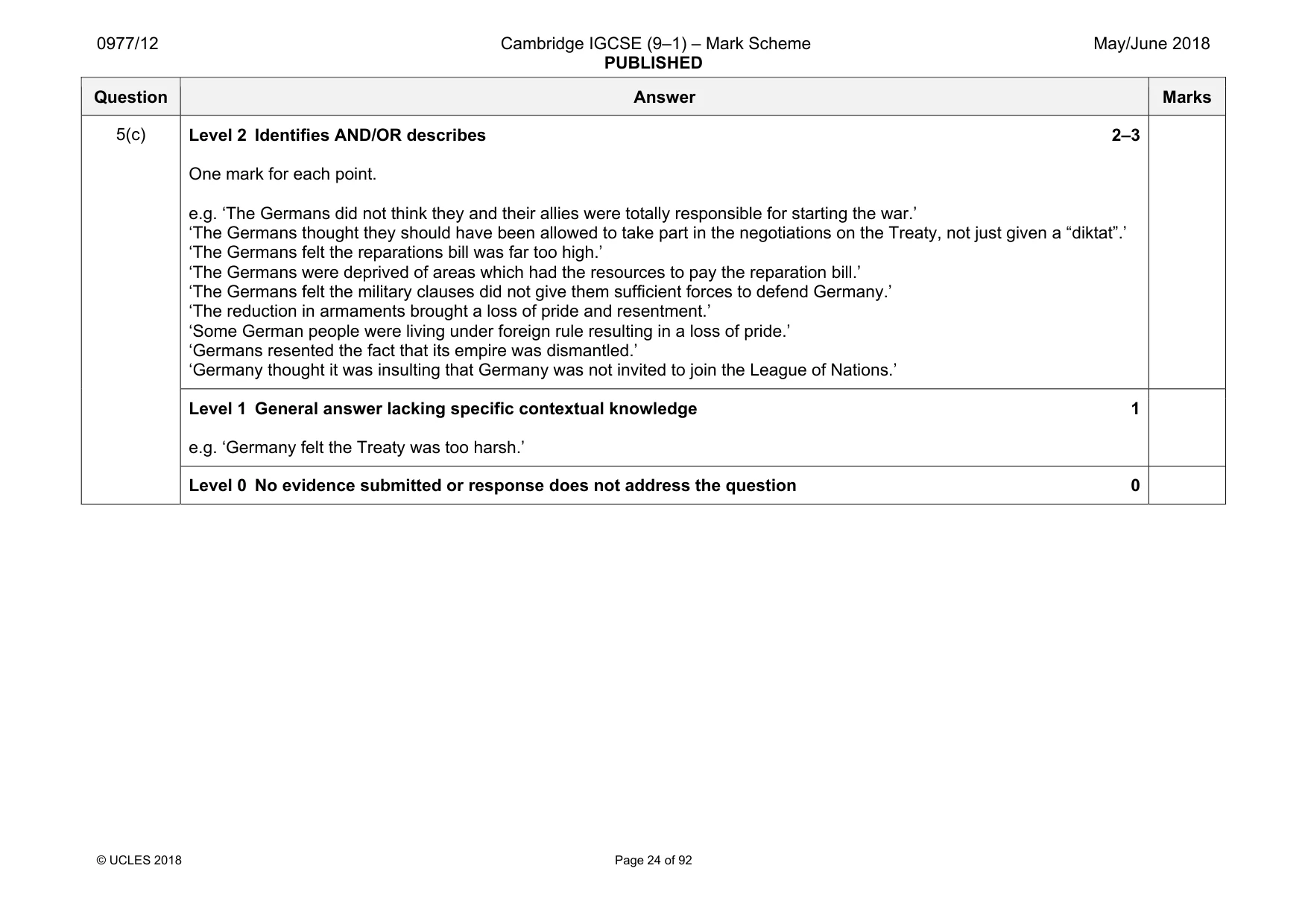
0977/12 Cambridge IGCSE (9–1) – Mark Scheme PUBLISHED May/June 2018 © UCLES 2018 Page 24 of 92 Question Answer Marks 5(c) Level 2 Identifies AND/OR describes 2–3 One mark for each point. e.g. ‘The Germans did not think they and their allies were totally responsible for starting the war.’ ‘The Germans thought they should have been allowed to take part in the negotiations on the Treaty, not just given a “diktat”.’ ‘The Germans felt the reparations bill was far too high.’ ‘The Germans were deprived of areas which had the resources to pay the reparation bill.’ ‘The Germans felt the military clauses did not give them sufficient forces to defend Germany.’ ‘The reduction in armaments brought a loss of pride and resentment.’ ‘Some German people were living under foreign rule resulting in a loss of pride.’ ‘Germans resented the fact that its empire was dismantled.’ ‘Germany thought it was insulting that Germany was not invited to join the League of Nations.’ Level 1 General answer lacking specific contextual knowledge 1 e.g. ‘Germany felt the Treaty was too harsh.’ Level 0 No evidence submitted or response does not address the question 0
Mark scheme, page 25
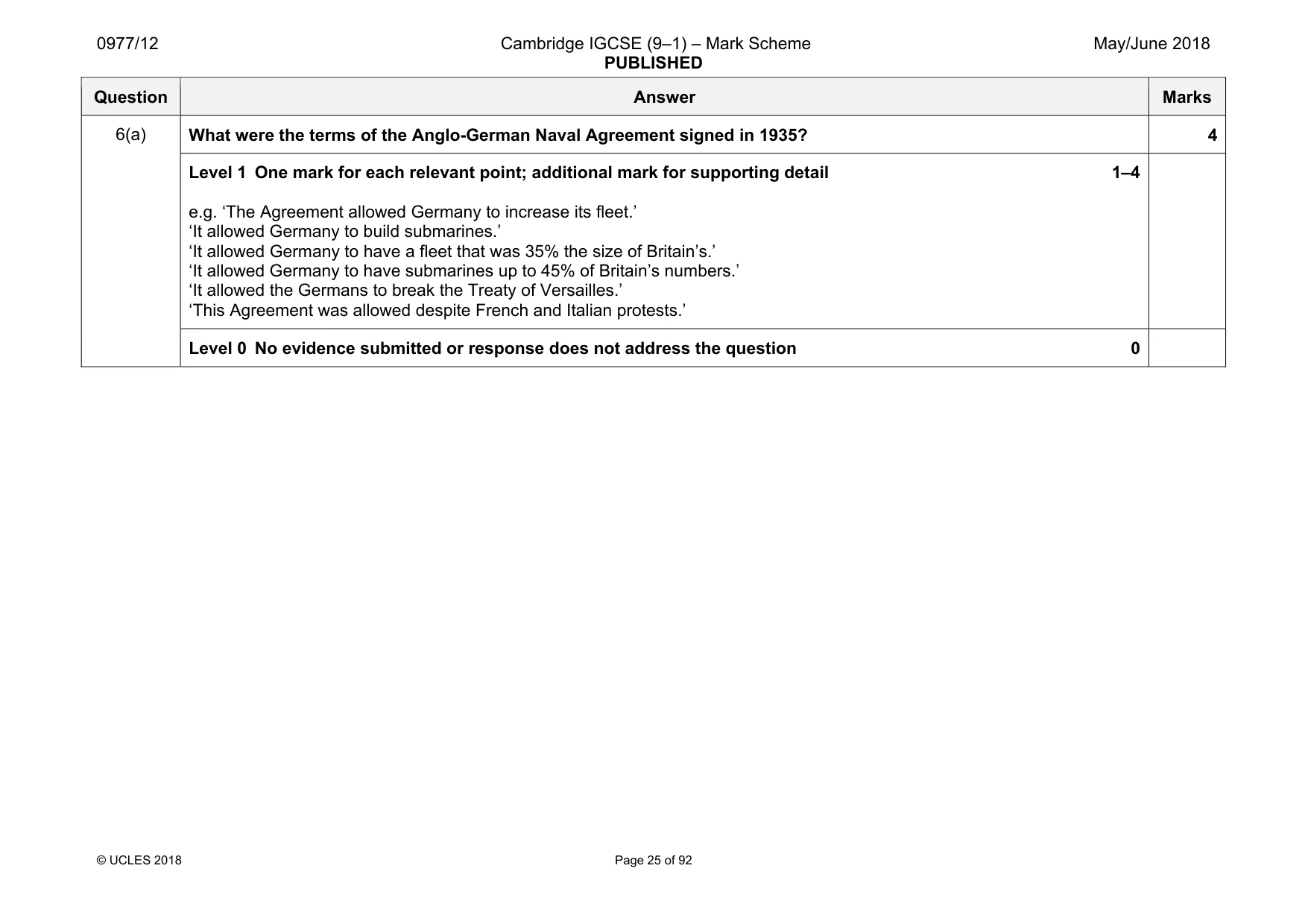
0977/12 Cambridge IGCSE (9–1) – Mark Scheme PUBLISHED May/June 2018 © UCLES 2018 Page 25 of 92 Question Answer Marks 6(a) What were the terms of the Anglo-German Naval Agreement signed in 1935? 4 Level 1 One mark for each relevant point; additional mark for supporting detail 1–4 e.g. ‘The Agreement allowed Germany to increase its fleet.’ ‘It allowed Germany to build submarines.’ ‘It allowed Germany to have a fleet that was 35% the size of Britain’s.’ ‘It allowed Germany to have submarines up to 45% of Britain’s numbers.’ ‘It allowed the Germans to break the Treaty of Versailles.’ ‘This Agreement was allowed despite French and Italian protests.’ Level 0 No evidence submitted or response does not address the question 0
Mark scheme, page 26
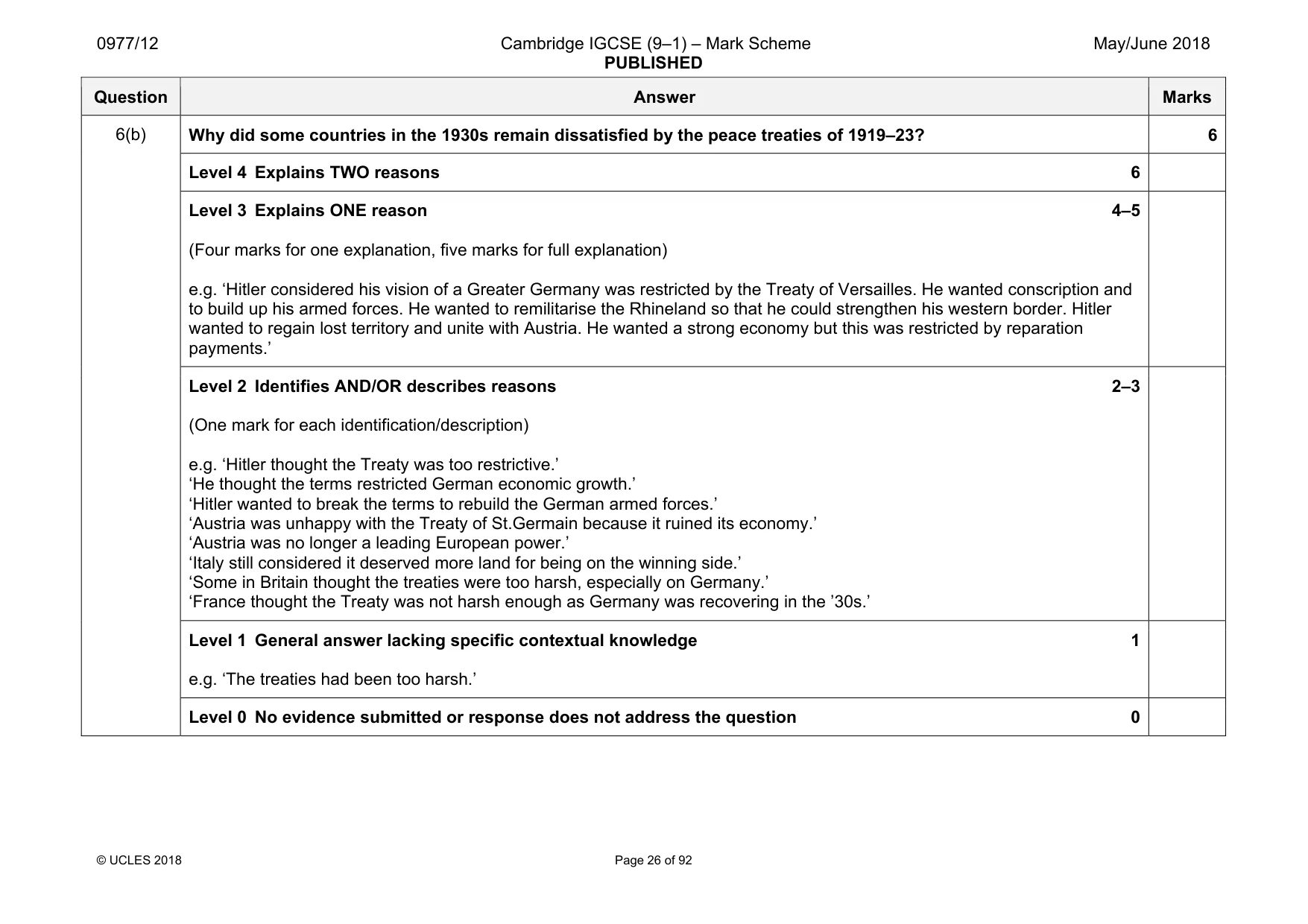
0977/12 Cambridge IGCSE (9–1) – Mark Scheme PUBLISHED May/June 2018 © UCLES 2018 Page 26 of 92 Question Answer Marks 6(b) Why did some countries in the 1930s remain dissatisfied by the peace treaties of 1919–23? 6 Level 4 Explains TWO reasons 6 Level 3 Explains ONE reason 4–5 (Four marks for one explanation, five marks for full explanation) e.g. ‘Hitler considered his vision of a Greater Germany was restricted by the Treaty of Versailles. He wanted conscription and to build up his armed forces. He wanted to remilitarise the Rhineland so that he could strengthen his western border. Hitler wanted to regain lost territory and unite with Austria. He wanted a strong economy but this was restricted by reparation payments.’ Level 2 Identifies AND/OR describes reasons 2–3 (One mark for each identification/description) e.g. ‘Hitler thought the Treaty was too restrictive.’ ‘He thought the terms restricted German economic growth.’ ‘Hitler wanted to break the terms to rebuild the German armed forces.’ ‘Austria was unhappy with the Treaty of St.Germain because it ruined its economy.’ ‘Austria was no longer a leading European power.’ ‘Italy still considered it deserved more land for being on the winning side.’ ‘Some in Britain thought the treaties were too harsh, especially on Germany.’ ‘France thought the Treaty was not harsh enough as Germany was recovering in the ’30s.’ Level 1 General answer lacking specific contextual knowledge 1 e.g. ‘The treaties had been too harsh.’ Level 0 No evidence submitted or response does not address the question 0
Mark scheme, page 27
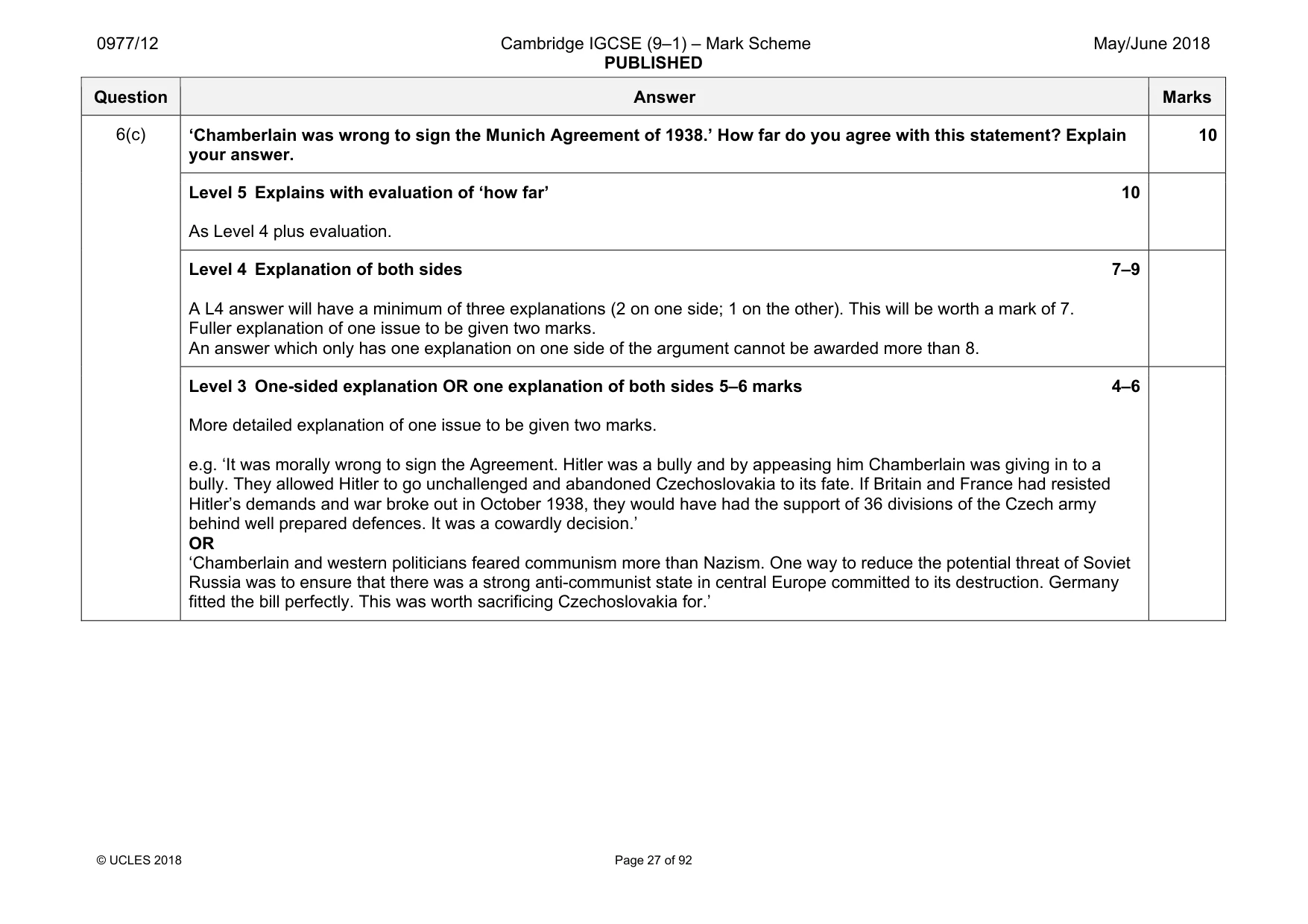
0977/12 Cambridge IGCSE (9–1) – Mark Scheme PUBLISHED May/June 2018 © UCLES 2018 Page 27 of 92 Question Answer Marks 6(c) ‘Chamberlain was wrong to sign the Munich Agreement of 1938.’ How far do you agree with this statement? Explain your answer. 10 Level 5 Explains with evaluation of ‘how far’ 10 As Level 4 plus evaluation. Level 4 Explanation of both sides 7–9 A L4 answer will have a minimum of three explanations (2 on one side; 1 on the other). This will be worth a mark of 7. Fuller explanation of one issue to be given two marks. An answer which only has one explanation on one side of the argument cannot be awarded more than 8. Level 3 One-sided explanation OR one explanation of both sides 5–6 marks 4–6 More detailed explanation of one issue to be given two marks. e.g. ‘It was morally wrong to sign the Agreement. Hitler was a bully and by appeasing him Chamberlain was giving in to a bully. They allowed Hitler to go unchallenged and abandoned Czechoslovakia to its fate. If Britain and France had resisted Hitler’s demands and war broke out in October 1938, they would have had the support of 36 divisions of the Czech army behind well prepared defences. It was a cowardly decision.’ OR ‘Chamberlain and western politicians feared communism more than Nazism. One way to reduce the potential threat of Soviet Russia was to ensure that there was a strong anti-communist state in central Europe committed to its destruction. Germany fitted the bill perfectly. This was worth sacrificing Czechoslovakia for.’
Mark scheme, page 28
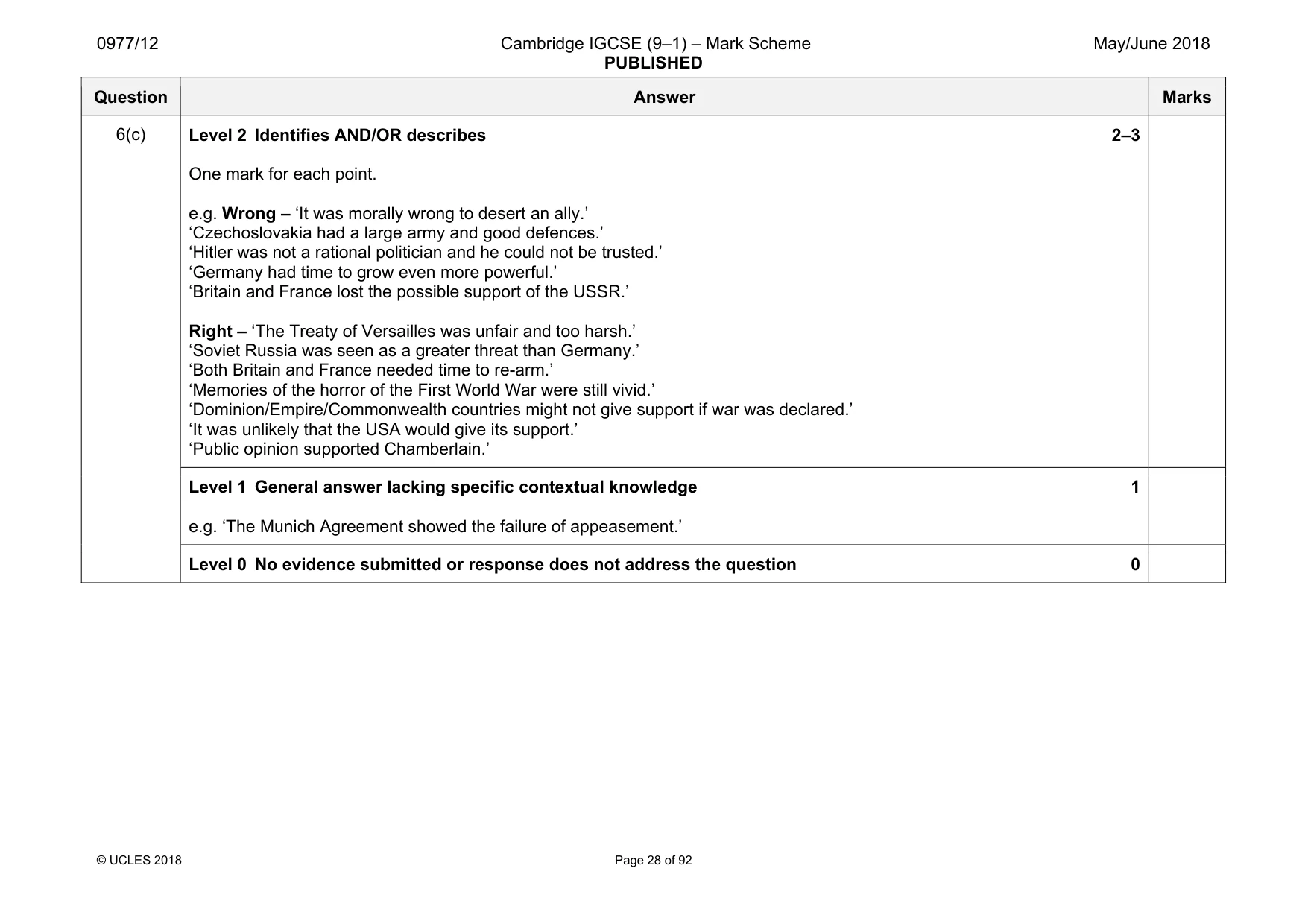
0977/12 Cambridge IGCSE (9–1) – Mark Scheme PUBLISHED May/June 2018 © UCLES 2018 Page 28 of 92 Question Answer Marks 6(c) Level 2 Identifies AND/OR describes 2–3 One mark for each point. e.g. Wrong – ‘It was morally wrong to desert an ally.’ ‘Czechoslovakia had a large army and good defences.’ ‘Hitler was not a rational politician and he could not be trusted.’ ‘Germany had time to grow even more powerful.’ ‘Britain and France lost the possible support of the USSR.’ Right – ‘The Treaty of Versailles was unfair and too harsh.’ ‘Soviet Russia was seen as a greater threat than Germany.’ ‘Both Britain and France needed time to re-arm.’ ‘Memories of the horror of the First World War were still vivid.’ ‘Dominion/Empire/Commonwealth countries might not give support if war was declared.’ ‘It was unlikely that the USA would give its support.’ ‘Public opinion supported Chamberlain.’ Level 1 General answer lacking specific contextual knowledge 1 e.g. ‘The Munich Agreement showed the failure of appeasement.’ Level 0 No evidence submitted or response does not address the question 0
Mark scheme, page 29
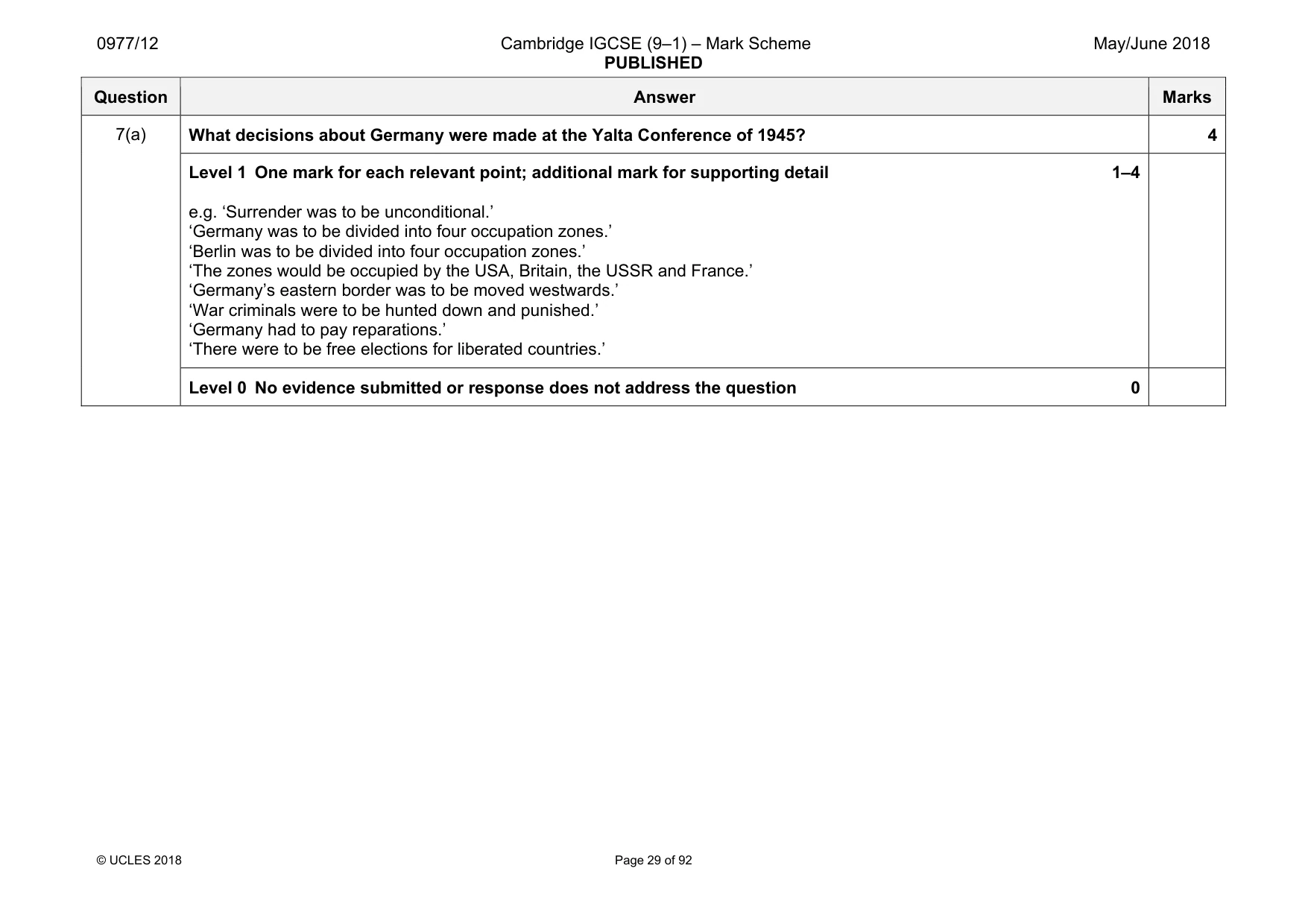
0977/12 Cambridge IGCSE (9–1) – Mark Scheme PUBLISHED May/June 2018 © UCLES 2018 Page 29 of 92 Question Answer Marks 7(a) What decisions about Germany were made at the Yalta Conference of 1945? 4 Level 1 One mark for each relevant point; additional mark for supporting detail 1–4 e.g. ‘Surrender was to be unconditional.’ ‘Germany was to be divided into four occupation zones.’ ‘Berlin was to be divided into four occupation zones.’ ‘The zones would be occupied by the USA, Britain, the USSR and France.’ ‘Germany’s eastern border was to be moved westwards.’ ‘War criminals were to be hunted down and punished.’ ‘Germany had to pay reparations.’ ‘There were to be free elections for liberated countries.’ Level 0 No evidence submitted or response does not address the question 0
Mark scheme, page 30
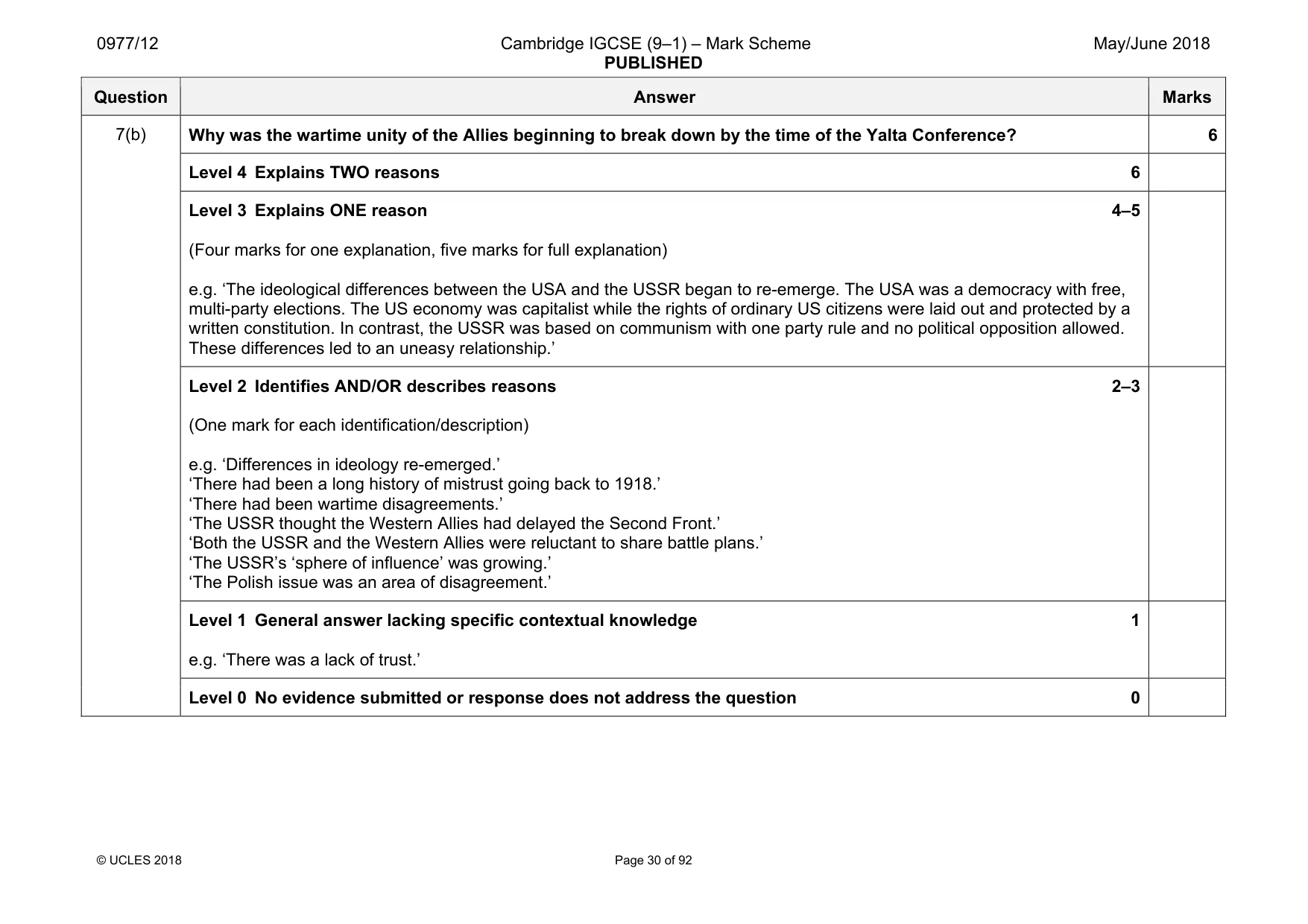
0977/12 Cambridge IGCSE (9–1) – Mark Scheme PUBLISHED May/June 2018 © UCLES 2018 Page 30 of 92 Question Answer Marks 7(b) Why was the wartime unity of the Allies beginning to break down by the time of the Yalta Conference? 6 Level 4 Explains TWO reasons 6 Level 3 Explains ONE reason 4–5 (Four marks for one explanation, five marks for full explanation) e.g. ‘The ideological differences between the USA and the USSR began to re-emerge. The USA was a democracy with free, multi-party elections. The US economy was capitalist while the rights of ordinary US citizens were laid out and protected by a written constitution. In contrast, the USSR was based on communism with one party rule and no political opposition allowed. These differences led to an uneasy relationship.’ Level 2 Identifies AND/OR describes reasons 2–3 (One mark for each identification/description) e.g. ‘Differences in ideology re-emerged.’ ‘There had been a long history of mistrust going back to 1918.’ ‘There had been wartime disagreements.’ ‘The USSR thought the Western Allies had delayed the Second Front.’ ‘Both the USSR and the Western Allies were reluctant to share battle plans.’ ‘The USSR’s ‘sphere of influence’ was growing.’ ‘The Polish issue was an area of disagreement.’ Level 1 General answer lacking specific contextual knowledge 1 e.g. ‘There was a lack of trust.’ Level 0 No evidence submitted or response does not address the question 0
Mark scheme, page 31
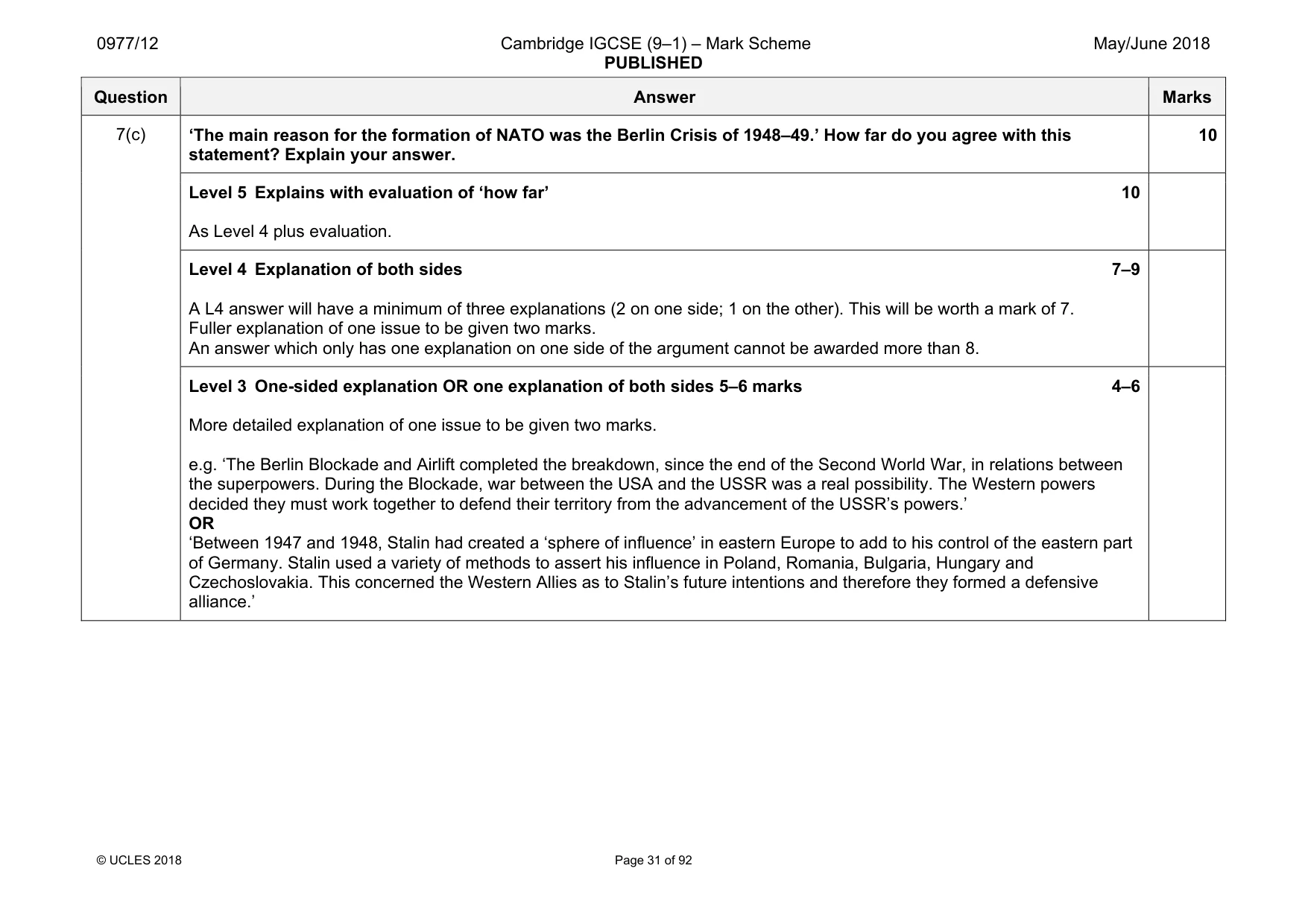
0977/12 Cambridge IGCSE (9–1) – Mark Scheme PUBLISHED May/June 2018 © UCLES 2018 Page 31 of 92 Question Answer Marks 7(c) ‘The main reason for the formation of NATO was the Berlin Crisis of 1948–49.’ How far do you agree with this statement? Explain your answer. 10 Level 5 Explains with evaluation of ‘how far’ 10 As Level 4 plus evaluation. Level 4 Explanation of both sides 7–9 A L4 answer will have a minimum of three explanations (2 on one side; 1 on the other). This will be worth a mark of 7. Fuller explanation of one issue to be given two marks. An answer which only has one explanation on one side of the argument cannot be awarded more than 8. Level 3 One-sided explanation OR one explanation of both sides 5–6 marks 4–6 More detailed explanation of one issue to be given two marks. e.g. ‘The Berlin Blockade and Airlift completed the breakdown, since the end of the Second World War, in relations between the superpowers. During the Blockade, war between the USA and the USSR was a real possibility. The Western powers decided they must work together to defend their territory from the advancement of the USSR’s powers.’ OR ‘Between 1947 and 1948, Stalin had created a ‘sphere of influence’ in eastern Europe to add to his control of the eastern part of Germany. Stalin used a variety of methods to assert his influence in Poland, Romania, Bulgaria, Hungary and Czechoslovakia. This concerned the Western Allies as to Stalin’s future intentions and therefore they formed a defensive alliance.’
Mark scheme, page 32
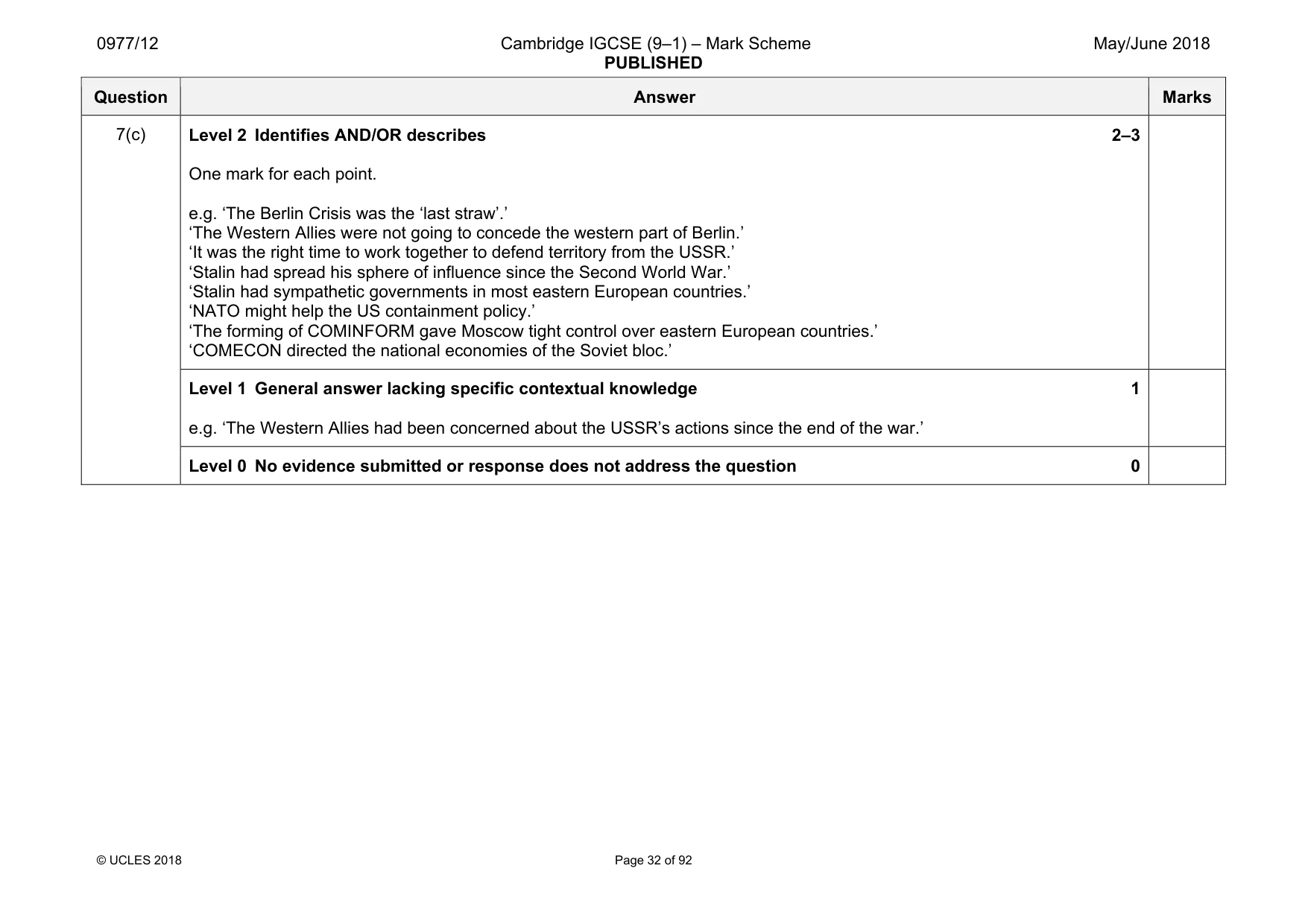
0977/12 Cambridge IGCSE (9–1) – Mark Scheme PUBLISHED May/June 2018 © UCLES 2018 Page 32 of 92 Question Answer Marks 7(c) Level 2 Identifies AND/OR describes 2–3 One mark for each point. e.g. ‘The Berlin Crisis was the ‘last straw’.’ ‘The Western Allies were not going to concede the western part of Berlin.’ ‘It was the right time to work together to defend territory from the USSR.’ ‘Stalin had spread his sphere of influence since the Second World War.’ ‘Stalin had sympathetic governments in most eastern European countries.’ ‘NATO might help the US containment policy.’ ‘The forming of COMINFORM gave Moscow tight control over eastern European countries.’ ‘COMECON directed the national economies of the Soviet bloc.’ Level 1 General answer lacking specific contextual knowledge 1 e.g. ‘The Western Allies had been concerned about the USSR’s actions since the end of the war.’ Level 0 No evidence submitted or response does not address the question 0
Mark scheme, page 33
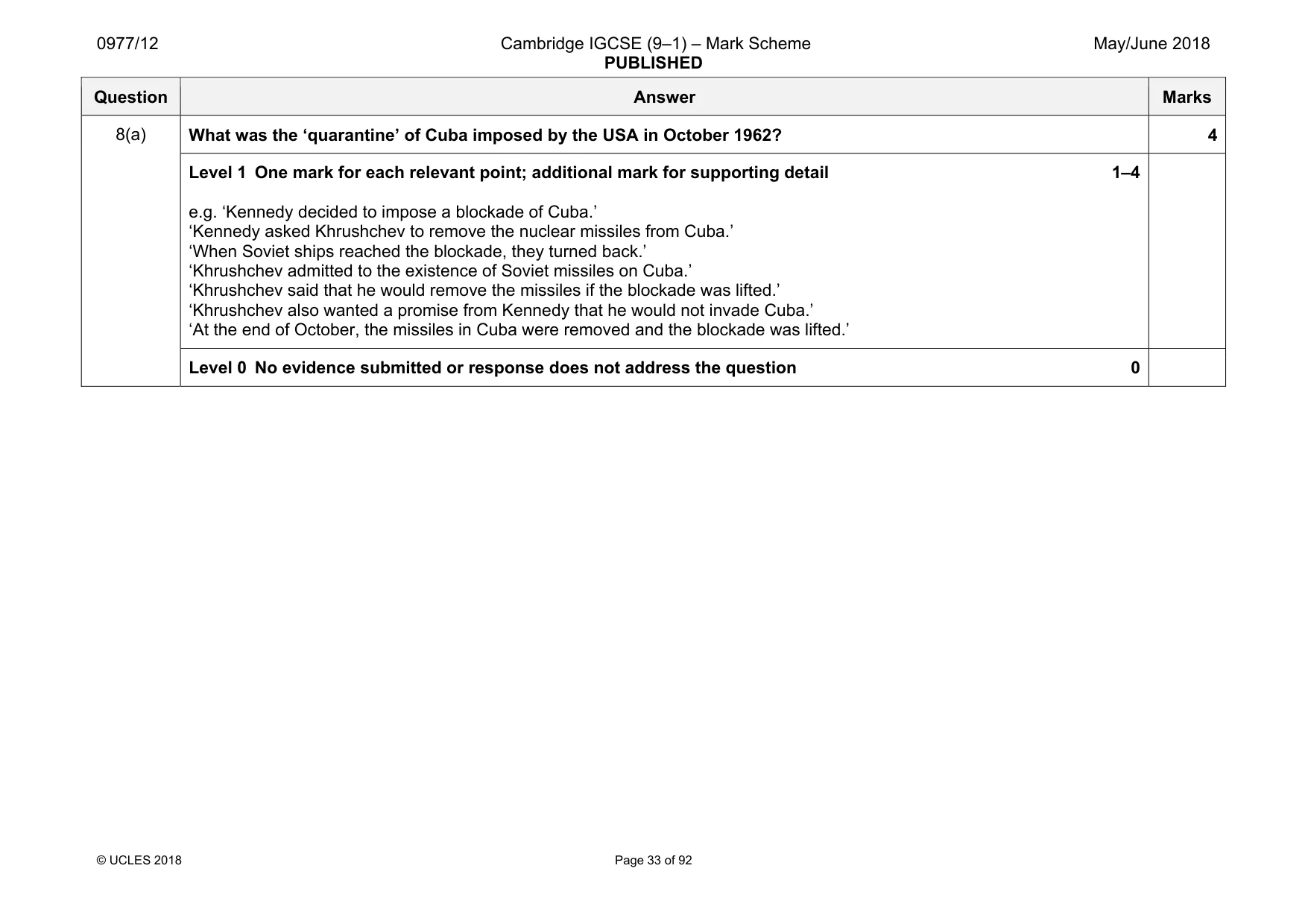
0977/12 Cambridge IGCSE (9–1) – Mark Scheme PUBLISHED May/June 2018 © UCLES 2018 Page 33 of 92 Question Answer Marks 8(a) What was the ‘quarantine’ of Cuba imposed by the USA in October 1962? 4 Level 1 One mark for each relevant point; additional mark for supporting detail 1–4 e.g. ‘Kennedy decided to impose a blockade of Cuba.’ ‘Kennedy asked Khrushchev to remove the nuclear missiles from Cuba.’ ‘When Soviet ships reached the blockade, they turned back.’ ‘Khrushchev admitted to the existence of Soviet missiles on Cuba.’ ‘Khrushchev said that he would remove the missiles if the blockade was lifted.’ ‘Khrushchev also wanted a promise from Kennedy that he would not invade Cuba.’ ‘At the end of October, the missiles in Cuba were removed and the blockade was lifted.’ Level 0 No evidence submitted or response does not address the question 0
Mark scheme, page 34
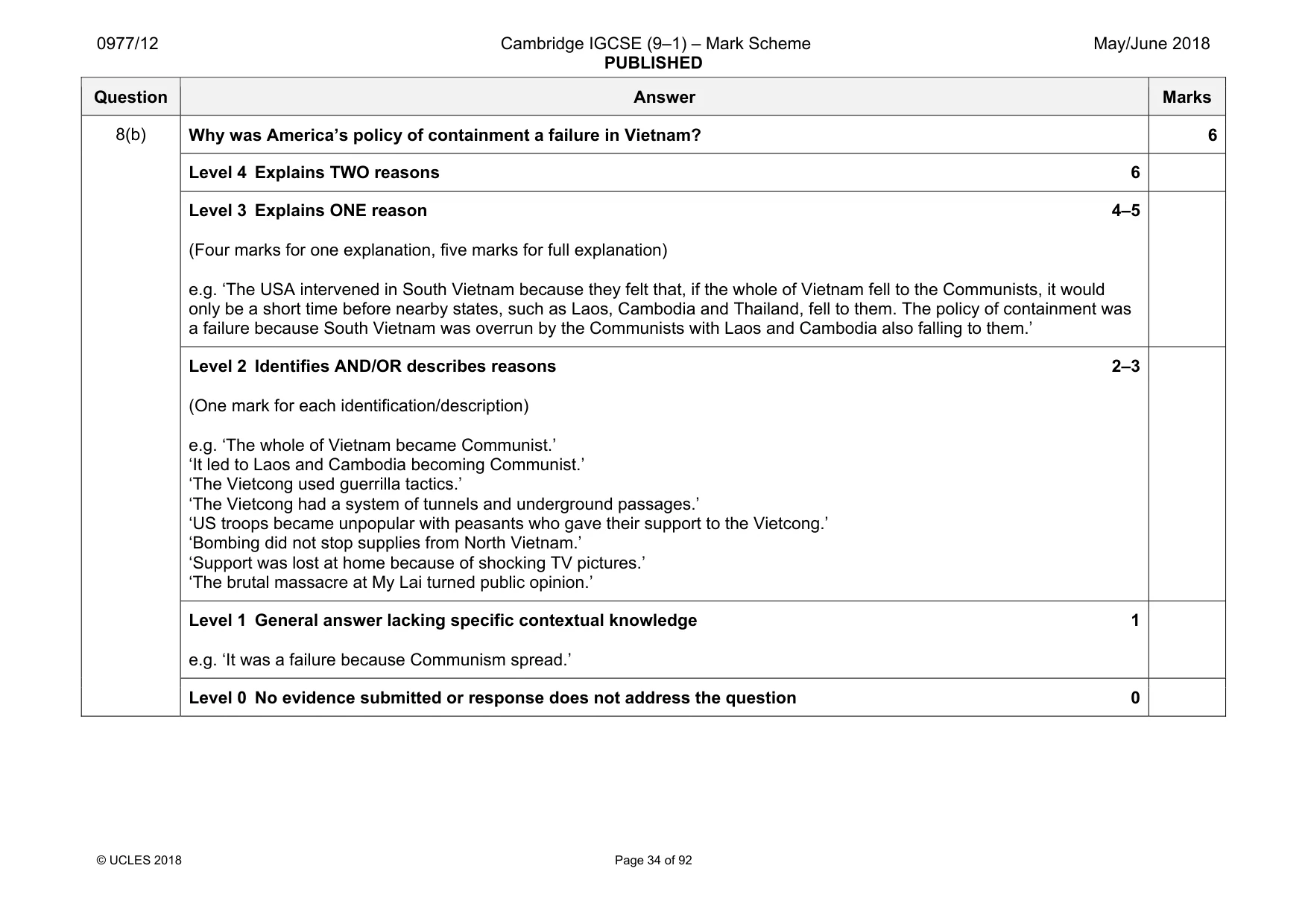
0977/12 Cambridge IGCSE (9–1) – Mark Scheme PUBLISHED May/June 2018 © UCLES 2018 Page 34 of 92 Question Answer Marks 8(b) Why was America’s policy of containment a failure in Vietnam? 6 Level 4 Explains TWO reasons 6 Level 3 Explains ONE reason 4–5 (Four marks for one explanation, five marks for full explanation) e.g. ‘The USA intervened in South Vietnam because they felt that, if the whole of Vietnam fell to the Communists, it would only be a short time before nearby states, such as Laos, Cambodia and Thailand, fell to them. The policy of containment was a failure because South Vietnam was overrun by the Communists with Laos and Cambodia also falling to them.’ Level 2 Identifies AND/OR describes reasons 2–3 (One mark for each identification/description) e.g. ‘The whole of Vietnam became Communist.’ ‘It led to Laos and Cambodia becoming Communist.’ ‘The Vietcong used guerrilla tactics.’ ‘The Vietcong had a system of tunnels and underground passages.’ ‘US troops became unpopular with peasants who gave their support to the Vietcong.’ ‘Bombing did not stop supplies from North Vietnam.’ ‘Support was lost at home because of shocking TV pictures.’ ‘The brutal massacre at My Lai turned public opinion.’ Level 1 General answer lacking specific contextual knowledge 1 e.g. ‘It was a failure because Communism spread.’ Level 0 No evidence submitted or response does not address the question 0
Mark scheme, page 35
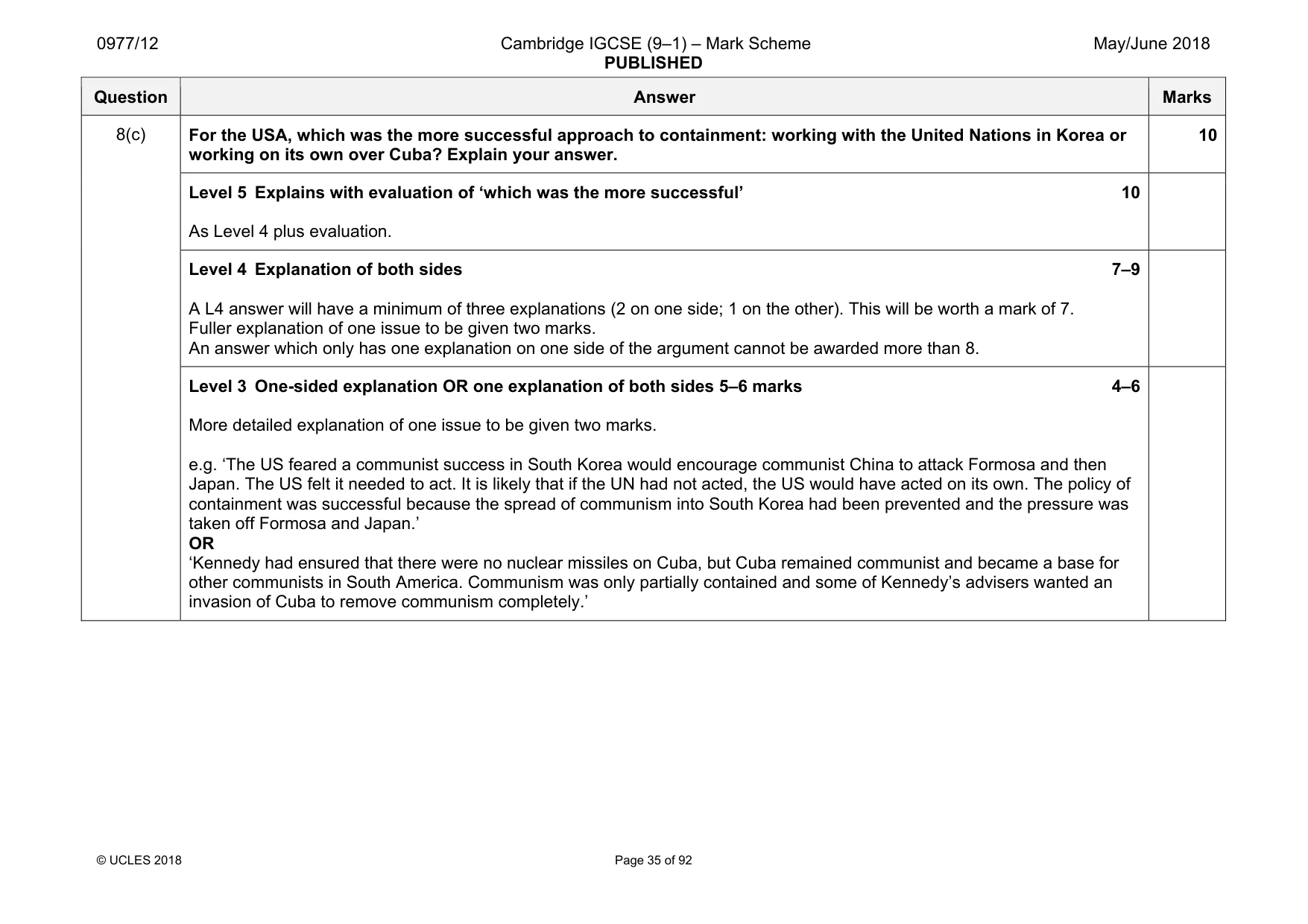
0977/12 Cambridge IGCSE (9–1) – Mark Scheme PUBLISHED May/June 2018 © UCLES 2018 Page 35 of 92 Question Answer Marks 8(c) For the USA, which was the more successful approach to containment: working with the United Nations in Korea or working on its own over Cuba? Explain your answer. 10 Level 5 Explains with evaluation of ‘which was the more successful’ 10 As Level 4 plus evaluation. Level 4 Explanation of both sides 7–9 A L4 answer will have a minimum of three explanations (2 on one side; 1 on the other). This will be worth a mark of 7. Fuller explanation of one issue to be given two marks. An answer which only has one explanation on one side of the argument cannot be awarded more than 8. Level 3 One-sided explanation OR one explanation of both sides 5–6 marks 4–6 More detailed explanation of one issue to be given two marks. e.g. ‘The US feared a communist success in South Korea would encourage communist China to attack Formosa and then Japan. The US felt it needed to act. It is likely that if the UN had not acted, the US would have acted on its own. The policy of containment was successful because the spread of communism into South Korea had been prevented and the pressure was taken off Formosa and Japan.’ OR ‘Kennedy had ensured that there were no nuclear missiles on Cuba, but Cuba remained communist and became a base for other communists in South America. Communism was only partially contained and some of Kennedy’s advisers wanted an invasion of Cuba to remove communism completely.’
Mark scheme, page 36
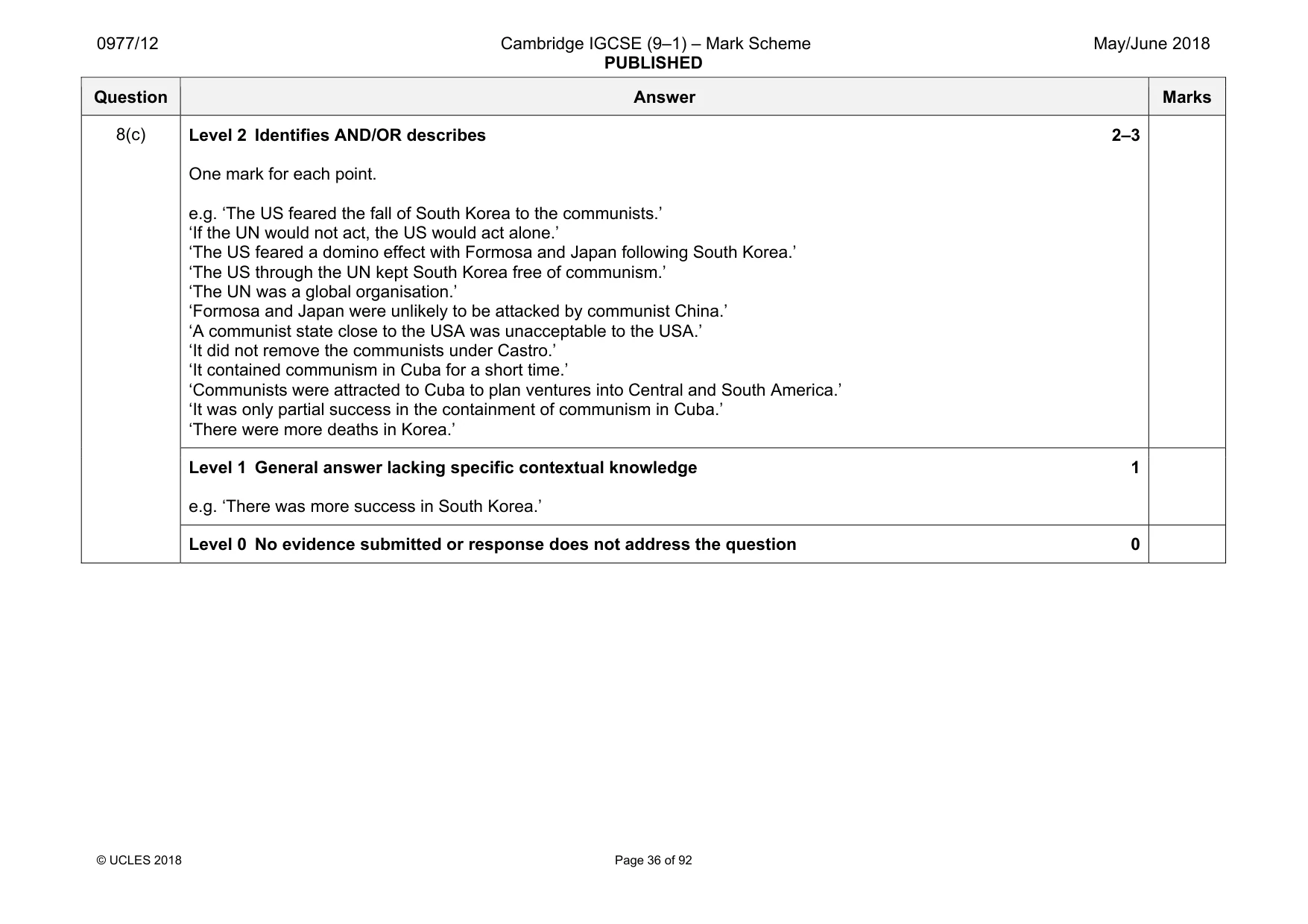
0977/12 Cambridge IGCSE (9–1) – Mark Scheme PUBLISHED May/June 2018 © UCLES 2018 Page 36 of 92 Question Answer Marks 8(c) Level 2 Identifies AND/OR describes 2–3 One mark for each point. e.g. ‘The US feared the fall of South Korea to the communists.’ ‘If the UN would not act, the US would act alone.’ ‘The US feared a domino effect with Formosa and Japan following South Korea.’ ‘The US through the UN kept South Korea free of communism.’ ‘The UN was a global organisation.’ ‘Formosa and Japan were unlikely to be attacked by communist China.’ ‘A communist state close to the USA was unacceptable to the USA.’ ‘It did not remove the communists under Castro.’ ‘It contained communism in Cuba for a short time.’ ‘Communists were attracted to Cuba to plan ventures into Central and South America.’ ‘It was only partial success in the containment of communism in Cuba.’ ‘There were more deaths in Korea.’ Level 1 General answer lacking specific contextual knowledge 1 e.g. ‘There was more success in South Korea.’ Level 0 No evidence submitted or response does not address the question 0
Mark scheme, page 37
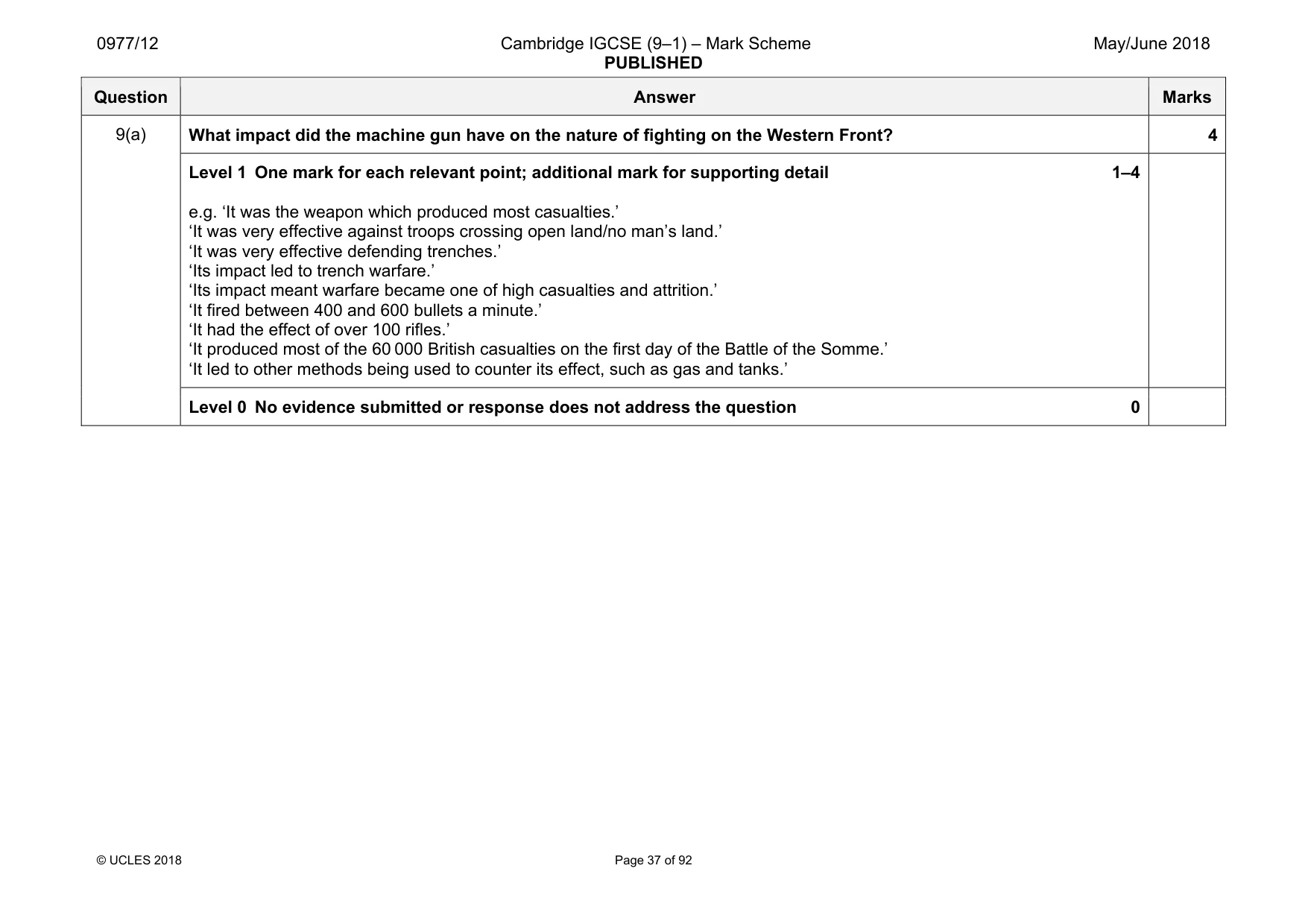
0977/12 Cambridge IGCSE (9–1) – Mark Scheme PUBLISHED May/June 2018 © UCLES 2018 Page 37 of 92 Question Answer Marks 9(a) What impact did the machine gun have on the nature of fighting on the Western Front? 4 Level 1 One mark for each relevant point; additional mark for supporting detail 1–4 e.g. ‘It was the weapon which produced most casualties.’ ‘It was very effective against troops crossing open land/no man’s land.’ ‘It was very effective defending trenches.’ ‘Its impact led to trench warfare.’ ‘Its impact meant warfare became one of high casualties and attrition.’ ‘It fired between 400 and 600 bullets a minute.’ ‘It had the effect of over 100 rifles.’ ‘It produced most of the 60 000 British casualties on the first day of the Battle of the Somme.’ ‘It led to other methods being used to counter its effect, such as gas and tanks.’ Level 0 No evidence submitted or response does not address the question 0
Mark scheme, page 38
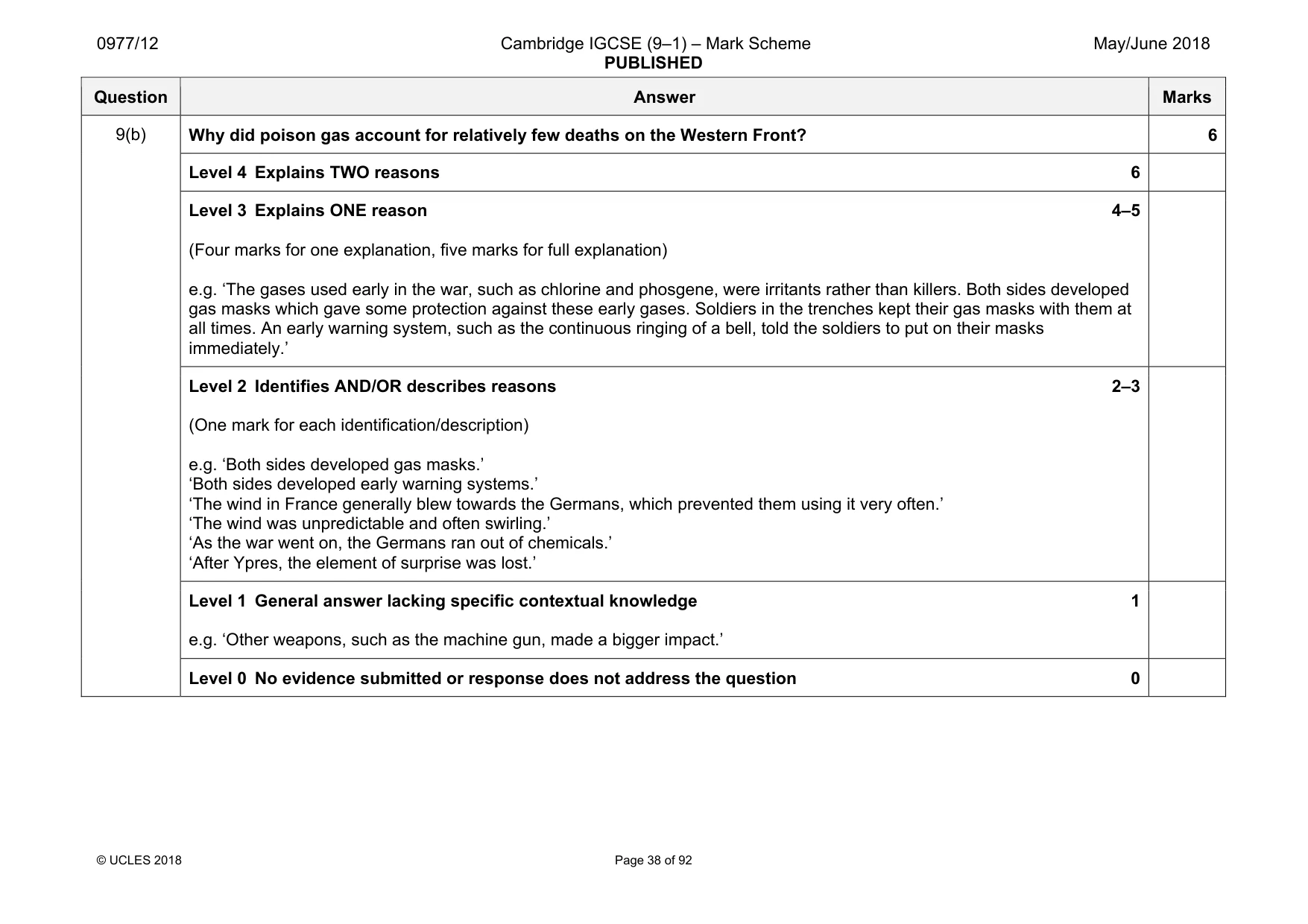
0977/12 Cambridge IGCSE (9–1) – Mark Scheme PUBLISHED May/June 2018 © UCLES 2018 Page 38 of 92 Question Answer Marks 9(b) Why did poison gas account for relatively few deaths on the Western Front? 6 Level 4 Explains TWO reasons 6 Level 3 Explains ONE reason 4–5 (Four marks for one explanation, five marks for full explanation) e.g. ‘The gases used early in the war, such as chlorine and phosgene, were irritants rather than killers. Both sides developed gas masks which gave some protection against these early gases. Soldiers in the trenches kept their gas masks with them at all times. An early warning system, such as the continuous ringing of a bell, told the soldiers to put on their masks immediately.’ Level 2 Identifies AND/OR describes reasons 2–3 (One mark for each identification/description) e.g. ‘Both sides developed gas masks.’ ‘Both sides developed early warning systems.’ ‘The wind in France generally blew towards the Germans, which prevented them using it very often.’ ‘The wind was unpredictable and often swirling.’ ‘As the war went on, the Germans ran out of chemicals.’ ‘After Ypres, the element of surprise was lost.’ Level 1 General answer lacking specific contextual knowledge 1 e.g. ‘Other weapons, such as the machine gun, made a bigger impact.’ Level 0 No evidence submitted or response does not address the question 0
Mark scheme, page 39
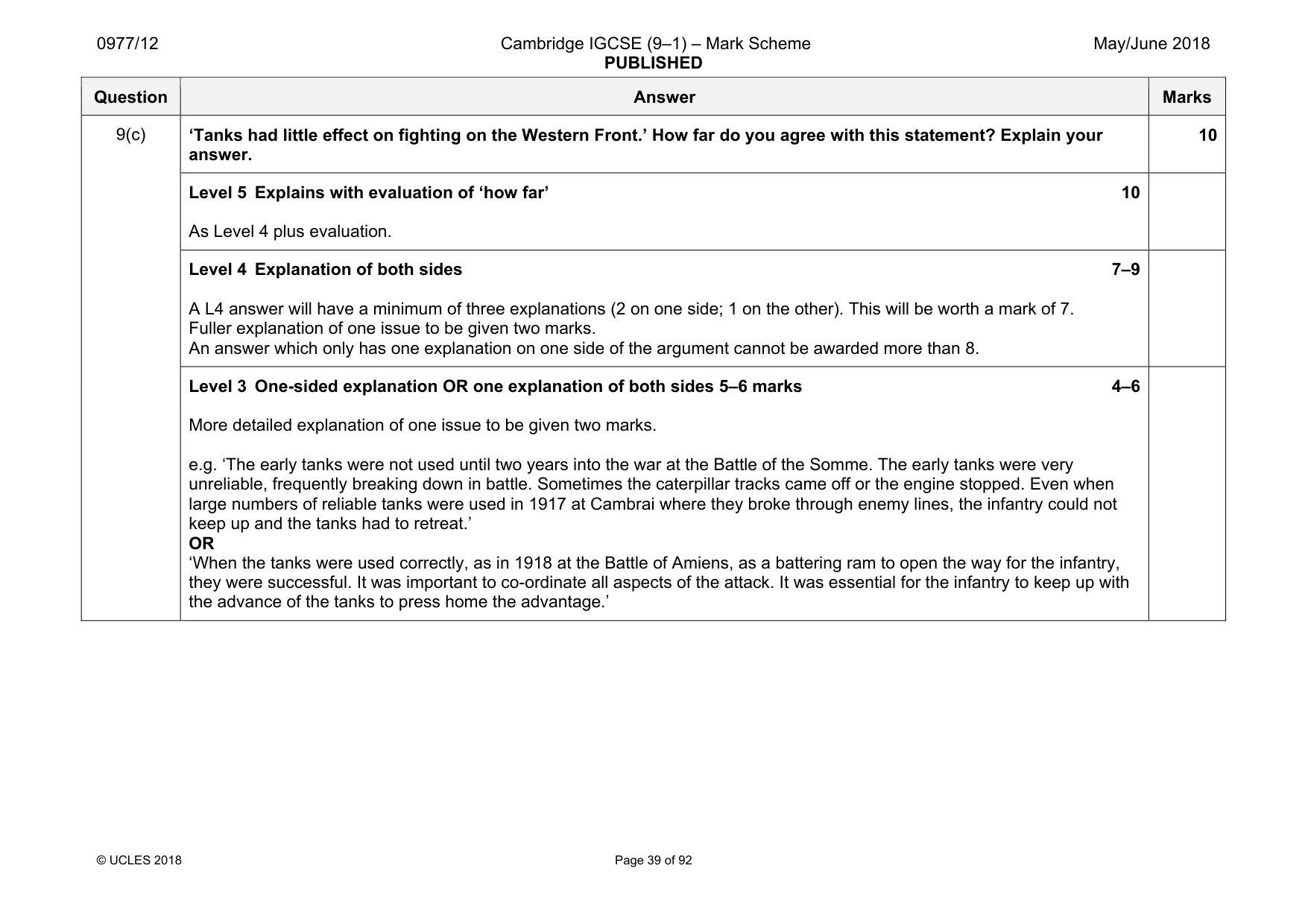
0977/12 Cambridge IGCSE (9–1) – Mark Scheme PUBLISHED May/June 2018 © UCLES 2018 Page 39 of 92 Question Answer Marks 9(c) ‘Tanks had little effect on fighting on the Western Front.’ How far do you agree with this statement? Explain your answer. 10 Level 5 Explains with evaluation of ‘how far’ 10 As Level 4 plus evaluation. Level 4 Explanation of both sides 7–9 A L4 answer will have a minimum of three explanations (2 on one side; 1 on the other). This will be worth a mark of 7. Fuller explanation of one issue to be given two marks. An answer which only has one explanation on one side of the argument cannot be awarded more than 8. Level 3 One-sided explanation OR one explanation of both sides 5–6 marks 4–6 More detailed explanation of one issue to be given two marks. e.g. ‘The early tanks were not used until two years into the war at the Battle of the Somme. The early tanks were very unreliable, frequently breaking down in battle. Sometimes the caterpillar tracks came off or the engine stopped. Even when large numbers of reliable tanks were used in 1917 at Cambrai where they broke through enemy lines, the infantry could not keep up and the tanks had to retreat.’ OR ‘When the tanks were used correctly, as in 1918 at the Battle of Amiens, as a battering ram to open the way for the infantry, they were successful. It was important to co-ordinate all aspects of the attack. It was essential for the infantry to keep up with the advance of the tanks to press home the advantage.’
Mark scheme, page 40
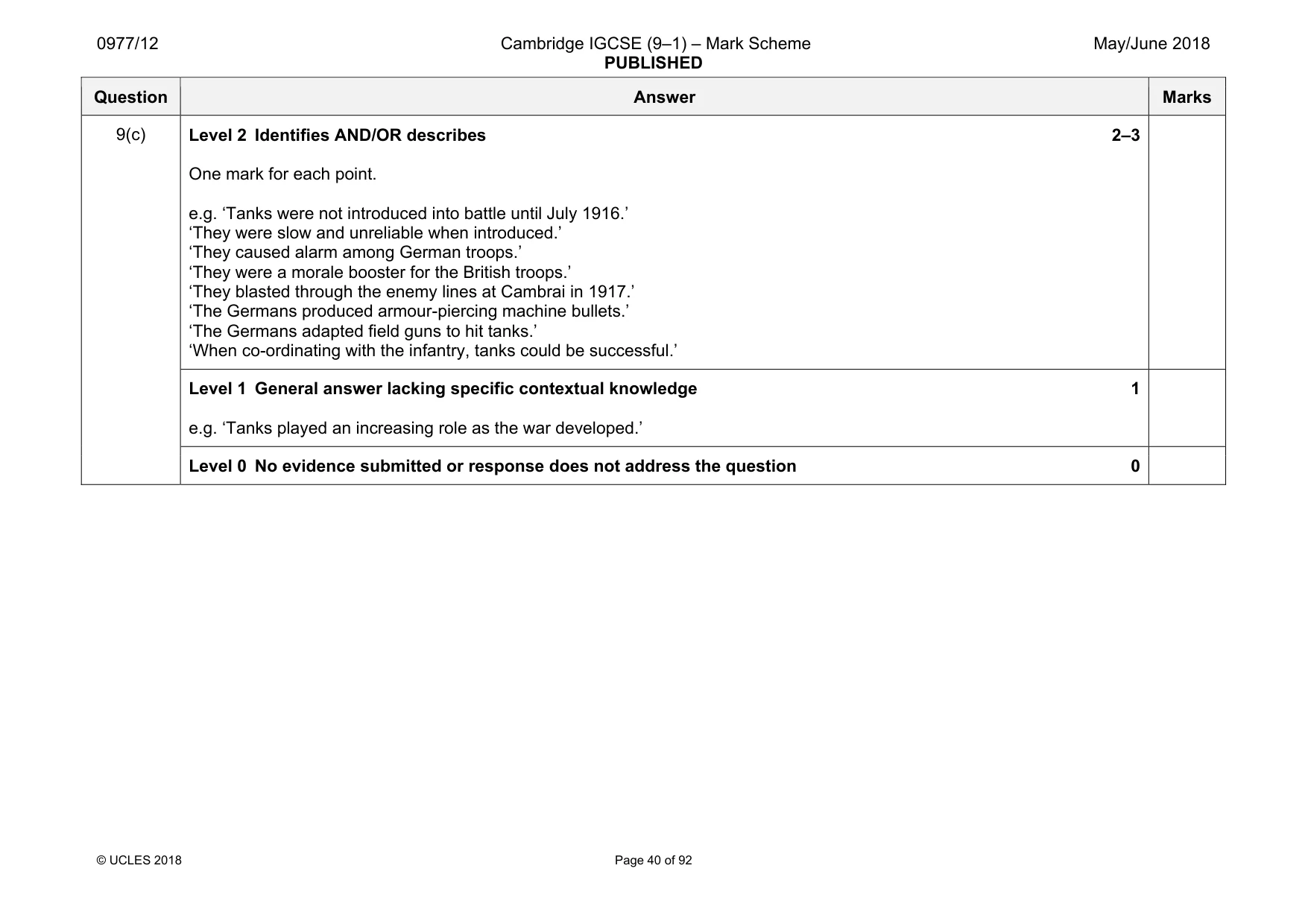
0977/12 Cambridge IGCSE (9–1) – Mark Scheme PUBLISHED May/June 2018 © UCLES 2018 Page 40 of 92 Question Answer Marks 9(c) Level 2 Identifies AND/OR describes 2–3 One mark for each point. e.g. ‘Tanks were not introduced into battle until July 1916.’ ‘They were slow and unreliable when introduced.’ ‘They caused alarm among German troops.’ ‘They were a morale booster for the British troops.’ ‘They blasted through the enemy lines at Cambrai in 1917.’ ‘The Germans produced armour-piercing machine bullets.’ ‘The Germans adapted field guns to hit tanks.’ ‘When co-ordinating with the infantry, tanks could be successful.’ Level 1 General answer lacking specific contextual knowledge 1 e.g. ‘Tanks played an increasing role as the war developed.’ Level 0 No evidence submitted or response does not address the question 0
Mark scheme, page 41
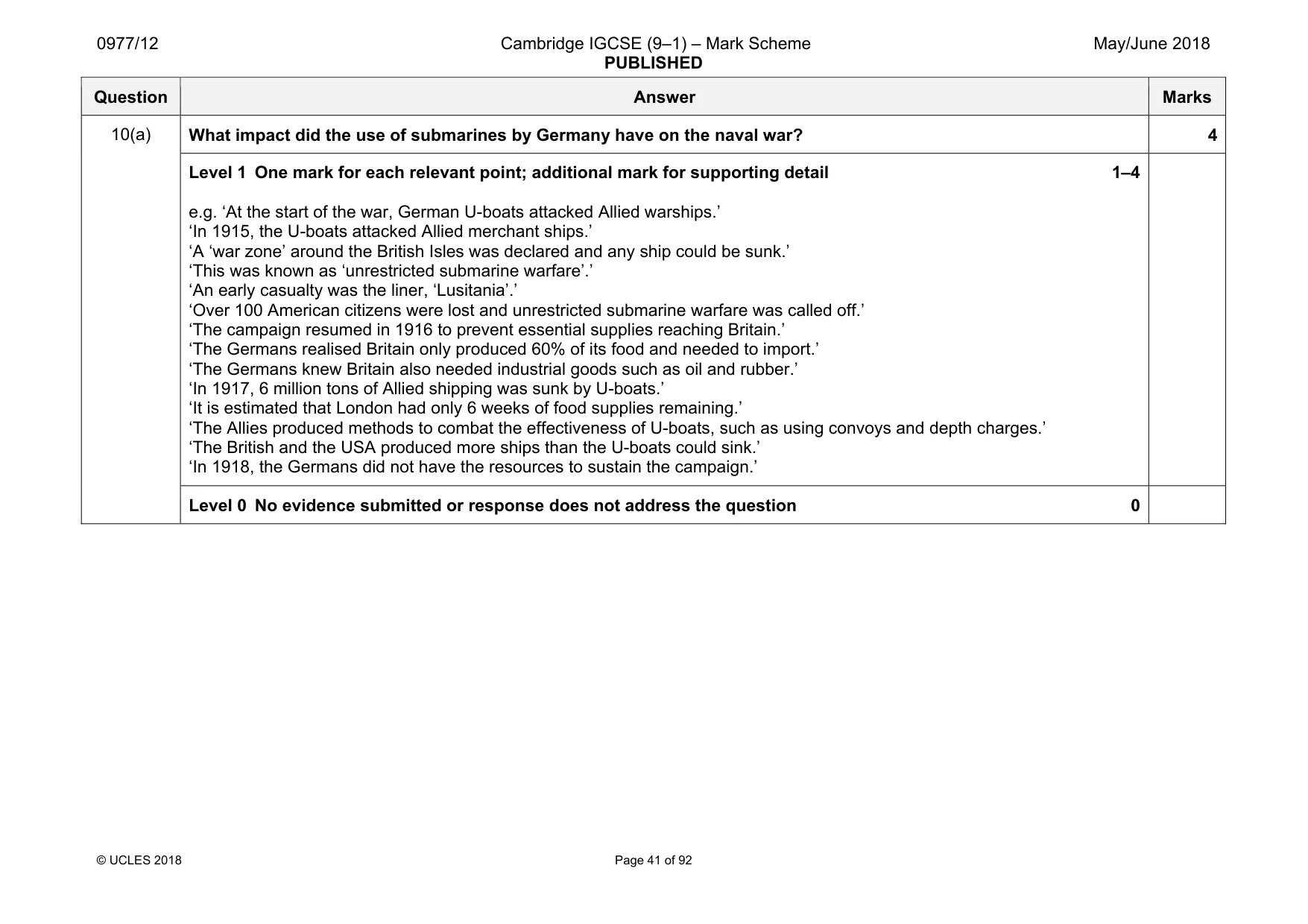
0977/12 Cambridge IGCSE (9–1) – Mark Scheme PUBLISHED May/June 2018 © UCLES 2018 Page 41 of 92 Question Answer Marks 10(a) What impact did the use of submarines by Germany have on the naval war? 4 Level 1 One mark for each relevant point; additional mark for supporting detail 1–4 e.g. ‘At the start of the war, German U-boats attacked Allied warships.’ ‘In 1915, the U-boats attacked Allied merchant ships.’ ‘A ‘war zone’ around the British Isles was declared and any ship could be sunk.’ ‘This was known as ‘unrestricted submarine warfare’.’ ‘An early casualty was the liner, ‘Lusitania’.’ ‘Over 100 American citizens were lost and unrestricted submarine warfare was called off.’ ‘The campaign resumed in 1916 to prevent essential supplies reaching Britain.’ ‘The Germans realised Britain only produced 60% of its food and needed to import.’ ‘The Germans knew Britain also needed industrial goods such as oil and rubber.’ ‘In 1917, 6 million tons of Allied shipping was sunk by U-boats.’ ‘It is estimated that London had only 6 weeks of food supplies remaining.’ ‘The Allies produced methods to combat the effectiveness of U-boats, such as using convoys and depth charges.’ ‘The British and the USA produced more ships than the U-boats could sink.’ ‘In 1918, the Germans did not have the resources to sustain the campaign.’ Level 0 No evidence submitted or response does not address the question 0
Mark scheme, page 42
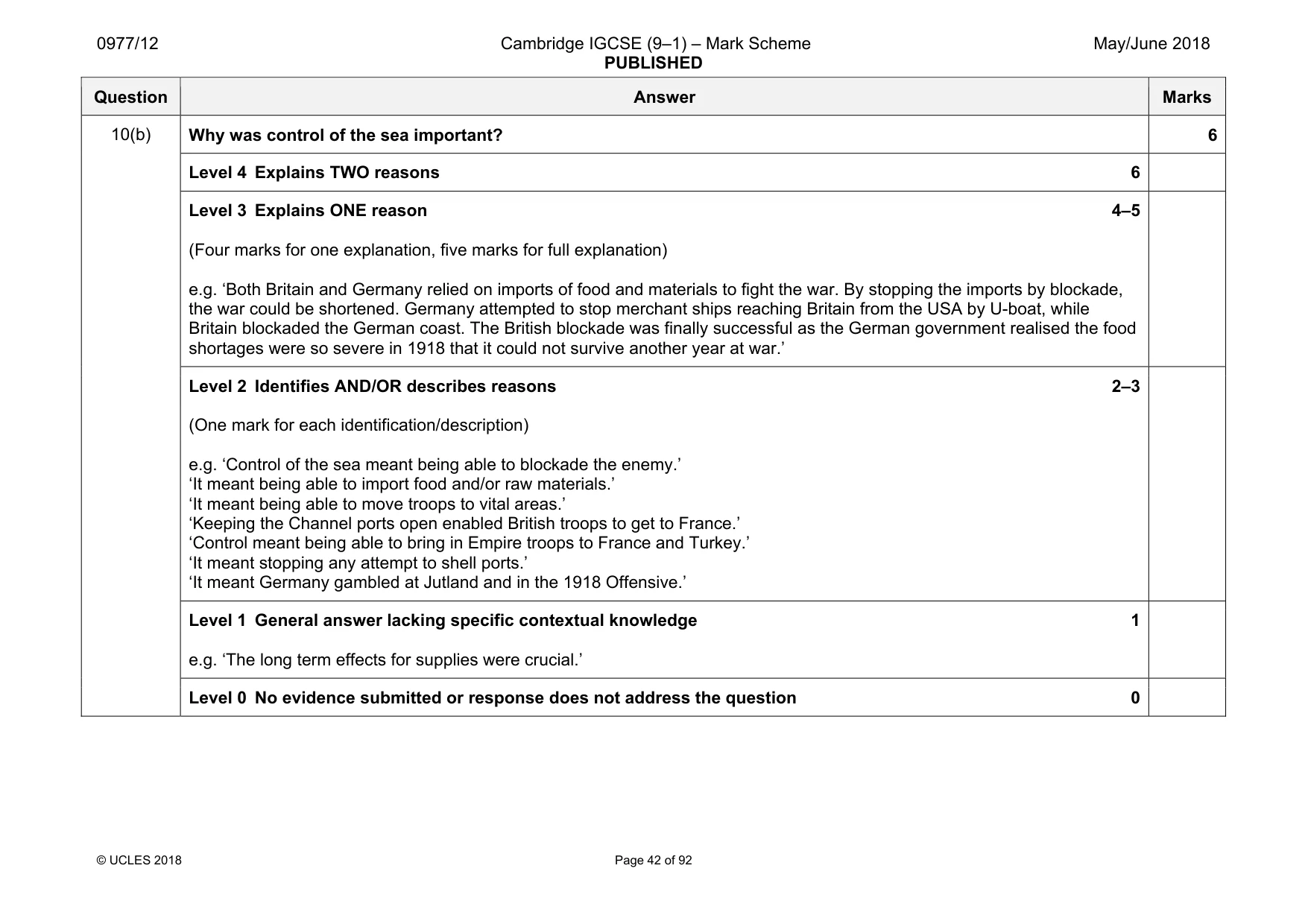
0977/12 Cambridge IGCSE (9–1) – Mark Scheme PUBLISHED May/June 2018 © UCLES 2018 Page 42 of 92 Question Answer Marks 10(b) Why was control of the sea important? 6 Level 4 Explains TWO reasons 6 Level 3 Explains ONE reason 4–5 (Four marks for one explanation, five marks for full explanation) e.g. ‘Both Britain and Germany relied on imports of food and materials to fight the war. By stopping the imports by blockade, the war could be shortened. Germany attempted to stop merchant ships reaching Britain from the USA by U-boat, while Britain blockaded the German coast. The British blockade was finally successful as the German government realised the food shortages were so severe in 1918 that it could not survive another year at war.’ Level 2 Identifies AND/OR describes reasons 2–3 (One mark for each identification/description) e.g. ‘Control of the sea meant being able to blockade the enemy.’ ‘It meant being able to import food and/or raw materials.’ ‘It meant being able to move troops to vital areas.’ ‘Keeping the Channel ports open enabled British troops to get to France.’ ‘Control meant being able to bring in Empire troops to France and Turkey.’ ‘It meant stopping any attempt to shell ports.’ ‘It meant Germany gambled at Jutland and in the 1918 Offensive.’ Level 1 General answer lacking specific contextual knowledge 1 e.g. ‘The long term effects for supplies were crucial.’ Level 0 No evidence submitted or response does not address the question 0
Mark scheme, page 43
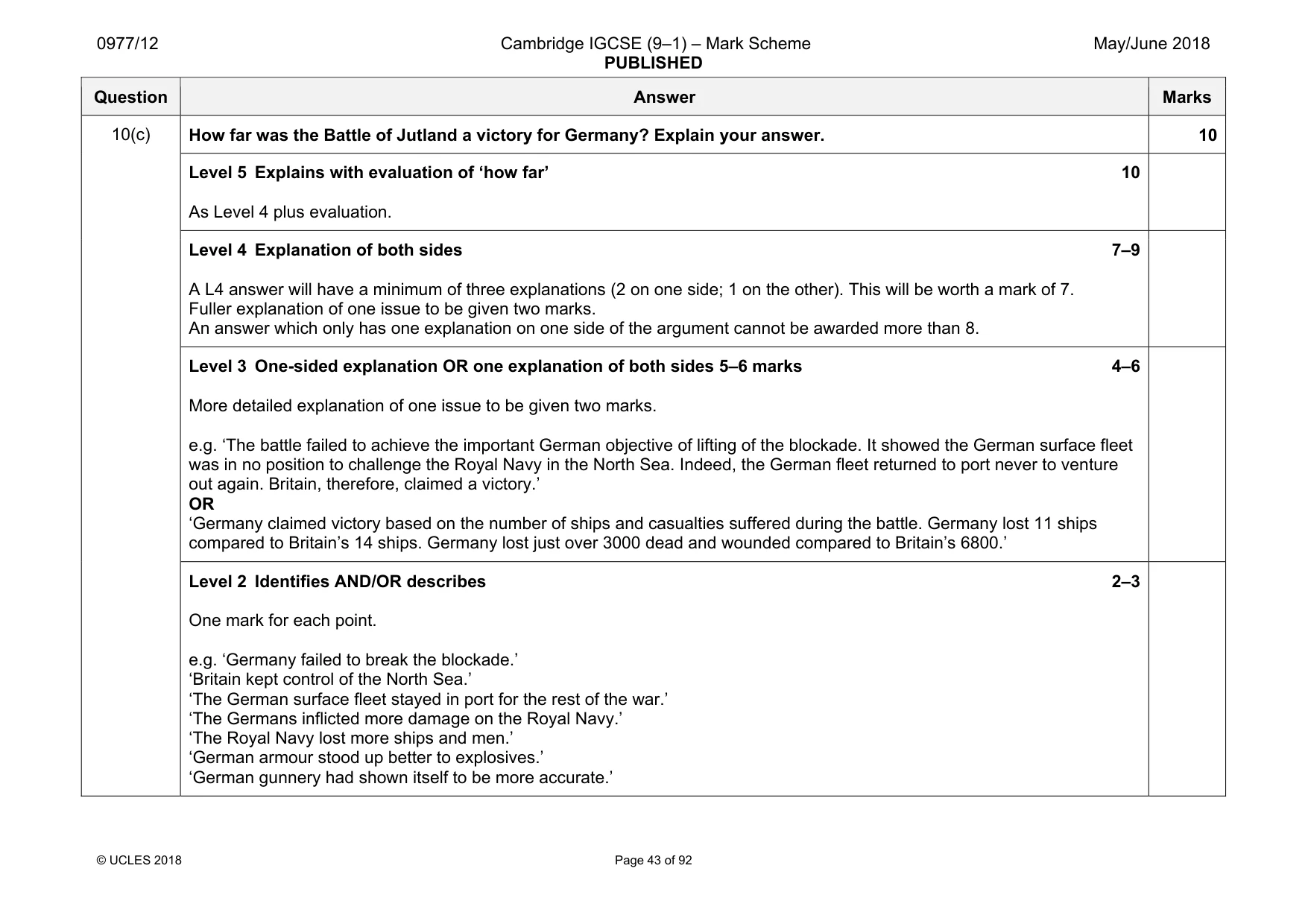
0977/12 Cambridge IGCSE (9–1) – Mark Scheme PUBLISHED May/June 2018 © UCLES 2018 Page 43 of 92 Question Answer Marks 10(c) How far was the Battle of Jutland a victory for Germany? Explain your answer. 10 Level 5 Explains with evaluation of ‘how far’ 10 As Level 4 plus evaluation. Level 4 Explanation of both sides 7–9 A L4 answer will have a minimum of three explanations (2 on one side; 1 on the other). This will be worth a mark of 7. Fuller explanation of one issue to be given two marks. An answer which only has one explanation on one side of the argument cannot be awarded more than 8. Level 3 One-sided explanation OR one explanation of both sides 5–6 marks 4–6 More detailed explanation of one issue to be given two marks. e.g. ‘The battle failed to achieve the important German objective of lifting of the blockade. It showed the German surface fleet was in no position to challenge the Royal Navy in the North Sea. Indeed, the German fleet returned to port never to venture out again. Britain, therefore, claimed a victory.’ OR ‘Germany claimed victory based on the number of ships and casualties suffered during the battle. Germany lost 11 ships compared to Britain’s 14 ships. Germany lost just over 3000 dead and wounded compared to Britain’s 6800.’ Level 2 Identifies AND/OR describes 2–3 One mark for each point. e.g. ‘Germany failed to break the blockade.’ ‘Britain kept control of the North Sea.’ ‘The German surface fleet stayed in port for the rest of the war.’ ‘The Germans inflicted more damage on the Royal Navy.’ ‘The Royal Navy lost more ships and men.’ ‘German armour stood up better to explosives.’ ‘German gunnery had shown itself to be more accurate.’
Mark scheme, page 44
0977/12 Cambridge IGCSE (9–1) – Mark Scheme PUBLISHED May/June 2018 © UCLES 2018 Page 44 of 92 Question Answer Marks 10(c) Level 1 General answer lacking specific contextual knowledge 1 e.g. ‘Both sides claimed victory.’ Level 0 No evidence submitted or response does not address the question 0
Mark scheme, page 45
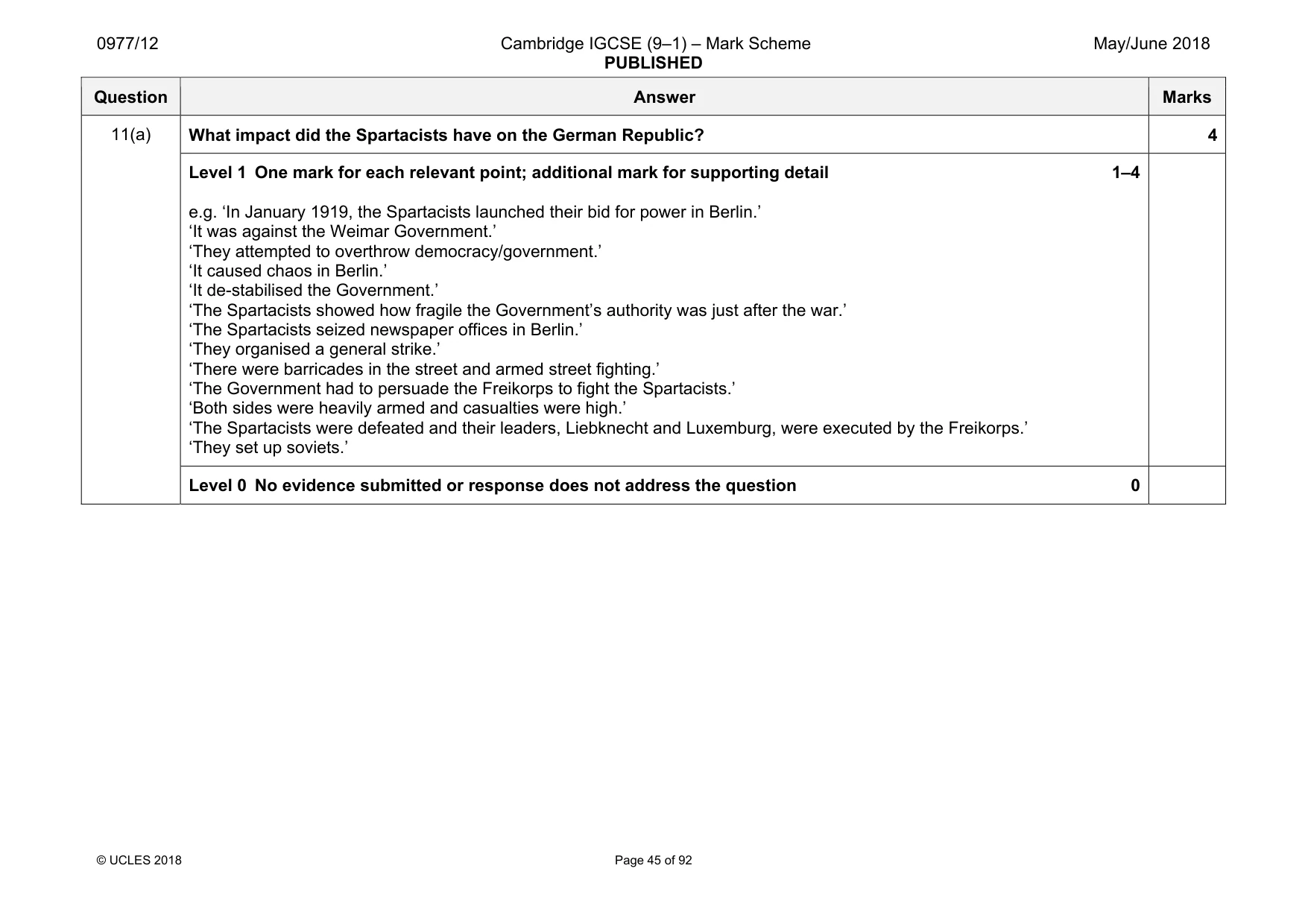
0977/12 Cambridge IGCSE (9–1) – Mark Scheme PUBLISHED May/June 2018 © UCLES 2018 Page 45 of 92 Question Answer Marks 11(a) What impact did the Spartacists have on the German Republic? 4 Level 1 One mark for each relevant point; additional mark for supporting detail 1–4 e.g. ‘In January 1919, the Spartacists launched their bid for power in Berlin.’ ‘It was against the Weimar Government.’ ‘They attempted to overthrow democracy/government.’ ‘It caused chaos in Berlin.’ ‘It de-stabilised the Government.’ ‘The Spartacists showed how fragile the Government’s authority was just after the war.’ ‘The Spartacists seized newspaper offices in Berlin.’ ‘They organised a general strike.’ ‘There were barricades in the street and armed street fighting.’ ‘The Government had to persuade the Freikorps to fight the Spartacists.’ ‘Both sides were heavily armed and casualties were high.’ ‘The Spartacists were defeated and their leaders, Liebknecht and Luxemburg, were executed by the Freikorps.’ ‘They set up soviets.’ Level 0 No evidence submitted or response does not address the question 0
Mark scheme, page 46
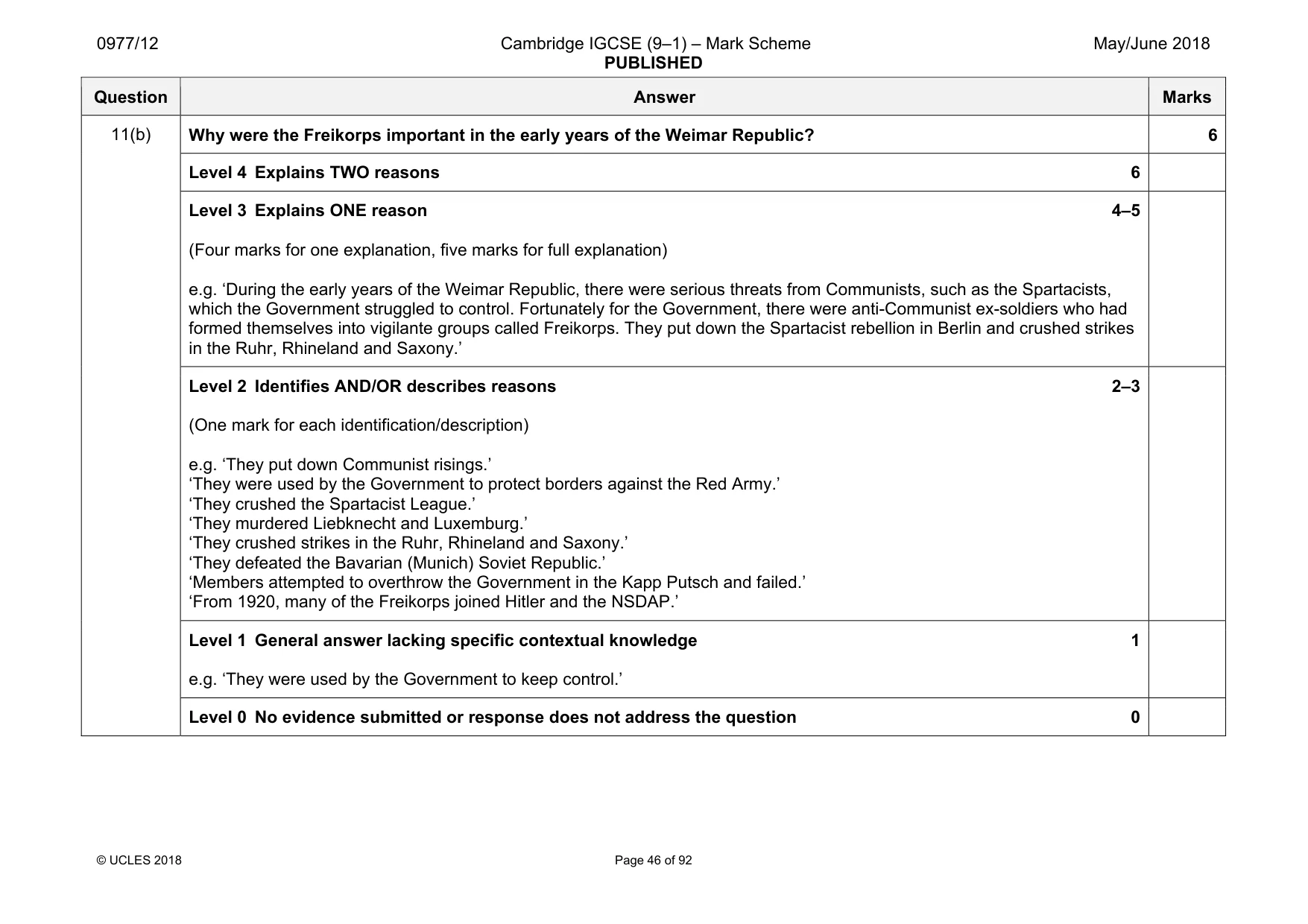
0977/12 Cambridge IGCSE (9–1) – Mark Scheme PUBLISHED May/June 2018 © UCLES 2018 Page 46 of 92 Question Answer Marks 11(b) Why were the Freikorps important in the early years of the Weimar Republic? 6 Level 4 Explains TWO reasons 6 Level 3 Explains ONE reason 4–5 (Four marks for one explanation, five marks for full explanation) e.g. ‘During the early years of the Weimar Republic, there were serious threats from Communists, such as the Spartacists, which the Government struggled to control. Fortunately for the Government, there were anti-Communist ex-soldiers who had formed themselves into vigilante groups called Freikorps. They put down the Spartacist rebellion in Berlin and crushed strikes in the Ruhr, Rhineland and Saxony.’ Level 2 Identifies AND/OR describes reasons 2–3 (One mark for each identification/description) e.g. ‘They put down Communist risings.’ ‘They were used by the Government to protect borders against the Red Army.’ ‘They crushed the Spartacist League.’ ‘They murdered Liebknecht and Luxemburg.’ ‘They crushed strikes in the Ruhr, Rhineland and Saxony.’ ‘They defeated the Bavarian (Munich) Soviet Republic.’ ‘Members attempted to overthrow the Government in the Kapp Putsch and failed.’ ‘From 1920, many of the Freikorps joined Hitler and the NSDAP.’ Level 1 General answer lacking specific contextual knowledge 1 e.g. ‘They were used by the Government to keep control.’ Level 0 No evidence submitted or response does not address the question 0
Mark scheme, page 47
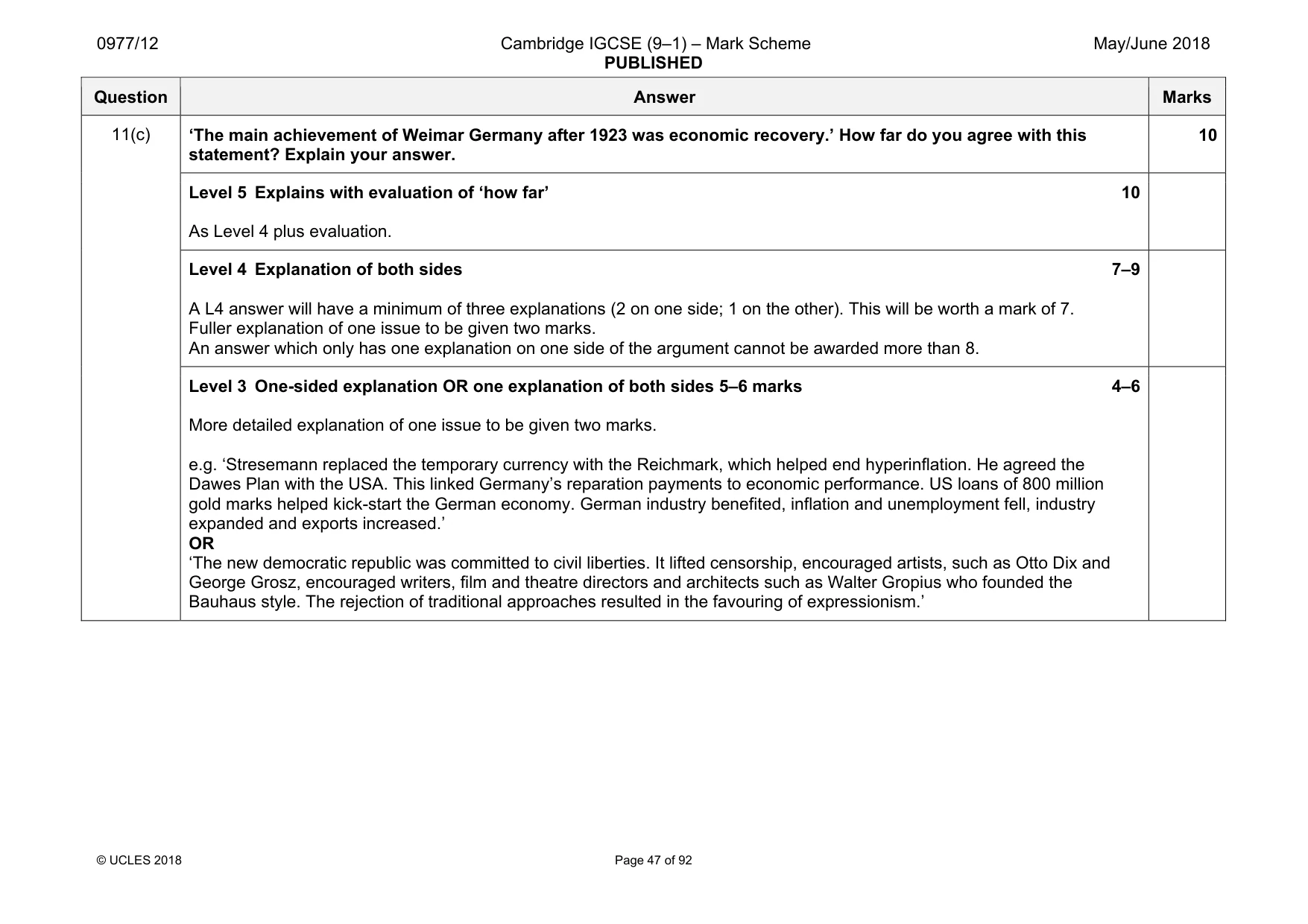
0977/12 Cambridge IGCSE (9–1) – Mark Scheme PUBLISHED May/June 2018 © UCLES 2018 Page 47 of 92 Question Answer Marks 11(c) ‘The main achievement of Weimar Germany after 1923 was economic recovery.’ How far do you agree with this statement? Explain your answer. 10 Level 5 Explains with evaluation of ‘how far’ 10 As Level 4 plus evaluation. Level 4 Explanation of both sides 7–9 A L4 answer will have a minimum of three explanations (2 on one side; 1 on the other). This will be worth a mark of 7. Fuller explanation of one issue to be given two marks. An answer which only has one explanation on one side of the argument cannot be awarded more than 8. Level 3 One-sided explanation OR one explanation of both sides 5–6 marks 4–6 More detailed explanation of one issue to be given two marks. e.g. ‘Stresemann replaced the temporary currency with the Reichmark, which helped end hyperinflation. He agreed the Dawes Plan with the USA. This linked Germany’s reparation payments to economic performance. US loans of 800 million gold marks helped kick-start the German economy. German industry benefited, inflation and unemployment fell, industry expanded and exports increased.’ OR ‘The new democratic republic was committed to civil liberties. It lifted censorship, encouraged artists, such as Otto Dix and George Grosz, encouraged writers, film and theatre directors and architects such as Walter Gropius who founded the Bauhaus style. The rejection of traditional approaches resulted in the favouring of expressionism.’
Mark scheme, page 48
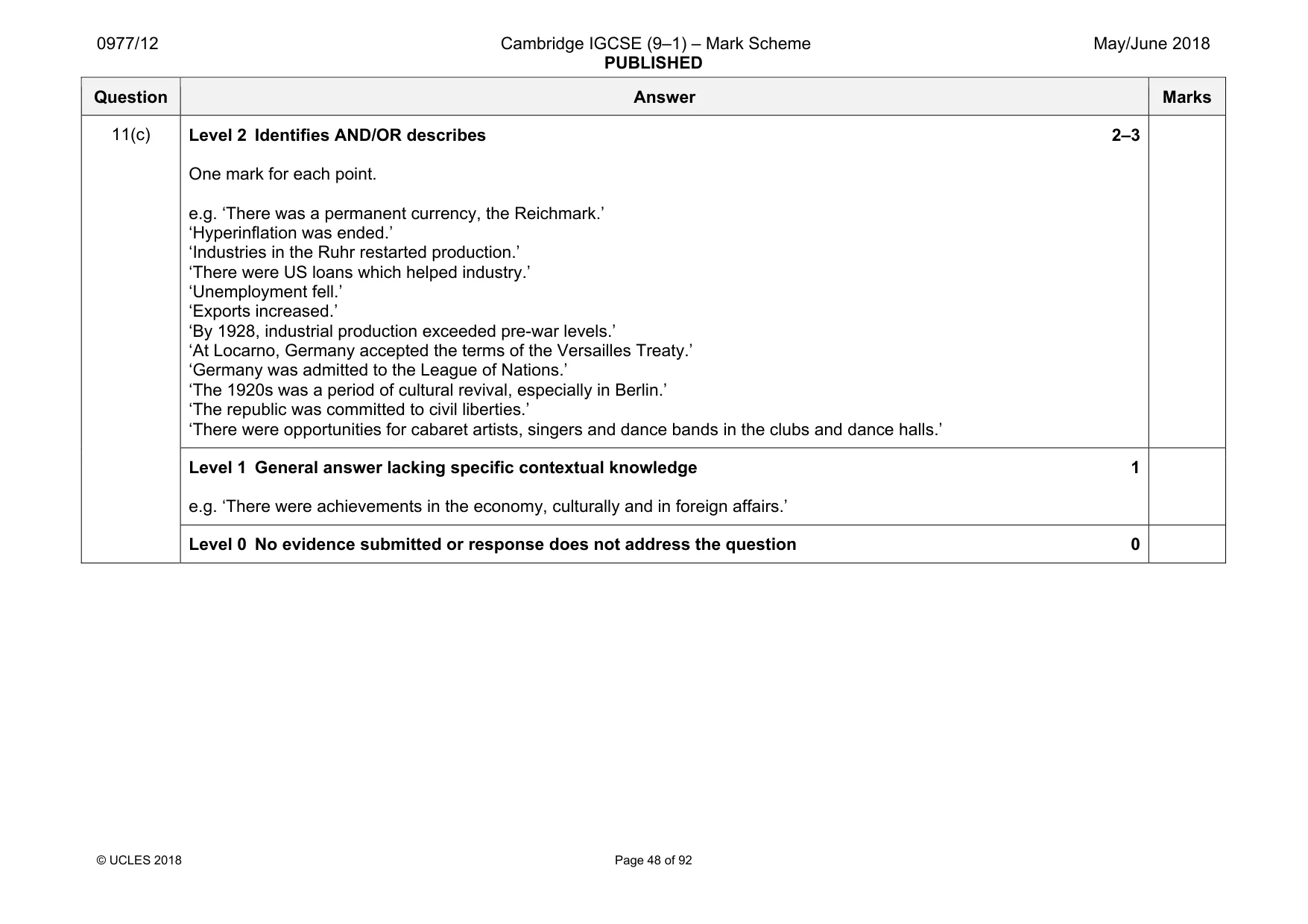
0977/12 Cambridge IGCSE (9–1) – Mark Scheme PUBLISHED May/June 2018 © UCLES 2018 Page 48 of 92 Question Answer Marks 11(c) Level 2 Identifies AND/OR describes 2–3 One mark for each point. e.g. ‘There was a permanent currency, the Reichmark.’ ‘Hyperinflation was ended.’ ‘Industries in the Ruhr restarted production.’ ‘There were US loans which helped industry.’ ‘Unemployment fell.’ ‘Exports increased.’ ‘By 1928, industrial production exceeded pre-war levels.’ ‘At Locarno, Germany accepted the terms of the Versailles Treaty.’ ‘Germany was admitted to the League of Nations.’ ‘The 1920s was a period of cultural revival, especially in Berlin.’ ‘The republic was committed to civil liberties.’ ‘There were opportunities for cabaret artists, singers and dance bands in the clubs and dance halls.’ Level 1 General answer lacking specific contextual knowledge 1 e.g. ‘There were achievements in the economy, culturally and in foreign affairs.’ Level 0 No evidence submitted or response does not address the question 0
Mark scheme, page 49
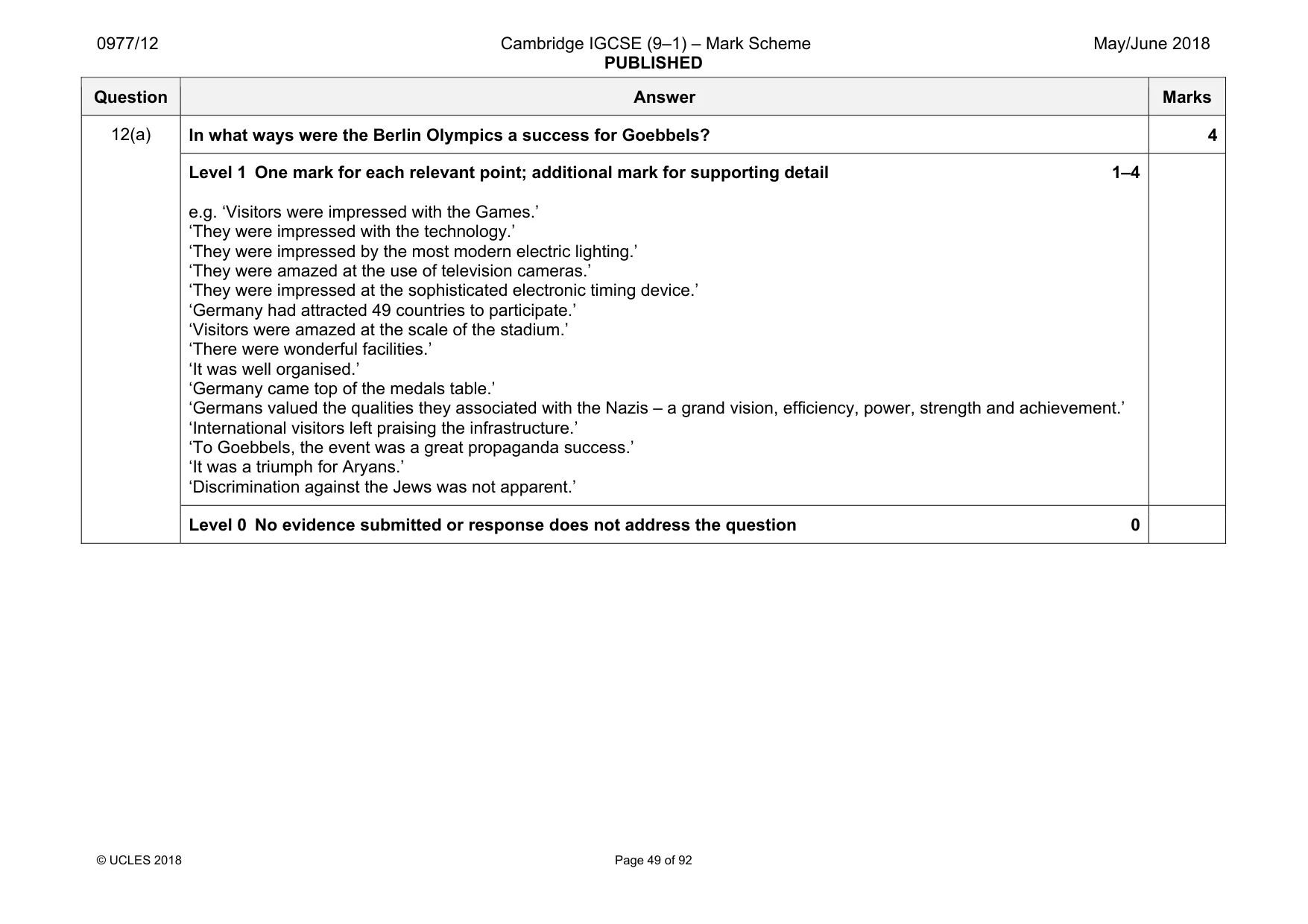
0977/12 Cambridge IGCSE (9–1) – Mark Scheme PUBLISHED May/June 2018 © UCLES 2018 Page 49 of 92 Question Answer Marks 12(a) In what ways were the Berlin Olympics a success for Goebbels? 4 Level 1 One mark for each relevant point; additional mark for supporting detail 1–4 e.g. ‘Visitors were impressed with the Games.’ ‘They were impressed with the technology.’ ‘They were impressed by the most modern electric lighting.’ ‘They were amazed at the use of television cameras.’ ‘They were impressed at the sophisticated electronic timing device.’ ‘Germany had attracted 49 countries to participate.’ ‘Visitors were amazed at the scale of the stadium.’ ‘There were wonderful facilities.’ ‘It was well organised.’ ‘Germany came top of the medals table.’ ‘Germans valued the qualities they associated with the Nazis – a grand vision, efficiency, power, strength and achievement.’ ‘International visitors left praising the infrastructure.’ ‘To Goebbels, the event was a great propaganda success.’ ‘It was a triumph for Aryans.’ ‘Discrimination against the Jews was not apparent.’ Level 0 No evidence submitted or response does not address the question 0
Mark scheme, page 50
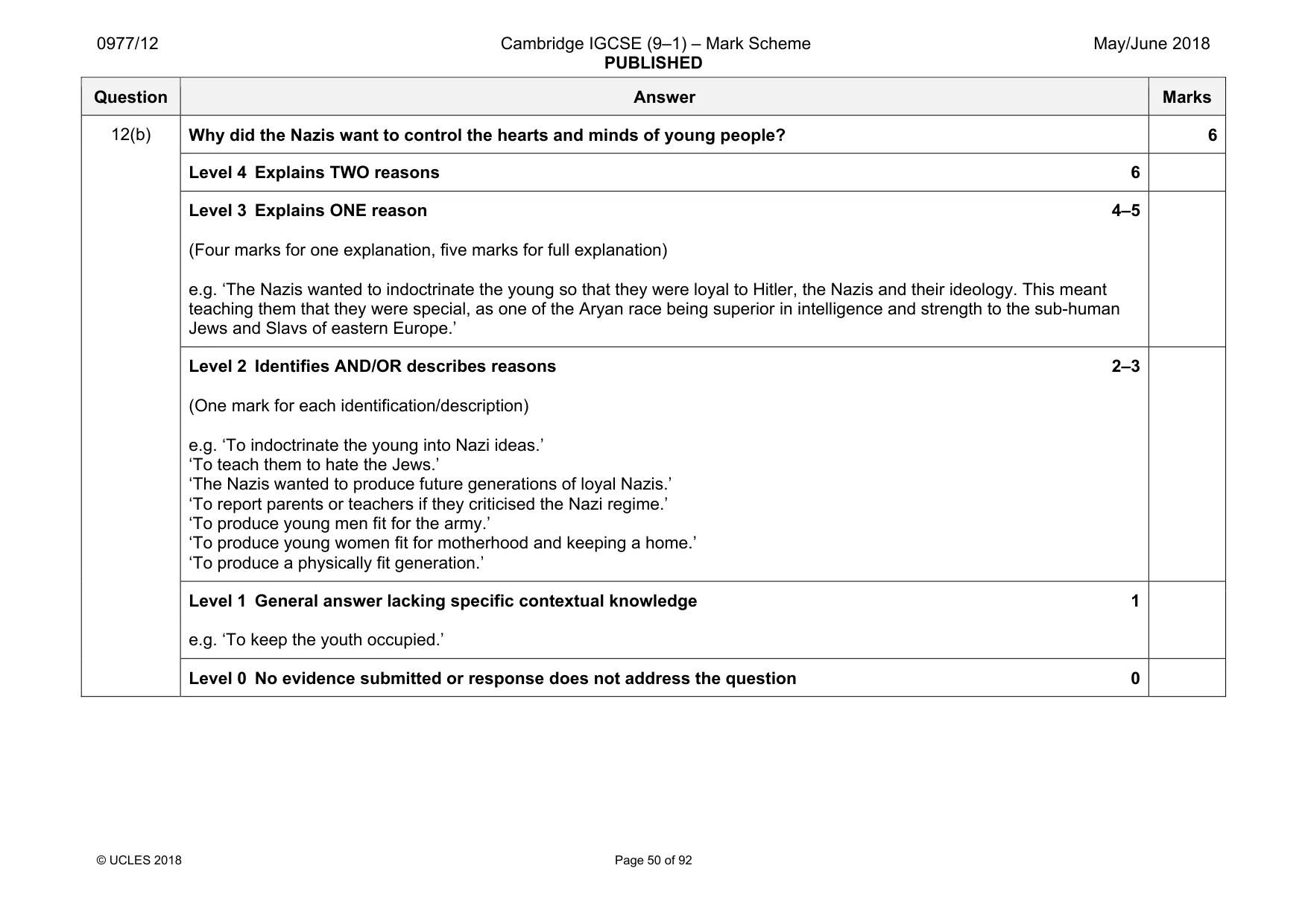
0977/12 Cambridge IGCSE (9–1) – Mark Scheme PUBLISHED May/June 2018 © UCLES 2018 Page 50 of 92 Question Answer Marks 12(b) Why did the Nazis want to control the hearts and minds of young people? 6 Level 4 Explains TWO reasons 6 Level 3 Explains ONE reason 4–5 (Four marks for one explanation, five marks for full explanation) e.g. ‘The Nazis wanted to indoctrinate the young so that they were loyal to Hitler, the Nazis and their ideology. This meant teaching them that they were special, as one of the Aryan race being superior in intelligence and strength to the sub-human Jews and Slavs of eastern Europe.’ Level 2 Identifies AND/OR describes reasons 2–3 (One mark for each identification/description) e.g. ‘To indoctrinate the young into Nazi ideas.’ ‘To teach them to hate the Jews.’ ‘The Nazis wanted to produce future generations of loyal Nazis.’ ‘To report parents or teachers if they criticised the Nazi regime.’ ‘To produce young men fit for the army.’ ‘To produce young women fit for motherhood and keeping a home.’ ‘To produce a physically fit generation.’ Level 1 General answer lacking specific contextual knowledge 1 e.g. ‘To keep the youth occupied.’ Level 0 No evidence submitted or response does not address the question 0
Mark scheme, page 51
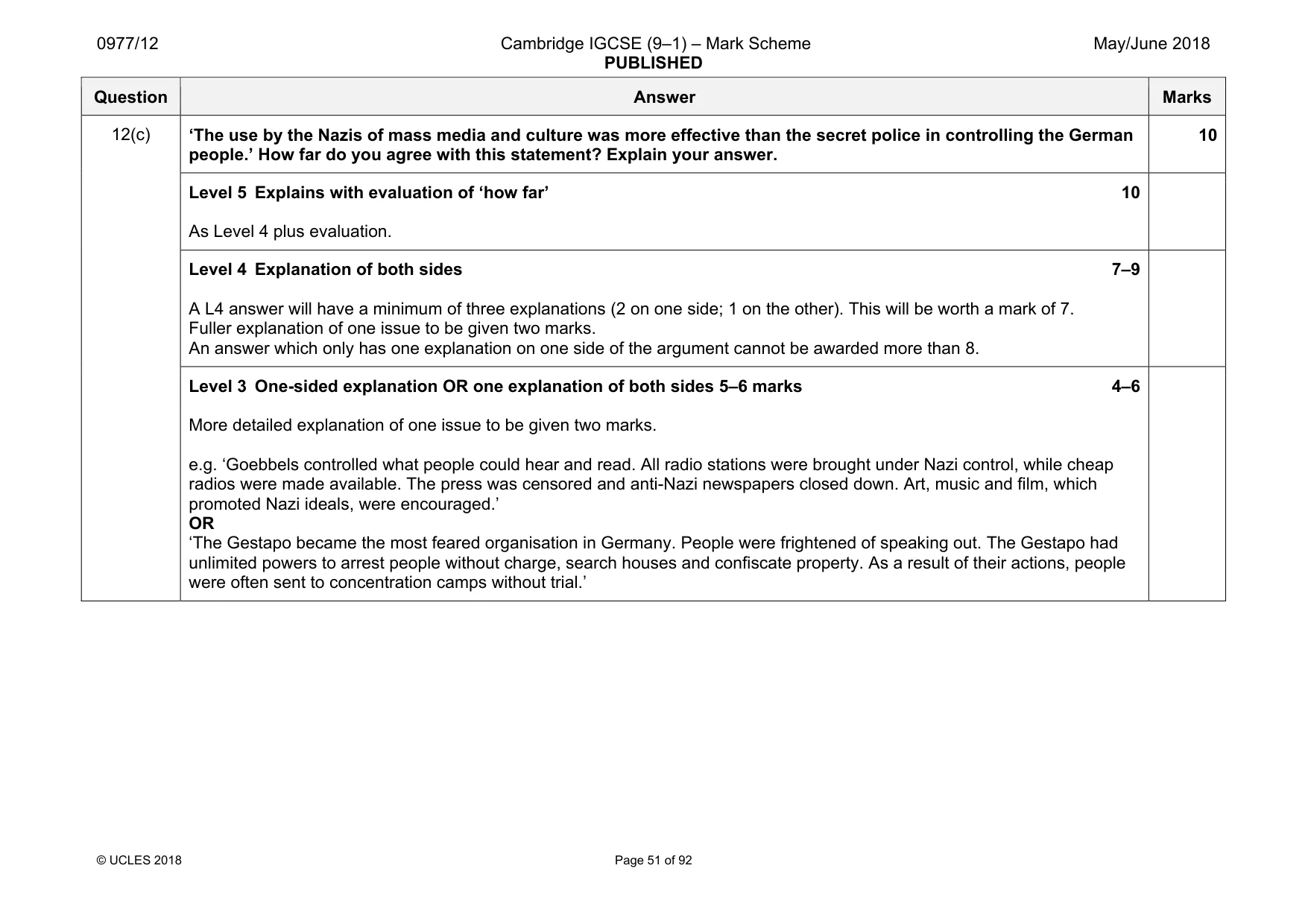
0977/12 Cambridge IGCSE (9–1) – Mark Scheme PUBLISHED May/June 2018 © UCLES 2018 Page 51 of 92 Question Answer Marks 12(c) ‘The use by the Nazis of mass media and culture was more effective than the secret police in controlling the German people.’ How far do you agree with this statement? Explain your answer. 10 Level 5 Explains with evaluation of ‘how far’ 10 As Level 4 plus evaluation. Level 4 Explanation of both sides 7–9 A L4 answer will have a minimum of three explanations (2 on one side; 1 on the other). This will be worth a mark of 7. Fuller explanation of one issue to be given two marks. An answer which only has one explanation on one side of the argument cannot be awarded more than 8. Level 3 One-sided explanation OR one explanation of both sides 5–6 marks 4–6 More detailed explanation of one issue to be given two marks. e.g. ‘Goebbels controlled what people could hear and read. All radio stations were brought under Nazi control, while cheap radios were made available. The press was censored and anti-Nazi newspapers closed down. Art, music and film, which promoted Nazi ideals, were encouraged.’ OR ‘The Gestapo became the most feared organisation in Germany. People were frightened of speaking out. The Gestapo had unlimited powers to arrest people without charge, search houses and confiscate property. As a result of their actions, people were often sent to concentration camps without trial.’
Mark scheme, page 52
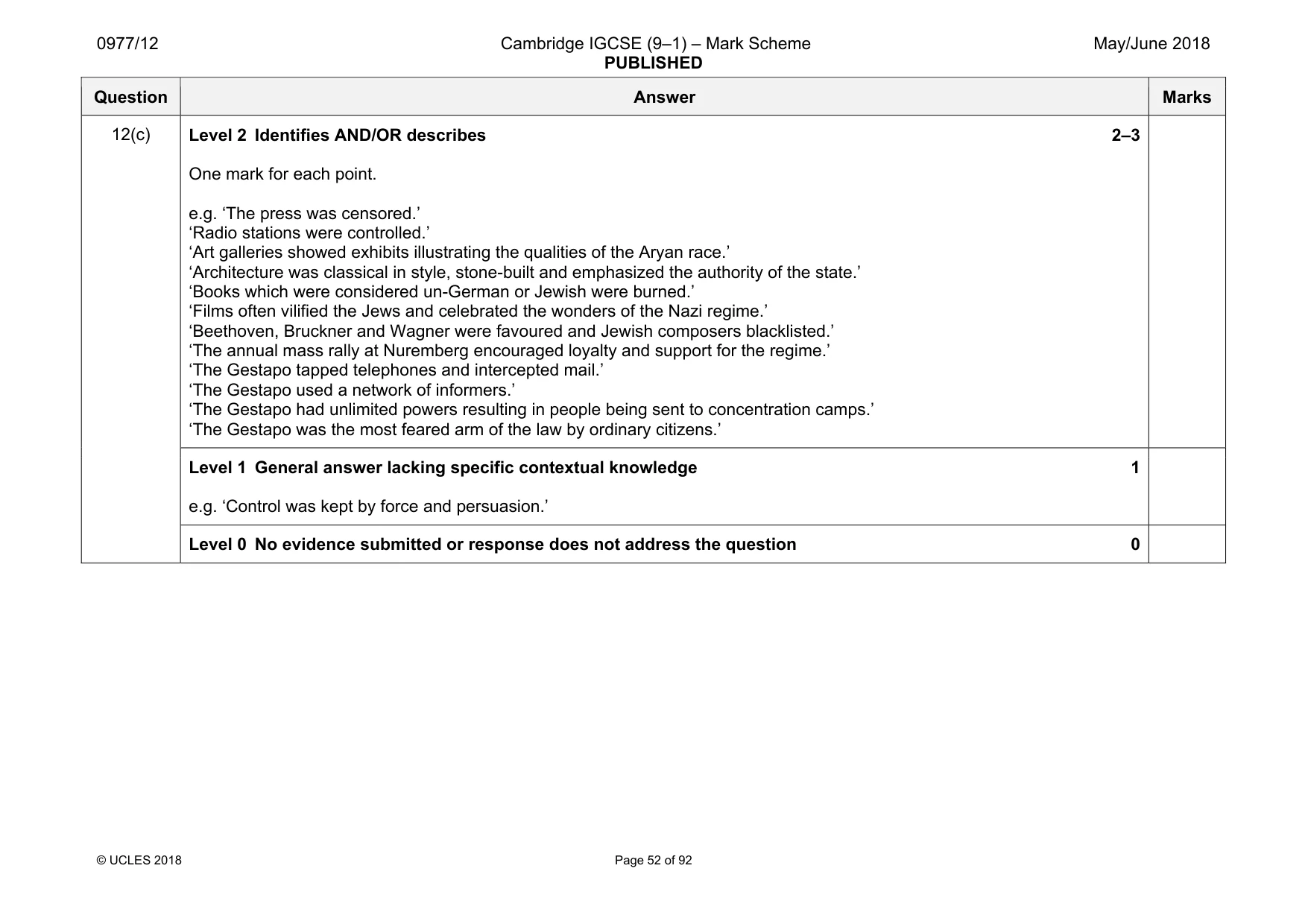
0977/12 Cambridge IGCSE (9–1) – Mark Scheme PUBLISHED May/June 2018 © UCLES 2018 Page 52 of 92 Question Answer Marks 12(c) Level 2 Identifies AND/OR describes 2–3 One mark for each point. e.g. ‘The press was censored.’ ‘Radio stations were controlled.’ ‘Art galleries showed exhibits illustrating the qualities of the Aryan race.’ ‘Architecture was classical in style, stone-built and emphasized the authority of the state.’ ‘Books which were considered un-German or Jewish were burned.’ ‘Films often vilified the Jews and celebrated the wonders of the Nazi regime.’ ‘Beethoven, Bruckner and Wagner were favoured and Jewish composers blacklisted.’ ‘The annual mass rally at Nuremberg encouraged loyalty and support for the regime.’ ‘The Gestapo tapped telephones and intercepted mail.’ ‘The Gestapo used a network of informers.’ ‘The Gestapo had unlimited powers resulting in people being sent to concentration camps.’ ‘The Gestapo was the most feared arm of the law by ordinary citizens.’ Level 1 General answer lacking specific contextual knowledge 1 e.g. ‘Control was kept by force and persuasion.’ Level 0 No evidence submitted or response does not address the question 0
Mark scheme, page 53
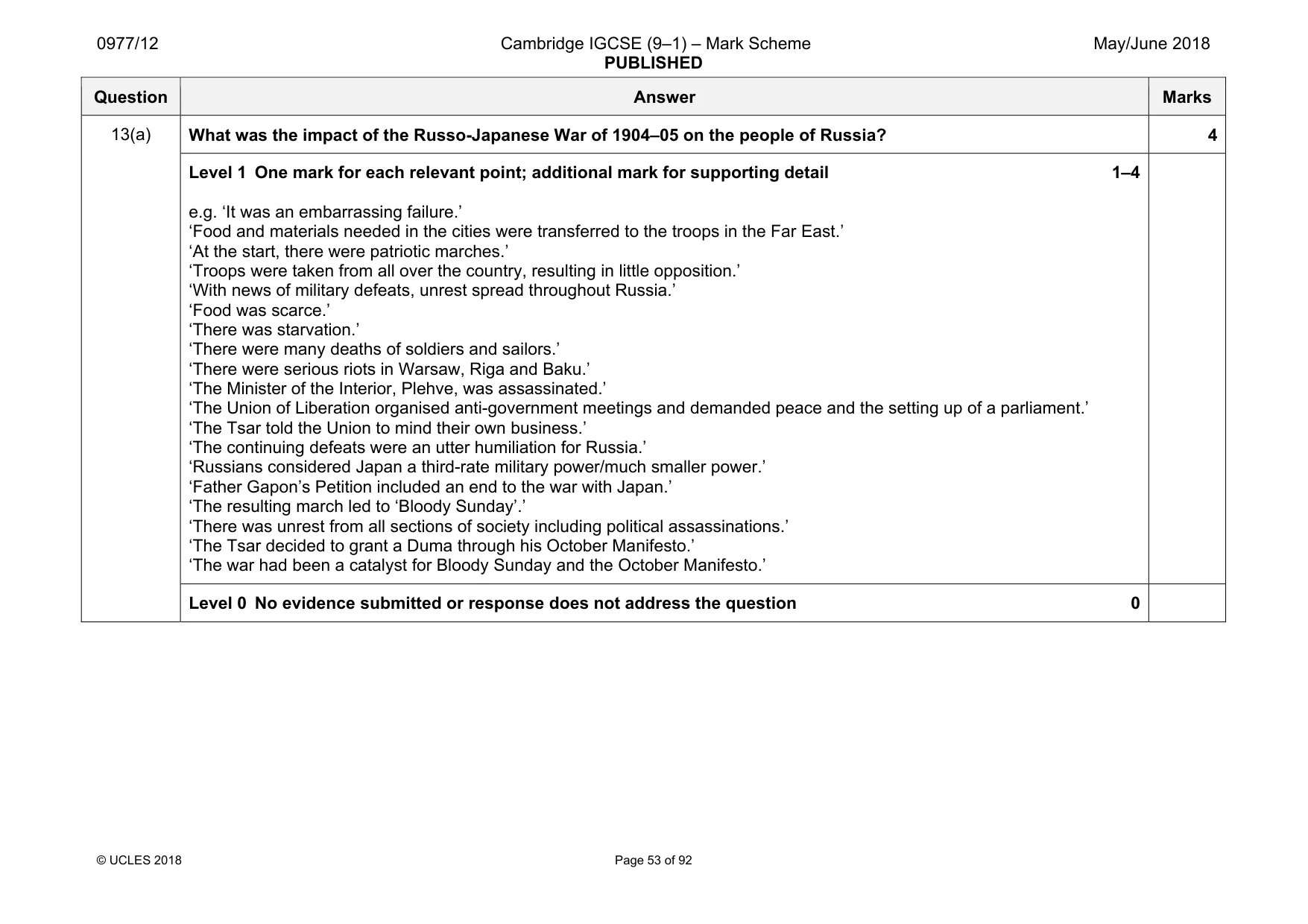
0977/12 Cambridge IGCSE (9–1) – Mark Scheme PUBLISHED May/June 2018 © UCLES 2018 Page 53 of 92 Question Answer Marks 13(a) What was the impact of the Russo-Japanese War of 1904–05 on the people of Russia? 4 Level 1 One mark for each relevant point; additional mark for supporting detail 1–4 e.g. ‘It was an embarrassing failure.’ ‘Food and materials needed in the cities were transferred to the troops in the Far East.’ ‘At the start, there were patriotic marches.’ ‘Troops were taken from all over the country, resulting in little opposition.’ ‘With news of military defeats, unrest spread throughout Russia.’ ‘Food was scarce.’ ‘There was starvation.’ ‘There were many deaths of soldiers and sailors.’ ‘There were serious riots in Warsaw, Riga and Baku.’ ‘The Minister of the Interior, Plehve, was assassinated.’ ‘The Union of Liberation organised anti-government meetings and demanded peace and the setting up of a parliament.’ ‘The Tsar told the Union to mind their own business.’ ‘The continuing defeats were an utter humiliation for Russia.’ ‘Russians considered Japan a third-rate military power/much smaller power.’ ‘Father Gapon’s Petition included an end to the war with Japan.’ ‘The resulting march led to ‘Bloody Sunday’.’ ‘There was unrest from all sections of society including political assassinations.’ ‘The Tsar decided to grant a Duma through his October Manifesto.’ ‘The war had been a catalyst for Bloody Sunday and the October Manifesto.’ Level 0 No evidence submitted or response does not address the question 0
Mark scheme, page 54
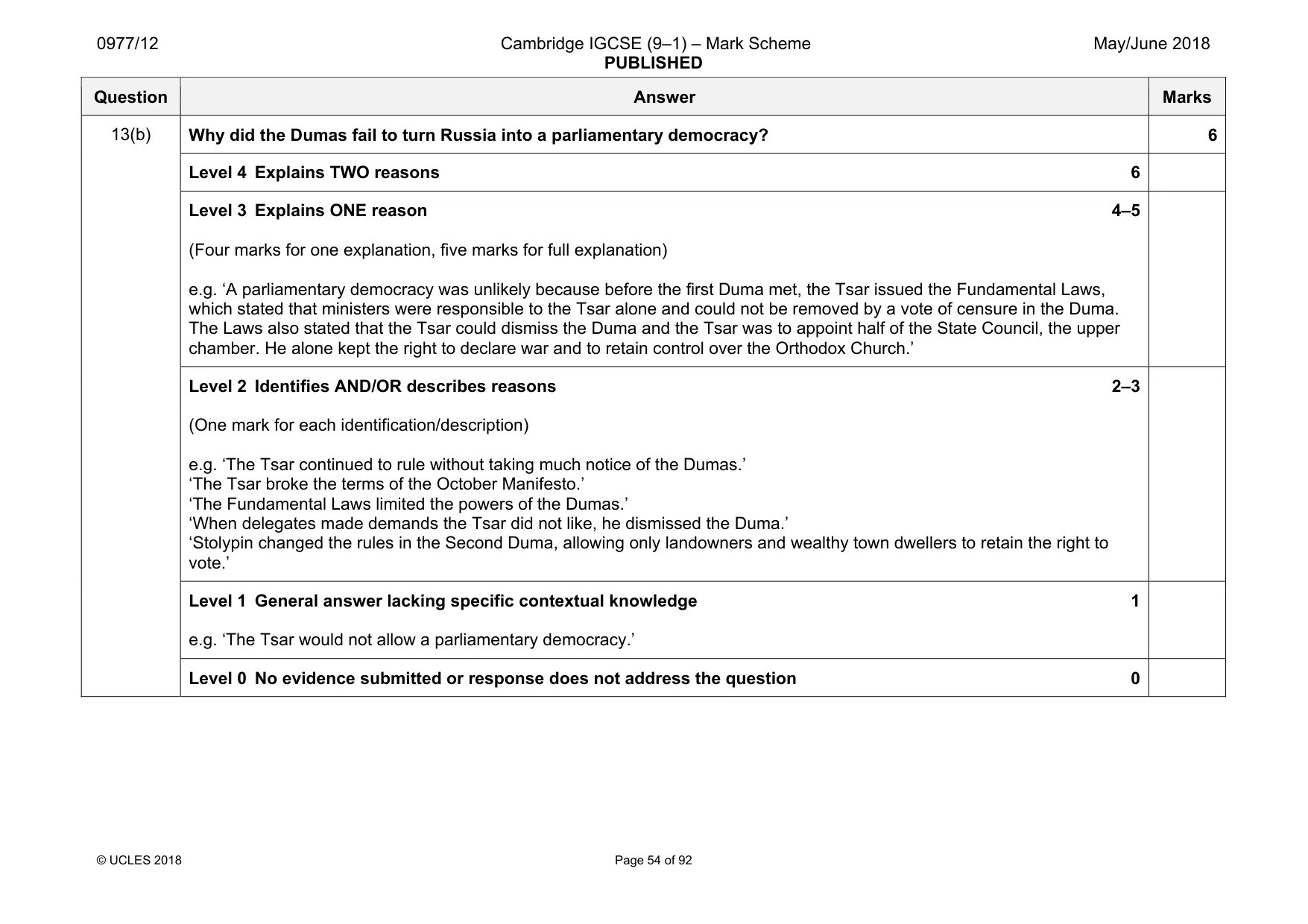
0977/12 Cambridge IGCSE (9–1) – Mark Scheme PUBLISHED May/June 2018 © UCLES 2018 Page 54 of 92 Question Answer Marks 13(b) Why did the Dumas fail to turn Russia into a parliamentary democracy? 6 Level 4 Explains TWO reasons 6 Level 3 Explains ONE reason 4–5 (Four marks for one explanation, five marks for full explanation) e.g. ‘A parliamentary democracy was unlikely because before the first Duma met, the Tsar issued the Fundamental Laws, which stated that ministers were responsible to the Tsar alone and could not be removed by a vote of censure in the Duma. The Laws also stated that the Tsar could dismiss the Duma and the Tsar was to appoint half of the State Council, the upper chamber. He alone kept the right to declare war and to retain control over the Orthodox Church.’ Level 2 Identifies AND/OR describes reasons 2–3 (One mark for each identification/description) e.g. ‘The Tsar continued to rule without taking much notice of the Dumas.’ ‘The Tsar broke the terms of the October Manifesto.’ ‘The Fundamental Laws limited the powers of the Dumas.’ ‘When delegates made demands the Tsar did not like, he dismissed the Duma.’ ‘Stolypin changed the rules in the Second Duma, allowing only landowners and wealthy town dwellers to retain the right to vote.’ Level 1 General answer lacking specific contextual knowledge 1 e.g. ‘The Tsar would not allow a parliamentary democracy.’ Level 0 No evidence submitted or response does not address the question 0
Mark scheme, page 55
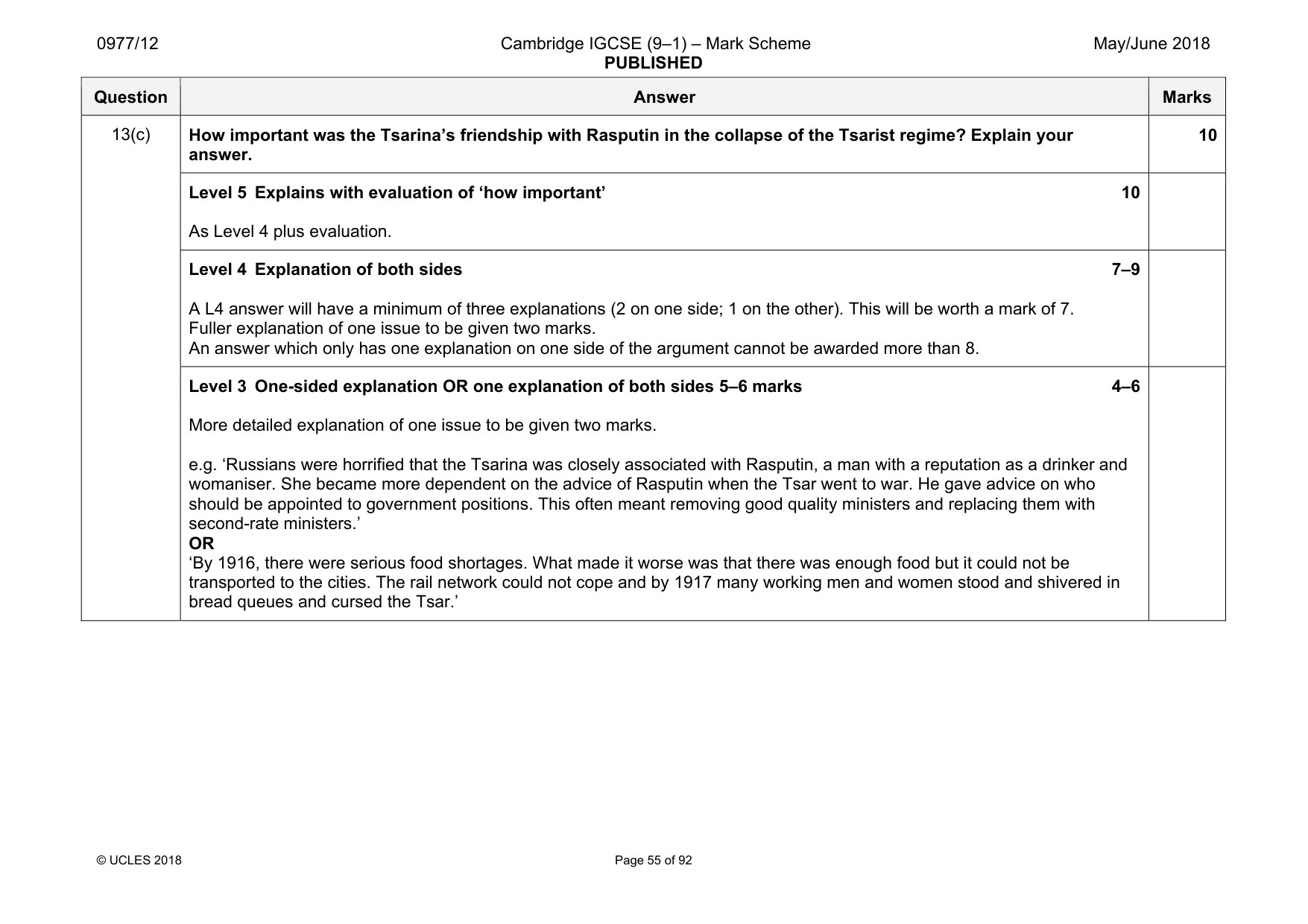
0977/12 Cambridge IGCSE (9–1) – Mark Scheme PUBLISHED May/June 2018 © UCLES 2018 Page 55 of 92 Question Answer Marks 13(c) How important was the Tsarina’s friendship with Rasputin in the collapse of the Tsarist regime? Explain your answer. 10 Level 5 Explains with evaluation of ‘how important’ 10 As Level 4 plus evaluation. Level 4 Explanation of both sides 7–9 A L4 answer will have a minimum of three explanations (2 on one side; 1 on the other). This will be worth a mark of 7. Fuller explanation of one issue to be given two marks. An answer which only has one explanation on one side of the argument cannot be awarded more than 8. Level 3 One-sided explanation OR one explanation of both sides 5–6 marks 4–6 More detailed explanation of one issue to be given two marks. e.g. ‘Russians were horrified that the Tsarina was closely associated with Rasputin, a man with a reputation as a drinker and womaniser. She became more dependent on the advice of Rasputin when the Tsar went to war. He gave advice on who should be appointed to government positions. This often meant removing good quality ministers and replacing them with second-rate ministers.’ OR ‘By 1916, there were serious food shortages. What made it worse was that there was enough food but it could not be transported to the cities. The rail network could not cope and by 1917 many working men and women stood and shivered in bread queues and cursed the Tsar.’
Mark scheme, page 56
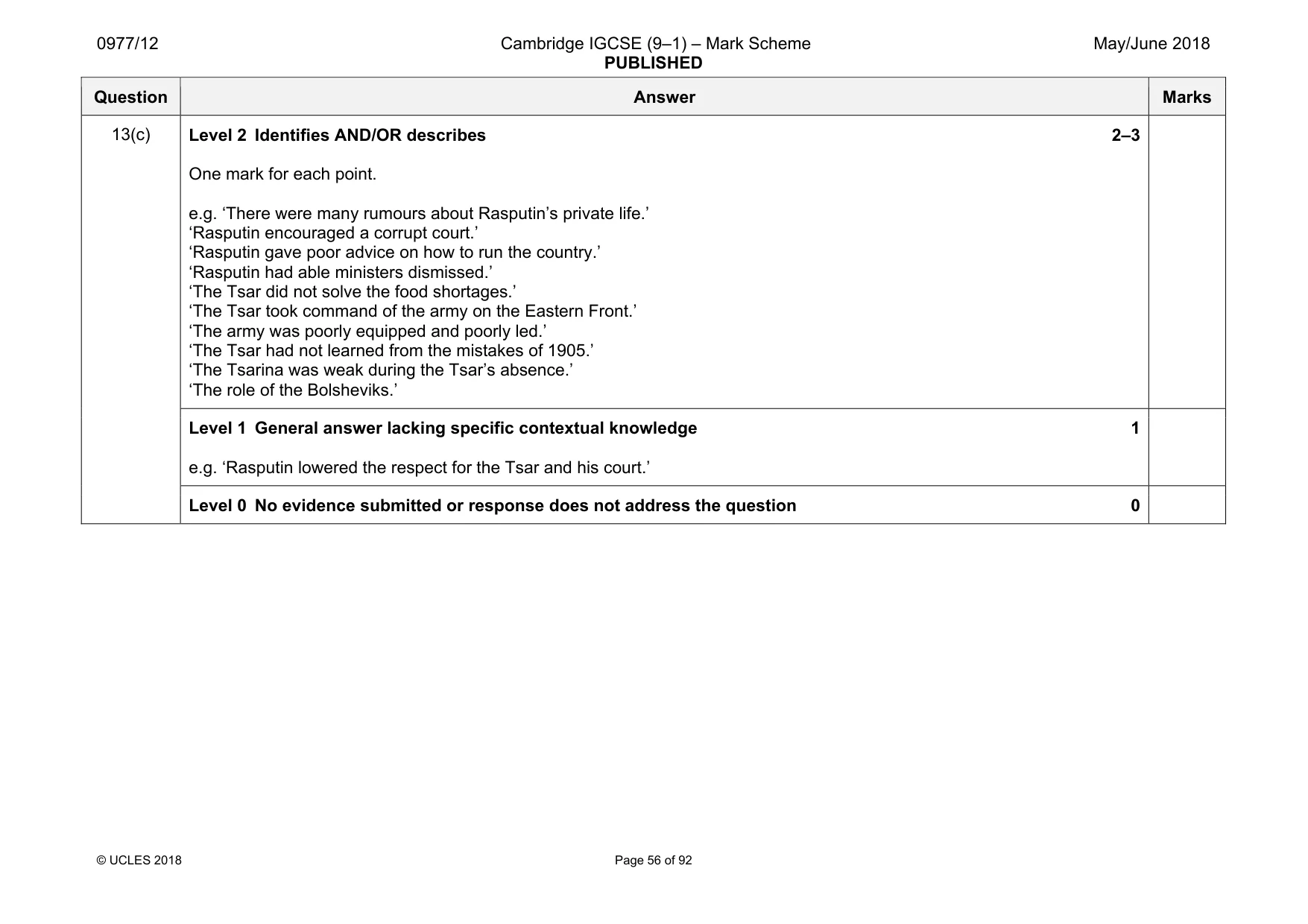
0977/12 Cambridge IGCSE (9–1) – Mark Scheme PUBLISHED May/June 2018 © UCLES 2018 Page 56 of 92 Question Answer Marks 13(c) Level 2 Identifies AND/OR describes 2–3 One mark for each point. e.g. ‘There were many rumours about Rasputin’s private life.’ ‘Rasputin encouraged a corrupt court.’ ‘Rasputin gave poor advice on how to run the country.’ ‘Rasputin had able ministers dismissed.’ ‘The Tsar did not solve the food shortages.’ ‘The Tsar took command of the army on the Eastern Front.’ ‘The army was poorly equipped and poorly led.’ ‘The Tsar had not learned from the mistakes of 1905.’ ‘The Tsarina was weak during the Tsar’s absence.’ ‘The role of the Bolsheviks.’ Level 1 General answer lacking specific contextual knowledge 1 e.g. ‘Rasputin lowered the respect for the Tsar and his court.’ Level 0 No evidence submitted or response does not address the question 0
Mark scheme, page 57
0977/12 Cambridge IGCSE (9–1) – Mark Scheme PUBLISHED May/June 2018 © UCLES 2018 Page 57 of 92 Question Answer Marks 14(a) What was the New Economic Policy? 4 Level 1 One mark for each relevant point; additional mark for supporting detail 1–4 e.g. ‘It was a policy announced by Lenin.’ ‘It began in 1921.’ ‘It brought an end to War Communism.’ ‘It attempted to regain the support of the peasants and gain support of the workers.’ ‘Its aim was to produce more food for the workers in the cities.’ ‘It allowed peasants to sell surplus grain on the open market.’ ‘Private enterprise was allowed in trade and small-scale industry.’ ‘Compulsory labour ceased.’ ‘Bonuses were introduced for overtime and extra work.’ ‘The currency was put on a sound footing.’ ‘A regular system of taxation was introduced.’ ‘Foreign trade was allowed, encouraging links with other countries.’ ‘It gave the economy a boost.’ Level 0 No evidence submitted or response does not address the question 0
Mark scheme, page 58
0977/12 Cambridge IGCSE (9–1) – Mark Scheme PUBLISHED May/June 2018 © UCLES 2018 Page 58 of 92 Question Answer Marks 14(b) Why was Stalin the most plausible candidate to become leader following the death of Lenin? 6 Level 4 Explains TWO reasons 6 Level 3 Explains ONE reason 4–5 (Four marks for one explanation, five marks for full explanation) e.g. ‘Stalin’s ideas seemed more realistic than Trotsky’s ideas. Communist Party leaders were worried by Trotsky’s radicalism and his belief in permanent revolution, which meant that the USSR would be obliged to help communist groups in other countries. Stalin believed in ‘socialism in one country’, which would allow the USSR to concentrate on establishing communism at home first.’ Level 2 Identifies AND/OR describes reasons 2–3 (One mark for each identification/description) e.g. ‘Stalin promoted ‘socialism in one country’.’ ‘Stalin believed in establishing communism at home.’ ‘Stalin praised Lenin’s policies including the NEP.’ ‘Trotsky believed in a permanent or world revolution.’ ‘Trotsky believed it was the USSR’s duty to help revolutionary groups in other countries.’ ‘Trotsky’s ideas could involve the USSR in new international conflicts.’ ‘Stalin had influence through his position as General Secretary.’ ‘He deceived Trotsky over Lenin’s funeral.’ ‘He removed opposition.’ Level 1 General answer lacking specific contextual knowledge 1 e.g. ‘Trotsky’s ideas were thought to be too extreme.’ Level 0 No evidence submitted or response does not address the question 0
Mark scheme, page 59
0977/12 Cambridge IGCSE (9–1) – Mark Scheme PUBLISHED May/June 2018 © UCLES 2018 Page 59 of 92 Question Answer Marks 14(c) ‘The most successful method used by Stalin to control the Soviet people was art and culture.’ How far do you agree with this statement? Explain your answer. 10 Level 5 Explains with evaluation of ‘the most successful’ 10 As Level 4 plus evaluation. Level 4 Explanation of both sides 7–9 A L4 answer will have a minimum of three explanations (2 on one side; 1 on the other). This will be worth a mark of 7. Fuller explanation of one issue to be given two marks. An answer which only has one explanation on one side of the argument cannot be awarded more than 8. Level 3 One-sided explanation OR one explanation of both sides 5–6 marks 4–6 More detailed explanation of one issue to be given two marks. e.g. ‘To enforce the cult of Stalin and show that Russia’s success was dependent on him, statues and pictures increased and made Stalin appear god-like. The glamour also grew. For his birthday each year the celebrations became more and more dramatic. This helped to make him loved and admired.’ OR ‘In 1936, Stalin created a new constitution for the USSR. It gave freedom of speech and free elections to the Russian people. This was cosmetic. Only Communist Party candidates were allowed to stand in elections and only approved newspapers and magazines could be published.’
Mark scheme, page 60
0977/12 Cambridge IGCSE (9–1) – Mark Scheme PUBLISHED May/June 2018 © UCLES 2018 Page 60 of 92 Question Answer Marks 14(c) Level 2 Identifies AND/OR describes 2–3 One mark for each point. e.g. Official art and culture – ‘Stalin’s image was everywhere.’ ‘There was a cult of Stalin.’ ‘Places were named after him.’ ‘Children were taught that he was ‘the wisest man of the age’.’ ‘Famous photographs were changed to make him a hero and to remove purged people.’ ‘Books, films, art and plays had to match Stalin’s beliefs.’ Other methods – ‘Purges and show trials were carried out to remove anyone considered disloyal.’ ‘Stalin introduced a new constitution.’ ‘Ordinary people lived in fear of the NKVD.’ ‘Millions were sent to the gulags.’ Level 1 General answer lacking specific contextual knowledge 1 e.g. ‘Stalin imposed on the people what he wanted.’ Level 0 No evidence submitted or response does not address the question 0
Mark scheme, page 61
0977/12 Cambridge IGCSE (9–1) – Mark Scheme PUBLISHED May/June 2018 © UCLES 2018 Page 61 of 92 Question Answer Marks 15(a) What impact did trade tariffs have on the US economy in the 1920s? 4 Level 1 One mark for each relevant point; additional mark for supporting detail 1–4 e.g. ‘Trade tariffs made imported foreign goods expensive.’ ‘The tariffs protected American businesses against foreign competition.’ ‘They encouraged Americans to buy American goods.’ ‘There was confidence in American goods.’ ‘It made the economy grow/it had a positive effect.’ ‘The lack of foreign competition allowed American companies to grow rapidly.’ ‘The tariffs protected the young consumer industries from foreign competition.’ ‘The lack of foreign competition eventually made parts of American industry inefficient.’ ‘Countries retaliated with tariffs on American goods.’ ‘When the American home market became saturated with consumer goods, it became difficult to sell abroad because of counter-tariffs.’ ‘American farmers were overproducing for the home market, but could not sell much abroad.’ ‘The fall in shares in 1929 was partly due to stagnated production and surpluses which could not be sold abroad.’ Level 0 No evidence submitted or response does not address the question 0
Mark scheme, page 62
0977/12 Cambridge IGCSE (9–1) – Mark Scheme PUBLISHED May/June 2018 © UCLES 2018 Page 62 of 92 Question Answer Marks 15(b) Why was the growth of mail order and nationwide advertising important to the economic boom? 6 Level 4 Explains TWO reasons 6 Level 3 Explains ONE reason 4–5 (Four marks for one explanation, five marks for full explanation) e.g. ‘Consumer goods were being mass-produced on a vast scale and depended on vast sales. To encourage consumers to buy goods sophisticated marketing techniques were developed. Many of the advertisers who had learned their skills in wartime propaganda now set up agencies to sell cars, cigarettes, clothing and electrical items. Posters, radio adverts and travelling salesmen encouraged Americans to spend on the latest products.’ Level 2 Identifies AND/OR describes reasons 2–3 (One mark for each identification/description) e.g. ‘American consumer industries needed to sell vast numbers of goods.’ ‘Advertising needed to convince Americans that they needed a particular product.’ ‘Advertising needed to persuade Americans to keep up with their neighbour in buying.’ ‘Mail order allowed people to consider buying goods from their own home.’ ‘Mail order made it easy to buy consumer goods without going to the shops.’ ‘It opened up rural areas.’ ‘It created more employment.’ ‘It made goods more accessible.’ Level 1 General answer lacking specific contextual knowledge 1 e.g. ‘Advertising and mail order were needed to persuade people to buy goods.’ Level 0 No evidence submitted or response does not address the question 0
Mark scheme, page 63
0977/12 Cambridge IGCSE (9–1) – Mark Scheme PUBLISHED May/June 2018 © UCLES 2018 Page 63 of 92 Question Answer Marks 15(c) ‘Overproduction rather than competition from Canada was to blame for the difficulties faced by farmers in the 1920s.’ How far do you agree with this statement? Explain your answer. 10 Level 5 Explains with evaluation of ‘how far’ 10 As Level 4 plus evaluation. Level 4 Explanation of both sides 7–9 A L4 answer will have a minimum of three explanations (2 on one side; 1 on the other). This will be worth a mark of 7. Fuller explanation of one issue to be given two marks. An answer which only has one explanation on one side of the argument cannot be awarded more than 8. Level 3 One-sided explanation OR one explanation of both sides 5–6 marks 4–6 More detailed explanation of one issue to be given two marks. e.g. ‘The underlying problem of the farming industry was overproduction. From 1900 to 1920, while farming was doing well, more and more land was being farmed. Improved machinery, especially the combine harvester, and improved fertilisers made US agriculture very efficient. The result was that by 1920 it was producing surpluses of wheat which nobody wanted and prices fell.’ OR ‘Farmers struggled against competition from the highly efficient Canadian wheat producers. Canadian wheat prices were low and Canada started to supply grain to the world markets. European markets preferred Canadian grain because of the low price and because they did not want to buy American grain in retaliation for tariffs on European goods.’
Mark scheme, page 64
0977/12 Cambridge IGCSE (9–1) – Mark Scheme PUBLISHED May/June 2018 © UCLES 2018 Page 64 of 92 Question Answer Marks 15(c) Level 2 Identifies AND/OR describes 2–3 One mark for each point. e.g. ‘During the war, the US farmers expanded growing areas to supply the European markets.’ ‘After the war, Europe did not import so much US grain.’ ‘The home market was steady and therefore there were surpluses.’ ‘The surplus could not be sold, leading to lower prices and often bankruptcy.’ ‘Canadian wheat farmers were very efficient.’ ‘Canadian farmers were not involved in tariff wars.’ ‘Canadian farmers supplied world markets.’ Level 1 General answer lacking specific contextual knowledge 1 e.g. ‘There were numerous problems affecting US agriculture.’ Level 0 No evidence submitted or response does not address the question 0
Mark scheme, page 65
0977/12 Cambridge IGCSE (9–1) – Mark Scheme PUBLISHED May/June 2018 © UCLES 2018 Page 65 of 92 Question Answer Marks 16(a) What did the Social Security Act of 1935 provide? 4 Level 1 One mark for each relevant point; additional mark for supporting detail 1–4 e.g. ‘It provided a national insurance scheme.’ ‘It provided old age pensions.’ ‘It provided pensions for widows.’ ‘It provided unemployment benefit.’ ‘It provided help for the sick.’ ‘It provided help for the disabled.’ ‘It gave money to public health to investigate disease.’ Level 0 No evidence submitted or response does not address the question 0
Mark scheme, page 66
0977/12 Cambridge IGCSE (9–1) – Mark Scheme PUBLISHED May/June 2018 © UCLES 2018 Page 66 of 92 Question Answer Marks 16(b) Why did Roosevelt’s ‘Hundred Days’ have the effect of restoring confidence? 6 Level 4 Explains TWO reasons 6 Level 3 Explains ONE reason 4–5 (Four marks for one explanation, five marks for full explanation) e.g. ‘Roosevelt ordered a four-day national bank holiday while the Emergency Banking Act was passed through Congress. Unsound banks were closed down while the remainder were helped with government grants and advice. Roosevelt explained what he was doing to the American people through a national radio broadcast. Public confidence was restored and the banking system survived.’ Level 2 Identifies AND/OR describes reasons 2–3 (One mark for each identification/description) e.g. ‘Roosevelt’s ‘fireside chats’ explained what he was doing with legislation to solve the existing problems.’ ‘He explained that he was producing a wide range of sweeping measures to tackle the impact of the Depression.’ ‘He stabilised the banking system.’ ‘Each of the ‘alphabet agencies’ were set up to tackle a specific problem.’ ‘He set up organisations, such as the PWA, to create employment.’ ‘He set up the CCC to carry out conservation work.’ ‘Roosevelt helped farmers receive rewarding prices for their produce.’ ‘Roosevelt helped the poor with emergency relief funds.’ Level 1 General answer lacking specific contextual knowledge 1 e.g. ‘Roosevelt had a plan of action.’ Level 0 No evidence submitted or response does not address the question 0
Mark scheme, page 67
0977/12 Cambridge IGCSE (9–1) – Mark Scheme PUBLISHED May/June 2018 © UCLES 2018 Page 67 of 92 Question Answer Marks 16(c) ‘Criticism of the New Deal by the Supreme Court was more serious than criticism from other groups and individuals.’ How far do you agree with this statement? Explain your answer. 10 Level 5 Explains with evaluation of ‘how far’ 10 As Level 4 plus evaluation. Level 4 Explanation of both sides 7–9 A L4 answer will have a minimum of three explanations (2 on one side; 1 on the other). This will be worth a mark of 7. Fuller explanation of one issue to be given two marks. An answer which only has one explanation on one side of the argument cannot be awarded more than 8. Level 3 One-sided explanation OR one explanation of both sides 5–6 marks 4–6 More detailed explanation of one issue to be given two marks. e.g. ‘The Supreme Court declared that the AAA and the NRA were unconstitutional. It was the Court’s task to decide if measures passed by the President and the Congress were consistent with the American Constitution. Most of the judges were Republican and they had a natural political dislike for the New Deal.’ OR ‘Senator Huey Long did not think the New Deal went far enough. His ‘Share our Wealth’ scheme included the confiscation of large fortunes, lump sums for American families, pensions for the over 60s, free washing machines and radios, minimum wages and free education.’
Mark scheme, page 68
0977/12 Cambridge IGCSE (9–1) – Mark Scheme PUBLISHED May/June 2018 © UCLES 2018 Page 68 of 92 Question Answer Marks 16(c) Level 2 Identifies AND/OR describes 2–3 One mark for each point. e.g. ‘The Supreme Court had to uphold the Constitution.’ ‘Republicans believed in minimal government intervention and low taxation.’ ‘Some Republicans accused Roosevelt of acting as a dictator.’ ‘Some state governors argued that the New Deal laws conflicted with the rights of state governments.’ ‘Business leaders in the Liberty League opposed the New Deal.’ ‘Many of the wealthy did not like high taxes and benefit handouts.’ ‘Huey Long thought the New Deal did not go far enough and he wanted all wealth shared.’ ‘Dr. Townsend wanted a pension of $200 per month for the over 60s.’ ‘Father Coughlin attacked the New Deal for being inadequate and wanted social justice for all.’ Level 1 General answer lacking specific contextual knowledge 1 e.g. ‘Opposition came from the law, political parties and individuals.’ Level 0 No evidence submitted or response does not address the question 0
Mark scheme, page 69
0977/12 Cambridge IGCSE (9–1) – Mark Scheme PUBLISHED May/June 2018 © UCLES 2018 Page 69 of 92 Question Answer Marks 17(a) What benefits did the Communists gain from the years of the Yenan Soviet? 4 Level 1 One mark for each relevant point; additional mark for supporting detail 1–4 e.g. ‘The Communists were able to recover from fighting the KMT.’ ‘Mao was able to establish his authority.’ ‘Mao indoctrinated his followers with Marxist-Leninist ideas.’ ‘Communists lived and worked alongside peasants and gained their support.’ ‘Membership grew rapidly.’ ‘By 1945 there were 1.2 million members.’ ‘Foreign visitors and journalists visited Yenan.’ ‘They gave favourable accounts to the outside world and reported KMT atrocities.’ Level 0 No evidence submitted or response does not address the question 0
Mark scheme, page 70
0977/12 Cambridge IGCSE (9–1) – Mark Scheme PUBLISHED May/June 2018 © UCLES 2018 Page 70 of 92 Question Answer Marks 17(b) Why did the Nationalist government lose the support of the peasants during the Second World War? 6 Level 4 Explains TWO reasons 6 Level 3 Explains ONE reason 4–5 (Four marks for one explanation, five marks for full explanation) e.g. ‘Chiang Kai-shek proved reluctant to engage the Japanese in military confrontation and adopted defensive positions and ignored the advice of American military advisers who urged him to attack the Japanese. This annoyed the Chinese peasants who wanted to see their own government fight the Japanese.’ Level 2 Identifies AND/OR describes reasons 2–3 (One mark for each identification/description) e.g. ‘The Nationalist government did not attack the Japanese.’ ‘The Nationalists wasted huge amounts of aid and equipment from the USA.’ ‘Senior members of the KMT were corrupt and embezzled US funds for personal use.’ ‘The peasantry supported the Communists because they took direct action against the Japanese.’ Level 1 General answer lacking specific contextual knowledge 1 e.g. ‘The Nationalists did not give the peasants what they wanted.’ Level 0 No evidence submitted or response does not address the question 0
Mark scheme, page 71
0977/12 Cambridge IGCSE (9–1) – Mark Scheme PUBLISHED May/June 2018 © UCLES 2018 Page 71 of 92 Question Answer Marks 17(c) ‘The Communists won the Civil War because of superior leadership.’ How far do you agree with this statement? Explain your answer. 10 Level 5 Explains with evaluation of ‘how far’ 10 As Level 4 plus evaluation. Level 4 Explanation of both sides 7–9 A L4 answer will have a minimum of three explanations (2 on one side; 1 on the other). This will be worth a mark of 7. Fuller explanation of one issue to be given two marks. An answer which only has one explanation on one side of the argument cannot be awarded more than 8. Level 3 One-sided explanation OR one explanation of both sides 5–6 marks 4–6 More detailed explanation of one issue to be given two marks. e.g. ‘The Communists used the guerrilla tactics that had served them so well against the Japanese. Aware that their main force was smaller and less well supplied than the KMT, they adopted a policy of not attacking the main Nationalist forces in set-piece battles. Instead, they focused on calculated attacks against smaller targets and caused supply problems in the KMT.’ OR ‘The corruption which had hindered their war effort also meant that the KMT struggled to win support during the Civil War. Ordinary people lost faith in the ability of Chiang’s government to solve the economic problems the country faced and turned towards the Communists.’
Mark scheme, page 72
0977/12 Cambridge IGCSE (9–1) – Mark Scheme PUBLISHED May/June 2018 © UCLES 2018 Page 72 of 92 Question Answer Marks 17(c) Level 2 Identifies AND/OR describes 2–3 One mark for each point. e.g. ‘The Communists successfully used guerrilla tactics.’ ‘The Communists attacked the supply lines of the KMT.’ ‘The Communists had the support of the peasants because of their war efforts against the Japanese.’ ‘The Communists controlled the rural areas with large peasant numbers.’ ‘Many KMT troops deserted the KMT, taking weapons and supplies to the Communists.’ ‘The USA withdrew aid to the KMT and stayed neutral.’ ‘The image of the KMT was one of corruption and relying on foreign support.’ ‘The Communist Party was portrayed as the party of the people.’ ‘Capturing the key city of Shanghai was vital to the result of the Civil War.’ Level 1 General answer lacking specific contextual knowledge 1 e.g. ‘The treatment of the peasantry was significant in the result of the Civil War.’ Level 0 No evidence submitted or response does not address the question 0
Mark scheme, page 73
0977/12 Cambridge IGCSE (9–1) – Mark Scheme PUBLISHED May/June 2018 © UCLES 2018 Page 73 of 92 Question Answer Marks 18(a) What was the impact of the Cultural Revolution on Chinese art and culture? 4 Level 1 One mark for each relevant point; additional mark for supporting detail 1–4 e.g. ‘The Chinese were encouraged to ignore traditional arts and ideas.’ ‘Traditions such as fortune telling and feng shui were discouraged.’ ‘Classical Chinese literature was criticised.’ ‘Only authors and artists endorsed by the regime were encouraged.’ ‘Historical sites and artefacts were destroyed.’ ‘Museum pieces and priceless pieces from private collections were destroyed.’ ‘Many pieces were smuggled abroad and sold to prevent destruction.’ ‘Mao wanted to remove influences of past generations.’ ‘Art under Mao was one of striking posters glorifying the regime.’ Level 0 No evidence submitted or response does not address the question 0
Mark scheme, page 74
0977/12 Cambridge IGCSE (9–1) – Mark Scheme PUBLISHED May/June 2018 © UCLES 2018 Page 74 of 92 Question Answer Marks 18(b) Why was the Hundred Flowers campaign important to Mao? 6 Level 4 Explains TWO reasons 6 Level 3 Explains ONE reason 4–5 (Four marks for one explanation, five marks for full explanation) e.g. ‘Mao wanted to address the direction of the revolution. He claimed he wanted people in China to analyse the direction the country was heading in. Mao said that criticism was healthy and he wanted people to speak out against the excesses they saw in China.’ Level 2 Identifies AND/OR describes reasons 2–3 (One mark for each identification/description) e.g. ‘Mao hoped it would praise his and the regime’s achievements.’ ‘Mao wanted to remove those who still opposed Communist rule.’ ‘Mao wanted to know who his critics were by encouraging them to speak out.’ ‘Mao wanted people to point the finger at those who did not follow Communist ways.’ ‘Mao may have wanted ideas of how the revolution should develop.’ Level 1 General answer lacking specific contextual knowledge 1 e.g. ‘It is difficult to know what Mao’s real intentions were with this campaign.’ Level 0 No evidence submitted or response does not address the question 0
Mark scheme, page 75
0977/12 Cambridge IGCSE (9–1) – Mark Scheme PUBLISHED May/June 2018 © UCLES 2018 Page 75 of 92 Question Answer Marks 18(c) ‘The main reason for the Cultural Revolution was to give Mao an opportunity to re-establish his influence.’ How far do you agree with this statement? Explain your answer. 10 Level 5 Explains with evaluation of ‘how far’ 10 As Level 4 plus evaluation. Level 4 Explanation of both sides 7–9 A L4 answer will have a minimum of three explanations (2 on one side; 1 on the other). This will be worth a mark of 7. Fuller explanation of one issue to be given two marks. An answer which only has one explanation on one side of the argument cannot be awarded more than 8. Level 3 One-sided explanation OR one explanation of both sides 5–6 marks 4–6 More detailed explanation of one issue to be given two marks. e.g. ‘Since the failure of the Great Leap Forward, Mao had lost his position as Chairman of the Party. Mao wanted to return to a powerful position. As the Great Leap Forward had been widely discredited, Mao was worried his position in history was under threat. A new movement would help re-establish his influence.’ OR ‘Mao wanted the Cultural Revolution to oppose the reforms of Liu Shaoqi. Mao wanted to stop the emergence of a privileged class in China where others were left to struggle. Mao argued that this was what happened to the revolution in the Soviet Union under Stalin and Khrushchev and that it would in China if the reforms of Liu Shaoqi continued.’
Mark scheme, page 76
0977/12 Cambridge IGCSE (9–1) – Mark Scheme PUBLISHED May/June 2018 © UCLES 2018 Page 76 of 92 Question Answer Marks 18(c) Level 2 Identifies AND/OR describes 2–3 One mark for each point. e.g. ‘Mao wanted to regain his influence after the failure of the Great Leap Forward.’ ‘Mao had lost his position as Party Chairman.’ ‘Mao considered his place in history was under threat.’ ‘Mao was concerned the revolution was heading towards a Soviet model with privileged groups.’ ‘Liu Shaoqi did not favour collective farms and factories which Mao had introduced.’ ‘Young people seemed less connected to the communist model and needed enthusing.’ ‘The less well off and poorly educated seemed to be turning against the spirit of the revolution.’ ‘Elements of capitalism, such as private trade, had made certain people richer than others.’ Level 1 General answer lacking specific contextual knowledge 1 e.g. ‘Mao wanted to re-impose his style of communism.’ Level 0 No evidence submitted or response does not address the question 0
Mark scheme, page 77
0977/12 Cambridge IGCSE (9–1) – Mark Scheme PUBLISHED May/June 2018 © UCLES 2018 Page 77 of 92 Question Answer Marks 19(a) What was the Broederbond? 4 Level 1 One mark for each relevant point; additional mark for supporting detail 1–4 e.g. ‘It was an organisation dedicated to the advancement of Afrikaner interests.’ ‘It was a secret organisation.’ ‘It was almost exclusively male.’ ‘Members of the Broederbond designed and implemented apartheid.’ ‘It has been likened to the Masons.’ ‘All leaders of government between 1948 and 1994 were members.’ ‘All key posts in central government were held by members.’ ‘Malan, Vorster, P.W.Botha and de Klerk were all members.’ Level 0 No evidence submitted or response does not address the question 0
Mark scheme, page 78
0977/12 Cambridge IGCSE (9–1) – Mark Scheme PUBLISHED May/June 2018 © UCLES 2018 Page 78 of 92 Question Answer Marks 19(b) Why did the United Party lose the 1948 election despite gaining more votes than the National Party? 6 Level 4 Explains TWO reasons 6 Level 3 Explains ONE reason 4–5 (Four marks for one explanation, five marks for full explanation) e.g. ‘By 1948, Smuts was 78 years old and regarded as out of touch. He was regarded with suspicion for supporting the ideas of equal human rights and liberty in the Charter of the United Nations drawn up after the Second World War.’ Level 2 Identifies AND/OR describes reasons 2–3 (One mark for each identification/description) e.g. ‘The Nationalists had the benefit of the rural vote.’ ‘There was an increasing growth of Afrikaner nationalism.’ ‘The government had relaxed laws concerning segregation.’ ‘Groups of black people took part in boycotts, strikes and acts of passive resistance.’ ‘Smuts was seen as old and out of touch.’ ‘Afrikaners were not reassured that the United Party thought black people would stay in cities.’ ‘The United Party thought the segregation of the races was impractical.’ ‘Afrikaners wanted total separation or apartheid.’ Level 1 General answer lacking specific contextual knowledge 1 e.g. ‘It was as a result of a quirk in the South African constitution.’ Level 0 No evidence submitted or response does not address the question 0
Mark scheme, page 79
0977/12 Cambridge IGCSE (9–1) – Mark Scheme PUBLISHED May/June 2018 © UCLES 2018 Page 79 of 92 Question Answer Marks 19(c) How segregated was South Africa prior to 1948? Explain your answer. 10 Level 5 Explains with evaluation of ‘how segregated’ 10 As Level 4 plus evaluation. Level 4 Explanation of both sides 7–9 A L4 answer will have a minimum of three explanations (2 on one side; 1 on the other). This will be worth a mark of 7. Fuller explanation of one issue to be given two marks. An answer which only has one explanation on one side of the argument cannot be awarded more than 8. Level 3 One-sided explanation OR one explanation of both sides 5–6 marks 4–6 More detailed explanation of one issue to be given two marks. e.g. ‘South Africa was highly segregated by 1948. Membership of parliament was restricted to white men, while 87% of the land was owned by white people. Segregated housing for black people and white people existed and new black townships were built. Black Africans were restricted in their movement by the pass system.’ OR ‘During the Second World War, many white people left to fight. Factories responded to the labour shortage by employing more black people. The number of black people working in industry increased by 70% during the war, many taking over skilled or semi-skilled jobs. This meant more black people moved to the towns where, for the first time, they began to outnumber white people.’
Mark scheme, page 80
0977/12 Cambridge IGCSE (9–1) – Mark Scheme PUBLISHED May/June 2018 © UCLES 2018 Page 80 of 92 Question Answer Marks 19(c) Level 2 Identifies AND/OR describes 2–3 One mark for each point. e.g. ‘All Members of Parliament were white.’ ‘Extra-marital intercourse between a white person and a black person was a crime.’ ‘90% of black people lived in rural areas.’ ‘There was segregated housing for white people and black people in town areas.’ ‘Every black male over 16 years had to carry a pass.’ ‘Skilled jobs in the mines were for white people only.’ ‘The Second World War meant some skilled jobs were taken by black people.’ ‘There were more black people in the towns since the start of the war.’ ‘The government relaxed some of the restrictions on black people, such as the pass system.’ Level 1 General answer lacking specific contextual knowledge 1 e.g. ‘The basis of apartheid was already established by 1948.’ Level 0 No evidence submitted or response does not address the question 0
Mark scheme, page 81
0977/12 Cambridge IGCSE (9–1) – Mark Scheme PUBLISHED May/June 2018 © UCLES 2018 Page 81 of 92 Question Answer Marks 20(a) What was the Bantu Homelands Constitution Act of 1971? 4 Level 1 One mark for each relevant point; additional mark for supporting detail 1–4 e.g. ‘The Act enabled the South African government to grant independence to any Homeland.’ ‘The ‘Homelands’ or ‘Bantustans’ were created in the Bantu Self-Government Act of 1959.’ ‘These were intended as the homelands for all black people in South Africa.’ ‘There were eight Bantustans.’ ‘By 1981 four Bantustans were independent.’ ‘It was administered by the Minister of Bantu Administration and Development.’ ‘The Act was repealed in 1994.’ Level 0 No evidence submitted or response does not address the question 0
Mark scheme, page 82
0977/12 Cambridge IGCSE (9–1) – Mark Scheme PUBLISHED May/June 2018 © UCLES 2018 Page 82 of 92 Question Answer Marks 20(b) Why did criticism from the international community have limited effect on the policy of apartheid? 6 Level 4 Explains TWO reasons 6 Level 3 Explains ONE reason 4–5 (Four marks for one explanation, five marks for full explanation) e.g. ‘Criticism consisted merely of words rather than words and deeds. If comprehensive trade sanctions had been imposed on South Africa, the South African government might have been forced to alter course since South Africa had no oil reserves, depended upon foreign capital and relied upon imports both for advanced technology and for heavy plant and equipment.’ Level 2 Identifies AND/OR describes reasons 2–3 (One mark for each identification/description) e.g. ‘The only successful sanctions before 1980 concerned sport.’ ‘South Africa had some rare and much needed metals such as nickel, zinc and asbestos.’ ‘South Africa had billions of dollars of foreign investments, which gave excellent returns to the investing country.’ ‘Criticism was weak because South Africa supported the West in the Cold War.’ ‘Criticism was weak because the ANC was considered to be communist inspired.’ ‘The National government was determined to keep apartheid.’ Level 1 General answer lacking specific contextual knowledge 1 e.g. ‘Most of the criticism was half-hearted.’ Level 0 No evidence submitted or response does not address the question 0
Mark scheme, page 83
0977/12 Cambridge IGCSE (9–1) – Mark Scheme PUBLISHED May/June 2018 © UCLES 2018 Page 83 of 92 Question Answer Marks 20(c) ‘The most important internal challenge to the apartheid state between 1966 and 1980 was the Soweto Uprising.’ How far do you agree with this statement? Explain your answer. 10 Level 5 Explains with evaluation of ‘how far’ 10 As Level 4 plus evaluation. Level 4 Explanation of both sides 7–9 A L4 answer will have a minimum of three explanations (2 on one side; 1 on the other). This will be worth a mark of 7. Fuller explanation of one issue to be given two marks. An answer which only has one explanation on one side of the argument cannot be awarded more than 8. Level 3 One-sided explanation OR one explanation of both sides 5–6 marks 4–6 More detailed explanation of one issue to be given two marks. e.g. ‘In June 1976, thousands of black school children demonstrated against the government instruction that half their subjects were to be taught in Afrikaans. The protests became nationwide after police shot a 13 year old African boy, resulting in at least 575 deaths. News of the violence went worldwide, causing shock at the inhumanity and brutality of the apartheid regime.’ OR ‘Steve Biko helped to change the way that black people thought about themselves, encouraging them to continue the struggle against oppression with renewed hope and vigour. He founded the Black Consciousness Movement which promoted pride and confidence in being black.’
Mark scheme, page 84
0977/12 Cambridge IGCSE (9–1) – Mark Scheme PUBLISHED May/June 2018 © UCLES 2018 Page 84 of 92 Question Answer Marks 20(c) Level 2 Identifies AND/OR describes 2–3 One mark for each point. e.g. ‘Ideas of confrontation and resistance were developed among the general black population.’ ‘This included children, parents and industrial workers.’ ‘There was an upsurge in strike action for improved wages and conditions of work.’ ‘Steve Biko’s Black Consciousness Movement encouraged the struggle against apartheid.’ ‘Biko’s removal from university led to strikes on university campuses.’ ‘The Soweto Uprising led to nationwide protests and many deaths.’ ‘Investors in gold and diamond shares took fright.’ ‘Thousands of Africans fled to Mozambique, Angola and Tanzania to train as guerrilla fighters.’ Level 1 General answer lacking specific contextual knowledge 1 e.g. ‘Pupils and students played a vital role in the challenge to apartheid.’ Level 0 No evidence submitted or response does not address the question 0
Mark scheme, page 85
0977/12 Cambridge IGCSE (9–1) – Mark Scheme PUBLISHED May/June 2018 © UCLES 2018 Page 85 of 92 Question Answer Marks 21(a) What part did the Israeli air force play in the Six-Day War? 4 Level 1 One mark for each relevant point; additional mark for supporting detail 1–4 e.g. ‘The outbreak of war was triggered by an Israeli pre-emptive air strike.’ ‘The air strike launched Operation Focus.’ ‘The Israeli air force caught the Egyptian air force on the ground.’ ‘The Egyptian air force was destroyed.’ ‘Both Syrian and Iraqi air forces were attacked and destroyed on the ground.’ ‘The whole of Jordan’s air force was destroyed.’ ‘Within a few hours of the start, Israel had complete mastery of the air.’ ‘During the second day, the Israeli air force attacked Egyptian tanks and armoured vehicles.’ ‘The air support accelerated the Israeli victories on land.’ Level 0 No evidence submitted or response does not address the question 0
Mark scheme, page 86
0977/12 Cambridge IGCSE (9–1) – Mark Scheme PUBLISHED May/June 2018 © UCLES 2018 Page 86 of 92 Question Answer Marks 21(b) Why were the USA and the USSR worried by the Yom Kippur War? 6 Level 4 Explains TWO reasons 6 Level 3 Explains ONE reason 4–5 (Four marks for one explanation, five marks for full explanation) e.g. ‘Both superpowers were concerned about losing prestige and therefore wanted success from the Yom Kippur War. Both the USA and the USSR had invested heavily in the Middle East. The USA had supported Israel with funds and arms, while Egypt had been equipped with Russian arms and their army had been trained by Russian experts. Both superpowers wanted success for their investments and prestige.’ Level 2 Identifies AND/OR describes reasons 2–3 (One mark for each identification/description) e.g. ‘Both superpowers were heavily involved elsewhere in the world.’ ‘The USA feared Sadat’s motives.’ ‘The USA was busy with the Vietnam War.’ ‘The USSR was distracted over Poland and China.’ ‘The USA was concerned over oil supplies.’ Level 1 General answer lacking specific contextual knowledge 1 e.g. ‘Both were concerned about the outcome of the war.’ Level 0 No evidence submitted or response does not address the question 0
Mark scheme, page 87
0977/12 Cambridge IGCSE (9–1) – Mark Scheme PUBLISHED May/June 2018 © UCLES 2018 Page 87 of 92 Question Answer Marks 21(c) ‘The Camp David meeting in 1978 was a success.’ How far do you agree with this statement? Explain your answer. 10 Level 5 Explains with evaluation of ‘how far’ 10 As Level 4 plus evaluation. Level 4 Explanation of both sides 7–9 A L4 answer will have a minimum of three explanations (2 on one side; 1 on the other). This will be worth a mark of 7. Fuller explanation of one issue to be given two marks. An answer which only has one explanation on one side of the argument cannot be awarded more than 8. Level 3 One-sided explanation OR one explanation of both sides 5–6 marks 4–6 More detailed explanation of one issue to be given two marks. e.g. ‘After thirty years of conflict, Egypt and Israel were at peace with each other. Ambassadors were exchanged, trade developed and Egypt supplied Israel with crude oil. Egypt agreed to allow ships going to and from Israel to use the Suez Canal. It was agreed that Israel would gradually leave Sinai and return to the borders of 1948. Israel agreed to allow Palestinians in the West Bank some rights of self-government within five years.’ OR ‘Many Arab nations blame Egypt for the present problems over Palestine. The peace treaty did not demand from Israel recognition of the Palestinians’ rights to self-determination. They see the Accords as a disintegration of a united Arab front in opposition to Israel. Arab feeling was so strong that Egypt was suspended from the Arab League from 1979 to 1989 and the headquarters were moved from Cairo.’
Mark scheme, page 88
0977/12 Cambridge IGCSE (9–1) – Mark Scheme PUBLISHED May/June 2018 © UCLES 2018 Page 88 of 92 Question Answer Marks 21(c) Level 2 Identifies AND/OR describes 2–3 One mark for each point. e.g. ‘Egypt and Israel were at peace.’ ‘It did not demand enough for the Palestinians.’ ‘Some concessions were made to the Palestinians.’ ‘Some Israelis had to give up their homes.’ ‘Israel was allowed to use the Suez Canal.’ ‘Egypt was suspended from the Arab League.’ Level 1 General answer lacking specific contextual knowledge 1 e.g. ‘It was considered a first step towards peace in the region.’ Level 0 No evidence submitted or response does not address the question 0
Mark scheme, page 89
0977/12 Cambridge IGCSE (9–1) – Mark Scheme PUBLISHED May/June 2018 © UCLES 2018 Page 89 of 92 Question Answer Marks 22(a) Describe the Palestinian refugee crisis at the end of the Six-Day War. 4 Level 1 One mark for each relevant point; additional mark for supporting detail 1–4 e.g. ‘The refugee crisis worsened as a result of the 1967 war.’ ‘Refugees fled from Sinai, Gaza, Jerusalem and the West Bank.’ ‘The Israeli government encouraged Jewish settlers to these areas.’ ‘It became impossible for Arabs to return to their homes.’ ‘In Gaza and the West Bank, the Israeli government designated areas as ‘state land’.’ ‘This tied Gaza and the West Bank permanently to Israel.’ ‘The refugee camps became larger and conditions worsened.’ ‘Arab states continued to use the camps for propaganda purposes against Israel.’ Level 0 No evidence submitted or response does not address the question 0
Mark scheme, page 90
0977/12 Cambridge IGCSE (9–1) – Mark Scheme PUBLISHED May/June 2018 © UCLES 2018 Page 90 of 92 Question Answer Marks 22(b) Why was the expulsion of the PLO from Jordan a problem for Lebanon? 6 Level 4 Explains TWO reasons 6 Level 3 Explains ONE reason 4–5 (Four marks for one explanation, five marks for full explanation) e.g. ‘When the PLO was expelled from Jordan, it moved its headquarters to Beirut and established bases in south-east Lebanon. The PLO trained people from the refugee camps in Lebanon for raids against Israel. These frontier raids provoked the Israeli forces to retaliate.’ Level 2 Identifies AND/OR describes reasons 2–3 (One mark for each identification/description) e.g. ‘The PLO headquarters moved to Lebanon.’ ‘There were Palestinian camps in Lebanon.’ ‘Raids took place on Israel from Lebanon.’ ‘Those involved in the raids were trained by the PLO.’ ‘The Israelis retaliated when raids were carried out against Israel.’ ‘The Israelis sent troops into Lebanon to protect Christians from the PLO.’ Level 1 General answer lacking specific contextual knowledge 1 e.g. ‘Israel attacked the PLO.’ Level 0 No evidence submitted or response does not address the question 0
Mark scheme, page 91
0977/12 Cambridge IGCSE (9–1) – Mark Scheme PUBLISHED May/June 2018 © UCLES 2018 Page 91 of 92 Question Answer Marks 22(c) How far was the PLO successful in promoting the Palestinian cause before 1993? Explain your answer. 10 Level 5 Explains with evaluation of ‘how far’ 10 As Level 4 plus evaluation. Level 4 Explanation of both sides 7–9 A L4 answer will have a minimum of three explanations (2 on one side; 1 on the other). This will be worth a mark of 7. Fuller explanation of one issue to be given two marks. An answer which only has one explanation on one side of the argument cannot be awarded more than 8. Level 3 One-sided explanation OR one explanation of both sides 5–6 marks 4–6 More detailed explanation of one issue to be given two marks. e.g. ‘By their actions in the 1970s, the PLO became terrorists in the eyes of Western governments and press. An example of this occurred at the Munich Olympics when Black September kidnapped and killed 11 Israeli Olympic athletes. They failed to get the release of 200 of their comrades who were held in prison in Israel.’ OR ‘Their political fortunes improved in 1974 when the PLO was recognised by the Arab League as the ‘sole representative of the Palestinian people’. That year Arafat was allowed to address the UN General Assembly, strengthening the Palestinian cause. A resolution passed by the UN in the following year condemned Zionism.’
Mark scheme, page 92
0977/12 Cambridge IGCSE (9–1) – Mark Scheme PUBLISHED May/June 2018 © UCLES 2018 Page 92 of 92 Question Answer Marks 22(c) Level 2 Identifies AND/OR describes 2–3 One mark for each point. e.g. Effective – ‘Actions by the PLO in the 1970s gained massive world publicity.’ ‘Arafat was allowed to address the United Nations.’ ‘At the UN they were backed by African and Asian states.’ ‘The PLO provided a voice for Palestinians.’ ‘In 1988 the PLO accepted the existence of Israel.’ Ineffective – ‘By their actions in the 1970s they were considered as terrorists by the West.’ ‘PLO actions often resulted in Israeli revenge attacks.’ ‘The PLO did not always have the support of Arab states.’ ‘There was still no independent Palestinian state.’ Level 1 General answer lacking specific contextual knowledge 1 e.g. ‘The PLO was popular with some, but condemned by many.’ Level 0 No evidence submitted or response does not address the question 0
What you needed in this session
Cambridge’s own grade thresholds for 2018 May/June, Paper 1 · Variant 2. A higher threshold means an easier paper — the bar moves with how the cohort did.