Cambridge IGCSE Greek - Foreign Language 0543 — 2019 May/June Paper 4 · Variant 1
0543/41/M/J/19 · 50 marks · ≈56 min
The question paper and its mark scheme, free to read here and free to download. This is Cambridge’s own paper, exactly as it was sat.
Question paper8 pages

Mark scheme28 pages
Answers below. Sit the paper first if you are practising.
Paper as text
Question paper, page 1
This document consists of 5 printed pages and 3 blank pages. DC (NH/CB) 164218/3 © UCLES 2019 [Turn over Cambridge Assessment International Education Cambridge International General Certificate of Secondary Education * 7 2 6 2 5 5 3 3 2 2 * GREEK 0543/04 Paper 4 Writing May/June 2019 1 hour Candidates answer on the Question Paper. No Additional Materials are required. READ THESE INSTRUCTIONS FIRST Write your centre number, candidate number and name in the spaces at the top of this page. Write in dark blue or black pen. Do not use staples, paper clips, glue or correction fluid. DO NOT WRITE IN ANY BARCODES. Answer three questions: Question 1, Question 2 and Question 3(a) or Question 3(b) or Question 3(c). The number of marks is given in brackets [ ] at the end of each question or part question. This syllabus is regulated for use in England, Wales and Northern Ireland as a Cambridge International Level 1/Level 2 Certificate.
Question paper, page 2
2 0543/04/M/J/19 © UCLES 2019 BLANK PAGE
Question paper, page 3
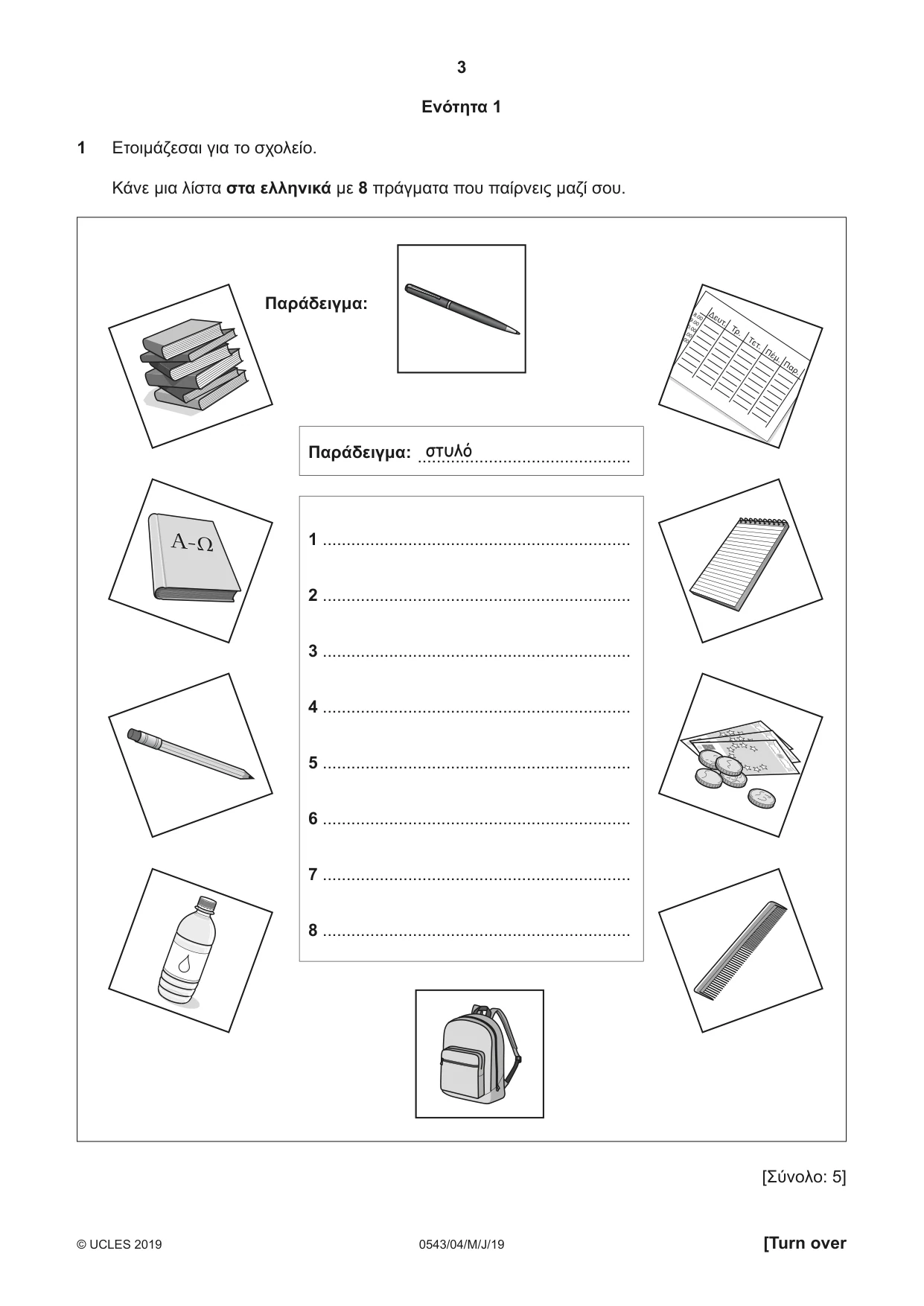
3 0543/04/M/J/19 © UCLES 2019 [Turn over Ενότητα 1 1 Ετοιμάζεσαι για το σχολείο. Κάνε μια λίστα στα ελληνικά με 8 πράγματα που παίρνεις μαζί σου. Παράδειγμα: Παράδειγμα: στυλό … 1 … 2 … 3 … 4 … 5 … 6 … 7 … 8 … [Ʃύvoλo: 5]
Question paper, page 4
4 0543/04/M/J/19 © UCLES 2019 2 Γράφεις στον φίλο/στη φίλη σου για το αγαπημένο σου χόμπι: • Ποιο είναι το αγαπημένο σου χόμπι; • Για ποιον λόγο σου αρέσει αυτό το χόμπι; • Πόσο συχνά ασχολείσαι με αυτό; • Τι ακριβώς κάνεις κάθε φορά που ασχολείσαι με το χόμπι σου; • Με ποιο άλλο χόμπι θα ασχοληθείς στο μέλλον και γιατί; Γράψε περίπου 80–90 λέξεις στα ελληνικά. … … … … … … … … … … … … … … … [Ʃύvoλo: 15]
Question paper, page 5
5 0543/04/M/J/19 © UCLES 2019 [Turn over BLANK PAGE Γύρισε σελíδα για τη 2η Ενότητα
Question paper, page 6
6 0543/04/M/J/19 © UCLES 2019 Ενότητα 2 3 Διάλεξε ένα από τα παρακάτω θέματα. Θα πρέπει να γράψεις 130–140 λέξεις στα ελληνικά. (a) Φεστιβάλ στην πόλη Στην πόλη σου γίνεται κάποιο φεστιβάλ, το οποίο επισκέφθηκες την περασμένη εβδομάδα με την οικογένειά σου. Γράψε ένα ηλεκτρονικό μήνυμα στον φίλο/στη φίλη σου σχετικά με αυτή την εκδήλωση. Στο μήνυμα πρέπει να αναφέρεις: • Τι είδους φεστιβάλ είναι; • Τι ακριβώς κάνατε εκεί; • Τι σου άρεσε περισσότερο από το φεστιβάλ και γιατί; • Με ποιον τρόπο, κατά τη γνώμη σου, θα βοηθήσει την πόλη σου το φεστιβάλ; ή (b) Οικογενειακό ταξίδι Μόλις γύρισες από ένα ταξίδι που έκανες με την οικογένειά σου. Γράψε ένα άρθρο για το blog σου σχετικά με την εμπειρία σου από αυτό το ταξίδι. Σ΄αυτό θα πρέπει να αναφέρεις: • Πού πήγατε; • Τι δραστηριότητες κάνατε εκεί; • Για ποιον λόγο σου αρέσει να ταξιδεύεις με την οικογένειά σου; • Πού θα ήθελες να ταξιδέψεις στο μέλλον και γιατί; ή (c) Βοήθεια σε φιλανθρωπική οργάνωση “Πρόσφατα πήρα μέρος σε μία εκδήλωση, για να μαζευτούν χρήματα για μία φιλανθρωπική οργάνωση. Ήταν η πιο σημαντική εμπειρία της ζωής μου. Όταν έφτασα εκεί...” Συνέχισε την ιστορία: • Περίγραψε τι ακριβώς έκανες. • Τι είδους οργάνωση ήταν και πόσα χρήματα μάζεψες; • Ποια ήταν η πιο δύσκολη στιγμή εκείνη τη μέρα; • Περίγραψε πώς ένιωσες στο τέλος της ημέρας.
Question paper, page 7
7 0543/04/M/J/19 © UCLES 2019 ΓΡΑΨΕ ΕΔΩ ΤΗΝ ΑΠΑΝΤΗΣΗ ΣΟΥ ΣΤΗΝ ΕΡΩΤΗΣΗ 3 … … … … … … … … … … … … … … … … … … … … … … … … … … … [Ʃύvoλo: 30]
Question paper, page 8
8 0543/04/M/J/19 © UCLES 2019 Permission to reproduce items where third-party owned material protected by copyright is included has been sought and cleared where possible. Every reasonable effort has been made by the publisher (UCLES) to trace copyright holders, but if any items requiring clearance have unwittingly been included, the publisher will be pleased to make amends at the earliest possible opportunity. To avoid the issue of disclosure of answer-related information to candidates, all copyright acknowledgements are reproduced online in the Cambridge Assessment International Education Copyright Acknowledgements Booklet. This is produced for each series of examinations and is freely available to download at www.cambridgeinternational.org after the live examination series. Cambridge Assessment International Education is part of the Cambridge Assessment Group. Cambridge Assessment is the brand name of the University of Cambridge Local Examinations Syndicate (UCLES), which itself is a department of the University of Cambridge. BLANK PAGE
Mark scheme, page 1
This document consists of 28 printed pages. © UCLES 2019 [Turn over Cambridge Assessment International Education Cambridge International General Certificate of Secondary Education GREEK 0543/04 Paper 4 Writing May/June 2019 MARK SCHEME Maximum Mark: 50 Published This mark scheme is published as an aid to teachers and candidates, to indicate the requirements of the examination. It shows the basis on which Examiners were instructed to award marks. It does not indicate the details of the discussions that took place at an Examiners’ meeting before marking began, which would have considered the acceptability of alternative answers. Mark schemes should be read in conjunction with the question paper and the Principal Examiner Report for Teachers. Cambridge International will not enter into discussions about these mark schemes. Cambridge International is publishing the mark schemes for the May/June 2019 series for most Cambridge IGCSE™, Cambridge International A and AS Level and Cambridge Pre-U components, and some Cambridge O Level components.
Mark scheme, page 2
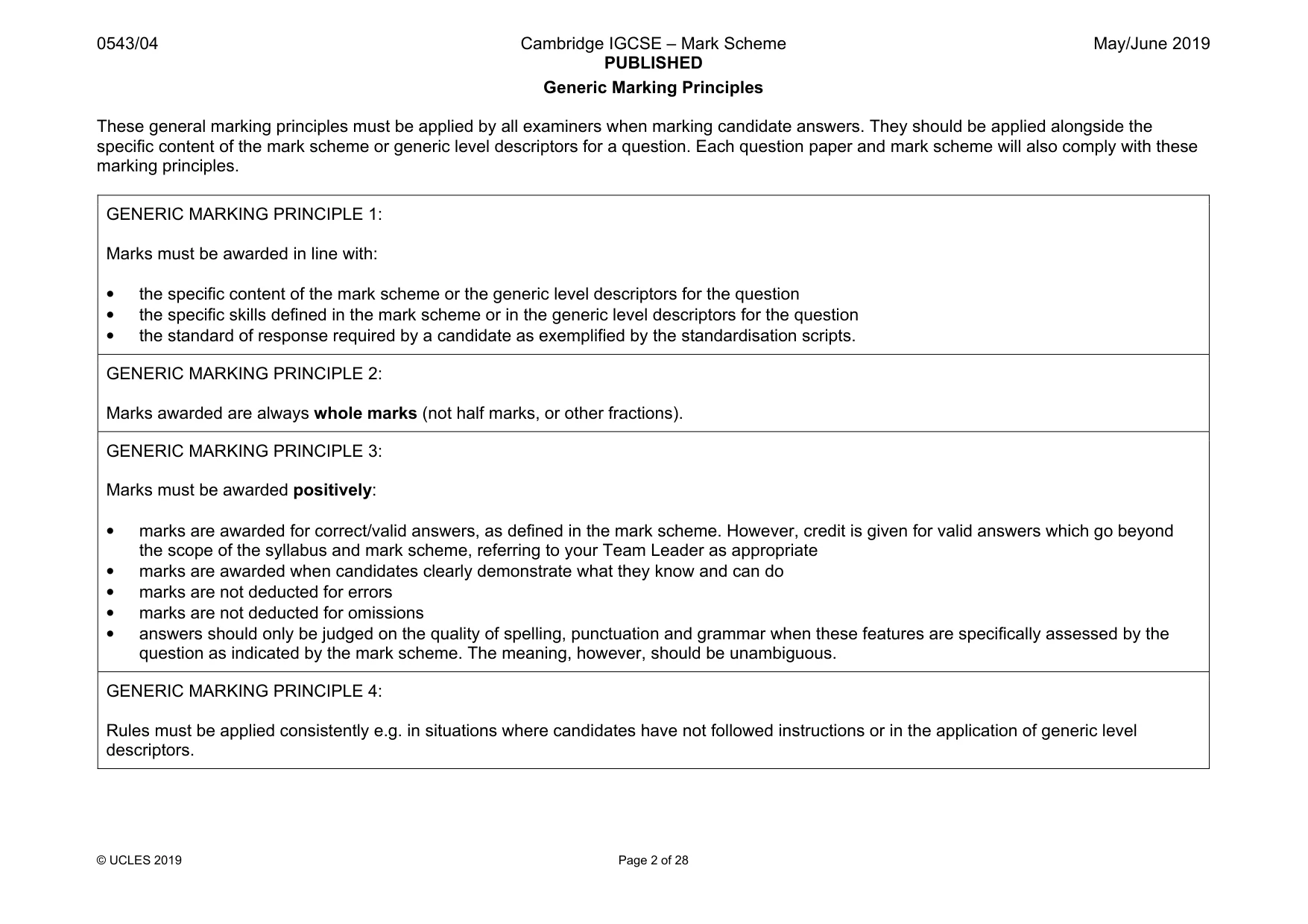
0543/04 Cambridge IGCSE – Mark Scheme PUBLISHED May/June 2019 © UCLES 2019 Page 2 of 28 Generic Marking Principles These general marking principles must be applied by all examiners when marking candidate answers. They should be applied alongside the specific content of the mark scheme or generic level descriptors for a question. Each question paper and mark scheme will also comply with these marking principles. GENERIC MARKING PRINCIPLE 1: Marks must be awarded in line with: • the specific content of the mark scheme or the generic level descriptors for the question • the specific skills defined in the mark scheme or in the generic level descriptors for the question • the standard of response required by a candidate as exemplified by the standardisation scripts. GENERIC MARKING PRINCIPLE 2: Marks awarded are always whole marks (not half marks, or other fractions). GENERIC MARKING PRINCIPLE 3: Marks must be awarded positively: • marks are awarded for correct/valid answers, as defined in the mark scheme. However, credit is given for valid answers which go beyond the scope of the syllabus and mark scheme, referring to your Team Leader as appropriate • marks are awarded when candidates clearly demonstrate what they know and can do • marks are not deducted for errors • marks are not deducted for omissions • answers should only be judged on the quality of spelling, punctuation and grammar when these features are specifically assessed by the question as indicated by the mark scheme. The meaning, however, should be unambiguous. GENERIC MARKING PRINCIPLE 4: Rules must be applied consistently e.g. in situations where candidates have not followed instructions or in the application of generic level descriptors.
Mark scheme, page 3
0543/04 Cambridge IGCSE – Mark Scheme PUBLISHED May/June 2019 © UCLES 2019 Page 3 of 28 GENERIC MARKING PRINCIPLE 5: Marks should be awarded using the full range of marks defined in the mark scheme for the question (however; the use of the full mark range may be limited according to the quality of the candidate responses seen). GENERIC MARKING PRINCIPLE 6: Marks awarded are based solely on the requirements as defined in the mark scheme. Marks should not be awarded with grade thresholds or grade descriptors in mind.
Mark scheme, page 4
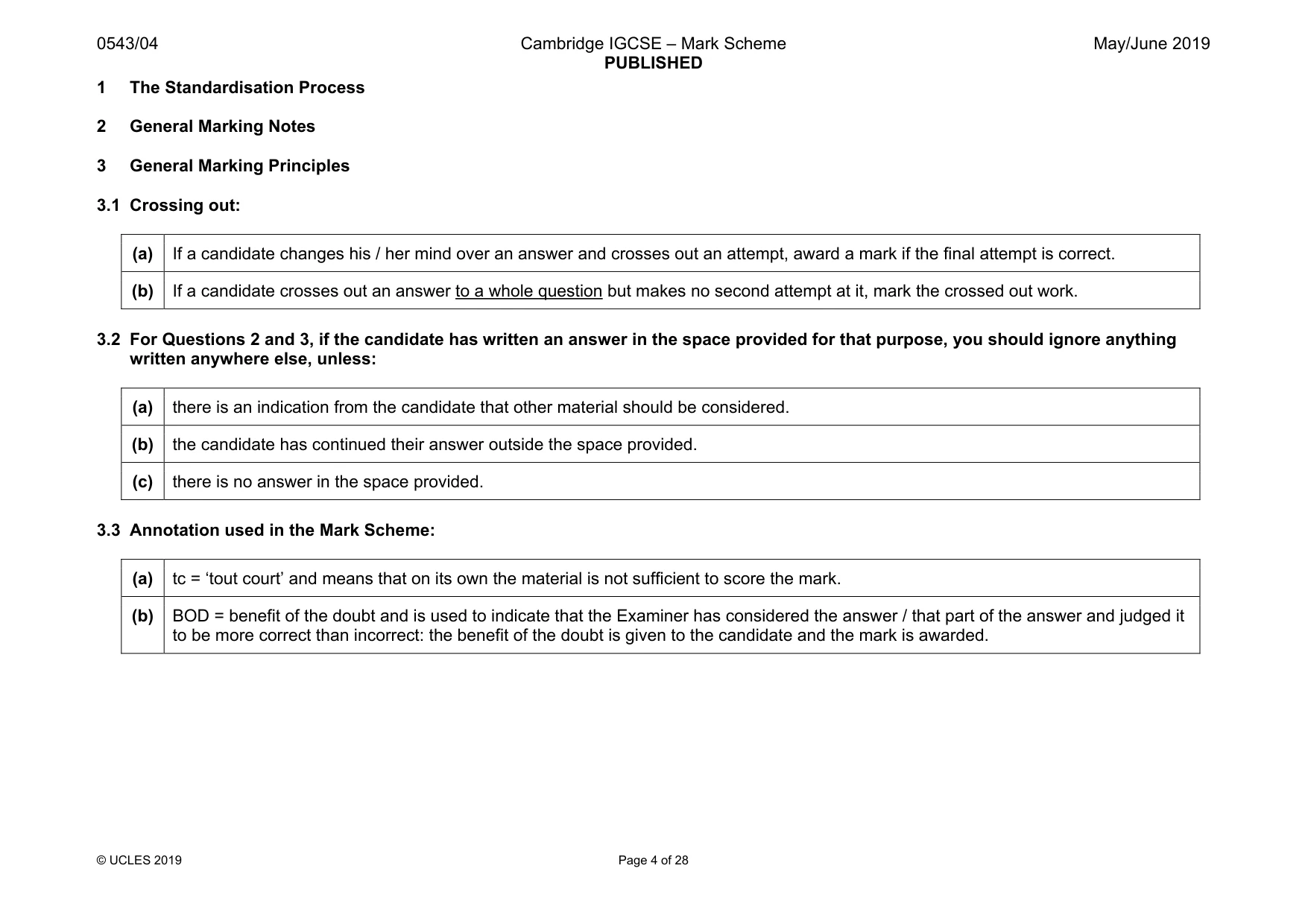
0543/04 Cambridge IGCSE – Mark Scheme PUBLISHED May/June 2019 © UCLES 2019 Page 4 of 28 1 The Standardisation Process 2 General Marking Notes 3 General Marking Principles 3.1 Crossing out: (a) If a candidate changes his / her mind over an answer and crosses out an attempt, award a mark if the final attempt is correct. (b) If a candidate crosses out an answer to a whole question but makes no second attempt at it, mark the crossed out work. 3.2 For Questions 2 and 3, if the candidate has written an answer in the space provided for that purpose, you should ignore anything written anywhere else, unless: (a) there is an indication from the candidate that other material should be considered. (b) the candidate has continued their answer outside the space provided. (c) there is no answer in the space provided. 3.3 Annotation used in the Mark Scheme: (a) tc = ‘tout court’ and means that on its own the material is not sufficient to score the mark. (b) BOD = benefit of the doubt and is used to indicate that the Examiner has considered the answer / that part of the answer and judged it to be more correct than incorrect: the benefit of the doubt is given to the candidate and the mark is awarded.
Mark scheme, page 5
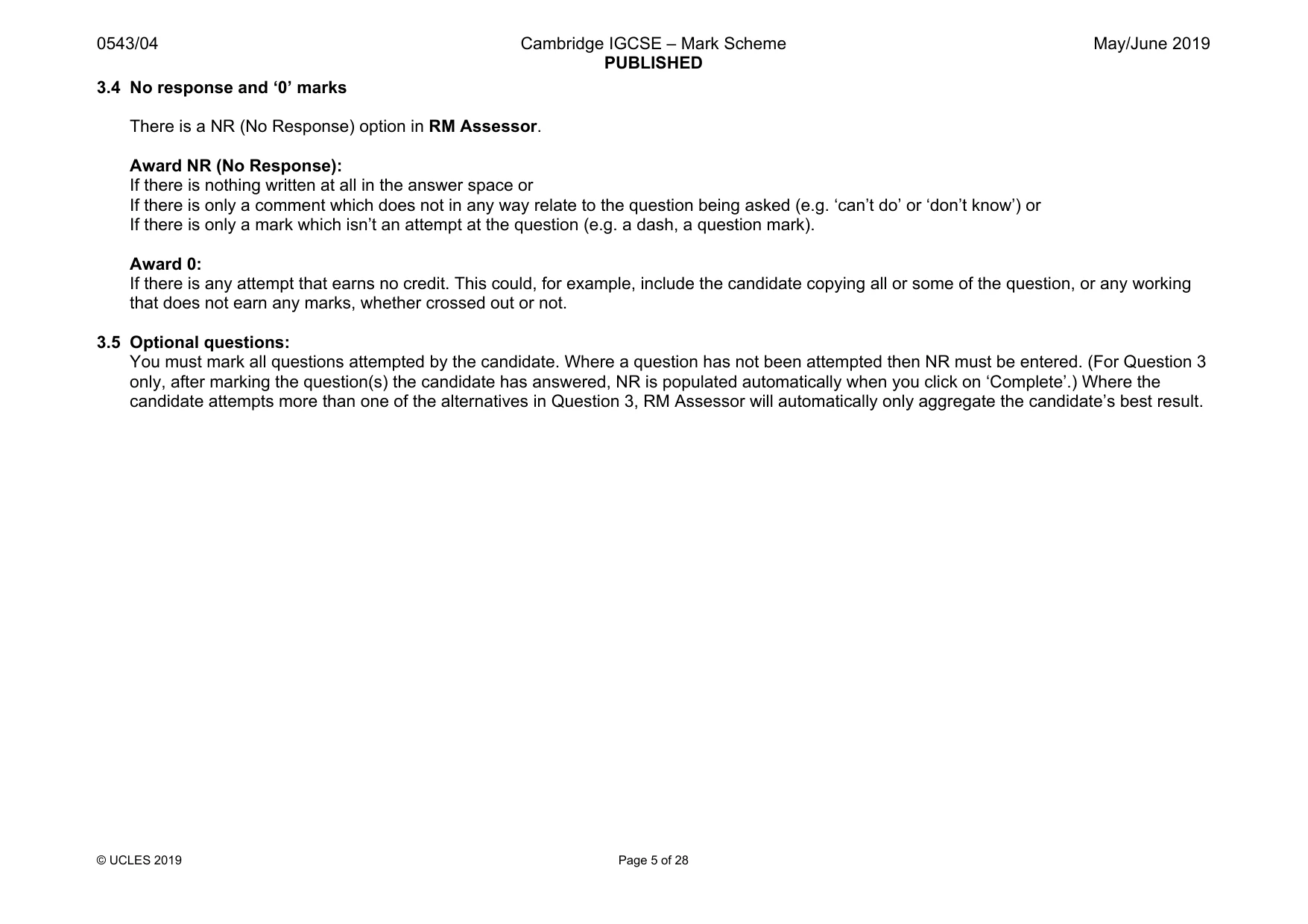
0543/04 Cambridge IGCSE – Mark Scheme PUBLISHED May/June 2019 © UCLES 2019 Page 5 of 28 3.4 No response and ‘0’ marks There is a NR (No Response) option in RM Assessor. Award NR (No Response): If there is nothing written at all in the answer space or If there is only a comment which does not in any way relate to the question being asked (e.g. ‘can’t do’ or ‘don’t know’) or If there is only a mark which isn’t an attempt at the question (e.g. a dash, a question mark). Award 0: If there is any attempt that earns no credit. This could, for example, include the candidate copying all or some of the question, or any working that does not earn any marks, whether crossed out or not. 3.5 Optional questions: You must mark all questions attempted by the candidate. Where a question has not been attempted then NR must be entered. (For Question 3 only, after marking the question(s) the candidate has answered, NR is populated automatically when you click on ‘Complete’.) Where the candidate attempts more than one of the alternatives in Question 3, RM Assessor will automatically only aggregate the candidate’s best result.
Mark scheme, page 6
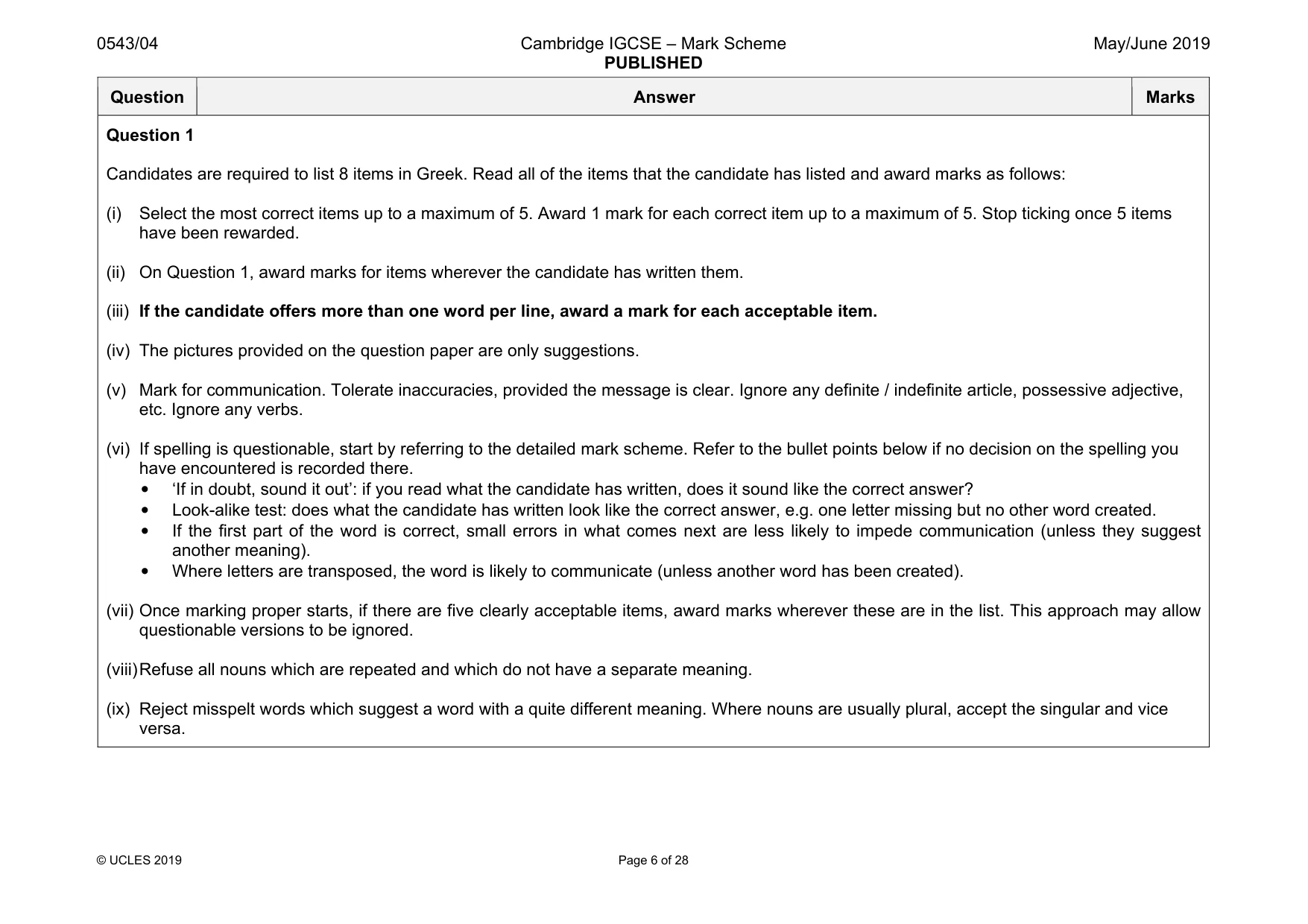
0543/04 Cambridge IGCSE – Mark Scheme PUBLISHED May/June 2019 © UCLES 2019 Page 6 of 28 Question Answer Marks Question 1 Candidates are required to list 8 items in Greek. Read all of the items that the candidate has listed and award marks as follows: (i) Select the most correct items up to a maximum of 5. Award 1 mark for each correct item up to a maximum of 5. Stop ticking once 5 items have been rewarded. (ii) On Question 1, award marks for items wherever the candidate has written them. (iii) If the candidate offers more than one word per line, award a mark for each acceptable item. (iv) The pictures provided on the question paper are only suggestions. (v) Mark for communication. Tolerate inaccuracies, provided the message is clear. Ignore any definite / indefinite article, possessive adjective, etc. Ignore any verbs. (vi) If spelling is questionable, start by referring to the detailed mark scheme. Refer to the bullet points below if no decision on the spelling you have encountered is recorded there. • ‘If in doubt, sound it out’: if you read what the candidate has written, does it sound like the correct answer? • Look-alike test: does what the candidate has written look like the correct answer, e.g. one letter missing but no other word created. • If the first part of the word is correct, small errors in what comes next are less likely to impede communication (unless they suggest another meaning). • Where letters are transposed, the word is likely to communicate (unless another word has been created). (vii) Once marking proper starts, if there are five clearly acceptable items, award marks wherever these are in the list. This approach may allow questionable versions to be ignored. (viii) Refuse all nouns which are repeated and which do not have a separate meaning. (ix) Reject misspelt words which suggest a word with a quite different meaning. Where nouns are usually plural, accept the singular and vice versa.
Mark scheme, page 7
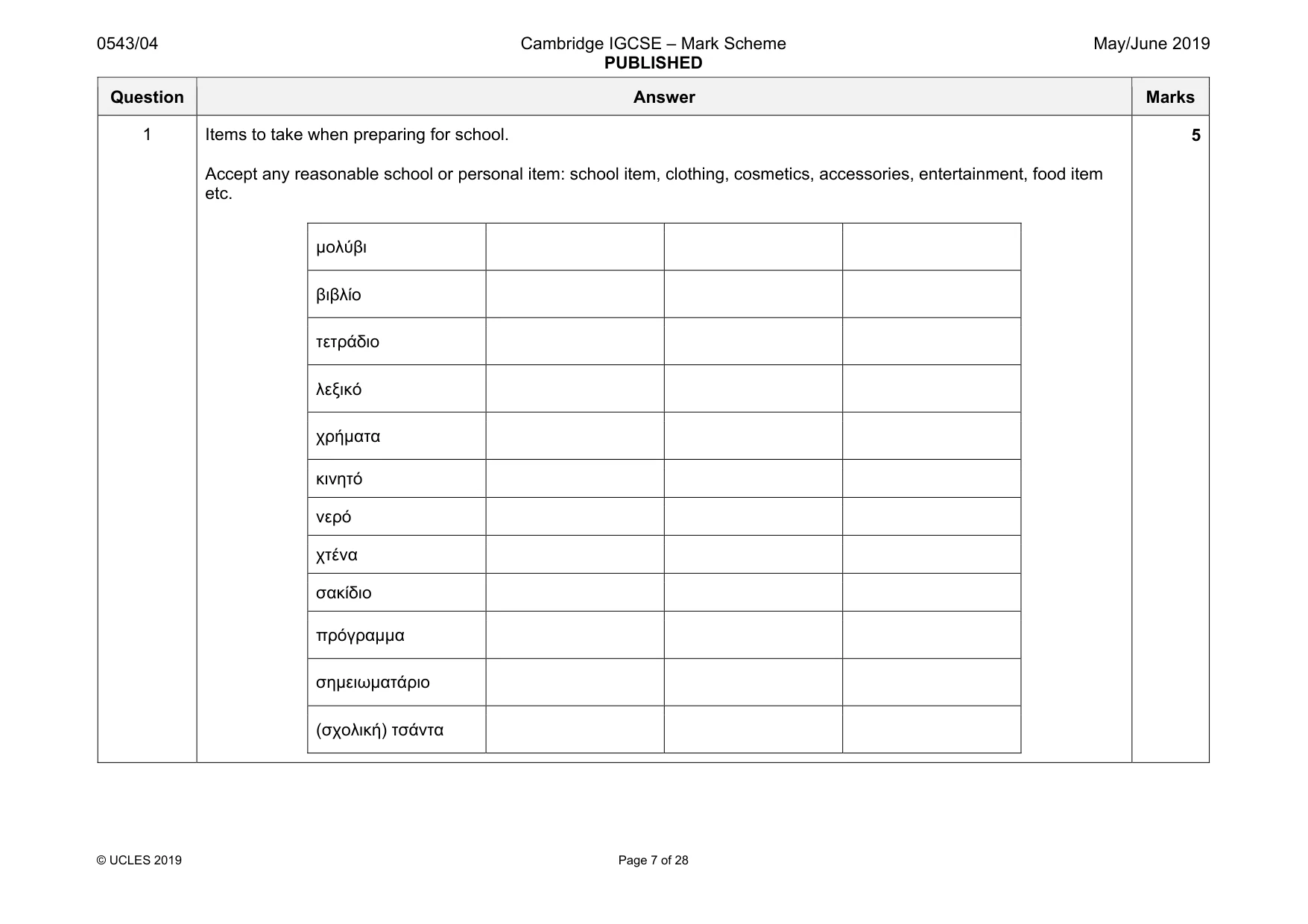
0543/04 Cambridge IGCSE – Mark Scheme PUBLISHED May/June 2019 © UCLES 2019 Page 7 of 28 Question Answer Marks 1 Items to take when preparing for school. Accept any reasonable school or personal item: school item, clothing, cosmetics, accessories, entertainment, food item etc. µολύβι βιβλίο τετράδιο λεξικό χρήµατα κινητό νερό χτένα σακίδιο πρόγραµµα σηµειωµατάριο (σχολική) τσάντα 5
Mark scheme, page 8
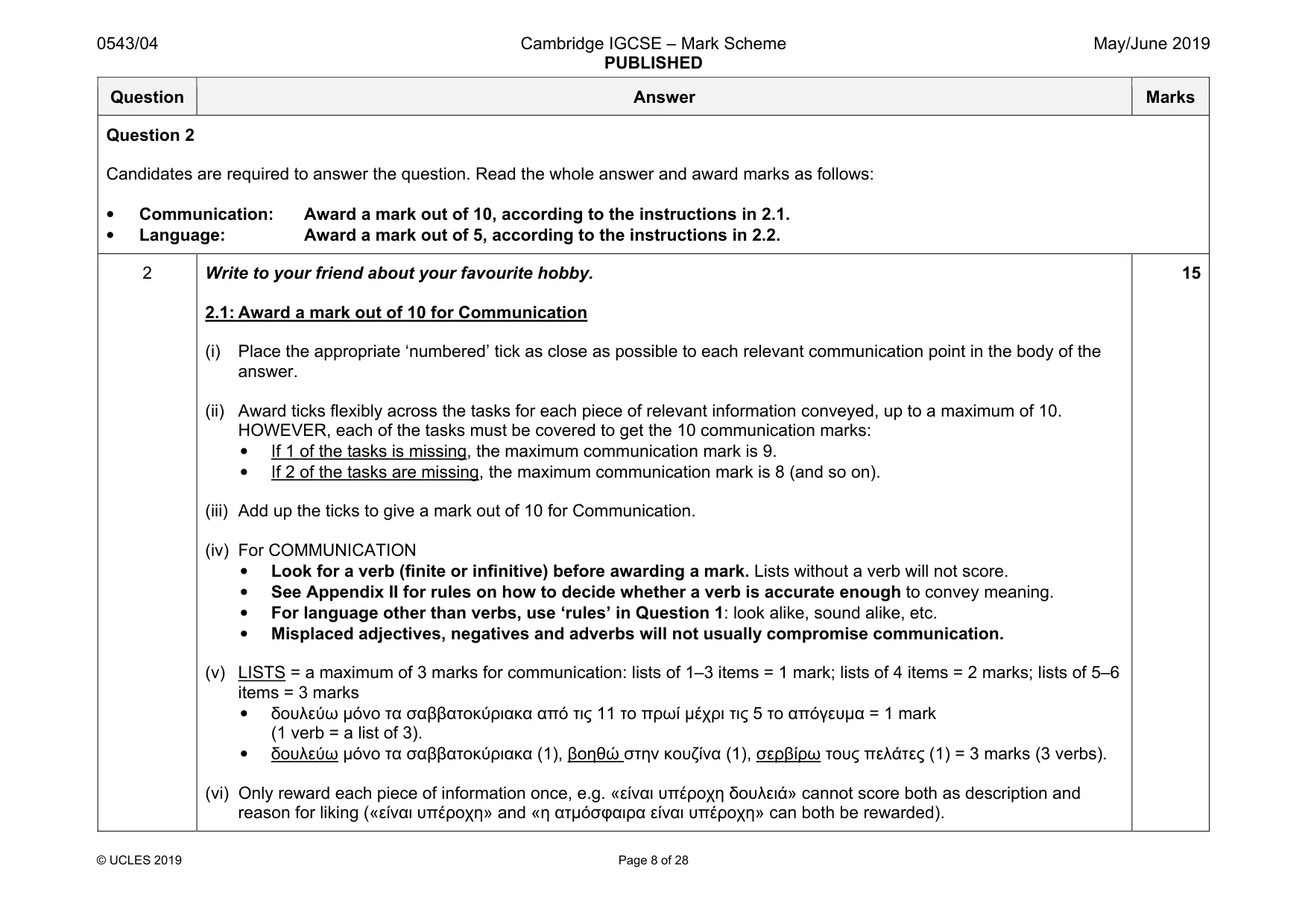
0543/04 Cambridge IGCSE – Mark Scheme PUBLISHED May/June 2019 © UCLES 2019 Page 8 of 28 Question Answer Marks Question 2 Candidates are required to answer the question. Read the whole answer and award marks as follows: • Communication: Award a mark out of 10, according to the instructions in 2.1. • Language: Award a mark out of 5, according to the instructions in 2.2. 2 Write to your friend about your favourite hobby. 2.1: Award a mark out of 10 for Communication (i) Place the appropriate ‘numbered’ tick as close as possible to each relevant communication point in the body of the answer. (ii) Award ticks flexibly across the tasks for each piece of relevant information conveyed, up to a maximum of 10. HOWEVER, each of the tasks must be covered to get the 10 communication marks: • If 1 of the tasks is missing, the maximum communication mark is 9. • If 2 of the tasks are missing, the maximum communication mark is 8 (and so on). (iii) Add up the ticks to give a mark out of 10 for Communication. (iv) For COMMUNICATION • Look for a verb (finite or infinitive) before awarding a mark. Lists without a verb will not score. • See Appendix II for rules on how to decide whether a verb is accurate enough to convey meaning. • For language other than verbs, use ‘rules’ in Question 1: look alike, sound alike, etc. • Misplaced adjectives, negatives and adverbs will not usually compromise communication. (v) LISTS = a maximum of 3 marks for communication: lists of 1–3 items = 1 mark; lists of 4 items = 2 marks; lists of 5–6 items = 3 marks • δουλεύω µόνο τα σαββατοκύριακα από τις 11 το πρωί µέχρι τις 5 το απόγευµα = 1 mark (1 verb = a list of 3). • δουλεύω µόνο τα σαββατοκύριακα (1), βοηθώ στην κουζίνα (1), σερβίρω τους πελάτες (1) = 3 marks (3 verbs). (vi) Only reward each piece of information once, e.g. «είναι υπέροχη δουλειά» cannot score both as description and reason for liking («είναι υπέροχη» and «η ατµόσφαιρα είναι υπέροχη» can both be rewarded). 15
Mark scheme, page 9
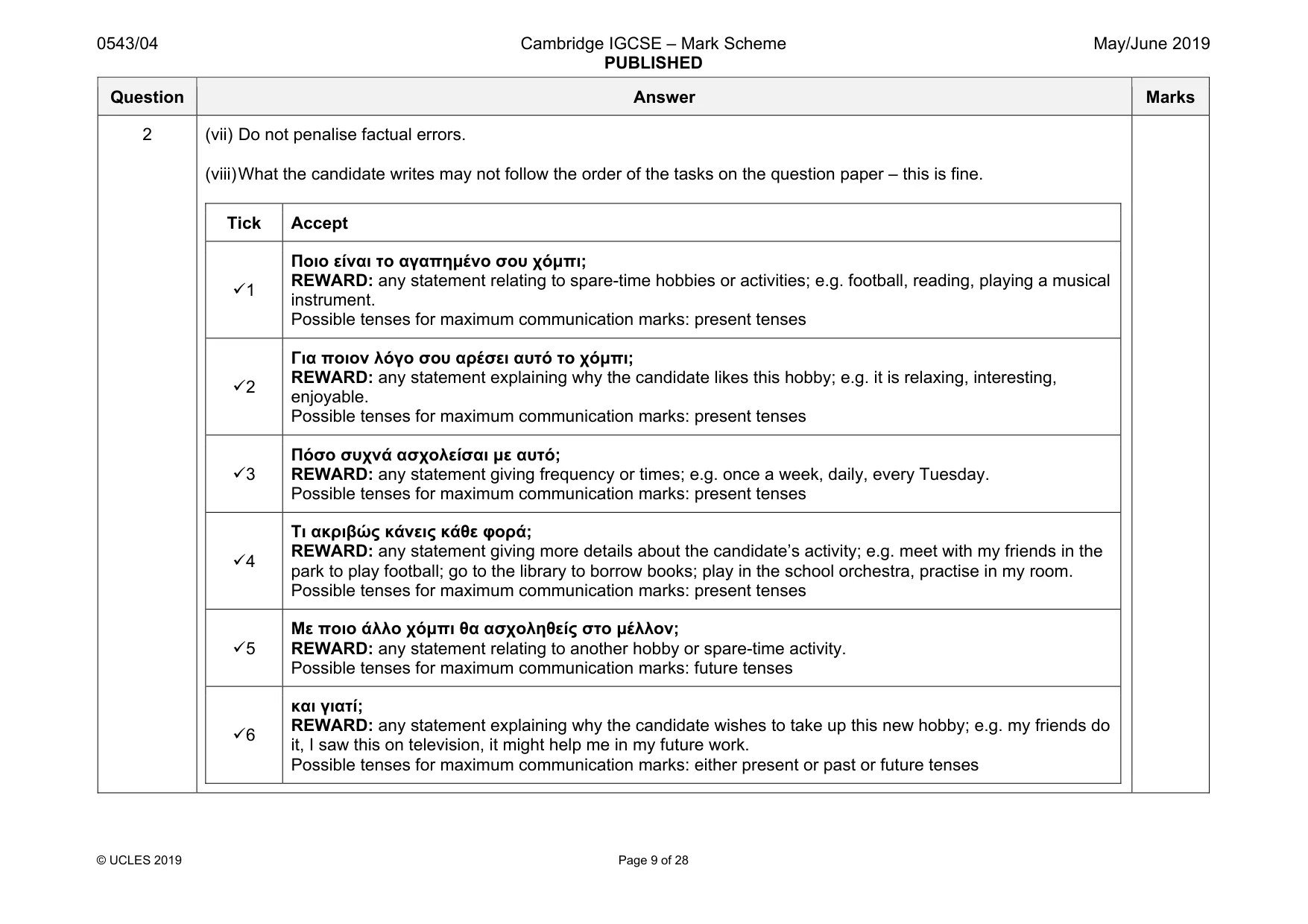
0543/04 Cambridge IGCSE – Mark Scheme PUBLISHED May/June 2019 © UCLES 2019 Page 9 of 28 Question Answer Marks 2 (vii) Do not penalise factual errors. (viii) What the candidate writes may not follow the order of the tasks on the question paper – this is fine. Tick Accept 91 Ποιο είναι το αγαπηµένο σου χόµπι; REWARD: any statement relating to spare-time hobbies or activities; e.g. football, reading, playing a musical instrument. Possible tenses for maximum communication marks: present tenses 92 Για ποιον λόγο σου αρέσει αυτό το χόµπι; REWARD: any statement explaining why the candidate likes this hobby; e.g. it is relaxing, interesting, enjoyable. Possible tenses for maximum communication marks: present tenses 93 Πόσο συχνά ασχολείσαι µε αυτό; REWARD: any statement giving frequency or times; e.g. once a week, daily, every Tuesday. Possible tenses for maximum communication marks: present tenses 94 Τι ακριβώς κάνεις κάθε φορά; REWARD: any statement giving more details about the candidate’s activity; e.g. meet with my friends in the park to play football; go to the library to borrow books; play in the school orchestra, practise in my room. Possible tenses for maximum communication marks: present tenses 95 Με ποιο άλλο χόµπι θα ασχοληθείς στο µέλλον; REWARD: any statement relating to another hobby or spare-time activity. Possible tenses for maximum communication marks: future tenses 96 και γιατί; REWARD: any statement explaining why the candidate wishes to take up this new hobby; e.g. my friends do it, I saw this on television, it might help me in my future work. Possible tenses for maximum communication marks: either present or past or future tenses
Mark scheme, page 10
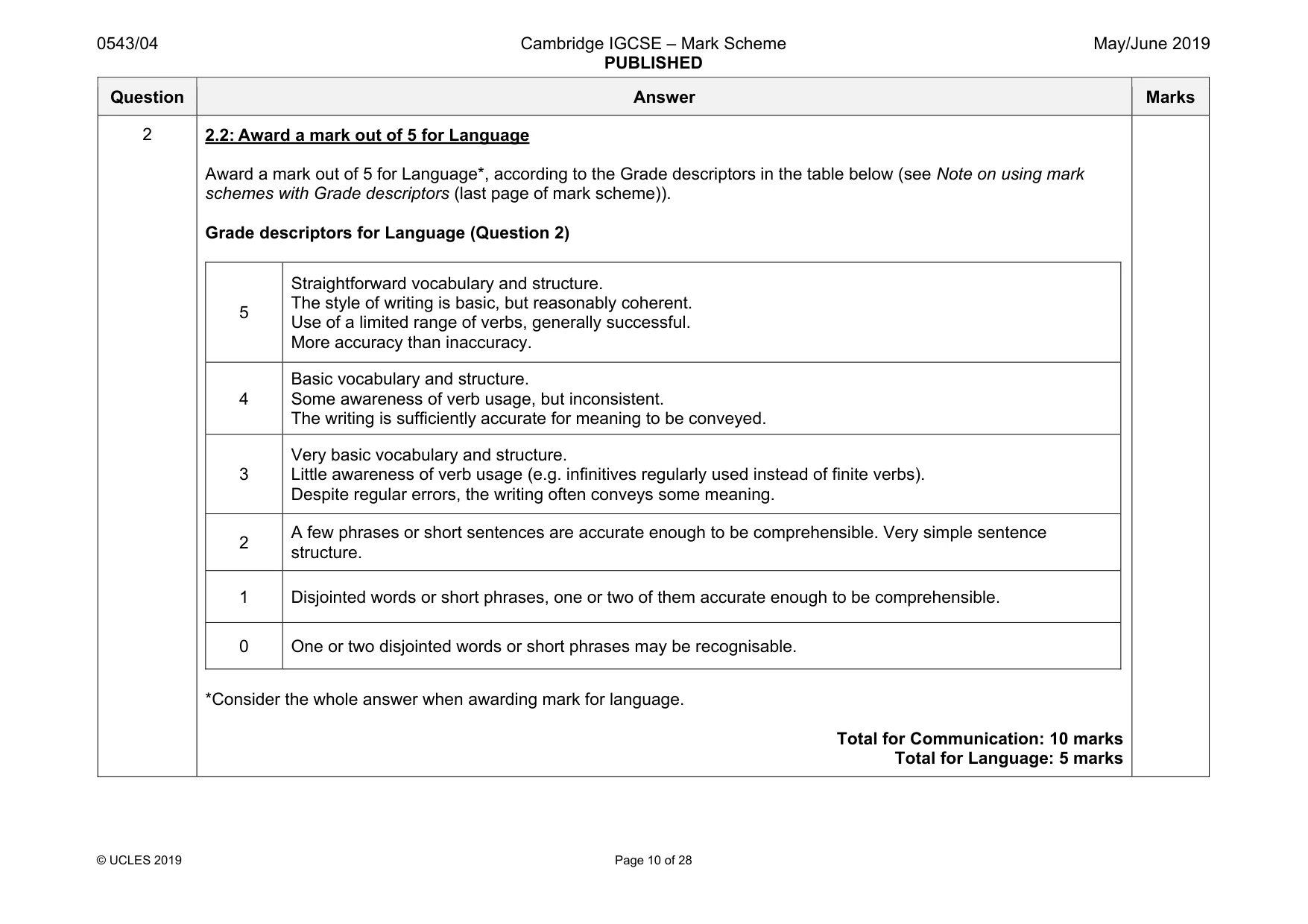
0543/04 Cambridge IGCSE – Mark Scheme PUBLISHED May/June 2019 © UCLES 2019 Page 10 of 28 Question Answer Marks 2 2.2: Award a mark out of 5 for Language Award a mark out of 5 for Language*, according to the Grade descriptors in the table below (see Note on using mark schemes with Grade descriptors (last page of mark scheme)). Grade descriptors for Language (Question 2) 5 Straightforward vocabulary and structure. The style of writing is basic, but reasonably coherent. Use of a limited range of verbs, generally successful. More accuracy than inaccuracy. 4 Basic vocabulary and structure. Some awareness of verb usage, but inconsistent. The writing is sufficiently accurate for meaning to be conveyed. 3 Very basic vocabulary and structure. Little awareness of verb usage (e.g. infinitives regularly used instead of finite verbs). Despite regular errors, the writing often conveys some meaning. 2 A few phrases or short sentences are accurate enough to be comprehensible. Very simple sentence structure. 1 Disjointed words or short phrases, one or two of them accurate enough to be comprehensible. 0 One or two disjointed words or short phrases may be recognisable. *Consider the whole answer when awarding mark for language. Total for Communication: 10 marks Total for Language: 5 marks
Mark scheme, page 11
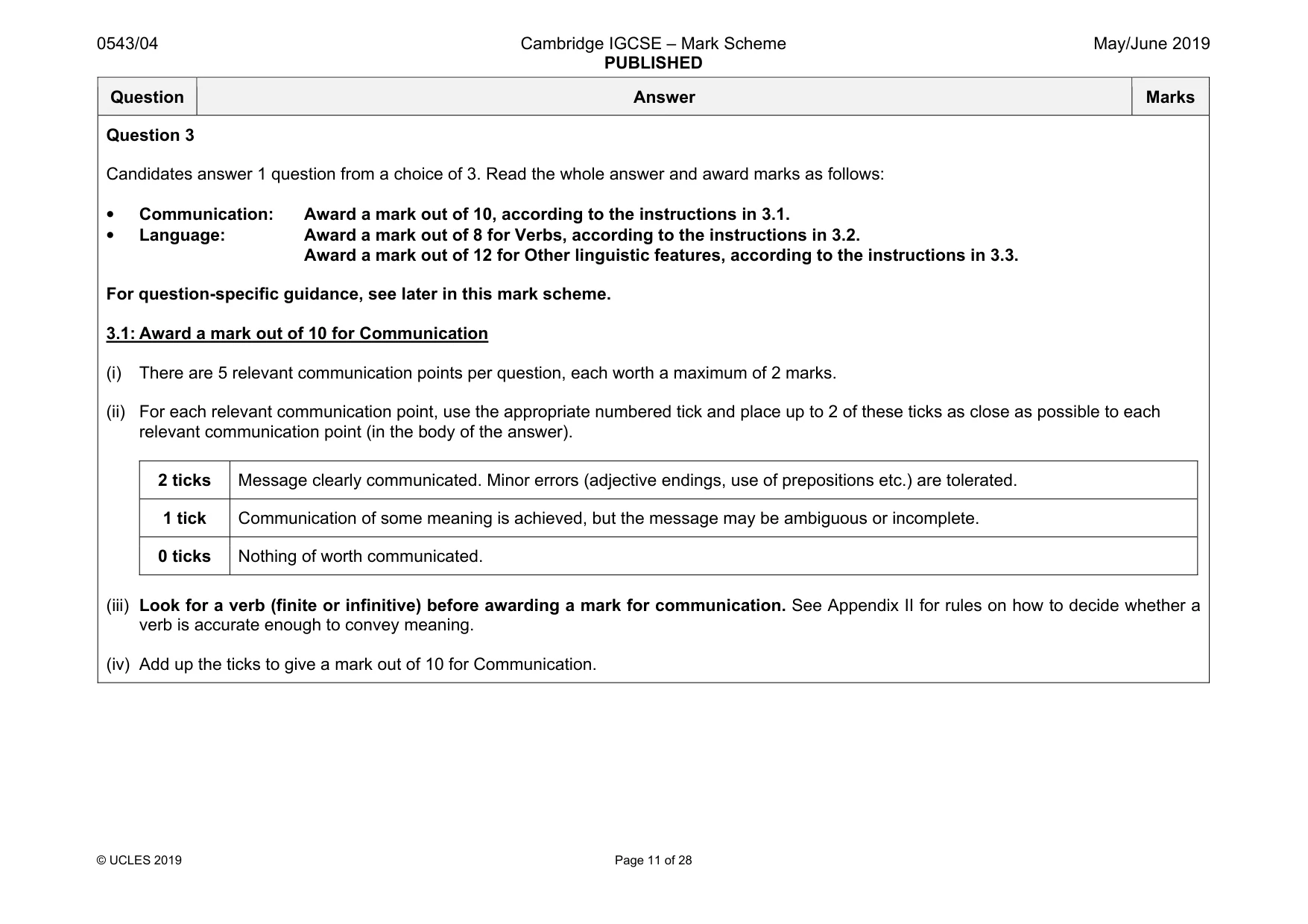
0543/04 Cambridge IGCSE – Mark Scheme PUBLISHED May/June 2019 © UCLES 2019 Page 11 of 28 Question Answer Marks Question 3 Candidates answer 1 question from a choice of 3. Read the whole answer and award marks as follows: • Communication: Award a mark out of 10, according to the instructions in 3.1. • Language: Award a mark out of 8 for Verbs, according to the instructions in 3.2. Award a mark out of 12 for Other linguistic features, according to the instructions in 3.3. For question-specific guidance, see later in this mark scheme. 3.1: Award a mark out of 10 for Communication (i) There are 5 relevant communication points per question, each worth a maximum of 2 marks. (ii) For each relevant communication point, use the appropriate numbered tick and place up to 2 of these ticks as close as possible to each relevant communication point (in the body of the answer). 2 ticks Message clearly communicated. Minor errors (adjective endings, use of prepositions etc.) are tolerated. 1 tick Communication of some meaning is achieved, but the message may be ambiguous or incomplete. 0 ticks Nothing of worth communicated. (iii) Look for a verb (finite or infinitive) before awarding a mark for communication. See Appendix II for rules on how to decide whether a verb is accurate enough to convey meaning. (iv) Add up the ticks to give a mark out of 10 for Communication.
Mark scheme, page 12
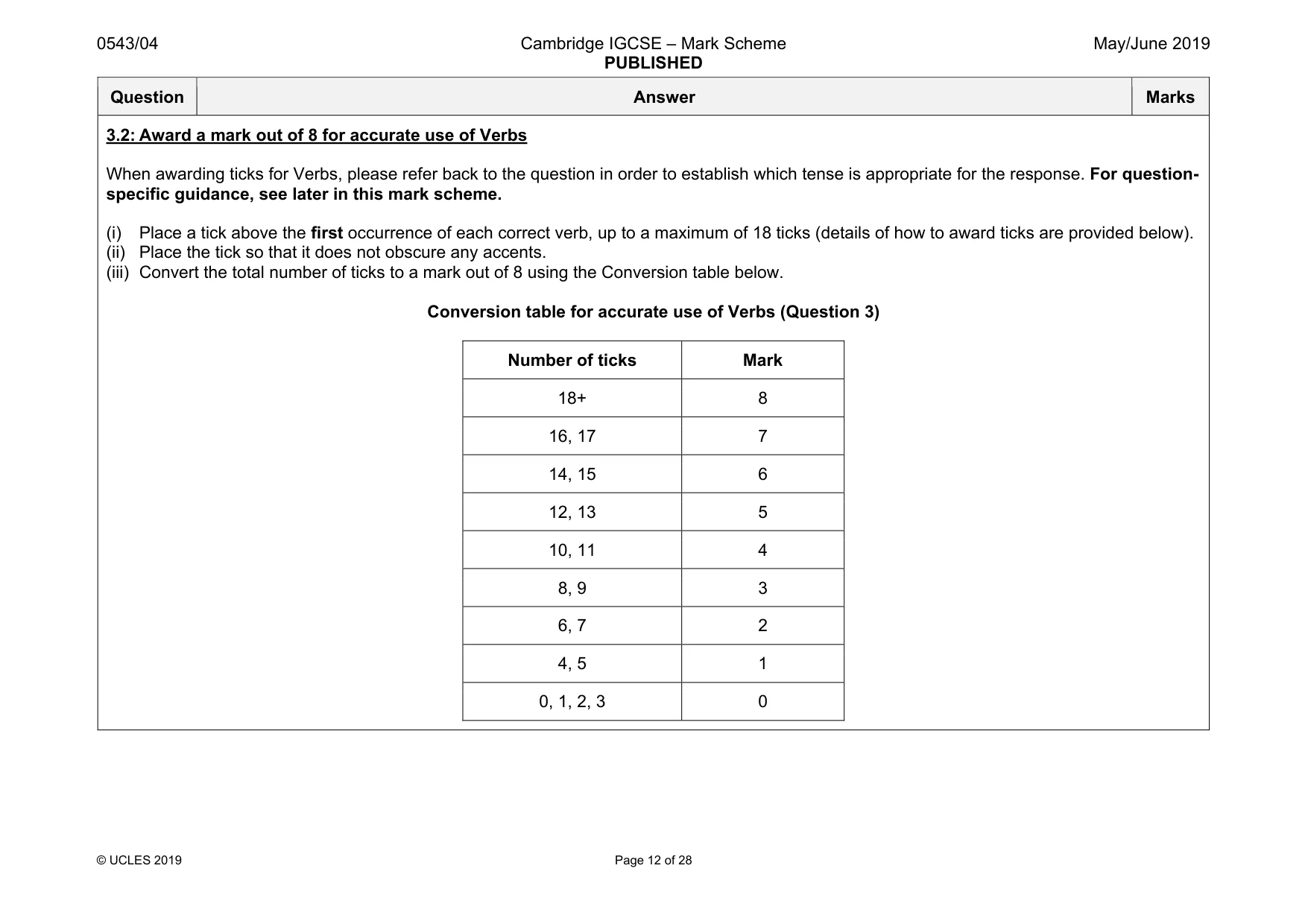
0543/04 Cambridge IGCSE – Mark Scheme PUBLISHED May/June 2019 © UCLES 2019 Page 12 of 28 Question Answer Marks 3.2: Award a mark out of 8 for accurate use of Verbs When awarding ticks for Verbs, please refer back to the question in order to establish which tense is appropriate for the response. For question- specific guidance, see later in this mark scheme. (i) Place a tick above the first occurrence of each correct verb, up to a maximum of 18 ticks (details of how to award ticks are provided below). (ii) Place the tick so that it does not obscure any accents. (iii) Convert the total number of ticks to a mark out of 8 using the Conversion table below. Conversion table for accurate use of Verbs (Question 3) Number of ticks Mark 18+ 8 16, 17 7 14, 15 6 12, 13 5 10, 11 4 8, 9 3 6, 7 2 4, 5 1 0, 1, 2, 3 0
Mark scheme, page 13
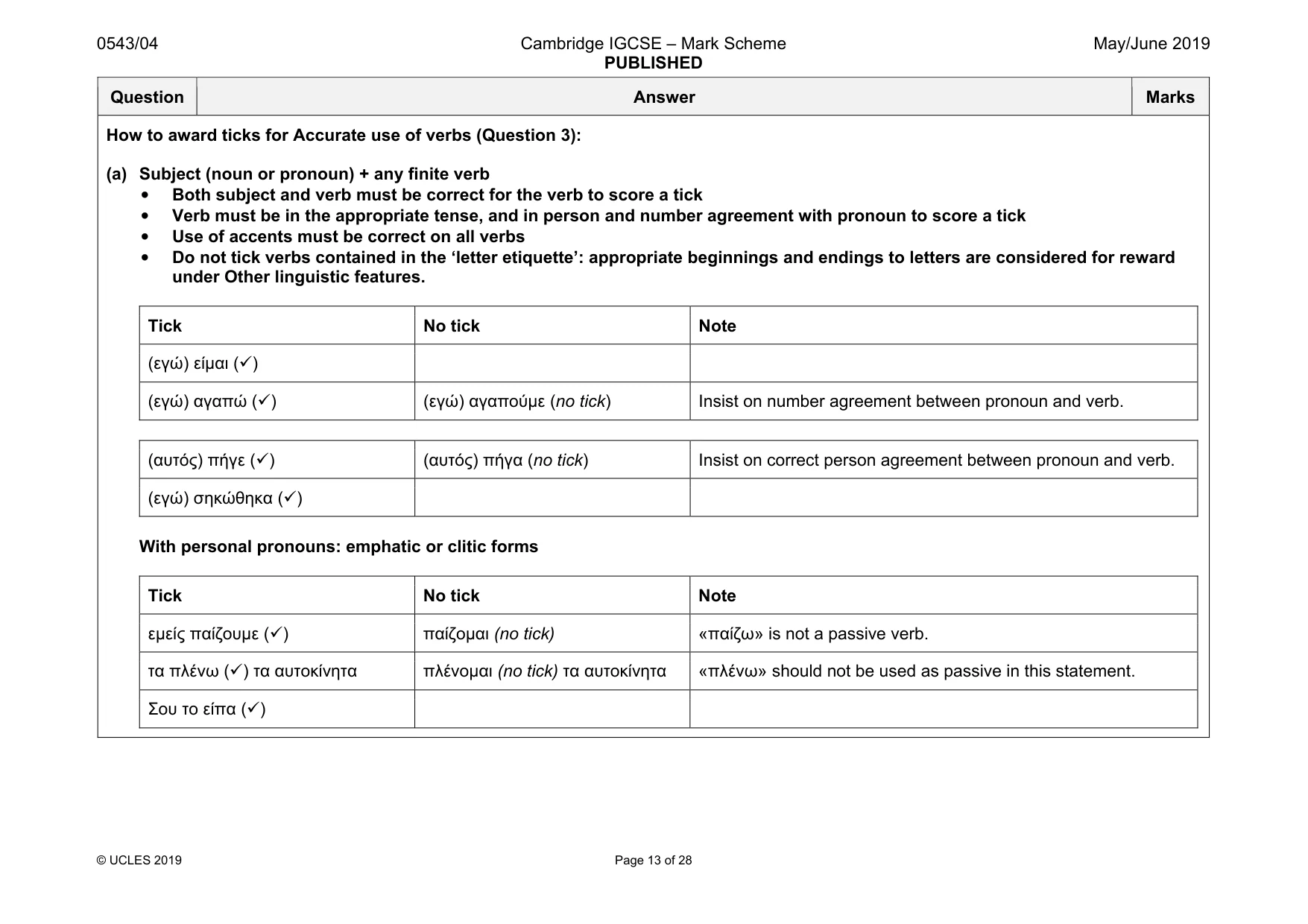
0543/04 Cambridge IGCSE – Mark Scheme PUBLISHED May/June 2019 © UCLES 2019 Page 13 of 28 Question Answer Marks How to award ticks for Accurate use of verbs (Question 3): (a) Subject (noun or pronoun) + any finite verb • Both subject and verb must be correct for the verb to score a tick • Verb must be in the appropriate tense, and in person and number agreement with pronoun to score a tick • Use of accents must be correct on all verbs • Do not tick verbs contained in the ‘letter etiquette’: appropriate beginnings and endings to letters are considered for reward under Other linguistic features. Tick No tick Note (εγώ) είµαι (9) (εγώ) αγαπώ (9) (εγώ) αγαπούµε (no tick) Insist on number agreement between pronoun and verb. (αυτός) πήγε (9) (αυτός) πήγα (no tick) Insist on correct person agreement between pronoun and verb. (εγώ) σηκώθηκα (9) With personal pronouns: emphatic or clitic forms Tick No tick Note εµείς παίζουµε (9) παίζοµαι (no tick) «παίζω» is not a passive verb. τα πλένω (9) τα αυτοκίνητα πλένοµαι (no tick) τα αυτοκίνητα «πλένω» should not be used as passive in this statement. Σου το είπα (9)
Mark scheme, page 14
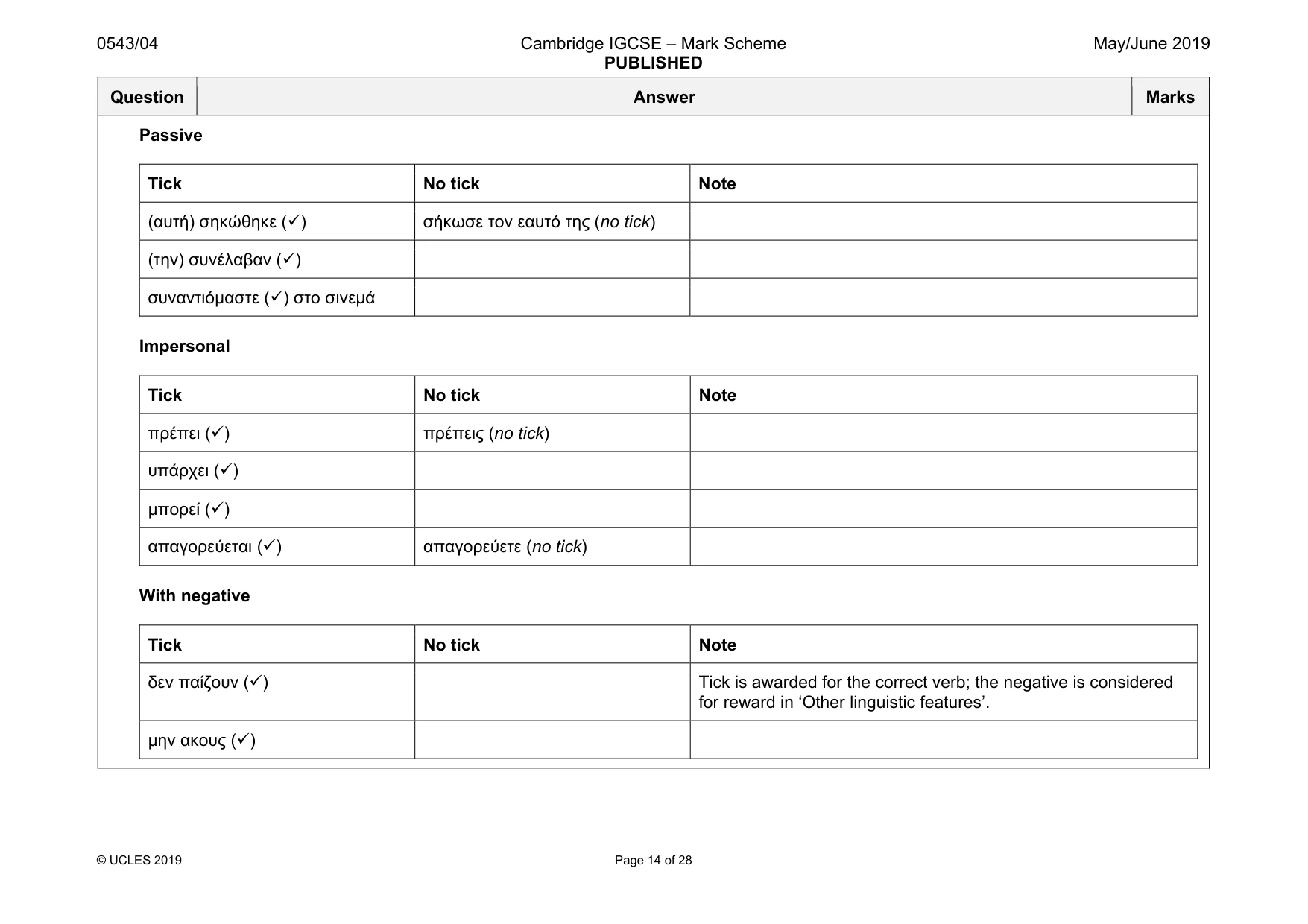
0543/04 Cambridge IGCSE – Mark Scheme PUBLISHED May/June 2019 © UCLES 2019 Page 14 of 28 Question Answer Marks Passive Tick No tick Note (αυτή) σηκώθηκε (9) σήκωσε τον εαυτό της (no tick) (την) συνέλαβαν (9) συναντιόµαστε (9) στο σινεµά Impersonal Tick No tick Note πρέπει (9) πρέπεις (no tick) υπάρχει (9) µπορεί (9) απαγορεύεται (9) απαγορεύετε (no tick) With negative Tick No tick Note δεν παίζουν (9) Tick is awarded for the correct verb; the negative is considered for reward in ‘Other linguistic features’. µην ακους (9)
Mark scheme, page 15
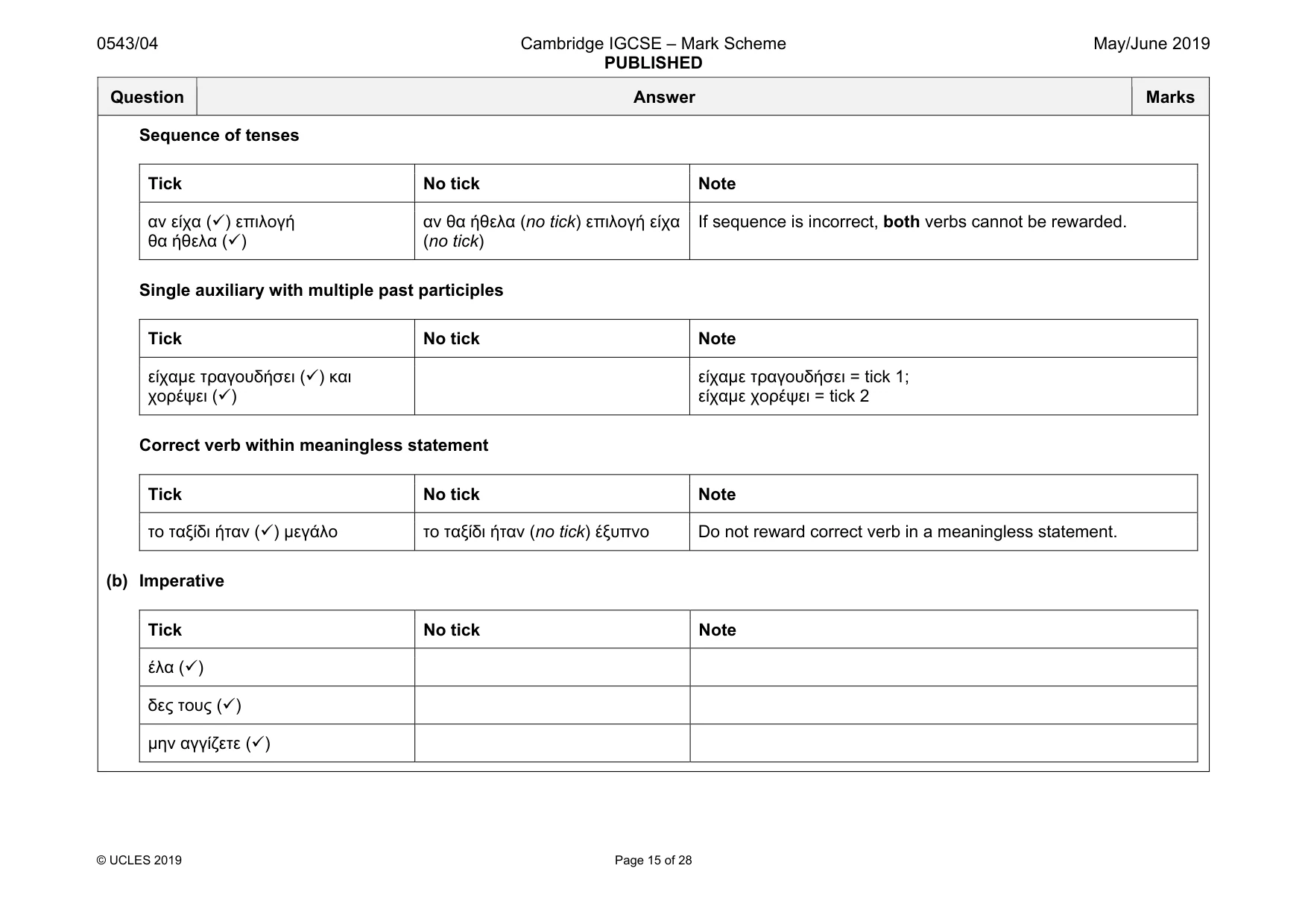
0543/04 Cambridge IGCSE – Mark Scheme PUBLISHED May/June 2019 © UCLES 2019 Page 15 of 28 Question Answer Marks Sequence of tenses Tick No tick Note αν είχα (9) επιλογή θα ήθελα (9) αν θα ήθελα (no tick) επιλογή είχα (no tick) If sequence is incorrect, both verbs cannot be rewarded. Single auxiliary with multiple past participles Tick No tick Note είχαµε τραγουδήσει (9) και χορέψει (9) είχαµε τραγουδήσει = tick 1; είχαµε χορέψει = tick 2 Correct verb within meaningless statement Tick No tick Note το ταξίδι ήταν (9) µεγάλο το ταξίδι ήταν (no tick) έξυπνο Do not reward correct verb in a meaningless statement. (b) Imperative Tick No tick Note έλα (9) δες τους (9) µην αγγίζετε (9)
Mark scheme, page 16
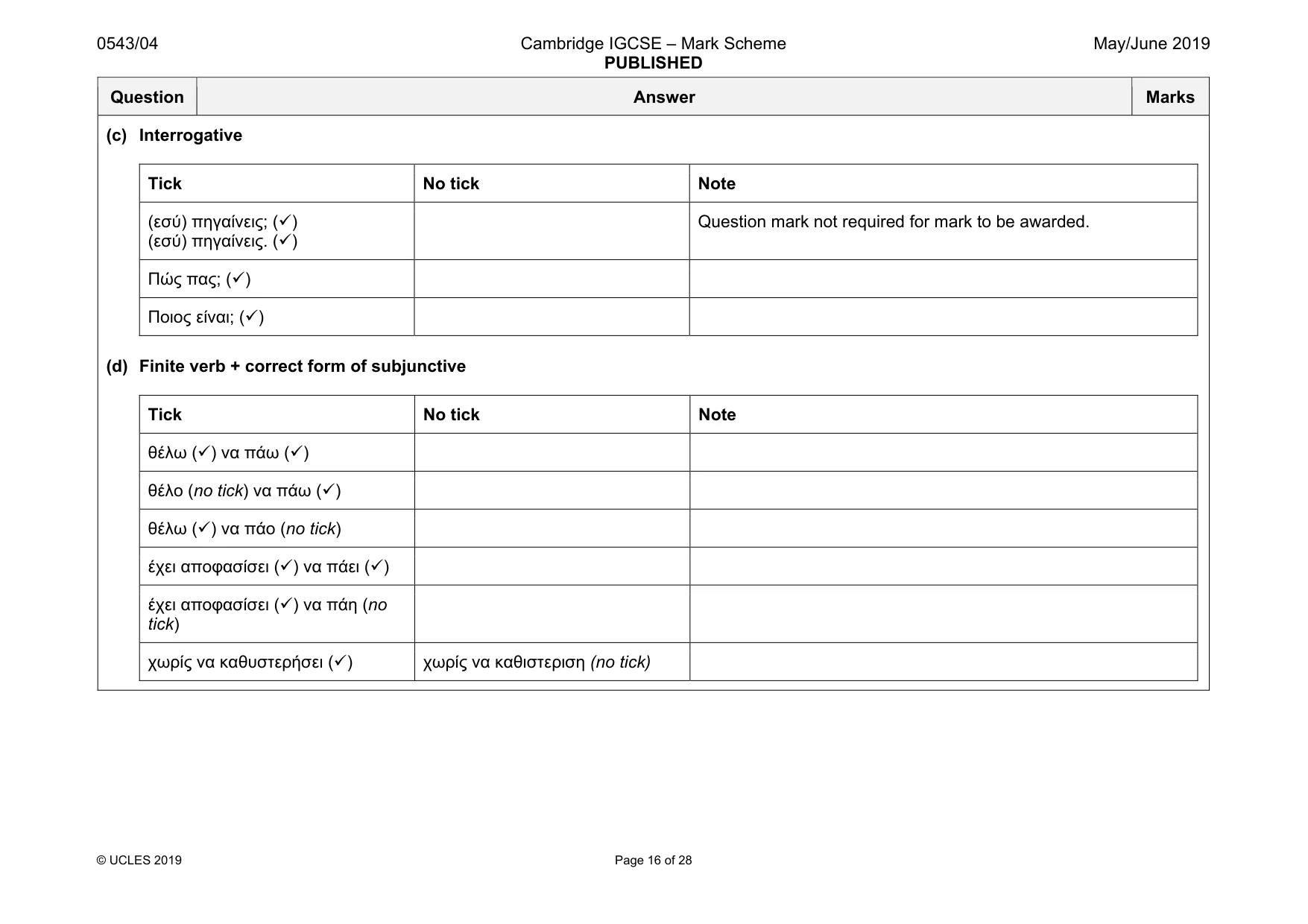
0543/04 Cambridge IGCSE – Mark Scheme PUBLISHED May/June 2019 © UCLES 2019 Page 16 of 28 Question Answer Marks (c) Interrogative Tick No tick Note (εσύ) πηγαίνεις; (9) (εσύ) πηγαίνεις. (9) Question mark not required for mark to be awarded. Πώς πας; (9) Ποιος είναι; (9) (d) Finite verb + correct form of subjunctive Tick No tick Note θέλω (9) να πάω (9) θέλο (no tick) να πάω (9) θέλω (9) να πάο (no tick) έχει αποφασίσει (9) να πάει (9) έχει αποφασίσει (9) να πάη (no tick) χωρίς να καθυστερήσει (9) χωρίς να καθιστεριση (no tick)
Mark scheme, page 17
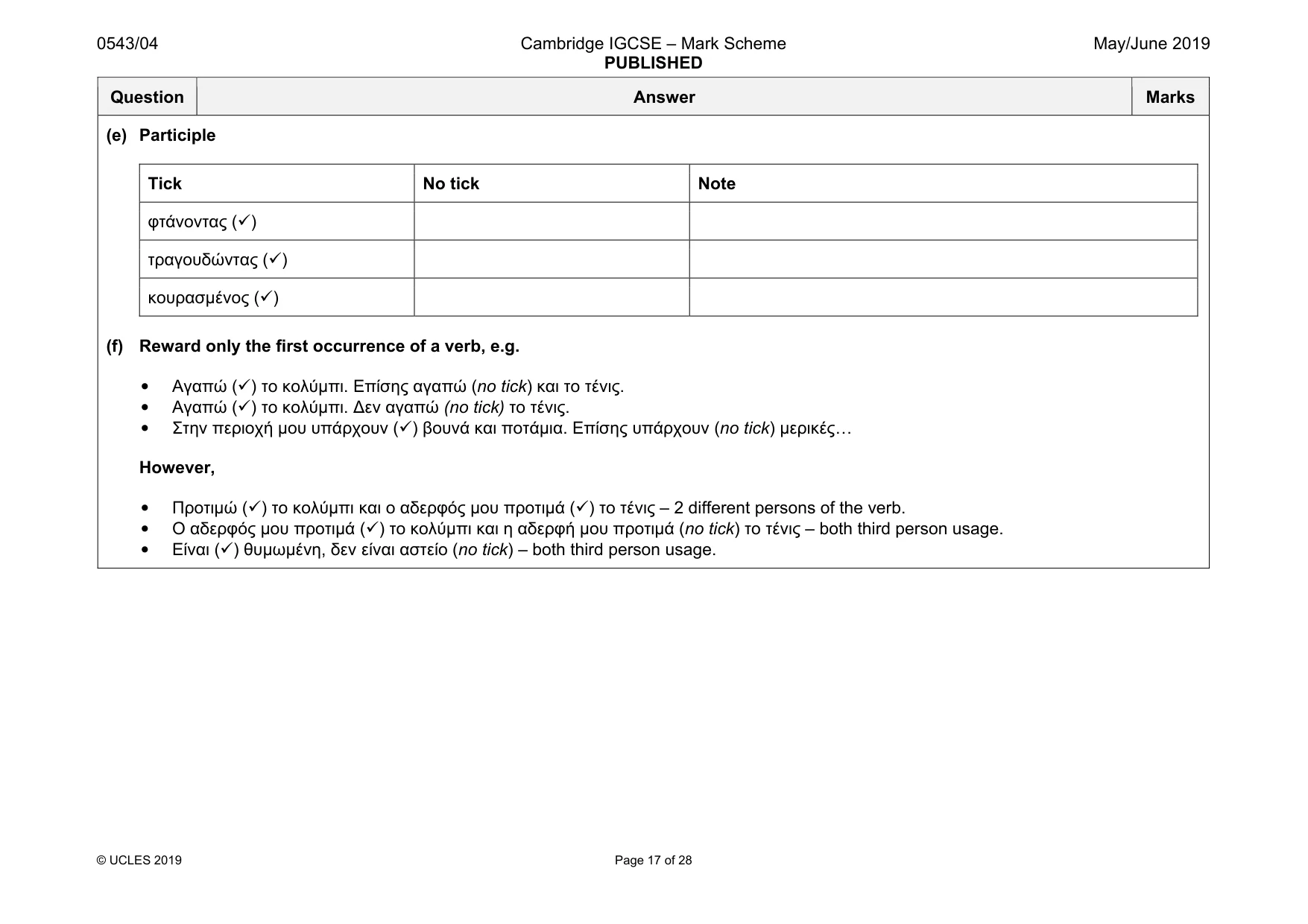
0543/04 Cambridge IGCSE – Mark Scheme PUBLISHED May/June 2019 © UCLES 2019 Page 17 of 28 Question Answer Marks (e) Participle Tick No tick Note φτάνοντας (9) τραγουδώντας (9) κουρασµένος (9) (f) Reward only the first occurrence of a verb, e.g. • Αγαπώ (9) το κολύµπι. Επίσης αγαπώ (no tick) και το τένις. • Αγαπώ (9) το κολύµπι. ∆εν αγαπώ (no tick) το τένις. • Στην περιοχή µου υπάρχουν (9) βουνά και ποτάµια. Επίσης υπάρχουν (no tick) µερικές« However, • Προτιµώ (9) το κολύµπι και ο αδερφός µου προτιµά (9) το τένις – 2 different persons of the verb. • Ο αδερφός µου προτιµά (9) το κολύµπι και η αδερφή µου προτιµά (no tick) το τένις – both third person usage. • Είναι (9) θυµωµένη, δεν είναι αστείο (no tick) – both third person usage.
Mark scheme, page 18
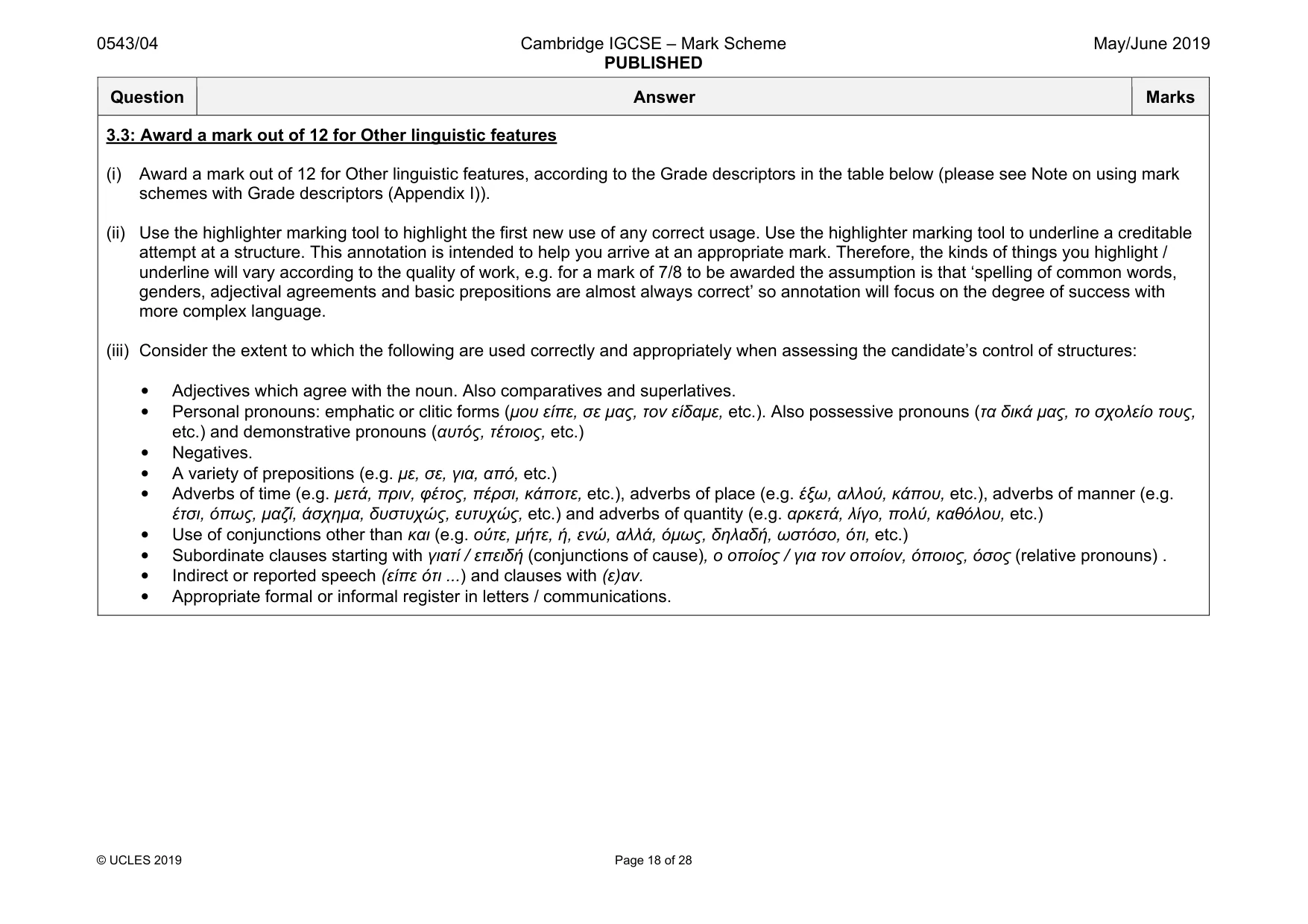
0543/04 Cambridge IGCSE – Mark Scheme PUBLISHED May/June 2019 © UCLES 2019 Page 18 of 28 Question Answer Marks 3.3: Award a mark out of 12 for Other linguistic features (i) Award a mark out of 12 for Other linguistic features, according to the Grade descriptors in the table below (please see Note on using mark schemes with Grade descriptors (Appendix I)). (ii) Use the highlighter marking tool to highlight the first new use of any correct usage. Use the highlighter marking tool to underline a creditable attempt at a structure. This annotation is intended to help you arrive at an appropriate mark. Therefore, the kinds of things you highlight / underline will vary according to the quality of work, e.g. for a mark of 7/8 to be awarded the assumption is that ‘spelling of common words, genders, adjectival agreements and basic prepositions are almost always correct’ so annotation will focus on the degree of success with more complex language. (iii) Consider the extent to which the following are used correctly and appropriately when assessing the candidate’s control of structures: • Adjectives which agree with the noun. Also comparatives and superlatives. • Personal pronouns: emphatic or clitic forms (µου είπε, σε µας, τον είδαµε, etc.). Also possessive pronouns (τα δικά µας, το σχολείο τους, etc.) and demonstrative pronouns (αυτός, τέτοιος, etc.) • Negatives. • A variety of prepositions (e.g. µε, σε, για, από, etc.) • Adverbs of time (e.g. µετά, πριν, φέτος, πέρσι, κάποτε, etc.), adverbs of place (e.g. έξω, αλλού, κάπου, etc.), adverbs of manner (e.g. έτσι, όπως, µαζί, άσχηµα, δυστυχώς, ευτυχώς, etc.) and adverbs of quantity (e.g. αρκετά, λίγο, πολύ, καθόλου, etc.) • Use of conjunctions other than και (e.g. ούτε, µήτε, ή, ενώ, αλλά, όµως, δηλαδή, ωστόσο, ότι, etc.) • Subordinate clauses starting with γιατί / επειδή (conjunctions of cause), ο οποίος / για τον οποίον, όποιος, όσος (relative pronouns) . • Indirect or reported speech (είπε ότι ...) and clauses with (ε)αν. • Appropriate formal or informal register in letters / communications.
Mark scheme, page 19
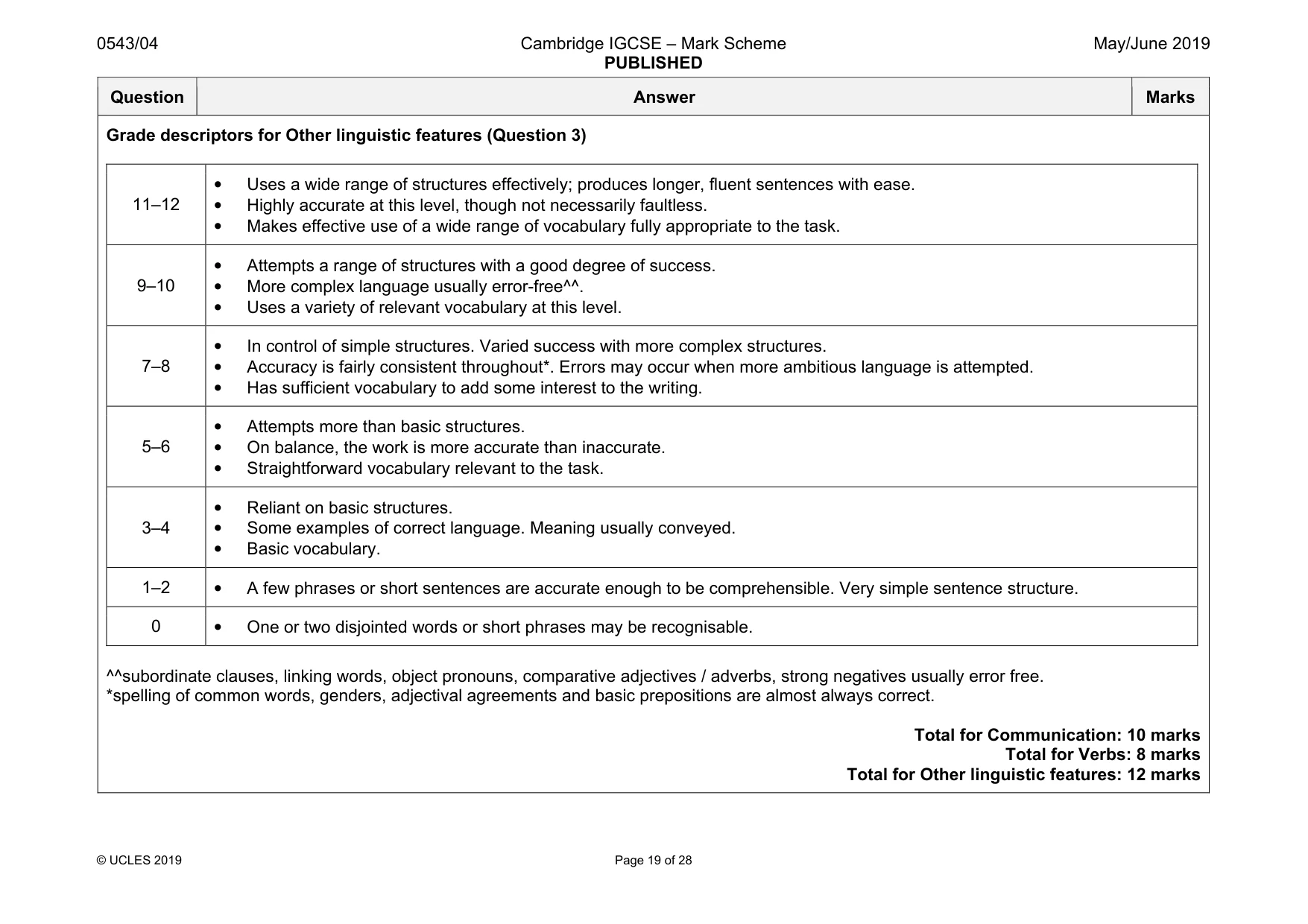
0543/04 Cambridge IGCSE – Mark Scheme PUBLISHED May/June 2019 © UCLES 2019 Page 19 of 28 Question Answer Marks Grade descriptors for Other linguistic features (Question 3) 11–12 • Uses a wide range of structures effectively; produces longer, fluent sentences with ease. • Highly accurate at this level, though not necessarily faultless. • Makes effective use of a wide range of vocabulary fully appropriate to the task. 9–10 • Attempts a range of structures with a good degree of success. • More complex language usually error-free^^. • Uses a variety of relevant vocabulary at this level. 7–8 • In control of simple structures. Varied success with more complex structures. • Accuracy is fairly consistent throughout*. Errors may occur when more ambitious language is attempted. • Has sufficient vocabulary to add some interest to the writing. 5–6 • Attempts more than basic structures. • On balance, the work is more accurate than inaccurate. • Straightforward vocabulary relevant to the task. 3–4 • Reliant on basic structures. • Some examples of correct language. Meaning usually conveyed. • Basic vocabulary. 1–2 • A few phrases or short sentences are accurate enough to be comprehensible. Very simple sentence structure. 0 • One or two disjointed words or short phrases may be recognisable. ^^subordinate clauses, linking words, object pronouns, comparative adjectives / adverbs, strong negatives usually error free. *spelling of common words, genders, adjectival agreements and basic prepositions are almost always correct. Total for Communication: 10 marks Total for Verbs: 8 marks Total for Other linguistic features: 12 marks
Mark scheme, page 20
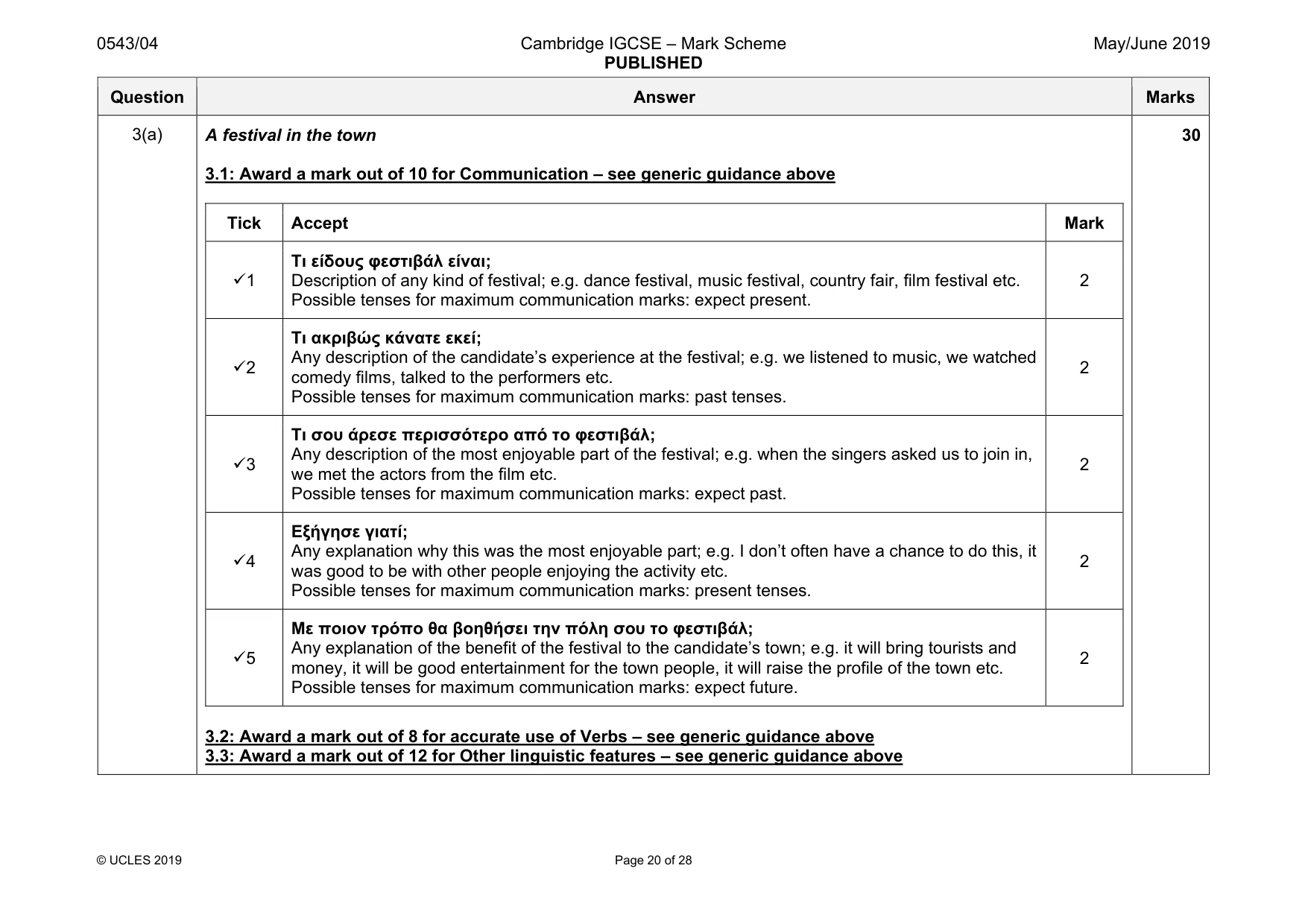
0543/04 Cambridge IGCSE – Mark Scheme PUBLISHED May/June 2019 © UCLES 2019 Page 20 of 28 Question Answer Marks 3(a) A festival in the town 3.1: Award a mark out of 10 for Communication – see generic guidance above Tick Accept Mark 91 Τι είδους φεστιβάλ είναι; Description of any kind of festival; e.g. dance festival, music festival, country fair, film festival etc. Possible tenses for maximum communication marks: expect present. 2 92 Τι ακριβώς κάνατε εκεί; Any description of the candidate’s experience at the festival; e.g. we listened to music, we watched comedy films, talked to the performers etc. Possible tenses for maximum communication marks: past tenses. 2 93 Τι σου άρεσε περισσότερο από το φεστιβάλ; Any description of the most enjoyable part of the festival; e.g. when the singers asked us to join in, we met the actors from the film etc. Possible tenses for maximum communication marks: expect past. 2 94 Εξήγησε γιατί; Any explanation why this was the most enjoyable part; e.g. I don’t often have a chance to do this, it was good to be with other people enjoying the activity etc. Possible tenses for maximum communication marks: present tenses. 2 95 Με ποιοv τρόπο θα βοηθήσει την πόλη σου το φεστιβάλ; Any explanation of the benefit of the festival to the candidate’s town; e.g. it will bring tourists and money, it will be good entertainment for the town people, it will raise the profile of the town etc. Possible tenses for maximum communication marks: expect future. 2 3.2: Award a mark out of 8 for accurate use of Verbs – see generic guidance above 3.3: Award a mark out of 12 for Other linguistic features – see generic guidance above 30
Mark scheme, page 21
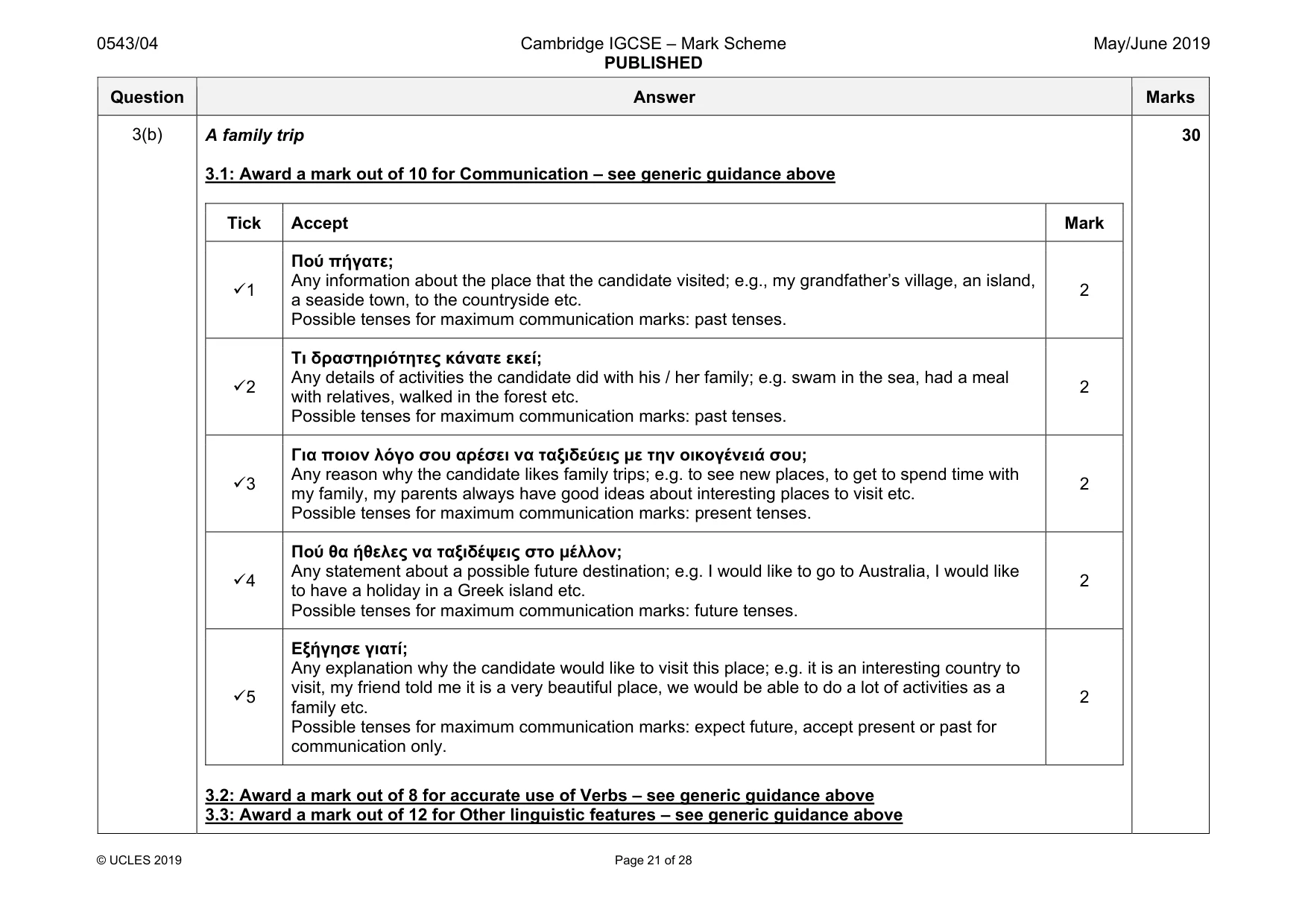
0543/04 Cambridge IGCSE – Mark Scheme PUBLISHED May/June 2019 © UCLES 2019 Page 21 of 28 Question Answer Marks 3(b) A family trip 3.1: Award a mark out of 10 for Communication – see generic guidance above Tick Accept Mark 91 Πού πήγατε; Any information about the place that the candidate visited; e.g., my grandfather’s village, an island, a seaside town, to the countryside etc. Possible tenses for maximum communication marks: past tenses. 2 92 Τι δραστηριότητες κάνατε εκεί; Any details of activities the candidate did with his / her family; e.g. swam in the sea, had a meal with relatives, walked in the forest etc. Possible tenses for maximum communication marks: past tenses. 2 93 Για ποιον λόγο σου αρέσει να ταξιδεύεις µε την οικογένειά σου; Any reason why the candidate likes family trips; e.g. to see new places, to get to spend time with my family, my parents always have good ideas about interesting places to visit etc. Possible tenses for maximum communication marks: present tenses. 2 94 Πού θα ήθελες να ταξιδέψεις στο µέλλον; Any statement about a possible future destination; e.g. I would like to go to Australia, I would like to have a holiday in a Greek island etc. Possible tenses for maximum communication marks: future tenses. 2 95 Εξήγησε γιατί; Any explanation why the candidate would like to visit this place; e.g. it is an interesting country to visit, my friend told me it is a very beautiful place, we would be able to do a lot of activities as a family etc. Possible tenses for maximum communication marks: expect future, accept present or past for communication only. 2 3.2: Award a mark out of 8 for accurate use of Verbs – see generic guidance above 3.3: Award a mark out of 12 for Other linguistic features – see generic guidance above 30
Mark scheme, page 22
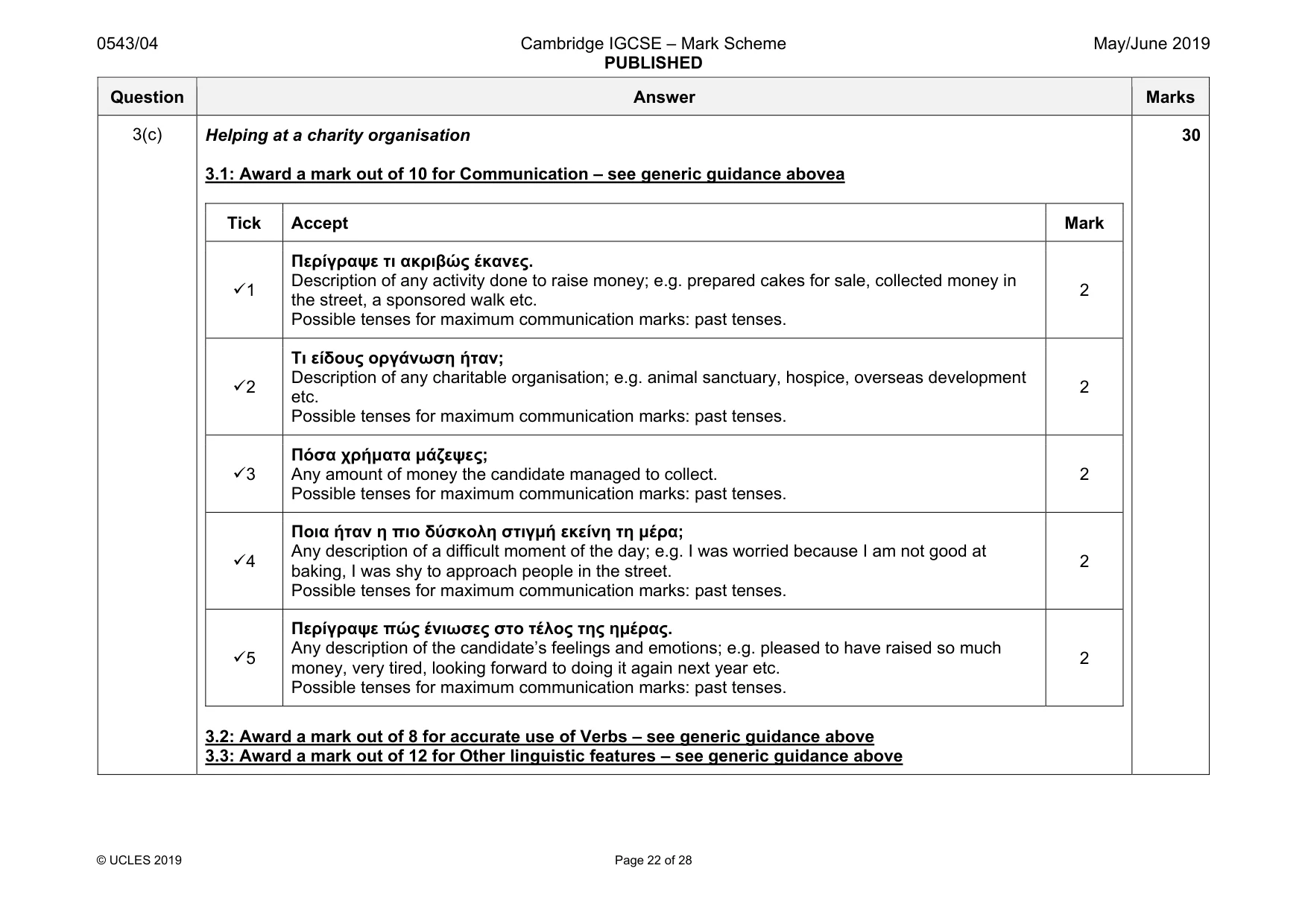
0543/04 Cambridge IGCSE – Mark Scheme PUBLISHED May/June 2019 © UCLES 2019 Page 22 of 28 Question Answer Marks 3(c) Helping at a charity organisation 3.1: Award a mark out of 10 for Communication – see generic guidance abovea Tick Accept Mark 91 Περίγραψε τι ακριβώς έκανες. Description of any activity done to raise money; e.g. prepared cakes for sale, collected money in the street, a sponsored walk etc. Possible tenses for maximum communication marks: past tenses. 2 92 Τι είδους οργάνωση ήταν; Description of any charitable organisation; e.g. animal sanctuary, hospice, overseas development etc. Possible tenses for maximum communication marks: past tenses. 2 93 Πόσα χρήµατα µάζεψες; Any amount of money the candidate managed to collect. Possible tenses for maximum communication marks: past tenses. 2 94 Ποια ήταν η πιο δύσκολη στιγµή εκείνη τη µέρα; Any description of a difficult moment of the day; e.g. I was worried because I am not good at baking, I was shy to approach people in the street. Possible tenses for maximum communication marks: past tenses. 2 95 Περίγραψε πώς ένιωσες στο τέλος της ηµέρας. Any description of the candidate’s feelings and emotions; e.g. pleased to have raised so much money, very tired, looking forward to doing it again next year etc. Possible tenses for maximum communication marks: past tenses. 2 3.2: Award a mark out of 8 for accurate use of Verbs – see generic guidance above 3.3: Award a mark out of 12 for Other linguistic features – see generic guidance above 30
Mark scheme, page 23
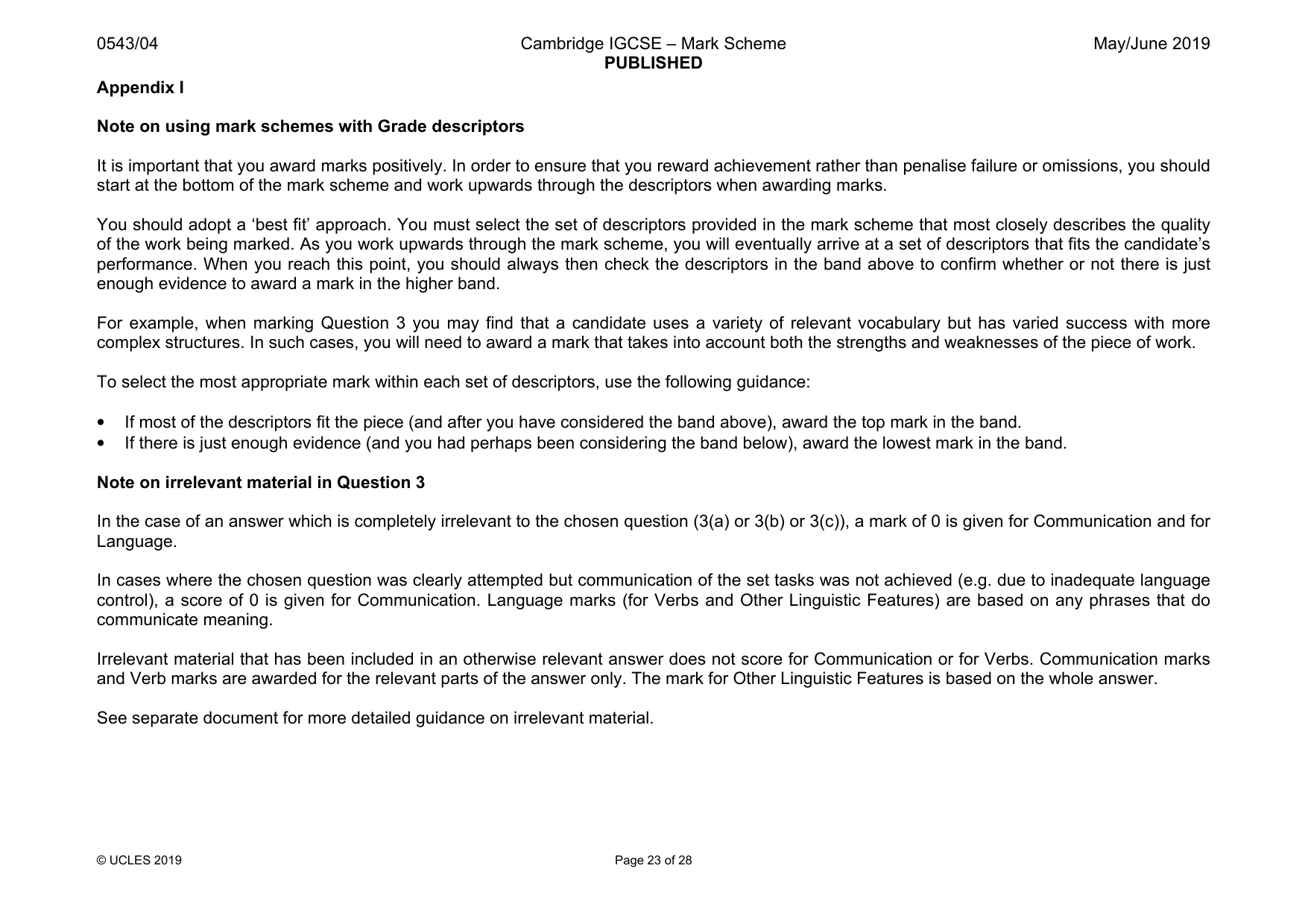
0543/04 Cambridge IGCSE – Mark Scheme PUBLISHED May/June 2019 © UCLES 2019 Page 23 of 28 Appendix I Note on using mark schemes with Grade descriptors It is important that you award marks positively. In order to ensure that you reward achievement rather than penalise failure or omissions, you should start at the bottom of the mark scheme and work upwards through the descriptors when awarding marks. You should adopt a ‘best fit’ approach. You must select the set of descriptors provided in the mark scheme that most closely describes the quality of the work being marked. As you work upwards through the mark scheme, you will eventually arrive at a set of descriptors that fits the candidate’s performance. When you reach this point, you should always then check the descriptors in the band above to confirm whether or not there is just enough evidence to award a mark in the higher band. For example, when marking Question 3 you may find that a candidate uses a variety of relevant vocabulary but has varied success with more complex structures. In such cases, you will need to award a mark that takes into account both the strengths and weaknesses of the piece of work. To select the most appropriate mark within each set of descriptors, use the following guidance: • If most of the descriptors fit the piece (and after you have considered the band above), award the top mark in the band. • If there is just enough evidence (and you had perhaps been considering the band below), award the lowest mark in the band. Note on irrelevant material in Question 3 In the case of an answer which is completely irrelevant to the chosen question (3(a) or 3(b) or 3(c)), a mark of 0 is given for Communication and for Language. In cases where the chosen question was clearly attempted but communication of the set tasks was not achieved (e.g. due to inadequate language control), a score of 0 is given for Communication. Language marks (for Verbs and Other Linguistic Features) are based on any phrases that do communicate meaning. Irrelevant material that has been included in an otherwise relevant answer does not score for Communication or for Verbs. Communication marks and Verb marks are awarded for the relevant parts of the answer only. The mark for Other Linguistic Features is based on the whole answer. See separate document for more detailed guidance on irrelevant material.
Mark scheme, page 24
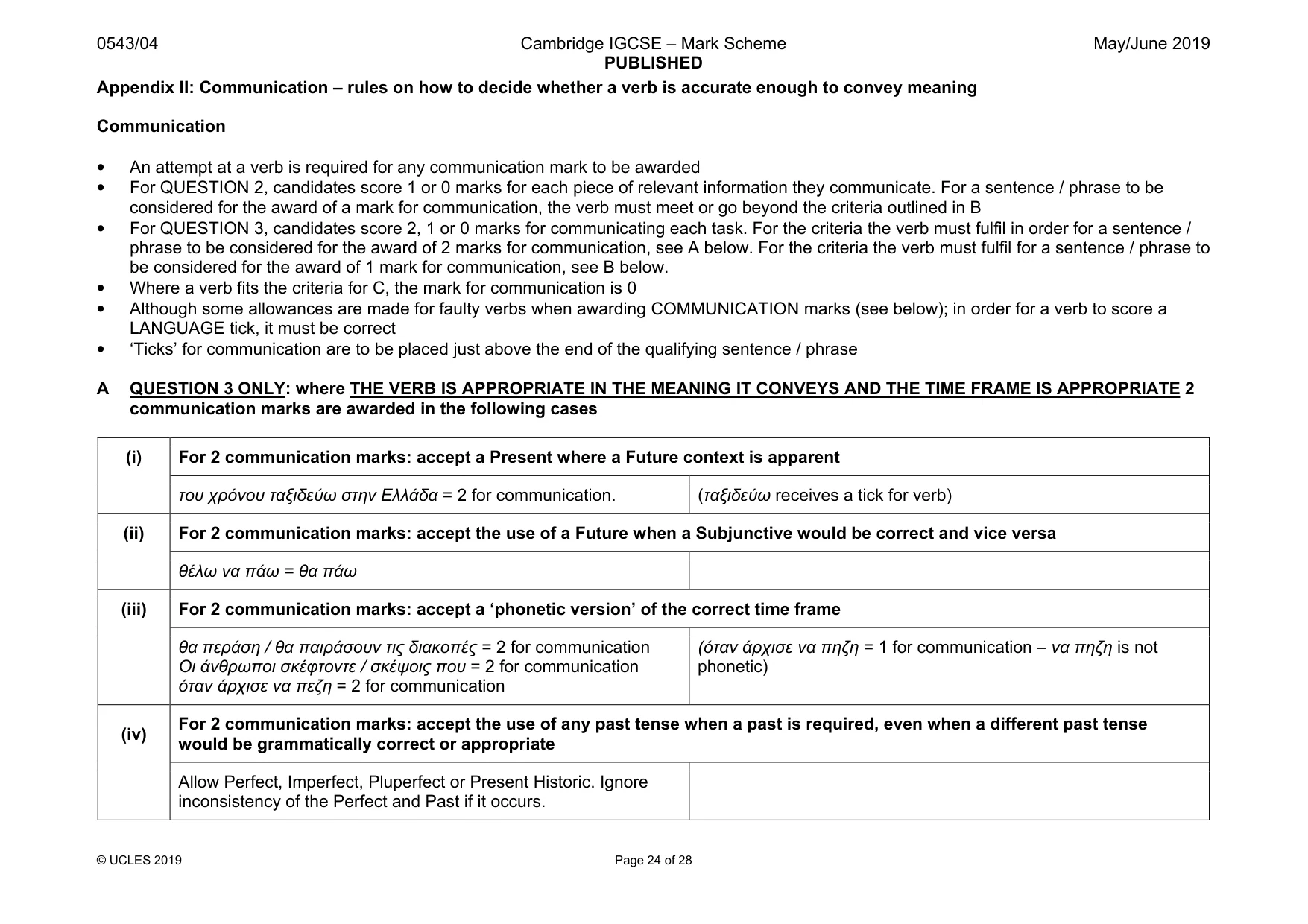
0543/04 Cambridge IGCSE – Mark Scheme PUBLISHED May/June 2019 © UCLES 2019 Page 24 of 28 Appendix II: Communication – rules on how to decide whether a verb is accurate enough to convey meaning Communication • An attempt at a verb is required for any communication mark to be awarded • For QUESTION 2, candidates score 1 or 0 marks for each piece of relevant information they communicate. For a sentence / phrase to be considered for the award of a mark for communication, the verb must meet or go beyond the criteria outlined in B • For QUESTION 3, candidates score 2, 1 or 0 marks for communicating each task. For the criteria the verb must fulfil in order for a sentence / phrase to be considered for the award of 2 marks for communication, see A below. For the criteria the verb must fulfil for a sentence / phrase to be considered for the award of 1 mark for communication, see B below. • Where a verb fits the criteria for C, the mark for communication is 0 • Although some allowances are made for faulty verbs when awarding COMMUNICATION marks (see below); in order for a verb to score a LANGUAGE tick, it must be correct • ‘Ticks’ for communication are to be placed just above the end of the qualifying sentence / phrase A QUESTION 3 ONLY: where THE VERB IS APPROPRIATE IN THE MEANING IT CONVEYS AND THE TIME FRAME IS APPROPRIATE 2 communication marks are awarded in the following cases (i) For 2 communication marks: accept a Present where a Future context is apparent του χρόνου ταξιδεύω στην Ελλάδα = 2 for communication. (ταξιδεύω receives a tick for verb) (ii) For 2 communication marks: accept the use of a Future when a Subjunctive would be correct and vice versa θέλω να πάω = θα πάω (iii) For 2 communication marks: accept a ‘phonetic version’ of the correct time frame θα περάση / θα παιράσουν τις διακοπές = 2 for communication Οι άνθρωποι σκέφτοντε / σκέψοις που = 2 for communication όταν άρχισε να πεζη = 2 for communication (όταν άρχισε να πηζη = 1 for communication – να πηζη is not phonetic) (iv) For 2 communication marks: accept the use of any past tense when a past is required, even when a different past tense would be grammatically correct or appropriate Allow Perfect, Imperfect, Pluperfect or Present Historic. Ignore inconsistency of the Perfect and Past if it occurs.
Mark scheme, page 25
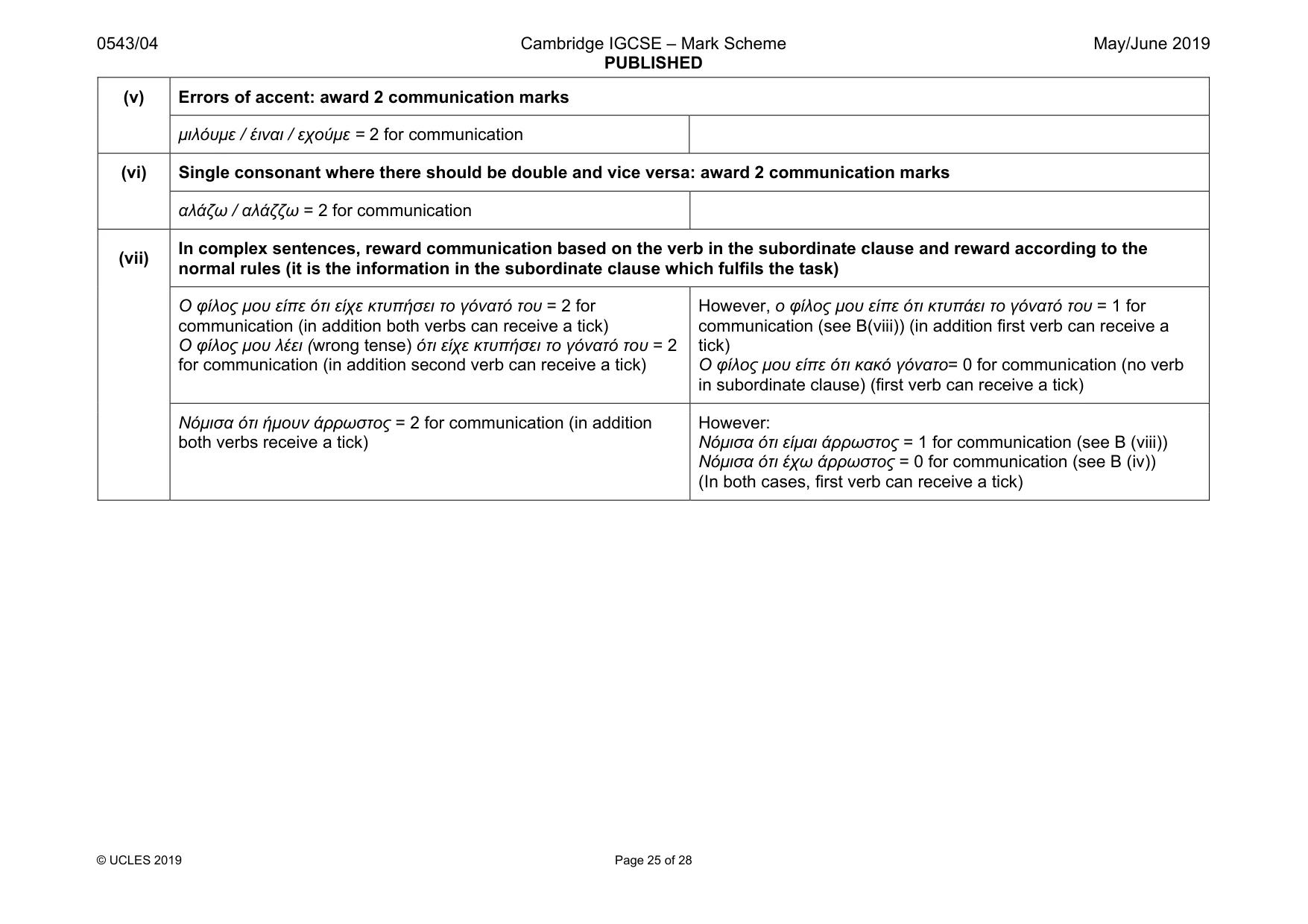
0543/04 Cambridge IGCSE – Mark Scheme PUBLISHED May/June 2019 © UCLES 2019 Page 25 of 28 (v) Errors of accent: award 2 communication marks µιλόυµε / έιναι / εχούµε = 2 for communication (vi) Single consonant where there should be double and vice versa: award 2 communication marks αλάζω / αλάζζω = 2 for communication (vii) In complex sentences, reward communication based on the verb in the subordinate clause and reward according to the normal rules (it is the information in the subordinate clause which fulfils the task) Ο φίλος µου είπε ότι είχε κτυπήσει το γόνατό του = 2 for communication (in addition both verbs can receive a tick) Ο φίλος µου λέει (wrong tense) ότι είχε κτυπήσει το γόνατό του = 2 for communication (in addition second verb can receive a tick) However, o φίλος µου είπε ότι κτυπάει το γόνατό του = 1 for communication (see B(viii)) (in addition first verb can receive a tick) Ο φίλος µου είπε ότι κακό γόνατο= 0 for communication (no verb in subordinate clause) (first verb can receive a tick) Νόµισα ότι ήµουν άρρωστος = 2 for communication (in addition both verbs receive a tick) However: Νόµισα ότι είµαι άρρωστος = 1 for communication (see B (viii)) Νόµισα ότι έχω άρρωστος = 0 for communication (see B (iv)) (In both cases, first verb can receive a tick)
Mark scheme, page 26
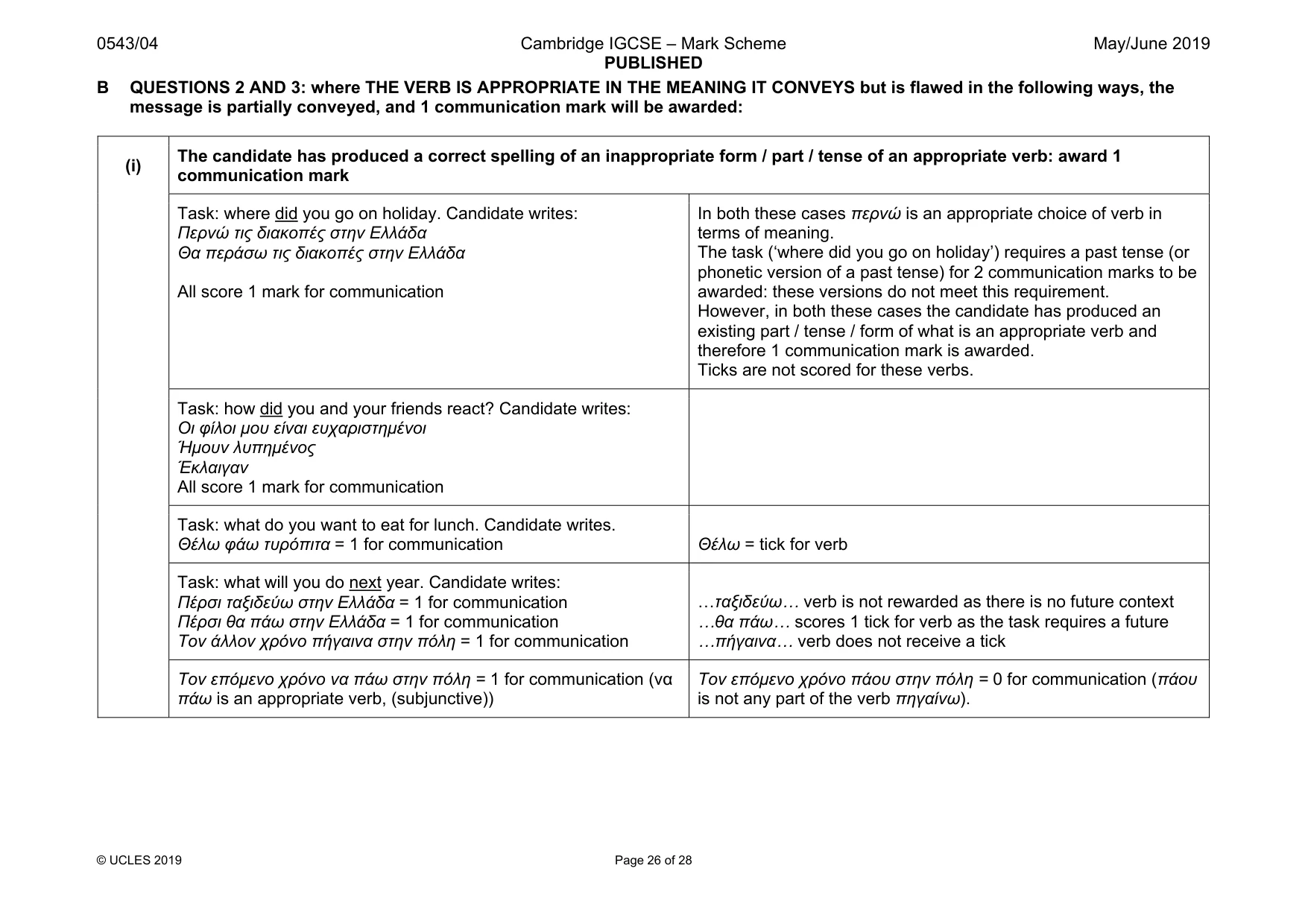
0543/04 Cambridge IGCSE – Mark Scheme PUBLISHED May/June 2019 © UCLES 2019 Page 26 of 28 B QUESTIONS 2 AND 3: where THE VERB IS APPROPRIATE IN THE MEANING IT CONVEYS but is flawed in the following ways, the message is partially conveyed, and 1 communication mark will be awarded: (i) The candidate has produced a correct spelling of an inappropriate form / part / tense of an appropriate verb: award 1 communication mark Task: where did you go on holiday. Candidate writes: Περνώ τις διακοπές στην Ελλάδα Θα περάσω τις διακοπές στην Ελλάδα All score 1 mark for communication In both these cases περνώ is an appropriate choice of verb in terms of meaning. The task (‘where did you go on holiday’) requires a past tense (or phonetic version of a past tense) for 2 communication marks to be awarded: these versions do not meet this requirement. However, in both these cases the candidate has produced an existing part / tense / form of what is an appropriate verb and therefore 1 communication mark is awarded. Ticks are not scored for these verbs. Task: how did you and your friends react? Candidate writes: Οι φίλοι µου είναι ευχαριστηµένοι Ήµουν λυπηµένος Έκλαιγαν All score 1 mark for communication Task: what do you want to eat for lunch. Candidate writes. Θέλω φάω τυρόπιτα = 1 for communication Θέλω = tick for verb Task: what will you do next year. Candidate writes: Πέρσι ταξιδεύω στην Ελλάδα = 1 for communication Πέρσι θα πάω στην Ελλάδα = 1 for communication Τον άλλον χρόνο πήγαινα στην πόλη = 1 for communication «ταξιδεύω« verb is not rewarded as there is no future context «θα πάω« scores 1 tick for verb as the task requires a future «πήγαινα« verb does not receive a tick Τον επόµενο χρόνο να πάω στην πόλη = 1 for communication (να πάω is an appropriate verb, (subjunctive)) Τον επόµενο χρόνο πάου στην πόλη = 0 for communication (πάου is not any part of the verb πηγαίνω).
Mark scheme, page 27
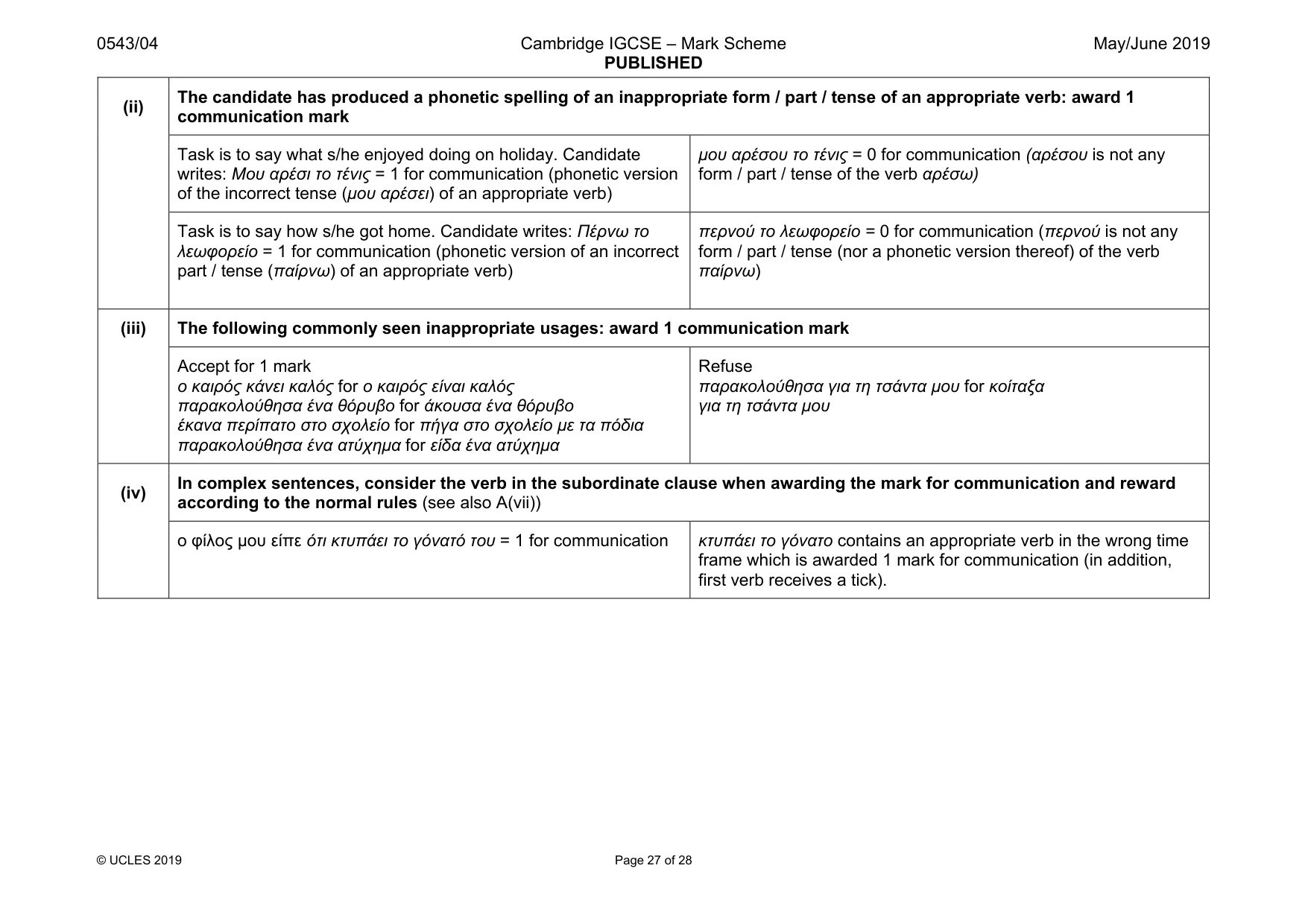
0543/04 Cambridge IGCSE – Mark Scheme PUBLISHED May/June 2019 © UCLES 2019 Page 27 of 28 (ii) The candidate has produced a phonetic spelling of an inappropriate form / part / tense of an appropriate verb: award 1 communication mark Task is to say what s/he enjoyed doing on holiday. Candidate writes: Μου αρέσι το τένις = 1 for communication (phonetic version of the incorrect tense (µου αρέσει) of an appropriate verb) µου αρέσου το τένις = 0 for communication (αρέσου is not any form / part / tense of the verb αρέσω) Task is to say how s/he got home. Candidate writes: Πέρνω το λεωφορείο = 1 for communication (phonetic version of an incorrect part / tense (παίρνω) of an appropriate verb) περνού το λεωφορείο = 0 for communication (περνού is not any form / part / tense (nor a phonetic version thereof) of the verb παίρνω) (iii) The following commonly seen inappropriate usages: award 1 communication mark Accept for 1 mark ο καιρός κάνει καλός for ο καιρός είναι καλός παρακολούθησα ένα θόρυβο for άκουσα ένα θόρυβο έκανα περίπατο στο σχολείο for πήγα στο σχολείο µε τα πόδια παρακολούθησα ένα ατύχηµα for είδα ένα ατύχηµα Refuse παρακολούθησα για τη τσάντα µου for κοίταξα για τη τσάντα µου (iv) In complex sentences, consider the verb in the subordinate clause when awarding the mark for communication and reward according to the normal rules (see also A(vii)) o φίλος µου είπε ότι κτυπάει το γόνατό του = 1 for communication κτυπάει το γόνατο contains an appropriate verb in the wrong time frame which is awarded 1 mark for communication (in addition, first verb receives a tick).
Mark scheme, page 28
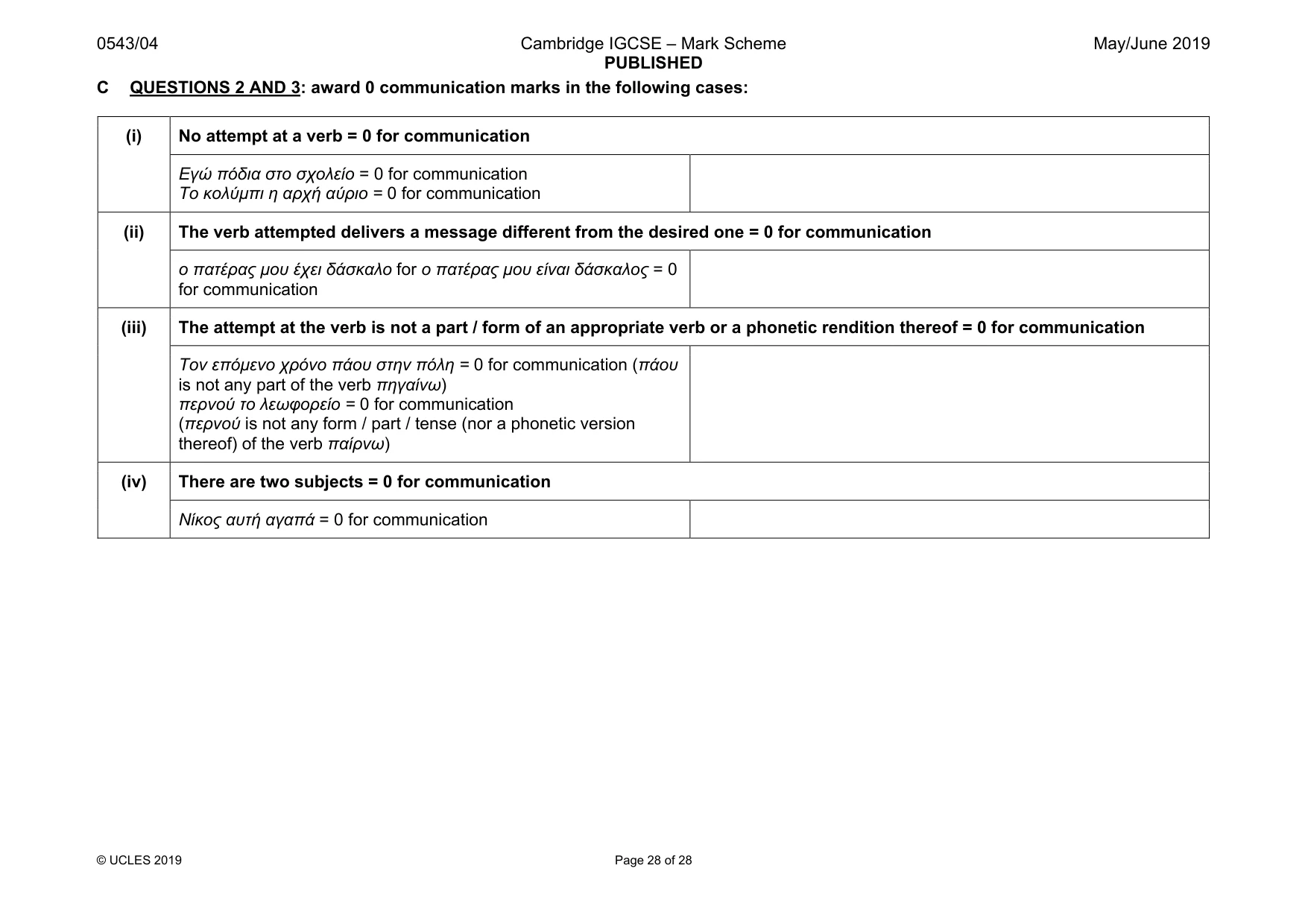
0543/04 Cambridge IGCSE – Mark Scheme PUBLISHED May/June 2019 © UCLES 2019 Page 28 of 28 C QUESTIONS 2 AND 3: award 0 communication marks in the following cases: (i) No attempt at a verb = 0 for communication Εγώ πόδια στο σχολείο = 0 for communication Το κολύµπι η αρχή αύριο = 0 for communication (ii) The verb attempted delivers a message different from the desired one = 0 for communication ο πατέρας µου έχει δάσκαλο for ο πατέρας µου είναι δάσκαλος = 0 for communication (iii) The attempt at the verb is not a part / form of an appropriate verb or a phonetic rendition thereof = 0 for communication Τον επόµενο χρόνο πάου στην πόλη = 0 for communication (πάου is not any part of the verb πηγαίνω) περνού το λεωφορείο = 0 for communication (περνού is not any form / part / tense (nor a phonetic version thereof) of the verb παίρνω) (iv) There are two subjects = 0 for communication Νίκος αυτή αγαπά = 0 for communication
What you needed in this session
Cambridge’s own grade thresholds for 2019 May/June, Paper 4 · Variant 1. A higher threshold means an easier paper — the bar moves with how the cohort did.