Cambridge IGCSE Global Perspectives 0457 — 2023 Feb/March Paper 1 · Variant 2
0457/12/F/M/23 · 70 marks · ≈79 min
The question paper and its mark scheme, free to read here and free to download. This is Cambridge’s own paper, exactly as it was sat.
Question paper12 pages







Mark scheme20 pages
Answers below. Sit the paper first if you are practising.

Paper as text
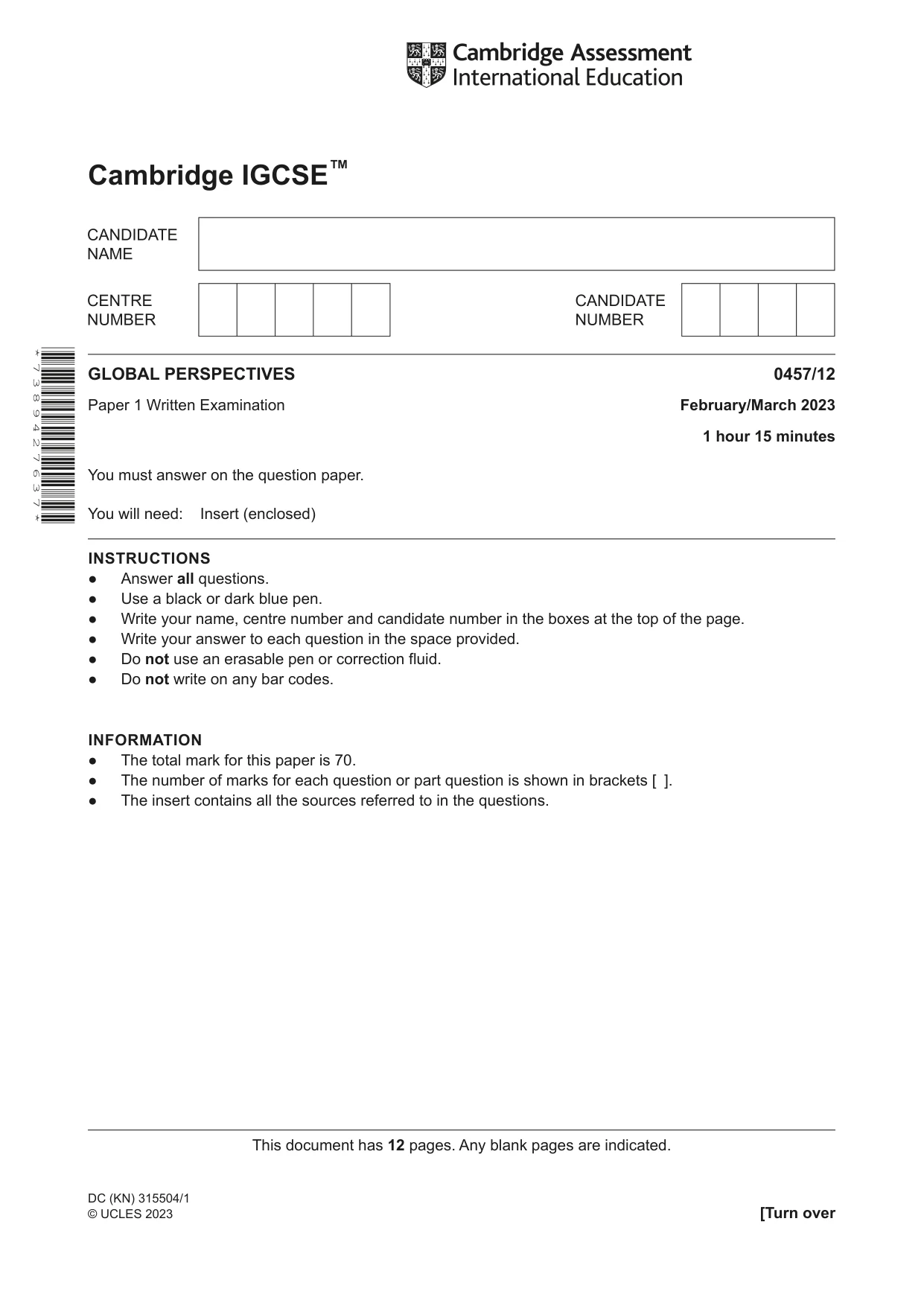
Question paper, page 1
This document has 12 pages. Any blank pages are indicated. [Turn over Cambridge IGCSE™ DC (KN) 315504/1 © UCLES 2023 * 7 3 8 9 4 2 7 6 3 7 * GLOBAL PERSPECTIVES 0457/12 Paper 1 Written Examination February/March 2023 1 hour 15 minutes You must answer on the question paper. You will need: Insert (enclosed) INSTRUCTIONS ● Answer all questions. ● Use a black or dark blue pen. ● Write your name, centre number and candidate number in the boxes at the top of the page. ● Write your answer to each question in the space provided. ● Do not use an erasable pen or correction fluid. ● Do not write on any bar codes. INFORMATION ● The total mark for this paper is 70. ● The number of marks for each question or part question is shown in brackets [ ]. ● The insert contains all the sources referred to in the questions.
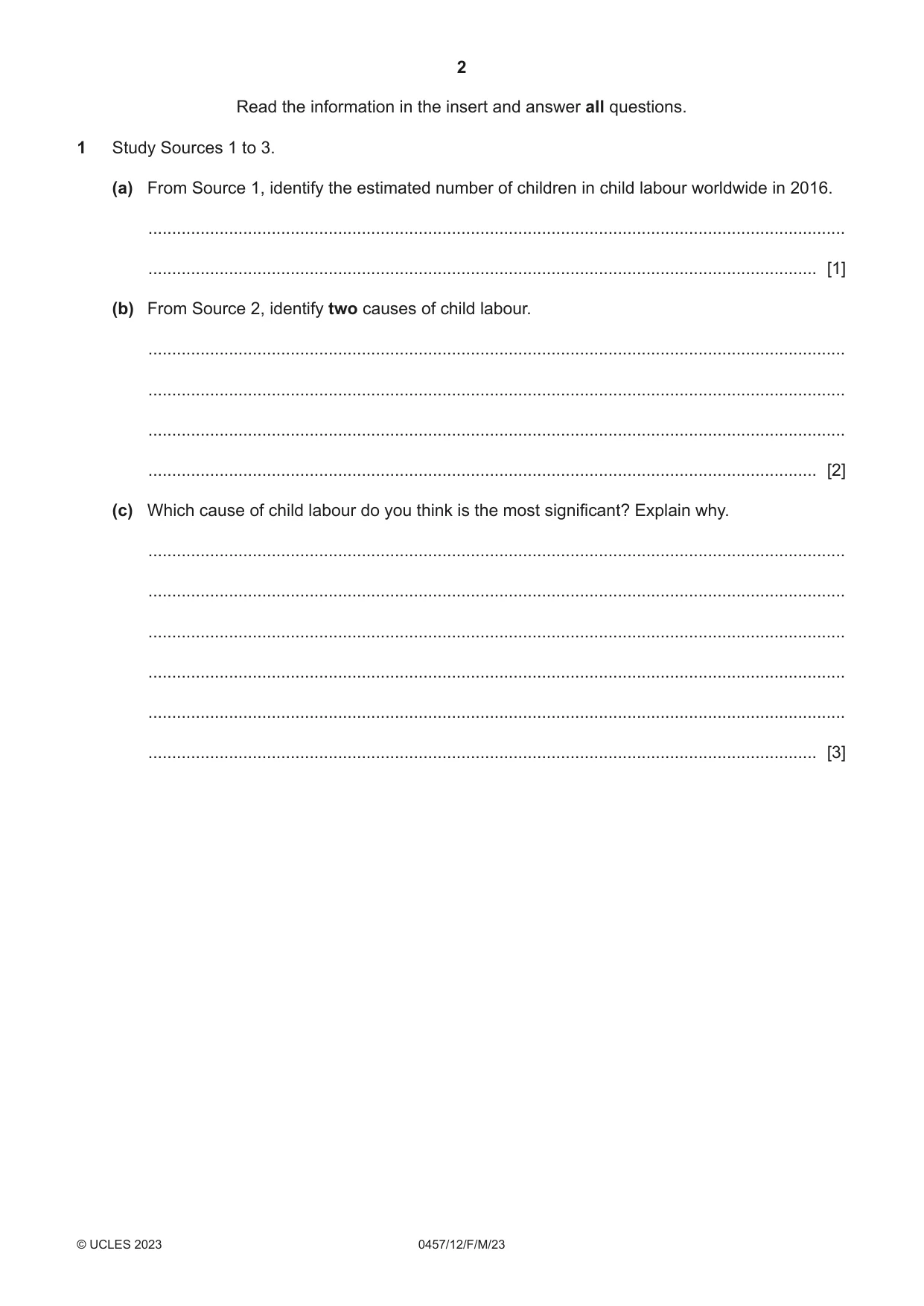
Question paper, page 2
2 0457/12/F/M/23 © UCLES 2023 Read the information in the insert and answer all questions. 1 Study Sources 1 to 3. (a) From Source 1, identify the estimated number of children in child labour worldwide in 2016. … … [1] (b) From Source 2, identify two causes of child labour. … … … … [2] (c) Which cause of child labour do you think is the most significant? Explain why. … … … … … … [3]
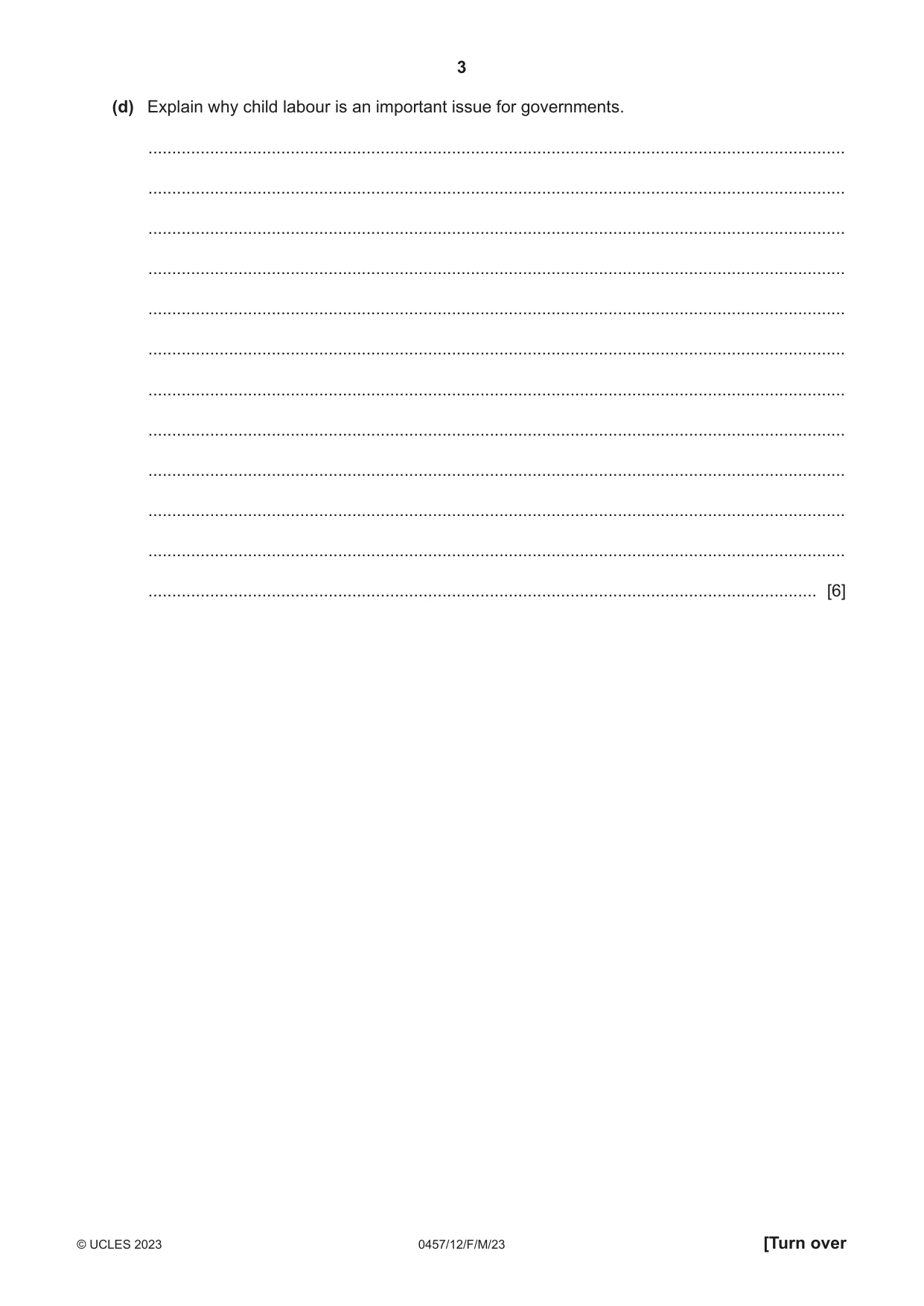
Question paper, page 3
3 0457/12/F/M/23 © UCLES 2023 [Turn over (d) Explain why child labour is an important issue for governments. … … … … … … … … … … … … [6]
Question paper, page 4
4 0457/12/F/M/23 © UCLES 2023 2 Study Source 3. (a) What are the strengths and weaknesses of this source for understanding the issue of child labour? … … … … … … … … … … … … [6]
Question paper, page 5
5 0457/12/F/M/23 © UCLES 2023 [Turn over (b) ‘Climate change caused many crops to fail.’ How could you test this claim? You should consider the types of information, sources of evidence and methods you might use. … … … … … … … … … … … … … … … … [8]
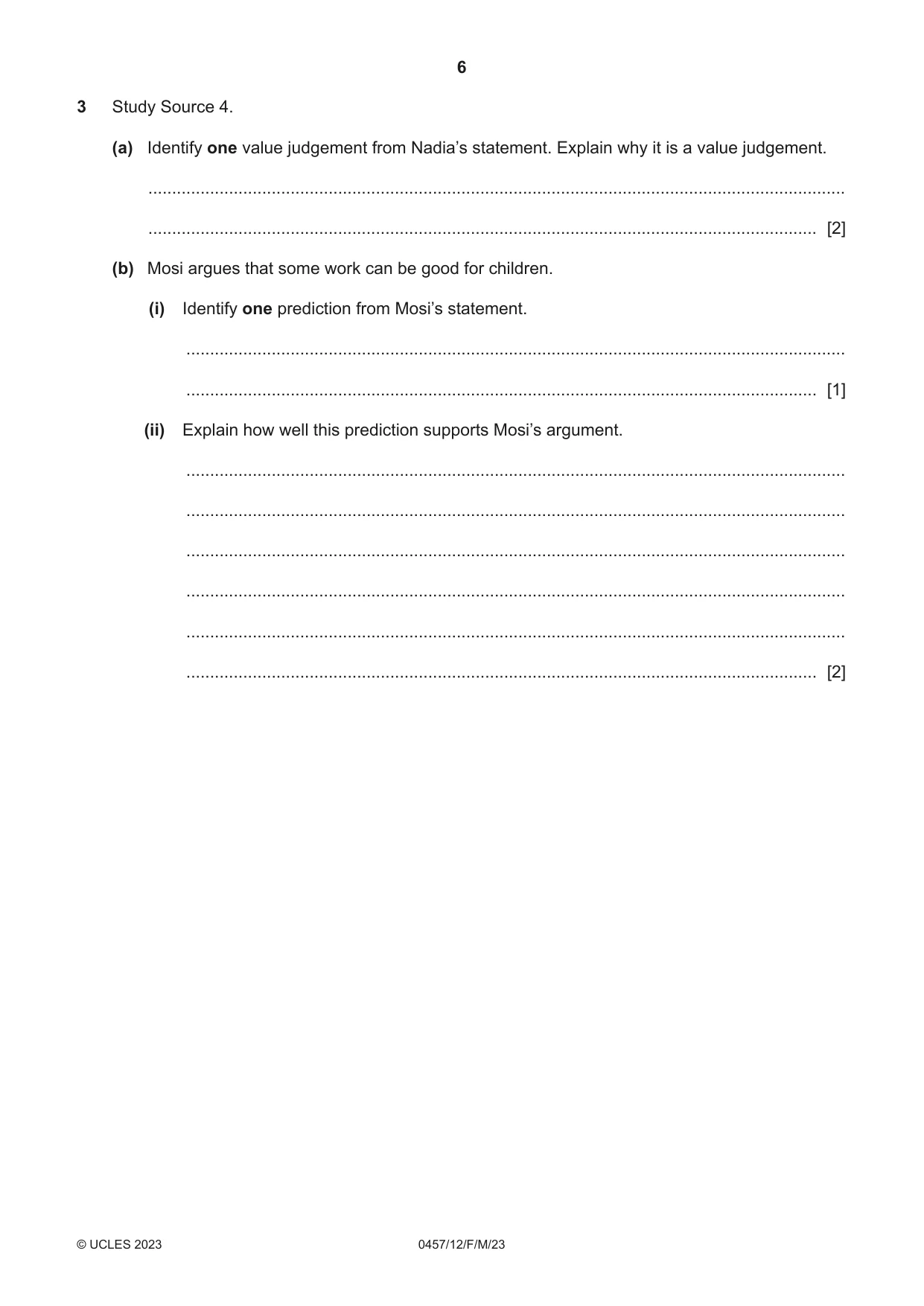
Question paper, page 6
6 0457/12/F/M/23 © UCLES 2023 3 Study Source 4. (a) Identify one value judgement from Nadia’s statement. Explain why it is a value judgement. … … [2] (b) Mosi argues that some work can be good for children. (i) Identify one prediction from Mosi’s statement. … … [1] (ii) Explain how well this prediction supports Mosi’s argument. … … … … … … [2]
Question paper, page 7
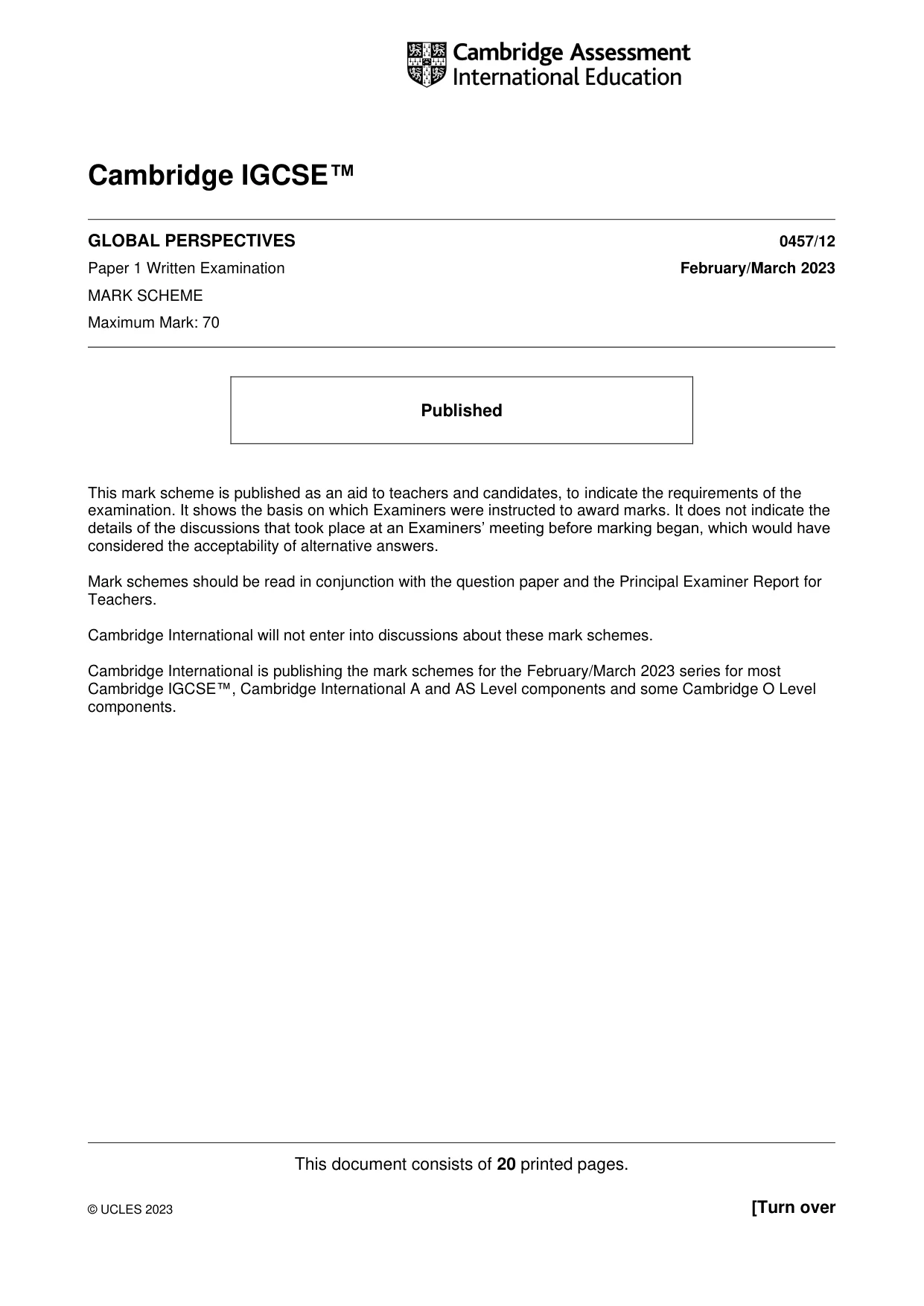
7 0457/12/F/M/23 © UCLES 2023 [Turn over (c) Which argument is more convincing, Nadia’s or Mosi’s? Your answer should consider both arguments and you should support your point of view with their words. You should also consider: • the strength of their reasoning and evidence • their use of language • the different types of information used. … … … … … … … … … … … … … … … … … … … … … … … [15]
Question paper, page 8
8 0457/12/F/M/23 © UCLES 2023 4 ‘Children should not be allowed to work in paid employment.’ Do you agree with this statement? In your answer, you should: • state your opinion • give reasons and evidence to support your opinion • use the material in the sources and/or any of your own ideas • consider different arguments and perspectives. … … … … … … … … … … … … … … … … … … … … … … …
Question paper, page 9
9 0457/12/F/M/23 © UCLES 2023 … … … … … … … … … … … … … … … … … … … … … … … … … [24]
Question paper, page 10
10 0457/12/F/M/23 © UCLES 2023 BLANK PAGE
Question paper, page 11
11 0457/12/F/M/23 © UCLES 2023 BLANK PAGE
Question paper, page 12
12 0457/12/F/M/23 © UCLES 2023 Permission to reproduce items where third-party owned material protected by copyright is included has been sought and cleared where possible. Every reasonable effort has been made by the publisher (UCLES) to trace copyright holders, but if any items requiring clearance have unwittingly been included, the publisher will be pleased to make amends at the earliest possible opportunity. To avoid the issue of disclosure of answer-related information to candidates, all copyright acknowledgements are reproduced online in the Cambridge Assessment International Education Copyright Acknowledgements Booklet. This is produced for each series of examinations and is freely available to download at www.cambridgeinternational.org after the live examination series. Cambridge Assessment International Education is part of Cambridge Assessment. Cambridge Assessment is the brand name of the University of Cambridge Local Examinations Syndicate (UCLES), which is a department of the University of Cambridge. BLANK PAGE
Mark scheme, page 1
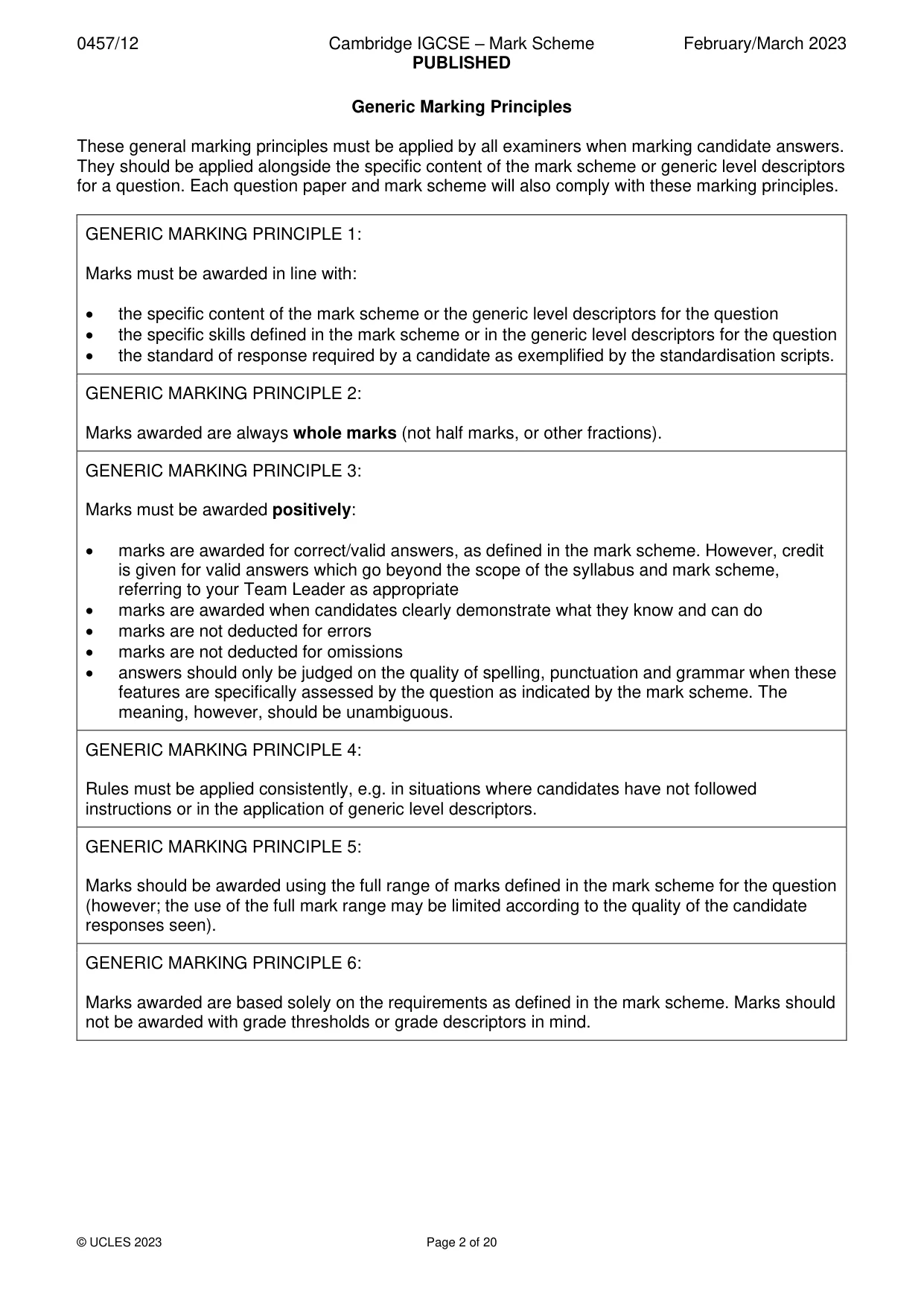
This document consists of 20 printed pages. © UCLES 2023 [Turn over Cambridge IGCSE™ GLOBAL PERSPECTIVES 0457/12 Paper 1 Written Examination February/March 2023 MARK SCHEME Maximum Mark: 70 Published This mark scheme is published as an aid to teachers and candidates, to indicate the requirements of the examination. It shows the basis on which Examiners were instructed to award marks. It does not indicate the details of the discussions that took place at an Examiners’ meeting before marking began, which would have considered the acceptability of alternative answers. Mark schemes should be read in conjunction with the question paper and the Principal Examiner Report for Teachers. Cambridge International will not enter into discussions about these mark schemes. Cambridge International is publishing the mark schemes for the February/March 2023 series for most Cambridge IGCSE™, Cambridge International A and AS Level components and some Cambridge O Level components.
Mark scheme, page 2
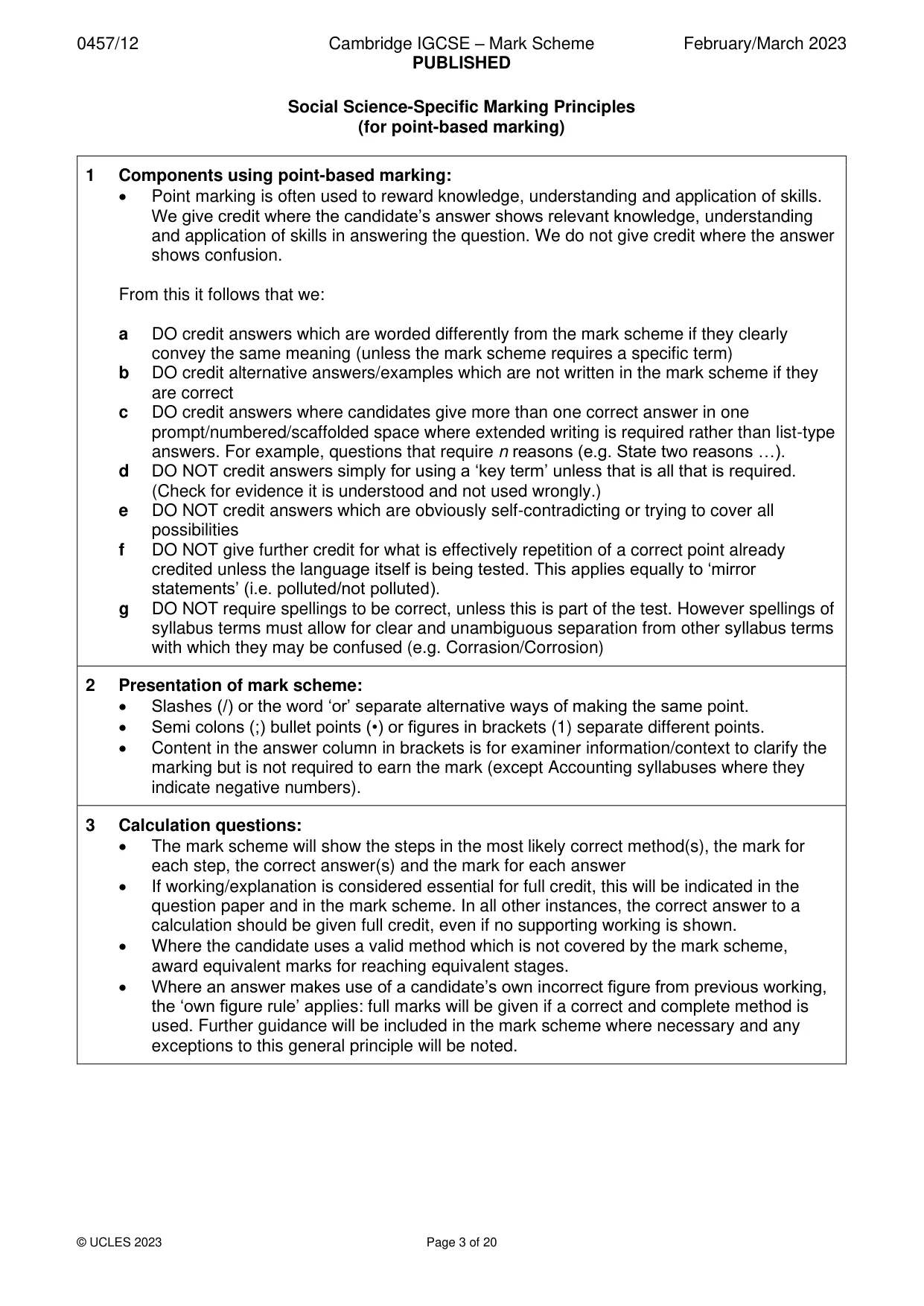
0457/12 Cambridge IGCSE – Mark Scheme PUBLISHED February/March 2023 © UCLES 2023 Page 2 of 20 Generic Marking Principles These general marking principles must be applied by all examiners when marking candidate answers. They should be applied alongside the specific content of the mark scheme or generic level descriptors for a question. Each question paper and mark scheme will also comply with these marking principles. GENERIC MARKING PRINCIPLE 1: Marks must be awarded in line with: • the specific content of the mark scheme or the generic level descriptors for the question • the specific skills defined in the mark scheme or in the generic level descriptors for the question • the standard of response required by a candidate as exemplified by the standardisation scripts. GENERIC MARKING PRINCIPLE 2: Marks awarded are always whole marks (not half marks, or other fractions). GENERIC MARKING PRINCIPLE 3: Marks must be awarded positively: • marks are awarded for correct/valid answers, as defined in the mark scheme. However, credit is given for valid answers which go beyond the scope of the syllabus and mark scheme, referring to your Team Leader as appropriate • marks are awarded when candidates clearly demonstrate what they know and can do • marks are not deducted for errors • marks are not deducted for omissions • answers should only be judged on the quality of spelling, punctuation and grammar when these features are specifically assessed by the question as indicated by the mark scheme. The meaning, however, should be unambiguous. GENERIC MARKING PRINCIPLE 4: Rules must be applied consistently, e.g. in situations where candidates have not followed instructions or in the application of generic level descriptors. GENERIC MARKING PRINCIPLE 5: Marks should be awarded using the full range of marks defined in the mark scheme for the question (however; the use of the full mark range may be limited according to the quality of the candidate responses seen). GENERIC MARKING PRINCIPLE 6: Marks awarded are based solely on the requirements as defined in the mark scheme. Marks should not be awarded with grade thresholds or grade descriptors in mind.
Mark scheme, page 3
0457/12 Cambridge IGCSE – Mark Scheme PUBLISHED February/March 2023 © UCLES 2023 Page 3 of 20 Social Science-Specific Marking Principles (for point-based marking) 1 Components using point-based marking: • Point marking is often used to reward knowledge, understanding and application of skills. We give credit where the candidate’s answer shows relevant knowledge, understanding and application of skills in answering the question. We do not give credit where the answer shows confusion. From this it follows that we: a DO credit answers which are worded differently from the mark scheme if they clearly convey the same meaning (unless the mark scheme requires a specific term) b DO credit alternative answers/examples which are not written in the mark scheme if they are correct c DO credit answers where candidates give more than one correct answer in one prompt/numbered/scaffolded space where extended writing is required rather than list-type answers. For example, questions that require n reasons (e.g. State two reasons …). d DO NOT credit answers simply for using a ‘key term’ unless that is all that is required. (Check for evidence it is understood and not used wrongly.) e DO NOT credit answers which are obviously self-contradicting or trying to cover all possibilities f DO NOT give further credit for what is effectively repetition of a correct point already credited unless the language itself is being tested. This applies equally to ‘mirror statements’ (i.e. polluted/not polluted). g DO NOT require spellings to be correct, unless this is part of the test. However spellings of syllabus terms must allow for clear and unambiguous separation from other syllabus terms with which they may be confused (e.g. Corrasion/Corrosion) 2 Presentation of mark scheme: • Slashes (/) or the word ‘or’ separate alternative ways of making the same point. • Semi colons (;) bullet points (•) or figures in brackets (1) separate different points. • Content in the answer column in brackets is for examiner information/context to clarify the marking but is not required to earn the mark (except Accounting syllabuses where they indicate negative numbers). 3 Calculation questions: • The mark scheme will show the steps in the most likely correct method(s), the mark for each step, the correct answer(s) and the mark for each answer • If working/explanation is considered essential for full credit, this will be indicated in the question paper and in the mark scheme. In all other instances, the correct answer to a calculation should be given full credit, even if no supporting working is shown. • Where the candidate uses a valid method which is not covered by the mark scheme, award equivalent marks for reaching equivalent stages. • Where an answer makes use of a candidate’s own incorrect figure from previous working, the ‘own figure rule’ applies: full marks will be given if a correct and complete method is used. Further guidance will be included in the mark scheme where necessary and any exceptions to this general principle will be noted.
Mark scheme, page 4
0457/12 Cambridge IGCSE – Mark Scheme PUBLISHED February/March 2023 © UCLES 2023 Page 4 of 20 4 Annotation: • For point marking, ticks can be used to indicate correct answers and crosses can be used to indicate wrong answers. There is no direct relationship between ticks and marks. Ticks have no defined meaning for levels of response marking. • For levels of response marking, the level awarded should be annotated on the script. • Other annotations will be used by examiners as agreed during standardisation, and the meaning will be understood by all examiners who marked that paper.
Mark scheme, page 5
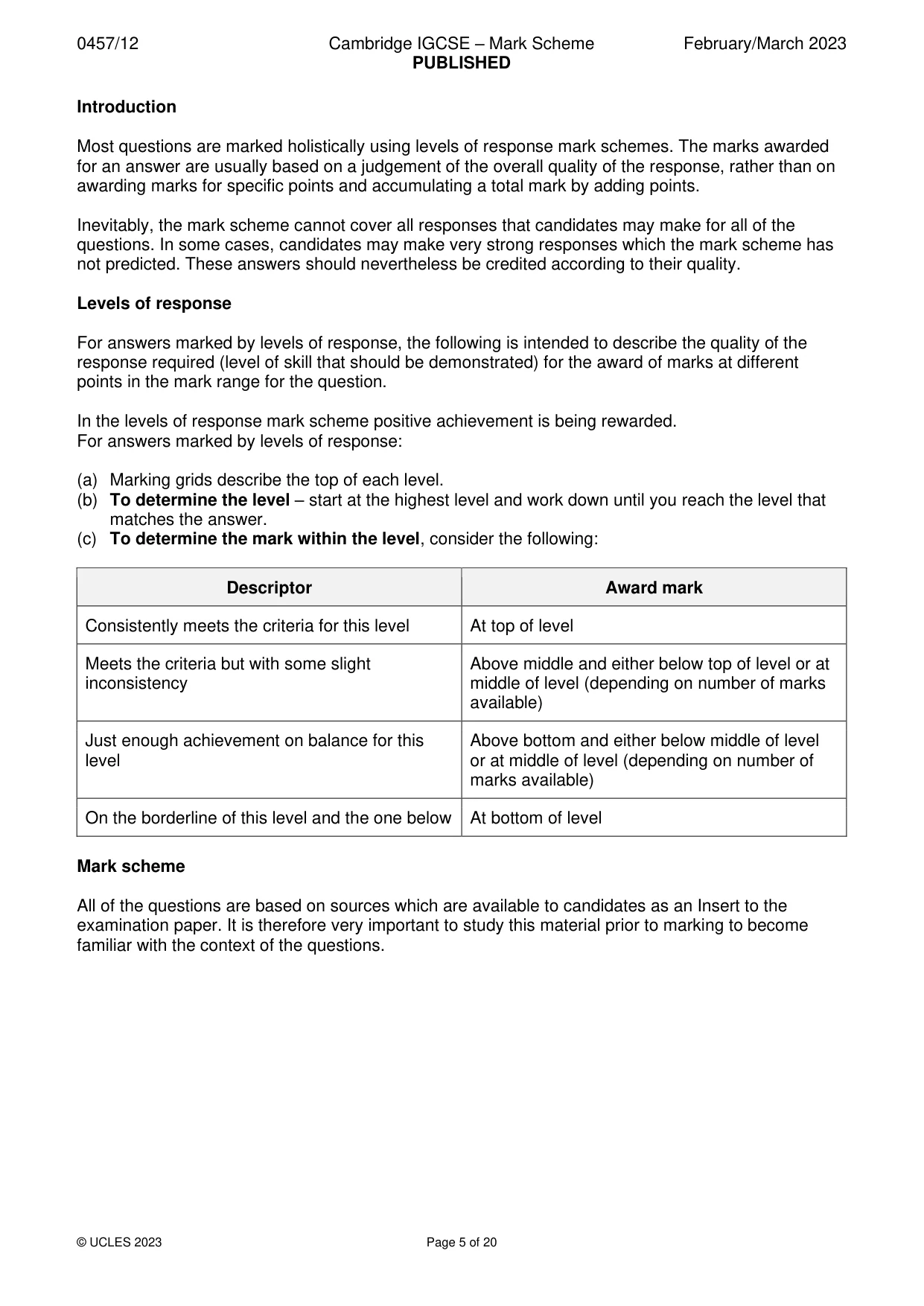
0457/12 Cambridge IGCSE – Mark Scheme PUBLISHED February/March 2023 © UCLES 2023 Page 5 of 20 Introduction Most questions are marked holistically using levels of response mark schemes. The marks awarded for an answer are usually based on a judgement of the overall quality of the response, rather than on awarding marks for specific points and accumulating a total mark by adding points. Inevitably, the mark scheme cannot cover all responses that candidates may make for all of the questions. In some cases, candidates may make very strong responses which the mark scheme has not predicted. These answers should nevertheless be credited according to their quality. Levels of response For answers marked by levels of response, the following is intended to describe the quality of the response required (level of skill that should be demonstrated) for the award of marks at different points in the mark range for the question. In the levels of response mark scheme positive achievement is being rewarded. For answers marked by levels of response: (a) Marking grids describe the top of each level. (b) To determine the level – start at the highest level and work down until you reach the level that matches the answer. (c) To determine the mark within the level, consider the following: Descriptor Award mark Consistently meets the criteria for this level At top of level Meets the criteria but with some slight inconsistency Above middle and either below top of level or at middle of level (depending on number of marks available) Just enough achievement on balance for this level Above bottom and either below middle of level or at middle of level (depending on number of marks available) On the borderline of this level and the one below At bottom of level Mark scheme All of the questions are based on sources which are available to candidates as an Insert to the examination paper. It is therefore very important to study this material prior to marking to become familiar with the context of the questions.
Mark scheme, page 6
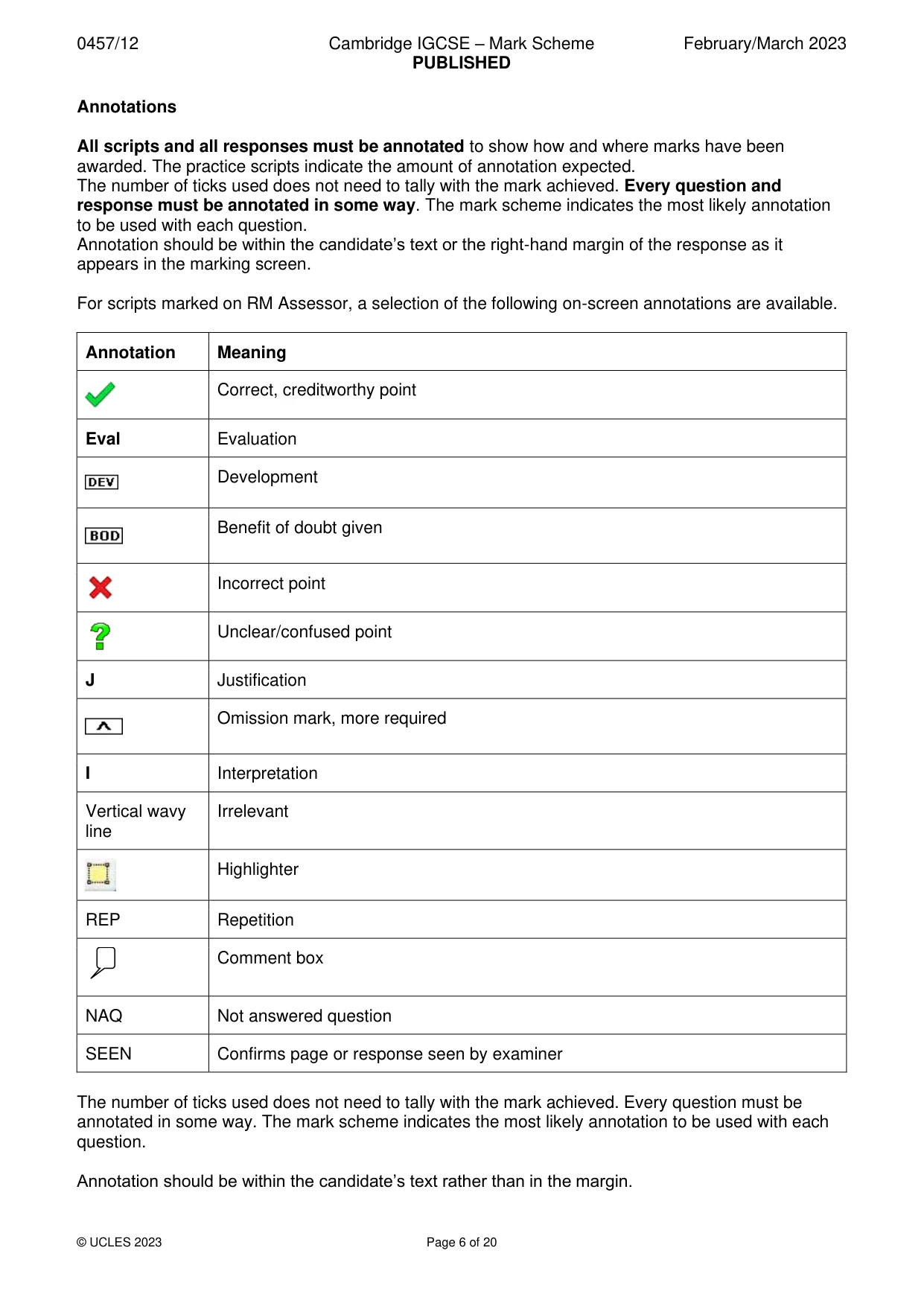
0457/12 Cambridge IGCSE – Mark Scheme PUBLISHED February/March 2023 © UCLES 2023 Page 6 of 20 Annotations All scripts and all responses must be annotated to show how and where marks have been awarded. The practice scripts indicate the amount of annotation expected. The number of ticks used does not need to tally with the mark achieved. Every question and response must be annotated in some way. The mark scheme indicates the most likely annotation to be used with each question. Annotation should be within the candidate’s text or the right-hand margin of the response as it appears in the marking screen. For scripts marked on RM Assessor, a selection of the following on-screen annotations are available. Annotation Meaning Correct, creditworthy point Eval Evaluation Development Benefit of doubt given Incorrect point Unclear/confused point J Justification Omission mark, more required I Interpretation Vertical wavy line Irrelevant Highlighter REP Repetition Comment box NAQ Not answered question SEEN Confirms page or response seen by examiner The number of ticks used does not need to tally with the mark achieved. Every question must be annotated in some way. The mark scheme indicates the most likely annotation to be used with each question. Annotation should be within the candidate’s text rather than in the margin.
Mark scheme, page 7
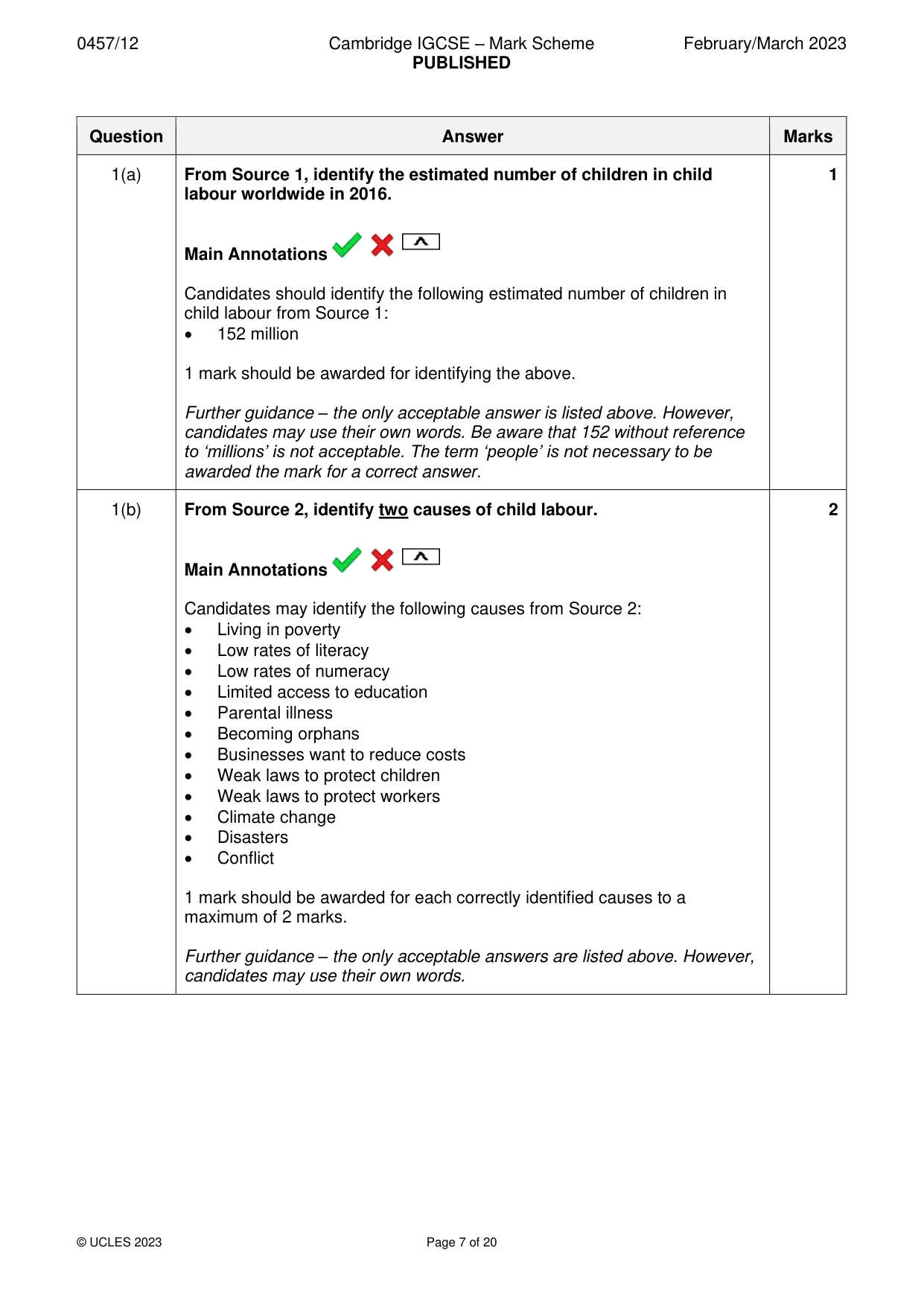
0457/12 Cambridge IGCSE – Mark Scheme PUBLISHED February/March 2023 © UCLES 2023 Page 7 of 20 Question Answer Marks 1(a) From Source 1, identify the estimated number of children in child labour worldwide in 2016. Main Annotations Candidates should identify the following estimated number of children in child labour from Source 1: • 152 million 1 mark should be awarded for identifying the above. Further guidance – the only acceptable answer is listed above. However, candidates may use their own words. Be aware that 152 without reference to ‘millions’ is not acceptable. The term ‘people’ is not necessary to be awarded the mark for a correct answer. 1 1(b) From Source 2, identify two causes of child labour. Main Annotations Candidates may identify the following causes from Source 2: • Living in poverty • Low rates of literacy • Low rates of numeracy • Limited access to education • Parental illness • Becoming orphans • Businesses want to reduce costs • Weak laws to protect children • Weak laws to protect workers • Climate change • Disasters • Conflict 1 mark should be awarded for each correctly identified causes to a maximum of 2 marks. Further guidance – the only acceptable answers are listed above. However, candidates may use their own words. 2
Mark scheme, page 8
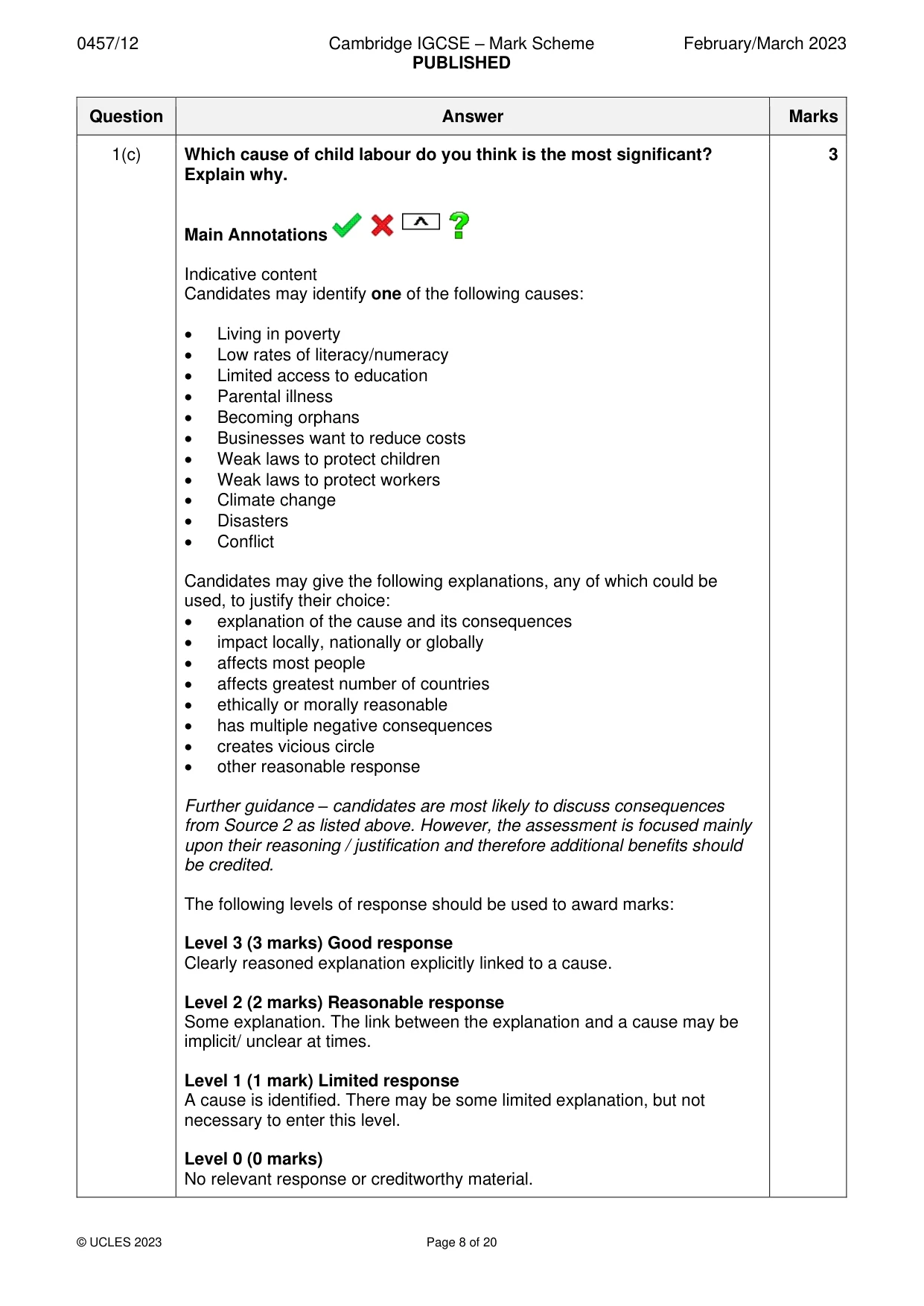
0457/12 Cambridge IGCSE – Mark Scheme PUBLISHED February/March 2023 © UCLES 2023 Page 8 of 20 Question Answer Marks 1(c) Which cause of child labour do you think is the most significant? Explain why. Main Annotations Indicative content Candidates may identify one of the following causes: • Living in poverty • Low rates of literacy/numeracy • Limited access to education • Parental illness • Becoming orphans • Businesses want to reduce costs • Weak laws to protect children • Weak laws to protect workers • Climate change • Disasters • Conflict Candidates may give the following explanations, any of which could be used, to justify their choice: • explanation of the cause and its consequences • impact locally, nationally or globally • affects most people • affects greatest number of countries • ethically or morally reasonable • has multiple negative consequences • creates vicious circle • other reasonable response Further guidance – candidates are most likely to discuss consequences from Source 2 as listed above. However, the assessment is focused mainly upon their reasoning / justification and therefore additional benefits should be credited. The following levels of response should be used to award marks: Level 3 (3 marks) Good response Clearly reasoned explanation explicitly linked to a cause. Level 2 (2 marks) Reasonable response Some explanation. The link between the explanation and a cause may be implicit/ unclear at times. Level 1 (1 mark) Limited response A cause is identified. There may be some limited explanation, but not necessary to enter this level. Level 0 (0 marks) No relevant response or creditworthy material. 3
Mark scheme, page 9
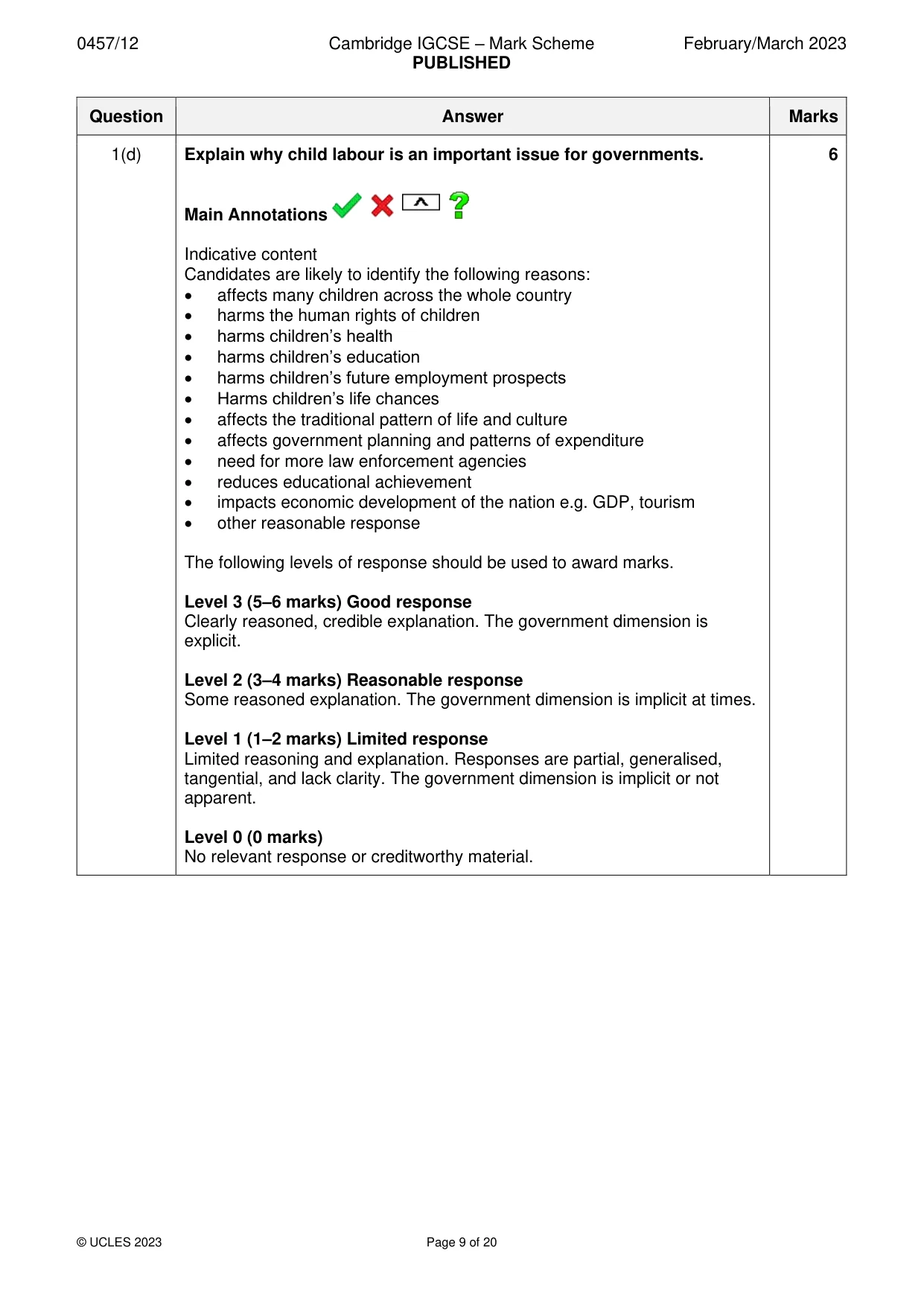
0457/12 Cambridge IGCSE – Mark Scheme PUBLISHED February/March 2023 © UCLES 2023 Page 9 of 20 Question Answer Marks 1(d) Explain why child labour is an important issue for governments. Main Annotations Indicative content Candidates are likely to identify the following reasons: • affects many children across the whole country • harms the human rights of children • harms children’s health • harms children’s education • harms children’s future employment prospects • Harms children’s life chances • affects the traditional pattern of life and culture • affects government planning and patterns of expenditure • need for more law enforcement agencies • reduces educational achievement • impacts economic development of the nation e.g. GDP, tourism • other reasonable response The following levels of response should be used to award marks. Level 3 (5–6 marks) Good response Clearly reasoned, credible explanation. The government dimension is explicit. Level 2 (3–4 marks) Reasonable response Some reasoned explanation. The government dimension is implicit at times. Level 1 (1–2 marks) Limited response Limited reasoning and explanation. Responses are partial, generalised, tangential, and lack clarity. The government dimension is implicit or not apparent. Level 0 (0 marks) No relevant response or creditworthy material. 6
Mark scheme, page 10
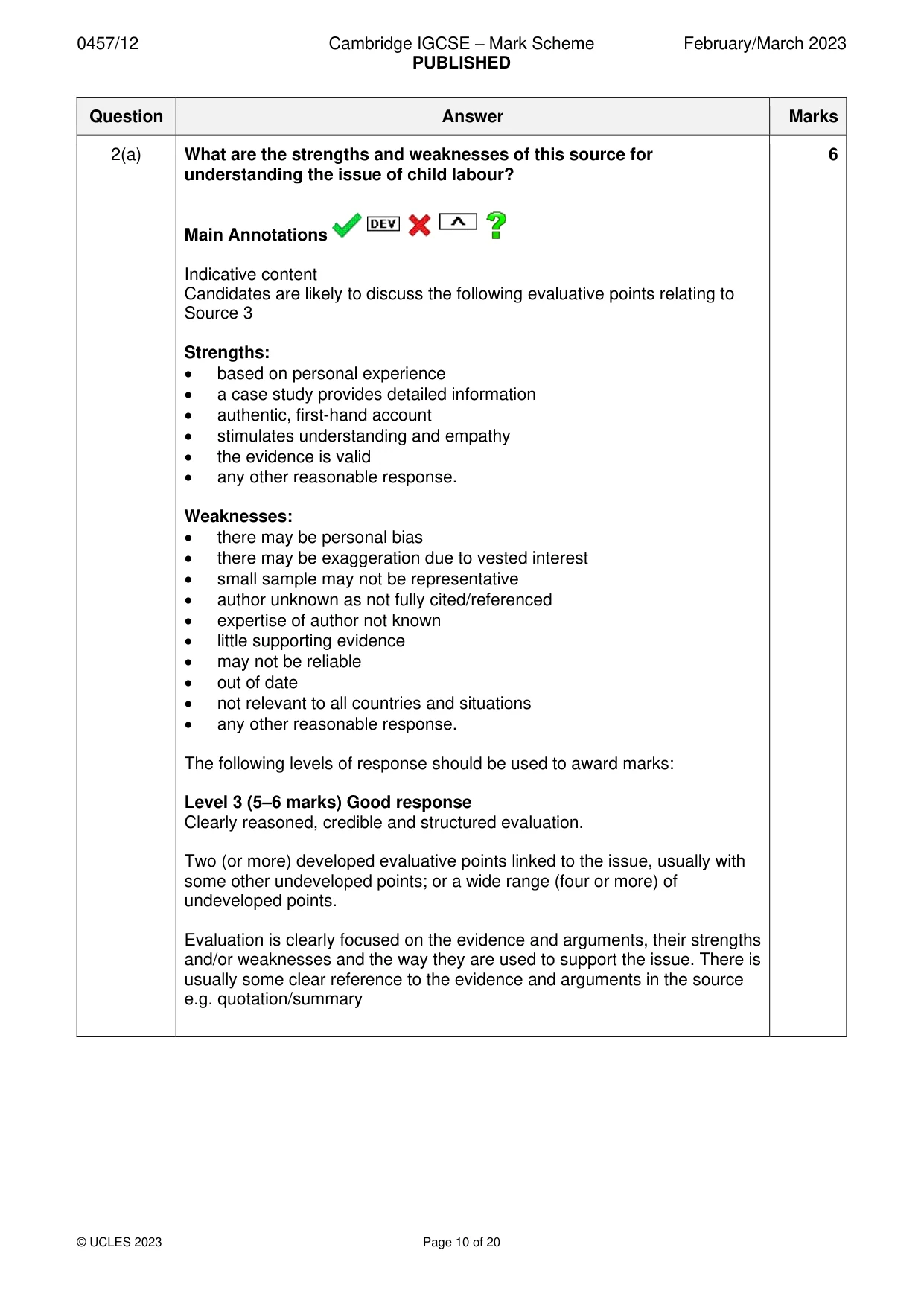
0457/12 Cambridge IGCSE – Mark Scheme PUBLISHED February/March 2023 © UCLES 2023 Page 10 of 20 Question Answer Marks 2(a) What are the strengths and weaknesses of this source for understanding the issue of child labour? Main Annotations Indicative content Candidates are likely to discuss the following evaluative points relating to Source 3 Strengths: • based on personal experience • a case study provides detailed information • authentic, first-hand account • stimulates understanding and empathy • the evidence is valid • any other reasonable response. Weaknesses: • there may be personal bias • there may be exaggeration due to vested interest • small sample may not be representative • author unknown as not fully cited/referenced • expertise of author not known • little supporting evidence • may not be reliable • out of date • not relevant to all countries and situations • any other reasonable response. The following levels of response should be used to award marks: Level 3 (5–6 marks) Good response Clearly reasoned, credible and structured evaluation. Two (or more) developed evaluative points linked to the issue, usually with some other undeveloped points; or a wide range (four or more) of undeveloped points. Evaluation is clearly focused on the evidence and arguments, their strengths and/or weaknesses and the way they are used to support the issue. There is usually some clear reference to the evidence and arguments in the source e.g. quotation/summary 6
Mark scheme, page 11
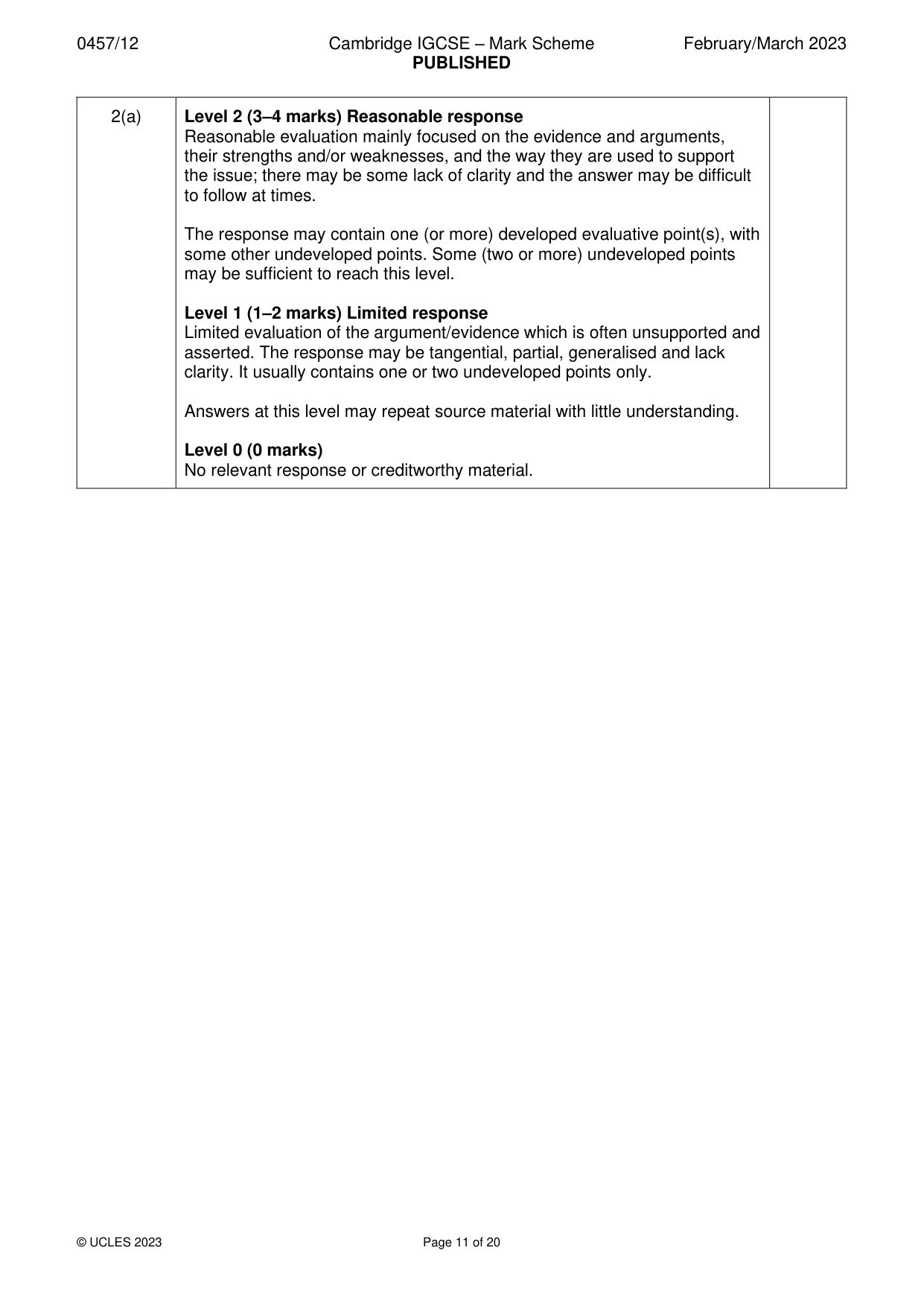
0457/12 Cambridge IGCSE – Mark Scheme PUBLISHED February/March 2023 © UCLES 2023 Page 11 of 20 2(a) Level 2 (3–4 marks) Reasonable response Reasonable evaluation mainly focused on the evidence and arguments, their strengths and/or weaknesses, and the way they are used to support the issue; there may be some lack of clarity and the answer may be difficult to follow at times. The response may contain one (or more) developed evaluative point(s), with some other undeveloped points. Some (two or more) undeveloped points may be sufficient to reach this level. Level 1 (1–2 marks) Limited response Limited evaluation of the argument/evidence which is often unsupported and asserted. The response may be tangential, partial, generalised and lack clarity. It usually contains one or two undeveloped points only. Answers at this level may repeat source material with little understanding. Level 0 (0 marks) No relevant response or creditworthy material.
Mark scheme, page 12
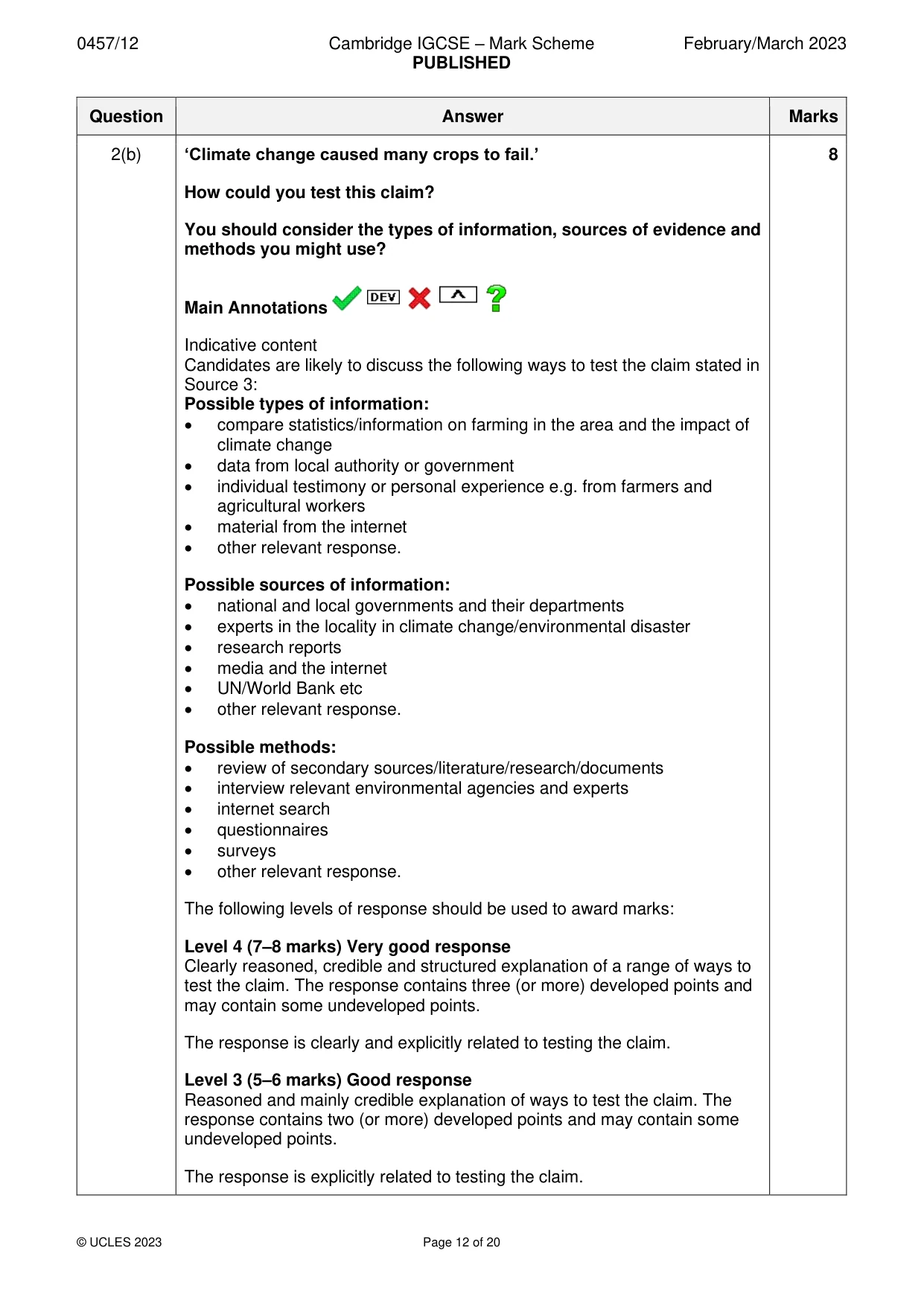
0457/12 Cambridge IGCSE – Mark Scheme PUBLISHED February/March 2023 © UCLES 2023 Page 12 of 20 Question Answer Marks 2(b) ‘Climate change caused many crops to fail.’ How could you test this claim? You should consider the types of information, sources of evidence and methods you might use? Main Annotations Indicative content Candidates are likely to discuss the following ways to test the claim stated in Source 3: Possible types of information: • compare statistics/information on farming in the area and the impact of climate change • data from local authority or government • individual testimony or personal experience e.g. from farmers and agricultural workers • material from the internet • other relevant response. Possible sources of information: • national and local governments and their departments • experts in the locality in climate change/environmental disaster • research reports • media and the internet • UN/World Bank etc • other relevant response. Possible methods: • review of secondary sources/literature/research/documents • interview relevant environmental agencies and experts • internet search • questionnaires • surveys • other relevant response. The following levels of response should be used to award marks: Level 4 (7–8 marks) Very good response Clearly reasoned, credible and structured explanation of a range of ways to test the claim. The response contains three (or more) developed points and may contain some undeveloped points. The response is clearly and explicitly related to testing the claim. Level 3 (5–6 marks) Good response Reasoned and mainly credible explanation of ways to test the claim. The response contains two (or more) developed points and may contain some undeveloped points. The response is explicitly related to testing the claim. 8
Mark scheme, page 13
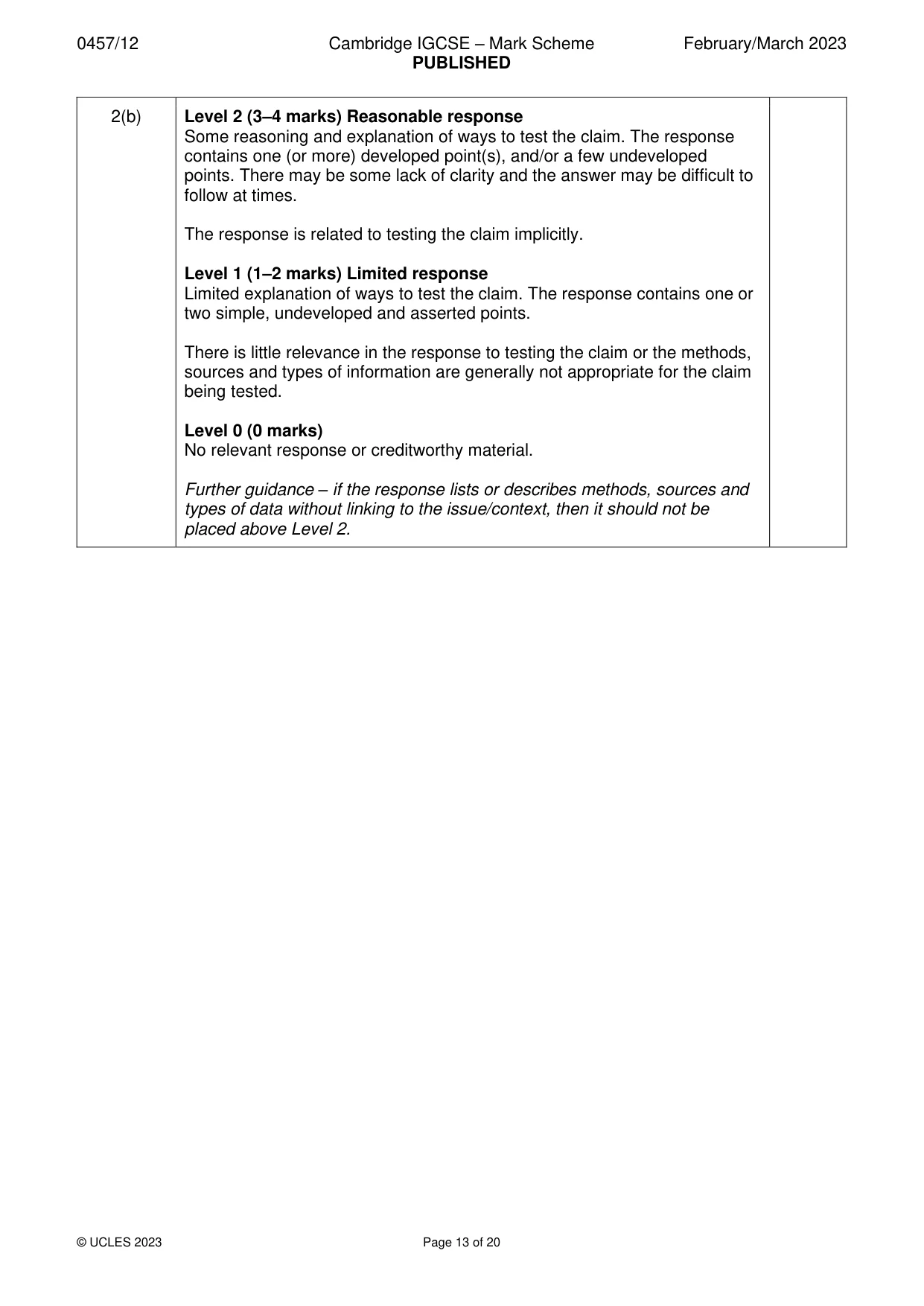
0457/12 Cambridge IGCSE – Mark Scheme PUBLISHED February/March 2023 © UCLES 2023 Page 13 of 20 2(b) Level 2 (3–4 marks) Reasonable response Some reasoning and explanation of ways to test the claim. The response contains one (or more) developed point(s), and/or a few undeveloped points. There may be some lack of clarity and the answer may be difficult to follow at times. The response is related to testing the claim implicitly. Level 1 (1–2 marks) Limited response Limited explanation of ways to test the claim. The response contains one or two simple, undeveloped and asserted points. There is little relevance in the response to testing the claim or the methods, sources and types of information are generally not appropriate for the claim being tested. Level 0 (0 marks) No relevant response or creditworthy material. Further guidance – if the response lists or describes methods, sources and types of data without linking to the issue/context, then it should not be placed above Level 2.
Mark scheme, page 14
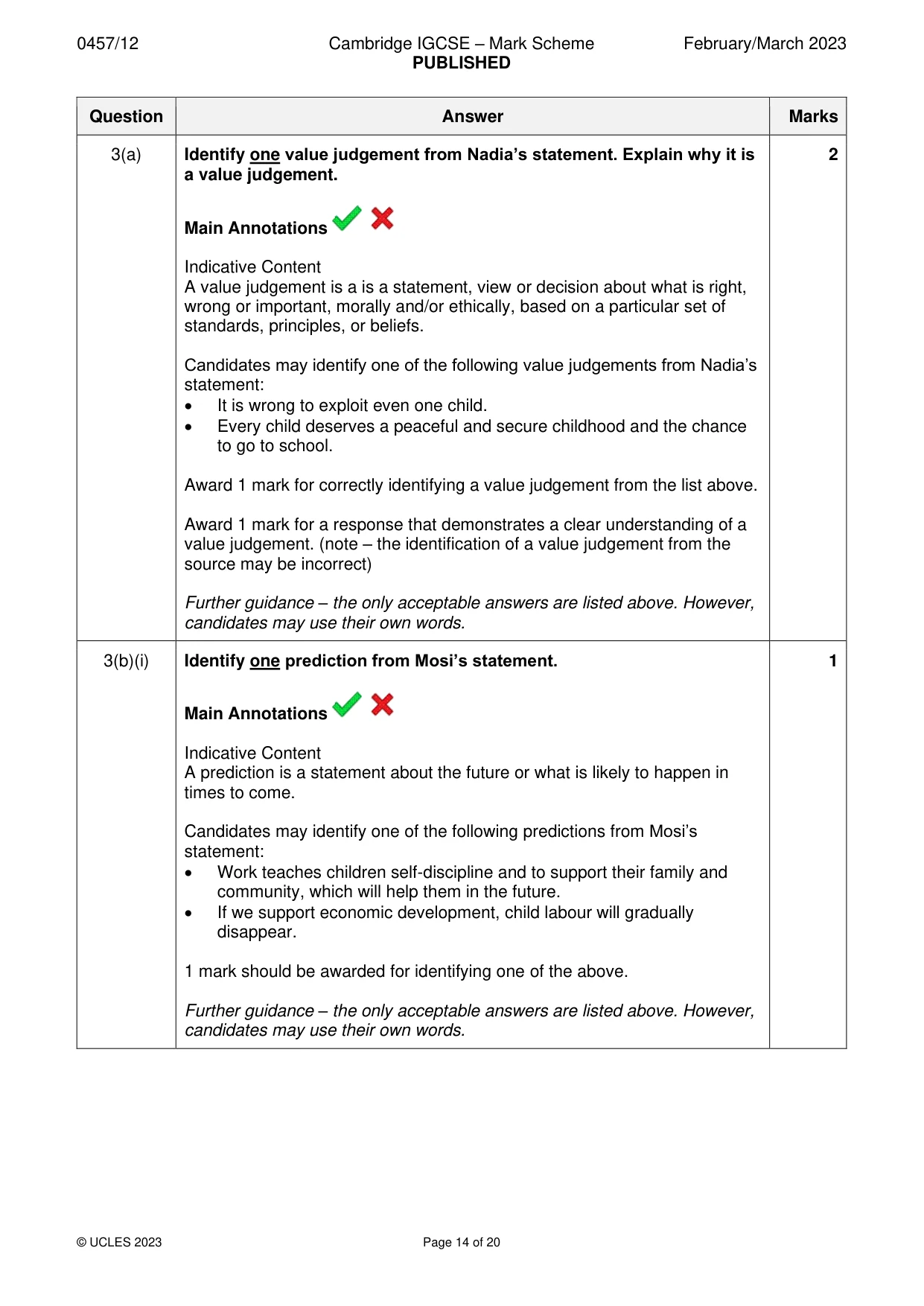
0457/12 Cambridge IGCSE – Mark Scheme PUBLISHED February/March 2023 © UCLES 2023 Page 14 of 20 Question Answer Marks 3(a) Identify one value judgement from Nadia’s statement. Explain why it is a value judgement. Main Annotations Indicative Content A value judgement is a is a statement, view or decision about what is right, wrong or important, morally and/or ethically, based on a particular set of standards, principles, or beliefs. Candidates may identify one of the following value judgements from Nadia’s statement: • It is wrong to exploit even one child. • Every child deserves a peaceful and secure childhood and the chance to go to school. Award 1 mark for correctly identifying a value judgement from the list above. Award 1 mark for a response that demonstrates a clear understanding of a value judgement. (note – the identification of a value judgement from the source may be incorrect) Further guidance – the only acceptable answers are listed above. However, candidates may use their own words. 2 3(b)(i) Identify one prediction from Mosi’s statement. Main Annotations Indicative Content A prediction is a statement about the future or what is likely to happen in times to come. Candidates may identify one of the following predictions from Mosi’s statement: • Work teaches children self-discipline and to support their family and community, which will help them in the future. • If we support economic development, child labour will gradually disappear. 1 mark should be awarded for identifying one of the above. Further guidance – the only acceptable answers are listed above. However, candidates may use their own words. 1
Mark scheme, page 15
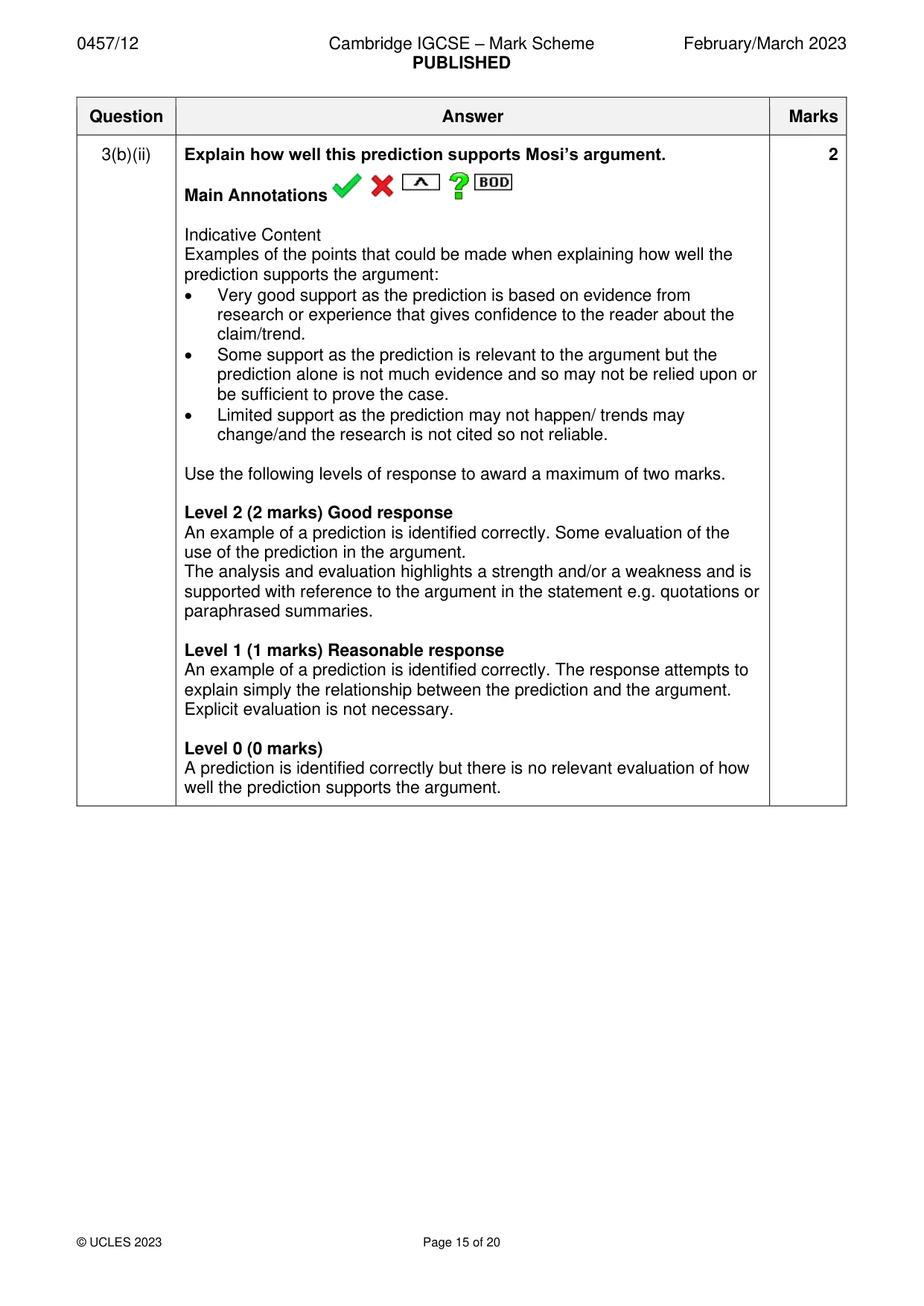
0457/12 Cambridge IGCSE – Mark Scheme PUBLISHED February/March 2023 © UCLES 2023 Page 15 of 20 Question Answer Marks 3(b)(ii) Explain how well this prediction supports Mosi’s argument. Main Annotations Indicative Content Examples of the points that could be made when explaining how well the prediction supports the argument: • Very good support as the prediction is based on evidence from research or experience that gives confidence to the reader about the claim/trend. • Some support as the prediction is relevant to the argument but the prediction alone is not much evidence and so may not be relied upon or be sufficient to prove the case. • Limited support as the prediction may not happen/ trends may change/and the research is not cited so not reliable. Use the following levels of response to award a maximum of two marks. Level 2 (2 marks) Good response An example of a prediction is identified correctly. Some evaluation of the use of the prediction in the argument. The analysis and evaluation highlights a strength and/or a weakness and is supported with reference to the argument in the statement e.g. quotations or paraphrased summaries. Level 1 (1 marks) Reasonable response An example of a prediction is identified correctly. The response attempts to explain simply the relationship between the prediction and the argument. Explicit evaluation is not necessary. Level 0 (0 marks) A prediction is identified correctly but there is no relevant evaluation of how well the prediction supports the argument. 2
Mark scheme, page 16
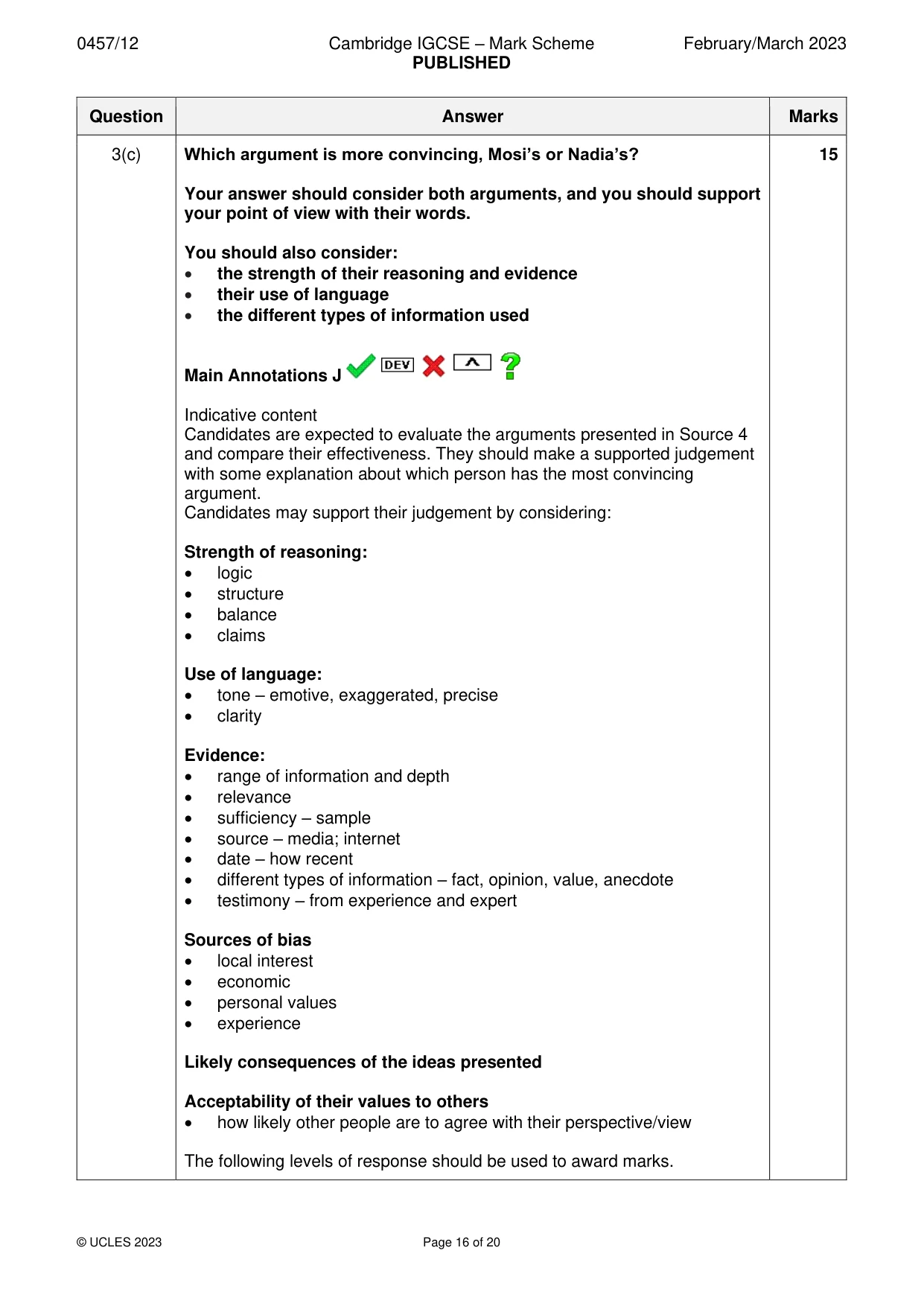
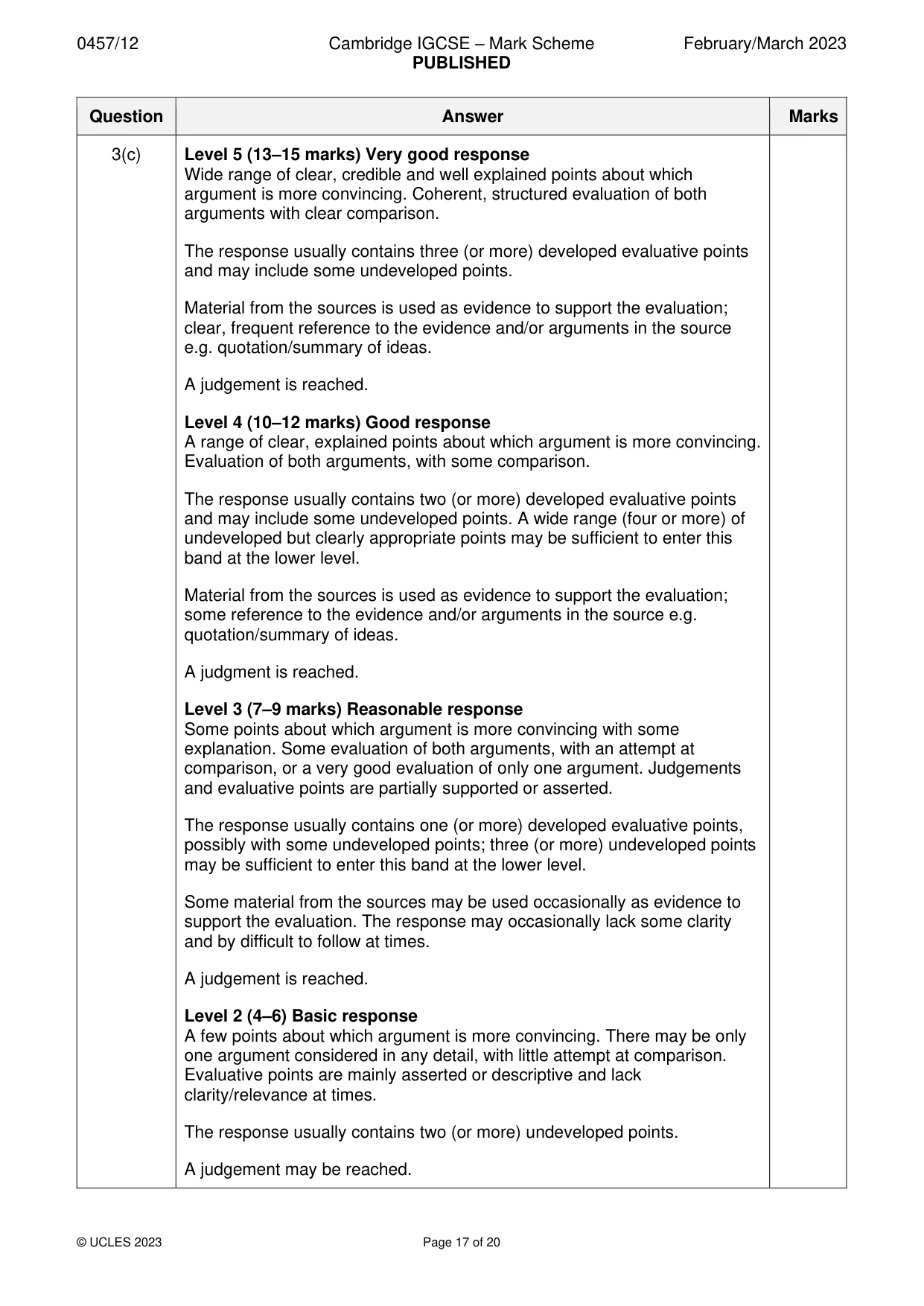
0457/12 Cambridge IGCSE – Mark Scheme PUBLISHED February/March 2023 © UCLES 2023 Page 16 of 20 Question Answer Marks 3(c) Which argument is more convincing, Mosi’s or Nadia’s? Your answer should consider both arguments, and you should support your point of view with their words. You should also consider: • the strength of their reasoning and evidence • their use of language • the different types of information used Main Annotations J Indicative content Candidates are expected to evaluate the arguments presented in Source 4 and compare their effectiveness. They should make a supported judgement with some explanation about which person has the most convincing argument. Candidates may support their judgement by considering: Strength of reasoning: • logic • structure • balance • claims Use of language: • tone – emotive, exaggerated, precise • clarity Evidence: • range of information and depth • relevance • sufficiency – sample • source – media; internet • date – how recent • different types of information – fact, opinion, value, anecdote • testimony – from experience and expert Sources of bias • local interest • economic • personal values • experience Likely consequences of the ideas presented Acceptability of their values to others • how likely other people are to agree with their perspective/view The following levels of response should be used to award marks. 15
Mark scheme, page 17
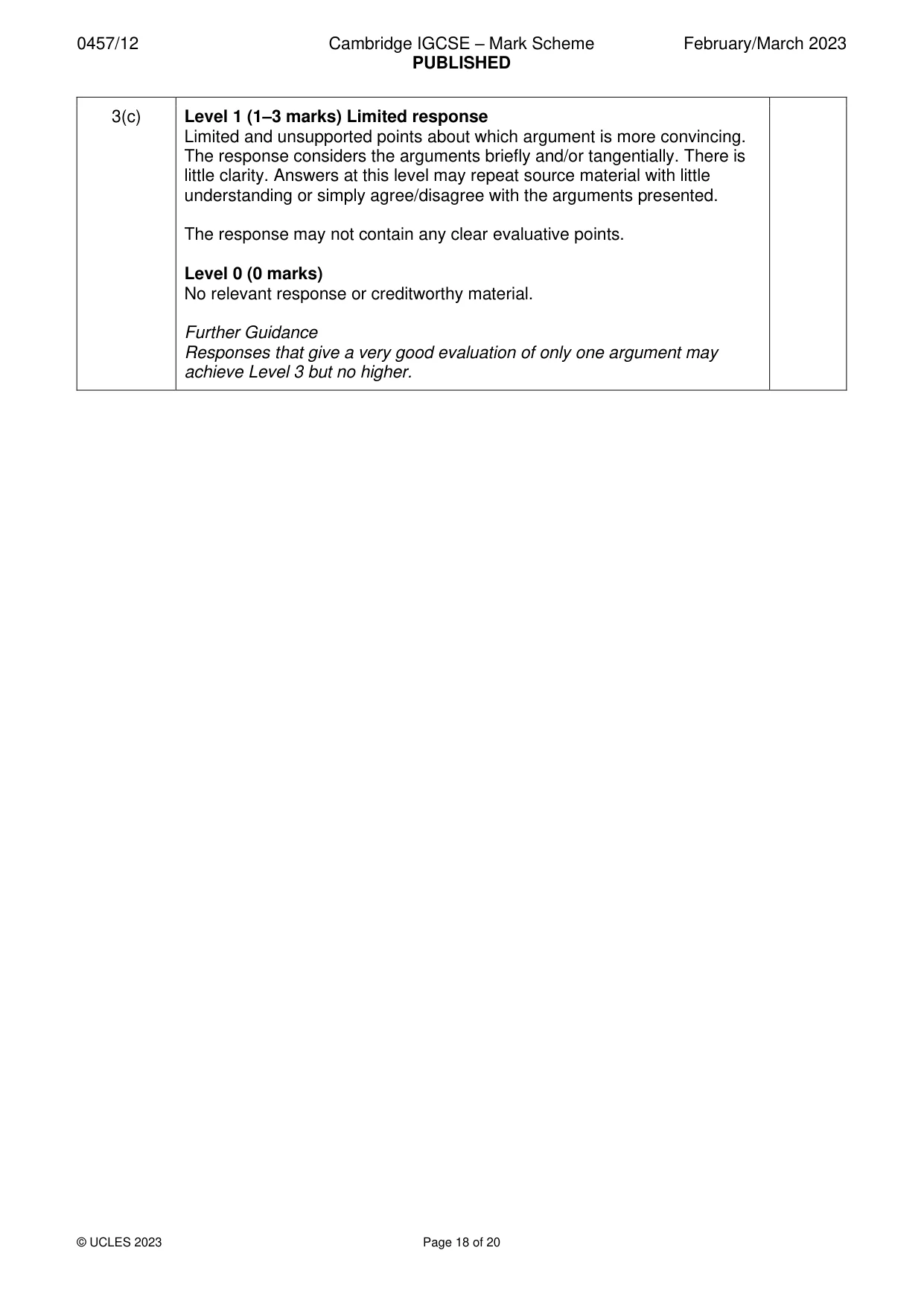
0457/12 Cambridge IGCSE – Mark Scheme PUBLISHED February/March 2023 © UCLES 2023 Page 17 of 20 Question Answer Marks 3(c) Level 5 (13–15 marks) Very good response Wide range of clear, credible and well explained points about which argument is more convincing. Coherent, structured evaluation of both arguments with clear comparison. The response usually contains three (or more) developed evaluative points and may include some undeveloped points. Material from the sources is used as evidence to support the evaluation; clear, frequent reference to the evidence and/or arguments in the source e.g. quotation/summary of ideas. A judgement is reached. Level 4 (10–12 marks) Good response A range of clear, explained points about which argument is more convincing. Evaluation of both arguments, with some comparison. The response usually contains two (or more) developed evaluative points and may include some undeveloped points. A wide range (four or more) of undeveloped but clearly appropriate points may be sufficient to enter this band at the lower level. Material from the sources is used as evidence to support the evaluation; some reference to the evidence and/or arguments in the source e.g. quotation/summary of ideas. A judgment is reached. Level 3 (7–9 marks) Reasonable response Some points about which argument is more convincing with some explanation. Some evaluation of both arguments, with an attempt at comparison, or a very good evaluation of only one argument. Judgements and evaluative points are partially supported or asserted. The response usually contains one (or more) developed evaluative points, possibly with some undeveloped points; three (or more) undeveloped points may be sufficient to enter this band at the lower level. Some material from the sources may be used occasionally as evidence to support the evaluation. The response may occasionally lack some clarity and by difficult to follow at times. A judgement is reached. Level 2 (4–6) Basic response A few points about which argument is more convincing. There may be only one argument considered in any detail, with little attempt at comparison. Evaluative points are mainly asserted or descriptive and lack clarity/relevance at times. The response usually contains two (or more) undeveloped points. A judgement may be reached.
Mark scheme, page 18
0457/12 Cambridge IGCSE – Mark Scheme PUBLISHED February/March 2023 © UCLES 2023 Page 18 of 20 3(c) Level 1 (1–3 marks) Limited response Limited and unsupported points about which argument is more convincing. The response considers the arguments briefly and/or tangentially. There is little clarity. Answers at this level may repeat source material with little understanding or simply agree/disagree with the arguments presented. The response may not contain any clear evaluative points. Level 0 (0 marks) No relevant response or creditworthy material. Further Guidance Responses that give a very good evaluation of only one argument may achieve Level 3 but no higher.
Mark scheme, page 19
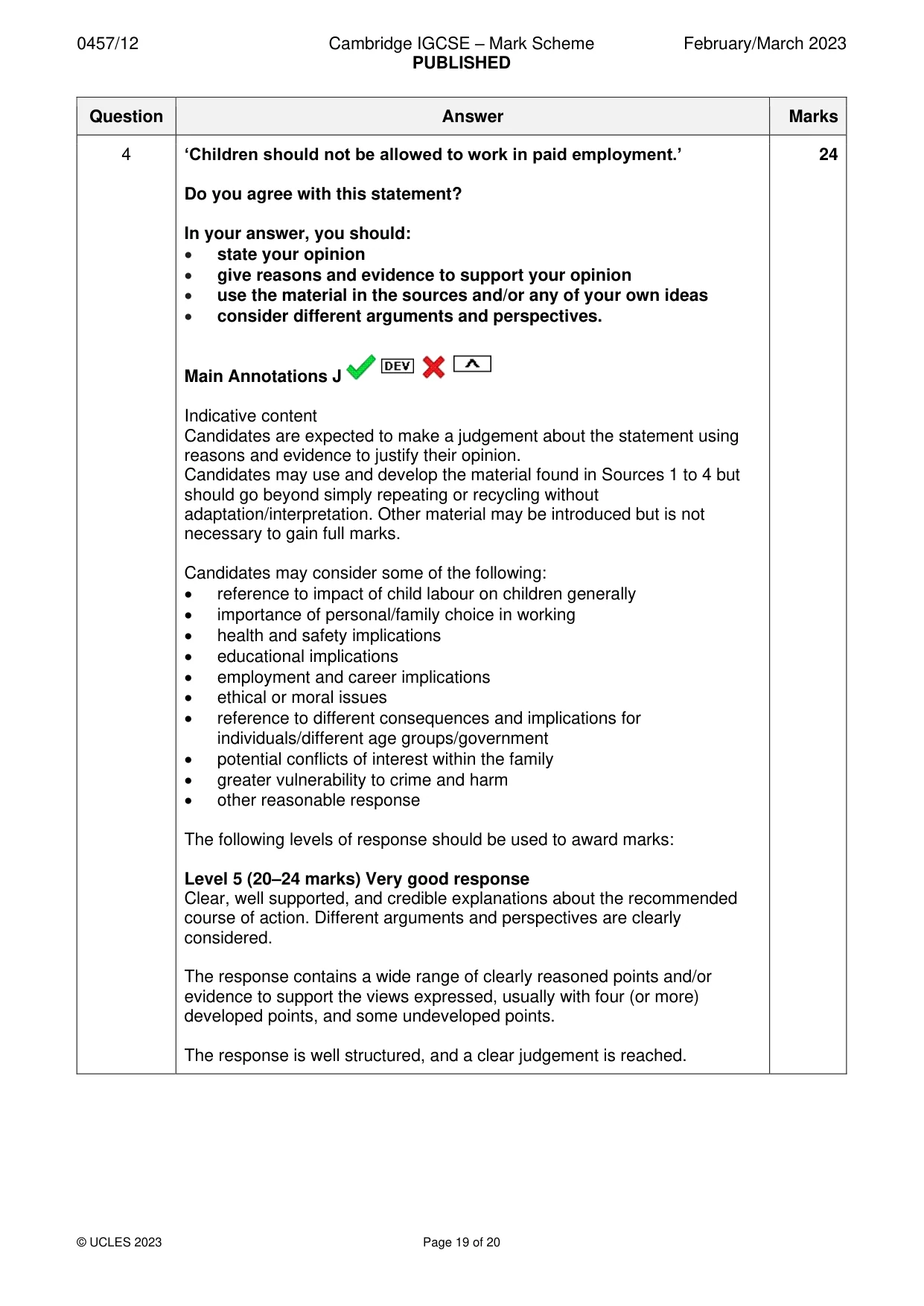
0457/12 Cambridge IGCSE – Mark Scheme PUBLISHED February/March 2023 © UCLES 2023 Page 19 of 20 Question Answer Marks 4 ‘Children should not be allowed to work in paid employment.’ Do you agree with this statement? In your answer, you should: • state your opinion • give reasons and evidence to support your opinion • use the material in the sources and/or any of your own ideas • consider different arguments and perspectives. Main Annotations J Indicative content Candidates are expected to make a judgement about the statement using reasons and evidence to justify their opinion. Candidates may use and develop the material found in Sources 1 to 4 but should go beyond simply repeating or recycling without adaptation/interpretation. Other material may be introduced but is not necessary to gain full marks. Candidates may consider some of the following: • reference to impact of child labour on children generally • importance of personal/family choice in working • health and safety implications • educational implications • employment and career implications • ethical or moral issues • reference to different consequences and implications for individuals/different age groups/government • potential conflicts of interest within the family • greater vulnerability to crime and harm • other reasonable response The following levels of response should be used to award marks: Level 5 (20–24 marks) Very good response Clear, well supported, and credible explanations about the recommended course of action. Different arguments and perspectives are clearly considered. The response contains a wide range of clearly reasoned points and/or evidence to support the views expressed, usually with four (or more) developed points, and some undeveloped points. The response is well structured, and a clear judgement is reached. 24
Mark scheme, page 20
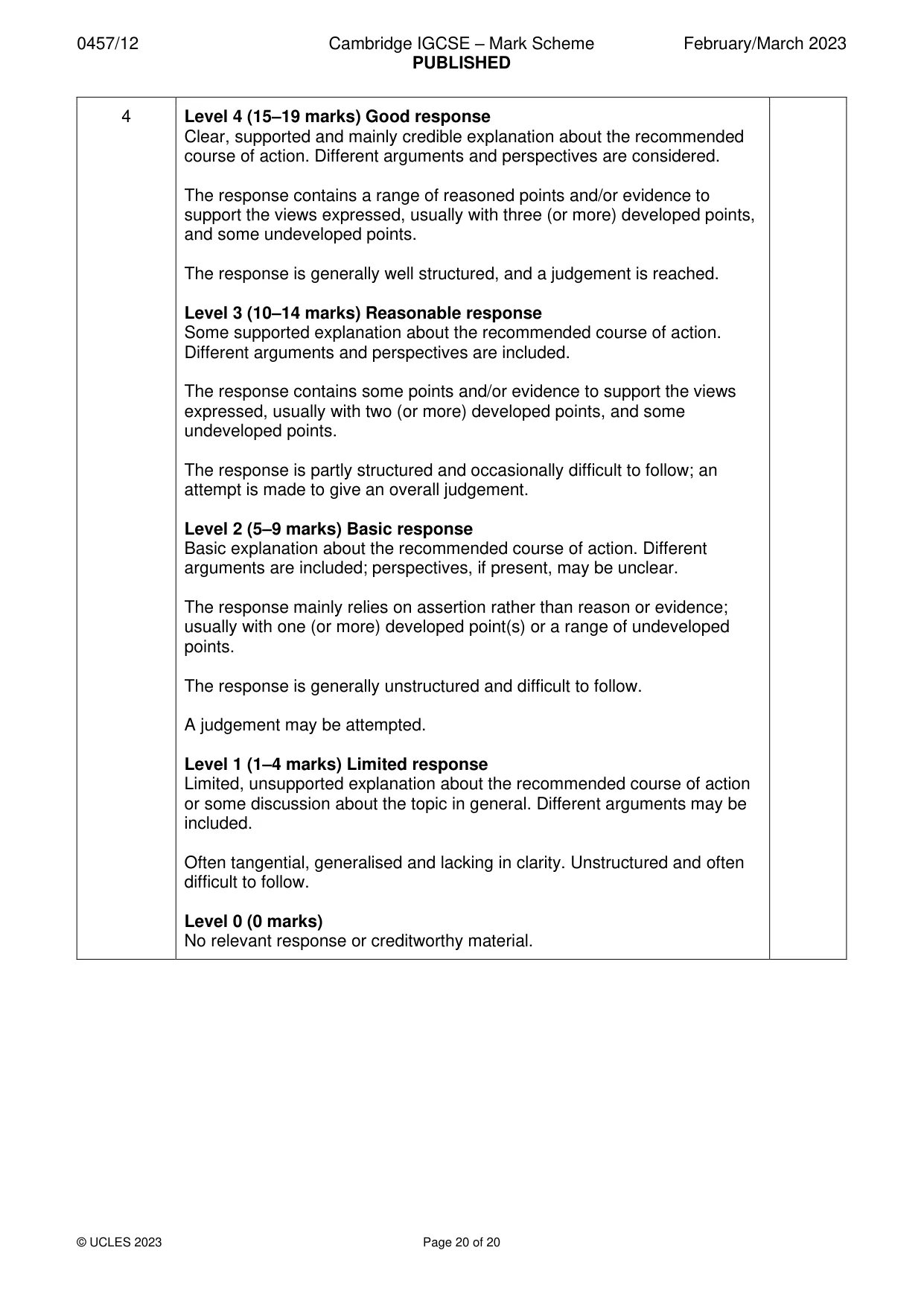
0457/12 Cambridge IGCSE – Mark Scheme PUBLISHED February/March 2023 © UCLES 2023 Page 20 of 20 4 Level 4 (15–19 marks) Good response Clear, supported and mainly credible explanation about the recommended course of action. Different arguments and perspectives are considered. The response contains a range of reasoned points and/or evidence to support the views expressed, usually with three (or more) developed points, and some undeveloped points. The response is generally well structured, and a judgement is reached. Level 3 (10–14 marks) Reasonable response Some supported explanation about the recommended course of action. Different arguments and perspectives are included. The response contains some points and/or evidence to support the views expressed, usually with two (or more) developed points, and some undeveloped points. The response is partly structured and occasionally difficult to follow; an attempt is made to give an overall judgement. Level 2 (5–9 marks) Basic response Basic explanation about the recommended course of action. Different arguments are included; perspectives, if present, may be unclear. The response mainly relies on assertion rather than reason or evidence; usually with one (or more) developed point(s) or a range of undeveloped points. The response is generally unstructured and difficult to follow. A judgement may be attempted. Level 1 (1–4 marks) Limited response Limited, unsupported explanation about the recommended course of action or some discussion about the topic in general. Different arguments may be included. Often tangential, generalised and lacking in clarity. Unstructured and often difficult to follow. Level 0 (0 marks) No relevant response or creditworthy material.
What you needed in this session
Cambridge’s own grade thresholds for 2023 Feb/March, Paper 1 · Variant 2. A higher threshold means an easier paper — the bar moves with how the cohort did.