Cambridge IGCSE Global Perspectives 0457 — 2020 Oct/Nov Paper 1 · Variant 3
0457/13/O/N/20 · 70 marks · ≈79 min
The question paper and its mark scheme, free to read here and free to download. This is Cambridge’s own paper, exactly as it was sat.
Question paper12 pages








Mark scheme15 pages
Answers below. Sit the paper first if you are practising.
Paper as text
Question paper, page 1
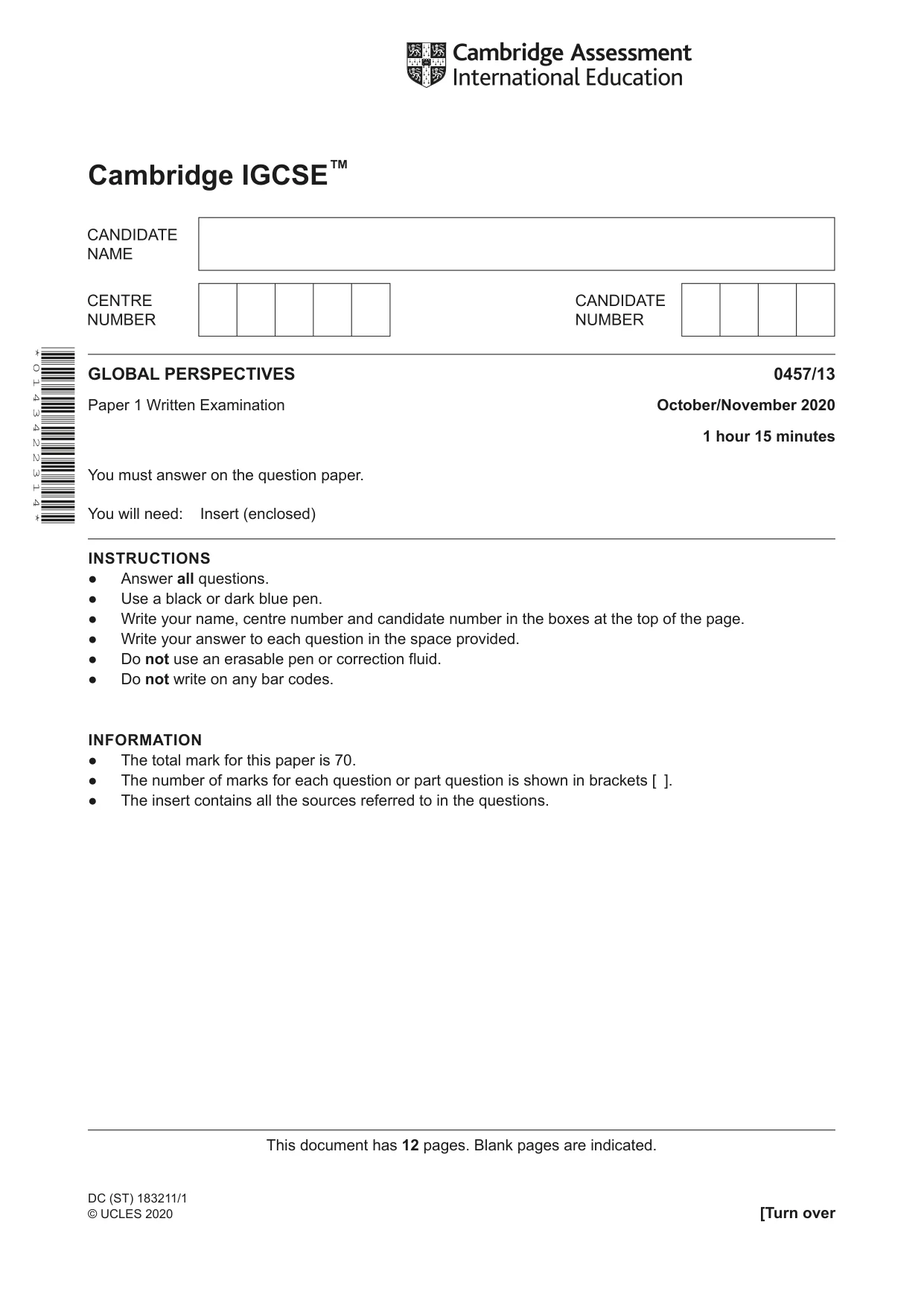
Cambridge IGCSE™ This document has 12 pages. Blank pages are indicated. DC (ST) 183211/1 © UCLES 2020 [Turn over * 0 1 4 3 4 2 2 3 1 4 * GLOBAL PERSPECTIVES 0457/13 Paper 1 Written Examination October/November 2020 1 hour 15 minutes You must answer on the question paper. You will need: Insert (enclosed) INSTRUCTIONS ● Answer all questions. ● Use a black or dark blue pen. ● Write your name, centre number and candidate number in the boxes at the top of the page. ● Write your answer to each question in the space provided. ● Do not use an erasable pen or correction fluid. ● Do not write on any bar codes. INFORMATION ● The total mark for this paper is 70. ● The number of marks for each question or part question is shown in brackets [ ]. ● The insert contains all the sources referred to in the questions.
Question paper, page 2
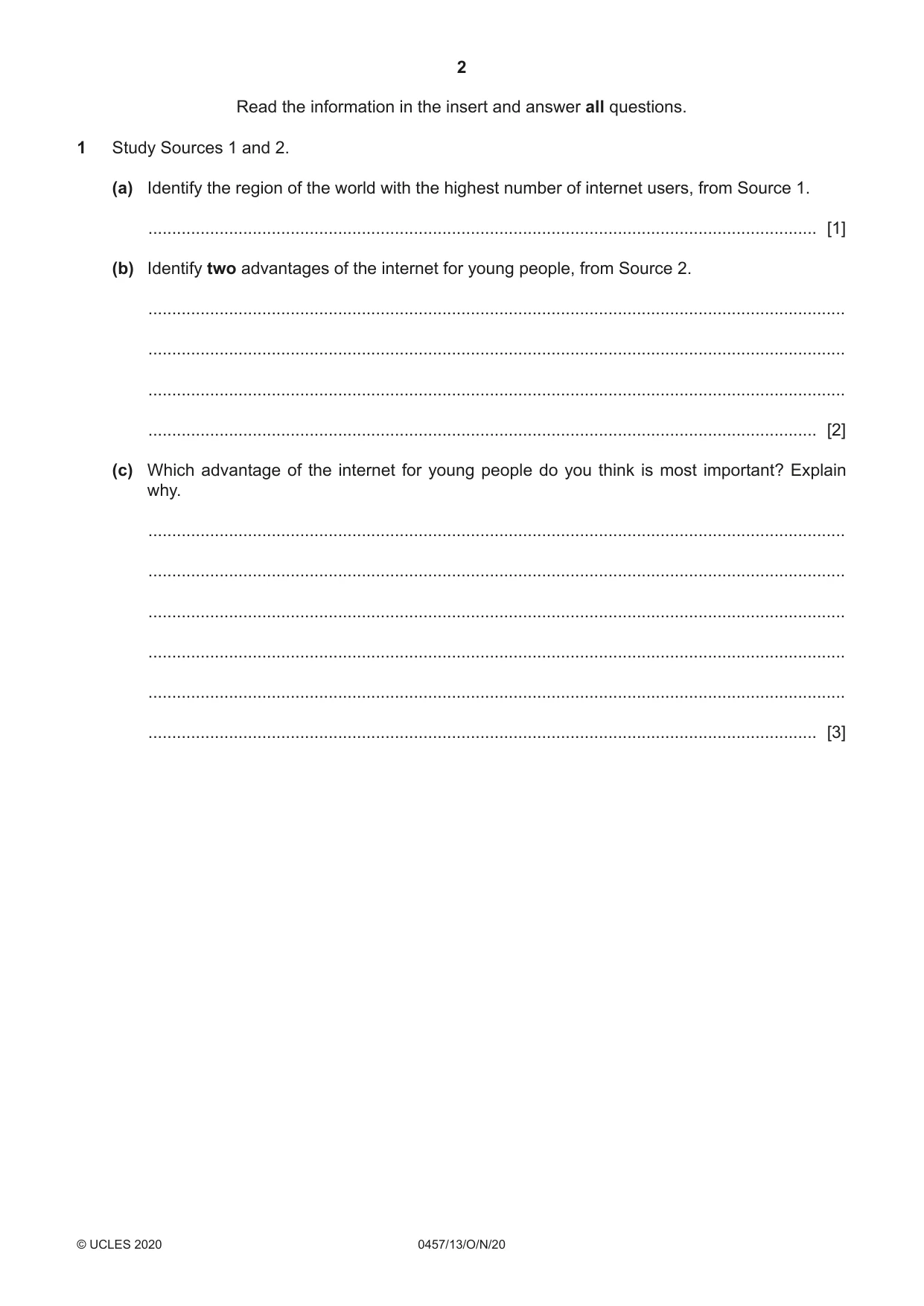
2 0457/13/O/N/20 © UCLES 2020 Read the information in the insert and answer all questions. 1 Study Sources 1 and 2. (a) Identify the region of the world with the highest number of internet users, from Source 1. … [1] (b) Identify two advantages of the internet for young people, from Source 2. … … … … [2] (c) Which advantage of the internet for young people do you think is most important? Explain why. … … … … … … [3]
Question paper, page 3
3 0457/13/O/N/20 © UCLES 2020 [Turn over (d) Explain why the use of the internet by young people is an important issue for governments. … … … … … … … … … … … … [6]
Question paper, page 4
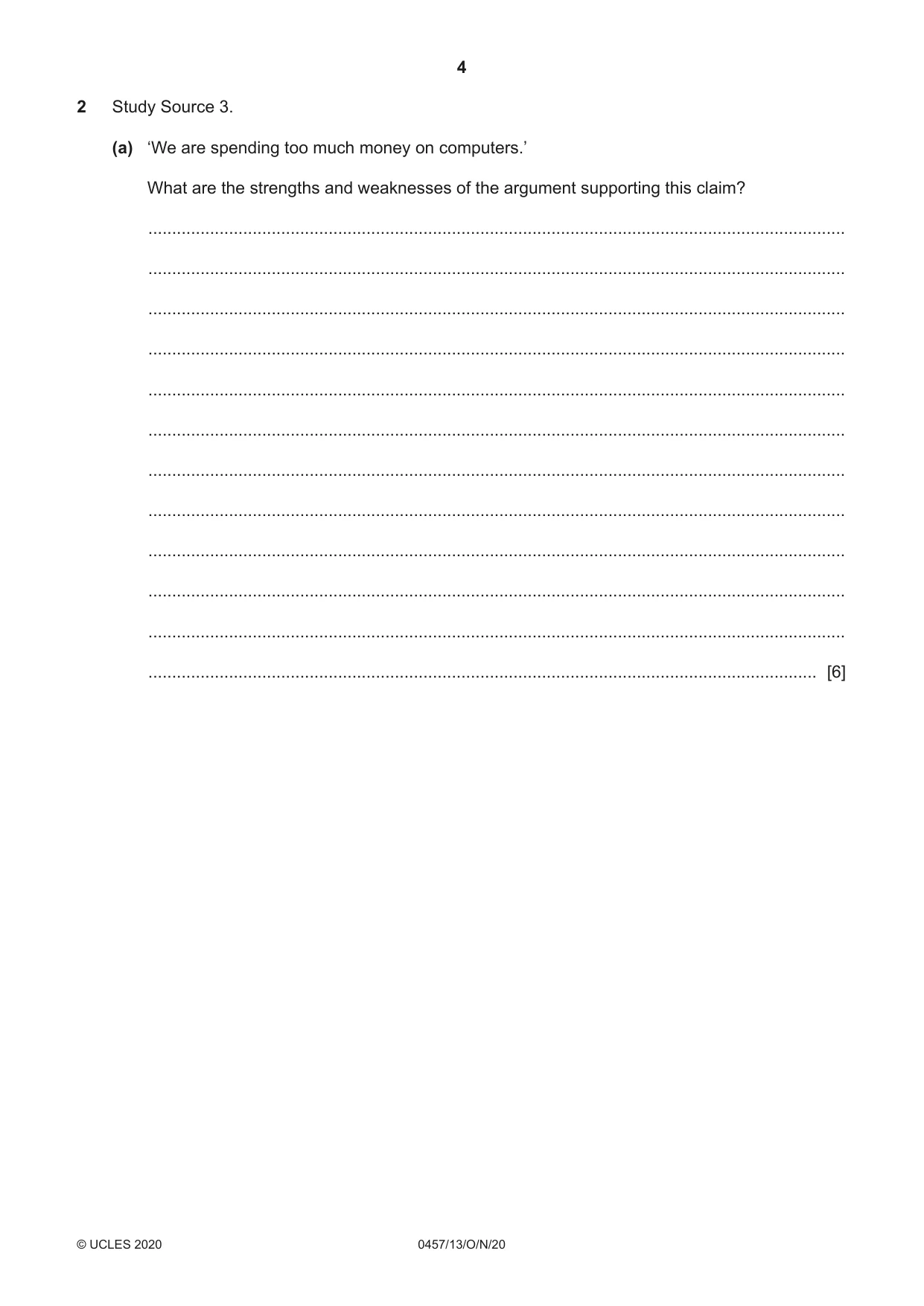
4 0457/13/O/N/20 © UCLES 2020 2 Study Source 3. (a) ‘We are spending too much money on computers.’ What are the strengths and weaknesses of the argument supporting this claim? … … … … … … … … … … … … [6]
Question paper, page 5
5 0457/13/O/N/20 © UCLES 2020 [Turn over (b) ‘The costs of technology are increasing every year.’ How would you test this claim? You should consider the types of information, sources of evidence or methods you might use. … … … … … … … … … … … … … … … … [8]
Question paper, page 6
6 0457/13/O/N/20 © UCLES 2020 3 Study Source 4. (a) Identify one prediction from Kim’s statement. … … [1] (b) Identify one fact from Sumin’s statement. … … [1] (c) Identify an example of vested interest in Sumin’s statement. Explain why this is vested interest. … … … … … … [3]
Question paper, page 7
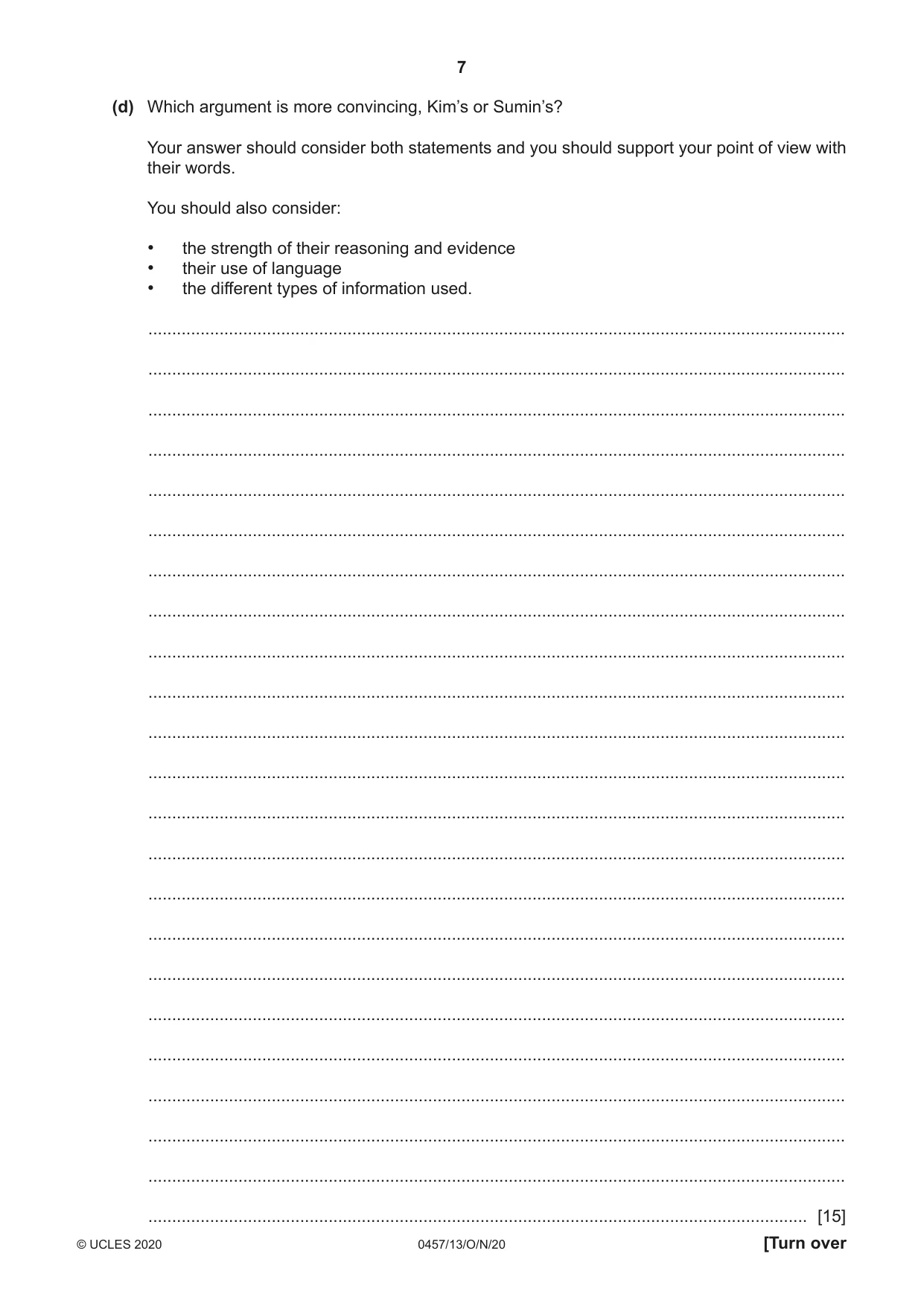
7 0457/13/O/N/20 © UCLES 2020 [Turn over (d) Which argument is more convincing, Kim’s or Sumin’s? Your answer should consider both statements and you should support your point of view with their words. You should also consider: • the strength of their reasoning and evidence • their use of language • the different types of information used. … … … … … … … … … … … … … … … … … … … … … … … [15]
Question paper, page 8
8 0457/13/O/N/20 © UCLES 2020 4 Young people need to be protected from the internet because it is harmful. Do you agree with this statement? In your answer you should: • state your opinion • give reasons and evidence to support your opinion • use the material in the sources and/or any of your own ideas • consider different arguments and perspectives. … … … … … … … … … … … … … … … … … … … … … … …
Question paper, page 9
9 0457/13/O/N/20 © UCLES 2020 … … … … … … … … … … … … … … … … … … … … … … … … … [24]
Question paper, page 10
10 0457/13/O/N/20 © UCLES 2020 BLANK PAGE
Question paper, page 11
11 0457/13/O/N/20 © UCLES 2020 BLANK PAGE
Question paper, page 12
12 0457/13/O/N/20 © UCLES 2020 Permission to reproduce items where third-party owned material protected by copyright is included has been sought and cleared where possible. Every reasonable effort has been made by the publisher (UCLES) to trace copyright holders, but if any items requiring clearance have unwittingly been included, the publisher will be pleased to make amends at the earliest possible opportunity. To avoid the issue of disclosure of answer-related information to candidates, all copyright acknowledgements are reproduced online in the Cambridge Assessment International Education Copyright Acknowledgements Booklet. This is produced for each series of examinations and is freely available to download at www.cambridgeinternational.org after the live examination series. Cambridge Assessment International Education is part of the Cambridge Assessment Group. Cambridge Assessment is the brand name of the University of Cambridge Local Examinations Syndicate (UCLES), which itself is a department of the University of Cambridge. BLANK PAGE
Mark scheme, page 1
This document consists of 15 printed pages. © UCLES 2020 [Turn over Cambridge IGCSE™ GLOBAL PERSPECTIVES 0457/13 Paper 1 Written Examination October/November 2020 MARK SCHEME Maximum Mark: 70 Published This mark scheme is published as an aid to teachers and candidates, to indicate the requirements of the examination. It shows the basis on which Examiners were instructed to award marks. It does not indicate the details of the discussions that took place at an Examiners’ meeting before marking began, which would have considered the acceptability of alternative answers. Mark schemes should be read in conjunction with the question paper and the Principal Examiner Report for Teachers. Cambridge International will not enter into discussions about these mark schemes. Cambridge International is publishing the mark schemes for the October/November 2020 series for most Cambridge IGCSE™, Cambridge International A and AS Level and Cambridge Pre-U components, and some Cambridge O Level components.
Mark scheme, page 2
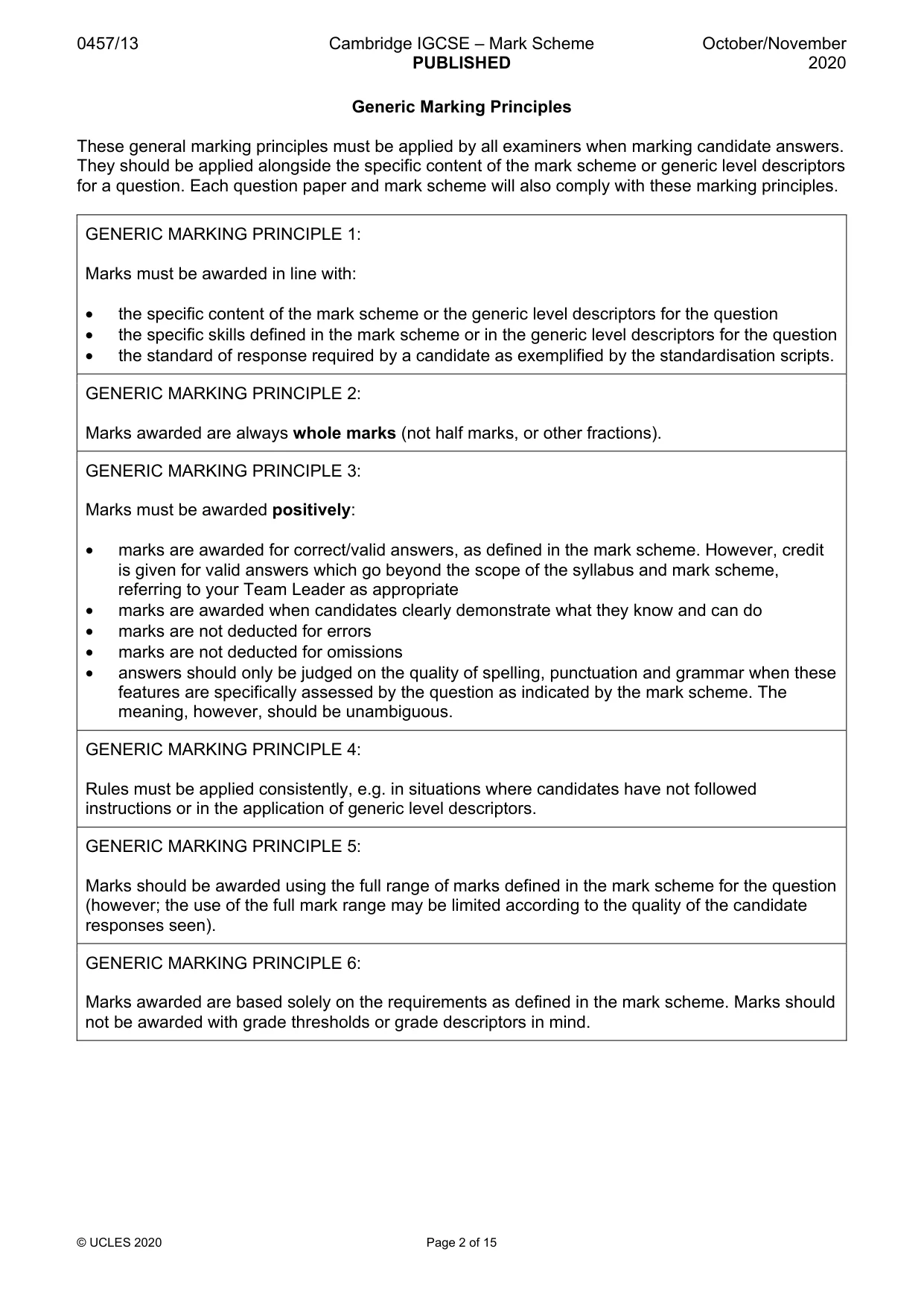
0457/13 Cambridge IGCSE – Mark Scheme PUBLISHED October/November 2020 © UCLES 2020 Page 2 of 15 Generic Marking Principles These general marking principles must be applied by all examiners when marking candidate answers. They should be applied alongside the specific content of the mark scheme or generic level descriptors for a question. Each question paper and mark scheme will also comply with these marking principles. GENERIC MARKING PRINCIPLE 1: Marks must be awarded in line with: • the specific content of the mark scheme or the generic level descriptors for the question • the specific skills defined in the mark scheme or in the generic level descriptors for the question • the standard of response required by a candidate as exemplified by the standardisation scripts. GENERIC MARKING PRINCIPLE 2: Marks awarded are always whole marks (not half marks, or other fractions). GENERIC MARKING PRINCIPLE 3: Marks must be awarded positively: • marks are awarded for correct/valid answers, as defined in the mark scheme. However, credit is given for valid answers which go beyond the scope of the syllabus and mark scheme, referring to your Team Leader as appropriate • marks are awarded when candidates clearly demonstrate what they know and can do • marks are not deducted for errors • marks are not deducted for omissions • answers should only be judged on the quality of spelling, punctuation and grammar when these features are specifically assessed by the question as indicated by the mark scheme. The meaning, however, should be unambiguous. GENERIC MARKING PRINCIPLE 4: Rules must be applied consistently, e.g. in situations where candidates have not followed instructions or in the application of generic level descriptors. GENERIC MARKING PRINCIPLE 5: Marks should be awarded using the full range of marks defined in the mark scheme for the question (however; the use of the full mark range may be limited according to the quality of the candidate responses seen). GENERIC MARKING PRINCIPLE 6: Marks awarded are based solely on the requirements as defined in the mark scheme. Marks should not be awarded with grade thresholds or grade descriptors in mind.
Mark scheme, page 3
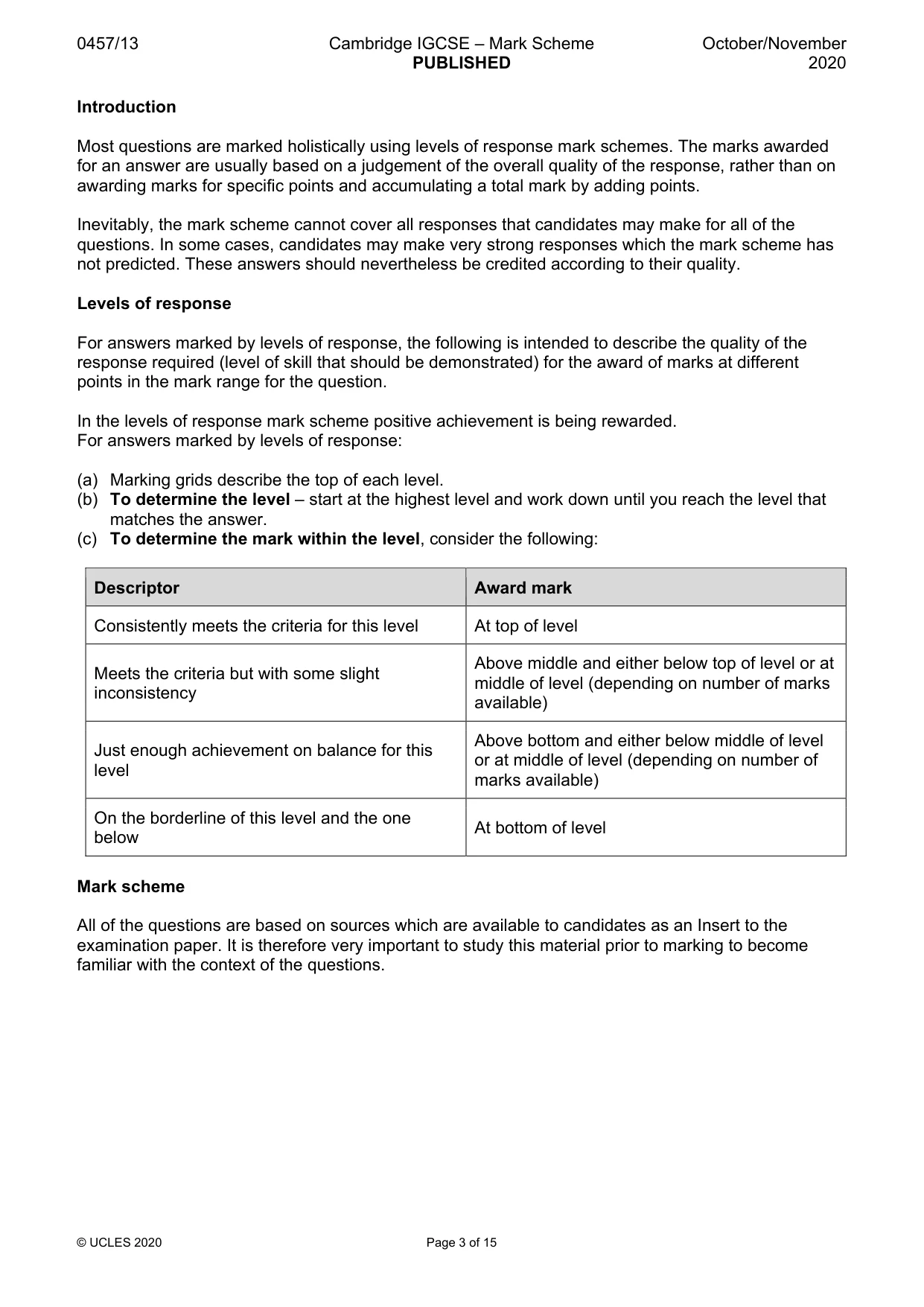
0457/13 Cambridge IGCSE – Mark Scheme PUBLISHED October/November 2020 © UCLES 2020 Page 3 of 15 Introduction Most questions are marked holistically using levels of response mark schemes. The marks awarded for an answer are usually based on a judgement of the overall quality of the response, rather than on awarding marks for specific points and accumulating a total mark by adding points. Inevitably, the mark scheme cannot cover all responses that candidates may make for all of the questions. In some cases, candidates may make very strong responses which the mark scheme has not predicted. These answers should nevertheless be credited according to their quality. Levels of response For answers marked by levels of response, the following is intended to describe the quality of the response required (level of skill that should be demonstrated) for the award of marks at different points in the mark range for the question. In the levels of response mark scheme positive achievement is being rewarded. For answers marked by levels of response: (a) Marking grids describe the top of each level. (b) To determine the level – start at the highest level and work down until you reach the level that matches the answer. (c) To determine the mark within the level, consider the following: Descriptor Award mark Consistently meets the criteria for this level At top of level Meets the criteria but with some slight inconsistency Above middle and either below top of level or at middle of level (depending on number of marks available) Just enough achievement on balance for this level Above bottom and either below middle of level or at middle of level (depending on number of marks available) On the borderline of this level and the one below At bottom of level Mark scheme All of the questions are based on sources which are available to candidates as an Insert to the examination paper. It is therefore very important to study this material prior to marking to become familiar with the context of the questions.
Mark scheme, page 4
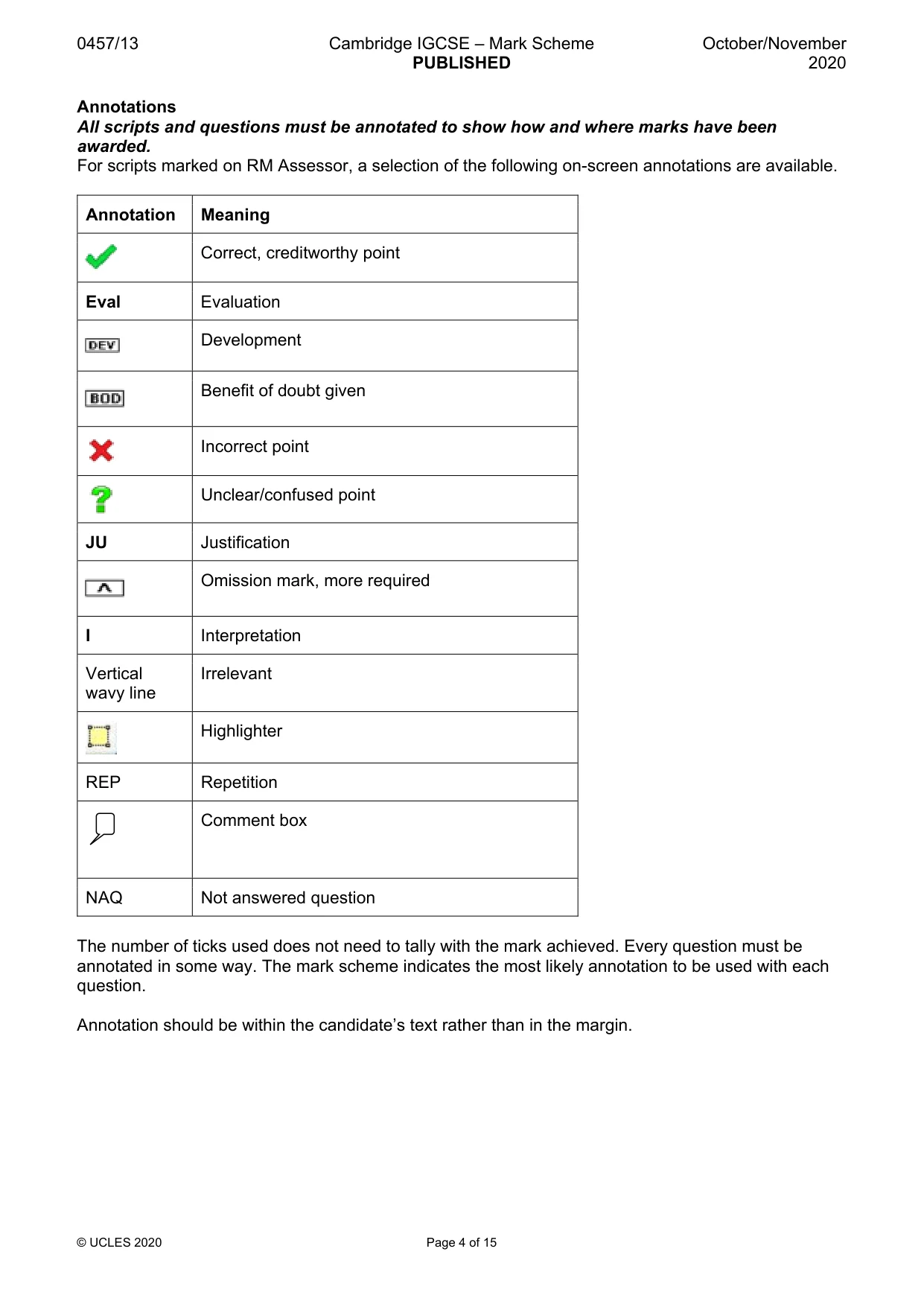
0457/13 Cambridge IGCSE – Mark Scheme PUBLISHED October/November 2020 © UCLES 2020 Page 4 of 15 Annotations All scripts and questions must be annotated to show how and where marks have been awarded. For scripts marked on RM Assessor, a selection of the following on-screen annotations are available. Annotation Meaning Correct, creditworthy point Eval Evaluation Development Benefit of doubt given Incorrect point Unclear/confused point JU Justification Omission mark, more required I Interpretation Vertical wavy line Irrelevant Highlighter REP Repetition Comment box NAQ Not answered question The number of ticks used does not need to tally with the mark achieved. Every question must be annotated in some way. The mark scheme indicates the most likely annotation to be used with each question. Annotation should be within the candidate’s text rather than in the margin.
Mark scheme, page 5
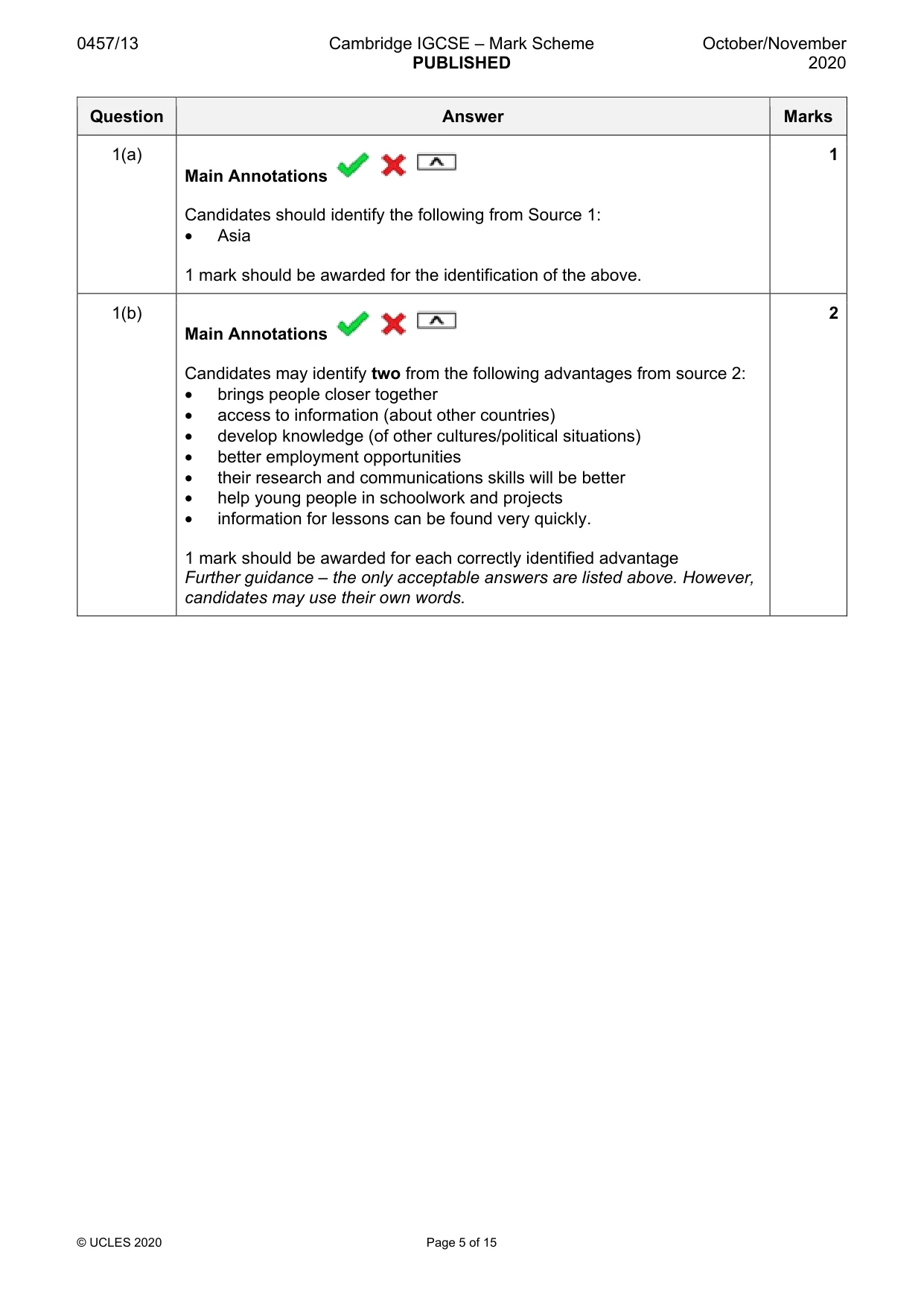
0457/13 Cambridge IGCSE – Mark Scheme PUBLISHED October/November 2020 © UCLES 2020 Page 5 of 15 Question Answer Marks 1(a) Main Annotations Candidates should identify the following from Source 1: • Asia 1 mark should be awarded for the identification of the above. 1 1(b) Main Annotations Candidates may identify two from the following advantages from source 2: • brings people closer together • access to information (about other countries) • develop knowledge (of other cultures/political situations) • better employment opportunities • their research and communications skills will be better • help young people in schoolwork and projects • information for lessons can be found very quickly. 1 mark should be awarded for each correctly identified advantage Further guidance – the only acceptable answers are listed above. However, candidates may use their own words. 2
Mark scheme, page 6
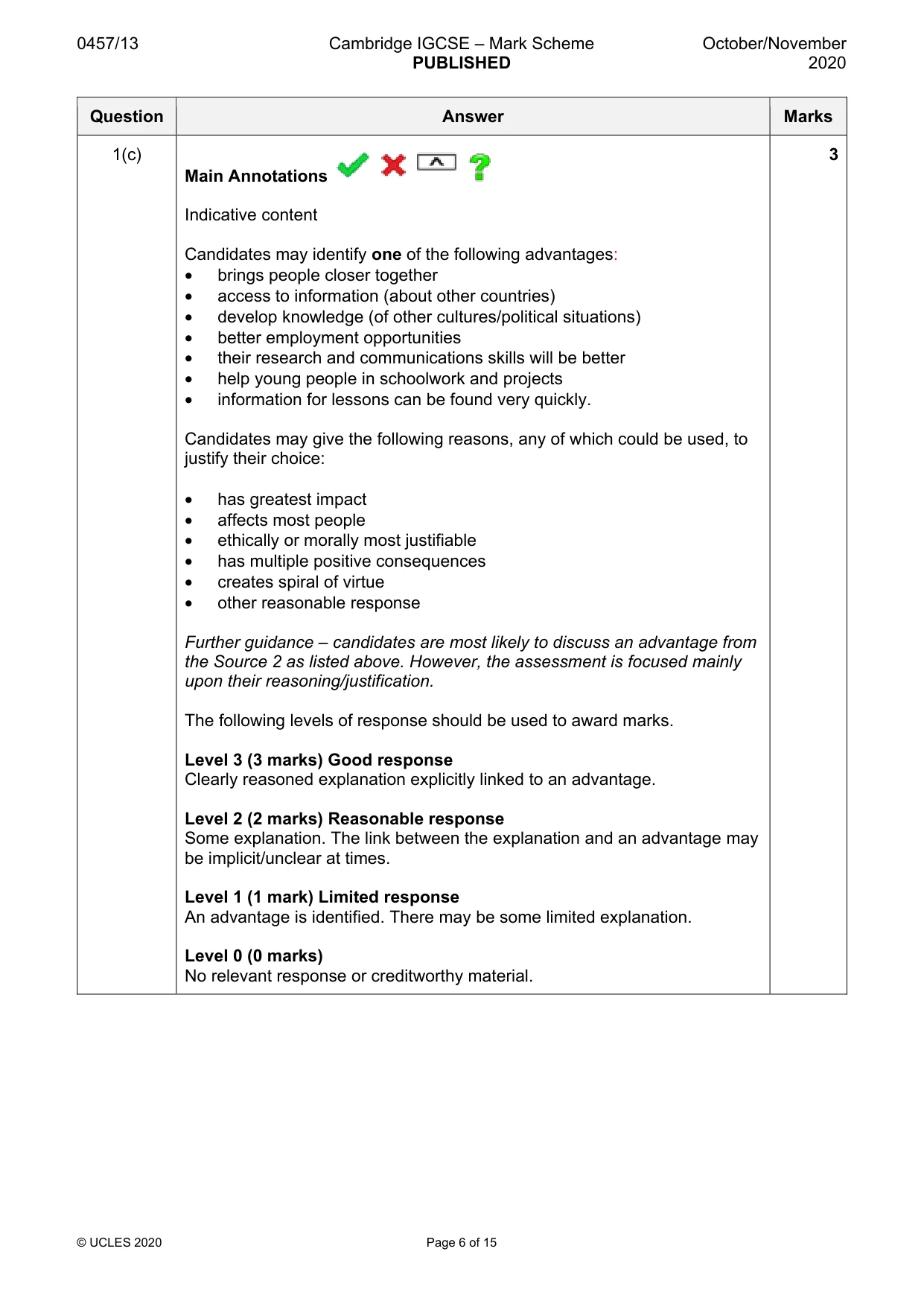
0457/13 Cambridge IGCSE – Mark Scheme PUBLISHED October/November 2020 © UCLES 2020 Page 6 of 15 Question Answer Marks 1(c) Main Annotations Indicative content Candidates may identify one of the following advantages: • brings people closer together • access to information (about other countries) • develop knowledge (of other cultures/political situations) • better employment opportunities • their research and communications skills will be better • help young people in schoolwork and projects • information for lessons can be found very quickly. Candidates may give the following reasons, any of which could be used, to justify their choice: • has greatest impact • affects most people • ethically or morally most justifiable • has multiple positive consequences • creates spiral of virtue • other reasonable response Further guidance – candidates are most likely to discuss an advantage from the Source 2 as listed above. However, the assessment is focused mainly upon their reasoning/justification. The following levels of response should be used to award marks. Level 3 (3 marks) Good response Clearly reasoned explanation explicitly linked to an advantage. Level 2 (2 marks) Reasonable response Some explanation. The link between the explanation and an advantage may be implicit/unclear at times. Level 1 (1 mark) Limited response An advantage is identified. There may be some limited explanation. Level 0 (0 marks) No relevant response or creditworthy material. 3
Mark scheme, page 7
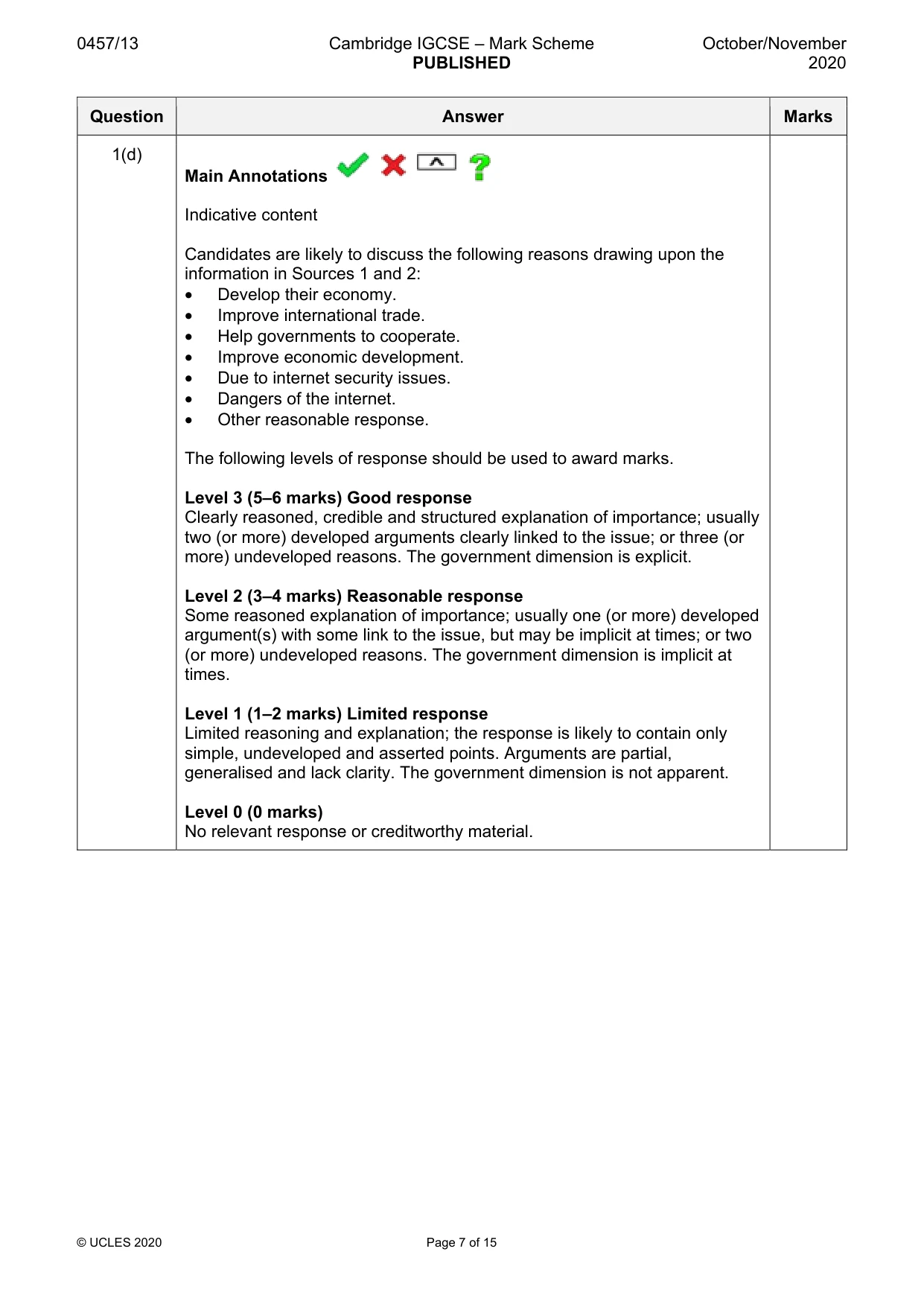
0457/13 Cambridge IGCSE – Mark Scheme PUBLISHED October/November 2020 © UCLES 2020 Page 7 of 15 Question Answer Marks 1(d) Main Annotations Indicative content Candidates are likely to discuss the following reasons drawing upon the information in Sources 1 and 2: • Develop their economy. • Improve international trade. • Help governments to cooperate. • Improve economic development. • Due to internet security issues. • Dangers of the internet. • Other reasonable response. The following levels of response should be used to award marks. Level 3 (5–6 marks) Good response Clearly reasoned, credible and structured explanation of importance; usually two (or more) developed arguments clearly linked to the issue; or three (or more) undeveloped reasons. The government dimension is explicit. Level 2 (3–4 marks) Reasonable response Some reasoned explanation of importance; usually one (or more) developed argument(s) with some link to the issue, but may be implicit at times; or two (or more) undeveloped reasons. The government dimension is implicit at times. Level 1 (1–2 marks) Limited response Limited reasoning and explanation; the response is likely to contain only simple, undeveloped and asserted points. Arguments are partial, generalised and lack clarity. The government dimension is not apparent. Level 0 (0 marks) No relevant response or creditworthy material.
Mark scheme, page 8
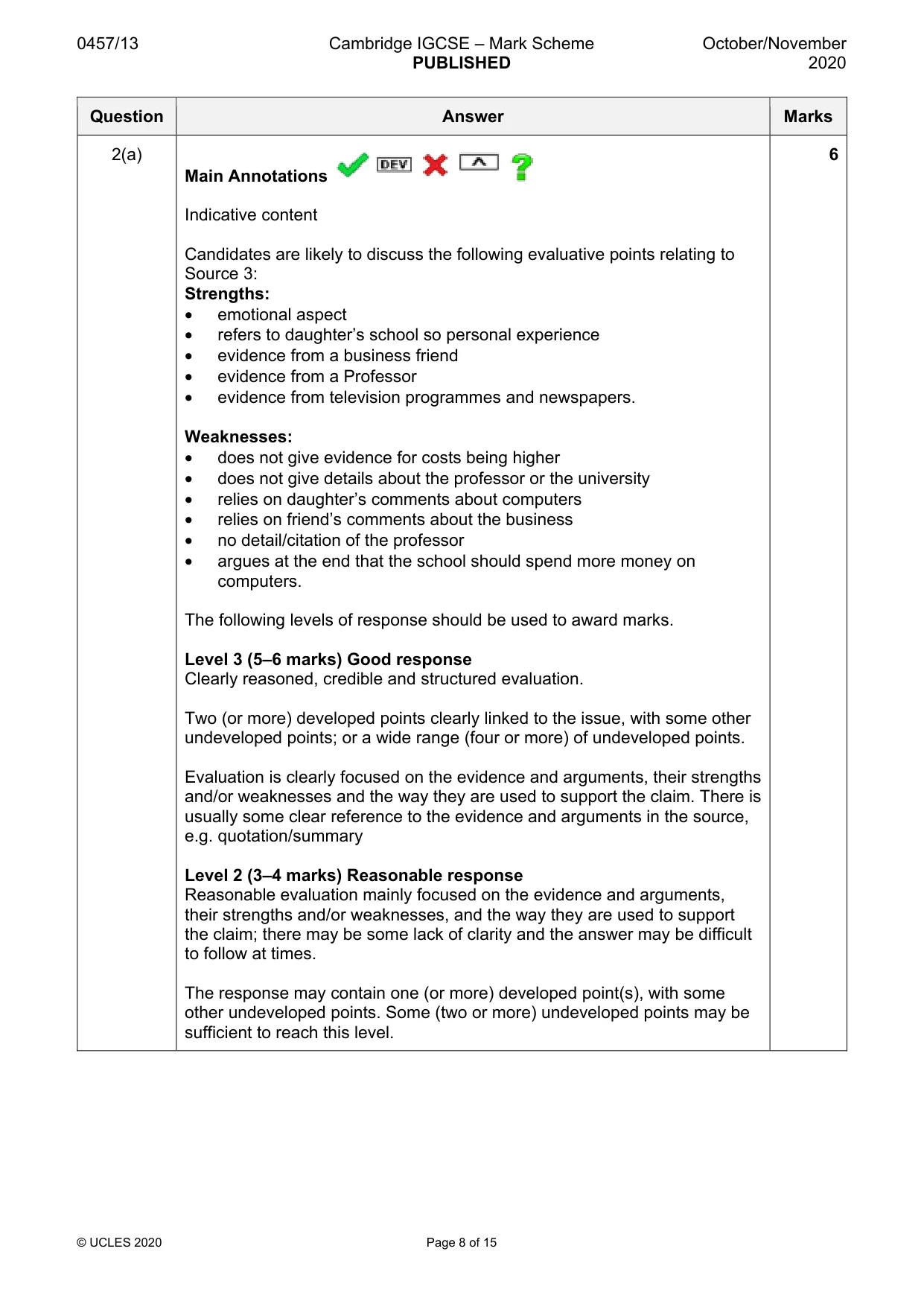
0457/13 Cambridge IGCSE – Mark Scheme PUBLISHED October/November 2020 © UCLES 2020 Page 8 of 15 Question Answer Marks 2(a) Main Annotations Indicative content Candidates are likely to discuss the following evaluative points relating to Source 3: Strengths: • emotional aspect • refers to daughter’s school so personal experience • evidence from a business friend • evidence from a Professor • evidence from television programmes and newspapers. Weaknesses: • does not give evidence for costs being higher • does not give details about the professor or the university • relies on daughter’s comments about computers • relies on friend’s comments about the business • no detail/citation of the professor • argues at the end that the school should spend more money on computers. The following levels of response should be used to award marks. Level 3 (5–6 marks) Good response Clearly reasoned, credible and structured evaluation. Two (or more) developed points clearly linked to the issue, with some other undeveloped points; or a wide range (four or more) of undeveloped points. Evaluation is clearly focused on the evidence and arguments, their strengths and/or weaknesses and the way they are used to support the claim. There is usually some clear reference to the evidence and arguments in the source, e.g. quotation/summary Level 2 (3–4 marks) Reasonable response Reasonable evaluation mainly focused on the evidence and arguments, their strengths and/or weaknesses, and the way they are used to support the claim; there may be some lack of clarity and the answer may be difficult to follow at times. The response may contain one (or more) developed point(s), with some other undeveloped points. Some (two or more) undeveloped points may be sufficient to reach this level. 6
Mark scheme, page 9
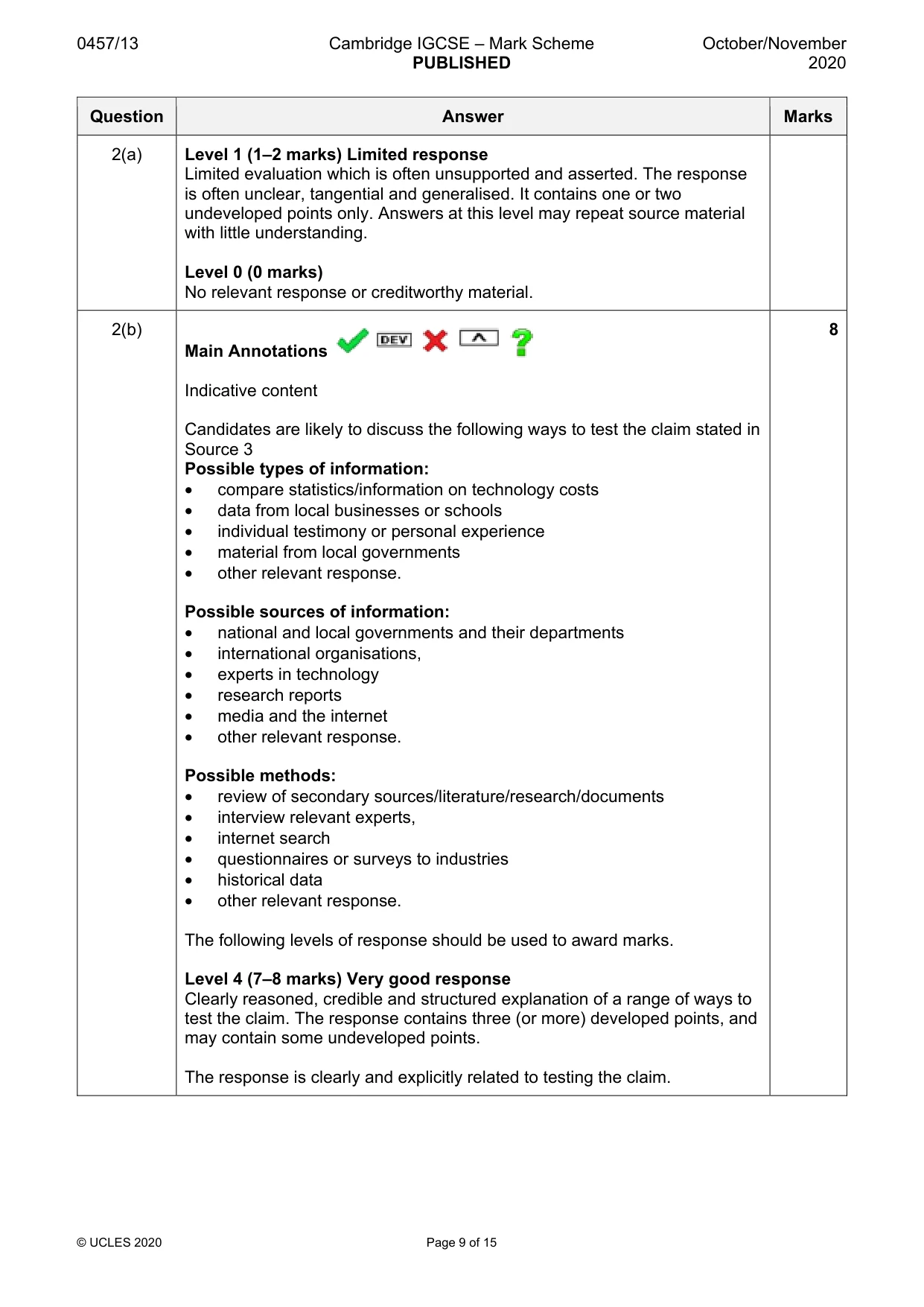
0457/13 Cambridge IGCSE – Mark Scheme PUBLISHED October/November 2020 © UCLES 2020 Page 9 of 15 Question Answer Marks 2(a) Level 1 (1–2 marks) Limited response Limited evaluation which is often unsupported and asserted. The response is often unclear, tangential and generalised. It contains one or two undeveloped points only. Answers at this level may repeat source material with little understanding. Level 0 (0 marks) No relevant response or creditworthy material. 2(b) Main Annotations Indicative content Candidates are likely to discuss the following ways to test the claim stated in Source 3 Possible types of information: • compare statistics/information on technology costs • data from local businesses or schools • individual testimony or personal experience • material from local governments • other relevant response. Possible sources of information: • national and local governments and their departments • international organisations, • experts in technology • research reports • media and the internet • other relevant response. Possible methods: • review of secondary sources/literature/research/documents • interview relevant experts, • internet search • questionnaires or surveys to industries • historical data • other relevant response. The following levels of response should be used to award marks. Level 4 (7–8 marks) Very good response Clearly reasoned, credible and structured explanation of a range of ways to test the claim. The response contains three (or more) developed points, and may contain some undeveloped points. The response is clearly and explicitly related to testing the claim. 8
Mark scheme, page 10
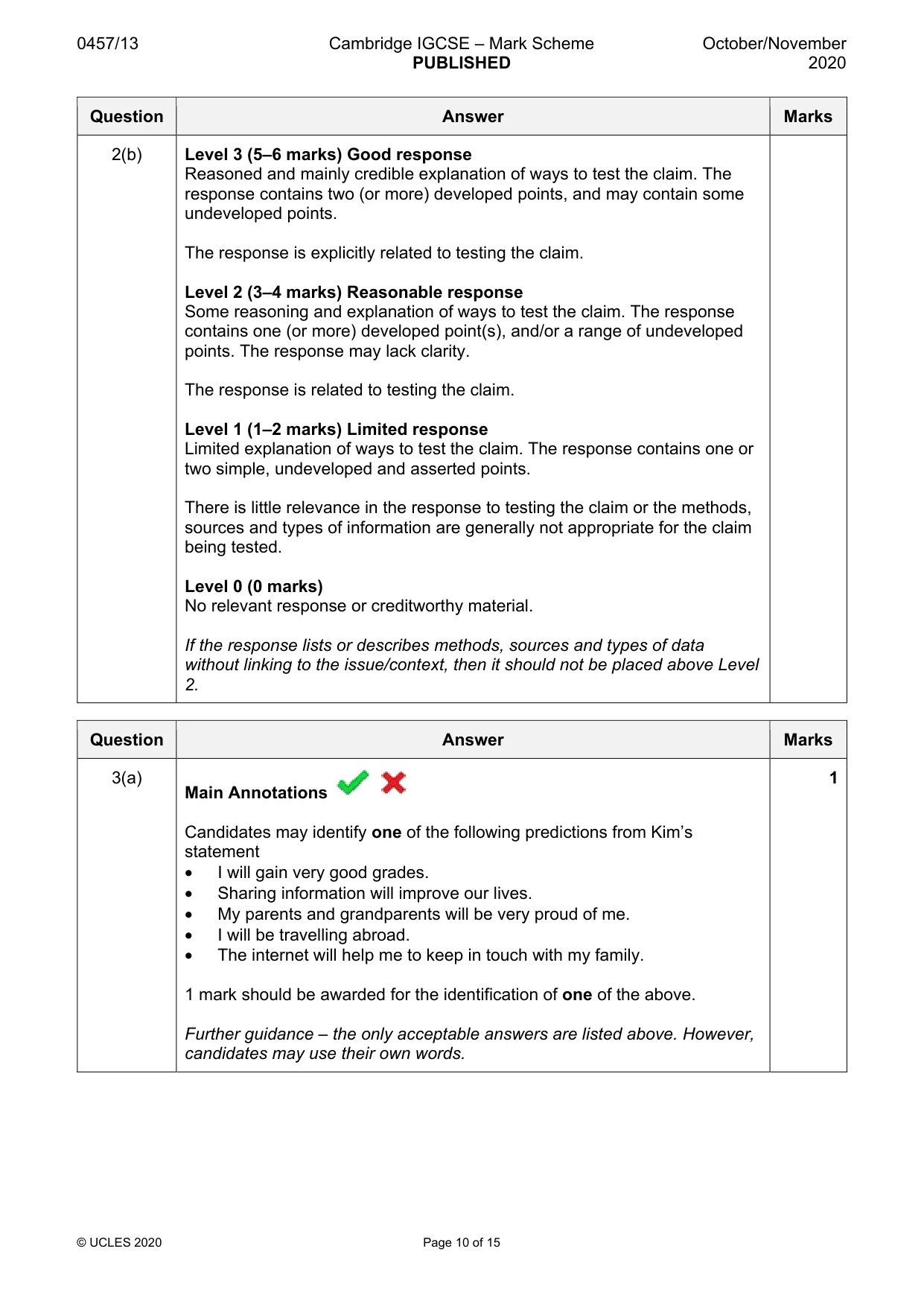
0457/13 Cambridge IGCSE – Mark Scheme PUBLISHED October/November 2020 © UCLES 2020 Page 10 of 15 Question Answer Marks 2(b) Level 3 (5–6 marks) Good response Reasoned and mainly credible explanation of ways to test the claim. The response contains two (or more) developed points, and may contain some undeveloped points. The response is explicitly related to testing the claim. Level 2 (3–4 marks) Reasonable response Some reasoning and explanation of ways to test the claim. The response contains one (or more) developed point(s), and/or a range of undeveloped points. The response may lack clarity. The response is related to testing the claim. Level 1 (1–2 marks) Limited response Limited explanation of ways to test the claim. The response contains one or two simple, undeveloped and asserted points. There is little relevance in the response to testing the claim or the methods, sources and types of information are generally not appropriate for the claim being tested. Level 0 (0 marks) No relevant response or creditworthy material. If the response lists or describes methods, sources and types of data without linking to the issue/context, then it should not be placed above Level 2. Question Answer Marks 3(a) Main Annotations Candidates may identify one of the following predictions from Kim’s statement • I will gain very good grades. • Sharing information will improve our lives. • My parents and grandparents will be very proud of me. • I will be travelling abroad. • The internet will help me to keep in touch with my family. 1 mark should be awarded for the identification of one of the above. Further guidance – the only acceptable answers are listed above. However, candidates may use their own words. 1
Mark scheme, page 11
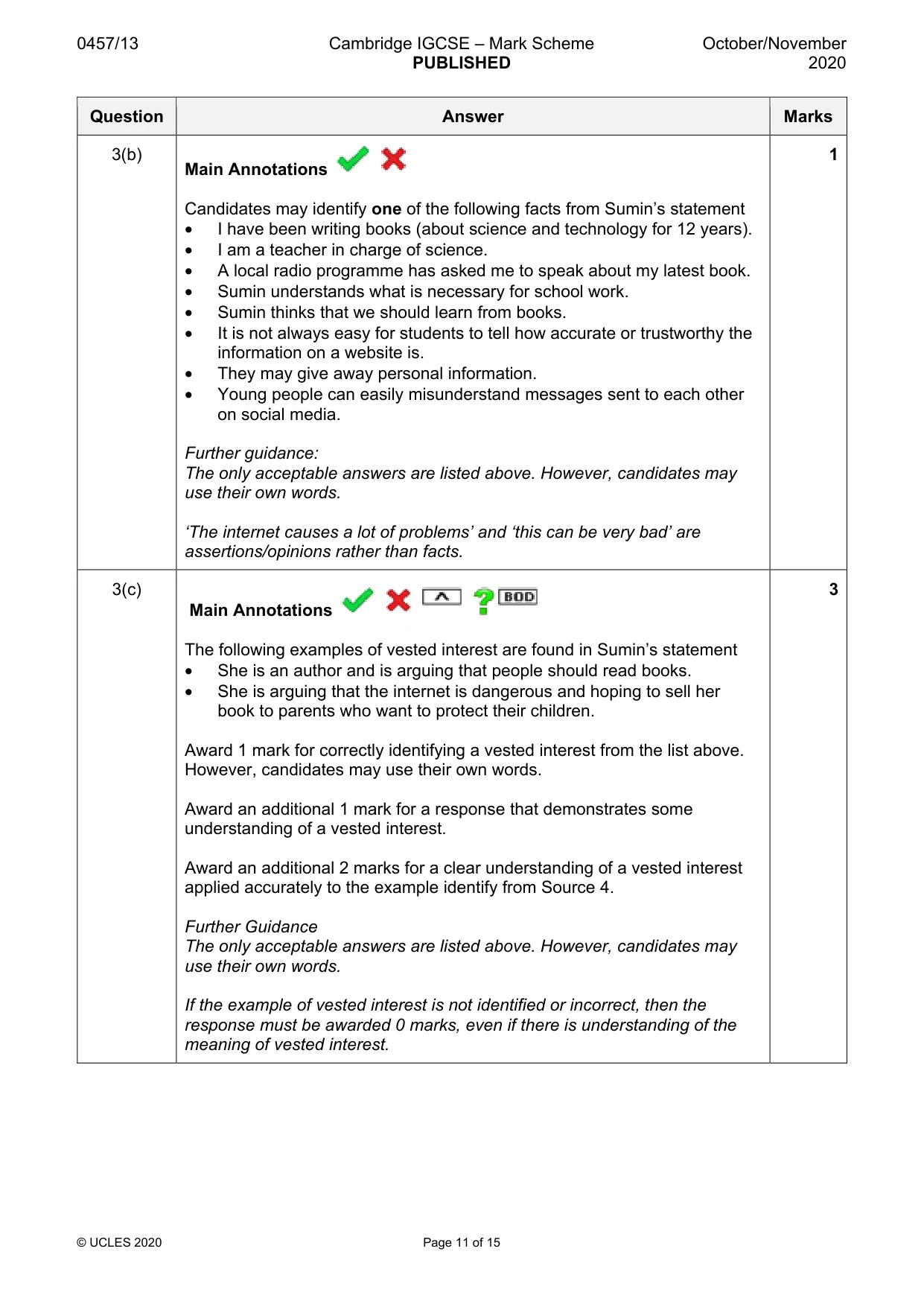
0457/13 Cambridge IGCSE – Mark Scheme PUBLISHED October/November 2020 © UCLES 2020 Page 11 of 15 Question Answer Marks 3(b) Main Annotations Candidates may identify one of the following facts from Sumin’s statement • I have been writing books (about science and technology for 12 years). • I am a teacher in charge of science. • A local radio programme has asked me to speak about my latest book. • Sumin understands what is necessary for school work. • Sumin thinks that we should learn from books. • It is not always easy for students to tell how accurate or trustworthy the information on a website is. • They may give away personal information. • Young people can easily misunderstand messages sent to each other on social media. Further guidance: The only acceptable answers are listed above. However, candidates may use their own words. ‘The internet causes a lot of problems’ and ‘this can be very bad’ are assertions/opinions rather than facts. 1 3(c) Main Annotations The following examples of vested interest are found in Sumin’s statement • She is an author and is arguing that people should read books. • She is arguing that the internet is dangerous and hoping to sell her book to parents who want to protect their children. Award 1 mark for correctly identifying a vested interest from the list above. However, candidates may use their own words. Award an additional 1 mark for a response that demonstrates some understanding of a vested interest. Award an additional 2 marks for a clear understanding of a vested interest applied accurately to the example identify from Source 4. Further Guidance The only acceptable answers are listed above. However, candidates may use their own words. If the example of vested interest is not identified or incorrect, then the response must be awarded 0 marks, even if there is understanding of the meaning of vested interest. 3
Mark scheme, page 12
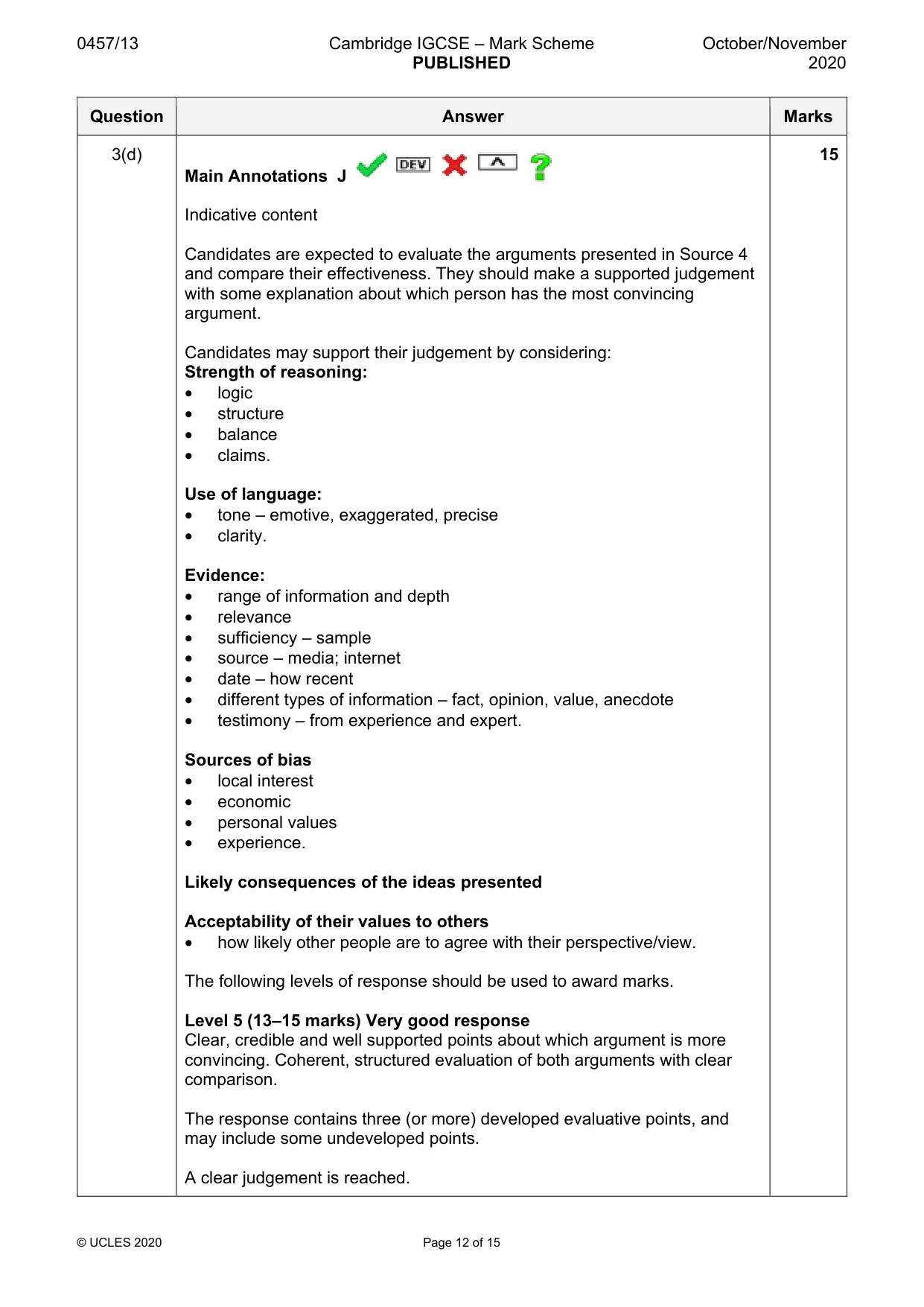
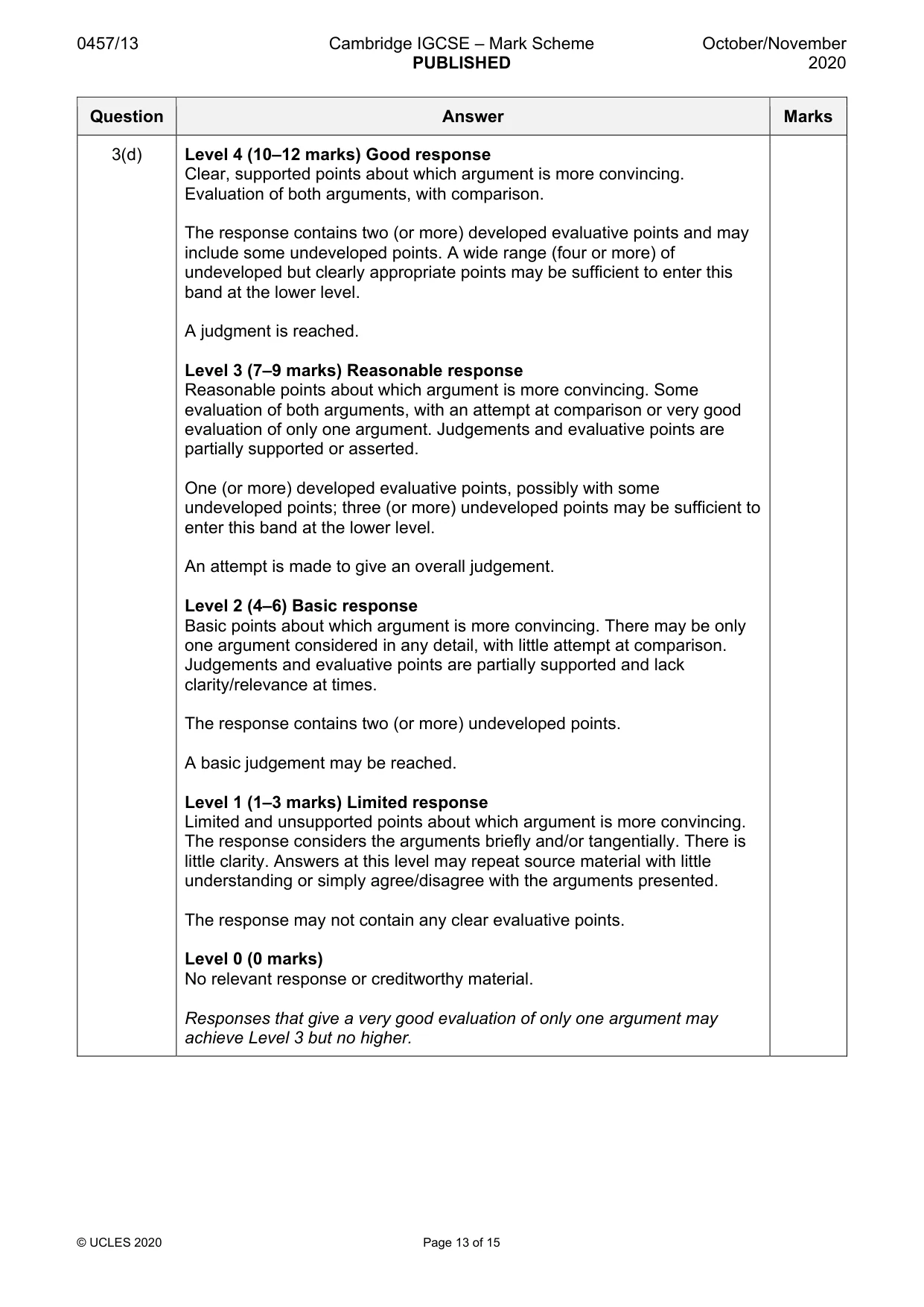
0457/13 Cambridge IGCSE – Mark Scheme PUBLISHED October/November 2020 © UCLES 2020 Page 12 of 15 Question Answer Marks 3(d) Main Annotations J Indicative content Candidates are expected to evaluate the arguments presented in Source 4 and compare their effectiveness. They should make a supported judgement with some explanation about which person has the most convincing argument. Candidates may support their judgement by considering: Strength of reasoning: • logic • structure • balance • claims. Use of language: • tone – emotive, exaggerated, precise • clarity. Evidence: • range of information and depth • relevance • sufficiency – sample • source – media; internet • date – how recent • different types of information – fact, opinion, value, anecdote • testimony – from experience and expert. Sources of bias • local interest • economic • personal values • experience. Likely consequences of the ideas presented Acceptability of their values to others • how likely other people are to agree with their perspective/view. The following levels of response should be used to award marks. Level 5 (13–15 marks) Very good response Clear, credible and well supported points about which argument is more convincing. Coherent, structured evaluation of both arguments with clear comparison. The response contains three (or more) developed evaluative points, and may include some undeveloped points. A clear judgement is reached. 15
Mark scheme, page 13
0457/13 Cambridge IGCSE – Mark Scheme PUBLISHED October/November 2020 © UCLES 2020 Page 13 of 15 Question Answer Marks 3(d) Level 4 (10–12 marks) Good response Clear, supported points about which argument is more convincing. Evaluation of both arguments, with comparison. The response contains two (or more) developed evaluative points and may include some undeveloped points. A wide range (four or more) of undeveloped but clearly appropriate points may be sufficient to enter this band at the lower level. A judgment is reached. Level 3 (7–9 marks) Reasonable response Reasonable points about which argument is more convincing. Some evaluation of both arguments, with an attempt at comparison or very good evaluation of only one argument. Judgements and evaluative points are partially supported or asserted. One (or more) developed evaluative points, possibly with some undeveloped points; three (or more) undeveloped points may be sufficient to enter this band at the lower level. An attempt is made to give an overall judgement. Level 2 (4–6) Basic response Basic points about which argument is more convincing. There may be only one argument considered in any detail, with little attempt at comparison. Judgements and evaluative points are partially supported and lack clarity/relevance at times. The response contains two (or more) undeveloped points. A basic judgement may be reached. Level 1 (1–3 marks) Limited response Limited and unsupported points about which argument is more convincing. The response considers the arguments briefly and/or tangentially. There is little clarity. Answers at this level may repeat source material with little understanding or simply agree/disagree with the arguments presented. The response may not contain any clear evaluative points. Level 0 (0 marks) No relevant response or creditworthy material. Responses that give a very good evaluation of only one argument may achieve Level 3 but no higher.
Mark scheme, page 14
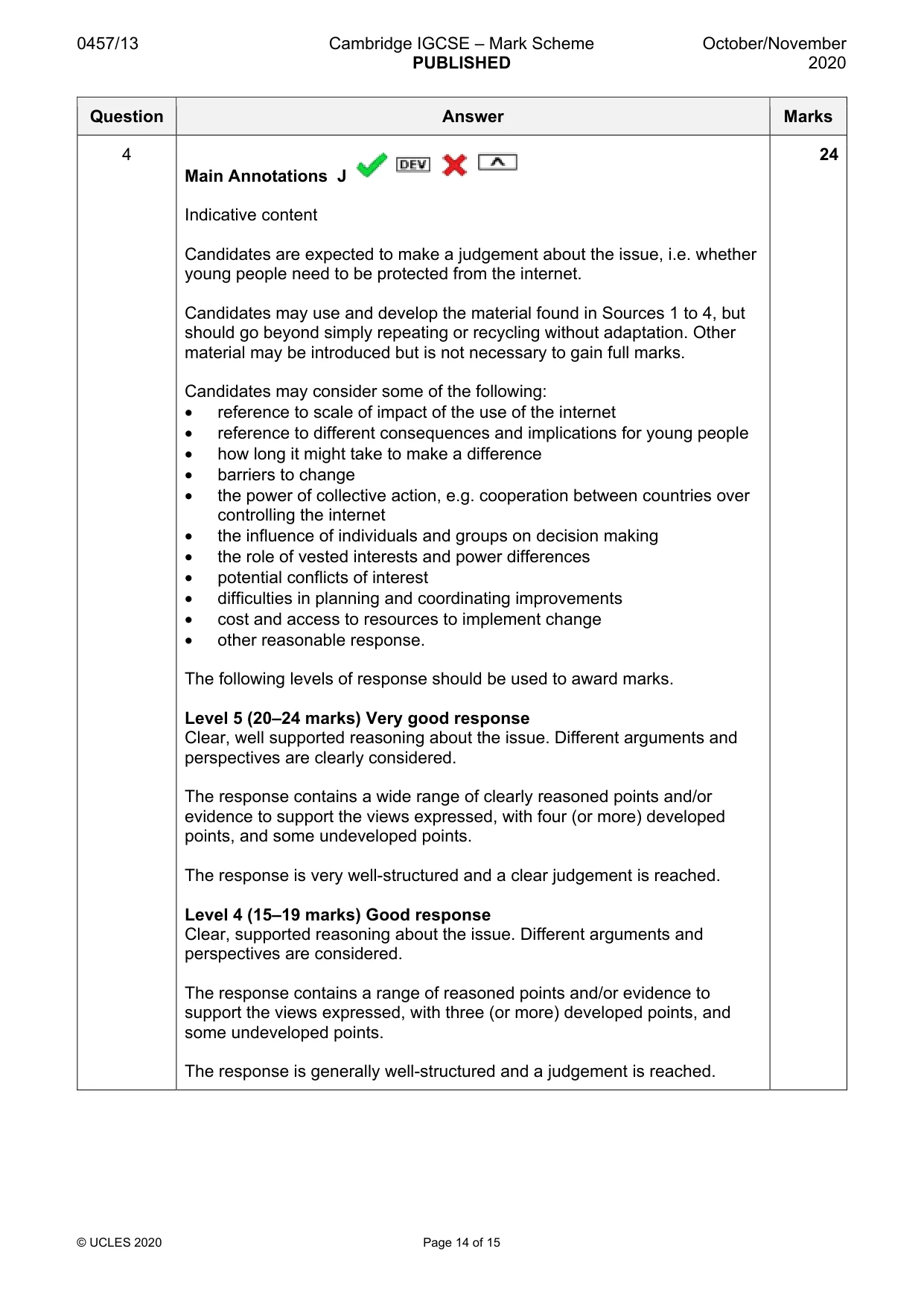
0457/13 Cambridge IGCSE – Mark Scheme PUBLISHED October/November 2020 © UCLES 2020 Page 14 of 15 Question Answer Marks 4 Main Annotations J Indicative content Candidates are expected to make a judgement about the issue, i.e. whether young people need to be protected from the internet. Candidates may use and develop the material found in Sources 1 to 4, but should go beyond simply repeating or recycling without adaptation. Other material may be introduced but is not necessary to gain full marks. Candidates may consider some of the following: • reference to scale of impact of the use of the internet • reference to different consequences and implications for young people • how long it might take to make a difference • barriers to change • the power of collective action, e.g. cooperation between countries over controlling the internet • the influence of individuals and groups on decision making • the role of vested interests and power differences • potential conflicts of interest • difficulties in planning and coordinating improvements • cost and access to resources to implement change • other reasonable response. The following levels of response should be used to award marks. Level 5 (20–24 marks) Very good response Clear, well supported reasoning about the issue. Different arguments and perspectives are clearly considered. The response contains a wide range of clearly reasoned points and/or evidence to support the views expressed, with four (or more) developed points, and some undeveloped points. The response is very well-structured and a clear judgement is reached. Level 4 (15–19 marks) Good response Clear, supported reasoning about the issue. Different arguments and perspectives are considered. The response contains a range of reasoned points and/or evidence to support the views expressed, with three (or more) developed points, and some undeveloped points. The response is generally well-structured and a judgement is reached. 24
Mark scheme, page 15
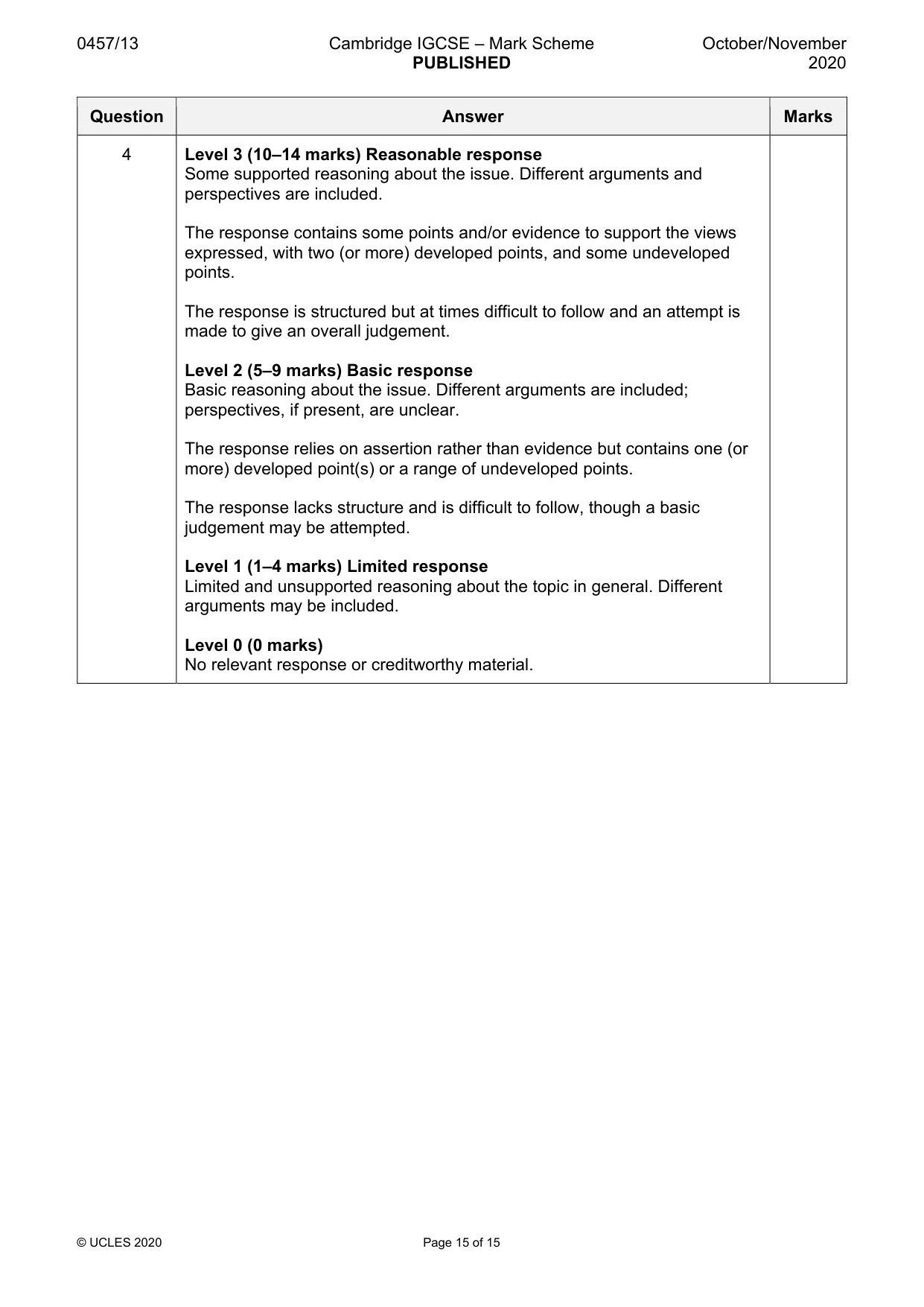
0457/13 Cambridge IGCSE – Mark Scheme PUBLISHED October/November 2020 © UCLES 2020 Page 15 of 15 Question Answer Marks 4 Level 3 (10–14 marks) Reasonable response Some supported reasoning about the issue. Different arguments and perspectives are included. The response contains some points and/or evidence to support the views expressed, with two (or more) developed points, and some undeveloped points. The response is structured but at times difficult to follow and an attempt is made to give an overall judgement. Level 2 (5–9 marks) Basic response Basic reasoning about the issue. Different arguments are included; perspectives, if present, are unclear. The response relies on assertion rather than evidence but contains one (or more) developed point(s) or a range of undeveloped points. The response lacks structure and is difficult to follow, though a basic judgement may be attempted. Level 1 (1–4 marks) Limited response Limited and unsupported reasoning about the topic in general. Different arguments may be included. Level 0 (0 marks) No relevant response or creditworthy material.
What you needed in this session
Cambridge’s own grade thresholds for 2020 Oct/Nov, Paper 1 · Variant 3. A higher threshold means an easier paper — the bar moves with how the cohort did.