Cambridge IGCSE Global Perspectives 0457 — 2018 May/June Paper 1 · Variant 3
0457/13/M/J/18 · 70 marks · ≈79 min
The question paper and its mark scheme, free to read here and free to download. This is Cambridge’s own paper, exactly as it was sat.
Question paper12 pages







Mark scheme14 pages
Answers below. Sit the paper first if you are practising.
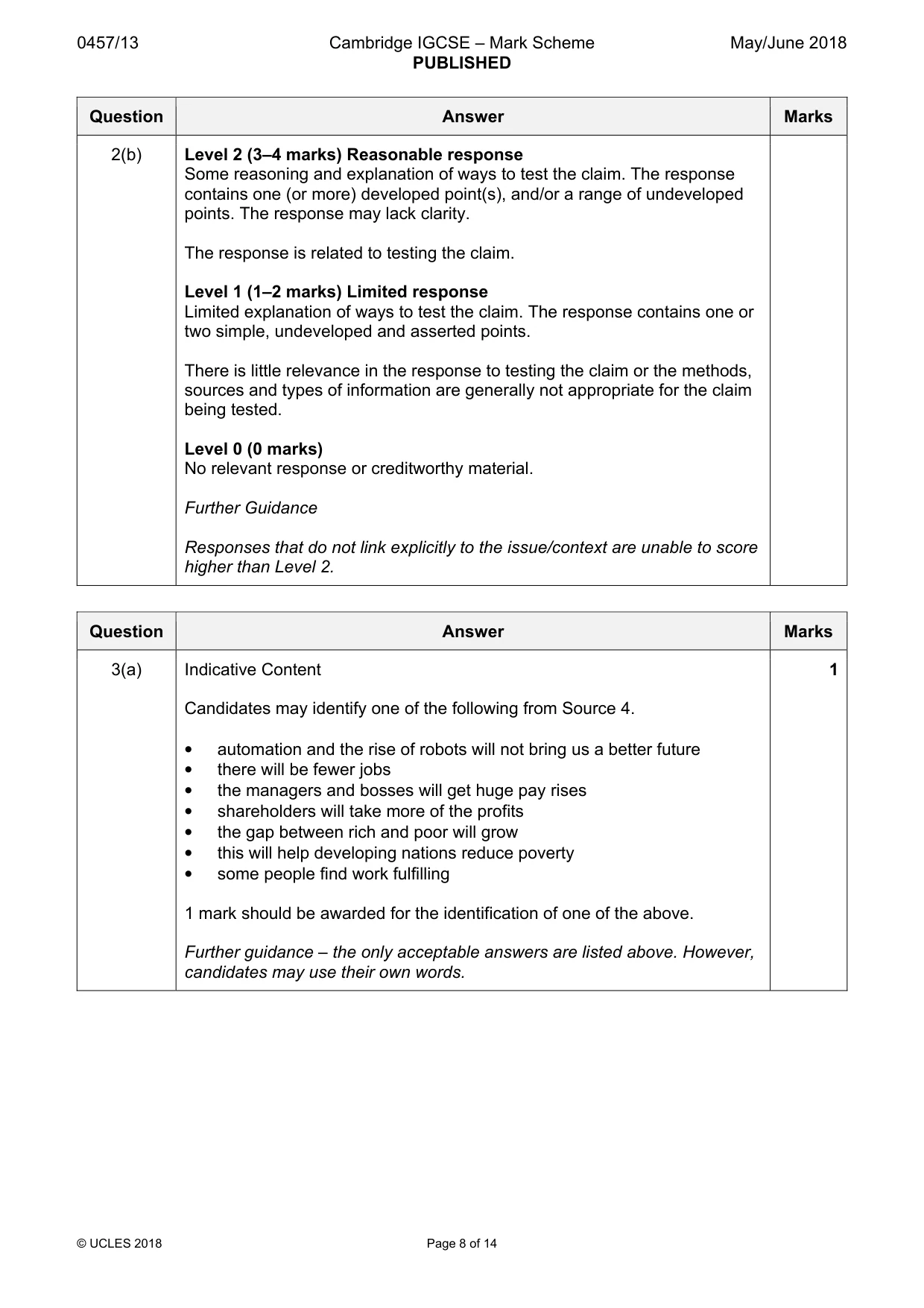
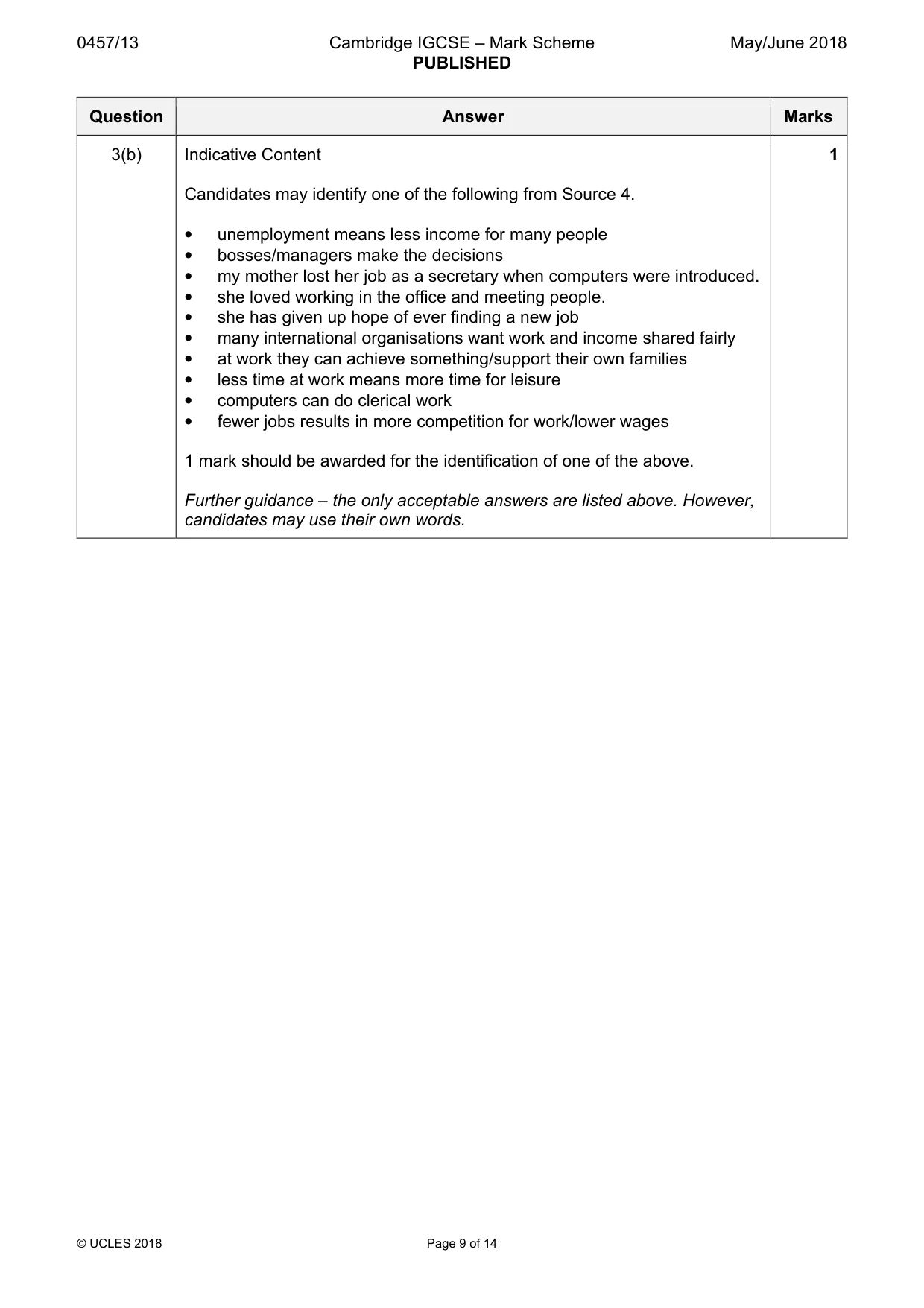
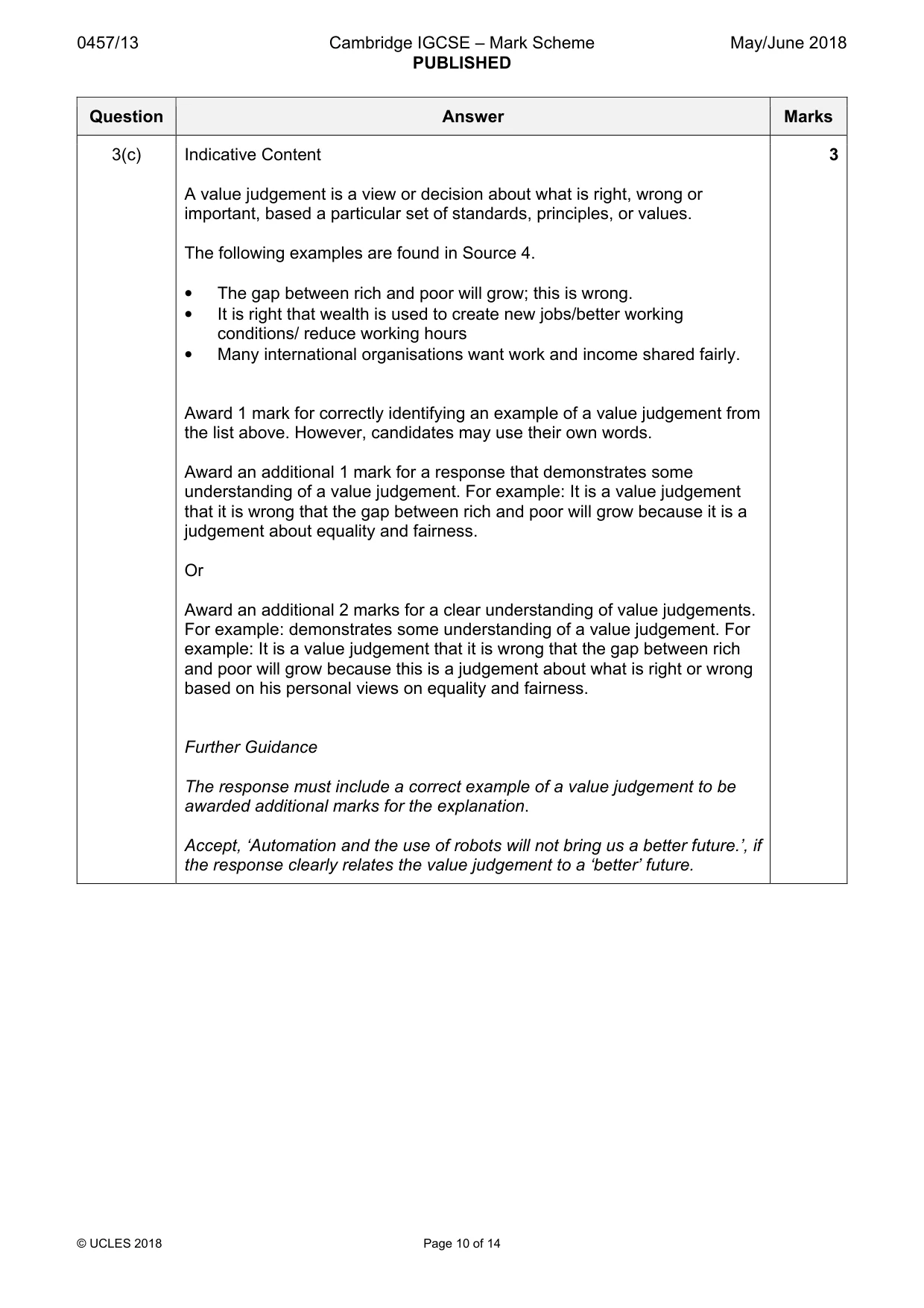
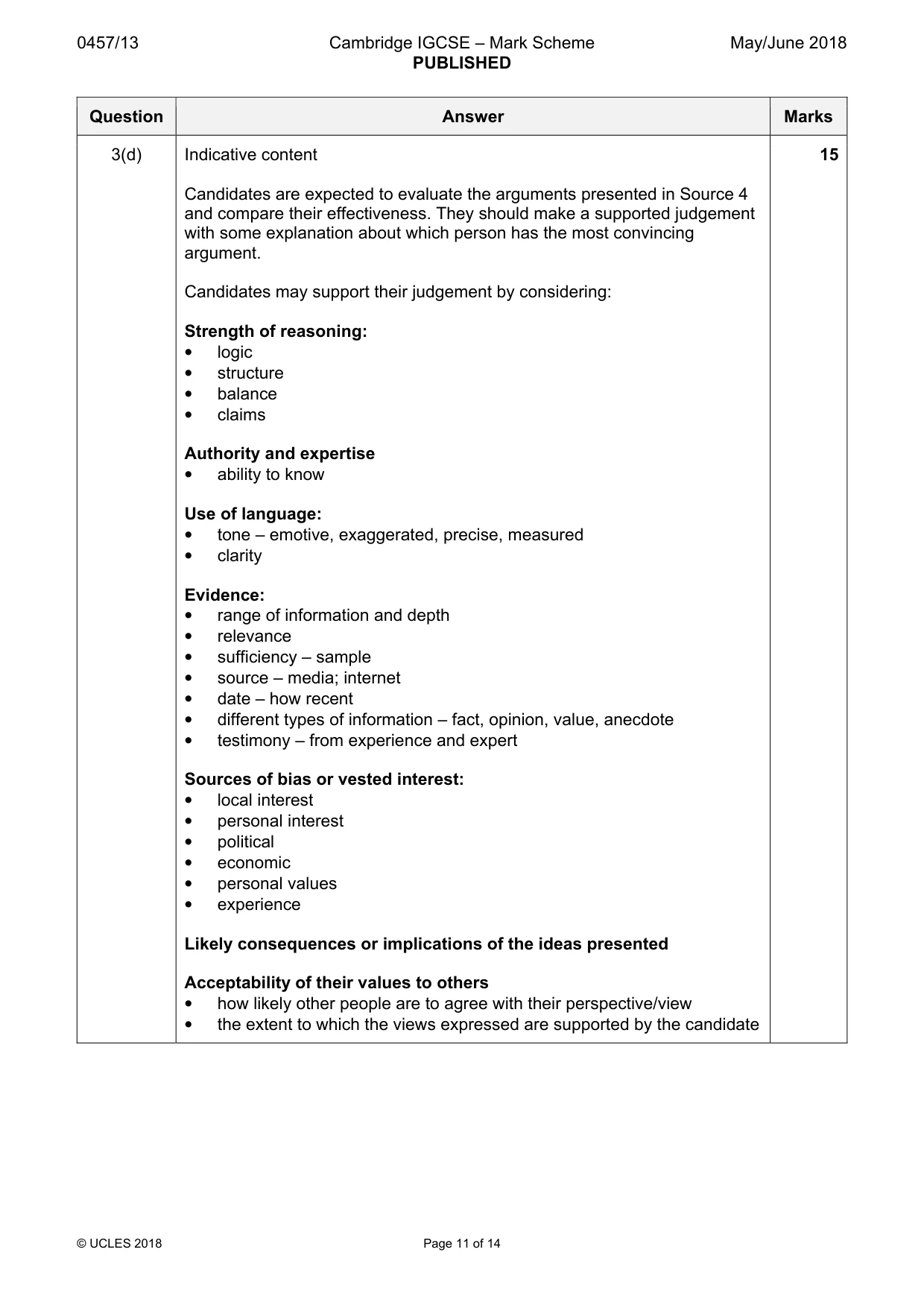
Paper as text
Question paper, page 1
This document consists of 9 printed pages, 3 blank pages and 1 Insert. DC (NH) 149266/1 © UCLES 2018 [Turn over * 5 5 8 1 9 3 5 7 6 4 * GLOBAL PERSPECTIVES 0457/13 Paper 1 Written Examination May/June 2018 1 hour 15 minutes Candidates answer on the Question Paper. No Additional Materials are required. READ THESE INSTRUCTIONS FIRST Write your Centre number, candidate number and name in the spaces at the top of this page. Write in dark blue or black pen. Do not use staples, paper clips, glue or correction fluid. DO NOT WRITE IN ANY BARCODES. Answer all questions. Any rough working should be done in this booklet. At the end of the examination, fasten all your work securely together. The number of marks is given in brackets [ ] at the end of each question or part question. Cambridge International Examinations Cambridge International General Certificate of Secondary Education
Question paper, page 2
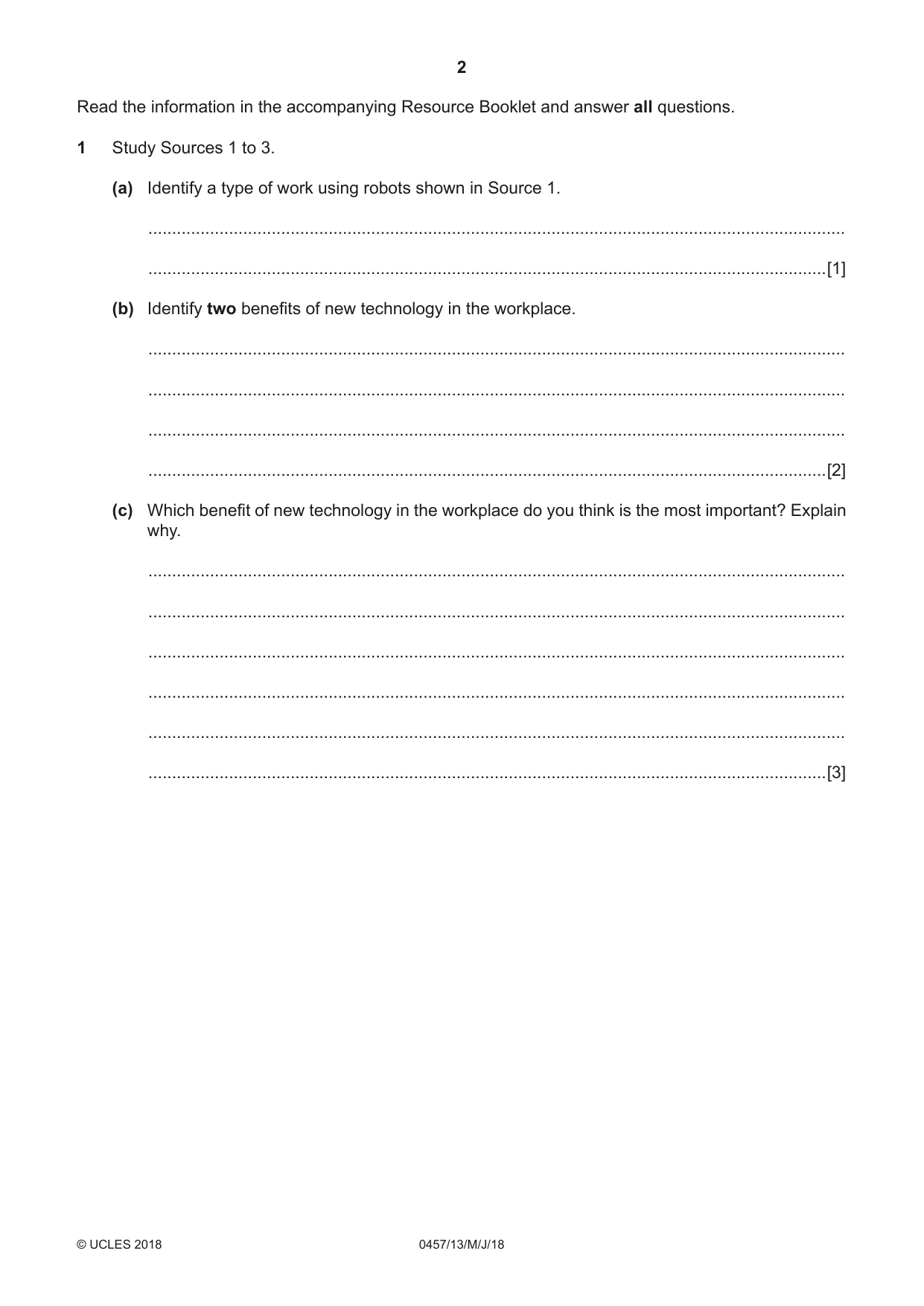
2 0457/13/M/J/18 © UCLES 2018 Read the information in the accompanying Resource Booklet and answer all questions. 1 Study Sources 1 to 3. (a) Identify a type of work using robots shown in Source 1. … …[1] (b) Identify two benefits of new technology in the workplace. … … … …[2] (c) Which benefit of new technology in the workplace do you think is the most important? Explain why. … … … … … …[3]
Question paper, page 3
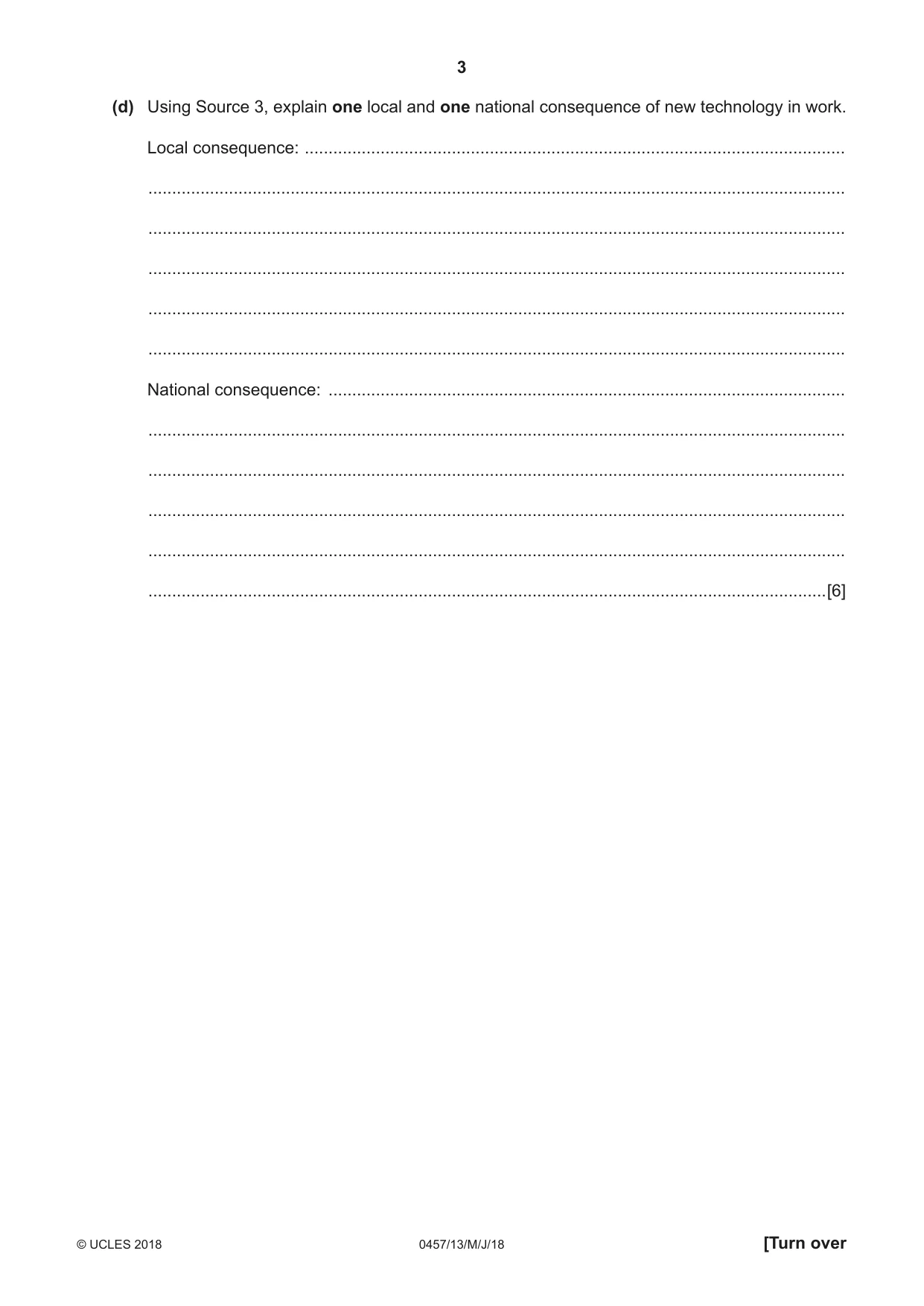
3 0457/13/M/J/18 © UCLES 2018 [Turn over (d) Using Source 3, explain one local and one national consequence of new technology in work. Local consequence: … … … … … … National consequence: … … … … … …[6]
Question paper, page 4
4 0457/13/M/J/18 © UCLES 2018 2 Study Source 3. (a) ‘Robots will mean better working lives for people in the future.’ What are the strengths and weaknesses of the argument supporting this claim? … … … … … … … … … … … …[6]
Question paper, page 5
5 0457/13/M/J/18 © UCLES 2018 [Turn over (b) ‘In the future we will work shorter hours.’ How could you test this claim? You may consider the types of information, sources of evidence or methods you might use. … … … … … … … … … … … … … … … …[8]
Question paper, page 6
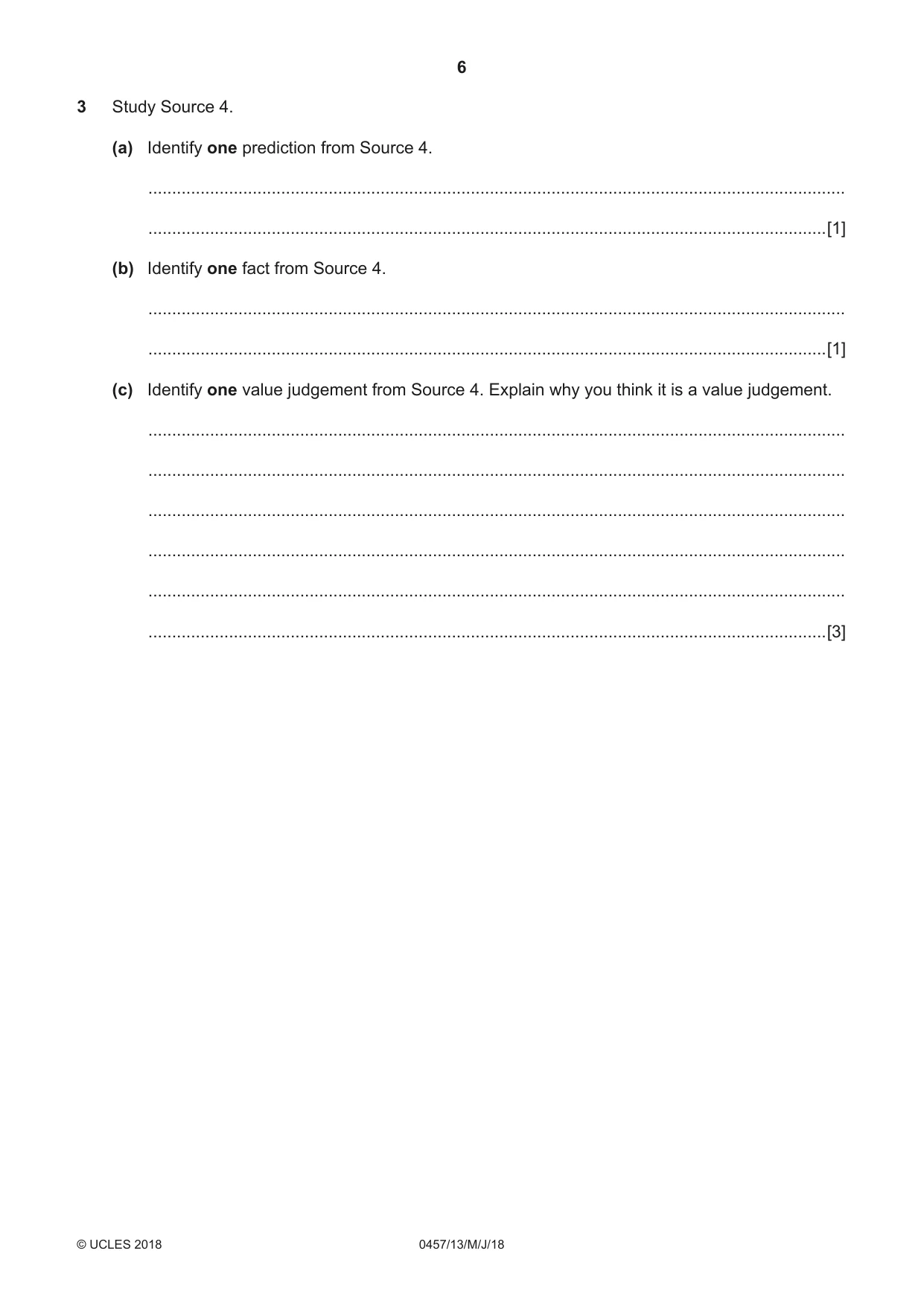
6 0457/13/M/J/18 © UCLES 2018 3 Study Source 4. (a) Identify one prediction from Source 4. … …[1] (b) Identify one fact from Source 4. … …[1] (c) Identify one value judgement from Source 4. Explain why you think it is a value judgement. … … … … … …[3]
Question paper, page 7
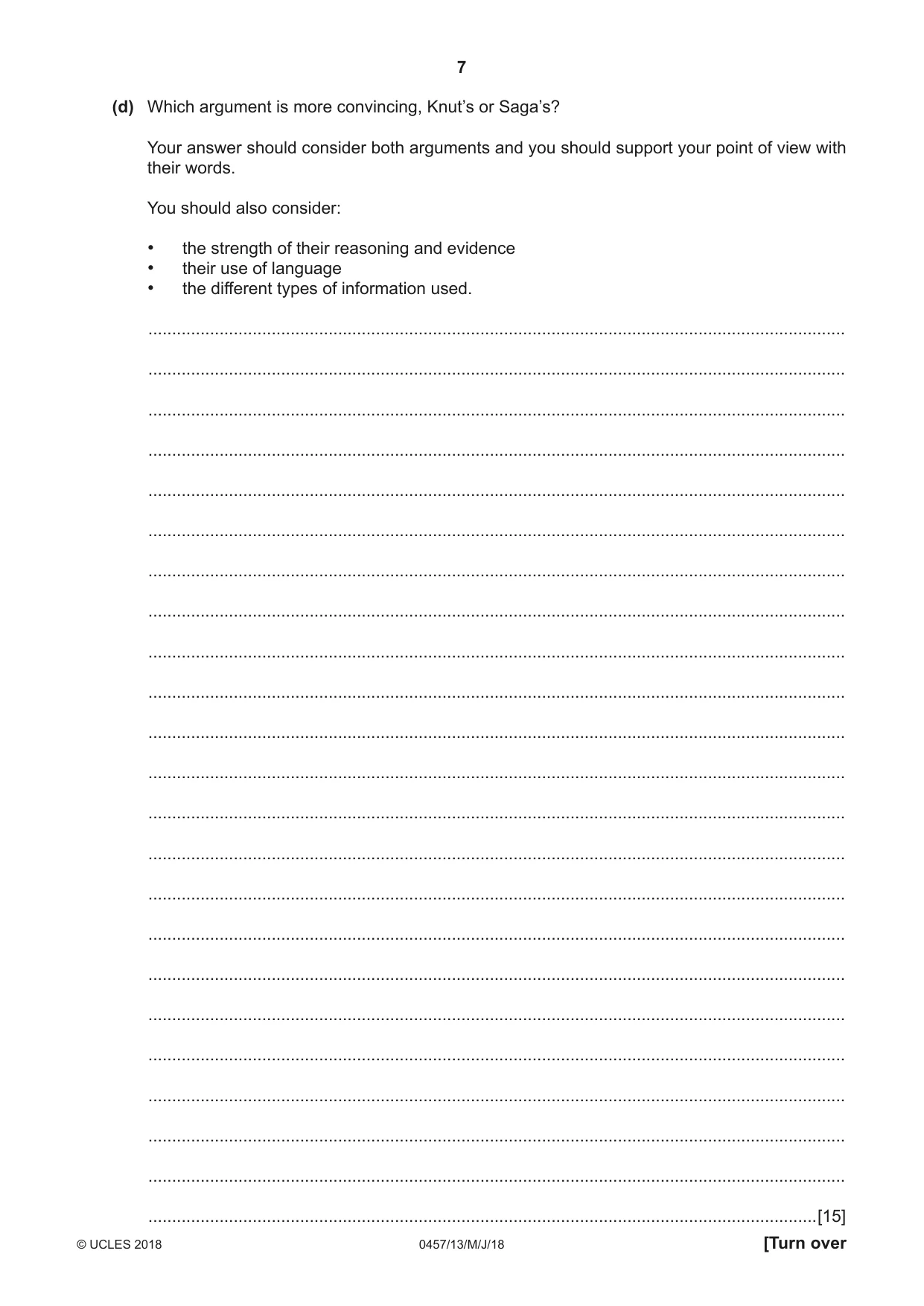
7 0457/13/M/J/18 © UCLES 2018 [Turn over (d) Which argument is more convincing, Knut’s or Saga’s? Your answer should consider both arguments and you should support your point of view with their words. You should also consider: • the strength of their reasoning and evidence • their use of language • the different types of information used. … … … … … … … … … … … … … … … … … … … … … … …[15]
Question paper, page 8
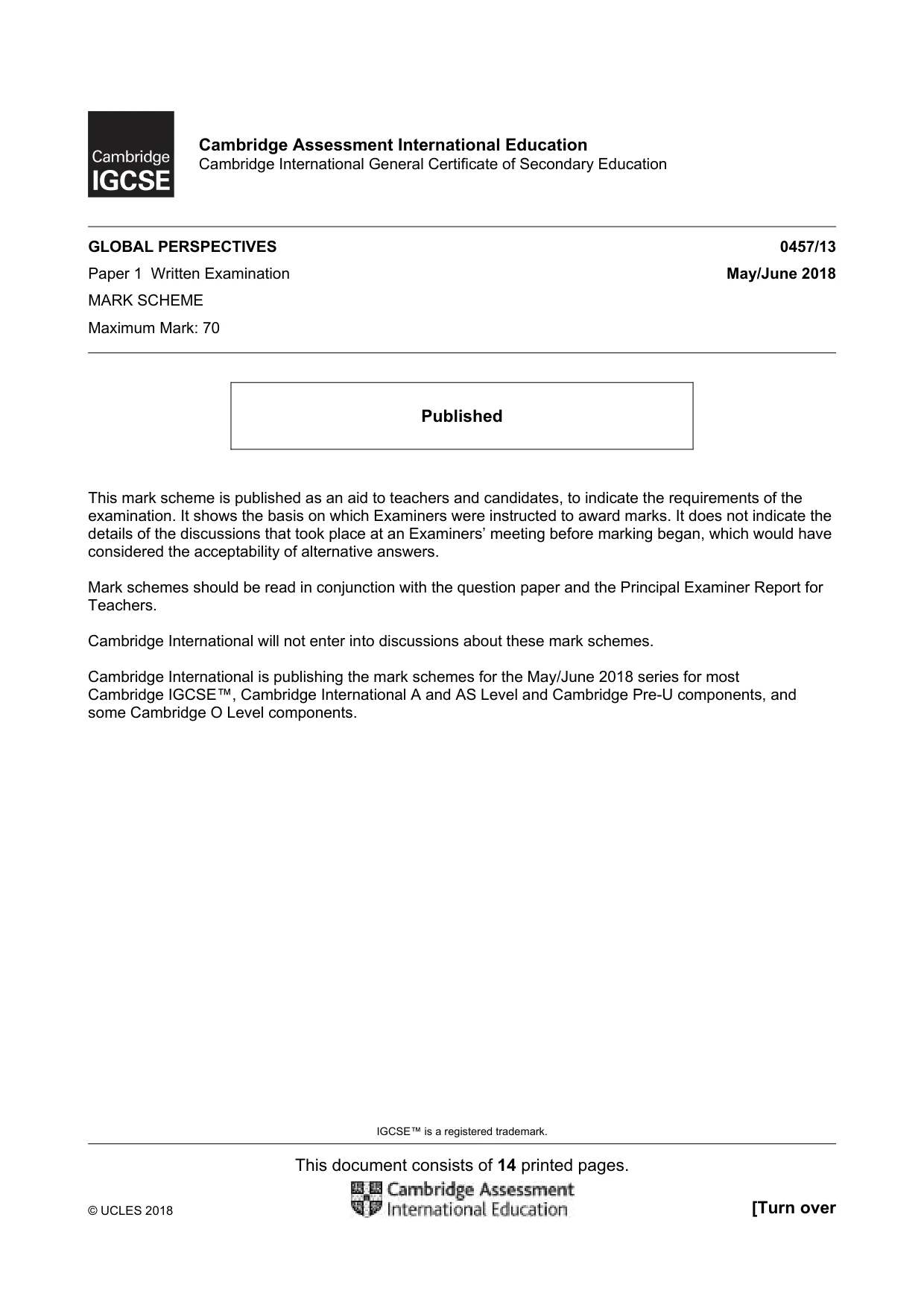
8 0457/13/M/J/18 © UCLES 2018 4 Your government is considering different actions to improve employment for local people. The following actions are being considered: • closing the pay gap between low and high paid workers • increasing the funding of research into science and new technology • spending more on education and training of employees to improve skills. Which one of these actions would you recommend to the government, and why? In your answer, you should: • state your recommendation • give reasons to support your choice • use the material in the sources and/or any of your own ideas • consider different arguments and perspectives. … … … … … … … … … … … … … … … … … … … …
Question paper, page 9
9 0457/13/M/J/18 © UCLES 2018 … … … … … … … … … … … … … … … … … … … … … … … … … … … …[24]
Question paper, page 10
10 0457/13/M/J/18 © UCLES 2018 BLANK PAGE
Question paper, page 11
11 0457/13/M/J/18 © UCLES 2018 BLANK PAGE
Question paper, page 12
12 0457/13/M/J/18 © UCLES 2018 Permission to reproduce items where third-party owned material protected by copyright is included has been sought and cleared where possible. Every reasonable effort has been made by the publisher (UCLES) to trace copyright holders, but if any items requiring clearance have unwittingly been included, the publisher will be pleased to make amends at the earliest possible opportunity. To avoid the issue of disclosure of answer-related information to candidates, all copyright acknowledgements are reproduced online in the Cambridge International Examinations Copyright Acknowledgements Booklet. This is produced for each series of examinations and is freely available to download at www.cie.org.uk after the live examination series. Cambridge International Examinations is part of the Cambridge Assessment Group. Cambridge Assessment is the brand name of University of Cambridge Local Examinations Syndicate (UCLES), which is itself a department of the University of Cambridge. BLANK PAGE
Mark scheme, page 1
IGCSE™ is a registered trademark. This document consists of 14 printed pages. © UCLES 2018 [Turn over Cambridge Assessment International Education Cambridge International General Certificate of Secondary Education GLOBAL PERSPECTIVES 0457/13 Paper 1 Written Examination May/June 2018 MARK SCHEME Maximum Mark: 70 Published This mark scheme is published as an aid to teachers and candidates, to indicate the requirements of the examination. It shows the basis on which Examiners were instructed to award marks. It does not indicate the details of the discussions that took place at an Examiners’ meeting before marking began, which would have considered the acceptability of alternative answers. Mark schemes should be read in conjunction with the question paper and the Principal Examiner Report for Teachers. Cambridge International will not enter into discussions about these mark schemes. Cambridge International is publishing the mark schemes for the May/June 2018 series for most Cambridge IGCSE™, Cambridge International A and AS Level and Cambridge Pre-U components, and some Cambridge O Level components.
Mark scheme, page 2
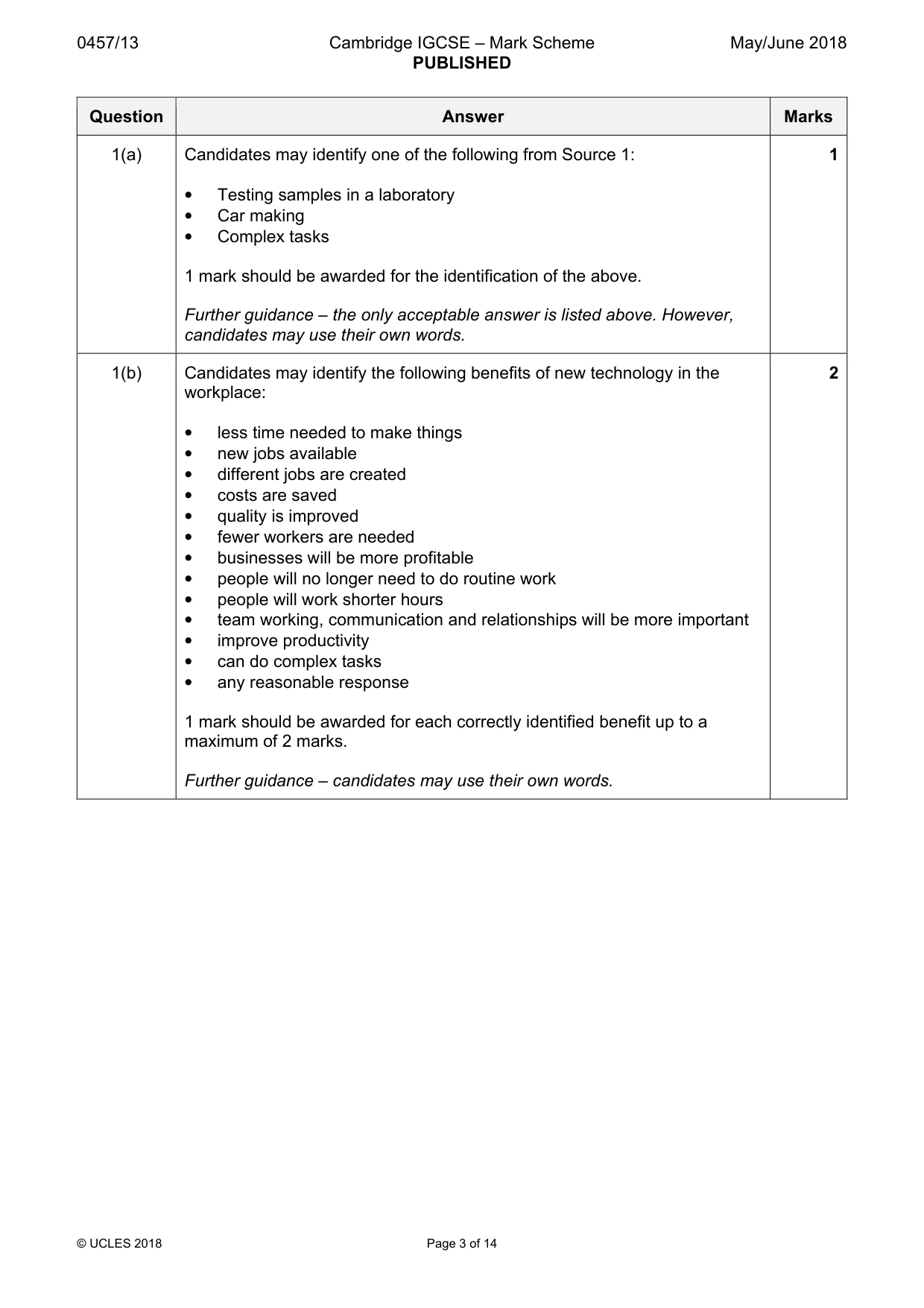
0457/13 Cambridge IGCSE – Mark Scheme PUBLISHED May/June 2018 © UCLES 2018 Page 2 of 14 Generic Marking Principles These general marking principles must be applied by all examiners when marking candidate answers. They should be applied alongside the specific content of the mark scheme or generic level descriptors for a question. Each question paper and mark scheme will also comply with these marking principles. GENERIC MARKING PRINCIPLE 1: Marks must be awarded in line with: • the specific content of the mark scheme or the generic level descriptors for the question • the specific skills defined in the mark scheme or in the generic level descriptors for the question • the standard of response required by a candidate as exemplified by the standardisation scripts. GENERIC MARKING PRINCIPLE 2: Marks awarded are always whole marks (not half marks, or other fractions). GENERIC MARKING PRINCIPLE 3: Marks must be awarded positively: • marks are awarded for correct/valid answers, as defined in the mark scheme. However, credit is given for valid answers which go beyond the scope of the syllabus and mark scheme, referring to your Team Leader as appropriate • marks are awarded when candidates clearly demonstrate what they know and can do • marks are not deducted for errors • marks are not deducted for omissions • answers should only be judged on the quality of spelling, punctuation and grammar when these features are specifically assessed by the question as indicated by the mark scheme. The meaning, however, should be unambiguous. GENERIC MARKING PRINCIPLE 4: Rules must be applied consistently e.g. in situations where candidates have not followed instructions or in the application of generic level descriptors. GENERIC MARKING PRINCIPLE 5: Marks should be awarded using the full range of marks defined in the mark scheme for the question (however; the use of the full mark range may be limited according to the quality of the candidate responses seen). GENERIC MARKING PRINCIPLE 6: Marks awarded are based solely on the requirements as defined in the mark scheme. Marks should not be awarded with grade thresholds or grade descriptors in mind.
Mark scheme, page 3
0457/13 Cambridge IGCSE – Mark Scheme PUBLISHED May/June 2018 © UCLES 2018 Page 3 of 14 Question Answer Marks 1(a) Candidates may identify one of the following from Source 1: • Testing samples in a laboratory • Car making • Complex tasks 1 mark should be awarded for the identification of the above. Further guidance – the only acceptable answer is listed above. However, candidates may use their own words. 1 1(b) Candidates may identify the following benefits of new technology in the workplace: • less time needed to make things • new jobs available • different jobs are created • costs are saved • quality is improved • fewer workers are needed • businesses will be more profitable • people will no longer need to do routine work • people will work shorter hours • team working, communication and relationships will be more important • improve productivity • can do complex tasks • any reasonable response 1 mark should be awarded for each correctly identified benefit up to a maximum of 2 marks. Further guidance – candidates may use their own words. 2
Mark scheme, page 4
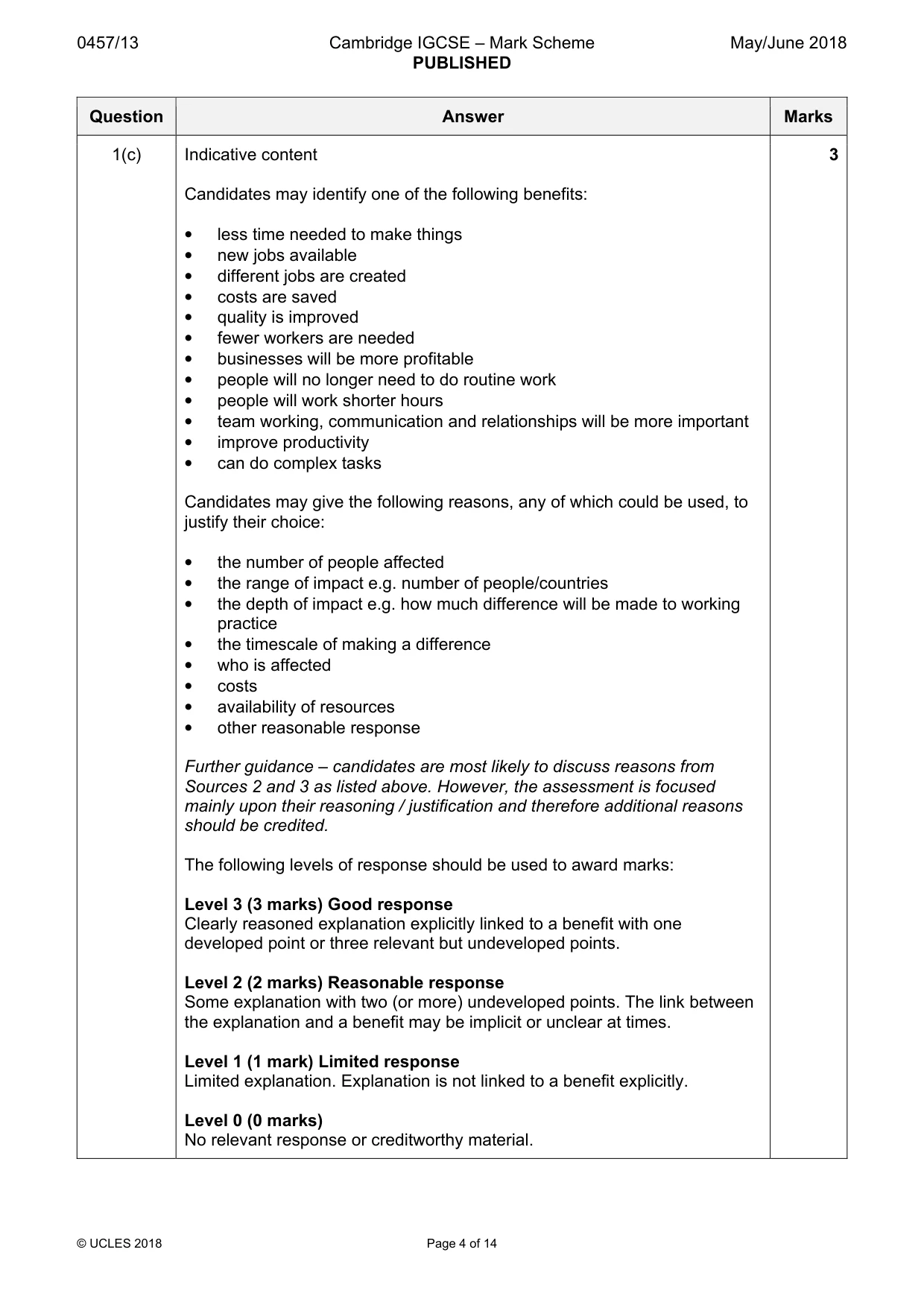
0457/13 Cambridge IGCSE – Mark Scheme PUBLISHED May/June 2018 © UCLES 2018 Page 4 of 14 Question Answer Marks 1(c) Indicative content Candidates may identify one of the following benefits: • less time needed to make things • new jobs available • different jobs are created • costs are saved • quality is improved • fewer workers are needed • businesses will be more profitable • people will no longer need to do routine work • people will work shorter hours • team working, communication and relationships will be more important • improve productivity • can do complex tasks Candidates may give the following reasons, any of which could be used, to justify their choice: • the number of people affected • the range of impact e.g. number of people/countries • the depth of impact e.g. how much difference will be made to working practice • the timescale of making a difference • who is affected • costs • availability of resources • other reasonable response Further guidance – candidates are most likely to discuss reasons from Sources 2 and 3 as listed above. However, the assessment is focused mainly upon their reasoning / justification and therefore additional reasons should be credited. The following levels of response should be used to award marks: Level 3 (3 marks) Good response Clearly reasoned explanation explicitly linked to a benefit with one developed point or three relevant but undeveloped points. Level 2 (2 marks) Reasonable response Some explanation with two (or more) undeveloped points. The link between the explanation and a benefit may be implicit or unclear at times. Level 1 (1 mark) Limited response Limited explanation. Explanation is not linked to a benefit explicitly. Level 0 (0 marks) No relevant response or creditworthy material. 3
Mark scheme, page 5
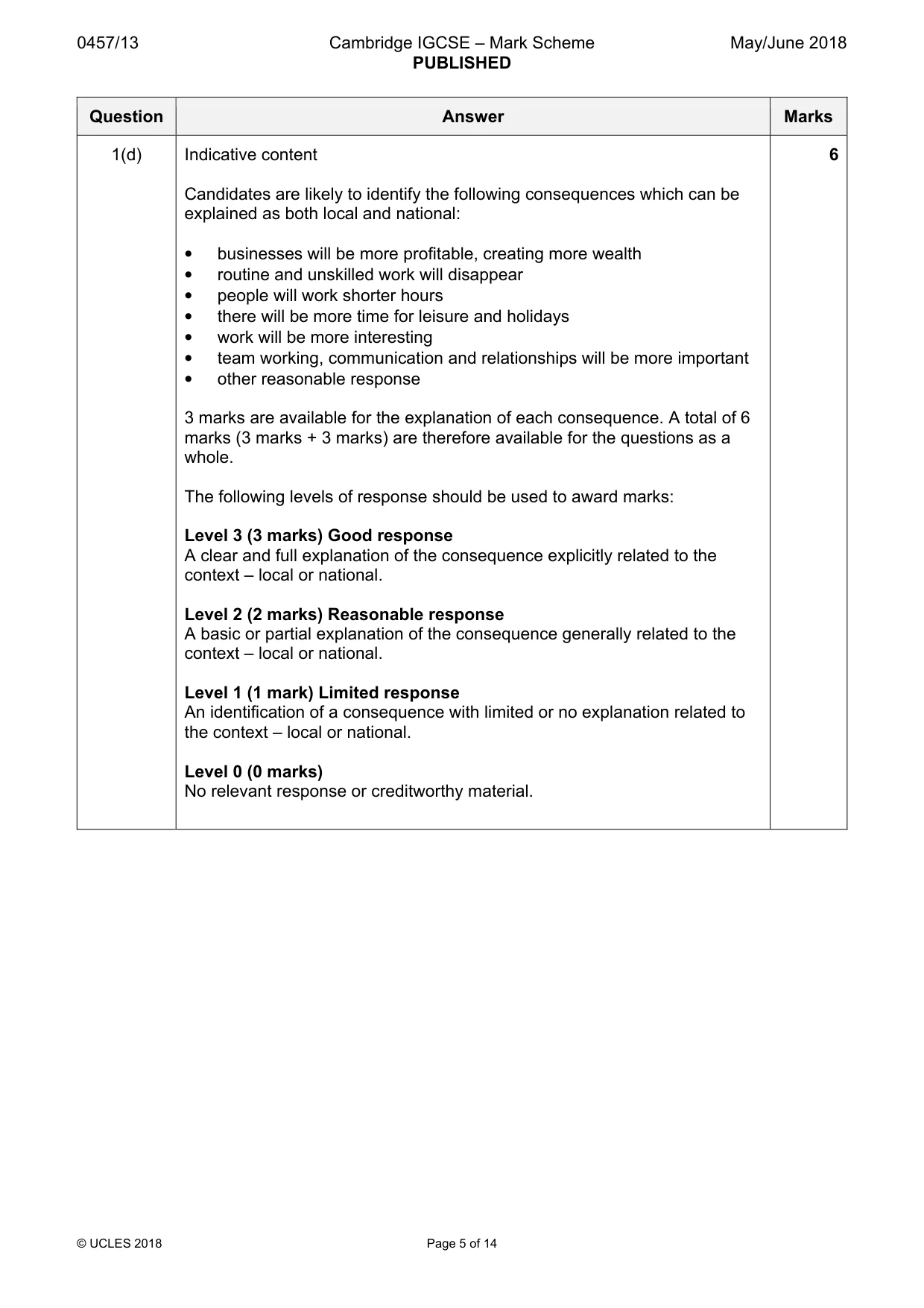
0457/13 Cambridge IGCSE – Mark Scheme PUBLISHED May/June 2018 © UCLES 2018 Page 5 of 14 Question Answer Marks 1(d) Indicative content Candidates are likely to identify the following consequences which can be explained as both local and national: • businesses will be more profitable, creating more wealth • routine and unskilled work will disappear • people will work shorter hours • there will be more time for leisure and holidays • work will be more interesting • team working, communication and relationships will be more important • other reasonable response 3 marks are available for the explanation of each consequence. A total of 6 marks (3 marks + 3 marks) are therefore available for the questions as a whole. The following levels of response should be used to award marks: Level 3 (3 marks) Good response A clear and full explanation of the consequence explicitly related to the context – local or national. Level 2 (2 marks) Reasonable response A basic or partial explanation of the consequence generally related to the context – local or national. Level 1 (1 mark) Limited response An identification of a consequence with limited or no explanation related to the context – local or national. Level 0 (0 marks) No relevant response or creditworthy material. 6
Mark scheme, page 6
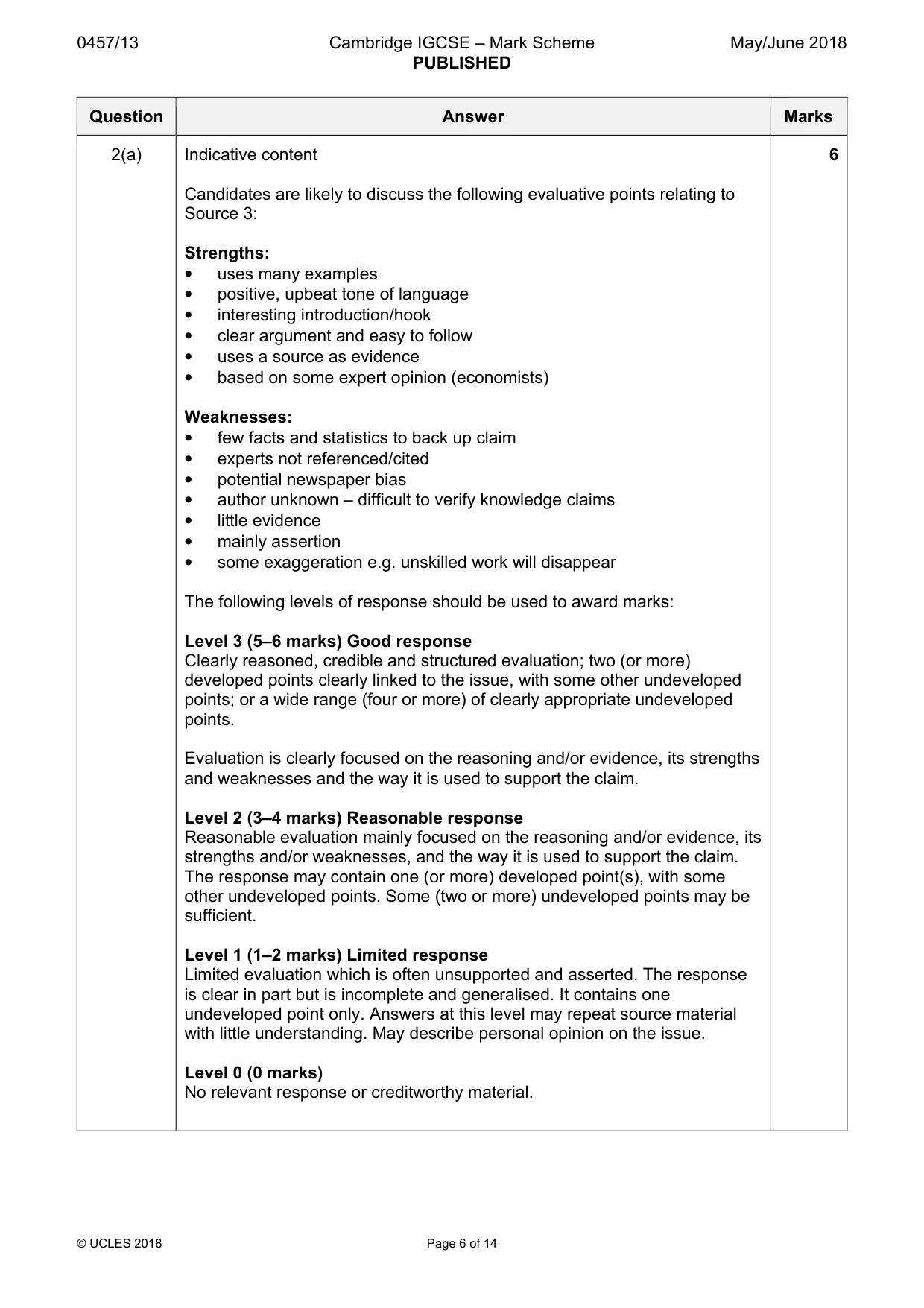
0457/13 Cambridge IGCSE – Mark Scheme PUBLISHED May/June 2018 © UCLES 2018 Page 6 of 14 Question Answer Marks 2(a) Indicative content Candidates are likely to discuss the following evaluative points relating to Source 3: Strengths: • uses many examples • positive, upbeat tone of language • interesting introduction/hook • clear argument and easy to follow • uses a source as evidence • based on some expert opinion (economists) Weaknesses: • few facts and statistics to back up claim • experts not referenced/cited • potential newspaper bias • author unknown – difficult to verify knowledge claims • little evidence • mainly assertion • some exaggeration e.g. unskilled work will disappear The following levels of response should be used to award marks: Level 3 (5–6 marks) Good response Clearly reasoned, credible and structured evaluation; two (or more) developed points clearly linked to the issue, with some other undeveloped points; or a wide range (four or more) of clearly appropriate undeveloped points. Evaluation is clearly focused on the reasoning and/or evidence, its strengths and weaknesses and the way it is used to support the claim. Level 2 (3–4 marks) Reasonable response Reasonable evaluation mainly focused on the reasoning and/or evidence, its strengths and/or weaknesses, and the way it is used to support the claim. The response may contain one (or more) developed point(s), with some other undeveloped points. Some (two or more) undeveloped points may be sufficient. Level 1 (1–2 marks) Limited response Limited evaluation which is often unsupported and asserted. The response is clear in part but is incomplete and generalised. It contains one undeveloped point only. Answers at this level may repeat source material with little understanding. May describe personal opinion on the issue. Level 0 (0 marks) No relevant response or creditworthy material. 6
Mark scheme, page 7
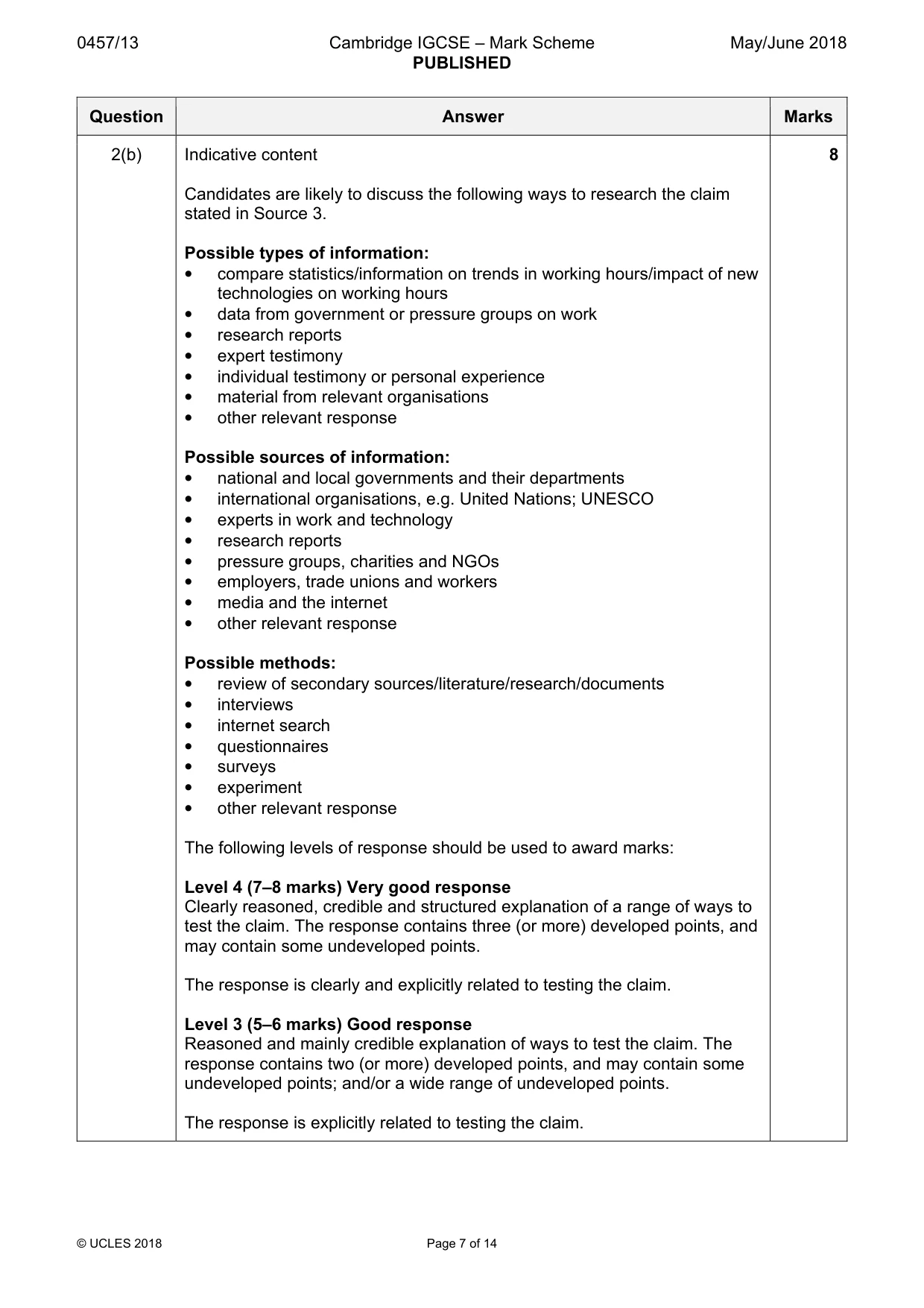
0457/13 Cambridge IGCSE – Mark Scheme PUBLISHED May/June 2018 © UCLES 2018 Page 7 of 14 Question Answer Marks 2(b) Indicative content Candidates are likely to discuss the following ways to research the claim stated in Source 3. Possible types of information: • compare statistics/information on trends in working hours/impact of new technologies on working hours • data from government or pressure groups on work • research reports • expert testimony • individual testimony or personal experience • material from relevant organisations • other relevant response Possible sources of information: • national and local governments and their departments • international organisations, e.g. United Nations; UNESCO • experts in work and technology • research reports • pressure groups, charities and NGOs • employers, trade unions and workers • media and the internet • other relevant response Possible methods: • review of secondary sources/literature/research/documents • interviews • internet search • questionnaires • surveys • experiment • other relevant response The following levels of response should be used to award marks: Level 4 (7–8 marks) Very good response Clearly reasoned, credible and structured explanation of a range of ways to test the claim. The response contains three (or more) developed points, and may contain some undeveloped points. The response is clearly and explicitly related to testing the claim. Level 3 (5–6 marks) Good response Reasoned and mainly credible explanation of ways to test the claim. The response contains two (or more) developed points, and may contain some undeveloped points; and/or a wide range of undeveloped points. The response is explicitly related to testing the claim. 8
Mark scheme, page 8
0457/13 Cambridge IGCSE – Mark Scheme PUBLISHED May/June 2018 © UCLES 2018 Page 8 of 14 Question Answer Marks 2(b) Level 2 (3–4 marks) Reasonable response Some reasoning and explanation of ways to test the claim. The response contains one (or more) developed point(s), and/or a range of undeveloped points. The response may lack clarity. The response is related to testing the claim. Level 1 (1–2 marks) Limited response Limited explanation of ways to test the claim. The response contains one or two simple, undeveloped and asserted points. There is little relevance in the response to testing the claim or the methods, sources and types of information are generally not appropriate for the claim being tested. Level 0 (0 marks) No relevant response or creditworthy material. Further Guidance Responses that do not link explicitly to the issue/context are unable to score higher than Level 2. Question Answer Marks 3(a) Indicative Content Candidates may identify one of the following from Source 4. • automation and the rise of robots will not bring us a better future • there will be fewer jobs • the managers and bosses will get huge pay rises • shareholders will take more of the profits • the gap between rich and poor will grow • this will help developing nations reduce poverty • some people find work fulfilling 1 mark should be awarded for the identification of one of the above. Further guidance – the only acceptable answers are listed above. However, candidates may use their own words. 1
Mark scheme, page 9
0457/13 Cambridge IGCSE – Mark Scheme PUBLISHED May/June 2018 © UCLES 2018 Page 9 of 14 Question Answer Marks 3(b) Indicative Content Candidates may identify one of the following from Source 4. • unemployment means less income for many people • bosses/managers make the decisions • my mother lost her job as a secretary when computers were introduced. • she loved working in the office and meeting people. • she has given up hope of ever finding a new job • many international organisations want work and income shared fairly • at work they can achieve something/support their own families • less time at work means more time for leisure • computers can do clerical work • fewer jobs results in more competition for work/lower wages 1 mark should be awarded for the identification of one of the above. Further guidance – the only acceptable answers are listed above. However, candidates may use their own words. 1
Mark scheme, page 10
0457/13 Cambridge IGCSE – Mark Scheme PUBLISHED May/June 2018 © UCLES 2018 Page 10 of 14 Question Answer Marks 3(c) Indicative Content A value judgement is a view or decision about what is right, wrong or important, based a particular set of standards, principles, or values. The following examples are found in Source 4. • The gap between rich and poor will grow; this is wrong. • It is right that wealth is used to create new jobs/better working conditions/ reduce working hours • Many international organisations want work and income shared fairly. Award 1 mark for correctly identifying an example of a value judgement from the list above. However, candidates may use their own words. Award an additional 1 mark for a response that demonstrates some understanding of a value judgement. For example: It is a value judgement that it is wrong that the gap between rich and poor will grow because it is a judgement about equality and fairness. Or Award an additional 2 marks for a clear understanding of value judgements. For example: demonstrates some understanding of a value judgement. For example: It is a value judgement that it is wrong that the gap between rich and poor will grow because this is a judgement about what is right or wrong based on his personal views on equality and fairness. Further Guidance The response must include a correct example of a value judgement to be awarded additional marks for the explanation. Accept, ‘Automation and the use of robots will not bring us a better future.’, if the response clearly relates the value judgement to a ‘better’ future. 3
Mark scheme, page 11
0457/13 Cambridge IGCSE – Mark Scheme PUBLISHED May/June 2018 © UCLES 2018 Page 11 of 14 Question Answer Marks 3(d) Indicative content Candidates are expected to evaluate the arguments presented in Source 4 and compare their effectiveness. They should make a supported judgement with some explanation about which person has the most convincing argument. Candidates may support their judgement by considering: Strength of reasoning: • logic • structure • balance • claims Authority and expertise • ability to know Use of language: • tone – emotive, exaggerated, precise, measured • clarity Evidence: • range of information and depth • relevance • sufficiency – sample • source – media; internet • date – how recent • different types of information – fact, opinion, value, anecdote • testimony – from experience and expert Sources of bias or vested interest: • local interest • personal interest • political • economic • personal values • experience Likely consequences or implications of the ideas presented Acceptability of their values to others • how likely other people are to agree with their perspective/view • the extent to which the views expressed are supported by the candidate 15
Mark scheme, page 12
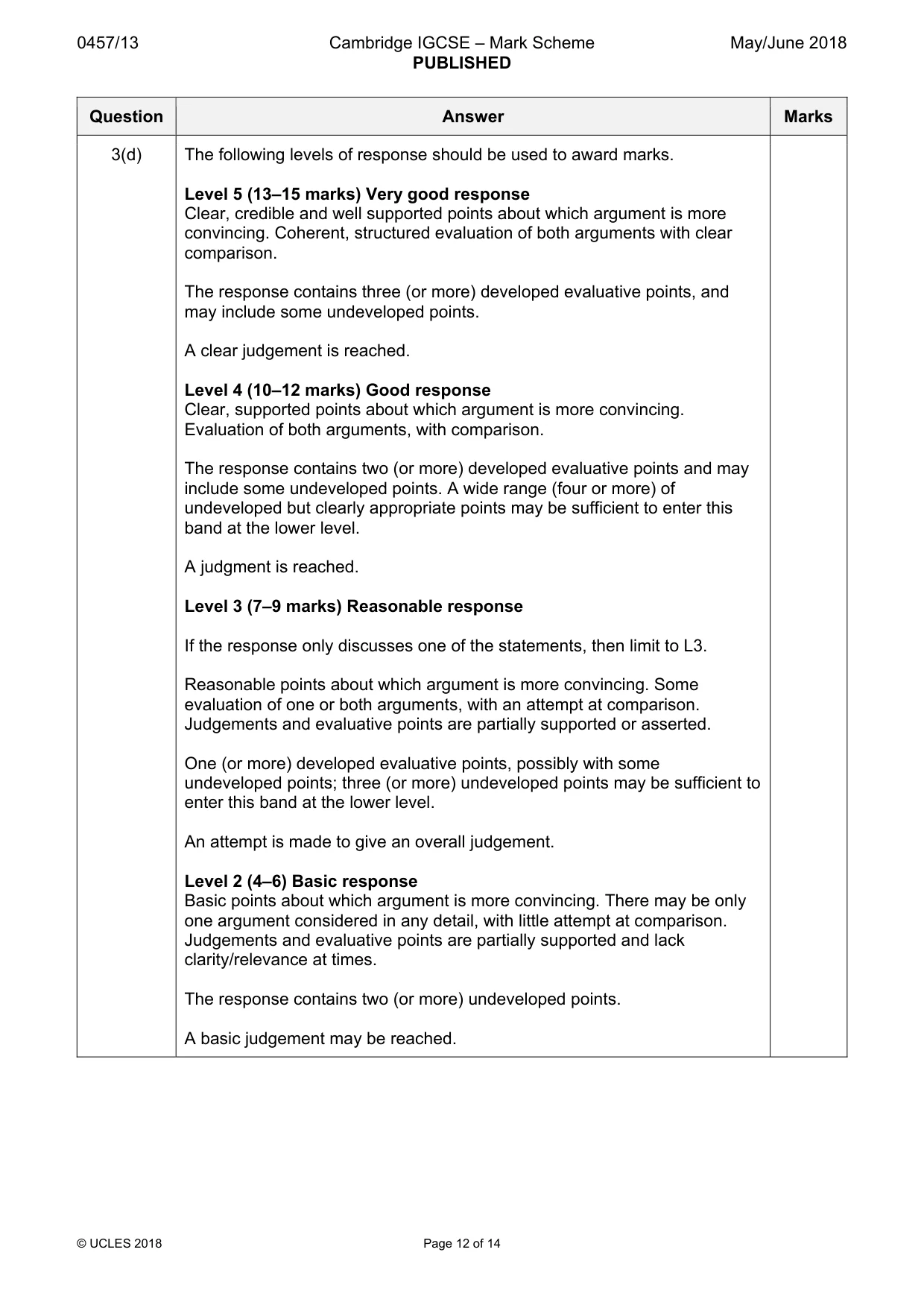
0457/13 Cambridge IGCSE – Mark Scheme PUBLISHED May/June 2018 © UCLES 2018 Page 12 of 14 Question Answer Marks 3(d) The following levels of response should be used to award marks. Level 5 (13–15 marks) Very good response Clear, credible and well supported points about which argument is more convincing. Coherent, structured evaluation of both arguments with clear comparison. The response contains three (or more) developed evaluative points, and may include some undeveloped points. A clear judgement is reached. Level 4 (10–12 marks) Good response Clear, supported points about which argument is more convincing. Evaluation of both arguments, with comparison. The response contains two (or more) developed evaluative points and may include some undeveloped points. A wide range (four or more) of undeveloped but clearly appropriate points may be sufficient to enter this band at the lower level. A judgment is reached. Level 3 (7–9 marks) Reasonable response If the response only discusses one of the statements, then limit to L3. Reasonable points about which argument is more convincing. Some evaluation of one or both arguments, with an attempt at comparison. Judgements and evaluative points are partially supported or asserted. One (or more) developed evaluative points, possibly with some undeveloped points; three (or more) undeveloped points may be sufficient to enter this band at the lower level. An attempt is made to give an overall judgement. Level 2 (4–6) Basic response Basic points about which argument is more convincing. There may be only one argument considered in any detail, with little attempt at comparison. Judgements and evaluative points are partially supported and lack clarity/relevance at times. The response contains two (or more) undeveloped points. A basic judgement may be reached.
Mark scheme, page 13
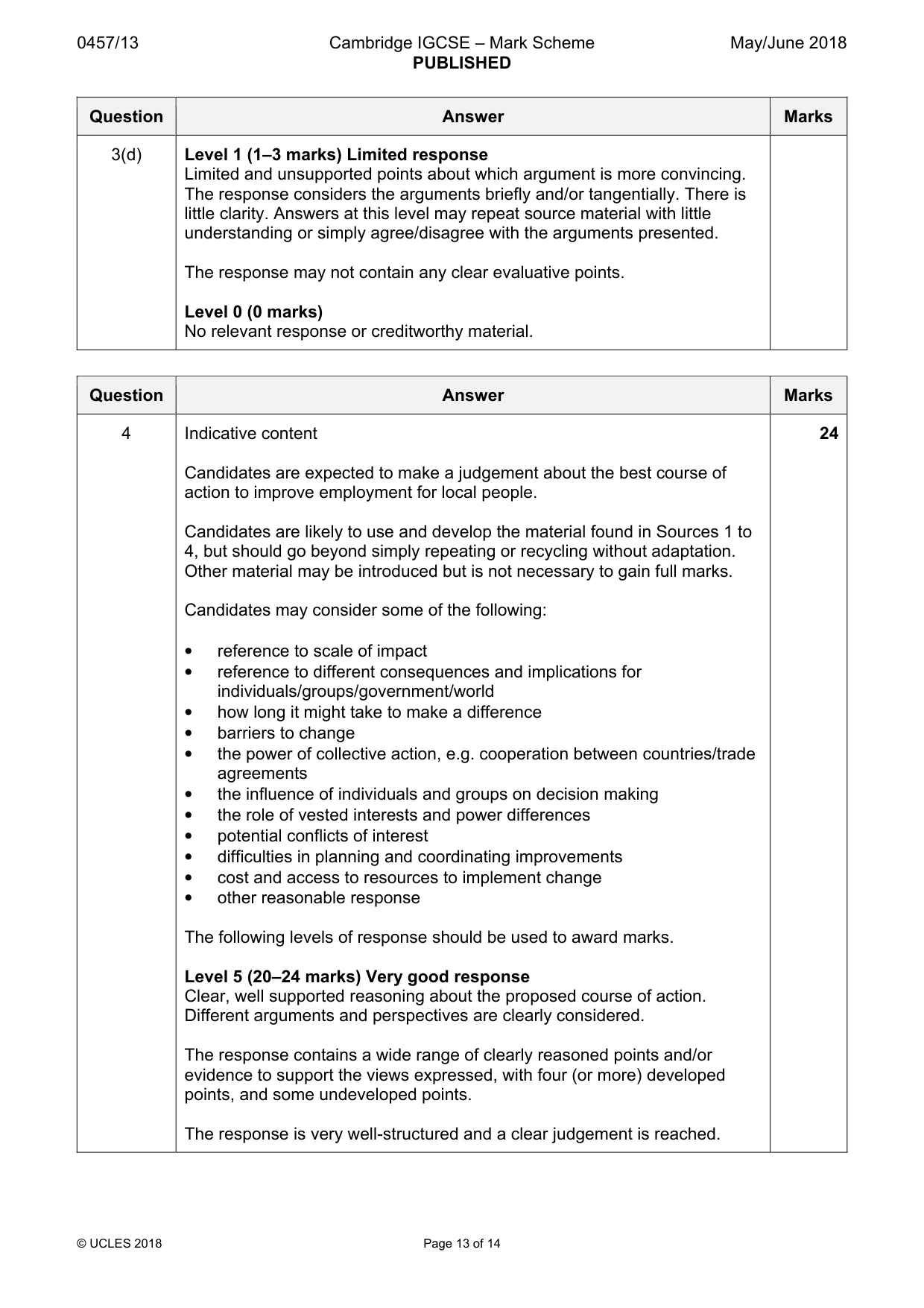
0457/13 Cambridge IGCSE – Mark Scheme PUBLISHED May/June 2018 © UCLES 2018 Page 13 of 14 Question Answer Marks 3(d) Level 1 (1–3 marks) Limited response Limited and unsupported points about which argument is more convincing. The response considers the arguments briefly and/or tangentially. There is little clarity. Answers at this level may repeat source material with little understanding or simply agree/disagree with the arguments presented. The response may not contain any clear evaluative points. Level 0 (0 marks) No relevant response or creditworthy material. Question Answer Marks 4 Indicative content Candidates are expected to make a judgement about the best course of action to improve employment for local people. Candidates are likely to use and develop the material found in Sources 1 to 4, but should go beyond simply repeating or recycling without adaptation. Other material may be introduced but is not necessary to gain full marks. Candidates may consider some of the following: • reference to scale of impact • reference to different consequences and implications for individuals/groups/government/world • how long it might take to make a difference • barriers to change • the power of collective action, e.g. cooperation between countries/trade agreements • the influence of individuals and groups on decision making • the role of vested interests and power differences • potential conflicts of interest • difficulties in planning and coordinating improvements • cost and access to resources to implement change • other reasonable response The following levels of response should be used to award marks. Level 5 (20–24 marks) Very good response Clear, well supported reasoning about the proposed course of action. Different arguments and perspectives are clearly considered. The response contains a wide range of clearly reasoned points and/or evidence to support the views expressed, with four (or more) developed points, and some undeveloped points. The response is very well-structured and a clear judgement is reached. 24
Mark scheme, page 14
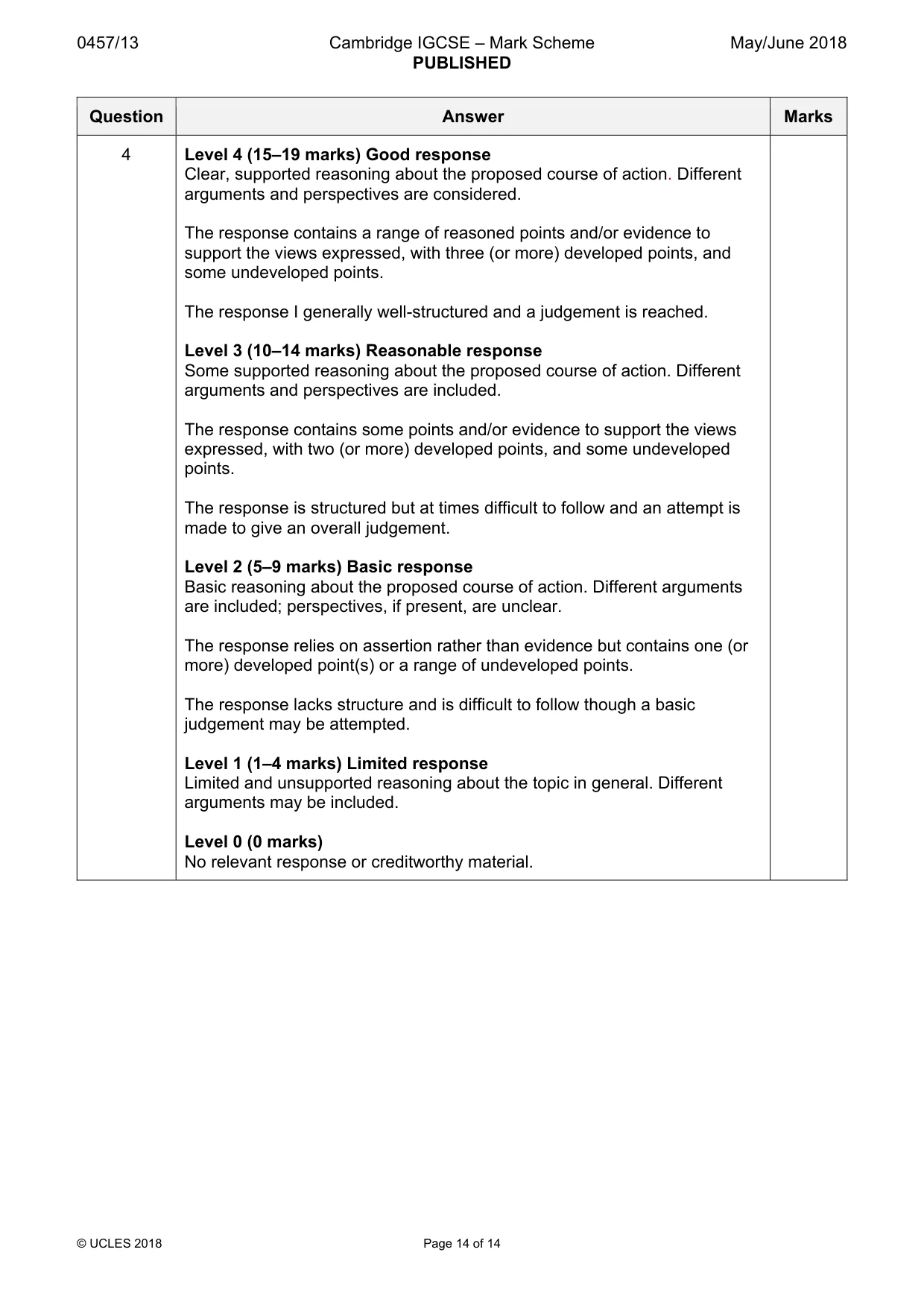
0457/13 Cambridge IGCSE – Mark Scheme PUBLISHED May/June 2018 © UCLES 2018 Page 14 of 14 Question Answer Marks 4 Level 4 (15–19 marks) Good response Clear, supported reasoning about the proposed course of action. Different arguments and perspectives are considered. The response contains a range of reasoned points and/or evidence to support the views expressed, with three (or more) developed points, and some undeveloped points. The response I generally well-structured and a judgement is reached. Level 3 (10–14 marks) Reasonable response Some supported reasoning about the proposed course of action. Different arguments and perspectives are included. The response contains some points and/or evidence to support the views expressed, with two (or more) developed points, and some undeveloped points. The response is structured but at times difficult to follow and an attempt is made to give an overall judgement. Level 2 (5–9 marks) Basic response Basic reasoning about the proposed course of action. Different arguments are included; perspectives, if present, are unclear. The response relies on assertion rather than evidence but contains one (or more) developed point(s) or a range of undeveloped points. The response lacks structure and is difficult to follow though a basic judgement may be attempted. Level 1 (1–4 marks) Limited response Limited and unsupported reasoning about the topic in general. Different arguments may be included. Level 0 (0 marks) No relevant response or creditworthy material.
What you needed in this session
Cambridge’s own grade thresholds for 2018 May/June, Paper 1 · Variant 3. A higher threshold means an easier paper — the bar moves with how the cohort did.