Cambridge IGCSE Global Perspectives 0457 — 2010 Oct/Nov Paper 3 · Variant 1
0457/31/O/N/10 · 100 marks · ≈113 min
The question paper and its mark scheme, free to read here and free to download. This is Cambridge’s own paper, exactly as it was sat.
Question paper12 pages

Mark scheme11 pages
Answers below. Sit the paper first if you are practising.
Paper as text
Question paper, page 1
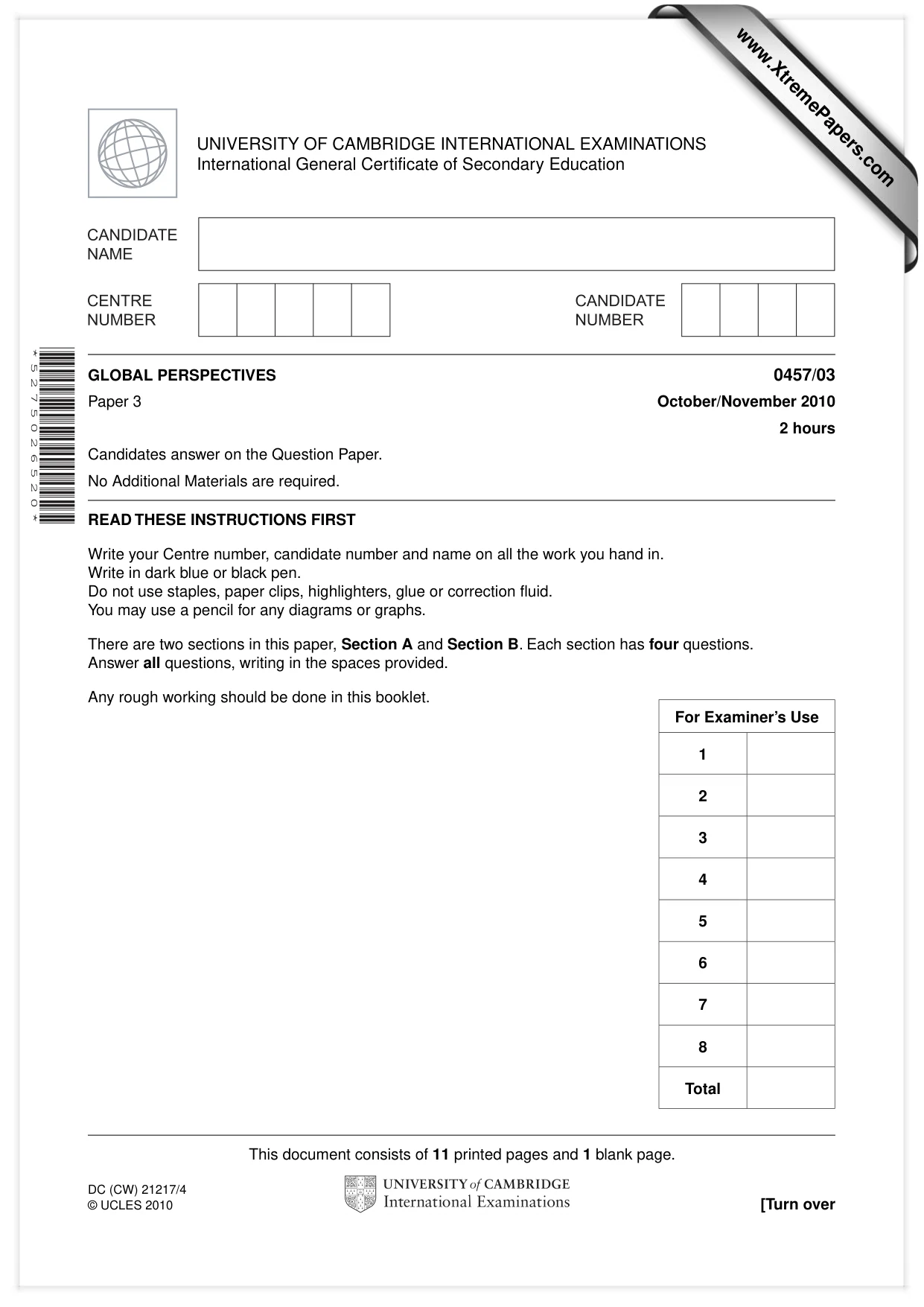
This document consists of 11 printed pages and 1 blank page. DC (CW) 21217/4 © UCLES 2010 [Turn over UNIVERSITY OF CAMBRIDGE INTERNATIONAL EXAMINATIONS International General Certificate of Secondary Education READ THESE INSTRUCTIONS FIRST Write your Centre number, candidate number and name on all the work you hand in. Write in dark blue or black pen. Do not use staples, paper clips, highlighters, glue or correction fluid. You may use a pencil for any diagrams or graphs. There are two sections in this paper, Section A and Section B. Each section has four questions. Answer all questions, writing in the spaces provided. Any rough working should be done in this booklet. * 5 2 7 5 0 2 6 5 2 0 * GLOBAL PERSPECTIVES 0457/03 Paper 3 October/November 2010 2 hours Candidates answer on the Question Paper. No Additional Materials are required. For Examiner’s Use 1 2 3 4 5 6 7 8 Total www.XtremePapers.com
Question paper, page 2
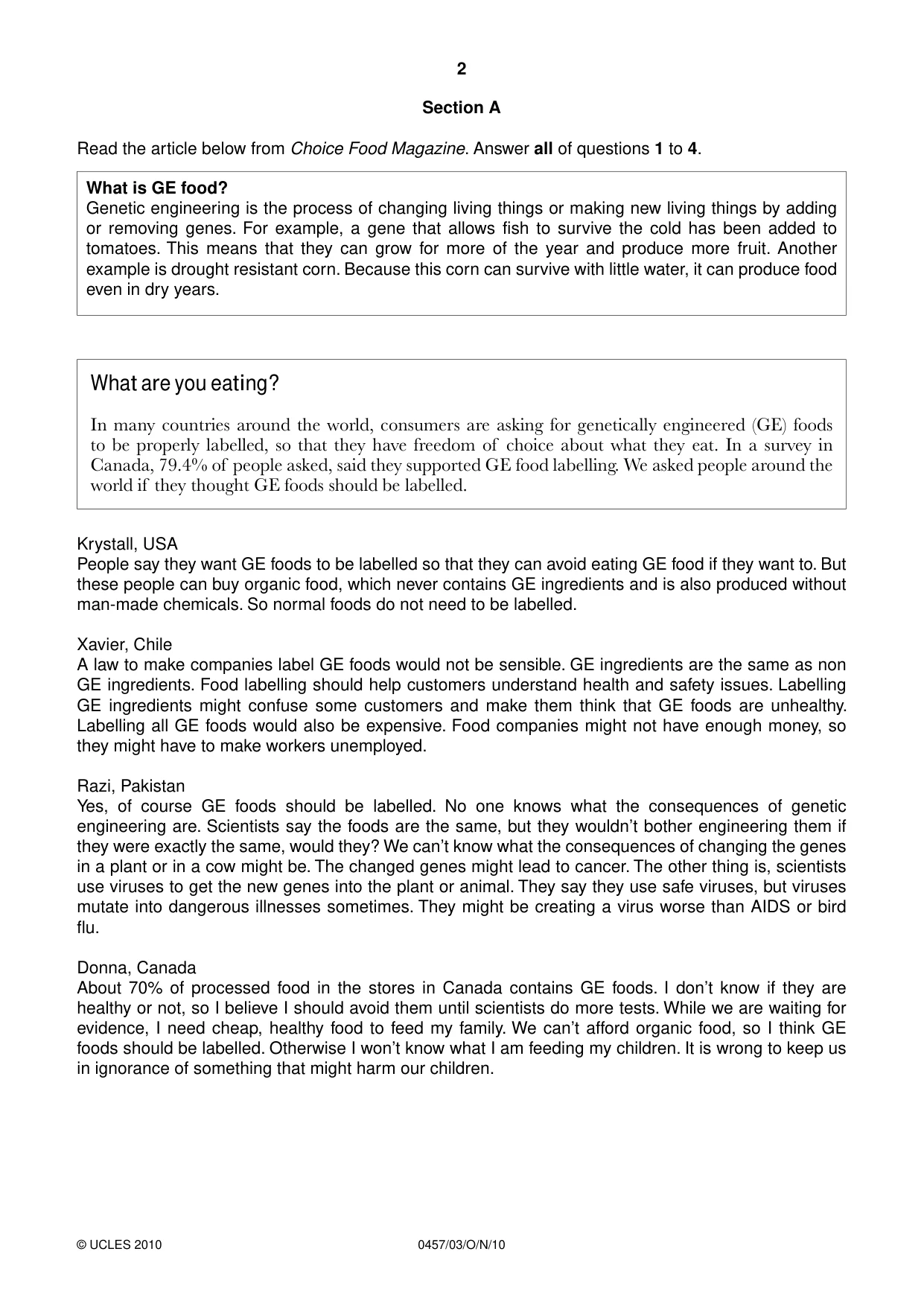
2 0457/03/O/N/10 © UCLES 2010 Section A Read the article below from Choice Food Magazine. Answer all of questions 1 to 4. What is GE food? Genetic engineering is the process of changing living things or making new living things by adding or removing genes. For example, a gene that allows fish to survive the cold has been added to tomatoes. This means that they can grow for more of the year and produce more fruit. Another example is drought resistant corn. Because this corn can survive with little water, it can produce food even in dry years. What are you eating? In many countries around the world, consumers are asking for genetically engineered (GE) foods to be properly labelled, so that they have freedom of choice about what they eat. In a survey in Canada, 79.4% of people asked, said they supported GE food labelling. We asked people around the world if they thought GE foods should be labelled. Krystall, USA People say they want GE foods to be labelled so that they can avoid eating GE food if they want to. But these people can buy organic food, which never contains GE ingredients and is also produced without man-made chemicals. So normal foods do not need to be labelled. Xavier, Chile A law to make companies label GE foods would not be sensible. GE ingredients are the same as non GE ingredients. Food labelling should help customers understand health and safety issues. Labelling GE ingredients might confuse some customers and make them think that GE foods are unhealthy. Labelling all GE foods would also be expensive. Food companies might not have enough money, so they might have to make workers unemployed. Razi, Pakistan Yes, of course GE foods should be labelled. No one knows what the consequences of genetic engineering are. Scientists say the foods are the same, but they wouldn’t bother engineering them if they were exactly the same, would they? We can’t know what the consequences of changing the genes in a plant or in a cow might be. The changed genes might lead to cancer. The other thing is, scientists use viruses to get the new genes into the plant or animal. They say they use safe viruses, but viruses mutate into dangerous illnesses sometimes. They might be creating a virus worse than AIDS or bird flu. Donna, Canada About 70% of processed food in the stores in Canada contains GE foods. I don’t know if they are healthy or not, so I believe I should avoid them until scientists do more tests. While we are waiting for evidence, I need cheap, healthy food to feed my family. We can’t afford organic food, so I think GE foods should be labelled. Otherwise I won’t know what I am feeding my children. It is wrong to keep us in ignorance of something that might harm our children.
Question paper, page 3
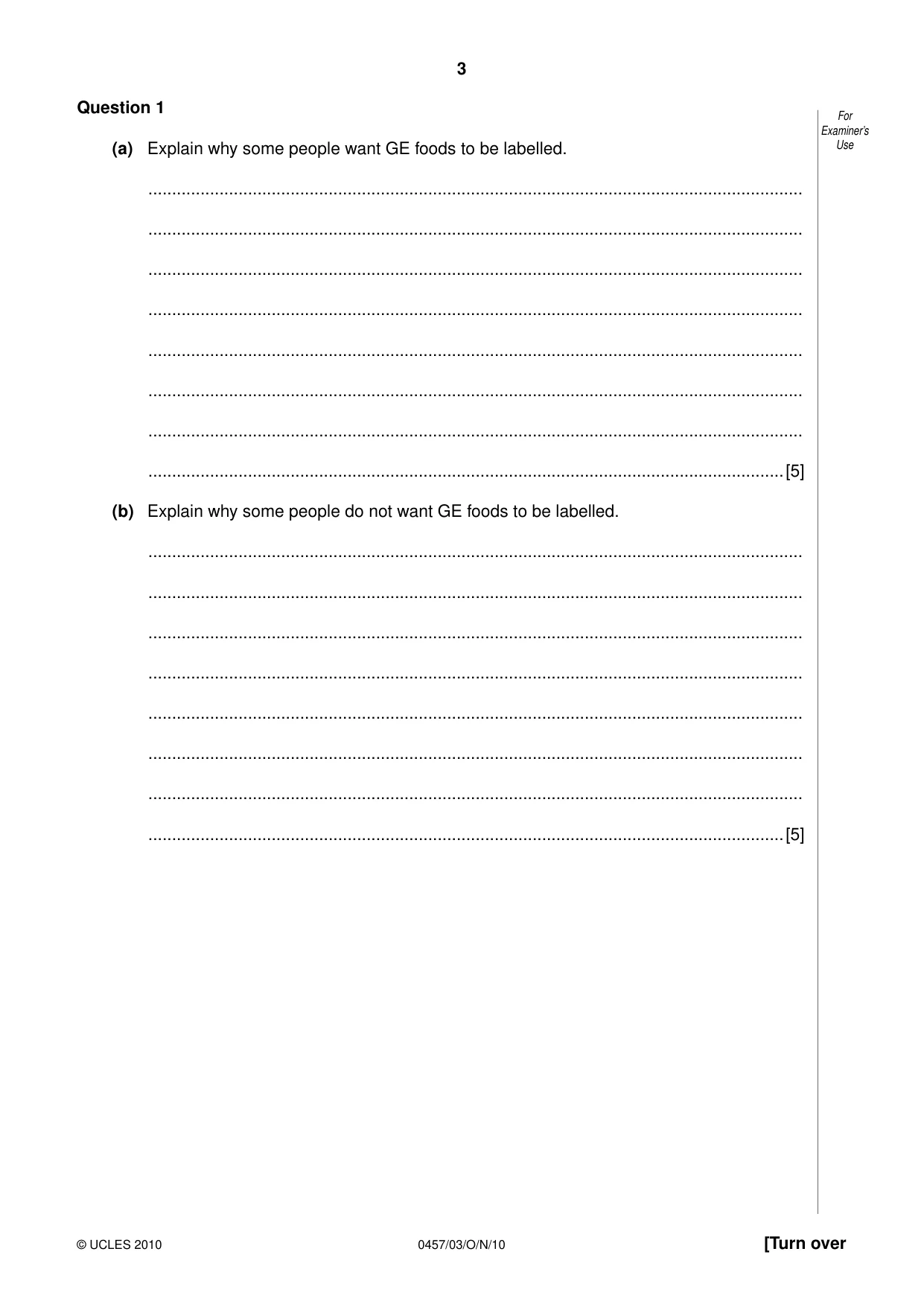
3 0457/03/O/N/10 © UCLES 2010 [Turn over For Examiner’s Use Question 1 (a) Explain why some people want GE foods to be labelled. … … … … … … … …[5] (b) Explain why some people do not want GE foods to be labelled. … … … … … … … …[5]
Question paper, page 4
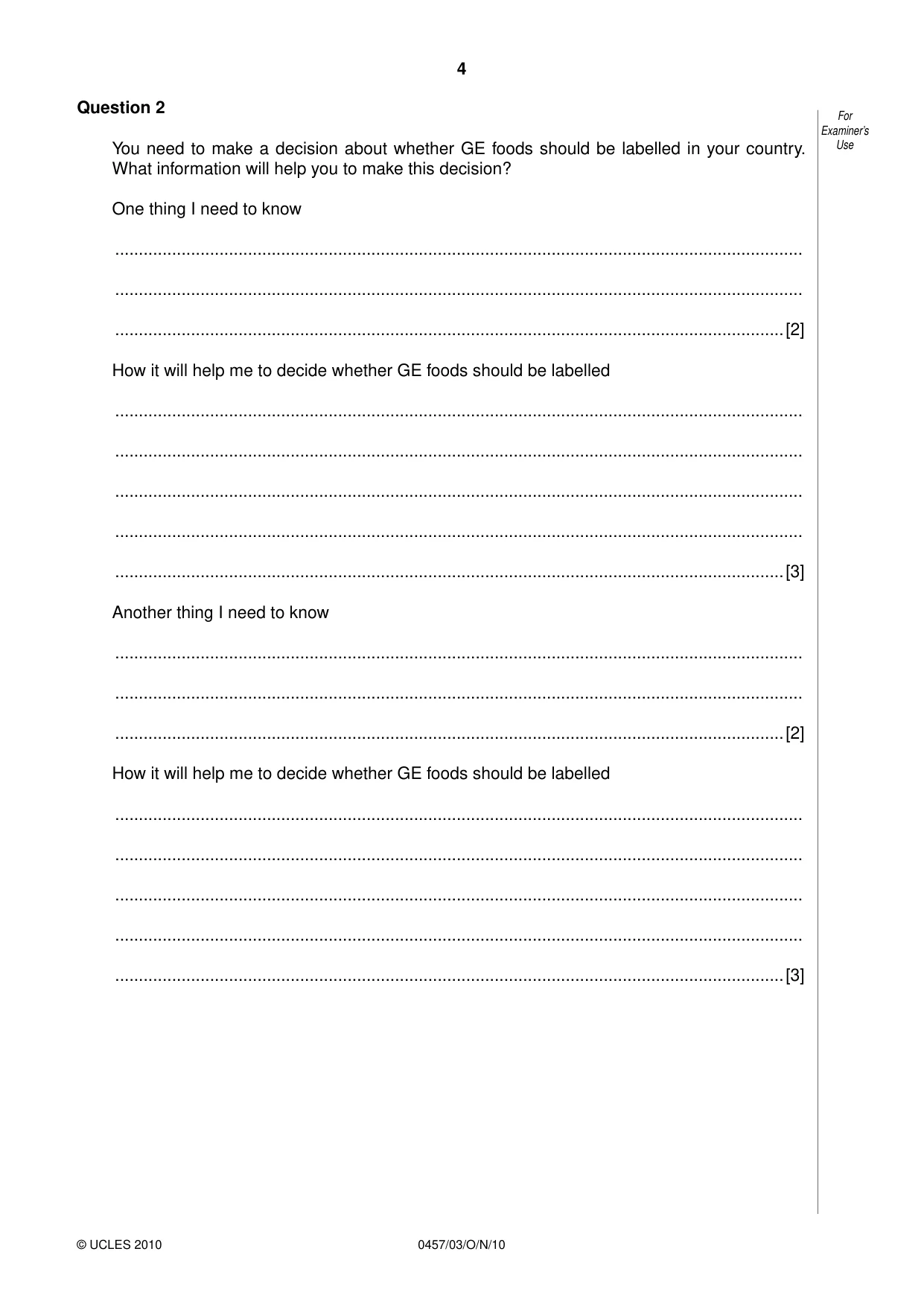
4 0457/03/O/N/10 © UCLES 2010 For Examiner’s Use Question 2 You need to make a decision about whether GE foods should be labelled in your country. What information will help you to make this decision? One thing I need to know … … …[2] How it will help me to decide whether GE foods should be labelled … … … … …[3] Another thing I need to know … … …[2] How it will help me to decide whether GE foods should be labelled … … … … …[3]
Question paper, page 5
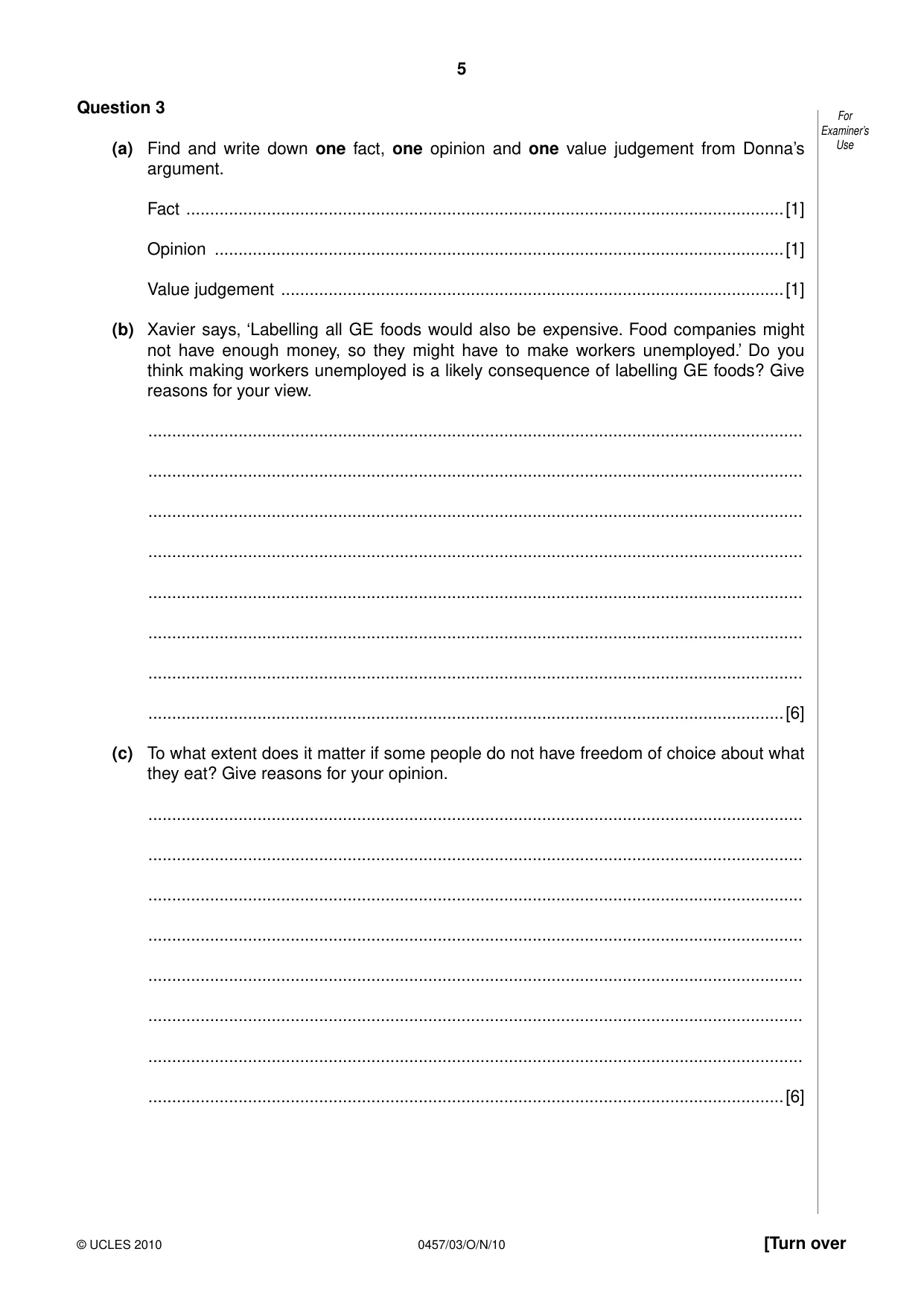
5 0457/03/O/N/10 © UCLES 2010 [Turn over For Examiner’s Use Question 3 (a) Find and write down one fact, one opinion and one value judgement from Donna’s argument. Fact …[1] Opinion …[1] Value judgement …[1] (b) Xavier says, ‘Labelling all GE foods would also be expensive. Food companies might not have enough money, so they might have to make workers unemployed.’ Do you think making workers unemployed is a likely consequence of labelling GE foods? Give reasons for your view. … … … … … … … …[6] (c) To what extent does it matter if some people do not have freedom of choice about what they eat? Give reasons for your opinion. … … … … … … … …[6]
Question paper, page 6
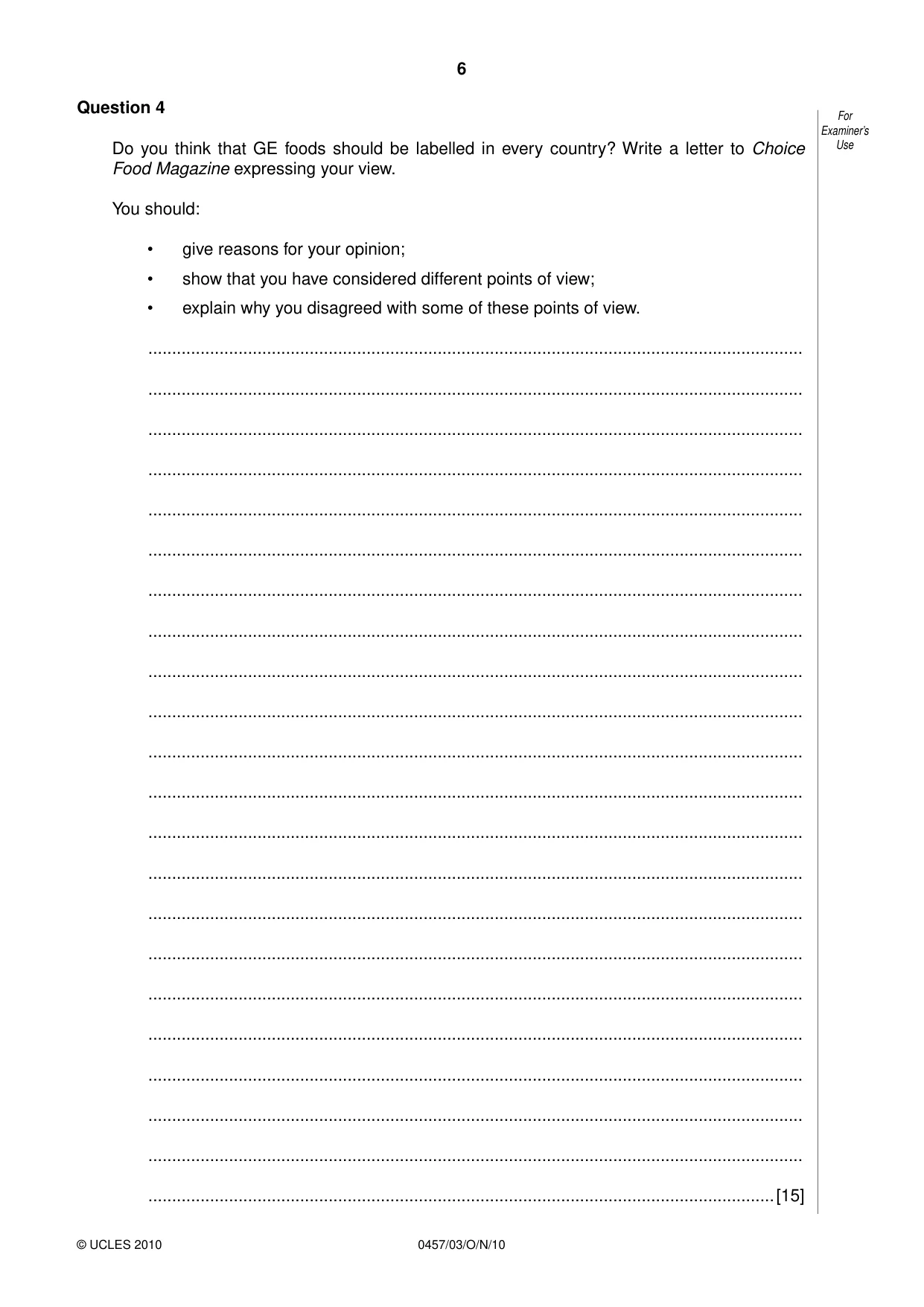
6 0457/03/O/N/10 © UCLES 2010 For Examiner’s Use Question 4 Do you think that GE foods should be labelled in every country? Write a letter to Choice Food Magazine expressing your view. You should: • give reasons for your opinion; • show that you have considered different points of view; • explain why you disagreed with some of these points of view. … … … … … … … … … … … … … … … … … … … … … …[15]
Question paper, page 7
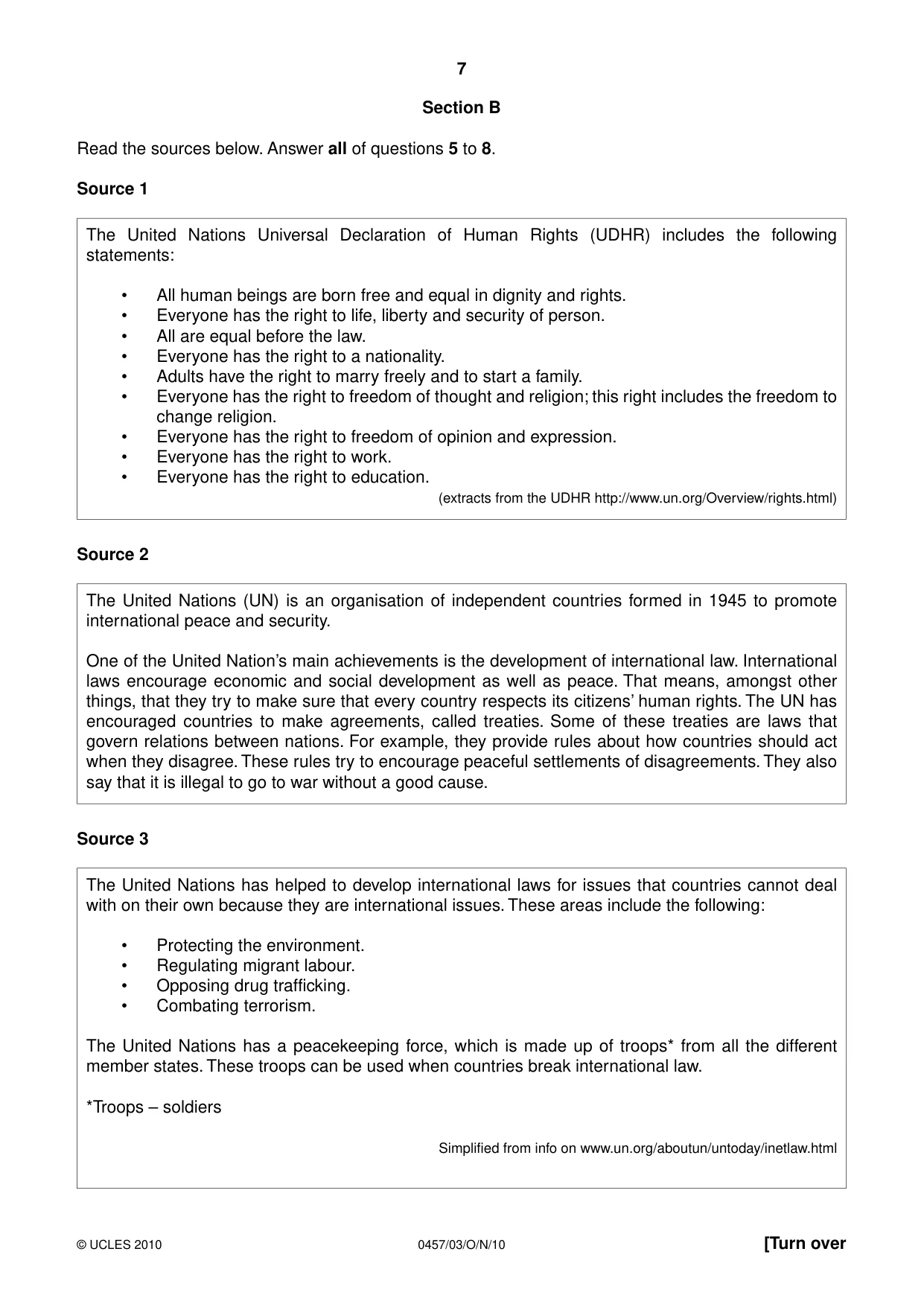
7 0457/03/O/N/10 © UCLES 2010 [Turn over Section B Read the sources below. Answer all of questions 5 to 8. Source 1 The United Nations Universal Declaration of Human Rights (UDHR) includes the following statements: • All human beings are born free and equal in dignity and rights. • Everyone has the right to life, liberty and security of person. • All are equal before the law. • Everyone has the right to a nationality. • Adults have the right to marry freely and to start a family. • Everyone has the right to freedom of thought and religion; this right includes the freedom to change religion. • Everyone has the right to freedom of opinion and expression. • Everyone has the right to work. • Everyone has the right to education. (extracts from the UDHR http://www.un.org/Overview/rights.html) Source 2 The United Nations (UN) is an organisation of independent countries formed in 1945 to promote international peace and security. One of the United Nation’s main achievements is the development of international law. International laws encourage economic and social development as well as peace. That means, amongst other things, that they try to make sure that every country respects its citizens’ human rights. The UN has encouraged countries to make agreements, called treaties. Some of these treaties are laws that govern relations between nations. For example, they provide rules about how countries should act when they disagree. These rules try to encourage peaceful settlements of disagreements. They also say that it is illegal to go to war without a good cause. Source 3 The United Nations has helped to develop international laws for issues that countries cannot deal with on their own because they are international issues. These areas include the following: • Protecting the environment. • Regulating migrant labour. • Opposing drug trafficking. • Combating terrorism. The United Nations has a peacekeeping force, which is made up of troops* from all the different member states. These troops can be used when countries break international law. *Troops – soldiers Simplified from info on www.un.org/aboutun/untoday/inetlaw.html
Question paper, page 8
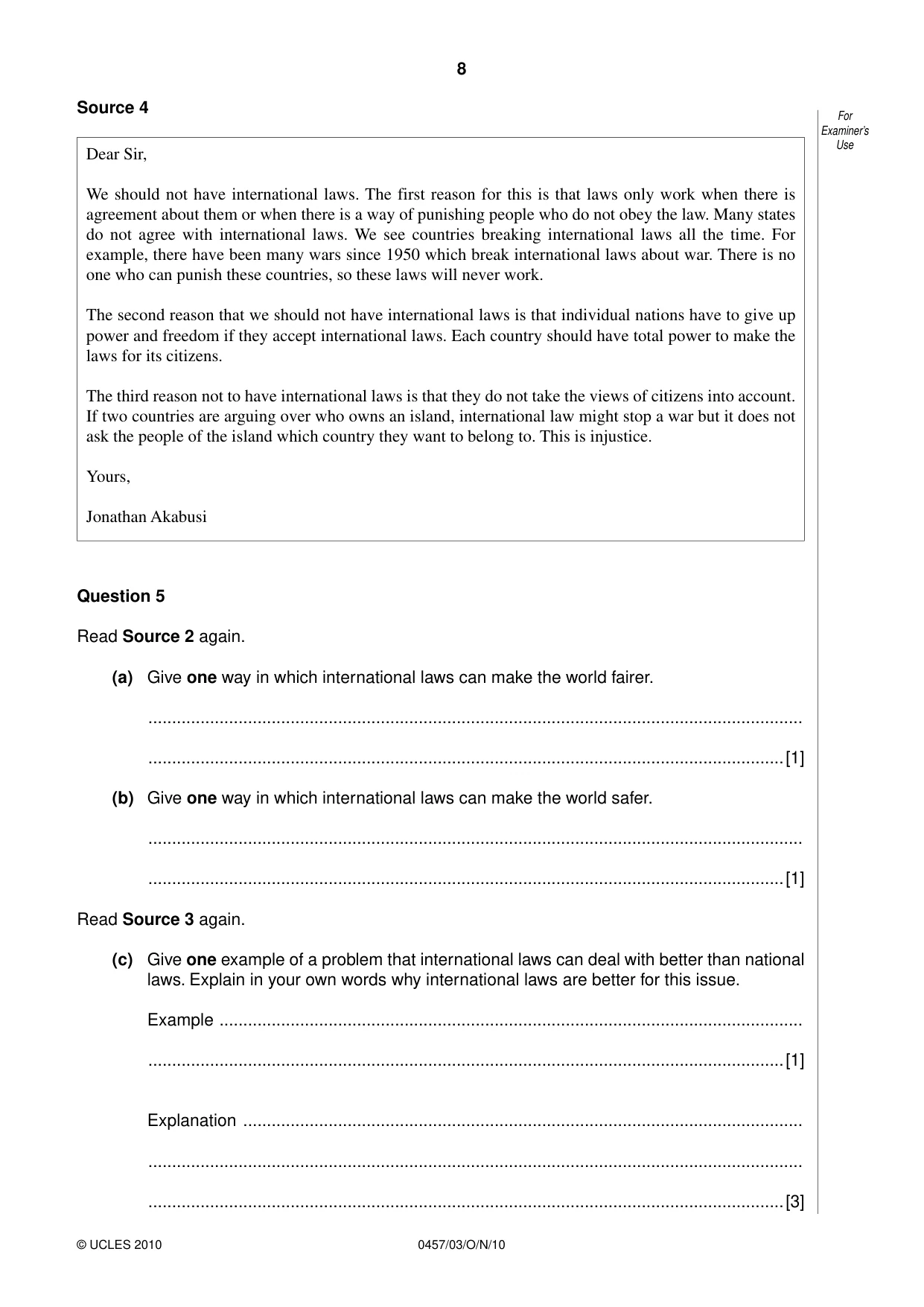
8 0457/03/O/N/10 © UCLES 2010 For Examiner’s Use Source 4 Dear Sir, We should not have international laws. The first reason for this is that laws only work when there is agreement about them or when there is a way of punishing people who do not obey the law. Many states do not agree with international laws. We see countries breaking international laws all the time. For example, there have been many wars since 1950 which break international laws about war. There is no one who can punish these countries, so these laws will never work. The second reason that we should not have international laws is that individual nations have to give up power and freedom if they accept international laws. Each country should have total power to make the laws for its citizens. The third reason not to have international laws is that they do not take the views of citizens into account. If two countries are arguing over who owns an island, international law might stop a war but it does not ask the people of the island which country they want to belong to. This is injustice. Yours, Jonathan Akabusi Question 5 Read Source 2 again. (a) Give one way in which international laws can make the world fairer. … …[1] (b) Give one way in which international laws can make the world safer. … …[1] Read Source 3 again. (c) Give one example of a problem that international laws can deal with better than national laws. Explain in your own words why international laws are better for this issue. Example … …[1] Explanation … … …[3]
Question paper, page 9
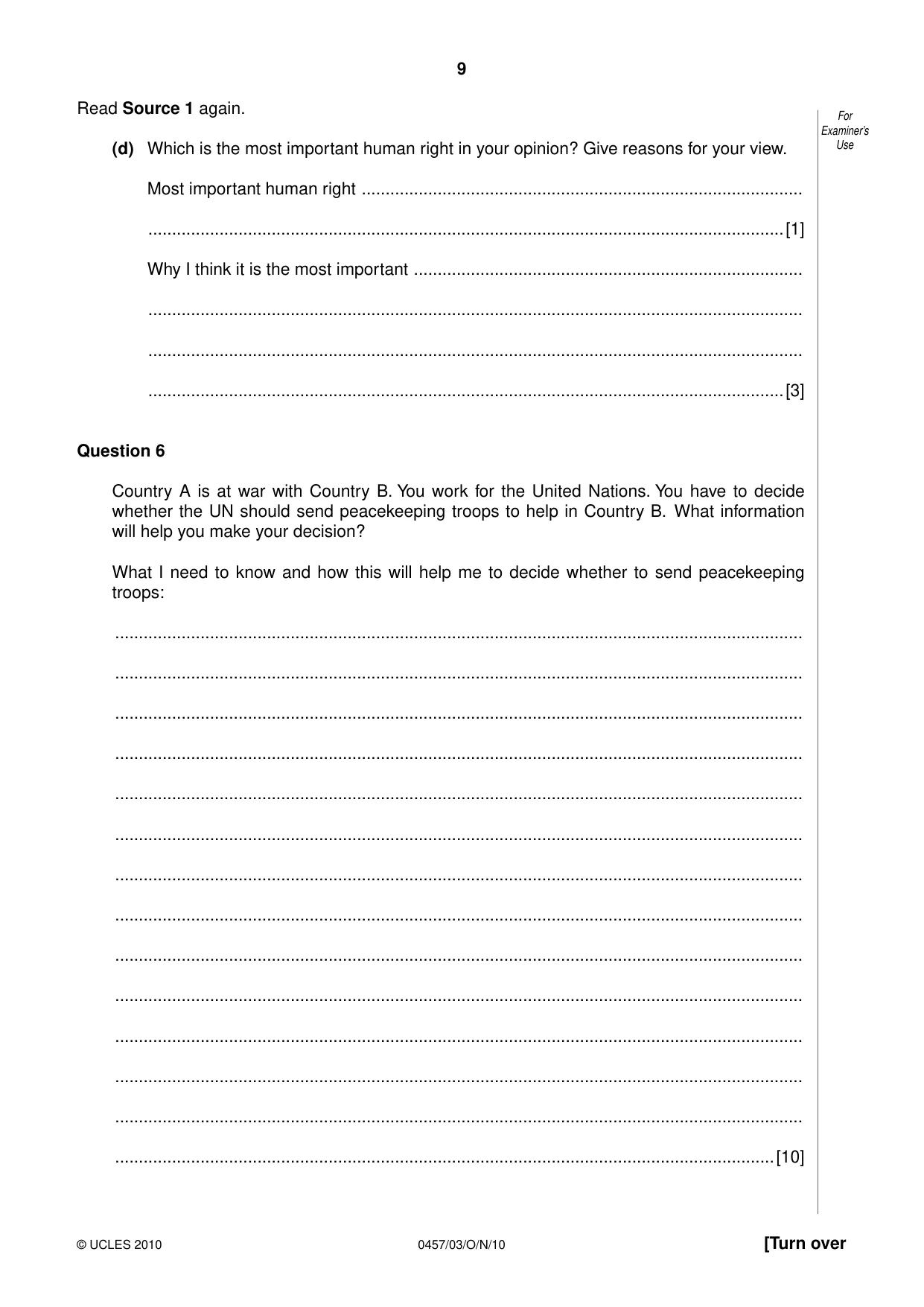
9 0457/03/O/N/10 © UCLES 2010 [Turn over For Examiner’s Use Read Source 1 again. (d) Which is the most important human right in your opinion? Give reasons for your view. Most important human right … …[1] Why I think it is the most important … … … …[3] Question 6 Country A is at war with Country B. You work for the United Nations. You have to decide whether the UN should send peacekeeping troops to help in Country B. What information will help you make your decision? What I need to know and how this will help me to decide whether to send peacekeeping troops: … … … … … … … … … … … … … …[10]
Question paper, page 10
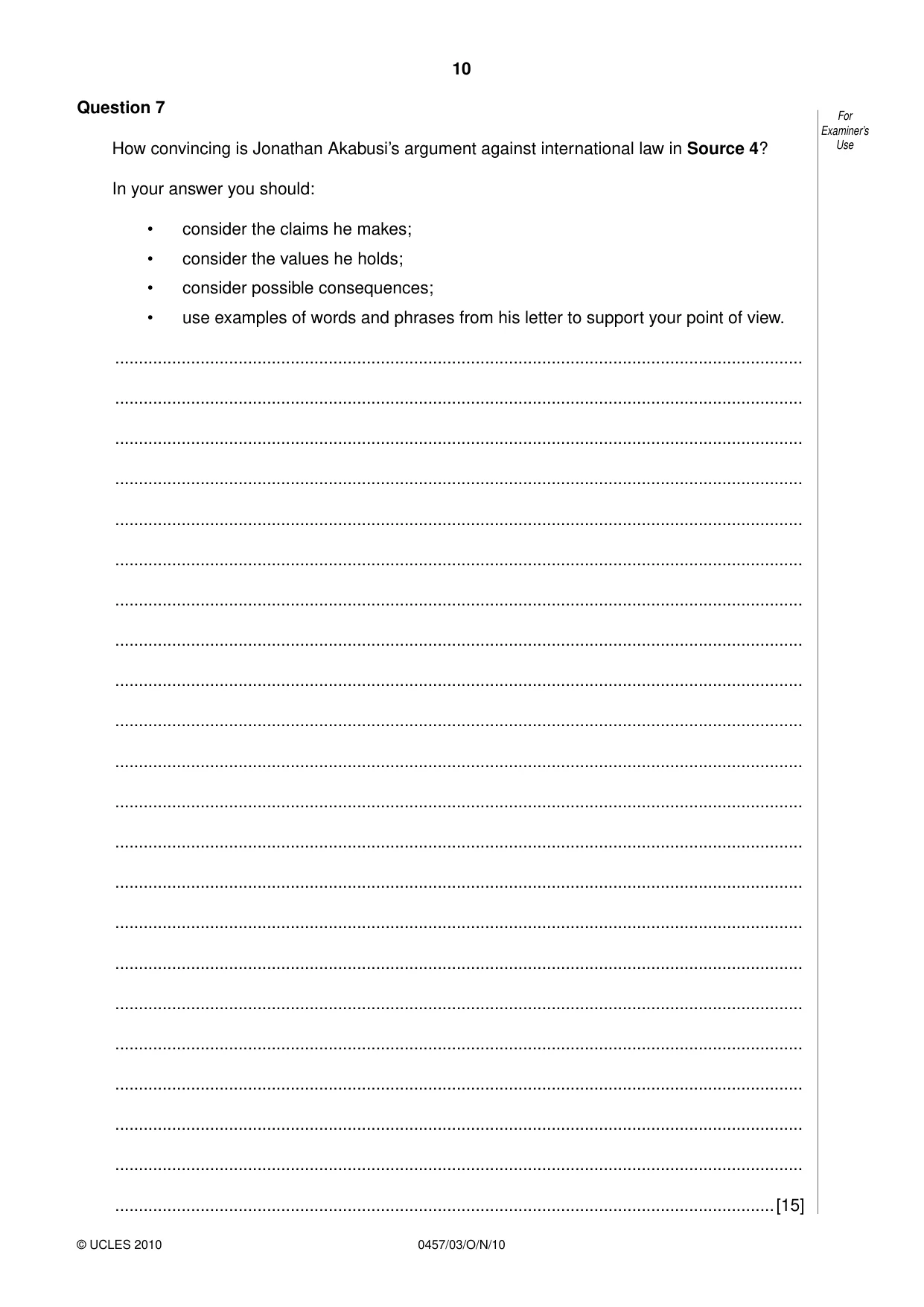
10 0457/03/O/N/10 © UCLES 2010 For Examiner’s Use Question 7 How convincing is Jonathan Akabusi’s argument against international law in Source 4? In your answer you should: • consider the claims he makes; • consider the values he holds; • consider possible consequences; • use examples of words and phrases from his letter to support your point of view. … … … … … … … … … … … … … … … … … … … … … …[15]
Question paper, page 11
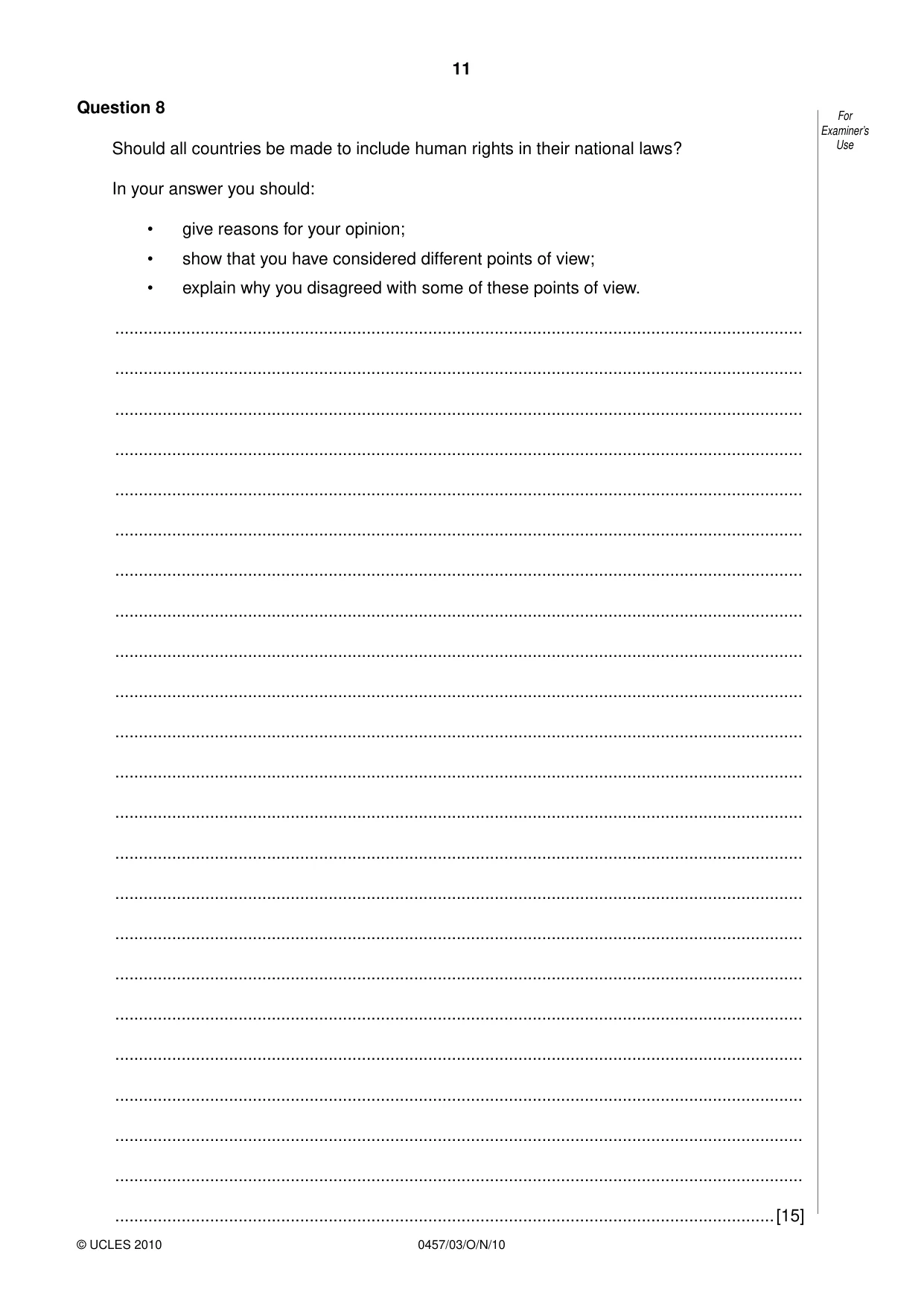
11 0457/03/O/N/10 © UCLES 2010 For Examiner’s Use Question 8 Should all countries be made to include human rights in their national laws? In your answer you should: • give reasons for your opinion; • show that you have considered different points of view; • explain why you disagreed with some of these points of view. … … … … … … … … … … … … … … … … … … … … … … …[15]
Question paper, page 12
12 0457/03/O/N/10 © UCLES 2010 BLANK PAGE Permission to reproduce items where third-party owned material protected by copyright is included has been sought and cleared where possible. Every reasonable effort has been made by the publisher (UCLES) to trace copyright holders, but if any items requiring clearance have unwittingly been included, the publisher will be pleased to make amends at the earliest possible opportunity. University of Cambridge International Examinations is part of the Cambridge Assessment Group. Cambridge Assessment is the brand name of University of Cambridge Local Examinations Syndicate (UCLES), which is itself a department of the University of Cambridge.
Mark scheme, page 1
UNIVERSITY OF CAMBRIDGE INTERNATIONAL EXAMINATIONS International General Certificate of Secondary Education MARK SCHEME for the October/November 2010 question paper for the guidance of teachers 0457 GLOBAL PERSPECTIVES 0457/03 Paper 3 (Written Paper), maximum raw mark 100 This mark scheme is published as an aid to teachers and candidates, to indicate the requirements of the examination. It shows the basis on which Examiners were instructed to award marks. It does not indicate the details of the discussions that took place at an Examiners’ meeting before marking began, which would have considered the acceptability of alternative answers. Mark schemes must be read in conjunction with the question papers and the report on the examination. • CIE will not enter into discussions or correspondence in connection with these mark schemes. CIE is publishing the mark schemes for the October/November 2010 question papers for most IGCSE, GCE Advanced Level and Advanced Subsidiary Level syllabuses and some Ordinary Level syllabuses. www.XtremePapers.com
Mark scheme, page 2
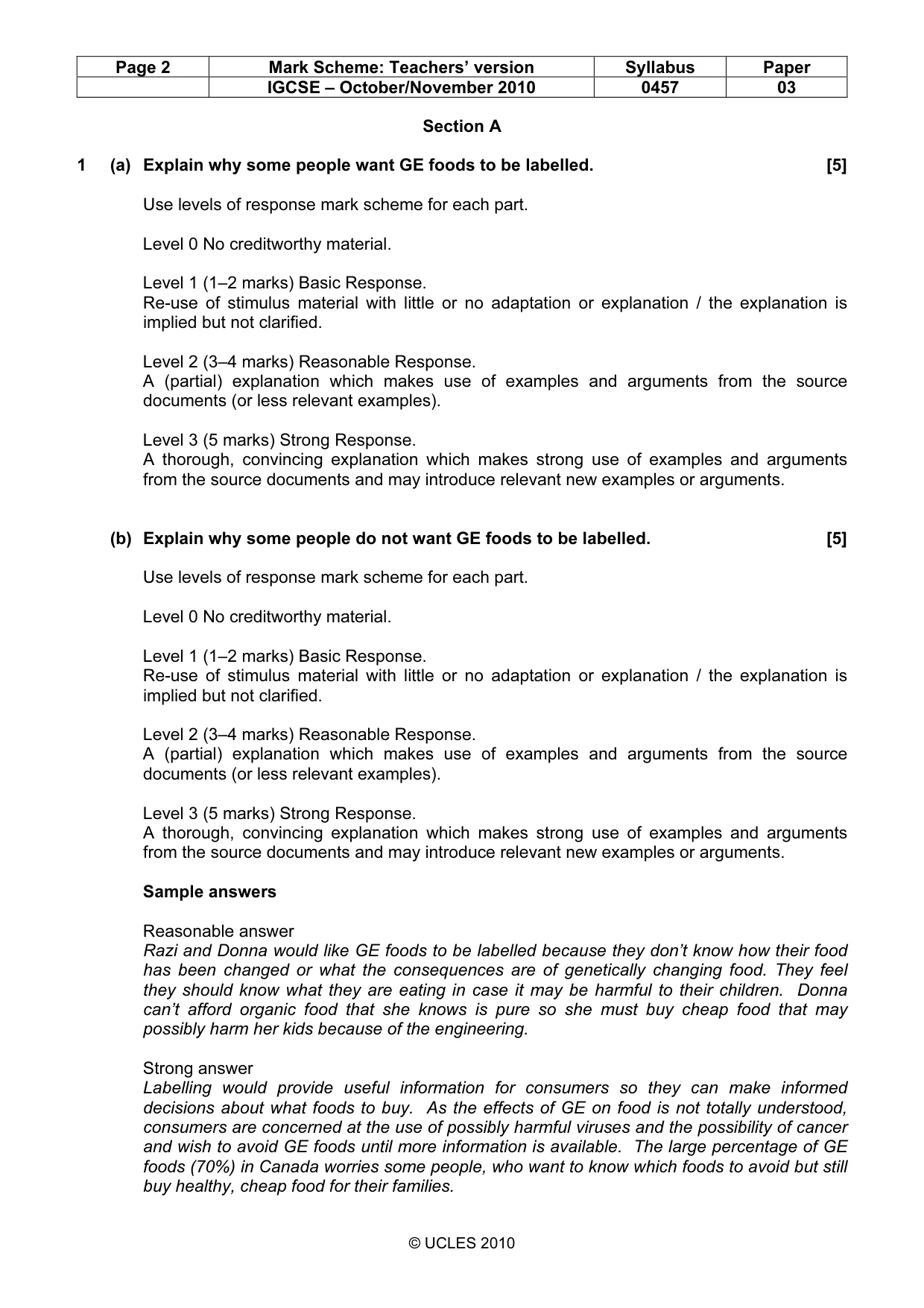
Page 2 Mark Scheme: Teachers’ version Syllabus Paper IGCSE – October/November 2010 0457 03 © UCLES 2010 Section A 1 (a) Explain why some people want GE foods to be labelled. [5] Use levels of response mark scheme for each part. Level 0 No creditworthy material. Level 1 (1–2 marks) Basic Response. Re-use of stimulus material with little or no adaptation or explanation / the explanation is implied but not clarified. Level 2 (3–4 marks) Reasonable Response. A (partial) explanation which makes use of examples and arguments from the source documents (or less relevant examples). Level 3 (5 marks) Strong Response. A thorough, convincing explanation which makes strong use of examples and arguments from the source documents and may introduce relevant new examples or arguments. (b) Explain why some people do not want GE foods to be labelled. [5] Use levels of response mark scheme for each part. Level 0 No creditworthy material. Level 1 (1–2 marks) Basic Response. Re-use of stimulus material with little or no adaptation or explanation / the explanation is implied but not clarified. Level 2 (3–4 marks) Reasonable Response. A (partial) explanation which makes use of examples and arguments from the source documents (or less relevant examples). Level 3 (5 marks) Strong Response. A thorough, convincing explanation which makes strong use of examples and arguments from the source documents and may introduce relevant new examples or arguments. Sample answers Reasonable answer Razi and Donna would like GE foods to be labelled because they don’t know how their food has been changed or what the consequences are of genetically changing food. They feel they should know what they are eating in case it may be harmful to their children. Donna can’t afford organic food that she knows is pure so she must buy cheap food that may possibly harm her kids because of the engineering. Strong answer Labelling would provide useful information for consumers so they can make informed decisions about what foods to buy. As the effects of GE on food is not totally understood, consumers are concerned at the use of possibly harmful viruses and the possibility of cancer and wish to avoid GE foods until more information is available. The large percentage of GE foods (70%) in Canada worries some people, who want to know which foods to avoid but still buy healthy, cheap food for their families.
Mark scheme, page 3
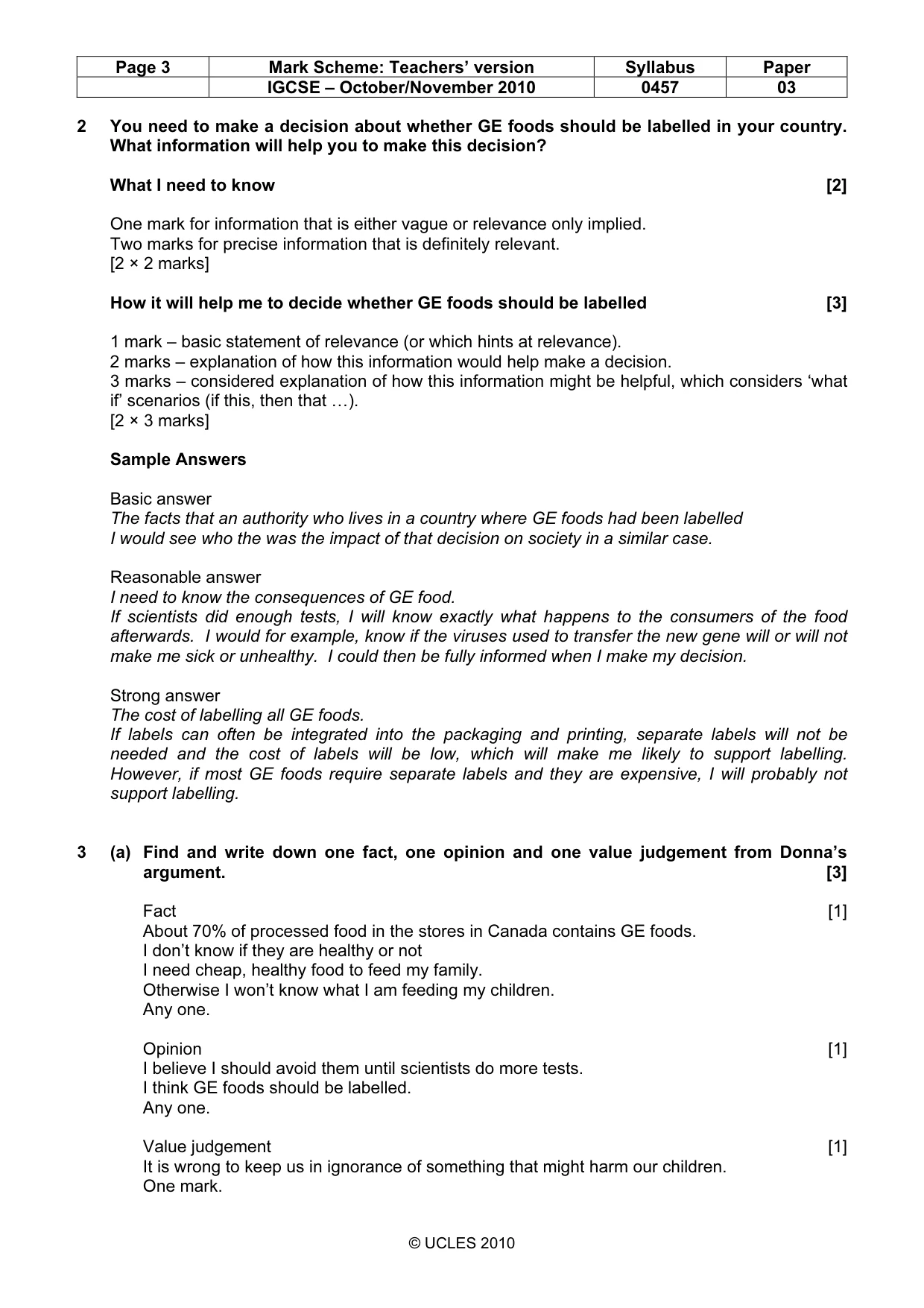
Page 3 Mark Scheme: Teachers’ version Syllabus Paper IGCSE – October/November 2010 0457 03 © UCLES 2010 2 You need to make a decision about whether GE foods should be labelled in your country. What information will help you to make this decision? What I need to know [2] One mark for information that is either vague or relevance only implied. Two marks for precise information that is definitely relevant. [2 × 2 marks] How it will help me to decide whether GE foods should be labelled [3] 1 mark – basic statement of relevance (or which hints at relevance). 2 marks – explanation of how this information would help make a decision. 3 marks – considered explanation of how this information might be helpful, which considers ‘what if’ scenarios (if this, then that …). [2 × 3 marks] Sample Answers Basic answer The facts that an authority who lives in a country where GE foods had been labelled I would see who the was the impact of that decision on society in a similar case. Reasonable answer I need to know the consequences of GE food. If scientists did enough tests, I will know exactly what happens to the consumers of the food afterwards. I would for example, know if the viruses used to transfer the new gene will or will not make me sick or unhealthy. I could then be fully informed when I make my decision. Strong answer The cost of labelling all GE foods. If labels can often be integrated into the packaging and printing, separate labels will not be needed and the cost of labels will be low, which will make me likely to support labelling. However, if most GE foods require separate labels and they are expensive, I will probably not support labelling. 3 (a) Find and write down one fact, one opinion and one value judgement from Donna’s argument. [3] Fact [1] About 70% of processed food in the stores in Canada contains GE foods. I don’t know if they are healthy or not I need cheap, healthy food to feed my family. Otherwise I won’t know what I am feeding my children. Any one. Opinion [1] I believe I should avoid them until scientists do more tests. I think GE foods should be labelled. Any one. Value judgement [1] It is wrong to keep us in ignorance of something that might harm our children. One mark.
Mark scheme, page 4
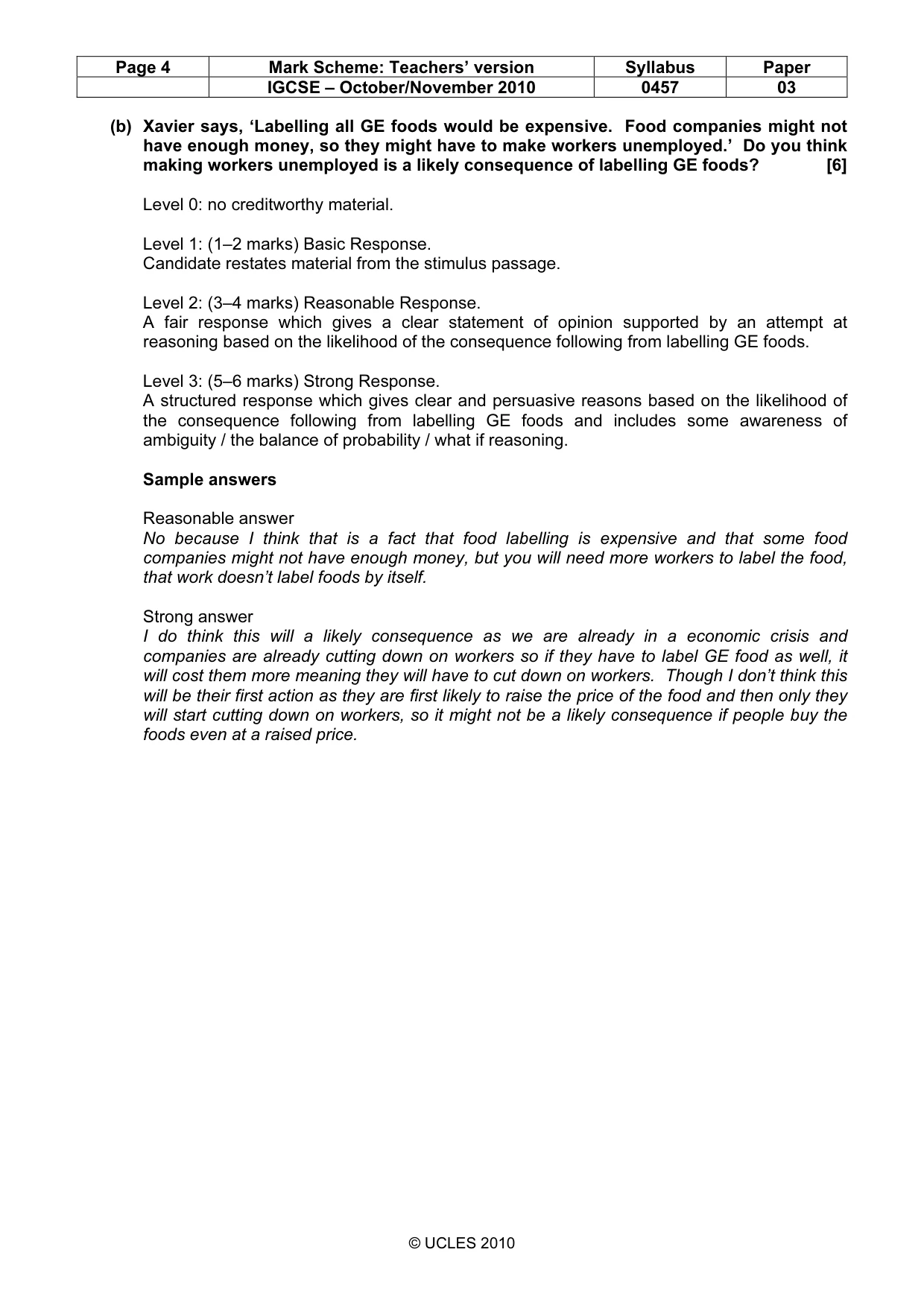
Page 4 Mark Scheme: Teachers’ version Syllabus Paper IGCSE – October/November 2010 0457 03 © UCLES 2010 (b) Xavier says, ‘Labelling all GE foods would be expensive. Food companies might not have enough money, so they might have to make workers unemployed.’ Do you think making workers unemployed is a likely consequence of labelling GE foods? [6] Level 0: no creditworthy material. Level 1: (1–2 marks) Basic Response. Candidate restates material from the stimulus passage. Level 2: (3–4 marks) Reasonable Response. A fair response which gives a clear statement of opinion supported by an attempt at reasoning based on the likelihood of the consequence following from labelling GE foods. Level 3: (5–6 marks) Strong Response. A structured response which gives clear and persuasive reasons based on the likelihood of the consequence following from labelling GE foods and includes some awareness of ambiguity / the balance of probability / what if reasoning. Sample answers Reasonable answer No because I think that is a fact that food labelling is expensive and that some food companies might not have enough money, but you will need more workers to label the food, that work doesn’t label foods by itself. Strong answer I do think this will a likely consequence as we are already in a economic crisis and companies are already cutting down on workers so if they have to label GE food as well, it will cost them more meaning they will have to cut down on workers. Though I don’t think this will be their first action as they are first likely to raise the price of the food and then only they will start cutting down on workers, so it might not be a likely consequence if people buy the foods even at a raised price.
Mark scheme, page 5
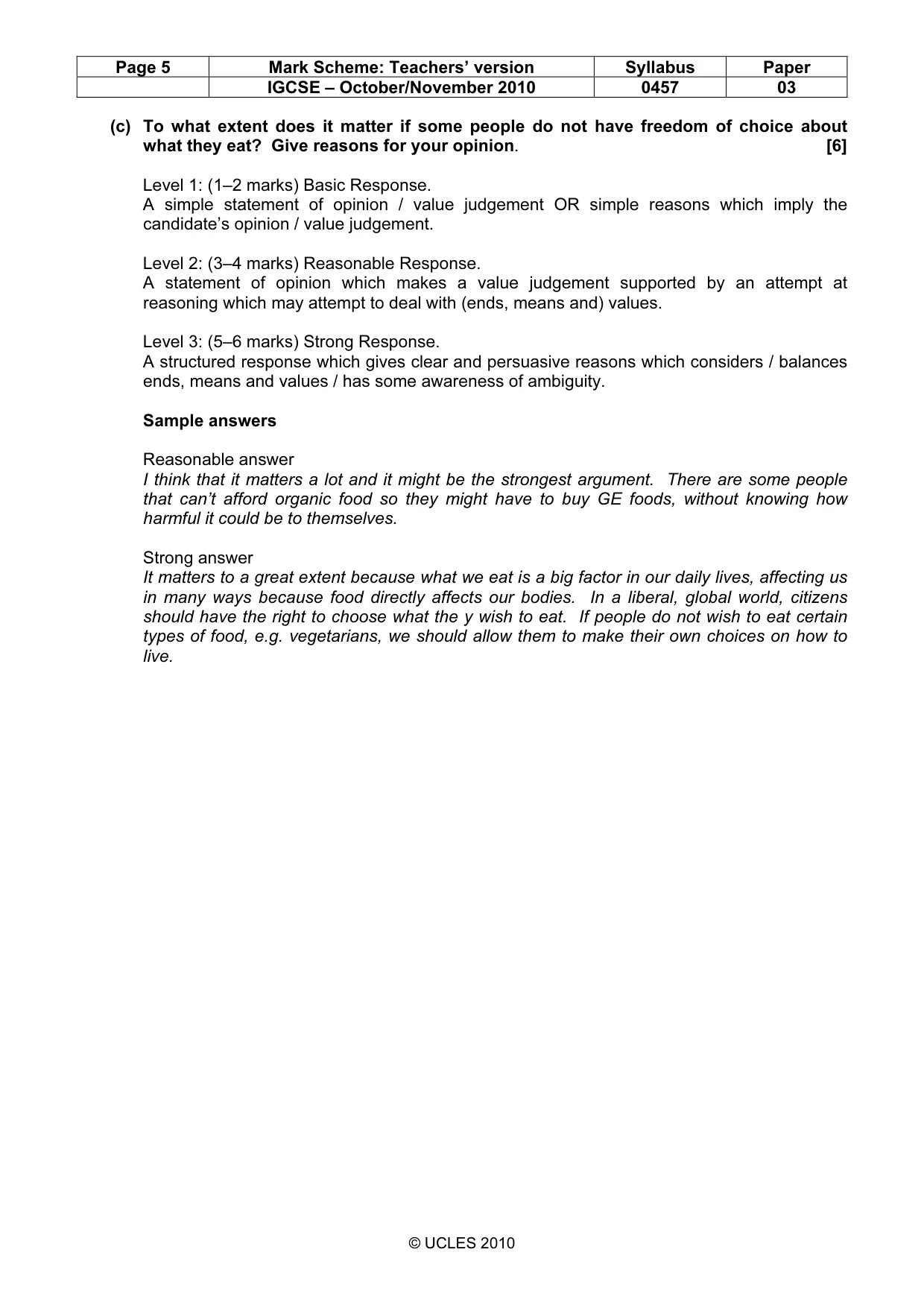
Page 5 Mark Scheme: Teachers’ version Syllabus Paper IGCSE – October/November 2010 0457 03 © UCLES 2010 (c) To what extent does it matter if some people do not have freedom of choice about what they eat? Give reasons for your opinion. [6] Level 1: (1–2 marks) Basic Response. A simple statement of opinion / value judgement OR simple reasons which imply the candidate’s opinion / value judgement. Level 2: (3–4 marks) Reasonable Response. A statement of opinion which makes a value judgement supported by an attempt at reasoning which may attempt to deal with (ends, means and) values. Level 3: (5–6 marks) Strong Response. A structured response which gives clear and persuasive reasons which considers / balances ends, means and values / has some awareness of ambiguity. Sample answers Reasonable answer I think that it matters a lot and it might be the strongest argument. There are some people that can’t afford organic food so they might have to buy GE foods, without knowing how harmful it could be to themselves. Strong answer It matters to a great extent because what we eat is a big factor in our daily lives, affecting us in many ways because food directly affects our bodies. In a liberal, global world, citizens should have the right to choose what the y wish to eat. If people do not wish to eat certain types of food, e.g. vegetarians, we should allow them to make their own choices on how to live.
Mark scheme, page 6
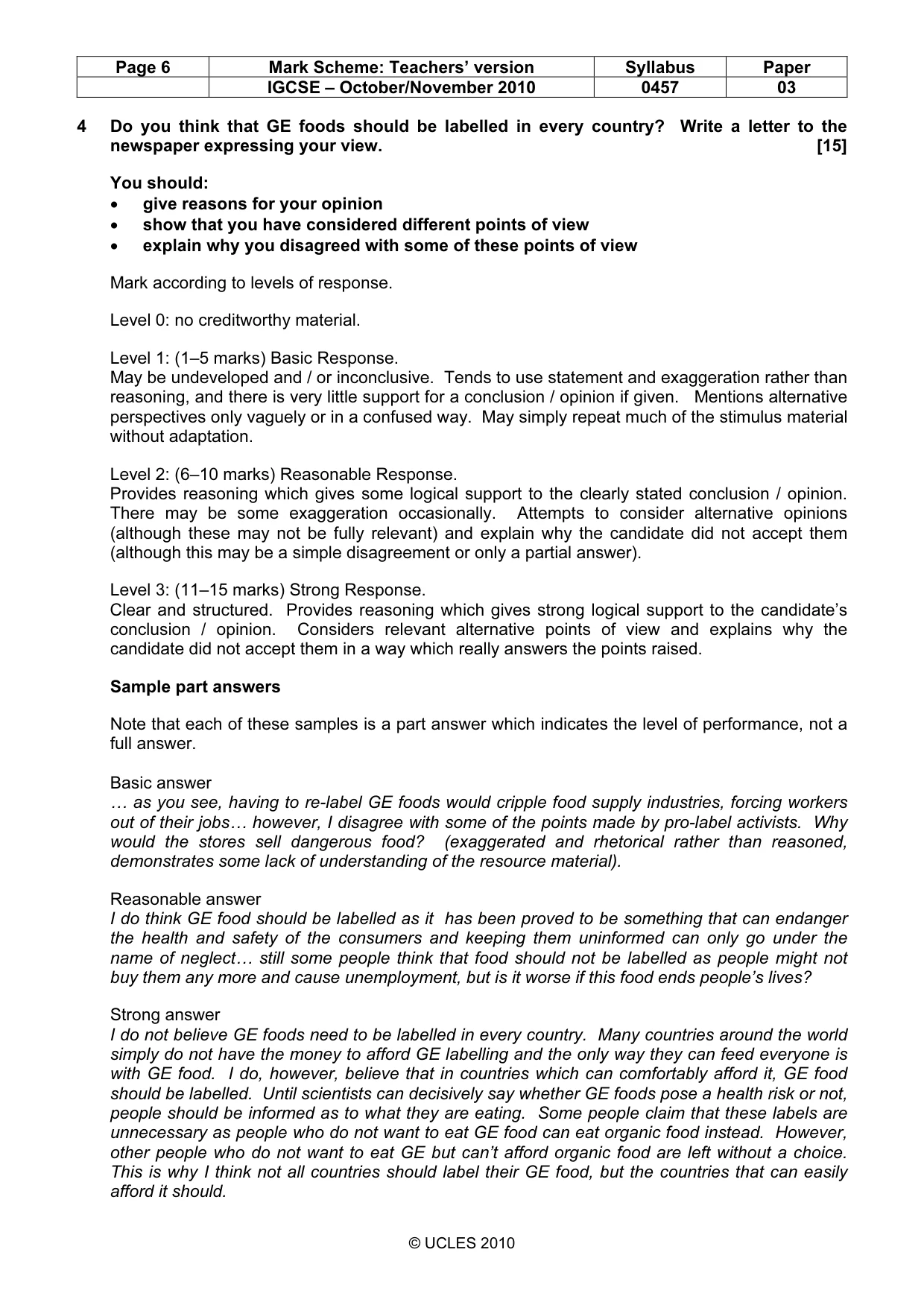
Page 6 Mark Scheme: Teachers’ version Syllabus Paper IGCSE – October/November 2010 0457 03 © UCLES 2010 4 Do you think that GE foods should be labelled in every country? Write a letter to the newspaper expressing your view. [15] You should: • give reasons for your opinion • show that you have considered different points of view • explain why you disagreed with some of these points of view Mark according to levels of response. Level 0: no creditworthy material. Level 1: (1–5 marks) Basic Response. May be undeveloped and / or inconclusive. Tends to use statement and exaggeration rather than reasoning, and there is very little support for a conclusion / opinion if given. Mentions alternative perspectives only vaguely or in a confused way. May simply repeat much of the stimulus material without adaptation. Level 2: (6–10 marks) Reasonable Response. Provides reasoning which gives some logical support to the clearly stated conclusion / opinion. There may be some exaggeration occasionally. Attempts to consider alternative opinions (although these may not be fully relevant) and explain why the candidate did not accept them (although this may be a simple disagreement or only a partial answer). Level 3: (11–15 marks) Strong Response. Clear and structured. Provides reasoning which gives strong logical support to the candidate’s conclusion / opinion. Considers relevant alternative points of view and explains why the candidate did not accept them in a way which really answers the points raised. Sample part answers Note that each of these samples is a part answer which indicates the level of performance, not a full answer. Basic answer … as you see, having to re-label GE foods would cripple food supply industries, forcing workers out of their jobs… however, I disagree with some of the points made by pro-label activists. Why would the stores sell dangerous food? (exaggerated and rhetorical rather than reasoned, demonstrates some lack of understanding of the resource material). Reasonable answer I do think GE food should be labelled as it has been proved to be something that can endanger the health and safety of the consumers and keeping them uninformed can only go under the name of neglect… still some people think that food should not be labelled as people might not buy them any more and cause unemployment, but is it worse if this food ends people’s lives? Strong answer I do not believe GE foods need to be labelled in every country. Many countries around the world simply do not have the money to afford GE labelling and the only way they can feed everyone is with GE food. I do, however, believe that in countries which can comfortably afford it, GE food should be labelled. Until scientists can decisively say whether GE foods pose a health risk or not, people should be informed as to what they are eating. Some people claim that these labels are unnecessary as people who do not want to eat GE food can eat organic food instead. However, other people who do not want to eat GE but can’t afford organic food are left without a choice. This is why I think not all countries should label their GE food, but the countries that can easily afford it should.
Mark scheme, page 7
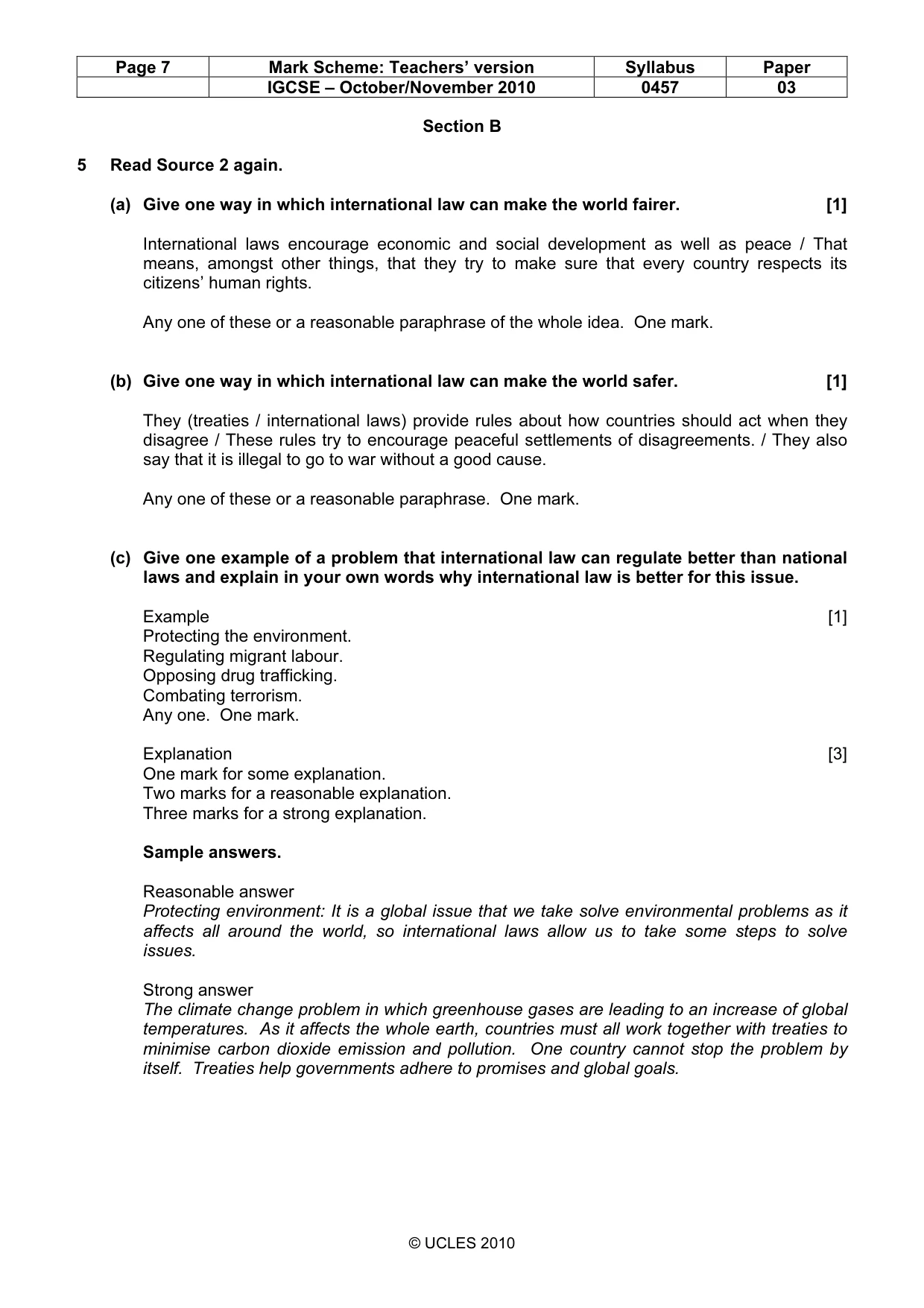
Page 7 Mark Scheme: Teachers’ version Syllabus Paper IGCSE – October/November 2010 0457 03 © UCLES 2010 Section B 5 Read Source 2 again. (a) Give one way in which international law can make the world fairer. [1] International laws encourage economic and social development as well as peace / That means, amongst other things, that they try to make sure that every country respects its citizens’ human rights. Any one of these or a reasonable paraphrase of the whole idea. One mark. (b) Give one way in which international law can make the world safer. [1] They (treaties / international laws) provide rules about how countries should act when they disagree / These rules try to encourage peaceful settlements of disagreements. / They also say that it is illegal to go to war without a good cause. Any one of these or a reasonable paraphrase. One mark. (c) Give one example of a problem that international law can regulate better than national laws and explain in your own words why international law is better for this issue. Example [1] Protecting the environment. Regulating migrant labour. Opposing drug trafficking. Combating terrorism. Any one. One mark. Explanation [3] One mark for some explanation. Two marks for a reasonable explanation. Three marks for a strong explanation. Sample answers. Reasonable answer Protecting environment: It is a global issue that we take solve environmental problems as it affects all around the world, so international laws allow us to take some steps to solve issues. Strong answer The climate change problem in which greenhouse gases are leading to an increase of global temperatures. As it affects the whole earth, countries must all work together with treaties to minimise carbon dioxide emission and pollution. One country cannot stop the problem by itself. Treaties help governments adhere to promises and global goals.
Mark scheme, page 8
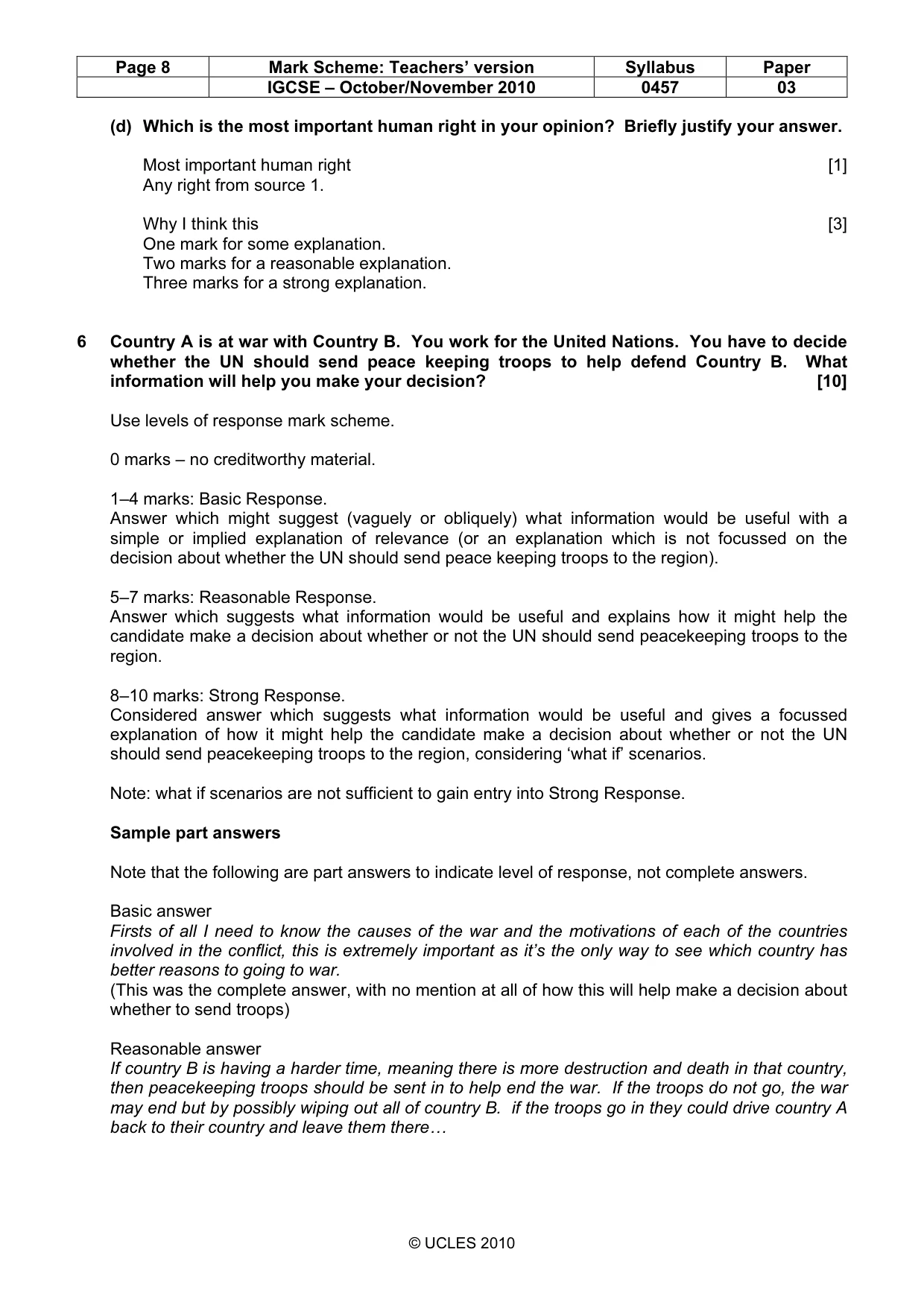
Page 8 Mark Scheme: Teachers’ version Syllabus Paper IGCSE – October/November 2010 0457 03 © UCLES 2010 (d) Which is the most important human right in your opinion? Briefly justify your answer. Most important human right [1] Any right from source 1. Why I think this [3] One mark for some explanation. Two marks for a reasonable explanation. Three marks for a strong explanation. 6 Country A is at war with Country B. You work for the United Nations. You have to decide whether the UN should send peace keeping troops to help defend Country B. What information will help you make your decision? [10] Use levels of response mark scheme. 0 marks – no creditworthy material. 1–4 marks: Basic Response. Answer which might suggest (vaguely or obliquely) what information would be useful with a simple or implied explanation of relevance (or an explanation which is not focussed on the decision about whether the UN should send peace keeping troops to the region). 5–7 marks: Reasonable Response. Answer which suggests what information would be useful and explains how it might help the candidate make a decision about whether or not the UN should send peacekeeping troops to the region. 8–10 marks: Strong Response. Considered answer which suggests what information would be useful and gives a focussed explanation of how it might help the candidate make a decision about whether or not the UN should send peacekeeping troops to the region, considering ‘what if’ scenarios. Note: what if scenarios are not sufficient to gain entry into Strong Response. Sample part answers Note that the following are part answers to indicate level of response, not complete answers. Basic answer Firsts of all I need to know the causes of the war and the motivations of each of the countries involved in the conflict, this is extremely important as it’s the only way to see which country has better reasons to going to war. (This was the complete answer, with no mention at all of how this will help make a decision about whether to send troops) Reasonable answer If country B is having a harder time, meaning there is more destruction and death in that country, then peacekeeping troops should be sent in to help end the war. If the troops do not go, the war may end but by possibly wiping out all of country B. if the troops go in they could drive country A back to their country and leave them there…
Mark scheme, page 9
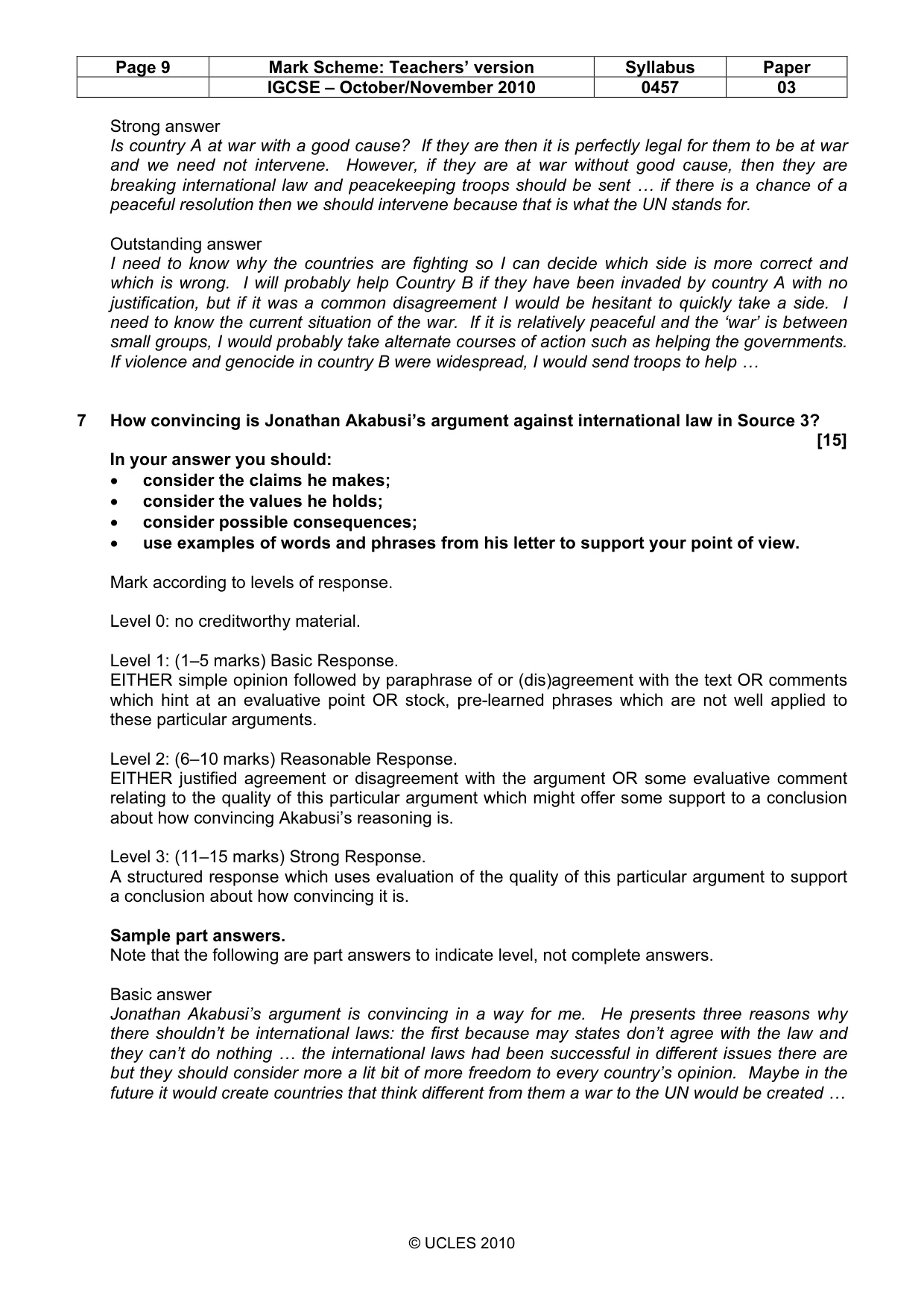
Page 9 Mark Scheme: Teachers’ version Syllabus Paper IGCSE – October/November 2010 0457 03 © UCLES 2010 Strong answer Is country A at war with a good cause? If they are then it is perfectly legal for them to be at war and we need not intervene. However, if they are at war without good cause, then they are breaking international law and peacekeeping troops should be sent … if there is a chance of a peaceful resolution then we should intervene because that is what the UN stands for. Outstanding answer I need to know why the countries are fighting so I can decide which side is more correct and which is wrong. I will probably help Country B if they have been invaded by country A with no justification, but if it was a common disagreement I would be hesitant to quickly take a side. I need to know the current situation of the war. If it is relatively peaceful and the ‘war’ is between small groups, I would probably take alternate courses of action such as helping the governments. If violence and genocide in country B were widespread, I would send troops to help … 7 How convincing is Jonathan Akabusi’s argument against international law in Source 3? [15] In your answer you should: • consider the claims he makes; • consider the values he holds; • consider possible consequences; • use examples of words and phrases from his letter to support your point of view. Mark according to levels of response. Level 0: no creditworthy material. Level 1: (1–5 marks) Basic Response. EITHER simple opinion followed by paraphrase of or (dis)agreement with the text OR comments which hint at an evaluative point OR stock, pre-learned phrases which are not well applied to these particular arguments. Level 2: (6–10 marks) Reasonable Response. EITHER justified agreement or disagreement with the argument OR some evaluative comment relating to the quality of this particular argument which might offer some support to a conclusion about how convincing Akabusi’s reasoning is. Level 3: (11–15 marks) Strong Response. A structured response which uses evaluation of the quality of this particular argument to support a conclusion about how convincing it is. Sample part answers. Note that the following are part answers to indicate level, not complete answers. Basic answer Jonathan Akabusi’s argument is convincing in a way for me. He presents three reasons why there shouldn’t be international laws: the first because may states don’t agree with the law and they can’t do nothing … the international laws had been successful in different issues there are but they should consider more a lit bit of more freedom to every country’s opinion. Maybe in the future it would create countries that think different from them a war to the UN would be created …
Mark scheme, page 10
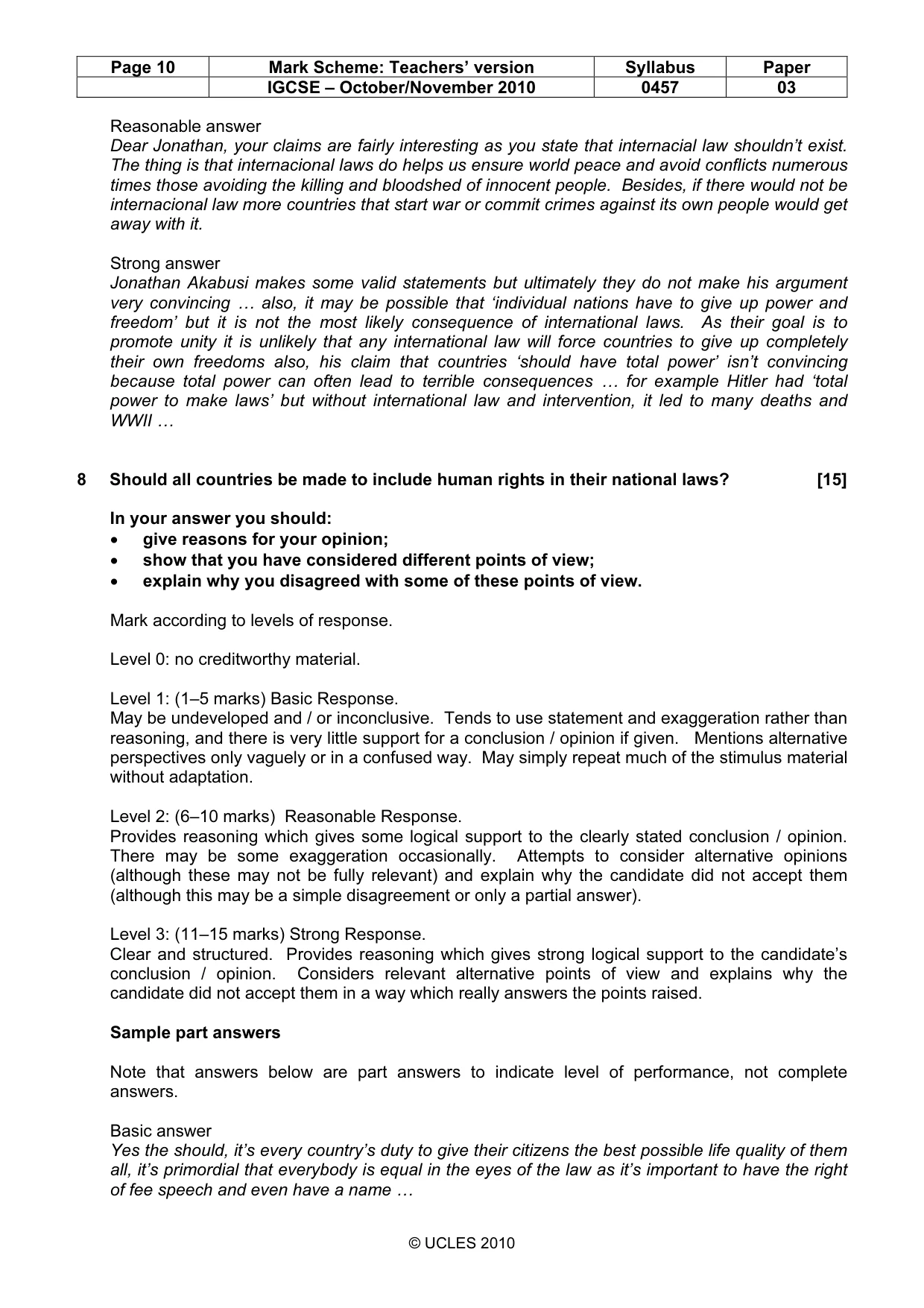
Page 10 Mark Scheme: Teachers’ version Syllabus Paper IGCSE – October/November 2010 0457 03 © UCLES 2010 Reasonable answer Dear Jonathan, your claims are fairly interesting as you state that internacial law shouldn’t exist. The thing is that internacional laws do helps us ensure world peace and avoid conflicts numerous times those avoiding the killing and bloodshed of innocent people. Besides, if there would not be internacional law more countries that start war or commit crimes against its own people would get away with it. Strong answer Jonathan Akabusi makes some valid statements but ultimately they do not make his argument very convincing … also, it may be possible that ‘individual nations have to give up power and freedom’ but it is not the most likely consequence of international laws. As their goal is to promote unity it is unlikely that any international law will force countries to give up completely their own freedoms also, his claim that countries ‘should have total power’ isn’t convincing because total power can often lead to terrible consequences … for example Hitler had ‘total power to make laws’ but without international law and intervention, it led to many deaths and WWII … 8 Should all countries be made to include human rights in their national laws? [15] In your answer you should: • give reasons for your opinion; • show that you have considered different points of view; • explain why you disagreed with some of these points of view. Mark according to levels of response. Level 0: no creditworthy material. Level 1: (1–5 marks) Basic Response. May be undeveloped and / or inconclusive. Tends to use statement and exaggeration rather than reasoning, and there is very little support for a conclusion / opinion if given. Mentions alternative perspectives only vaguely or in a confused way. May simply repeat much of the stimulus material without adaptation. Level 2: (6–10 marks) Reasonable Response. Provides reasoning which gives some logical support to the clearly stated conclusion / opinion. There may be some exaggeration occasionally. Attempts to consider alternative opinions (although these may not be fully relevant) and explain why the candidate did not accept them (although this may be a simple disagreement or only a partial answer). Level 3: (11–15 marks) Strong Response. Clear and structured. Provides reasoning which gives strong logical support to the candidate’s conclusion / opinion. Considers relevant alternative points of view and explains why the candidate did not accept them in a way which really answers the points raised. Sample part answers Note that answers below are part answers to indicate level of performance, not complete answers. Basic answer Yes the should, it’s every country’s duty to give their citizens the best possible life quality of them all, it’s primordial that everybody is equal in the eyes of the law as it’s important to have the right of fee speech and even have a name …
Mark scheme, page 11
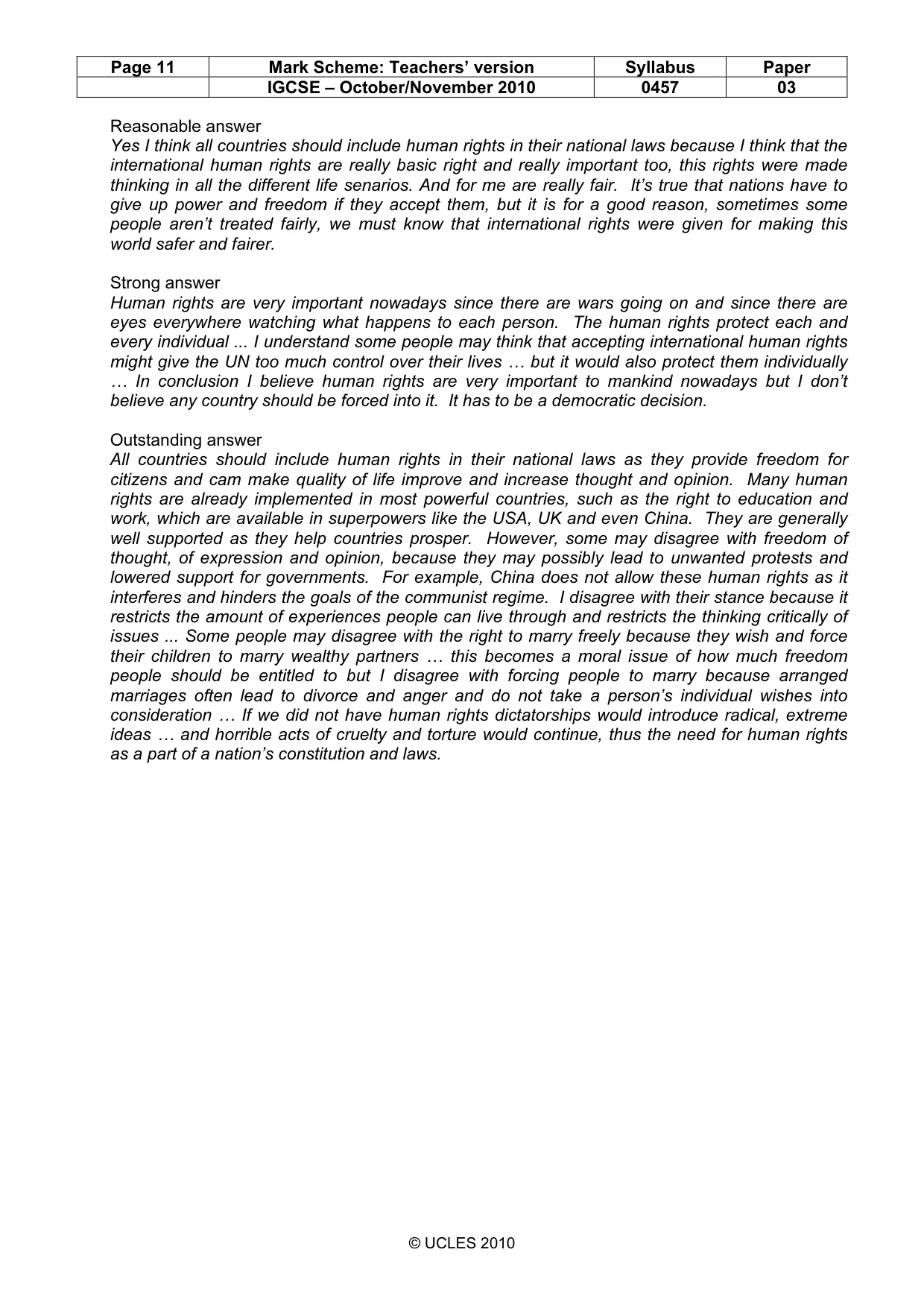
Page 11 Mark Scheme: Teachers’ version Syllabus Paper IGCSE – October/November 2010 0457 03 © UCLES 2010 Reasonable answer Yes I think all countries should include human rights in their national laws because I think that the international human rights are really basic right and really important too, this rights were made thinking in all the different life senarios. And for me are really fair. It’s true that nations have to give up power and freedom if they accept them, but it is for a good reason, sometimes some people aren’t treated fairly, we must know that international rights were given for making this world safer and fairer. Strong answer Human rights are very important nowadays since there are wars going on and since there are eyes everywhere watching what happens to each person. The human rights protect each and every individual ... I understand some people may think that accepting international human rights might give the UN too much control over their lives … but it would also protect them individually … In conclusion I believe human rights are very important to mankind nowadays but I don’t believe any country should be forced into it. It has to be a democratic decision. Outstanding answer All countries should include human rights in their national laws as they provide freedom for citizens and cam make quality of life improve and increase thought and opinion. Many human rights are already implemented in most powerful countries, such as the right to education and work, which are available in superpowers like the USA, UK and even China. They are generally well supported as they help countries prosper. However, some may disagree with freedom of thought, of expression and opinion, because they may possibly lead to unwanted protests and lowered support for governments. For example, China does not allow these human rights as it interferes and hinders the goals of the communist regime. I disagree with their stance because it restricts the amount of experiences people can live through and restricts the thinking critically of issues ... Some people may disagree with the right to marry freely because they wish and force their children to marry wealthy partners … this becomes a moral issue of how much freedom people should be entitled to but I disagree with forcing people to marry because arranged marriages often lead to divorce and anger and do not take a person’s individual wishes into consideration … If we did not have human rights dictatorships would introduce radical, extreme ideas … and horrible acts of cruelty and torture would continue, thus the need for human rights as a part of a nation’s constitution and laws.
What you needed in this session
Cambridge’s own grade thresholds for 2010 Oct/Nov, Paper 3 · Variant 1. A higher threshold means an easier paper — the bar moves with how the cohort did.