Cambridge IGCSE Global Perspectives 0457 — 2009 Oct/Nov Paper 3 · Variant 1
0457/31/O/N/09 · 100 marks · ≈113 min
The question paper and its mark scheme, free to read here and free to download. This is Cambridge’s own paper, exactly as it was sat.
Question paper16 pages



Mark scheme10 pages
Answers below. Sit the paper first if you are practising.
Paper as text
Question paper, page 1
This document consists of 13 printed pages and 3 blank pages. DCA (SHW 00401 2/09) 14974/3 © UCLES 2009 [Turn over UNIVERSITY OF CAMBRIDGE INTERNATIONAL EXAMINATIONS International General Certificate of Secondary Education READ THESE INSTRUCTIONS FIRST Write your Centre number, candidate number and name on all the work you hand in. Write in dark blue or black pen. Do not use staples, paper clips, highlighters, glue or correction fluid. You may use a pencil for any diagrams or graphs. There are two sections in this paper, Section A and Section B. Each section has four questions. Answer all questions in the spaces provided. Any rough working should be done in this booklet. * 7 0 6 9 1 4 9 9 5 9 * GLOBAL PERSPECTIVES 0457/03 Paper 3 October/November 2009 2 hours Candidates answer on the Question Paper. No Additional Materials are required. For Examiner’s Use 1 2 3 4 5 6 7 8 Total www.XtremePapers.com
Question paper, page 2
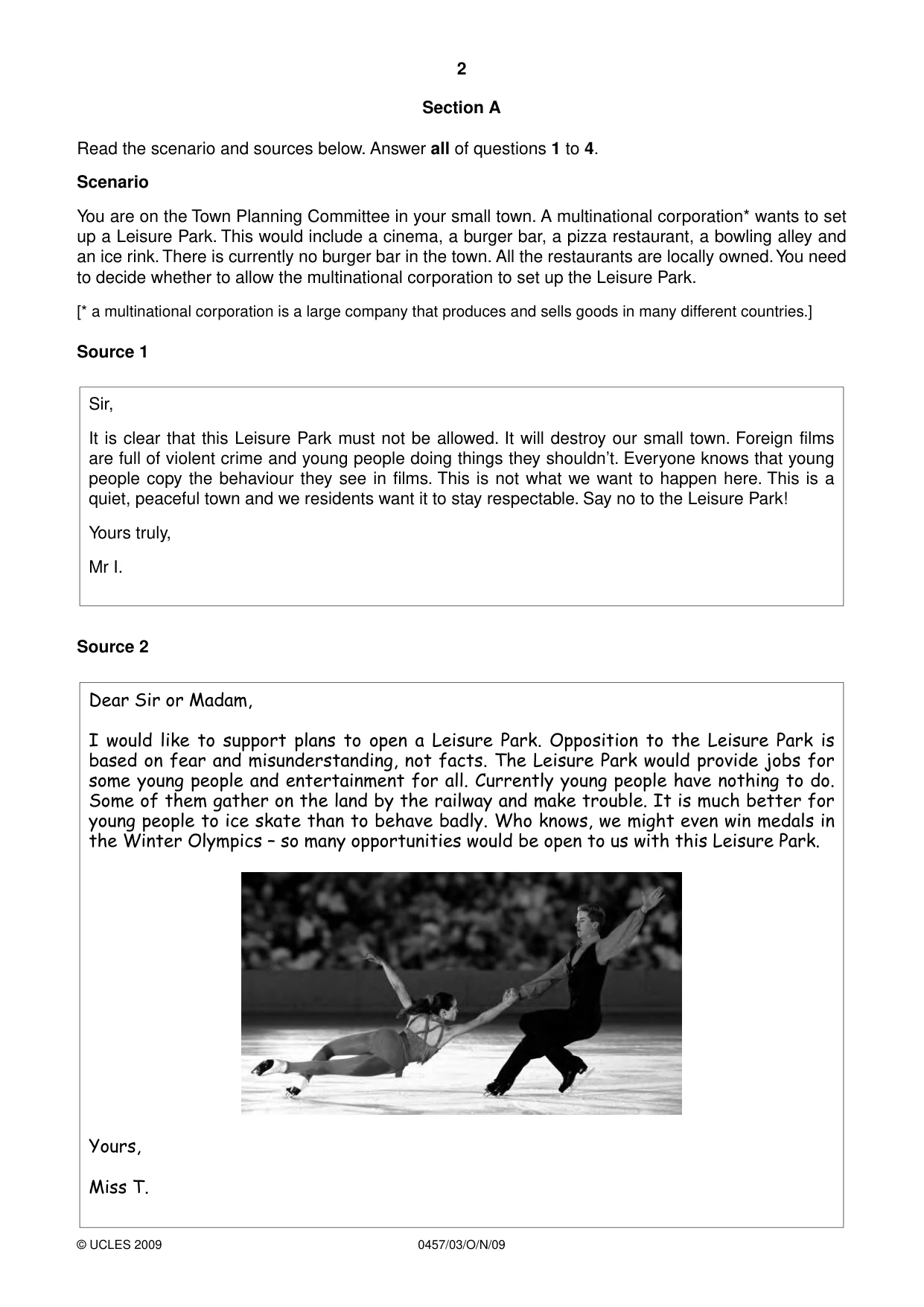
2 0457/03/O/N/09 © UCLES 2009 Section A Read the scenario and sources below. Answer all of questions 1 to 4. Scenario You are on the Town Planning Committee in your small town. A multinational corporation* wants to set up a Leisure Park. This would include a cinema, a burger bar, a pizza restaurant, a bowling alley and an ice rink. There is currently no burger bar in the town. All the restaurants are locally owned. You need to decide whether to allow the multinational corporation to set up the Leisure Park. [* a multinational corporation is a large company that produces and sells goods in many different countries.] Source 1 Sir, It is clear that this Leisure Park must not be allowed. It will destroy our small town. Foreign films are full of violent crime and young people doing things they shouldn’t. Everyone knows that young people copy the behaviour they see in films. This is not what we want to happen here. This is a quiet, peaceful town and we residents want it to stay respectable. Say no to the Leisure Park! Yours truly, Mr I. Source 2 Dear Sir or Madam, I would like to support plans to open a Leisure Park. Opposition to the Leisure Park is based on fear and misunderstanding, not facts. The Leisure Park would provide jobs for some young people and entertainment for all. Currently young people have nothing to do. Some of them gather on the land by the railway and make trouble. It is much better for young people to ice skate than to behave badly. Who knows, we might even win medals in the Winter Olympics – so many opportunities would be open to us with this Leisure Park. Yours, Miss T.
Question paper, page 3
3 0457/03/O/N/09 © UCLES 2009 [Turn over For Examiner’s Use Source 3 Sir, This multinational corporation will take our money and send it abroad. Today, my restaurant is full. I cook proper, healthy, traditional food which people like to eat. People spend their money in my restaurant. Then I spend my money in the shops here. I pay local people to work in my restaurant. They spend their money in local shops. These foreigners will bring foreign managers. We will only be able to get jobs as cleaners and waiters. I have three children. I don’t want them to grow up eating junk food. I don’t want them to watch violent films. I don’t want them to work for a multinational corporation in a burger bar. I want them to run my restaurant and be independent, but my restaurant won’t exist if the Leisure Park comes. If young people want entertainment, why don’t we provide locally run entertainment? Why don’t people of this town get together and build a cinema to show local films? Then we could keep our traditions, keep our restaurants, keep our way of life and keep our independence. Yours truly, Mrs J. Question 1 (a) Explain why some people are opposed to the Leisure Park. … … … … … … … [5]
Question paper, page 4
4 0457/03/O/N/09 © UCLES 2009 For Examiner’s Use (b) Explain why some people support the Leisure Park. … … … … … … … [5] Question 2 As a member of the Town Planning Committee, you need to decide whether to allow the multinational corporation to set up the Leisure Park. What further information would you find useful to help you make your decision? An example is given for you below. What I need to know: I need to know what effects similar leisure parks have had on other areas. Where I will find this information: Write to the Local Government of a town with a new leisure park. How this information will help me make a decision: If a new leisure park in another town has more advantages than disadvantages, I would be more likely to support a leisure park here. (a) What I need to know … … [1] Where I will find this information … … [1] How this information will help me make a decision … … … … [3]
Question paper, page 5
5 0457/03/O/N/09 © UCLES 2009 [Turn over For Examiner’s Use (b) What I need to know … … [1] Where I will find this information … … [1] How this information will help me make a decision … … … … [3] Question 3 Read Source 2 again. (a) ‘Currently young people have nothing to do.’ Is this fact or opinion? Explain your answer. … … … … … [3]
Question paper, page 6
6 0457/03/O/N/09 © UCLES 2009 For Examiner’s Use (b) Do you think Miss T is making a convincing argument? Give reasons for your view. You should: • consider the claims she makes; • consider possible consequences; • use examples of words and phrases from her letter to support your point of view. … … … … … … … … … … … … … … … … … … … [12]
Question paper, page 7
7 0457/03/O/N/09 © UCLES 2009 [Turn over For Examiner’s Use Question 4 Write an article for the local community newsletter to explain the Town Planning Committee’s decision about the Leisure Park. In your article you should: • explain why you have reached the decision that you made; • show that you have considered different points of view; • explain why you disagreed with some of these points of view. … … … … … … … … … … … … … … … … … … … … … … [15]
Question paper, page 8
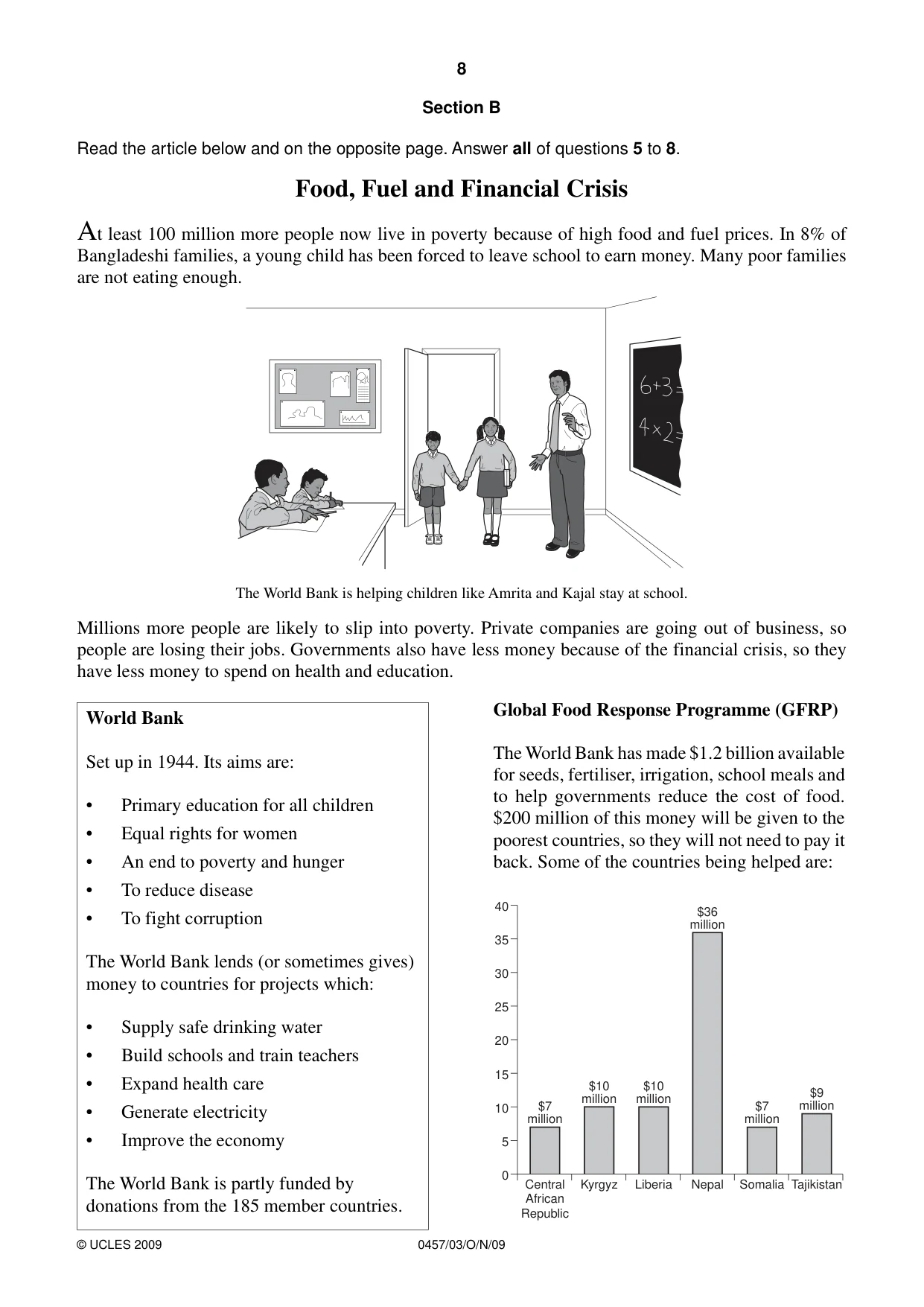
8 0457/03/O/N/09 © UCLES 2009 Section B Read the article below and on the opposite page. Answer all of questions 5 to 8. Food, Fuel and Financial Crisis At least 100 million more people now live in poverty because of high food and fuel prices. In 8% of Bangladeshi families, a young child has been forced to leave school to earn money. Many poor families are not eating enough. The World Bank is helping children like Amrita and Kajal stay at school. Millions more people are likely to slip into poverty. Private companies are going out of business, so people are losing their jobs. Governments also have less money because of the financial crisis, so they have less money to spend on health and education. World Bank Set up in 1944. Its aims are: • Primary education for all children • Equal rights for women • An end to poverty and hunger • To reduce disease • To fight corruption The World Bank lends (or sometimes gives) money to countries for projects which: • Supply safe drinking water • Build schools and train teachers • Expand health care • Generate electricity • Improve the economy The World Bank is partly funded by donations from the 185 member countries. Global Food Response Programme (GFRP) The World Bank has made $1.2 billion available for seeds, fertiliser, irrigation, school meals and to help governments reduce the cost of food. $200 million of this money will be given to the poorest countries, so they will not need to pay it back. Some of the countries being helped are: Central African Republic Kyrgyz Liberia Nepal Somalia Tajikistan $7 million $10 million $10 million $36 million $7 million $9 million 0 5 10 15 20 25 30 35 40
Question paper, page 9
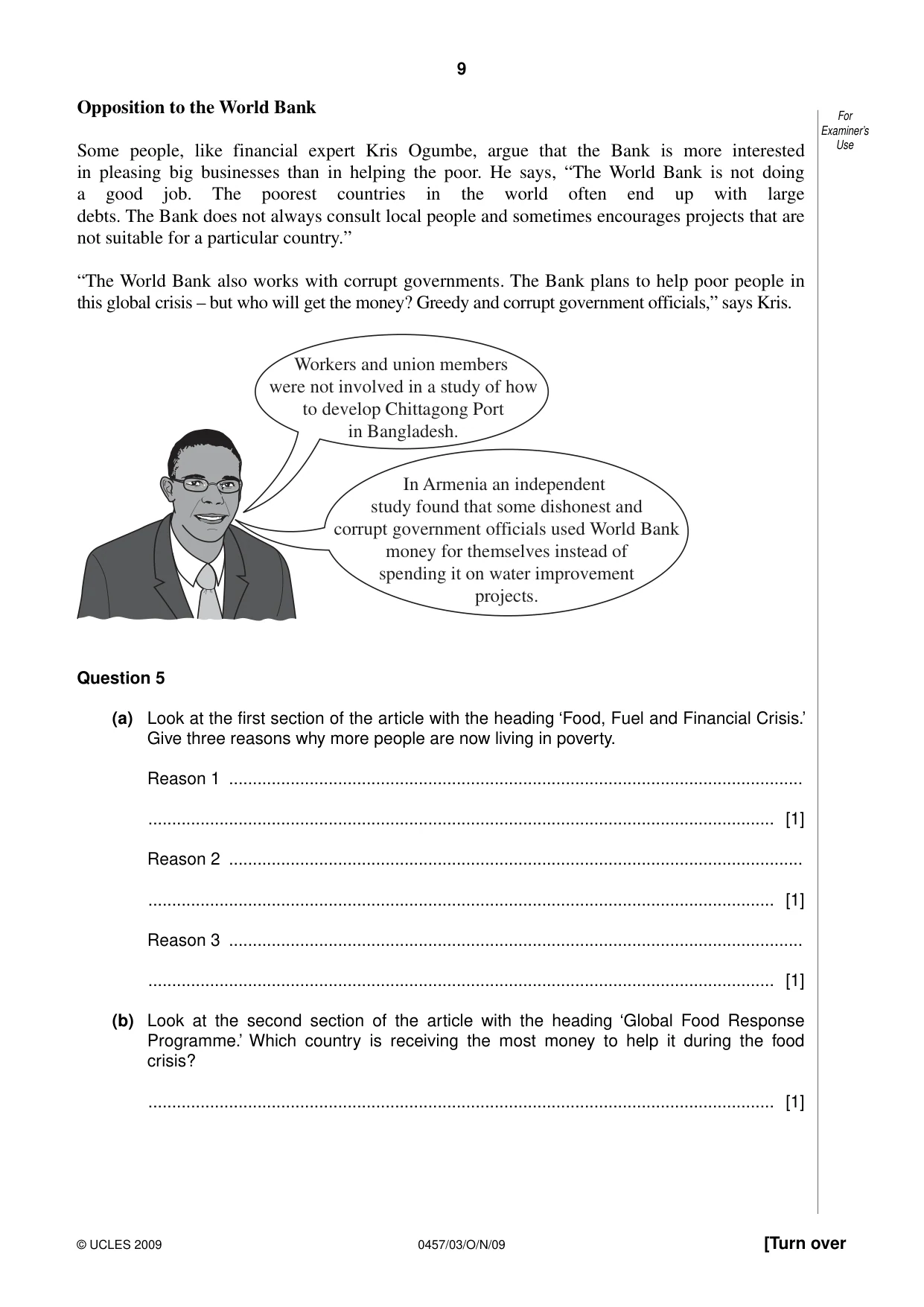
9 0457/03/O/N/09 © UCLES 2009 [Turn over For Examiner’s Use Opposition to the World Bank Some people, like financial expert Kris Ogumbe, argue that the Bank is more interested in pleasing big businesses than in helping the poor. He says, “The World Bank is not doing a good job. The poorest countries in the world often end up with large debts. The Bank does not always consult local people and sometimes encourages projects that are not suitable for a particular country.” “The World Bank also works with corrupt governments. The Bank plans to help poor people in this global crisis – but who will get the money? Greedy and corrupt government officials,” says Kris. Workers and union members were not involved in a study of how to develop Chittagong Port in Bangladesh. In Armenia an independent study found that some dishonest and corrupt government officials used World Bank money for themselves instead of spending it on water improvement projects. Question 5 (a) Look at the first section of the article with the heading ‘Food, Fuel and Financial Crisis.’ Give three reasons why more people are now living in poverty. Reason 1 … … [1] Reason 2 … … [1] Reason 3 … … [1] (b) Look at the second section of the article with the heading ‘Global Food Response Programme.’ Which country is receiving the most money to help it during the food crisis? … [1]
Question paper, page 10
10 0457/03/O/N/09 © UCLES 2009 For Examiner’s Use (c) In your own words, explain how money from the World Bank can help poor people during the food, fuel and financial crisis. … … … … … … … … … … [6]
Question paper, page 11
11 0457/03/O/N/09 © UCLES 2009 [Turn over For Examiner’s Use Question 6 A country has asked the World Bank for an extra $15 million. In addition to the global food, fuel and financial crisis, in this country the rains have failed and the crops have not grown. What information would it be useful for the World Bank to find out, to help it make a decision whether or not to lend the money to this country? What the World Bank needs to know, and how this will help make a decision. … … … … … … … … … … … … … … … … [10] Question 7 Look at the last section of the article with the heading ‘Opposition to the World Bank.’ (a) From this section, give one example of a World Bank project which has had problems. … … [1]
Question paper, page 12
12 0457/03/O/N/09 © UCLES 2009 For Examiner’s Use (b) Give one opinion from this section. Explain why you think it is an opinion not a fact. … … … … [2] (c) Kris Ogumbe predicts that greedy and corrupt government officials will get the World Bank money instead of poor people. Do you think this is a likely consequence? Give reasons for your opinion. … … … … … … … … … … … [6] (d) To what extent does it matter if some of the World Bank’s money goes to corrupt government officials instead of poor people? Give reasons for your opinion. … … … … … … … … … … … [6]
Question paper, page 13
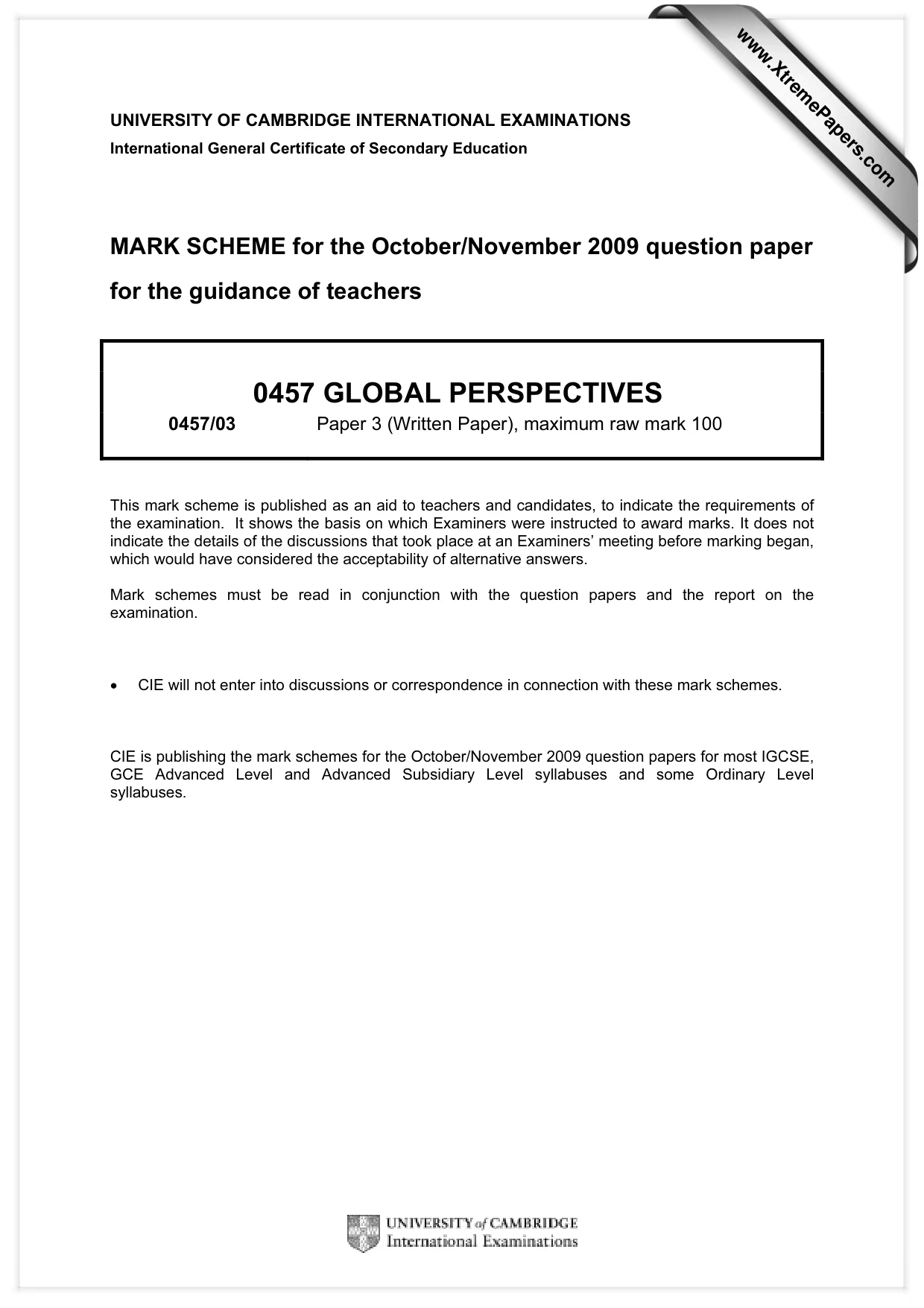
13 0457/03/O/N/09 © UCLES 2009 For Examiner’s Use Question 8 Is the World Bank the best way of getting help to the poorest people in the world? In your answer you should: • give reasons for your opinion; • show that you have considered different points of view; • explain why you disagreed with some of these points of view. … … … … … … … … … … … … … … … … … … … … [15]
Question paper, page 16
16 0457/03/O/N/09 BLANK PAGE Copyright Acknowledgements: Section A © Photo of ice skaters Ref: #AR6125-007 Stone; Getty Images. Section B © http://www.worldbank.org/html/extdr/foodprices/ Permission to reproduce items where third-party owned material protected by copyright is included has been sought and cleared where possible. Every reasonable effort has been made by the publisher (UCLES) to trace copyright holders, but if any items requiring clearance have unwittingly been included, the publisher will be pleased to make amends at the earliest possible opportunity. University of Cambridge International Examinations is part of the Cambridge Assessment Group. Cambridge Assessment is the brand name of University of Cambridge Local Examinations Syndicate (UCLES), which is itself a department of the University of Cambridge.
Mark scheme, page 1
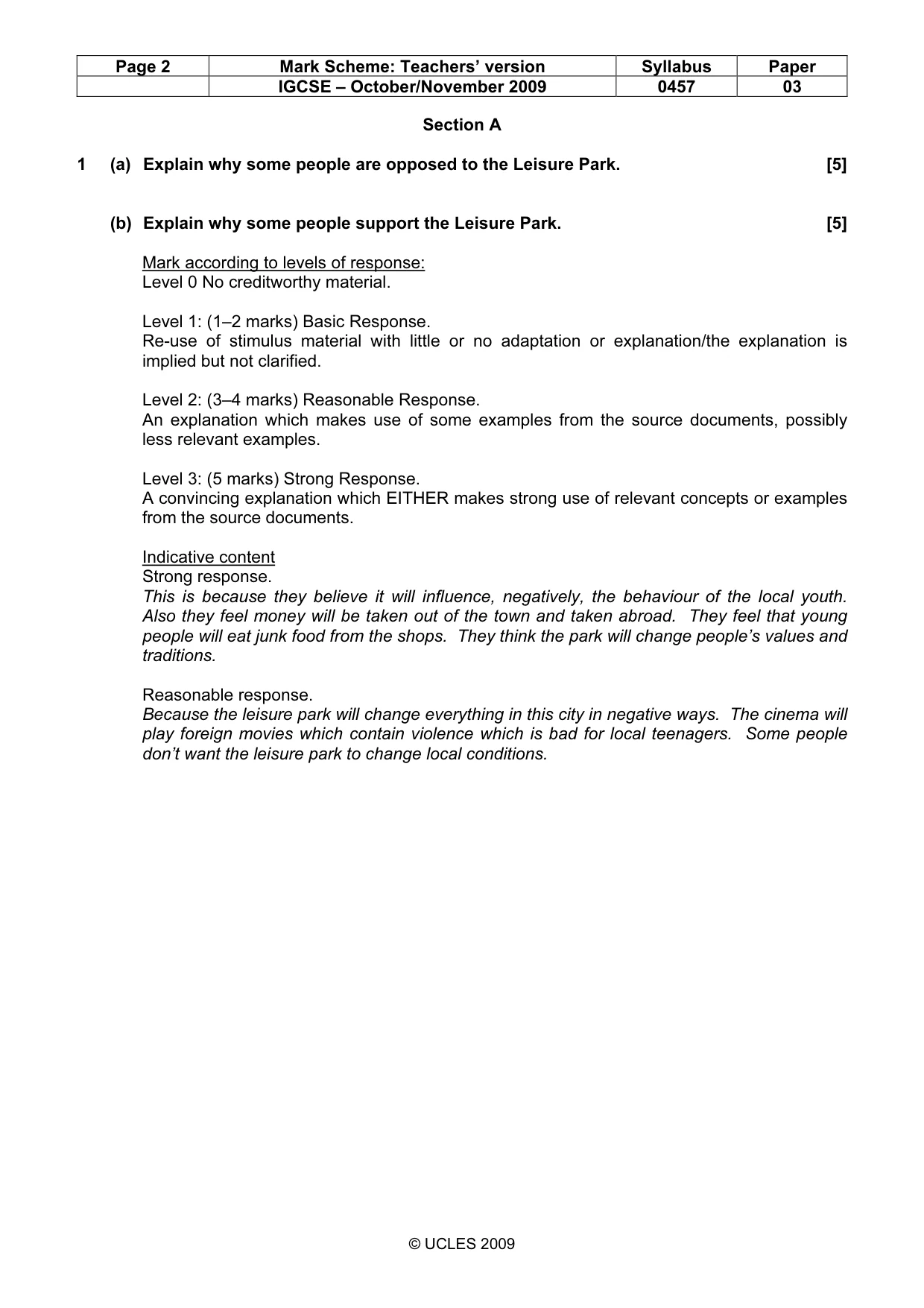
UNIVERSITY OF CAMBRIDGE INTERNATIONAL EXAMINATIONS International General Certificate of Secondary Education MARK SCHEME for the October/November 2009 question paper for the guidance of teachers 0457 GLOBAL PERSPECTIVES 0457/03 Paper 3 (Written Paper), maximum raw mark 100 This mark scheme is published as an aid to teachers and candidates, to indicate the requirements of the examination. It shows the basis on which Examiners were instructed to award marks. It does not indicate the details of the discussions that took place at an Examiners’ meeting before marking began, which would have considered the acceptability of alternative answers. Mark schemes must be read in conjunction with the question papers and the report on the examination. • CIE will not enter into discussions or correspondence in connection with these mark schemes. CIE is publishing the mark schemes for the October/November 2009 question papers for most IGCSE, GCE Advanced Level and Advanced Subsidiary Level syllabuses and some Ordinary Level syllabuses. www.XtremePapers.com
Mark scheme, page 2
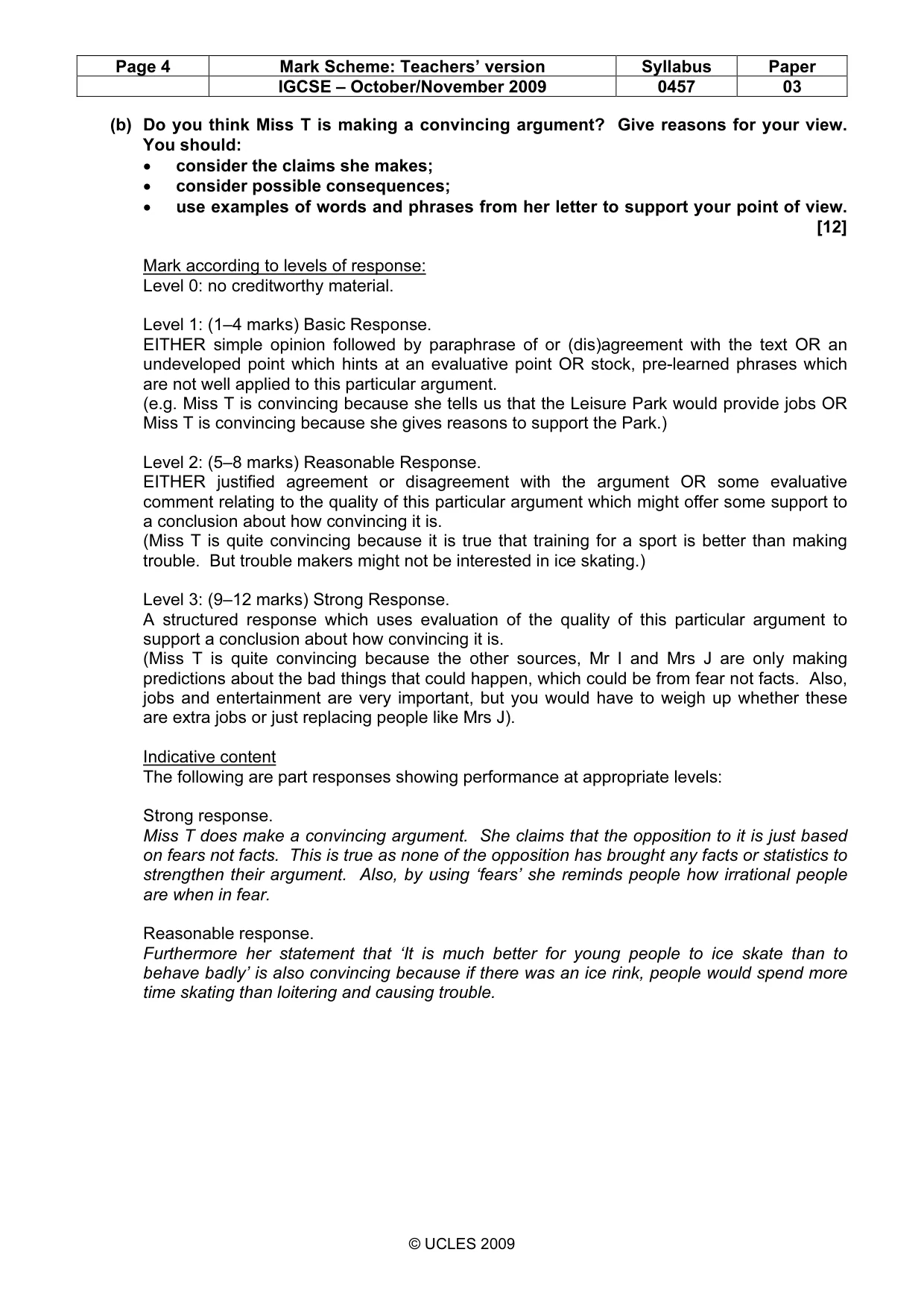
Page 2 Mark Scheme: Teachers’ version Syllabus Paper IGCSE – October/November 2009 0457 03 © UCLES 2009 Section A 1 (a) Explain why some people are opposed to the Leisure Park. [5] (b) Explain why some people support the Leisure Park. [5] Mark according to levels of response: Level 0 No creditworthy material. Level 1: (1–2 marks) Basic Response. Re-use of stimulus material with little or no adaptation or explanation/the explanation is implied but not clarified. Level 2: (3–4 marks) Reasonable Response. An explanation which makes use of some examples from the source documents, possibly less relevant examples. Level 3: (5 marks) Strong Response. A convincing explanation which EITHER makes strong use of relevant concepts or examples from the source documents. Indicative content Strong response. This is because they believe it will influence, negatively, the behaviour of the local youth. Also they feel money will be taken out of the town and taken abroad. They feel that young people will eat junk food from the shops. They think the park will change people’s values and traditions. Reasonable response. Because the leisure park will change everything in this city in negative ways. The cinema will play foreign movies which contain violence which is bad for local teenagers. Some people don’t want the leisure park to change local conditions.
Mark scheme, page 3
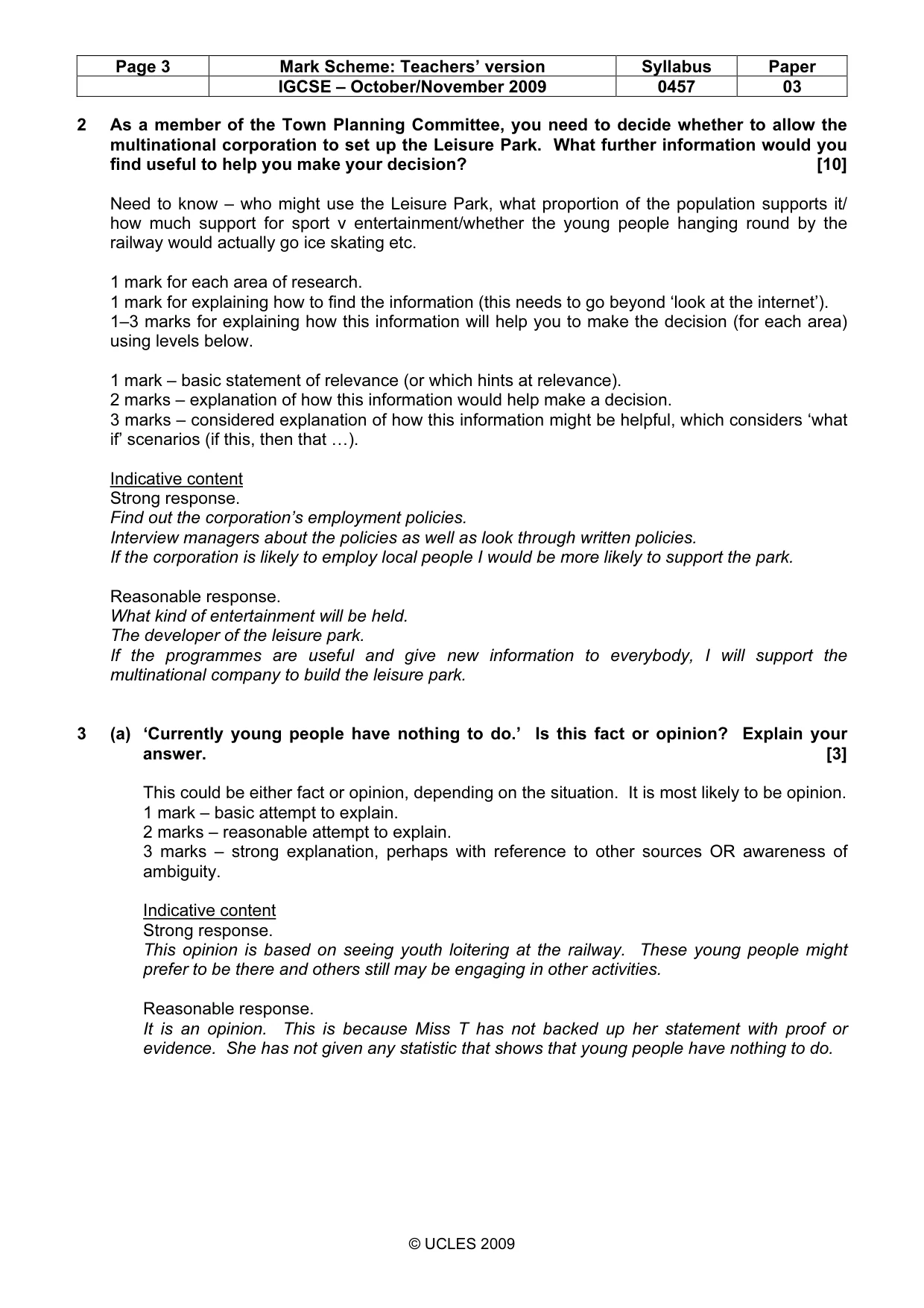
Page 3 Mark Scheme: Teachers’ version Syllabus Paper IGCSE – October/November 2009 0457 03 © UCLES 2009 2 As a member of the Town Planning Committee, you need to decide whether to allow the multinational corporation to set up the Leisure Park. What further information would you find useful to help you make your decision? [10] Need to know – who might use the Leisure Park, what proportion of the population supports it/ how much support for sport v entertainment/whether the young people hanging round by the railway would actually go ice skating etc. 1 mark for each area of research. 1 mark for explaining how to find the information (this needs to go beyond ‘look at the internet’). 1–3 marks for explaining how this information will help you to make the decision (for each area) using levels below. 1 mark – basic statement of relevance (or which hints at relevance). 2 marks – explanation of how this information would help make a decision. 3 marks – considered explanation of how this information might be helpful, which considers ‘what if’ scenarios (if this, then that …). Indicative content Strong response. Find out the corporation’s employment policies. Interview managers about the policies as well as look through written policies. If the corporation is likely to employ local people I would be more likely to support the park. Reasonable response. What kind of entertainment will be held. The developer of the leisure park. If the programmes are useful and give new information to everybody, I will support the multinational company to build the leisure park. 3 (a) ‘Currently young people have nothing to do.’ Is this fact or opinion? Explain your answer. [3] This could be either fact or opinion, depending on the situation. It is most likely to be opinion. 1 mark – basic attempt to explain. 2 marks – reasonable attempt to explain. 3 marks – strong explanation, perhaps with reference to other sources OR awareness of ambiguity. Indicative content Strong response. This opinion is based on seeing youth loitering at the railway. These young people might prefer to be there and others still may be engaging in other activities. Reasonable response. It is an opinion. This is because Miss T has not backed up her statement with proof or evidence. She has not given any statistic that shows that young people have nothing to do.
Mark scheme, page 4
Page 4 Mark Scheme: Teachers’ version Syllabus Paper IGCSE – October/November 2009 0457 03 © UCLES 2009 (b) Do you think Miss T is making a convincing argument? Give reasons for your view. You should: • consider the claims she makes; • consider possible consequences; • use examples of words and phrases from her letter to support your point of view. [12] Mark according to levels of response: Level 0: no creditworthy material. Level 1: (1–4 marks) Basic Response. EITHER simple opinion followed by paraphrase of or (dis)agreement with the text OR an undeveloped point which hints at an evaluative point OR stock, pre-learned phrases which are not well applied to this particular argument. (e.g. Miss T is convincing because she tells us that the Leisure Park would provide jobs OR Miss T is convincing because she gives reasons to support the Park.) Level 2: (5–8 marks) Reasonable Response. EITHER justified agreement or disagreement with the argument OR some evaluative comment relating to the quality of this particular argument which might offer some support to a conclusion about how convincing it is. (Miss T is quite convincing because it is true that training for a sport is better than making trouble. But trouble makers might not be interested in ice skating.) Level 3: (9–12 marks) Strong Response. A structured response which uses evaluation of the quality of this particular argument to support a conclusion about how convincing it is. (Miss T is quite convincing because the other sources, Mr I and Mrs J are only making predictions about the bad things that could happen, which could be from fear not facts. Also, jobs and entertainment are very important, but you would have to weigh up whether these are extra jobs or just replacing people like Mrs J). Indicative content The following are part responses showing performance at appropriate levels: Strong response. Miss T does make a convincing argument. She claims that the opposition to it is just based on fears not facts. This is true as none of the opposition has brought any facts or statistics to strengthen their argument. Also, by using ‘fears’ she reminds people how irrational people are when in fear. Reasonable response. Furthermore her statement that ‘It is much better for young people to ice skate than to behave badly’ is also convincing because if there was an ice rink, people would spend more time skating than loitering and causing trouble.
Mark scheme, page 5
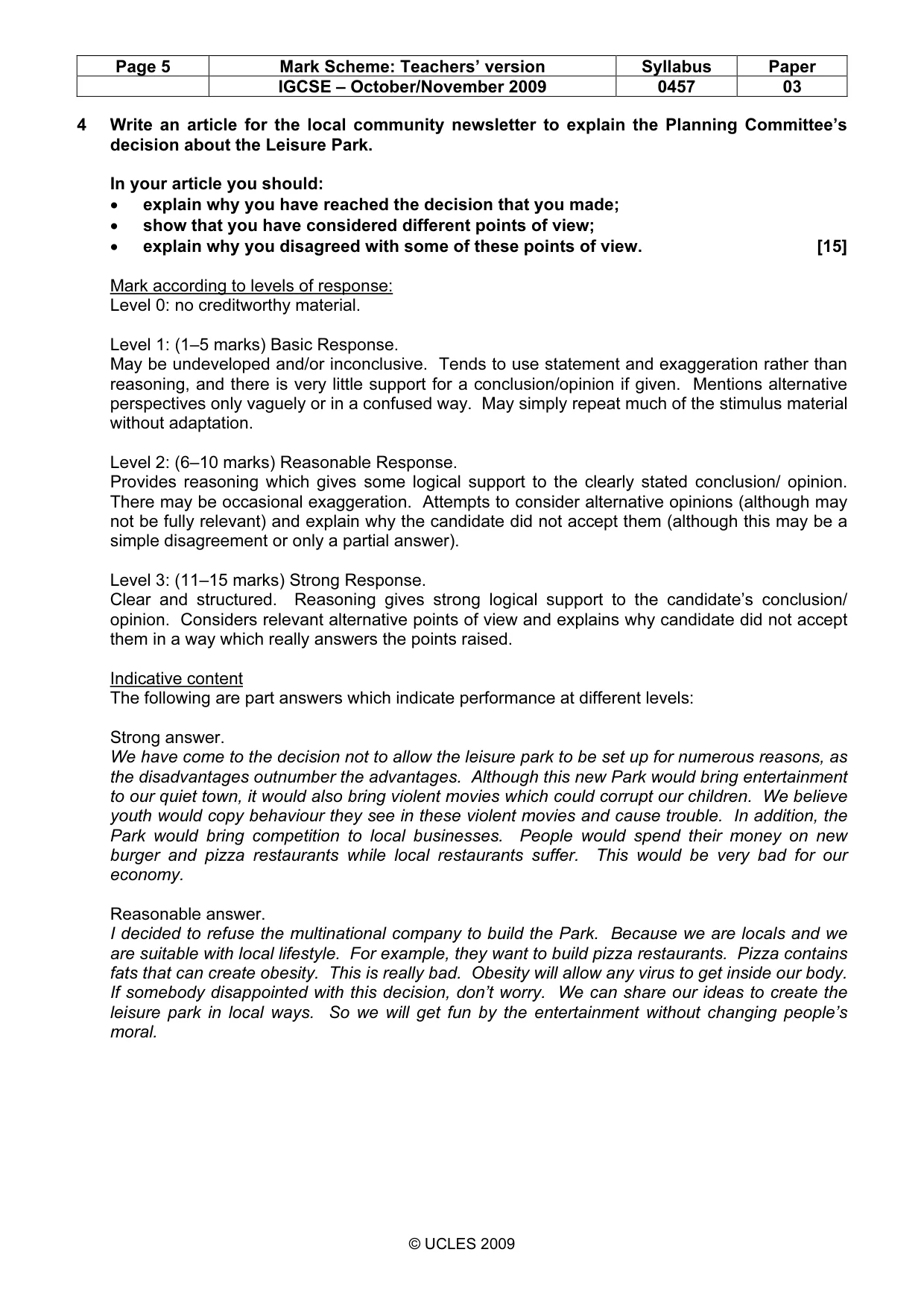
Page 5 Mark Scheme: Teachers’ version Syllabus Paper IGCSE – October/November 2009 0457 03 © UCLES 2009 4 Write an article for the local community newsletter to explain the Planning Committee’s decision about the Leisure Park. In your article you should: • explain why you have reached the decision that you made; • show that you have considered different points of view; • explain why you disagreed with some of these points of view. [15] Mark according to levels of response: Level 0: no creditworthy material. Level 1: (1–5 marks) Basic Response. May be undeveloped and/or inconclusive. Tends to use statement and exaggeration rather than reasoning, and there is very little support for a conclusion/opinion if given. Mentions alternative perspectives only vaguely or in a confused way. May simply repeat much of the stimulus material without adaptation. Level 2: (6–10 marks) Reasonable Response. Provides reasoning which gives some logical support to the clearly stated conclusion/ opinion. There may be occasional exaggeration. Attempts to consider alternative opinions (although may not be fully relevant) and explain why the candidate did not accept them (although this may be a simple disagreement or only a partial answer). Level 3: (11–15 marks) Strong Response. Clear and structured. Reasoning gives strong logical support to the candidate’s conclusion/ opinion. Considers relevant alternative points of view and explains why candidate did not accept them in a way which really answers the points raised. Indicative content The following are part answers which indicate performance at different levels: Strong answer. We have come to the decision not to allow the leisure park to be set up for numerous reasons, as the disadvantages outnumber the advantages. Although this new Park would bring entertainment to our quiet town, it would also bring violent movies which could corrupt our children. We believe youth would copy behaviour they see in these violent movies and cause trouble. In addition, the Park would bring competition to local businesses. People would spend their money on new burger and pizza restaurants while local restaurants suffer. This would be very bad for our economy. Reasonable answer. I decided to refuse the multinational company to build the Park. Because we are locals and we are suitable with local lifestyle. For example, they want to build pizza restaurants. Pizza contains fats that can create obesity. This is really bad. Obesity will allow any virus to get inside our body. If somebody disappointed with this decision, don’t worry. We can share our ideas to create the leisure park in local ways. So we will get fun by the entertainment without changing people’s moral.
Mark scheme, page 6
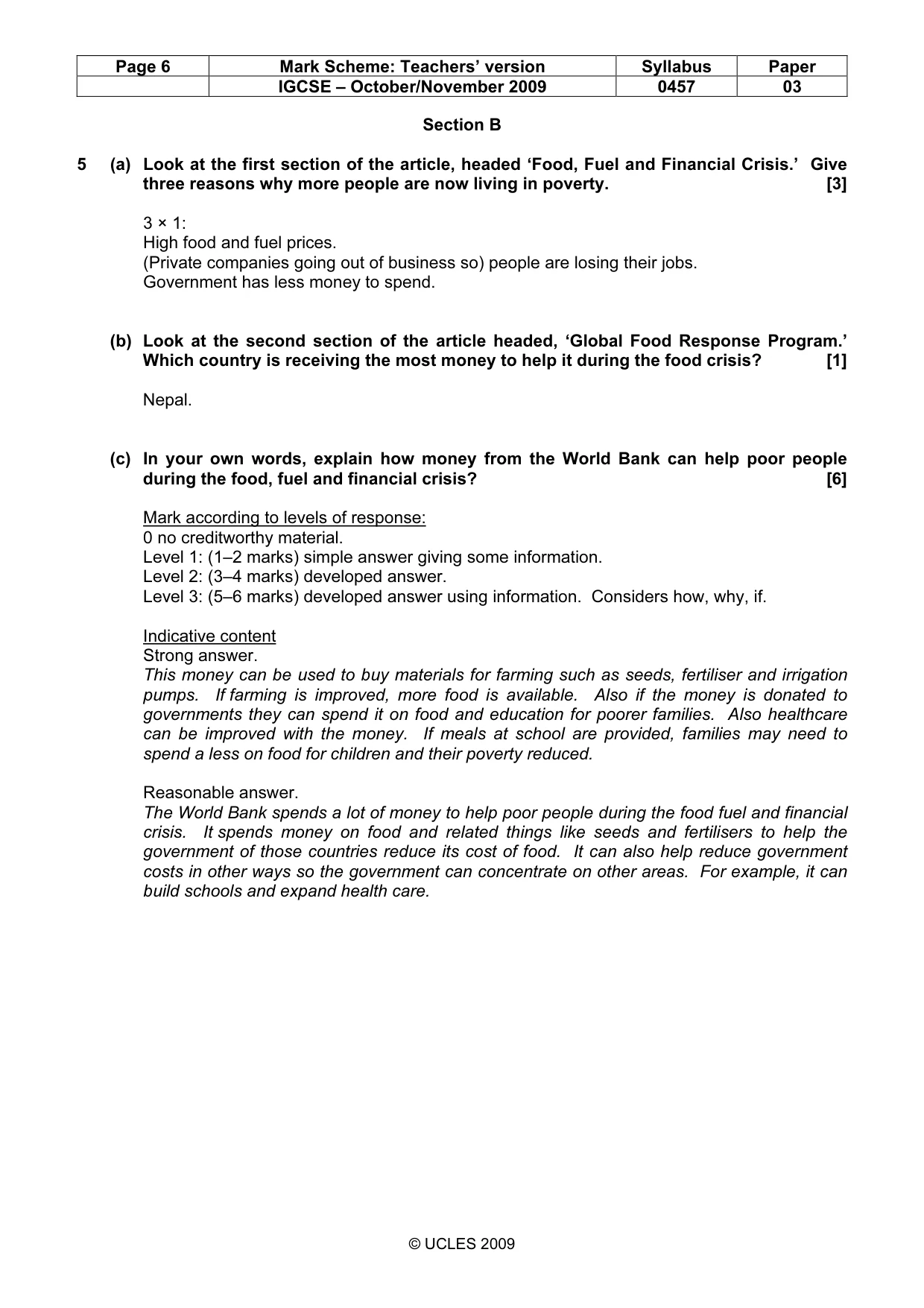
Page 6 Mark Scheme: Teachers’ version Syllabus Paper IGCSE – October/November 2009 0457 03 © UCLES 2009 Section B 5 (a) Look at the first section of the article, headed ‘Food, Fuel and Financial Crisis.’ Give three reasons why more people are now living in poverty. [3] 3 × 1: High food and fuel prices. (Private companies going out of business so) people are losing their jobs. Government has less money to spend. (b) Look at the second section of the article headed, ‘Global Food Response Program.’ Which country is receiving the most money to help it during the food crisis? [1] Nepal. (c) In your own words, explain how money from the World Bank can help poor people during the food, fuel and financial crisis? [6] Mark according to levels of response: 0 no creditworthy material. Level 1: (1–2 marks) simple answer giving some information. Level 2: (3–4 marks) developed answer. Level 3: (5–6 marks) developed answer using information. Considers how, why, if. Indicative content Strong answer. This money can be used to buy materials for farming such as seeds, fertiliser and irrigation pumps. If farming is improved, more food is available. Also if the money is donated to governments they can spend it on food and education for poorer families. Also healthcare can be improved with the money. If meals at school are provided, families may need to spend a less on food for children and their poverty reduced. Reasonable answer. The World Bank spends a lot of money to help poor people during the food fuel and financial crisis. It spends money on food and related things like seeds and fertilisers to help the government of those countries reduce its cost of food. It can also help reduce government costs in other ways so the government can concentrate on other areas. For example, it can build schools and expand health care.
Mark scheme, page 7
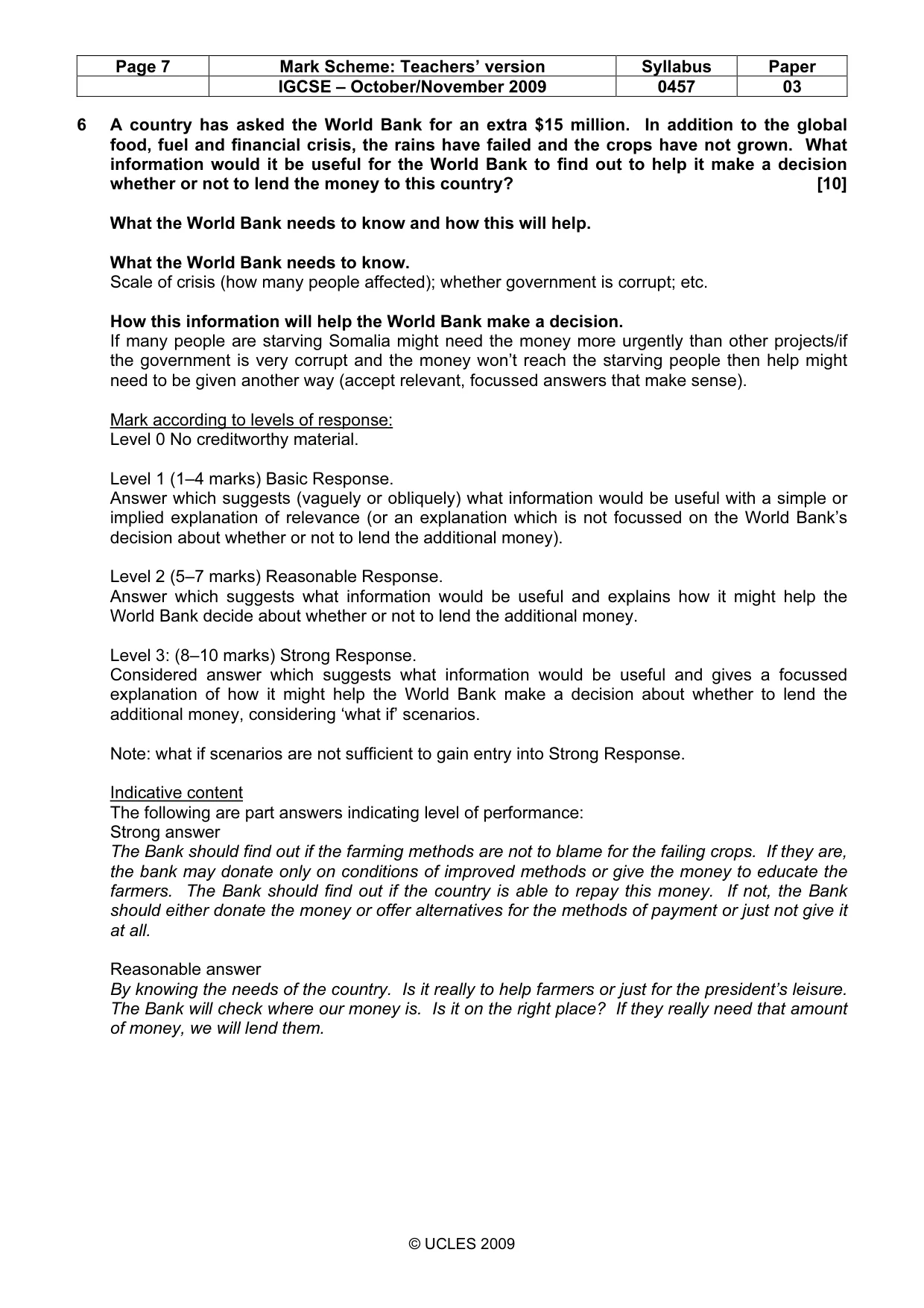
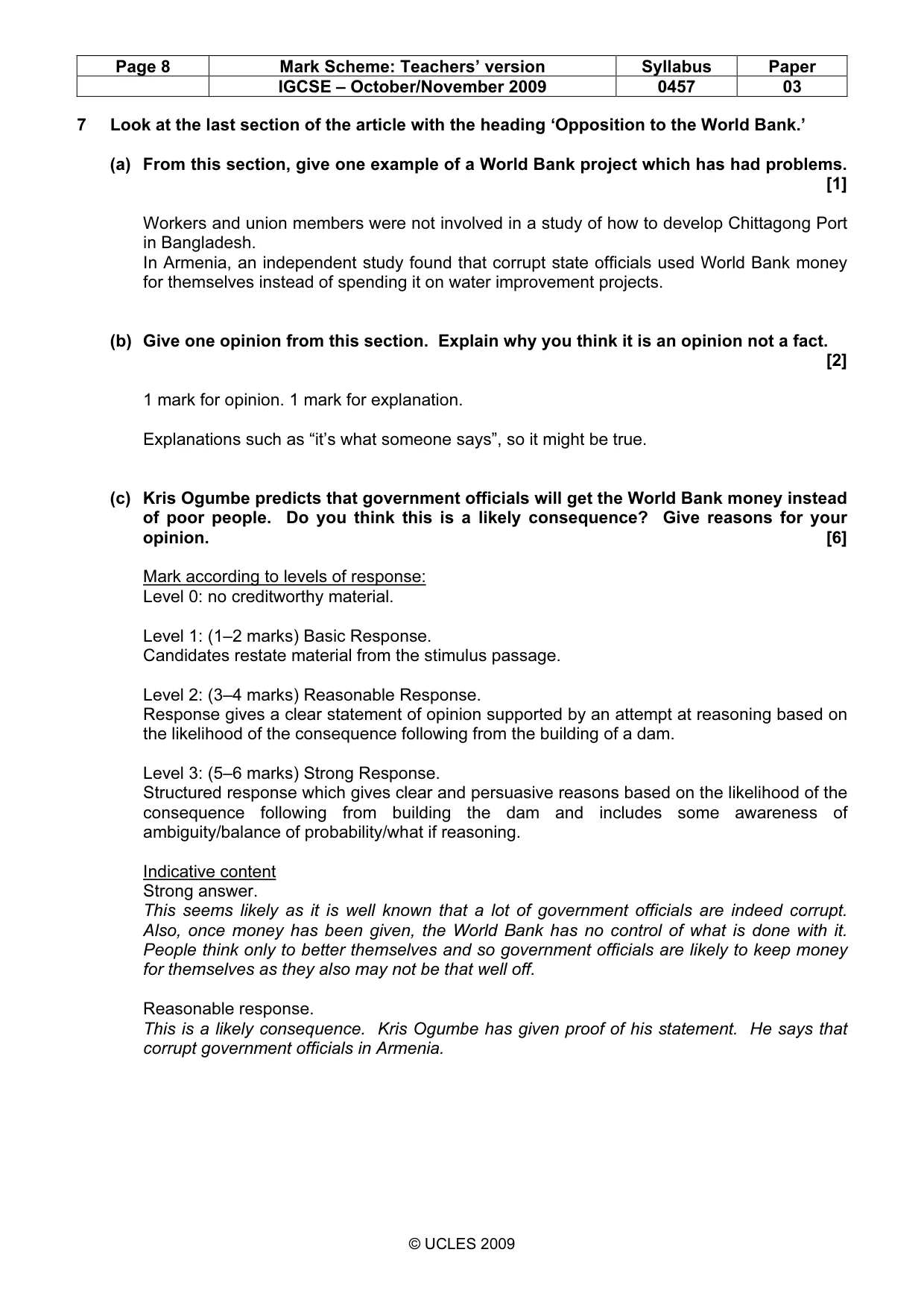
Page 7 Mark Scheme: Teachers’ version Syllabus Paper IGCSE – October/November 2009 0457 03 © UCLES 2009 6 A country has asked the World Bank for an extra $15 million. In addition to the global food, fuel and financial crisis, the rains have failed and the crops have not grown. What information would it be useful for the World Bank to find out to help it make a decision whether or not to lend the money to this country? [10] What the World Bank needs to know and how this will help. What the World Bank needs to know. Scale of crisis (how many people affected); whether government is corrupt; etc. How this information will help the World Bank make a decision. If many people are starving Somalia might need the money more urgently than other projects/if the government is very corrupt and the money won’t reach the starving people then help might need to be given another way (accept relevant, focussed answers that make sense). Mark according to levels of response: Level 0 No creditworthy material. Level 1 (1–4 marks) Basic Response. Answer which suggests (vaguely or obliquely) what information would be useful with a simple or implied explanation of relevance (or an explanation which is not focussed on the World Bank’s decision about whether or not to lend the additional money). Level 2 (5–7 marks) Reasonable Response. Answer which suggests what information would be useful and explains how it might help the World Bank decide about whether or not to lend the additional money. Level 3: (8–10 marks) Strong Response. Considered answer which suggests what information would be useful and gives a focussed explanation of how it might help the World Bank make a decision about whether to lend the additional money, considering ‘what if’ scenarios. Note: what if scenarios are not sufficient to gain entry into Strong Response. Indicative content The following are part answers indicating level of performance: Strong answer The Bank should find out if the farming methods are not to blame for the failing crops. If they are, the bank may donate only on conditions of improved methods or give the money to educate the farmers. The Bank should find out if the country is able to repay this money. If not, the Bank should either donate the money or offer alternatives for the methods of payment or just not give it at all. Reasonable answer By knowing the needs of the country. Is it really to help farmers or just for the president’s leisure. The Bank will check where our money is. Is it on the right place? If they really need that amount of money, we will lend them.
Mark scheme, page 8
Page 8 Mark Scheme: Teachers’ version Syllabus Paper IGCSE – October/November 2009 0457 03 © UCLES 2009 7 Look at the last section of the article with the heading ‘Opposition to the World Bank.’ (a) From this section, give one example of a World Bank project which has had problems. [1] Workers and union members were not involved in a study of how to develop Chittagong Port in Bangladesh. In Armenia, an independent study found that corrupt state officials used World Bank money for themselves instead of spending it on water improvement projects. (b) Give one opinion from this section. Explain why you think it is an opinion not a fact. [2] 1 mark for opinion. 1 mark for explanation. Explanations such as “it’s what someone says”, so it might be true. (c) Kris Ogumbe predicts that government officials will get the World Bank money instead of poor people. Do you think this is a likely consequence? Give reasons for your opinion. [6] Mark according to levels of response: Level 0: no creditworthy material. Level 1: (1–2 marks) Basic Response. Candidates restate material from the stimulus passage. Level 2: (3–4 marks) Reasonable Response. Response gives a clear statement of opinion supported by an attempt at reasoning based on the likelihood of the consequence following from the building of a dam. Level 3: (5–6 marks) Strong Response. Structured response which gives clear and persuasive reasons based on the likelihood of the consequence following from building the dam and includes some awareness of ambiguity/balance of probability/what if reasoning. Indicative content Strong answer. This seems likely as it is well known that a lot of government officials are indeed corrupt. Also, once money has been given, the World Bank has no control of what is done with it. People think only to better themselves and so government officials are likely to keep money for themselves as they also may not be that well off. Reasonable response. This is a likely consequence. Kris Ogumbe has given proof of his statement. He says that corrupt government officials in Armenia.
Mark scheme, page 9
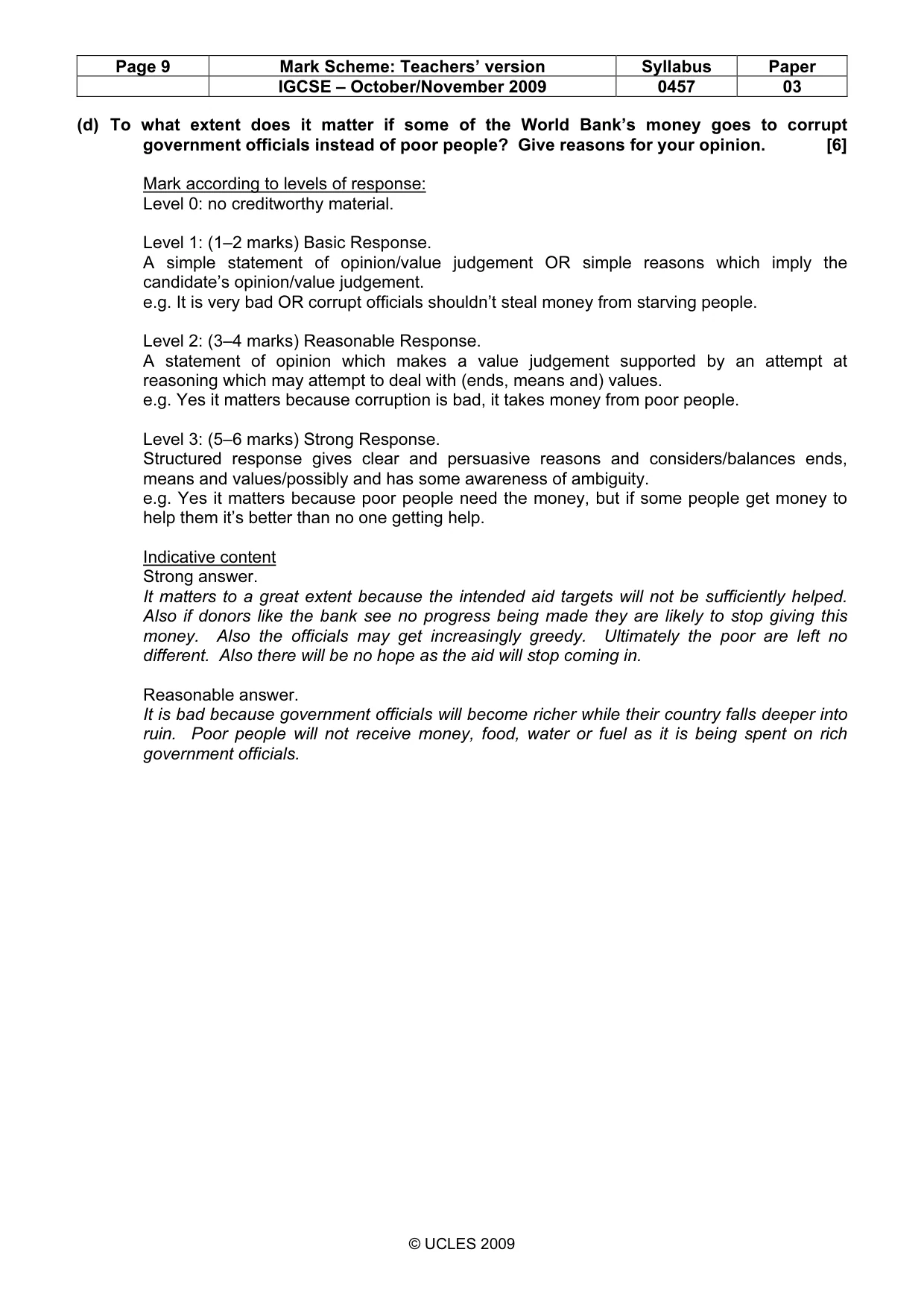
Page 9 Mark Scheme: Teachers’ version Syllabus Paper IGCSE – October/November 2009 0457 03 © UCLES 2009 (d) To what extent does it matter if some of the World Bank’s money goes to corrupt government officials instead of poor people? Give reasons for your opinion. [6] Mark according to levels of response: Level 0: no creditworthy material. Level 1: (1–2 marks) Basic Response. A simple statement of opinion/value judgement OR simple reasons which imply the candidate’s opinion/value judgement. e.g. It is very bad OR corrupt officials shouldn’t steal money from starving people. Level 2: (3–4 marks) Reasonable Response. A statement of opinion which makes a value judgement supported by an attempt at reasoning which may attempt to deal with (ends, means and) values. e.g. Yes it matters because corruption is bad, it takes money from poor people. Level 3: (5–6 marks) Strong Response. Structured response gives clear and persuasive reasons and considers/balances ends, means and values/possibly and has some awareness of ambiguity. e.g. Yes it matters because poor people need the money, but if some people get money to help them it’s better than no one getting help. Indicative content Strong answer. It matters to a great extent because the intended aid targets will not be sufficiently helped. Also if donors like the bank see no progress being made they are likely to stop giving this money. Also the officials may get increasingly greedy. Ultimately the poor are left no different. Also there will be no hope as the aid will stop coming in. Reasonable answer. It is bad because government officials will become richer while their country falls deeper into ruin. Poor people will not receive money, food, water or fuel as it is being spent on rich government officials.
Mark scheme, page 10
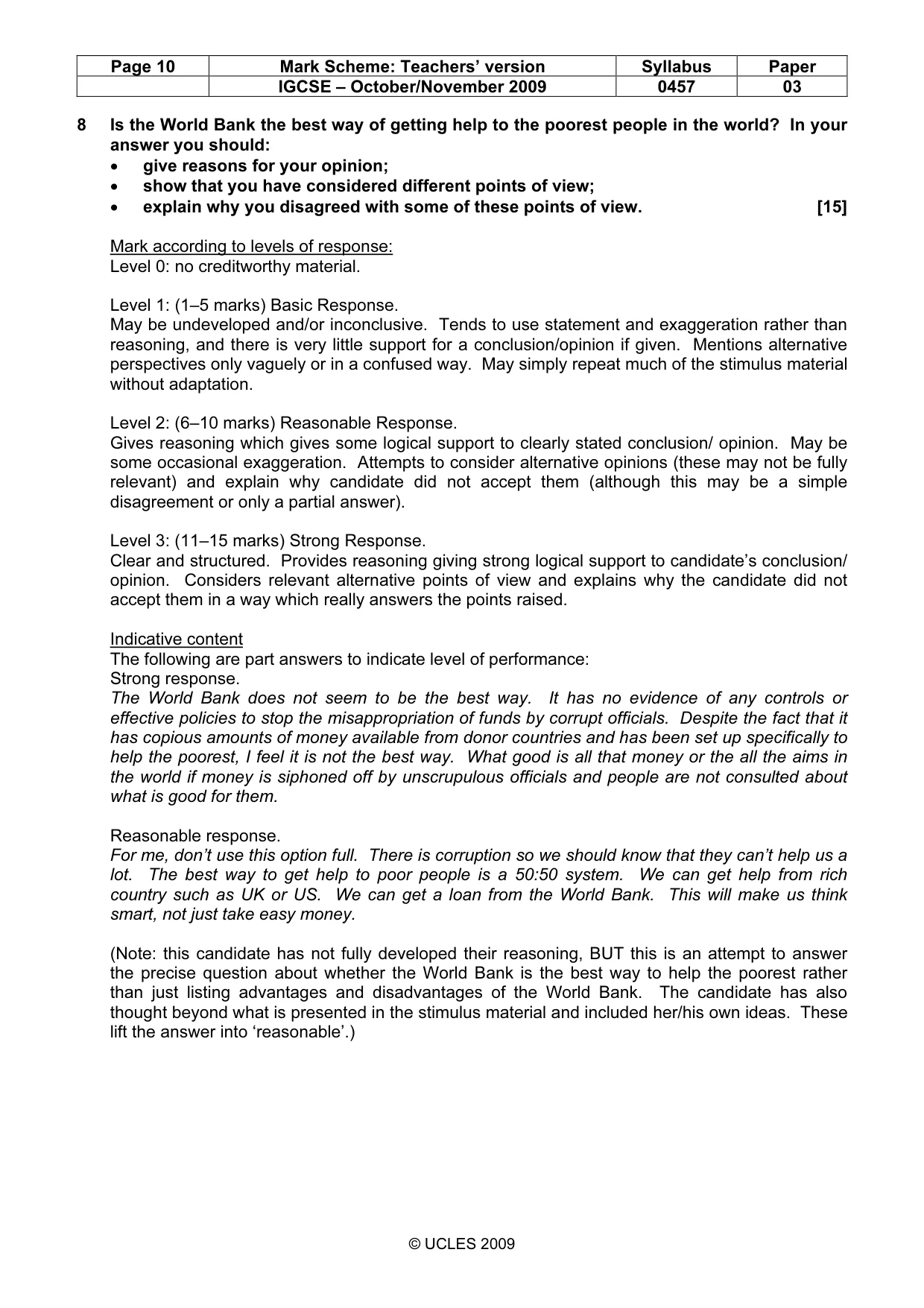
Page 10 Mark Scheme: Teachers’ version Syllabus Paper IGCSE – October/November 2009 0457 03 © UCLES 2009 8 Is the World Bank the best way of getting help to the poorest people in the world? In your answer you should: • give reasons for your opinion; • show that you have considered different points of view; • explain why you disagreed with some of these points of view. [15] Mark according to levels of response: Level 0: no creditworthy material. Level 1: (1–5 marks) Basic Response. May be undeveloped and/or inconclusive. Tends to use statement and exaggeration rather than reasoning, and there is very little support for a conclusion/opinion if given. Mentions alternative perspectives only vaguely or in a confused way. May simply repeat much of the stimulus material without adaptation. Level 2: (6–10 marks) Reasonable Response. Gives reasoning which gives some logical support to clearly stated conclusion/ opinion. May be some occasional exaggeration. Attempts to consider alternative opinions (these may not be fully relevant) and explain why candidate did not accept them (although this may be a simple disagreement or only a partial answer). Level 3: (11–15 marks) Strong Response. Clear and structured. Provides reasoning giving strong logical support to candidate’s conclusion/ opinion. Considers relevant alternative points of view and explains why the candidate did not accept them in a way which really answers the points raised. Indicative content The following are part answers to indicate level of performance: Strong response. The World Bank does not seem to be the best way. It has no evidence of any controls or effective policies to stop the misappropriation of funds by corrupt officials. Despite the fact that it has copious amounts of money available from donor countries and has been set up specifically to help the poorest, I feel it is not the best way. What good is all that money or the all the aims in the world if money is siphoned off by unscrupulous officials and people are not consulted about what is good for them. Reasonable response. For me, don’t use this option full. There is corruption so we should know that they can’t help us a lot. The best way to get help to poor people is a 50:50 system. We can get help from rich country such as UK or US. We can get a loan from the World Bank. This will make us think smart, not just take easy money. (Note: this candidate has not fully developed their reasoning, BUT this is an attempt to answer the precise question about whether the World Bank is the best way to help the poorest rather than just listing advantages and disadvantages of the World Bank. The candidate has also thought beyond what is presented in the stimulus material and included her/his own ideas. These lift the answer into ‘reasonable’.)
What you needed in this session
Cambridge’s own grade thresholds for 2009 Oct/Nov, Paper 3 · Variant 1. A higher threshold means an easier paper — the bar moves with how the cohort did.