Cambridge IGCSE Global Perspectives 0457 — 2009 May/June Paper 3 · Variant 1
0457/31/M/J/09 · 100 marks · ≈113 min
The question paper and its mark scheme, free to read here and free to download. This is Cambridge’s own paper, exactly as it was sat.
Question paper16 pages


Mark scheme7 pages
Answers below. Sit the paper first if you are practising.
Paper as text
Question paper, page 1
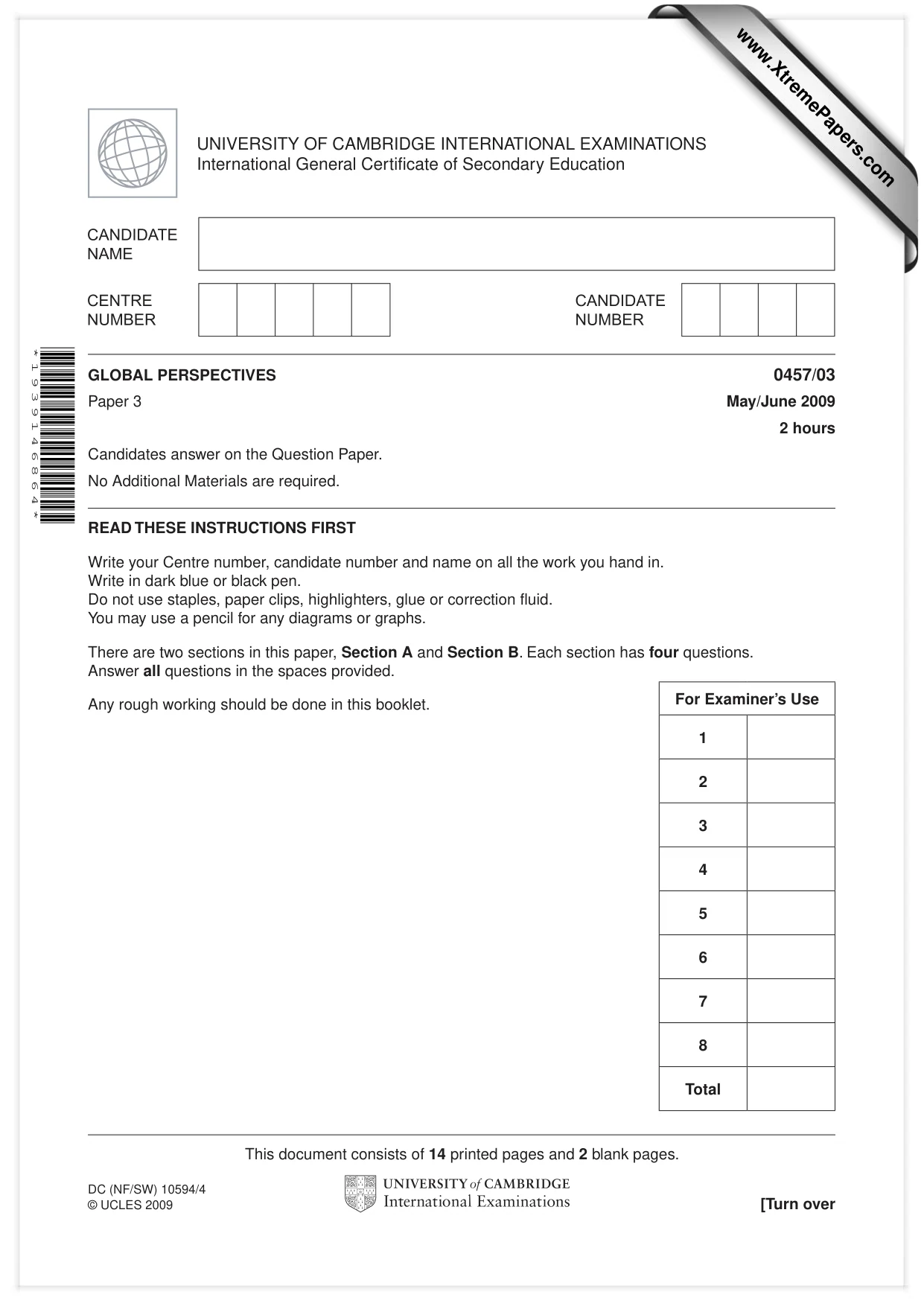
This document consists of 14 printed pages and 2 blank pages. DC (NF/SW) 10594/4 © UCLES 2009 [Turn over UNIVERSITY OF CAMBRIDGE INTERNATIONAL EXAMINATIONS International General Certificate of Secondary Education READ THESE INSTRUCTIONS FIRST Write your Centre number, candidate number and name on all the work you hand in. Write in dark blue or black pen. Do not use staples, paper clips, highlighters, glue or correction fluid. You may use a pencil for any diagrams or graphs. There are two sections in this paper, Section A and Section B. Each section has four questions. Answer all questions in the spaces provided. Any rough working should be done in this booklet. * 1 9 3 9 1 4 6 8 6 4 * GLOBAL PERSPECTIVES 0457/03 Paper 3 May/June 2009 2 hours Candidates answer on the Question Paper. No Additional Materials are required. For Examiner’s Use 1 2 3 4 5 6 7 8 Total www.XtremePapers.com
Question paper, page 2
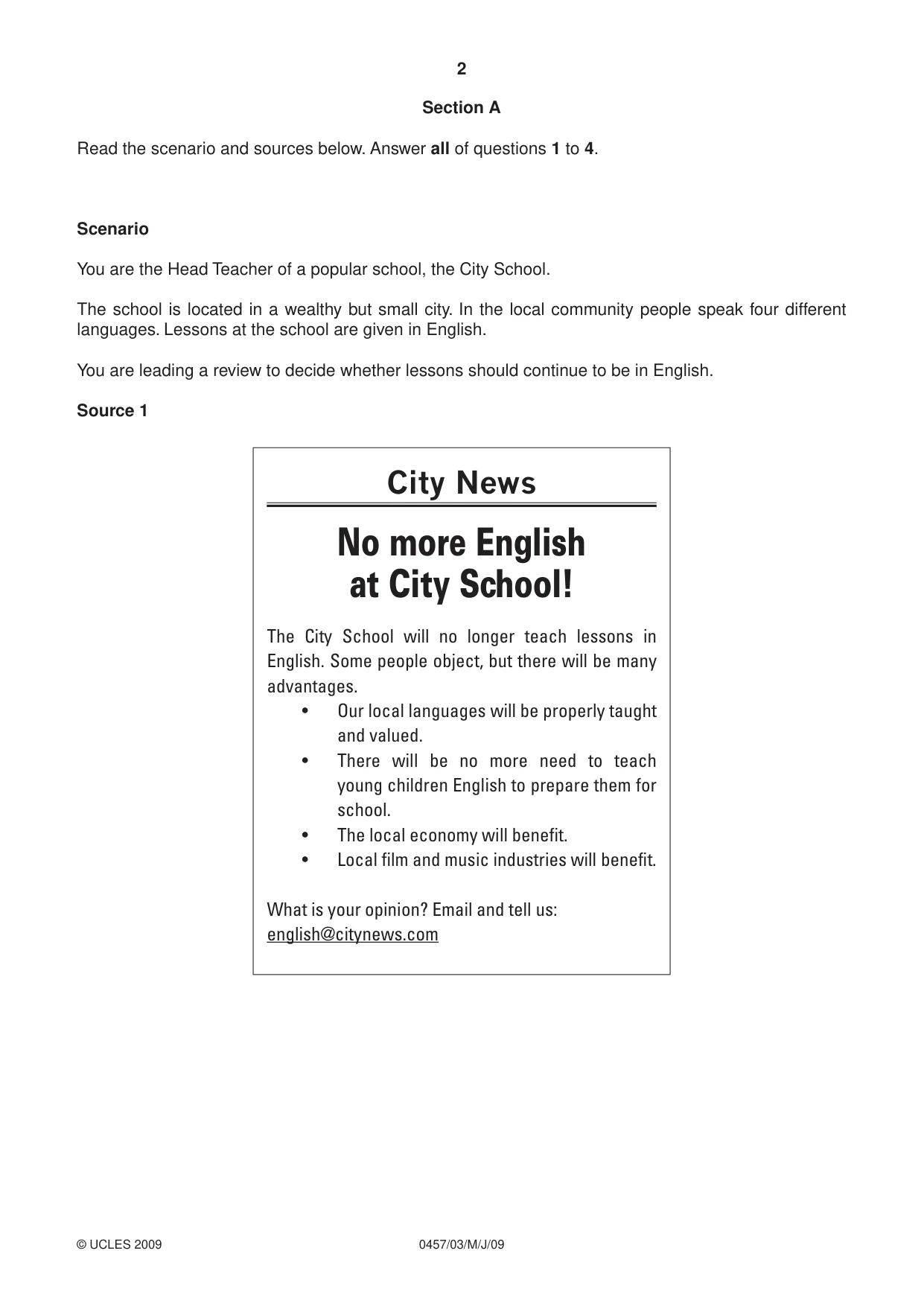
2 0457/03/M/J/09 © UCLES 2009 Section A Read the scenario and sources below. Answer all of questions 1 to 4. Scenario You are the Head Teacher of a popular school, the City School. The school is located in a wealthy but small city. In the local community people speak four different languages. Lessons at the school are given in English. You are leading a review to decide whether lessons should continue to be in English. Source 1 City News No more English at City School! The City School will no longer teach lessons in English. Some people object, but there will be many advantages. • Our local languages will be properly taught and valued. • There will be no more need to teach young children English to prepare them for school. • The local economy will benefit. • Local film and music industries will benefit. What is your opinion? Email and tell us: english@citynews.com
Question paper, page 3
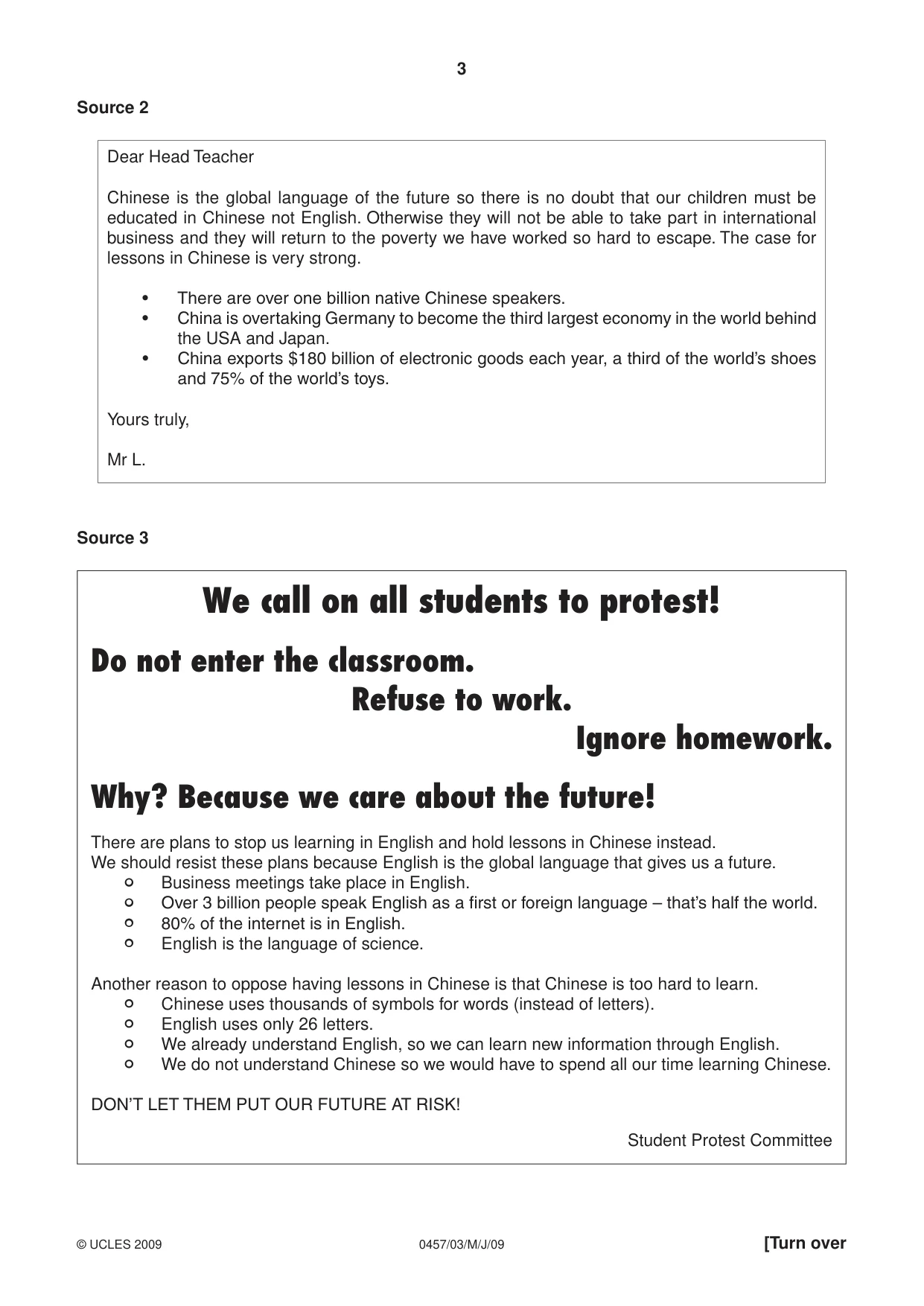
3 0457/03/M/J/09 © UCLES 2009 [Turn over Source 2 Dear Head Teacher Chinese is the global language of the future so there is no doubt that our children must be educated in Chinese not English. Otherwise they will not be able to take part in international business and they will return to the poverty we have worked so hard to escape. The case for lessons in Chinese is very strong. • There are over one billion native Chinese speakers. • China is overtaking Germany to become the third largest economy in the world behind the USA and Japan. • China exports $180 billion of electronic goods each year, a third of the world’s shoes and 75% of the world’s toys. Yours truly, Mr L. Source 3 We call on all students to protest! Do not enter the classroom. Refuse to work. Ignore homework. Why? Because we care about the future! There are plans to stop us learning in English and hold lessons in Chinese instead. We should resist these plans because English is the global language that gives us a future. • Business meetings take place in English. • Over 3 billion people speak English as a first or foreign language – that’s half the world. • 80% of the internet is in English. • English is the language of science. Another reason to oppose having lessons in Chinese is that Chinese is too hard to learn. • Chinese uses thousands of symbols for words (instead of letters). • English uses only 26 letters. • We already understand English, so we can learn new information through English. • We do not understand Chinese so we would have to spend all our time learning Chinese. DON’T LET THEM PUT OUR FUTURE AT RISK! Student Protest Committee
Question paper, page 4
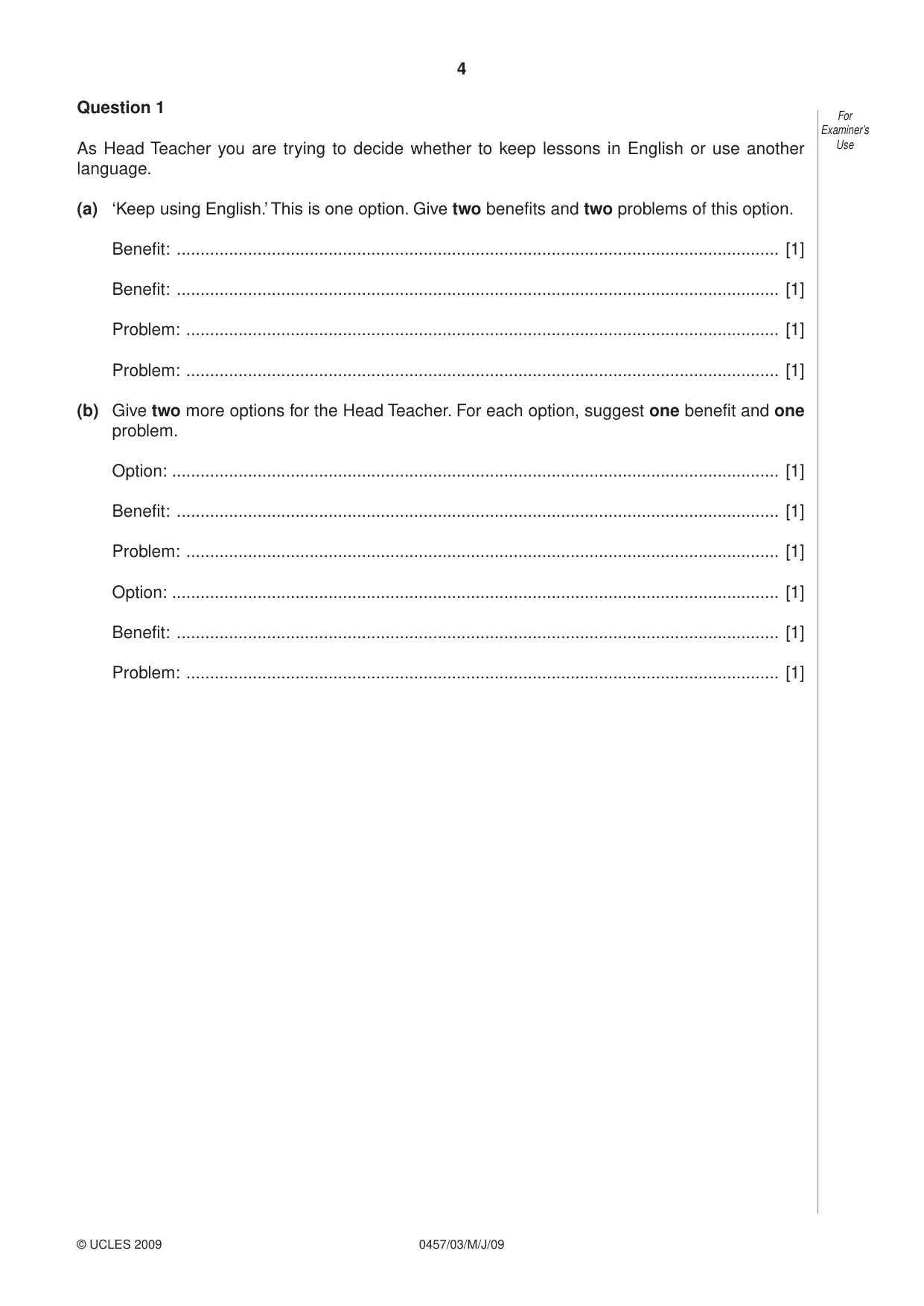
4 0457/03/M/J/09 © UCLES 2009 For Examiner’s Use Question 1 As Head Teacher you are trying to decide whether to keep lessons in English or use another language. (a) ‘Keep using English.’ This is one option. Give two benefits and two problems of this option. Benefit: … [1] Benefit: … [1] Problem: … [1] Problem: … [1] (b) Give two more options for the Head Teacher. For each option, suggest one benefit and one problem. Option: … [1] Benefit: … [1] Problem: … [1] Option: … [1] Benefit: … [1] Problem: … [1]
Question paper, page 5
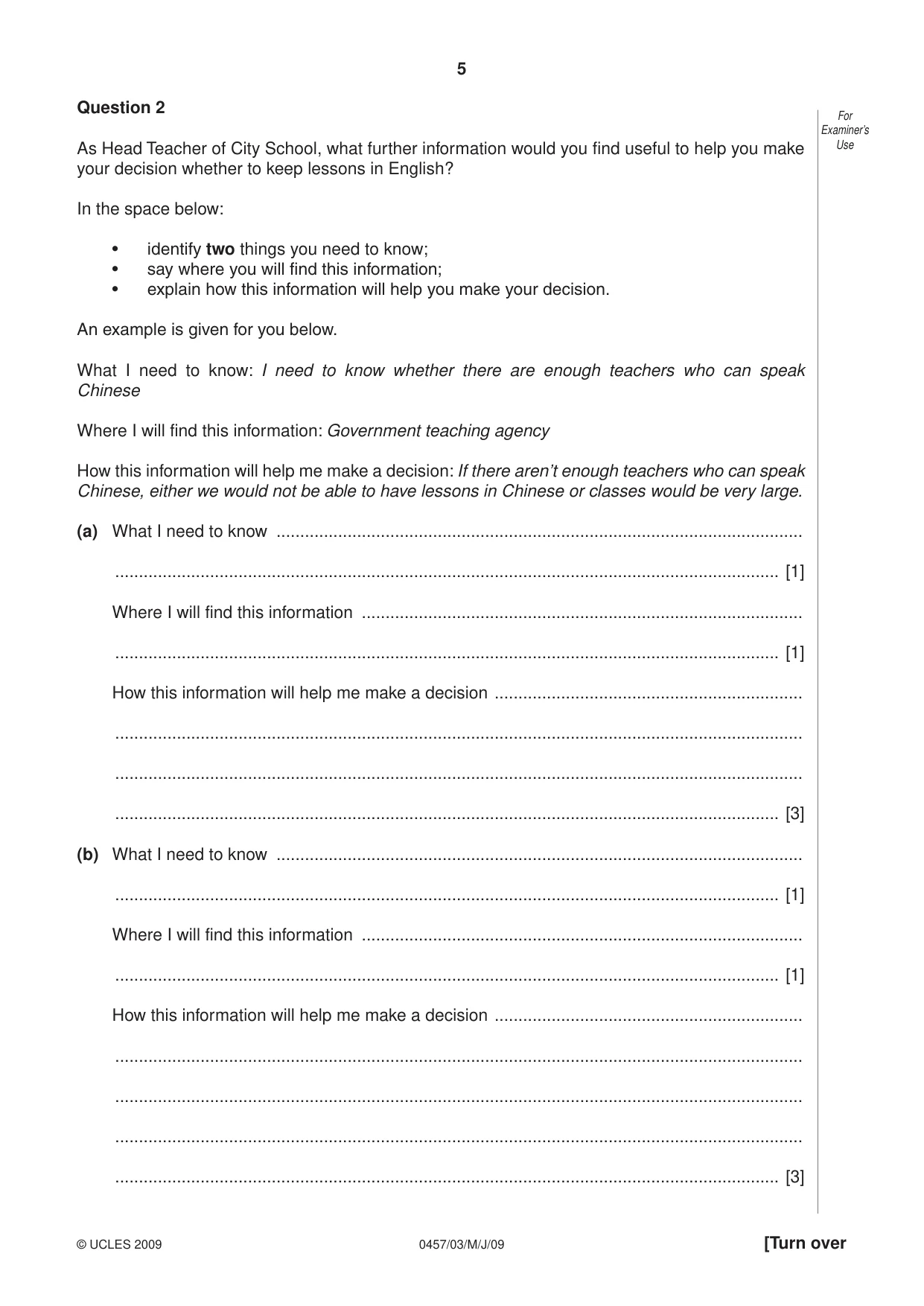
5 0457/03/M/J/09 © UCLES 2009 [Turn over For Examiner’s Use Question 2 As Head Teacher of City School, what further information would you find useful to help you make your decision whether to keep lessons in English? In the space below: • identify two things you need to know; • say where you will find this information; • explain how this information will help you make your decision. An example is given for you below. What I need to know: I need to know whether there are enough teachers who can speak Chinese Where I will find this information: Government teaching agency How this information will help me make a decision: If there aren’t enough teachers who can speak Chinese, either we would not be able to have lessons in Chinese or classes would be very large. (a) What I need to know … … [1] Where I will find this information … … [1] How this information will help me make a decision … … … … [3] (b) What I need to know … … [1] Where I will find this information … … [1] How this information will help me make a decision … … … … … [3]
Question paper, page 6
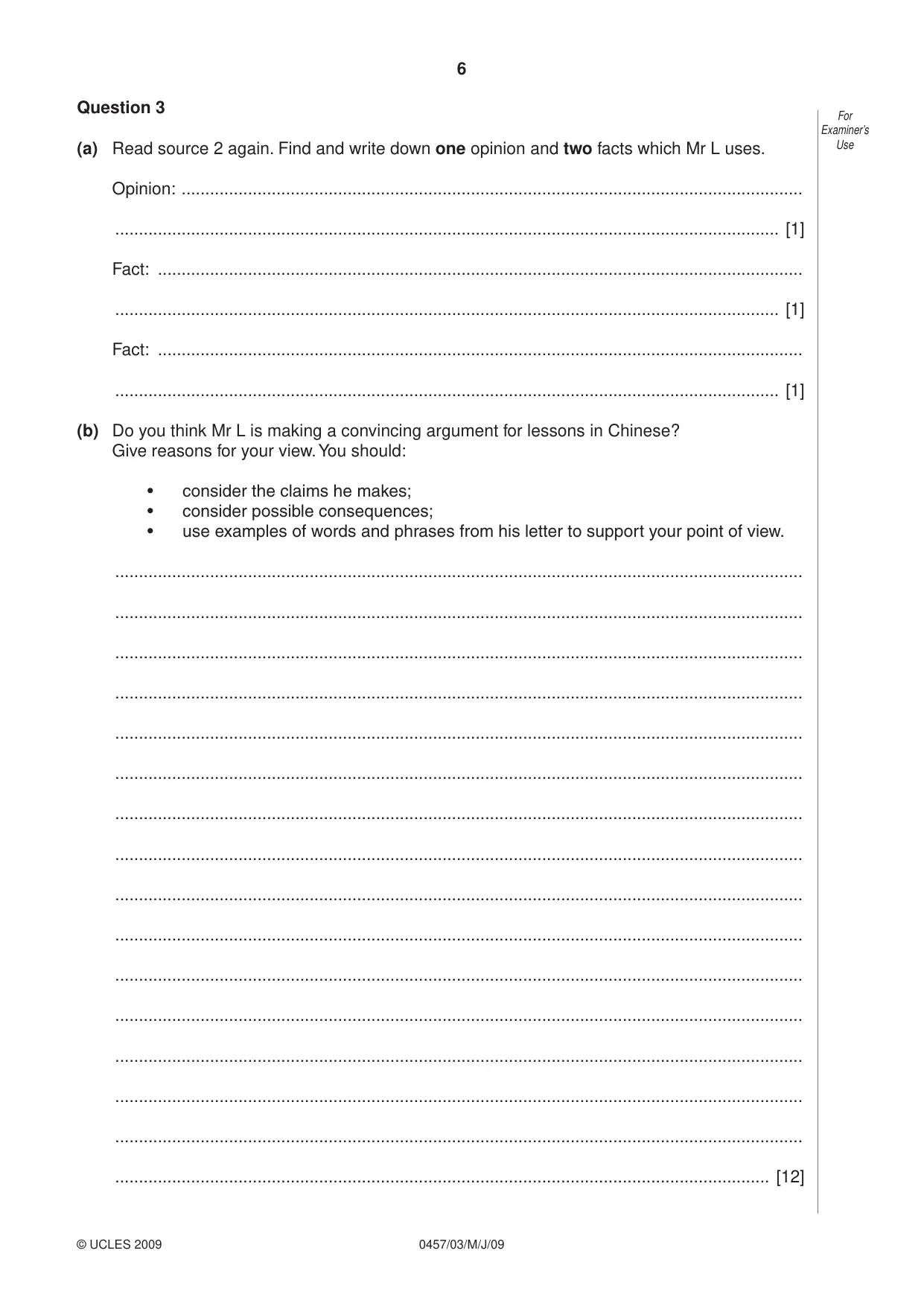
6 0457/03/M/J/09 © UCLES 2009 For Examiner’s Use Question 3 (a) Read source 2 again. Find and write down one opinion and two facts which Mr L uses. Opinion: … … [1] Fact: … … [1] Fact: … … [1] (b) Do you think Mr L is making a convincing argument for lessons in Chinese? Give reasons for your view. You should: • consider the claims he makes; • consider possible consequences; • use examples of words and phrases from his letter to support your point of view. … … … … … … … … … … … … … … … … [12]
Question paper, page 7
7 0457/03/M/J/09 © UCLES 2009 [Turn over For Examiner’s Use Question 4 Consider the sources and your answers to previous questions. In your role as Head Teacher, write a letter to parents to explain what you have decided about which language the City School will use in lessons. In your letter you should: • explain why you have reached the decision that you have made; • show that you have considered different points of view; • explain why you disagreed with some of these points of view. … … … … … … … … … … … … … … … … … … … … … [15]
Question paper, page 8
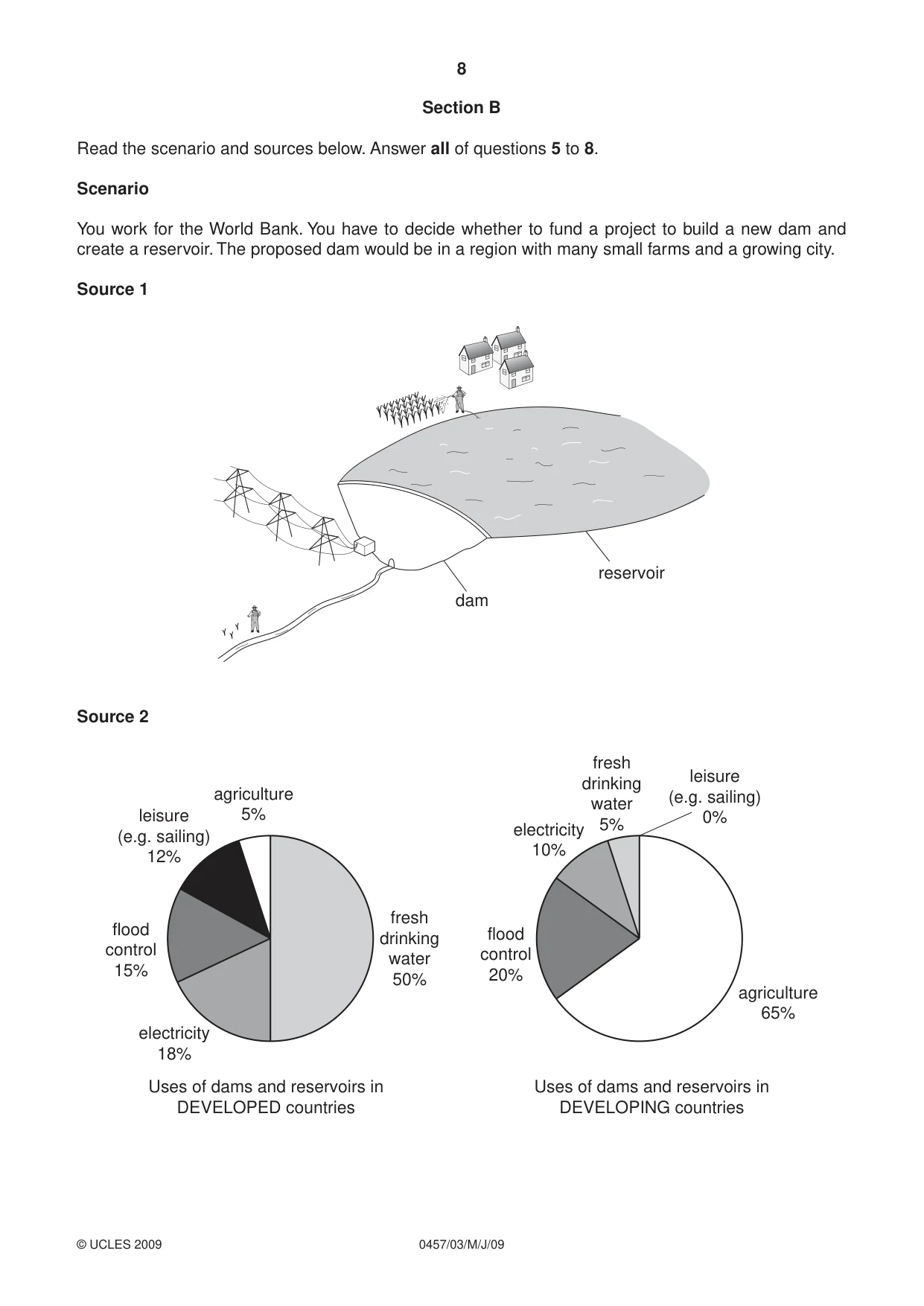
8 0457/03/M/J/09 © UCLES 2009 Section B Read the scenario and sources below. Answer all of questions 5 to 8. Scenario You work for the World Bank. You have to decide whether to fund a project to build a new dam and create a reservoir. The proposed dam would be in a region with many small farms and a growing city. Source 1 reservoir dam Source 2 fresh drinking water 50% electricity 18% flood control 15% leisure (e.g. sailing) 12% agriculture 5% Uses of dams and reservoirs in DEVELOPED countries Uses of dams and reservoirs in DEVELOPING countries fresh drinking water 5% electricity 10% flood control 20% leisure (e.g. sailing) 0% agriculture 65%
Question paper, page 9
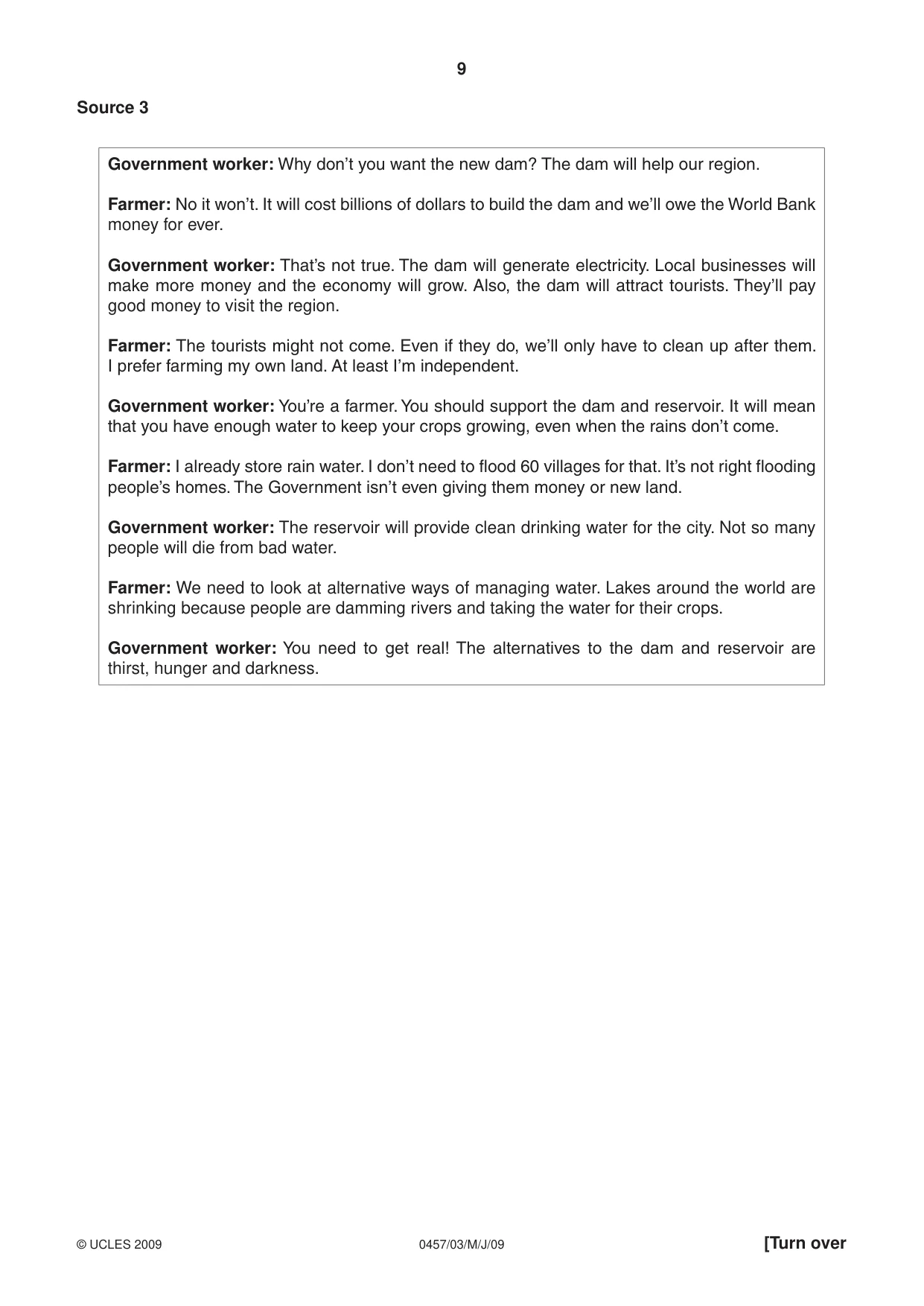
9 0457/03/M/J/09 © UCLES 2009 [Turn over Source 3 Government worker: Why don’t you want the new dam? The dam will help our region. Farmer: No it won’t. It will cost billions of dollars to build the dam and we’ll owe the World Bank money for ever. Government worker: That’s not true. The dam will generate electricity. Local businesses will make more money and the economy will grow. Also, the dam will attract tourists. They’ll pay good money to visit the region. Farmer: The tourists might not come. Even if they do, we’ll only have to clean up after them. I prefer farming my own land. At least I’m independent. Government worker: You’re a farmer. You should support the dam and reservoir. It will mean that you have enough water to keep your crops growing, even when the rains don’t come. Farmer: I already store rain water. I don’t need to flood 60 villages for that. It’s not right flooding people’s homes. The Government isn’t even giving them money or new land. Government worker: The reservoir will provide clean drinking water for the city. Not so many people will die from bad water. Farmer: We need to look at alternative ways of managing water. Lakes around the world are shrinking because people are damming rivers and taking the water for their crops. Government worker: You need to get real! The alternatives to the dam and reservoir are thirst, hunger and darkness.
Question paper, page 10
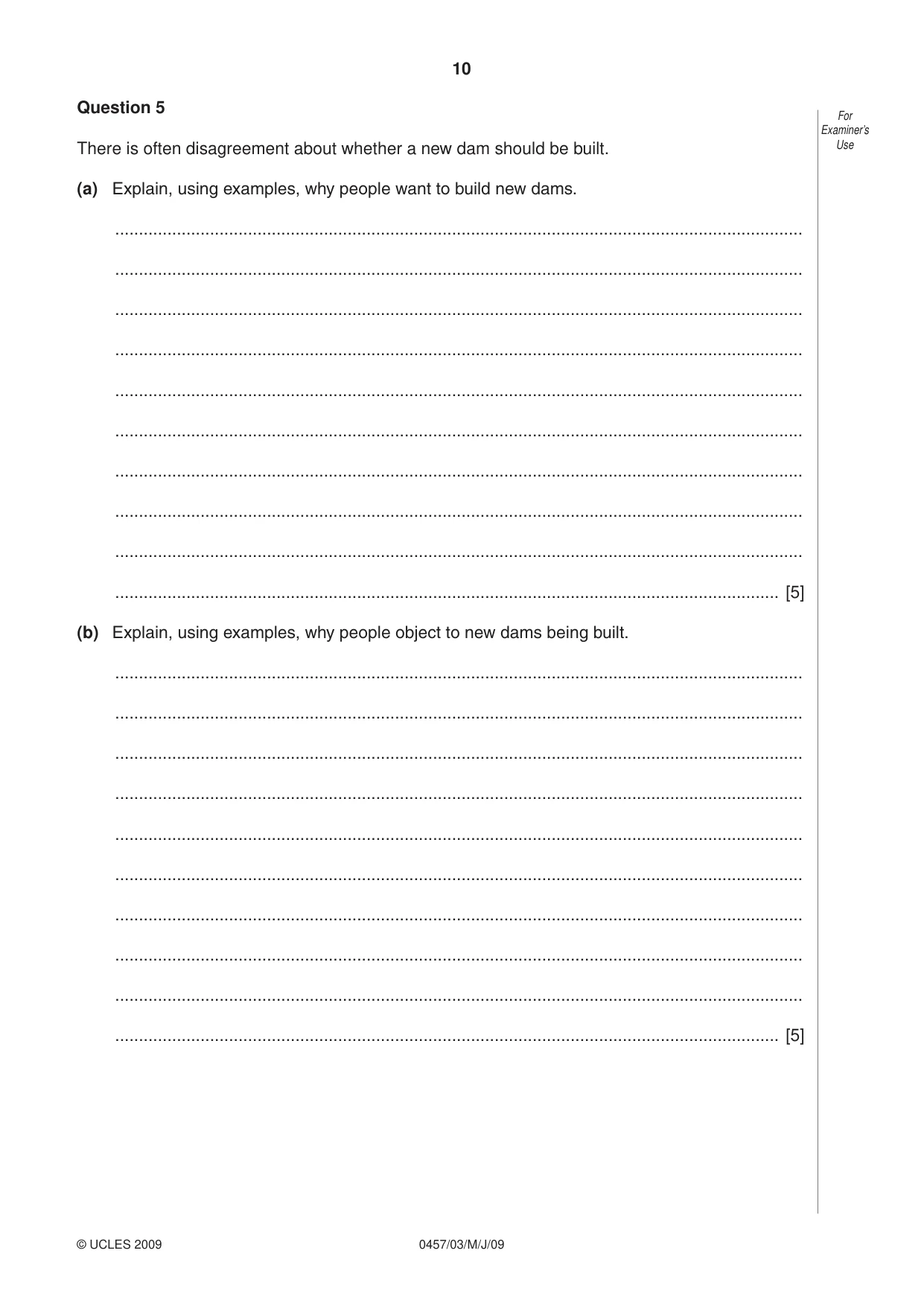
10 0457/03/M/J/09 © UCLES 2009 For Examiner’s Use Question 5 There is often disagreement about whether a new dam should be built. (a) Explain, using examples, why people want to build new dams. … … … … … … … … … … [5] (b) Explain, using examples, why people object to new dams being built. … … … … … … … … … … [5]
Question paper, page 11
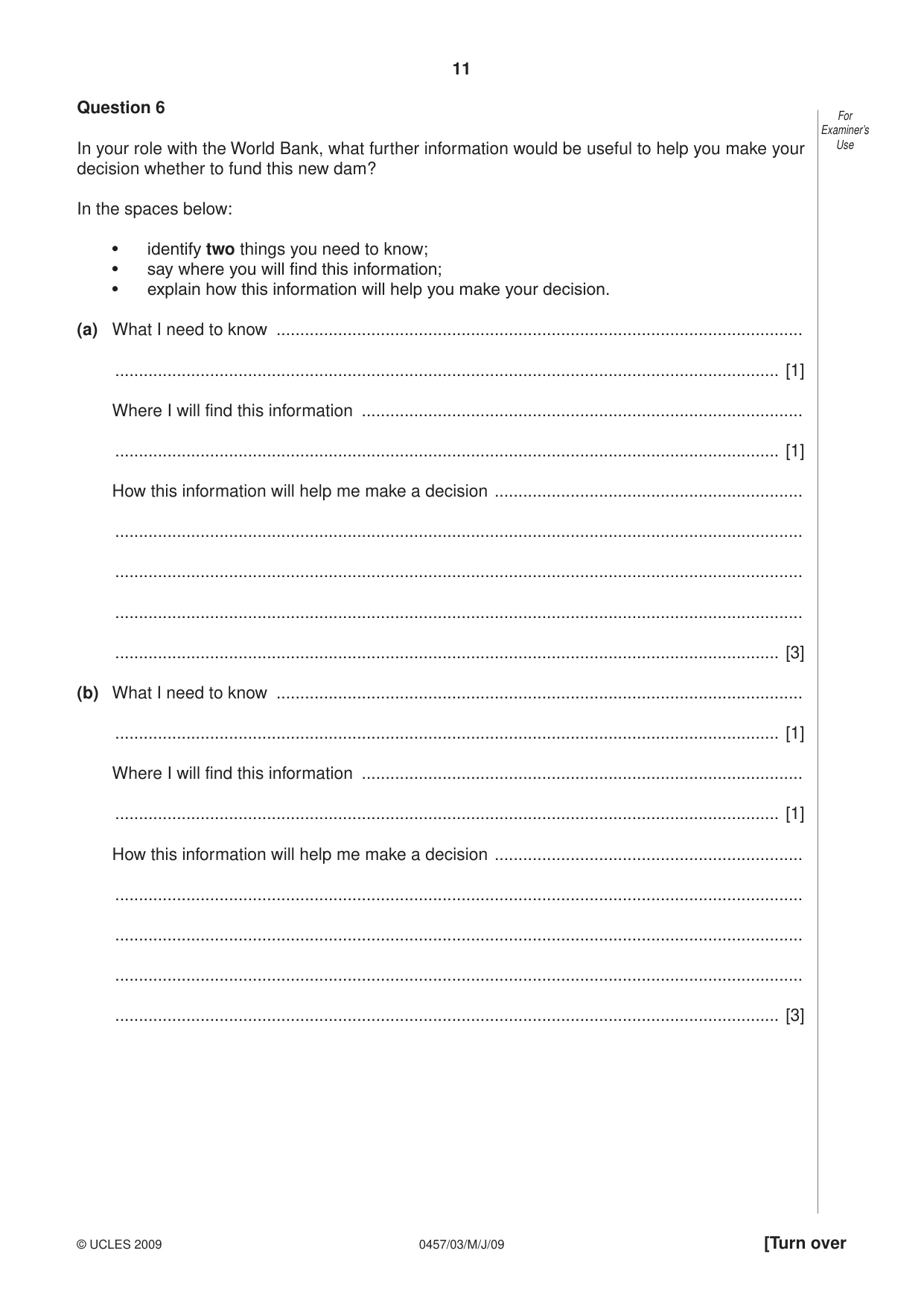
11 0457/03/M/J/09 © UCLES 2009 [Turn over For Examiner’s Use Question 6 In your role with the World Bank, what further information would be useful to help you make your decision whether to fund this new dam? In the spaces below: • identify two things you need to know; • say where you will find this information; • explain how this information will help you make your decision. (a) What I need to know … … [1] Where I will find this information … … [1] How this information will help me make a decision … … … … … [3] (b) What I need to know … … [1] Where I will find this information … … [1] How this information will help me make a decision … … … … … [3]
Question paper, page 12
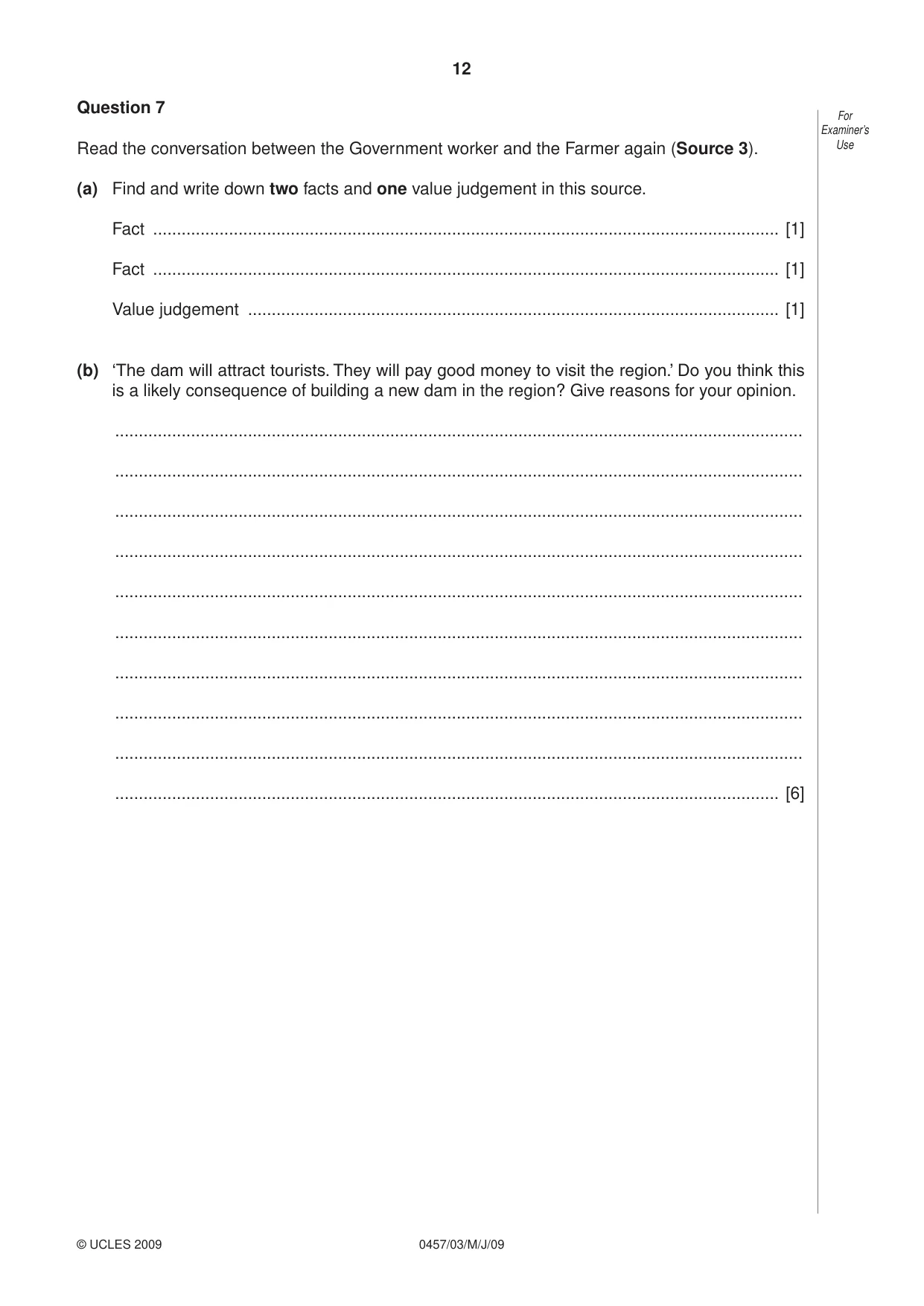
12 0457/03/M/J/09 © UCLES 2009 For Examiner’s Use Question 7 Read the conversation between the Government worker and the Farmer again (Source 3). (a) Find and write down two facts and one value judgement in this source. Fact … [1] Fact … [1] Value judgement … [1] (b) ‘The dam will attract tourists. They will pay good money to visit the region.’ Do you think this is a likely consequence of building a new dam in the region? Give reasons for your opinion. … … … … … … … … … … [6]
Question paper, page 13
13 0457/03/M/J/09 © UCLES 2009 [Turn over For Examiner’s Use (c) The dam ‘will mean that you have enough water to keep your crops growing.’ Do you think this is a likely consequence of building a new dam in the region? Give reasons for your opinion. … … … … … … … … … … [6]
Question paper, page 14
14 0457/03/M/J/09 © UCLES 2009 For Examiner’s Use Question 8 Do you think that dams are a good way of managing water? In your answer you should: • give reasons for your opinion; • show that you have considered other points of view; • explain why you disagreed with some of these points of view. … … … … … … … … … … … … … … … … … … … … … … … [15]
Question paper, page 16
16 0457/03/M/J/09 BLANK PAGE Permission to reproduce items where third-party owned material protected by copyright is included has been sought and cleared where possible. Every reasonable effort has been made by the publisher (UCLES) to trace copyright holders, but if any items requiring clearance have unwittingly been included, the publisher will be pleased to make amends at the earliest possible opportunity. University of Cambridge International Examinations is part of the Cambridge Assessment Group. Cambridge Assessment is the brand name of University of Cambridge Local Examinations Syndicate (UCLES), which is itself a department of the University of Cambridge.
Mark scheme, page 1
UNIVERSITY OF CAMBRIDGE INTERNATIONAL EXAMINATIONS International General Certificate of Secondary Education MARK SCHEME for the May/June 2009 question paper for the guidance of teachers 0457 GLOBAL PERSPECTIVES 0457/03 Paper 3 (Written Paper), maximum raw mark 100 This mark scheme is published as an aid to teachers and candidates, to indicate the requirements of the examination. It shows the basis on which Examiners were instructed to award marks. It does not indicate the details of the discussions that took place at an Examiners’ meeting before marking began, which would have considered the acceptability of alternative answers. Mark schemes must be read in conjunction with the question papers and the report on the examination. • CIE will not enter into discussions or correspondence in connection with these mark schemes. CIE is publishing the mark schemes for the May/June 2009 question papers for most IGCSE, GCE Advanced Level and Advanced Subsidiary Level syllabuses and some Ordinary Level syllabuses. www.XtremePapers.com
Mark scheme, page 2
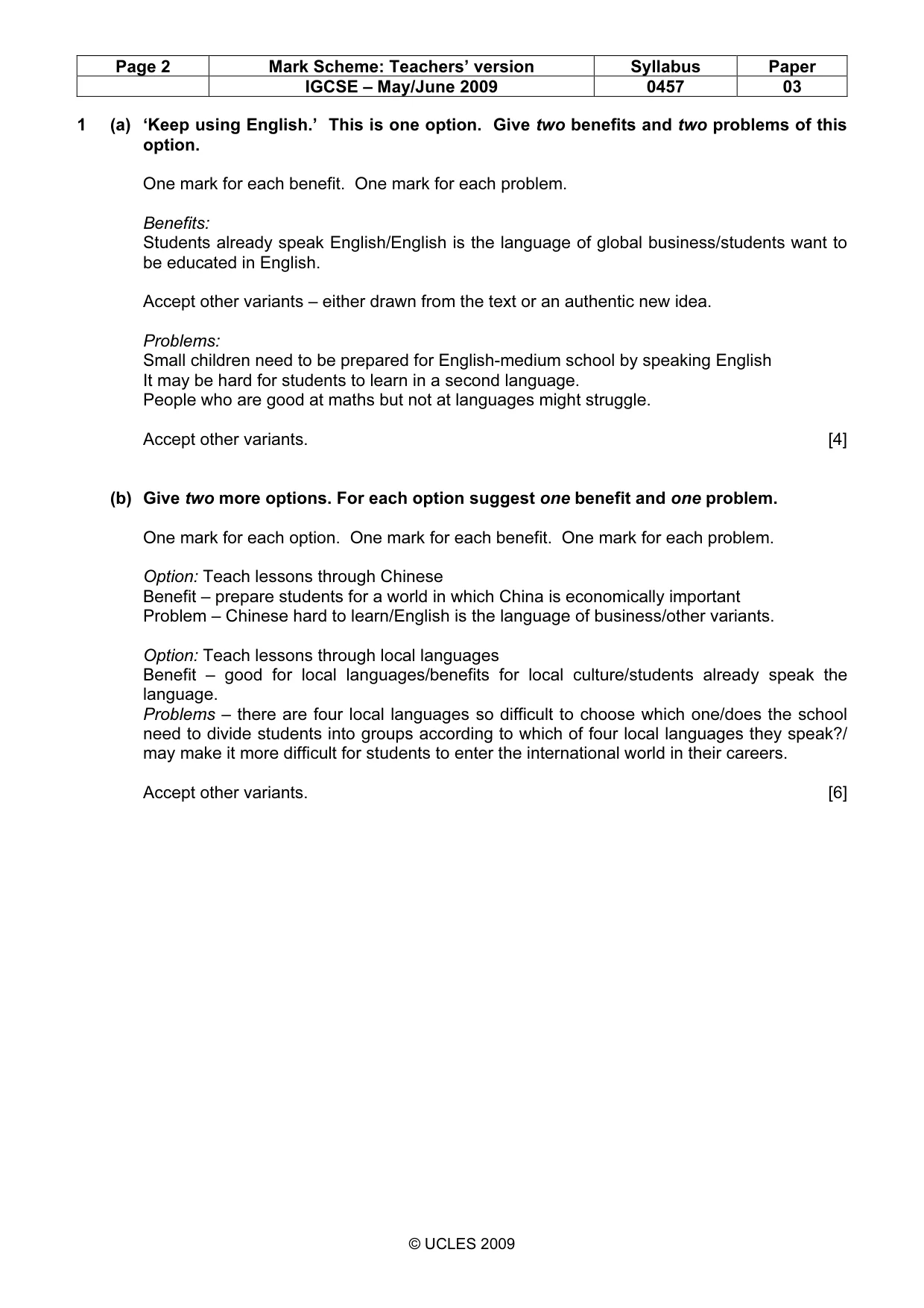
Page 2 Mark Scheme: Teachers’ version Syllabus Paper IGCSE – May/June 2009 0457 03 © UCLES 2009 1 (a) ‘Keep using English.’ This is one option. Give two benefits and two problems of this option. One mark for each benefit. One mark for each problem. Benefits: Students already speak English/English is the language of global business/students want to be educated in English. Accept other variants – either drawn from the text or an authentic new idea. Problems: Small children need to be prepared for English-medium school by speaking English It may be hard for students to learn in a second language. People who are good at maths but not at languages might struggle. Accept other variants. [4] (b) Give two more options. For each option suggest one benefit and one problem. One mark for each option. One mark for each benefit. One mark for each problem. Option: Teach lessons through Chinese Benefit – prepare students for a world in which China is economically important Problem – Chinese hard to learn/English is the language of business/other variants. Option: Teach lessons through local languages Benefit – good for local languages/benefits for local culture/students already speak the language. Problems – there are four local languages so difficult to choose which one/does the school need to divide students into groups according to which of four local languages they speak?/ may make it more difficult for students to enter the international world in their careers. Accept other variants. [6]
Mark scheme, page 3
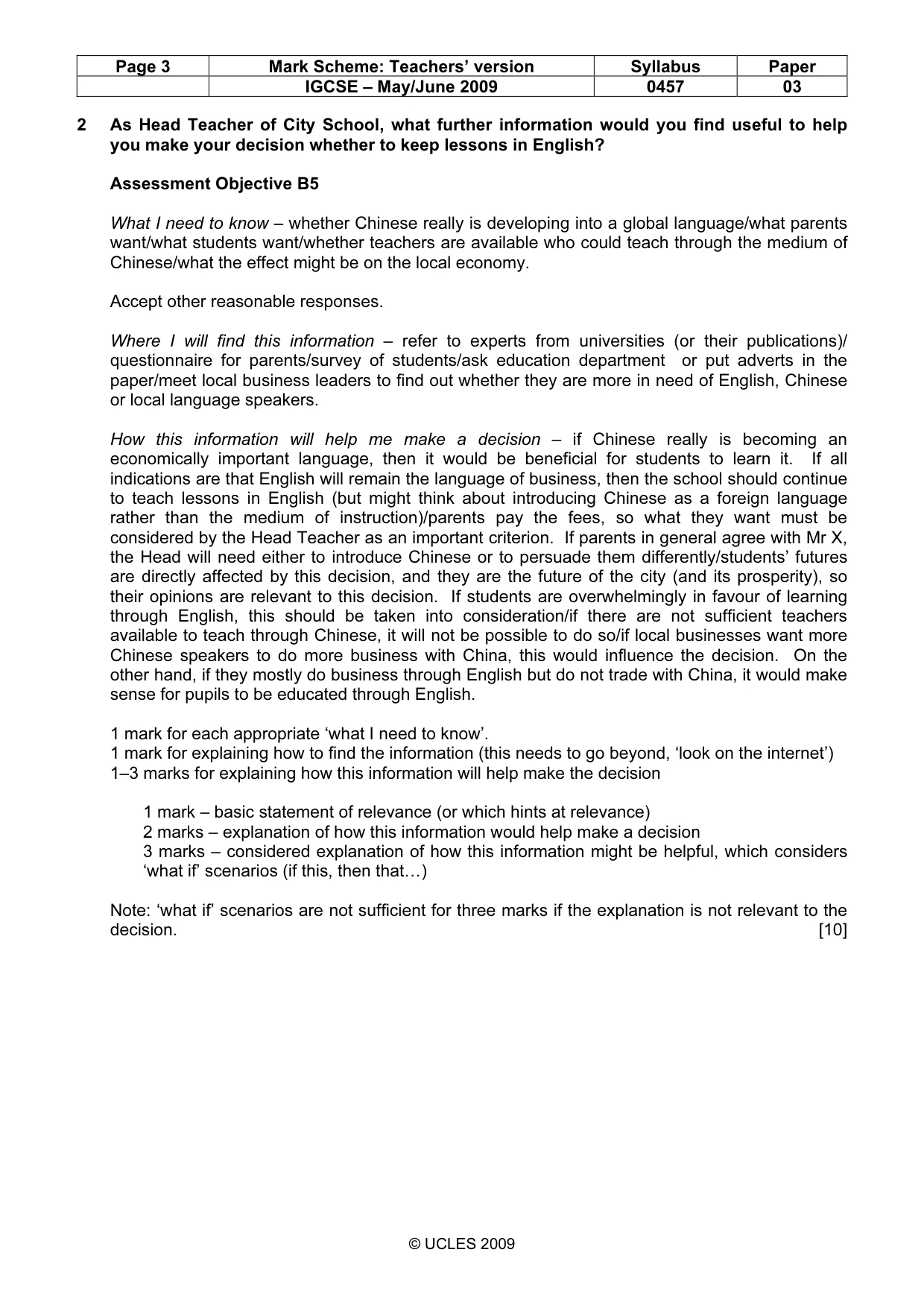
Page 3 Mark Scheme: Teachers’ version Syllabus Paper IGCSE – May/June 2009 0457 03 © UCLES 2009 2 As Head Teacher of City School, what further information would you find useful to help you make your decision whether to keep lessons in English? Assessment Objective B5 What I need to know – whether Chinese really is developing into a global language/what parents want/what students want/whether teachers are available who could teach through the medium of Chinese/what the effect might be on the local economy. Accept other reasonable responses. Where I will find this information – refer to experts from universities (or their publications)/ questionnaire for parents/survey of students/ask education department or put adverts in the paper/meet local business leaders to find out whether they are more in need of English, Chinese or local language speakers. How this information will help me make a decision – if Chinese really is becoming an economically important language, then it would be beneficial for students to learn it. If all indications are that English will remain the language of business, then the school should continue to teach lessons in English (but might think about introducing Chinese as a foreign language rather than the medium of instruction)/parents pay the fees, so what they want must be considered by the Head Teacher as an important criterion. If parents in general agree with Mr X, the Head will need either to introduce Chinese or to persuade them differently/students’ futures are directly affected by this decision, and they are the future of the city (and its prosperity), so their opinions are relevant to this decision. If students are overwhelmingly in favour of learning through English, this should be taken into consideration/if there are not sufficient teachers available to teach through Chinese, it will not be possible to do so/if local businesses want more Chinese speakers to do more business with China, this would influence the decision. On the other hand, if they mostly do business through English but do not trade with China, it would make sense for pupils to be educated through English. 1 mark for each appropriate ‘what I need to know’. 1 mark for explaining how to find the information (this needs to go beyond, ‘look on the internet’) 1–3 marks for explaining how this information will help make the decision 1 mark – basic statement of relevance (or which hints at relevance) 2 marks – explanation of how this information would help make a decision 3 marks – considered explanation of how this information might be helpful, which considers ‘what if’ scenarios (if this, then that…) Note: ‘what if’ scenarios are not sufficient for three marks if the explanation is not relevant to the decision. [10]
Mark scheme, page 4
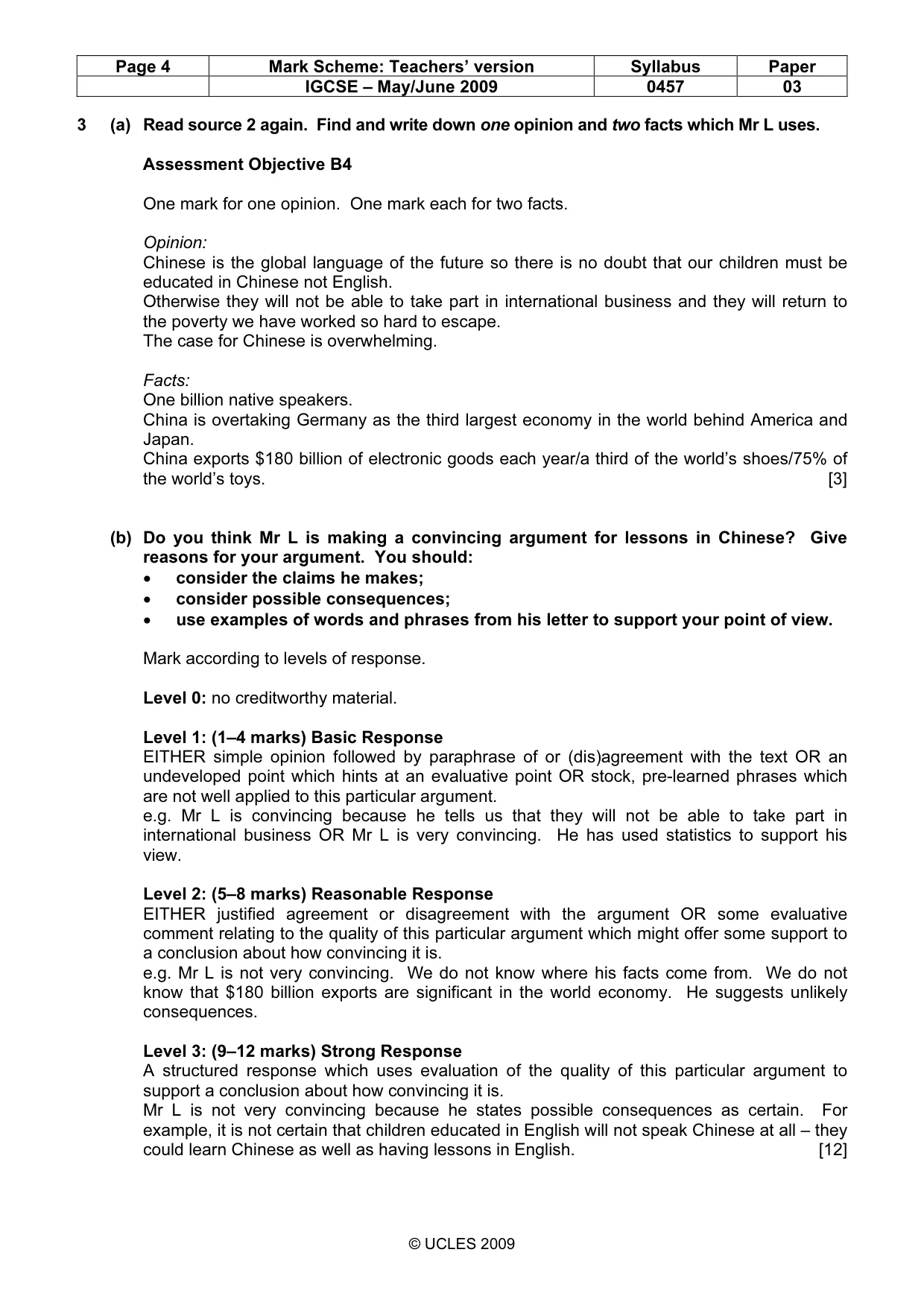
Page 4 Mark Scheme: Teachers’ version Syllabus Paper IGCSE – May/June 2009 0457 03 © UCLES 2009 3 (a) Read source 2 again. Find and write down one opinion and two facts which Mr L uses. Assessment Objective B4 One mark for one opinion. One mark each for two facts. Opinion: Chinese is the global language of the future so there is no doubt that our children must be educated in Chinese not English. Otherwise they will not be able to take part in international business and they will return to the poverty we have worked so hard to escape. The case for Chinese is overwhelming. Facts: One billion native speakers. China is overtaking Germany as the third largest economy in the world behind America and Japan. China exports $180 billion of electronic goods each year/a third of the world’s shoes/75% of the world’s toys. [3] (b) Do you think Mr L is making a convincing argument for lessons in Chinese? Give reasons for your argument. You should: • consider the claims he makes; • consider possible consequences; • use examples of words and phrases from his letter to support your point of view. Mark according to levels of response. Level 0: no creditworthy material. Level 1: (1–4 marks) Basic Response EITHER simple opinion followed by paraphrase of or (dis)agreement with the text OR an undeveloped point which hints at an evaluative point OR stock, pre-learned phrases which are not well applied to this particular argument. e.g. Mr L is convincing because he tells us that they will not be able to take part in international business OR Mr L is very convincing. He has used statistics to support his view. Level 2: (5–8 marks) Reasonable Response EITHER justified agreement or disagreement with the argument OR some evaluative comment relating to the quality of this particular argument which might offer some support to a conclusion about how convincing it is. e.g. Mr L is not very convincing. We do not know where his facts come from. We do not know that $180 billion exports are significant in the world economy. He suggests unlikely consequences. Level 3: (9–12 marks) Strong Response A structured response which uses evaluation of the quality of this particular argument to support a conclusion about how convincing it is. Mr L is not very convincing because he states possible consequences as certain. For example, it is not certain that children educated in English will not speak Chinese at all – they could learn Chinese as well as having lessons in English. [12]
Mark scheme, page 5
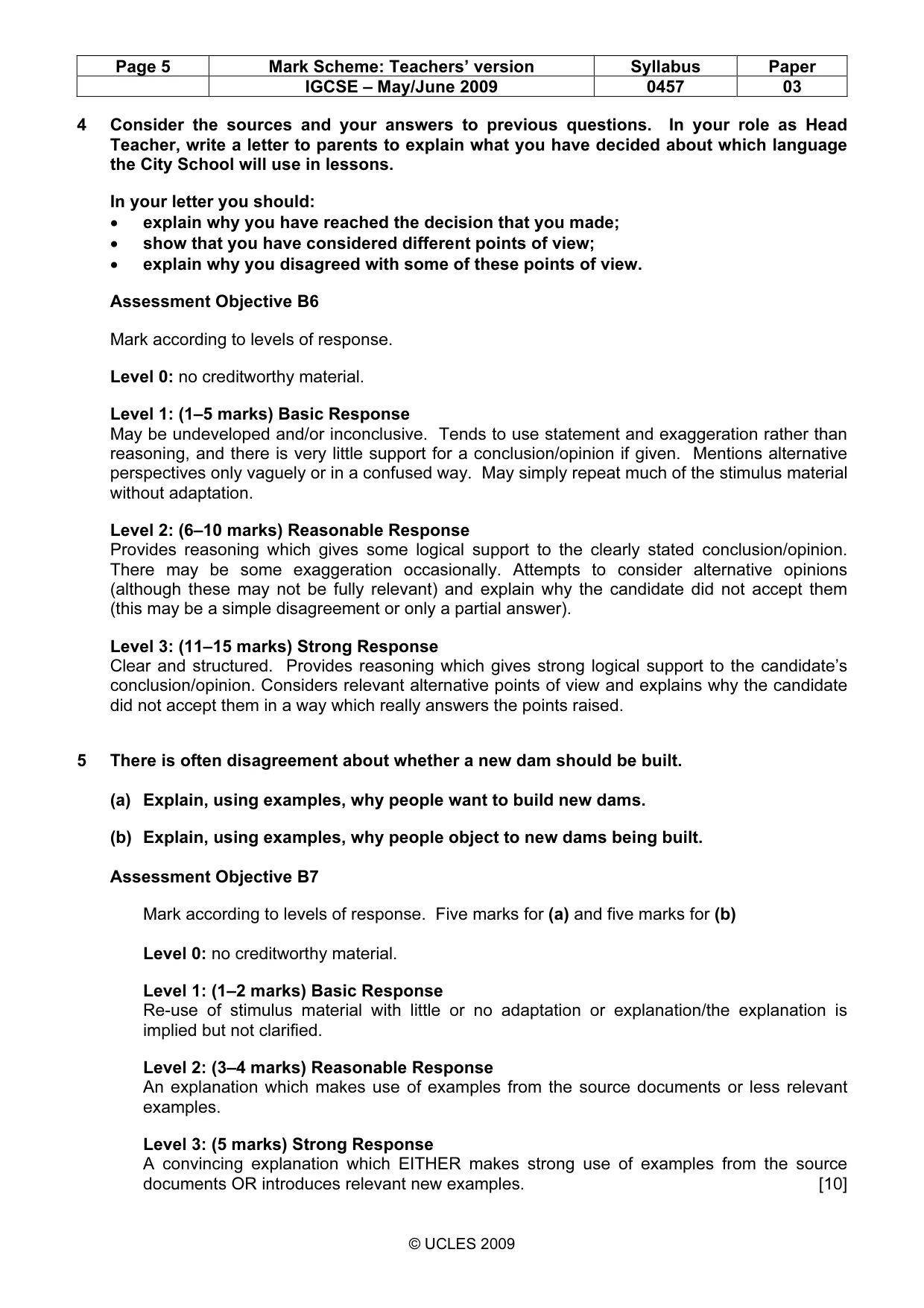
Page 5 Mark Scheme: Teachers’ version Syllabus Paper IGCSE – May/June 2009 0457 03 © UCLES 2009 4 Consider the sources and your answers to previous questions. In your role as Head Teacher, write a letter to parents to explain what you have decided about which language the City School will use in lessons. In your letter you should: • explain why you have reached the decision that you made; • show that you have considered different points of view; • explain why you disagreed with some of these points of view. Assessment Objective B6 Mark according to levels of response. Level 0: no creditworthy material. Level 1: (1–5 marks) Basic Response May be undeveloped and/or inconclusive. Tends to use statement and exaggeration rather than reasoning, and there is very little support for a conclusion/opinion if given. Mentions alternative perspectives only vaguely or in a confused way. May simply repeat much of the stimulus material without adaptation. Level 2: (6–10 marks) Reasonable Response Provides reasoning which gives some logical support to the clearly stated conclusion/opinion. There may be some exaggeration occasionally. Attempts to consider alternative opinions (although these may not be fully relevant) and explain why the candidate did not accept them (this may be a simple disagreement or only a partial answer). Level 3: (11–15 marks) Strong Response Clear and structured. Provides reasoning which gives strong logical support to the candidate’s conclusion/opinion. Considers relevant alternative points of view and explains why the candidate did not accept them in a way which really answers the points raised. 5 There is often disagreement about whether a new dam should be built. (a) Explain, using examples, why people want to build new dams. (b) Explain, using examples, why people object to new dams being built. Assessment Objective B7 Mark according to levels of response. Five marks for (a) and five marks for (b) Level 0: no creditworthy material. Level 1: (1–2 marks) Basic Response Re-use of stimulus material with little or no adaptation or explanation/the explanation is implied but not clarified. Level 2: (3–4 marks) Reasonable Response An explanation which makes use of examples from the source documents or less relevant examples. Level 3: (5 marks) Strong Response A convincing explanation which EITHER makes strong use of examples from the source documents OR introduces relevant new examples. [10]
Mark scheme, page 6
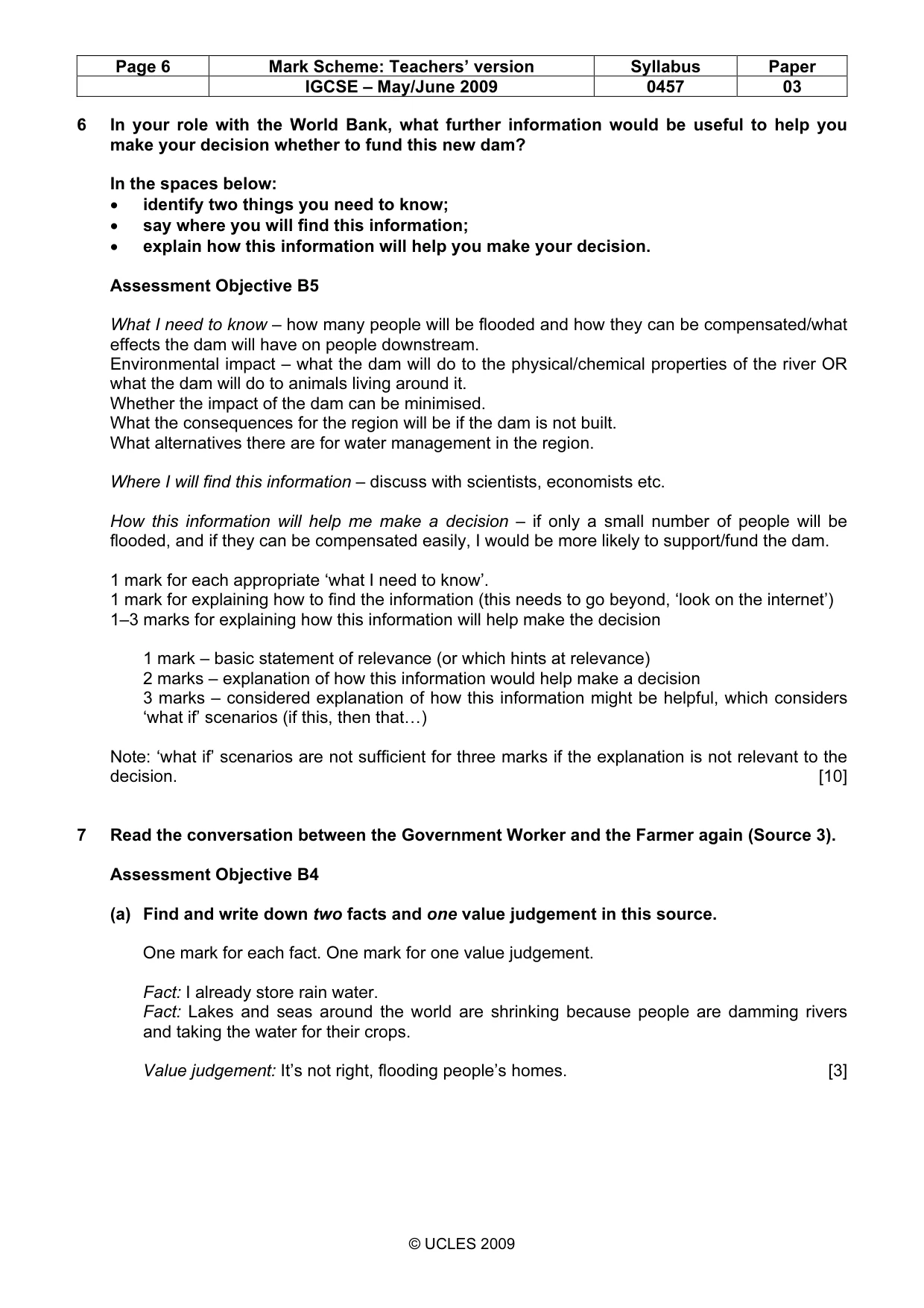
Page 6 Mark Scheme: Teachers’ version Syllabus Paper IGCSE – May/June 2009 0457 03 © UCLES 2009 6 In your role with the World Bank, what further information would be useful to help you make your decision whether to fund this new dam? In the spaces below: • identify two things you need to know; • say where you will find this information; • explain how this information will help you make your decision. Assessment Objective B5 What I need to know – how many people will be flooded and how they can be compensated/what effects the dam will have on people downstream. Environmental impact – what the dam will do to the physical/chemical properties of the river OR what the dam will do to animals living around it. Whether the impact of the dam can be minimised. What the consequences for the region will be if the dam is not built. What alternatives there are for water management in the region. Where I will find this information – discuss with scientists, economists etc. How this information will help me make a decision – if only a small number of people will be flooded, and if they can be compensated easily, I would be more likely to support/fund the dam. 1 mark for each appropriate ‘what I need to know’. 1 mark for explaining how to find the information (this needs to go beyond, ‘look on the internet’) 1–3 marks for explaining how this information will help make the decision 1 mark – basic statement of relevance (or which hints at relevance) 2 marks – explanation of how this information would help make a decision 3 marks – considered explanation of how this information might be helpful, which considers ‘what if’ scenarios (if this, then that…) Note: ‘what if’ scenarios are not sufficient for three marks if the explanation is not relevant to the decision. [10] 7 Read the conversation between the Government Worker and the Farmer again (Source 3). Assessment Objective B4 (a) Find and write down two facts and one value judgement in this source. One mark for each fact. One mark for one value judgement. Fact: I already store rain water. Fact: Lakes and seas around the world are shrinking because people are damming rivers and taking the water for their crops. Value judgement: It’s not right, flooding people’s homes. [3]
Mark scheme, page 7
Page 7 Mark Scheme: Teachers’ version Syllabus Paper IGCSE – May/June 2009 0457 03 © UCLES 2009 (b) ‘The dam will attract tourists. They will pay good money to visit the region.’ Do you think this is a likely consequence of building a new dam in the region? Give reasons for your opinion. (c) The dam ‘will mean that you have enough water to keep your crops growing.’ Do you think this is a likely consequence of building a new dam in the region? Give reasons for your opinion. Mark (b) and (c) according to levels of response. Level 0: no creditworthy material. Level 1: (1–2 marks) Basic Response Candidate restate material from the stimulus passage or make weak evaluative points which might support a conclusion. Level 2: (3–4 marks) Reasonable Response A fair response which gives a clear statement of opinion supported by an attempt at reasoning which focus on the likelihood of the consequence following from the building of a dam. Level 3: (5–6 marks) Strong Response A structured response which gives clear and persuasive reasons which focus on the likelihood of the consequence following from the building of the dam and includes some awareness of ambiguity/the balance of probability/what if reasoning. [12] 8 Do you think that dams are a good way of managing water? In your answer you should: • give reasons for your opinion; • show that you have considered other points of view; • explain why you disagreed with some of these points of view. Assessment Objective B6 Mark according to levels of response. Level 0: no creditworthy material. Level 1: (1–5 marks) Basic Response May be undeveloped and/or inconclusive. Tends to use statement and exaggeration rather than reasoning, and there is very little support for a conclusion/opinion if given. Mentions alternative perspectives only vaguely or in a confused way. May simply repeat much of the stimulus material without adaptation. Level 2: (6–10 marks) Reasonable Response Provides reasoning which gives some logical support to the clearly stated conclusion/opinion. There may be some exaggeration occasionally. Attempts to consider alternative opinions (although these may not be fully relevant) and explain why the candidate did not accept them (this may be a simple disagreement or only a partial answer). Level 3: (11–15 marks) Strong Response Clear and structured. Provides reasoning which gives strong logical support to the candidate’s conclusion/opinion. Considers relevant alternative points of view and explains why the candidate did not accept them in a way which really answers the points raised.
What you needed in this session
Cambridge’s own grade thresholds for 2009 May/June, Paper 3 · Variant 1. A higher threshold means an easier paper — the bar moves with how the cohort did.