Cambridge IGCSE German - Foreign Language 0525 — 2018 May/June Paper 4 · Variant 1
0525/41/M/J/18 · 50 marks · ≈56 min
The question paper and its mark scheme, free to read here and free to download. This is Cambridge’s own paper, exactly as it was sat.
Question paper8 pages

Mark scheme27 pages
Answers below. Sit the paper first if you are practising.
Paper as text
Question paper, page 1
This document consists of 5 printed pages and 3 blank pages. DC (KS) 165982 © UCLES 2018 [Turn over Cambridge International Examinations Cambridge International General Certificate of Secondary Education * 6 0 0 8 3 2 1 0 8 1 * GERMAN 0525/41 Paper 4 Writing May/June 2018 1 hour Candidates answer on the Question Paper. No Additional Materials are required. READ THESE INSTRUCTIONS FIRST Write your Centre number, candidate number and name in the spaces at the top of this page. Write in dark blue or black pen. Do not use staples, paper clips, glue or correction fluid. DO NOT WRITE IN ANY BARCODES. Answer three questions: Question 1, Question 2 and Question 3(a) or Question 3(b) or Question 3(c). The number of marks is given in brackets [ ] at the end of each question or part question. This syllabus is approved for use in England, Wales and Northern Ireland as a Cambridge International Level 1/Level 2 Certificate.
Question paper, page 2
2 0525/41/M/J/18 © UCLES 2018 BLANK PAGE
Question paper, page 3
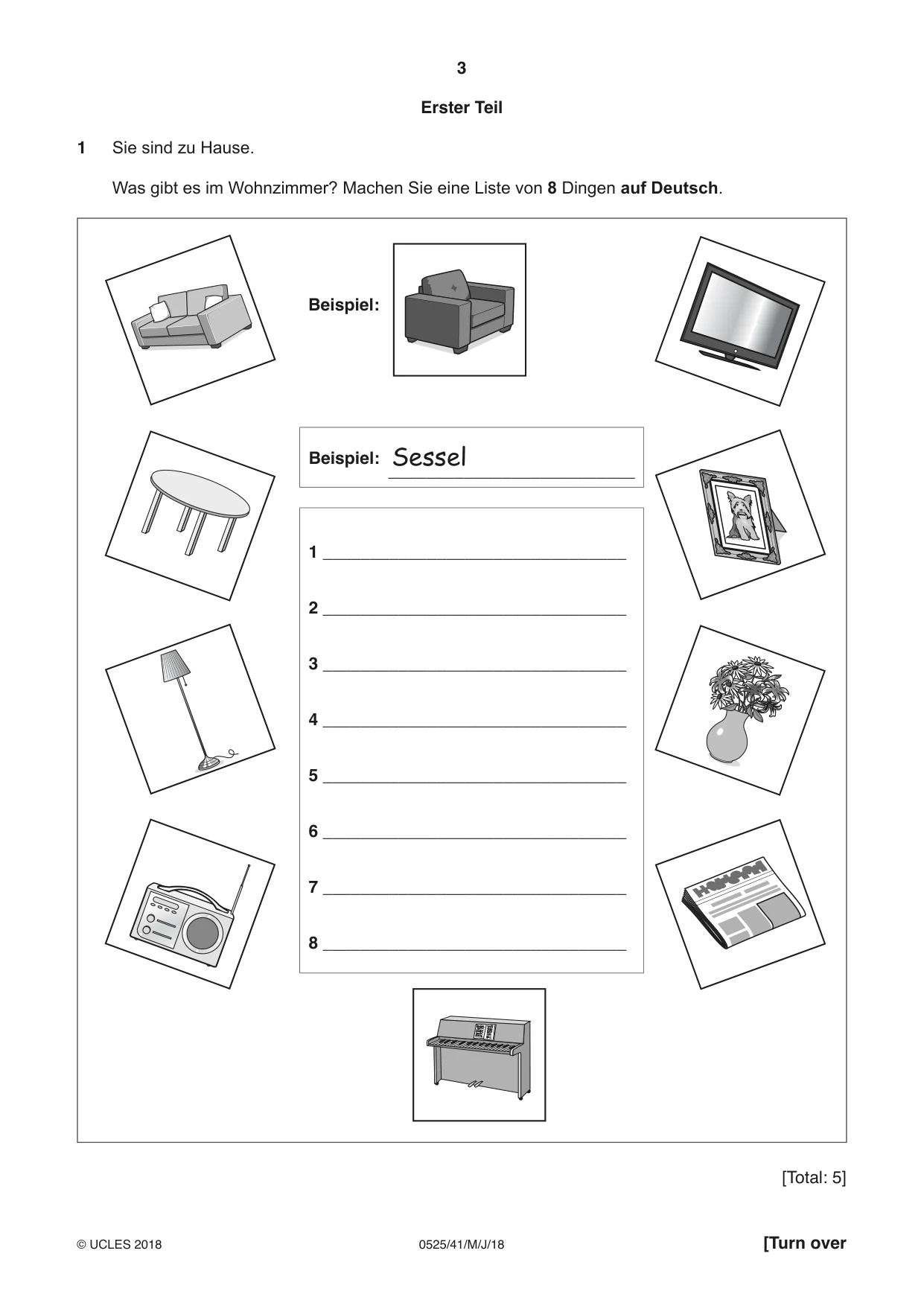
3 0525/41/M/J/18 © UCLES 2018 [Turn over Erster Teil 1 Sie sind zu Hause. Was gibt es im Wohnzimmer? Machen Sie eine Liste von 8 Dingen auf Deutsch. Beispiel: Beispiel: Sessel __________________________ 1 ________________________________ 2 ________________________________ 3 ________________________________ 4 ________________________________ 5 ________________________________ 6 ________________________________ 7 ________________________________ 8 ________________________________ [Total: 5]
Question paper, page 4
4 0525/41/M/J/18 © UCLES 2018 2 Essen und Kochen • Sagen Sie, um wie viel Uhr Sie abends essen. • Sagen Sie, wer bei Ihnen zu Hause kocht. • Erklären Sie, was Sie nicht gern essen und warum. • Beschreiben Sie, wo Sie zu Ihrem nächsten Geburtstag essen werden. Schreiben Sie 80–90 Wörter auf Deutsch. … … … … … … … … … … … … … … … … … … … … … [Total: 15]
Question paper, page 5
5 0525/41/M/J/18 © UCLES 2018 [Turn over BLANK PAGE
Question paper, page 6
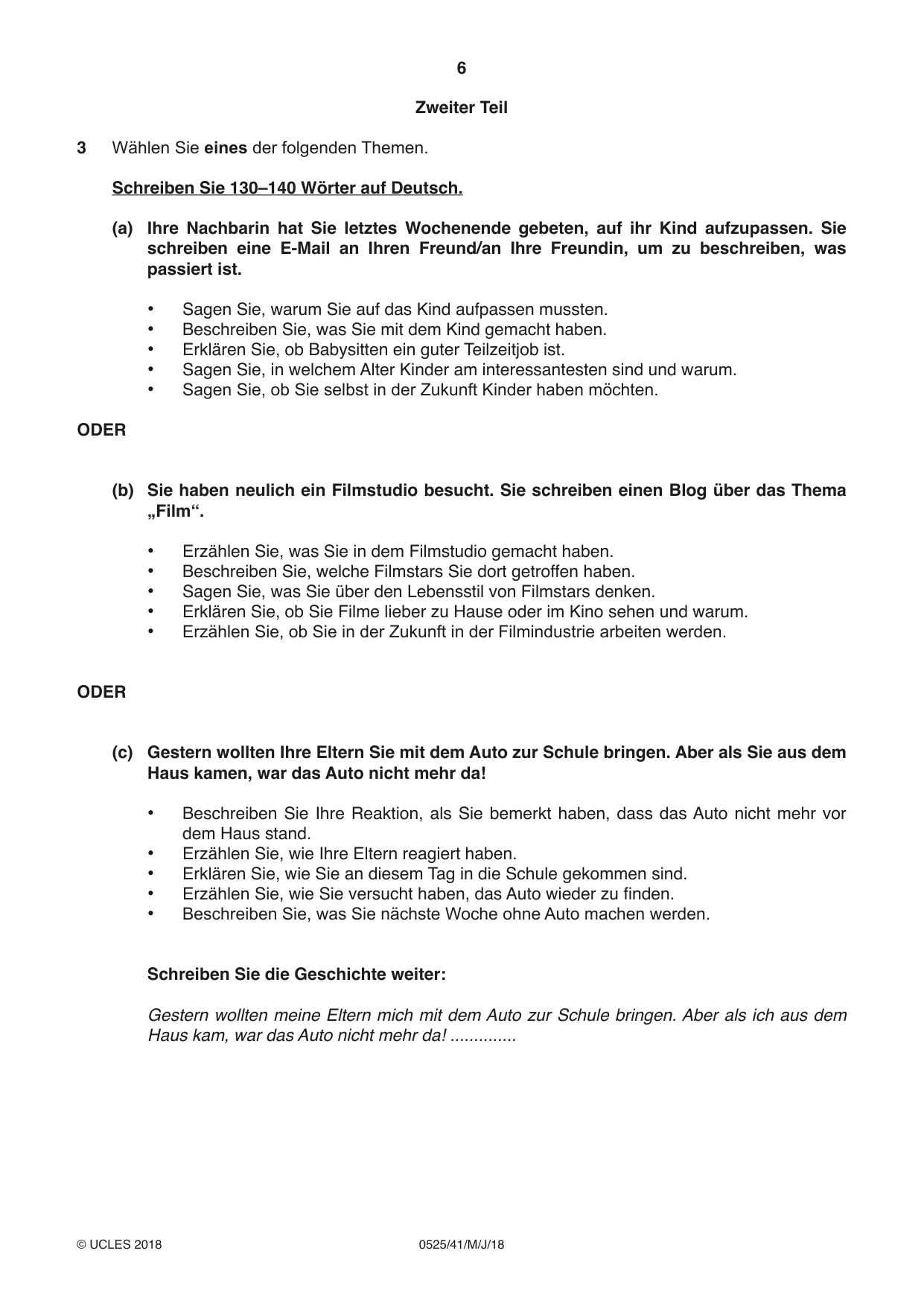
6 0525/41/M/J/18 © UCLES 2018 Zweiter Teil 3 Wählen Sie eines der folgenden Themen. Schreiben Sie 130–140 Wörter auf Deutsch. (a) Ihre Nachbarin hat Sie letztes Wochenende gebeten, auf ihr Kind aufzupassen. Sie schreiben eine E-Mail an Ihren Freund/an Ihre Freundin, um zu beschreiben, was passiert ist. • Sagen Sie, warum Sie auf das Kind aufpassen mussten. • Beschreiben Sie, was Sie mit dem Kind gemacht haben. • Erklären Sie, ob Babysitten ein guter Teilzeitjob ist. • Sagen Sie, in welchem Alter Kinder am interessantesten sind und warum. • Sagen Sie, ob Sie selbst in der Zukunft Kinder haben möchten. ODER (b) Sie haben neulich ein Filmstudio besucht. Sie schreiben einen Blog über das Thema „Film“. • Erzählen Sie, was Sie in dem Filmstudio gemacht haben. • Beschreiben Sie, welche Filmstars Sie dort getroffen haben. • Sagen Sie, was Sie über den Lebensstil von Filmstars denken. • Erklären Sie, ob Sie Filme lieber zu Hause oder im Kino sehen und warum. • Erzählen Sie, ob Sie in der Zukunft in der Filmindustrie arbeiten werden. ODER (c) Gestern wollten Ihre Eltern Sie mit dem Auto zur Schule bringen. Aber als Sie aus dem Haus kamen, war das Auto nicht mehr da! • Beschreiben Sie Ihre Reaktion, als Sie bemerkt haben, dass das Auto nicht mehr vor dem Haus stand. • Erzählen Sie, wie Ihre Eltern reagiert haben. • Erklären Sie, wie Sie an diesem Tag in die Schule gekommen sind. • Erzählen Sie, wie Sie versucht haben, das Auto wieder zu finden. • Beschreiben Sie, was Sie nächste Woche ohne Auto machen werden. Schreiben Sie die Geschichte weiter: Gestern wollten meine Eltern mich mit dem Auto zur Schule bringen. Aber als ich aus dem Haus kam, war das Auto nicht mehr da! …
Question paper, page 7
7 0525/41/M/J/18 © UCLES 2018 SCHREIBEN SIE IHRE ANTWORT AUF FRAGE 3 AUF DIESE SEITE … … … … … … … … … … … … … … … … … … … … … … … … … … … [Total: 30]
Question paper, page 8
8 0525/41/M/J/18 © UCLES 2018 Permission to reproduce items where third-party owned material protected by copyright is included has been sought and cleared where possible. Every reasonable effort has been made by the publisher (UCLES) to trace copyright holders, but if any items requiring clearance have unwittingly been included, the publisher will be pleased to make amends at the earliest possible opportunity. To avoid the issue of disclosure of answer-related information to candidates, all copyright acknowledgements are reproduced online in the Cambridge International Examinations Copyright Acknowledgements Booklet. This is produced for each series of examinations and is freely available to download at www.cie.org.uk after the live examination series. Cambridge International Examinations is part of the Cambridge Assessment Group. Cambridge Assessment is the brand name of University of Cambridge Local Examinations Syndicate (UCLES), which is itself a department of the University of Cambridge. BLANK PAGE
Mark scheme, page 1
IGCSE™ is a registered trademark. This syllabus is approved for use in England, Wales and Northern Ireland as a Cambridge International Level 1/Level 2 Certificate. This document consists of 27 printed pages. © UCLES 2018 [Turn over Cambridge Assessment International Education Cambridge International General Certificate of Secondary Education GERMAN 0525/41 Paper 4 Writing May/June 2018 MARK SCHEME Maximum Mark: 50 Published This mark scheme is published as an aid to teachers and candidates, to indicate the requirements of the examination. It shows the basis on which Examiners were instructed to award marks. It does not indicate the details of the discussions that took place at an Examiners’ meeting before marking began, which would have considered the acceptability of alternative answers. Mark schemes should be read in conjunction with the question paper and the Principal Examiner Report for Teachers. Cambridge International will not enter into discussions about these mark schemes. Cambridge International is publishing the mark schemes for the May/June 2018 series for most Cambridge IGCSE™, Cambridge International A and AS Level and Cambridge Pre-U components, and some Cambridge O Level components.
Mark scheme, page 2
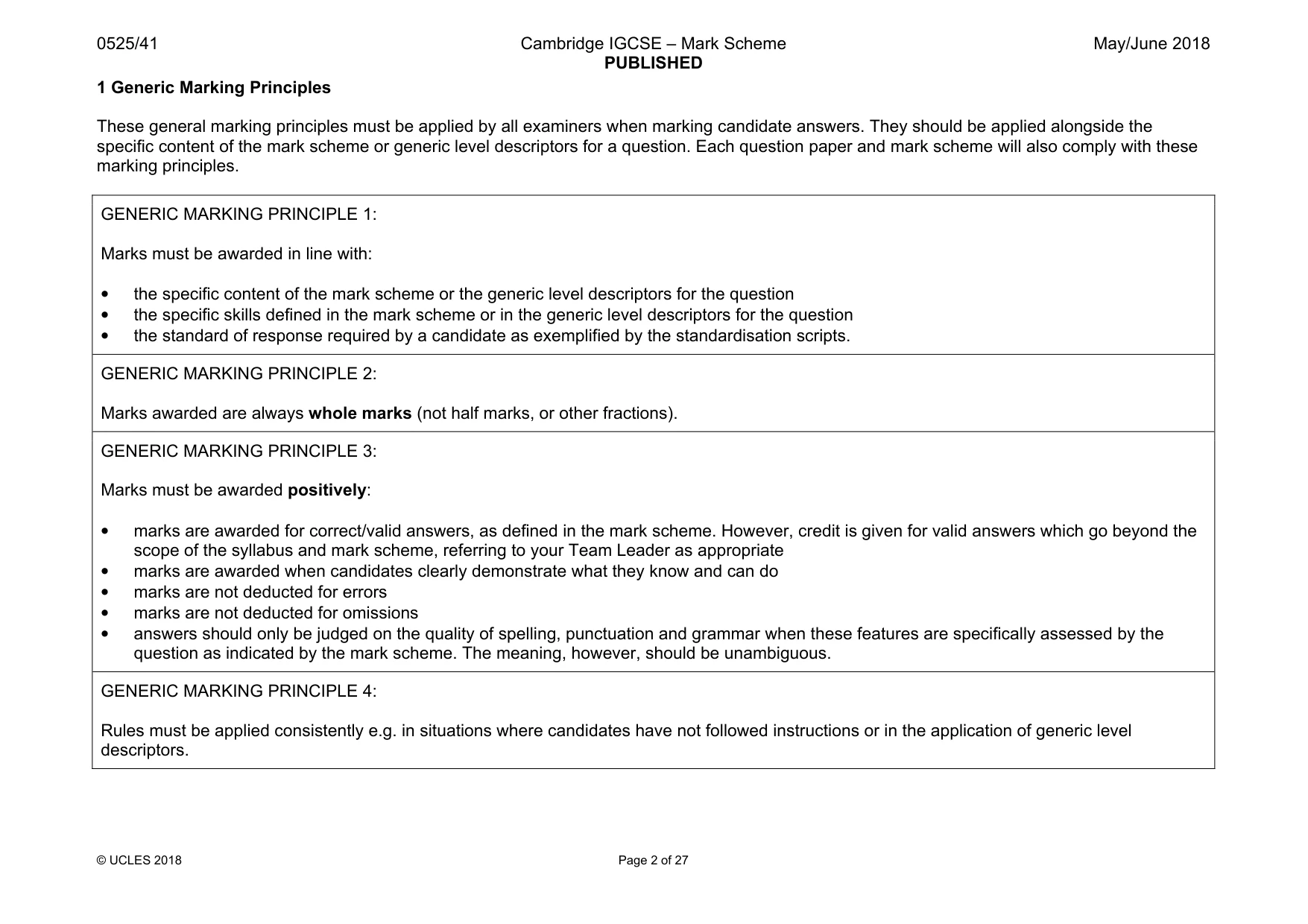
0525/41 Cambridge IGCSE – Mark Scheme PUBLISHED May/June 2018 © UCLES 2018 Page 2 of 27 1 Generic Marking Principles These general marking principles must be applied by all examiners when marking candidate answers. They should be applied alongside the specific content of the mark scheme or generic level descriptors for a question. Each question paper and mark scheme will also comply with these marking principles. GENERIC MARKING PRINCIPLE 1: Marks must be awarded in line with: • the specific content of the mark scheme or the generic level descriptors for the question • the specific skills defined in the mark scheme or in the generic level descriptors for the question • the standard of response required by a candidate as exemplified by the standardisation scripts. GENERIC MARKING PRINCIPLE 2: Marks awarded are always whole marks (not half marks, or other fractions). GENERIC MARKING PRINCIPLE 3: Marks must be awarded positively: • marks are awarded for correct/valid answers, as defined in the mark scheme. However, credit is given for valid answers which go beyond the scope of the syllabus and mark scheme, referring to your Team Leader as appropriate • marks are awarded when candidates clearly demonstrate what they know and can do • marks are not deducted for errors • marks are not deducted for omissions • answers should only be judged on the quality of spelling, punctuation and grammar when these features are specifically assessed by the question as indicated by the mark scheme. The meaning, however, should be unambiguous. GENERIC MARKING PRINCIPLE 4: Rules must be applied consistently e.g. in situations where candidates have not followed instructions or in the application of generic level descriptors.
Mark scheme, page 3
0525/41 Cambridge IGCSE – Mark Scheme PUBLISHED May/June 2018 © UCLES 2018 Page 3 of 27 GENERIC MARKING PRINCIPLE 5: Marks should be awarded using the full range of marks defined in the mark scheme for the question (however; the use of the full mark range may be limited according to the quality of the candidate responses seen). GENERIC MARKING PRINCIPLE 6: Marks awarded are based solely on the requirements as defined in the mark scheme. Marks should not be awarded with grade thresholds or grade descriptors in mind.
Mark scheme, page 4
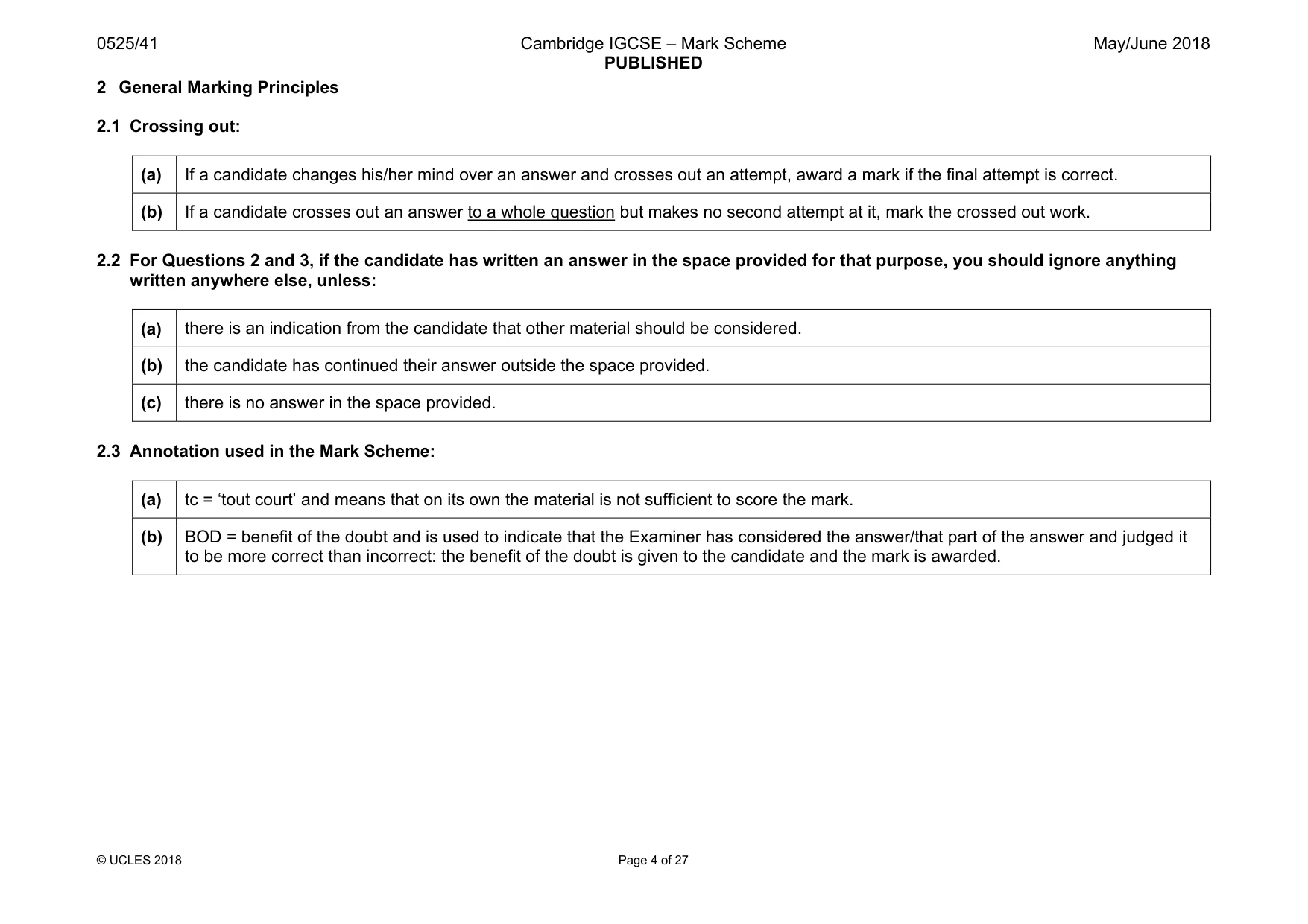
0525/41 Cambridge IGCSE – Mark Scheme PUBLISHED May/June 2018 © UCLES 2018 Page 4 of 27 2 General Marking Principles 2.1 Crossing out: (a) If a candidate changes his/her mind over an answer and crosses out an attempt, award a mark if the final attempt is correct. (b) If a candidate crosses out an answer to a whole question but makes no second attempt at it, mark the crossed out work. 2.2 For Questions 2 and 3, if the candidate has written an answer in the space provided for that purpose, you should ignore anything written anywhere else, unless: (a) there is an indication from the candidate that other material should be considered. (b) the candidate has continued their answer outside the space provided. (c) there is no answer in the space provided. 2.3 Annotation used in the Mark Scheme: (a) tc = ‘tout court’ and means that on its own the material is not sufficient to score the mark. (b) BOD = benefit of the doubt and is used to indicate that the Examiner has considered the answer/that part of the answer and judged it to be more correct than incorrect: the benefit of the doubt is given to the candidate and the mark is awarded.
Mark scheme, page 5
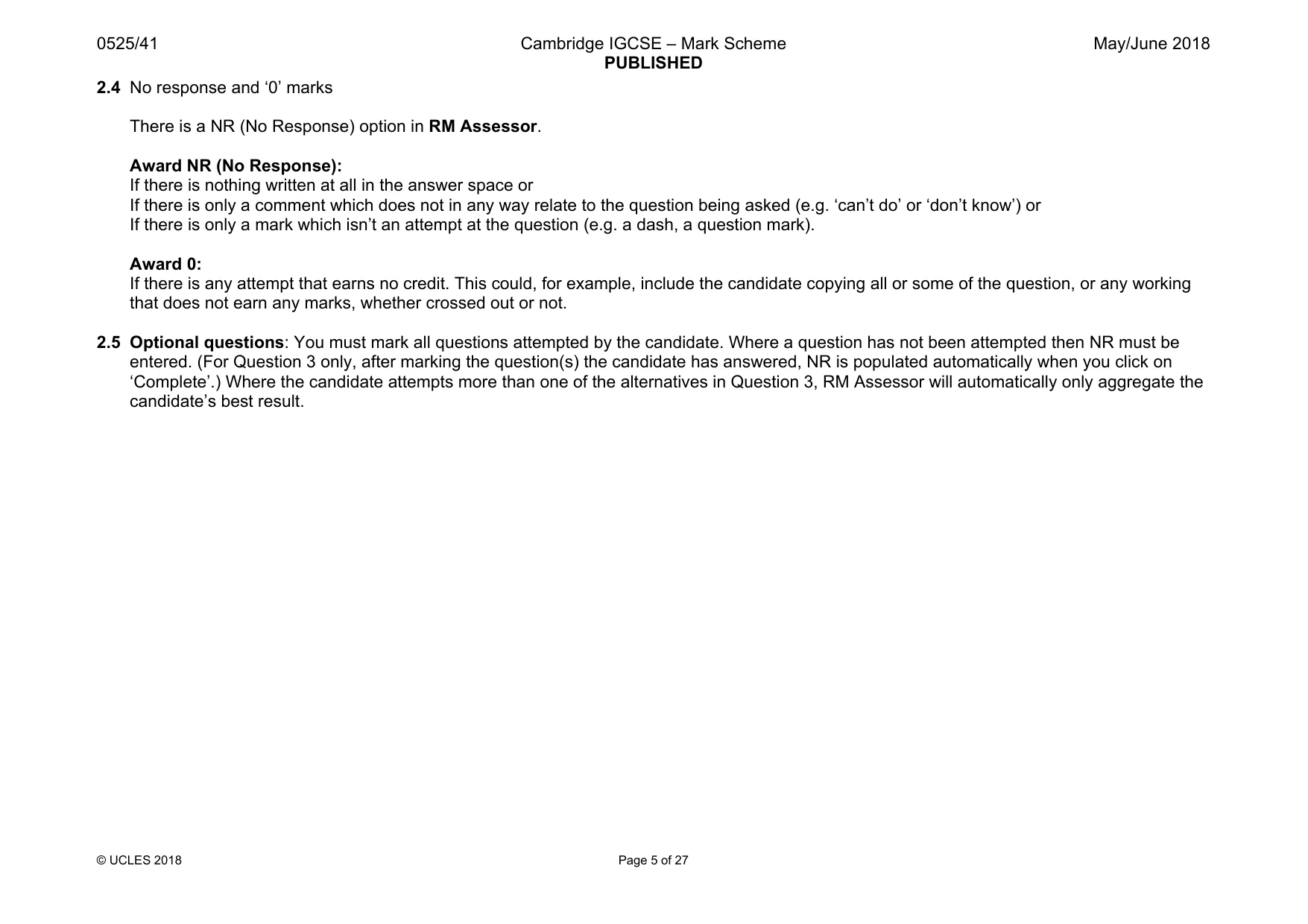
0525/41 Cambridge IGCSE – Mark Scheme PUBLISHED May/June 2018 © UCLES 2018 Page 5 of 27 2.4 No response and ‘0’ marks There is a NR (No Response) option in RM Assessor. Award NR (No Response): If there is nothing written at all in the answer space or If there is only a comment which does not in any way relate to the question being asked (e.g. ‘can’t do’ or ‘don’t know’) or If there is only a mark which isn’t an attempt at the question (e.g. a dash, a question mark). Award 0: If there is any attempt that earns no credit. This could, for example, include the candidate copying all or some of the question, or any working that does not earn any marks, whether crossed out or not. 2.5 Optional questions: You must mark all questions attempted by the candidate. Where a question has not been attempted then NR must be entered. (For Question 3 only, after marking the question(s) the candidate has answered, NR is populated automatically when you click on ‘Complete’.) Where the candidate attempts more than one of the alternatives in Question 3, RM Assessor will automatically only aggregate the candidate’s best result.
Mark scheme, page 6
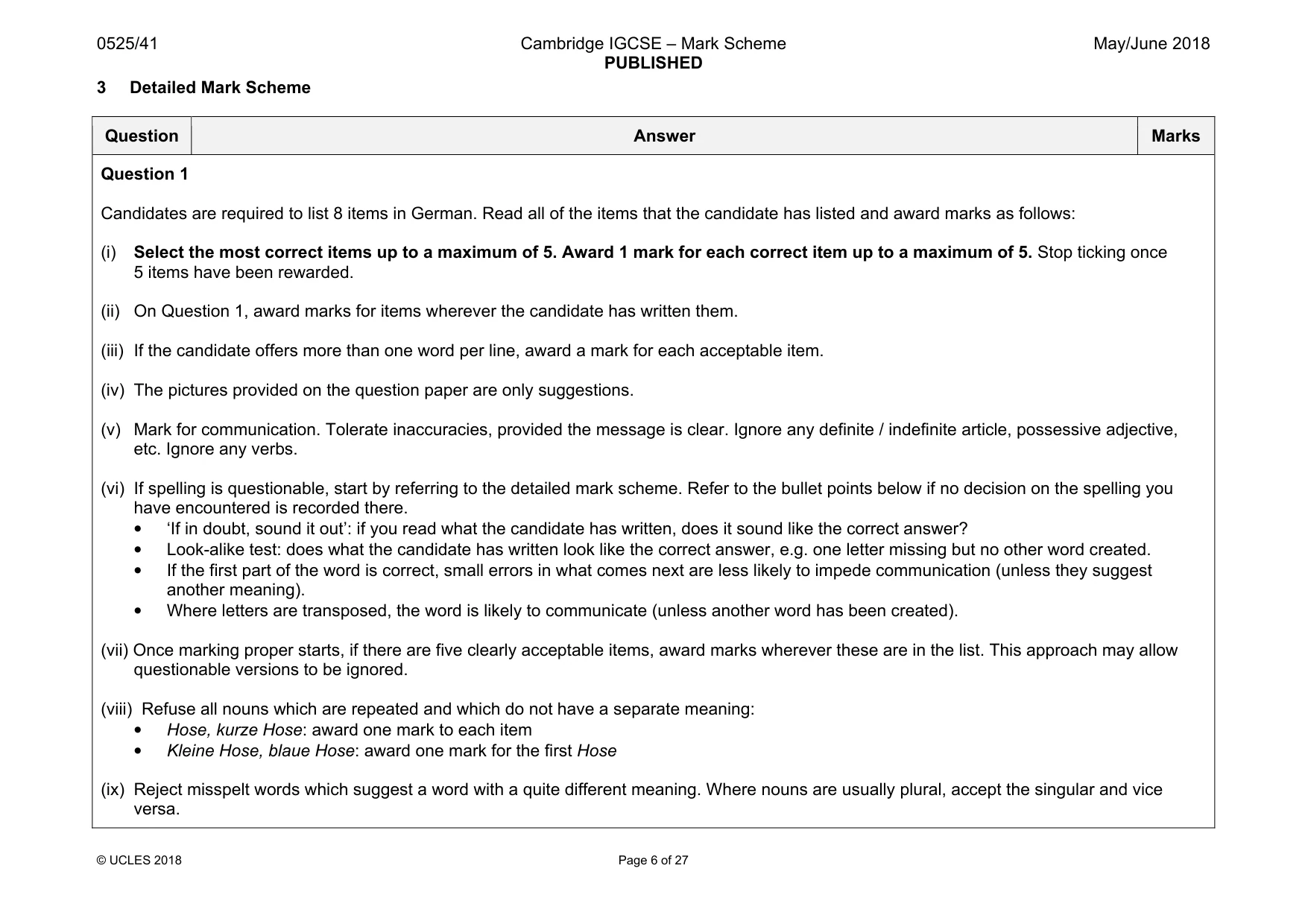
0525/41 Cambridge IGCSE – Mark Scheme PUBLISHED May/June 2018 © UCLES 2018 Page 6 of 27 3 Detailed Mark Scheme Question Answer Marks Question 1 Candidates are required to list 8 items in German. Read all of the items that the candidate has listed and award marks as follows: (i) Select the most correct items up to a maximum of 5. Award 1 mark for each correct item up to a maximum of 5. Stop ticking once 5 items have been rewarded. (ii) On Question 1, award marks for items wherever the candidate has written them. (iii) If the candidate offers more than one word per line, award a mark for each acceptable item. (iv) The pictures provided on the question paper are only suggestions. (v) Mark for communication. Tolerate inaccuracies, provided the message is clear. Ignore any definite / indefinite article, possessive adjective, etc. Ignore any verbs. (vi) If spelling is questionable, start by referring to the detailed mark scheme. Refer to the bullet points below if no decision on the spelling you have encountered is recorded there. • ‘If in doubt, sound it out’: if you read what the candidate has written, does it sound like the correct answer? • Look-alike test: does what the candidate has written look like the correct answer, e.g. one letter missing but no other word created. • If the first part of the word is correct, small errors in what comes next are less likely to impede communication (unless they suggest another meaning). • Where letters are transposed, the word is likely to communicate (unless another word has been created). (vii) Once marking proper starts, if there are five clearly acceptable items, award marks wherever these are in the list. This approach may allow questionable versions to be ignored. (viii) Refuse all nouns which are repeated and which do not have a separate meaning: • Hose, kurze Hose: award one mark to each item • Kleine Hose, blaue Hose: award one mark for the first Hose (ix) Reject misspelt words which suggest a word with a quite different meaning. Where nouns are usually plural, accept the singular and vice versa.
Mark scheme, page 7
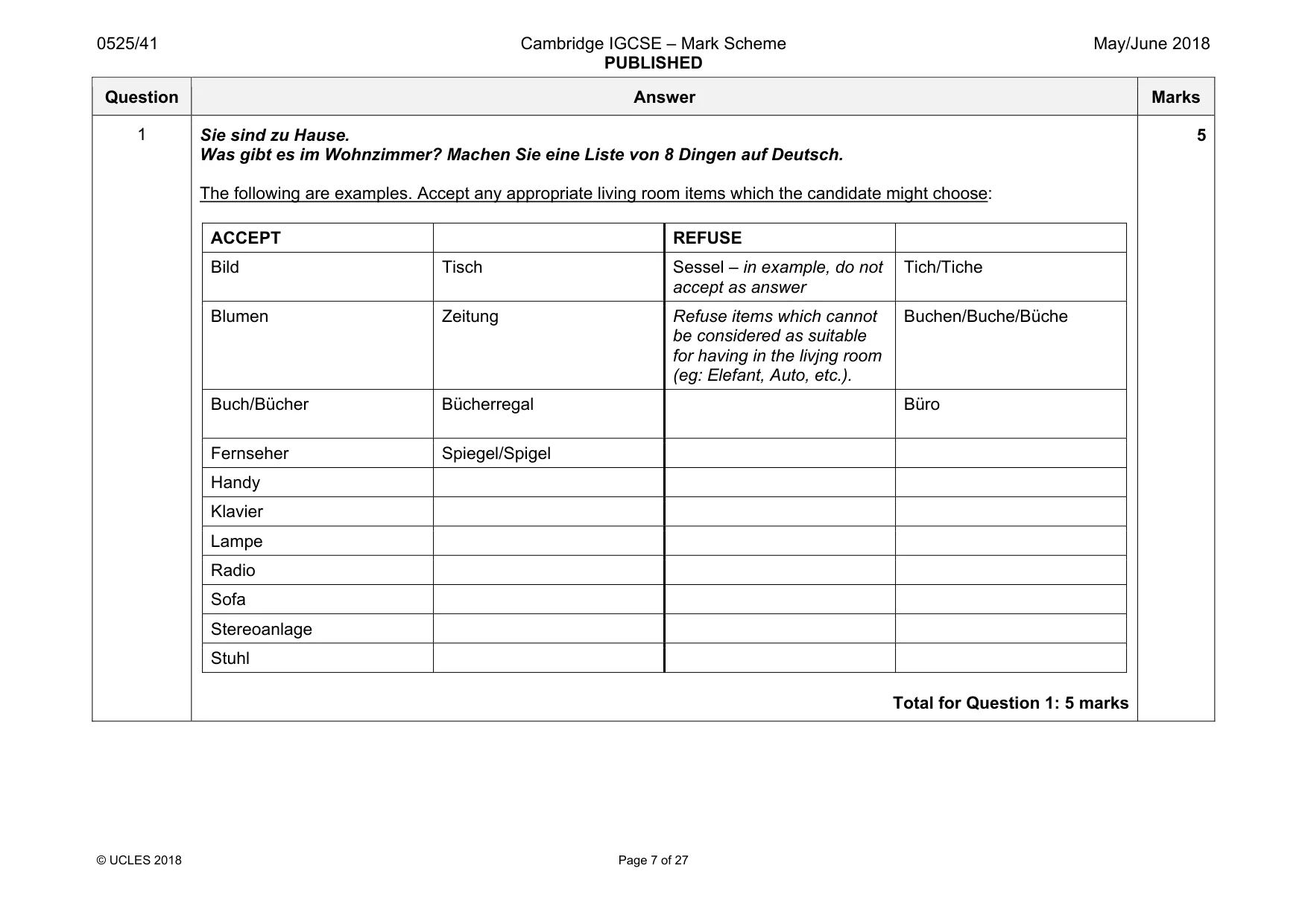
0525/41 Cambridge IGCSE – Mark Scheme PUBLISHED May/June 2018 © UCLES 2018 Page 7 of 27 Question Answer Marks 1 Sie sind zu Hause. Was gibt es im Wohnzimmer? Machen Sie eine Liste von 8 Dingen auf Deutsch. The following are examples. Accept any appropriate living room items which the candidate might choose: ACCEPT REFUSE Bild Tisch Sessel – in example, do not accept as answer Tich/Tiche Blumen Zeitung Refuse items which cannot be considered as suitable for having in the livjng room (eg: Elefant, Auto, etc.). Buchen/Buche/Büche Buch/Bücher Bücherregal Büro Fernseher Spiegel/Spigel Handy Klavier Lampe Radio Sofa Stereoanlage Stuhl Total for Question 1: 5 marks 5
Mark scheme, page 8
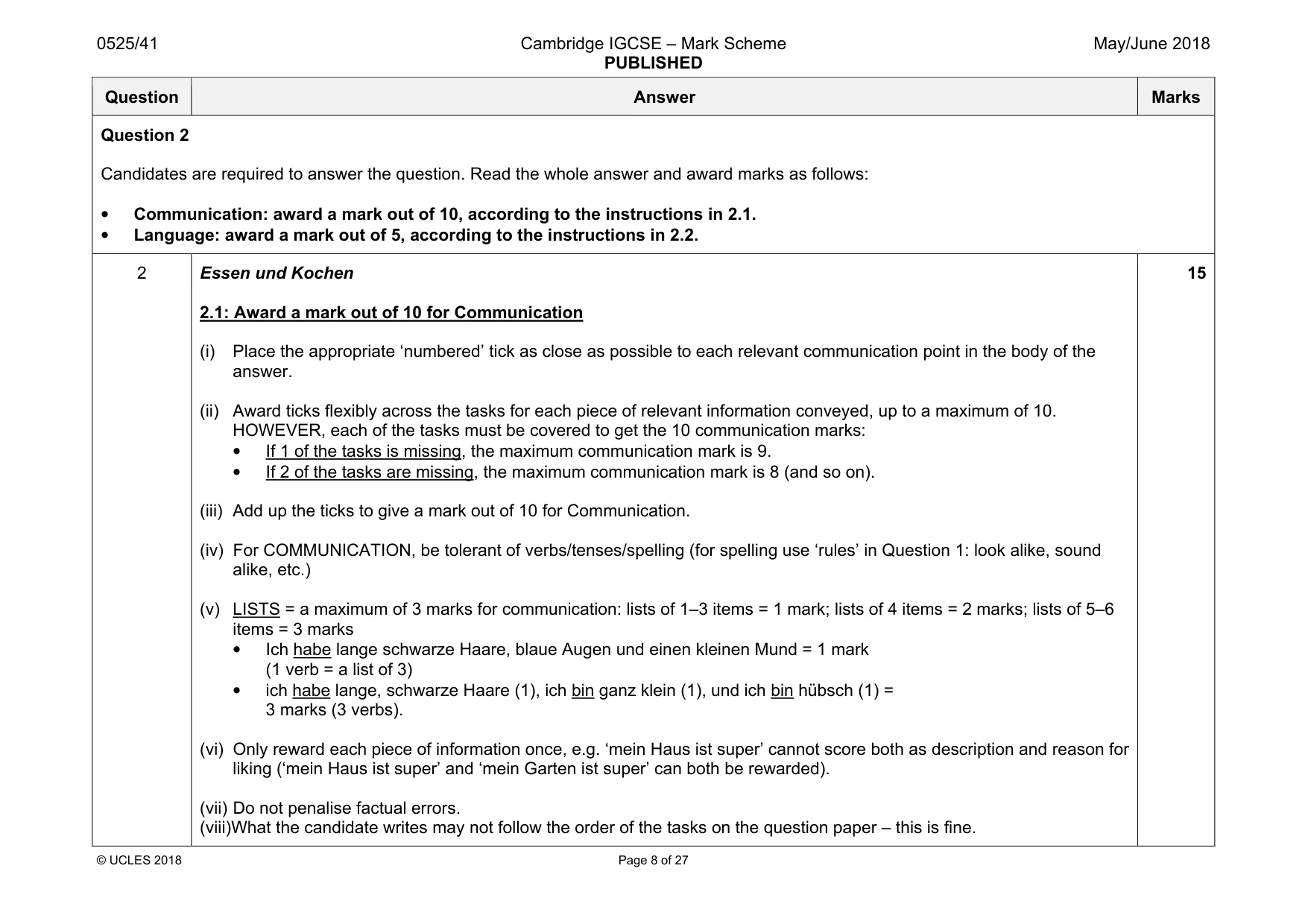
0525/41 Cambridge IGCSE – Mark Scheme PUBLISHED May/June 2018 © UCLES 2018 Page 8 of 27 Question Answer Marks Question 2 Candidates are required to answer the question. Read the whole answer and award marks as follows: • Communication: award a mark out of 10, according to the instructions in 2.1. • Language: award a mark out of 5, according to the instructions in 2.2. 2 Essen und Kochen 2.1: Award a mark out of 10 for Communication (i) Place the appropriate ‘numbered’ tick as close as possible to each relevant communication point in the body of the answer. (ii) Award ticks flexibly across the tasks for each piece of relevant information conveyed, up to a maximum of 10. HOWEVER, each of the tasks must be covered to get the 10 communication marks: • If 1 of the tasks is missing, the maximum communication mark is 9. • If 2 of the tasks are missing, the maximum communication mark is 8 (and so on). (iii) Add up the ticks to give a mark out of 10 for Communication. (iv) For COMMUNICATION, be tolerant of verbs/tenses/spelling (for spelling use ‘rules’ in Question 1: look alike, sound alike, etc.) (v) LISTS = a maximum of 3 marks for communication: lists of 1–3 items = 1 mark; lists of 4 items = 2 marks; lists of 5–6 items = 3 marks • Ich habe lange schwarze Haare, blaue Augen und einen kleinen Mund = 1 mark (1 verb = a list of 3) • ich habe lange, schwarze Haare (1), ich bin ganz klein (1), und ich bin hübsch (1) = 3 marks (3 verbs). (vi) Only reward each piece of information once, e.g. ‘mein Haus ist super’ cannot score both as description and reason for liking (‘mein Haus ist super’ and ‘mein Garten ist super’ can both be rewarded). (vii) Do not penalise factual errors. (viii)What the candidate writes may not follow the order of the tasks on the question paper – this is fine. 15
Mark scheme, page 9
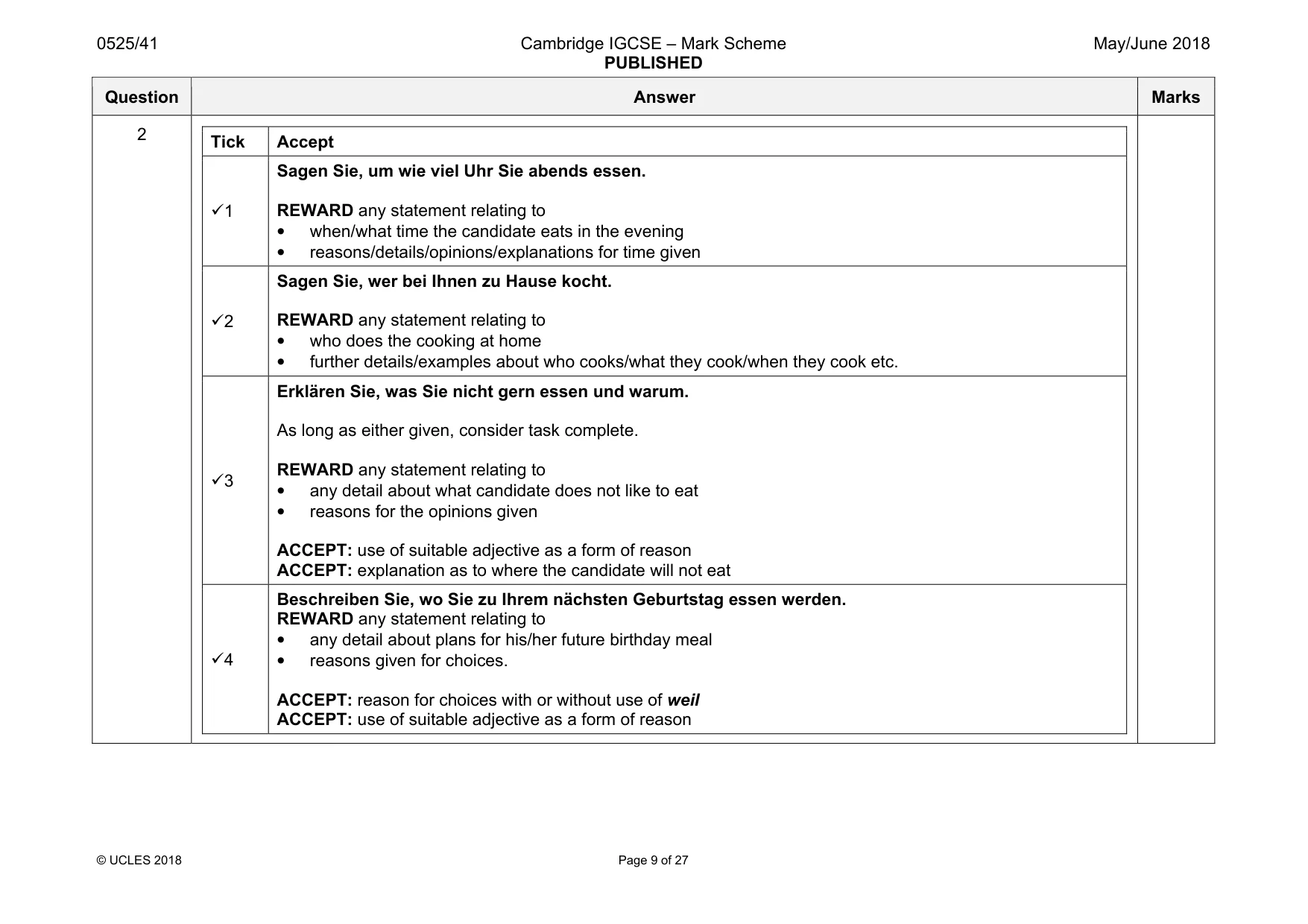
0525/41 Cambridge IGCSE – Mark Scheme PUBLISHED May/June 2018 © UCLES 2018 Page 9 of 27 Question Answer Marks 2 Tick Accept 91 Sagen Sie, um wie viel Uhr Sie abends essen. REWARD any statement relating to • when/what time the candidate eats in the evening • reasons/details/opinions/explanations for time given 92 Sagen Sie, wer bei Ihnen zu Hause kocht. REWARD any statement relating to • who does the cooking at home • further details/examples about who cooks/what they cook/when they cook etc. 93 Erklären Sie, was Sie nicht gern essen und warum. As long as either given, consider task complete. REWARD any statement relating to • any detail about what candidate does not like to eat • reasons for the opinions given ACCEPT: use of suitable adjective as a form of reason ACCEPT: explanation as to where the candidate will not eat 94 Beschreiben Sie, wo Sie zu Ihrem nächsten Geburtstag essen werden. REWARD any statement relating to • any detail about plans for his/her future birthday meal • reasons given for choices. ACCEPT: reason for choices with or without use of weil ACCEPT: use of suitable adjective as a form of reason
Mark scheme, page 10
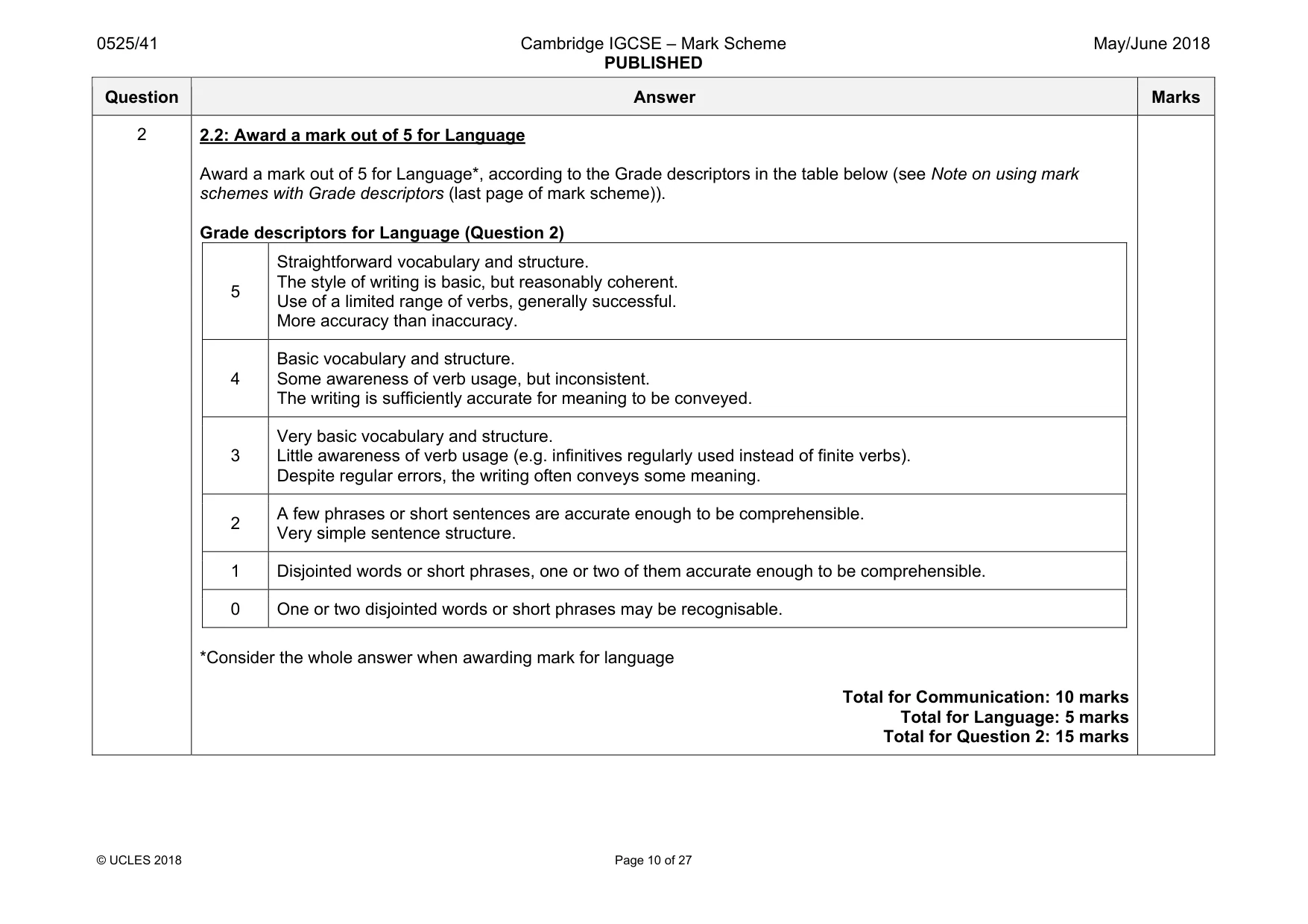
0525/41 Cambridge IGCSE – Mark Scheme PUBLISHED May/June 2018 © UCLES 2018 Page 10 of 27 Question Answer Marks 2 2.2: Award a mark out of 5 for Language Award a mark out of 5 for Language*, according to the Grade descriptors in the table below (see Note on using mark schemes with Grade descriptors (last page of mark scheme)). Grade descriptors for Language (Question 2) 5 Straightforward vocabulary and structure. The style of writing is basic, but reasonably coherent. Use of a limited range of verbs, generally successful. More accuracy than inaccuracy. 4 Basic vocabulary and structure. Some awareness of verb usage, but inconsistent. The writing is sufficiently accurate for meaning to be conveyed. 3 Very basic vocabulary and structure. Little awareness of verb usage (e.g. infinitives regularly used instead of finite verbs). Despite regular errors, the writing often conveys some meaning. 2 A few phrases or short sentences are accurate enough to be comprehensible. Very simple sentence structure. 1 Disjointed words or short phrases, one or two of them accurate enough to be comprehensible. 0 One or two disjointed words or short phrases may be recognisable. *Consider the whole answer when awarding mark for language Total for Communication: 10 marks Total for Language: 5 marks Total for Question 2: 15 marks
Mark scheme, page 11
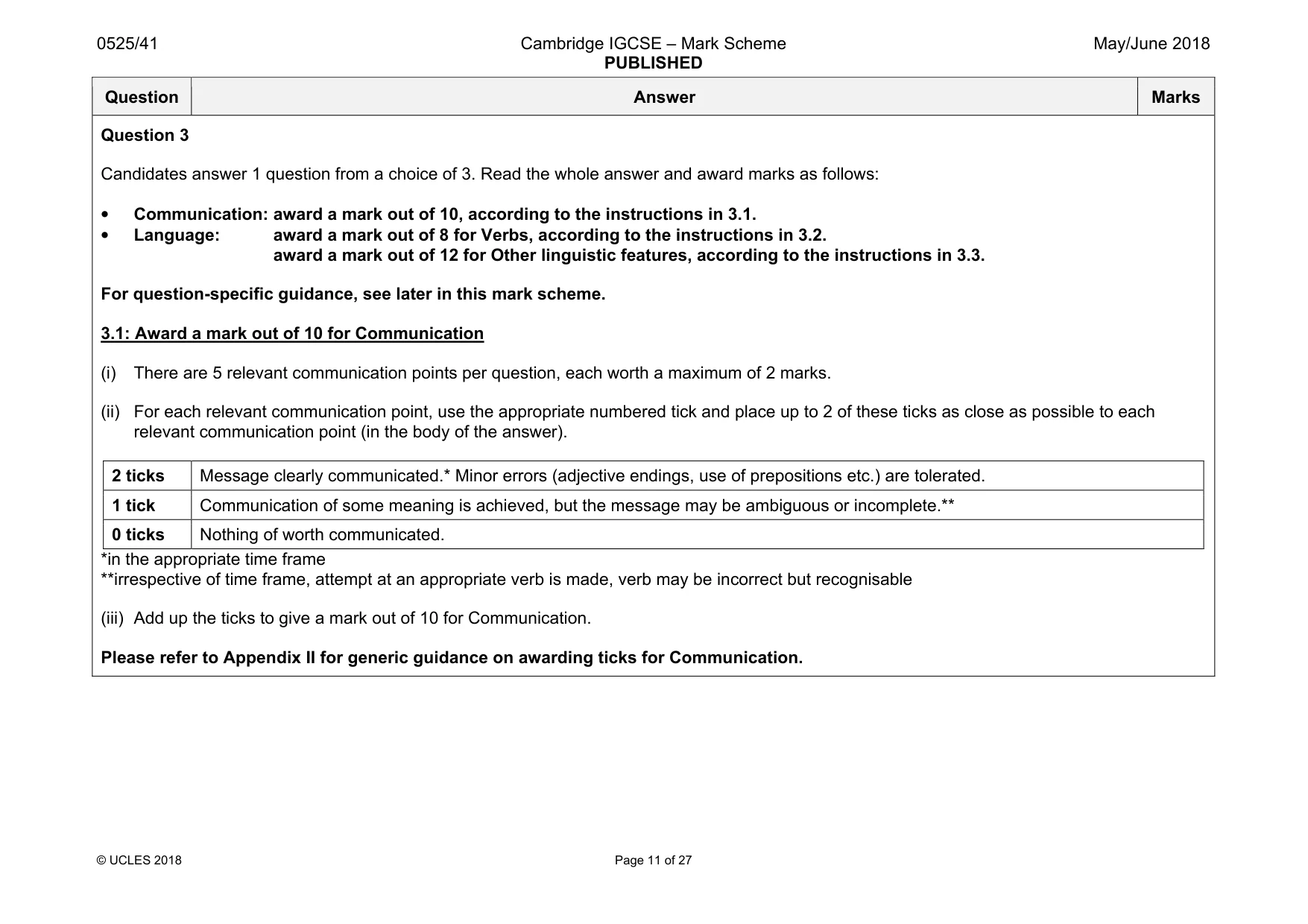
0525/41 Cambridge IGCSE – Mark Scheme PUBLISHED May/June 2018 © UCLES 2018 Page 11 of 27 Question Answer Marks Question 3 Candidates answer 1 question from a choice of 3. Read the whole answer and award marks as follows: • Communication: award a mark out of 10, according to the instructions in 3.1. • Language: award a mark out of 8 for Verbs, according to the instructions in 3.2. award a mark out of 12 for Other linguistic features, according to the instructions in 3.3. For question-specific guidance, see later in this mark scheme. 3.1: Award a mark out of 10 for Communication (i) There are 5 relevant communication points per question, each worth a maximum of 2 marks. (ii) For each relevant communication point, use the appropriate numbered tick and place up to 2 of these ticks as close as possible to each relevant communication point (in the body of the answer). 2 ticks Message clearly communicated.* Minor errors (adjective endings, use of prepositions etc.) are tolerated. 1 tick Communication of some meaning is achieved, but the message may be ambiguous or incomplete.** 0 ticks Nothing of worth communicated. *in the appropriate time frame **irrespective of time frame, attempt at an appropriate verb is made, verb may be incorrect but recognisable (iii) Add up the ticks to give a mark out of 10 for Communication. Please refer to Appendix II for generic guidance on awarding ticks for Communication.
Mark scheme, page 12
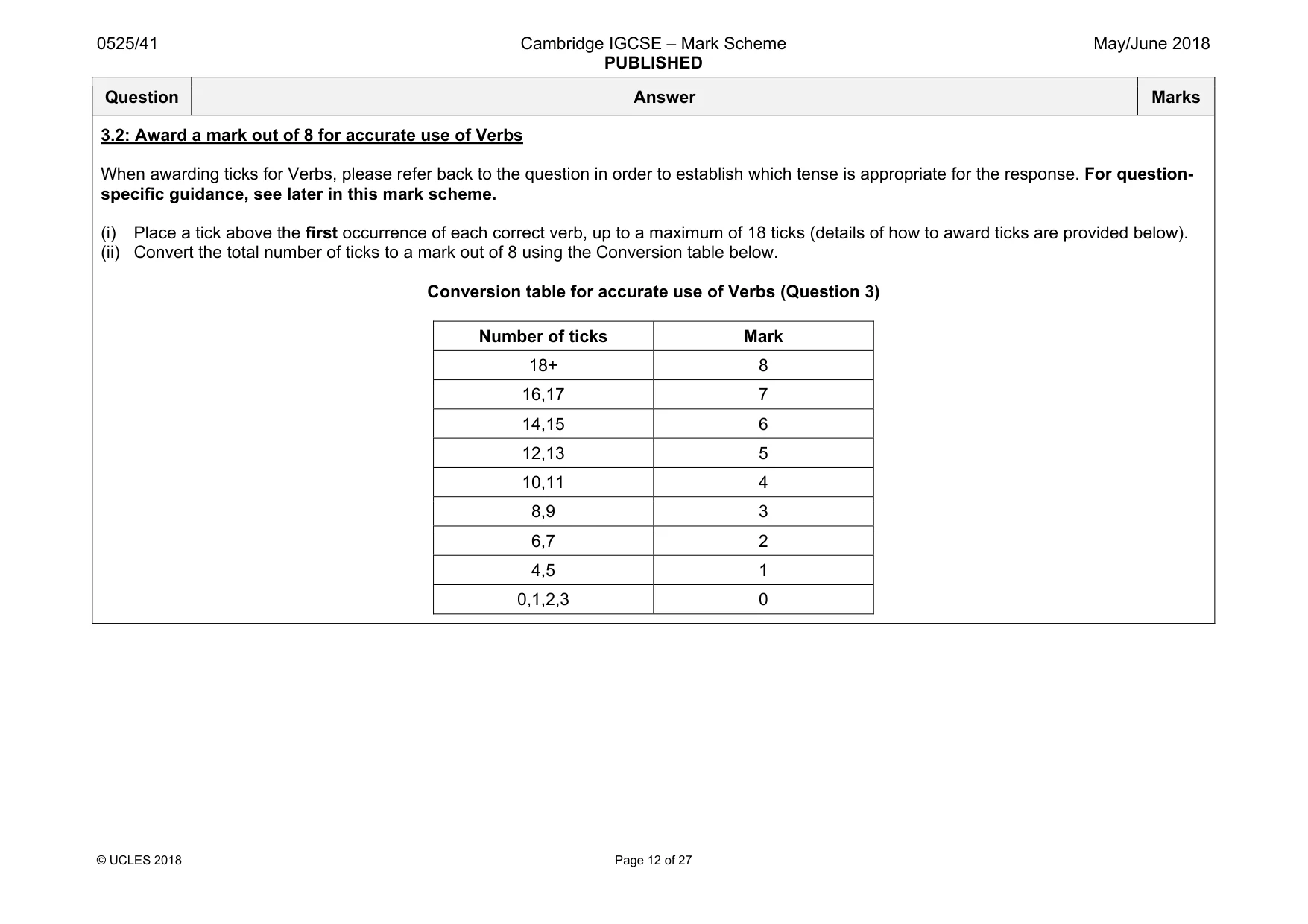
0525/41 Cambridge IGCSE – Mark Scheme PUBLISHED May/June 2018 © UCLES 2018 Page 12 of 27 Question Answer Marks 3.2: Award a mark out of 8 for accurate use of Verbs When awarding ticks for Verbs, please refer back to the question in order to establish which tense is appropriate for the response. For question- specific guidance, see later in this mark scheme. (i) Place a tick above the first occurrence of each correct verb, up to a maximum of 18 ticks (details of how to award ticks are provided below). (ii) Convert the total number of ticks to a mark out of 8 using the Conversion table below. Conversion table for accurate use of Verbs (Question 3) Number of ticks Mark 18+ 8 16,17 7 14,15 6 12,13 5 10,11 4 8,9 3 6,7 2 4,5 1 0,1,2,3 0
Mark scheme, page 13
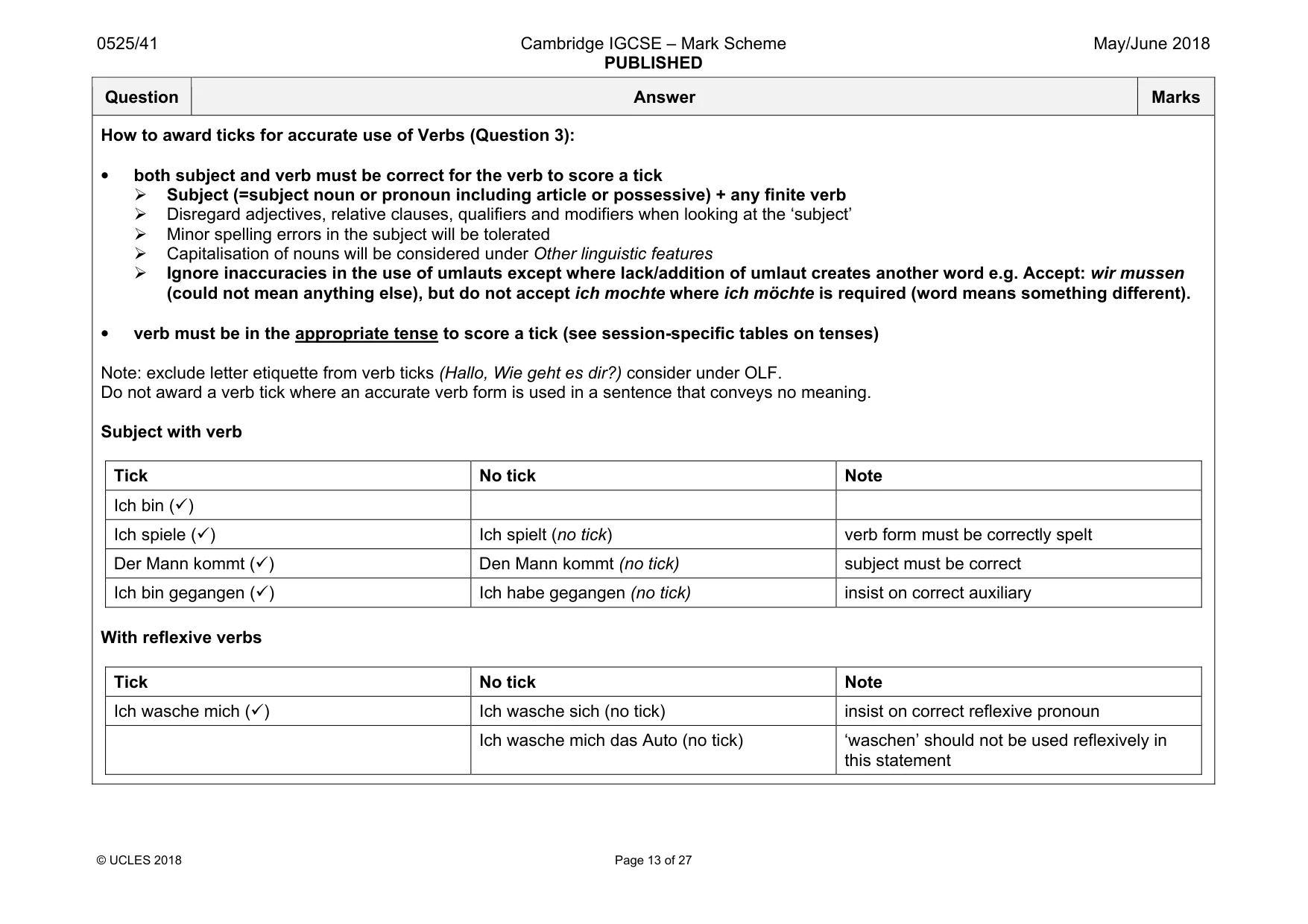
0525/41 Cambridge IGCSE – Mark Scheme PUBLISHED May/June 2018 © UCLES 2018 Page 13 of 27 Question Answer Marks How to award ticks for accurate use of Verbs (Question 3): • both subject and verb must be correct for the verb to score a tick ¾ Subject (=subject noun or pronoun including article or possessive) + any finite verb ¾ Disregard adjectives, relative clauses, qualifiers and modifiers when looking at the ‘subject’ ¾ Minor spelling errors in the subject will be tolerated ¾ Capitalisation of nouns will be considered under Other linguistic features ¾ Ignore inaccuracies in the use of umlauts except where lack/addition of umlaut creates another word e.g. Accept: wir mussen (could not mean anything else), but do not accept ich mochte where ich möchte is required (word means something different). • verb must be in the appropriate tense to score a tick (see session-specific tables on tenses) Note: exclude letter etiquette from verb ticks (Hallo, Wie geht es dir?) consider under OLF. Do not award a verb tick where an accurate verb form is used in a sentence that conveys no meaning. Subject with verb Tick No tick Note Ich bin (9) Ich spiele (9) Ich spielt (no tick) verb form must be correctly spelt Der Mann kommt (9) Den Mann kommt (no tick) subject must be correct Ich bin gegangen (9) Ich habe gegangen (no tick) insist on correct auxiliary With reflexive verbs Tick No tick Note Ich wasche mich (9) Ich wasche sich (no tick) insist on correct reflexive pronoun Ich wasche mich das Auto (no tick) ‘waschen’ should not be used reflexively in this statement
Mark scheme, page 14
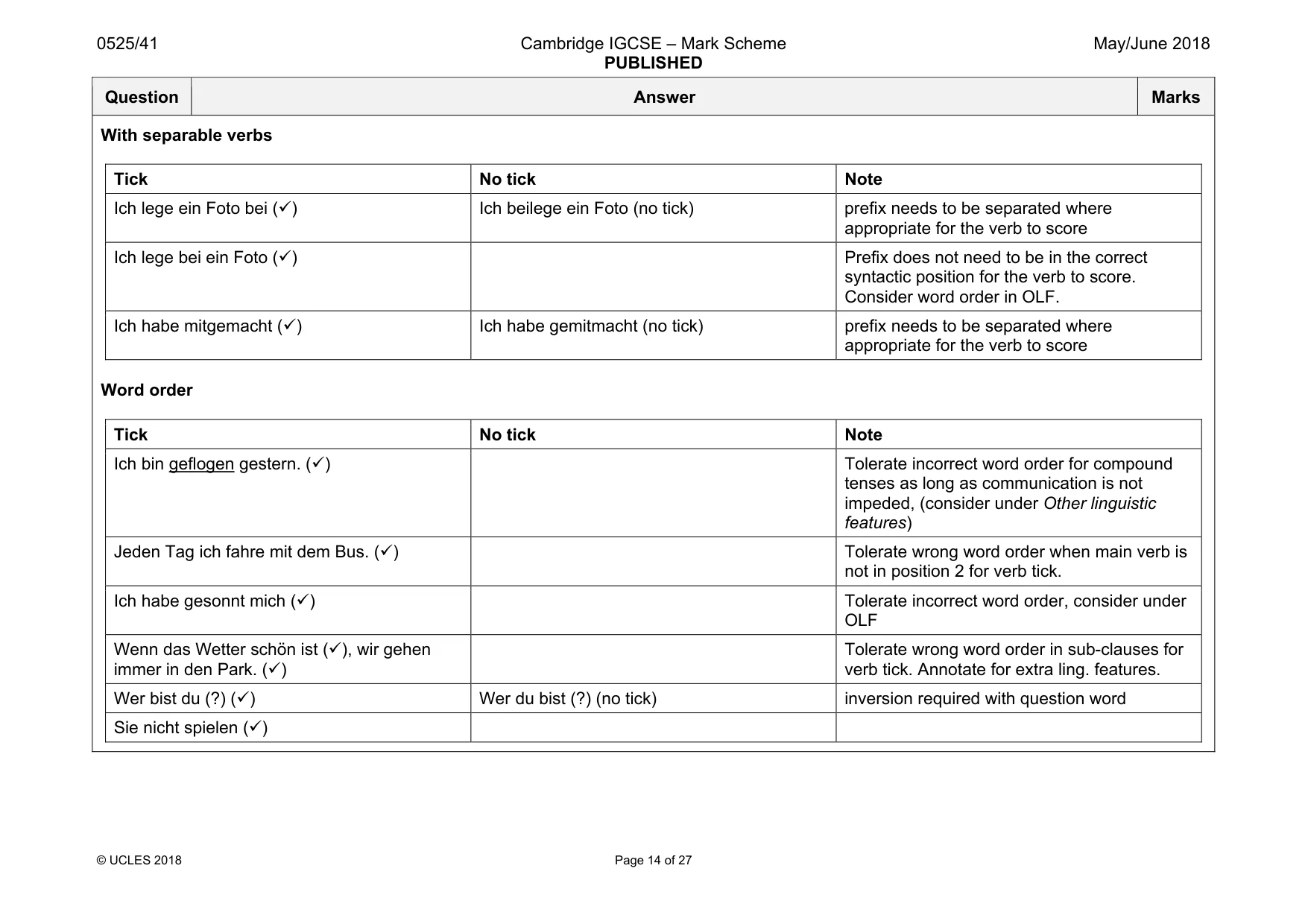
0525/41 Cambridge IGCSE – Mark Scheme PUBLISHED May/June 2018 © UCLES 2018 Page 14 of 27 Question Answer Marks With separable verbs Tick No tick Note Ich lege ein Foto bei (9) Ich beilege ein Foto (no tick) prefix needs to be separated where appropriate for the verb to score Ich lege bei ein Foto (9) Prefix does not need to be in the correct syntactic position for the verb to score. Consider word order in OLF. Ich habe mitgemacht (9) Ich habe gemitmacht (no tick) prefix needs to be separated where appropriate for the verb to score Word order Tick No tick Note Ich bin geflogen gestern. (9) Tolerate incorrect word order for compound tenses as long as communication is not impeded, (consider under Other linguistic features) Jeden Tag ich fahre mit dem Bus. (9) Tolerate wrong word order when main verb is not in position 2 for verb tick. Ich habe gesonnt mich (9) Tolerate incorrect word order, consider under OLF Wenn das Wetter schön ist (9), wir gehen immer in den Park. (9) Tolerate wrong word order in sub-clauses for verb tick. Annotate for extra ling. features. Wer bist du (?) (9) Wer du bist (?) (no tick) inversion required with question word Sie nicht spielen (9)
Mark scheme, page 15
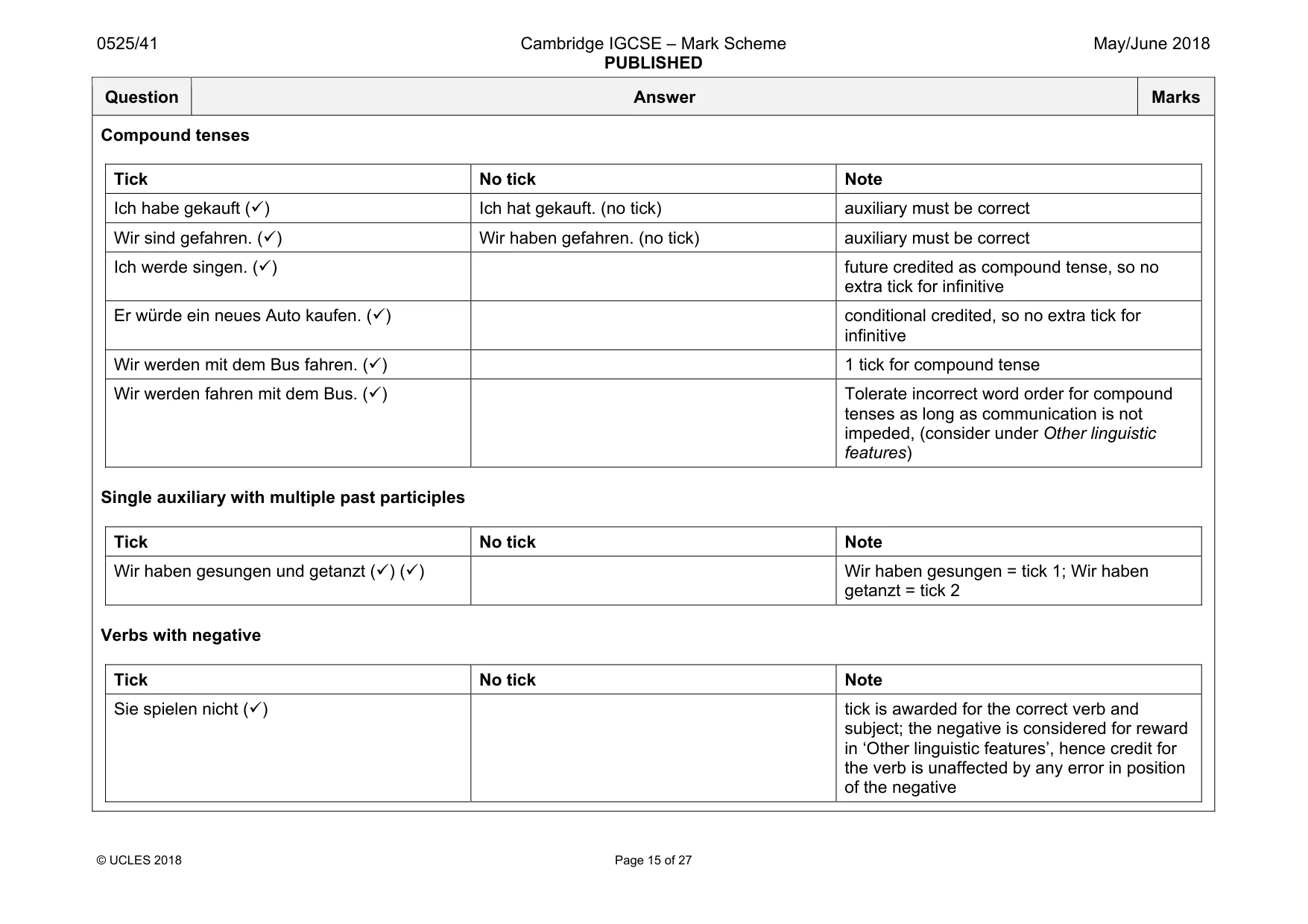
0525/41 Cambridge IGCSE – Mark Scheme PUBLISHED May/June 2018 © UCLES 2018 Page 15 of 27 Question Answer Marks Compound tenses Tick No tick Note Ich habe gekauft (9) Ich hat gekauft. (no tick) auxiliary must be correct Wir sind gefahren. (9) Wir haben gefahren. (no tick) auxiliary must be correct Ich werde singen. (9) future credited as compound tense, so no extra tick for infinitive Er würde ein neues Auto kaufen. (9) conditional credited, so no extra tick for infinitive Wir werden mit dem Bus fahren. (9) 1 tick for compound tense Wir werden fahren mit dem Bus. (9) Tolerate incorrect word order for compound tenses as long as communication is not impeded, (consider under Other linguistic features) Single auxiliary with multiple past participles Tick No tick Note Wir haben gesungen und getanzt (9) (9) Wir haben gesungen = tick 1; Wir haben getanzt = tick 2 Verbs with negative Tick No tick Note Sie spielen nicht (9) tick is awarded for the correct verb and subject; the negative is considered for reward in ‘Other linguistic features’, hence credit for the verb is unaffected by any error in position of the negative
Mark scheme, page 16
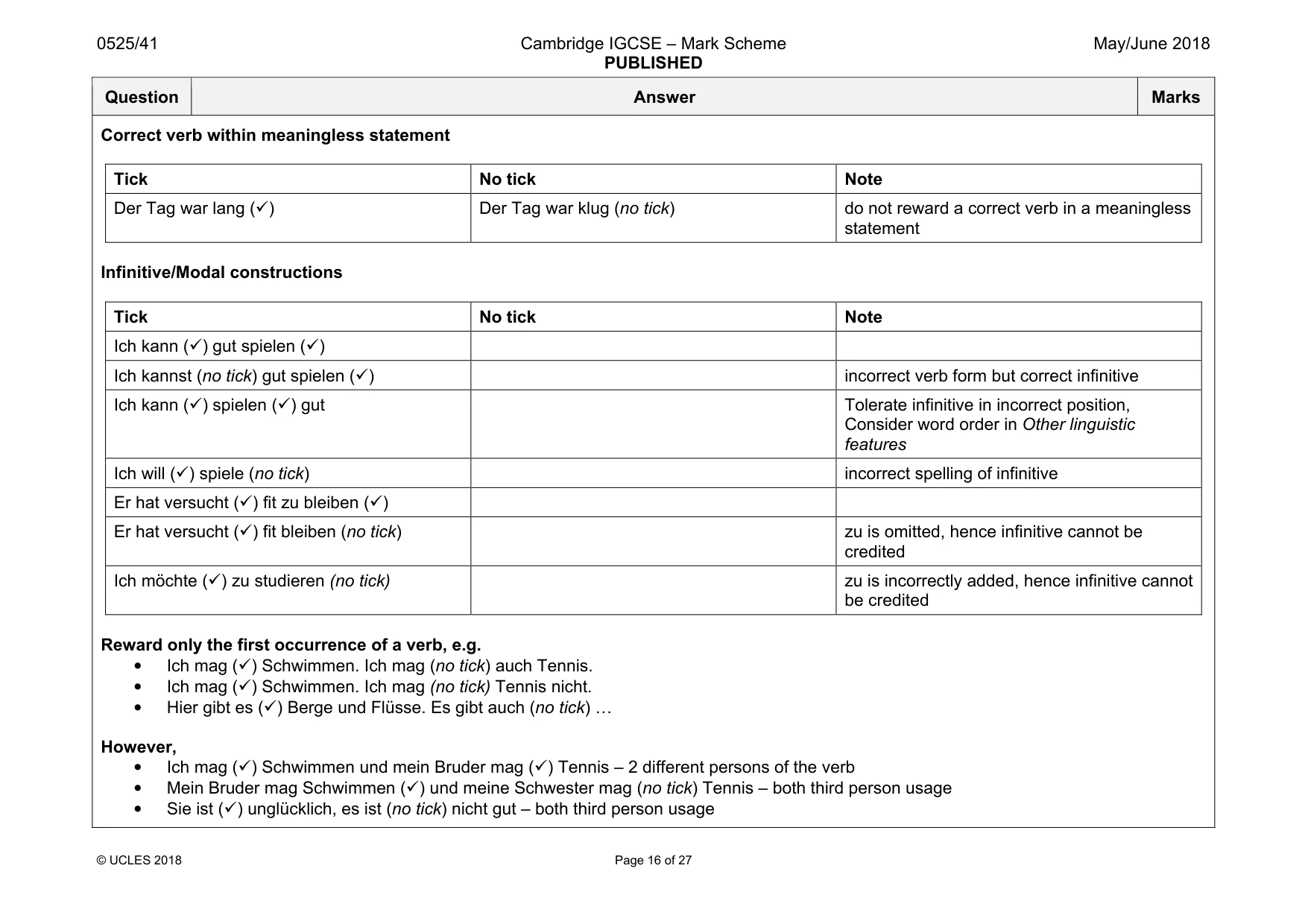
0525/41 Cambridge IGCSE – Mark Scheme PUBLISHED May/June 2018 © UCLES 2018 Page 16 of 27 Question Answer Marks Correct verb within meaningless statement Tick No tick Note Der Tag war lang (9) Der Tag war klug (no tick) do not reward a correct verb in a meaningless statement Infinitive/Modal constructions Tick No tick Note Ich kann (9) gut spielen (9) Ich kannst (no tick) gut spielen (9) incorrect verb form but correct infinitive Ich kann (9) spielen (9) gut Tolerate infinitive in incorrect position, Consider word order in Other linguistic features Ich will (9) spiele (no tick) incorrect spelling of infinitive Er hat versucht (9) fit zu bleiben (9) Er hat versucht (9) fit bleiben (no tick) zu is omitted, hence infinitive cannot be credited Ich möchte (9) zu studieren (no tick) zu is incorrectly added, hence infinitive cannot be credited Reward only the first occurrence of a verb, e.g. • Ich mag (9) Schwimmen. Ich mag (no tick) auch Tennis. • Ich mag (9) Schwimmen. Ich mag (no tick) Tennis nicht. • Hier gibt es (9) Berge und Flüsse. Es gibt auch (no tick) « However, • Ich mag (9) Schwimmen und mein Bruder mag (9) Tennis – 2 different persons of the verb • Mein Bruder mag Schwimmen (9) und meine Schwester mag (no tick) Tennis – both third person usage • Sie ist (9) unglücklich, es ist (no tick) nicht gut – both third person usage
Mark scheme, page 17
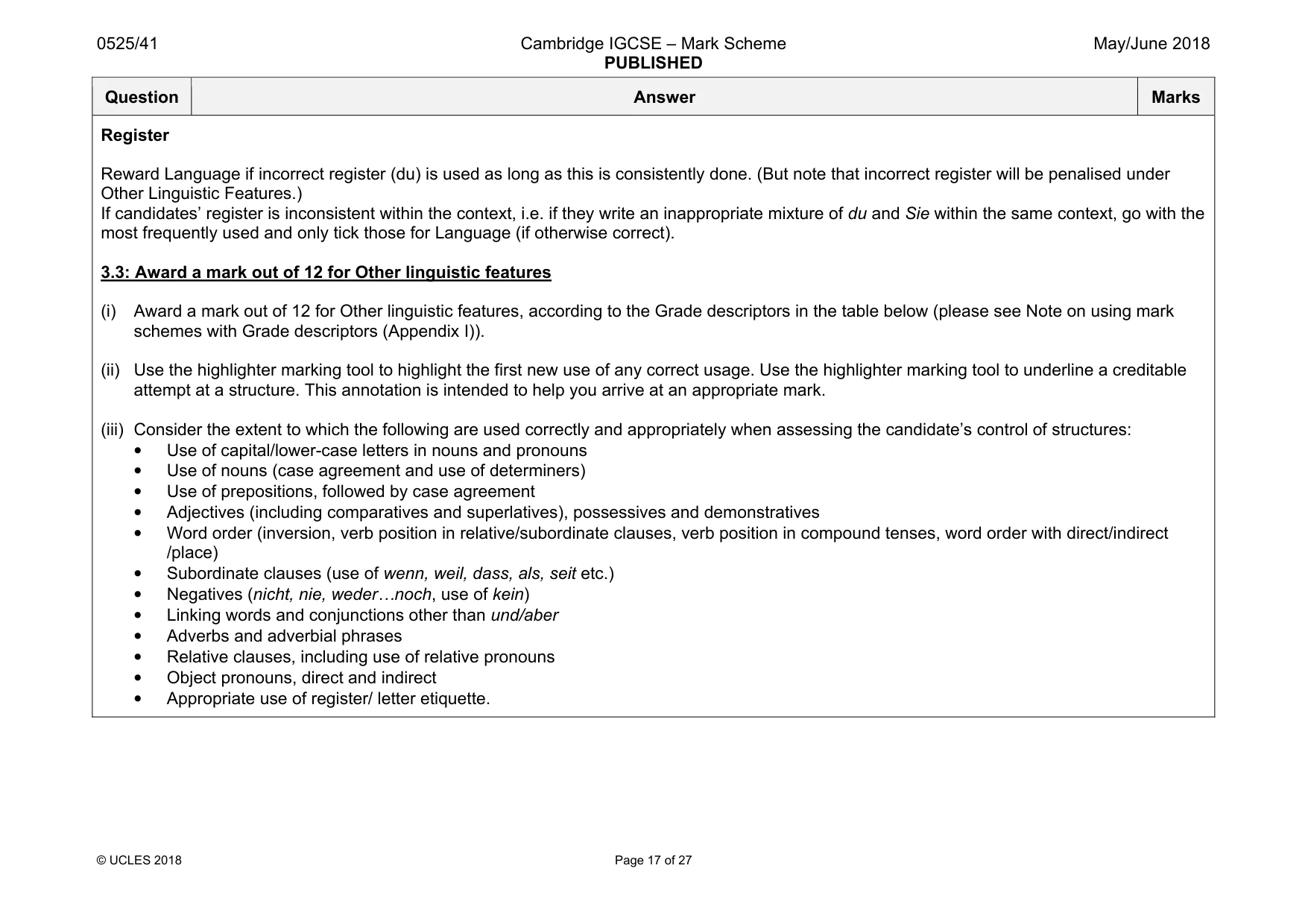
0525/41 Cambridge IGCSE – Mark Scheme PUBLISHED May/June 2018 © UCLES 2018 Page 17 of 27 Question Answer Marks Register Reward Language if incorrect register (du) is used as long as this is consistently done. (But note that incorrect register will be penalised under Other Linguistic Features.) If candidates’ register is inconsistent within the context, i.e. if they write an inappropriate mixture of du and Sie within the same context, go with the most frequently used and only tick those for Language (if otherwise correct). 3.3: Award a mark out of 12 for Other linguistic features (i) Award a mark out of 12 for Other linguistic features, according to the Grade descriptors in the table below (please see Note on using mark schemes with Grade descriptors (Appendix I)). (ii) Use the highlighter marking tool to highlight the first new use of any correct usage. Use the highlighter marking tool to underline a creditable attempt at a structure. This annotation is intended to help you arrive at an appropriate mark. (iii) Consider the extent to which the following are used correctly and appropriately when assessing the candidate’s control of structures: • Use of capital/lower-case letters in nouns and pronouns • Use of nouns (case agreement and use of determiners) • Use of prepositions, followed by case agreement • Adjectives (including comparatives and superlatives), possessives and demonstratives • Word order (inversion, verb position in relative/subordinate clauses, verb position in compound tenses, word order with direct/indirect /place) • Subordinate clauses (use of wenn, weil, dass, als, seit etc.) • Negatives (nicht, nie, weder«noch, use of kein) • Linking words and conjunctions other than und/aber • Adverbs and adverbial phrases • Relative clauses, including use of relative pronouns • Object pronouns, direct and indirect • Appropriate use of register/ letter etiquette.
Mark scheme, page 18
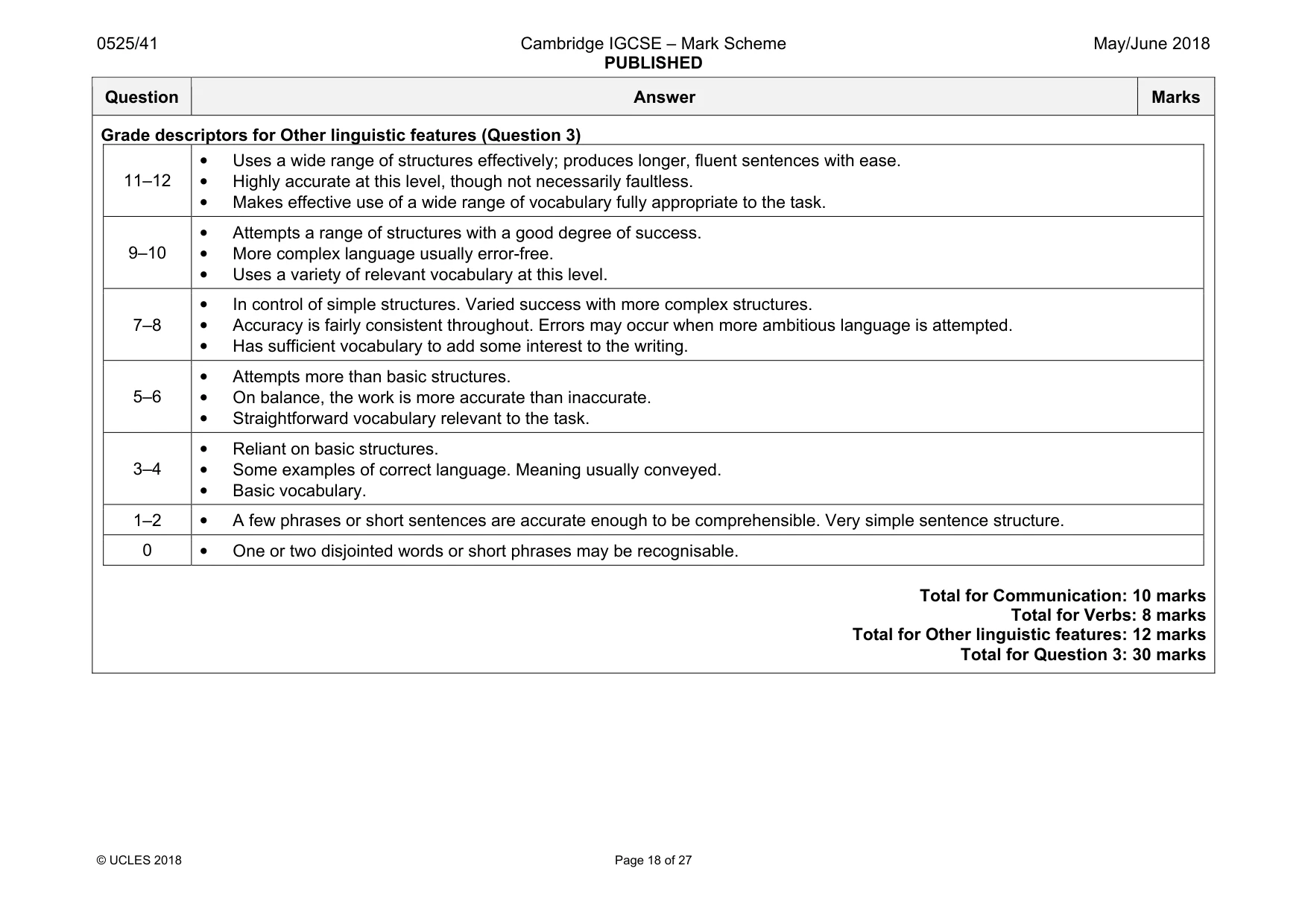
0525/41 Cambridge IGCSE – Mark Scheme PUBLISHED May/June 2018 © UCLES 2018 Page 18 of 27 Question Answer Marks Grade descriptors for Other linguistic features (Question 3) 11–12 • Uses a wide range of structures effectively; produces longer, fluent sentences with ease. • Highly accurate at this level, though not necessarily faultless. • Makes effective use of a wide range of vocabulary fully appropriate to the task. 9–10 • Attempts a range of structures with a good degree of success. • More complex language usually error-free. • Uses a variety of relevant vocabulary at this level. 7–8 • In control of simple structures. Varied success with more complex structures. • Accuracy is fairly consistent throughout. Errors may occur when more ambitious language is attempted. • Has sufficient vocabulary to add some interest to the writing. 5–6 • Attempts more than basic structures. • On balance, the work is more accurate than inaccurate. • Straightforward vocabulary relevant to the task. 3–4 • Reliant on basic structures. • Some examples of correct language. Meaning usually conveyed. • Basic vocabulary. 1–2 • A few phrases or short sentences are accurate enough to be comprehensible. Very simple sentence structure. 0 • One or two disjointed words or short phrases may be recognisable. Total for Communication: 10 marks Total for Verbs: 8 marks Total for Other linguistic features: 12 marks Total for Question 3: 30 marks
Mark scheme, page 19
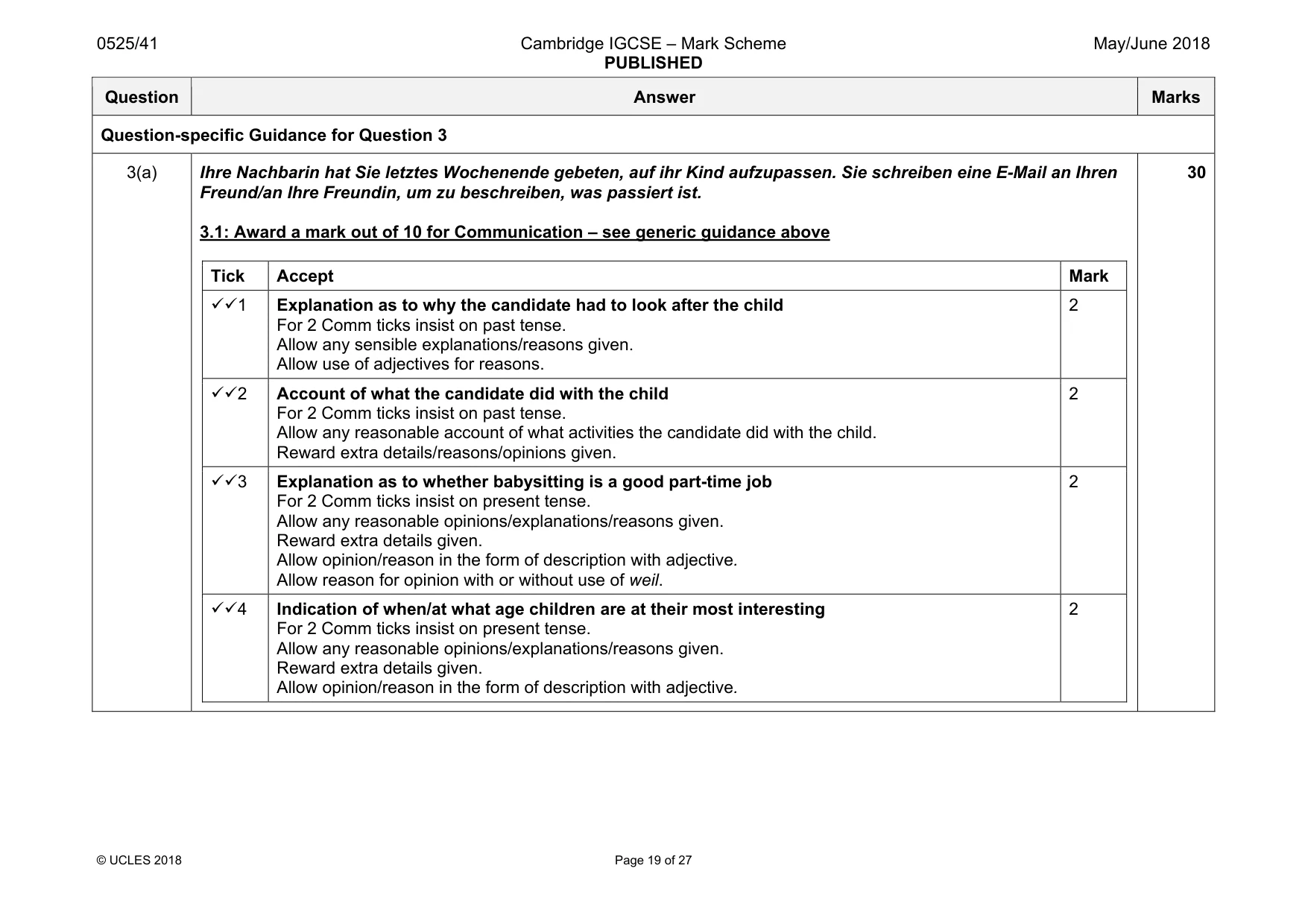
0525/41 Cambridge IGCSE – Mark Scheme PUBLISHED May/June 2018 © UCLES 2018 Page 19 of 27 Question Answer Marks Question-specific Guidance for Question 3 3(a) Ihre Nachbarin hat Sie letztes Wochenende gebeten, auf ihr Kind aufzupassen. Sie schreiben eine E-Mail an Ihren Freund/an Ihre Freundin, um zu beschreiben, was passiert ist. 3.1: Award a mark out of 10 for Communication – see generic guidance above Tick Accept Mark 991 Explanation as to why the candidate had to look after the child For 2 Comm ticks insist on past tense. Allow any sensible explanations/reasons given. Allow use of adjectives for reasons. 2 992 Account of what the candidate did with the child For 2 Comm ticks insist on past tense. Allow any reasonable account of what activities the candidate did with the child. Reward extra details/reasons/opinions given. 2 993 Explanation as to whether babysitting is a good part-time job For 2 Comm ticks insist on present tense. Allow any reasonable opinions/explanations/reasons given. Reward extra details given. Allow opinion/reason in the form of description with adjective. Allow reason for opinion with or without use of weil. 2 994 Indication of when/at what age children are at their most interesting For 2 Comm ticks insist on present tense. Allow any reasonable opinions/explanations/reasons given. Reward extra details given. Allow opinion/reason in the form of description with adjective. 2 30
Mark scheme, page 20
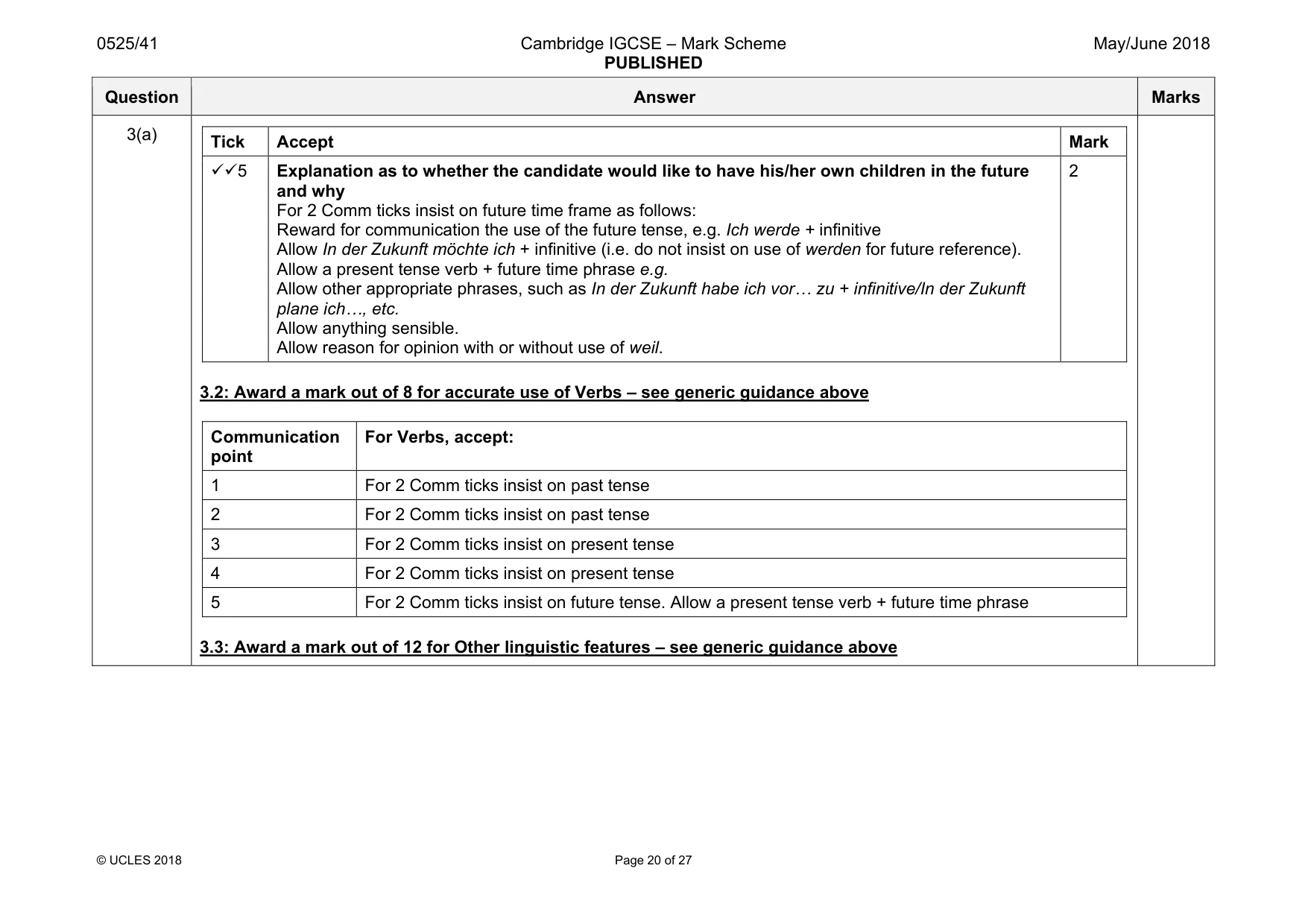
0525/41 Cambridge IGCSE – Mark Scheme PUBLISHED May/June 2018 © UCLES 2018 Page 20 of 27 Question Answer Marks 3(a) Tick Accept Mark 995 Explanation as to whether the candidate would like to have his/her own children in the future and why For 2 Comm ticks insist on future time frame as follows: Reward for communication the use of the future tense, e.g. Ich werde + infinitive Allow In der Zukunft möchte ich + infinitive (i.e. do not insist on use of werden for future reference). Allow a present tense verb + future time phrase e.g. Allow other appropriate phrases, such as In der Zukunft habe ich vor« zu + infinitive/In der Zukunft plane ich«, etc. Allow anything sensible. Allow reason for opinion with or without use of weil. 2 3.2: Award a mark out of 8 for accurate use of Verbs – see generic guidance above Communication point For Verbs, accept: 1 For 2 Comm ticks insist on past tense 2 For 2 Comm ticks insist on past tense 3 For 2 Comm ticks insist on present tense 4 For 2 Comm ticks insist on present tense 5 For 2 Comm ticks insist on future tense. Allow a present tense verb + future time phrase 3.3: Award a mark out of 12 for Other linguistic features – see generic guidance above
Mark scheme, page 21
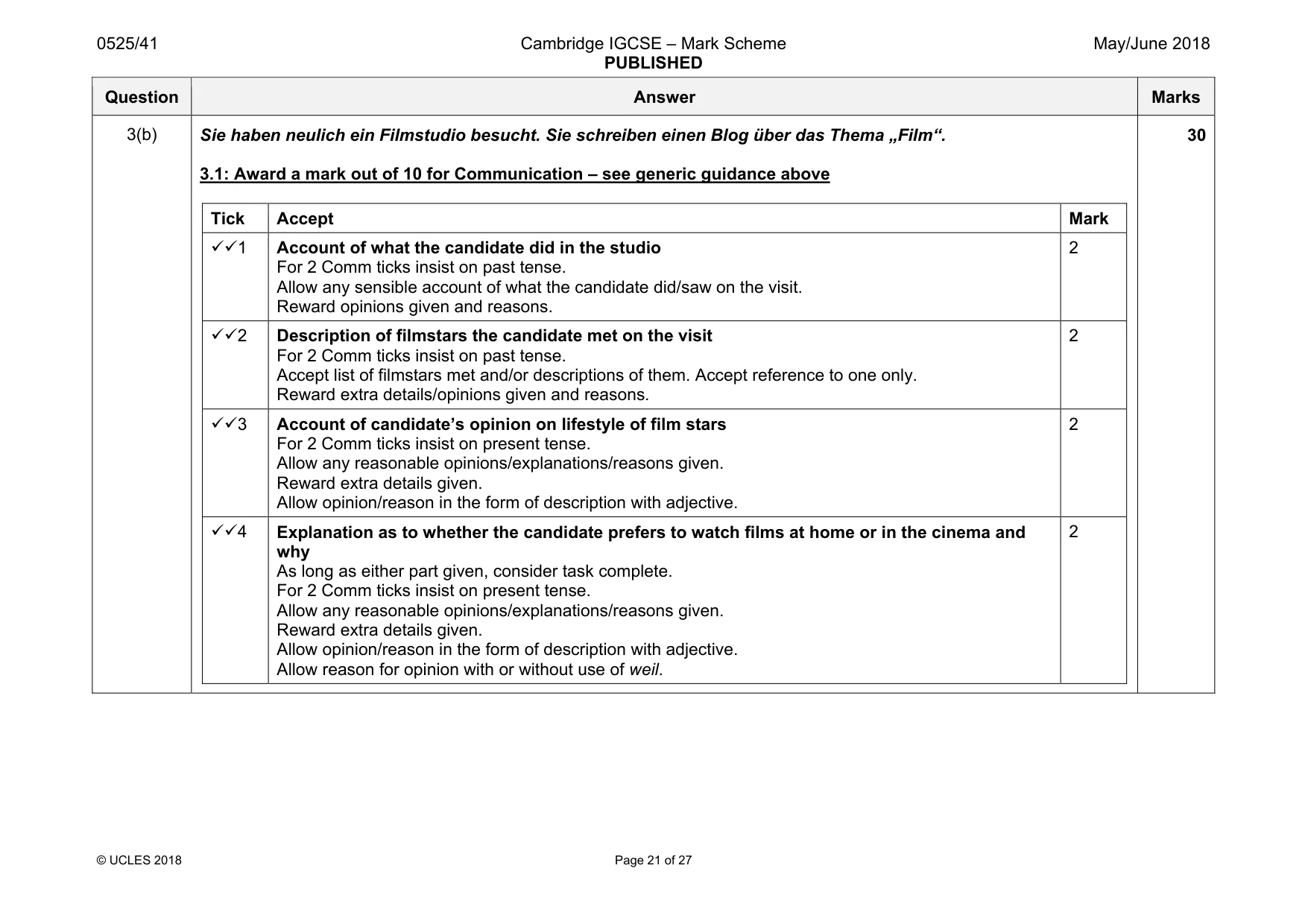
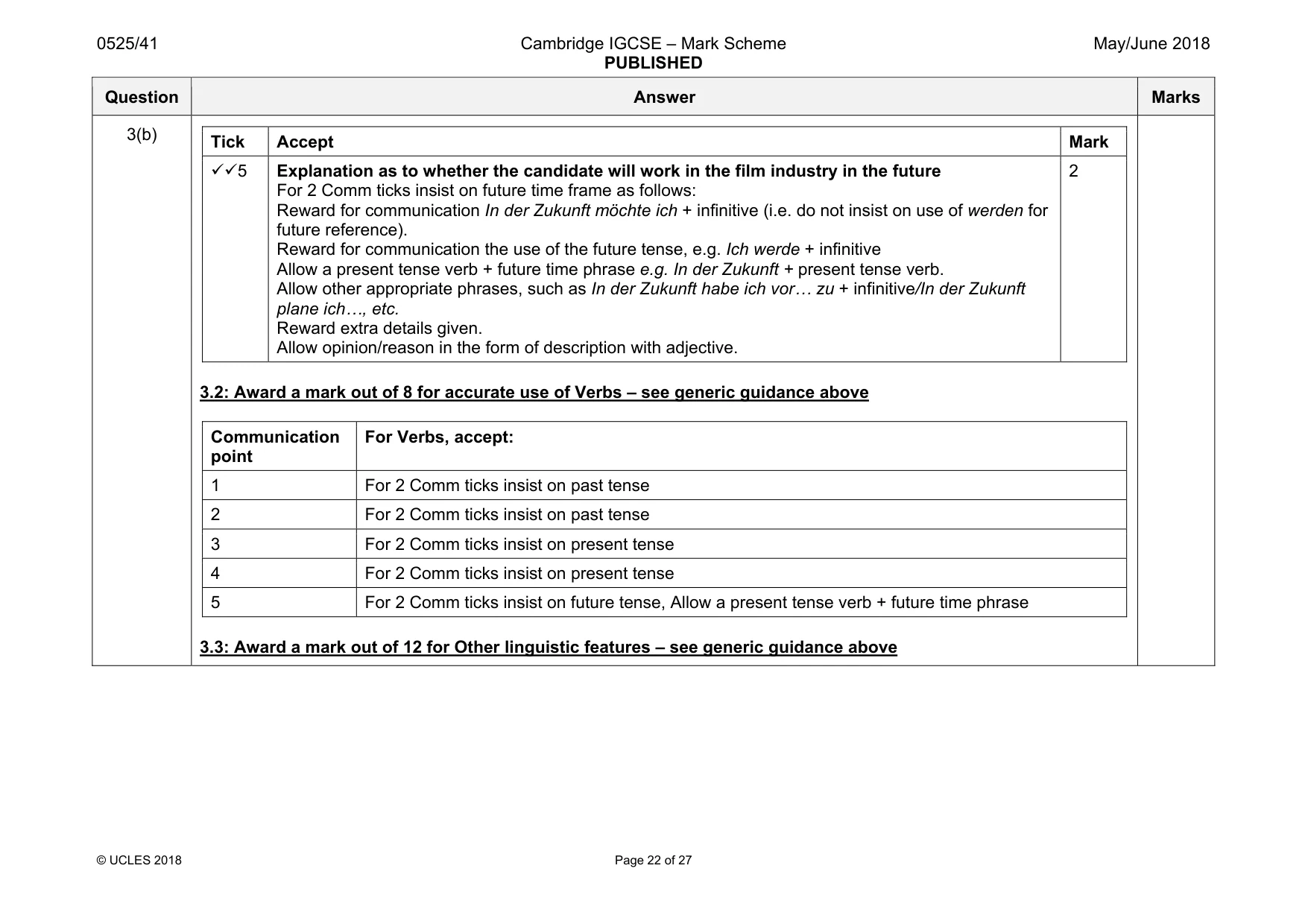
0525/41 Cambridge IGCSE – Mark Scheme PUBLISHED May/June 2018 © UCLES 2018 Page 21 of 27 Question Answer Marks 3(b) Sie haben neulich ein Filmstudio besucht. Sie schreiben einen Blog über das Thema „Film“. 3.1: Award a mark out of 10 for Communication – see generic guidance above Tick Accept Mark 991 Account of what the candidate did in the studio For 2 Comm ticks insist on past tense. Allow any sensible account of what the candidate did/saw on the visit. Reward opinions given and reasons. 2 992 Description of filmstars the candidate met on the visit For 2 Comm ticks insist on past tense. Accept list of filmstars met and/or descriptions of them. Accept reference to one only. Reward extra details/opinions given and reasons. 2 993 Account of candidate’s opinion on lifestyle of film stars For 2 Comm ticks insist on present tense. Allow any reasonable opinions/explanations/reasons given. Reward extra details given. Allow opinion/reason in the form of description with adjective. 2 994 Explanation as to whether the candidate prefers to watch films at home or in the cinema and why As long as either part given, consider task complete. For 2 Comm ticks insist on present tense. Allow any reasonable opinions/explanations/reasons given. Reward extra details given. Allow opinion/reason in the form of description with adjective. Allow reason for opinion with or without use of weil. 2 30
Mark scheme, page 22
0525/41 Cambridge IGCSE – Mark Scheme PUBLISHED May/June 2018 © UCLES 2018 Page 22 of 27 Question Answer Marks 3(b) Tick Accept Mark 995 Explanation as to whether the candidate will work in the film industry in the future For 2 Comm ticks insist on future time frame as follows: Reward for communication In der Zukunft möchte ich + infinitive (i.e. do not insist on use of werden for future reference). Reward for communication the use of the future tense, e.g. Ich werde + infinitive Allow a present tense verb + future time phrase e.g. In der Zukunft + present tense verb. Allow other appropriate phrases, such as In der Zukunft habe ich vor« zu + infinitive/In der Zukunft plane ich«, etc. Reward extra details given. Allow opinion/reason in the form of description with adjective. 2 3.2: Award a mark out of 8 for accurate use of Verbs – see generic guidance above Communication point For Verbs, accept: 1 For 2 Comm ticks insist on past tense 2 For 2 Comm ticks insist on past tense 3 For 2 Comm ticks insist on present tense 4 For 2 Comm ticks insist on present tense 5 For 2 Comm ticks insist on future tense, Allow a present tense verb + future time phrase 3.3: Award a mark out of 12 for Other linguistic features – see generic guidance above
Mark scheme, page 23
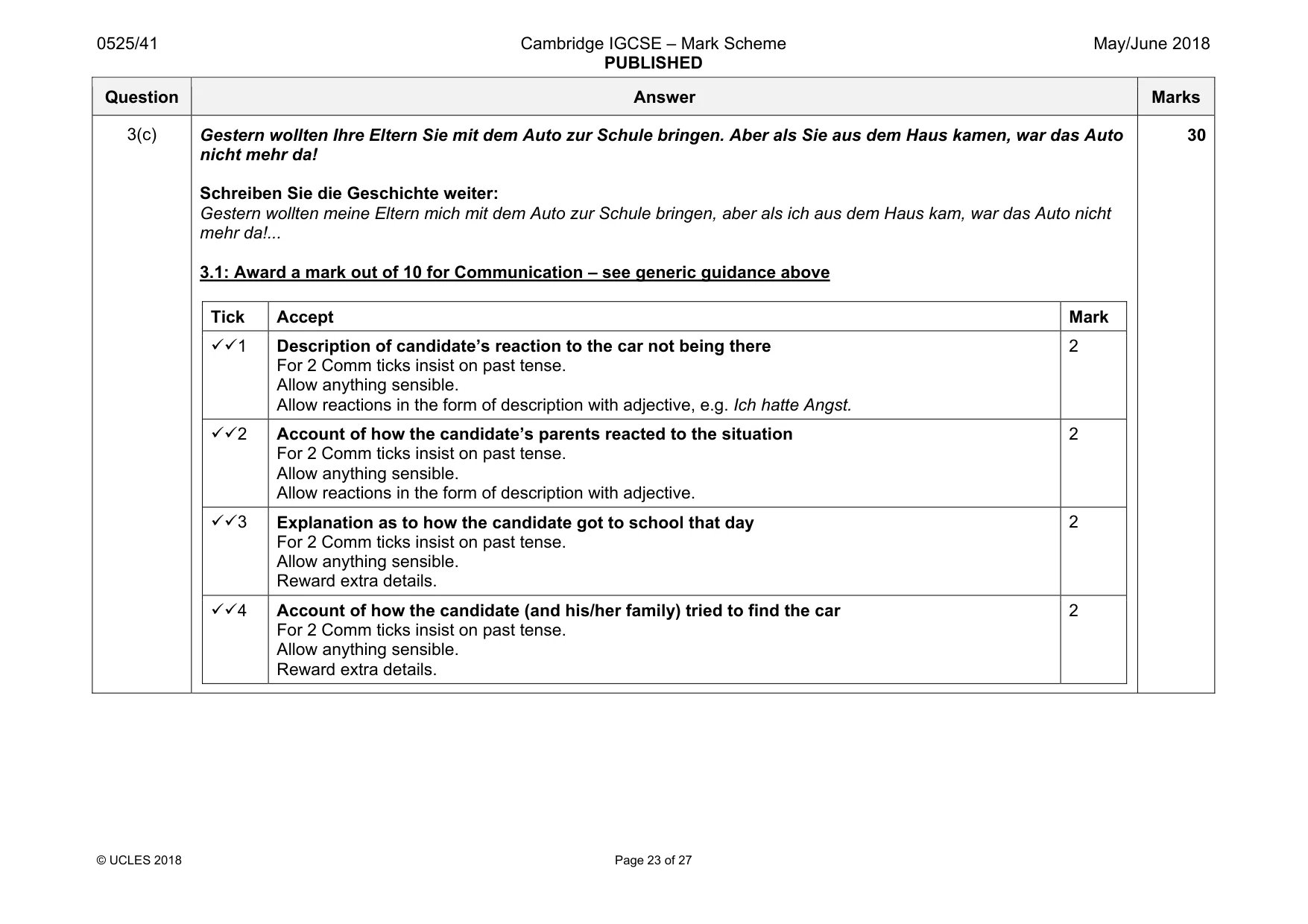
0525/41 Cambridge IGCSE – Mark Scheme PUBLISHED May/June 2018 © UCLES 2018 Page 23 of 27 Question Answer Marks 3(c) Gestern wollten Ihre Eltern Sie mit dem Auto zur Schule bringen. Aber als Sie aus dem Haus kamen, war das Auto nicht mehr da! Schreiben Sie die Geschichte weiter: Gestern wollten meine Eltern mich mit dem Auto zur Schule bringen, aber als ich aus dem Haus kam, war das Auto nicht mehr da!... 3.1: Award a mark out of 10 for Communication – see generic guidance above Tick Accept Mark 991 Description of candidate’s reaction to the car not being there For 2 Comm ticks insist on past tense. Allow anything sensible. Allow reactions in the form of description with adjective, e.g. Ich hatte Angst. 2 992 Account of how the candidate’s parents reacted to the situation For 2 Comm ticks insist on past tense. Allow anything sensible. Allow reactions in the form of description with adjective. 2 993 Explanation as to how the candidate got to school that day For 2 Comm ticks insist on past tense. Allow anything sensible. Reward extra details. 2 994 Account of how the candidate (and his/her family) tried to find the car For 2 Comm ticks insist on past tense. Allow anything sensible. Reward extra details. 2 30
Mark scheme, page 24
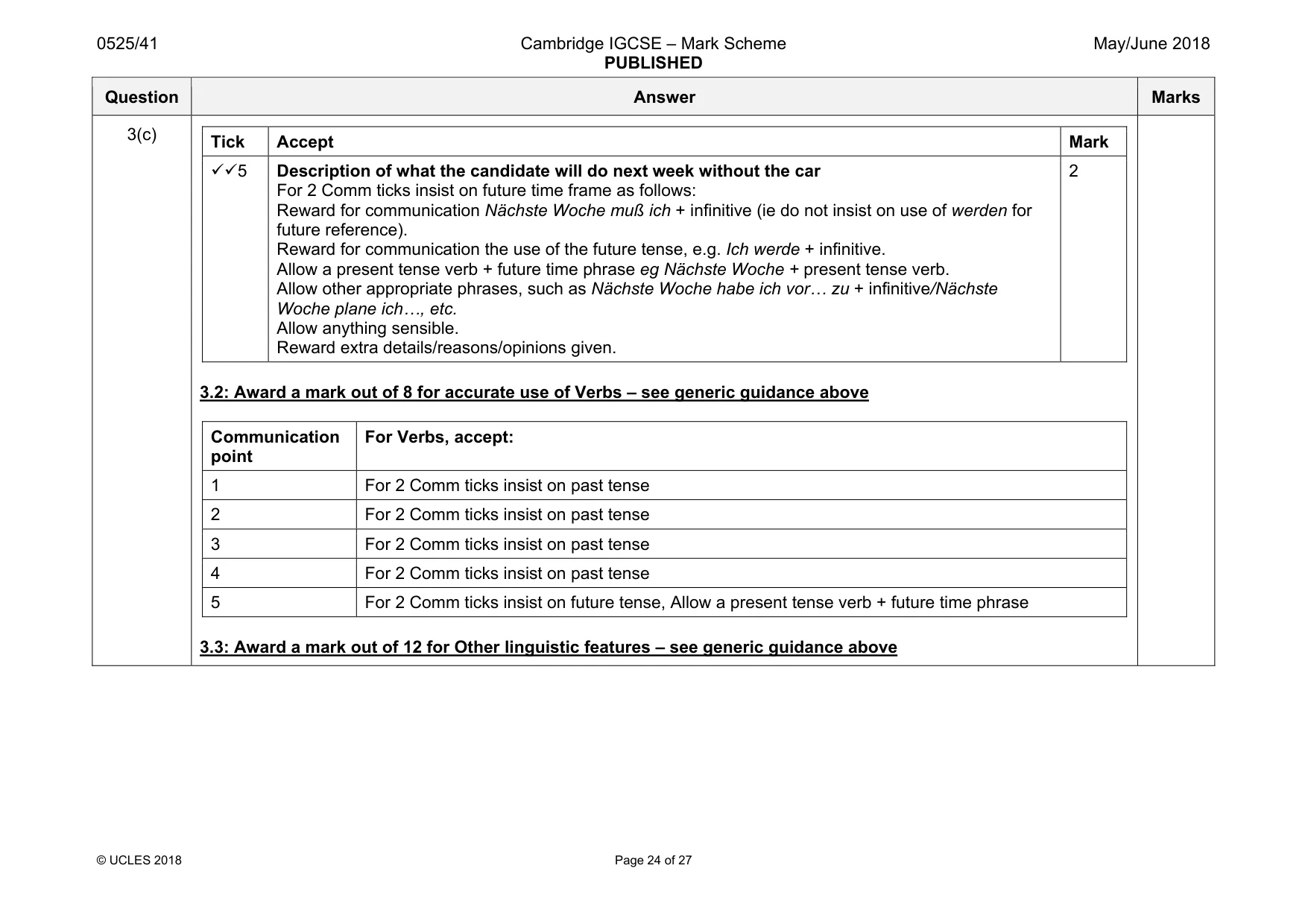
0525/41 Cambridge IGCSE – Mark Scheme PUBLISHED May/June 2018 © UCLES 2018 Page 24 of 27 Question Answer Marks 3(c) Tick Accept Mark 995 Description of what the candidate will do next week without the car For 2 Comm ticks insist on future time frame as follows: Reward for communication Nächste Woche muß ich + infinitive (ie do not insist on use of werden for future reference). Reward for communication the use of the future tense, e.g. Ich werde + infinitive. Allow a present tense verb + future time phrase eg Nächste Woche + present tense verb. Allow other appropriate phrases, such as Nächste Woche habe ich vor« zu + infinitive/Nächste Woche plane ich«, etc. Allow anything sensible. Reward extra details/reasons/opinions given. 2 3.2: Award a mark out of 8 for accurate use of Verbs – see generic guidance above Communication point For Verbs, accept: 1 For 2 Comm ticks insist on past tense 2 For 2 Comm ticks insist on past tense 3 For 2 Comm ticks insist on past tense 4 For 2 Comm ticks insist on past tense 5 For 2 Comm ticks insist on future tense, Allow a present tense verb + future time phrase 3.3: Award a mark out of 12 for Other linguistic features – see generic guidance above
Mark scheme, page 25
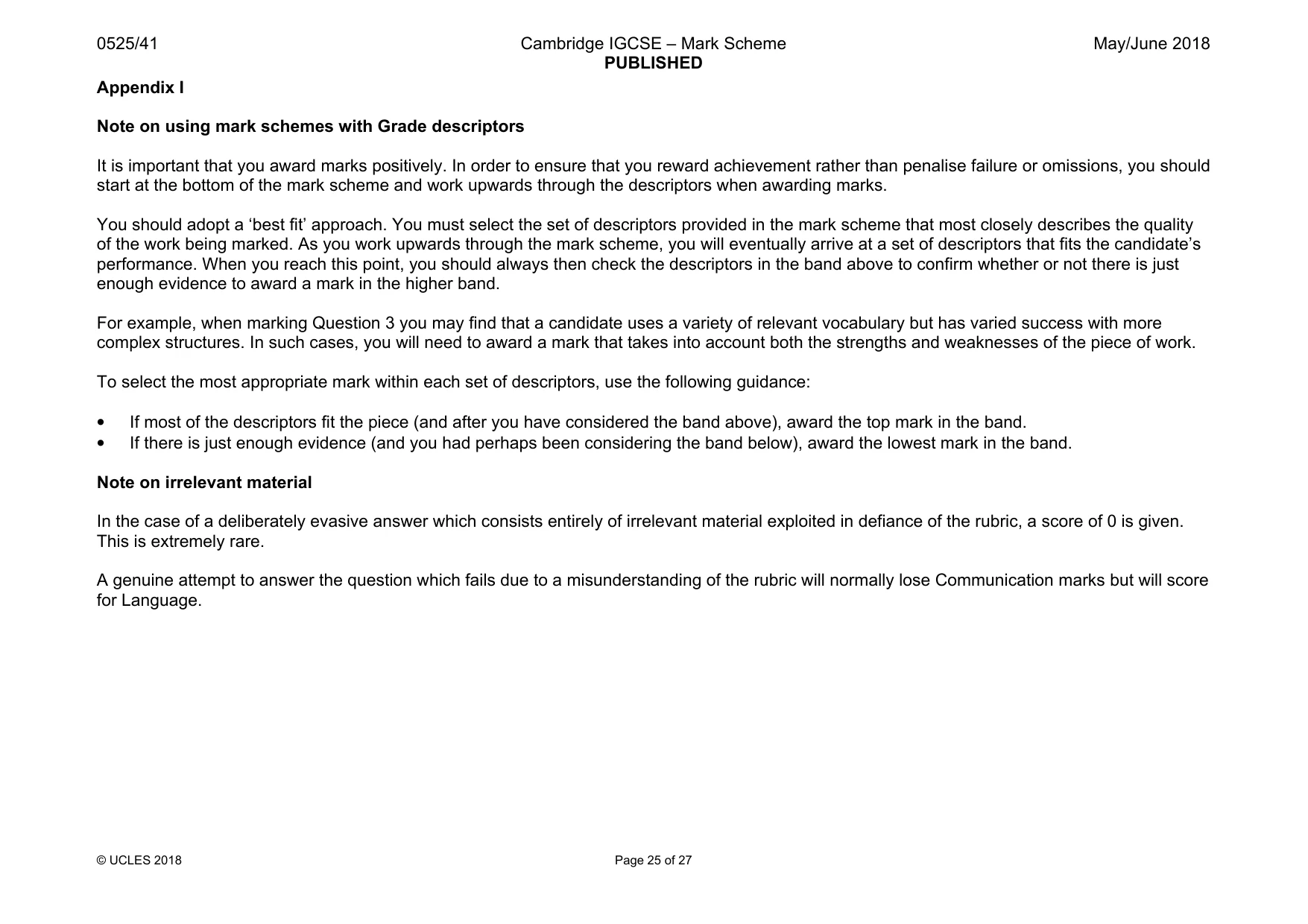
0525/41 Cambridge IGCSE – Mark Scheme PUBLISHED May/June 2018 © UCLES 2018 Page 25 of 27 Appendix I Note on using mark schemes with Grade descriptors It is important that you award marks positively. In order to ensure that you reward achievement rather than penalise failure or omissions, you should start at the bottom of the mark scheme and work upwards through the descriptors when awarding marks. You should adopt a ‘best fit’ approach. You must select the set of descriptors provided in the mark scheme that most closely describes the quality of the work being marked. As you work upwards through the mark scheme, you will eventually arrive at a set of descriptors that fits the candidate’s performance. When you reach this point, you should always then check the descriptors in the band above to confirm whether or not there is just enough evidence to award a mark in the higher band. For example, when marking Question 3 you may find that a candidate uses a variety of relevant vocabulary but has varied success with more complex structures. In such cases, you will need to award a mark that takes into account both the strengths and weaknesses of the piece of work. To select the most appropriate mark within each set of descriptors, use the following guidance: • If most of the descriptors fit the piece (and after you have considered the band above), award the top mark in the band. • If there is just enough evidence (and you had perhaps been considering the band below), award the lowest mark in the band. Note on irrelevant material In the case of a deliberately evasive answer which consists entirely of irrelevant material exploited in defiance of the rubric, a score of 0 is given. This is extremely rare. A genuine attempt to answer the question which fails due to a misunderstanding of the rubric will normally lose Communication marks but will score for Language.
Mark scheme, page 26
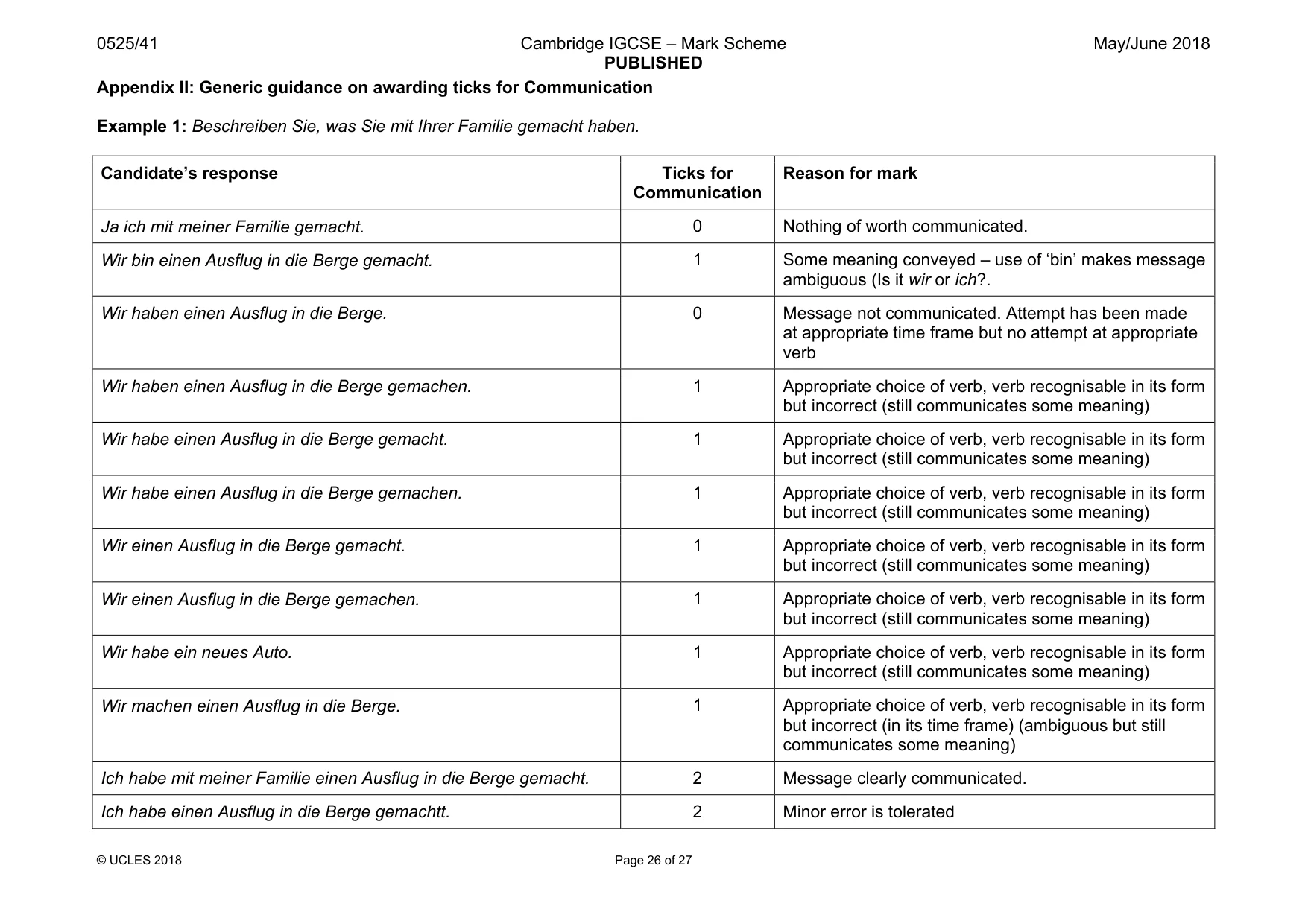
0525/41 Cambridge IGCSE – Mark Scheme PUBLISHED May/June 2018 © UCLES 2018 Page 26 of 27 Appendix II: Generic guidance on awarding ticks for Communication Example 1: Beschreiben Sie, was Sie mit Ihrer Familie gemacht haben. Candidate’s response Ticks for Communication Reason for mark Ja ich mit meiner Familie gemacht. 0 Nothing of worth communicated. Wir bin einen Ausflug in die Berge gemacht. 1 Some meaning conveyed – use of ‘bin’ makes message ambiguous (Is it wir or ich?. Wir haben einen Ausflug in die Berge. 0 Message not communicated. Attempt has been made at appropriate time frame but no attempt at appropriate verb Wir haben einen Ausflug in die Berge gemachen. 1 Appropriate choice of verb, verb recognisable in its form but incorrect (still communicates some meaning) Wir habe einen Ausflug in die Berge gemacht. 1 Appropriate choice of verb, verb recognisable in its form but incorrect (still communicates some meaning) Wir habe einen Ausflug in die Berge gemachen. 1 Appropriate choice of verb, verb recognisable in its form but incorrect (still communicates some meaning) Wir einen Ausflug in die Berge gemacht. 1 Appropriate choice of verb, verb recognisable in its form but incorrect (still communicates some meaning) Wir einen Ausflug in die Berge gemachen. 1 Appropriate choice of verb, verb recognisable in its form but incorrect (still communicates some meaning) Wir habe ein neues Auto. 1 Appropriate choice of verb, verb recognisable in its form but incorrect (still communicates some meaning) Wir machen einen Ausflug in die Berge. 1 Appropriate choice of verb, verb recognisable in its form but incorrect (in its time frame) (ambiguous but still communicates some meaning) Ich habe mit meiner Familie einen Ausflug in die Berge gemacht. 2 Message clearly communicated. Ich habe einen Ausflug in die Berge gemachtt. 2 Minor error is tolerated
Mark scheme, page 27
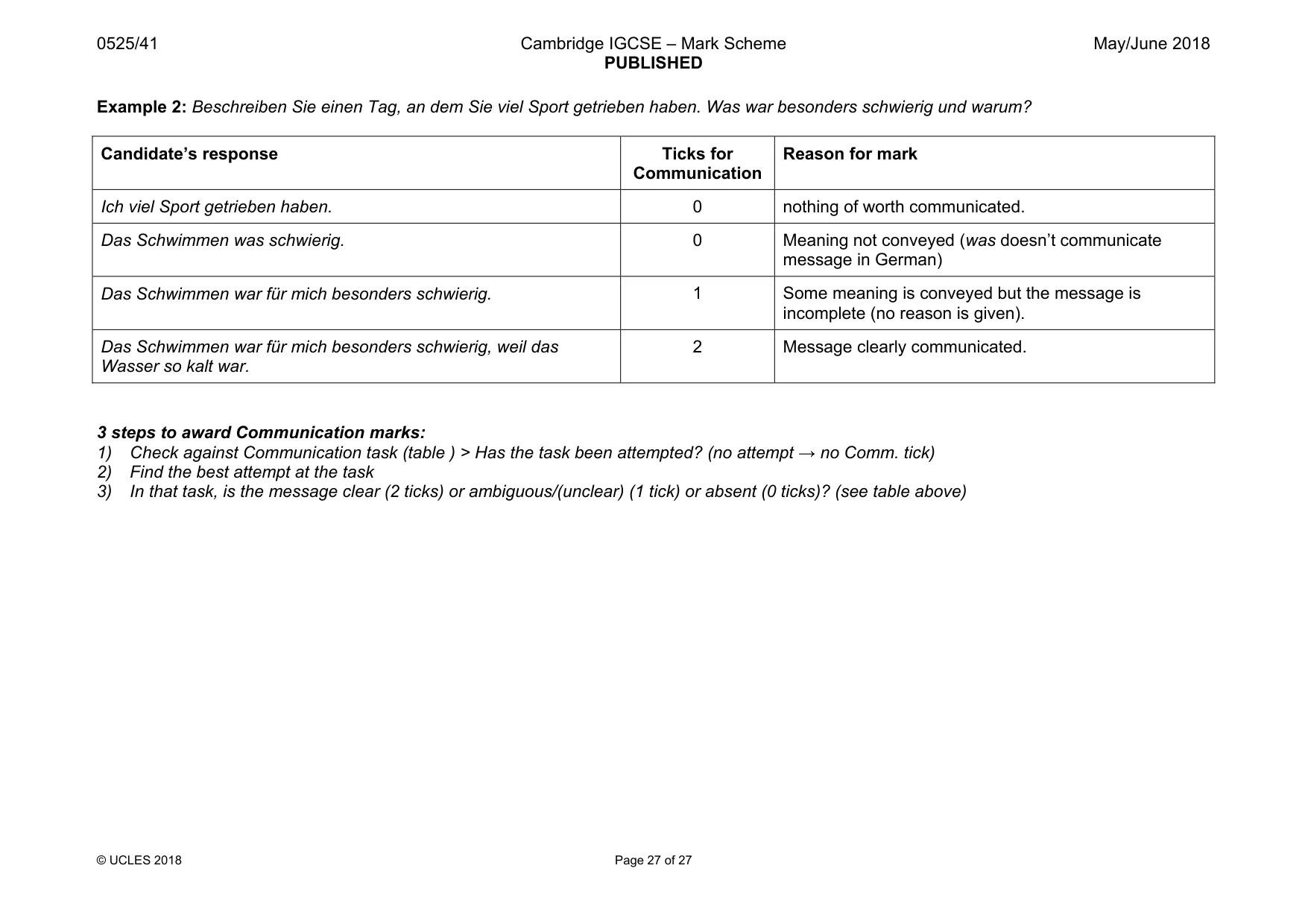
0525/41 Cambridge IGCSE – Mark Scheme PUBLISHED May/June 2018 © UCLES 2018 Page 27 of 27 Example 2: Beschreiben Sie einen Tag, an dem Sie viel Sport getrieben haben. Was war besonders schwierig und warum? Candidate’s response Ticks for Communication Reason for mark Ich viel Sport getrieben haben. 0 nothing of worth communicated. Das Schwimmen was schwierig. 0 Meaning not conveyed (was doesn’t communicate message in German) Das Schwimmen war für mich besonders schwierig. 1 Some meaning is conveyed but the message is incomplete (no reason is given). Das Schwimmen war für mich besonders schwierig, weil das Wasser so kalt war. 2 Message clearly communicated. 3 steps to award Communication marks: 1) Check against Communication task (table ) > Has the task been attempted? (no attempt → no Comm. tick) 2) Find the best attempt at the task 3) In that task, is the message clear (2 ticks) or ambiguous/(unclear) (1 tick) or absent (0 ticks)? (see table above)
What you needed in this session
Cambridge’s own grade thresholds for 2018 May/June, Paper 4 · Variant 1. A higher threshold means an easier paper — the bar moves with how the cohort did.