Cambridge IGCSE German - Foreign Language 0525 — 2012 May/June Paper 4 · Variant 2
0525/42/M/J/12
The question paper and its mark scheme, free to read here and free to download. This is Cambridge’s own paper, exactly as it was sat.
Question paper4 pages
Mark scheme23 pages
Answers below. Sit the paper first if you are practising.
Paper as text
Question paper, page 1
This document consists of 4 printed pages. IB12 06_0525_42/RP © UCLES 2012 [Turn over *8568208697* For Examiner's Use 1 2 Total UNIVERSITY OF CAMBRIDGE INTERNATIONAL EXAMINATIONS International General Certificate of Secondary Education GERMAN 0525/42 Paper 4 Continuous Writing May/June 2012 1 hour 15 minutes Candidates answer on the Question Paper. No Additional Materials are required. READ THESE INSTRUCTIONS FIRST Write your Centre number, candidate number and name on all the work you hand in. Write in dark blue or black pen. Do not use staples, paper clips, highlighters, glue or correction fluid. DO NOT WRITE IN ANY BARCODES. Answer either Question 1 (a) or Question 1 (b) and Question 2. All questions on this paper carry equal marks. At the end of the examination, fasten all your work securely together. www.XtremePapers.com
Question paper, page 2
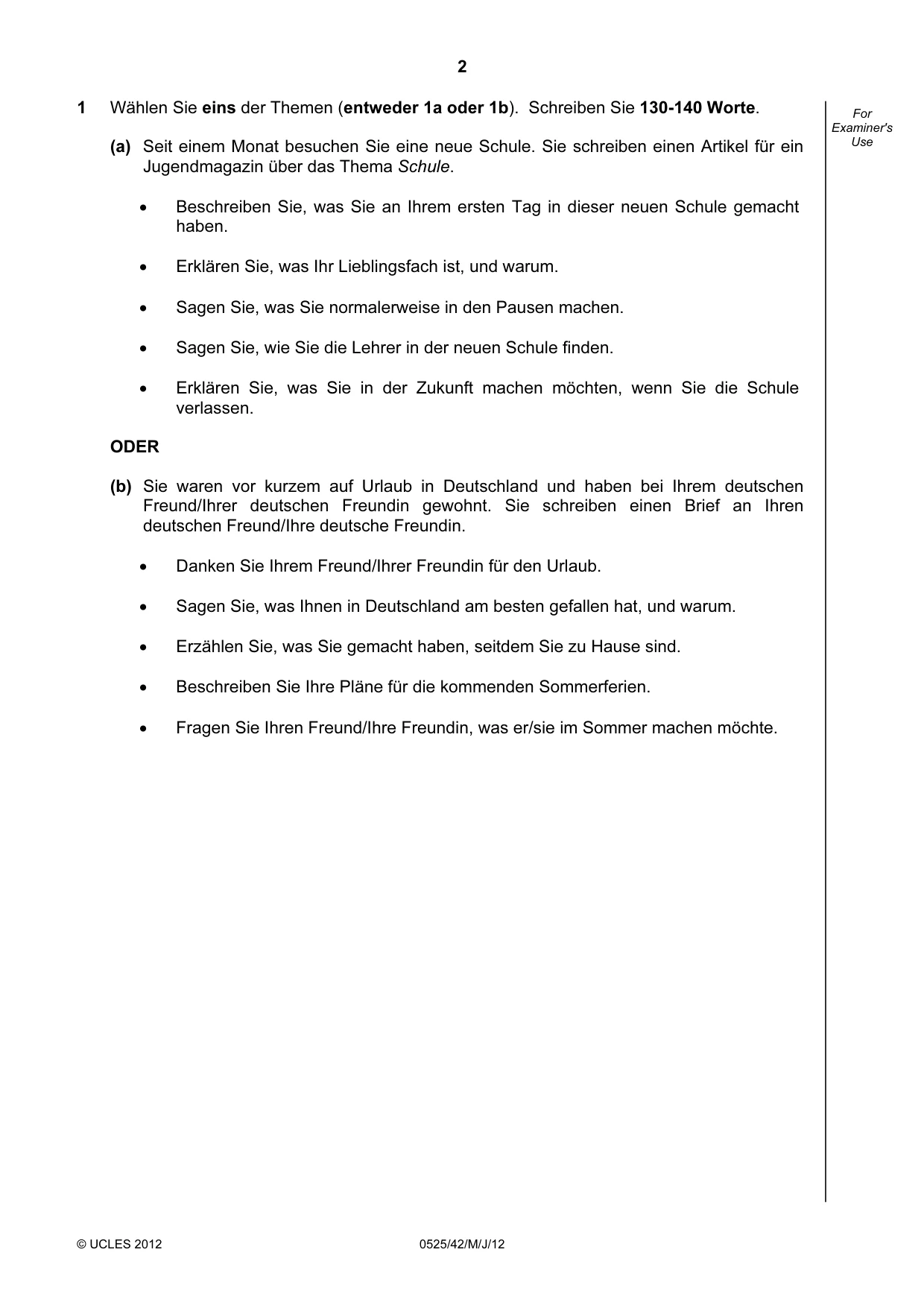
2 © UCLES 2012 0525/42/M/J/12 For Examiner's Use 1 Wählen Sie eins der Themen (entweder 1a oder 1b). Schreiben Sie 130-140 Worte. (a) Seit einem Monat besuchen Sie eine neue Schule. Sie schreiben einen Artikel für ein Jugendmagazin über das Thema Schule. • Beschreiben Sie, was Sie an Ihrem ersten Tag in dieser neuen Schule gemacht haben. • Erklären Sie, was Ihr Lieblingsfach ist, und warum. • Sagen Sie, was Sie normalerweise in den Pausen machen. • Sagen Sie, wie Sie die Lehrer in der neuen Schule finden. • Erklären Sie, was Sie in der Zukunft machen möchten, wenn Sie die Schule verlassen. ODER (b) Sie waren vor kurzem auf Urlaub in Deutschland und haben bei Ihrem deutschen Freund/Ihrer deutschen Freundin gewohnt. Sie schreiben einen Brief an Ihren deutschen Freund/Ihre deutsche Freundin. • Danken Sie Ihrem Freund/Ihrer Freundin für den Urlaub. • Sagen Sie, was Ihnen in Deutschland am besten gefallen hat, und warum. • Erzählen Sie, was Sie gemacht haben, seitdem Sie zu Hause sind. • Beschreiben Sie Ihre Pläne für die kommenden Sommerferien. • Fragen Sie Ihren Freund/Ihre Freundin, was er/sie im Sommer machen möchte.
Question paper, page 3
3 © UCLES 2012 0525/42/M/J/12 [Turn over For Examiner's Use SCHREIBEN SIE IHRE ANTWORT AUF DIE FRAGE EINS AUF DIESE SEITE
Question paper, page 4
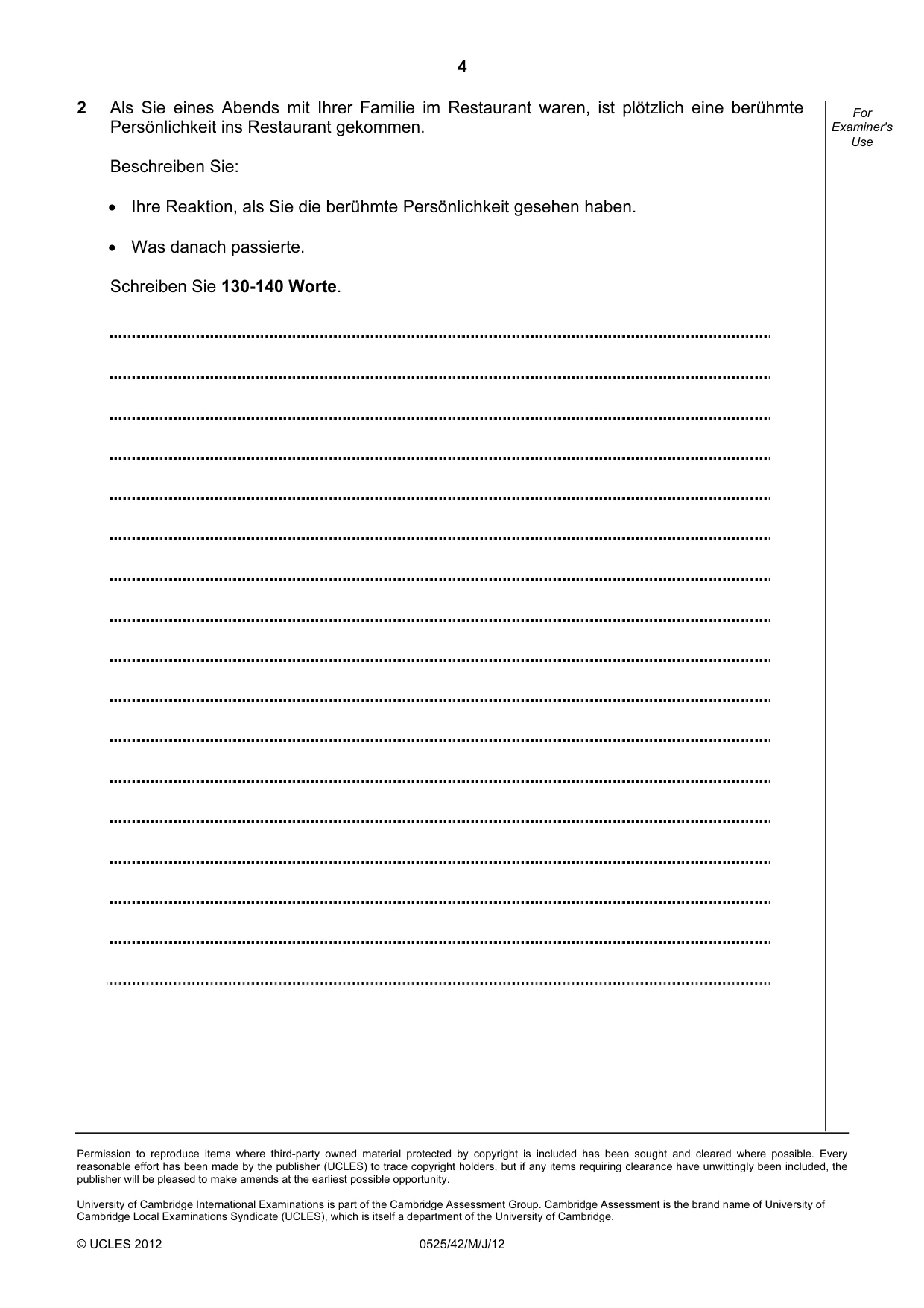
4 Permission to reproduce items where third-party owned material protected by copyright is included has been sought and cleared where possible. Every reasonable effort has been made by the publisher (UCLES) to trace copyright holders, but if any items requiring clearance have unwittingly been included, the publisher will be pleased to make amends at the earliest possible opportunity. University of Cambridge International Examinations is part of the Cambridge Assessment Group. Cambridge Assessment is the brand name of University of Cambridge Local Examinations Syndicate (UCLES), which is itself a department of the University of Cambridge. © UCLES 2012 0525/42/M/J/12 For Examiner's Use 2 Als Sie eines Abends mit Ihrer Familie im Restaurant waren, ist plötzlich eine berühmte Persönlichkeit ins Restaurant gekommen. Beschreiben Sie: • Ihre Reaktion, als Sie die berühmte Persönlichkeit gesehen haben. • Was danach passierte. Schreiben Sie 130-140 Worte.
Mark scheme, page 1
UNIVERSITY OF CAMBRIDGE INTERNATIONAL EXAMINATIONS International General Certificate of Secondary Education MARK SCHEME for the May/June 2012 question paper for the guidance of teachers 0525 GERMAN (FOREIGN LANGUAGE) 0525/42 Paper 4 (Continuous Writing), maximum raw mark 50 This mark scheme is published as an aid to teachers and candidates, to indicate the requirements of the examination. It shows the basis on which Examiners were instructed to award marks. It does not indicate the details of the discussions that took place at an Examiners’ meeting before marking began, which would have considered the acceptability of alternative answers. Mark schemes must be read in conjunction with the question papers and the report on the examination. • Cambridge will not enter into discussions or correspondence in connection with these mark schemes. Cambridge is publishing the mark schemes for the May/June 2012 question papers for most IGCSE, GCE Advanced Level and Advanced Subsidiary Level syllabuses and some Ordinary Level syllabuses. www.XtremePapers.com
Mark scheme, page 2
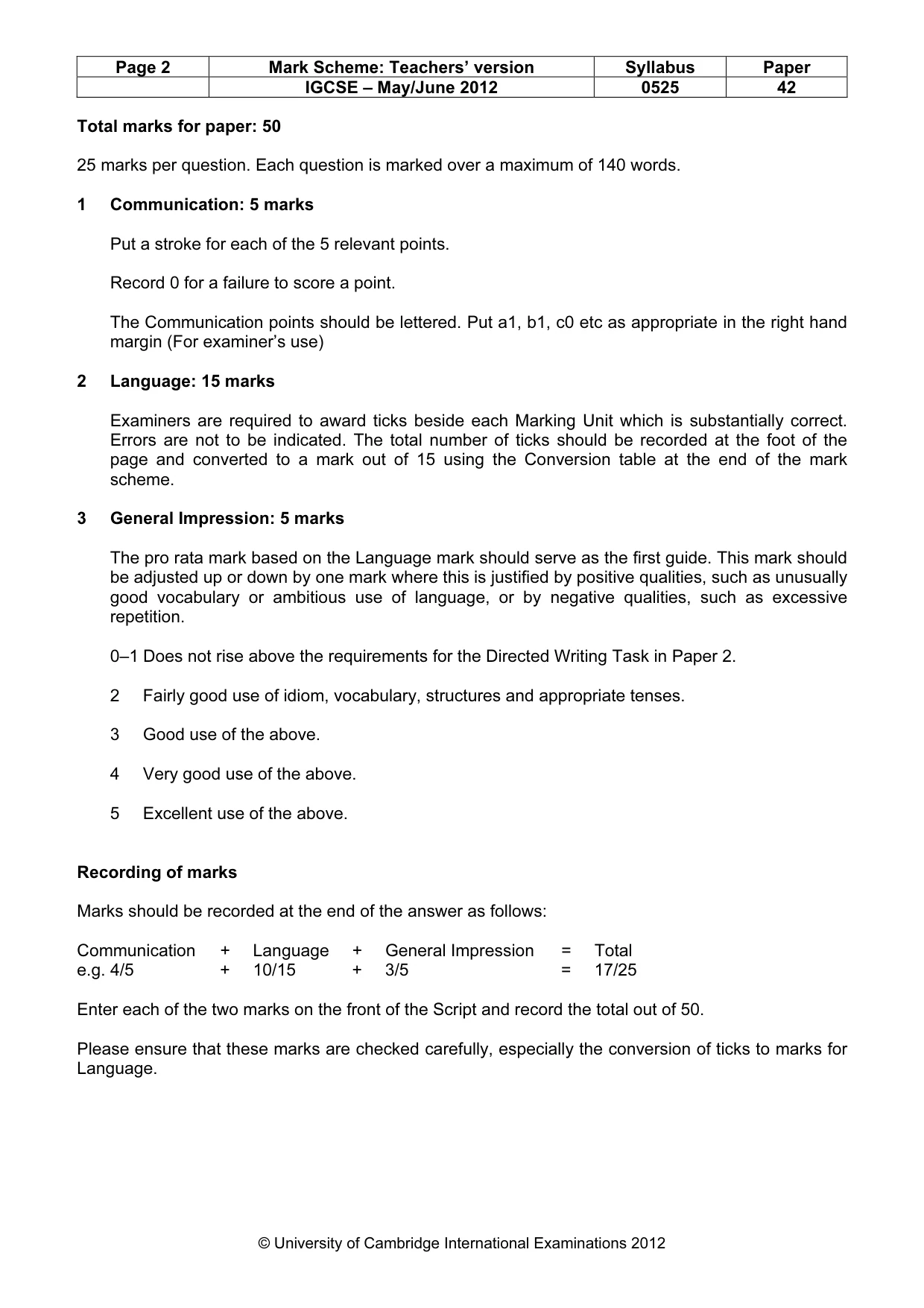
Page 2 Mark Scheme: Teachers’ version Syllabus Paper IGCSE – May/June 2012 0525 42 © University of Cambridge International Examinations 2012 Total marks for paper: 50 25 marks per question. Each question is marked over a maximum of 140 words. 1 Communication: 5 marks Put a stroke for each of the 5 relevant points. Record 0 for a failure to score a point. The Communication points should be lettered. Put a1, b1, c0 etc as appropriate in the right hand margin (For examiner’s use) 2 Language: 15 marks Examiners are required to award ticks beside each Marking Unit which is substantially correct. Errors are not to be indicated. The total number of ticks should be recorded at the foot of the page and converted to a mark out of 15 using the Conversion table at the end of the mark scheme. 3 General Impression: 5 marks The pro rata mark based on the Language mark should serve as the first guide. This mark should be adjusted up or down by one mark where this is justified by positive qualities, such as unusually good vocabulary or ambitious use of language, or by negative qualities, such as excessive repetition. 0–1 Does not rise above the requirements for the Directed Writing Task in Paper 2. 2 Fairly good use of idiom, vocabulary, structures and appropriate tenses. 3 Good use of the above. 4 Very good use of the above. 5 Excellent use of the above. Recording of marks Marks should be recorded at the end of the answer as follows: Communication + Language + General Impression = Total e.g. 4/5 + 10/15 + 3/5 = 17/25 Enter each of the two marks on the front of the Script and record the total out of 50. Please ensure that these marks are checked carefully, especially the conversion of ticks to marks for Language.
Mark scheme, page 3
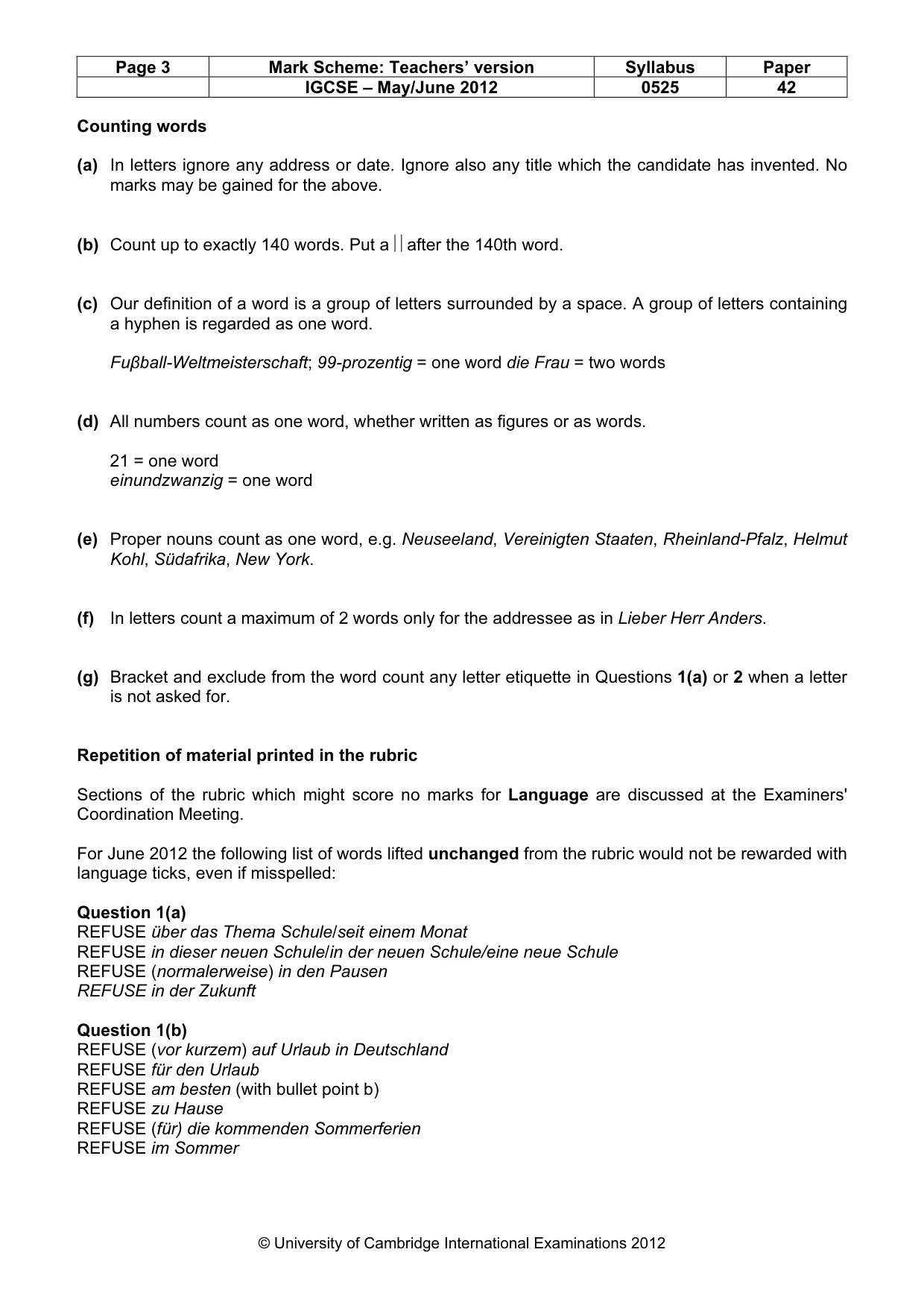
Page 3 Mark Scheme: Teachers’ version Syllabus Paper IGCSE – May/June 2012 0525 42 © University of Cambridge International Examinations 2012 Counting words (a) In letters ignore any address or date. Ignore also any title which the candidate has invented. No marks may be gained for the above. (b) Count up to exactly 140 words. Put a after the 140th word. (c) Our definition of a word is a group of letters surrounded by a space. A group of letters containing a hyphen is regarded as one word. Fuβball-Weltmeisterschaft; 99-prozentig = one word die Frau = two words (d) All numbers count as one word, whether written as figures or as words. 21 = one word einundzwanzig = one word (e) Proper nouns count as one word, e.g. Neuseeland, Vereinigten Staaten, Rheinland-Pfalz, Helmut Kohl, Südafrika, New York. (f) In letters count a maximum of 2 words only for the addressee as in Lieber Herr Anders. (g) Bracket and exclude from the word count any letter etiquette in Questions 1(a) or 2 when a letter is not asked for. Repetition of material printed in the rubric Sections of the rubric which might score no marks for Language are discussed at the Examiners' Coordination Meeting. For June 2012 the following list of words lifted unchanged from the rubric would not be rewarded with language ticks, even if misspelled: Question 1(a) REFUSE über das Thema Schule/seit einem Monat REFUSE in dieser neuen Schule/in der neuen Schule/eine neue Schule REFUSE (normalerweise) in den Pausen REFUSE in der Zukunft Question 1(b) REFUSE (vor kurzem) auf Urlaub in Deutschland REFUSE für den Urlaub REFUSE am besten (with bullet point b) REFUSE zu Hause REFUSE (für) die kommenden Sommerferien REFUSE im Sommer
Mark scheme, page 4
Page 4 Mark Scheme: Teachers’ version Syllabus Paper IGCSE – May/June 2012 0525 42 © University of Cambridge International Examinations 2012 Question 2 REFUSE eines Abends REFUSE (ist) (plötzlich) eine berühmte Persönlichkeit, die berühmte Persönlichkeit (ins Restaurant) (gekommen)
Mark scheme, page 5
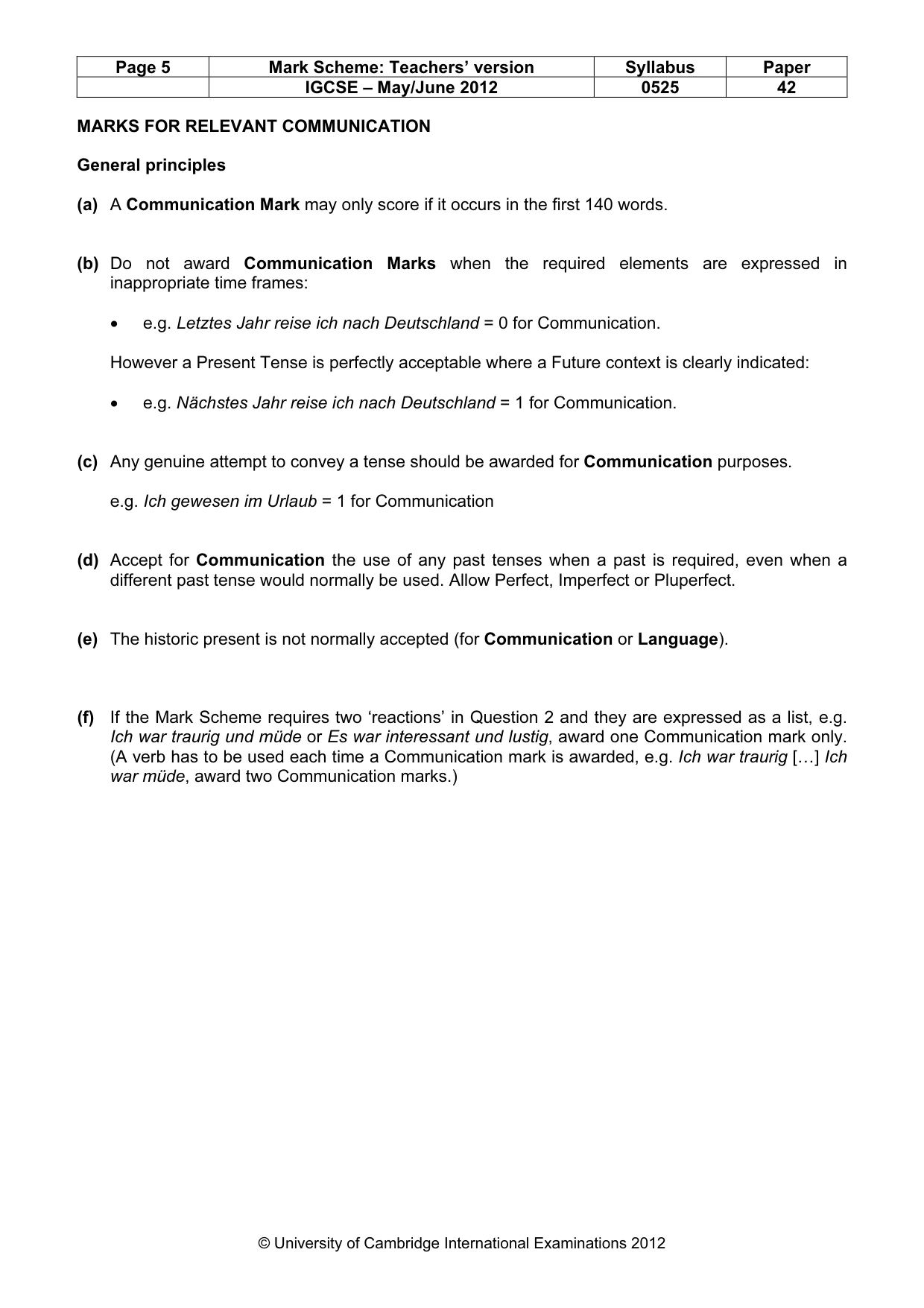
Page 5 Mark Scheme: Teachers’ version Syllabus Paper IGCSE – May/June 2012 0525 42 © University of Cambridge International Examinations 2012 MARKS FOR RELEVANT COMMUNICATION General principles (a) A Communication Mark may only score if it occurs in the first 140 words. (b) Do not award Communication Marks when the required elements are expressed in inappropriate time frames: • e.g. Letztes Jahr reise ich nach Deutschland = 0 for Communication. However a Present Tense is perfectly acceptable where a Future context is clearly indicated: • e.g. Nächstes Jahr reise ich nach Deutschland = 1 for Communication. (c) Any genuine attempt to convey a tense should be awarded for Communication purposes. e.g. Ich gewesen im Urlaub = 1 for Communication (d) Accept for Communication the use of any past tenses when a past is required, even when a different past tense would normally be used. Allow Perfect, Imperfect or Pluperfect. (e) The historic present is not normally accepted (for Communication or Language). (f) If the Mark Scheme requires two ‘reactions’ in Question 2 and they are expressed as a list, e.g. Ich war traurig und müde or Es war interessant und lustig, award one Communication mark only. (A verb has to be used each time a Communication mark is awarded, e.g. Ich war traurig […] Ich war müde, award two Communication marks.)
Mark scheme, page 6
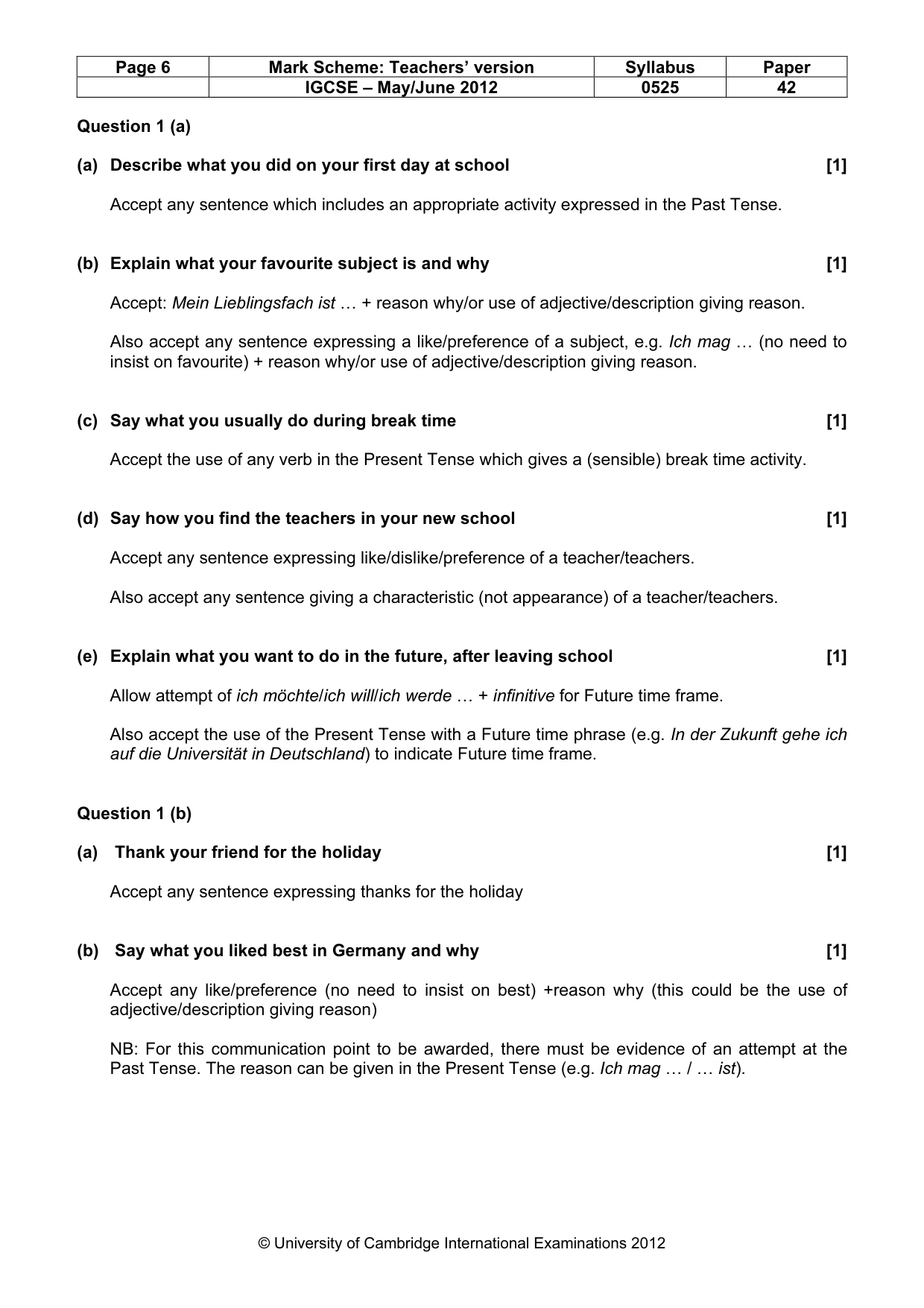
Page 6 Mark Scheme: Teachers’ version Syllabus Paper IGCSE – May/June 2012 0525 42 © University of Cambridge International Examinations 2012 Question 1 (a) (a) Describe what you did on your first day at school [1] Accept any sentence which includes an appropriate activity expressed in the Past Tense. (b) Explain what your favourite subject is and why [1] Accept: Mein Lieblingsfach ist … + reason why/or use of adjective/description giving reason. Also accept any sentence expressing a like/preference of a subject, e.g. Ich mag … (no need to insist on favourite) + reason why/or use of adjective/description giving reason. (c) Say what you usually do during break time [1] Accept the use of any verb in the Present Tense which gives a (sensible) break time activity. (d) Say how you find the teachers in your new school [1] Accept any sentence expressing like/dislike/preference of a teacher/teachers. Also accept any sentence giving a characteristic (not appearance) of a teacher/teachers. (e) Explain what you want to do in the future, after leaving school [1] Allow attempt of ich möchte/ich will/ich werde … + infinitive for Future time frame. Also accept the use of the Present Tense with a Future time phrase (e.g. In der Zukunft gehe ich auf die Universität in Deutschland) to indicate Future time frame. Question 1 (b) (a) Thank your friend for the holiday [1] Accept any sentence expressing thanks for the holiday (b) Say what you liked best in Germany and why [1] Accept any like/preference (no need to insist on best) +reason why (this could be the use of adjective/description giving reason) NB: For this communication point to be awarded, there must be evidence of an attempt at the Past Tense. The reason can be given in the Present Tense (e.g. Ich mag … / … ist).
Mark scheme, page 7
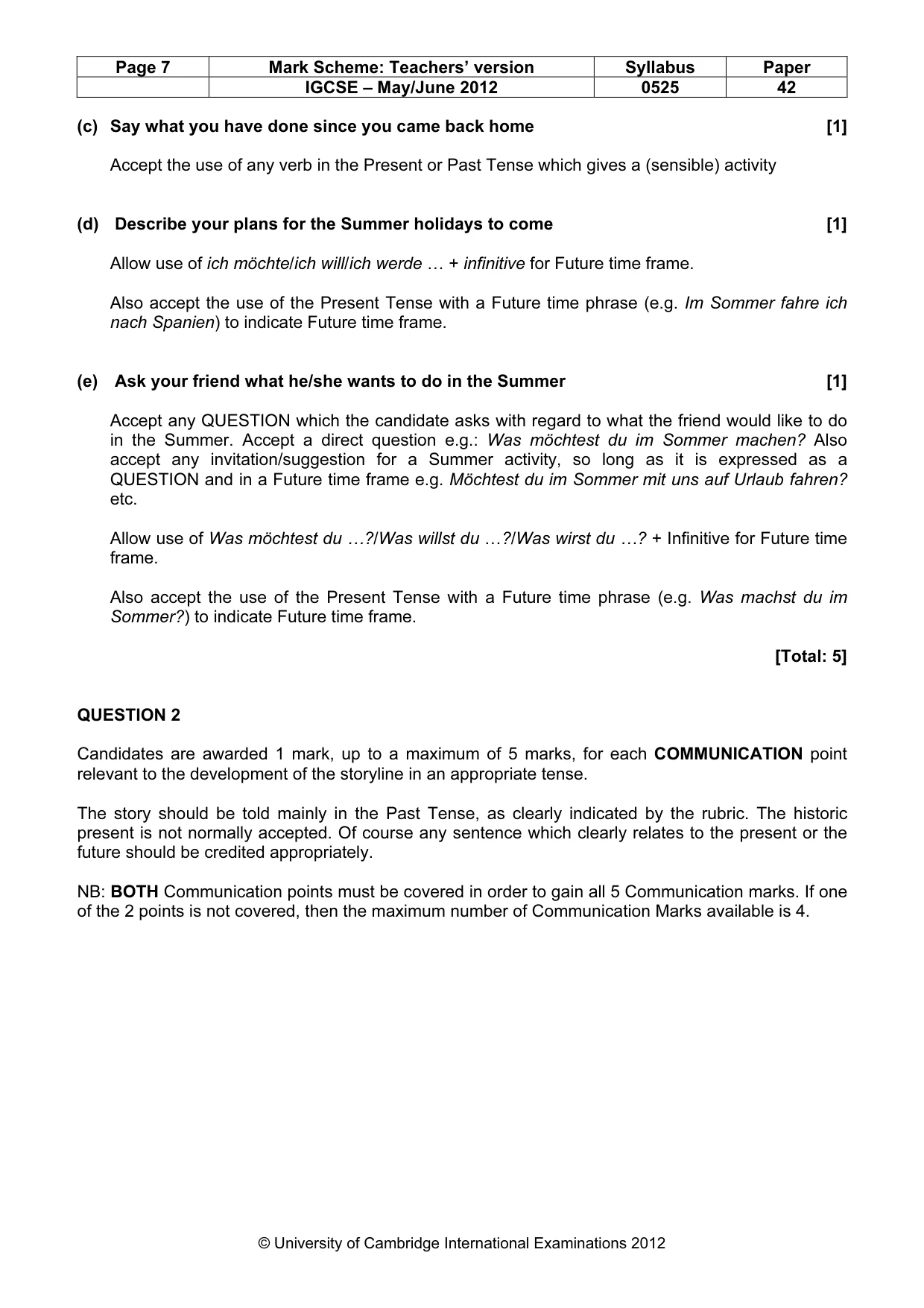
Page 7 Mark Scheme: Teachers’ version Syllabus Paper IGCSE – May/June 2012 0525 42 © University of Cambridge International Examinations 2012 (c) Say what you have done since you came back home [1] Accept the use of any verb in the Present or Past Tense which gives a (sensible) activity (d) Describe your plans for the Summer holidays to come [1] Allow use of ich möchte/ich will/ich werde … + infinitive for Future time frame. Also accept the use of the Present Tense with a Future time phrase (e.g. Im Sommer fahre ich nach Spanien) to indicate Future time frame. (e) Ask your friend what he/she wants to do in the Summer [1] Accept any QUESTION which the candidate asks with regard to what the friend would like to do in the Summer. Accept a direct question e.g.: Was möchtest du im Sommer machen? Also accept any invitation/suggestion for a Summer activity, so long as it is expressed as a QUESTION and in a Future time frame e.g. Möchtest du im Sommer mit uns auf Urlaub fahren? etc. Allow use of Was möchtest du …?/Was willst du …?/Was wirst du …? + Infinitive for Future time frame. Also accept the use of the Present Tense with a Future time phrase (e.g. Was machst du im Sommer?) to indicate Future time frame. [Total: 5] QUESTION 2 Candidates are awarded 1 mark, up to a maximum of 5 marks, for each COMMUNICATION point relevant to the development of the storyline in an appropriate tense. The story should be told mainly in the Past Tense, as clearly indicated by the rubric. The historic present is not normally accepted. Of course any sentence which clearly relates to the present or the future should be credited appropriately. NB: BOTH Communication points must be covered in order to gain all 5 Communication marks. If one of the 2 points is not covered, then the maximum number of Communication Marks available is 4.
Mark scheme, page 8
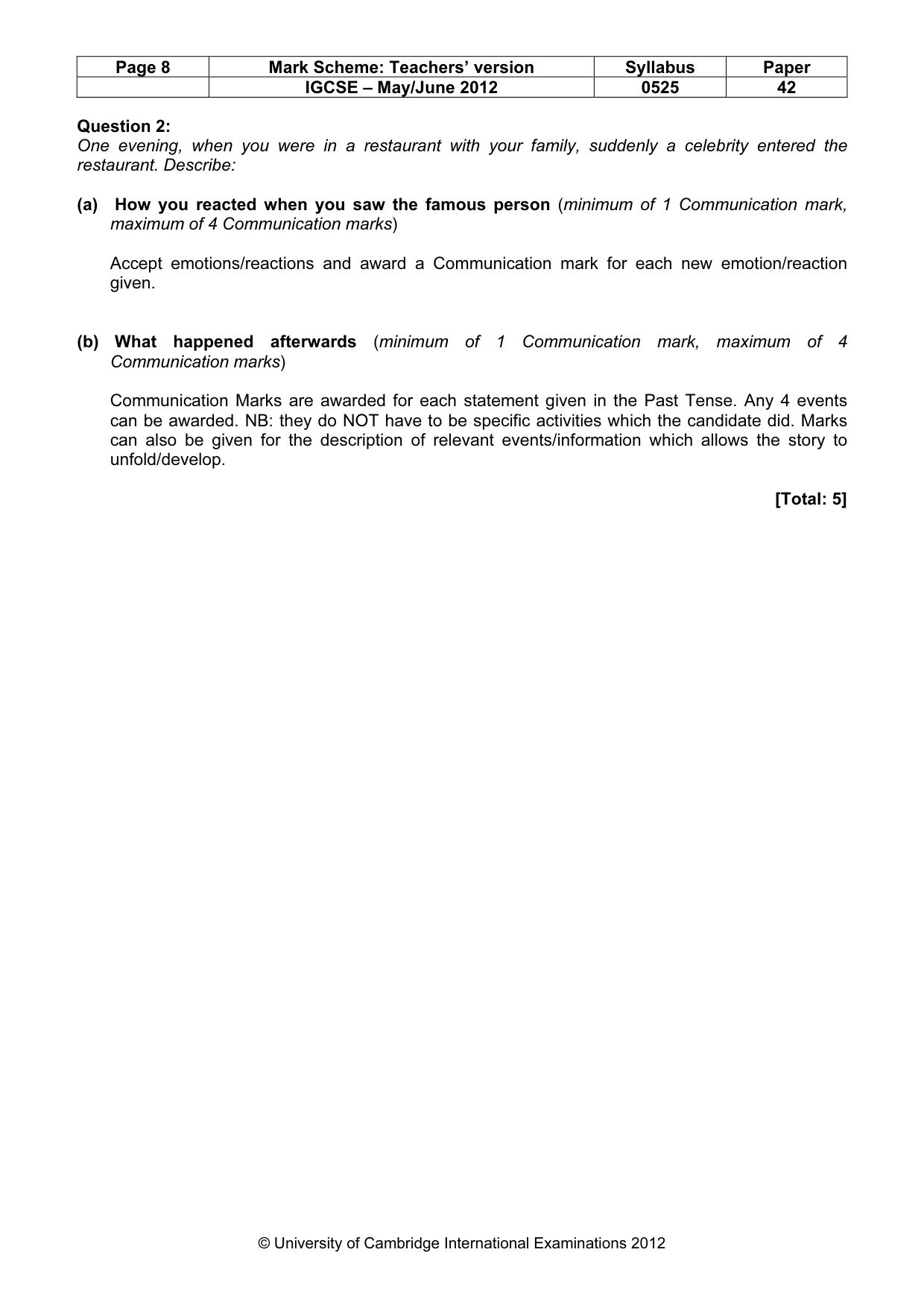
Page 8 Mark Scheme: Teachers’ version Syllabus Paper IGCSE – May/June 2012 0525 42 © University of Cambridge International Examinations 2012 Question 2: One evening, when you were in a restaurant with your family, suddenly a celebrity entered the restaurant. Describe: (a) How you reacted when you saw the famous person (minimum of 1 Communication mark, maximum of 4 Communication marks) Accept emotions/reactions and award a Communication mark for each new emotion/reaction given. (b) What happened afterwards (minimum of 1 Communication mark, maximum of 4 Communication marks) Communication Marks are awarded for each statement given in the Past Tense. Any 4 events can be awarded. NB: they do NOT have to be specific activities which the candidate did. Marks can also be given for the description of relevant events/information which allows the story to unfold/develop. [Total: 5]
Mark scheme, page 9
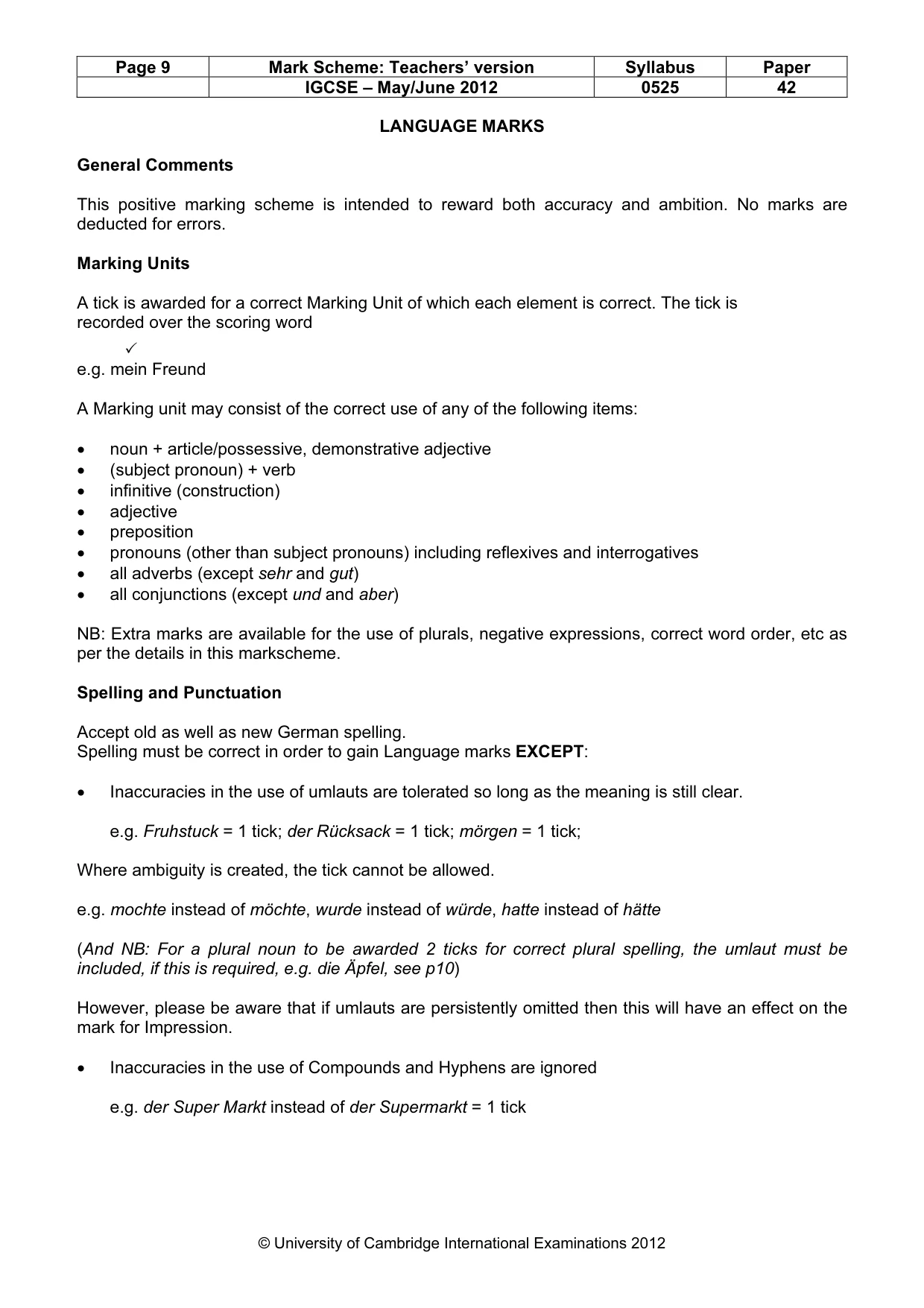
Page 9 Mark Scheme: Teachers’ version Syllabus Paper IGCSE – May/June 2012 0525 42 © University of Cambridge International Examinations 2012 LANGUAGE MARKS General Comments This positive marking scheme is intended to reward both accuracy and ambition. No marks are deducted for errors. Marking Units A tick is awarded for a correct Marking Unit of which each element is correct. The tick is recorded over the scoring word ✓ e.g. mein Freund A Marking unit may consist of the correct use of any of the following items: • noun + article/possessive, demonstrative adjective • (subject pronoun) + verb • infinitive (construction) • adjective • preposition • pronouns (other than subject pronouns) including reflexives and interrogatives • all adverbs (except sehr and gut) • all conjunctions (except und and aber) NB: Extra marks are available for the use of plurals, negative expressions, correct word order, etc as per the details in this markscheme. Spelling and Punctuation Accept old as well as new German spelling. Spelling must be correct in order to gain Language marks EXCEPT: • Inaccuracies in the use of umlauts are tolerated so long as the meaning is still clear. e.g. Fruhstuck = 1 tick; der Rücksack = 1 tick; mörgen = 1 tick; Where ambiguity is created, the tick cannot be allowed. e.g. mochte instead of möchte, wurde instead of würde, hatte instead of hätte (And NB: For a plural noun to be awarded 2 ticks for correct plural spelling, the umlaut must be included, if this is required, e.g. die Äpfel, see p10) However, please be aware that if umlauts are persistently omitted then this will have an effect on the mark for Impression. • Inaccuracies in the use of Compounds and Hyphens are ignored e.g. der Super Markt instead of der Supermarkt = 1 tick
Mark scheme, page 10
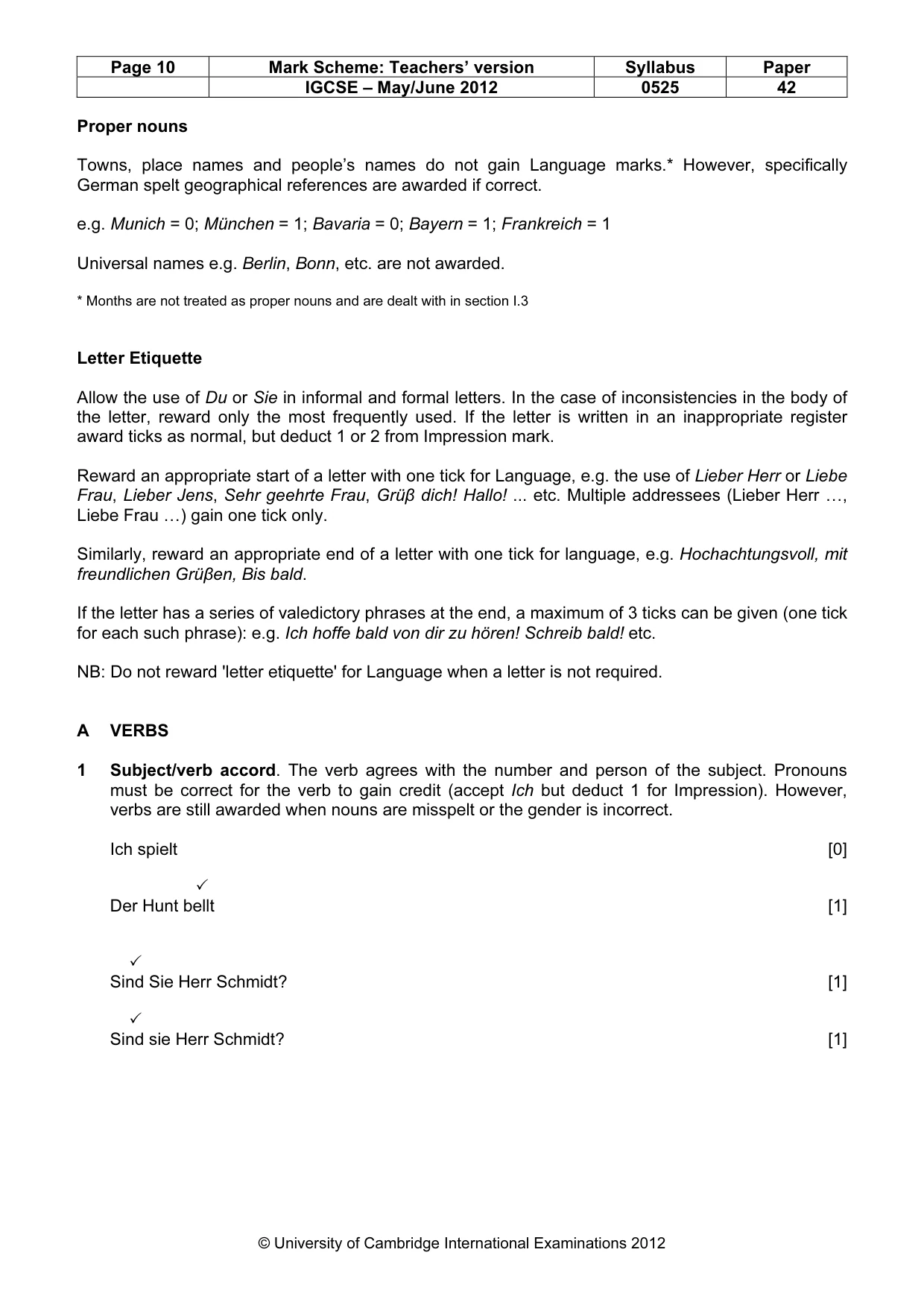
Page 10 Mark Scheme: Teachers’ version Syllabus Paper IGCSE – May/June 2012 0525 42 © University of Cambridge International Examinations 2012 Proper nouns Towns, place names and people’s names do not gain Language marks.* However, specifically German spelt geographical references are awarded if correct. e.g. Munich = 0; München = 1; Bavaria = 0; Bayern = 1; Frankreich = 1 Universal names e.g. Berlin, Bonn, etc. are not awarded. * Months are not treated as proper nouns and are dealt with in section I.3 Letter Etiquette Allow the use of Du or Sie in informal and formal letters. In the case of inconsistencies in the body of the letter, reward only the most frequently used. If the letter is written in an inappropriate register award ticks as normal, but deduct 1 or 2 from Impression mark. Reward an appropriate start of a letter with one tick for Language, e.g. the use of Lieber Herr or Liebe Frau, Lieber Jens, Sehr geehrte Frau, Grüβ dich! Hallo! ... etc. Multiple addressees (Lieber Herr …, Liebe Frau …) gain one tick only. Similarly, reward an appropriate end of a letter with one tick for language, e.g. Hochachtungsvoll, mit freundlichen Grüβen, Bis bald. If the letter has a series of valedictory phrases at the end, a maximum of 3 ticks can be given (one tick for each such phrase): e.g. Ich hoffe bald von dir zu hören! Schreib bald! etc. NB: Do not reward 'letter etiquette' for Language when a letter is not required. A VERBS 1 Subject/verb accord. The verb agrees with the number and person of the subject. Pronouns must be correct for the verb to gain credit (accept Ich but deduct 1 for Impression). However, verbs are still awarded when nouns are misspelt or the gender is incorrect. Ich spielt [0] ✓ Der Hunt bellt [1] ✓ Sind Sie Herr Schmidt? [1] ✓ Sind sie Herr Schmidt? [1]
Mark scheme, page 11
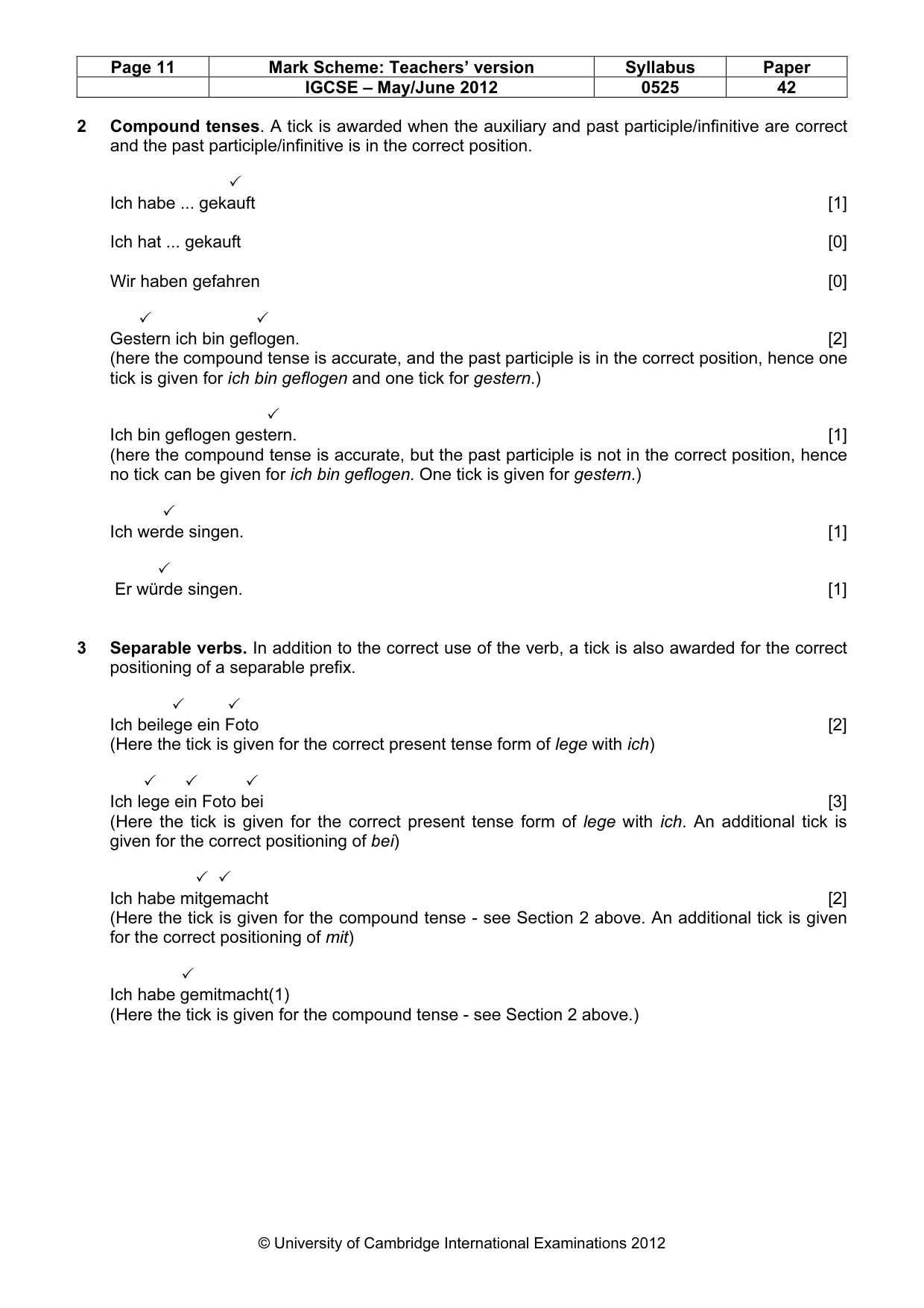
Page 11 Mark Scheme: Teachers’ version Syllabus Paper IGCSE – May/June 2012 0525 42 © University of Cambridge International Examinations 2012 2 Compound tenses. A tick is awarded when the auxiliary and past participle/infinitive are correct and the past participle/infinitive is in the correct position. ✓ Ich habe ... gekauft [1] Ich hat ... gekauft [0] Wir haben gefahren [0] ✓ ✓ Gestern ich bin geflogen. [2] (here the compound tense is accurate, and the past participle is in the correct position, hence one tick is given for ich bin geflogen and one tick for gestern.) ✓ Ich bin geflogen gestern. [1] (here the compound tense is accurate, but the past participle is not in the correct position, hence no tick can be given for ich bin geflogen. One tick is given for gestern.) ✓ Ich werde singen. [1] ✓ Er würde singen. [1] 3 Separable verbs. In addition to the correct use of the verb, a tick is also awarded for the correct positioning of a separable prefix. ✓ ✓ Ich beilege ein Foto [2] (Here the tick is given for the correct present tense form of lege with ich) ✓ ✓ ✓ Ich lege ein Foto bei [3] (Here the tick is given for the correct present tense form of lege with ich. An additional tick is given for the correct positioning of bei) ✓ ✓ Ich habe mitgemacht [2] (Here the tick is given for the compound tense - see Section 2 above. An additional tick is given for the correct positioning of mit) ✓ Ich habe gemitmacht(1) (Here the tick is given for the compound tense - see Section 2 above.)
Mark scheme, page 12
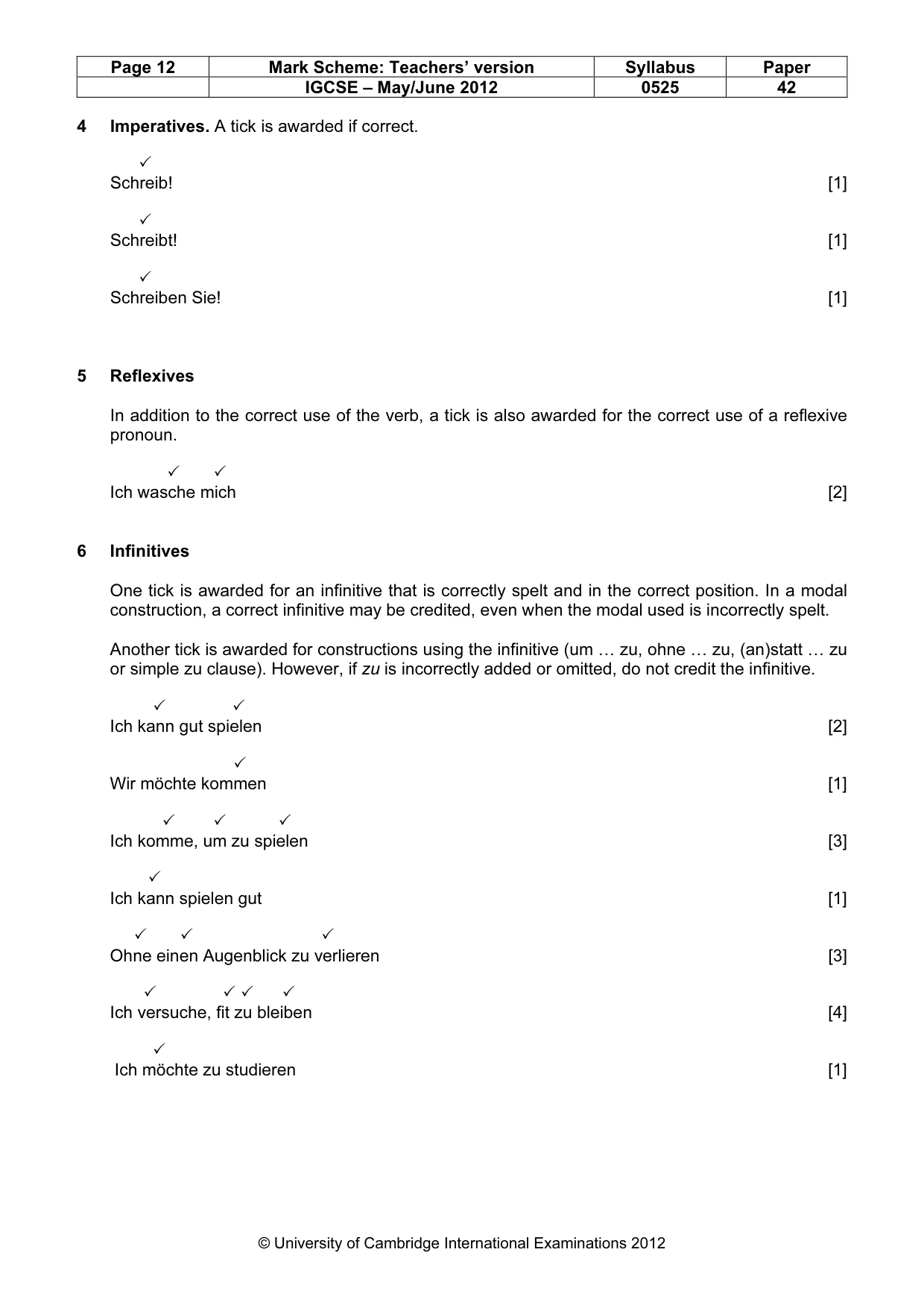
Page 12 Mark Scheme: Teachers’ version Syllabus Paper IGCSE – May/June 2012 0525 42 © University of Cambridge International Examinations 2012 4 Imperatives. A tick is awarded if correct. ✓ Schreib! [1] ✓ Schreibt! [1] ✓ Schreiben Sie! [1] 5 Reflexives In addition to the correct use of the verb, a tick is also awarded for the correct use of a reflexive pronoun. ✓ ✓ Ich wasche mich [2] 6 Infinitives One tick is awarded for an infinitive that is correctly spelt and in the correct position. In a modal construction, a correct infinitive may be credited, even when the modal used is incorrectly spelt. Another tick is awarded for constructions using the infinitive (um … zu, ohne … zu, (an)statt … zu or simple zu clause). However, if zu is incorrectly added or omitted, do not credit the infinitive. ✓ ✓ Ich kann gut spielen [2] ✓ Wir möchte kommen [1] ✓ ✓ ✓ Ich komme, um zu spielen [3] ✓ Ich kann spielen gut [1] ✓ ✓ ✓ Ohne einen Augenblick zu verlieren [3] ✓ ✓ ✓ ✓ Ich versuche, fit zu bleiben [4] ✓ Ich möchte zu studieren [1]
Mark scheme, page 13
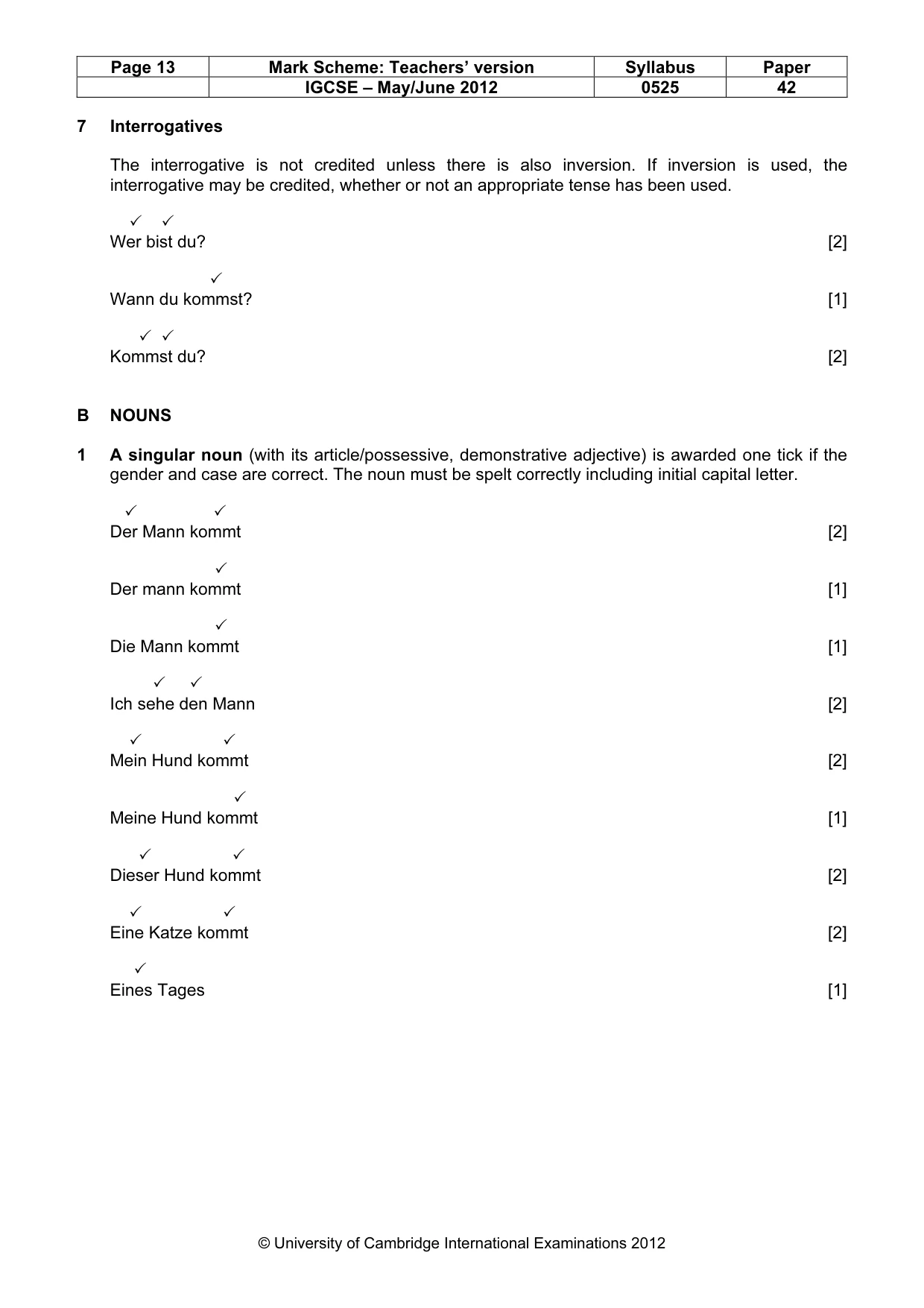
Page 13 Mark Scheme: Teachers’ version Syllabus Paper IGCSE – May/June 2012 0525 42 © University of Cambridge International Examinations 2012 7 Interrogatives The interrogative is not credited unless there is also inversion. If inversion is used, the interrogative may be credited, whether or not an appropriate tense has been used. ✓ ✓ Wer bist du? [2] ✓ Wann du kommst? [1] ✓ ✓ Kommst du? [2] B NOUNS 1 A singular noun (with its article/possessive, demonstrative adjective) is awarded one tick if the gender and case are correct. The noun must be spelt correctly including initial capital letter. ✓ ✓ Der Mann kommt [2] ✓ Der mann kommt [1] ✓ Die Mann kommt [1] ✓ ✓ Ich sehe den Mann [2] ✓ ✓ Mein Hund kommt [2] ✓ Meine Hund kommt [1] ✓ ✓ Dieser Hund kommt [2] ✓ ✓ Eine Katze kommt [2] ✓ Eines Tages [1]
Mark scheme, page 14
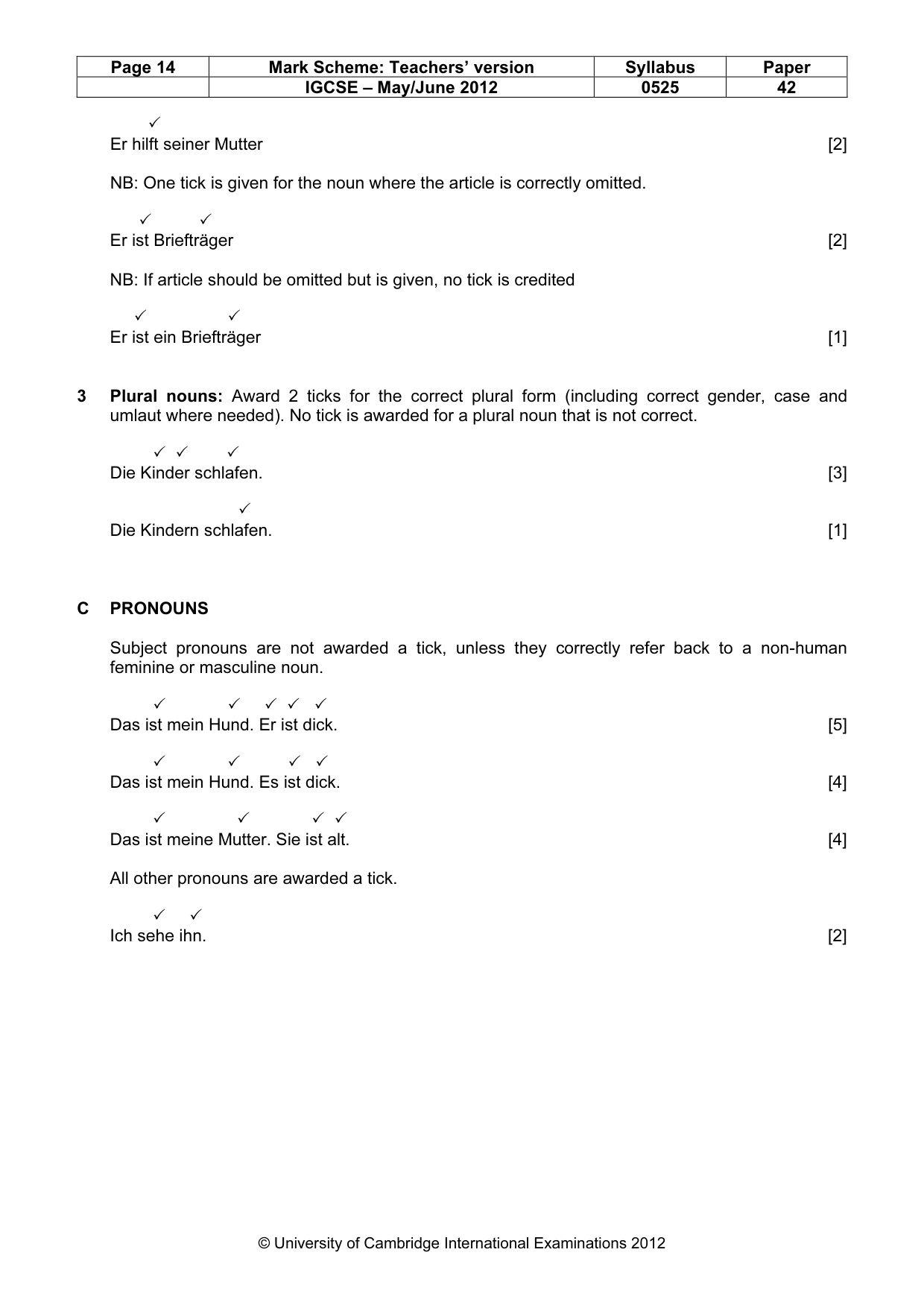
Page 14 Mark Scheme: Teachers’ version Syllabus Paper IGCSE – May/June 2012 0525 42 © University of Cambridge International Examinations 2012 ✓ Er hilft seiner Mutter [2] NB: One tick is given for the noun where the article is correctly omitted. ✓ ✓ Er ist Briefträger [2] NB: If article should be omitted but is given, no tick is credited ✓ ✓ Er ist ein Briefträger [1] 3 Plural nouns: Award 2 ticks for the correct plural form (including correct gender, case and umlaut where needed). No tick is awarded for a plural noun that is not correct. ✓ ✓ ✓ Die Kinder schlafen. [3] ✓ Die Kindern schlafen. [1] C PRONOUNS Subject pronouns are not awarded a tick, unless they correctly refer back to a non-human feminine or masculine noun. ✓ ✓ ✓ ✓ ✓ Das ist mein Hund. Er ist dick. [5] ✓ ✓ ✓ ✓ Das ist mein Hund. Es ist dick. [4] ✓ ✓ ✓ ✓ Das ist meine Mutter. Sie ist alt. [4] All other pronouns are awarded a tick. ✓ ✓ Ich sehe ihn. [2]
Mark scheme, page 15
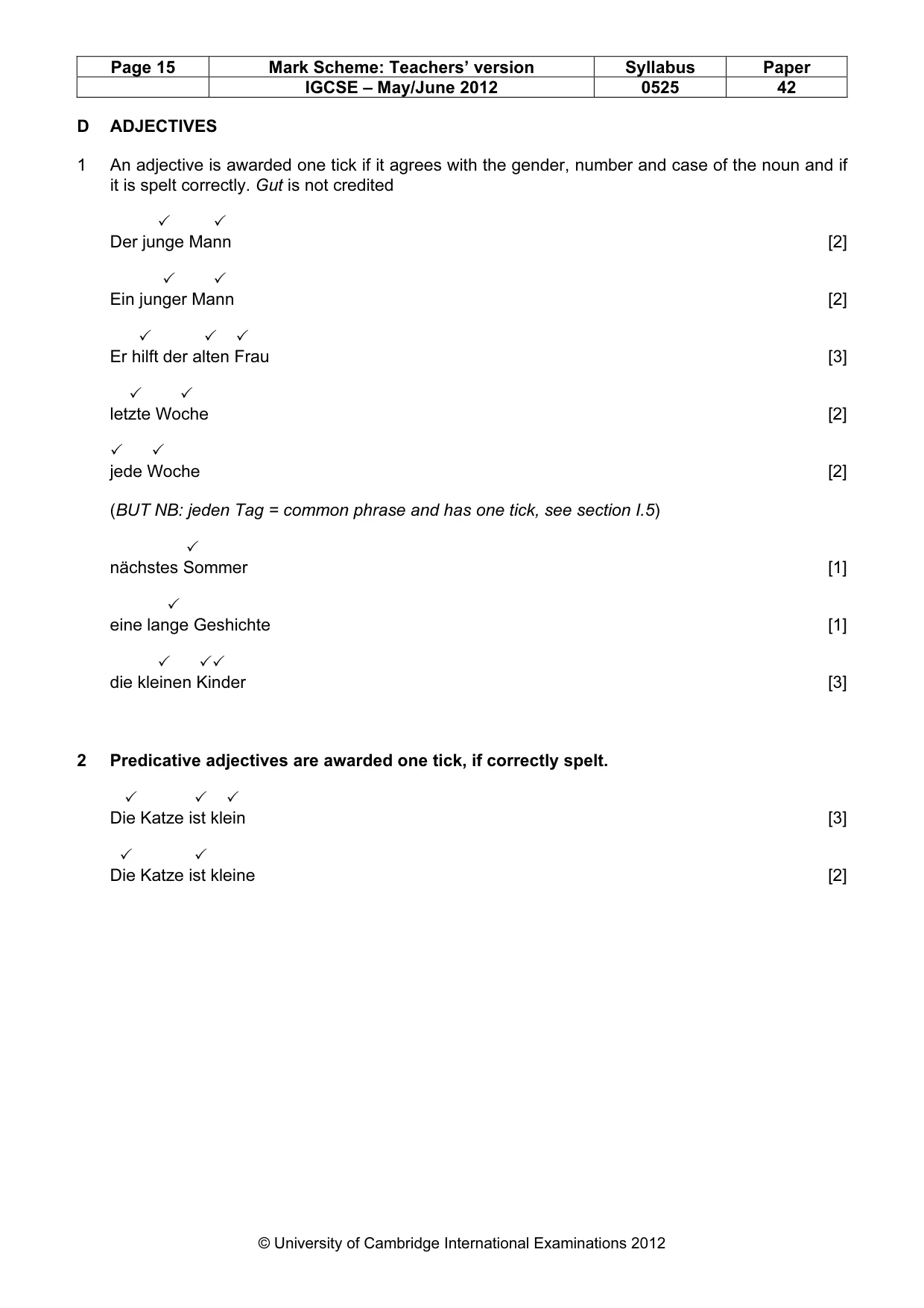
Page 15 Mark Scheme: Teachers’ version Syllabus Paper IGCSE – May/June 2012 0525 42 © University of Cambridge International Examinations 2012 D ADJECTIVES 1 An adjective is awarded one tick if it agrees with the gender, number and case of the noun and if it is spelt correctly. Gut is not credited ✓ ✓ Der junge Mann [2] ✓ ✓ Ein junger Mann [2] ✓ ✓ ✓ Er hilft der alten Frau [3] ✓ ✓ letzte Woche [2] ✓ ✓ jede Woche [2] (BUT NB: jeden Tag = common phrase and has one tick, see section I.5) ✓ nächstes Sommer [1] ✓ eine lange Geshichte [1] ✓ ✓✓ die kleinen Kinder [3] 2 Predicative adjectives are awarded one tick, if correctly spelt. ✓ ✓ ✓ Die Katze ist klein [3] ✓ ✓ Die Katze ist kleine [2]
Mark scheme, page 16
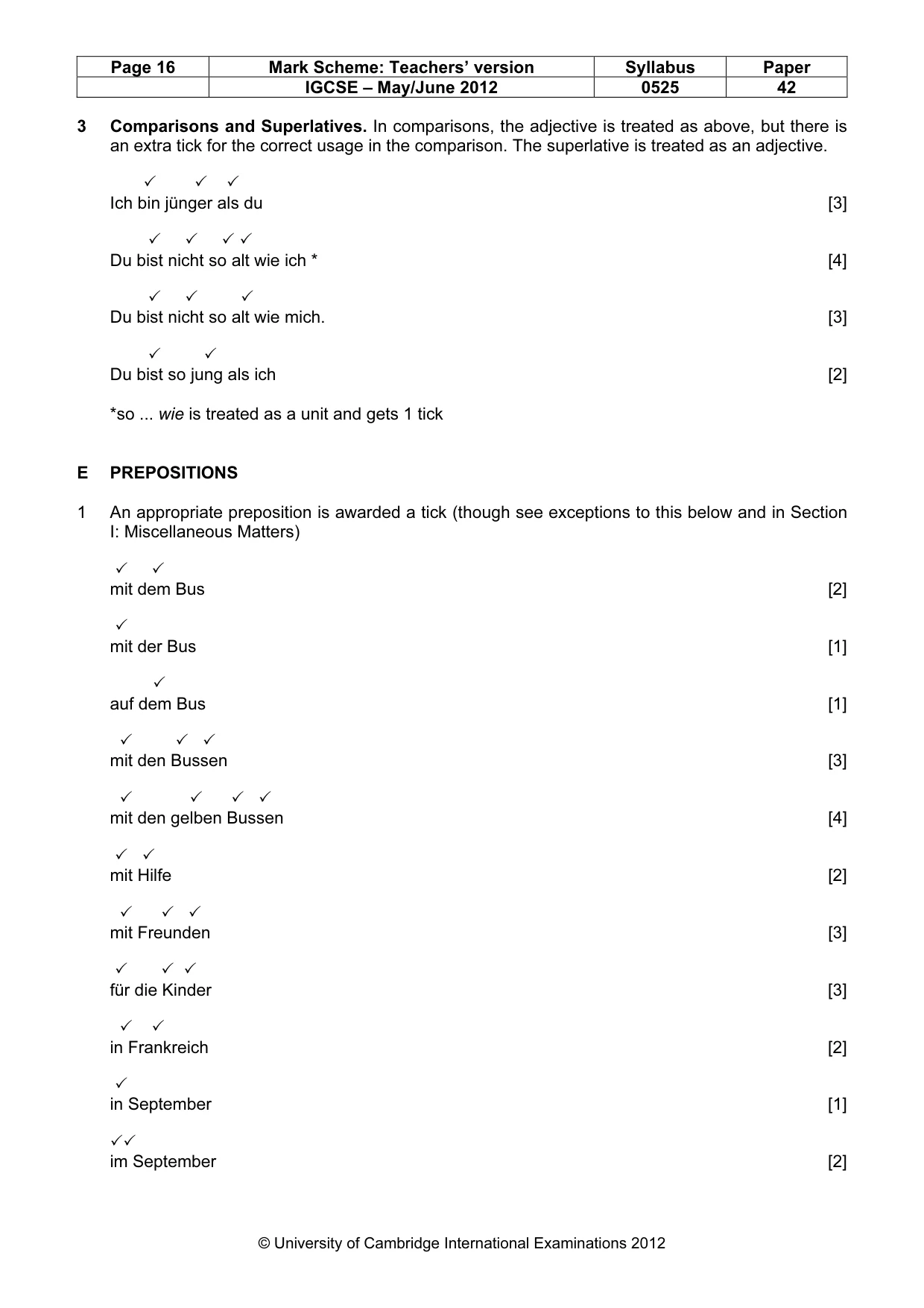
Page 16 Mark Scheme: Teachers’ version Syllabus Paper IGCSE – May/June 2012 0525 42 © University of Cambridge International Examinations 2012 3 Comparisons and Superlatives. In comparisons, the adjective is treated as above, but there is an extra tick for the correct usage in the comparison. The superlative is treated as an adjective. ✓ ✓ ✓ Ich bin jünger als du [3] ✓ ✓ ✓ ✓ Du bist nicht so alt wie ich * [4] ✓ ✓ ✓ Du bist nicht so alt wie mich. [3] ✓ ✓ Du bist so jung als ich [2] *so ... wie is treated as a unit and gets 1 tick E PREPOSITIONS 1 An appropriate preposition is awarded a tick (though see exceptions to this below and in Section I: Miscellaneous Matters) ✓ ✓ mit dem Bus [2] ✓ mit der Bus [1] ✓ auf dem Bus [1] ✓ ✓ ✓ mit den Bussen [3] ✓ ✓ ✓ ✓ mit den gelben Bussen [4] ✓ ✓ mit Hilfe [2] ✓ ✓ ✓ mit Freunden [3] ✓ ✓ ✓ für die Kinder [3] ✓ ✓ in Frankreich [2] ✓ in September [1] ✓✓ im September [2]
Mark scheme, page 17
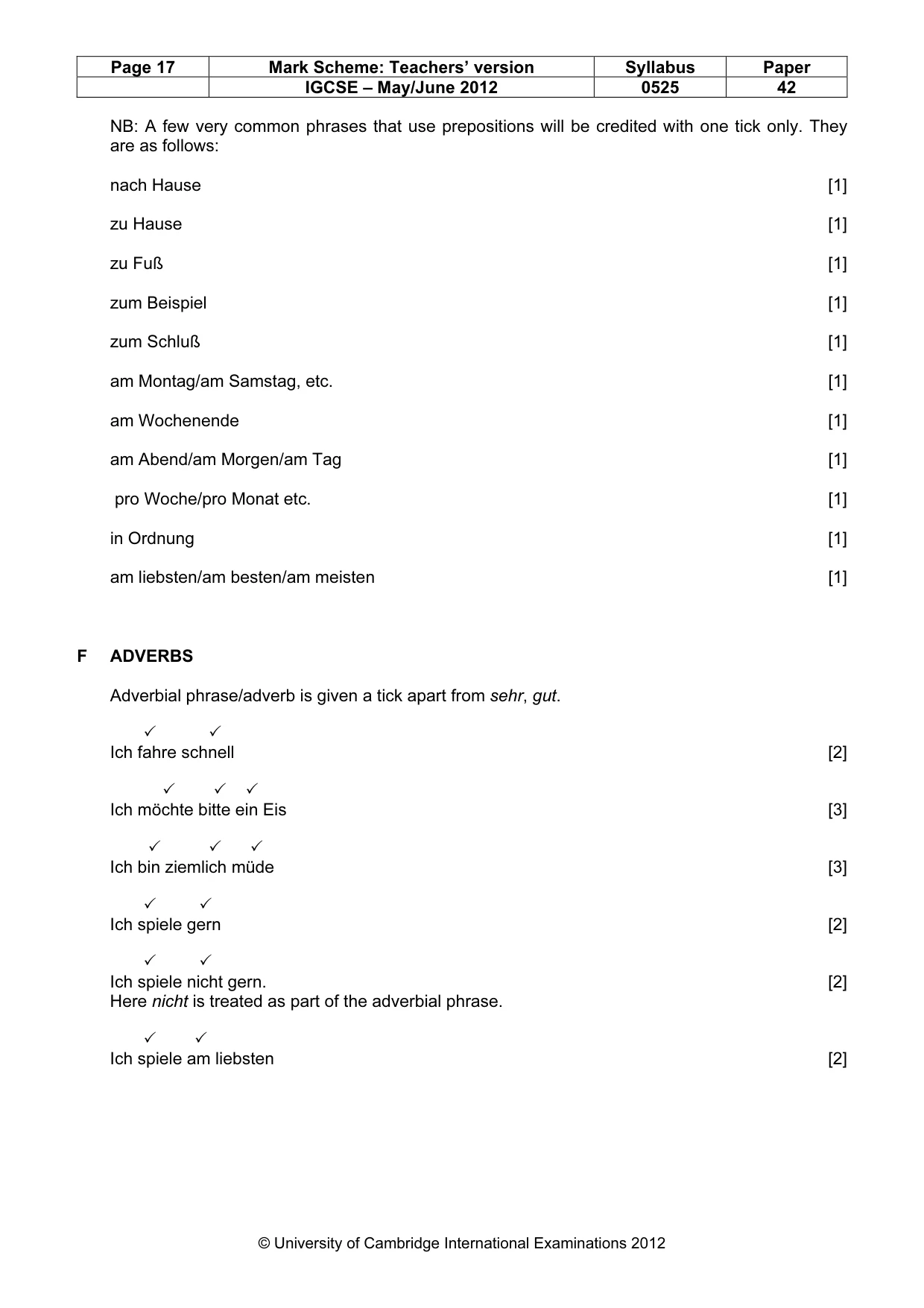
Page 17 Mark Scheme: Teachers’ version Syllabus Paper IGCSE – May/June 2012 0525 42 © University of Cambridge International Examinations 2012 NB: A few very common phrases that use prepositions will be credited with one tick only. They are as follows: nach Hause [1] zu Hause [1] zu Fuß [1] zum Beispiel [1] zum Schluß [1] am Montag/am Samstag, etc. [1] am Wochenende [1] am Abend/am Morgen/am Tag [1] pro Woche/pro Monat etc. [1] in Ordnung [1] am liebsten/am besten/am meisten [1] F ADVERBS Adverbial phrase/adverb is given a tick apart from sehr, gut. ✓ ✓ Ich fahre schnell [2] ✓ ✓ ✓ Ich möchte bitte ein Eis [3] ✓ ✓ ✓ Ich bin ziemlich müde [3] ✓ ✓ Ich spiele gern [2] ✓ ✓ Ich spiele nicht gern. [2] Here nicht is treated as part of the adverbial phrase. ✓ ✓ Ich spiele am liebsten [2]
Mark scheme, page 18
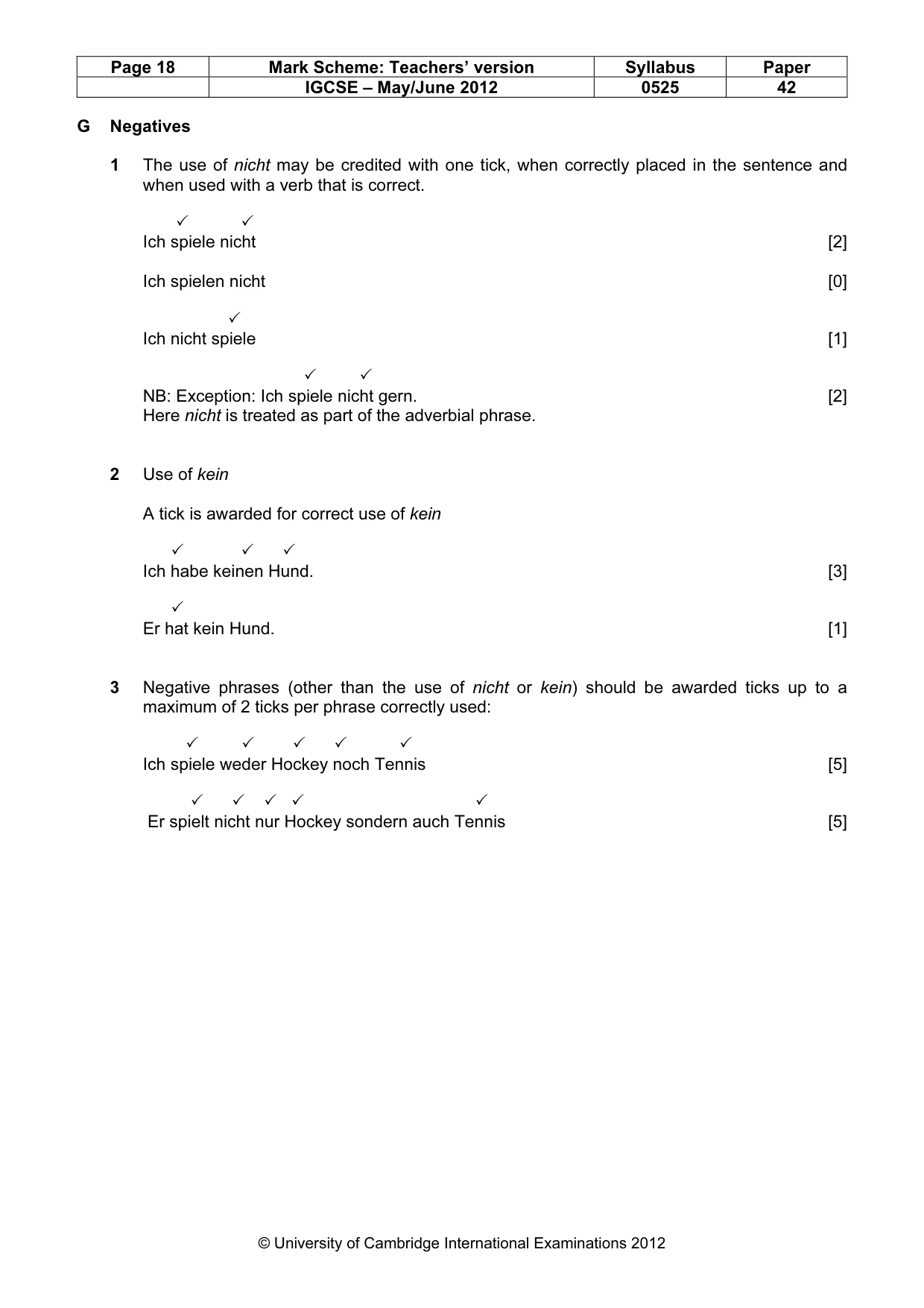
Page 18 Mark Scheme: Teachers’ version Syllabus Paper IGCSE – May/June 2012 0525 42 © University of Cambridge International Examinations 2012 G Negatives 1 The use of nicht may be credited with one tick, when correctly placed in the sentence and when used with a verb that is correct. ✓ ✓ Ich spiele nicht [2] Ich spielen nicht [0] ✓ Ich nicht spiele [1] ✓ ✓ NB: Exception: Ich spiele nicht gern. [2] Here nicht is treated as part of the adverbial phrase. 2 Use of kein A tick is awarded for correct use of kein ✓ ✓ ✓ Ich habe keinen Hund. [3] ✓ Er hat kein Hund. [1] 3 Negative phrases (other than the use of nicht or kein) should be awarded ticks up to a maximum of 2 ticks per phrase correctly used: ✓ ✓ ✓ ✓ ✓ Ich spiele weder Hockey noch Tennis [5] ✓ ✓ ✓ ✓ ✓ Er spielt nicht nur Hockey sondern auch Tennis [5]
Mark scheme, page 19
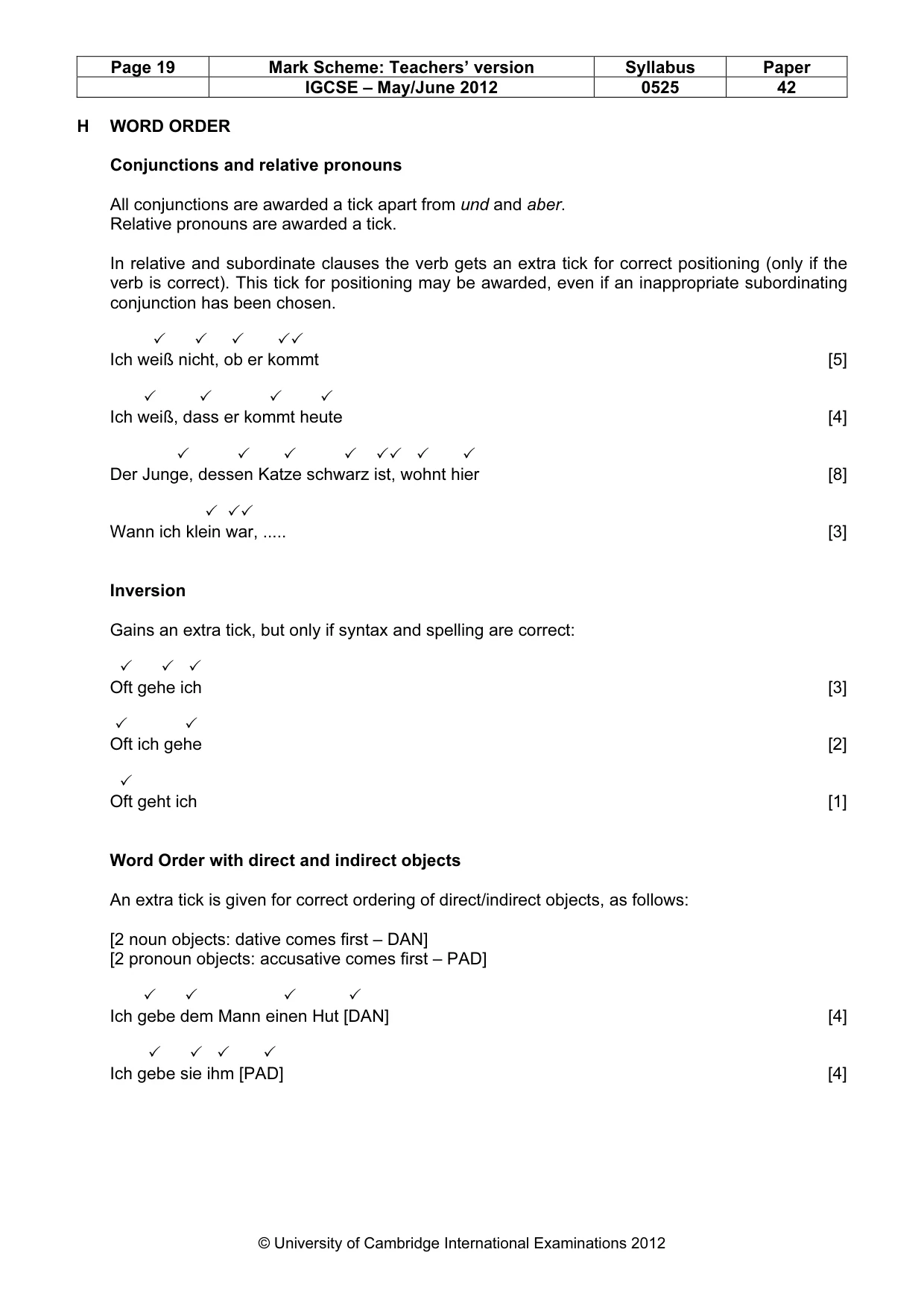
Page 19 Mark Scheme: Teachers’ version Syllabus Paper IGCSE – May/June 2012 0525 42 © University of Cambridge International Examinations 2012 H WORD ORDER Conjunctions and relative pronouns All conjunctions are awarded a tick apart from und and aber. Relative pronouns are awarded a tick. In relative and subordinate clauses the verb gets an extra tick for correct positioning (only if the verb is correct). This tick for positioning may be awarded, even if an inappropriate subordinating conjunction has been chosen. ✓ ✓ ✓ ✓✓ Ich weiß nicht, ob er kommt [5] ✓ ✓ ✓ ✓ Ich weiß, dass er kommt heute [4] ✓ ✓ ✓ ✓ ✓✓ ✓ ✓ Der Junge, dessen Katze schwarz ist, wohnt hier [8] ✓ ✓✓ Wann ich klein war, … [3] Inversion Gains an extra tick, but only if syntax and spelling are correct: ✓ ✓ ✓ Oft gehe ich [3] ✓ ✓ Oft ich gehe [2] ✓ Oft geht ich [1] Word Order with direct and indirect objects An extra tick is given for correct ordering of direct/indirect objects, as follows: [2 noun objects: dative comes first – DAN] [2 pronoun objects: accusative comes first – PAD] ✓ ✓ ✓ ✓ Ich gebe dem Mann einen Hut [DAN] [4] ✓ ✓ ✓ ✓ Ich gebe sie ihm [PAD] [4]
Mark scheme, page 20
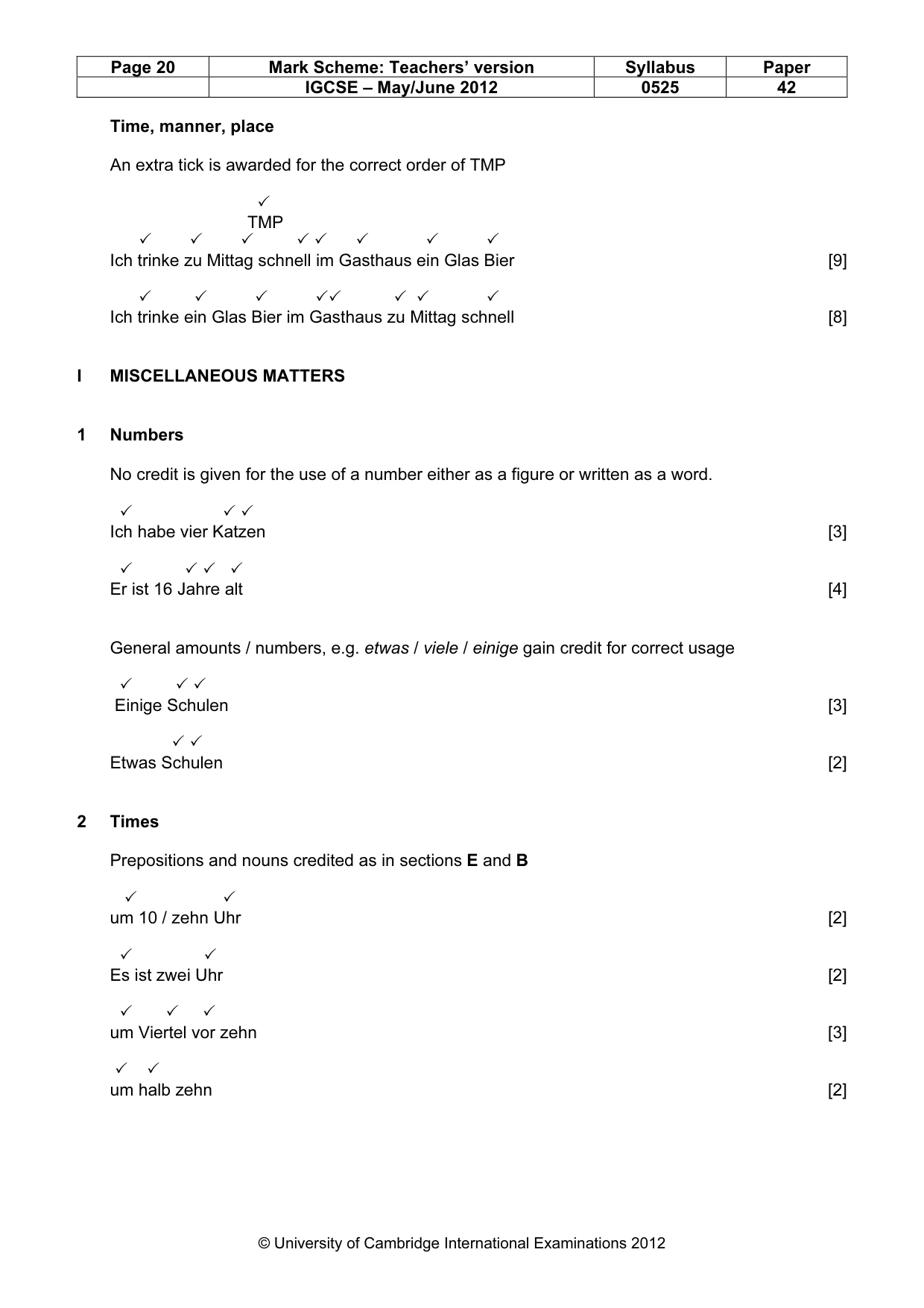
Page 20 Mark Scheme: Teachers’ version Syllabus Paper IGCSE – May/June 2012 0525 42 © University of Cambridge International Examinations 2012 Time, manner, place An extra tick is awarded for the correct order of TMP ✓ TMP ✓ ✓ ✓ ✓ ✓ ✓ ✓ ✓ Ich trinke zu Mittag schnell im Gasthaus ein Glas Bier [9] ✓ ✓ ✓ ✓✓ ✓ ✓ ✓ Ich trinke ein Glas Bier im Gasthaus zu Mittag schnell [8] I MISCELLANEOUS MATTERS 1 Numbers No credit is given for the use of a number either as a figure or written as a word. ✓ ✓ ✓ Ich habe vier Katzen [3] ✓ ✓ ✓ ✓ Er ist 16 Jahre alt [4] General amounts / numbers, e.g. etwas / viele / einige gain credit for correct usage ✓ ✓ ✓ Einige Schulen [3] ✓ ✓ Etwas Schulen [2] 2 Times Prepositions and nouns credited as in sections E and B ✓ ✓ um 10 / zehn Uhr [2] ✓ ✓ Es ist zwei Uhr [2] ✓ ✓ ✓ um Viertel vor zehn [3] ✓ ✓ um halb zehn [2]
Mark scheme, page 21
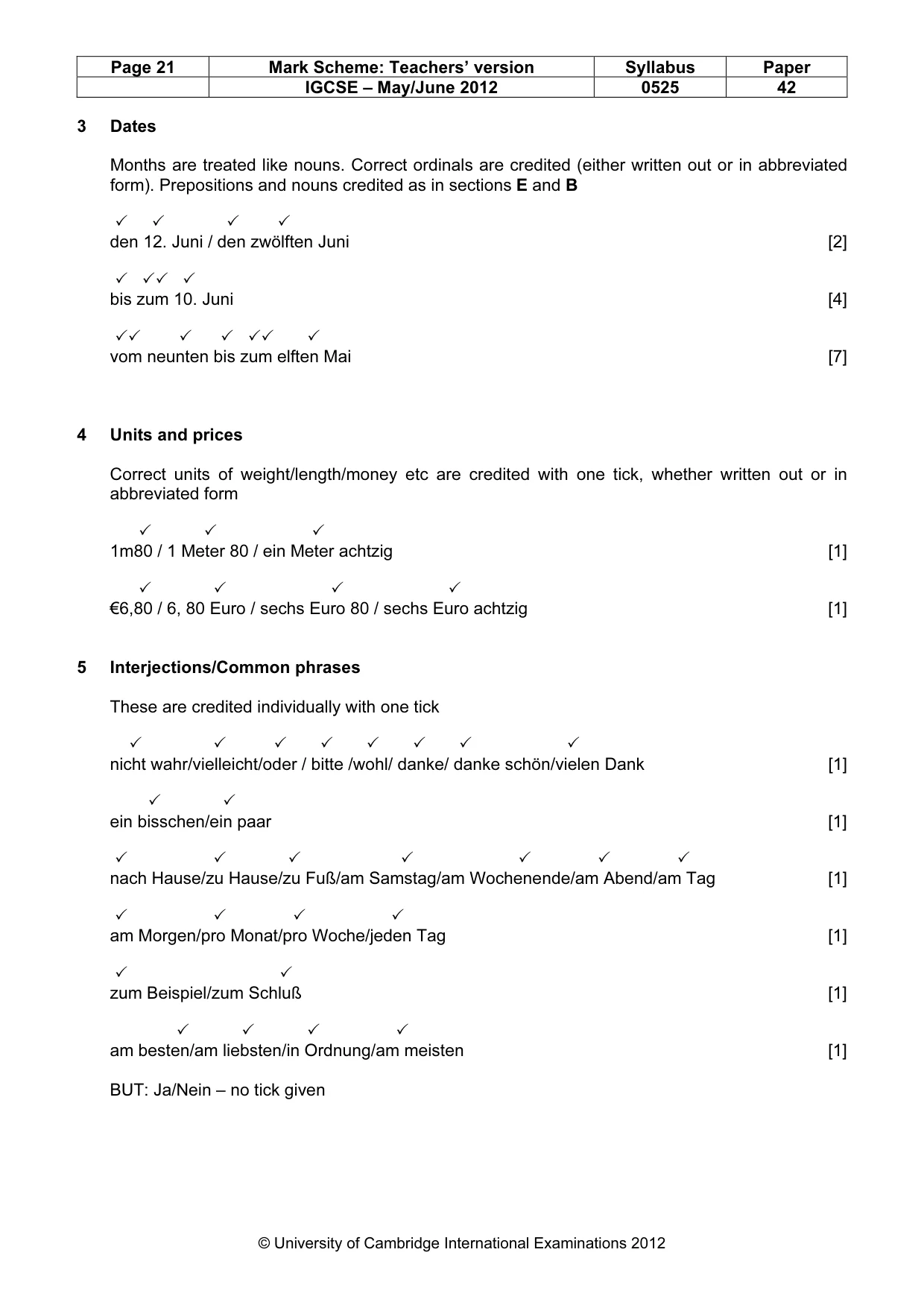
Page 21 Mark Scheme: Teachers’ version Syllabus Paper IGCSE – May/June 2012 0525 42 © University of Cambridge International Examinations 2012 3 Dates Months are treated like nouns. Correct ordinals are credited (either written out or in abbreviated form). Prepositions and nouns credited as in sections E and B ✓ ✓ ✓ ✓ den 12. Juni / den zwölften Juni [2] ✓ ✓✓ ✓ bis zum 10. Juni [4] ✓✓ ✓ ✓ ✓✓ ✓ vom neunten bis zum elften Mai [7] 4 Units and prices Correct units of weight/length/money etc are credited with one tick, whether written out or in abbreviated form ✓ ✓ ✓ 1m80 / 1 Meter 80 / ein Meter achtzig [1] ✓ ✓ ✓ ✓ €6,80 / 6, 80 Euro / sechs Euro 80 / sechs Euro achtzig [1] 5 Interjections/Common phrases These are credited individually with one tick ✓ ✓ ✓ ✓ ✓ ✓ ✓ ✓ nicht wahr/vielleicht/oder / bitte /wohl/ danke/ danke schön/vielen Dank [1] ✓ ✓ ein bisschen/ein paar [1] ✓ ✓ ✓ ✓ ✓ ✓ ✓ nach Hause/zu Hause/zu Fuß/am Samstag/am Wochenende/am Abend/am Tag [1] ✓ ✓ ✓ ✓ am Morgen/pro Monat/pro Woche/jeden Tag [1] ✓ ✓ zum Beispiel/zum Schluß [1] ✓ ✓ ✓ ✓ am besten/am liebsten/in Ordnung/am meisten [1] BUT: Ja/Nein – no tick given
Mark scheme, page 22
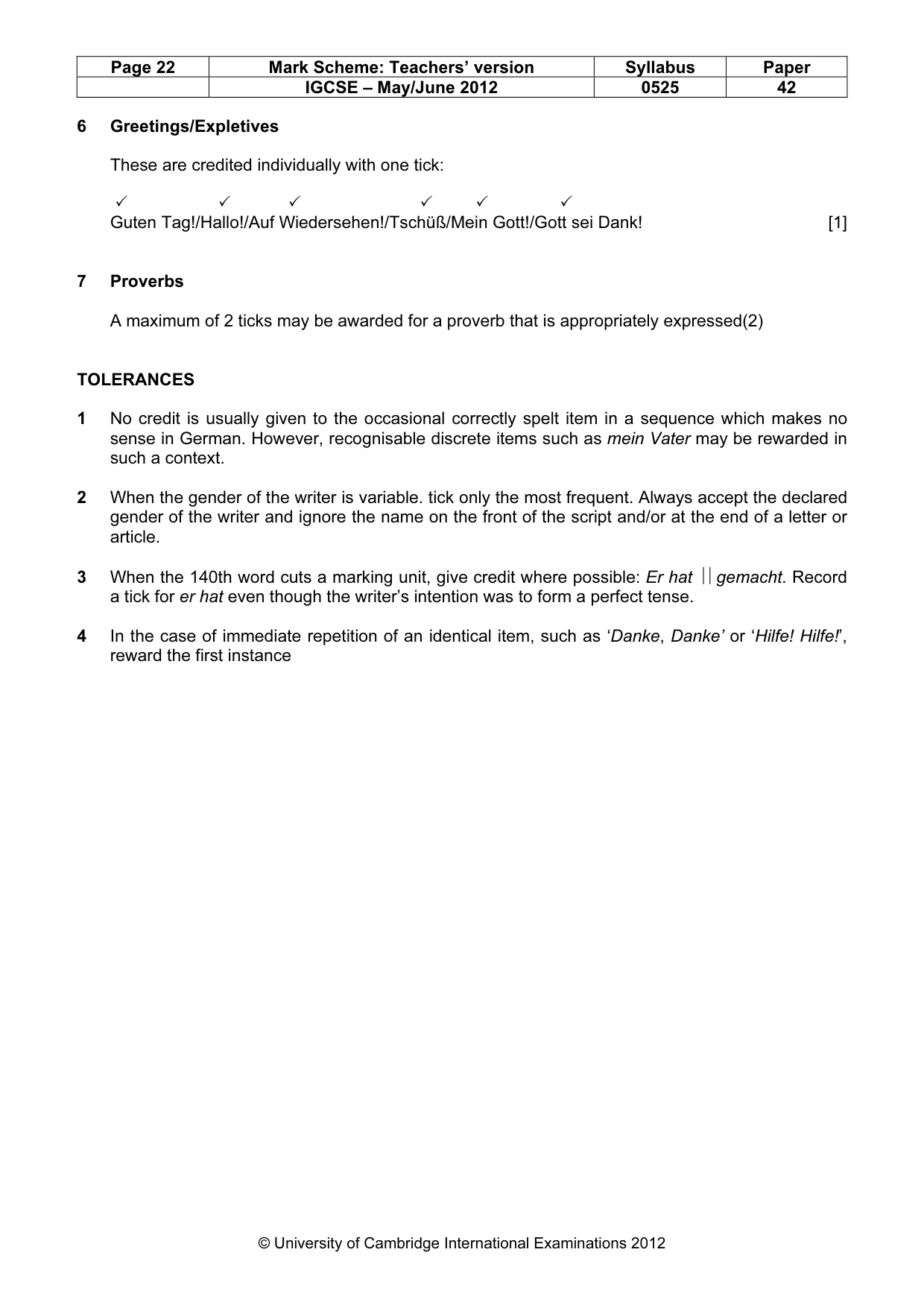
Page 22 Mark Scheme: Teachers’ version Syllabus Paper IGCSE – May/June 2012 0525 42 © University of Cambridge International Examinations 2012 6 Greetings/Expletives These are credited individually with one tick: ✓ ✓ ✓ ✓ ✓ ✓ Guten Tag!/Hallo!/Auf Wiedersehen!/Tschüß/Mein Gott!/Gott sei Dank! [1] 7 Proverbs A maximum of 2 ticks may be awarded for a proverb that is appropriately expressed(2) TOLERANCES 1 No credit is usually given to the occasional correctly spelt item in a sequence which makes no sense in German. However, recognisable discrete items such as mein Vater may be rewarded in such a context. 2 When the gender of the writer is variable. tick only the most frequent. Always accept the declared gender of the writer and ignore the name on the front of the script and/or at the end of a letter or article. 3 When the 140th word cuts a marking unit, give credit where possible: Er hat gemacht. Record a tick for er hat even though the writer’s intention was to form a perfect tense. 4 In the case of immediate repetition of an identical item, such as ‘Danke, Danke’ or ‘Hilfe! Hilfe!’, reward the first instance
Mark scheme, page 23
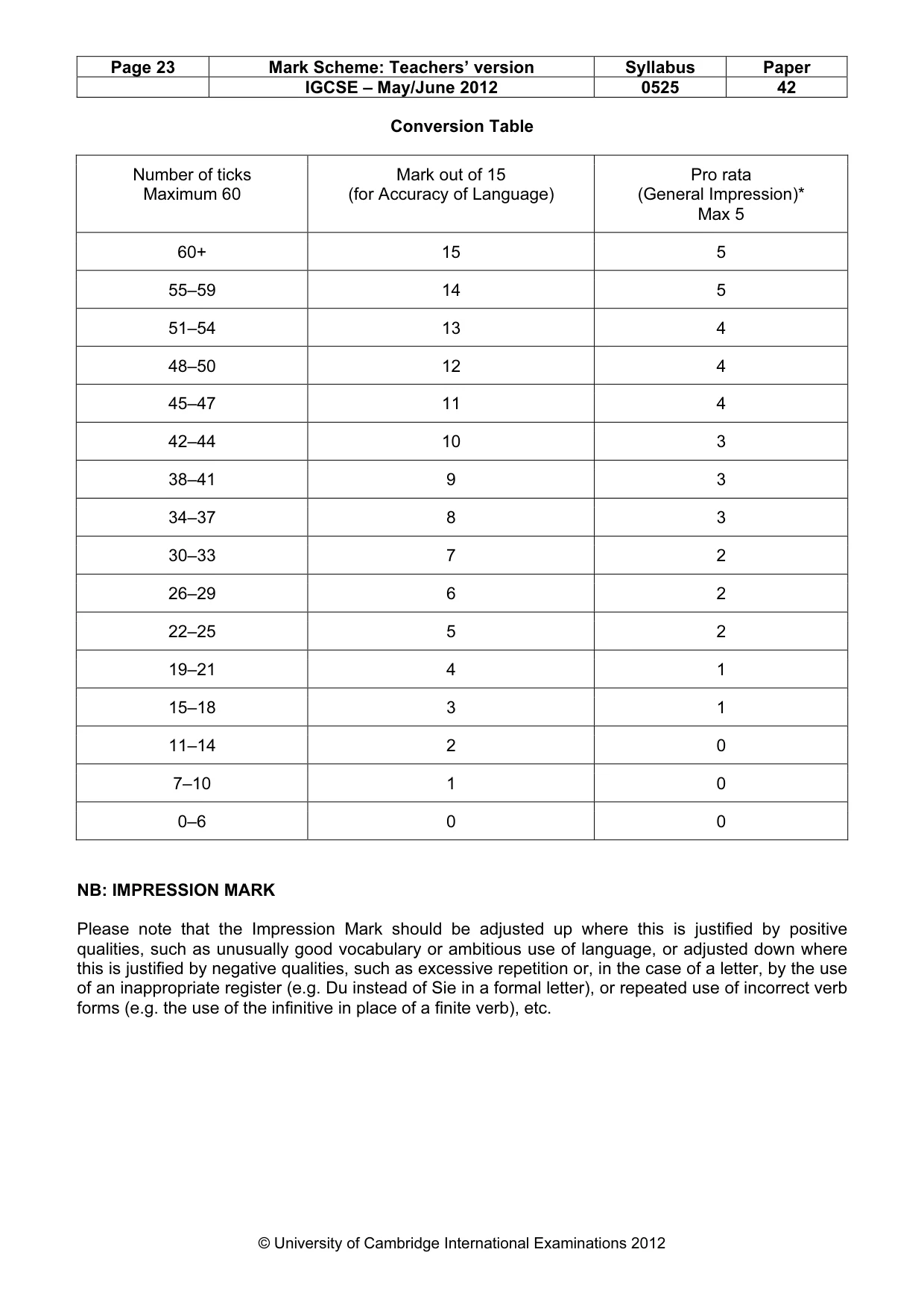
Page 23 Mark Scheme: Teachers’ version Syllabus Paper IGCSE – May/June 2012 0525 42 © University of Cambridge International Examinations 2012 Conversion Table Number of ticks Maximum 60 Mark out of 15 (for Accuracy of Language) Pro rata (General Impression)* Max 5 60+ 15 5 55–59 14 5 51–54 13 4 48–50 12 4 45–47 11 4 42–44 10 3 38–41 9 3 34–37 8 3 30–33 7 2 26–29 6 2 22–25 5 2 19–21 4 1 15–18 3 1 11–14 2 0 7–10 1 0 0–6 0 0 NB: IMPRESSION MARK Please note that the Impression Mark should be adjusted up where this is justified by positive qualities, such as unusually good vocabulary or ambitious use of language, or adjusted down where this is justified by negative qualities, such as excessive repetition or, in the case of a letter, by the use of an inappropriate register (e.g. Du instead of Sie in a formal letter), or repeated use of incorrect verb forms (e.g. the use of the infinitive in place of a finite verb), etc.