Cambridge IGCSE German - Foreign Language 0525 — 2009 May/June Paper 4 · Variant 1
0525/41/M/J/09 · 50 marks · ≈56 min
The question paper and its mark scheme, free to read here and free to download. This is Cambridge’s own paper, exactly as it was sat.
Question paper4 pages
Mark scheme11 pages
Answers below. Sit the paper first if you are practising.
Paper as text
Question paper, page 1
This document consists of 4 printed pages. IB09 06_0525_04/RP © UCLES 2009 [Turn over *0793483527* For Examiner's Use 1 2 Total UNIVERSITY OF CAMBRIDGE INTERNATIONAL EXAMINATIONS International General Certificate of Secondary Education GERMAN 0525/04 Paper 4 Continuous Writing May/June 2009 1 hour 15 minutes Candidates answer on the Question Paper No Additional Materials are required. READ THESE INSTRUCTIONS FIRST Write your Centre number, candidate number and name on all the work you hand in. Write in dark blue or black pen. Do not use staples, paper clips, highlighters, glue or correction fluid. DO NOT WRITE IN ANY BARCODES. Answer either Question 1 (a) or Question 1 (b) and Question 2. All questions on this paper carry equal marks. At the end of the examination, fasten all your work securely together. www.XtremePapers.com
Question paper, page 2
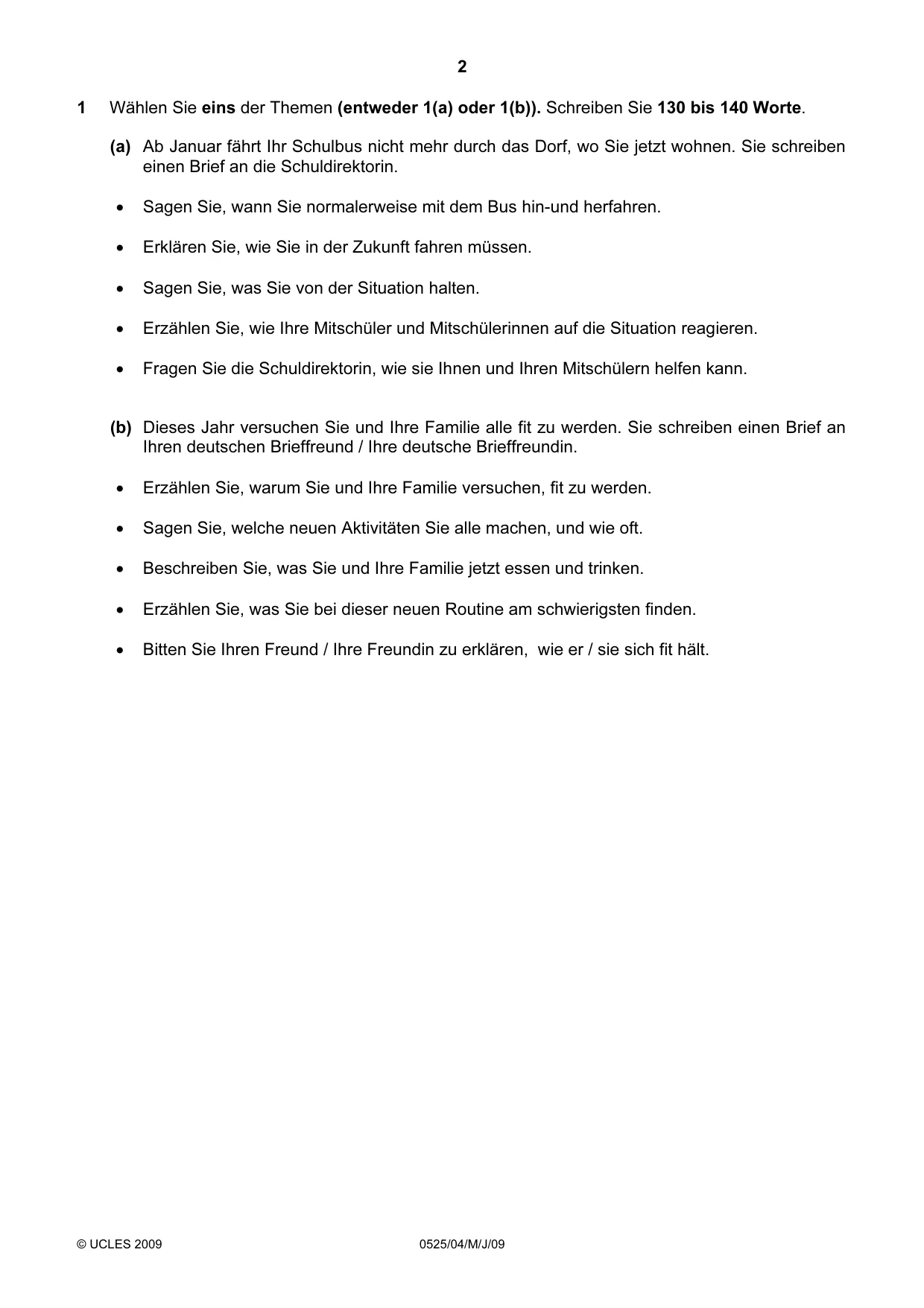
2 © UCLES 2009 0525/04/M/J/09 1 Wählen Sie eins der Themen (entweder 1(a) oder 1(b)). Schreiben Sie 130 bis 140 Worte. (a) Ab Januar fährt Ihr Schulbus nicht mehr durch das Dorf, wo Sie jetzt wohnen. Sie schreiben einen Brief an die Schuldirektorin. • Sagen Sie, wann Sie normalerweise mit dem Bus hin-und herfahren. • Erklären Sie, wie Sie in der Zukunft fahren müssen. • Sagen Sie, was Sie von der Situation halten. • Erzählen Sie, wie Ihre Mitschüler und Mitschülerinnen auf die Situation reagieren. • Fragen Sie die Schuldirektorin, wie sie Ihnen und Ihren Mitschülern helfen kann. (b) Dieses Jahr versuchen Sie und Ihre Familie alle fit zu werden. Sie schreiben einen Brief an Ihren deutschen Brieffreund / Ihre deutsche Brieffreundin. • Erzählen Sie, warum Sie und Ihre Familie versuchen, fit zu werden. • Sagen Sie, welche neuen Aktivitäten Sie alle machen, und wie oft. • Beschreiben Sie, was Sie und Ihre Familie jetzt essen und trinken. • Erzählen Sie, was Sie bei dieser neuen Routine am schwierigsten finden. • Bitten Sie Ihren Freund / Ihre Freundin zu erklären, wie er / sie sich fit hält.
Question paper, page 3
3 © UCLES 2009 0525/04/M/J/09 [Turn over For Examiner's Use SCHREIBEN SIE IHRE ANTWORT AUF DIE FRAGE EINS AUF DIESE SEITE
Question paper, page 4
4 Permission to reproduce items where third-party owned material protected by copyright is included has been sought and cleared where possible. Every reasonable effort has been made by the publisher (UCLES) to trace copyright holders, but if any items requiring clearance have unwittingly been included, the publisher will be pleased to make amends at the earliest possible opportunity. University of Cambridge International Examinations is part of the Cambridge Assessment Group. Cambridge Assessment is the brand name of University of Cambridge Local Examinations Syndicate (UCLES), which is itself a department of the University of Cambridge. © UCLES 2009 0525/04/M/J/09 For Examiner's Use 2 Als Sie eines Abends den Bahnhof erreichten, um nach Hause zu fahren, erfuhren Sie, dass der letzte Zug schon abgefahren war. Erzählen Sie, was weiterhin geschah. Schreiben Sie 130 bis 140 Worte.
Mark scheme, page 1
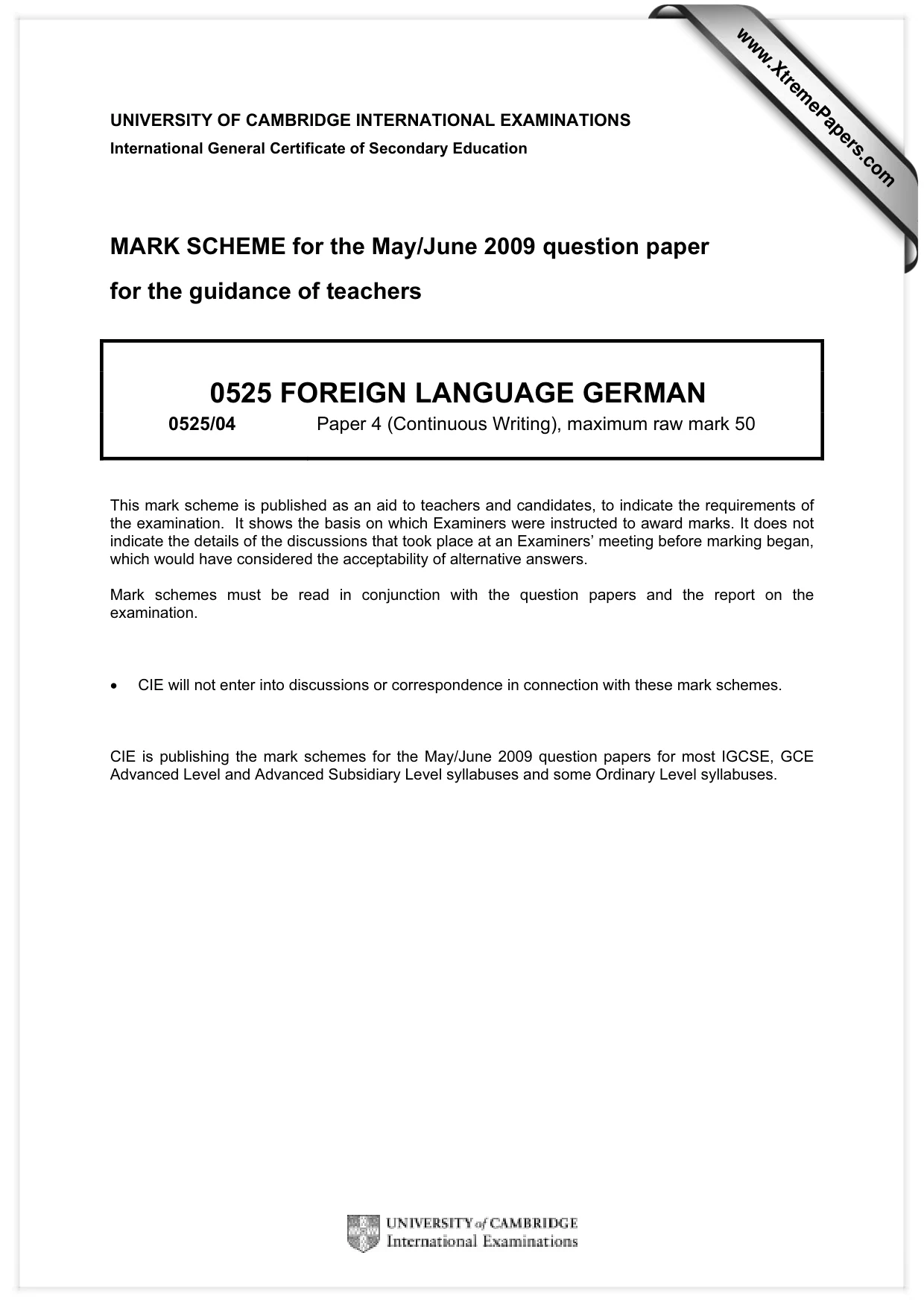
UNIVERSITY OF CAMBRIDGE INTERNATIONAL EXAMINATIONS International General Certificate of Secondary Education MARK SCHEME for the May/June 2009 question paper for the guidance of teachers 0525 FOREIGN LANGUAGE GERMAN 0525/04 Paper 4 (Continuous Writing), maximum raw mark 50 This mark scheme is published as an aid to teachers and candidates, to indicate the requirements of the examination. It shows the basis on which Examiners were instructed to award marks. It does not indicate the details of the discussions that took place at an Examiners’ meeting before marking began, which would have considered the acceptability of alternative answers. Mark schemes must be read in conjunction with the question papers and the report on the examination. • CIE will not enter into discussions or correspondence in connection with these mark schemes. CIE is publishing the mark schemes for the May/June 2009 question papers for most IGCSE, GCE Advanced Level and Advanced Subsidiary Level syllabuses and some Ordinary Level syllabuses. www.XtremePapers.com
Mark scheme, page 2
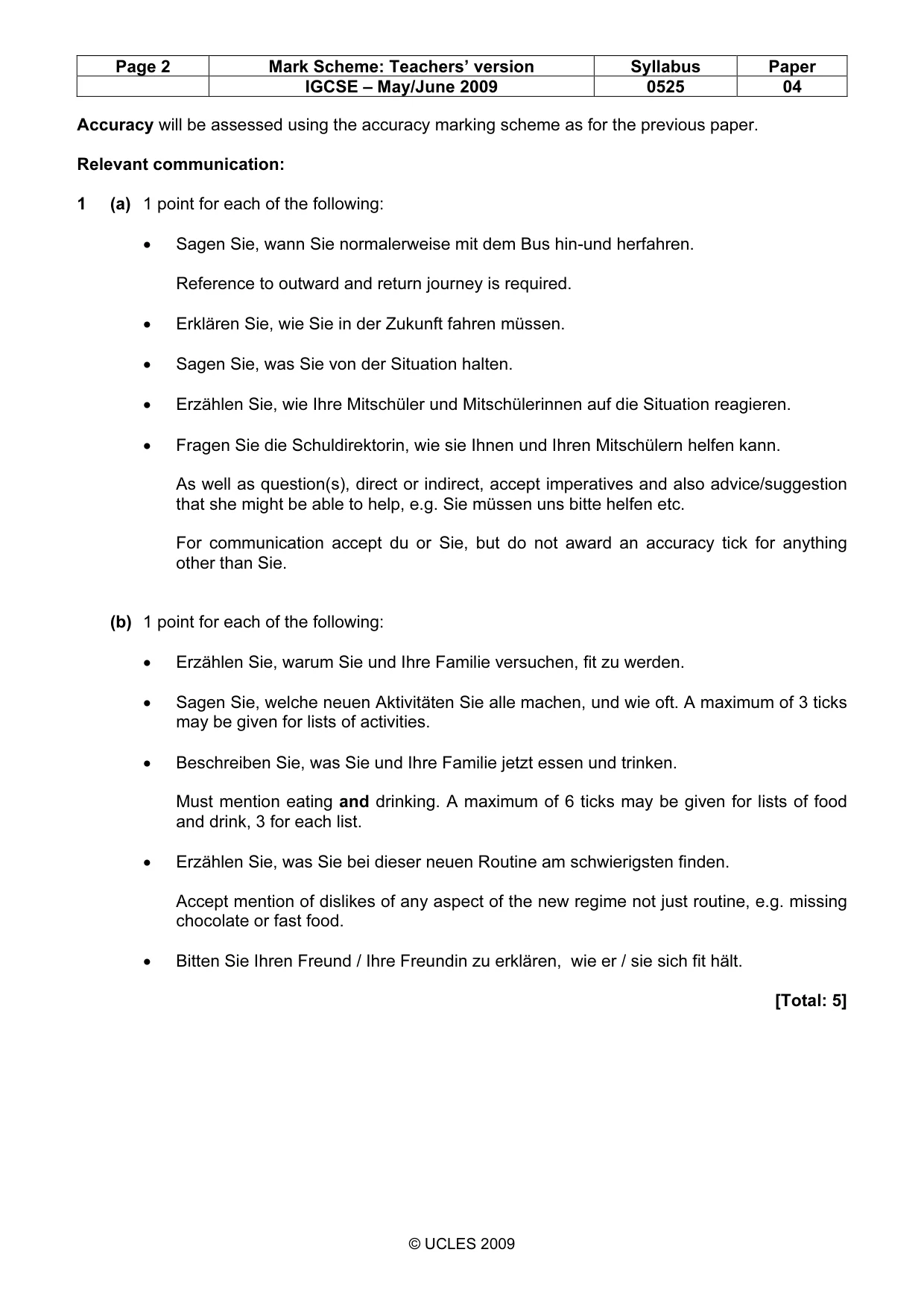
Page 2 Mark Scheme: Teachers’ version Syllabus Paper IGCSE – May/June 2009 0525 04 © UCLES 2009 Accuracy will be assessed using the accuracy marking scheme as for the previous paper. Relevant communication: 1 (a) 1 point for each of the following: • Sagen Sie, wann Sie normalerweise mit dem Bus hin-und herfahren. Reference to outward and return journey is required. • Erklären Sie, wie Sie in der Zukunft fahren müssen. • Sagen Sie, was Sie von der Situation halten. • Erzählen Sie, wie Ihre Mitschüler und Mitschülerinnen auf die Situation reagieren. • Fragen Sie die Schuldirektorin, wie sie Ihnen und Ihren Mitschülern helfen kann. As well as question(s), direct or indirect, accept imperatives and also advice/suggestion that she might be able to help, e.g. Sie müssen uns bitte helfen etc. For communication accept du or Sie, but do not award an accuracy tick for anything other than Sie. (b) 1 point for each of the following: • Erzählen Sie, warum Sie und Ihre Familie versuchen, fit zu werden. • Sagen Sie, welche neuen Aktivitäten Sie alle machen, und wie oft. A maximum of 3 ticks may be given for lists of activities. • Beschreiben Sie, was Sie und Ihre Familie jetzt essen und trinken. Must mention eating and drinking. A maximum of 6 ticks may be given for lists of food and drink, 3 for each list. • Erzählen Sie, was Sie bei dieser neuen Routine am schwierigsten finden. Accept mention of dislikes of any aspect of the new regime not just routine, e.g. missing chocolate or fast food. • Bitten Sie Ihren Freund / Ihre Freundin zu erklären, wie er / sie sich fit hält. [Total: 5]
Mark scheme, page 3
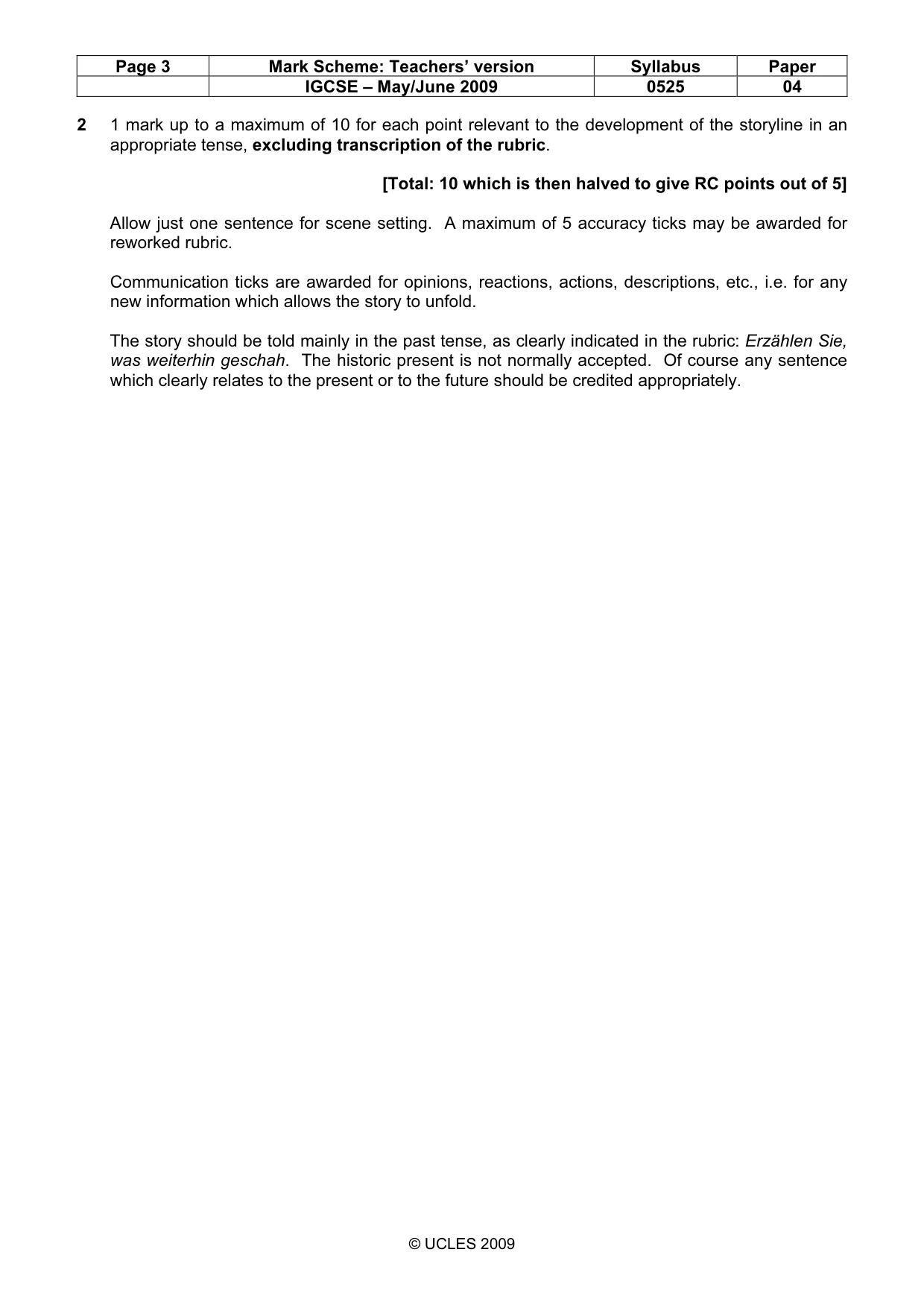
Page 3 Mark Scheme: Teachers’ version Syllabus Paper IGCSE – May/June 2009 0525 04 © UCLES 2009 2 1 mark up to a maximum of 10 for each point relevant to the development of the storyline in an appropriate tense, excluding transcription of the rubric. [Total: 10 which is then halved to give RC points out of 5] Allow just one sentence for scene setting. A maximum of 5 accuracy ticks may be awarded for reworked rubric. Communication ticks are awarded for opinions, reactions, actions, descriptions, etc., i.e. for any new information which allows the story to unfold. The story should be told mainly in the past tense, as clearly indicated in the rubric: Erzählen Sie, was weiterhin geschah. The historic present is not normally accepted. Of course any sentence which clearly relates to the present or to the future should be credited appropriately.
Mark scheme, page 4
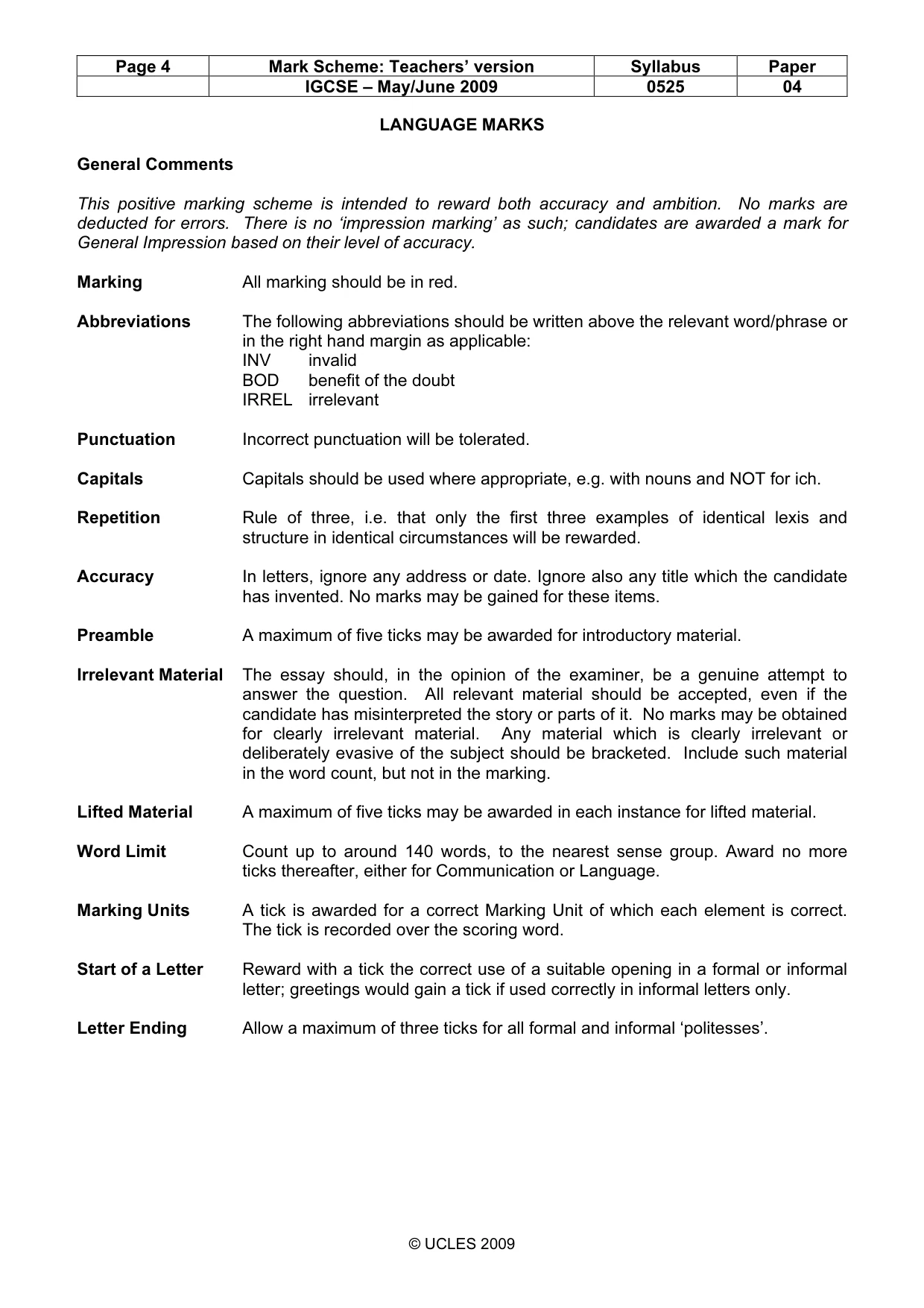
Page 4 Mark Scheme: Teachers’ version Syllabus Paper IGCSE – May/June 2009 0525 04 © UCLES 2009 LANGUAGE MARKS General Comments This positive marking scheme is intended to reward both accuracy and ambition. No marks are deducted for errors. There is no ‘impression marking’ as such; candidates are awarded a mark for General Impression based on their level of accuracy. Marking All marking should be in red. Abbreviations The following abbreviations should be written above the relevant word/phrase or in the right hand margin as applicable: INV invalid BOD benefit of the doubt IRREL irrelevant Punctuation Incorrect punctuation will be tolerated. Capitals Capitals should be used where appropriate, e.g. with nouns and NOT for ich. Repetition Rule of three, i.e. that only the first three examples of identical lexis and structure in identical circumstances will be rewarded. Accuracy In letters, ignore any address or date. Ignore also any title which the candidate has invented. No marks may be gained for these items. Preamble A maximum of five ticks may be awarded for introductory material. Irrelevant Material The essay should, in the opinion of the examiner, be a genuine attempt to answer the question. All relevant material should be accepted, even if the candidate has misinterpreted the story or parts of it. No marks may be obtained for clearly irrelevant material. Any material which is clearly irrelevant or deliberately evasive of the subject should be bracketed. Include such material in the word count, but not in the marking. Lifted Material A maximum of five ticks may be awarded in each instance for lifted material. Word Limit Count up to around 140 words, to the nearest sense group. Award no more ticks thereafter, either for Communication or Language. Marking Units A tick is awarded for a correct Marking Unit of which each element is correct. The tick is recorded over the scoring word. Start of a Letter Reward with a tick the correct use of a suitable opening in a formal or informal letter; greetings would gain a tick if used correctly in informal letters only. Letter Ending Allow a maximum of three ticks for all formal and informal ‘politesses’.
Mark scheme, page 5
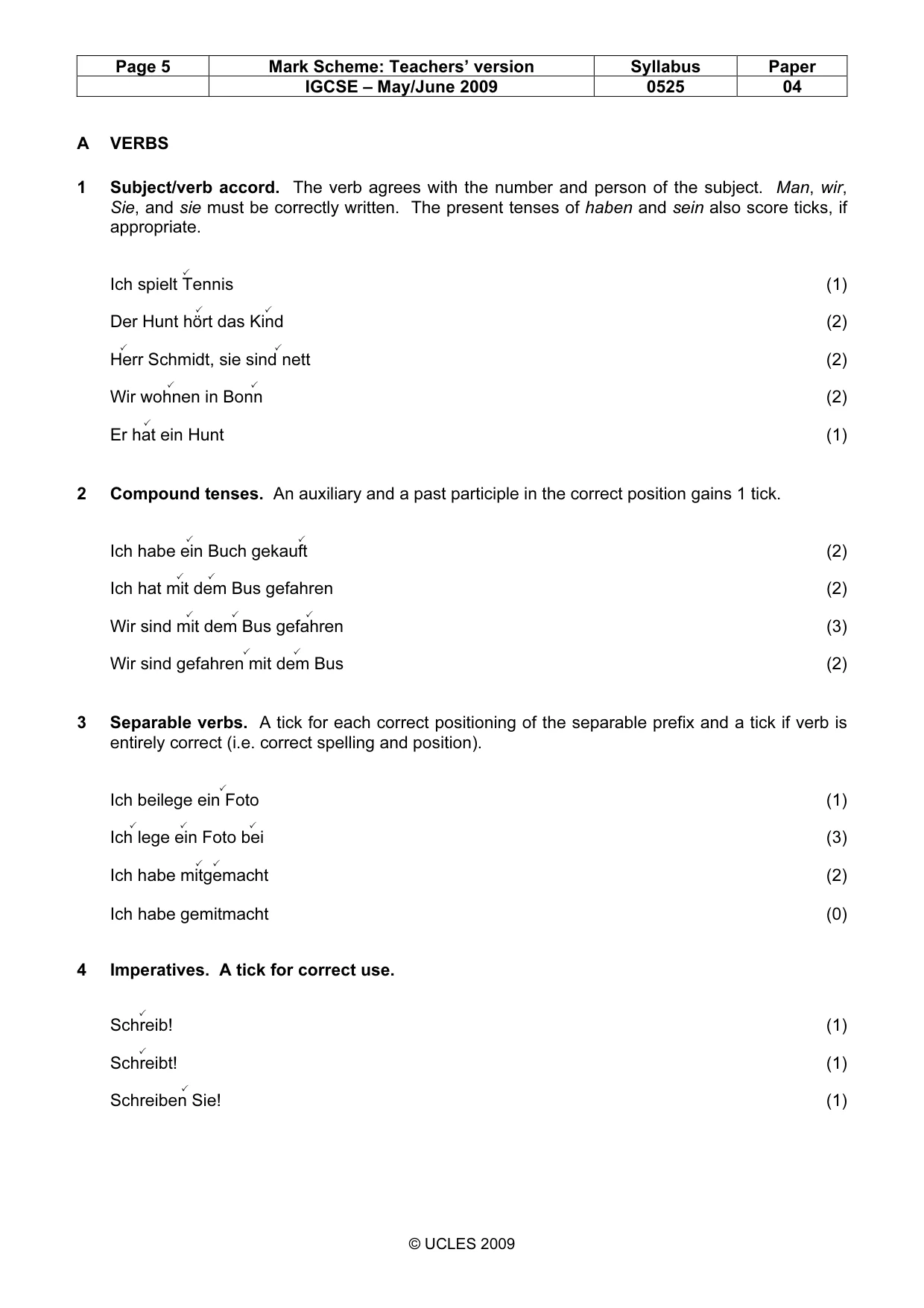
Page 5 Mark Scheme: Teachers’ version Syllabus Paper IGCSE – May/June 2009 0525 04 © UCLES 2009 A VERBS 1 Subject/verb accord. The verb agrees with the number and person of the subject. Man, wir, Sie, and sie must be correctly written. The present tenses of haben and sein also score ticks, if appropriate. ✓ Ich spielt Tennis (1) ✓ ✓ Der Hunt hört das Kind (2) ✓ ✓ Herr Schmidt, sie sind nett (2) ✓ ✓ Wir wohnen in Bonn (2) ✓ Er hat ein Hunt (1) 2 Compound tenses. An auxiliary and a past participle in the correct position gains 1 tick. ✓ ✓ Ich habe ein Buch gekauft (2) ✓ ✓ Ich hat mit dem Bus gefahren (2) ✓ ✓ ✓ Wir sind mit dem Bus gefahren (3) ✓ ✓ Wir sind gefahren mit dem Bus (2) 3 Separable verbs. A tick for each correct positioning of the separable prefix and a tick if verb is entirely correct (i.e. correct spelling and position). ✓ Ich beilege ein Foto (1) ✓ ✓ ✓ Ich lege ein Foto bei (3) ✓ ✓ Ich habe mitgemacht (2) Ich habe gemitmacht (0) 4 Imperatives. A tick for correct use. ✓ Schreib! (1) ✓ Schreibt! (1) ✓ Schreiben Sie! (1)
Mark scheme, page 6
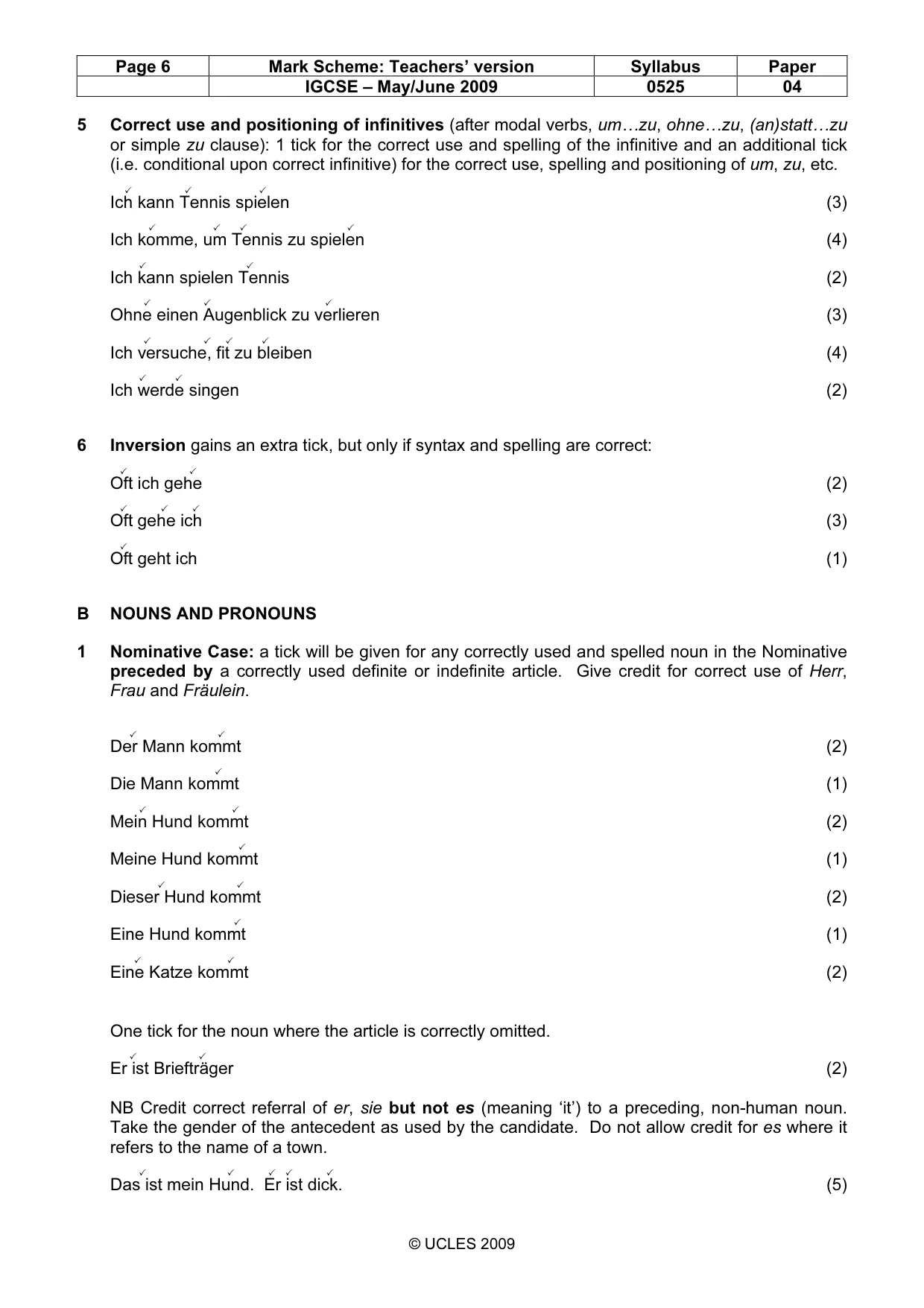
Page 6 Mark Scheme: Teachers’ version Syllabus Paper IGCSE – May/June 2009 0525 04 © UCLES 2009 5 Correct use and positioning of infinitives (after modal verbs, um…zu, ohne…zu, (an)statt…zu or simple zu clause): 1 tick for the correct use and spelling of the infinitive and an additional tick (i.e. conditional upon correct infinitive) for the correct use, spelling and positioning of um, zu, etc. ✓ ✓ ✓ Ich kann Tennis spielen (3) ✓ ✓ ✓ ✓ Ich komme, um Tennis zu spielen (4) ✓ ✓ Ich kann spielen Tennis (2) ✓ ✓ ✓ Ohne einen Augenblick zu verlieren (3) ✓ ✓ ✓ ✓ Ich versuche, fit zu bleiben (4) ✓ ✓ Ich werde singen (2) 6 Inversion gains an extra tick, but only if syntax and spelling are correct: ✓ ✓ Oft ich gehe (2) ✓ ✓ ✓ Oft gehe ich (3) ✓ Oft geht ich (1) B NOUNS AND PRONOUNS 1 Nominative Case: a tick will be given for any correctly used and spelled noun in the Nominative preceded by a correctly used definite or indefinite article. Give credit for correct use of Herr, Frau and Fräulein. ✓ ✓ Der Mann kommt (2) ✓ Die Mann kommt (1) ✓ ✓ Mein Hund kommt (2) ✓ Meine Hund kommt (1) ✓ ✓ Dieser Hund kommt (2) ✓ Eine Hund kommt (1) ✓ ✓ Eine Katze kommt (2) One tick for the noun where the article is correctly omitted. ✓ ✓ Er ist Briefträger (2) NB Credit correct referral of er, sie but not es (meaning ‘it’) to a preceding, non-human noun. Take the gender of the antecedent as used by the candidate. Do not allow credit for es where it refers to the name of a town. ✓ ✓ ✓ ✓ ✓ Das ist mein Hund. Er ist dick. (5)
Mark scheme, page 7
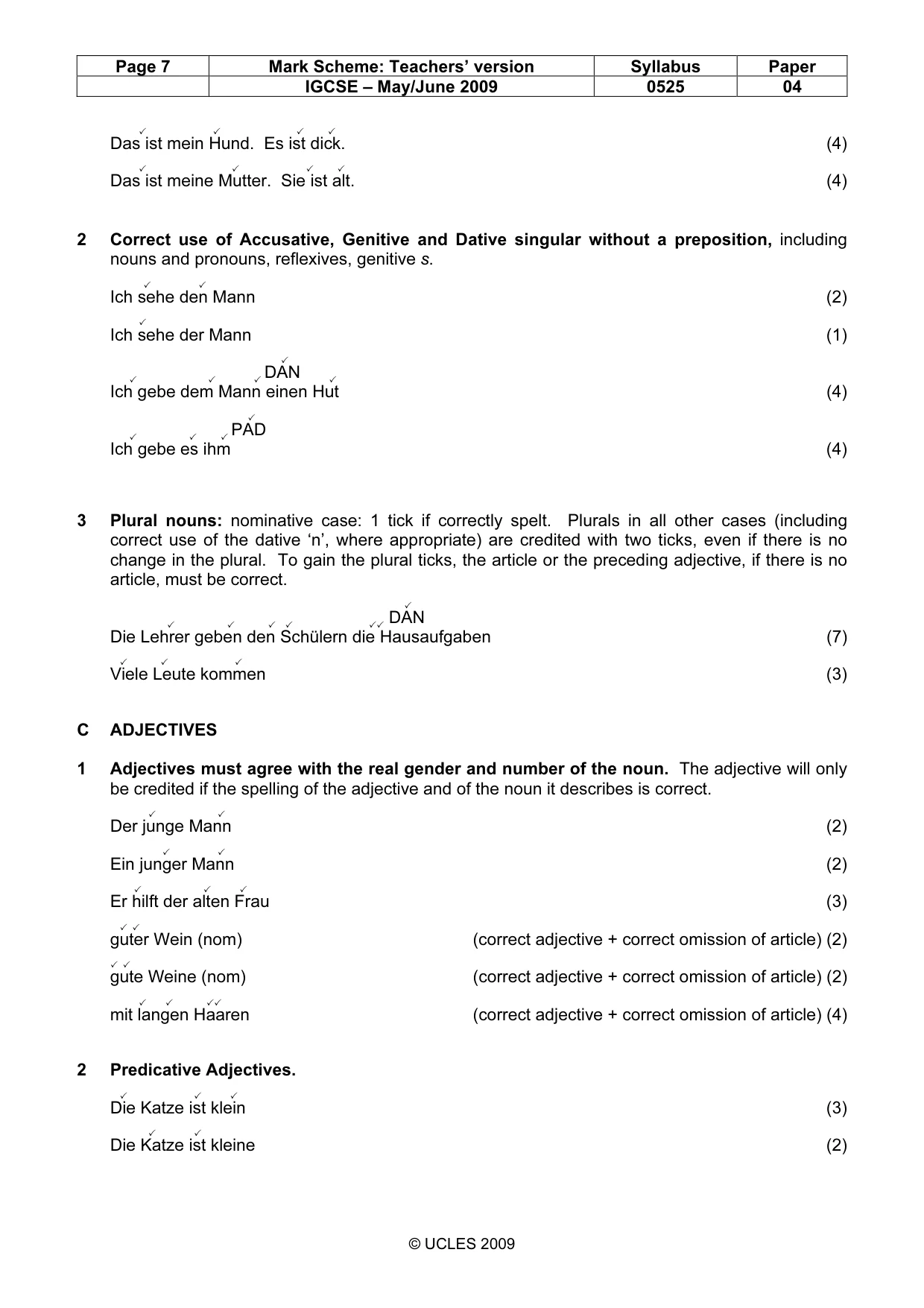
Page 7 Mark Scheme: Teachers’ version Syllabus Paper IGCSE – May/June 2009 0525 04 © UCLES 2009 ✓ ✓ ✓ ✓ Das ist mein Hund. Es ist dick. (4) ✓ ✓ ✓ ✓ Das ist meine Mutter. Sie ist alt. (4) 2 Correct use of Accusative, Genitive and Dative singular without a preposition, including nouns and pronouns, reflexives, genitive s. ✓ ✓ Ich sehe den Mann (2) ✓ Ich sehe der Mann (1) ✓ ✓ ✓ ✓ DAN ✓ Ich gebe dem Mann einen Hut (4) ✓ ✓ ✓ ✓ PAD Ich gebe es ihm (4) 3 Plural nouns: nominative case: 1 tick if correctly spelt. Plurals in all other cases (including correct use of the dative ‘n’, where appropriate) are credited with two ticks, even if there is no change in the plural. To gain the plural ticks, the article or the preceding adjective, if there is no article, must be correct. ✓ ✓ ✓ ✓ ✓ ✓✓ DAN Die Lehrer geben den Schülern die Hausaufgaben (7) ✓ ✓ ✓ Viele Leute kommen (3) C ADJECTIVES 1 Adjectives must agree with the real gender and number of the noun. The adjective will only be credited if the spelling of the adjective and of the noun it describes is correct. ✓ ✓ Der junge Mann (2) ✓ ✓ Ein junger Mann (2) ✓ ✓ ✓ Er hilft der alten Frau (3) ✓ ✓ guter Wein (nom) (correct adjective + correct omission of article) (2) ✓ ✓ gute Weine (nom) (correct adjective + correct omission of article) (2) ✓ ✓ ✓✓ mit langen Haaren (correct adjective + correct omission of article) (4) 2 Predicative Adjectives. ✓ ✓ ✓ Die Katze ist klein (3) ✓ ✓ Die Katze ist kleine (2)
Mark scheme, page 8
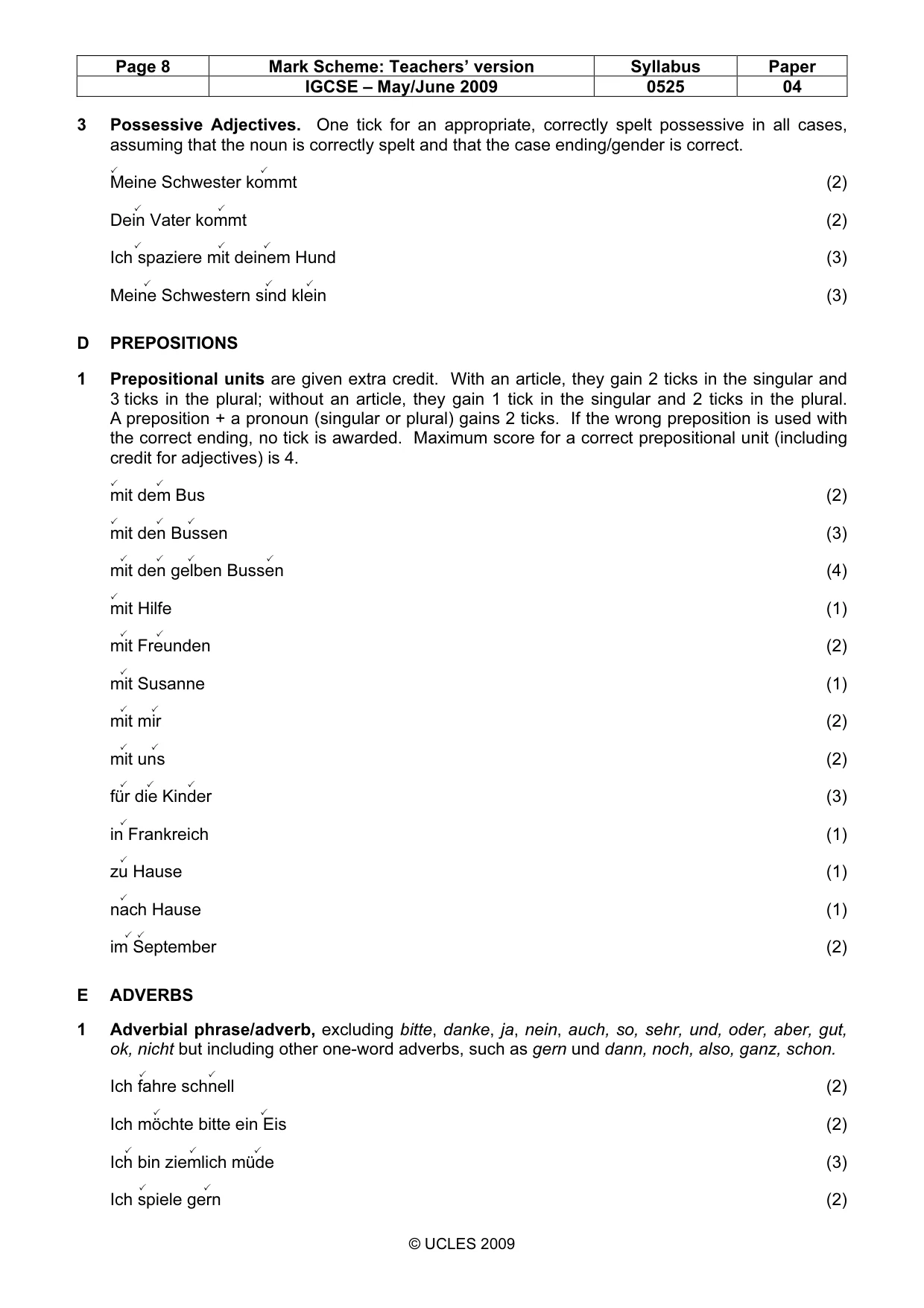
Page 8 Mark Scheme: Teachers’ version Syllabus Paper IGCSE – May/June 2009 0525 04 © UCLES 2009 3 Possessive Adjectives. One tick for an appropriate, correctly spelt possessive in all cases, assuming that the noun is correctly spelt and that the case ending/gender is correct. ✓ ✓ Meine Schwester kommt (2) ✓ ✓ Dein Vater kommt (2) ✓ ✓ ✓ Ich spaziere mit deinem Hund (3) ✓ ✓ ✓ Meine Schwestern sind klein (3) D PREPOSITIONS 1 Prepositional units are given extra credit. With an article, they gain 2 ticks in the singular and 3 ticks in the plural; without an article, they gain 1 tick in the singular and 2 ticks in the plural. A preposition + a pronoun (singular or plural) gains 2 ticks. If the wrong preposition is used with the correct ending, no tick is awarded. Maximum score for a correct prepositional unit (including credit for adjectives) is 4. ✓ ✓ mit dem Bus (2) ✓ ✓ ✓ mit den Bussen (3) ✓ ✓ ✓ ✓ mit den gelben Bussen (4) ✓ mit Hilfe (1) ✓ ✓ mit Freunden (2) ✓ mit Susanne (1) ✓ ✓ mit mir (2) ✓ ✓ mit uns (2) ✓ ✓ ✓ für die Kinder (3) ✓ in Frankreich (1) ✓ zu Hause (1) ✓ nach Hause (1) ✓ ✓ im September (2) E ADVERBS 1 Adverbial phrase/adverb, excluding bitte, danke, ja, nein, auch, so, sehr, und, oder, aber, gut, ok, nicht but including other one-word adverbs, such as gern und dann, noch, also, ganz, schon. ✓ ✓ Ich fahre schnell (2) ✓ ✓ Ich möchte bitte ein Eis (2) ✓ ✓ ✓ Ich bin ziemlich müde (3) ✓ ✓ Ich spiele gern (2)
Mark scheme, page 9
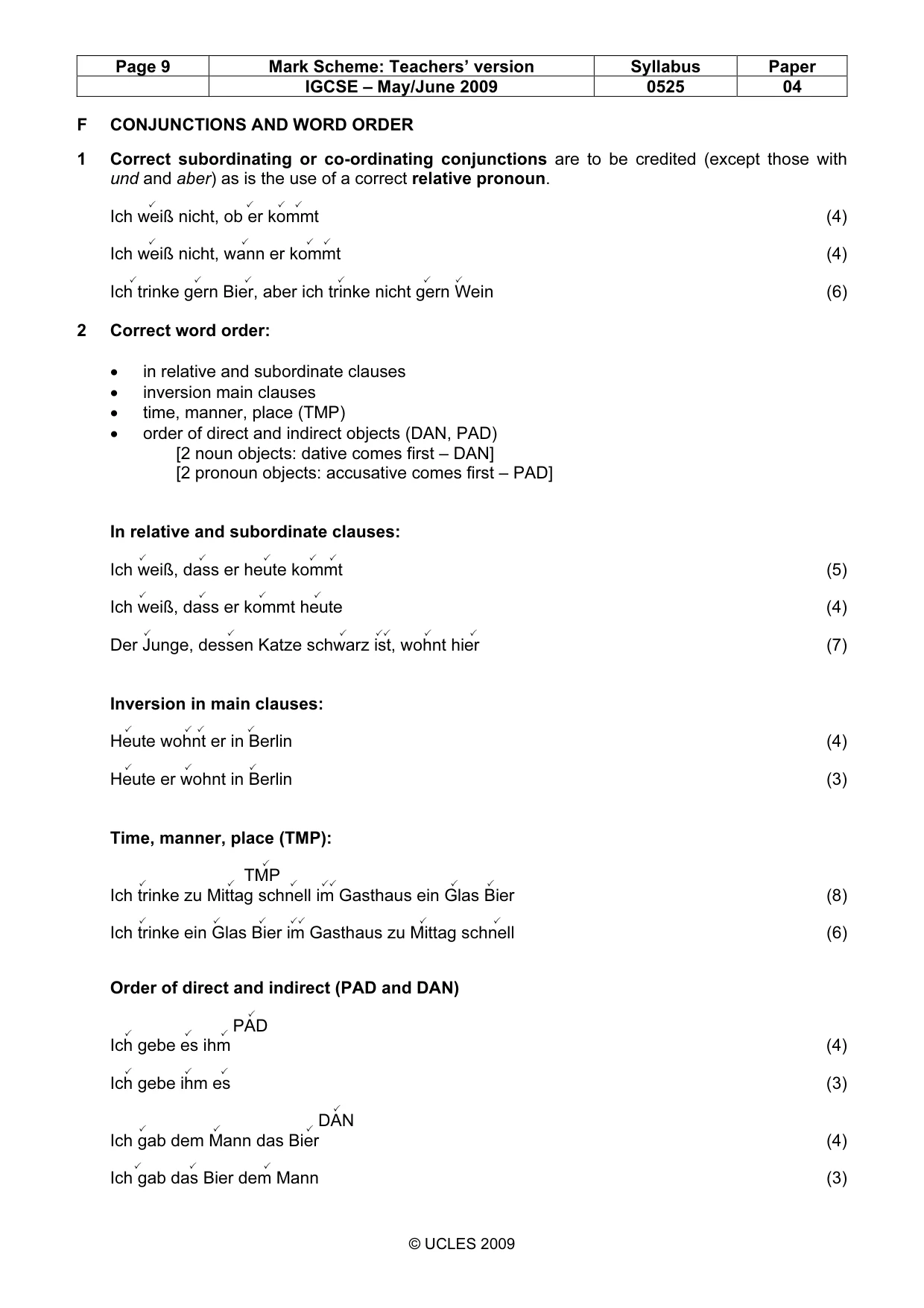
Page 9 Mark Scheme: Teachers’ version Syllabus Paper IGCSE – May/June 2009 0525 04 © UCLES 2009 F CONJUNCTIONS AND WORD ORDER 1 Correct subordinating or co-ordinating conjunctions are to be credited (except those with und and aber) as is the use of a correct relative pronoun. ✓ ✓ ✓ ✓ Ich weiß nicht, ob er kommt (4) ✓ ✓ ✓ ✓ Ich weiß nicht, wann er kommt (4) ✓ ✓ ✓ ✓ ✓ ✓ Ich trinke gern Bier, aber ich trinke nicht gern Wein (6) 2 Correct word order: • in relative and subordinate clauses • inversion main clauses • time, manner, place (TMP) • order of direct and indirect objects (DAN, PAD) [2 noun objects: dative comes first – DAN] [2 pronoun objects: accusative comes first – PAD] In relative and subordinate clauses: ✓ ✓ ✓ ✓ ✓ Ich weiß, dass er heute kommt (5) ✓ ✓ ✓ ✓ Ich weiß, dass er kommt heute (4) ✓ ✓ ✓ ✓✓ ✓ ✓ Der Junge, dessen Katze schwarz ist, wohnt hier (7) Inversion in main clauses: ✓ ✓ ✓ ✓ Heute wohnt er in Berlin (4) ✓ ✓ ✓ Heute er wohnt in Berlin (3) Time, manner, place (TMP): ✓ ✓ ✓ TMP ✓ ✓✓ ✓ ✓ Ich trinke zu Mittag schnell im Gasthaus ein Glas Bier (8) ✓ ✓ ✓ ✓✓ ✓ ✓ Ich trinke ein Glas Bier im Gasthaus zu Mittag schnell (6) Order of direct and indirect (PAD and DAN) ✓ ✓ ✓ ✓ PAD Ich gebe es ihm (4) ✓ ✓ ✓ Ich gebe ihm es (3) ✓ ✓ ✓ ✓ DAN Ich gab dem Mann das Bier (4) ✓ ✓ ✓ Ich gab das Bier dem Mann (3)
Mark scheme, page 10
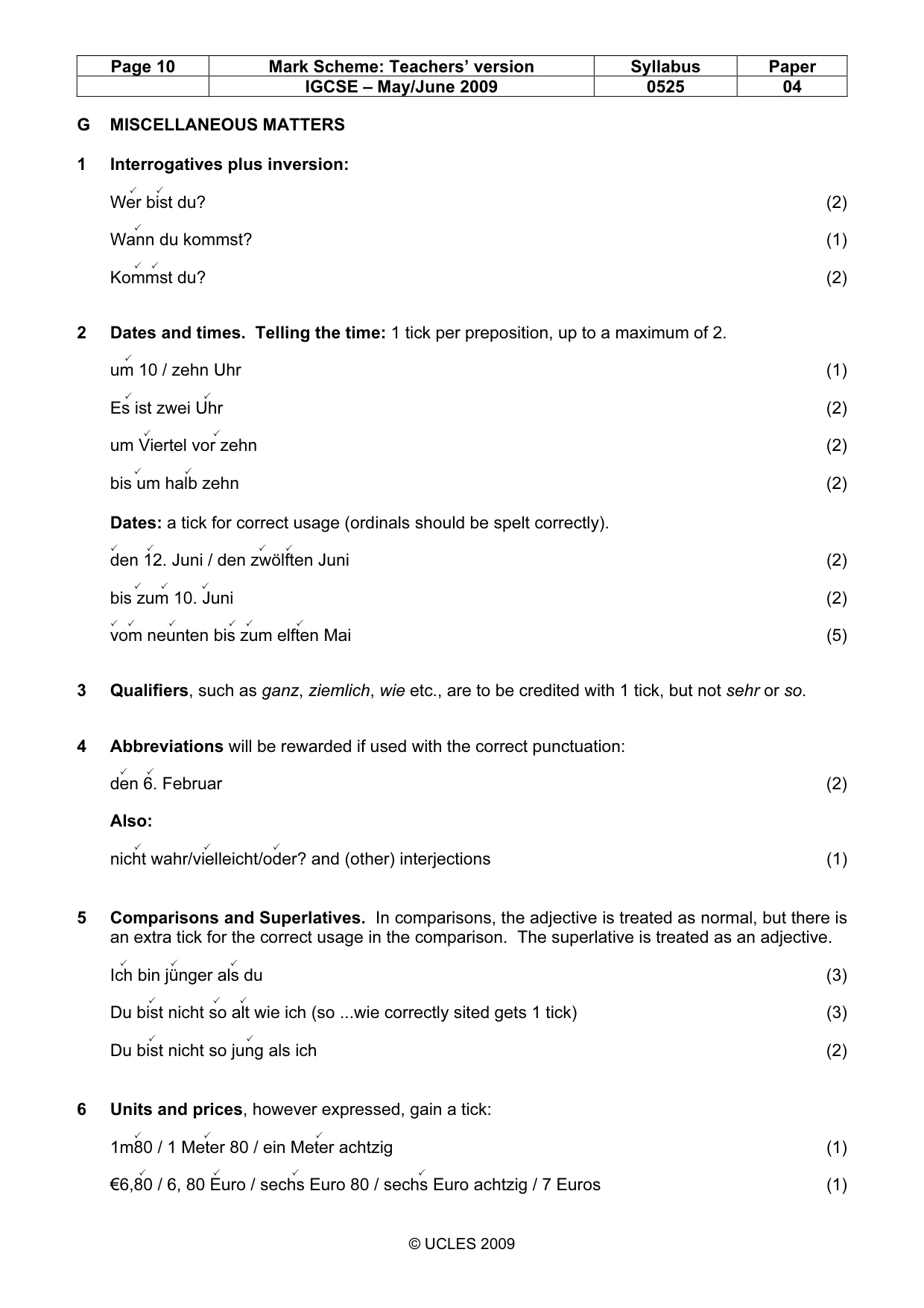
Page 10 Mark Scheme: Teachers’ version Syllabus Paper IGCSE – May/June 2009 0525 04 © UCLES 2009 G MISCELLANEOUS MATTERS 1 Interrogatives plus inversion: ✓ ✓ Wer bist du? (2) ✓ Wann du kommst? (1) ✓ ✓ Kommst du? (2) 2 Dates and times. Telling the time: 1 tick per preposition, up to a maximum of 2. ✓ um 10 / zehn Uhr (1) ✓ ✓ Es ist zwei Uhr (2) ✓ ✓ um Viertel vor zehn (2) ✓ ✓ bis um halb zehn (2) Dates: a tick for correct usage (ordinals should be spelt correctly). ✓ ✓ ✓ ✓ den 12. Juni / den zwölften Juni (2) ✓ ✓ ✓ bis zum 10. Juni (2) ✓ ✓ ✓ ✓ ✓ ✓ vom neunten bis zum elften Mai (5) 3 Qualifiers, such as ganz, ziemlich, wie etc., are to be credited with 1 tick, but not sehr or so. 4 Abbreviations will be rewarded if used with the correct punctuation: ✓ ✓ den 6. Februar (2) Also: ✓ ✓ ✓ nicht wahr/vielleicht/oder? and (other) interjections (1) 5 Comparisons and Superlatives. In comparisons, the adjective is treated as normal, but there is an extra tick for the correct usage in the comparison. The superlative is treated as an adjective. ✓ ✓ ✓ Ich bin jünger als du (3) ✓ ✓ ✓ Du bist nicht so alt wie ich (so ...wie correctly sited gets 1 tick) (3) ✓ ✓ Du bist nicht so jung als ich (2) 6 Units and prices, however expressed, gain a tick: ✓ ✓ ✓ 1m80 / 1 Meter 80 / ein Meter achtzig (1) ✓ ✓ ✓ ✓ €6,80 / 6, 80 Euro / sechs Euro 80 / sechs Euro achtzig / 7 Euros (1)
Mark scheme, page 11
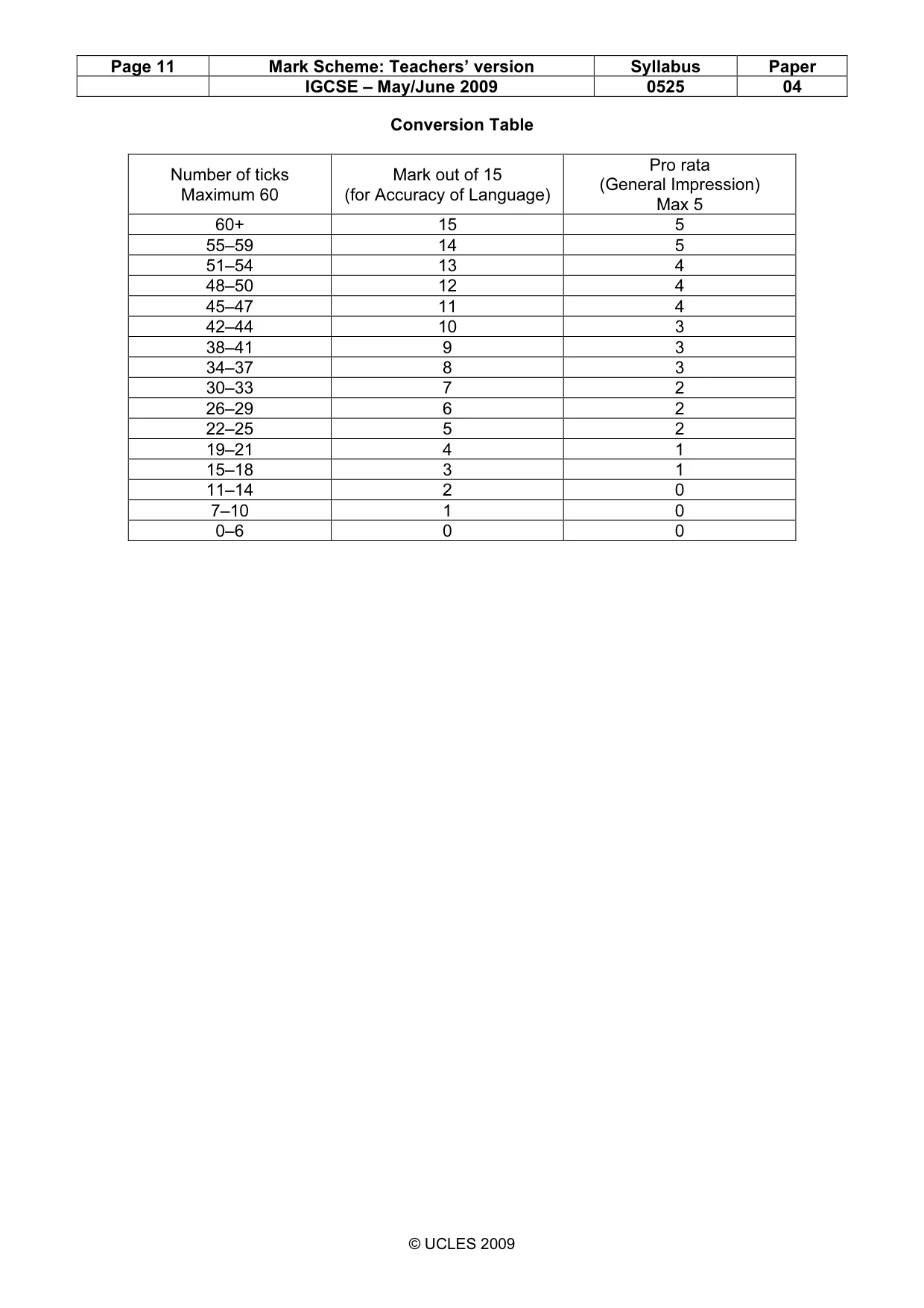
Page 11 Mark Scheme: Teachers’ version Syllabus Paper IGCSE – May/June 2009 0525 04 © UCLES 2009 Conversion Table Number of ticks Maximum 60 Mark out of 15 (for Accuracy of Language) Pro rata (General Impression) Max 5 60+ 15 5 55–59 14 5 51–54 13 4 48–50 12 4 45–47 11 4 42–44 10 3 38–41 9 3 34–37 8 3 30–33 7 2 26–29 6 2 22–25 5 2 19–21 4 1 15–18 3 1 11–14 2 0 7–10 1 0 0–6 0 0
What you needed in this session
Cambridge’s own grade thresholds for 2009 May/June, Paper 4 · Variant 1. A higher threshold means an easier paper — the bar moves with how the cohort did.