Cambridge IGCSE German - First Language 0505 — 2015 May/June Paper 2 · Variant 1
0505/21/M/J/15 · 50 marks · ≈56 min
The question paper and its mark scheme, free to read here and free to download. This is Cambridge’s own paper, exactly as it was sat.
Question paper4 pages
Mark scheme5 pages
Answers below. Sit the paper first if you are practising.
Paper as text
Question paper, page 1
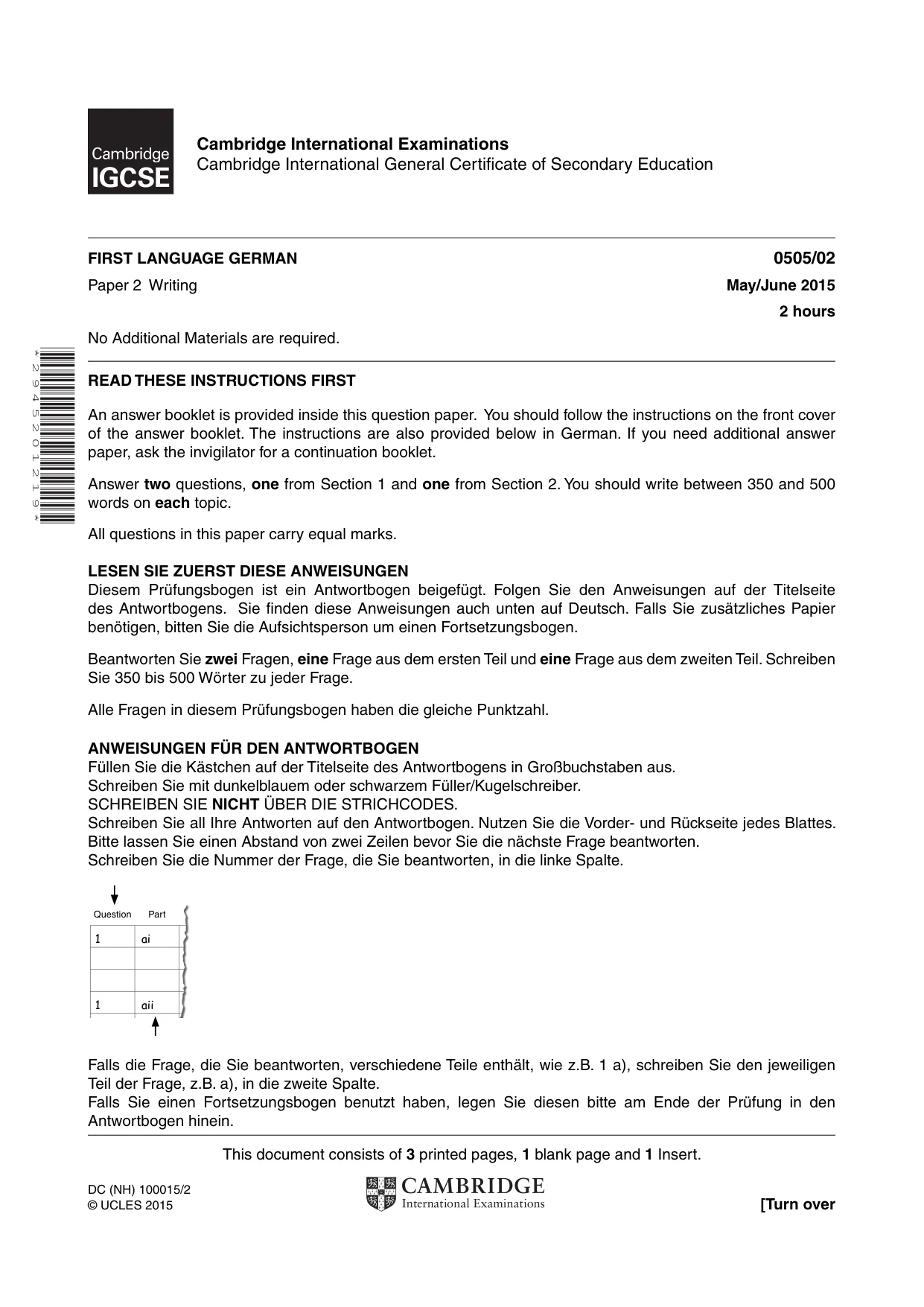
This document consists of 3 printed pages, 1 blank page and 1 Insert. DC (NH) 100015/2 © UCLES 2015 [Turn over * 2 9 4 5 2 0 1 2 1 9 * FIRST LANGUAGE GERMAN 0505/02 Paper 2 Writing May/June 2015 2 hours No Additional Materials are required. READ THESE INSTRUCTIONS FIRST An answer booklet is provided inside this question paper. You should follow the instructions on the front cover of the answer booklet. The instructions are also provided below in German. If you need additional answer paper, ask the invigilator for a continuation booklet. Answer two questions, one from Section 1 and one from Section 2. You should write between 350 and 500 words on each topic. All questions in this paper carry equal marks. LESEN SIE ZUERST DIESE ANWEISUNGEN Diesem Prüfungsbogen ist ein Antwortbogen beigefügt. Folgen Sie den Anweisungen auf der Titelseite des Antwortbogens. Sie finden diese Anweisungen auch unten auf Deutsch. Falls Sie zusätzliches Papier benötigen, bitten Sie die Aufsichtsperson um einen Fortsetzungsbogen. Beantworten Sie zwei Fragen, eine Frage aus dem ersten Teil und eine Frage aus dem zweiten Teil. Schreiben Sie 350 bis 500 Wörter zu jeder Frage. Alle Fragen in diesem Prüfungsbogen haben die gleiche Punktzahl. ANWEISUNGEN FÜR DEN ANTWORTBOGEN Füllen Sie die Kästchen auf der Titelseite des Antwortbogens in Großbuchstaben aus. Schreiben Sie mit dunkelblauem oder schwarzem Füller/Kugelschreiber. SCHREIBEN SIE NICHT ÜBER DIE STRICHCODES. Schreiben Sie all Ihre Antworten auf den Antwortbogen. Nutzen Sie die Vorder- und Rückseite jedes Blattes. Bitte lassen Sie einen Abstand von zwei Zeilen bevor Sie die nächste Frage beantworten. Schreiben Sie die Nummer der Frage, die Sie beantworten, in die linke Spalte. Question Part 1 1 ai aii Falls die Frage, die Sie beantworten, verschiedene Teile enthält, wie z.B. 1 a), schreiben Sie den jeweiligen Teil der Frage, z.B. a), in die zweite Spalte. Falls Sie einen Fortsetzungsbogen benutzt haben, legen Sie diesen bitte am Ende der Prüfung in den Antwortbogen hinein. Cambridge International Examinations Cambridge International General Certificate of Secondary Education
Question paper, page 2
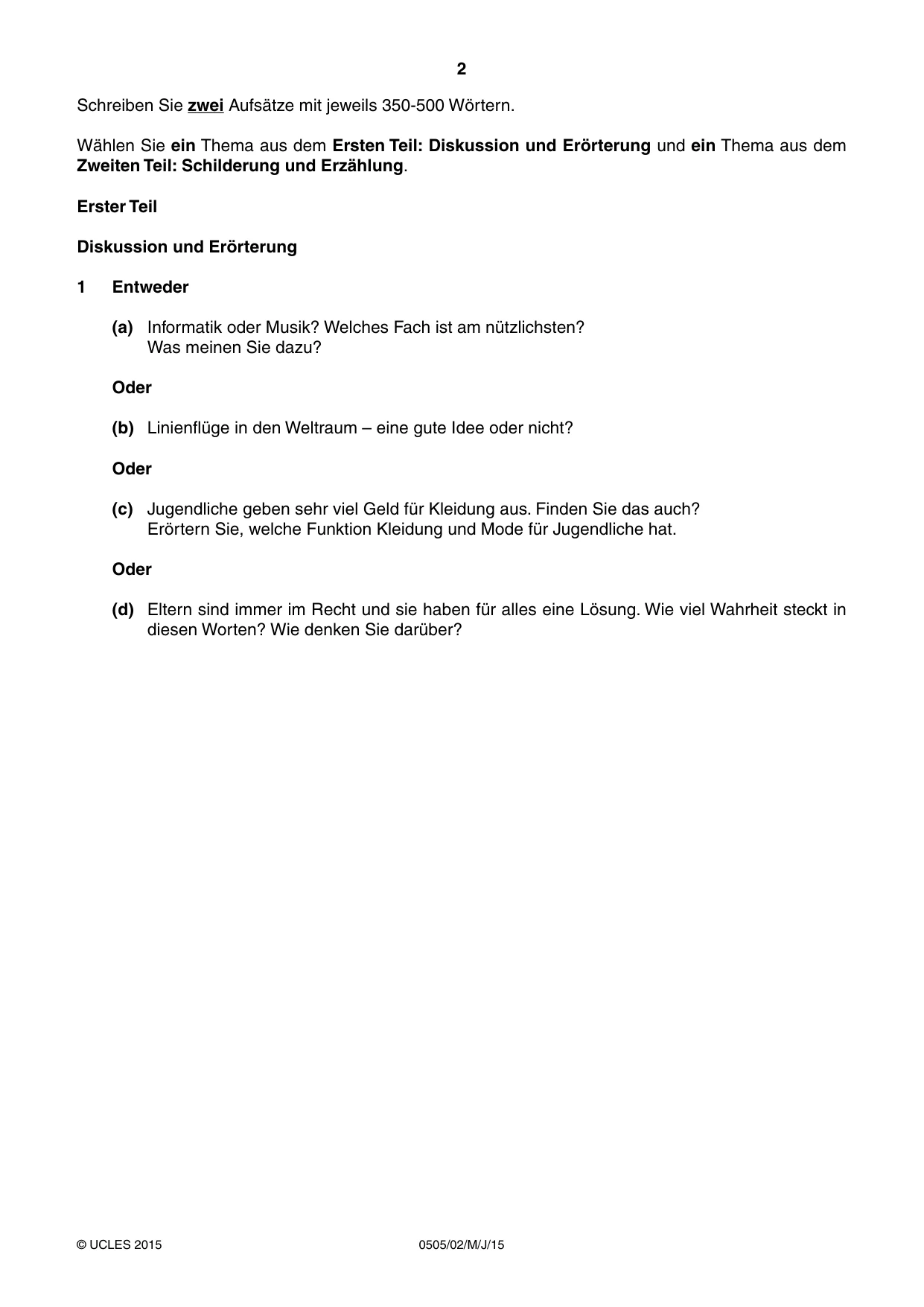
2 0505/02/M/J/15 © UCLES 2015 Schreiben Sie zwei Aufsätze mit jeweils 350-500 Wörtern. Wählen Sie ein Thema aus dem Ersten Teil: Diskussion und Erörterung und ein Thema aus dem Zweiten Teil: Schilderung und Erzählung. Erster Teil Diskussion und Erörterung 1 Entweder (a) Informatik oder Musik? Welches Fach ist am nützlichsten? Was meinen Sie dazu? Oder (b) Linienflüge in den Weltraum – eine gute Idee oder nicht? Oder (c) Jugendliche geben sehr viel Geld für Kleidung aus. Finden Sie das auch? Erörtern Sie, welche Funktion Kleidung und Mode für Jugendliche hat. Oder (d) Eltern sind immer im Recht und sie haben für alles eine Lösung. Wie viel Wahrheit steckt in diesen Worten? Wie denken Sie darüber?
Question paper, page 3
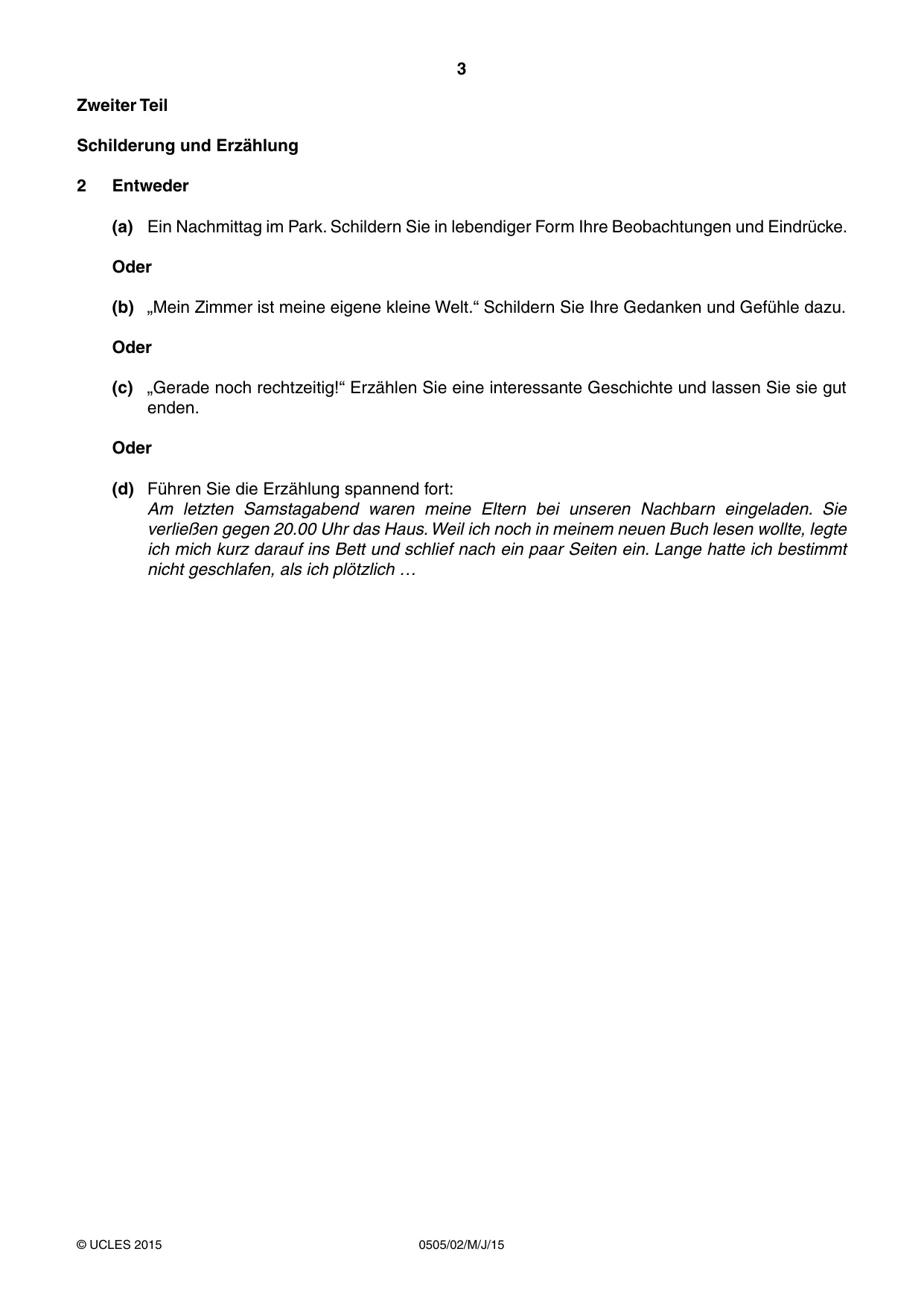
3 0505/02/M/J/15 © UCLES 2015 Zweiter Teil Schilderung und Erzählung 2 Entweder (a) Ein Nachmittag im Park. Schildern Sie in lebendiger Form Ihre Beobachtungen und Eindrücke. Oder (b) „Mein Zimmer ist meine eigene kleine Welt.“ Schildern Sie Ihre Gedanken und Gefühle dazu. Oder (c) „Gerade noch rechtzeitig!“ Erzählen Sie eine interessante Geschichte und lassen Sie sie gut enden. Oder (d) Führen Sie die Erzählung spannend fort: Am letzten Samstagabend waren meine Eltern bei unseren Nachbarn eingeladen. Sie verließen gegen 20.00 Uhr das Haus. Weil ich noch in meinem neuen Buch lesen wollte, legte ich mich kurz darauf ins Bett und schlief nach ein paar Seiten ein. Lange hatte ich bestimmt nicht geschlafen, als ich plötzlich …
Question paper, page 4
4 0505/02/M/J/15 © UCLES 2015 Cambridge International Examinations is part of the Cambridge Assessment Group. Cambridge Assessment is the brand name of University of Cambridge Local Examinations Syndicate (UCLES), which is itself a department of the University of Cambridge. BLANK PAGE
Mark scheme, page 1
® IGCSE is the registered trademark of Cambridge International Examinations. CAMBRIDGE INTERNATIONAL EXAMINATIONS Cambridge International General Certificate of Secondary Education MARK SCHEME for the May/June 2015 series 0505 FIRST LANGUAGE GERMAN 0505/02 Paper 2 (Writing), maximum raw mark 50 This mark scheme is published as an aid to teachers and candidates, to indicate the requirements of the examination. It shows the basis on which Examiners were instructed to award marks. It does not indicate the details of the discussions that took place at an Examiners’ meeting before marking began, which would have considered the acceptability of alternative answers. Mark schemes should be read in conjunction with the question paper and the Principal Examiner Report for Teachers. Cambridge will not enter into discussions about these mark schemes. Cambridge is publishing the mark schemes for the May/June 2015 series for most Cambridge IGCSE®, Cambridge International A and AS Level components and some Cambridge O Level components.
Mark scheme, page 2
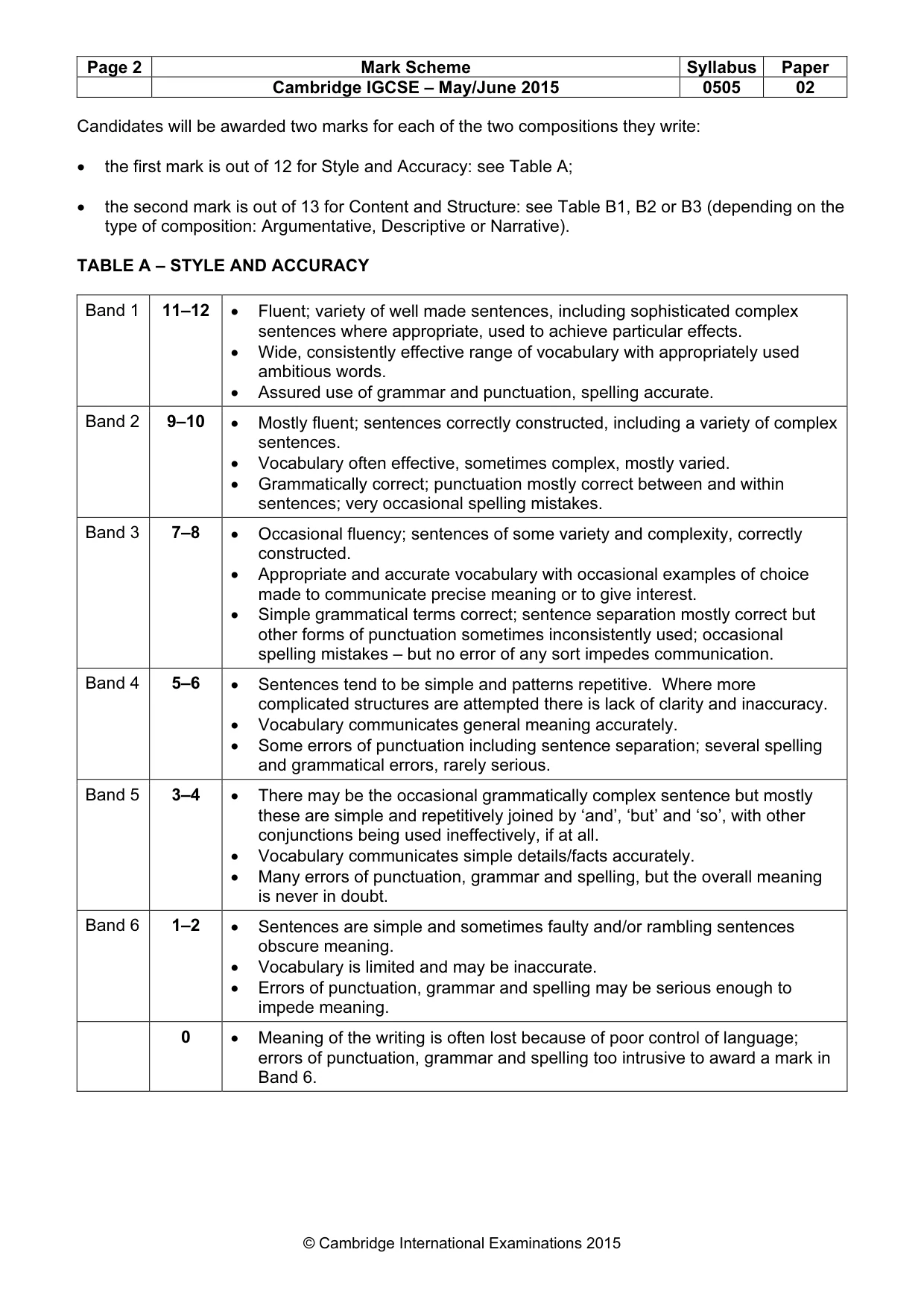
Page 2 Mark Scheme Syllabus Paper Cambridge IGCSE – May/June 2015 0505 02 © Cambridge International Examinations 2015 Candidates will be awarded two marks for each of the two compositions they write: • the first mark is out of 12 for Style and Accuracy: see Table A; • the second mark is out of 13 for Content and Structure: see Table B1, B2 or B3 (depending on the type of composition: Argumentative, Descriptive or Narrative). TABLE A – STYLE AND ACCURACY Band 1 11–12 • Fluent; variety of well made sentences, including sophisticated complex sentences where appropriate, used to achieve particular effects. • Wide, consistently effective range of vocabulary with appropriately used ambitious words. • Assured use of grammar and punctuation, spelling accurate. Band 2 9–10 • Mostly fluent; sentences correctly constructed, including a variety of complex sentences. • Vocabulary often effective, sometimes complex, mostly varied. • Grammatically correct; punctuation mostly correct between and within sentences; very occasional spelling mistakes. Band 3 7–8 • Occasional fluency; sentences of some variety and complexity, correctly constructed. • Appropriate and accurate vocabulary with occasional examples of choice made to communicate precise meaning or to give interest. • Simple grammatical terms correct; sentence separation mostly correct but other forms of punctuation sometimes inconsistently used; occasional spelling mistakes – but no error of any sort impedes communication. Band 4 5–6 • Sentences tend to be simple and patterns repetitive. Where more complicated structures are attempted there is lack of clarity and inaccuracy. • Vocabulary communicates general meaning accurately. • Some errors of punctuation including sentence separation; several spelling and grammatical errors, rarely serious. Band 5 3–4 • There may be the occasional grammatically complex sentence but mostly these are simple and repetitively joined by ‘and’, ‘but’ and ‘so’, with other conjunctions being used ineffectively, if at all. • Vocabulary communicates simple details/facts accurately. • Many errors of punctuation, grammar and spelling, but the overall meaning is never in doubt. Band 6 1–2 • Sentences are simple and sometimes faulty and/or rambling sentences obscure meaning. • Vocabulary is limited and may be inaccurate. • Errors of punctuation, grammar and spelling may be serious enough to impede meaning. 0 • Meaning of the writing is often lost because of poor control of language; errors of punctuation, grammar and spelling too intrusive to award a mark in Band 6.
Mark scheme, page 3
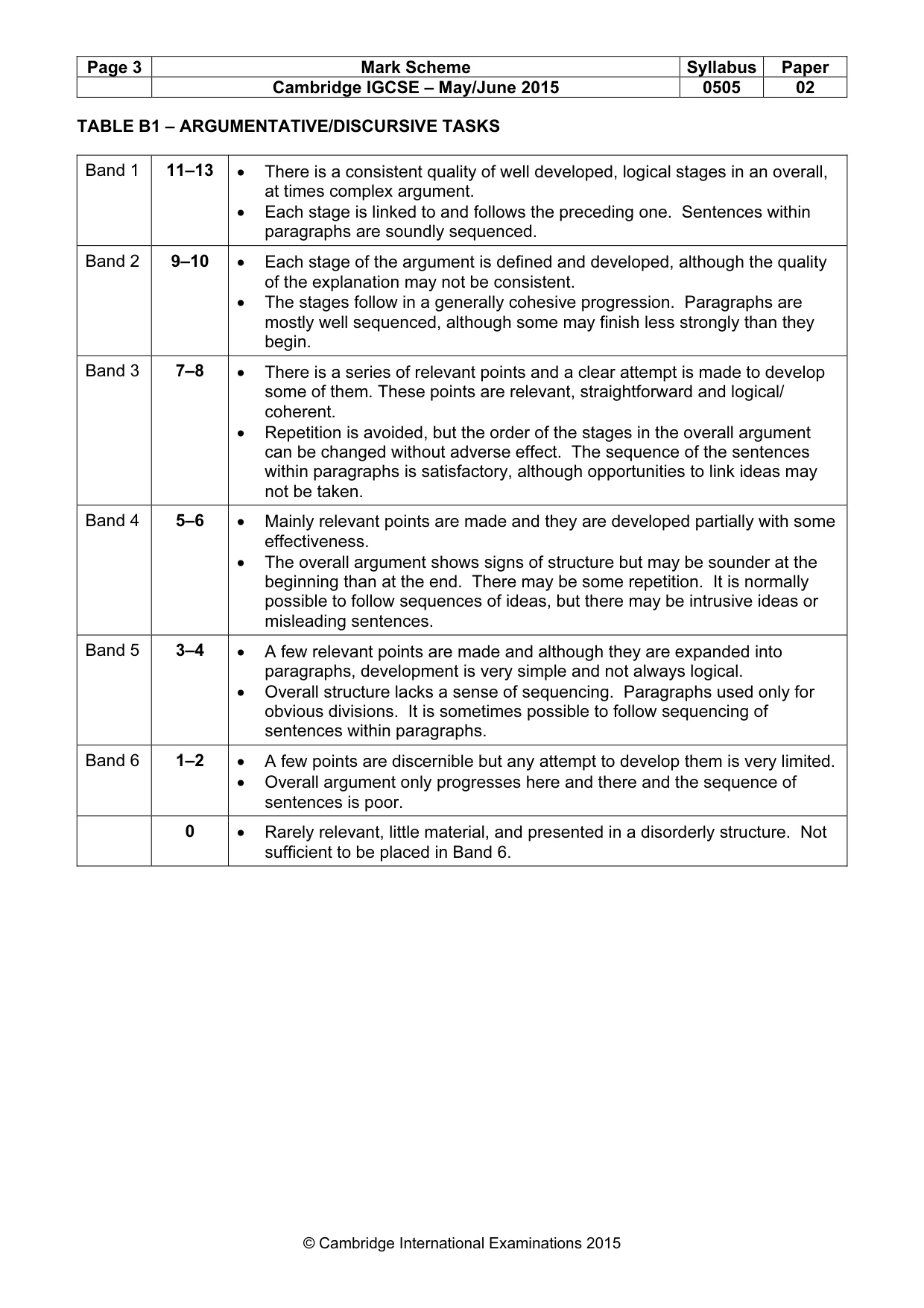
Page 3 Mark Scheme Syllabus Paper Cambridge IGCSE – May/June 2015 0505 02 © Cambridge International Examinations 2015 TABLE B1 – ARGUMENTATIVE/DISCURSIVE TASKS Band 1 11–13 • There is a consistent quality of well developed, logical stages in an overall, at times complex argument. • Each stage is linked to and follows the preceding one. Sentences within paragraphs are soundly sequenced. Band 2 9–10 • Each stage of the argument is defined and developed, although the quality of the explanation may not be consistent. • The stages follow in a generally cohesive progression. Paragraphs are mostly well sequenced, although some may finish less strongly than they begin. Band 3 7–8 • There is a series of relevant points and a clear attempt is made to develop some of them. These points are relevant, straightforward and logical/ coherent. • Repetition is avoided, but the order of the stages in the overall argument can be changed without adverse effect. The sequence of the sentences within paragraphs is satisfactory, although opportunities to link ideas may not be taken. Band 4 5–6 • Mainly relevant points are made and they are developed partially with some effectiveness. • The overall argument shows signs of structure but may be sounder at the beginning than at the end. There may be some repetition. It is normally possible to follow sequences of ideas, but there may be intrusive ideas or misleading sentences. Band 5 3–4 • A few relevant points are made and although they are expanded into paragraphs, development is very simple and not always logical. • Overall structure lacks a sense of sequencing. Paragraphs used only for obvious divisions. It is sometimes possible to follow sequencing of sentences within paragraphs. Band 6 1–2 • A few points are discernible but any attempt to develop them is very limited. • Overall argument only progresses here and there and the sequence of sentences is poor. 0 • Rarely relevant, little material, and presented in a disorderly structure. Not sufficient to be placed in Band 6.
Mark scheme, page 4
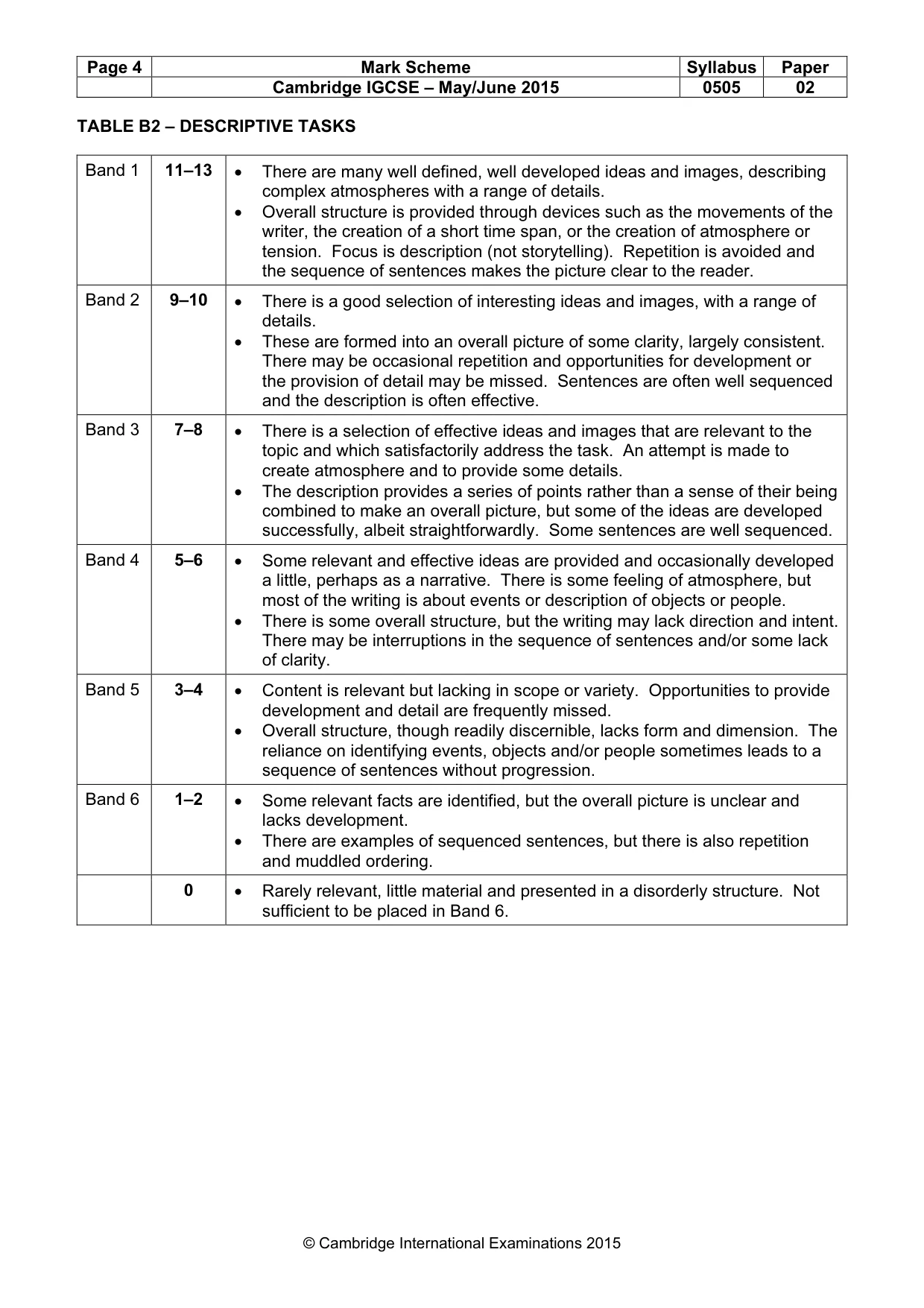
Page 4 Mark Scheme Syllabus Paper Cambridge IGCSE – May/June 2015 0505 02 © Cambridge International Examinations 2015 TABLE B2 – DESCRIPTIVE TASKS Band 1 11–13 • There are many well defined, well developed ideas and images, describing complex atmospheres with a range of details. • Overall structure is provided through devices such as the movements of the writer, the creation of a short time span, or the creation of atmosphere or tension. Focus is description (not storytelling). Repetition is avoided and the sequence of sentences makes the picture clear to the reader. Band 2 9–10 • There is a good selection of interesting ideas and images, with a range of details. • These are formed into an overall picture of some clarity, largely consistent. There may be occasional repetition and opportunities for development or the provision of detail may be missed. Sentences are often well sequenced and the description is often effective. Band 3 7–8 • There is a selection of effective ideas and images that are relevant to the topic and which satisfactorily address the task. An attempt is made to create atmosphere and to provide some details. • The description provides a series of points rather than a sense of their being combined to make an overall picture, but some of the ideas are developed successfully, albeit straightforwardly. Some sentences are well sequenced. Band 4 5–6 • Some relevant and effective ideas are provided and occasionally developed a little, perhaps as a narrative. There is some feeling of atmosphere, but most of the writing is about events or description of objects or people. • There is some overall structure, but the writing may lack direction and intent. There may be interruptions in the sequence of sentences and/or some lack of clarity. Band 5 3–4 • Content is relevant but lacking in scope or variety. Opportunities to provide development and detail are frequently missed. • Overall structure, though readily discernible, lacks form and dimension. The reliance on identifying events, objects and/or people sometimes leads to a sequence of sentences without progression. Band 6 1–2 • Some relevant facts are identified, but the overall picture is unclear and lacks development. • There are examples of sequenced sentences, but there is also repetition and muddled ordering. 0 • Rarely relevant, little material and presented in a disorderly structure. Not sufficient to be placed in Band 6.
Mark scheme, page 5
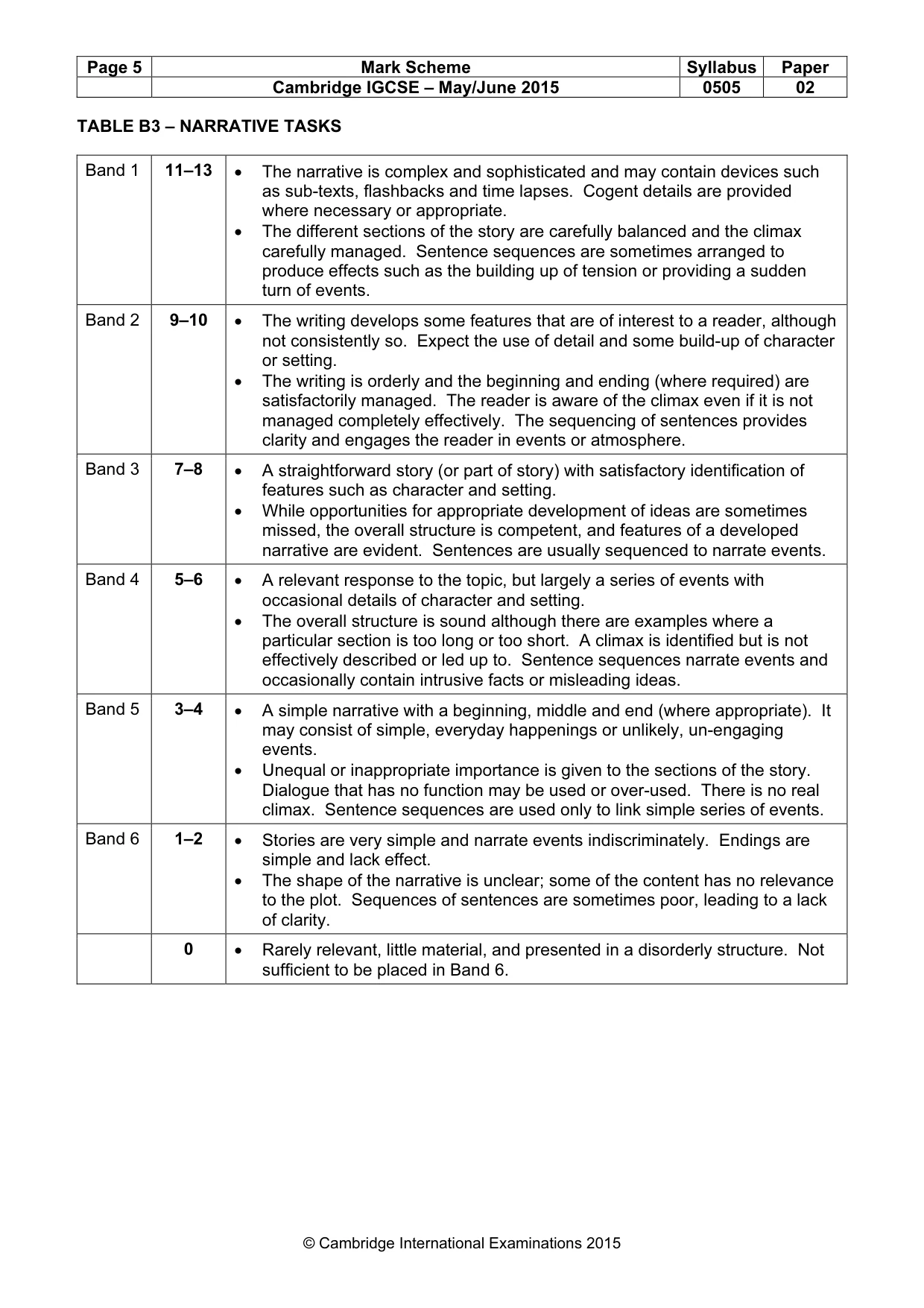
Page 5 Mark Scheme Syllabus Paper Cambridge IGCSE – May/June 2015 0505 02 © Cambridge International Examinations 2015 TABLE B3 – NARRATIVE TASKS Band 1 11–13 • The narrative is complex and sophisticated and may contain devices such as sub-texts, flashbacks and time lapses. Cogent details are provided where necessary or appropriate. • The different sections of the story are carefully balanced and the climax carefully managed. Sentence sequences are sometimes arranged to produce effects such as the building up of tension or providing a sudden turn of events. Band 2 9–10 • The writing develops some features that are of interest to a reader, although not consistently so. Expect the use of detail and some build-up of character or setting. • The writing is orderly and the beginning and ending (where required) are satisfactorily managed. The reader is aware of the climax even if it is not managed completely effectively. The sequencing of sentences provides clarity and engages the reader in events or atmosphere. Band 3 7–8 • A straightforward story (or part of story) with satisfactory identification of features such as character and setting. • While opportunities for appropriate development of ideas are sometimes missed, the overall structure is competent, and features of a developed narrative are evident. Sentences are usually sequenced to narrate events. Band 4 5–6 • A relevant response to the topic, but largely a series of events with occasional details of character and setting. • The overall structure is sound although there are examples where a particular section is too long or too short. A climax is identified but is not effectively described or led up to. Sentence sequences narrate events and occasionally contain intrusive facts or misleading ideas. Band 5 3–4 • A simple narrative with a beginning, middle and end (where appropriate). It may consist of simple, everyday happenings or unlikely, un-engaging events. • Unequal or inappropriate importance is given to the sections of the story. Dialogue that has no function may be used or over-used. There is no real climax. Sentence sequences are used only to link simple series of events. Band 6 1–2 • Stories are very simple and narrate events indiscriminately. Endings are simple and lack effect. • The shape of the narrative is unclear; some of the content has no relevance to the plot. Sequences of sentences are sometimes poor, leading to a lack of clarity. 0 • Rarely relevant, little material, and presented in a disorderly structure. Not sufficient to be placed in Band 6.
What you needed in this session
Cambridge’s own grade thresholds for 2015 May/June, Paper 2 · Variant 1. A higher threshold means an easier paper — the bar moves with how the cohort did.