Cambridge IGCSE French - Foreign Language 0520 — 2016 May/June Paper 4 · Variant 3
0520/43/M/J/16 · 50 marks · ≈56 min
The question paper and its mark scheme, free to read here and free to download. This is Cambridge’s own paper, exactly as it was sat.
Question paper8 pages

Mark scheme31 pages
Answers below. Sit the paper first if you are practising.
Paper as text
Question paper, page 1
This document consists of 6 printed pages and 2 blank pages. DC (NH/FD) 110769/2 © UCLES 2016 [Turn over * 7 0 0 3 6 3 5 3 5 0 * FRENCH 0520/43 Paper 4 Writing May/June 2016 1 hour Candidates answer on the Question Paper. No Additional Materials are required. READ THESE INSTRUCTIONS FIRST Write your Centre number, candidate number and name on all the work you hand in. Write in dark blue or black pen. Do not use staples, paper clips, glue or correction fluid. DO NOT WRITE IN ANY BARCODES. Answer three questions: Question 1, Question 2 and Question 3(a) or Question 3(b) or Question 3(c). The number of marks is given in brackets [ ] at the end of each question or part question. The syllabus is approved for use in England, Wales and Northern Ireland as a Cambridge International Level 1/Level 2 Certificate. Cambridge International Examinations Cambridge International General Certificate of Secondary Education
Question paper, page 2
2 0520/43/M/J/16 © UCLES 2016 BLANK PAGE
Question paper, page 3
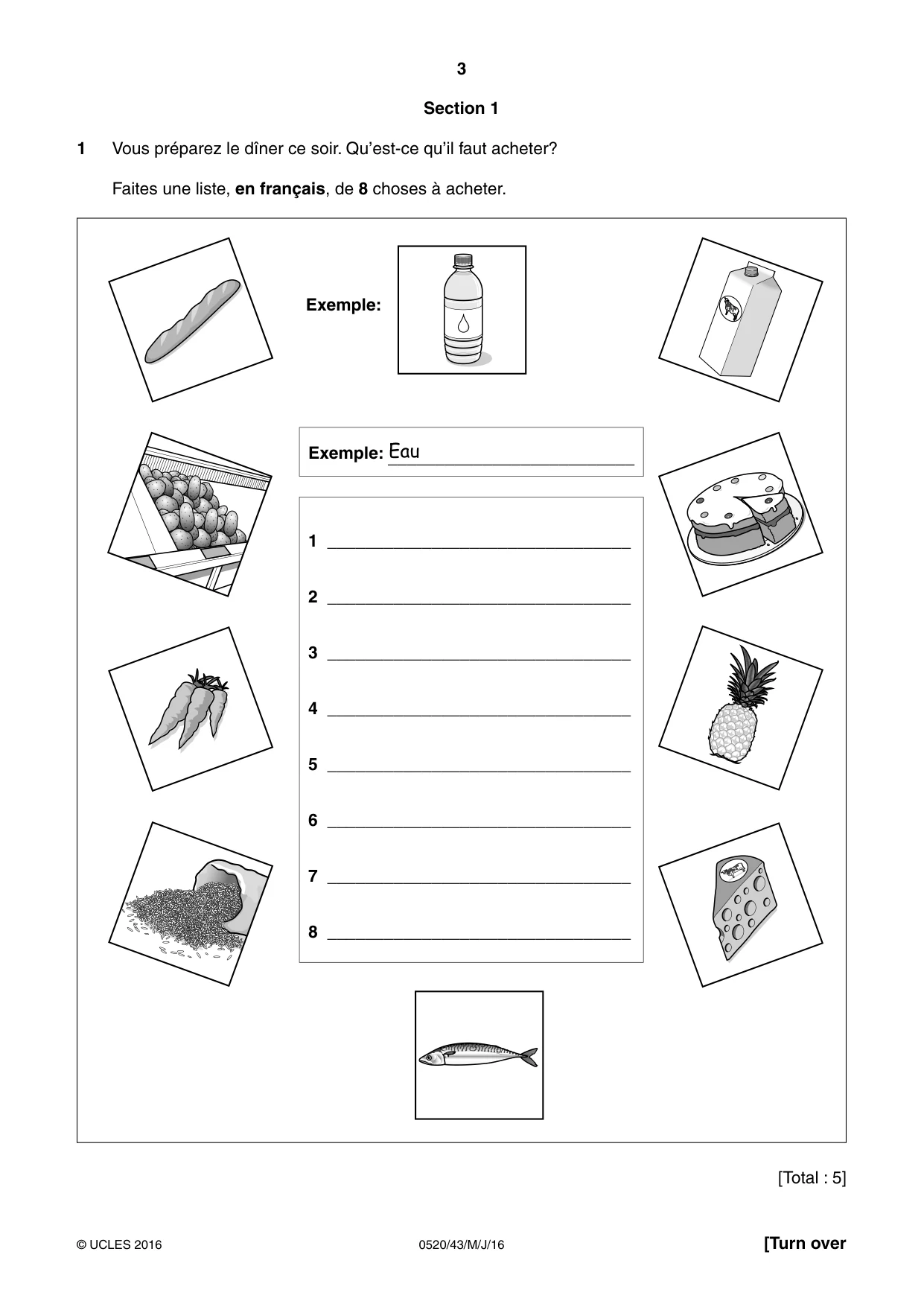
3 0520/43/M/J/16 © UCLES 2016 [Turn over Section 1 1 Vous préparez le dîner ce soir. Qu’est-ce qu’il faut acheter? Faites une liste, en français, de 8 choses à acheter. Exemple: Exemple: Eau __________________________ 1 ________________________________ 2 ________________________________ 3 ________________________________ 4 ________________________________ 5 ________________________________ 6 ________________________________ 7 ________________________________ 8 ________________________________ [Total : 5]
Question paper, page 4
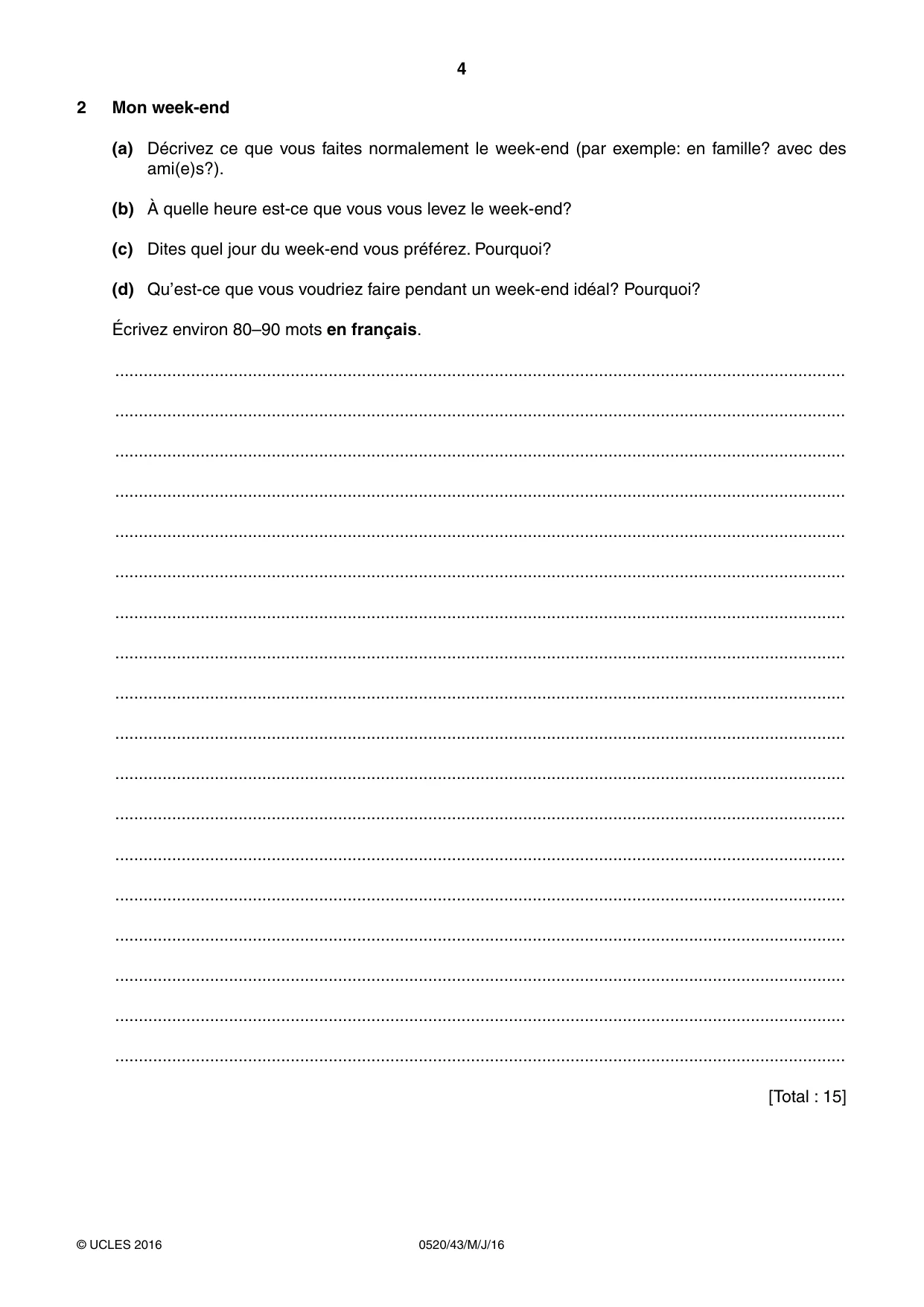
4 0520/43/M/J/16 © UCLES 2016 2 Mon week-end (a) Décrivez ce que vous faites normalement le week-end (par exemple: en famille? avec des ami(e)s?). (b) À quelle heure est-ce que vous vous levez le week-end? (c) Dites quel jour du week-end vous préférez. Pourquoi? (d) Qu’est-ce que vous voudriez faire pendant un week-end idéal? Pourquoi? Écrivez environ 80–90 mots en français. … … … … … … … … … … … … … … … … … … [Total : 15]
Question paper, page 5
5 0520/43/M/J/16 © UCLES 2016 [Turn over Tournez la page pour la Section 2.
Question paper, page 6
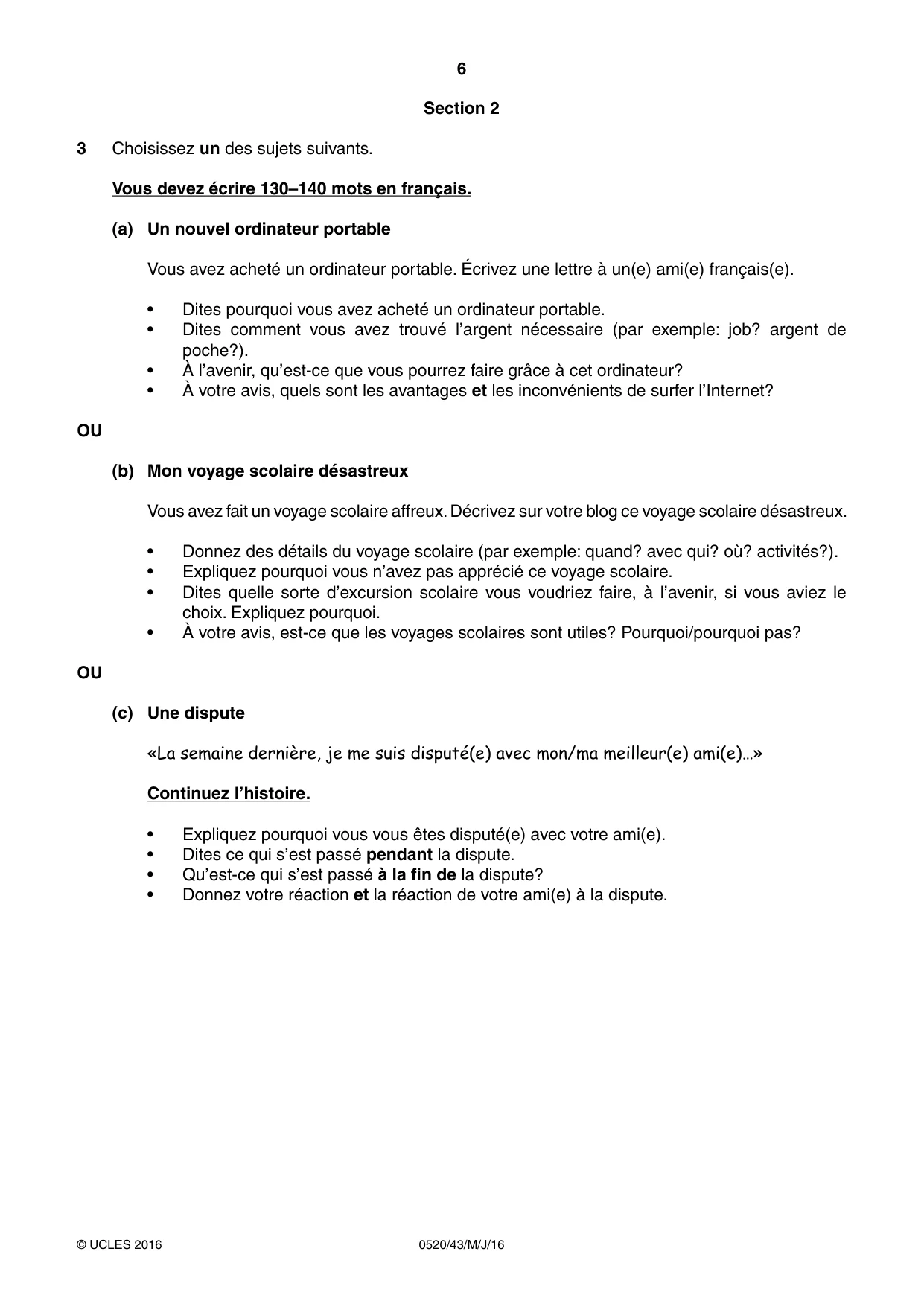
6 0520/43/M/J/16 © UCLES 2016 Se ction 2 3 Choisissez un des sujets suivants. Vous devez écrire 130–140 mots en français. (a) Un nouvel ordinateur portable Vous avez acheté un ordinateur portable. Écrivez une lettre à un(e) ami(e) français(e). • Dites pourquoi vous avez acheté un ordinateur portable. • Dites comment vous avez trouvé l’argent nécessaire (par exemple: job? argent de poche?). • À l’avenir, qu’est-ce que vous pourrez faire grâce à cet ordinateur? • À votre avis, quels sont les avantages et les inconvénients de surfer l’Internet? OU (b) Mon voyage scolaire désastreux Vous avez fait un voyage scolaire affreux. Décrivez sur votre blog ce voyage scolaire désastreux. • Donnez des détails du voyage scolaire (par exemple: quand? avec qui? où? activités?). • Expliquez pourquoi vous n’avez pas apprécié ce voyage scolaire. • Dites quelle sorte d’excursion scolaire vous voudriez faire, à l’avenir, si vous aviez le choix. Expliquez pourquoi. • À votre avis, est-ce que les voyages scolaires sont utiles? Pourquoi/pourquoi pas? OU (c) Une dispute «La semaine dernière, je me su is disputé(e) avec mon/ma meilleur(e) ami(e)…» Continuez l’histoire. • Expliquez pourquoi vous vous êtes disputé(e) avec votre ami(e). • Dites ce qui s’est passé pendant la dispute. • Qu’est-ce qui s’est passé à la fin de la dispute? • Donnez votre réaction et la réaction de votre ami(e) à la dispute.
Question paper, page 7
7 0520/43/M/J/16 © UCLES 2016 ÉCRIVEZ VOTRE RÉPONSE À QUESTION 3 ICI … … … … … … … … … … … … … … … … … … … … … … … … … … [Total : 30]
Question paper, page 8
8 0520/43/M/J/16 © UCLES 2016 Permission to reproduce items where third-party owned material protected by copyright is included has been sought and cleared where possible. Every reasonable effort has been made by the publisher (UCLES) to trace copyright holders, but if any items requiring clearance have unwittingly been included, the publisher will be pleased to make amends at the earliest possible opportunity. To avoid the issue of disclosure of answer-related information to candidates, all copyright acknowledgements are reproduced online in the Cambridge International Examinations Copyright Acknowledgements Booklet. This is produced for each series of examinations and is freely available to download at www.cie.org.uk after the live examination series. Cambridge International Examinations is part of the Cambridge Assessment Group. Cambridge Assessment is the brand name of University of Cambridge Local Examinations Syndicate (UCLES), which is itself a department of the University of Cambridge. BLANK PAGE
Mark scheme, page 1
® IGCSE is the registered trademark of Cambridge International Examinations. This syllabus is approved for use in England, Wales and Northern Ireland as a Cambridge International Level 1/Level 2 Certificate. This document consists of 31 printed pages. © UCLES 2016 [Turn over Cambridge International Examinations Cambridge International General Certificate of Secondary Education FRENCH (FOREIGN LANGUAGE) 0520/43 Paper 4 Writing May/June 2016 MARK SCHEME Maximum Mark: 50 Published This mark scheme is published as an aid to teachers and candidates, to indicate the requirements of the examination. It shows the basis on which Examiners were instructed to award marks. It does not indicate the details of the discussions that took place at an Examiners’ meeting before marking began, which would have considered the acceptability of alternative answers. Mark schemes should be read in conjunction with the question paper and the Principal Examiner Report for Teachers. Cambridge will not enter into discussions about these mark schemes. Cambridge is publishing the mark schemes for the May/June 2016 series for most Cambridge IGCSE®, Cambridge International A and AS Level components and some Cambridge O Level components.
Mark scheme, page 2
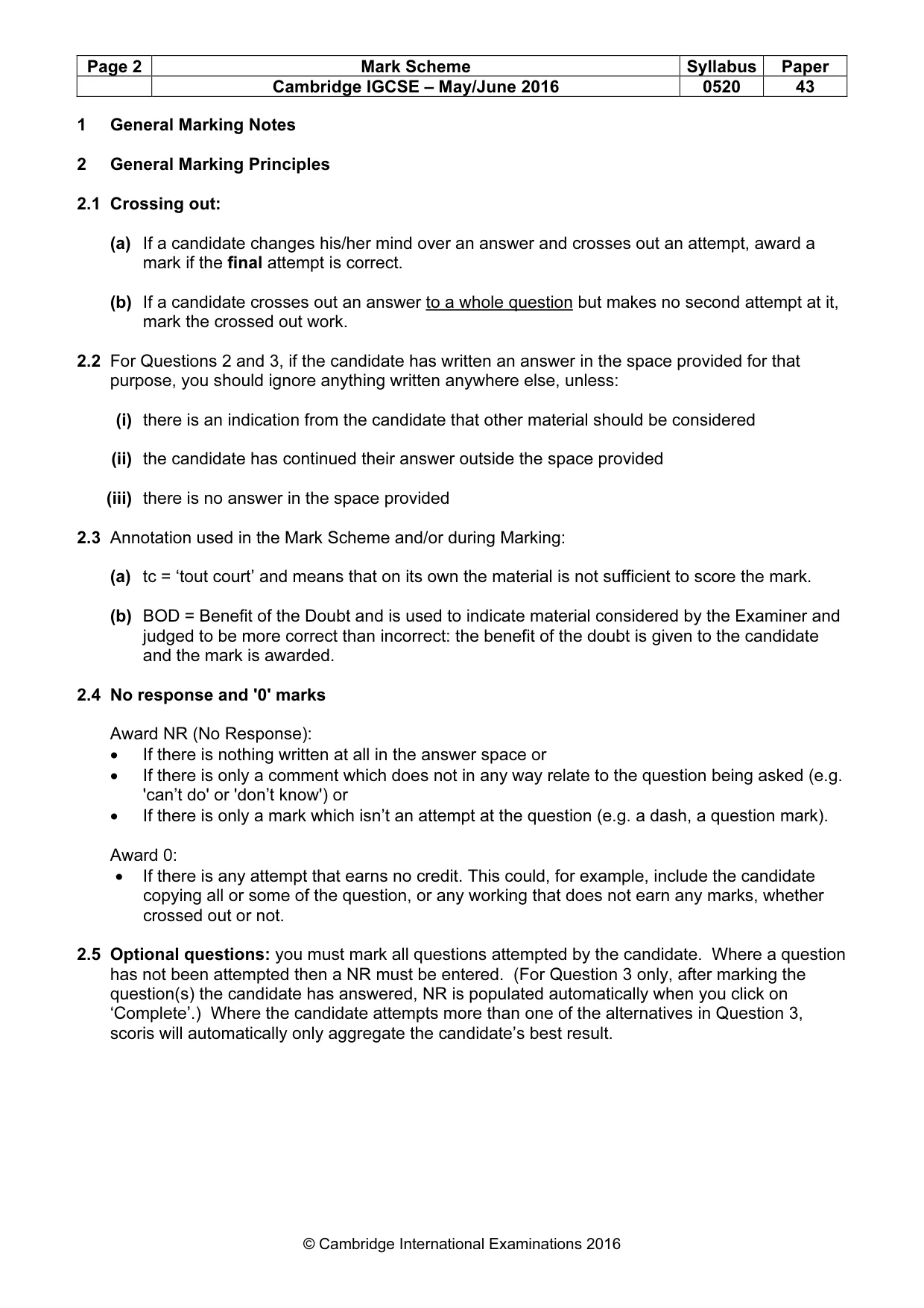
Page 2 Mark Scheme Syllabus Paper Cambridge IGCSE – May/June 2016 0520 43 © Cambridge International Examinations 2016 1 General Marking Notes 2 General Marking Principles 2.1 Crossing out: (a) If a candidate changes his/her mind over an answer and crosses out an attempt, award a mark if the final attempt is correct. (b) If a candidate crosses out an answer to a whole question but makes no second attempt at it, mark the crossed out work. 2.2 For Questions 2 and 3, if the candidate has written an answer in the space provided for that purpose, you should ignore anything written anywhere else, unless: (i) there is an indication from the candidate that other material should be considered (ii) the candidate has continued their answer outside the space provided (iii) there is no answer in the space provided 2.3 Annotation used in the Mark Scheme and/or during Marking: (a) tc = ‘tout court’ and means that on its own the material is not sufficient to score the mark. (b) BOD = Benefit of the Doubt and is used to indicate material considered by the Examiner and judged to be more correct than incorrect: the benefit of the doubt is given to the candidate and the mark is awarded. 2.4 No response and '0' marks Award NR (No Response): • If there is nothing written at all in the answer space or • If there is only a comment which does not in any way relate to the question being asked (e.g. 'can’t do' or 'don’t know') or • If there is only a mark which isn’t an attempt at the question (e.g. a dash, a question mark). Award 0: • If there is any attempt that earns no credit. This could, for example, include the candidate copying all or some of the question, or any working that does not earn any marks, whether crossed out or not. 2.5 Optional questions: you must mark all questions attempted by the candidate. Where a question has not been attempted then a NR must be entered. (For Question 3 only, after marking the question(s) the candidate has answered, NR is populated automatically when you click on ‘Complete’.) Where the candidate attempts more than one of the alternatives in Question 3, scoris will automatically only aggregate the candidate’s best result.
Mark scheme, page 3
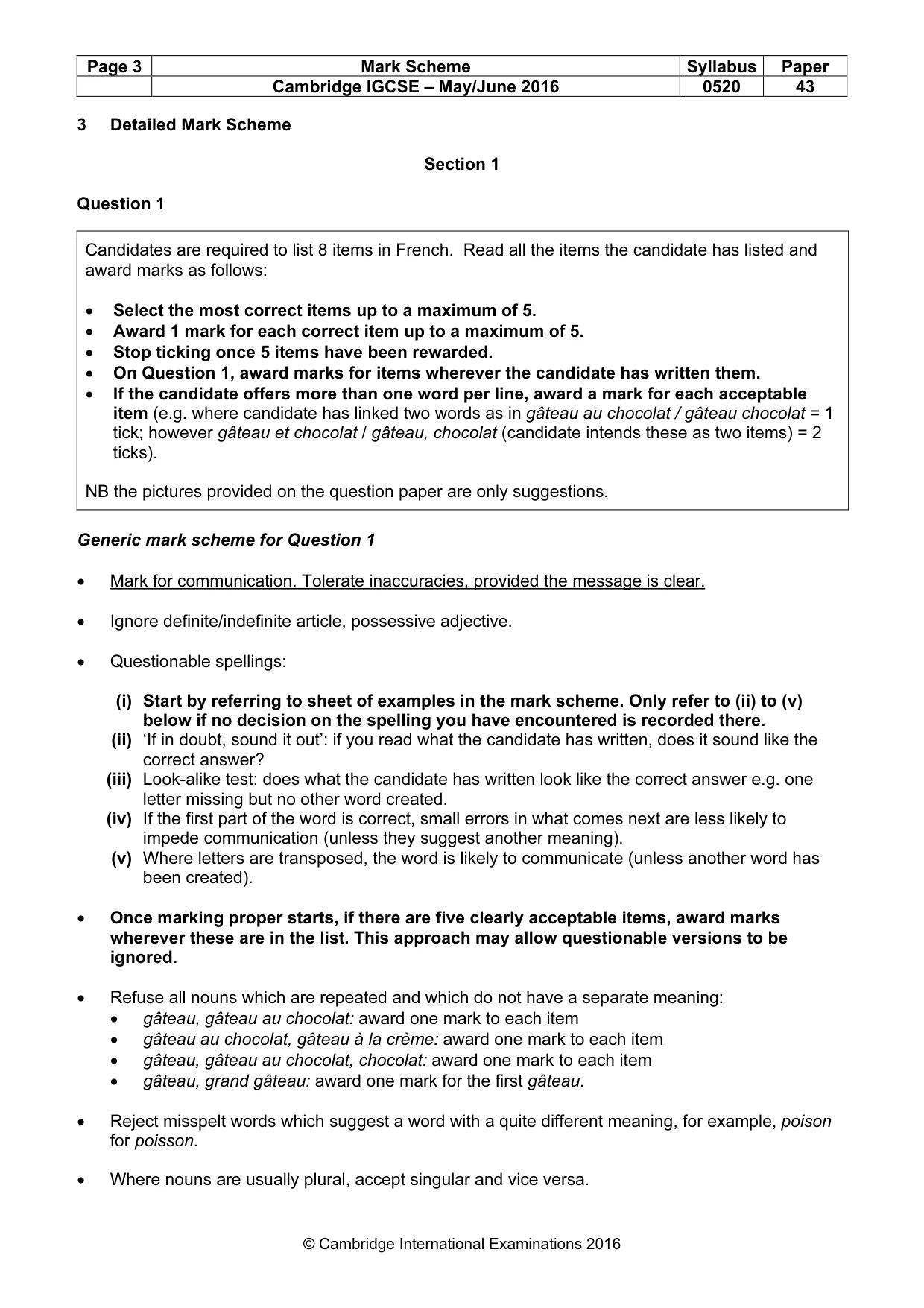
Page 3 Mark Scheme Syllabus Paper Cambridge IGCSE – May/June 2016 0520 43 © Cambridge International Examinations 2016 3 Detailed Mark Scheme Section 1 Question 1 Candidates are required to list 8 items in French. Read all the items the candidate has listed and award marks as follows: • Select the most correct items up to a maximum of 5. • Award 1 mark for each correct item up to a maximum of 5. • Stop ticking once 5 items have been rewarded. • On Question 1, award marks for items wherever the candidate has written them. • If the candidate offers more than one word per line, award a mark for each acceptable item (e.g. where candidate has linked two words as in gâteau au chocolat / gâteau chocolat = 1 tick; however gâteau et chocolat / gâteau, chocolat (candidate intends these as two items) = 2 ticks). NB the pictures provided on the question paper are only suggestions. Generic mark scheme for Question 1 • Mark for communication. Tolerate inaccuracies, provided the message is clear. • Ignore definite/indefinite article, possessive adjective. • Questionable spellings: (i) Start by referring to sheet of examples in the mark scheme. Only refer to (ii) to (v) below if no decision on the spelling you have encountered is recorded there. (ii) ‘If in doubt, sound it out’: if you read what the candidate has written, does it sound like the correct answer? (iii) Look-alike test: does what the candidate has written look like the correct answer e.g. one letter missing but no other word created. (iv) If the first part of the word is correct, small errors in what comes next are less likely to impede communication (unless they suggest another meaning). (v) Where letters are transposed, the word is likely to communicate (unless another word has been created). • Once marking proper starts, if there are five clearly acceptable items, award marks wherever these are in the list. This approach may allow questionable versions to be ignored. • Refuse all nouns which are repeated and which do not have a separate meaning: • gâteau, gâteau au chocolat: award one mark to each item • gâteau au chocolat, gâteau à la crème: award one mark to each item • gâteau, gâteau au chocolat, chocolat: award one mark to each item • gâteau, grand gâteau: award one mark for the first gâteau. • Reject misspelt words which suggest a word with a quite different meaning, for example, poison for poisson. • Where nouns are usually plural, accept singular and vice versa.
Mark scheme, page 4
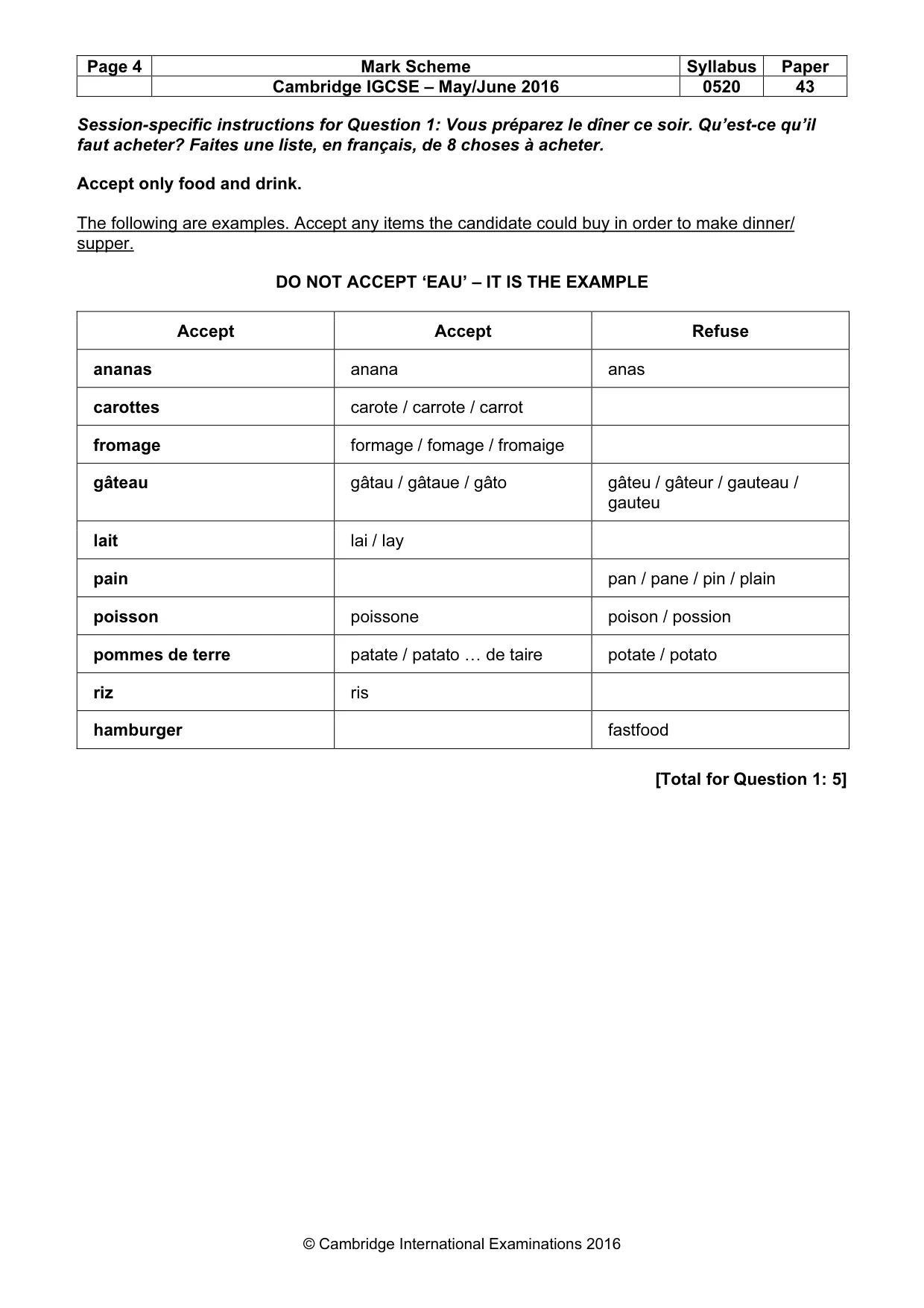
Page 4 Mark Scheme Syllabus Paper Cambridge IGCSE – May/June 2016 0520 43 © Cambridge International Examinations 2016 Session-specific instructions for Question 1: Vous préparez le dîner ce soir. Qu’est-ce qu’il faut acheter? Faites une liste, en français, de 8 choses à acheter. Accept only food and drink. The following are examples. Accept any items the candidate could buy in order to make dinner/ supper. DO NOT ACCEPT ‘EAU’ – IT IS THE EXAMPLE Accept Accept Refuse ananas anana anas carottes carote / carrote / carrot fromage formage / fomage / fromaige gâteau gâtau / gâtaue / gâto gâteu / gâteur / gauteau / gauteu lait lai / lay pain pan / pane / pin / plain poisson poissone poison / possion pommes de terre patate / patato … de taire potate / potato riz ris hamburger fastfood [Total for Question 1: 5]
Mark scheme, page 5
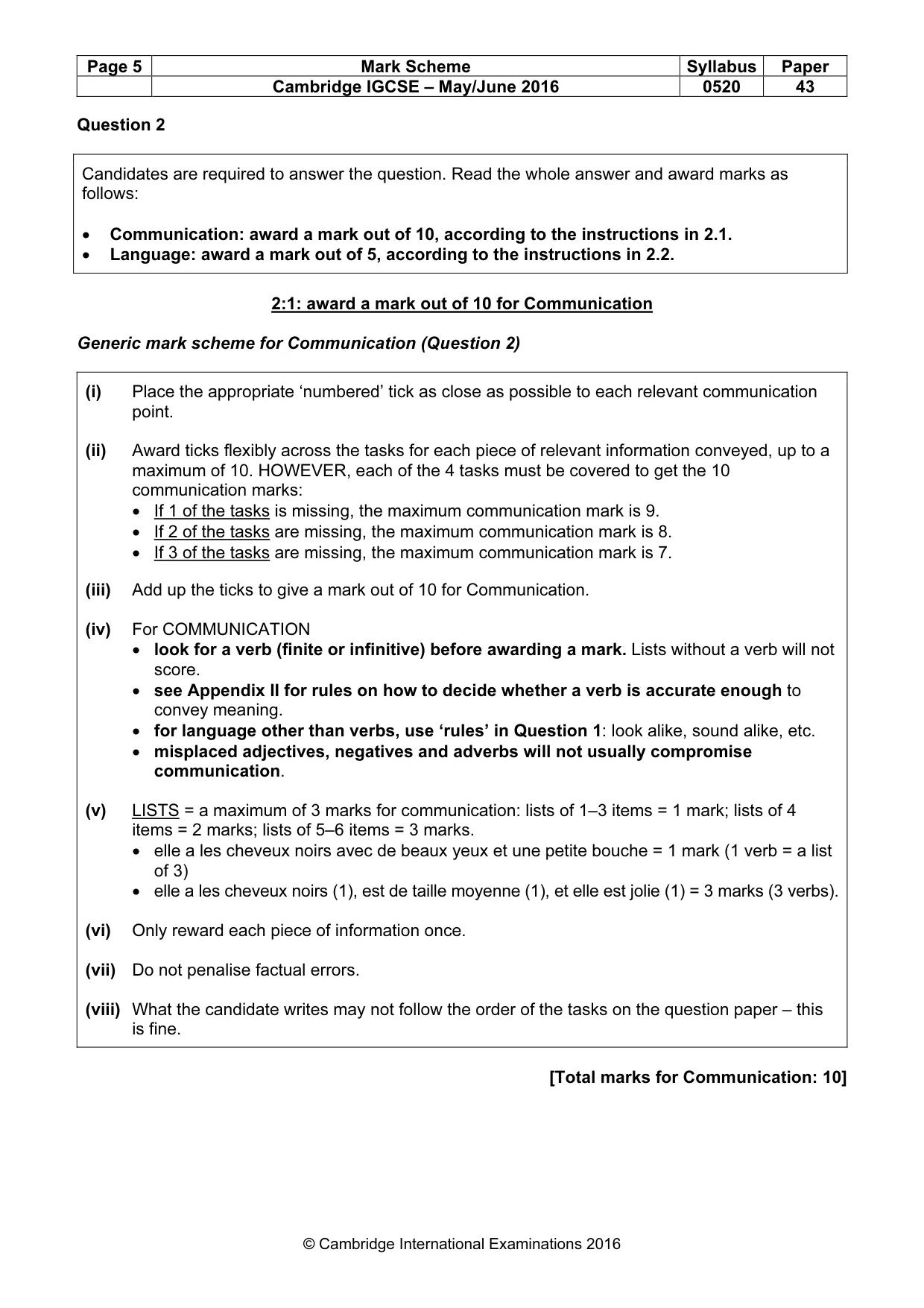
Page 5 Mark Scheme Syllabus Paper Cambridge IGCSE – May/June 2016 0520 43 © Cambridge International Examinations 2016 Question 2 Candidates are required to answer the question. Read the whole answer and award marks as follows: • Communication: award a mark out of 10, according to the instructions in 2.1. • Language: award a mark out of 5, according to the instructions in 2.2. 2:1: award a mark out of 10 for Communication Generic mark scheme for Communication (Question 2) (i) Place the appropriate ‘numbered’ tick as close as possible to each relevant communication point. (ii) Award ticks flexibly across the tasks for each piece of relevant information conveyed, up to a maximum of 10. HOWEVER, each of the 4 tasks must be covered to get the 10 communication marks: • If 1 of the tasks is missing, the maximum communication mark is 9. • If 2 of the tasks are missing, the maximum communication mark is 8. • If 3 of the tasks are missing, the maximum communication mark is 7. (iii) Add up the ticks to give a mark out of 10 for Communication. (iv) For COMMUNICATION • look for a verb (finite or infinitive) before awarding a mark. Lists without a verb will not score. • see Appendix II for rules on how to decide whether a verb is accurate enough to convey meaning. • for language other than verbs, use ‘rules’ in Question 1: look alike, sound alike, etc. • misplaced adjectives, negatives and adverbs will not usually compromise communication. (v) LISTS = a maximum of 3 marks for communication: lists of 1–3 items = 1 mark; lists of 4 items = 2 marks; lists of 5–6 items = 3 marks. • elle a les cheveux noirs avec de beaux yeux et une petite bouche = 1 mark (1 verb = a list of 3) • elle a les cheveux noirs (1), est de taille moyenne (1), et elle est jolie (1) = 3 marks (3 verbs). (vi) Only reward each piece of information once. (vii) Do not penalise factual errors. (viii) What the candidate writes may not follow the order of the tasks on the question paper – this is fine. [Total marks for Communication: 10]
Mark scheme, page 6
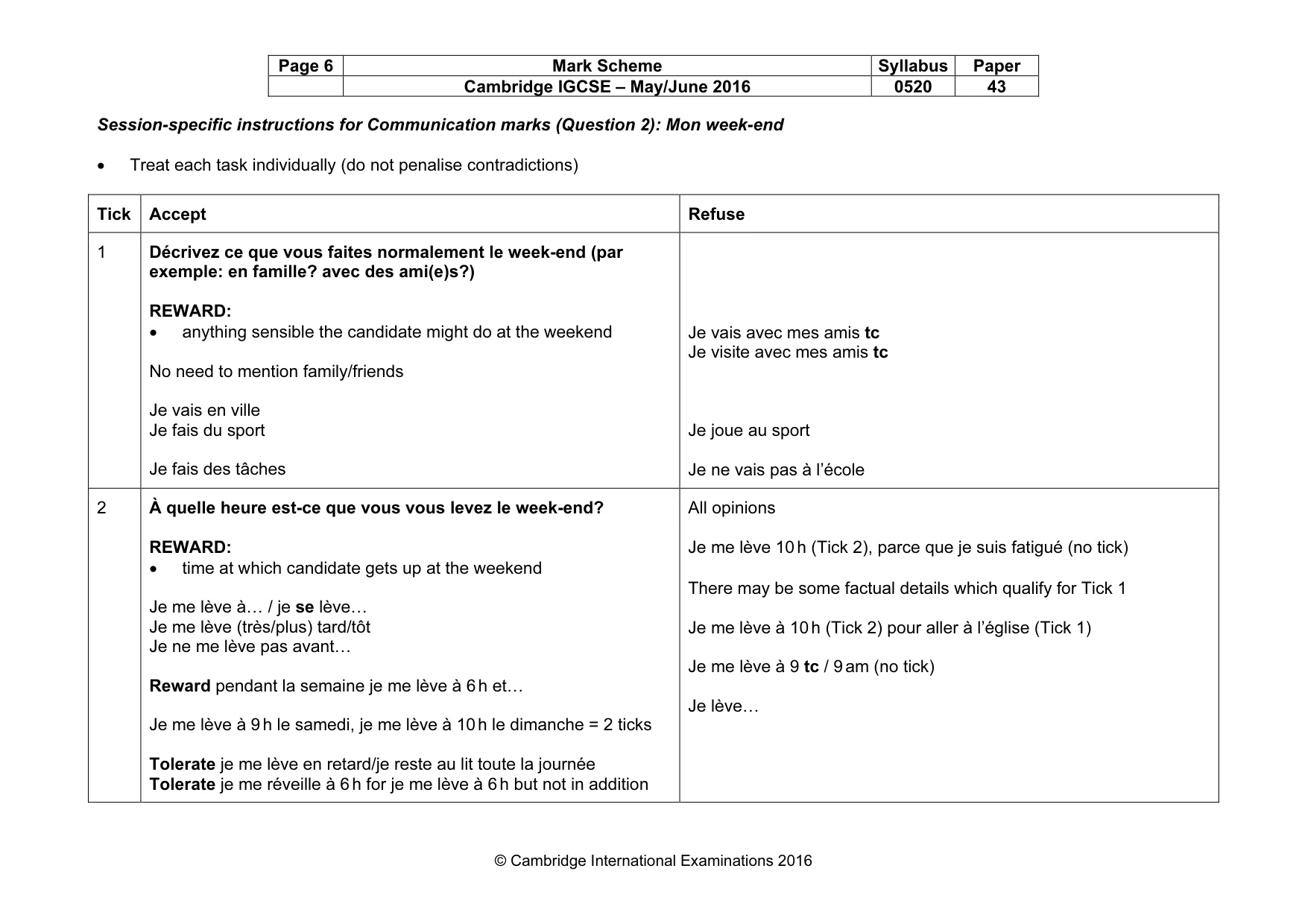
Page 6 Mark Scheme Syllabus Paper Cambridge IGCSE – May/June 2016 0520 43 © Cambridge International Examinations 2016 Session-specific instructions for Communication marks (Question 2): Mon week-end • Treat each task individually (do not penalise contradictions) Tick Accept Refuse 1 Décrivez ce que vous faites normalement le week-end (par exemple: en famille? avec des ami(e)s?) REWARD: • anything sensible the candidate might do at the weekend No need to mention family/friends Je vais en ville Je fais du sport Je fais des tâches Je vais avec mes amis tc Je visite avec mes amis tc Je joue au sport Je ne vais pas à l’école 2 À quelle heure est-ce que vous vous levez le week-end? REWARD: • time at which candidate gets up at the weekend Je me lève à… / je se lève… Je me lève (très/plus) tard/tôt Je ne me lève pas avant… Reward pendant la semaine je me lève à 6 h et… Je me lève à 9 h le samedi, je me lève à 10 h le dimanche = 2 ticks Tolerate je me lève en retard/je reste au lit toute la journée Tolerate je me réveille à 6 h for je me lève à 6 h but not in addition All opinions Je me lève 10 h (Tick 2), parce que je suis fatigué (no tick) There may be some factual details which qualify for Tick 1 Je me lève à 10 h (Tick 2) pour aller à l’église (Tick 1) Je me lève à 9 tc / 9 am (no tick) Je lève…
Mark scheme, page 7
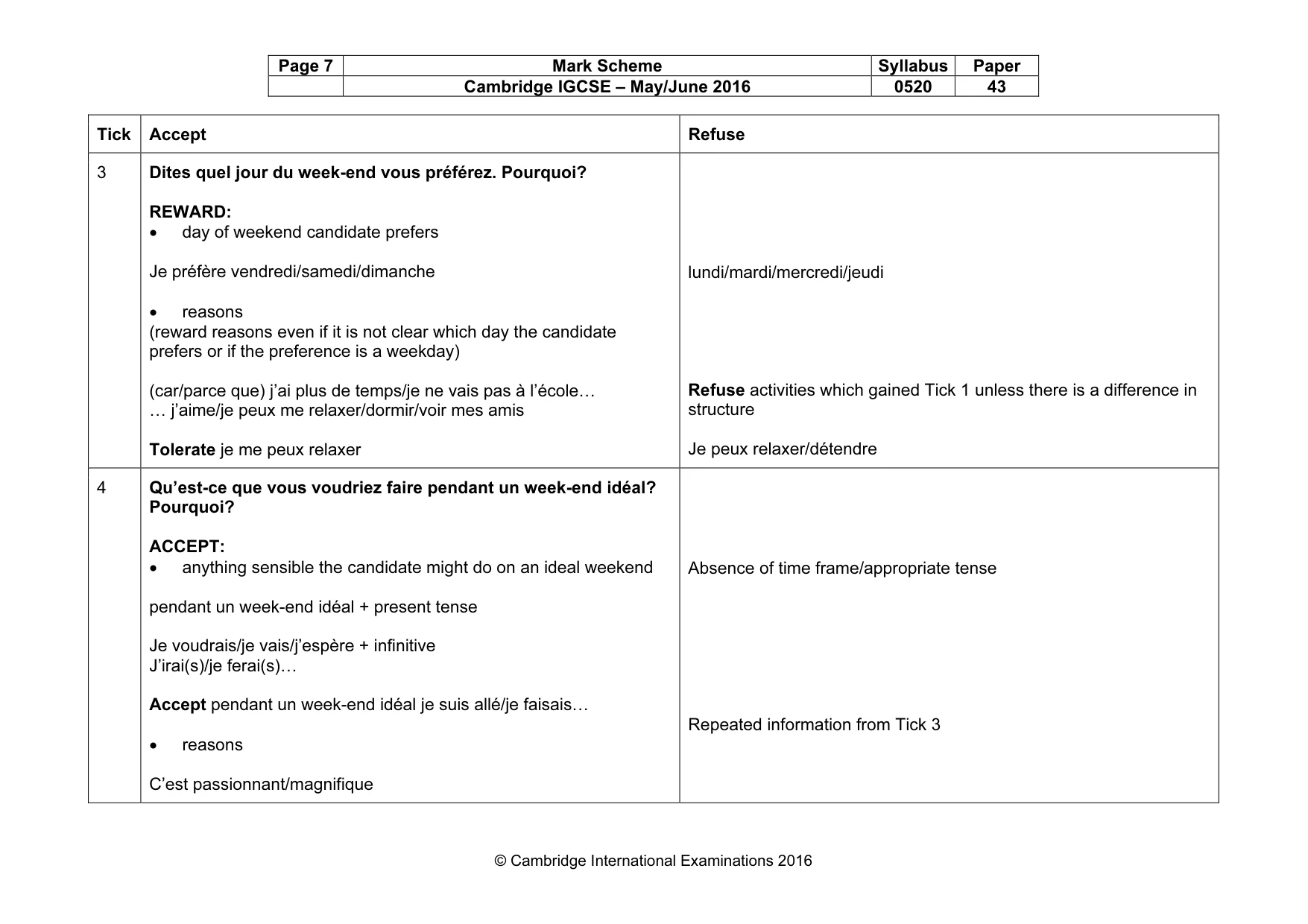
Page 7 Mark Scheme Syllabus Paper Cambridge IGCSE – May/June 2016 0520 43 © Cambridge International Examinations 2016 Tick Accept Refuse 3 Dites quel jour du week-end vous préférez. Pourquoi? REWARD: • day of weekend candidate prefers Je préfère vendredi/samedi/dimanche • reasons (reward reasons even if it is not clear which day the candidate prefers or if the preference is a weekday) (car/parce que) j’ai plus de temps/je ne vais pas à l’école… … j’aime/je peux me relaxer/dormir/voir mes amis Tolerate je me peux relaxer lundi/mardi/mercredi/jeudi Refuse activities which gained Tick 1 unless there is a difference in structure Je peux relaxer/détendre 4 Qu’est-ce que vous voudriez faire pendant un week-end idéal? Pourquoi? ACCEPT: • anything sensible the candidate might do on an ideal weekend pendant un week-end idéal + present tense Je voudrais/je vais/j’espère + infinitive J’irai(s)/je ferai(s)… Accept pendant un week-end idéal je suis allé/je faisais… • reasons C’est passionnant/magnifique Absence of time frame/appropriate tense Repeated information from Tick 3
Mark scheme, page 8
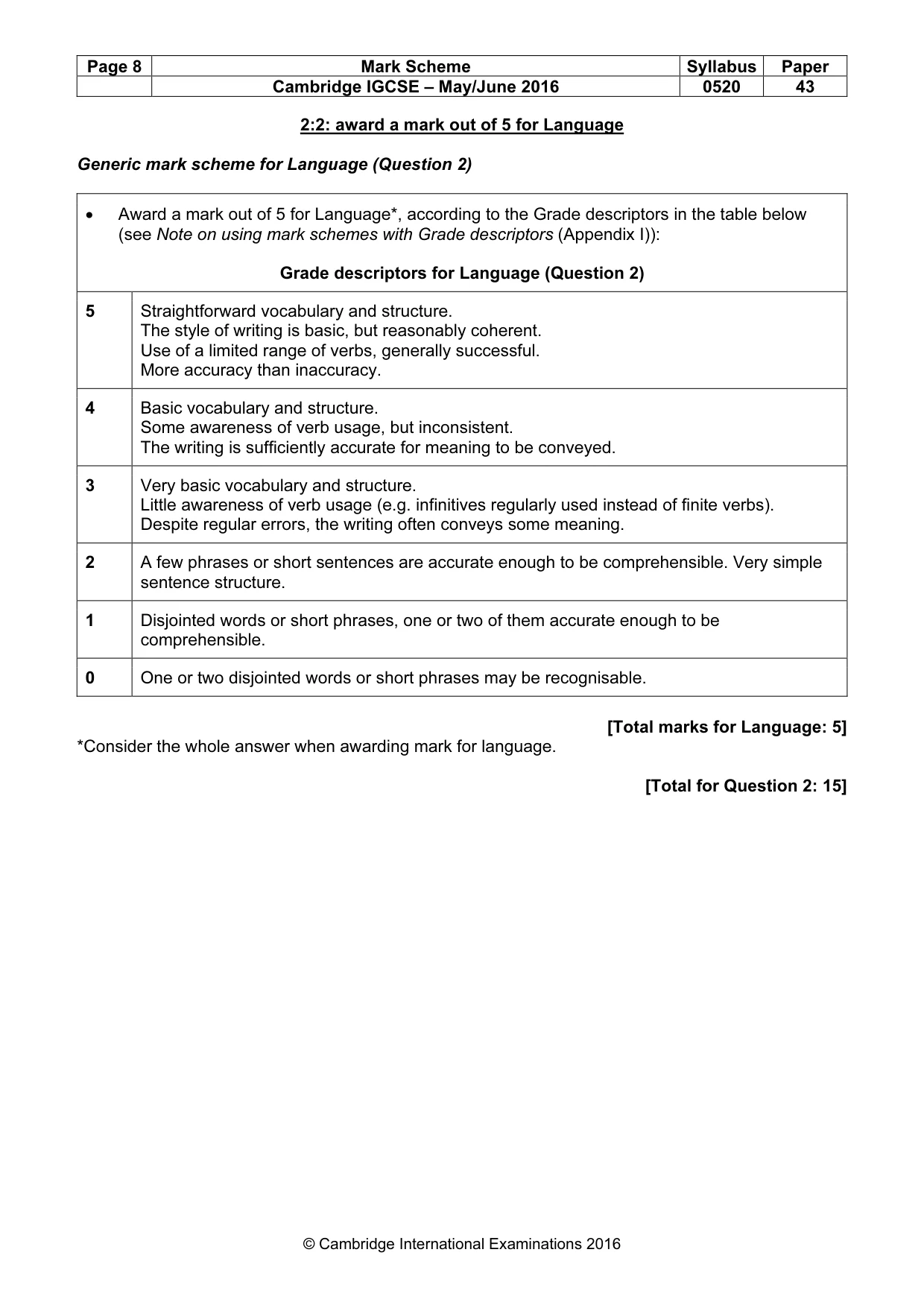
Page 8 Mark Scheme Syllabus Paper Cambridge IGCSE – May/June 2016 0520 43 © Cambridge International Examinations 2016 2:2: award a mark out of 5 for Language Generic mark scheme for Language (Question 2) • Award a mark out of 5 for Language*, according to the Grade descriptors in the table below (see Note on using mark schemes with Grade descriptors (Appendix I)): Grade descriptors for Language (Question 2) 5 Straightforward vocabulary and structure. The style of writing is basic, but reasonably coherent. Use of a limited range of verbs, generally successful. More accuracy than inaccuracy. 4 Basic vocabulary and structure. Some awareness of verb usage, but inconsistent. The writing is sufficiently accurate for meaning to be conveyed. 3 Very basic vocabulary and structure. Little awareness of verb usage (e.g. infinitives regularly used instead of finite verbs). Despite regular errors, the writing often conveys some meaning. 2 A few phrases or short sentences are accurate enough to be comprehensible. Very simple sentence structure. 1 Disjointed words or short phrases, one or two of them accurate enough to be comprehensible. 0 One or two disjointed words or short phrases may be recognisable. [Total marks for Language: 5] *Consider the whole answer when awarding mark for language. [Total for Question 2: 15]
Mark scheme, page 9
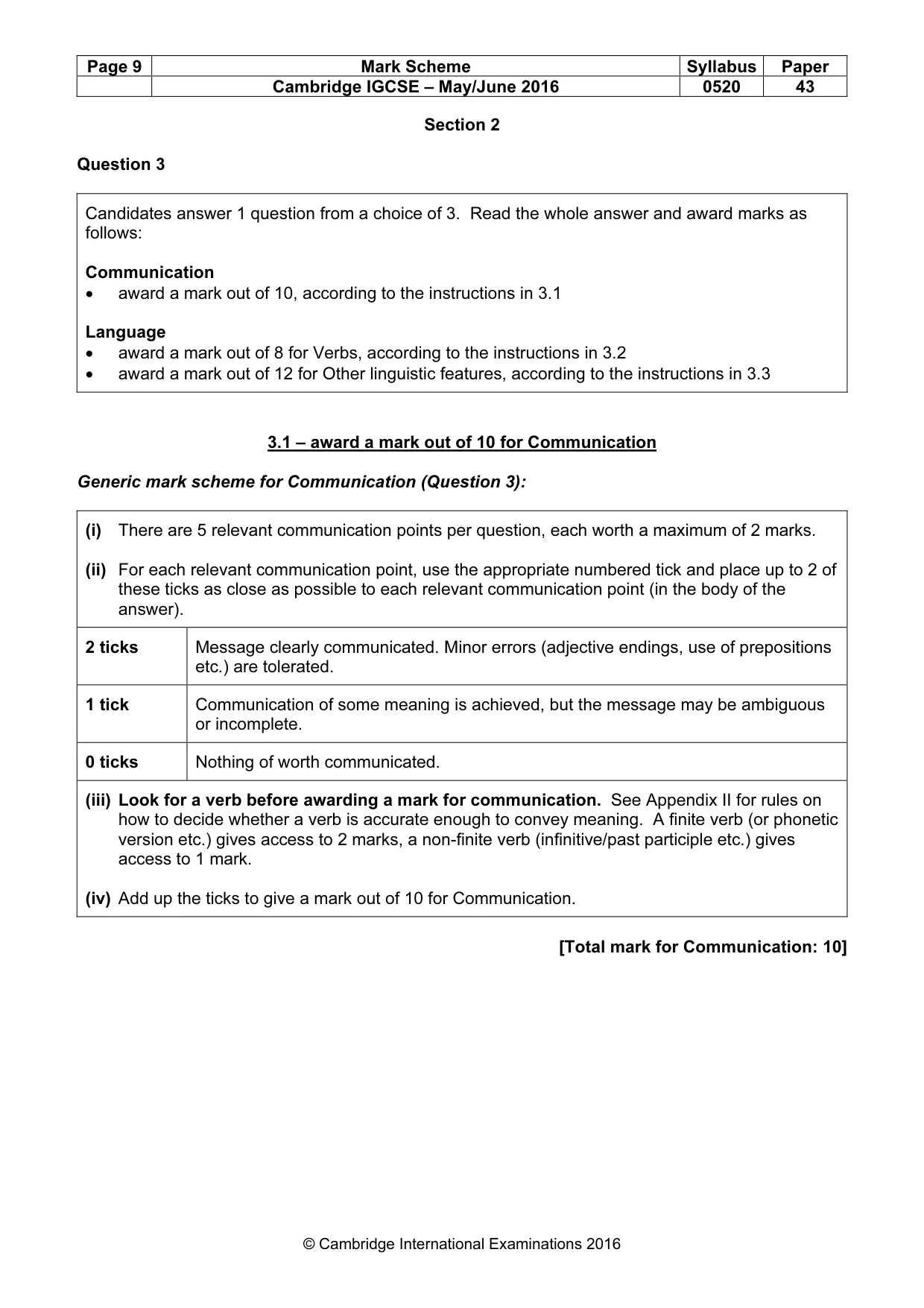
Page 9 Mark Scheme Syllabus Paper Cambridge IGCSE – May/June 2016 0520 43 © Cambridge International Examinations 2016 Section 2 Question 3 Candidates answer 1 question from a choice of 3. Read the whole answer and award marks as follows: Communication • award a mark out of 10, according to the instructions in 3.1 Language • award a mark out of 8 for Verbs, according to the instructions in 3.2 • award a mark out of 12 for Other linguistic features, according to the instructions in 3.3 3.1 – award a mark out of 10 for Communication Generic mark scheme for Communication (Question 3): (i) There are 5 relevant communication points per question, each worth a maximum of 2 marks. (ii) For each relevant communication point, use the appropriate numbered tick and place up to 2 of these ticks as close as possible to each relevant communication point (in the body of the answer). 2 ticks Message clearly communicated. Minor errors (adjective endings, use of prepositions etc.) are tolerated. 1 tick Communication of some meaning is achieved, but the message may be ambiguous or incomplete. 0 ticks Nothing of worth communicated. (iii) Look for a verb before awarding a mark for communication. See Appendix II for rules on how to decide whether a verb is accurate enough to convey meaning. A finite verb (or phonetic version etc.) gives access to 2 marks, a non-finite verb (infinitive/past participle etc.) gives access to 1 mark. (iv) Add up the ticks to give a mark out of 10 for Communication. [Total mark for Communication: 10]
Mark scheme, page 10
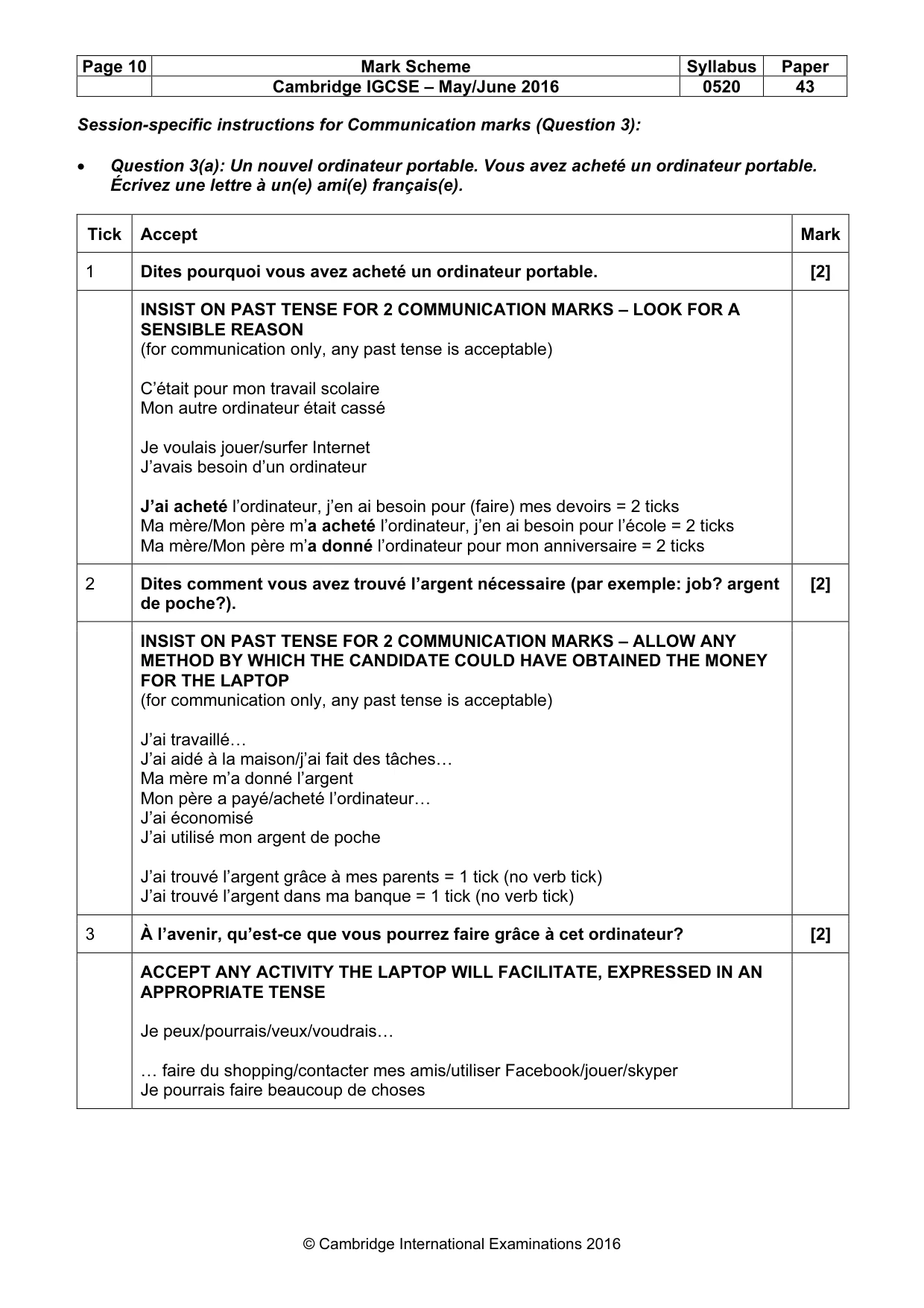
Page 10 Mark Scheme Syllabus Paper Cambridge IGCSE – May/June 2016 0520 43 © Cambridge International Examinations 2016 Session-specific instructions for Communication marks (Question 3): • Question 3(a): Un nouvel ordinateur portable. Vous avez acheté un ordinateur portable. Écrivez une lettre à un(e) ami(e) français(e). Tick Accept Mark 1 Dites pourquoi vous avez acheté un ordinateur portable. [2] INSIST ON PAST TENSE FOR 2 COMMUNICATION MARKS – LOOK FOR A SENSIBLE REASON (for communication only, any past tense is acceptable) C’était pour mon travail scolaire Mon autre ordinateur était cassé Je voulais jouer/surfer Internet J’avais besoin d’un ordinateur J’ai acheté l’ordinateur, j’en ai besoin pour (faire) mes devoirs = 2 ticks Ma mère/Mon père m’a acheté l’ordinateur, j’en ai besoin pour l’école = 2 ticks Ma mère/Mon père m’a donné l’ordinateur pour mon anniversaire = 2 ticks 2 Dites comment vous avez trouvé l’argent nécessaire (par exemple: job? argent de poche?). [2] INSIST ON PAST TENSE FOR 2 COMMUNICATION MARKS – ALLOW ANY METHOD BY WHICH THE CANDIDATE COULD HAVE OBTAINED THE MONEY FOR THE LAPTOP (for communication only, any past tense is acceptable) J’ai travaillé… J’ai aidé à la maison/j’ai fait des tâches… Ma mère m’a donné l’argent Mon père a payé/acheté l’ordinateur… J’ai économisé J’ai utilisé mon argent de poche J’ai trouvé l’argent grâce à mes parents = 1 tick (no verb tick) J’ai trouvé l’argent dans ma banque = 1 tick (no verb tick) 3 À l’avenir, qu’est-ce que vous pourrez faire grâce à cet ordinateur? [2] ACCEPT ANY ACTIVITY THE LAPTOP WILL FACILITATE, EXPRESSED IN AN APPROPRIATE TENSE Je peux/pourrais/veux/voudrais… … faire du shopping/contacter mes amis/utiliser Facebook/jouer/skyper Je pourrais faire beaucoup de choses
Mark scheme, page 11
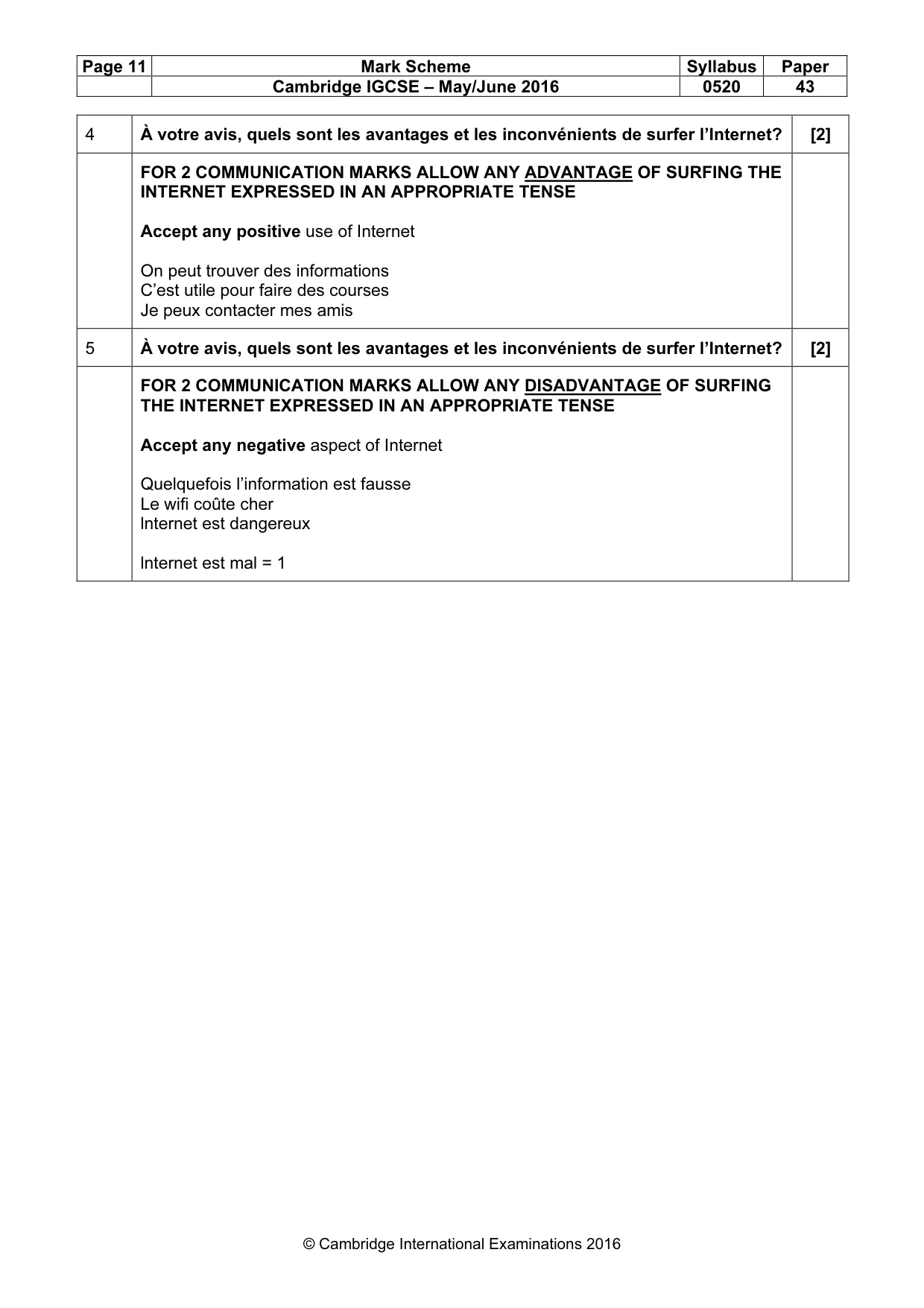
Page 11 Mark Scheme Syllabus Paper Cambridge IGCSE – May/June 2016 0520 43 © Cambridge International Examinations 2016 4 À votre avis, quels sont les avantages et les inconvénients de surfer l’Internet? [2] FOR 2 COMMUNICATION MARKS ALLOW ANY ADVANTAGE OF SURFING THE INTERNET EXPRESSED IN AN APPROPRIATE TENSE Accept any positive use of Internet On peut trouver des informations C’est utile pour faire des courses Je peux contacter mes amis 5 À votre avis, quels sont les avantages et les inconvénients de surfer l’Internet? [2] FOR 2 COMMUNICATION MARKS ALLOW ANY DISADVANTAGE OF SURFING THE INTERNET EXPRESSED IN AN APPROPRIATE TENSE Accept any negative aspect of Internet Quelquefois l’information est fausse Le wifi coûte cher lnternet est dangereux lnternet est mal = 1
Mark scheme, page 12
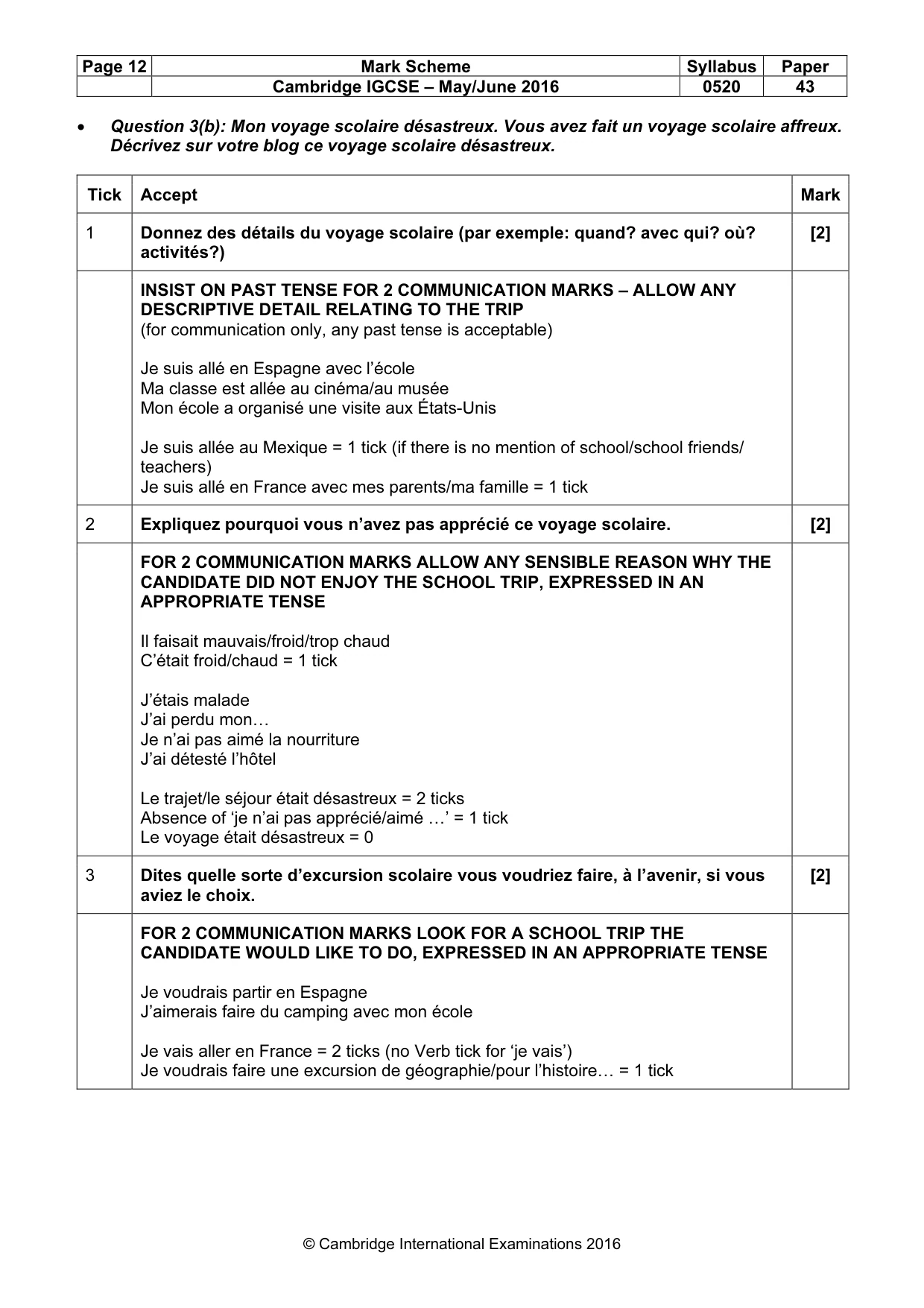
Page 12 Mark Scheme Syllabus Paper Cambridge IGCSE – May/June 2016 0520 43 © Cambridge International Examinations 2016 • Question 3(b): Mon voyage scolaire désastreux. Vous avez fait un voyage scolaire affreux. Décrivez sur votre blog ce voyage scolaire désastreux. Tick Accept Mark 1 Donnez des détails du voyage scolaire (par exemple: quand? avec qui? où? activités?) [2] INSIST ON PAST TENSE FOR 2 COMMUNICATION MARKS – ALLOW ANY DESCRIPTIVE DETAIL RELATING TO THE TRIP (for communication only, any past tense is acceptable) Je suis allé en Espagne avec l’école Ma classe est allée au cinéma/au musée Mon école a organisé une visite aux États-Unis Je suis allée au Mexique = 1 tick (if there is no mention of school/school friends/ teachers) Je suis allé en France avec mes parents/ma famille = 1 tick 2 Expliquez pourquoi vous n’avez pas apprécié ce voyage scolaire. [2] FOR 2 COMMUNICATION MARKS ALLOW ANY SENSIBLE REASON WHY THE CANDIDATE DID NOT ENJOY THE SCHOOL TRIP, EXPRESSED IN AN APPROPRIATE TENSE Il faisait mauvais/froid/trop chaud C’était froid/chaud = 1 tick J’étais malade J’ai perdu mon… Je n’ai pas aimé la nourriture J’ai détesté l’hôtel Le trajet/le séjour était désastreux = 2 ticks Absence of ‘je n’ai pas apprécié/aimé …’ = 1 tick Le voyage était désastreux = 0 3 Dites quelle sorte d’excursion scolaire vous voudriez faire, à l’avenir, si vous aviez le choix. [2] FOR 2 COMMUNICATION MARKS LOOK FOR A SCHOOL TRIP THE CANDIDATE WOULD LIKE TO DO, EXPRESSED IN AN APPROPRIATE TENSE Je voudrais partir en Espagne J’aimerais faire du camping avec mon école Je vais aller en France = 2 ticks (no Verb tick for ‘je vais’) Je voudrais faire une excursion de géographie/pour l’histoire… = 1 tick
Mark scheme, page 13
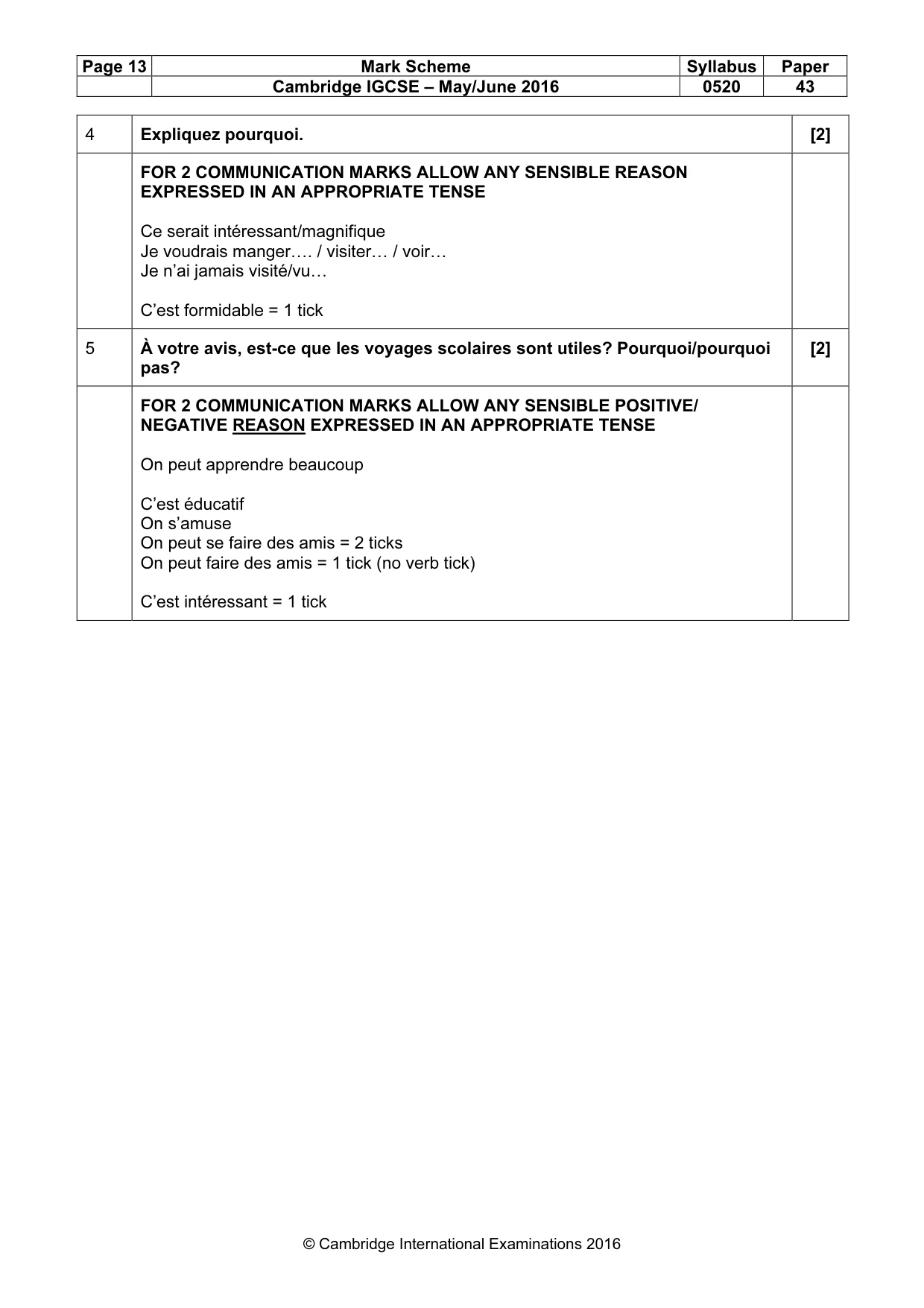
Page 13 Mark Scheme Syllabus Paper Cambridge IGCSE – May/June 2016 0520 43 © Cambridge International Examinations 2016 4 Expliquez pourquoi. [2] FOR 2 COMMUNICATION MARKS ALLOW ANY SENSIBLE REASON EXPRESSED IN AN APPROPRIATE TENSE Ce serait intéressant/magnifique Je voudrais manger…. / visiter… / voir… Je n’ai jamais visité/vu… C’est formidable = 1 tick 5 À votre avis, est-ce que les voyages scolaires sont utiles? Pourquoi/pourquoi pas? [2] FOR 2 COMMUNICATION MARKS ALLOW ANY SENSIBLE POSITIVE/ NEGATIVE REASON EXPRESSED IN AN APPROPRIATE TENSE On peut apprendre beaucoup C’est éducatif On s’amuse On peut se faire des amis = 2 ticks On peut faire des amis = 1 tick (no verb tick) C’est intéressant = 1 tick
Mark scheme, page 14
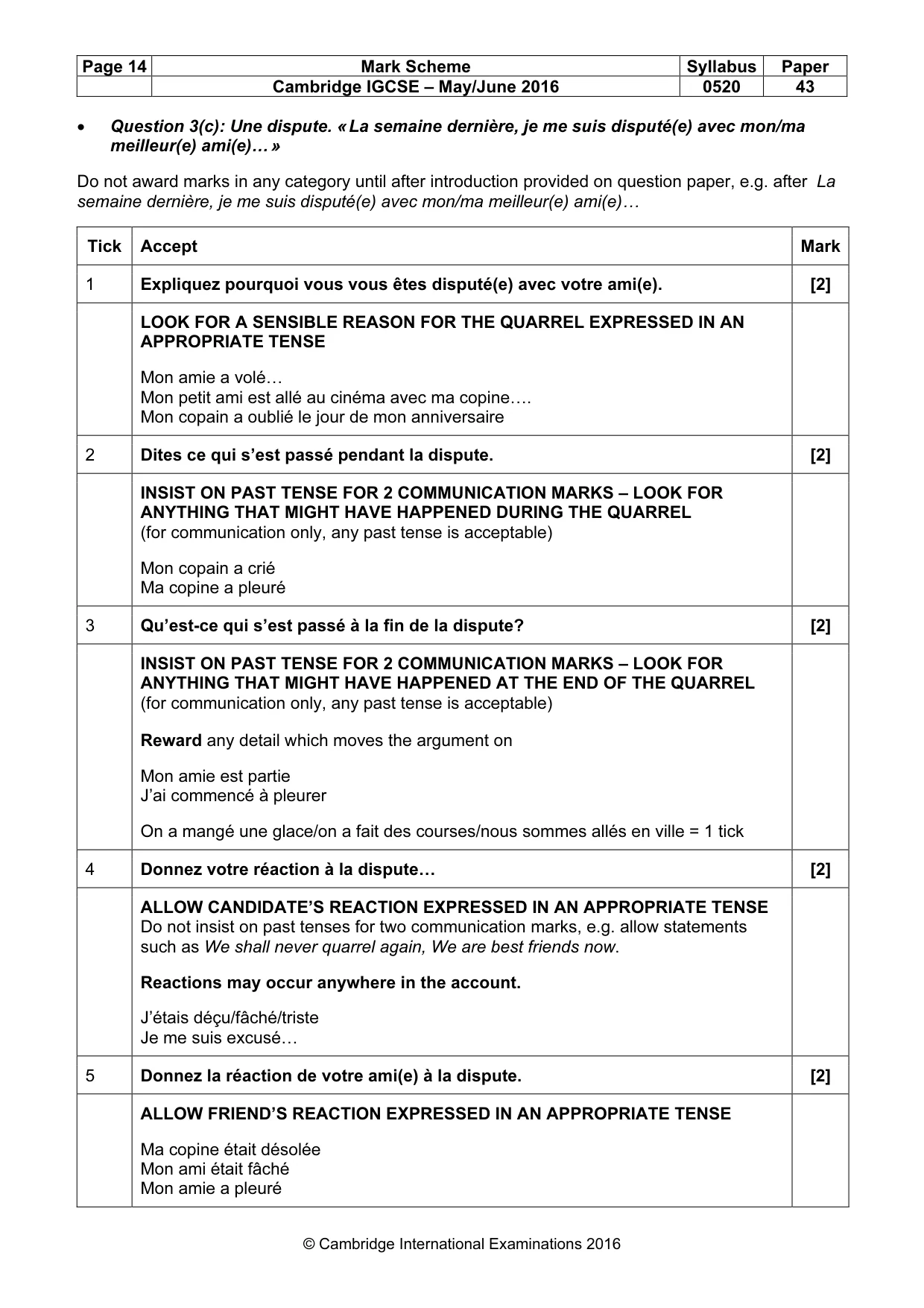
Page 14 Mark Scheme Syllabus Paper Cambridge IGCSE – May/June 2016 0520 43 © Cambridge International Examinations 2016 • Question 3(c): Une dispute. « La semaine dernière, je me suis disputé(e) avec mon/ma meilleur(e) ami(e)… » Do not award marks in any category until after introduction provided on question paper, e.g. after La semaine dernière, je me suis disputé(e) avec mon/ma meilleur(e) ami(e)… Tick Accept Mark 1 Expliquez pourquoi vous vous êtes disputé(e) avec votre ami(e). [2] LOOK FOR A SENSIBLE REASON FOR THE QUARREL EXPRESSED IN AN APPROPRIATE TENSE Mon amie a volé… Mon petit ami est allé au cinéma avec ma copine…. Mon copain a oublié le jour de mon anniversaire 2 Dites ce qui s’est passé pendant la dispute. [2] INSIST ON PAST TENSE FOR 2 COMMUNICATION MARKS – LOOK FOR ANYTHING THAT MIGHT HAVE HAPPENED DURING THE QUARREL (for communication only, any past tense is acceptable) Mon copain a crié Ma copine a pleuré 3 Qu’est-ce qui s’est passé à la fin de la dispute? [2] INSIST ON PAST TENSE FOR 2 COMMUNICATION MARKS – LOOK FOR ANYTHING THAT MIGHT HAVE HAPPENED AT THE END OF THE QUARREL (for communication only, any past tense is acceptable) Reward any detail which moves the argument on Mon amie est partie J’ai commencé à pleurer On a mangé une glace/on a fait des courses/nous sommes allés en ville = 1 tick 4 Donnez votre réaction à la dispute… [2] ALLOW CANDIDATE’S REACTION EXPRESSED IN AN APPROPRIATE TENSE Do not insist on past tenses for two communication marks, e.g. allow statements such as We shall never quarrel again, We are best friends now. Reactions may occur anywhere in the account. J’étais déçu/fâché/triste Je me suis excusé… 5 Donnez la réaction de votre ami(e) à la dispute. [2] ALLOW FRIEND’S REACTION EXPRESSED IN AN APPROPRIATE TENSE Ma copine était désolée Mon ami était fâché Mon amie a pleuré
Mark scheme, page 15
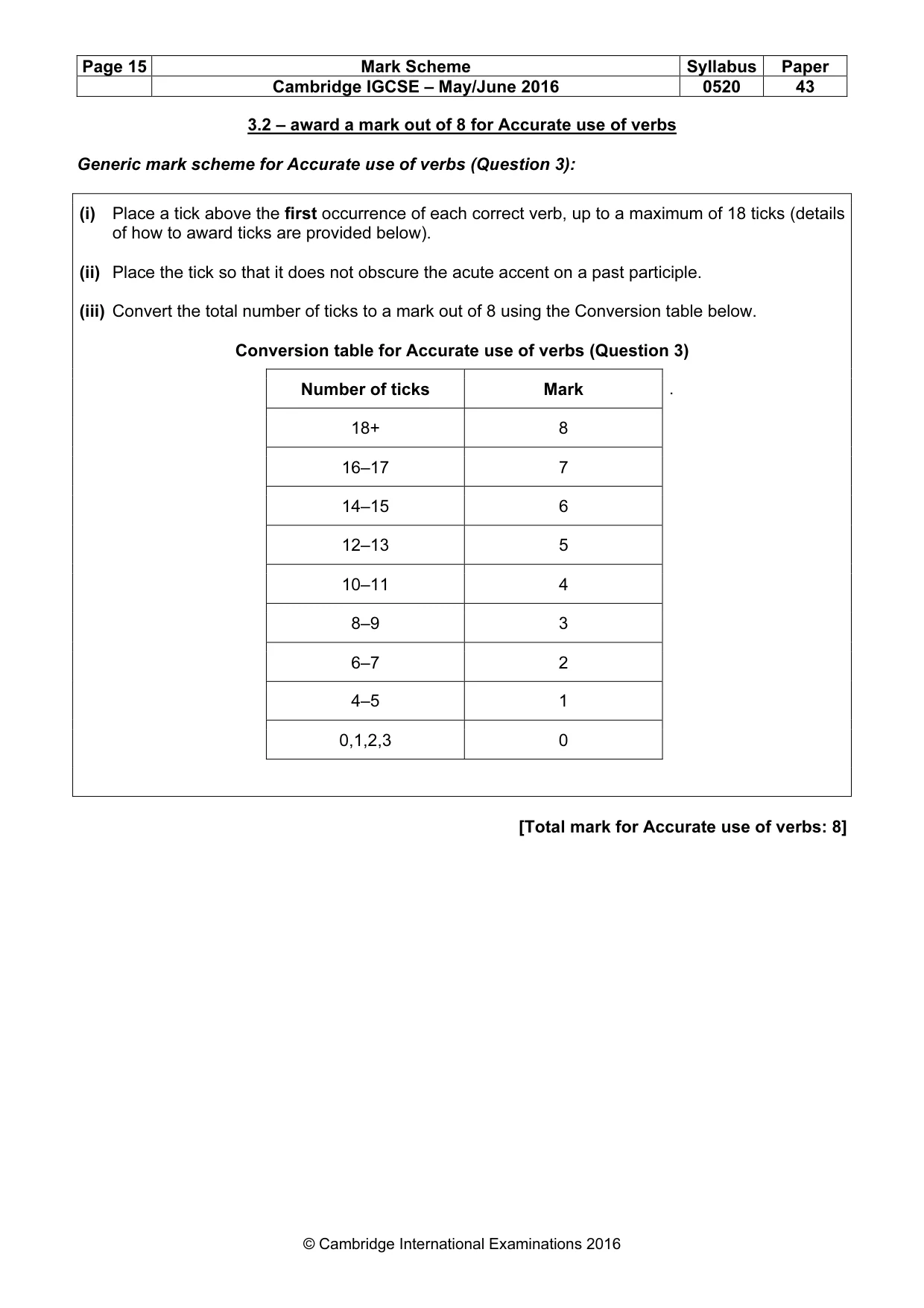
Page 15 Mark Scheme Syllabus Paper Cambridge IGCSE – May/June 2016 0520 43 © Cambridge International Examinations 2016 3.2 – award a mark out of 8 for Accurate use of verbs Generic mark scheme for Accurate use of verbs (Question 3): (i) Place a tick above the first occurrence of each correct verb, up to a maximum of 18 ticks (details of how to award ticks are provided below). (ii) Place the tick so that it does not obscure the acute accent on a past participle. (iii) Convert the total number of ticks to a mark out of 8 using the Conversion table below. Conversion table for Accurate use of verbs (Question 3) Number of ticks Mark . 18+ 8 16–17 7 14–15 6 12–13 5 10–11 4 8–9 3 6–7 2 4–5 1 0,1,2,3 0 [Total mark for Accurate use of verbs: 8]
Mark scheme, page 16
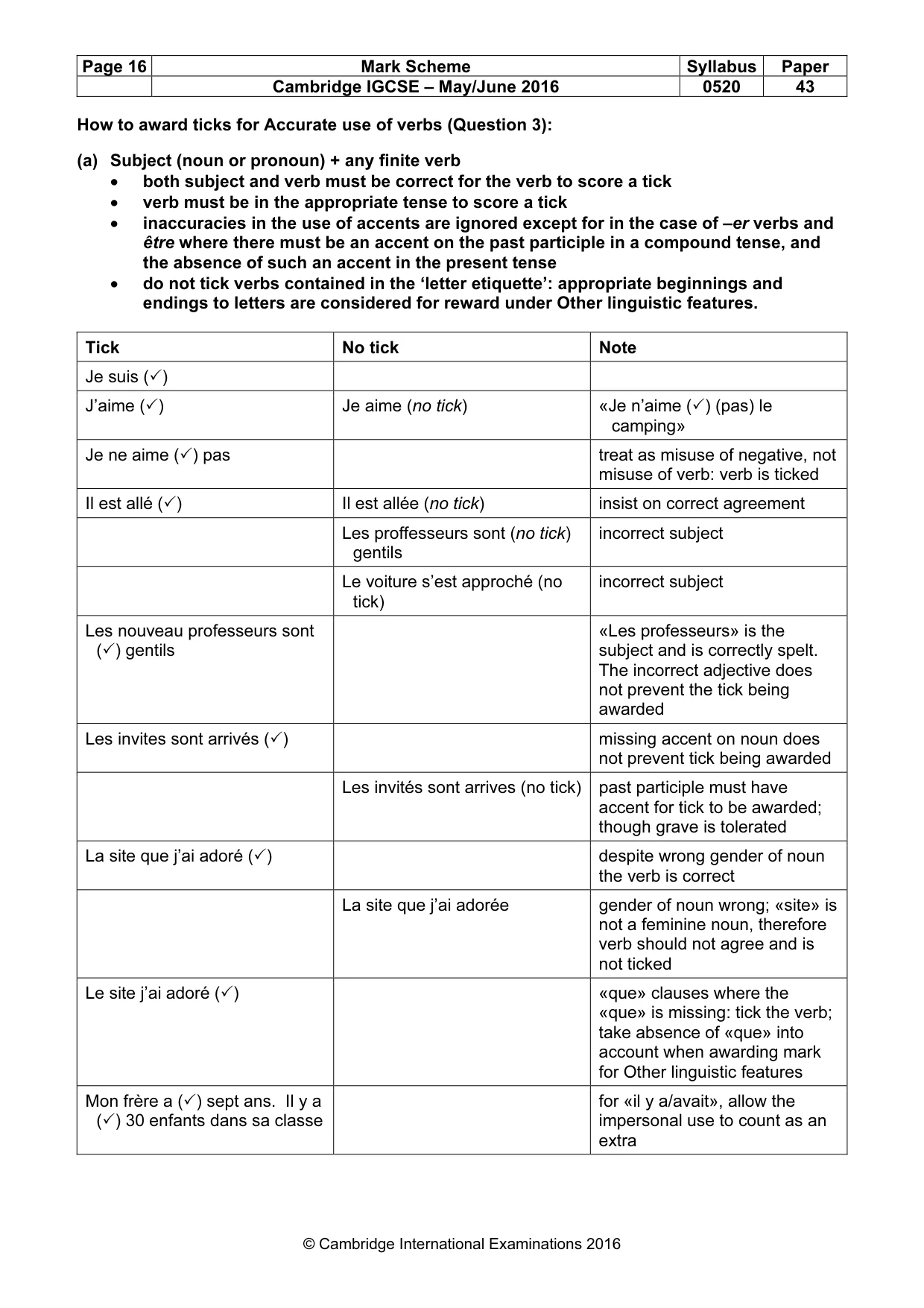
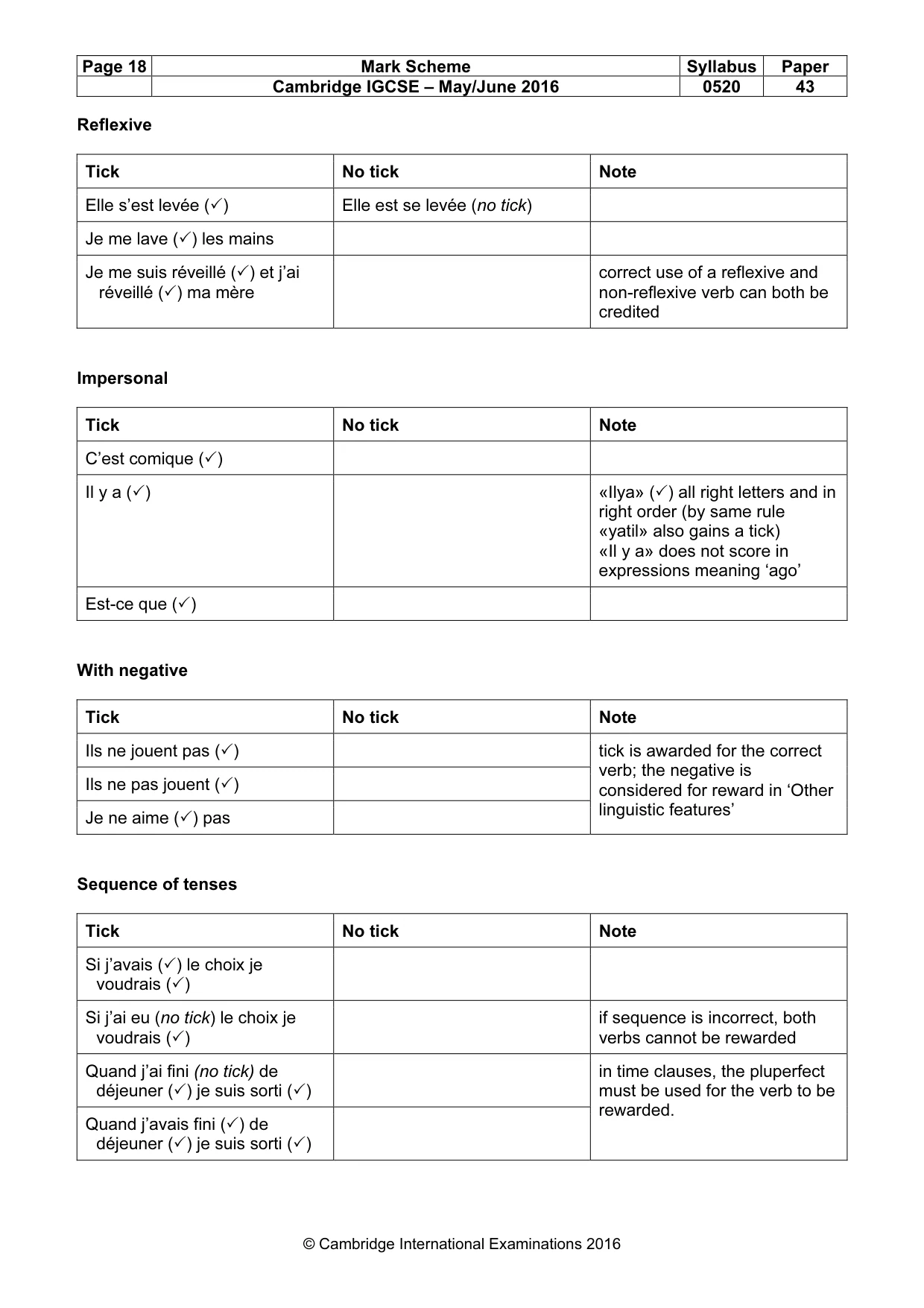
Page 16 Mark Scheme Syllabus Paper Cambridge IGCSE – May/June 2016 0520 43 © Cambridge International Examinations 2016 How to award ticks for Accurate use of verbs (Question 3): (a) Subject (noun or pronoun) + any finite verb • both subject and verb must be correct for the verb to score a tick • verb must be in the appropriate tense to score a tick • inaccuracies in the use of accents are ignored except for in the case of –er verbs and être where there must be an accent on the past participle in a compound tense, and the absence of such an accent in the present tense • do not tick verbs contained in the ‘letter etiquette’: appropriate beginnings and endings to letters are considered for reward under Other linguistic features. Tick No tick Note Je suis (✓) J’aime (✓) Je aime (no tick) «Je n’aime (✓) (pas) le camping» Je ne aime (✓) pas treat as misuse of negative, not misuse of verb: verb is ticked Il est allé (✓) Il est allée (no tick) insist on correct agreement Les proffesseurs sont (no tick) gentils incorrect subject Le voiture s’est approché (no tick) incorrect subject Les nouveau professeurs sont (✓) gentils «Les professeurs» is the subject and is correctly spelt. The incorrect adjective does not prevent the tick being awarded Les invites sont arrivés (✓) missing accent on noun does not prevent tick being awarded Les invités sont arrives (no tick) past participle must have accent for tick to be awarded; though grave is tolerated La site que j’ai adoré (✓) despite wrong gender of noun the verb is correct La site que j’ai adorée gender of noun wrong; «site» is not a feminine noun, therefore verb should not agree and is not ticked Le site j’ai adoré (✓) «que» clauses where the «que» is missing: tick the verb; take absence of «que» into account when awarding mark for Other linguistic features Mon frère a (✓) sept ans. Il y a (✓) 30 enfants dans sa classe for «il y a/avait», allow the impersonal use to count as an extra
Mark scheme, page 17
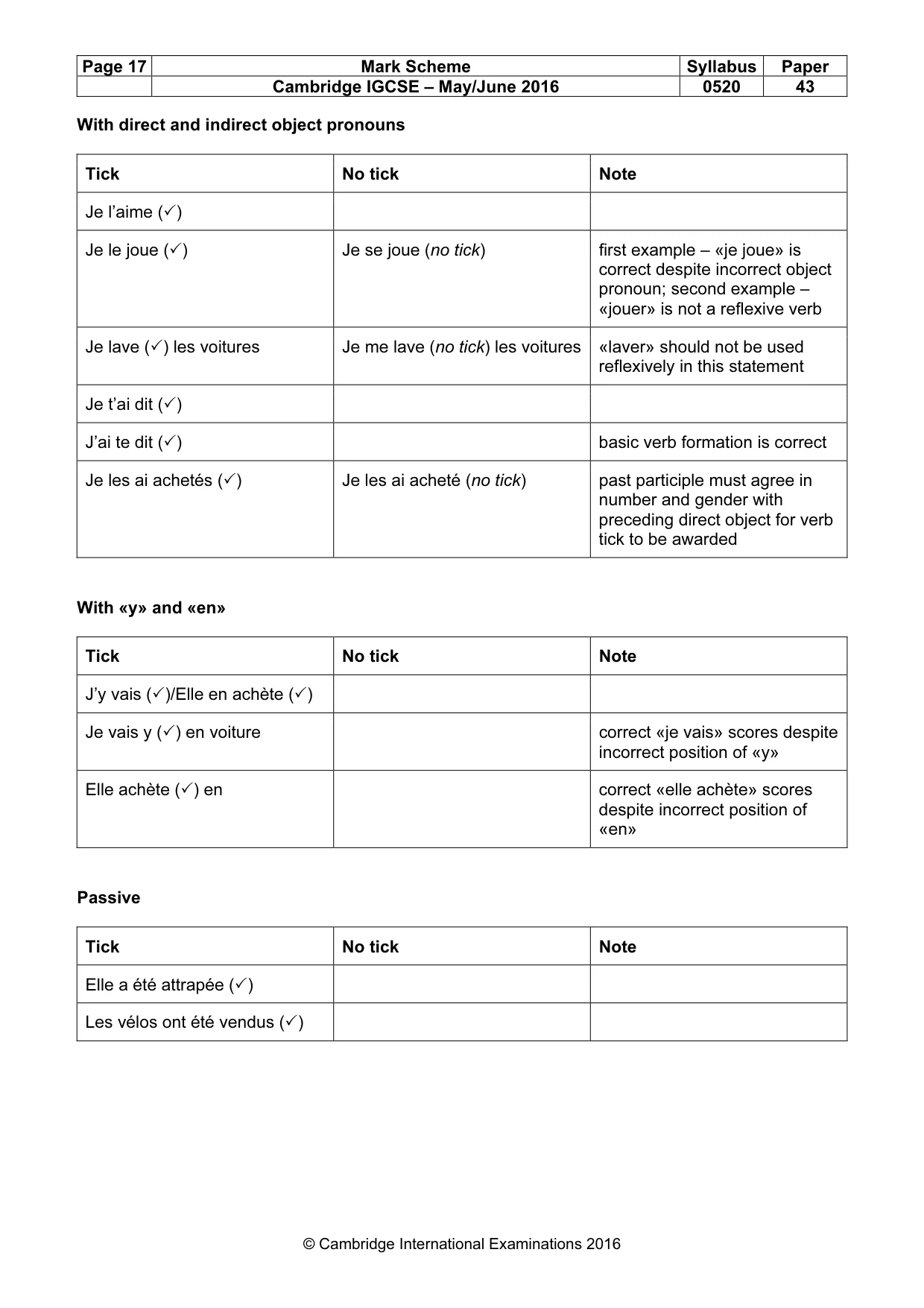
Page 17 Mark Scheme Syllabus Paper Cambridge IGCSE – May/June 2016 0520 43 © Cambridge International Examinations 2016 With direct and indirect object pronouns Tick No tick Note Je l’aime (✓) Je le joue (✓) Je se joue (no tick) first example – «je joue» is correct despite incorrect object pronoun; second example – «jouer» is not a reflexive verb Je lave (✓) les voitures Je me lave (no tick) les voitures «laver» should not be used reflexively in this statement Je t’ai dit (✓) J’ai te dit (✓) basic verb formation is correct Je les ai achetés (✓) Je les ai acheté (no tick) past participle must agree in number and gender with preceding direct object for verb tick to be awarded With «y» and «en» Tick No tick Note J’y vais (✓)/Elle en achète (✓) Je vais y (✓) en voiture correct «je vais» scores despite incorrect position of «y» Elle achète (✓) en correct «elle achète» scores despite incorrect position of «en» Passive Tick No tick Note Elle a été attrapée (✓) Les vélos ont été vendus (✓)
Mark scheme, page 18
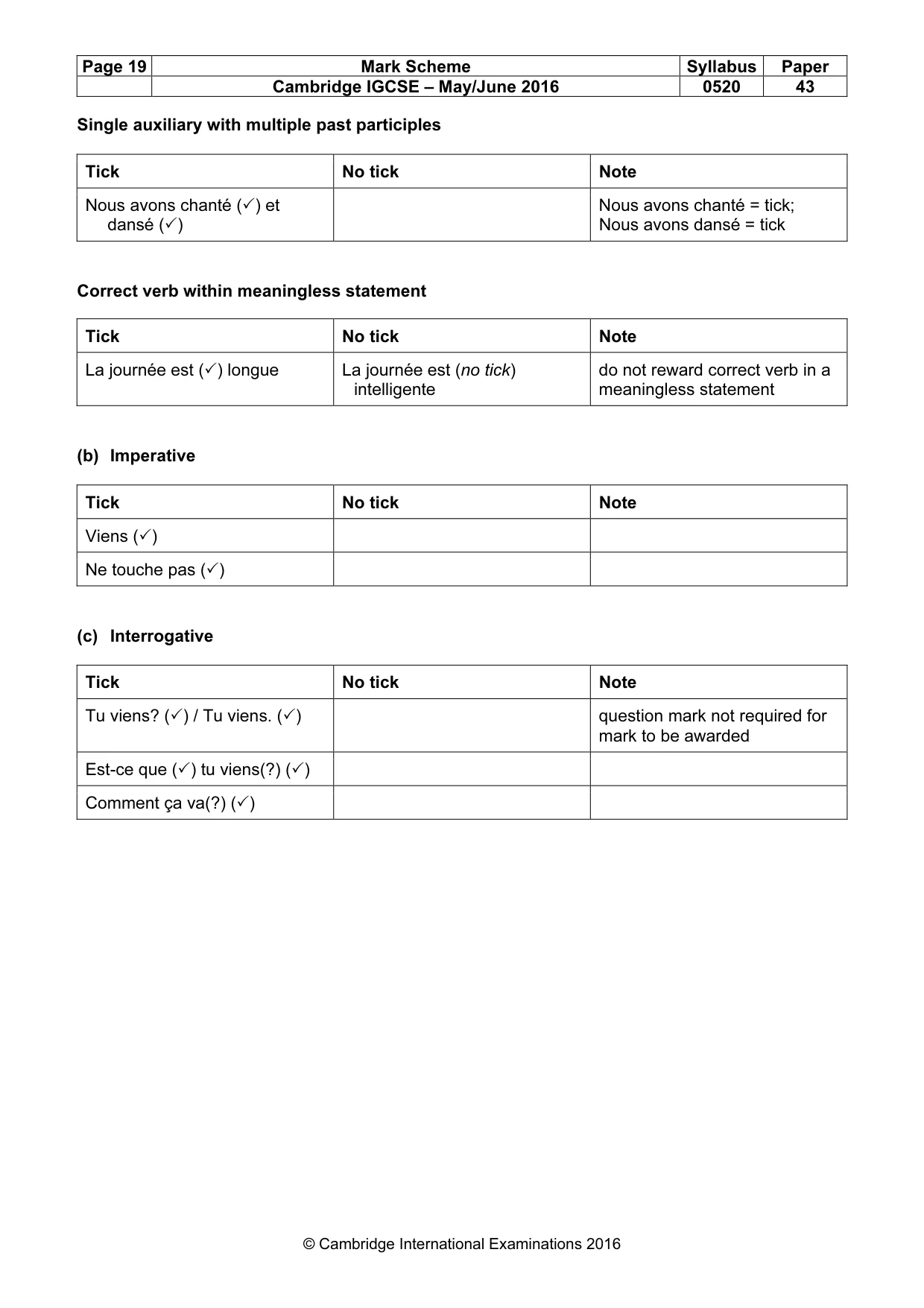
Page 18 Mark Scheme Syllabus Paper Cambridge IGCSE – May/June 2016 0520 43 © Cambridge International Examinations 2016 Reflexive Tick No tick Note Elle s’est levée (✓) Elle est se levée (no tick) Je me lave (✓) les mains Je me suis réveillé (✓) et j’ai réveillé (✓) ma mère correct use of a reflexive and non-reflexive verb can both be credited Impersonal Tick No tick Note C’est comique (✓) Il y a (✓) «Ilya» (✓) all right letters and in right order (by same rule «yatil» also gains a tick) «Il y a» does not score in expressions meaning ‘ago’ Est-ce que (✓) With negative Tick No tick Note Ils ne jouent pas (✓) tick is awarded for the correct verb; the negative is considered for reward in ‘Other linguistic features’ Ils ne pas jouent (✓) Je ne aime (✓) pas Sequence of tenses Tick No tick Note Si j’avais (✓) le choix je voudrais (✓) Si j’ai eu (no tick) le choix je voudrais (✓) if sequence is incorrect, both verbs cannot be rewarded Quand j’ai fini (no tick) de déjeuner (✓) je suis sorti (✓) in time clauses, the pluperfect must be used for the verb to be rewarded. Quand j’avais fini (✓) de déjeuner (✓) je suis sorti (✓)
Mark scheme, page 19
Page 19 Mark Scheme Syllabus Paper Cambridge IGCSE – May/June 2016 0520 43 © Cambridge International Examinations 2016 Single auxiliary with multiple past participles Tick No tick Note Nous avons chanté (✓) et dansé (✓) Nous avons chanté = tick; Nous avons dansé = tick Correct verb within meaningless statement Tick No tick Note La journée est (✓) longue La journée est (no tick) intelligente do not reward correct verb in a meaningless statement (b) Imperative Tick No tick Note Viens (✓) Ne touche pas (✓) (c) Interrogative Tick No tick Note Tu viens? (✓) / Tu viens. (✓) question mark not required for mark to be awarded Est-ce que (✓) tu viens(?) (✓) Comment ça va(?) (✓)
Mark scheme, page 20
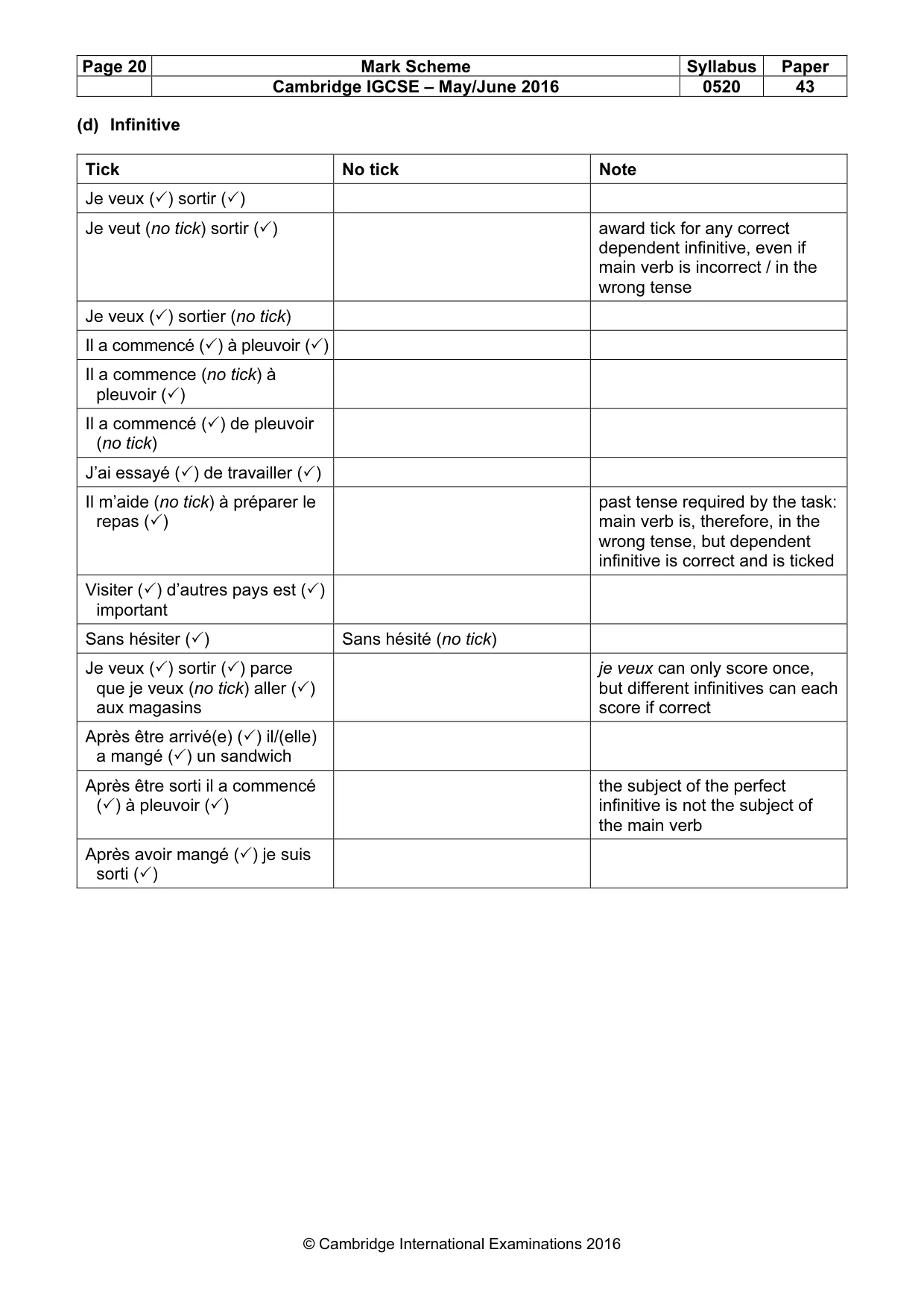
Page 20 Mark Scheme Syllabus Paper Cambridge IGCSE – May/June 2016 0520 43 © Cambridge International Examinations 2016 (d) Infinitive Tick No tick Note Je veux (✓) sortir (✓) Je veut (no tick) sortir (✓) award tick for any correct dependent infinitive, even if main verb is incorrect / in the wrong tense Je veux (✓) sortier (no tick) Il a commencé (✓) à pleuvoir (✓) Il a commence (no tick) à pleuvoir (✓) Il a commencé (✓) de pleuvoir (no tick) J’ai essayé (✓) de travailler (✓) Il m’aide (no tick) à préparer le repas (✓) past tense required by the task: main verb is, therefore, in the wrong tense, but dependent infinitive is correct and is ticked Visiter (✓) d’autres pays est (✓) important Sans hésiter (✓) Sans hésité (no tick) Je veux (✓) sortir (✓) parce que je veux (no tick) aller (✓) aux magasins je veux can only score once, but different infinitives can each score if correct Après être arrivé(e) (✓) il/(elle) a mangé (✓) un sandwich Après être sorti il a commencé (✓) à pleuvoir (✓) the subject of the perfect infinitive is not the subject of the main verb Après avoir mangé (✓) je suis sorti (✓)
Mark scheme, page 21
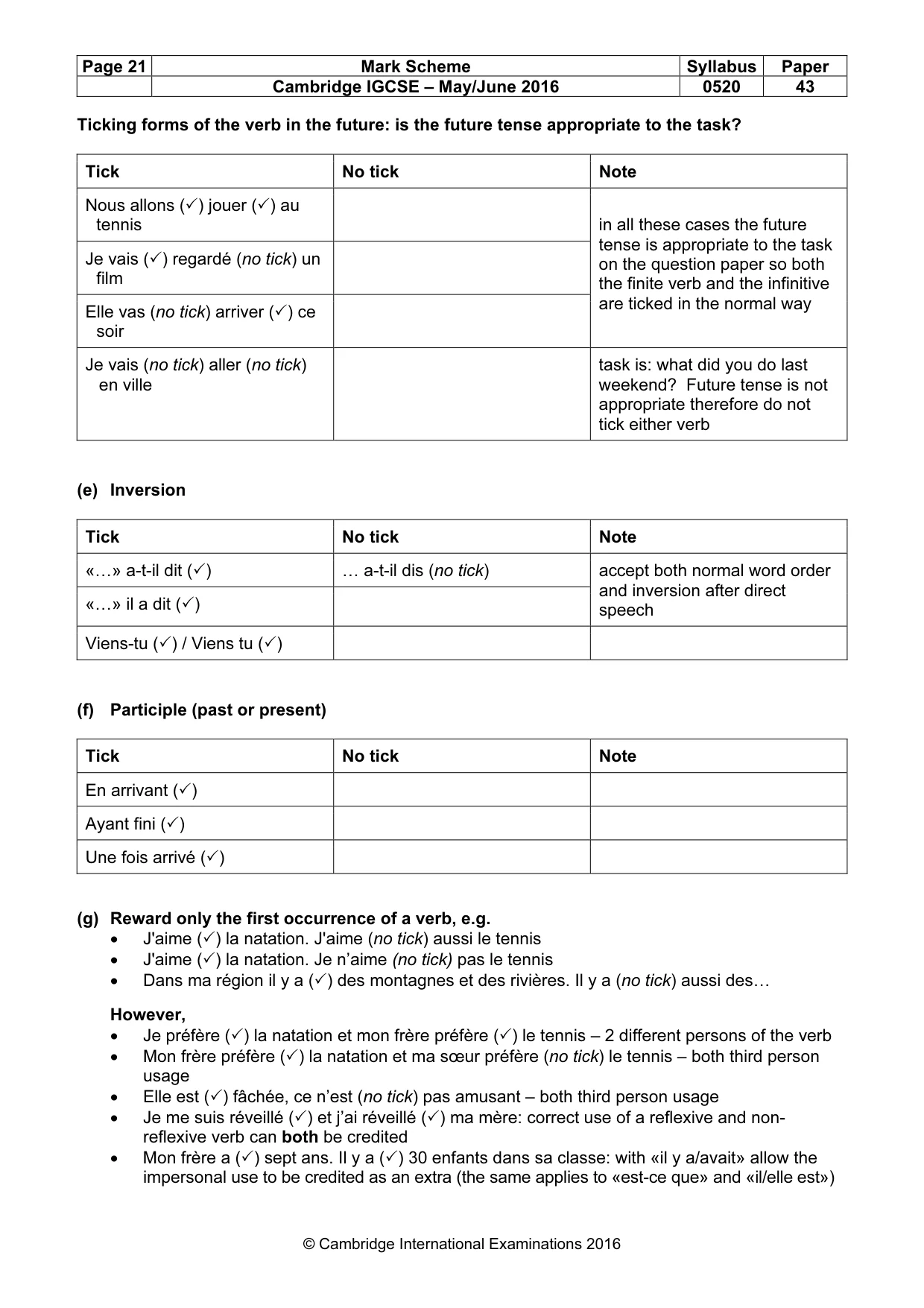
Page 21 Mark Scheme Syllabus Paper Cambridge IGCSE – May/June 2016 0520 43 © Cambridge International Examinations 2016 Ticking forms of the verb in the future: is the future tense appropriate to the task? Tick No tick Note Nous allons (✓) jouer (✓) au tennis in all these cases the future tense is appropriate to the task on the question paper so both the finite verb and the infinitive are ticked in the normal way Je vais (✓) regardé (no tick) un film Elle vas (no tick) arriver (✓) ce soir Je vais (no tick) aller (no tick) en ville task is: what did you do last weekend? Future tense is not appropriate therefore do not tick either verb (e) Inversion Tick No tick Note «…» a-t-il dit (✓) … a-t-il dis (no tick) accept both normal word order and inversion after direct speech «…» il a dit (✓) Viens-tu (✓) / Viens tu (✓) (f) Participle (past or present) Tick No tick Note En arrivant (✓) Ayant fini (✓) Une fois arrivé (✓) (g) Reward only the first occurrence of a verb, e.g. • J'aime (✓) la natation. J'aime (no tick) aussi le tennis • J'aime (✓) la natation. Je n’aime (no tick) pas le tennis • Dans ma région il y a (✓) des montagnes et des rivières. Il y a (no tick) aussi des… However, • Je préfère (✓) la natation et mon frère préfère (✓) le tennis – 2 different persons of the verb • Mon frère préfère (✓) la natation et ma sœur préfère (no tick) le tennis – both third person usage • Elle est (✓) fâchée, ce n’est (no tick) pas amusant – both third person usage • Je me suis réveillé (✓) et j’ai réveillé (✓) ma mère: correct use of a reflexive and non- reflexive verb can both be credited • Mon frère a (✓) sept ans. Il y a (✓) 30 enfants dans sa classe: with «il y a/avait» allow the impersonal use to be credited as an extra (the same applies to «est-ce que» and «il/elle est»)
Mark scheme, page 22
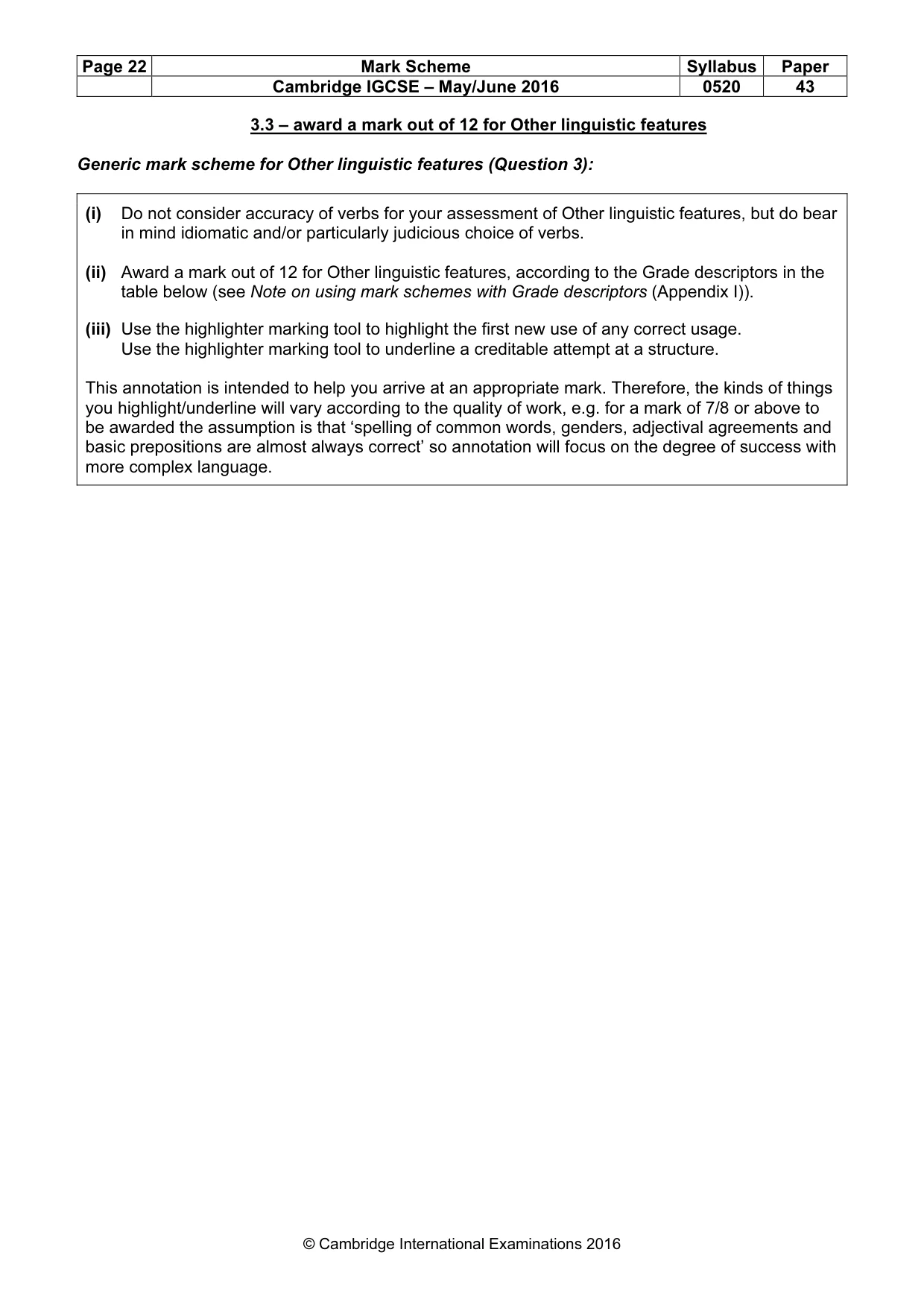
Page 22 Mark Scheme Syllabus Paper Cambridge IGCSE – May/June 2016 0520 43 © Cambridge International Examinations 2016 3.3 – award a mark out of 12 for Other linguistic features Generic mark scheme for Other linguistic features (Question 3): (i) Do not consider accuracy of verbs for your assessment of Other linguistic features, but do bear in mind idiomatic and/or particularly judicious choice of verbs. (ii) Award a mark out of 12 for Other linguistic features, according to the Grade descriptors in the table below (see Note on using mark schemes with Grade descriptors (Appendix I)). (iii) Use the highlighter marking tool to highlight the first new use of any correct usage. Use the highlighter marking tool to underline a creditable attempt at a structure. This annotation is intended to help you arrive at an appropriate mark. Therefore, the kinds of things you highlight/underline will vary according to the quality of work, e.g. for a mark of 7/8 or above to be awarded the assumption is that ‘spelling of common words, genders, adjectival agreements and basic prepositions are almost always correct’ so annotation will focus on the degree of success with more complex language.
Mark scheme, page 23
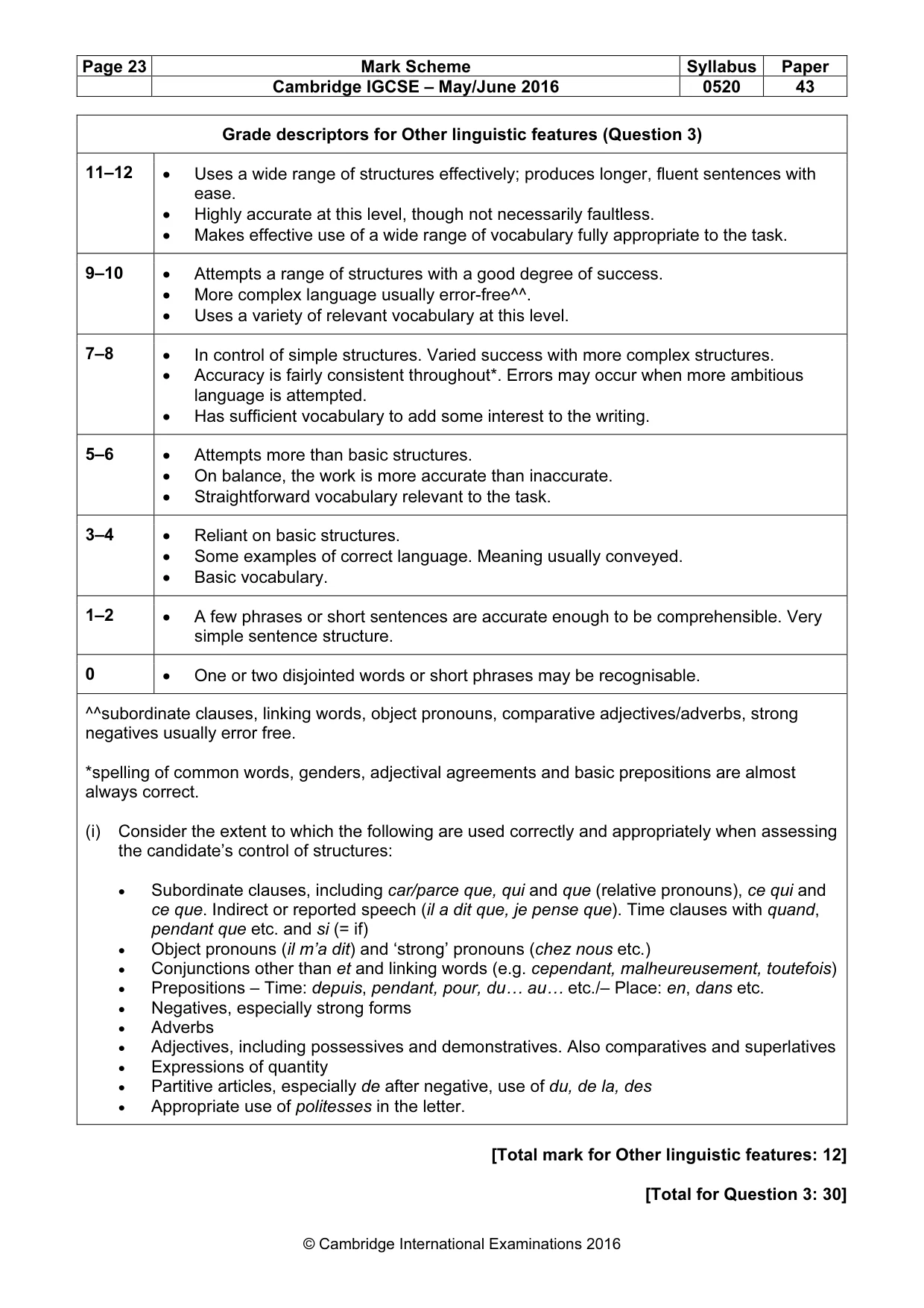
Page 23 Mark Scheme Syllabus Paper Cambridge IGCSE – May/June 2016 0520 43 © Cambridge International Examinations 2016 Grade descriptors for Other linguistic features (Question 3) 11–12 • Uses a wide range of structures effectively; produces longer, fluent sentences with ease. • Highly accurate at this level, though not necessarily faultless. • Makes effective use of a wide range of vocabulary fully appropriate to the task. 9–10 • Attempts a range of structures with a good degree of success. • More complex language usually error-free^^. • Uses a variety of relevant vocabulary at this level. 7–8 • In control of simple structures. Varied success with more complex structures. • Accuracy is fairly consistent throughout*. Errors may occur when more ambitious language is attempted. • Has sufficient vocabulary to add some interest to the writing. 5–6 • Attempts more than basic structures. • On balance, the work is more accurate than inaccurate. • Straightforward vocabulary relevant to the task. 3–4 • Reliant on basic structures. • Some examples of correct language. Meaning usually conveyed. • Basic vocabulary. 1–2 • A few phrases or short sentences are accurate enough to be comprehensible. Very simple sentence structure. 0 • One or two disjointed words or short phrases may be recognisable. ^^subordinate clauses, linking words, object pronouns, comparative adjectives/adverbs, strong negatives usually error free. *spelling of common words, genders, adjectival agreements and basic prepositions are almost always correct. (i) Consider the extent to which the following are used correctly and appropriately when assessing the candidate’s control of structures: • Subordinate clauses, including car/parce que, qui and que (relative pronouns), ce qui and ce que. Indirect or reported speech (il a dit que, je pense que). Time clauses with quand, pendant que etc. and si (= if) • Object pronouns (il m’a dit) and ‘strong’ pronouns (chez nous etc.) • Conjunctions other than et and linking words (e.g. cependant, malheureusement, toutefois) • Prepositions – Time: depuis, pendant, pour, du… au… etc./– Place: en, dans etc. • Negatives, especially strong forms • Adverbs • Adjectives, including possessives and demonstratives. Also comparatives and superlatives • Expressions of quantity • Partitive articles, especially de after negative, use of du, de la, des • Appropriate use of politesses in the letter. [Total mark for Other linguistic features: 12] [Total for Question 3: 30]
Mark scheme, page 24
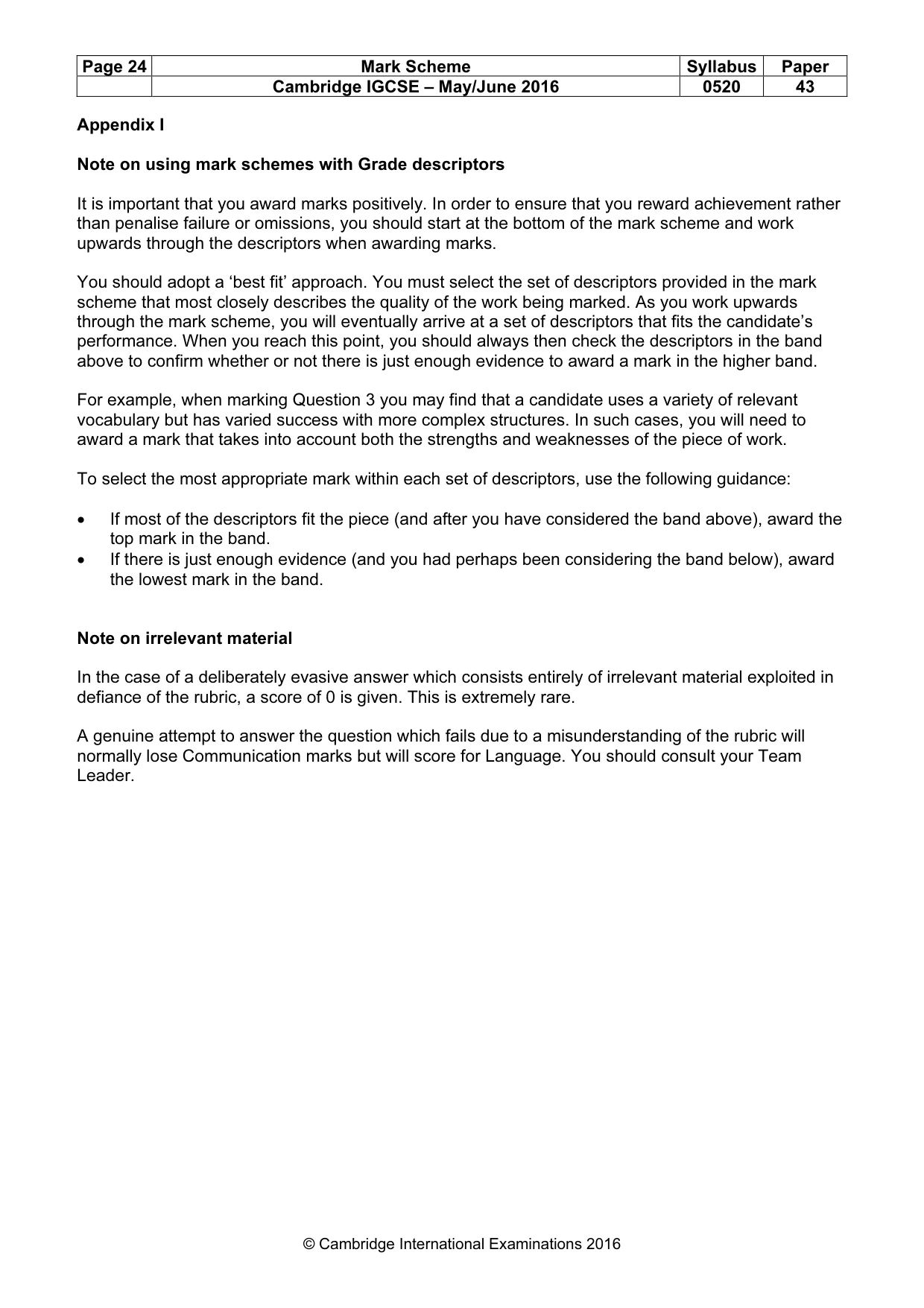
Page 24 Mark Scheme Syllabus Paper Cambridge IGCSE – May/June 2016 0520 43 © Cambridge International Examinations 2016 Appendix I Note on using mark schemes with Grade descriptors It is important that you award marks positively. In order to ensure that you reward achievement rather than penalise failure or omissions, you should start at the bottom of the mark scheme and work upwards through the descriptors when awarding marks. You should adopt a ‘best fit’ approach. You must select the set of descriptors provided in the mark scheme that most closely describes the quality of the work being marked. As you work upwards through the mark scheme, you will eventually arrive at a set of descriptors that fits the candidate’s performance. When you reach this point, you should always then check the descriptors in the band above to confirm whether or not there is just enough evidence to award a mark in the higher band. For example, when marking Question 3 you may find that a candidate uses a variety of relevant vocabulary but has varied success with more complex structures. In such cases, you will need to award a mark that takes into account both the strengths and weaknesses of the piece of work. To select the most appropriate mark within each set of descriptors, use the following guidance: • If most of the descriptors fit the piece (and after you have considered the band above), award the top mark in the band. • If there is just enough evidence (and you had perhaps been considering the band below), award the lowest mark in the band. Note on irrelevant material In the case of a deliberately evasive answer which consists entirely of irrelevant material exploited in defiance of the rubric, a score of 0 is given. This is extremely rare. A genuine attempt to answer the question which fails due to a misunderstanding of the rubric will normally lose Communication marks but will score for Language. You should consult your Team Leader.
Mark scheme, page 25
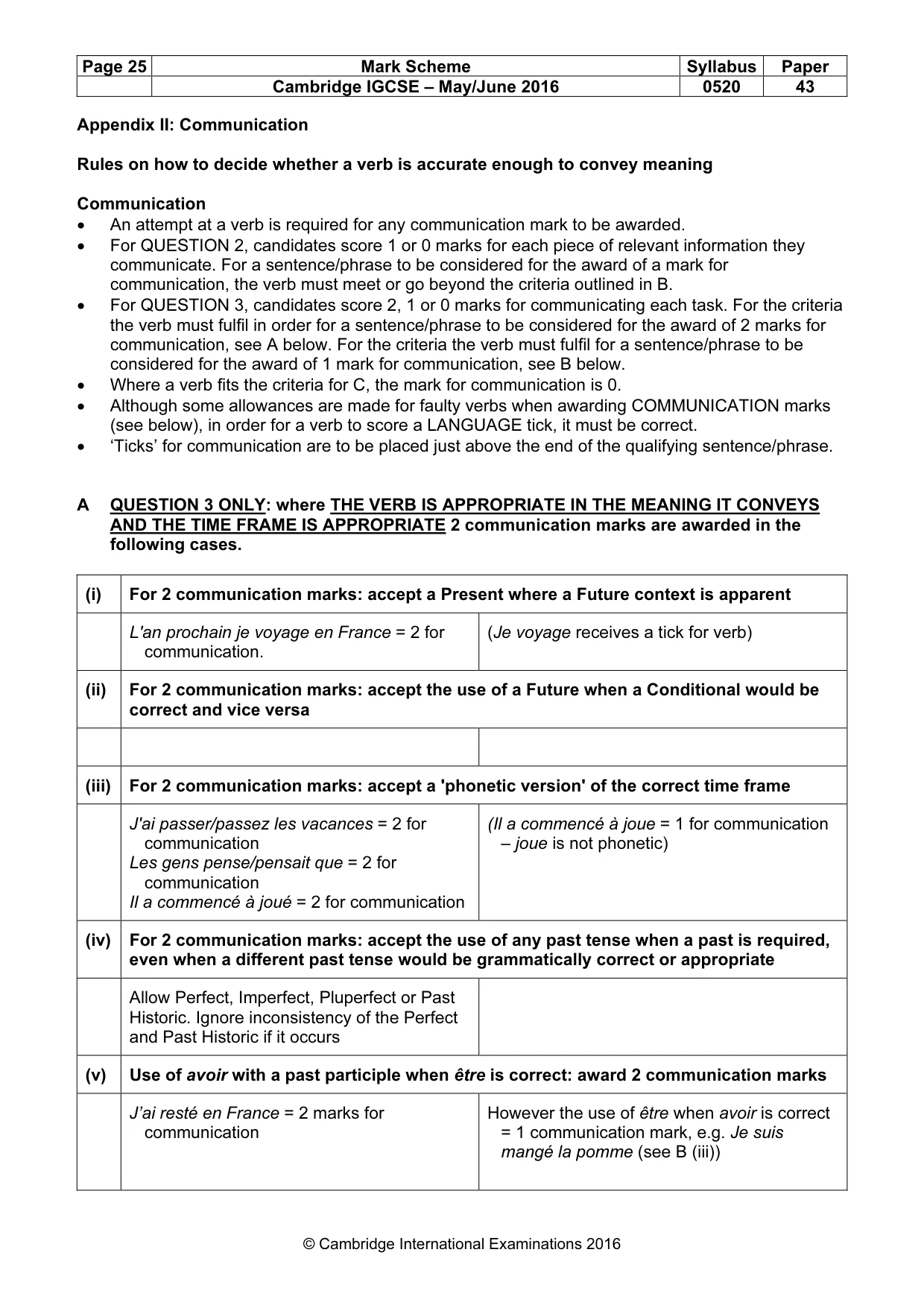
Page 25 Mark Scheme Syllabus Paper Cambridge IGCSE – May/June 2016 0520 43 © Cambridge International Examinations 2016 Appendix II: Communication Rules on how to decide whether a verb is accurate enough to convey meaning Communication • An attempt at a verb is required for any communication mark to be awarded. • For QUESTION 2, candidates score 1 or 0 marks for each piece of relevant information they communicate. For a sentence/phrase to be considered for the award of a mark for communication, the verb must meet or go beyond the criteria outlined in B. • For QUESTION 3, candidates score 2, 1 or 0 marks for communicating each task. For the criteria the verb must fulfil in order for a sentence/phrase to be considered for the award of 2 marks for communication, see A below. For the criteria the verb must fulfil for a sentence/phrase to be considered for the award of 1 mark for communication, see B below. • Where a verb fits the criteria for C, the mark for communication is 0. • Although some allowances are made for faulty verbs when awarding COMMUNICATION marks (see below), in order for a verb to score a LANGUAGE tick, it must be correct. • ‘Ticks’ for communication are to be placed just above the end of the qualifying sentence/phrase. A QUESTION 3 ONLY: where THE VERB IS APPROPRIATE IN THE MEANING IT CONVEYS AND THE TIME FRAME IS APPROPRIATE 2 communication marks are awarded in the following cases. (i) For 2 communication marks: accept a Present where a Future context is apparent L'an prochain je voyage en France = 2 for communication. (Je voyage receives a tick for verb) (ii) For 2 communication marks: accept the use of a Future when a Conditional would be correct and vice versa (iii) For 2 communication marks: accept a 'phonetic version' of the correct time frame J'ai passer/passez les vacances = 2 for communication Les gens pense/pensait que = 2 for communication Il a commencé à joué = 2 for communication (Il a commencé à joue = 1 for communication – joue is not phonetic) (iv) For 2 communication marks: accept the use of any past tense when a past is required, even when a different past tense would be grammatically correct or appropriate Allow Perfect, Imperfect, Pluperfect or Past Historic. Ignore inconsistency of the Perfect and Past Historic if it occurs (v) Use of avoir with a past participle when être is correct: award 2 communication marks J’ai resté en France = 2 marks for communication However the use of être when avoir is correct = 1 communication mark, e.g. Je suis mangé la pomme (see B (iii))
Mark scheme, page 26
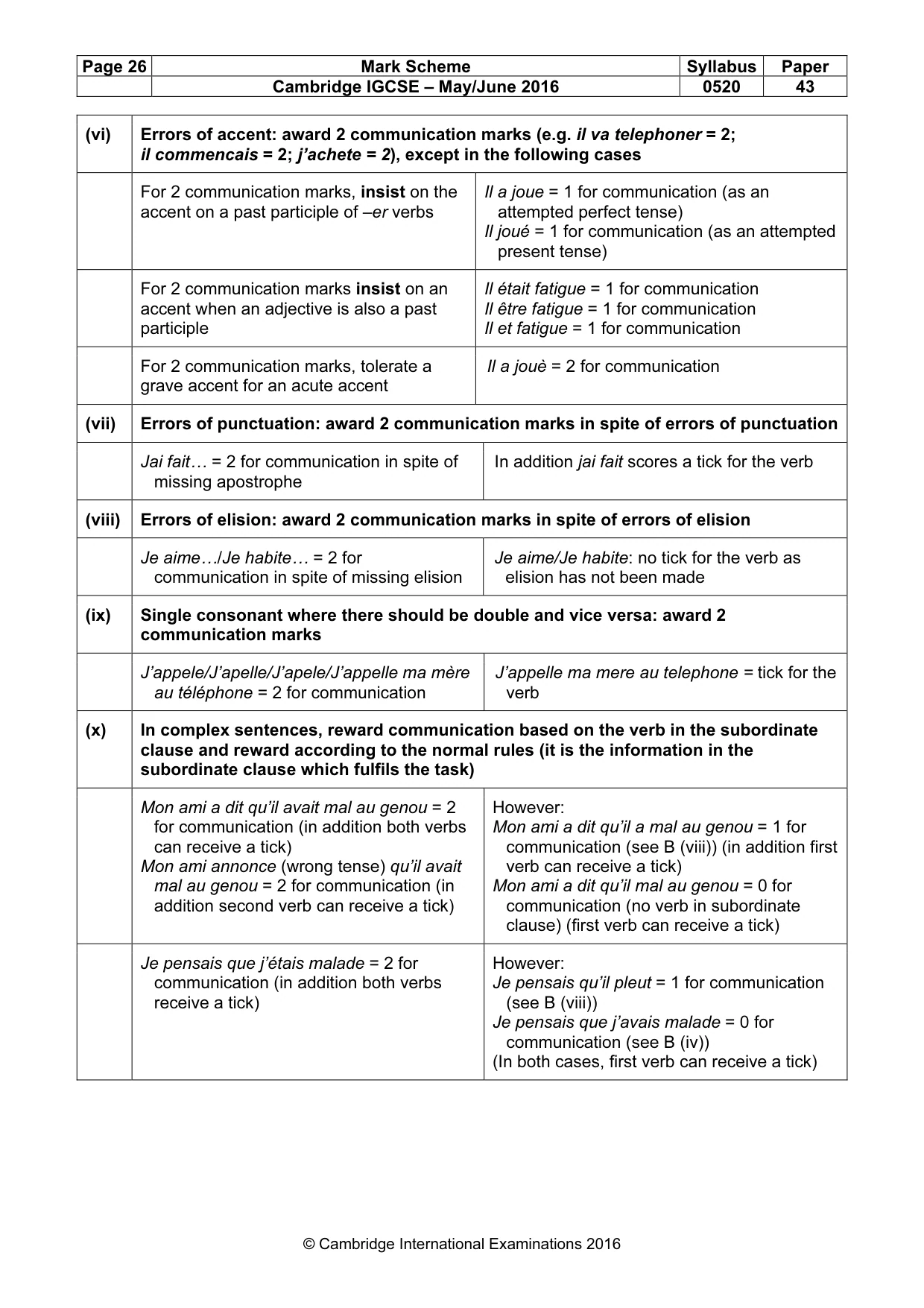
Page 26 Mark Scheme Syllabus Paper Cambridge IGCSE – May/June 2016 0520 43 © Cambridge International Examinations 2016 (vi) Errors of accent: award 2 communication marks (e.g. il va telephoner = 2; il commencais = 2; j’achete = 2), except in the following cases For 2 communication marks, insist on the accent on a past participle of –er verbs Il a joue = 1 for communication (as an attempted perfect tense) Il joué = 1 for communication (as an attempted present tense) For 2 communication marks insist on an accent when an adjective is also a past participle Il était fatigue = 1 for communication Il être fatigue = 1 for communication Il et fatigue = 1 for communication For 2 communication marks, tolerate a grave accent for an acute accent Il a jouè = 2 for communication (vii) Errors of punctuation: award 2 communication marks in spite of errors of punctuation Jai fait… = 2 for communication in spite of missing apostrophe In addition jai fait scores a tick for the verb (viii) Errors of elision: award 2 communication marks in spite of errors of elision Je aime…/Je habite… = 2 for communication in spite of missing elision Je aime/Je habite: no tick for the verb as elision has not been made (ix) Single consonant where there should be double and vice versa: award 2 communication marks J’appele/J’apelle/J’apele/J’appelle ma mère au téléphone = 2 for communication J’appelle ma mere au telephone = tick for the verb (x) In complex sentences, reward communication based on the verb in the subordinate clause and reward according to the normal rules (it is the information in the subordinate clause which fulfils the task) Mon ami a dit qu’il avait mal au genou = 2 for communication (in addition both verbs can receive a tick) Mon ami annonce (wrong tense) qu’il avait mal au genou = 2 for communication (in addition second verb can receive a tick) However: Mon ami a dit qu’il a mal au genou = 1 for communication (see B (viii)) (in addition first verb can receive a tick) Mon ami a dit qu’il mal au genou = 0 for communication (no verb in subordinate clause) (first verb can receive a tick) Je pensais que j’étais malade = 2 for communication (in addition both verbs receive a tick) However: Je pensais qu’il pleut = 1 for communication (see B (viii)) Je pensais que j’avais malade = 0 for communication (see B (iv)) (In both cases, first verb can receive a tick)
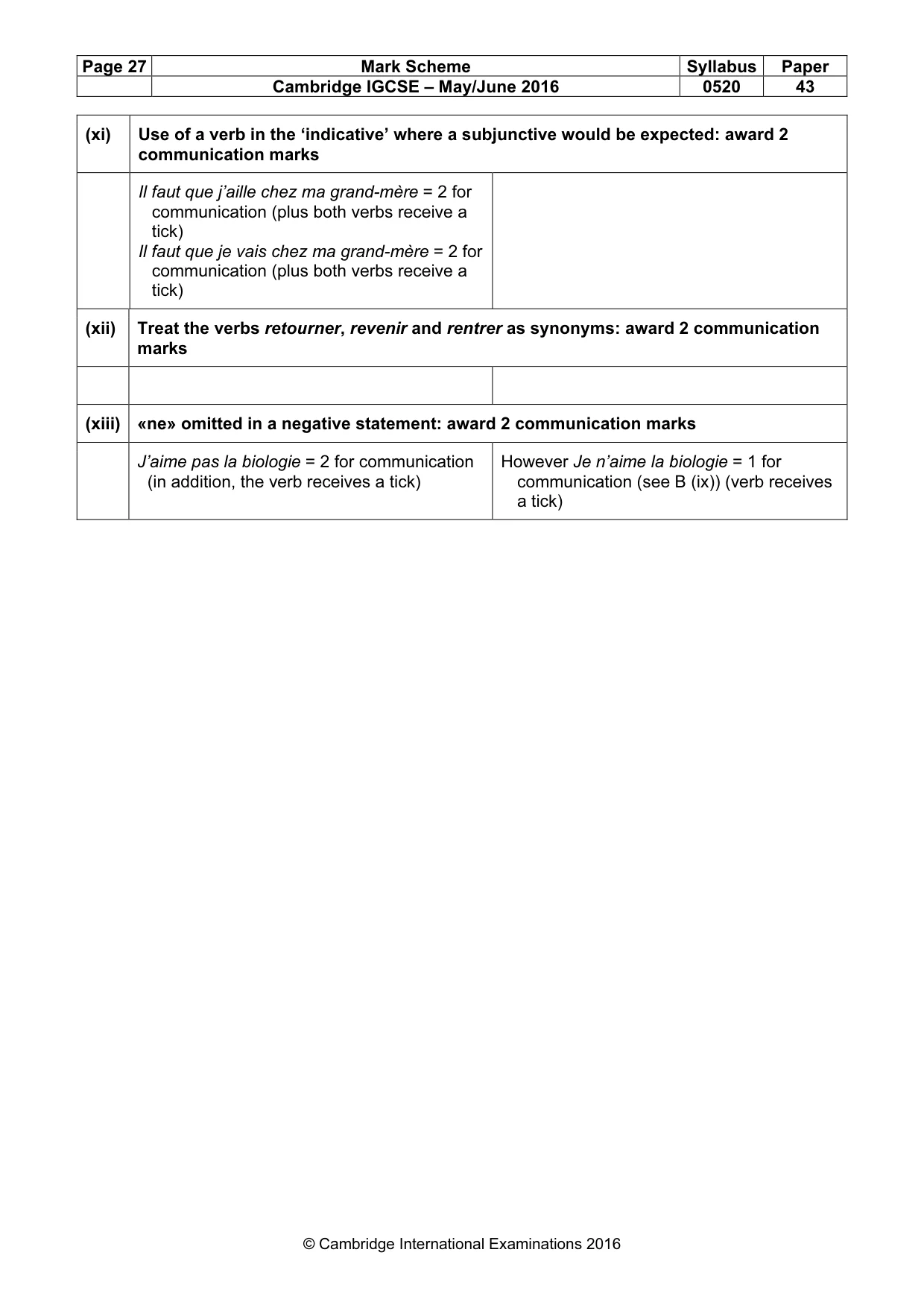
Mark scheme, page 27
Page 27 Mark Scheme Syllabus Paper Cambridge IGCSE – May/June 2016 0520 43 © Cambridge International Examinations 2016 (xi) Use of a verb in the ‘indicative’ where a subjunctive would be expected: award 2 communication marks Il faut que j’aille chez ma grand-mère = 2 for communication (plus both verbs receive a tick) Il faut que je vais chez ma grand-mère = 2 for communication (plus both verbs receive a tick) (xii) Treat the verbs retourner, revenir and rentrer as synonyms: award 2 communication marks (xiii) «ne» omitted in a negative statement: award 2 communication marks J’aime pas la biologie = 2 for communication (in addition, the verb receives a tick) However Je n’aime la biologie = 1 for communication (see B (ix)) (verb receives a tick)
Mark scheme, page 28
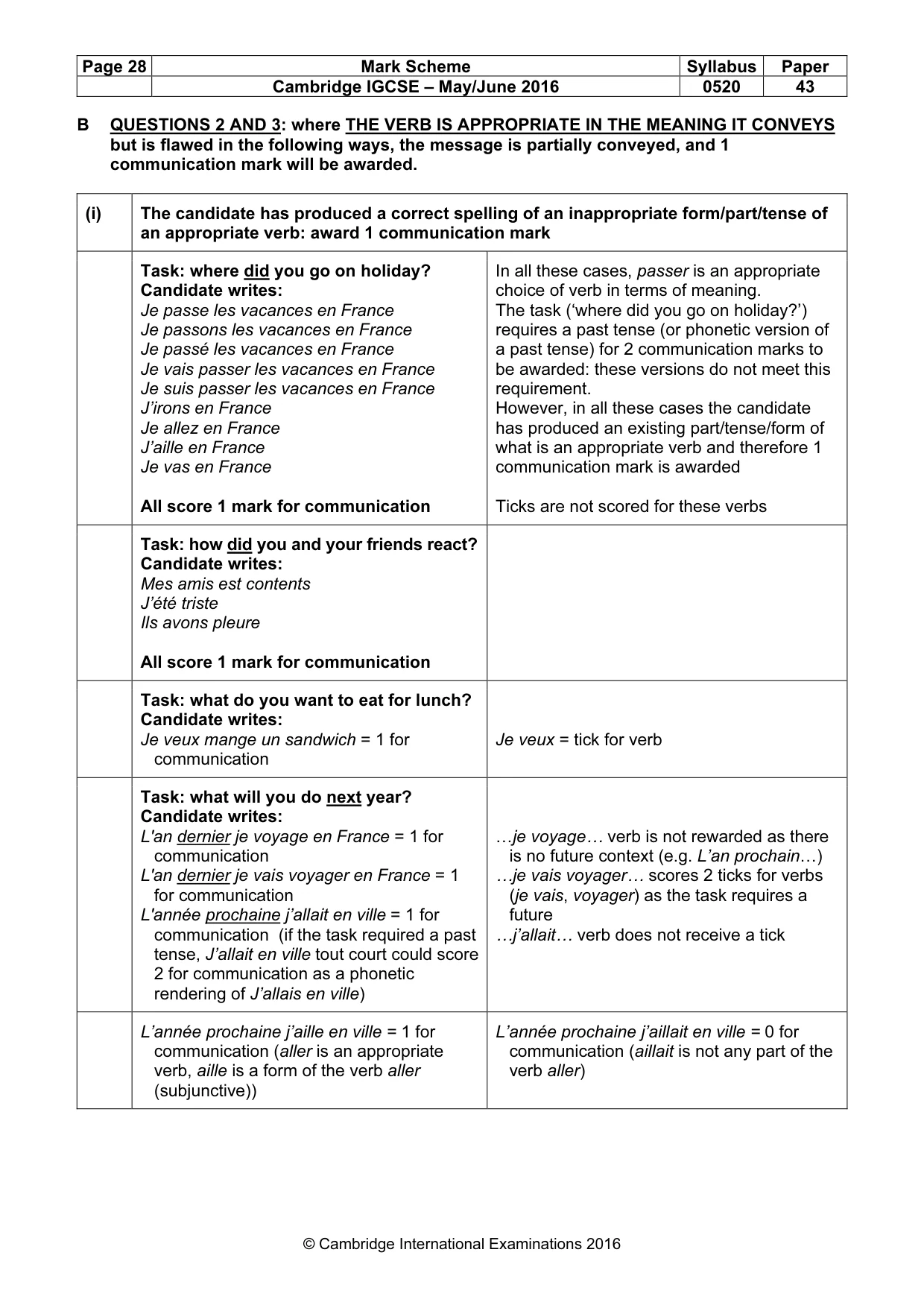
Page 28 Mark Scheme Syllabus Paper Cambridge IGCSE – May/June 2016 0520 43 © Cambridge International Examinations 2016 B QUESTIONS 2 AND 3: where THE VERB IS APPROPRIATE IN THE MEANING IT CONVEYS but is flawed in the following ways, the message is partially conveyed, and 1 communication mark will be awarded. (i) The candidate has produced a correct spelling of an inappropriate form/part/tense of an appropriate verb: award 1 communication mark Task: where did you go on holiday? Candidate writes: Je passe les vacances en France Je passons les vacances en France Je passé les vacances en France Je vais passer les vacances en France Je suis passer les vacances en France J’irons en France Je allez en France J’aille en France Je vas en France All score 1 mark for communication In all these cases, passer is an appropriate choice of verb in terms of meaning. The task (‘where did you go on holiday?’) requires a past tense (or phonetic version of a past tense) for 2 communication marks to be awarded: these versions do not meet this requirement. However, in all these cases the candidate has produced an existing part/tense/form of what is an appropriate verb and therefore 1 communication mark is awarded Ticks are not scored for these verbs Task: how did you and your friends react? Candidate writes: Mes amis est contents J’été triste Ils avons pleure All score 1 mark for communication Task: what do you want to eat for lunch? Candidate writes: Je veux mange un sandwich = 1 for communication Je veux = tick for verb Task: what will you do next year? Candidate writes: L'an dernier je voyage en France = 1 for communication L'an dernier je vais voyager en France = 1 for communication L'année prochaine j’allait en ville = 1 for communication (if the task required a past tense, J’allait en ville tout court could score 2 for communication as a phonetic rendering of J’allais en ville) …je voyage… verb is not rewarded as there is no future context (e.g. L’an prochain…) …je vais voyager… scores 2 ticks for verbs (je vais, voyager) as the task requires a future …j’allait… verb does not receive a tick L’année prochaine j’aille en ville = 1 for communication (aller is an appropriate verb, aille is a form of the verb aller (subjunctive)) L’année prochaine j’aillait en ville = 0 for communication (aillait is not any part of the verb aller)
Mark scheme, page 29
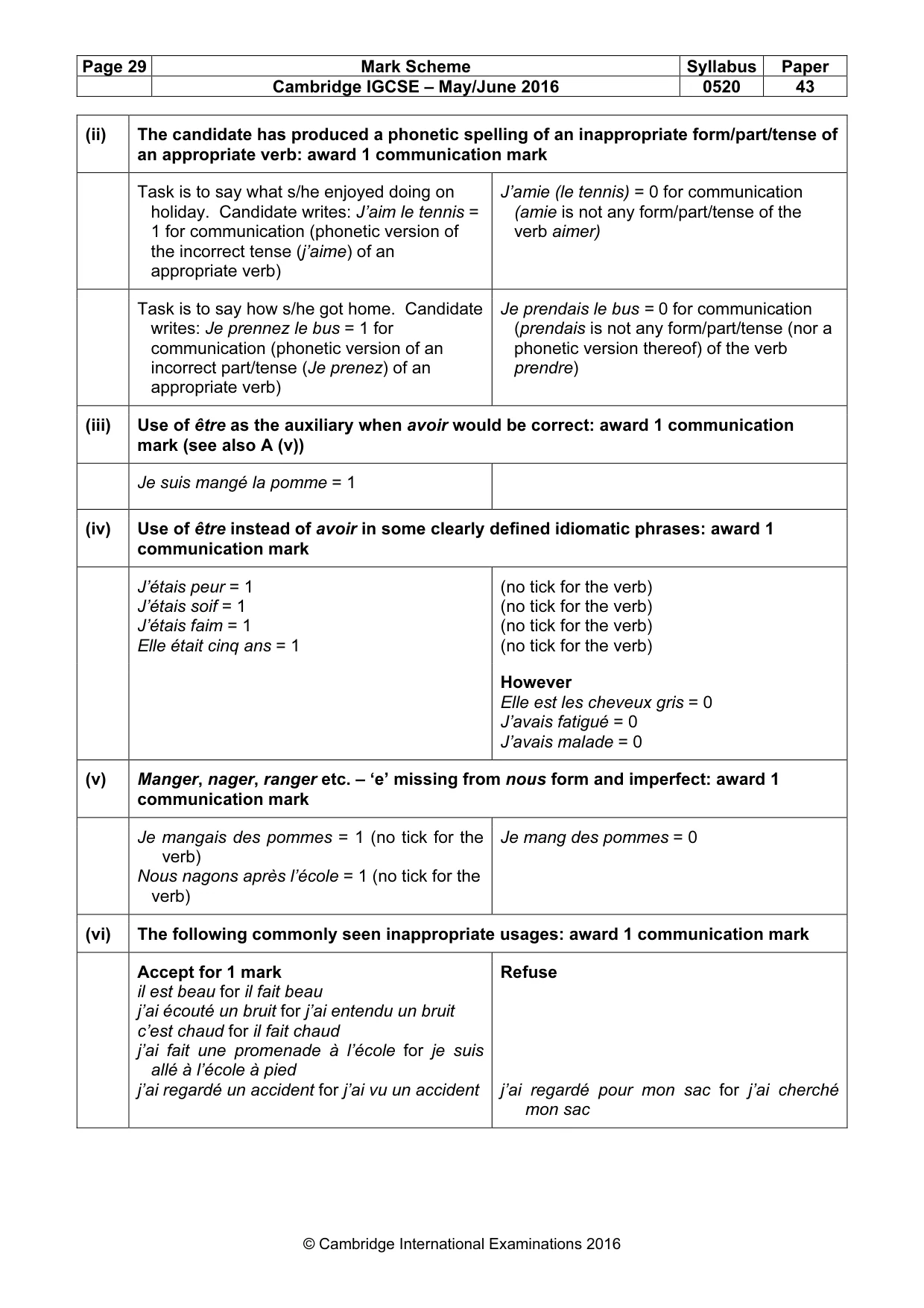
Page 29 Mark Scheme Syllabus Paper Cambridge IGCSE – May/June 2016 0520 43 © Cambridge International Examinations 2016 (ii) The candidate has produced a phonetic spelling of an inappropriate form/part/tense of an appropriate verb: award 1 communication mark Task is to say what s/he enjoyed doing on holiday. Candidate writes: J’aim le tennis = 1 for communication (phonetic version of the incorrect tense (j’aime) of an appropriate verb) J’amie (le tennis) = 0 for communication (amie is not any form/part/tense of the verb aimer) Task is to say how s/he got home. Candidate writes: Je prennez le bus = 1 for communication (phonetic version of an incorrect part/tense (Je prenez) of an appropriate verb) Je prendais le bus = 0 for communication (prendais is not any form/part/tense (nor a phonetic version thereof) of the verb prendre) (iii) Use of être as the auxiliary when avoir would be correct: award 1 communication mark (see also A (v)) Je suis mangé la pomme = 1 (iv) Use of être instead of avoir in some clearly defined idiomatic phrases: award 1 communication mark J’étais peur = 1 J’étais soif = 1 J’étais faim = 1 Elle était cinq ans = 1 (no tick for the verb) (no tick for the verb) (no tick for the verb) (no tick for the verb) However Elle est les cheveux gris = 0 J’avais fatigué = 0 J’avais malade = 0 (v) Manger, nager, ranger etc. – ‘e’ missing from nous form and imperfect: award 1 communication mark Je mangais des pommes = 1 (no tick for the verb) Nous nagons après l’école = 1 (no tick for the verb) Je mang des pommes = 0 (vi) The following commonly seen inappropriate usages: award 1 communication mark Accept for 1 mark il est beau for il fait beau j’ai écouté un bruit for j’ai entendu un bruit c’est chaud for il fait chaud j’ai fait une promenade à l’école for je suis allé à l’école à pied j’ai regardé un accident for j’ai vu un accident Refuse j’ai regardé pour mon sac for j’ai cherché mon sac
Mark scheme, page 30
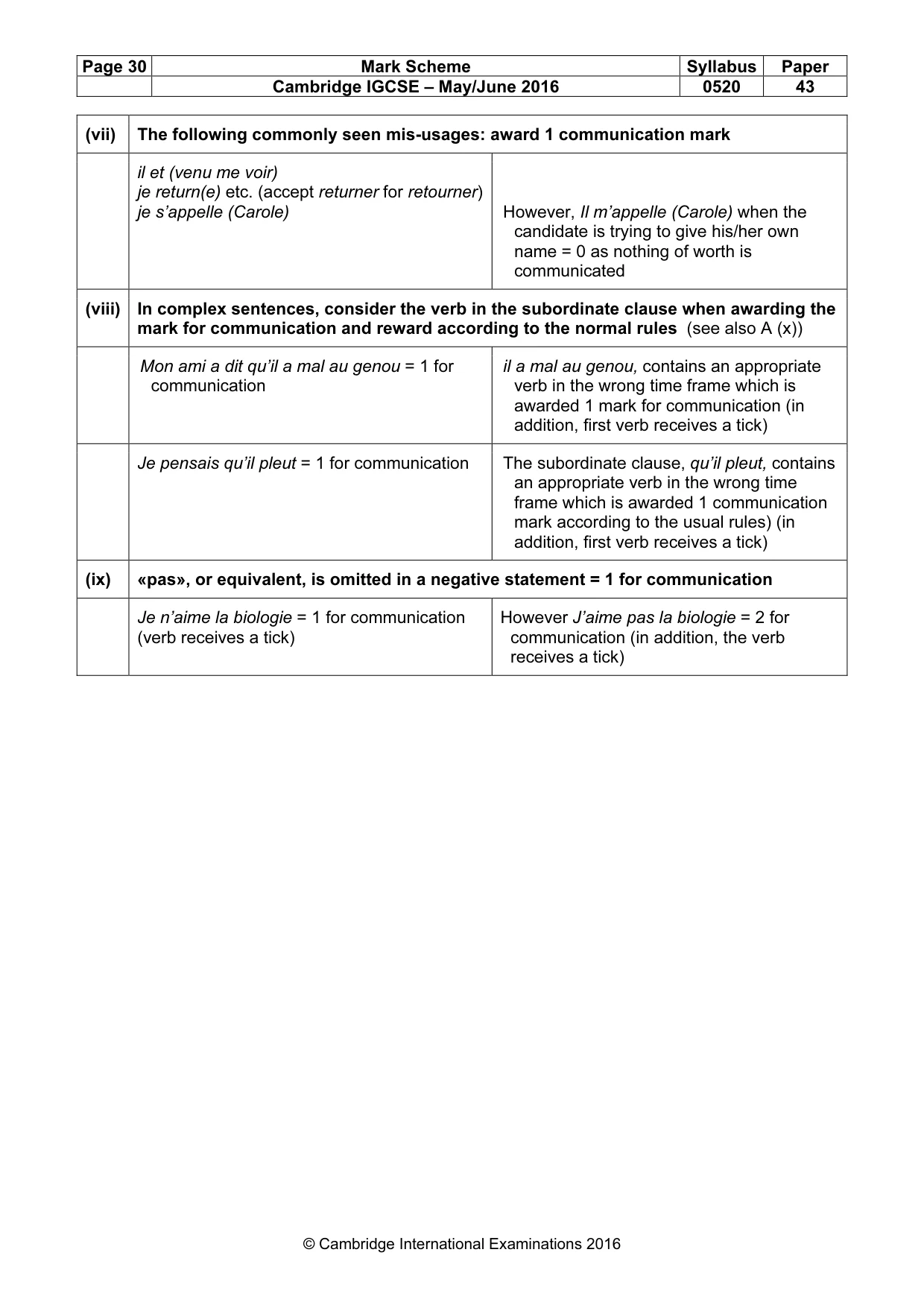
Page 30 Mark Scheme Syllabus Paper Cambridge IGCSE – May/June 2016 0520 43 © Cambridge International Examinations 2016 (vii) The following commonly seen mis-usages: award 1 communication mark il et (venu me voir) je return(e) etc. (accept returner for retourner) je s’appelle (Carole) However, Il m’appelle (Carole) when the candidate is trying to give his/her own name = 0 as nothing of worth is communicated (viii) In complex sentences, consider the verb in the subordinate clause when awarding the mark for communication and reward according to the normal rules (see also A (x)) Mon ami a dit qu’il a mal au genou = 1 for communication il a mal au genou, contains an appropriate verb in the wrong time frame which is awarded 1 mark for communication (in addition, first verb receives a tick) Je pensais qu’il pleut = 1 for communication The subordinate clause, qu’il pleut, contains an appropriate verb in the wrong time frame which is awarded 1 communication mark according to the usual rules) (in addition, first verb receives a tick) (ix) «pas», or equivalent, is omitted in a negative statement = 1 for communication Je n’aime la biologie = 1 for communication (verb receives a tick) However J’aime pas la biologie = 2 for communication (in addition, the verb receives a tick)
Mark scheme, page 31
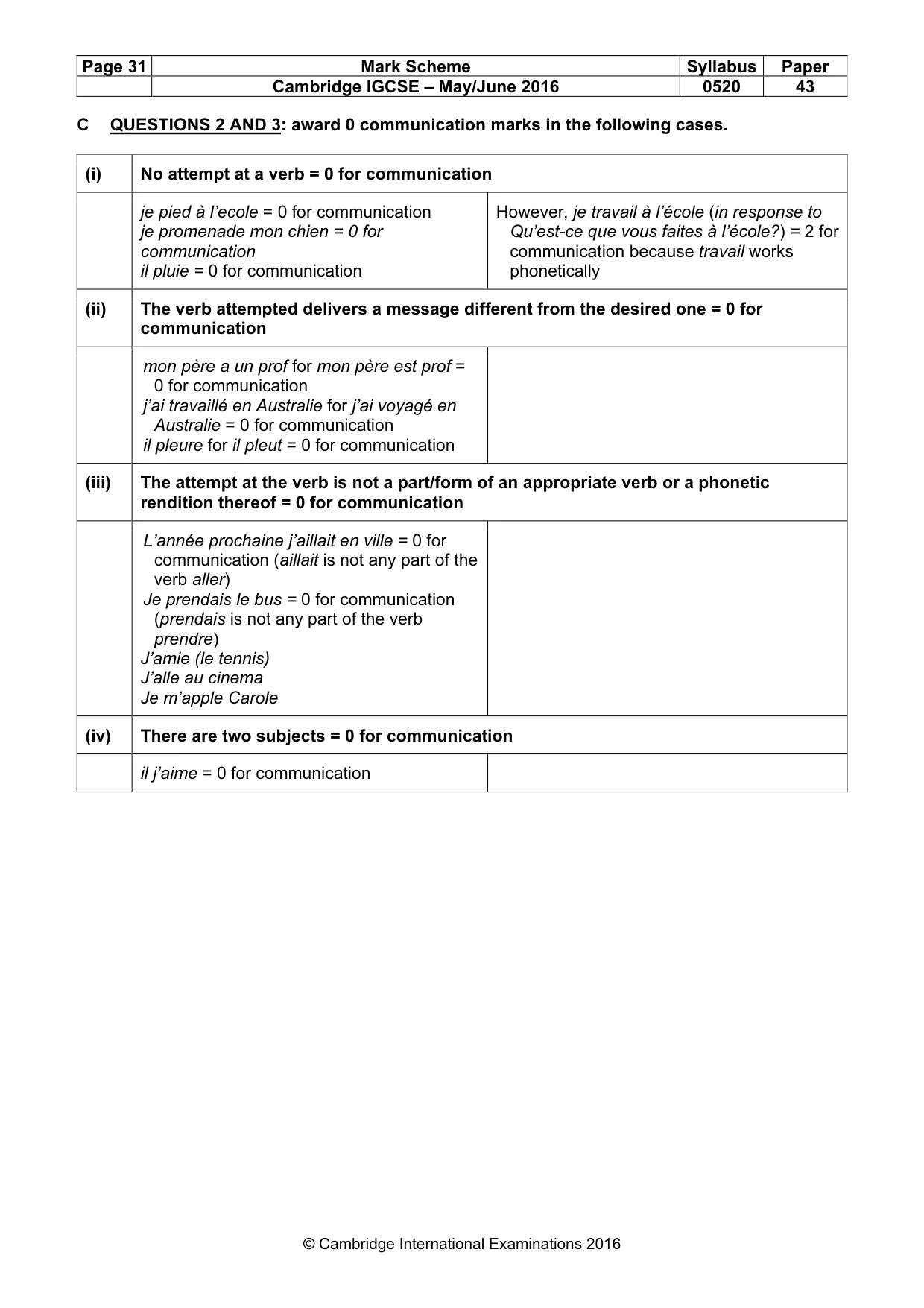
Page 31 Mark Scheme Syllabus Paper Cambridge IGCSE – May/June 2016 0520 43 © Cambridge International Examinations 2016 C QUESTIONS 2 AND 3: award 0 communication marks in the following cases. (i) No attempt at a verb = 0 for communication je pied à l’ecole = 0 for communication je promenade mon chien = 0 for communication il pluie = 0 for communication However, je travail à l’école (in response to Qu’est-ce que vous faites à l’école?) = 2 for communication because travail works phonetically (ii) The verb attempted delivers a message different from the desired one = 0 for communication mon père a un prof for mon père est prof = 0 for communication j’ai travaillé en Australie for j’ai voyagé en Australie = 0 for communication il pleure for il pleut = 0 for communication (iii) The attempt at the verb is not a part/form of an appropriate verb or a phonetic rendition thereof = 0 for communication L’année prochaine j’aillait en ville = 0 for communication (aillait is not any part of the verb aller) Je prendais le bus = 0 for communication (prendais is not any part of the verb prendre) J’amie (le tennis) J’alle au cinema Je m’apple Carole (iv) There are two subjects = 0 for communication il j’aime = 0 for communication
What you needed in this session
Cambridge’s own grade thresholds for 2016 May/June, Paper 4 · Variant 3. A higher threshold means an easier paper — the bar moves with how the cohort did.