Cambridge IGCSE French - Foreign Language 0520 — 2013 Oct/Nov Paper 4 · Variant 1
0520/41/O/N/13 · 50 marks · ≈56 min
The question paper and its mark scheme, free to read here and free to download. This is Cambridge’s own paper, exactly as it was sat.
Question paper4 pages
Mark scheme22 pages
Answers below. Sit the paper first if you are practising.
Paper as text
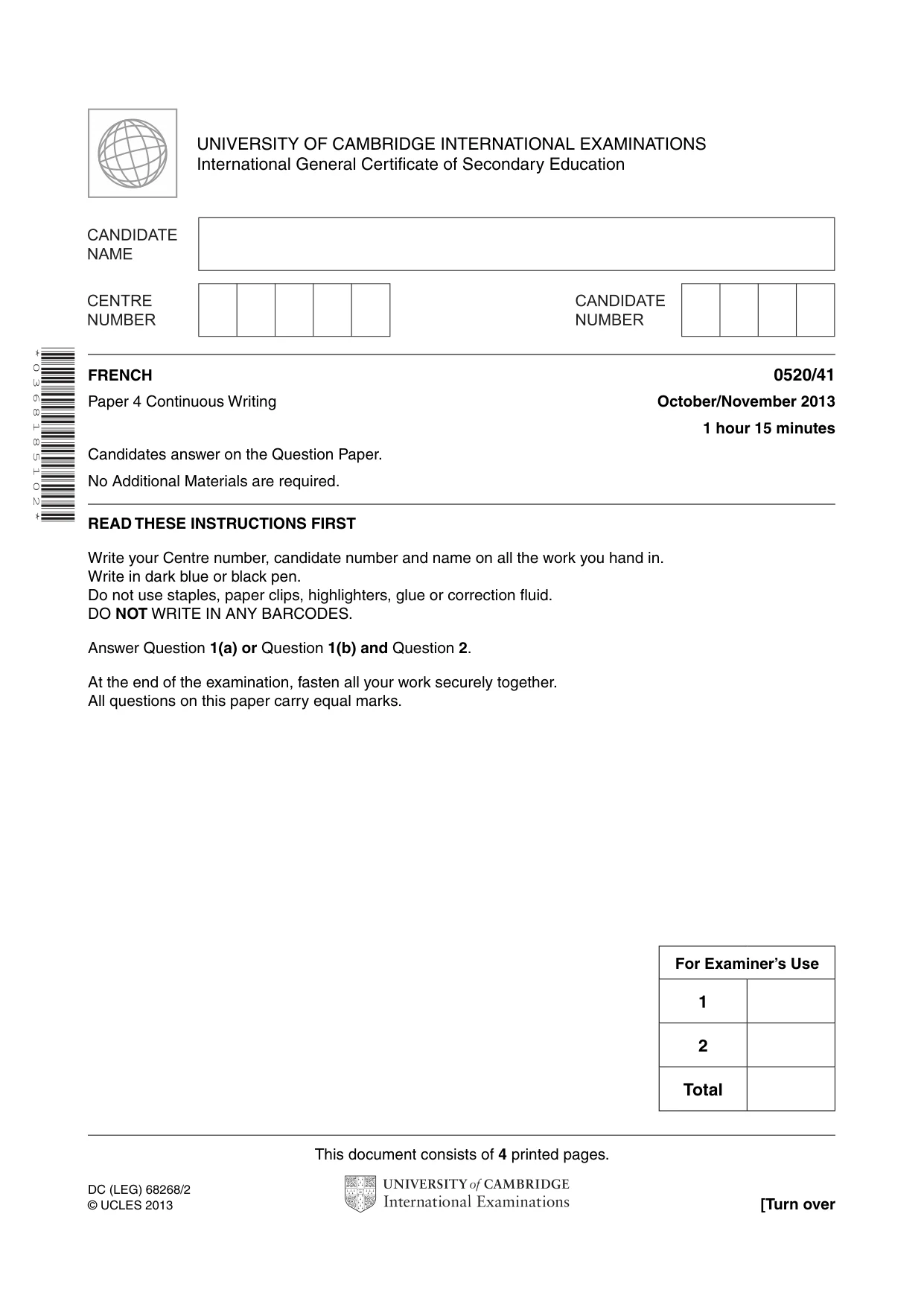
Question paper, page 1
This document consists of 4 printed pages. DC (LEG) 68268/2 © UCLES 2013 [Turn over UNIVERSITY OF CAMBRIDGE INTERNATIONAL EXAMINATIONS International General Certificate of Secondary Education * 0 3 6 8 1 8 5 1 0 2 * FRENCH 0520/41 Paper 4 Continuous Writing October/November 2013 1 hour 15 minutes Candidates answer on the Question Paper. No Additional Materials are required. READ THESE INSTRUCTIONS FIRST Write your Centre number, candidate number and name on all the work you hand in. Write in dark blue or black pen. Do not use staples, paper clips, highlighters, glue or correction fluid. DO NOT WRITE IN ANY BARCODES. Answer Question 1(a) or Question 1(b) and Question 2. At the end of the examination, fasten all your work securely together. All questions on this paper carry equal marks. For Examiner’s Use 1 2 Total
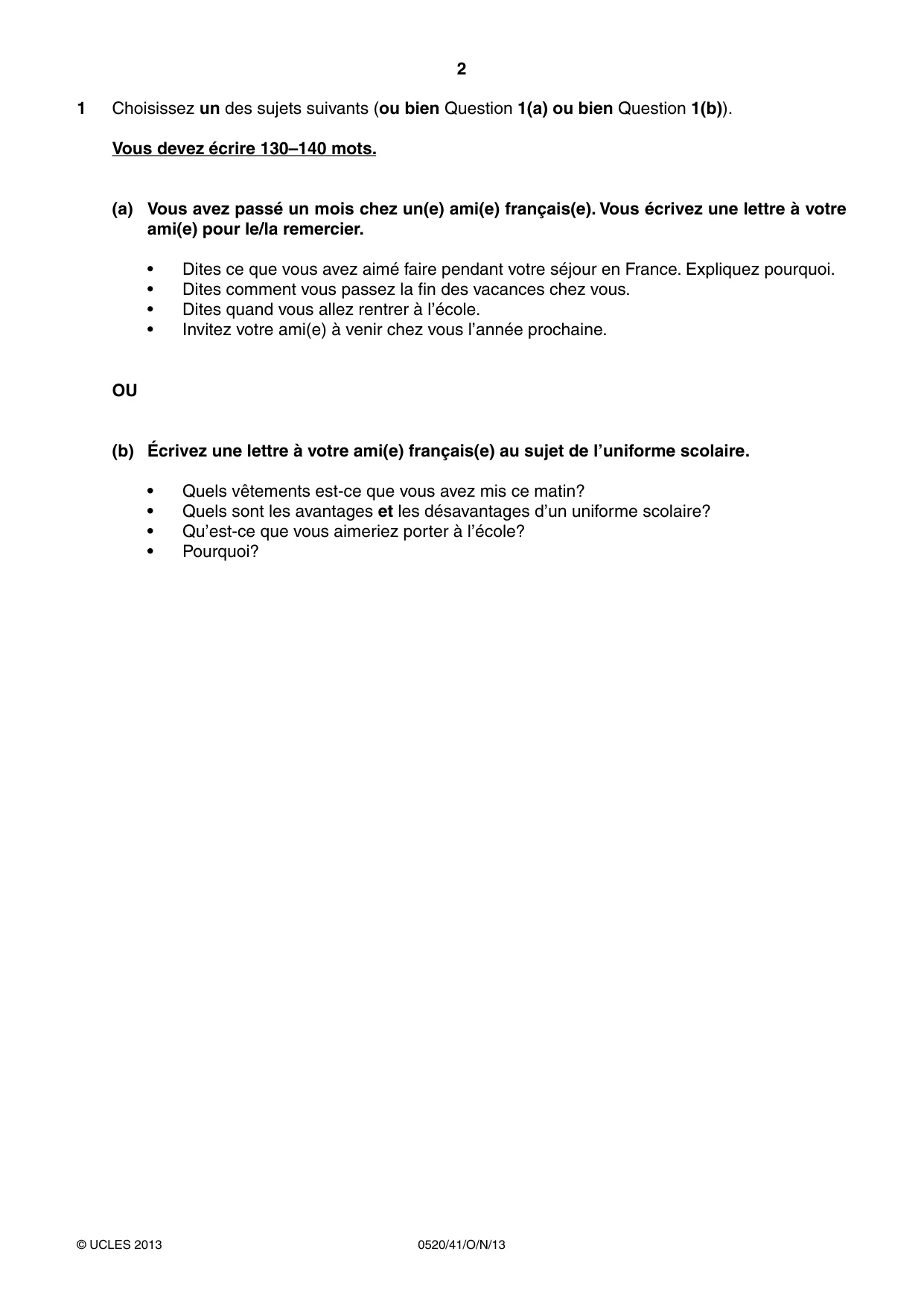
Question paper, page 2
2 0520/41/O/N/13 © UCLES 2013 1 Choisissez un des sujets suivants (ou bien Question 1(a) ou bien Question 1(b)). Vous devez écrire 130–140 mots. (a) Vous avez passé un mois chez un(e) ami(e) français(e). Vous écrivez une lettre à votre ami(e) pour le/la remercier. • Dites ce que vous avez aimé faire pendant votre séjour en France. Expliquez pourquoi. • Dites comment vous passez la fin des vacances chez vous. • Dites quand vous allez rentrer à l’école. • Invitez votre ami(e) à venir chez vous l’année prochaine. OU (b) Écrivez une lettre à votre ami(e) français(e) au sujet de l’uniforme scolaire. • Quels vêtements est-ce que vous avez mis ce matin? • Quels sont les avantages et les désavantages d’un uniforme scolaire? • Qu’est-ce que vous aimeriez porter à l’école? • Pourquoi?
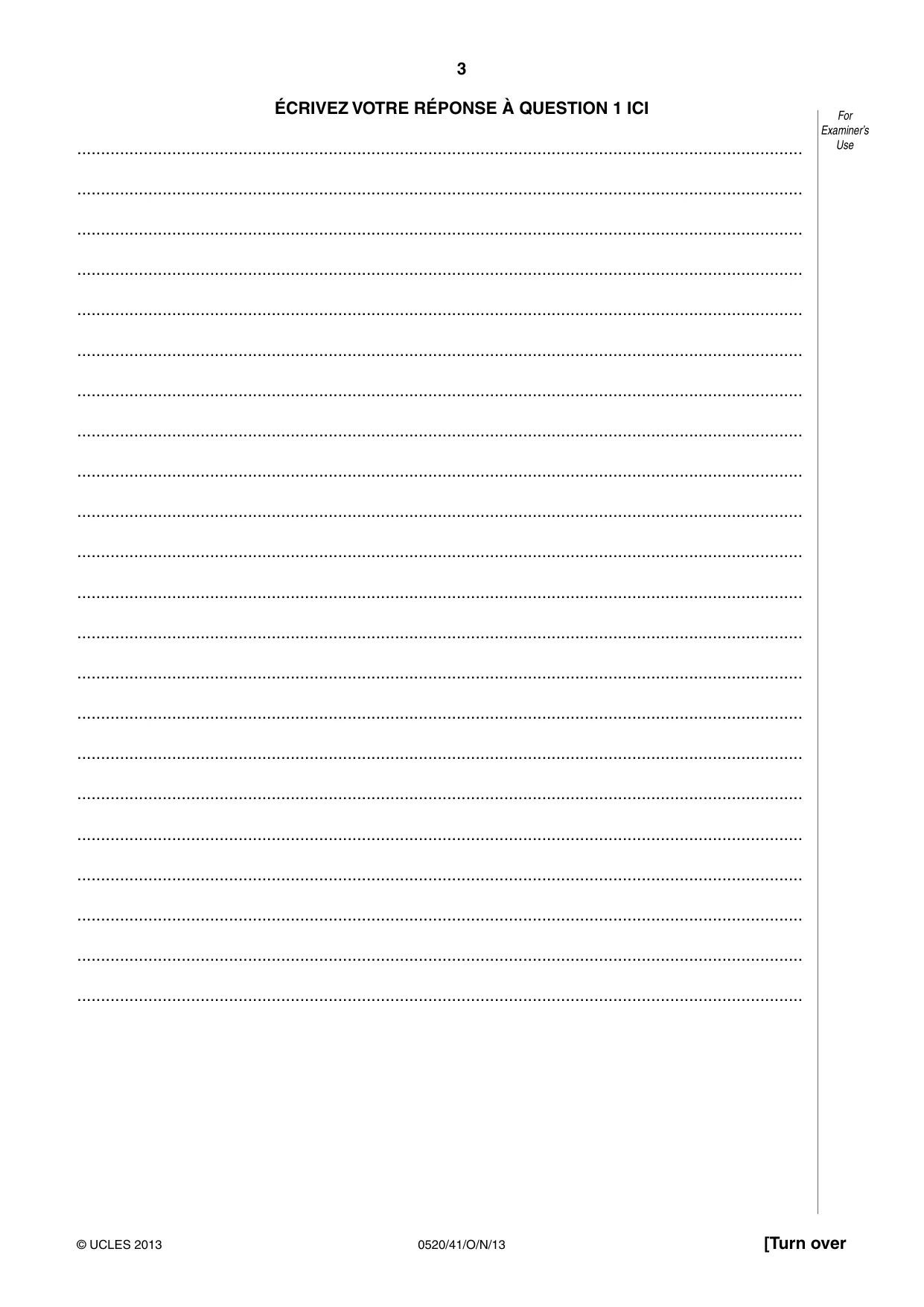
Question paper, page 3
3 0520/41/O/N/13 © UCLES 2013 [Turn over For Examiner’s Use ÉCRIVEZ VOTRE RÉPONSE À QUESTION 1 ICI … … … … … … … … … … … … … … … … … … … … … …
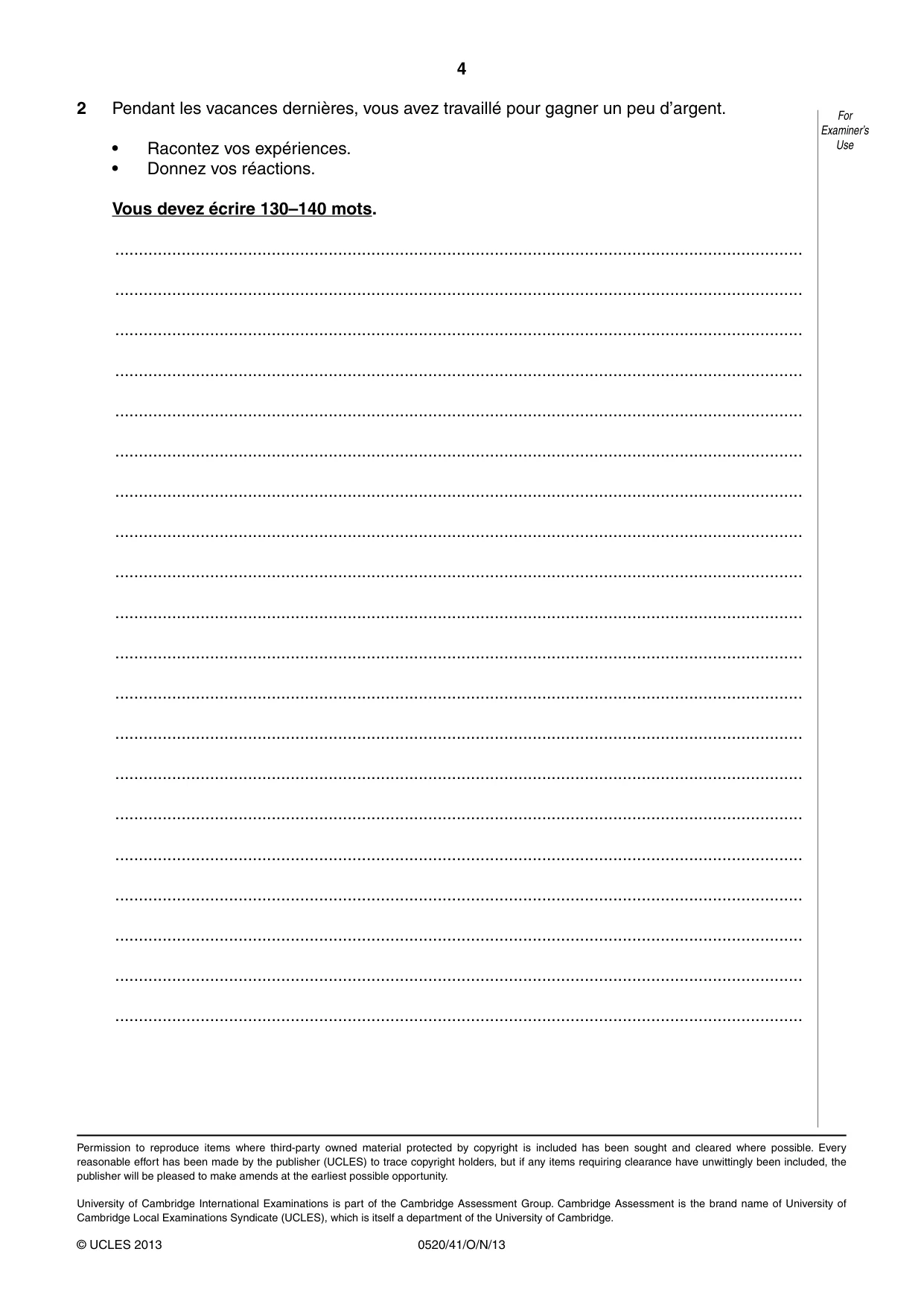
Question paper, page 4
4 0520/41/O/N/13 © UCLES 2013 For Examiner’s Use Permission to reproduce items where third-party owned material protected by copyright is included has been sought and cleared where possible. Every reasonable effort has been made by the publisher (UCLES) to trace copyright holders, but if any items requiring clearance have unwittingly been included, the publisher will be pleased to make amends at the earliest possible opportunity. University of Cambridge International Examinations is part of the Cambridge Assessment Group. Cambridge Assessment is the brand name of University of Cambridge Local Examinations Syndicate (UCLES), which is itself a department of the University of Cambridge. 2 Pendant les vacances dernières, vous avez travaillé pour gagner un peu d’argent. • Racontez vos expériences. • Donnez vos réactions. Vous devez écrire 130–140 mots. … … … … … … … … … … … … … … … … … … … …
Mark scheme, page 1
CAMBRIDGE INTERNATIONAL EXAMINATIONS International General Certificate of Secondary Education MARK SCHEME for the October/November 2013 series 0520 FRENCH (FOREIGN LANGUAGE) 0520/41 Paper 4 (Continuous Writing), maximum raw mark 50 This mark scheme is published as an aid to teachers and candidates, to indicate the requirements of the examination. It shows the basis on which Examiners were instructed to award marks. It does not indicate the details of the discussions that took place at an Examiners’ meeting before marking began, which would have considered the acceptability of alternative answers. Mark schemes should be read in conjunction with the question paper and the Principal Examiner Report for Teachers. Cambridge will not enter into discussions about these mark schemes. Cambridge is publishing the mark schemes for the October/November 2013 series for most IGCSE, GCE Advanced Level and Advanced Subsidiary Level components and some Ordinary Level components.
Mark scheme, page 2
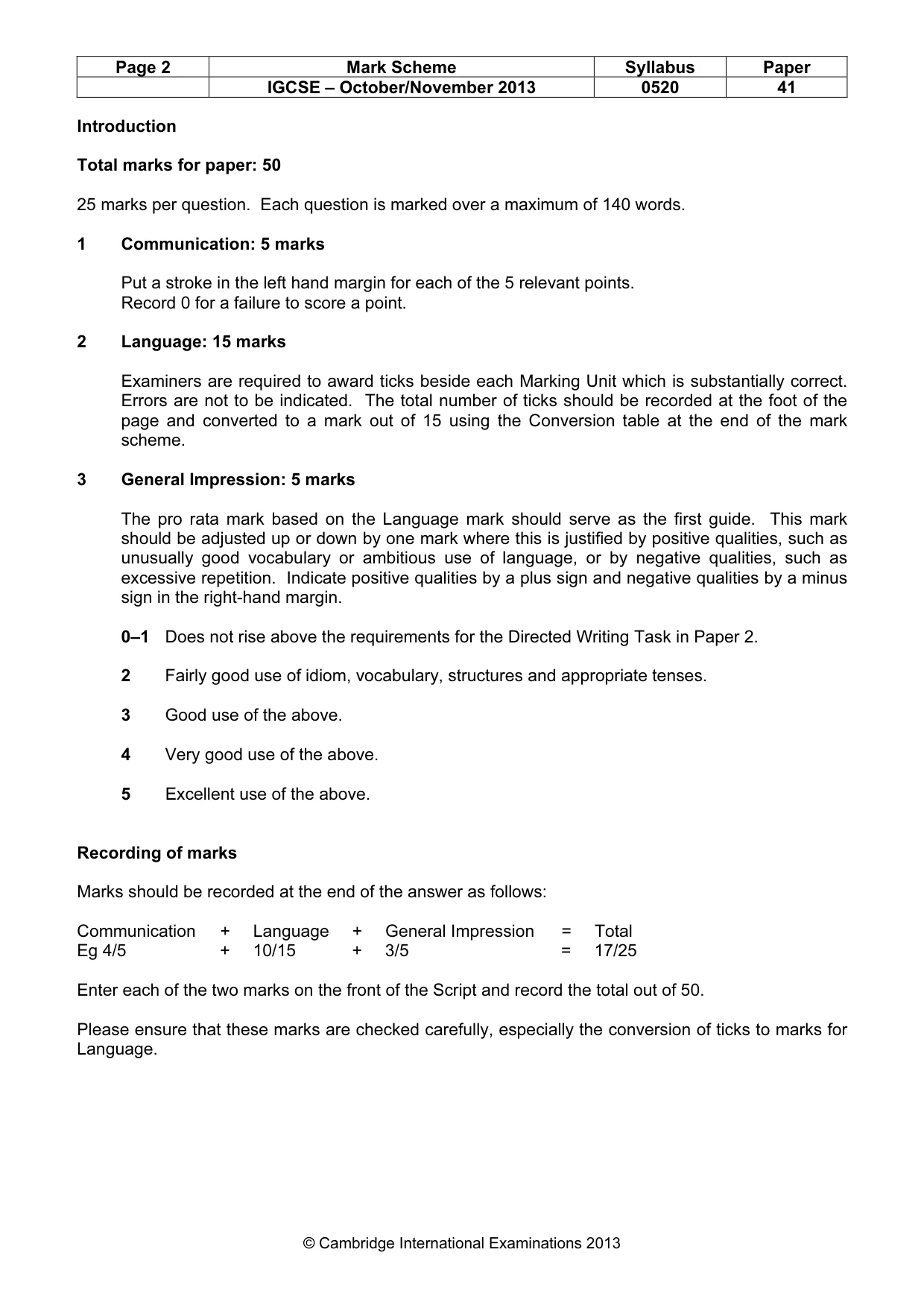
Page 2 Mark Scheme Syllabus Paper IGCSE – October/November 2013 0520 41 © Cambridge International Examinations 2013 Introduction Total marks for paper: 50 25 marks per question. Each question is marked over a maximum of 140 words. 1 Communication: 5 marks Put a stroke in the left hand margin for each of the 5 relevant points. Record 0 for a failure to score a point. 2 Language: 15 marks Examiners are required to award ticks beside each Marking Unit which is substantially correct. Errors are not to be indicated. The total number of ticks should be recorded at the foot of the page and converted to a mark out of 15 using the Conversion table at the end of the mark scheme. 3 General Impression: 5 marks The pro rata mark based on the Language mark should serve as the first guide. This mark should be adjusted up or down by one mark where this is justified by positive qualities, such as unusually good vocabulary or ambitious use of language, or by negative qualities, such as excessive repetition. Indicate positive qualities by a plus sign and negative qualities by a minus sign in the right-hand margin. 0–1 Does not rise above the requirements for the Directed Writing Task in Paper 2. 2 Fairly good use of idiom, vocabulary, structures and appropriate tenses. 3 Good use of the above. 4 Very good use of the above. 5 Excellent use of the above. Recording of marks Marks should be recorded at the end of the answer as follows: Communication + Language + General Impression = Total Eg 4/5 + 10/15 + 3/5 = 17/25 Enter each of the two marks on the front of the Script and record the total out of 50. Please ensure that these marks are checked carefully, especially the conversion of ticks to marks for Language.
Mark scheme, page 3
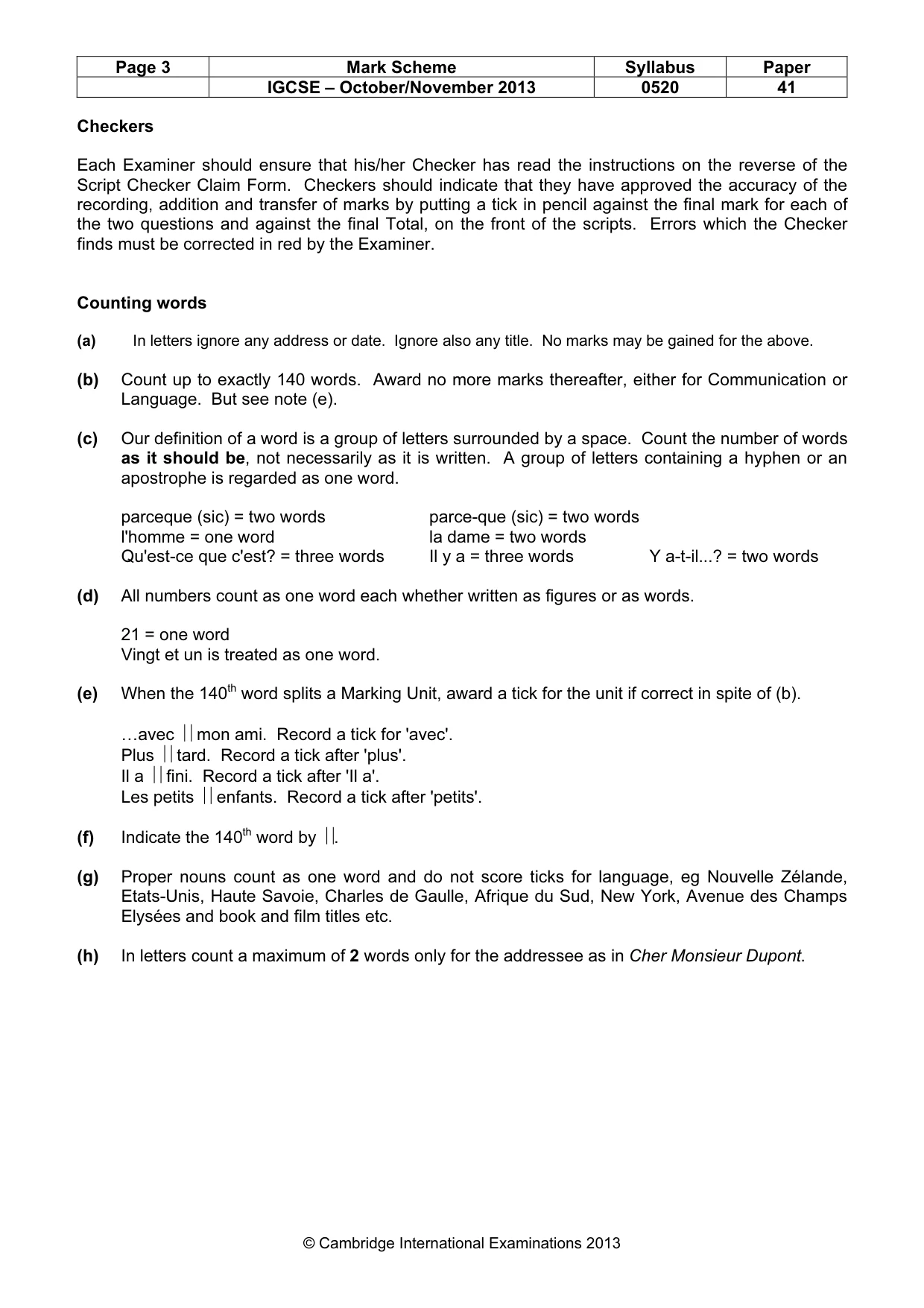
Page 3 Mark Scheme Syllabus Paper IGCSE – October/November 2013 0520 41 © Cambridge International Examinations 2013 Checkers Each Examiner should ensure that his/her Checker has read the instructions on the reverse of the Script Checker Claim Form. Checkers should indicate that they have approved the accuracy of the recording, addition and transfer of marks by putting a tick in pencil against the final mark for each of the two questions and against the final Total, on the front of the scripts. Errors which the Checker finds must be corrected in red by the Examiner. Counting words (a) In letters ignore any address or date. Ignore also any title. No marks may be gained for the above. (b) Count up to exactly 140 words. Award no more marks thereafter, either for Communication or Language. But see note (e). (c) Our definition of a word is a group of letters surrounded by a space. Count the number of words as it should be, not necessarily as it is written. A group of letters containing a hyphen or an apostrophe is regarded as one word. parceque (sic) = two words parce-que (sic) = two words l'homme = one word la dame = two words Qu'est-ce que c'est? = three words Il y a = three words Y a-t-il...? = two words (d) All numbers count as one word each whether written as figures or as words. 21 = one word Vingt et un is treated as one word. (e) When the 140th word splits a Marking Unit, award a tick for the unit if correct in spite of (b). …avec mon ami. Record a tick for 'avec'. Plus tard. Record a tick after 'plus'. Il a fini. Record a tick after 'Il a'. Les petits enfants. Record a tick after 'petits'. (f) Indicate the 140th word by . (g) Proper nouns count as one word and do not score ticks for language, eg Nouvelle Zélande, Etats-Unis, Haute Savoie, Charles de Gaulle, Afrique du Sud, New York, Avenue des Champs Elysées and book and film titles etc. (h) In letters count a maximum of 2 words only for the addressee as in Cher Monsieur Dupont.
Mark scheme, page 4
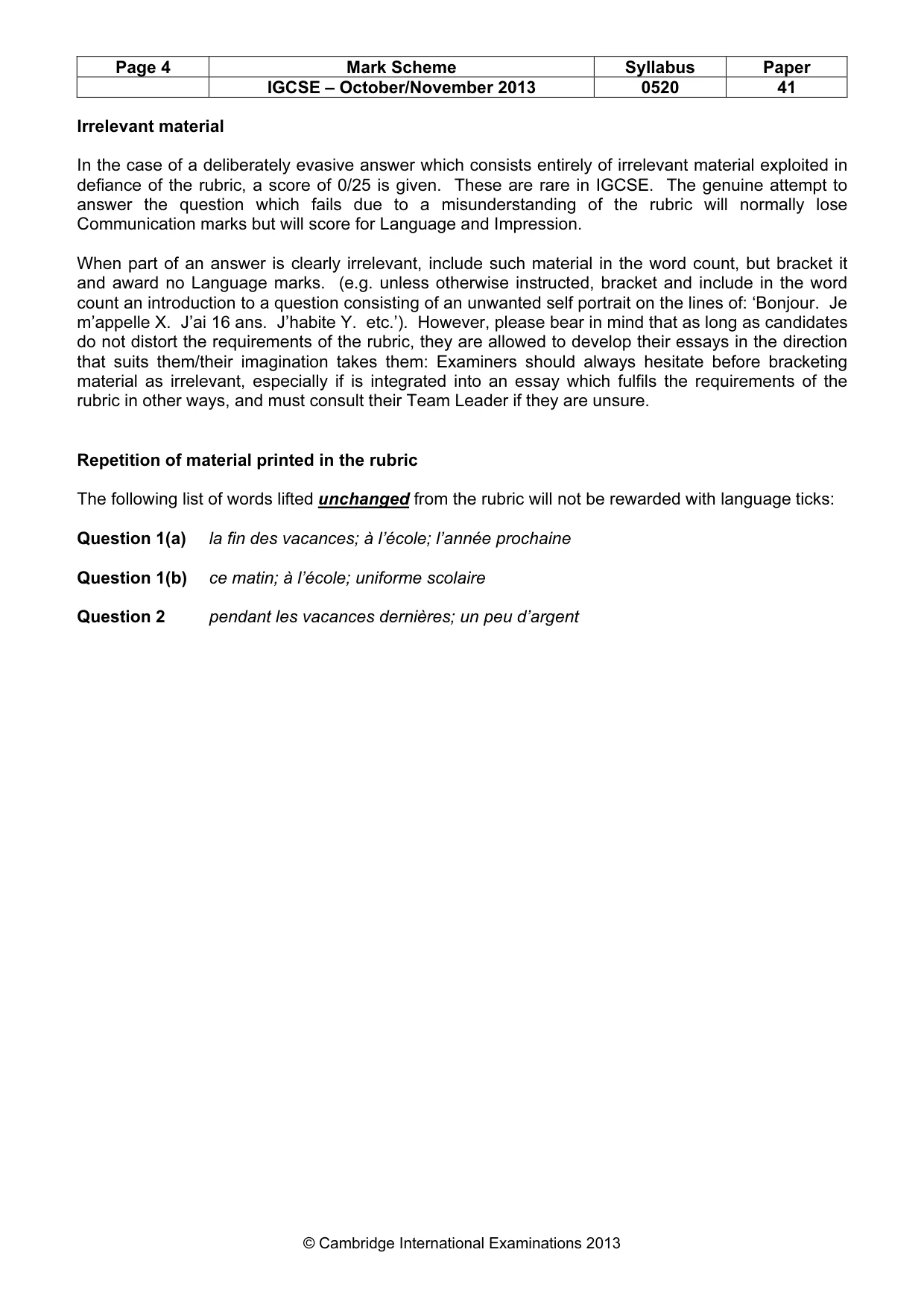
Page 4 Mark Scheme Syllabus Paper IGCSE – October/November 2013 0520 41 © Cambridge International Examinations 2013 Irrelevant material In the case of a deliberately evasive answer which consists entirely of irrelevant material exploited in defiance of the rubric, a score of 0/25 is given. These are rare in IGCSE. The genuine attempt to answer the question which fails due to a misunderstanding of the rubric will normally lose Communication marks but will score for Language and Impression. When part of an answer is clearly irrelevant, include such material in the word count, but bracket it and award no Language marks. (e.g. unless otherwise instructed, bracket and include in the word count an introduction to a question consisting of an unwanted self portrait on the lines of: ‘Bonjour. Je m’appelle X. J’ai 16 ans. J’habite Y. etc.’). However, please bear in mind that as long as candidates do not distort the requirements of the rubric, they are allowed to develop their essays in the direction that suits them/their imagination takes them: Examiners should always hesitate before bracketing material as irrelevant, especially if is integrated into an essay which fulfils the requirements of the rubric in other ways, and must consult their Team Leader if they are unsure. Repetition of material printed in the rubric The following list of words lifted unchanged from the rubric will not be rewarded with language ticks: Question 1(a) la fin des vacances; à l’école; l’année prochaine Question 1(b) ce matin; à l’école; uniforme scolaire Question 2 pendant les vacances dernières; un peu d’argent
Mark scheme, page 5
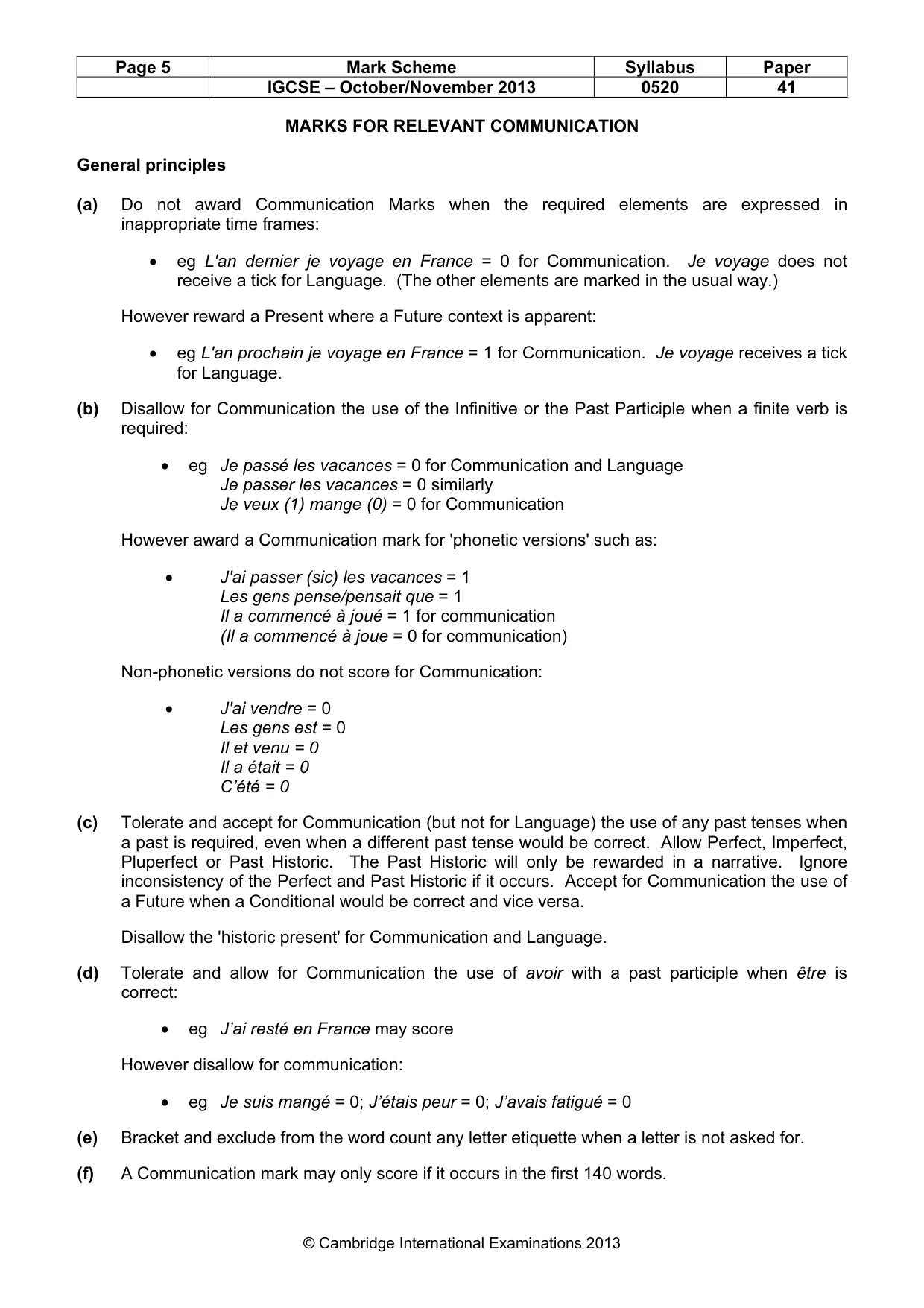
Page 5 Mark Scheme Syllabus Paper IGCSE – October/November 2013 0520 41 © Cambridge International Examinations 2013 MARKS FOR RELEVANT COMMUNICATION General principles (a) Do not award Communication Marks when the required elements are expressed in inappropriate time frames: • eg L'an dernier je voyage en France = 0 for Communication. Je voyage does not receive a tick for Language. (The other elements are marked in the usual way.) However reward a Present where a Future context is apparent: • eg L'an prochain je voyage en France = 1 for Communication. Je voyage receives a tick for Language. (b) Disallow for Communication the use of the Infinitive or the Past Participle when a finite verb is required: • eg Je passé les vacances = 0 for Communication and Language Je passer les vacances = 0 similarly Je veux (1) mange (0) = 0 for Communication However award a Communication mark for 'phonetic versions' such as: • J'ai passer (sic) les vacances = 1 Les gens pense/pensait que = 1 Il a commencé à joué = 1 for communication (Il a commencé à joue = 0 for communication) Non-phonetic versions do not score for Communication: • J'ai vendre = 0 Les gens est = 0 Il et venu = 0 Il a était = 0 C’été = 0 (c) Tolerate and accept for Communication (but not for Language) the use of any past tenses when a past is required, even when a different past tense would be correct. Allow Perfect, Imperfect, Pluperfect or Past Historic. The Past Historic will only be rewarded in a narrative. Ignore inconsistency of the Perfect and Past Historic if it occurs. Accept for Communication the use of a Future when a Conditional would be correct and vice versa. Disallow the 'historic present' for Communication and Language. (d) Tolerate and allow for Communication the use of avoir with a past participle when être is correct: • eg J’ai resté en France may score However disallow for communication: • eg Je suis mangé = 0; J’étais peur = 0; J’avais fatigué = 0 (e) Bracket and exclude from the word count any letter etiquette when a letter is not asked for. (f) A Communication mark may only score if it occurs in the first 140 words.
Mark scheme, page 6
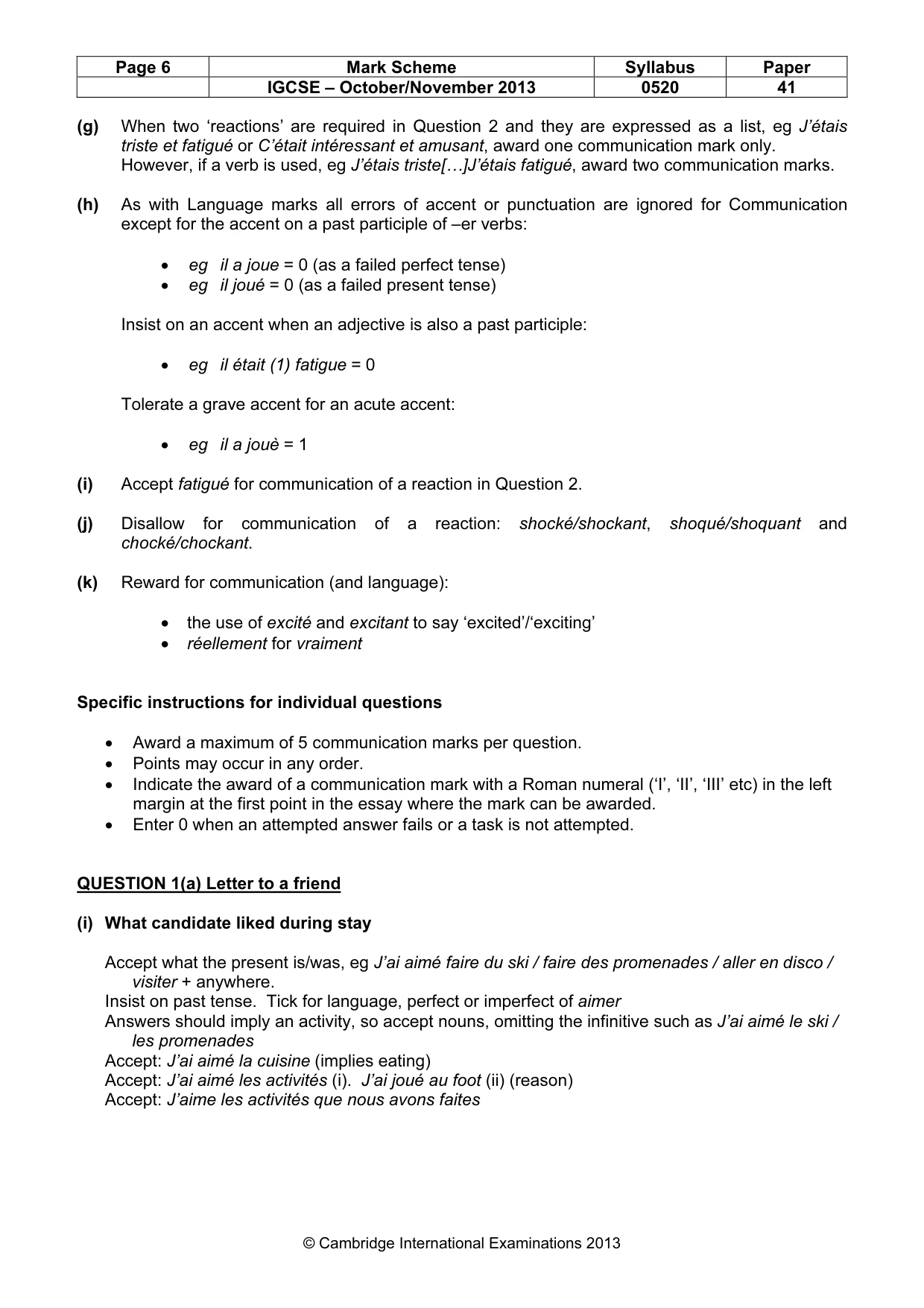
Page 6 Mark Scheme Syllabus Paper IGCSE – October/November 2013 0520 41 © Cambridge International Examinations 2013 (g) When two ‘reactions’ are required in Question 2 and they are expressed as a list, eg J’étais triste et fatigué or C’était intéressant et amusant, award one communication mark only. However, if a verb is used, eg J’étais triste[…]J’étais fatigué, award two communication marks. (h) As with Language marks all errors of accent or punctuation are ignored for Communication except for the accent on a past participle of –er verbs: • eg il a joue = 0 (as a failed perfect tense) • eg il joué = 0 (as a failed present tense) Insist on an accent when an adjective is also a past participle: • eg il était (1) fatigue = 0 Tolerate a grave accent for an acute accent: • eg il a jouè = 1 (i) Accept fatigué for communication of a reaction in Question 2. (j) Disallow for communication of a reaction: shocké/shockant, shoqué/shoquant and chocké/chockant. (k) Reward for communication (and language): • the use of excité and excitant to say ‘excited’/‘exciting’ • réellement for vraiment Specific instructions for individual questions • Award a maximum of 5 communication marks per question. • Points may occur in any order. • Indicate the award of a communication mark with a Roman numeral (‘I’, ‘II’, ‘III’ etc) in the left margin at the first point in the essay where the mark can be awarded. • Enter 0 when an attempted answer fails or a task is not attempted. QUESTION 1(a) Letter to a friend (i) What candidate liked during stay Accept what the present is/was, eg J’ai aimé faire du ski / faire des promenades / aller en disco / visiter + anywhere. Insist on past tense. Tick for language, perfect or imperfect of aimer Answers should imply an activity, so accept nouns, omitting the infinitive such as J’ai aimé le ski / les promenades Accept: J’ai aimé la cuisine (implies eating) Accept: J’ai aimé les activités (i). J’ai joué au foot (ii) (reason) Accept: J’aime les activités que nous avons faites
Mark scheme, page 7
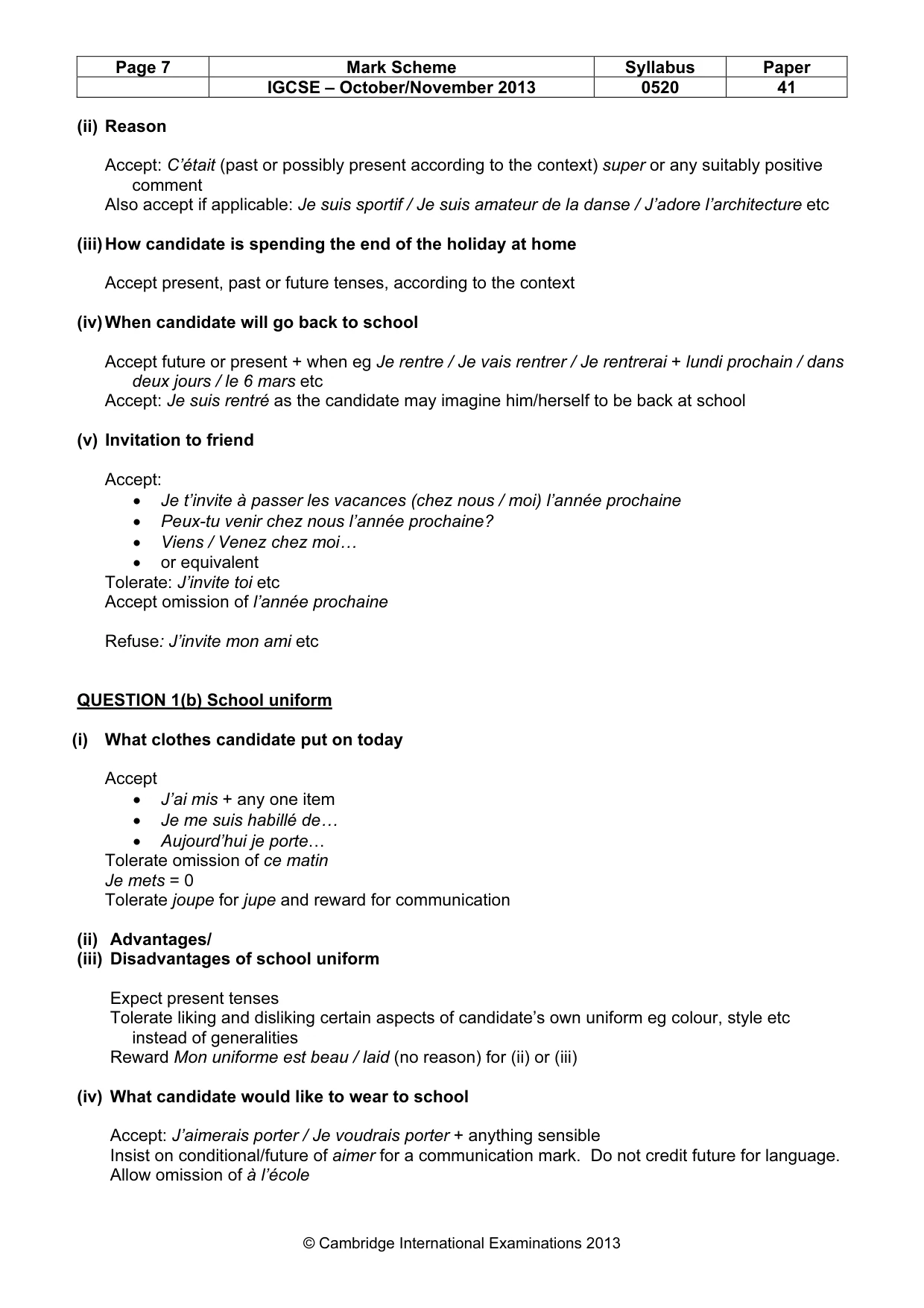
Page 7 Mark Scheme Syllabus Paper IGCSE – October/November 2013 0520 41 © Cambridge International Examinations 2013 (ii) Reason Accept: C’était (past or possibly present according to the context) super or any suitably positive comment Also accept if applicable: Je suis sportif / Je suis amateur de la danse / J’adore l’architecture etc (iii) How candidate is spending the end of the holiday at home Accept present, past or future tenses, according to the context (iv) When candidate will go back to school Accept future or present + when eg Je rentre / Je vais rentrer / Je rentrerai + lundi prochain / dans deux jours / le 6 mars etc Accept: Je suis rentré as the candidate may imagine him/herself to be back at school (v) Invitation to friend Accept: • Je t’invite à passer les vacances (chez nous / moi) l’année prochaine • Peux-tu venir chez nous l’année prochaine? • Viens / Venez chez moi… • or equivalent Tolerate: J’invite toi etc Accept omission of l’année prochaine Refuse: J’invite mon ami etc QUESTION 1(b) School uniform (i) What clothes candidate put on today Accept • J’ai mis + any one item • Je me suis habillé de… • Aujourd’hui je porte… Tolerate omission of ce matin Je mets = 0 Tolerate joupe for jupe and reward for communication (ii) Advantages/ (iii) Disadvantages of school uniform Expect present tenses Tolerate liking and disliking certain aspects of candidate’s own uniform eg colour, style etc instead of generalities Reward Mon uniforme est beau / laid (no reason) for (ii) or (iii) (iv) What candidate would like to wear to school Accept: J’aimerais porter / Je voudrais porter + anything sensible Insist on conditional/future of aimer for a communication mark. Do not credit future for language. Allow omission of à l’école
Mark scheme, page 8
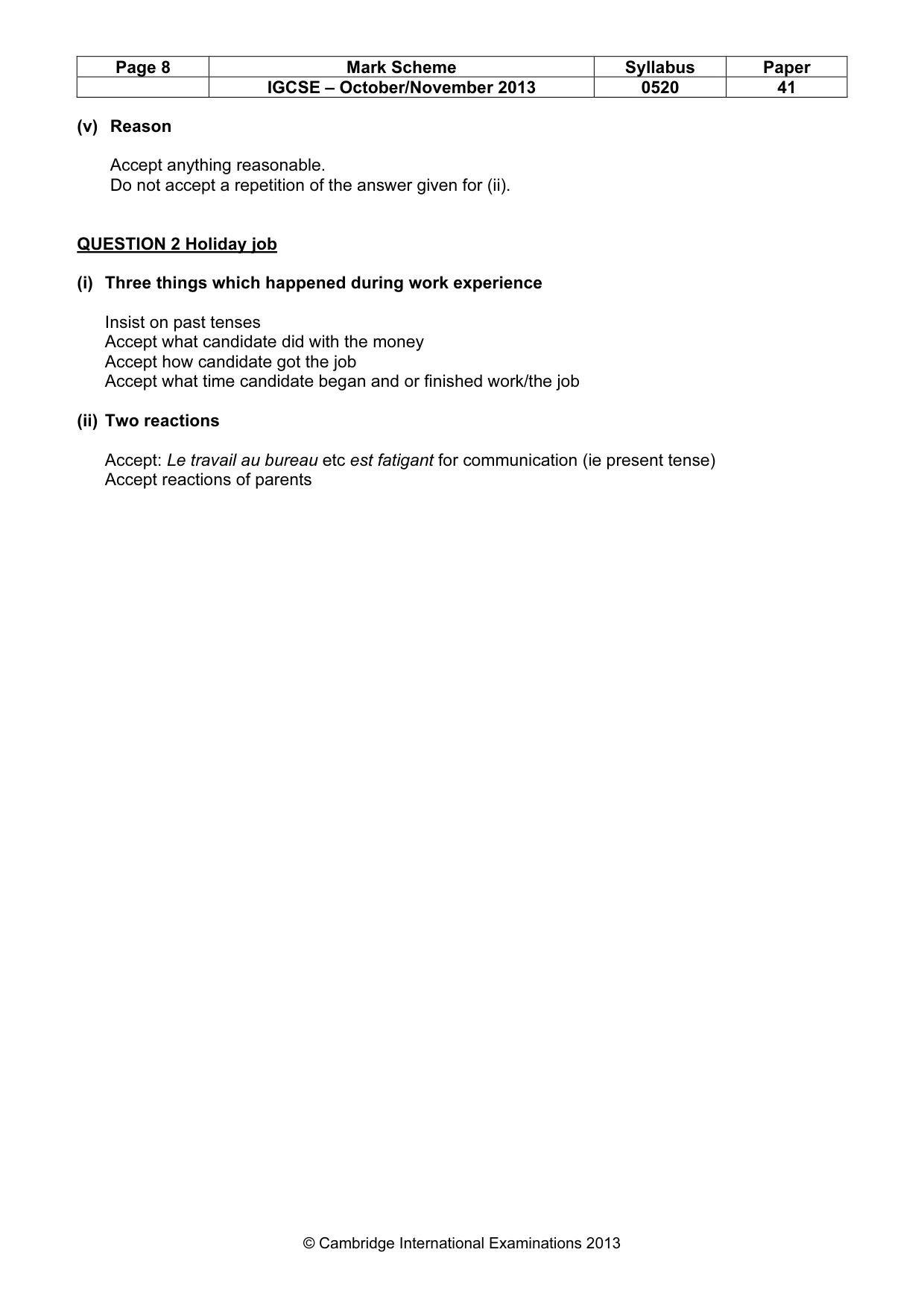
Page 8 Mark Scheme Syllabus Paper IGCSE – October/November 2013 0520 41 © Cambridge International Examinations 2013 (v) Reason Accept anything reasonable. Do not accept a repetition of the answer given for (ii). QUESTION 2 Holiday job (i) Three things which happened during work experience Insist on past tenses Accept what candidate did with the money Accept how candidate got the job Accept what time candidate began and or finished work/the job (ii) Two reactions Accept: Le travail au bureau etc est fatigant for communication (ie present tense) Accept reactions of parents
Mark scheme, page 9
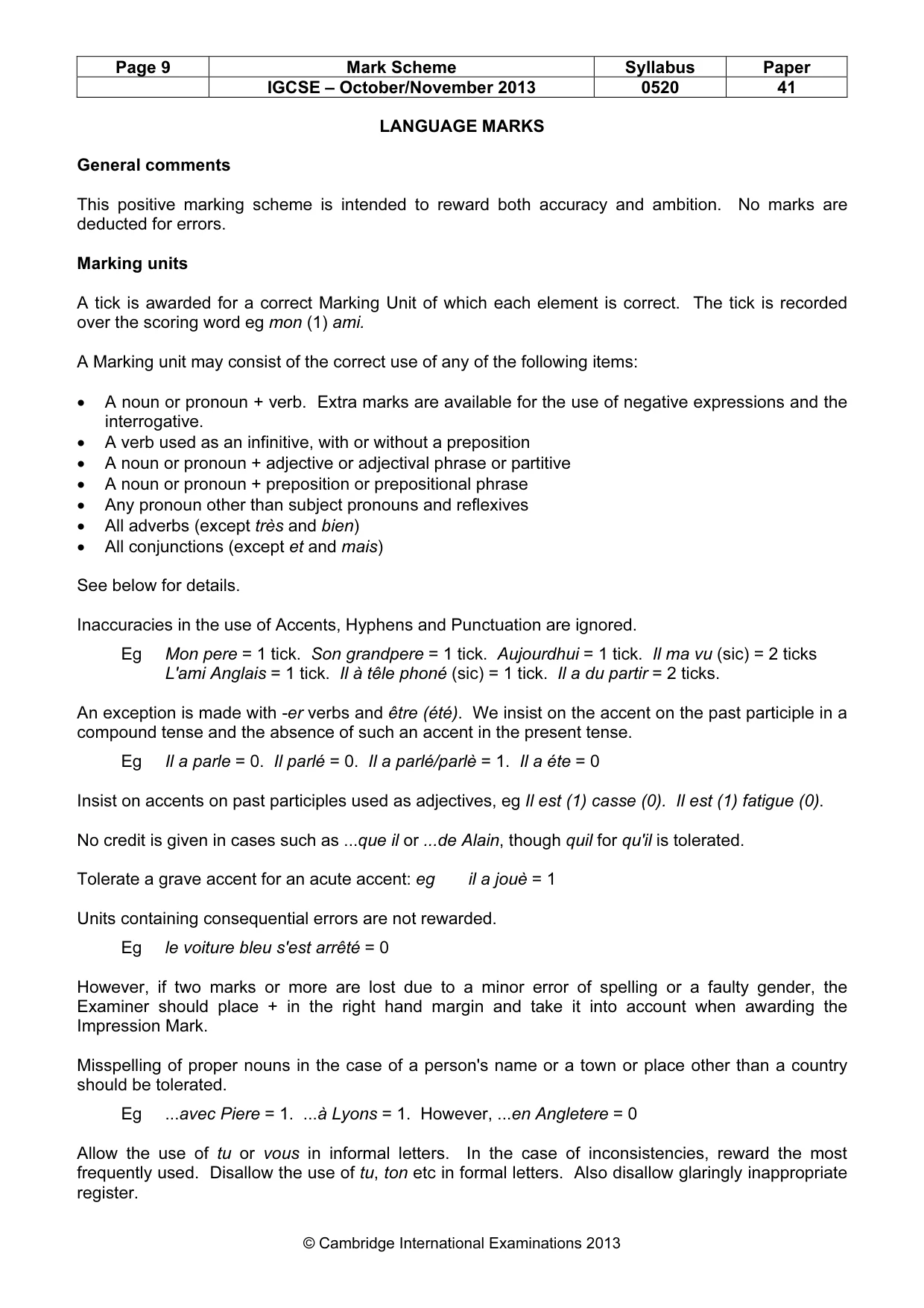
Page 9 Mark Scheme Syllabus Paper IGCSE – October/November 2013 0520 41 © Cambridge International Examinations 2013 LANGUAGE MARKS General comments This positive marking scheme is intended to reward both accuracy and ambition. No marks are deducted for errors. Marking units A tick is awarded for a correct Marking Unit of which each element is correct. The tick is recorded over the scoring word eg mon (1) ami. A Marking unit may consist of the correct use of any of the following items: • A noun or pronoun + verb. Extra marks are available for the use of negative expressions and the interrogative. • A verb used as an infinitive, with or without a preposition • A noun or pronoun + adjective or adjectival phrase or partitive • A noun or pronoun + preposition or prepositional phrase • Any pronoun other than subject pronouns and reflexives • All adverbs (except très and bien) • All conjunctions (except et and mais) See below for details. Inaccuracies in the use of Accents, Hyphens and Punctuation are ignored. Eg Mon pere = 1 tick. Son grandpere = 1 tick. Aujourdhui = 1 tick. Il ma vu (sic) = 2 ticks L'ami Anglais = 1 tick. Il à têle phoné (sic) = 1 tick. Il a du partir = 2 ticks. An exception is made with -er verbs and être (été). We insist on the accent on the past participle in a compound tense and the absence of such an accent in the present tense. Eg Il a parle = 0. Il parlé = 0. Il a parlé/parlè = 1. Il a éte = 0 Insist on accents on past participles used as adjectives, eg Il est (1) casse (0). Il est (1) fatigue (0). No credit is given in cases such as ...que il or ...de Alain, though quil for qu'il is tolerated. Tolerate a grave accent for an acute accent: eg il a jouè = 1 Units containing consequential errors are not rewarded. Eg le voiture bleu s'est arrêté = 0 However, if two marks or more are lost due to a minor error of spelling or a faulty gender, the Examiner should place + in the right hand margin and take it into account when awarding the Impression Mark. Misspelling of proper nouns in the case of a person's name or a town or place other than a country should be tolerated. Eg ...avec Piere = 1. ...à Lyons = 1. However, ...en Angletere = 0 Allow the use of tu or vous in informal letters. In the case of inconsistencies, reward the most frequently used. Disallow the use of tu, ton etc in formal letters. Also disallow glaringly inappropriate register.
Mark scheme, page 10
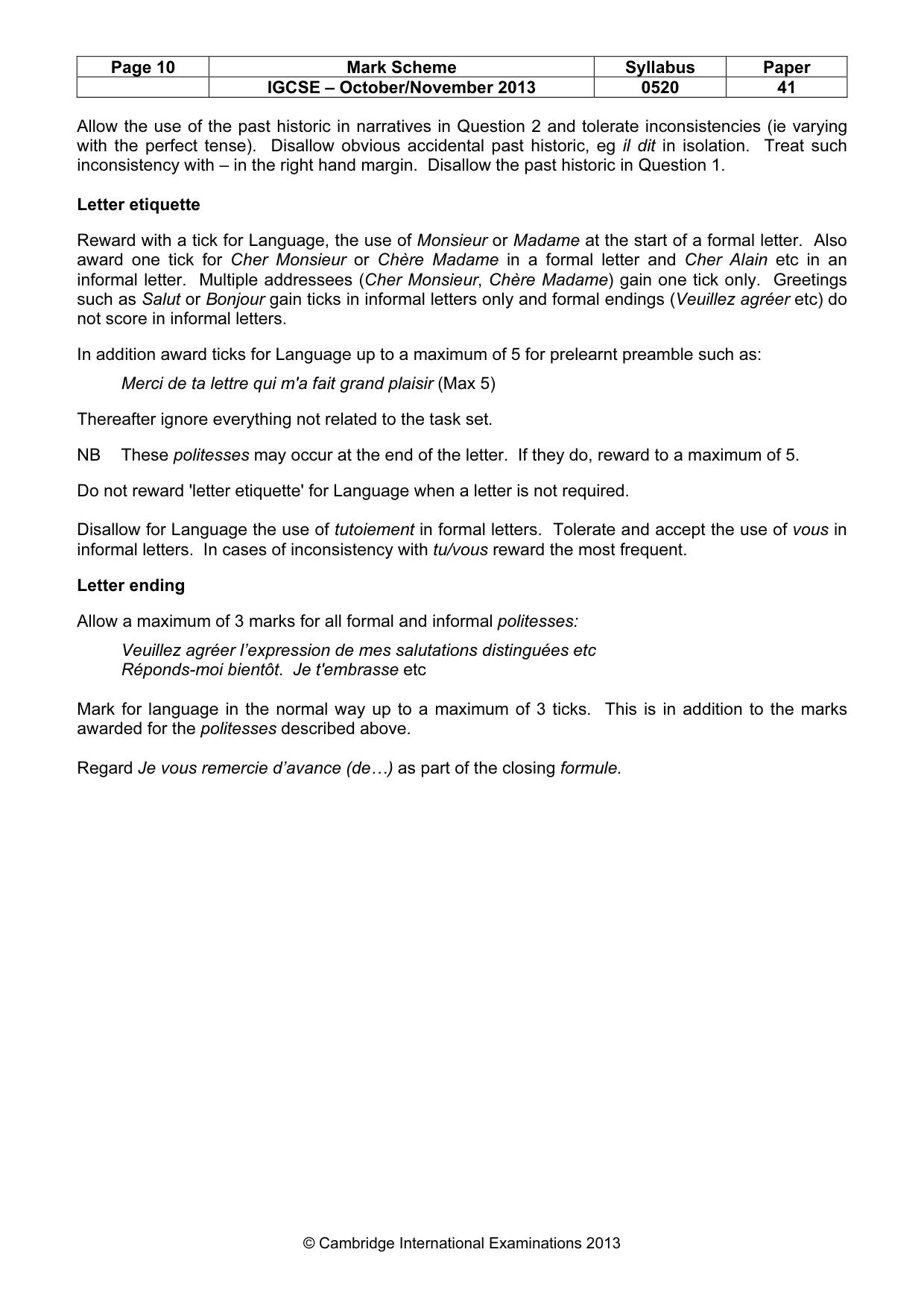
Page 10 Mark Scheme Syllabus Paper IGCSE – October/November 2013 0520 41 © Cambridge International Examinations 2013 Allow the use of the past historic in narratives in Question 2 and tolerate inconsistencies (ie varying with the perfect tense). Disallow obvious accidental past historic, eg il dit in isolation. Treat such inconsistency with – in the right hand margin. Disallow the past historic in Question 1. Letter etiquette Reward with a tick for Language, the use of Monsieur or Madame at the start of a formal letter. Also award one tick for Cher Monsieur or Chère Madame in a formal letter and Cher Alain etc in an informal letter. Multiple addressees (Cher Monsieur, Chère Madame) gain one tick only. Greetings such as Salut or Bonjour gain ticks in informal letters only and formal endings (Veuillez agréer etc) do not score in informal letters. In addition award ticks for Language up to a maximum of 5 for prelearnt preamble such as: Merci de ta lettre qui m'a fait grand plaisir (Max 5) Thereafter ignore everything not related to the task set. NB These politesses may occur at the end of the letter. If they do, reward to a maximum of 5. Do not reward 'letter etiquette' for Language when a letter is not required. Disallow for Language the use of tutoiement in formal letters. Tolerate and accept the use of vous in informal letters. In cases of inconsistency with tu/vous reward the most frequent. Letter ending Allow a maximum of 3 marks for all formal and informal politesses: Veuillez agréer l’expression de mes salutations distinguées etc Réponds-moi bientôt. Je t'embrasse etc Mark for language in the normal way up to a maximum of 3 ticks. This is in addition to the marks awarded for the politesses described above. Regard Je vous remercie d’avance (de…) as part of the closing formule.
Mark scheme, page 11
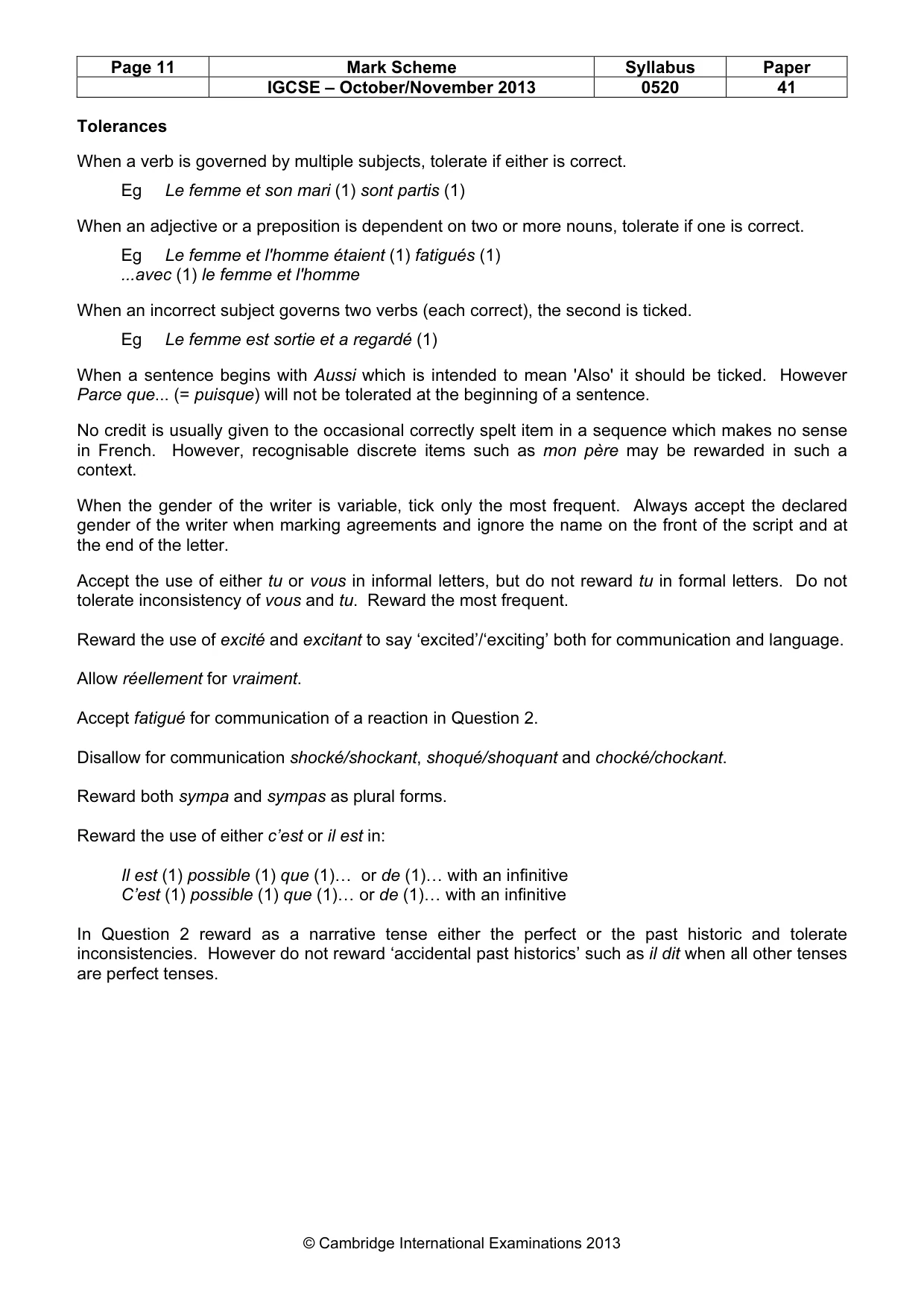
Page 11 Mark Scheme Syllabus Paper IGCSE – October/November 2013 0520 41 © Cambridge International Examinations 2013 Tolerances When a verb is governed by multiple subjects, tolerate if either is correct. Eg Le femme et son mari (1) sont partis (1) When an adjective or a preposition is dependent on two or more nouns, tolerate if one is correct. Eg Le femme et l'homme étaient (1) fatigués (1) ...avec (1) le femme et l'homme When an incorrect subject governs two verbs (each correct), the second is ticked. Eg Le femme est sortie et a regardé (1) When a sentence begins with Aussi which is intended to mean 'Also' it should be ticked. However Parce que... (= puisque) will not be tolerated at the beginning of a sentence. No credit is usually given to the occasional correctly spelt item in a sequence which makes no sense in French. However, recognisable discrete items such as mon père may be rewarded in such a context. When the gender of the writer is variable, tick only the most frequent. Always accept the declared gender of the writer when marking agreements and ignore the name on the front of the script and at the end of the letter. Accept the use of either tu or vous in informal letters, but do not reward tu in formal letters. Do not tolerate inconsistency of vous and tu. Reward the most frequent. Reward the use of excité and excitant to say ‘excited’/‘exciting’ both for communication and language. Allow réellement for vraiment. Accept fatigué for communication of a reaction in Question 2. Disallow for communication shocké/shockant, shoqué/shoquant and chocké/chockant. Reward both sympa and sympas as plural forms. Reward the use of either c’est or il est in: Il est (1) possible (1) que (1)… or de (1)… with an infinitive C’est (1) possible (1) que (1)… or de (1)… with an infinitive In Question 2 reward as a narrative tense either the perfect or the past historic and tolerate inconsistencies. However do not reward ‘accidental past historics’ such as il dit when all other tenses are perfect tenses.
Mark scheme, page 12
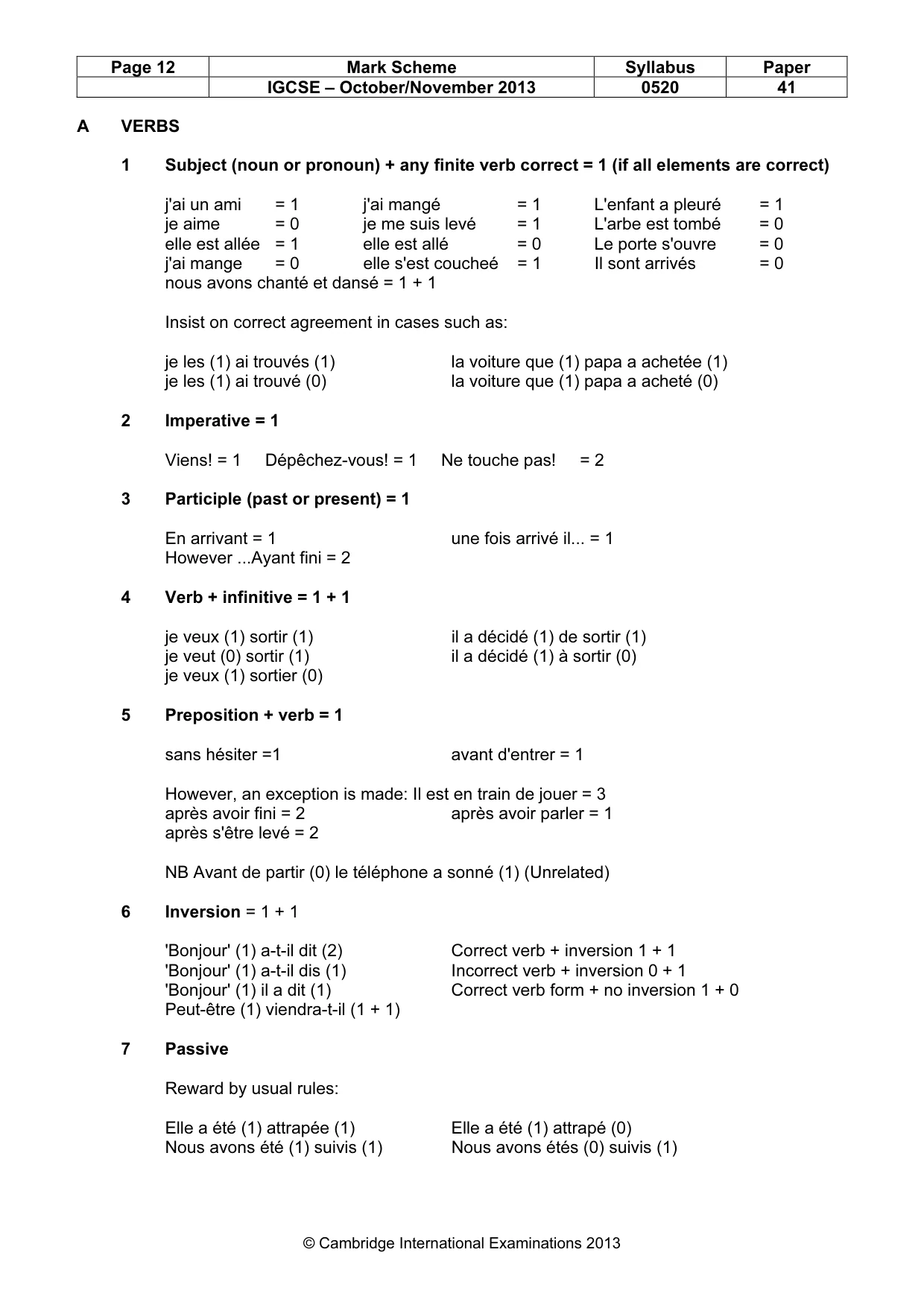
Page 12 Mark Scheme Syllabus Paper IGCSE – October/November 2013 0520 41 © Cambridge International Examinations 2013 A VERBS 1 Subject (noun or pronoun) + any finite verb correct = 1 (if all elements are correct) j'ai un ami = 1 j'ai mangé = 1 L'enfant a pleuré = 1 je aime = 0 je me suis levé = 1 L'arbe est tombé = 0 elle est allée = 1 elle est allé = 0 Le porte s'ouvre = 0 j'ai mange = 0 elle s'est coucheé = 1 Il sont arrivés = 0 nous avons chanté et dansé = 1 + 1 Insist on correct agreement in cases such as: je les (1) ai trouvés (1) la voiture que (1) papa a achetée (1) je les (1) ai trouvé (0) la voiture que (1) papa a acheté (0) 2 Imperative = 1 Viens! = 1 Dépêchez-vous! = 1 Ne touche pas! = 2 3 Participle (past or present) = 1 En arrivant = 1 une fois arrivé il... = 1 However ...Ayant fini = 2 4 Verb + infinitive = 1 + 1 je veux (1) sortir (1) il a décidé (1) de sortir (1) je veut (0) sortir (1) il a décidé (1) à sortir (0) je veux (1) sortier (0) 5 Preposition + verb = 1 sans hésiter =1 avant d'entrer = 1 However, an exception is made: Il est en train de jouer = 3 après avoir fini = 2 après avoir parler = 1 après s'être levé = 2 NB Avant de partir (0) le téléphone a sonné (1) (Unrelated) 6 Inversion = 1 + 1 'Bonjour' (1) a-t-il dit (2) Correct verb + inversion 1 + 1 'Bonjour' (1) a-t-il dis (1) Incorrect verb + inversion 0 + 1 'Bonjour' (1) il a dit (1) Correct verb form + no inversion 1 + 0 Peut-être (1) viendra-t-il (1 + 1) 7 Passive Reward by usual rules: Elle a été (1) attrapée (1) Elle a été (1) attrapé (0) Nous avons été (1) suivis (1) Nous avons étés (0) suivis (1)
Mark scheme, page 13
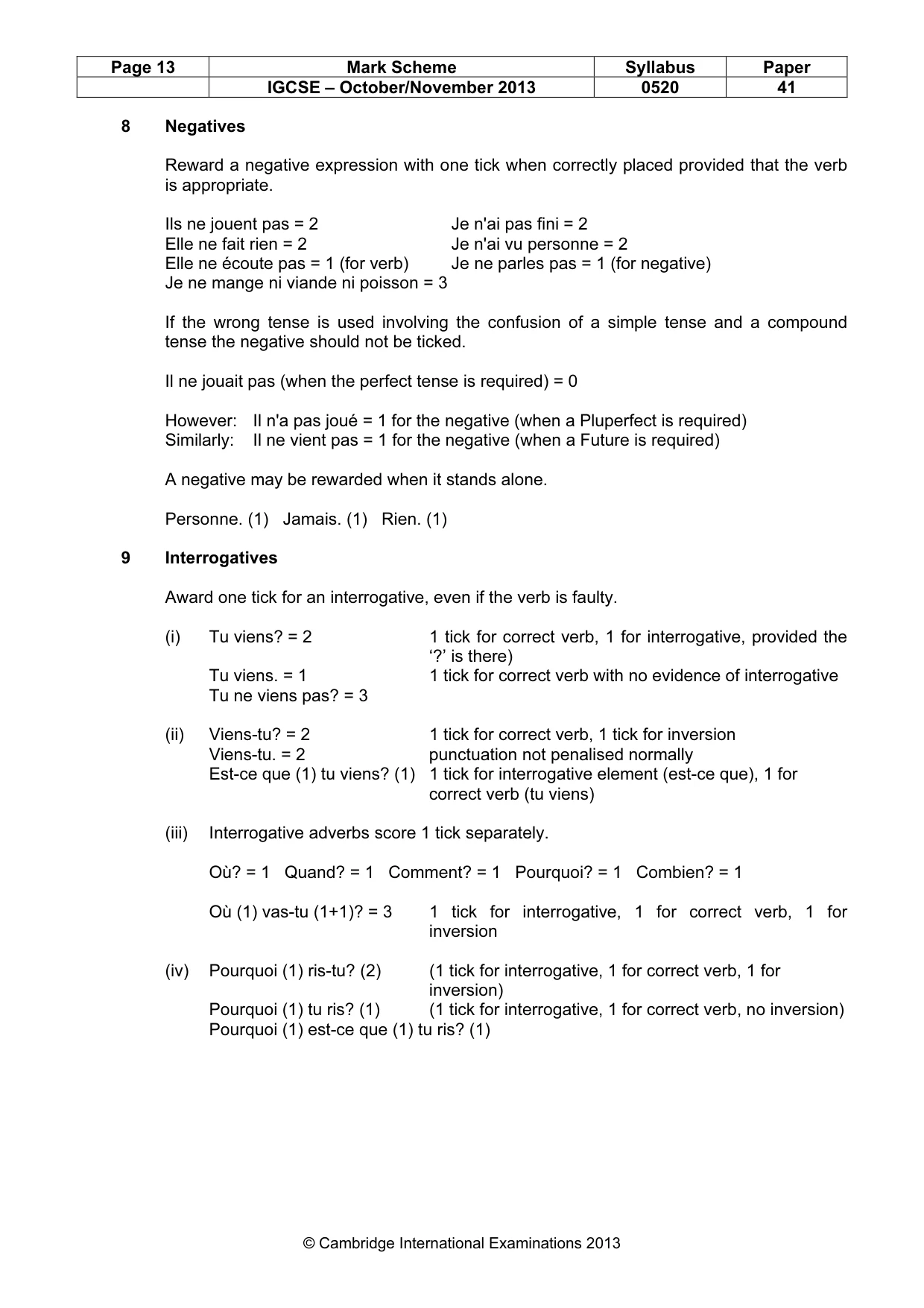
Page 13 Mark Scheme Syllabus Paper IGCSE – October/November 2013 0520 41 © Cambridge International Examinations 2013 8 Negatives Reward a negative expression with one tick when correctly placed provided that the verb is appropriate. Ils ne jouent pas = 2 Je n'ai pas fini = 2 Elle ne fait rien = 2 Je n'ai vu personne = 2 Elle ne écoute pas = 1 (for verb) Je ne parles pas = 1 (for negative) Je ne mange ni viande ni poisson = 3 If the wrong tense is used involving the confusion of a simple tense and a compound tense the negative should not be ticked. Il ne jouait pas (when the perfect tense is required) = 0 However: Il n'a pas joué = 1 for the negative (when a Pluperfect is required) Similarly: Il ne vient pas = 1 for the negative (when a Future is required) A negative may be rewarded when it stands alone. Personne. (1) Jamais. (1) Rien. (1) 9 Interrogatives Award one tick for an interrogative, even if the verb is faulty. (i) Tu viens? = 2 1 tick for correct verb, 1 for interrogative, provided the ‘?’ is there) Tu viens. = 1 1 tick for correct verb with no evidence of interrogative Tu ne viens pas? = 3 (ii) Viens-tu? = 2 1 tick for correct verb, 1 tick for inversion Viens-tu. = 2 punctuation not penalised normally Est-ce que (1) tu viens? (1) 1 tick for interrogative element (est-ce que), 1 for correct verb (tu viens) (iii) Interrogative adverbs score 1 tick separately. Où? = 1 Quand? = 1 Comment? = 1 Pourquoi? = 1 Combien? = 1 Où (1) vas-tu (1+1)? = 3 1 tick for interrogative, 1 for correct verb, 1 for inversion (iv) Pourquoi (1) ris-tu? (2) (1 tick for interrogative, 1 for correct verb, 1 for inversion) Pourquoi (1) tu ris? (1) (1 tick for interrogative, 1 for correct verb, no inversion) Pourquoi (1) est-ce que (1) tu ris? (1)
Mark scheme, page 14
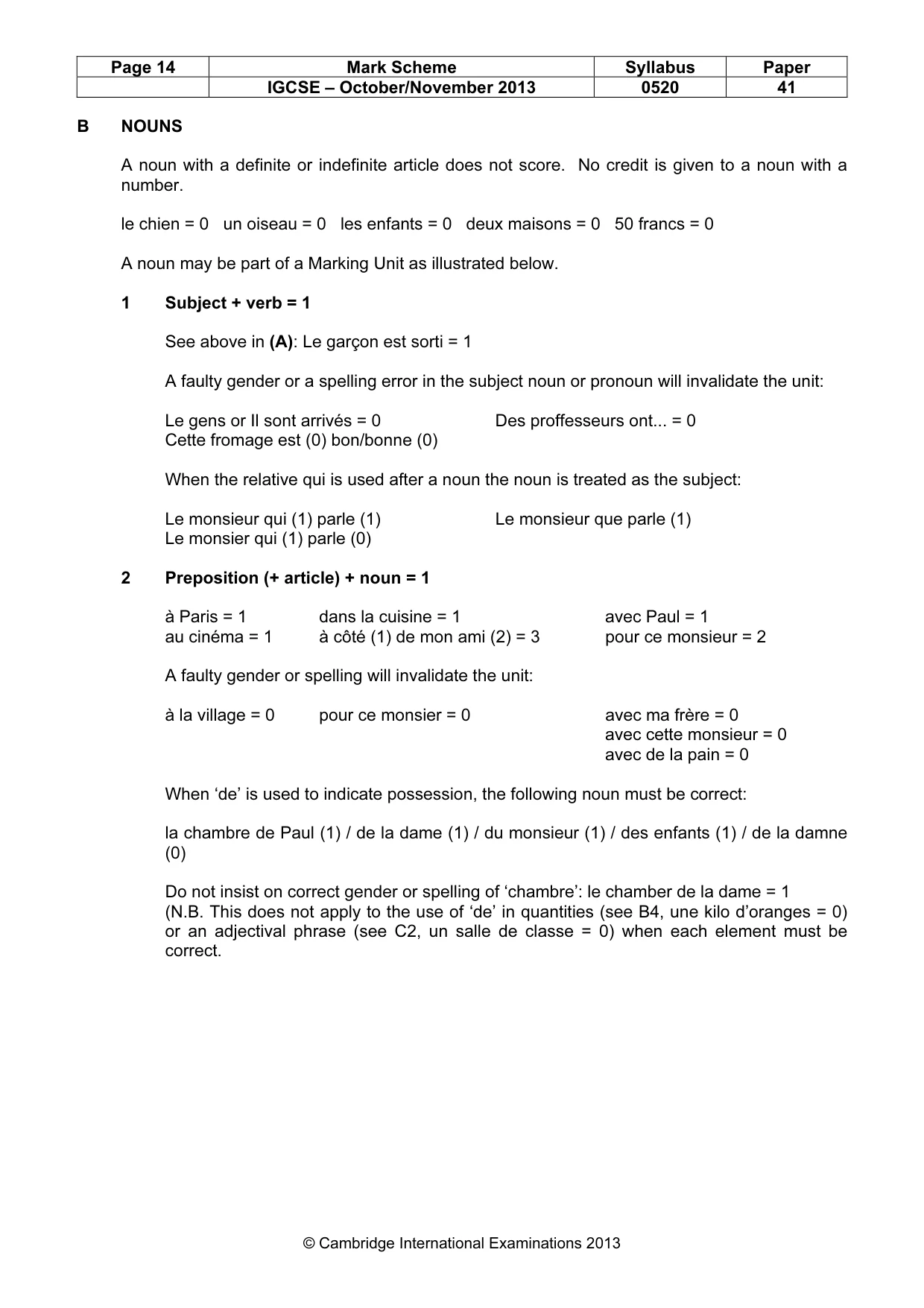
Page 14 Mark Scheme Syllabus Paper IGCSE – October/November 2013 0520 41 © Cambridge International Examinations 2013 B NOUNS A noun with a definite or indefinite article does not score. No credit is given to a noun with a number. le chien = 0 un oiseau = 0 les enfants = 0 deux maisons = 0 50 francs = 0 A noun may be part of a Marking Unit as illustrated below. 1 Subject + verb = 1 See above in (A): Le garçon est sorti = 1 A faulty gender or a spelling error in the subject noun or pronoun will invalidate the unit: Le gens or Il sont arrivés = 0 Des proffesseurs ont... = 0 Cette fromage est (0) bon/bonne (0) When the relative qui is used after a noun the noun is treated as the subject: Le monsieur qui (1) parle (1) Le monsieur que parle (1) Le monsier qui (1) parle (0) 2 Preposition (+ article) + noun = 1 à Paris = 1 dans la cuisine = 1 avec Paul = 1 au cinéma = 1 à côté (1) de mon ami (2) = 3 pour ce monsieur = 2 A faulty gender or spelling will invalidate the unit: à la village = 0 pour ce monsier = 0 avec ma frère = 0 avec cette monsieur = 0 avec de la pain = 0 When ‘de’ is used to indicate possession, the following noun must be correct: la chambre de Paul (1) / de la dame (1) / du monsieur (1) / des enfants (1) / de la damne (0) Do not insist on correct gender or spelling of ‘chambre’: le chamber de la dame = 1 (N.B. This does not apply to the use of ‘de’ in quantities (see B4, une kilo d’oranges = 0) or an adjectival phrase (see C2, un salle de classe = 0) when each element must be correct.
Mark scheme, page 15
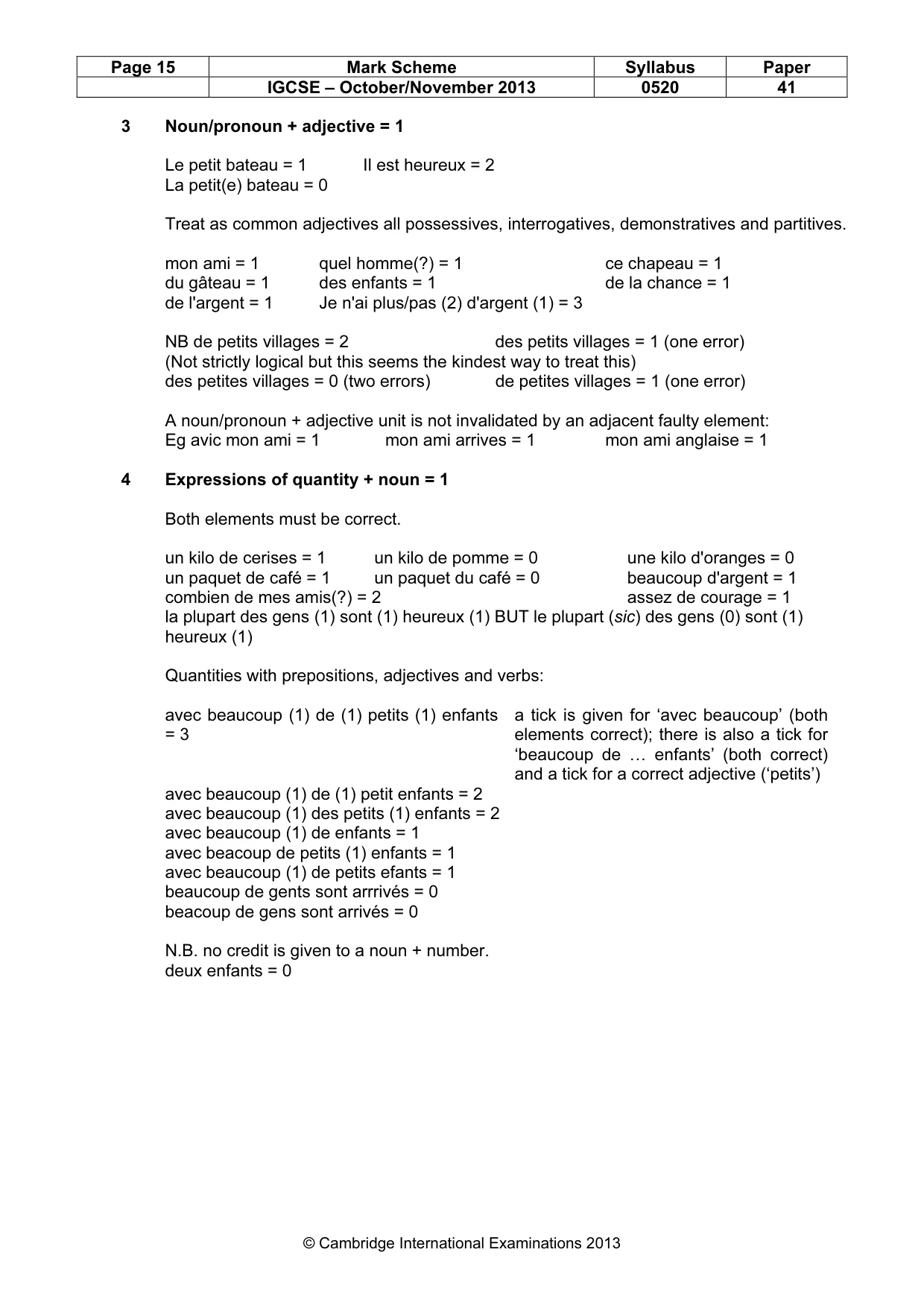
Page 15 Mark Scheme Syllabus Paper IGCSE – October/November 2013 0520 41 © Cambridge International Examinations 2013 3 Noun/pronoun + adjective = 1 Le petit bateau = 1 Il est heureux = 2 La petit(e) bateau = 0 Treat as common adjectives all possessives, interrogatives, demonstratives and partitives. mon ami = 1 quel homme(?) = 1 ce chapeau = 1 du gâteau = 1 des enfants = 1 de la chance = 1 de l'argent = 1 Je n'ai plus/pas (2) d'argent (1) = 3 NB de petits villages = 2 des petits villages = 1 (one error) (Not strictly logical but this seems the kindest way to treat this) des petites villages = 0 (two errors) de petites villages = 1 (one error) A noun/pronoun + adjective unit is not invalidated by an adjacent faulty element: Eg avic mon ami = 1 mon ami arrives = 1 mon ami anglaise = 1 4 Expressions of quantity + noun = 1 Both elements must be correct. un kilo de cerises = 1 un kilo de pomme = 0 une kilo d'oranges = 0 un paquet de café = 1 un paquet du café = 0 beaucoup d'argent = 1 combien de mes amis(?) = 2 assez de courage = 1 la plupart des gens (1) sont (1) heureux (1) BUT le plupart (sic) des gens (0) sont (1) heureux (1) Quantities with prepositions, adjectives and verbs: avec beaucoup (1) de (1) petits (1) enfants = 3 a tick is given for ‘avec beaucoup’ (both elements correct); there is also a tick for ‘beaucoup de … enfants’ (both correct) and a tick for a correct adjective (‘petits’) avec beaucoup (1) de (1) petit enfants = 2 avec beaucoup (1) des petits (1) enfants = 2 avec beaucoup (1) de enfants = 1 avec beacoup de petits (1) enfants = 1 avec beaucoup (1) de petits efants = 1 beaucoup de gents sont arrrivés = 0 beacoup de gens sont arrivés = 0 N.B. no credit is given to a noun + number. deux enfants = 0
Mark scheme, page 16
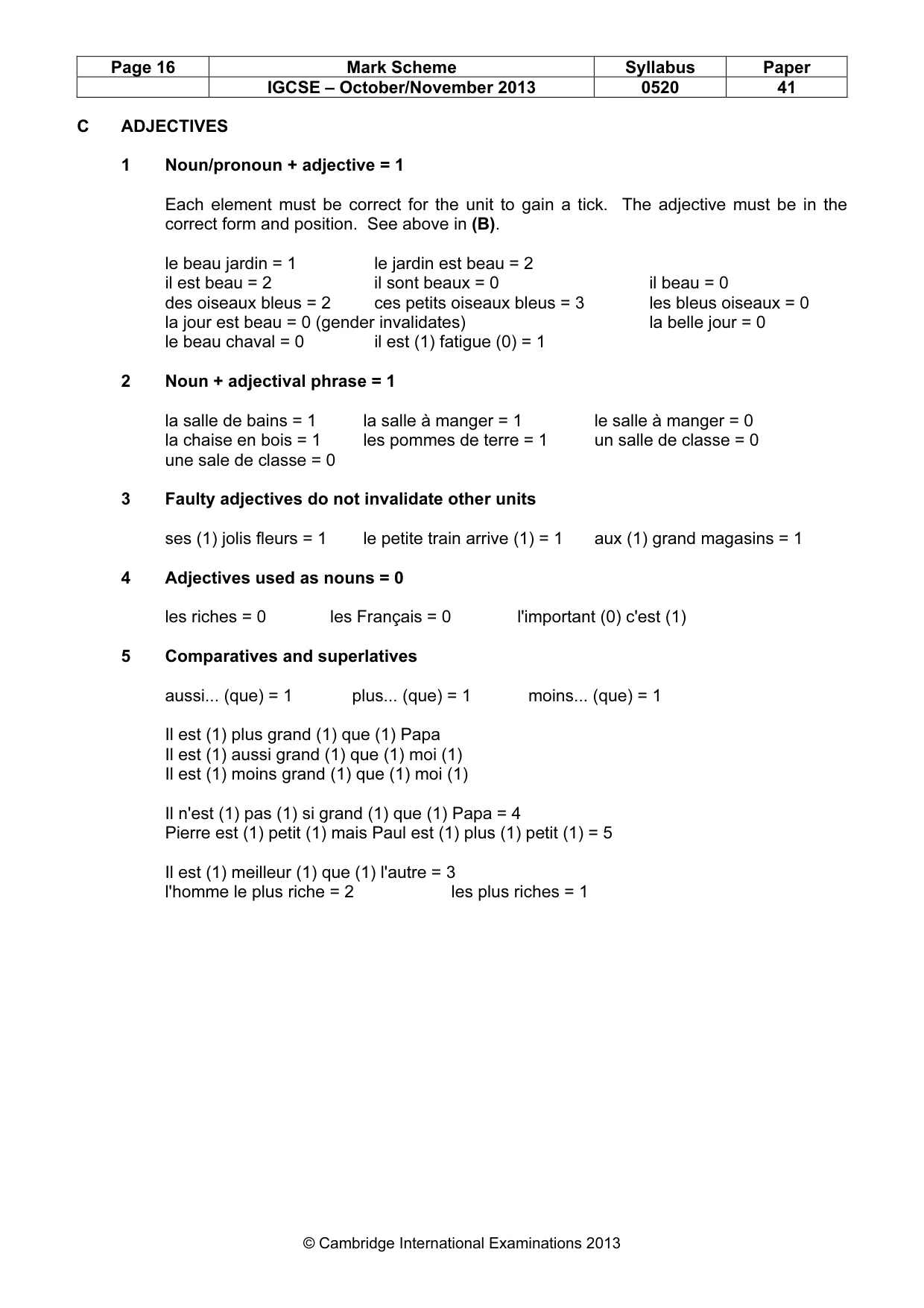
Page 16 Mark Scheme Syllabus Paper IGCSE – October/November 2013 0520 41 © Cambridge International Examinations 2013 C ADJECTIVES 1 Noun/pronoun + adjective = 1 Each element must be correct for the unit to gain a tick. The adjective must be in the correct form and position. See above in (B). le beau jardin = 1 le jardin est beau = 2 il est beau = 2 il sont beaux = 0 il beau = 0 des oiseaux bleus = 2 ces petits oiseaux bleus = 3 les bleus oiseaux = 0 la jour est beau = 0 (gender invalidates) la belle jour = 0 le beau chaval = 0 il est (1) fatigue (0) = 1 2 Noun + adjectival phrase = 1 la salle de bains = 1 la salle à manger = 1 le salle à manger = 0 la chaise en bois = 1 les pommes de terre = 1 un salle de classe = 0 une sale de classe = 0 3 Faulty adjectives do not invalidate other units ses (1) jolis fleurs = 1 le petite train arrive (1) = 1 aux (1) grand magasins = 1 4 Adjectives used as nouns = 0 les riches = 0 les Français = 0 l'important (0) c'est (1) 5 Comparatives and superlatives aussi... (que) = 1 plus... (que) = 1 moins... (que) = 1 Il est (1) plus grand (1) que (1) Papa Il est (1) aussi grand (1) que (1) moi (1) Il est (1) moins grand (1) que (1) moi (1) Il n'est (1) pas (1) si grand (1) que (1) Papa = 4 Pierre est (1) petit (1) mais Paul est (1) plus (1) petit (1) = 5 Il est (1) meilleur (1) que (1) l'autre = 3 l'homme le plus riche = 2 les plus riches = 1
Mark scheme, page 17
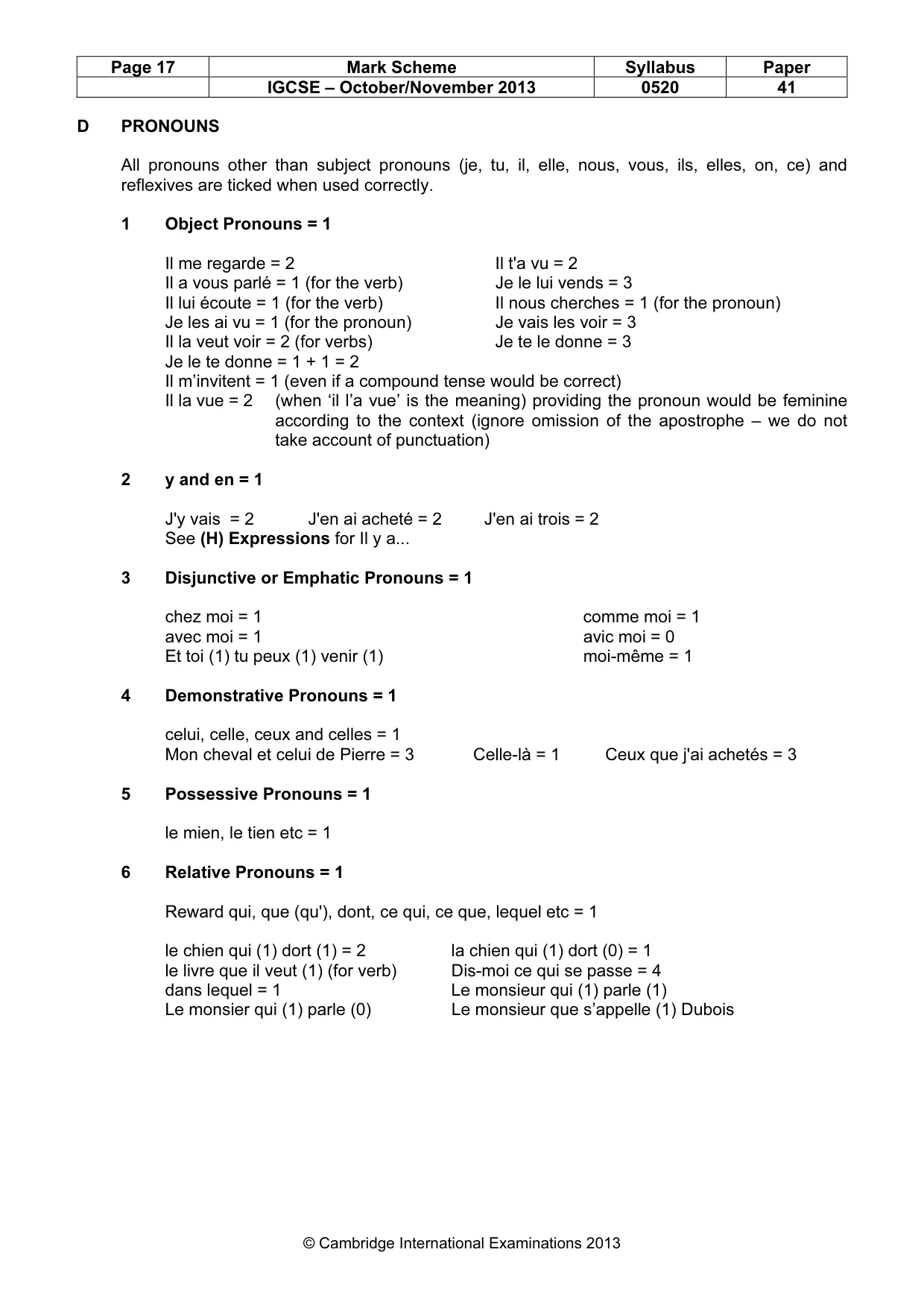
Page 17 Mark Scheme Syllabus Paper IGCSE – October/November 2013 0520 41 © Cambridge International Examinations 2013 D PRONOUNS All pronouns other than subject pronouns (je, tu, il, elle, nous, vous, ils, elles, on, ce) and reflexives are ticked when used correctly. 1 Object Pronouns = 1 Il me regarde = 2 Il t'a vu = 2 Il a vous parlé = 1 (for the verb) Je le lui vends = 3 Il lui écoute = 1 (for the verb) Il nous cherches = 1 (for the pronoun) Je les ai vu = 1 (for the pronoun) Je vais les voir = 3 Il la veut voir = 2 (for verbs) Je te le donne = 3 Je le te donne = 1 + 1 = 2 Il m’invitent = 1 (even if a compound tense would be correct) Il la vue = 2 (when ‘il l’a vue’ is the meaning) providing the pronoun would be feminine according to the context (ignore omission of the apostrophe – we do not take account of punctuation) 2 y and en = 1 J'y vais = 2 J'en ai acheté = 2 J'en ai trois = 2 See (H) Expressions for Il y a... 3 Disjunctive or Emphatic Pronouns = 1 chez moi = 1 comme moi = 1 avec moi = 1 avic moi = 0 Et toi (1) tu peux (1) venir (1) moi-même = 1 4 Demonstrative Pronouns = 1 celui, celle, ceux and celles = 1 Mon cheval et celui de Pierre = 3 Celle-là = 1 Ceux que j'ai achetés = 3 5 Possessive Pronouns = 1 le mien, le tien etc = 1 6 Relative Pronouns = 1 Reward qui, que (qu'), dont, ce qui, ce que, lequel etc = 1 le chien qui (1) dort (1) = 2 la chien qui (1) dort (0) = 1 le livre que il veut (1) (for verb) Dis-moi ce qui se passe = 4 dans lequel = 1 Le monsieur qui (1) parle (1) Le monsier qui (1) parle (0) Le monsieur que s’appelle (1) Dubois
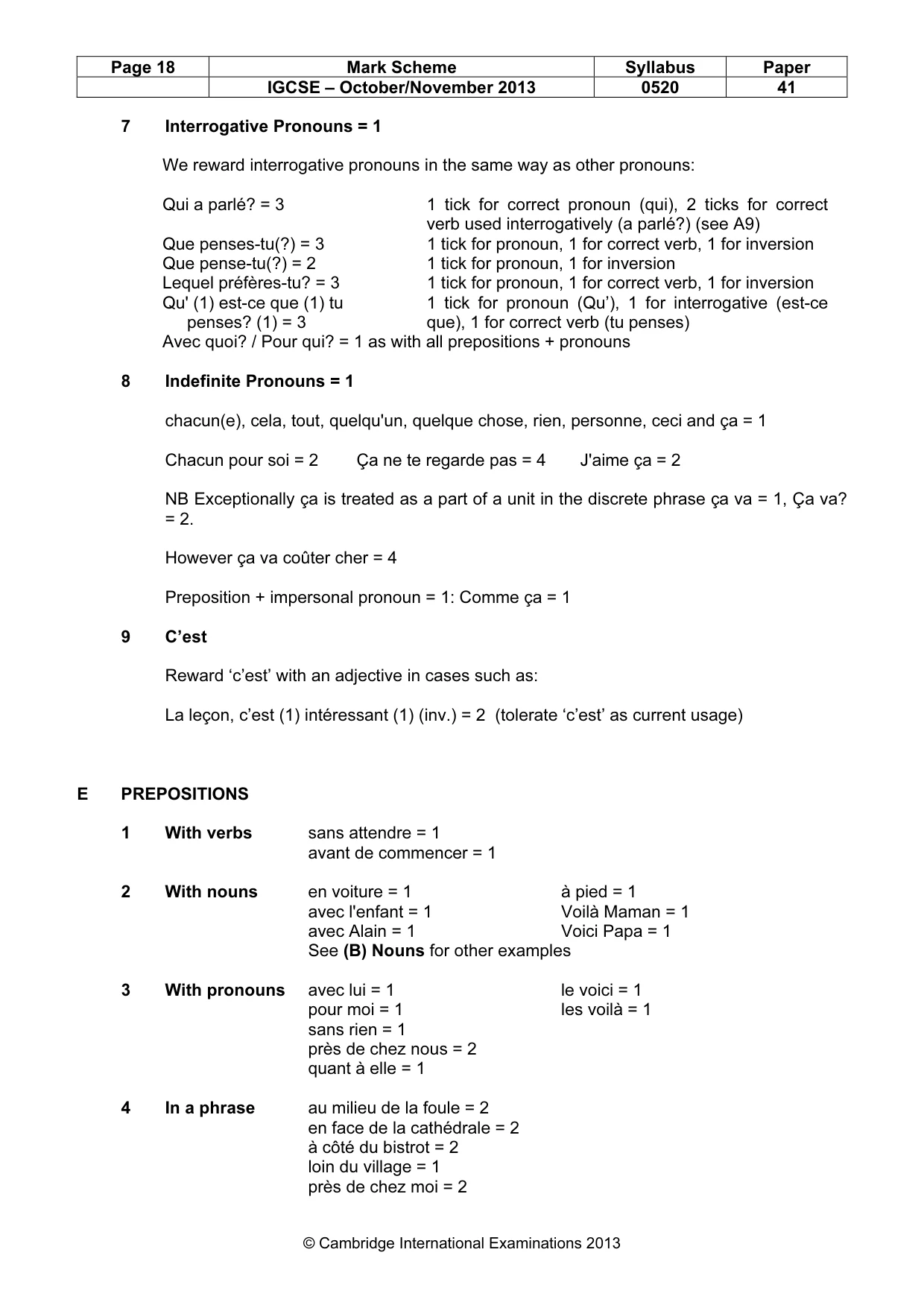
Mark scheme, page 18
Page 18 Mark Scheme Syllabus Paper IGCSE – October/November 2013 0520 41 © Cambridge International Examinations 2013 7 Interrogative Pronouns = 1 We reward interrogative pronouns in the same way as other pronouns: Qui a parlé? = 3 1 tick for correct pronoun (qui), 2 ticks for correct verb used interrogatively (a parlé?) (see A9) Que penses-tu(?) = 3 1 tick for pronoun, 1 for correct verb, 1 for inversion Que pense-tu(?) = 2 1 tick for pronoun, 1 for inversion Lequel préfères-tu? = 3 1 tick for pronoun, 1 for correct verb, 1 for inversion Qu' (1) est-ce que (1) tu penses? (1) = 3 1 tick for pronoun (Qu’), 1 for interrogative (est-ce que), 1 for correct verb (tu penses) Avec quoi? / Pour qui? = 1 as with all prepositions + pronouns 8 Indefinite Pronouns = 1 chacun(e), cela, tout, quelqu'un, quelque chose, rien, personne, ceci and ça = 1 Chacun pour soi = 2 Ça ne te regarde pas = 4 J'aime ça = 2 NB Exceptionally ça is treated as a part of a unit in the discrete phrase ça va = 1, Ça va? = 2. However ça va coûter cher = 4 Preposition + impersonal pronoun = 1: Comme ça = 1 9 C’est Reward ‘c’est’ with an adjective in cases such as: La leçon, c’est (1) intéressant (1) (inv.) = 2 (tolerate ‘c’est’ as current usage) E PREPOSITIONS 1 With verbs sans attendre = 1 avant de commencer = 1 2 With nouns en voiture = 1 à pied = 1 avec l'enfant = 1 Voilà Maman = 1 avec Alain = 1 Voici Papa = 1 See (B) Nouns for other examples 3 With pronouns avec lui = 1 le voici = 1 pour moi = 1 les voilà = 1 sans rien = 1 près de chez nous = 2 quant à elle = 1 4 In a phrase au milieu de la foule = 2 en face de la cathédrale = 2 à côté du bistrot = 2 loin du village = 1 près de chez moi = 2
Mark scheme, page 19
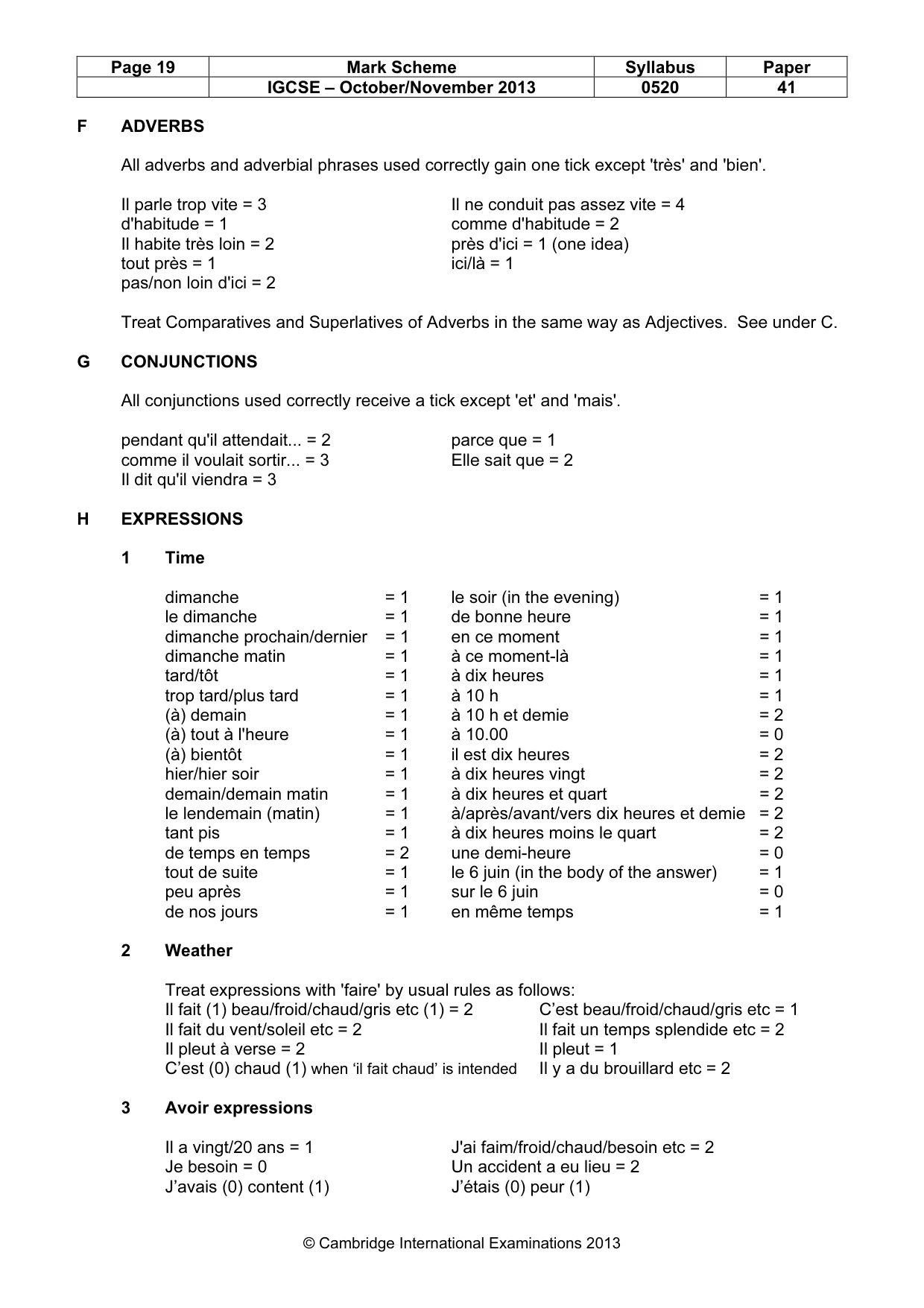
Page 19 Mark Scheme Syllabus Paper IGCSE – October/November 2013 0520 41 © Cambridge International Examinations 2013 F ADVERBS All adverbs and adverbial phrases used correctly gain one tick except 'très' and 'bien'. Il parle trop vite = 3 Il ne conduit pas assez vite = 4 d'habitude = 1 comme d'habitude = 2 Il habite très loin = 2 près d'ici = 1 (one idea) tout près = 1 ici/là = 1 pas/non loin d'ici = 2 Treat Comparatives and Superlatives of Adverbs in the same way as Adjectives. See under C. G CONJUNCTIONS All conjunctions used correctly receive a tick except 'et' and 'mais'. pendant qu'il attendait... = 2 parce que = 1 comme il voulait sortir... = 3 Elle sait que = 2 Il dit qu'il viendra = 3 H EXPRESSIONS 1 Time dimanche = 1 le soir (in the evening) = 1 le dimanche = 1 de bonne heure = 1 dimanche prochain/dernier = 1 en ce moment = 1 dimanche matin = 1 à ce moment-là = 1 tard/tôt = 1 à dix heures = 1 trop tard/plus tard = 1 à 10 h = 1 (à) demain = 1 à 10 h et demie = 2 (à) tout à l'heure = 1 à 10.00 = 0 (à) bientôt = 1 il est dix heures = 2 hier/hier soir = 1 à dix heures vingt = 2 demain/demain matin = 1 à dix heures et quart = 2 le lendemain (matin) = 1 à/après/avant/vers dix heures et demie = 2 tant pis = 1 à dix heures moins le quart = 2 de temps en temps = 2 une demi-heure = 0 tout de suite = 1 le 6 juin (in the body of the answer) = 1 peu après = 1 sur le 6 juin = 0 de nos jours = 1 en même temps = 1 2 Weather Treat expressions with 'faire' by usual rules as follows: Il fait (1) beau/froid/chaud/gris etc (1) = 2 C’est beau/froid/chaud/gris etc = 1 Il fait du vent/soleil etc = 2 Il fait un temps splendide etc = 2 Il pleut à verse = 2 Il pleut = 1 C’est (0) chaud (1) when ‘il fait chaud’ is intended Il y a du brouillard etc = 2 3 Avoir expressions Il a vingt/20 ans = 1 J'ai faim/froid/chaud/besoin etc = 2 Je besoin = 0 Un accident a eu lieu = 2 J’avais (0) content (1) J’étais (0) peur (1)
Mark scheme, page 20
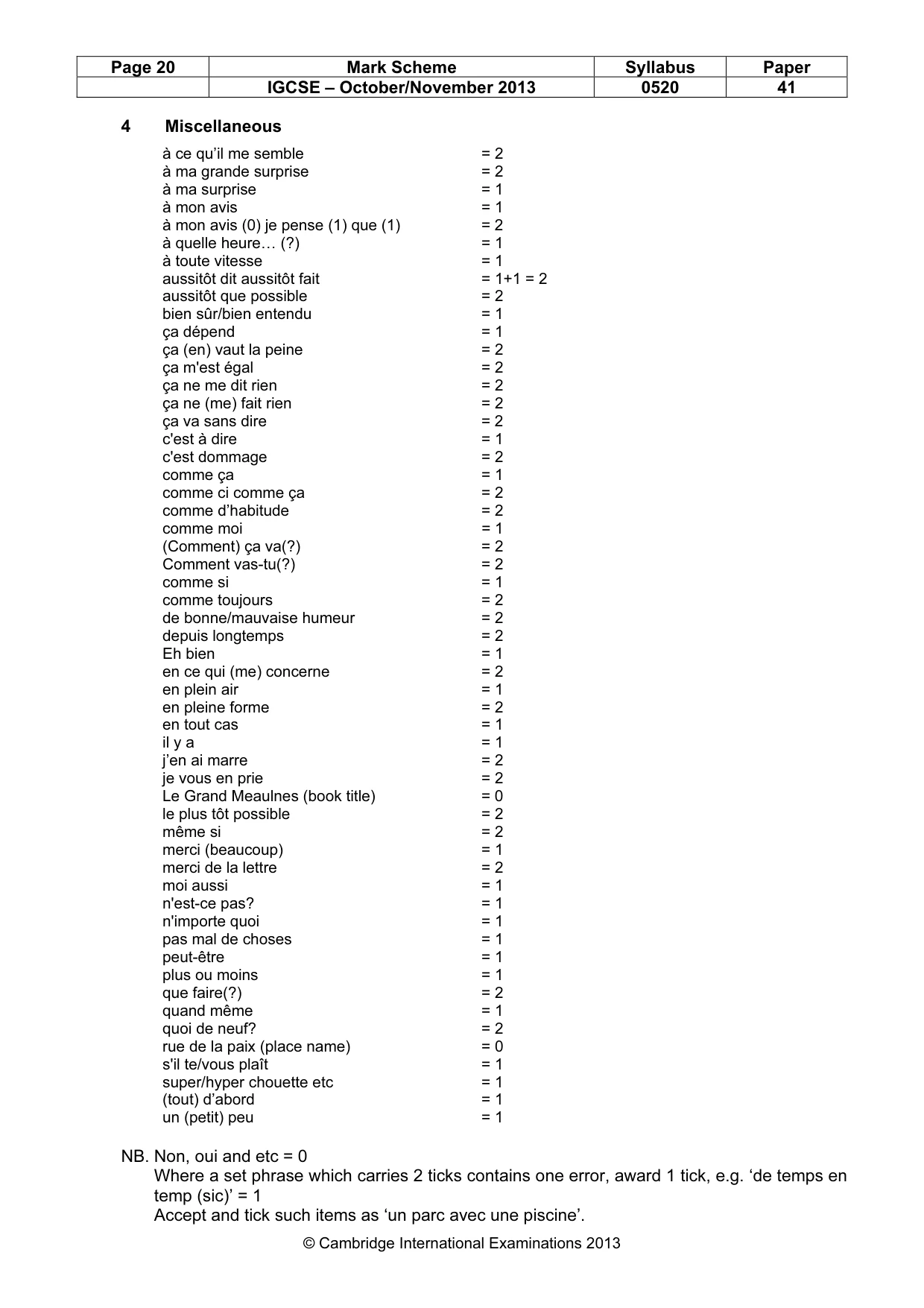
Page 20 Mark Scheme Syllabus Paper IGCSE – October/November 2013 0520 41 © Cambridge International Examinations 2013 4 Miscellaneous à ce qu’il me semble = 2 à ma grande surprise = 2 à ma surprise = 1 à mon avis = 1 à mon avis (0) je pense (1) que (1) = 2 à quelle heure… (?) = 1 à toute vitesse = 1 aussitôt dit aussitôt fait = 1+1 = 2 aussitôt que possible = 2 bien sûr/bien entendu = 1 ça dépend = 1 ça (en) vaut la peine = 2 ça m'est égal = 2 ça ne me dit rien = 2 ça ne (me) fait rien = 2 ça va sans dire = 2 c'est à dire = 1 c'est dommage = 2 comme ça = 1 comme ci comme ça = 2 comme d’habitude = 2 comme moi = 1 (Comment) ça va(?) = 2 Comment vas-tu(?) = 2 comme si = 1 comme toujours = 2 de bonne/mauvaise humeur = 2 depuis longtemps = 2 Eh bien = 1 en ce qui (me) concerne = 2 en plein air = 1 en pleine forme = 2 en tout cas = 1 il y a = 1 j’en ai marre = 2 je vous en prie = 2 Le Grand Meaulnes (book title) = 0 le plus tôt possible = 2 même si = 2 merci (beaucoup) = 1 merci de la lettre = 2 moi aussi = 1 n'est-ce pas? = 1 n'importe quoi = 1 pas mal de choses = 1 peut-être = 1 plus ou moins = 1 que faire(?) = 2 quand même = 1 quoi de neuf? = 2 rue de la paix (place name) = 0 s'il te/vous plaît = 1 super/hyper chouette etc = 1 (tout) d’abord = 1 un (petit) peu = 1 NB. Non, oui and etc = 0 Where a set phrase which carries 2 ticks contains one error, award 1 tick, e.g. ‘de temps en temp (sic)’ = 1 Accept and tick such items as ‘un parc avec une piscine’.
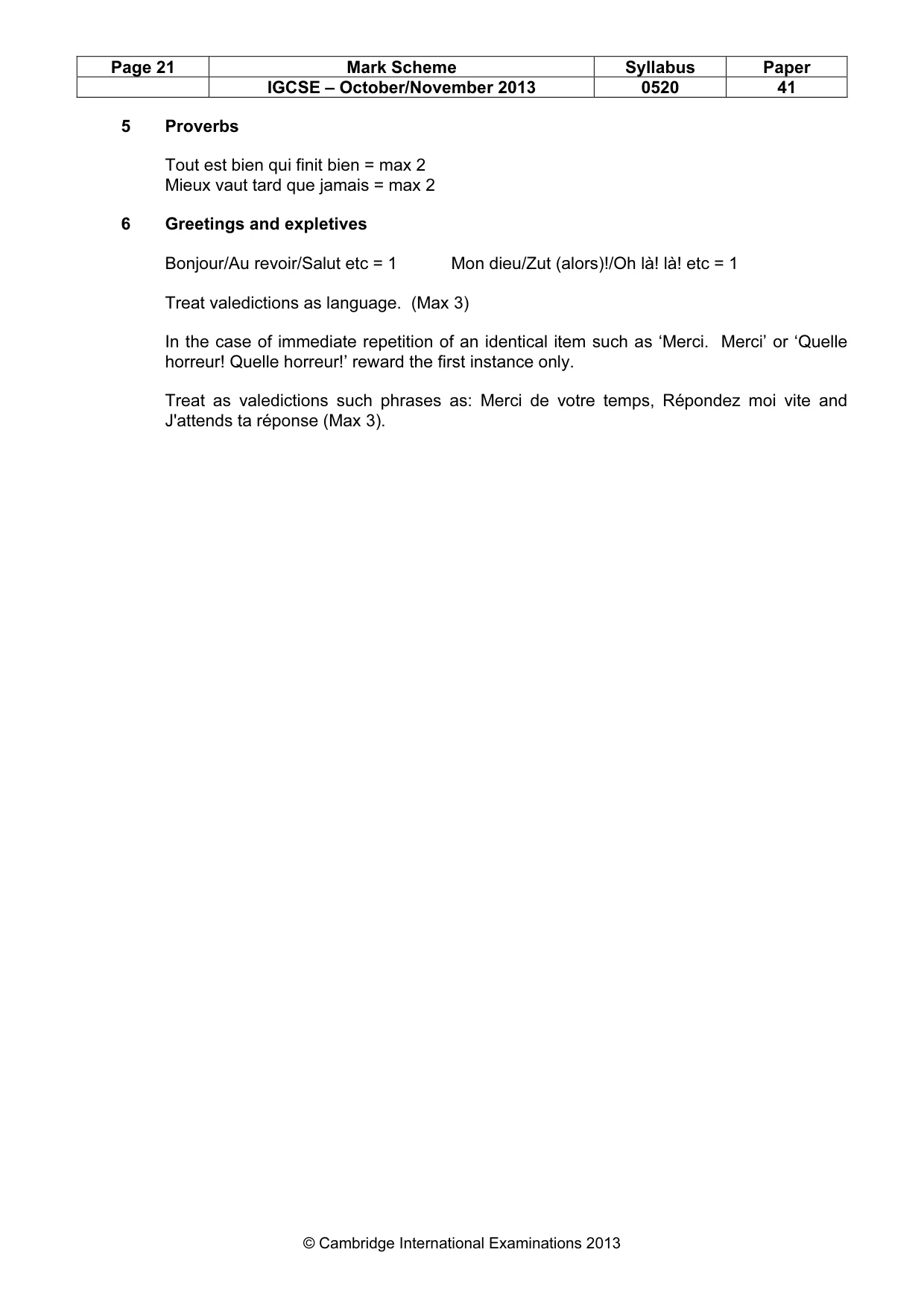
Mark scheme, page 21
Page 21 Mark Scheme Syllabus Paper IGCSE – October/November 2013 0520 41 © Cambridge International Examinations 2013 5 Proverbs Tout est bien qui finit bien = max 2 Mieux vaut tard que jamais = max 2 6 Greetings and expletives Bonjour/Au revoir/Salut etc = 1 Mon dieu/Zut (alors)!/Oh là! là! etc = 1 Treat valedictions as language. (Max 3) In the case of immediate repetition of an identical item such as ‘Merci. Merci’ or ‘Quelle horreur! Quelle horreur!’ reward the first instance only. Treat as valedictions such phrases as: Merci de votre temps, Répondez moi vite and J'attends ta réponse (Max 3).
Mark scheme, page 22
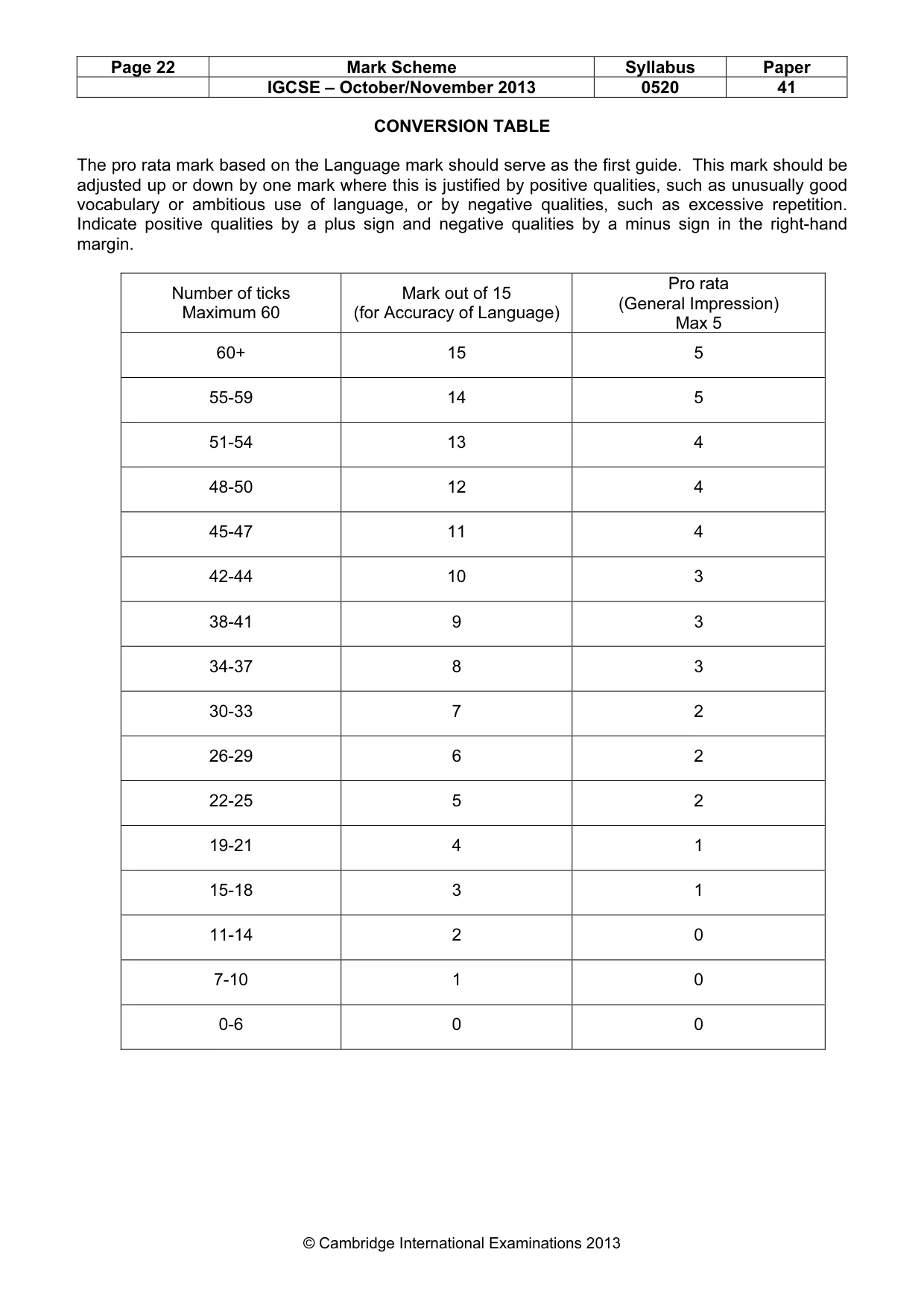
Page 22 Mark Scheme Syllabus Paper IGCSE – October/November 2013 0520 41 © Cambridge International Examinations 2013 CONVERSION TABLE The pro rata mark based on the Language mark should serve as the first guide. This mark should be adjusted up or down by one mark where this is justified by positive qualities, such as unusually good vocabulary or ambitious use of language, or by negative qualities, such as excessive repetition. Indicate positive qualities by a plus sign and negative qualities by a minus sign in the right-hand margin. Number of ticks Maximum 60 Mark out of 15 (for Accuracy of Language) Pro rata (General Impression) Max 5 60+ 15 5 55-59 14 5 51-54 13 4 48-50 12 4 45-47 11 4 42-44 10 3 38-41 9 3 34-37 8 3 30-33 7 2 26-29 6 2 22-25 5 2 19-21 4 1 15-18 3 1 11-14 2 0 7-10 1 0 0-6 0 0
What you needed in this session
Cambridge’s own grade thresholds for 2013 Oct/Nov, Paper 4 · Variant 1. A higher threshold means an easier paper — the bar moves with how the cohort did.