Cambridge IGCSE Food and Nutrition 0648 — 2016 May/June Paper 1 · Variant 0
0648/10/M/J/16
The question paper and its mark scheme, free to read here and free to download. This is Cambridge’s own paper, exactly as it was sat.
Question paper12 pages

Mark scheme
No mark scheme is in the library for this paper.
Paper as text
Question paper, page 1
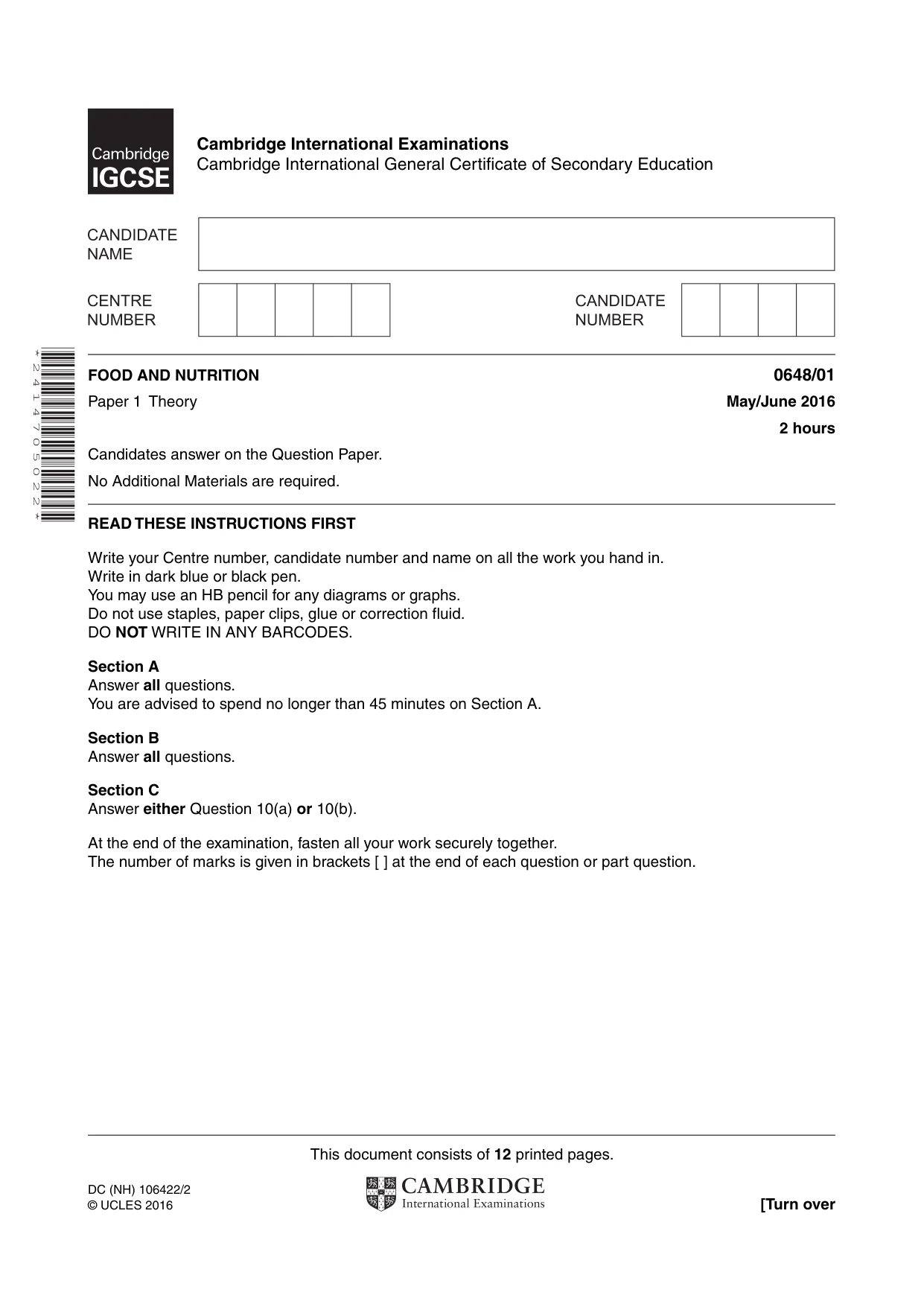
This document consists of 12 printed pages. DC (NH) 106422/2 © UCLES 2016 [Turn over * 2 4 1 4 7 0 5 0 2 2 * FOOD AND NUTRITION 0648/01 Paper 1 Theory May/June 2016 2 hours Candidates answer on the Question Paper. No Additional Materials are required. READ THESE INSTRUCTIONS FIRST Write your Centre number, candidate number and name on all the work you hand in. Write in dark blue or black pen. You may use an HB pencil for any diagrams or graphs. Do not use staples, paper clips, glue or correction fluid. DO NOT WRITE IN ANY BARCODES. Section A Answer all questions. You are advised to spend no longer than 45 minutes on Section A. Section B Answer all questions. Section C Answer either Question 10(a) or 10(b). At the end of the examination, fasten all your work securely together. The number of marks is given in brackets [ ] at the end of each question or part question. Cambridge International Examinations Cambridge International General Certificate of Secondary Education
Question paper, page 2
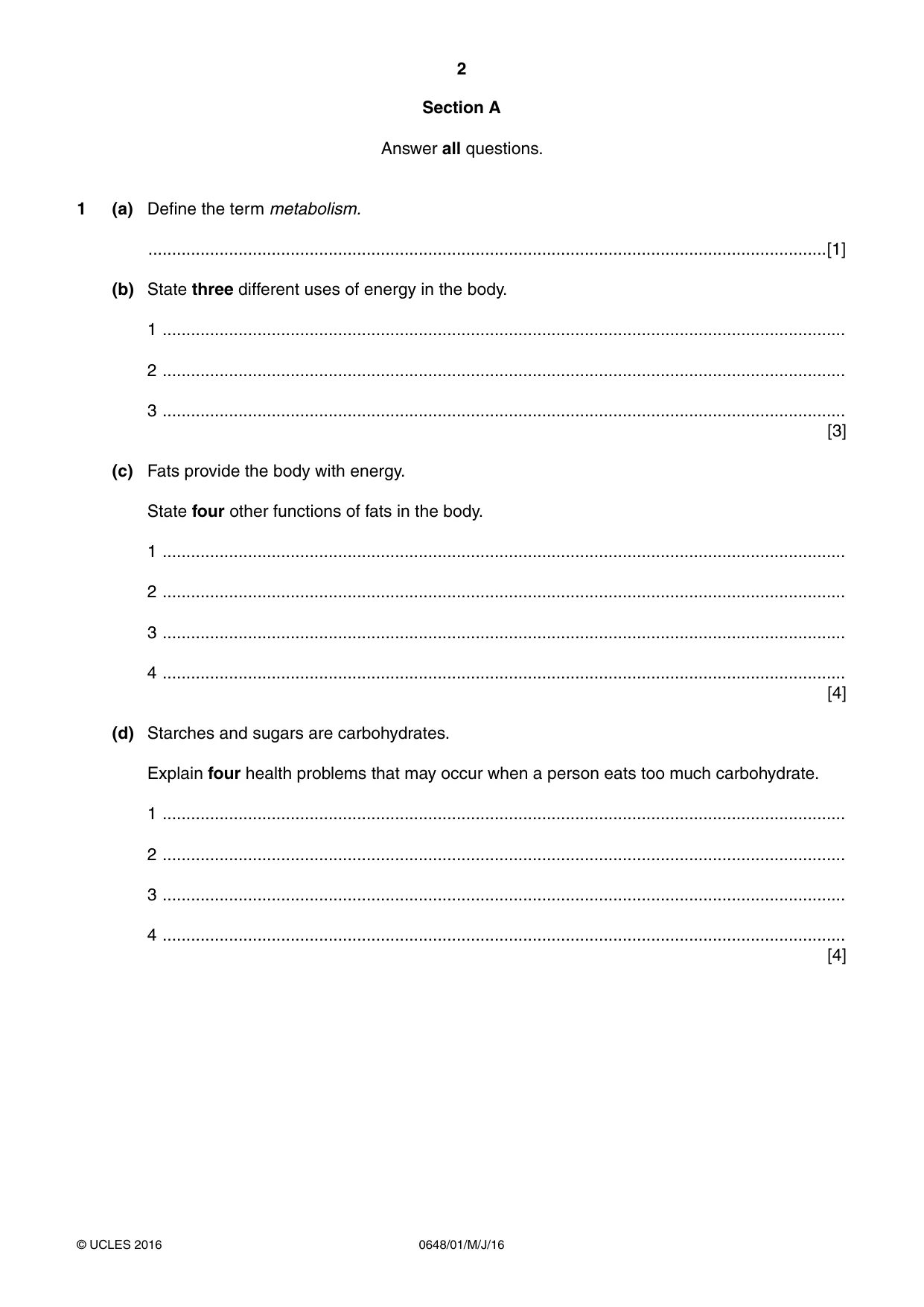
2 0648/01/M/J/16 © UCLES 2016 Section A Answer all questions. 1 (a) Define the term metabolism. …[1] (b) State three different uses of energy in the body. 1 … 2 … 3 … [3] (c) Fats provide the body with energy. State four other functions of fats in the body. 1 … 2 … 3 … 4 … [4] (d) Starches and sugars are carbohydrates. Explain four health problems that may occur when a person eats too much carbohydrate. 1 … 2 … 3 … 4 … [4]
Question paper, page 3
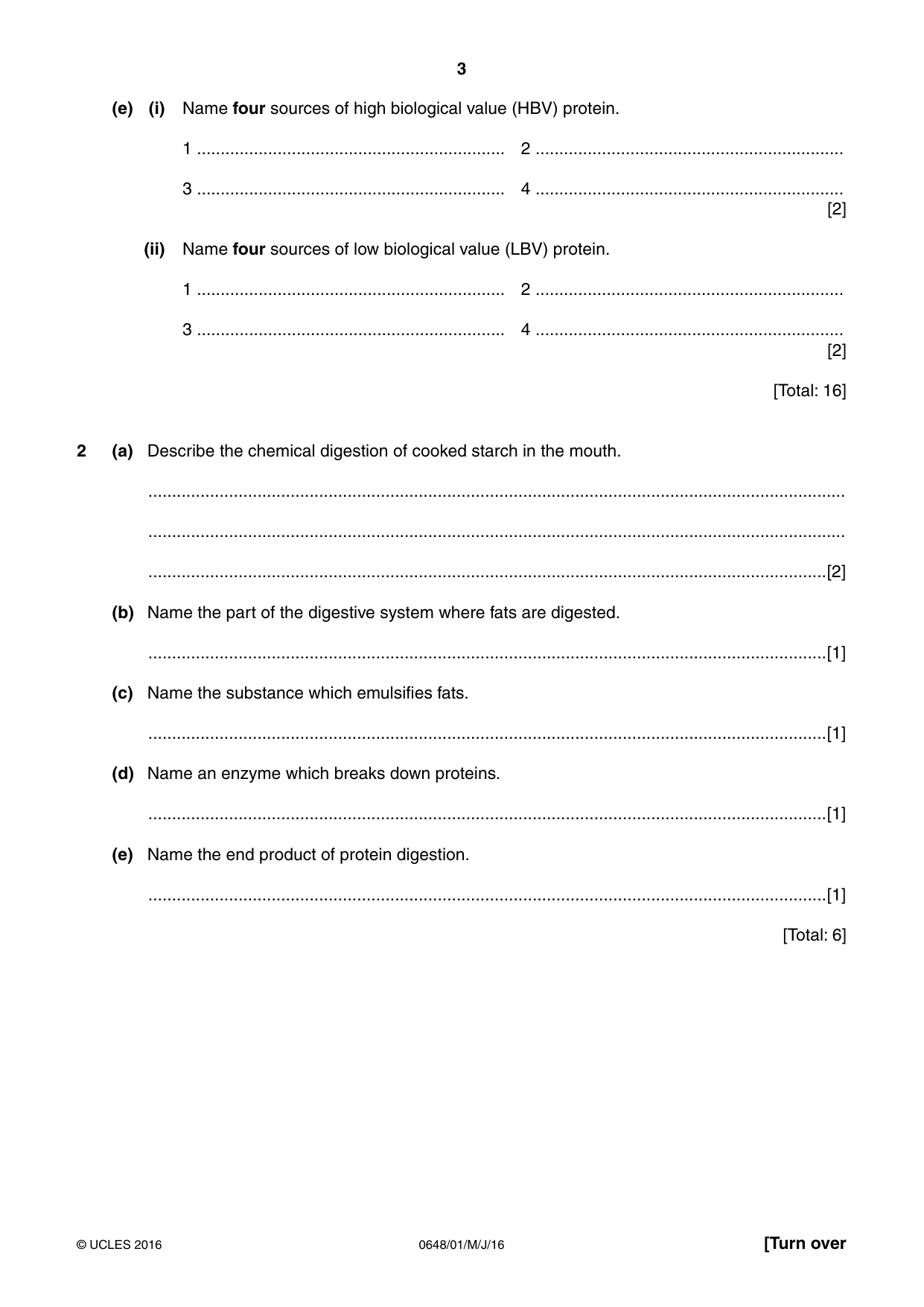
3 0648/01/M/J/16 © UCLES 2016 [Turn over (e) (i) Name four sources of high biological value (HBV) protein. 1 … 2 … 3 … 4 … [2] (ii) Name four sources of low biological value (LBV) protein. 1 … 2 … 3 … 4 … [2] [Total: 16] 2 (a) Describe the chemical digestion of cooked starch in the mouth. … … …[2] (b) Name the part of the digestive system where fats are digested. …[1] (c) Name the substance which emulsifies fats. …[1] (d) Name an enzyme which breaks down proteins. …[1] (e) Name the end product of protein digestion. …[1] [Total: 6]
Question paper, page 4
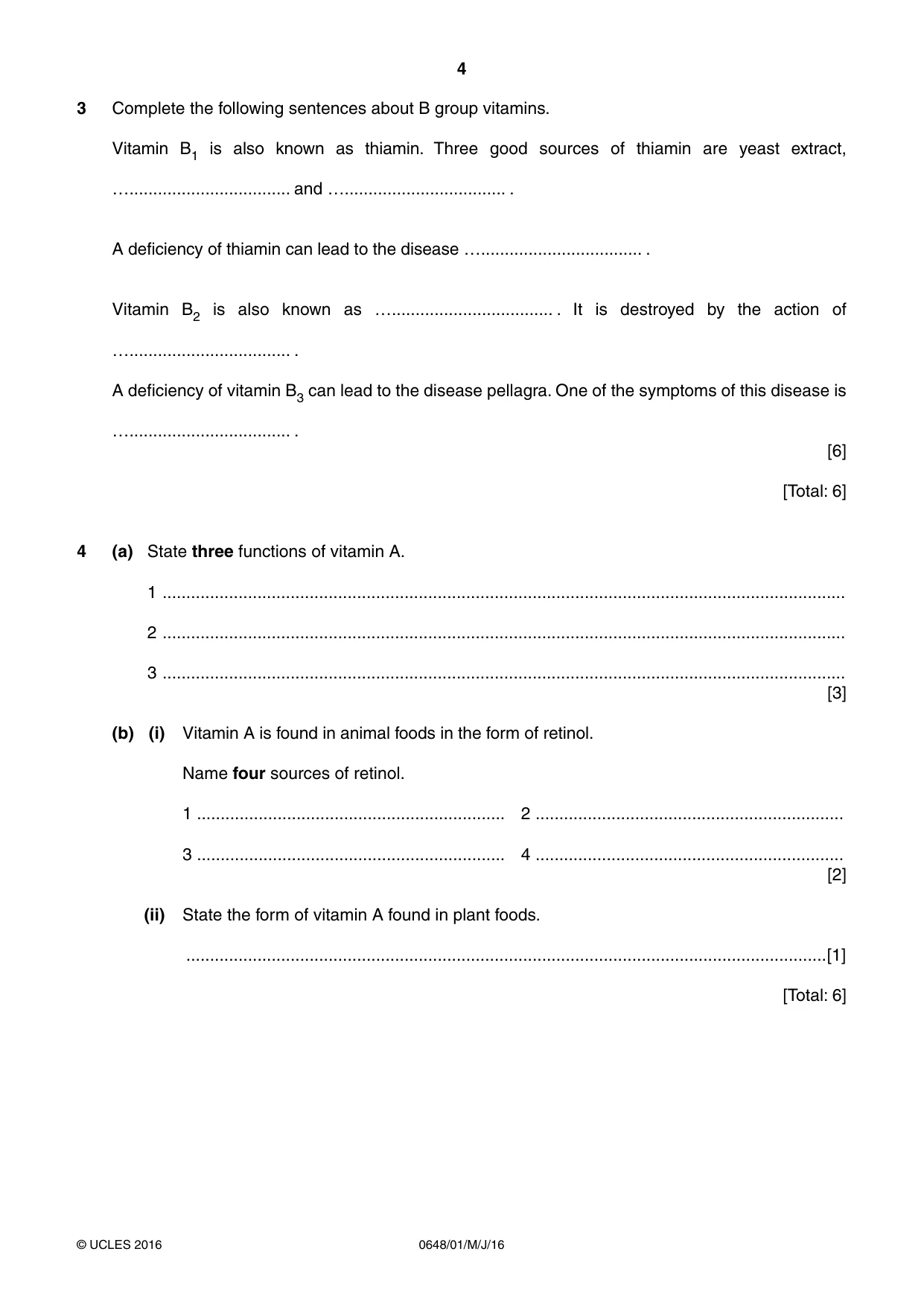
4 0648/01/M/J/16 © UCLES 2016 3 Complete the following sentences about B group vitamins. Vitamin B1 is also known as thiamin. Three good sources of thiamin are yeast extract, …… and …… . A deficiency of thiamin can lead to the disease …… . Vitamin B2 is also known as …… . It is destroyed by the action of …… . A deficiency of vitamin B3 can lead to the disease pellagra. One of the symptoms of this disease is …… . [6] [Total: 6] 4 (a) State three functions of vitamin A. 1 … 2 … 3 … [3] (b) (i) Vitamin A is found in animal foods in the form of retinol. Name four sources of retinol. 1 … 2 … 3 … 4 … [2] (ii) State the form of vitamin A found in plant foods. …[1] [Total: 6]
Question paper, page 5
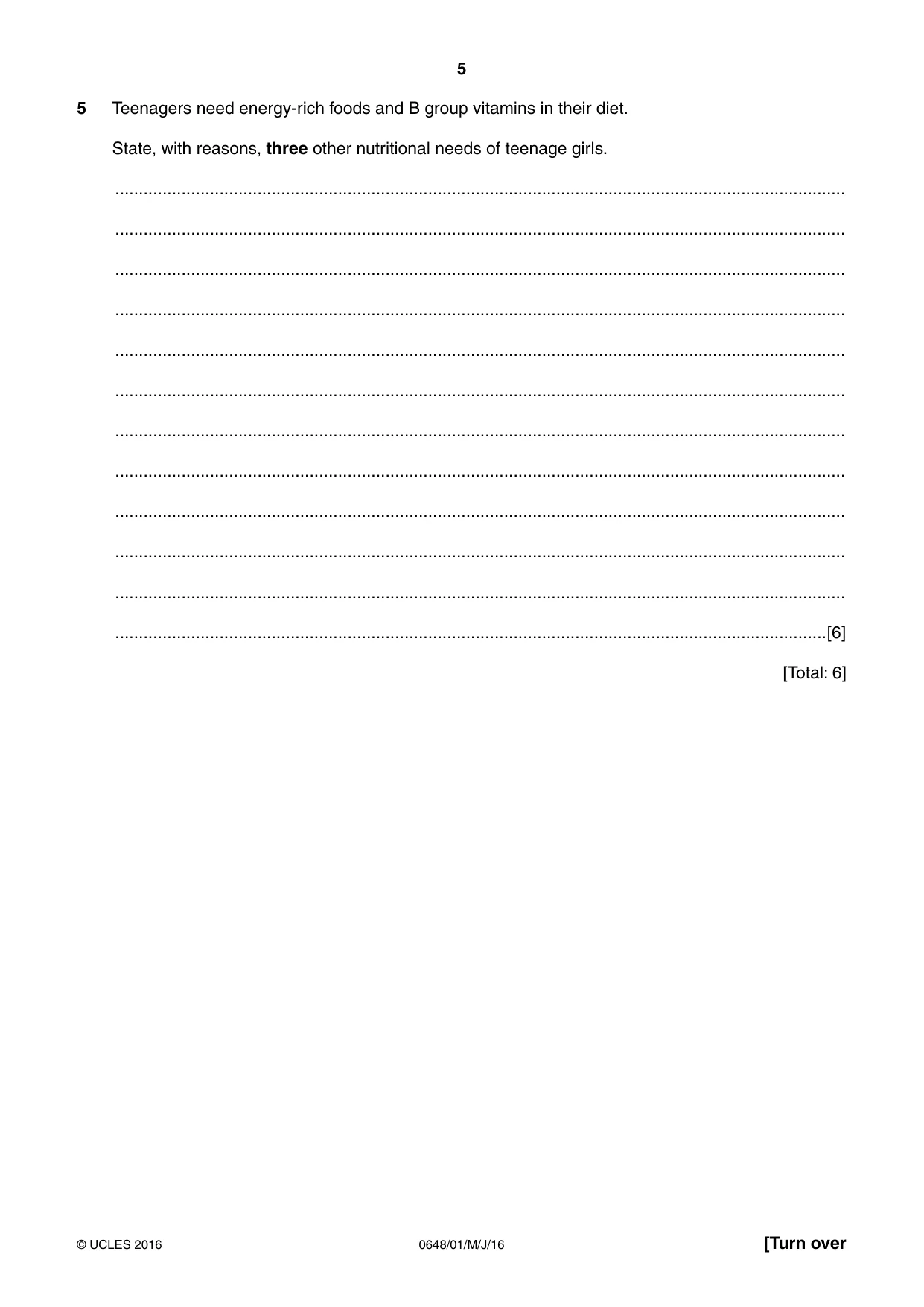
5 0648/01/M/J/16 © UCLES 2016 [Turn over 5 Teenagers need energy-rich foods and B group vitamins in their diet. State, with reasons, three other nutritional needs of teenage girls. … … … … … … … … … … … …[6] [Total: 6]
Question paper, page 6
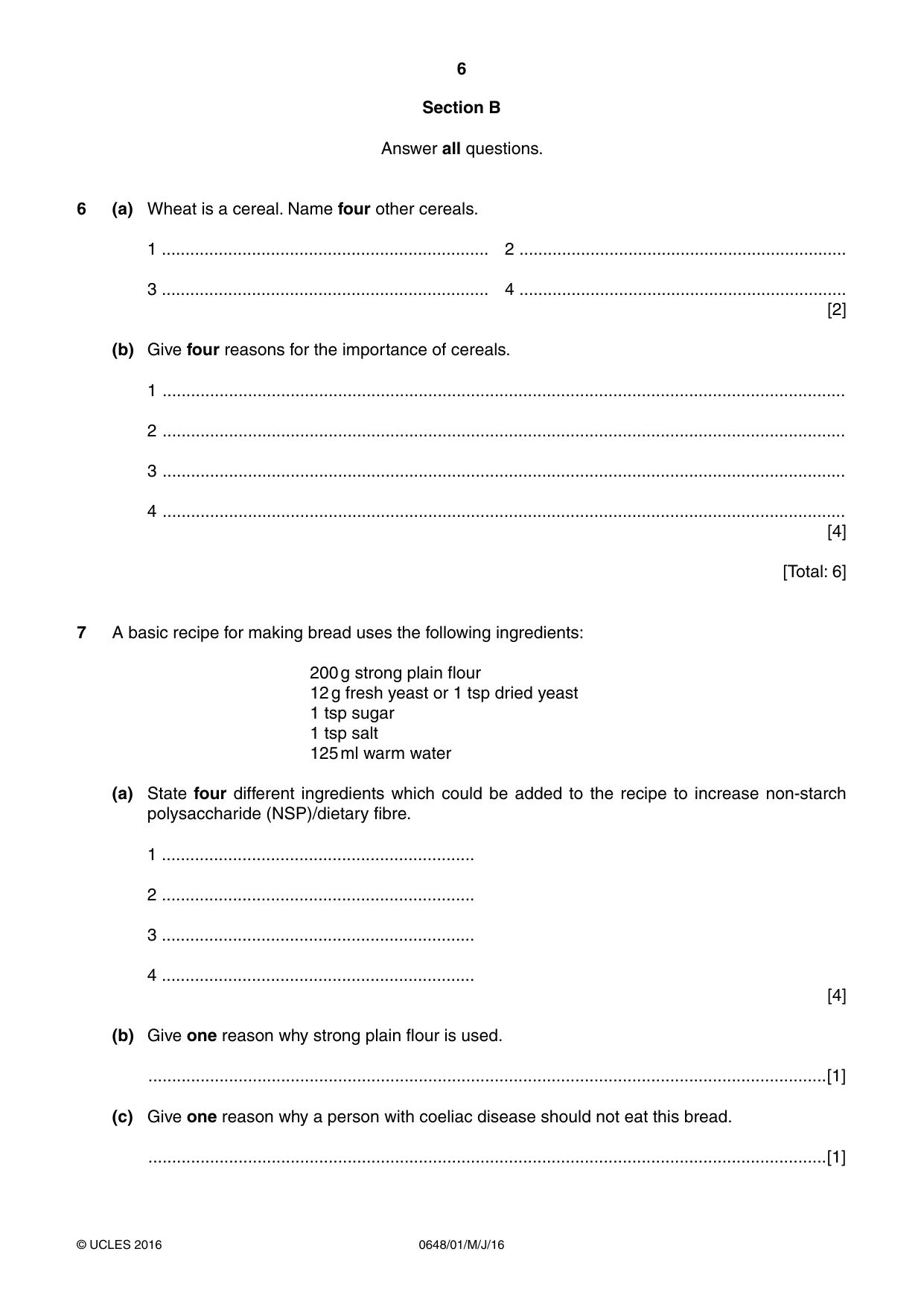
6 0648/01/M/J/16 © UCLES 2016 Section B Answer all questions. 6 (a) Wheat is a cereal. Name four other cereals. 1 … 2 … 3 … 4 … [2] (b) Give four reasons for the importance of cereals. 1 … 2 … 3 … 4 … [4] [Total: 6] 7 A basic recipe for making bread uses the following ingredients: 200 g strong plain flour 12 g fresh yeast or 1 tsp dried yeast 1 tsp sugar 1 tsp salt 125 ml warm water (a) State four different ingredients which could be added to the recipe to increase non-starch polysaccharide (NSP)/dietary fibre. 1 … 2 … 3 … 4 … [4] (b) Give one reason why strong plain flour is used. …[1] (c) Give one reason why a person with coeliac disease should not eat this bread. …[1]
Question paper, page 7
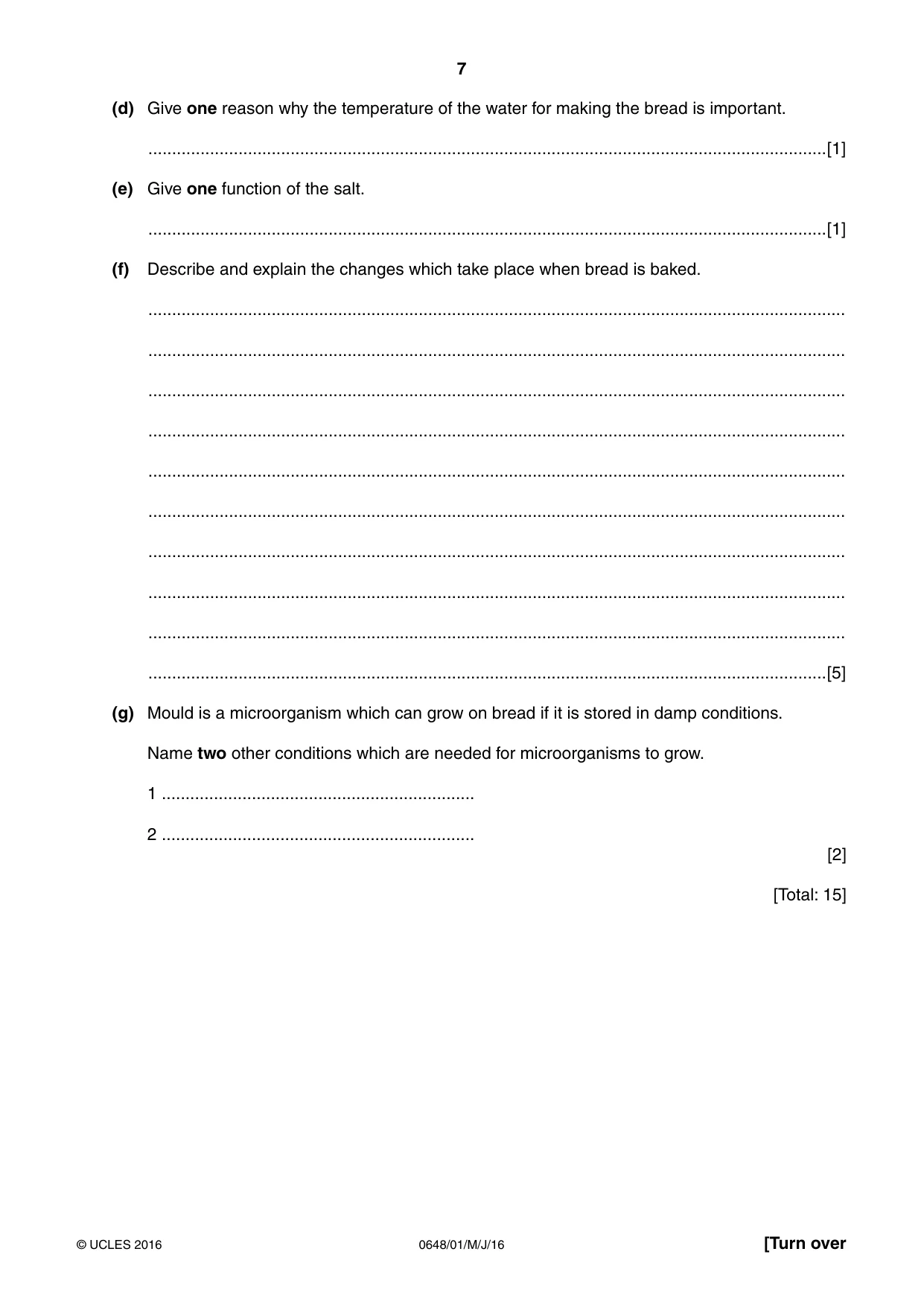
7 0648/01/M/J/16 © UCLES 2016 [Turn over (d) Give one reason why the temperature of the water for making the bread is important. …[1] (e) Give one function of the salt. …[1] (f) Describe and explain the changes which take place when bread is baked. … … … … … … … … … …[5] (g) Mould is a microorganism which can grow on bread if it is stored in damp conditions. Name two other conditions which are needed for microorganisms to grow. 1 … 2 … [2] [Total: 15]
Question paper, page 8
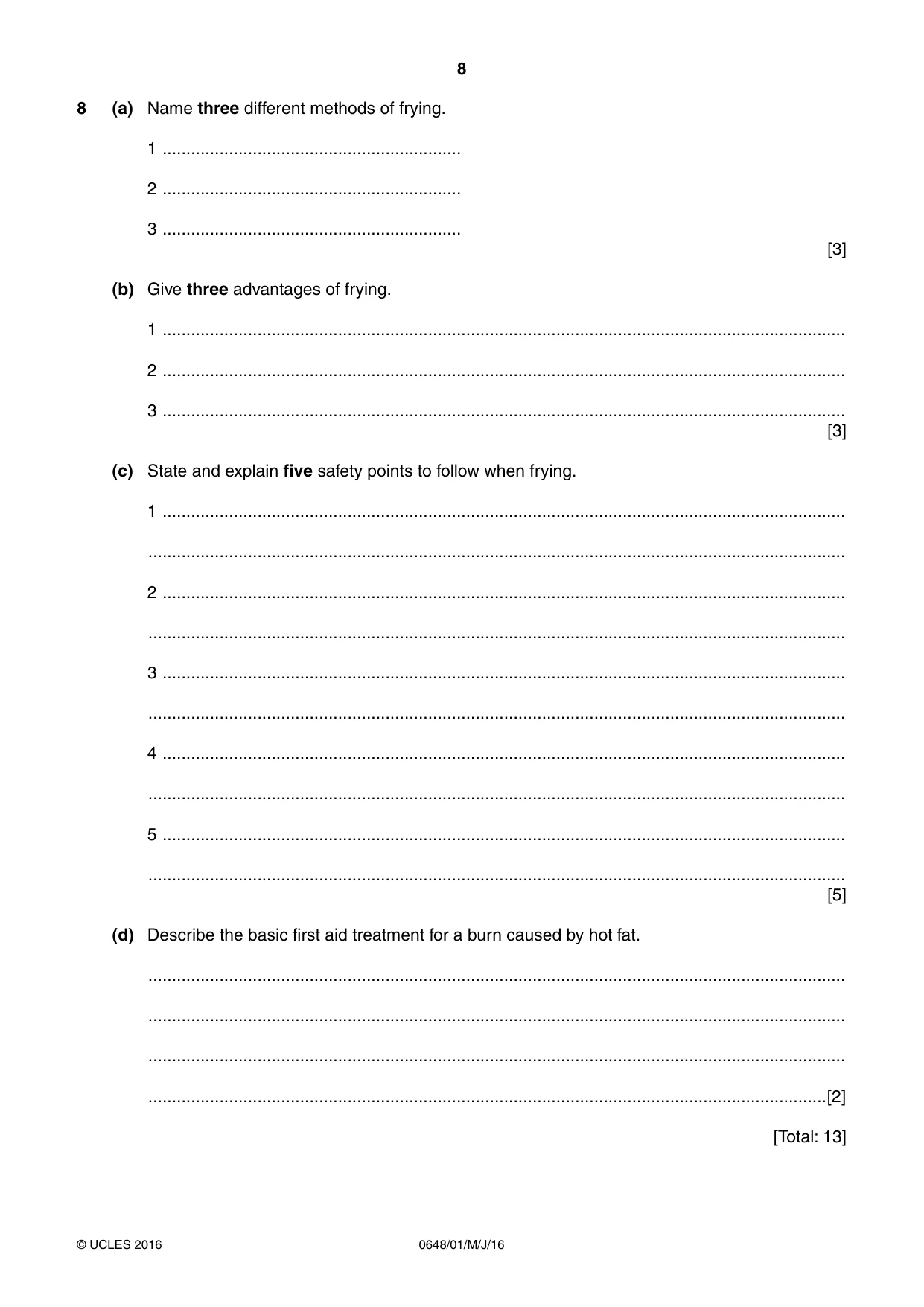
8 0648/01/M/J/16 © UCLES 2016 8 (a) Name three different methods of frying. 1 … 2 … 3 … [3] (b) Give three advantages of frying. 1 … 2 … 3 … [3] (c) State and explain five safety points to follow when frying. 1 … … 2 … … 3 … … 4 … … 5 … … [5] (d) Describe the basic first aid treatment for a burn caused by hot fat. … … … …[2] [Total: 13]
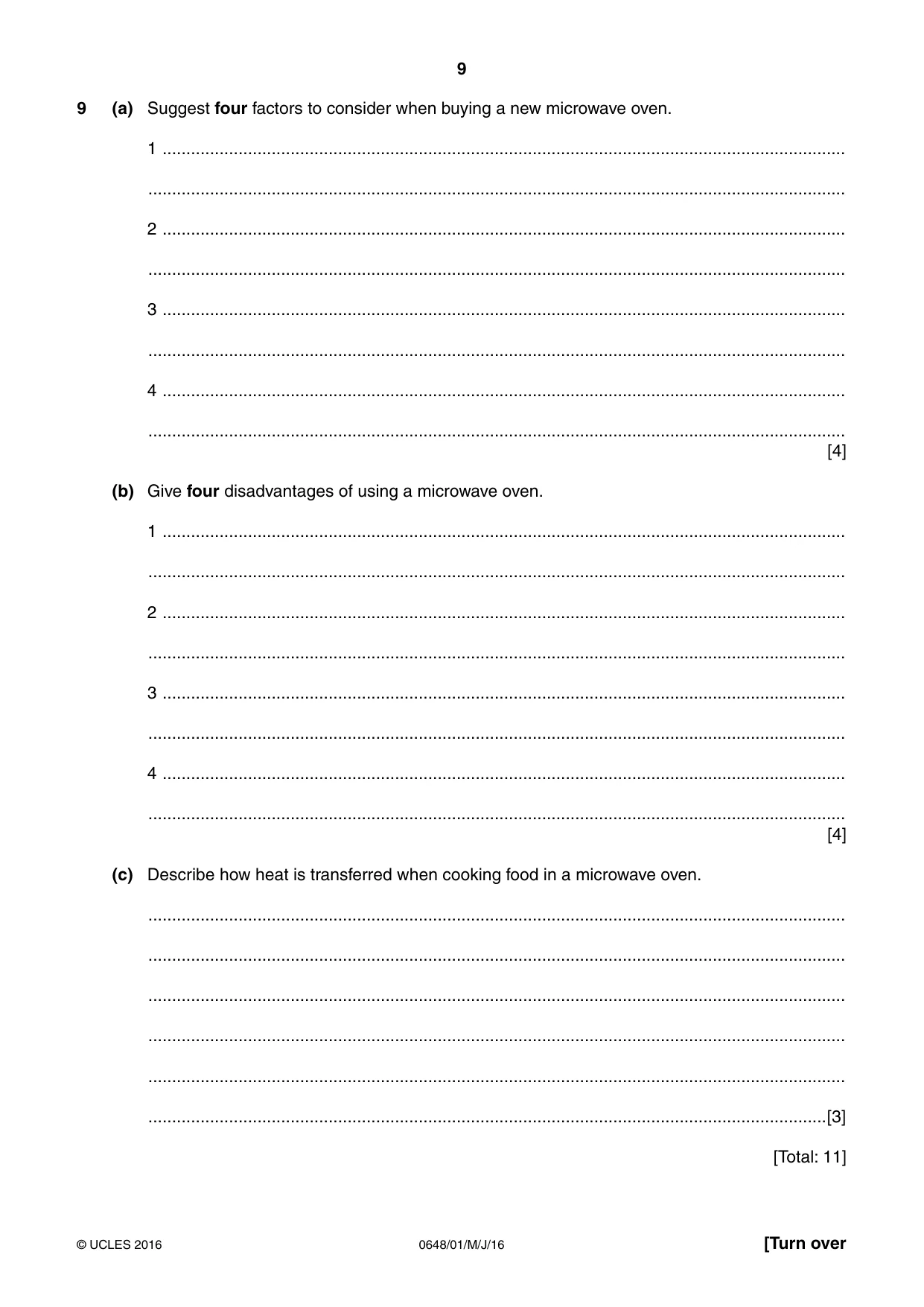
Question paper, page 9
9 0648/01/M/J/16 © UCLES 2016 [Turn over 9 (a) Suggest four factors to consider when buying a new microwave oven. 1 … … 2 … … 3 … … 4 … … [4] (b) Give four disadvantages of using a microwave oven. 1 … … 2 … … 3 … … 4 … … [4] (c) Describe how heat is transferred when cooking food in a microwave oven. … … … … … …[3] [Total: 11]
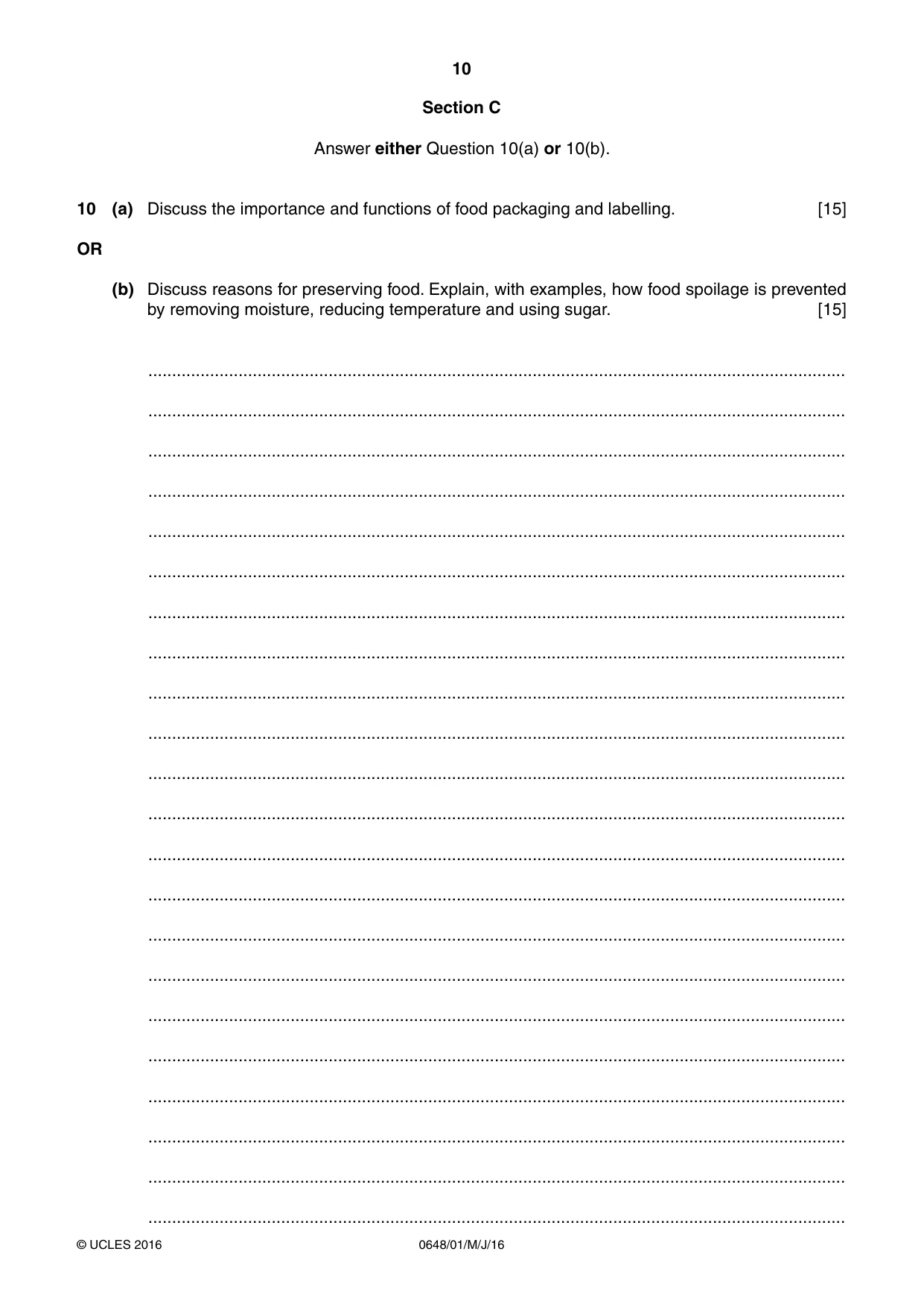
Question paper, page 10
10 0648/01/M/J/16 © UCLES 2016 Section C Answer either Question 10(a) or 10(b). 10 (a) Discuss the importance and functions of food packaging and labelling. [15] OR (b) Discuss reasons for preserving food. Explain, with examples, how food spoilage is prevented by removing moisture, reducing temperature and using sugar. [15] … … … … … … … … … … … … … … … … … … … … … …
Question paper, page 11
11 0648/01/M/J/16 © UCLES 2016 [Turn over … … … … … … … … … … … … … … … … … … … … … … … … … … … …
Question paper, page 12
12 0648/01/M/J/16 © UCLES 2016 … … … … … … … … … … … … … … … … … … … … … … [Total: 15] Permission to reproduce items where third-party owned material protected by copyright is included has been sought and cleared where possible. Every reasonable effort has been made by the publisher (UCLES) to trace copyright holders, but if any items requiring clearance have unwittingly been included, the publisher will be pleased to make amends at the earliest possible opportunity. To avoid the issue of disclosure of answer-related information to candidates, all copyright acknowledgements are reproduced online in the Cambridge International Examinations Copyright Acknowledgements Booklet. This is produced for each series of examinations and is freely available to download at www.cie.org.uk after the live examination series. Cambridge International Examinations is part of the Cambridge Assessment Group. Cambridge Assessment is the brand name of University of Cambridge Local Examinations Syndicate (UCLES), which is itself a department of the University of Cambridge.