Cambridge IGCSE Food and Nutrition 0648 — 2014 Oct/Nov Paper 2 · Variant 1
0648/21/O/N/14
The question paper and its mark scheme, free to read here and free to download. This is Cambridge’s own paper, exactly as it was sat.
Question paper4 pages
Mark scheme6 pages
Answers below. Sit the paper first if you are practising.
Paper as text
Question paper, page 1
This document consists of 3 printed pages and 1 blank page. DC (LEG) 91148/1 © UCLES 2014 [Turn over Cambridge International Examinations Cambridge International General Certificate of Secondary Education * 1 8 6 0 5 9 9 2 1 7 * FOOD AND NUTRITION 0648/02 Paper 2 Practical Test 01 September – 31 October 2014 Planning Session: 1 hour 30 minutes Practical Test: 2 hours 30 minutes Additional Materials: Carbonised Sheets READ THESE INSTRUCTIONS FIRST Write your Centre number, candidate number and name on all the work you hand in. Please see page 2.
Question paper, page 2
2 0648/02/O/N/14 © UCLES 2014 Planning Session: 1 hour 30 minutes When you know which of the tests is assigned to you, read it through carefully, then prepare a Plan of Work, Time Plan and Shopping List of ingredients as follows, using the carbonised sheets. (i) On the Plan of Work sheet, write down the dishes that you decide to make. (Try to choose familiar but interesting dishes which give you scope to show your skill.) Do not copy out the test. List the dishes in the correct order to answer the question. (ii) Beside each of the dishes chosen, give the quantities of the main ingredients required. (A full recipe is not necessary.) (iii) Complete the Time Plan sheet to show the order of working, the methods to be used, and the length of time required for cooking each dish. Frozen, tinned and packaged foods (i.e. ‘convenience’ foods) may be used with discretion, but enough work must be planned to show skill and to occupy the whole of the Practical Test. (iv) Complete the Shopping List sheet to show the total quantities of the ingredients required. The amounts cooked should be sufficient for two or three people, but this may be governed by the requirements of each particular test. Recipe books may be used during the Planning Session, but frequent reference to them is to be avoided during the Practical Test. Write your name, candidate number and the number of the test on your Plan of Work, Time Plan and Shopping List. Give them and any notes you may have made, with this question paper, to the Supervisor at the end of the Planning Session. You may not take away a copy of the test or of your plan or any notes (other than your recipe book) and you may not bring fresh notes to the Practical Test. The question paper and one copy of your Plan of Work, Time Plan and Shopping List will be returned to you by the Examiner at the beginning of the Practical Test. You will be expected to keep to your plan. At the end of the examination, the question paper is to be handed to the Examiner, with your Plan of Work, Time Plan and Shopping List.
Question paper, page 3
3 0648/02/O/N/14 © UCLES 2014 Practical Test: 2 hours 30 minutes 1 (a) Prepare, cook and serve a two-course main meal suitable for two teenagers. (b) Make a cake by the whisking method and make some biscuits by the melting method. 2 (a) Prepare, cook and serve three different main meal dishes, each of which includes one of the following cooking methods: deep fat frying, baking, stewing. (b) Make a cold dessert which includes fruit and a hot dish which includes cheese. 3 Prepare, cook and serve five different skilful dishes which could be served at a family gathering. 4 (a) Prepare, cook and serve a two-course evening meal for two manual workers. (b) Make a sweet dish using shortcrust pastry and make some small cakes by the creaming method. 5 (a) Prepare, cook and serve a two-course main meal for two people using only the top of the cooker. (b) Make a savoury dish using flaky or rough-puff pastry. Also make a dish using a batter mixture. 6 (a) Prepare, cook and serve three skilful dishes each of which includes a different type of fruit or vegetable. (b) Make two different dishes which could be taken on a picnic. 7 (a) Prepare, cook and serve a two-course main meal for two elderly relatives. (b) Make some scones and a cake for tea. 8 (a) Prepare, cook and serve three skilful dishes, each of which includes one of the following ingredients: a cereal, dried fruit, a root vegetable. (b) Make some small cakes by the rubbing-in method and a dish using a steamer.
Question paper, page 4
4 0648/02/O/N/14 © UCLES 2014 Permission to reproduce items where third-party owned material protected by copyright is included has been sought and cleared where possible. Every reasonable effort has been made by the publisher (UCLES) to trace copyright holders, but if any items requiring clearance have unwittingly been included, the publisher will be pleased to make amends at the earliest possible opportunity. Cambridge International Examinations is part of the Cambridge Assessment Group. Cambridge Assessment is the brand name of University of Cambridge Local Examinations Syndicate (UCLES), which is itself a department of the University of Cambridge. BLANK PAGE
Mark scheme, page 1
® IGCSE is the registered trademark of Cambridge International Examinations. CAMBRIDGE INTERNATIONAL EXAMINATIONS Cambridge International General Certificate of Secondary Education MARK SCHEME for the October/November 2014 series 0648 FOOD AND NUTRITION 0648/02 Paper 2 (Practical), maximum raw mark 100 This mark scheme is published as an aid to teachers and candidates, to indicate the requirements of the examination. It shows the basis on which Examiners were instructed to award marks. It does not indicate the details of the discussions that took place at an Examiners’ meeting before marking began, which would have considered the acceptability of alternative answers. Mark schemes should be read in conjunction with the question paper and the Principal Examiner Report for Teachers. Cambridge will not enter into discussions about these mark schemes. Cambridge is publishing the mark schemes for the October/November 2014 series for most Cambridge IGCSE®, Cambridge International A and AS Level components and some Cambridge O Level components.
Mark scheme, page 2
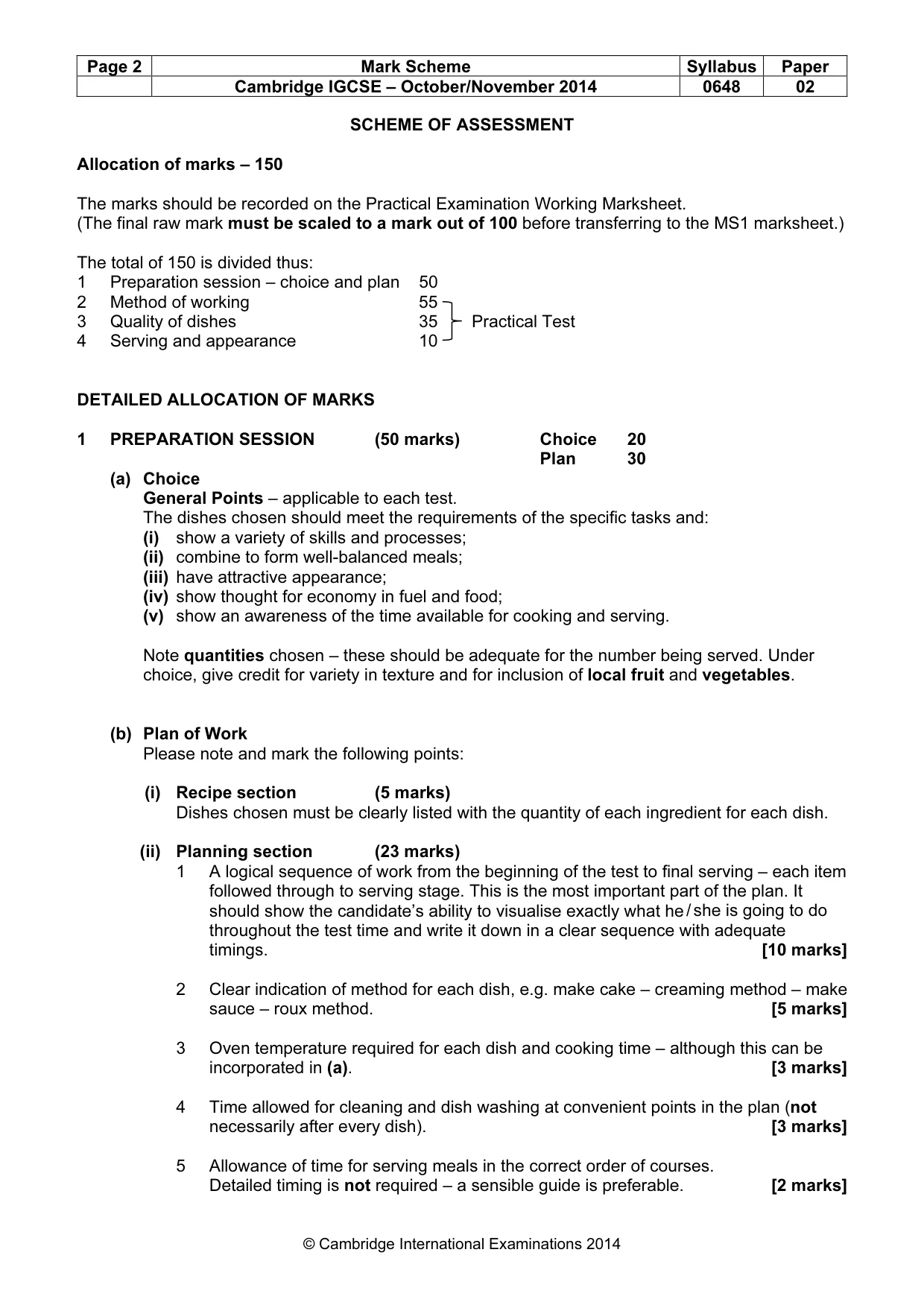
Page 2 Mark Scheme Syllabus Paper Cambridge IGCSE – October/November 2014 0648 02 © Cambridge International Examinations 2014 SCHEME OF ASSESSMENT Allocation of marks – 150 The marks should be recorded on the Practical Examination Working Marksheet. (The final raw mark must be scaled to a mark out of 100 before transferring to the MS1 marksheet.) The total of 150 is divided thus: 1 Preparation session – choice and plan 50 2 Method of working 55 3 Quality of dishes 35 Practical Test 4 Serving and appearance 10 DETAILED ALLOCATION OF MARKS 1 PREPARATION SESSION (50 marks) Choice 20 Plan 30 (a) Choice General Points – applicable to each test. The dishes chosen should meet the requirements of the specific tasks and: (i) show a variety of skills and processes; (ii) combine to form well-balanced meals; (iii) have attractive appearance; (iv) show thought for economy in fuel and food; (v) show an awareness of the time available for cooking and serving. Note quantities chosen – these should be adequate for the number being served. Under choice, give credit for variety in texture and for inclusion of local fruit and vegetables. (b) Plan of Work Please note and mark the following points: (i) Recipe section (5 marks) Dishes chosen must be clearly listed with the quantity of each ingredient for each dish. (ii) Planning section (23 marks) 1 A logical sequence of work from the beginning of the test to final serving – each item followed through to serving stage. This is the most important part of the plan. It should show the candidate’s ability to visualise exactly what he / she is going to do throughout the test time and write it down in a clear sequence with adequate timings. [10 marks] 2 Clear indication of method for each dish, e.g. make cake – creaming method – make sauce – roux method. [5 marks] 3 Oven temperature required for each dish and cooking time – although this can be incorporated in (a). [3 marks] 4 Time allowed for cleaning and dish washing at convenient points in the plan (not necessarily after every dish). [3 marks] 5 Allowance of time for serving meals in the correct order of courses. Detailed timing is not required – a sensible guide is preferable. [2 marks]
Mark scheme, page 3
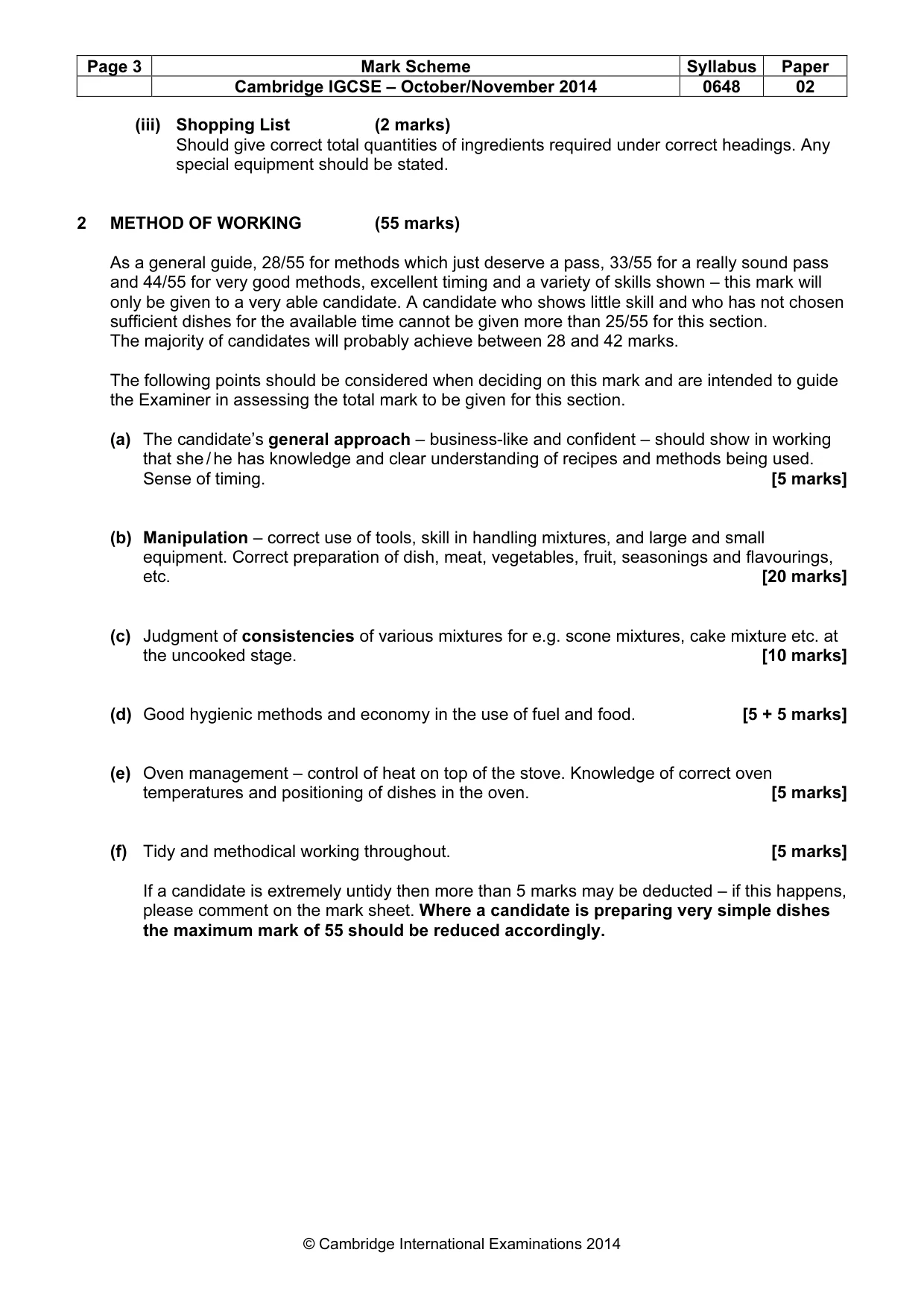
Page 3 Mark Scheme Syllabus Paper Cambridge IGCSE – October/November 2014 0648 02 © Cambridge International Examinations 2014 (iii) Shopping List (2 marks) Should give correct total quantities of ingredients required under correct headings. Any special equipment should be stated. 2 METHOD OF WORKING (55 marks) As a general guide, 28/55 for methods which just deserve a pass, 33/55 for a really sound pass and 44/55 for very good methods, excellent timing and a variety of skills shown – this mark will only be given to a very able candidate. A candidate who shows little skill and who has not chosen sufficient dishes for the available time cannot be given more than 25/55 for this section. The majority of candidates will probably achieve between 28 and 42 marks. The following points should be considered when deciding on this mark and are intended to guide the Examiner in assessing the total mark to be given for this section. (a) The candidate’s general approach – business-like and confident – should show in working that she / he has knowledge and clear understanding of recipes and methods being used. Sense of timing. [5 marks] (b) Manipulation – correct use of tools, skill in handling mixtures, and large and small equipment. Correct preparation of dish, meat, vegetables, fruit, seasonings and flavourings, etc. [20 marks] (c) Judgment of consistencies of various mixtures for e.g. scone mixtures, cake mixture etc. at the uncooked stage. [10 marks] (d) Good hygienic methods and economy in the use of fuel and food. [5 + 5 marks] (e) Oven management – control of heat on top of the stove. Knowledge of correct oven temperatures and positioning of dishes in the oven. [5 marks] (f) Tidy and methodical working throughout. [5 marks] If a candidate is extremely untidy then more than 5 marks may be deducted – if this happens, please comment on the mark sheet. Where a candidate is preparing very simple dishes the maximum mark of 55 should be reduced accordingly.
Mark scheme, page 4
Page 4 Mark Scheme Syllabus Paper Cambridge IGCSE – October/November 2014 0648 02 © Cambridge International Examinations 2014 3 QUALITY OF DISHES (35 marks) All dishes must be tasted. Each dish must be marked according to flavour, texture and edibility. Please note that the maximum marks must be reduced for simple dishes involving little skill. Dishes added after the Planning Session has been completed will not receive a mark. In assessing the quality of finished dishes, comments should be written on the assessment sheet about the flavour, texture and edibility of each dish. Serving and appearance are assessed with a separate mark. The term ‘fresh vegetables’ includes the preparation and cooking of root and / or green vegetables. Salads, which should include a variety of vegetables and fruits, may merit a maximum of 6, dressing up to 4 according to type and skill involved. NB Tinned, frozen and freeze-dried vegetables and instant coffee – maximum 1 mark each. Commercially prepared fruit juice or squash = 0. These marks apply to the result only. If serving and presentation of vegetables is good then give credit in last section, but for tinned juice, etc. no mark. 4 SERVING AND APPEARANCE (10 (usually 5 + 5) marks) Serving – note the following points: sequence of serving meal, correct temperature of food, correct serving dishes. Appearance – attractive presentation, tasteful garnishing and decoration. Cleanliness of dishes and tablecloth. Correct use of doilies and dish papers. Suitable flower arrangement.
Mark scheme, page 5
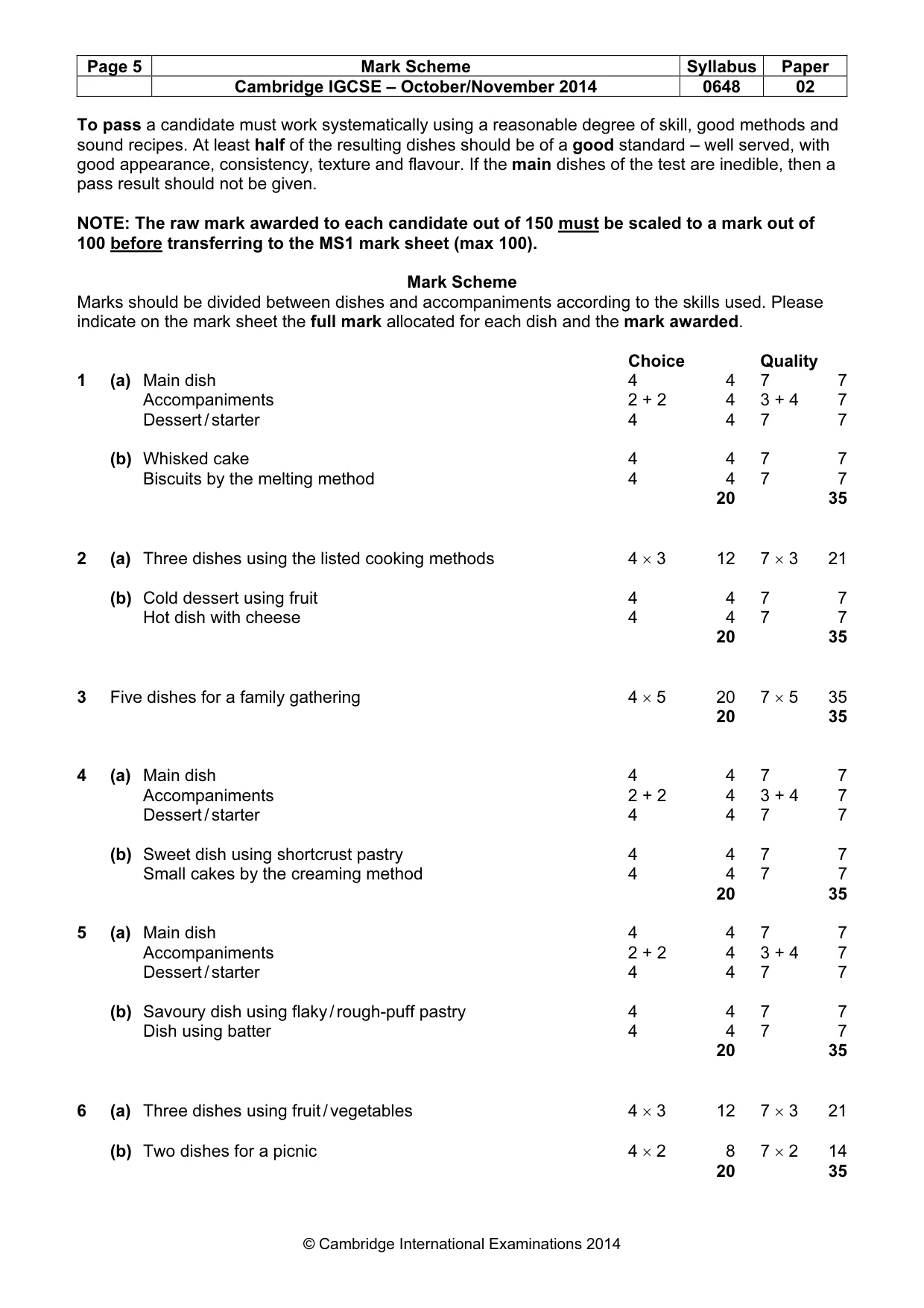
Page 5 Mark Scheme Syllabus Paper Cambridge IGCSE – October/November 2014 0648 02 © Cambridge International Examinations 2014 To pass a candidate must work systematically using a reasonable degree of skill, good methods and sound recipes. At least half of the resulting dishes should be of a good standard – well served, with good appearance, consistency, texture and flavour. If the main dishes of the test are inedible, then a pass result should not be given. NOTE: The raw mark awarded to each candidate out of 150 must be scaled to a mark out of 100 before transferring to the MS1 mark sheet (max 100). Mark Scheme Marks should be divided between dishes and accompaniments according to the skills used. Please indicate on the mark sheet the full mark allocated for each dish and the mark awarded. Choice Quality 1 (a) Main dish 4 4 7 7 Accompaniments 2 + 2 4 3 + 4 7 Dessert / starter 4 4 7 7 (b) Whisked cake 4 4 7 7 Biscuits by the melting method 4 4 7 7 20 35 2 (a) Three dishes using the listed cooking methods 4 × 3 12 7 × 3 21 (b) Cold dessert using fruit 4 4 7 7 Hot dish with cheese 4 4 7 7 20 35 3 Five dishes for a family gathering 4 × 5 20 7 × 5 35 20 35 4 (a) Main dish 4 4 7 7 Accompaniments 2 + 2 4 3 + 4 7 Dessert / starter 4 4 7 7 (b) Sweet dish using shortcrust pastry 4 4 7 7 Small cakes by the creaming method 4 4 7 7 20 35 5 (a) Main dish 4 4 7 7 Accompaniments 2 + 2 4 3 + 4 7 Dessert / starter 4 4 7 7 (b) Savoury dish using flaky / rough-puff pastry 4 4 7 7 Dish using batter 4 4 7 7 20 35 6 (a) Three dishes using fruit / vegetables 4 × 3 12 7 × 3 21 (b) Two dishes for a picnic 4 × 2 8 7 × 2 14 20 35
Mark scheme, page 6
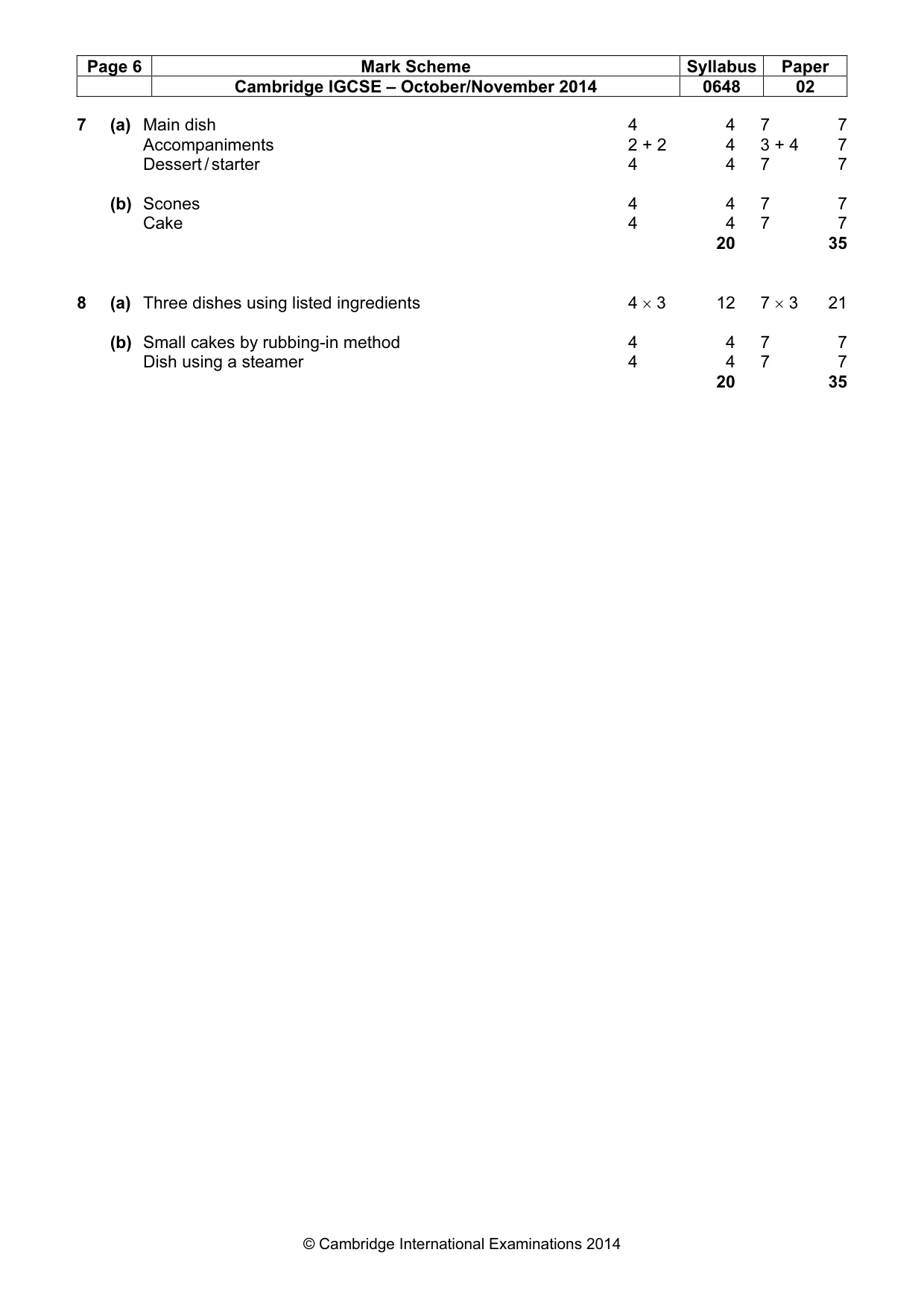
Page 6 Mark Scheme Syllabus Paper Cambridge IGCSE – October/November 2014 0648 02 © Cambridge International Examinations 2014 7 (a) Main dish 4 4 7 7 Accompaniments 2 + 2 4 3 + 4 7 Dessert / starter 4 4 7 7 (b) Scones 4 4 7 7 Cake 4 4 7 7 20 35 8 (a) Three dishes using listed ingredients 4 × 3 12 7 × 3 21 (b) Small cakes by rubbing-in method 4 4 7 7 Dish using a steamer 4 4 7 7 20 35