Cambridge IGCSE English Second Language (Speaking Endorsement) (9-1) 0993 — 2021 May/June Paper 1 · Variant 2
0993/12/M/J/21
The question paper and its mark scheme, free to read here and free to download. This is Cambridge’s own paper, exactly as it was sat.
Question paper16 pages



Mark scheme9 pages
Answers below. Sit the paper first if you are practising.
Paper as text
Question paper, page 1
This document has 16 pages. Any blank pages are indicated. Cambridge IGCSE™(9–1) DC (MB) 213013/1 © UCLES 2021 [Turn over * 9 5 4 5 5 7 6 1 8 2 * ENGLISH AS A SECOND LANGUAGE 0993/12 Paper 1 Reading and Writing (Core) May/June 2021 1 hour 30 minutes You must answer on the question paper. No additional materials are needed. INSTRUCTIONS ● Answer all questions. ● Use a black or dark blue pen. ● Write your name, centre number and candidate number in the boxes at the top of the page. ● Write your answer to each question in the space provided. ● Do not use an erasable pen or correction fluid. ● Do not write on any bar codes. ● Dictionaries are not allowed. INFORMATION ● The total mark for this paper is 60. ● The number of marks for each question or part question is shown in brackets [ ].
Question paper, page 2
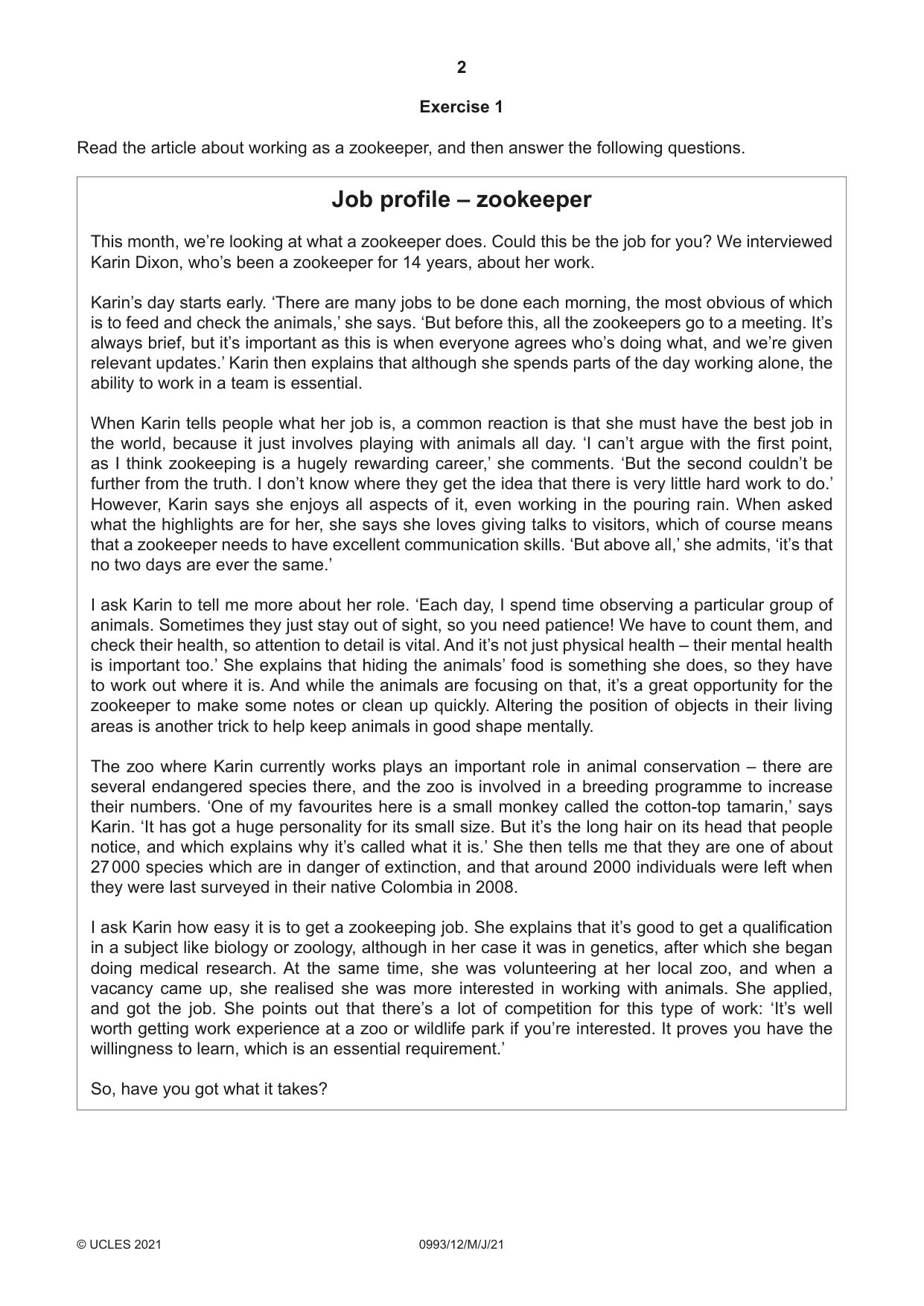
2 0993/12/M/J/21 © UCLES 2021 Exercise 1 Read the article about working as a zookeeper, and then answer the following questions. Job profile – zookeeper This month, we’re looking at what a zookeeper does. Could this be the job for you? We interviewed Karin Dixon, who’s been a zookeeper for 14 years, about her work. Karin’s day starts early. ‘There are many jobs to be done each morning, the most obvious of which is to feed and check the animals,’ she says. ‘But before this, all the zookeepers go to a meeting. It’s always brief, but it’s important as this is when everyone agrees who’s doing what, and we’re given relevant updates.’ Karin then explains that although she spends parts of the day working alone, the ability to work in a team is essential. When Karin tells people what her job is, a common reaction is that she must have the best job in the world, because it just involves playing with animals all day. ‘I can’t argue with the first point, as I think zookeeping is a hugely rewarding career,’ she comments. ‘But the second couldn’t be further from the truth. I don’t know where they get the idea that there is very little hard work to do.’ However, Karin says she enjoys all aspects of it, even working in the pouring rain. When asked what the highlights are for her, she says she loves giving talks to visitors, which of course means that a zookeeper needs to have excellent communication skills. ‘But above all,’ she admits, ‘it’s that no two days are ever the same.’ I ask Karin to tell me more about her role. ‘Each day, I spend time observing a particular group of animals. Sometimes they just stay out of sight, so you need patience! We have to count them, and check their health, so attention to detail is vital. And it’s not just physical health – their mental health is important too.’ She explains that hiding the animals’ food is something she does, so they have to work out where it is. And while the animals are focusing on that, it’s a great opportunity for the zookeeper to make some notes or clean up quickly. Altering the position of objects in their living areas is another trick to help keep animals in good shape mentally. The zoo where Karin currently works plays an important role in animal conservation – there are several endangered species there, and the zoo is involved in a breeding programme to increase their numbers. ‘One of my favourites here is a small monkey called the cotton-top tamarin,’ says Karin. ‘It has got a huge personality for its small size. But it’s the long hair on its head that people notice, and which explains why it’s called what it is.’ She then tells me that they are one of about 27 000 species which are in danger of extinction, and that around 2000 individuals were left when they were last surveyed in their native Colombia in 2008. I ask Karin how easy it is to get a zookeeping job. She explains that it’s good to get a qualification in a subject like biology or zoology, although in her case it was in genetics, after which she began doing medical research. At the same time, she was volunteering at her local zoo, and when a vacancy came up, she realised she was more interested in working with animals. She applied, and got the job. She points out that there’s a lot of competition for this type of work: ‘It’s well worth getting work experience at a zoo or wildlife park if you’re interested. It proves you have the willingness to learn, which is an essential requirement.’ So, have you got what it takes?
Question paper, page 3
3 0993/12/M/J/21 © UCLES 2021 [Turn over 1 What is the first thing that Karin has to do at the zoo each day? … [1] 2 What do many people believe about zookeeping which is actually not true? Give two details. … … [2] 3 What does Karin like most about her job? … [1] 4 How do zookeepers try to keep animals’ minds active? Give two details. … … [2] 5 What gives the cotton-top tamarin its name? … [1] 6 How many cotton-top tamarins are estimated to live in the wild? … [1] 7 Which subject did Karin study at university? … [1] [Total: 9]
Question paper, page 4
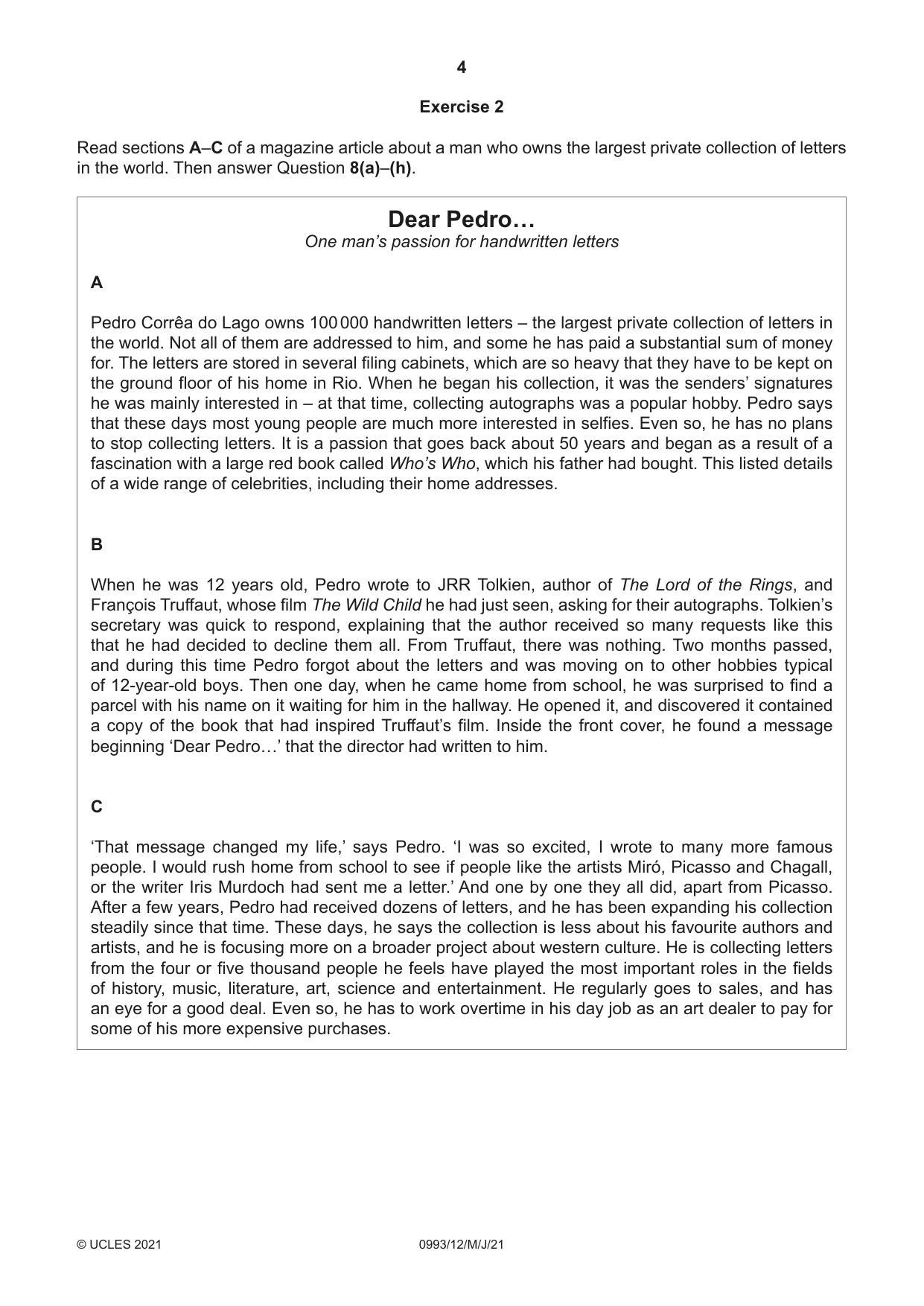
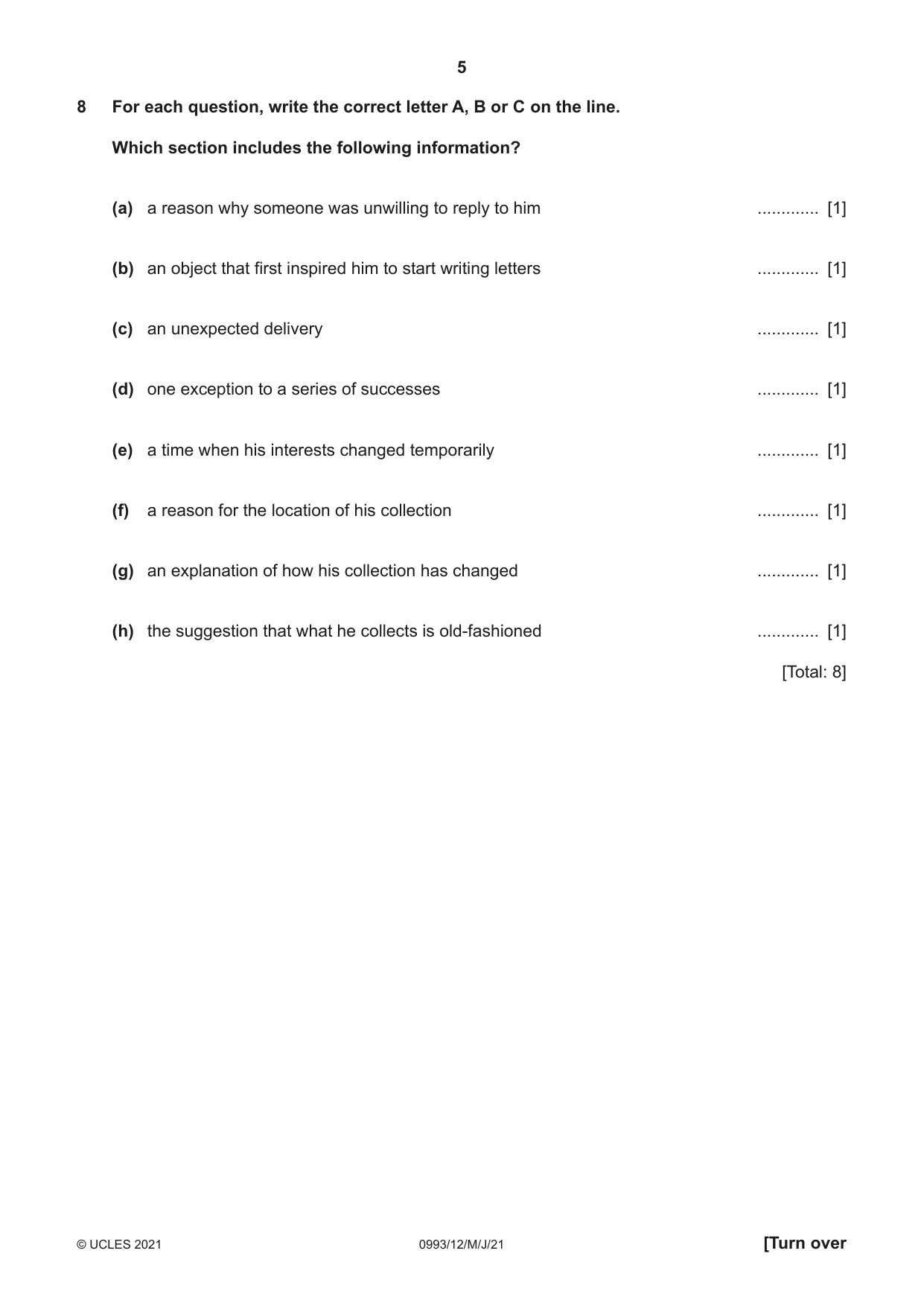
4 0993/12/M/J/21 © UCLES 2021 Exercise 2 Read sections A–C of a magazine article about a man who owns the largest private collection of letters in the world. Then answer Question 8(a)–(h). Dear Pedro… One man’s passion for handwritten letters A Pedro Corrêa do Lago owns 100 000 handwritten letters – the largest private collection of letters in the world. Not all of them are addressed to him, and some he has paid a substantial sum of money for. The letters are stored in several filing cabinets, which are so heavy that they have to be kept on the ground floor of his home in Rio. When he began his collection, it was the senders’ signatures he was mainly interested in – at that time, collecting autographs was a popular hobby. Pedro says that these days most young people are much more interested in selfies. Even so, he has no plans to stop collecting letters. It is a passion that goes back about 50 years and began as a result of a fascination with a large red book called Who’s Who, which his father had bought. This listed details of a wide range of celebrities, including their home addresses. B When he was 12 years old, Pedro wrote to JRR Tolkien, author of The Lord of the Rings, and François Truffaut, whose film The Wild Child he had just seen, asking for their autographs. Tolkien’s secretary was quick to respond, explaining that the author received so many requests like this that he had decided to decline them all. From Truffaut, there was nothing. Two months passed, and during this time Pedro forgot about the letters and was moving on to other hobbies typical of 12-year-old boys. Then one day, when he came home from school, he was surprised to find a parcel with his name on it waiting for him in the hallway. He opened it, and discovered it contained a copy of the book that had inspired Truffaut’s film. Inside the front cover, he found a message beginning ‘Dear Pedro…’ that the director had written to him. C ‘That message changed my life,’ says Pedro. ‘I was so excited, I wrote to many more famous people. I would rush home from school to see if people like the artists Miró, Picasso and Chagall, or the writer Iris Murdoch had sent me a letter.’ And one by one they all did, apart from Picasso. After a few years, Pedro had received dozens of letters, and he has been expanding his collection steadily since that time. These days, he says the collection is less about his favourite authors and artists, and he is focusing more on a broader project about western culture. He is collecting letters from the four or five thousand people he feels have played the most important roles in the fields of history, music, literature, art, science and entertainment. He regularly goes to sales, and has an eye for a good deal. Even so, he has to work overtime in his day job as an art dealer to pay for some of his more expensive purchases.
Question paper, page 5
5 0993/12/M/J/21 © UCLES 2021 [Turn over 8 For each question, write the correct letter A, B or C on the line. Which section includes the following information? (a) a reason why someone was unwilling to reply to him … [1] (b) an object that first inspired him to start writing letters … [1] (c) an unexpected delivery … [1] (d) one exception to a series of successes … [1] (e) a time when his interests changed temporarily … [1] (f) a reason for the location of his collection … [1] (g) an explanation of how his collection has changed … [1] (h) the suggestion that what he collects is old-fashioned … [1] [Total: 8]
Question paper, page 6
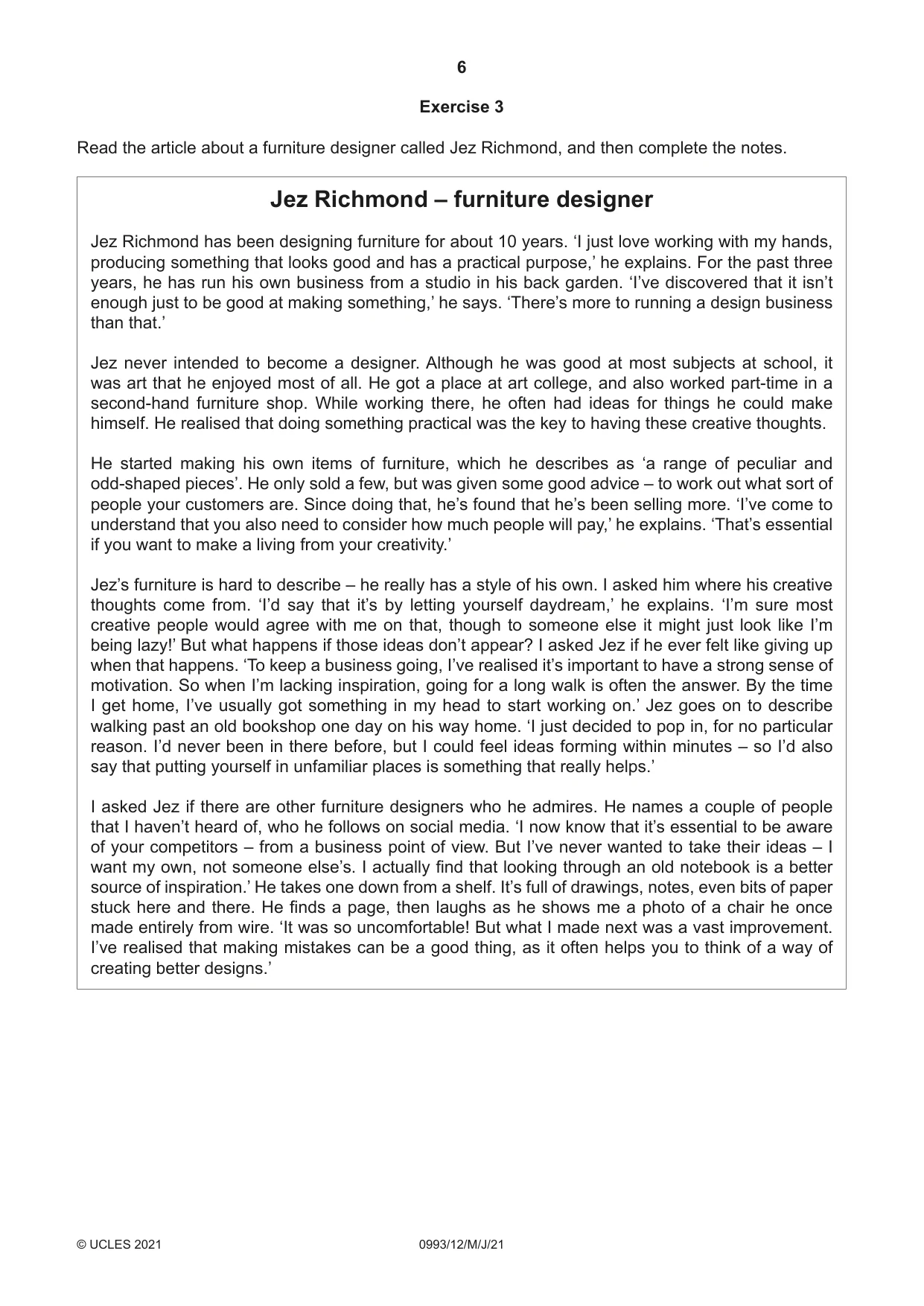
6 0993/12/M/J/21 © UCLES 2021 Exercise 3 Read the article about a furniture designer called Jez Richmond, and then complete the notes. Jez Richmond – furniture designer Jez Richmond has been designing furniture for about 10 years. ‘I just love working with my hands, producing something that looks good and has a practical purpose,’ he explains. For the past three years, he has run his own business from a studio in his back garden. ‘I’ve discovered that it isn’t enough just to be good at making something,’ he says. ‘There’s more to running a design business than that.’ Jez never intended to become a designer. Although he was good at most subjects at school, it was art that he enjoyed most of all. He got a place at art college, and also worked part-time in a second-hand furniture shop. While working there, he often had ideas for things he could make himself. He realised that doing something practical was the key to having these creative thoughts. He started making his own items of furniture, which he describes as ‘a range of peculiar and odd-shaped pieces’. He only sold a few, but was given some good advice – to work out what sort of people your customers are. Since doing that, he’s found that he’s been selling more. ‘I’ve come to understand that you also need to consider how much people will pay,’ he explains. ‘That’s essential if you want to make a living from your creativity.’ Jez’s furniture is hard to describe – he really has a style of his own. I asked him where his creative thoughts come from. ‘I’d say that it’s by letting yourself daydream,’ he explains. ‘I’m sure most creative people would agree with me on that, though to someone else it might just look like I’m being lazy!’ But what happens if those ideas don’t appear? I asked Jez if he ever felt like giving up when that happens. ‘To keep a business going, I’ve realised it’s important to have a strong sense of motivation. So when I’m lacking inspiration, going for a long walk is often the answer. By the time I get home, I’ve usually got something in my head to start working on.’ Jez goes on to describe walking past an old bookshop one day on his way home. ‘I just decided to pop in, for no particular reason. I’d never been in there before, but I could feel ideas forming within minutes – so I’d also say that putting yourself in unfamiliar places is something that really helps.’ I asked Jez if there are other furniture designers who he admires. He names a couple of people that I haven’t heard of, who he follows on social media. ‘I now know that it’s essential to be aware of your competitors – from a business point of view. But I’ve never wanted to take their ideas – I want my own, not someone else’s. I actually find that looking through an old notebook is a better source of inspiration.’ He takes one down from a shelf. It’s full of drawings, notes, even bits of paper stuck here and there. He finds a page, then laughs as he shows me a photo of a chair he once made entirely from wire. ‘It was so uncomfortable! But what I made next was a vast improvement. I’ve realised that making mistakes can be a good thing, as it often helps you to think of a way of creating better designs.’
Question paper, page 7
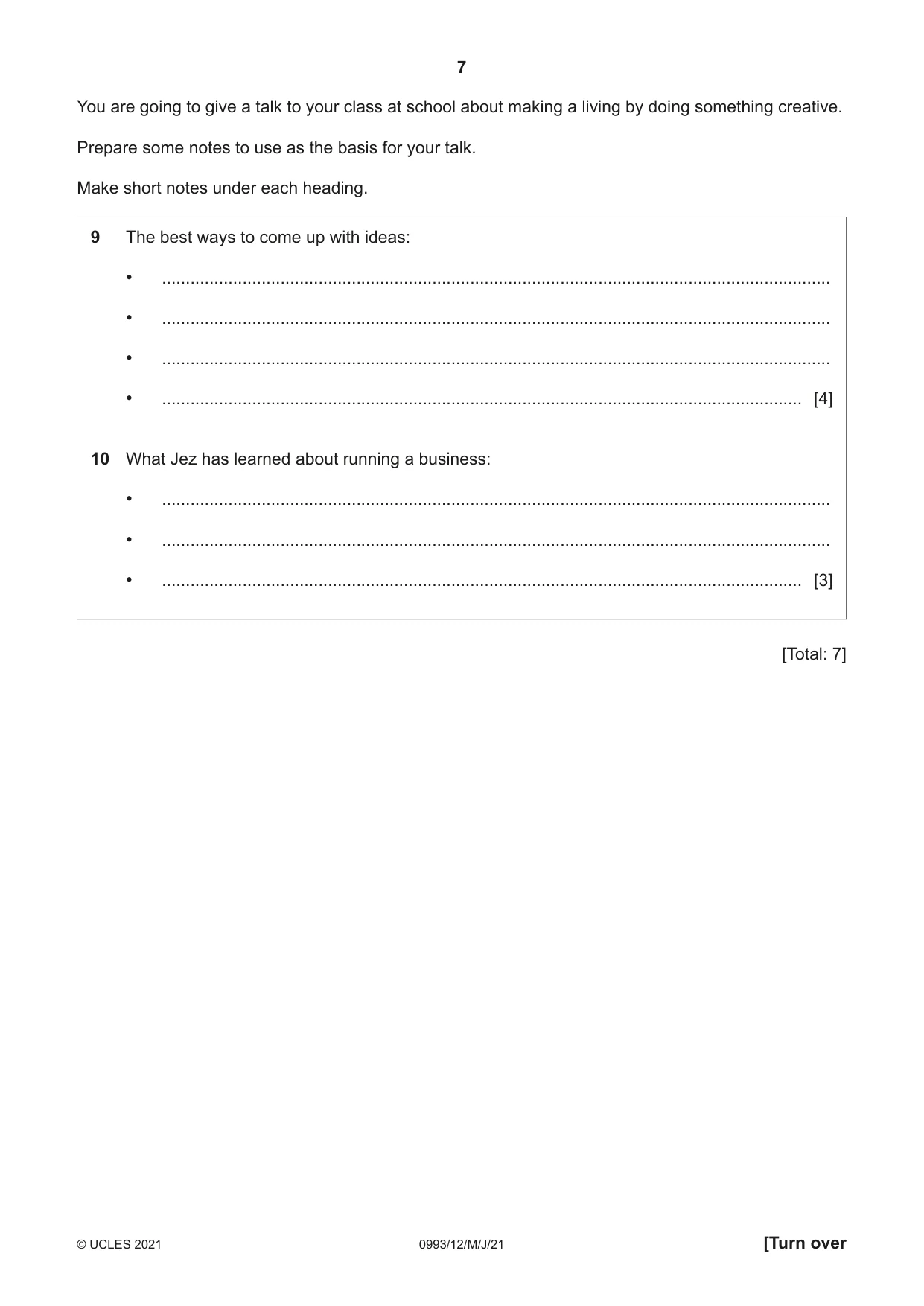
7 0993/12/M/J/21 © UCLES 2021 [Turn over You are going to give a talk to your class at school about making a living by doing something creative. Prepare some notes to use as the basis for your talk. Make short notes under each heading. 9 The best ways to come up with ideas: • … • … • … • … [4] 10 What Jez has learned about running a business: • … • … • … [3] [Total: 7]
Question paper, page 8
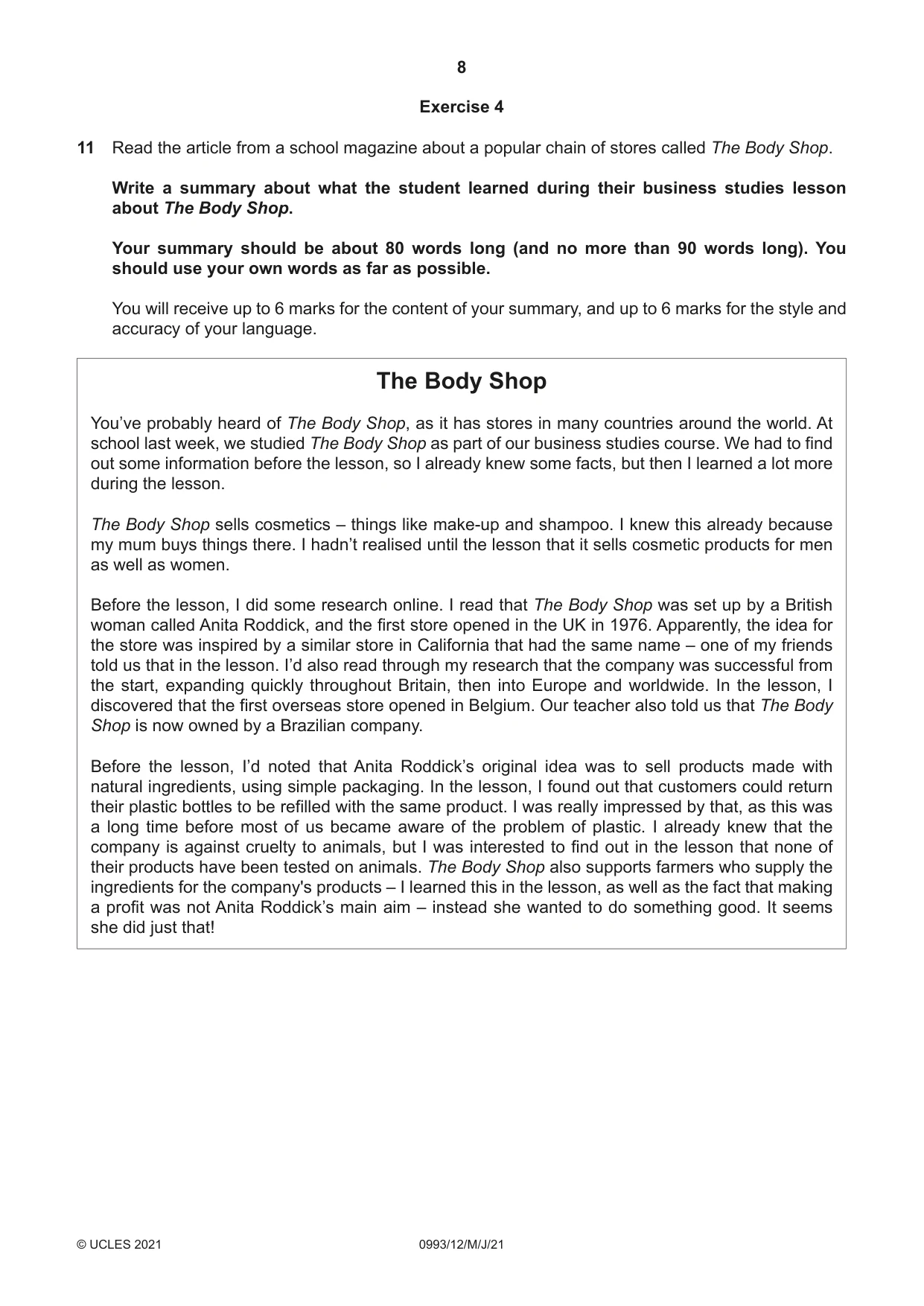
8 0993/12/M/J/21 © UCLES 2021 Exercise 4 11 Read the article from a school magazine about a popular chain of stores called The Body Shop. Write a summary about what the student learned during their business studies lesson about The Body Shop. Your summary should be about 80 words long (and no more than 90 words long). You should use your own words as far as possible. You will receive up to 6 marks for the content of your summary, and up to 6 marks for the style and accuracy of your language. The Body Shop You’ve probably heard of The Body Shop, as it has stores in many countries around the world. At school last week, we studied The Body Shop as part of our business studies course. We had to find out some information before the lesson, so I already knew some facts, but then I learned a lot more during the lesson. The Body Shop sells cosmetics – things like make-up and shampoo. I knew this already because my mum buys things there. I hadn’t realised until the lesson that it sells cosmetic products for men as well as women. Before the lesson, I did some research online. I read that The Body Shop was set up by a British woman called Anita Roddick, and the first store opened in the UK in 1976. Apparently, the idea for the store was inspired by a similar store in California that had the same name – one of my friends told us that in the lesson. I’d also read through my research that the company was successful from the start, expanding quickly throughout Britain, then into Europe and worldwide. In the lesson, I discovered that the first overseas store opened in Belgium. Our teacher also told us that The Body Shop is now owned by a Brazilian company. Before the lesson, I’d noted that Anita Roddick’s original idea was to sell products made with natural ingredients, using simple packaging. In the lesson, I found out that customers could return their plastic bottles to be refilled with the same product. I was really impressed by that, as this was a long time before most of us became aware of the problem of plastic. I already knew that the company is against cruelty to animals, but I was interested to find out in the lesson that none of their products have been tested on animals. The Body Shop also supports farmers who supply the ingredients for the company's products – I learned this in the lesson, as well as the fact that making a profit was not Anita Roddick’s main aim – instead she wanted to do something good. It seems she did just that!
Question paper, page 9
9 0993/12/M/J/21 © UCLES 2021 [Turn over … … … … … … … … … … … … … … [Total: 12]
Question paper, page 10
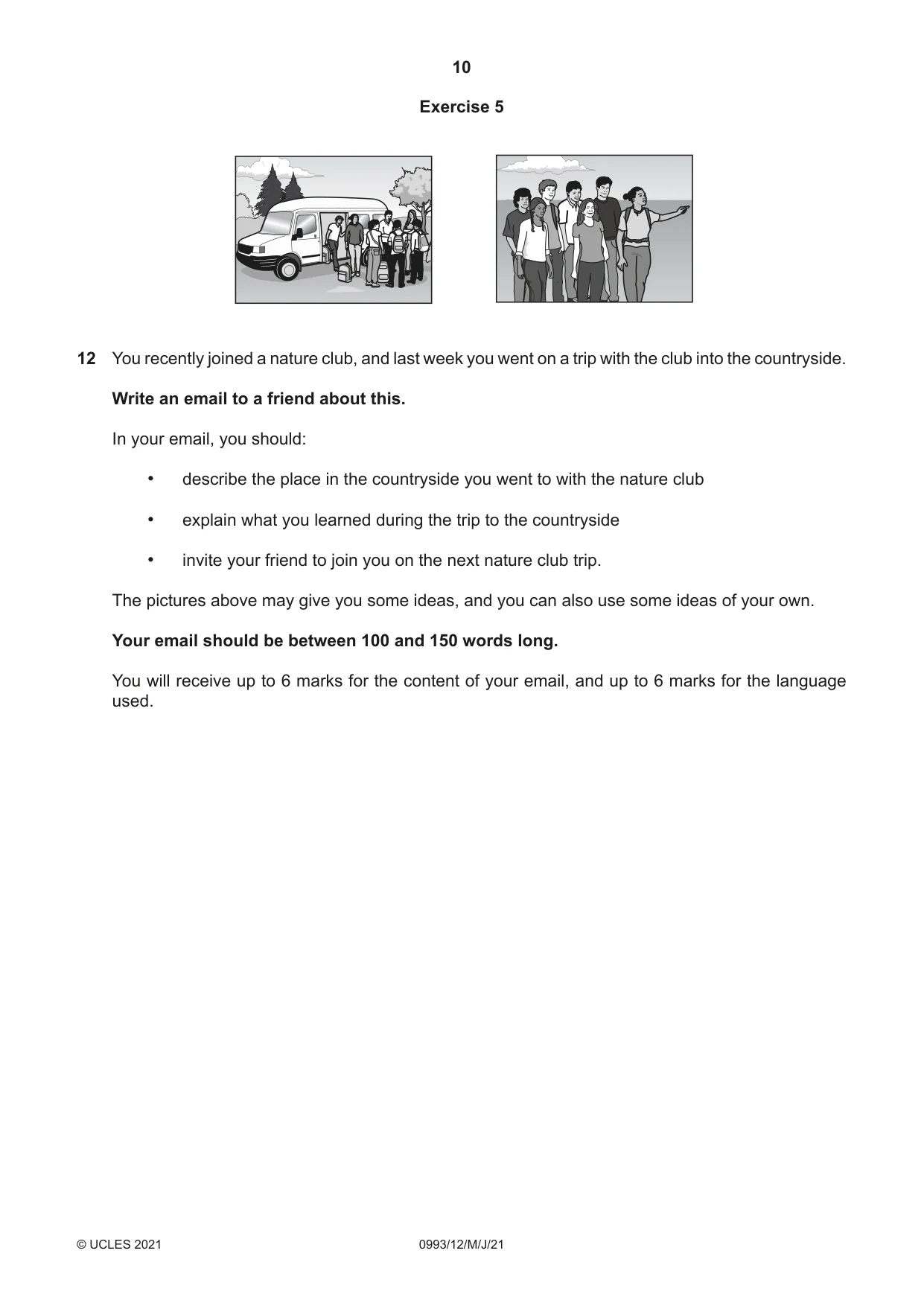
10 0993/12/ M / J /21 © UCLES 2021 Exercise 5 12 You recently joined a nature club, and last week you went on a trip with the club into the countryside. Write an email to a friend about this. In your email, you should: • describe the place in the countryside you went to with the nature club • explain what you learned during the trip to the countryside • invite your friend to join you on the next nature club trip. The pictures above may give you some ideas, and you can also use some ideas of your own. Your email should be between 100 and 150 words long. You will receive up to 6 marks for the content of your email, and up to 6 marks for the language used.
Question paper, page 11
11 0993/12/M/J/21 © UCLES 2021 [Turn over … … … … … … … … … … … … … … … … … … … … … … … … … … … [Total: 12]
Question paper, page 12
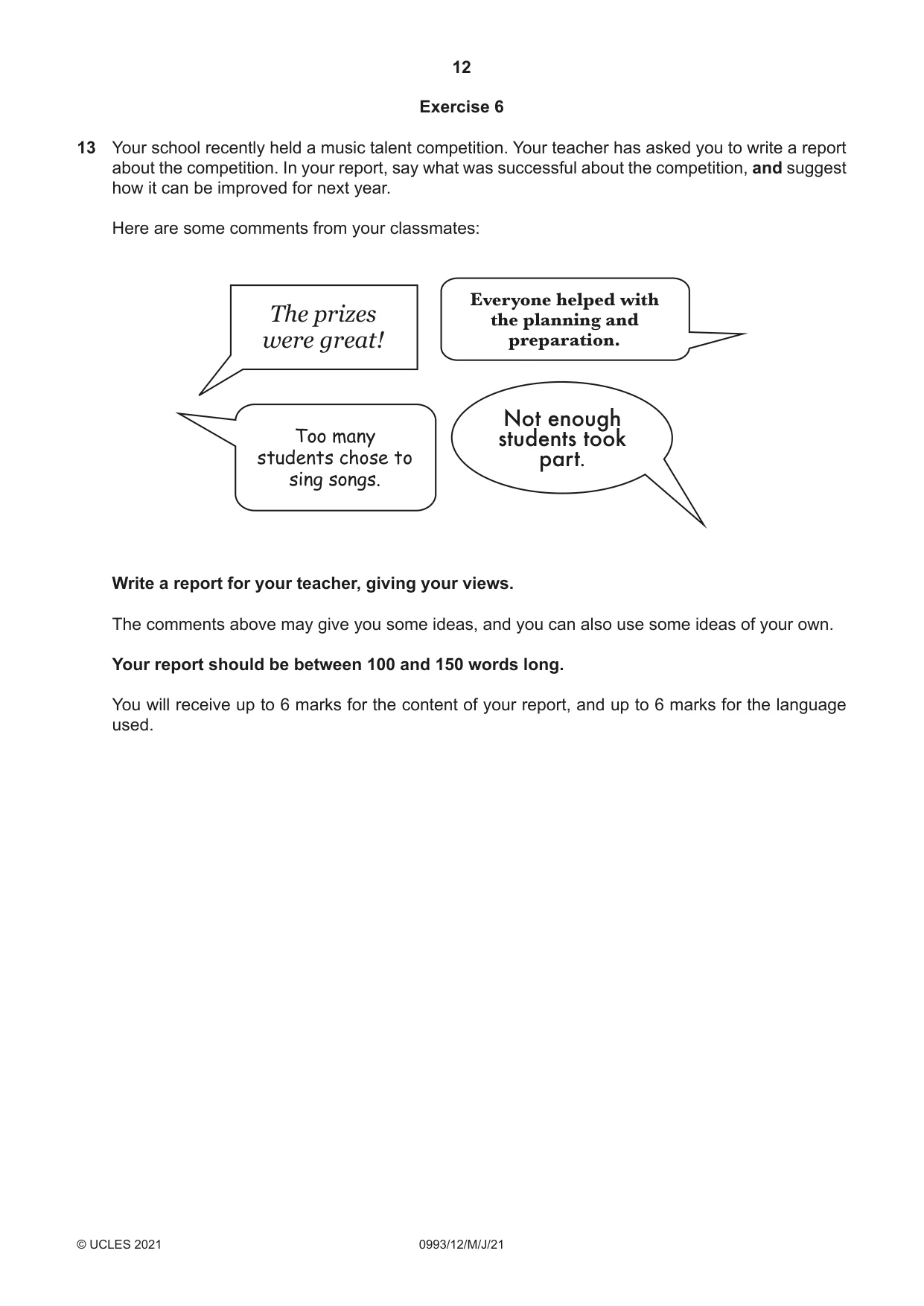
12 0993/12/M/J/21 © UCLES 2021 Exercise 6 13 Your school recently held a music talent competition. Your teacher has asked you to write a report about the competition. In your report, say what was successful about the competition, and suggest how it can be improved for next year. Here are some comments from your classmates: Everyone helped with the planning and preparation. Too many students chose to sing songs. Not enough students took part. The prizes were great! Write a report for your teacher, giving your views. The comments above may give you some ideas, and you can also use some ideas of your own. Your report should be between 100 and 150 words long. You will receive up to 6 marks for the content of your report, and up to 6 marks for the language used.
Question paper, page 13
13 0993/12/M/J/21 © UCLES 2021 … … … … … … … … … … … … … … … … … … … … … … … … … … … [Total: 12]
Question paper, page 14
14 0993/12/M/J/21 © UCLES 2021 BLANK PAGE
Question paper, page 15
15 0993/12/M/J/21 © UCLES 2021 BLANK PAGE
Question paper, page 16
16 0993/12/M/J/21 © UCLES 2021 Permission to reproduce items where third-party owned material protected by copyright is included has been sought and cleared where possible. Every reasonable effort has been made by the publisher (UCLES) to trace copyright holders, but if any items requiring clearance have unwittingly been included, the publisher will be pleased to make amends at the earliest possible opportunity. To avoid the issue of disclosure of answer-related information to candidates, all copyright acknowledgements are reproduced online in the Cambridge Assessment International Education Copyright Acknowledgements Booklet. This is produced for each series of examinations and is freely available to download at www.cambridgeinternational.org after the live examination series. Cambridge Assessment International Education is part of the Cambridge Assessment Group. Cambridge Assessment is the brand name of the University of Cambridge Local Examinations Syndicate (UCLES), which itself is a department of the University of Cambridge. BLANK PAGE
Mark scheme, page 1
This document consists of 9 printed pages. © UCLES 2021 [Turn over Cambridge IGCSE™ (9–1) ENGLISH AS A SECOND LANGUAGE 9–1 0993/12 Paper 1 Reading and Writing (Core) May/June 2021 MARK SCHEME Maximum Mark: 60 Published This mark scheme is published as an aid to teachers and candidates, to indicate the requirements of the examination. It shows the basis on which Examiners were instructed to award marks. It does not indicate the details of the discussions that took place at an Examiners’ meeting before marking began, which would have considered the acceptability of alternative answers. Mark schemes should be read in conjunction with the question paper and the Principal Examiner Report for Teachers. Cambridge International will not enter into discussions about these mark schemes. Cambridge International is publishing the mark schemes for the May/June 2021 series for most Cambridge IGCSE™, Cambridge International A and AS Level components and some Cambridge O Level components.
Mark scheme, page 2
0993/12 Cambridge IGCSE (9–1) – Mark Scheme PUBLISHED May/June 2021 © UCLES 2021 Page 2 of 9 Generic Marking Principles These general marking principles must be applied by all examiners when marking candidate answers. They should be applied alongside the specific content of the mark scheme or generic level descriptors for a question. Each question paper and mark scheme will also comply with these marking principles. GENERIC MARKING PRINCIPLE 1: Marks must be awarded in line with: • the specific content of the mark scheme or the generic level descriptors for the question • the specific skills defined in the mark scheme or in the generic level descriptors for the question • the standard of response required by a candidate as exemplified by the standardisation scripts. GENERIC MARKING PRINCIPLE 2: Marks awarded are always whole marks (not half marks, or other fractions). GENERIC MARKING PRINCIPLE 3: Marks must be awarded positively: • marks are awarded for correct/valid answers, as defined in the mark scheme. However, credit is given for valid answers which go beyond the scope of the syllabus and mark scheme, referring to your Team Leader as appropriate • marks are awarded when candidates clearly demonstrate what they know and can do • marks are not deducted for errors • marks are not deducted for omissions • answers should only be judged on the quality of spelling, punctuation and grammar when these features are specifically assessed by the question as indicated by the mark scheme. The meaning, however, should be unambiguous. GENERIC MARKING PRINCIPLE 4: Rules must be applied consistently, e.g. in situations where candidates have not followed instructions or in the application of generic level descriptors. GENERIC MARKING PRINCIPLE 5: Marks should be awarded using the full range of marks defined in the mark scheme for the question (however; the use of the full mark range may be limited according to the quality of the candidate responses seen). GENERIC MARKING PRINCIPLE 6: Marks awarded are based solely on the requirements as defined in the mark scheme. Marks should not be awarded with grade thresholds or grade descriptors in mind.
Mark scheme, page 3
0993/12 Cambridge IGCSE (9–1) – Mark Scheme PUBLISHED May/June 2021 © UCLES 2021 Page 3 of 9 This component forms part of the Core tier assessment of Cambridge IGCSE English as a Second Language and tests the following Assessment Objectives: AO1: Reading R1 identify and select relevant information R2 understand ideas, opinions and attitudes R3 show understanding of the connections between ideas, opinions and attitudes R4 understand what is implied but not directly stated, e.g. gist, writer’s purpose, intentions and feelings AO2: Writing W1 communicate information/ideas/opinions clearly, accurately and effectively W2 organise ideas into coherent paragraphs using a range of appropriate linking devices W3 use a range of grammatical structures accurately and effectively W4 show control of punctuation and spelling W5 use appropriate register and style/format for the given purpose and audience
Mark scheme, page 4
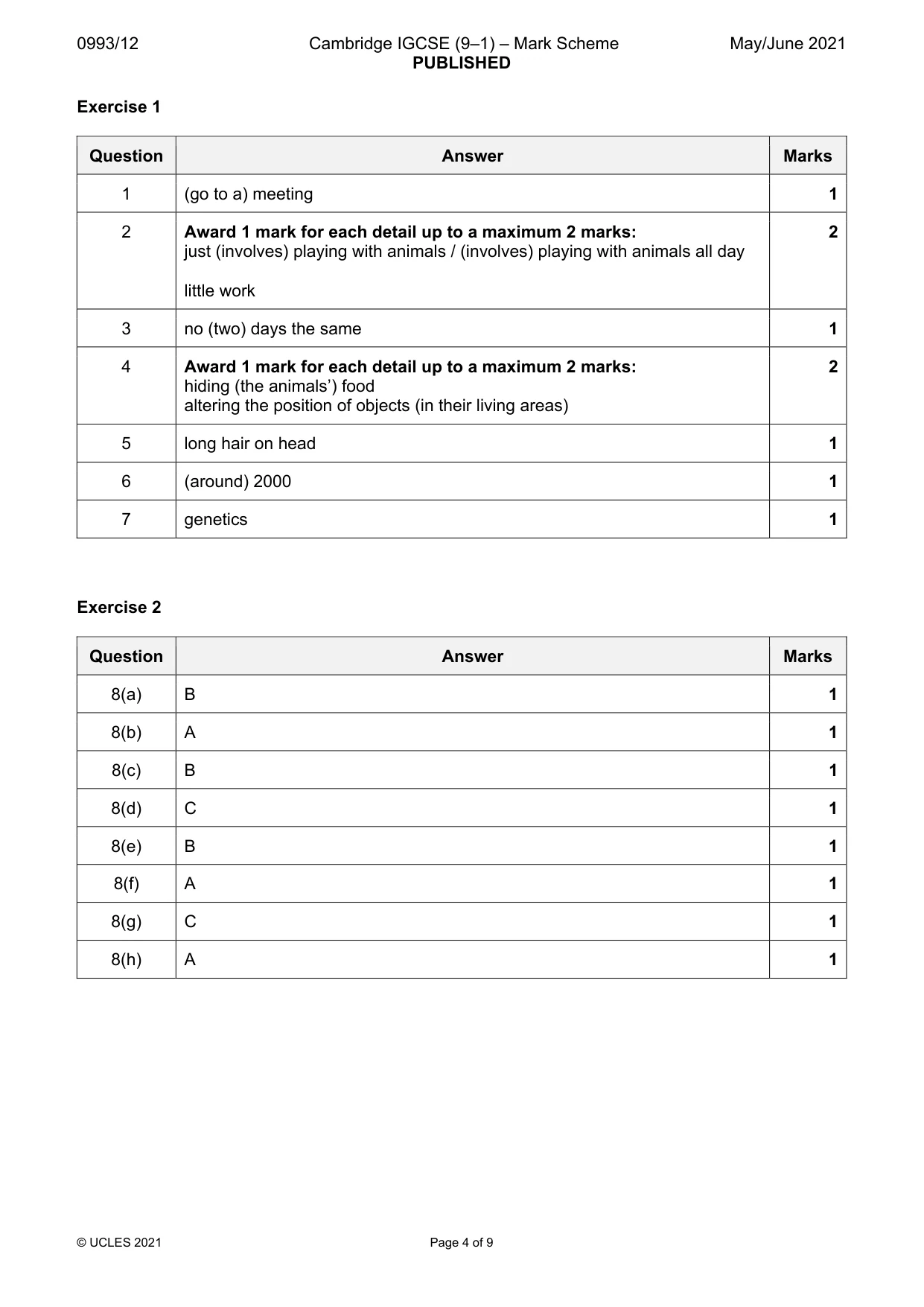
0993/12 Cambridge IGCSE (9–1) – Mark Scheme PUBLISHED May/June 2021 © UCLES 2021 Page 4 of 9 Exercise 1 Question Answer Marks 1 (go to a) meeting 1 2 Award 1 mark for each detail up to a maximum 2 marks: just (involves) playing with animals / (involves) playing with animals all day little work 2 3 no (two) days the same 1 4 Award 1 mark for each detail up to a maximum 2 marks: hiding (the animals’) food altering the position of objects (in their living areas) 2 5 long hair on head 1 6 (around) 2000 1 7 genetics 1 Exercise 2 Question Answer Marks 8(a) B 1 8(b) A 1 8(c) B 1 8(d) C 1 8(e) B 1 8(f) A 1 8(g) C 1 8(h) A 1
Mark scheme, page 5
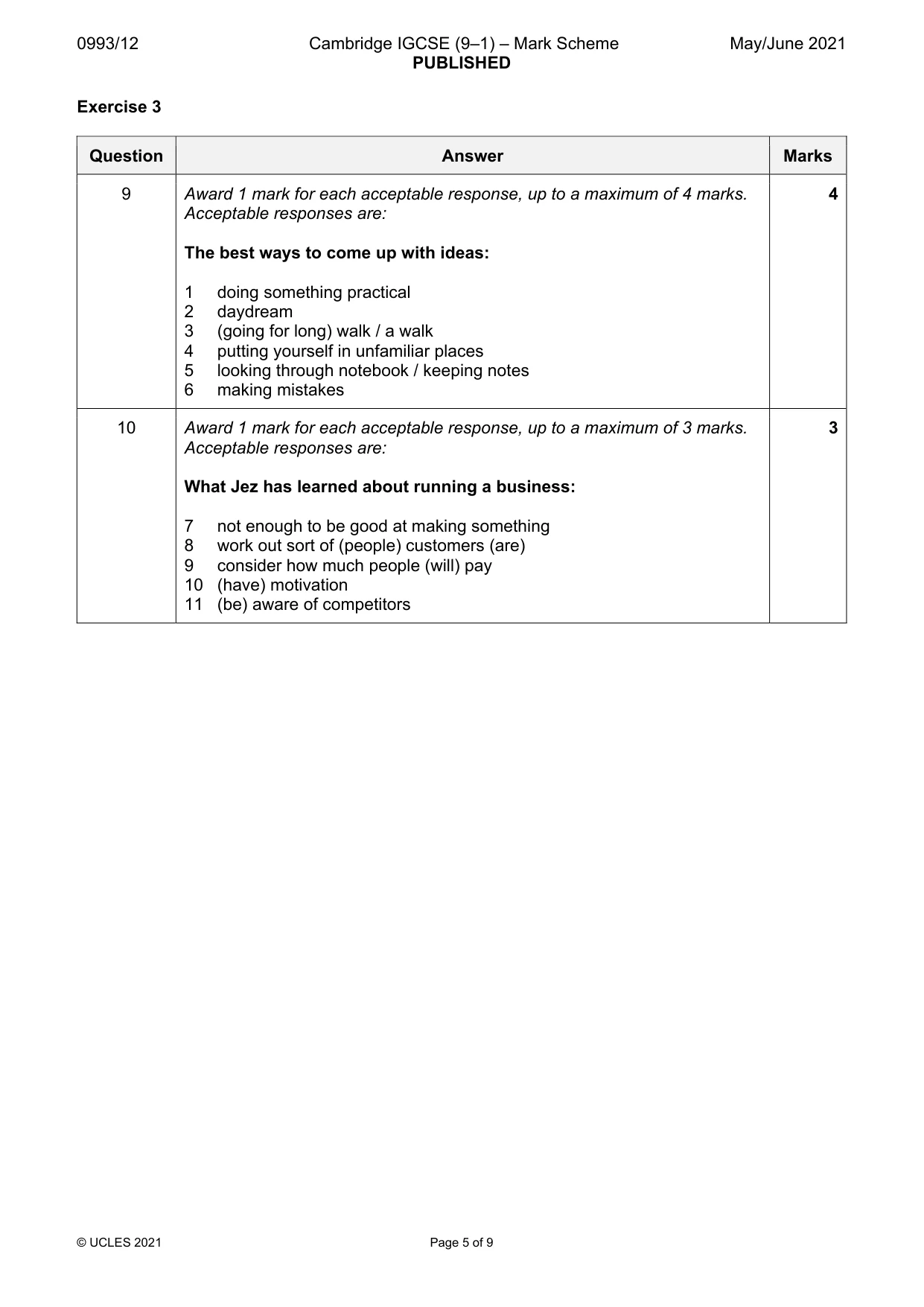
0993/12 Cambridge IGCSE (9–1) – Mark Scheme PUBLISHED May/June 2021 © UCLES 2021 Page 5 of 9 Exercise 3 Question Answer Marks 9 Award 1 mark for each acceptable response, up to a maximum of 4 marks. Acceptable responses are: The best ways to come up with ideas: 1 doing something practical 2 daydream 3 (going for long) walk / a walk 4 putting yourself in unfamiliar places 5 looking through notebook / keeping notes 6 making mistakes 4 10 Award 1 mark for each acceptable response, up to a maximum of 3 marks. Acceptable responses are: What Jez has learned about running a business: 7 not enough to be good at making something 8 work out sort of (people) customers (are) 9 consider how much people (will) pay 10 (have) motivation 11 (be) aware of competitors 3
Mark scheme, page 6
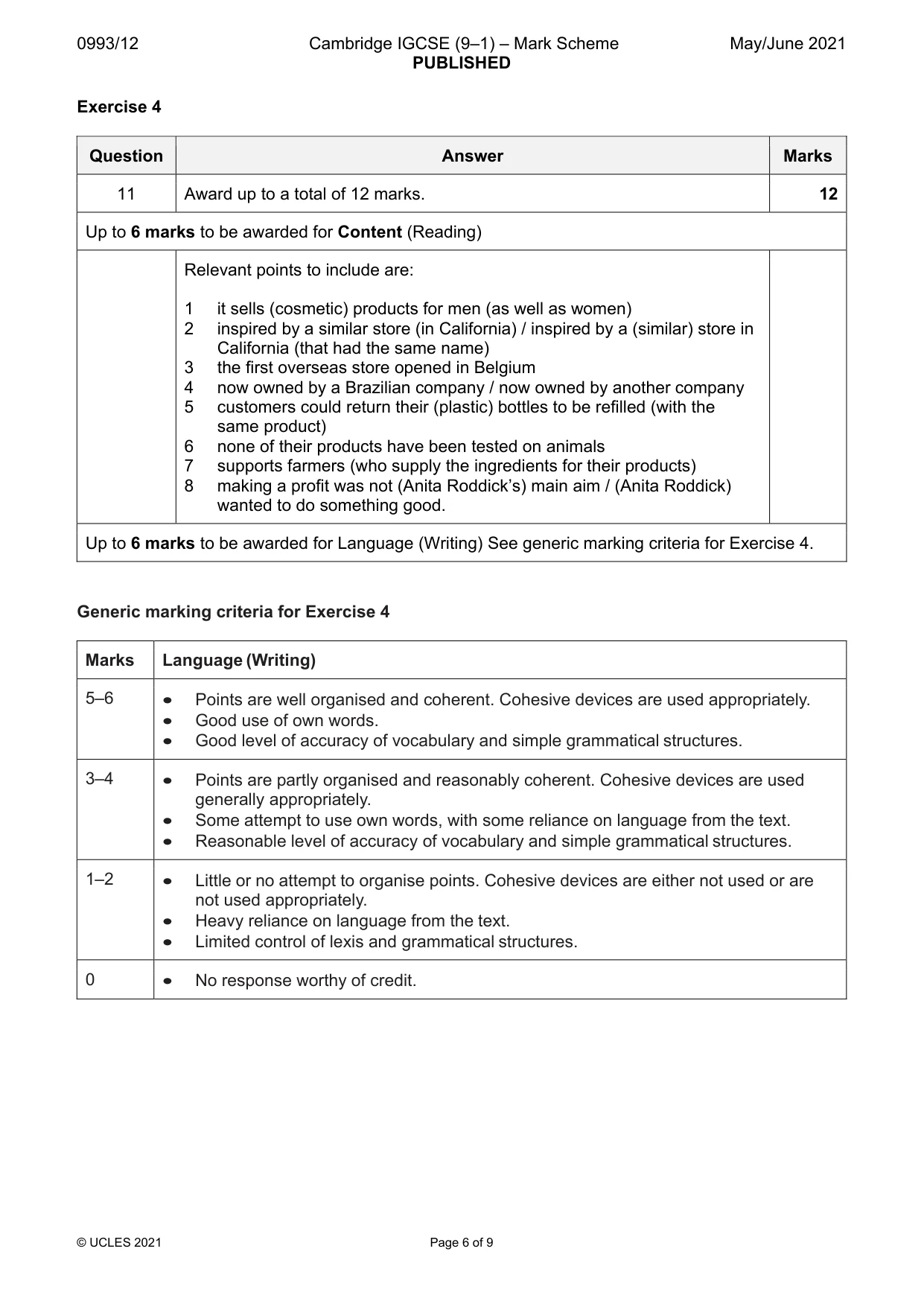
0993/12 Cambridge IGCSE (9–1) – Mark Scheme PUBLISHED May/June 2021 © UCLES 2021 Page 6 of 9 Exercise 4 Question Answer Marks 11 Award up to a total of 12 marks. 12 Up to 6 marks to be awarded for Content (Reading) Relevant points to include are: 1 it sells (cosmetic) products for men (as well as women) 2 inspired by a similar store (in California) / inspired by a (similar) store in California (that had the same name) 3 the first overseas store opened in Belgium 4 now owned by a Brazilian company / now owned by another company 5 customers could return their (plastic) bottles to be refilled (with the same product) 6 none of their products have been tested on animals 7 supports farmers (who supply the ingredients for their products) 8 making a profit was not (Anita Roddick’s) main aim / (Anita Roddick) wanted to do something good. Up to 6 marks to be awarded for Language (Writing) See generic marking criteria for Exercise 4. Generic marking criteria for Exercise 4 Marks Language (Writing) 5–6 • Points are well organised and coherent. Cohesive devices are used appropriately. • Good use of own words. • Good level of accuracy of vocabulary and simple grammatical structures. 3–4 • Points are partly organised and reasonably coherent. Cohesive devices are used generally appropriately. • Some attempt to use own words, with some reliance on language from the text. • Reasonable level of accuracy of vocabulary and simple grammatical structures. 1–2 • Little or no attempt to organise points. Cohesive devices are either not used or are not used appropriately. • Heavy reliance on language from the text. • Limited control of lexis and grammatical structures. 0 • No response worthy of credit.
Mark scheme, page 7
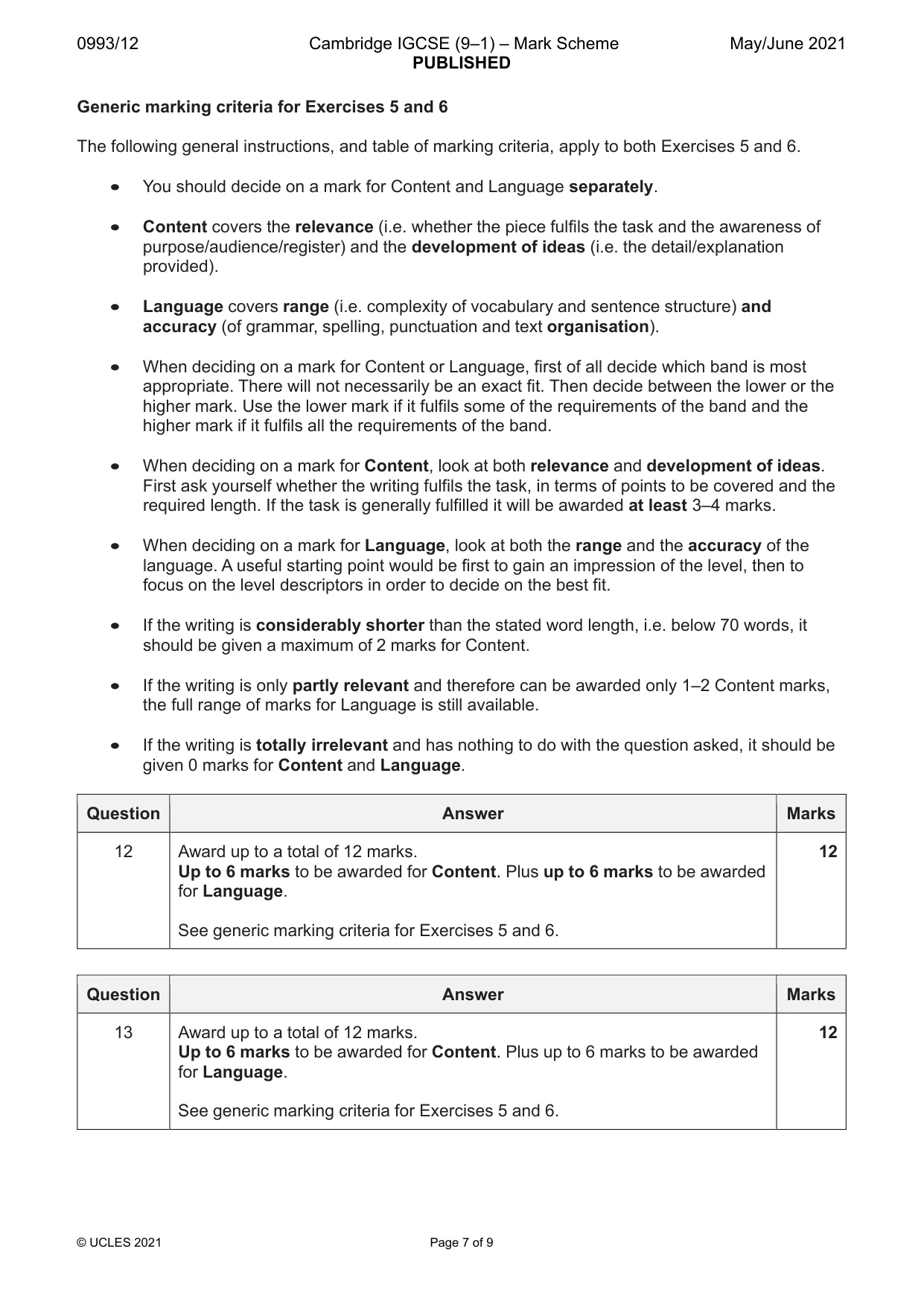
0993/12 Cambridge IGCSE (9–1) – Mark Scheme PUBLISHED May/June 2021 © UCLES 2021 Page 7 of 9 Generic marking criteria for Exercises 5 and 6 The following general instructions, and table of marking criteria, apply to both Exercises 5 and 6. • You should decide on a mark for Content and Language separately. • Content covers the relevance (i.e. whether the piece fulfils the task and the awareness of purpose/audience/register) and the development of ideas (i.e. the detail/explanation provided). • Language covers range (i.e. complexity of vocabulary and sentence structure) and accuracy (of grammar, spelling, punctuation and text organisation). • When deciding on a mark for Content or Language, first of all decide which band is most appropriate. There will not necessarily be an exact fit. Then decide between the lower or the higher mark. Use the lower mark if it fulfils some of the requirements of the band and the higher mark if it fulfils all the requirements of the band. • When deciding on a mark for Content, look at both relevance and development of ideas. First ask yourself whether the writing fulfils the task, in terms of points to be covered and the required length. If the task is generally fulfilled it will be awarded at least 3–4 marks. • When deciding on a mark for Language, look at both the range and the accuracy of the language. A useful starting point would be first to gain an impression of the level, then to focus on the level descriptors in order to decide on the best fit. • If the writing is considerably shorter than the stated word length, i.e. below 70 words, it should be given a maximum of 2 marks for Content. • If the writing is only partly relevant and therefore can be awarded only 1–2 Content marks, the full range of marks for Language is still available. • If the writing is totally irrelevant and has nothing to do with the question asked, it should be given 0 marks for Content and Language. Question Answer Marks 12 Award up to a total of 12 marks. Up to 6 marks to be awarded for Content. Plus up to 6 marks to be awarded for Language. See generic marking criteria for Exercises 5 and 6. 12 Question Answer Marks 13 Award up to a total of 12 marks. Up to 6 marks to be awarded for Content. Plus up to 6 marks to be awarded for Language. See generic marking criteria for Exercises 5 and 6. 12
Mark scheme, page 8
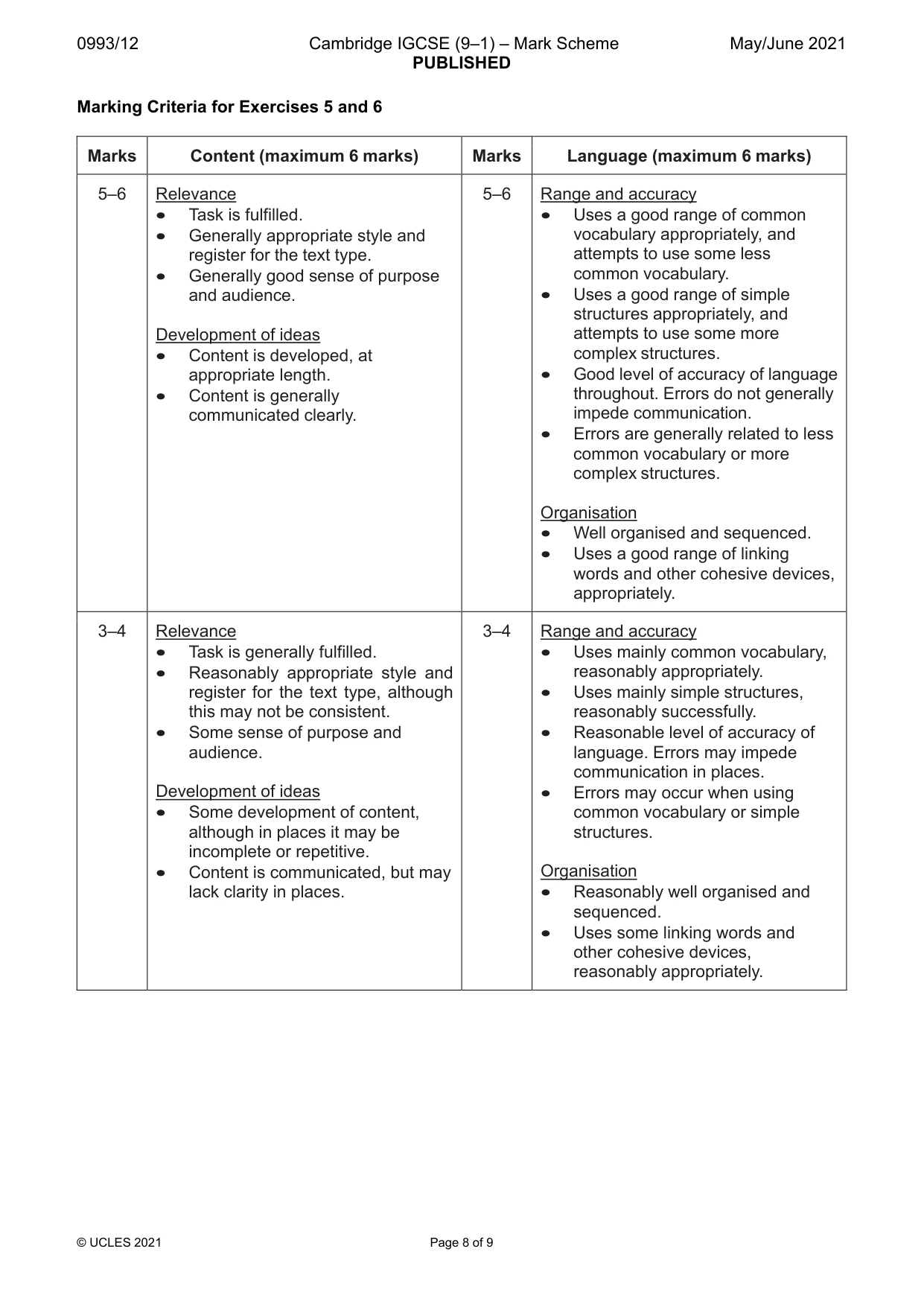
0993/12 Cambridge IGCSE (9–1) – Mark Scheme PUBLISHED May/June 2021 © UCLES 2021 Page 8 of 9 Marking Criteria for Exercises 5 and 6 Marks Content (maximum 6 marks) Marks Language (maximum 6 marks) 5–6 Relevance • Task is fulfilled. • Generally appropriate style and register for the text type. • Generally good sense of purpose and audience. Development of ideas • Content is developed, at appropriate length. • Content is generally communicated clearly. 5–6 Range and accuracy • Uses a good range of common vocabulary appropriately, and attempts to use some less common vocabulary. • Uses a good range of simple structures appropriately, and attempts to use some more complex structures. • Good level of accuracy of language throughout. Errors do not generally impede communication. • Errors are generally related to less common vocabulary or more complex structures. Organisation • Well organised and sequenced. • Uses a good range of linking words and other cohesive devices, appropriately. 3–4 Relevance • Task is generally fulfilled. • Reasonably appropriate style and register for the text type, although this may not be consistent. • Some sense of purpose and audience. Development of ideas • Some development of content, although in places it may be incomplete or repetitive. • Content is communicated, but may lack clarity in places. 3–4 Range and accuracy • Uses mainly common vocabulary, reasonably appropriately. • Uses mainly simple structures, reasonably successfully. • Reasonable level of accuracy of language. Errors may impede communication in places. • Errors may occur when using common vocabulary or simple structures. Organisation • Reasonably well organised and sequenced. • Uses some linking words and other cohesive devices, reasonably appropriately.
Mark scheme, page 9
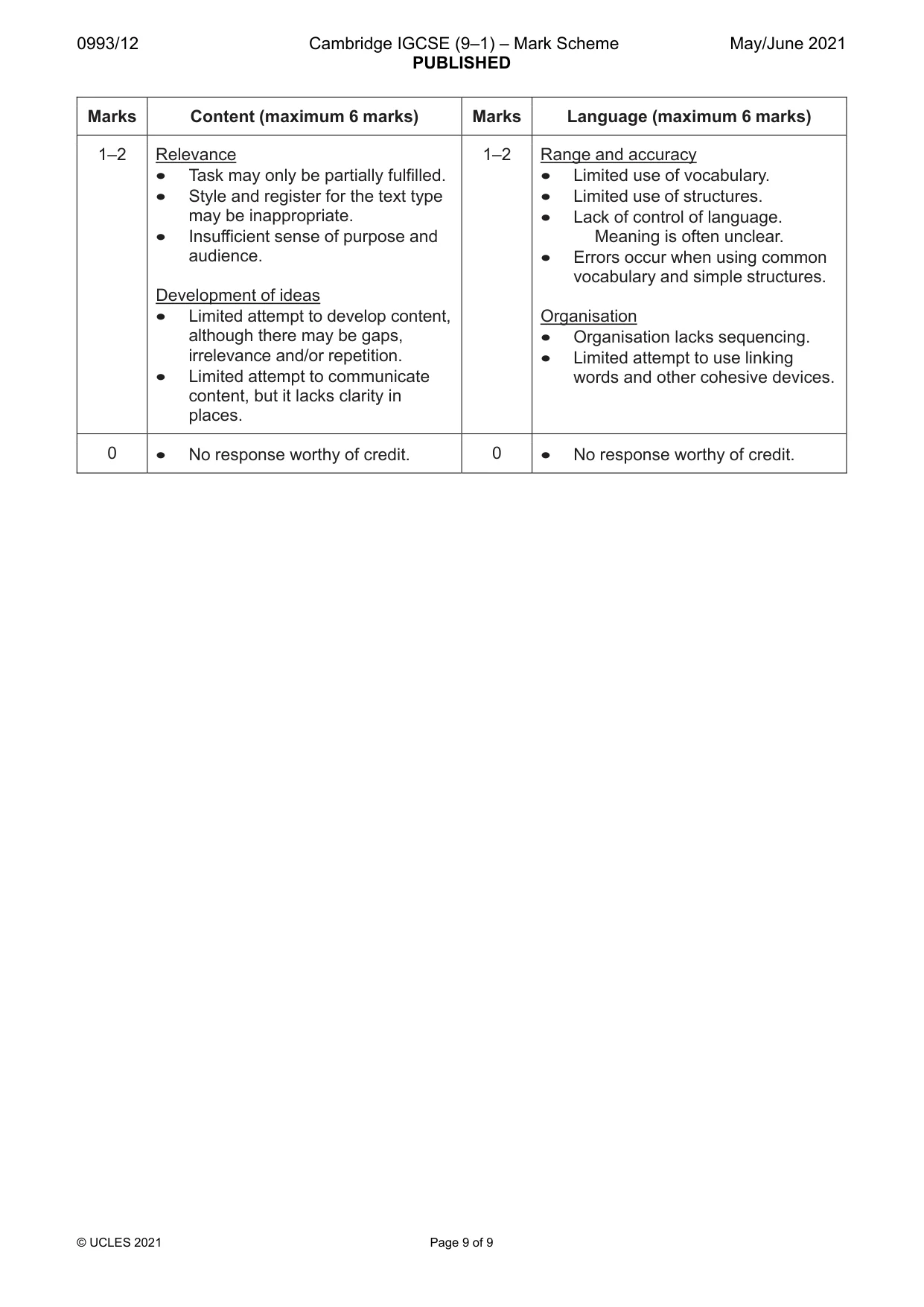
0993/12 Cambridge IGCSE (9–1) – Mark Scheme PUBLISHED May/June 2021 © UCLES 2021 Page 9 of 9 Marks Content (maximum 6 marks) Marks Language (maximum 6 marks) 1–2 Relevance • Task may only be partially fulfilled. • Style and register for the text type may be inappropriate. • Insufficient sense of purpose and audience. Development of ideas • Limited attempt to develop content, although there may be gaps, irrelevance and/or repetition. • Limited attempt to communicate content, but it lacks clarity in places. 1–2 Range and accuracy • Limited use of vocabulary. • Limited use of structures. • Lack of control of language. Meaning is often unclear. • Errors occur when using common vocabulary and simple structures. Organisation • Organisation lacks sequencing. • Limited attempt to use linking words and other cohesive devices. 0 • No response worthy of credit. 0 • No response worthy of credit.