Cambridge IGCSE English - Second Language (oral endorsement) 0510 — 2022 May/June Paper 2 · Variant 1
0510/21/M/J/22 · 80 marks · ≈90 min
The question paper and its mark scheme, free to read here and free to download. This is Cambridge’s own paper, exactly as it was sat.
Question paper16 pages






Mark scheme11 pages
Answers below. Sit the paper first if you are practising.
Paper as text
Question paper, page 1
This document has 16 pages. Any blank pages are indicated. [Turn over Cambridge IGCSE™ ENGLISH AS A SECOND LANGUAGE 0510/21 Paper 2 Reading and Writing (Extended) May/June 2022 2 hours You must answer on the question paper. No additional materials are needed. INSTRUCTIONS ● Answer all questions. ● Use a black or dark blue pen. ● Write your name, centre number and candidate number in the boxes at the top of the page. ● Write your answer to each question in the space provided. ● Do not use an erasable pen or correction fluid. ● Do not write on any bar codes. ● Dictionaries are not allowed. INFORMATION ● The total mark for this paper is 80. ● The number of marks for each question or part question is shown in brackets [ ]. * 1 7 5 9 8 0 9 6 9 0 * DC (MB/SW) 301669/3 © UCLES 2022
Question paper, page 2
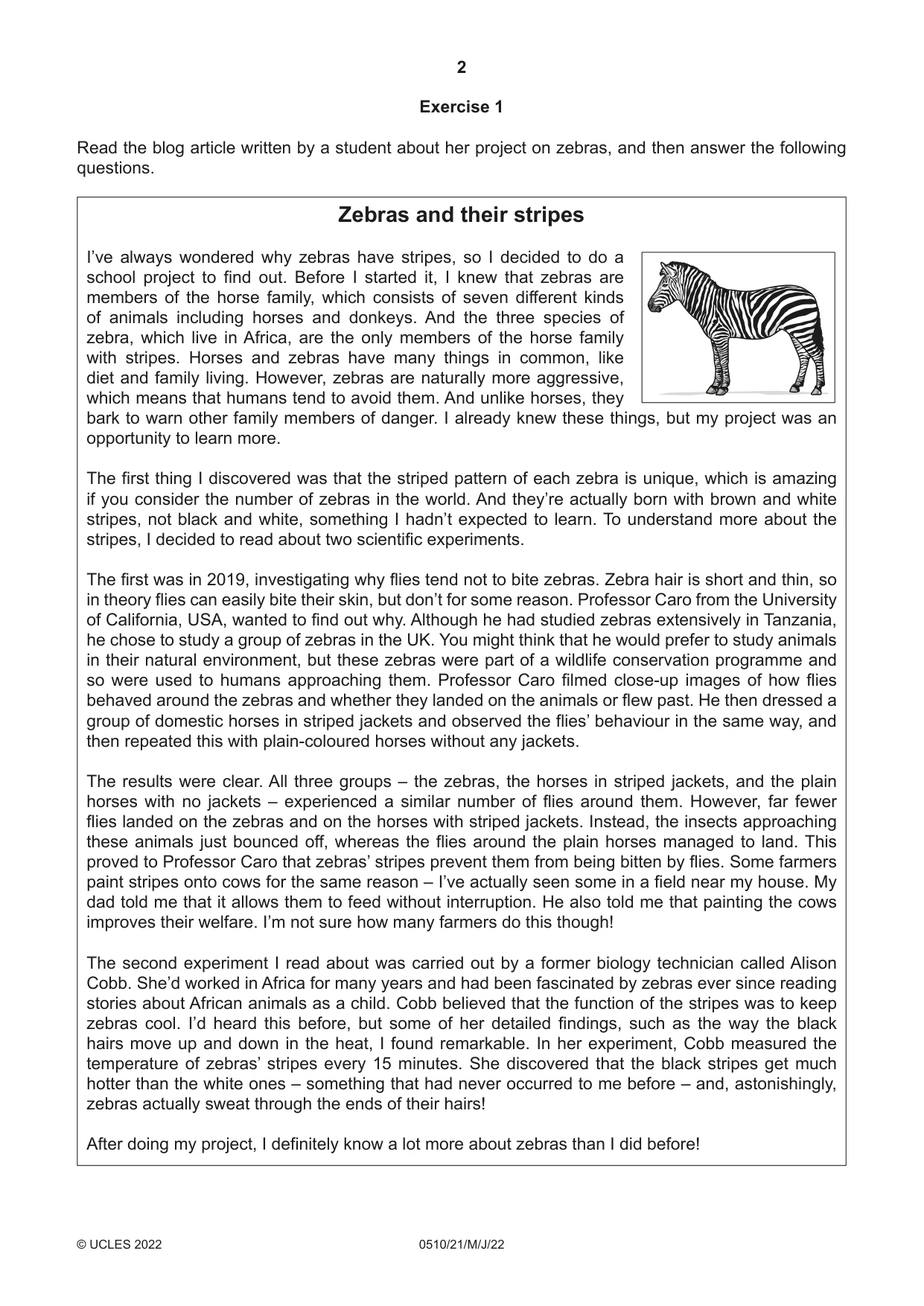
2 0510/21/M/J/22 © UCLES 2022 Exercise 1 Read the blog article written by a student about her project on zebras, and then answer the following questions. Zebras and their stripes I’ve always wondered why zebras have stripes, so I decided to do a school project to find out. Before I started it, I knew that zebras are members of the horse family, which consists of seven different kinds of animals including horses and donkeys. And the three species of zebra, which live in Africa, are the only members of the horse family with stripes. Horses and zebras have many things in common, like diet and family living. However, zebras are naturally more aggressive, which means that humans tend to avoid them. And unlike horses, they bark to warn other family members of danger. I already knew these things, but my project was an opportunity to learn more. The first thing I discovered was that the striped pattern of each zebra is unique, which is amazing if you consider the number of zebras in the world. And they’re actually born with brown and white stripes, not black and white, something I hadn’t expected to learn. To understand more about the stripes, I decided to read about two scientific experiments. The first was in 2019, investigating why flies tend not to bite zebras. Zebra hair is short and thin, so in theory flies can easily bite their skin, but don’t for some reason. Professor Caro from the University of California, USA, wanted to find out why. Although he had studied zebras extensively in Tanzania, he chose to study a group of zebras in the UK. You might think that he would prefer to study animals in their natural environment, but these zebras were part of a wildlife conservation programme and so were used to humans approaching them. Professor Caro filmed close-up images of how flies behaved around the zebras and whether they landed on the animals or flew past. He then dressed a group of domestic horses in striped jackets and observed the flies’ behaviour in the same way, and then repeated this with plain-coloured horses without any jackets. The results were clear. All three groups – the zebras, the horses in striped jackets, and the plain horses with no jackets – experienced a similar number of flies around them. However, far fewer flies landed on the zebras and on the horses with striped jackets. Instead, the insects approaching these animals just bounced off, whereas the flies around the plain horses managed to land. This proved to Professor Caro that zebras’ stripes prevent them from being bitten by flies. Some farmers paint stripes onto cows for the same reason – I’ve actually seen some in a field near my house. My dad told me that it allows them to feed without interruption. He also told me that painting the cows improves their welfare. I’m not sure how many farmers do this though! The second experiment I read about was carried out by a former biology technician called Alison Cobb. She’d worked in Africa for many years and had been fascinated by zebras ever since reading stories about African animals as a child. Cobb believed that the function of the stripes was to keep zebras cool. I’d heard this before, but some of her detailed findings, such as the way the black hairs move up and down in the heat, I found remarkable. In her experiment, Cobb measured the temperature of zebras’ stripes every 15 minutes. She discovered that the black stripes get much hotter than the white ones – something that had never occurred to me before – and, astonishingly, zebras actually sweat through the ends of their hairs! After doing my project, I definitely know a lot more about zebras than I did before!
Question paper, page 3
3 0510/21/M/J/22 © UCLES 2022 [Turn over 1 How many types of zebra are there? … [1] 2 How is zebra behaviour different from horse behaviour? Give two details. … … [2] 3 Where did Professor Caro’s experiment take place? … [1] 4 Why were the zebras in the wildlife conservation programme suitable for Professor Caro’s study? … [1] 5 What happened when the flies in Professor Caro’s study tried to land on the animals with stripes? … [1] 6 What are the benefits of protecting cows from being bitten by flies? Give two details. … … [2] 7 What first inspired Alison Cobb’s interest in zebras? … [1] 8 What facts about zebras was the writer surprised to learn while doing her project? Give four details. … … … … [4] [Total: 13]
Question paper, page 4
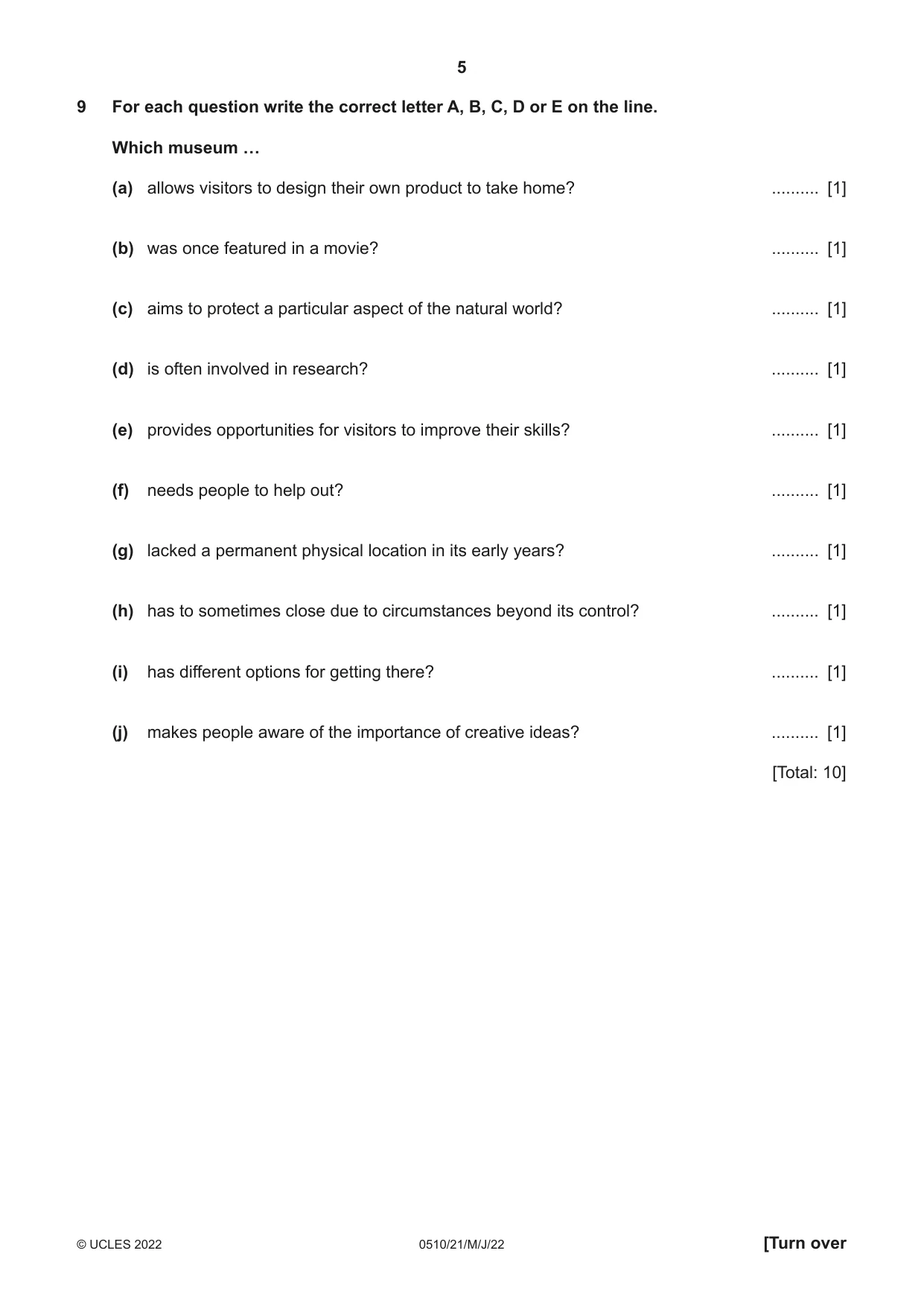
4 0510/21/M/J/22 © UCLES 2022 Exercise 2 Read the article about five unusual museums (A–E). Then answer Question 9(a)–(j). WHO SAYS MUSEUMS ARE BORING? Five young people describe an unusual museum they have visited A Dinosaur Ridge, Colorado Natural Area, USA My favourite museum is Dinosaur Ridge – one of the best places in the world to see real evidence of dinosaurs. At this ‘outdoor museum’, you can get close to over 300 dinosaur footprints, left in the sand as dinosaurs walked here 100 million years ago – just like being on a Hollywood movie set! The best way to reach the site is to hike or cycle, but the sun can be hot and the route includes a steep climb, so the guided bus tour might be a good alternative for some. Each year, the museum relies on lots of volunteers who assist with everything from answering visitors’ questions to picking up rubbish. I think that would be a fantastic thing to do! B Cancun Underwater Museum, Mexico As its name suggests, this museum is in an unusual place – it’s underwater! I love diving, so I can’t think of anything better. The museum was the idea of the local national park director, and consists of over 500 abstract sculptures fixed to the ocean floor. It can be explored by swimming, diving or from a glass-bottom boat. All visitors are taken there by boat from their hotel, so poor weather conditions do occasionally prevent the site from operating. The sculptures were designed by a team of Mexican and British artists and the idea is certainly full of imagination. However, the museum’s main goal is actually the conservation of the underwater environment, which it tries to achieve by showing people through art how we affect our oceans. C Cup Noodles Museum, Japan Instant noodles – or ‘cup noodles’ – are my favourite fast food. Just add boiling water and you have an immediate snack in a cup! The museum tells the story of Momofuku Ando, a man who spent his life inventing food that everyone could afford. Hearing his amazing story of investigation and discovery, visitors can’t help being reminded of what it is possible to achieve by thinking differently. The circumstances leading to the invention of his noodles are explained through a short cartoon video. The highlight for me was the opportunity to have my own souvenir noodles produced at the museum factory. You even choose the flavours and draw the picture to be printed on the cup! This activity is popular though, so it might be better to book in advance. D Computer Games Museum, Germany This is definitely the museum for computer games fans like me! It contains over 300 interactive devices covering six decades of gaming history, from the 1972 ‘Magnavox Odyssey’ game to more recent PlayStation devices. The museum started in 1997, although it shut soon afterwards, operating online only. It wasn’t until 2011 that it opened in its current building, just five minutes by underground train from central Berlin. As well as being a great place for visitors like me, it also has a slightly more serious side. The museum regularly participates in scientific projects, such as studying how computer games influence the way people interact. If they ever wanted people to take part, I’d be the first to volunteer! E Derwent Pencil Museum, England A pencil museum might sound boring, but the Derwent company produces some of the world’s finest art materials. I love drawing, so enjoyed learning about their beautiful coloured pencils, which visitors are given as a souvenir instead of a ticket. The museum is located on the site of their original factory, which started manufacturing in the early 20th century and became famous recently as a setting in the horror-comedy film Sightseers. The museum tells the story of pencil-making, from the discovery in the surrounding countryside of graphite, the black substance used to make pencils, up to the present day. The modern-day ‘secret agent’ pencils, designed to hide tiny maps inside, were really interesting. But for me, the free art classes in which you can benefit from specialist teaching were the biggest attraction.
Question paper, page 5
5 0510/21/M/J/22 © UCLES 2022 [Turn over 9 For each question write the correct letter A, B, C, D or E on the line. Which museum … (a) allows visitors to design their own product to take home? … [1] (b) was once featured in a movie? … [1] (c) aims to protect a particular aspect of the natural world? … [1] (d) is often involved in research? … [1] (e) provides opportunities for visitors to improve their skills? … [1] (f) needs people to help out? … [1] (g) lacked a permanent physical location in its early years? … [1] (h) has to sometimes close due to circumstances beyond its control? … [1] (i) has different options for getting there? … [1] (j) makes people aware of the importance of creative ideas? … [1] [Total: 10]
Question paper, page 6
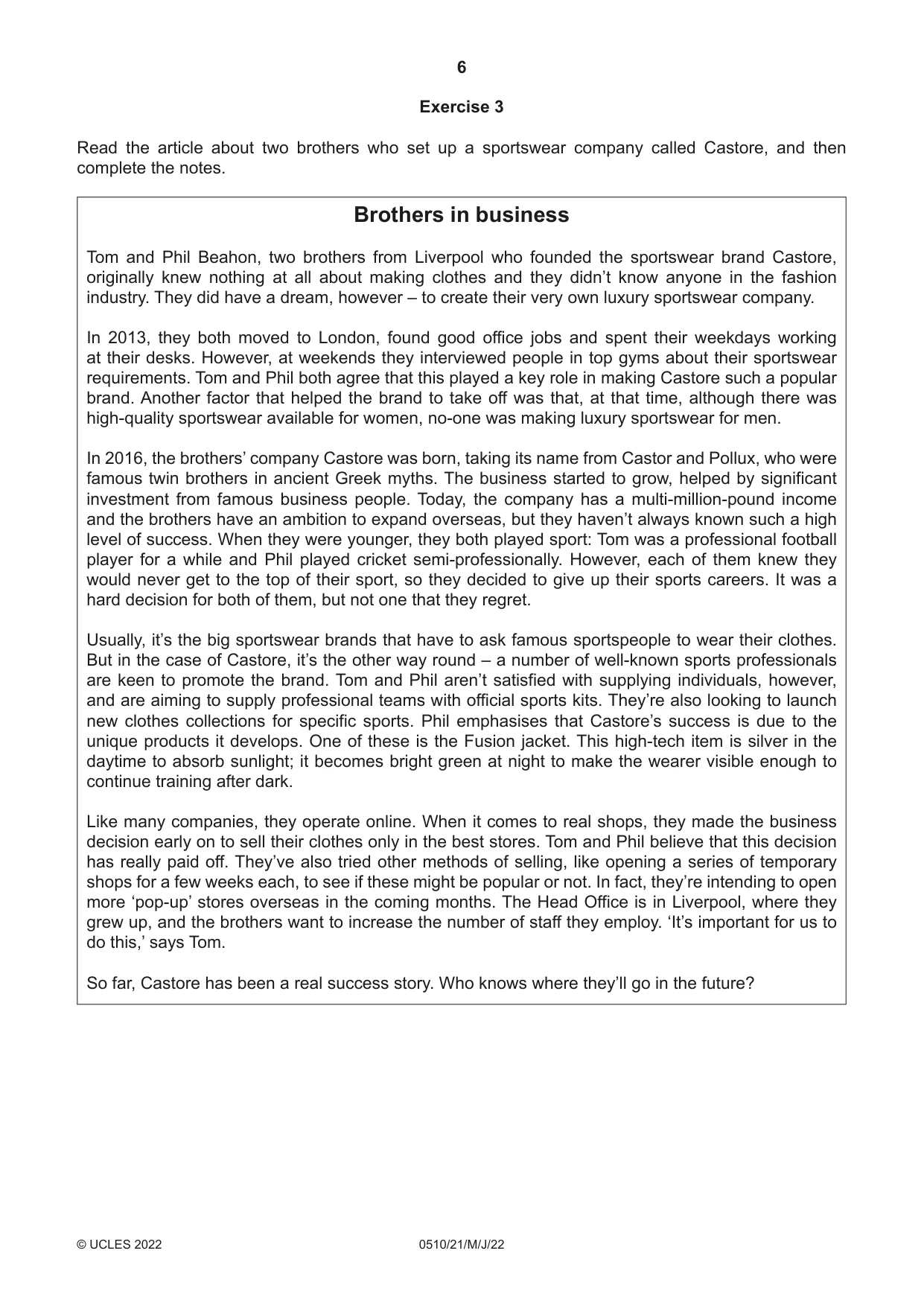
6 0510/21/M/J/22 © UCLES 2022 Exercise 3 Read the article about two brothers who set up a sportswear company called Castore, and then complete the notes. Brothers in business Tom and Phil Beahon, two brothers from Liverpool who founded the sportswear brand Castore, originally knew nothing at all about making clothes and they didn’t know anyone in the fashion industry. They did have a dream, however – to create their very own luxury sportswear company. In 2013, they both moved to London, found good office jobs and spent their weekdays working at their desks. However, at weekends they interviewed people in top gyms about their sportswear requirements. Tom and Phil both agree that this played a key role in making Castore such a popular brand. Another factor that helped the brand to take off was that, at that time, although there was high-quality sportswear available for women, no-one was making luxury sportswear for men. In 2016, the brothers’ company Castore was born, taking its name from Castor and Pollux, who were famous twin brothers in ancient Greek myths. The business started to grow, helped by significant investment from famous business people. Today, the company has a multi-million-pound income and the brothers have an ambition to expand overseas, but they haven’t always known such a high level of success. When they were younger, they both played sport: Tom was a professional football player for a while and Phil played cricket semi-professionally. However, each of them knew they would never get to the top of their sport, so they decided to give up their sports careers. It was a hard decision for both of them, but not one that they regret. Usually, it’s the big sportswear brands that have to ask famous sportspeople to wear their clothes. But in the case of Castore, it’s the other way round – a number of well-known sports professionals are keen to promote the brand. Tom and Phil aren’t satisfied with supplying individuals, however, and are aiming to supply professional teams with official sports kits. They’re also looking to launch new clothes collections for specific sports. Phil emphasises that Castore’s success is due to the unique products it develops. One of these is the Fusion jacket. This high-tech item is silver in the daytime to absorb sunlight; it becomes bright green at night to make the wearer visible enough to continue training after dark. Like many companies, they operate online. When it comes to real shops, they made the business decision early on to sell their clothes only in the best stores. Tom and Phil believe that this decision has really paid off. They’ve also tried other methods of selling, like opening a series of temporary shops for a few weeks each, to see if these might be popular or not. In fact, they’re intending to open more ‘pop-up’ stores overseas in the coming months. The Head Office is in Liverpool, where they grew up, and the brothers want to increase the number of staff they employ. ‘It’s important for us to do this,’ says Tom. So far, Castore has been a real success story. Who knows where they’ll go in the future?
Question paper, page 7
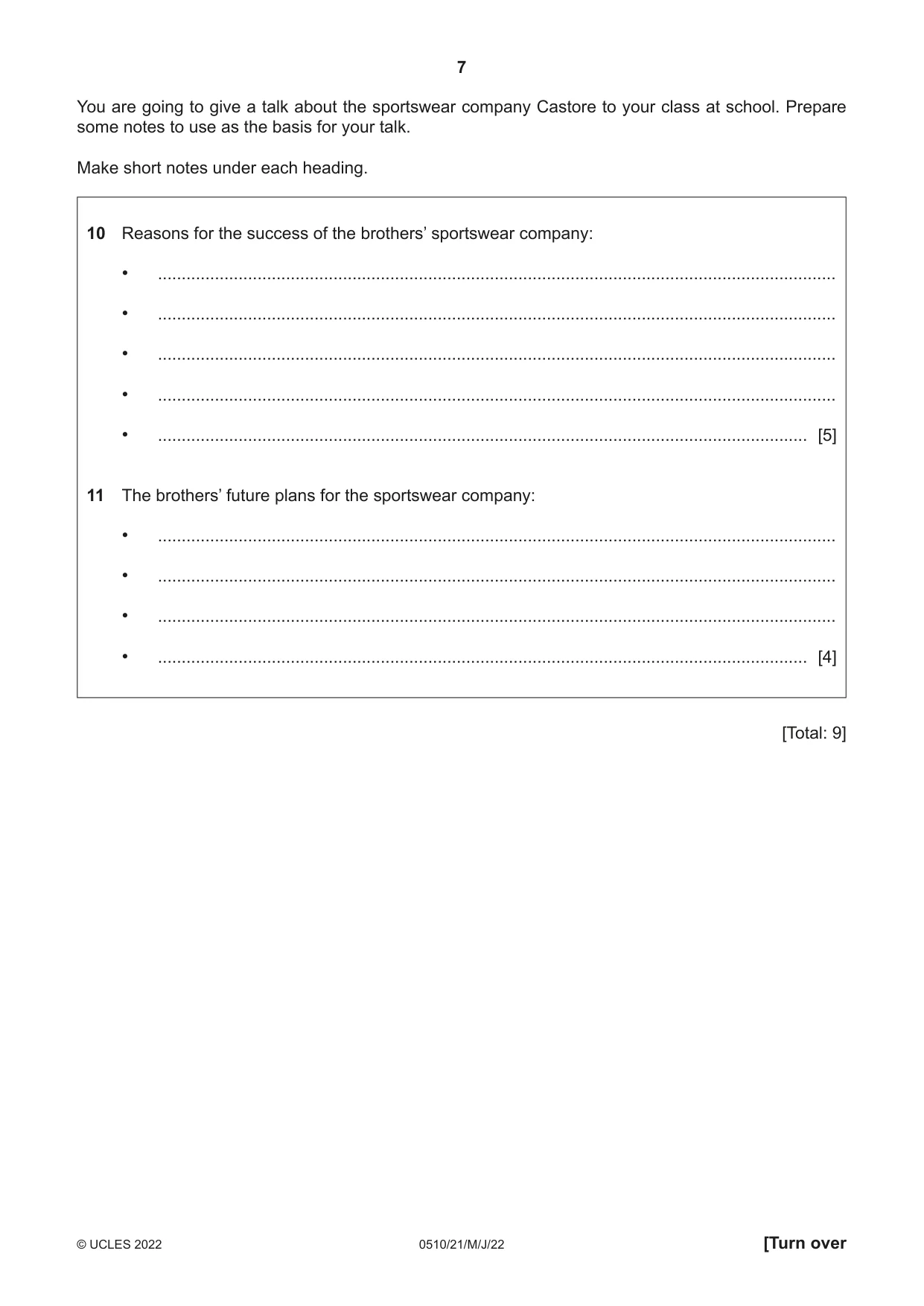
7 0510/21/M/J/22 © UCLES 2022 [Turn over You are going to give a talk about the sportswear company Castore to your class at school. Prepare some notes to use as the basis for your talk. Make short notes under each heading. 10 Reasons for the success of the brothers’ sportswear company: • … • … • … • … • … [5] 11 The brothers’ future plans for the sportswear company: • … • … • … • … [4] [Total: 9]
Question paper, page 8
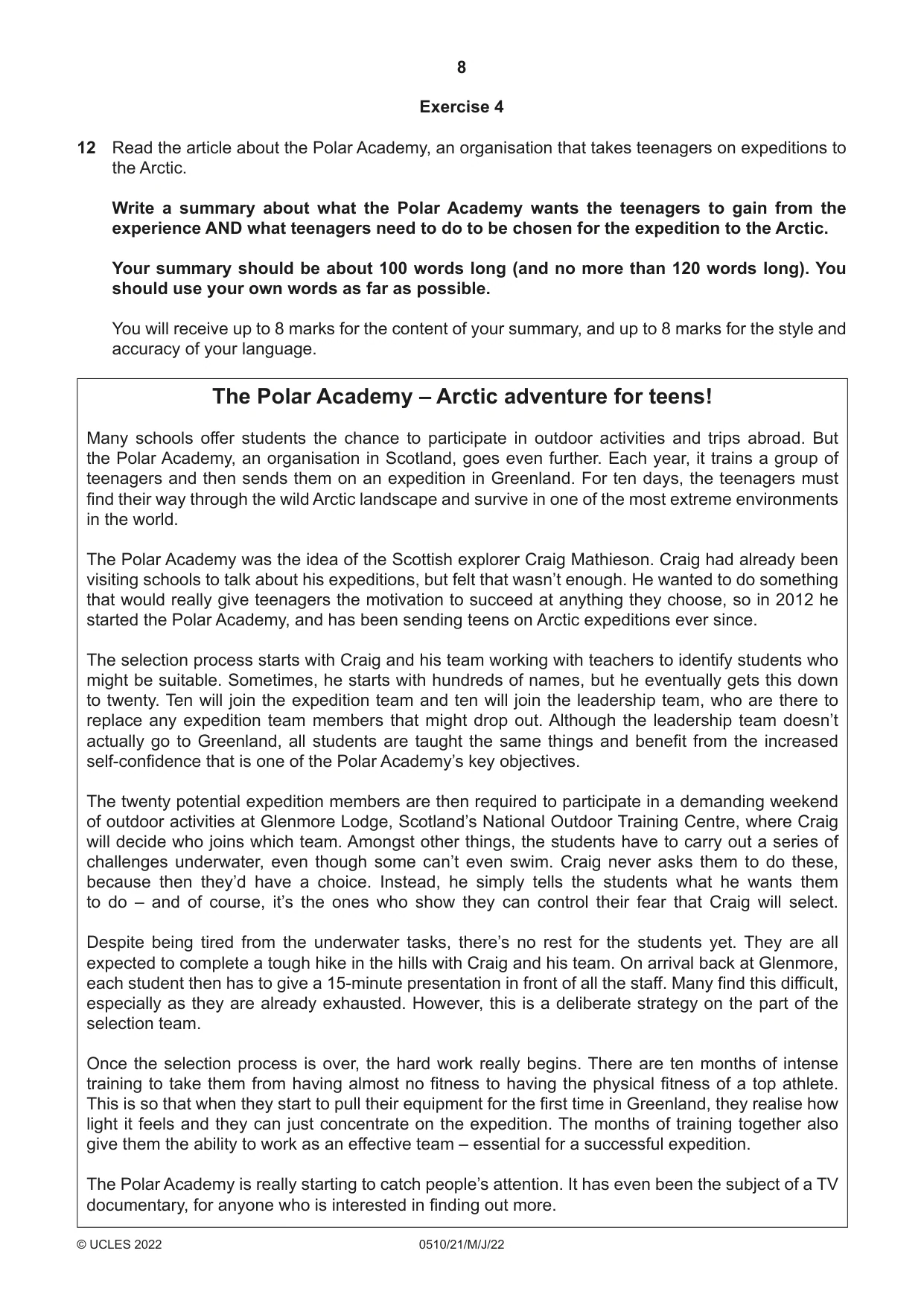
8 0510/21/M/J/22 © UCLES 2022 Exercise 4 12 Read the article about the Polar Academy, an organisation that takes teenagers on expeditions to the Arctic. Write a summary about what the Polar Academy wants the teenagers to gain from the experience AND what teenagers need to do to be chosen for the expedition to the Arctic. Your summary should be about 100 words long (and no more than 120 words long). You should use your own words as far as possible. You will receive up to 8 marks for the content of your summary, and up to 8 marks for the style and accuracy of your language. The Polar Academy – Arctic adventure for teens! Many schools offer students the chance to participate in outdoor activities and trips abroad. But the Polar Academy, an organisation in Scotland, goes even further. Each year, it trains a group of teenagers and then sends them on an expedition in Greenland. For ten days, the teenagers must find their way through the wild Arctic landscape and survive in one of the most extreme environments in the world. The Polar Academy was the idea of the Scottish explorer Craig Mathieson. Craig had already been visiting schools to talk about his expeditions, but felt that wasn’t enough. He wanted to do something that would really give teenagers the motivation to succeed at anything they choose, so in 2012 he started the Polar Academy, and has been sending teens on Arctic expeditions ever since. The selection process starts with Craig and his team working with teachers to identify students who might be suitable. Sometimes, he starts with hundreds of names, but he eventually gets this down to twenty. Ten will join the expedition team and ten will join the leadership team, who are there to replace any expedition team members that might drop out. Although the leadership team doesn’t actually go to Greenland, all students are taught the same things and benefit from the increased self-confidence that is one of the Polar Academy’s key objectives. The twenty potential expedition members are then required to participate in a demanding weekend of outdoor activities at Glenmore Lodge, Scotland’s National Outdoor Training Centre, where Craig will decide who joins which team. Amongst other things, the students have to carry out a series of challenges underwater, even though some can’t even swim. Craig never asks them to do these, because then they’d have a choice. Instead, he simply tells the students what he wants them to do – and of course, it’s the ones who show they can control their fear that Craig will select. Despite being tired from the underwater tasks, there’s no rest for the students yet. They are all expected to complete a tough hike in the hills with Craig and his team. On arrival back at Glenmore, each student then has to give a 15-minute presentation in front of all the staff. Many find this difficult, especially as they are already exhausted. However, this is a deliberate strategy on the part of the selection team. Once the selection process is over, the hard work really begins. There are ten months of intense training to take them from having almost no fitness to having the physical fitness of a top athlete. This is so that when they start to pull their equipment for the first time in Greenland, they realise how light it feels and they can just concentrate on the expedition. The months of training together also give them the ability to work as an effective team – essential for a successful expedition. The Polar Academy is really starting to catch people’s attention. It has even been the subject of a TV documentary, for anyone who is interested in finding out more.
Question paper, page 9
9 0510/21/M/J/22 © UCLES 2022 [Turn over … … … … … … … … … … … … … … … … … … … … … … … … … … … [Total: 16]
Question paper, page 10
10 0510/21/M/J/22 © UCLES 2022 Exercise 5 13 Your town has been chosen as the location for a large international event. Write an email to a friend telling them about this. In your email, you should: • explain why your town was chosen for the event • describe what will happen at the event • suggest how you could both get tickets to watch the event. The pictures above may give you some ideas, and you can also use some ideas of your own. Your email should be between 150 and 200 words long. You will receive up to 8 marks for the content of your email, and up to 8 marks for the language used.
Question paper, page 11
11 0510/21/M/J/22 © UCLES 2022 [Turn over … … … … … … … … … … … … … … … … … … … … … … … … … … … [Total: 16]
Question paper, page 12
12 0510/21/M/J/22 © UCLES 2022 Exercise 6 14 In class, you have been discussing whether the school day should start and finish later, because many teenagers find it hard to get up early in the mornings. Here are two comments from your classmates: I don’t want to have less free time after school. I never go to bed before midnight, so I hate early mornings! Write an article for your school magazine, giving your views. The comments above may give you some ideas, and you can also use some ideas of your own. Your article should be between 150 and 200 words long. You will receive up to 8 marks for the content of your article, and up to 8 marks for the language used.
Question paper, page 13
13 0510/21/M/J/22 © UCLES 2022 … … … … … … … … … … … … … … … … … … … … … … … … … … … [Total: 16]
Question paper, page 14
14 0510/21/M/J/22 © UCLES 2022 BLANK PAGE
Question paper, page 15
15 0510/21/M/J/22 © UCLES 2022 BLANK PAGE
Question paper, page 16
16 0510/21/M/J/22 © UCLES 2022 Permission to reproduce items where third-party owned material protected by copyright is included has been sought and cleared where possible. Every reasonable effort has been made by the publisher (UCLES) to trace copyright holders, but if any items requiring clearance have unwittingly been included, the publisher will be pleased to make amends at the earliest possible opportunity. To avoid the issue of disclosure of answer-related information to candidates, all copyright acknowledgements are reproduced online in the Cambridge Assessment International Education Copyright Acknowledgements Booklet. This is produced for each series of examinations and is freely available to download at www.cambridgeinternational.org after the live examination series. Cambridge Assessment International Education is part of Cambridge Assessment. Cambridge Assessment is the brand name of the University of Cambridge Local Examinations Syndicate (UCLES), which is a department of the University of Cambridge. BLANK PAGE
Mark scheme, page 1
This document consists of 11 printed pages. © UCLES 2022 [Turn over Cambridge IGCSE™ ENGLISH AS A SECOND LANGUAGE 0510/21 Paper 2 Reading and Writing (Extended) May/June 2022 MARK SCHEME Maximum Mark: 80 Published This mark scheme is published as an aid to teachers and candidates, to indicate the requirements of the examination. It shows the basis on which Examiners were instructed to award marks. It does not indicate the details of the discussions that took place at an Examiners’ meeting before marking began, which would have considered the acceptability of alternative answers. Mark schemes should be read in conjunction with the question paper and the Principal Examiner Report for Teachers. Cambridge International will not enter into discussions about these mark schemes. Cambridge International is publishing the mark schemes for the May/June 2022 series for most Cambridge IGCSE, Cambridge International A and AS Level and Cambridge Pre-U components, and some Cambridge O Level components.
Mark scheme, page 2
0510/21 Cambridge IGCSE – Mark Scheme PUBLISHED May/June 2022 © UCLES 2022 Page 2 of 11 Generic Marking Principles These general marking principles must be applied by all examiners when marking candidate answers. They should be applied alongside the specific content of the mark scheme or generic level descriptors for a question. Each question paper and mark scheme will also comply with these marking principles. GENERIC MARKING PRINCIPLE 1: Marks must be awarded in line with: the specific content of the mark scheme or the generic level descriptors for the question the specific skills defined in the mark scheme or in the generic level descriptors for the question the standard of response required by a candidate as exemplified by the standardisation scripts. GENERIC MARKING PRINCIPLE 2: Marks awarded are always whole marks (not half marks, or other fractions). GENERIC MARKING PRINCIPLE 3: Marks must be awarded positively: marks are awarded for correct/valid answers, as defined in the mark scheme. However, credit is given for valid answers which go beyond the scope of the syllabus and mark scheme, referring to your Team Leader as appropriate marks are awarded when candidates clearly demonstrate what they know and can do marks are not deducted for errors marks are not deducted for omissions answers should only be judged on the quality of spelling, punctuation and grammar when these features are specifically assessed by the question as indicated by the mark scheme. The meaning, however, should be unambiguous. GENERIC MARKING PRINCIPLE 4: Rules must be applied consistently, e.g. in situations where candidates have not followed instructions or in the application of generic level descriptors. GENERIC MARKING PRINCIPLE 5: Marks should be awarded using the full range of marks defined in the mark scheme for the question (however; the use of the full mark range may be limited according to the quality of the candidate responses seen). GENERIC MARKING PRINCIPLE 6: Marks awarded are based solely on the requirements as defined in the mark scheme. Marks should not be awarded with grade thresholds or grade descriptors in mind.
Mark scheme, page 3
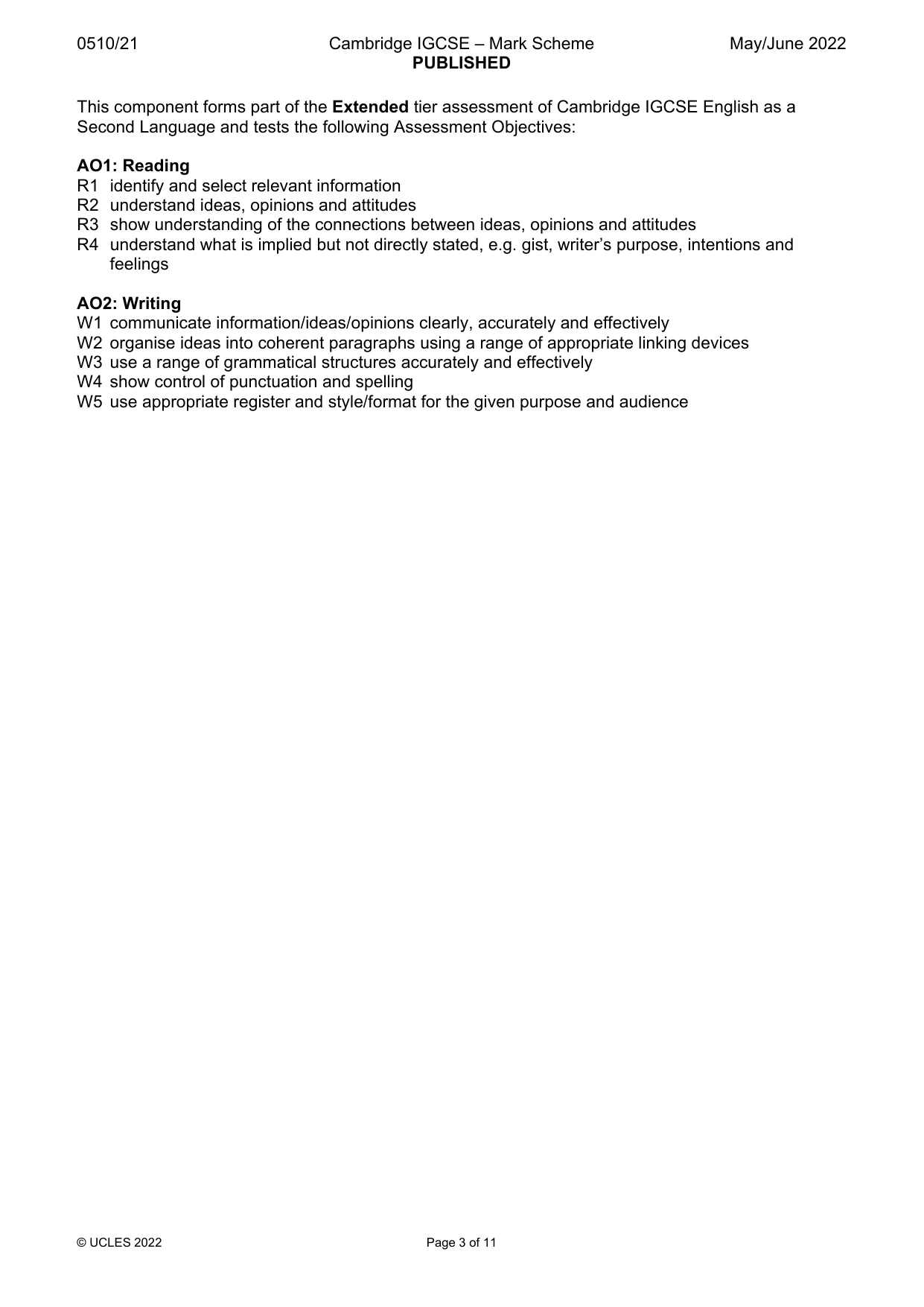
0510/21 Cambridge IGCSE – Mark Scheme PUBLISHED May/June 2022 © UCLES 2022 Page 3 of 11 This component forms part of the Extended tier assessment of Cambridge IGCSE English as a Second Language and tests the following Assessment Objectives: AO1: Reading R1 identify and select relevant information R2 understand ideas, opinions and attitudes R3 show understanding of the connections between ideas, opinions and attitudes R4 understand what is implied but not directly stated, e.g. gist, writer’s purpose, intentions and feelings AO2: Writing W1 communicate information/ideas/opinions clearly, accurately and effectively W2 organise ideas into coherent paragraphs using a range of appropriate linking devices W3 use a range of grammatical structures accurately and effectively W4 show control of punctuation and spelling W5 use appropriate register and style/format for the given purpose and audience
Mark scheme, page 4
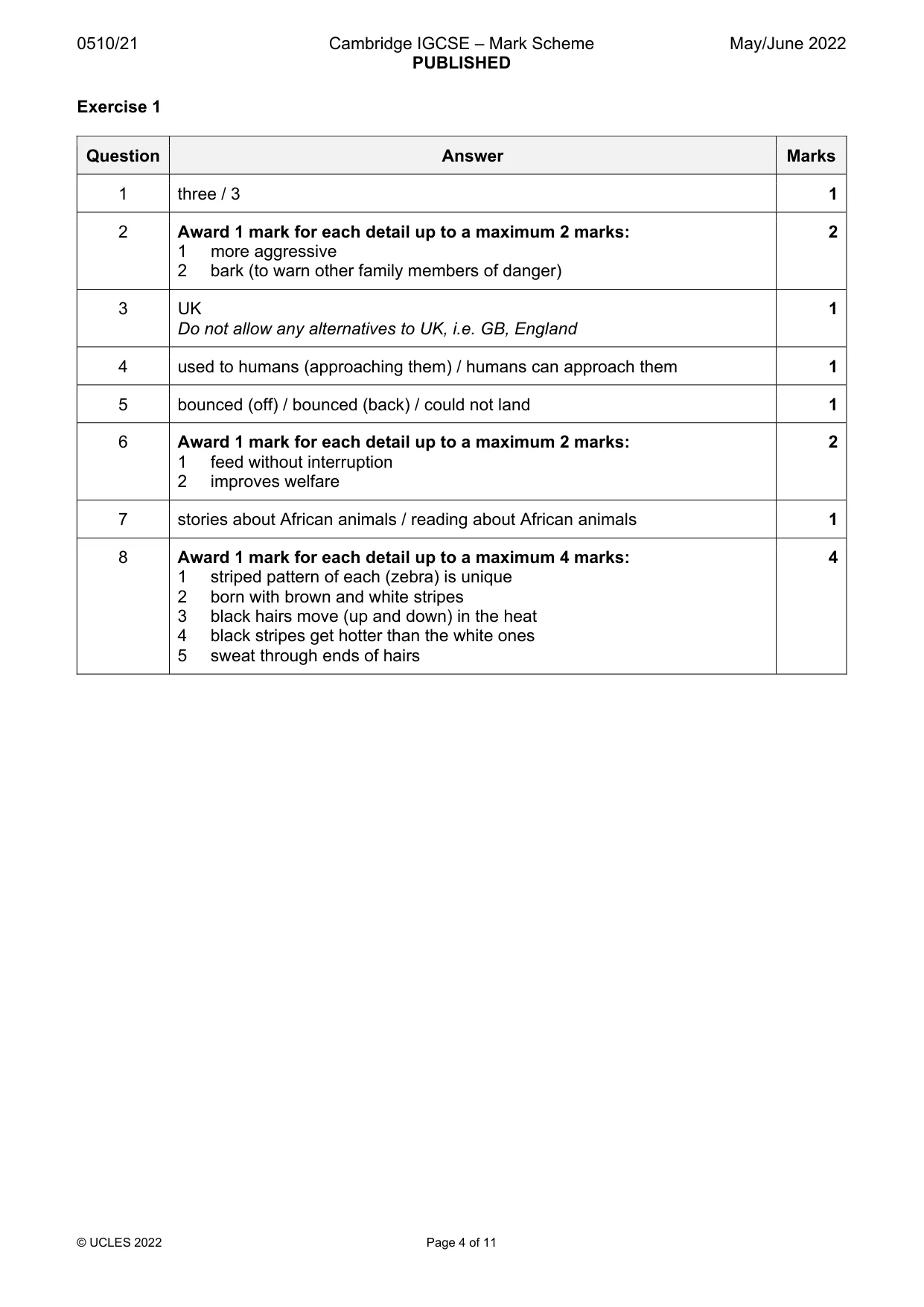
0510/21 Cambridge IGCSE – Mark Scheme PUBLISHED May/June 2022 © UCLES 2022 Page 4 of 11 Exercise 1 Question Answer Marks 1 three / 3 1 2 Award 1 mark for each detail up to a maximum 2 marks: 1 more aggressive 2 bark (to warn other family members of danger) 2 3 UK Do not allow any alternatives to UK, i.e. GB, England 1 4 used to humans (approaching them) / humans can approach them 1 5 bounced (off) / bounced (back) / could not land 1 6 Award 1 mark for each detail up to a maximum 2 marks: 1 feed without interruption 2 improves welfare 2 7 stories about African animals / reading about African animals 1 8 Award 1 mark for each detail up to a maximum 4 marks: 1 striped pattern of each (zebra) is unique 2 born with brown and white stripes 3 black hairs move (up and down) in the heat 4 black stripes get hotter than the white ones 5 sweat through ends of hairs 4
Mark scheme, page 5
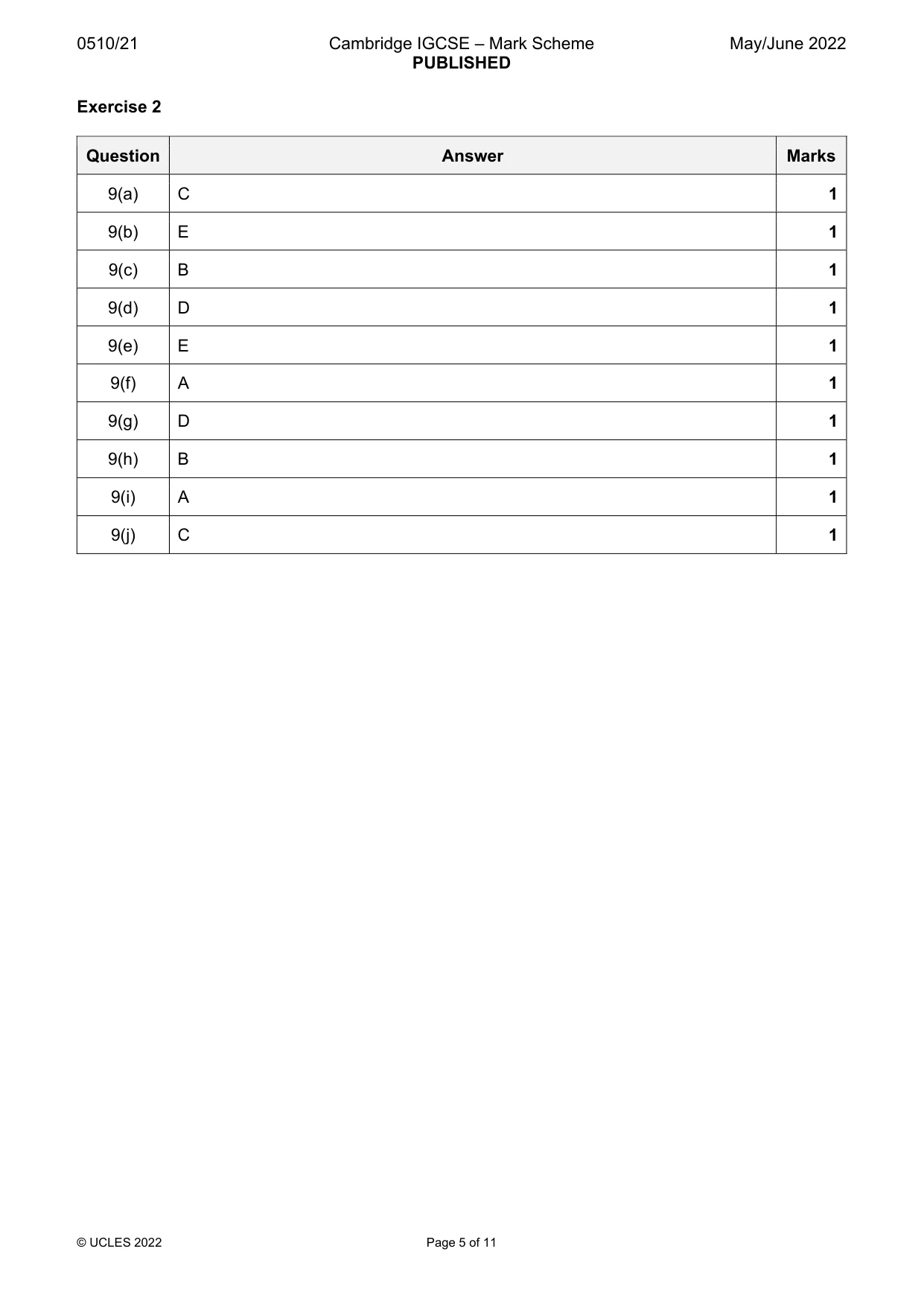
0510/21 Cambridge IGCSE – Mark Scheme PUBLISHED May/June 2022 © UCLES 2022 Page 5 of 11 Exercise 2 Question Answer Marks 9(a) C 1 9(b) E 1 9(c) B 1 9(d) D 1 9(e) E 1 9(f) A 1 9(g) D 1 9(h) B 1 9(i) A 1 9(j) C 1
Mark scheme, page 6
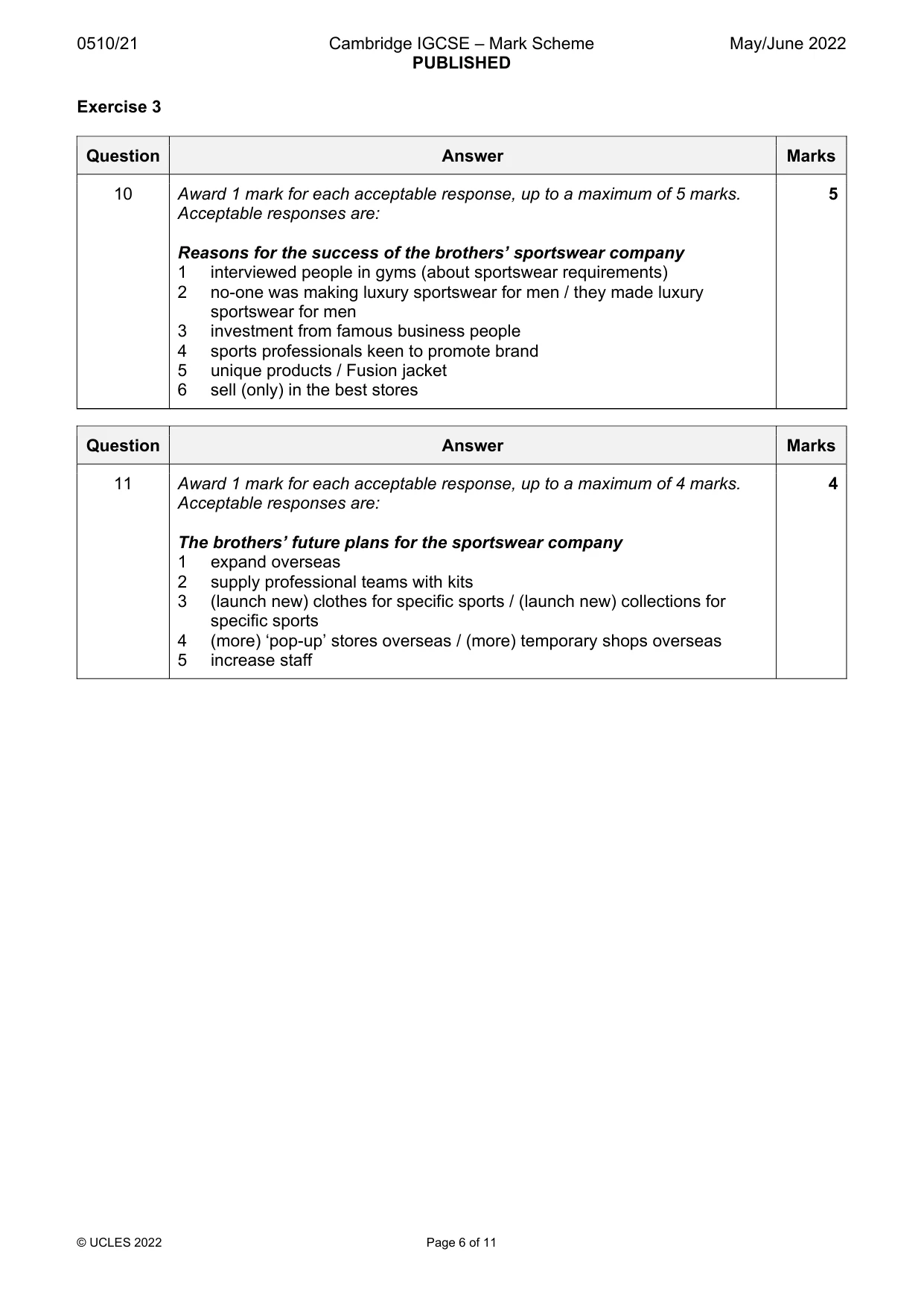
0510/21 Cambridge IGCSE – Mark Scheme PUBLISHED May/June 2022 © UCLES 2022 Page 6 of 11 Exercise 3 Question Answer Marks 10 Award 1 mark for each acceptable response, up to a maximum of 5 marks. Acceptable responses are: Reasons for the success of the brothers’ sportswear company 1 interviewed people in gyms (about sportswear requirements) 2 no-one was making luxury sportswear for men / they made luxury sportswear for men 3 investment from famous business people 4 sports professionals keen to promote brand 5 unique products / Fusion jacket 6 sell (only) in the best stores 5 Question Answer Marks 11 Award 1 mark for each acceptable response, up to a maximum of 4 marks. Acceptable responses are: The brothers’ future plans for the sportswear company 1 expand overseas 2 supply professional teams with kits 3 (launch new) clothes for specific sports / (launch new) collections for specific sports 4 (more) ‘pop-up’ stores overseas / (more) temporary shops overseas 5 increase staff 4
Mark scheme, page 7
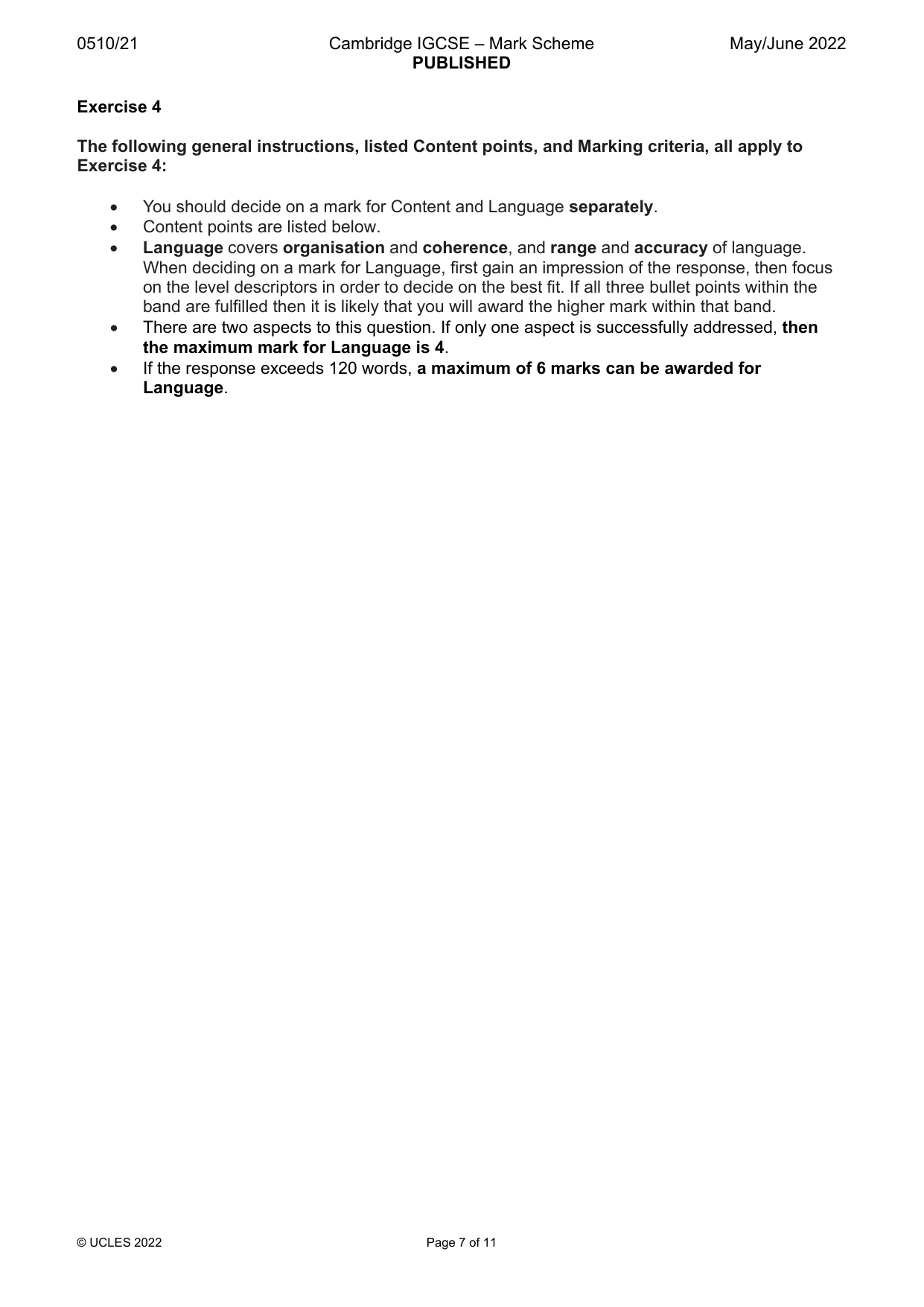
0510/21 Cambridge IGCSE – Mark Scheme PUBLISHED May/June 2022 © UCLES 2022 Page 7 of 11 Exercise 4 The following general instructions, listed Content points, and Marking criteria, all apply to Exercise 4: You should decide on a mark for Content and Language separately. Content points are listed below. Language covers organisation and coherence, and range and accuracy of language. When deciding on a mark for Language, first gain an impression of the response, then focus on the level descriptors in order to decide on the best fit. If all three bullet points within the band are fulfilled then it is likely that you will award the higher mark within that band. There are two aspects to this question. If only one aspect is successfully addressed, then the maximum mark for Language is 4. If the response exceeds 120 words, a maximum of 6 marks can be awarded for Language.
Mark scheme, page 8
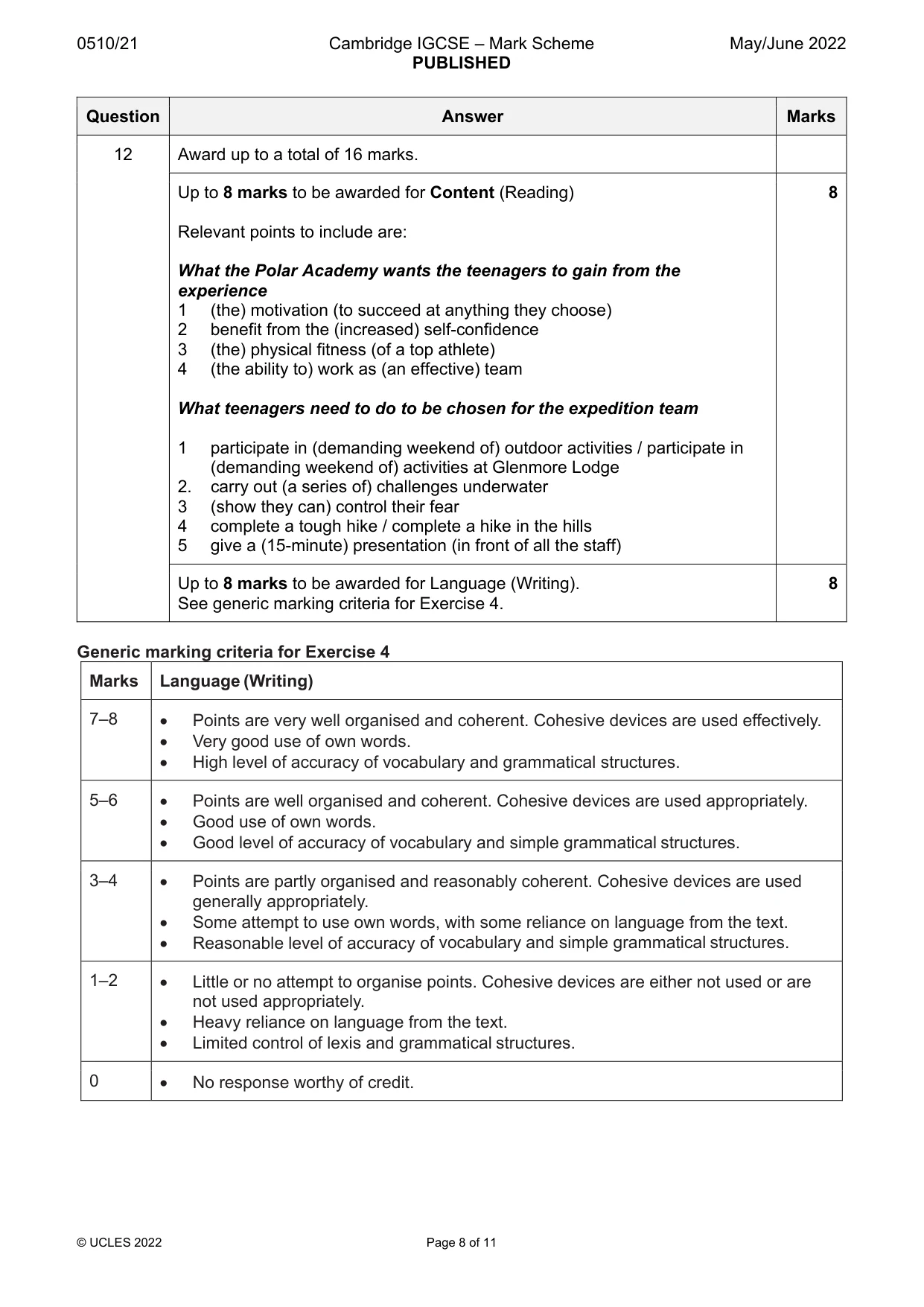
0510/21 Cambridge IGCSE – Mark Scheme PUBLISHED May/June 2022 © UCLES 2022 Page 8 of 11 Question Answer Marks 12 Award up to a total of 16 marks. Up to 8 marks to be awarded for Content (Reading) Relevant points to include are: What the Polar Academy wants the teenagers to gain from the experience 1 (the) motivation (to succeed at anything they choose) 2 benefit from the (increased) self-confidence 3 (the) physical fitness (of a top athlete) 4 (the ability to) work as (an effective) team What teenagers need to do to be chosen for the expedition team 1 participate in (demanding weekend of) outdoor activities / participate in (demanding weekend of) activities at Glenmore Lodge 2. carry out (a series of) challenges underwater 3 (show they can) control their fear 4 complete a tough hike / complete a hike in the hills 5 give a (15-minute) presentation (in front of all the staff) 8 Up to 8 marks to be awarded for Language (Writing). See generic marking criteria for Exercise 4. 8 Generic marking criteria for Exercise 4 Marks Language (Writing) 7–8 Points are very well organised and coherent. Cohesive devices are used effectively. Very good use of own words. High level of accuracy of vocabulary and grammatical structures. 5–6 Points are well organised and coherent. Cohesive devices are used appropriately. Good use of own words. Good level of accuracy of vocabulary and simple grammatical structures. 3–4 Points are partly organised and reasonably coherent. Cohesive devices are used generally appropriately. Some attempt to use own words, with some reliance on language from the text. Reasonable level of accuracy of vocabulary and simple grammatical structures. 1–2 Little or no attempt to organise points. Cohesive devices are either not used or are not used appropriately. Heavy reliance on language from the text. Limited control of lexis and grammatical structures. 0 No response worthy of credit.
Mark scheme, page 9
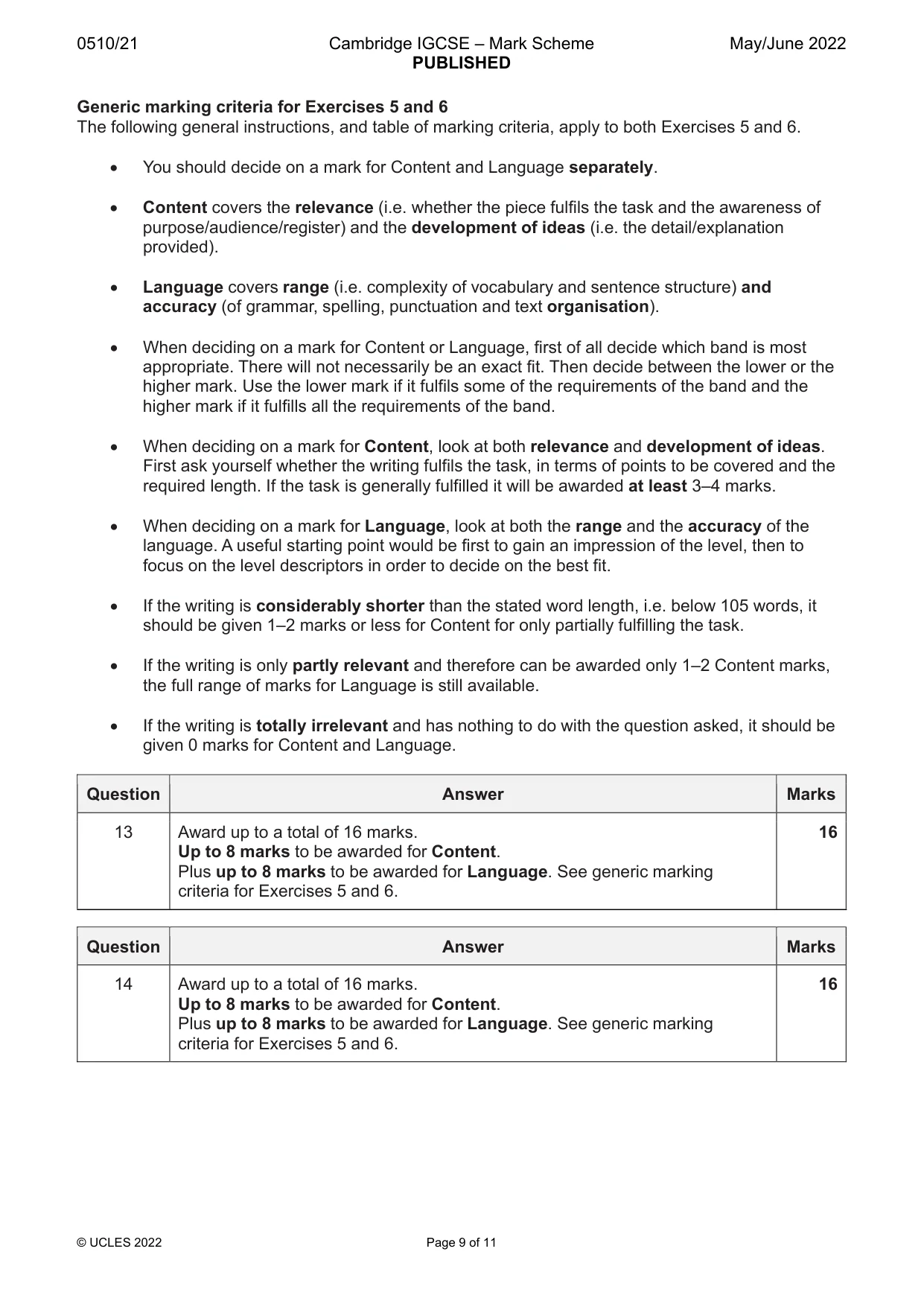
0510/21 Cambridge IGCSE – Mark Scheme PUBLISHED May/June 2022 © UCLES 2022 Page 9 of 11 Generic marking criteria for Exercises 5 and 6 The following general instructions, and table of marking criteria, apply to both Exercises 5 and 6. You should decide on a mark for Content and Language separately. Content covers the relevance (i.e. whether the piece fulfils the task and the awareness of purpose/audience/register) and the development of ideas (i.e. the detail/explanation provided). Language covers range (i.e. complexity of vocabulary and sentence structure) and accuracy (of grammar, spelling, punctuation and text organisation). When deciding on a mark for Content or Language, first of all decide which band is most appropriate. There will not necessarily be an exact fit. Then decide between the lower or the higher mark. Use the lower mark if it fulfils some of the requirements of the band and the higher mark if it fulfills all the requirements of the band. When deciding on a mark for Content, look at both relevance and development of ideas. First ask yourself whether the writing fulfils the task, in terms of points to be covered and the required length. If the task is generally fulfilled it will be awarded at least 3–4 marks. When deciding on a mark for Language, look at both the range and the accuracy of the language. A useful starting point would be first to gain an impression of the level, then to focus on the level descriptors in order to decide on the best fit. If the writing is considerably shorter than the stated word length, i.e. below 105 words, it should be given 1–2 marks or less for Content for only partially fulfilling the task. If the writing is only partly relevant and therefore can be awarded only 1–2 Content marks, the full range of marks for Language is still available. If the writing is totally irrelevant and has nothing to do with the question asked, it should be given 0 marks for Content and Language. Question Answer Marks 13 Award up to a total of 16 marks. Up to 8 marks to be awarded for Content. Plus up to 8 marks to be awarded for Language. See generic marking criteria for Exercises 5 and 6. 16 Question Answer Marks 14 Award up to a total of 16 marks. Up to 8 marks to be awarded for Content. Plus up to 8 marks to be awarded for Language. See generic marking criteria for Exercises 5 and 6. 16
Mark scheme, page 10
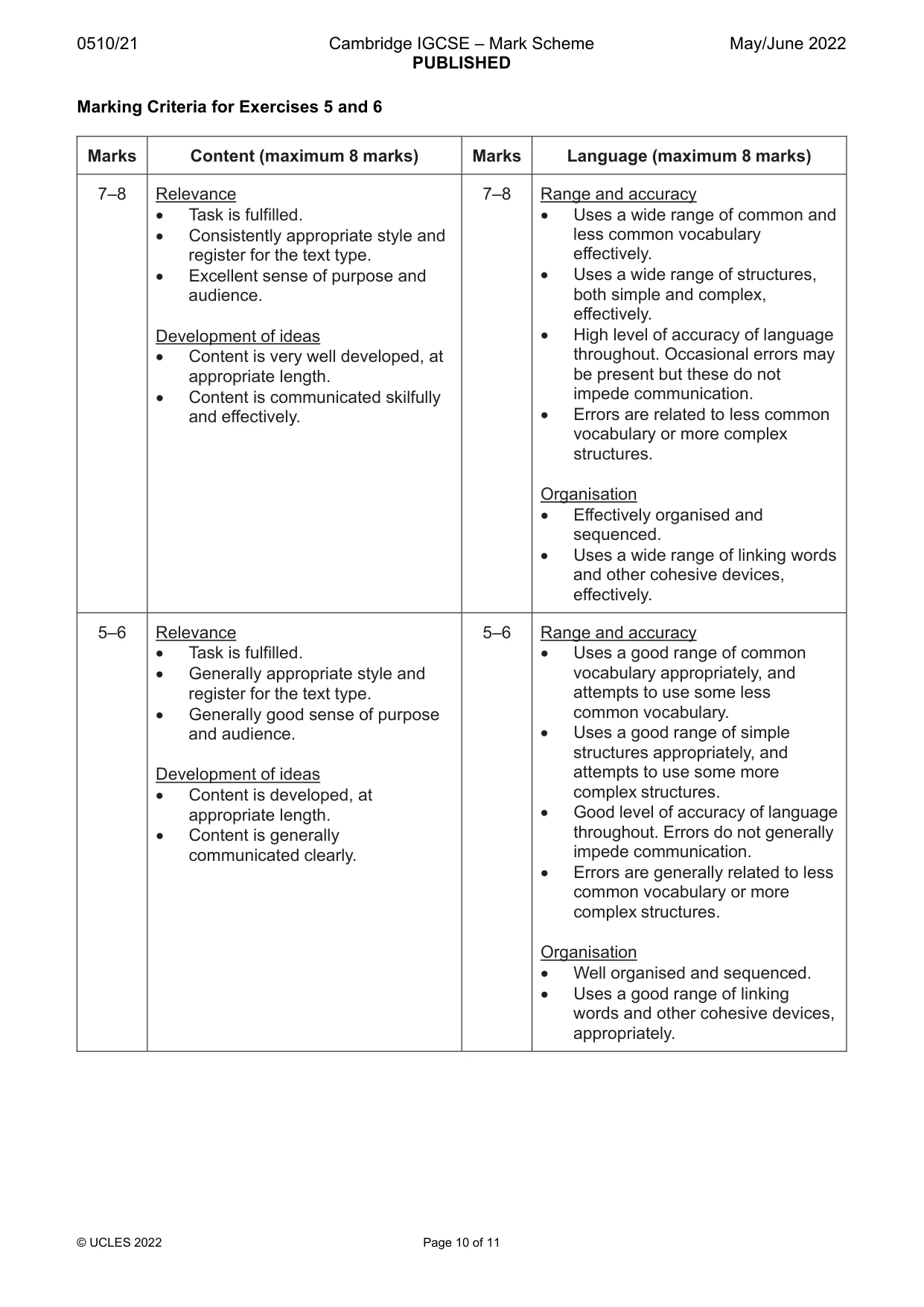
0510/21 Cambridge IGCSE – Mark Scheme PUBLISHED May/June 2022 © UCLES 2022 Page 10 of 11 Marking Criteria for Exercises 5 and 6 Marks Content (maximum 8 marks) Marks Language (maximum 8 marks) 7–8 Relevance Task is fulfilled. Consistently appropriate style and register for the text type. Excellent sense of purpose and audience. Development of ideas Content is very well developed, at appropriate length. Content is communicated skilfully and effectively. 7–8 Range and accuracy Uses a wide range of common and less common vocabulary effectively. Uses a wide range of structures, both simple and complex, effectively. High level of accuracy of language throughout. Occasional errors may be present but these do not impede communication. Errors are related to less common vocabulary or more complex structures. Organisation Effectively organised and sequenced. Uses a wide range of linking words and other cohesive devices, effectively. 5–6 Relevance Task is fulfilled. Generally appropriate style and register for the text type. Generally good sense of purpose and audience. Development of ideas Content is developed, at appropriate length. Content is generally communicated clearly. 5–6 Range and accuracy Uses a good range of common vocabulary appropriately, and attempts to use some less common vocabulary. Uses a good range of simple structures appropriately, and attempts to use some more complex structures. Good level of accuracy of language throughout. Errors do not generally impede communication. Errors are generally related to less common vocabulary or more complex structures. Organisation Well organised and sequenced. Uses a good range of linking words and other cohesive devices, appropriately.
Mark scheme, page 11
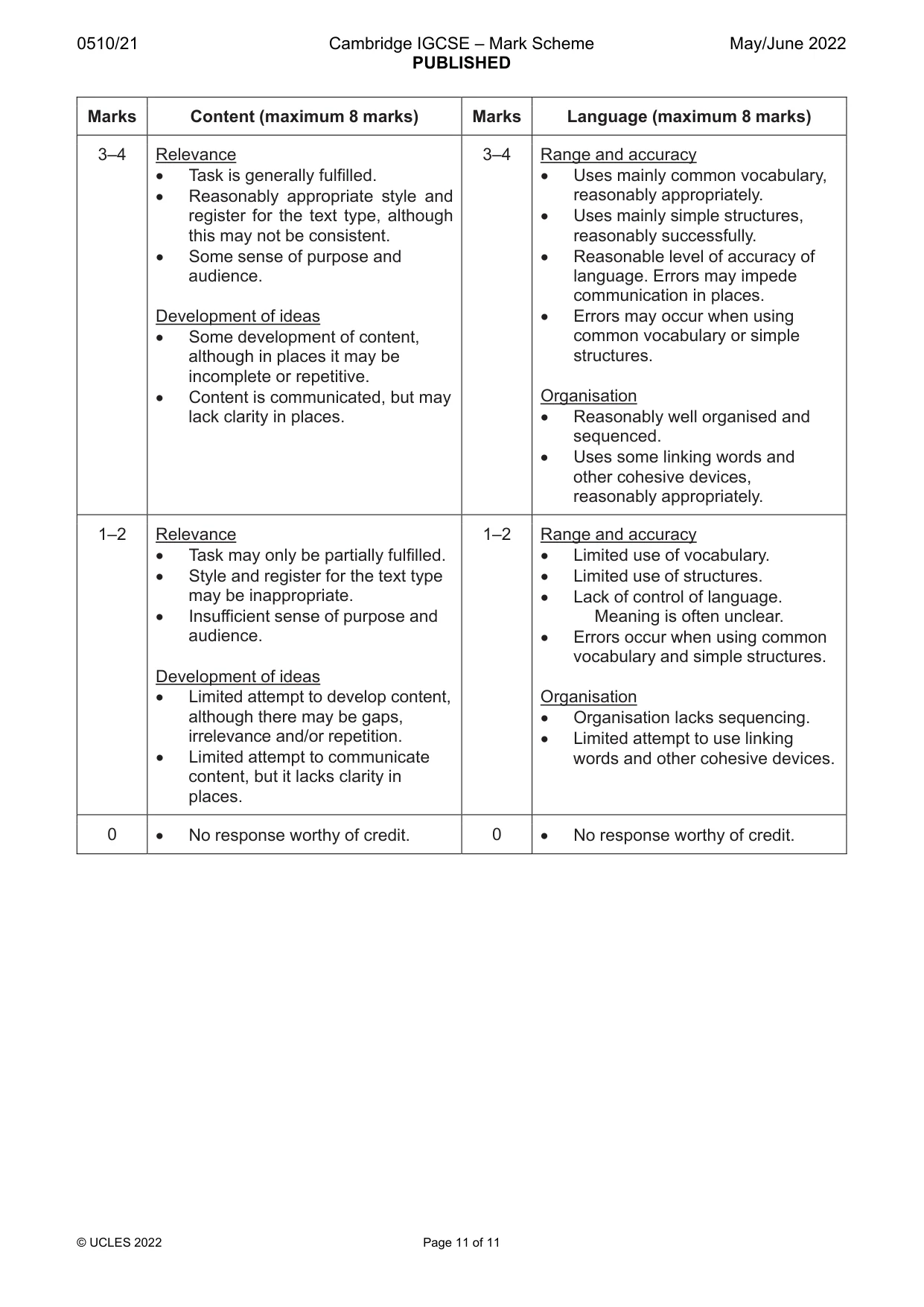
0510/21 Cambridge IGCSE – Mark Scheme PUBLISHED May/June 2022 © UCLES 2022 Page 11 of 11 Marks Content (maximum 8 marks) Marks Language (maximum 8 marks) 3–4 Relevance Task is generally fulfilled. Reasonably appropriate style and register for the text type, although this may not be consistent. Some sense of purpose and audience. Development of ideas Some development of content, although in places it may be incomplete or repetitive. Content is communicated, but may lack clarity in places. 3–4 Range and accuracy Uses mainly common vocabulary, reasonably appropriately. Uses mainly simple structures, reasonably successfully. Reasonable level of accuracy of language. Errors may impede communication in places. Errors may occur when using common vocabulary or simple structures. Organisation Reasonably well organised and sequenced. Uses some linking words and other cohesive devices, reasonably appropriately. 1–2 Relevance Task may only be partially fulfilled. Style and register for the text type may be inappropriate. Insufficient sense of purpose and audience. Development of ideas Limited attempt to develop content, although there may be gaps, irrelevance and/or repetition. Limited attempt to communicate content, but it lacks clarity in places. 1–2 Range and accuracy Limited use of vocabulary. Limited use of structures. Lack of control of language. Meaning is often unclear. Errors occur when using common vocabulary and simple structures. Organisation Organisation lacks sequencing. Limited attempt to use linking words and other cohesive devices. 0 No response worthy of credit. 0 No response worthy of credit.
What you needed in this session
Cambridge’s own grade thresholds for 2022 May/June, Paper 2 · Variant 1. A higher threshold means an easier paper — the bar moves with how the cohort did.