Cambridge IGCSE English - Second Language (oral endorsement) 0510 — 2020 Oct/Nov Paper 1 · Variant 1
0510/11/O/N/20 · 60 marks · ≈68 min
The question paper and its mark scheme, free to read here and free to download. This is Cambridge’s own paper, exactly as it was sat.
Question paper16 pages



Mark scheme10 pages
Answers below. Sit the paper first if you are practising.
Paper as text
Question paper, page 1
Cambridge IGCSE™ ENGLISH AS A SECOND LANGUAGE 0510/11 Paper 1 Reading and Writing (Core) October/November 2020 1 hour 30 minutes You must answer on the question paper. No additional materials are needed. INSTRUCTIONS ● Answer all questions. ● Use a black or dark blue pen. ● Write your name, centre number and candidate number in the boxes at the top of the page. ● Write your answer to each question in the space provided. ● Do not use an erasable pen or correction fluid. ● Do not write on any bar codes. ● Dictionaries are not allowed. INFORMATION ● The total mark for this paper is 60. ● The number of marks for each question or part question is shown in brackets [ ]. DC (RCL/GO) 188491/2 © UCLES 2020 [Turn over This document has 16 pages. Blank pages are indicated. * 5 8 3 4 1 2 9 8 7 0 *
Question paper, page 2
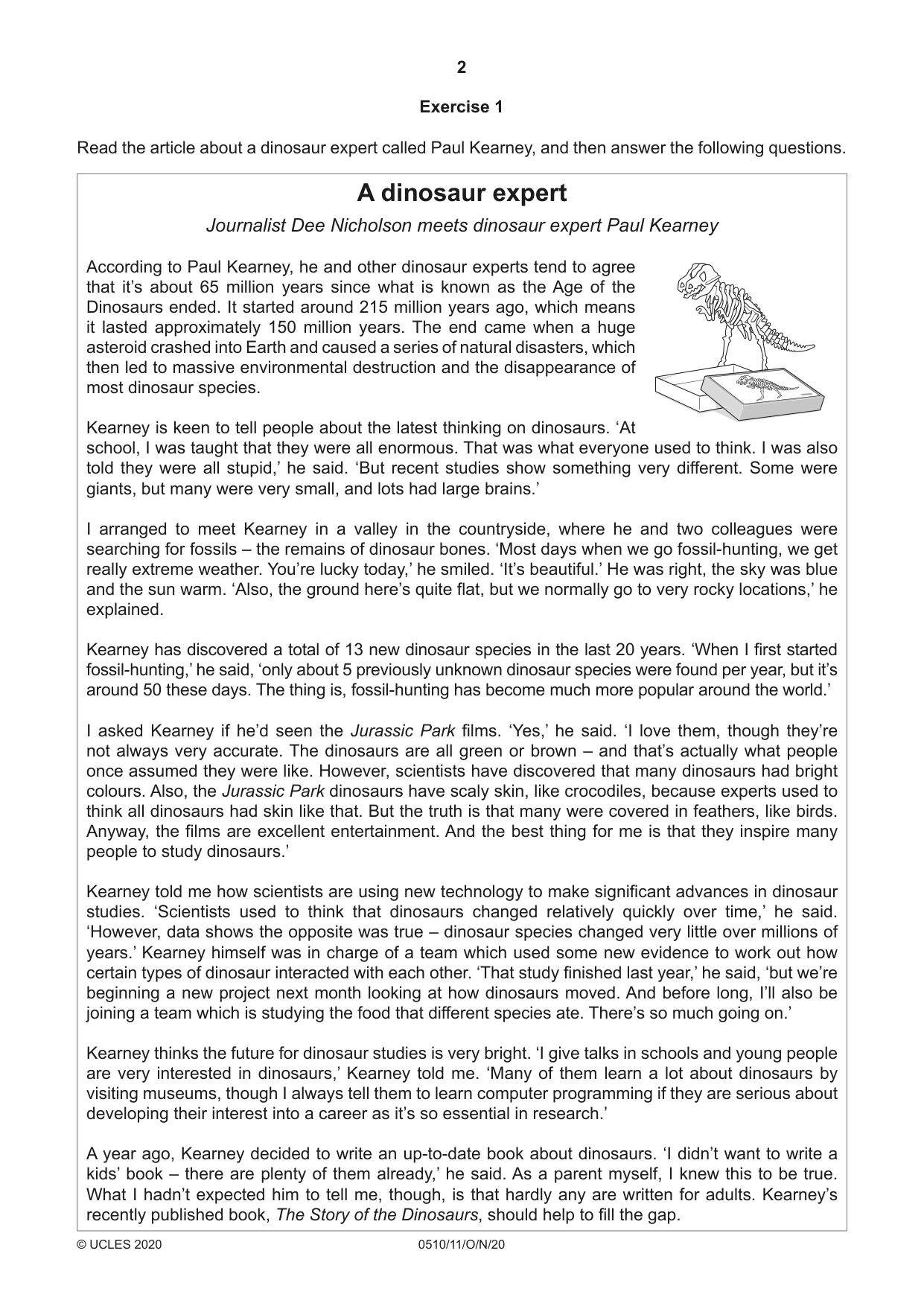
2 0510/11/O/N/20 © UCLES 2020 Exercise 1 Read the article about a dinosaur expert called Paul Kearney, and then answer the following questions. A dinosaur expert Journalist Dee Nicholson meets dinosaur expert Paul Kearney According to Paul Kearney, he and other dinosaur experts tend to agree that it’s about 65 million years since what is known as the Age of the Dinosaurs ended. It started around 215 million years ago, which means it lasted approximately 150 million years. The end came when a huge asteroid crashed into Earth and caused a series of natural disasters, which then led to massive environmental destruction and the disappearance of most dinosaur species. Kearney is keen to tell people about the latest thinking on dinosaurs. ‘At school, I was taught that they were all enormous. That was what everyone used to think. I was also told they were all stupid,’ he said. ‘But recent studies show something very different. Some were giants, but many were very small, and lots had large brains.’ I arranged to meet Kearney in a valley in the countryside, where he and two colleagues were searching for fossils – the remains of dinosaur bones. ‘Most days when we go fossil-hunting, we get really extreme weather. You’re lucky today,’ he smiled. ‘It’s beautiful.’ He was right, the sky was blue and the sun warm. ‘Also, the ground here’s quite flat, but we normally go to very rocky locations,’ he explained. Kearney has discovered a total of 13 new dinosaur species in the last 20 years. ‘When I first started fossil-hunting,’ he said, ‘only about 5 previously unknown dinosaur species were found per year, but it’s around 50 these days. The thing is, fossil-hunting has become much more popular around the world.’ I asked Kearney if he’d seen the Jurassic Park films. ‘Yes,’ he said. ‘I love them, though they’re not always very accurate. The dinosaurs are all green or brown – and that’s actually what people once assumed they were like. However, scientists have discovered that many dinosaurs had bright colours. Also, the Jurassic Park dinosaurs have scaly skin, like crocodiles, because experts used to think all dinosaurs had skin like that. But the truth is that many were covered in feathers, like birds. Anyway, the films are excellent entertainment. And the best thing for me is that they inspire many people to study dinosaurs.’ Kearney told me how scientists are using new technology to make significant advances in dinosaur studies. ‘Scientists used to think that dinosaurs changed relatively quickly over time,’ he said. ‘However, data shows the opposite was true – dinosaur species changed very little over millions of years.’ Kearney himself was in charge of a team which used some new evidence to work out how certain types of dinosaur interacted with each other. ‘That study finished last year,’ he said, ‘but we’re beginning a new project next month looking at how dinosaurs moved. And before long, I’ll also be joining a team which is studying the food that different species ate. There’s so much going on.’ Kearney thinks the future for dinosaur studies is very bright. ‘I give talks in schools and young people are very interested in dinosaurs,’ Kearney told me. ‘Many of them learn a lot about dinosaurs by visiting museums, though I always tell them to learn computer programming if they are serious about developing their interest into a career as it’s so essential in research.’ A year ago, Kearney decided to write an up-to-date book about dinosaurs. ‘I didn’t want to write a kids’ book – there are plenty of them already,’ he said. As a parent myself, I knew this to be true. What I hadn’t expected him to tell me, though, is that hardly any are written for adults. Kearney’s recently published book, The Story of the Dinosaurs, should help to fill the gap.
Question paper, page 3
3 0510/11/O/N/20 © UCLES 2020 [Turn over 1 When did the Age of the Dinosaurs begin? … [1] 2 What conditions does Kearney generally work in when he’s looking for dinosaur remains? Give two details. … … [2] 3 How many new species of dinosaur are now discovered each year? … [1] 4 What does Kearney like most about the Jurassic Park films? … [1] 5 Which two areas of research will Kearney soon start working on? Give two details. … … [2] 6 What advice does Kearney give to students who want to become dinosaur experts? … [1] 7 What was the writer surprised to find out about dinosaur books? … [1] [Total: 9]
Question paper, page 4
4 0510/11/O/N/20 © UCLES 2020 Exercise 2 Read the article about three people (A–C) who studied journalism at university. Then answer Question 8 (a)–(h). Studying journalism A Ines When I was considering what to study at university, my parents encouraged me to choose law. They didn’t think journalism was a good idea, but the mix of practical and academic activities attracted me. I admit that early in the course I missed a few classes. Some were first thing in the morning, and some were in the evening, which I found strange because it was very different from school. My attendance improved, however, and I loved being at university in general. During the course, I was able to visit parts of the city near the university to interview residents, take photos and write news stories, and gradually I became an expert on the place – those are some of my best memories. Since graduating, I’ve worked as a radio producer, a communications manager and now a marketing manager for a software company. So, I’m not a journalist, but the excellent teachers we had helped me develop skills that have been very relevant to what I’ve done since then. B Marta Maybe I didn’t work as much as some other students during my journalism degree, but I did what was necessary and I had some great lecturers. We were given projects which involved doing what real reporters do: investigating and writing about crime, sports and business. I remember one evening in the university library watching other students writing long essays; I was writing questions to ask the star player of the biggest football club in the town the following morning. I thought to myself: ‘It almost seems unfair that I’m doing something so exciting while everyone else is having such a tough time.’ One of my early plans was to become a sports reporter, then I thought about doing travel writing. I struggled to make up my mind about what to do, but I eventually became a media officer for a company that makes sports equipment. I’m responsible for dealing with newspapers, magazines, TV and radio – and social media of course. It’s challenging, but my degree gave me the confidence to do it. C Jess Since I graduated from university, I’ve worked as a writer for three different magazines. So although I’ve moved around, I’ve essentially been doing the same job. Much of my success is due to the degree course I did, which involved not only writing newspaper articles, but also producing, presenting and editing high-quality film and radio broadcasts. I was lucky enough to study in a department where many of the staff had experience of exactly this type of work, so they really knew what they were talking about. The only thing I didn’t enjoy was media law. In fact, I often avoided going to those classes. Looking back, I now wish I hadn’t, because it’s something I need to know about as a journalist. But otherwise, I’d say that the course as a whole was really interesting. However, anyone who wants to study the media from an academic point of view – for example, looking at how the media influences the way people think – should choose another subject, probably sociology.
Question paper, page 5
5 0510/11/O/N/20 © UCLES 2020 [Turn over 8 For each question, write the correct letter A, B or C on the line. Which person … (a) regrets not working harder on one part of the course? … [1] (b) is glad that they had the opportunity to get to know the local area well? … [1] (c) feels fortunate that their teachers had previously worked in the media? … [1] (d) says that the course timetable was hard to get used to at first? … [1] (e) mentions finding it difficult to decide what career to go into? … [1] (f) refers to learning things that have been useful in a variety of professions? … [1] (g) suggests that a journalism degree would not be suitable for everyone? … [1] (h) suggests that they felt guilty at some point during their course? … [1] [Total: 8]
Question paper, page 6
6 0510/11/O/N/20 © UCLES 2020 Exercise 3 Read the article about a teacher who started keeping bees at her school, and then complete the notes. Keeping bees at school Three years ago, Maria Sterling set up what she named the Bee Project at Abbey High, the secondary school in London where she teaches geography. Now, beekeeping is one of the most popular activities at the school. ‘We’re very proud of our Bee Project,’ says Head Teacher Nadia Malan. ‘It’s great tasting the honey!’ says 12-year-old student Luke Davies. ‘I really enjoy watching the bees,’ agrees Sara, a student in Year 11. ‘But the Bee Project is not just about enjoyment,’ Maria explains. ‘Keeping bees and getting honey from them helps to teach students what it means to be responsible for something.’ The bees are kept in hives – large wooden boxes – at one end of the school sports field. Each one contains thousands of bees. ‘The hives are made by some of our students in their technology classes,’ Maria says. ‘Knowing how to make things with wood is really useful, and it’s thanks to the Bee Project that they can do this.’ Maria admits that setting up the Bee Project wasn’t as straightforward as she’d hoped it would be. ‘Persuading parents that it’s safe wasn’t easy at first,’ she says, ‘which is understandable. But it helped when I explained that I remembered being amazed at how gentle bees were when I put my hand inside a hive for the first time.’ The other initial problem was the cost of the equipment, especially the protective clothing. ‘That’s often an issue,’ Maria says. ‘I didn’t have to pay anything for the bees, though.’ Maria has been involved in beekeeping since she was 15, when her father acquired a hive and some bees and asked her to help him. ‘Before Dad got the bees, I hadn’t realised that bees can do well in a big city. In our area of London, there are lots of trees and flowers. Something else I hadn’t expected was that looking after bees can be really relaxing.’ Maria had considered introducing bees into the school where she worked before moving to Abbey High. ‘But I was only there for a year and I never got round to setting up a project. It takes up a lot of time,’ she says. ‘Also, finding a suitable location for the hives can be challenging. I was lucky here because there’s some land nearby that isn’t built on and there are lots of wild plants that I know bees like.’ The Bee Project has influenced what happens in classes at Abbey High. In science lessons, students find out why bees are important for the environment. ‘In geography,’ Maria says, ‘my students do research into the ways people around the world use bees. It’s more meaningful for the students because they can relate the results of their research to our school bees.’ And the honey produced at the school doesn’t go to waste. In cookery lessons, students discover how to use honey to make some delicious dishes. Maria is convinced that more schools would benefit from setting up their own beekeeping projects. ‘There’s plenty of information available about how to do it,’ Maria points out. ‘And if someone’s really interested, they should contact local beekeepers. My dad and I couldn’t believe how helpful other beekeepers were when we were beginners.’
Question paper, page 7
7 0510/11/O/N/20 © UCLES 2020 [Turn over You are going to give a talk about beekeeping to your class at school. Prepare some notes to use as the basis for your talk. Make short notes under each heading. 9 What students at Abbey High school learn from keeping bees: Example: what it means to be responsible for something • … • … [2] 10 What can be difficult about introducing beekeeping in a school: • … • … • … [3] 11 What surprised Maria when she first started beekeeping: • … • … [2] [Total: 7]
Question paper, page 8
8 0510/11/O/N/20 © UCLES 2020 Exercise 4 12 Read the article about learning how to snowboard. Write a summary about the most common mistakes that people make when they are learning how to snowboard. Your summary should be about 80 words long (and no more than 90 words long). You should use your own words as far as possible. You will receive up to 6 marks for the content of your summary, and up to 6 marks for the style and accuracy of your language. Learning how to snowboard Alice Pardew asks an expert for advice on learning how to snowboard In a month’s time, I’m going on a snowboarding holiday with a friend. The trouble is that I’ve never been snowboarding before, and I don’t know if I’ll be able to learn. I contacted snowboarding instructor Ross Gardner for advice. ‘Snowboarding is great fun and you’ll probably love it,’ Ross said. ‘But beginners make plenty of mistakes. The first is that they think it’s going to be easy.’ As I told Ross, I definitely didn’t think that. He then told me that many beginners don’t bother with lessons, which isn’t very wise. I’m sure Ross is right, so I’m definitely going to book a place on a course. ‘Before anyone tries snowboarding, they should do exercises to make their legs stronger,’ Ross said. ‘New snowboarders often ignore that advice.’ By now, I was taking notes of everything Ross said. ‘Also, you’d be amazed at how many first-timers don’t buy suitable clothing,’ he said. ‘And they often end up very cold and wet.’ What about when they get onto the snow? ‘Something that a new snowboarder often gets wrong is trying to attach the snowboard to their feet when standing up – they nearly always fall over as a result,’ Ross said. ‘They should sit down instead.’ I wrote this in my notes. Ross said that most beginners fall over a lot when they start moving, but he doesn’t think of that as a mistake – it’s part of learning. ‘The problem comes when they put their hands out to protect themselves as they’re falling. It can cause wrist injuries.’ But how can you avoid falling? ‘Bending your knees helps, but many people don’t do that,’ Ross explained. I tried to stand in what I imagined the correct position was. ‘That’s quite good,’ Ross nodded. ‘But you’re looking down at the snowboard, which is another common problem. It’s important for snowboarders to look in the direction they want to go.’ I thanked Ross, and left feeling much more confident about how I should prepare for my holiday.
Question paper, page 9
9 0510/11/O/N/20 © UCLES 2020 [Turn over … … … … … … … … … … … … … … [Total: 12]
Question paper, page 10
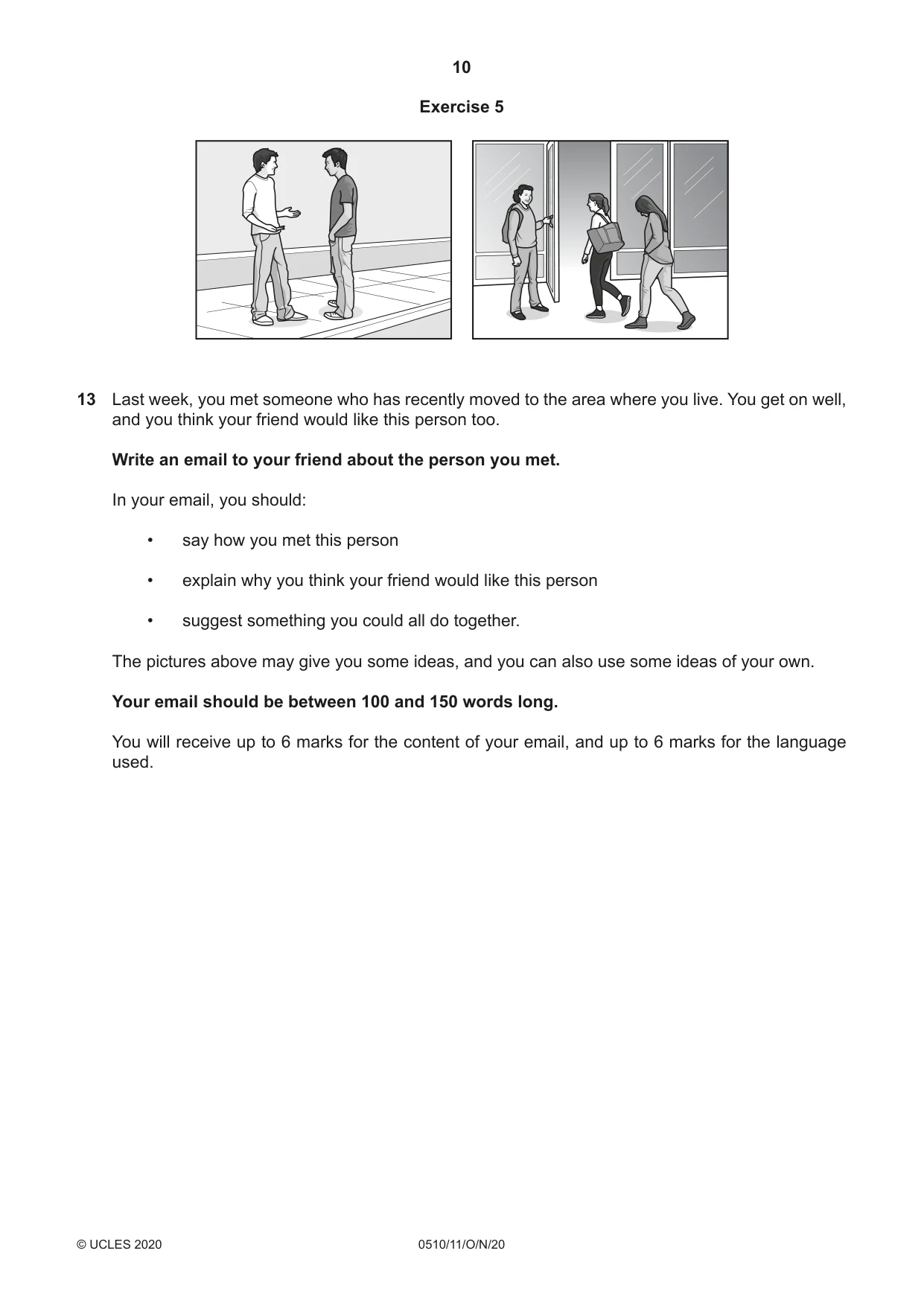
10 0510/11/O/N/20 © UCLES 2020 Exercise 5 13 Last week, you met someone who has recently moved to the area where you live. You get on well, and you think your friend would like this person too. Write an email to your friend about the person you met. In your email, you should: • say how you met this person • explain why you think your friend would like this person • suggest something you could all do together. The pictures above may give you some ideas, and you can also use some ideas of your own. Your email should be between 100 and 150 words long. You will receive up to 6 marks for the content of your email, and up to 6 marks for the language used.
Question paper, page 11
11 0510/11/O/N/20 © UCLES 2020 [Turn over … … … … … … … … … … … … … … … … … … … … … … … … … … … [Total: 12]
Question paper, page 12
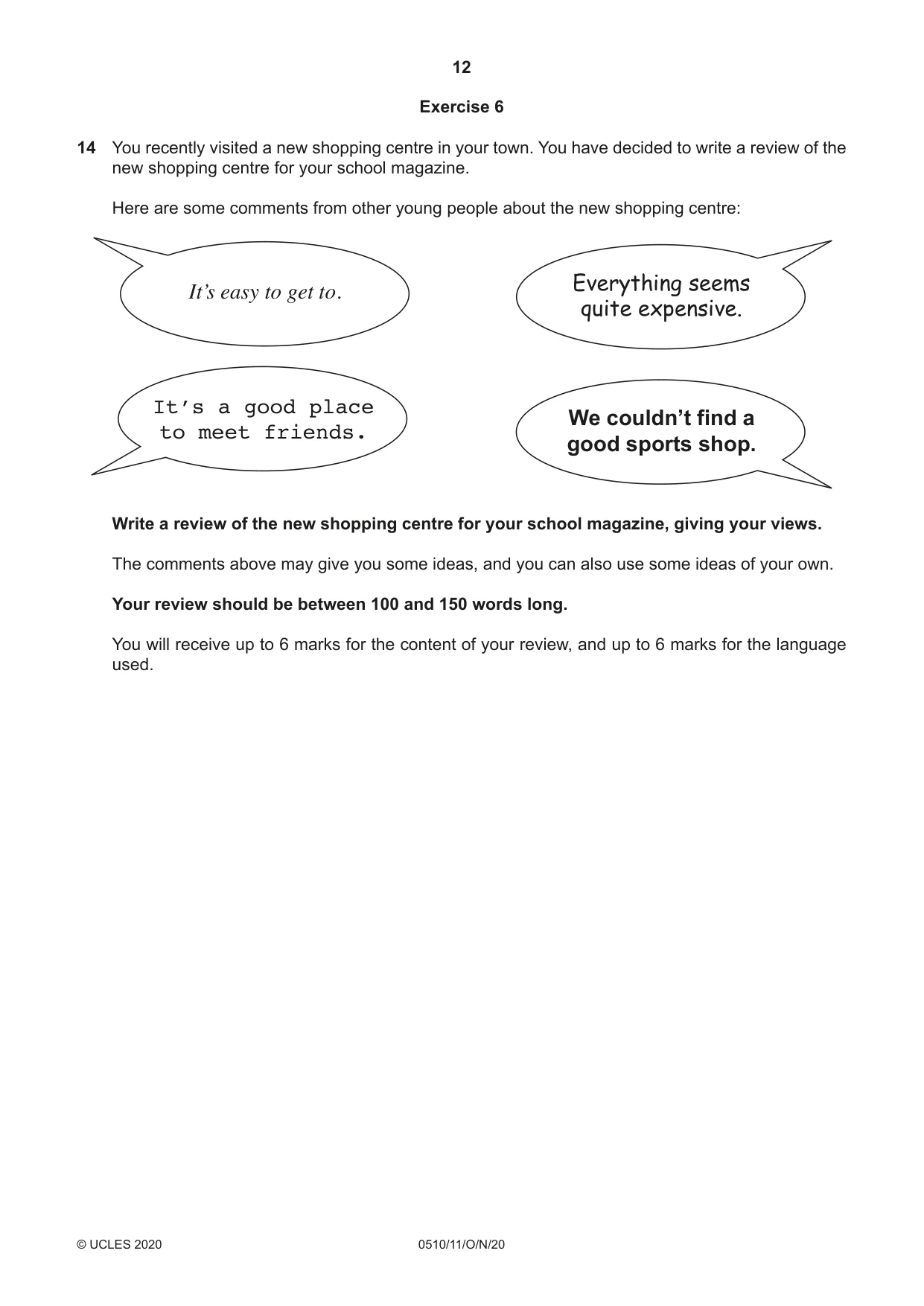
12 0510/11/O/N/20 © UCLES 2020 Exercise 6 14 You recently visited a new shopping centre in your town. You have decided to write a review of the new shopping centre for your school magazine. Here are some comments from other young people about the new shopping centre: It’s easy to get to. It’s a good place to meet friends. Everything seems quite expensive. We couldn’t find a good sports shop. Write a review of the new shopping centre for your school magazine, giving your views. The comments above may give you some ideas, and you can also use some ideas of your own. Your review should be between 100 and 150 words long. You will receive up to 6 marks for the content of your review, and up to 6 marks for the language used.
Question paper, page 13
13 0510/11/O/N/20 © UCLES 2020 … … … … … … … … … … … … … … … … … … … … … … … … … … … [Total: 12]
Question paper, page 14
14 0510/11/O/N/20 © UCLES 2020 BLANK PAGE
Question paper, page 15
15 0510/11/O/N/20 © UCLES 2020 BLANK PAGE
Question paper, page 16
16 0510/11/O/N/20 © UCLES 2020 Permission to reproduce items where third-party owned material protected by copyright is included has been sought and cleared where possible. Every reasonable effort has been made by the publisher (UCLES) to trace copyright holders, but if any items requiring clearance have unwittingly been included, the publisher will be pleased to make amends at the earliest possible opportunity. To avoid the issue of disclosure of answer-related information to candidates, all copyright acknowledgements are reproduced online in the Cambridge Assessment International Education Copyright Acknowledgements Booklet. This is produced for each series of examinations and is freely available to download at www.cambridgeinternational.org after the live examination series. Cambridge Assessment International Education is part of the Cambridge Assessment Group. Cambridge Assessment is the brand name of the University of Cambridge Local Examinations Syndicate (UCLES), which itself is a department of the University of Cambridge. BLANK PAGE
Mark scheme, page 1
This document consists of 10 printed pages. © UCLES 2020 [Turn over Cambridge IGCSE™ ENGLISH AS A SECOND LANGUAGE 0510/11 Paper 1 Reading and Writing (Core) October/November 2020 MARK SCHEME Maximum Mark: 60 Published This mark scheme is published as an aid to teachers and candidates, to indicate the requirements of the examination. It shows the basis on which Examiners were instructed to award marks. It does not indicate the details of the discussions that took place at an Examiners’ meeting before marking began, which would have considered the acceptability of alternative answers. Mark schemes should be read in conjunction with the question paper and the Principal Examiner Report for Teachers. Cambridge International will not enter into discussions about these mark schemes. Cambridge International is publishing the mark schemes for the October/November 2020 series for most Cambridge IGCSE™, Cambridge International A and AS Level and Cambridge Pre-U components, and some Cambridge O Level components.
Mark scheme, page 2
0510/11 Cambridge IGCSE – Mark Scheme PUBLISHED October/November 2020 © UCLES 2020 Page 2 of 10 Generic Marking Principles These general marking principles must be applied by all examiners when marking candidate answers. They should be applied alongside the specific content of the mark scheme or generic level descriptors for a question. Each question paper and mark scheme will also comply with these marking principles. GENERIC MARKING PRINCIPLE 1: Marks must be awarded in line with: • the specific content of the mark scheme or the generic level descriptors for the question • the specific skills defined in the mark scheme or in the generic level descriptors for the question • the standard of response required by a candidate as exemplified by the standardisation scripts. GENERIC MARKING PRINCIPLE 2: Marks awarded are always whole marks (not half marks, or other fractions). GENERIC MARKING PRINCIPLE 3: Marks must be awarded positively: • marks are awarded for correct/valid answers, as defined in the mark scheme. However, credit is given for valid answers which go beyond the scope of the syllabus and mark scheme, referring to your Team Leader as appropriate • marks are awarded when candidates clearly demonstrate what they know and can do • marks are not deducted for errors • marks are not deducted for omissions • answers should only be judged on the quality of spelling, punctuation and grammar when these features are specifically assessed by the question as indicated by the mark scheme. The meaning, however, should be unambiguous. GENERIC MARKING PRINCIPLE 4: Rules must be applied consistently, e.g. in situations where candidates have not followed instructions or in the application of generic level descriptors. GENERIC MARKING PRINCIPLE 5: Marks should be awarded using the full range of marks defined in the mark scheme for the question (however; the use of the full mark range may be limited according to the quality of the candidate responses seen). GENERIC MARKING PRINCIPLE 6: Marks awarded are based solely on the requirements as defined in the mark scheme. Marks should not be awarded with grade thresholds or grade descriptors in mind.
Mark scheme, page 3
0510/11 Cambridge IGCSE – Mark Scheme PUBLISHED October/November 2020 © UCLES 2020 Page 3 of 10 This component forms part of the Core tier assessment of Cambridge IGCSE English as a Second Language and tests the following Assessment Objectives: AO1: Reading R1 identify and select relevant information R2 understand ideas, opinions and attitudes R3 show understanding of the connections between ideas, opinions and attitudes R4 understand what is implied but not directly stated, e.g. gist, writer’s purpose, intentions and feelings AO2: Writing W1 communicate information/ideas/opinions clearly, accurately and effectively W2 organise ideas into coherent paragraphs using a range of appropriate linking devices W3 use a range of grammatical structures accurately and effectively W4 show control of punctuation and spelling W5 use appropriate register and style/format for the given purpose and audience
Mark scheme, page 4
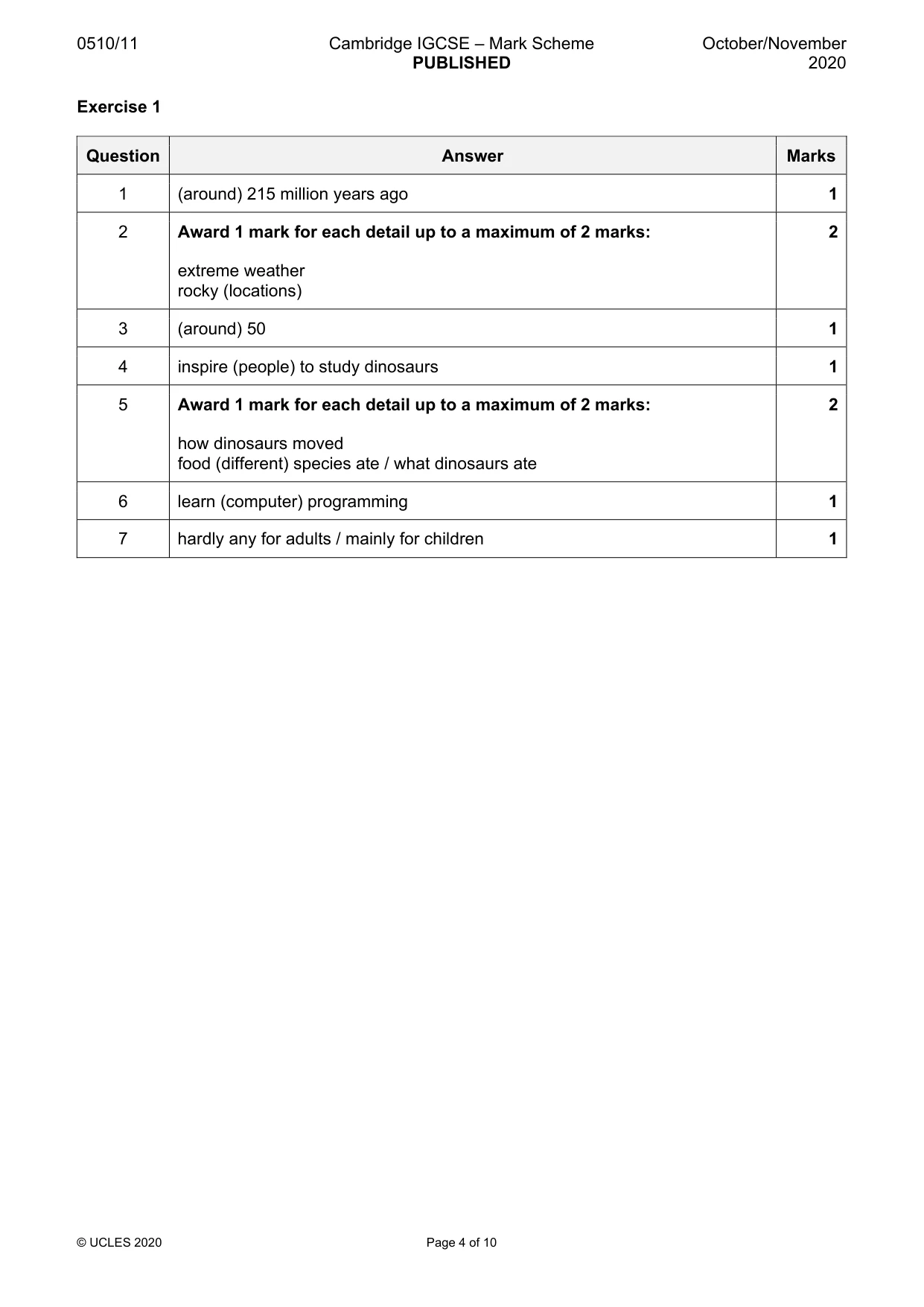
0510/11 Cambridge IGCSE – Mark Scheme PUBLISHED October/November 2020 © UCLES 2020 Page 4 of 10 Exercise 1 Question Answer Marks 1 (around) 215 million years ago 1 2 Award 1 mark for each detail up to a maximum of 2 marks: extreme weather rocky (locations) 2 3 (around) 50 1 4 inspire (people) to study dinosaurs 1 5 Award 1 mark for each detail up to a maximum of 2 marks: how dinosaurs moved food (different) species ate / what dinosaurs ate 2 6 learn (computer) programming 1 7 hardly any for adults / mainly for children 1
Mark scheme, page 5
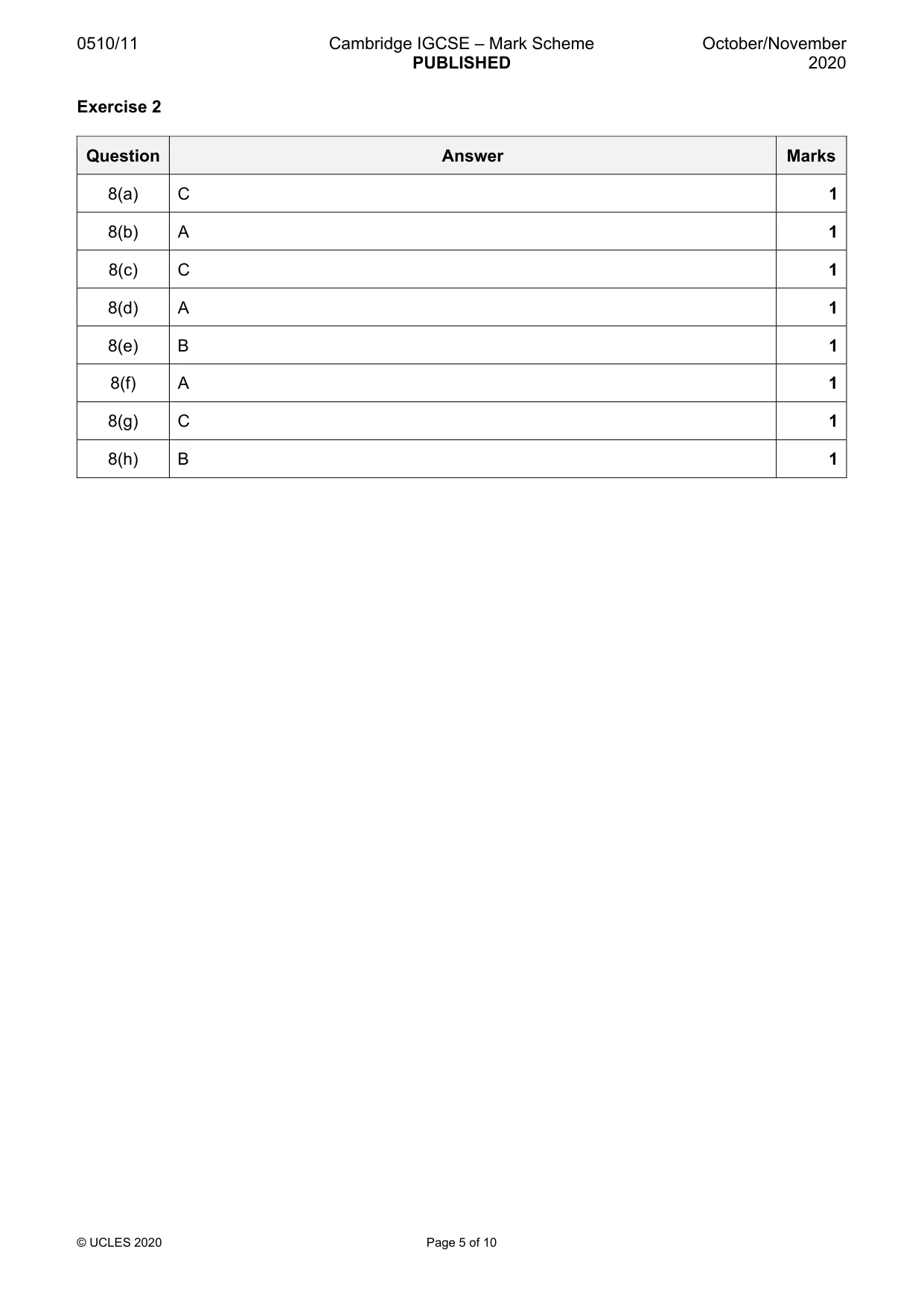
0510/11 Cambridge IGCSE – Mark Scheme PUBLISHED October/November 2020 © UCLES 2020 Page 5 of 10 Exercise 2 Question Answer Marks 8(a) C 1 8(b) A 1 8(c) C 1 8(d) A 1 8(e) B 1 8(f) A 1 8(g) C 1 8(h) B 1
Mark scheme, page 6
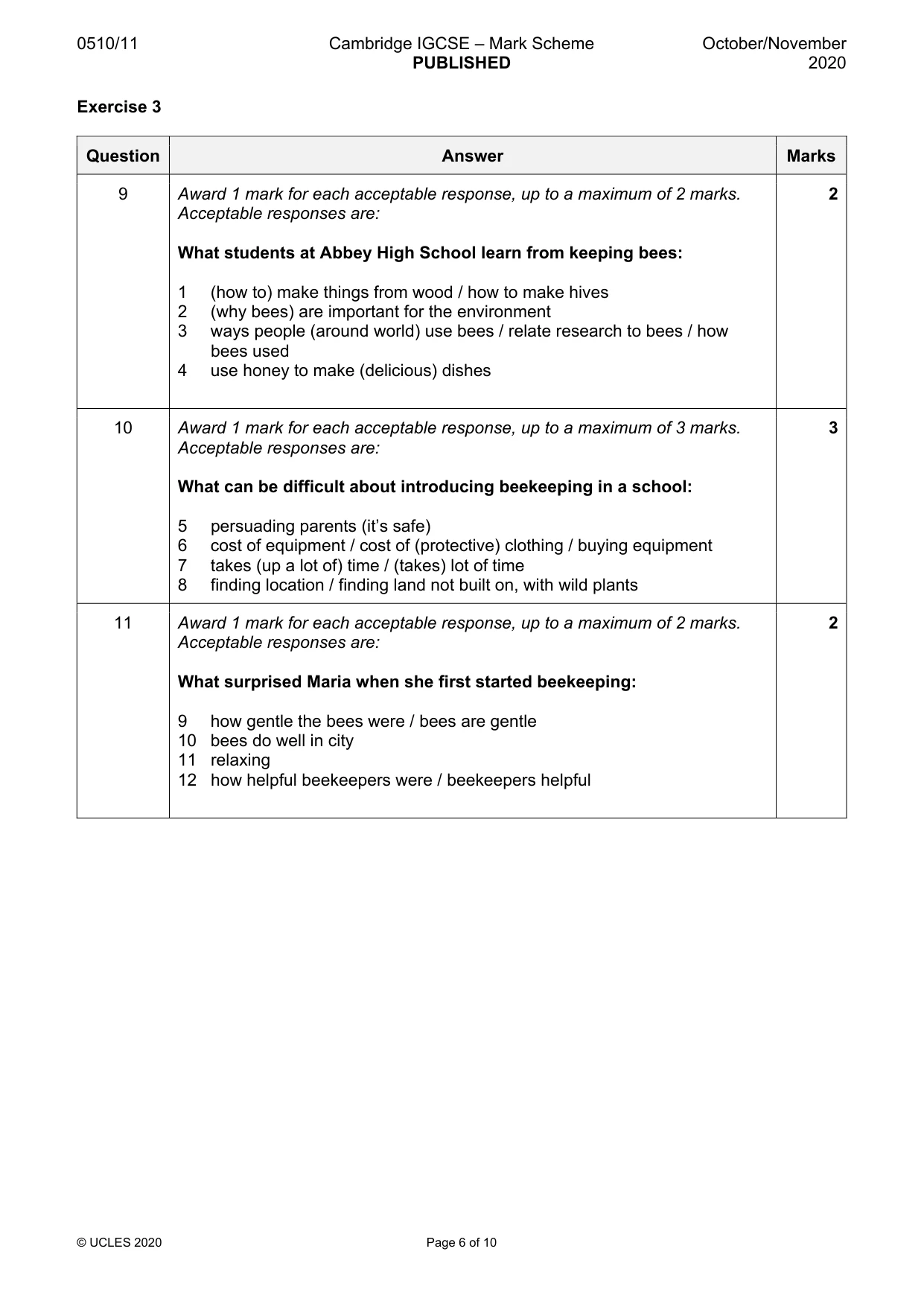
0510/11 Cambridge IGCSE – Mark Scheme PUBLISHED October/November 2020 © UCLES 2020 Page 6 of 10 Exercise 3 Question Answer Marks 9 Award 1 mark for each acceptable response, up to a maximum of 2 marks. Acceptable responses are: What students at Abbey High School learn from keeping bees: 1 (how to) make things from wood / how to make hives 2 (why bees) are important for the environment 3 ways people (around world) use bees / relate research to bees / how bees used 4 use honey to make (delicious) dishes 2 10 Award 1 mark for each acceptable response, up to a maximum of 3 marks. Acceptable responses are: What can be difficult about introducing beekeeping in a school: 5 persuading parents (it’s safe) 6 cost of equipment / cost of (protective) clothing / buying equipment 7 takes (up a lot of) time / (takes) lot of time 8 finding location / finding land not built on, with wild plants 3 11 Award 1 mark for each acceptable response, up to a maximum of 2 marks. Acceptable responses are: What surprised Maria when she first started beekeeping: 9 how gentle the bees were / bees are gentle 10 bees do well in city 11 relaxing 12 how helpful beekeepers were / beekeepers helpful 2
Mark scheme, page 7
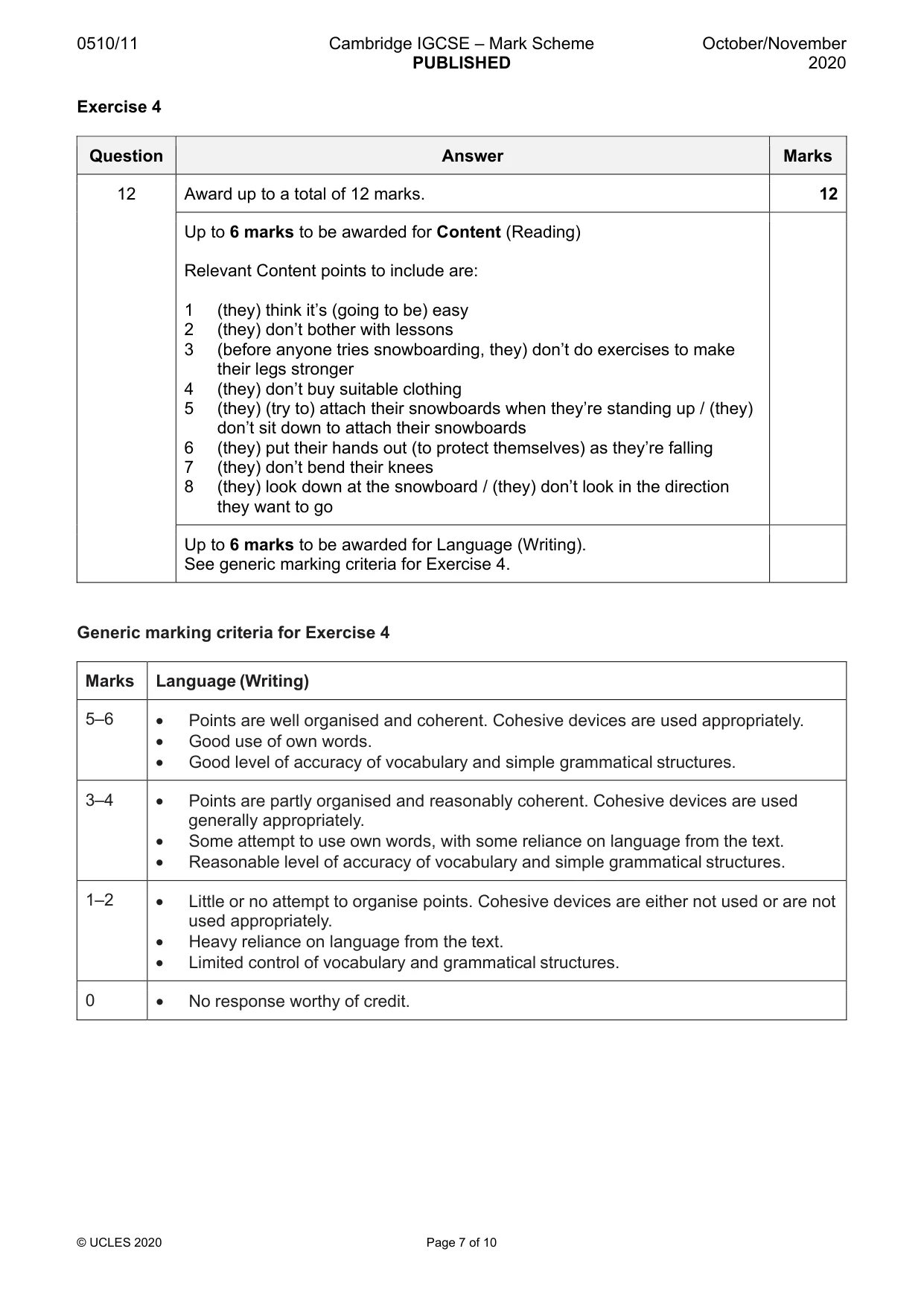
0510/11 Cambridge IGCSE – Mark Scheme PUBLISHED October/November 2020 © UCLES 2020 Page 7 of 10 Exercise 4 Question Answer Marks 12 Award up to a total of 12 marks. 12 Up to 6 marks to be awarded for Content (Reading) Relevant Content points to include are: 1 (they) think it’s (going to be) easy 2 (they) don’t bother with lessons 3 (before anyone tries snowboarding, they) don’t do exercises to make their legs stronger 4 (they) don’t buy suitable clothing 5 (they) (try to) attach their snowboards when they’re standing up / (they) don’t sit down to attach their snowboards 6 (they) put their hands out (to protect themselves) as they’re falling 7 (they) don’t bend their knees 8 (they) look down at the snowboard / (they) don’t look in the direction they want to go Up to 6 marks to be awarded for Language (Writing). See generic marking criteria for Exercise 4. Generic marking criteria for Exercise 4 Marks Language (Writing) 5–6 • Points are well organised and coherent. Cohesive devices are used appropriately. • Good use of own words. • Good level of accuracy of vocabulary and simple grammatical structures. 3–4 • Points are partly organised and reasonably coherent. Cohesive devices are used generally appropriately. • Some attempt to use own words, with some reliance on language from the text. • Reasonable level of accuracy of vocabulary and simple grammatical structures. 1–2 • Little or no attempt to organise points. Cohesive devices are either not used or are not used appropriately. • Heavy reliance on language from the text. • Limited control of vocabulary and grammatical structures. 0 • No response worthy of credit.
Mark scheme, page 8
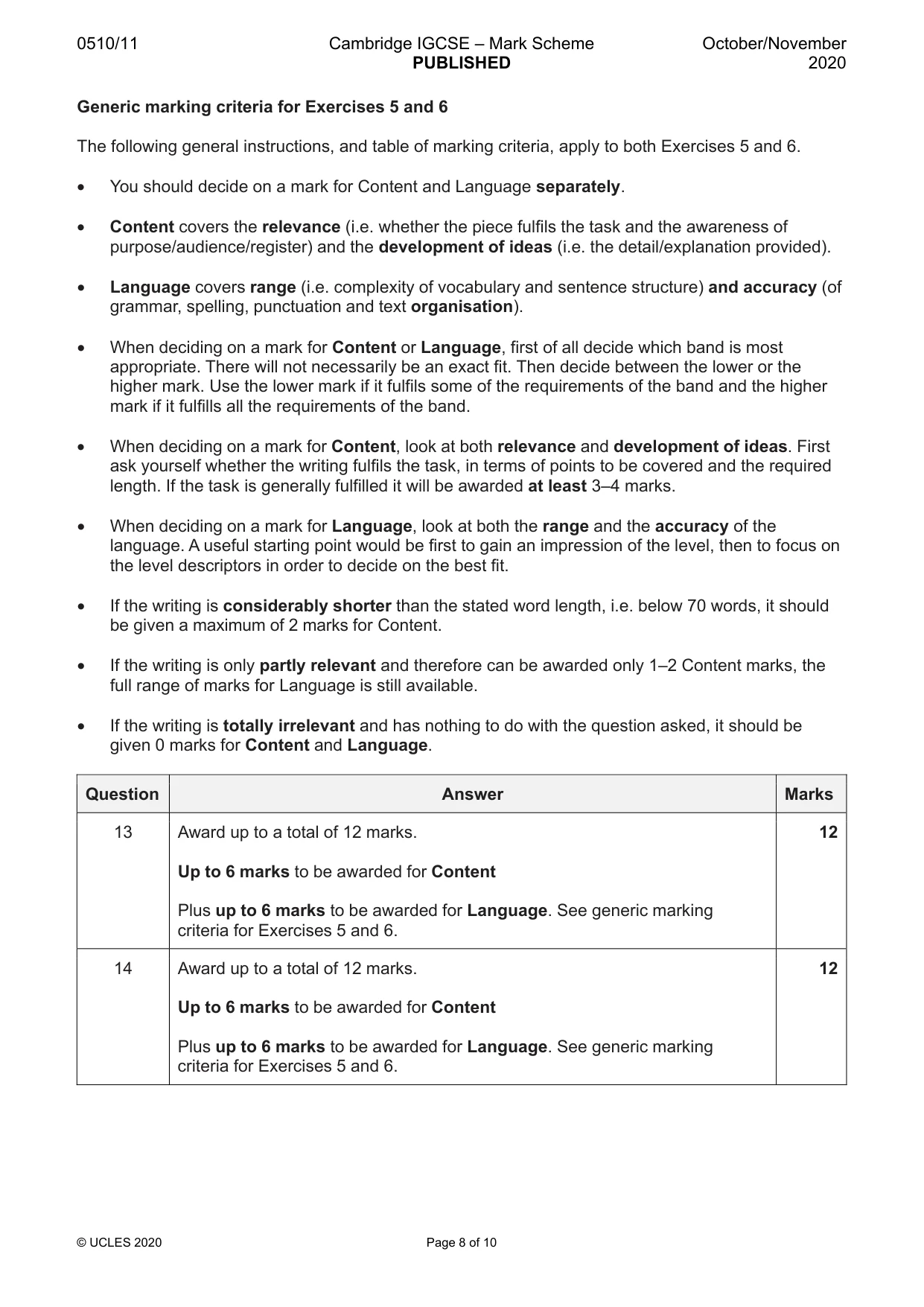
0510/11 Cambridge IGCSE – Mark Scheme PUBLISHED October/November 2020 © UCLES 2020 Page 8 of 10 Generic marking criteria for Exercises 5 and 6 The following general instructions, and table of marking criteria, apply to both Exercises 5 and 6. • You should decide on a mark for Content and Language separately. • Content covers the relevance (i.e. whether the piece fulfils the task and the awareness of purpose/audience/register) and the development of ideas (i.e. the detail/explanation provided). • Language covers range (i.e. complexity of vocabulary and sentence structure) and accuracy (of grammar, spelling, punctuation and text organisation). • When deciding on a mark for Content or Language, first of all decide which band is most appropriate. There will not necessarily be an exact fit. Then decide between the lower or the higher mark. Use the lower mark if it fulfils some of the requirements of the band and the higher mark if it fulfills all the requirements of the band. • When deciding on a mark for Content, look at both relevance and development of ideas. First ask yourself whether the writing fulfils the task, in terms of points to be covered and the required length. If the task is generally fulfilled it will be awarded at least 3–4 marks. • When deciding on a mark for Language, look at both the range and the accuracy of the language. A useful starting point would be first to gain an impression of the level, then to focus on the level descriptors in order to decide on the best fit. • If the writing is considerably shorter than the stated word length, i.e. below 70 words, it should be given a maximum of 2 marks for Content. • If the writing is only partly relevant and therefore can be awarded only 1–2 Content marks, the full range of marks for Language is still available. • If the writing is totally irrelevant and has nothing to do with the question asked, it should be given 0 marks for Content and Language. Question Answer Marks 13 Award up to a total of 12 marks. Up to 6 marks to be awarded for Content Plus up to 6 marks to be awarded for Language. See generic marking criteria for Exercises 5 and 6. 12 14 Award up to a total of 12 marks. Up to 6 marks to be awarded for Content Plus up to 6 marks to be awarded for Language. See generic marking criteria for Exercises 5 and 6. 12
Mark scheme, page 9
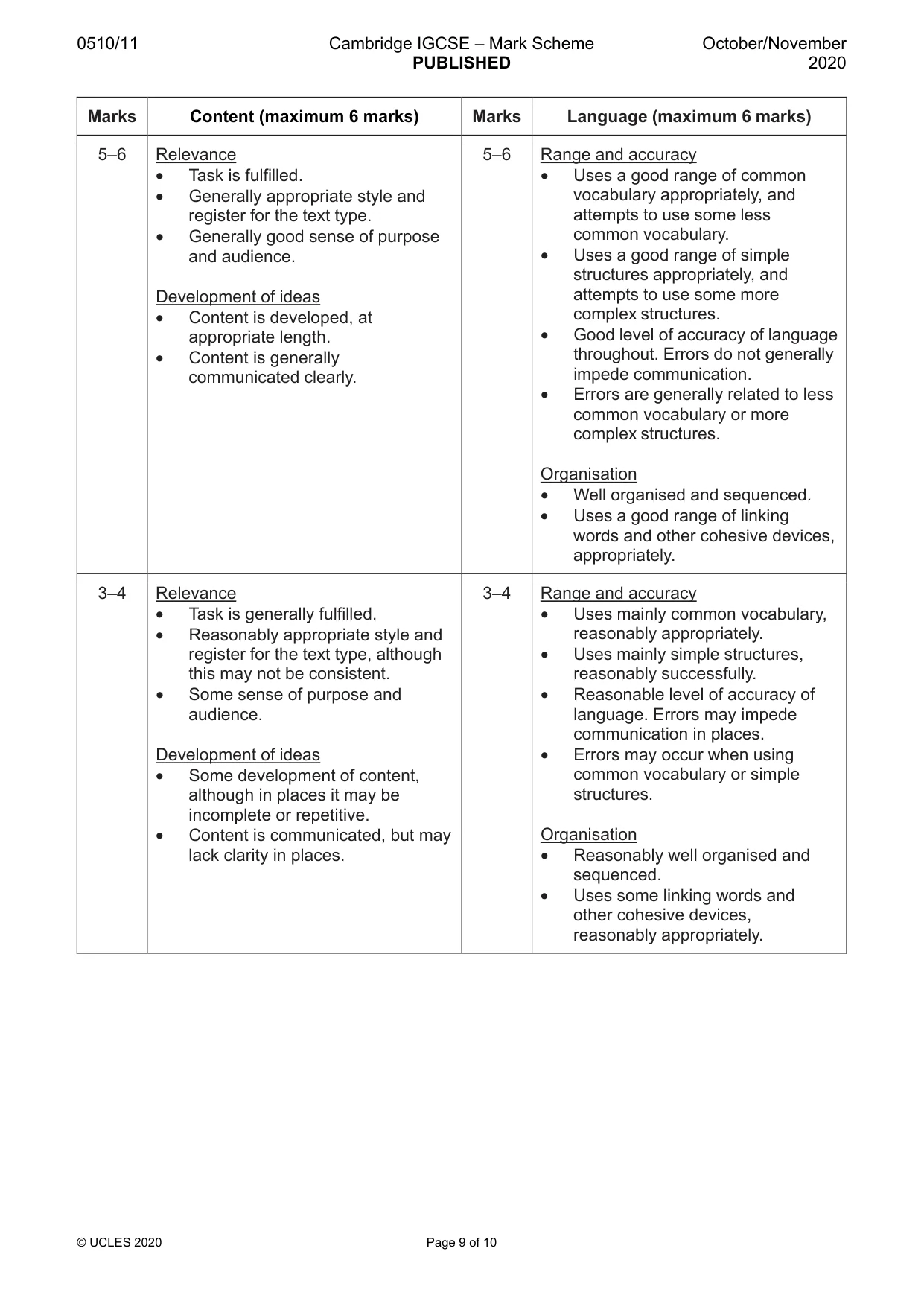
0510/11 Cambridge IGCSE – Mark Scheme PUBLISHED October/November 2020 © UCLES 2020 Page 9 of 10 Marks Content (maximum 6 marks) Marks Language (maximum 6 marks) 5–6 Relevance • Task is fulfilled. • Generally appropriate style and register for the text type. • Generally good sense of purpose and audience. Development of ideas • Content is developed, at appropriate length. • Content is generally communicated clearly. 5–6 Range and accuracy • Uses a good range of common vocabulary appropriately, and attempts to use some less common vocabulary. • Uses a good range of simple structures appropriately, and attempts to use some more complex structures. • Good level of accuracy of language throughout. Errors do not generally impede communication. • Errors are generally related to less common vocabulary or more complex structures. Organisation • Well organised and sequenced. • Uses a good range of linking words and other cohesive devices, appropriately. 3–4 Relevance • Task is generally fulfilled. • Reasonably appropriate style and register for the text type, although this may not be consistent. • Some sense of purpose and audience. Development of ideas • Some development of content, although in places it may be incomplete or repetitive. • Content is communicated, but may lack clarity in places. 3–4 Range and accuracy • Uses mainly common vocabulary, reasonably appropriately. • Uses mainly simple structures, reasonably successfully. • Reasonable level of accuracy of language. Errors may impede communication in places. • Errors may occur when using common vocabulary or simple structures. Organisation • Reasonably well organised and sequenced. • Uses some linking words and other cohesive devices, reasonably appropriately.
Mark scheme, page 10
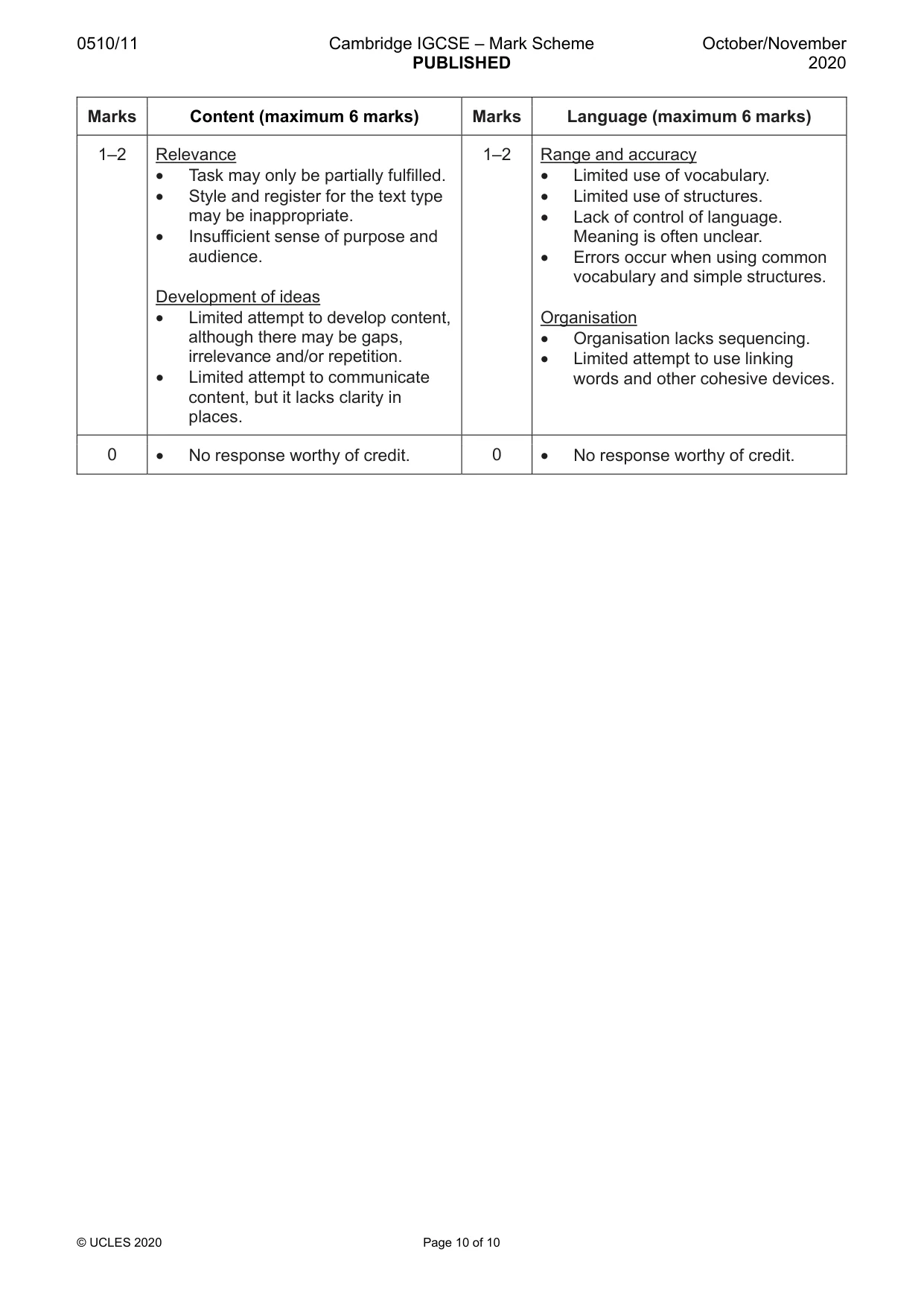
0510/11 Cambridge IGCSE – Mark Scheme PUBLISHED October/November 2020 © UCLES 2020 Page 10 of 10 Marks Content (maximum 6 marks) Marks Language (maximum 6 marks) 1–2 Relevance • Task may only be partially fulfilled. • Style and register for the text type may be inappropriate. • Insufficient sense of purpose and audience. Development of ideas • Limited attempt to develop content, although there may be gaps, irrelevance and/or repetition. • Limited attempt to communicate content, but it lacks clarity in places. 1–2 Range and accuracy • Limited use of vocabulary. • Limited use of structures. • Lack of control of language. Meaning is often unclear. • Errors occur when using common vocabulary and simple structures. Organisation • Organisation lacks sequencing. • Limited attempt to use linking words and other cohesive devices. 0 • No response worthy of credit. 0 • No response worthy of credit.
What you needed in this session
Cambridge’s own grade thresholds for 2020 Oct/Nov, Paper 1 · Variant 1. A higher threshold means an easier paper — the bar moves with how the cohort did.