Cambridge IGCSE English - Second Language (oral endorsement) 0510 — 2016 Oct/Nov Paper 1 · Variant 1
0510/11/O/N/16 · 70 marks · ≈79 min
The question paper and its mark scheme, free to read here and free to download. This is Cambridge’s own paper, exactly as it was sat.
Question paper16 pages





Mark scheme11 pages
Answers below. Sit the paper first if you are practising.
Paper as text
Question paper, page 1
This document consists of 13 printed pages and 3 blank pages. DC (LK/CGW) 119403/5 © UCLES 2016 [Turn over Cambridge International Examinations Cambridge International General Certificate of Secondary Education * 5 6 4 4 5 8 2 3 7 4 * ENGLISH AS A SECOND LANGUAGE 0510/11 Paper 1 Reading and Writing (Core) October/November 2016 1 hour 30 minutes Candidates answer on the Question Paper. No Additional Materials are required. READ THESE INSTRUCTIONS FIRST Write your Centre number, candidate number and name on all the work you hand in. Write in dark blue or black pen. Do not use staples, paper clips, glue or correction fluid. DO NOT WRITE IN ANY BARCODES. Answer all questions. Dictionaries are not allowed. At the end of the examination, fasten all your work securely together. The number of marks is given in brackets [ ] at the end of each question or part question.
Question paper, page 2
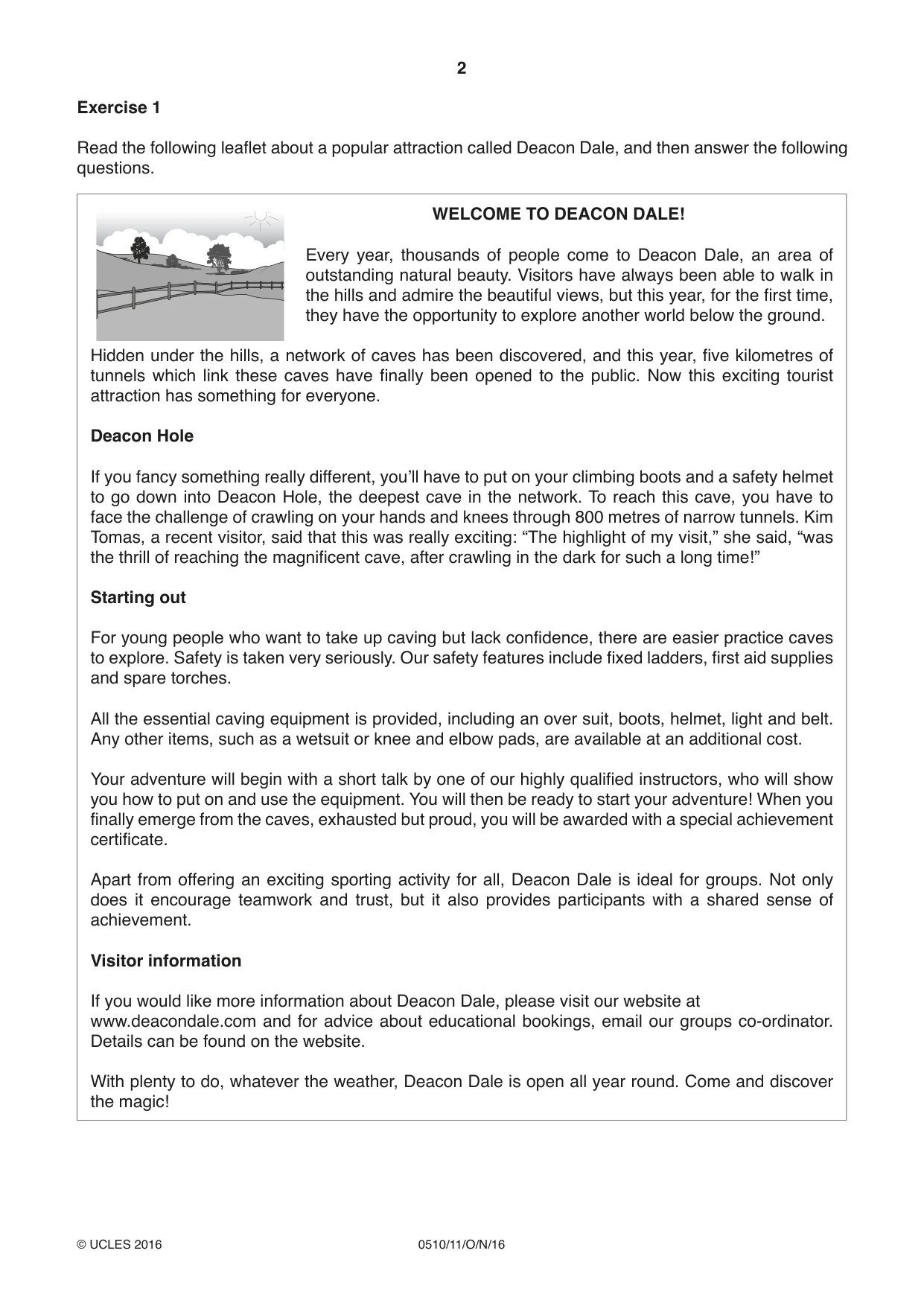
2 0510/11/O/N/16 © UCLES 2016 Exercise 1 Read the following leaflet about a popular attraction called Deacon Dale, and then answer the following questions. WELCOME TO DEACON DALE! Every year, thousands of people come to Deacon Dale, an area of outstanding natural beauty. Visitors have always been able to walk in the hills and admire the beautiful views, but this year, for the first time, they have the opportunity to explore another world below the ground. Hidden under the hills, a network of caves has been discovered, and this year, five kilometres of tunnels which link these caves have finally been opened to the public. Now this exciting tourist attraction has something for everyone. Deacon Hole If you fancy something really different, you’ll have to put on your climbing boots and a safety helmet to go down into Deacon Hole, the deepest cave in the network. To reach this cave, you have to face the challenge of crawling on your hands and knees through 800 metres of narrow tunnels. Kim Tomas, a recent visitor, said that this was really exciting: “The highlight of my visit,” she said, “was the thrill of reaching the magnificent cave, after crawling in the dark for such a long time!” Starting out For young people who want to take up caving but lack confidence, there are easier practice caves to explore. Safety is taken very seriously. Our safety features include fixed ladders, first aid supplies and spare torches. All the essential caving equipment is provided, including an over suit, boots, helmet, light and belt. Any other items, such as a wetsuit or knee and elbow pads, are available at an additional cost. Your adventure will begin with a short talk by one of our highly qualified instructors, who will show you how to put on and use the equipment. You will then be ready to start your adventure! When you finally emerge from the caves, exhausted but proud, you will be awarded with a special achievement certificate. Apart from offering an exciting sporting activity for all, Deacon Dale is ideal for groups. Not only does it encourage teamwork and trust, but it also provides participants with a shared sense of achievement. Visitor information If you would like more information about Deacon Dale, please visit our website at www.deacondale.com and for advice about educational bookings, email our groups co-ordinator. Details can be found on the website. With plenty to do, whatever the weather, Deacon Dale is open all year round. Come and discover the magic!
Question paper, page 3
3 0510/11/O/N/16 © UCLES 2016 [Turn over (a) What has been found underground at Deacon Dale? …[1] (b) What must you do before you can start climbing down to Deacon Hole? Give two details. … …[1] (c) Where in Deacon Dale can beginners start caving? …[1] (d) Which equipment will you have to pay extra for when you go caving at Deacon Dale? Give two details. … …[1] (e) According to the leaflet, how will you feel after your first caving adventure? …[1] (f) Why is a visit to Deacon Dale popular with groups? Give two details. … …[2] [Total: 7]
Question paper, page 4
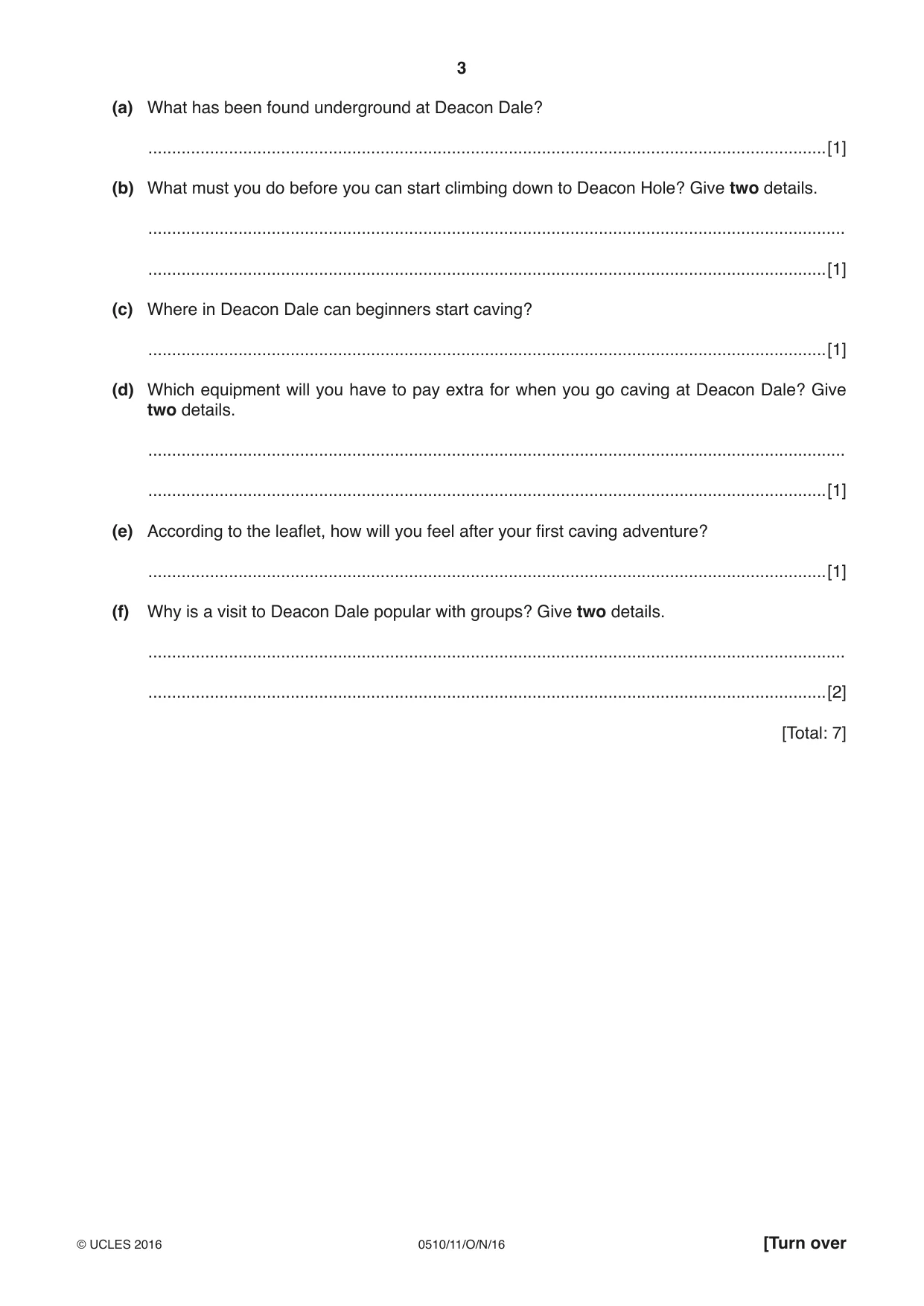
4 0510/11/O/N/16 © UCLES 2016 Exercise 2 Read the following article about the Dana octopus squid, and then answer the following questions. SQUID THAT LIGHTS UP IN THE DARK Several species of squid, including the giant squid and the colossal squid, live in the deep waters of the ocean. However, very little is known about them. Scientists have therefore been particularly excited to discover another type of deep-sea squid – one which lights up in the dark. This enormous squid, known as the Dana octopus squid, has been filmed for the first time in the wild. The film shows the squid, which can grow as big as a human, using bright, flashing lights on its arms to catch other creatures. The glow-in-the-dark squid was discovered in 2006 in the dark waters of the North Pacific Ocean off south-eastern Japan by Japanese scientists, during an expedition led by Tsunemi Kubodera of the National Science Museum in Tokyo. They attracted the massive squid by putting food at the end of a long line which they dropped from the research ship down into the ocean, and lowered cameras alongside it. Two years previously, in 2004, the same team had also filmed the first ever images of a live giant squid. The Dana octopus squid, like most squid, has eight arms with cat-like claws on its suckers. Other large squid use two long tentacles, which are like extra arms, to grab creatures while hunting, but scientists think that the Dana octopus squid blinds its victims using light-producing organs on the ends of two of its arms. These organs, which are about the size of lemons, are called photophores, and they can be opened and closed like eyes. This deep-sea squid swims in a very dark environment, so their photophores can be used to light up its immediate surroundings. Additionally, the squid uses them to measure the distance between itself and its prey. The Japanese scientists noticed that the Dana octopus squid also glows when it is not hunting. They believe that the squid uses these light signals as a form of communication. For example, a single flash of light seems to act as a warning signal when the squid is approaching unfamiliar objects. Further investigation revealed that these flashes of light could also be used to attract a mate. Researchers already had some ideas about how this glowing squid behaves, and the new video footage supports those theories. “It’s nice to have some proof,” says squid researcher Michael Vecchione of the Natural History Institute. “It has mostly been just theory and guesswork up until now.” The footage also shows that the Dana octopus squid is a very effective hunter. It swims backwards and forwards and it is able to change direction rapidly by bending its body. On the film some were seen reaching speeds of 2.5 metres per second as they attacked the food. “Some people have said that all deep-water squid are rather slow and heavy because their muscles are not very firm,” says Vecchione, “but this particular type of squid has got very muscular fins for swimming.” The Dana octopus squid is thought to be one of the world’s largest squid and scientists believe that they live in large numbers in the tropical oceans. However, because they swim in such deep waters, it has not been easy to conduct more detailed research on them. Until the Japanese team caught them on film, no one had ever seen one alive. Deep-sea squid Length in metres Female giant squid Male giant squid Dana octopus squid Colossal squid 20 15 10 5 0
Question paper, page 5
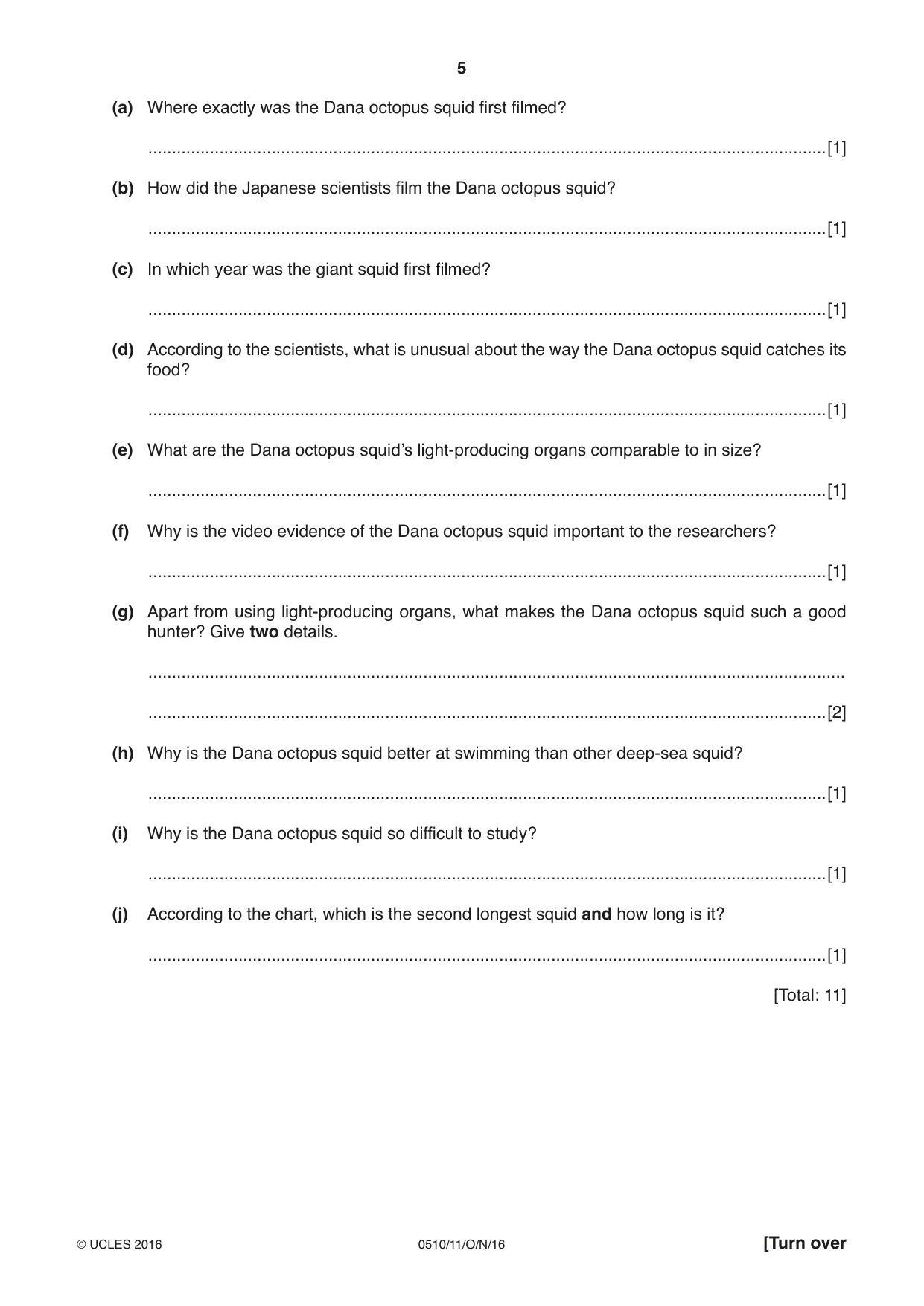
5 0510/11/O/N/16 © UCLES 2016 [Turn over (a) Where exactly was the Dana octopus squid first filmed? …[1] (b) How did the Japanese scientists film the Dana octopus squid? …[1] (c) In which year was the giant squid first filmed? …[1] (d) According to the scientists, what is unusual about the way the Dana octopus squid catches its food? …[1] (e) What are the Dana octopus squid’s light-producing organs comparable to in size? …[1] (f) Why is the video evidence of the Dana octopus squid important to the researchers? …[1] (g) Apart from using light-producing organs, what makes the Dana octopus squid such a good hunter? Give two details. … …[2] (h) Why is the Dana octopus squid better at swimming than other deep-sea squid? …[1] (i) Why is the Dana octopus squid so difficult to study? …[1] (j) According to the chart, which is the second longest squid and how long is it? …[1] [Total: 11]
Question paper, page 6
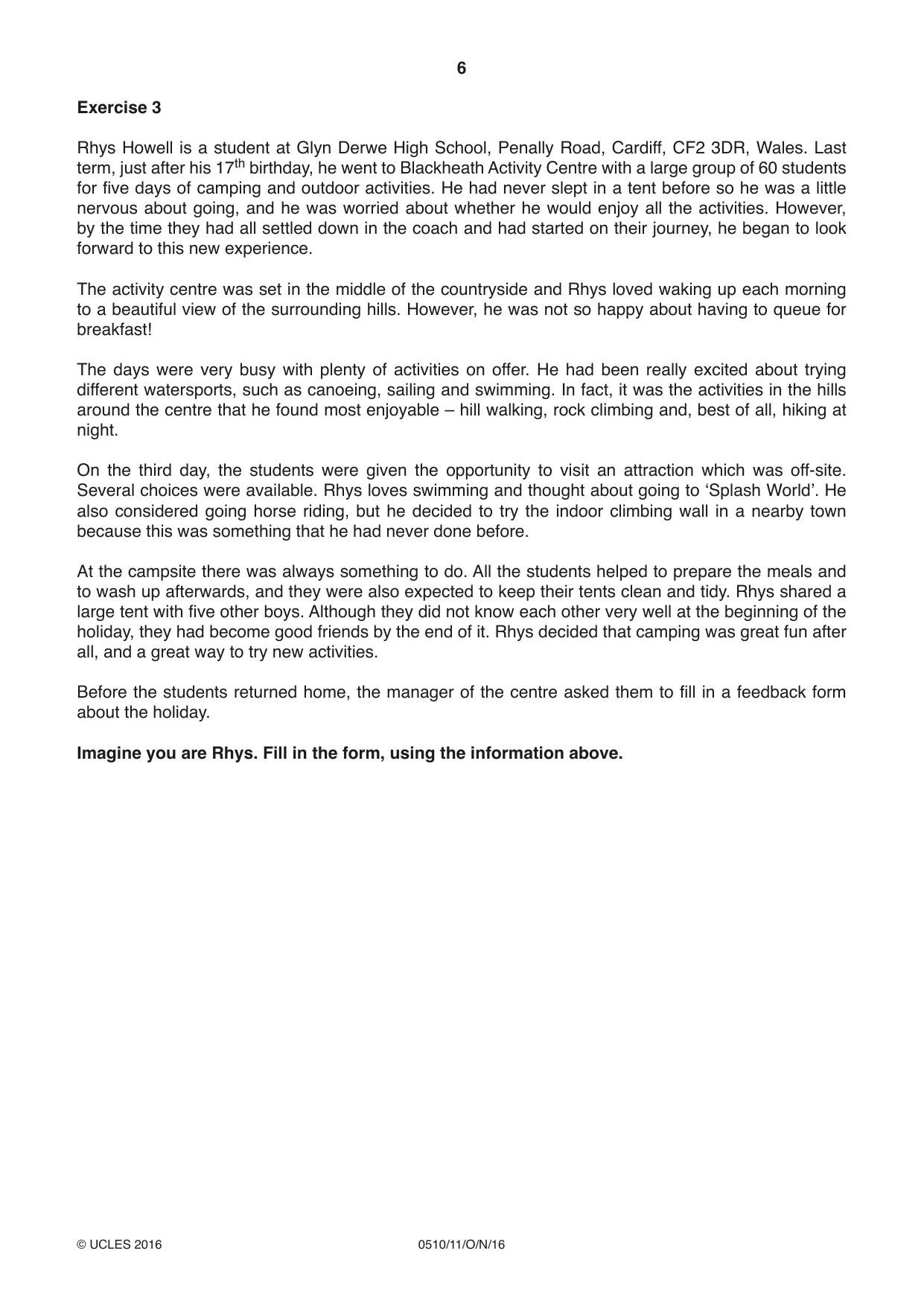
6 0510/11/O/N/16 © UCLES 2016 Exercise 3 Rhys Howell is a student at Glyn Derwe High School, Penally Road, Cardiff, CF2 3DR, Wales. Last term, just after his 17th birthday, he went to Blackheath Activity Centre with a large group of 60 students for five days of camping and outdoor activities. He had never slept in a tent before so he was a little nervous about going, and he was worried about whether he would enjoy all the activities. However, by the time they had all settled down in the coach and had started on their journey, he began to look forward to this new experience. The activity centre was set in the middle of the countryside and Rhys loved waking up each morning to a beautiful view of the surrounding hills. However, he was not so happy about having to queue for breakfast! The days were very busy with plenty of activities on offer. He had been really excited about trying different watersports, such as canoeing, sailing and swimming. In fact, it was the activities in the hills around the centre that he found most enjoyable – hill walking, rock climbing and, best of all, hiking at night. On the third day, the students were given the opportunity to visit an attraction which was off-site. Several choices were available. Rhys loves swimming and thought about going to ‘Splash World’. He also considered going horse riding, but he decided to try the indoor climbing wall in a nearby town because this was something that he had never done before. At the campsite there was always something to do. All the students helped to prepare the meals and to wash up afterwards, and they were also expected to keep their tents clean and tidy. Rhys shared a large tent with five other boys. Although they did not know each other very well at the beginning of the holiday, they had become good friends by the end of it. Rhys decided that camping was great fun after all, and a great way to try new activities. Before the students returned home, the manager of the centre asked them to fill in a feedback form about the holiday. Imagine you are Rhys. Fill in the form, using the information above.
Question paper, page 7
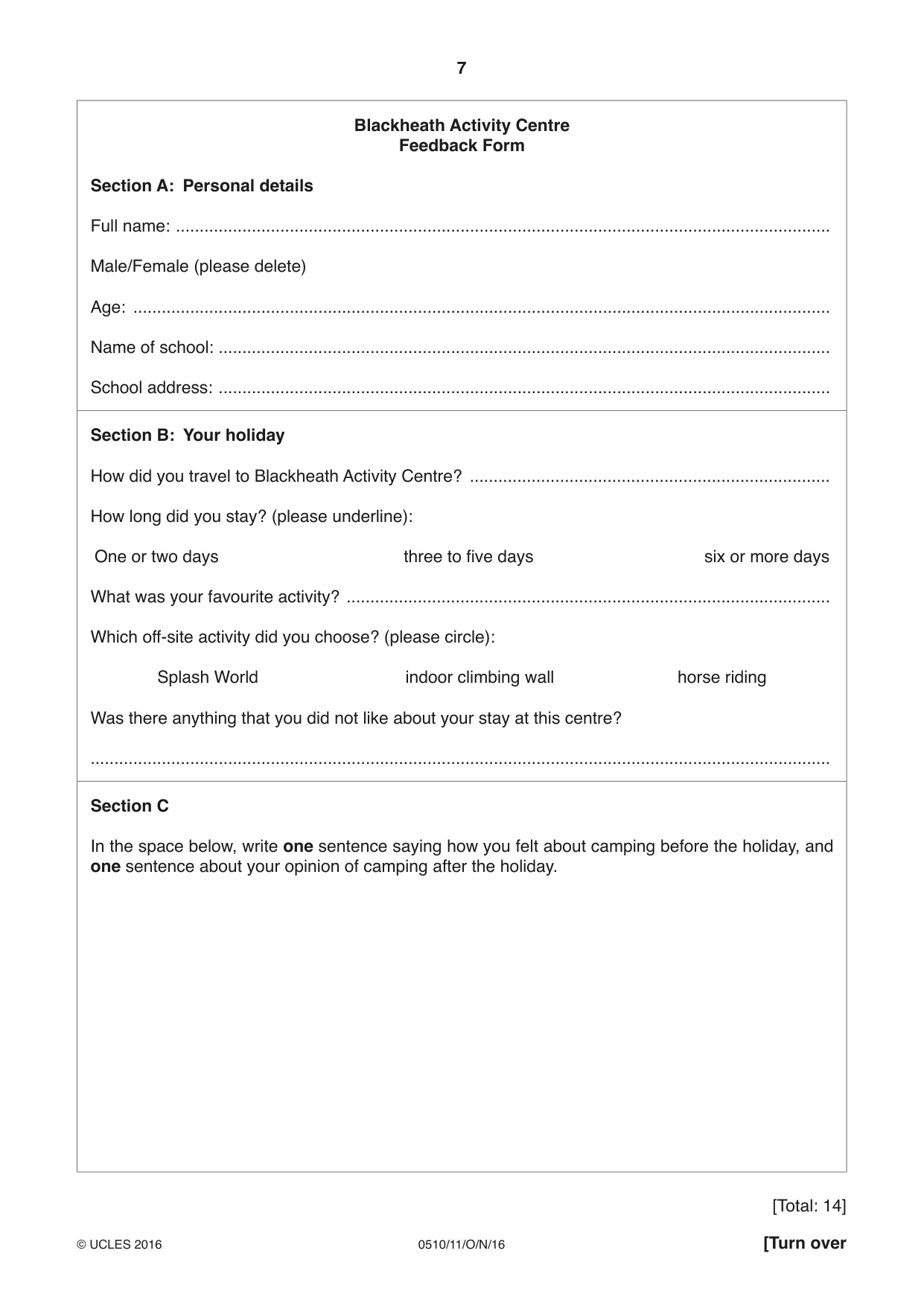
7 0510/11/O/N/16 © UCLES 2016 [Turn over Blackheath Activity Centre Feedback Form Section A: Personal details Full name: … Male/Female (please delete) Age: … Name of school: … School address: … Section B: Your holiday How did you travel to Blackheath Activity Centre? … How long did you stay? (please underline): One or two days three to five days six or more days What was your favourite activity? … Which off-site activity did you choose? (please circle): Splash World indoor climbing wall horse riding Was there anything that you did not like about your stay at this centre? … Section C In the space below, write one sentence saying how you felt about camping before the holiday, and one sentence about your opinion of camping after the holiday. [Total: 14]
Question paper, page 8
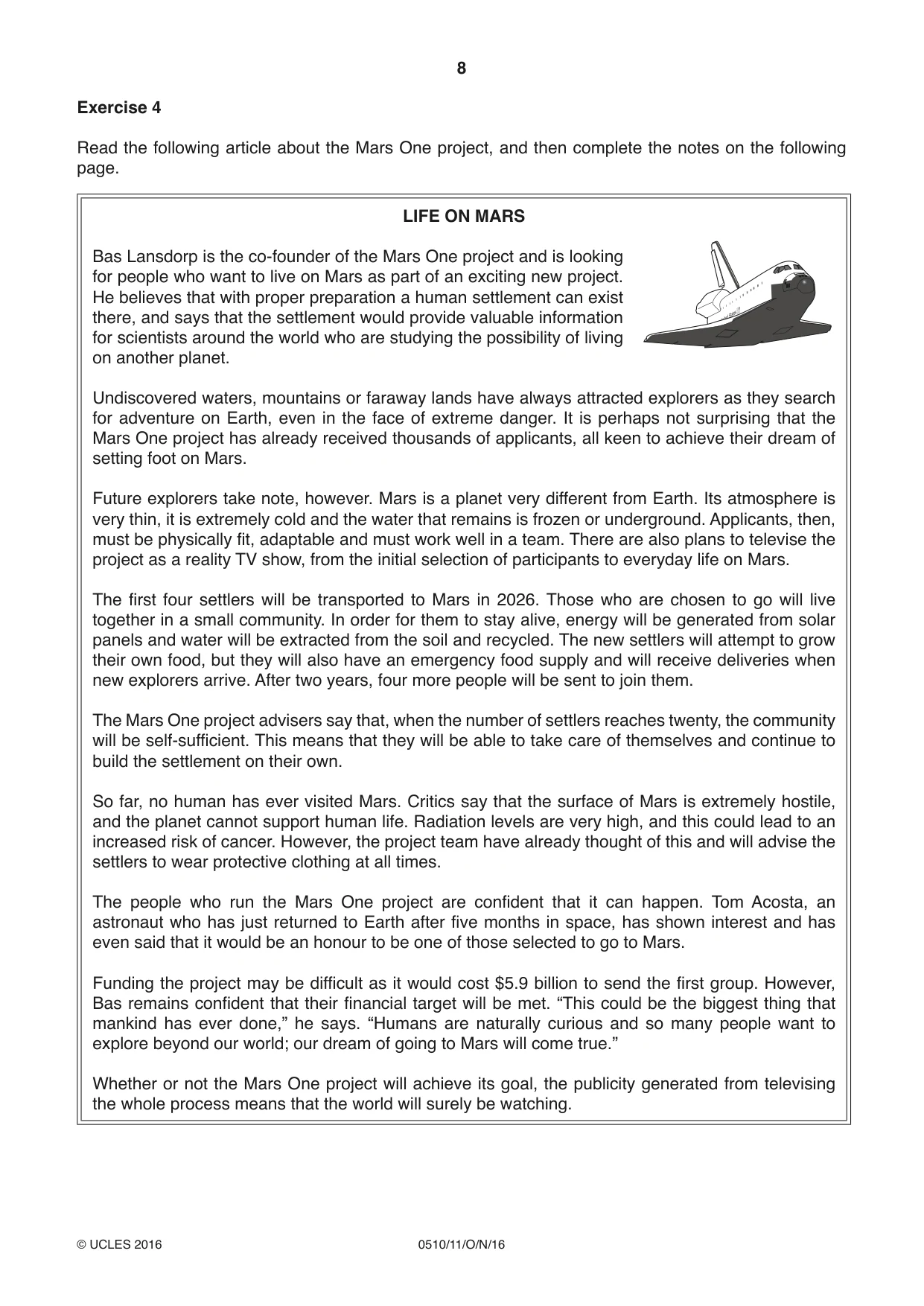
8 0510/11/O/N/16 © UCLES 2016 Exercise 4 Read the following article about the Mars One project, and then complete the notes on the following page. LIFE ON MARS Bas Lansdorp is the co-founder of the Mars One project and is looking for people who want to live on Mars as part of an exciting new project. He believes that with proper preparation a human settlement can exist there, and says that the settlement would provide valuable information for scientists around the world who are studying the possibility of living on another planet. Undiscovered waters, mountains or faraway lands have always attracted explorers as they search for adventure on Earth, even in the face of extreme danger. It is perhaps not surprising that the Mars One project has already received thousands of applicants, all keen to achieve their dream of setting foot on Mars. Future explorers take note, however. Mars is a planet very different from Earth. Its atmosphere is very thin, it is extremely cold and the water that remains is frozen or underground. Applicants, then, must be physically fit, adaptable and must work well in a team. There are also plans to televise the project as a reality TV show, from the initial selection of participants to everyday life on Mars. The first four settlers will be transported to Mars in 2026. Those who are chosen to go will live together in a small community. In order for them to stay alive, energy will be generated from solar panels and water will be extracted from the soil and recycled. The new settlers will attempt to grow their own food, but they will also have an emergency food supply and will receive deliveries when new explorers arrive. After two years, four more people will be sent to join them. The Mars One project advisers say that, when the number of settlers reaches twenty, the community will be self-sufficient. This means that they will be able to take care of themselves and continue to build the settlement on their own. So far, no human has ever visited Mars. Critics say that the surface of Mars is extremely hostile, and the planet cannot support human life. Radiation levels are very high, and this could lead to an increased risk of cancer. However, the project team have already thought of this and will advise the settlers to wear protective clothing at all times. The people who run the Mars One project are confident that it can happen. Tom Acosta, an astronaut who has just returned to Earth after five months in space, has shown interest and has even said that it would be an honour to be one of those selected to go to Mars. Funding the project may be difficult as it would cost $5.9 billion to send the first group. However, Bas remains confident that their financial target will be met. “This could be the biggest thing that mankind has ever done,” he says. “Humans are naturally curious and so many people want to explore beyond our world; our dream of going to Mars will come true.” Whether or not the Mars One project will achieve its goal, the publicity generated from televising the whole process means that the world will surely be watching.
Question paper, page 9
9 0510/11/O/N/16 © UCLES 2016 [Turn over You are going to give a talk to your school’s science club about the Mars One project. Prepare some notes to use as the basis for your talk. Make short notes under each heading. Reasons to take part in the Mars One project: • … • … • … How the first group will survive on Mars: • Energy will be generated from solar panels • … • … • … • … [Total: 7] Exercise 5 Imagine that you have given your talk to your school’s science club. Now your teacher wants you to follow this up with a summary for homework. Look at your notes in Exercise 4 above. Using the ideas in your notes, write a summary about the Mars One project. Your summary should be about 70 words long (and no more than 80 words long). You should use your own words as far as possible. … … … … … … … … [Total: 5]
Question paper, page 10
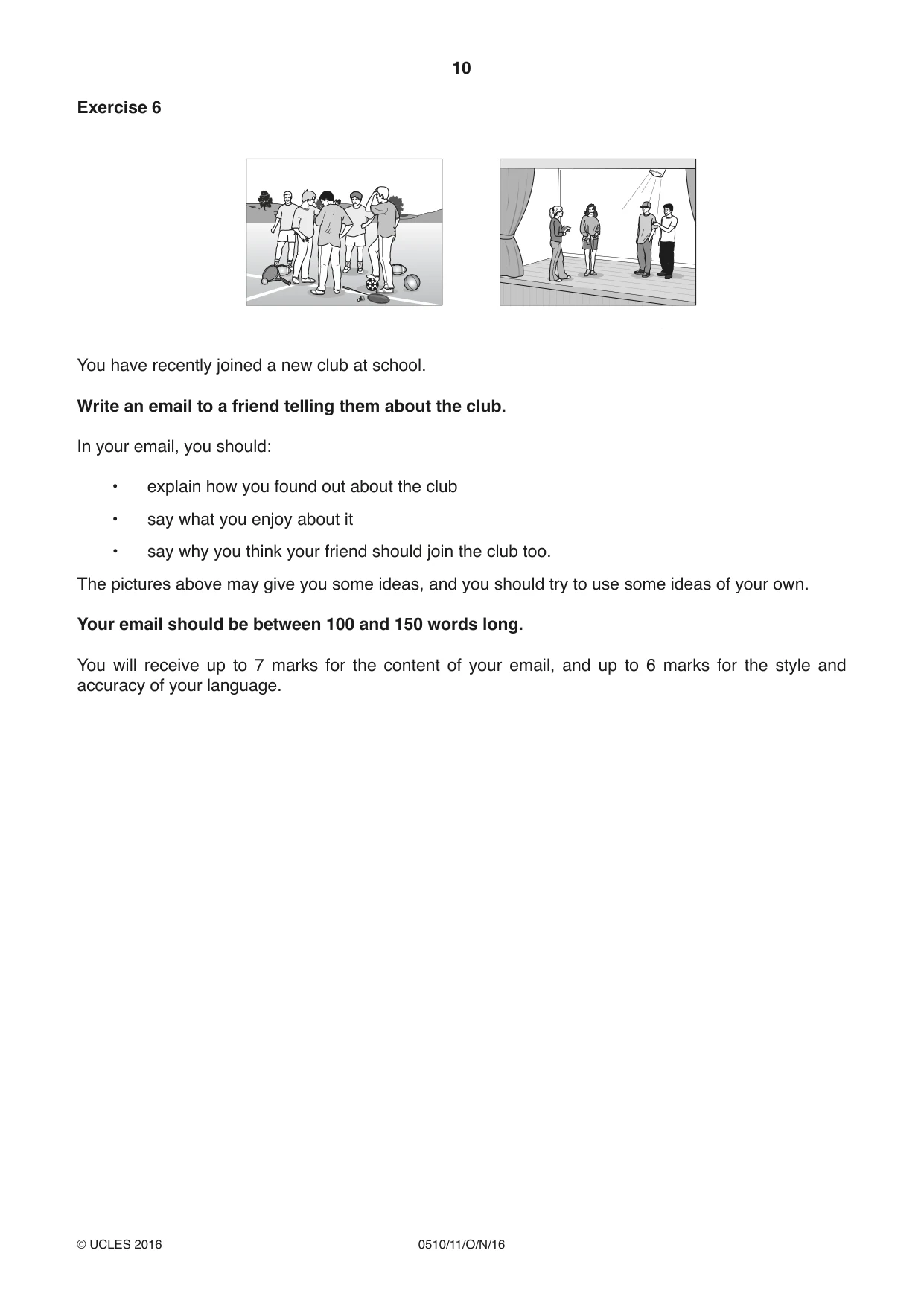
10 0510/11/O/N/16 © UCLES 2016 Exercise 6 You have recently joined a new club at school. Write an email to a friend telling them about the club. In your email, you should: • explain how you found out about the club • say what you enjoy about it • say why you think your friend should join the club too. The pictures above may give you some ideas, and you should try to use some ideas of your own. Your email should be between 100 and 150 words long. You will receive up to 7 marks for the content of your email, and up to 6 marks for the style and accuracy of your language.
Question paper, page 11
11 0510/11/O/N/16 © UCLES 2016 [Turn over … … … … … … … … … … … … … … … … … … … … … … … … … … … [Total: 13]
Question paper, page 12
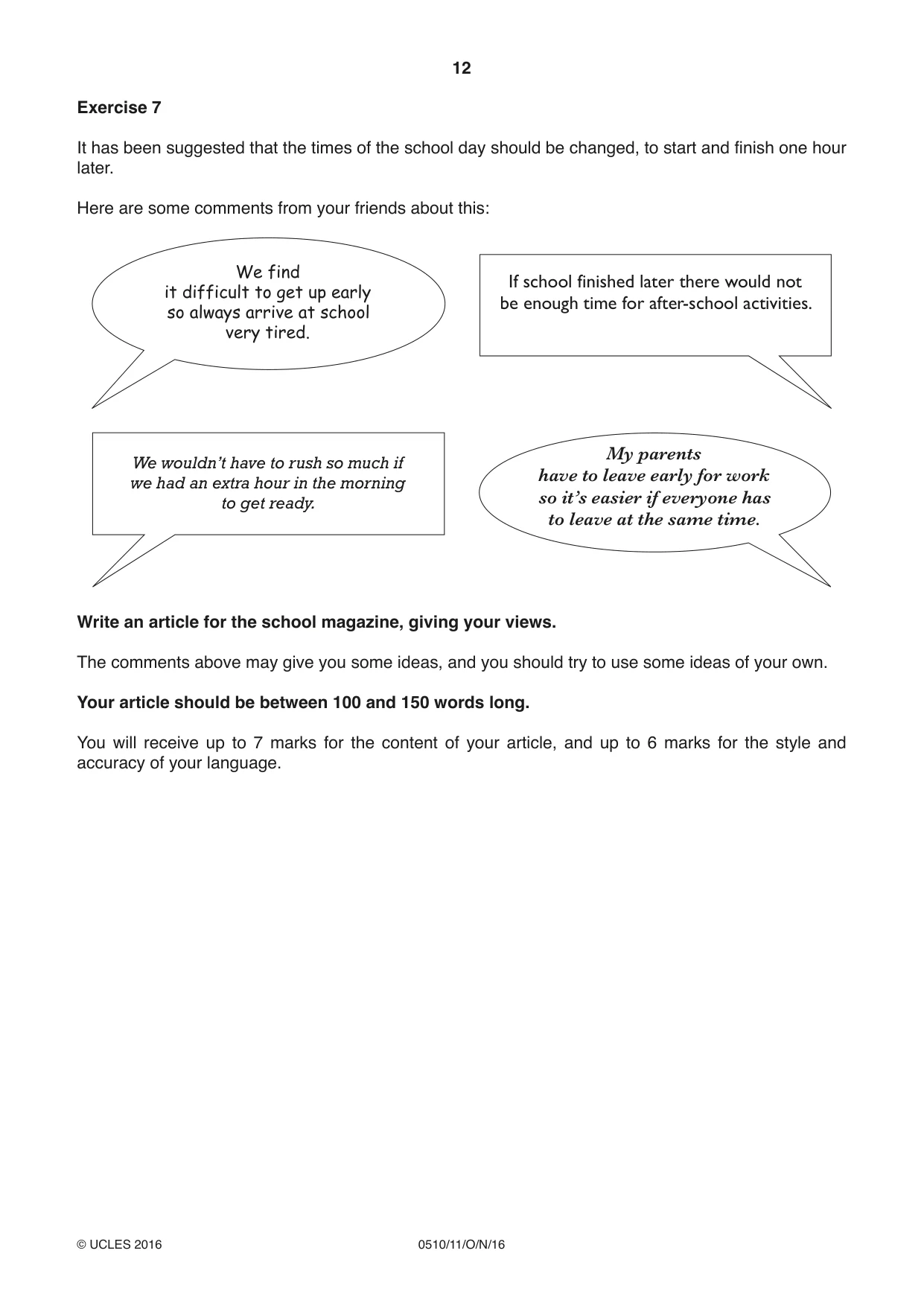
12 0510/11/O/N/16 © UCLES 2016 Exercise 7 It has been suggested that the times of the school day should be changed, to start and finish one hour later. Here are some comments from your friends about this: We find it difficult to get up early so always arrive at school very tired. If school finished later there would not be enough time for after-school activities. We wouldn’t have to rush so much if we had an extra hour in the morning to get ready. My parents have to leave early for work so it’s easier if everyone has to leave at the same time. Write an article for the school magazine, giving your views. The comments above may give you some ideas, and you should try to use some ideas of your own. Your article should be between 100 and 150 words long. You will receive up to 7 marks for the content of your article, and up to 6 marks for the style and accuracy of your language.
Question paper, page 13
13 0510/11/O/N/16 © UCLES 2016 … … … … … … … … … … … … … … … … … … … … … … … … … … … [Total: 13]
Question paper, page 14
14 0510/11/O/N/16 © UCLES 2016 BLANK PAGE
Question paper, page 15
15 0510/11/O/N/16 © UCLES 2016 BLANK PAGE
Question paper, page 16
16 0510/11/O/N/16 © UCLES 2016 Permission to reproduce items where third-party owned material protected by copyright is included has been sought and cleared where possible. Every reasonable effort has been made by the publisher (UCLES) to trace copyright holders, but if any items requiring clearance have unwittingly been included, the publisher will be pleased to make amends at the earliest possible opportunity. To avoid the issue of disclosure of answer-related information to candidates, all copyright acknowledgements are reproduced online in the Cambridge International Examinations Copyright Acknowledgements Booklet. This is produced for each series of examinations and is freely available to download at www.cie.org.uk after the live examination series. Cambridge International Examinations is part of the Cambridge Assessment Group. Cambridge Assessment is the brand name of University of Cambridge Local Examinations Syndicate (UCLES), which is itself a department of the University of Cambridge. BLANK PAGE
Mark scheme, page 1
® IGCSE is the registered trademark of Cambridge International Examinations. This document consists of 11 printed pages. © UCLES 2016 [Turn over Cambridge International Examinations Cambridge International General Certificate of Secondary Education ENGLISH AS A SECOND LANGUAGE 0510/11 Paper 1 Reading and Writing (Core) October/November 2016 MARK SCHEME Maximum Mark: 70 Published This mark scheme is published as an aid to teachers and candidates, to indicate the requirements of the examination. It shows the basis on which Examiners were instructed to award marks. It does not indicate the details of the discussions that took place at an Examiners’ meeting before marking began, which would have considered the acceptability of alternative answers. Mark schemes should be read in conjunction with the question paper and the Principal Examiner Report for Teachers. Cambridge will not enter into discussions about these mark schemes. Cambridge is publishing the mark schemes for the October/November 2016 series for most Cambridge IGCSE®, Cambridge International A and AS Level components and some Cambridge O Level components.
Mark scheme, page 2
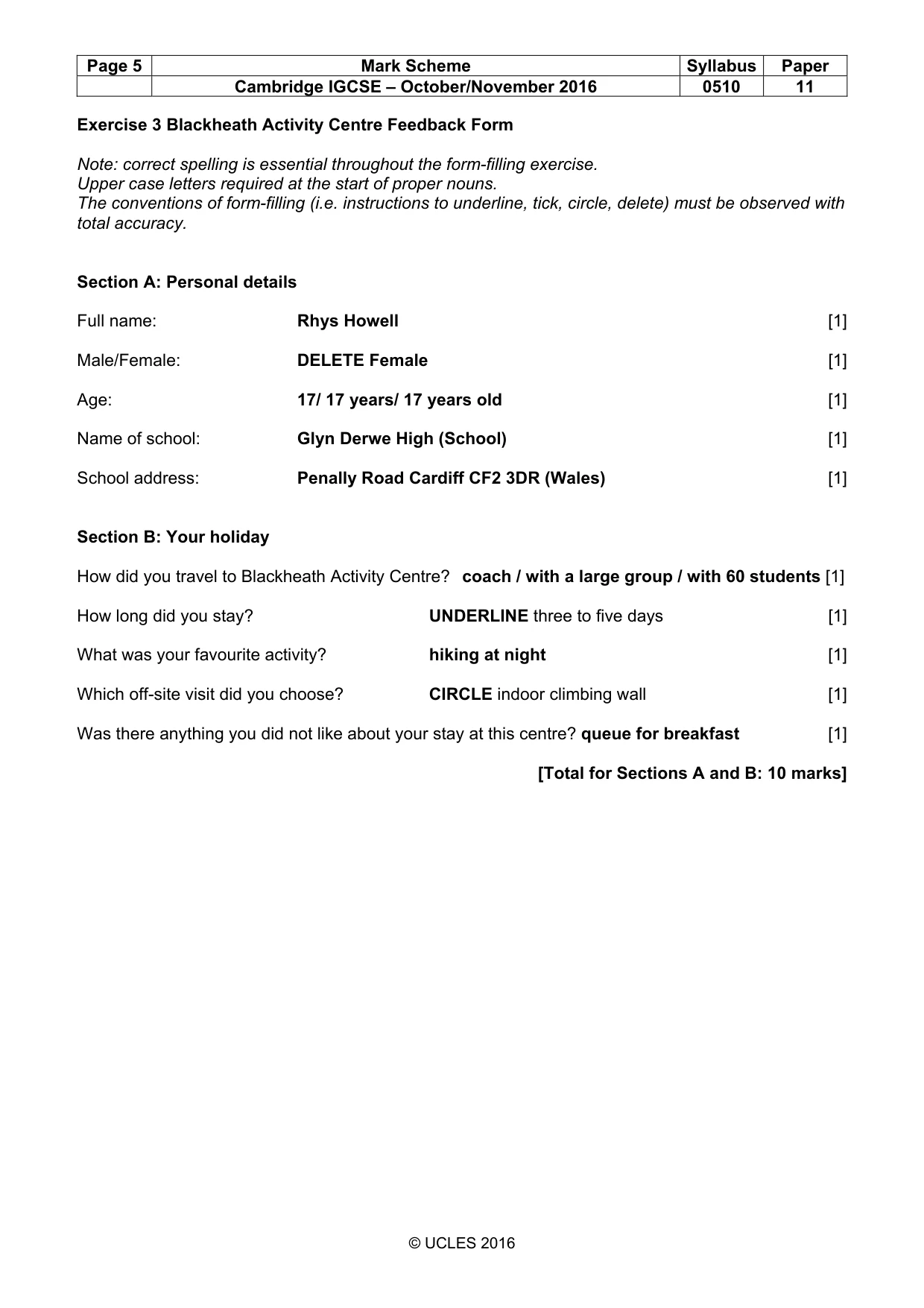
Page 2 Mark Scheme Syllabus Paper Cambridge IGCSE – October/November 2016 0510 11 © UCLES 2016 IGCSE English as a Second Language Core tier Reading/Writing (Paper 1) This component forms part of the Core tier assessment of IGCSE English as a Second Language and tests the following Assessment Objectives: AO1: Reading R1 identify and retrieve facts and details R2 understand and select relevant information R3 recognise, understand ideas, opinions and attitudes and the connections between the related ideas R4 understand what is implied but not actually written, eg. gist, relationships, writer's purpose/intention, writer's feelings, situation or place AO2: Writing W1 communicate clearly, accurately and appropriately W2 convey information and express opinions effectively W3 employ and control a variety of grammatical structures W4 demonstrate knowledge and understanding of a range of appropriate vocabulary W5 observe conventions of paragraphing, punctuation and spelling W6 employ appropriate register/style Overview of exercises on Paper 1 Reading objectives tested Marks for reading objectives Writing objectives tested Marks for writing objectives Total available marks Exercise 1 Reading (1) R1 R2 7 – 7 Exercise 2 Reading (2) R1 R2 R4 11 – 11 Exercise 3 Information transfer R1, R2 10 W1, W5 4 14 Exercise 4 Note- making R1, R2, R3 7 – 7 Exercise 5 Summary – W1, W2, W3, W4, W5 5 5 Exercise 6 Writing (1) – W1, W2, W3, W4, W5, W6 13 13 Exercise 7 Writing (2) – W1, W2, W3, W4, W5, W6 13 13 70
Mark scheme, page 3
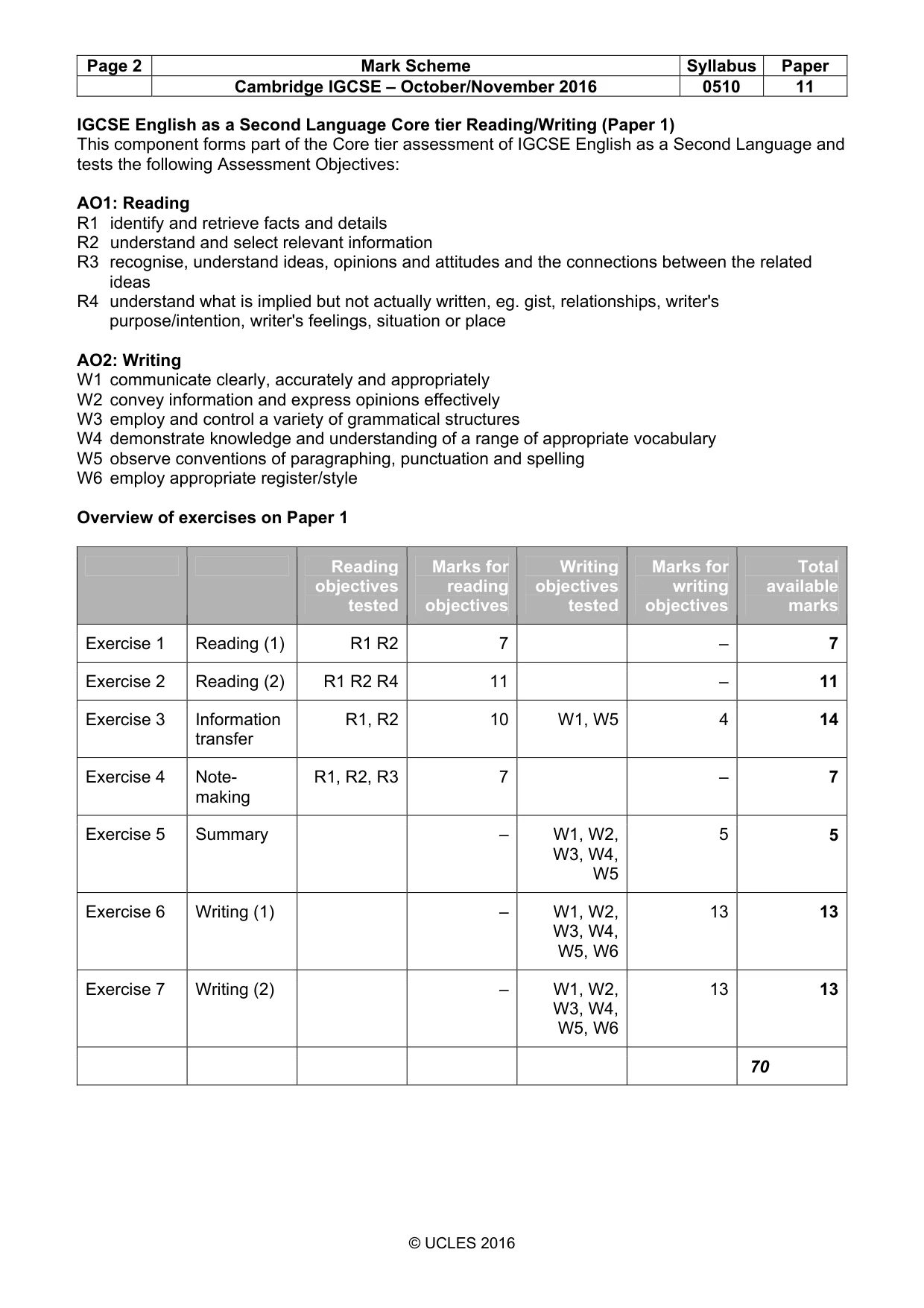
Page 3 Mark Scheme Syllabus Paper Cambridge IGCSE – October/November 2016 0510 11 © UCLES 2016 Exercise 1 Welcome to Deacon Dale (a) caves / Deacon Hole / tunnels / another world [1] (b) put on (climbing) boots OR climbing shoes / (and) a (safety) helmet [1] BOTH REQUIRED FOR ONE MARK (c) easier caves / practice caves [1] (d) wetsuit / knee pads / elbow pads [1] ANY TWO FROM THREE (e) proud / exhausted [1] (f) encourages teamwork / encourages trust / shared sense of achievement [2] ONE MARK EACH FOR ANY TWO FROM THREE [Max total for exercise 1: 7 marks]
Mark scheme, page 4
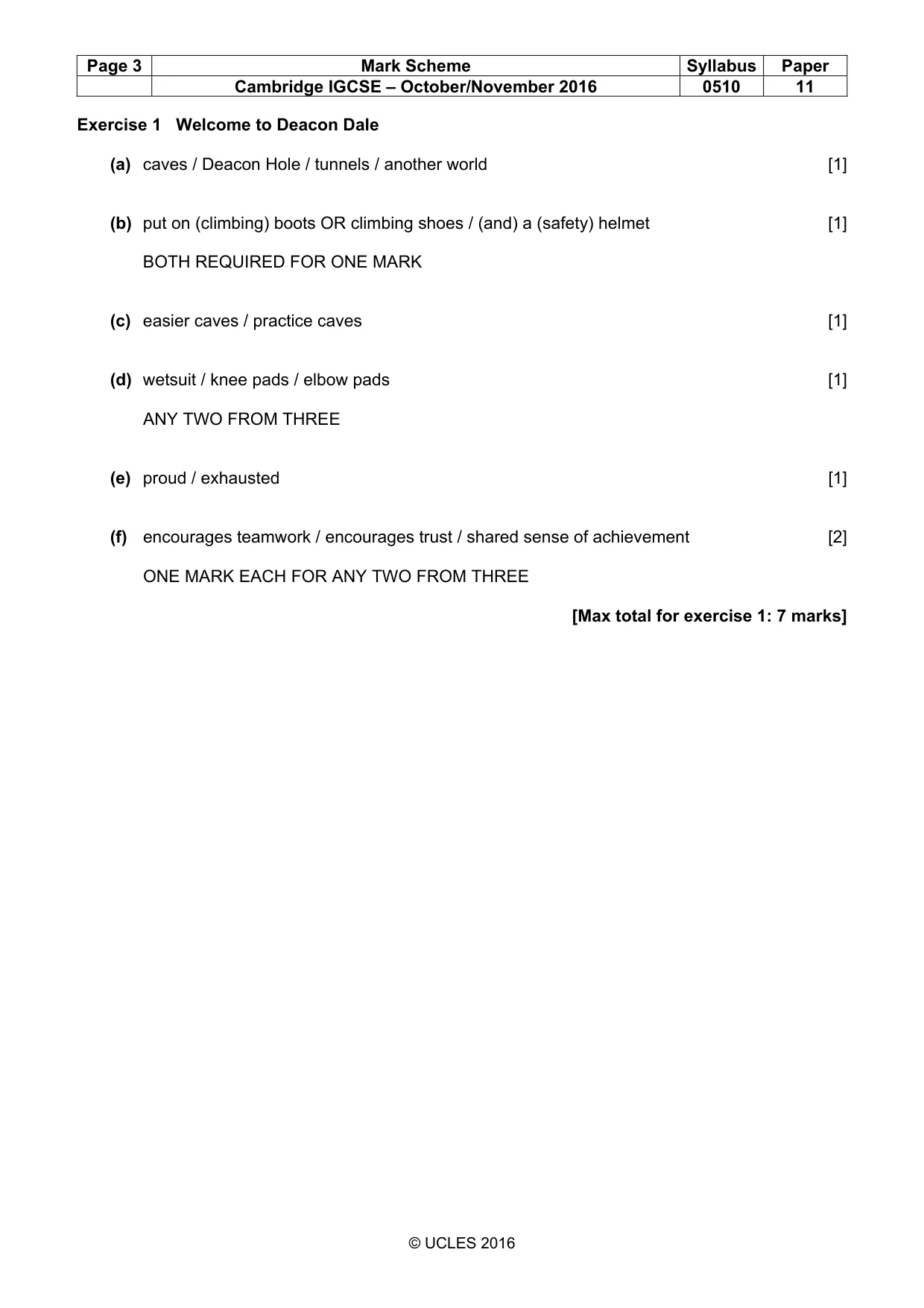
Page 4 Mark Scheme Syllabus Paper Cambridge IGCSE – October/November 2016 0510 11 © UCLES 2016 Exercise 2 Squid that lights up in the dark (a) North Pacific Ocean / off south eastern (SE) Japan [1] (b) lowered cameras into ocean / lowered cameras from the ship / lowered cameras alongside food / attracted (it) with food / put food on the end of a long line [1] (c) 2004 [1] (d) blinds (it with flashes) / uses light-producing organs [1] (e) lemons [1] (f) supports (their) theories / proof / it has been theory until now [1] (g) swims backwards and forwards / changes direction rapidly OR bending body / fast OR speed (2.5m per second) / muscular fins ONE MARK EACH DETAIL - ANY TWO FROM THREE [2] (h) muscular fins [1] (i) (swim in very) deep waters [1] (j) female giant squid AND 10 m(etres) [1] [Max total for Exercise 2: 11 marks]
Mark scheme, page 5
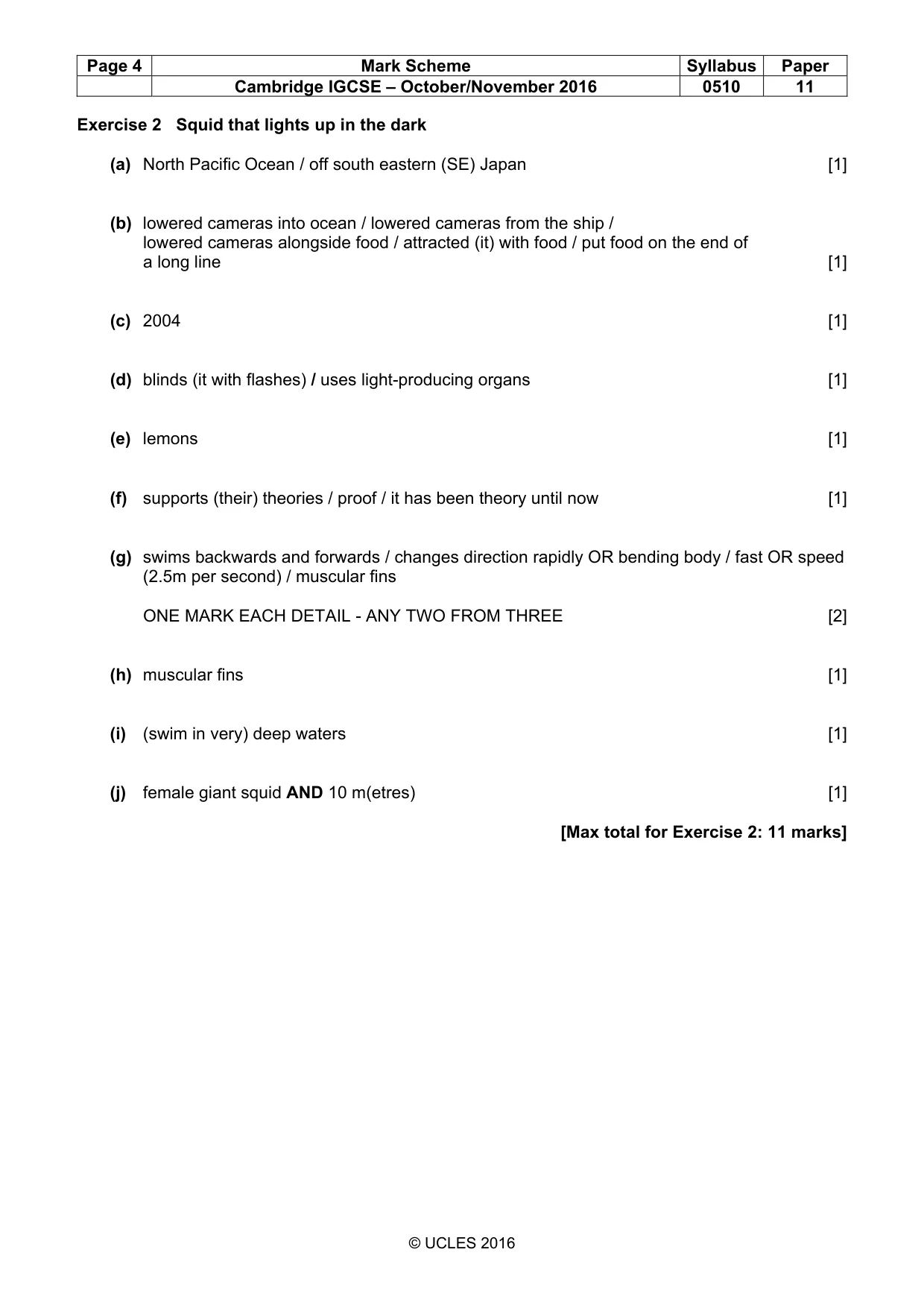
Page 5 Mark Scheme Syllabus Paper Cambridge IGCSE – October/November 2016 0510 11 © UCLES 2016 Exercise 3 Blackheath Activity Centre Feedback Form Note: correct spelling is essential throughout the form-filling exercise. Upper case letters required at the start of proper nouns. The conventions of form-filling (i.e. instructions to underline, tick, circle, delete) must be observed with total accuracy. Section A: Personal details Full name: Rhys Howell [1] Male/Female: DELETE Female [1] Age: 17/ 17 years/ 17 years old [1] Name of school: Glyn Derwe High (School) [1] School address: Penally Road Cardiff CF2 3DR (Wales) [1] Section B: Your holiday How did you travel to Blackheath Activity Centre? coach / with a large group / with 60 students [1] How long did you stay? UNDERLINE three to five days [1] What was your favourite activity? hiking at night [1] Which off-site visit did you choose? CIRCLE indoor climbing wall [1] Was there anything you did not like about your stay at this centre? queue for breakfast [1] [Total for Sections A and B: 10 marks]
Mark scheme, page 6
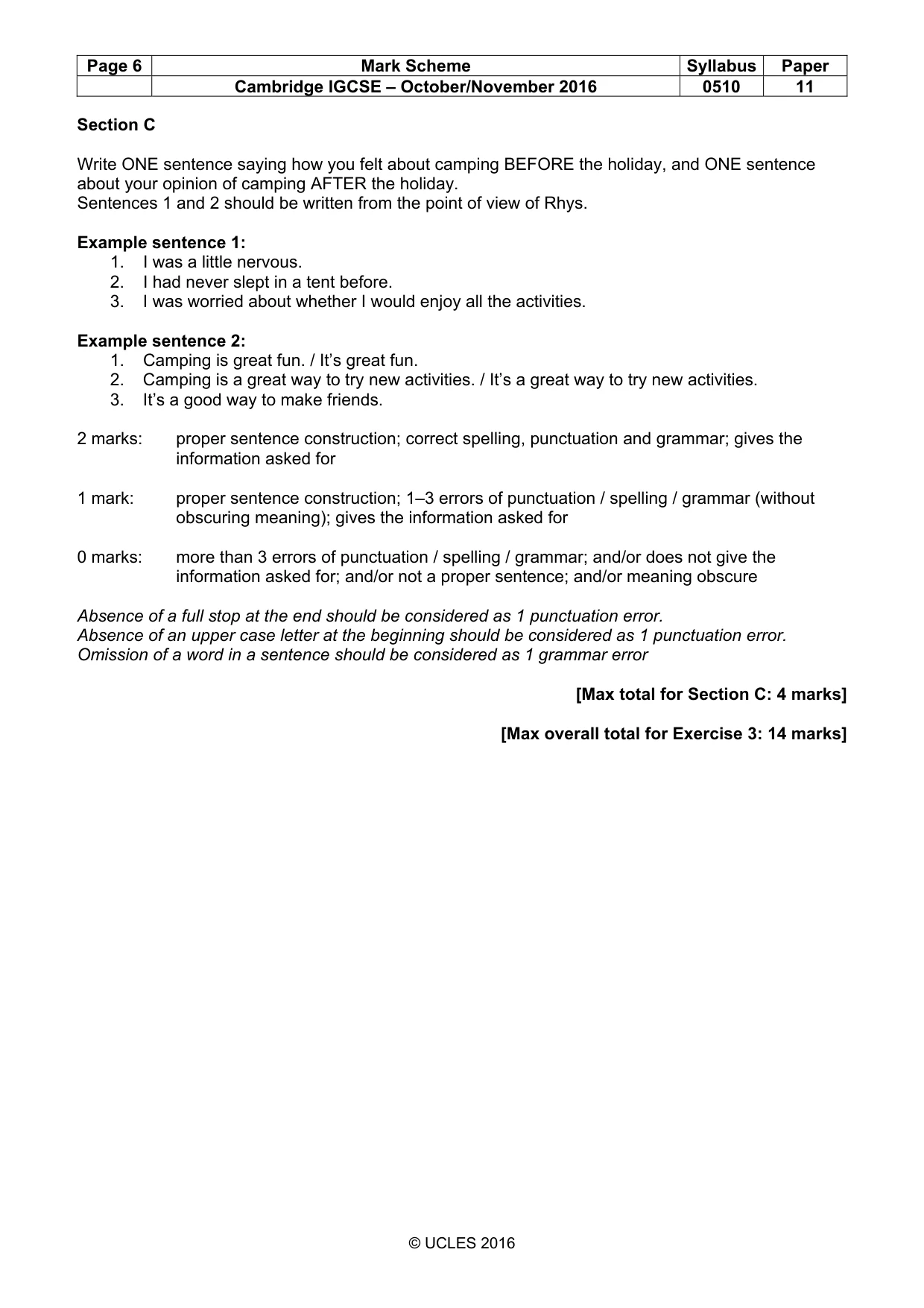
Page 6 Mark Scheme Syllabus Paper Cambridge IGCSE – October/November 2016 0510 11 © UCLES 2016 Section C Write ONE sentence saying how you felt about camping BEFORE the holiday, and ONE sentence about your opinion of camping AFTER the holiday. Sentences 1 and 2 should be written from the point of view of Rhys. Example sentence 1: 1. I was a little nervous. 2. I had never slept in a tent before. 3. I was worried about whether I would enjoy all the activities. Example sentence 2: 1. Camping is great fun. / It’s great fun. 2. Camping is a great way to try new activities. / It’s a great way to try new activities. 3. It’s a good way to make friends. 2 marks: proper sentence construction; correct spelling, punctuation and grammar; gives the information asked for 1 mark: proper sentence construction; 1–3 errors of punctuation / spelling / grammar (without obscuring meaning); gives the information asked for 0 marks: more than 3 errors of punctuation / spelling / grammar; and/or does not give the information asked for; and/or not a proper sentence; and/or meaning obscure Absence of a full stop at the end should be considered as 1 punctuation error. Absence of an upper case letter at the beginning should be considered as 1 punctuation error. Omission of a word in a sentence should be considered as 1 grammar error [Max total for Section C: 4 marks] [Max overall total for Exercise 3: 14 marks]
Mark scheme, page 7
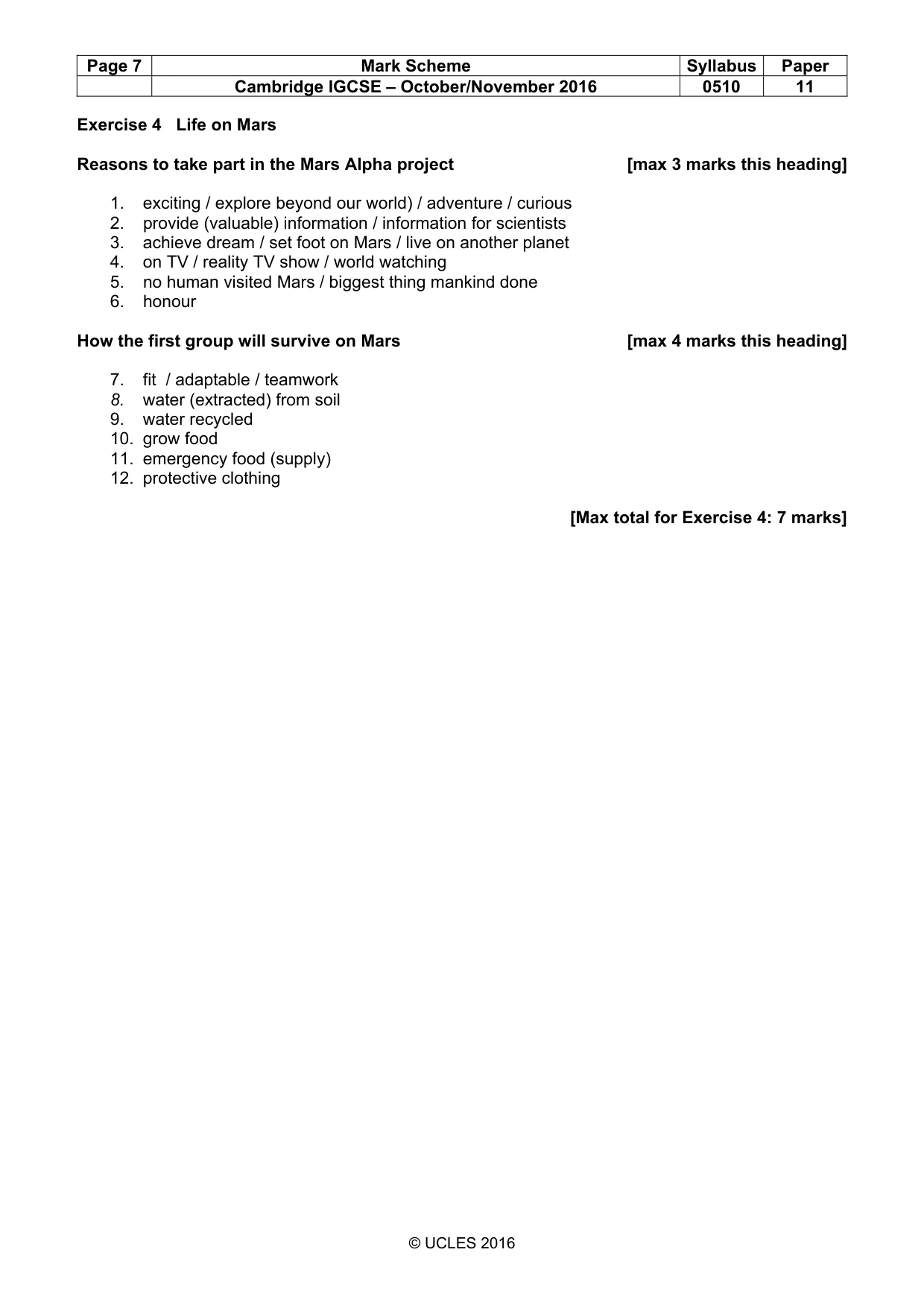
Page 7 Mark Scheme Syllabus Paper Cambridge IGCSE – October/November 2016 0510 11 © UCLES 2016 Exercise 4 Life on Mars Reasons to take part in the Mars Alpha project [max 3 marks this heading] 1. exciting / explore beyond our world) / adventure / curious 2. provide (valuable) information / information for scientists 3. achieve dream / set foot on Mars / live on another planet 4. on TV / reality TV show / world watching 5. no human visited Mars / biggest thing mankind done 6. honour How the first group will survive on Mars [max 4 marks this heading] 7. fit / adaptable / teamwork 8. water (extracted) from soil 9. water recycled 10. grow food 11. emergency food (supply) 12. protective clothing [Max total for Exercise 4: 7 marks]
Mark scheme, page 8
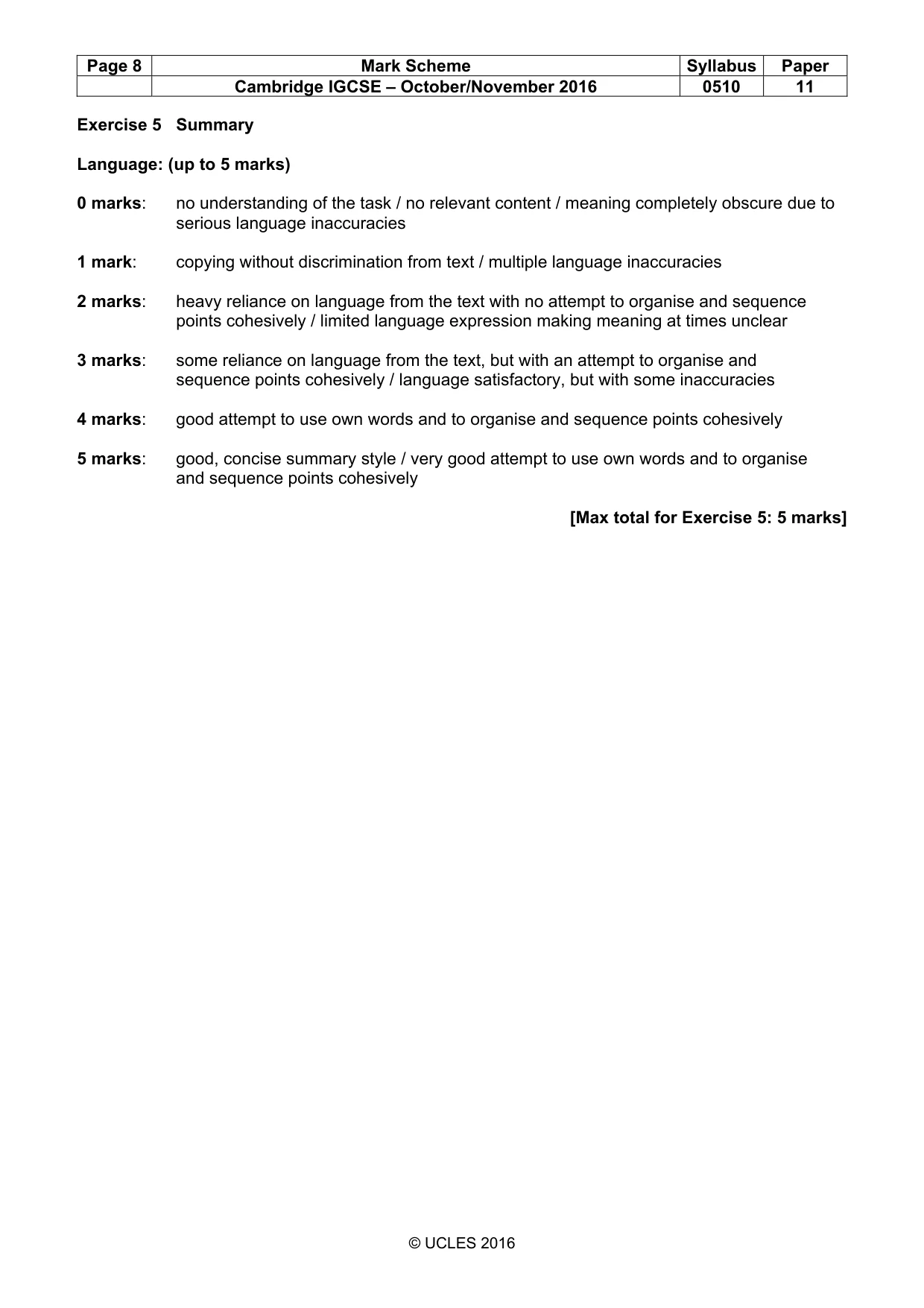
Page 8 Mark Scheme Syllabus Paper Cambridge IGCSE – October/November 2016 0510 11 © UCLES 2016 Exercise 5 Summary Language: (up to 5 marks) 0 marks: no understanding of the task / no relevant content / meaning completely obscure due to serious language inaccuracies 1 mark: copying without discrimination from text / multiple language inaccuracies 2 marks: heavy reliance on language from the text with no attempt to organise and sequence points cohesively / limited language expression making meaning at times unclear 3 marks: some reliance on language from the text, but with an attempt to organise and sequence points cohesively / language satisfactory, but with some inaccuracies 4 marks: good attempt to use own words and to organise and sequence points cohesively 5 marks: good, concise summary style / very good attempt to use own words and to organise and sequence points cohesively [Max total for Exercise 5: 5 marks]
Mark scheme, page 9
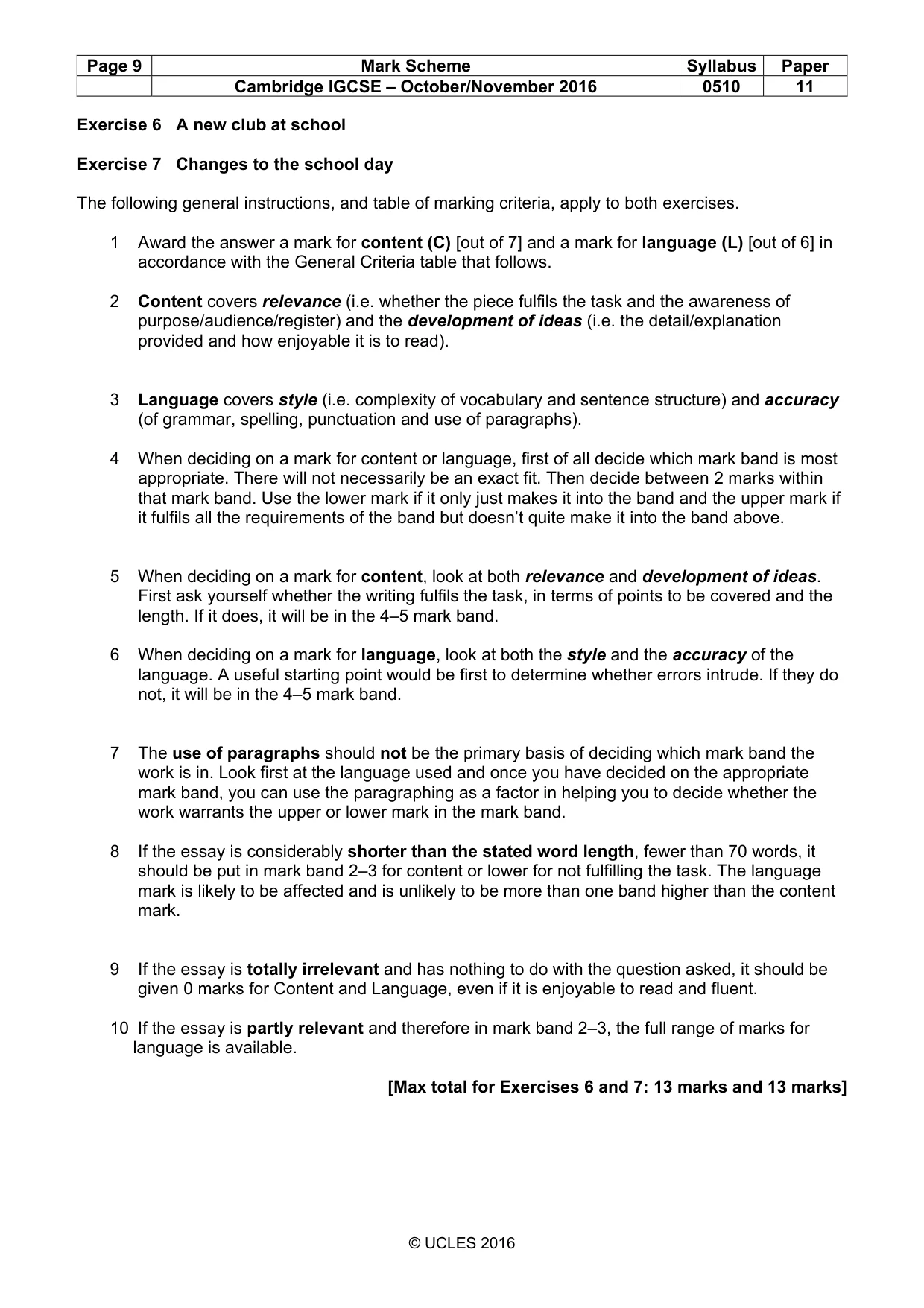
Page 9 Mark Scheme Syllabus Paper Cambridge IGCSE – October/November 2016 0510 11 © UCLES 2016 Exercise 6 A new club at school Exercise 7 Changes to the school day The following general instructions, and table of marking criteria, apply to both exercises. 1 Award the answer a mark for content (C) [out of 7] and a mark for language (L) [out of 6] in accordance with the General Criteria table that follows. 2 Content covers relevance (i.e. whether the piece fulfils the task and the awareness of purpose/audience/register) and the development of ideas (i.e. the detail/explanation provided and how enjoyable it is to read). 3 Language covers style (i.e. complexity of vocabulary and sentence structure) and accuracy (of grammar, spelling, punctuation and use of paragraphs). 4 When deciding on a mark for content or language, first of all decide which mark band is most appropriate. There will not necessarily be an exact fit. Then decide between 2 marks within that mark band. Use the lower mark if it only just makes it into the band and the upper mark if it fulfils all the requirements of the band but doesn’t quite make it into the band above. 5 When deciding on a mark for content, look at both relevance and development of ideas. First ask yourself whether the writing fulfils the task, in terms of points to be covered and the length. If it does, it will be in the 4–5 mark band. 6 When deciding on a mark for language, look at both the style and the accuracy of the language. A useful starting point would be first to determine whether errors intrude. If they do not, it will be in the 4–5 mark band. 7 The use of paragraphs should not be the primary basis of deciding which mark band the work is in. Look first at the language used and once you have decided on the appropriate mark band, you can use the paragraphing as a factor in helping you to decide whether the work warrants the upper or lower mark in the mark band. 8 If the essay is considerably shorter than the stated word length, fewer than 70 words, it should be put in mark band 2–3 for content or lower for not fulfilling the task. The language mark is likely to be affected and is unlikely to be more than one band higher than the content mark. 9 If the essay is totally irrelevant and has nothing to do with the question asked, it should be given 0 marks for Content and Language, even if it is enjoyable to read and fluent. 10 If the essay is partly relevant and therefore in mark band 2–3, the full range of marks for language is available. [Max total for Exercises 6 and 7: 13 marks and 13 marks]
Mark scheme, page 10
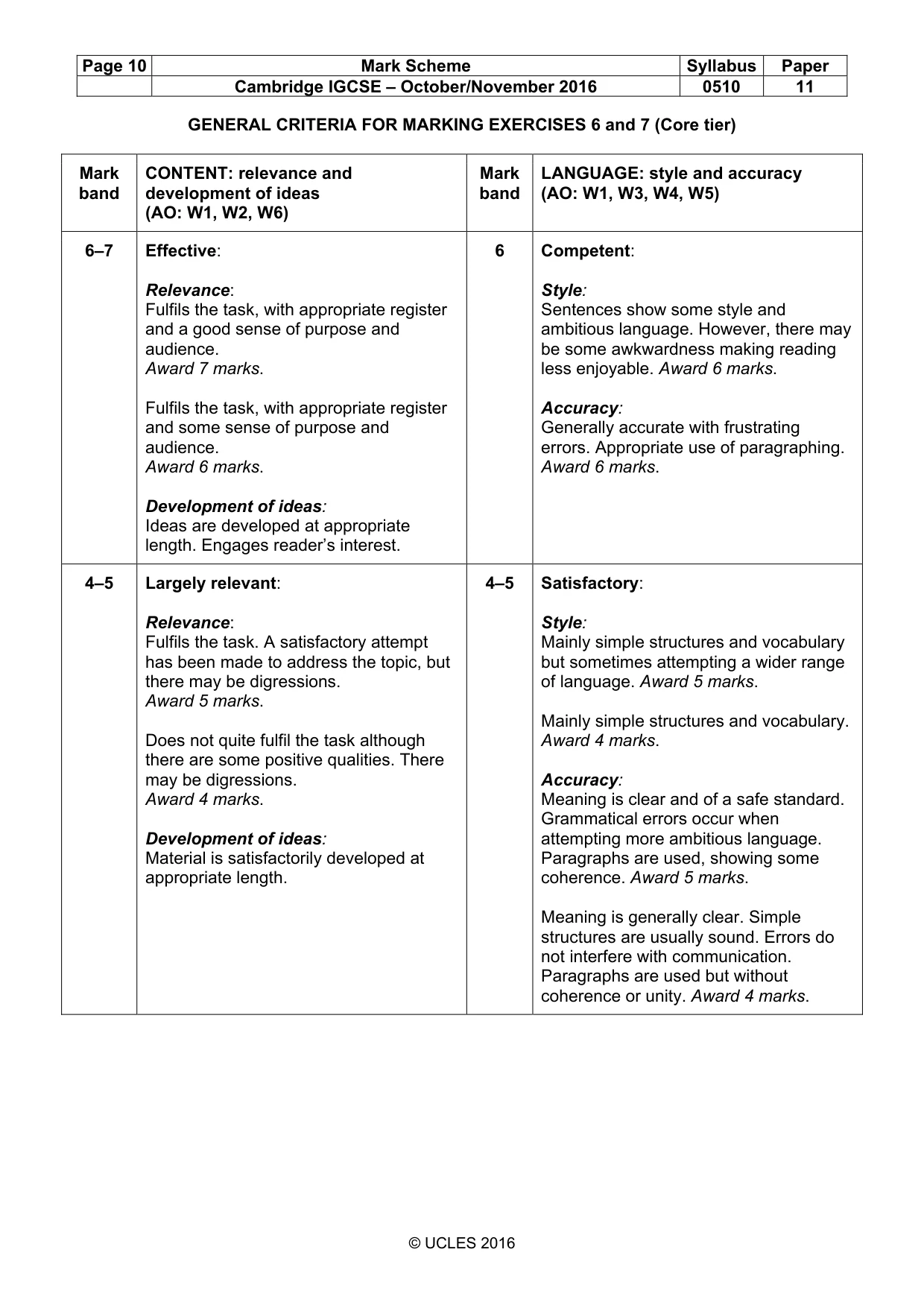
Page 10 Mark Scheme Syllabus Paper Cambridge IGCSE – October/November 2016 0510 11 © UCLES 2016 GENERAL CRITERIA FOR MARKING EXERCISES 6 and 7 (Core tier) Mark band CONTENT: relevance and development of ideas (AO: W1, W2, W6) Mark band LANGUAGE: style and accuracy (AO: W1, W3, W4, W5) 6–7 Effective: Relevance: Fulfils the task, with appropriate register and a good sense of purpose and audience. Award 7 marks. Fulfils the task, with appropriate register and some sense of purpose and audience. Award 6 marks. Development of ideas: Ideas are developed at appropriate length. Engages reader’s interest. 6 Competent: Style: Sentences show some style and ambitious language. However, there may be some awkwardness making reading less enjoyable. Award 6 marks. Accuracy: Generally accurate with frustrating errors. Appropriate use of paragraphing. Award 6 marks. 4–5 Largely relevant: Relevance: Fulfils the task. A satisfactory attempt has been made to address the topic, but there may be digressions. Award 5 marks. Does not quite fulfil the task although there are some positive qualities. There may be digressions. Award 4 marks. Development of ideas: Material is satisfactorily developed at appropriate length. 4–5 Satisfactory: Style: Mainly simple structures and vocabulary but sometimes attempting a wider range of language. Award 5 marks. Mainly simple structures and vocabulary. Award 4 marks. Accuracy: Meaning is clear and of a safe standard. Grammatical errors occur when attempting more ambitious language. Paragraphs are used, showing some coherence. Award 5 marks. Meaning is generally clear. Simple structures are usually sound. Errors do not interfere with communication. Paragraphs are used but without coherence or unity. Award 4 marks.
Mark scheme, page 11
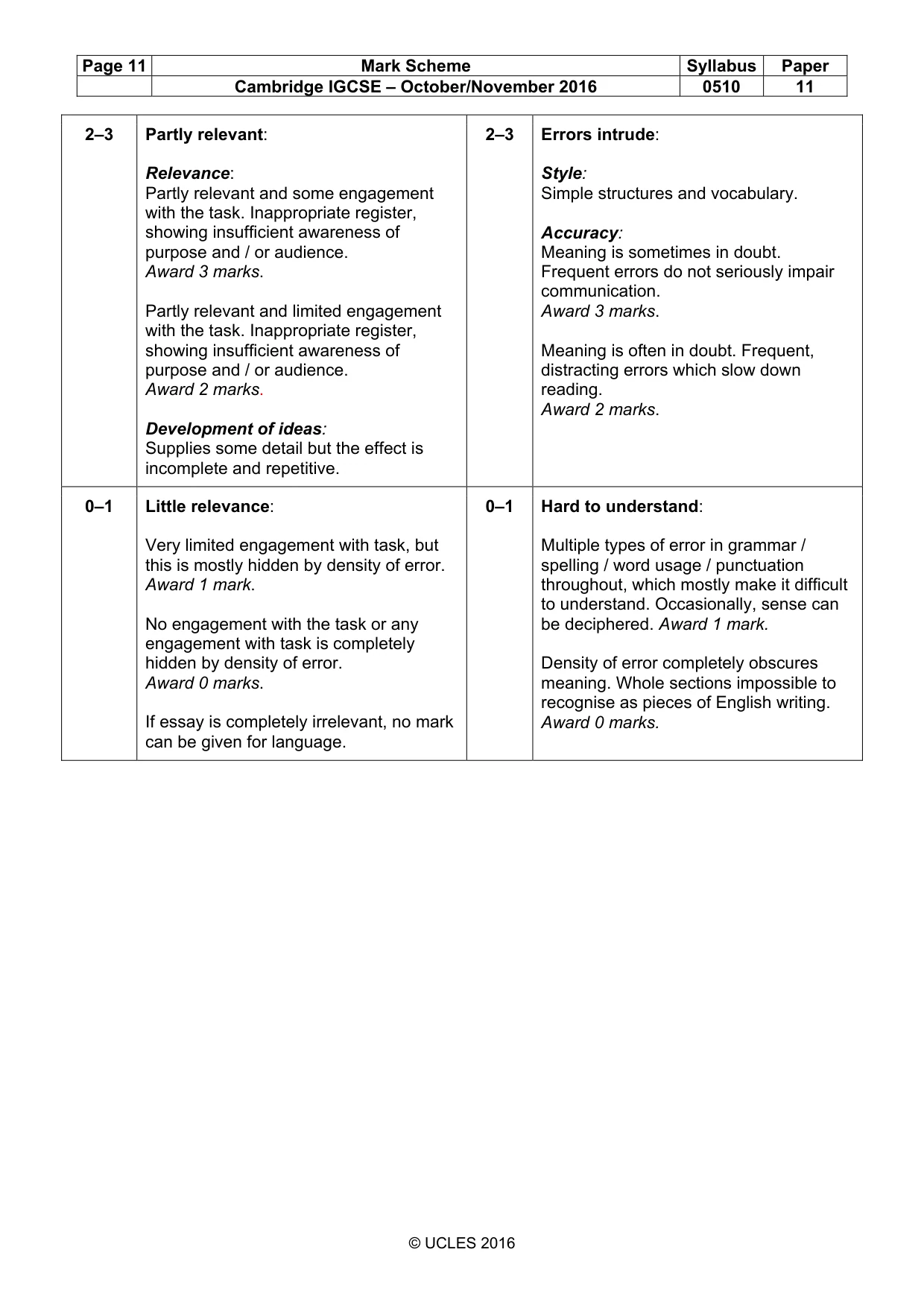
Page 11 Mark Scheme Syllabus Paper Cambridge IGCSE – October/November 2016 0510 11 © UCLES 2016 2–3 Partly relevant: Relevance: Partly relevant and some engagement with the task. Inappropriate register, showing insufficient awareness of purpose and / or audience. Award 3 marks. Partly relevant and limited engagement with the task. Inappropriate register, showing insufficient awareness of purpose and / or audience. Award 2 marks. Development of ideas: Supplies some detail but the effect is incomplete and repetitive. 2–3 Errors intrude: Style: Simple structures and vocabulary. Accuracy: Meaning is sometimes in doubt. Frequent errors do not seriously impair communication. Award 3 marks. Meaning is often in doubt. Frequent, distracting errors which slow down reading. Award 2 marks. 0–1 Little relevance: Very limited engagement with task, but this is mostly hidden by density of error. Award 1 mark. No engagement with the task or any engagement with task is completely hidden by density of error. Award 0 marks. If essay is completely irrelevant, no mark can be given for language. 0–1 Hard to understand: Multiple types of error in grammar / spelling / word usage / punctuation throughout, which mostly make it difficult to understand. Occasionally, sense can be deciphered. Award 1 mark. Density of error completely obscures meaning. Whole sections impossible to recognise as pieces of English writing. Award 0 marks.
What you needed in this session
Cambridge’s own grade thresholds for 2016 Oct/Nov, Paper 1 · Variant 1. A higher threshold means an easier paper — the bar moves with how the cohort did.