Cambridge IGCSE English - Second Language (oral endorsement) 0510 — 2015 May/June Paper 1 · Variant 1
0510/11/M/J/15 · 70 marks · ≈79 min
The question paper and its mark scheme, free to read here and free to download. This is Cambridge’s own paper, exactly as it was sat.
Question paper16 pages





Mark scheme11 pages
Answers below. Sit the paper first if you are practising.
Paper as text
Question paper, page 1
This document consists of 13 printed pages and 3 blank pages. DC (ST/SG) 100401/4 © UCLES 2015 [Turn over Cambridge International Examinations Cambridge International General Certificate of Secondary Education * 2 1 6 8 1 6 4 8 6 1 * ENGLISH AS A SECOND LANGUAGE 0510/11 Paper 1 Reading and Writing (Core) May/June 2015 1 hour 30 minutes Candidates answer on the Question Paper. No Additional Materials are required. READ THESE INSTRUCTIONS FIRST Write your Centre number, candidate number and name on all the work you hand in. Write in dark blue or black pen. Do not use staples, paper clips, glue or correction fluid. DO NOT WRITE IN ANY BARCODES. Answer all questions. Dictionaries are not allowed. At the end of the examination, fasten all your work securely together. The number of marks is given in brackets [ ] at the end of each question or part question.
Question paper, page 2
2 0510/11/M/J/15 © UCLES 2015 Exercise 1 Read the following visitor information leaflet about the Ulu Temburong National Park in Brunei Darussalam, and then answer the questions on the opposite page. LEAVE NOTHING BUT FOOTPRINTS Ulu Temburong was the first national park in Brunei Darussalam. Access to the park is not quick or direct, and you must take a riverboat through the mangrove tree forests, but it is a journey full of adventure. Features of the park The rivers which have carved their routes through the forest are one of the most exciting features of the park, as although they are dry much of the time, when there is heavy rain, they become deep and fast flowing. High waterfalls are common throughout the forest, and you can also see the many places where landslides have occurred. They are a vital feature of the park, although it means that paths sometimes have to be repaired, because they create new habitats for plants and animal life. Travelling quietly up the river gives you the chance to hear and watch exotic birds, many of which feed on the plentiful insects in the park. The most spectacular birds are the hornbills, which are the largest fruit-eating birds in the forest, and can be seen and heard everywhere. In the forest Your first stop is at the national park headquarters. Here, you register your name and age so that the authorities know exactly who is in the park. Then you start out on foot along the boardwalk and cross the main river on a suspension bridge. The dense forestation prevents sunlight from penetrating the forest floor. Light is very important to most life forms, and here in the dark rainforest plants have found unusual ways of finding it. Some plants are able to climb more than 30 metres off the forest floor, using the tall trees as support, in order to escape the darkness down below and reach the sunlight above. What you should bring to the park Shorts and T-shirts are the normal form of clothing but it is recommended that you also bring a cap and a shirt with long sleeves for protection against sunburn and insects. It is important to wear suitable shoes because the tracks in the forest can be very slippery after rain. A water bottle and a camera are also essential items. Protecting the environment There are many rules and regulations to protect the beauty of the forest. For example, nobody is allowed to remove plants or drop litter. A permit has to be obtained from the Forestry Department before entering the park to ensure that the number of visitors is strictly controlled. If you have any questions or would like to apply for a permit to visit the park, the department can be contacted by email on forestrybrunei@hotmail.com
Question paper, page 3
3 0510/11/M/J/15 © UCLES 2015 [Turn over (a) How do you have to travel to reach Ulu Temburong? …[1] (b) Why are the rivers one of the most exciting features of the park? …[1] (c) Why are landslides important? …[1] (d) What is the main diet of the hornbills? …[1] (e) Where at the park entrance do you have to give details about yourself? …[1] (f) What items are visitors advised to carry with them? Give two details. … …[1] (g) What is it forbidden to do in the park? Give two details. … …[1] [Total: 7]
Question paper, page 4
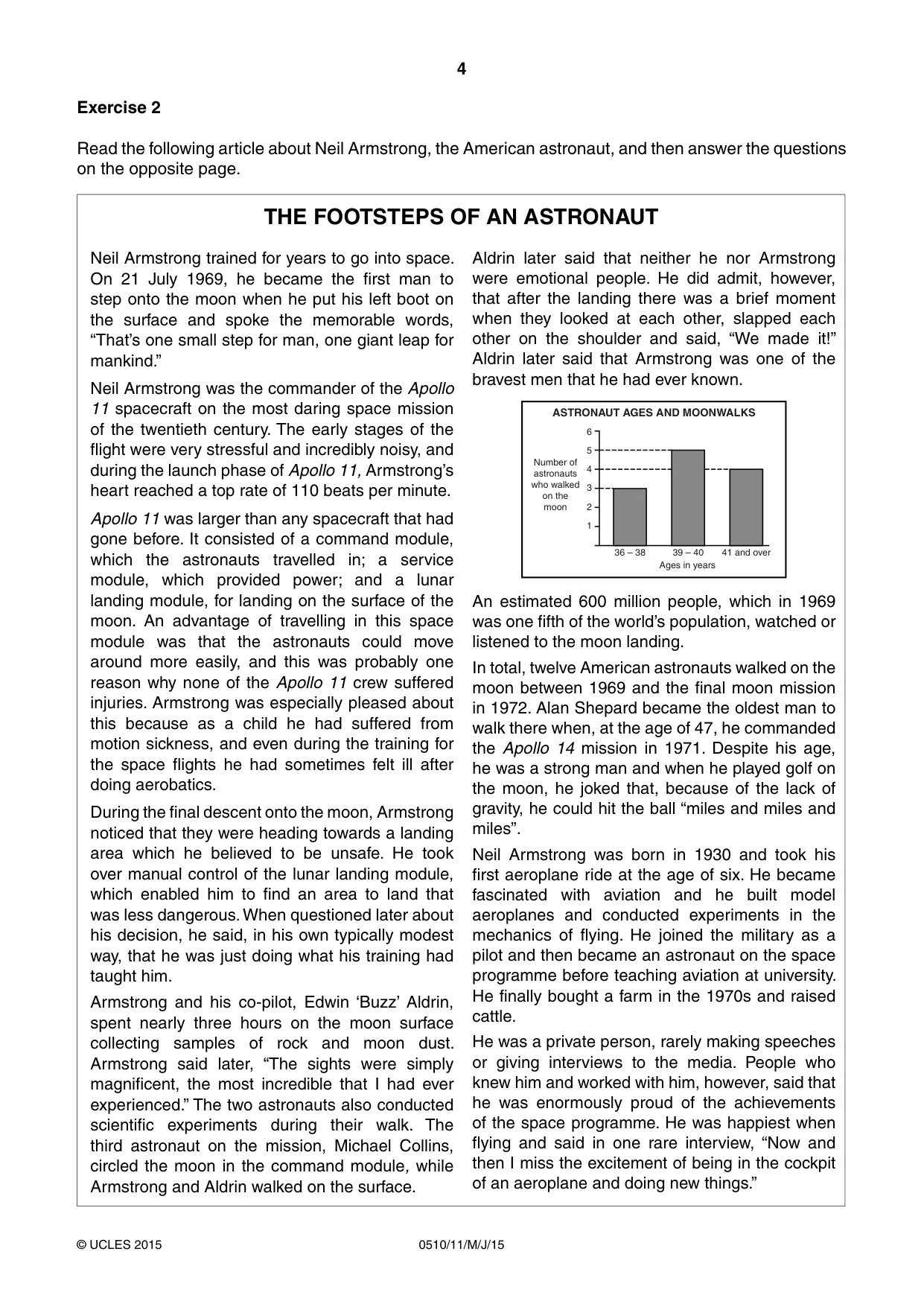
4 0510/11/M/J/15 © UCLES 2015 Exercise 2 Read the following article about Neil Armstrong, the American astronaut, and then answer the questions on the opposite page. THE FOOTSTEPS OF AN ASTRONAUT Neil Armstrong trained for years to go into space. On 21 July 1969, he became the first man to step onto the moon when he put his left boot on the surface and spoke the memorable words, “That’s one small step for man, one giant leap for mankind.” Neil Armstrong was the commander of the Apollo 11 spacecraft on the most daring space mission of the twentieth century. The early stages of the flight were very stressful and incredibly noisy, and during the launch phase of Apollo 11, Armstrong’s heart reached a top rate of 110 beats per minute. Apollo 11 was larger than any spacecraft that had gone before. It consisted of a command module, which the astronauts travelled in; a service module, which provided power; and a lunar landing module, for landing on the surface of the moon. An advantage of travelling in this space module was that the astronauts could move around more easily, and this was probably one reason why none of the Apollo 11 crew suffered injuries. Armstrong was especially pleased about this because as a child he had suffered from motion sickness, and even during the training for the space flights he had sometimes felt ill after doing aerobatics. During the final descent onto the moon, Armstrong noticed that they were heading towards a landing area which he believed to be unsafe. He took over manual control of the lunar landing module, which enabled him to find an area to land that was less dangerous. When questioned later about his decision, he said, in his own typically modest way, that he was just doing what his training had taught him. Armstrong and his co-pilot, Edwin ‘Buzz’ Aldrin, spent nearly three hours on the moon surface collecting samples of rock and moon dust. Armstrong said later, “The sights were simply magnificent, the most incredible that I had ever experienced.” The two astronauts also conducted scientific experiments during their walk. The third astronaut on the mission, Michael Collins, circled the moon in the command module, while Armstrong and Aldrin walked on the surface. Aldrin later said that neither he nor Armstrong were emotional people. He did admit, however, that after the landing there was a brief moment when they looked at each other, slapped each other on the shoulder and said, “We made it!” Aldrin later said that Armstrong was one of the bravest men that he had ever known. Number of astronauts who walked on the moon 6 5 4 3 2 1 36 – 38 39 – 40 41 and over Ages in years ASTRONAUT AGES AND MOONWALKS An estimated 600 million people, which in 1969 was one fifth of the world’s population, watched or listened to the moon landing. In total, twelve American astronauts walked on the moon between 1969 and the final moon mission in 1972. Alan Shepard became the oldest man to walk there when, at the age of 47, he commanded the Apollo 14 mission in 1971. Despite his age, he was a strong man and when he played golf on the moon, he joked that, because of the lack of gravity, he could hit the ball “miles and miles and miles”. Neil Armstrong was born in 1930 and took his first aeroplane ride at the age of six. He became fascinated with aviation and he built model aeroplanes and conducted experiments in the mechanics of flying. He joined the military as a pilot and then became an astronaut on the space programme before teaching aviation at university. He finally bought a farm in the 1970s and raised cattle. He was a private person, rarely making speeches or giving interviews to the media. People who knew him and worked with him, however, said that he was enormously proud of the achievements of the space programme. He was happiest when flying and said in one rare interview, “Now and then I miss the excitement of being in the cockpit of an aeroplane and doing new things.”
Question paper, page 5
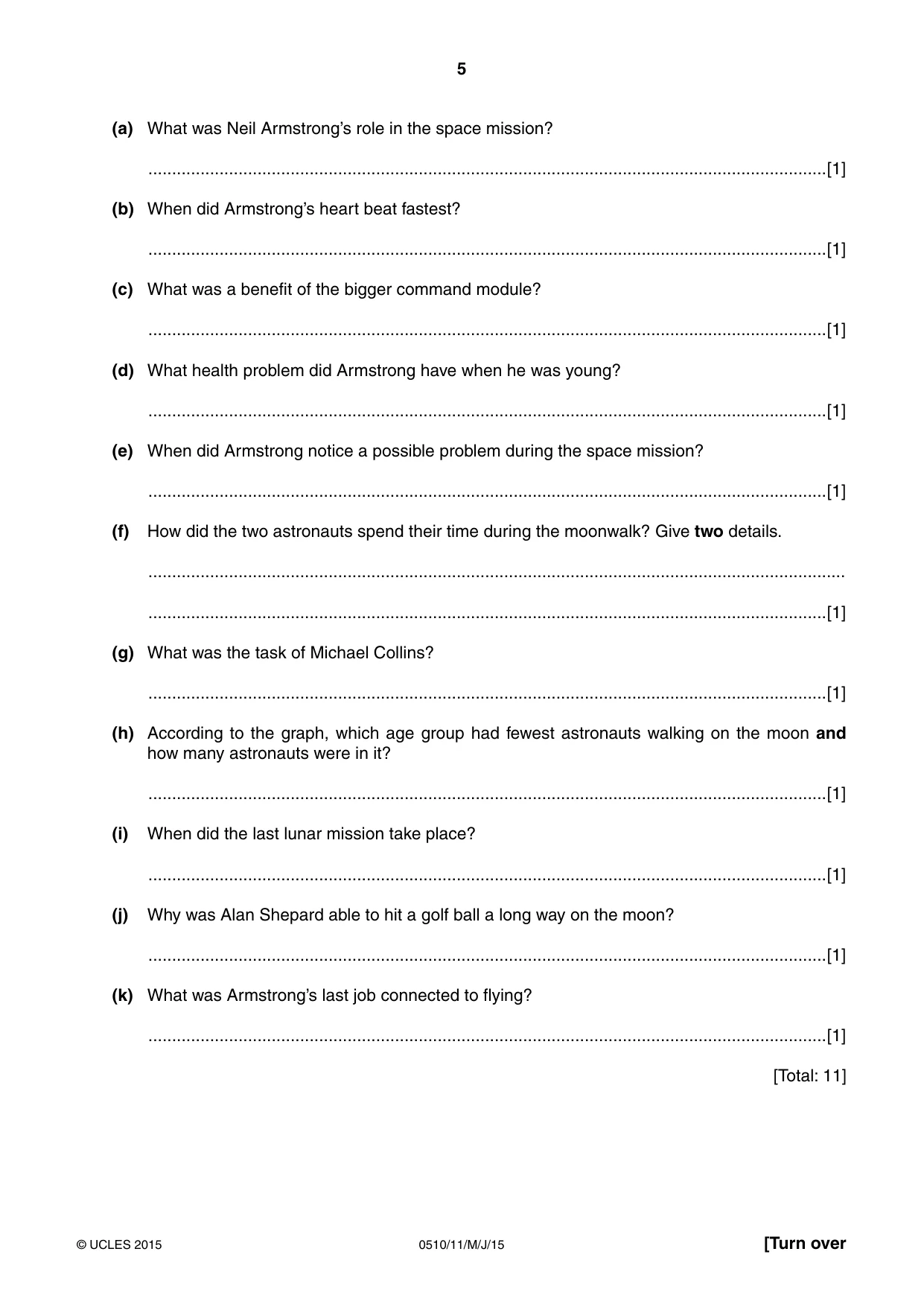
5 0510/11/M/J/15 © UCLES 2015 [Turn over (a) What was Neil Armstrong’s role in the space mission? …[1] (b) When did Armstrong’s heart beat fastest? …[1] (c) What was a benefit of the bigger command module? …[1] (d) What health problem did Armstrong have when he was young? …[1] (e) When did Armstrong notice a possible problem during the space mission? …[1] (f) How did the two astronauts spend their time during the moonwalk? Give two details. … …[1] (g) What was the task of Michael Collins? …[1] (h) According to the graph, which age group had fewest astronauts walking on the moon and how many astronauts were in it? …[1] (i) When did the last lunar mission take place? …[1] (j) Why was Alan Shepard able to hit a golf ball a long way on the moon? …[1] (k) What was Armstrong’s last job connected to flying? …[1] [Total: 11]
Question paper, page 6
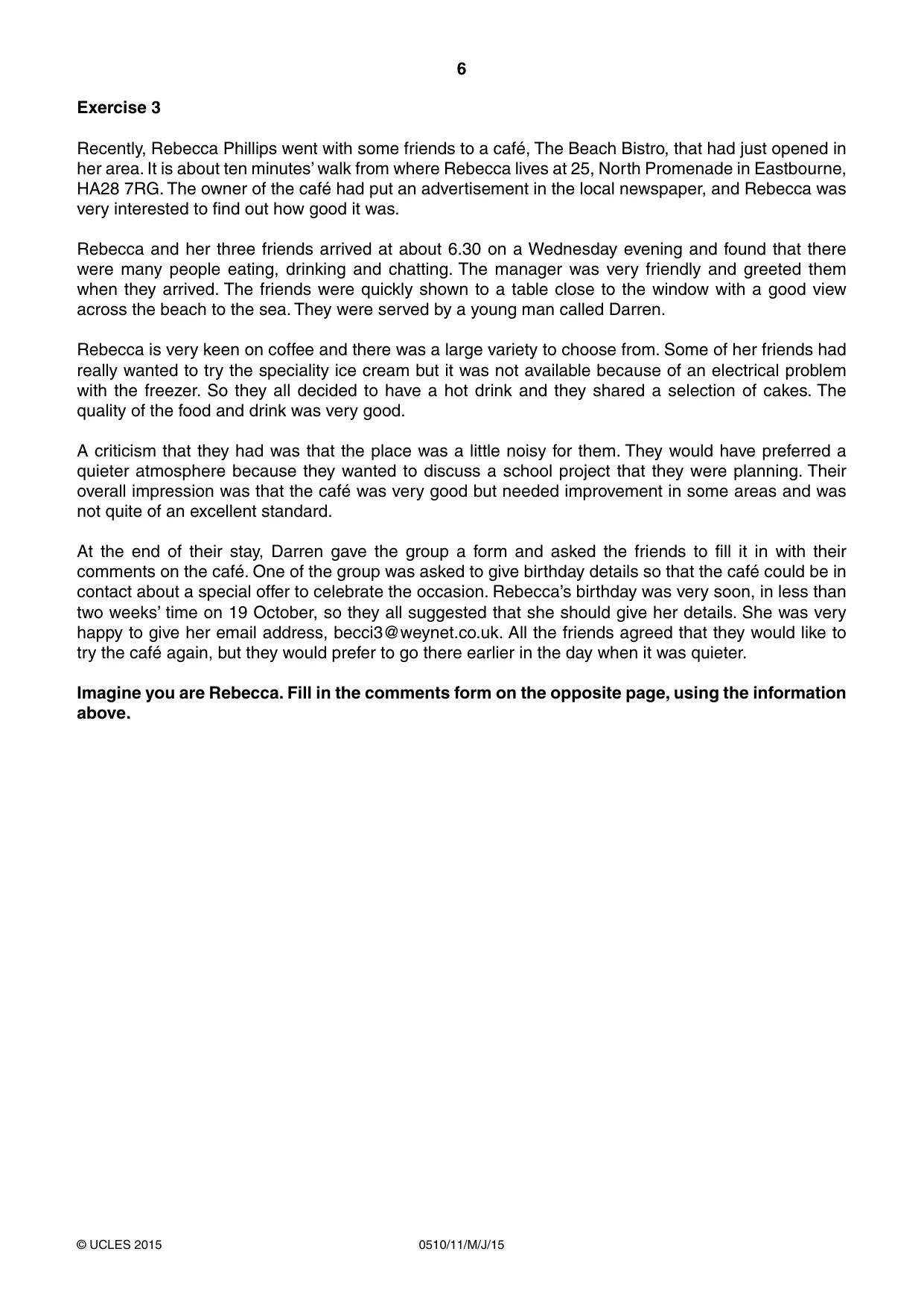
6 0510/11/M/J/15 © UCLES 2015 Exercise 3 Recently, Rebecca Phillips went with some friends to a café, The Beach Bistro, that had just opened in her area. It is about ten minutes’ walk from where Rebecca lives at 25, North Promenade in Eastbourne, HA28 7RG. The owner of the café had put an advertisement in the local newspaper, and Rebecca was very interested to find out how good it was. Rebecca and her three friends arrived at about 6.30 on a Wednesday evening and found that there were many people eating, drinking and chatting. The manager was very friendly and greeted them when they arrived. The friends were quickly shown to a table close to the window with a good view across the beach to the sea. They were served by a young man called Darren. Rebecca is very keen on coffee and there was a large variety to choose from. Some of her friends had really wanted to try the speciality ice cream but it was not available because of an electrical problem with the freezer. So they all decided to have a hot drink and they shared a selection of cakes. The quality of the food and drink was very good. A criticism that they had was that the place was a little noisy for them. They would have preferred a quieter atmosphere because they wanted to discuss a school project that they were planning. Their overall impression was that the café was very good but needed improvement in some areas and was not quite of an excellent standard. At the end of their stay, Darren gave the group a form and asked the friends to fill it in with their comments on the café. One of the group was asked to give birthday details so that the café could be in contact about a special offer to celebrate the occasion. Rebecca’s birthday was very soon, in less than two weeks’ time on 19 October, so they all suggested that she should give her details. She was very happy to give her email address, becci3@weynet.co.uk. All the friends agreed that they would like to try the café again, but they would prefer to go there earlier in the day when it was quieter. Imagine you are Rebecca. Fill in the comments form on the opposite page, using the information above.
Question paper, page 7
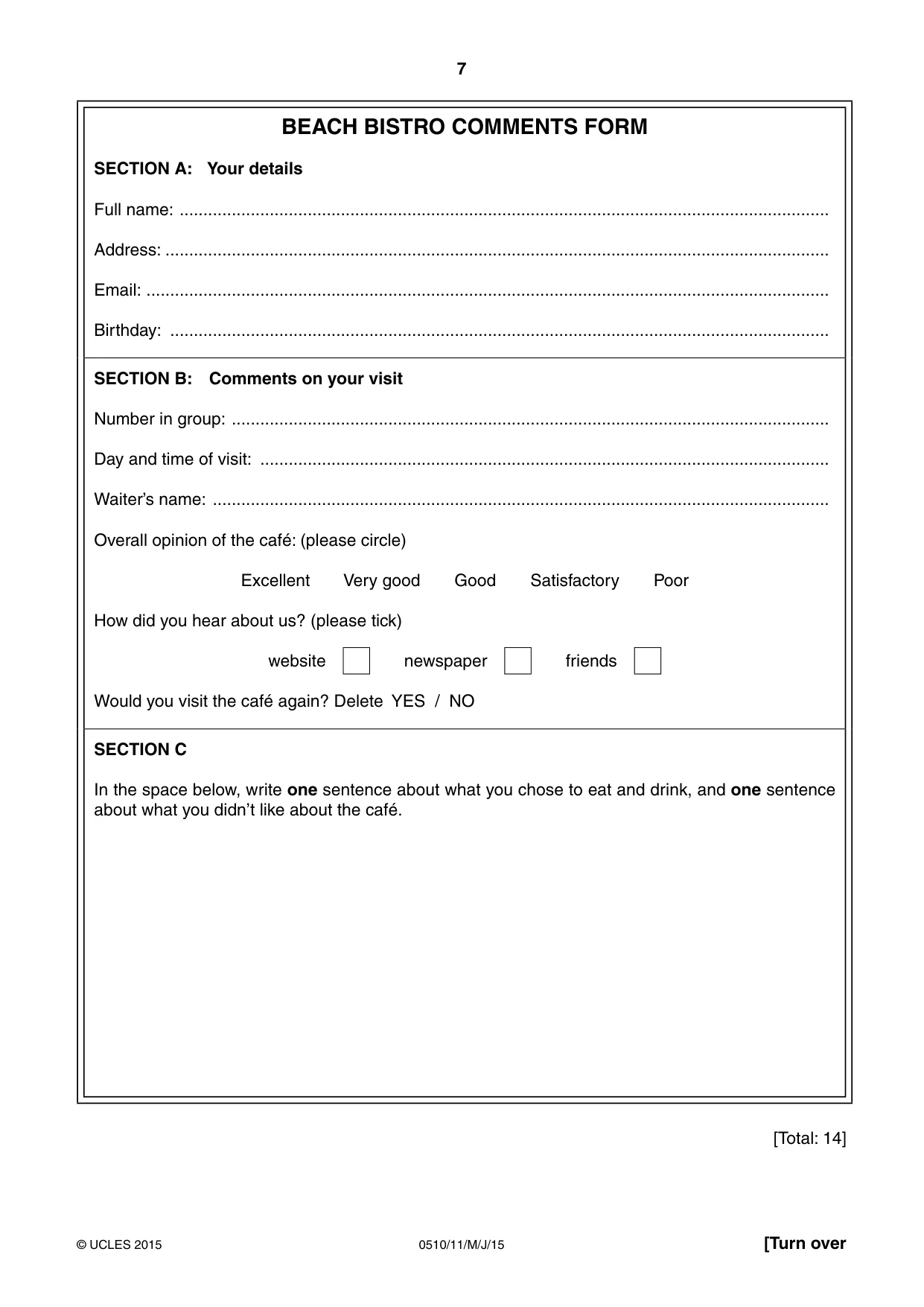
7 0510/11/M/J/15 © UCLES 2015 [Turn over BEACH BISTRO COMMENTS FORM SECTION A: Your details Full name: … Address: … Email: … Birthday: … SECTION B: Comments on your visit Number in group: … Day and time of visit: … Waiter’s name: … Overall opinion of the café: (please circle) Excellent Very good Good Satisfactory Poor How did you hear about us? (please tick) website newspaper friends Would you visit the café again? Delete YES / NO SECTION C In the space below, write one sentence about what you chose to eat and drink, and one sentence about what you didn’t like about the café. [Total: 14]
Question paper, page 8
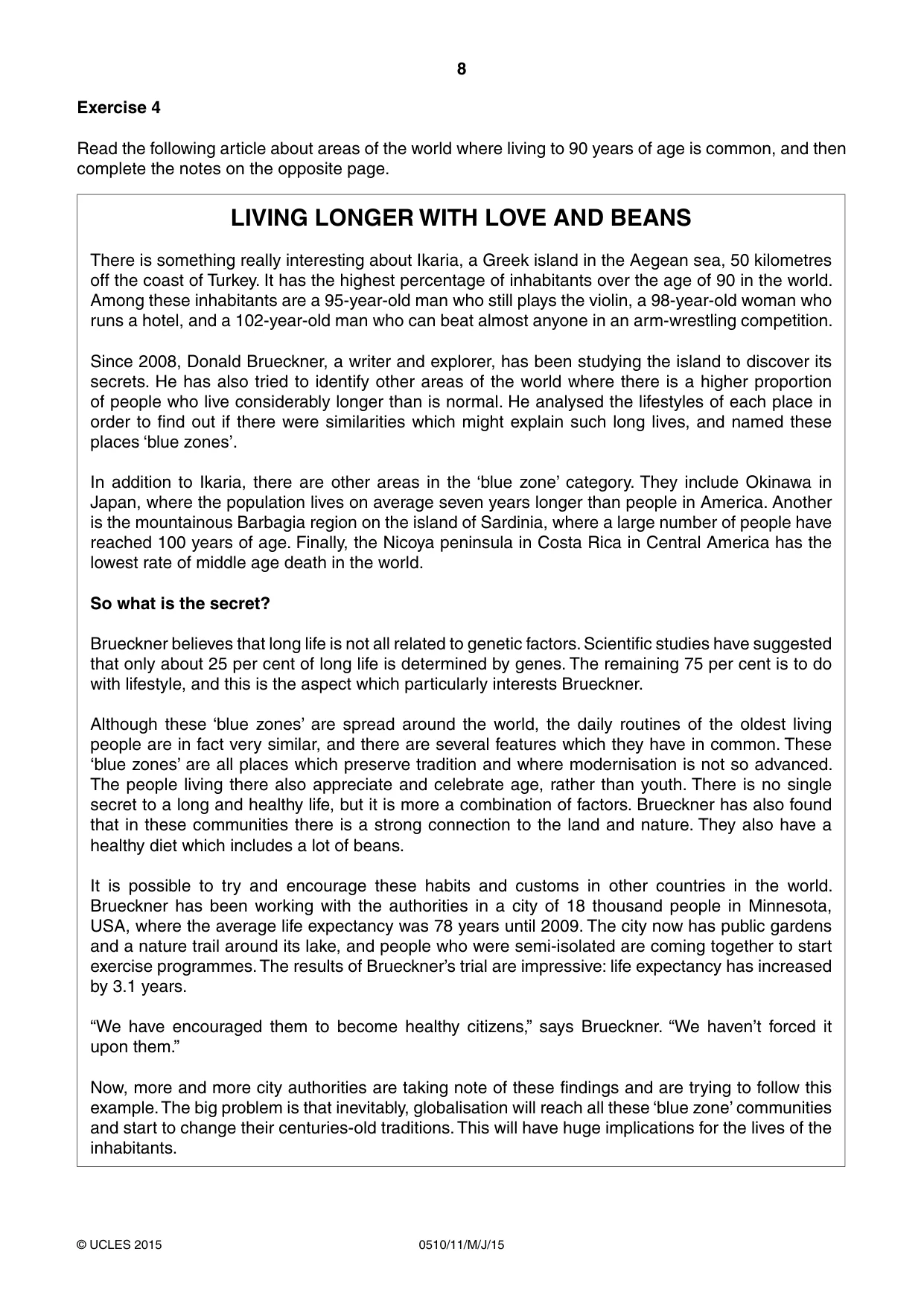
8 0510/11/M/J/15 © UCLES 2015 Exercise 4 Read the following article about areas of the world where living to 90 years of age is common, and then complete the notes on the opposite page. LIVING LONGER WITH LOVE AND BEANS There is something really interesting about Ikaria, a Greek island in the Aegean sea, 50 kilometres off the coast of Turkey. It has the highest percentage of inhabitants over the age of 90 in the world. Among these inhabitants are a 95-year-old man who still plays the violin, a 98-year-old woman who runs a hotel, and a 102-year-old man who can beat almost anyone in an arm-wrestling competition. Since 2008, Donald Brueckner, a writer and explorer, has been studying the island to discover its secrets. He has also tried to identify other areas of the world where there is a higher proportion of people who live considerably longer than is normal. He analysed the lifestyles of each place in order to find out if there were similarities which might explain such long lives, and named these places ‘blue zones’. In addition to Ikaria, there are other areas in the ‘blue zone’ category. They include Okinawa in Japan, where the population lives on average seven years longer than people in America. Another is the mountainous Barbagia region on the island of Sardinia, where a large number of people have reached 100 years of age. Finally, the Nicoya peninsula in Costa Rica in Central America has the lowest rate of middle age death in the world. So what is the secret? Brueckner believes that long life is not all related to genetic factors. Scientific studies have suggested that only about 25 per cent of long life is determined by genes. The remaining 75 per cent is to do with lifestyle, and this is the aspect which particularly interests Brueckner. Although these ‘blue zones’ are spread around the world, the daily routines of the oldest living people are in fact very similar, and there are several features which they have in common. These ‘blue zones’ are all places which preserve tradition and where modernisation is not so advanced. The people living there also appreciate and celebrate age, rather than youth. There is no single secret to a long and healthy life, but it is more a combination of factors. Brueckner has also found that in these communities there is a strong connection to the land and nature. They also have a healthy diet which includes a lot of beans. It is possible to try and encourage these habits and customs in other countries in the world. Brueckner has been working with the authorities in a city of 18 thousand people in Minnesota, USA, where the average life expectancy was 78 years until 2009. The city now has public gardens and a nature trail around its lake, and people who were semi-isolated are coming together to start exercise programmes. The results of Brueckner’s trial are impressive: life expectancy has increased by 3.1 years. “We have encouraged them to become healthy citizens,” says Brueckner. “We haven’t forced it upon them.” Now, more and more city authorities are taking note of these findings and are trying to follow this example. The big problem is that inevitably, globalisation will reach all these ‘blue zone’ communities and start to change their centuries-old traditions. This will have huge implications for the lives of the inhabitants.
Question paper, page 9
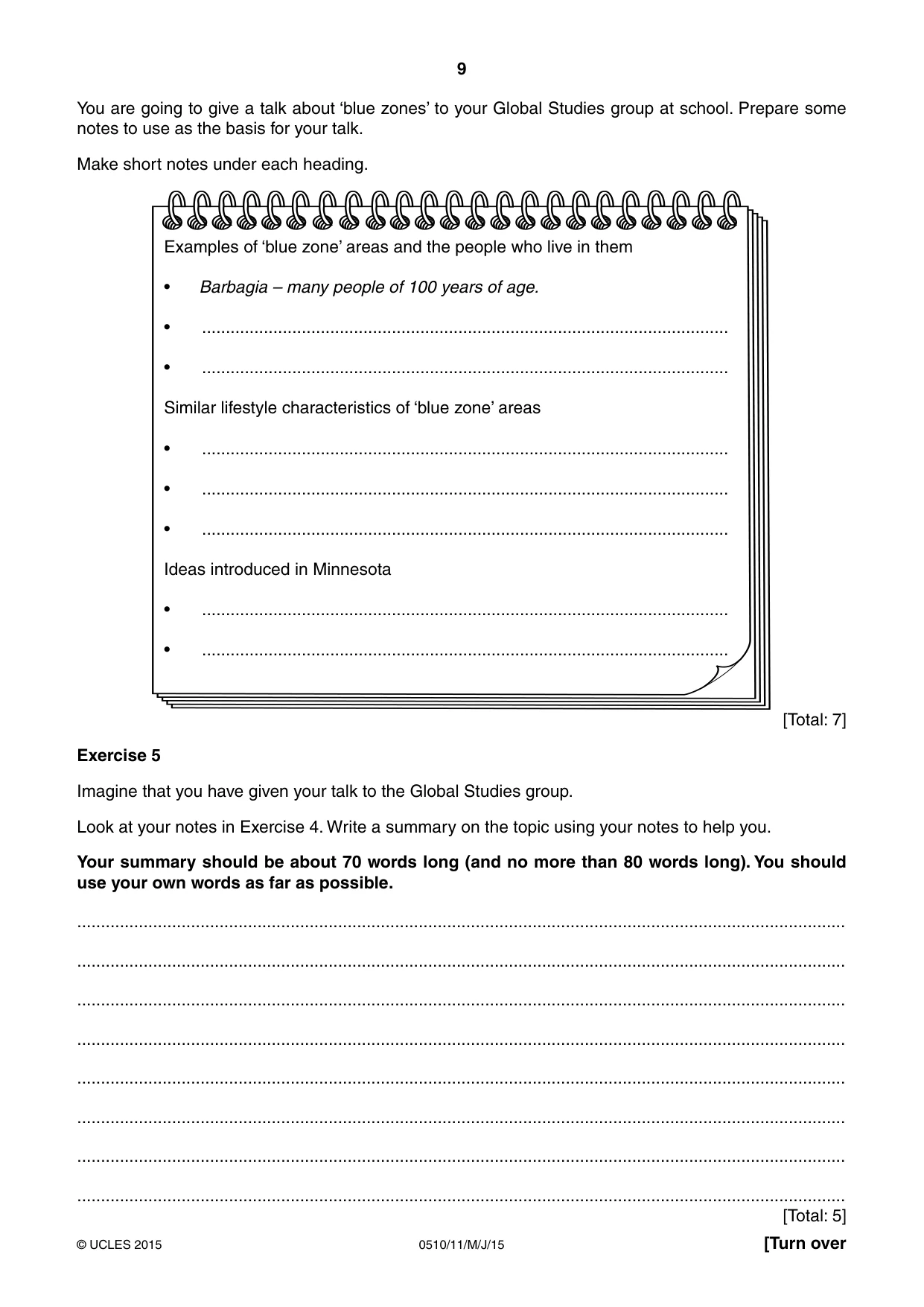
9 0510/11/M/J/15 © UCLES 2015 [Turn over You are going to give a talk about ‘blue zones’ to your Global Studies group at school. Prepare some notes to use as the basis for your talk. Make short notes under each heading. Examples of ‘blue zone’ areas and the people who live in them • Barbagia – many people of 100 years of age. • … • … Similar lifestyle characteristics of ‘blue zone’ areas • … • … • … Ideas introduced in Minnesota • … • … [Total: 7] Exercise 5 Imagine that you have given your talk to the Global Studies group. Look at your notes in Exercise 4. Write a summary on the topic using your notes to help you. Your summary should be about 70 words long (and no more than 80 words long). You should use your own words as far as possible. … … … … … … … … [Total: 5]
Question paper, page 10
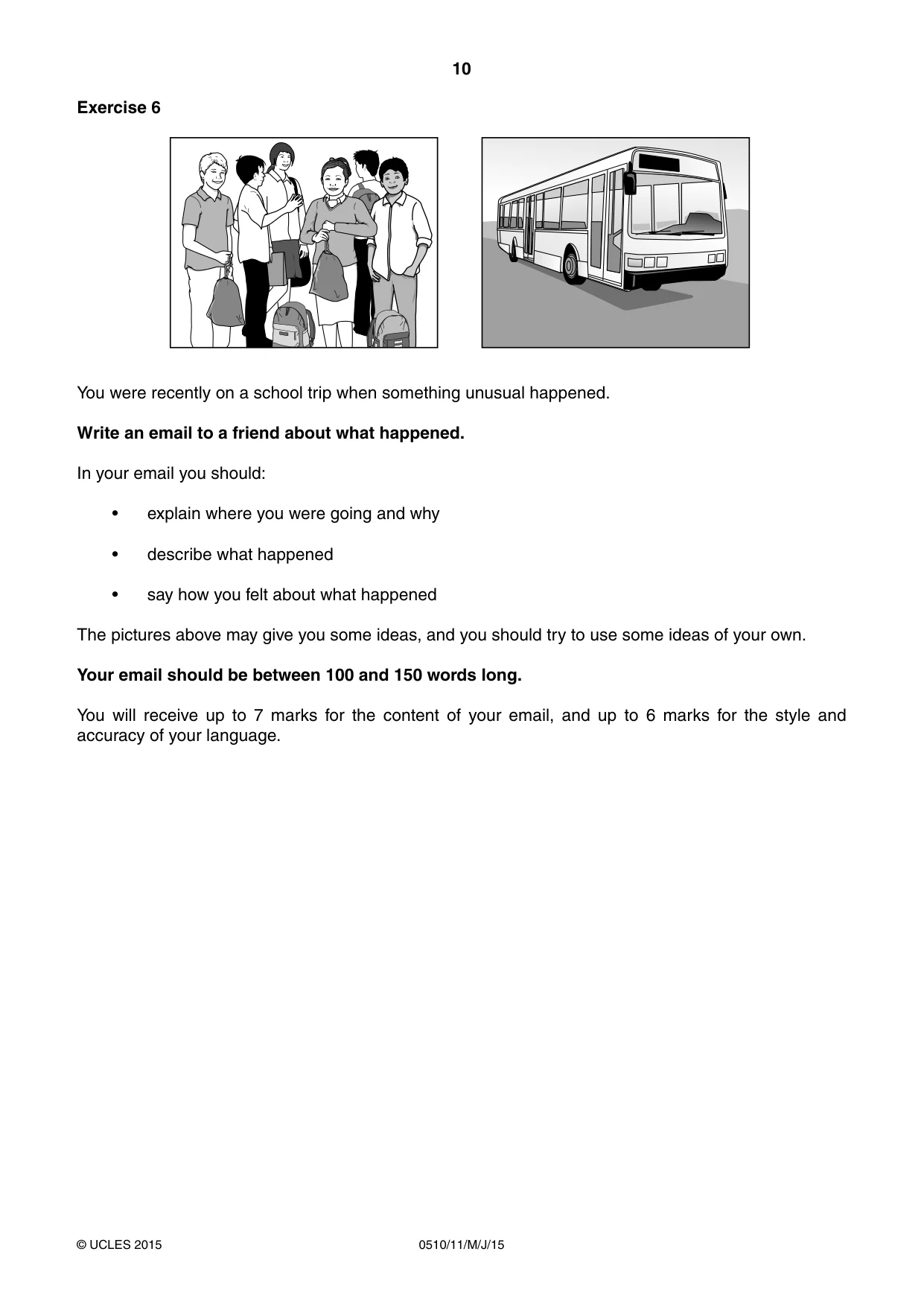
10 0510/11/M/J/15 © UCLES 2015 Exercise 6 You were recently on a school trip when something unusual happened. Write an email to a friend about what happened. In your email you should: • explain where you were going and why • describe what happened • say how you felt about what happened The pictures above may give you some ideas, and you should try to use some ideas of your own. Your email should be between 100 and 150 words long. You will receive up to 7 marks for the content of your email, and up to 6 marks for the style and accuracy of your language.
Question paper, page 11
11 0510/11/M/J/15 © UCLES 2015 [Turn over … … … … … … … … … … … … … … … … … … … … [Total: 13]
Question paper, page 12
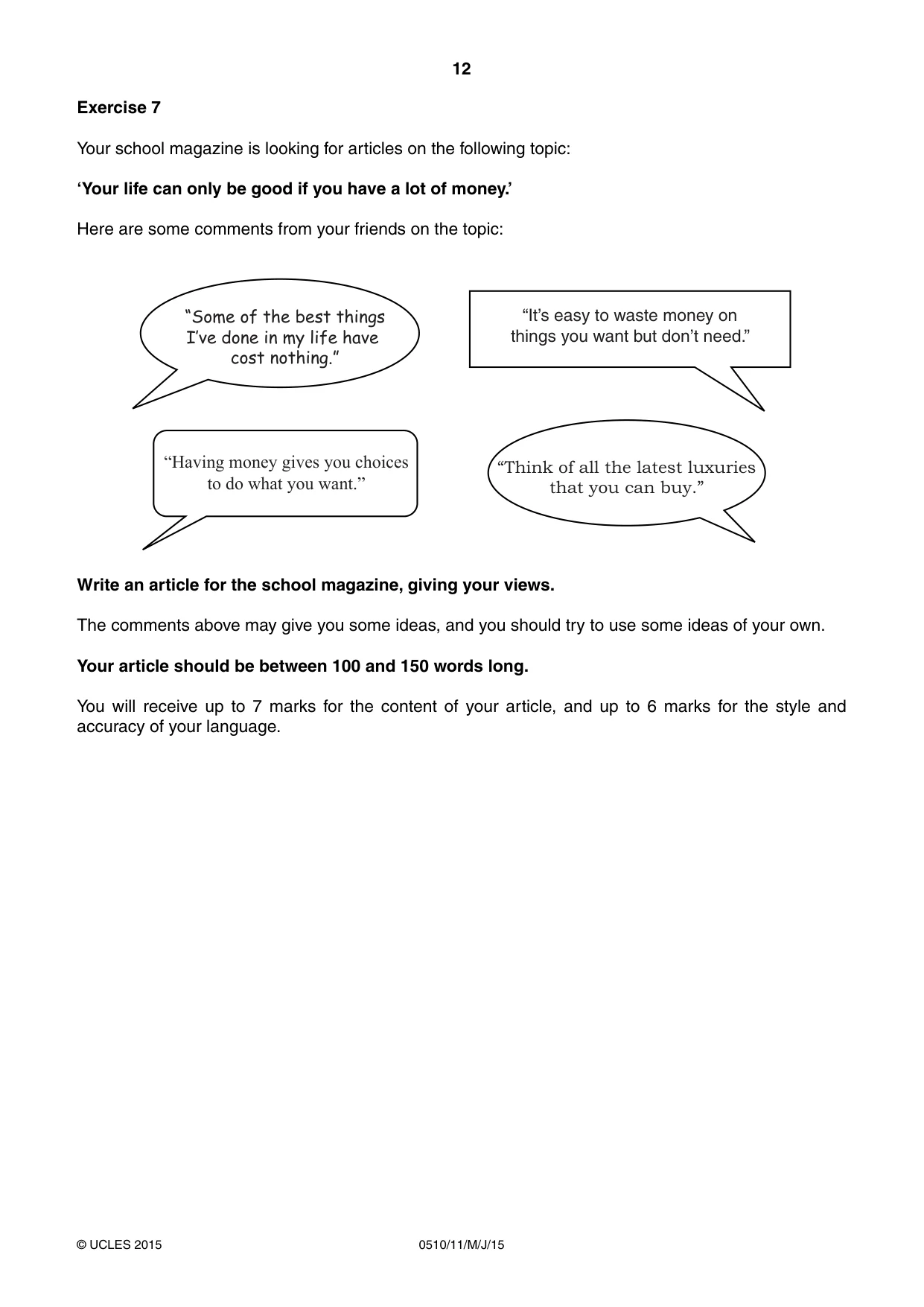
12 0510/11/M/J/15 © UCLES 2015 Exercise 7 Your school magazine is looking for articles on the following topic: ‘Your life can only be good if you have a lot of money.’ Here are some comments from your friends on the topic: “It’s easy to waste money on things you want but don’t need.” “Some of the best things ,·Ye Gone in m\ Oife hDYe cost nothing.” “Having money gives you choices to do what you want.” “Think of all the latest luxuries that you can buy.” Write an article for the school magazine, giving your views. The comments above may give you some ideas, and you should try to use some ideas of your own. Your article should be between 100 and 150 words long. You will receive up to 7 marks for the content of your article, and up to 6 marks for the style and accuracy of your language.
Question paper, page 13
13 0510/11/M/J/15 © UCLES 2015 … … … … … … … … … … … … … … … … … … … … [Total: 13]
Question paper, page 14
14 0510/11/M/J/15 © UCLES 2015 BLANK PAGE
Question paper, page 15
15 0510/11/M/J/15 © UCLES 2015 BLANK PAGE
Question paper, page 16
16 0510/11/M/J/15 © UCLES 2015 Permission to reproduce items where third-party owned material protected by copyright is included has been sought and cleared where possible. Every reasonable effort has been made by the publisher (UCLES) to trace copyright holders, but if any items requiring clearance have unwittingly been included, the publisher will be pleased to make amends at the earliest possible opportunity. To avoid the issue of disclosure of answer-related information to candidates, all copyright acknowledgements are reproduced online in the Cambridge International Examinations Copyright Acknowledgements Booklet. This is produced for each series of examinations and is freely available to download at www.cie.org.uk after the live examination series. Cambridge International Examinations is part of the Cambridge Assessment Group. Cambridge Assessment is the brand name of University of Cambridge Local Examinations Syndicate (UCLES), which is itself a department of the University of Cambridge. BLANK PAGE
Mark scheme, page 1
® IGCSE is the registered trademark of Cambridge International Examinations. CAMBRIDGE INTERNATIONAL EXAMINATIONS Cambridge International General Certificate of Secondary Education MARK SCHEME for the May/June 2015 series 0510 ENGLISH AS A SECOND LANGAUGE 0510/11 Paper 1 (Reading and Writing – Core), maximum raw mark 70 This mark scheme is published as an aid to teachers and candidates, to indicate the requirements of the examination. It shows the basis on which Examiners were instructed to award marks. It does not indicate the details of the discussions that took place at an Examiners’ meeting before marking began, which would have considered the acceptability of alternative answers. Mark schemes should be read in conjunction with the question paper and the Principal Examiner Report for Teachers. Cambridge will not enter into discussions about these mark schemes. Cambridge is publishing the mark schemes for the May/June 2015 series for most Cambridge IGCSE®, Cambridge International A and AS Level components and some Cambridge O Level components.
Mark scheme, page 2
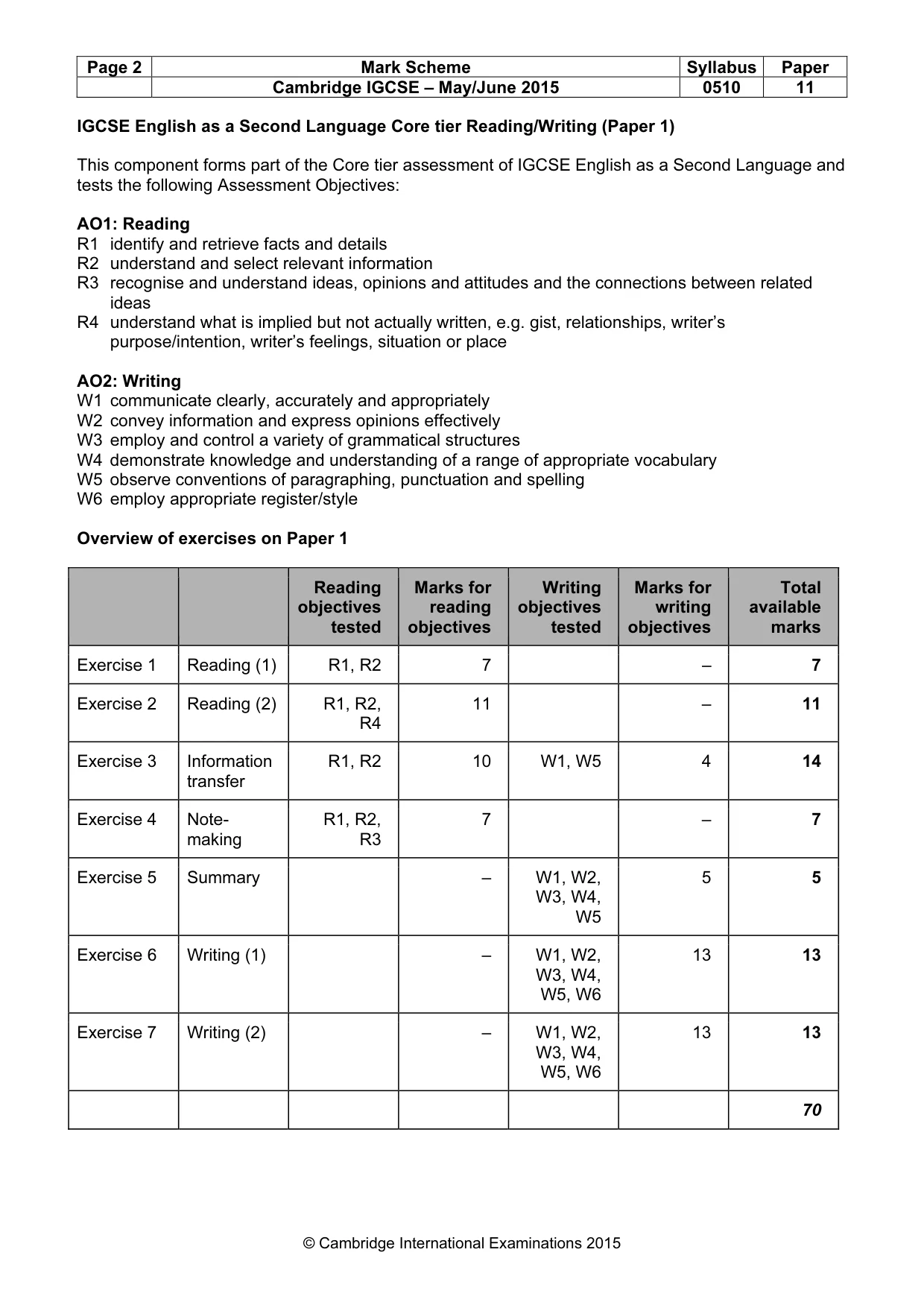
Page 2 Mark Scheme Syllabus Paper Cambridge IGCSE – May/June 2015 0510 11 © Cambridge International Examinations 2015 IGCSE English as a Second Language Core tier Reading/Writing (Paper 1) This component forms part of the Core tier assessment of IGCSE English as a Second Language and tests the following Assessment Objectives: AO1: Reading R1 identify and retrieve facts and details R2 understand and select relevant information R3 recognise and understand ideas, opinions and attitudes and the connections between related ideas R4 understand what is implied but not actually written, e.g. gist, relationships, writer’s purpose/intention, writer’s feelings, situation or place AO2: Writing W1 communicate clearly, accurately and appropriately W2 convey information and express opinions effectively W3 employ and control a variety of grammatical structures W4 demonstrate knowledge and understanding of a range of appropriate vocabulary W5 observe conventions of paragraphing, punctuation and spelling W6 employ appropriate register/style Overview of exercises on Paper 1 Reading objectives tested Marks for reading objectives Writing objectives tested Marks for writing objectives Total available marks Exercise 1 Reading (1) R1, R2 7 – 7 Exercise 2 Reading (2) R1, R2, R4 11 – 11 Exercise 3 Information transfer R1, R2 10 W1, W5 4 14 Exercise 4 Note- making R1, R2, R3 7 – 7 Exercise 5 Summary – W1, W2, W3, W4, W5 5 5 Exercise 6 Writing (1) – W1, W2, W3, W4, W5, W6 13 13 Exercise 7 Writing (2) – W1, W2, W3, W4, W5, W6 13 13 70
Mark scheme, page 3
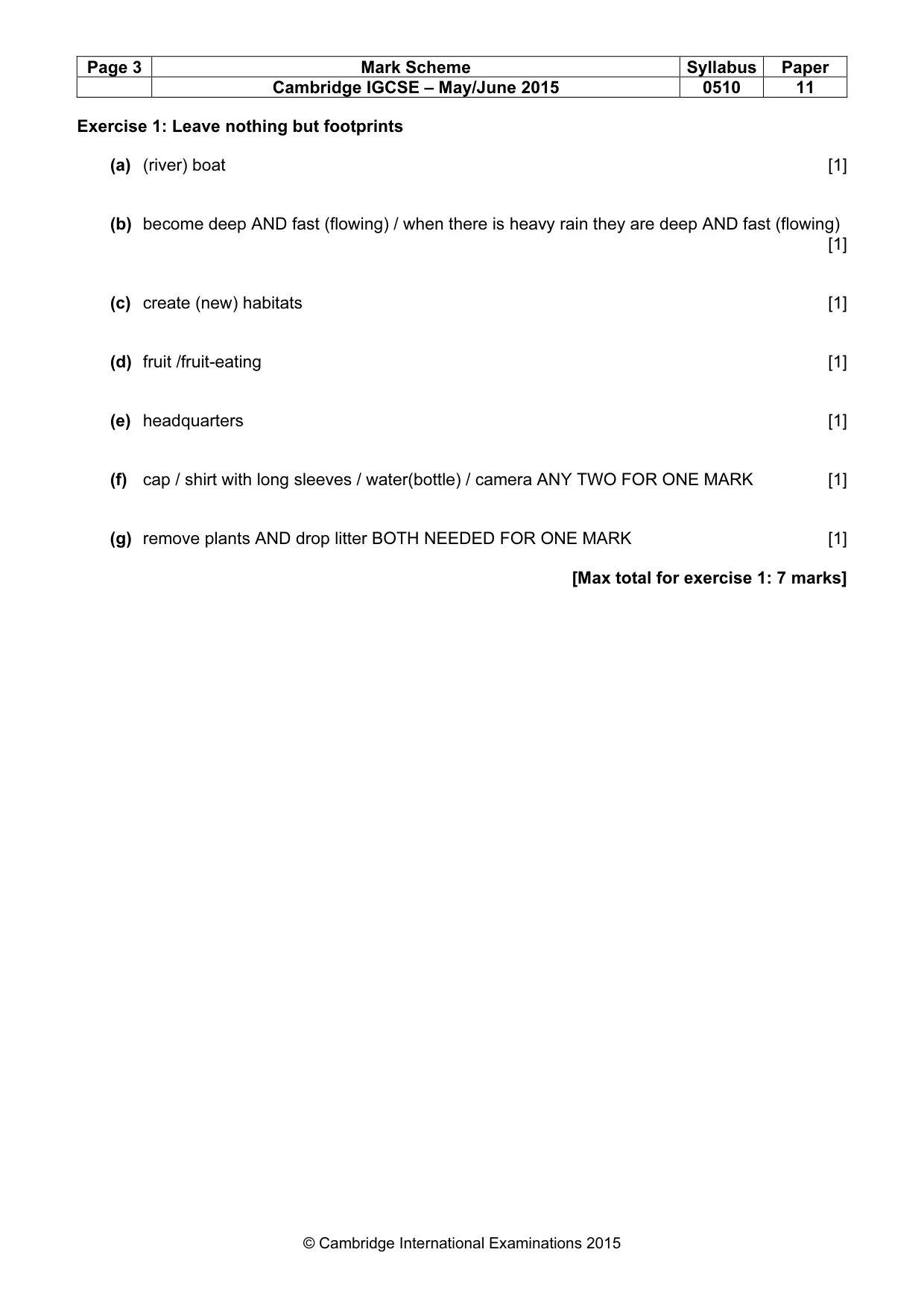
Page 3 Mark Scheme Syllabus Paper Cambridge IGCSE – May/June 2015 0510 11 © Cambridge International Examinations 2015 Exercise 1: Leave nothing but footprints (a) (river) boat [1] (b) become deep AND fast (flowing) / when there is heavy rain they are deep AND fast (flowing) [1] (c) create (new) habitats [1] (d) fruit /fruit-eating [1] (e) headquarters [1] (f) cap / shirt with long sleeves / water(bottle) / camera ANY TWO FOR ONE MARK [1] (g) remove plants AND drop litter BOTH NEEDED FOR ONE MARK [1] [Max total for exercise 1: 7 marks]
Mark scheme, page 4
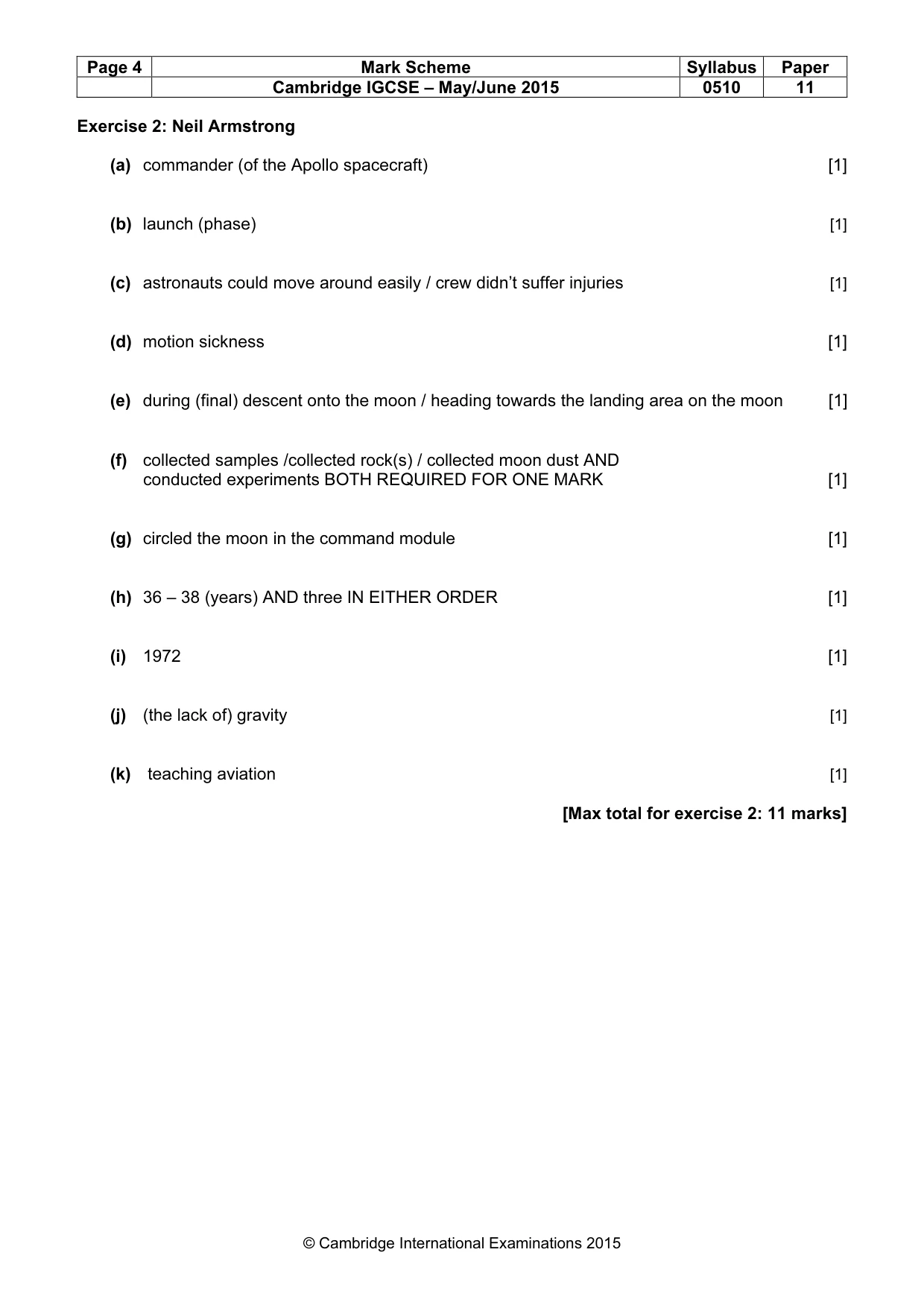
Page 4 Mark Scheme Syllabus Paper Cambridge IGCSE – May/June 2015 0510 11 © Cambridge International Examinations 2015 Exercise 2: Neil Armstrong (a) commander (of the Apollo spacecraft) [1] (b) launch (phase) [1] (c) astronauts could move around easily / crew didn’t suffer injuries [1] (d) motion sickness [1] (e) during (final) descent onto the moon / heading towards the landing area on the moon [1] (f) collected samples /collected rock(s) / collected moon dust AND conducted experiments BOTH REQUIRED FOR ONE MARK [1] (g) circled the moon in the command module [1] (h) 36 – 38 (years) AND three IN EITHER ORDER [1] (i) 1972 [1] (j) (the lack of) gravity [1] (k) teaching aviation [1] [Max total for exercise 2: 11 marks]
Mark scheme, page 5
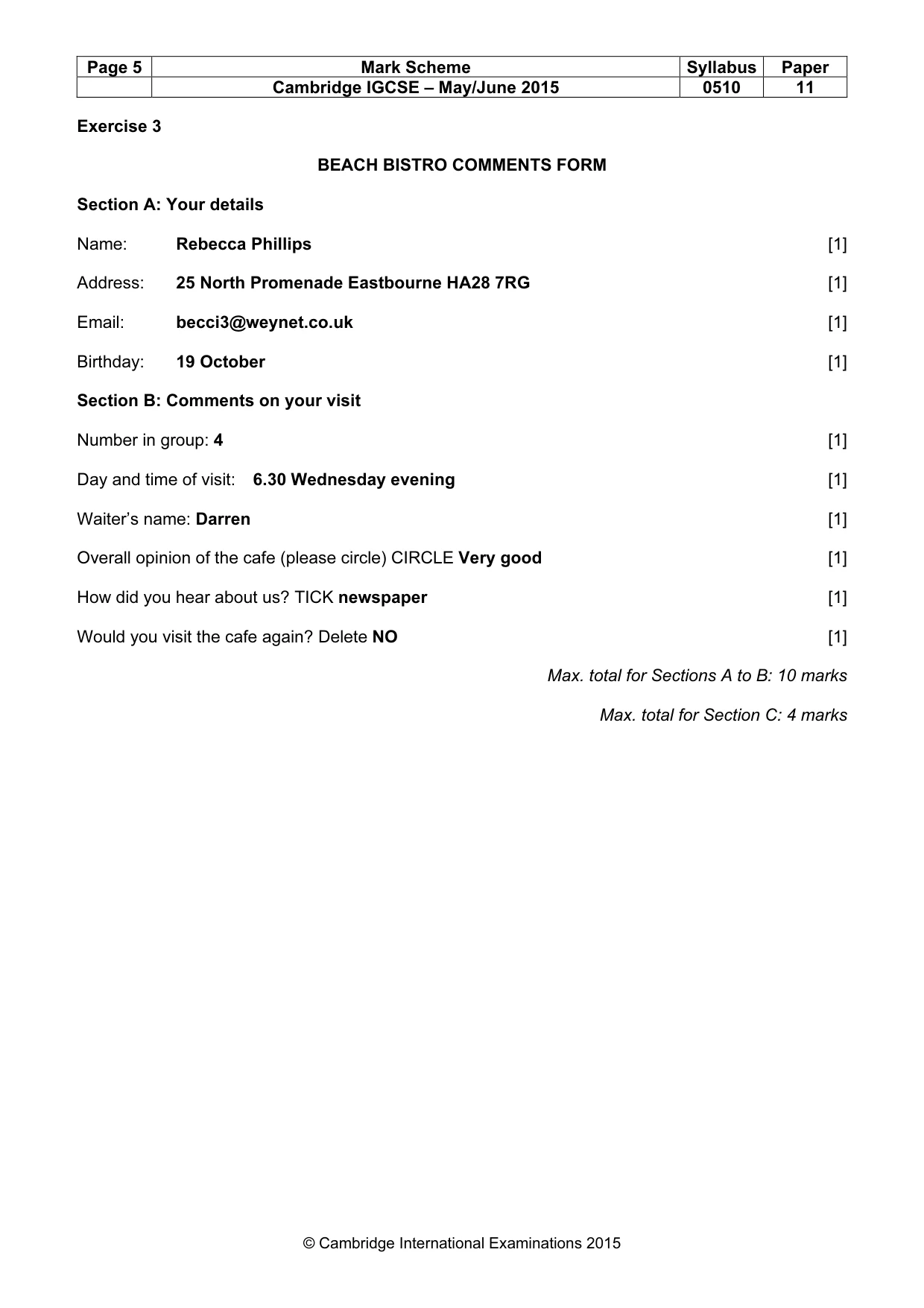
Page 5 Mark Scheme Syllabus Paper Cambridge IGCSE – May/June 2015 0510 11 © Cambridge International Examinations 2015 Exercise 3 BEACH BISTRO COMMENTS FORM Section A: Your details Name: Rebecca Phillips [1] Address: 25 North Promenade Eastbourne HA28 7RG [1] Email: becci3@weynet.co.uk [1] Birthday: 19 October [1] Section B: Comments on your visit Number in group: 4 [1] Day and time of visit: 6.30 Wednesday evening [1] Waiter’s name: Darren [1] Overall opinion of the cafe (please circle) CIRCLE Very good [1] How did you hear about us? TICK newspaper [1] Would you visit the cafe again? Delete NO [1] Max. total for Sections A to B: 10 marks Max. total for Section C: 4 marks
Mark scheme, page 6
Page 6 Mark Scheme Syllabus Paper Cambridge IGCSE – May/June 2015 0510 11 © Cambridge International Examinations 2015 Section C In the space below, write one sentence about what you chose to eat and drink and one sentence about what you didn’t like about the cafe. Example sentence: We had a hot drink and shared cakes. 2 marks: proper sentence construction; correct spelling and punctuation; gives the information asked for 1 mark: proper sentence construction; 1–3 errors of punctuation and/or spelling (without obscuring meaning); gives the information asked for 0 marks: more than 3 errors of punctuation and/or spelling; and/or does not give the information asked for; and/or not a proper sentence; and/or meaning obscure Absence of a full stop at the end should be considered as 1 punctuation error. Absence of an upper case letter at the beginning should be considered as 1 punctuation error. Omission of a word in a sentence should be considered as 1 grammar error. [Max total for exercise 3: 14 marks]
Mark scheme, page 7
Page 7 Mark Scheme Syllabus Paper Cambridge IGCSE – May/June 2015 0510 11 © Cambridge International Examinations 2015 Exercise 4: Living longer with love and beans Examples of ‘blue zone’ areas and the people who live in them [max 2 marks for this heading] Barbagia – many people of 100 years of age. • Ikaria – highest percentage (of people) over 90 • Okinawa – (population) lives 7 years longer than people in America • Nicoya peninsula – lowest rate of middle-age death Similar lifestyle characteristics of ‘blue zone’ areas [max 3 marks for this heading] • daily routines • preserve tradition / modernisation not so advanced • appreciate age / celebrate age • (strong) connection to the land / (strong) connection to nature • healthy diet / eat a lot of beans Ideas introduced in Minnesota [max 2 marks for this heading] • public gardens • nature trail • exercise programmes / exercising together [Max total for exercise 4: 7 marks]
Mark scheme, page 8
Page 8 Mark Scheme Syllabus Paper Cambridge IGCSE – May/June 2015 0510 11 © Cambridge International Examinations 2015 Exercise 5: Blue Zones: summary Language: (up to 5 marks) 0 marks: no understanding of the task / no relevant content / meaning completely obscure due to serious language inaccuracies 1 mark: copying without discrimination from text / multiple language inaccuracies 2 marks: heavy reliance on language from the text with no attempt to organise and sequence points cohesively / limited language expression making meaning at times unclear 3 marks: some reliance on language from the text, but with an attempt to organise and sequence points cohesively / language satisfactory, but with some inaccuracies 4 marks: good attempt to use own words and to organise and sequence points cohesively / generally good control of language 5 marks: good, concise summary style / very good attempt to use own words and to organise and sequence points cohesively [Max total for exercise 5: 5 marks]
Mark scheme, page 9
Page 9 Mark Scheme Syllabus Paper Cambridge IGCSE – May/June 2015 0510 11 © Cambridge International Examinations 2015 Exercise 6: Incident on a school trip Exercise 7: ‘Your life can only be good if you have a lot of money’ Transcribing the prompts with no original development by the candidate will limit both content and language marks to the 2–3 band. However, if candidates also include some original ideas, higher marks can be awarded. The following general instructions, and table of marking criteria, apply to both exercises. • Award the answer a mark for content (C) [out of 7] and a mark for language (L) [out of 6] in accordance with the General Criteria table that follows. • Content covers relevance (i.e. whether the piece fulfils the task and the awareness of purpose/audience/register) and the development of ideas (i.e. the detail/explanation provided and how enjoyable it is to read). • Language covers style (i.e. complexity of vocabulary and sentence structure) and accuracy (of grammar, spelling, punctuation and use of paragraphs). • When deciding on a mark for content or language, first of all decide which mark band is most appropriate. There will not necessarily be an exact fit. Then decide between 2 marks within that mark band. Use the lower mark if it only just makes it into the band and the upper mark if it fulfils all the requirements of the band but doesn’t quite make it into the band above. • When deciding on a mark for content, look at both relevance and development of ideas. First ask yourself whether the writing fulfils the task, in terms of points to be covered and the length. If it does, it will be in at least the 4–5 mark band. • When deciding on a mark for language, look at both the style and the accuracy of the language. A useful starting point would be first to determine whether errors intrude. If they do not, it will be in at least the 4–5 mark band. • The use of paragraphs should not be the primary basis of deciding which mark band the work is in. Look first at the language used and once you have decided on the appropriate mark band, you can use the paragraphing as a factor in helping you to decide whether the work warrants the upper or lower mark in the mark band. • If the essay is considerably shorter than the stated word length, fewer than 70 words, it should be put in mark band 2–3 for content or lower for not fulfilling the task. If the essay is between 70 and 100 words, it should be put in mark band 4–5 for content or lower. The language mark is likely to be affected and is unlikely to be more than one band higher than the content mark. • If the essay is totally irrelevant and has nothing to do with the question asked, it should be given 0 marks for content and language, even if it is enjoyable to read and fluent. • If the essay is partly relevant and therefore in mark band 2–3, the full range of marks for language is available. [Max total for exercise 6: 13 marks] [Max total for exercise 7: 13 marks]
Mark scheme, page 10
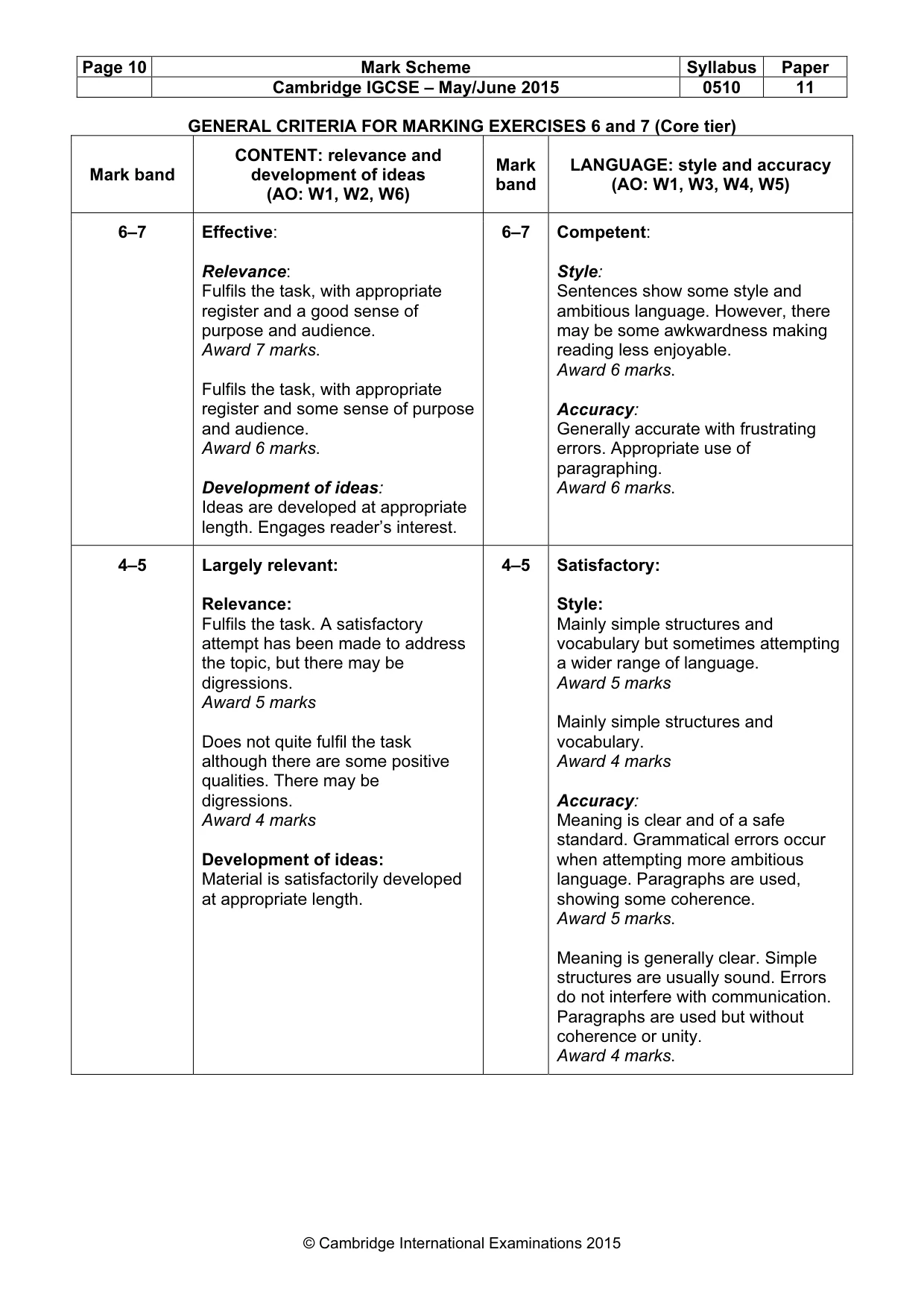
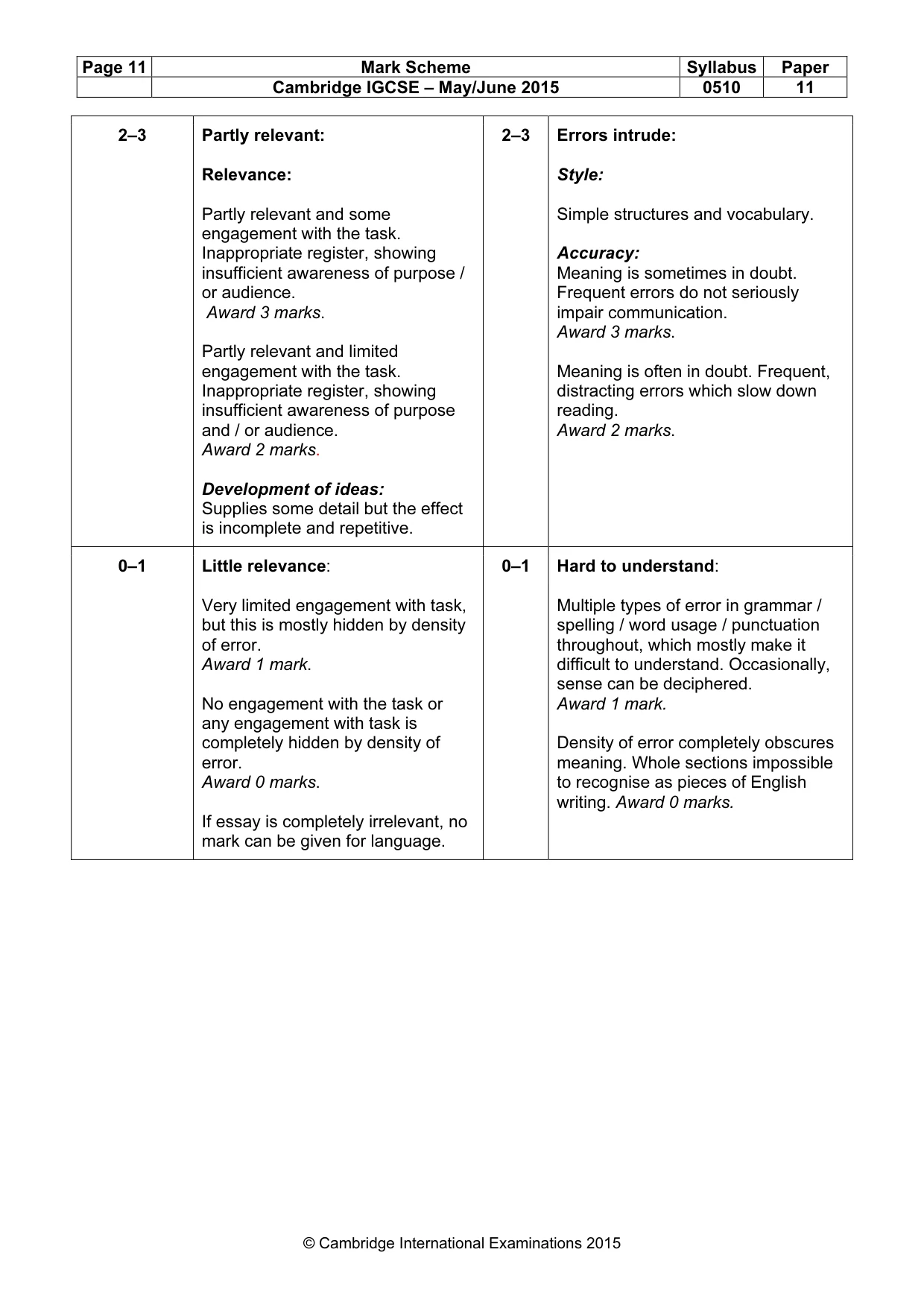
Page 10 Mark Scheme Syllabus Paper Cambridge IGCSE – May/June 2015 0510 11 © Cambridge International Examinations 2015 GENERAL CRITERIA FOR MARKING EXERCISES 6 and 7 (Core tier) Mark band CONTENT: relevance and development of ideas (AO: W1, W2, W6) Mark band LANGUAGE: style and accuracy (AO: W1, W3, W4, W5) 6–7 Effective: Relevance: Fulfils the task, with appropriate register and a good sense of purpose and audience. Award 7 marks. Fulfils the task, with appropriate register and some sense of purpose and audience. Award 6 marks. Development of ideas: Ideas are developed at appropriate length. Engages reader’s interest. 6–7 Competent: Style: Sentences show some style and ambitious language. However, there may be some awkwardness making reading less enjoyable. Award 6 marks. Accuracy: Generally accurate with frustrating errors. Appropriate use of paragraphing. Award 6 marks. 4–5 Largely relevant: Relevance: Fulfils the task. A satisfactory attempt has been made to address the topic, but there may be digressions. Award 5 marks Does not quite fulfil the task although there are some positive qualities. There may be digressions. Award 4 marks Development of ideas: Material is satisfactorily developed at appropriate length. 4–5 Satisfactory: Style: Mainly simple structures and vocabulary but sometimes attempting a wider range of language. Award 5 marks Mainly simple structures and vocabulary. Award 4 marks Accuracy: Meaning is clear and of a safe standard. Grammatical errors occur when attempting more ambitious language. Paragraphs are used, showing some coherence. Award 5 marks. Meaning is generally clear. Simple structures are usually sound. Errors do not interfere with communication. Paragraphs are used but without coherence or unity. Award 4 marks.
Mark scheme, page 11
Page 11 Mark Scheme Syllabus Paper Cambridge IGCSE – May/June 2015 0510 11 © Cambridge International Examinations 2015 2–3 Partly relevant: Relevance: Partly relevant and some engagement with the task. Inappropriate register, showing insufficient awareness of purpose / or audience. Award 3 marks. Partly relevant and limited engagement with the task. Inappropriate register, showing insufficient awareness of purpose and / or audience. Award 2 marks. Development of ideas: Supplies some detail but the effect is incomplete and repetitive. 2–3 Errors intrude: Style: Simple structures and vocabulary. Accuracy: Meaning is sometimes in doubt. Frequent errors do not seriously impair communication. Award 3 marks. Meaning is often in doubt. Frequent, distracting errors which slow down reading. Award 2 marks. 0–1 Little relevance: Very limited engagement with task, but this is mostly hidden by density of error. Award 1 mark. No engagement with the task or any engagement with task is completely hidden by density of error. Award 0 marks. If essay is completely irrelevant, no mark can be given for language. 0–1 Hard to understand: Multiple types of error in grammar / spelling / word usage / punctuation throughout, which mostly make it difficult to understand. Occasionally, sense can be deciphered. Award 1 mark. Density of error completely obscures meaning. Whole sections impossible to recognise as pieces of English writing. Award 0 marks.
What you needed in this session
Cambridge’s own grade thresholds for 2015 May/June, Paper 1 · Variant 1. A higher threshold means an easier paper — the bar moves with how the cohort did.