Cambridge IGCSE English - Second Language (oral endorsement) 0510 — 2014 May/June Paper 1 · Variant 1
0510/11/M/J/14 · 70 marks · ≈79 min
The question paper and its mark scheme, free to read here and free to download. This is Cambridge’s own paper, exactly as it was sat.
Question paper16 pages
Mark scheme11 pages
Answers below. Sit the paper first if you are practising.
Paper as text
Question paper, page 1
This document consists of 13 printed pages and 3 blank pages. DC (SJF/SW) 74432/5 © UCLES 2014 [Turn over Cambridge International Examinations Cambridge International General Certificate of Secondary Education * 8 5 2 3 8 4 2 8 0 0 * ENGLISH AS A SECOND LANGUAGE 0510/11 Paper 1 Reading and Writing (Core) May/June 2014 1 hour 30 minutes Candidates answer on the Question Paper. No Additional Materials are required. READ THESE INSTRUCTIONS FIRST Write your Centre number, candidate number and name on all the work you hand in. Write in dark blue or black pen. Do not use staples, paper clips, glue or correction fluid. DO NOT WRITE IN ANY BARCODES. Answer all questions. Dictionaries are not allowed. At the end of the examination, fasten all your work securely together. The number of marks is given in brackets [ ] at the end of each question or part question.
Question paper, page 2
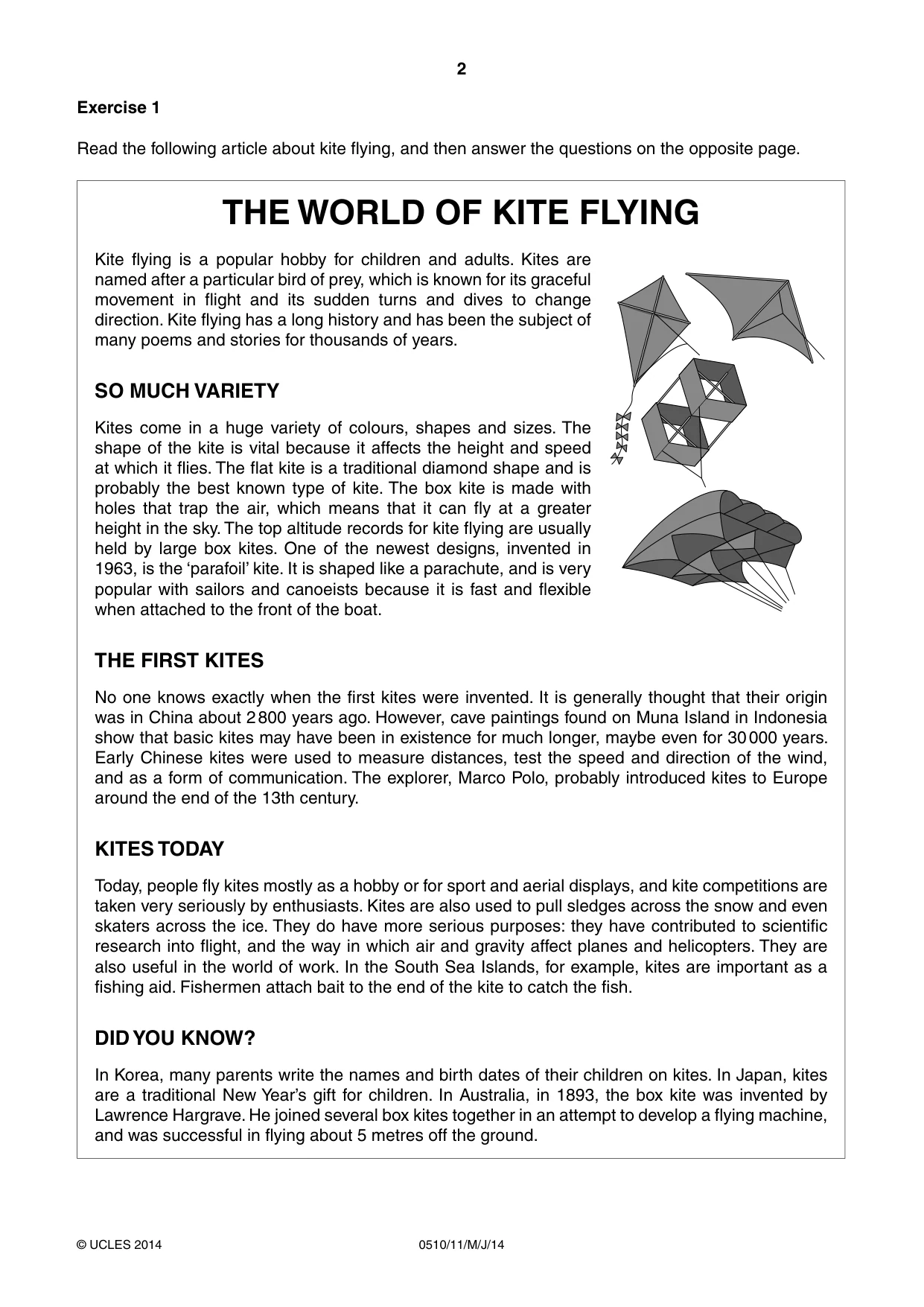
2 0510/11/M/J/14 © UCLES 2014 Exercise 1 Read the following article about kite flying, and then answer the questions on the opposite page. THE WORLD OF KITE FLYING Kite flying is a popular hobby for children and adults. Kites are named after a particular bird of prey, which is known for its graceful movement in flight and its sudden turns and dives to change direction. Kite flying has a long history and has been the subject of many poems and stories for thousands of years. SO MUCH VARIETY Kites come in a huge variety of colours, shapes and sizes. The shape of the kite is vital because it affects the height and speed at which it flies. The flat kite is a traditional diamond shape and is probably the best known type of kite. The box kite is made with holes that trap the air, which means that it can fly at a greater height in the sky. The top altitude records for kite flying are usually held by large box kites. One of the newest designs, invented in 1963, is the ‘parafoil’ kite. It is shaped like a parachute, and is very popular with sailors and canoeists because it is fast and flexible when attached to the front of the boat. THE FIRST KITES No one knows exactly when the first kites were invented. It is generally thought that their origin was in China about 2 800 years ago. However, cave paintings found on Muna Island in Indonesia show that basic kites may have been in existence for much longer, maybe even for 30 000 years. Early Chinese kites were used to measure distances, test the speed and direction of the wind, and as a form of communication. The explorer, Marco Polo, probably introduced kites to Europe around the end of the 13th century. KITES TODAY Today, people fly kites mostly as a hobby or for sport and aerial displays, and kite competitions are taken very seriously by enthusiasts. Kites are also used to pull sledges across the snow and even skaters across the ice. They do have more serious purposes: they have contributed to scientific research into flight, and the way in which air and gravity affect planes and helicopters. They are also useful in the world of work. In the South Sea Islands, for example, kites are important as a fishing aid. Fishermen attach bait to the end of the kite to catch the fish. DID YOU KNOW? In Korea, many parents write the names and birth dates of their children on kites. In Japan, kites are a traditional New Year’s gift for children. In Australia, in 1893, the box kite was invented by Lawrence Hargrave. He joined several box kites together in an attempt to develop a flying machine, and was successful in flying about 5 metres off the ground.
Question paper, page 3
3 0510/11/M/J/14 © UCLES 2014 [Turn over (a) Where do kites get their name from? …[1] (b) Why is the shape of the kite so important? …[1] (c) What makes the box kite fly higher? …[1] (d) What discovery suggests that kites are much older than 2 800 years? …[1] (e) How were kites helpful in China? Give two details. … …[1] (f) In which country are kites commonly given as presents? …[1] (g) How did Lawrence Hargrave manage to fly? …[1] [Total: 7]
Question paper, page 4
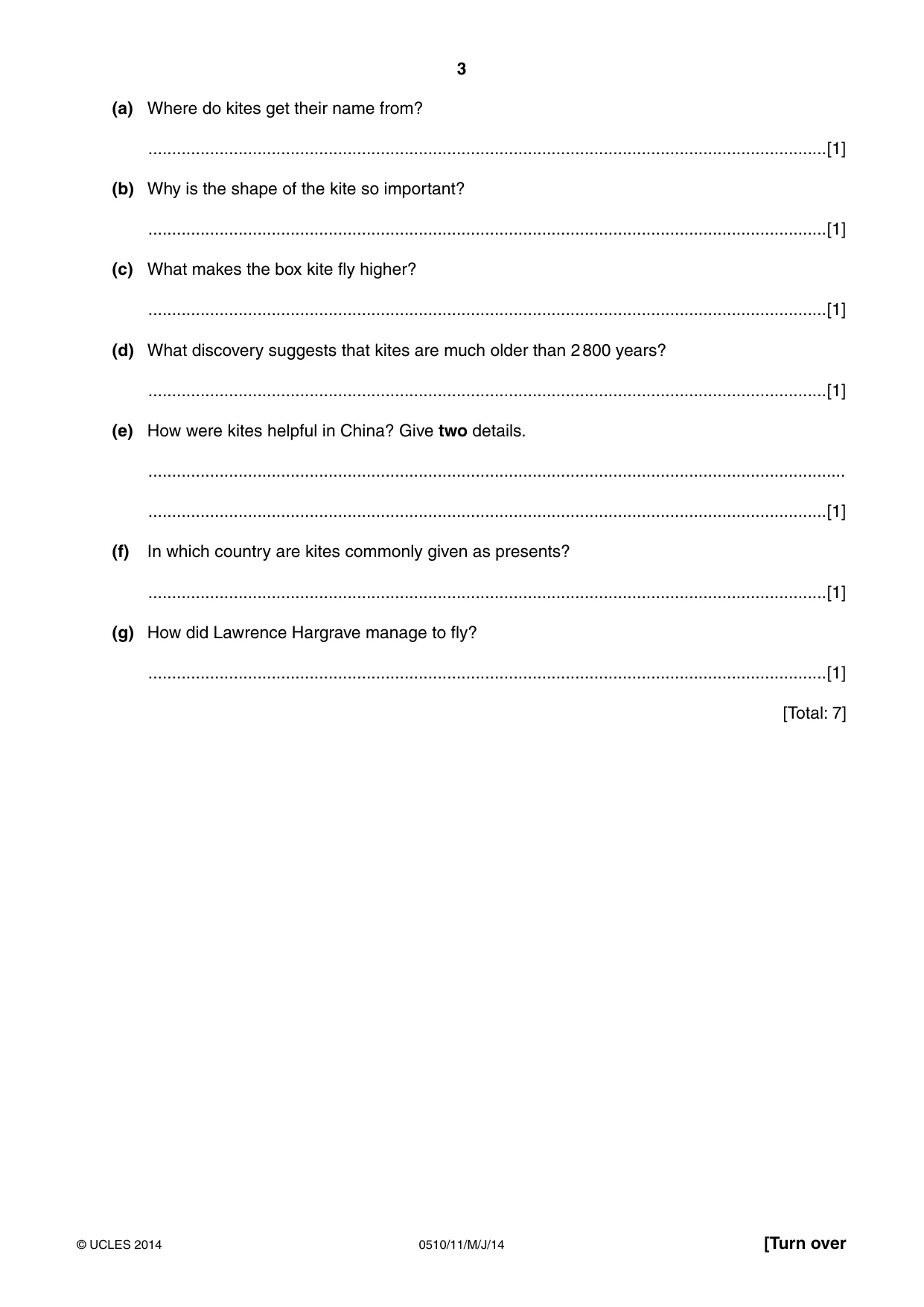
4 0510/11/M/J/14 © UCLES 2014 Exercise 2 Read the following article about the number of languages that have vanished over the years, and then answer the questions on the opposite page. LOST FOR WORDS – 500 000 LANGUAGES DISAPPEARED New research suggests that about half a million languages have existed since the first humans walked the Earth, 160 000 to 200 000 years ago. However, this number has declined over the centuries because many of the world’s languages have simply disappeared. The latest estimate is that there are 7 000 languages remaining in the world today, but many of these are under threat of dying out completely. We now have the smallest number of different languages, with only about 20 recognised by the population of the world in general. The vast majority of the remaining languages are spoken by tribal groups containing only a few thousand people. One example of this is Papua New Guinea in South East Asia. It is a country where you can find over 800 languages, which is an incredible 12 per cent of the total number of the world’s languages. There are places in that country where you can find a new language spoken every three or four kilometres. One explanation for this extraordinary situation in Papua New Guinea is that the climate makes it easy for small groups to grow their own food and survive independently. This means that more languages will develop and remain. As a university professor says, “Different groups of people use language to mark out their territories and draw boundaries. They also use it to distinguish themselves from other groups. They can tell who is a member of the group and who isn’t.” Country USA NIGERIA NORTH KOREA PAPUA NEW GUINEA Total number of languages 364 521 1 830 Percentage of indigenous languages 45% 95% 0% 100% It is interesting to consider the reasons why some languages survive while others die out. It is not just a matter of how difficult the language is to learn – English, for example, is well known for its difficult spelling and pronunciation. Sometimes, the survival of a language is simply because the society that uses it is successful, and this helps to maintain and spread the language more and more. How well the language survives is also affected by the natural geographical features of a country, in particular, how easy it is to travel within a country and to neighbouring countries. There are no languages that are superior to others. There are just lucky ones, and the luckiest of them all is English. The professor continues, “The most commonly spoken mother tongue is Mandarin. This is followed by Spanish and then Hindi / Urdu, but these are largely spoken within one country or continent. English is only the fourth most commonly spoken mother tongue, and yet it has become the leading international means of communication.” Although some animals use signs and sounds to communicate in a limited way with one another, only humans can learn to use a language independently. There are some mysteries about languages that scientists still have to solve. Humans are genetically programmed to learn languages, but no one knows exactly how it works. Another mystery is when exactly humans first learnt to communicate through speech. It is not possible to tell from fossil records when humans made the first sounds. It is sad for the people who lose their language, because this leads to a loss of traditions and culture as well. The university professor states, “Just as hundreds of thousands of languages have died out, so many more will follow until we are left with just a few. English is most people’s second language across the entire world, so English will probably be one of them, despite the fact that it is difficult to learn to pronounce.” However, many people believe that the world will be a poorer place without the rich diversity of a wide range of languages.
Question paper, page 5
5 0510/11/M/J/14 © UCLES 2014 [Turn over (a) How many languages have there been since the first humans? …[1] (b) Why is the number of existing languages likely to change? …[1] (c) What is surprising about the languages in Papua New Guinea? …[1] (d) In what ways are languages useful to different groups? Give two details. … …[1] (e) According to the diagram, which country has the second highest percentage of indigenous languages and what exactly is the percentage? …[1] (f) Which factors are important in helping languages to survive? Give two details. … …[2] (g) Which mother tongue is the second most widely spoken? …[1] (h) What are scientists still trying to discover about languages? Give two details. … …[2] (i) Why is it sad when a native language is lost? …[1] [Total: 11]
Question paper, page 6
6 0510/11/M/J/14 © UCLES 2014 Exercise 3 Two months ago, Isabel Polo Gomez was asked by her headteacher to attend a course on first aid. The reason that he asked her to attend was to learn about how to help other students if they are injured or have an accident at school. Isabel had just recently had her 17th birthday and so was old enough to take the course. It took place at the Chamberi Hospital in her home city of Barcelona. It was possible to attend the course either on a Wednesday or a Friday. Isabel played for the school sports team on Wednesday afternoons and so could not attend on Wednesday 26th March, but she was able to go on Friday 28th March 2014. There were 30 students there from different schools in the region. The hospital offers a wide range of courses at different times and levels. Isabel’s course was called ‘Essential First Aid’ and was for beginners. It started promptly and Isabel thought that the two trainers who led the course were very good and communicated the information well. The trainers also provided an excellent booklet, which students could take with them at the end of the course and which contained a summary of all the main details. Isabel’s impression was that the course was a success. The only problem was that the room at the Chamberi Hospital was too small, especially when the students had to do practical work in pairs. Apart from that, there was plenty of light and the temperature was perfect for the activities. Isabel was very pleased to have had the chance to learn about first aid skills because she had once helped a student who had fallen over in the garden of the school and cut his head. She had bandaged the wound before calling the emergency services. Isabel intends to meet the headteacher very soon to see if she can possibly attend the next level of the first aid programme later in the year. At the end of the course, the hospital asked all the students to complete a feedback form about the course. Imagine you are Isabel. Fill in the feedback form on the opposite page, using the information above.
Question paper, page 7
7 0510/11/M/J/14 © UCLES 2014 [Turn over First Aid Course Feedback form Section A Personal details Full name: … Age: … Gender: (please circle one) MALE FEMALE Section B Course details Title of course: … Date of course: … Venue of course: … How would you rate the trainers? (please underline one) very good satisfactory poor Was there anything about the course that could have been improved? Please give brief details. … Section C Additional information Have you ever given first aid? (please delete) YES / NO If ‘yes’, please give brief details … … Section D In the space below, write one sentence about your reason for attending the course, and one sentence about your plans for future first aid training. [Total: 14]
Question paper, page 8
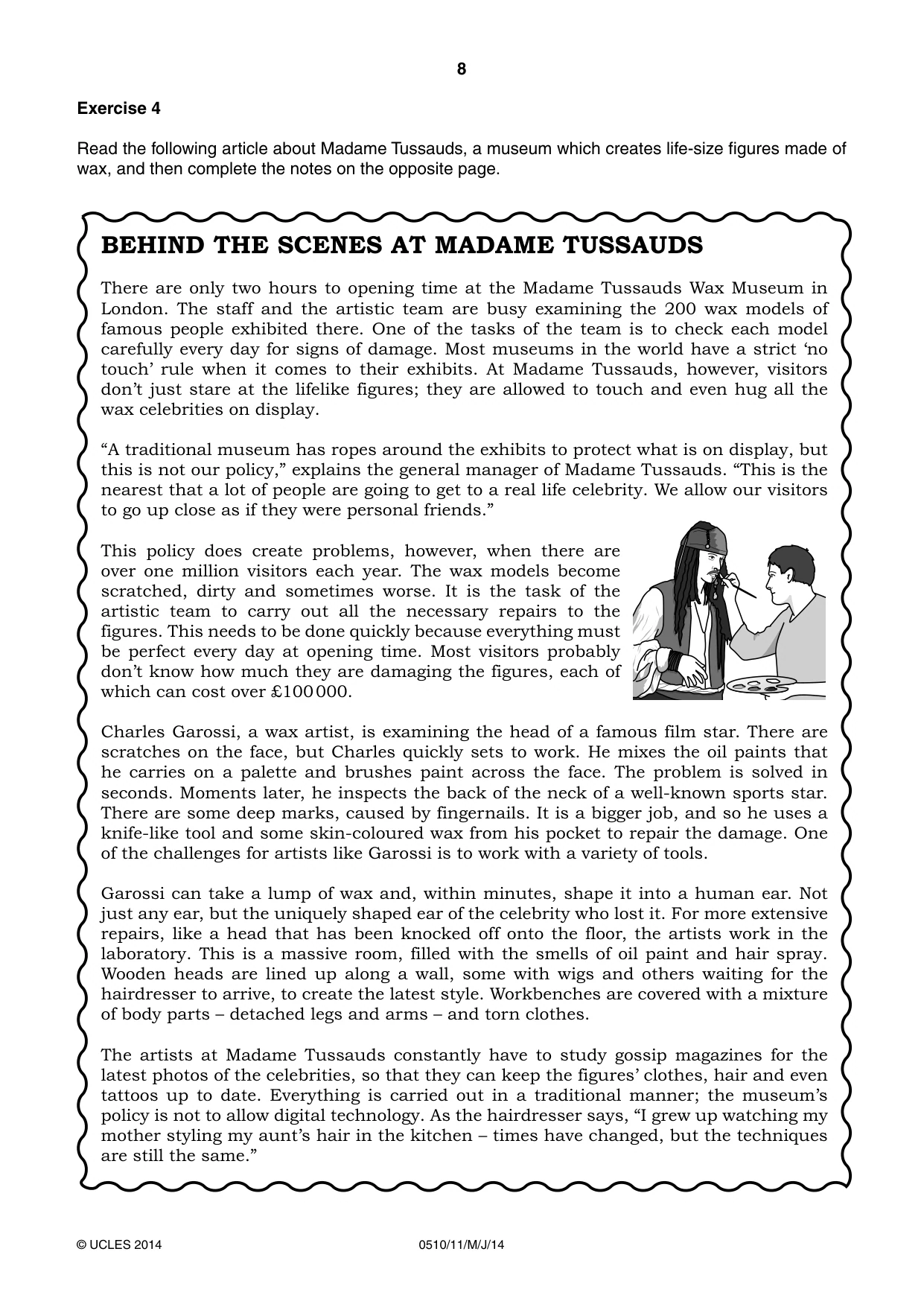
8 0510/11/M/J/14 © UCLES 2014 BEHIND THE SCENES AT MADAME TUSSAUDS There are only two hours to opening time at the Madame Tussauds Wax Museum in London. The staff and the artistic team are busy examining the 200 wax models of famous people exhibited there. One of the tasks of the team is to check each model carefully every day for signs of damage. Most museums in the world have a strict ‘no touch’ rule when it comes to their exhibits. At Madame Tussauds, however, visitors don’t just stare at the lifelike figures; they are allowed to touch and even hug all the wax celebrities on display. “A traditional museum has ropes around the exhibits to protect what is on display, but this is not our policy,” explains the general manager of Madame Tussauds. “This is the nearest that a lot of people are going to get to a real life celebrity. We allow our visitors to go up close as if they were personal friends.” This policy does create problems, however, when there are over one million visitors each year. The wax models become scratched, dirty and sometimes worse. It is the task of the artistic team to carry out all the necessary repairs to the figures. This needs to be done quickly because everything must be perfect every day at opening time. Most visitors probably don’t know how much they are damaging the figures, each of which can cost over £100 000. Charles Garossi, a wax artist, is examining the head of a famous film star. There are scratches on the face, but Charles quickly sets to work. He mixes the oil paints that he carries on a palette and brushes paint across the face. The problem is solved in seconds. Moments later, he inspects the back of the neck of a well-known sports star. There are some deep marks, caused by fingernails. It is a bigger job, and so he uses a knife-like tool and some skin-coloured wax from his pocket to repair the damage. One of the challenges for artists like Garossi is to work with a variety of tools. Garossi can take a lump of wax and, within minutes, shape it into a human ear. Not just any ear, but the uniquely shaped ear of the celebrity who lost it. For more extensive repairs, like a head that has been knocked off onto the floor, the artists work in the laboratory. This is a massive room, filled with the smells of oil paint and hair spray. Wooden heads are lined up along a wall, some with wigs and others waiting for the hairdresser to arrive, to create the latest style. Workbenches are covered with a mixture of body parts – detached legs and arms – and torn clothes. The artists at Madame Tussauds constantly have to study gossip magazines for the latest photos of the celebrities, so that they can keep the figures’ clothes, hair and even tattoos up to date. Everything is carried out in a traditional manner; the museum’s policy is not to allow digital technology. As the hairdresser says, “I grew up watching my mother styling my aunt’s hair in the kitchen – times have changed, but the techniques are still the same.” Exercise 4 Read the following article about Madame Tussauds, a museum which creates life-size figures made of wax, and then complete the notes on the opposite page.
Question paper, page 9
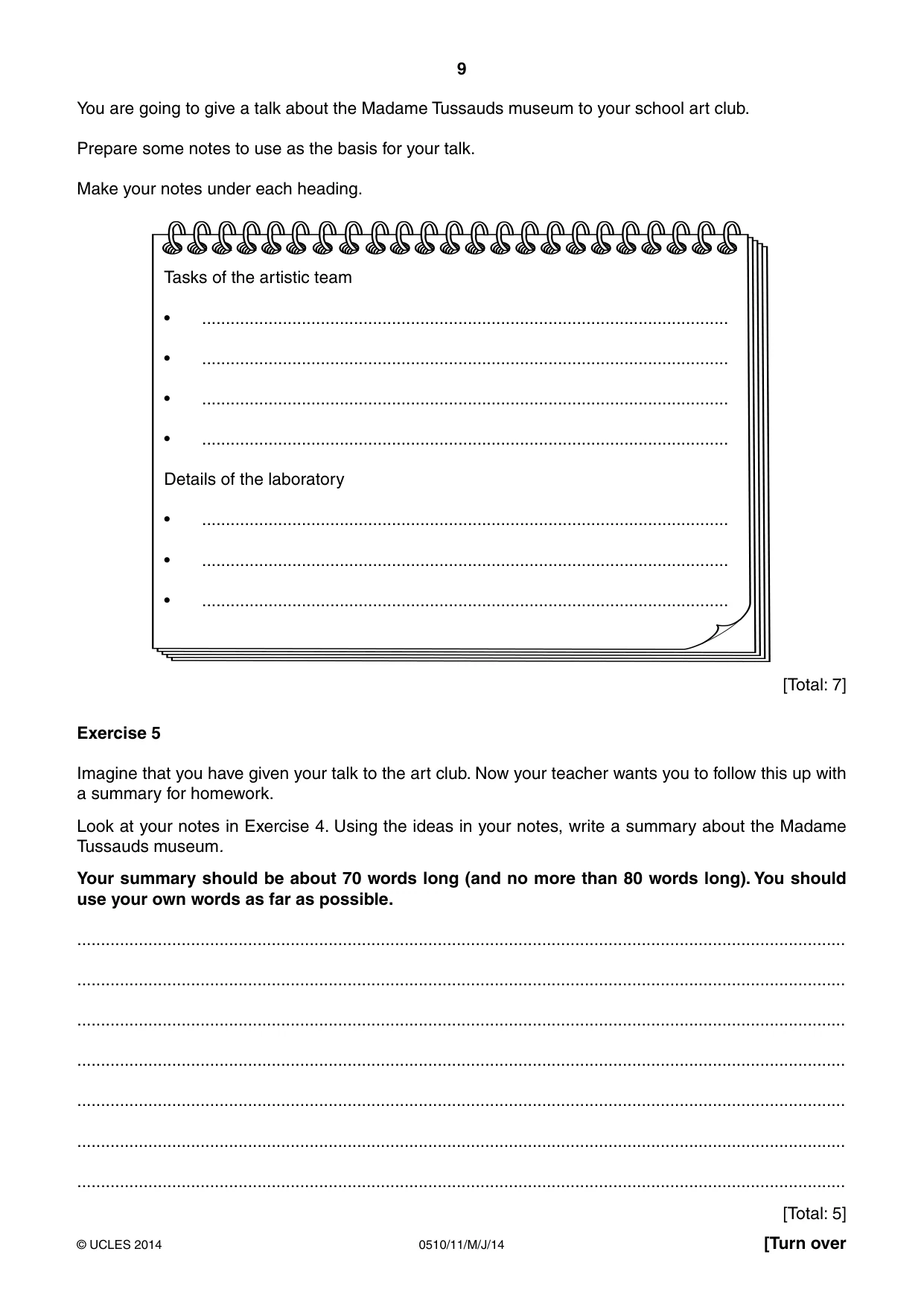
9 0510/11/M/J/14 © UCLES 2014 [Turn over You are going to give a talk about the Madame Tussauds museum to your school art club. Prepare some notes to use as the basis for your talk. Make your notes under each heading. Tasks of the artistic team • … • … • … • … Details of the laboratory • … • … • … [Total: 7] Exercise 5 Imagine that you have given your talk to the art club. Now your teacher wants you to follow this up with a summary for homework. Look at your notes in Exercise 4. Using the ideas in your notes, write a summary about the Madame Tussauds museum. Your summary should be about 70 words long (and no more than 80 words long). You should use your own words as far as possible. … … … … … … … [Total: 5]
Question paper, page 10
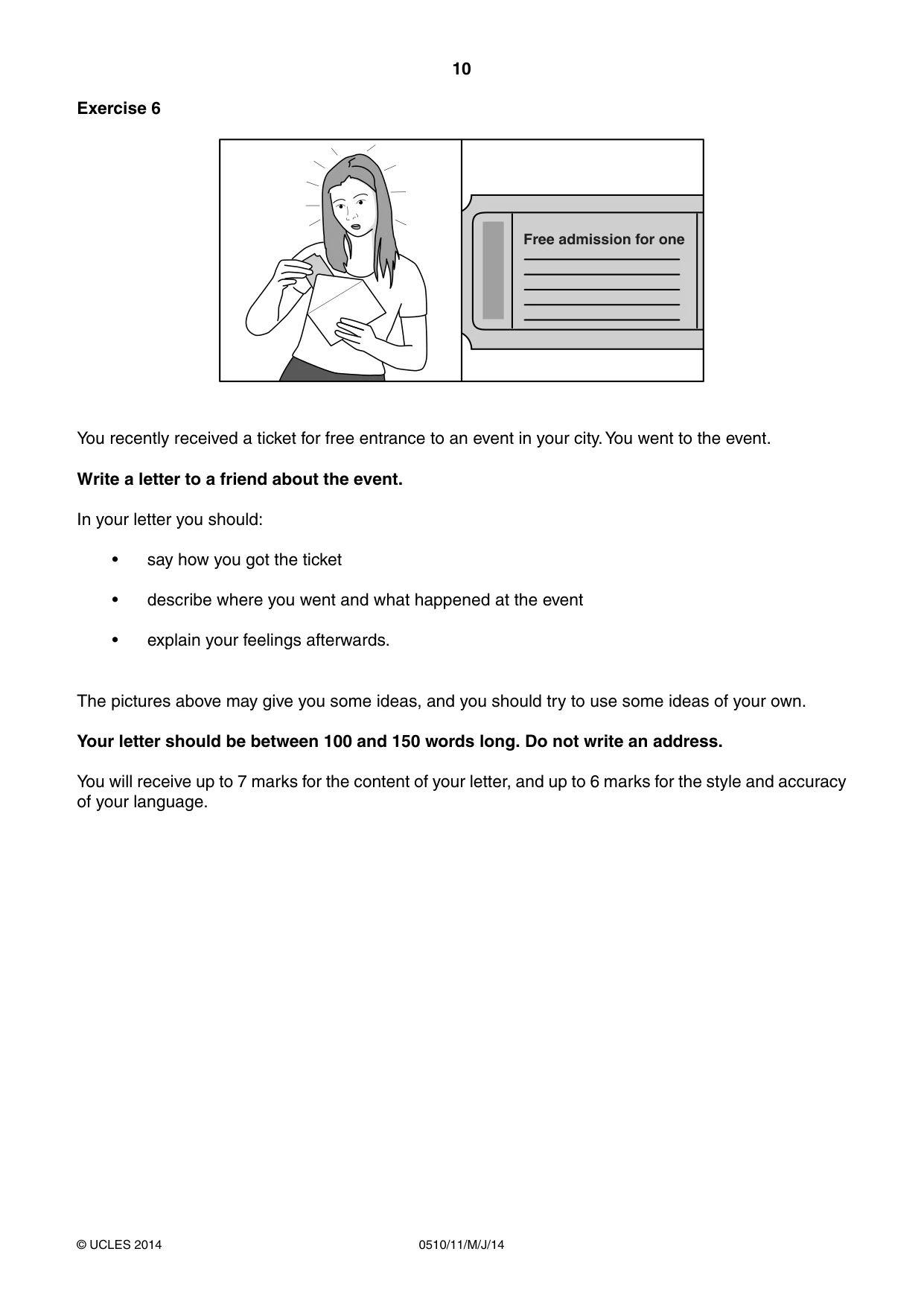
10 0510/11/M/J/14 © UCLES 2014 Exercise 6 Free admission for one You recently received a ticket for free entrance to an event in your city. You went to the event. Write a letter to a friend about the event. In your letter you should: • say how you got the ticket • describe where you went and what happened at the event • explain your feelings afterwards. The pictures above may give you some ideas, and you should try to use some ideas of your own. Your letter should be between 100 and 150 words long. Do not write an address. You will receive up to 7 marks for the content of your letter, and up to 6 marks for the style and accuracy of your language.
Question paper, page 11
11 0510/11/M/J/14 © UCLES 2014 [Turn over … … … … … … … … … … … … … … … … … … … … [Total: 13]
Question paper, page 12
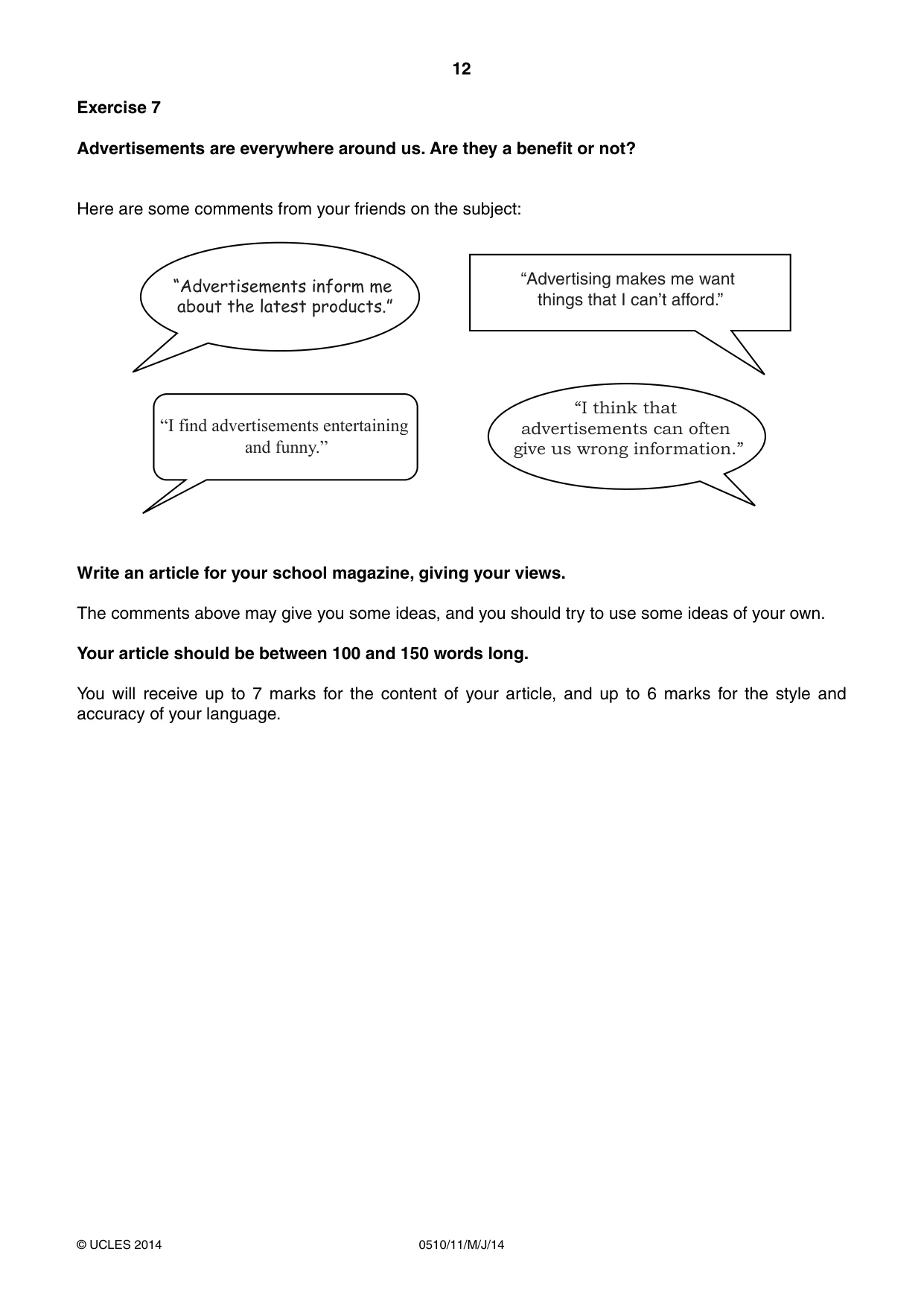
12 0510/11/M/J/14 © UCLES 2014 Exercise 7 Advertisements are everywhere around us. Are they a benefit or not? Here are some comments from your friends on the subject: “Advertising makes me want things that I can’t afford.” “Advertisements inform me about the latest products.” “I find advertisements entertaining and funny.” “I think that advertisements can often give us wrong information.” Write an article for your school magazine, giving your views. The comments above may give you some ideas, and you should try to use some ideas of your own. Your article should be between 100 and 150 words long. You will receive up to 7 marks for the content of your article, and up to 6 marks for the style and accuracy of your language.
Question paper, page 13
13 0510/11/M/J/14 © UCLES 2014 … … … … … … … … … … … … … … … … … … … … [Total: 13]
Question paper, page 14
14 0510/11/M/J/14 © UCLES 2014 BLANK PAGE
Question paper, page 15
15 0510/11/M/J/14 © UCLES 2014 BLANK PAGE
Question paper, page 16
16 0510/11/M/J/14 © UCLES 2014 Permission to reproduce items where third-party owned material protected by copyright is included has been sought and cleared where possible. Every reasonable effort has been made by the publisher (UCLES) to trace copyright holders, but if any items requiring clearance have unwittingly been included, the publisher will be pleased to make amends at the earliest possible opportunity. Cambridge International Examinations is part of the Cambridge Assessment Group. Cambridge Assessment is the brand name of University of Cambridge Local Examinations Syndicate (UCLES), which is itself a department of the University of Cambridge. BLANK PAGE
Mark scheme, page 1
CAMBRIDGE INTERNATIONAL EXAMINATIONS International General Certificate of Secondary Education MARK SCHEME for the May/June 2014 series 0510 ENGLISH AS A SECOND LANGUAGE 0510/11 Paper 1 (Reading and Writing – Core), maximum raw mark 70 This mark scheme is published as an aid to teachers and candidates, to indicate the requirements of the examination. It shows the basis on which Examiners were instructed to award marks. It does not indicate the details of the discussions that took place at an Examiners’ meeting before marking began, which would have considered the acceptability of alternative answers. Mark schemes should be read in conjunction with the question paper and the Principal Examiner Report for Teachers. Cambridge will not enter into discussions about these mark schemes. Cambridge is publishing the mark schemes for the May/June 2014 series for most IGCSE, GCE Advanced Level and Advanced Subsidiary Level components and some Ordinary Level components.
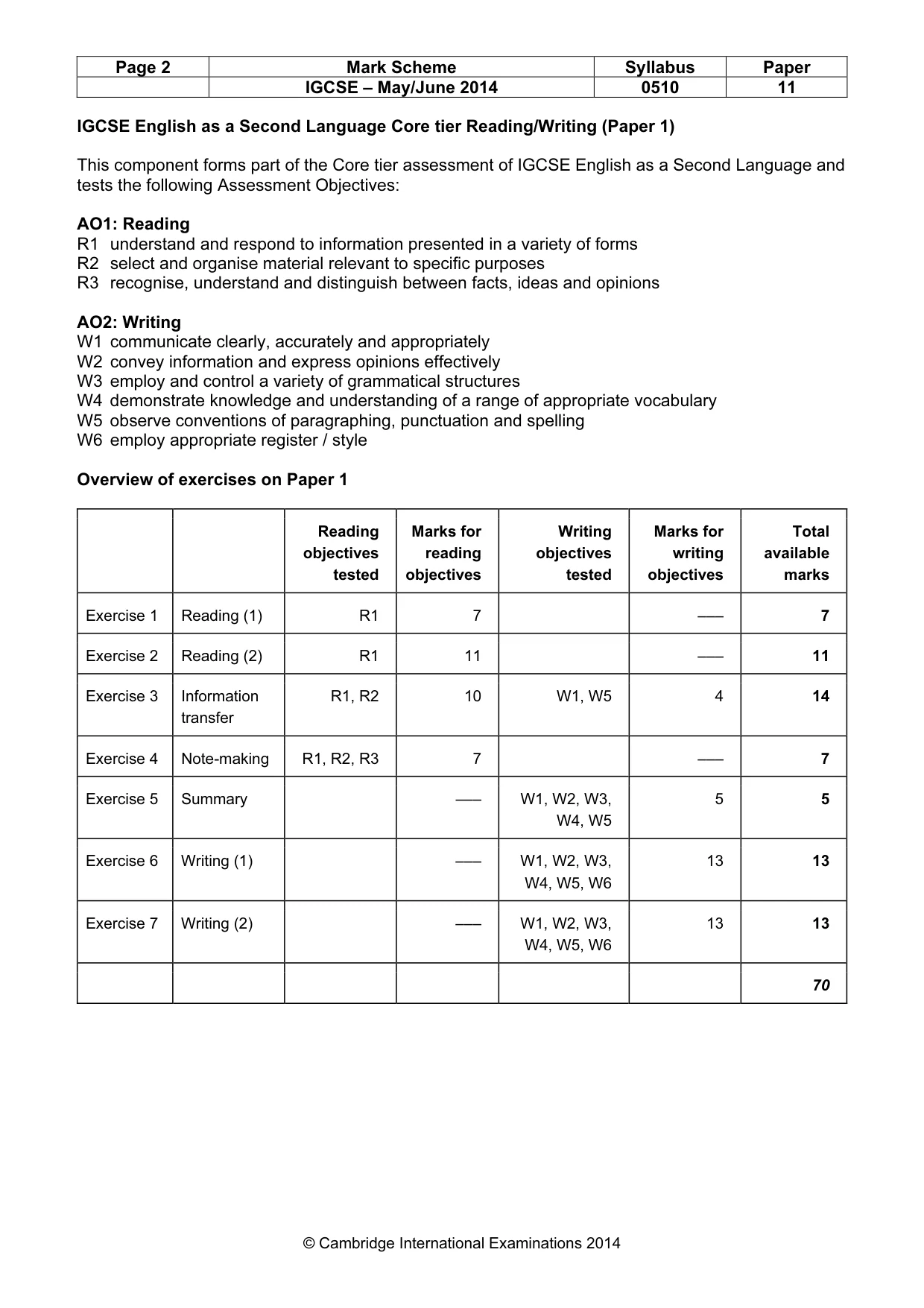
Mark scheme, page 2
Page 2 Mark Scheme Syllabus Paper IGCSE – May/June 2014 0510 11 © Cambridge International Examinations 2014 IGCSE English as a Second Language Core tier Reading/Writing (Paper 1) This component forms part of the Core tier assessment of IGCSE English as a Second Language and tests the following Assessment Objectives: AO1: Reading R1 understand and respond to information presented in a variety of forms R2 select and organise material relevant to specific purposes R3 recognise, understand and distinguish between facts, ideas and opinions AO2: Writing W1 communicate clearly, accurately and appropriately W2 convey information and express opinions effectively W3 employ and control a variety of grammatical structures W4 demonstrate knowledge and understanding of a range of appropriate vocabulary W5 observe conventions of paragraphing, punctuation and spelling W6 employ appropriate register / style Overview of exercises on Paper 1 Reading objectives tested Marks for reading objectives Writing objectives tested Marks for writing objectives Total available marks Exercise 1 Reading (1) R1 7 ––– 7 Exercise 2 Reading (2) R1 11 ––– 11 Exercise 3 Information transfer R1, R2 10 W1, W5 4 14 Exercise 4 Note-making R1, R2, R3 7 ––– 7 Exercise 5 Summary ––– W1, W2, W3, W4, W5 5 5 Exercise 6 Writing (1) ––– W1, W2, W3, W4, W5, W6 13 13 Exercise 7 Writing (2) ––– W1, W2, W3, W4, W5, W6 13 13 70
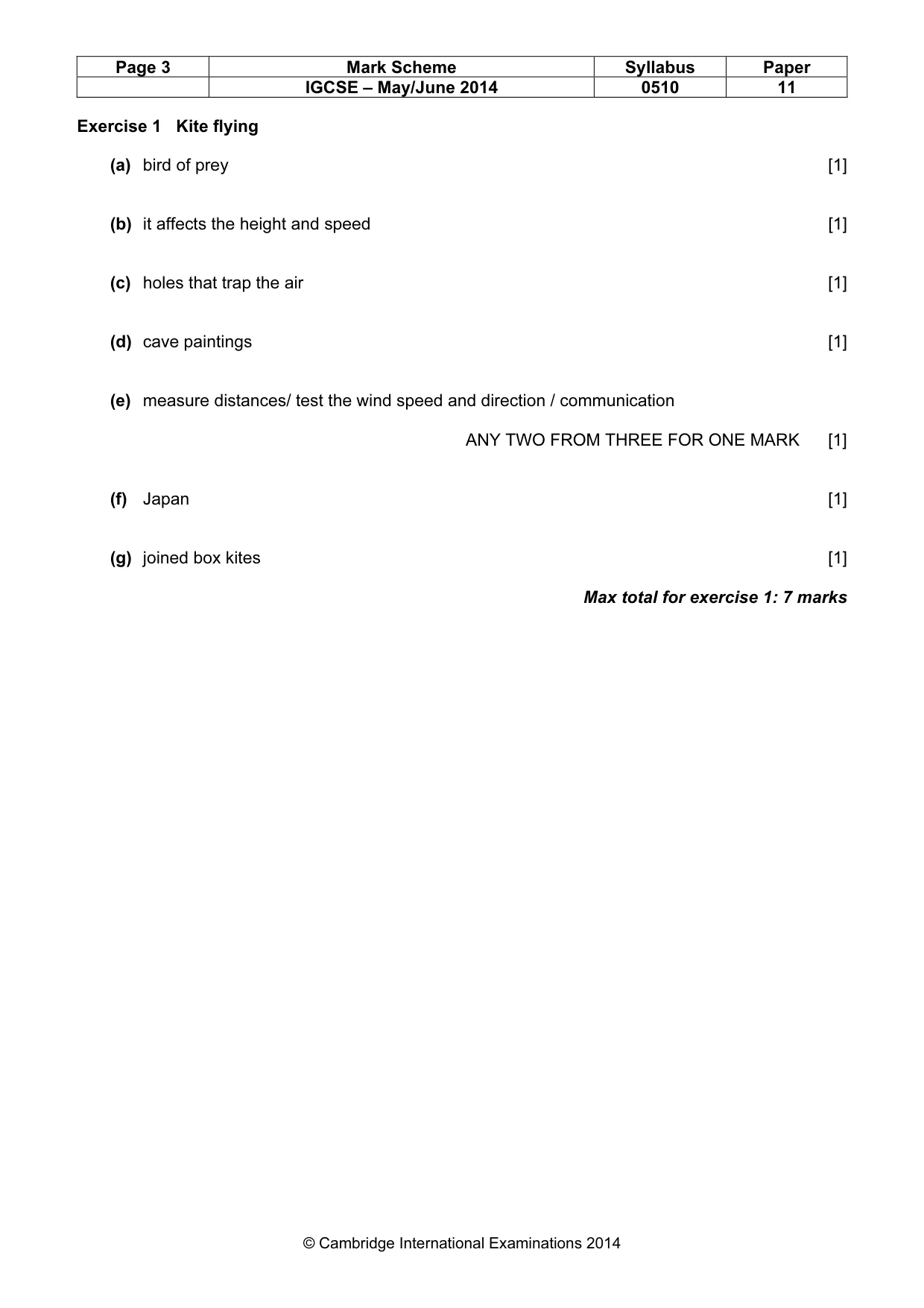
Mark scheme, page 3
Page 3 Mark Scheme Syllabus Paper IGCSE – May/June 2014 0510 11 © Cambridge International Examinations 2014 Exercise 1 Kite flying (a) bird of prey [1] (b) it affects the height and speed [1] (c) holes that trap the air [1] (d) cave paintings [1] (e) measure distances/ test the wind speed and direction / communication ANY TWO FROM THREE FOR ONE MARK [1] (f) Japan [1] (g) joined box kites [1] Max total for exercise 1: 7 marks
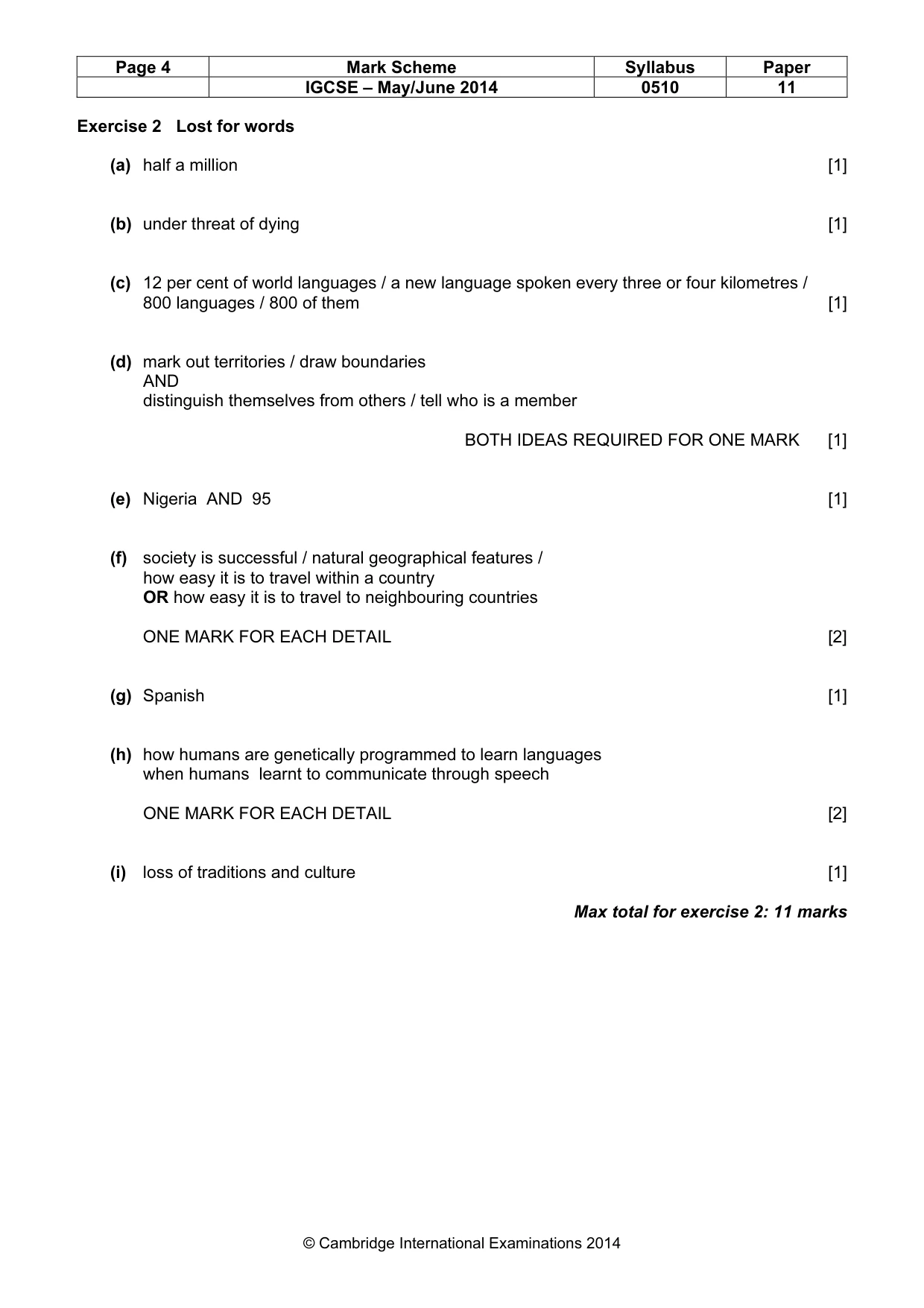
Mark scheme, page 4
Page 4 Mark Scheme Syllabus Paper IGCSE – May/June 2014 0510 11 © Cambridge International Examinations 2014 Exercise 2 Lost for words (a) half a million [1] (b) under threat of dying [1] (c) 12 per cent of world languages / a new language spoken every three or four kilometres / 800 languages / 800 of them [1] (d) mark out territories / draw boundaries AND distinguish themselves from others / tell who is a member BOTH IDEAS REQUIRED FOR ONE MARK [1] (e) Nigeria AND 95 [1] (f) society is successful / natural geographical features / how easy it is to travel within a country OR how easy it is to travel to neighbouring countries ONE MARK FOR EACH DETAIL [2] (g) Spanish [1] (h) how humans are genetically programmed to learn languages when humans learnt to communicate through speech ONE MARK FOR EACH DETAIL [2] (i) loss of traditions and culture [1] Max total for exercise 2: 11 marks
Mark scheme, page 5
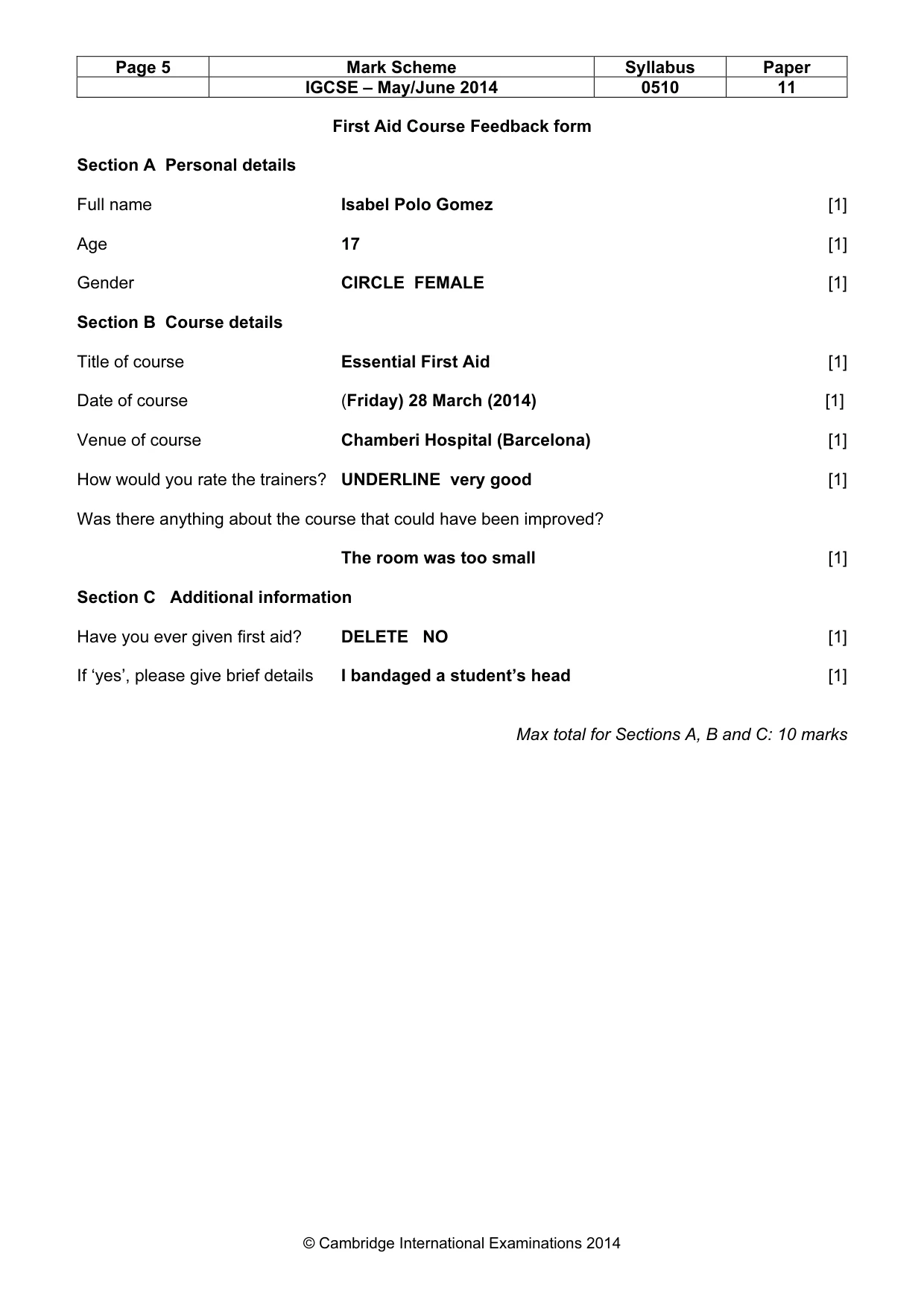
Page 5 Mark Scheme Syllabus Paper IGCSE – May/June 2014 0510 11 © Cambridge International Examinations 2014 First Aid Course Feedback form Section A Personal details Full name Isabel Polo Gomez [1] Age 17 [1] Gender CIRCLE FEMALE [1] Section B Course details Title of course Essential First Aid [1] Date of course (Friday) 28 March (2014) [1] Venue of course Chamberi Hospital (Barcelona) [1] How would you rate the trainers? UNDERLINE very good [1] Was there anything about the course that could have been improved? The room was too small [1] Section C Additional information Have you ever given first aid? DELETE NO [1] If ‘yes’, please give brief details I bandaged a student’s head [1] Max total for Sections A, B and C: 10 marks
Mark scheme, page 6
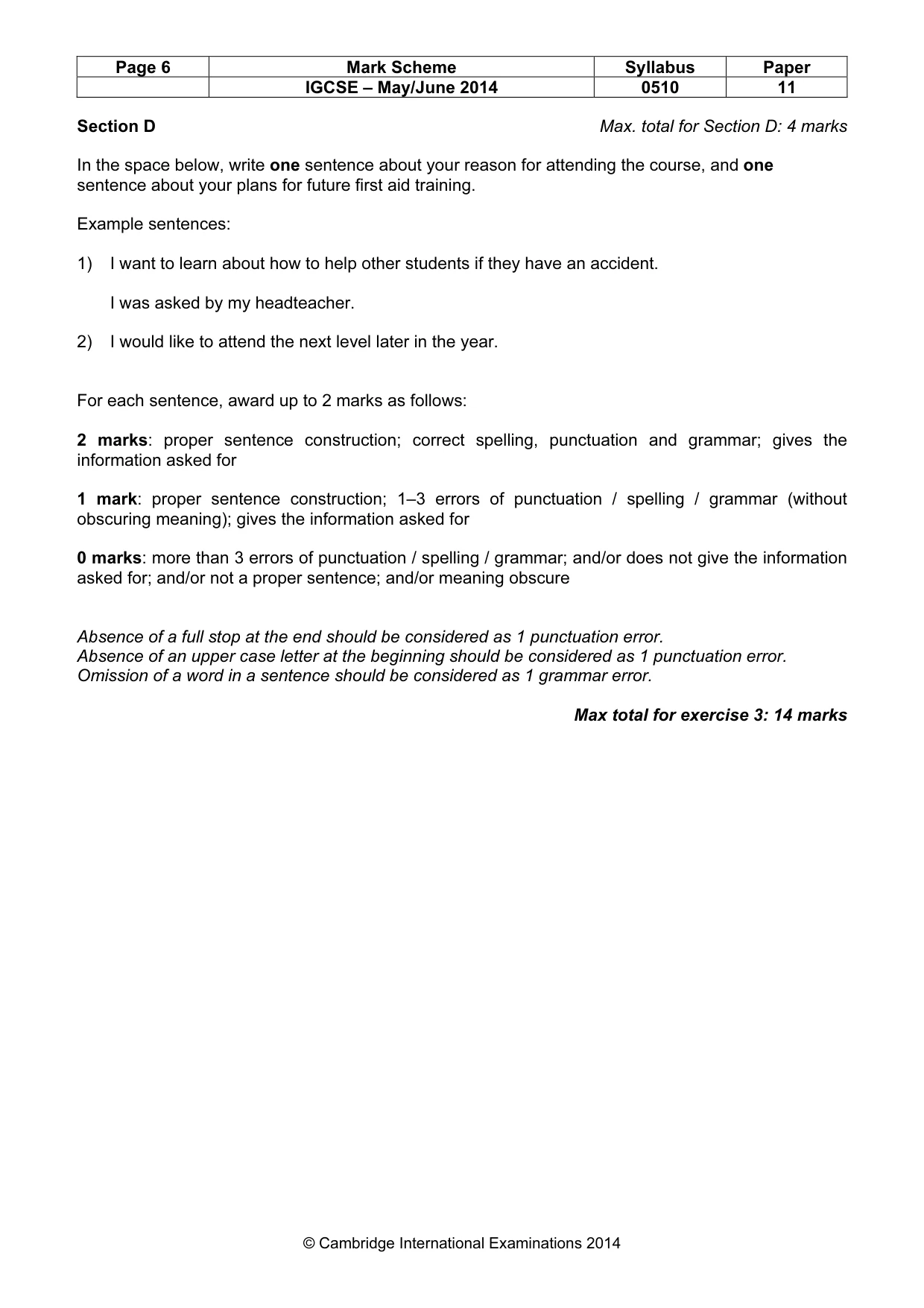
Page 6 Mark Scheme Syllabus Paper IGCSE – May/June 2014 0510 11 © Cambridge International Examinations 2014 Section D Max. total for Section D: 4 marks In the space below, write one sentence about your reason for attending the course, and one sentence about your plans for future first aid training. Example sentences: 1) I want to learn about how to help other students if they have an accident. I was asked by my headteacher. 2) I would like to attend the next level later in the year. For each sentence, award up to 2 marks as follows: 2 marks: proper sentence construction; correct spelling, punctuation and grammar; gives the information asked for 1 mark: proper sentence construction; 1–3 errors of punctuation / spelling / grammar (without obscuring meaning); gives the information asked for 0 marks: more than 3 errors of punctuation / spelling / grammar; and/or does not give the information asked for; and/or not a proper sentence; and/or meaning obscure Absence of a full stop at the end should be considered as 1 punctuation error. Absence of an upper case letter at the beginning should be considered as 1 punctuation error. Omission of a word in a sentence should be considered as 1 grammar error. Max total for exercise 3: 14 marks
Mark scheme, page 7
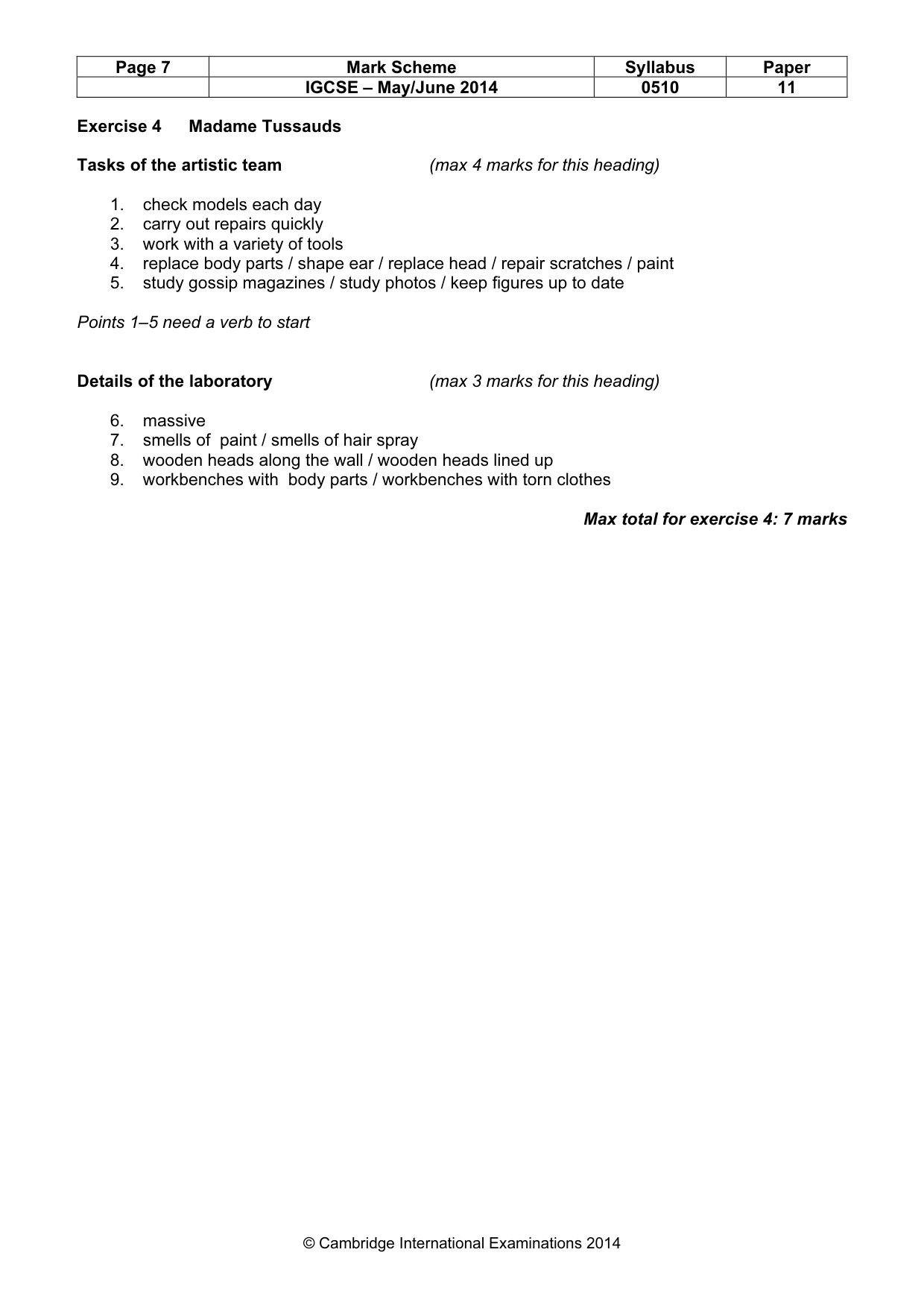
Page 7 Mark Scheme Syllabus Paper IGCSE – May/June 2014 0510 11 © Cambridge International Examinations 2014 Exercise 4 Madame Tussauds Tasks of the artistic team (max 4 marks for this heading) 1. check models each day 2. carry out repairs quickly 3. work with a variety of tools 4. replace body parts / shape ear / replace head / repair scratches / paint 5. study gossip magazines / study photos / keep figures up to date Points 1–5 need a verb to start Details of the laboratory (max 3 marks for this heading) 6. massive 7. smells of paint / smells of hair spray 8. wooden heads along the wall / wooden heads lined up 9. workbenches with body parts / workbenches with torn clothes Max total for exercise 4: 7 marks
Mark scheme, page 8
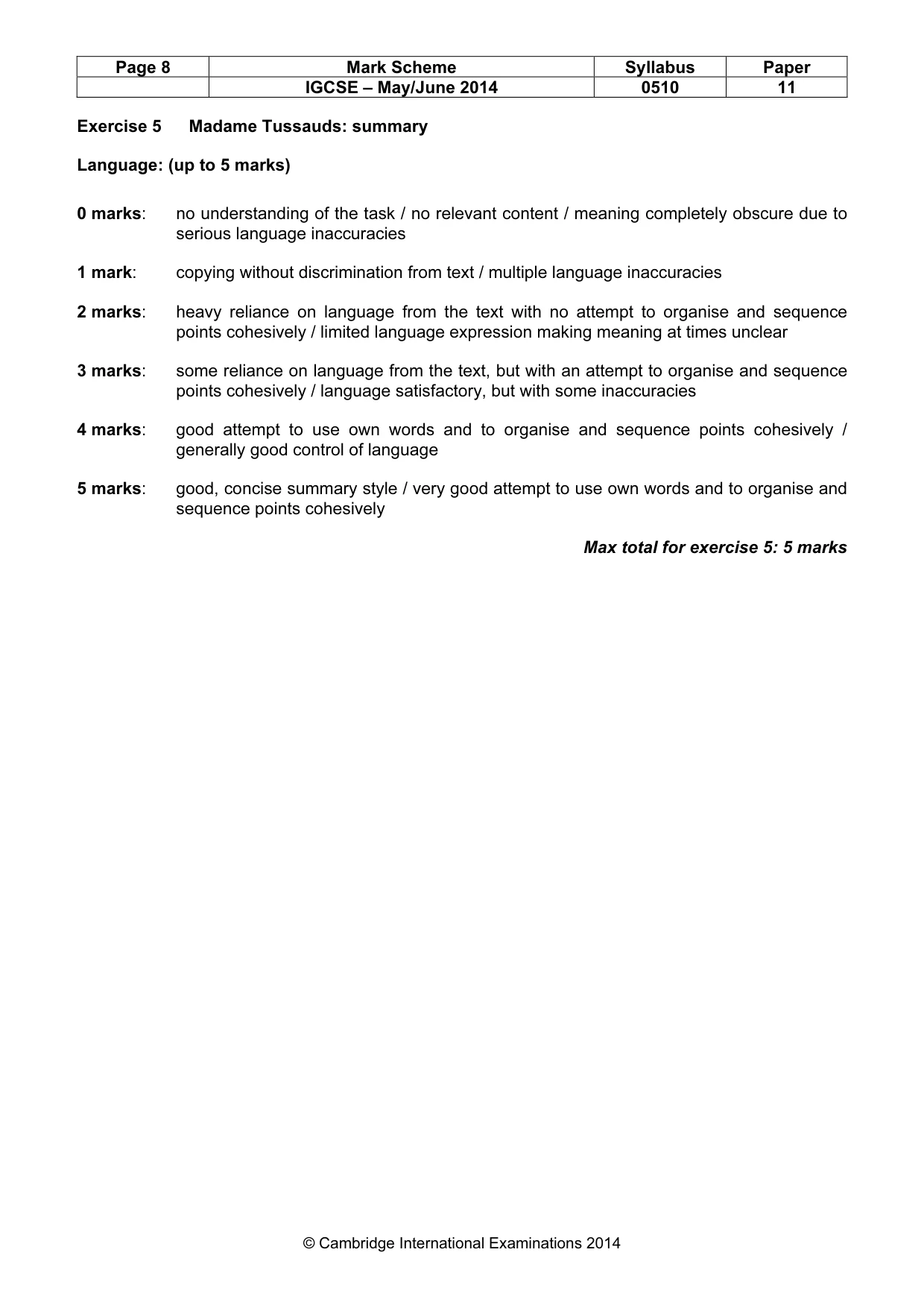
Page 8 Mark Scheme Syllabus Paper IGCSE – May/June 2014 0510 11 © Cambridge International Examinations 2014 Exercise 5 Madame Tussauds: summary Language: (up to 5 marks) 0 marks: no understanding of the task / no relevant content / meaning completely obscure due to serious language inaccuracies 1 mark: copying without discrimination from text / multiple language inaccuracies 2 marks: heavy reliance on language from the text with no attempt to organise and sequence points cohesively / limited language expression making meaning at times unclear 3 marks: some reliance on language from the text, but with an attempt to organise and sequence points cohesively / language satisfactory, but with some inaccuracies 4 marks: good attempt to use own words and to organise and sequence points cohesively / generally good control of language 5 marks: good, concise summary style / very good attempt to use own words and to organise and sequence points cohesively Max total for exercise 5: 5 marks
Mark scheme, page 9
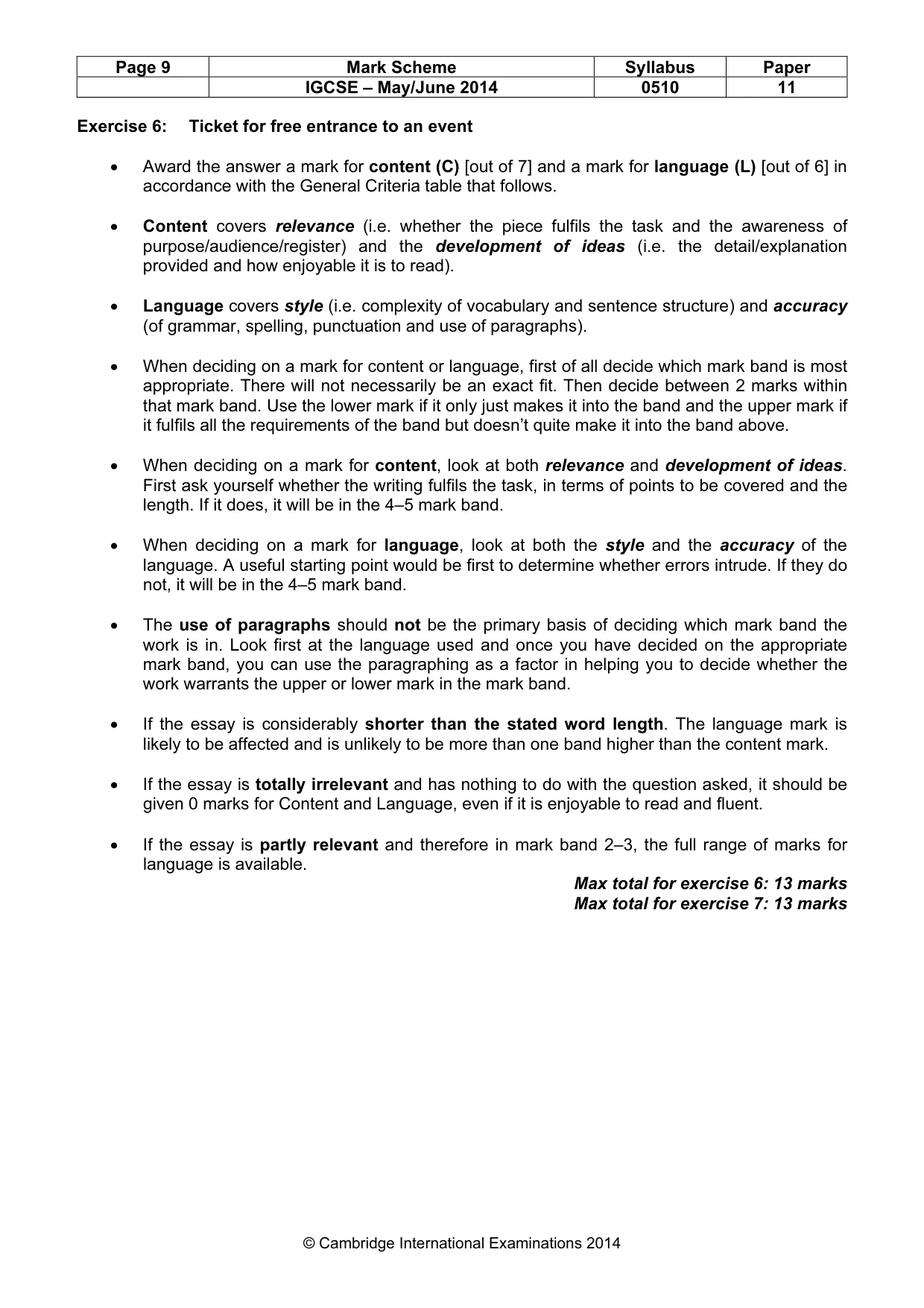
Page 9 Mark Scheme Syllabus Paper IGCSE – May/June 2014 0510 11 © Cambridge International Examinations 2014 Exercise 6: Ticket for free entrance to an event • Award the answer a mark for content (C) [out of 7] and a mark for language (L) [out of 6] in accordance with the General Criteria table that follows. • Content covers relevance (i.e. whether the piece fulfils the task and the awareness of purpose/audience/register) and the development of ideas (i.e. the detail/explanation provided and how enjoyable it is to read). • Language covers style (i.e. complexity of vocabulary and sentence structure) and accuracy (of grammar, spelling, punctuation and use of paragraphs). • When deciding on a mark for content or language, first of all decide which mark band is most appropriate. There will not necessarily be an exact fit. Then decide between 2 marks within that mark band. Use the lower mark if it only just makes it into the band and the upper mark if it fulfils all the requirements of the band but doesn’t quite make it into the band above. • When deciding on a mark for content, look at both relevance and development of ideas. First ask yourself whether the writing fulfils the task, in terms of points to be covered and the length. If it does, it will be in the 4–5 mark band. • When deciding on a mark for language, look at both the style and the accuracy of the language. A useful starting point would be first to determine whether errors intrude. If they do not, it will be in the 4–5 mark band. • The use of paragraphs should not be the primary basis of deciding which mark band the work is in. Look first at the language used and once you have decided on the appropriate mark band, you can use the paragraphing as a factor in helping you to decide whether the work warrants the upper or lower mark in the mark band. • If the essay is considerably shorter than the stated word length. The language mark is likely to be affected and is unlikely to be more than one band higher than the content mark. • If the essay is totally irrelevant and has nothing to do with the question asked, it should be given 0 marks for Content and Language, even if it is enjoyable to read and fluent. • If the essay is partly relevant and therefore in mark band 2–3, the full range of marks for language is available. Max total for exercise 6: 13 marks Max total for exercise 7: 13 marks
Mark scheme, page 10
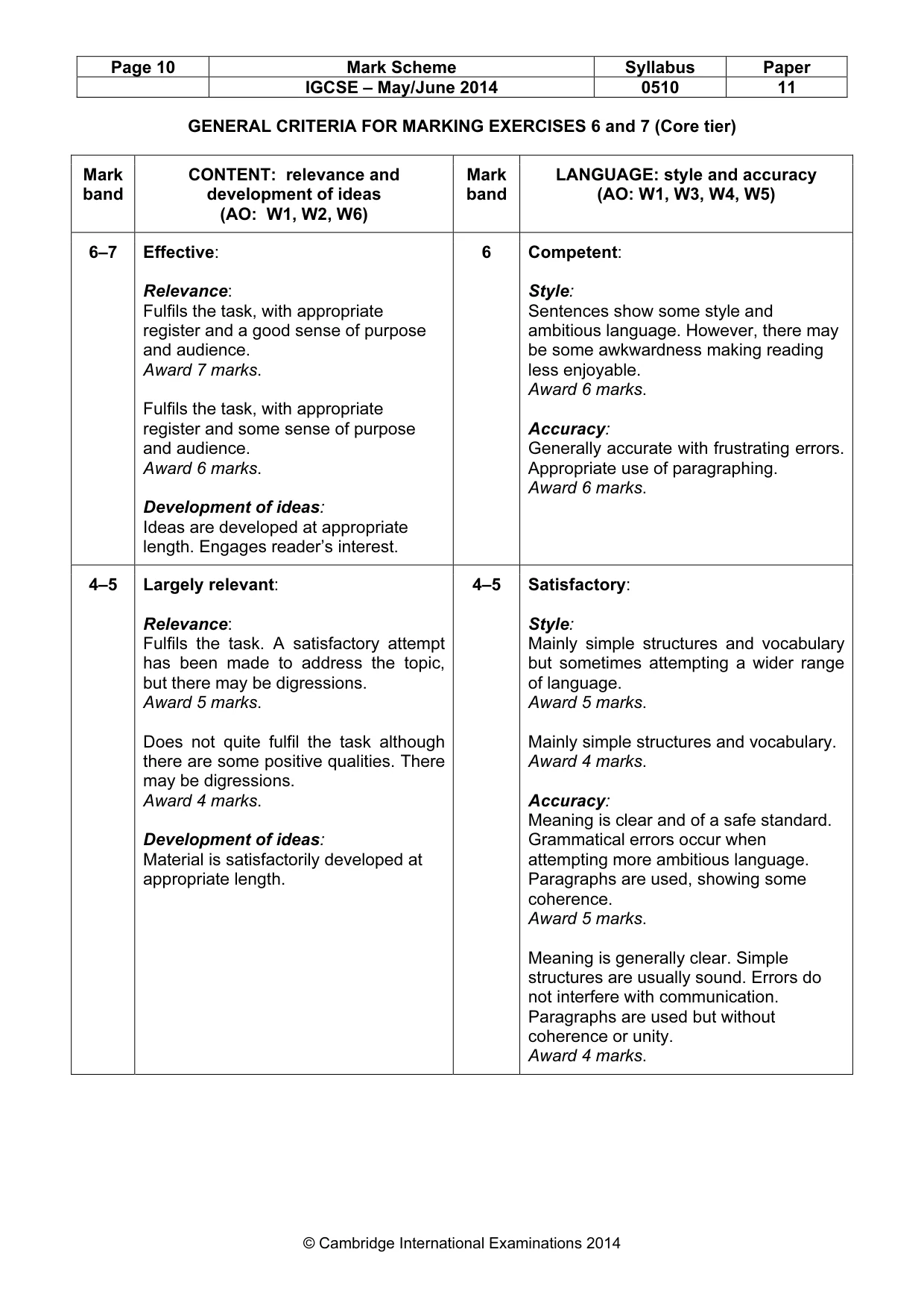
Page 10 Mark Scheme Syllabus Paper IGCSE – May/June 2014 0510 11 © Cambridge International Examinations 2014 GENERAL CRITERIA FOR MARKING EXERCISES 6 and 7 (Core tier) Mark band CONTENT: relevance and development of ideas (AO: W1, W2, W6) Mark band LANGUAGE: style and accuracy (AO: W1, W3, W4, W5) 6–7 Effective: Relevance: Fulfils the task, with appropriate register and a good sense of purpose and audience. Award 7 marks. Fulfils the task, with appropriate register and some sense of purpose and audience. Award 6 marks. Development of ideas: Ideas are developed at appropriate length. Engages reader’s interest. 6 Competent: Style: Sentences show some style and ambitious language. However, there may be some awkwardness making reading less enjoyable. Award 6 marks. Accuracy: Generally accurate with frustrating errors. Appropriate use of paragraphing. Award 6 marks. 4–5 Largely relevant: Relevance: Fulfils the task. A satisfactory attempt has been made to address the topic, but there may be digressions. Award 5 marks. Does not quite fulfil the task although there are some positive qualities. There may be digressions. Award 4 marks. Development of ideas: Material is satisfactorily developed at appropriate length. 4–5 Satisfactory: Style: Mainly simple structures and vocabulary but sometimes attempting a wider range of language. Award 5 marks. Mainly simple structures and vocabulary. Award 4 marks. Accuracy: Meaning is clear and of a safe standard. Grammatical errors occur when attempting more ambitious language. Paragraphs are used, showing some coherence. Award 5 marks. Meaning is generally clear. Simple structures are usually sound. Errors do not interfere with communication. Paragraphs are used but without coherence or unity. Award 4 marks.
Mark scheme, page 11
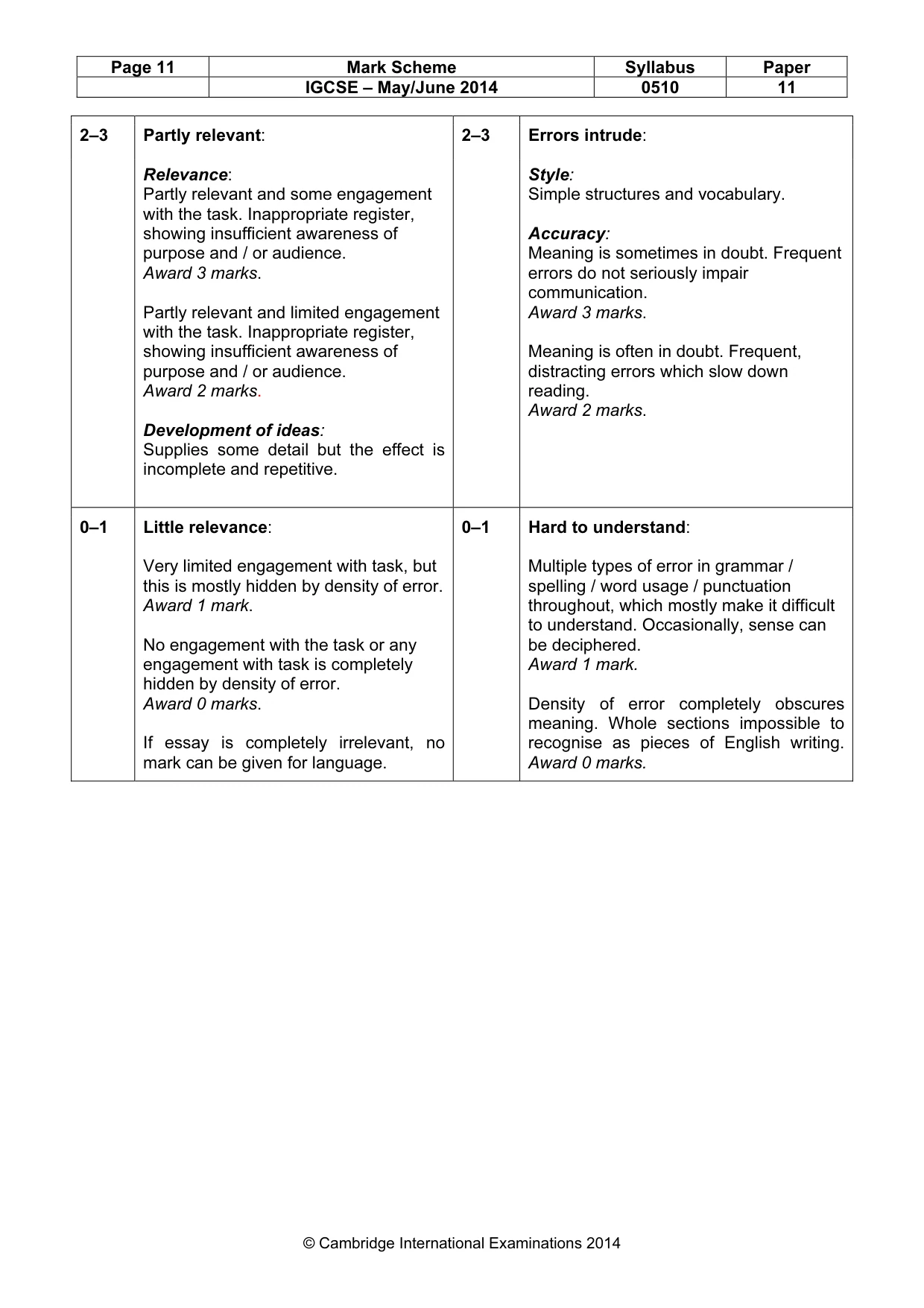
Page 11 Mark Scheme Syllabus Paper IGCSE – May/June 2014 0510 11 © Cambridge International Examinations 2014 2–3 Partly relevant: Relevance: Partly relevant and some engagement with the task. Inappropriate register, showing insufficient awareness of purpose and / or audience. Award 3 marks. Partly relevant and limited engagement with the task. Inappropriate register, showing insufficient awareness of purpose and / or audience. Award 2 marks. Development of ideas: Supplies some detail but the effect is incomplete and repetitive. 2–3 Errors intrude: Style: Simple structures and vocabulary. Accuracy: Meaning is sometimes in doubt. Frequent errors do not seriously impair communication. Award 3 marks. Meaning is often in doubt. Frequent, distracting errors which slow down reading. Award 2 marks. 0–1 Little relevance: Very limited engagement with task, but this is mostly hidden by density of error. Award 1 mark. No engagement with the task or any engagement with task is completely hidden by density of error. Award 0 marks. If essay is completely irrelevant, no mark can be given for language. 0–1 Hard to understand: Multiple types of error in grammar / spelling / word usage / punctuation throughout, which mostly make it difficult to understand. Occasionally, sense can be deciphered. Award 1 mark. Density of error completely obscures meaning. Whole sections impossible to recognise as pieces of English writing. Award 0 marks.
What you needed in this session
Cambridge’s own grade thresholds for 2014 May/June, Paper 1 · Variant 1. A higher threshold means an easier paper — the bar moves with how the cohort did.