Cambridge IGCSE English - Second Language (oral endorsement) 0510 — 2013 Oct/Nov Paper 3 · Variant 3
0510/33/O/N/13
The question paper and its mark scheme, free to read here and free to download. This is Cambridge’s own paper, exactly as it was sat.
Question paper8 pages

Mark scheme14 pages
Answers below. Sit the paper first if you are practising.
Paper as text
Question paper, page 1
This document consists of 7 printed pages and 1 blank page. DC (SLM) 82045 © UCLES 2013 [Turn over UNIVERSITY OF CAMBRIDGE INTERNATIONAL EXAMINATIONS International General Certificate of Secondary Education * 7 6 4 7 1 0 5 5 8 9 * ENGLISH AS A SECOND LANGUAGE 0510/33 Paper 3 Listening (Core) October/November 2013 Approx. 30–40 minutes Candidates answer on the Question Paper. Additional Materials: As listed in Instructions to Supervisors. READ THESE INSTRUCTIONS FIRST Write your Centre number, candidate number and name on all the work you hand in. Write in dark blue or black pen. Do not use staples, paper clips, highlighters, glue or correction fluid. DO NOT WRITE IN ANY BARCODES. Answer all questions. Dictionaries are not permitted. At the end of the examination, fasten all your work securely together. The number of marks is given in brackets [ ] at the end of each question or part question.
Question paper, page 2
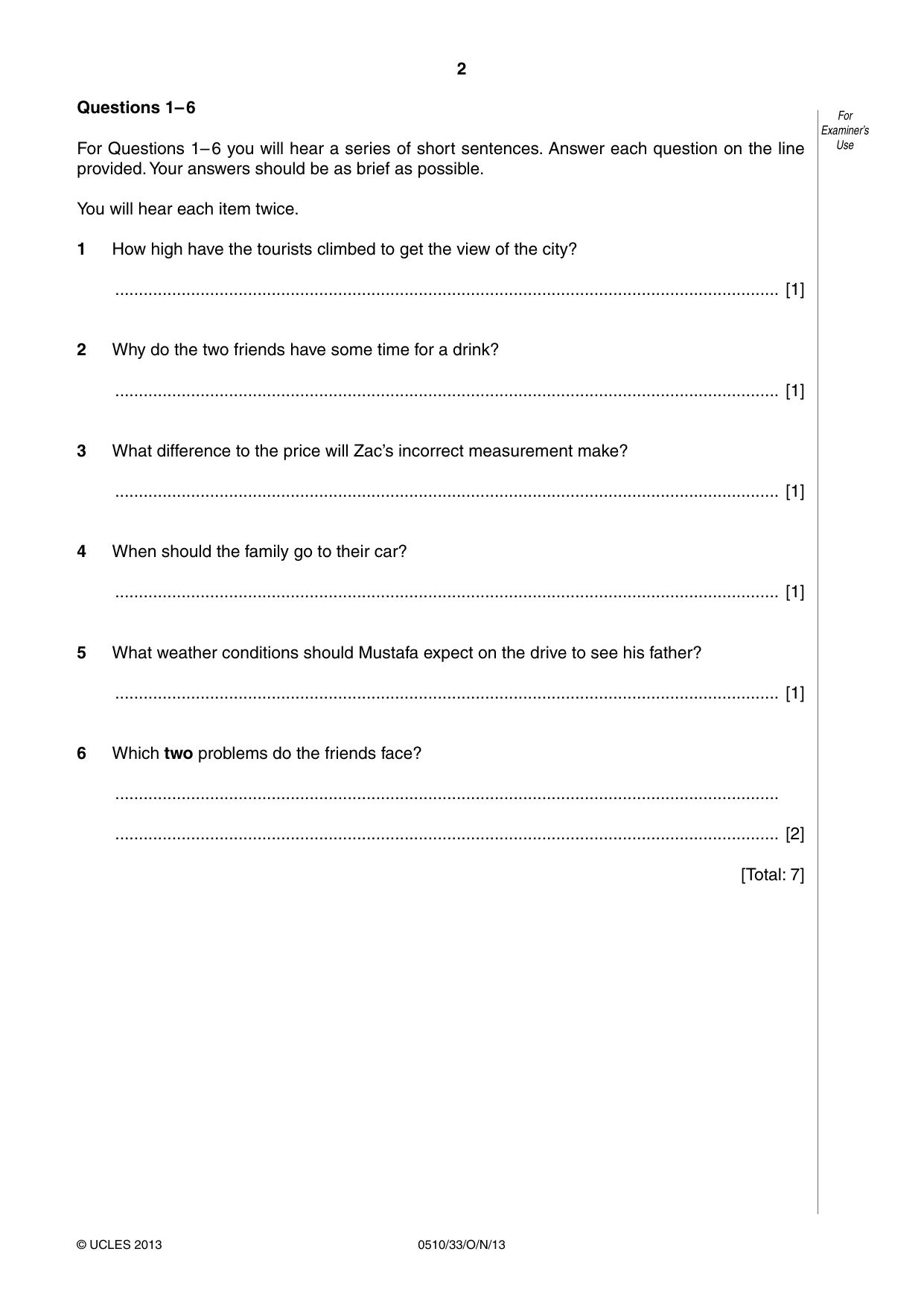
2 0510/33/O/N/13 © UCLES 2013 For Examiner’s Use Questions 1– 6 For Questions 1– 6 you will hear a series of short sentences. Answer each question on the line provided. Your answers should be as brief as possible. You will hear each item twice. 1 How high have the tourists climbed to get the view of the city? … [1] 2 Why do the two friends have some time for a drink? … [1] 3 What difference to the price will Zac’s incorrect measurement make? … [1] 4 When should the family go to their car? … [1] 5 What weather conditions should Mustafa expect on the drive to see his father? … [1] 6 Which two problems do the friends face? … … [2] [Total: 7]
Question paper, page 3
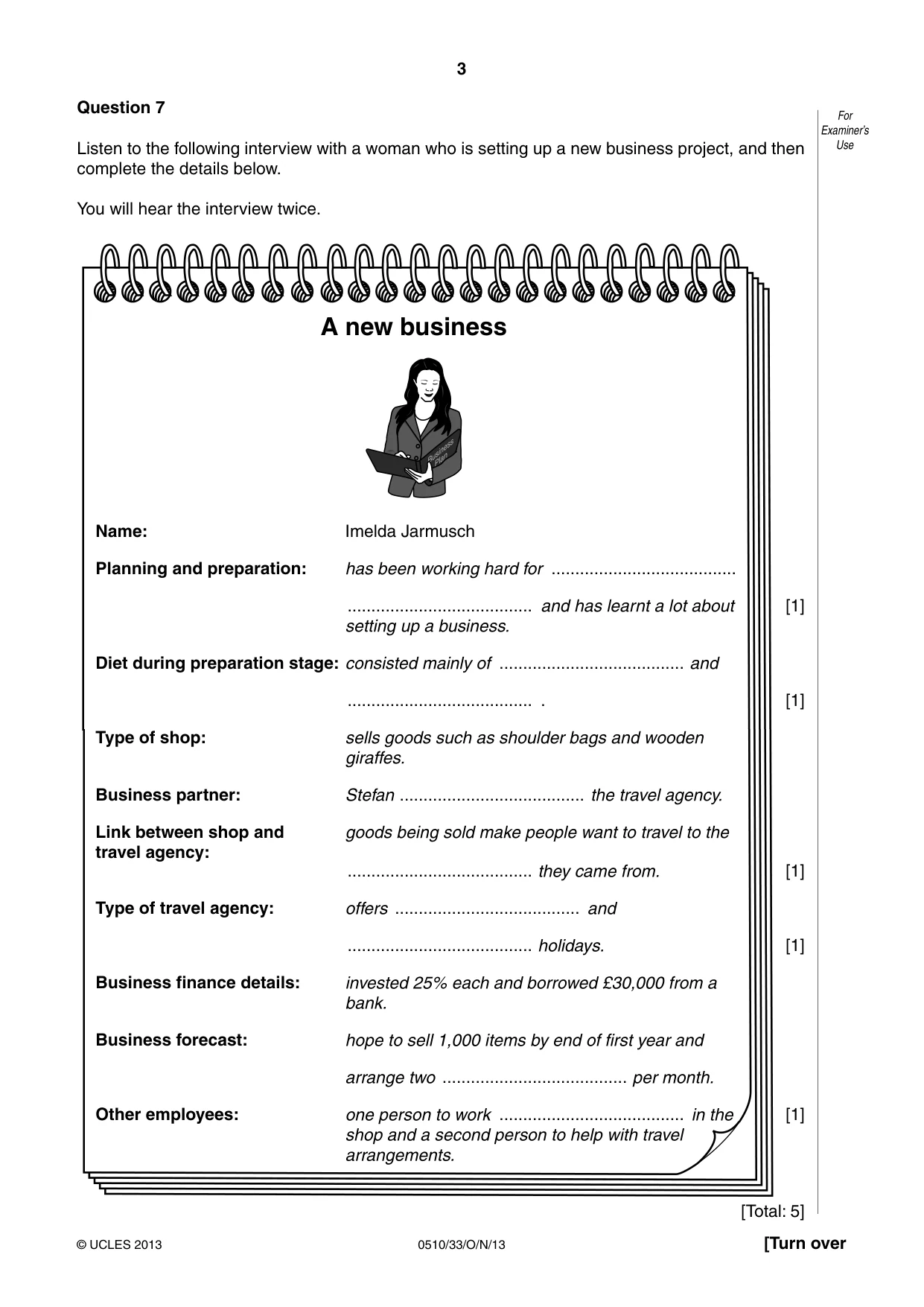
3 0510/33/O/N/13 © UCLES 2013 [Turn over For Examiner’s Use Question 7 Listen to the following interview with a woman who is setting up a new business project, and then complete the details below. You will hear the interview twice. A new business Name: Imelda Jarmusch Planning and preparation: has been working hard for … … and has learnt a lot about [1] setting up a business. Diet during preparation stage: consisted mainly of … and … . [1] Type of shop: sells goods such as shoulder bags and wooden giraffes. Business partner: Stefan … the travel agency. Link between shop and goods being sold make people want to travel to the travel agency: … they came from. [1] Type of travel agency: offers … and … holidays. [1] Business finance details: invested 25% each and borrowed £30,000 from a bank. Business forecast: hope to sell 1,000 items by end of first year and arrange two … per month. Other employees: one person to work … in the [1] shop and a second person to help with travel arrangements. [Total: 5]
Question paper, page 4
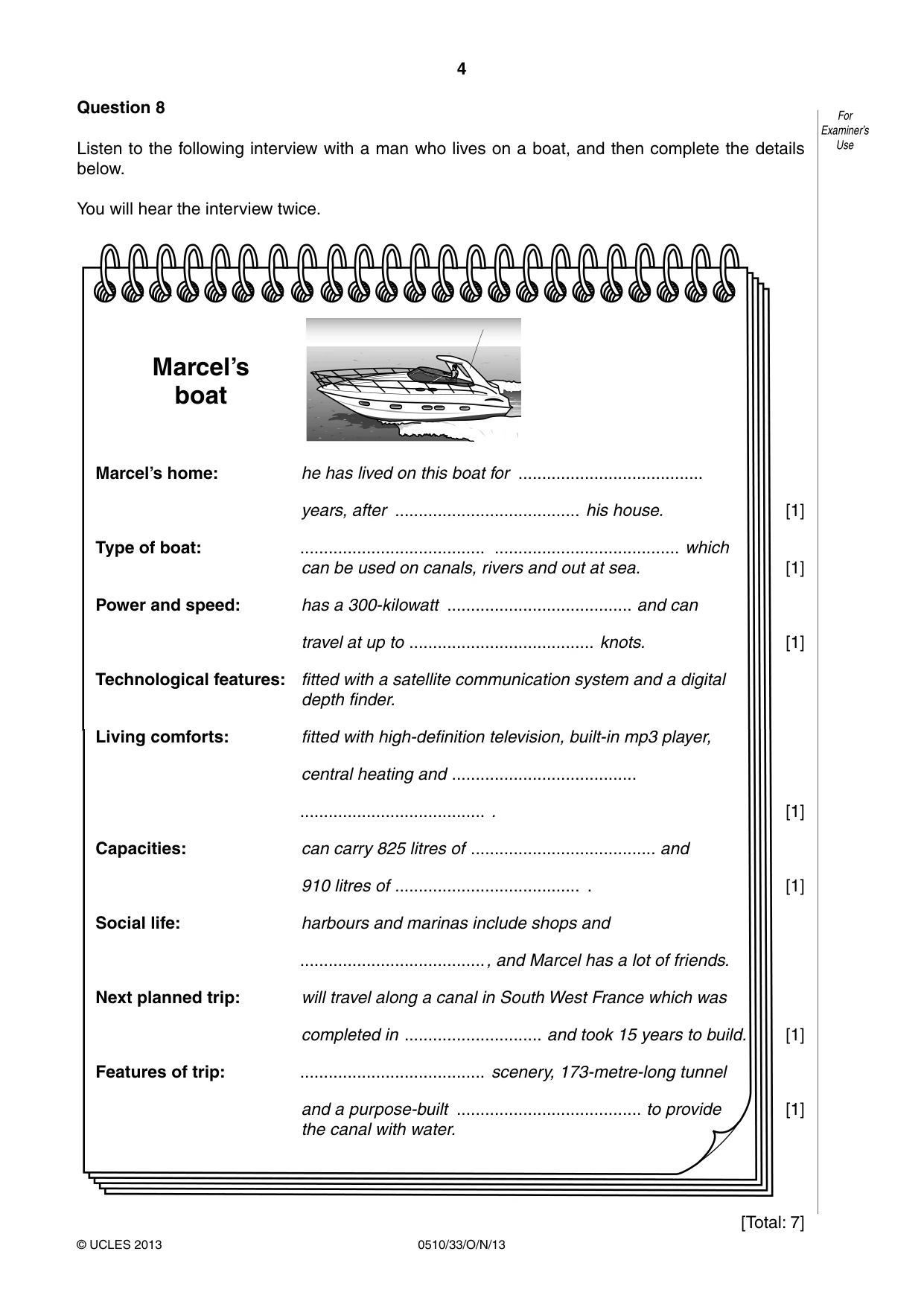
4 0510/33/O/N/13 © UCLES 2013 For Examiner’s Use Question 8 Listen to the following interview with a man who lives on a boat, and then complete the details below. You will hear the interview twice. Marcel’s boat Marcel’s home: he has lived on this boat for … years, after … his house. [1] Type of boat: … … which can be used on canals, rivers and out at sea. [1] Power and speed: has a 300-kilowatt … and can travel at up to … knots. [1] Technological features: fitted with a satellite communication system and a digital depth finder. Living comforts: fitted with high-definition television, built-in mp3 player, central heating and … … . [1] Capacities: can carry 825 litres of … and 910 litres of … . [1] Social life: harbours and marinas include shops and …, and Marcel has a lot of friends. Next planned trip: will travel along a canal in South West France which was completed in … and took 15 years to build. [1] Features of trip: … scenery, 173-metre-long tunnel and a purpose-built … to provide [1] the canal with water. [Total: 7]
Question paper, page 5
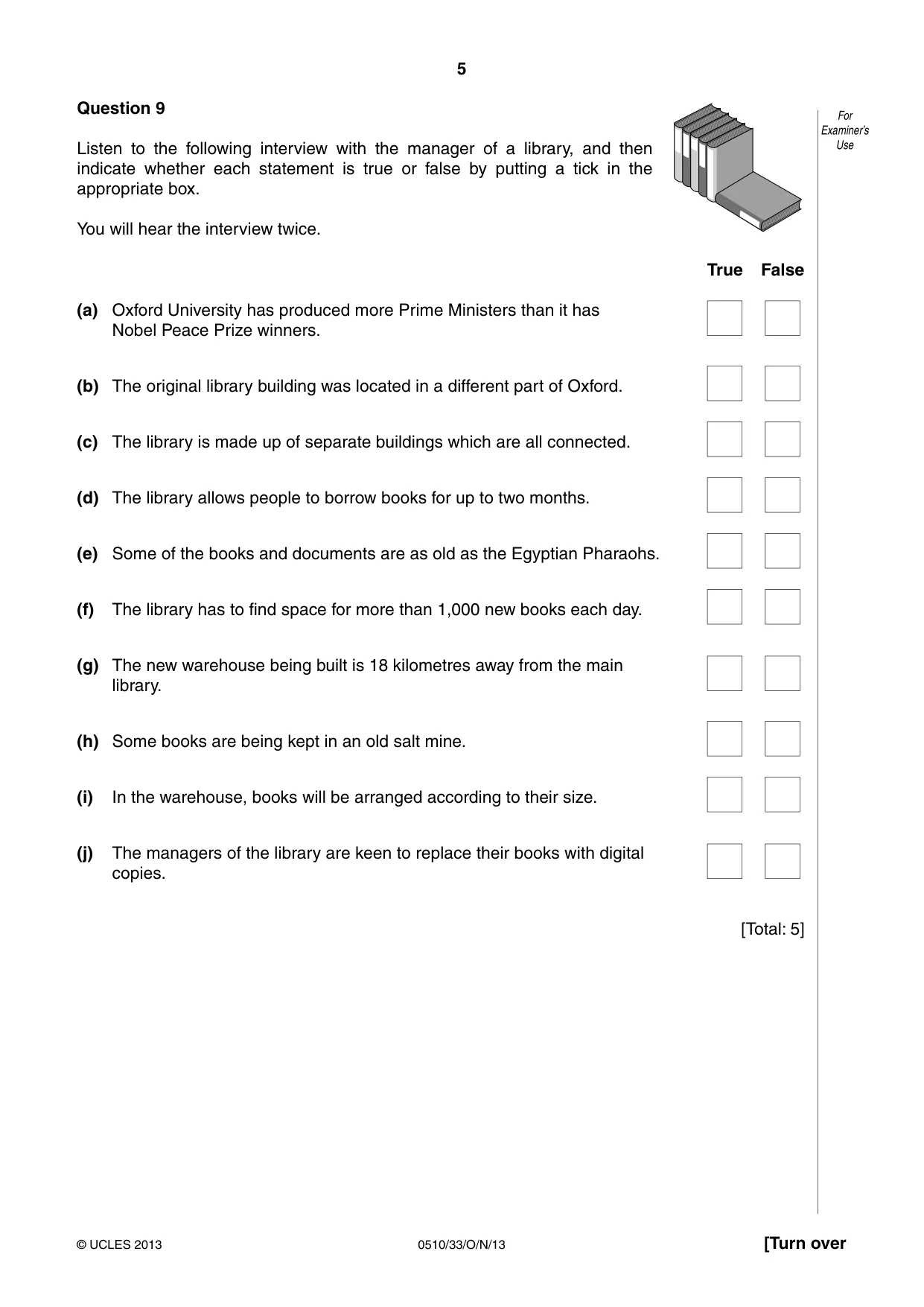
5 0510/33/O/N/13 © UCLES 2013 [Turn over For Examiner’s Use Question 9 Listen to the following interview with the manager of a library, and then indicate whether each statement is true or false by putting a tick in the appropriate box. You will hear the interview twice. True False (a) Oxford University has produced more Prime Ministers than it has Nobel Peace Prize winners. (b) The original library building was located in a different part of Oxford. (c) The library is made up of separate buildings which are all connected. (d) The library allows people to borrow books for up to two months. (e) Some of the books and documents are as old as the Egyptian Pharaohs. (f) The library has to find space for more than 1,000 new books each day. (g) The new warehouse being built is 18 kilometres away from the main library. (h) Some books are being kept in an old salt mine. (i) In the warehouse, books will be arranged according to their size. (j) The managers of the library are keen to replace their books with digital copies. [Total: 5]
Question paper, page 6
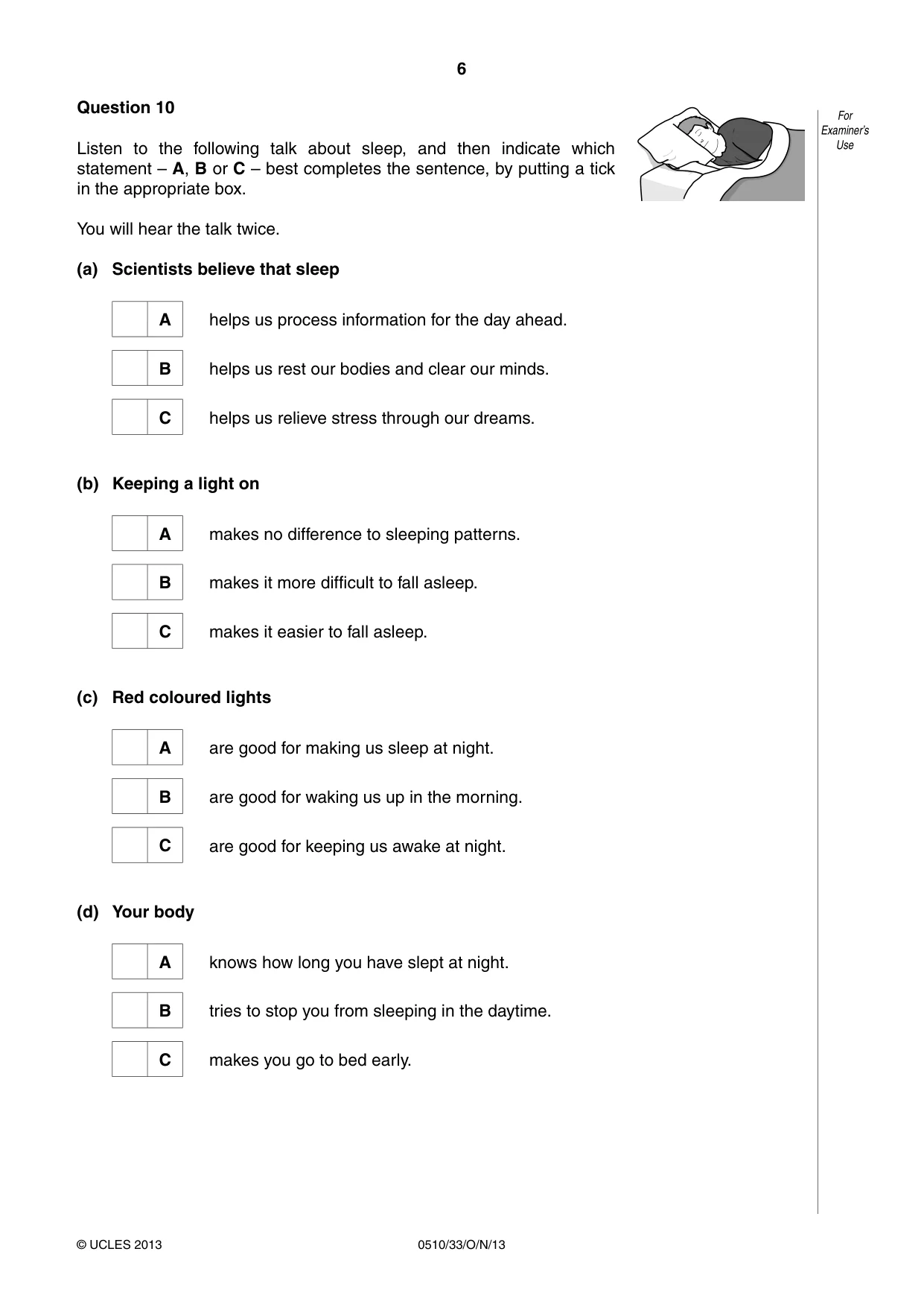
6 0510/33/O/N/13 © UCLES 2013 For Examiner’s Use Question 10 Listen to the following talk about sleep, and then indicate which statement – A, B or C – best completes the sentence, by putting a tick in the appropriate box. You will hear the talk twice. (a) Scientists believe that sleep A helps us process information for the day ahead. B helps us rest our bodies and clear our minds. C helps us relieve stress through our dreams. (b) Keeping a light on A makes no difference to sleeping patterns. B makes it more difficult to fall asleep. C makes it easier to fall asleep. (c) Red coloured lights A are good for making us sleep at night. B are good for waking us up in the morning. C are good for keeping us awake at night. (d) Your body A knows how long you have slept at night. B tries to stop you from sleeping in the daytime. C makes you go to bed early.
Question paper, page 7
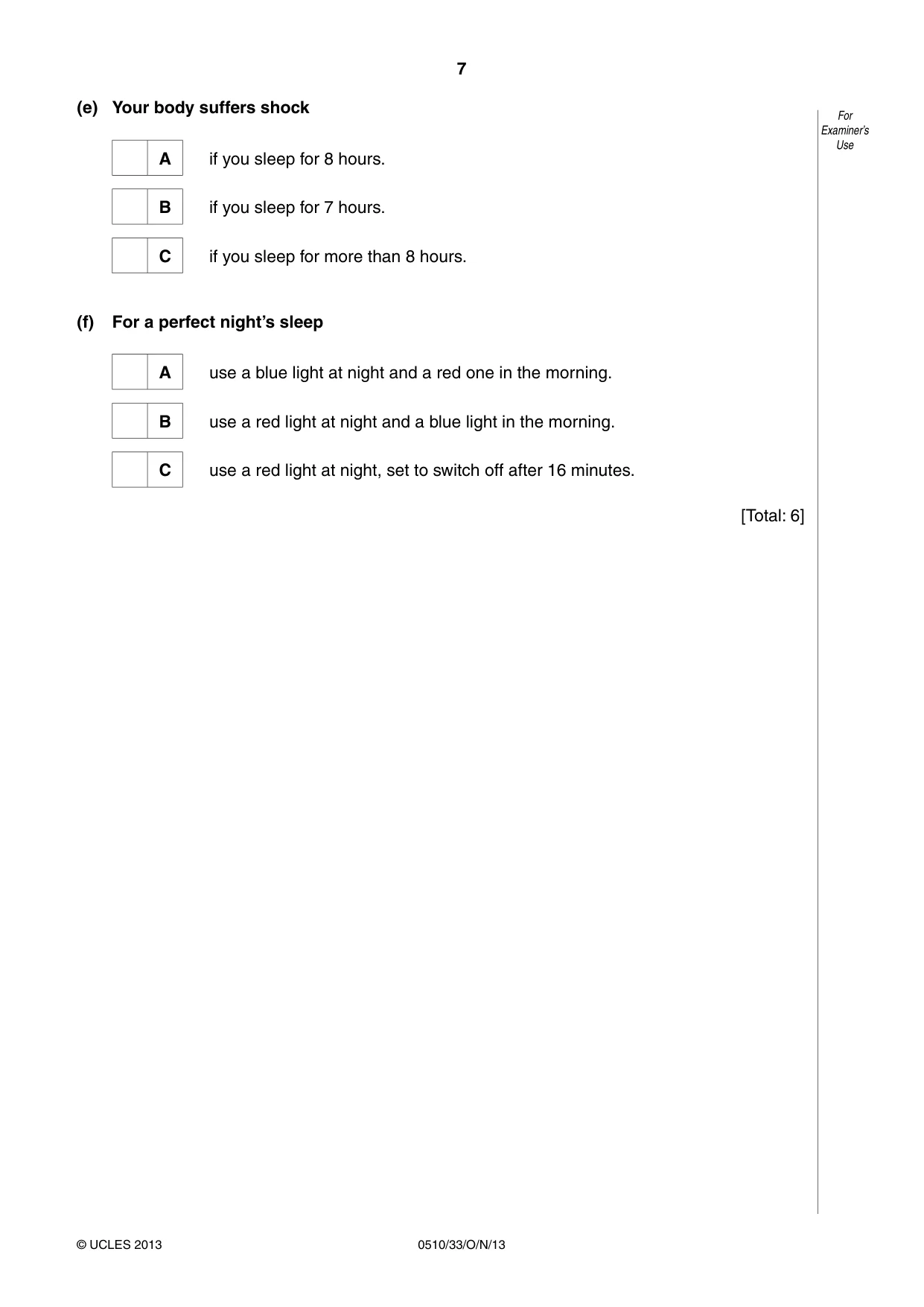
7 0510/33/O/N/13 © UCLES 2013 For Examiner’s Use (e) Your body suffers shock A if you sleep for 8 hours. B if you sleep for 7 hours. C if you sleep for more than 8 hours. (f) For a perfect night’s sleep A use a blue light at night and a red one in the morning. B use a red light at night and a blue light in the morning. C use a red light at night, set to switch off after 16 minutes. [Total: 6]
Question paper, page 8
8 0510/33/O/N/13 © UCLES 2013 Permission to reproduce items where third-party owned material protected by copyright is included has been sought and cleared where possible. Every reasonable effort has been made by the publisher (UCLES) to trace copyright holders, but if any items requiring clearance have unwittingly been included, the publisher will be pleased to make amends at the earliest possible opportunity. University of Cambridge International Examinations is part of the Cambridge Assessment Group. Cambridge Assessment is the brand name of University of Cambridge Local Examinations Syndicate (UCLES), which is itself a department of the University of Cambridge. BLANK PAGE
Mark scheme, page 1
CAMBRIDGE INTERNATIONAL EXAMINATIONS International General Certificate of Secondary Education MARK SCHEME for the October/November 2013 series 0510 ENGLISH AS A SECOND LANGUAGE (ORAL ENDORSEMENT) 0510/33 Paper 3 (Listening (Core)), maximum raw mark 30 This mark scheme is published as an aid to teachers and candidates, to indicate the requirements of the examination. It shows the basis on which Examiners were instructed to award marks. It does not indicate the details of the discussions that took place at an Examiners’ meeting before marking began, which would have considered the acceptability of alternative answers. Mark schemes should be read in conjunction with the question paper and the Principal Examiner Report for Teachers. Cambridge will not enter into discussions about these mark schemes. Cambridge is publishing the mark schemes for the October/November 2013 series for most IGCSE, GCE Advanced Level and Advanced Subsidiary Level components and some Ordinary Level components.
Mark scheme, page 2
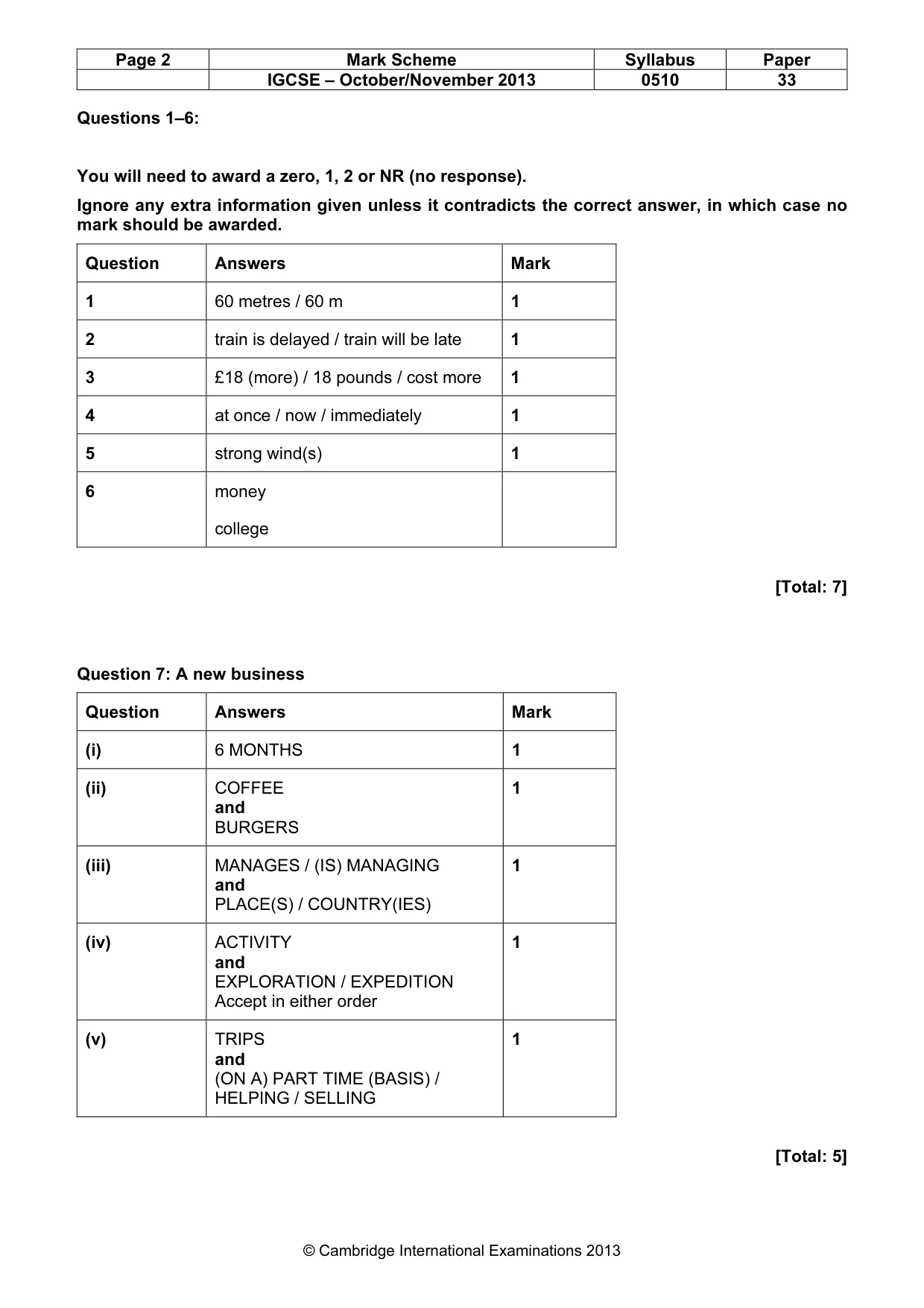
Page 2 Mark Scheme Syllabus Paper IGCSE – October/November 2013 0510 33 © Cambridge International Examinations 2013 Questions 1–6: You will need to award a zero, 1, 2 or NR (no response). Ignore any extra information given unless it contradicts the correct answer, in which case no mark should be awarded. Question Answers Mark 1 60 metres / 60 m 1 2 train is delayed / train will be late 1 3 £18 (more) / 18 pounds / cost more 1 4 at once / now / immediately 1 5 strong wind(s) 1 6 money college [Total: 7] Question 7: A new business Question Answers Mark (i) 6 MONTHS 1 (ii) COFFEE and BURGERS 1 (iii) MANAGES / (IS) MANAGING and PLACE(S) / COUNTRY(IES) 1 (iv) ACTIVITY and EXPLORATION / EXPEDITION Accept in either order 1 (v) TRIPS and (ON A) PART TIME (BASIS) / HELPING / SELLING 1 [Total: 5]
Mark scheme, page 3
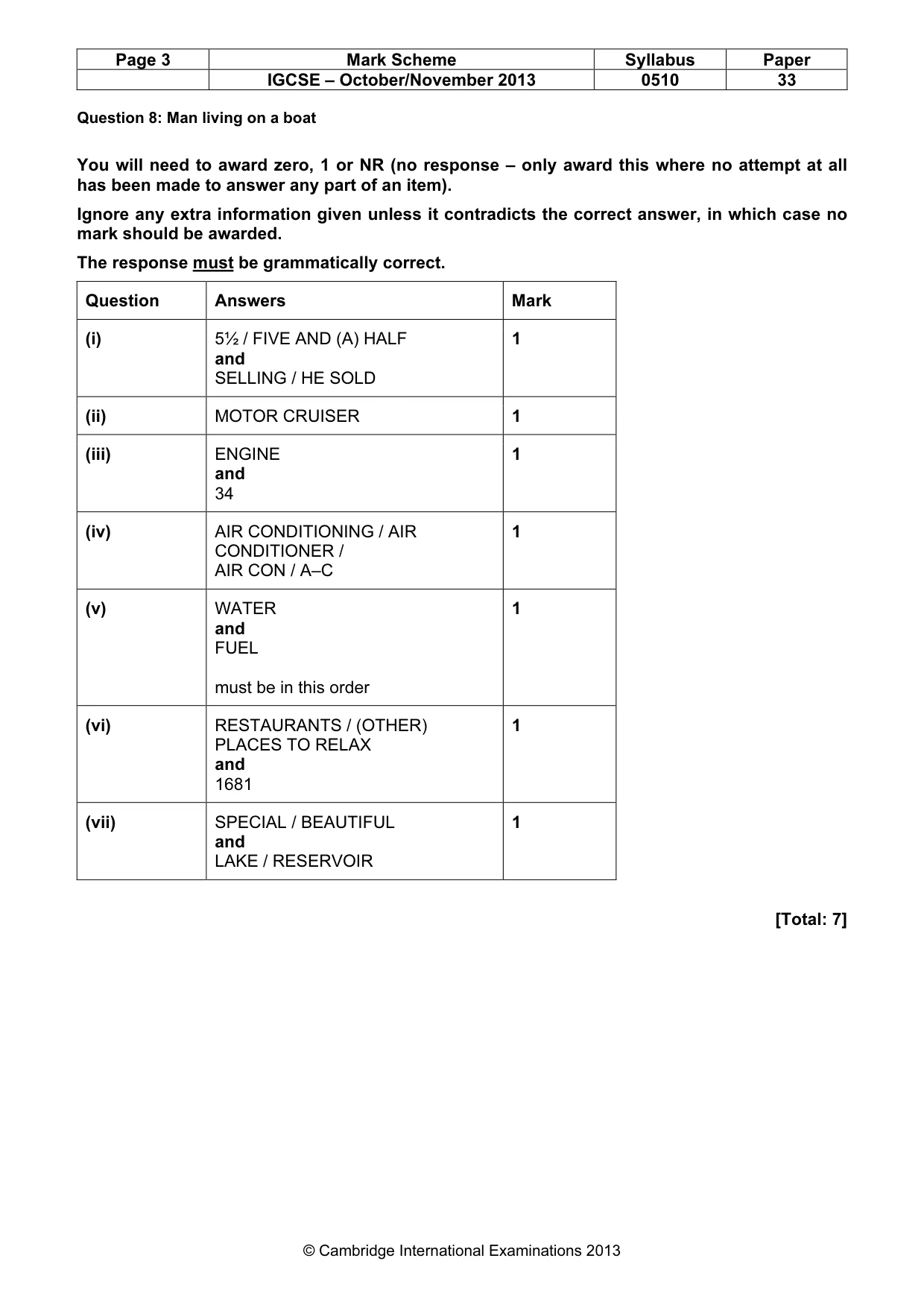
Page 3 Mark Scheme Syllabus Paper IGCSE – October/November 2013 0510 33 © Cambridge International Examinations 2013 Question 8: Man living on a boat You will need to award zero, 1 or NR (no response – only award this where no attempt at all has been made to answer any part of an item). Ignore any extra information given unless it contradicts the correct answer, in which case no mark should be awarded. The response must be grammatically correct. Question Answers Mark (i) 5½ / FIVE AND (A) HALF and SELLING / HE SOLD 1 (ii) MOTOR CRUISER 1 (iii) ENGINE and 34 1 (iv) AIR CONDITIONING / AIR CONDITIONER / AIR CON / A–C 1 (v) WATER and FUEL must be in this order 1 (vi) RESTAURANTS / (OTHER) PLACES TO RELAX and 1681 1 (vii) SPECIAL / BEAUTIFUL and LAKE / RESERVOIR 1 [Total: 7]
Mark scheme, page 4
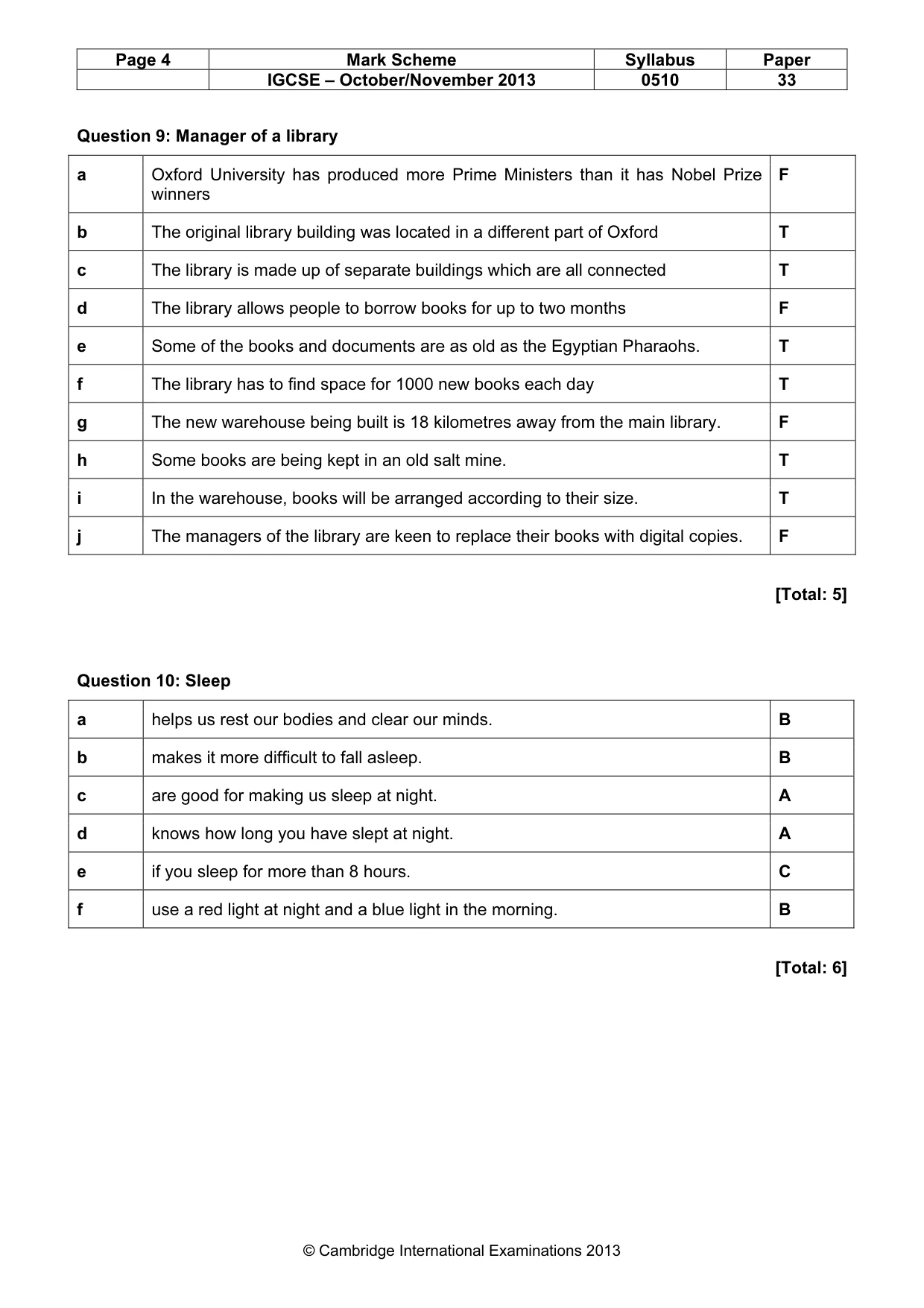
Page 4 Mark Scheme Syllabus Paper IGCSE – October/November 2013 0510 33 © Cambridge International Examinations 2013 Question 9: Manager of a library a Oxford University has produced more Prime Ministers than it has Nobel Prize winners F b The original library building was located in a different part of Oxford T c The library is made up of separate buildings which are all connected T d The library allows people to borrow books for up to two months F e Some of the books and documents are as old as the Egyptian Pharaohs. T f The library has to find space for 1000 new books each day T g The new warehouse being built is 18 kilometres away from the main library. F h Some books are being kept in an old salt mine. T i In the warehouse, books will be arranged according to their size. T j The managers of the library are keen to replace their books with digital copies. F [Total: 5] Question 10: Sleep a helps us rest our bodies and clear our minds. B b makes it more difficult to fall asleep. B c are good for making us sleep at night. A d knows how long you have slept at night. A e if you sleep for more than 8 hours. C f use a red light at night and a blue light in the morning. B [Total: 6]
Mark scheme, page 5
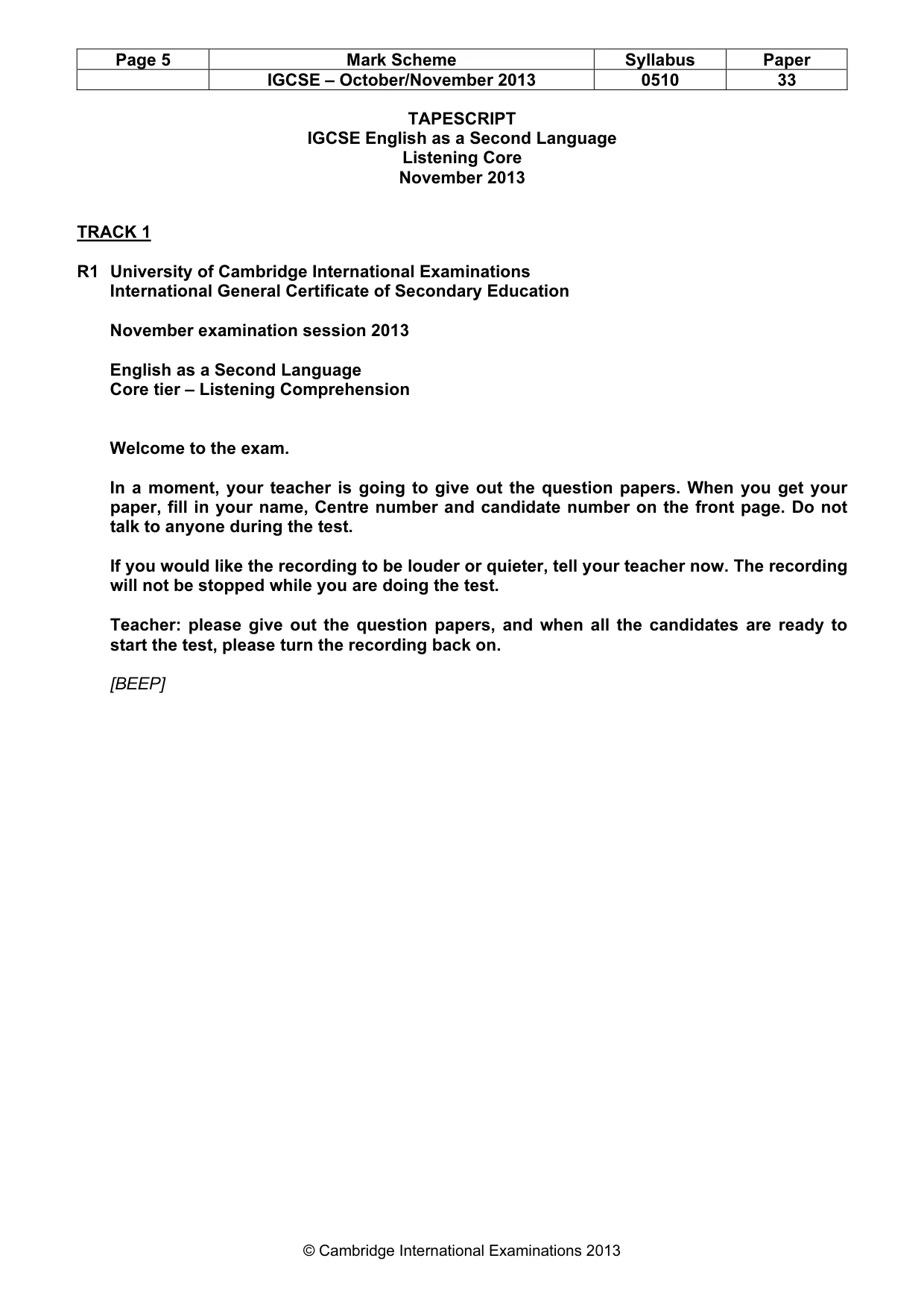
Page 5 Mark Scheme Syllabus Paper IGCSE – October/November 2013 0510 33 © Cambridge International Examinations 2013 TAPESCRIPT IGCSE English as a Second Language Listening Core November 2013 TRACK 1 R1 University of Cambridge International Examinations International General Certificate of Secondary Education November examination session 2013 English as a Second Language Core tier – Listening Comprehension Welcome to the exam. In a moment, your teacher is going to give out the question papers. When you get your paper, fill in your name, Centre number and candidate number on the front page. Do not talk to anyone during the test. If you would like the recording to be louder or quieter, tell your teacher now. The recording will not be stopped while you are doing the test. Teacher: please give out the question papers, and when all the candidates are ready to start the test, please turn the recording back on. [BEEP]
Mark scheme, page 6
Page 6 Mark Scheme Syllabus Paper IGCSE – October/November 2013 0510 33 © Cambridge International Examinations 2013 TRACK 2 Now you are all ready, here is the test. Look at Questions 1 to 6. For each question you will hear the situation described as it is on your exam paper. You will hear each item twice. Pause 00’05” R1 Questions 1–6 For Questions 1–6 you will hear a series of short sentences. Answer each question on the line provided. Your answers should be as brief as possible. You will hear each item twice. R1 Question 1 How high have the tourists climbed to get the view of the city? V1 *From the top of this building, you can see right across the south of the city, all the way to the river over there. V2 How high up are we? And how far away is the river? V1 The river is 6 kilometres away and we’re approximately 60 metres above ground.** Pause 00’10” Repeat from * to ** Pause 00’05” R1 Question 2 Why do the two friends have some time for a drink? V1 *The next train to Mumbai will arrive at 6pm. Please note that this train is delayed by 45 minutes. V2 That’s our train. We have some time now, what shall we do? V1 Oh well, we might as well go and have a drink while we’re waiting.** Pause 00’10” Repeat from * to ** Pause 00’05” R1 Question 3 What difference to the price will Zac’s incorrect measurement make? V1 *Well, this room is quite a bit bigger than you said it was over the phone, Zac. V2 I measured it in just the way you told me to. V1 It’s 30% bigger – that’s 30% more paint, and it will take longer to do the job. V2 Does that change the price you quoted to do the job? V1 I’m afraid so. It'll be £18 more.** Pause 00’10” Repeat from * to ** Pause 00’05”
Mark scheme, page 7
Page 7 Mark Scheme Syllabus Paper IGCSE – October/November 2013 0510 33 © Cambridge International Examinations 2013 R1 Question 4 When should the family go to their car? V1 *Attention all passengers. Please note that the people parked on the lower level need to go to their vehicles at once. These vehicles will be allowed off the boat before those on the upper level. V2 OK, that’s us. We’re on the lower level. Let’s make our way to the car now. Follow me and be careful of the staircase, it’s very steep.** Pause 00’10” Repeat from * to ** Pause 00’05” R1 Question 5 What weather conditions should Mustafa expect on the drive to see his father? V1 *Mustafa. Did you hear the weather forecast for today? They said that this good weather might change. V2 I hope the conditions will be OK; I’m planning to drive over to see my dad later on tonight. V1 Well take care. They’re predicting very strong winds for the evening.** Pause 00’10” Repeat from * to ** Pause 00’05” R1 Question 6 Which two problems do the friends face? V1 *Going to the motor racing sounds like a great idea, Joe, but how will we get the money to go? V2 We can try to earn some. I’ll ask my dad if he’ll give us some work at his factory. V1 It’s not just the money though, is it? We’re supposed to be at college that day. V2 You worry too much. We’ll find a way and get there somehow.** Pause 00’10” Repeat from * to ** Pause 00’05” R1 That is the last of Questions 1 to 6. In a moment you will hear Question 7. Now look at the questions for this part of the exam. Pause 00’20”
Mark scheme, page 8
Page 8 Mark Scheme Syllabus Paper IGCSE – October/November 2013 0510 33 © Cambridge International Examinations 2013 TRACK 3 R1 Question 7 Listen to the following interview with a woman who is setting up a new business project, and then complete the details below. You will hear the interview twice. V1 *We’re here today with Imelda Jarmusch at her new shop. Hello Imelda, I believe that you’re due to open for business tomorrow? V2 Yes, that’s right. I’m a little nervous, but excited too. V1 It must have taken a lot of planning and preparation to get to this stage, Imelda. Have you had any previous experience of setting up a business? V2 No, none at all. This is a completely new project for me. I’ve been putting in lots of hours over the last 6 months, and doing a lot of learning. V1 You must have plenty of energy but you must also be very tired. V2 Absolutely, yes. I’m really tired – and I’ve been living on a diet of coffee and burgers for the last few weeks. V1 Oh dear. Well, I do hope things settle down for you after tomorrow and you can eat normally. Now, Imelda, please tell us what your business is all about. V2 It consists of two parts really. In the shop, we’ll be selling gifts such as those shoulder bags over there and the wooden giraffes in the corner. But also, we’re running a sort of travel agency. V1 Oh, that’s unusual. Is there a link between the two then? I mean the items for sale and the travel? V2 Well, I run the shop, but my business partner, Stefan, is managing the travel agency. The idea is that the goods we’re selling highlight interesting places to visit, and that creates a desire to travel to those places. V1 And that’s where Stefan comes in. What type of holidays is he offering? V2 Activity and exploration. So it’s not really the sun and beach crowd that we’re trying to attract. V1 Who came up with the plan, Imelda? V2 Both of us really. I was in Sri Lanka last year and met Stefan there. He was working as a tour guide for a group of people from Belgium and we got talking about going into business together. V1 And how did you finance the business? V2 We both had some savings, so we put 25% each into the business, and then we borrowed the remaining £30,000 from the bank. V1 Was that the toughest part, getting the money from the bankers? V2 Not really, no. We had a good business plan and we presented it confidently. I think the toughest part was getting the shop ready. V1 What would you like to achieve by the end of your first year? V2 We hope to have sold at least one thousand items, and we also hope to have organised at least two trips a month.
Mark scheme, page 9
Page 9 Mark Scheme Syllabus Paper IGCSE – October/November 2013 0510 33 © Cambridge International Examinations 2013 V1 It’s a lot of work, Imelda. Will you be employing anyone to help? V2 Yes. We have two people working for us. One to help in the shop on a part-time basis and another to take care of the travel arrangements. V1 Is there any chance of you and Stefan swapping places? I mean you leading the trips abroad and Stefan working here in the shop? V2 Oh yes, definitely. We are taking it in turns to do the travelling. I’m not interested in standing behind a sales desk all the time – I also need an active life.** Pause 00’30” R1 Now you will hear the interview again. Repeat from * to ** Pause 0’30” R1 That is the end of Question 7. In a moment you will hear Question 8. Now look at the questions for this part of the exam. Pause 00’25”
Mark scheme, page 10
Page 10 Mark Scheme Syllabus Paper IGCSE – October/November 2013 0510 33 © Cambridge International Examinations 2013 TRACK 4 R1 Question 8 Listen to the following interview with a man who lives on a boat, and then complete the details below. You will hear the interview twice. V1 *We’re here this morning in the South of France with Marcel Benault. Marcel lives on a boat. Hello there and thank you for offering to show us your home on water. V2 Hello...welcome aboard. V1 How long have you been living on your boat, Marcel? V2 For the last five and a half years. I’ve owned several smaller boats in my life, but 8 years ago I decided to sell my house and live full-time on the water. It took me a while to get things organised though. V1 What type of boat is this then? V2 It’s called a motor cruiser. It can be used on rivers and canals and also out at sea. V1 So from where we are now in the South of France, you can go inland up to Paris, but you could also sail across the Mediterranean and end up in Africa. V2 That’s right, yes. In fact, I was in Cyprus last week – it took me 4 days to get back! V1 The inside of the boat seems larger than it looks from the outside. So where we are now, what’s this section called? V2 This is the cockpit, where we steer the boat, but where we can also enjoy the sights and the sea breeze. V1 It does feel great out here in the open on a sunny day like today. How fast does the boat travel, Marcel? V2 Quicker than you think. It has a modern, electronic 300 kilowatt engine which can propel the boat at up to 34 knots – that’s the speed measurement we use for water. That equates to about 64 kilometres per hour on land. V1 What other technology does it have? V2 The boat has a satellite communication system, so I always know exactly where I am at sea. And it has a digital depth finder, so I don’t get stuck on the river bed anywhere! V1 And what about things that make life comfortable for you? V2 It has a high-definition television, built-in mp3 player with speakers, central heating, and even air conditioning for when I’m in hot places. V1 What about when you are out at sea, for days or even weeks at a time? V2 I can store 825 litres of water and 910 litres of fuel. That’s enough for more than a month’s cruising. V1 And I can see that you have a refrigerator, a gas cooker and even a normal electricity supply, just as you would see in a house.
Mark scheme, page 11
Page 11 Mark Scheme Syllabus Paper IGCSE – October/November 2013 0510 33 © Cambridge International Examinations 2013 V2 Yes. When I’m back in harbour, I just plug in a cable and that gives me constant electricity. The boat has 4 batteries though, so when I’m out on the water, I rely on those. They are re- chargeable. The gas is just a portable bottle, like the ones you use for camping. V1 What about the social side of things. Doesn’t it get lonely? V2 No, not really. In each harbour, or marina if you are using rivers and canals, there is a lively community of people just like me. The harbours and marinas have shops, restaurants and other places to relax. At this harbour, which is my main base, I have lots of friends. V1 Where are you off to next? V2 I’m going to make my way along a canal called the Canal du Midi all the way inland up to Toulouse. I’ve been at sea for a while already this year, so I fancy a change. V1 The Canal du Midi…isn’t that a World Heritage Site? V2 Yes. It was opened in 1681 and took 15 years to build. It cuts across South West France from the Atlantic to the Mediterranean. V1 There must be some beautiful scenery along the way. I think I envy you, Marcel. V2 The scenery is very special, yes. The canal has a 173 metre-long tunnel, and this was the first ever canal tunnel in the world. And let’s not forget the reservoir – the Canal du Midi has its own purpose-built lake which supplies water to the canal. V1 Sounds exciting. Just one last thing – do you need a licence for a boat? V2 Yes. We need two actually: one for rivers and canals, and the other for the sea. In fact, for the latter, we need to gain a special certificate, and this involves passing some written and practical tests. The rules are much stricter for taking a boat out to sea, as you would imagine. V1 For safety reasons, I’m sure. Thanks Marcel. It’s been a pleasure.** Pause 00’30” R1 Now you will hear the interview again. Repeat from * to ** Pause 00’30” R1 That is the end of Question 8. In a moment you will hear Question 9. Now look at the questions for this part of the exam. Pause 00’35”
Mark scheme, page 12
Page 12 Mark Scheme Syllabus Paper IGCSE – October/November 2013 0510 33 © Cambridge International Examinations 2013 TRACK 5 R1 Question 9 Listen to the following interview with the manager of a library, and then indicate whether each statement is true or false by putting a tick in the appropriate box. You will hear the interview twice. V1 *I’m in Oxford this morning, and I’m here to meet Hugo McDaniel, who looks after this great library. Hello Hugo. V2 Hello. V1 Hugo, what a lovely city, and of course quite a famous city. It’s my first visit to Oxford, and I’m here for a few days, so perhaps you can give me some hints later about where to go and what to see. V2 Yes, of course. I’ve lived here all my life, so I should know one or two interesting places. There’s the University of course, which has produced 47 Nobel Peace prize winners and 26 Prime Ministers. V1 OK, I’m here to talk to you about the problems that you are experiencing in the library at the moment. But before we get to that can you tell us a little about the great library itself. V2 The original library dates back to 1320, when it was situated in the north of the town, but it wasn’t until 1620 that the library was established in its present location, here. So it’s a very old library. V1 And not just a single building, right? V2 No. We have 30 separate buildings now in the city; all linked by private footpaths. And the two main departments are linked by an underground tunnel. V1 Fascinating. Hugo, you have an unusual policy about lending out books, don’t you? V2 Well, it’s simple really – we don’t lend books. Anyone who wants to read one of our books has to do it here, in the library. Even the King of England was refused a book, back in 1645. V1 I guess that’s because you have so many valuable items. You must have rather a lot of books here if they never leave the building. V2 Yes, we have over 12 million books, maps and documents – some of which date back to the time of the Pharaohs in ancient Egypt. So yes, we have some very valuable books and manuscripts indeed. V1 And you have another unusual policy, don’t you? V2 You mean that we’re not allowed to throw any of our books away. By law, we have to store a single copy of all the books published in the UK and Ireland. V1 That’s a lot of books! Which brings us to the main problem – lack of space. V2 Indeed. We have to find space for just over 1000 books every single day. And quite simply, we’ve run out of shelf space here in Oxford. V1 And people thought that the internet would kill off the printed word, eh. So what’s the solution? V2 We’re building a warehouse – about 80 kilometres away. It’s almost ready and it’s huge, housing another 10 million books.
Mark scheme, page 13
Page 13 Mark Scheme Syllabus Paper IGCSE – October/November 2013 0510 33 © Cambridge International Examinations 2013 V1 Will you remove books from here then? V2 Actually, we started removing the less popular items a few years ago. We have 2.4 million books stored in a mine – a moisture-free and very dark salt mine in northern England – all awaiting a permanent home. The conditions in the mine help to protect and preserve the books. But yes, we’ll also be removing another 2 million of the least wanted books from here, the library itself. V1 Tell us more about the process of moving this large amount of books, Hugo. V2 We’re employing around 150 people. We need people who can operate machinery, such as cranes and lifting devices, and to drive trucks to carry the books. And then we need people to re- catalogue every single book and put them all on the new shelves. V1 So how are the books catalogued? V2 Each book has a unique bar code. So they all need to be scanned into a database, and then re- located in the warehouse. We’ll do this by size of book and not by subject. So we could easily have a book on fishing stored on a shelf next to a book on astrophysics. This will be quite different to the way that the books are shelved in a regular library. V1 And what does the warehouse look like inside? V2 Very modern. Almost like a space station. It’s temperature controlled, has constant low-level lighting and the moisture levels are kept very low. V1 Will people be able to visit the warehouse and read the books there? V2 No. If a particular book is required, we will arrange for it to be delivered here within 48 hours. V1 Sounds like a challenge, Hugo. And all because you can’t throw any old books away! V2 Yes. But it’s not going to be a solution for ever. We calculate that if the same number of new books arrive each year from now on, the new warehouse will be full in around 18 years. And then we’ll have to build another one. V1 Unless you start scanning books into computers, Hugo, and create digital copies? That would take up far less space. V2 That approach has been discussed, and of course, there are plenty of digital books out there now. But we decided that we just couldn’t destroy any of our books and replace them with digital copies. Some of them are really old, many are famous, and others are just beautiful.** Pause 00’30” R1 Now you will hear the interview again. Repeat from * to ** Pause 00’30” R1 That is the end of Question 9. In a moment you will hear Question 10. Now look at the questions for this part of the exam. Pause 0035”
Mark scheme, page 14
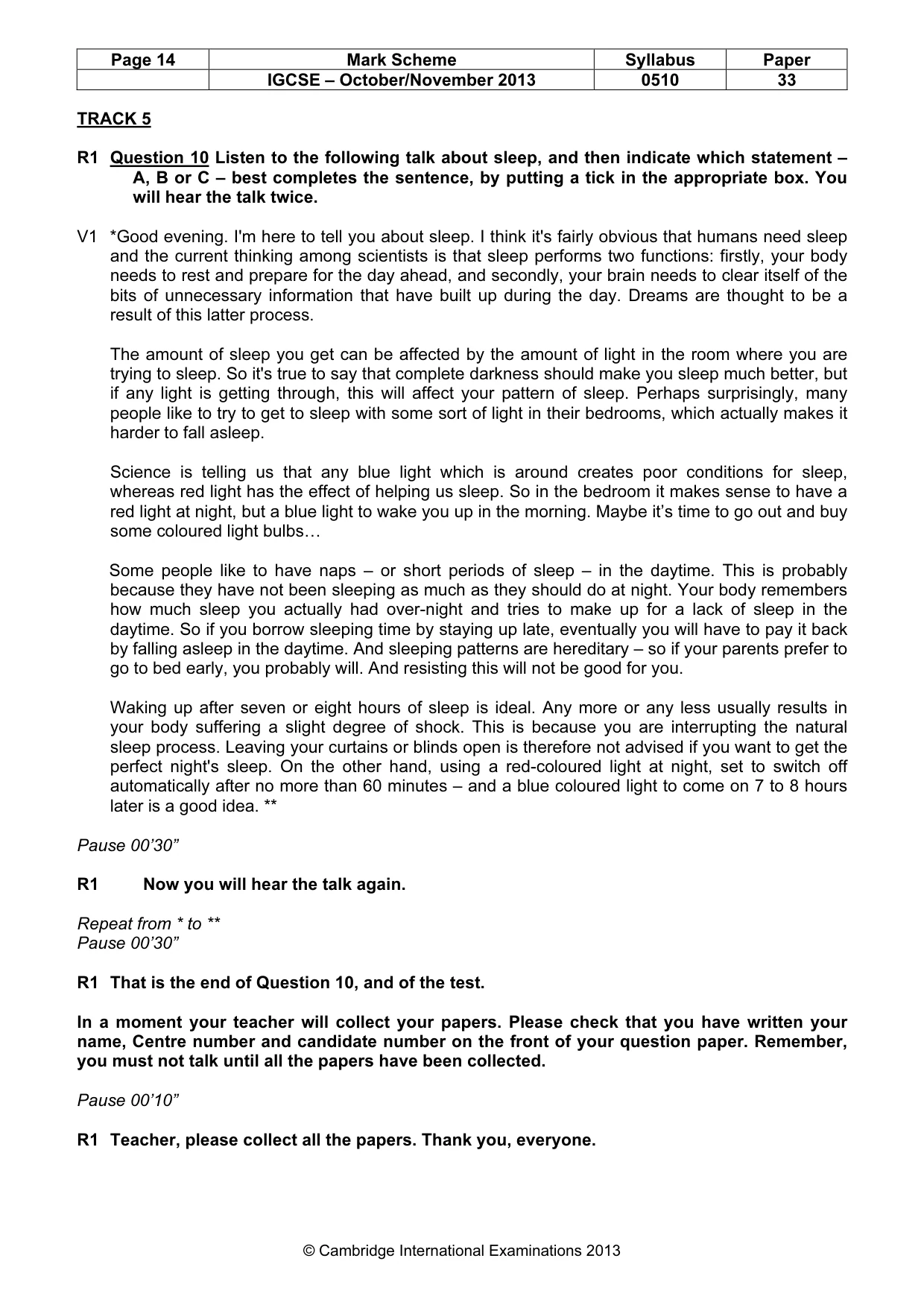
Page 14 Mark Scheme Syllabus Paper IGCSE – October/November 2013 0510 33 © Cambridge International Examinations 2013 TRACK 5 R1 Question 10 Listen to the following talk about sleep, and then indicate which statement – A, B or C – best completes the sentence, by putting a tick in the appropriate box. You will hear the talk twice. V1 *Good evening. I'm here to tell you about sleep. I think it's fairly obvious that humans need sleep and the current thinking among scientists is that sleep performs two functions: firstly, your body needs to rest and prepare for the day ahead, and secondly, your brain needs to clear itself of the bits of unnecessary information that have built up during the day. Dreams are thought to be a result of this latter process. The amount of sleep you get can be affected by the amount of light in the room where you are trying to sleep. So it's true to say that complete darkness should make you sleep much better, but if any light is getting through, this will affect your pattern of sleep. Perhaps surprisingly, many people like to try to get to sleep with some sort of light in their bedrooms, which actually makes it harder to fall asleep. Science is telling us that any blue light which is around creates poor conditions for sleep, whereas red light has the effect of helping us sleep. So in the bedroom it makes sense to have a red light at night, but a blue light to wake you up in the morning. Maybe it’s time to go out and buy some coloured light bulbs… Some people like to have naps – or short periods of sleep – in the daytime. This is probably because they have not been sleeping as much as they should do at night. Your body remembers how much sleep you actually had over-night and tries to make up for a lack of sleep in the daytime. So if you borrow sleeping time by staying up late, eventually you will have to pay it back by falling asleep in the daytime. And sleeping patterns are hereditary – so if your parents prefer to go to bed early, you probably will. And resisting this will not be good for you. Waking up after seven or eight hours of sleep is ideal. Any more or any less usually results in your body suffering a slight degree of shock. This is because you are interrupting the natural sleep process. Leaving your curtains or blinds open is therefore not advised if you want to get the perfect night's sleep. On the other hand, using a red-coloured light at night, set to switch off automatically after no more than 60 minutes – and a blue coloured light to come on 7 to 8 hours later is a good idea. ** Pause 00’30” R1 Now you will hear the talk again. Repeat from * to ** Pause 00’30” R1 That is the end of Question 10, and of the test. In a moment your teacher will collect your papers. Please check that you have written your name, Centre number and candidate number on the front of your question paper. Remember, you must not talk until all the papers have been collected. Pause 00’10” R1 Teacher, please collect all the papers. Thank you, everyone.