Cambridge IGCSE English - Second Language (oral endorsement) 0510 — 2011 Oct/Nov Paper 3 · Variant 1
0510/31/O/N/11 · 30 marks · ≈34 min
The question paper and its mark scheme, free to read here and free to download. This is Cambridge’s own paper, exactly as it was sat.
Question paper8 pages


Mark scheme15 pages
Answers below. Sit the paper first if you are practising.
Paper as text
Question paper, page 1
This document consists of 6 printed pages and 2 blank pages. IB11 11_0510_31/6RP © UCLES 2011 [Turn over *0199252869* UNIVERSITY OF CAMBRIDGE INTERNATIONAL EXAMINATIONS International General Certificate of Secondary Education ENGLISH AS A SECOND LANGUAGE 0510/31 Paper 3 Listening (Core) October/November 2011 Approx. 30 – 40 minutes Candidates answer on the Question Paper. Additional Materials: As listed in Instructions to Supervisors. READ THESE INSTRUCTIONS FIRST Write your Centre number, candidate number and name on all the work you hand in. Write in dark blue or black pen. Do not use staples, paper clips, highlighters, glue or correction fluid. DO NOT WRITE IN ANY BARCODES. Answer all questions. Dictionaries are not permitted. The number of marks is given in brackets [ ] at the end of each question or part question.
Question paper, page 2
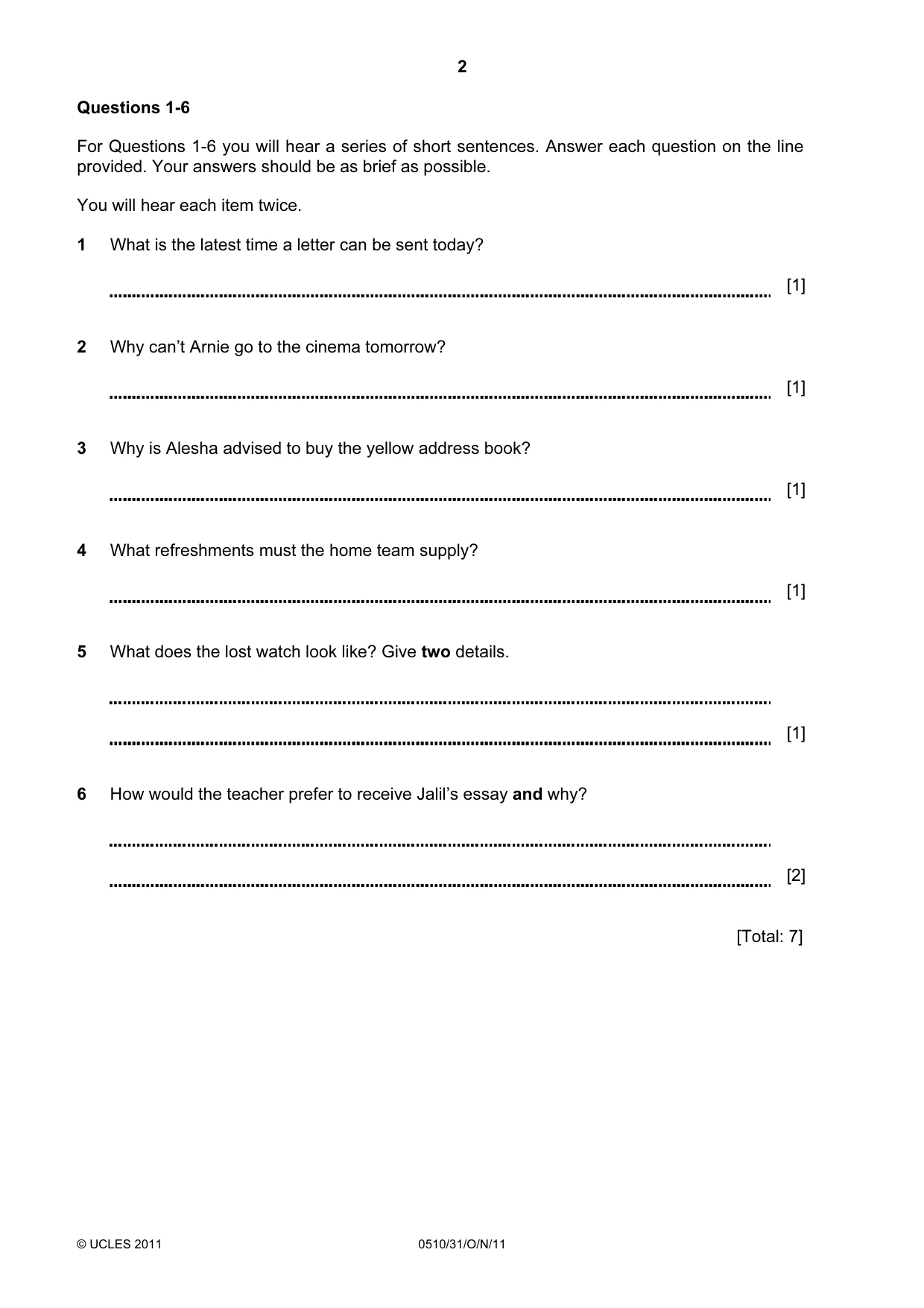
2 © UCLES 2011 0510/31/O/N/11 Questions 1-6 For Questions 1-6 you will hear a series of short sentences. Answer each question on the line provided. Your answers should be as brief as possible. You will hear each item twice. 1 What is the latest time a letter can be sent today? [1] 2 Why can’t Arnie go to the cinema tomorrow? [1] 3 Why is Alesha advised to buy the yellow address book? [1] 4 What refreshments must the home team supply? [1] 5 What does the lost watch look like? Give two details. [1] 6 How would the teacher prefer to receive Jalil’s essay and why? [2] [Total: 7]
Question paper, page 3
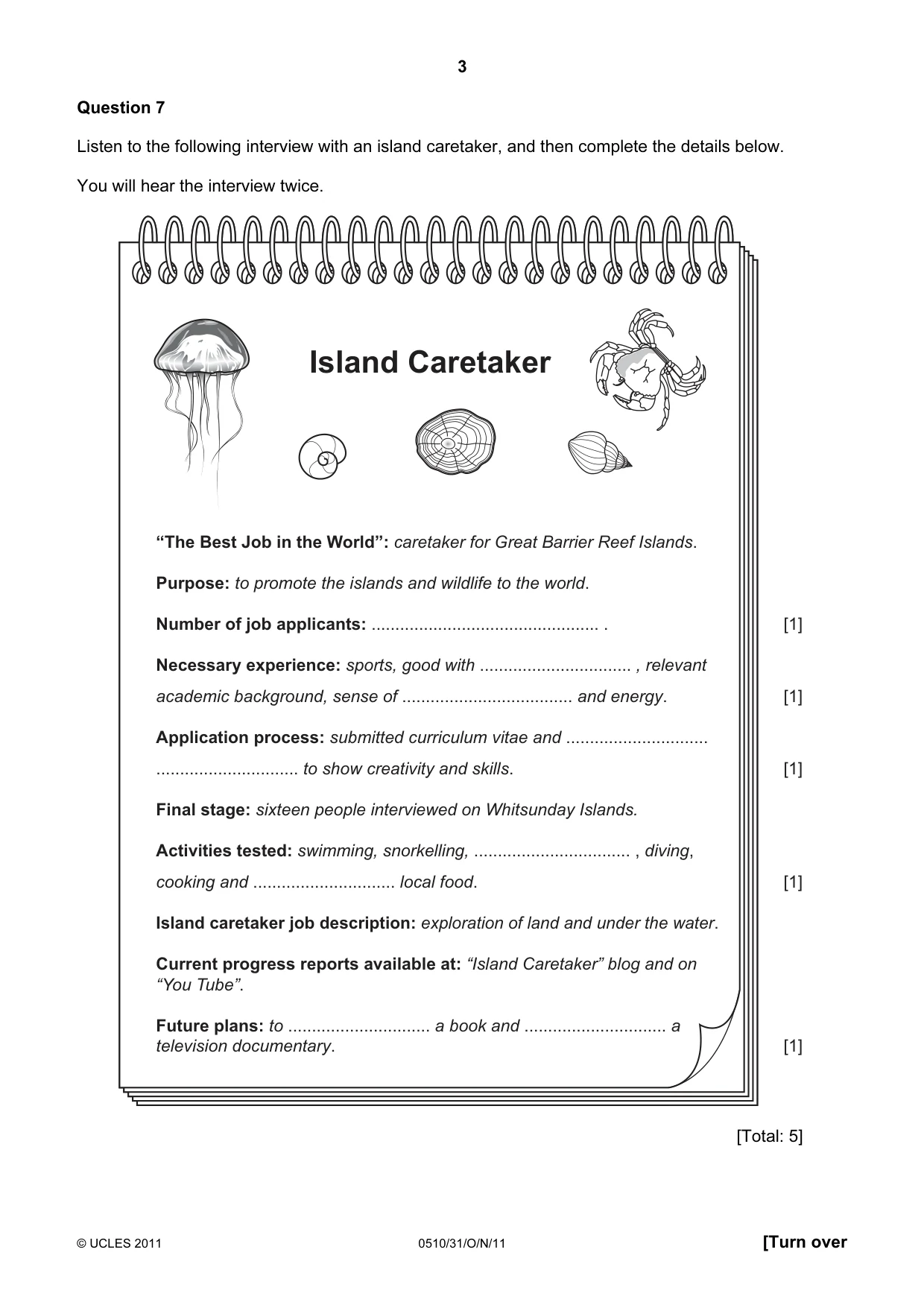
3 © UCLES 2011 0510/31/O/N/11 [Turn over Question 7 Listen to the following interview with an island caretaker, and then complete the details below. You will hear the interview twice. Island Caretaker “The Best Job in the World”: caretaker for Great Barrier Reef Islands. Purpose: to promote the islands and wildlife to the world. Number of job applicants: … . [1] Necessary experience: sports, good with … , relevant academic background, sense of … and energy. [1] Application process: submitted curriculum vitae and … … to show creativity and skills. [1] Final stage: sixteen people interviewed on Whitsunday Islands. Activities tested: swimming, snorkelling, … , diving, cooking and … local food. [1] Island caretaker job description: exploration of land and under the water. Current progress reports available at: “Island Caretaker” blog and on “You Tube”. Future plans: to … a book and … a television documentary. [1] [Total: 5]
Question paper, page 4
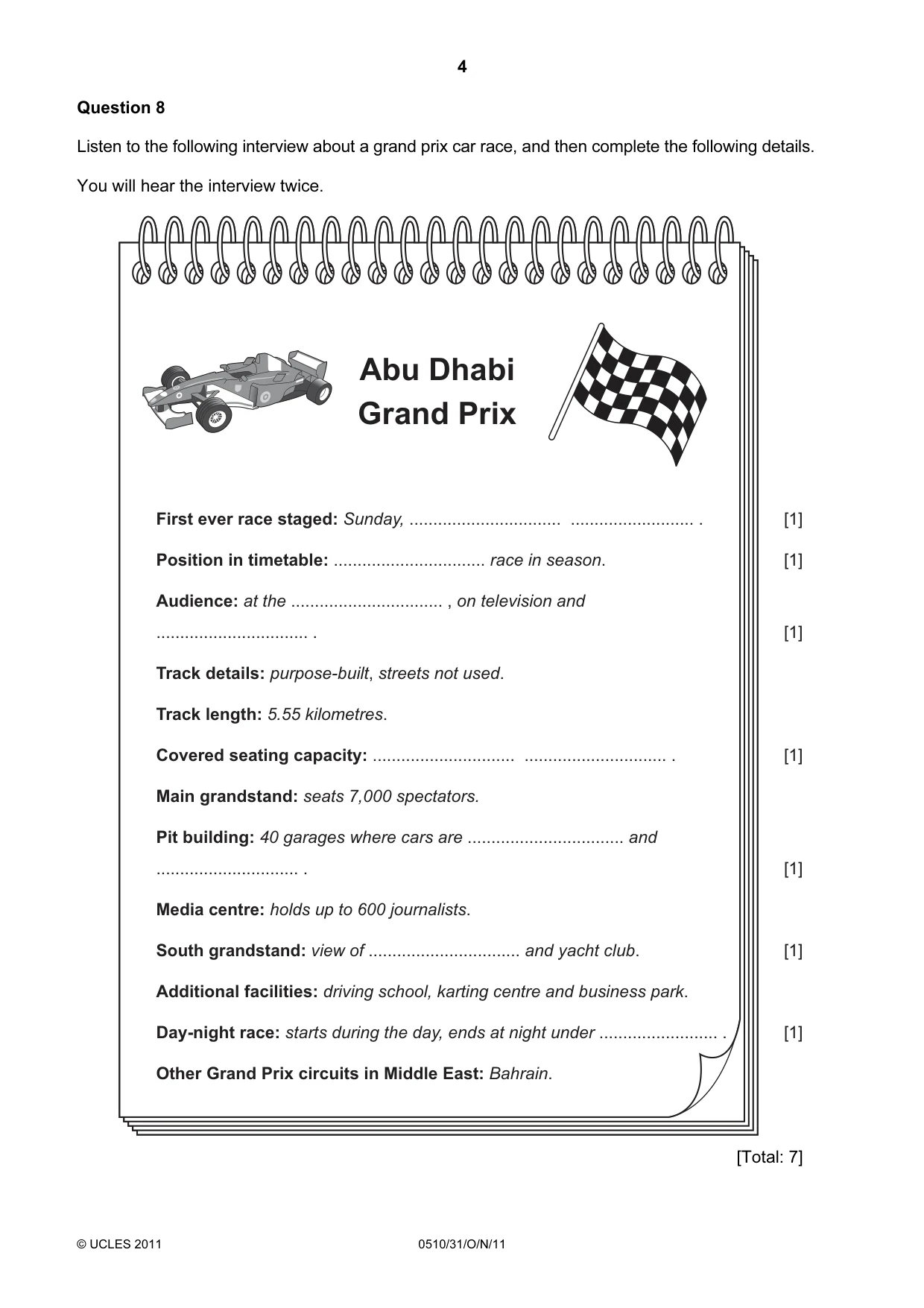
4 © UCLES 2011 0510/31/O/N/11 Question 8 Listen to the following interview about a grand prix car race, and then complete the following details. You will hear the interview twice. Abu Dhabi Grand Prix First ever race staged: Sunday, … … . [1] Position in timetable: … race in season. [1] Audience: at the … , on television and … . [1] Track details: purpose-built, streets not used. Track length: 5.55 kilometres. Covered seating capacity: … … . [1] Main grandstand: seats 7,000 spectators. Pit building: 40 garages where cars are … and … . [1] Media centre: holds up to 600 journalists. South grandstand: view of … and yacht club. [1] Additional facilities: driving school, karting centre and business park. Day-night race: starts during the day, ends at night under … . [1] Other Grand Prix circuits in Middle East: Bahrain. [Total: 7]
Question paper, page 5
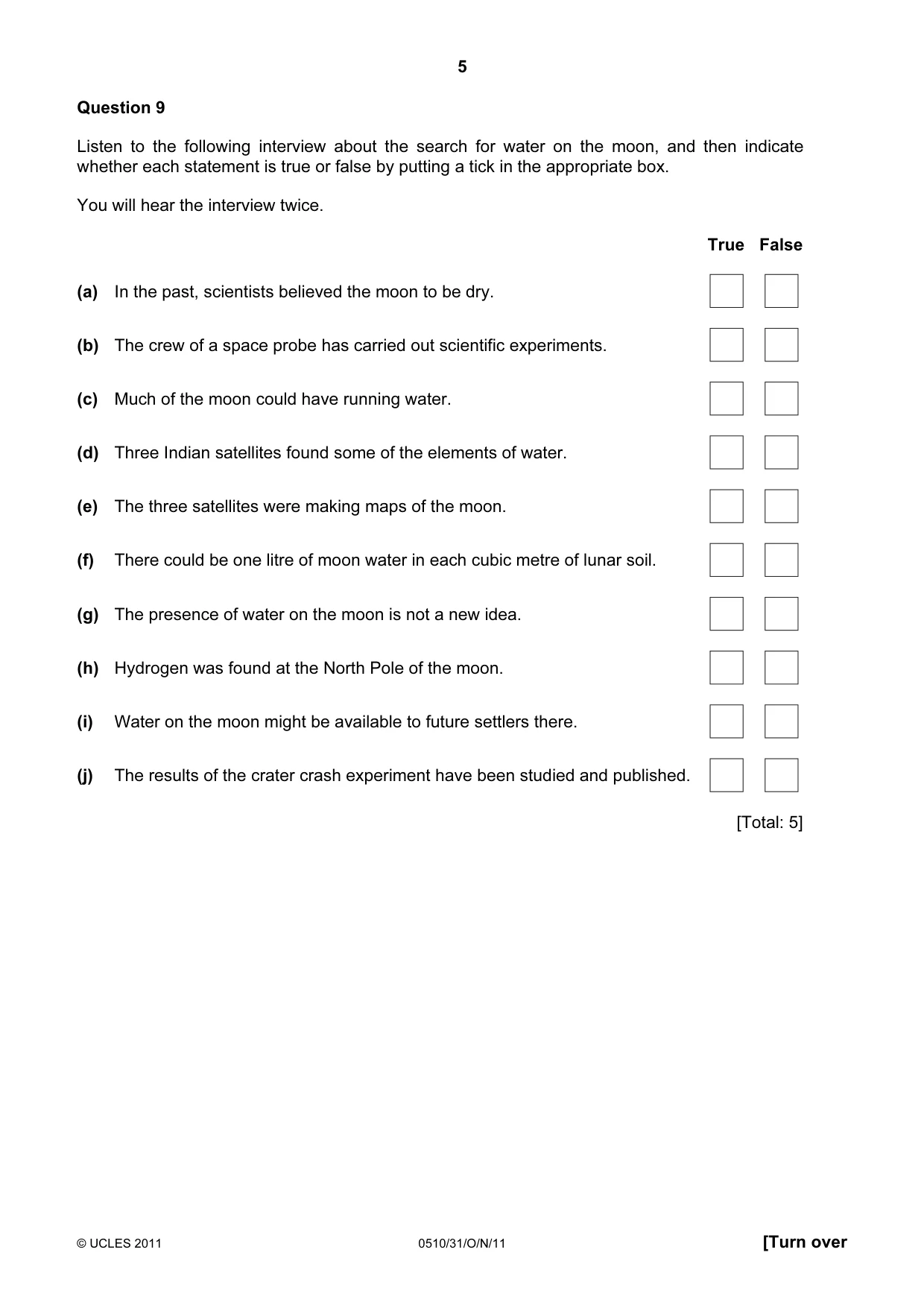
5 © UCLES 2011 0510/31/O/N/11 [Turn over Question 9 Listen to the following interview about the search for water on the moon, and then indicate whether each statement is true or false by putting a tick in the appropriate box. You will hear the interview twice. True False (a) In the past, scientists believed the moon to be dry. (b) The crew of a space probe has carried out scientific experiments. (c) Much of the moon could have running water. (d) Three Indian satellites found some of the elements of water. (e) The three satellites were making maps of the moon. (f) There could be one litre of moon water in each cubic metre of lunar soil. (g) The presence of water on the moon is not a new idea. (h) Hydrogen was found at the North Pole of the moon. (i) Water on the moon might be available to future settlers there. (j) The results of the crater crash experiment have been studied and published. [Total: 5]
Question paper, page 6
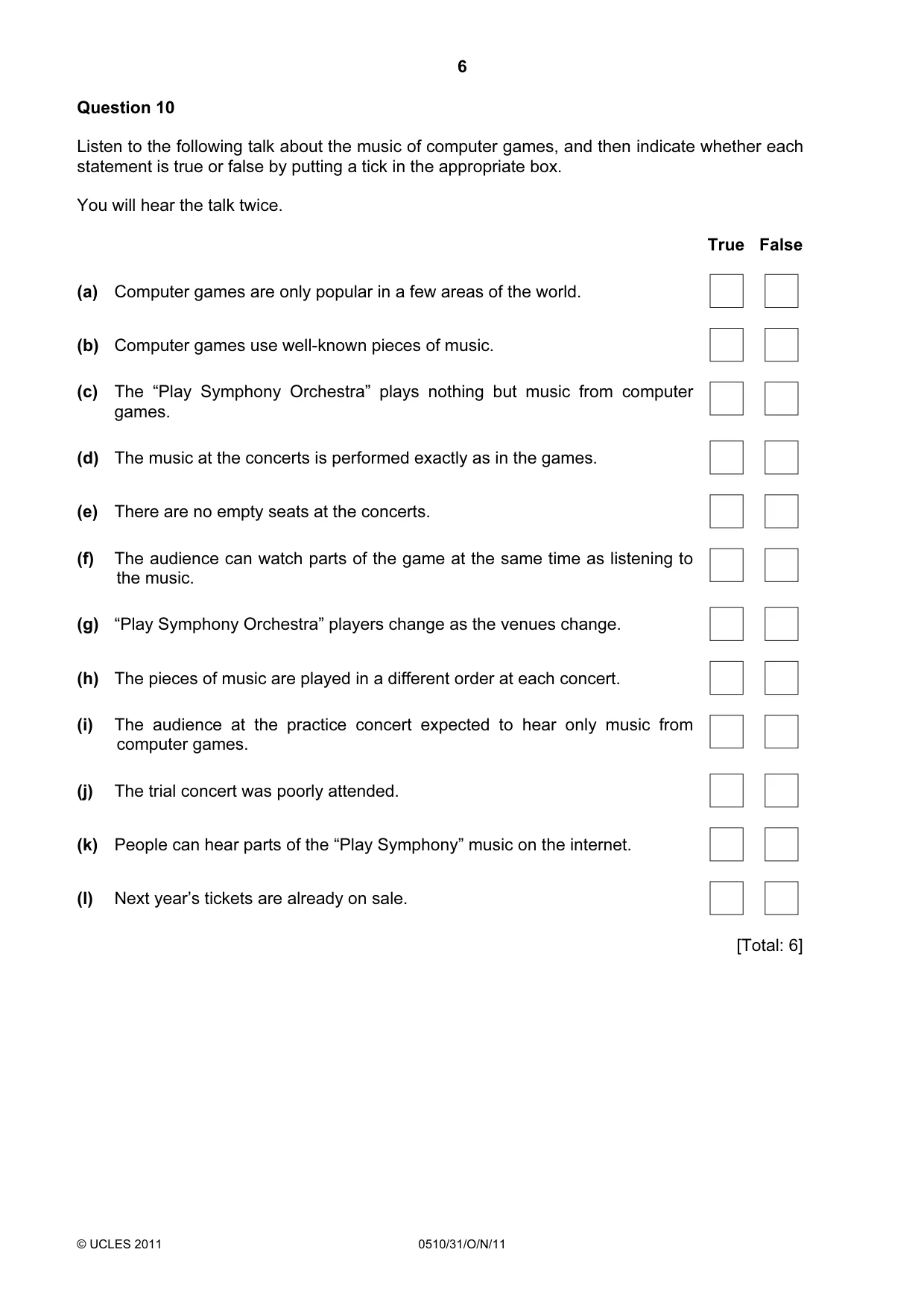
6 © UCLES 2011 0510/31/O/N/11 Question 10 Listen to the following talk about the music of computer games, and then indicate whether each statement is true or false by putting a tick in the appropriate box. You will hear the talk twice. True False (a) Computer games are only popular in a few areas of the world. (b) Computer games use well-known pieces of music. (c) The “Play Symphony Orchestra” plays nothing but music from computer games. (d) The music at the concerts is performed exactly as in the games. (e) There are no empty seats at the concerts. (f) The audience can watch parts of the game at the same time as listening to the music. (g) “Play Symphony Orchestra” players change as the venues change. (h) The pieces of music are played in a different order at each concert. (i) The audience at the practice concert expected to hear only music from computer games. (j) The trial concert was poorly attended. (k) People can hear parts of the “Play Symphony” music on the internet. (l) Next year’s tickets are already on sale. [Total: 6]
Question paper, page 7
7 © UCLES 2011 0510/31/O/N/11 BLANK PAGE
Question paper, page 8
8 Permission to reproduce items where third-party owned material protected by copyright is included has been sought and cleared where possible. Every reasonable effort has been made by the publisher (UCLES) to trace copyright holders, but if any items requiring clearance have unwittingly been included, the publisher will be pleased to make amends at the earliest possible opportunity. University of Cambridge International Examinations is part of the Cambridge Assessment Group. Cambridge Assessment is the brand name of University of Cambridge Local Examinations Syndicate (UCLES), which is itself a department of the University of Cambridge. © UCLES 2011 0510/31/O/N/11 BLANK PAGE
Mark scheme, page 1
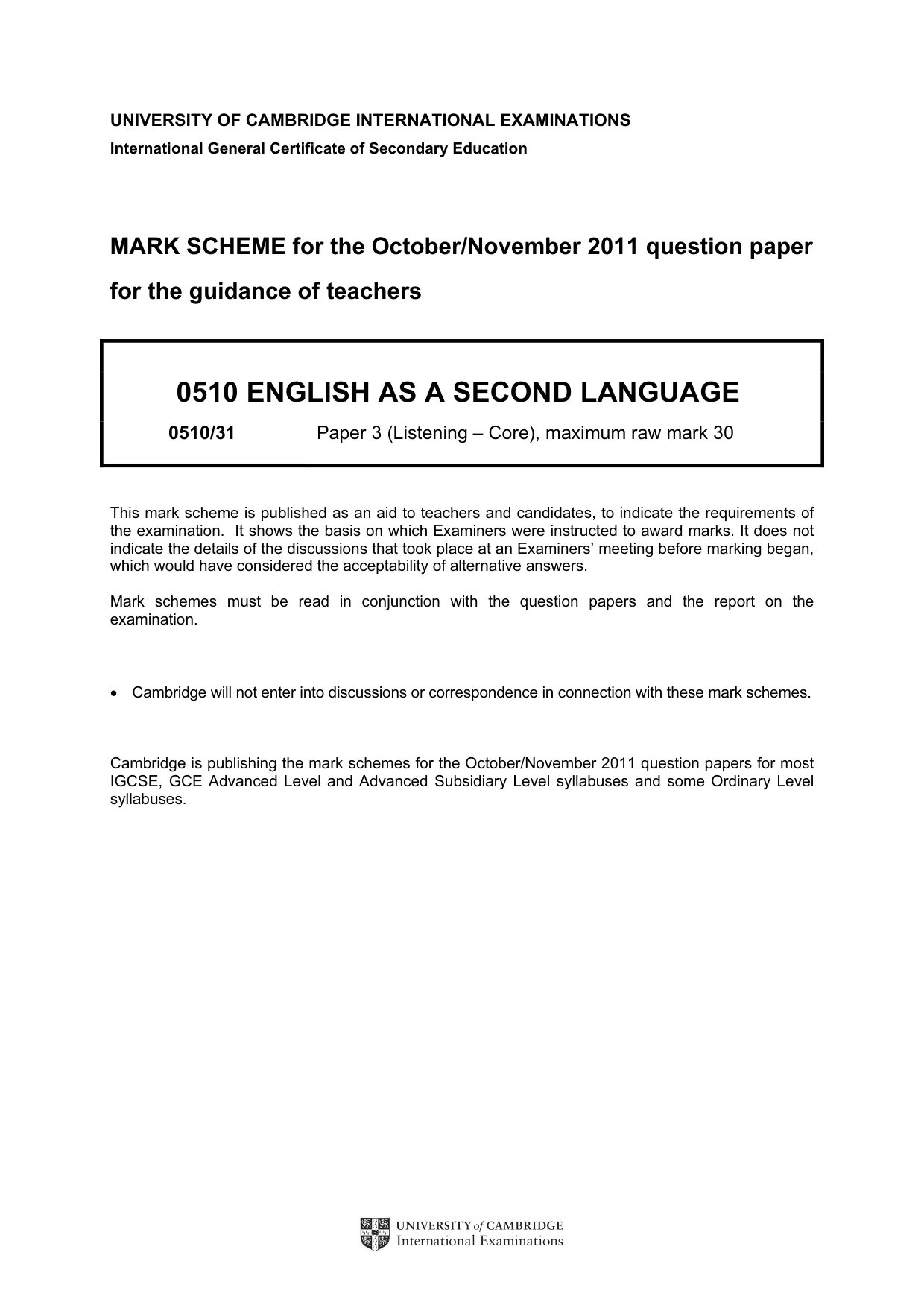
UNIVERSITY OF CAMBRIDGE INTERNATIONAL EXAMINATIONS International General Certificate of Secondary Education MARK SCHEME for the October/November 2011 question paper for the guidance of teachers 0510 ENGLISH AS A SECOND LANGUAGE 0510/31 Paper 3 (Listening – Core), maximum raw mark 30 This mark scheme is published as an aid to teachers and candidates, to indicate the requirements of the examination. It shows the basis on which Examiners were instructed to award marks. It does not indicate the details of the discussions that took place at an Examiners’ meeting before marking began, which would have considered the acceptability of alternative answers. Mark schemes must be read in conjunction with the question papers and the report on the examination. • Cambridge will not enter into discussions or correspondence in connection with these mark schemes. Cambridge is publishing the mark schemes for the October/November 2011 question papers for most IGCSE, GCE Advanced Level and Advanced Subsidiary Level syllabuses and some Ordinary Level syllabuses.
Mark scheme, page 2
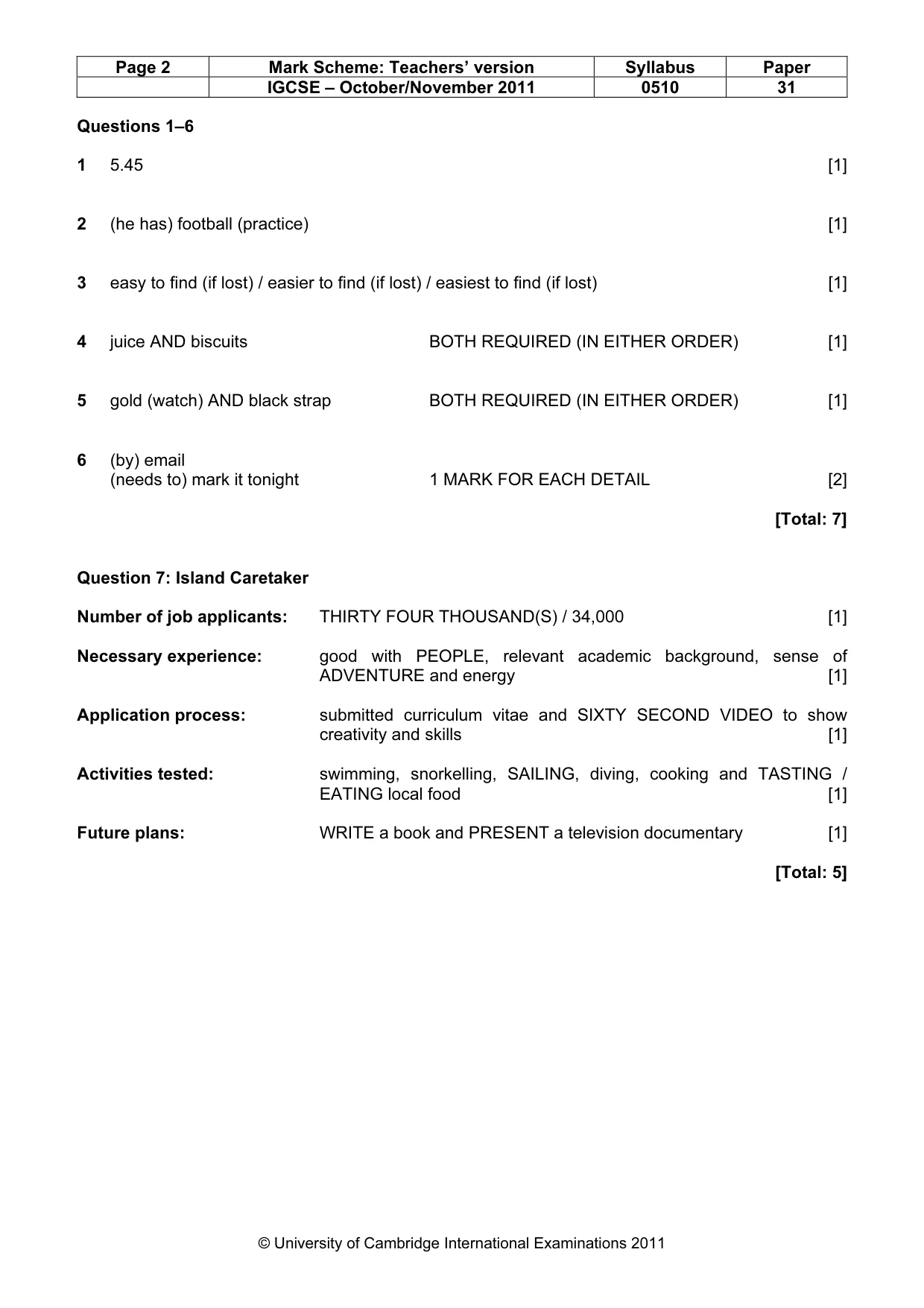
Page 2 Mark Scheme: Teachers’ version Syllabus Paper IGCSE – October/November 2011 0510 31 © University of Cambridge International Examinations 2011 Questions 1–6 1 5.45 [1] 2 (he has) football (practice) [1] 3 easy to find (if lost) / easier to find (if lost) / easiest to find (if lost) [1] 4 juice AND biscuits BOTH REQUIRED (IN EITHER ORDER) [1] 5 gold (watch) AND black strap BOTH REQUIRED (IN EITHER ORDER) [1] 6 (by) email (needs to) mark it tonight 1 MARK FOR EACH DETAIL [2] [Total: 7] Question 7: Island Caretaker Number of job applicants: THIRTY FOUR THOUSAND(S) / 34,000 [1] Necessary experience: good with PEOPLE, relevant academic background, sense of ADVENTURE and energy [1] Application process: submitted curriculum vitae and SIXTY SECOND VIDEO to show creativity and skills [1] Activities tested: swimming, snorkelling, SAILING, diving, cooking and TASTING / EATING local food [1] Future plans: WRITE a book and PRESENT a television documentary [1] [Total: 5]
Mark scheme, page 3
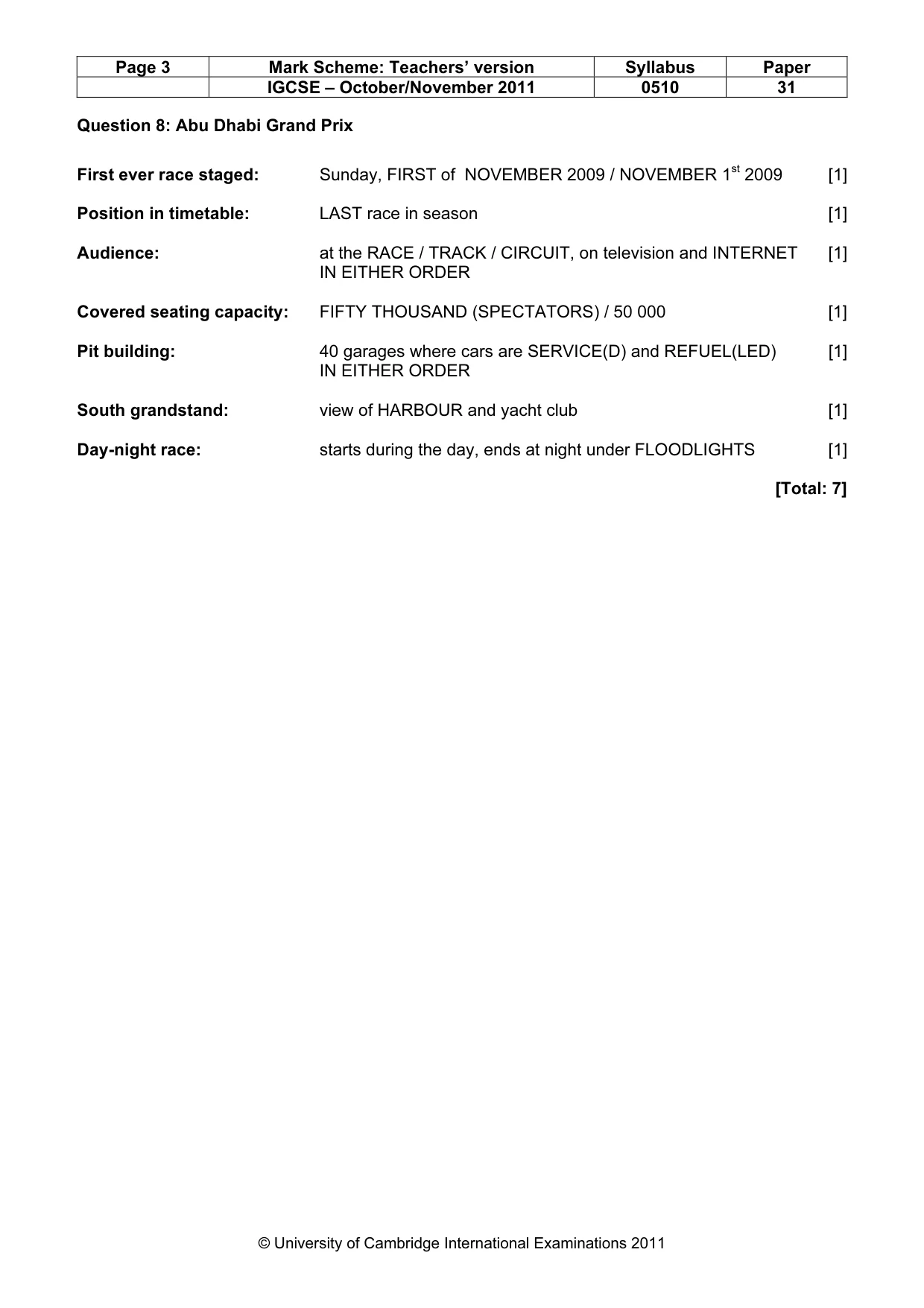
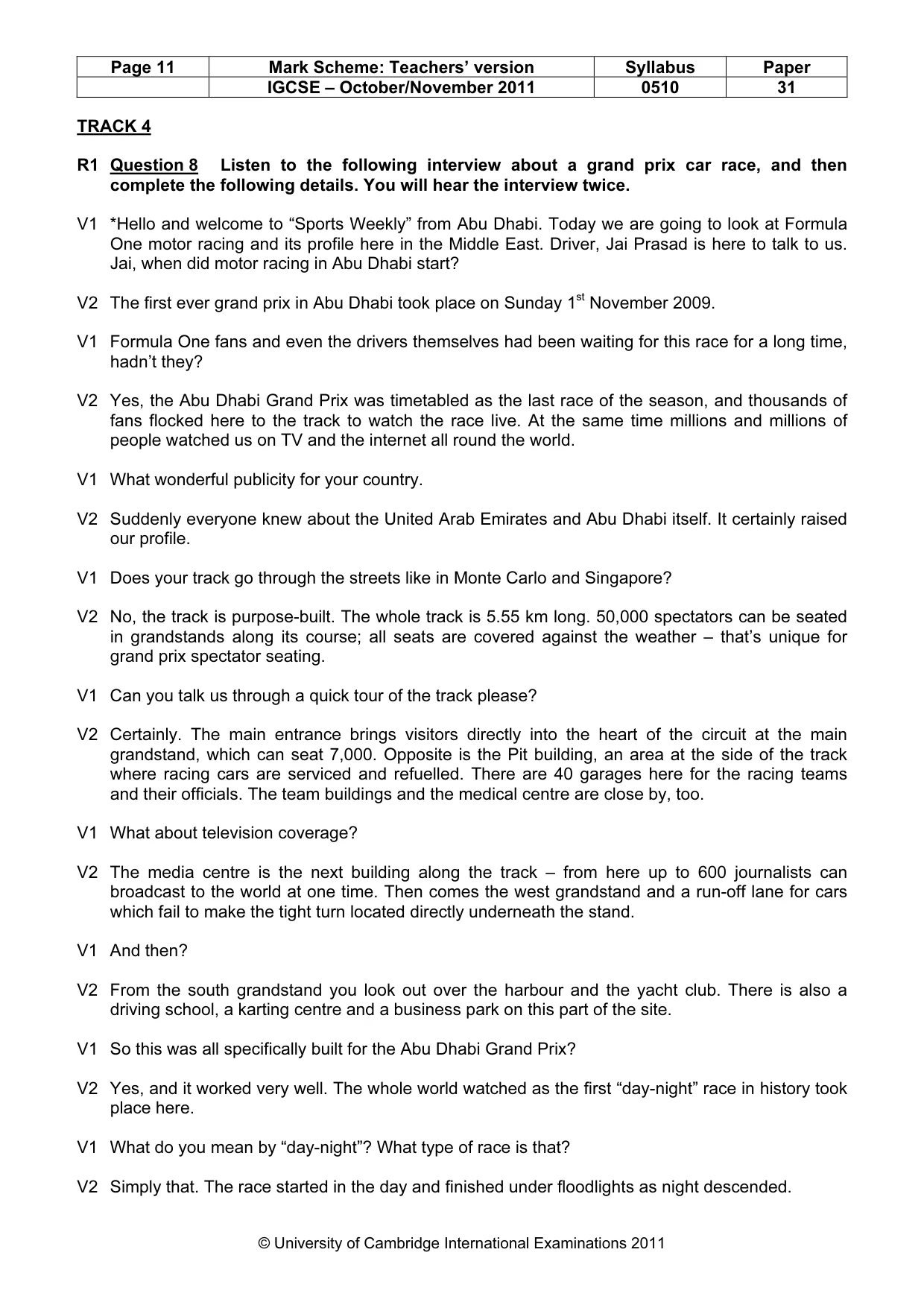
Page 3 Mark Scheme: Teachers’ version Syllabus Paper IGCSE – October/November 2011 0510 31 © University of Cambridge International Examinations 2011 Question 8: Abu Dhabi Grand Prix First ever race staged: Sunday, FIRST of NOVEMBER 2009 / NOVEMBER 1st 2009 [1] Position in timetable: LAST race in season [1] Audience: at the RACE / TRACK / CIRCUIT, on television and INTERNET [1] IN EITHER ORDER Covered seating capacity: FIFTY THOUSAND (SPECTATORS) / 50 000 [1] Pit building: 40 garages where cars are SERVICE(D) and REFUEL(LED) [1] IN EITHER ORDER South grandstand: view of HARBOUR and yacht club [1] Day-night race: starts during the day, ends at night under FLOODLIGHTS [1] [Total: 7]
Mark scheme, page 4
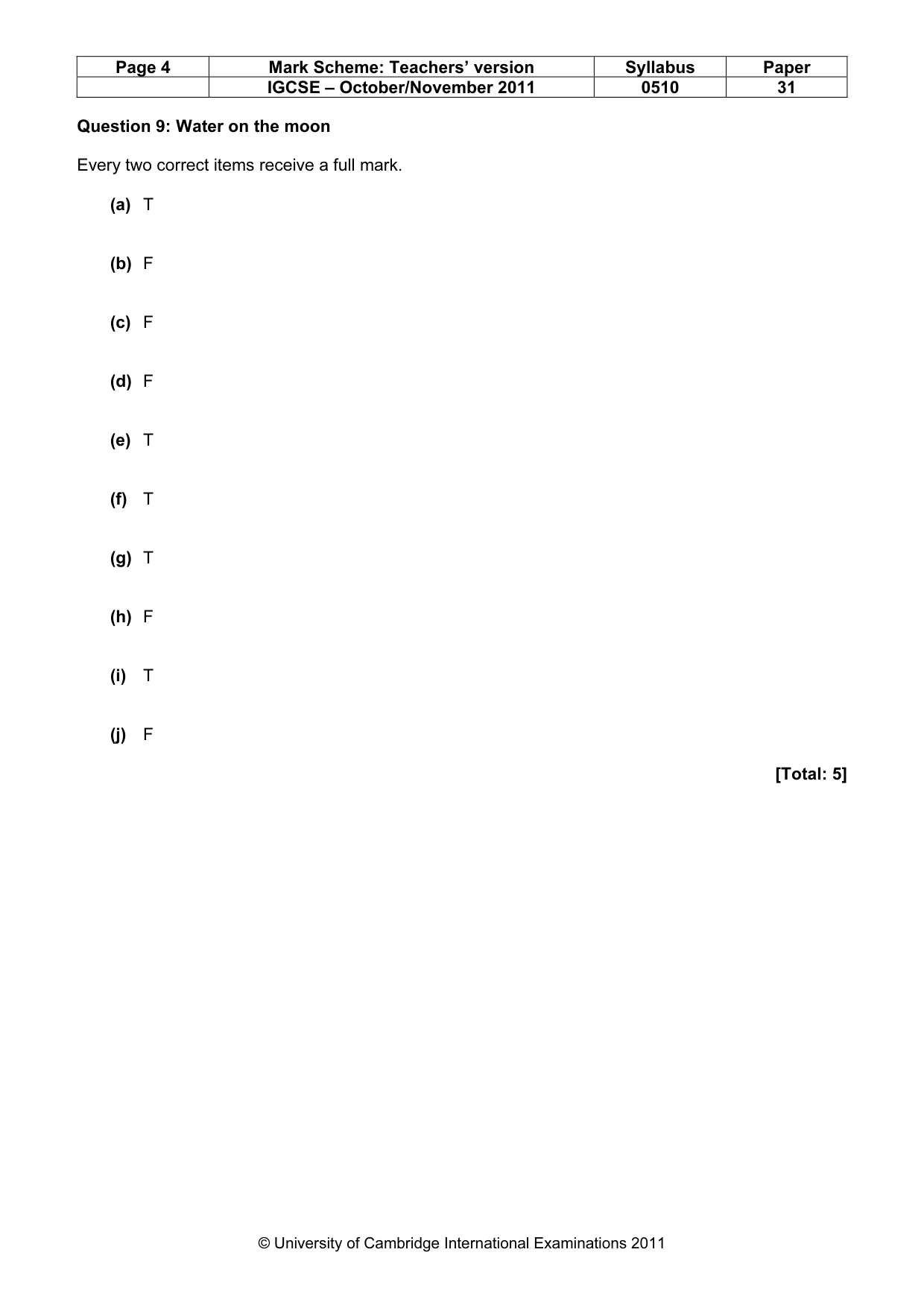
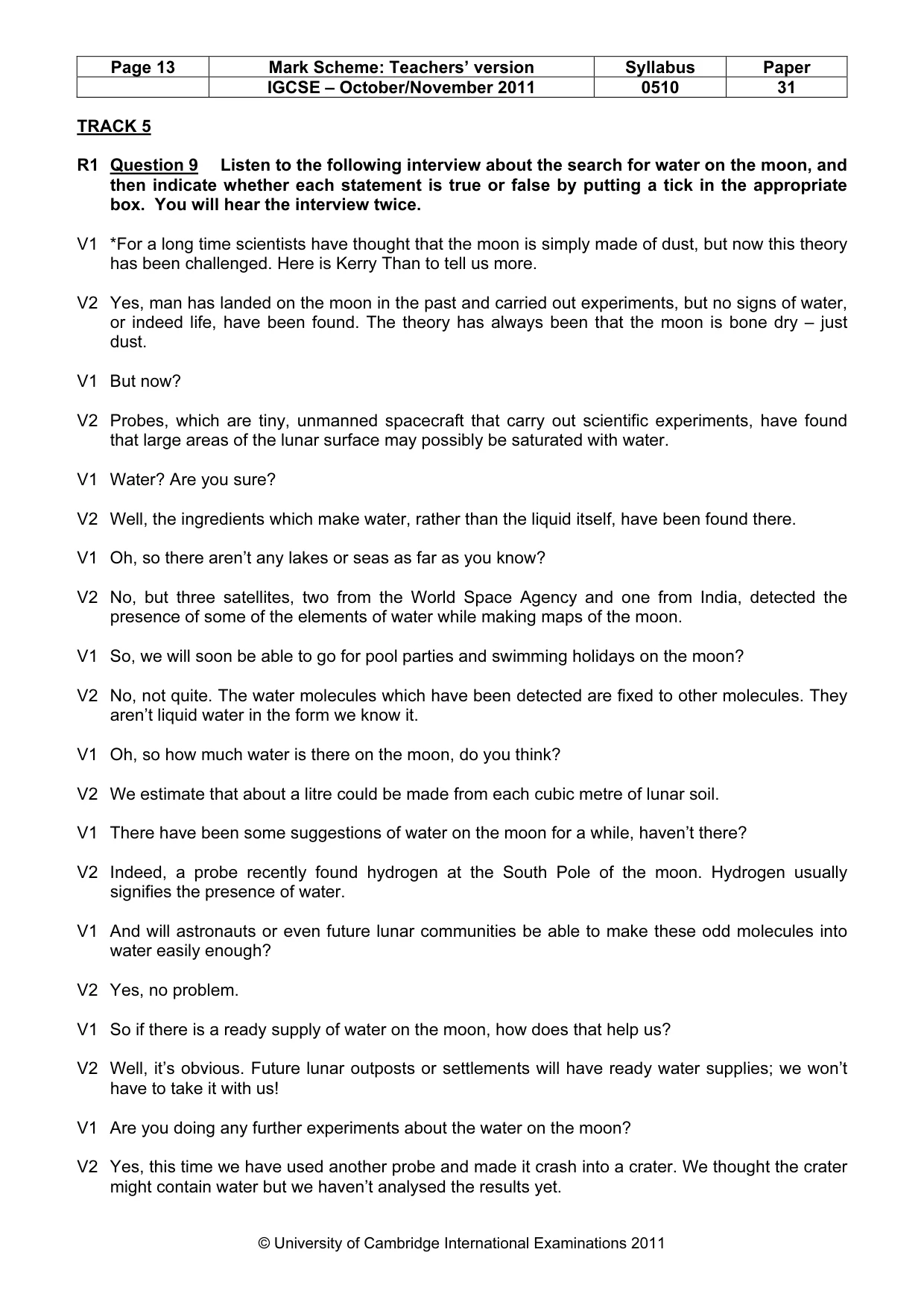
Page 4 Mark Scheme: Teachers’ version Syllabus Paper IGCSE – October/November 2011 0510 31 © University of Cambridge International Examinations 2011 Question 9: Water on the moon Every two correct items receive a full mark. (a) T (b) F (c) F (d) F (e) T (f) T (g) T (h) F (i) T (j) F [Total: 5]
Mark scheme, page 5
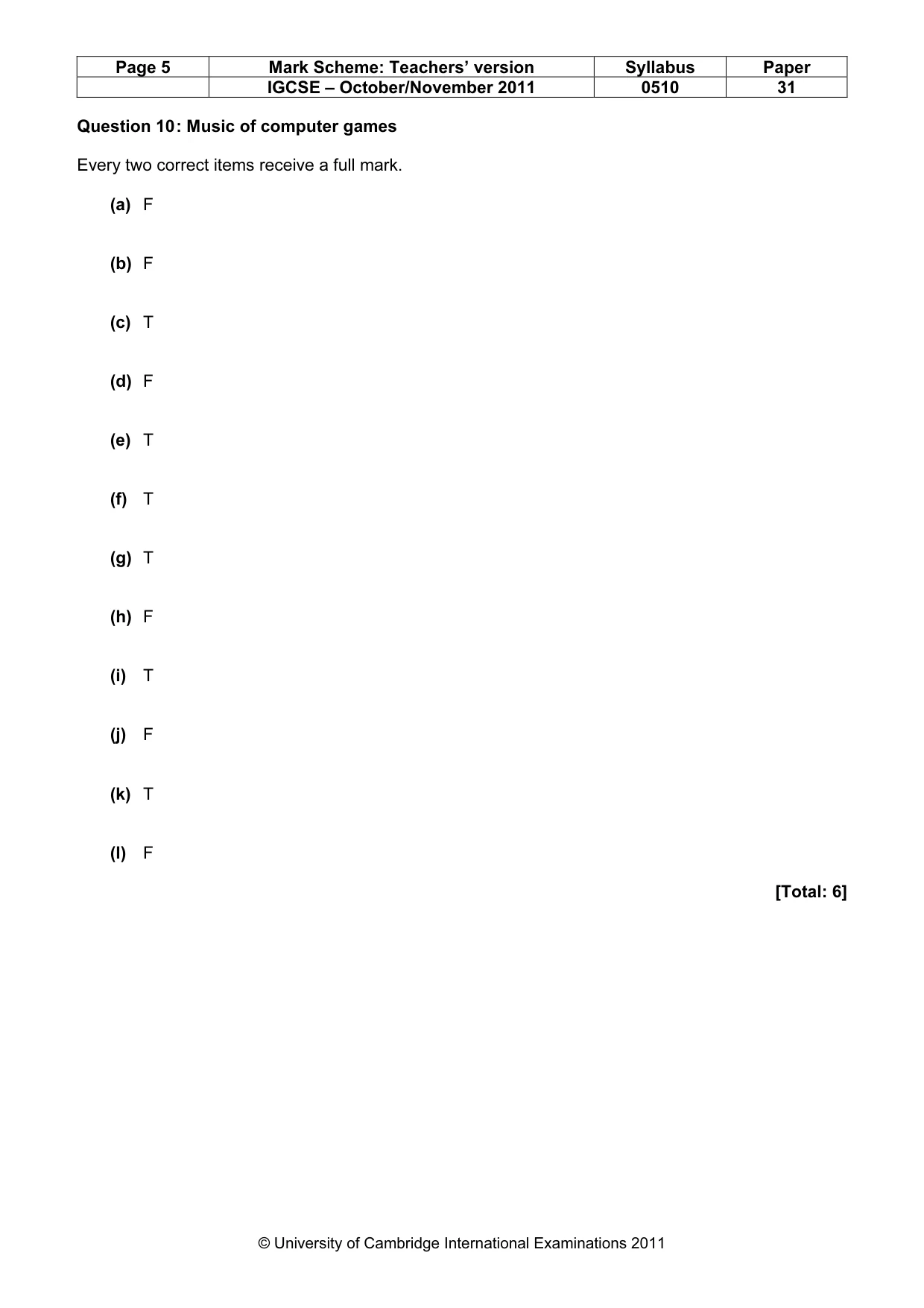
Page 5 Mark Scheme: Teachers’ version Syllabus Paper IGCSE – October/November 2011 0510 31 © University of Cambridge International Examinations 2011 Question 10 : Music of computer games Every two correct items receive a full mark. (a) F (b) F (c) T (d) F (e) T (f) T (g) T (h) F (i) T (j) F (k) T (l) F [Total: 6]
Mark scheme, page 6
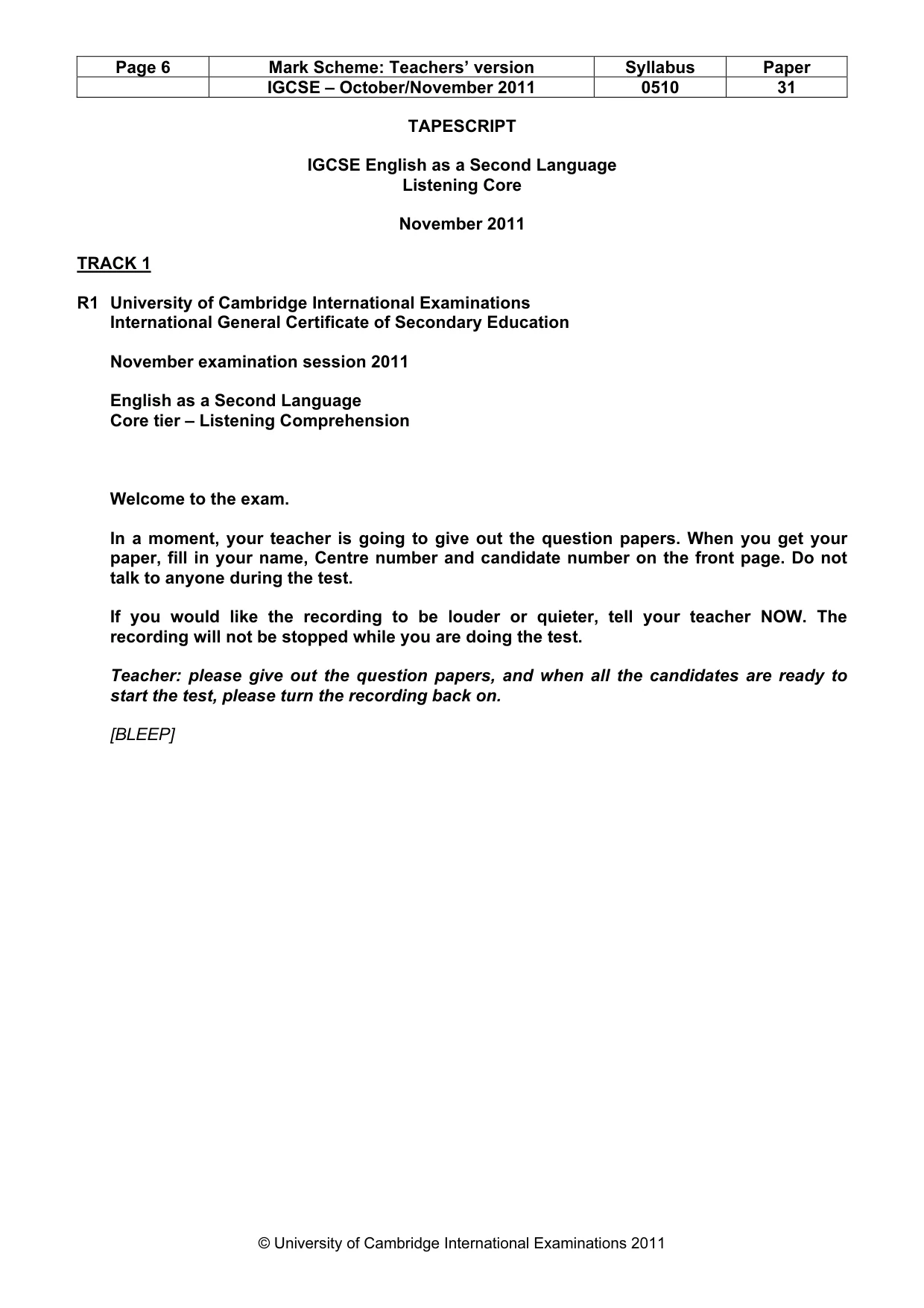
Page 6 Mark Scheme: Teachers’ version Syllabus Paper IGCSE – October/November 2011 0510 31 © University of Cambridge International Examinations 2011 TAPESCRIPT IGCSE English as a Second Language Listening Core November 2011 TRACK 1 R1 University of Cambridge International Examinations International General Certificate of Secondary Education November examination session 2011 English as a Second Language Core tier – Listening Comprehension Welcome to the exam. In a moment, your teacher is going to give out the question papers. When you get your paper, fill in your name, Centre number and candidate number on the front page. Do not talk to anyone during the test. If you would like the recording to be louder or quieter, tell your teacher NOW. The recording will not be stopped while you are doing the test. Teacher: please give out the question papers, and when all the candidates are ready to start the test, please turn the recording back on. [BLEEP]
Mark scheme, page 7
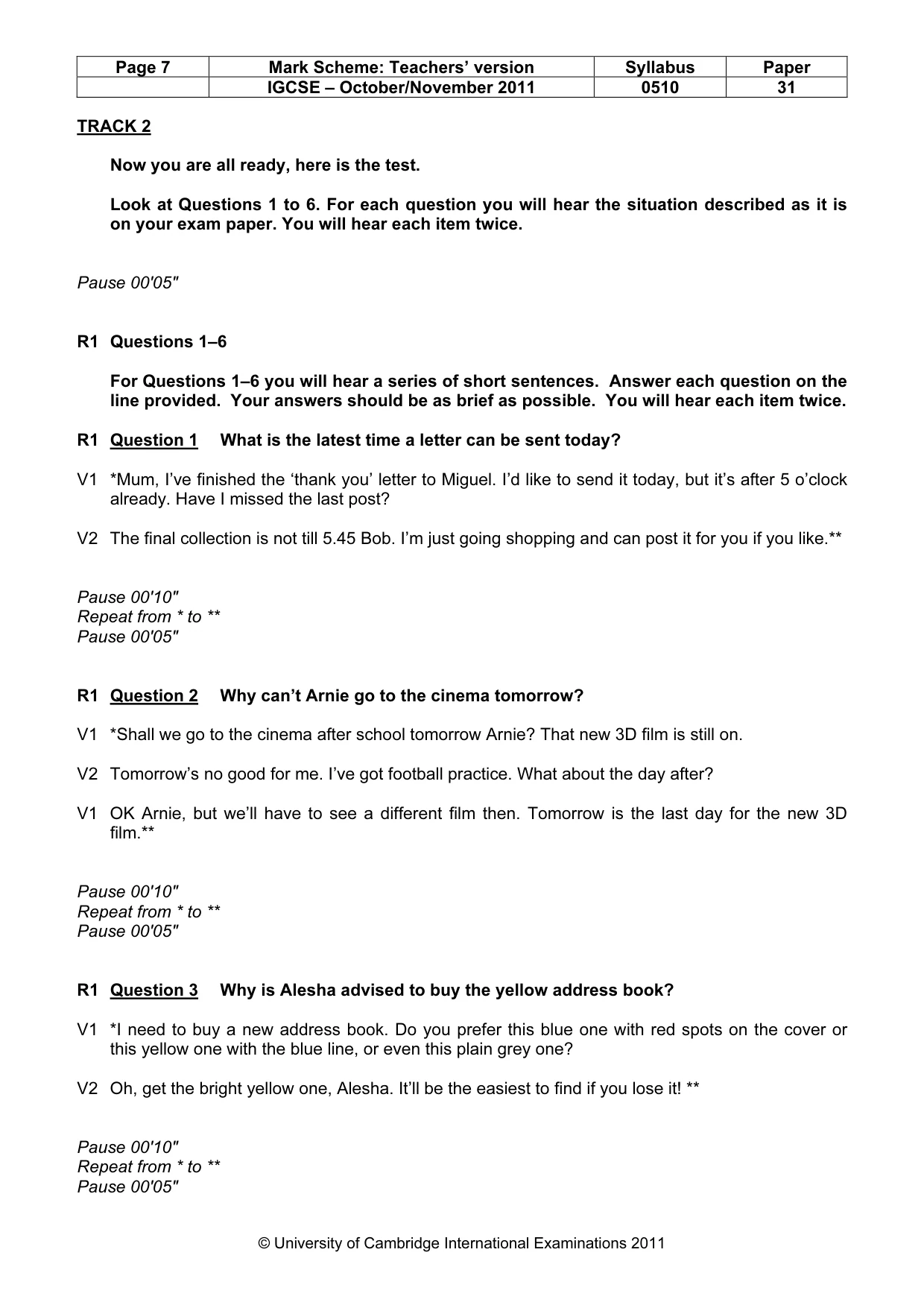
Page 7 Mark Scheme: Teachers’ version Syllabus Paper IGCSE – October/November 2011 0510 31 © University of Cambridge International Examinations 2011 TRACK 2 Now you are all ready, here is the test. Look at Questions 1 to 6. For each question you will hear the situation described as it is on your exam paper. You will hear each item twice. Pause 00'05" R1 Questions 1–6 For Questions 1–6 you will hear a series of short sentences. Answer each question on the line provided. Your answers should be as brief as possible. You will hear each item twice. R1 Question 1 What is the latest time a letter can be sent today? V1 *Mum, I’ve finished the ‘thank you’ letter to Miguel. I’d like to send it today, but it’s after 5 o’clock already. Have I missed the last post? V2 The final collection is not till 5.45 Bob. I’m just going shopping and can post it for you if you like.** Pause 00'10" Repeat from * to ** Pause 00'05" R1 Question 2 Why can’t Arnie go to the cinema tomorrow? V1 *Shall we go to the cinema after school tomorrow Arnie? That new 3D film is still on. V2 Tomorrow’s no good for me. I’ve got football practice. What about the day after? V1 OK Arnie, but we’ll have to see a different film then. Tomorrow is the last day for the new 3D film.** Pause 00'10" Repeat from * to ** Pause 00'05" R1 Question 3 Why is Alesha advised to buy the yellow address book? V1 *I need to buy a new address book. Do you prefer this blue one with red spots on the cover or this yellow one with the blue line, or even this plain grey one? V2 Oh, get the bright yellow one, Alesha. It’ll be the easiest to find if you lose it! ** Pause 00'10" Repeat from * to ** Pause 00'05"
Mark scheme, page 8
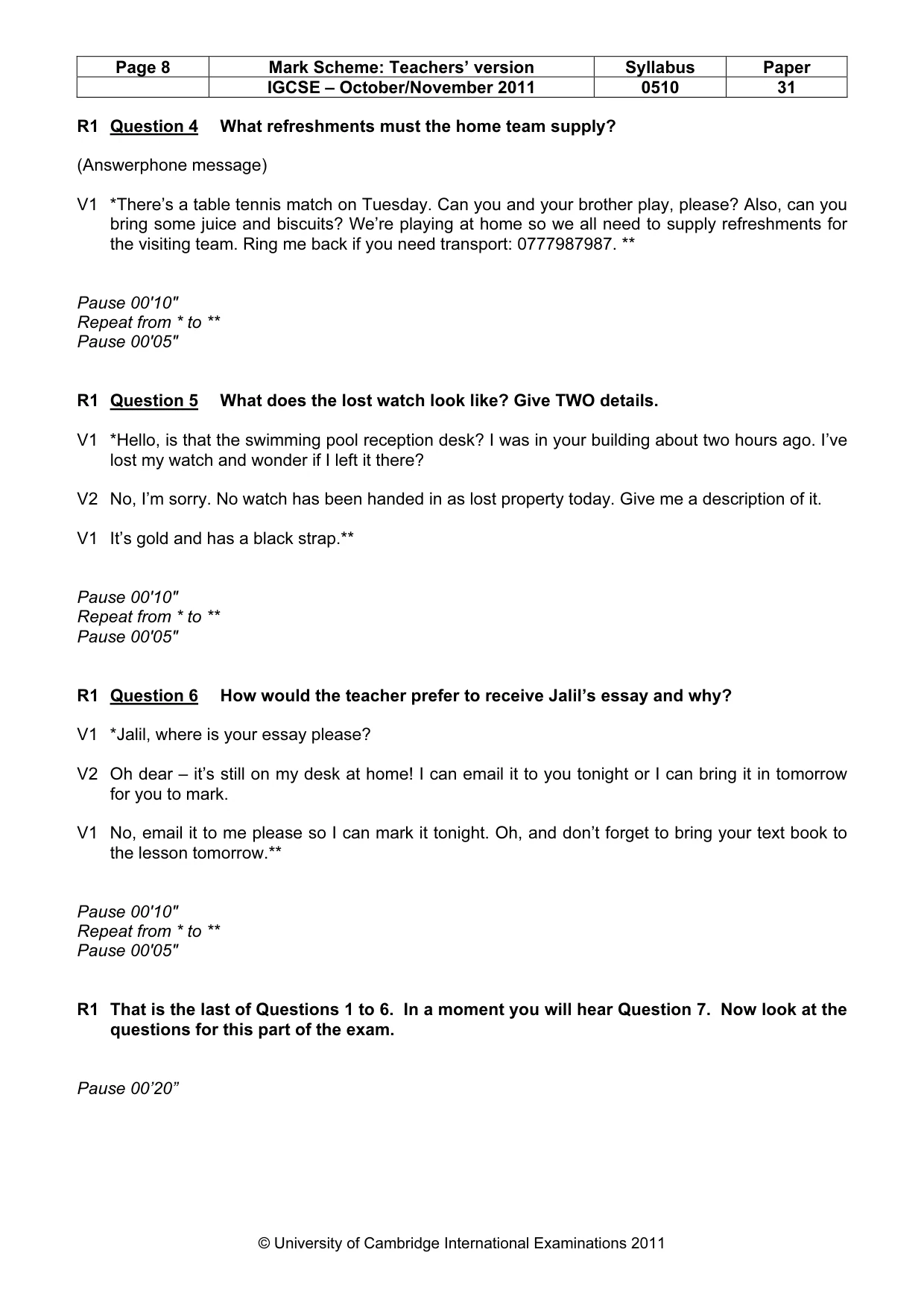
Page 8 Mark Scheme: Teachers’ version Syllabus Paper IGCSE – October/November 2011 0510 31 © University of Cambridge International Examinations 2011 R1 Question 4 What refreshments must the home team supply? (Answerphone message) V1 *There’s a table tennis match on Tuesday. Can you and your brother play, please? Also, can you bring some juice and biscuits? We’re playing at home so we all need to supply refreshments for the visiting team. Ring me back if you need transport: 0777987987. ** Pause 00'10" Repeat from * to ** Pause 00'05" R1 Question 5 What does the lost watch look like? Give TWO details. V1 *Hello, is that the swimming pool reception desk? I was in your building about two hours ago. I’ve lost my watch and wonder if I left it there? V2 No, I’m sorry. No watch has been handed in as lost property today. Give me a description of it. V1 It’s gold and has a black strap.** Pause 00'10" Repeat from * to ** Pause 00'05" R1 Question 6 How would the teacher prefer to receive Jalil’s essay and why? V1 *Jalil, where is your essay please? V2 Oh dear – it’s still on my desk at home! I can email it to you tonight or I can bring it in tomorrow for you to mark. V1 No, email it to me please so I can mark it tonight. Oh, and don’t forget to bring your text book to the lesson tomorrow.** Pause 00'10" Repeat from * to ** Pause 00'05" R1 That is the last of Questions 1 to 6. In a moment you will hear Question 7. Now look at the questions for this part of the exam. Pause 00’20”
Mark scheme, page 9
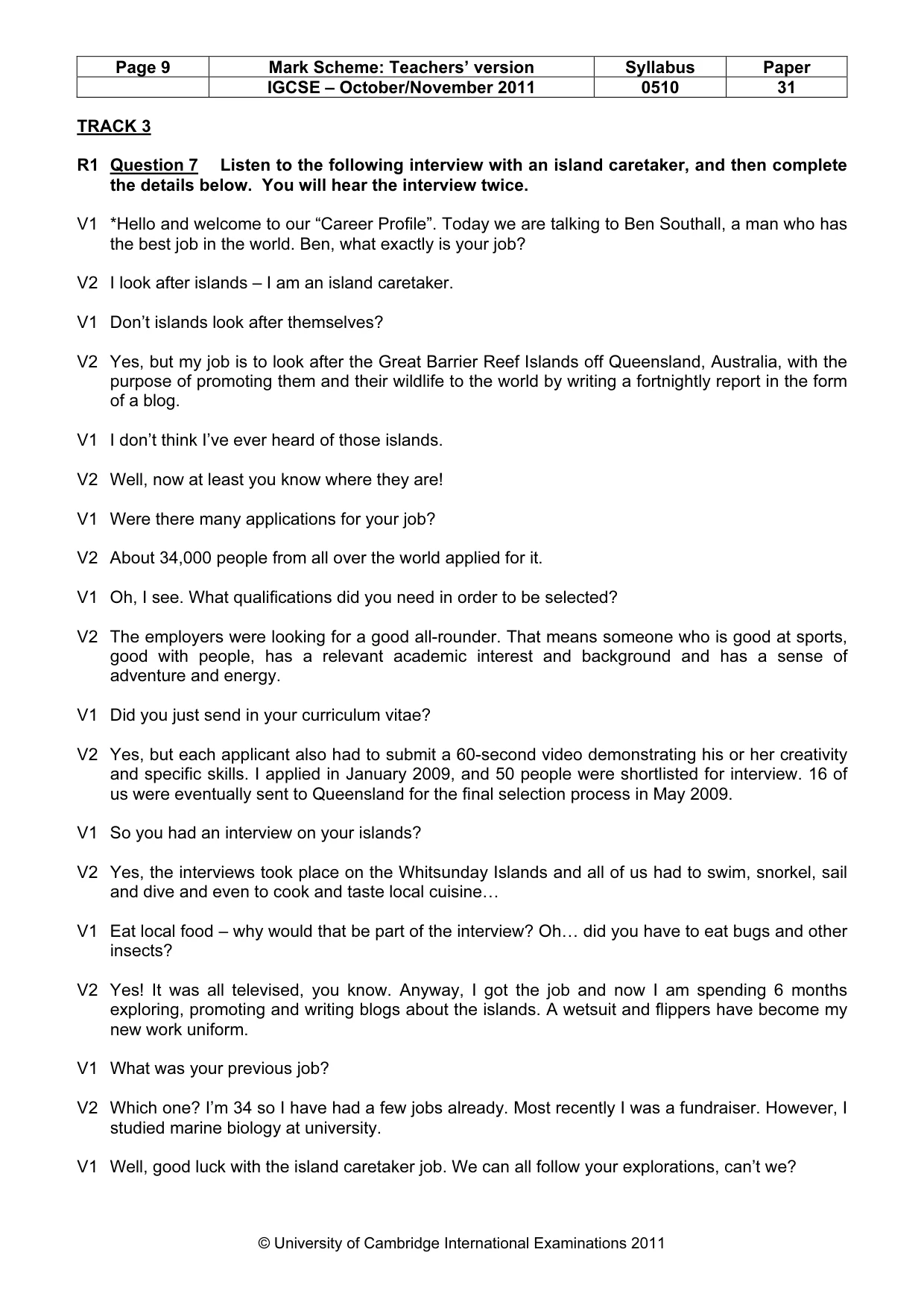
Page 9 Mark Scheme: Teachers’ version Syllabus Paper IGCSE – October/November 2011 0510 31 © University of Cambridge International Examinations 2011 TRACK 3 R1 Question 7 Listen to the following interview with an island caretaker, and then complete the details below. You will hear the interview twice. V1 *Hello and welcome to our “Career Profile”. Today we are talking to Ben Southall, a man who has the best job in the world. Ben, what exactly is your job? V2 I look after islands – I am an island caretaker. V1 Don’t islands look after themselves? V2 Yes, but my job is to look after the Great Barrier Reef Islands off Queensland, Australia, with the purpose of promoting them and their wildlife to the world by writing a fortnightly report in the form of a blog. V1 I don’t think I’ve ever heard of those islands. V2 Well, now at least you know where they are! V1 Were there many applications for your job? V2 About 34,000 people from all over the world applied for it. V1 Oh, I see. What qualifications did you need in order to be selected? V2 The employers were looking for a good all-rounder. That means someone who is good at sports, good with people, has a relevant academic interest and background and has a sense of adventure and energy. V1 Did you just send in your curriculum vitae? V2 Yes, but each applicant also had to submit a 60-second video demonstrating his or her creativity and specific skills. I applied in January 2009, and 50 people were shortlisted for interview. 16 of us were eventually sent to Queensland for the final selection process in May 2009. V1 So you had an interview on your islands? V2 Yes, the interviews took place on the Whitsunday Islands and all of us had to swim, snorkel, sail and dive and even to cook and taste local cuisine… V1 Eat local food – why would that be part of the interview? Oh… did you have to eat bugs and other insects? V2 Yes! It was all televised, you know. Anyway, I got the job and now I am spending 6 months exploring, promoting and writing blogs about the islands. A wetsuit and flippers have become my new work uniform. V1 What was your previous job? V2 Which one? I’m 34 so I have had a few jobs already. Most recently I was a fundraiser. However, I studied marine biology at university. V1 Well, good luck with the island caretaker job. We can all follow your explorations, can’t we?
Mark scheme, page 10
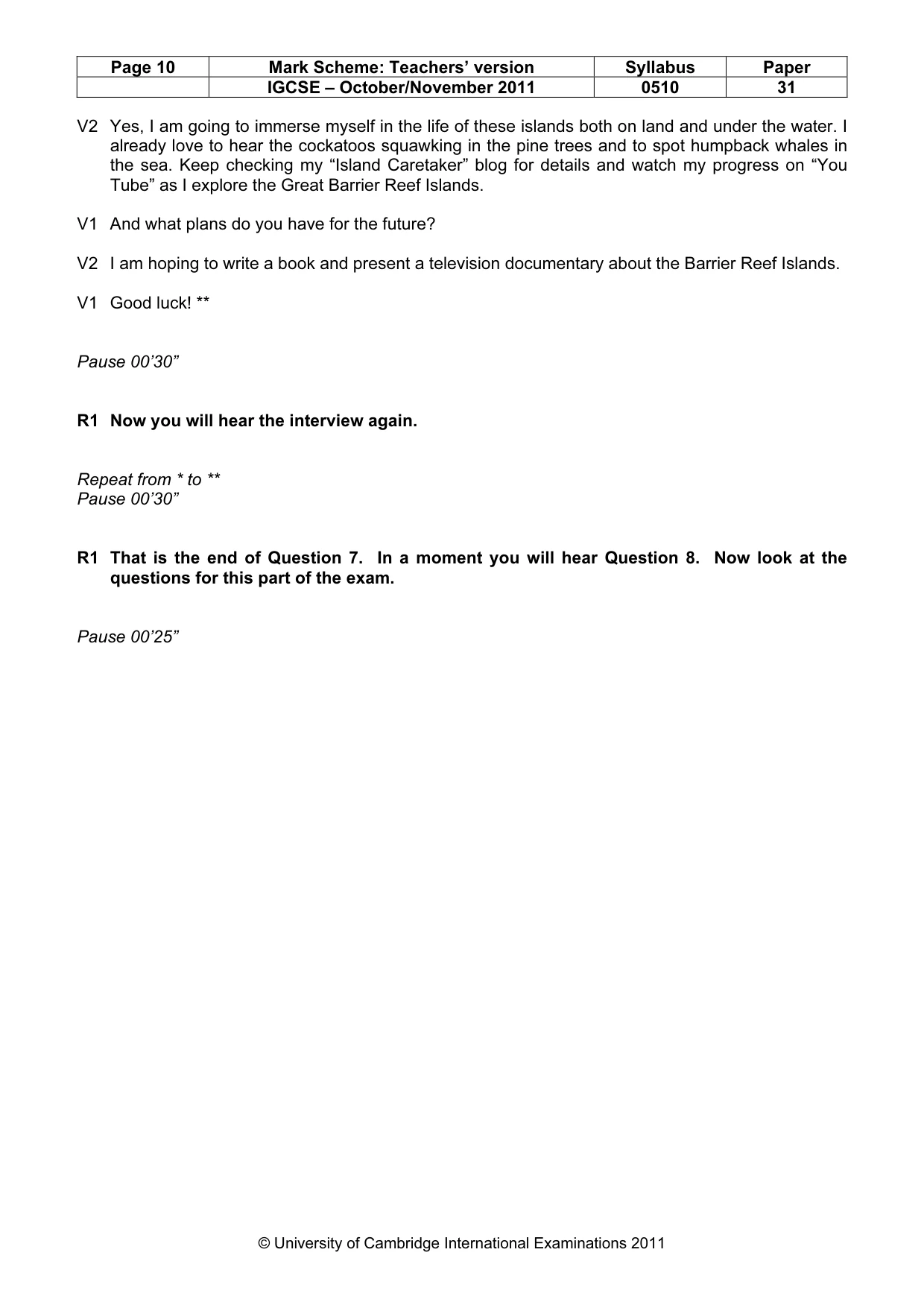
Page 10 Mark Scheme: Teachers’ version Syllabus Paper IGCSE – October/November 2011 0510 31 © University of Cambridge International Examinations 2011 V2 Yes, I am going to immerse myself in the life of these islands both on land and under the water. I already love to hear the cockatoos squawking in the pine trees and to spot humpback whales in the sea. Keep checking my “Island Caretaker” blog for details and watch my progress on “You Tube” as I explore the Great Barrier Reef Islands. V1 And what plans do you have for the future? V2 I am hoping to write a book and present a television documentary about the Barrier Reef Islands. V1 Good luck! ** Pause 00’30” R1 Now you will hear the interview again. Repeat from * to ** Pause 00’30” R1 That is the end of Question 7. In a moment you will hear Question 8. Now look at the questions for this part of the exam. Pause 00’25”
Mark scheme, page 11
Page 11 Mark Scheme: Teachers’ version Syllabus Paper IGCSE – October/November 2011 0510 31 © University of Cambridge International Examinations 2011 TRACK 4 R1 Question 8 Listen to the following interview about a grand prix car race, and then complete the following details. You will hear the interview twice. V1 *Hello and welcome to “Sports Weekly” from Abu Dhabi. Today we are going to look at Formula One motor racing and its profile here in the Middle East. Driver, Jai Prasad is here to talk to us. Jai, when did motor racing in Abu Dhabi start? V2 The first ever grand prix in Abu Dhabi took place on Sunday 1st November 2009. V1 Formula One fans and even the drivers themselves had been waiting for this race for a long time, hadn’t they? V2 Yes, the Abu Dhabi Grand Prix was timetabled as the last race of the season, and thousands of fans flocked here to the track to watch the race live. At the same time millions and millions of people watched us on TV and the internet all round the world. V1 What wonderful publicity for your country. V2 Suddenly everyone knew about the United Arab Emirates and Abu Dhabi itself. It certainly raised our profile. V1 Does your track go through the streets like in Monte Carlo and Singapore? V2 No, the track is purpose-built. The whole track is 5.55 km long. 50,000 spectators can be seated in grandstands along its course; all seats are covered against the weather – that’s unique for grand prix spectator seating. V1 Can you talk us through a quick tour of the track please? V2 Certainly. The main entrance brings visitors directly into the heart of the circuit at the main grandstand, which can seat 7,000. Opposite is the Pit building, an area at the side of the track where racing cars are serviced and refuelled. There are 40 garages here for the racing teams and their officials. The team buildings and the medical centre are close by, too. V1 What about television coverage? V2 The media centre is the next building along the track – from here up to 600 journalists can broadcast to the world at one time. Then comes the west grandstand and a run-off lane for cars which fail to make the tight turn located directly underneath the stand. V1 And then? V2 From the south grandstand you look out over the harbour and the yacht club. There is also a driving school, a karting centre and a business park on this part of the site. V1 So this was all specifically built for the Abu Dhabi Grand Prix? V2 Yes, and it worked very well. The whole world watched as the first “day-night” race in history took place here. V1 What do you mean by “day-night”? What type of race is that? V2 Simply that. The race started in the day and finished under floodlights as night descended.
Mark scheme, page 12
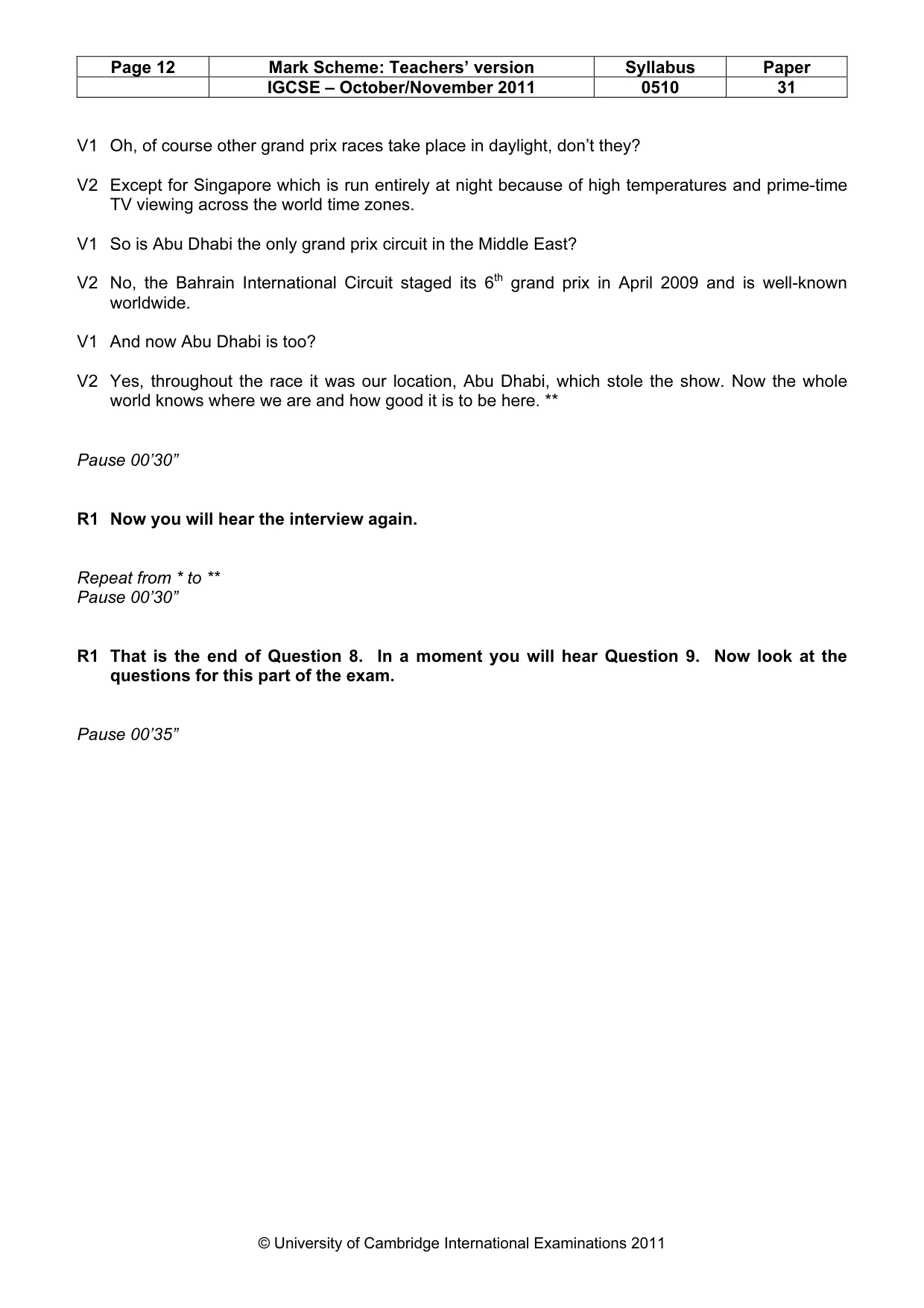
Page 12 Mark Scheme: Teachers’ version Syllabus Paper IGCSE – October/November 2011 0510 31 © University of Cambridge International Examinations 2011 V1 Oh, of course other grand prix races take place in daylight, don’t they? V2 Except for Singapore which is run entirely at night because of high temperatures and prime-time TV viewing across the world time zones. V1 So is Abu Dhabi the only grand prix circuit in the Middle East? V2 No, the Bahrain International Circuit staged its 6th grand prix in April 2009 and is well-known worldwide. V1 And now Abu Dhabi is too? V2 Yes, throughout the race it was our location, Abu Dhabi, which stole the show. Now the whole world knows where we are and how good it is to be here. ** Pause 00’30” R1 Now you will hear the interview again. Repeat from * to ** Pause 00’30” R1 That is the end of Question 8. In a moment you will hear Question 9. Now look at the questions for this part of the exam. Pause 00’35”
Mark scheme, page 13
Page 13 Mark Scheme: Teachers’ version Syllabus Paper IGCSE – October/November 2011 0510 31 © University of Cambridge International Examinations 2011 TRACK 5 R1 Question 9 Listen to the following interview about the search for water on the moon, and then indicate whether each statement is true or false by putting a tick in the appropriate box. You will hear the interview twice. V1 *For a long time scientists have thought that the moon is simply made of dust, but now this theory has been challenged. Here is Kerry Than to tell us more. V2 Yes, man has landed on the moon in the past and carried out experiments, but no signs of water, or indeed life, have been found. The theory has always been that the moon is bone dry – just dust. V1 But now? V2 Probes, which are tiny, unmanned spacecraft that carry out scientific experiments, have found that large areas of the lunar surface may possibly be saturated with water. V1 Water? Are you sure? V2 Well, the ingredients which make water, rather than the liquid itself, have been found there. V1 Oh, so there aren’t any lakes or seas as far as you know? V2 No, but three satellites, two from the World Space Agency and one from India, detected the presence of some of the elements of water while making maps of the moon. V1 So, we will soon be able to go for pool parties and swimming holidays on the moon? V2 No, not quite. The water molecules which have been detected are fixed to other molecules. They aren’t liquid water in the form we know it. V1 Oh, so how much water is there on the moon, do you think? V2 We estimate that about a litre could be made from each cubic metre of lunar soil. V1 There have been some suggestions of water on the moon for a while, haven’t there? V2 Indeed, a probe recently found hydrogen at the South Pole of the moon. Hydrogen usually signifies the presence of water. V1 And will astronauts or even future lunar communities be able to make these odd molecules into water easily enough? V2 Yes, no problem. V1 So if there is a ready supply of water on the moon, how does that help us? V2 Well, it’s obvious. Future lunar outposts or settlements will have ready water supplies; we won’t have to take it with us! V1 Are you doing any further experiments about the water on the moon? V2 Yes, this time we have used another probe and made it crash into a crater. We thought the crater might contain water but we haven’t analysed the results yet.
Mark scheme, page 14
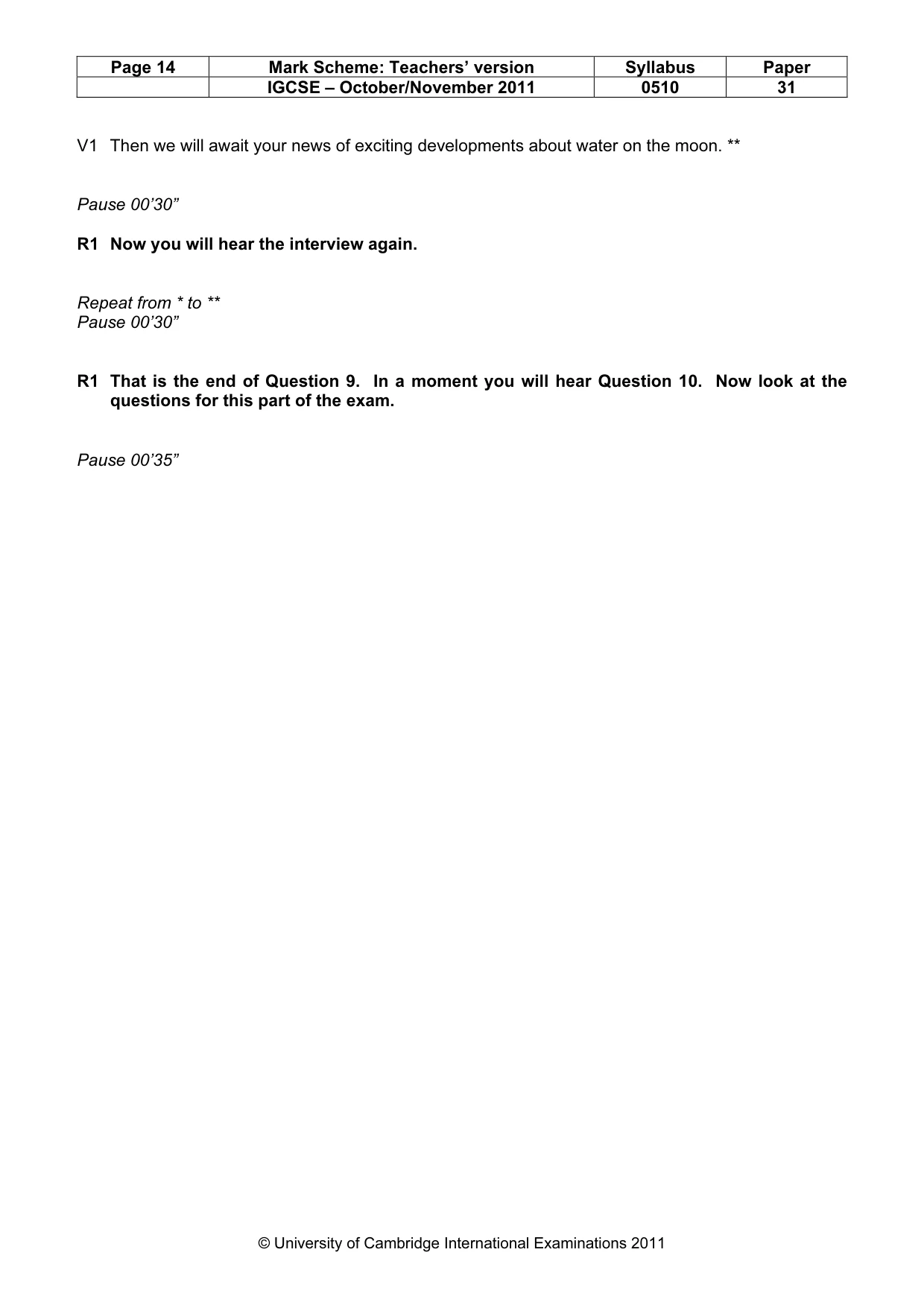
Page 14 Mark Scheme: Teachers’ version Syllabus Paper IGCSE – October/November 2011 0510 31 © University of Cambridge International Examinations 2011 V1 Then we will await your news of exciting developments about water on the moon. ** Pause 00’30” R1 Now you will hear the interview again. Repeat from * to ** Pause 00’30” R1 That is the end of Question 9. In a moment you will hear Question 10. Now look at the questions for this part of the exam. Pause 00’35”
Mark scheme, page 15
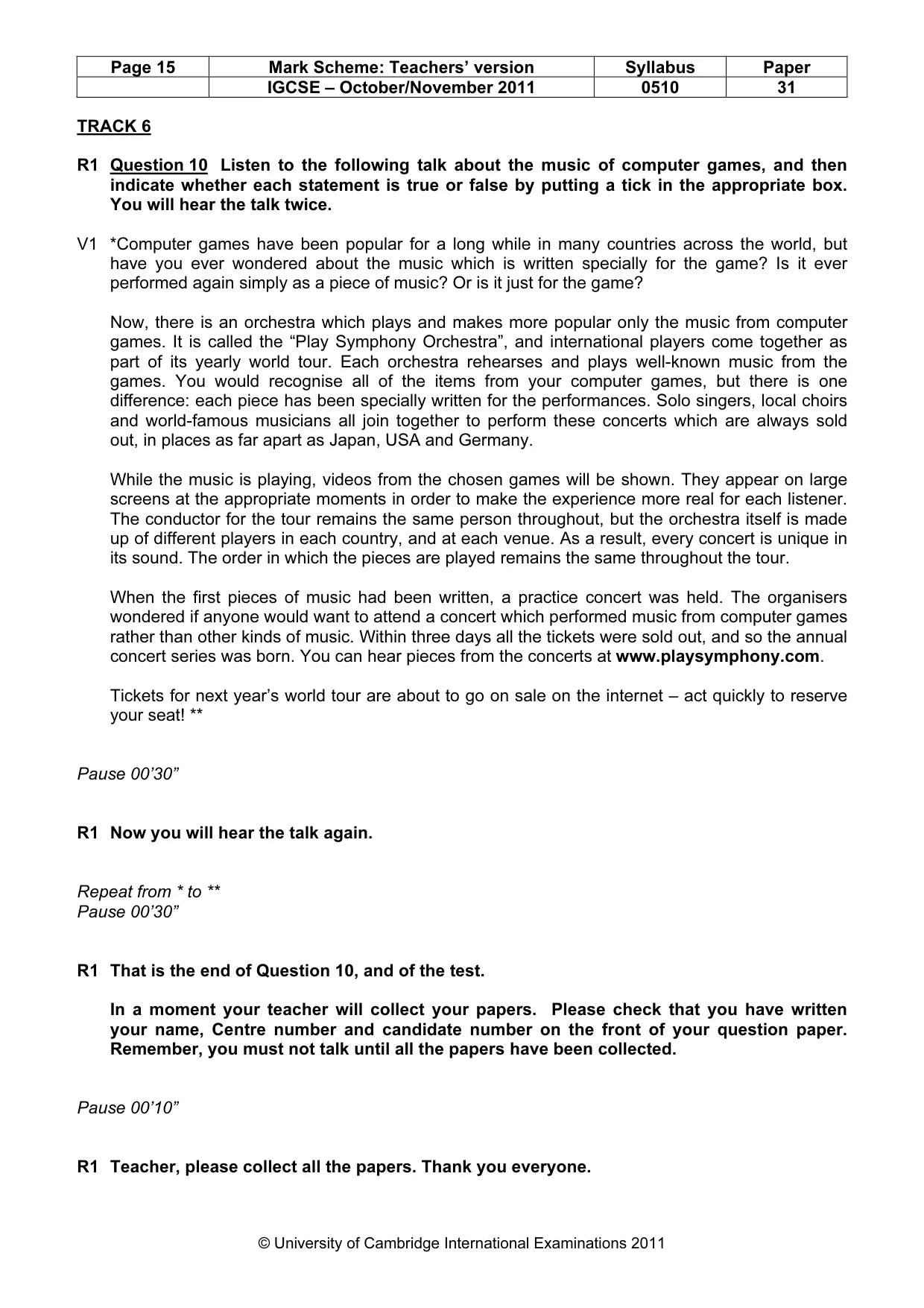
Page 15 Mark Scheme: Teachers’ version Syllabus Paper IGCSE – October/November 2011 0510 31 © University of Cambridge International Examinations 2011 TRACK 6 R1 Question 10 Listen to the following talk about the music of computer games, and then indicate whether each statement is true or false by putting a tick in the appropriate box. You will hear the talk twice. V1 *Computer games have been popular for a long while in many countries across the world, but have you ever wondered about the music which is written specially for the game? Is it ever performed again simply as a piece of music? Or is it just for the game? Now, there is an orchestra which plays and makes more popular only the music from computer games. It is called the “Play Symphony Orchestra”, and international players come together as part of its yearly world tour. Each orchestra rehearses and plays well-known music from the games. You would recognise all of the items from your computer games, but there is one difference: each piece has been specially written for the performances. Solo singers, local choirs and world-famous musicians all join together to perform these concerts which are always sold out, in places as far apart as Japan, USA and Germany. While the music is playing, videos from the chosen games will be shown. They appear on large screens at the appropriate moments in order to make the experience more real for each listener. The conductor for the tour remains the same person throughout, but the orchestra itself is made up of different players in each country, and at each venue. As a result, every concert is unique in its sound. The order in which the pieces are played remains the same throughout the tour. When the first pieces of music had been written, a practice concert was held. The organisers wondered if anyone would want to attend a concert which performed music from computer games rather than other kinds of music. Within three days all the tickets were sold out, and so the annual concert series was born. You can hear pieces from the concerts at www.playsymphony.com. Tickets for next year’s world tour are about to go on sale on the internet – act quickly to reserve your seat! ** Pause 00’30” R1 Now you will hear the talk again. Repeat from * to ** Pause 00’30” R1 That is the end of Question 10, and of the test. In a moment your teacher will collect your papers. Please check that you have written your name, Centre number and candidate number on the front of your question paper. Remember, you must not talk until all the papers have been collected. Pause 00’10” R1 Teacher, please collect all the papers. Thank you everyone.
What you needed in this session
Cambridge’s own grade thresholds for 2011 Oct/Nov, Paper 3 · Variant 1. A higher threshold means an easier paper — the bar moves with how the cohort did.