Cambridge IGCSE English - Second Language (oral endorsement) 0510 — 2011 Oct/Nov Paper 1 · Variant 1
0510/11/O/N/11 · 56 marks · ≈63 min
The question paper and its mark scheme, free to read here and free to download. This is Cambridge’s own paper, exactly as it was sat.
Question paper16 pages



Mark scheme7 pages
Answers below. Sit the paper first if you are practising.
Paper as text
Question paper, page 1
This document consists of 13 printed pages and 3 blank pages. IB11 11_0510_11/5RP © UCLES 2011 [Turn over *4766815836* UNIVERSITY OF CAMBRIDGE INTERNATIONAL EXAMINATIONS International General Certificate of Secondary Education ENGLISH AS A SECOND LANGUAGE 0510/11 Paper 1 Reading and Writing (Core) October/November 2011 1 hour 30 minutes Candidates answer on the Question Paper. No Additional Materials are required. READ THESE INSTRUCTIONS FIRST Write your Centre number, candidate number and name on all the work you hand in. Write in dark blue or black pen. Do not use staples, paper clips, highlighters, glue or correction fluid. DO NOT WRITE IN ANY BARCODES. Answer all questions. Dictionaries are not allowed. The number of marks is given in brackets [ ] at the end of each question or part question.
Question paper, page 2
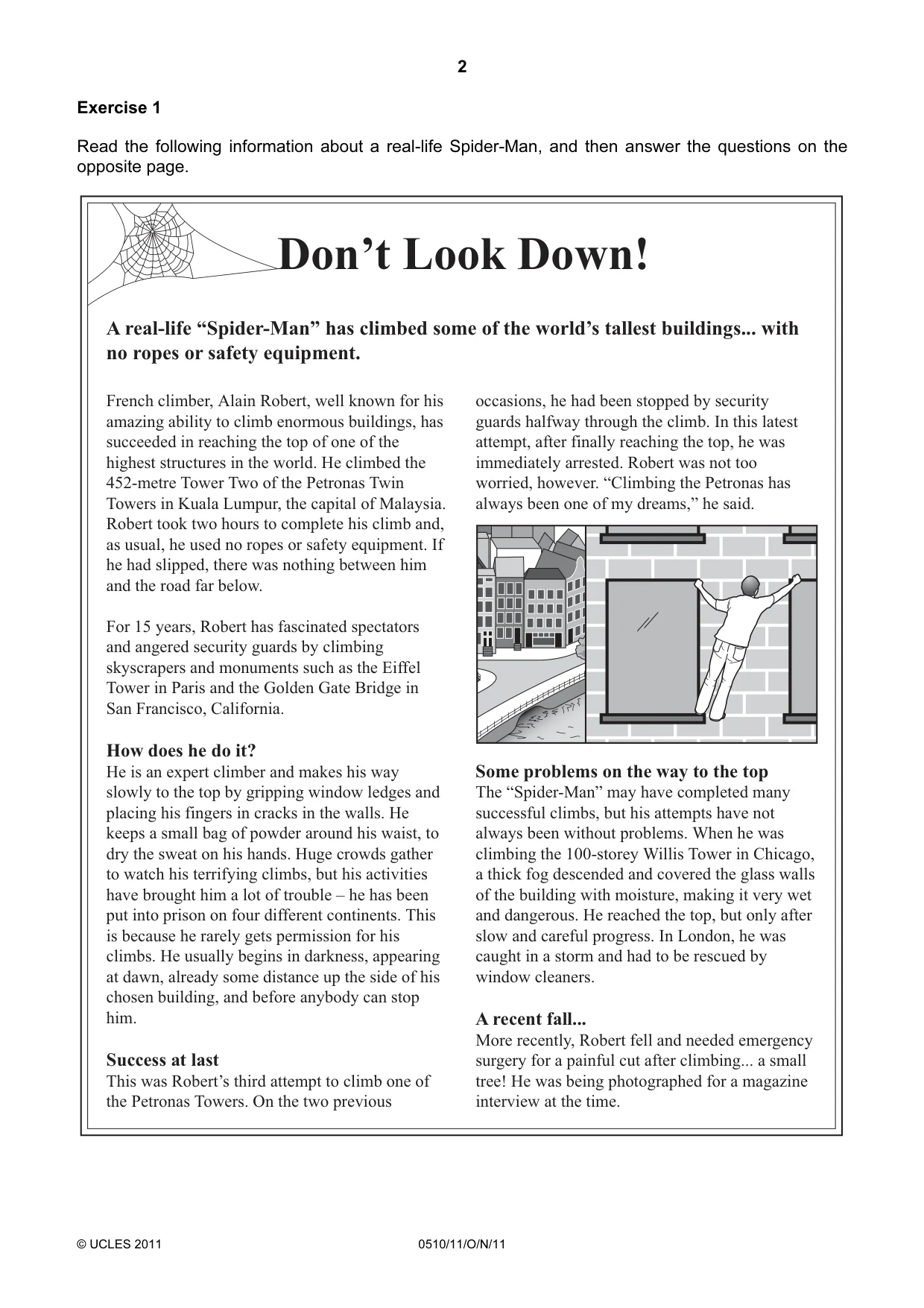
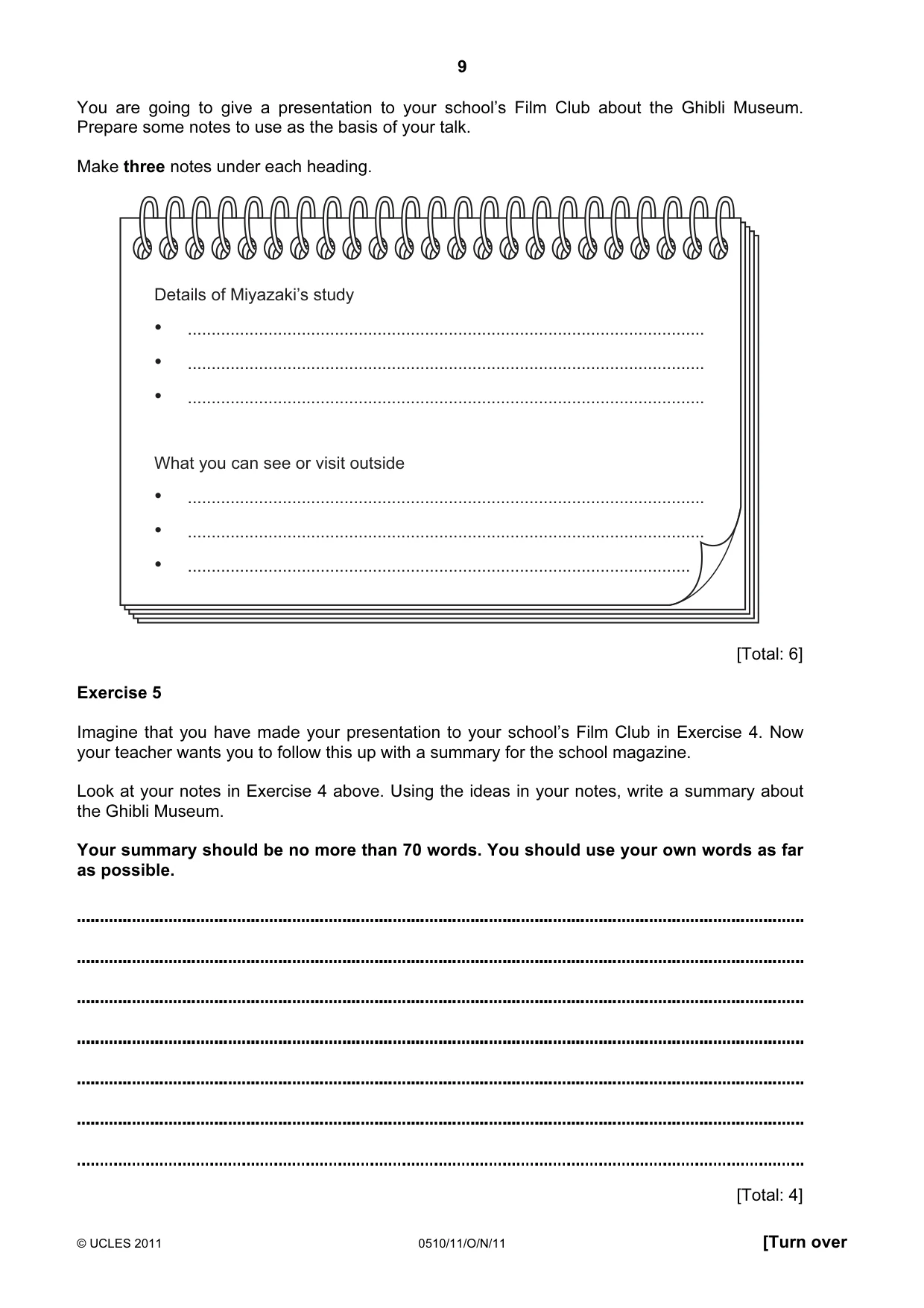
2 © UCLES 2011 0510/11/O/N/11 Exercise 1 Read the following information about a real-life Spider-Man, and then answer the questions on the opposite page. Don’t Look Down! A real-life “Spider-Man” has climbed some of the world’s tallest buildings... with no ropes or safety equipment. French climber, Alain Robert, well known for his amazing ability to climb enormous buildings, has succeeded in reaching the top of one of the highest structures in the world. He climbed the 452-metre Tower Two of the Petronas Twin Towers in Kuala Lumpur, the capital of Malaysia. Robert took two hours to complete his climb and, as usual, he used no ropes or safety equipment. If he had slipped, there was nothing between him and the road far below. For 15 years, Robert has fascinated spectators and angered security guards by climbing skyscrapers and monuments such as the Eiffel Tower in Paris and the Golden Gate Bridge in San Francisco, California. How does he do it? He is an expert climber and makes his way slowly to the top by gripping window ledges and placing his fingers in cracks in the walls. He keeps a small bag of powder around his waist, to dry the sweat on his hands. Huge crowds gather to watch his terrifying climbs, but his activities have brought him a lot of trouble – he has been put into prison on four different continents. This is because he rarely gets permission for his climbs. He usually begins in darkness, appearing at dawn, already some distance up the side of his chosen building, and before anybody can stop him. Success at last This was Robert’s third attempt to climb one of the Petronas Towers. On the two previous occasions, he had been stopped by security guards halfway through the climb. In this latest attempt, after finally reaching the top, he was immediately arrested. Robert was not too worried, however. “Climbing the Petronas has always been one of my dreams,” he said. Some problems on the way to the top The “Spider-Man” may have completed many successful climbs, but his attempts have not always been without problems. When he was climbing the 100-storey Willis Tower in Chicago, a thick fog descended and covered the glass walls of the building with moisture, making it very wet and dangerous. He reached the top, but only after slow and careful progress. In London, he was caught in a storm and had to be rescued by window cleaners. A recent fall... More recently, Robert fell and needed emergency surgery for a painful cut after climbing... a small tree! He was being photographed for a magazine interview at the time.
Question paper, page 3
3 © UCLES 2011 0510/11/O/N/11 [Turn over (a) In which country are the Petronas Towers? [1] (b) Why is Robert’s method of climbing so dangerous? [1] (c) What does he carry to help him grip the sides of buildings? [1] (d) When does Robert normally start his climbs? [1] (e) How many times had Robert failed to climb the Petronas Towers? [1] (f) What caused the glass walls of the Willis Tower to become wet? [1] [Total: 6]
Question paper, page 4
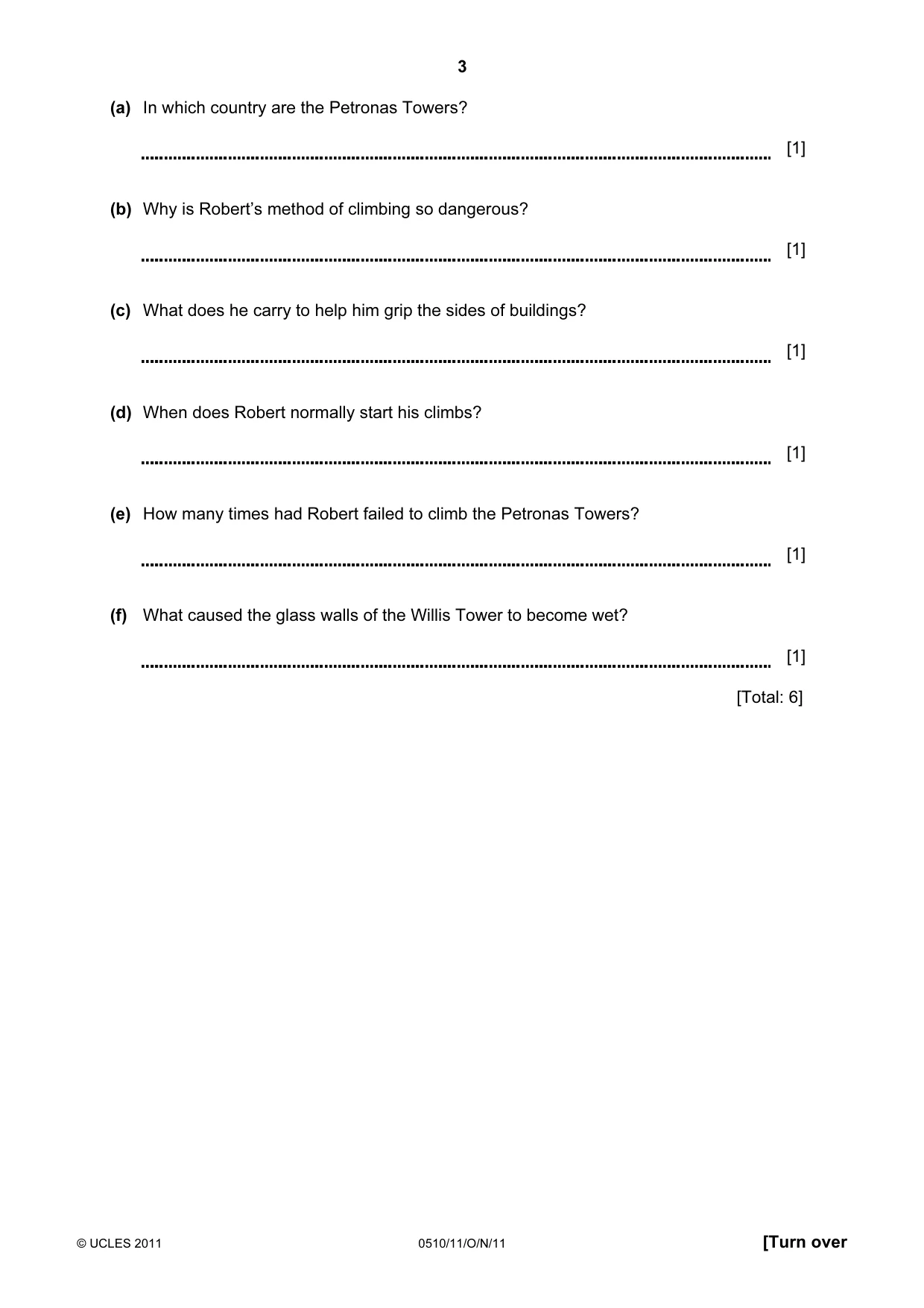
4 © UCLES 2011 0510/11/O/N/11 Exercise 2 Read the following article about the discovery of strange animal species living around a remote volcano, and then answer the questions on the opposite page. Discoveries in Papua New Guinea For many months George McGavin refused to describe the extraordinary creature he had discovered. “People would ask me if it had four legs, and if it had fur,” he said. “I didn’t tell anyone, not even my wife.” Finally, last September, McGavin revealed that he had observed a previously undiscovered giant rat. This was the most amazing discovery that his team had made on a journey to one of the most remote places on earth. The giant rat was discovered in Bosavi in Papua New Guinea, an island in the Pacific Ocean. The rat measures 0.8 of a metre from nose to tail and weighs 1.5 kilos, about the size of a small cat. It has thick fur and appears to be vegetarian. The rat was not the only unusual animal they encountered on the expedition. The team found about 40 other species unknown to science, including some fish, frogs and beetles. The team travelled to Mount Bosavi and stayed for about six weeks. This extinct volcano is isolated, rising 2,500 metres above the lowland rainforest. Its crater is an enclosed area full of unnamed life forms and with its own climate. The last eruption of Mount Bosavi was about 225,000 years ago, so new species have had plenty of time to develop. Before making the trip up to the top of the volcano, the team spent some time filming in the lowland rainforests, which are home to many types of species. This area presents considerable challenges for wildlife film-makers, who often spend long hours waiting for something to happen but in the end seeing nothing but ants. Furthermore, there were no spectacular creatures like monkeys or wild cats, which always attract big audiences to television programmes. In addition, most of the mammals were extremely afraid of humans because they are often hunted by the local tribesmen. Nevertheless, the television team managed to find an extraordinary range of creatures with fascinating lives, proving that it’s not just wild cats that are interesting. In the end, the days spent filming proved worthwhile even though the team was constantly bitten by mosquitoes. After exploring the rainforests, the team flew to the rim of the crater in a helicopter. Only thirty seconds after landing, one of the group noticed a different type of frog, almost certainly a species unknown to man. Unlike the mammals and birds in the lowland forests, these creatures were not nervous of humans – a sign that there was very little hunting up in the crater. One unexpected encounter was with a tree kangaroo. As McGavin said: “Animals like this are usually really shy and hard to film, but this one just wandered past our camp. We couldn’t believe it!” All these new species are now being studied at scientific institutions. Each one will have to be named. Typically, the name will refer to a characteristic of the creature or the place where it was found. It might even include the name of the scientist. However, as McGavin states: “It’s fine to name something after one of your colleagues, but it’s not considered correct procedure to name a new species after yourself.” species existing outside the rainforests species existing inside the rainforests 70% 70% 30% 30% 70% 30% The rainforest in Papua New Guinea: home to many species
Question paper, page 5
5 © UCLES 2011 0510/11/O/N/11 [Turn over (a) What was George McGavin’s major discovery and when did he first tell everyone about it? [1] (b) What is the length and weight of the new discovery? [1] (c) Why is the extinct volcano favourable to the development of new species? Give two details. [2] (d) According to the chart, what percentage of species live in the rainforests of Papua New Guinea? [1] (e) Which two animals are most popular with television viewers? [1] (f) What first indicated that the team might find new species in the crater? [1] (g) How did the volcano animals behave differently towards humans compared to the lowland forest animals? [1] (h) How do scientists usually name new species? Give two details. [2] [Total: 10]
Question paper, page 6
6 © UCLES 2011 0510/11/O/N/11 Exercise 3 Peter Wheaton is a student in his final year at the Grangethorpe School in Balmoral Avenue, Glasgow, Scotland. About two weeks ago, his teacher, Gordon Key, asked him to find out where his class would like to go as a special visit at the end of term. Peter made enquiries and found out that the most popular choice amongst his friends was a day trip to Edinburgh to see the famous castle there. All the students commented that the main attraction for them would be to walk around the top of the walls for the magnificent view of the city and the countryside. Mr Key was happy with this choice and asked Peter to complete the booking form for the day. Because the number in the group is 30 students and 5 teachers, the school minibus is too small, and so Peter has to book a coach. This adds to the cost of the whole trip because they will also have to pay to park the coach at the castle. However, in order to keep the price as low as possible, the group has decided that they will bring their own food and drink and have a picnic lunch in a nearby park. There will be a special exhibition in the castle at that time, featuring important aspects of the life and history of Scotland. All the students have expressed a wish to visit the exhibition in the afternoon of 21st June 2012, so tickets will need to be reserved. In addition, they want to attend one of the talks given by the guides at the castle. There is a list of topics to choose from and, after class discussion, they have voted to attend the talk on ‘Scotland in the Twentieth Century’, because they have been doing a project on that period of history at school. All the students in the group are between 16 and 18 years old. They will not have to pay the full price of ten pounds per person because they will receive special ticket prices, and this reduces the entrance fee to seven pounds per student. Mr Key has agreed to be the teacher leading the group and he will have overall responsibility. The booking manager at the castle can contact him either by phone on 077366845 or by email grathorduc@scotnet.org.uk. Imagine you are Peter. Fill in the form on the opposite page, using the information above.
Question paper, page 7
7 © UCLES 2011 0510/11/O/N/11 [Turn over Edinburgh Castle School Booking Form Section A School details Name and address of school: … … Name of teacher in charge: … Contact details: i) … ii) … Section B Visit details Date of visit: … Number of students: (please circle one) less than 20 21-30 31-40 more than 40 Age group of students: (please circle one) under 12 12-18 19 or older Number of adult places required: … Method of transport to the castle: … Will you require a car park ticket? (please delete as appropriate) YES / NO I would like to book the following talk: (please tick one only) Tales of the Loch Ness Monster Towns and Cities Scotland in the Twentieth Century The Islands of Scotland Preferred time of talk: (please underline one) morning afternoon evening Will you require lunch in the cafeteria? (please delete as appropriate) YES / NO Section C In the space below, write one sentence about why you have chosen Edinburgh Castle for your visit and one sentence about the reason for your choice of topic for the talk. [Total: 10]
Question paper, page 8
8 © UCLES 2011 0510/11/O/N/11 Exercise 4 Read the following article about a museum in Tokyo, the capital of Japan, and then complete the notes on the opposite page. It’s an early spring morning in Tokyo and you are walking along Kichijoji Avenue, in Inokashira Park. After a while, you come to a small, black iron gate. You push it open, step through the gateway, and stare. Staring right back at you is a huge, furry, grey-faced, black-whiskered creature, sitting upright in a tall, glass box. This strange guard is called a Totoro, and you are about to enter the world of its creator, Hayao Miyazaki. Since the 1960s, Miyazaki has worked on several television series and directed nine major feature films. He is known internationally for his imaginative fantasy film, “Spirited Away”. This is the story of a ten-year-old girl who, by chance, finds an abandoned adventure park, which is in fact another world. The film is aimed equally at adults and children, and like many of Miyazaki’s stories it is a mixture of Japanese tradition and ideas from world literature. When you walk past the Totoro at the gates, you are inside the Ghibli Museum – an art gallery and adventure playground in one place. If you are used to long queues and boring exhibits at museums, then you will be pleasantly surprised. The building is a castle, painted in amazing shades of yellow, green and purple. Upstairs, a series of rooms shows how a film is made. The main attraction is Miyazaki’s study, overflowing with models and books. All of these have been created or written by Miyazaki himself. Pinned to the walls are colourful sketches, which show the first ideas for his film plots. It is astonishing how much time is needed to create the final version of a film from these first ideas. The many photographs and drawings on his workdesk give an indication of the patience that he shows when making animated films. On his desk there are clues to his interests: he has an obsession with flying, from small aircraft to modern glider planes, from garden birds to powerful birds of prey. Miyazaki himself is a white-haired 68-year-old with a neat beard. He is an intensely private person, who rarely gives interviews or appears in public. Totally dedicated to his work, he will happily spend fourteen hours a day concentrating on his various projects. When you have spent long enough inside the building, there is still the rooftop garden to explore. There stands the bronze statue of a robot-soldier. Red pine trees provide shade from the hot sun on the rooftop café, which serves good tasty food, including enormous slices of strawberry cake. Tokyo has many places where you can spend your time and your money. But Ghibli is unique; if you are ever in the neighbourhood, make sure that you walk down Kichijoji Avenue, say “hello” to the Totoro, and step inside.
Question paper, page 9
9 © UCLES 2011 0510/11/O/N/11 [Turn over You are going to give a presentation to your school’s Film Club about the Ghibli Museum. Prepare some notes to use as the basis of your talk. Make three notes under each heading. Details of Miyazaki’s study • … • … • … What you can see or visit outside • … • … • … [Total: 6] Exercise 5 Imagine that you have made your presentation to your school’s Film Club in Exercise 4. Now your teacher wants you to follow this up with a summary for the school magazine. Look at your notes in Exercise 4 above. Using the ideas in your notes, write a summary about the Ghibli Museum. Your summary should be no more than 70 words. You should use your own words as far as possible. [Total: 4]
Question paper, page 10
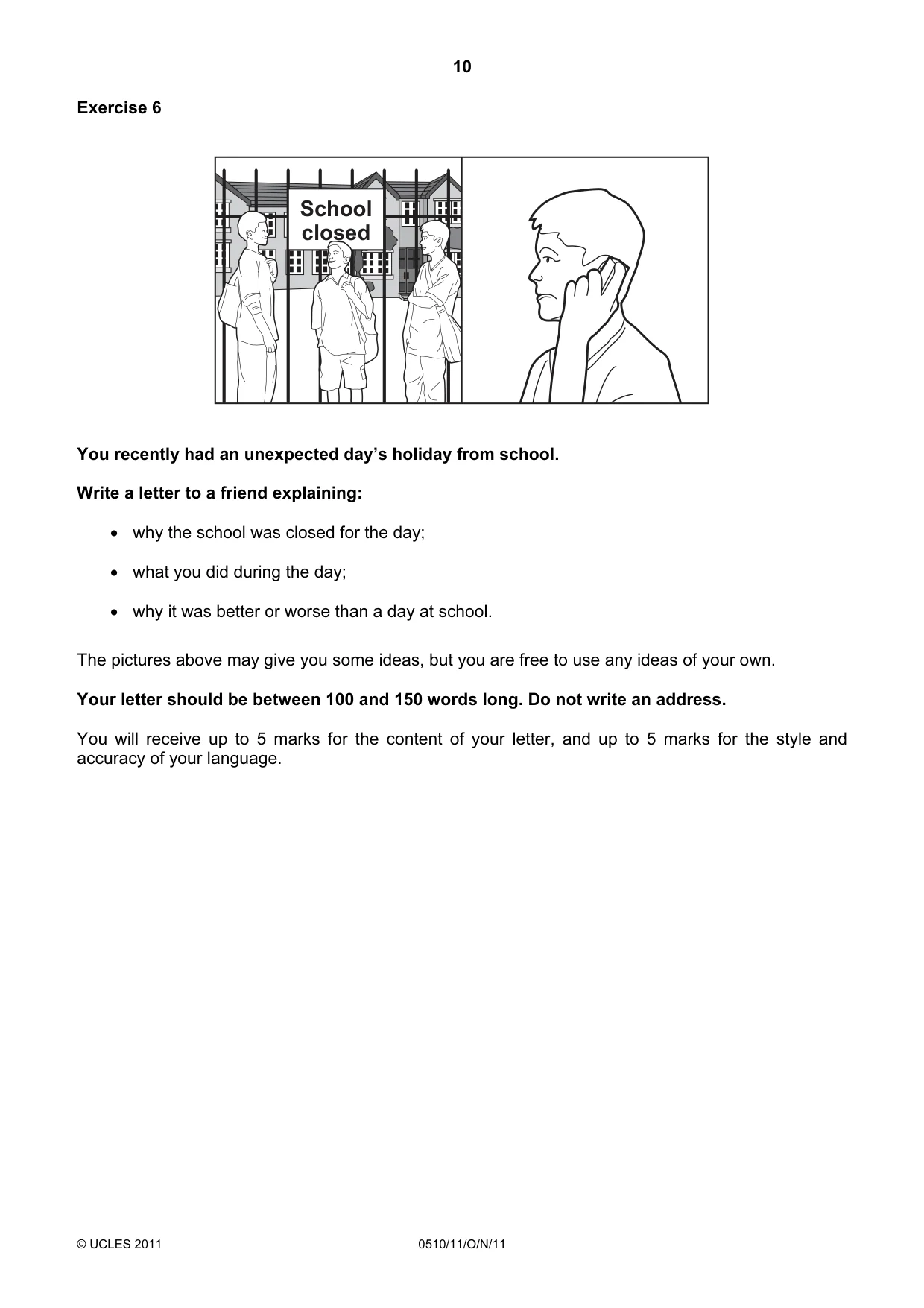
10 © UCLES 2011 0510/11/O/N/11 Exercise 6 School closed You recently had an unexpected day’s holiday from school. Write a letter to a friend explaining: • why the school was closed for the day; • what you did during the day; • why it was better or worse than a day at school. The pictures above may give you some ideas, but you are free to use any ideas of your own. Your letter should be between 100 and 150 words long. Do not write an address. You will receive up to 5 marks for the content of your letter, and up to 5 marks for the style and accuracy of your language.
Question paper, page 11
11 © UCLES 2011 0510/11/O/N/11 [Turn over [Total: 10]
Question paper, page 12
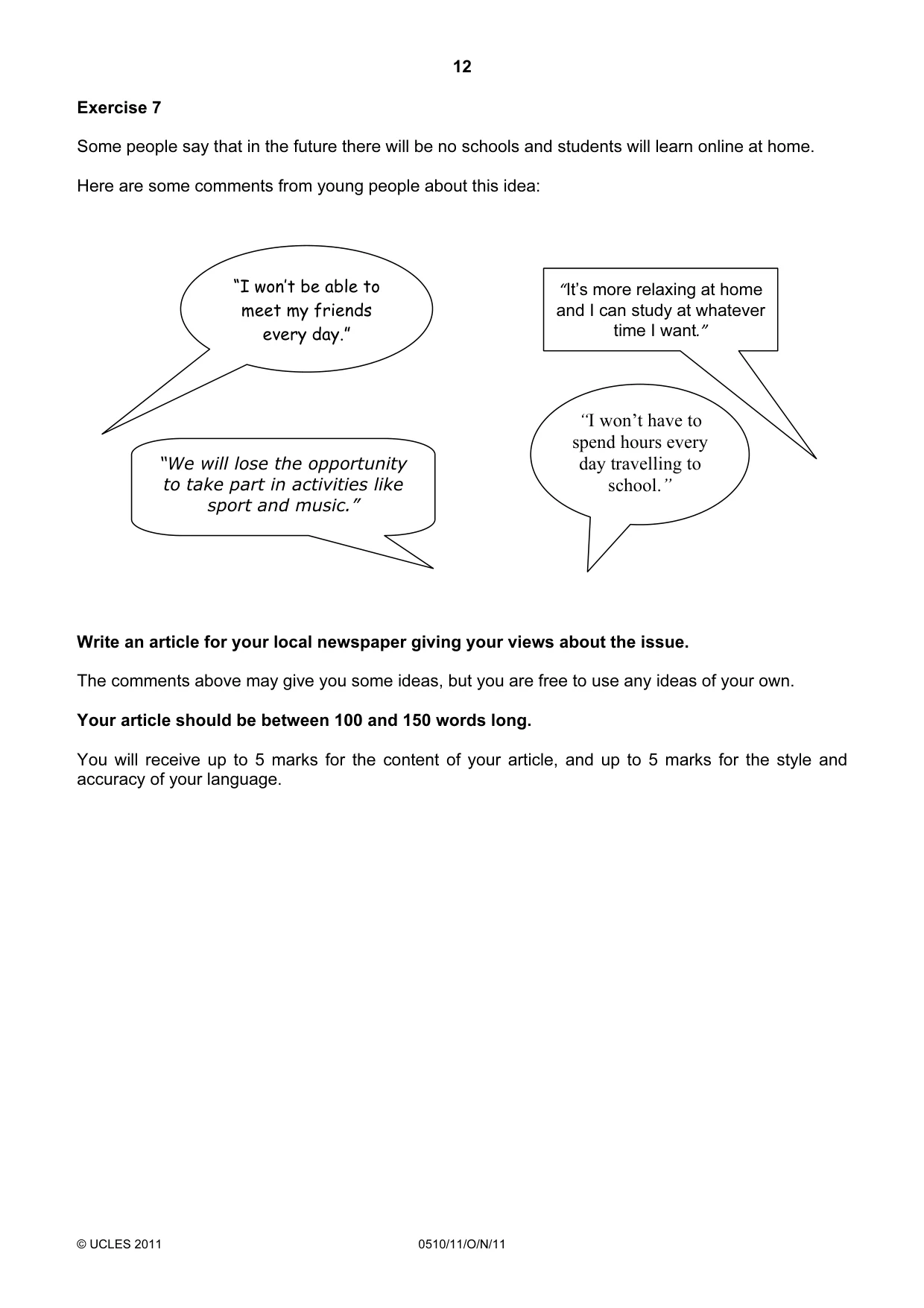
12 © UCLES 2011 0510/11/O/N/11 Exercise 7 Some people say that in the future there will be no schools and students will learn online at home. Here are some comments from young people about this idea: Write an article for your local newspaper giving your views about the issue. The comments above may give you some ideas, but you are free to use any ideas of your own. Your article should be between 100 and 150 words long. You will receive up to 5 marks for the content of your article, and up to 5 marks for the style and accuracy of your language. “I won’t be able to meet my friends every day.” “It’s more relaxing at home and I can study at whatever time I want.” “I won’t have to spend hours every day travelling to school.” “We will lose the opportunity to take part in activities like sport and music.”
Question paper, page 13
13 © UCLES 2011 0510/11/O/N/11 [Total: 10]
Question paper, page 14
14 © UCLES 2011 0510/11/O/N/11 BLANK PAGE
Question paper, page 15
15 © UCLES 2011 0510/11/O/N/11 BLANK PAGE
Question paper, page 16
16 Copyright Acknowledgements: Question 1 Question 4 © Chloe Lambert; Young Times Section; Times 2; The Times; 2 September 2009. © Tom Gatti; The Times Travel Section; 12 September 2009. Permission to reproduce items where third-party owned material protected by copyright is included has been sought and cleared where possible. Every reasonable effort has been made by the publisher (UCLES) to trace copyright holders, but if any items requiring clearance have unwittingly been included, the publisher will be pleased to make amends at the earliest possible opportunity. University of Cambridge International Examinations is part of the Cambridge Assessment Group. Cambridge Assessment is the brand name of University of Cambridge Local Examinations Syndicate (UCLES), which is itself a department of the University of Cambridge. © UCLES 2011 0510/11/O/N/11 BLANK PAGE
Mark scheme, page 1
UNIVERSITY OF CAMBRIDGE INTERNATIONAL EXAMINATIONS International General Certificate of Secondary Education MARK SCHEME for the October/November 2011 question paper for the guidance of teachers 0510 ENGLISH AS A SECOND LANGUAGE 0510/11 Paper 1 (Reading and Writing – Core), maximum raw mark 56 This mark scheme is published as an aid to teachers and candidates, to indicate the requirements of the examination. It shows the basis on which Examiners were instructed to award marks. It does not indicate the details of the discussions that took place at an Examiners’ meeting before marking began, which would have considered the acceptability of alternative answers. Mark schemes must be read in conjunction with the question papers and the report on the examination. • Cambridge will not enter into discussions or correspondence in connection with these mark schemes. Cambridge is publishing the mark schemes for the October/November 2011 question papers for most IGCSE, GCE Advanced Level and Advanced Subsidiary Level syllabuses and some Ordinary Level syllabuses.
Mark scheme, page 2
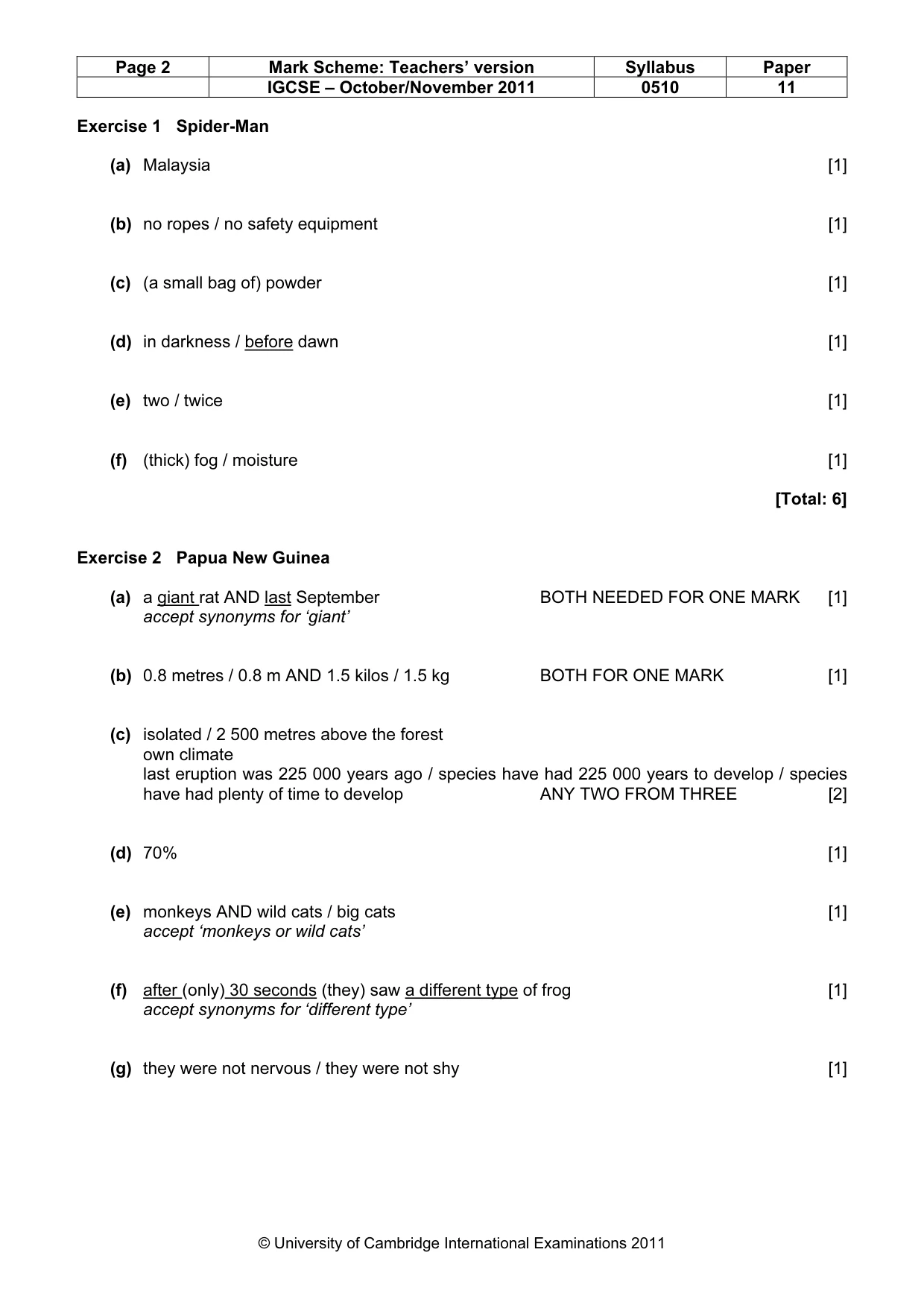
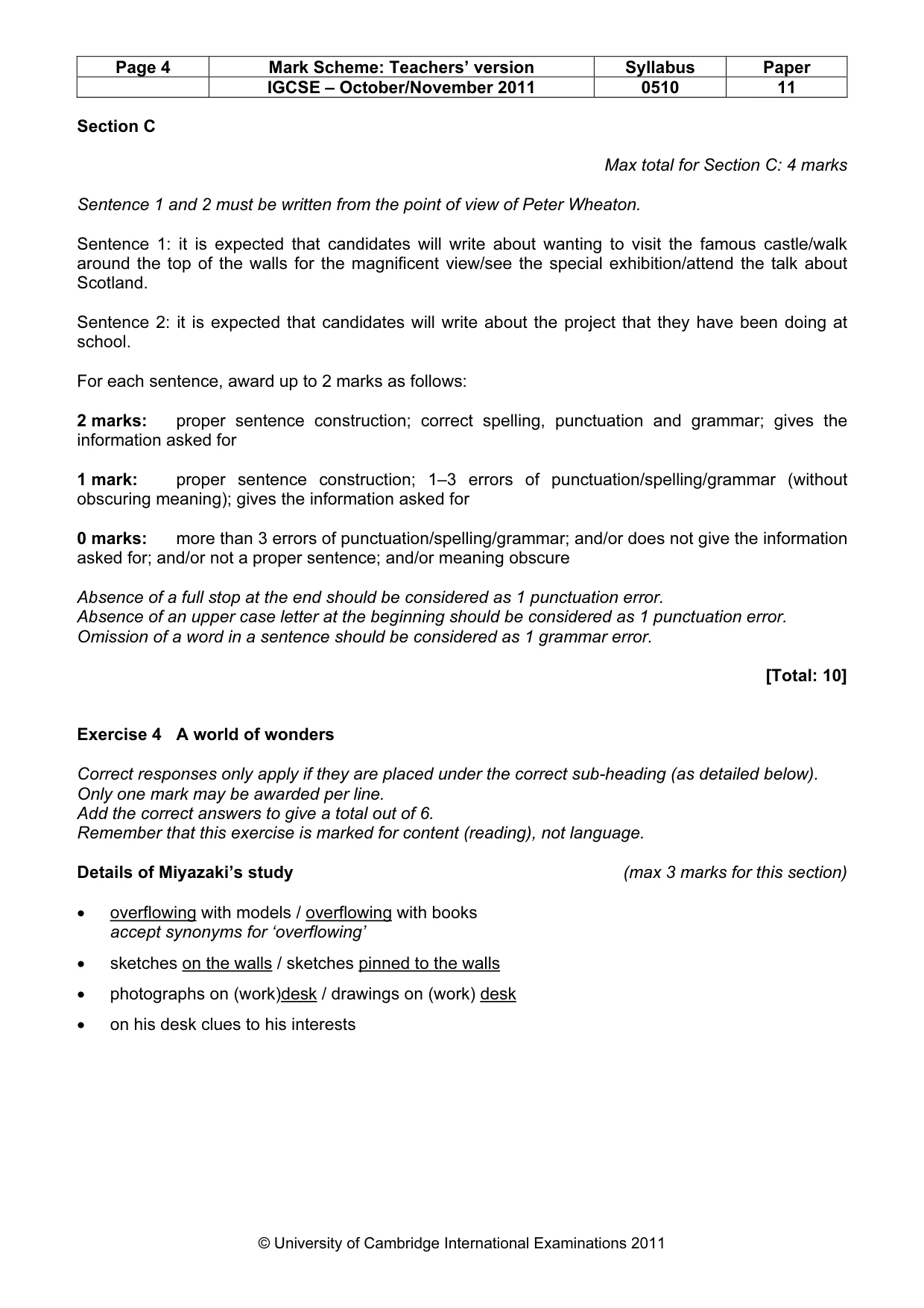
Page 2 Mark Scheme: Teachers’ version Syllabus Paper IGCSE – October/November 2011 0510 11 © University of Cambridge International Examinations 2011 Exercise 1 Spider-Man (a) Malaysia [1] (b) no ropes / no safety equipment [1] (c) (a small bag of) powder [1] (d) in darkness / before dawn [1] (e) two / twice [1] (f) (thick) fog / moisture [1] [Total: 6] Exercise 2 Papua New Guinea (a) a giant rat AND last September BOTH NEEDED FOR ONE MARK [1] accept synonyms for ‘giant’ (b) 0.8 metres / 0.8 m AND 1.5 kilos / 1.5 kg BOTH FOR ONE MARK [1] (c) isolated / 2 500 metres above the forest own climate last eruption was 225 000 years ago / species have had 225 000 years to develop / species have had plenty of time to develop ANY TWO FROM THREE [2] (d) 70% [1] (e) monkeys AND wild cats / big cats [1] accept ‘monkeys or wild cats’ (f) after (only) 30 seconds (they) saw a different type of frog [1] accept synonyms for ‘different type’ (g) they were not nervous / they were not shy [1]
Mark scheme, page 3
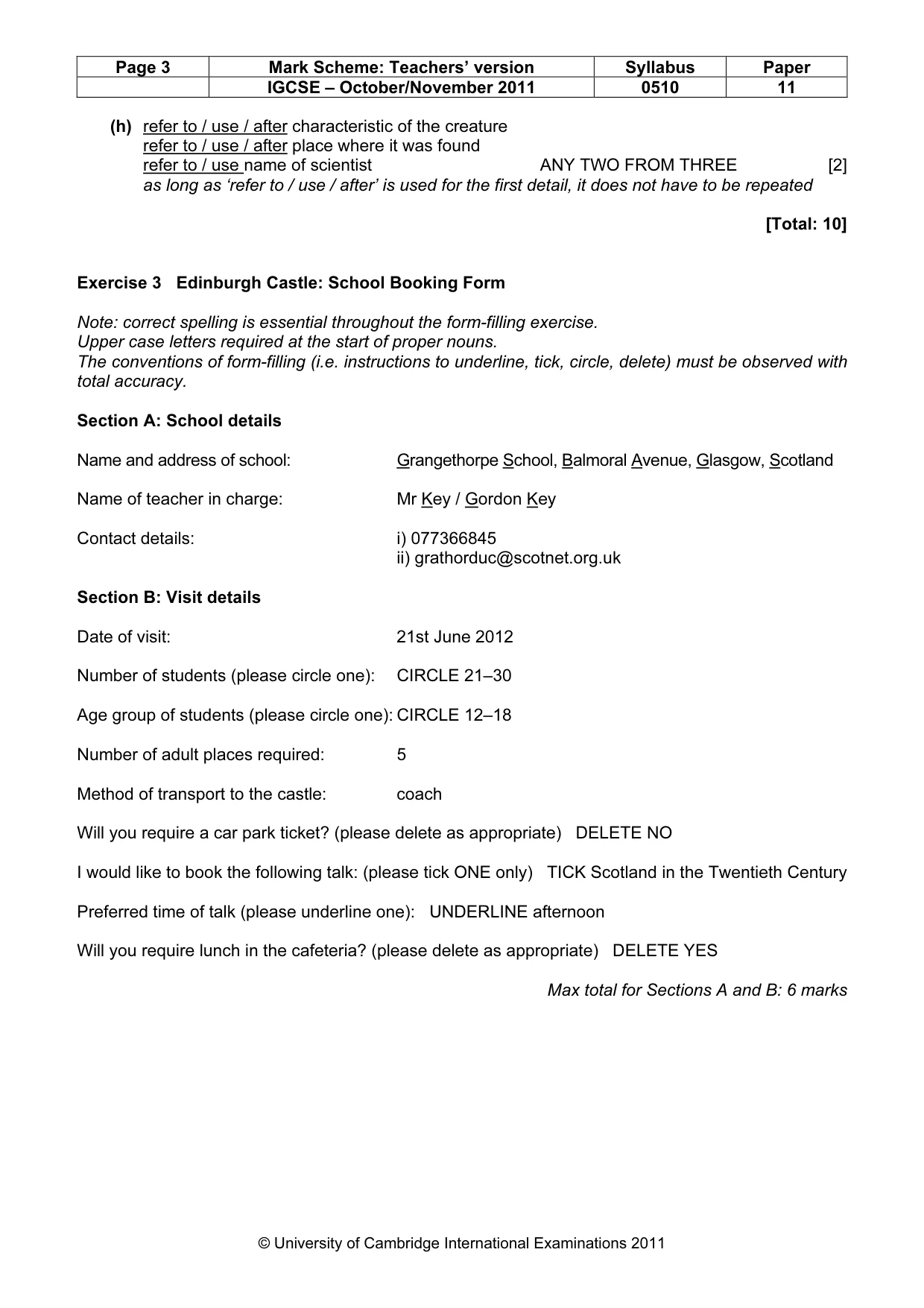
Page 3 Mark Scheme: Teachers’ version Syllabus Paper IGCSE – October/November 2011 0510 11 © University of Cambridge International Examinations 2011 (h) refer to / use / after characteristic of the creature refer to / use / after place where it was found refer to / use name of scientist ANY TWO FROM THREE [2] as long as ‘refer to / use / after’ is used for the first detail, it does not have to be repeated [Total: 10] Exercise 3 Edinburgh Castle: School Booking Form Note: correct spelling is essential throughout the form-filling exercise. Upper case letters required at the start of proper nouns. The conventions of form-filling (i.e. instructions to underline, tick, circle, delete) must be observed with total accuracy. Section A: School details Name and address of school: Grangethorpe School, Balmoral Avenue, Glasgow, Scotland Name of teacher in charge: Mr Key / Gordon Key Contact details: i) 077366845 ii) grathorduc@scotnet.org.uk Section B: Visit details Date of visit: 21st June 2012 Number of students (please circle one): CIRCLE 21–30 Age group of students (please circle one): CIRCLE 12–18 Number of adult places required: 5 Method of transport to the castle: coach Will you require a car park ticket? (please delete as appropriate) DELETE NO I would like to book the following talk: (please tick ONE only) TICK Scotland in the Twentieth Century Preferred time of talk (please underline one): UNDERLINE afternoon Will you require lunch in the cafeteria? (please delete as appropriate) DELETE YES Max total for Sections A and B: 6 marks
Mark scheme, page 4
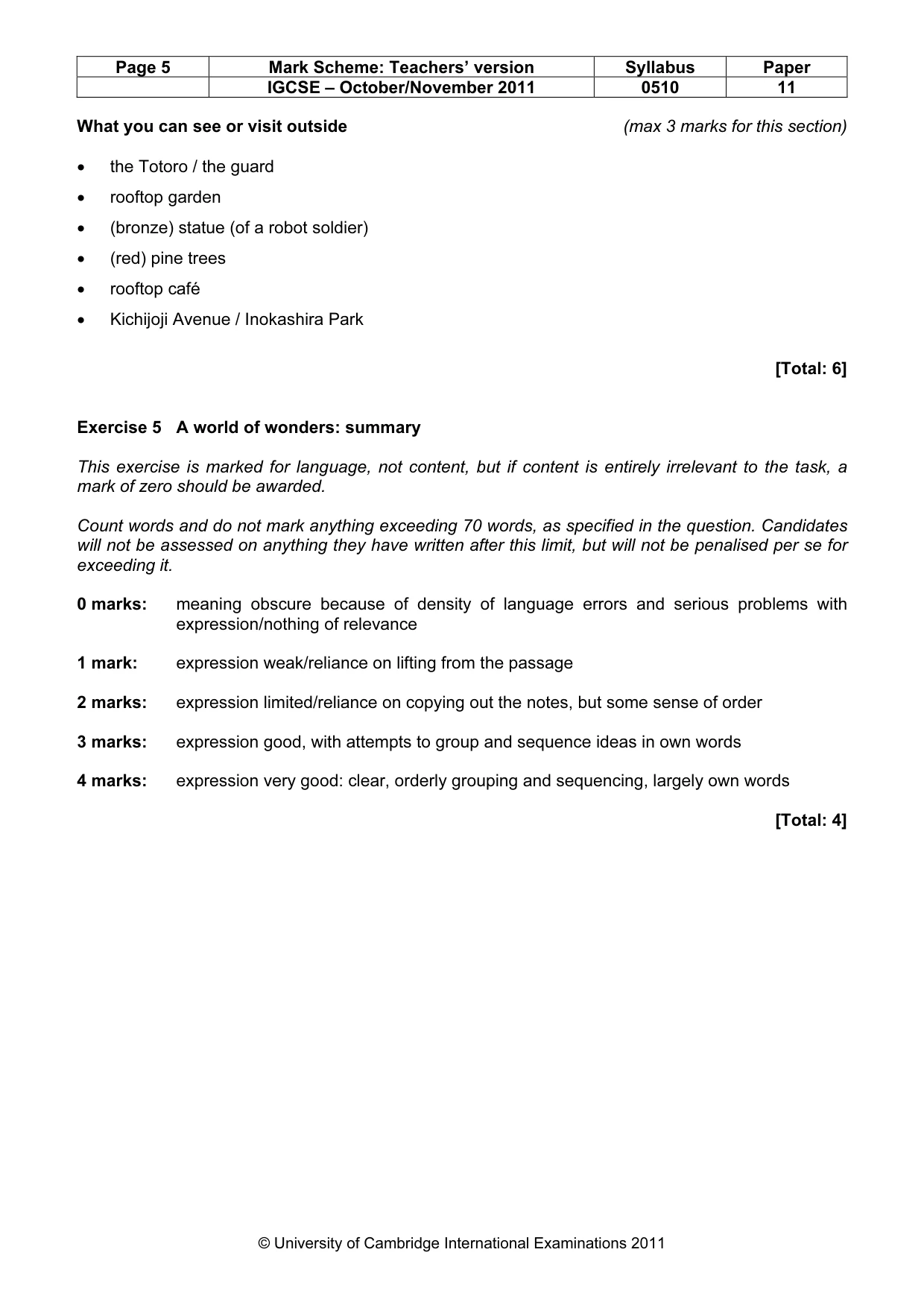
Page 4 Mark Scheme: Teachers’ version Syllabus Paper IGCSE – October/November 2011 0510 11 © University of Cambridge International Examinations 2011 Section C Max total for Section C: 4 marks Sentence 1 and 2 must be written from the point of view of Peter Wheaton. Sentence 1: it is expected that candidates will write about wanting to visit the famous castle/walk around the top of the walls for the magnificent view/see the special exhibition/attend the talk about Scotland. Sentence 2: it is expected that candidates will write about the project that they have been doing at school. For each sentence, award up to 2 marks as follows: 2 marks: proper sentence construction; correct spelling, punctuation and grammar; gives the information asked for 1 mark: proper sentence construction; 1–3 errors of punctuation/spelling/grammar (without obscuring meaning); gives the information asked for 0 marks: more than 3 errors of punctuation/spelling/grammar; and/or does not give the information asked for; and/or not a proper sentence; and/or meaning obscure Absence of a full stop at the end should be considered as 1 punctuation error. Absence of an upper case letter at the beginning should be considered as 1 punctuation error. Omission of a word in a sentence should be considered as 1 grammar error. [Total: 10] Exercise 4 A world of wonders Correct responses only apply if they are placed under the correct sub-heading (as detailed below). Only one mark may be awarded per line. Add the correct answers to give a total out of 6. Remember that this exercise is marked for content (reading), not language. Details of Miyazaki’s study (max 3 marks for this section) • overflowing with models / overflowing with books accept synonyms for ‘overflowing’ • sketches on the walls / sketches pinned to the walls • photographs on (work)desk / drawings on (work) desk • on his desk clues to his interests
Mark scheme, page 5
Page 5 Mark Scheme: Teachers’ version Syllabus Paper IGCSE – October/November 2011 0510 11 © University of Cambridge International Examinations 2011 What you can see or visit outside (max 3 marks for this section) • the Totoro / the guard • rooftop garden • (bronze) statue (of a robot soldier) • (red) pine trees • rooftop café • Kichijoji Avenue / Inokashira Park [Total: 6] Exercise 5 A world of wonders: summary This exercise is marked for language, not content, but if content is entirely irrelevant to the task, a mark of zero should be awarded. Count words and do not mark anything exceeding 70 words, as specified in the question. Candidates will not be assessed on anything they have written after this limit, but will not be penalised per se for exceeding it. 0 marks: meaning obscure because of density of language errors and serious problems with expression/nothing of relevance 1 mark: expression weak/reliance on lifting from the passage 2 marks: expression limited/reliance on copying out the notes, but some sense of order 3 marks: expression good, with attempts to group and sequence ideas in own words 4 marks: expression very good: clear, orderly grouping and sequencing, largely own words [Total: 4]
Mark scheme, page 6
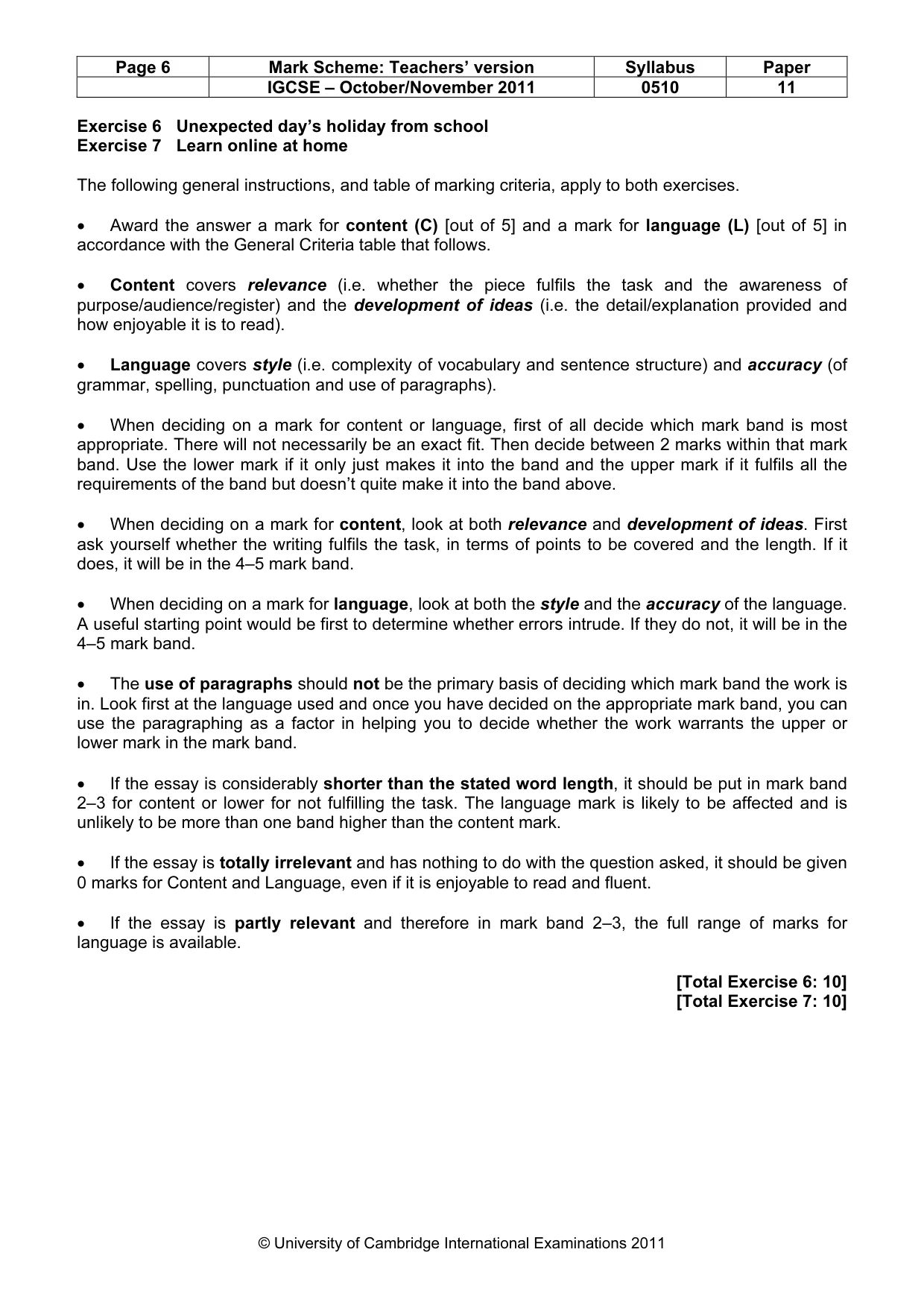
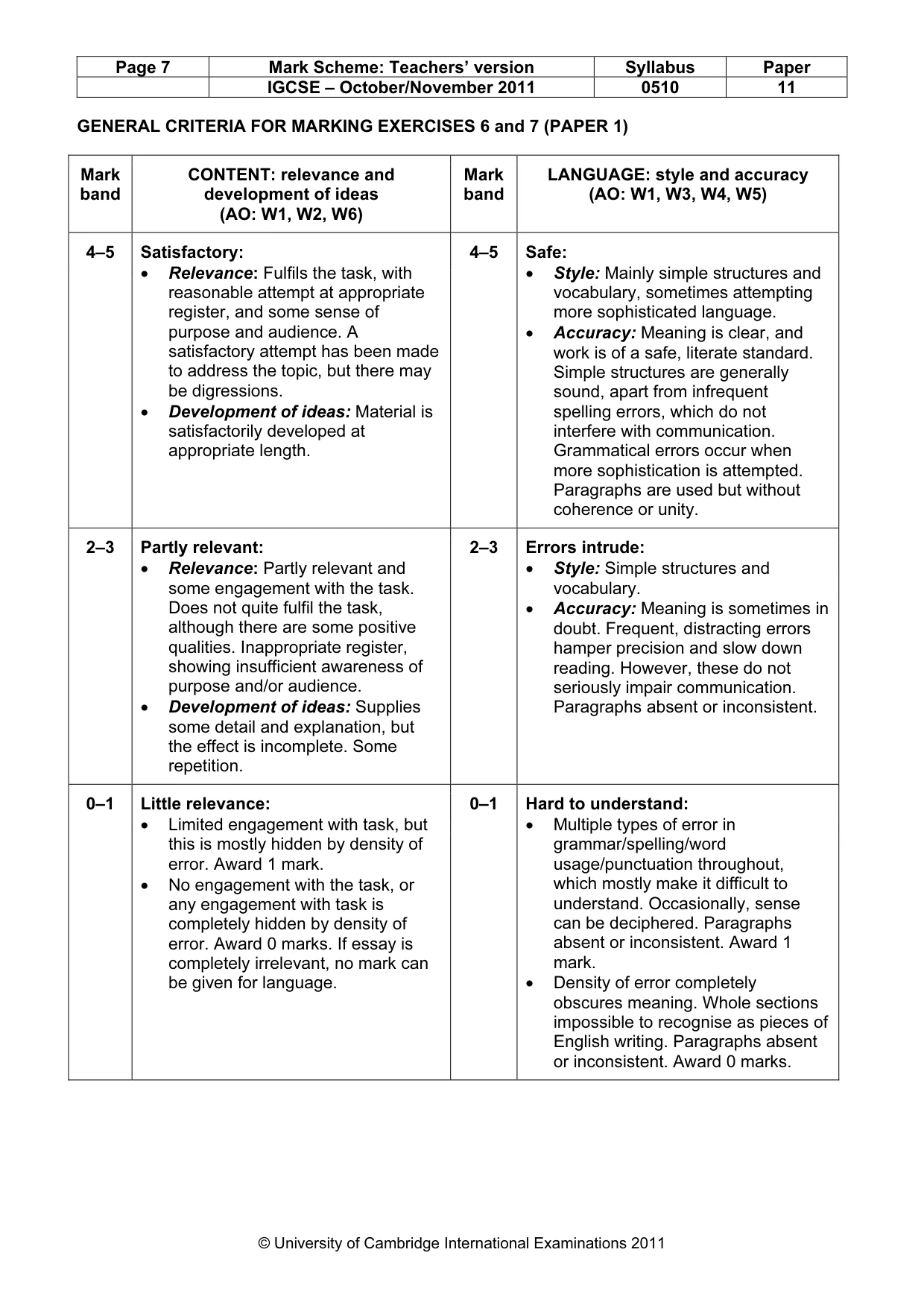
Page 6 Mark Scheme: Teachers’ version Syllabus Paper IGCSE – October/November 2011 0510 11 © University of Cambridge International Examinations 2011 Exercise 6 Unexpected day’s holiday from school Exercise 7 Learn online at home The following general instructions, and table of marking criteria, apply to both exercises. • Award the answer a mark for content (C) [out of 5] and a mark for language (L) [out of 5] in accordance with the General Criteria table that follows. • Content covers relevance (i.e. whether the piece fulfils the task and the awareness of purpose/audience/register) and the development of ideas (i.e. the detail/explanation provided and how enjoyable it is to read). • Language covers style (i.e. complexity of vocabulary and sentence structure) and accuracy (of grammar, spelling, punctuation and use of paragraphs). • When deciding on a mark for content or language, first of all decide which mark band is most appropriate. There will not necessarily be an exact fit. Then decide between 2 marks within that mark band. Use the lower mark if it only just makes it into the band and the upper mark if it fulfils all the requirements of the band but doesn’t quite make it into the band above. • When deciding on a mark for content, look at both relevance and development of ideas. First ask yourself whether the writing fulfils the task, in terms of points to be covered and the length. If it does, it will be in the 4–5 mark band. • When deciding on a mark for language, look at both the style and the accuracy of the language. A useful starting point would be first to determine whether errors intrude. If they do not, it will be in the 4–5 mark band. • The use of paragraphs should not be the primary basis of deciding which mark band the work is in. Look first at the language used and once you have decided on the appropriate mark band, you can use the paragraphing as a factor in helping you to decide whether the work warrants the upper or lower mark in the mark band. • If the essay is considerably shorter than the stated word length, it should be put in mark band 2–3 for content or lower for not fulfilling the task. The language mark is likely to be affected and is unlikely to be more than one band higher than the content mark. • If the essay is totally irrelevant and has nothing to do with the question asked, it should be given 0 marks for Content and Language, even if it is enjoyable to read and fluent. • If the essay is partly relevant and therefore in mark band 2–3, the full range of marks for language is available. [Total Exercise 6: 10] [Total Exercise 7: 10]
Mark scheme, page 7
Page 7 Mark Scheme: Teachers’ version Syllabus Paper IGCSE – October/November 2011 0510 11 © University of Cambridge International Examinations 2011 GENERAL CRITERIA FOR MARKING EXERCISES 6 and 7 (PAPER 1) Mark band CONTENT: relevance and development of ideas (AO: W1, W2, W6) Mark band LANGUAGE: style and accuracy (AO: W1, W3, W4, W5) 4–5 4–5 Satisfactory: • Relevance: Fulfils the task, with reasonable attempt at appropriate register, and some sense of purpose and audience. A satisfactory attempt has been made to address the topic, but there may be digressions. • Development of ideas: Material is satisfactorily developed at appropriate length. Safe: • Style: Mainly simple structures and vocabulary, sometimes attempting more sophisticated language. • Accuracy: Meaning is clear, and work is of a safe, literate standard. Simple structures are generally sound, apart from infrequent spelling errors, which do not interfere with communication. Grammatical errors occur when more sophistication is attempted. Paragraphs are used but without coherence or unity. 2–3 2–3 Partly relevant: • Relevance: Partly relevant and some engagement with the task. Does not quite fulfil the task, although there are some positive qualities. Inappropriate register, showing insufficient awareness of purpose and/or audience. • Development of ideas: Supplies some detail and explanation, but the effect is incomplete. Some repetition. Errors intrude: • Style: Simple structures and vocabulary. • Accuracy: Meaning is sometimes in doubt. Frequent, distracting errors hamper precision and slow down reading. However, these do not seriously impair communication. Paragraphs absent or inconsistent. 0–1 0–1 Little relevance: • Limited engagement with task, but this is mostly hidden by density of error. Award 1 mark. • No engagement with the task, or any engagement with task is completely hidden by density of error. Award 0 marks. If essay is completely irrelevant, no mark can be given for language. Hard to understand: • Multiple types of error in grammar/spelling/word usage/punctuation throughout, which mostly make it difficult to understand. Occasionally, sense can be deciphered. Paragraphs absent or inconsistent. Award 1 mark. • Density of error completely obscures meaning. Whole sections impossible to recognise as pieces of English writing. Paragraphs absent or inconsistent. Award 0 marks.
What you needed in this session
Cambridge’s own grade thresholds for 2011 Oct/Nov, Paper 1 · Variant 1. A higher threshold means an easier paper — the bar moves with how the cohort did.