Cambridge IGCSE English - Second Language (oral endorsement) 0510 — 2010 Oct/Nov Paper 2 · Variant 1
0510/21/O/N/10 · 84 marks · ≈95 min
The question paper and its mark scheme, free to read here and free to download. This is Cambridge’s own paper, exactly as it was sat.
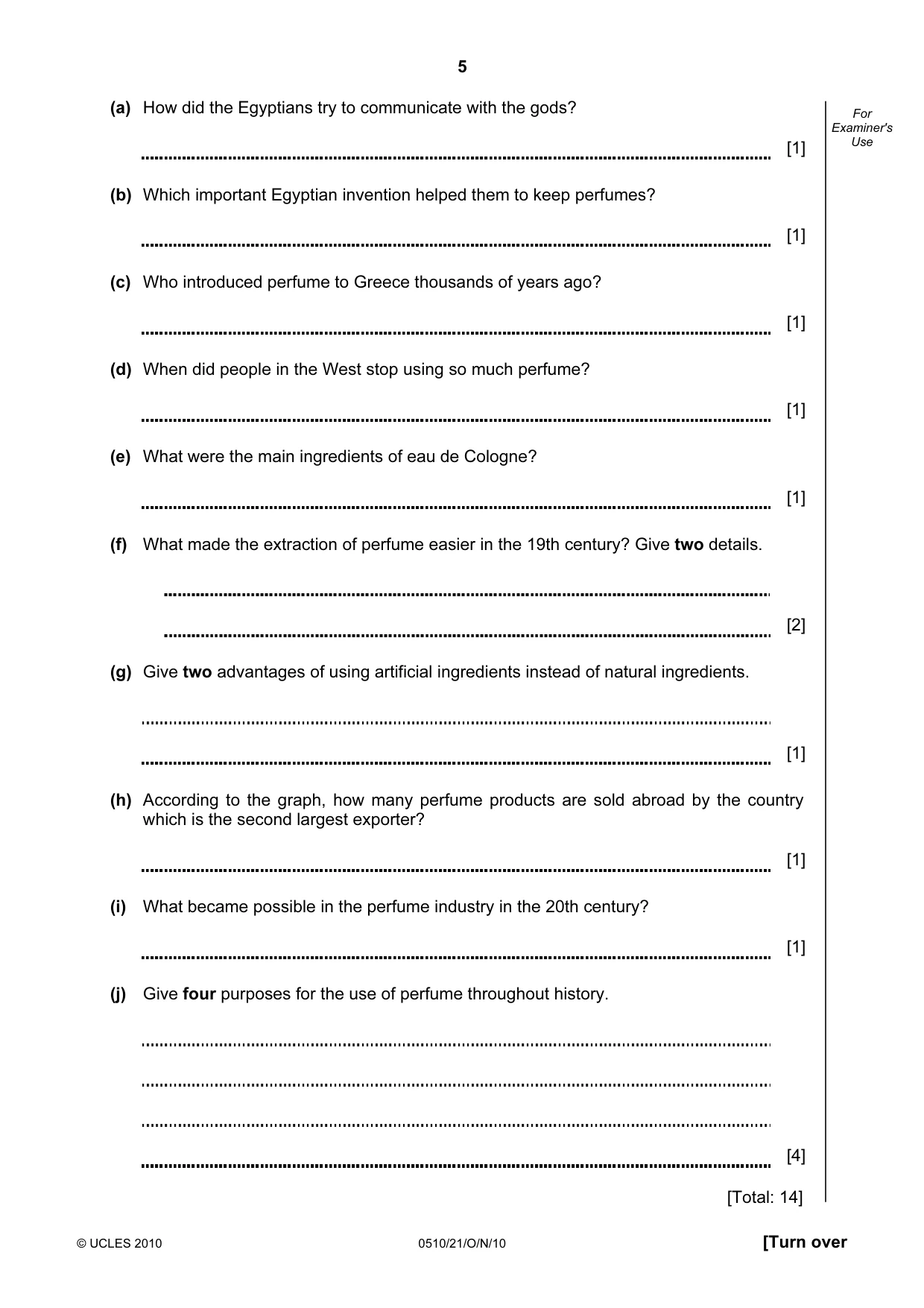
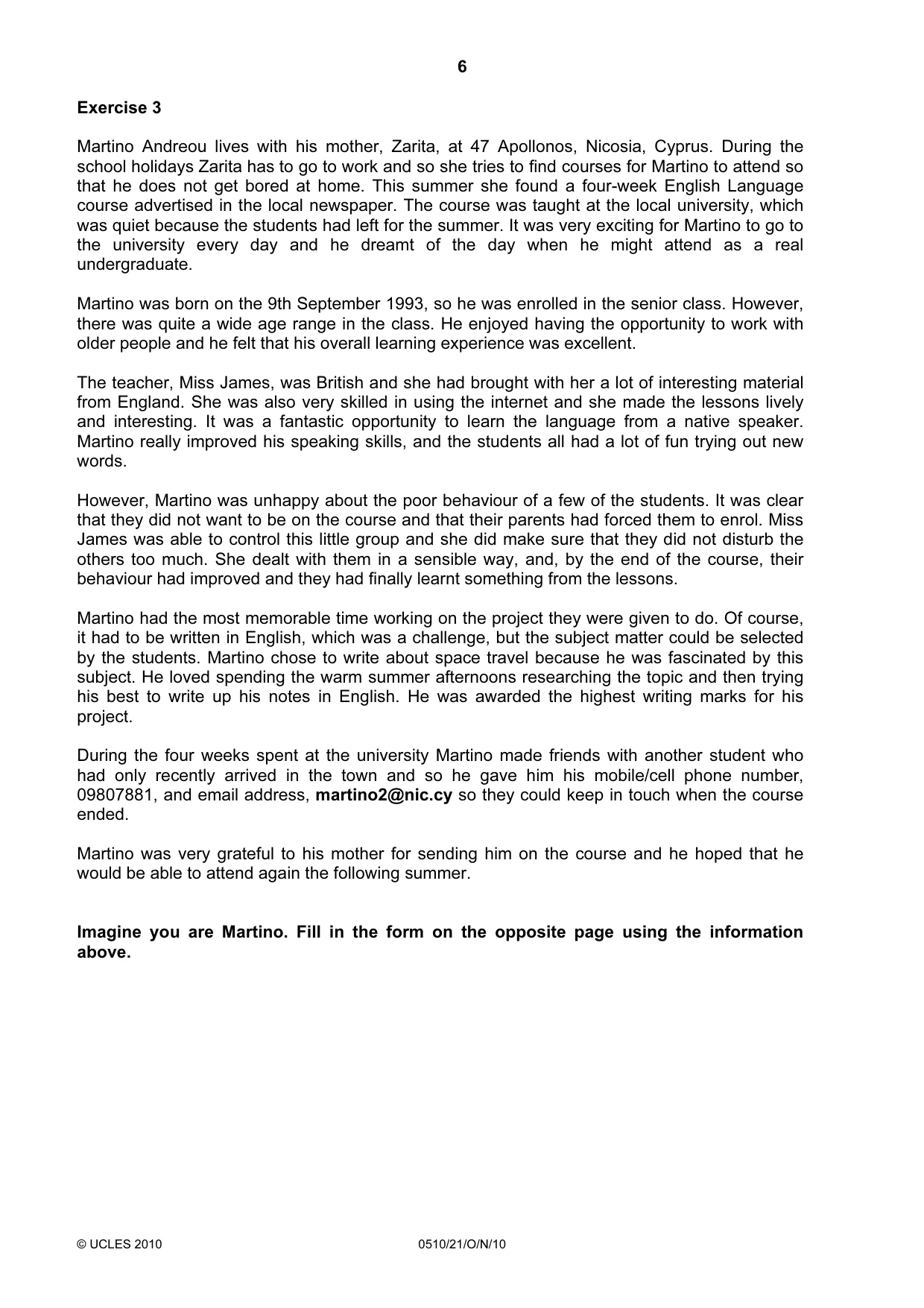
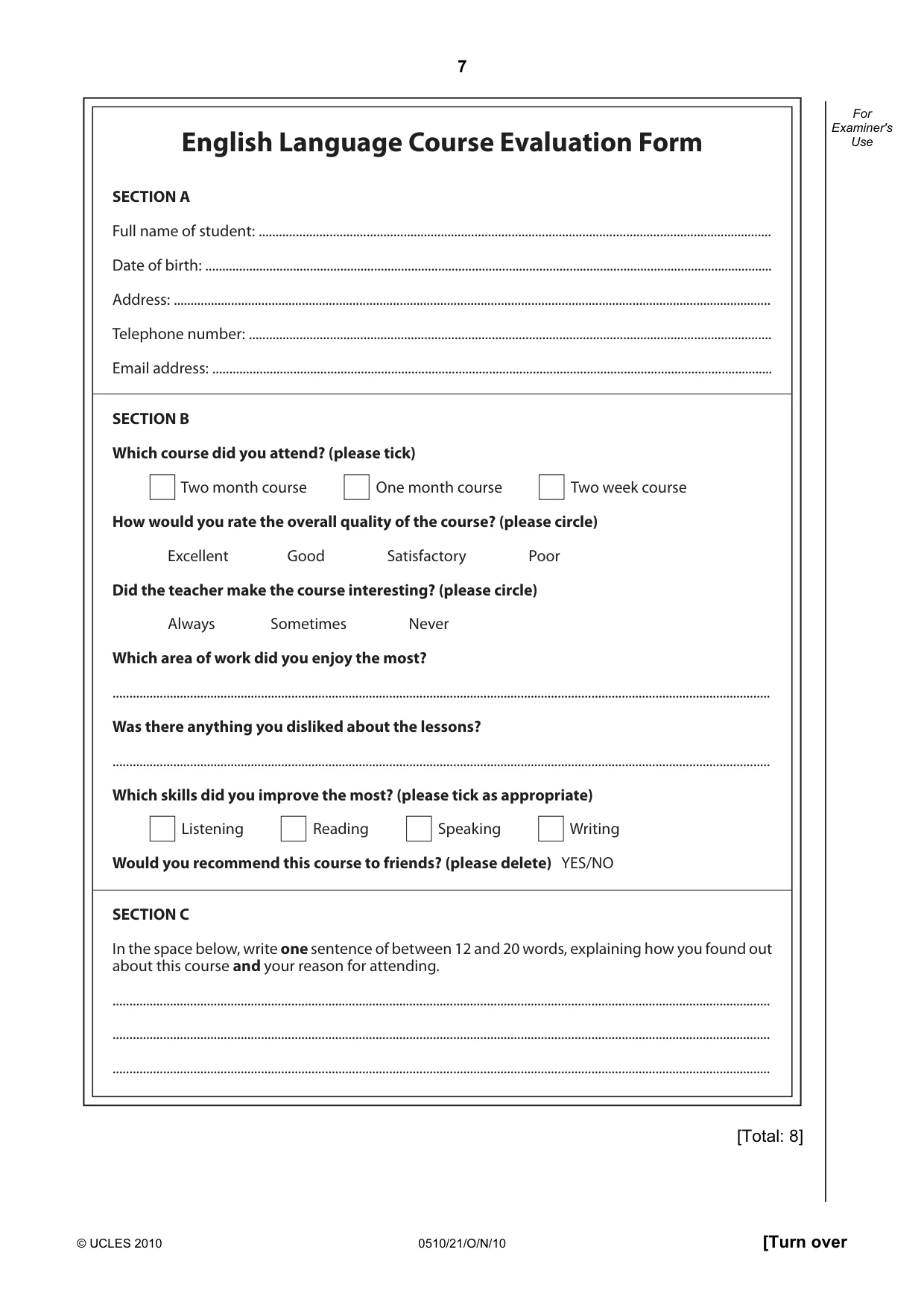
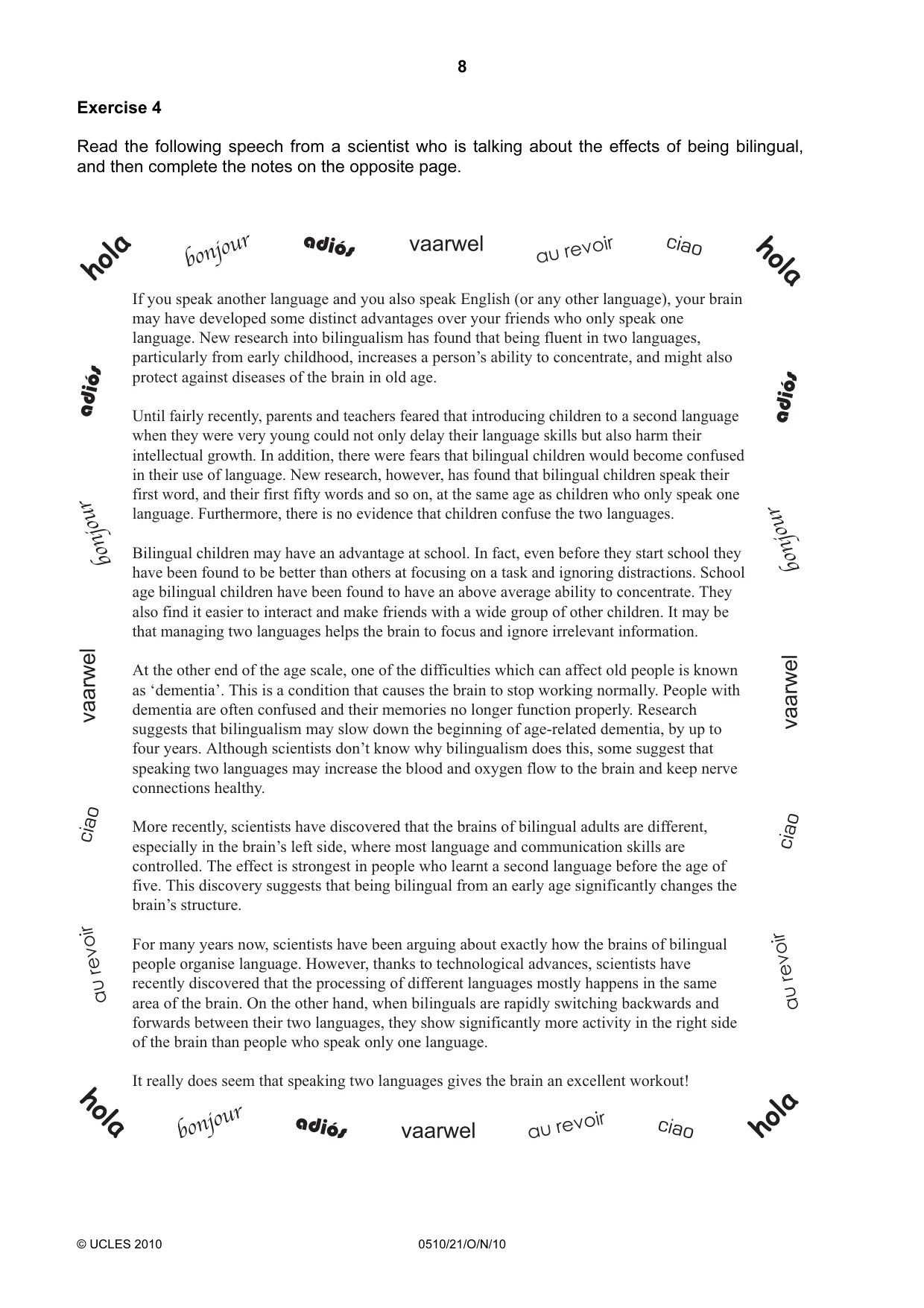
Question paper16 pages




Mark scheme9 pages
Answers below. Sit the paper first if you are practising.
Paper as text
Question paper, page 1
This document consists of 15 printed pages and 1 blank page. IB10 11_0510_21/4RP © UCLES 2010 [Turn over *1597166505* For Examiner's Use Exercise 1 Exercise 2 Exercise 3 Exercise 4 Exercise 5 Exercise 6 Exercise 7 Total UNIVERSITY OF CAMBRIDGE INTERNATIONAL EXAMINATIONS International General Certificate of Secondary Education ENGLISH AS A SECOND LANGUAGE 0510/21 Paper 2 Reading and Writing (Extended) October/November 2010 2 hours Candidates answer on the Question Paper. No Additional Materials are required. READ THESE INSTRUCTIONS FIRST Write your Centre number, candidate number and name on all the work you hand in. Write in dark blue or black pen. Do not use staples, paper clips, highlighters, glue or correction fluid. DO NOT WRITE IN ANY BARCODES. Answer all questions. Dictionaries are not allowed. At the end of the examination, fasten all your work securely together. The number of marks is given in brackets [ ] at the end of each question or part question.
Question paper, page 2
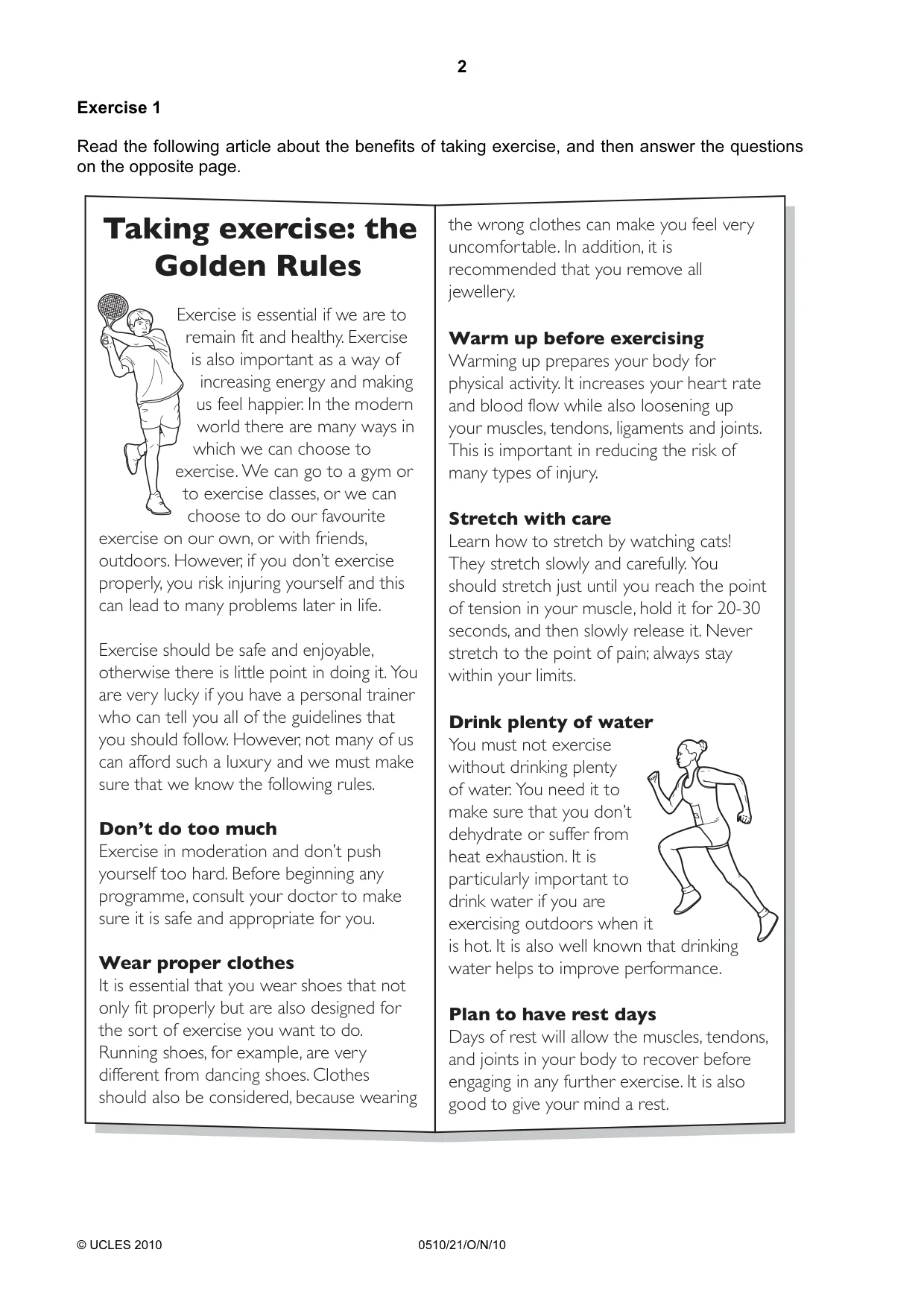
2 © UCLES 2010 0510/21/O/N/10 Exercise 1 Read the following article about the benefits of taking exercise, and then answer the questions on the opposite page. Taking exercise: the Golden Rules Exercise is essential if we are to remain fit and healthy. Exercise is also important as a way of increasing energy and making us feel happier. In the modern world there are many ways in which we can choose to exercise. We can go to a gym or to exercise classes, or we can choose to do our favourite exercise on our own, or with friends, outdoors. However, if you don’t exercise properly, you risk injuring yourself and this can lead to many problems later in life. Exercise should be safe and enjoyable, otherwise there is little point in doing it. You are very lucky if you have a personal trainer who can tell you all of the guidelines that you should follow. However, not many of us can afford such a luxury and we must make sure that we know the following rules. Don’t do too much Exercise in moderation and don’t push yourself too hard. Before beginning any programme, consult your doctor to make sure it is safe and appropriate for you. Wear proper clothes It is essential that you wear shoes that not only fit properly but are also designed for the sort of exercise you want to do. Running shoes, for example, are very different from dancing shoes. Clothes should also be considered, because wearing the wrong clothes can make you feel very uncomfortable. In addition, it is recommended that you remove all jewellery. Warm up before exercising Warming up prepares your body for physical activity. It increases your heart rate and blood flow while also loosening up your muscles, tendons, ligaments and joints. This is important in reducing the risk of many types of injury. Stretch with care Learn how to stretch by watching cats! They stretch slowly and carefully. You should stretch just until you reach the point of tension in your muscle, hold it for 20-30 seconds, and then slowly release it. Never stretch to the point of pain; always stay within your limits. Drink plenty of water You must not exercise without drinking plenty of water. You need it to make sure that you don’t dehydrate or suffer from heat exhaustion. It is particularly important to drink water if you are exercising outdoors when it is hot. It is also well known that drinking water helps to improve performance. Plan to have rest days Days of rest will allow the muscles, tendons, and joints in your body to recover before engaging in any further exercise. It is also good to give your mind a rest. 3
Question paper, page 3
3 © UCLES 2010 0510/21/O/N/10 [Turn over For Examiner's Use (a) What should we do if we want to keep well? [1] (b) Why don’t many people have a personal trainer? [1] (c) Why is it recommended that you see a doctor before you start exercising? [1] (d) If you plan to do a particular exercise, what will you have to wear? Give two details. [1] (e) What can be learnt from cats? [1] (f) What may happen if you do not drink enough water whilst exercising? Give two details. [2] (g) What are the advantages of having days without exercise? Give two details. [1] [Total 8]
Question paper, page 4
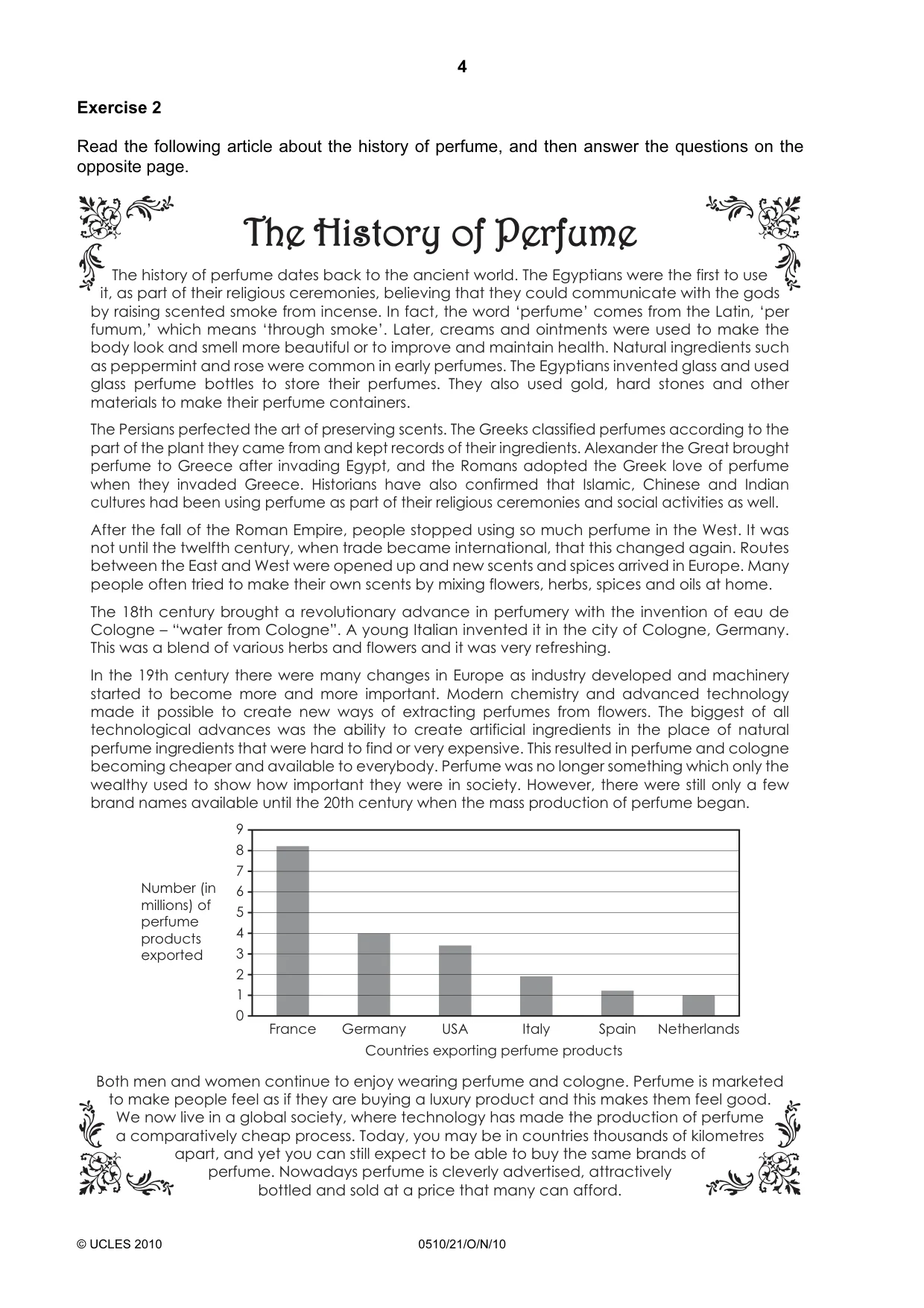
4 © UCLES 2010 0510/21/O/N/10 Exercise 2 Read the following article about the history of perfume, and then answer the questions on the opposite page. The history of perfume dates back to the ancient world. The Egyptians were the first to use it, as part of their religious ceremonies, believing that they could communicate with the gods by raising scented smoke from incense. In fact, the word ‘perfume’ comes from the Latin, ‘per fumum,’ which means ‘through smoke’. Later, creams and ointments were used to make the body look and smell more beautiful or to improve and maintain health. Natural ingredients such as peppermint and rose were common in early perfumes. The Egyptians invented glass and used glass perfume bottles to store their perfumes. They also used gold, hard stones and other materials to make their perfume containers. The Persians perfected the art of preserving scents. The Greeks classified perfumes according to the part of the plant they came from and kept records of their ingredients. Alexander the Great brought perfume to Greece after invading Egypt, and the Romans adopted the Greek love of perfume when they invaded Greece. Historians have also confirmed that Islamic, Chinese and Indian cultures had been using perfume as part of their religious ceremonies and social activities as well. After the fall of the Roman Empire, people stopped using so much perfume in the West. It was not until the twelfth century, when trade became international, that this changed again. Routes between the East and West were opened up and new scents and spices arrived in Europe. Many people often tried to make their own scents by mixing flowers, herbs, spices and oils at home. The 18th century brought a revolutionary advance in perfumery with the invention of eau de Cologne – “water from Cologne”. A young Italian invented it in the city of Cologne, Germany. This was a blend of various herbs and flowers and it was very refreshing. In the 19th century there were many changes in Europe as industry developed and machinery started to become more and more important. Modern chemistry and advanced technology made it possible to create new ways of extracting perfumes from flowers. The biggest of all technological advances was the ability to create artificial ingredients in the place of natural perfume ingredients that were hard to find or very expensive. This resulted in perfume and cologne becoming cheaper and available to everybody. Perfume was no longer something which only the wealthy used to show how important they were in society. However, there were still only a few brand names available until the 20th century when the mass production of perfume began. Both men and women continue to enjoy wearing perfume and cologne. Perfume is marketed to make people feel as if they are buying a luxury product and this makes them feel good. We now live in a global society, where technology has made the production of perfume a comparatively cheap process. Today, you may be in countries thousands of kilometres apart, and yet you can still expect to be able to buy the same brands of perfume. Nowadays perfume is cleverly advertised, attractively bottled and sold at a price that many can afford. France Countries exporting perfume products Germany USA Italy Spain Netherlands 9 8 7 6 5 4 3 2 1 0 Number (in millions) of perfume products exported
Question paper, page 5
5 © UCLES 2010 0510/21/O/N/10 [Turn over For Examiner's Use (a) How did the Egyptians try to communicate with the gods? [1] (b) Which important Egyptian invention helped them to keep perfumes? [1] (c) Who introduced perfume to Greece thousands of years ago? [1] (d) When did people in the West stop using so much perfume? [1] (e) What were the main ingredients of eau de Cologne? [1] (f) What made the extraction of perfume easier in the 19th century? Give two details. [2] (g) Give two advantages of using artificial ingredients instead of natural ingredients. [1] (h) According to the graph, how many perfume products are sold abroad by the country which is the second largest exporter? [1] (i) What became possible in the perfume industry in the 20th century? [1] (j) Give four purposes for the use of perfume throughout history. [4] [Total: 14]
Question paper, page 6
6 © UCLES 2010 0510/21/O/N/10 Exercise 3 Martino Andreou lives with his mother, Zarita, at 47 Apollonos, Nicosia, Cyprus. During the school holidays Zarita has to go to work and so she tries to find courses for Martino to attend so that he does not get bored at home. This summer she found a four-week English Language course advertised in the local newspaper. The course was taught at the local university, which was quiet because the students had left for the summer. It was very exciting for Martino to go to the university every day and he dreamt of the day when he might attend as a real undergraduate. Martino was born on the 9th September 1993, so he was enrolled in the senior class. However, there was quite a wide age range in the class. He enjoyed having the opportunity to work with older people and he felt that his overall learning experience was excellent. The teacher, Miss James, was British and she had brought with her a lot of interesting material from England. She was also very skilled in using the internet and she made the lessons lively and interesting. It was a fantastic opportunity to learn the language from a native speaker. Martino really improved his speaking skills, and the students all had a lot of fun trying out new words. However, Martino was unhappy about the poor behaviour of a few of the students. It was clear that they did not want to be on the course and that their parents had forced them to enrol. Miss James was able to control this little group and she did make sure that they did not disturb the others too much. She dealt with them in a sensible way, and, by the end of the course, their behaviour had improved and they had finally learnt something from the lessons. Martino had the most memorable time working on the project they were given to do. Of course, it had to be written in English, which was a challenge, but the subject matter could be selected by the students. Martino chose to write about space travel because he was fascinated by this subject. He loved spending the warm summer afternoons researching the topic and then trying his best to write up his notes in English. He was awarded the highest writing marks for his project. During the four weeks spent at the university Martino made friends with another student who had only recently arrived in the town and so he gave him his mobile/cell phone number, 09807881, and email address, martino2@nic.cy so they could keep in touch when the course ended. Martino was very grateful to his mother for sending him on the course and he hoped that he would be able to attend again the following summer. Imagine you are Martino. Fill in the form on the opposite page using the information above.
Question paper, page 7
7 © UCLES 2010 0510/21/O/N/10 [Turn over For Examiner's Use English Language Course Evaluation Form SECTION A Full name of student: … Date of birth: … Address: … Telephone number: … Email address: … SECTION B Which course did you attend? (please tick) Two month course One month course Two week course How would you rate the overall quality of the course? (please circle) Excellent Good Satisfactory Poor Did the teacher make the course interesting? (please circle) Always Sometimes Never Which area of work did you enjoy the most? … Was there anything you disliked about the lessons? … Which skills did you improve the most? (please tick as appropriate) Listening Reading Speaking Writing Would you recommend this course to friends? (please delete) YES/NO SECTION C In the space below, write one sentence of between 12 and 20 words, explaining how you found out about this course and your reason for attending. … … … [Total: 8]
Question paper, page 8
8 © UCLES 2010 0510/21/O/N/10 Exercise 4 Read the following speech from a scientist who is talking about the effects of being bilingual, and then complete the notes on the opposite page. If you speak another language and you also speak English (or any other language), your brain may have developed some distinct advantages over your friends who only speak one language. New research into bilingualism has found that being fluent in two languages, particularly from early childhood, increases a person’s ability to concentrate, and might also protect against diseases of the brain in old age. Until fairly recently, parents and teachers feared that introducing children to a second language when they were very young could not only delay their language skills but also harm their intellectual growth. In addition, there were fears that bilingual children would become confused in their use of language. New research, however, has found that bilingual children speak their first word, and their first fifty words and so on, at the same age as children who only speak one language. Furthermore, there is no evidence that children confuse the two languages. Bilingual children may have an advantage at school. In fact, even before they start school they have been found to be better than others at focusing on a task and ignoring distractions. School age bilingual children have been found to have an above average ability to concentrate. They also find it easier to interact and make friends with a wide group of other children. It may be that managing two languages helps the brain to focus and ignore irrelevant information. At the other end of the age scale, one of the difficulties which can affect old people is known as ‘dementia’. This is a condition that causes the brain to stop working normally. People with dementia are often confused and their memories no longer function properly. Research suggests that bilingualism may slow down the beginning of age-related dementia, by up to four years. Although scientists don’t know why bilingualism does this, some suggest that speaking two languages may increase the blood and oxygen flow to the brain and keep nerve connections healthy. More recently, scientists have discovered that the brains of bilingual adults are different, especially in the brain’s left side, where most language and communication skills are controlled. The effect is strongest in people who learnt a second language before the age of five. This discovery suggests that being bilingual from an early age significantly changes the brain’s structure. For many years now, scientists have been arguing about exactly how the brains of bilingual people organise language. However, thanks to technological advances, scientists have recently discovered that the processing of different languages mostly happens in the same area of the brain. On the other hand, when bilinguals are rapidly switching backwards and forwards between their two languages, they show significantly more activity in the right side of the brain than people who speak only one language. It really does seem that speaking two languages gives the brain an excellent workout!
Question paper, page 9
9 © UCLES 2010 0510/21/O/N/10 [Turn over For Examiner's Use You have been asked by your languages teacher to give a presentation to your year group on what has been discovered about bilingualism. Prepare some notes to use as the basis for your presentation. Make your notes under each heading. Fears about encouraging young children to be bilingual • … • … • … Advantages for children of being bilingual • … • … Effects of bilingualism on the brain • … • … • … [Total: 8]
Question paper, page 10
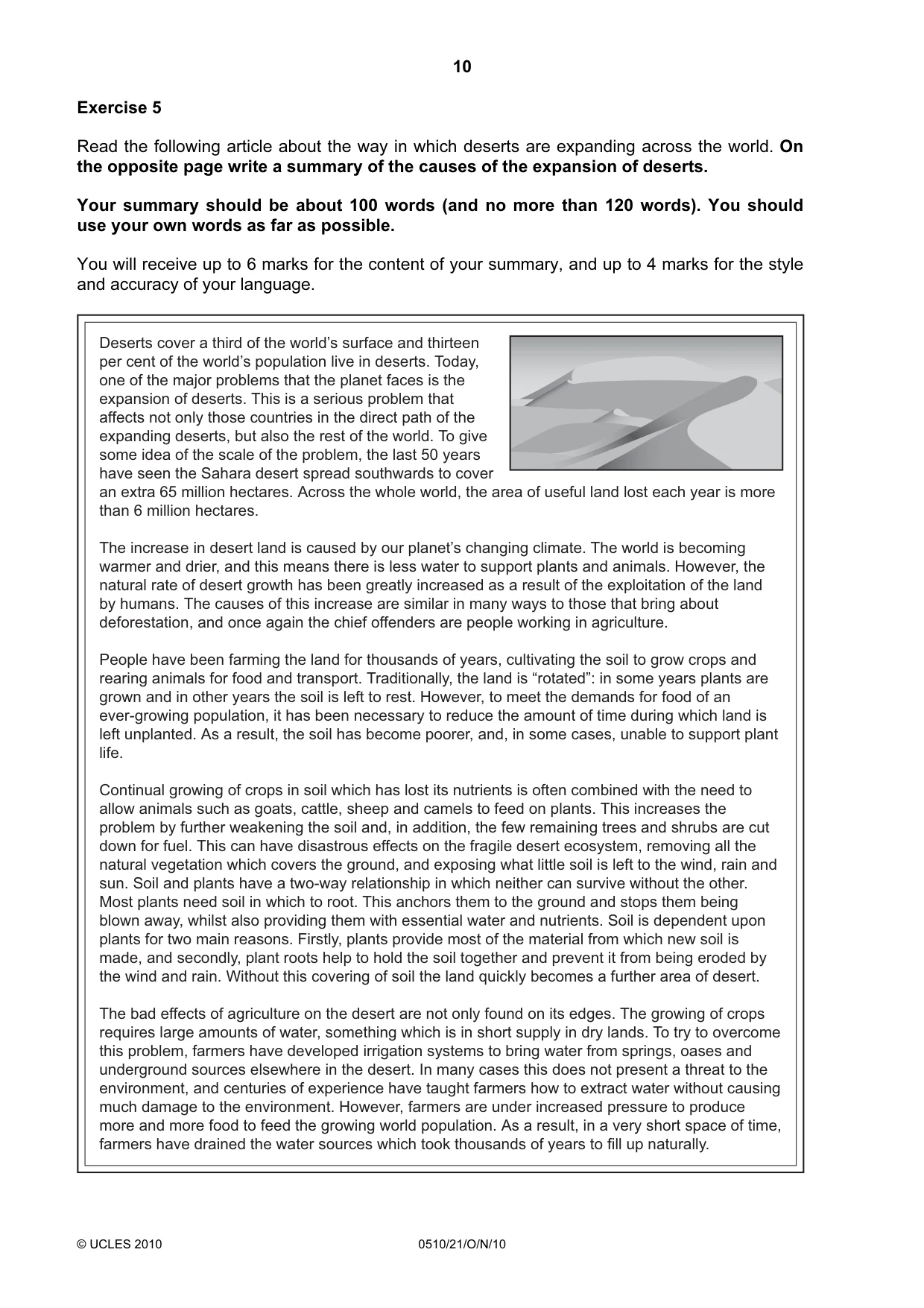
10 © UCLES 2010 0510/21/O/N/10 Exercise 5 Read the following article about the way in which deserts are expanding across the world. On the opposite page write a summary of the causes of the expansion of deserts. Your summary should be about 100 words (and no more than 120 words). You should use your own words as far as possible. You will receive up to 6 marks for the content of your summary, and up to 4 marks for the style and accuracy of your language. Deserts cover a third of the world’s surface and thirteen per cent of the world’s population live in deserts. Today, one of the major problems that the planet faces is the expansion of deserts. This is a serious problem that affects not only those countries in the direct path of the expanding deserts, but also the rest of the world. To give some idea of the scale of the problem, the last 50 years have seen the Sahara desert spread southwards to cover an extra 65 million hectares. Across the whole world, the area of useful land lost each year is more than 6 million hectares. The increase in desert land is caused by our planet’s changing climate. The world is becoming warmer and drier, and this means there is less water to support plants and animals. However, the natural rate of desert growth has been greatly increased as a result of the exploitation of the land by humans. The causes of this increase are similar in many ways to those that bring about deforestation, and once again the chief offenders are people working in agriculture. People have been farming the land for thousands of years, cultivating the soil to grow crops and rearing animals for food and transport. Traditionally, the land is “rotated”: in some years plants are grown and in other years the soil is left to rest. However, to meet the demands for food of an ever-growing population, it has been necessary to reduce the amount of time during which land is left unplanted. As a result, the soil has become poorer, and, in some cases, unable to support plant life. Continual growing of crops in soil which has lost its nutrients is often combined with the need to allow animals such as goats, cattle, sheep and camels to feed on plants. This increases the problem by further weakening the soil and, in addition, the few remaining trees and shrubs are cut down for fuel. This can have disastrous effects on the fragile desert ecosystem, removing all the natural vegetation which covers the ground, and exposing what little soil is left to the wind, rain and sun. Soil and plants have a two-way relationship in which neither can survive without the other. Most plants need soil in which to root. This anchors them to the ground and stops them being blown away, whilst also providing them with essential water and nutrients. Soil is dependent upon plants for two main reasons. Firstly, plants provide most of the material from which new soil is made, and secondly, plant roots help to hold the soil together and prevent it from being eroded by the wind and rain. Without this covering of soil the land quickly becomes a further area of desert. The bad effects of agriculture on the desert are not only found on its edges. The growing of crops requires large amounts of water, something which is in short supply in dry lands. To try to overcome this problem, farmers have developed irrigation systems to bring water from springs, oases and underground sources elsewhere in the desert. In many cases this does not present a threat to the environment, and centuries of experience have taught farmers how to extract water without causing much damage to the environment. However, farmers are under increased pressure to produce more and more food to feed the growing world population. As a result, in a very short space of time, farmers have drained the water sources which took thousands of years to fill up naturally.
Question paper, page 11
11 © UCLES 2010 0510/21/O/N/10 [Turn over For Examiner's Use [Total: 10]
Question paper, page 12
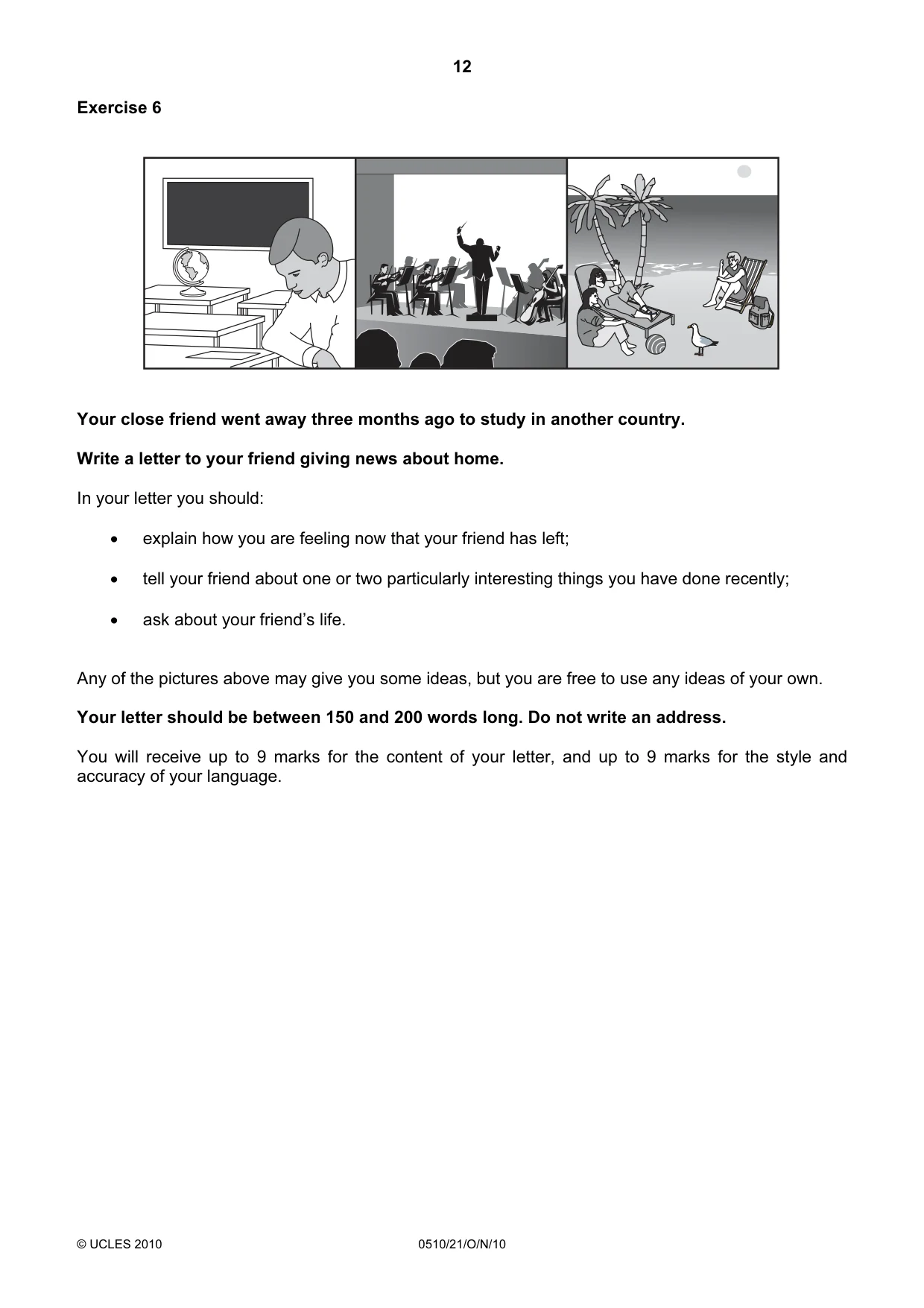
12 © UCLES 2010 0510/21/O/N/10 Exercise 6 Your close friend went away three months ago to study in another country. Write a letter to your friend giving news about home. In your letter you should: • explain how you are feeling now that your friend has left; • tell your friend about one or two particularly interesting things you have done recently; • ask about your friend’s life. Any of the pictures above may give you some ideas, but you are free to use any ideas of your own. Your letter should be between 150 and 200 words long. Do not write an address. You will receive up to 9 marks for the content of your letter, and up to 9 marks for the style and accuracy of your language.
Question paper, page 13
13 © UCLES 2010 0510/21/O/N/10 [Turn over For Examiner's Use [Total: 18]
Question paper, page 14
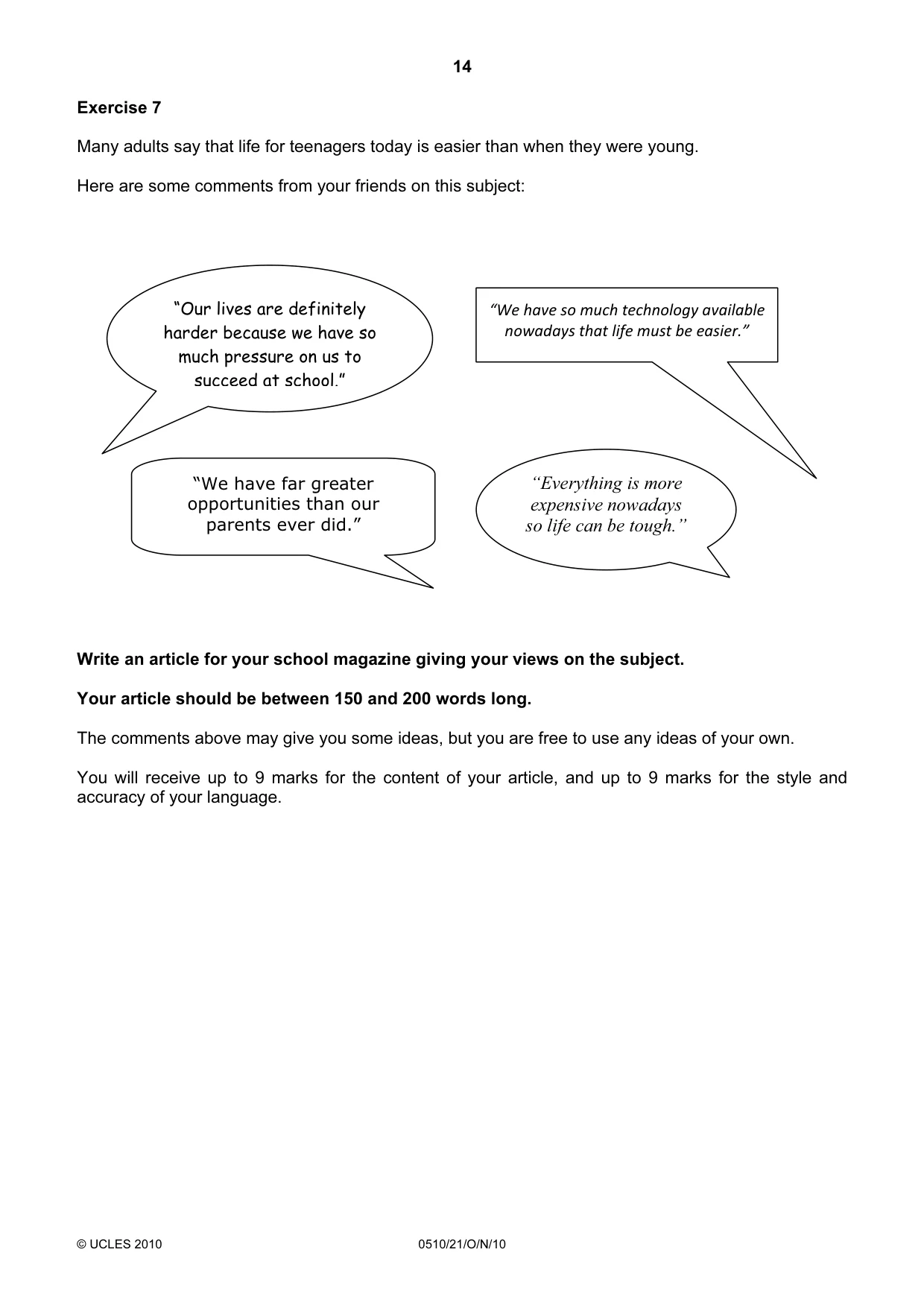
14 © UCLES 2010 0510/21/O/N/10 Exercise 7 Many adults say that life for teenagers today is easier than when they were young. Here are some comments from your friends on this subject: Write an article for your school magazine giving your views on the subject. Your article should be between 150 and 200 words long. The comments above may give you some ideas, but you are free to use any ideas of your own. You will receive up to 9 marks for the content of your article, and up to 9 marks for the style and accuracy of your language. “Our lives are definitely harder because we have so much pressure on us to succeed at school.” “We have so much technology available nowadays that life must be easier.” “Everything is more expensive nowadays so life can be tough.” “We have far greater opportunities than our parents ever did.”
Question paper, page 15
15 © UCLES 2010 0510/21/O/N/10 For Examiner's Use [Total: 18]
Question paper, page 16
16 Permission to reproduce items where third-party owned material protected by copyright is included has been sought and cleared where possible. Every reasonable effort has been made by the publisher (UCLES) to trace copyright holders, but if any items requiring clearance have unwittingly been included, the publisher will be pleased to make amends at the earliest possible opportunity. University of Cambridge International Examinations is part of the Cambridge Assessment Group. Cambridge Assessment is the brand name of University of Cambridge Local Examinations Syndicate (UCLES), which is itself a department of the University of Cambridge. © UCLES 2010 0510/21/O/N/10 BLANK PAGE
Mark scheme, page 1
UNIVERSITY OF CAMBRIDGE INTERNATIONAL EXAMINATIONS International General Certificate of Secondary Education MARK SCHEME for the October/November 2010 question paper for the guidance of teachers 0510 ENGLISH AS A SECOND LANGUAGE 0510/21 Paper 2 (Reading and Writing – Extended), maximum raw mark 84 This mark scheme is published as an aid to teachers and candidates, to indicate the requirements of the examination. It shows the basis on which Examiners were instructed to award marks. It does not indicate the details of the discussions that took place at an Examiners’ meeting before marking began, which would have considered the acceptability of alternative answers. Mark schemes must be read in conjunction with the question papers and the report on the examination. • CIE will not enter into discussions or correspondence in connection with these mark schemes. CIE is publishing the mark schemes for the October/November 2010 question papers for most IGCSE, GCE Advanced Level and Advanced Subsidiary Level syllabuses and some Ordinary Level syllabuses.
Mark scheme, page 2
Page 2 Mark Scheme: Teachers’ version Syllabus Paper IGCSE – October/November 2010 0510 21 © UCLES 2010 Exercise 1 Taking exercise: the Golden Rules (a) exercise(s) / classes / go to gym [1] (b) (too) expensive / can’t afford it / can’t afford such a luxury do not accept ‘it’s a luxury’ on its own [1] (c) make sure it’s safe / make sure it’s appropriate [1] (d) shoes that fit / appropriate shoes / right shoes AND right clothes / comfortable clothes (both points needed for 1 mark) [1] for the first idea accept the lift ‘shoes designed for the sort of exercise you want to do’. (e) how to stretch / stretching slowly and carefully / they stretch slowly and carefully [1] do not accept ‘stretching’ on its own (f) dehydrate / dehydration (suffer from) heat exhaustion performance won’t improve (any two from three, 1 mark each detail) [2] (g) body recovers AND mind has a rest (both points needed for 1 mark) [1] for the first idea accept the lift ‘will allow the muscles, tendons and joints…to recover’. [Total: 8]
Mark scheme, page 3
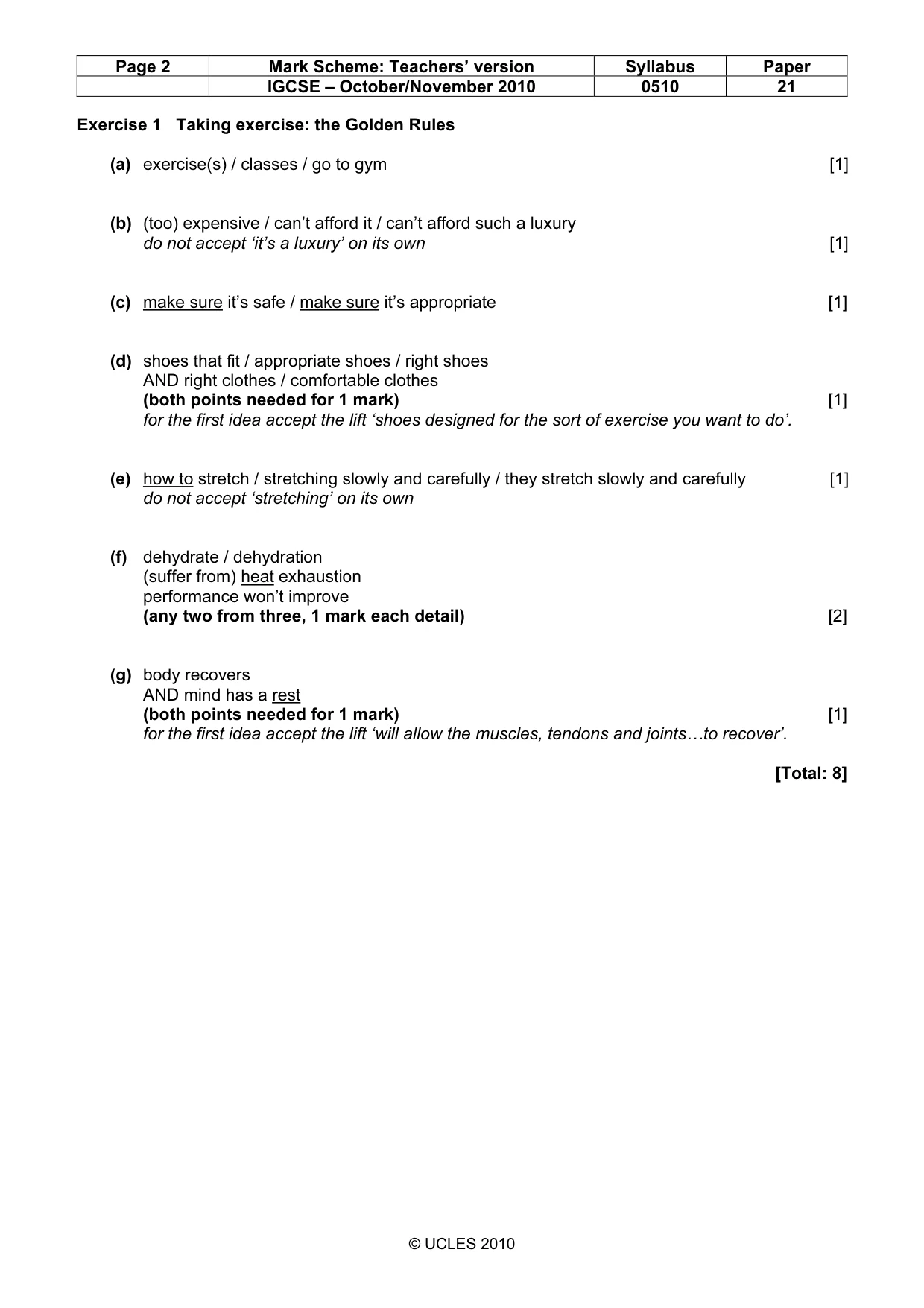
Page 3 Mark Scheme: Teachers’ version Syllabus Paper IGCSE – October/November 2010 0510 21 © UCLES 2010 Exercise 2 History of Perfume (a) (raising) scented smoke / (raising) smoke from incense [1] (b) glass (for bottles) [1] do not accept ‘glass bottles’ or ‘glass perfume bottles’ (c) Alexander the Great [1] do not accept ‘Alexander’ on its own (d) after the fall of the Roman Empire [1] (e) herbs AND flowers (both points needed for 1 mark) [1] tolerate any mention of ‘water’ if both required points present (f) modern chemistry advanced technology (1 mark for each detail) [2] do not credit ‘machinery’ or ‘industry’ as answers but tolerate as additional unnecessary information (g) cheap(er) / not expensive / less expensive available to everyone / no longer something which only the wealthy used easy to find / easier to find (any two from three for 1 mark) [1] (h) 4 million(s) / 4,000,000 [1] (i) mass production / more brand names available [1] (j) 1. religious / communicate with the gods 2. social (activities) 3. make people feel good / enjoyment / make people smell good / make the body smell good 4. maintain health / improve health 5. show how important people are / show how wealthy people are (1 mark for each correct detail up to a maximum of 4). [4] [Total: 14]
Mark scheme, page 4
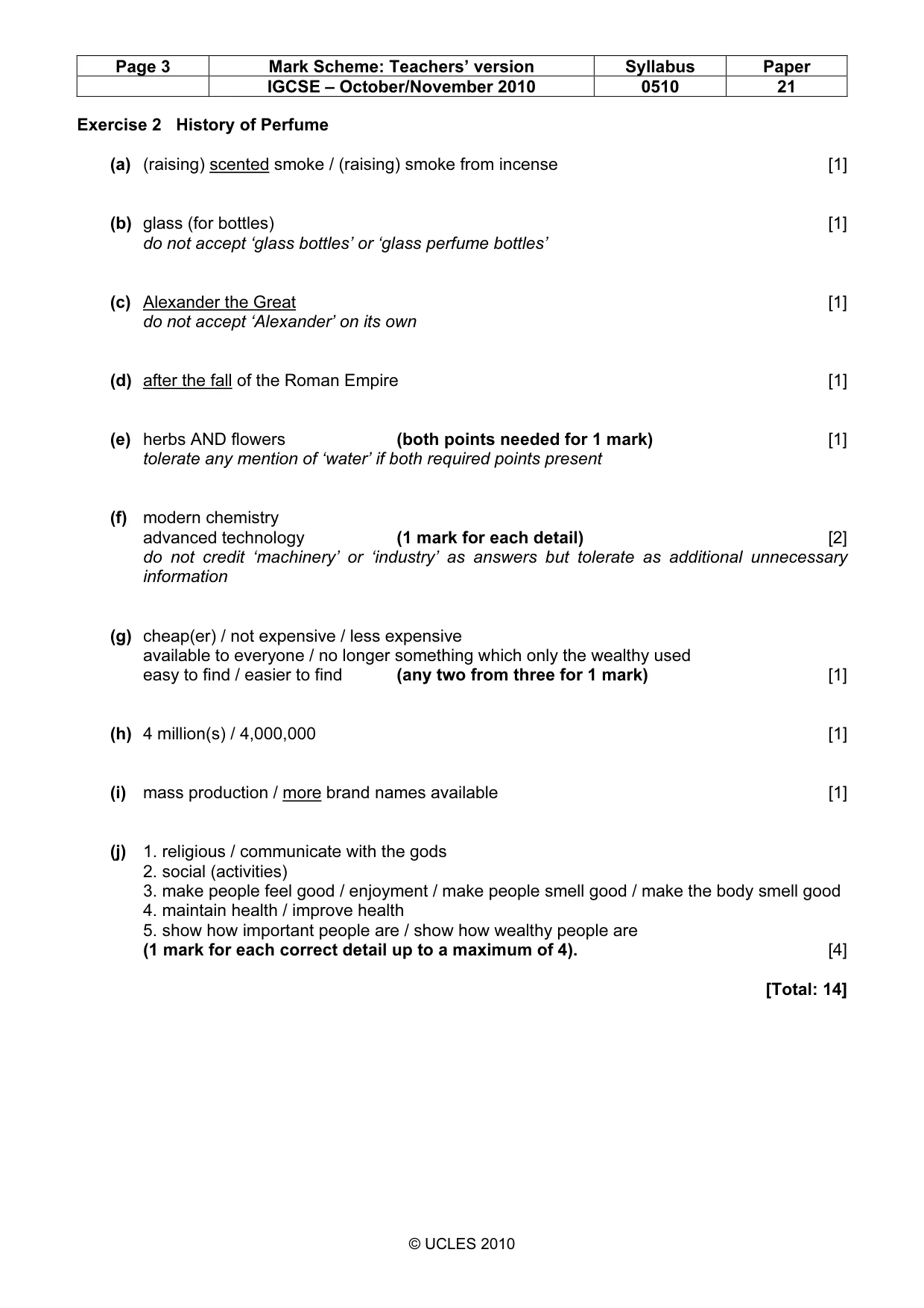
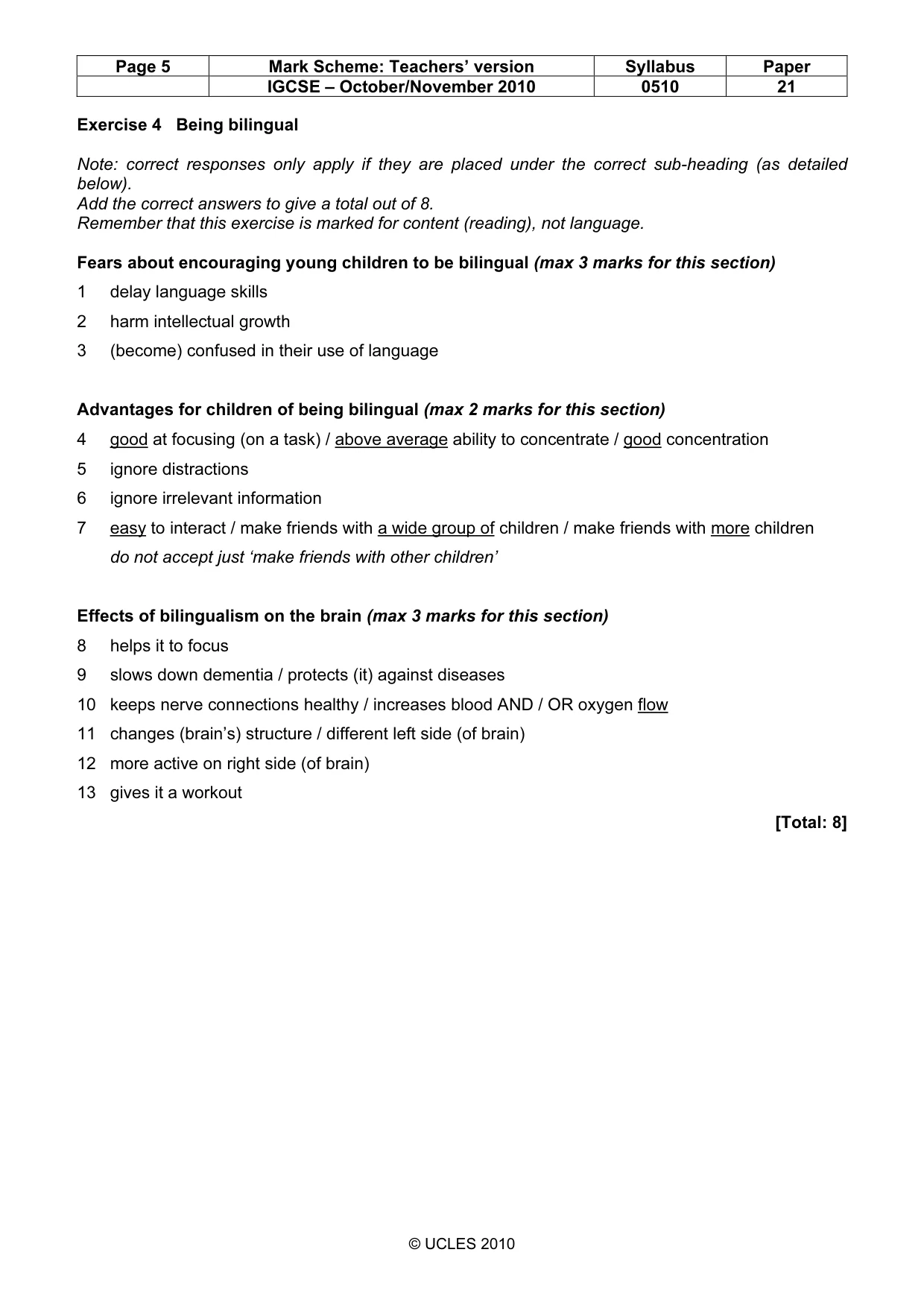
Page 4 Mark Scheme: Teachers’ version Syllabus Paper IGCSE – October/November 2010 0510 21 © UCLES 2010 Exercise 3 English Language Course Evaluation Form Note: correct spelling is essential throughout the form-filling exercise. Upper case letters required at the start of proper nouns. The conventions of form-filling (i.e. instructions to tick, circle, delete) must be observed with total accuracy. SECTION A Martino Andreou 9.9.93 / 9th September 1993 47 Apollonos Nicosia (Cyprus) 09807881 martino2@nic.cy SECTION B TICK One month course CIRCLE Excellent CIRCLE Always Project (Poor) behaviour of (some) other students Speaking AND Writing DELETE No Max. total for Sections A and B: 6 marks SECTION C Max. total for Section C: 2 marks Note: the sentence must be written from the point of view of Martino. Sample sentence 1: ‘My mother saw the advertisement in the local paper and she did not want me to be bored.’ = 2 marks Sample sentence 2: ‘It was advertised in the local paper and I don’t like being bored in the holidays.’ = 2 marks For the sentence, award 2 marks as follows: 2 marks no fewer than 12 and no more than 20 words; proper sentence construction; correct spelling, punctuation and grammar; relevant to context. 1 mark no fewer than 12 and no more than 20 words; proper sentence construction; 1- 3 errors of punctuation / spelling / grammar that do not obscure meaning; relevant to context. 0 marks more than 3 errors of punctuation / spelling / grammar; and / or irrelevant to context, and / or not a proper sentence; and / or fewer than 12 words or more than 20 words. Absence of a full stop at the end should be considered as 1 punctuation error. Absence of an upper case letter at the beginning should be considered as 1 punctuation error. [Total: 8]
Mark scheme, page 5
Page 5 Mark Scheme: Teachers’ version Syllabus Paper IGCSE – October/November 2010 0510 21 © UCLES 2010 Exercise 4 Being bilingual Note: correct responses only apply if they are placed under the correct sub-heading (as detailed below). Add the correct answers to give a total out of 8. Remember that this exercise is marked for content (reading), not language. Fears about encouraging young children to be bilingual (max 3 marks for this section) 1 delay language skills 2 harm intellectual growth 3 (become) confused in their use of language Advantages for children of being bilingual (max 2 marks for this section) 4 good at focusing (on a task) / above average ability to concentrate / good concentration 5 ignore distractions 6 ignore irrelevant information 7 easy to interact / make friends with a wide group of children / make friends with more children do not accept just ‘make friends with other children’ Effects of bilingualism on the brain (max 3 marks for this section) 8 helps it to focus 9 slows down dementia / protects (it) against diseases 10 keeps nerve connections healthy / increases blood AND / OR oxygen flow 11 changes (brain’s) structure / different left side (of brain) 12 more active on right side (of brain) 13 gives it a workout [Total: 8]
Mark scheme, page 6
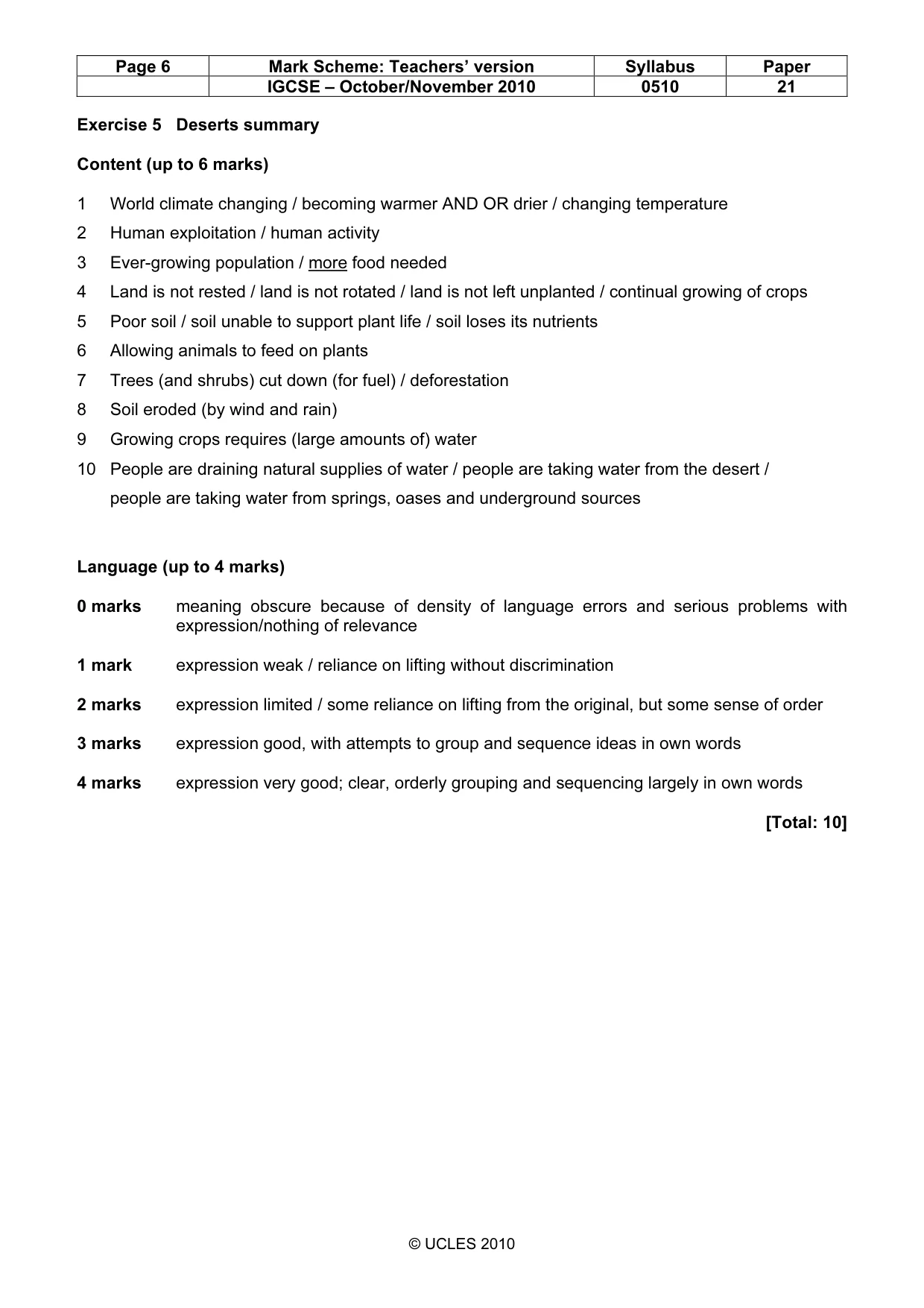
Page 6 Mark Scheme: Teachers’ version Syllabus Paper IGCSE – October/November 2010 0510 21 © UCLES 2010 Exercise 5 Deserts summary Content (up to 6 marks) 1 World climate changing / becoming warmer AND OR drier / changing temperature 2 Human exploitation / human activity 3 Ever-growing population / more food needed 4 Land is not rested / land is not rotated / land is not left unplanted / continual growing of crops 5 Poor soil / soil unable to support plant life / soil loses its nutrients 6 Allowing animals to feed on plants 7 Trees (and shrubs) cut down (for fuel) / deforestation 8 Soil eroded (by wind and rain) 9 Growing crops requires (large amounts of) water 10 People are draining natural supplies of water / people are taking water from the desert / people are taking water from springs, oases and underground sources Language (up to 4 marks) 0 marks meaning obscure because of density of language errors and serious problems with expression/nothing of relevance 1 mark expression weak / reliance on lifting without discrimination 2 marks expression limited / some reliance on lifting from the original, but some sense of order 3 marks expression good, with attempts to group and sequence ideas in own words 4 marks expression very good; clear, orderly grouping and sequencing largely in own words [Total: 10]
Mark scheme, page 7
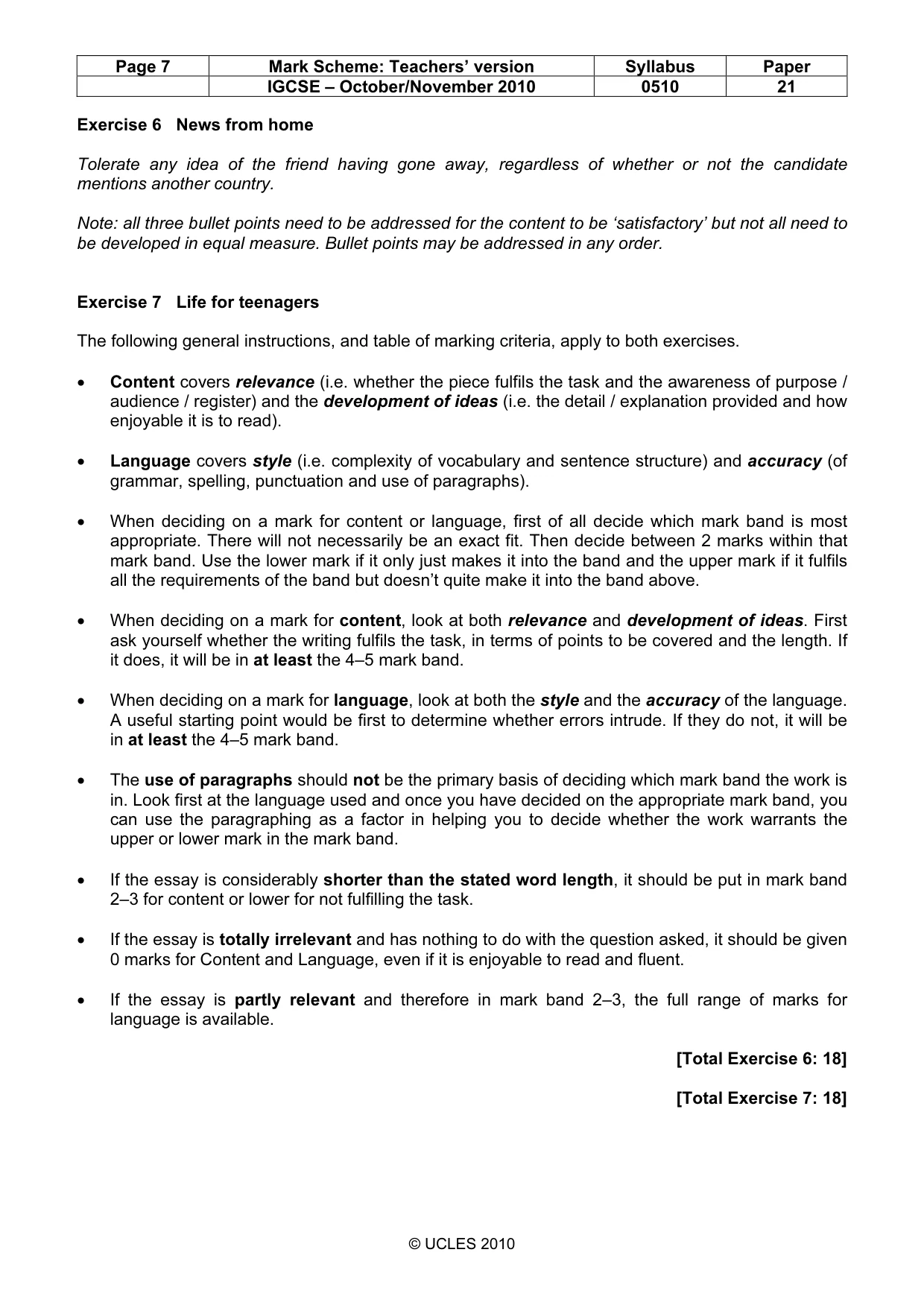
Page 7 Mark Scheme: Teachers’ version Syllabus Paper IGCSE – October/November 2010 0510 21 © UCLES 2010 Exercise 6 News from home Tolerate any idea of the friend having gone away, regardless of whether or not the candidate mentions another country. Note: all three bullet points need to be addressed for the content to be ‘satisfactory’ but not all need to be developed in equal measure. Bullet points may be addressed in any order. Exercise 7 Life for teenagers The following general instructions, and table of marking criteria, apply to both exercises. • Content covers relevance (i.e. whether the piece fulfils the task and the awareness of purpose / audience / register) and the development of ideas (i.e. the detail / explanation provided and how enjoyable it is to read). • Language covers style (i.e. complexity of vocabulary and sentence structure) and accuracy (of grammar, spelling, punctuation and use of paragraphs). • When deciding on a mark for content or language, first of all decide which mark band is most appropriate. There will not necessarily be an exact fit. Then decide between 2 marks within that mark band. Use the lower mark if it only just makes it into the band and the upper mark if it fulfils all the requirements of the band but doesn’t quite make it into the band above. • When deciding on a mark for content, look at both relevance and development of ideas. First ask yourself whether the writing fulfils the task, in terms of points to be covered and the length. If it does, it will be in at least the 4–5 mark band. • When deciding on a mark for language, look at both the style and the accuracy of the language. A useful starting point would be first to determine whether errors intrude. If they do not, it will be in at least the 4–5 mark band. • The use of paragraphs should not be the primary basis of deciding which mark band the work is in. Look first at the language used and once you have decided on the appropriate mark band, you can use the paragraphing as a factor in helping you to decide whether the work warrants the upper or lower mark in the mark band. • If the essay is considerably shorter than the stated word length, it should be put in mark band 2–3 for content or lower for not fulfilling the task. • If the essay is totally irrelevant and has nothing to do with the question asked, it should be given 0 marks for Content and Language, even if it is enjoyable to read and fluent. • If the essay is partly relevant and therefore in mark band 2–3, the full range of marks for language is available. [Total Exercise 6: 18] [Total Exercise 7: 18]
Mark scheme, page 8
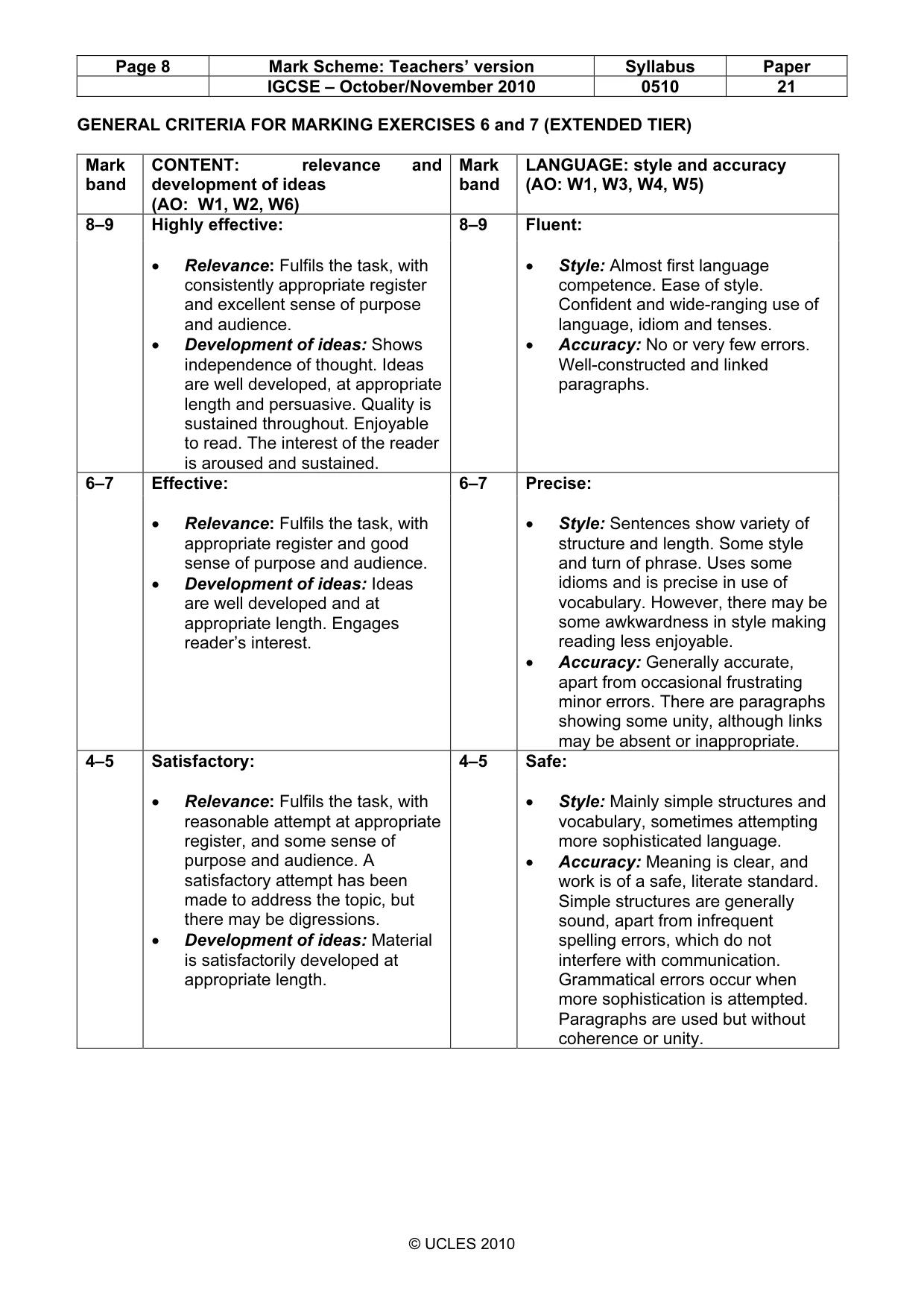
Page 8 Mark Scheme: Teachers’ version Syllabus Paper IGCSE – October/November 2010 0510 21 © UCLES 2010 GENERAL CRITERIA FOR MARKING EXERCISES 6 and 7 (EXTENDED TIER) Mark band CONTENT: relevance and development of ideas (AO: W1, W2, W6) Mark band LANGUAGE: style and accuracy (AO: W1, W3, W4, W5) 8–9 8–9 Highly effective: • Relevance: Fulfils the task, with consistently appropriate register and excellent sense of purpose and audience. • Development of ideas: Shows independence of thought. Ideas are well developed, at appropriate length and persuasive. Quality is sustained throughout. Enjoyable to read. The interest of the reader is aroused and sustained. Fluent: • Style: Almost first language competence. Ease of style. Confident and wide-ranging use of language, idiom and tenses. • Accuracy: No or very few errors. Well-constructed and linked paragraphs. 6–7 6–7 Effective: • Relevance: Fulfils the task, with appropriate register and good sense of purpose and audience. • Development of ideas: Ideas are well developed and at appropriate length. Engages reader’s interest. Precise: • Style: Sentences show variety of structure and length. Some style and turn of phrase. Uses some idioms and is precise in use of vocabulary. However, there may be some awkwardness in style making reading less enjoyable. • Accuracy: Generally accurate, apart from occasional frustrating minor errors. There are paragraphs showing some unity, although links may be absent or inappropriate. 4–5 4–5 Satisfactory: • Relevance: Fulfils the task, with reasonable attempt at appropriate register, and some sense of purpose and audience. A satisfactory attempt has been made to address the topic, but there may be digressions. • Development of ideas: Material is satisfactorily developed at appropriate length. Safe: • Style: Mainly simple structures and vocabulary, sometimes attempting more sophisticated language. • Accuracy: Meaning is clear, and work is of a safe, literate standard. Simple structures are generally sound, apart from infrequent spelling errors, which do not interfere with communication. Grammatical errors occur when more sophistication is attempted. Paragraphs are used but without coherence or unity.
Mark scheme, page 9
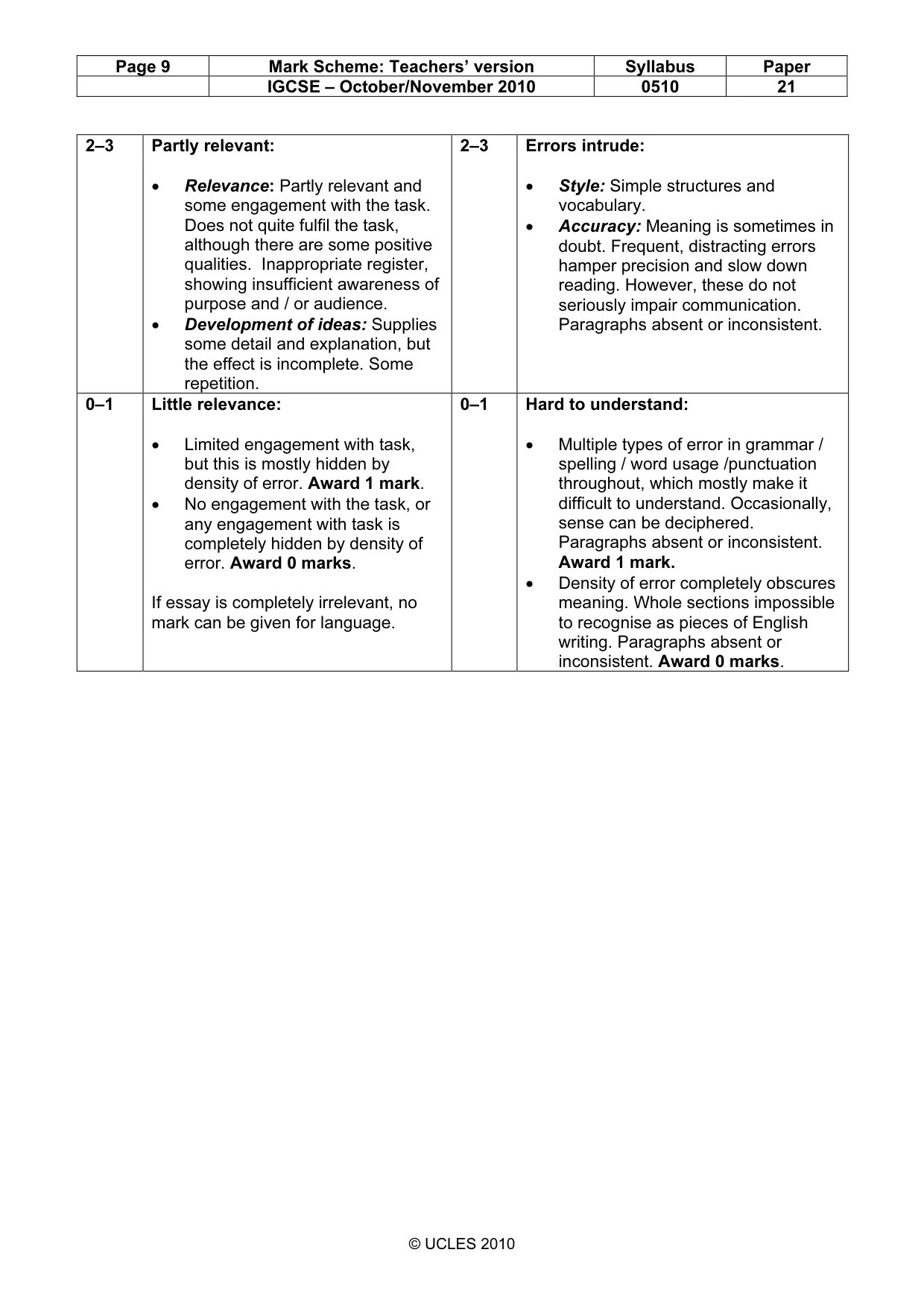
Page 9 Mark Scheme: Teachers’ version Syllabus Paper IGCSE – October/November 2010 0510 21 © UCLES 2010 2–3 2–3 Partly relevant: • Relevance: Partly relevant and some engagement with the task. Does not quite fulfil the task, although there are some positive qualities. Inappropriate register, showing insufficient awareness of purpose and / or audience. • Development of ideas: Supplies some detail and explanation, but the effect is incomplete. Some repetition. Errors intrude: • Style: Simple structures and vocabulary. • Accuracy: Meaning is sometimes in doubt. Frequent, distracting errors hamper precision and slow down reading. However, these do not seriously impair communication. Paragraphs absent or inconsistent. 0–1 0–1 Little relevance: • Limited engagement with task, but this is mostly hidden by density of error. Award 1 mark. • No engagement with the task, or any engagement with task is completely hidden by density of error. Award 0 marks. If essay is completely irrelevant, no mark can be given for language. Hard to understand: • Multiple types of error in grammar / spelling / word usage /punctuation throughout, which mostly make it difficult to understand. Occasionally, sense can be deciphered. Paragraphs absent or inconsistent. Award 1 mark. • Density of error completely obscures meaning. Whole sections impossible to recognise as pieces of English writing. Paragraphs absent or inconsistent. Award 0 marks.
What you needed in this session
Cambridge’s own grade thresholds for 2010 Oct/Nov, Paper 2 · Variant 1. A higher threshold means an easier paper — the bar moves with how the cohort did.