Cambridge IGCSE English - Second Language (oral endorsement) 0510 — 2009 Oct/Nov Paper 3 · Variant 1
0510/31/O/N/09 · 30 marks · ≈34 min
The question paper and its mark scheme, free to read here and free to download. This is Cambridge’s own paper, exactly as it was sat.
Question paper8 pages


Mark scheme13 pages
Answers below. Sit the paper first if you are practising.
Paper as text
Question paper, page 1
This document consists of 6 printed pages and 2 blank pages. IB09 11_0510_03/6RP © UCLES 2009 [Turn over *2219520781* For Examiner's Use Questions 1-6 Question 7 Question 8 Question 9 Question 10 Total UNIVERSITY OF CAMBRIDGE INTERNATIONAL EXAMINATIONS International General Certificate of Secondary Education ENGLISH AS A SECOND LANGUAGE 0510/03 Paper 3 Listening (Core) October/November 2009 Approx. 30 – 40 minutes Candidates answer on the Question Paper. Additional Materials: As listed in Instructions to Supervisors. READ THESE INSTRUCTIONS FIRST Write your Centre number, candidate number and name on all the work you hand in. Write in dark blue or black pen. Do not use staples, paper clips, highlighters, glue or correction fluid. DO NOT WRITE IN ANY BARCODES. Answer all questions. Dictionaries are not permitted. At the end of the examination, fasten all your work securely together. The number of marks is given in brackets [ ] at the end of each question or part question. www.xtremepapers.net
Question paper, page 2
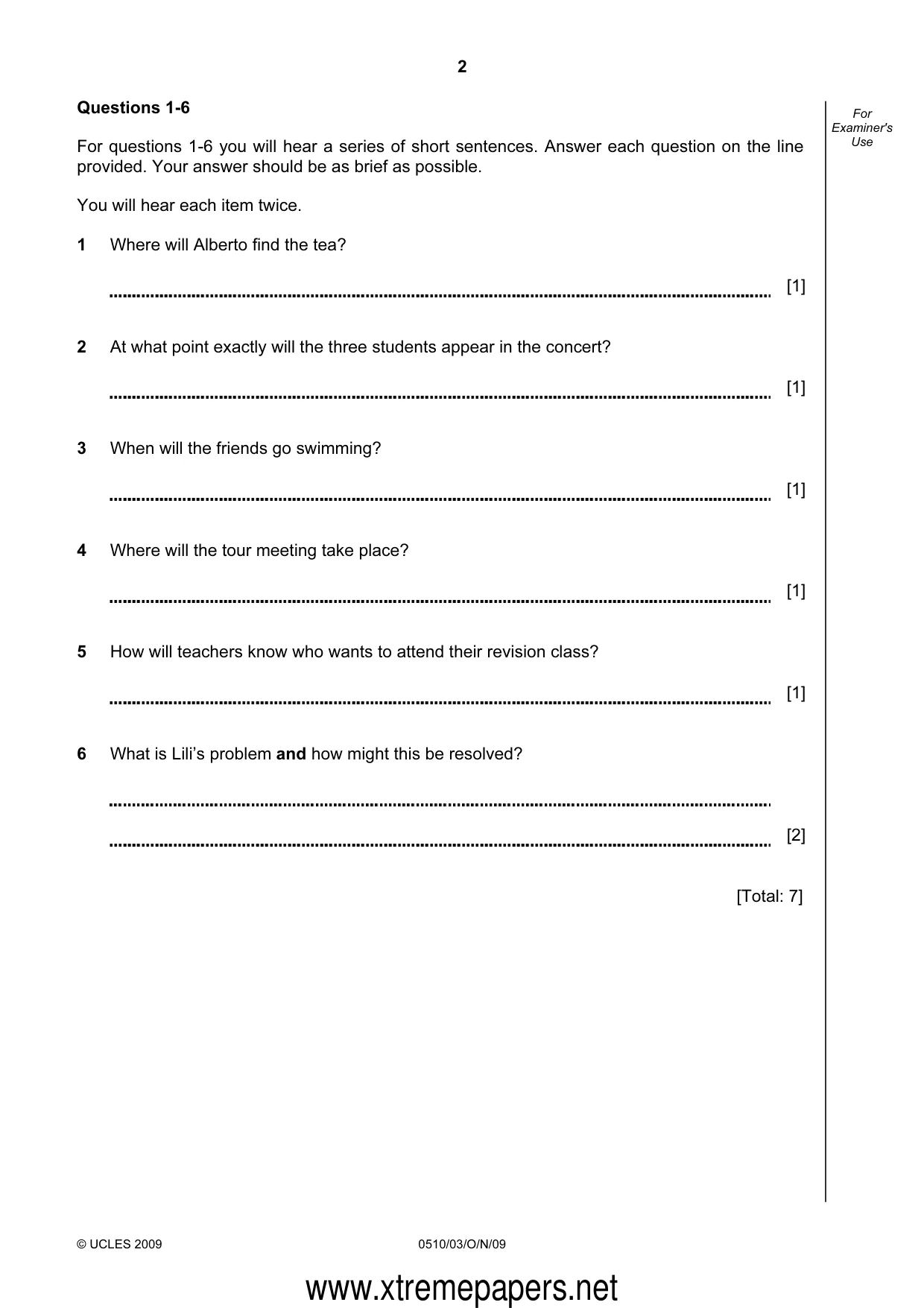
2 © UCLES 2009 0510/03/O/N/09 For Examiner's Use Questions 1-6 For questions 1-6 you will hear a series of short sentences. Answer each question on the line provided. Your answer should be as brief as possible. You will hear each item twice. 1 Where will Alberto find the tea? [1] 2 At what point exactly will the three students appear in the concert? [1] 3 When will the friends go swimming? [1] 4 Where will the tour meeting take place? [1] 5 How will teachers know who wants to attend their revision class? [1] 6 What is Lili’s problem and how might this be resolved? [2] [Total: 7] www.xtremepapers.net
Question paper, page 3
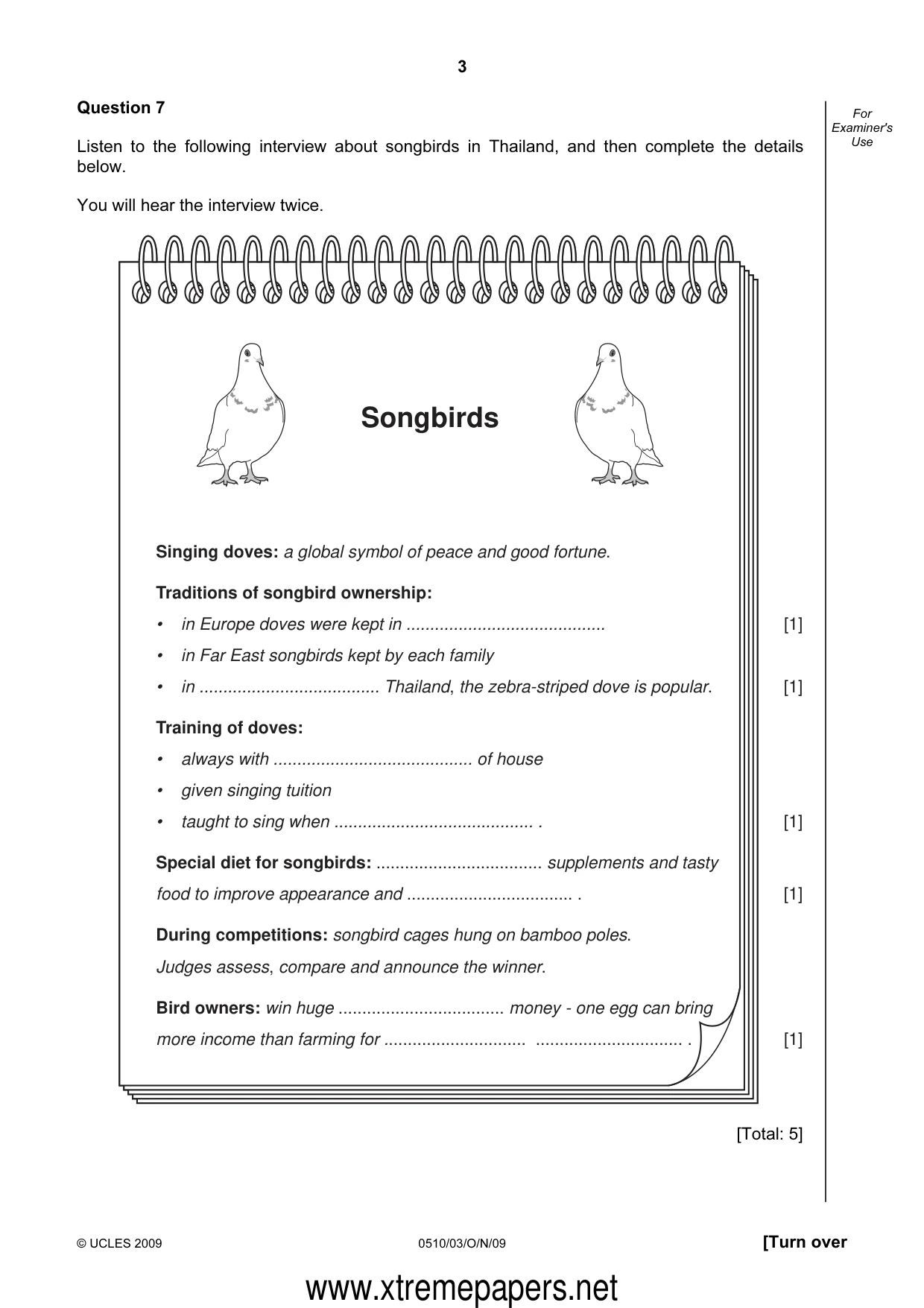
3 © UCLES 2009 0510/03/O/N/09 [Turn over For Examiner's Use Question 7 Listen to the following interview about songbirds in Thailand, and then complete the details below. You will hear the interview twice. Songbirds Singing doves: a global symbol of peace and good fortune. Traditions of songbird ownership: • in Europe doves were kept in … [1] • in Far East songbirds kept by each family • in … Thailand, the zebra-striped dove is popular. [1] Training of doves: • always with … of house • given singing tuition • taught to sing when … . [1] Special diet for songbirds: … supplements and tasty food to improve appearance and … . [1] During competitions: songbird cages hung on bamboo poles. Judges assess, compare and announce the winner. Bird owners: win huge … money - one egg can bring more income than farming for … … . [1] [Total: 5] www.xtremepapers.net
Question paper, page 4
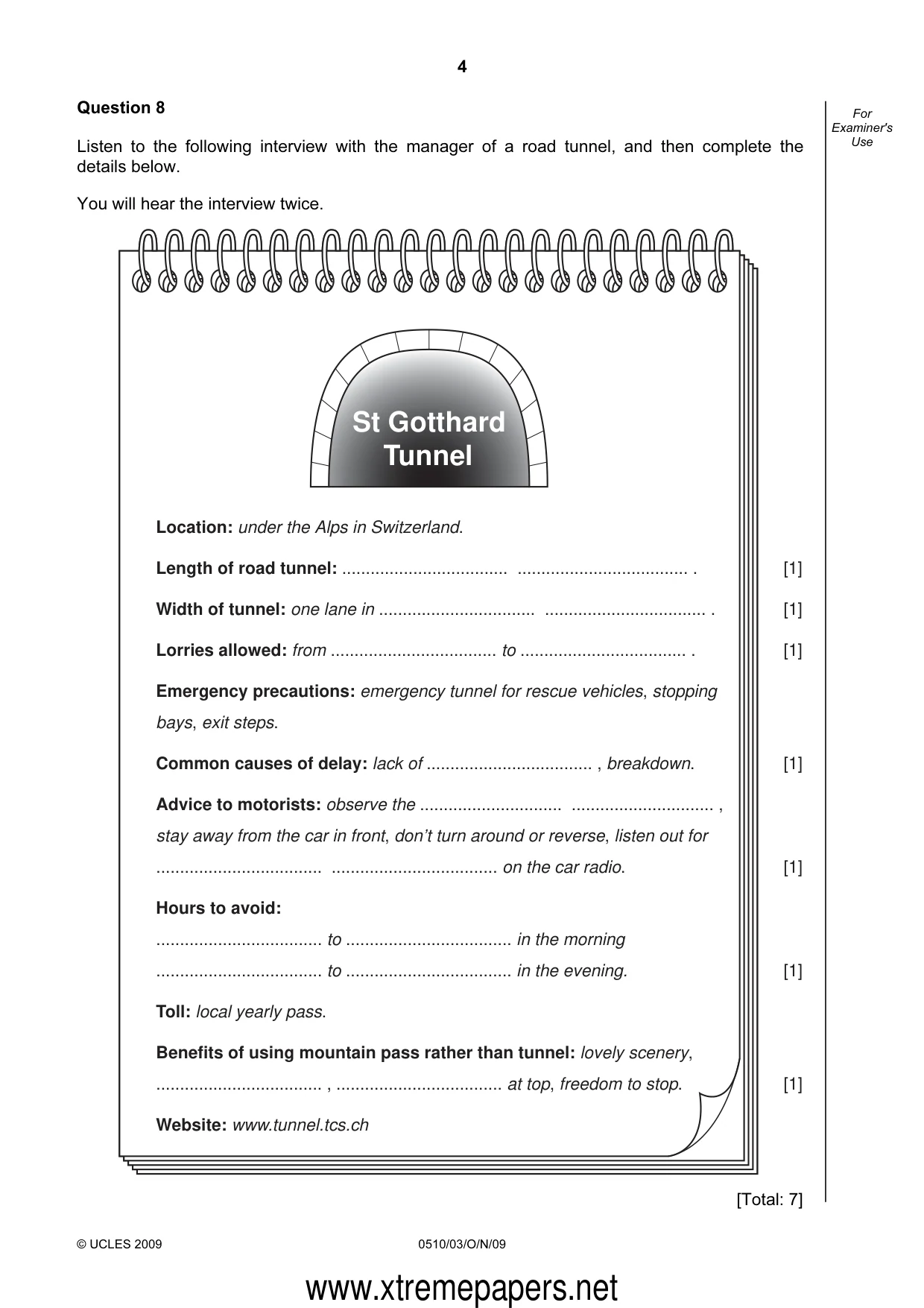
4 © UCLES 2009 0510/03/O/N/09 For Examiner's Use Question 8 Listen to the following interview with the manager of a road tunnel, and then complete the details below. You will hear the interview twice. St Gotthard Tunnel Location: under the Alps in Switzerland. Length of road tunnel: … … . [1] Width of tunnel: one lane in … … . [1] Lorries allowed: from … to … . [1] Emergency precautions: emergency tunnel for rescue vehicles, stopping bays, exit steps. Common causes of delay: lack of … , breakdown. [1] Advice to motorists: observe the … … , stay away from the car in front, don’t turn around or reverse, listen out for … … on the car radio. [1] Hours to avoid: … to … in the morning … to … in the evening. [1] Toll: local yearly pass. Benefits of using mountain pass rather than tunnel: lovely scenery, … , … at top, freedom to stop. [1] Website: www.tunnel.tcs.ch [Total: 7] www.xtremepapers.net
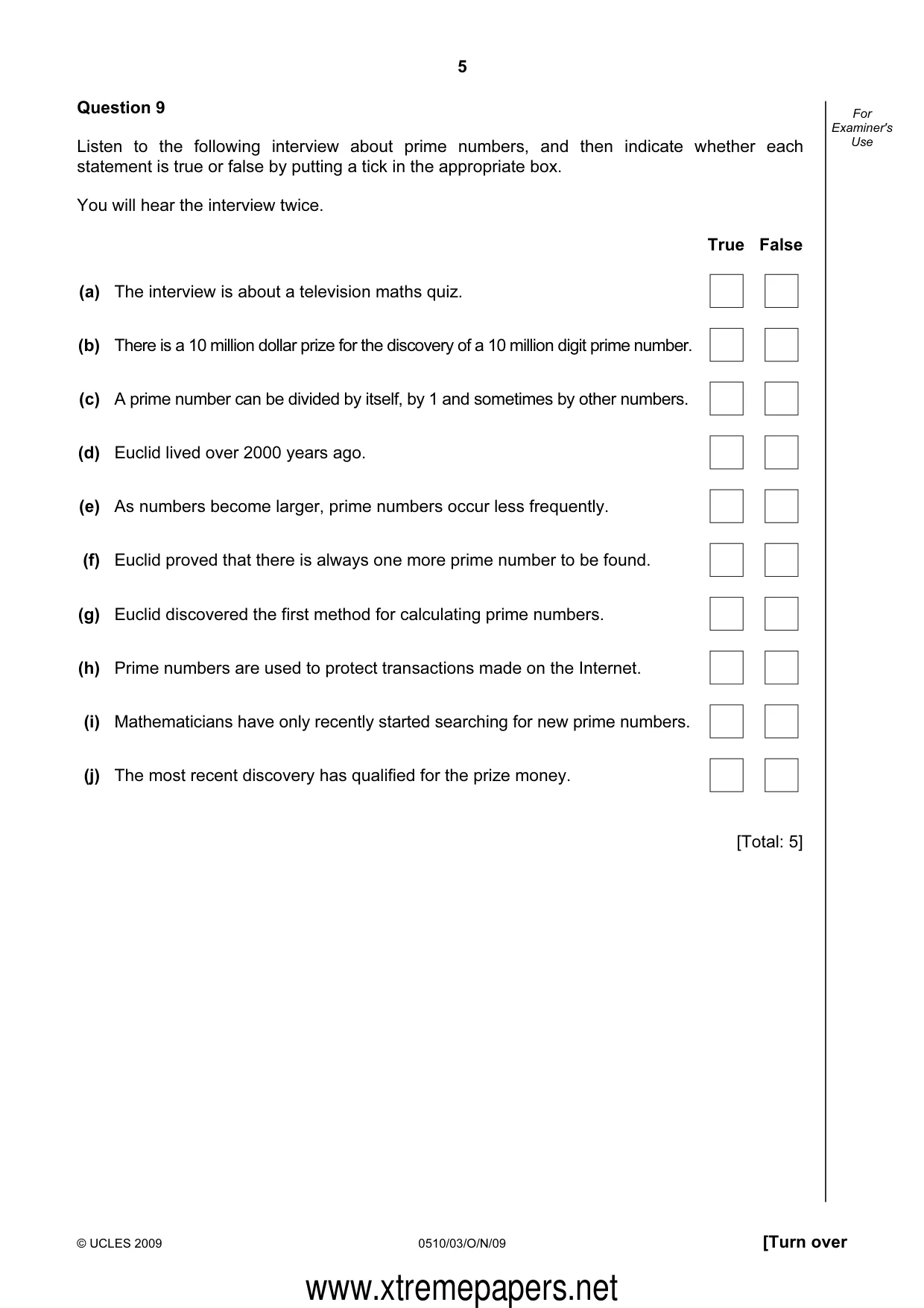
Question paper, page 5
5 © UCLES 2009 0510/03/O/N/09 [Turn over For Examiner's Use Question 9 Listen to the following interview about prime numbers, and then indicate whether each statement is true or false by putting a tick in the appropriate box. You will hear the interview twice. True False (a) The interview is about a television maths quiz. (b) There is a 10 million dollar prize for the discovery of a 10 million digit prime number. (c) A prime number can be divided by itself, by 1 and sometimes by other numbers. (d) Euclid lived over 2000 years ago. (e) As numbers become larger, prime numbers occur less frequently. (f) Euclid proved that there is always one more prime number to be found. (g) Euclid discovered the first method for calculating prime numbers. (h) Prime numbers are used to protect transactions made on the Internet. (i) Mathematicians have only recently started searching for new prime numbers. (j) The most recent discovery has qualified for the prize money. [Total: 5] www.xtremepapers.net
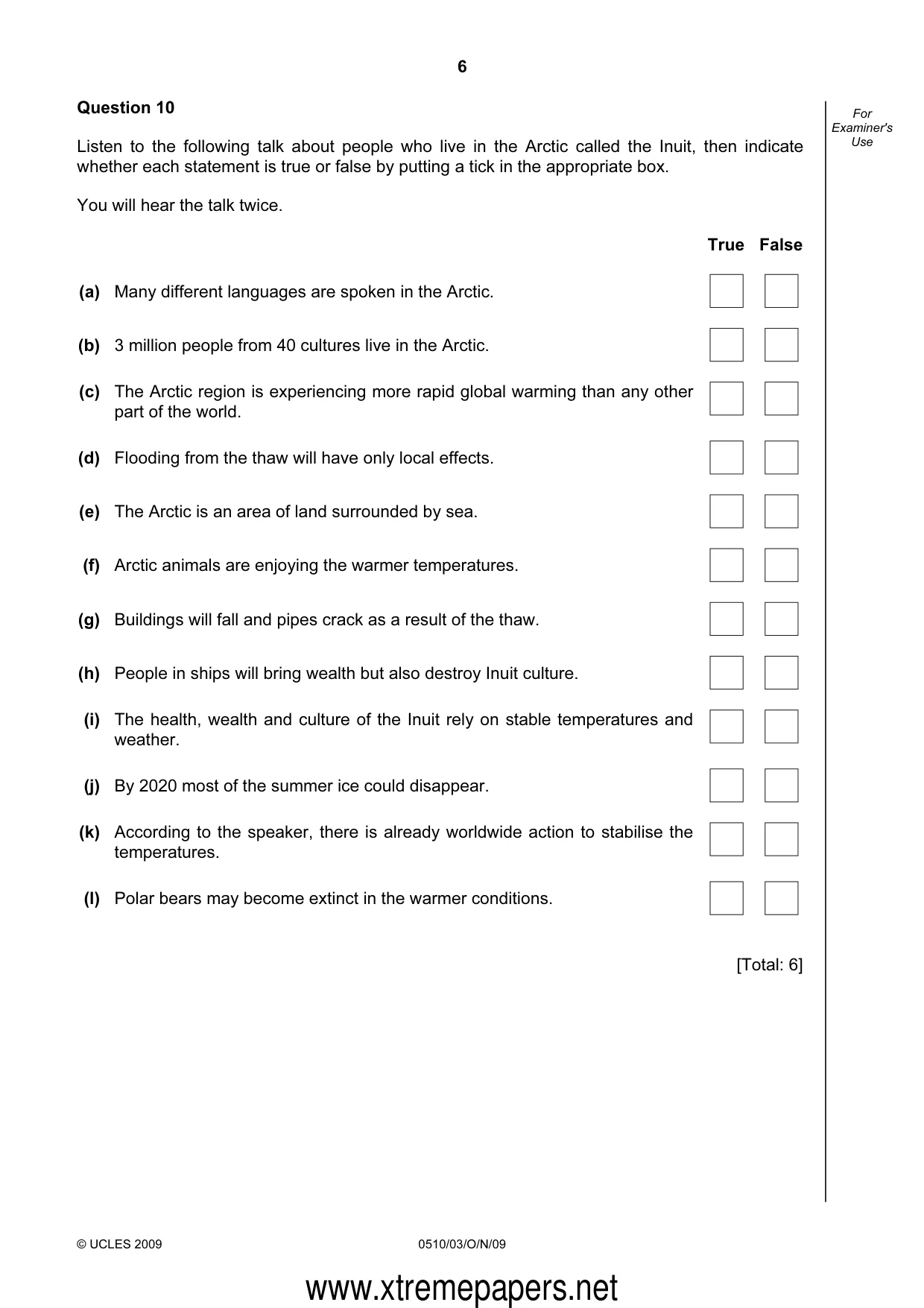
Question paper, page 6
6 © UCLES 2009 0510/03/O/N/09 For Examiner's Use Question 10 Listen to the following talk about people who live in the Arctic called the Inuit, then indicate whether each statement is true or false by putting a tick in the appropriate box. You will hear the talk twice. True False (a) Many different languages are spoken in the Arctic. (b) 3 million people from 40 cultures live in the Arctic. (c) The Arctic region is experiencing more rapid global warming than any other part of the world. (d) Flooding from the thaw will have only local effects. (e) The Arctic is an area of land surrounded by sea. (f) Arctic animals are enjoying the warmer temperatures. (g) Buildings will fall and pipes crack as a result of the thaw. (h) People in ships will bring wealth but also destroy Inuit culture. (i) The health, wealth and culture of the Inuit rely on stable temperatures and weather. (j) By 2020 most of the summer ice could disappear. (k) According to the speaker, there is already worldwide action to stabilise the temperatures. (l) Polar bears may become extinct in the warmer conditions. [Total: 6] www.xtremepapers.net
Question paper, page 7
7 0510/03/O/N/09 BLANK PAGE www.xtremepapers.net
Question paper, page 8
8 Permission to reproduce items where third-party owned material protected by copyright is included has been sought and cleared where possible. Every reasonable effort has been made by the publisher (UCLES) to trace copyright holders, but if any items requiring clearance have unwittingly been included, the publisher will be pleased to make amends at the earliest possible opportunity. University of Cambridge International Examinations is part of the Cambridge Assessment Group. Cambridge Assessment is the brand name of University of Cambridge Local Examinations Syndicate (UCLES), which is itself a department of the University of Cambridge. 0510/03/O/N/09 BLANK PAGE www.xtremepapers.net
Mark scheme, page 1
UNIVERSITY OF CAMBRIDGE INTERNATIONAL EXAMINATIONS International General Certificate of Secondary Education MARK SCHEME for the October/November 2009 question paper for the guidance of teachers 0510 ENGLISH AS A SECOND LANGUAGE 0510/03 Paper 3 (Listening – Core), maximum raw mark 30 This mark scheme is published as an aid to teachers and candidates, to indicate the requirements of the examination. It shows the basis on which Examiners were instructed to award marks. It does not indicate the details of the discussions that took place at an Examiners’ meeting before marking began, which would have considered the acceptability of alternative answers. Mark schemes must be read in conjunction with the question papers and the report on the examination. • CIE will not enter into discussions or correspondence in connection with these mark schemes. CIE is publishing the mark schemes for the October/November 2009 question papers for most IGCSE, GCE Advanced Level and Advanced Subsidiary Level syllabuses and some Ordinary Level syllabuses. www.xtremepapers.net
Mark scheme, page 2
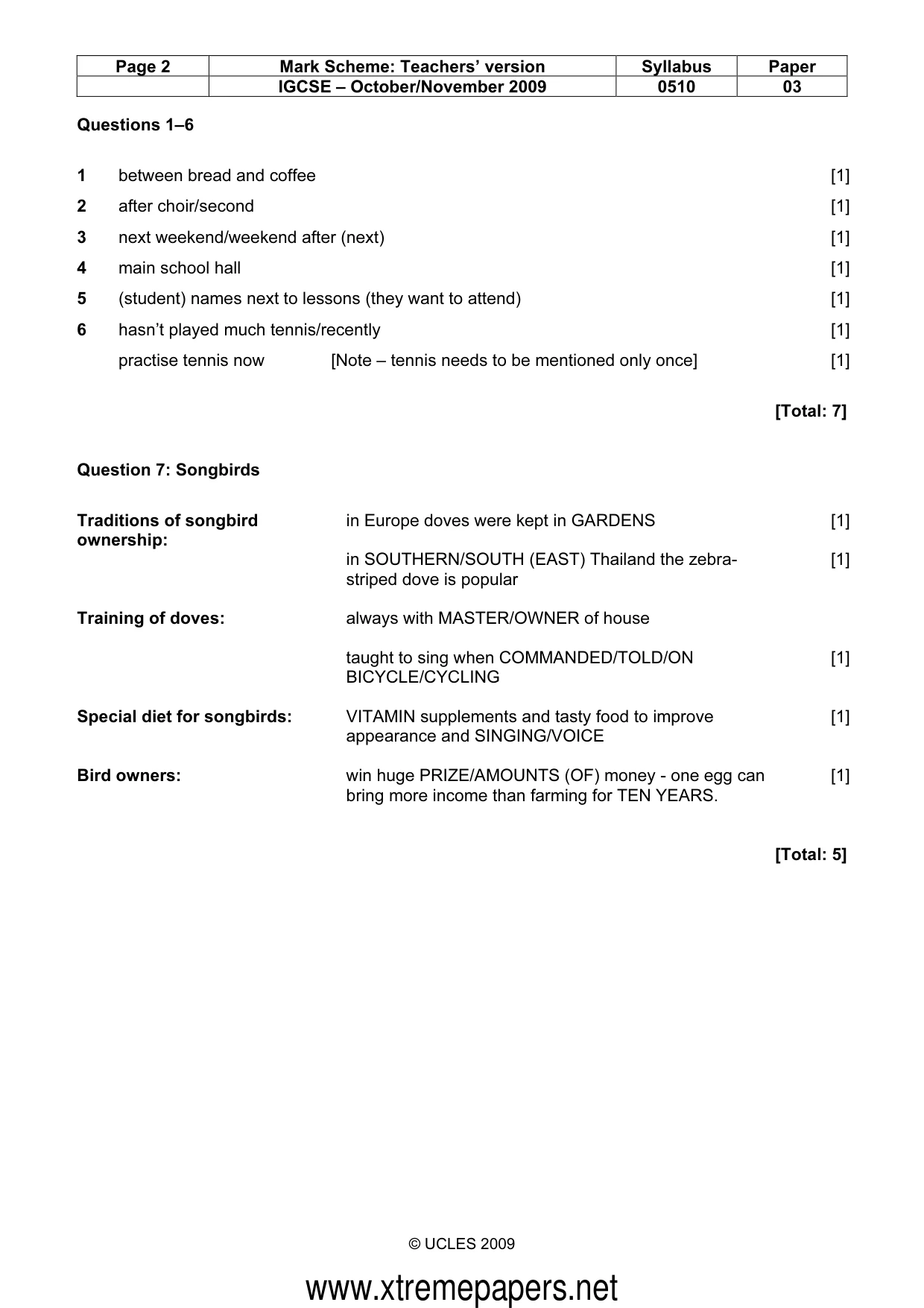
Page 2 Mark Scheme: Teachers’ version Syllabus Paper IGCSE – October/November 2009 0510 03 © UCLES 2009 Questions 1–6 1 between bread and coffee [1] 2 after choir/second [1] 3 next weekend/weekend after (next) [1] 4 main school hall [1] 5 (student) names next to lessons (they want to attend) [1] 6 hasn’t played much tennis/recently [1] practise tennis now [Note – tennis needs to be mentioned only once] [1] [Total: 7] Question 7: Songbirds Traditions of songbird ownership: in Europe doves were kept in GARDENS [1] in SOUTHERN/SOUTH (EAST) Thailand the zebra- striped dove is popular [1] Training of doves: always with MASTER/OWNER of house taught to sing when COMMANDED/TOLD/ON BICYCLE/CYCLING [1] Special diet for songbirds: VITAMIN supplements and tasty food to improve appearance and SINGING/VOICE [1] Bird owners: win huge PRIZE/AMOUNTS (OF) money - one egg can bring more income than farming for TEN YEARS. [1] [Total: 5] www.xtremepapers.net
Mark scheme, page 3
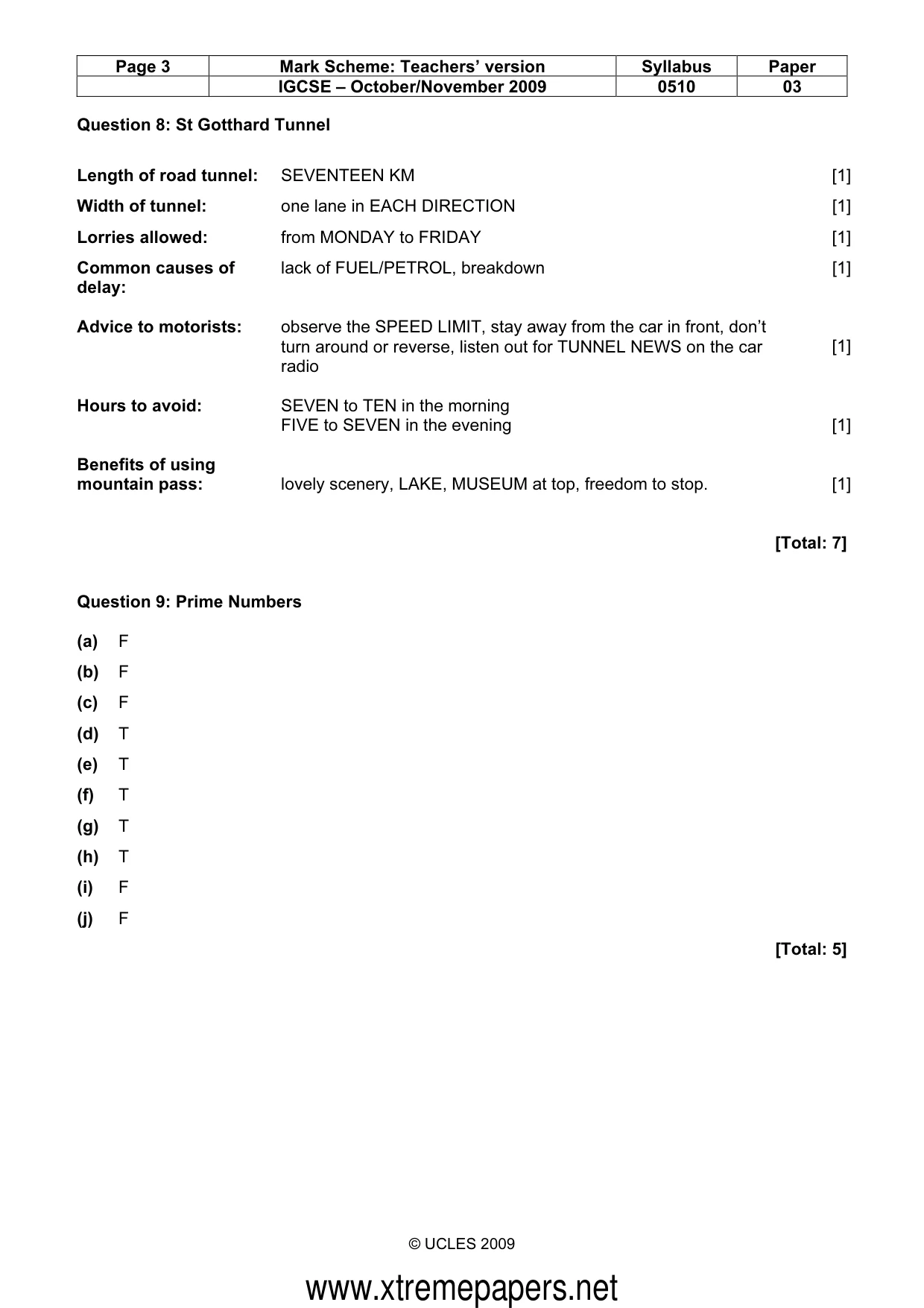
Page 3 Mark Scheme: Teachers’ version Syllabus Paper IGCSE – October/November 2009 0510 03 © UCLES 2009 Question 8: St Gotthard Tunnel Length of road tunnel: SEVENTEEN KM [1] Width of tunnel: one lane in EACH DIRECTION [1] Lorries allowed: from MONDAY to FRIDAY [1] Common causes of delay: lack of FUEL/PETROL, breakdown [1] Advice to motorists: observe the SPEED LIMIT, stay away from the car in front, don’t turn around or reverse, listen out for TUNNEL NEWS on the car radio [1] Hours to avoid: SEVEN to TEN in the morning FIVE to SEVEN in the evening [1] Benefits of using mountain pass: lovely scenery, LAKE, MUSEUM at top, freedom to stop. [1] [Total: 7] Question 9: Prime Numbers (a) F (b) F (c) F (d) T (e) T (f) T (g) T (h) T (i) F (j) F [Total: 5] www.xtremepapers.net
Mark scheme, page 4
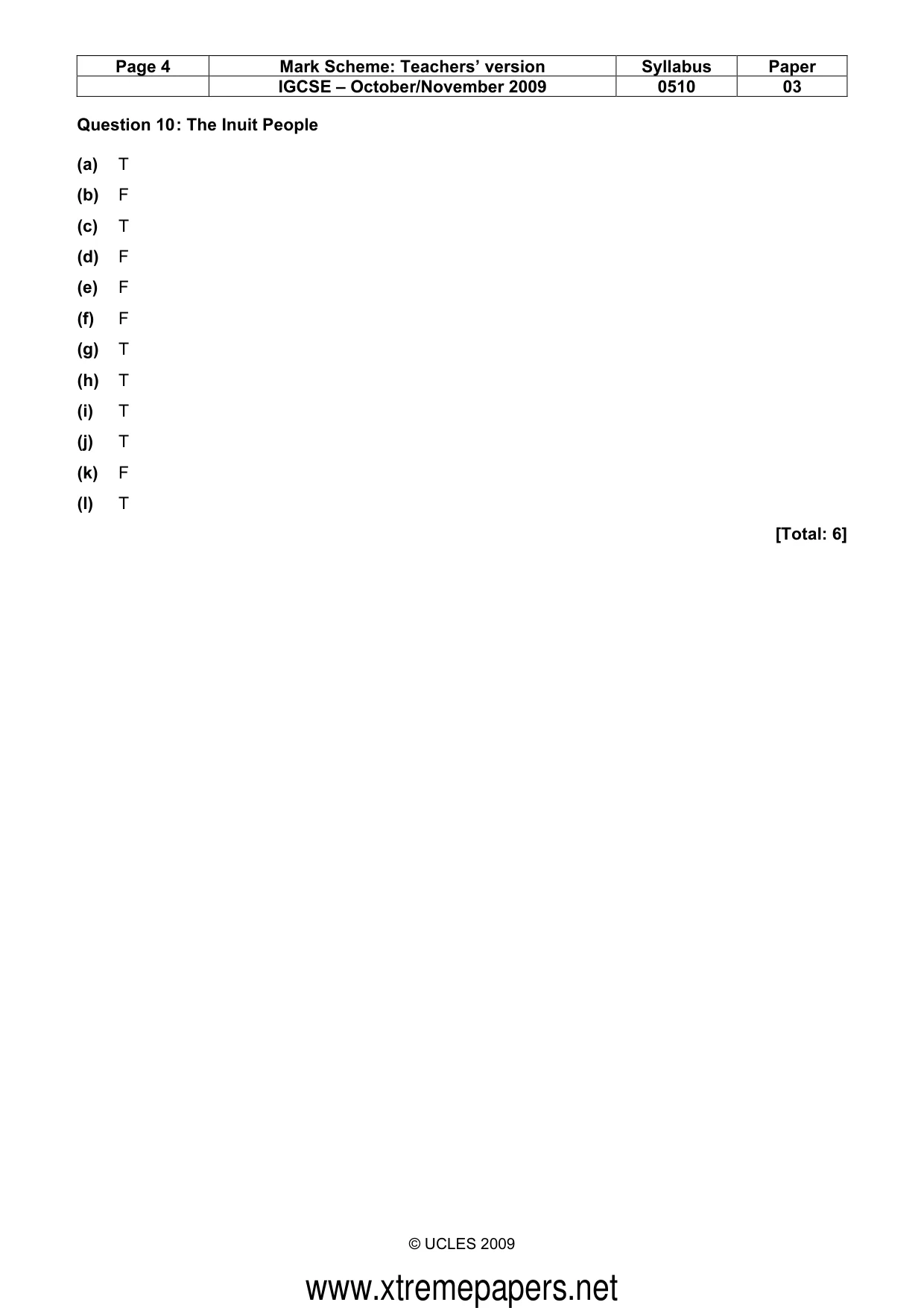
Page 4 Mark Scheme: Teachers’ version Syllabus Paper IGCSE – October/November 2009 0510 03 © UCLES 2009 Question 10 : The Inuit People (a) T (b) F (c) T (d) F (e) F (f) F (g) T (h) T (i) T (j) T (k) F (l) T [Total: 6] www.xtremepapers.net
Mark scheme, page 5
Page 5 Mark Scheme: Teachers’ version Syllabus Paper IGCSE – October/November 2009 0510 03 © UCLES 2009 TAPESCRIPT IGCSE English as a Second Language 0510/03 Listening Core November 2009 TRACK 1 R1 University of Cambridge International Examinations International General Certificate of Secondary Education November examination session 2009 English as a Second Language Paper 3 – Listening Comprehension Welcome to the exam. In a moment, your teacher is going to give out the question papers. When you get your paper, fill in your name, Centre number and candidate number on the front page. Do not talk to anyone during the test. If you would like the recording to be louder or quieter, tell your teacher NOW. The recording will not be stopped while you are doing the test. Teacher: please give out the question papers, and when all the candidates are ready to start the test, please turn the recording back on. [BLEEP] www.xtremepapers.net
Mark scheme, page 6
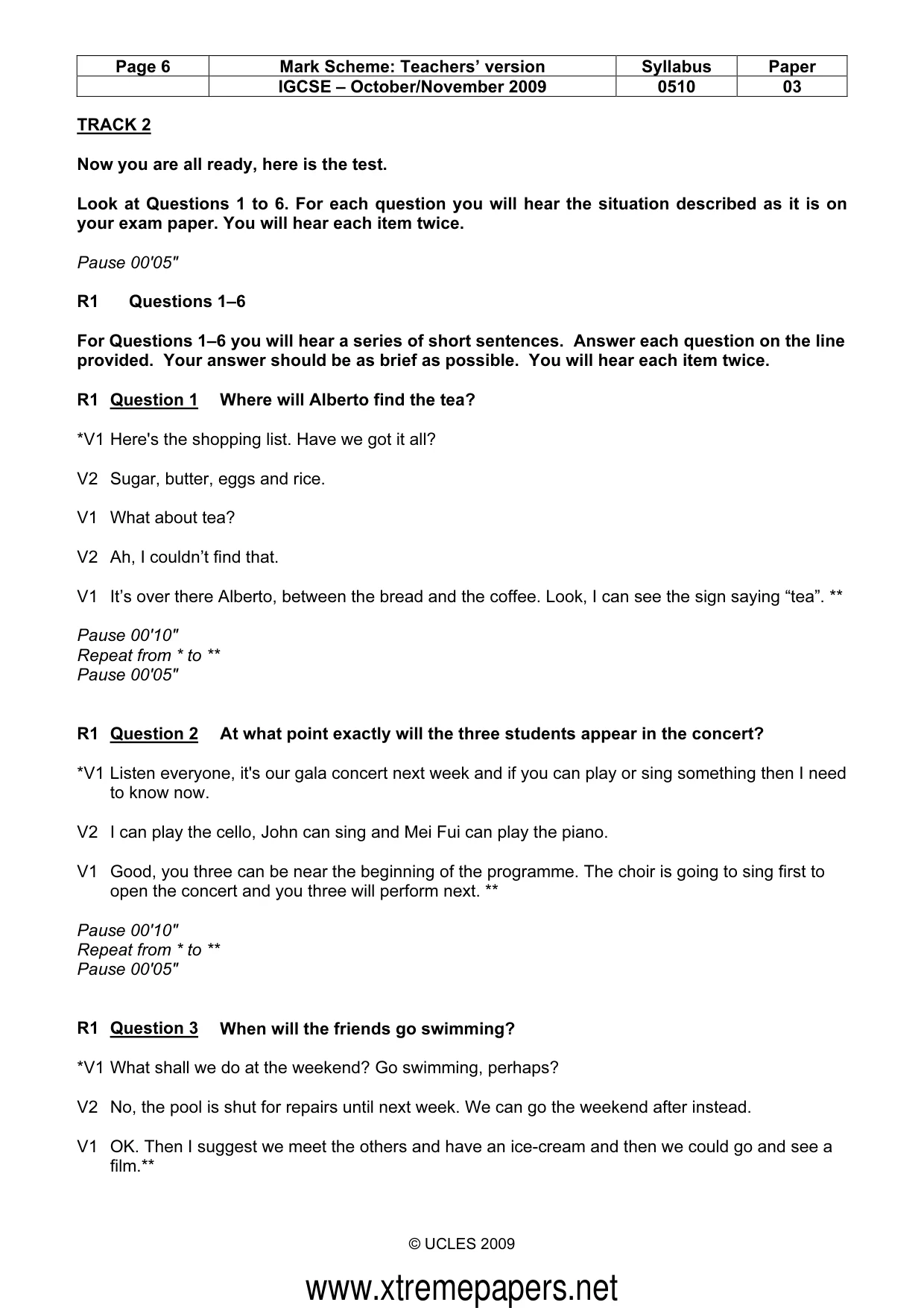
Page 6 Mark Scheme: Teachers’ version Syllabus Paper IGCSE – October/November 2009 0510 03 © UCLES 2009 TRACK 2 Now you are all ready, here is the test. Look at Questions 1 to 6. For each question you will hear the situation described as it is on your exam paper. You will hear each item twice. Pause 00'05" R1 Questions 1–6 For Questions 1–6 you will hear a series of short sentences. Answer each question on the line provided. Your answer should be as brief as possible. You will hear each item twice. R1 Question 1 Where will Alberto find the tea? *V1 Here's the shopping list. Have we got it all? V2 Sugar, butter, eggs and rice. V1 What about tea? V2 Ah, I couldn’t find that. V1 It’s over there Alberto, between the bread and the coffee. Look, I can see the sign saying “tea”. ** Pause 00'10" Repeat from * to ** Pause 00'05" R1 Question 2 At what point exactly will the three students appear in the concert? *V1 Listen everyone, it's our gala concert next week and if you can play or sing something then I need to know now. V2 I can play the cello, John can sing and Mei Fui can play the piano. V1 Good, you three can be near the beginning of the programme. The choir is going to sing first to open the concert and you three will perform next. ** Pause 00'10" Repeat from * to ** Pause 00'05" R1 Question 3 When will the friends go swimming? *V1 What shall we do at the weekend? Go swimming, perhaps? V2 No, the pool is shut for repairs until next week. We can go the weekend after instead. V1 OK. Then I suggest we meet the others and have an ice-cream and then we could go and see a film.** www.xtremepapers.net
Mark scheme, page 7
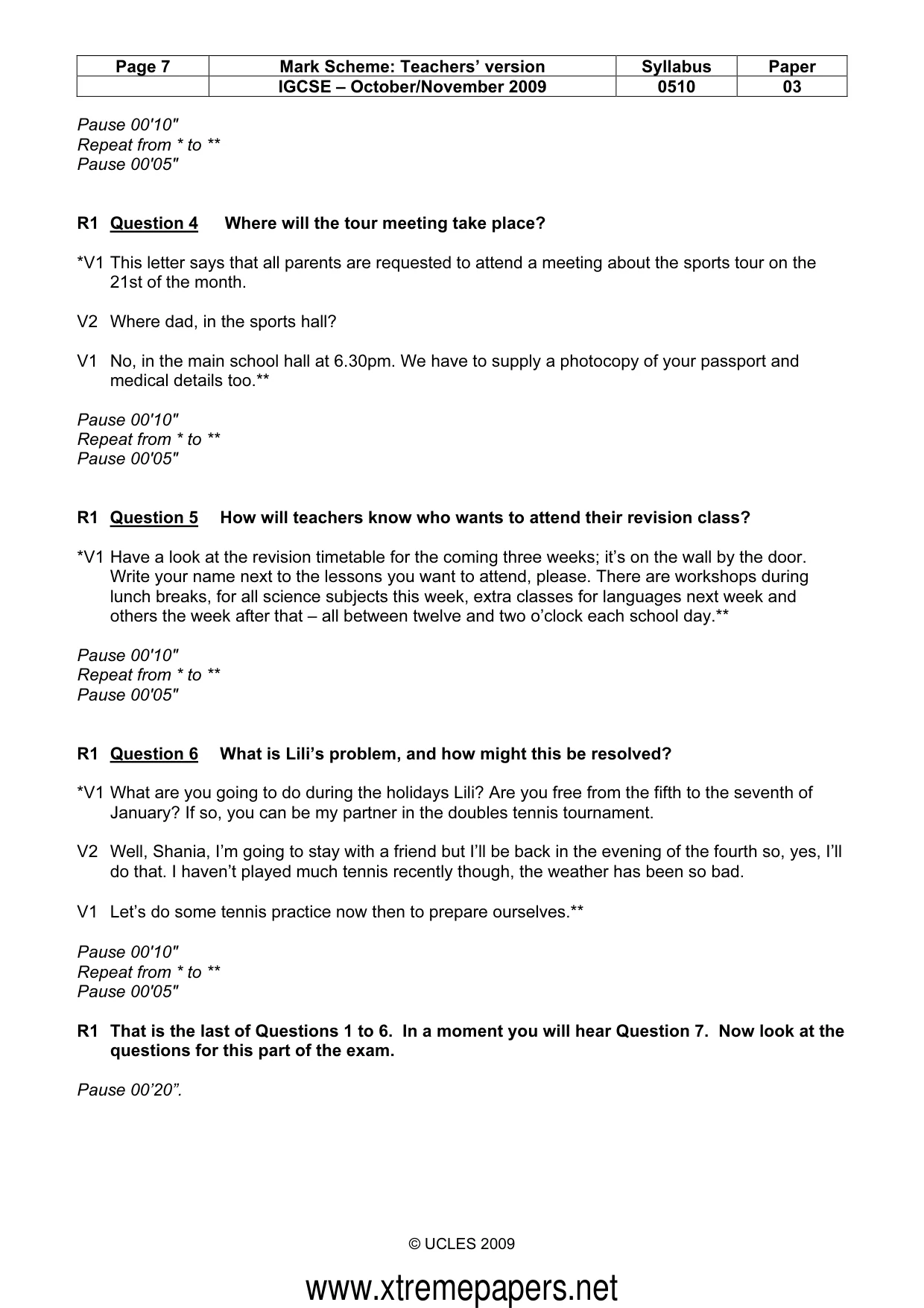
Page 7 Mark Scheme: Teachers’ version Syllabus Paper IGCSE – October/November 2009 0510 03 © UCLES 2009 Pause 00'10" Repeat from * to ** Pause 00'05" R1 Question 4 Where will the tour meeting take place? *V1 This letter says that all parents are requested to attend a meeting about the sports tour on the 21st of the month. V2 Where dad, in the sports hall? V1 No, in the main school hall at 6.30pm. We have to supply a photocopy of your passport and medical details too.** Pause 00'10" Repeat from * to ** Pause 00'05" R1 Question 5 How will teachers know who wants to attend their revision class? *V1 Have a look at the revision timetable for the coming three weeks; it’s on the wall by the door. Write your name next to the lessons you want to attend, please. There are workshops during lunch breaks, for all science subjects this week, extra classes for languages next week and others the week after that – all between twelve and two o’clock each school day.** Pause 00'10" Repeat from * to ** Pause 00'05" R1 Question 6 What is Lili’s problem, and how might this be resolved? *V1 What are you going to do during the holidays Lili? Are you free from the fifth to the seventh of January? If so, you can be my partner in the doubles tennis tournament. V2 Well, Shania, I’m going to stay with a friend but I’ll be back in the evening of the fourth so, yes, I’ll do that. I haven’t played much tennis recently though, the weather has been so bad. V1 Let’s do some tennis practice now then to prepare ourselves.** Pause 00'10" Repeat from * to ** Pause 00'05" R1 That is the last of Questions 1 to 6. In a moment you will hear Question 7. Now look at the questions for this part of the exam. Pause 00’20”. www.xtremepapers.net
Mark scheme, page 8
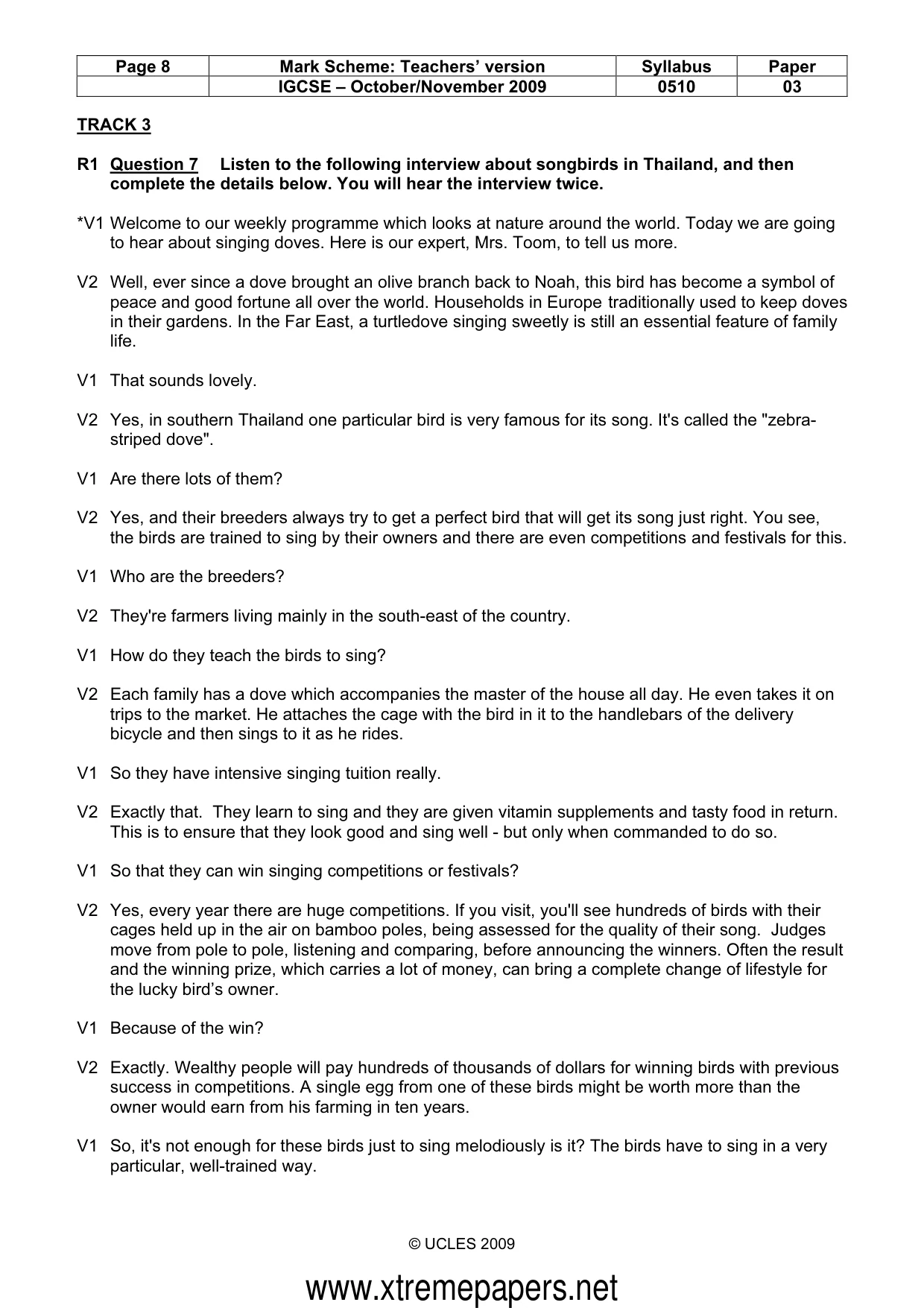
Page 8 Mark Scheme: Teachers’ version Syllabus Paper IGCSE – October/November 2009 0510 03 © UCLES 2009 TRACK 3 R1 Question 7 Listen to the following interview about songbirds in Thailand, and then complete the details below. You will hear the interview twice. *V1 Welcome to our weekly programme which looks at nature around the world. Today we are going to hear about singing doves. Here is our expert, Mrs. Toom, to tell us more. V2 Well, ever since a dove brought an olive branch back to Noah, this bird has become a symbol of peace and good fortune all over the world. Households in Europe traditionally used to keep doves in their gardens. In the Far East, a turtledove singing sweetly is still an essential feature of family life. V1 That sounds lovely. V2 Yes, in southern Thailand one particular bird is very famous for its song. It's called the "zebra- striped dove". V1 Are there lots of them? V2 Yes, and their breeders always try to get a perfect bird that will get its song just right. You see, the birds are trained to sing by their owners and there are even competitions and festivals for this. V1 Who are the breeders? V2 They're farmers living mainly in the south-east of the country. V1 How do they teach the birds to sing? V2 Each family has a dove which accompanies the master of the house all day. He even takes it on trips to the market. He attaches the cage with the bird in it to the handlebars of the delivery bicycle and then sings to it as he rides. V1 So they have intensive singing tuition really. V2 Exactly that. They learn to sing and they are given vitamin supplements and tasty food in return. This is to ensure that they look good and sing well - but only when commanded to do so. V1 So that they can win singing competitions or festivals? V2 Yes, every year there are huge competitions. If you visit, you'll see hundreds of birds with their cages held up in the air on bamboo poles, being assessed for the quality of their song. Judges move from pole to pole, listening and comparing, before announcing the winners. Often the result and the winning prize, which carries a lot of money, can bring a complete change of lifestyle for the lucky bird’s owner. V1 Because of the win? V2 Exactly. Wealthy people will pay hundreds of thousands of dollars for winning birds with previous success in competitions. A single egg from one of these birds might be worth more than the owner would earn from his farming in ten years. V1 So, it's not enough for these birds just to sing melodiously is it? The birds have to sing in a very particular, well-trained way. www.xtremepapers.net
Mark scheme, page 9
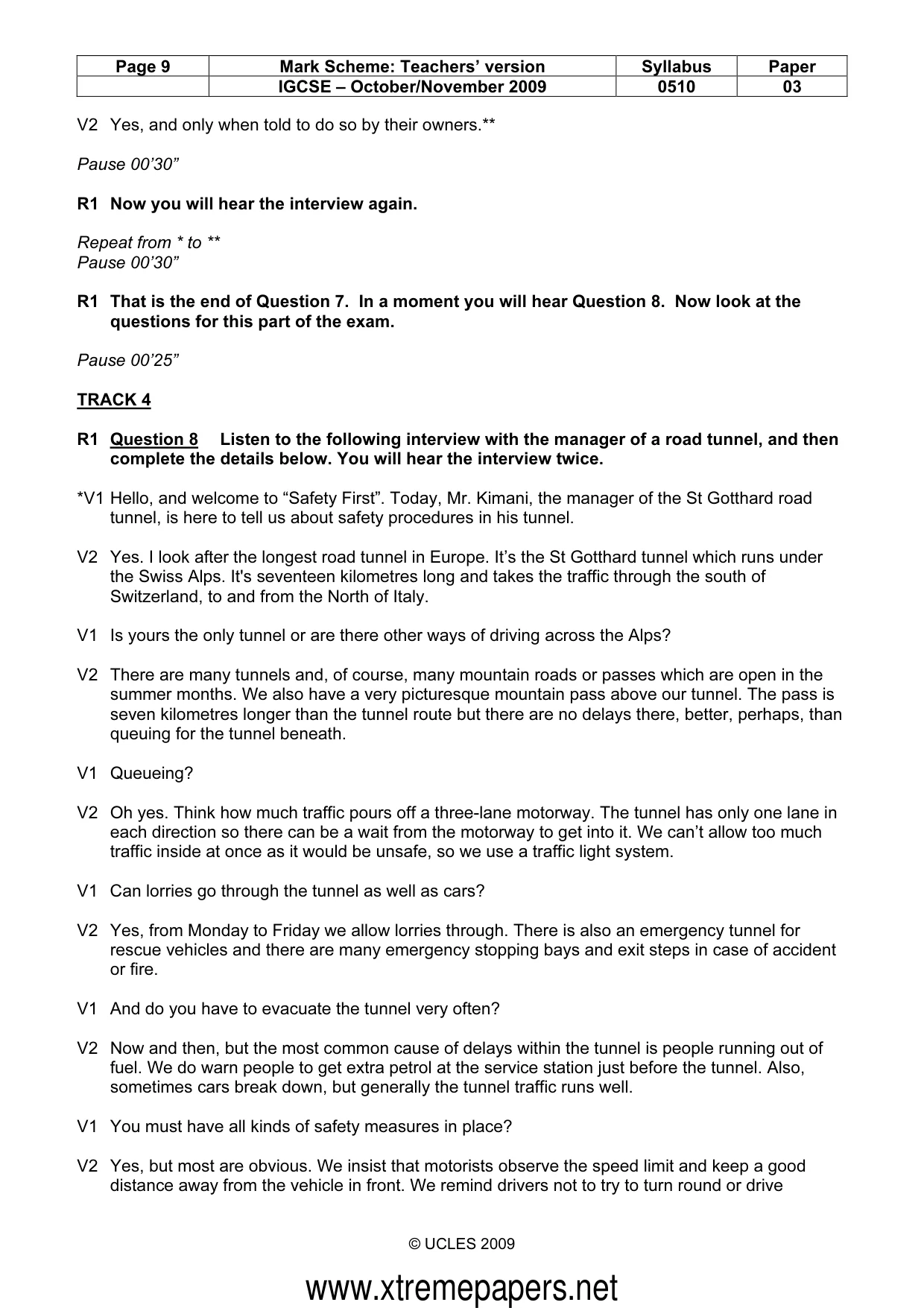
Page 9 Mark Scheme: Teachers’ version Syllabus Paper IGCSE – October/November 2009 0510 03 © UCLES 2009 V2 Yes, and only when told to do so by their owners.** Pause 00’30” R1 Now you will hear the interview again. Repeat from * to ** Pause 00’30” R1 That is the end of Question 7. In a moment you will hear Question 8. Now look at the questions for this part of the exam. Pause 00’25” TRACK 4 R1 Question 8 Listen to the following interview with the manager of a road tunnel, and then complete the details below. You will hear the interview twice. *V1 Hello, and welcome to “Safety First”. Today, Mr. Kimani, the manager of the St Gotthard road tunnel, is here to tell us about safety procedures in his tunnel. V2 Yes. I look after the longest road tunnel in Europe. It’s the St Gotthard tunnel which runs under the Swiss Alps. It's seventeen kilometres long and takes the traffic through the south of Switzerland, to and from the North of Italy. V1 Is yours the only tunnel or are there other ways of driving across the Alps? V2 There are many tunnels and, of course, many mountain roads or passes which are open in the summer months. We also have a very picturesque mountain pass above our tunnel. The pass is seven kilometres longer than the tunnel route but there are no delays there, better, perhaps, than queuing for the tunnel beneath. V1 Queueing? V2 Oh yes. Think how much traffic pours off a three-lane motorway. The tunnel has only one lane in each direction so there can be a wait from the motorway to get into it. We can’t allow too much traffic inside at once as it would be unsafe, so we use a traffic light system. V1 Can lorries go through the tunnel as well as cars? V2 Yes, from Monday to Friday we allow lorries through. There is also an emergency tunnel for rescue vehicles and there are many emergency stopping bays and exit steps in case of accident or fire. V1 And do you have to evacuate the tunnel very often? V2 Now and then, but the most common cause of delays within the tunnel is people running out of fuel. We do warn people to get extra petrol at the service station just before the tunnel. Also, sometimes cars break down, but generally the tunnel traffic runs well. V1 You must have all kinds of safety measures in place? V2 Yes, but most are obvious. We insist that motorists observe the speed limit and keep a good distance away from the vehicle in front. We remind drivers not to try to turn round or drive www.xtremepapers.net
Mark scheme, page 10
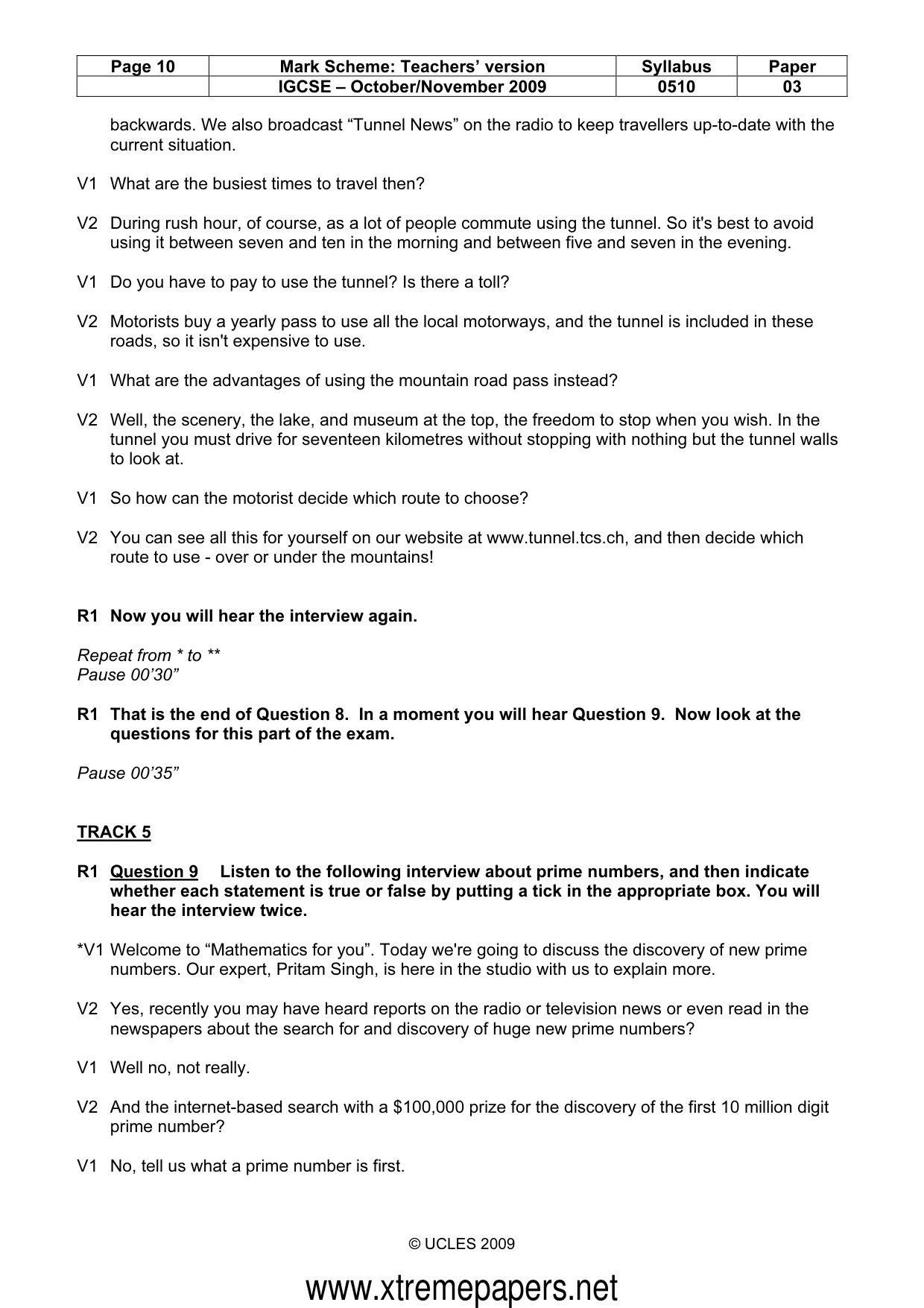
Page 10 Mark Scheme: Teachers’ version Syllabus Paper IGCSE – October/November 2009 0510 03 © UCLES 2009 backwards. We also broadcast “Tunnel News” on the radio to keep travellers up-to-date with the current situation. V1 What are the busiest times to travel then? V2 During rush hour, of course, as a lot of people commute using the tunnel. So it's best to avoid using it between seven and ten in the morning and between five and seven in the evening. V1 Do you have to pay to use the tunnel? Is there a toll? V2 Motorists buy a yearly pass to use all the local motorways, and the tunnel is included in these roads, so it isn't expensive to use. V1 What are the advantages of using the mountain road pass instead? V2 Well, the scenery, the lake, and museum at the top, the freedom to stop when you wish. In the tunnel you must drive for seventeen kilometres without stopping with nothing but the tunnel walls to look at. V1 So how can the motorist decide which route to choose? V2 You can see all this for yourself on our website at www.tunnel.tcs.ch, and then decide which route to use - over or under the mountains! R1 Now you will hear the interview again. Repeat from * to ** Pause 00’30” R1 That is the end of Question 8. In a moment you will hear Question 9. Now look at the questions for this part of the exam. Pause 00’35” TRACK 5 R1 Question 9 Listen to the following interview about prime numbers, and then indicate whether each statement is true or false by putting a tick in the appropriate box. You will hear the interview twice. *V1 Welcome to “Mathematics for you”. Today we're going to discuss the discovery of new prime numbers. Our expert, Pritam Singh, is here in the studio with us to explain more. V2 Yes, recently you may have heard reports on the radio or television news or even read in the newspapers about the search for and discovery of huge new prime numbers? V1 Well no, not really. V2 And the internet-based search with a $100,000 prize for the discovery of the first 10 million digit prime number? V1 No, tell us what a prime number is first. www.xtremepapers.net
Mark scheme, page 11
Page 11 Mark Scheme: Teachers’ version Syllabus Paper IGCSE – October/November 2009 0510 03 © UCLES 2009 V2 It's a number which only divides by itself and 1. No other number will divide into a prime number – only 1 and the number itself. V1 So numbers like 2 and 3 are prime? V2 Yes, and then 5, 7 and 11, 13, 17 and 19. V1 Oh they sound easy to find. V2 Yes, between zero and 20 they are – there are 4 prime numbers between 10 and 20 as we have just said. V1 Don’t they keep that same sort of pattern? V2 Oh no, between 110 and 120 for example there is only one prime number. V1 113 at a guess. V2 Absolutely right. Over 2,000 years ago in Alexandria a man called Euclid, a mathematician known as the father of geometry, looked at prime numbers just as we have been doing today. His question was - as numbers increase into thousands and millions do prime numbers become ever more rare? V1 And do they ? V2 Yes, but Euclid also wondered this – do the gaps between prime numbers become eventually so huge that the list stops or do they go on forever? V1 You mean he wondered if there really is a “biggest prime number”? V2 Yes. Actually Euclid went on from there to prove that there is no end to the possible list of prime numbers. V1 How did he do that? V2 Well, very roughly, he said that we can multiply all our known prime numbers together and add 1 and we get the next prime number. And so on, forever. V1 Well why is this all so important? V2 Prime numbers are used as keys for codes to protect privacy. For example, prime numbers are used when you send payment details on the Internet. They are also used by governments for global security issues. V1 Very complicated. So they do actually have a practical application in our everyday lives then – they' re not just theory. V2 Certainly not, every time you do a transaction on the Internet you’re unknowingly being protected by prime number codes. V1 Hmm, interesting. What’s all this about new discoveries then? V2 Since Euclid’s time, mathematicians have searched for the next prime number and the one after that. The most recent prime number has 9.8 million digits. www.xtremepapers.net
Mark scheme, page 12
Page 12 Mark Scheme: Teachers’ version Syllabus Paper IGCSE – October/November 2009 0510 03 © UCLES 2009 V1 Wow! V2 There's prize money offered for the first 10 million-digit prime number. So, don’t forget to log onto www.primenumbers.com if you find it. V1 Good luck with the search!** Pause 00’30” R1 Now you will hear the interview again. Repeat from * to ** Pause 00’30” R1 That is the end of Question 9. In a moment you will hear Question 10. Now look at the questions for this part of the exam. Pause 00’35” TRACK 6 R1 Question 10 Listen to the following talk about people who live in the Arctic, called the Inuit, then indicate whether each statement is true or false by putting a tick in the appropriate box. You will hear the talk twice. *V1 Imagine you are looking down on the top of the world with the North Pole in the middle and the Arctic region surrounding it. This area is the most vulnerable to climate change across the whole of the Earth. The Arctic is a vast area covering one sixth of the Earth’s land which is shared between 8 countries, dozens of languages and 24 time zones. It is home to 4 million inhabitants from 30 different cultures. The Inuit are one of these groups of people. They depend on hunting, fishing and herding animals in the Arctic for their physical and economic survival, and for their cultural identity. Global warming in the Arctic is happening at twice the rate of the rest of the world. This threatens the whole world with a sea level rise and Arctic coastal settlements would then be exposed to flooding. The Arctic is an ocean surrounded by land. As its sea ice melts, creatures such as polar bears, seals and sea birds will be forced towards extinction. On the land round the central Arctic Ocean, the ice is thawing which means that it's simply becoming too warm for many of these animals. This process will also disrupt the foundations of buildings and pipelines. On the other hand, as the ice continues to thaw, shipping channels will be opened up. This will bring economic opportunity to the area and the possibility of imports and exports. At the same time, however, it will destroy the fragile culture of peoples such as the Inuit. Another consequence of the rising temperatures is that there will be fewer animals such as reindeer and seals. The weather will become unpredictable and make the traditional Inuit way of life even harder. Scientists think that the Arctic Sea ice is melting even faster now and that nearly all the summer ice could be lost by the year 2020. Eyewitness accounts from the Inuit and other peoples have been collected, in the hope of starting worldwide action to stabilise Arctic temperatures. The Inuit people are in despair about the potential loss of their culture. “We have a right to be cold,” said one representative recently. www.xtremepapers.net
Mark scheme, page 13
Page 13 Mark Scheme: Teachers’ version Syllabus Paper IGCSE – October/November 2009 0510 03 © UCLES 2009 The polar bear is the symbol of the Arctic; indeed, the word "Arktos" which means “bear” in Greek gives the Arctic its name. However, the polar bear may soon disappear if the rest of the world fails to take radical action. ** Pause 00’30” R1 Now you will hear the talk again. Repeat from * to ** Pause 00’30” R1 That is the end of Question 10, and of the test. In a moment your teacher will collect your papers. Please check that you have written your name, Centre number and candidate number on the front of your question paper. Remember, you must not talk until all the papers have been collected. Pause 00’10” R1 Teacher, please collect all the papers. Thank you everyone. www.xtremepapers.net
What you needed in this session
Cambridge’s own grade thresholds for 2009 Oct/Nov, Paper 3 · Variant 1. A higher threshold means an easier paper — the bar moves with how the cohort did.