Cambridge IGCSE English - Second Language (oral endorsement) 0510 — 2009 Oct/Nov Paper 1 · Variant 1
0510/11/O/N/09 · 56 marks · ≈63 min
The question paper and its mark scheme, free to read here and free to download. This is Cambridge’s own paper, exactly as it was sat.
Question paper16 pages



Mark scheme7 pages
Answers below. Sit the paper first if you are practising.
Paper as text
Question paper, page 1
This document consists of 13 printed pages and 3 blank pages. IB09 11_0510_11/7RP © UCLES 2009 [Turn over *5749190868* For Examiner's Use Exercise 1 Exercise 2 Exercise 3 Exercise 4 Exercise 5 Exercise 6 Exercise 7 Total UNIVERSITY OF CAMBRIDGE INTERNATIONAL EXAMINATIONS International General Certificate of Secondary Education ENGLISH AS A SECOND LANGUAGE 0510/11 Paper 1 Reading and Writing (Core) October/November 2009 1 hour 30 minutes Candidates answer on the Question Paper. No Additional Materials are required. READ THESE INSTRUCTIONS FIRST Write your Centre number, candidate number and name on all the work you hand in. Write in dark blue or black pen. Do not use staples, paper clips, highlighters, glue or correction fluid. DO NOT WRITE IN ANY BARCODES. Answer all questions. Dictionaries are not allowed. At the end of the examination, fasten all your work securely together. The number of marks is given in brackets [ ] at the end of each question or part question. www.xtremepapers.net
Question paper, page 2
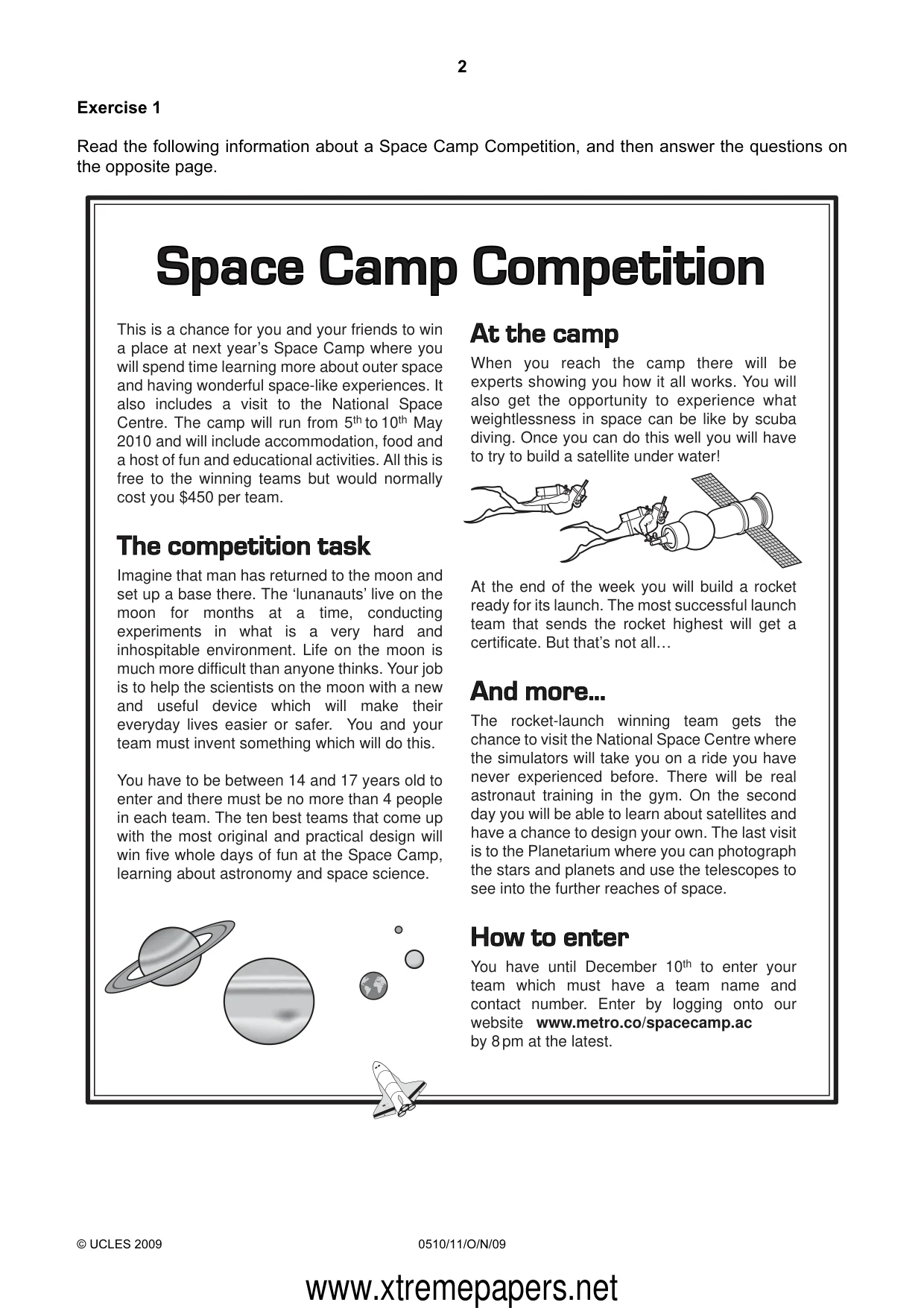
2 © UCLES 2009 0510/11/O/N/09 Exercise 1 Read the following information about a Space Camp Competition, and then answer the questions on the opposite page. This is a chance for you and your friends to win a place at next year’s Space Camp where you will spend time learning more about outer space and having wonderful space-like experiences. It also includes a visit to the National Space Centre. The camp will run from 5th to 10th May 2010 and will include accommodation, food and a host of fun and educational activities. All this is free to the winning teams but would normally cost you $450 per team. The competition task The competition task Imagine that man has returned to the moon and set up a base there. The ‘lunanauts’ live on the moon for months at a time, conducting experiments in what is a very hard and inhospitable environment. Life on the moon is much more difficult than anyone thinks. Your job is to help the scientists on the moon with a new and useful device which will make their everyday lives easier or safer. You and your team must invent something which will do this. You have to be between 14 and 17 years old to enter and there must be no more than 4 people in each team. The ten best teams that come up with the most original and practical design will win five whole days of fun at the Space Camp, learning about astronomy and space science. At the camp At the camp When you reach the camp there will be experts showing you how it all works. You will also get the opportunity to experience what weightlessness in space can be like by scuba diving. Once you can do this well you will have to try to build a satellite under water! At the end of the week you will build a rocket ready for its launch. The most successful launch team that sends the rocket highest will get a certificate. But that’s not all… And more... And more... The rocket-launch winning team gets the chance to visit the National Space Centre where the simulators will take you on a ride you have never experienced before. There will be real astronaut training in the gym. On the second day you will be able to learn about satellites and have a chance to design your own. The last visit is to the Planetarium where you can photograph the stars and planets and use the telescopes to see into the further reaches of space. How to enter How to enter You have until December 10th to enter your team which must have a team name and contact number. Enter by logging onto our website www.metro.co/spacecamp.ac by 8 pm at the latest. Space Camp Competition Space Camp Competition www.xtremepapers.net
Question paper, page 3
3 © UCLES 2009 0510/11/O/N/09 [Turn over For Examiner's Use (a) When will the Space Camp take place? [1] (b) How much is the Space Camp prize worth? [1] (c) What is the age requirement for team members? [1] (d) What creative activity can you enjoy at the National Space Centre? [1] (e) Give one activity you can take part in at the Planetarium. [1] (f) When is the latest time and date to apply for the competition? [1] [Total: 6] www.xtremepapers.net
Question paper, page 4
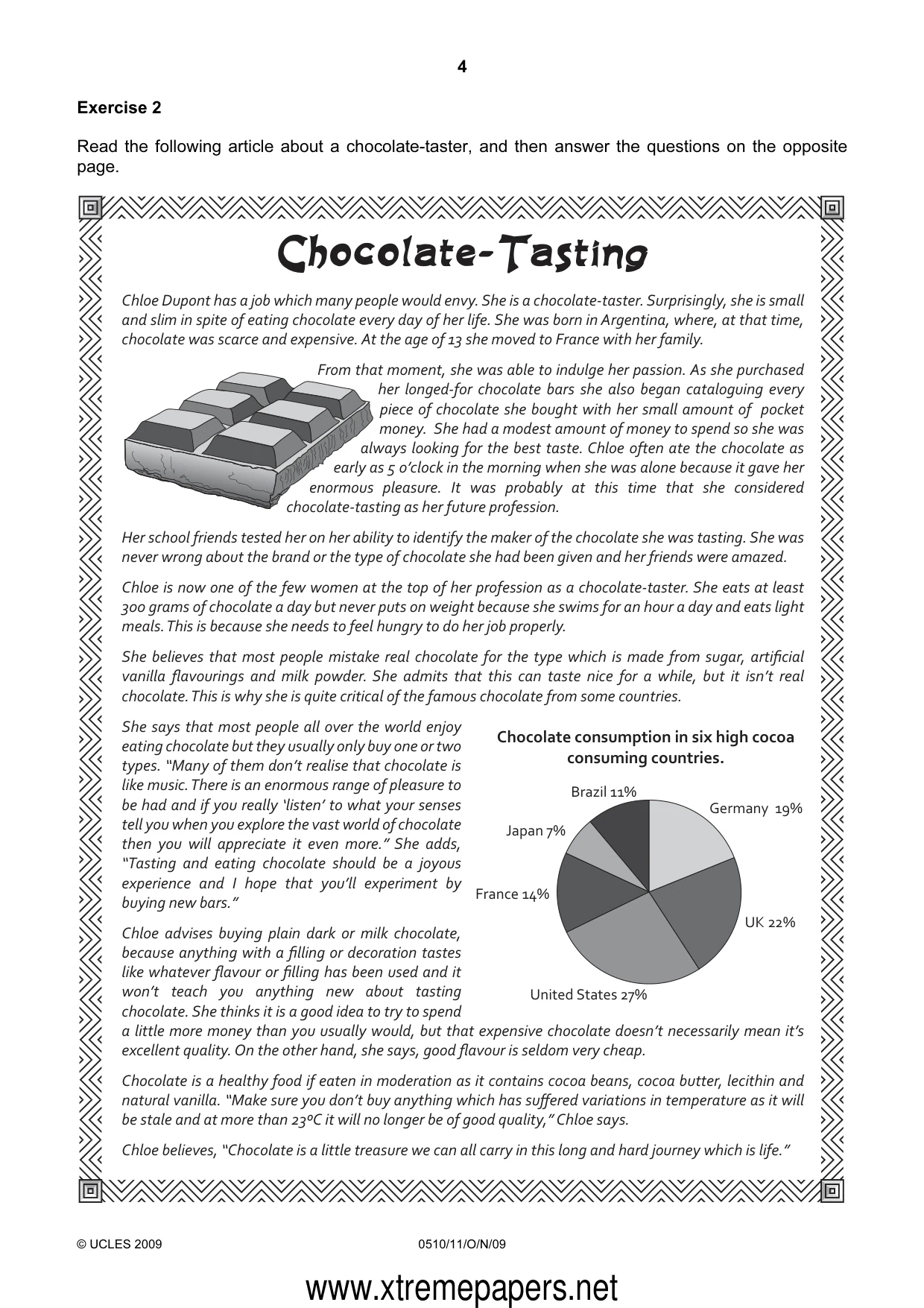
4 © UCLES 2009 0510/11/O/N/09 Exercise 2 Read the following article about a chocolate-taster, and then answer the questions on the opposite page. Chocolate-Tasting Chocolate-Tasting Chloe Dupont has a job which many people would envy. She is a chocolate-taster. Surprisingly, she is small and slim in spite of eating chocolate every day of her life. She was born in Argentina, where, at that time, chocolate was scarce and expensive. At the age of 13 she moved to France with her family. From that moment, she was able to indulge her passion. As she purchased her longed-for chocolate bars she also began cataloguing every piece of chocolate she bought with her small amount of pocket money. She had a modest amount of money to spend so she was always looking for the best taste. Chloe often ate the chocolate as early as 5 o’clock in the morning when she was alone because it gave her enormous pleasure. It was probably at this time that she considered chocolate-tasting as her future profession. Her school friends tested her on her ability to identify the maker of the chocolate she was tasting. She was never wrong about the brand or the type of chocolate she had been given and her friends were amazed. Chloe is now one of the few women at the top of her profession as a chocolate-taster. She eats at least 300 grams of chocolate a day but never puts on weight because she swims for an hour a day and eats light meals. This is because she needs to feel hungry to do her job properly. She believes that most people mistake real chocolate for the type which is made from sugar, artificial vanilla flavourings and milk powder. She admits that this can taste nice for a while, but it isn’t real chocolate. This is why she is quite critical of the famous chocolate from some countries. She says that most people all over the world enjoy eating chocolate but they usually only buy one or two types. “Many of them don’t realise that chocolate is like music. There is an enormous range of pleasure to be had and if you really ‘listen’ to what your senses tell you when you explore the vast world of chocolate then you will appreciate it even more.” She adds, “Tasting and eating chocolate should be a joyous experience and I hope that you’ll experiment by buying new bars.” Chloe advises buying plain dark or milk chocolate, because anything with a filling or decoration tastes like whatever flavour or filling has been used and it won’t teach you anything new about tasting chocolate. She thinks it is a good idea to try to spend a little more money than you usually would, but that expensive chocolate doesn’t necessarily mean it’s excellent quality. On the other hand, she says, good flavour is seldom very cheap. Chocolate is a healthy food if eaten in moderation as it contains cocoa beans, cocoa butter, lecithin and natural vanilla. “Make sure you don’t buy anything which has suffered variations in temperature as it will be stale and at more than 23ºC it will no longer be of good quality,” Chloe says. Chloe believes, “Chocolate is a little treasure we can all carry in this long and hard journey which is life.” Chocolate consumption in six high cocoa consuming countries. Germany 19% UK 22% United States 27% France 14% Japan 7% Brazil 11% www.xtremepapers.net
Question paper, page 5
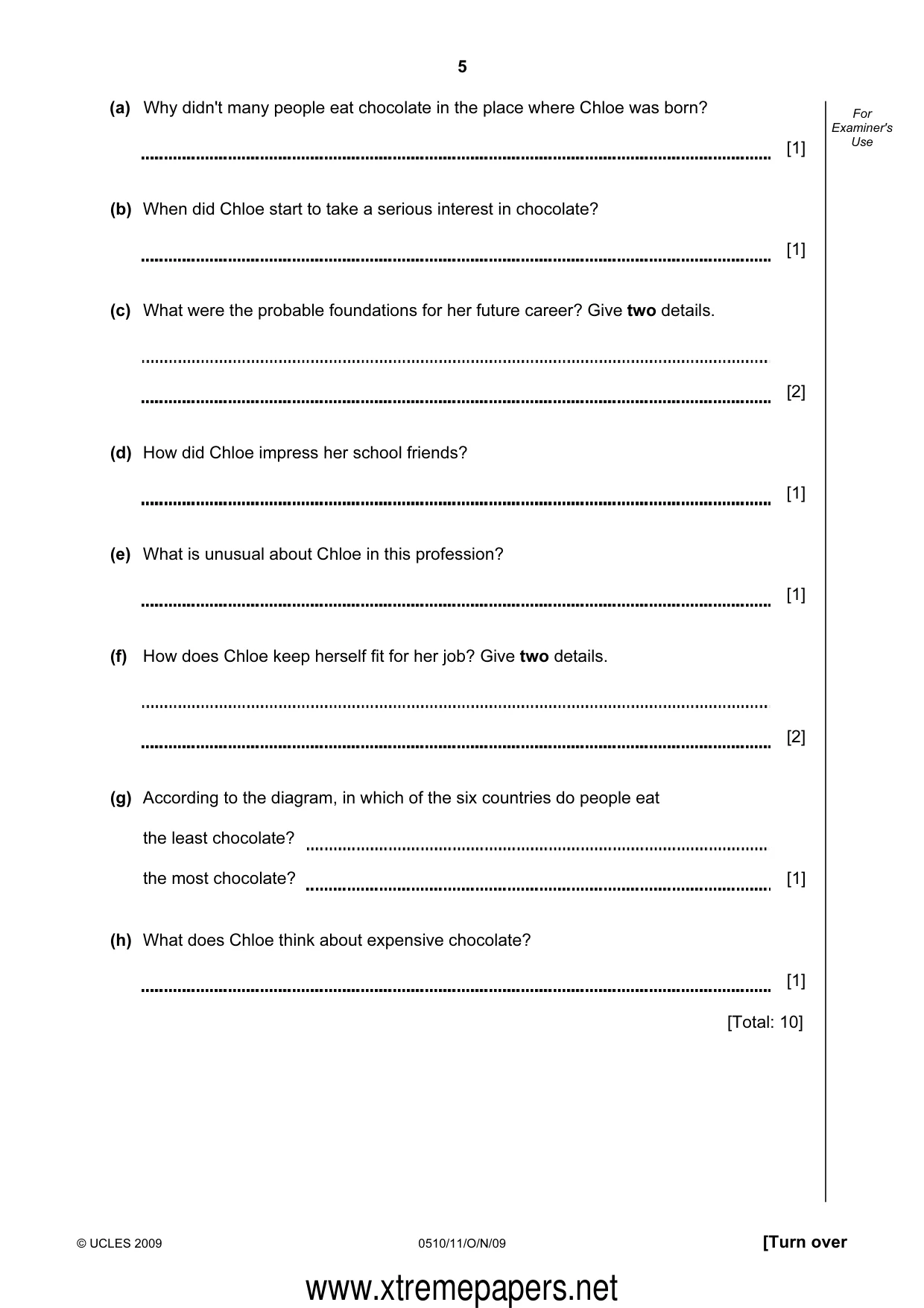
5 © UCLES 2009 0510/11/O/N/09 [Turn over For Examiner's Use (a) Why didn't many people eat chocolate in the place where Chloe was born? [1] (b) When did Chloe start to take a serious interest in chocolate? [1] (c) What were the probable foundations for her future career? Give two details. [2] (d) How did Chloe impress her school friends? [1] (e) What is unusual about Chloe in this profession? [1] (f) How does Chloe keep herself fit for her job? Give two details. [2] (g) According to the diagram, in which of the six countries do people eat the least chocolate? the most chocolate? [1] (h) What does Chloe think about expensive chocolate? [1] [Total: 10] www.xtremepapers.net
Question paper, page 6
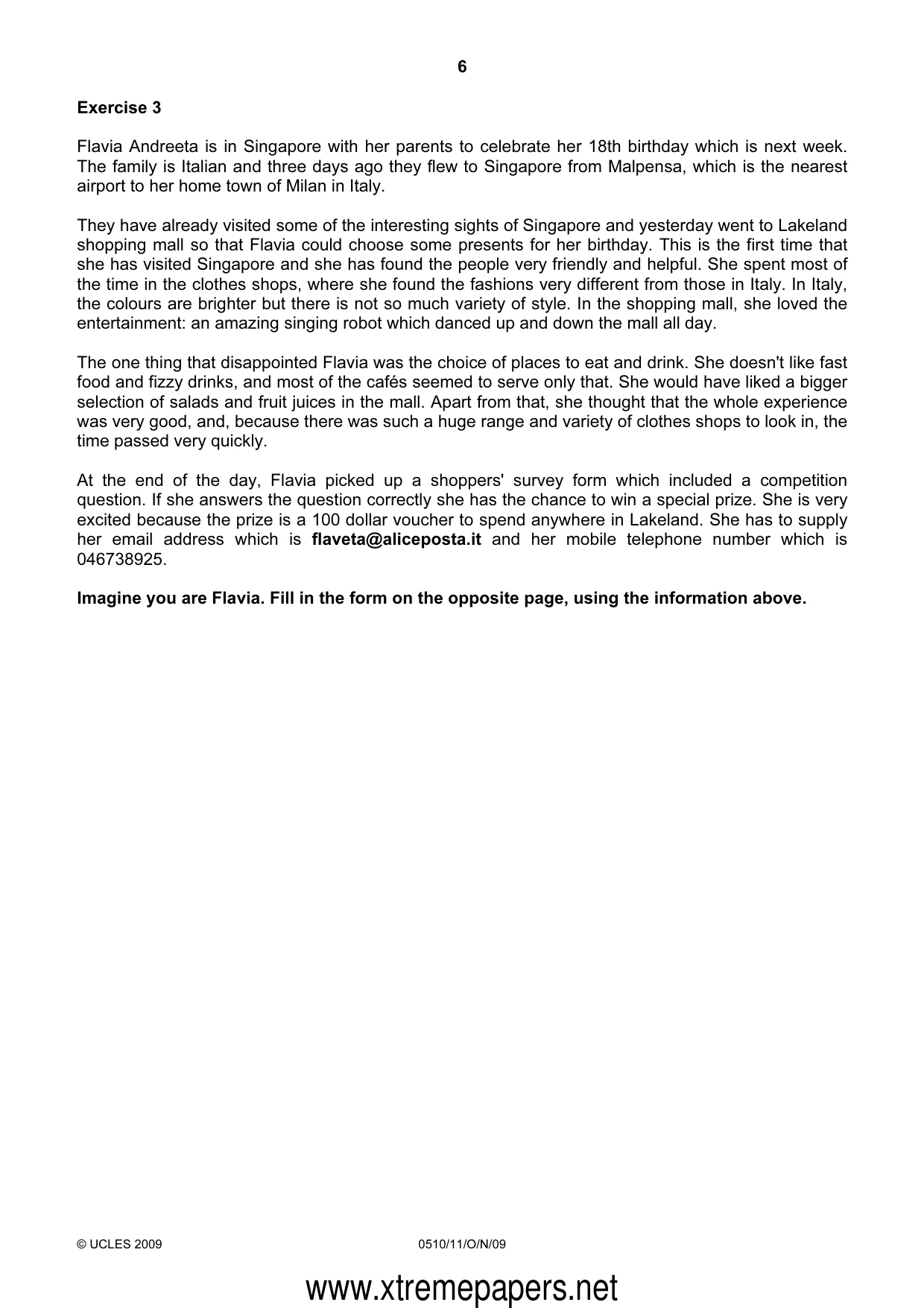
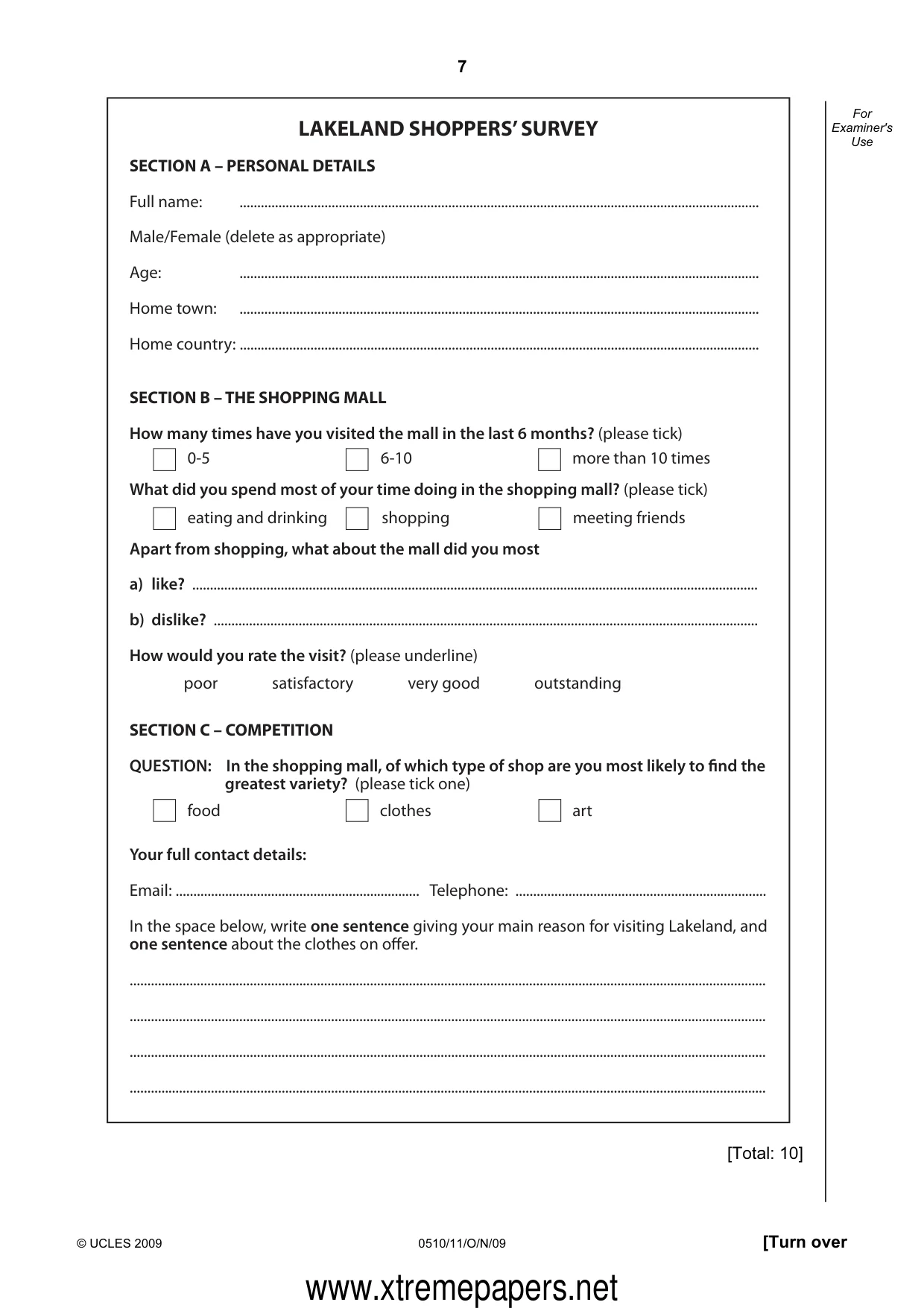
6 © UCLES 2009 0510/11/O/N/09 Exercise 3 Flavia Andreeta is in Singapore with her parents to celebrate her 18th birthday which is next week. The family is Italian and three days ago they flew to Singapore from Malpensa, which is the nearest airport to her home town of Milan in Italy. They have already visited some of the interesting sights of Singapore and yesterday went to Lakeland shopping mall so that Flavia could choose some presents for her birthday. This is the first time that she has visited Singapore and she has found the people very friendly and helpful. She spent most of the time in the clothes shops, where she found the fashions very different from those in Italy. In Italy, the colours are brighter but there is not so much variety of style. In the shopping mall, she loved the entertainment: an amazing singing robot which danced up and down the mall all day. The one thing that disappointed Flavia was the choice of places to eat and drink. She doesn't like fast food and fizzy drinks, and most of the cafés seemed to serve only that. She would have liked a bigger selection of salads and fruit juices in the mall. Apart from that, she thought that the whole experience was very good, and, because there was such a huge range and variety of clothes shops to look in, the time passed very quickly. At the end of the day, Flavia picked up a shoppers' survey form which included a competition question. If she answers the question correctly she has the chance to win a special prize. She is very excited because the prize is a 100 dollar voucher to spend anywhere in Lakeland. She has to supply her email address which is flaveta@aliceposta.it and her mobile telephone number which is 046738925. Imagine you are Flavia. Fill in the form on the opposite page, using the information above. www.xtremepapers.net
Question paper, page 7
7 © UCLES 2009 0510/11/O/N/09 [Turn over For Examiner's Use LAKELAND SHOPPERS’ SURVEY SECTION A – PERSONAL DETAILS Full name: … Male/Female (delete as appropriate) Age: … Home town: … Home country: … SECTION B – THE SHOPPING MALL How many times have you visited the mall in the last 6 months? (please tick) 0-5 6-10 more than 10 times What did you spend most of your time doing in the shopping mall? (please tick) eating and drinking shopping meeting friends Apart from shopping, what about the mall did you most a) like? … b) dislike? … How would you rate the visit? (please underline) poor satisfactory very good outstanding SECTION C – COMPETITION QUESTION: In the shopping mall, of which type of shop are you most likely to find the greatest variety? (please tick one) food clothes art Your full contact details: Email: … Telephone: … In the space below, write one sentence giving your main reason for visiting Lakeland, and one sentence about the clothes on offer. … … … … [Total: 10] www.xtremepapers.net
Question paper, page 8
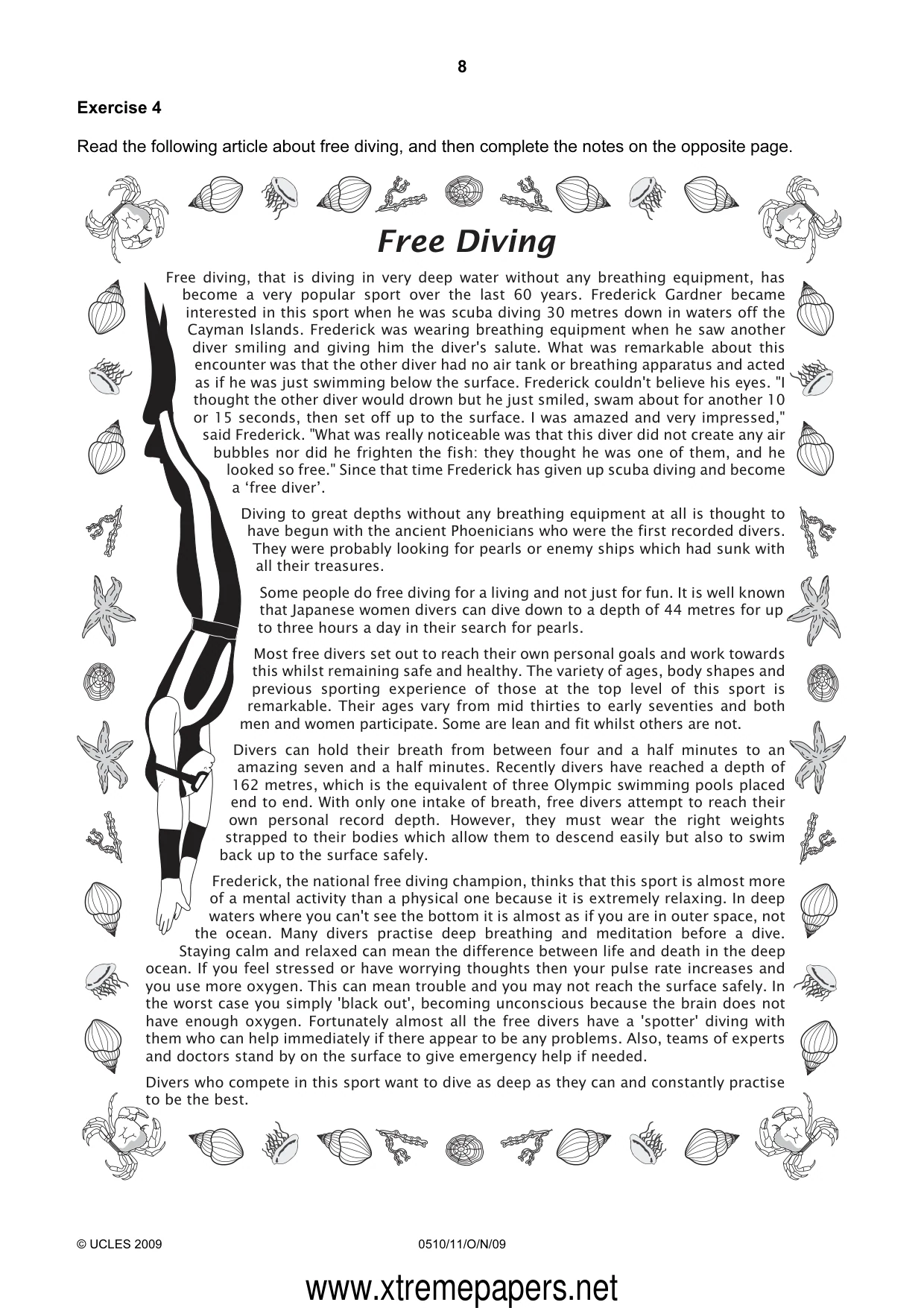
8 © UCLES 2009 0510/11/O/N/09 Exercise 4 Read the following article about free diving, and then complete the notes on the opposite page. Free Diving Free diving, that is diving in very deep water without any breathing equipment, has become a very popular sport over the last 60 years. Frederick Gardner became interested in this sport when he was scuba diving 30 metres down in waters off the Cayman Islands. Frederick was wearing breathing equipment when he saw another diver smiling and giving him the diver's salute. What was remarkable about this encounter was that the other diver had no air tank or breathing apparatus and acted as if he was just swimming below the surface. Frederick couldn't believe his eyes. "I thought the other diver would drown but he just smiled, swam about for another 10 or 15 seconds, then set off up to the surface. I was amazed and very impressed," said Frederick. "What was really noticeable was that this diver did not create any air bubbles nor did he frighten the fish: they thought he was one of them, and he looked so free." Since that time Frederick has given up scuba diving and become a ‘free diver’. Diving to great depths without any breathing equipment at all is thought to have begun with the ancient Phoenicians who were the first recorded divers. They were probably looking for pearls or enemy ships which had sunk with all their treasures. Some people do free diving for a living and not just for fun. It is well known that Japanese women divers can dive down to a depth of 44 metres for up to three hours a day in their search for pearls. Most free divers set out to reach their own personal goals and work towards this whilst remaining safe and healthy. The variety of ages, body shapes and previous sporting experience of those at the top level of this sport is remarkable. Their ages vary from mid thirties to early seventies and both men and women participate. Some are lean and fit whilst others are not. Divers can hold their breath from between four and a half minutes to an amazing seven and a half minutes. Recently divers have reached a depth of 162 metres, which is the equivalent of three Olympic swimming pools placed end to end. With only one intake of breath, free divers attempt to reach their own personal record depth. However, they must wear the right weights strapped to their bodies which allow them to descend easily but also to swim back up to the surface safely. Frederick, the national free diving champion, thinks that this sport is almost more of a mental activity than a physical one because it is extremely relaxing. In deep waters where you can't see the bottom it is almost as if you are in outer space, not the ocean. Many divers practise deep breathing and meditation before a dive. Staying calm and relaxed can mean the difference between life and death in the deep ocean. If you feel stressed or have worrying thoughts then your pulse rate increases and you use more oxygen. This can mean trouble and you may not reach the surface safely. In the worst case you simply 'black out', becoming unconscious because the brain does not have enough oxygen. Fortunately almost all the free divers have a 'spotter' diving with them who can help immediately if there appear to be any problems. Also, teams of experts and doctors stand by on the surface to give emergency help if needed. Divers who compete in this sport want to dive as deep as they can and constantly practise to be the best. www.xtremepapers.net
Question paper, page 9
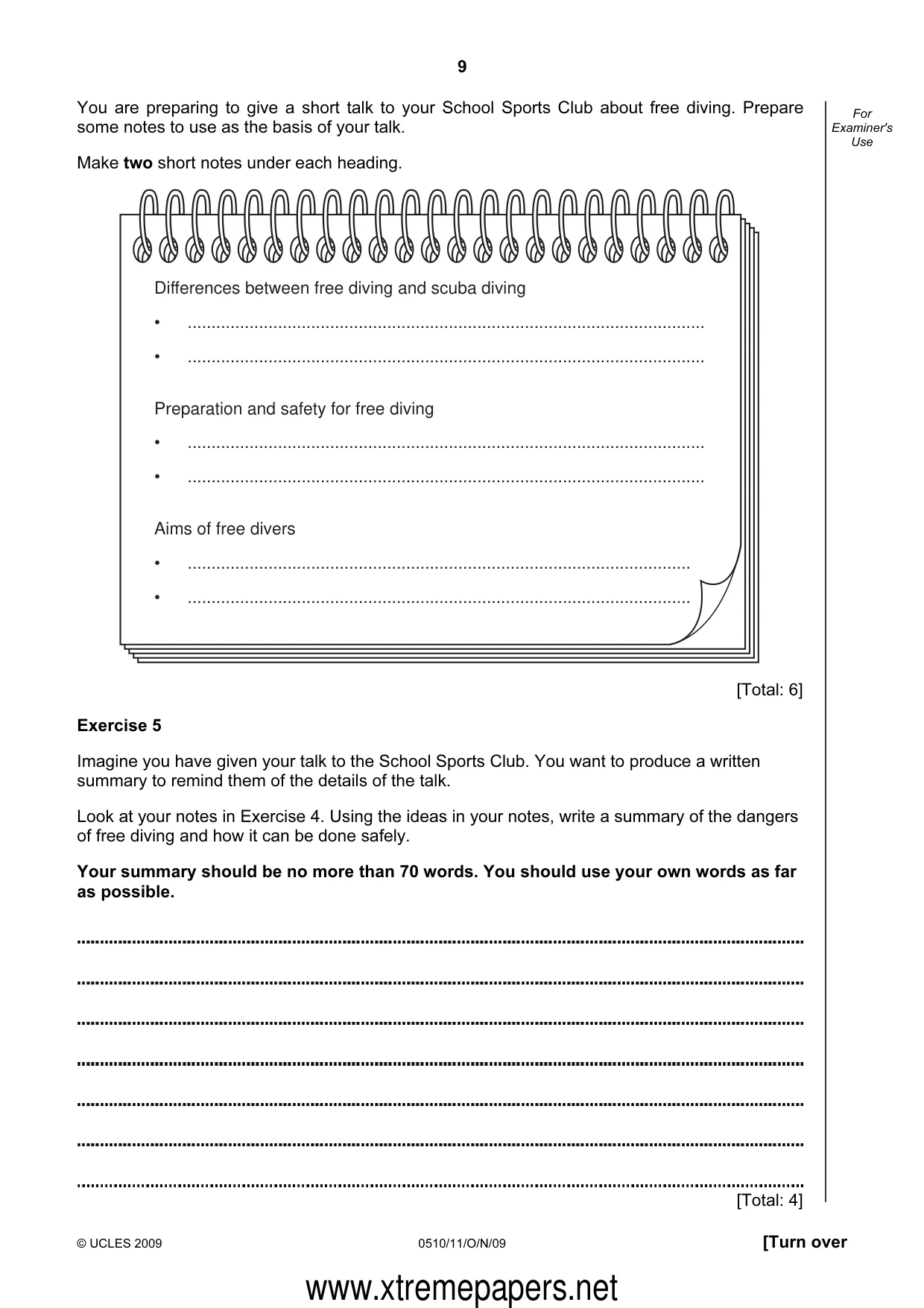
9 © UCLES 2009 0510/11/O/N/09 [Turn over For Examiner's Use You are preparing to give a short talk to your School Sports Club about free diving. Prepare some notes to use as the basis of your talk. Make two short notes under each heading. Differences between free diving and scuba diving • … • … Preparation and safety for free diving • … • … Aims of free divers • … • … [Total: 6] Exercise 5 Imagine you have given your talk to the School Sports Club. You want to produce a written summary to remind them of the details of the talk. Look at your notes in Exercise 4. Using the ideas in your notes, write a summary of the dangers of free diving and how it can be done safely. Your summary should be no more than 70 words. You should use your own words as far as possible. [Total: 4] www.xtremepapers.net
Question paper, page 10
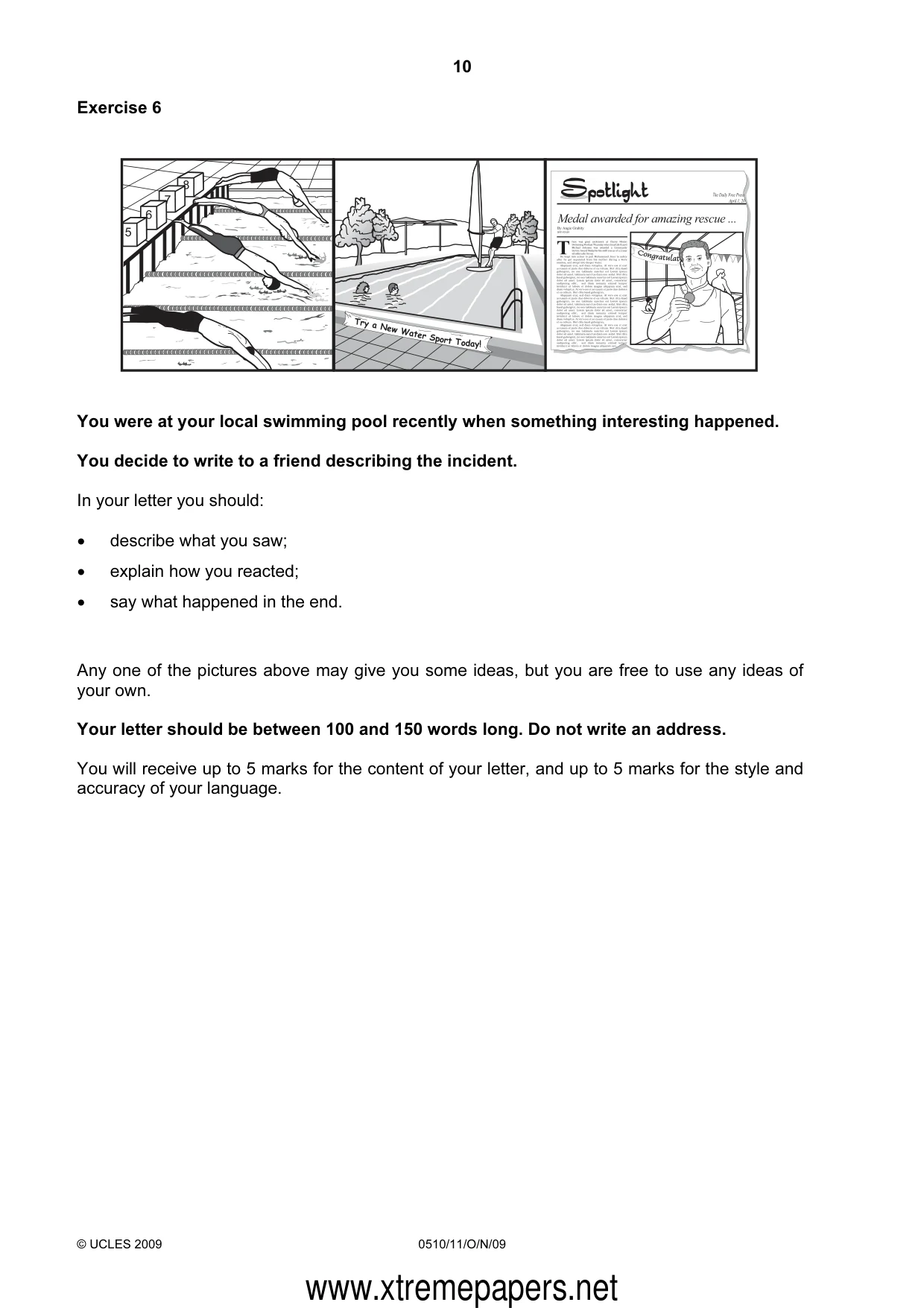
10 © UCLES 2009 0510/11/O/N/09 Exercise 6 Tr y a New Water Sport Tod ay ! You were at your local swimming pool recently when something interesting happened. You decide to write to a friend describing the incident. In your letter you should: • describe what you saw; • explain how you reacted; • say what happened in the end. Any one of the pictures above may give you some ideas, but you are free to use any ideas of your own. Your letter should be between 100 and 150 words long. Do not write an address. You will receive up to 5 marks for the content of your letter, and up to 5 marks for the style and accuracy of your language. www.xtremepapers.net
Question paper, page 11
11 © UCLES 2009 0510/11/O/N/09 [Turn over For Examiner's Use [10] www.xtremepapers.net
Question paper, page 12
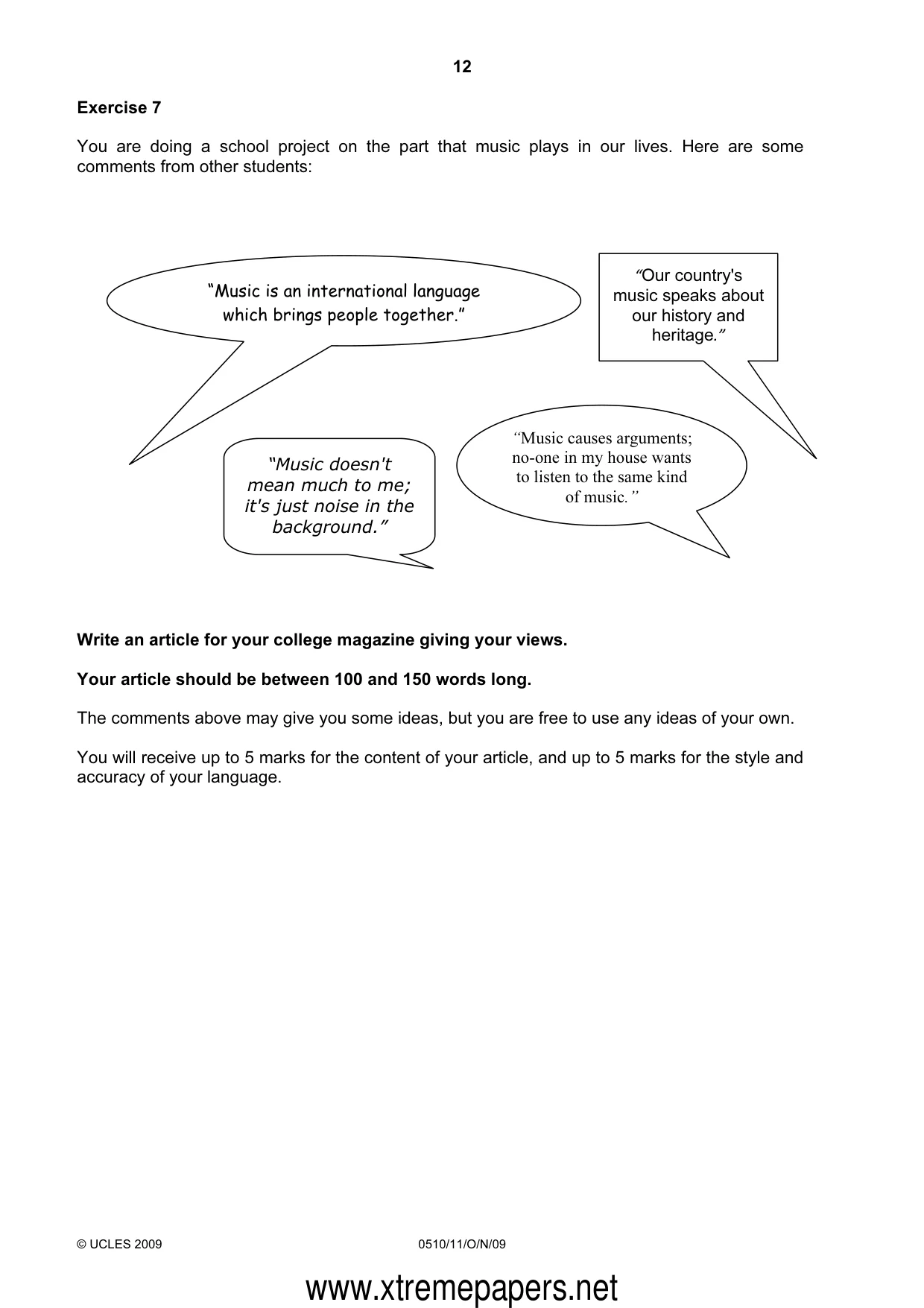
12 © UCLES 2009 0510/11/O/N/09 Exercise 7 You are doing a school project on the part that music plays in our lives. Here are some comments from other students: Write an article for your college magazine giving your views. Your article should be between 100 and 150 words long. The comments above may give you some ideas, but you are free to use any ideas of your own. You will receive up to 5 marks for the content of your article, and up to 5 marks for the style and accuracy of your language. “Music is an international language which brings people together.” “Our country's music speaks about our history and heritage.” “Music causes arguments; no-one in my house wants to listen to the same kind of music.” “Music doesn't mean much to me; it's just noise in the background.” www.xtremepapers.net
Question paper, page 13
13 © UCLES 2009 0510/11/O/N/09 For Examiner's Use [10] www.xtremepapers.net
Question paper, page 14
14 0510/11/O/N/09 BLANK PAGE www.xtremepapers.net
Question paper, page 15
15 0510/11/O/N/09 BLANK PAGE www.xtremepapers.net
Question paper, page 16
16 Permission to reproduce items where third-party owned material protected by copyright is included has been sought and cleared where possible. Every reasonable effort has been made by the publisher (UCLES) to trace copyright holders, but if any items requiring clearance have unwittingly been included, the publisher will be pleased to make amends at the earliest possible opportunity. University of Cambridge International Examinations is part of the Cambridge Assessment Group. Cambridge Assessment is the brand name of University of Cambridge Local Examinations Syndicate (UCLES), which is itself a department of the University of Cambridge. 0510/11/O/N/09 BLANK PAGE www.xtremepapers.net
Mark scheme, page 1
UNIVERSITY OF CAMBRIDGE INTERNATIONAL EXAMINATIONS International General Certificate of Secondary Education MARK SCHEME for the October/November 2009 question paper for the guidance of teachers 0510 ENGLISH AS A SECOND LANGUAGE 0510/11 Paper 11 (Reading and Writing – Core), maximum raw mark 56 This mark scheme is published as an aid to teachers and candidates, to indicate the requirements of the examination. It shows the basis on which Examiners were instructed to award marks. It does not indicate the details of the discussions that took place at an Examiners’ meeting before marking began, which would have considered the acceptability of alternative answers. Mark schemes must be read in conjunction with the question papers and the report on the examination. • CIE will not enter into discussions or correspondence in connection with these mark schemes. CIE is publishing the mark schemes for the October/November 2009 question papers for most IGCSE, GCE Advanced Level and Advanced Subsidiary Level syllabuses and some Ordinary Level syllabuses. www.xtremepapers.net
Mark scheme, page 2
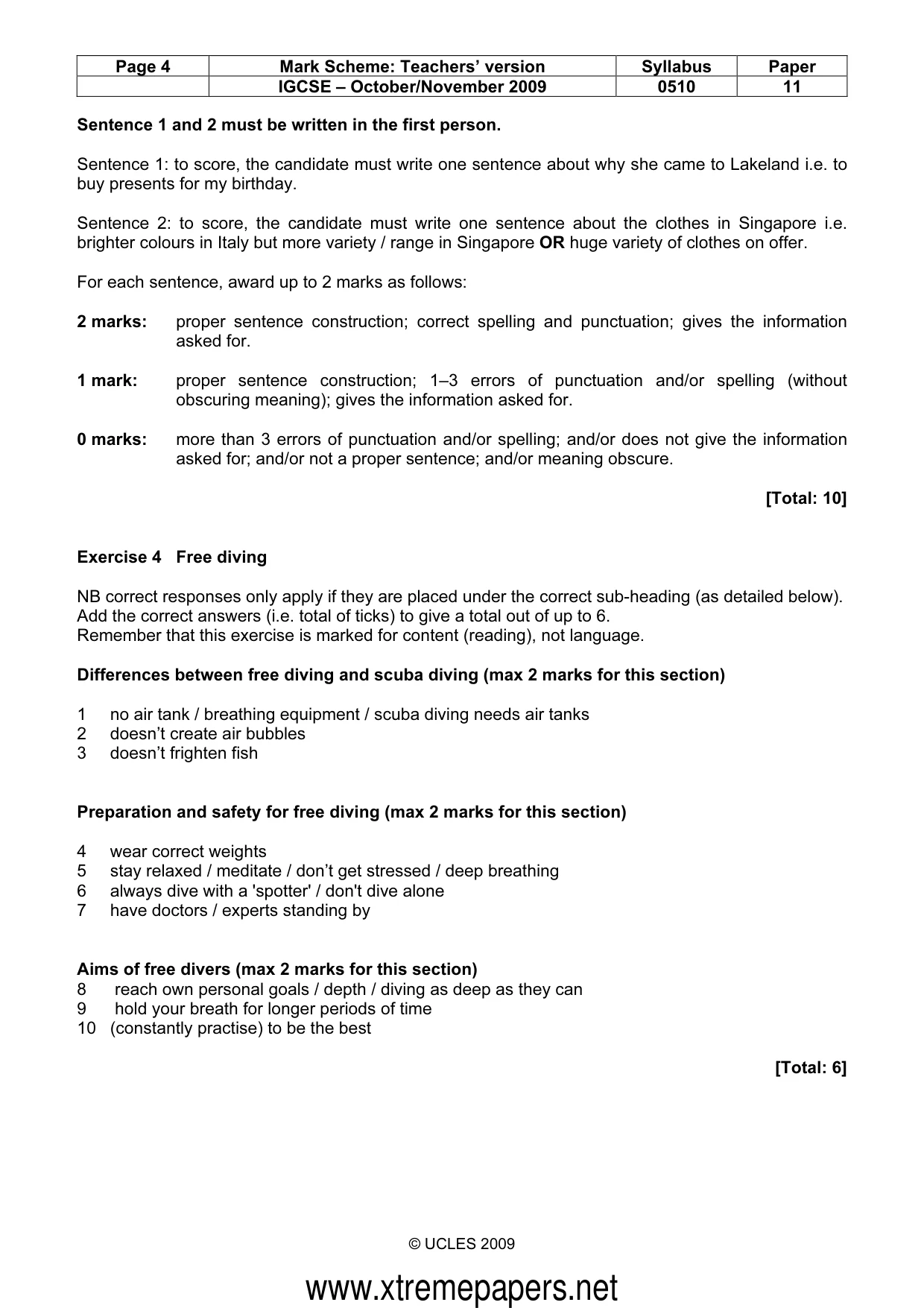
Page 2 Mark Scheme: Teachers’ version Syllabus Paper IGCSE – October/November 2009 0510 11 © UCLES 2009 Exercise 1 Space Camp Competition (a) 5 (th) to 10 (th) May 2010 / next year / 2010 [1] (b) $450 (per team) [1] (c) (between) 14 -17 (years old) [1] (d) design your own satellite [1] (e) photograph stars (planets) / use telescopes [1] (f) 8 pm on 10th December [1] [Total: 6] Exercise 2 Chocolate-Tasting (a) It was scarce / expensive [1] (b) When she moved to France / when she was 13 [1] (c) Her cataloguing of the chocolate / she bought chocolate with pocket money / finding the best tastes / eating chocolate in the early morning [ANY TWO] [2] (d) Identified the brands of chocolate / she was never wrong about brand/maker [1] (e) She never puts on weight / she is one of the few women at the top (of her profession) / she is slim [1] (f) She swims everyday / she eats light meals [IN EITHER ORDER] [2] (g) Least = Japan Most = United States [1] (h) Doesn’t necessarily mean it’s good quality / good flavour is seldom cheap [1] [Total: 10] www.xtremepapers.net
Mark scheme, page 3
Page 3 Mark Scheme: Teachers’ version Syllabus Paper IGCSE – October/November 2009 0510 11 © UCLES 2009 Exercise 3 Lakeland Shopper’s Survey Note: accurate spelling is essential for the form-filling exercise. SECTION A – PERSONAL DETAILS Full name: Flavia Andreeta [1] DELETE Male [1] Age: 17 [1] Home town: Milan [1] Home country: Italy [1] SECTION B – THE SHOPPING MALL How many times have you visited the mall in the last 6 months? TICK 0–5 [1] What did you spend most of your time doing in the shopping mall? TICK shopping [1] Apart from shopping, what about the mall did you most a) like? the entertainment / watching the robot / the huge range and variety of clothes shops [1] b) dislike? (choices of) places to eat and drink / most cafés only served fast food & fizzy drinks [1] How would you rate the visit? UNDERLINE very good [1] SECTION C – COMPETITION In the shopping mall, of which type of shop are you most likely to find the greatest variety? TICK clothes [1] Your full contact details: Email: flaveta@aliceposta.it Telephone: 046738925 [1] [12 divided by 2 = 6] www.xtremepapers.net
Mark scheme, page 4
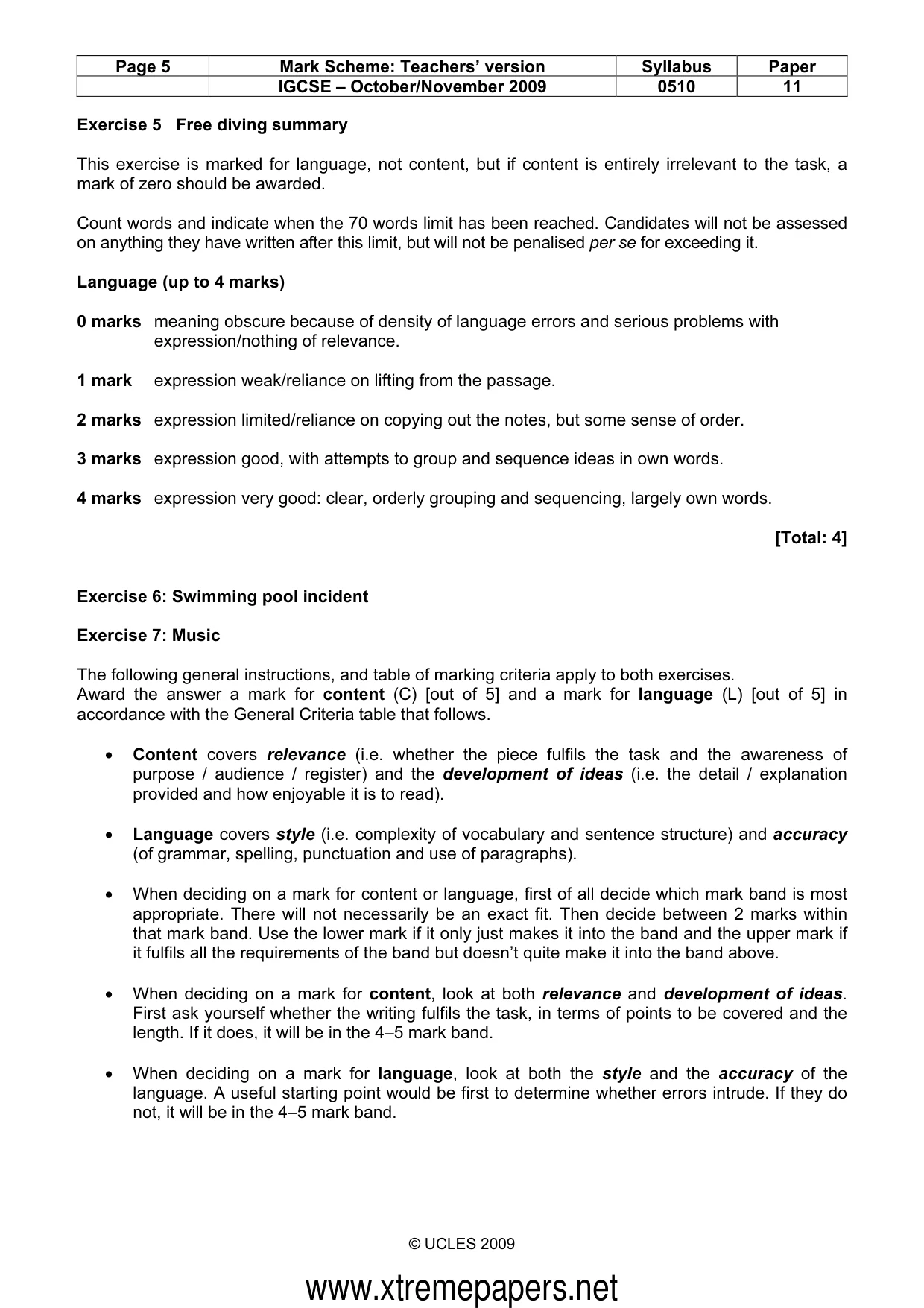
Page 4 Mark Scheme: Teachers’ version Syllabus Paper IGCSE – October/November 2009 0510 11 © UCLES 2009 Sentence 1 and 2 must be written in the first person. Sentence 1: to score, the candidate must write one sentence about why she came to Lakeland i.e. to buy presents for my birthday. Sentence 2: to score, the candidate must write one sentence about the clothes in Singapore i.e. brighter colours in Italy but more variety / range in Singapore OR huge variety of clothes on offer. For each sentence, award up to 2 marks as follows: 2 marks: proper sentence construction; correct spelling and punctuation; gives the information asked for. 1 mark: proper sentence construction; 1–3 errors of punctuation and/or spelling (without obscuring meaning); gives the information asked for. 0 marks: more than 3 errors of punctuation and/or spelling; and/or does not give the information asked for; and/or not a proper sentence; and/or meaning obscure. [Total: 10] Exercise 4 Free diving NB correct responses only apply if they are placed under the correct sub-heading (as detailed below). Add the correct answers (i.e. total of ticks) to give a total out of up to 6. Remember that this exercise is marked for content (reading), not language. Differences between free diving and scuba diving (max 2 marks for this section) 1 no air tank / breathing equipment / scuba diving needs air tanks 2 doesn’t create air bubbles 3 doesn’t frighten fish Preparation and safety for free diving (max 2 marks for this section) 4 wear correct weights 5 stay relaxed / meditate / don’t get stressed / deep breathing 6 always dive with a 'spotter' / don't dive alone 7 have doctors / experts standing by Aims of free divers (max 2 marks for this section) 8 reach own personal goals / depth / diving as deep as they can 9 hold your breath for longer periods of time 10 (constantly practise) to be the best [Total: 6] www.xtremepapers.net
Mark scheme, page 5
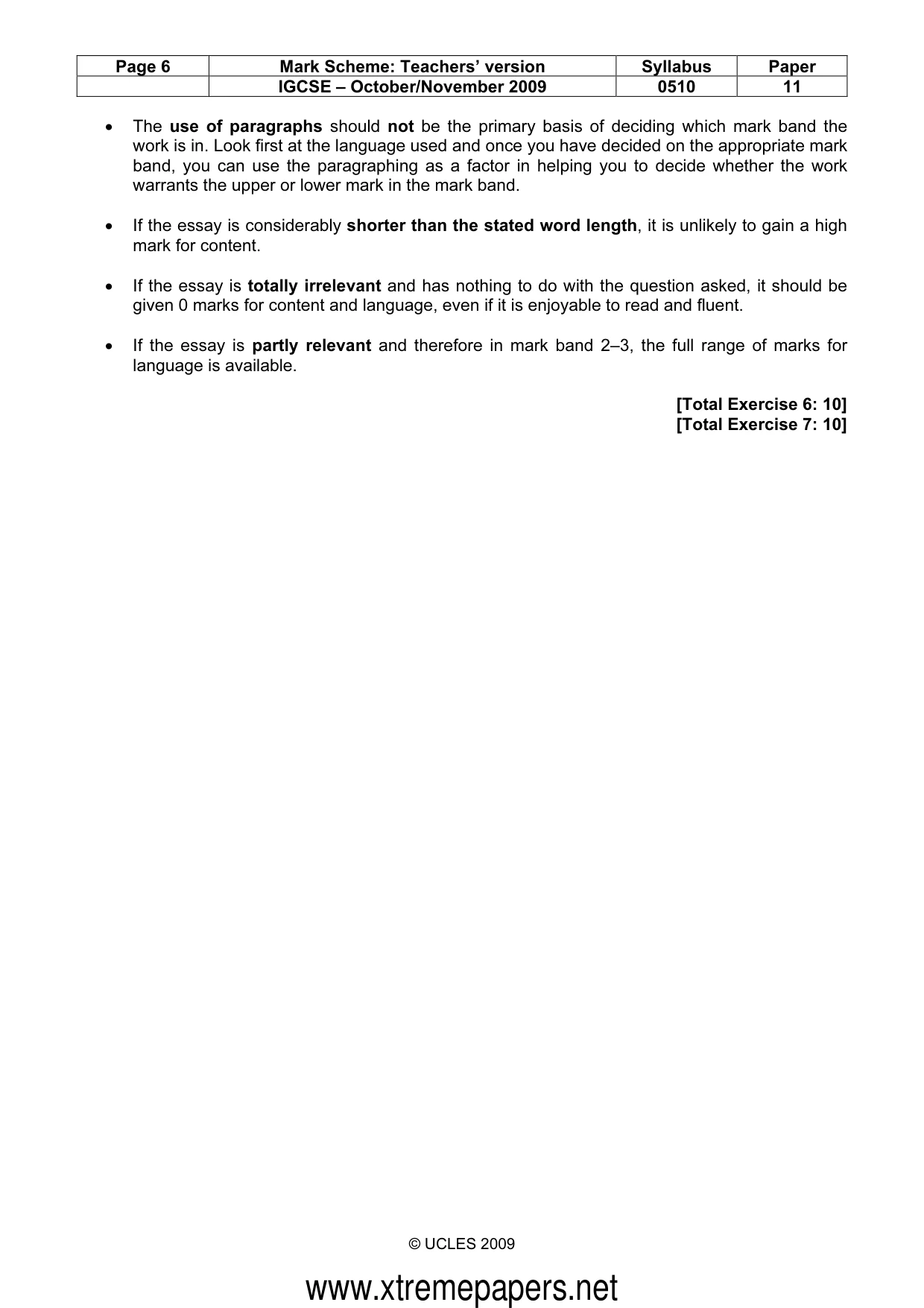
Page 5 Mark Scheme: Teachers’ version Syllabus Paper IGCSE – October/November 2009 0510 11 © UCLES 2009 Exercise 5 Free diving summary This exercise is marked for language, not content, but if content is entirely irrelevant to the task, a mark of zero should be awarded. Count words and indicate when the 70 words limit has been reached. Candidates will not be assessed on anything they have written after this limit, but will not be penalised per se for exceeding it. Language (up to 4 marks) 0 marks meaning obscure because of density of language errors and serious problems with expression/nothing of relevance. 1 mark expression weak/reliance on lifting from the passage. 2 marks expression limited/reliance on copying out the notes, but some sense of order. 3 marks expression good, with attempts to group and sequence ideas in own words. 4 marks expression very good: clear, orderly grouping and sequencing, largely own words. [Total: 4] Exercise 6: Swimming pool incident Exercise 7: Music The following general instructions, and table of marking criteria apply to both exercises. Award the answer a mark for content (C) [out of 5] and a mark for language (L) [out of 5] in accordance with the General Criteria table that follows. • Content covers relevance (i.e. whether the piece fulfils the task and the awareness of purpose / audience / register) and the development of ideas (i.e. the detail / explanation provided and how enjoyable it is to read). • Language covers style (i.e. complexity of vocabulary and sentence structure) and accuracy (of grammar, spelling, punctuation and use of paragraphs). • When deciding on a mark for content or language, first of all decide which mark band is most appropriate. There will not necessarily be an exact fit. Then decide between 2 marks within that mark band. Use the lower mark if it only just makes it into the band and the upper mark if it fulfils all the requirements of the band but doesn’t quite make it into the band above. • When deciding on a mark for content, look at both relevance and development of ideas. First ask yourself whether the writing fulfils the task, in terms of points to be covered and the length. If it does, it will be in the 4–5 mark band. • When deciding on a mark for language, look at both the style and the accuracy of the language. A useful starting point would be first to determine whether errors intrude. If they do not, it will be in the 4–5 mark band. www.xtremepapers.net
Mark scheme, page 6
Page 6 Mark Scheme: Teachers’ version Syllabus Paper IGCSE – October/November 2009 0510 11 © UCLES 2009 • The use of paragraphs should not be the primary basis of deciding which mark band the work is in. Look first at the language used and once you have decided on the appropriate mark band, you can use the paragraphing as a factor in helping you to decide whether the work warrants the upper or lower mark in the mark band. • If the essay is considerably shorter than the stated word length, it is unlikely to gain a high mark for content. • If the essay is totally irrelevant and has nothing to do with the question asked, it should be given 0 marks for content and language, even if it is enjoyable to read and fluent. • If the essay is partly relevant and therefore in mark band 2–3, the full range of marks for language is available. [Total Exercise 6: 10] [Total Exercise 7: 10] www.xtremepapers.net
Mark scheme, page 7
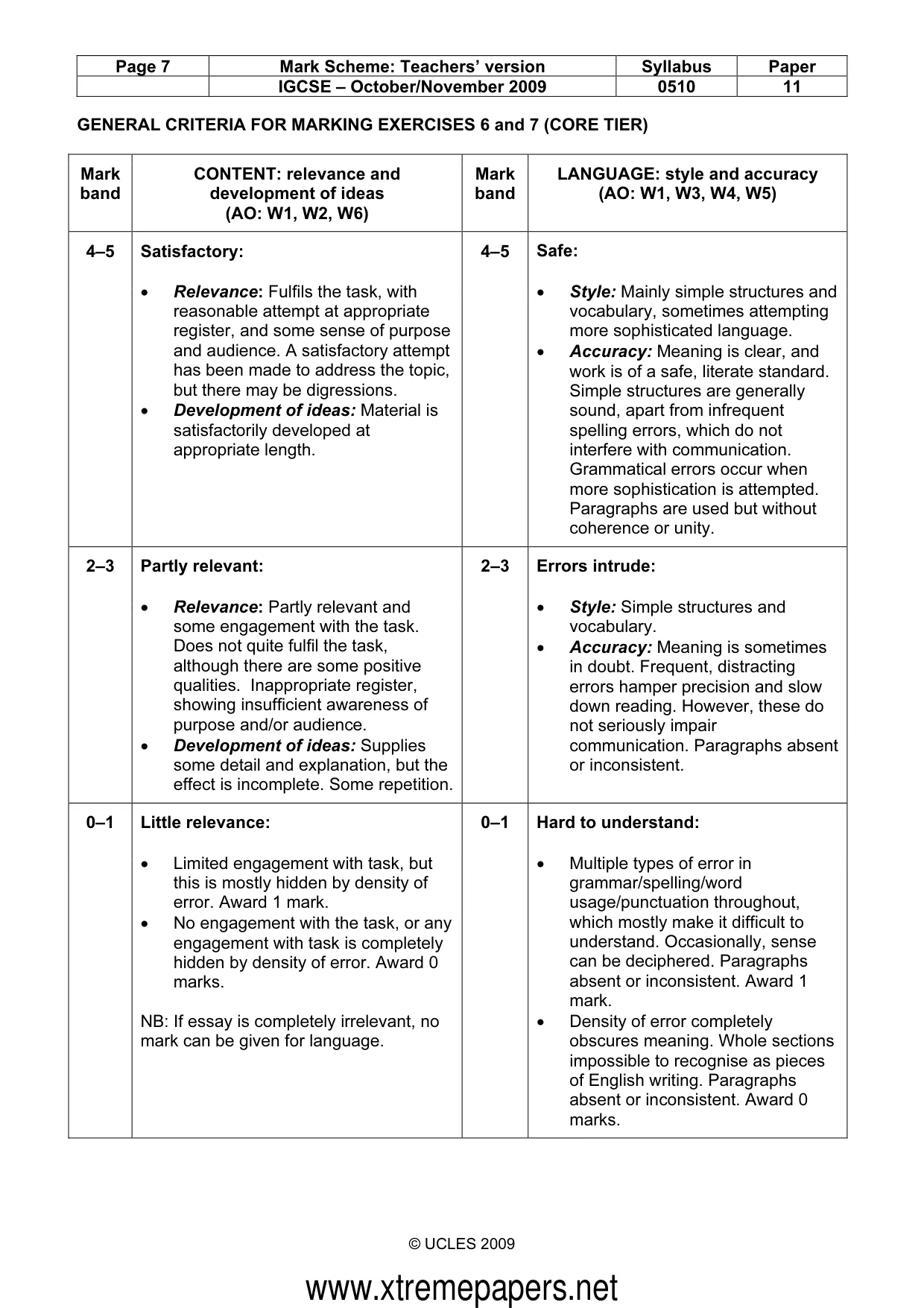
Page 7 Mark Scheme: Teachers’ version Syllabus Paper IGCSE – October/November 2009 0510 11 © UCLES 2009 GENERAL CRITERIA FOR MARKING EXERCISES 6 and 7 (CORE TIER) Mark band CONTENT: relevance and development of ideas (AO: W1, W2, W6) Mark band LANGUAGE: style and accuracy (AO: W1, W3, W4, W5) 4–5 4–5 Satisfactory: • Relevance: Fulfils the task, with reasonable attempt at appropriate register, and some sense of purpose and audience. A satisfactory attempt has been made to address the topic, but there may be digressions. • Development of ideas: Material is satisfactorily developed at appropriate length. Safe: • Style: Mainly simple structures and vocabulary, sometimes attempting more sophisticated language. • Accuracy: Meaning is clear, and work is of a safe, literate standard. Simple structures are generally sound, apart from infrequent spelling errors, which do not interfere with communication. Grammatical errors occur when more sophistication is attempted. Paragraphs are used but without coherence or unity. 2–3 2–3 Partly relevant: • Relevance: Partly relevant and some engagement with the task. Does not quite fulfil the task, although there are some positive qualities. Inappropriate register, showing insufficient awareness of purpose and/or audience. • Development of ideas: Supplies some detail and explanation, but the effect is incomplete. Some repetition. Errors intrude: • Style: Simple structures and vocabulary. • Accuracy: Meaning is sometimes in doubt. Frequent, distracting errors hamper precision and slow down reading. However, these do not seriously impair communication. Paragraphs absent or inconsistent. 0–1 0–1 Little relevance: • Limited engagement with task, but this is mostly hidden by density of error. Award 1 mark. • No engagement with the task, or any engagement with task is completely hidden by density of error. Award 0 marks. NB: If essay is completely irrelevant, no mark can be given for language. Hard to understand: • Multiple types of error in grammar/spelling/word usage/punctuation throughout, which mostly make it difficult to understand. Occasionally, sense can be deciphered. Paragraphs absent or inconsistent. Award 1 mark. • Density of error completely obscures meaning. Whole sections impossible to recognise as pieces of English writing. Paragraphs absent or inconsistent. Award 0 marks. www.xtremepapers.net
What you needed in this session
Cambridge’s own grade thresholds for 2009 Oct/Nov, Paper 1 · Variant 1. A higher threshold means an easier paper — the bar moves with how the cohort did.