Cambridge IGCSE English - Second Language (oral endorsement) 0510 — 2008 May/June Paper 3 · Variant 1
0510/31/M/J/08 · 30 marks · ≈34 min
The question paper and its mark scheme, free to read here and free to download. This is Cambridge’s own paper, exactly as it was sat.
Question paper8 pages


Mark scheme12 pages
Answers below. Sit the paper first if you are practising.
Paper as text
Question paper, page 1
This document consists of 6 printed pages and 2 blank pages. IB08 06_0510_03/5RP © UCLES 2008 [Turn over *6787738354* For Examiner's Use Questions 1-6 Question 7 Question 8 Question 9 Question 10 Total UNIVERSITY OF CAMBRIDGE INTERNATIONAL EXAMINATIONS International General Certificate of Secondary Education ENGLISH AS A SECOND LANGUAGE 0510/03 Paper 3 Listening (Core) May/June 2008 Approx. 30 – 40 minutes Candidates answer on the Question Paper. Additional Materials: As listed in Instructions to Supervisors READ THESE INSTRUCTIONS FIRST Write your Centre number, candidate number and name on all the work you hand in. Write in dark blue or black pen. Do not use staples, paper clips, highlighters, glue or correction fluid. DO NOT WRITE IN ANY BARCODES Answer all questions. Dictionaries are not permitted. At the end of the examination, fasten all your work securely together. The number of marks is given in brackets [ ] at the end of each question or part question. www.XtremePapers.com
Question paper, page 2
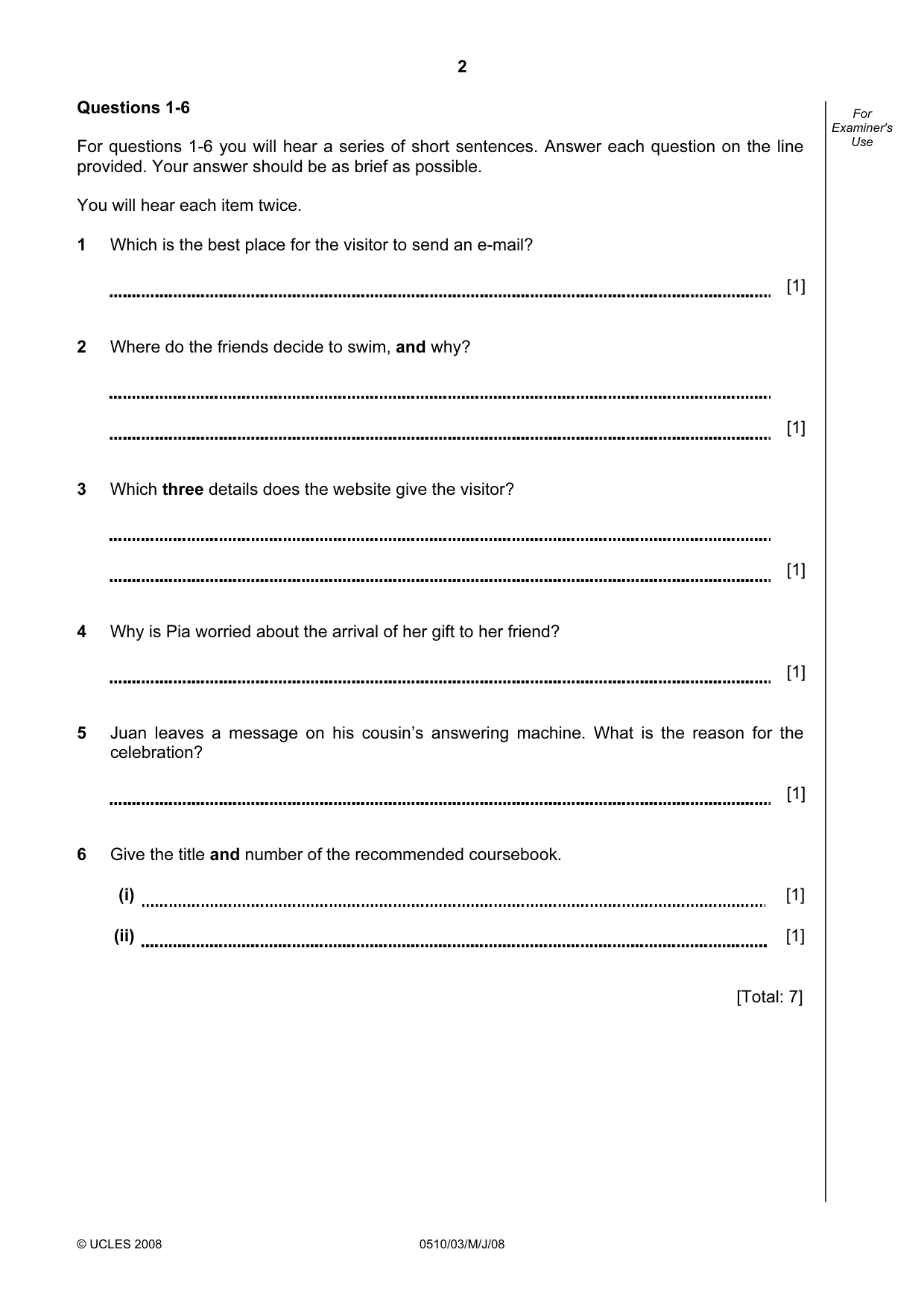
2 © UCLES 2008 0510/03/M/J/08 For Examiner's Use Questions 1-6 For questions 1-6 you will hear a series of short sentences. Answer each question on the line provided. Your answer should be as brief as possible. You will hear each item twice. 1 Which is the best place for the visitor to send an e-mail? [1] 2 Where do the friends decide to swim, and why? [1] 3 Which three details does the website give the visitor? [1] 4 Why is Pia worried about the arrival of her gift to her friend? [1] 5 Juan leaves a message on his cousin’s answering machine. What is the reason for the celebration? [1] 6 Give the title and number of the recommended coursebook. (i) [1] (ii) [1] [Total: 7]
Question paper, page 3
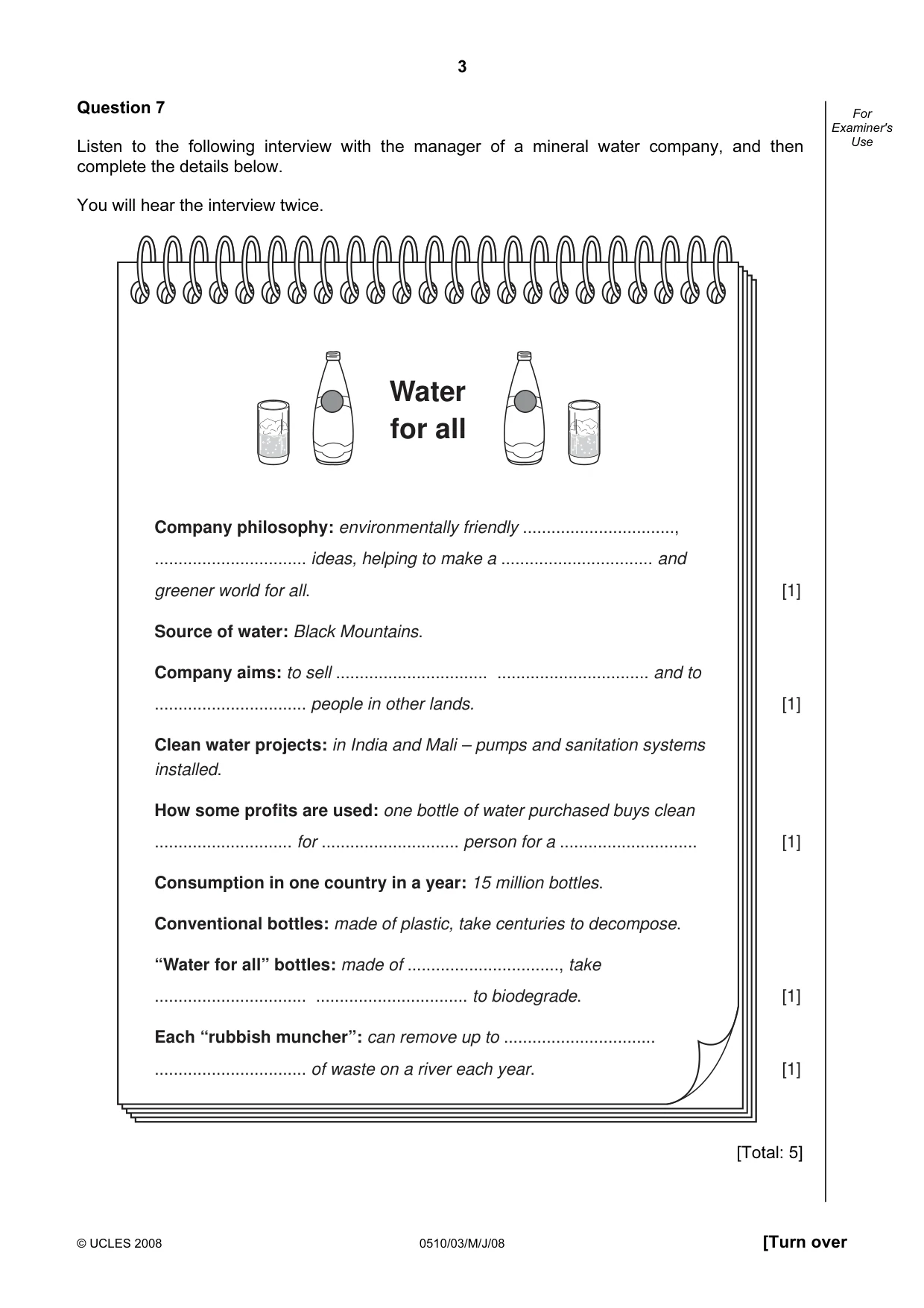
3 © UCLES 2008 0510/03/M/J/08 [Turn over For Examiner's Use Question 7 Listen to the following interview with the manager of a mineral water company, and then complete the details below. You will hear the interview twice. Water for all Company philosophy: environmentally friendly …, … ideas, helping to make a … and greener world for all. [1] Source of water: Black Mountains. Company aims: to sell … … and to … people in other lands. [1] Clean water projects: in India and Mali – pumps and sanitation systems installed. How some profits are used: one bottle of water purchased buys clean … for … person for a … [1] Consumption in one country in a year: 15 million bottles. Conventional bottles: made of plastic, take centuries to decompose. “Water for all” bottles: made of …, take … … to biodegrade. [1] Each “rubbish muncher”: can remove up to … … of waste on a river each year. [1] [Total: 5]
Question paper, page 4
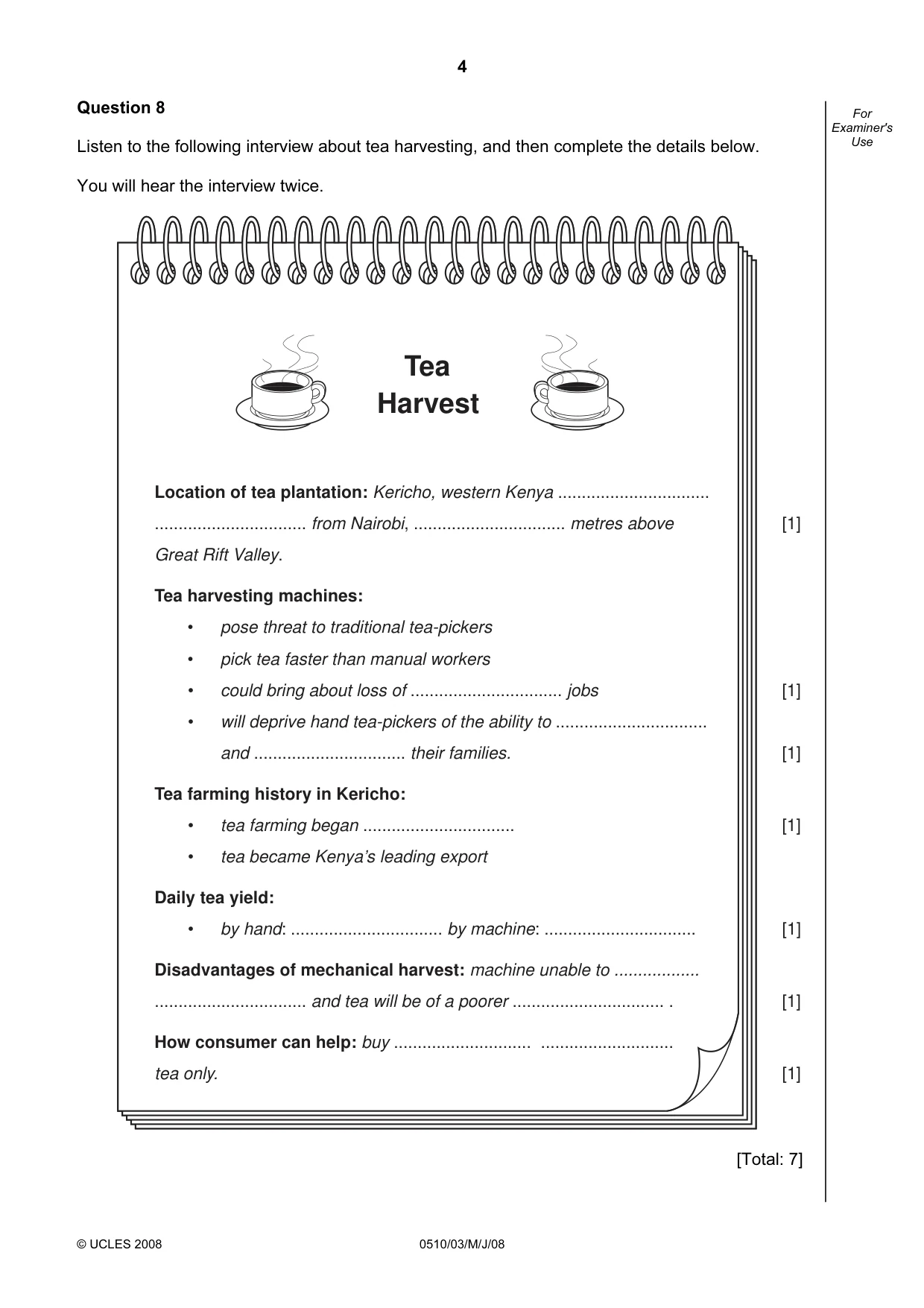
4 © UCLES 2008 0510/03/M/J/08 For Examiner's Use Question 8 Listen to the following interview about tea harvesting, and then complete the details below. You will hear the interview twice. Tea Harvest Location of tea plantation: Kericho, western Kenya … … from Nairobi, … metres above [1] Great Rift Valley. Tea harvesting machines: • pose threat to traditional tea-pickers • pick tea faster than manual workers • could bring about loss of … jobs [1] • will deprive hand tea-pickers of the ability to … and … their families. [1] Tea farming history in Kericho: • tea farming began … [1] • tea became Kenya’s leading export Daily tea yield: • by hand: … by machine: … [1] Disadvantages of mechanical harvest: machine unable to … … and tea will be of a poorer … . [1] How consumer can help: buy … … tea only. [1] [Total: 7]
Question paper, page 5
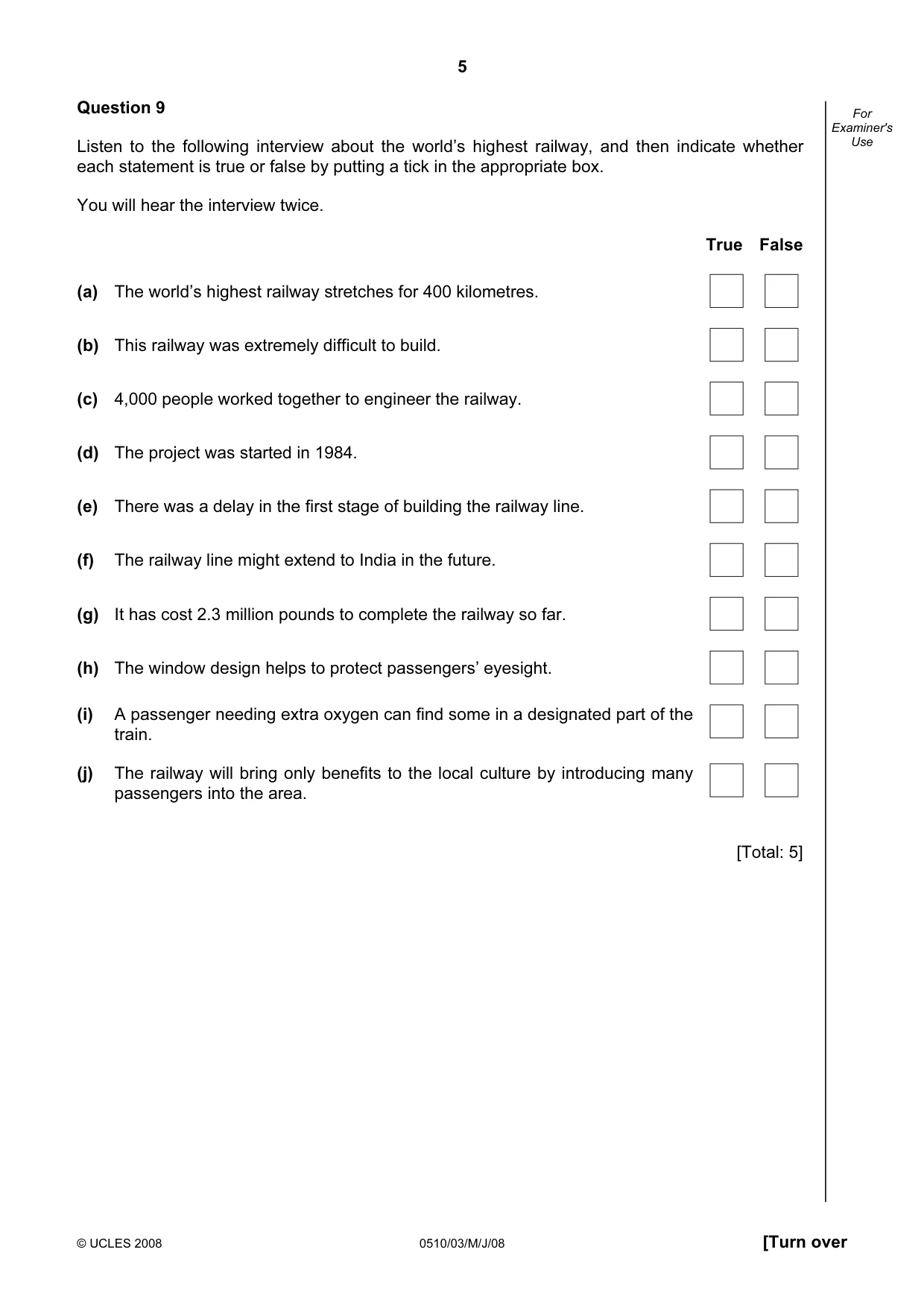
5 © UCLES 2008 0510/03/M/J/08 [Turn over For Examiner's Use Question 9 Listen to the following interview about the world’s highest railway, and then indicate whether each statement is true or false by putting a tick in the appropriate box. You will hear the interview twice. True False (a) The world’s highest railway stretches for 400 kilometres. (b) This railway was extremely difficult to build. (c) 4,000 people worked together to engineer the railway. (d) The project was started in 1984. (e) There was a delay in the first stage of building the railway line. (f) The railway line might extend to India in the future. (g) It has cost 2.3 million pounds to complete the railway so far. (h) The window design helps to protect passengers’ eyesight. (i) A passenger needing extra oxygen can find some in a designated part of the train. (j) The railway will bring only benefits to the local culture by introducing many passengers into the area. [Total: 5]
Question paper, page 6
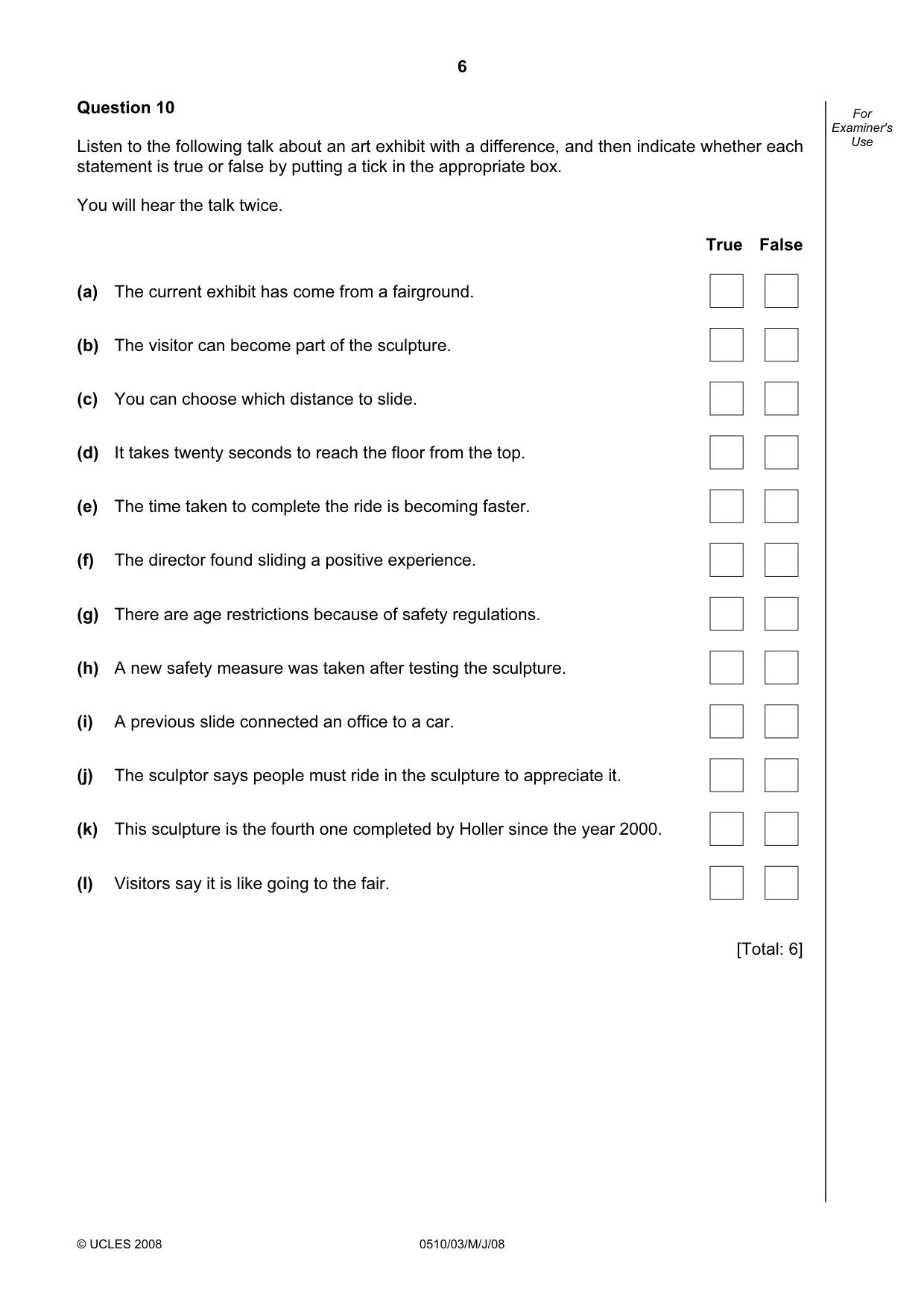
6 © UCLES 2008 0510/03/M/J/08 For Examiner's Use Question 10 Listen to the following talk about an art exhibit with a difference, and then indicate whether each statement is true or false by putting a tick in the appropriate box. You will hear the talk twice. True False (a) The current exhibit has come from a fairground. (b) The visitor can become part of the sculpture. (c) You can choose which distance to slide. (d) It takes twenty seconds to reach the floor from the top. (e) The time taken to complete the ride is becoming faster. (f) The director found sliding a positive experience. (g) There are age restrictions because of safety regulations. (h) A new safety measure was taken after testing the sculpture. (i) A previous slide connected an office to a car. (j) The sculptor says people must ride in the sculpture to appreciate it. (k) This sculpture is the fourth one completed by Holler since the year 2000. (l) Visitors say it is like going to the fair. [Total: 6]
Question paper, page 8
8 Permission to reproduce items where third-party owned material protected by copyright is included has been sought and cleared where possible. Every reasonable effort has been made by the publisher (UCLES) to trace copyright holders, but if any items requiring clearance have unwittingly been included, the publisher will be pleased to make amends at the earliest possible opportunity. University of Cambridge International Examinations is part of the Cambridge Assessment Group. Cambridge Assessment is the brand name of University of Cambridge Local Examinations Syndicate (UCLES), which is itself a department of the University of Cambridge. 0510/03/M/J/08 BLANK PAGE
Mark scheme, page 1
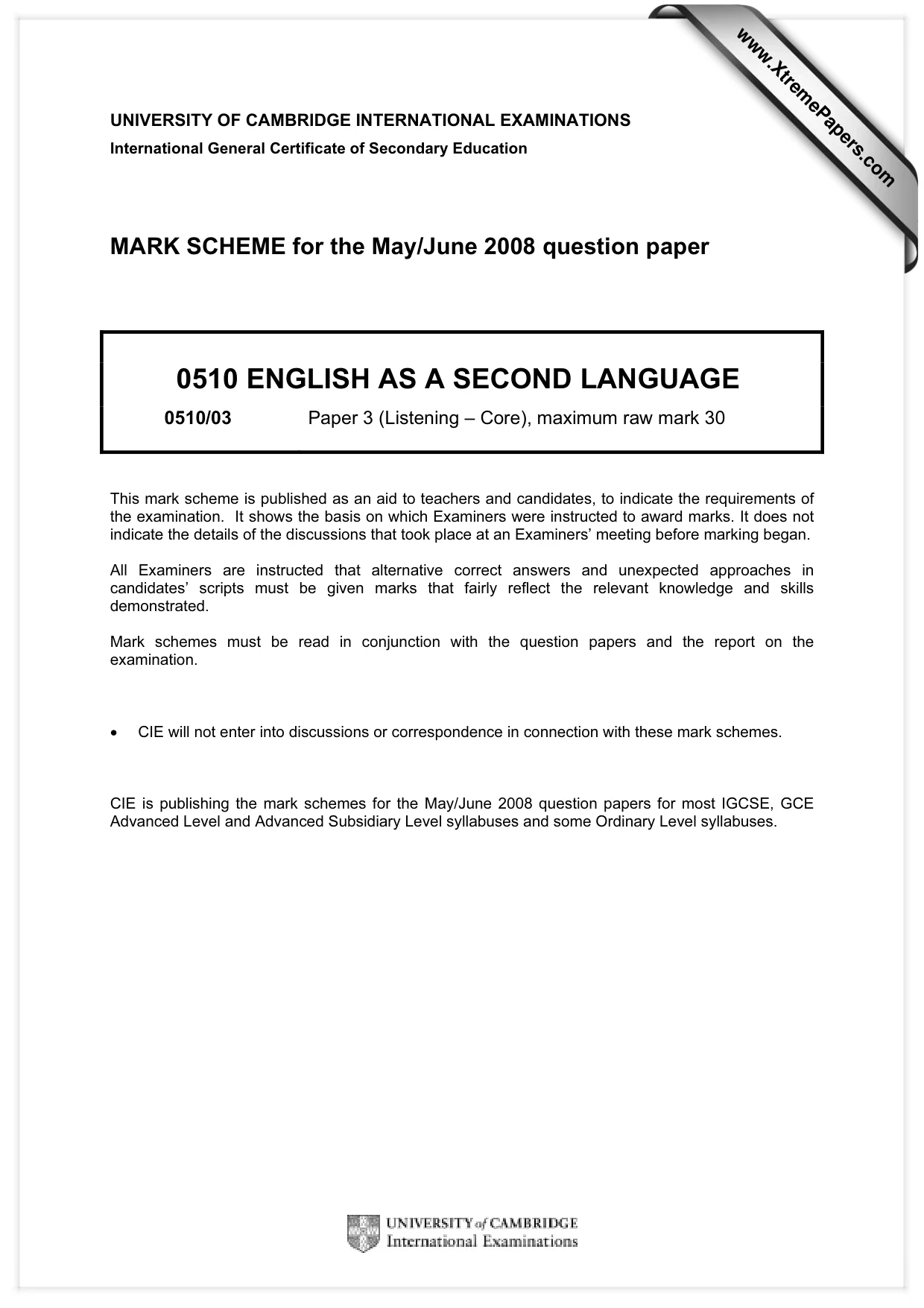
UNIVERSITY OF CAMBRIDGE INTERNATIONAL EXAMINATIONS International General Certificate of Secondary Education MARK SCHEME for the May/June 2008 question paper 0510 ENGLISH AS A SECOND LANGUAGE 0510/03 Paper 3 (Listening – Core), maximum raw mark 30 This mark scheme is published as an aid to teachers and candidates, to indicate the requirements of the examination. It shows the basis on which Examiners were instructed to award marks. It does not indicate the details of the discussions that took place at an Examiners’ meeting before marking began. All Examiners are instructed that alternative correct answers and unexpected approaches in candidates’ scripts must be given marks that fairly reflect the relevant knowledge and skills demonstrated. Mark schemes must be read in conjunction with the question papers and the report on the examination. • CIE will not enter into discussions or correspondence in connection with these mark schemes. CIE is publishing the mark schemes for the May/June 2008 question papers for most IGCSE, GCE Advanced Level and Advanced Subsidiary Level syllabuses and some Ordinary Level syllabuses. www.XtremePapers.com
Mark scheme, page 2
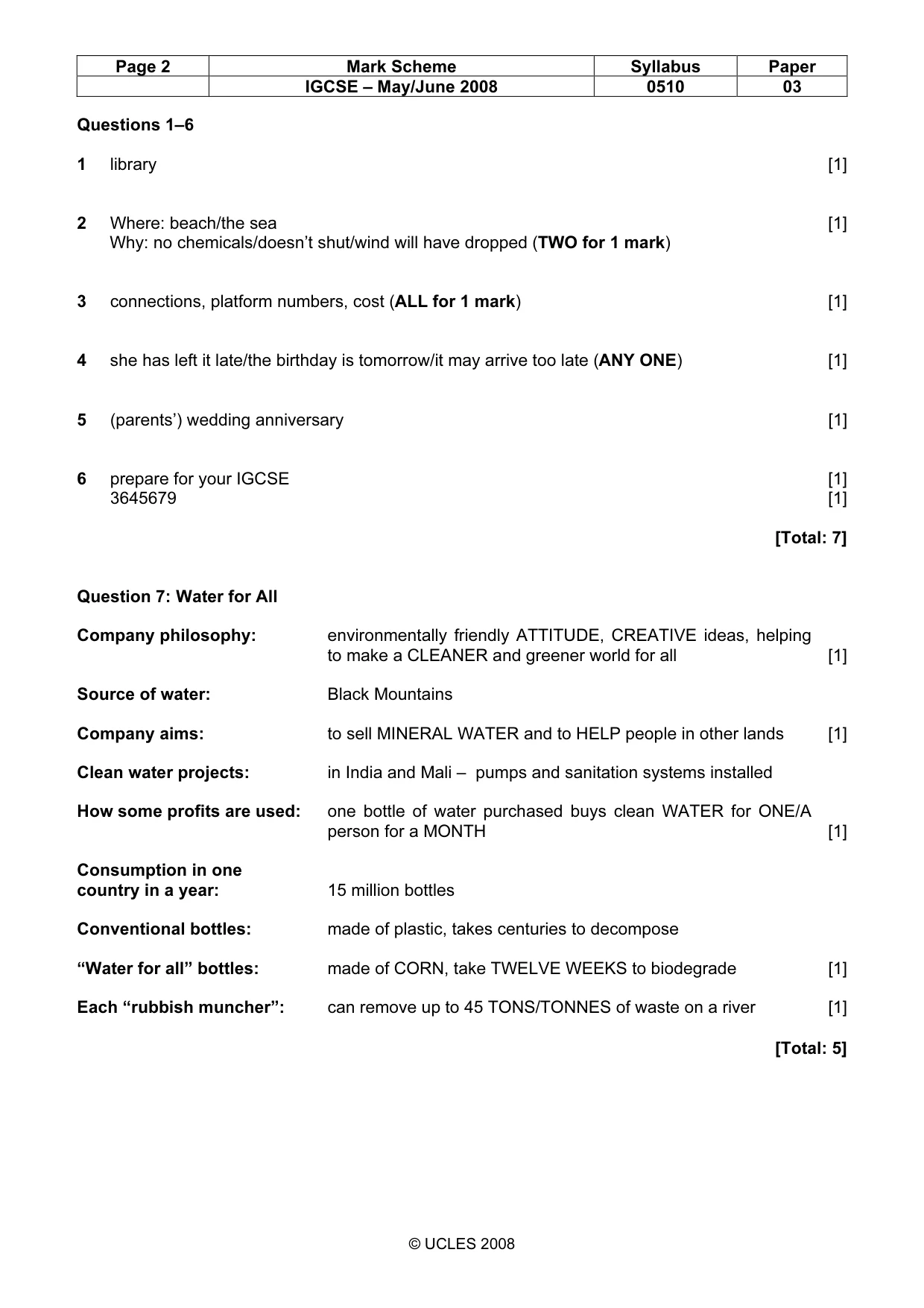
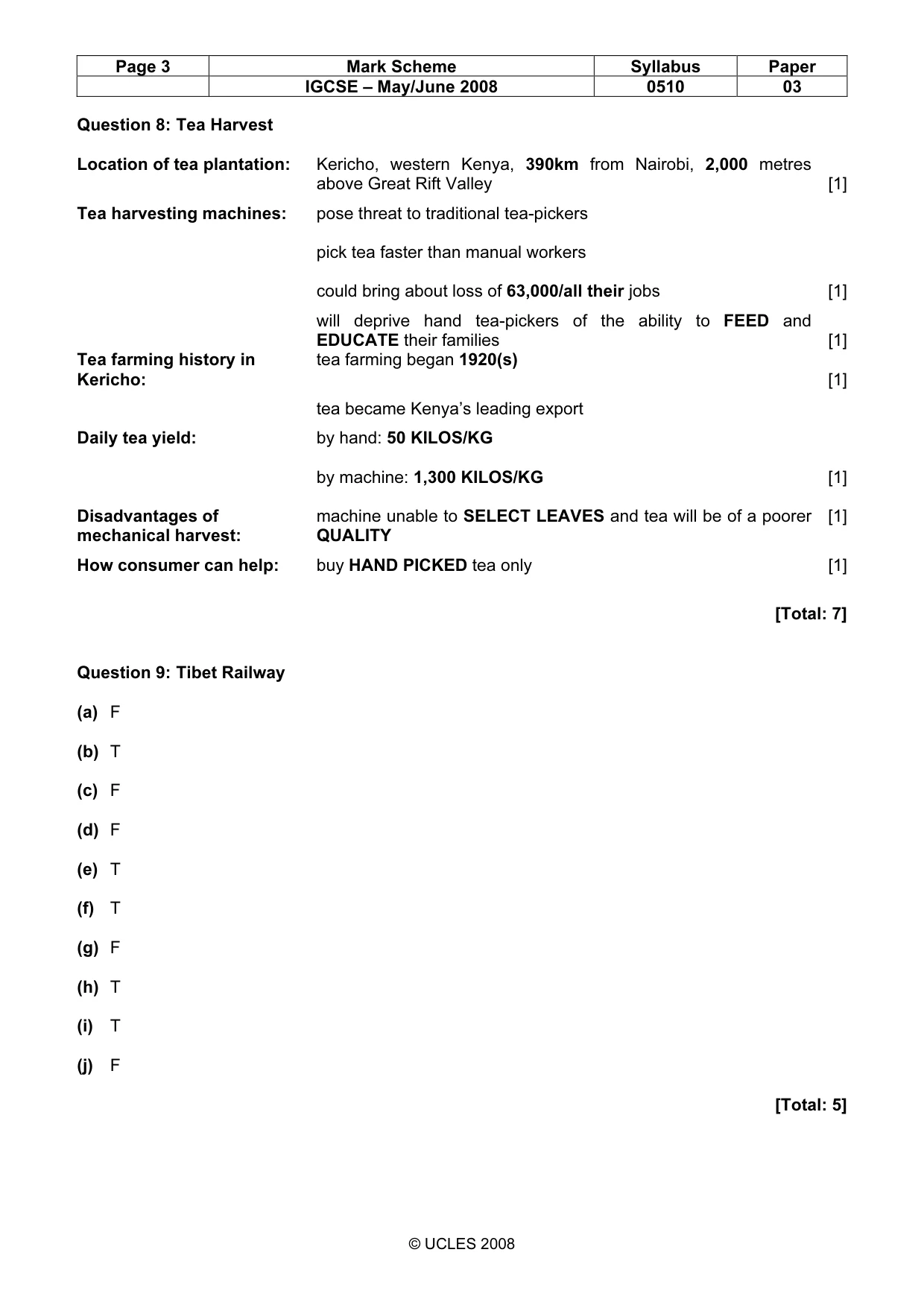
Page 2 Mark Scheme Syllabus Paper IGCSE – May/June 2008 0510 03 © UCLES 2008 Questions 1–6 1 library [1] 2 Where: beach/the sea [1] Why: no chemicals/doesn’t shut/wind will have dropped (TWO for 1 mark) 3 connections, platform numbers, cost (ALL for 1 mark) [1] 4 she has left it late/the birthday is tomorrow/it may arrive too late (ANY ONE) [1] 5 (parents’) wedding anniversary [1] 6 prepare for your IGCSE [1] 3645679 [1] [Total: 7] Question 7: Water for All Company philosophy: environmentally friendly ATTITUDE, CREATIVE ideas, helping to make a CLEANER and greener world for all [1] Source of water: Black Mountains Company aims: to sell MINERAL WATER and to HELP people in other lands [1] Clean water projects: in India and Mali – pumps and sanitation systems installed How some profits are used: one bottle of water purchased buys clean WATER for ONE/A person for a MONTH [1] Consumption in one country in a year: 15 million bottles Conventional bottles: made of plastic, takes centuries to decompose “Water for all” bottles: made of CORN, take TWELVE WEEKS to biodegrade [1] Each “rubbish muncher”: can remove up to 45 TONS/TONNES of waste on a river [1] [Total: 5]
Mark scheme, page 3
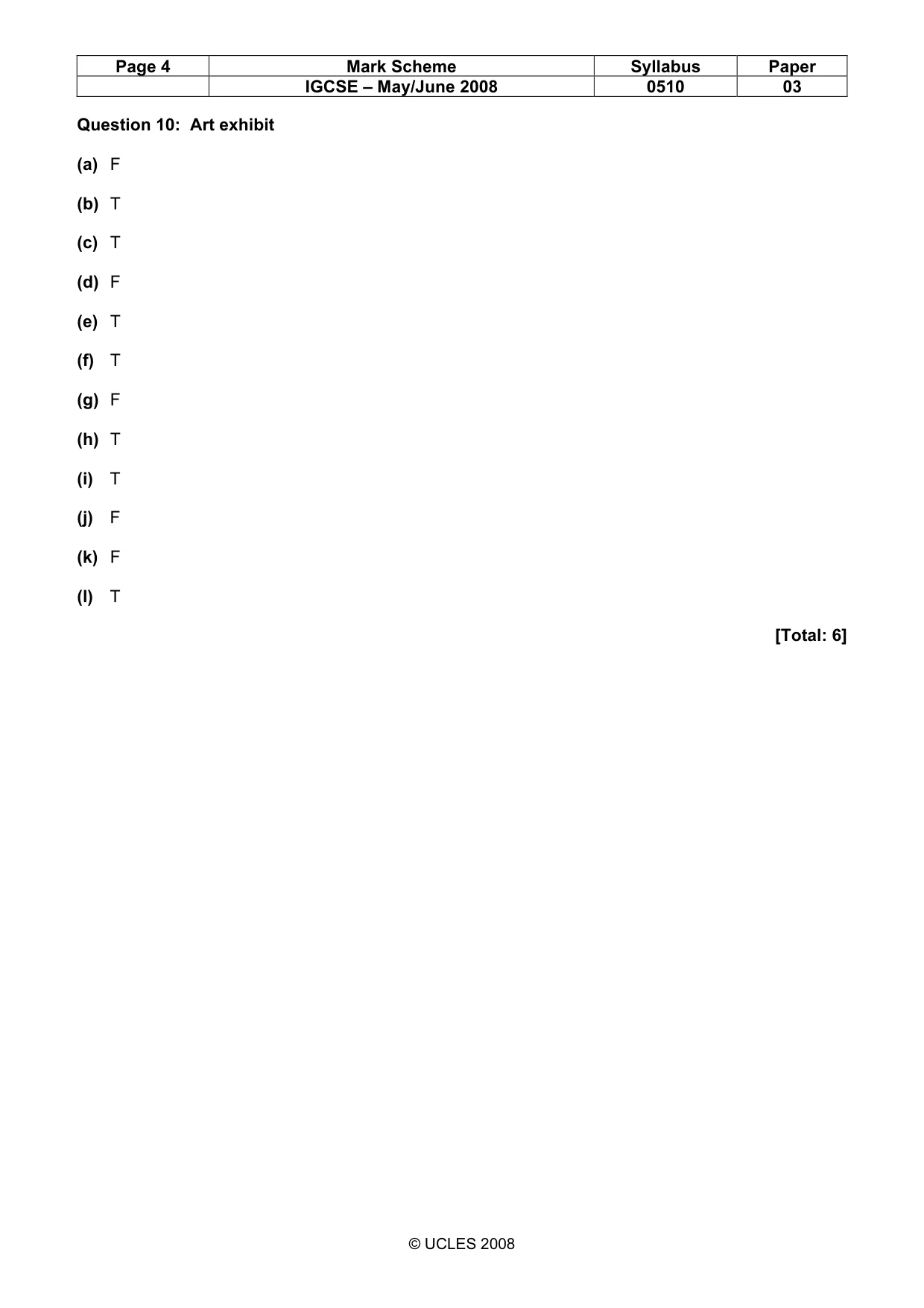
Page 3 Mark Scheme Syllabus Paper IGCSE – May/June 2008 0510 03 © UCLES 2008 Question 8: Tea Harvest Location of tea plantation: Kericho, western Kenya, 390km from Nairobi, 2,000 metres above Great Rift Valley [1] Tea harvesting machines: pose threat to traditional tea-pickers pick tea faster than manual workers could bring about loss of 63,000/all their jobs [1] will deprive hand tea-pickers of the ability to FEED and EDUCATE their families [1] Tea farming history in Kericho: tea farming began 1920(s) [1] tea became Kenya’s leading export Daily tea yield: by hand: 50 KILOS/KG by machine: 1,300 KILOS/KG [1] Disadvantages of mechanical harvest: machine unable to SELECT LEAVES and tea will be of a poorer QUALITY [1] How consumer can help: buy HAND PICKED tea only [1] [Total: 7] Question 9: Tibet Railway (a) F (b) T (c) F (d) F (e) T (f) T (g) F (h) T (i) T (j) F [Total: 5]
Mark scheme, page 4
Page 4 Mark Scheme Syllabus Paper IGCSE – May/June 2008 0510 03 © UCLES 2008 Question 10: Art exhibit (a) F (b) T (c) T (d) F (e) T (f) T (g) F (h) T (i) T (j) F (k) F (l) T [Total: 6]
Mark scheme, page 5
Page 5 Mark Scheme Syllabus Paper IGCSE – May/June 2008 0510 03 © UCLES 2008 TAPESCRIPT TRACK 1 R1 University of Cambridge International Examinations International General Certificate of Secondary Education June Examination Session 2008 English as a Second Language Paper 3 – Listening Comprehension Welcome to the exam. In a moment, your teacher is going to give out the question papers. When you get your paper, fill in your name, Centre number and candidate number on the front page. Do not talk to anyone during the test. If you would like the recording to be louder, tell your teacher NOW. The recording will not be stopped while you are doing the test. Teacher: please give out the question papers, and when all the candidates are ready to start the test, please turn the recording back on. [BLEEP]
Mark scheme, page 6
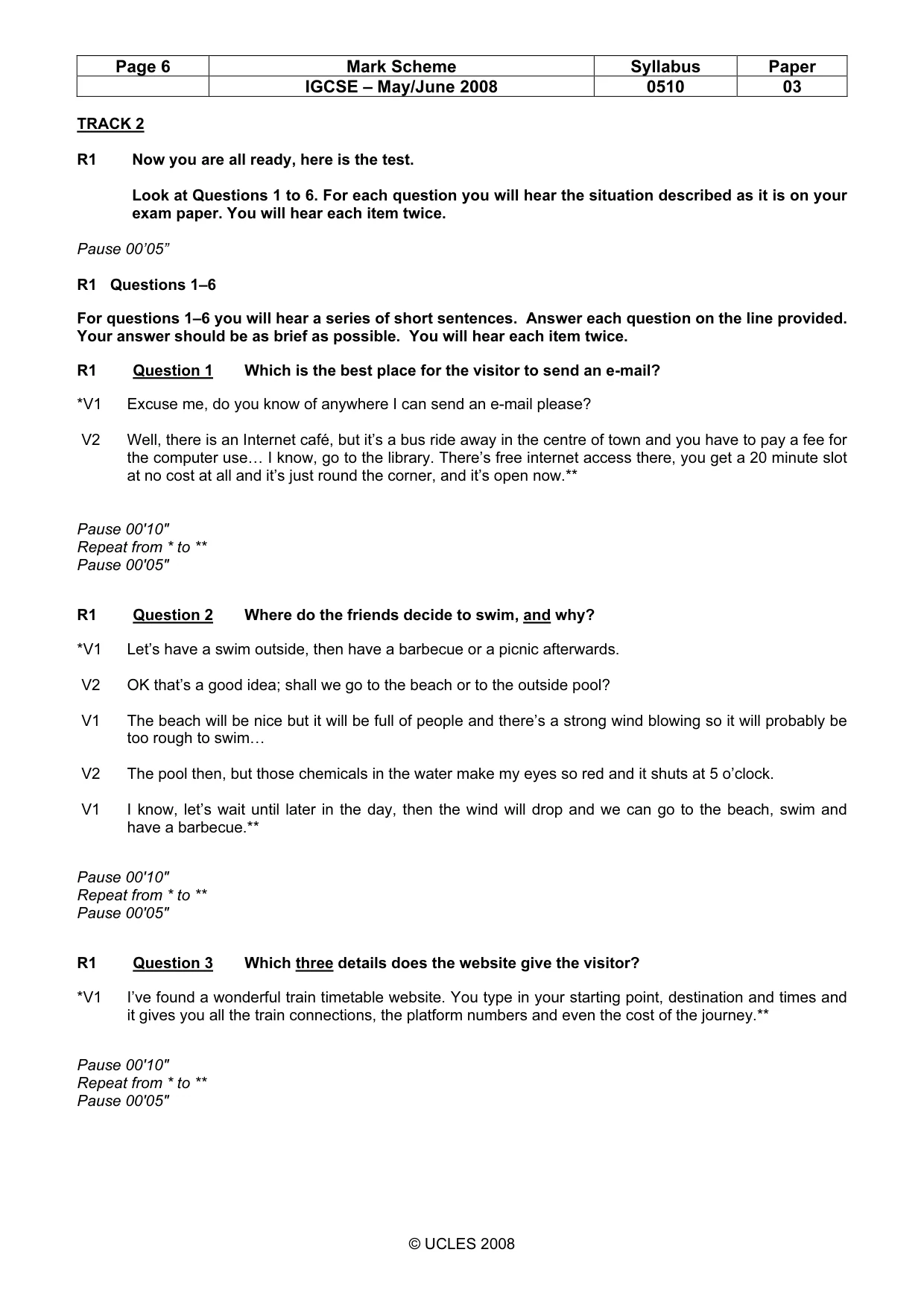
Page 6 Mark Scheme Syllabus Paper IGCSE – May/June 2008 0510 03 © UCLES 2008 TRACK 2 R1 Now you are all ready, here is the test. Look at Questions 1 to 6. For each question you will hear the situation described as it is on your exam paper. You will hear each item twice. Pause 00’05” R1 Questions 1–6 For questions 1–6 you will hear a series of short sentences. Answer each question on the line provided. Your answer should be as brief as possible. You will hear each item twice. R1 Question 1 Which is the best place for the visitor to send an e-mail? *V1 Excuse me, do you know of anywhere I can send an e-mail please? V2 Well, there is an Internet café, but it’s a bus ride away in the centre of town and you have to pay a fee for the computer use… I know, go to the library. There’s free internet access there, you get a 20 minute slot at no cost at all and it’s just round the corner, and it’s open now.** Pause 00'10" Repeat from * to ** Pause 00'05" R1 Question 2 Where do the friends decide to swim, and why? *V1 Let’s have a swim outside, then have a barbecue or a picnic afterwards. V2 OK that’s a good idea; shall we go to the beach or to the outside pool? V1 The beach will be nice but it will be full of people and there’s a strong wind blowing so it will probably be too rough to swim… V2 The pool then, but those chemicals in the water make my eyes so red and it shuts at 5 o’clock. V1 I know, let’s wait until later in the day, then the wind will drop and we can go to the beach, swim and have a barbecue.** Pause 00'10" Repeat from * to ** Pause 00'05" R1 Question 3 Which three details does the website give the visitor? *V1 I’ve found a wonderful train timetable website. You type in your starting point, destination and times and it gives you all the train connections, the platform numbers and even the cost of the journey.** Pause 00'10" Repeat from * to ** Pause 00'05"
Mark scheme, page 7
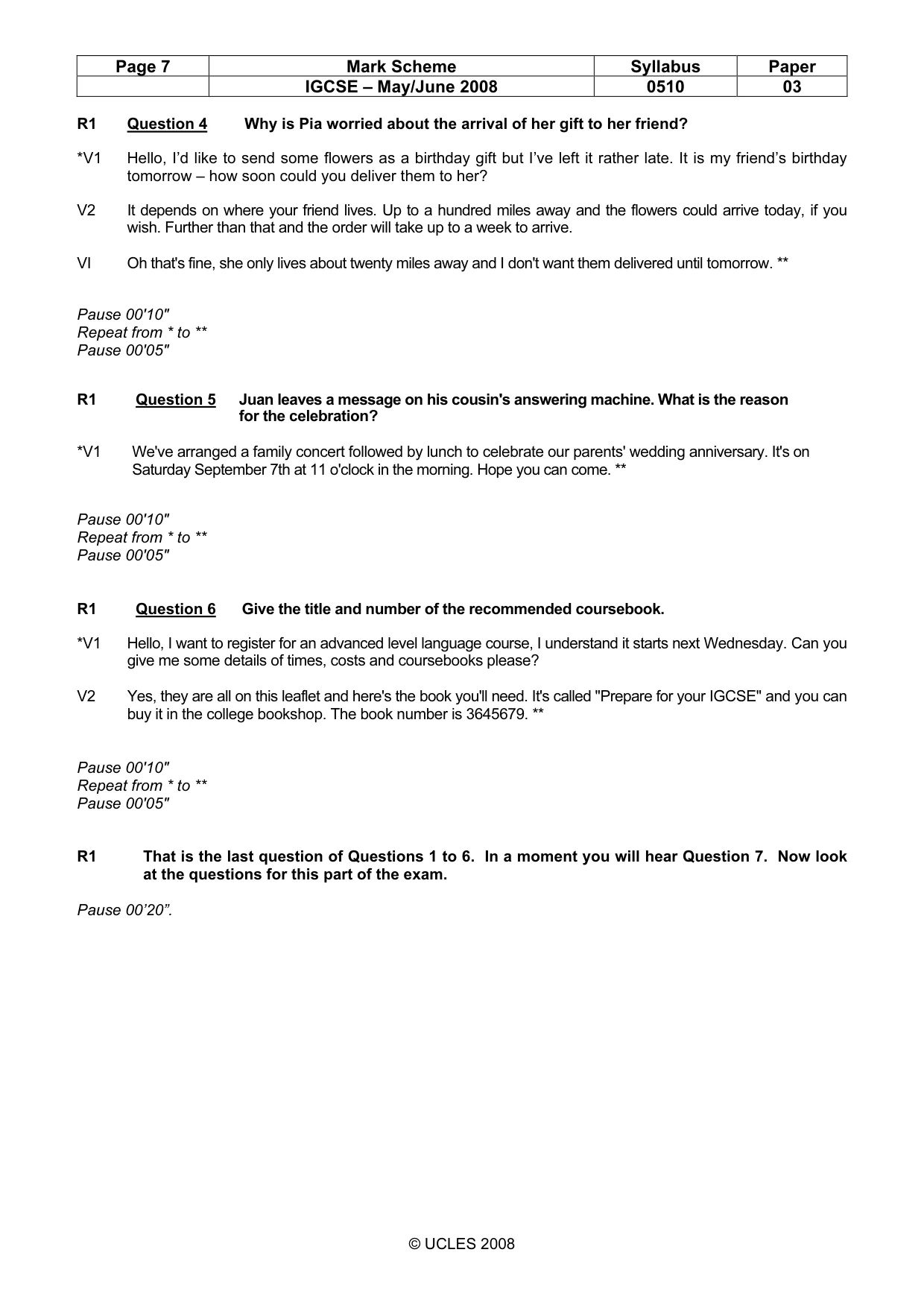
Page 7 Mark Scheme Syllabus Paper IGCSE – May/June 2008 0510 03 © UCLES 2008 R1 Question 4 Why is Pia worried about the arrival of her gift to her friend? *V1 Hello, I’d like to send some flowers as a birthday gift but I’ve left it rather late. It is my friend’s birthday tomorrow – how soon could you deliver them to her? V2 It depends on where your friend lives. Up to a hundred miles away and the flowers could arrive today, if you wish. Further than that and the order will take up to a week to arrive. VI Oh that's fine, she only lives about twenty miles away and I don't want them delivered until tomorrow. ** Pause 00'10" Repeat from * to ** Pause 00'05" R1 Question 5 Juan leaves a message on his cousin's answering machine. What is the reason for the celebration? *V1 We've arranged a family concert followed by lunch to celebrate our parents' wedding anniversary. It's on Saturday September 7th at 11 o'clock in the morning. Hope you can come. ** Pause 00'10" Repeat from * to ** Pause 00'05" R1 Question 6 Give the title and number of the recommended coursebook. *V1 Hello, I want to register for an advanced level language course, I understand it starts next Wednesday. Can you give me some details of times, costs and coursebooks please? V2 Yes, they are all on this leaflet and here's the book you'll need. It's called "Prepare for your IGCSE" and you can buy it in the college bookshop. The book number is 3645679. ** Pause 00'10" Repeat from * to ** Pause 00'05" R1 That is the last question of Questions 1 to 6. In a moment you will hear Question 7. Now look at the questions for this part of the exam. Pause 00’20”.
Mark scheme, page 8
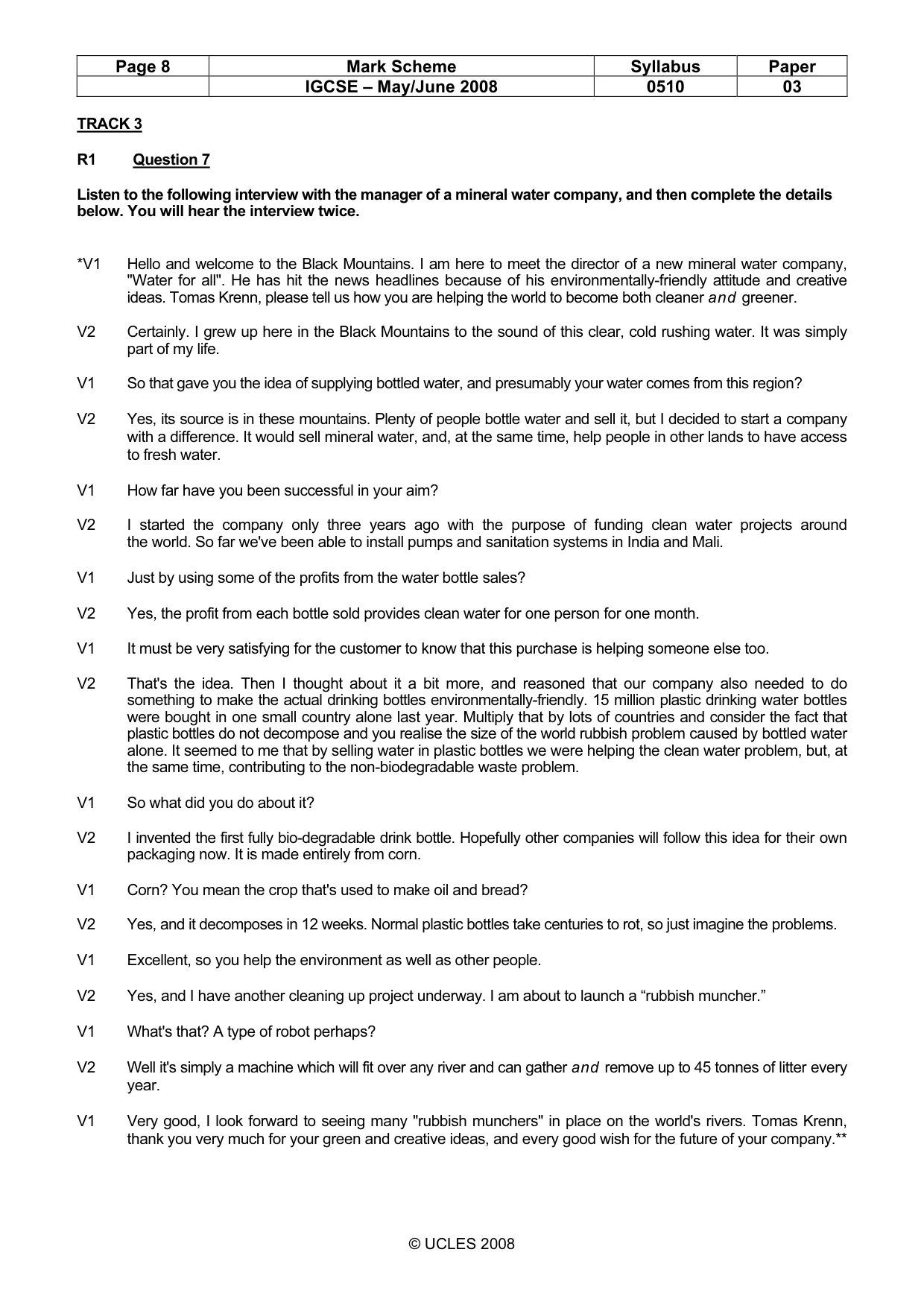
Page 8 Mark Scheme Syllabus Paper IGCSE – May/June 2008 0510 03 © UCLES 2008 TRACK 3 R1 Question 7 Listen to the following interview with the manager of a mineral water company, and then complete the details below. You will hear the interview twice. *V1 Hello and welcome to the Black Mountains. I am here to meet the director of a new mineral water company, "Water for all". He has hit the news headlines because of his environmentally-friendly attitude and creative ideas. Tomas Krenn, please tell us how you are helping the world to become both cleaner and greener. V2 Certainly. I grew up here in the Black Mountains to the sound of this clear, cold rushing water. It was simply part of my life. V1 So that gave you the idea of supplying bottled water, and presumably your water comes from this region? V2 Yes, its source is in these mountains. Plenty of people bottle water and sell it, but I decided to start a company with a difference. It would sell mineral water, and, at the same time, help people in other lands to have access to fresh water. V1 How far have you been successful in your aim? V2 I started the company only three years ago with the purpose of funding clean water projects around the world. So far we've been able to install pumps and sanitation systems in India and Mali. V1 Just by using some of the profits from the water bottle sales? V2 Yes, the profit from each bottle sold provides clean water for one person for one month. V1 It must be very satisfying for the customer to know that this purchase is helping someone else too. V2 That's the idea. Then I thought about it a bit more, and reasoned that our company also needed to do something to make the actual drinking bottles environmentally-friendly. 15 million plastic drinking water bottles were bought in one small country alone last year. Multiply that by lots of countries and consider the fact that plastic bottles do not decompose and you realise the size of the world rubbish problem caused by bottled water alone. It seemed to me that by selling water in plastic bottles we were helping the clean water problem, but, at the same time, contributing to the non-biodegradable waste problem. V1 So what did you do about it? V2 I invented the first fully bio-degradable drink bottle. Hopefully other companies will follow this idea for their own packaging now. It is made entirely from corn. V1 Corn? You mean the crop that's used to make oil and bread? V2 Yes, and it decomposes in 12 weeks. Normal plastic bottles take centuries to rot, so just imagine the problems. V1 Excellent, so you help the environment as well as other people. V2 Yes, and I have another cleaning up project underway. I am about to launch a “rubbish muncher.” V1 What's that? A type of robot perhaps? V2 Well it's simply a machine which will fit over any river and can gather and remove up to 45 tonnes of litter every year. V1 Very good, I look forward to seeing many "rubbish munchers" in place on the world's rivers. Tomas Krenn, thank you very much for your green and creative ideas, and every good wish for the future of your company.**
Mark scheme, page 9
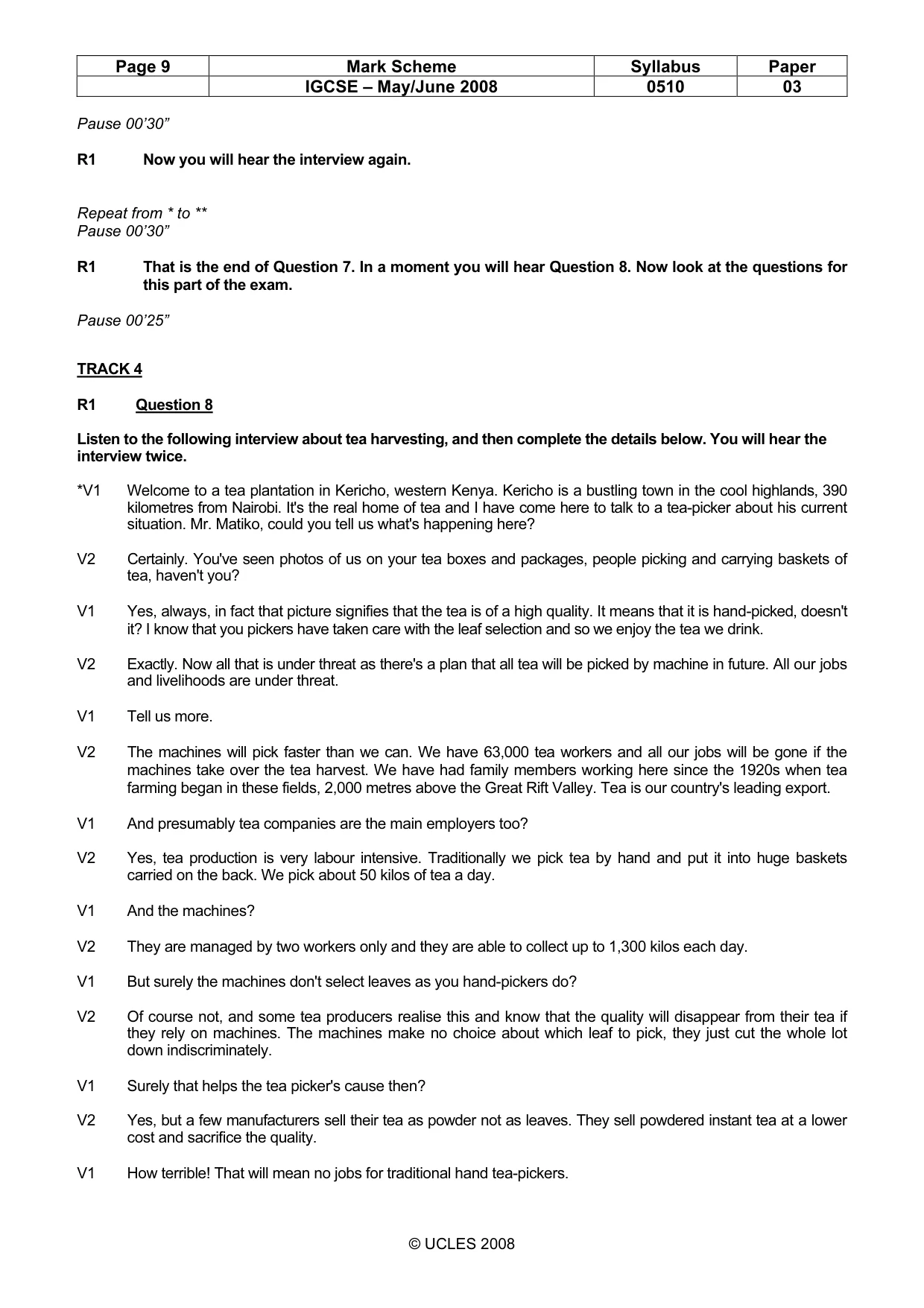
Page 9 Mark Scheme Syllabus Paper IGCSE – May/June 2008 0510 03 © UCLES 2008 Pause 00’30” R1 Now you will hear the interview again. Repeat from * to ** Pause 00’30” R1 That is the end of Question 7. In a moment you will hear Question 8. Now look at the questions for this part of the exam. Pause 00’25” TRACK 4 R1 Question 8 Listen to the following interview about tea harvesting, and then complete the details below. You will hear the interview twice. *V1 Welcome to a tea plantation in Kericho, western Kenya. Kericho is a bustling town in the cool highlands, 390 kilometres from Nairobi. It's the real home of tea and I have come here to talk to a tea-picker about his current situation. Mr. Matiko, could you tell us what's happening here? V2 Certainly. You've seen photos of us on your tea boxes and packages, people picking and carrying baskets of tea, haven't you? V1 Yes, always, in fact that picture signifies that the tea is of a high quality. It means that it is hand-picked, doesn't it? I know that you pickers have taken care with the leaf selection and so we enjoy the tea we drink. V2 Exactly. Now all that is under threat as there's a plan that all tea will be picked by machine in future. All our jobs and livelihoods are under threat. V1 Tell us more. V2 The machines will pick faster than we can. We have 63,000 tea workers and all our jobs will be gone if the machines take over the tea harvest. We have had family members working here since the 1920s when tea farming began in these fields, 2,000 metres above the Great Rift Valley. Tea is our country's leading export. V1 And presumably tea companies are the main employers too? V2 Yes, tea production is very labour intensive. Traditionally we pick tea by hand and put it into huge baskets carried on the back. We pick about 50 kilos of tea a day. V1 And the machines? V2 They are managed by two workers only and they are able to collect up to 1,300 kilos each day. V1 But surely the machines don't select leaves as you hand-pickers do? V2 Of course not, and some tea producers realise this and know that the quality will disappear from their tea if they rely on machines. The machines make no choice about which leaf to pick, they just cut the whole lot down indiscriminately. V1 Surely that helps the tea picker's cause then? V2 Yes, but a few manufacturers sell their tea as powder not as leaves. They sell powdered instant tea at a lower cost and sacrifice the quality. V1 How terrible! That will mean no jobs for traditional hand tea-pickers.
Mark scheme, page 10
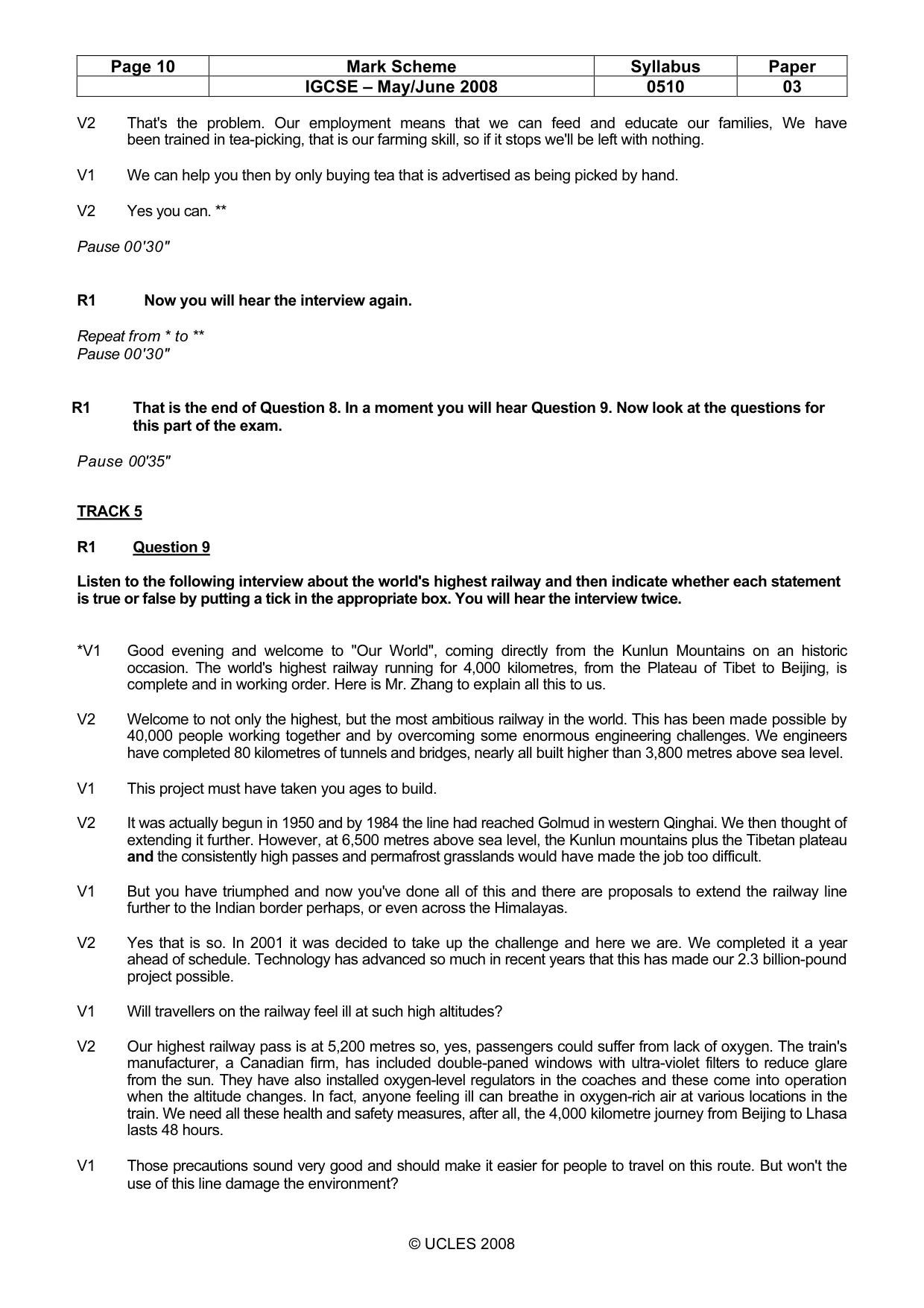
Page 10 Mark Scheme Syllabus Paper IGCSE – May/June 2008 0510 03 © UCLES 2008 V2 That's the problem. Our employment means that we can feed and educate our families, We have been trained in tea-picking, that is our farming skill, so if it stops we'll be left with nothing. V1 We can help you then by only buying tea that is advertised as being picked by hand. V2 Yes you can. ** Pause 00'30" R1 Now you will hear the interview again. Repeat from * to ** Pause 00'30" R1 That is the end of Question 8. In a moment you will hear Question 9. Now look at the questions for this part of the exam. Pause 00'35" TRACK 5 R1 Question 9 Listen to the following interview about the world's highest railway and then indicate whether each statement is true or false by putting a tick in the appropriate box. You will hear the interview twice. *V1 Good evening and welcome to "Our World", coming directly from the Kunlun Mountains on an historic occasion. The world's highest railway running for 4,000 kilometres, from the Plateau of Tibet to Beijing, is complete and in working order. Here is Mr. Zhang to explain all this to us. V2 Welcome to not only the highest, but the most ambitious railway in the world. This has been made possible by 40,000 people working together and by overcoming some enormous engineering challenges. We engineers have completed 80 kilometres of tunnels and bridges, nearly all built higher than 3,800 metres above sea level. V1 This project must have taken you ages to build. V2 It was actually begun in 1950 and by 1984 the line had reached Golmud in western Qinghai. We then thought of extending it further. However, at 6,500 metres above sea level, the Kunlun mountains plus the Tibetan plateau and the consistently high passes and permafrost grasslands would have made the job too difficult. V1 But you have triumphed and now you've done all of this and there are proposals to extend the railway line further to the Indian border perhaps, or even across the Himalayas. V2 Yes that is so. In 2001 it was decided to take up the challenge and here we are. We completed it a year ahead of schedule. Technology has advanced so much in recent years that this has made our 2.3 billion-pound project possible. V1 Will travellers on the railway feel ill at such high altitudes? V2 Our highest railway pass is at 5,200 metres so, yes, passengers could suffer from lack of oxygen. The train's manufacturer, a Canadian firm, has included double-paned windows with ultra-violet filters to reduce glare from the sun. They have also installed oxygen-level regulators in the coaches and these come into operation when the altitude changes. In fact, anyone feeling ill can breathe in oxygen-rich air at various locations in the train. We need all these health and safety measures, after all, the 4,000 kilometre journey from Beijing to Lhasa lasts 48 hours. V1 Those precautions sound very good and should make it easier for people to travel on this route. But won't the use of this line damage the environment?
Mark scheme, page 11
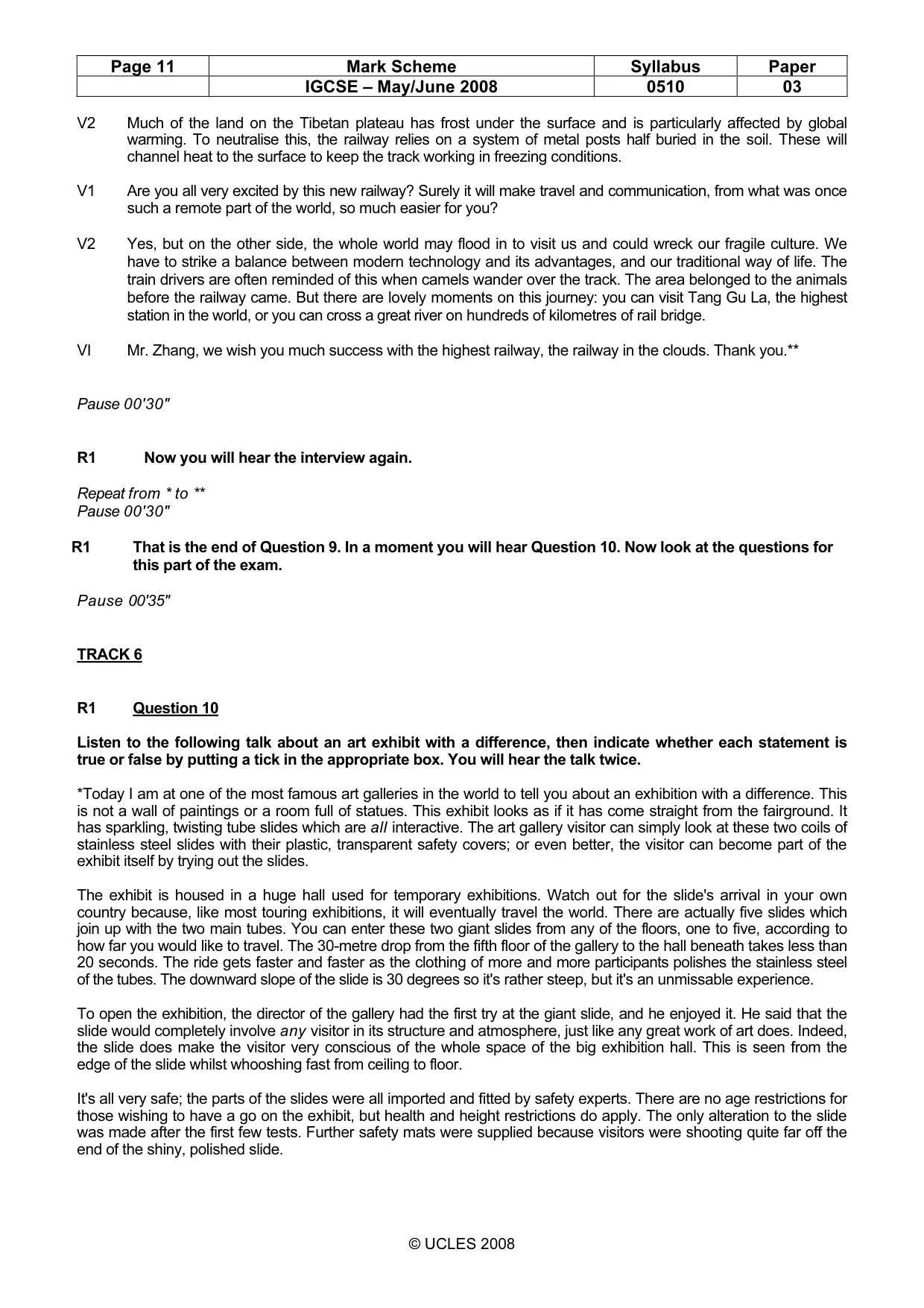
Page 11 Mark Scheme Syllabus Paper IGCSE – May/June 2008 0510 03 © UCLES 2008 V2 Much of the land on the Tibetan plateau has frost under the surface and is particularly affected by global warming. To neutralise this, the railway relies on a system of metal posts half buried in the soil. These will channel heat to the surface to keep the track working in freezing conditions. V1 Are you all very excited by this new railway? Surely it will make travel and communication, from what was once such a remote part of the world, so much easier for you? V2 Yes, but on the other side, the whole world may flood in to visit us and could wreck our fragile culture. We have to strike a balance between modern technology and its advantages, and our traditional way of life. The train drivers are often reminded of this when camels wander over the track. The area belonged to the animals before the railway came. But there are lovely moments on this journey: you can visit Tang Gu La, the highest station in the world, or you can cross a great river on hundreds of kilometres of rail bridge. VI Mr. Zhang, we wish you much success with the highest railway, the railway in the clouds. Thank you.** Pause 00'30" R1 Now you will hear the interview again. Repeat from * to ** Pause 00'30" R1 That is the end of Question 9. In a moment you will hear Question 10. Now look at the questions for this part of the exam. Pause 00'35" TRACK 6 R1 Question 10 Listen to the following talk about an art exhibit with a difference, then indicate whether each statement is true or false by putting a tick in the appropriate box. You will hear the talk twice. *Today I am at one of the most famous art galleries in the world to tell you about an exhibition with a difference. This is not a wall of paintings or a room full of statues. This exhibit looks as if it has come straight from the fairground. It has sparkling, twisting tube slides which are all interactive. The art gallery visitor can simply look at these two coils of stainless steel slides with their plastic, transparent safety covers; or even better, the visitor can become part of the exhibit itself by trying out the slides. The exhibit is housed in a huge hall used for temporary exhibitions. Watch out for the slide's arrival in your own country because, like most touring exhibitions, it will eventually travel the world. There are actually five slides which join up with the two main tubes. You can enter these two giant slides from any of the floors, one to five, according to how far you would like to travel. The 30-metre drop from the fifth floor of the gallery to the hall beneath takes less than 20 seconds. The ride gets faster and faster as the clothing of more and more participants polishes the stainless steel of the tubes. The downward slope of the slide is 30 degrees so it's rather steep, but it's an unmissable experience. To open the exhibition, the director of the gallery had the first try at the giant slide, and he enjoyed it. He said that the slide would completely involve any visitor in its structure and atmosphere, just like any great work of art does. Indeed, the slide does make the visitor very conscious of the whole space of the big exhibition hall. This is seen from the edge of the slide whilst whooshing fast from ceiling to floor. It's all very safe; the parts of the slides were all imported and fitted by safety experts. There are no age restrictions for those wishing to have a go on the exhibit, but health and height restrictions do apply. The only alteration to the slide was made after the first few tests. Further safety mats were supplied because visitors were shooting quite far off the end of the shiny, polished slide.
Mark scheme, page 12
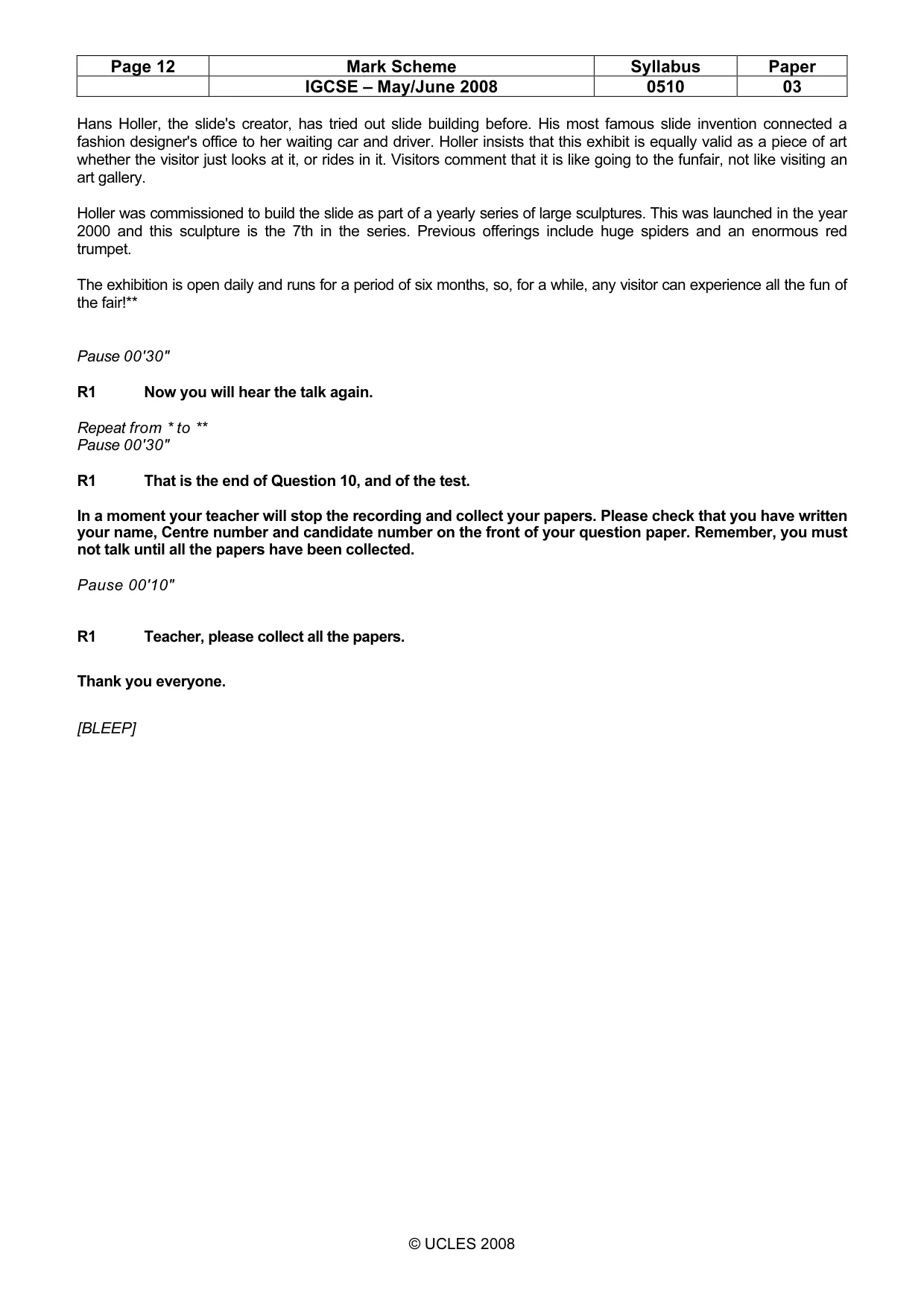
Page 12 Mark Scheme Syllabus Paper IGCSE – May/June 2008 0510 03 © UCLES 2008 Hans Holler, the slide's creator, has tried out slide building before. His most famous slide invention connected a fashion designer's office to her waiting car and driver. Holler insists that this exhibit is equally valid as a piece of art whether the visitor just looks at it, or rides in it. Visitors comment that it is like going to the funfair, not like visiting an art gallery. Holler was commissioned to build the slide as part of a yearly series of large sculptures. This was launched in the year 2000 and this sculpture is the 7th in the series. Previous offerings include huge spiders and an enormous red trumpet. The exhibition is open daily and runs for a period of six months, so, for a while, any visitor can experience all the fun of the fair!** Pause 00'30" R1 Now you will hear the talk again. Repeat from * to ** Pause 00'30" R1 That is the end of Question 10, and of the test. In a moment your teacher will stop the recording and collect your papers. Please check that you have written your name, Centre number and candidate number on the front of your question paper. Remember, you must not talk until all the papers have been collected. Pause 00'10" R1 Teacher, please collect all the papers. Thank you everyone. [BLEEP]
What you needed in this session
Cambridge’s own grade thresholds for 2008 May/June, Paper 3 · Variant 1. A higher threshold means an easier paper — the bar moves with how the cohort did.