Cambridge IGCSE English - Second Language (oral endorsement) 0510 — 2007 Oct/Nov Paper 2 · Variant 1
0510/21/O/N/07 · 84 marks · ≈95 min
The question paper and its mark scheme, free to read here and free to download. This is Cambridge’s own paper, exactly as it was sat.
Question paper16 pages


Mark scheme10 pages
Answers below. Sit the paper first if you are practising.
Paper as text
Question paper, page 1
This document consists of 15 printed pages and 1 blank page. IB07 11_0510_02/7RP © UCLES 2007 [Turn over *3728088813* For Examiner's Use Exercise 1 Exercise 2 Exercise 3 Exercise 4 Exercise 5 Exercise 6 Exercise 7 Total UNIVERSITY OF CAMBRIDGE INTERNATIONAL EXAMINATIONS International General Certificate of Secondary Education ENGLISH AS A SECOND LANGUAGE 0510/02 Paper 2 Reading and Writing (Extended) October/November 2007 2 hours Candidates answer on the Question Paper. No Additional Materials are required. READ THESE INSTRUCTIONS FIRST Write your Centre number, candidate number and name on all the work you hand in. Write in dark blue or black pen. Do not use staples, paper clips, highlighters, glue or correction fluid. DO NOT WRITE IN ANY BARCODES. Answer all questions. Dictionaries are not allowed. At the end of the examination, fasten all your work securely together. The number of marks is given in brackets [ ] at the end of each question or part question.
Question paper, page 2
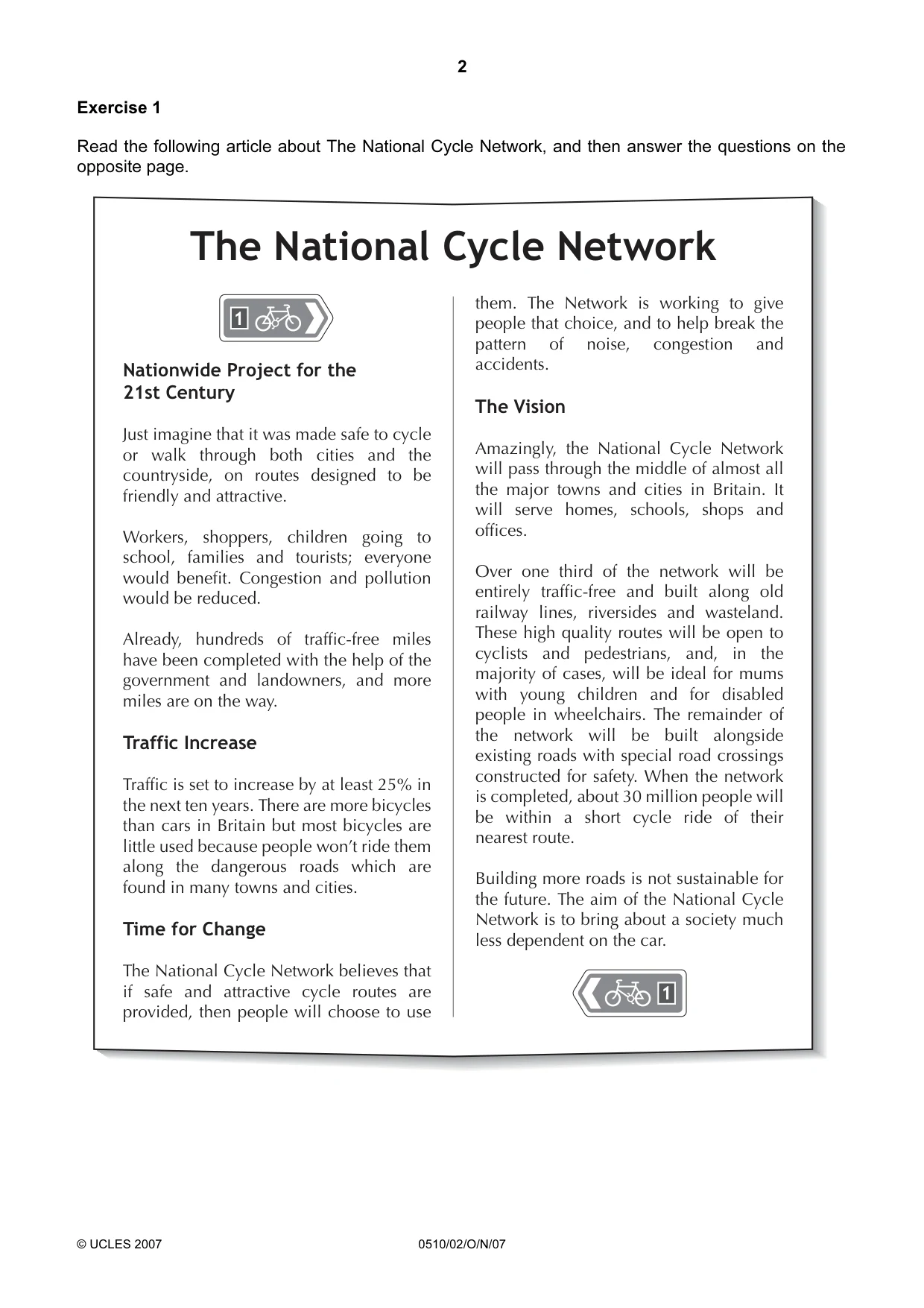
2 © UCLES 2007 0510/02/O/N/07 Exercise 1 Read the following article about The National Cycle Network, and then answer the questions on the opposite page. Nationwide Project for the 21st Century Just imagine that it was made safe to cycle or walk through both cities and the countryside, on routes designed to be friendly and attractive. Workers, shoppers, children going to school, families and tourists; everyone would benefit. Congestion and pollution would be reduced. Already, hundreds of traffic-free miles have been completed with the help of the government and landowners, and more miles are on the way. Traffic Increase Traffic is set to increase by at least 25% in the next ten years. There are more bicycles than cars in Britain but most bicycles are little used because people won’t ride them along the dangerous roads which are found in many towns and cities. Time for Change The National Cycle Network believes that if safe and attractive cycle routes are provided, then people will choose to use them. The Network is working to give people that choice, and to help break the pattern of noise, congestion and accidents. The Vision Amazingly, the National Cycle Network will pass through the middle of almost all the major towns and cities in Britain. It will serve homes, schools, shops and offices. Over one third of the network will be entirely traffic-free and built along old railway lines, riversides and wasteland. These high quality routes will be open to cyclists and pedestrians, and, in the majority of cases, will be ideal for mums with young children and for disabled people in wheelchairs. The remainder of the network will be built alongside existing roads with special road crossings constructed for safety. When the network is completed, about 30 million people will be within a short cycle ride of their nearest route. Building more roads is not sustainable for the future. The aim of the National Cycle Network is to bring about a society much less dependent on the car. 1 1 The National Cycle Network
Question paper, page 3
3 © UCLES 2007 0510/02/O/N/07 [Turn over For Examiner's Use (a) Apart from cities and towns, where will it be safe to cycle? [1] (b) Who is helping to build the National Cycle Network? Give two details. (i) (ii) [1] (c) Why do most people avoid cycling at the moment? [1] (d) What does the National Cycle Network aim to reduce? Give three details. (i) (ii) (iii) [1] (e) How much of the National Cycle Network will have no cars? [1] (f) Apart from cyclists, which members of the community will appreciate the traffic-free routes? Give two details. (i) (ii) [1] (g) How will safety be ensured where the National Cycle Network goes across existing roads? [1] (h) How might society change as a result of the National Cycle Network? [1] [Total: 8]
Question paper, page 4
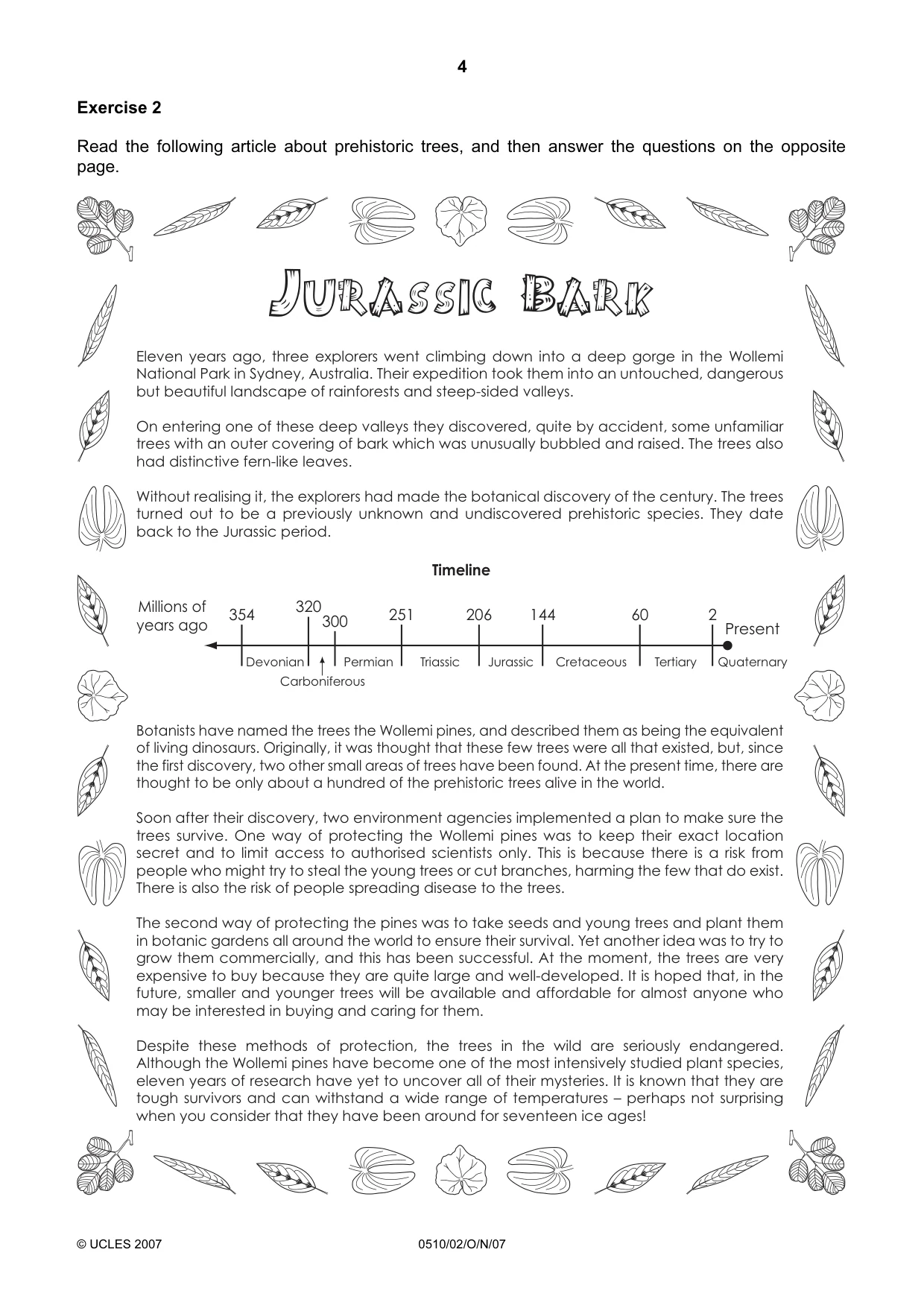
4 © UCLES 2007 0510/02/O/N/07 Exercise 2 Read the following article about prehistoric trees, and then answer the questions on the opposite page. Jurassic Bark Eleven years ago, three explorers went climbing down into a deep gorge in the Wollemi National Park in Sydney, Australia. Their expedition took them into an untouched, dangerous but beautiful landscape of rainforests and steep-sided valleys. On entering one of these deep valleys they discovered, quite by accident, some unfamiliar trees with an outer covering of bark which was unusually bubbled and raised. The trees also had distinctive fern-like leaves. Without realising it, the explorers had made the botanical discovery of the century. The trees turned out to be a previously unknown and undiscovered prehistoric species. They date back to the Jurassic period. Botanists have named the trees the Wollemi pines, and described them as being the equivalent of living dinosaurs. Originally, it was thought that these few trees were all that existed, but, since the first discovery, two other small areas of trees have been found. At the present time, there are thought to be only about a hundred of the prehistoric trees alive in the world. Soon after their discovery, two environment agencies implemented a plan to make sure the trees survive. One way of protecting the Wollemi pines was to keep their exact location secret and to limit access to authorised scientists only. This is because there is a risk from people who might try to steal the young trees or cut branches, harming the few that do exist. There is also the risk of people spreading disease to the trees. The second way of protecting the pines was to take seeds and young trees and plant them in botanic gardens all around the world to ensure their survival. Yet another idea was to try to grow them commercially, and this has been successful. At the moment, the trees are very expensive to buy because they are quite large and well-developed. It is hoped that, in the future, smaller and younger trees will be available and affordable for almost anyone who may be interested in buying and caring for them. Despite these methods of protection, the trees in the wild are seriously endangered. Although the Wollemi pines have become one of the most intensively studied plant species, eleven years of research have yet to uncover all of their mysteries. It is known that they are tough survivors and can withstand a wide range of temperatures – perhaps not surprising when you consider that they have been around for seventeen ice ages! 354 320 300 251 206 144 Present 60 2 Devonian Permian Carboniferous Triassic Jurassic Tertiary Quaternary Cretaceous Millions of years ago Timeline
Question paper, page 5
5 © UCLES 2007 0510/02/O/N/07 [Turn over For Examiner's Use (a) When and where were the trees discovered? [1] (b) What is different about their appearance? Give two details. (i) (ii) [1] (c) According to the chart, what were the dates of the Jurassic period? [1] (d) Who will be allowed to see and study the trees? [1] (e) Why is it important to keep the location of the trees a secret? Give two reasons. (i) (ii) [2] (f) Where can young trees be transplanted for their safety? [1] (g) How will Wollemi pines become more attractive to future buyers? Give two details. (i) (ii) [1] (h) How might the characteristics and history of the trees help to ensure their survival? Give two details. (i) (ii) [2] (j) Why were scientists and experts so excited about the discovery of the Wollemi pines? Give four reasons. [4] [Total: 14]
Question paper, page 6
6 © UCLES 2007 0510/02/O/N/07 Exercise 3 On Monday June 5 2006, Gabriella Sierra was walking from her home at 3806, Paseo del Prado, Buenos Aires, to go to school. She often walked to school and it normally took her 35 minutes. Usually, there was not much traffic on the streets but that morning, because it was raining hard, there were many more cars on the road. When she arrived at the traffic-lights at the intersection of two roads, Calle del Museo and Avenida Alfonso, she stopped and waited for the green signal to cross the road. She looked at her watch and was relieved to see that there were still another 15 minutes until the start of school at 8.30 a.m. At that moment, she looked to the right and saw a small blue sports car approaching the traffic-lights. Gabriella's first impression was that the vehicle was going too fast when the lights changed from green to red. She was right because the car was unable to stop quickly on the wet road and skidded into the back of another car, a large silver 4-wheel drive vehicle. Gabriella had a clear view of the accident. Immediately, both drivers got out of their cars and started to examine the extent of the damage. They both seemed unhurt, although the driver of the blue car, a man of about 45 with grey hair and a beard, looked a little shocked. His car had a lot of damage to the front and the headlights were smashed. The young woman who had been driving the silver car started writing down details of the accident and also appeared to be a little dazed. There was no obvious damage to her car except a small dent at the back. Because the two cars were in the middle of the road, Gabriella decided to ring the police on her mobile phone and explain what had happened. She considered calling the ambulance service but felt that this was a matter for the police. They told her to wait for them at the crossroads because she was an important witness to the accident and they needed to talk to her urgently. She gave them her mobile phone number 0307658972. In just over five minutes, a police car with two policemen arrived and they took control of the situation. After checking the condition of the two drivers, they decided it would be sensible to call an ambulance to take them to hospital for tests. The police quickly moved the cars to the side of the road so that the traffic could start to move normally again. Later that day, Gabriella had to complete an accident report form. Imagine you are Gabriella. Fill in the form on the opposite page, using the information above.
Question paper, page 7
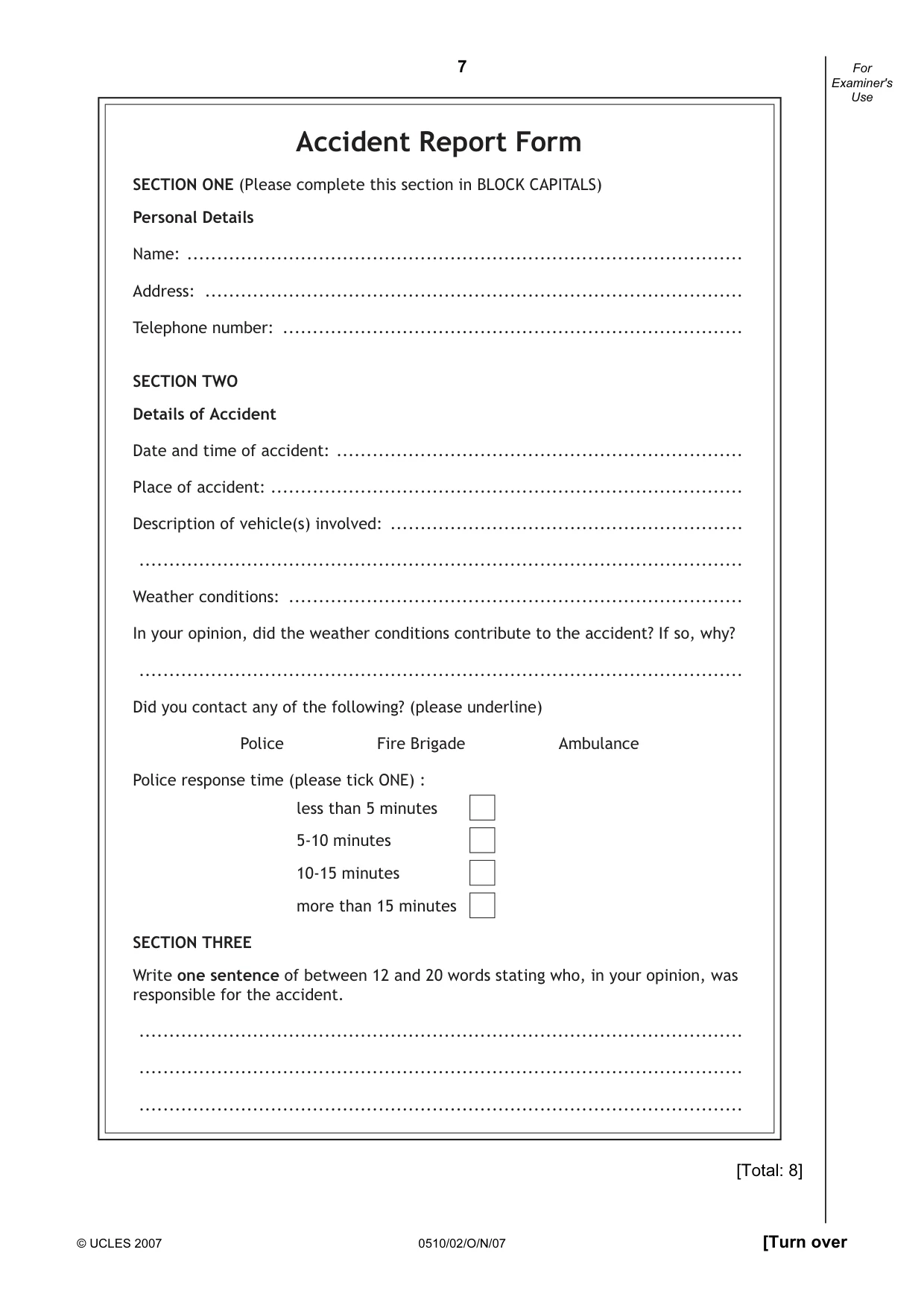
7 © UCLES 2007 0510/02/O/N/07 [Turn over For Examiner's Use Accident Report Form SECTION ONE (Please complete this section in BLOCK CAPITALS) Personal Details Name: … Address: … Telephone number: … SECTION TWO Details of Accident Date and time of accident: … Place of accident: … Description of vehicle(s) involved: … … Weather conditions: … In your opinion, did the weather conditions contribute to the accident? If so, why? … Did you contact any of the following? (please underline) Police Fire Brigade Ambulance Police response time (please tick ONE) : less than 5 minutes 5-10 minutes 10-15 minutes more than 15 minutes SECTION THREE Write one sentence of between 12 and 20 words stating who, in your opinion, was responsible for the accident. … … … [Total: 8]
Question paper, page 8
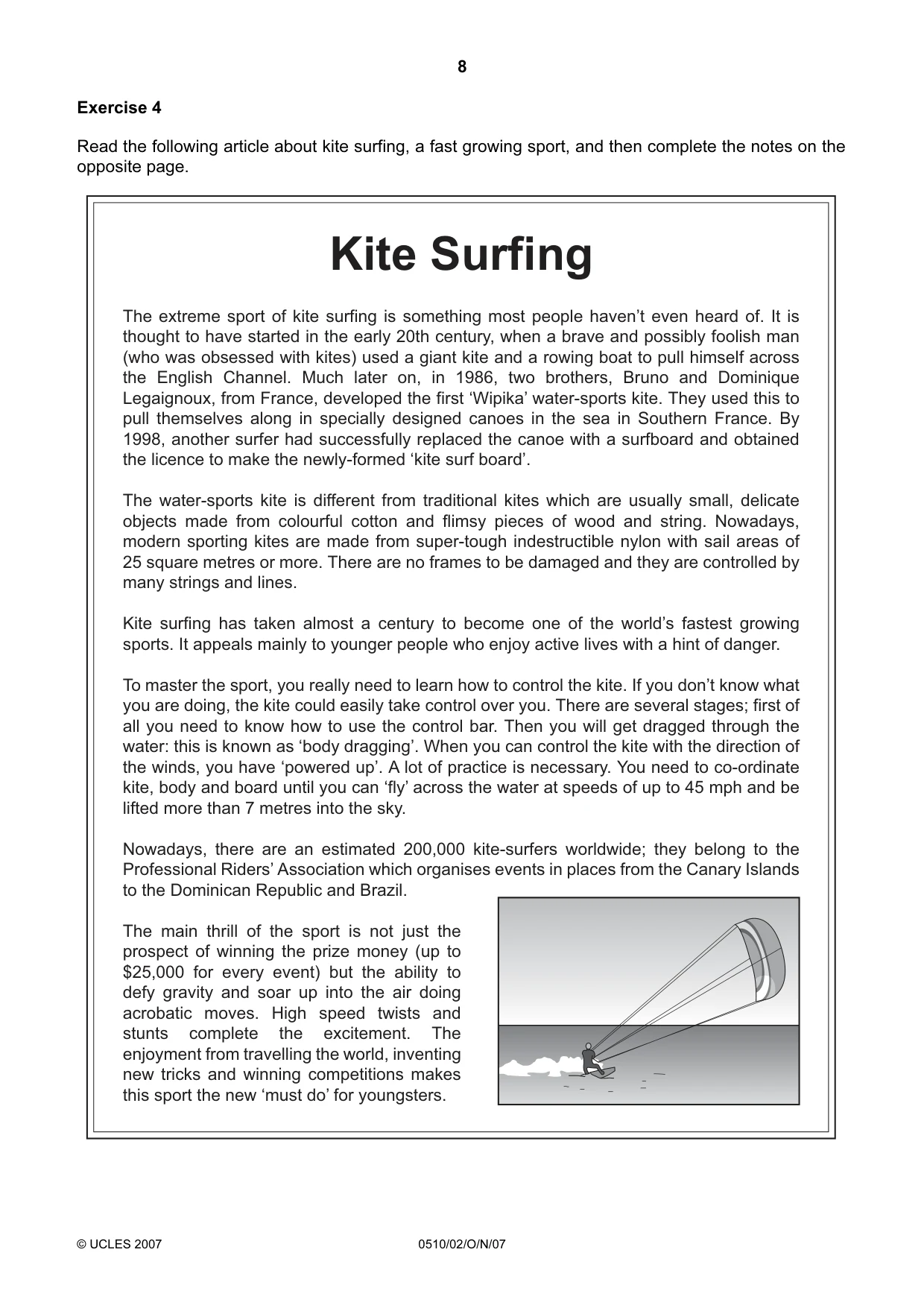
8 © UCLES 2007 0510/02/O/N/07 Exercise 4 Read the following article about kite surfing, a fast growing sport, and then complete the notes on the opposite page. Kite Surfing The extreme sport of kite surfing is something most people haven’t even heard of. It is thought to have started in the early 20th century, when a brave and possibly foolish man (who was obsessed with kites) used a giant kite and a rowing boat to pull himself across the English Channel. Much later on, in 1986, two brothers, Bruno and Dominique Legaignoux, from France, developed the first ‘Wipika’ water-sports kite. They used this to pull themselves along in specially designed canoes in the sea in Southern France. By 1998, another surfer had successfully replaced the canoe with a surfboard and obtained the licence to make the newly-formed ‘kite surf board’. The water-sports kite is different from traditional kites which are usually small, delicate objects made from colourful cotton and flimsy pieces of wood and string. Nowadays, modern sporting kites are made from super-tough indestructible nylon with sail areas of 25 square metres or more. There are no frames to be damaged and they are controlled by many strings and lines. Kite surfing has taken almost a century to become one of the world’s fastest growing sports. It appeals mainly to younger people who enjoy active lives with a hint of danger. To master the sport, you really need to learn how to control the kite. If you don’t know what you are doing, the kite could easily take control over you. There are several stages; first of all you need to know how to use the control bar. Then you will get dragged through the water: this is known as ‘body dragging’. When you can control the kite with the direction of the winds, you have ‘powered up’. A lot of practice is necessary. You need to co-ordinate kite, body and board until you can ‘fly’ across the water at speeds of up to 45 mph and be lifted more than 7 metres into the sky. Nowadays, there are an estimated 200,000 kite-surfers worldwide; they belong to the Professional Riders’ Association which organises events in places from the Canary Islands to the Dominican Republic and Brazil. The main thrill of the sport is not just the prospect of winning the prize money (up to $25,000 for every event) but the ability to defy gravity and soar up into the air doing acrobatic moves. High speed twists and stunts complete the excitement. The enjoyment from travelling the world, inventing new tricks and winning competitions makes this sport the new ‘must do’ for youngsters.
Question paper, page 9
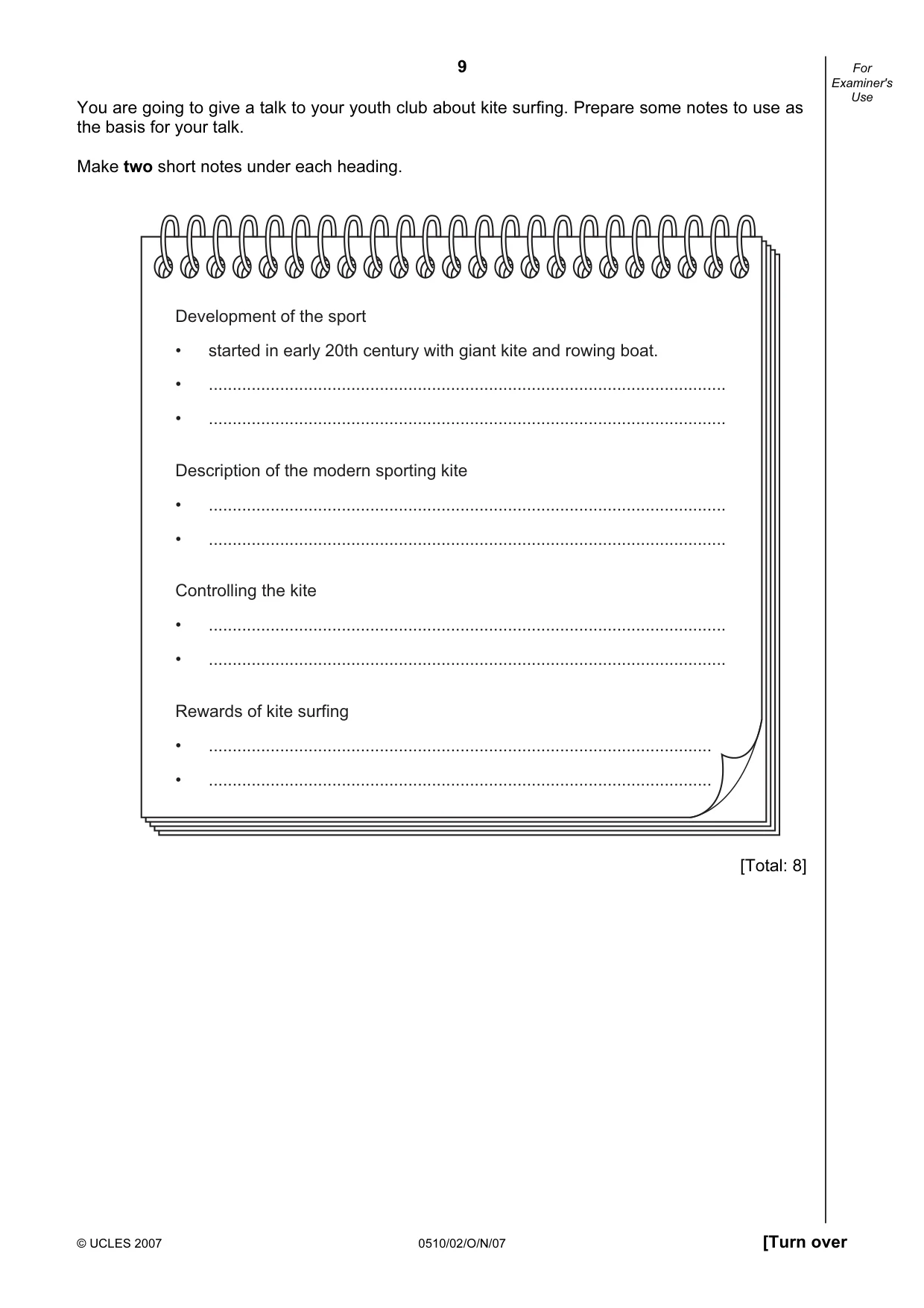
9 © UCLES 2007 0510/02/O/N/07 [Turn over For Examiner's Use You are going to give a talk to your youth club about kite surfing. Prepare some notes to use as the basis for your talk. Make two short notes under each heading. Development of the sport • started in early 20th century with giant kite and rowing boat. • … • … Description of the modern sporting kite • … • … Controlling the kite • … • … Rewards of kite surfing • … • … [Total: 8]
Question paper, page 10
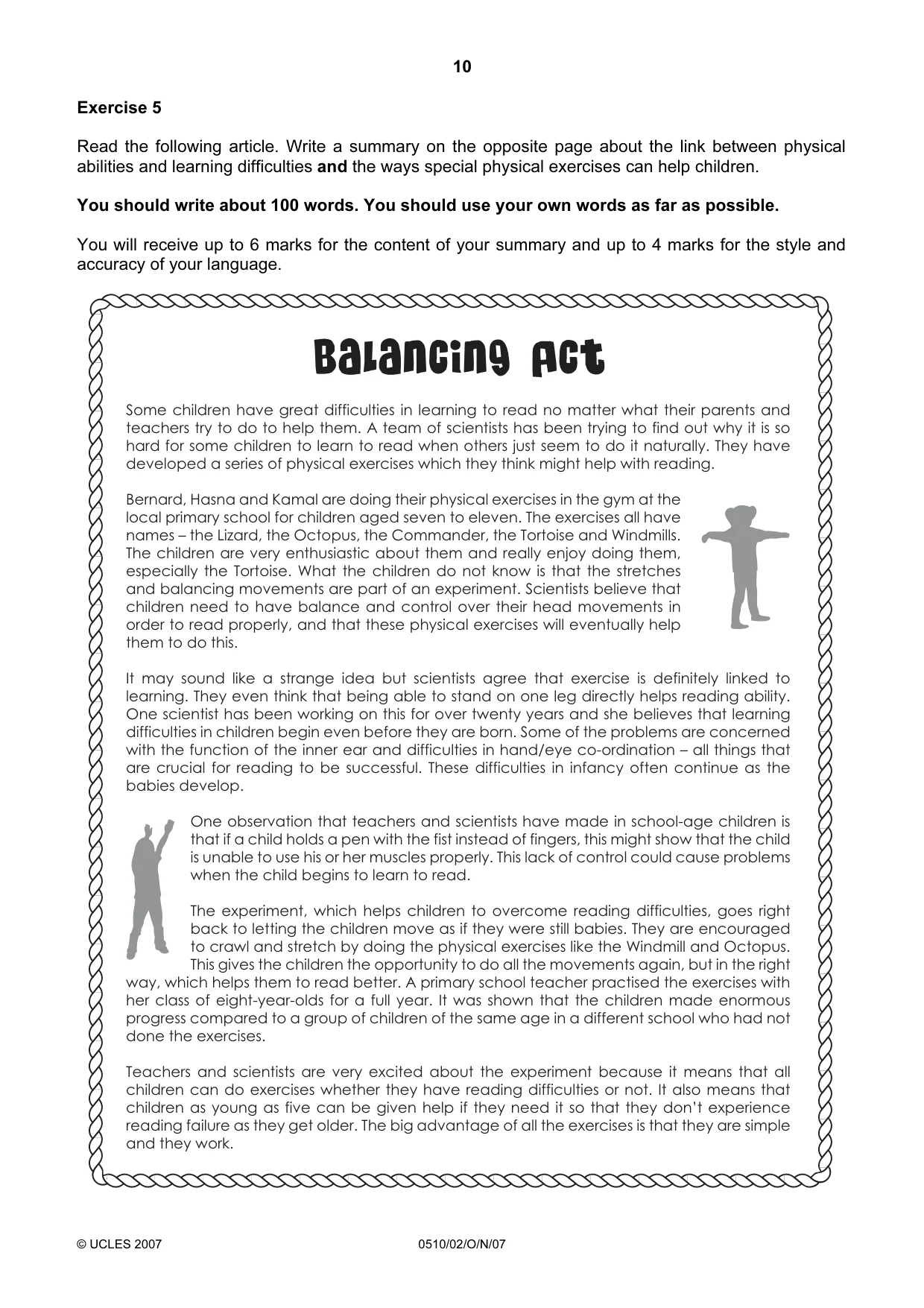
10 © UCLES 2007 0510/02/O/N/07 Exercise 5 Read the following article. Write a summary on the opposite page about the link between physical abilities and learning difficulties and the ways special physical exercises can help children. You should write about 100 words. You should use your own words as far as possible. You will receive up to 6 marks for the content of your summary and up to 4 marks for the style and accuracy of your language. Some children have great difficulties in learning to read no matter what their parents and teachers try to do to help them. A team of scientists has been trying to find out why it is so hard for some children to learn to read when others just seem to do it naturally. They have developed a series of physical exercises which they think might help with reading. Bernard, Hasna and Kamal are doing their physical exercises in the gym at the local primary school for children aged seven to eleven. The exercises all have names – the Lizard, the Octopus, the Commander, the Tortoise and Windmills. The children are very enthusiastic about them and really enjoy doing them, especially the Tortoise. What the children do not know is that the stretches and balancing movements are part of an experiment. Scientists believe that children need to have balance and control over their head movements in order to read properly, and that these physical exercises will eventually help them to do this. It may sound like a strange idea but scientists agree that exercise is definitely linked to learning. They even think that being able to stand on one leg directly helps reading ability. One scientist has been working on this for over twenty years and she believes that learning difficulties in children begin even before they are born. Some of the problems are concerned with the function of the inner ear and difficulties in hand/eye co-ordination – all things that are crucial for reading to be successful. These difficulties in infancy often continue as the babies develop. One observation that teachers and scientists have made in school-age children is that if a child holds a pen with the fist instead of fingers, this might show that the child is unable to use his or her muscles properly. This lack of control could cause problems when the child begins to learn to read. The experiment, which helps children to overcome reading difficulties, goes right back to letting the children move as if they were still babies. They are encouraged to crawl and stretch by doing the physical exercises like the Windmill and Octopus. This gives the children the opportunity to do all the movements again, but in the right way, which helps them to read better. A primary school teacher practised the exercises with her class of eight-year-olds for a full year. It was shown that the children made enormous progress compared to a group of children of the same age in a different school who had not done the exercises. Teachers and scientists are very excited about the experiment because it means that all children can do exercises whether they have reading difficulties or not. It also means that children as young as five can be given help if they need it so that they don’t experience reading failure as they get older. The big advantage of all the exercises is that they are simple and they work.
Question paper, page 11
11 © UCLES 2007 0510/02/O/N/07 [Turn over For Examiner's Use [10]
Question paper, page 12
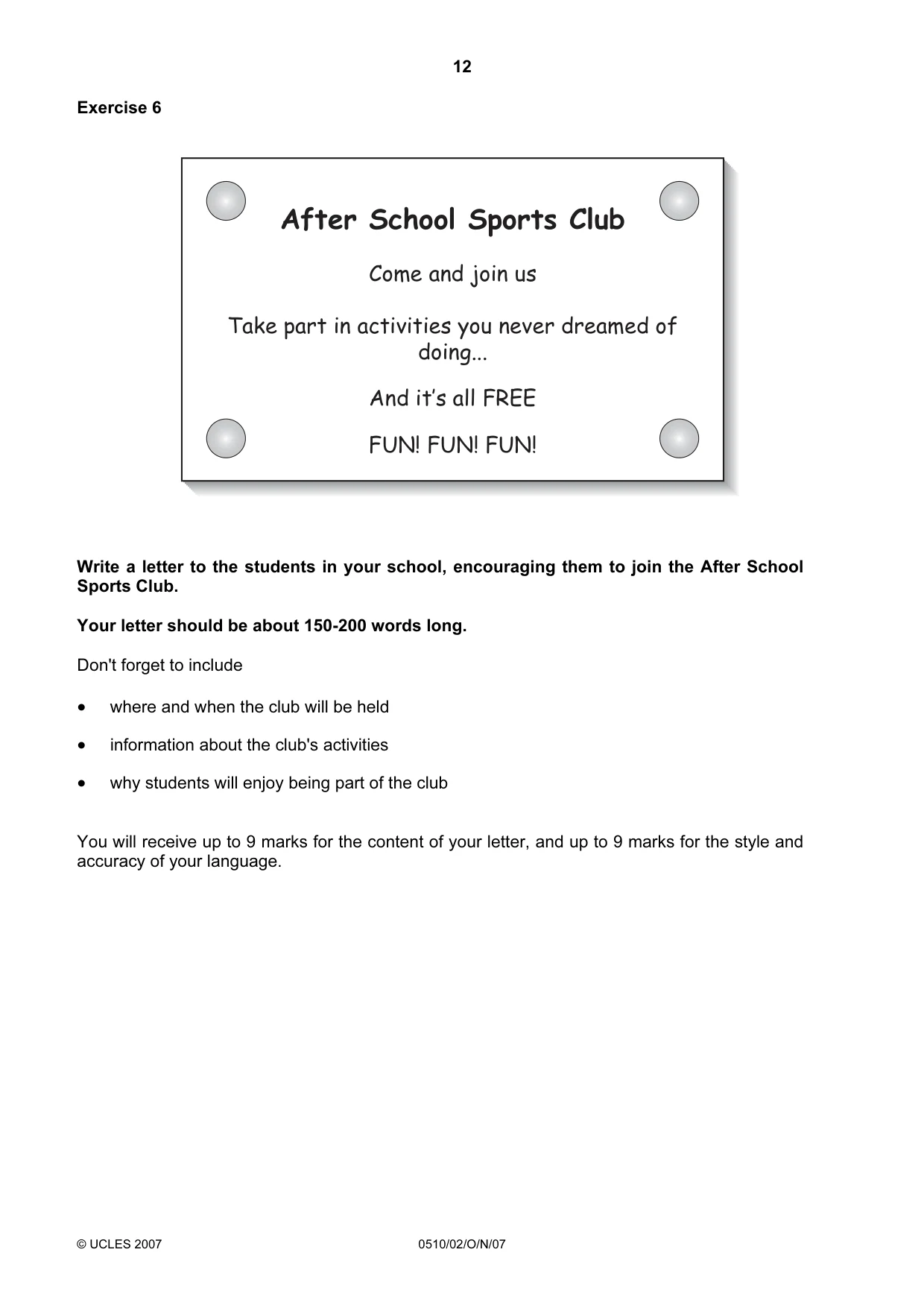
12 © UCLES 2007 0510/02/O/N/07 Exercise 6 After School Sports Club Come and join us Take part in activities you never dreamed of doing... And it‛s all FREE FUN! FUN! FUN! Write a letter to the students in your school, encouraging them to join the After School Sports Club. Your letter should be about 150-200 words long. Don't forget to include • where and when the club will be held • information about the club's activities • why students will enjoy being part of the club You will receive up to 9 marks for the content of your letter, and up to 9 marks for the style and accuracy of your language.
Question paper, page 13
13 © UCLES 2007 0510/02/O/N/07 [Turn over For Examiner's Use Dear Students, [18]
Question paper, page 14
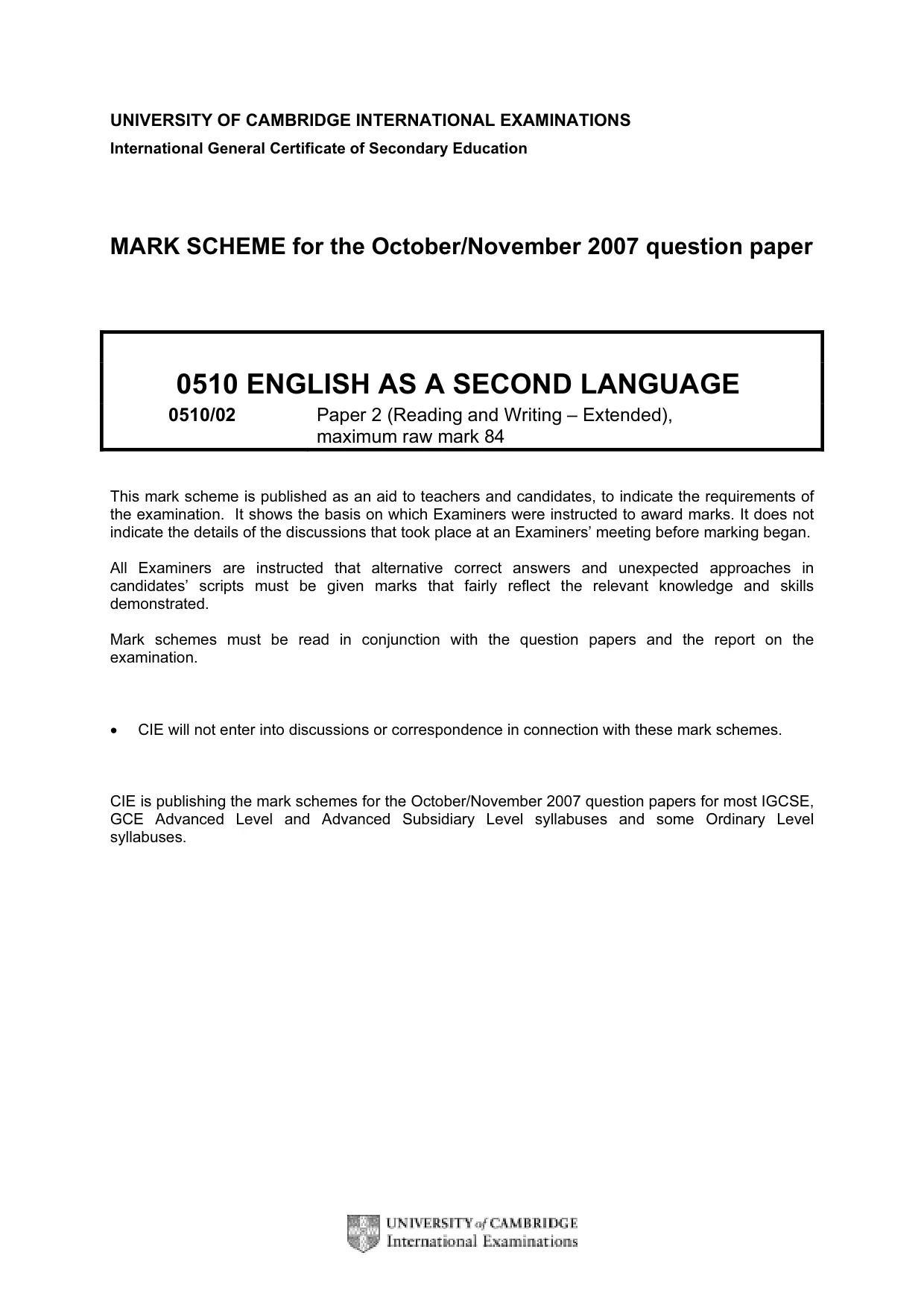
14 © UCLES 2007 0510/02/O/N/07 Exercise 7 Here are four pictures showing some different relationships between people and animals. Write an article for your college magazine giving your views on the way animals should be treated. Your article should be about 150-200 words long. The pictures above may give you some ideas, but you are free to use any ideas of your own. You will receive up to 9 marks for the content of your article, and up to 9 marks for the style and accuracy of your language.
Question paper, page 15
15 © UCLES 2007 0510/02/O/N/07 For Examiner's Use [18]
Question paper, page 16
16 Copyright Acknowledgements: Exercise 1 © Sustrans Ltd. Permission to reproduce items where third-party owned material protected by copyright is included has been sought and cleared where possible. Every reasonable effort has been made by the publisher (UCLES) to trace copyright holders, but if any items requiring clearance have unwittingly been included, the publisher will be pleased to make amends at the earliest possible opportunity. University of Cambridge International Examinations is part of the Cambridge Assessment Group. Cambridge Assessment is the brand name of University of Cambridge Local Examinations Syndicate (UCLES), which is itself a department of the University of Cambridge. 0510/02/O/N/07 BLANK PAGE
Mark scheme, page 1
UNIVERSITY OF CAMBRIDGE INTERNATIONAL EXAMINATIONS International General Certificate of Secondary Education MARK SCHEME for the October/November 2007 question paper 0510 ENGLISH AS A SECOND LANGUAGE 0510/02 Paper 2 (Reading and Writing – Extended), maximum raw mark 84 This mark scheme is published as an aid to teachers and candidates, to indicate the requirements of the examination. It shows the basis on which Examiners were instructed to award marks. It does not indicate the details of the discussions that took place at an Examiners’ meeting before marking began. All Examiners are instructed that alternative correct answers and unexpected approaches in candidates’ scripts must be given marks that fairly reflect the relevant knowledge and skills demonstrated. Mark schemes must be read in conjunction with the question papers and the report on the examination. • CIE will not enter into discussions or correspondence in connection with these mark schemes. CIE is publishing the mark schemes for the October/November 2007 question papers for most IGCSE, GCE Advanced Level and Advanced Subsidiary Level syllabuses and some Ordinary Level syllabuses.
Mark scheme, page 2
Page 2 Mark Scheme Syllabus Paper IGCSE – October/November 2007 0510 02 © UCLES 2007 Exercise 1 The National Cycle Network (a) countryside [1] (b) government AND landowners [1] (c) roads (too) dangerous [1] (d) noise/congestion/accidents/pollution ANY THREE [1] (e) over one third [1] (f) pedestrians/mums with children/disabled ANY TWO [1] (g) special road crossing(s) [1] (h) people become less dependent on the car [1] [Max. total for Exercise 1: 8 marks]
Mark scheme, page 3
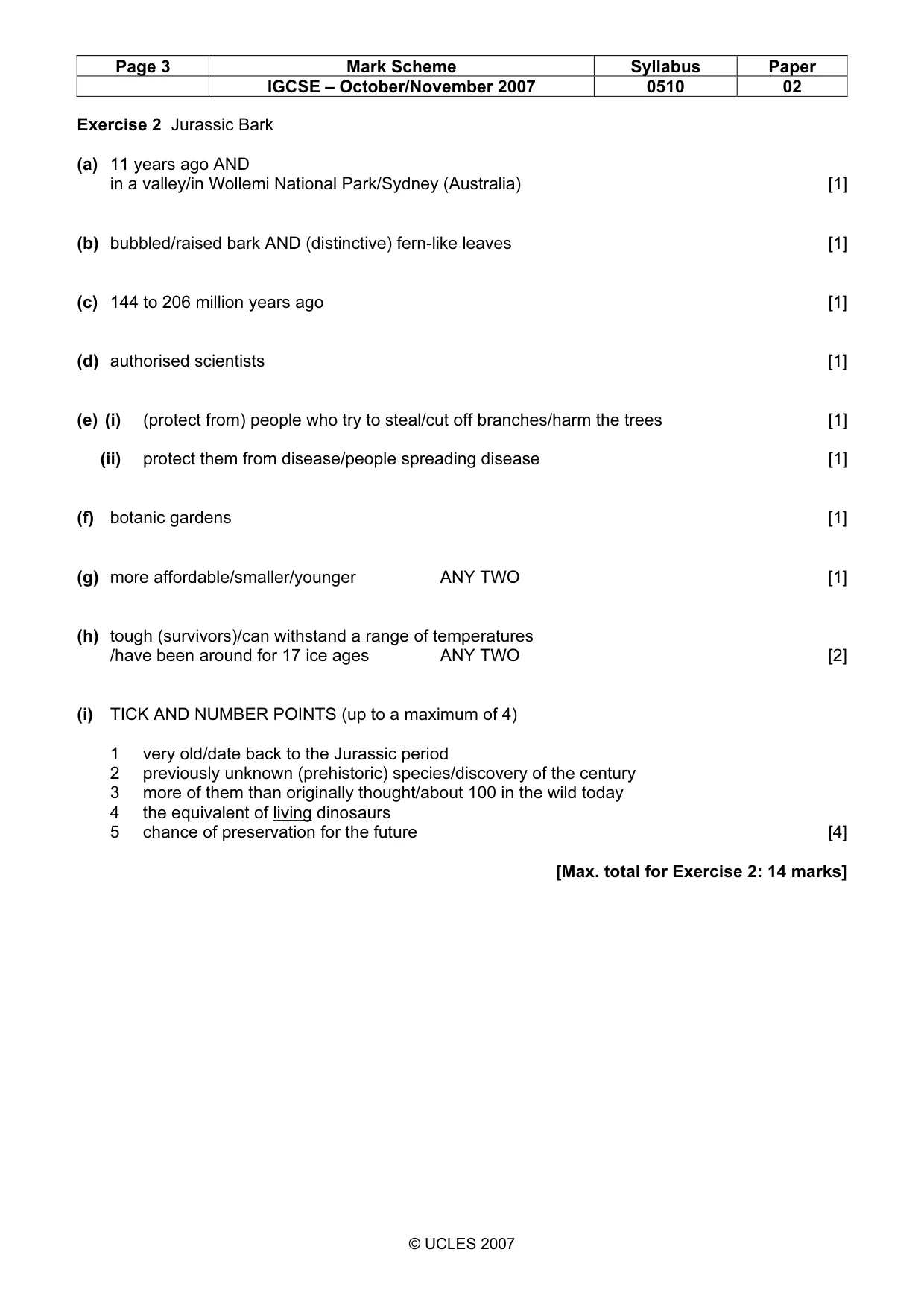
Page 3 Mark Scheme Syllabus Paper IGCSE – October/November 2007 0510 02 © UCLES 2007 Exercise 2 Jurassic Bark (a) 11 years ago AND in a valley/in Wollemi National Park/Sydney (Australia) [1] (b) bubbled/raised bark AND (distinctive) fern-like leaves [1] (c) 144 to 206 million years ago [1] (d) authorised scientists [1] (e) (i) (protect from) people who try to steal/cut off branches/harm the trees [1] (ii) protect them from disease/people spreading disease [1] (f) botanic gardens [1] (g) more affordable/smaller/younger ANY TWO [1] (h) tough (survivors)/can withstand a range of temperatures /have been around for 17 ice ages ANY TWO [2] (i) TICK AND NUMBER POINTS (up to a maximum of 4) 1 very old/date back to the Jurassic period 2 previously unknown (prehistoric) species/discovery of the century 3 more of them than originally thought/about 100 in the wild today 4 the equivalent of living dinosaurs 5 chance of preservation for the future [4] [Max. total for Exercise 2: 14 marks]
Mark scheme, page 4
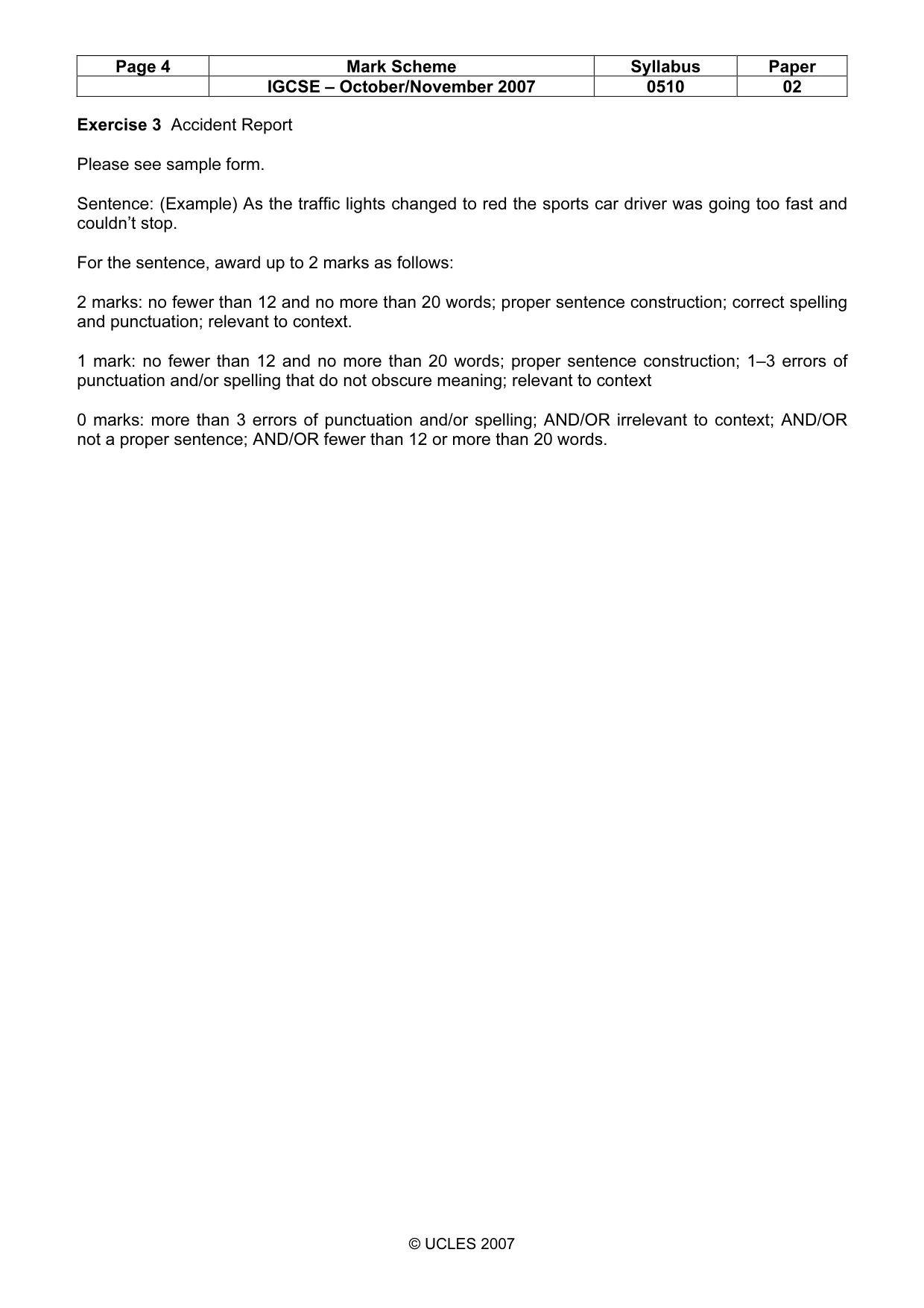
Page 4 Mark Scheme Syllabus Paper IGCSE – October/November 2007 0510 02 © UCLES 2007 Exercise 3 Accident Report Please see sample form. Sentence: (Example) As the traffic lights changed to red the sports car driver was going too fast and couldn’t stop. For the sentence, award up to 2 marks as follows: 2 marks: no fewer than 12 and no more than 20 words; proper sentence construction; correct spelling and punctuation; relevant to context. 1 mark: no fewer than 12 and no more than 20 words; proper sentence construction; 1–3 errors of punctuation and/or spelling that do not obscure meaning; relevant to context 0 marks: more than 3 errors of punctuation and/or spelling; AND/OR irrelevant to context; AND/OR not a proper sentence; AND/OR fewer than 12 or more than 20 words.
Mark scheme, page 5
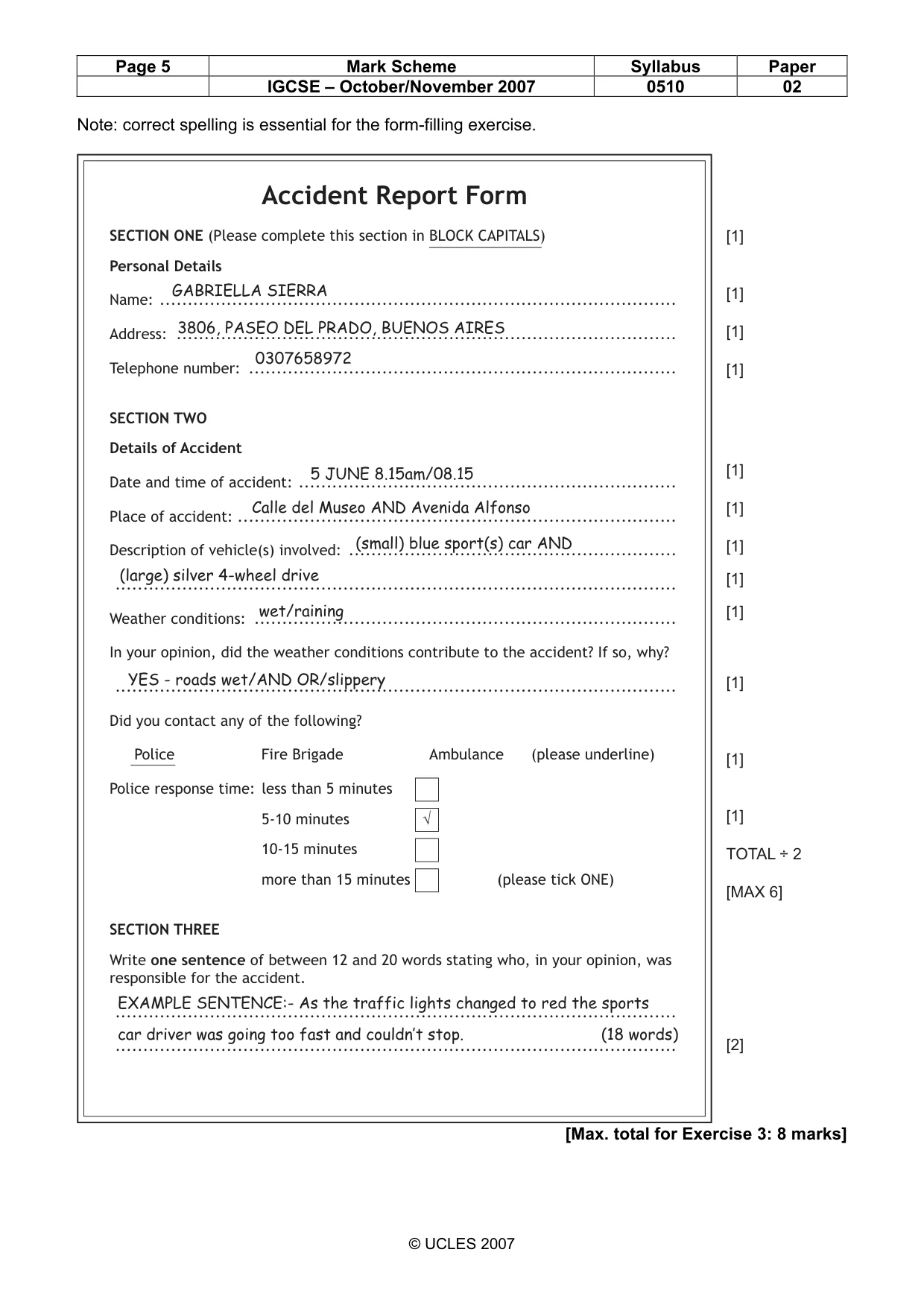
Page 5 Mark Scheme Syllabus Paper IGCSE – October/November 2007 0510 02 © UCLES 2007 Note: correct spelling is essential for the form-filling exercise. Accident Report Form SECTION ONE (Please complete this section in BLOCK CAPITALS) Personal Details Name: … Address: … Telephone number: … SECTION TWO Details of Accident Date and time of accident: … Place of accident: … Description of vehicle(s) involved: … … Weather conditions: … In your opinion, did the weather conditions contribute to the accident? If so, why? … Did you contact any of the following? Police Fire Brigade Ambulance (please underline) Police response time: less than 5 minutes 5-10 minutes √ 10-15 minutes more than 15 minutes (please tick ONE) SECTION THREE Write one sentence of between 12 and 20 words stating who, in your opinion, was responsible for the accident. … … GABRIELLA SIERRA 3806, PASEO DEL PRADO, BUENOS AIRES 0307658972 5 JUNE 8.15am/08.15 Calle del Museo AND Avenida Alfonso (small) blue sport(s) car AND (large) silver 4-wheel drive wet/raining YES - roads wet/AND OR/slippery EXAMPLE SENTENCE:- As the traffic lights changed to red the sports car driver was going too fast and couldn‛t stop. (18 words) [1] [1] [1] [1] [1] [1] [1] [1] [1] [1] [1] [1] TOTAL ÷ 2 [MAX 6] [2] [Max. total for Exercise 3: 8 marks]
Mark scheme, page 6
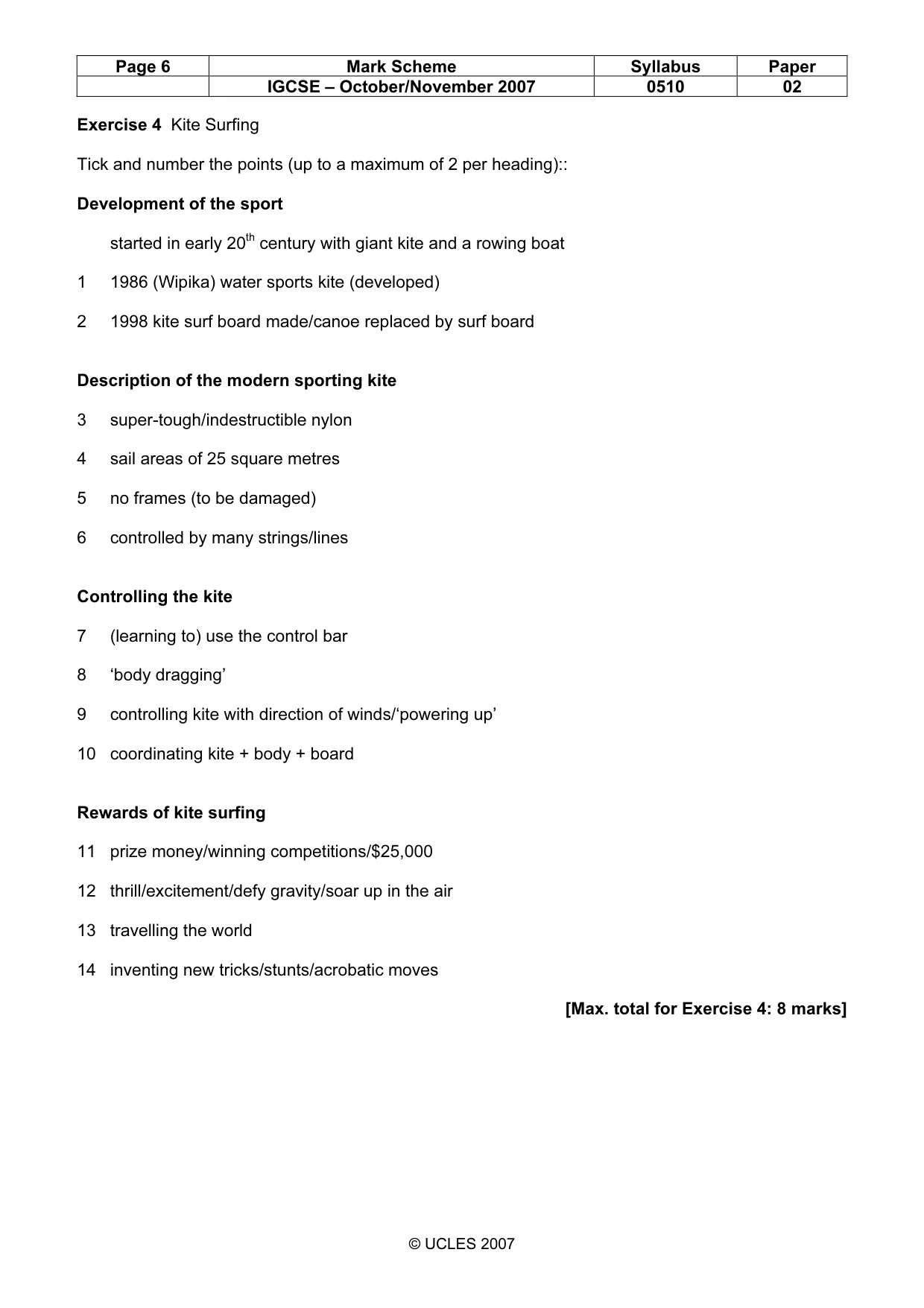
Page 6 Mark Scheme Syllabus Paper IGCSE – October/November 2007 0510 02 © UCLES 2007 Exercise 4 Kite Surfing Tick and number the points (up to a maximum of 2 per heading):: Development of the sport started in early 20th century with giant kite and a rowing boat 1 1986 (Wipika) water sports kite (developed) 2 1998 kite surf board made/canoe replaced by surf board Description of the modern sporting kite 3 super-tough/indestructible nylon 4 sail areas of 25 square metres 5 no frames (to be damaged) 6 controlled by many strings/lines Controlling the kite 7 (learning to) use the control bar 8 ‘body dragging’ 9 controlling kite with direction of winds/‘powering up’ 10 coordinating kite + body + board Rewards of kite surfing 11 prize money/winning competitions/$25,000 12 thrill/excitement/defy gravity/soar up in the air 13 travelling the world 14 inventing new tricks/stunts/acrobatic moves [Max. total for Exercise 4: 8 marks]
Mark scheme, page 7
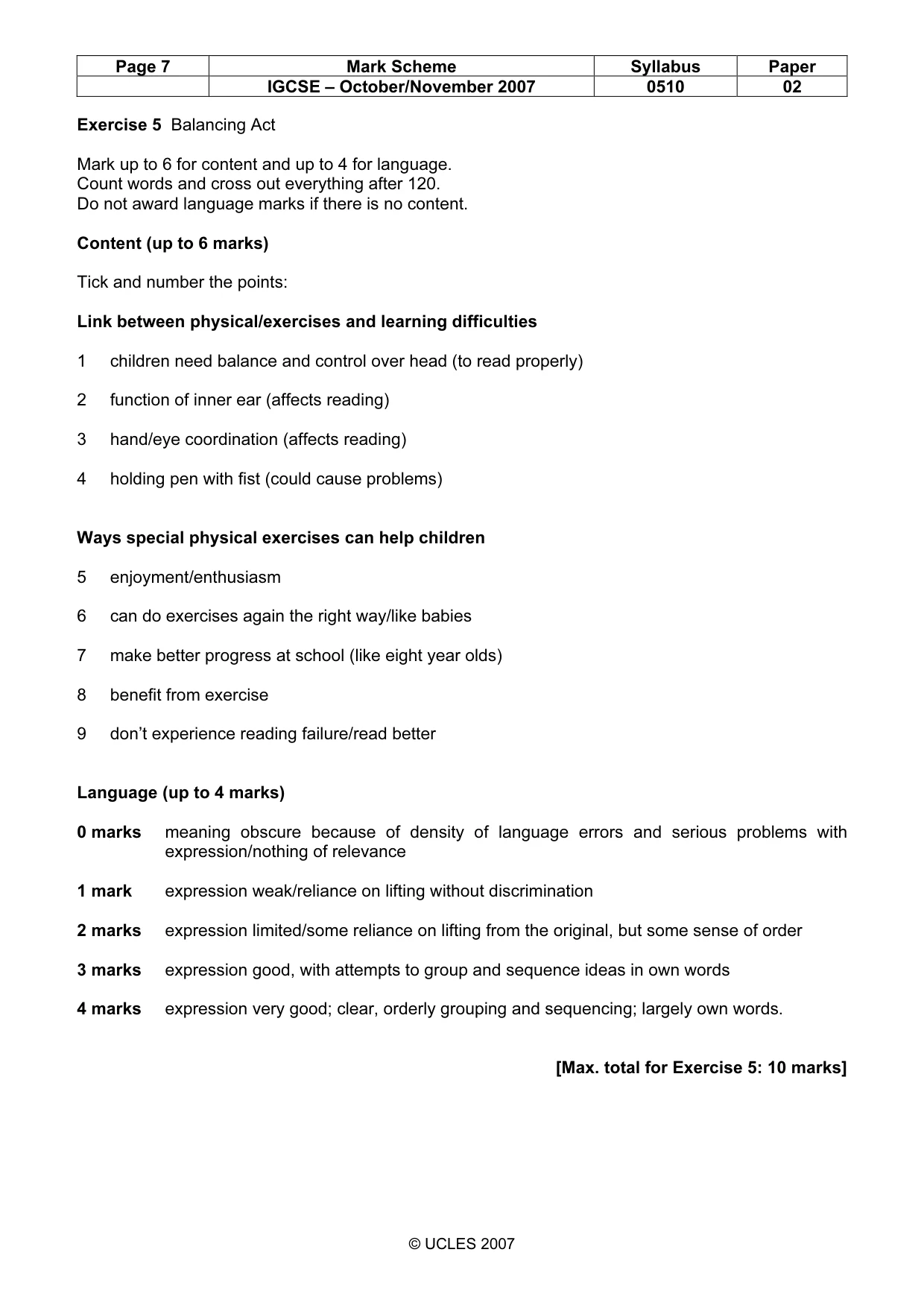
Page 7 Mark Scheme Syllabus Paper IGCSE – October/November 2007 0510 02 © UCLES 2007 Exercise 5 Balancing Act Mark up to 6 for content and up to 4 for language. Count words and cross out everything after 120. Do not award language marks if there is no content. Content (up to 6 marks) Tick and number the points: Link between physical/exercises and learning difficulties 1 children need balance and control over head (to read properly) 2 function of inner ear (affects reading) 3 hand/eye coordination (affects reading) 4 holding pen with fist (could cause problems) Ways special physical exercises can help children 5 enjoyment/enthusiasm 6 can do exercises again the right way/like babies 7 make better progress at school (like eight year olds) 8 benefit from exercise 9 don’t experience reading failure/read better Language (up to 4 marks) 0 marks meaning obscure because of density of language errors and serious problems with expression/nothing of relevance 1 mark expression weak/reliance on lifting without discrimination 2 marks expression limited/some reliance on lifting from the original, but some sense of order 3 marks expression good, with attempts to group and sequence ideas in own words 4 marks expression very good; clear, orderly grouping and sequencing; largely own words. [Max. total for Exercise 5: 10 marks]
Mark scheme, page 8
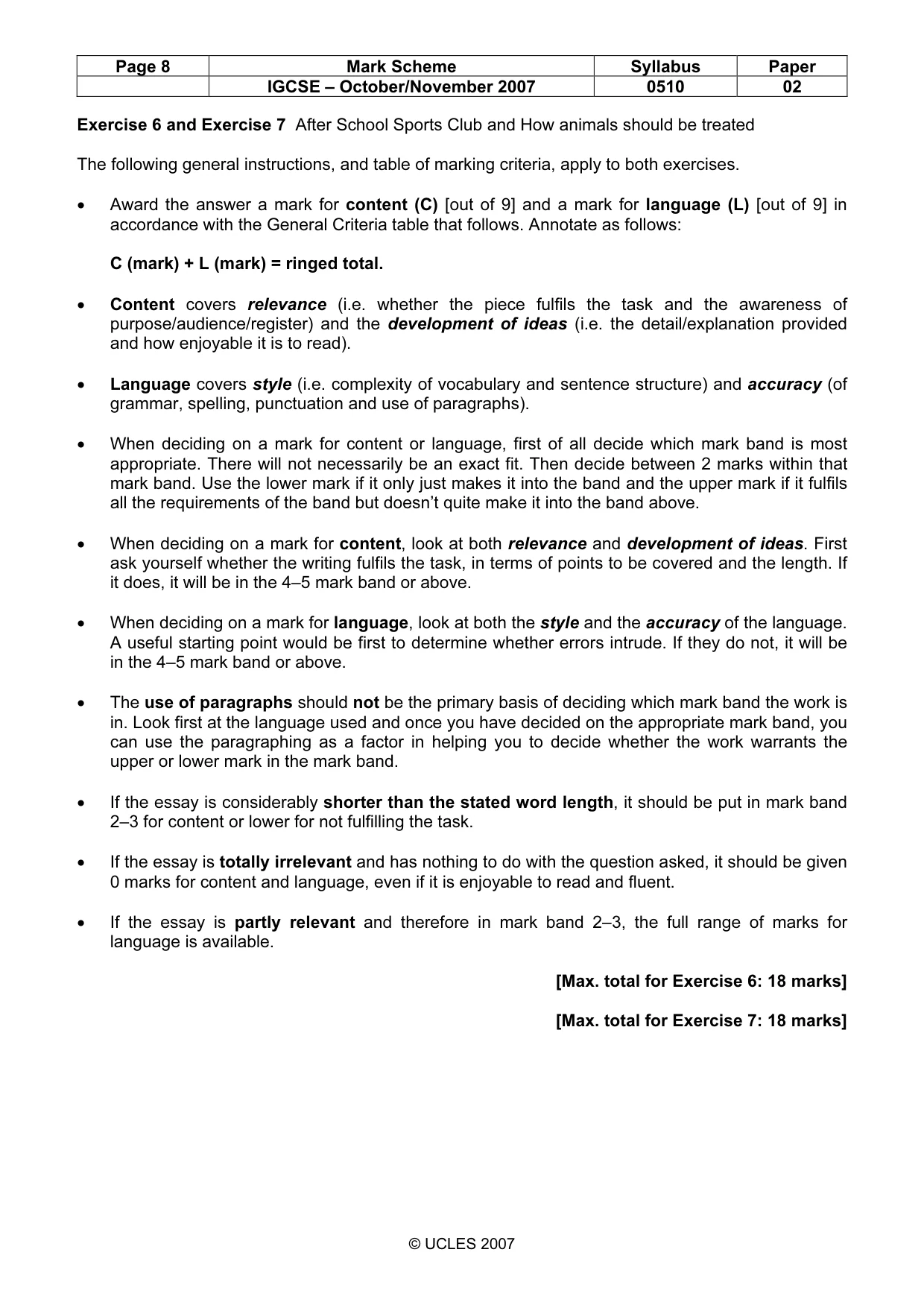
Page 8 Mark Scheme Syllabus Paper IGCSE – October/November 2007 0510 02 © UCLES 2007 Exercise 6 and Exercise 7 After School Sports Club and How animals should be treated The following general instructions, and table of marking criteria, apply to both exercises. • Award the answer a mark for content (C) [out of 9] and a mark for language (L) [out of 9] in accordance with the General Criteria table that follows. Annotate as follows: C (mark) + L (mark) = ringed total. • Content covers relevance (i.e. whether the piece fulfils the task and the awareness of purpose/audience/register) and the development of ideas (i.e. the detail/explanation provided and how enjoyable it is to read). • Language covers style (i.e. complexity of vocabulary and sentence structure) and accuracy (of grammar, spelling, punctuation and use of paragraphs). • When deciding on a mark for content or language, first of all decide which mark band is most appropriate. There will not necessarily be an exact fit. Then decide between 2 marks within that mark band. Use the lower mark if it only just makes it into the band and the upper mark if it fulfils all the requirements of the band but doesn’t quite make it into the band above. • When deciding on a mark for content, look at both relevance and development of ideas. First ask yourself whether the writing fulfils the task, in terms of points to be covered and the length. If it does, it will be in the 4–5 mark band or above. • When deciding on a mark for language, look at both the style and the accuracy of the language. A useful starting point would be first to determine whether errors intrude. If they do not, it will be in the 4–5 mark band or above. • The use of paragraphs should not be the primary basis of deciding which mark band the work is in. Look first at the language used and once you have decided on the appropriate mark band, you can use the paragraphing as a factor in helping you to decide whether the work warrants the upper or lower mark in the mark band. • If the essay is considerably shorter than the stated word length, it should be put in mark band 2–3 for content or lower for not fulfilling the task. • If the essay is totally irrelevant and has nothing to do with the question asked, it should be given 0 marks for content and language, even if it is enjoyable to read and fluent. • If the essay is partly relevant and therefore in mark band 2–3, the full range of marks for language is available. [Max. total for Exercise 6: 18 marks] [Max. total for Exercise 7: 18 marks]
Mark scheme, page 9
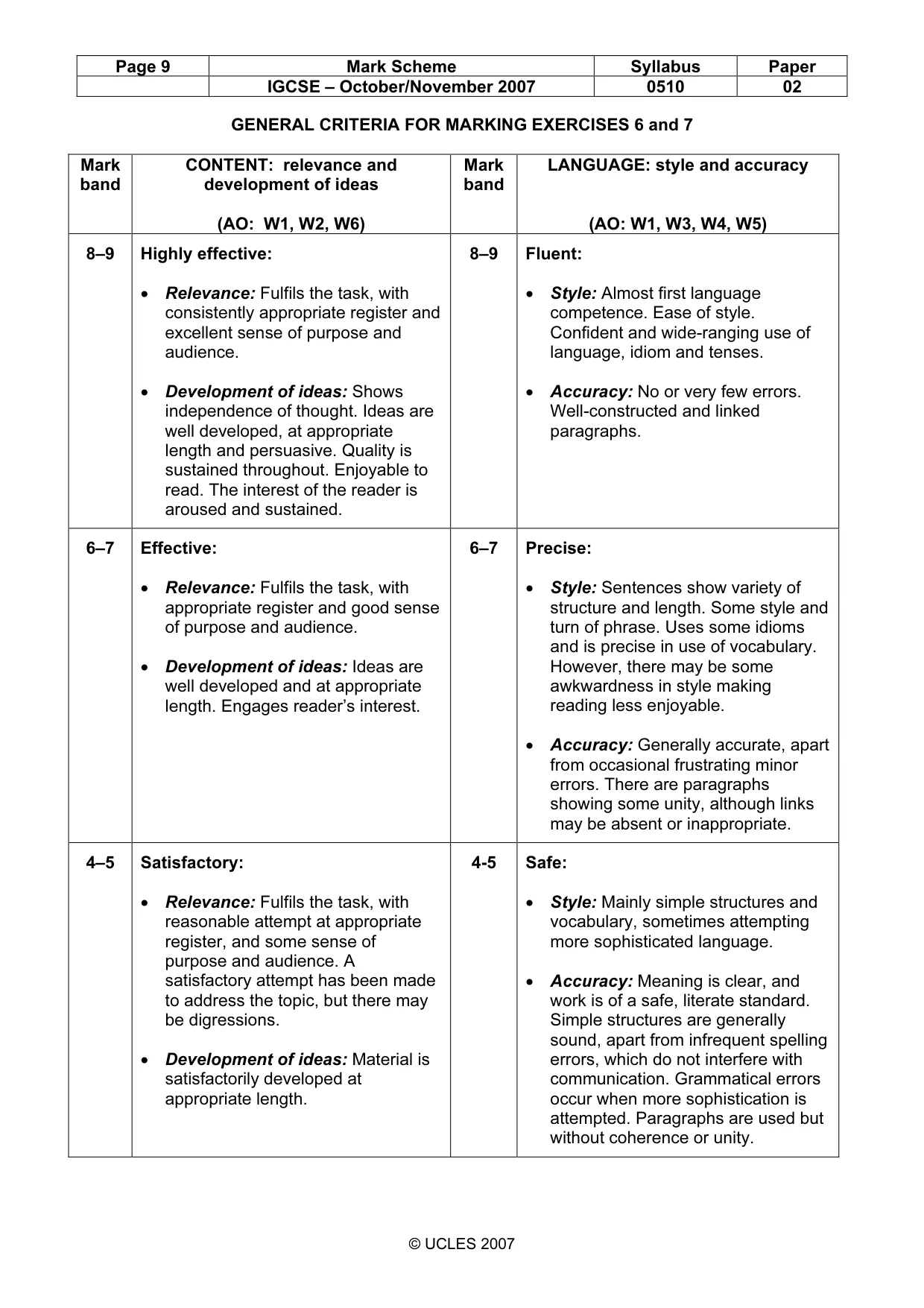
Page 9 Mark Scheme Syllabus Paper IGCSE – October/November 2007 0510 02 © UCLES 2007 GENERAL CRITERIA FOR MARKING EXERCISES 6 and 7 Mark band CONTENT: relevance and development of ideas (AO: W1, W2, W6) Mark band LANGUAGE: style and accuracy (AO: W1, W3, W4, W5) 8–9 Highly effective: • Relevance: Fulfils the task, with consistently appropriate register and excellent sense of purpose and audience. • Development of ideas: Shows independence of thought. Ideas are well developed, at appropriate length and persuasive. Quality is sustained throughout. Enjoyable to read. The interest of the reader is aroused and sustained. 8–9 Fluent: • Style: Almost first language competence. Ease of style. Confident and wide-ranging use of language, idiom and tenses. • Accuracy: No or very few errors. Well-constructed and linked paragraphs. 6–7 Effective: • Relevance: Fulfils the task, with appropriate register and good sense of purpose and audience. • Development of ideas: Ideas are well developed and at appropriate length. Engages reader’s interest. 6–7 Precise: • Style: Sentences show variety of structure and length. Some style and turn of phrase. Uses some idioms and is precise in use of vocabulary. However, there may be some awkwardness in style making reading less enjoyable. • Accuracy: Generally accurate, apart from occasional frustrating minor errors. There are paragraphs showing some unity, although links may be absent or inappropriate. 4–5 Satisfactory: • Relevance: Fulfils the task, with reasonable attempt at appropriate register, and some sense of purpose and audience. A satisfactory attempt has been made to address the topic, but there may be digressions. • Development of ideas: Material is satisfactorily developed at appropriate length. 4-5 Safe: • Style: Mainly simple structures and vocabulary, sometimes attempting more sophisticated language. • Accuracy: Meaning is clear, and work is of a safe, literate standard. Simple structures are generally sound, apart from infrequent spelling errors, which do not interfere with communication. Grammatical errors occur when more sophistication is attempted. Paragraphs are used but without coherence or unity.
Mark scheme, page 10
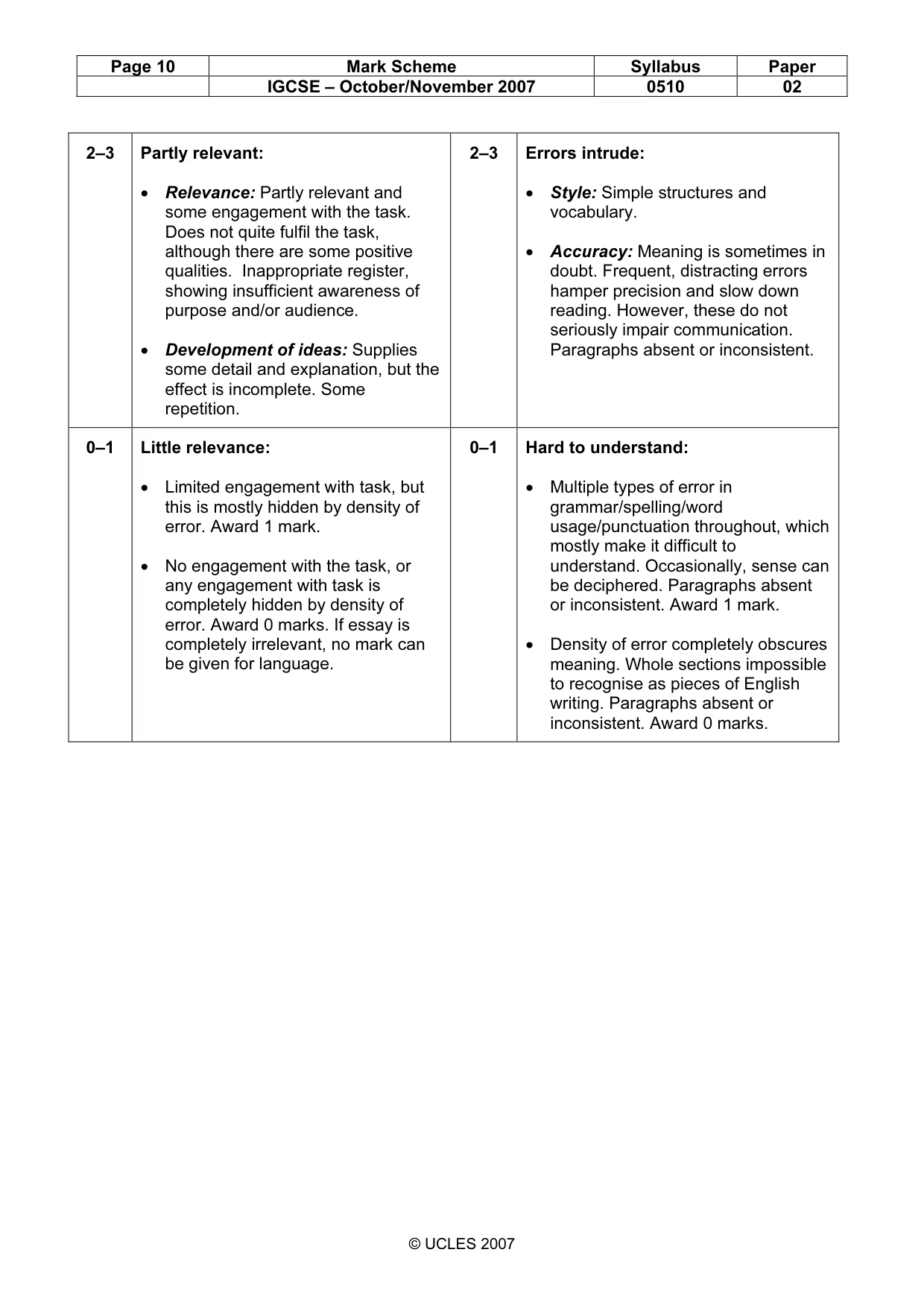
Page 10 Mark Scheme Syllabus Paper IGCSE – October/November 2007 0510 02 © UCLES 2007 2–3 Partly relevant: • Relevance: Partly relevant and some engagement with the task. Does not quite fulfil the task, although there are some positive qualities. Inappropriate register, showing insufficient awareness of purpose and/or audience. • Development of ideas: Supplies some detail and explanation, but the effect is incomplete. Some repetition. 2–3 Errors intrude: • Style: Simple structures and vocabulary. • Accuracy: Meaning is sometimes in doubt. Frequent, distracting errors hamper precision and slow down reading. However, these do not seriously impair communication. Paragraphs absent or inconsistent. 0–1 Little relevance: • Limited engagement with task, but this is mostly hidden by density of error. Award 1 mark. • No engagement with the task, or any engagement with task is completely hidden by density of error. Award 0 marks. If essay is completely irrelevant, no mark can be given for language. 0–1 Hard to understand: • Multiple types of error in grammar/spelling/word usage/punctuation throughout, which mostly make it difficult to understand. Occasionally, sense can be deciphered. Paragraphs absent or inconsistent. Award 1 mark. • Density of error completely obscures meaning. Whole sections impossible to recognise as pieces of English writing. Paragraphs absent or inconsistent. Award 0 marks.
What you needed in this session
Cambridge’s own grade thresholds for 2007 Oct/Nov, Paper 2 · Variant 1. A higher threshold means an easier paper — the bar moves with how the cohort did.