Cambridge IGCSE English - Second Language (oral endorsement) 0510 — 2007 Oct/Nov Paper 1 · Variant 1
0510/11/O/N/07 · 56 marks · ≈63 min
The question paper and its mark scheme, free to read here and free to download. This is Cambridge’s own paper, exactly as it was sat.
Question paper33 pages










Mark scheme12 pages
Answers below. Sit the paper first if you are practising.
Paper as text
Question paper, page 1
Location Entry Codes As part of CIE’s continual commitment to maintaining best practice in assessment, CIE has begun to use different variants of some question papers for our most popular assessments with extremely large and widespread candidature, The question papers are closely related and the relationships between them have been thoroughly established using our assessment expertise. All versions of the paper give assessment of equal standard. The content assessed by the examination papers and the type of questions are unchanged. This change means that for this component there are now two variant Question Papers, Mark Schemes and Principal Examiner’s Reports where previously there was only one. For any individual country, it is intended that only one variant is used. This document contains both variants which will give all Centres access to even more past examination material than is usually the case. The diagram shows the relationship between the Question Papers, Mark Schemes and Principal Examiner’s Reports. Question Paper Mark Scheme Principal Examiner’s Report Introduction Introduction Introduction First variant Question Paper First variant Mark Scheme First variant Principal Examiner’s Report Second variant Question Paper Second variant Mark Scheme Second variant Principal Examiner’s Report Who can I contact for further information on these changes? Please direct any questions about this to CIE’s Customer Services team at: international@cie.org.uk
Question paper, page 2
This document consists of 13 printed pages and 3 blank pages. IB07 11_0510_01/6RP © UCLES 2007 [Turn over *1701796345* For Examiner's Use Exercise 1 Exercise 2 Exercise 3 Exercise 4 Exercise 5 Exercise 6 Exercise 7 Total UNIVERSITY OF CAMBRIDGE INTERNATIONAL EXAMINATIONS International General Certificate of Secondary Education ENGLISH AS A SECOND LANGUAGE 0510/01 Paper 1 Reading and Writing (Core) October/November 2007 1 hour 30 minutes Candidates answer on the Question Paper. No Additional Materials are required. READ THESE INSTRUCTIONS FIRST Write your Centre number, candidate number and name on all the work you hand in. Write in dark blue or black pen. Do not use staples, paper clips, highlighters, glue or correction fluid. DO NOT WRITE IN ANY BARCODES. Answer all questions. Dictionaries are not allowed. At the end of the examination, fasten all your work securely together. The number of marks is given in brackets [ ] at the end of each question or part question. P First variant Question Paper
Question paper, page 3
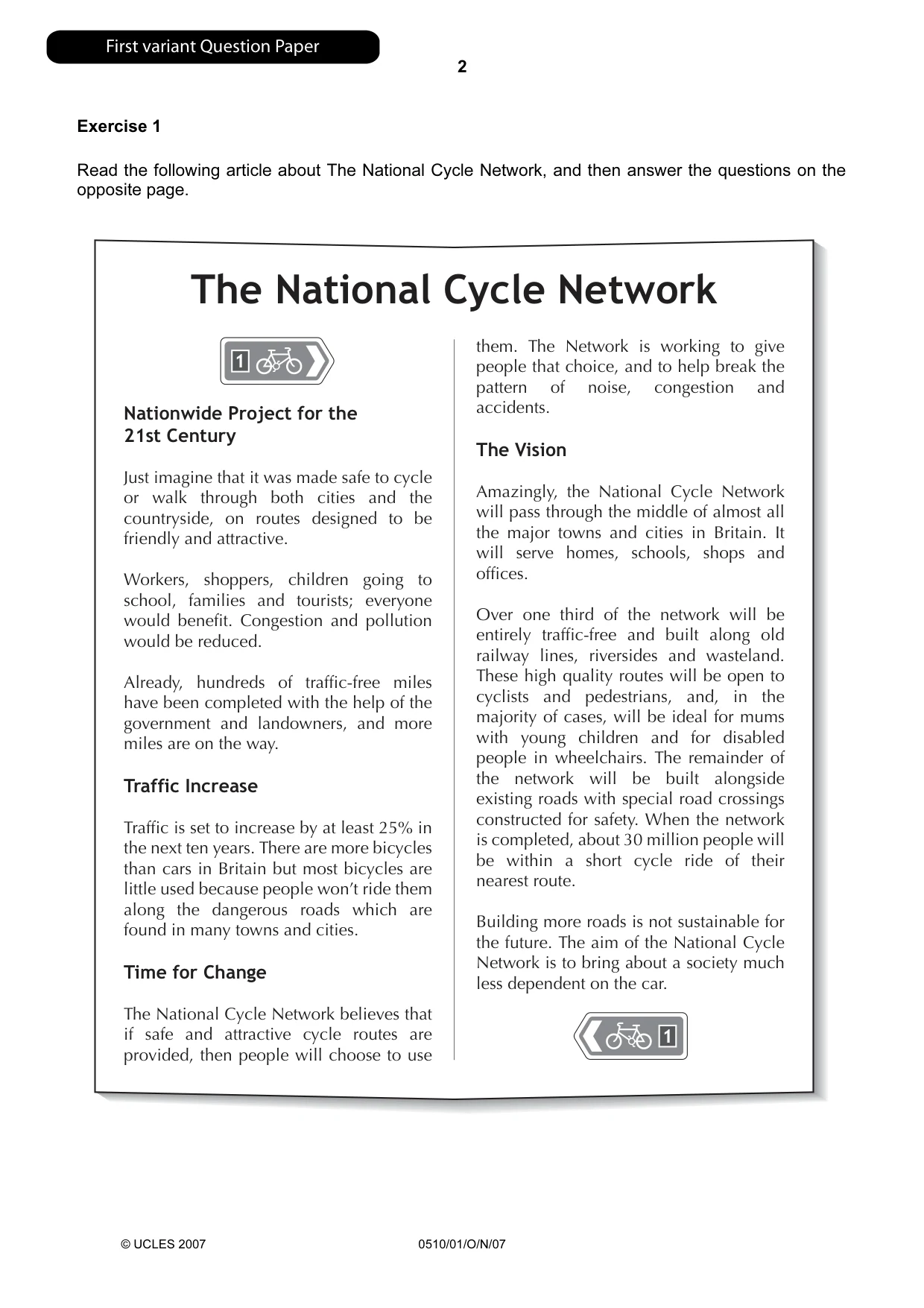
2 © UCLES 2007 0510/01/O/N/07 Exercise 1 Read the following article about The National Cycle Network, and then answer the questions on the opposite page. Nationwide Project for the 21st Century Just imagine that it was made safe to cycle or walk through both cities and the countryside, on routes designed to be friendly and attractive. Workers, shoppers, children going to school, families and tourists; everyone would benefit. Congestion and pollution would be reduced. Already, hundreds of traffic-free miles have been completed with the help of the government and landowners, and more miles are on the way. Traffic Increase Traffic is set to increase by at least 25% in the next ten years. There are more bicycles than cars in Britain but most bicycles are little used because people won’t ride them along the dangerous roads which are found in many towns and cities. Time for Change The National Cycle Network believes that if safe and attractive cycle routes are provided, then people will choose to use them. The Network is working to give people that choice, and to help break the pattern of noise, congestion and accidents. The Vision Amazingly, the National Cycle Network will pass through the middle of almost all the major towns and cities in Britain. It will serve homes, schools, shops and offices. Over one third of the network will be entirely traffic-free and built along old railway lines, riversides and wasteland. These high quality routes will be open to cyclists and pedestrians, and, in the majority of cases, will be ideal for mums with young children and for disabled people in wheelchairs. The remainder of the network will be built alongside existing roads with special road crossings constructed for safety. When the network is completed, about 30 million people will be within a short cycle ride of their nearest route. Building more roads is not sustainable for the future. The aim of the National Cycle Network is to bring about a society much less dependent on the car. 1 1 The National Cycle Network First variant Question Paper
Question paper, page 4
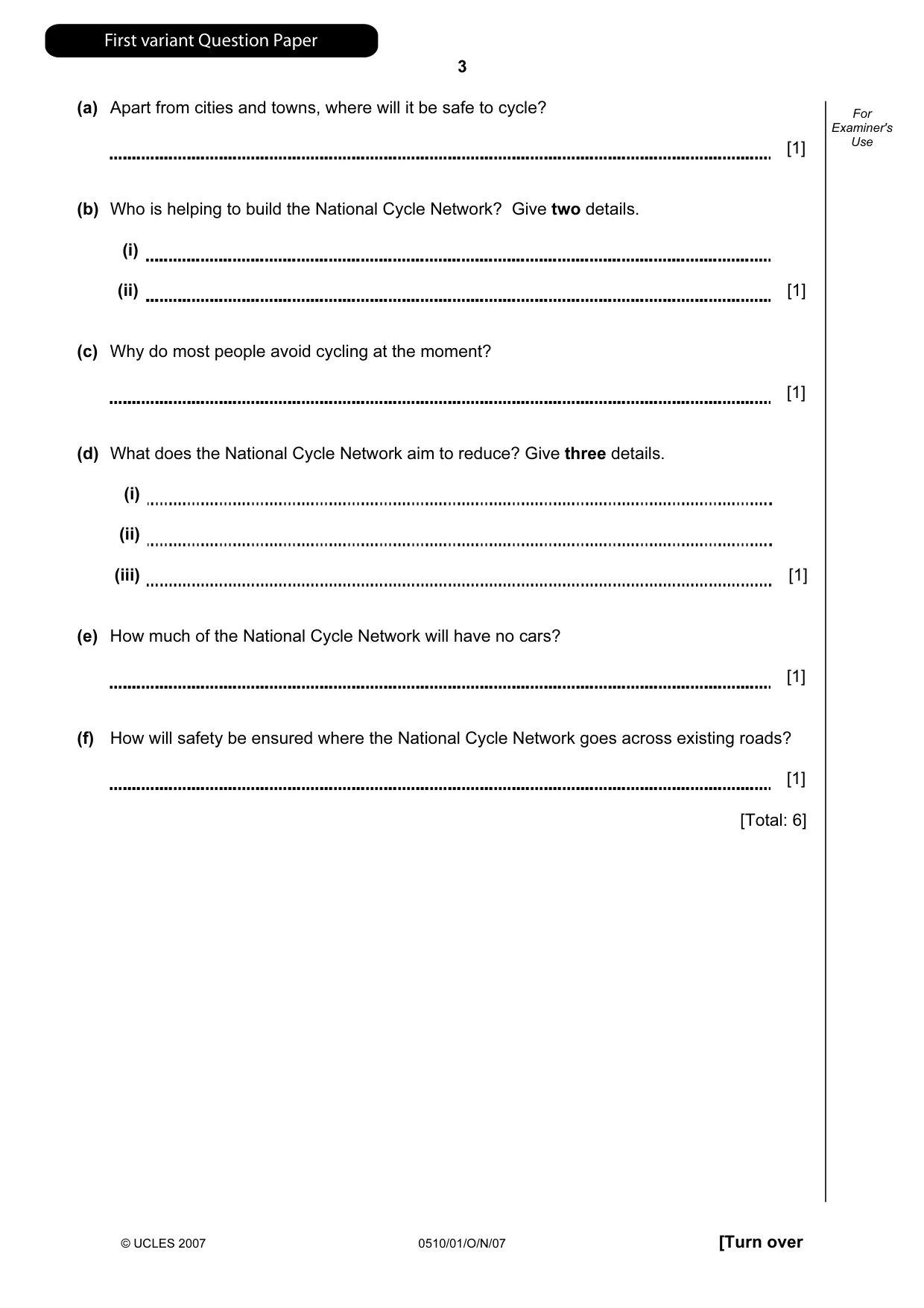
3 © UCLES 2007 0510/01/O/N/07 [Turn over For Examiner's Use (a) Apart from cities and towns, where will it be safe to cycle? [1] (b) Who is helping to build the National Cycle Network? Give two details. (i) (ii) [1] (c) Why do most people avoid cycling at the moment? [1] (d) What does the National Cycle Network aim to reduce? Give three details. (i) (ii) (iii) [1] (e) How much of the National Cycle Network will have no cars? [1] (f) How will safety be ensured where the National Cycle Network goes across existing roads? [1] [Total: 6] First variant Question Paper
Question paper, page 5
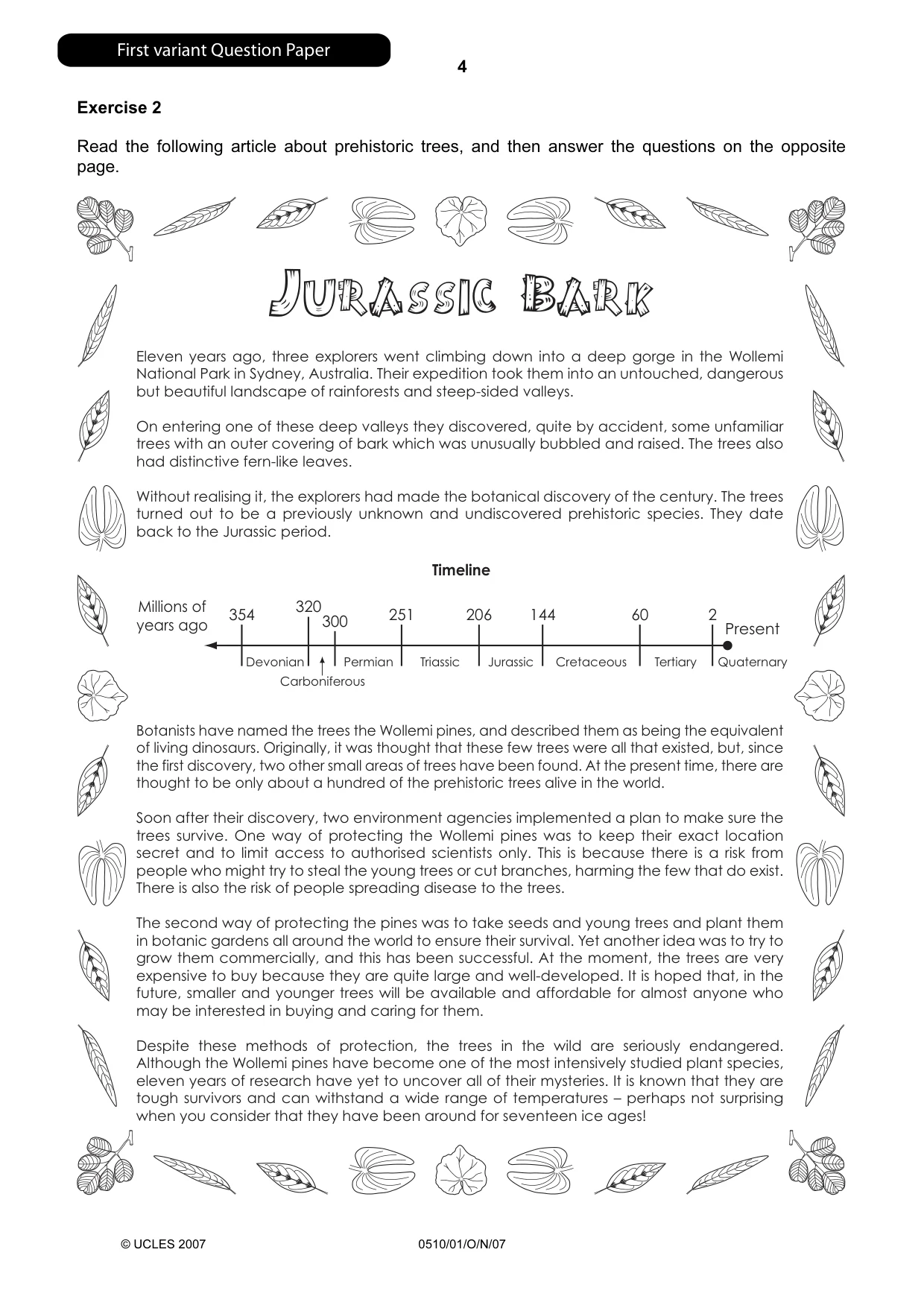
4 © UCLES 2007 0510/01/O/N/07 Exercise 2 Read the following article about prehistoric trees, and then answer the questions on the opposite page. Jurassic Bark Eleven years ago, three explorers went climbing down into a deep gorge in the Wollemi National Park in Sydney, Australia. Their expedition took them into an untouched, dangerous but beautiful landscape of rainforests and steep-sided valleys. On entering one of these deep valleys they discovered, quite by accident, some unfamiliar trees with an outer covering of bark which was unusually bubbled and raised. The trees also had distinctive fern-like leaves. Without realising it, the explorers had made the botanical discovery of the century. The trees turned out to be a previously unknown and undiscovered prehistoric species. They date back to the Jurassic period. Botanists have named the trees the Wollemi pines, and described them as being the equivalent of living dinosaurs. Originally, it was thought that these few trees were all that existed, but, since the first discovery, two other small areas of trees have been found. At the present time, there are thought to be only about a hundred of the prehistoric trees alive in the world. Soon after their discovery, two environment agencies implemented a plan to make sure the trees survive. One way of protecting the Wollemi pines was to keep their exact location secret and to limit access to authorised scientists only. This is because there is a risk from people who might try to steal the young trees or cut branches, harming the few that do exist. There is also the risk of people spreading disease to the trees. The second way of protecting the pines was to take seeds and young trees and plant them in botanic gardens all around the world to ensure their survival. Yet another idea was to try to grow them commercially, and this has been successful. At the moment, the trees are very expensive to buy because they are quite large and well-developed. It is hoped that, in the future, smaller and younger trees will be available and affordable for almost anyone who may be interested in buying and caring for them. Despite these methods of protection, the trees in the wild are seriously endangered. Although the Wollemi pines have become one of the most intensively studied plant species, eleven years of research have yet to uncover all of their mysteries. It is known that they are tough survivors and can withstand a wide range of temperatures – perhaps not surprising when you consider that they have been around for seventeen ice ages! 354 320 300 251 206 144 Present 60 2 Devonian Permian Carboniferous Triassic Jurassic Tertiary Quaternary Cretaceous Millions of years ago Timeline First variant Question Paper
Question paper, page 6
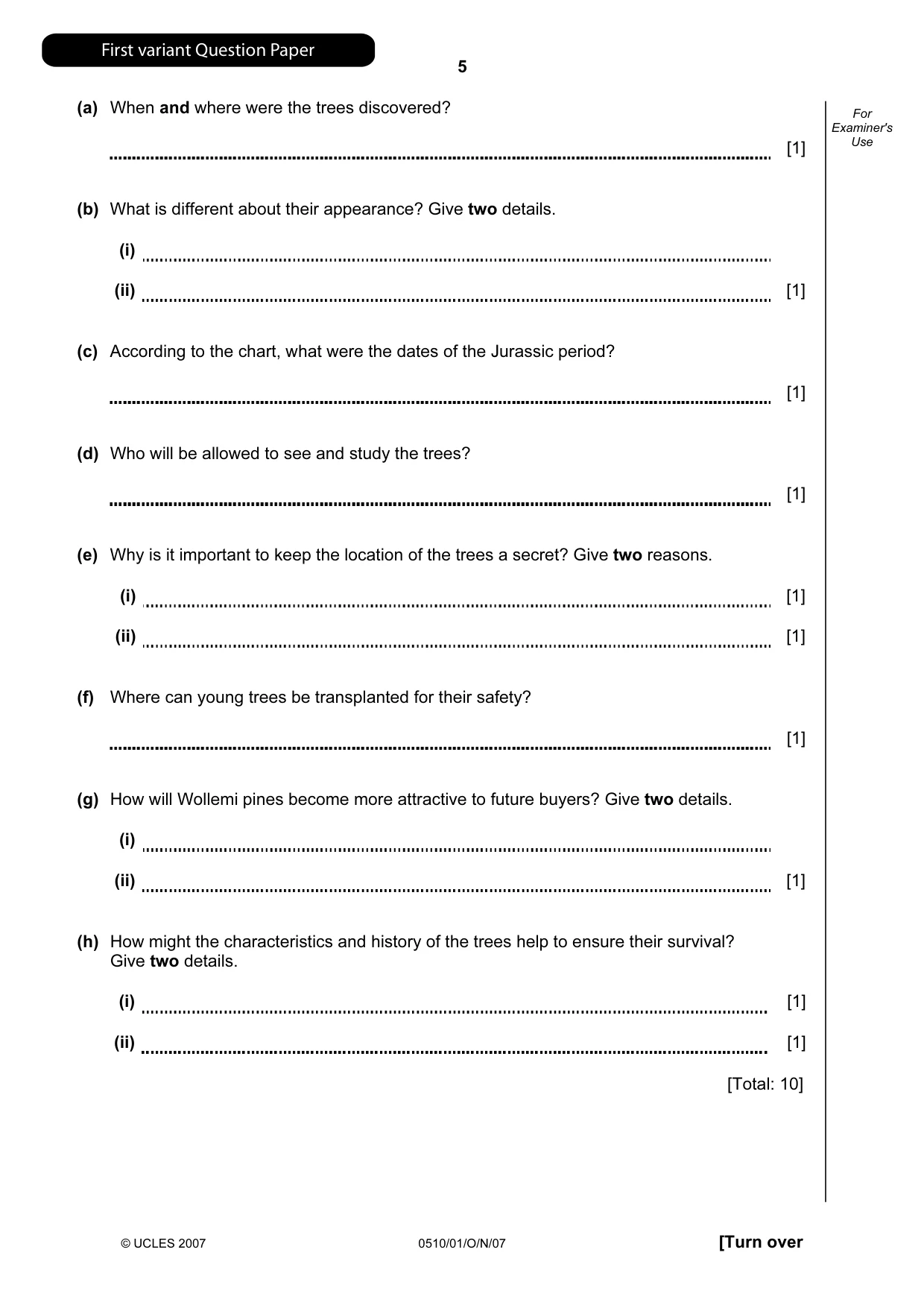
5 © UCLES 2007 0510/01/O/N/07 [Turn over For Examiner's Use (a) When and where were the trees discovered? [1] (b) What is different about their appearance? Give two details. (i) (ii) [1] (c) According to the chart, what were the dates of the Jurassic period? [1] (d) Who will be allowed to see and study the trees? [1] (e) Why is it important to keep the location of the trees a secret? Give two reasons. (i) [1] (ii) [1] (f) Where can young trees be transplanted for their safety? [1] (g) How will Wollemi pines become more attractive to future buyers? Give two details. (i) (ii) [1] (h) How might the characteristics and history of the trees help to ensure their survival? Give two details. (i) [1] (ii) [1] [Total: 10] First variant Question Paper
Question paper, page 7
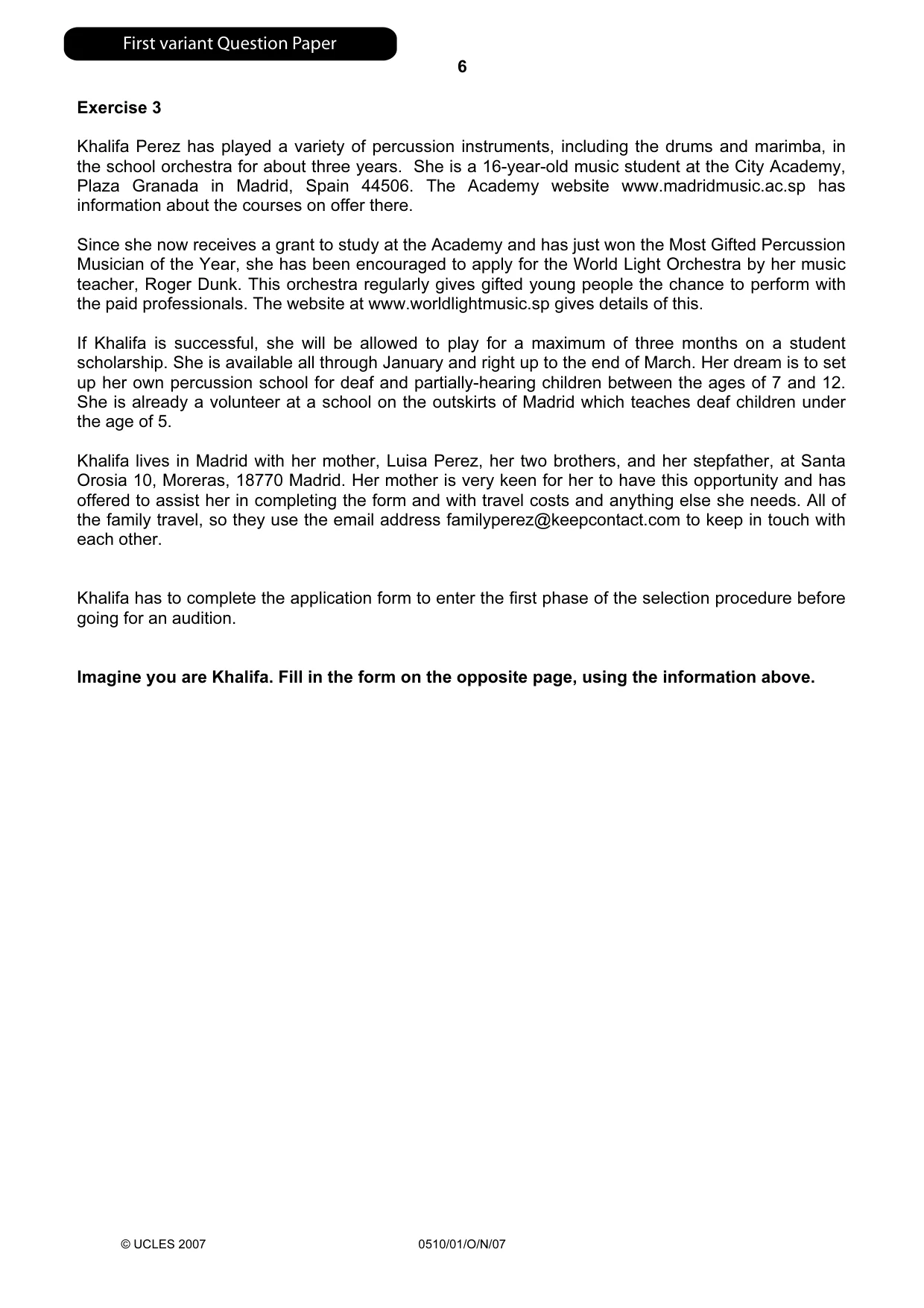
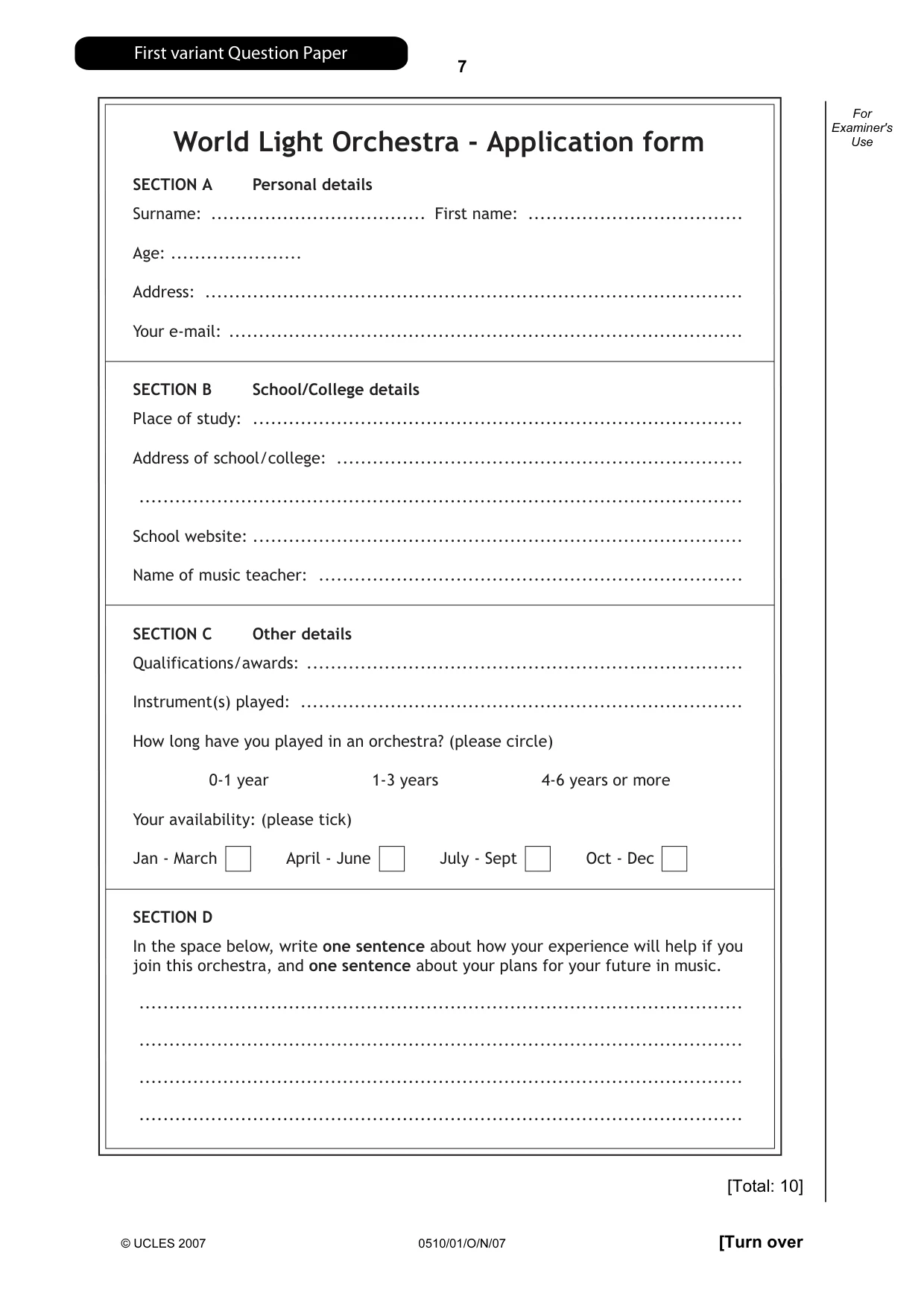
6 © UCLES 2007 0510/01/O/N/07 Exercise 3 Khalifa Perez has played a variety of percussion instruments, including the drums and marimba, in the school orchestra for about three years. She is a 16-year-old music student at the City Academy, Plaza Granada in Madrid, Spain 44506. The Academy website www.madridmusic.ac.sp has information about the courses on offer there. Since she now receives a grant to study at the Academy and has just won the Most Gifted Percussion Musician of the Year, she has been encouraged to apply for the World Light Orchestra by her music teacher, Roger Dunk. This orchestra regularly gives gifted young people the chance to perform with the paid professionals. The website at www.worldlightmusic.sp gives details of this. If Khalifa is successful, she will be allowed to play for a maximum of three months on a student scholarship. She is available all through January and right up to the end of March. Her dream is to set up her own percussion school for deaf and partially-hearing children between the ages of 7 and 12. She is already a volunteer at a school on the outskirts of Madrid which teaches deaf children under the age of 5. Khalifa lives in Madrid with her mother, Luisa Perez, her two brothers, and her stepfather, at Santa Orosia 10, Moreras, 18770 Madrid. Her mother is very keen for her to have this opportunity and has offered to assist her in completing the form and with travel costs and anything else she needs. All of the family travel, so they use the email address familyperez@keepcontact.com to keep in touch with each other. Khalifa has to complete the application form to enter the first phase of the selection procedure before going for an audition. Imagine you are Khalifa. Fill in the form on the opposite page, using the information above. First variant Question Paper
Question paper, page 8
7 © UCLES 2007 0510/01/O/N/07 [Turn over For Examiner's Use World Light Orchestra - Application form SECTION A Personal details Surname: … First name: … Age: … Address: … Your e-mail: … SECTION B School/College details Place of study: … Address of school/college: … … School website: … Name of music teacher: … SECTION C Other details Qualifications/awards: … Instrument(s) played: … How long have you played in an orchestra? (please circle) 0-1 year 1-3 years 4-6 years or more Your availability: (please tick) Jan - March April - June July - Sept Oct - Dec SECTION D In the space below, write one sentence about how your experience will help if you join this orchestra, and one sentence about your plans for your future in music. … … … … [Total: 10] First variant Question Paper
Question paper, page 9
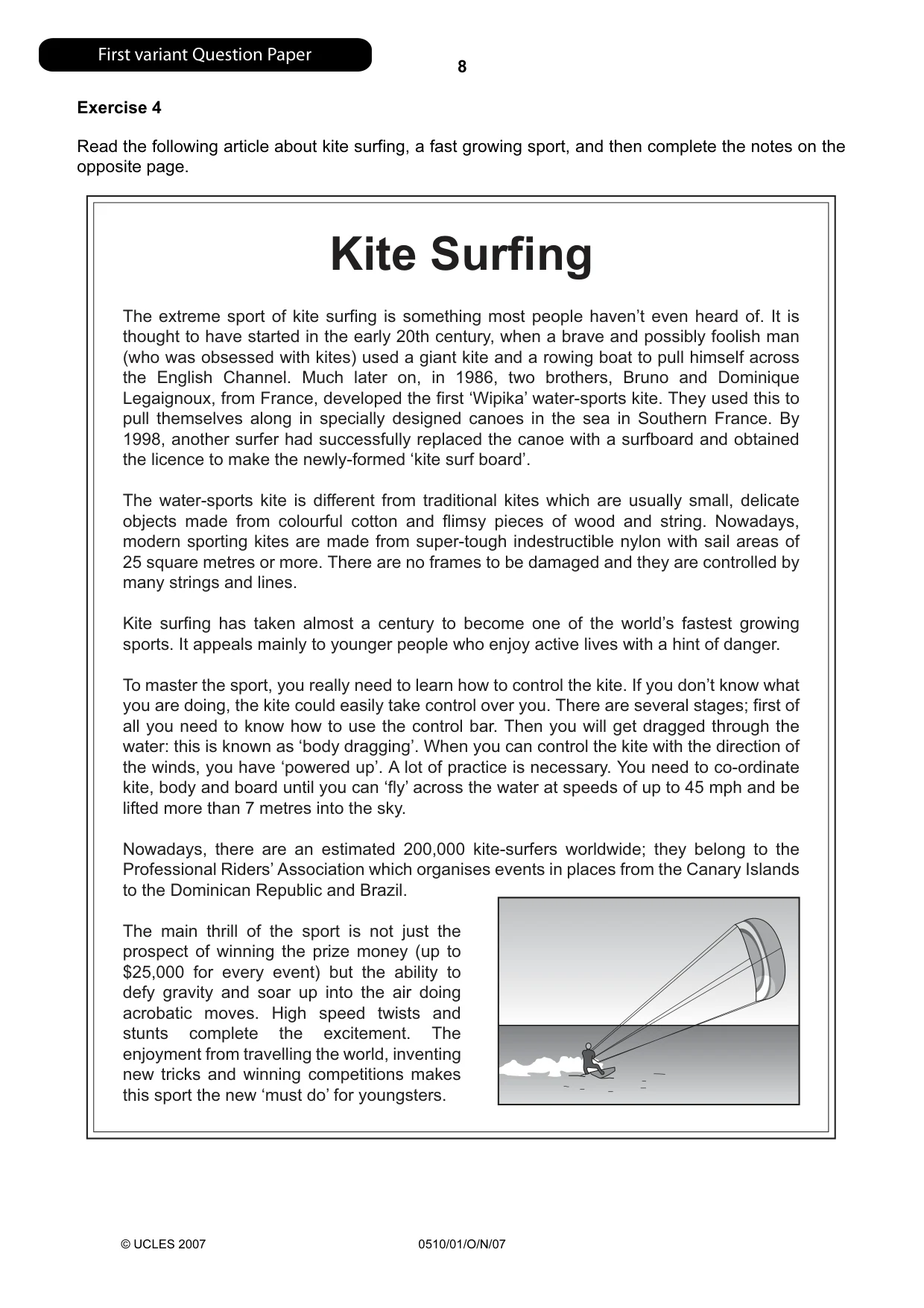
8 © UCLES 2007 0510/01/O/N/07 Exercise 4 Read the following article about kite surfing, a fast growing sport, and then complete the notes on the opposite page. Kite Surfing The extreme sport of kite surfing is something most people haven’t even heard of. It is thought to have started in the early 20th century, when a brave and possibly foolish man (who was obsessed with kites) used a giant kite and a rowing boat to pull himself across the English Channel. Much later on, in 1986, two brothers, Bruno and Dominique Legaignoux, from France, developed the first ‘Wipika’ water-sports kite. They used this to pull themselves along in specially designed canoes in the sea in Southern France. By 1998, another surfer had successfully replaced the canoe with a surfboard and obtained the licence to make the newly-formed ‘kite surf board’. The water-sports kite is different from traditional kites which are usually small, delicate objects made from colourful cotton and flimsy pieces of wood and string. Nowadays, modern sporting kites are made from super-tough indestructible nylon with sail areas of 25 square metres or more. There are no frames to be damaged and they are controlled by many strings and lines. Kite surfing has taken almost a century to become one of the world’s fastest growing sports. It appeals mainly to younger people who enjoy active lives with a hint of danger. To master the sport, you really need to learn how to control the kite. If you don’t know what you are doing, the kite could easily take control over you. There are several stages; first of all you need to know how to use the control bar. Then you will get dragged through the water: this is known as ‘body dragging’. When you can control the kite with the direction of the winds, you have ‘powered up’. A lot of practice is necessary. You need to co-ordinate kite, body and board until you can ‘fly’ across the water at speeds of up to 45 mph and be lifted more than 7 metres into the sky. Nowadays, there are an estimated 200,000 kite-surfers worldwide; they belong to the Professional Riders’ Association which organises events in places from the Canary Islands to the Dominican Republic and Brazil. The main thrill of the sport is not just the prospect of winning the prize money (up to $25,000 for every event) but the ability to defy gravity and soar up into the air doing acrobatic moves. High speed twists and stunts complete the excitement. The enjoyment from travelling the world, inventing new tricks and winning competitions makes this sport the new ‘must do’ for youngsters. First variant Question Paper
Question paper, page 10
9 © UCLES 2007 0510/01/O/N/07 [Turn over For Examiner's Use You are going to give a talk to your youth club about kite surfing. Prepare some notes to use as the basis for your talk. Make two short notes under each heading. Development of the sport • started in early 20th century with giant kite and rowing boat. • … • … Description of the modern sporting kite • … • … Controlling the kite • … • … [Total: 6] Exercise 5 Imagine that your school magazine wants you to write a short article about kite surfing. Look at your notes in Exercise 4 above. Using the ideas in your notes, write a summary about kite surfing. Your summary should be one paragraph of no more than 70 words. You should use your own words as far as possible. [Total: 4] First variant Question Paper
Question paper, page 11
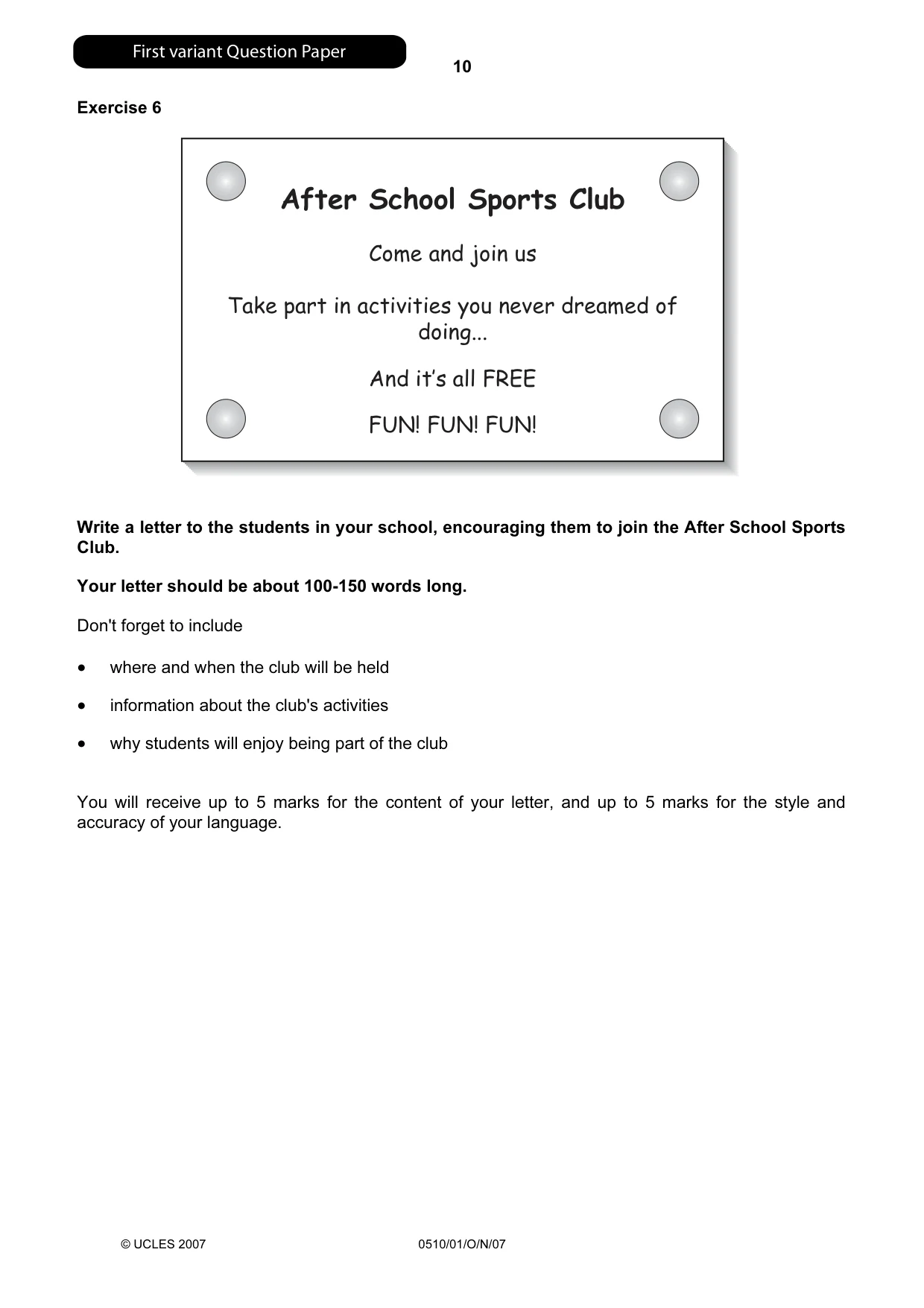
10 © UCLES 2007 0510/01/O/N/07 Exercise 6 After School Sports Club Come and join us Take part in activities you never dreamed of doing... And it‛s all FREE FUN! FUN! FUN! Write a letter to the students in your school, encouraging them to join the After School Sports Club. Your letter should be about 100-150 words long. Don't forget to include • where and when the club will be held • information about the club's activities • why students will enjoy being part of the club You will receive up to 5 marks for the content of your letter, and up to 5 marks for the style and accuracy of your language. First variant Question Paper
Question paper, page 12
11 © UCLES 2007 0510/01/O/N/07 [Turn over For Examiner's Use Dear Students, [10] First variant Question Paper
Question paper, page 13
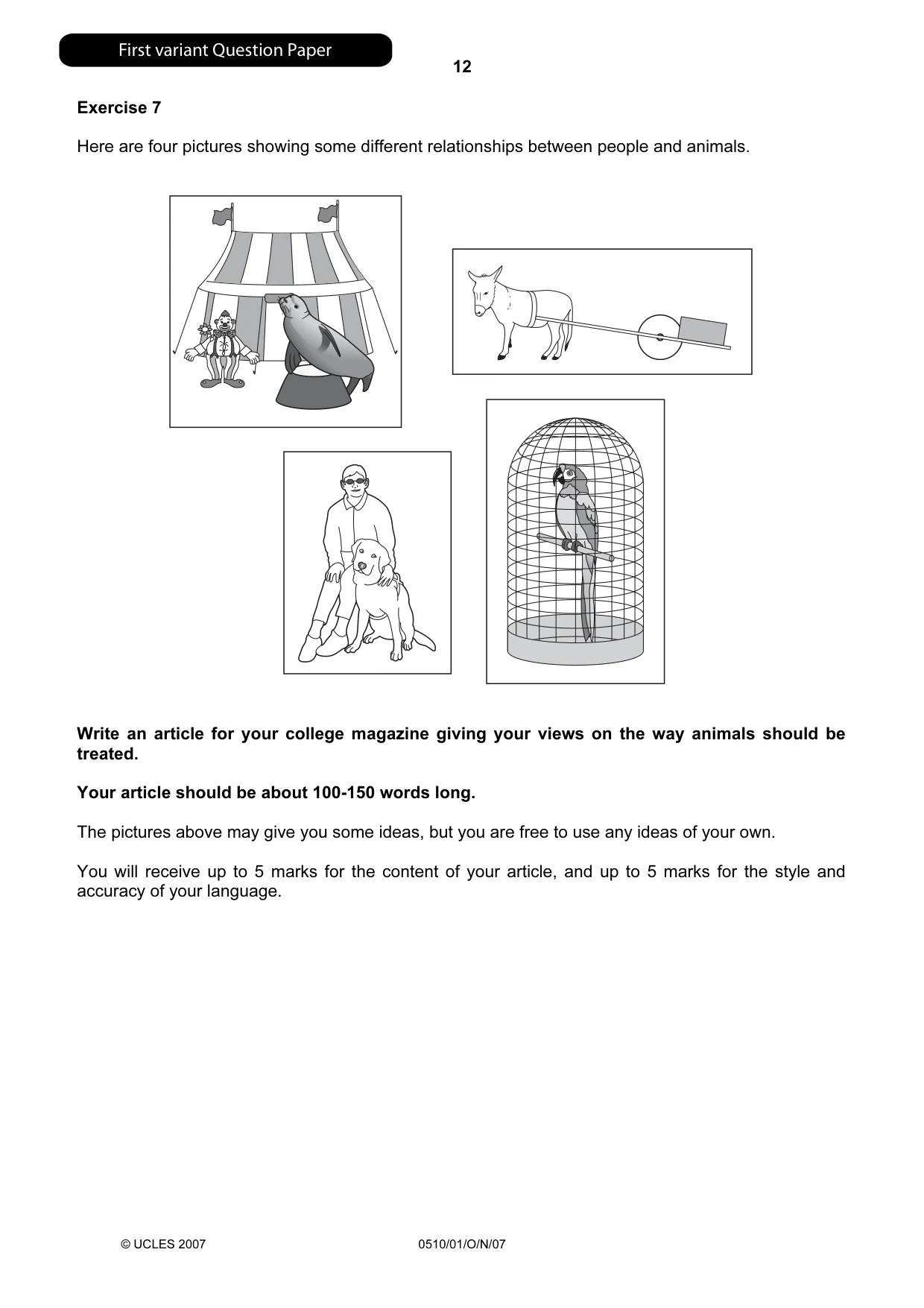
12 © UCLES 2007 0510/01/O/N/07 Exercise 7 Here are four pictures showing some different relationships between people and animals. Write an article for your college magazine giving your views on the way animals should be treated. Your article should be about 100-150 words long. The pictures above may give you some ideas, but you are free to use any ideas of your own. You will receive up to 5 marks for the content of your article, and up to 5 marks for the style and accuracy of your language. First variant Question Paper
Question paper, page 14
13 © UCLES 2007 0510/01/O/N/07 For Examiner's Use [10] First variant Question Paper
Question paper, page 15
14 0510/01/O/N/07 BLANK PAGE First variant Question Paper
Question paper, page 16
15 0510/01/O/N/07 BLANK PAGE First variant Question Paper
Question paper, page 17
16 Copyright Acknowledgements: Exercise 1 © Sustrans Ltd. Permission to reproduce items where third-party owned material protected by copyright is included has been sought and cleared where possible. Every reasonable effort has been made by the publisher (UCLES) to trace copyright holders, but if any items requiring clearance have unwittingly been included, the publisher will be pleased to make amends at the earliest possible opportunity. University of Cambridge International Examinations is part of the Cambridge Assessment Group. Cambridge Assessment is the brand name of University of Cambridge Local Examinations Syndicate (UCLES), which is itself a department of the University of Cambridge. 0510/01/O/N/07 BLANK PAGE First variant Question Paper
Question paper, page 18
This document consists of 13 printed pages and 3 blank pages. IB07 11_0510_01_TZ/6RP © UCLES 2007 [Turn over *2904124350* For Examiner's Use Exercise 1 Exercise 2 Exercise 3 Exercise 4 Exercise 5 Exercise 6 Exercise 7 Total UNIVERSITY OF CAMBRIDGE INTERNATIONAL EXAMINATIONS International General Certificate of Secondary Education ENGLISH AS A SECOND LANGUAGE 0510/01 Paper 1 Reading and Writing (Core) October/November 2007 1 hour 30 minutes Candidates answer on the Question Paper. No Additional Materials are required. READ THESE INSTRUCTIONS FIRST Write your Centre number, candidate number and name on all the work you hand in. Write in dark blue or black pen. Do not use staples, paper clips, highlighters, glue or correction fluid. DO NOT WRITE IN ANY BARCODES. Answer all questions. Dictionaries are not allowed. At the end of the examination, fasten all your work securely together. The number of marks is given in brackets [ ] at the end of each question or part question. Q Second variant Question Paper
Question paper, page 19
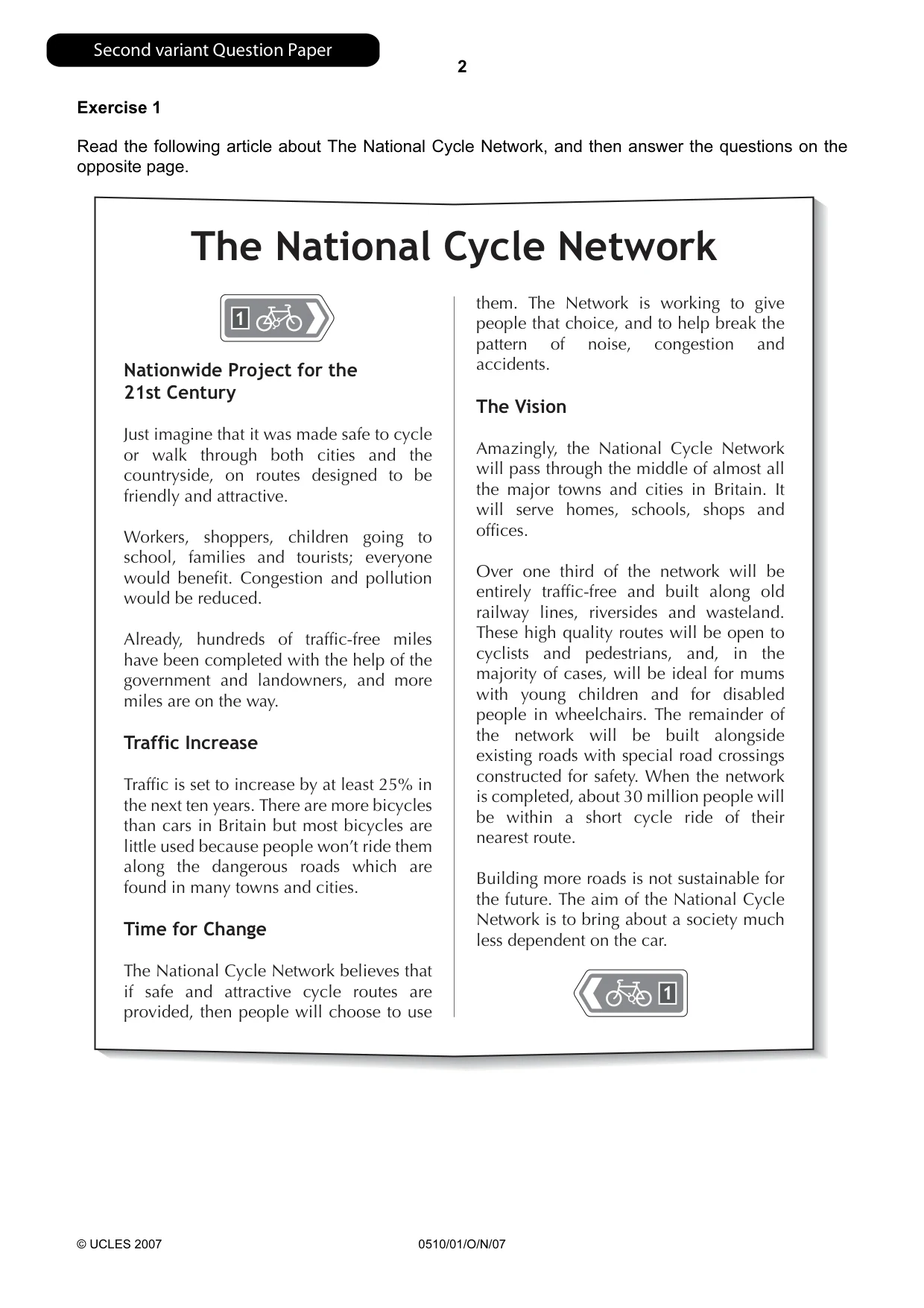
2 © UCLES 2007 0510/01/O/N/07 Exercise 1 Read the following article about The National Cycle Network, and then answer the questions on the opposite page. Nationwide Project for the 21st Century Just imagine that it was made safe to cycle or walk through both cities and the countryside, on routes designed to be friendly and attractive. Workers, shoppers, children going to school, families and tourists; everyone would benefit. Congestion and pollution would be reduced. Already, hundreds of traffic-free miles have been completed with the help of the government and landowners, and more miles are on the way. Traffic Increase Traffic is set to increase by at least 25% in the next ten years. There are more bicycles than cars in Britain but most bicycles are little used because people won’t ride them along the dangerous roads which are found in many towns and cities. Time for Change The National Cycle Network believes that if safe and attractive cycle routes are provided, then people will choose to use them. The Network is working to give people that choice, and to help break the pattern of noise, congestion and accidents. The Vision Amazingly, the National Cycle Network will pass through the middle of almost all the major towns and cities in Britain. It will serve homes, schools, shops and offices. Over one third of the network will be entirely traffic-free and built along old railway lines, riversides and wasteland. These high quality routes will be open to cyclists and pedestrians, and, in the majority of cases, will be ideal for mums with young children and for disabled people in wheelchairs. The remainder of the network will be built alongside existing roads with special road crossings constructed for safety. When the network is completed, about 30 million people will be within a short cycle ride of their nearest route. Building more roads is not sustainable for the future. The aim of the National Cycle Network is to bring about a society much less dependent on the car. 1 1 The National Cycle Network Second variant Question Paper
Question paper, page 20
3 © UCLES 2007 0510/01/O/N/07 [Turn over For Examiner's Use (a) Apart from cities and towns, where will it be safe to cycle? [1] (b) Who is helping to build the National Cycle Network? Give two details. (i) (ii) [1] (c) Why do most people avoid cycling at the moment? [1] (d) What does the National Cycle Network aim to reduce? Give three details. (i) (ii) (iii) [1] (e) How much of the National Cycle Network will have no cars? [1] (f) How will safety be ensured where the National Cycle Network goes across existing roads? [1] [Total: 6] Second variant Question Paper
Question paper, page 21
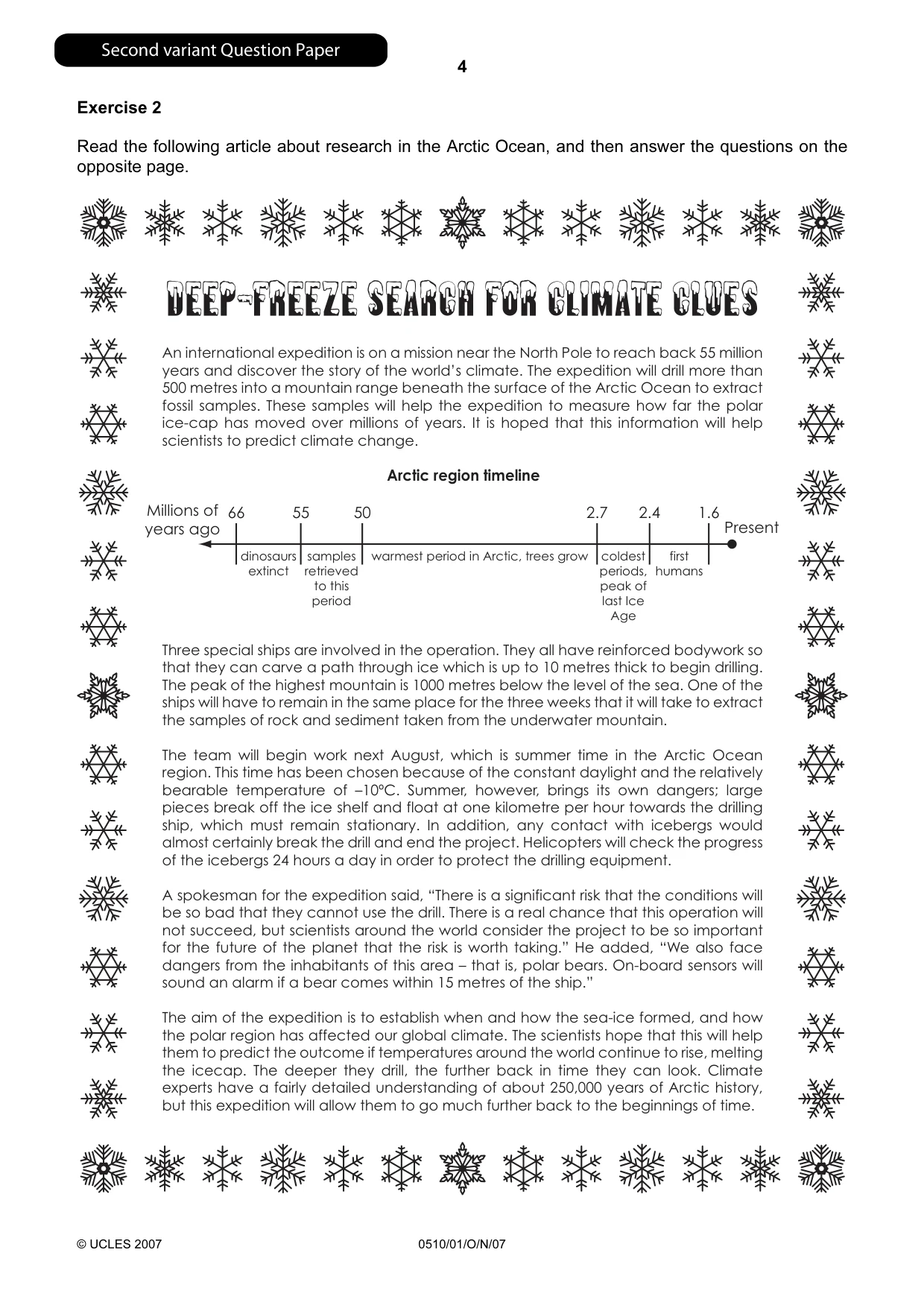
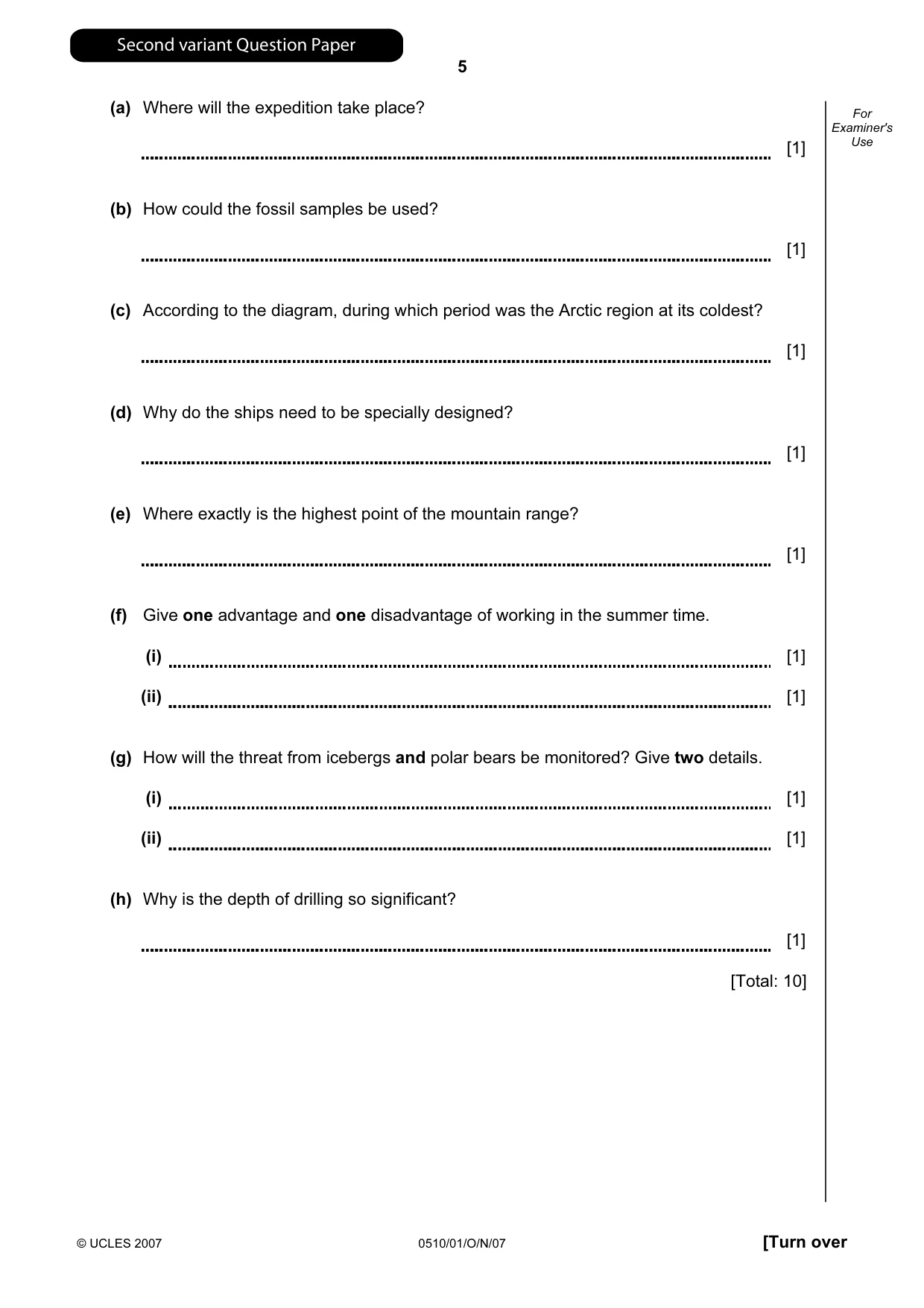
4 © UCLES 2007 0510/01/O/N/07 Exercise 2 Read the following article about research in the Arctic Ocean, and then answer the questions on the opposite page. Deep-freeze search for climate clues An international expedition is on a mission near the North Pole to reach back 55 million years and discover the story of the world’s climate. The expedition will drill more than 500 metres into a mountain range beneath the surface of the Arctic Ocean to extract fossil samples. These samples will help the expedition to measure how far the polar ice-cap has moved over millions of years. It is hoped that this information will help scientists to predict climate change. Three special ships are involved in the operation. They all have reinforced bodywork so that they can carve a path through ice which is up to 10 metres thick to begin drilling. The peak of the highest mountain is 1000 metres below the level of the sea. One of the ships will have to remain in the same place for the three weeks that it will take to extract the samples of rock and sediment taken from the underwater mountain. The team will begin work next August, which is summer time in the Arctic Ocean region. This time has been chosen because of the constant daylight and the relatively bearable temperature of –10ºC. Summer, however, brings its own dangers; large pieces break off the ice shelf and float at one kilometre per hour towards the drilling ship, which must remain stationary. In addition, any contact with icebergs would almost certainly break the drill and end the project. Helicopters will check the progress of the icebergs 24 hours a day in order to protect the drilling equipment. A spokesman for the expedition said, “There is a significant risk that the conditions will be so bad that they cannot use the drill. There is a real chance that this operation will not succeed, but scientists around the world consider the project to be so important for the future of the planet that the risk is worth taking.” He added, “We also face dangers from the inhabitants of this area – that is, polar bears. On-board sensors will sound an alarm if a bear comes within 15 metres of the ship.” The aim of the expedition is to establish when and how the sea-ice formed, and how the polar region has affected our global climate. The scientists hope that this will help them to predict the outcome if temperatures around the world continue to rise, melting the icecap. The deeper they drill, the further back in time they can look. Climate experts have a fairly detailed understanding of about 250,000 years of Arctic history, but this expedition will allow them to go much further back to the beginnings of time. Present Arctic region timeline 66 Millions of years ago 55 50 2.7 2.4 1.6 first humans coldest periods, peak of last Ice Age samples retrieved to this period dinosaurs extinct warmest period in Arctic, trees grow Second variant Question Paper
Question paper, page 22
5 © UCLES 2007 0510/01/O/N/07 [Turn over For Examiner's Use (a) Where will the expedition take place? [1] (b) How could the fossil samples be used? [1] (c) According to the diagram, during which period was the Arctic region at its coldest? [1] (d) Why do the ships need to be specially designed? [1] (e) Where exactly is the highest point of the mountain range? [1] (f) Give one advantage and one disadvantage of working in the summer time. (i) [1] (ii) [1] (g) How will the threat from icebergs and polar bears be monitored? Give two details. (i) [1] (ii) [1] (h) Why is the depth of drilling so significant? [1] [Total: 10] Second variant Question Paper
Question paper, page 23
6 © UCLES 2007 0510/01/O/N/07 Exercise 3 Russell Singh is a 16-year-old athlete who wants to do more training for the next Olympic Games. He lives in India at Building 7a, Park Square, Delhi. He attends the Elite Sports Academy in Jaipur where he is the captain of the marathon running team. This academy selects promising athletes and gives them plenty of opportunities to take part in running competitions worldwide. His parents, Balbir and Zafar Kapur, were very successful runners when they were young and want their son to do as well as they did. They hope he will bring back a gold medal. Russell's main strengths are in the half-marathon but he can also achieve a very good time of about four hours in the full marathon. His 400 metre circuit work is the best in the school and he tutors younger students on their own circuit technique. He is a good instructor too. The youngsters he tutors achieve times that are only a few seconds less than Russell’s own best times. When he is away from home he keeps in touch with his parents by mobile phone 07778 984124. Sometimes Russell forgets to switch the phone on and then he can be contacted by e-mail at marathonruss@run.com which he checks daily. There are some places available on a pre-Olympic training course and Russell would like to apply. If he is accepted on the course, Russell's aim is to reduce his full marathon time. He would also like to keep up the short 400 metre circuit work which helps to improve his speed and stamina. Imagine you are Russell. Fill in the form on the opposite page, using the information above. Second variant Question Paper
Question paper, page 24
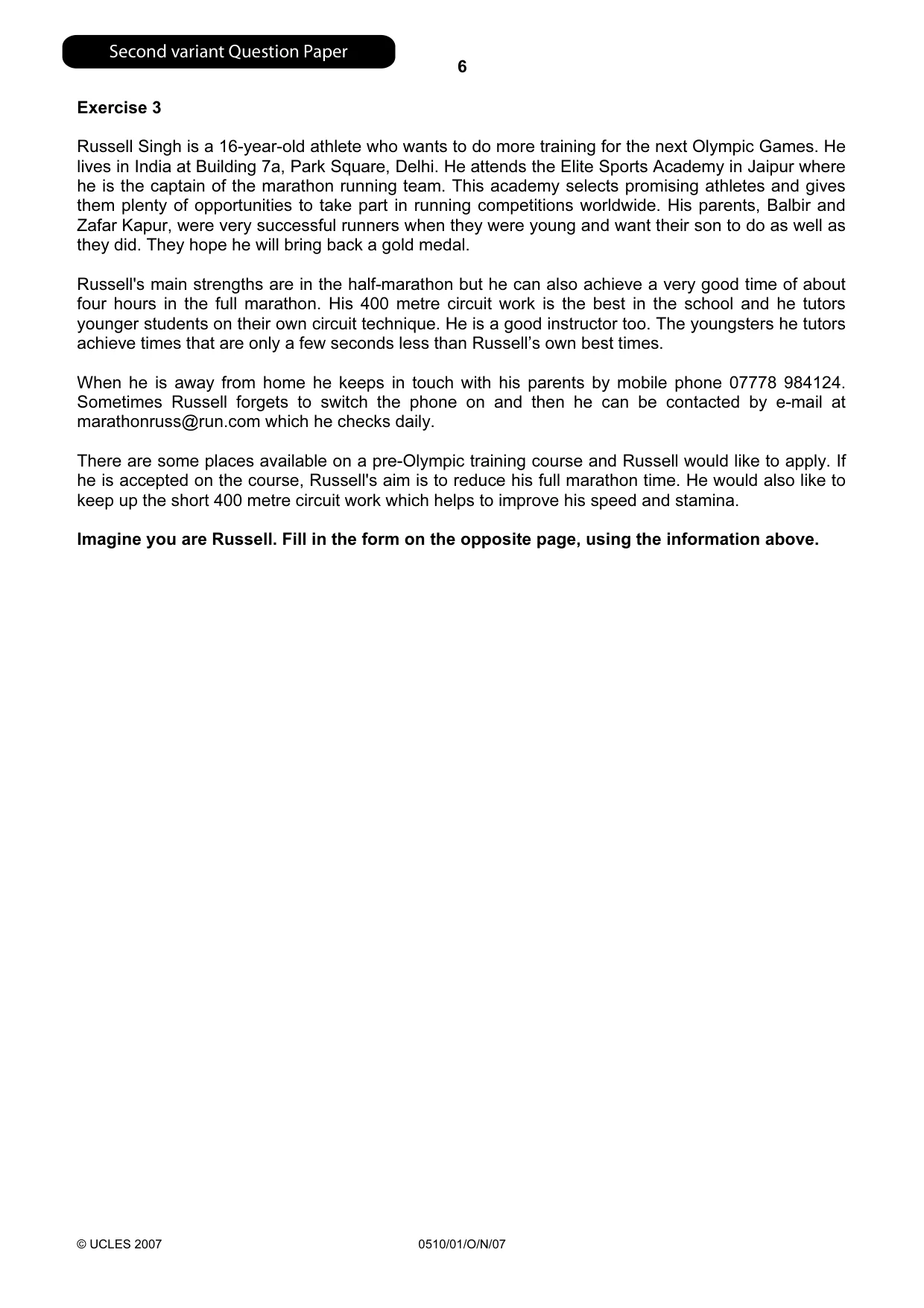
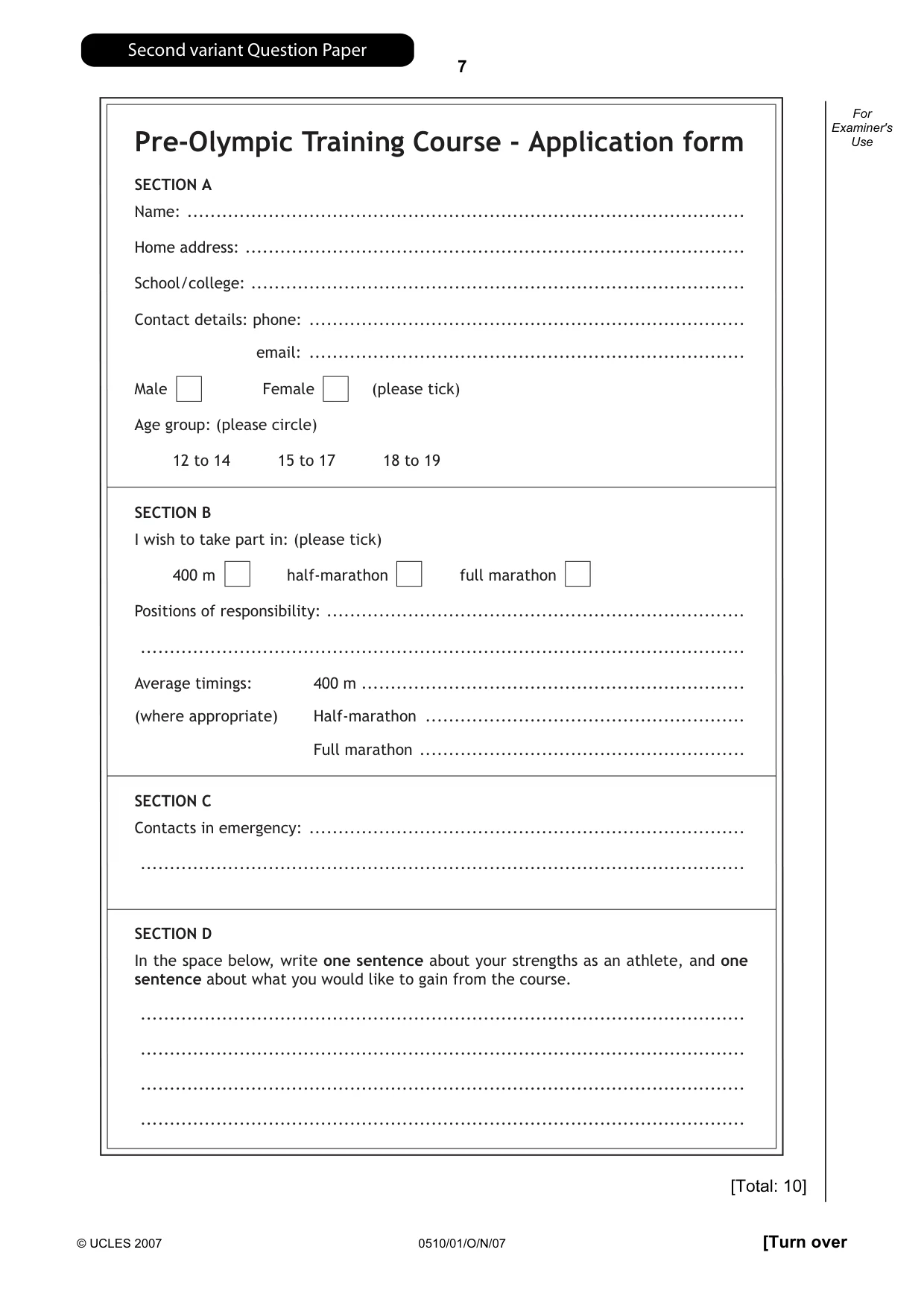
7 © UCLES 2007 0510/01/O/N/07 [Turn over For Examiner's Use Pre-Olympic Training Course - Application form SECTION A Name: … Home address: … School/college: … Contact details: phone: … email: … Male Female (please tick) Age group: (please circle) 12 to 14 15 to 17 18 to 19 SECTION B I wish to take part in: (please tick) 400 m half-marathon full marathon Positions of responsibility: … … Average timings: 400 m … (where appropriate) Half-marathon … Full marathon … SECTION C Contacts in emergency: … … SECTION D In the space below, write one sentence about your strengths as an athlete, and one sentence about what you would like to gain from the course. … … … … [Total: 10] Second variant Question Paper
Question paper, page 25
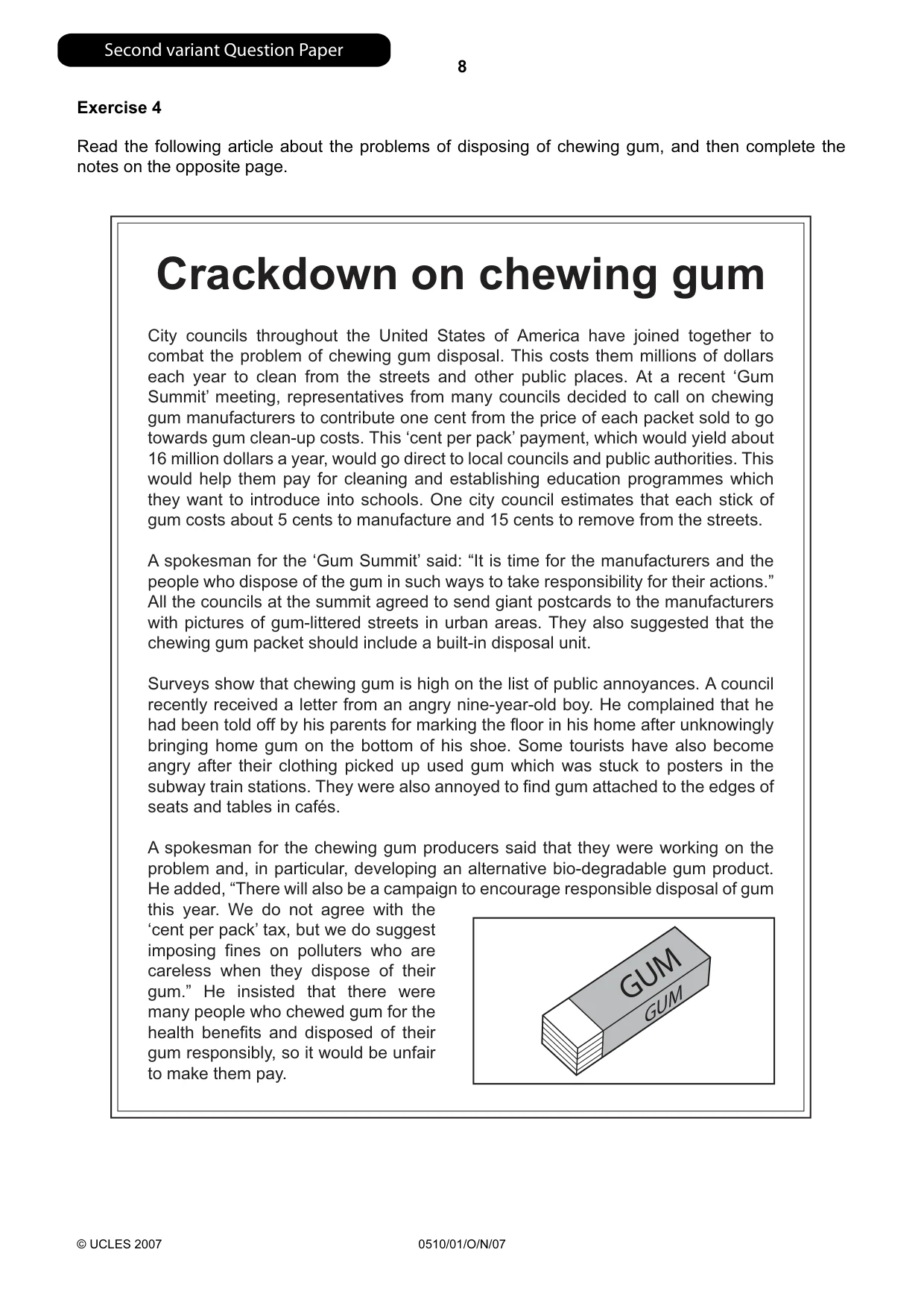
8 © UCLES 2007 0510/01/O/N/07 Exercise 4 Read the following article about the problems of disposing of chewing gum, and then complete the notes on the opposite page. Crackdown on chewing gum City councils throughout the United States of America have joined together to combat the problem of chewing gum disposal. This costs them millions of dollars each year to clean from the streets and other public places. At a recent ‘Gum Summit’ meeting, representatives from many councils decided to call on chewing gum manufacturers to contribute one cent from the price of each packet sold to go towards gum clean-up costs. This ‘cent per pack’ payment, which would yield about 16 million dollars a year, would go direct to local councils and public authorities. This would help them pay for cleaning and establishing education programmes which they want to introduce into schools. One city council estimates that each stick of gum costs about 5 cents to manufacture and 15 cents to remove from the streets. A spokesman for the ‘Gum Summit’ said: “It is time for the manufacturers and the people who dispose of the gum in such ways to take responsibility for their actions.” All the councils at the summit agreed to send giant postcards to the manufacturers with pictures of gum-littered streets in urban areas. They also suggested that the chewing gum packet should include a built-in disposal unit. Surveys show that chewing gum is high on the list of public annoyances. A council recently received a letter from an angry nine-year-old boy. He complained that he had been told off by his parents for marking the floor in his home after unknowingly bringing home gum on the bottom of his shoe. Some tourists have also become angry after their clothing picked up used gum which was stuck to posters in the subway train stations. They were also annoyed to find gum attached to the edges of seats and tables in cafés. A spokesman for the chewing gum producers said that they were working on the problem and, in particular, developing an alternative bio-degradable gum product. He added, “There will also be a campaign to encourage responsible disposal of gum this year. We do not agree with the ‘cent per pack’ tax, but we do suggest imposing fines on polluters who are careless when they dispose of their gum.” He insisted that there were many people who chewed gum for the health benefits and disposed of their gum responsibly, so it would be unfair to make them pay. GUM GUM Second variant Question Paper
Question paper, page 26
9 © UCLES 2007 0510/01/O/N/07 [Turn over For Examiner's Use You are going to give a talk to your class about the problems of chewing gum disposal. Prepare some notes to use as the basis for your talk. Make two short notes under each heading. ‘Gum Summit’ suggestions to improve situation • ‘cent per pack’ payment • … • … Examples of public complaints • … • … Gum manufacturers’ suggestions to improve situation • … • … [Total: 6] Exercise 5 Imagine that your teacher now wants you to follow up your talk with a written summary. Look at your notes in Exercise 4 above. Using the ideas in your notes, write a summary about chewing gum disposal. Your summary should be one paragraph of no more than 70 words. You should use your own words as far as possible. [Total: 4] Second variant Question Paper
Question paper, page 27
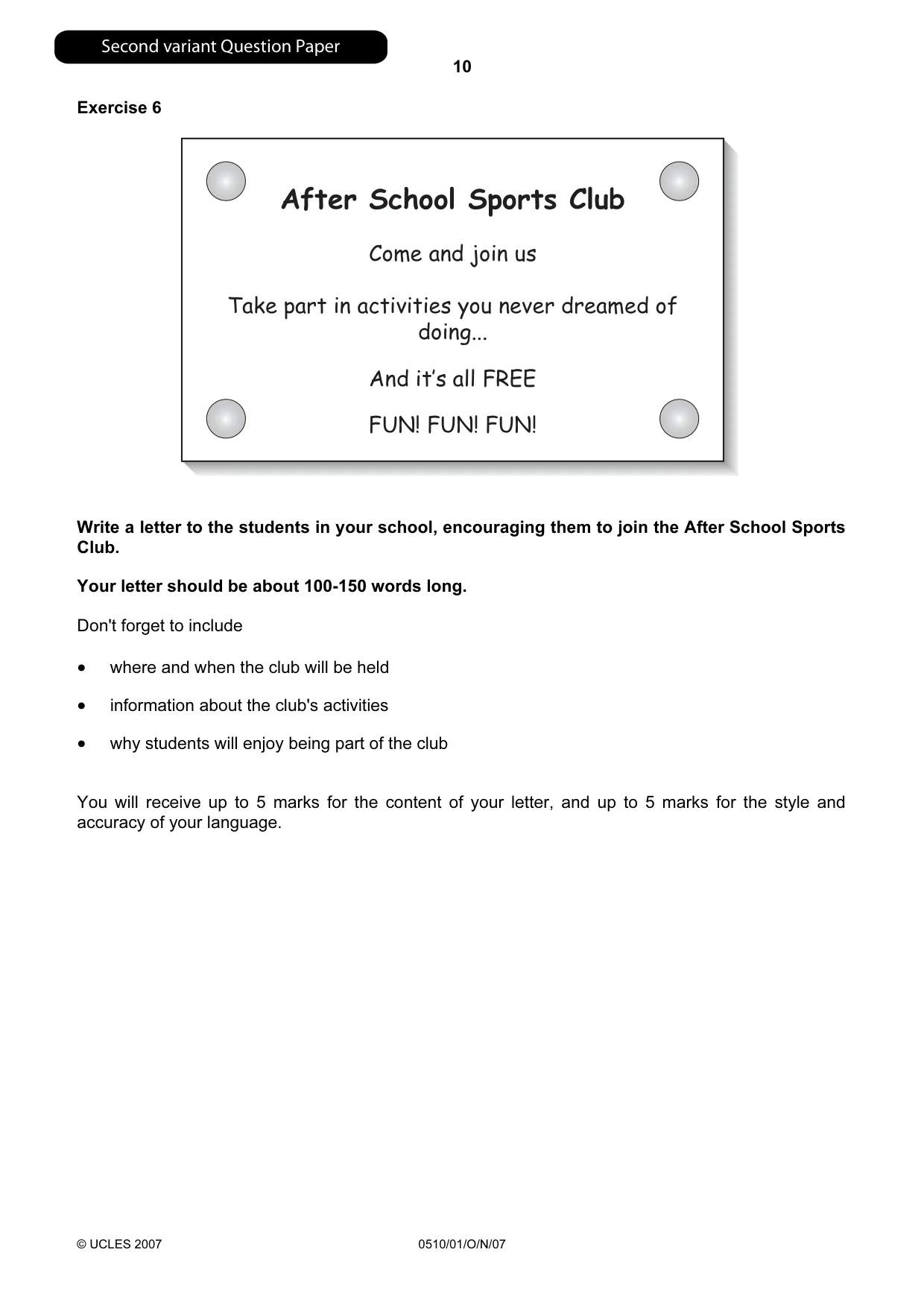
10 © UCLES 2007 0510/01/O/N/07 Exercise 6 After School Sports Club Come and join us Take part in activities you never dreamed of doing... And it‛s all FREE FUN! FUN! FUN! Write a letter to the students in your school, encouraging them to join the After School Sports Club. Your letter should be about 100-150 words long. Don't forget to include • where and when the club will be held • information about the club's activities • why students will enjoy being part of the club You will receive up to 5 marks for the content of your letter, and up to 5 marks for the style and accuracy of your language. Second variant Question Paper
Question paper, page 28
11 © UCLES 2007 0510/01/O/N/07 [Turn over For Examiner's Use Dear Students, [10] Second variant Question Paper
Question paper, page 29
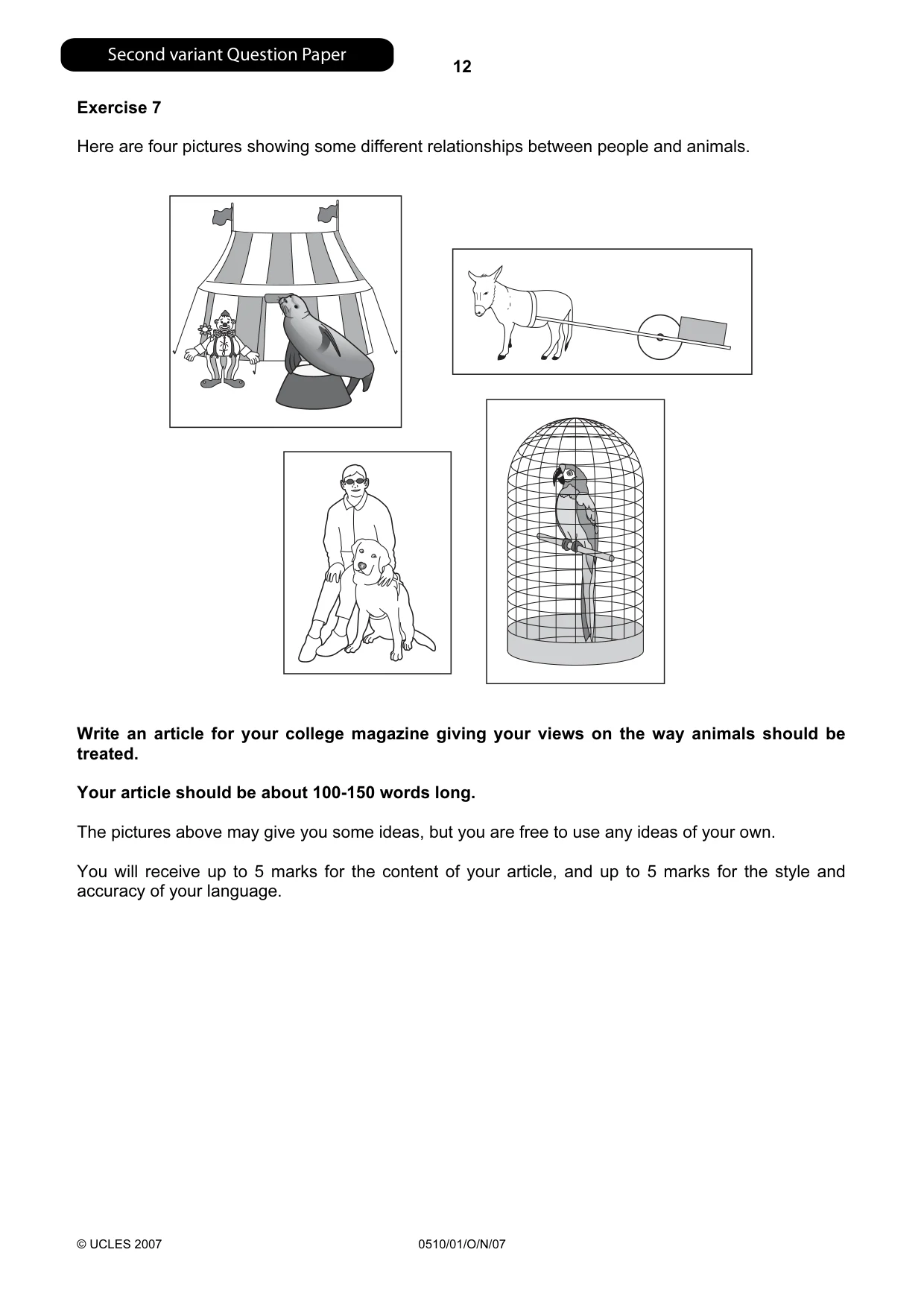
12 © UCLES 2007 0510/01/O/N/07 Exercise 7 Here are four pictures showing some different relationships between people and animals. Write an article for your college magazine giving your views on the way animals should be treated. Your article should be about 100-150 words long. The pictures above may give you some ideas, but you are free to use any ideas of your own. You will receive up to 5 marks for the content of your article, and up to 5 marks for the style and accuracy of your language. Second variant Question Paper
Question paper, page 30
13 © UCLES 2007 0510/01/O/N/07 For Examiner's Use [10] Second variant Question Paper
Question paper, page 31
14 0510/01/O/N/07 BLANK PAGE Second variant Question Paper
Question paper, page 32
15 0510/01/O/N/07 BLANK PAGE Second variant Question Paper
Question paper, page 33
16 Copyright Acknowledgements: Exercise 1 © Sustrans Ltd. Permission to reproduce items where third-party owned material protected by copyright is included has been sought and cleared where possible. Every reasonable effort has been made by the publisher (UCLES) to trace copyright holders, but if any items requiring clearance have unwittingly been included, the publisher will be pleased to make amends at the earliest possible opportunity. University of Cambridge International Examinations is part of the Cambridge Assessment Group. Cambridge Assessment is the brand name of University of Cambridge Local Examinations Syndicate (UCLES), which is itself a department of the University of Cambridge. 0510/01/O/N/07 BLANK PAGE Second variant Question Paper
Mark scheme, page 1
Location Entry Codes As part of CIE’s continual commitment to maintaining best practice in assessment, CIE has begun to use different variants of some question papers for our most popular assessments with extremely large and widespread candidature, The question papers are closely related and the relationships between them have been thoroughly established using our assessment expertise. All versions of the paper give assessment of equal standard. The content assessed by the examination papers and the type of questions are unchanged. This change means that for this component there are now two variant Question Papers, Mark Schemes and Principal Examiner’s Reports where previously there was only one. For any individual country, it is intended that only one variant is used. This document contains both variants which will give all Centres access to even more past examination material than is usually the case. The diagram shows the relationship between the Question Papers, Mark Schemes and Principal Examiner’s Reports. Question Paper Mark Scheme Principal Examiner’s Report Introduction Introduction Introduction First variant Question Paper First variant Mark Scheme First variant Principal Examiner’s Report Second variant Question Paper Second variant Mark Scheme Second variant Principal Examiner’s Report Who can I contact for further information on these changes? Please direct any questions about this to CIE’s Customer Services team at: international@cie.org.uk
Mark scheme, page 2
UNIVERSITY OF CAMBRIDGE INTERNATIONAL EXAMINATIONS International General Certificate of Secondary Education MARK SCHEME for the October/November 2007 question paper 0510 ENGLISH AS A SECOND LANGUAGE 0510/01 Paper 1 (Reading and Writing – Core), maximum raw mark 56 This mark scheme is published as an aid to teachers and candidates, to indicate the requirements of the examination. It shows the basis on which Examiners were instructed to award marks. It does not indicate the details of the discussions that took place at an Examiners’ meeting before marking began. All Examiners are instructed that alternative correct answers and unexpected approaches in candidates’ scripts must be given marks that fairly reflect the relevant knowledge and skills demonstrated. Mark schemes must be read in conjunction with the question papers and the report on the examination. • CIE will not enter into discussions or correspondence in connection with these mark schemes. CIE is publishing the mark schemes for the October/November 2007 question papers for most IGCSE, GCE Advanced Level and Advanced Subsidiary Level syllabuses and some Ordinary Level syllabuses.
Mark scheme, page 3
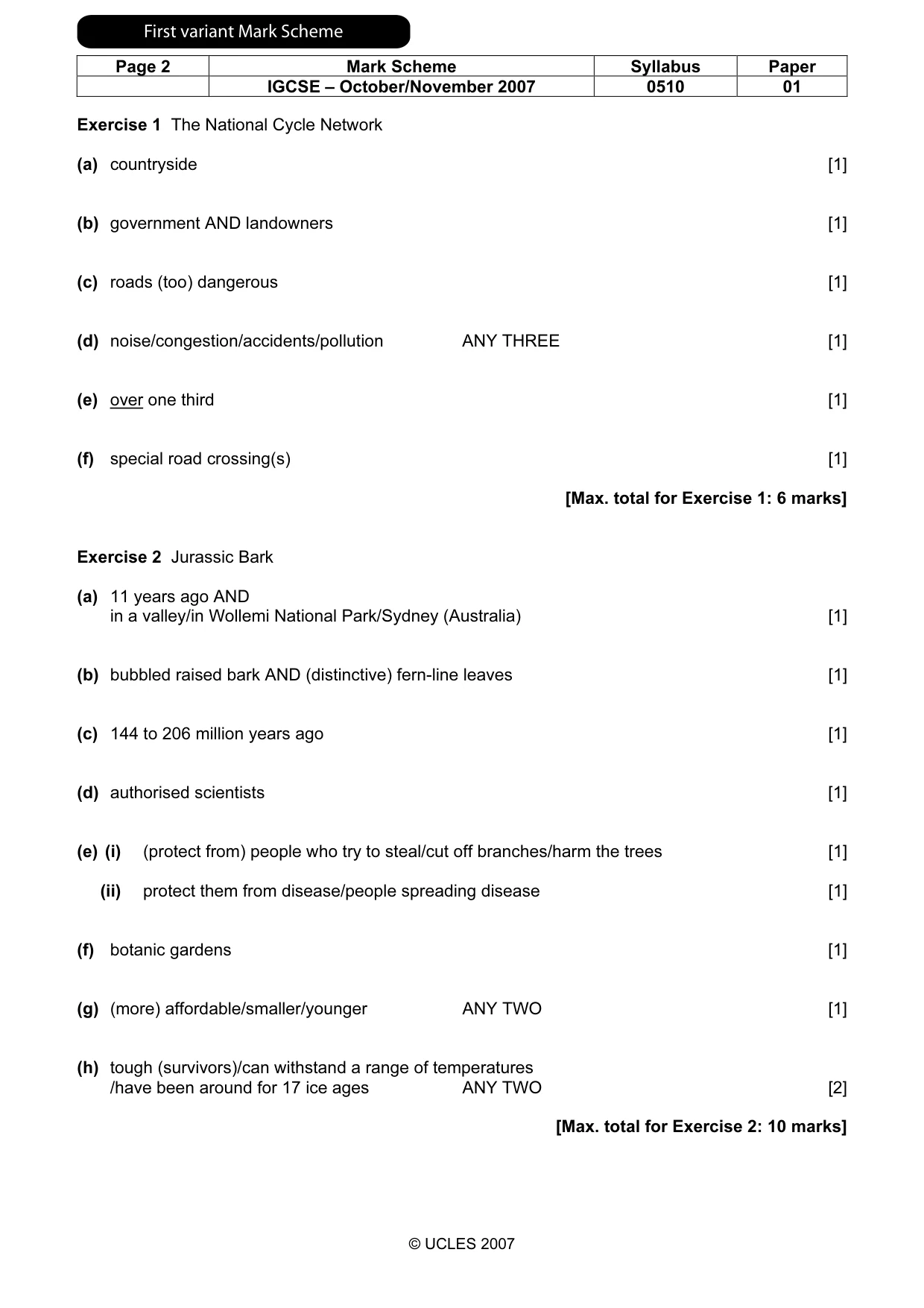
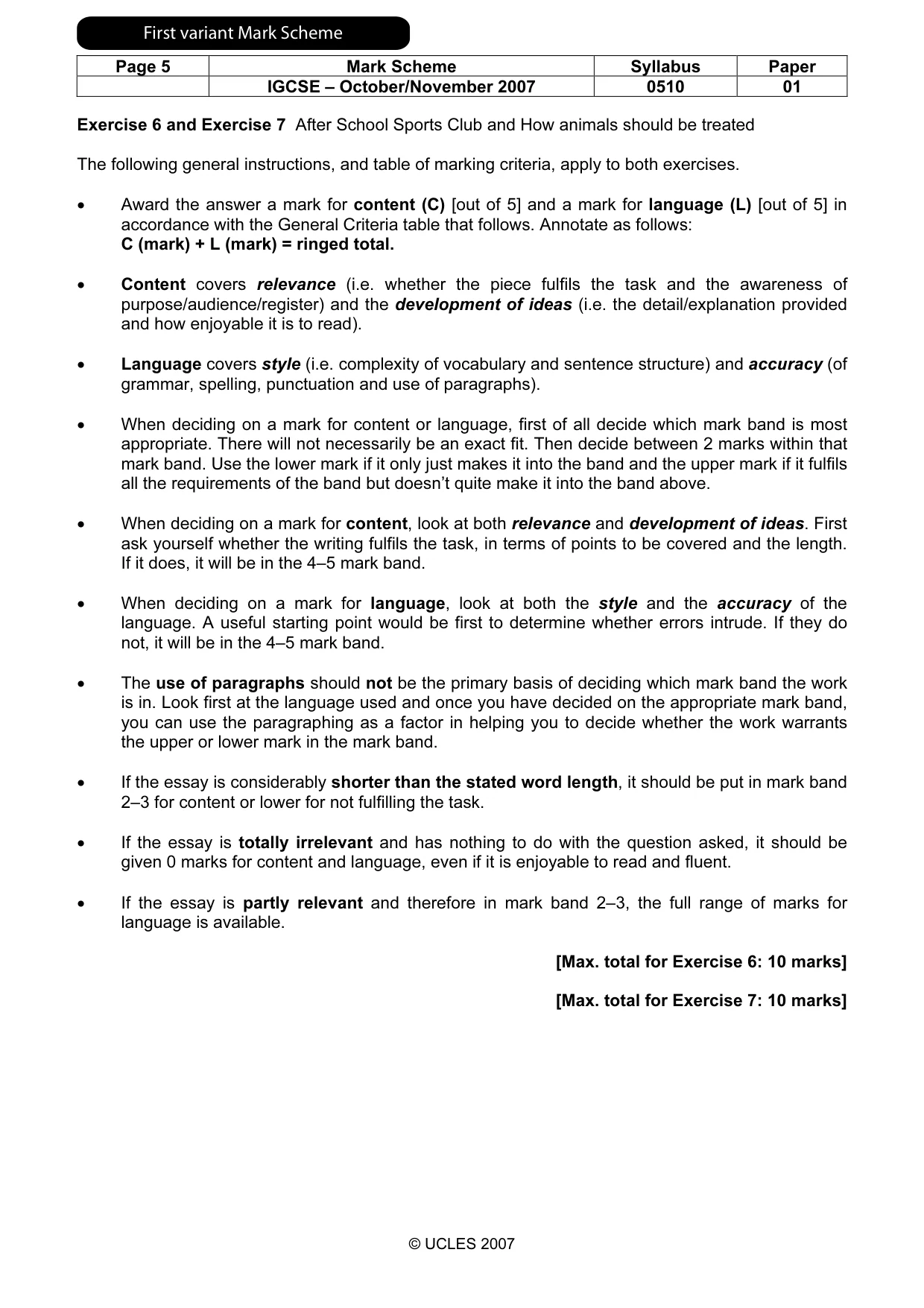
Page 2 Mark Scheme Syllabus Paper IGCSE – October/November 2007 0510 01 © UCLES 2007 Exercise 1 The National Cycle Network (a) countryside [1] (b) government AND landowners [1] (c) roads (too) dangerous [1] (d) noise/congestion/accidents/pollution ANY THREE [1] (e) over one third [1] (f) special road crossing(s) [1] [Max. total for Exercise 1: 6 marks] Exercise 2 Jurassic Bark (a) 11 years ago AND in a valley/in Wollemi National Park/Sydney (Australia) [1] (b) bubbled raised bark AND (distinctive) fern-line leaves [1] (c) 144 to 206 million years ago [1] (d) authorised scientists [1] (e) (i) (protect from) people who try to steal/cut off branches/harm the trees [1] (ii) protect them from disease/people spreading disease [1] (f) botanic gardens [1] (g) (more) affordable/smaller/younger ANY TWO [1] (h) tough (survivors)/can withstand a range of temperatures /have been around for 17 ice ages ANY TWO [2] [Max. total for Exercise 2: 10 marks] First variant Mark Scheme
Mark scheme, page 4
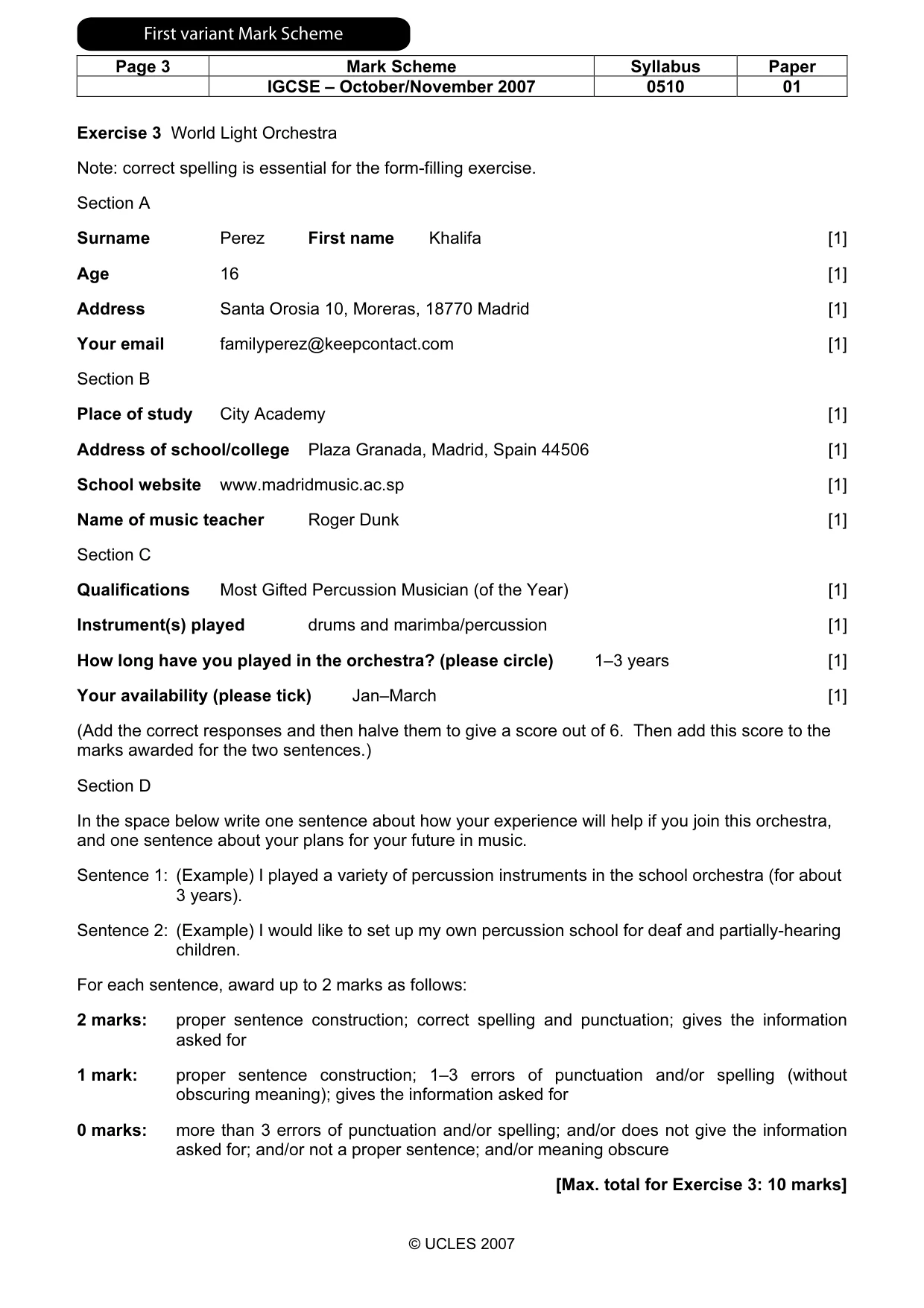
Page 3 Mark Scheme Syllabus Paper IGCSE – October/November 2007 0510 01 © UCLES 2007 Exercise 3 World Light Orchestra Note: correct spelling is essential for the form-filling exercise. Section A Surname Perez First name Khalifa [1] Age 16 [1] Address Santa Orosia 10, Moreras, 18770 Madrid [1] Your email familyperez@keepcontact.com [1] Section B Place of study City Academy [1] Address of school/college Plaza Granada, Madrid, Spain 44506 [1] School website www.madridmusic.ac.sp [1] Name of music teacher Roger Dunk [1] Section C Qualifications Most Gifted Percussion Musician (of the Year) [1] Instrument(s) played drums and marimba/percussion [1] How long have you played in the orchestra? (please circle) 1–3 years [1] Your availability (please tick) Jan–March [1] (Add the correct responses and then halve them to give a score out of 6. Then add this score to the marks awarded for the two sentences.) Section D In the space below write one sentence about how your experience will help if you join this orchestra, and one sentence about your plans for your future in music. Sentence 1: (Example) I played a variety of percussion instruments in the school orchestra (for about 3 years). Sentence 2: (Example) I would like to set up my own percussion school for deaf and partially-hearing children. For each sentence, award up to 2 marks as follows: 2 marks: proper sentence construction; correct spelling and punctuation; gives the information asked for 1 mark: proper sentence construction; 1–3 errors of punctuation and/or spelling (without obscuring meaning); gives the information asked for 0 marks: more than 3 errors of punctuation and/or spelling; and/or does not give the information asked for; and/or not a proper sentence; and/or meaning obscure [Max. total for Exercise 3: 10 marks] First variant Mark Scheme
Mark scheme, page 5
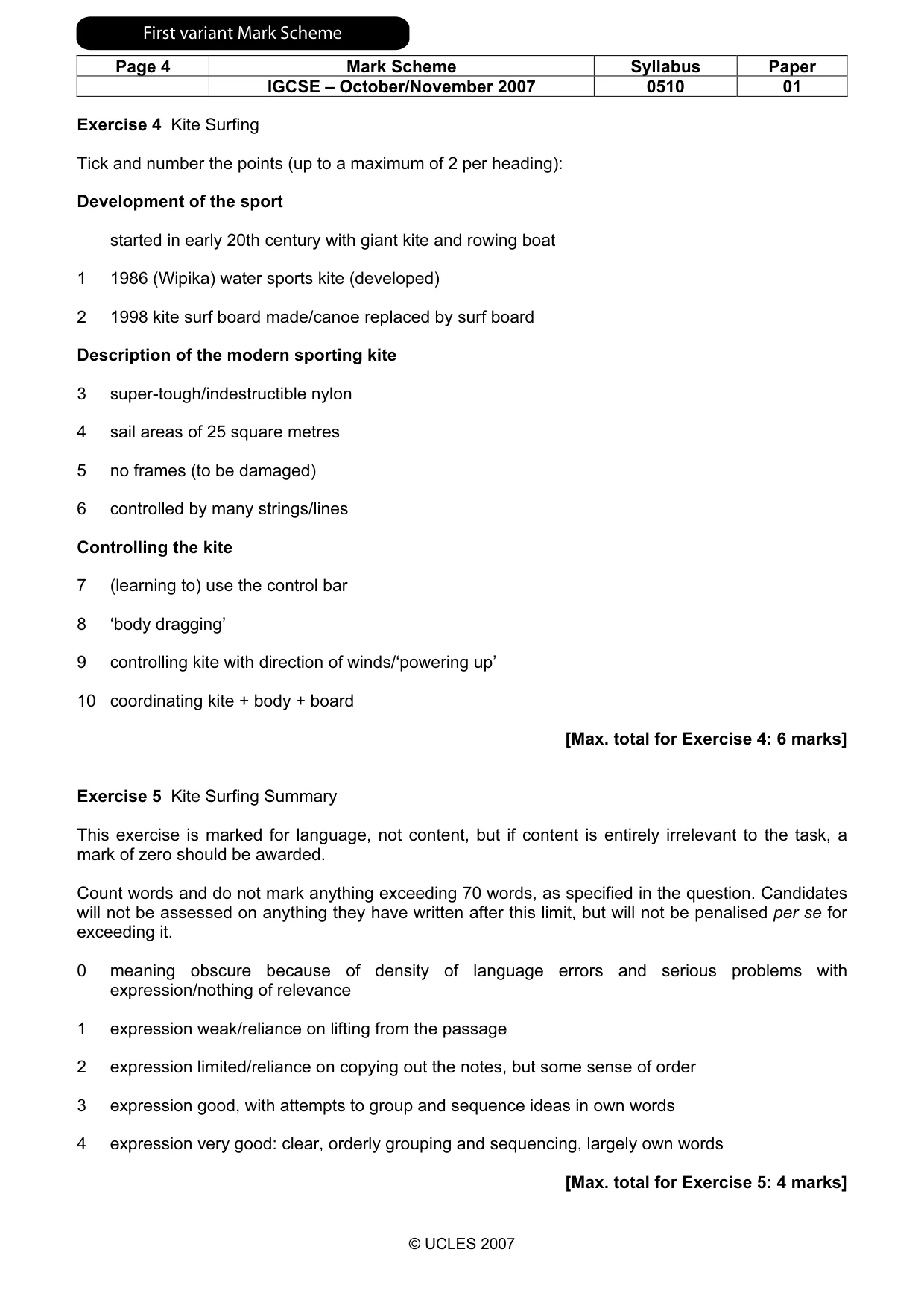
Page 4 Mark Scheme Syllabus Paper IGCSE – October/November 2007 0510 01 © UCLES 2007 Exercise 4 Kite Surfing Tick and number the points (up to a maximum of 2 per heading): Development of the sport started in early 20th century with giant kite and rowing boat 1 1986 (Wipika) water sports kite (developed) 2 1998 kite surf board made/canoe replaced by surf board Description of the modern sporting kite 3 super-tough/indestructible nylon 4 sail areas of 25 square metres 5 no frames (to be damaged) 6 controlled by many strings/lines Controlling the kite 7 (learning to) use the control bar 8 ‘body dragging’ 9 controlling kite with direction of winds/‘powering up’ 10 coordinating kite + body + board [Max. total for Exercise 4: 6 marks] Exercise 5 Kite Surfing Summary This exercise is marked for language, not content, but if content is entirely irrelevant to the task, a mark of zero should be awarded. Count words and do not mark anything exceeding 70 words, as specified in the question. Candidates will not be assessed on anything they have written after this limit, but will not be penalised per se for exceeding it. 0 meaning obscure because of density of language errors and serious problems with expression/nothing of relevance 1 expression weak/reliance on lifting from the passage 2 expression limited/reliance on copying out the notes, but some sense of order 3 expression good, with attempts to group and sequence ideas in own words 4 expression very good: clear, orderly grouping and sequencing, largely own words [Max. total for Exercise 5: 4 marks] First variant Mark Scheme
Mark scheme, page 6
Page 5 Mark Scheme Syllabus Paper IGCSE – October/November 2007 0510 01 © UCLES 2007 Exercise 6 and Exercise 7 After School Sports Club and How animals should be treated The following general instructions, and table of marking criteria, apply to both exercises. • Award the answer a mark for content (C) [out of 5] and a mark for language (L) [out of 5] in accordance with the General Criteria table that follows. Annotate as follows: C (mark) + L (mark) = ringed total. • Content covers relevance (i.e. whether the piece fulfils the task and the awareness of purpose/audience/register) and the development of ideas (i.e. the detail/explanation provided and how enjoyable it is to read). • Language covers style (i.e. complexity of vocabulary and sentence structure) and accuracy (of grammar, spelling, punctuation and use of paragraphs). • When deciding on a mark for content or language, first of all decide which mark band is most appropriate. There will not necessarily be an exact fit. Then decide between 2 marks within that mark band. Use the lower mark if it only just makes it into the band and the upper mark if it fulfils all the requirements of the band but doesn’t quite make it into the band above. • When deciding on a mark for content, look at both relevance and development of ideas. First ask yourself whether the writing fulfils the task, in terms of points to be covered and the length. If it does, it will be in the 4–5 mark band. • When deciding on a mark for language, look at both the style and the accuracy of the language. A useful starting point would be first to determine whether errors intrude. If they do not, it will be in the 4–5 mark band. • The use of paragraphs should not be the primary basis of deciding which mark band the work is in. Look first at the language used and once you have decided on the appropriate mark band, you can use the paragraphing as a factor in helping you to decide whether the work warrants the upper or lower mark in the mark band. • If the essay is considerably shorter than the stated word length, it should be put in mark band 2–3 for content or lower for not fulfilling the task. • If the essay is totally irrelevant and has nothing to do with the question asked, it should be given 0 marks for content and language, even if it is enjoyable to read and fluent. • If the essay is partly relevant and therefore in mark band 2–3, the full range of marks for language is available. [Max. total for Exercise 6: 10 marks] [Max. total for Exercise 7: 10 marks] First variant Mark Scheme
Mark scheme, page 7
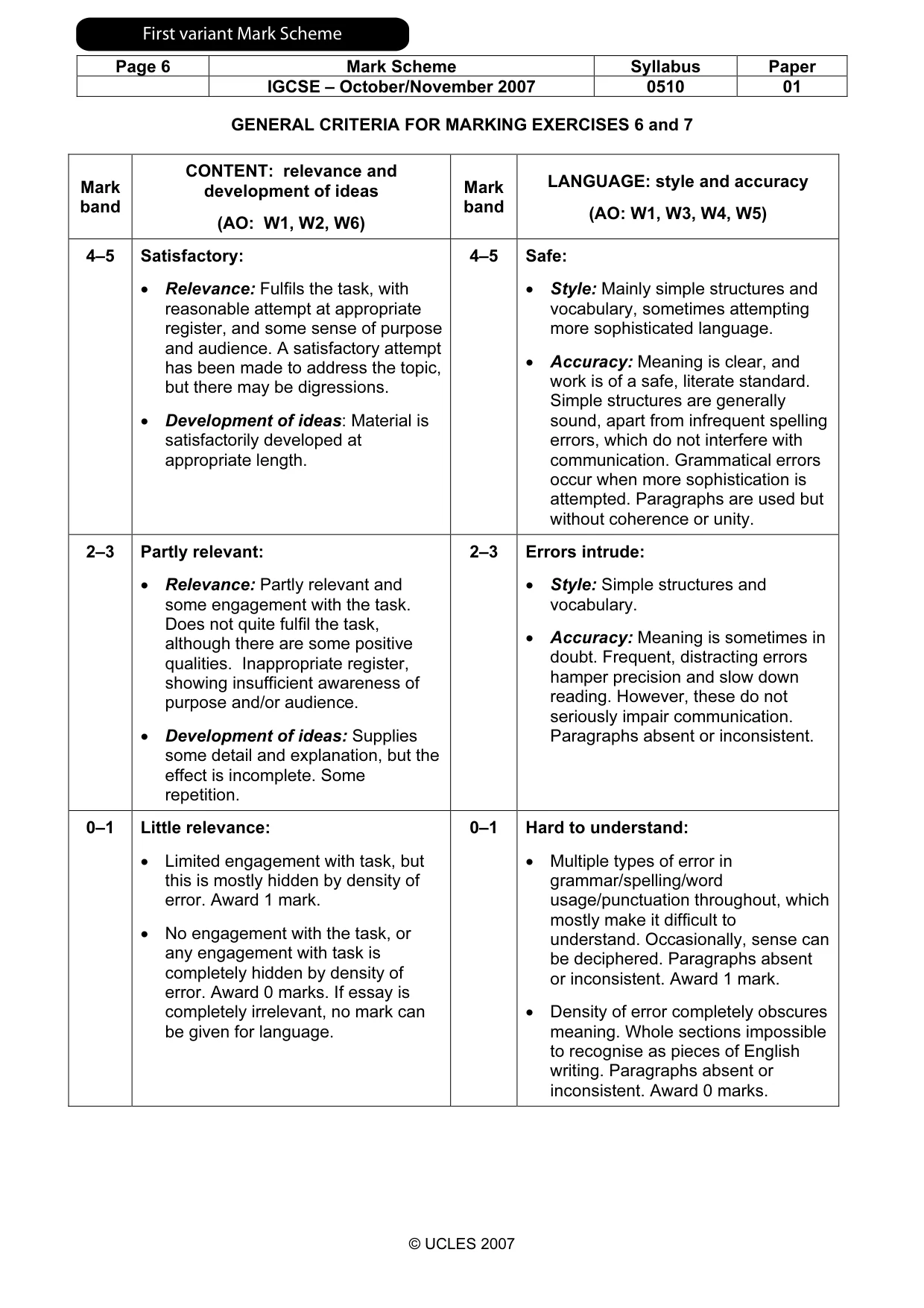
Page 6 Mark Scheme Syllabus Paper IGCSE – October/November 2007 0510 01 © UCLES 2007 GENERAL CRITERIA FOR MARKING EXERCISES 6 and 7 Mark band CONTENT: relevance and development of ideas (AO: W1, W2, W6) Mark band LANGUAGE: style and accuracy (AO: W1, W3, W4, W5) 4–5 Satisfactory: • Relevance: Fulfils the task, with reasonable attempt at appropriate register, and some sense of purpose and audience. A satisfactory attempt has been made to address the topic, but there may be digressions. • Development of ideas: Material is satisfactorily developed at appropriate length. 4–5 Safe: • Style: Mainly simple structures and vocabulary, sometimes attempting more sophisticated language. • Accuracy: Meaning is clear, and work is of a safe, literate standard. Simple structures are generally sound, apart from infrequent spelling errors, which do not interfere with communication. Grammatical errors occur when more sophistication is attempted. Paragraphs are used but without coherence or unity. 2–3 Partly relevant: • Relevance: Partly relevant and some engagement with the task. Does not quite fulfil the task, although there are some positive qualities. Inappropriate register, showing insufficient awareness of purpose and/or audience. • Development of ideas: Supplies some detail and explanation, but the effect is incomplete. Some repetition. 2–3 Errors intrude: • Style: Simple structures and vocabulary. • Accuracy: Meaning is sometimes in doubt. Frequent, distracting errors hamper precision and slow down reading. However, these do not seriously impair communication. Paragraphs absent or inconsistent. 0–1 Little relevance: • Limited engagement with task, but this is mostly hidden by density of error. Award 1 mark. • No engagement with the task, or any engagement with task is completely hidden by density of error. Award 0 marks. If essay is completely irrelevant, no mark can be given for language. 0–1 Hard to understand: • Multiple types of error in grammar/spelling/word usage/punctuation throughout, which mostly make it difficult to understand. Occasionally, sense can be deciphered. Paragraphs absent or inconsistent. Award 1 mark. • Density of error completely obscures meaning. Whole sections impossible to recognise as pieces of English writing. Paragraphs absent or inconsistent. Award 0 marks. First variant Mark Scheme
Mark scheme, page 8
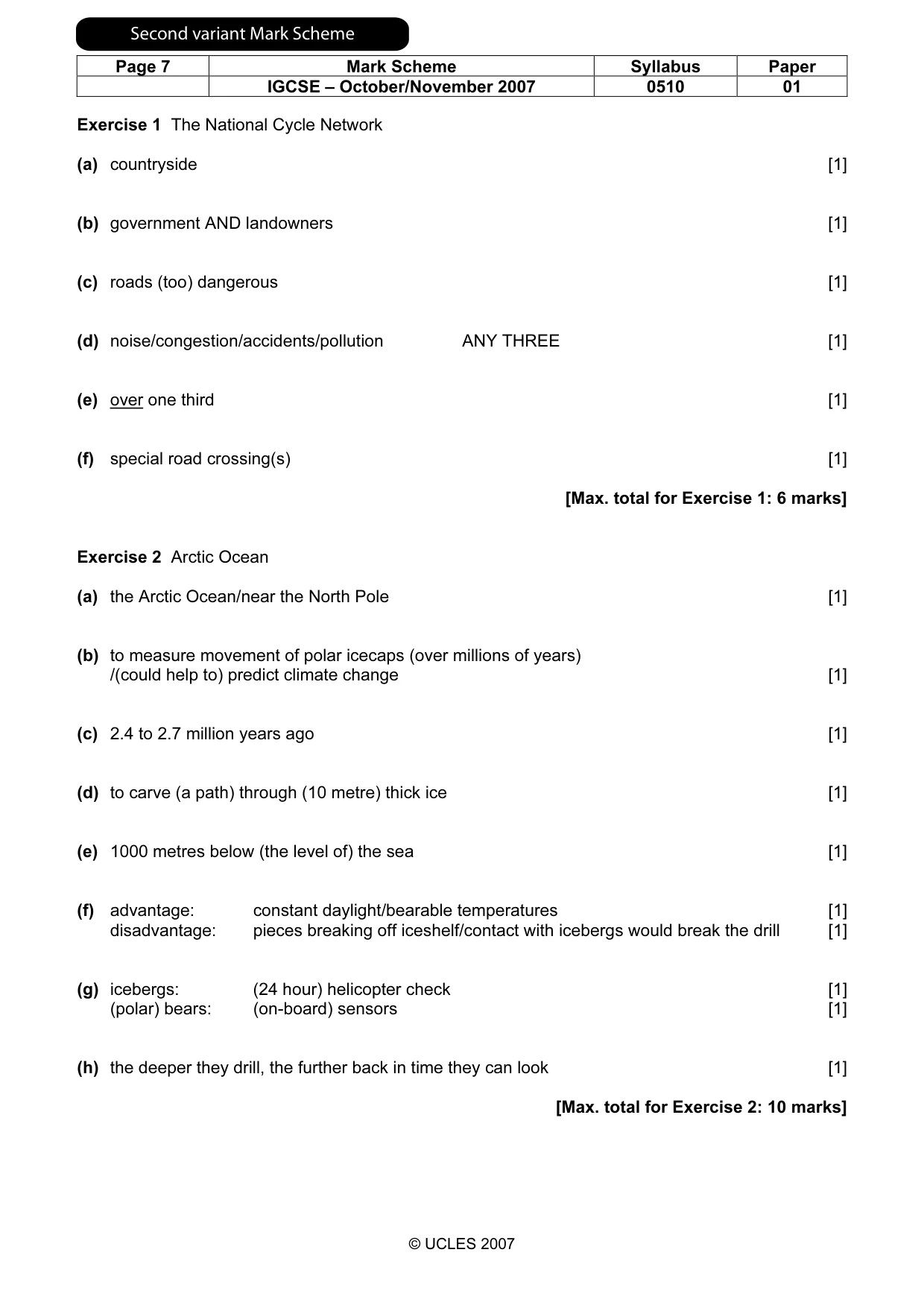
Page 7 Mark Scheme Syllabus Paper IGCSE – October/November 2007 0510 01 © UCLES 2007 Exercise 1 The National Cycle Network (a) countryside [1] (b) government AND landowners [1] (c) roads (too) dangerous [1] (d) noise/congestion/accidents/pollution ANY THREE [1] (e) over one third [1] (f) special road crossing(s) [1] [Max. total for Exercise 1: 6 marks] Exercise 2 Arctic Ocean (a) the Arctic Ocean/near the North Pole [1] (b) to measure movement of polar icecaps (over millions of years) /(could help to) predict climate change [1] (c) 2.4 to 2.7 million years ago [1] (d) to carve (a path) through (10 metre) thick ice [1] (e) 1000 metres below (the level of) the sea [1] (f) advantage: constant daylight/bearable temperatures [1] disadvantage: pieces breaking off iceshelf/contact with icebergs would break the drill [1] (g) icebergs: (24 hour) helicopter check [1] (polar) bears: (on-board) sensors [1] (h) the deeper they drill, the further back in time they can look [1] [Max. total for Exercise 2: 10 marks] Second variant Mark Scheme
Mark scheme, page 9
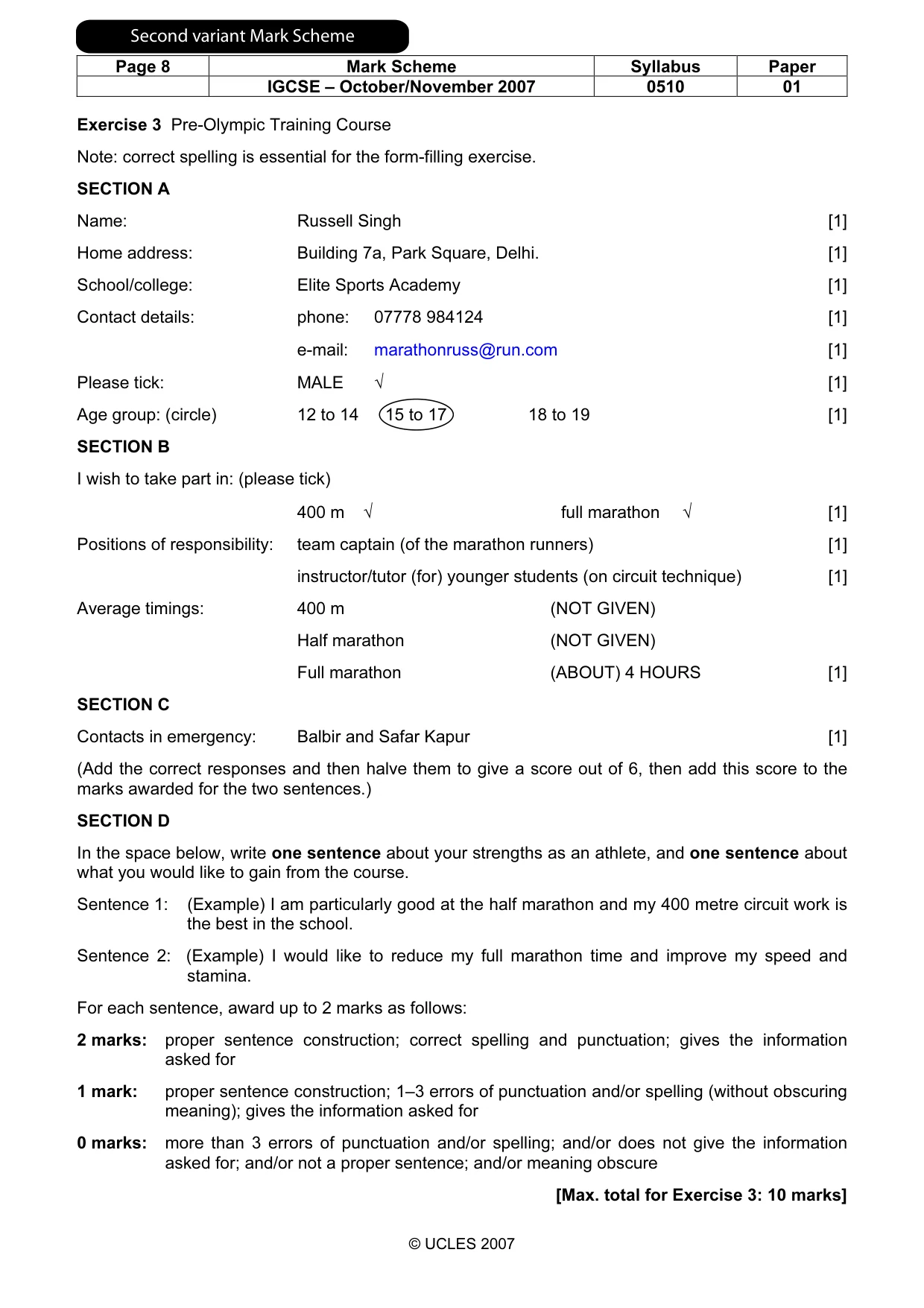
Page 8 Mark Scheme Syllabus Paper IGCSE – October/November 2007 0510 01 © UCLES 2007 Exercise 3 Pre-Olympic Training Course Note: correct spelling is essential for the form-filling exercise. SECTION A Name: Russell Singh [1] Home address: Building 7a, Park Square, Delhi. [1] School/college: Elite Sports Academy [1] Contact details: phone: 07778 984124 [1] e-mail: marathonruss@run.com [1] Please tick: MALE √ [1] Age group: (circle) 12 to 14 15 to 17 18 to 19 [1] SECTION B I wish to take part in: (please tick) 400 m √ full marathon √ [1] Positions of responsibility: team captain (of the marathon runners) [1] instructor/tutor (for) younger students (on circuit technique) [1] Average timings: 400 m (NOT GIVEN) Half marathon (NOT GIVEN) Full marathon (ABOUT) 4 HOURS [1] SECTION C Contacts in emergency: Balbir and Safar Kapur [1] (Add the correct responses and then halve them to give a score out of 6, then add this score to the marks awarded for the two sentences.) SECTION D In the space below, write one sentence about your strengths as an athlete, and one sentence about what you would like to gain from the course. Sentence 1: (Example) I am particularly good at the half marathon and my 400 metre circuit work is the best in the school. Sentence 2: (Example) I would like to reduce my full marathon time and improve my speed and stamina. For each sentence, award up to 2 marks as follows: 2 marks: proper sentence construction; correct spelling and punctuation; gives the information asked for 1 mark: proper sentence construction; 1–3 errors of punctuation and/or spelling (without obscuring meaning); gives the information asked for 0 marks: more than 3 errors of punctuation and/or spelling; and/or does not give the information asked for; and/or not a proper sentence; and/or meaning obscure [Max. total for Exercise 3: 10 marks] Second variant Mark Scheme
Mark scheme, page 10
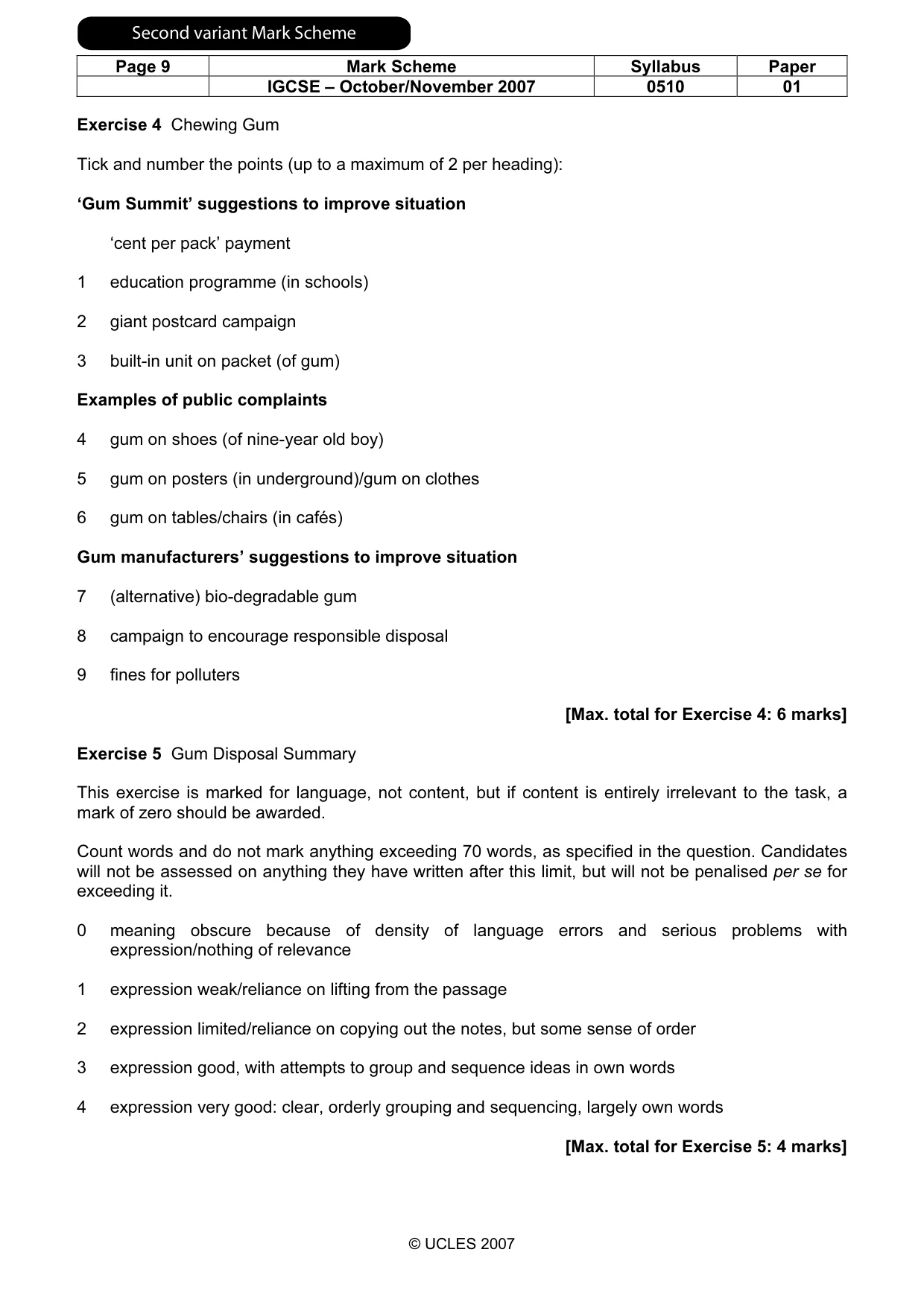
Page 9 Mark Scheme Syllabus Paper IGCSE – October/November 2007 0510 01 © UCLES 2007 Exercise 4 Chewing Gum Tick and number the points (up to a maximum of 2 per heading): ‘Gum Summit’ suggestions to improve situation ‘cent per pack’ payment 1 education programme (in schools) 2 giant postcard campaign 3 built-in unit on packet (of gum) Examples of public complaints 4 gum on shoes (of nine-year old boy) 5 gum on posters (in underground)/gum on clothes 6 gum on tables/chairs (in cafés) Gum manufacturers’ suggestions to improve situation 7 (alternative) bio-degradable gum 8 campaign to encourage responsible disposal 9 fines for polluters [Max. total for Exercise 4: 6 marks] Exercise 5 Gum Disposal Summary This exercise is marked for language, not content, but if content is entirely irrelevant to the task, a mark of zero should be awarded. Count words and do not mark anything exceeding 70 words, as specified in the question. Candidates will not be assessed on anything they have written after this limit, but will not be penalised per se for exceeding it. 0 meaning obscure because of density of language errors and serious problems with expression/nothing of relevance 1 expression weak/reliance on lifting from the passage 2 expression limited/reliance on copying out the notes, but some sense of order 3 expression good, with attempts to group and sequence ideas in own words 4 expression very good: clear, orderly grouping and sequencing, largely own words [Max. total for Exercise 5: 4 marks] Second variant Mark Scheme
Mark scheme, page 11
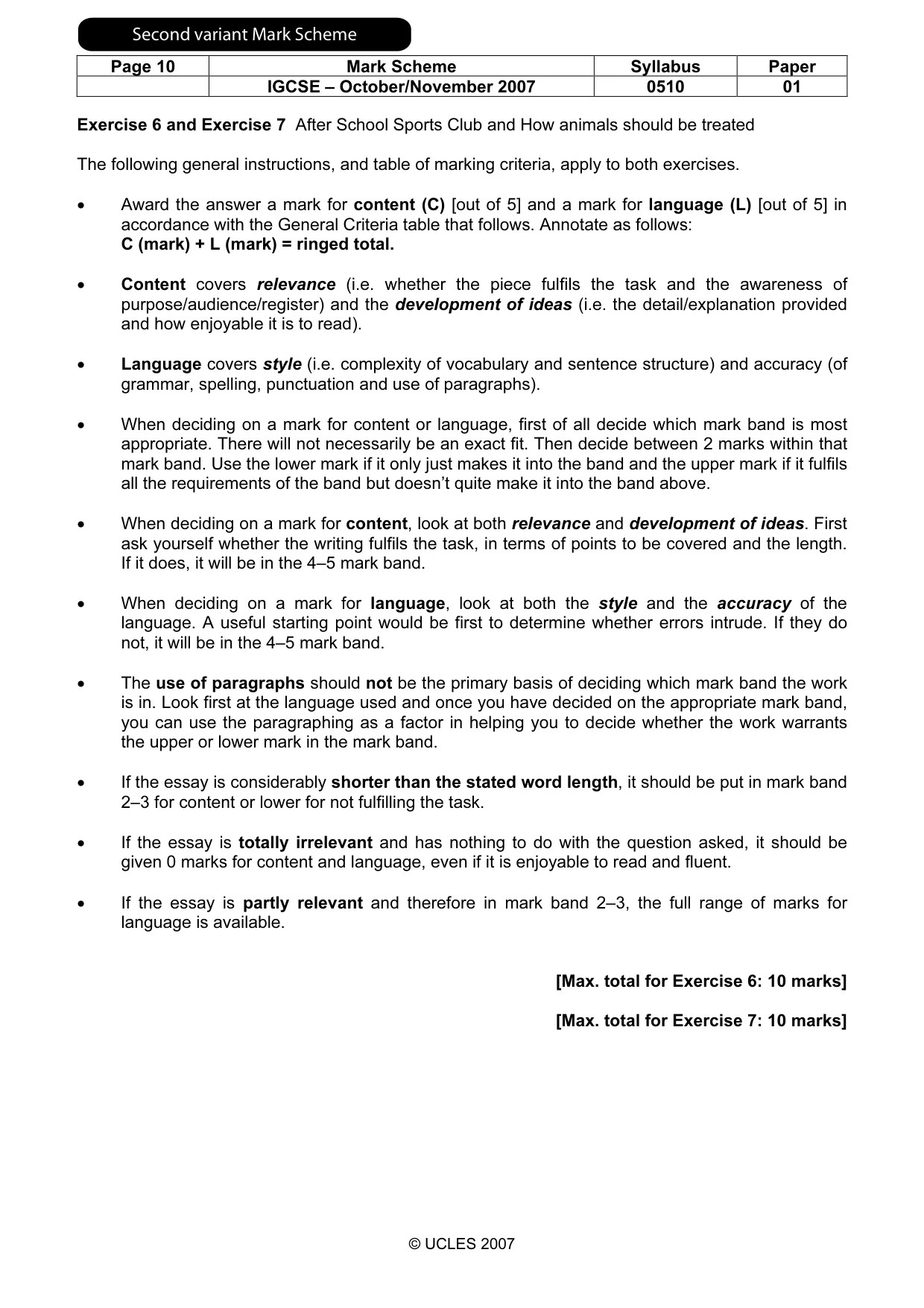
Page 10 Mark Scheme Syllabus Paper IGCSE – October/November 2007 0510 01 © UCLES 2007 Exercise 6 and Exercise 7 After School Sports Club and How animals should be treated The following general instructions, and table of marking criteria, apply to both exercises. • Award the answer a mark for content (C) [out of 5] and a mark for language (L) [out of 5] in accordance with the General Criteria table that follows. Annotate as follows: C (mark) + L (mark) = ringed total. • Content covers relevance (i.e. whether the piece fulfils the task and the awareness of purpose/audience/register) and the development of ideas (i.e. the detail/explanation provided and how enjoyable it is to read). • Language covers style (i.e. complexity of vocabulary and sentence structure) and accuracy (of grammar, spelling, punctuation and use of paragraphs). • When deciding on a mark for content or language, first of all decide which mark band is most appropriate. There will not necessarily be an exact fit. Then decide between 2 marks within that mark band. Use the lower mark if it only just makes it into the band and the upper mark if it fulfils all the requirements of the band but doesn’t quite make it into the band above. • When deciding on a mark for content, look at both relevance and development of ideas. First ask yourself whether the writing fulfils the task, in terms of points to be covered and the length. If it does, it will be in the 4–5 mark band. • When deciding on a mark for language, look at both the style and the accuracy of the language. A useful starting point would be first to determine whether errors intrude. If they do not, it will be in the 4–5 mark band. • The use of paragraphs should not be the primary basis of deciding which mark band the work is in. Look first at the language used and once you have decided on the appropriate mark band, you can use the paragraphing as a factor in helping you to decide whether the work warrants the upper or lower mark in the mark band. • If the essay is considerably shorter than the stated word length, it should be put in mark band 2–3 for content or lower for not fulfilling the task. • If the essay is totally irrelevant and has nothing to do with the question asked, it should be given 0 marks for content and language, even if it is enjoyable to read and fluent. • If the essay is partly relevant and therefore in mark band 2–3, the full range of marks for language is available. [Max. total for Exercise 6: 10 marks] [Max. total for Exercise 7: 10 marks] Second variant Mark Scheme
Mark scheme, page 12
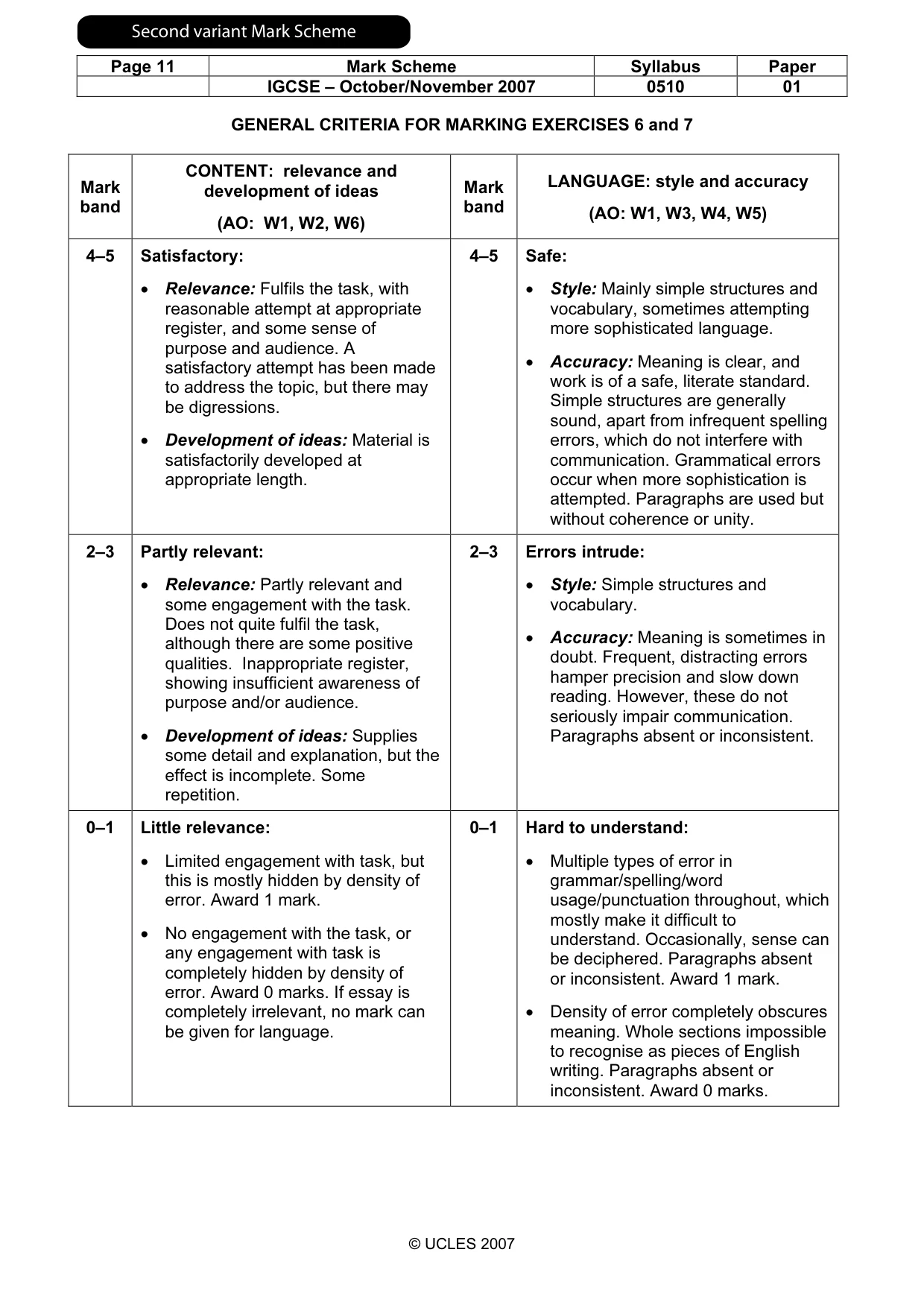
Page 11 Mark Scheme Syllabus Paper IGCSE – October/November 2007 0510 01 © UCLES 2007 GENERAL CRITERIA FOR MARKING EXERCISES 6 and 7 Mark band CONTENT: relevance and development of ideas (AO: W1, W2, W6) Mark band LANGUAGE: style and accuracy (AO: W1, W3, W4, W5) 4–5 Satisfactory: • Relevance: Fulfils the task, with reasonable attempt at appropriate register, and some sense of purpose and audience. A satisfactory attempt has been made to address the topic, but there may be digressions. • Development of ideas: Material is satisfactorily developed at appropriate length. 4–5 Safe: • Style: Mainly simple structures and vocabulary, sometimes attempting more sophisticated language. • Accuracy: Meaning is clear, and work is of a safe, literate standard. Simple structures are generally sound, apart from infrequent spelling errors, which do not interfere with communication. Grammatical errors occur when more sophistication is attempted. Paragraphs are used but without coherence or unity. 2–3 Partly relevant: • Relevance: Partly relevant and some engagement with the task. Does not quite fulfil the task, although there are some positive qualities. Inappropriate register, showing insufficient awareness of purpose and/or audience. • Development of ideas: Supplies some detail and explanation, but the effect is incomplete. Some repetition. 2–3 Errors intrude: • Style: Simple structures and vocabulary. • Accuracy: Meaning is sometimes in doubt. Frequent, distracting errors hamper precision and slow down reading. However, these do not seriously impair communication. Paragraphs absent or inconsistent. 0–1 Little relevance: • Limited engagement with task, but this is mostly hidden by density of error. Award 1 mark. • No engagement with the task, or any engagement with task is completely hidden by density of error. Award 0 marks. If essay is completely irrelevant, no mark can be given for language. 0–1 Hard to understand: • Multiple types of error in grammar/spelling/word usage/punctuation throughout, which mostly make it difficult to understand. Occasionally, sense can be deciphered. Paragraphs absent or inconsistent. Award 1 mark. • Density of error completely obscures meaning. Whole sections impossible to recognise as pieces of English writing. Paragraphs absent or inconsistent. Award 0 marks. Second variant Mark Scheme
What you needed in this session
Cambridge’s own grade thresholds for 2007 Oct/Nov, Paper 1 · Variant 1. A higher threshold means an easier paper — the bar moves with how the cohort did.