Cambridge IGCSE English - Second Language (oral endorsement) 0510 — 2007 May/June Paper 2 · Variant 1
0510/21/M/J/07 · 84 marks · ≈95 min
The question paper and its mark scheme, free to read here and free to download. This is Cambridge’s own paper, exactly as it was sat.
Question paper16 pages




Mark scheme10 pages
Answers below. Sit the paper first if you are practising.
Paper as text
Question paper, page 1
This document consists of 15 printed pages and 1 blank page. IB07 06_0510_02/3RP © UCLES 2007 [Turn over *9224791849* For Examiner's Use Exercise 1 Exercise 2 Exercise 3 Exercise 4 Exercise 5 Exercise 6 Exercise 7 Total UNIVERSITY OF CAMBRIDGE INTERNATIONAL EXAMINATIONS International General Certificate of Secondary Education ENGLISH AS A SECOND LANGUAGE 0510/02 Paper 2 Reading and Writing (Extended) May/June 2007 2 hours Candidates answer on the Question Paper. No Additional Materials are required. READ THESE INSTRUCTIONS FIRST Write your Centre number, candidate number and name on all the work you hand in. Write in dark blue or black pen. Do not use staples, paper clips, highlighters, glue or correction fluid. DO NOT WRITE IN ANY BARCODES. Answer all questions. Dictionaries are not allowed. At the end of the examination, fasten all your work securely together. The number of marks is given in brackets [ ] at the end of each question or part question. www.XtremePapers.com
Question paper, page 2
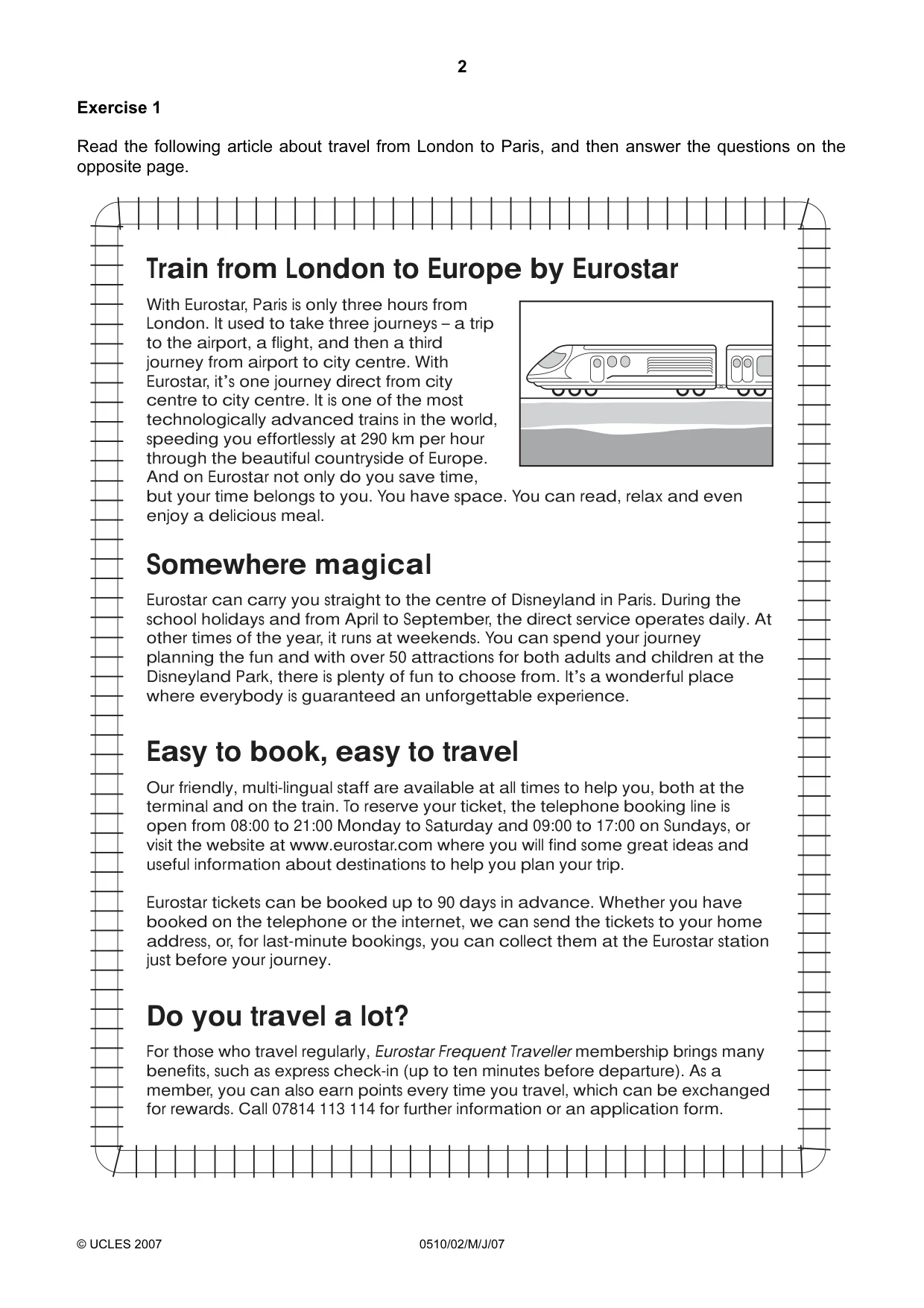
2 © UCLES 2007 0510/02/M/J/07 Exercise 1 Read the following article about travel from London to Paris, and then answer the questions on the opposite page. Train from London to Europe by Eurostar With Eurostar, Paris is only three hours from London. It used to take three journeys – a trip to the airport, a flight, and then a third journey from airport to city centre. With Eurostar, it’s one journey direct from city centre to city centre. It is one of the most technologically advanced trains in the world, speeding you effortlessly at 290 km per hour through the beautiful countryside of Europe. And on Eurostar not only do you save time, but your time belongs to you. You have space. You can read, relax and even enjoy a delicious meal. Somewhere magical Eurostar can carry you straight to the centre of Disneyland in Paris. During the school holidays and from April to September, the direct service operates daily. At other times of the year, it runs at weekends. You can spend your journey planning the fun and with over 50 attractions for both adults and children at the Disneyland Park, there is plenty of fun to choose from. It’s a wonderful place where everybody is guaranteed an unforgettable experience. Easy to book, easy to travel Our friendly, multi-lingual staff are available at all times to help you, both at the terminal and on the train. To reserve your ticket, the telephone booking line is open from 08:00 to 21:00 Monday to Saturday and 09:00 to 17:00 on Sundays, or visit the website at www.eurostar.com where you will find some great ideas and useful information about destinations to help you plan your trip. Eurostar tickets can be booked up to 90 days in advance. Whether you have booked on the telephone or the internet, we can send the tickets to your home address, or, for last-minute bookings, you can collect them at the Eurostar station just before your journey. Do you travel a lot? For those who travel regularly, Eurostar Frequent Traveller membership brings many benefits, such as express check-in (up to ten minutes before departure). As a member, you can also earn points every time you travel, which can be exchanged for rewards. Call 07814 113 114 for further information or an application form.
Question paper, page 3
3 © UCLES 2007 0510/02/M/J/07 [Turn over For Examiner's Use (a) How fast can the Eurostar train travel? [1] (b) Apart from relaxing, what else can you do on the train? Give two details. (i) (ii) [1] (c) How often does the train travel to Disneyland in July? [1] (d) What does Disneyland offer for all the family? [1] (e) How can Eurostar staff help if you do not speak English? [1] (f) Give two ways of booking a ticket. (i) (ii) [1] (g) Why is it not possible to reserve tickets in January for travel in August? [1] (h) How can Eurostar Frequent Traveller members earn rewards? [1] [Total: 8]
Question paper, page 4
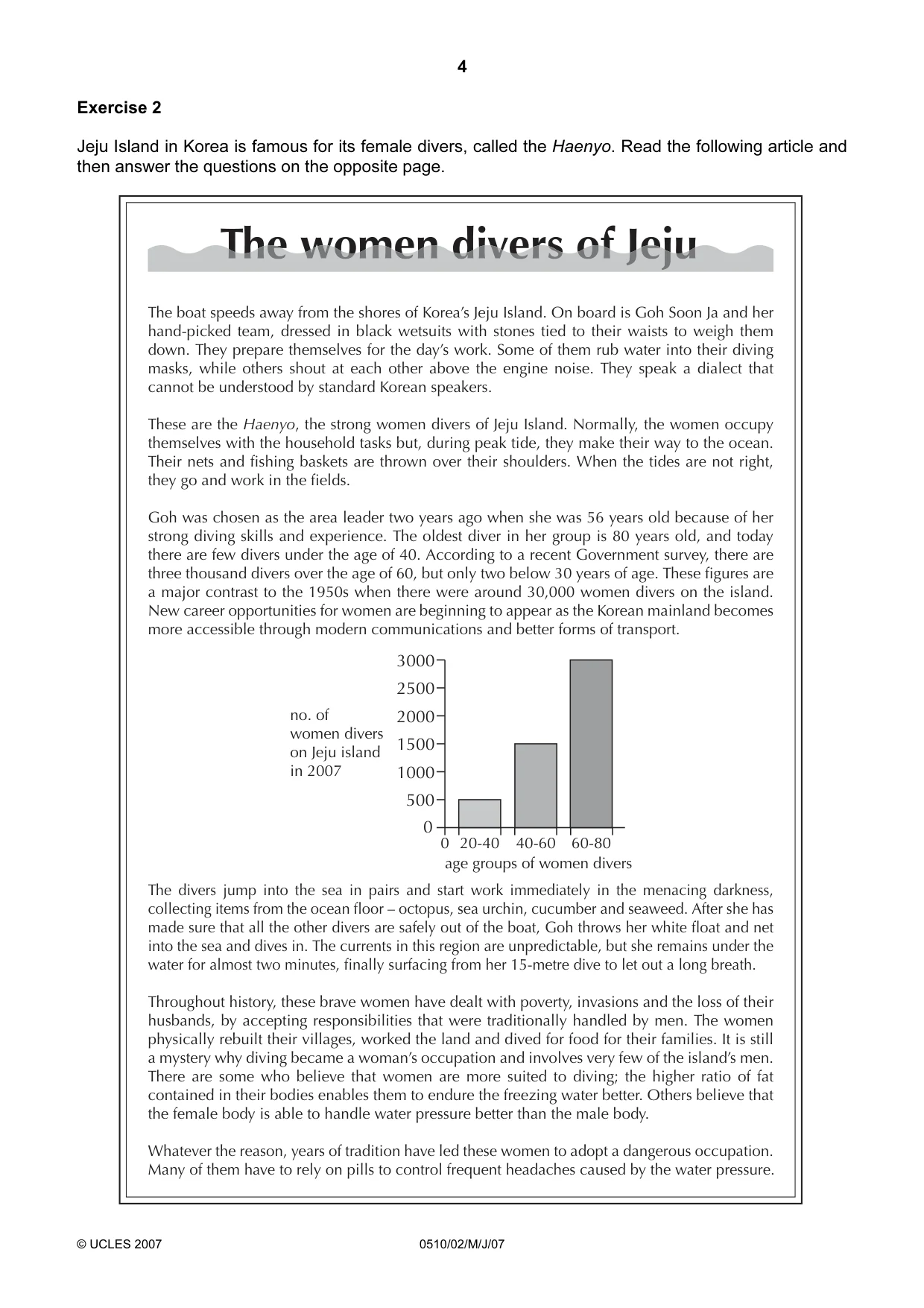
4 © UCLES 2007 0510/02/M/J/07 Exercise 2 Jeju Island in Korea is famous for its female divers, called the Haenyo. Read the following article and then answer the questions on the opposite page. The boat speeds away from the shores of Korea’s Jeju Island. On board is Goh Soon Ja and her hand-picked team, dressed in black wetsuits with stones tied to their waists to weigh them down. They prepare themselves for the day’s work. Some of them rub water into their diving masks, while others shout at each other above the engine noise. They speak a dialect that cannot be understood by standard Korean speakers. These are the Haenyo, the strong women divers of Jeju Island. Normally, the women occupy themselves with the household tasks but, during peak tide, they make their way to the ocean. Their nets and fishing baskets are thrown over their shoulders. When the tides are not right, they go and work in the fields. Goh was chosen as the area leader two years ago when she was 56 years old because of her strong diving skills and experience. The oldest diver in her group is 80 years old, and today there are few divers under the age of 40. According to a recent Government survey, there are three thousand divers over the age of 60, but only two below 30 years of age. These figures are a major contrast to the 1950s when there were around 30,000 women divers on the island. New career opportunities for women are beginning to appear as the Korean mainland becomes more accessible through modern communications and better forms of transport. The divers jump into the sea in pairs and start work immediately in the menacing darkness, collecting items from the ocean floor – octopus, sea urchin, cucumber and seaweed. After she has made sure that all the other divers are safely out of the boat, Goh throws her white float and net into the sea and dives in. The currents in this region are unpredictable, but she remains under the water for almost two minutes, finally surfacing from her 15-metre dive to let out a long breath. Throughout history, these brave women have dealt with poverty, invasions and the loss of their husbands, by accepting responsibilities that were traditionally handled by men. The women physically rebuilt their villages, worked the land and dived for food for their families. It is still a mystery why diving became a woman’s occupation and involves very few of the island’s men. There are some who believe that women are more suited to diving; the higher ratio of fat contained in their bodies enables them to endure the freezing water better. Others believe that the female body is able to handle water pressure better than the male body. Whatever the reason, years of tradition have led these women to adopt a dangerous occupation. Many of them have to rely on pills to control frequent headaches caused by the water pressure. no. of women divers on Jeju island in 2007 0 20-40 40-60 60-80 age groups of women divers 0 500 1000 1500 2000 2500 3000
Question paper, page 5
5 © UCLES 2007 0510/02/M/J/07 [Turn over For Examiner's Use (a) How do the women weigh themselves down for each dive? [1] (b) How do the women spend their time when they are not diving? Give two details. (i) (ii) [2] (c) Why was Goh Soon Ja chosen to be area leader? Give two details. (i) (ii) [1] (d) According to the diagram, what is the total number of women divers on Jeju island today? [1] (e) Why are so few young women choosing to become divers? [1] (f) Why does Goh enter the water after all the other divers? [1] (g) Why do men physically have problems with deep diving? Give two details. (i) (ii) [2] (h) Which health problem is caused by diving? [1] (i) Give four details of the difficult conditions the women have to face in the water. [4] [Total: 14]
Question paper, page 6
6 © UCLES 2007 0510/02/M/J/07 Exercise 3 Stefan Lofstadt and his family have a small apartment in Warsaw, Poland, that they would like to exchange for holidays with people from other countries. Stefan lives there with his father, Johann (who owns the property) and his younger sister, Eva, who is 18 years old. The apartment is situated on the second floor of a block about 2 kilometres from the city centre and the address is 23 Nowy Swiat. The family moved to the apartment when it was brand new, two years after the birth of Eva. The transport facilities to get from their home to the shops in the city are good; a regular bus service passes by every 20 minutes. There is no train and it is not possible to walk to the city centre because the road is busy and dangerous, so the only alternative to the bus is the car. The apartment has two bedrooms, a kitchen and a lounge, which contains a table and chairs where the family eat. There is no separate dining-room. It is possible for five people to sleep in the apartment but for comfort the ideal number is four. There are facilities for washing and drying clothes. There is a telephone, computer and access to the internet at all times for no extra charge. The Lofstadt family also have a dog which, in the past, has been looked after by neighbours when they have been on holiday. However, the neighbours are old and do not want the responsibility any more. As a special request, the family would like the exchange visitors to feed and walk the dog as a condition for staying in the apartment. The area has facilities for leisure activities within walking distance. There is a modern cinema for the family and a large supermarket. There is also a small outdoor swimming pool but this is sometimes closed, depending on the time of year. It is always open in June, July and August but for other months visitors need to check at the tourist information centre for up-to-date details. Other leisure activities are found about 30 minutes' journey from the city where there is a national park to the west. In addition, about one hour’s drive to the east, there is a lake with a long sandy beach, ideal for walking and windsurfing. In case of medical problems, the city hospital has an emergency department which is about 15 minutes by car from the apartment. For routine treatment, there is also a health centre situated on the outskirts of the city, about 35 minutes away. When the exchange family arrive, they can pick up the key to the apartment from the local agency which is situated in the shopping centre next to the apartment block. The office is open from 9.00am to 6.00pm every day except Sunday. The arrival day for families is Saturday after 2.00pm to give time for the apartment to be prepared and cleaned. Departure time is 10.00am on Saturday. The agency can be contacted by telephone (1243 773201) during office hours or mobile phone (0849427523). Before the family arrive, they are advised to inspect the property by logging on to the website www.homexchange.com where there is a full description and several pictures of the apartment as well as scenes from the local area. Exchange families may also contact the agency by email at jackshome@awl.com Imagine that you are Stefan. Fill in the registration form on the opposite page, using the information above.
Question paper, page 7
7 © UCLES 2007 0510/02/M/J/07 [Turn over For Examiner's Use Holiday Exchange Registration Form Section A Property details Owner’s name … Address of property … Age of property … Accommodation most suitable for: 2 3 4 5 6+ people (please circle one) Facilities washing machine telephone television internet computer garden garage (please tick those available) Section B Local area Public transport … Leisure facilities: on foot … by car/public transport… Full details of nearest medical facilities … Section C Agency details Business hours … Contact details … Property viewing at … Section D Write one sentence of between 12 and 20 words giving details of any special requests for your exchange family while they are staying in your house. … … … [Total: 8]
Question paper, page 8
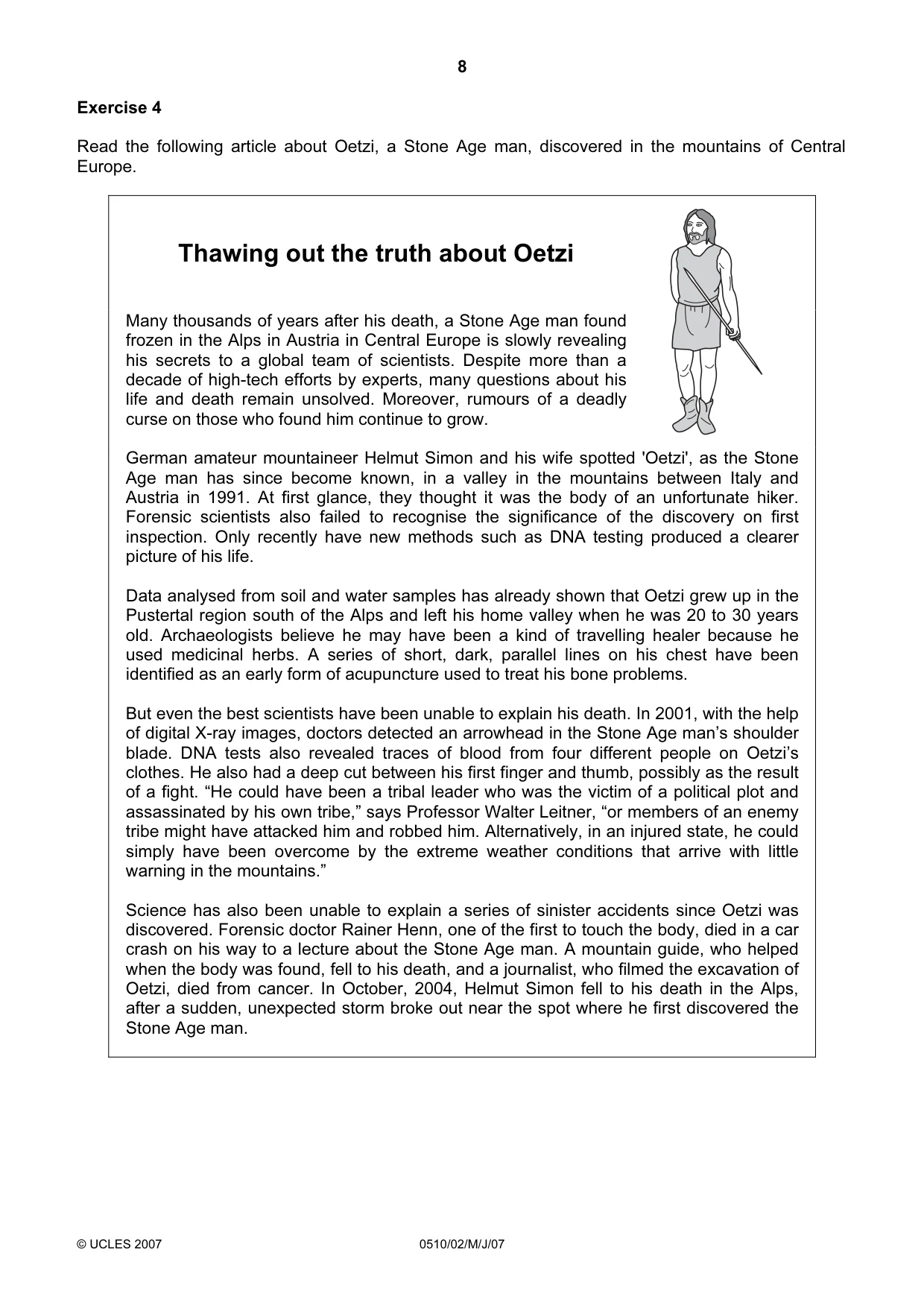
8 © UCLES 2007 0510/02/M/J/07 Exercise 4 Read the following article about Oetzi, a Stone Age man, discovered in the mountains of Central Europe. Thawing out the truth about Oetzi Many thousands of years after his death, a Stone Age man found frozen in the Alps in Austria in Central Europe is slowly revealing his secrets to a global team of scientists. Despite more than a decade of high-tech efforts by experts, many questions about his life and death remain unsolved. Moreover, rumours of a deadly curse on those who found him continue to grow. German amateur mountaineer Helmut Simon and his wife spotted 'Oetzi', as the Stone Age man has since become known, in a valley in the mountains between Italy and Austria in 1991. At first glance, they thought it was the body of an unfortunate hiker. Forensic scientists also failed to recognise the significance of the discovery on first inspection. Only recently have new methods such as DNA testing produced a clearer picture of his life. Data analysed from soil and water samples has already shown that Oetzi grew up in the Pustertal region south of the Alps and left his home valley when he was 20 to 30 years old. Archaeologists believe he may have been a kind of travelling healer because he used medicinal herbs. A series of short, dark, parallel lines on his chest have been identified as an early form of acupuncture used to treat his bone problems. But even the best scientists have been unable to explain his death. In 2001, with the help of digital X-ray images, doctors detected an arrowhead in the Stone Age man’s shoulder blade. DNA tests also revealed traces of blood from four different people on Oetzi’s clothes. He also had a deep cut between his first finger and thumb, possibly as the result of a fight. “He could have been a tribal leader who was the victim of a political plot and assassinated by his own tribe,” says Professor Walter Leitner, “or members of an enemy tribe might have attacked him and robbed him. Alternatively, in an injured state, he could simply have been overcome by the extreme weather conditions that arrive with little warning in the mountains.” Science has also been unable to explain a series of sinister accidents since Oetzi was discovered. Forensic doctor Rainer Henn, one of the first to touch the body, died in a car crash on his way to a lecture about the Stone Age man. A mountain guide, who helped when the body was found, fell to his death, and a journalist, who filmed the excavation of Oetzi, died from cancer. In October, 2004, Helmut Simon fell to his death in the Alps, after a sudden, unexpected storm broke out near the spot where he first discovered the Stone Age man.
Question paper, page 9
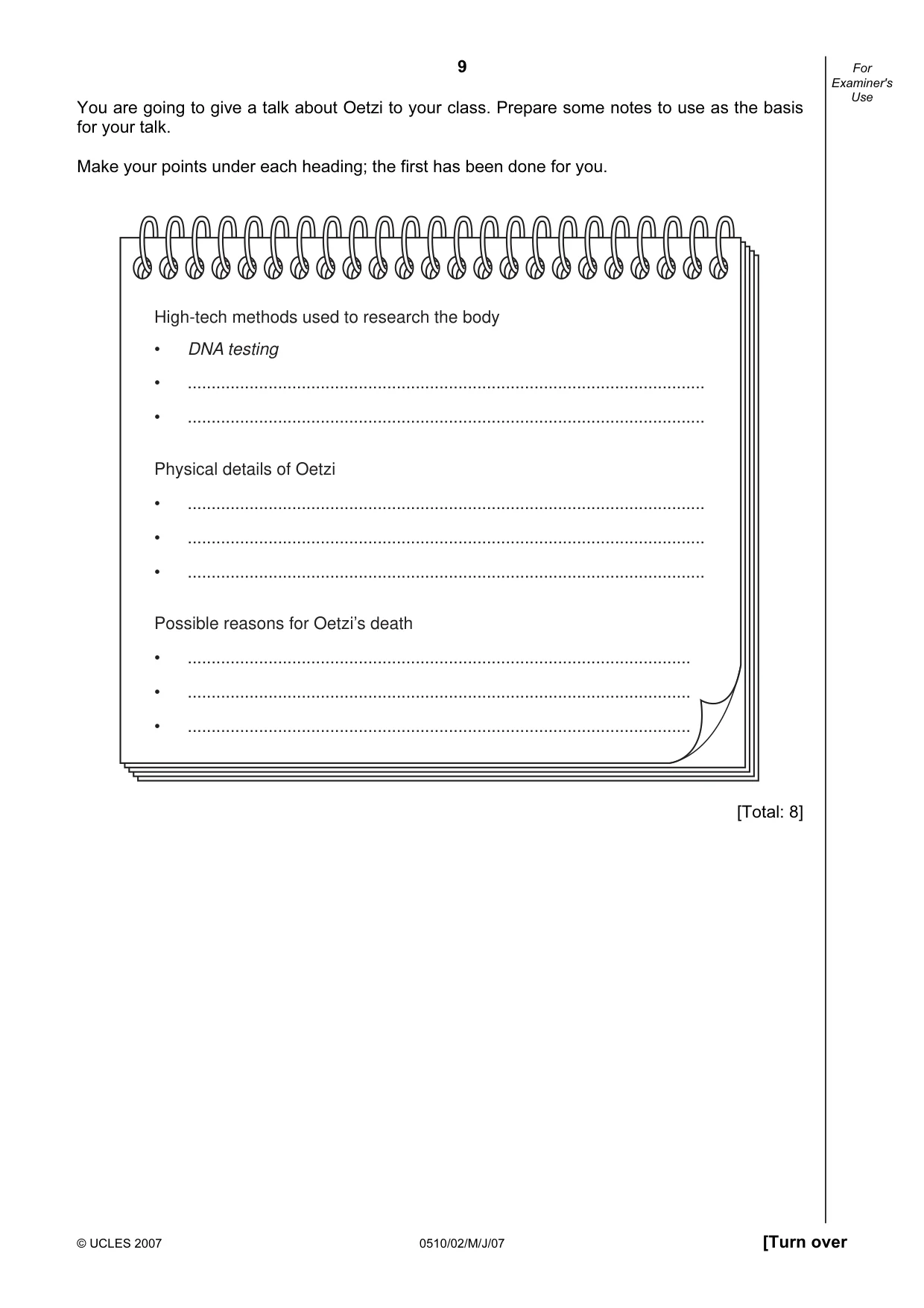
9 © UCLES 2007 0510/02/M/J/07 [Turn over For Examiner's Use You are going to give a talk about Oetzi to your class. Prepare some notes to use as the basis for your talk. Make your points under each heading; the first has been done for you. High-tech methods used to research the body • DNA testing • … • … Physical details of Oetzi • … • … • … Possible reasons for Oetzi’s death • … • … • … [Total: 8]
Question paper, page 10
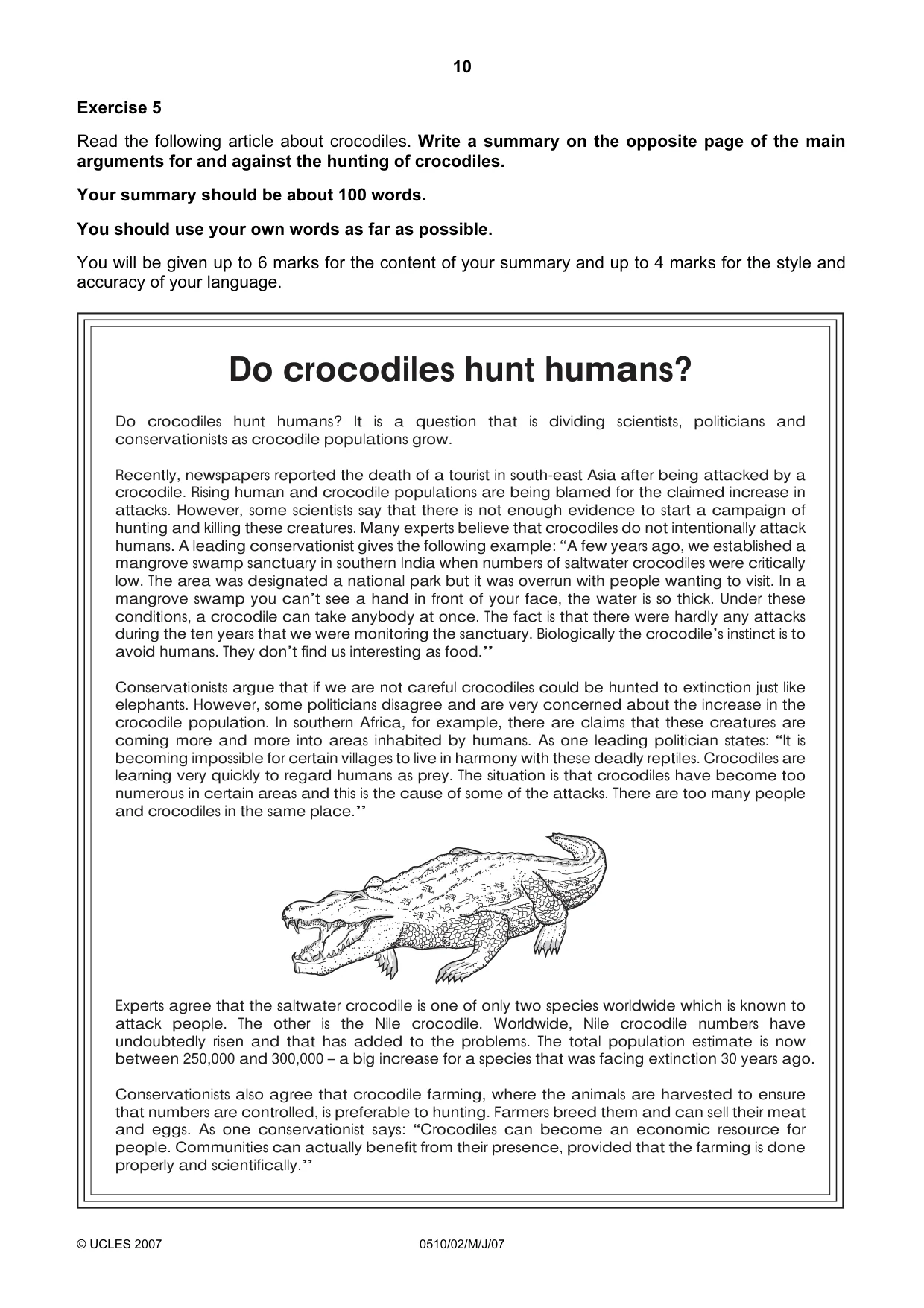
10 © UCLES 2007 0510/02/M/J/07 Exercise 5 Read the following article about crocodiles. Write a summary on the opposite page of the main arguments for and against the hunting of crocodiles. Your summary should be about 100 words. You should use your own words as far as possible. You will be given up to 6 marks for the content of your summary and up to 4 marks for the style and accuracy of your language. Do crocodiles hunt humans? Do crocodiles hunt humans? It is a question that is dividing scientists, politicians and conservationists as crocodile populations grow. Recently, newspapers reported the death of a tourist in south-east Asia after being attacked by a crocodile. Rising human and crocodile populations are being blamed for the claimed increase in attacks. However, some scientists say that there is not enough evidence to start a campaign of hunting and killing these creatures. Many experts believe that crocodiles do not intentionally attack humans. A leading conservationist gives the following example: “A few years ago, we established a mangrove swamp sanctuary in southern India when numbers of saltwater crocodiles were critically low. The area was designated a national park but it was overrun with people wanting to visit. In a mangrove swamp you can’t see a hand in front of your face, the water is so thick. Under these conditions, a crocodile can take anybody at once. The fact is that there were hardly any attacks during the ten years that we were monitoring the sanctuary. Biologically the crocodile’s instinct is to avoid humans. They don’t find us interesting as food.” Conservationists argue that if we are not careful crocodiles could be hunted to extinction just like elephants. However, some politicians disagree and are very concerned about the increase in the crocodile population. In southern Africa, for example, there are claims that these creatures are coming more and more into areas inhabited by humans. As one leading politician states: “It is becoming impossible for certain villages to live in harmony with these deadly reptiles. Crocodiles are learning very quickly to regard humans as prey. The situation is that crocodiles have become too numerous in certain areas and this is the cause of some of the attacks. There are too many people and crocodiles in the same place.” Experts agree that the saltwater crocodile is one of only two species worldwide which is known to attack people. The other is the Nile crocodile. Worldwide, Nile crocodile numbers have undoubtedly risen and that has added to the problems. The total population estimate is now between 250,000 and 300,000 – a big increase for a species that was facing extinction 30 years ago. Conservationists also agree that crocodile farming, where the animals are harvested to ensure that numbers are controlled, is preferable to hunting. Farmers breed them and can sell their meat and eggs. As one conservationist says: “Crocodiles can become an economic resource for people. Communities can actually benefit from their presence, provided that the farming is done properly and scientifically.”
Question paper, page 11
11 © UCLES 2007 0510/02/M/J/07 [Turn over For Examiner's Use [10]
Question paper, page 12
12 © UCLES 2007 0510/02/M/J/07 Exercise 6 Recently you visited an elderly relative for a week’s holiday. After the visit, you decide to write a letter to a friend about your holiday. Your letter should be between 150 and 200 words long. Do not write an address. In your letter you should: • explain one problem that occurred • say what you did about it • describe your feelings about the visit You will receive up to 9 marks for the content of your letter and up to 9 marks for the style and accuracy of your language.
Question paper, page 13
13 © UCLES 2007 0510/02/M/J/07 [Turn over For Examiner's Use [18]
Question paper, page 14
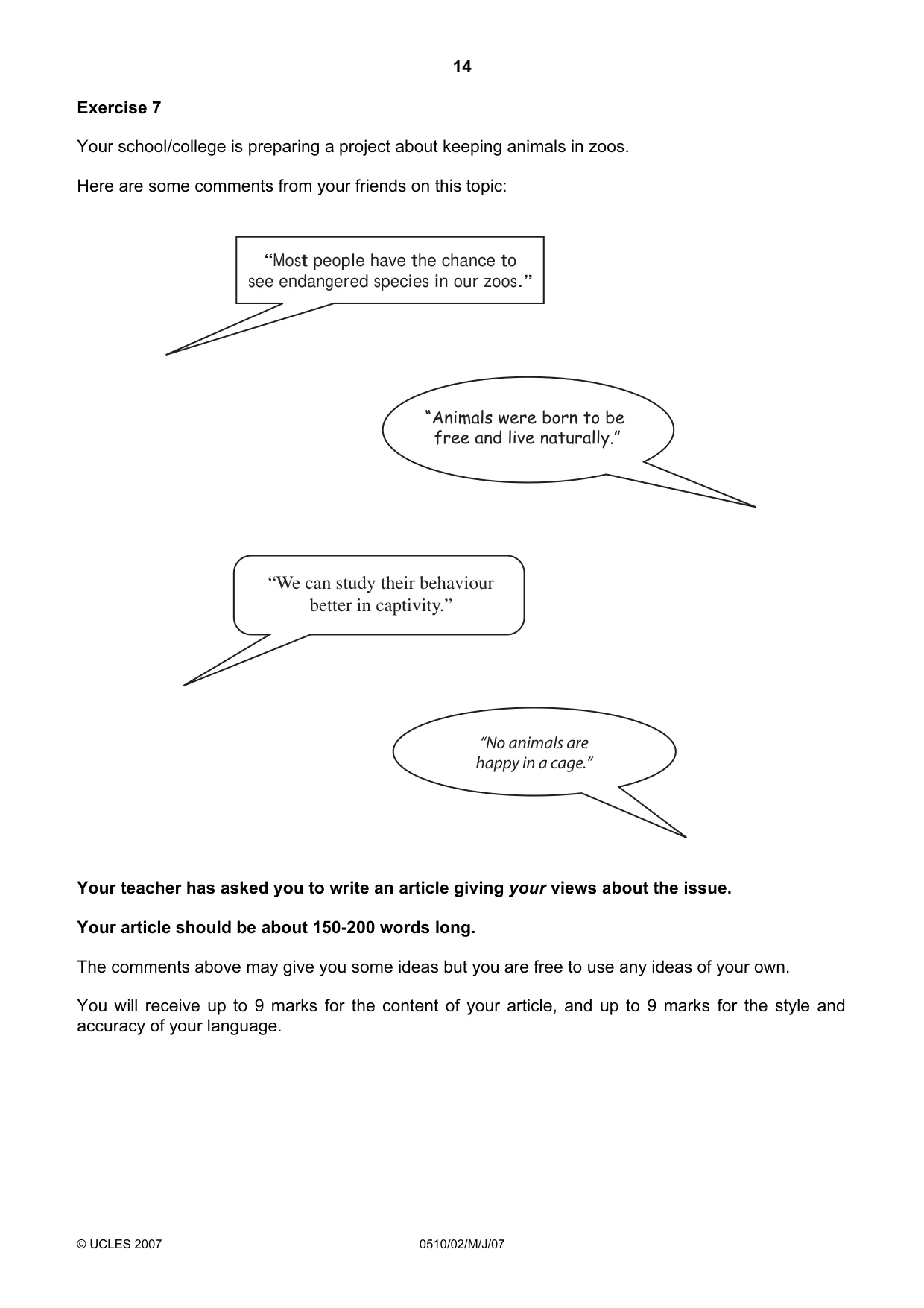
14 © UCLES 2007 0510/02/M/J/07 Exercise 7 Your school/college is preparing a project about keeping animals in zoos. Here are some comments from your friends on this topic: “Most people have the chance to see endangered species in our zoos.” “Animals were born to be free and live naturally.” “No animals are happy in a cage.” “We can study their behaviour better in captivity.” Your teacher has asked you to write an article giving your views about the issue. Your article should be about 150-200 words long. The comments above may give you some ideas but you are free to use any ideas of your own. You will receive up to 9 marks for the content of your article, and up to 9 marks for the style and accuracy of your language.
Question paper, page 15
15 © UCLES 2007 0510/02/M/J/07 For Examiner's Use [18]
Question paper, page 16
16 Permission to reproduce items where third-party owned material protected by copyright is included has been sought and cleared where possible. Every reasonable effort has been made by the publisher (UCLES) to trace copyright holders, but if any items requiring clearance have unwittingly been included, the publisher will be pleased to make amends at the earliest possible opportunity. University of Cambridge International Examinations is part of the Cambridge Assessment Group. Cambridge Assessment is the brand name of University of Cambridge Local Examinations Syndicate (UCLES), which is itself a department of the University of Cambridge. 0510/02/M/J/07 BLANK PAGE
Mark scheme, page 1
UNIVERSITY OF CAMBRIDGE INTERNATIONAL EXAMINATIONS International General Certificate of Secondary Education MARK SCHEME for the May/June 2007 question paper 0510 ENGLISH AS A SECOND LANGUAGE 0510/02 Paper 2 (Reading and Writing – Extended), maximum raw mark 84 This mark scheme is published as an aid to teachers and candidates, to indicate the requirements of the examination. It shows the basis on which Examiners were instructed to award marks. It does not indicate the details of the discussions that took place at an Examiners’ meeting before marking began. All Examiners are instructed that alternative correct answers and unexpected approaches in candidates’ scripts must be given marks that fairly reflect the relevant knowledge and skills demonstrated. Mark schemes must be read in conjunction with the question papers and the report on the examination. • CIE will not enter into discussions or correspondence in connection with these mark schemes. CIE is publishing the mark schemes for the May/June 2007 question papers for most IGCSE, GCE Advanced Level and Advanced Subsidiary Level syllabuses and some Ordinary Level syllabuses. www.XtremePapers.com
Mark scheme, page 2
Page 2 Mark Scheme Syllabus Paper IGCSE – May/June 2007 0510 02 © UCLES 2007 Exercise 1 Eurostar (a) 290 km per hour [1] (b) read AND enjoy a meal (BOTH NEEDED) [1] (c) daily [1] (d) many (50) attractions (for both adults and children)/an unforgettable experience/plenty of fun [1] (e) they are multi-lingual/they can speak other languages [1] (f) by phone AND on the internet/website/www.eurostar.com (BOTH NEEDED) [1] (g) you can only book up to 90 days in advance [1] (h) earn (travel) points which can be exchanged [1] [Max. total for Exercise 1: 8 marks]
Mark scheme, page 3
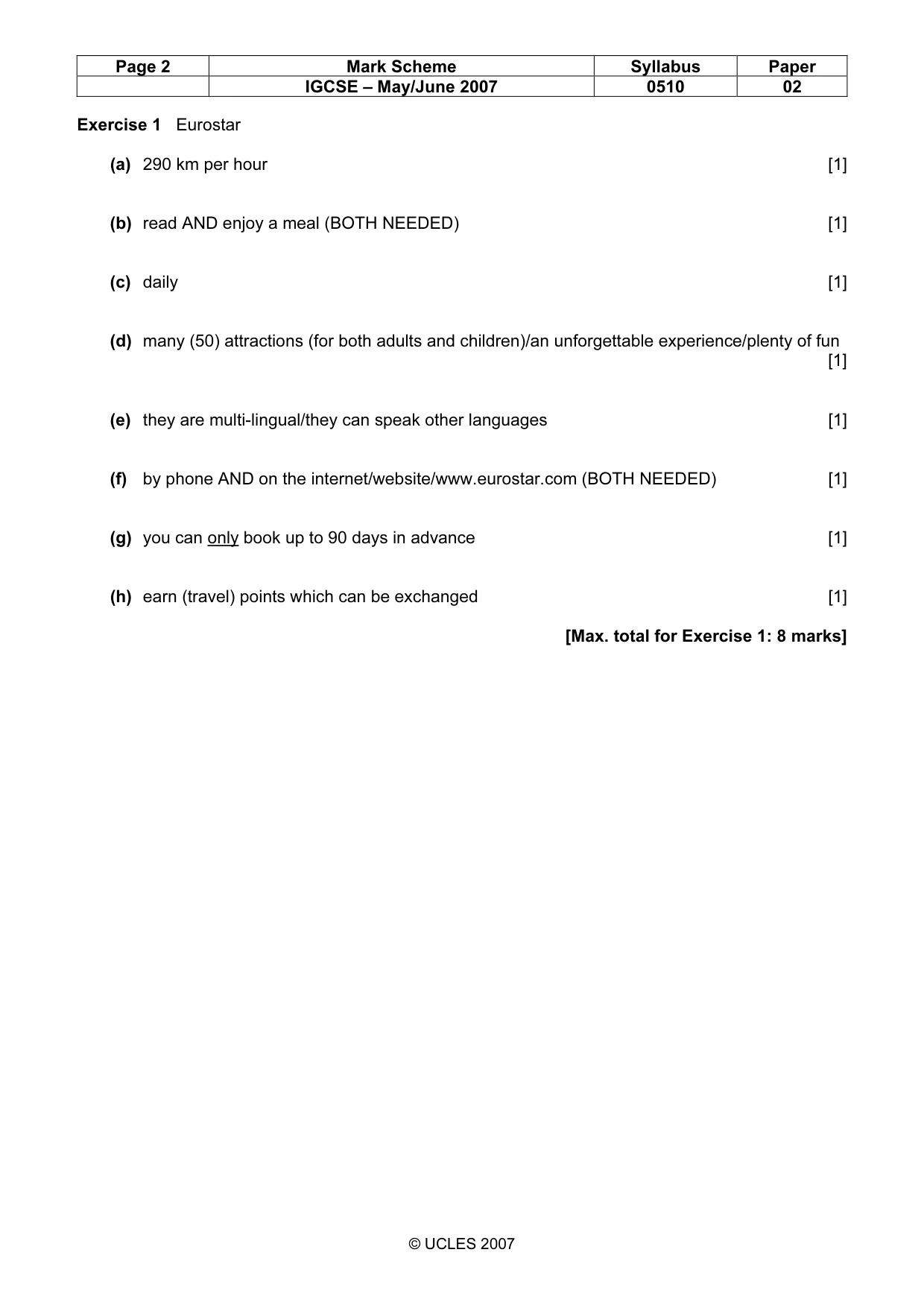
Page 3 Mark Scheme Syllabus Paper IGCSE – May/June 2007 0510 02 © UCLES 2007 Exercise 2 Women divers (a) stones (tied to their waists) [1] (b) doing household tasks [1] working in the fields [1] (c) strong diving skills AND experience (BOTH NEEDED) [1] (d) 5000 (divers) [1] (e) new (career) opportunities/mainland more accessible (for work) [1] (f) she makes sure the other divers have entered safely/are safely out of boat [1] (g) low(er) ratio of fat [1] male body does not handle water pressure (so) well [1] (h) (frequent) headaches [1] (i) TICK + NUMBER points (up to a maximum of 4) 1 (menacing) darkness [1] 2 (unpredictable) currents [1] 3 freezing water [1] 4 water pressure [1] [Max. total for Exercise 2: 14 marks]
Mark scheme, page 4
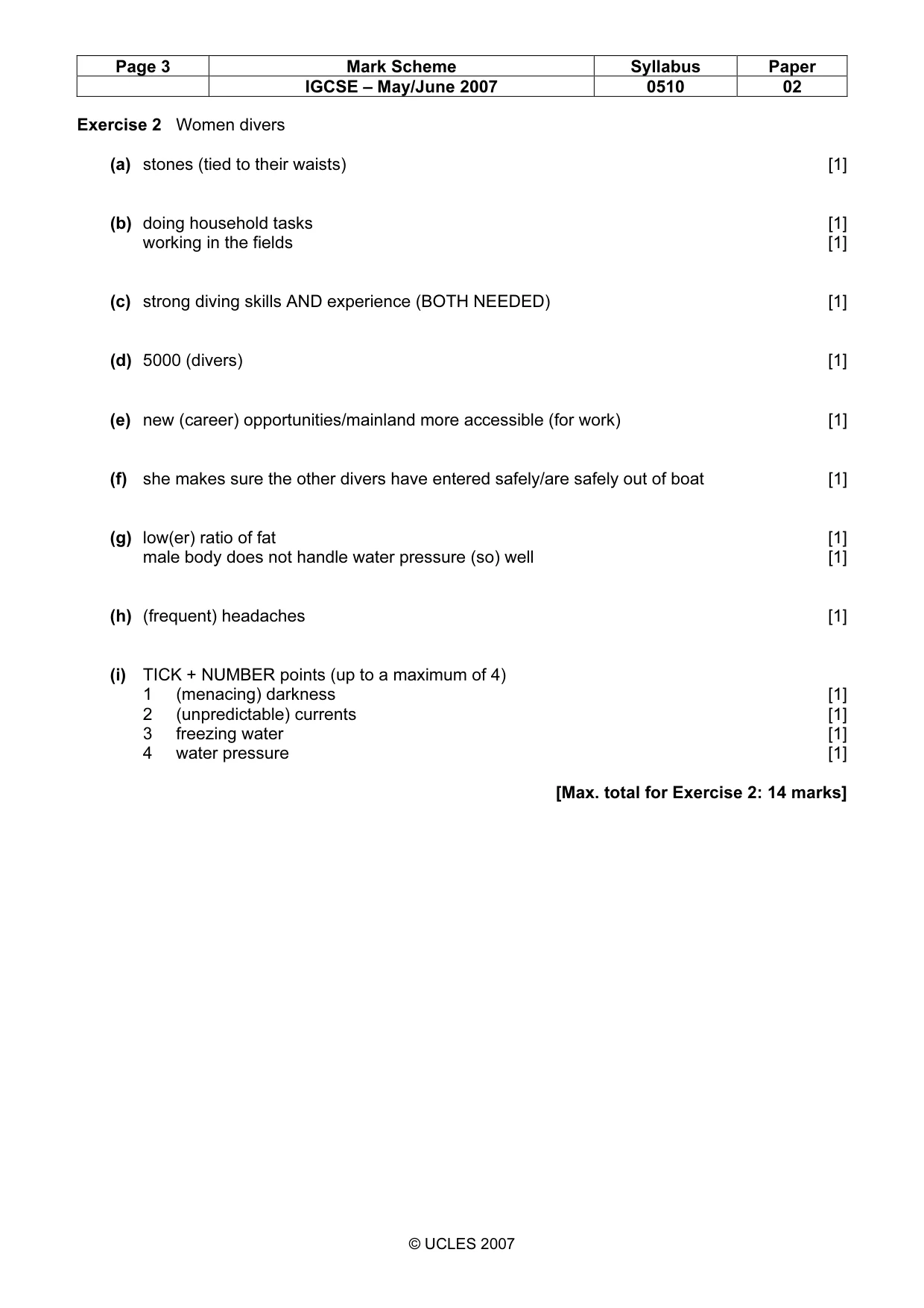
Page 4 Mark Scheme Syllabus Paper IGCSE – May/June 2007 0510 02 © UCLES 2007 Note: correct spelling is essential for the form-filling exercise. Exercise 3 Holiday Exchange Holiday Exchange Registration Form Section A Property details Owner’s name … Address of property … Age of property … Accommodation most suitable for: 2 3 4 5 6+ people (please circle one) Facilities washing machine telephone television internet computer garden garage (please tick those available) Section B Local area Public transport … Leisure facilities: on foot … by car/public transport… Full details of nearest medical facilities … Section C Agency details Business hours … Contact details … Property viewing at … Section D Write one sentence of between 12 and 20 words giving details of any special requests for your exchange family while they are staying in your house. … … … 1 1 1 1 1 (all for 1 mark) 1 1 (both needed) 1 1 1 1 1 (12÷2= 6 MAX) (2 MAX) Johann Lofstadt 23 Nowy Swiat, Warsaw (Poland) 16 years bus (service every 20 minutes) swimming pool and cinema national park/lake/beach hospital/emergency dept (15 mins by car) 9.00(am) to 6.00(pm) (09.00-18.00) except Sunday (Office) 1243 773201/mobile 0849427523/jackshome@awl.com www.homexchange.com Count and record number of words used. Must be in 1st person (singular or plural).
Mark scheme, page 5
Page 5 Mark Scheme Syllabus Paper IGCSE – May/June 2007 0510 02 © UCLES 2007 Add the correct responses for Sections A to C and then halve them to give a score out of 6. Then add this score to the marks awarded for the sentence. Sentence: it is expected that candidates will write a sentence that makes reference to the fact that the family should feed and walk the dog. This sentence must be in the first person. For the sentence, award up to 2 marks as follows: 2 marks: no fewer than 12 and no more than 20 words; proper sentence construction; correct spelling and punctuation; relevant to context. 1 mark: no fewer than 12 and no more than 20 words; proper sentence construction; 1-3 errors of punctuation and/or spelling that do not obscure meaning; relevant to context 0 marks: more than 3 errors of punctuation and/or spelling; AND/OR irrelevant to context; AND/OR not a proper sentence; AND/OR fewer than 12 or more than 20 words. [Max. total for Exercise 3: 8 marks]
Mark scheme, page 6
Page 6 Mark Scheme Syllabus Paper IGCSE – May/June 2007 0510 02 © UCLES 2007 Exercise 4 Stone Age man Tick and number points: High-tech methods used to research the body 1 soil and water analysis/sampling 2 digital X-ray (imaging) Physical details of Oetzi 3 (series of) short dark parallel lines (on chest)/bone problems 4 deep cut between first finger and thumb 5 arrowhead in shoulder blade Possible reasons for Oetzi’s death 6 assassinated (in a political plot) 7 victim of robbery/attacked (by enemy tribe) 8 overcome by extreme weather [Max. total for Exercise 4: 8 marks]
Mark scheme, page 7
Page 7 Mark Scheme Syllabus Paper IGCSE – May/June 2007 0510 02 © UCLES 2007 Exercise 5 Hunting of crocodiles Mark up to 6 for content and up to 4 for language. Count words and cross out everything after 120. Do not award language marks if there is no content. Do not award full language marks if both parts of summary not addressed. Content (up to 6 marks) Tick and number the points below Arguments for: 1 crocodile population rising 2 crocodiles moving into areas inhabited by humans 3 crocodiles learning quickly to regard humans as prey 4 (too many) people and crocodiles in one place Arguments against: 5 crocodiles do not intentionally attack humans 6 crocodiles’ instinct is to avoid humans 7 could be hunted to extinction 8 small number of attacks on humans (in mangrove swamps) 9 crocodile farming is suitable alternative/an economic resource Language (up to 4 marks) 0 marks: meaning obscure because of density of language errors and serious problems with expression/nothing of relevance 1 mark: expression weak/reliance on lifting without discrimination 2 marks: expression limited/some reliance on lifting from the original, but some sense of order 3 marks: expression good, with attempts to group and sequence ideas in own words 4 marks: expression very good; clear, orderly grouping and sequencing; largely own words. [Max. total for Exercise 5: 10 marks]
Mark scheme, page 8
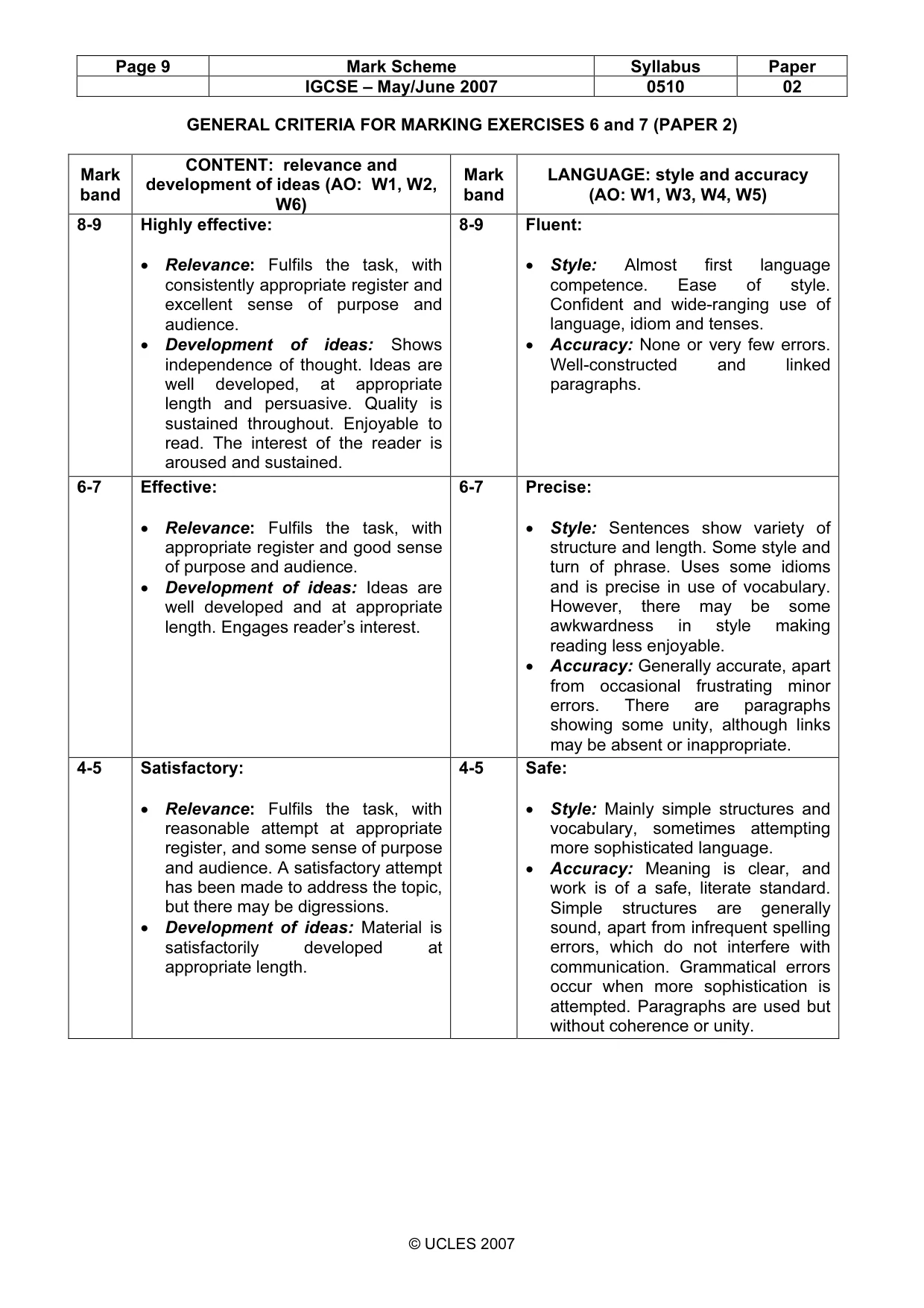
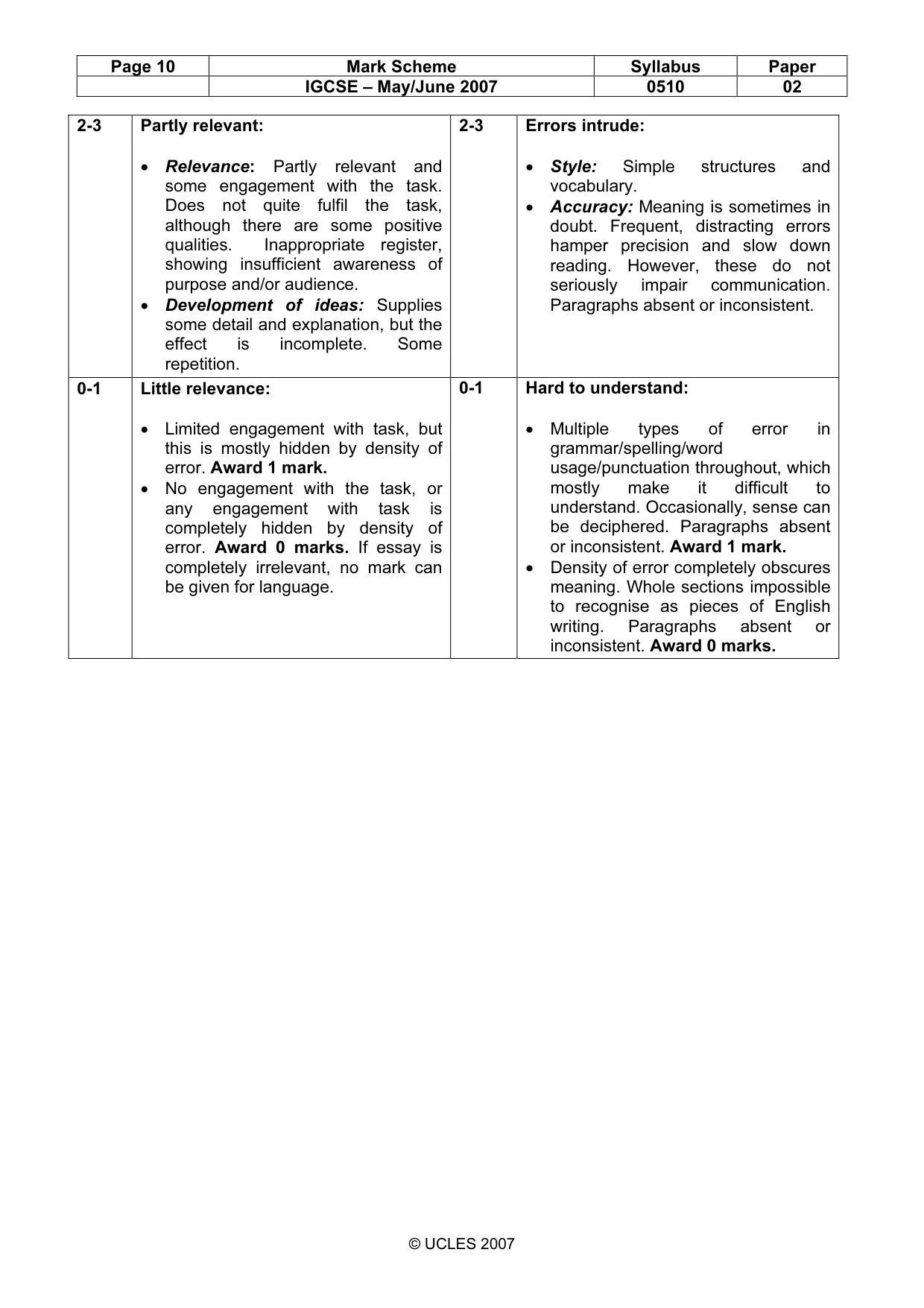
Page 8 Mark Scheme Syllabus Paper IGCSE – May/June 2007 0510 02 © UCLES 2007 Exercise 6 Letter to friend Exercise 7 Animals in zoos The following general instructions, and table of marking criteria, apply to both exercises. • Award the answer a mark for content (C) [out of 9] and a mark for language (L) [out of 9] in accordance with the General Criteria table that follows. Annotate as follows: C (mark) + L (mark) = ringed total • Content covers relevance (i.e. whether the piece fulfils the task and the awareness of purpose/audience/register) and the development of ideas (i.e. the detail/explanation provided and how enjoyable it is to read). • Language covers style (i.e. complexity of vocabulary and sentence structure) and accuracy (of grammar, spelling, punctuation and use of paragraphs). • When deciding on a mark for content or language, first of all decide which mark band is most appropriate. There will not necessarily be an exact fit. Then decide between 2 marks within that mark band. Use the lower mark if it only just makes it into the band and the upper mark if it fulfils all the requirements of the band but doesn’t quite make it into the band above. • When deciding on a mark for content, look at both relevance and development of ideas. First ask yourself whether the writing fulfils the task, in terms of points to be covered and the length. If it does, it will be in at least the 4-5 mark band. • When deciding on a mark for language, look at both the style and the accuracy of the language. A useful starting point would be first to determine whether errors intrude. If they do not, it will be in at least the 4-5 mark band. • The use of paragraphs should not be the primary basis of deciding which mark band the work is in. Look first at the language used and once you have decided on the appropriate mark band, you can use the paragraphing as a factor in helping you to decide whether the work warrants the upper or lower mark in the mark band. • If the essay is considerably shorter than the stated word length, it should be put in mark band 2-3 for content or lower for not fulfilling the task. • If the essay is totally irrelevant and has nothing to do with the question asked, it should be given 0 marks for content and language, even if it is enjoyable to read and fluent. • If the essay is partly relevant and therefore in mark band 2-3, the full range of marks for language is available. [Max. total for Exercise 6: 18 marks] [Max. total for Exercise 7: 18 marks]
Mark scheme, page 9
Page 9 Mark Scheme Syllabus Paper IGCSE – May/June 2007 0510 02 © UCLES 2007 GENERAL CRITERIA FOR MARKING EXERCISES 6 and 7 (PAPER 2) Mark band CONTENT: relevance and development of ideas (AO: W1, W2, W6) Mark band LANGUAGE: style and accuracy (AO: W1, W3, W4, W5) 8-9 Highly effective: • Relevance: Fulfils the task, with consistently appropriate register and excellent sense of purpose and audience. • Development of ideas: Shows independence of thought. Ideas are well developed, at appropriate length and persuasive. Quality is sustained throughout. Enjoyable to read. The interest of the reader is aroused and sustained. 8-9 Fluent: • Style: Almost first language competence. Ease of style. Confident and wide-ranging use of language, idiom and tenses. • Accuracy: None or very few errors. Well-constructed and linked paragraphs. 6-7 Effective: • Relevance: Fulfils the task, with appropriate register and good sense of purpose and audience. • Development of ideas: Ideas are well developed and at appropriate length. Engages reader’s interest. 6-7 Precise: • Style: Sentences show variety of structure and length. Some style and turn of phrase. Uses some idioms and is precise in use of vocabulary. However, there may be some awkwardness in style making reading less enjoyable. • Accuracy: Generally accurate, apart from occasional frustrating minor errors. There are paragraphs showing some unity, although links may be absent or inappropriate. 4-5 Satisfactory: • Relevance: Fulfils the task, with reasonable attempt at appropriate register, and some sense of purpose and audience. A satisfactory attempt has been made to address the topic, but there may be digressions. • Development of ideas: Material is satisfactorily developed at appropriate length. 4-5 Safe: • Style: Mainly simple structures and vocabulary, sometimes attempting more sophisticated language. • Accuracy: Meaning is clear, and work is of a safe, literate standard. Simple structures are generally sound, apart from infrequent spelling errors, which do not interfere with communication. Grammatical errors occur when more sophistication is attempted. Paragraphs are used but without coherence or unity.
Mark scheme, page 10
Page 10 Mark Scheme Syllabus Paper IGCSE – May/June 2007 0510 02 © UCLES 2007 2-3 Partly relevant: • Relevance: Partly relevant and some engagement with the task. Does not quite fulfil the task, although there are some positive qualities. Inappropriate register, showing insufficient awareness of purpose and/or audience. • Development of ideas: Supplies some detail and explanation, but the effect is incomplete. Some repetition. 2-3 Errors intrude: • Style: Simple structures and vocabulary. • Accuracy: Meaning is sometimes in doubt. Frequent, distracting errors hamper precision and slow down reading. However, these do not seriously impair communication. Paragraphs absent or inconsistent. 0-1 Little relevance: • Limited engagement with task, but this is mostly hidden by density of error. Award 1 mark. • No engagement with the task, or any engagement with task is completely hidden by density of error. Award 0 marks. If essay is completely irrelevant, no mark can be given for language. 0-1 Hard to understand: • Multiple types of error in grammar/spelling/word usage/punctuation throughout, which mostly make it difficult to understand. Occasionally, sense can be deciphered. Paragraphs absent or inconsistent. Award 1 mark. • Density of error completely obscures meaning. Whole sections impossible to recognise as pieces of English writing. Paragraphs absent or inconsistent. Award 0 marks.
What you needed in this session
Cambridge’s own grade thresholds for 2007 May/June, Paper 2 · Variant 1. A higher threshold means an easier paper — the bar moves with how the cohort did.