Cambridge IGCSE English - Second Language (oral endorsement) 0510 — 2007 May/June Paper 1 · Variant 1
0510/11/M/J/07 · 56 marks · ≈63 min
The question paper and its mark scheme, free to read here and free to download. This is Cambridge’s own paper, exactly as it was sat.
Question paper33 pages










Mark scheme12 pages
Answers below. Sit the paper first if you are practising.
Paper as text
Question paper, page 1
Location Entry Codes From the June 2007 session, as part of CIE’s continual commitment to maintaining best practice in assessment, CIE has begun to use different variants of some question papers for our most popular assessments with extremely large and widespread candidature, The question papers are closely related and the relationships between them have been thoroughly established using our assessment expertise. All versions of the paper give assessment of equal standard. The content assessed by the examination papers and the type of questions are unchanged. This change means that for this component there are now two variant Question Papers, Mark Schemes and Principal Examiner’s Reports where previously there was only one. For any individual country, it is intended that only one variant is used. This document contains both variants which will give all Centres access to even more past examination material than is usually the case. The diagram shows the relationship between the Question Papers, Mark Schemes and Principal Examiner’s Reports. Question Paper Mark Scheme Principal Examiner’s Report Introduction Introduction Introduction First variant Question Paper First variant Mark Scheme First variant Principal Examiner’s Report Second variant Question Paper Second variant Mark Scheme Second variant Principal Examiner’s Report Who can I contact for further information on these changes? Please direct any questions about this to CIE’s Customer Services team at: international@cie.org.uk www.XtremePapers.com
Question paper, page 2
This document consists of 13 printed pages and 3 blank pages. IB07 06_0510_01/3RP © UCLES 2007 [Turn over *0107524306* For Examiner's Use Exercise 1 Exercise 2 Exercise 3 Exercise 4 Exercise 5 Exercise 6 Exercise 7 Total UNIVERSITY OF CAMBRIDGE INTERNATIONAL EXAMINATIONS International General Certificate of Secondary Education ENGLISH AS A SECOND LANGUAGE 0510/01 Paper 1 Reading and Writing (Core) May/June 2007 1 hour 30 minutes Candidates answer on the Question Paper. No Additional Materials are required. READ THESE INSTRUCTIONS FIRST Write your Centre number, candidate number and name on all the work you hand in. Write in dark blue or black pen. Do not use staples, paper clips, highlighters, glue or correction fluid. DO NOT WRITE IN ANY BARCODES. Answer all questions. Dictionaries are not allowed. At the end of the examination, fasten all your work securely together. The number of marks is given in brackets [ ] at the end of each question or part question. P First variant Question Paper
Question paper, page 3
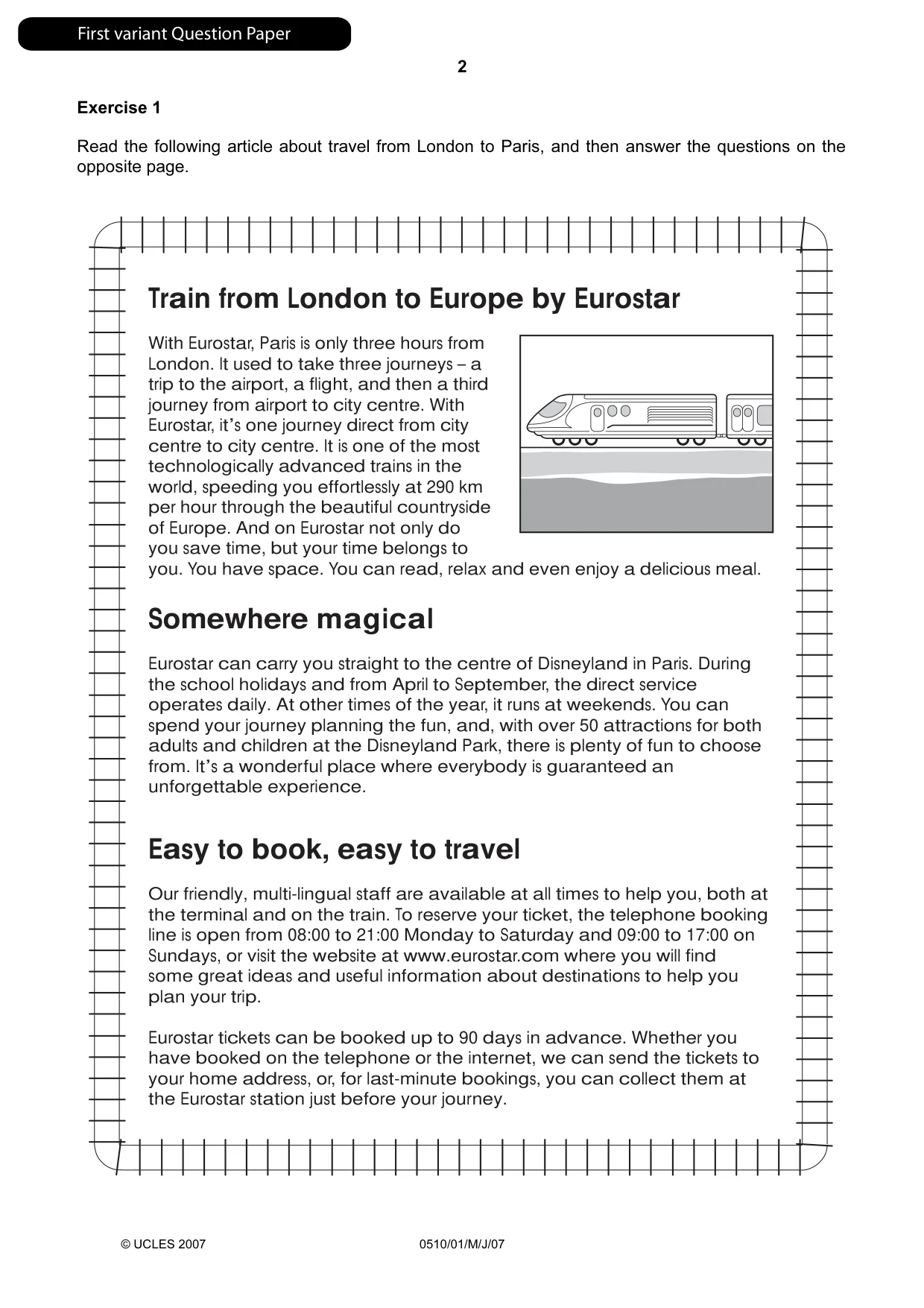
2 © UCLES 2007 0510/01/M/J/07 Exercise 1 Read the following article about travel from London to Paris, and then answer the questions on the opposite page. Train from London to Europe by Eurostar With Eurostar, Paris is only three hours from London. It used to take three journeys – a trip to the airport, a flight, and then a third journey from airport to city centre. With Eurostar, it’s one journey direct from city centre to city centre. It is one of the most technologically advanced trains in the world, speeding you effortlessly at 290 km per hour through the beautiful countryside of Europe. And on Eurostar not only do you save time, but your time belongs to you. You have space. You can read, relax and even enjoy a delicious meal. Somewhere magical Eurostar can carry you straight to the centre of Disneyland in Paris. During the school holidays and from April to September, the direct service operates daily. At other times of the year, it runs at weekends. You can spend your journey planning the fun, and, with over 50 attractions for both adults and children at the Disneyland Park, there is plenty of fun to choose from. It’s a wonderful place where everybody is guaranteed an unforgettable experience. Easy to book, easy to travel Our friendly, multi-lingual staff are available at all times to help you, both at the terminal and on the train. To reserve your ticket, the telephone booking line is open from 08:00 to 21:00 Monday to Saturday and 09:00 to 17:00 on Sundays, or visit the website at www.eurostar.com where you will find some great ideas and useful information about destinations to help you plan your trip. Eurostar tickets can be booked up to 90 days in advance. Whether you have booked on the telephone or the internet, we can send the tickets to your home address, or, for last-minute bookings, you can collect them at the Eurostar station just before your journey. First variant Question Paper
Question paper, page 4
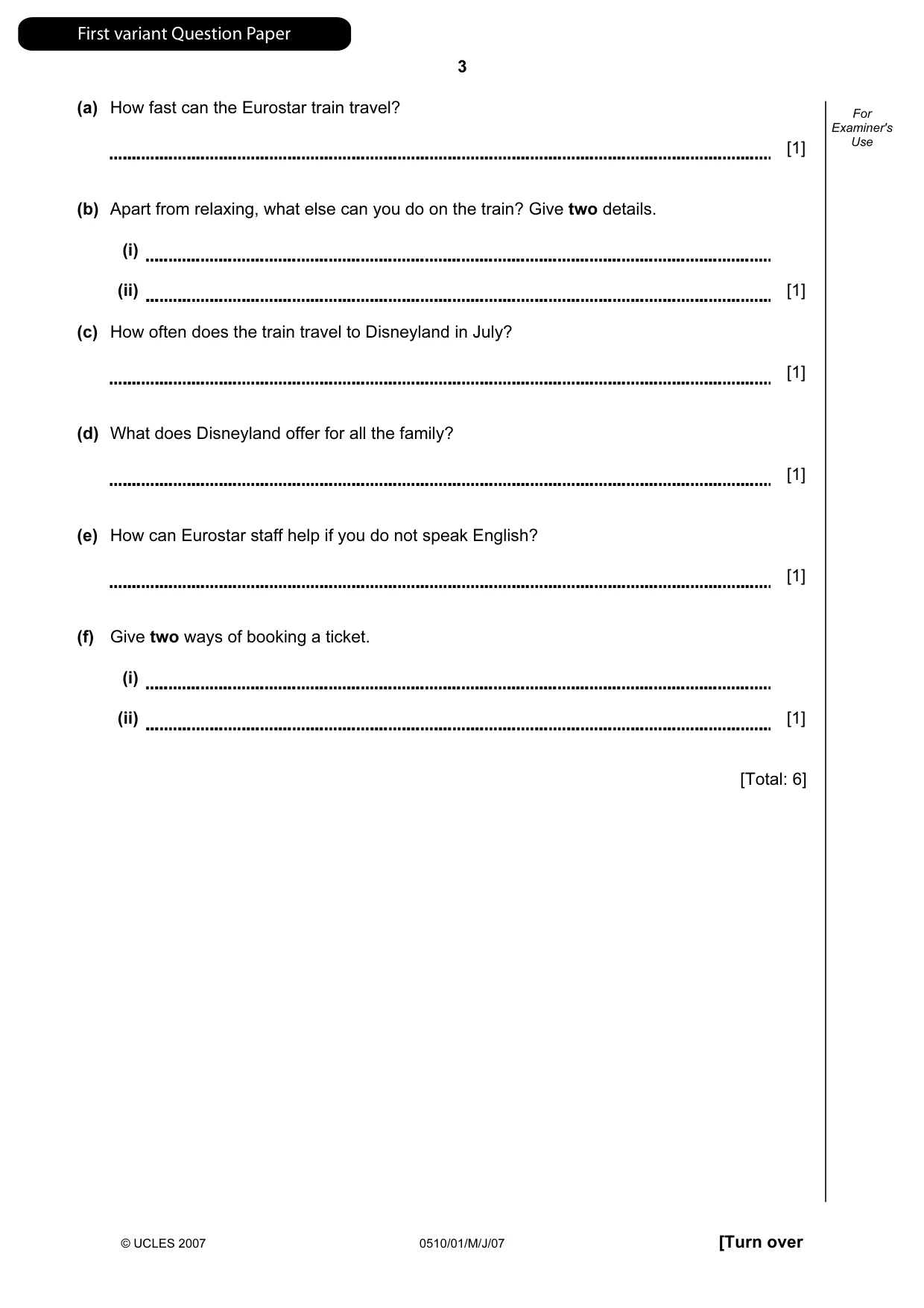
3 © UCLES 2007 0510/01/M/J/07 [Turn over For Examiner's Use (a) How fast can the Eurostar train travel? [1] (b) Apart from relaxing, what else can you do on the train? Give two details. (i) (ii) [1] (c) How often does the train travel to Disneyland in July? [1] (d) What does Disneyland offer for all the family? [1] (e) How can Eurostar staff help if you do not speak English? [1] (f) Give two ways of booking a ticket. (i) (ii) [1] [Total: 6] First variant Question Paper
Question paper, page 5
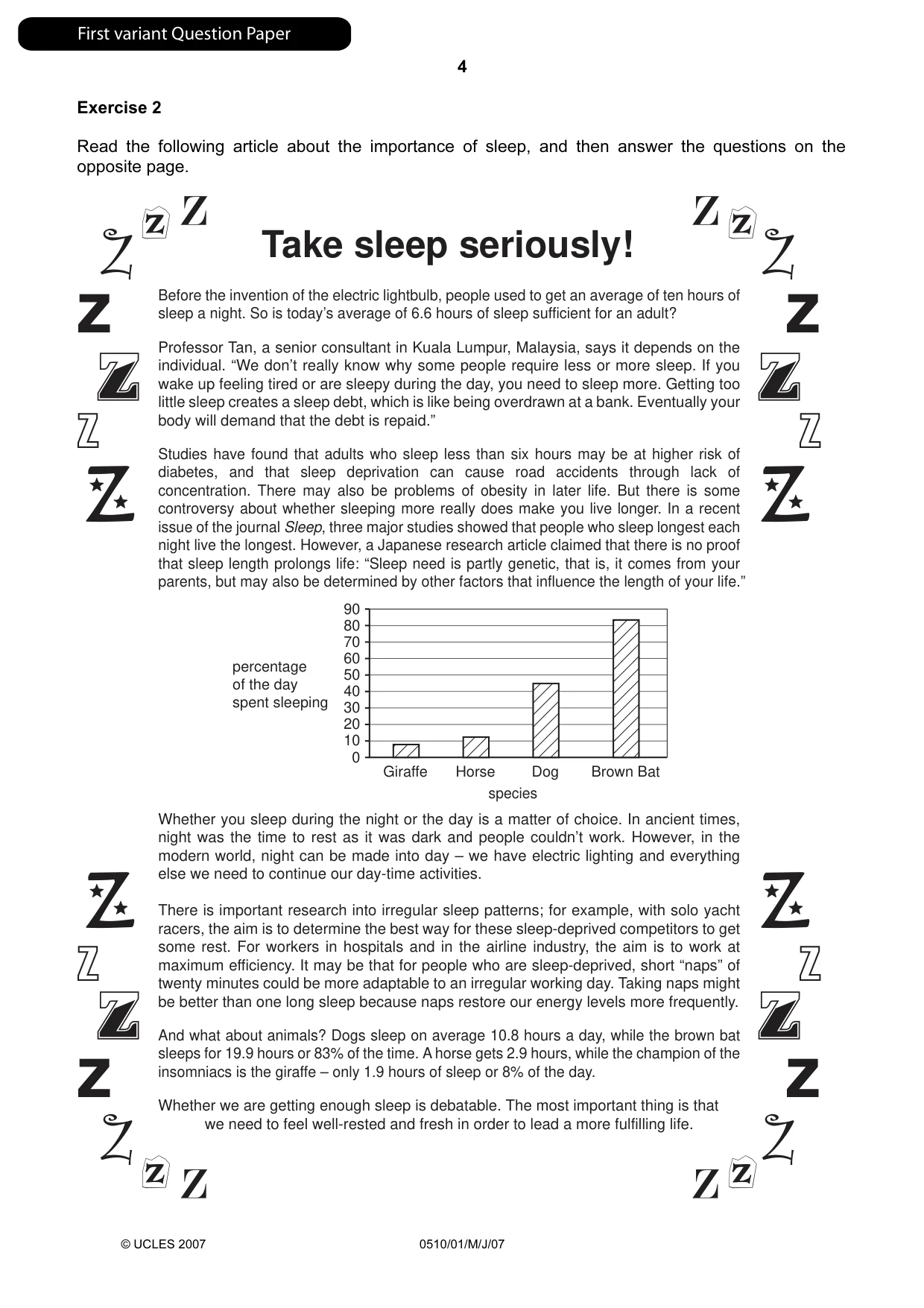
4 © UCLES 2007 0510/01/M/J/07 Exercise 2 Read the following article about the importance of sleep, and then answer the questions on the opposite page. Take sleep seriously! Before the invention of the electric lightbulb, people used to get an average of ten hours of sleep a night. So is today’s average of 6.6 hours of sleep sufficient for an adult? Professor Tan, a senior consultant in Kuala Lumpur, Malaysia, says it depends on the individual. “We don’t really know why some people require less or more sleep. If you wake up feeling tired or are sleepy during the day, you need to sleep more. Getting too little sleep creates a sleep debt, which is like being overdrawn at a bank. Eventually your body will demand that the debt is repaid.” Studies have found that adults who sleep less than six hours may be at higher risk of diabetes, and that sleep deprivation can cause road accidents through lack of concentration. There may also be problems of obesity in later life. But there is some controversy about whether sleeping more really does make you live longer. In a recent issue of the journal Sleep, three major studies showed that people who sleep longest each night live the longest. However, a Japanese research article claimed that there is no proof that sleep length prolongs life: “Sleep need is partly genetic, that is, it comes from your parents, but may also be determined by other factors that influence the length of your life.” Whether you sleep during the night or the day is a matter of choice. In ancient times, night was the time to rest as it was dark and people couldn’t work. However, in the modern world, night can be made into day – we have electric lighting and everything else we need to continue our day-time activities. There is important research into irregular sleep patterns; for example, with solo yacht racers, the aim is to determine the best way for these sleep-deprived competitors to get some rest. For workers in hospitals and in the airline industry, the aim is to work at maximum efficiency. It may be that for people who are sleep-deprived, short “naps” of twenty minutes could be more adaptable to an irregular working day. Taking naps might be better than one long sleep because naps restore our energy levels more frequently. And what about animals? Dogs sleep on average 10.8 hours a day, while the brown bat sleeps for 19.9 hours or 83% of the time. A horse gets 2.9 hours, while the champion of the insomniacs is the giraffe – only 1.9 hours of sleep or 8% of the day. Whether we are getting enough sleep is debatable. The most important thing is that we need to feel well-rested and fresh in order to lead a more fulfilling life. 90 80 70 60 50 40 30 20 10 0 Giraffe Horse Dog Brown Bat percentage of the day spent sleeping zz z zz zz z zz zz z z z zz z z z species First variant Question Paper
Question paper, page 6
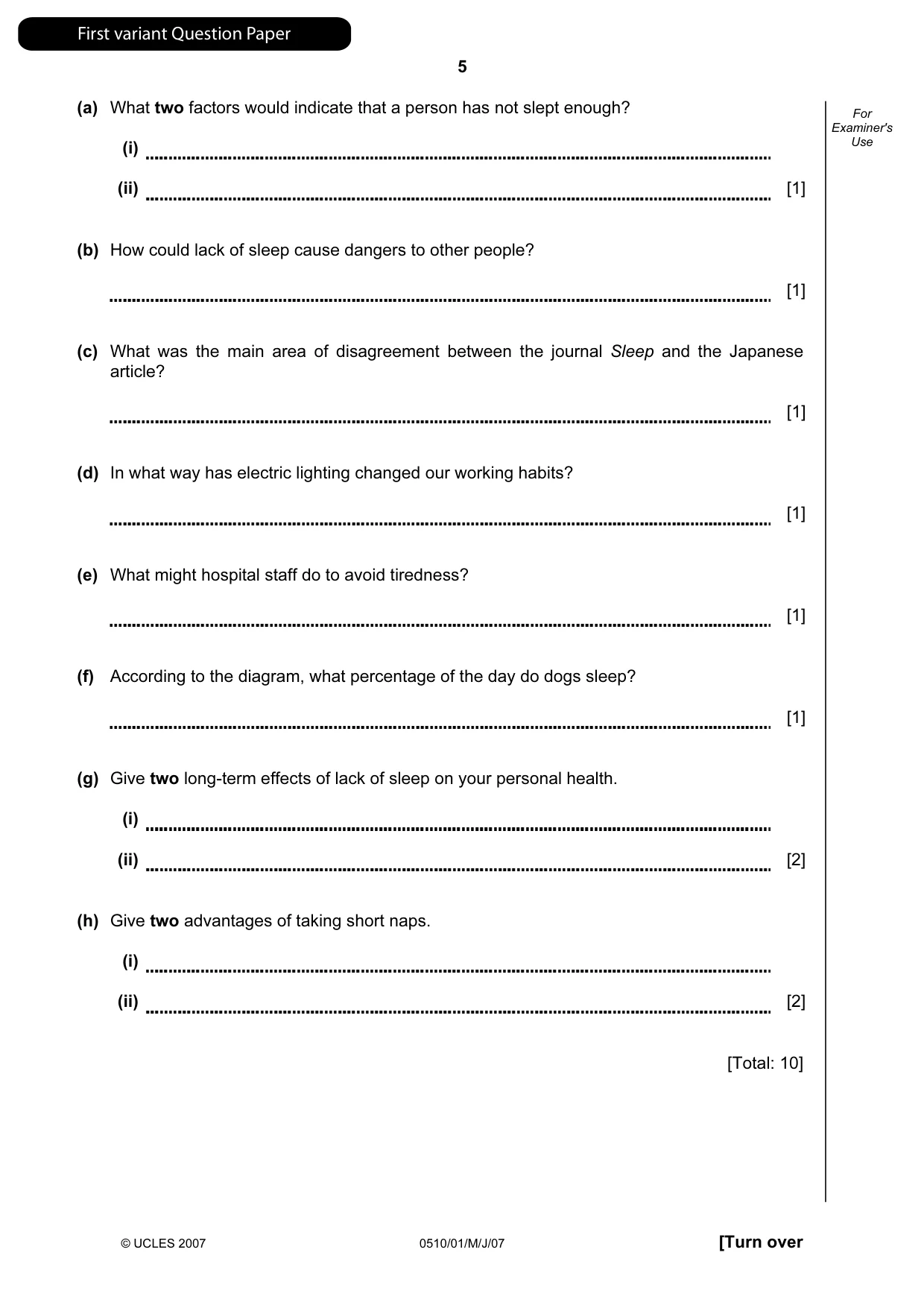
5 © UCLES 2007 0510/01/M/J/07 [Turn over For Examiner's Use (a) What two factors would indicate that a person has not slept enough? (i) (ii) [1] (b) How could lack of sleep cause dangers to other people? [1] (c) What was the main area of disagreement between the journal Sleep and the Japanese article? [1] (d) In what way has electric lighting changed our working habits? [1] (e) What might hospital staff do to avoid tiredness? [1] (f) According to the diagram, what percentage of the day do dogs sleep? [1] (g) Give two long-term effects of lack of sleep on your personal health. (i) (ii) [2] (h) Give two advantages of taking short naps. (i) (ii) [2] [Total: 10] First variant Question Paper
Question paper, page 7
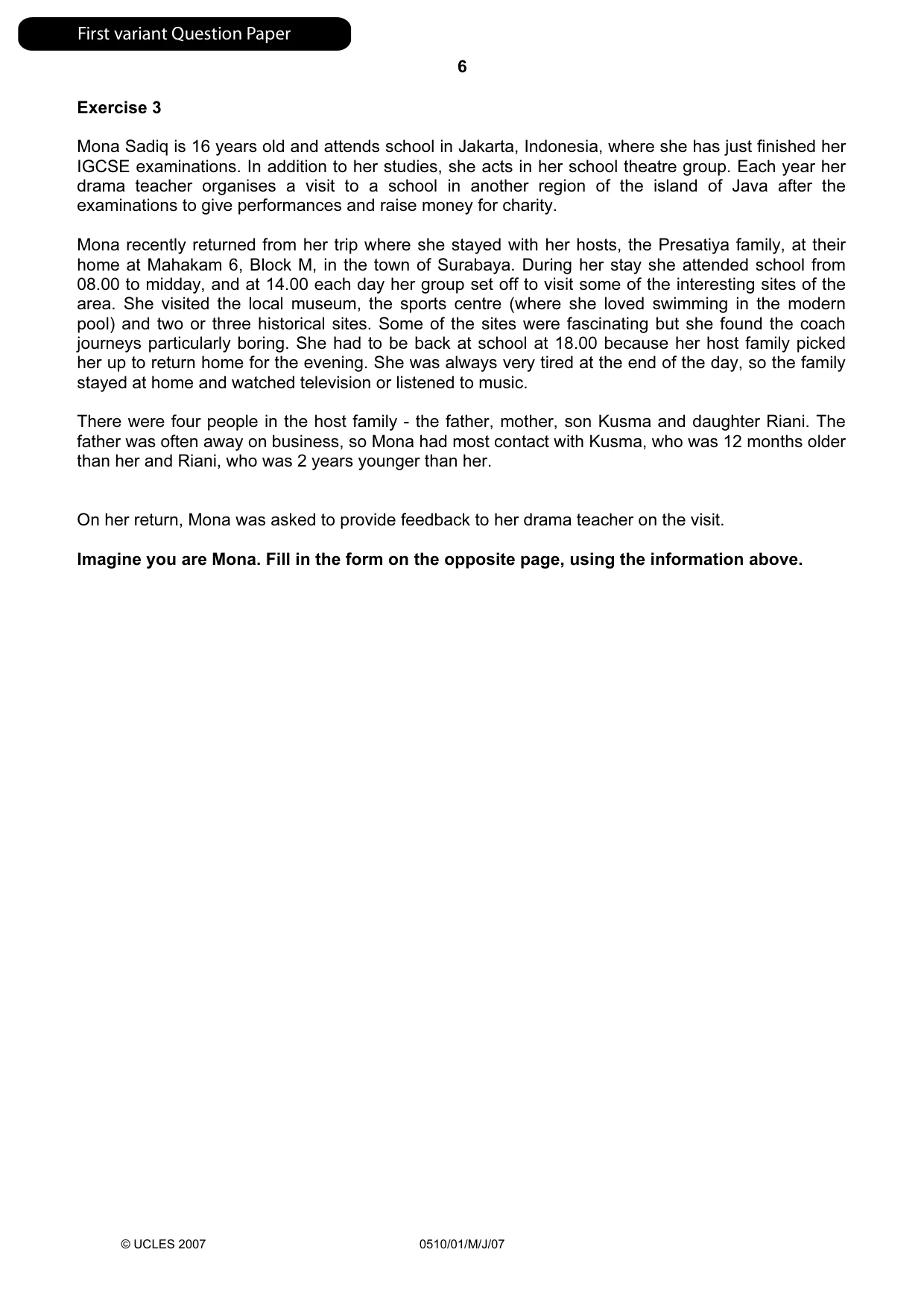
6 © UCLES 2007 0510/01/M/J/07 Exercise 3 Mona Sadiq is 16 years old and attends school in Jakarta, Indonesia, where she has just finished her IGCSE examinations. In addition to her studies, she acts in her school theatre group. Each year her drama teacher organises a visit to a school in another region of the island of Java after the examinations to give performances and raise money for charity. Mona recently returned from her trip where she stayed with her hosts, the Presatiya family, at their home at Mahakam 6, Block M, in the town of Surabaya. During her stay she attended school from 08.00 to midday, and at 14.00 each day her group set off to visit some of the interesting sites of the area. She visited the local museum, the sports centre (where she loved swimming in the modern pool) and two or three historical sites. Some of the sites were fascinating but she found the coach journeys particularly boring. She had to be back at school at 18.00 because her host family picked her up to return home for the evening. She was always very tired at the end of the day, so the family stayed at home and watched television or listened to music. There were four people in the host family - the father, mother, son Kusma and daughter Riani. The father was often away on business, so Mona had most contact with Kusma, who was 12 months older than her and Riani, who was 2 years younger than her. On her return, Mona was asked to provide feedback to her drama teacher on the visit. Imagine you are Mona. Fill in the form on the opposite page, using the information above. First variant Question Paper
Question paper, page 8
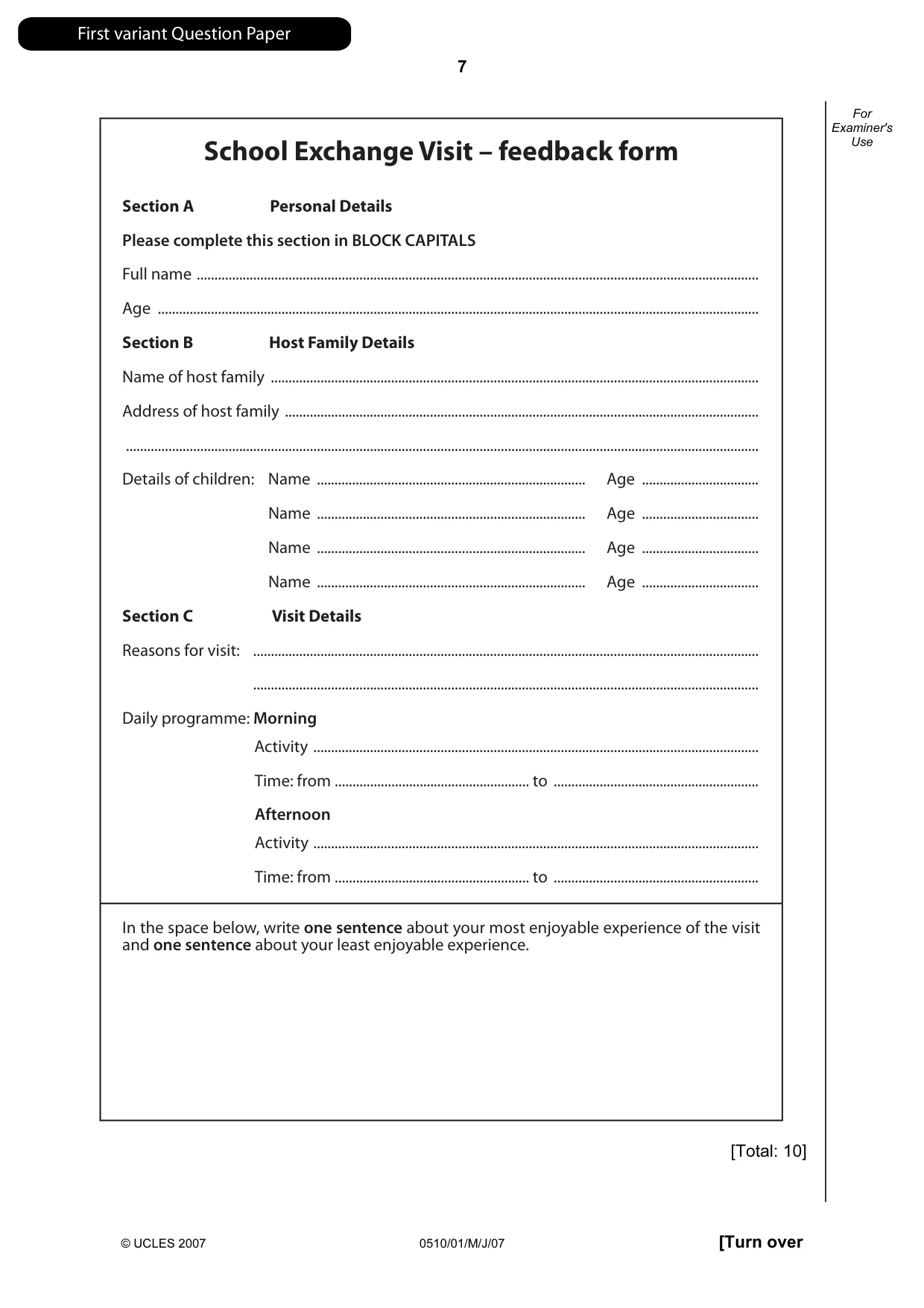
7 © UCLES 2007 0510/01/M/J/07 [Turn over For Examiner's Use School Exchange Visit – feedback form Section A Personal Details Please complete this section in BLOCK CAPITALS Full name … Age … Section B Host Family Details Name of host family … Address of host family … … Details of children: Name … Age … Name … Age … Name … Age … Name … Age … Section C Visit Details Reasons for visit: … … Daily programme: Morning Activity … Time: from … to … Afternoon Activity … Time: from … to … In the space below, write one sentence about your most enjoyable experience of the visit and one sentence about your least enjoyable experience. [Total: 10] First variant Question Paper
Question paper, page 9
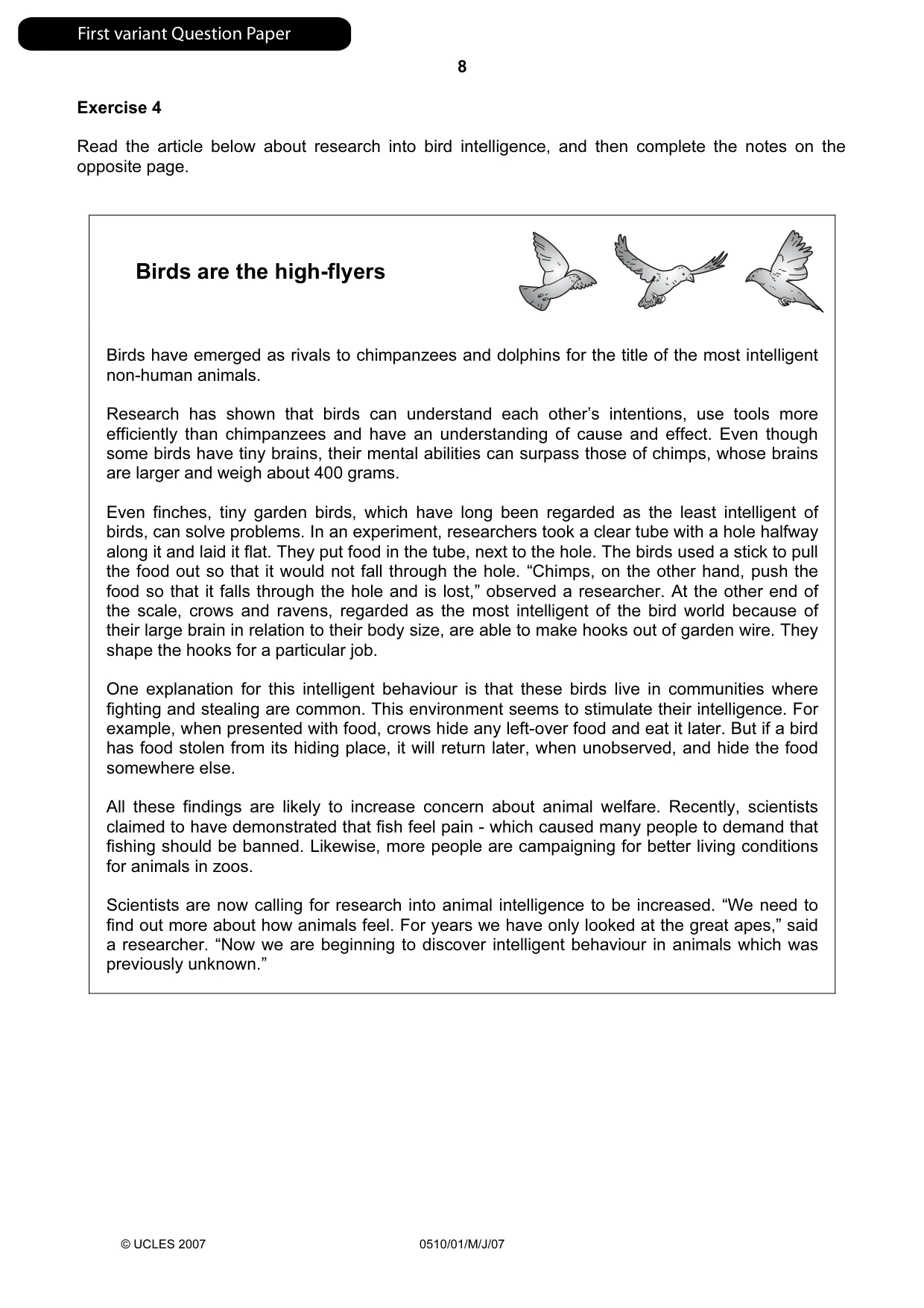
8 © UCLES 2007 0510/01/M/J/07 Exercise 4 Read the article below about research into bird intelligence, and then complete the notes on the opposite page. Birds are the high-flyers Birds have emerged as rivals to chimpanzees and dolphins for the title of the most intelligent non-human animals. Research has shown that birds can understand each other’s intentions, use tools more efficiently than chimpanzees and have an understanding of cause and effect. Even though some birds have tiny brains, their mental abilities can surpass those of chimps, whose brains are larger and weigh about 400 grams. Even finches, tiny garden birds, which have long been regarded as the least intelligent of birds, can solve problems. In an experiment, researchers took a clear tube with a hole halfway along it and laid it flat. They put food in the tube, next to the hole. The birds used a stick to pull the food out so that it would not fall through the hole. “Chimps, on the other hand, push the food so that it falls through the hole and is lost,” observed a researcher. At the other end of the scale, crows and ravens, regarded as the most intelligent of the bird world because of their large brain in relation to their body size, are able to make hooks out of garden wire. They shape the hooks for a particular job. One explanation for this intelligent behaviour is that these birds live in communities where fighting and stealing are common. This environment seems to stimulate their intelligence. For example, when presented with food, crows hide any left-over food and eat it later. But if a bird has food stolen from its hiding place, it will return later, when unobserved, and hide the food somewhere else. All these findings are likely to increase concern about animal welfare. Recently, scientists claimed to have demonstrated that fish feel pain - which caused many people to demand that fishing should be banned. Likewise, more people are campaigning for better living conditions for animals in zoos. Scientists are now calling for research into animal intelligence to be increased. “We need to find out more about how animals feel. For years we have only looked at the great apes,” said a researcher. “Now we are beginning to discover intelligent behaviour in animals which was previously unknown.” First variant Question Paper
Question paper, page 10
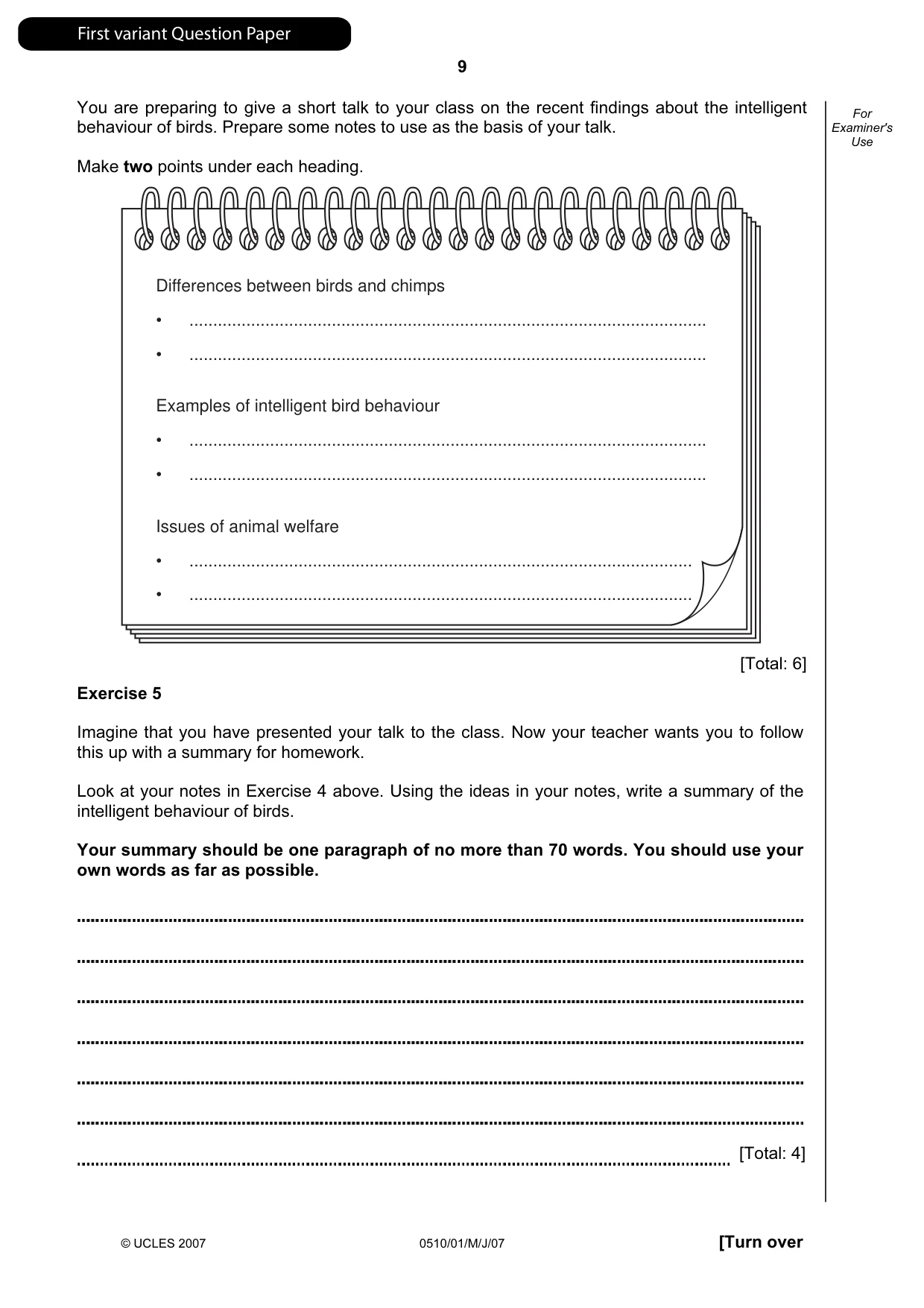
9 © UCLES 2007 0510/01/M/J/07 [Turn over For Examiner's Use You are preparing to give a short talk to your class on the recent findings about the intelligent behaviour of birds. Prepare some notes to use as the basis of your talk. Make two points under each heading. Differences between birds and chimps • … • … Examples of intelligent bird behaviour • … • … Issues of animal welfare • … • … [Total: 6] Exercise 5 Imagine that you have presented your talk to the class. Now your teacher wants you to follow this up with a summary for homework. Look at your notes in Exercise 4 above. Using the ideas in your notes, write a summary of the intelligent behaviour of birds. Your summary should be one paragraph of no more than 70 words. You should use your own words as far as possible. [Total: 4] First variant Question Paper
Question paper, page 11
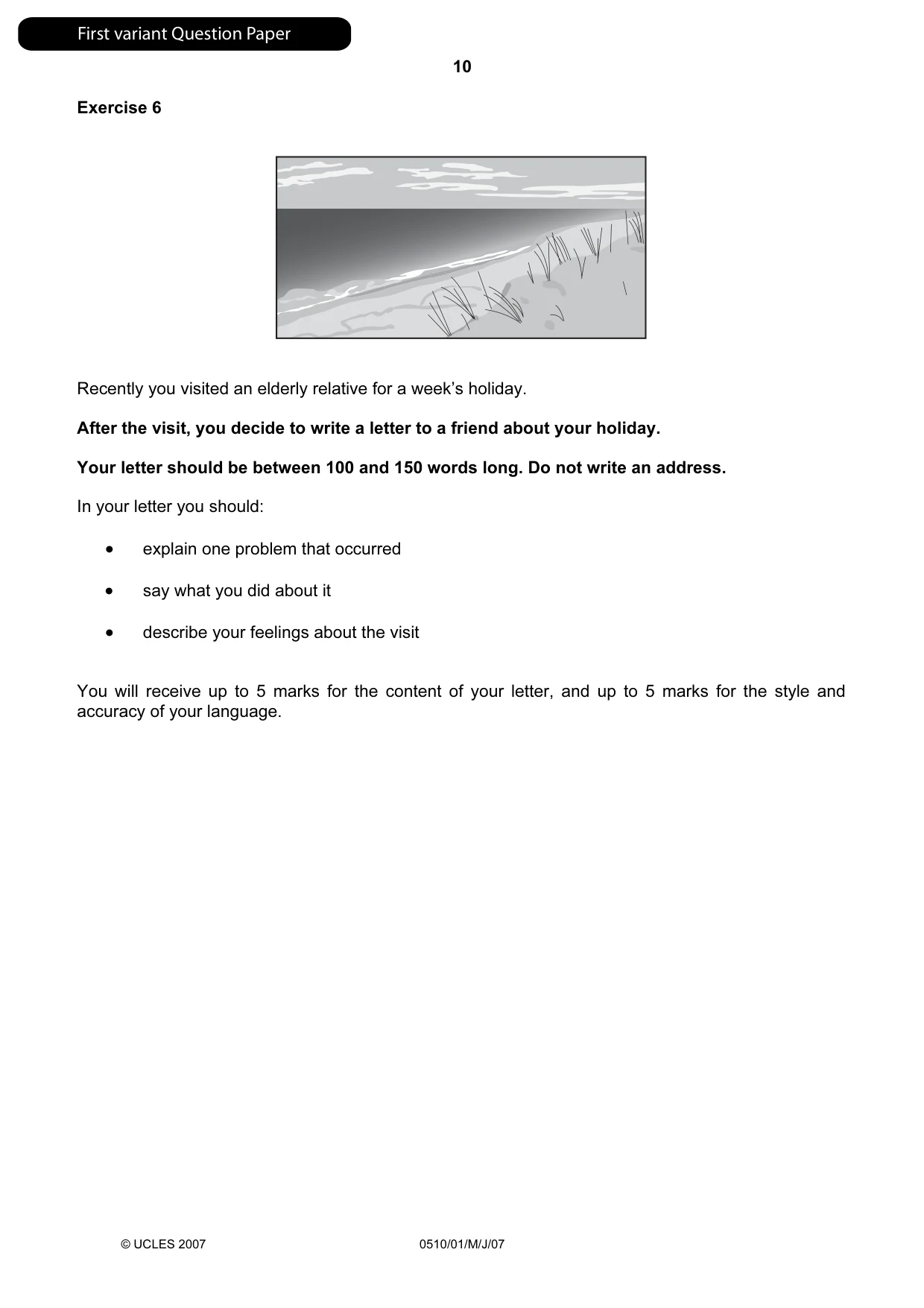
10 © UCLES 2007 0510/01/M/J/07 Exercise 6 Recently you visited an elderly relative for a week’s holiday. After the visit, you decide to write a letter to a friend about your holiday. Your letter should be between 100 and 150 words long. Do not write an address. In your letter you should: • explain one problem that occurred • say what you did about it • describe your feelings about the visit You will receive up to 5 marks for the content of your letter, and up to 5 marks for the style and accuracy of your language. First variant Question Paper
Question paper, page 12
11 © UCLES 2007 0510/01/M/J/07 [Turn over For Examiner's Use [10] First variant Question Paper
Question paper, page 13
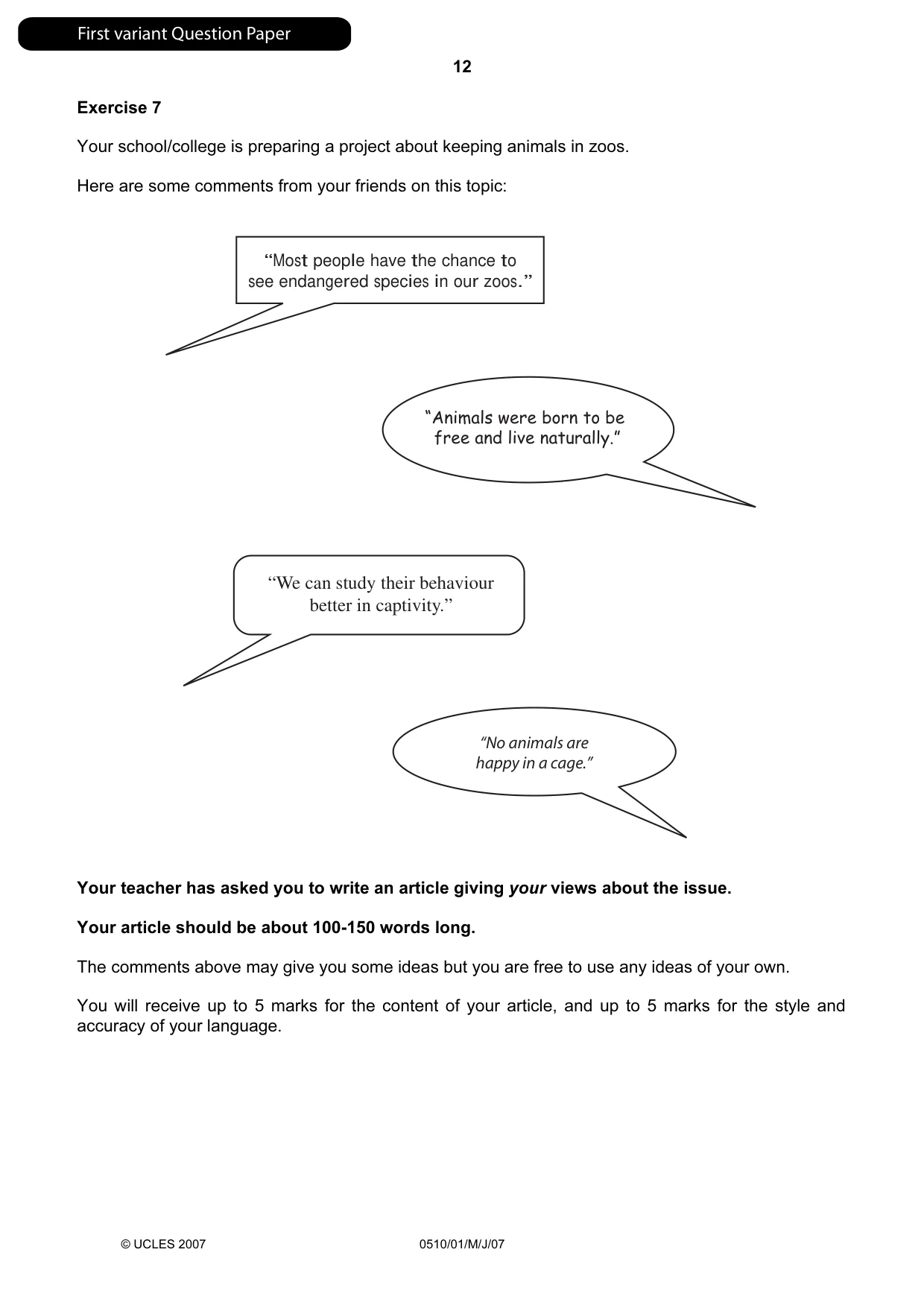
12 © UCLES 2007 0510/01/M/J/07 Exercise 7 Your school/college is preparing a project about keeping animals in zoos. Here are some comments from your friends on this topic: “Most people have the chance to see endangered species in our zoos.” “Animals were born to be free and live naturally.” “No animals are happy in a cage.” “We can study their behaviour better in captivity.” Your teacher has asked you to write an article giving your views about the issue. Your article should be about 100-150 words long. The comments above may give you some ideas but you are free to use any ideas of your own. You will receive up to 5 marks for the content of your article, and up to 5 marks for the style and accuracy of your language. First variant Question Paper
Question paper, page 14
13 © UCLES 2007 0510/01/M/J/07 For Examiner's Use [10] First variant Question Paper
Question paper, page 15
14 0510/01/M/J/07 BLANK PAGE First variant Question Paper
Question paper, page 16
15 0510/01/M/J/07 BLANK PAGE First variant Question Paper
Question paper, page 17
16 Permission to reproduce items where third-party owned material protected by copyright is included has been sought and cleared where possible. Every reasonable effort has been made by the publisher (UCLES) to trace copyright holders, but if any items requiring clearance have unwittingly been included, the publisher will be pleased to make amends at the earliest possible opportunity. University of Cambridge International Examinations is part of the Cambridge Assessment Group. Cambridge Assessment is the brand name of University of Cambridge Local Examinations Syndicate (UCLES), which is itself a department of the University of Cambridge. 0510/01/M/J/07 BLANK PAGE First variant Question Paper
Question paper, page 18
This document consists of 13 printed pages and 3 blank pages. IB07 06_0510_01_TZ/3RP © UCLES 2007 [Turn over For Examiner's Use Exercise 1 Exercise 2 Exercise 3 Exercise 4 Exercise 5 Exercise 6 Exercise 7 Total *7314780653* For Examiner's Use Exercise 1 Exercise 2 Exercise 3 Exercise 4 Exercise 5 Exercise 6 Exercise 7 Total UNIVERSITY OF CAMBRIDGE INTERNATIONAL EXAMINATIONS International General Certificate of Secondary Education ENGLISH AS A SECOND LANGUAGE 0510/01 Paper 1 Reading and Writing (Core) May/June 2007 1 hour 30 minutes Candidates answer on the Question Paper. No Additional Materials are required. READ THESE INSTRUCTIONS FIRST Write your Centre number, candidate number and name on all the work you hand in. Write in dark blue or black pen. Do not use staples, paper clips, highlighters, glue or correction fluid. DO NOT WRITE IN ANY BARCODES. Answer all questions. Dictionaries are not allowed. At the end of the examination, fasten all your work securely together. The number of marks is given in brackets [ ] at the end of each question or part question. Q Second variant Question Paper
Question paper, page 19
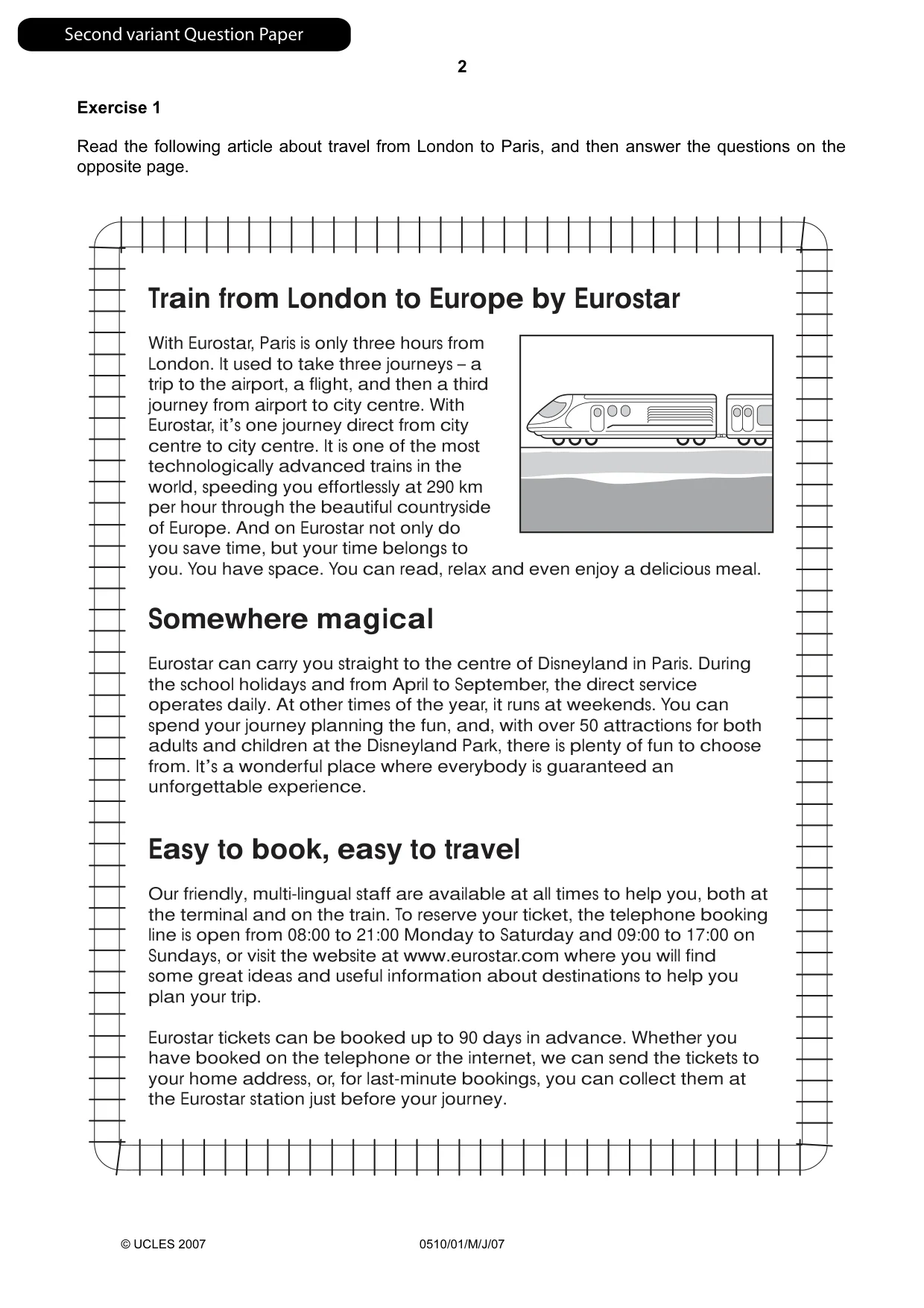
2 © UCLES 2007 0510/01/M/J/07 Exercise 1 Read the following article about travel from London to Paris, and then answer the questions on the opposite page. Train from London to Europe by Eurostar With Eurostar, Paris is only three hours from London. It used to take three journeys – a trip to the airport, a flight, and then a third journey from airport to city centre. With Eurostar, it’s one journey direct from city centre to city centre. It is one of the most technologically advanced trains in the world, speeding you effortlessly at 290 km per hour through the beautiful countryside of Europe. And on Eurostar not only do you save time, but your time belongs to you. You have space. You can read, relax and even enjoy a delicious meal. Somewhere magical Eurostar can carry you straight to the centre of Disneyland in Paris. During the school holidays and from April to September, the direct service operates daily. At other times of the year, it runs at weekends. You can spend your journey planning the fun, and, with over 50 attractions for both adults and children at the Disneyland Park, there is plenty of fun to choose from. It’s a wonderful place where everybody is guaranteed an unforgettable experience. Easy to book, easy to travel Our friendly, multi-lingual staff are available at all times to help you, both at the terminal and on the train. To reserve your ticket, the telephone booking line is open from 08:00 to 21:00 Monday to Saturday and 09:00 to 17:00 on Sundays, or visit the website at www.eurostar.com where you will find some great ideas and useful information about destinations to help you plan your trip. Eurostar tickets can be booked up to 90 days in advance. Whether you have booked on the telephone or the internet, we can send the tickets to your home address, or, for last-minute bookings, you can collect them at the Eurostar station just before your journey. Second variant Question Paper
Question paper, page 20
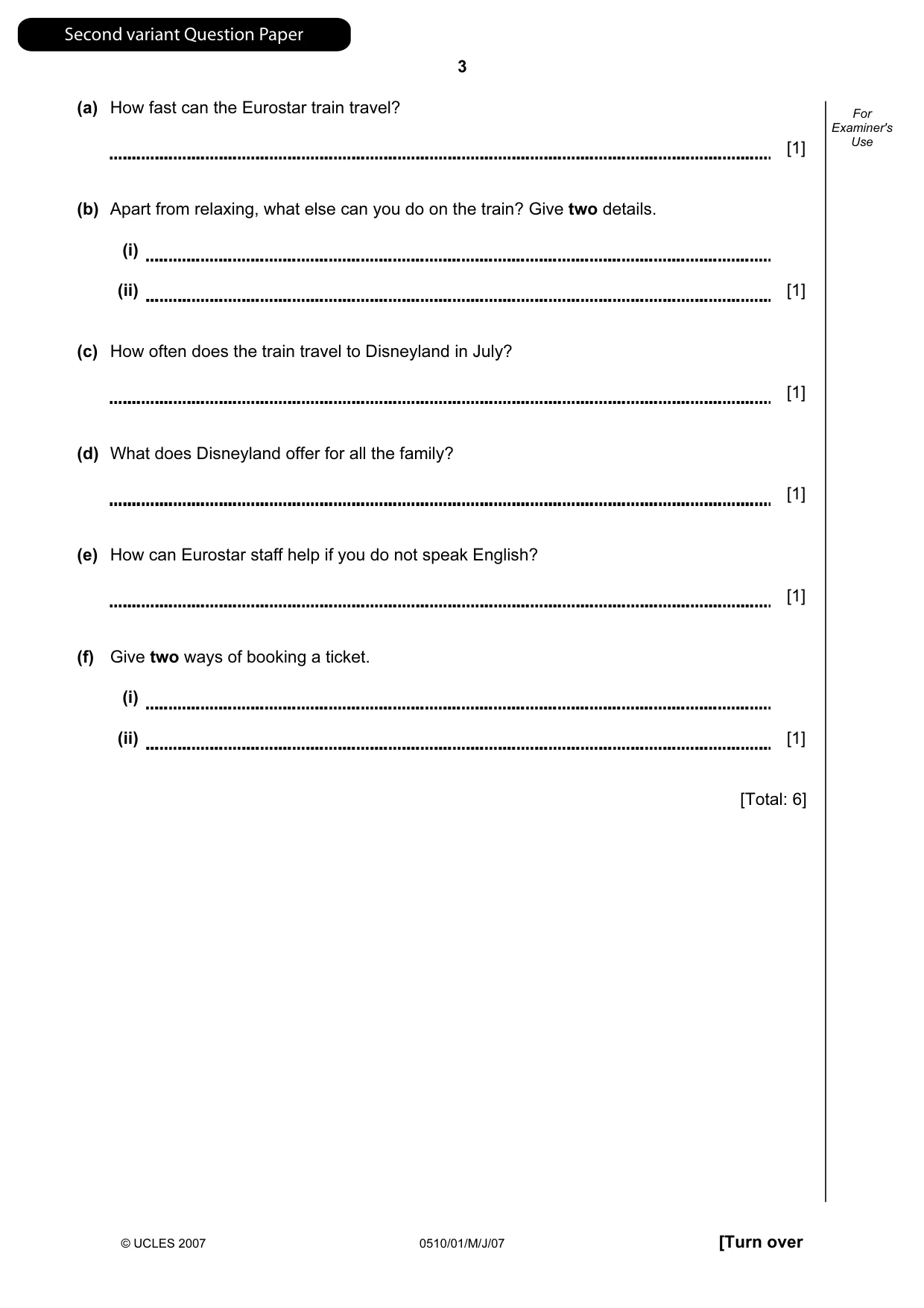
3 © UCLES 2007 0510/01/M/J/07 [Turn over For Examiner's Use (a) How fast can the Eurostar train travel? [1] (b) Apart from relaxing, what else can you do on the train? Give two details. (i) (ii) [1] (c) How often does the train travel to Disneyland in July? [1] (d) What does Disneyland offer for all the family? [1] (e) How can Eurostar staff help if you do not speak English? [1] (f) Give two ways of booking a ticket. (i) (ii) [1] [Total: 6] Second variant Question Paper
Question paper, page 21
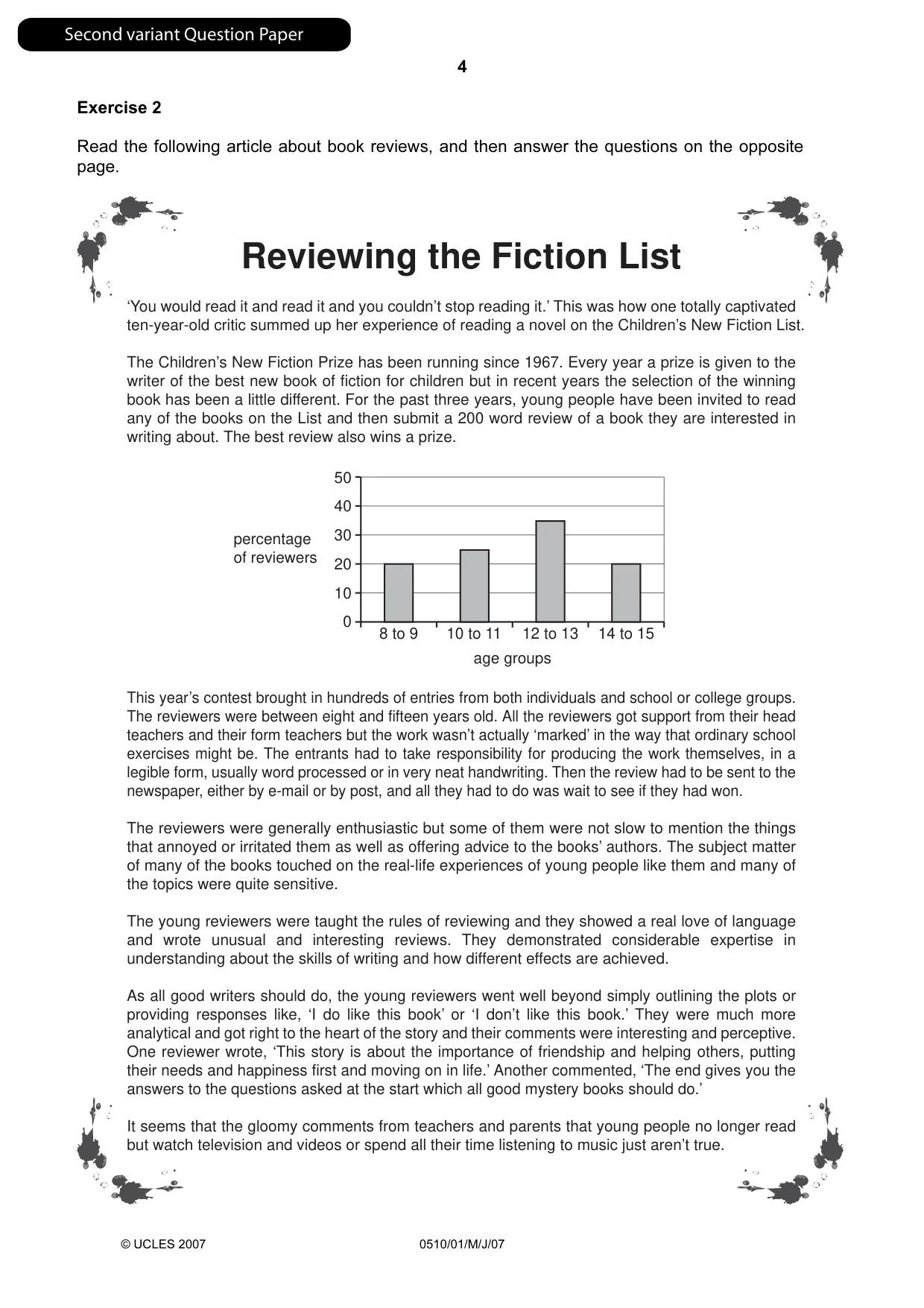
4 © UCLES 2007 0510/01/M/J/07 Exercise 2 Read the following article about book reviews, and then answer the questions on the opposite page. Reviewing the Fiction List ‘You would read it and read it and you couldn’t stop reading it.’ This was how one totally captivated ten-year-old critic summed up her experience of reading a novel on the Children’s New Fiction List. The Children’s New Fiction Prize has been running since 1967. Every year a prize is given to the writer of the best new book of fiction for children but in recent years the selection of the winning book has been a little different. For the past three years, young people have been invited to read any of the books on the List and then submit a 200 word review of a book they are interested in writing about. The best review also wins a prize. This year’s contest brought in hundreds of entries from both individuals and school or college groups. The reviewers were between eight and fifteen years old. All the reviewers got support from their head teachers and their form teachers but the work wasn’t actually ‘marked’ in the way that ordinary school exercises might be. The entrants had to take responsibility for producing the work themselves, in a legible form, usually word processed or in very neat handwriting. Then the review had to be sent to the newspaper, either by e-mail or by post, and all they had to do was wait to see if they had won. The reviewers were generally enthusiastic but some of them were not slow to mention the things that annoyed or irritated them as well as offering advice to the books’ authors. The subject matter of many of the books touched on the real-life experiences of young people like them and many of the topics were quite sensitive. The young reviewers were taught the rules of reviewing and they showed a real love of language and wrote unusual and interesting reviews. They demonstrated considerable expertise in understanding about the skills of writing and how different effects are achieved. As all good writers should do, the young reviewers went well beyond simply outlining the plots or providing responses like, ‘I do like this book’ or ‘I don’t like this book.’ They were much more analytical and got right to the heart of the story and their comments were interesting and perceptive. One reviewer wrote, ‘This story is about the importance of friendship and helping others, putting their needs and happiness first and moving on in life.’ Another commented, ‘The end gives you the answers to the questions asked at the start which all good mystery books should do.’ It seems that the gloomy comments from teachers and parents that young people no longer read but watch television and videos or spend all their time listening to music just aren’t true. 50 40 30 20 10 0 10 to 11 8 to 9 12 to 13 14 to 15 age groups percentage of reviewers Second variant Question Paper
Question paper, page 22
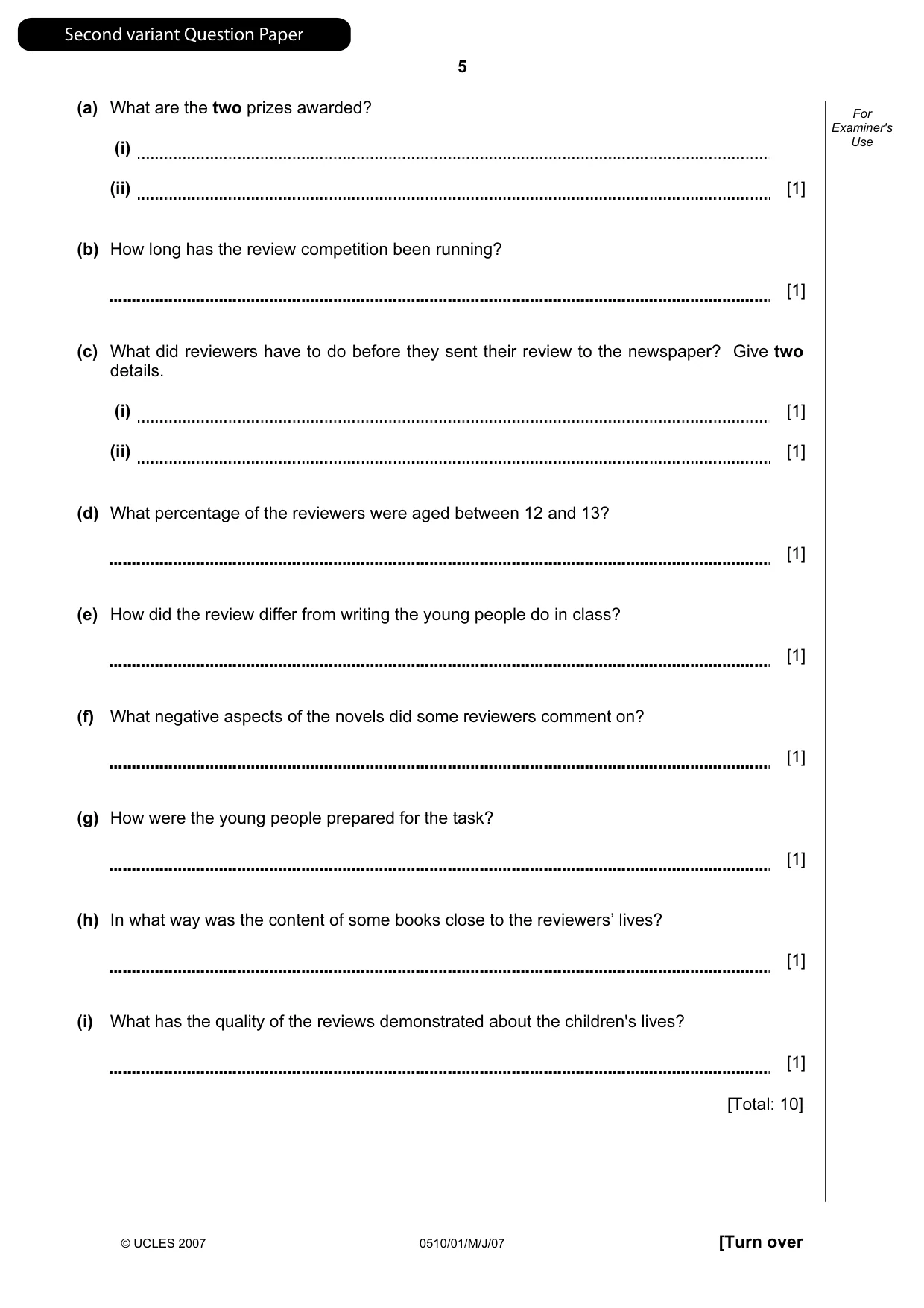
5 © UCLES 2007 0510/01/M/J/07 [Turn over For Examiner's Use (a) What are the two prizes awarded? (i) (ii) [1] (b) How long has the review competition been running? [1] (c) What did reviewers have to do before they sent their review to the newspaper? Give two details. (i) [1] (ii) [1] (d) What percentage of the reviewers were aged between 12 and 13? [1] (e) How did the review differ from writing the young people do in class? [1] (f) What negative aspects of the novels did some reviewers comment on? [1] (g) How were the young people prepared for the task? [1] (h) In what way was the content of some books close to the reviewers’ lives? [1] (i) What has the quality of the reviews demonstrated about the children's lives? [1] [Total: 10] Second variant Question Paper
Question paper, page 23
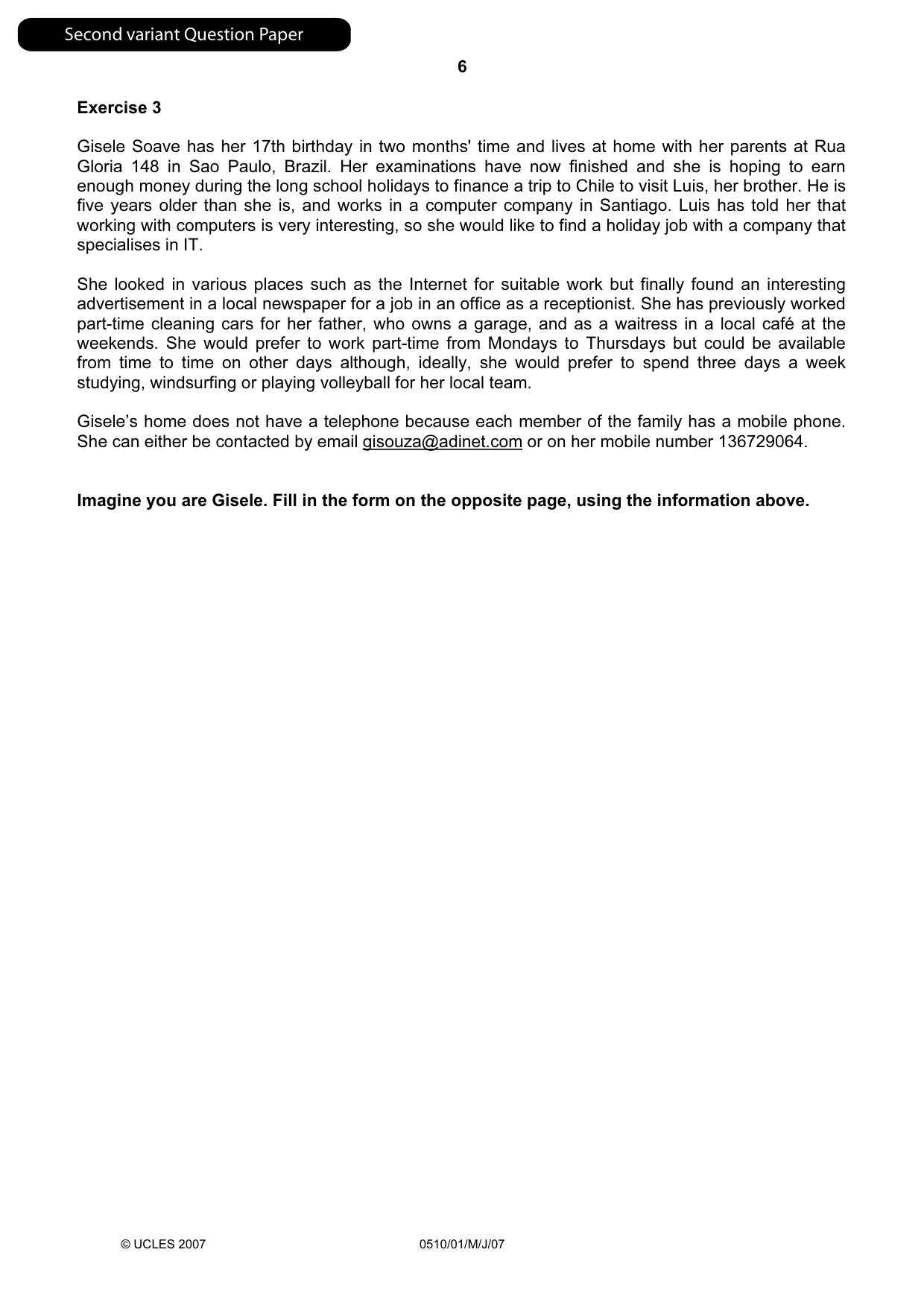
6 © UCLES 2007 0510/01/M/J/07 Exercise 3 Gisele Soave has her 17th birthday in two months' time and lives at home with her parents at Rua Gloria 148 in Sao Paulo, Brazil. Her examinations have now finished and she is hoping to earn enough money during the long school holidays to finance a trip to Chile to visit Luis, her brother. He is five years older than she is, and works in a computer company in Santiago. Luis has told her that working with computers is very interesting, so she would like to find a holiday job with a company that specialises in IT. She looked in various places such as the Internet for suitable work but finally found an interesting advertisement in a local newspaper for a job in an office as a receptionist. She has previously worked part-time cleaning cars for her father, who owns a garage, and as a waitress in a local café at the weekends. She would prefer to work part-time from Mondays to Thursdays but could be available from time to time on other days although, ideally, she would prefer to spend three days a week studying, windsurfing or playing volleyball for her local team. Gisele’s home does not have a telephone because each member of the family has a mobile phone. She can either be contacted by email gisouza@adinet.com or on her mobile number 136729064. Imagine you are Gisele. Fill in the form on the opposite page, using the information above. Second variant Question Paper
Question paper, page 24
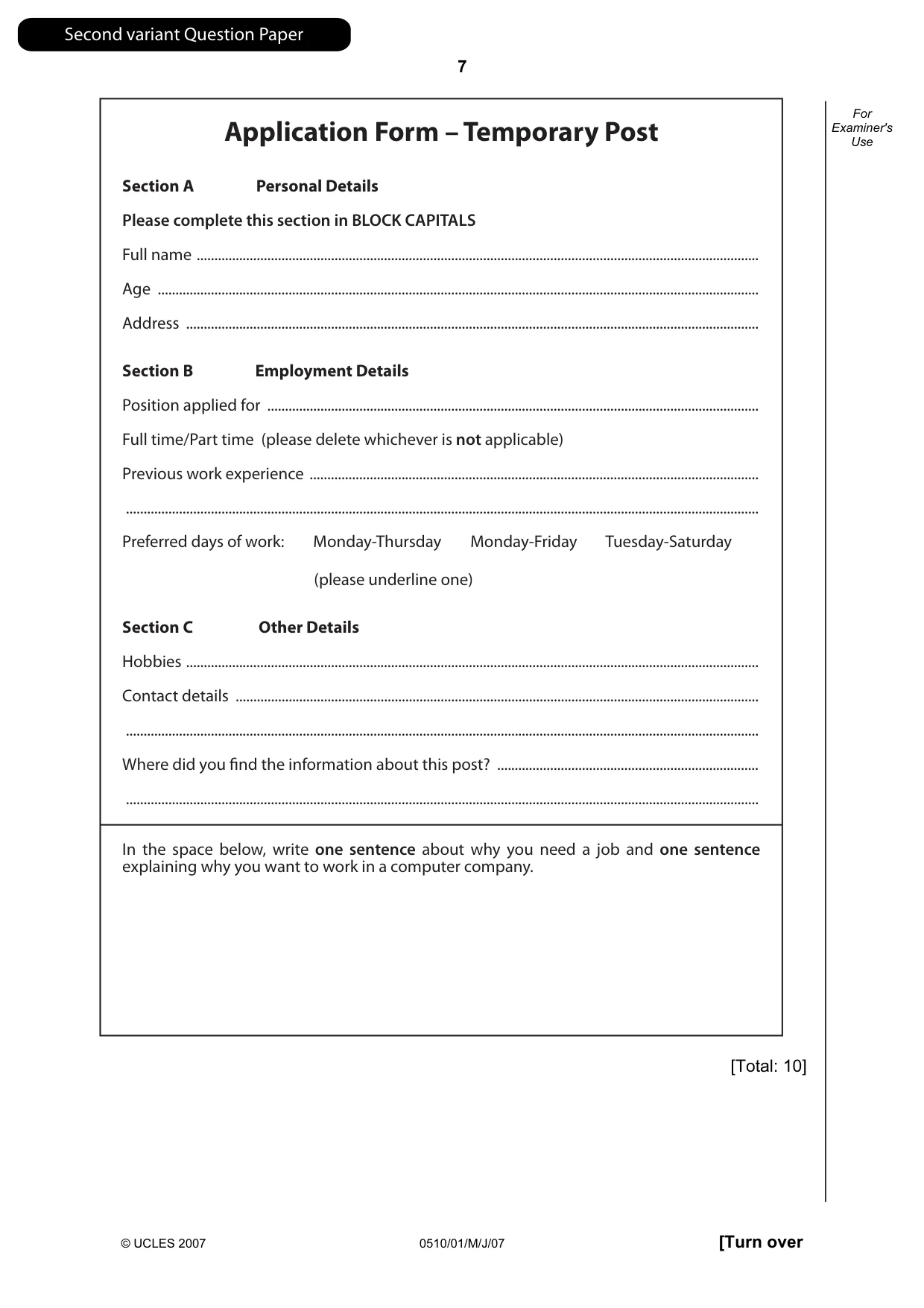
7 © UCLES 2007 0510/01/M/J/07 [Turn over For Examiner's Use Application Form – Temporary Post Section A Personal Details Please complete this section in BLOCK CAPITALS Full name … Age … Address … Section B Employment Details Position applied for … Full time/Part time (please delete whichever is not applicable) Previous work experience … … Preferred days of work: Monday-Thursday Monday-Friday Tuesday-Saturday (please underline one) Section C Other Details Hobbies … Contact details … … Where did you find the information about this post? … … In the space below, write one sentence about why you need a job and one sentence explaining why you want to work in a computer company. [Total: 10] Second variant Question Paper
Question paper, page 25
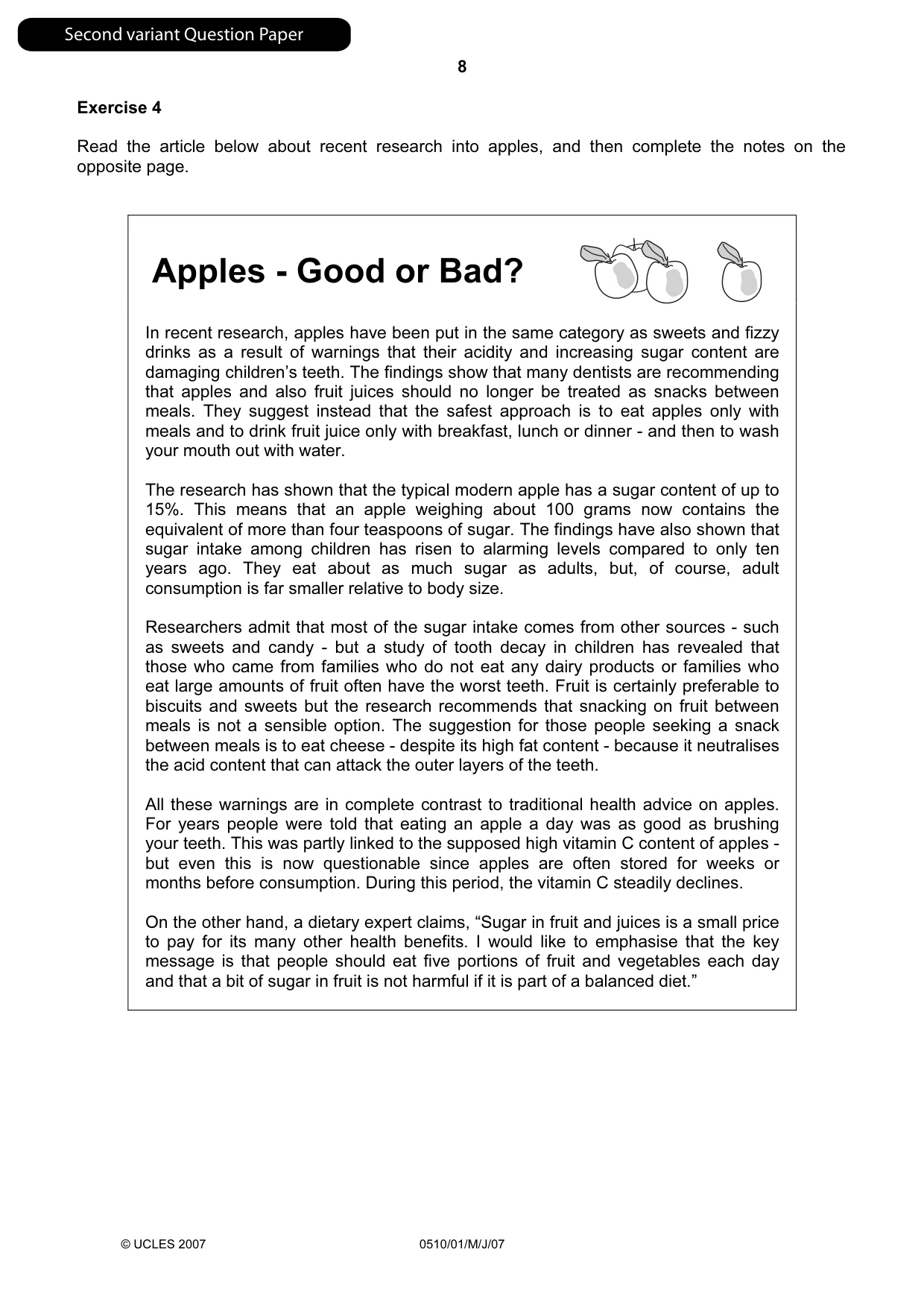
8 © UCLES 2007 0510/01/M/J/07 Exercise 4 Read the article below about recent research into apples, and then complete the notes on the opposite page. Apples - Good or Bad? In recent research, apples have been put in the same category as sweets and fizzy drinks as a result of warnings that their acidity and increasing sugar content are damaging children’s teeth. The findings show that many dentists are recommending that apples and also fruit juices should no longer be treated as snacks between meals. They suggest instead that the safest approach is to eat apples only with meals and to drink fruit juice only with breakfast, lunch or dinner - and then to wash your mouth out with water. The research has shown that the typical modern apple has a sugar content of up to 15%. This means that an apple weighing about 100 grams now contains the equivalent of more than four teaspoons of sugar. The findings have also shown that sugar intake among children has risen to alarming levels compared to only ten years ago. They eat about as much sugar as adults, but, of course, adult consumption is far smaller relative to body size. Researchers admit that most of the sugar intake comes from other sources - such as sweets and candy - but a study of tooth decay in children has revealed that those who came from families who do not eat any dairy products or families who eat large amounts of fruit often have the worst teeth. Fruit is certainly preferable to biscuits and sweets but the research recommends that snacking on fruit between meals is not a sensible option. The suggestion for those people seeking a snack between meals is to eat cheese - despite its high fat content - because it neutralises the acid content that can attack the outer layers of the teeth. All these warnings are in complete contrast to traditional health advice on apples. For years people were told that eating an apple a day was as good as brushing your teeth. This was partly linked to the supposed high vitamin C content of apples - but even this is now questionable since apples are often stored for weeks or months before consumption. During this period, the vitamin C steadily declines. On the other hand, a dietary expert claims, “Sugar in fruit and juices is a small price to pay for its many other health benefits. I would like to emphasise that the key message is that people should eat five portions of fruit and vegetables each day and that a bit of sugar in fruit is not harmful if it is part of a balanced diet.” Second variant Question Paper
Question paper, page 26
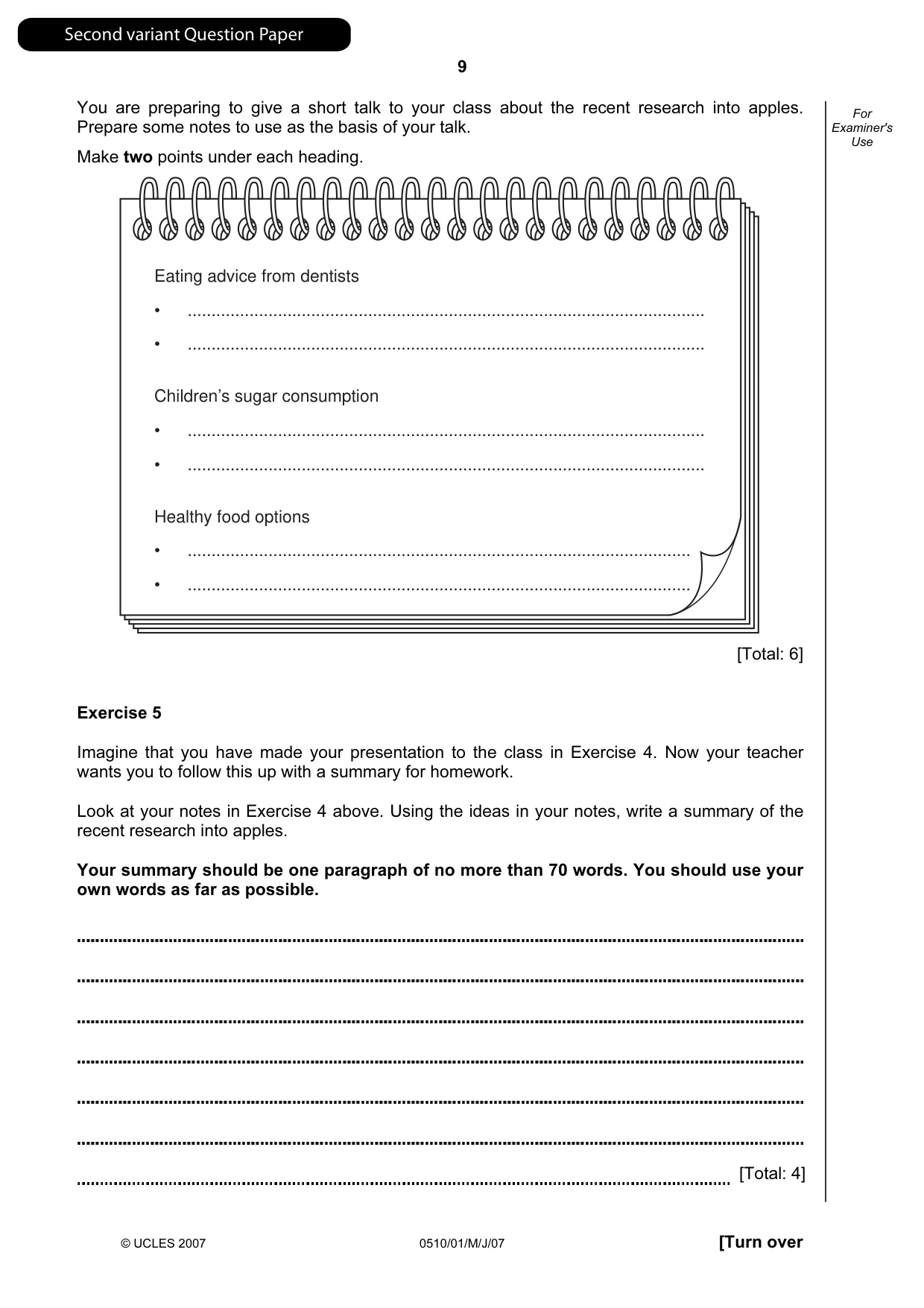
9 © UCLES 2007 0510/01/M/J/07 [Turn over For Examiner's Use You are preparing to give a short talk to your class about the recent research into apples. Prepare some notes to use as the basis of your talk. Make two points under each heading. Eating advice from dentists • … • … Children’s sugar consumption • … • … Healthy food options • … • … [Total: 6] Exercise 5 Imagine that you have made your presentation to the class in Exercise 4. Now your teacher wants you to follow this up with a summary for homework. Look at your notes in Exercise 4 above. Using the ideas in your notes, write a summary of the recent research into apples. Your summary should be one paragraph of no more than 70 words. You should use your own words as far as possible. [Total: 4] Second variant Question Paper
Question paper, page 27
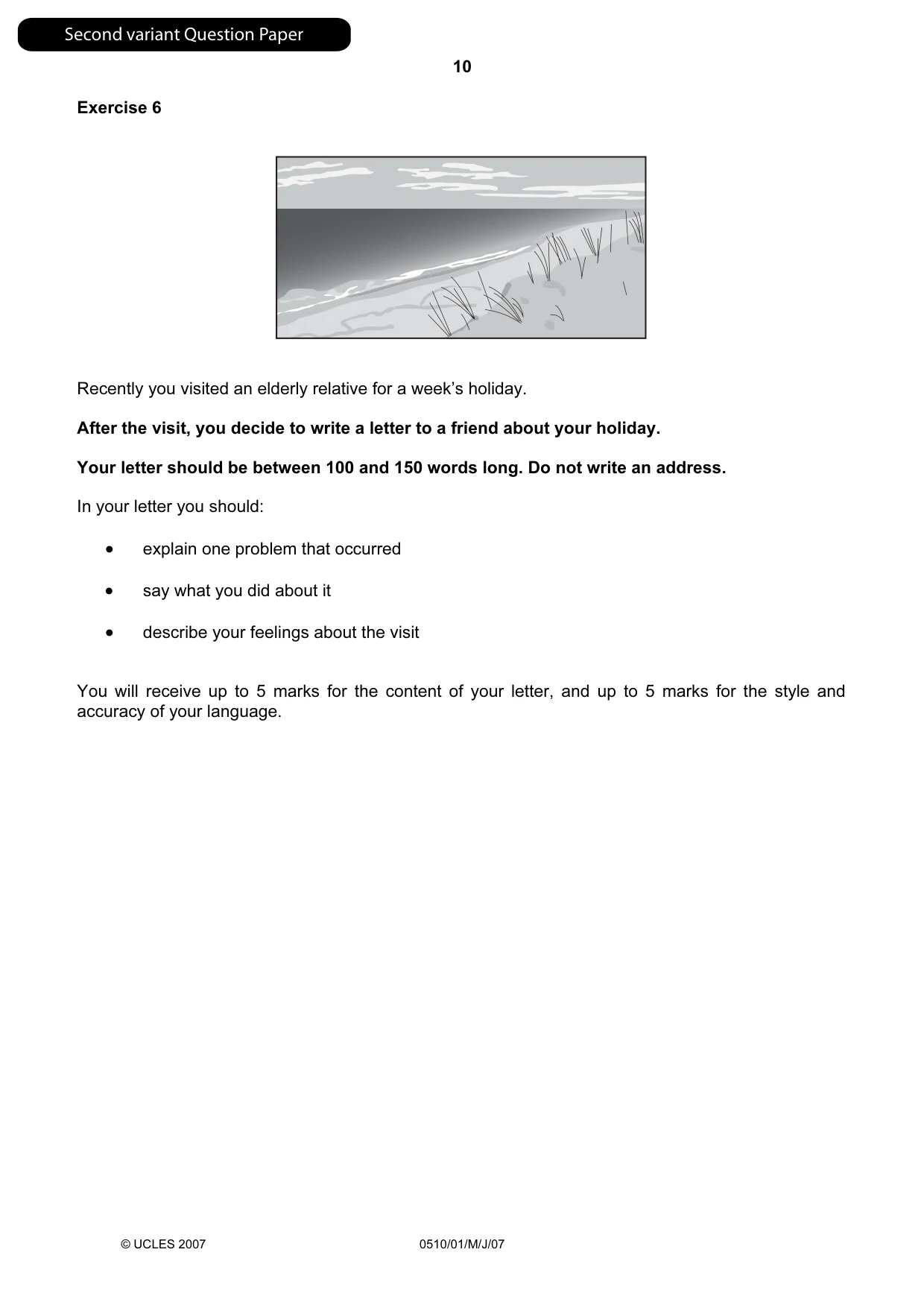
10 © UCLES 2007 0510/01/M/J/07 Exercise 6 Recently you visited an elderly relative for a week’s holiday. After the visit, you decide to write a letter to a friend about your holiday. Your letter should be between 100 and 150 words long. Do not write an address. In your letter you should: • explain one problem that occurred • say what you did about it • describe your feelings about the visit You will receive up to 5 marks for the content of your letter, and up to 5 marks for the style and accuracy of your language. Second variant Question Paper
Question paper, page 28
11 © UCLES 2007 0510/01/M/J/07 [Turn over For Examiner's Use [10] Second variant Question Paper
Question paper, page 29
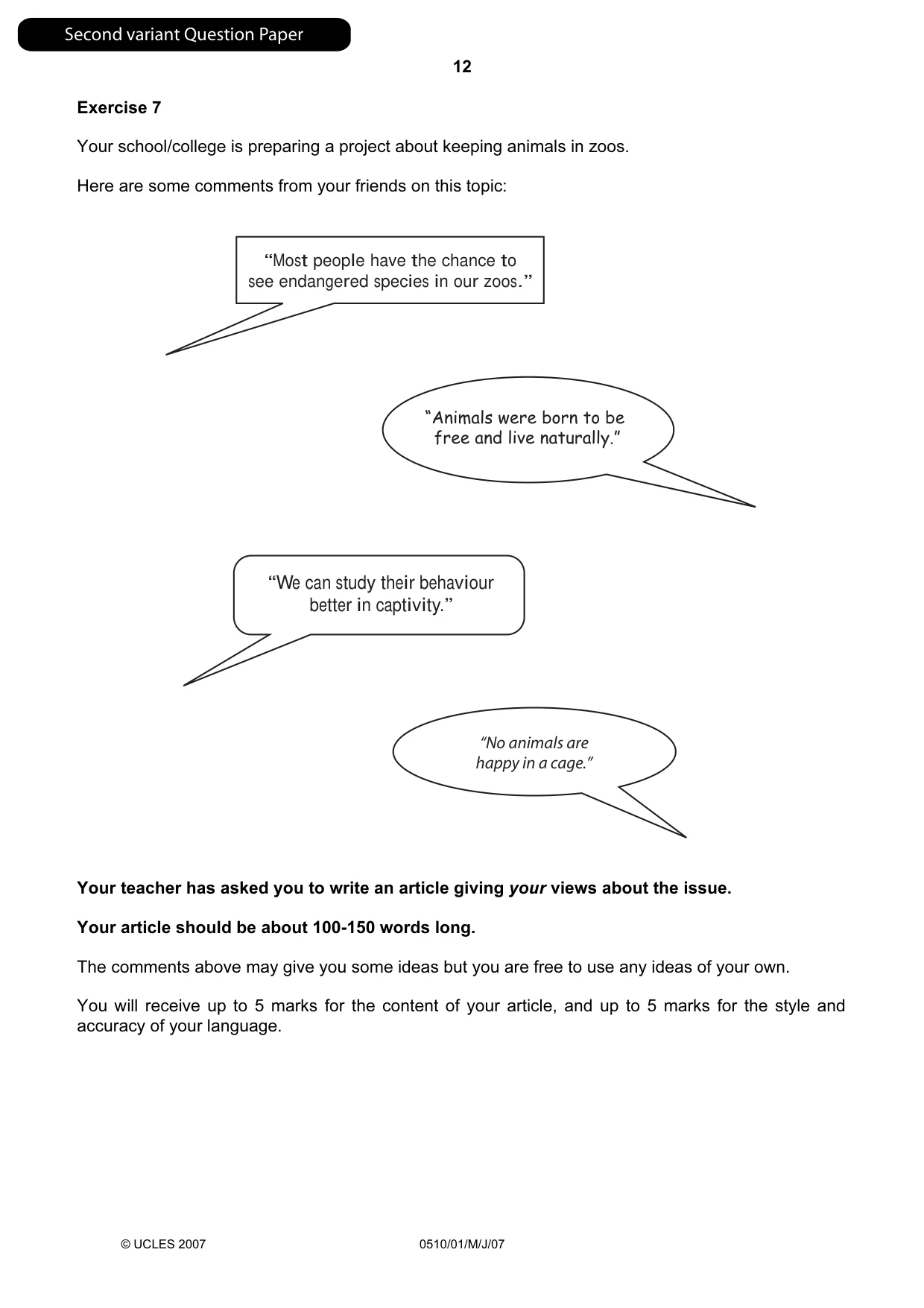
12 © UCLES 2007 0510/01/M/J/07 Exercise 7 Your school/college is preparing a project about keeping animals in zoos. Here are some comments from your friends on this topic: “Most people have the chance to see endangered species in our zoos.” “Animals were born to be free and live naturally.” “No animals are happy in a cage.” “We can study their behaviour better in captivity.” Your teacher has asked you to write an article giving your views about the issue. Your article should be about 100-150 words long. The comments above may give you some ideas but you are free to use any ideas of your own. You will receive up to 5 marks for the content of your article, and up to 5 marks for the style and accuracy of your language. Second variant Question Paper
Question paper, page 30
13 © UCLES 2007 0510/01/M/J/07 [Turn over For Examiner's Use [10] Second variant Question Paper
Question paper, page 31
14 0510/01/M/J/07 BLANK PAGE Second variant Question Paper
Question paper, page 32
15 0510/01/M/J/07 BLANK PAGE Second variant Question Paper
Question paper, page 33
16 Permission to reproduce items where third-party owned material protected by copyright is included has been sought and cleared where possible. Every reasonable effort has been made by the publisher (UCLES) to trace copyright holders, but if any items requiring clearance have unwittingly been included, the publisher will be pleased to make amends at the earliest possible opportunity. University of Cambridge International Examinations is part of the Cambridge Assessment Group. Cambridge Assessment is the brand name of University of Cambridge Local Examinations Syndicate (UCLES), which is itself a department of the University of Cambridge. 0510/01/M/J/07 BLANK PAGE Second variant Question Paper
Mark scheme, page 1
Location Entry Codes From the June 2007 session, as part of CIE’s continual commitment to maintaining best practice in assessment, CIE has begun to use different variants of some question papers for our most popular assessments with extremely large and widespread candidature, The question papers are closely related and the relationships between them have been thoroughly established using our assessment expertise. All versions of the paper give assessment of equal standard. The content assessed by the examination papers and the type of questions are unchanged. This change means that for this component there are now two variant Question Papers, Mark Schemes and Principal Examiner’s Reports where previously there was only one. For any individual country, it is intended that only one variant is used. This document contains both variants which will give all Centres access to even more past examination material than is usually the case. The diagram shows the relationship between the Question Papers, Mark Schemes and Principal Examiner’s Reports. Question Paper Mark Scheme Principal Examiner’s Report Introduction Introduction Introduction First variant Question Paper First variant Mark Scheme First variant Principal Examiner’s Report Second variant Question Paper Second variant Mark Scheme Second variant Principal Examiner’s Report Who can I contact for further information on these changes? Please direct any questions about this to CIE’s Customer Services team at: international@cie.org.uk www.XtremePapers.com
Mark scheme, page 2
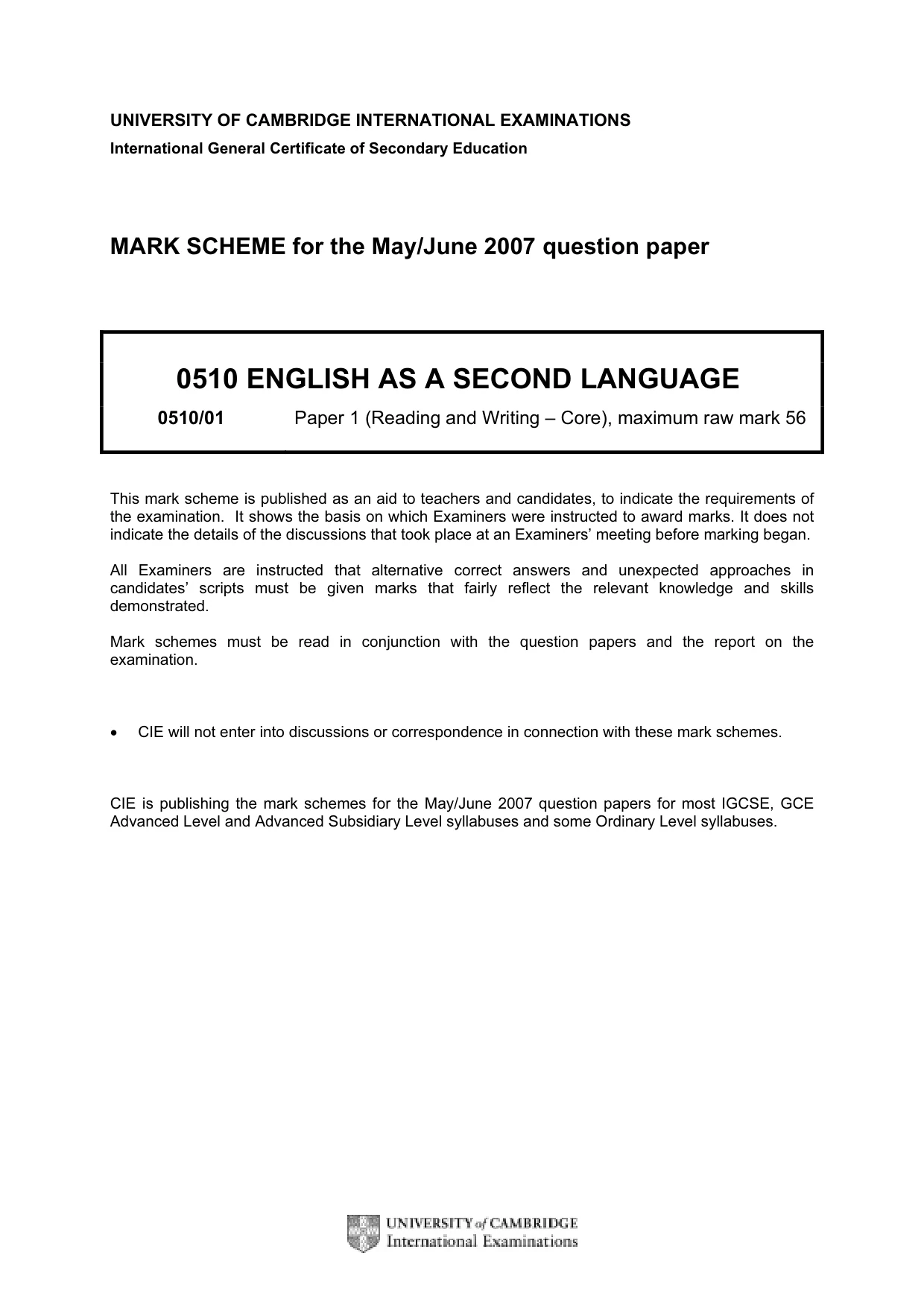
UNIVERSITY OF CAMBRIDGE INTERNATIONAL EXAMINATIONS International General Certificate of Secondary Education MARK SCHEME for the May/June 2007 question paper 0510 ENGLISH AS A SECOND LANGUAGE 0510/01 Paper 1 (Reading and Writing – Core), maximum raw mark 56 This mark scheme is published as an aid to teachers and candidates, to indicate the requirements of the examination. It shows the basis on which Examiners were instructed to award marks. It does not indicate the details of the discussions that took place at an Examiners’ meeting before marking began. All Examiners are instructed that alternative correct answers and unexpected approaches in candidates’ scripts must be given marks that fairly reflect the relevant knowledge and skills demonstrated. Mark schemes must be read in conjunction with the question papers and the report on the examination. • CIE will not enter into discussions or correspondence in connection with these mark schemes. CIE is publishing the mark schemes for the May/June 2007 question papers for most IGCSE, GCE Advanced Level and Advanced Subsidiary Level syllabuses and some Ordinary Level syllabuses.
Mark scheme, page 3
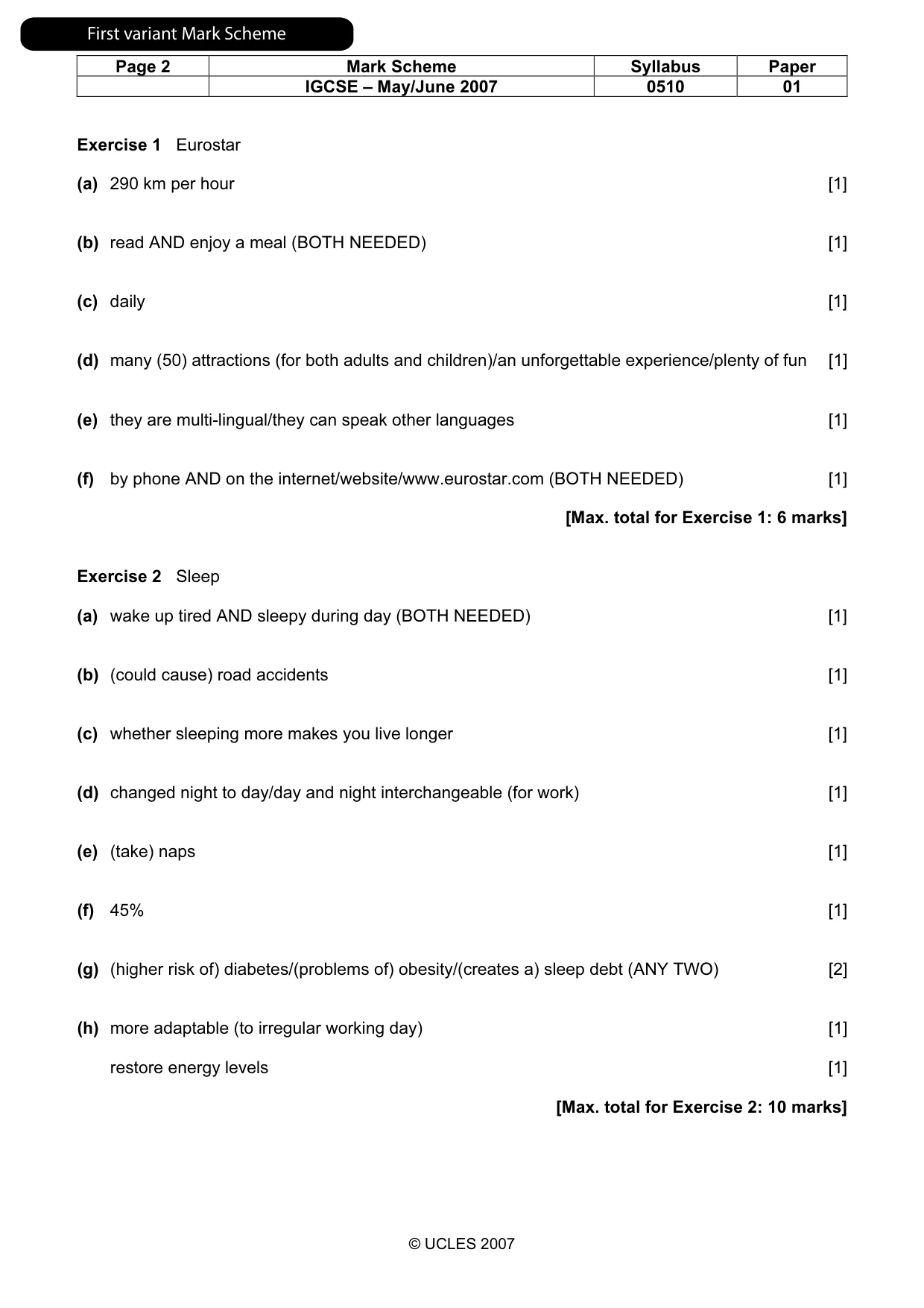
Page 2 Mark Scheme Syllabus Paper IGCSE – May/June 2007 0510 01 © UCLES 2007 Exercise 1 Eurostar (a) 290 km per hour [1] (b) read AND enjoy a meal (BOTH NEEDED) [1] (c) daily [1] (d) many (50) attractions (for both adults and children)/an unforgettable experience/plenty of fun [1] (e) they are multi-lingual/they can speak other languages [1] (f) by phone AND on the internet/website/www.eurostar.com (BOTH NEEDED) [1] [Max. total for Exercise 1: 6 marks] Exercise 2 Sleep (a) wake up tired AND sleepy during day (BOTH NEEDED) [1] (b) (could cause) road accidents [1] (c) whether sleeping more makes you live longer [1] (d) changed night to day/day and night interchangeable (for work) [1] (e) (take) naps [1] (f) 45% [1] (g) (higher risk of) diabetes/(problems of) obesity/(creates a) sleep debt (ANY TWO) [2] (h) more adaptable (to irregular working day) [1] restore energy levels [1] [Max. total for Exercise 2: 10 marks] First variant Mark Scheme
Mark scheme, page 4
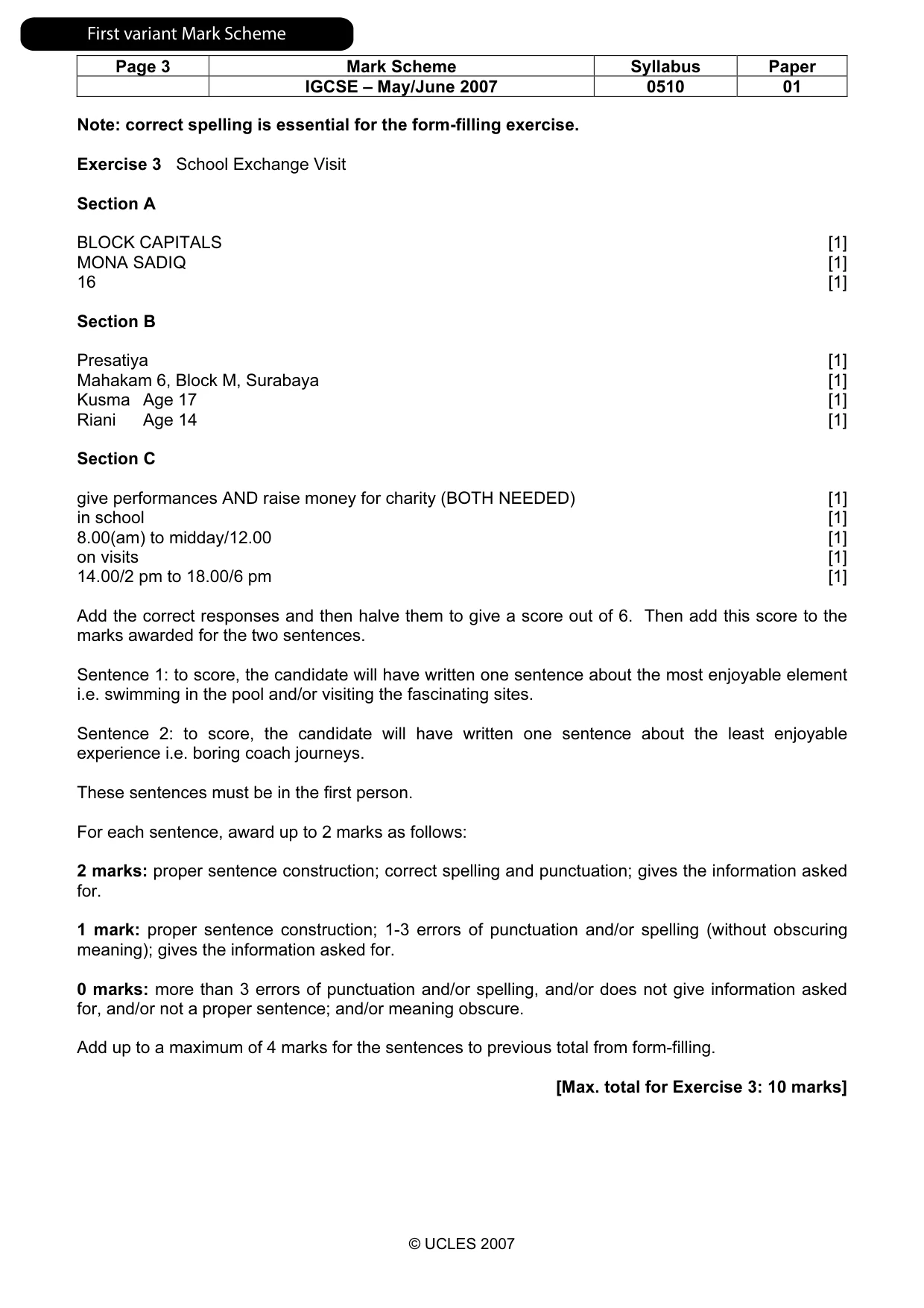
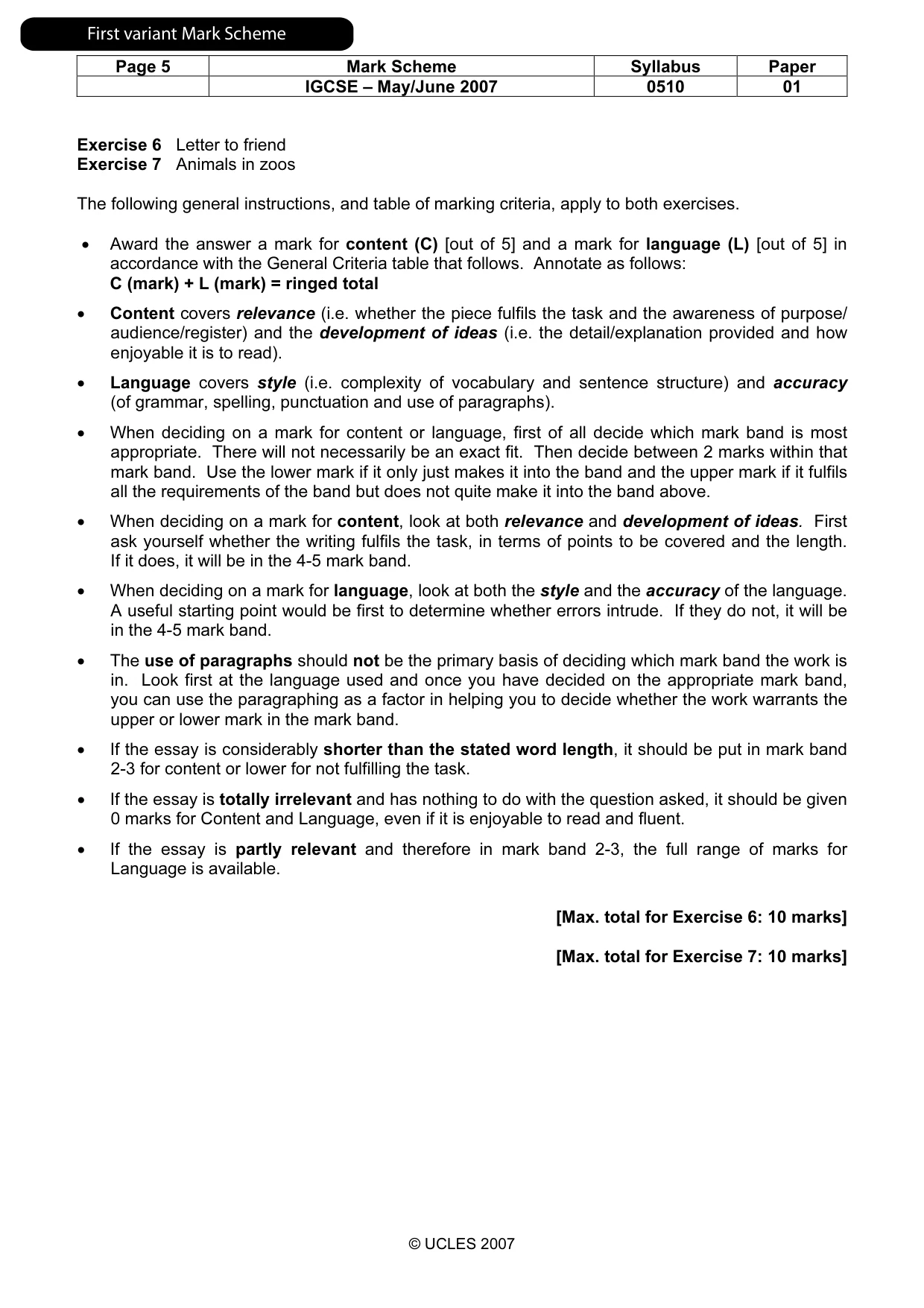
Page 3 Mark Scheme Syllabus Paper IGCSE – May/June 2007 0510 01 © UCLES 2007 Note: correct spelling is essential for the form-filling exercise. Exercise 3 School Exchange Visit Section A BLOCK CAPITALS [1] MONA SADIQ [1] 16 [1] Section B Presatiya [1] Mahakam 6, Block M, Surabaya [1] Kusma Age 17 [1] Riani Age 14 [1] Section C give performances AND raise money for charity (BOTH NEEDED) [1] in school [1] 8.00(am) to midday/12.00 [1] on visits [1] 14.00/2 pm to 18.00/6 pm [1] Add the correct responses and then halve them to give a score out of 6. Then add this score to the marks awarded for the two sentences. Sentence 1: to score, the candidate will have written one sentence about the most enjoyable element i.e. swimming in the pool and/or visiting the fascinating sites. Sentence 2: to score, the candidate will have written one sentence about the least enjoyable experience i.e. boring coach journeys. These sentences must be in the first person. For each sentence, award up to 2 marks as follows: 2 marks: proper sentence construction; correct spelling and punctuation; gives the information asked for. 1 mark: proper sentence construction; 1-3 errors of punctuation and/or spelling (without obscuring meaning); gives the information asked for. 0 marks: more than 3 errors of punctuation and/or spelling, and/or does not give information asked for, and/or not a proper sentence; and/or meaning obscure. Add up to a maximum of 4 marks for the sentences to previous total from form-filling. [Max. total for Exercise 3: 10 marks] First variant Mark Scheme
Mark scheme, page 5
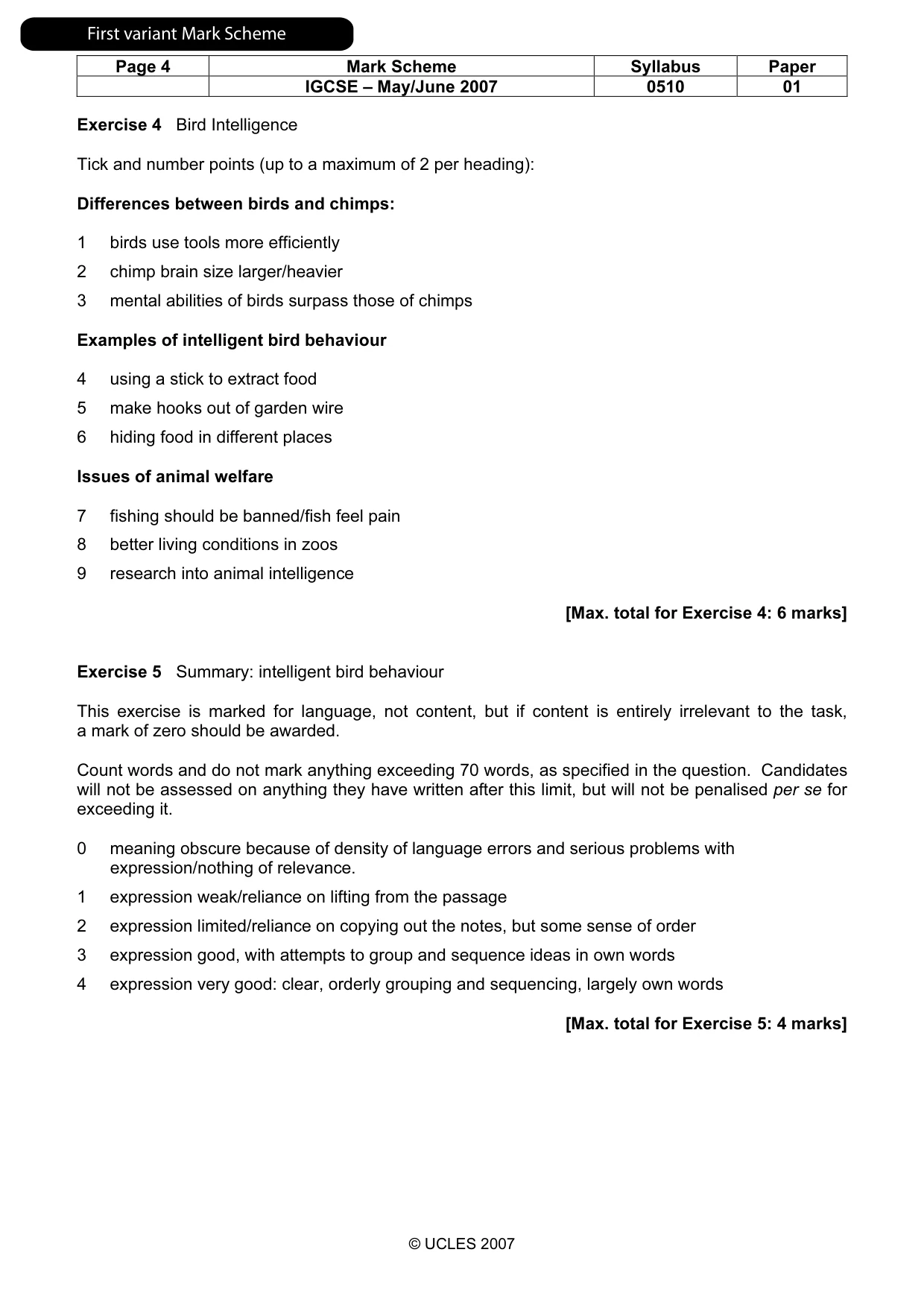
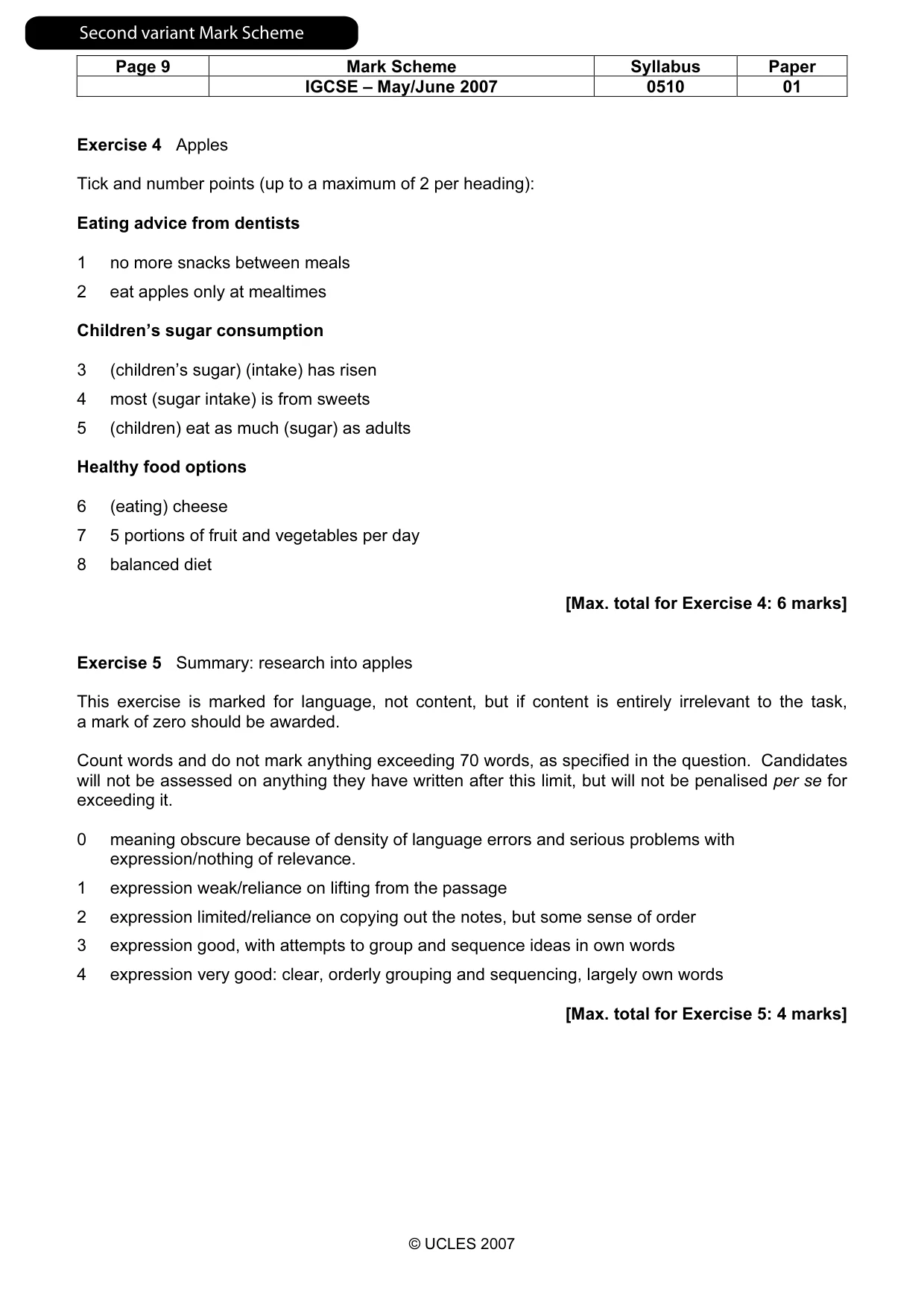
Page 4 Mark Scheme Syllabus Paper IGCSE – May/June 2007 0510 01 © UCLES 2007 Exercise 4 Bird Intelligence Tick and number points (up to a maximum of 2 per heading): Differences between birds and chimps: 1 birds use tools more efficiently 2 chimp brain size larger/heavier 3 mental abilities of birds surpass those of chimps Examples of intelligent bird behaviour 4 using a stick to extract food 5 make hooks out of garden wire 6 hiding food in different places Issues of animal welfare 7 fishing should be banned/fish feel pain 8 better living conditions in zoos 9 research into animal intelligence [Max. total for Exercise 4: 6 marks] Exercise 5 Summary: intelligent bird behaviour This exercise is marked for language, not content, but if content is entirely irrelevant to the task, a mark of zero should be awarded. Count words and do not mark anything exceeding 70 words, as specified in the question. Candidates will not be assessed on anything they have written after this limit, but will not be penalised per se for exceeding it. 0 meaning obscure because of density of language errors and serious problems with expression/nothing of relevance. 1 expression weak/reliance on lifting from the passage 2 expression limited/reliance on copying out the notes, but some sense of order 3 expression good, with attempts to group and sequence ideas in own words 4 expression very good: clear, orderly grouping and sequencing, largely own words [Max. total for Exercise 5: 4 marks] First variant Mark Scheme
Mark scheme, page 6
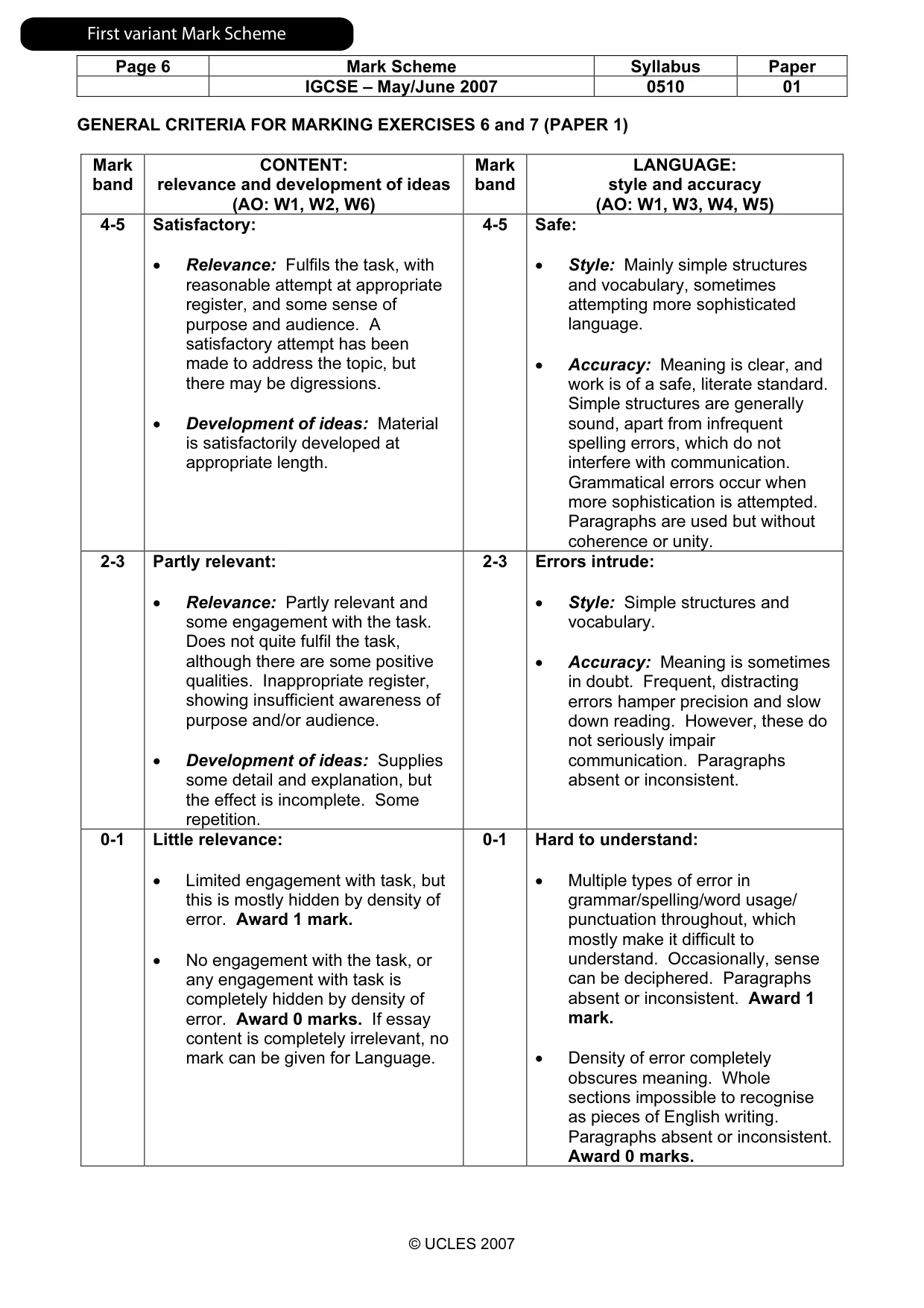
Page 5 Mark Scheme Syllabus Paper IGCSE – May/June 2007 0510 01 © UCLES 2007 Exercise 6 Letter to friend Exercise 7 Animals in zoos The following general instructions, and table of marking criteria, apply to both exercises. • Award the answer a mark for content (C) [out of 5] and a mark for language (L) [out of 5] in accordance with the General Criteria table that follows. Annotate as follows: C (mark) + L (mark) = ringed total • Content covers relevance (i.e. whether the piece fulfils the task and the awareness of purpose/ audience/register) and the development of ideas (i.e. the detail/explanation provided and how enjoyable it is to read). • Language covers style (i.e. complexity of vocabulary and sentence structure) and accuracy (of grammar, spelling, punctuation and use of paragraphs). • When deciding on a mark for content or language, first of all decide which mark band is most appropriate. There will not necessarily be an exact fit. Then decide between 2 marks within that mark band. Use the lower mark if it only just makes it into the band and the upper mark if it fulfils all the requirements of the band but does not quite make it into the band above. • When deciding on a mark for content, look at both relevance and development of ideas. First ask yourself whether the writing fulfils the task, in terms of points to be covered and the length. If it does, it will be in the 4-5 mark band. • When deciding on a mark for language, look at both the style and the accuracy of the language. A useful starting point would be first to determine whether errors intrude. If they do not, it will be in the 4-5 mark band. • The use of paragraphs should not be the primary basis of deciding which mark band the work is in. Look first at the language used and once you have decided on the appropriate mark band, you can use the paragraphing as a factor in helping you to decide whether the work warrants the upper or lower mark in the mark band. • If the essay is considerably shorter than the stated word length, it should be put in mark band 2-3 for content or lower for not fulfilling the task. • If the essay is totally irrelevant and has nothing to do with the question asked, it should be given 0 marks for Content and Language, even if it is enjoyable to read and fluent. • If the essay is partly relevant and therefore in mark band 2-3, the full range of marks for Language is available. [Max. total for Exercise 6: 10 marks] [Max. total for Exercise 7: 10 marks] First variant Mark Scheme
Mark scheme, page 7
Page 6 Mark Scheme Syllabus Paper IGCSE – May/June 2007 0510 01 © UCLES 2007 GENERAL CRITERIA FOR MARKING EXERCISES 6 and 7 (PAPER 1) Mark band CONTENT: relevance and development of ideas (AO: W1, W2, W6) Mark band LANGUAGE: style and accuracy (AO: W1, W3, W4, W5) 4-5 Satisfactory: • Relevance: Fulfils the task, with reasonable attempt at appropriate register, and some sense of purpose and audience. A satisfactory attempt has been made to address the topic, but there may be digressions. • Development of ideas: Material is satisfactorily developed at appropriate length. 4-5 Safe: • Style: Mainly simple structures and vocabulary, sometimes attempting more sophisticated language. • Accuracy: Meaning is clear, and work is of a safe, literate standard. Simple structures are generally sound, apart from infrequent spelling errors, which do not interfere with communication. Grammatical errors occur when more sophistication is attempted. Paragraphs are used but without coherence or unity. 2-3 Partly relevant: • Relevance: Partly relevant and some engagement with the task. Does not quite fulfil the task, although there are some positive qualities. Inappropriate register, showing insufficient awareness of purpose and/or audience. • Development of ideas: Supplies some detail and explanation, but the effect is incomplete. Some repetition. 2-3 Errors intrude: • Style: Simple structures and vocabulary. • Accuracy: Meaning is sometimes in doubt. Frequent, distracting errors hamper precision and slow down reading. However, these do not seriously impair communication. Paragraphs absent or inconsistent. 0-1 Little relevance: • Limited engagement with task, but this is mostly hidden by density of error. Award 1 mark. • No engagement with the task, or any engagement with task is completely hidden by density of error. Award 0 marks. If essay content is completely irrelevant, no mark can be given for Language. 0-1 Hard to understand: • Multiple types of error in grammar/spelling/word usage/ punctuation throughout, which mostly make it difficult to understand. Occasionally, sense can be deciphered. Paragraphs absent or inconsistent. Award 1 mark. • Density of error completely obscures meaning. Whole sections impossible to recognise as pieces of English writing. Paragraphs absent or inconsistent. Award 0 marks. First variant Mark Scheme
Mark scheme, page 8
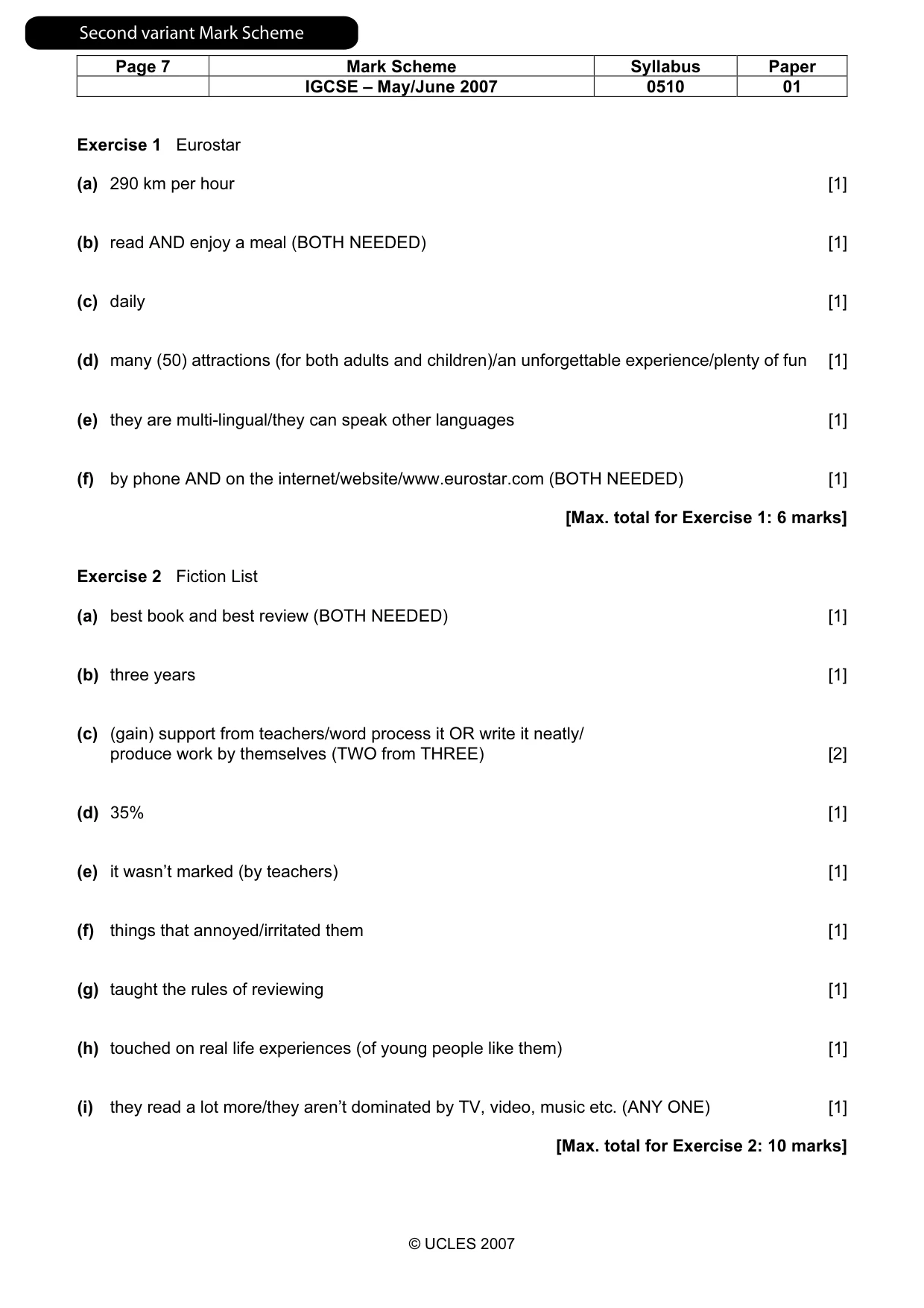
Page 7 Mark Scheme Syllabus Paper IGCSE – May/June 2007 0510 01 © UCLES 2007 Exercise 1 Eurostar (a) 290 km per hour [1] (b) read AND enjoy a meal (BOTH NEEDED) [1] (c) daily [1] (d) many (50) attractions (for both adults and children)/an unforgettable experience/plenty of fun [1] (e) they are multi-lingual/they can speak other languages [1] (f) by phone AND on the internet/website/www.eurostar.com (BOTH NEEDED) [1] [Max. total for Exercise 1: 6 marks] Exercise 2 Fiction List (a) best book and best review (BOTH NEEDED) [1] (b) three years [1] (c) (gain) support from teachers/word process it OR write it neatly/ produce work by themselves (TWO from THREE) [2] (d) 35% [1] (e) it wasn’t marked (by teachers) [1] (f) things that annoyed/irritated them [1] (g) taught the rules of reviewing [1] (h) touched on real life experiences (of young people like them) [1] (i) they read a lot more/they aren’t dominated by TV, video, music etc. (ANY ONE) [1] [Max. total for Exercise 2: 10 marks] Second variant Mark Scheme
Mark scheme, page 9
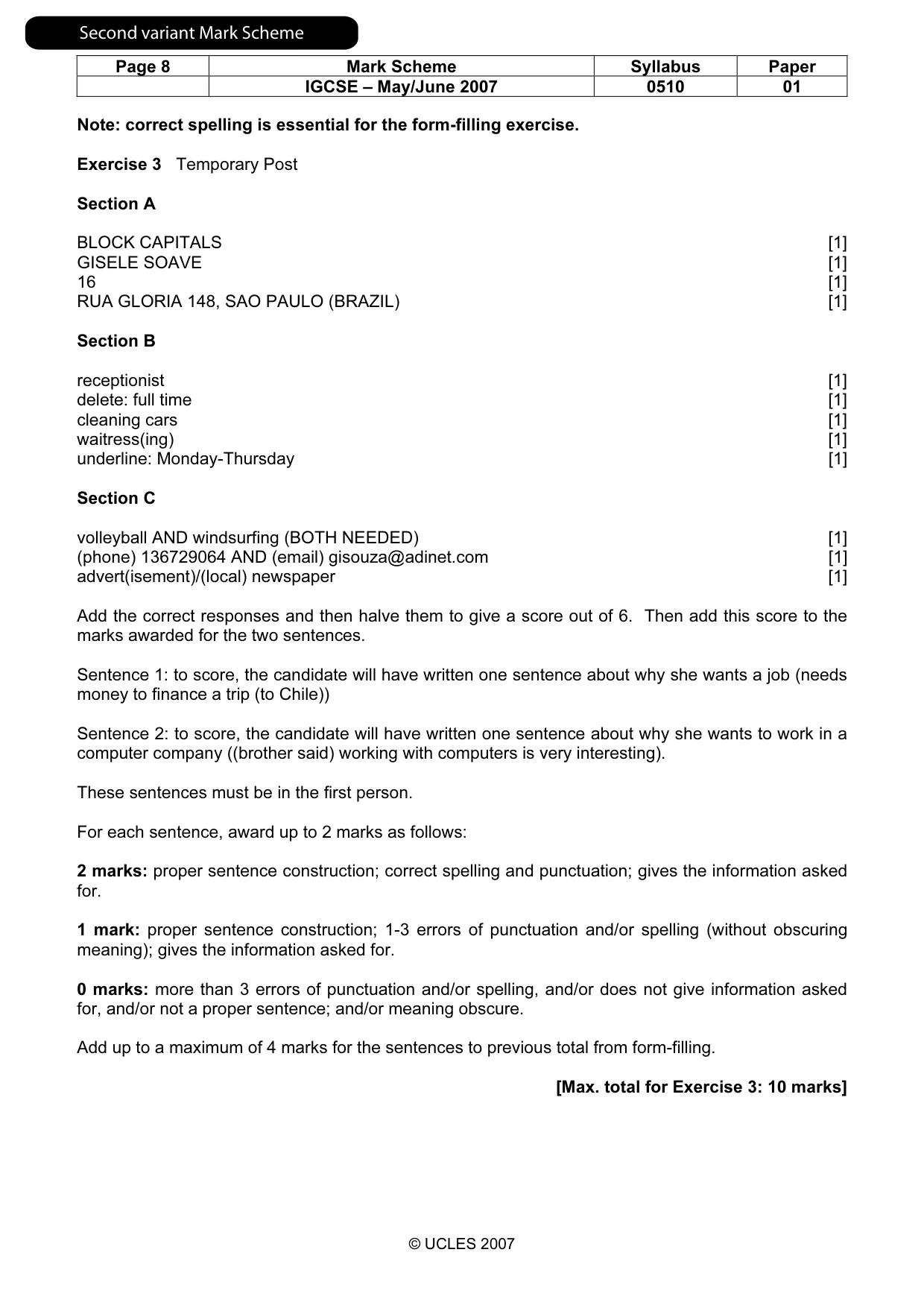
Page 8 Mark Scheme Syllabus Paper IGCSE – May/June 2007 0510 01 © UCLES 2007 Note: correct spelling is essential for the form-filling exercise. Exercise 3 Temporary Post Section A BLOCK CAPITALS [1] GISELE SOAVE [1] 16 [1] RUA GLORIA 148, SAO PAULO (BRAZIL) [1] Section B receptionist [1] delete: full time [1] cleaning cars [1] waitress(ing) [1] underline: Monday-Thursday [1] Section C volleyball AND windsurfing (BOTH NEEDED) [1] (phone) 136729064 AND (email) gisouza@adinet.com [1] advert(isement)/(local) newspaper [1] Add the correct responses and then halve them to give a score out of 6. Then add this score to the marks awarded for the two sentences. Sentence 1: to score, the candidate will have written one sentence about why she wants a job (needs money to finance a trip (to Chile)) Sentence 2: to score, the candidate will have written one sentence about why she wants to work in a computer company ((brother said) working with computers is very interesting). These sentences must be in the first person. For each sentence, award up to 2 marks as follows: 2 marks: proper sentence construction; correct spelling and punctuation; gives the information asked for. 1 mark: proper sentence construction; 1-3 errors of punctuation and/or spelling (without obscuring meaning); gives the information asked for. 0 marks: more than 3 errors of punctuation and/or spelling, and/or does not give information asked for, and/or not a proper sentence; and/or meaning obscure. Add up to a maximum of 4 marks for the sentences to previous total from form-filling. [Max. total for Exercise 3: 10 marks] Second variant Mark Scheme
Mark scheme, page 10
Page 9 Mark Scheme Syllabus Paper IGCSE – May/June 2007 0510 01 © UCLES 2007 Exercise 4 Apples Tick and number points (up to a maximum of 2 per heading): Eating advice from dentists 1 no more snacks between meals 2 eat apples only at mealtimes Children’s sugar consumption 3 (children’s sugar) (intake) has risen 4 most (sugar intake) is from sweets 5 (children) eat as much (sugar) as adults Healthy food options 6 (eating) cheese 7 5 portions of fruit and vegetables per day 8 balanced diet [Max. total for Exercise 4: 6 marks] Exercise 5 Summary: research into apples This exercise is marked for language, not content, but if content is entirely irrelevant to the task, a mark of zero should be awarded. Count words and do not mark anything exceeding 70 words, as specified in the question. Candidates will not be assessed on anything they have written after this limit, but will not be penalised per se for exceeding it. 0 meaning obscure because of density of language errors and serious problems with expression/nothing of relevance. 1 expression weak/reliance on lifting from the passage 2 expression limited/reliance on copying out the notes, but some sense of order 3 expression good, with attempts to group and sequence ideas in own words 4 expression very good: clear, orderly grouping and sequencing, largely own words [Max. total for Exercise 5: 4 marks] Second variant Mark Scheme
Mark scheme, page 11
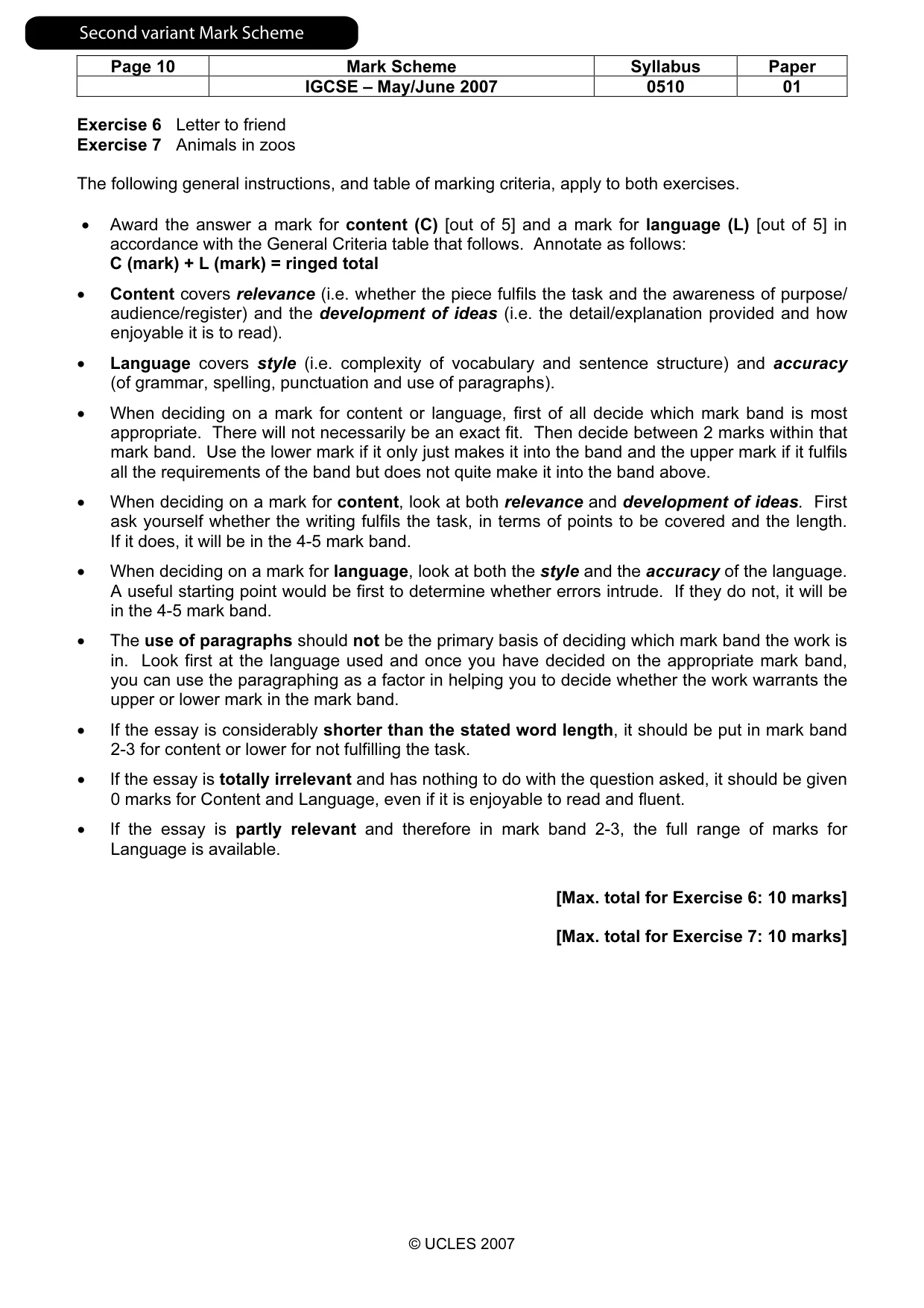
Page 10 Mark Scheme Syllabus Paper IGCSE – May/June 2007 0510 01 © UCLES 2007 Exercise 6 Letter to friend Exercise 7 Animals in zoos The following general instructions, and table of marking criteria, apply to both exercises. • Award the answer a mark for content (C) [out of 5] and a mark for language (L) [out of 5] in accordance with the General Criteria table that follows. Annotate as follows: C (mark) + L (mark) = ringed total • Content covers relevance (i.e. whether the piece fulfils the task and the awareness of purpose/ audience/register) and the development of ideas (i.e. the detail/explanation provided and how enjoyable it is to read). • Language covers style (i.e. complexity of vocabulary and sentence structure) and accuracy (of grammar, spelling, punctuation and use of paragraphs). • When deciding on a mark for content or language, first of all decide which mark band is most appropriate. There will not necessarily be an exact fit. Then decide between 2 marks within that mark band. Use the lower mark if it only just makes it into the band and the upper mark if it fulfils all the requirements of the band but does not quite make it into the band above. • When deciding on a mark for content, look at both relevance and development of ideas. First ask yourself whether the writing fulfils the task, in terms of points to be covered and the length. If it does, it will be in the 4-5 mark band. • When deciding on a mark for language, look at both the style and the accuracy of the language. A useful starting point would be first to determine whether errors intrude. If they do not, it will be in the 4-5 mark band. • The use of paragraphs should not be the primary basis of deciding which mark band the work is in. Look first at the language used and once you have decided on the appropriate mark band, you can use the paragraphing as a factor in helping you to decide whether the work warrants the upper or lower mark in the mark band. • If the essay is considerably shorter than the stated word length, it should be put in mark band 2-3 for content or lower for not fulfilling the task. • If the essay is totally irrelevant and has nothing to do with the question asked, it should be given 0 marks for Content and Language, even if it is enjoyable to read and fluent. • If the essay is partly relevant and therefore in mark band 2-3, the full range of marks for Language is available. [Max. total for Exercise 6: 10 marks] [Max. total for Exercise 7: 10 marks] Second variant Mark Scheme
Mark scheme, page 12
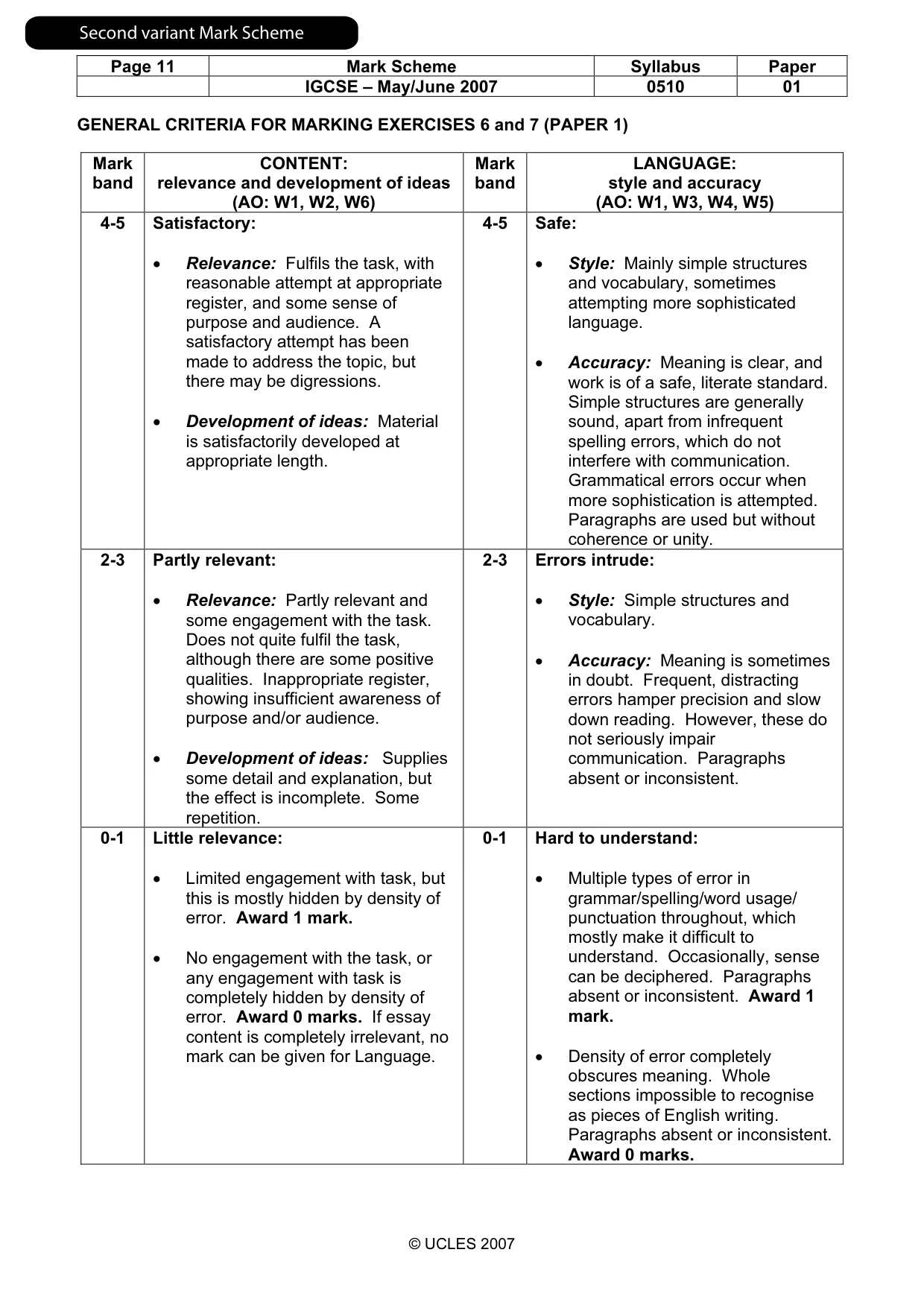
Page 11 Mark Scheme Syllabus Paper IGCSE – May/June 2007 0510 01 © UCLES 2007 GENERAL CRITERIA FOR MARKING EXERCISES 6 and 7 (PAPER 1) Mark band CONTENT: relevance and development of ideas (AO: W1, W2, W6) Mark band LANGUAGE: style and accuracy (AO: W1, W3, W4, W5) 4-5 Satisfactory: • Relevance: Fulfils the task, with reasonable attempt at appropriate register, and some sense of purpose and audience. A satisfactory attempt has been made to address the topic, but there may be digressions. • Development of ideas: Material is satisfactorily developed at appropriate length. 4-5 Safe: • Style: Mainly simple structures and vocabulary, sometimes attempting more sophisticated language. • Accuracy: Meaning is clear, and work is of a safe, literate standard. Simple structures are generally sound, apart from infrequent spelling errors, which do not interfere with communication. Grammatical errors occur when more sophistication is attempted. Paragraphs are used but without coherence or unity. 2-3 Partly relevant: • Relevance: Partly relevant and some engagement with the task. Does not quite fulfil the task, although there are some positive qualities. Inappropriate register, showing insufficient awareness of purpose and/or audience. • Development of ideas: Supplies some detail and explanation, but the effect is incomplete. Some repetition. 2-3 Errors intrude: • Style: Simple structures and vocabulary. • Accuracy: Meaning is sometimes in doubt. Frequent, distracting errors hamper precision and slow down reading. However, these do not seriously impair communication. Paragraphs absent or inconsistent. 0-1 Little relevance: • Limited engagement with task, but this is mostly hidden by density of error. Award 1 mark. • No engagement with the task, or any engagement with task is completely hidden by density of error. Award 0 marks. If essay content is completely irrelevant, no mark can be given for Language. 0-1 Hard to understand: • Multiple types of error in grammar/spelling/word usage/ punctuation throughout, which mostly make it difficult to understand. Occasionally, sense can be deciphered. Paragraphs absent or inconsistent. Award 1 mark. • Density of error completely obscures meaning. Whole sections impossible to recognise as pieces of English writing. Paragraphs absent or inconsistent. Award 0 marks. Second variant Mark Scheme
What you needed in this session
Cambridge’s own grade thresholds for 2007 May/June, Paper 1 · Variant 1. A higher threshold means an easier paper — the bar moves with how the cohort did.