Cambridge IGCSE English - Second Language (oral endorsement) 0510 — 2006 May/June Paper 3 · Variant 1
0510/31/M/J/06 · 30 marks · ≈34 min
The question paper and its mark scheme, free to read here and free to download. This is Cambridge’s own paper, exactly as it was sat.
Question paper8 pages


Mark scheme15 pages
Answers below. Sit the paper first if you are practising.
Paper as text
Question paper, page 1
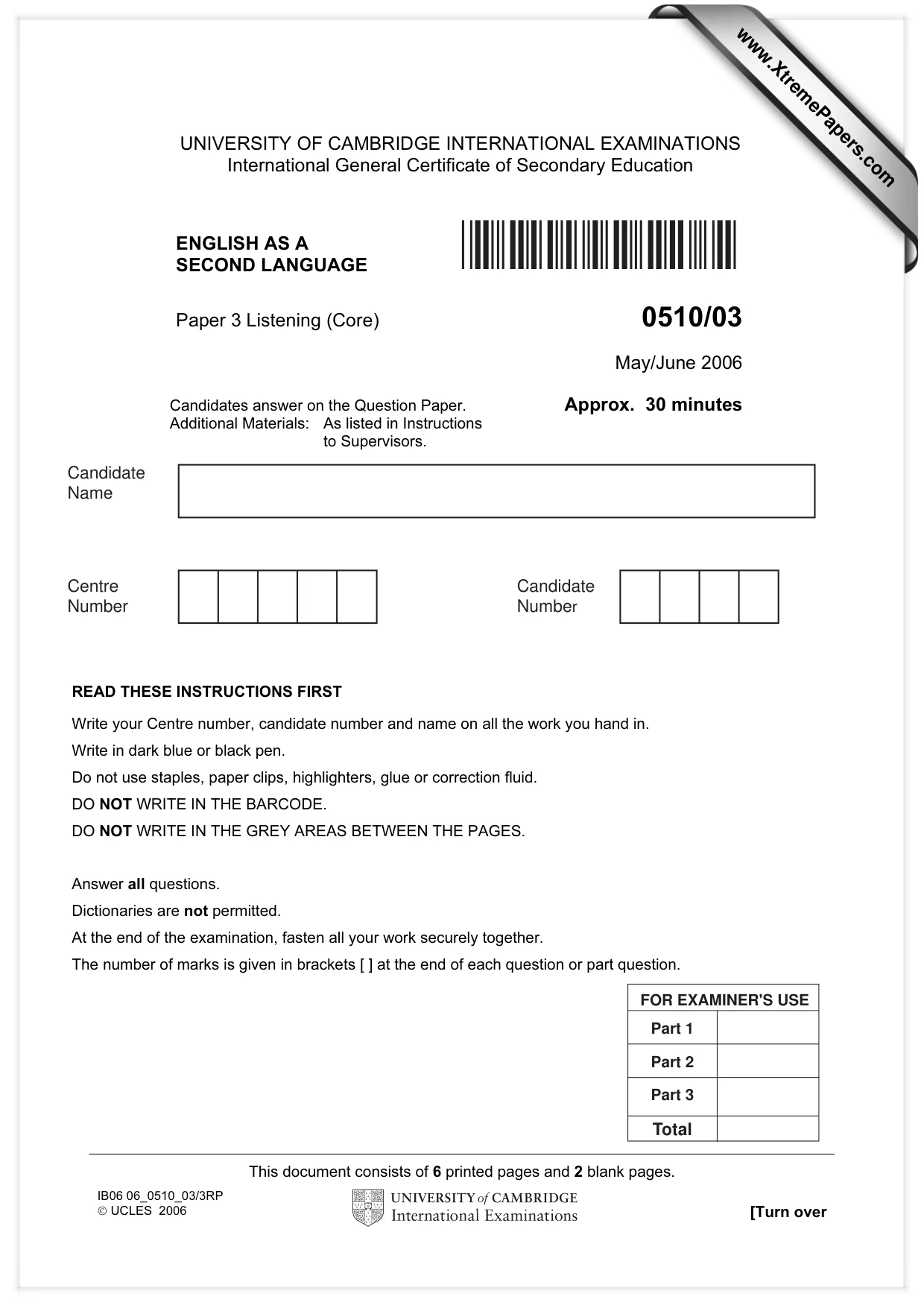
This document consists of 6 printed pages and 2 blank pages. IB06 06_0510_03/3RP UCLES 2006 [Turn over Candidate Name Centre Number Candidate Number UNIVERSITY OF CAMBRIDGE INTERNATIONAL EXAMINATIONS International General Certificate of Secondary Education ENGLISH AS A SECOND LANGUAGE Paper 3 Listening (Core) 0510/03 May/June 2006 Candidates answer on the Question Paper. Approx. 30 minutes Additional Materials: As listed in Instructions to Supervisors. READ THESE INSTRUCTIONS FIRST Write your Centre number, candidate number and name on all the work you hand in. Write in dark blue or black pen. Do not use staples, paper clips, highlighters, glue or correction fluid. DO NOT WRITE IN THE BARCODE. DO NOT WRITE IN THE GREY AREAS BETWEEN THE PAGES. Answer all questions. Dictionaries are not permitted. At the end of the examination, fasten all your work securely together. The number of marks is given in brackets [ ] at the end of each question or part question. *051003* FOR EXAMINER'S USE Part 1 Part 2 Part 3 Total www.XtremePapers.com
Question paper, page 2
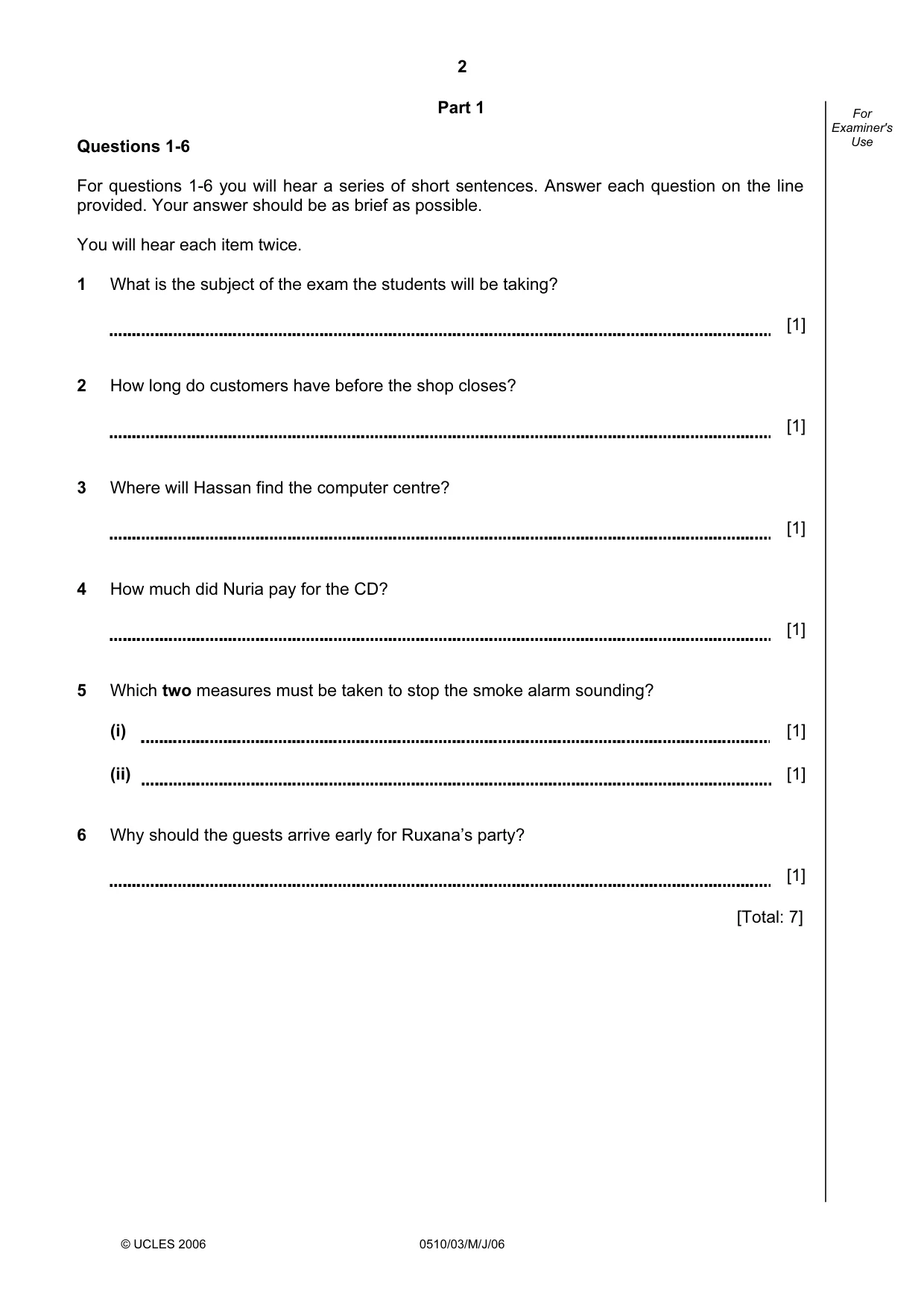
2 © UCLES 2006 0510/03/M/J/06 For Examiner's Use Part 1 Questions 1-6 For questions 1-6 you will hear a series of short sentences. Answer each question on the line provided. Your answer should be as brief as possible. You will hear each item twice. 1 What is the subject of the exam the students will be taking? [1] 2 How long do customers have before the shop closes? [1] 3 Where will Hassan find the computer centre? [1] 4 How much did Nuria pay for the CD? [1] 5 Which two measures must be taken to stop the smoke alarm sounding? (i) [1] (ii) [1] 6 Why should the guests arrive early for Ruxana’s party? [1] [Total: 7]
Question paper, page 3
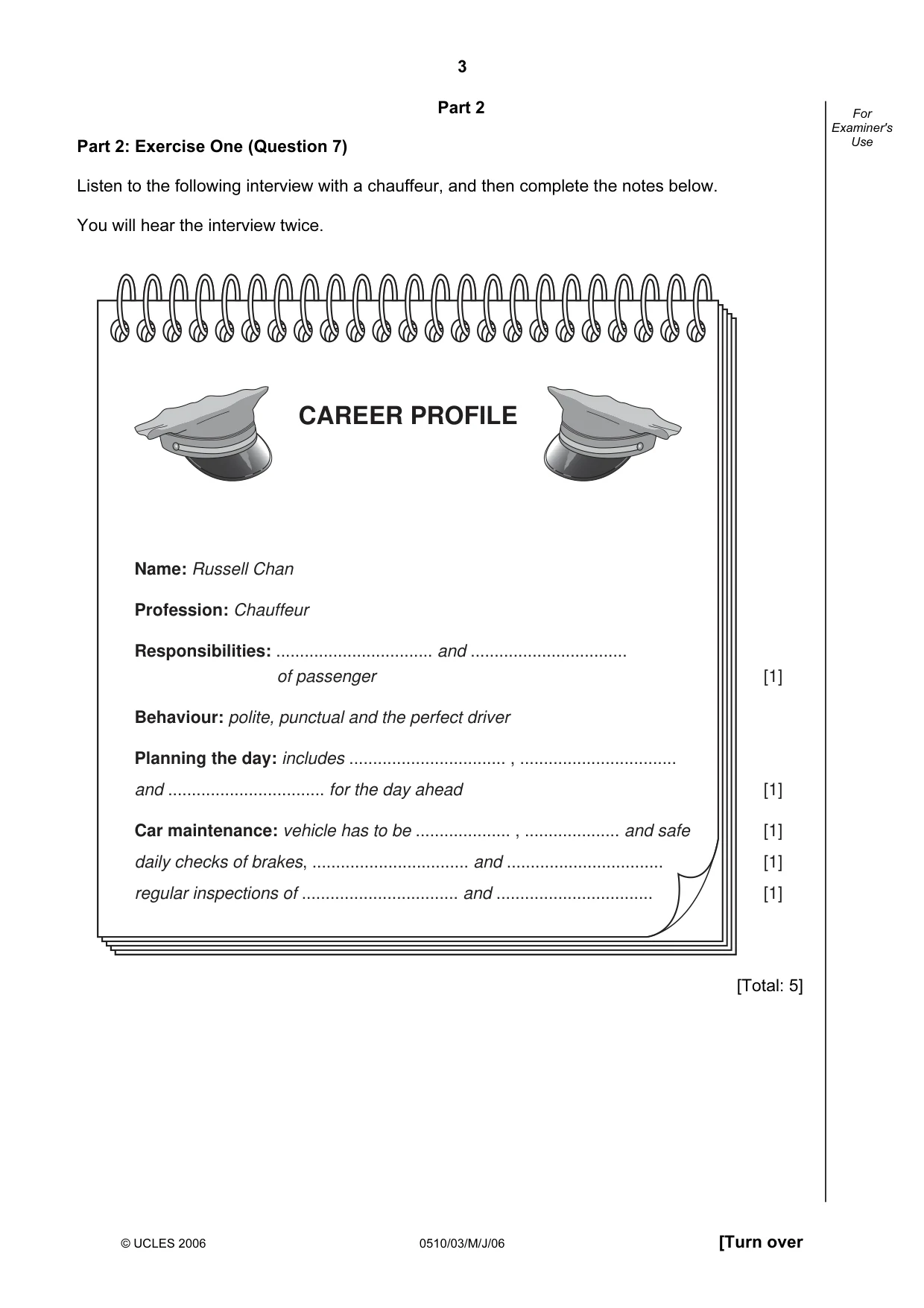
3 © UCLES 2006 0510/03/M/J/06 [Turn over For Examiner's Use Part 2 Part 2: Exercise One (Question 7) Listen to the following interview with a chauffeur, and then complete the notes below. You will hear the interview twice. Name: Russell Chan Profession: Chauffeur Responsibilities: … and … of passenger [1] Behaviour: polite, punctual and the perfect driver Planning the day: includes … , … and … for the day ahead [1] Car maintenance: vehicle has to be … , … and safe [1] daily checks of brakes, … and … [1] regular inspections of … and … [1] CAREER PROFILE [Total: 5]
Question paper, page 4
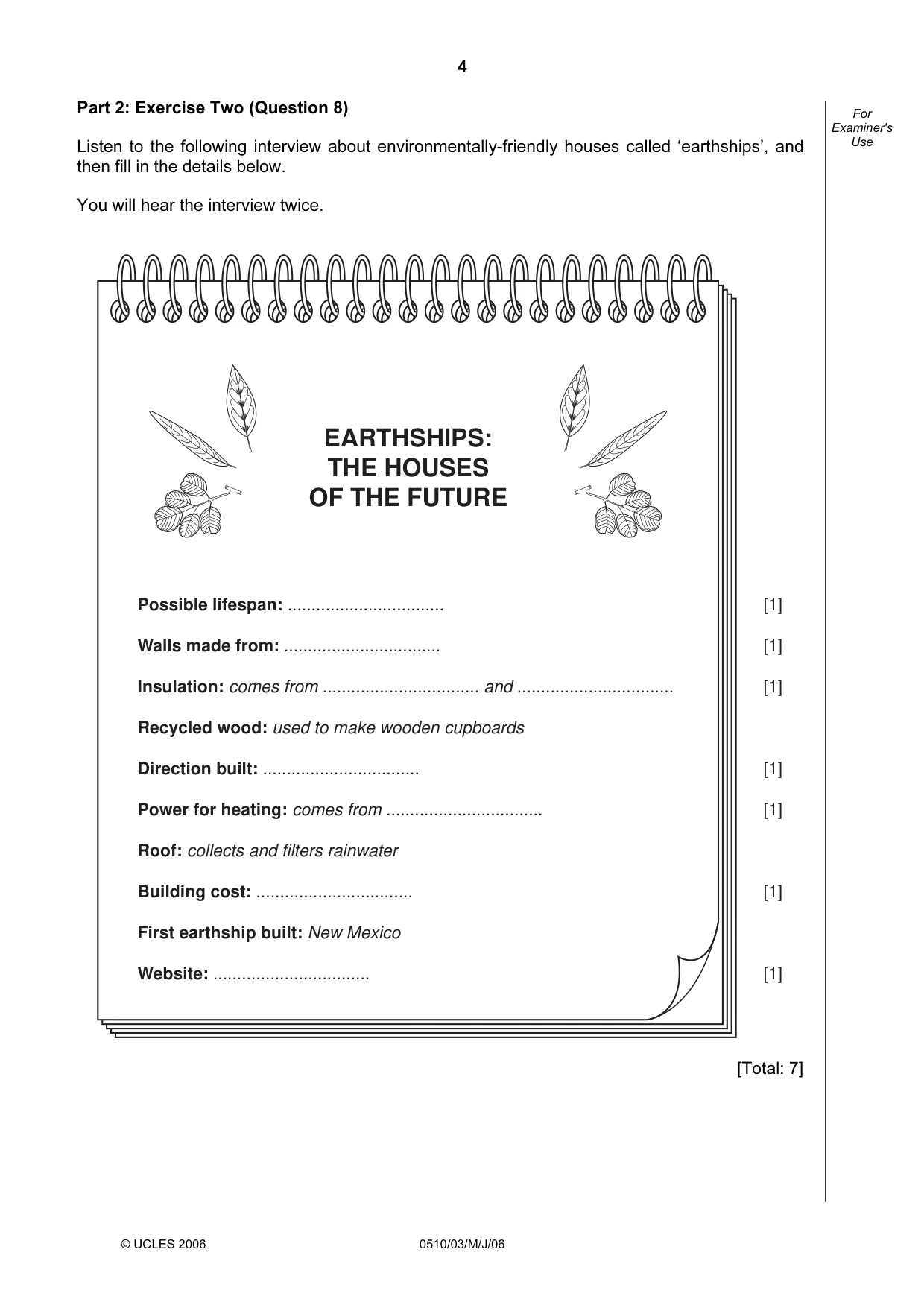
4 © UCLES 2006 0510/03/M/J/06 For Examiner's Use Part 2: Exercise Two (Question 8) Listen to the following interview about environmentally-friendly houses called ‘earthships’, and then fill in the details below. You will hear the interview twice. Possible lifespan: … [1] Walls made from: … [1] Insulation: comes from … and … [1] Recycled wood: used to make wooden cupboards Direction built: … [1] Power for heating: comes from … [1] Roof: collects and filters rainwater Building cost: … [1] First earthship built: New Mexico Website: … [1] EARTHSHIPS: THE HOUSES OF THE FUTURE [Total: 7]
Question paper, page 5
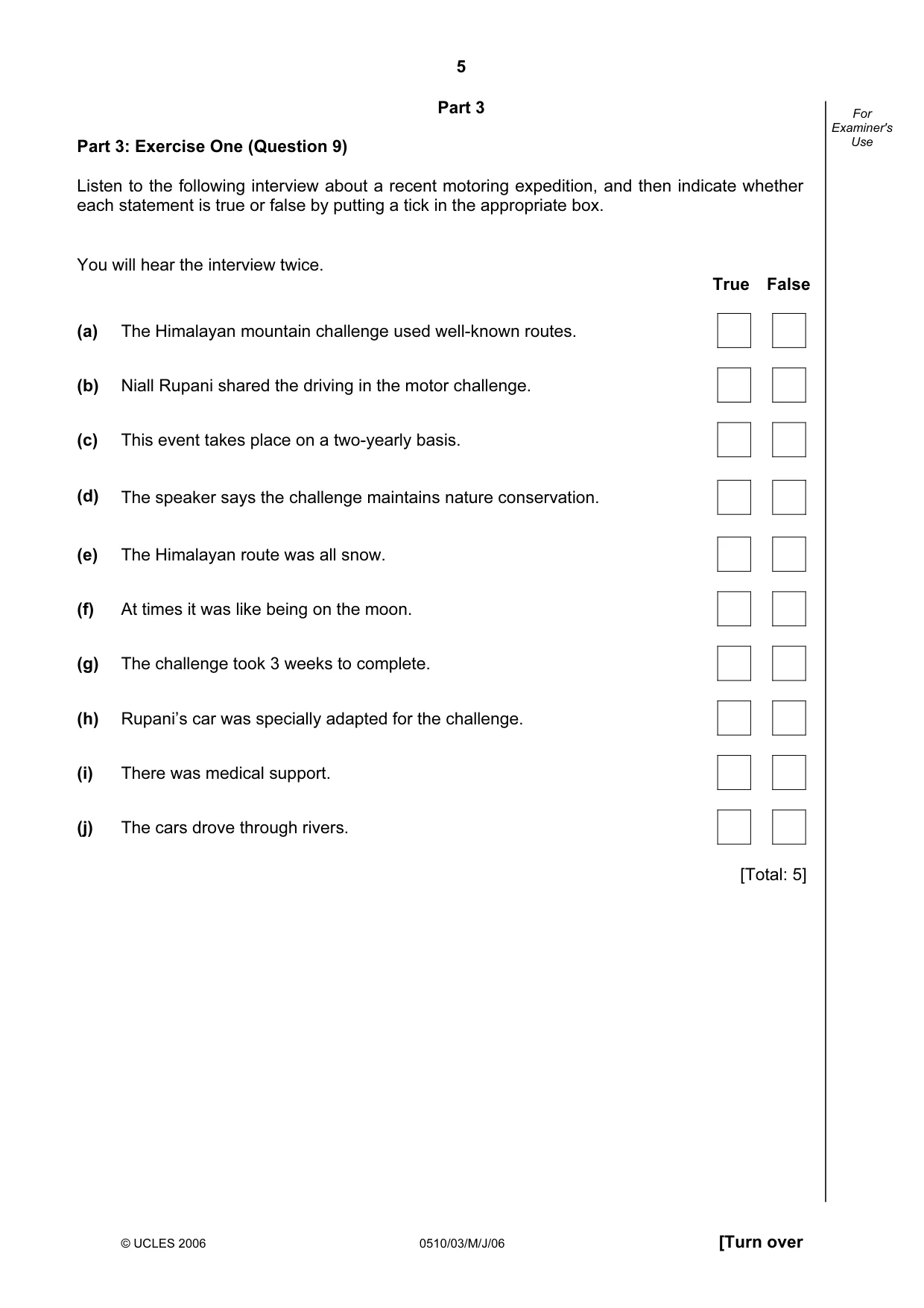
5 © UCLES 2006 0510/03/M/J/06 [Turn over For Examiner's Use Part 3 Part 3: Exercise One (Question 9) Listen to the following interview about a recent motoring expedition, and then indicate whether each statement is true or false by putting a tick in the appropriate box. You will hear the interview twice. True False (a) The Himalayan mountain challenge used well-known routes. (b) Niall Rupani shared the driving in the motor challenge. (c) This event takes place on a two-yearly basis. (d) The speaker says the challenge maintains nature conservation. (e) The Himalayan route was all snow. (f) At times it was like being on the moon. (g) The challenge took 3 weeks to complete. (h) Rupani’s car was specially adapted for the challenge. (i) There was medical support. (j) The cars drove through rivers. [Total: 5]
Question paper, page 6
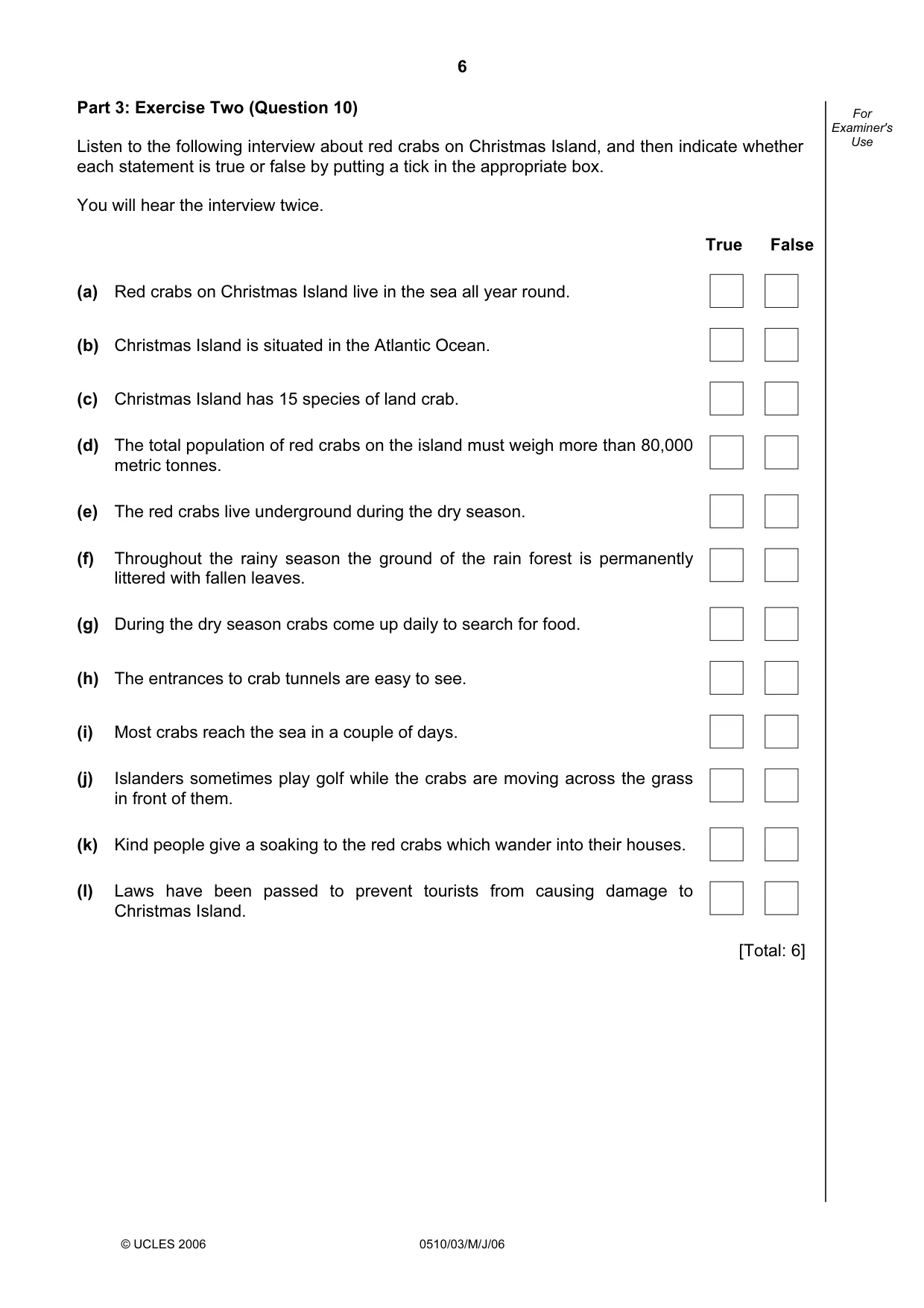
6 © UCLES 2006 0510/03/M/J/06 For Examiner's Use Part 3: Exercise Two (Question 10) Listen to the following interview about red crabs on Christmas Island, and then indicate whether each statement is true or false by putting a tick in the appropriate box. You will hear the interview twice. True False (a) Red crabs on Christmas Island live in the sea all year round. (b) Christmas Island is situated in the Atlantic Ocean. (c) Christmas Island has 15 species of land crab. (d) The total population of red crabs on the island must weigh more than 80,000 metric tonnes. (e) The red crabs live underground during the dry season. (f) Throughout the rainy season the ground of the rain forest is permanently littered with fallen leaves. (g) During the dry season crabs come up daily to search for food. (h) The entrances to crab tunnels are easy to see. (i) Most crabs reach the sea in a couple of days. (j) Islanders sometimes play golf while the crabs are moving across the grass in front of them. (k) Kind people give a soaking to the red crabs which wander into their houses. (l) Laws have been passed to prevent tourists from causing damage to Christmas Island. [Total: 6]
Question paper, page 8
8 Permission to reproduce items where third-party owned material protected by copyright is included has been sought and cleared where possible. Every reasonable effort has been made by the publisher (UCLES) to trace copyright holders, but if any items requiring clearance have unwittingly been included, the publisher will be pleased to make amends at the earliest possible opportunity. University of Cambridge International Examinations is part of the University of Cambridge Local Examinations Syndicate (UCLES), which is itself a department of the University of Cambridge. © UCLES 2006 0510/03/M/J/06 BLANK PAGE
Mark scheme, page 1
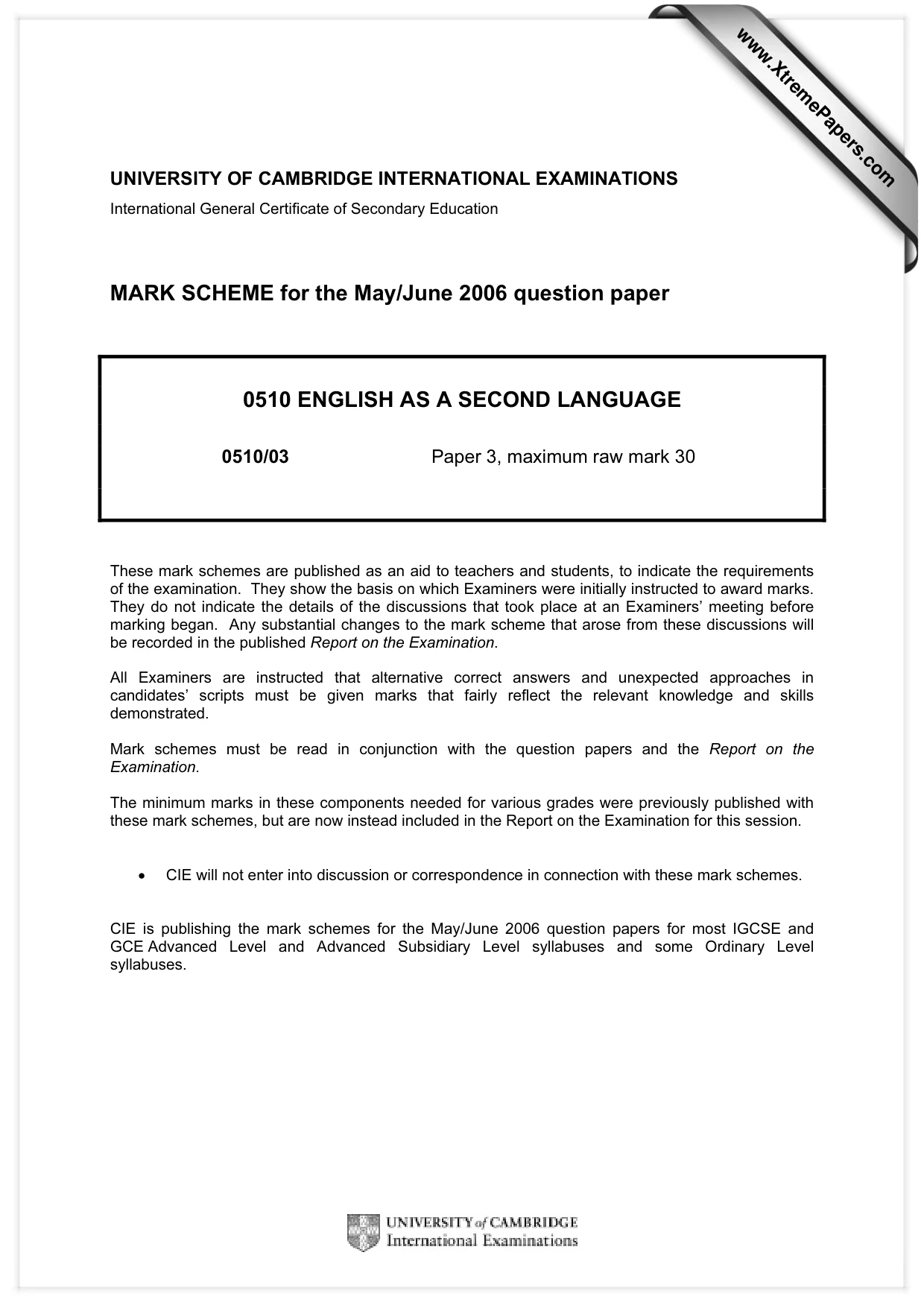
UNIVERSITY OF CAMBRIDGE INTERNATIONAL EXAMINATIONS International General Certificate of Secondary Education MARK SCHEME for the May/June 2006 question paper 0510 ENGLISH AS A SECOND LANGUAGE 0510/03 Paper 3, maximum raw mark 30 These mark schemes are published as an aid to teachers and students, to indicate the requirements of the examination. They show the basis on which Examiners were initially instructed to award marks. They do not indicate the details of the discussions that took place at an Examiners’ meeting before marking began. Any substantial changes to the mark scheme that arose from these discussions will be recorded in the published Report on the Examination. All Examiners are instructed that alternative correct answers and unexpected approaches in candidates’ scripts must be given marks that fairly reflect the relevant knowledge and skills demonstrated. Mark schemes must be read in conjunction with the question papers and the Report on the Examination. The minimum marks in these components needed for various grades were previously published with these mark schemes, but are now instead included in the Report on the Examination for this session. • CIE will not enter into discussion or correspondence in connection with these mark schemes. CIE is publishing the mark schemes for the May/June 2006 question papers for most IGCSE and GCE Advanced Level and Advanced Subsidiary Level syllabuses and some Ordinary Level syllabuses. www.XtremePapers.com
Mark scheme, page 2
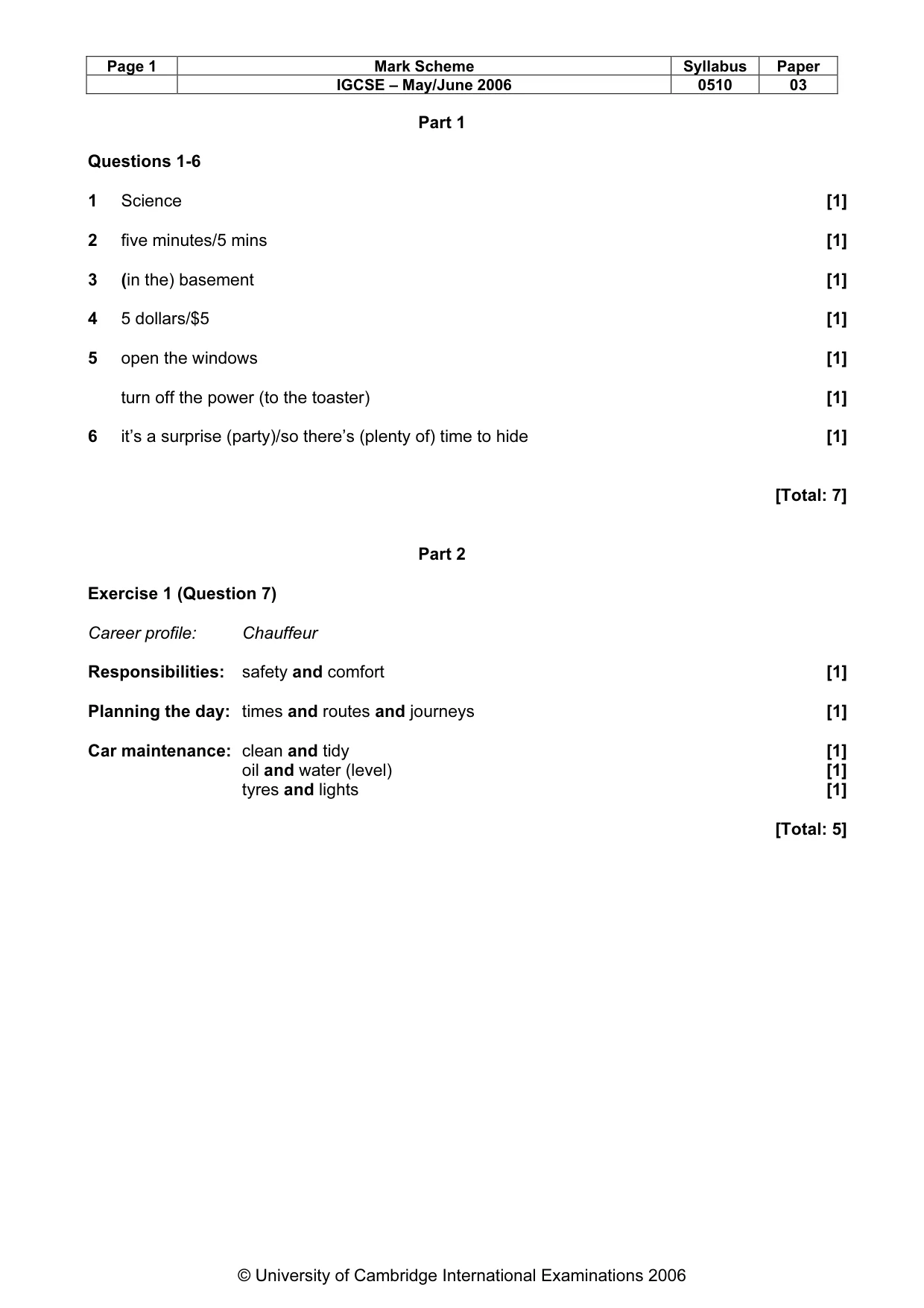
Page 1 Mark Scheme Syllabus Paper IGCSE – May/June 2006 0510 03 © University of Cambridge International Examinations 2006 Part 1 Questions 1-6 1 Science [1] 2 five minutes/5 mins [1] 3 (in the) basement [1] 4 5 dollars/$5 [1] 5 open the windows [1] turn off the power (to the toaster) [1] 6 it’s a surprise (party)/so there’s (plenty of) time to hide [1] [Total: 7] Part 2 Exercise 1 (Question 7) Career profile: Chauffeur Responsibilities: safety and comfort [1] Planning the day: times and routes and journeys [1] Car maintenance: clean and tidy [1] oil and water (level) [1] tyres and lights [1] [Total: 5]
Mark scheme, page 3
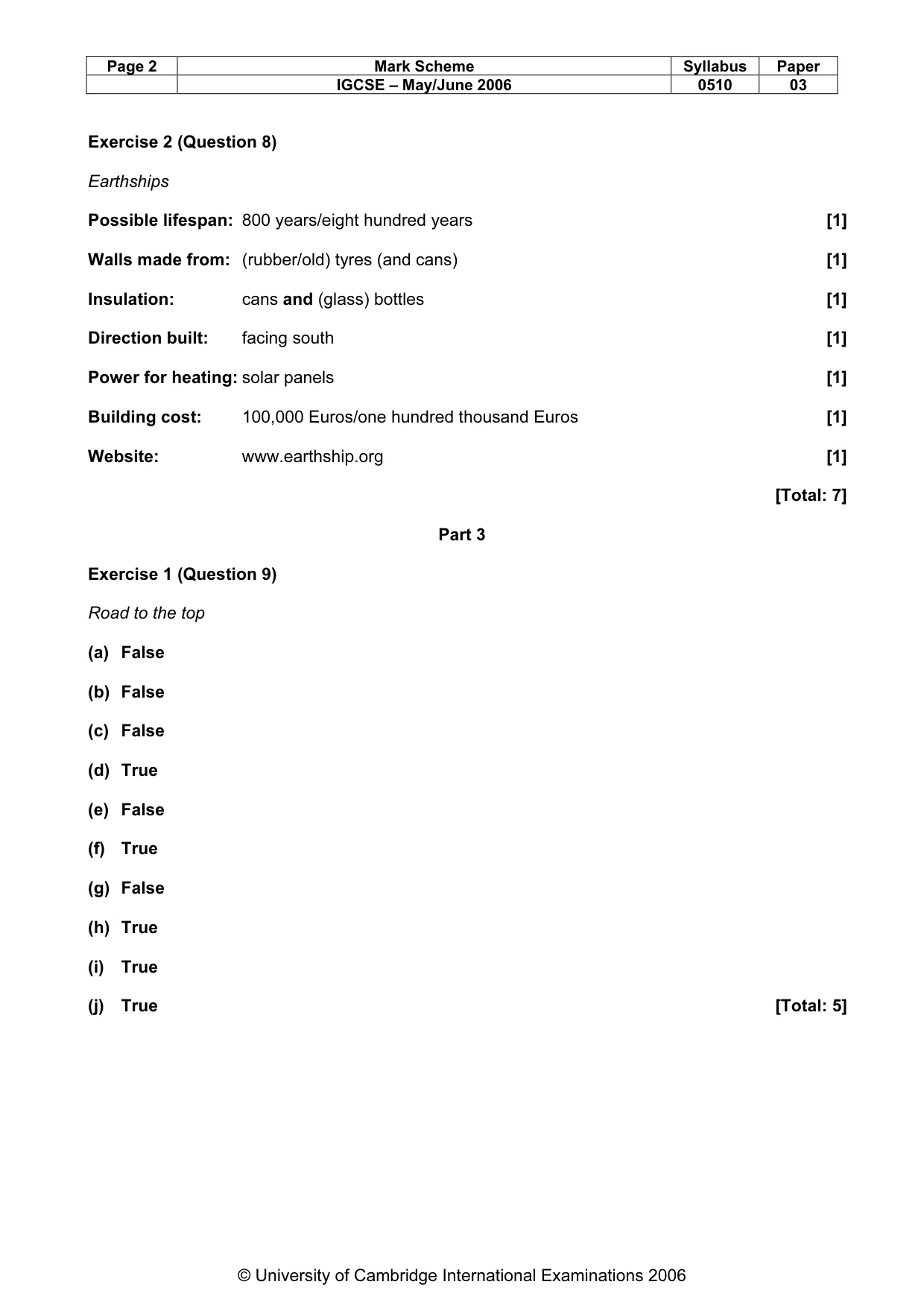
Page 2 Mark Scheme Syllabus Paper IGCSE – May/June 2006 0510 03 © University of Cambridge International Examinations 2006 Exercise 2 (Question 8) Earthships Possible lifespan: 800 years/eight hundred years [1] Walls made from: (rubber/old) tyres (and cans) [1] Insulation: cans and (glass) bottles [1] Direction built: facing south [1] Power for heating: solar panels [1] Building cost: 100,000 Euros/one hundred thousand Euros [1] Website: www.earthship.org [1] [Total: 7] Part 3 Exercise 1 (Question 9) Road to the top (a) False (b) False (c) False (d) True (e) False (f) True (g) False (h) True (i) True (j) True [Total: 5]
Mark scheme, page 4
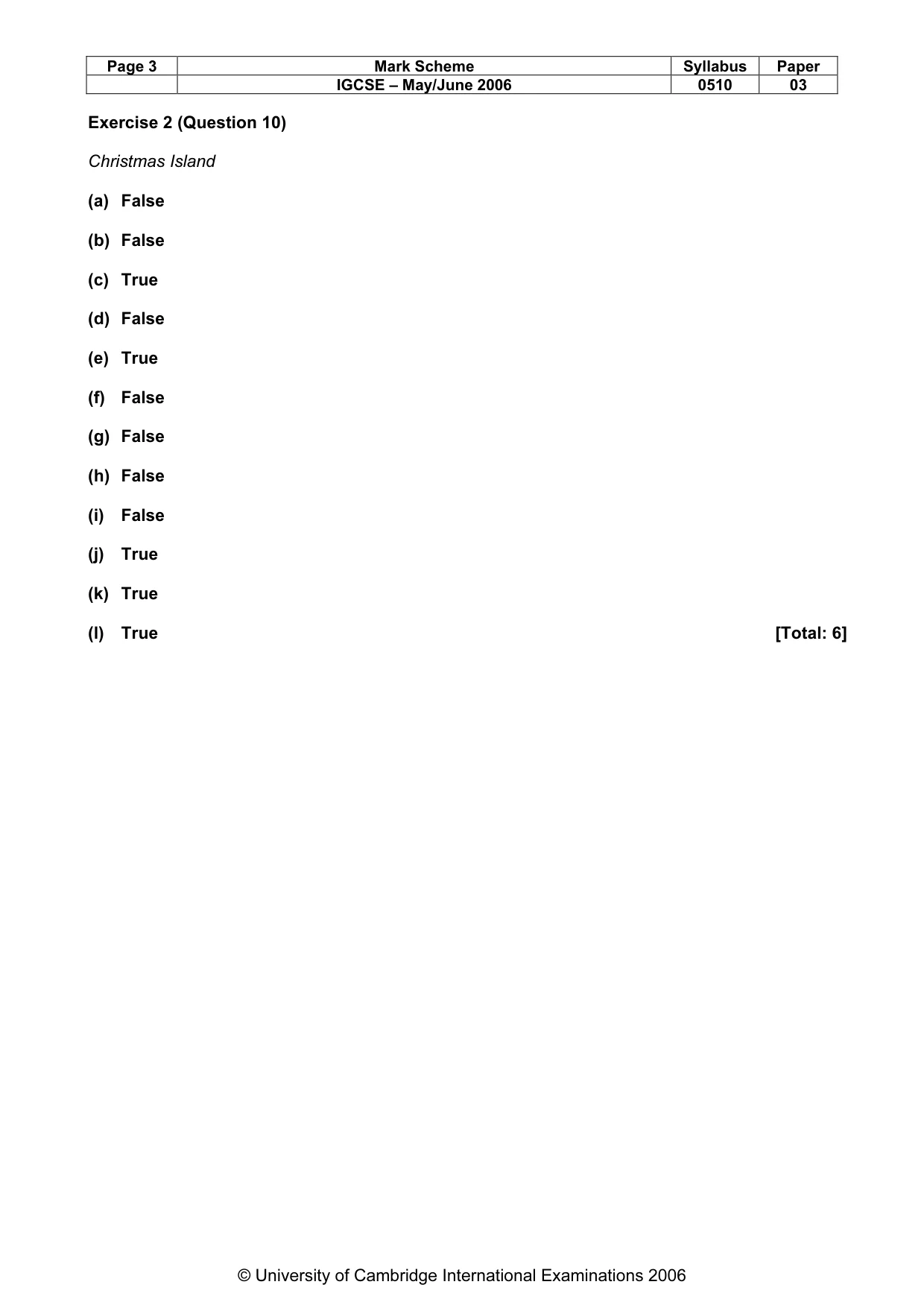
Page 3 Mark Scheme Syllabus Paper IGCSE – May/June 2006 0510 03 © University of Cambridge International Examinations 2006 Exercise 2 (Question 10) Christmas Island (a) False (b) False (c) True (d) False (e) True (f) False (g) False (h) False (i) False (j) True (k) True (l) True [Total: 6]
Mark scheme, page 5
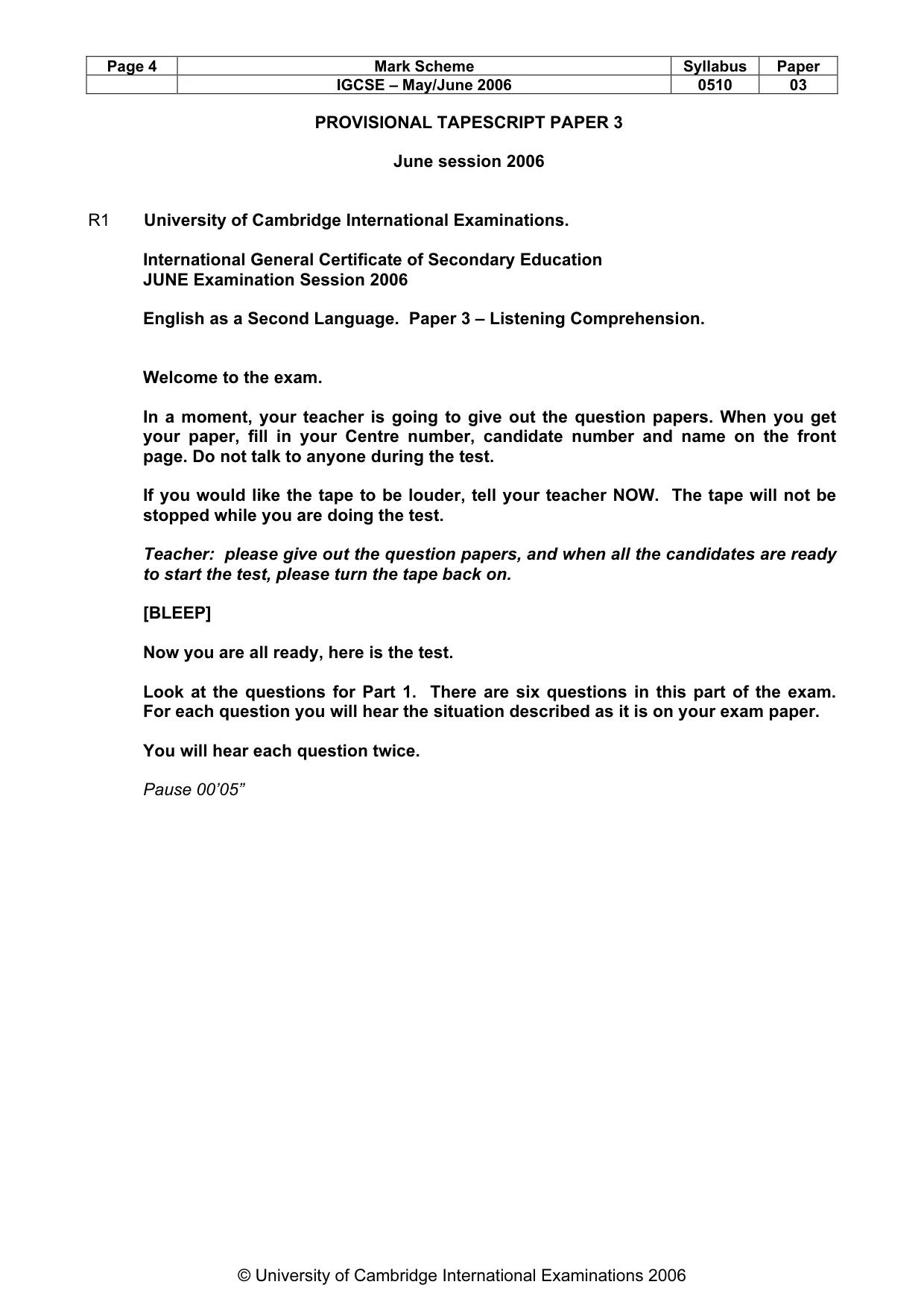
Page 4 Mark Scheme Syllabus Paper IGCSE – May/June 2006 0510 03 © University of Cambridge International Examinations 2006 PROVISIONAL TAPESCRIPT PAPER 3 June session 2006 R1 University of Cambridge International Examinations. International General Certificate of Secondary Education JUNE Examination Session 2006 English as a Second Language. Paper 3 – Listening Comprehension. Welcome to the exam. In a moment, your teacher is going to give out the question papers. When you get your paper, fill in your Centre number, candidate number and name on the front page. Do not talk to anyone during the test. If you would like the tape to be louder, tell your teacher NOW. The tape will not be stopped while you are doing the test. Teacher: please give out the question papers, and when all the candidates are ready to start the test, please turn the tape back on. [BLEEP] Now you are all ready, here is the test. Look at the questions for Part 1. There are six questions in this part of the exam. For each question you will hear the situation described as it is on your exam paper. You will hear each question twice. Pause 00’05”
Mark scheme, page 6
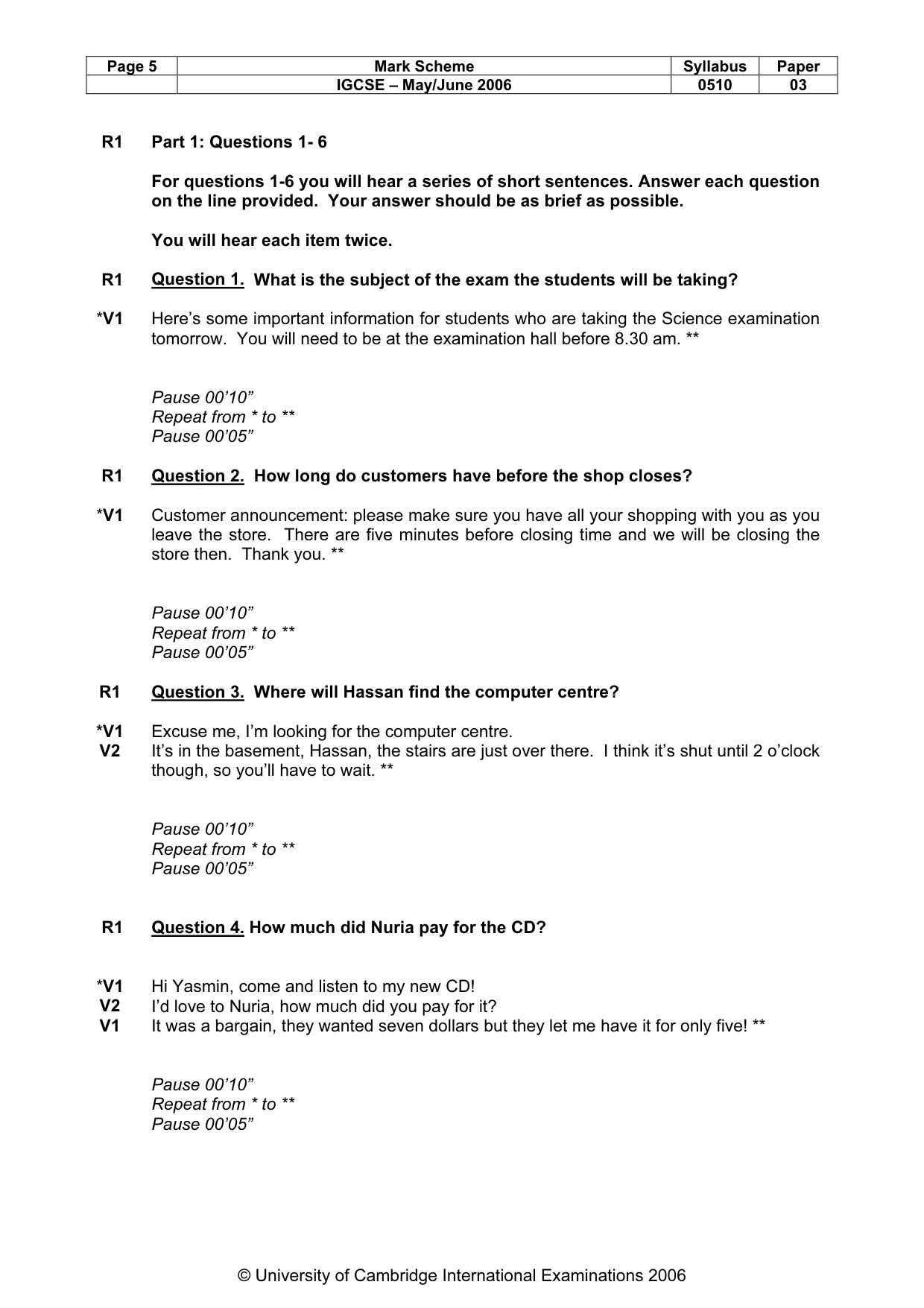
Page 5 Mark Scheme Syllabus Paper IGCSE – May/June 2006 0510 03 © University of Cambridge International Examinations 2006 R1 Part 1: Questions 1- 6 For questions 1-6 you will hear a series of short sentences. Answer each question on the line provided. Your answer should be as brief as possible. You will hear each item twice. R1 *V1 Question 1. What is the subject of the exam the students will be taking? Here’s some important information for students who are taking the Science examination tomorrow. You will need to be at the examination hall before 8.30 am. ** Pause 00’10” Repeat from * to ** Pause 00’05” R1 *V1 Question 2. How long do customers have before the shop closes? Customer announcement: please make sure you have all your shopping with you as you leave the store. There are five minutes before closing time and we will be closing the store then. Thank you. ** Pause 00’10” Repeat from * to ** Pause 00’05” R1 *V1 V2 Question 3. Where will Hassan find the computer centre? Excuse me, I’m looking for the computer centre. It’s in the basement, Hassan, the stairs are just over there. I think it’s shut until 2 o’clock though, so you’ll have to wait. ** Pause 00’10” Repeat from * to ** Pause 00’05” R1 *V1 V2 V1 Question 4. How much did Nuria pay for the CD? Hi Yasmin, come and listen to my new CD! I’d love to Nuria, how much did you pay for it? It was a bargain, they wanted seven dollars but they let me have it for only five! ** Pause 00’10” Repeat from * to ** Pause 00’05”
Mark scheme, page 7
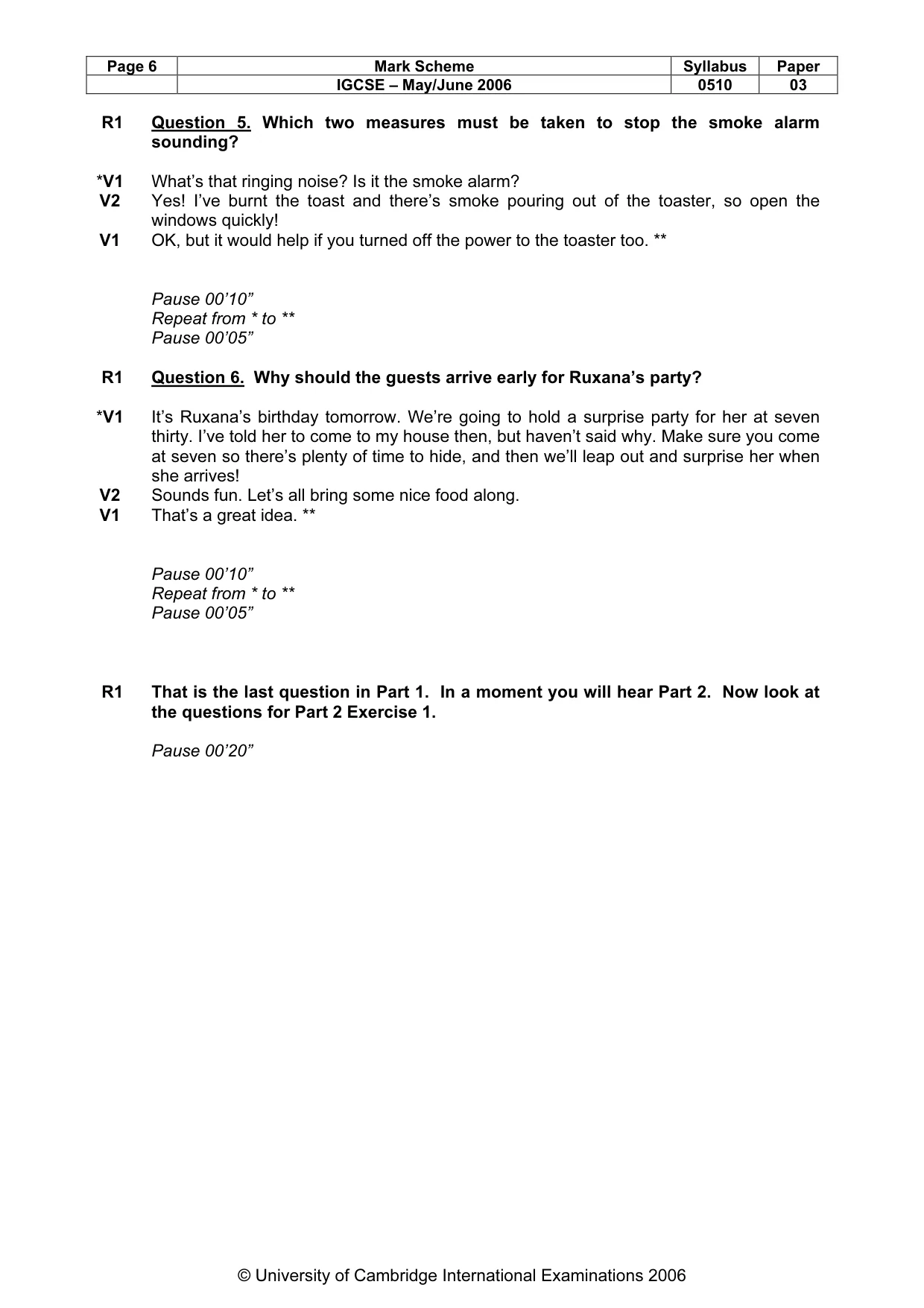
Page 6 Mark Scheme Syllabus Paper IGCSE – May/June 2006 0510 03 © University of Cambridge International Examinations 2006 R1 *V1 V2 V1 Question 5. Which two measures must be taken to stop the smoke alarm sounding? What’s that ringing noise? Is it the smoke alarm? Yes! I’ve burnt the toast and there’s smoke pouring out of the toaster, so open the windows quickly! OK, but it would help if you turned off the power to the toaster too. ** Pause 00’10” Repeat from * to ** Pause 00’05” R1 *V1 V2 V1 Question 6. Why should the guests arrive early for Ruxana’s party? It’s Ruxana’s birthday tomorrow. We’re going to hold a surprise party for her at seven thirty. I’ve told her to come to my house then, but haven’t said why. Make sure you come at seven so there’s plenty of time to hide, and then we’ll leap out and surprise her when she arrives! Sounds fun. Let’s all bring some nice food along. That’s a great idea. ** Pause 00’10” Repeat from * to ** Pause 00’05” R1 That is the last question in Part 1. In a moment you will hear Part 2. Now look at the questions for Part 2 Exercise 1. Pause 00’20”
Mark scheme, page 8
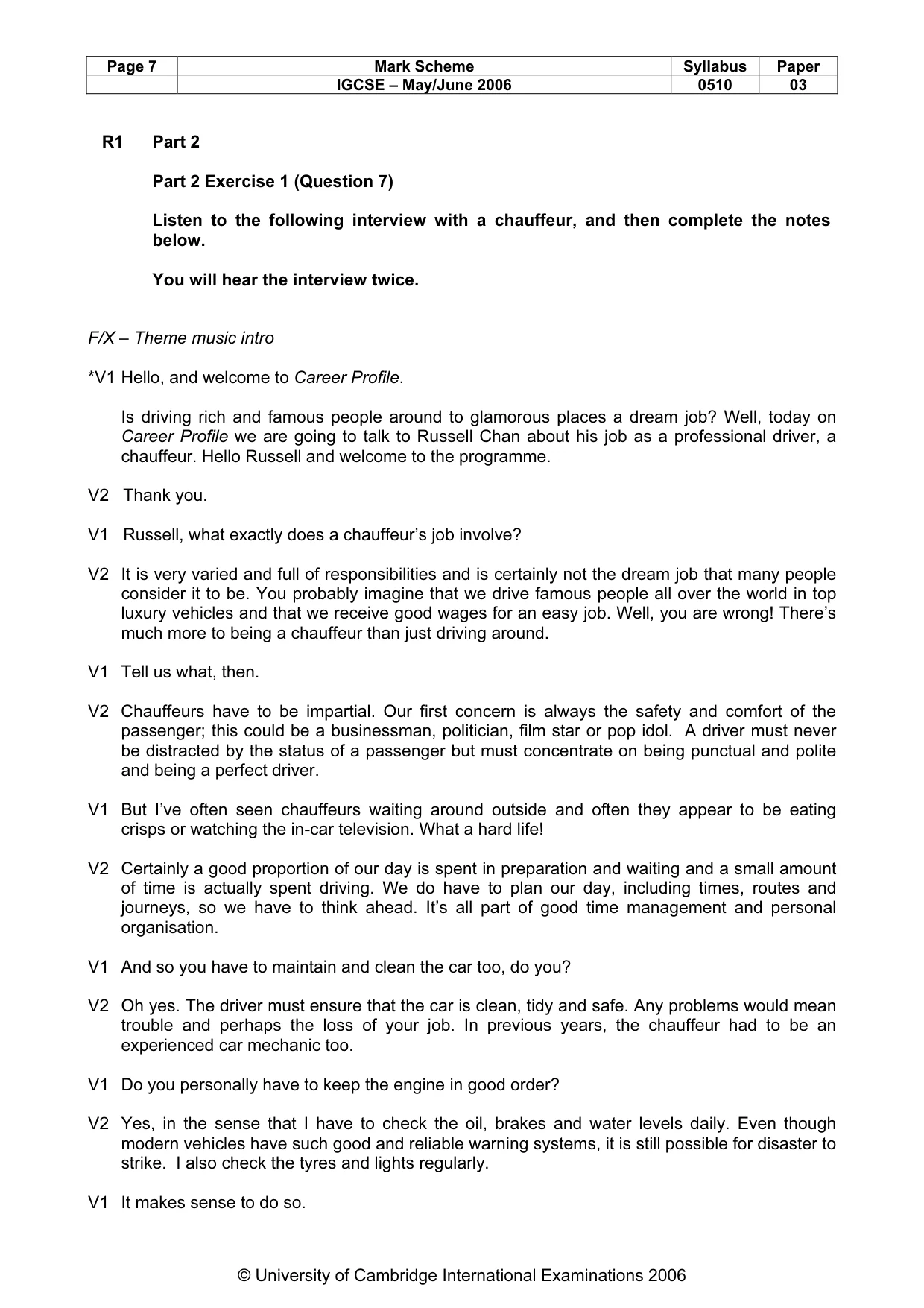
Page 7 Mark Scheme Syllabus Paper IGCSE – May/June 2006 0510 03 © University of Cambridge International Examinations 2006 R1 Part 2 Part 2 Exercise 1 (Question 7) Listen to the following interview with a chauffeur, and then complete the notes below. You will hear the interview twice. F/X – Theme music intro *V1 Hello, and welcome to Career Profile. Is driving rich and famous people around to glamorous places a dream job? Well, today on Career Profile we are going to talk to Russell Chan about his job as a professional driver, a chauffeur. Hello Russell and welcome to the programme. V2 Thank you. V1 Russell, what exactly does a chauffeur’s job involve? V2 It is very varied and full of responsibilities and is certainly not the dream job that many people consider it to be. You probably imagine that we drive famous people all over the world in top luxury vehicles and that we receive good wages for an easy job. Well, you are wrong! There’s much more to being a chauffeur than just driving around. V1 Tell us what, then. V2 Chauffeurs have to be impartial. Our first concern is always the safety and comfort of the passenger; this could be a businessman, politician, film star or pop idol. A driver must never be distracted by the status of a passenger but must concentrate on being punctual and polite and being a perfect driver. V1 But I’ve often seen chauffeurs waiting around outside and often they appear to be eating crisps or watching the in-car television. What a hard life! V2 Certainly a good proportion of our day is spent in preparation and waiting and a small amount of time is actually spent driving. We do have to plan our day, including times, routes and journeys, so we have to think ahead. It’s all part of good time management and personal organisation. V1 And so you have to maintain and clean the car too, do you? V2 Oh yes. The driver must ensure that the car is clean, tidy and safe. Any problems would mean trouble and perhaps the loss of your job. In previous years, the chauffeur had to be an experienced car mechanic too. V1 Do you personally have to keep the engine in good order? V2 Yes, in the sense that I have to check the oil, brakes and water levels daily. Even though modern vehicles have such good and reliable warning systems, it is still possible for disaster to strike. I also check the tyres and lights regularly. V1 It makes sense to do so.
Mark scheme, page 9
Page 8 Mark Scheme Syllabus Paper IGCSE – May/June 2006 0510 03 © University of Cambridge International Examinations 2006 V2 All professional chauffeurs have to attend to detail. We provide so much more than a one-off fast taxi service. We drive our passengers with a high degree of skill, safety and planning. V1 Thank you Russell Chan. ** Pause 00’30” R1 Now you will hear the interview again. Repeat from * to ** Pause 00’30” R1 That is the end of Part 2 Exercise 1. In a moment you will hear Part 2 Exercise 2. Now look at the questions for Exercise 2. Pause 00’25”
Mark scheme, page 10
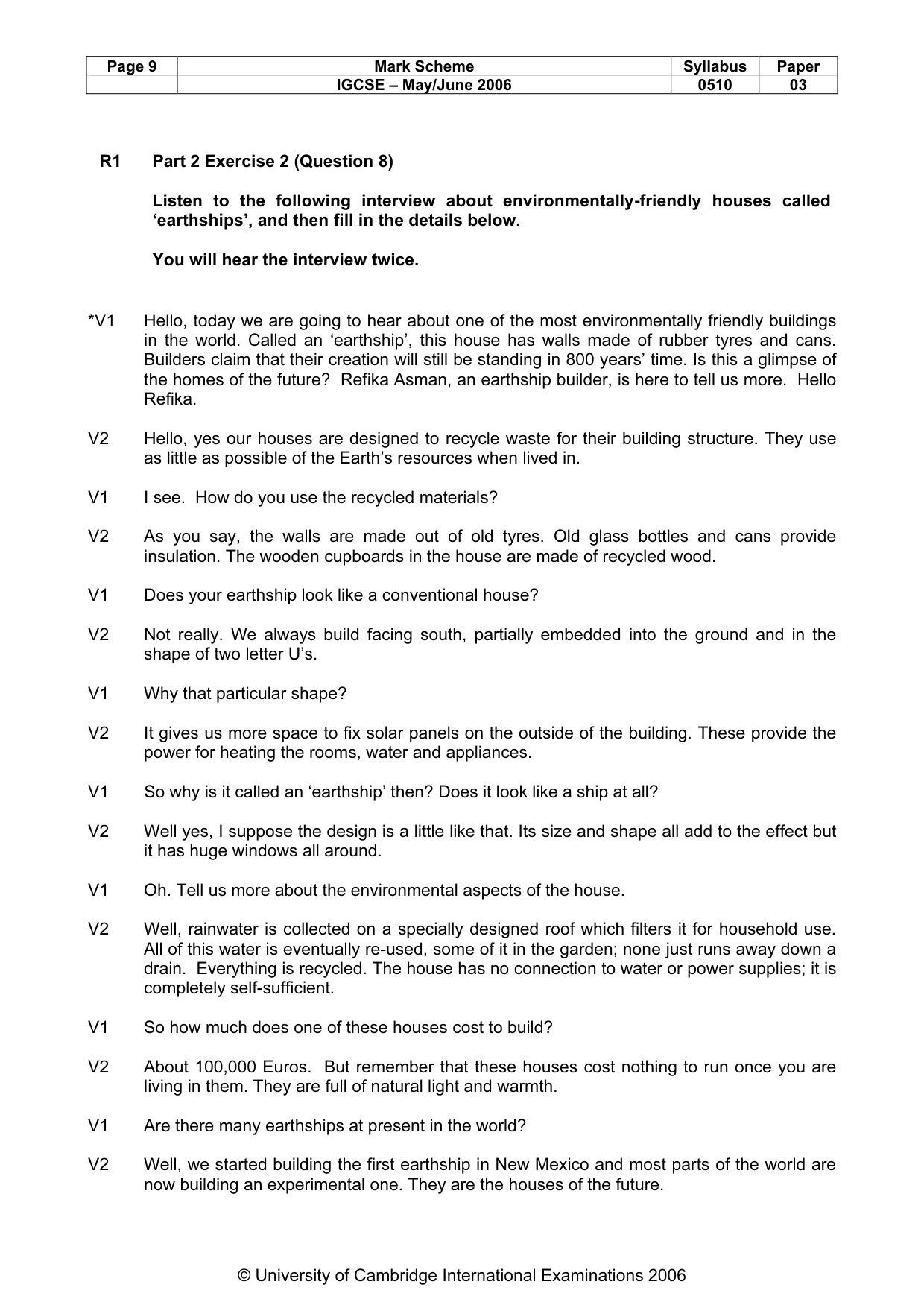
Page 9 Mark Scheme Syllabus Paper IGCSE – May/June 2006 0510 03 © University of Cambridge International Examinations 2006 R1 Part 2 Exercise 2 (Question 8) Listen to the following interview about environmentally-friendly houses called ‘earthships’, and then fill in the details below. You will hear the interview twice. *V1 Hello, today we are going to hear about one of the most environmentally friendly buildings in the world. Called an ‘earthship’, this house has walls made of rubber tyres and cans. Builders claim that their creation will still be standing in 800 years’ time. Is this a glimpse of the homes of the future? Refika Asman, an earthship builder, is here to tell us more. Hello Refika. V2 Hello, yes our houses are designed to recycle waste for their building structure. They use as little as possible of the Earth’s resources when lived in. V1 I see. How do you use the recycled materials? V2 As you say, the walls are made out of old tyres. Old glass bottles and cans provide insulation. The wooden cupboards in the house are made of recycled wood. V1 Does your earthship look like a conventional house? V2 Not really. We always build facing south, partially embedded into the ground and in the shape of two letter U’s. V1 Why that particular shape? V2 It gives us more space to fix solar panels on the outside of the building. These provide the power for heating the rooms, water and appliances. V1 So why is it called an ‘earthship’ then? Does it look like a ship at all? V2 Well yes, I suppose the design is a little like that. Its size and shape all add to the effect but it has huge windows all around. V1 Oh. Tell us more about the environmental aspects of the house. V2 Well, rainwater is collected on a specially designed roof which filters it for household use. All of this water is eventually re-used, some of it in the garden; none just runs away down a drain. Everything is recycled. The house has no connection to water or power supplies; it is completely self-sufficient. V1 So how much does one of these houses cost to build? V2 About 100,000 Euros. But remember that these houses cost nothing to run once you are living in them. They are full of natural light and warmth. V1 Are there many earthships at present in the world? V2 Well, we started building the first earthship in New Mexico and most parts of the world are now building an experimental one. They are the houses of the future.
Mark scheme, page 11
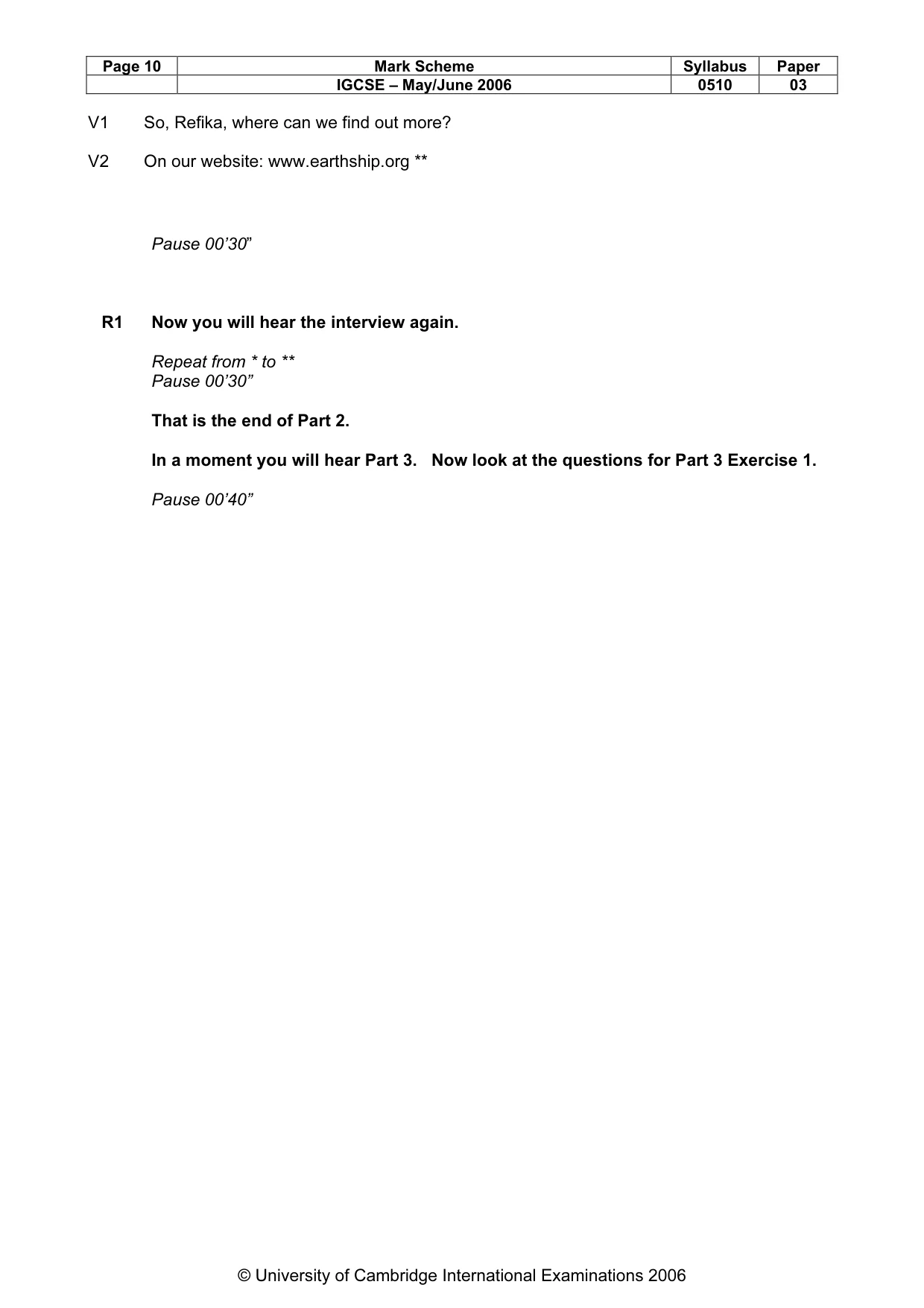
Page 10 Mark Scheme Syllabus Paper IGCSE – May/June 2006 0510 03 © University of Cambridge International Examinations 2006 V1 So, Refika, where can we find out more? V2 On our website: www.earthship.org ** Pause 00’30” R1 Now you will hear the interview again. Repeat from * to ** Pause 00’30” That is the end of Part 2. In a moment you will hear Part 3. Now look at the questions for Part 3 Exercise 1. Pause 00’40”
Mark scheme, page 12
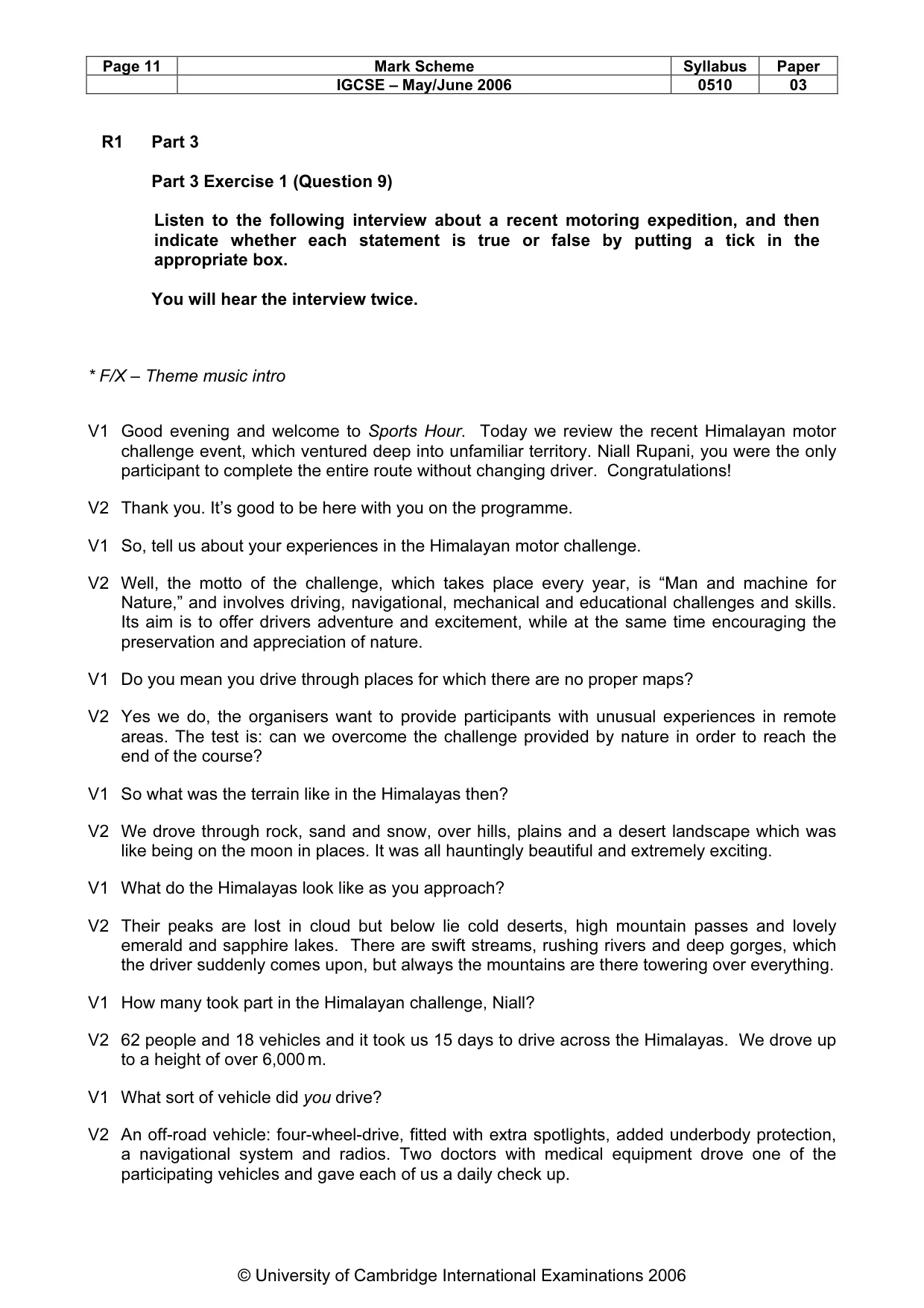
Page 11 Mark Scheme Syllabus Paper IGCSE – May/June 2006 0510 03 © University of Cambridge International Examinations 2006 R1 Part 3 Part 3 Exercise 1 (Question 9) Listen to the following interview about a recent motoring expedition, and then indicate whether each statement is true or false by putting a tick in the appropriate box. You will hear the interview twice. * F/X – Theme music intro V1 Good evening and welcome to Sports Hour. Today we review the recent Himalayan motor challenge event, which ventured deep into unfamiliar territory. Niall Rupani, you were the only participant to complete the entire route without changing driver. Congratulations! V2 Thank you. It’s good to be here with you on the programme. V1 So, tell us about your experiences in the Himalayan motor challenge. V2 Well, the motto of the challenge, which takes place every year, is “Man and machine for Nature,” and involves driving, navigational, mechanical and educational challenges and skills. Its aim is to offer drivers adventure and excitement, while at the same time encouraging the preservation and appreciation of nature. V1 Do you mean you drive through places for which there are no proper maps? V2 Yes we do, the organisers want to provide participants with unusual experiences in remote areas. The test is: can we overcome the challenge provided by nature in order to reach the end of the course? V1 So what was the terrain like in the Himalayas then? V2 We drove through rock, sand and snow, over hills, plains and a desert landscape which was like being on the moon in places. It was all hauntingly beautiful and extremely exciting. V1 What do the Himalayas look like as you approach? V2 Their peaks are lost in cloud but below lie cold deserts, high mountain passes and lovely emerald and sapphire lakes. There are swift streams, rushing rivers and deep gorges, which the driver suddenly comes upon, but always the mountains are there towering over everything. V1 How many took part in the Himalayan challenge, Niall? V2 62 people and 18 vehicles and it took us 15 days to drive across the Himalayas. We drove up to a height of over 6,000 m. V1 What sort of vehicle did you drive? V2 An off-road vehicle: four-wheel-drive, fitted with extra spotlights, added underbody protection, a navigational system and radios. Two doctors with medical equipment drove one of the participating vehicles and gave each of us a daily check up.
Mark scheme, page 13
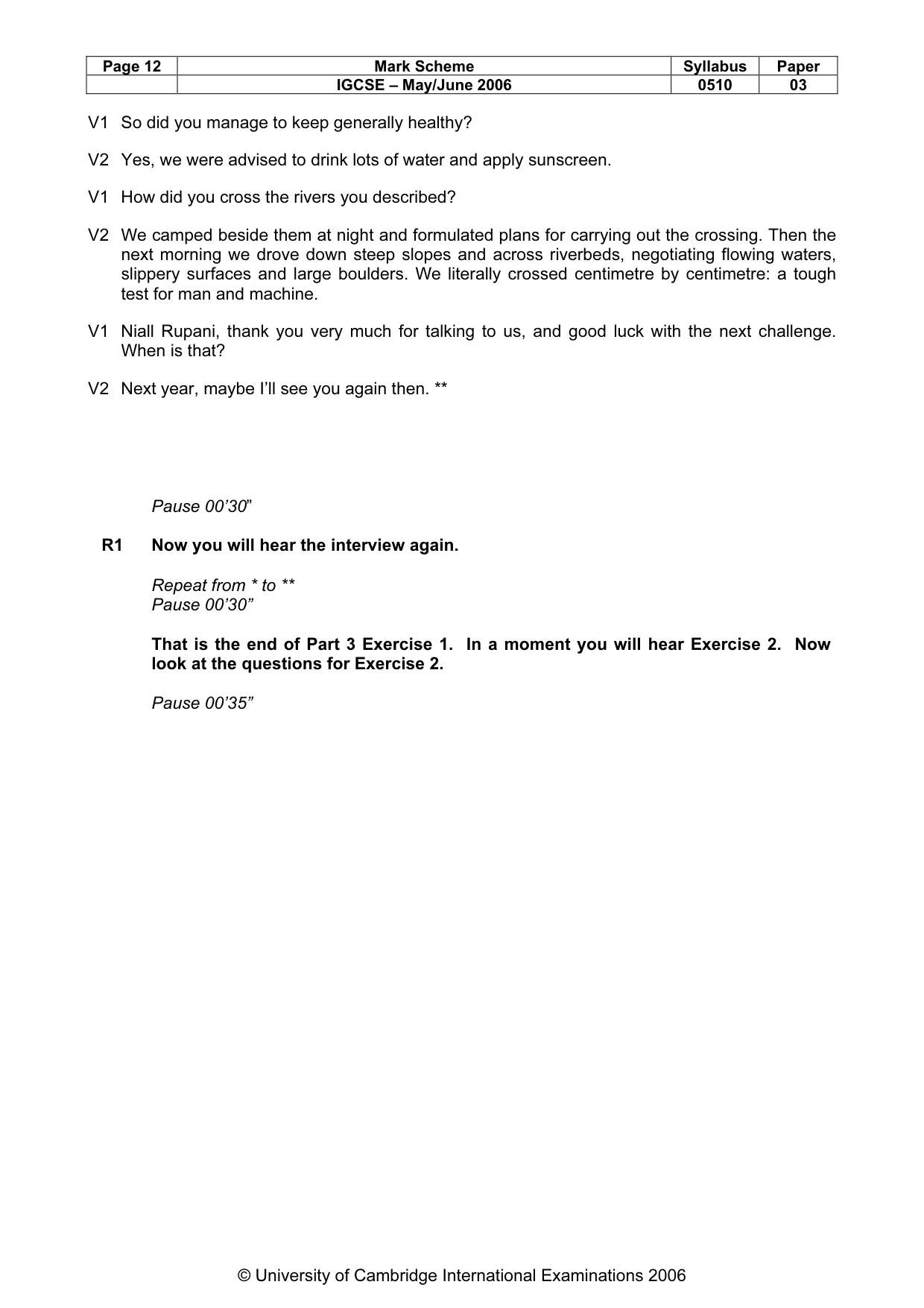
Page 12 Mark Scheme Syllabus Paper IGCSE – May/June 2006 0510 03 © University of Cambridge International Examinations 2006 V1 So did you manage to keep generally healthy? V2 Yes, we were advised to drink lots of water and apply sunscreen. V1 How did you cross the rivers you described? V2 We camped beside them at night and formulated plans for carrying out the crossing. Then the next morning we drove down steep slopes and across riverbeds, negotiating flowing waters, slippery surfaces and large boulders. We literally crossed centimetre by centimetre: a tough test for man and machine. V1 Niall Rupani, thank you very much for talking to us, and good luck with the next challenge. When is that? V2 Next year, maybe I’ll see you again then. ** Pause 00’30” R1 Now you will hear the interview again. Repeat from * to ** Pause 00’30” That is the end of Part 3 Exercise 1. In a moment you will hear Exercise 2. Now look at the questions for Exercise 2. Pause 00’35”
Mark scheme, page 14
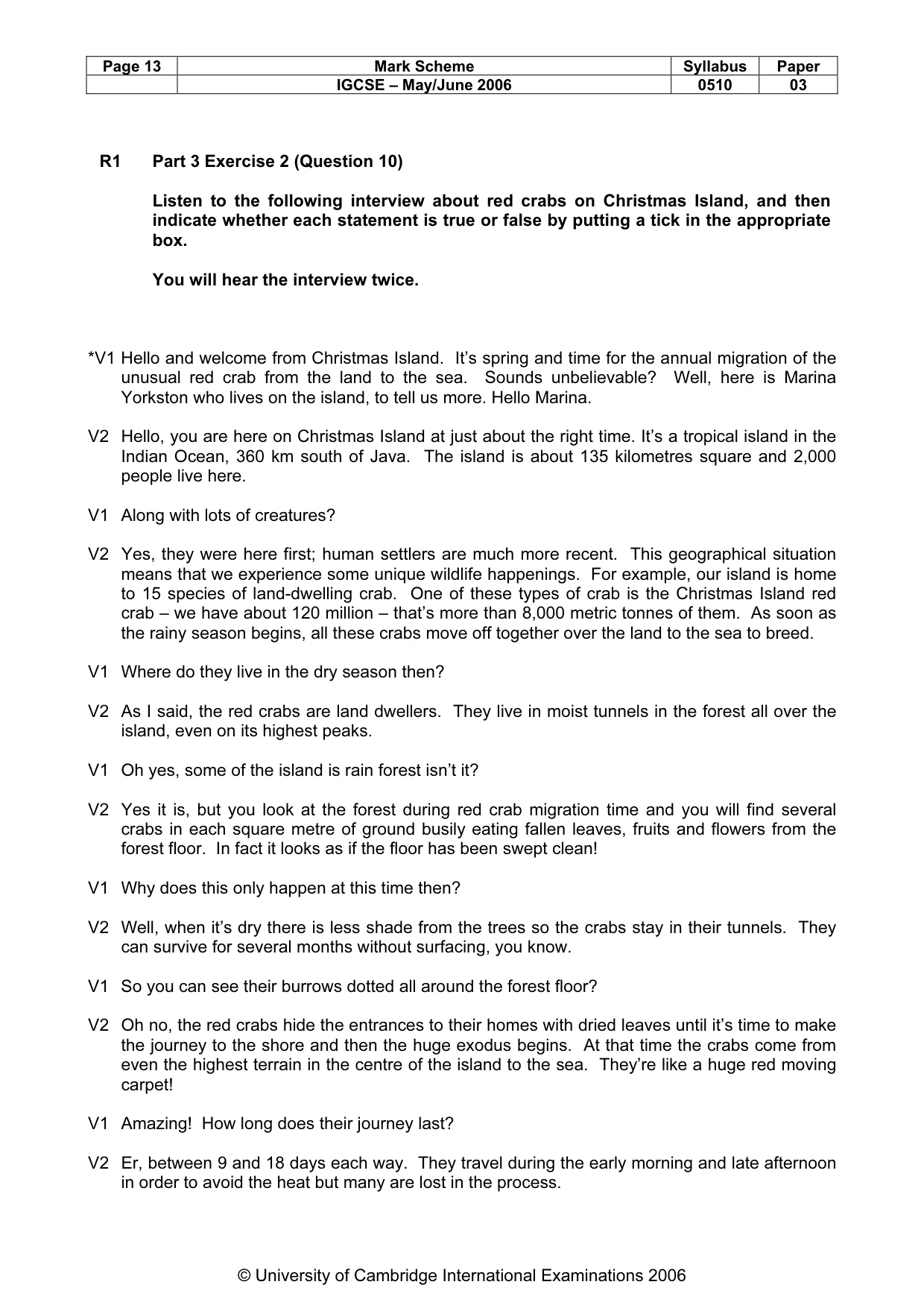
Page 13 Mark Scheme Syllabus Paper IGCSE – May/June 2006 0510 03 © University of Cambridge International Examinations 2006 R1 Part 3 Exercise 2 (Question 10) Listen to the following interview about red crabs on Christmas Island, and then indicate whether each statement is true or false by putting a tick in the appropriate box. You will hear the interview twice. *V1 Hello and welcome from Christmas Island. It’s spring and time for the annual migration of the unusual red crab from the land to the sea. Sounds unbelievable? Well, here is Marina Yorkston who lives on the island, to tell us more. Hello Marina. V2 Hello, you are here on Christmas Island at just about the right time. It’s a tropical island in the Indian Ocean, 360 km south of Java. The island is about 135 kilometres square and 2,000 people live here. V1 Along with lots of creatures? V2 Yes, they were here first; human settlers are much more recent. This geographical situation means that we experience some unique wildlife happenings. For example, our island is home to 15 species of land-dwelling crab. One of these types of crab is the Christmas Island red crab – we have about 120 million – that’s more than 8,000 metric tonnes of them. As soon as the rainy season begins, all these crabs move off together over the land to the sea to breed. V1 Where do they live in the dry season then? V2 As I said, the red crabs are land dwellers. They live in moist tunnels in the forest all over the island, even on its highest peaks. V1 Oh yes, some of the island is rain forest isn’t it? V2 Yes it is, but you look at the forest during red crab migration time and you will find several crabs in each square metre of ground busily eating fallen leaves, fruits and flowers from the forest floor. In fact it looks as if the floor has been swept clean! V1 Why does this only happen at this time then? V2 Well, when it’s dry there is less shade from the trees so the crabs stay in their tunnels. They can survive for several months without surfacing, you know. V1 So you can see their burrows dotted all around the forest floor? V2 Oh no, the red crabs hide the entrances to their homes with dried leaves until it’s time to make the journey to the shore and then the huge exodus begins. At that time the crabs come from even the highest terrain in the centre of the island to the sea. They’re like a huge red moving carpet! V1 Amazing! How long does their journey last? V2 Er, between 9 and 18 days each way. They travel during the early morning and late afternoon in order to avoid the heat but many are lost in the process.
Mark scheme, page 15
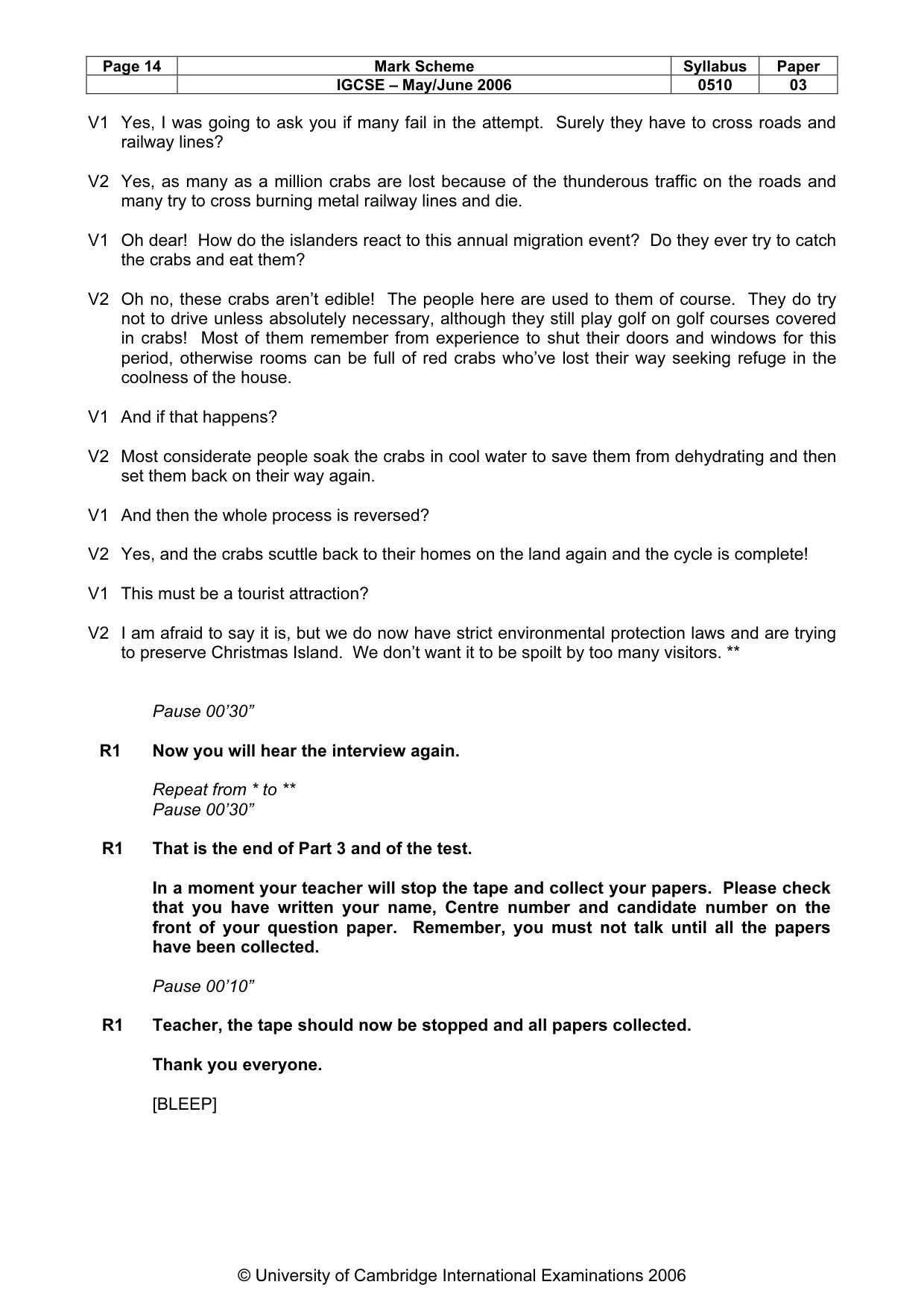
Page 14 Mark Scheme Syllabus Paper IGCSE – May/June 2006 0510 03 © University of Cambridge International Examinations 2006 V1 Yes, I was going to ask you if many fail in the attempt. Surely they have to cross roads and railway lines? V2 Yes, as many as a million crabs are lost because of the thunderous traffic on the roads and many try to cross burning metal railway lines and die. V1 Oh dear! How do the islanders react to this annual migration event? Do they ever try to catch the crabs and eat them? V2 Oh no, these crabs aren’t edible! The people here are used to them of course. They do try not to drive unless absolutely necessary, although they still play golf on golf courses covered in crabs! Most of them remember from experience to shut their doors and windows for this period, otherwise rooms can be full of red crabs who’ve lost their way seeking refuge in the coolness of the house. V1 And if that happens? V2 Most considerate people soak the crabs in cool water to save them from dehydrating and then set them back on their way again. V1 And then the whole process is reversed? V2 Yes, and the crabs scuttle back to their homes on the land again and the cycle is complete! V1 This must be a tourist attraction? V2 I am afraid to say it is, but we do now have strict environmental protection laws and are trying to preserve Christmas Island. We don’t want it to be spoilt by too many visitors. ** R1 R1 R1 Pause 00’30” Now you will hear the interview again. Repeat from * to ** Pause 00’30” That is the end of Part 3 and of the test. In a moment your teacher will stop the tape and collect your papers. Please check that you have written your name, Centre number and candidate number on the front of your question paper. Remember, you must not talk until all the papers have been collected. Pause 00’10” Teacher, the tape should now be stopped and all papers collected. Thank you everyone. [BLEEP]
What you needed in this session
Cambridge’s own grade thresholds for 2006 May/June, Paper 3 · Variant 1. A higher threshold means an easier paper — the bar moves with how the cohort did.