Cambridge IGCSE English - Second Language (oral endorsement) 0510 — 2006 May/June Paper 1 · Variant 1
0510/11/M/J/06 · 56 marks · ≈63 min
The question paper and its mark scheme, free to read here and free to download. This is Cambridge’s own paper, exactly as it was sat.
Question paper16 pages



Mark scheme6 pages
Answers below. Sit the paper first if you are practising.
Paper as text
Question paper, page 1
This document consists of 13 printed pages and 3 blank pages. IB06 06_0510_01/5RP UCLES 2006 [Turn over Candidate Name Centre Number Candidate Number UNIVERSITY OF CAMBRIDGE INTERNATIONAL EXAMINATIONS International General Certificate of Secondary Education ENGLISH AS A SECOND LANGUAGE Paper 1 Reading and Writing (Core) 0510/01 May/June 2006 Candidates answer on the Question Paper. 1 hour 30 minutes No Additional Materials are required. READ THESE INSTRUCTIONS FIRST Write your Centre number, candidate number and name on all the work you hand in. Write in dark blue or black pen. Do not use staples, paper clips, glue or correction fluid. DO NOT WRITE IN THE BARCODE. DO NOT WRITE IN THE GREY AREAS BETWEEN THE PAGES. Answer all questions. Dictionaries are not allowed. At the end of the examination, fasten all your work securely together. The number of marks is given in brackets [ ] at the end of each question or part question. *051001* For Examiner's Use Exercise 1 Exercise 2 Exercise 3 Exercise 4 Exercise 5 Exercise 6 Exercise 7 Total www.XtremePapers.com
Question paper, page 2
2 © UCLES 2006 0510/01/M/J/06 Exercise 1 Read the following advertisement about wild animal parks, and then answer the questions on the opposite page. Mid-Term break at the Port Lymper and West Coast Holiday Parks February 9 to February 17 FREE GIFT Port Lymper and West Coast Holiday Parks are situated in Australia’s open bush country and easily accessible by car. You can travel around Port Lymper and West Coast Holiday Parks and see the world’s rarest and most endangered animals. These range from pandas and marmosets to alligators and bats. It’s the only place in this part of the world where all these creatures can be seen together. Two wildlife parks, two great days out. Take advantage of our half-price winter promotion during the Mid-Term break where you can visit both parks for the price it would normally cost to visit one. Adults $4.90 per park. Children and Senior Citizens $3.90 per park. Between Saturday February 9 and Sunday February 17 every full-paying child that visits either Port Lymper or West Coast Holiday Parks with a voucher will receive a reminder of the endangered species. Choose from either a tiger, gorilla or elephant. You collect your new furry friend on entrance to the Parks with your voucher, usual retail price $2.99. At Port Lymper and West Coast Holiday Parks we have arranged a safari treasure hunt, providing fun, education and a prize for everyone. Each day there will be a talk from one of our keepers telling you about the animals they look after. FURTHER DETAILS: Park opening times: 10am daily, last admission 3pm. Closed Mondays and National Holidays. Gift Shop and Cafe: open from 10.30 to 3.30 daily. Education packs and talks available to schools and colleges, contact: www.westcoastholparks.net Information: www.portlymper.com or call 09068 800605 With every full-paying child aged between 4 – 14 years. You must bring your original voucher. No photocopies accepted.
Question paper, page 3
3 © UCLES 2006 0510/01/M/J/06 [Turn over For Examiner's Use (a) What kind of parks are Port Lymper and West Coast Holiday Parks? [1] (b) How much do the furry friends usually cost? [1] (c) What do the keepers offer on the programme daily? [1] (d) What is the latest time for entrance to the parks each day? [1] (e) What can teachers access to help their students? [1] (f) Which park would you contact for more information? [1] [Total: 6]
Question paper, page 4
4 © UCLES 2006 0510/01/M/J/06 Exercise 2 Read the article below and then answer the questions on the opposite page. In addition, the British Arctic team will provide more evidence of human powers of “mind over matter”. They will pull nearly twice their own weight in supplies, for more than 500 miles on moving pack ice. The 10 hours or so each day they spend covering the necessary distance has been compared to running a daily marathon for months on end. “What they are planning to do will be absolutely amazing physically. But it is even more incredible mentally. I would say that at least 70% of the expedition will be a mental challenge,” says Zoë Hudson. She’s a physiotherapist when she is working in Britain, but is the team base-camp manager on the walk to the North Pole. “For instance, the team might cover five miles in a day, only to find that the nature of polar ice flow means they could wake up the next morning to find they have drifted 10 miles backwards,” adds Zoë. In addition to the physical and mental challenges, each member of the team will lose around 12 kilos in weight, so, as well as doing endurance training with the army, they have had to put on weight. Ann Daniels has grown from her usual 62 kilos to 72 kilos, eating bread and cakes to build up a good layer of insulation. For the expedition, the team has invented a sticky food called “mullarkey”, a mixture of cereals, slightly salted butter, melted snow and drinking chocolate. Each morning they will have a hot rice-type breakfast and hot drinks made from boiling snow. While walking they eat chocolate bars and nuts. “No fresh fruit, far too heavy to carry,” they say. They take multivitamins to compensate. In the evening, a rehydrated meal is all they can look forward to after the efforts of the day. ICE MAIDENS WALK TO THE NORTH POLE Ann Daniels, 37, is proof that humans really can reach new physical and mental peaks after the age of 30. She is setting off with Caroline Hamilton and Pom Oliver to complete a unique double record. They are expected to take until June to become the first British all-female expedition to reach the North Pole on foot. In 2000 they conquered Antarctica, so they could also be the first all-women’s team in the world to have reached both poles. Ann Daniels Caroline Hamilton Pom Oliver 37 35 50 62 58 54 72 67 64 60 55 52 Name Age normal start of expedition Weight in Kilos end of expedition Apart from breaking records, the team will also try to move into new scientific areas of human endurance research. For example, the trio will suffer temperatures lower than -40oC. Through research on cell walls, scientists already know how we feel “hot”, but they are still struggling to find out how we feel “cold” and how the body survives extreme cold.
Question paper, page 5
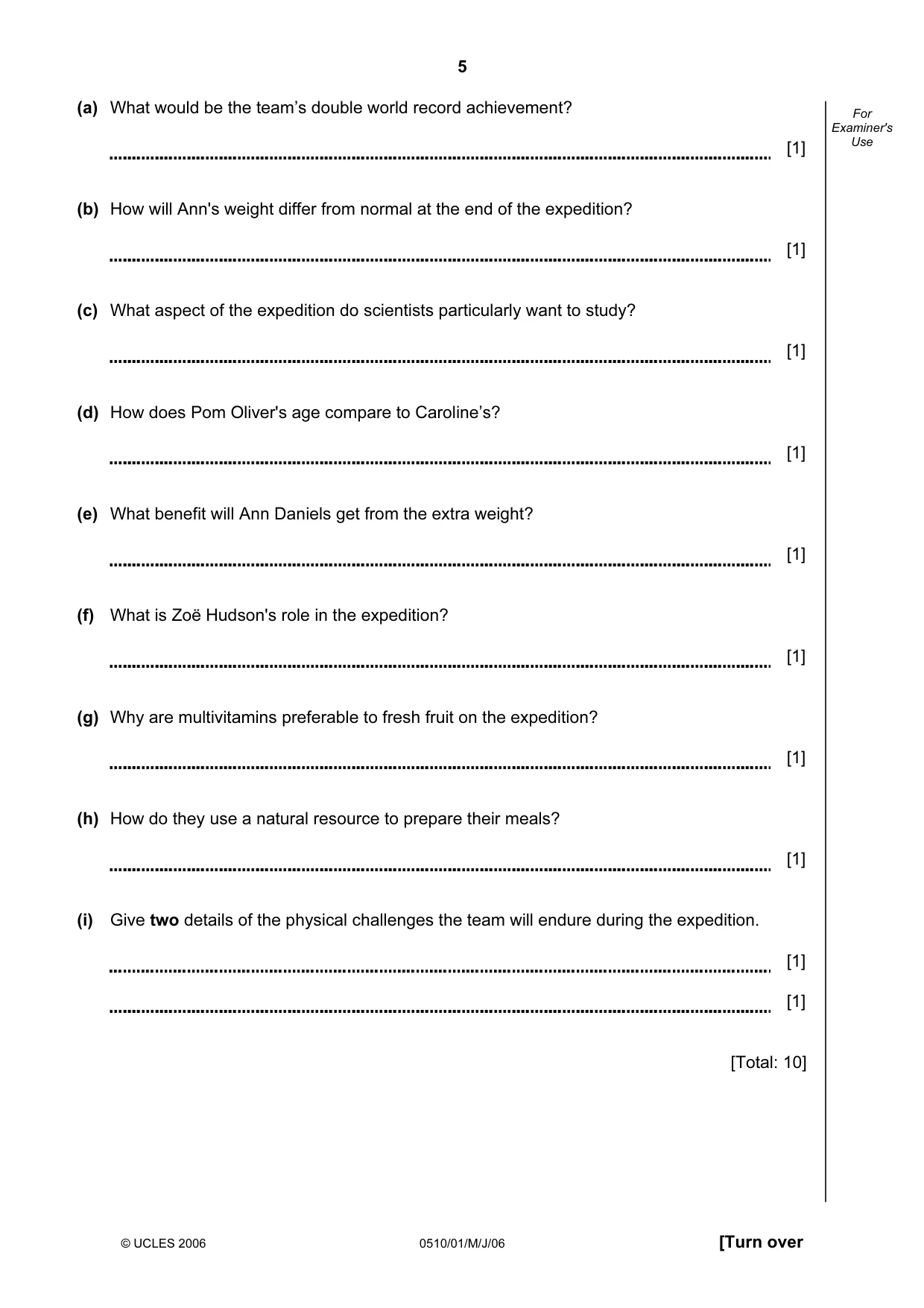
5 © UCLES 2006 0510/01/M/J/06 [Turn over For Examiner's Use (a) What would be the team’s double world record achievement? [1] (b) How will Ann's weight differ from normal at the end of the expedition? [1] (c) What aspect of the expedition do scientists particularly want to study? [1] (d) How does Pom Oliver's age compare to Caroline’s? [1] (e) What benefit will Ann Daniels get from the extra weight? [1] (f) What is Zoë Hudson's role in the expedition? [1] (g) Why are multivitamins preferable to fresh fruit on the expedition? [1] (h) How do they use a natural resource to prepare their meals? [1] (i) Give two details of the physical challenges the team will endure during the expedition. [1] [1] [Total: 10]
Question paper, page 6
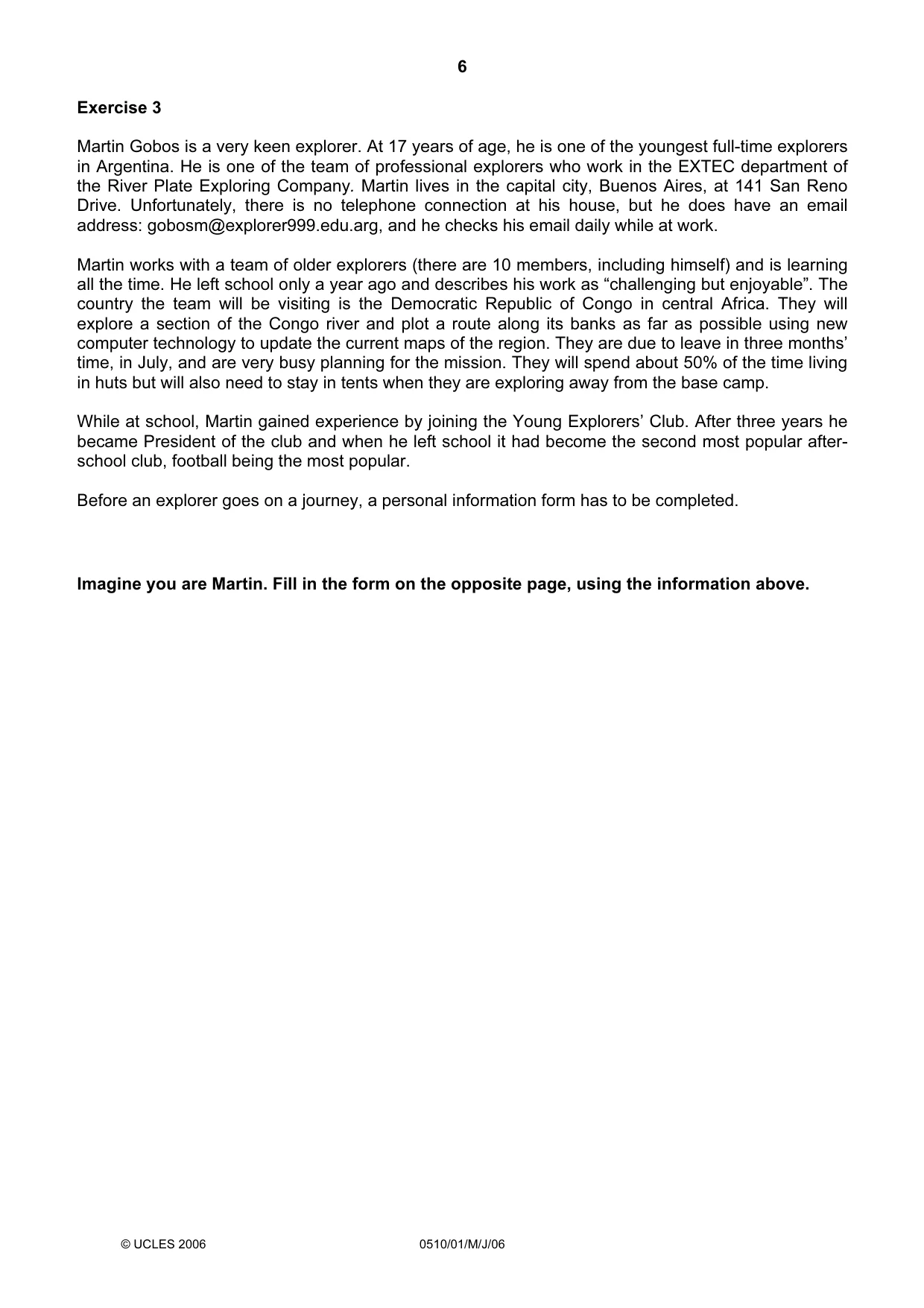
6 © UCLES 2006 0510/01/M/J/06 Exercise 3 Martin Gobos is a very keen explorer. At 17 years of age, he is one of the youngest full-time explorers in Argentina. He is one of the team of professional explorers who work in the EXTEC department of the River Plate Exploring Company. Martin lives in the capital city, Buenos Aires, at 141 San Reno Drive. Unfortunately, there is no telephone connection at his house, but he does have an email address: gobosm@explorer999.edu.arg, and he checks his email daily while at work. Martin works with a team of older explorers (there are 10 members, including himself) and is learning all the time. He left school only a year ago and describes his work as “challenging but enjoyable”. The country the team will be visiting is the Democratic Republic of Congo in central Africa. They will explore a section of the Congo river and plot a route along its banks as far as possible using new computer technology to update the current maps of the region. They are due to leave in three months’ time, in July, and are very busy planning for the mission. They will spend about 50% of the time living in huts but will also need to stay in tents when they are exploring away from the base camp. While at school, Martin gained experience by joining the Young Explorers’ Club. After three years he became President of the club and when he left school it had become the second most popular after- school club, football being the most popular. Before an explorer goes on a journey, a personal information form has to be completed. Imagine you are Martin. Fill in the form on the opposite page, using the information above.
Question paper, page 7
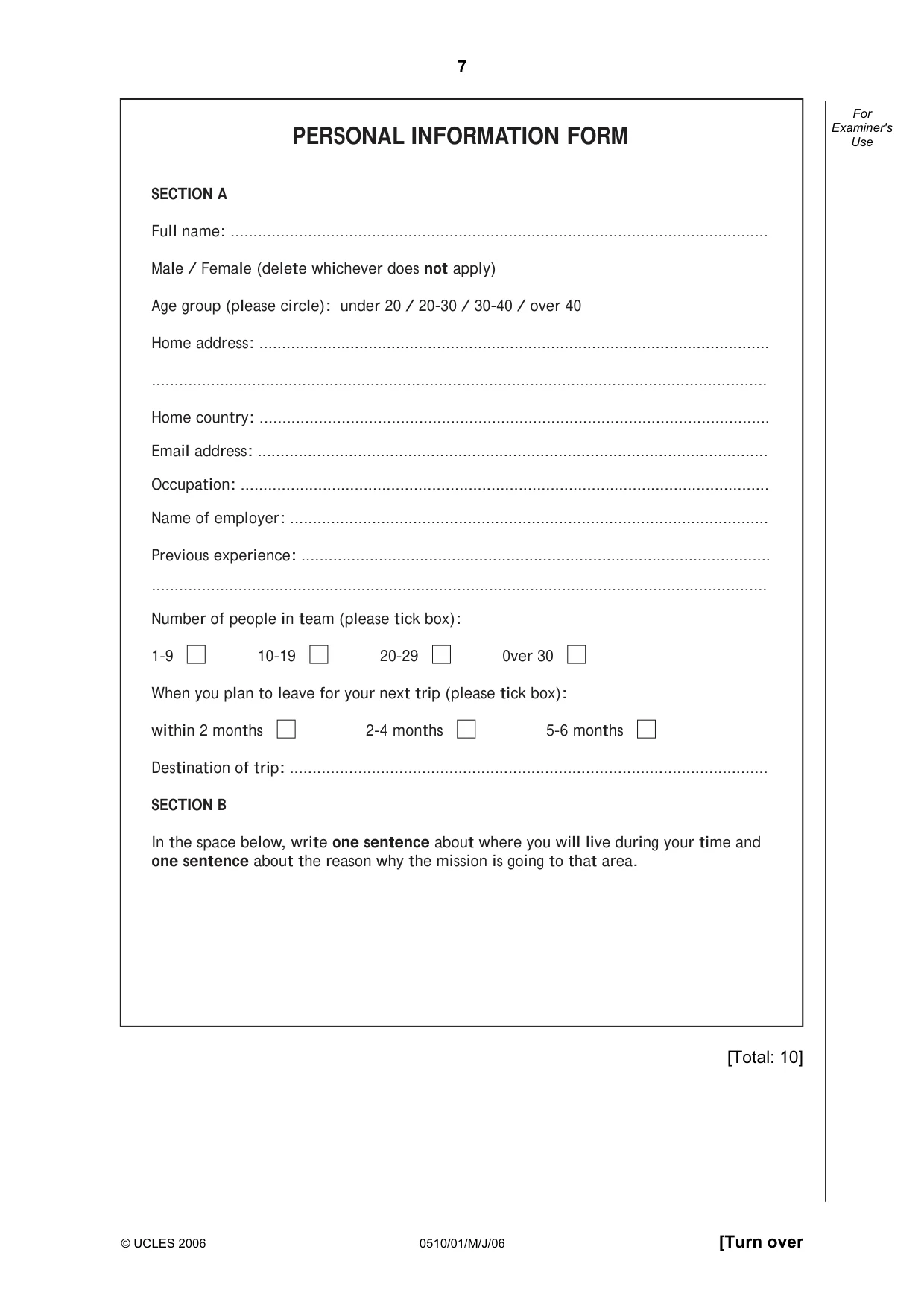
7 © UCLES 2006 0510/01/M/J/06 [Turn over For Examiner's Use PERSONAL INFORMATION FORM SECTION A Full name: … Male / Female (delete whichever does not apply) Age group (please circle): under 20 / 20-30 / 30-40 / over 40 Home address: … … Home country: … Email address: … Occupation: … Name of employer: … Previous experience: … … Number of people in team (please tick box): 1-9 10-19 20-29 0ver 30 When you plan to leave for your next trip (please tick box): within 2 months 2-4 months 5-6 months Destination of trip: … SECTION B In the space below, write one sentence about where you will live during your time and one sentence about the reason why the mission is going to that area. [Total: 10]
Question paper, page 8
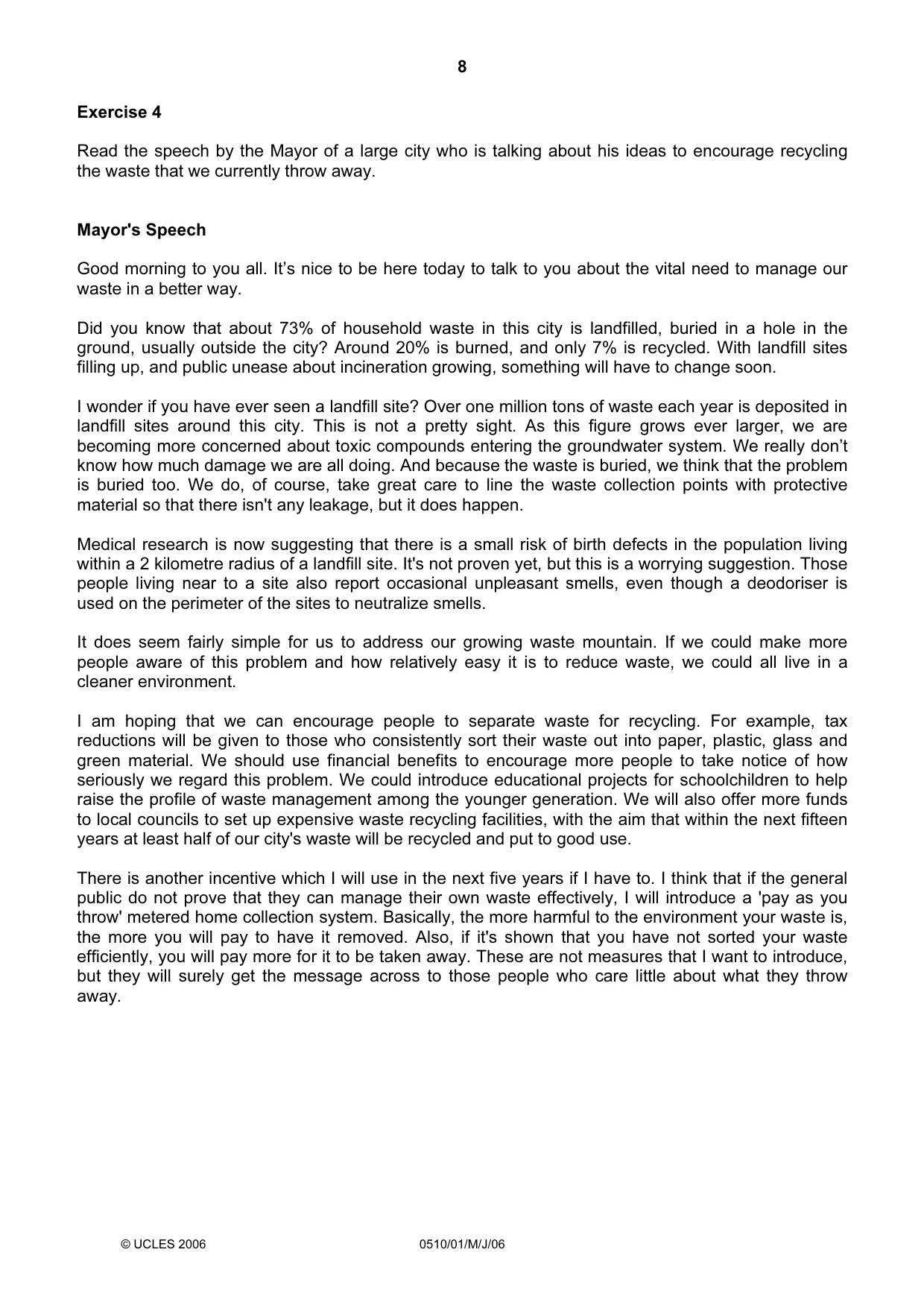
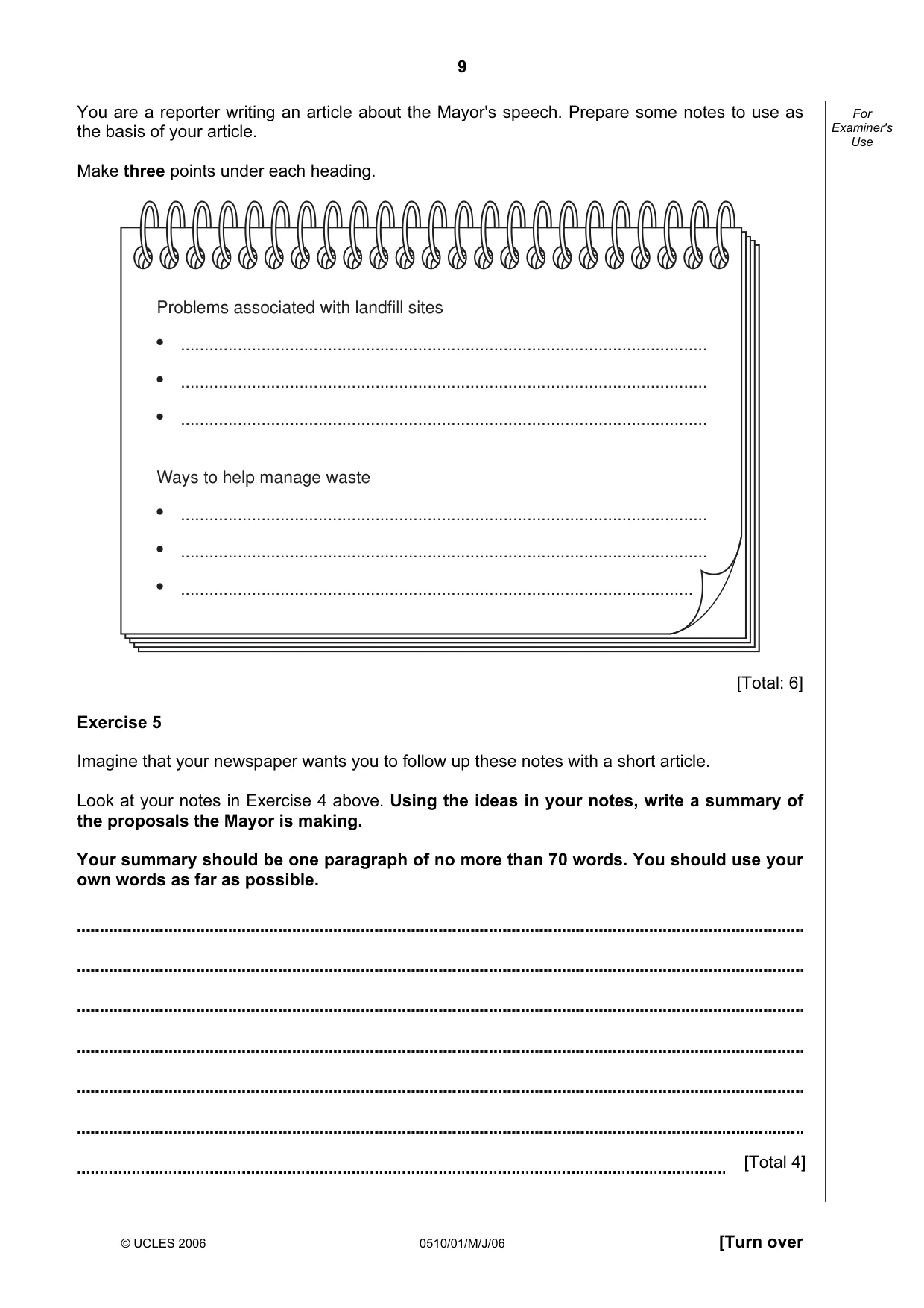
8 © UCLES 2006 0510/01/M/J/06 Exercise 4 Read the speech by the Mayor of a large city who is talking about his ideas to encourage recycling the waste that we currently throw away. Mayor's Speech Good morning to you all. It’s nice to be here today to talk to you about the vital need to manage our waste in a better way. Did you know that about 73% of household waste in this city is landfilled, buried in a hole in the ground, usually outside the city? Around 20% is burned, and only 7% is recycled. With landfill sites filling up, and public unease about incineration growing, something will have to change soon. I wonder if you have ever seen a landfill site? Over one million tons of waste each year is deposited in landfill sites around this city. This is not a pretty sight. As this figure grows ever larger, we are becoming more concerned about toxic compounds entering the groundwater system. We really don’t know how much damage we are all doing. And because the waste is buried, we think that the problem is buried too. We do, of course, take great care to line the waste collection points with protective material so that there isn't any leakage, but it does happen. Medical research is now suggesting that there is a small risk of birth defects in the population living within a 2 kilometre radius of a landfill site. It's not proven yet, but this is a worrying suggestion. Those people living near to a site also report occasional unpleasant smells, even though a deodoriser is used on the perimeter of the sites to neutralize smells. It does seem fairly simple for us to address our growing waste mountain. If we could make more people aware of this problem and how relatively easy it is to reduce waste, we could all live in a cleaner environment. I am hoping that we can encourage people to separate waste for recycling. For example, tax reductions will be given to those who consistently sort their waste out into paper, plastic, glass and green material. We should use financial benefits to encourage more people to take notice of how seriously we regard this problem. We could introduce educational projects for schoolchildren to help raise the profile of waste management among the younger generation. We will also offer more funds to local councils to set up expensive waste recycling facilities, with the aim that within the next fifteen years at least half of our city's waste will be recycled and put to good use. There is another incentive which I will use in the next five years if I have to. I think that if the general public do not prove that they can manage their own waste effectively, I will introduce a 'pay as you throw' metered home collection system. Basically, the more harmful to the environment your waste is, the more you will pay to have it removed. Also, if it's shown that you have not sorted your waste efficiently, you will pay more for it to be taken away. These are not measures that I want to introduce, but they will surely get the message across to those people who care little about what they throw away.
Question paper, page 9
9 © UCLES 2006 0510/01/M/J/06 [Turn over For Examiner's Use You are a reporter writing an article about the Mayor's speech. Prepare some notes to use as the basis of your article. Make three points under each heading. Problems associated with landfill sites … … … Ways to help manage waste … … … [Total: 6] Exercise 5 Imagine that your newspaper wants you to follow up these notes with a short article. Look at your notes in Exercise 4 above. Using the ideas in your notes, write a summary of the proposals the Mayor is making. Your summary should be one paragraph of no more than 70 words. You should use your own words as far as possible. [Total 4]
Question paper, page 10
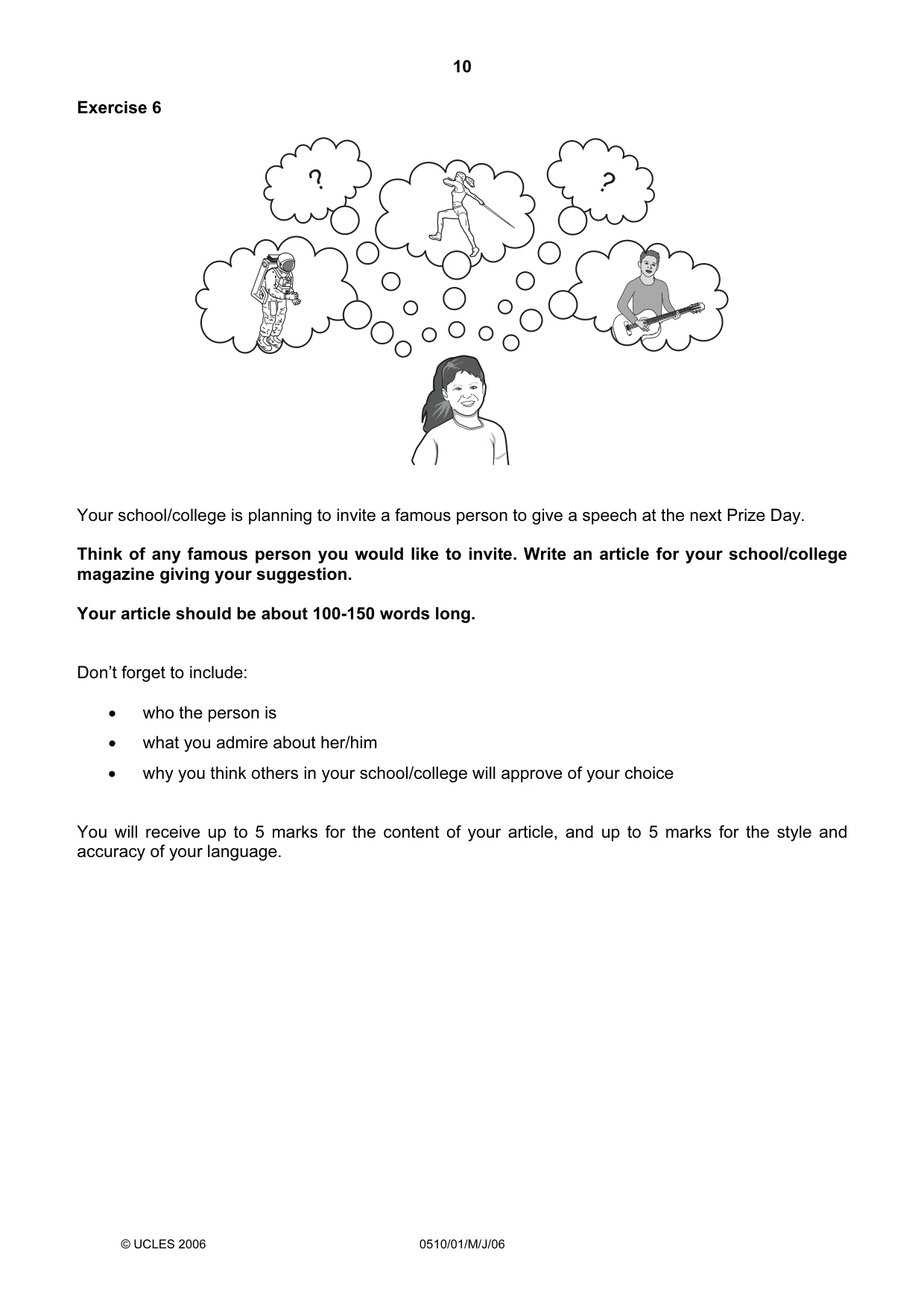
10 © UCLES 2006 0510/01/M/J/06 Exercise 6 ? ? Your school/college is planning to invite a famous person to give a speech at the next Prize Day. Think of any famous person you would like to invite. Write an article for your school/college magazine giving your suggestion. Your article should be about 100-150 words long. Don’t forget to include: • who the person is • what you admire about her/him • why you think others in your school/college will approve of your choice You will receive up to 5 marks for the content of your article, and up to 5 marks for the style and accuracy of your language.
Question paper, page 11
11 © UCLES 2006 0510/01/M/J/06 [Turn over For Examiner's Use [10]
Question paper, page 12
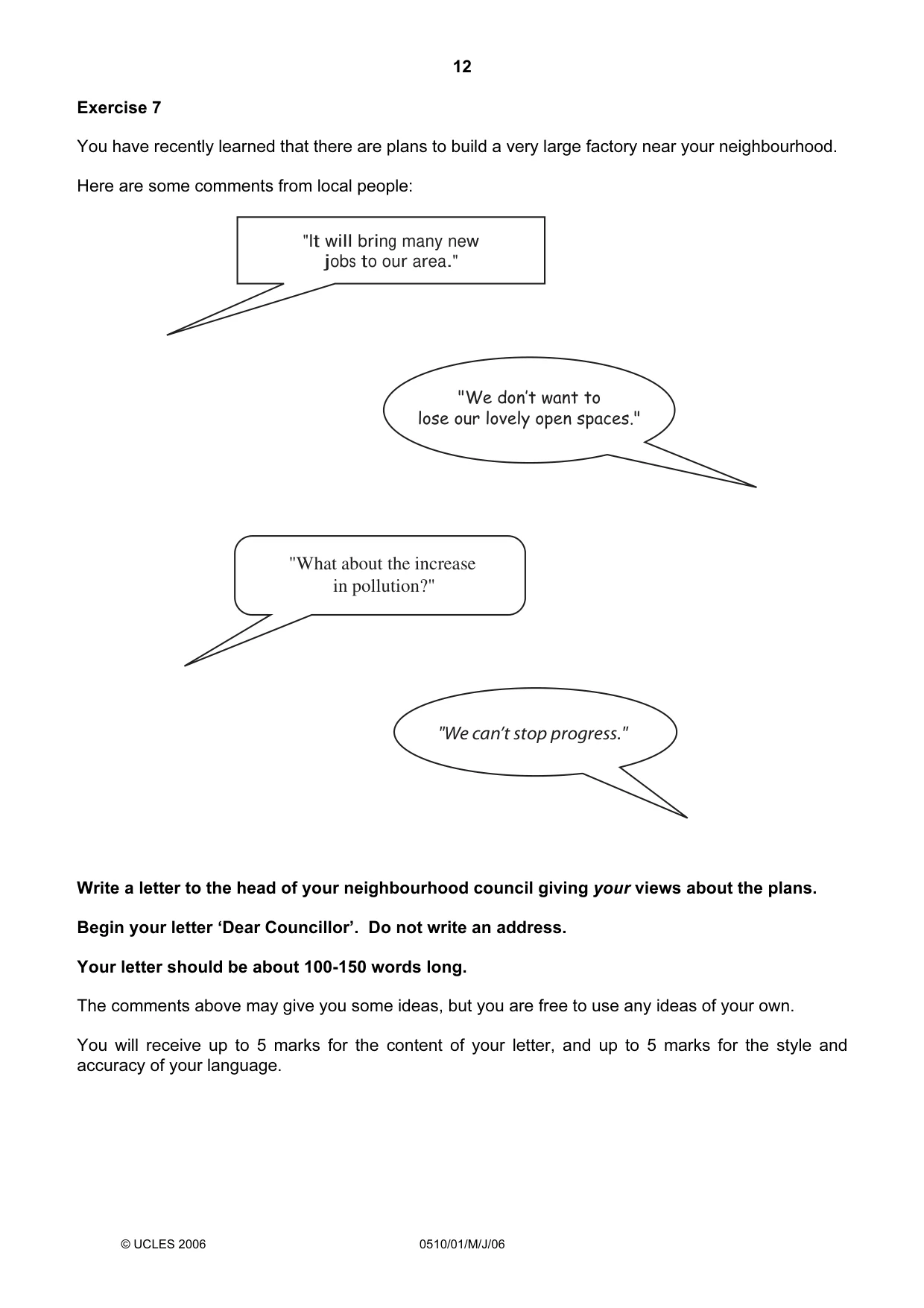
12 © UCLES 2006 0510/01/M/J/06 Exercise 7 You have recently learned that there are plans to build a very large factory near your neighbourhood. Here are some comments from local people: "We can’t stop progress." "It will bring many new jobs to our area." "We don’t want to lose our lovely open spaces." "What about the increase in pollution?" Write a letter to the head of your neighbourhood council giving your views about the plans. Begin your letter ‘Dear Councillor’. Do not write an address. Your letter should be about 100-150 words long. The comments above may give you some ideas, but you are free to use any ideas of your own. You will receive up to 5 marks for the content of your letter, and up to 5 marks for the style and accuracy of your language.
Question paper, page 13
13 © UCLES 2006 0510/01/M/J/06 For Examiner's Use Dear Councillor, [10]
Question paper, page 16
16 Permission to reproduce items where third-party owned material protected by copyright is included has been sought and cleared where possible. Every reasonable effort has been made by the publisher (UCLES) to trace copyright holders, but if any items requiring clearance have unwittingly been included, the publisher will be pleased to make amends at the earliest possible opportunity. University of Cambridge International Examinations is part of the Cambridge Assessment Group. Cambridge Assessment is the brand name of University of Cambridge Local Examinations Syndicate (UCLES), which is itself a department of the University of Cambridge. 0510/01/M/J/06 BLANK PAGE
Mark scheme, page 1
UNIVERSITY OF CAMBRIDGE INTERNATIONAL EXAMINATIONS International General Certificate of Secondary Education MARK SCHEME for the May/June 2006 question paper 0510 ENGLISH AS A SECOND LANGUAGE 0510/01 Paper 1, maximum raw mark 56 These mark schemes are published as an aid to teachers and students, to indicate the requirements of the examination. They show the basis on which Examiners were initially instructed to award marks. They do not indicate the details of the discussions that took place at an Examiners’ meeting before marking began. Any substantial changes to the mark scheme that arose from these discussions will be recorded in the published Report on the Examination. All Examiners are instructed that alternative correct answers and unexpected approaches in candidates’ scripts must be given marks that fairly reflect the relevant knowledge and skills demonstrated. Mark schemes must be read in conjunction with the question papers and the Report on the Examination. The minimum marks in these components needed for various grades were previously published with these mark schemes, but are now instead included in the Report on the Examination for this session. • CIE will not enter into discussion or correspondence in connection with these mark schemes. CIE is publishing the mark schemes for the May/June 2006 question papers for most IGCSE and GCE Advanced Level and Advanced Subsidiary Level syllabuses and some Ordinary Level syllabuses. www.XtremePapers.com
Mark scheme, page 2
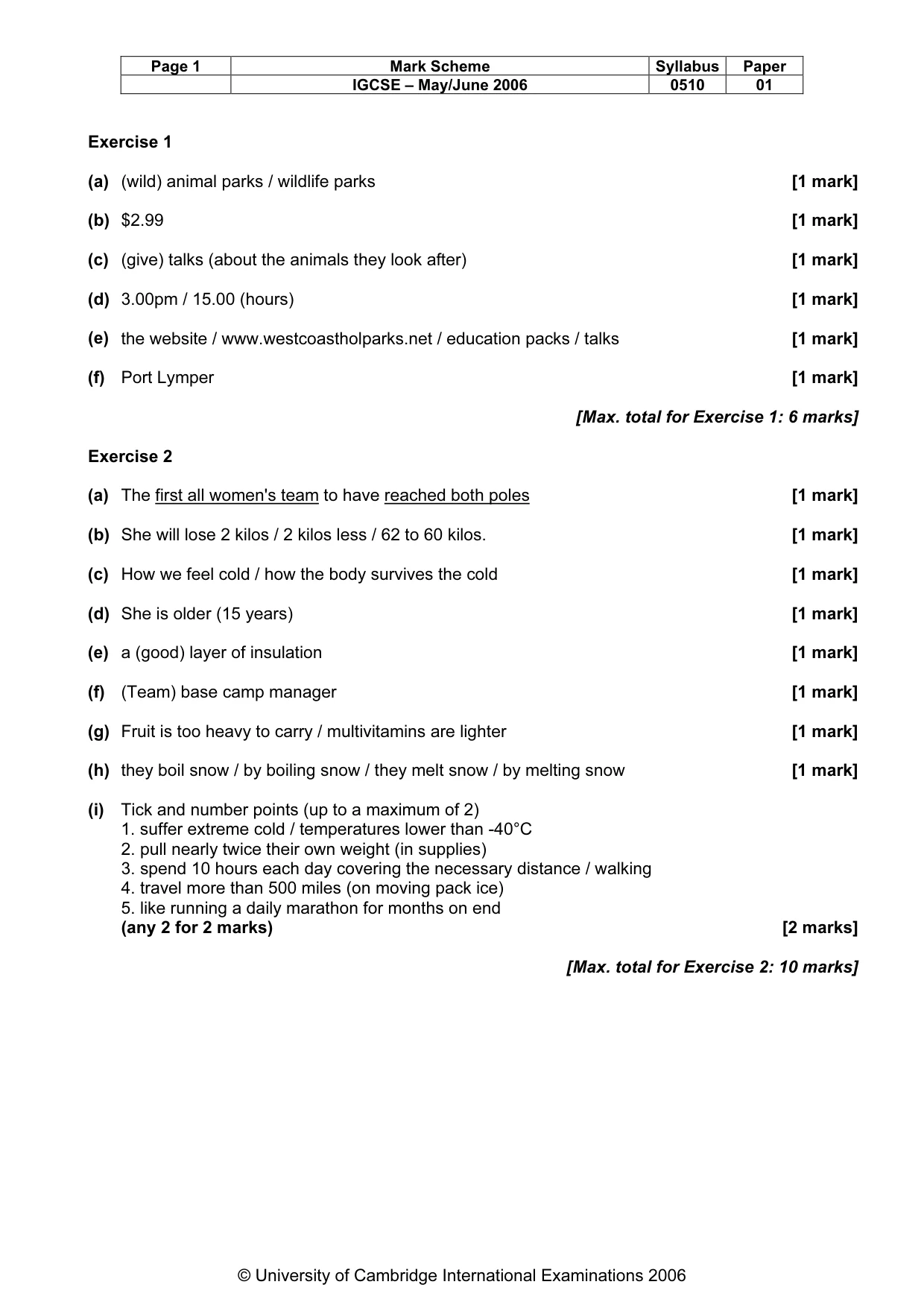
Page 1 Mark Scheme Syllabus Paper IGCSE – May/June 2006 0510 01 © University of Cambridge International Examinations 2006 Exercise 1 (a) (wild) animal parks / wildlife parks [1 mark] (b) $2.99 [1 mark] (c) (give) talks (about the animals they look after) [1 mark] (d) 3.00pm / 15.00 (hours) [1 mark] (e) the website / www.westcoastholparks.net / education packs / talks [1 mark] (f) Port Lymper [1 mark] [Max. total for Exercise 1: 6 marks] Exercise 2 (a) The first all women's team to have reached both poles [1 mark] (b) She will lose 2 kilos / 2 kilos less / 62 to 60 kilos. [1 mark] (c) How we feel cold / how the body survives the cold [1 mark] (d) She is older (15 years) [1 mark] (e) a (good) layer of insulation [1 mark] (f) (Team) base camp manager [1 mark] (g) Fruit is too heavy to carry / multivitamins are lighter [1 mark] (h) they boil snow / by boiling snow / they melt snow / by melting snow [1 mark] (i) Tick and number points (up to a maximum of 2) 1. suffer extreme cold / temperatures lower than -40°C 2. pull nearly twice their own weight (in supplies) 3. spend 10 hours each day covering the necessary distance / walking 4. travel more than 500 miles (on moving pack ice) 5. like running a daily marathon for months on end (any 2 for 2 marks) [2 marks] [Max. total for Exercise 2: 10 marks]
Mark scheme, page 3
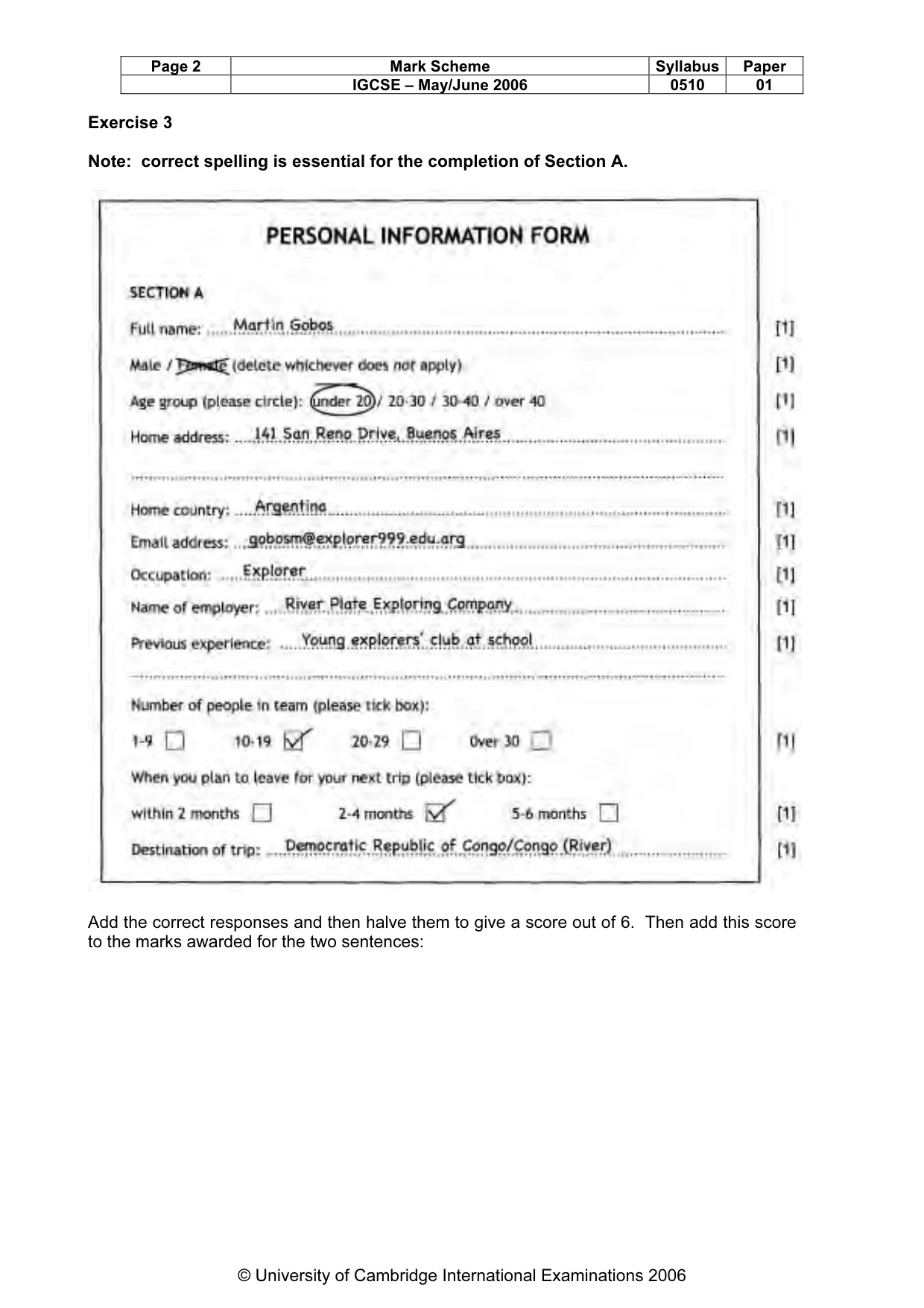
Page 2 Mark Scheme Syllabus Paper IGCSE – May/June 2006 0510 01 © University of Cambridge International Examinations 2006 Exercise 3 Note: correct spelling is essential for the completion of Section A. Add the correct responses and then halve them to give a score out of 6. Then add this score to the marks awarded for the two sentences:
Mark scheme, page 4
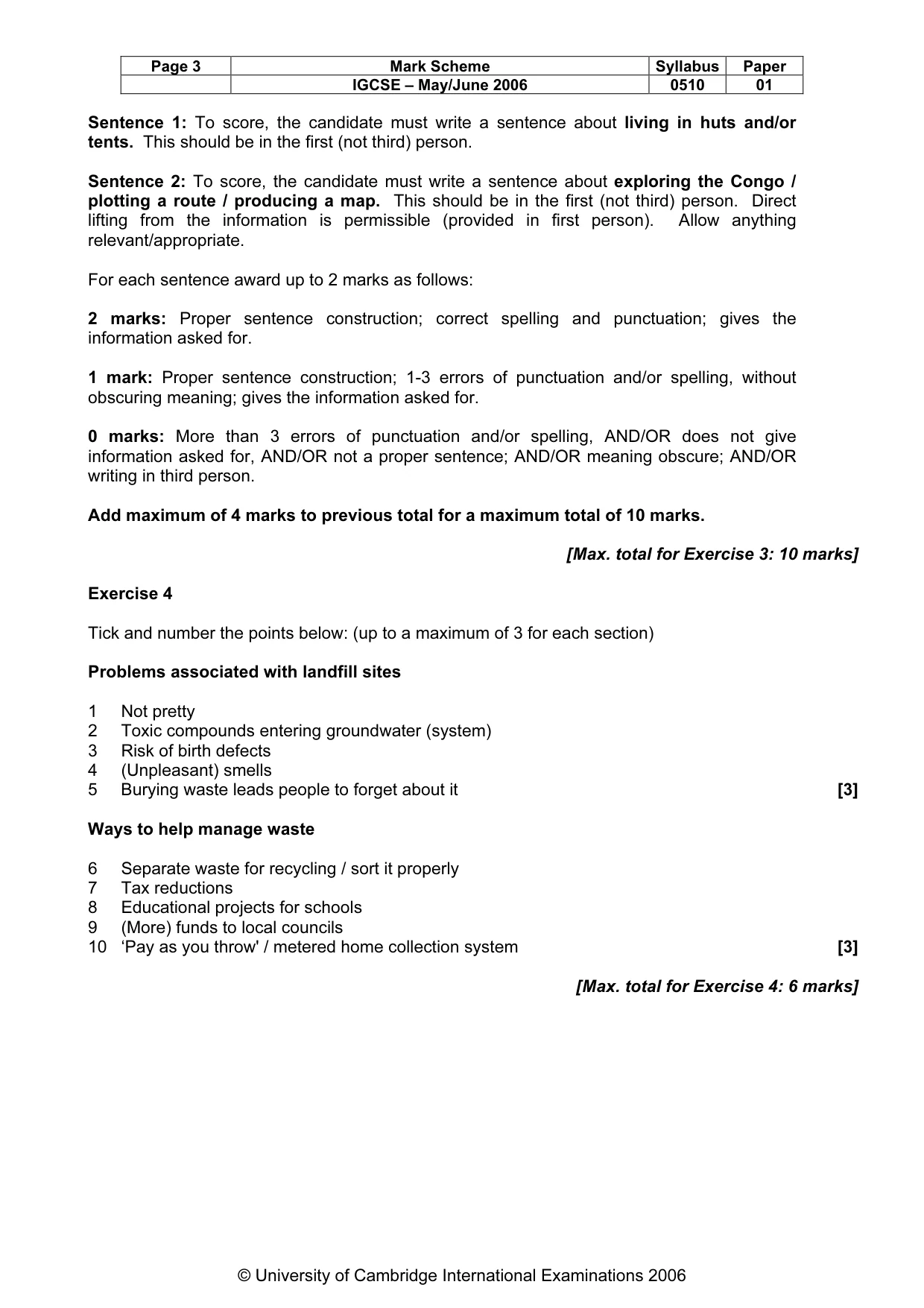
Page 3 Mark Scheme Syllabus Paper IGCSE – May/June 2006 0510 01 © University of Cambridge International Examinations 2006 Sentence 1: To score, the candidate must write a sentence about living in huts and/or tents. This should be in the first (not third) person. Sentence 2: To score, the candidate must write a sentence about exploring the Congo / plotting a route / producing a map. This should be in the first (not third) person. Direct lifting from the information is permissible (provided in first person). Allow anything relevant/appropriate. For each sentence award up to 2 marks as follows: 2 marks: Proper sentence construction; correct spelling and punctuation; gives the information asked for. 1 mark: Proper sentence construction; 1-3 errors of punctuation and/or spelling, without obscuring meaning; gives the information asked for. 0 marks: More than 3 errors of punctuation and/or spelling, AND/OR does not give information asked for, AND/OR not a proper sentence; AND/OR meaning obscure; AND/OR writing in third person. Add maximum of 4 marks to previous total for a maximum total of 10 marks. [Max. total for Exercise 3: 10 marks] Exercise 4 Tick and number the points below: (up to a maximum of 3 for each section) Problems associated with landfill sites 1 Not pretty 2 Toxic compounds entering groundwater (system) 3 Risk of birth defects 4 (Unpleasant) smells 5 Burying waste leads people to forget about it [3] Ways to help manage waste 6 Separate waste for recycling / sort it properly 7 Tax reductions 8 Educational projects for schools 9 (More) funds to local councils 10 ‘Pay as you throw' / metered home collection system [3] [Max. total for Exercise 4: 6 marks]
Mark scheme, page 5
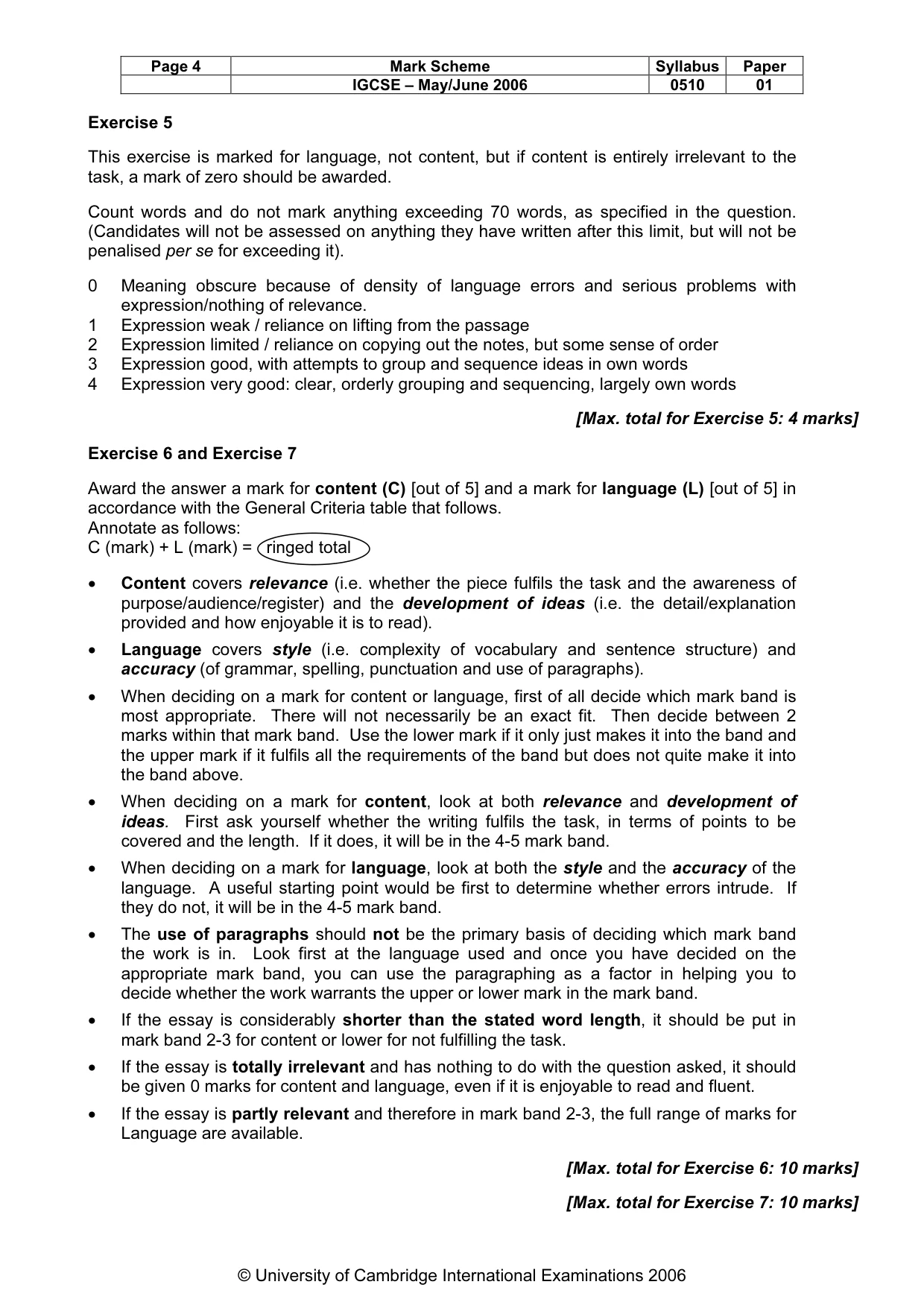
Page 4 Mark Scheme Syllabus Paper IGCSE – May/June 2006 0510 01 © University of Cambridge International Examinations 2006 Exercise 5 This exercise is marked for language, not content, but if content is entirely irrelevant to the task, a mark of zero should be awarded. Count words and do not mark anything exceeding 70 words, as specified in the question. (Candidates will not be assessed on anything they have written after this limit, but will not be penalised per se for exceeding it). 0 Meaning obscure because of density of language errors and serious problems with expression/nothing of relevance. 1 Expression weak / reliance on lifting from the passage 2 Expression limited / reliance on copying out the notes, but some sense of order 3 Expression good, with attempts to group and sequence ideas in own words 4 Expression very good: clear, orderly grouping and sequencing, largely own words [Max. total for Exercise 5: 4 marks] Exercise 6 and Exercise 7 Award the answer a mark for content (C) [out of 5] and a mark for language (L) [out of 5] in accordance with the General Criteria table that follows. Annotate as follows: C (mark) + L (mark) = ringed total • Content covers relevance (i.e. whether the piece fulfils the task and the awareness of purpose/audience/register) and the development of ideas (i.e. the detail/explanation provided and how enjoyable it is to read). • Language covers style (i.e. complexity of vocabulary and sentence structure) and accuracy (of grammar, spelling, punctuation and use of paragraphs). • When deciding on a mark for content or language, first of all decide which mark band is most appropriate. There will not necessarily be an exact fit. Then decide between 2 marks within that mark band. Use the lower mark if it only just makes it into the band and the upper mark if it fulfils all the requirements of the band but does not quite make it into the band above. • When deciding on a mark for content, look at both relevance and development of ideas. First ask yourself whether the writing fulfils the task, in terms of points to be covered and the length. If it does, it will be in the 4-5 mark band. • When deciding on a mark for language, look at both the style and the accuracy of the language. A useful starting point would be first to determine whether errors intrude. If they do not, it will be in the 4-5 mark band. • The use of paragraphs should not be the primary basis of deciding which mark band the work is in. Look first at the language used and once you have decided on the appropriate mark band, you can use the paragraphing as a factor in helping you to decide whether the work warrants the upper or lower mark in the mark band. • If the essay is considerably shorter than the stated word length, it should be put in mark band 2-3 for content or lower for not fulfilling the task. • If the essay is totally irrelevant and has nothing to do with the question asked, it should be given 0 marks for content and language, even if it is enjoyable to read and fluent. • If the essay is partly relevant and therefore in mark band 2-3, the full range of marks for Language are available. [Max. total for Exercise 6: 10 marks] [Max. total for Exercise 7: 10 marks]
Mark scheme, page 6
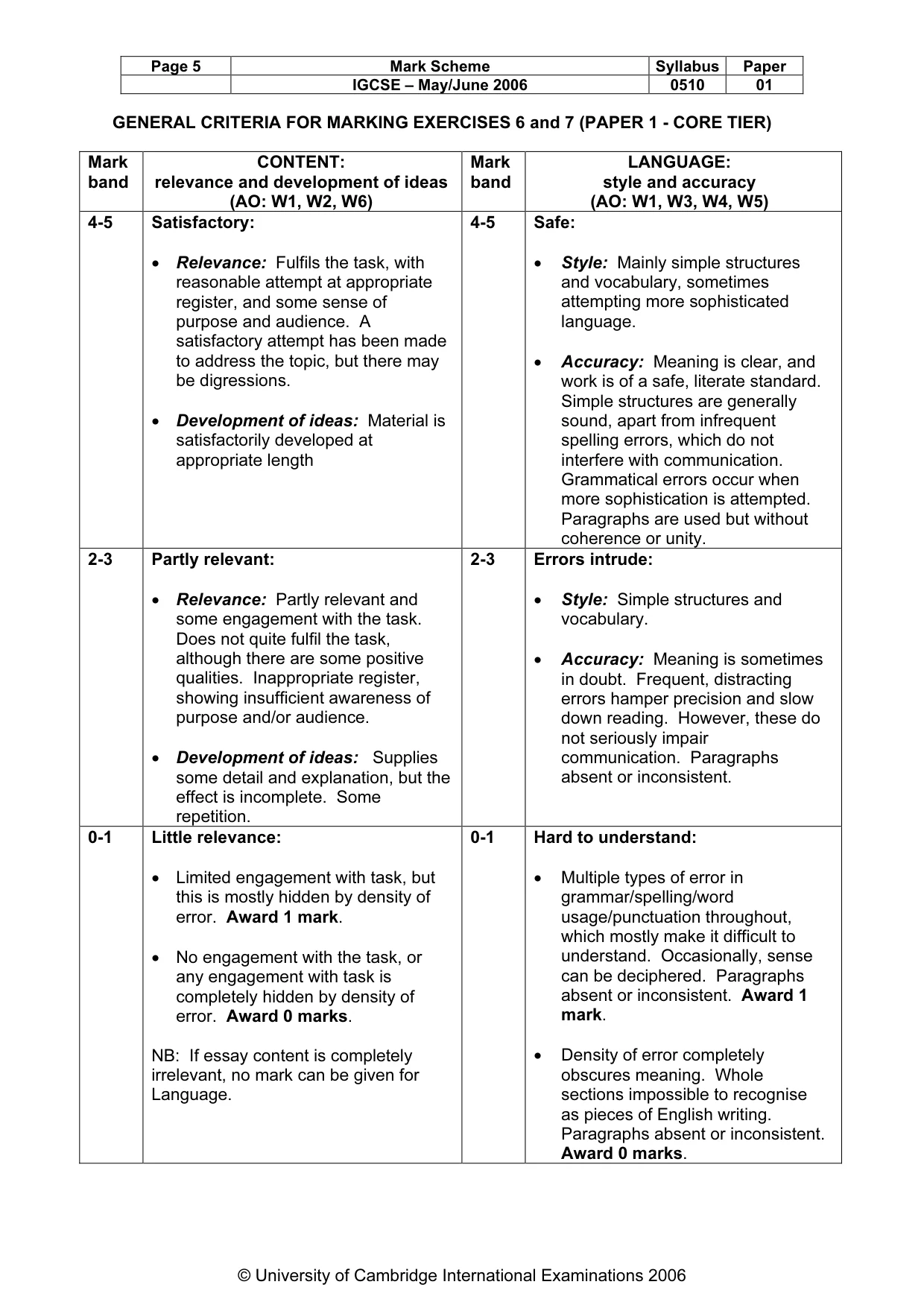
Page 5 Mark Scheme Syllabus Paper IGCSE – May/June 2006 0510 01 © University of Cambridge International Examinations 2006 GENERAL CRITERIA FOR MARKING EXERCISES 6 and 7 (PAPER 1 - CORE TIER) Mark band CONTENT: relevance and development of ideas (AO: W1, W2, W6) Mark band LANGUAGE: style and accuracy (AO: W1, W3, W4, W5) 4-5 Satisfactory: • Relevance: Fulfils the task, with reasonable attempt at appropriate register, and some sense of purpose and audience. A satisfactory attempt has been made to address the topic, but there may be digressions. • Development of ideas: Material is satisfactorily developed at appropriate length 4-5 Safe: • Style: Mainly simple structures and vocabulary, sometimes attempting more sophisticated language. • Accuracy: Meaning is clear, and work is of a safe, literate standard. Simple structures are generally sound, apart from infrequent spelling errors, which do not interfere with communication. Grammatical errors occur when more sophistication is attempted. Paragraphs are used but without coherence or unity. 2-3 Partly relevant: • Relevance: Partly relevant and some engagement with the task. Does not quite fulfil the task, although there are some positive qualities. Inappropriate register, showing insufficient awareness of purpose and/or audience. • Development of ideas: Supplies some detail and explanation, but the effect is incomplete. Some repetition. 2-3 Errors intrude: • Style: Simple structures and vocabulary. • Accuracy: Meaning is sometimes in doubt. Frequent, distracting errors hamper precision and slow down reading. However, these do not seriously impair communication. Paragraphs absent or inconsistent. 0-1 Little relevance: • Limited engagement with task, but this is mostly hidden by density of error. Award 1 mark. • No engagement with the task, or any engagement with task is completely hidden by density of error. Award 0 marks. NB: If essay content is completely irrelevant, no mark can be given for Language. 0-1 Hard to understand: • Multiple types of error in grammar/spelling/word usage/punctuation throughout, which mostly make it difficult to understand. Occasionally, sense can be deciphered. Paragraphs absent or inconsistent. Award 1 mark. • Density of error completely obscures meaning. Whole sections impossible to recognise as pieces of English writing. Paragraphs absent or inconsistent. Award 0 marks.
What you needed in this session
Cambridge’s own grade thresholds for 2006 May/June, Paper 1 · Variant 1. A higher threshold means an easier paper — the bar moves with how the cohort did.