Cambridge IGCSE English - Second Language (oral endorsement) 0510 — 2005 Oct/Nov Paper 2 · Variant 1
0510/21/O/N/05
The question paper and its mark scheme, free to read here and free to download. This is Cambridge’s own paper, exactly as it was sat.
Question paper20 pages









Mark scheme6 pages
Answers below. Sit the paper first if you are practising.
Paper as text
Question paper, page 1
Centre Number Candidate Number Name UNIVERSITY OF CAMBRIDGE INTERNATIONAL EXAMINATIONS International General Certificate of Secondary Education ENGLISH AS A SECOND LANGUAGE 0510/02 Paper 2 Reading and Writing October/November 2005 2 hours Candidates answer on the Question Paper. No Additional Materials are required. READ THESE INSTRUCTIONS FIRST Write your Centre number, candidate number and name on all the work you hand in. Write in dark blue or black pen in the spaces provided on the Question Paper. Do not use staples, paper clips, glue or correction fluid. Answer all questions. The number of marks is given in brackets [ ] at the end of each question or part question. At the end of the examination, fasten all your work securely together. Dictionaries are not allowed. FOR EXAMINER’S USE Part 1 Part 2 Part 3 TOTAL This document consists of 19 printed pages and 1 blank page. IB05 11_0510_02/4RP UCLES 2005 [Turn over www.XtremePapers.com
Question paper, page 2
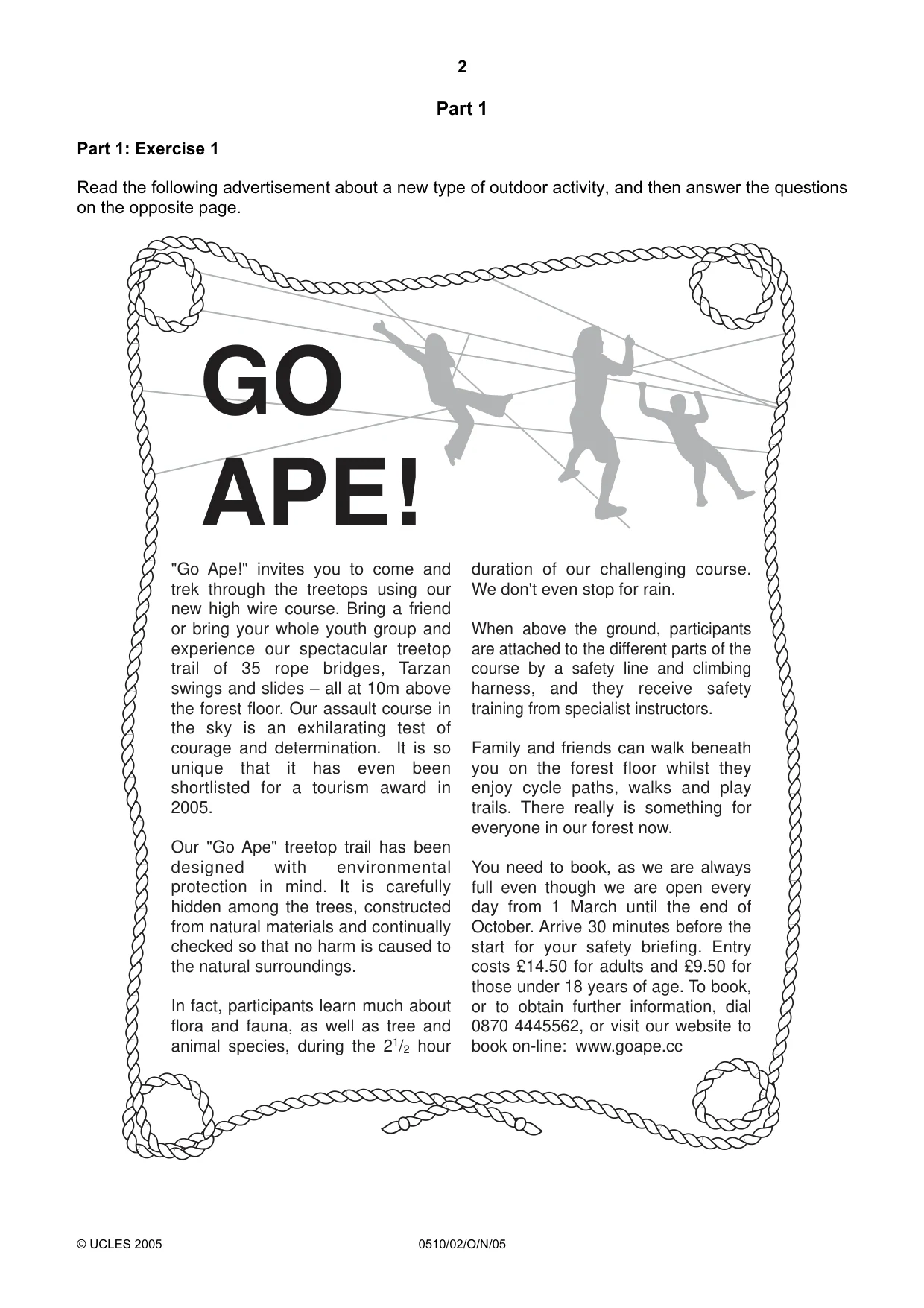
2 © UCLES 2005 0510/02/O/N/05 Part 1 Part 1: Exercise 1 Read the following advertisement about a new type of outdoor activity, and then answer the questions on the opposite page. "Go Ape!" invites you to come and trek through the treetops using our new high wire course. Bring a friend or bring your whole youth group and experience our spectacular treetop trail of 35 rope bridges, Tarzan swings and slides – all at 10m above the forest floor. Our assault course in the sky is an exhilarating test of courage and determination. It is so unique that it has even been shortlisted for a tourism award in 2005. Our "Go Ape" treetop trail has been designed with environmental protection in mind. It is carefully hidden among the trees, constructed from natural materials and continually checked so that no harm is caused to the natural surroundings. In fact, participants learn much about flora and fauna, as well as tree and animal species, during the 21/2 hour duration of our challenging course. We don't even stop for rain. When above the ground, participants are attached to the different parts of the course by a safety line and climbing harness, and they receive safety training from specialist instructors. Family and friends can walk beneath you on the forest floor whilst they enjoy cycle paths, walks and play trails. There really is something for everyone in our forest now. You need to book, as we are always full even though we are open every day from 1 March until the end of October. Arrive 30 minutes before the start for your safety briefing. Entry costs £14.50 for adults and £9.50 for those under 18 years of age. To book, or to obtain further information, dial 0870 4445562, or visit our website to book on-line: www.goape.cc GO APE!
Question paper, page 3
3 © UCLES 2005 0510/02/O/N/05 [Turn over For Examiner's Use (a) What is special about Go Ape’s Tarzan swings and slides? [1] (b) Which two qualities does a participant need in order to use the course? [1] (c) How do we know that Go Ape is so highly regarded? [1] (d) The course is monitored and well hidden. How else is it environmentally friendly? [1] (e) How is the safety of participants ensured? Give two details. [1] (f) How might the rest of the family enjoy a visit to the forest? [1] (g) When exactly does Go Ape close? [1] [Total: 7]
Question paper, page 4
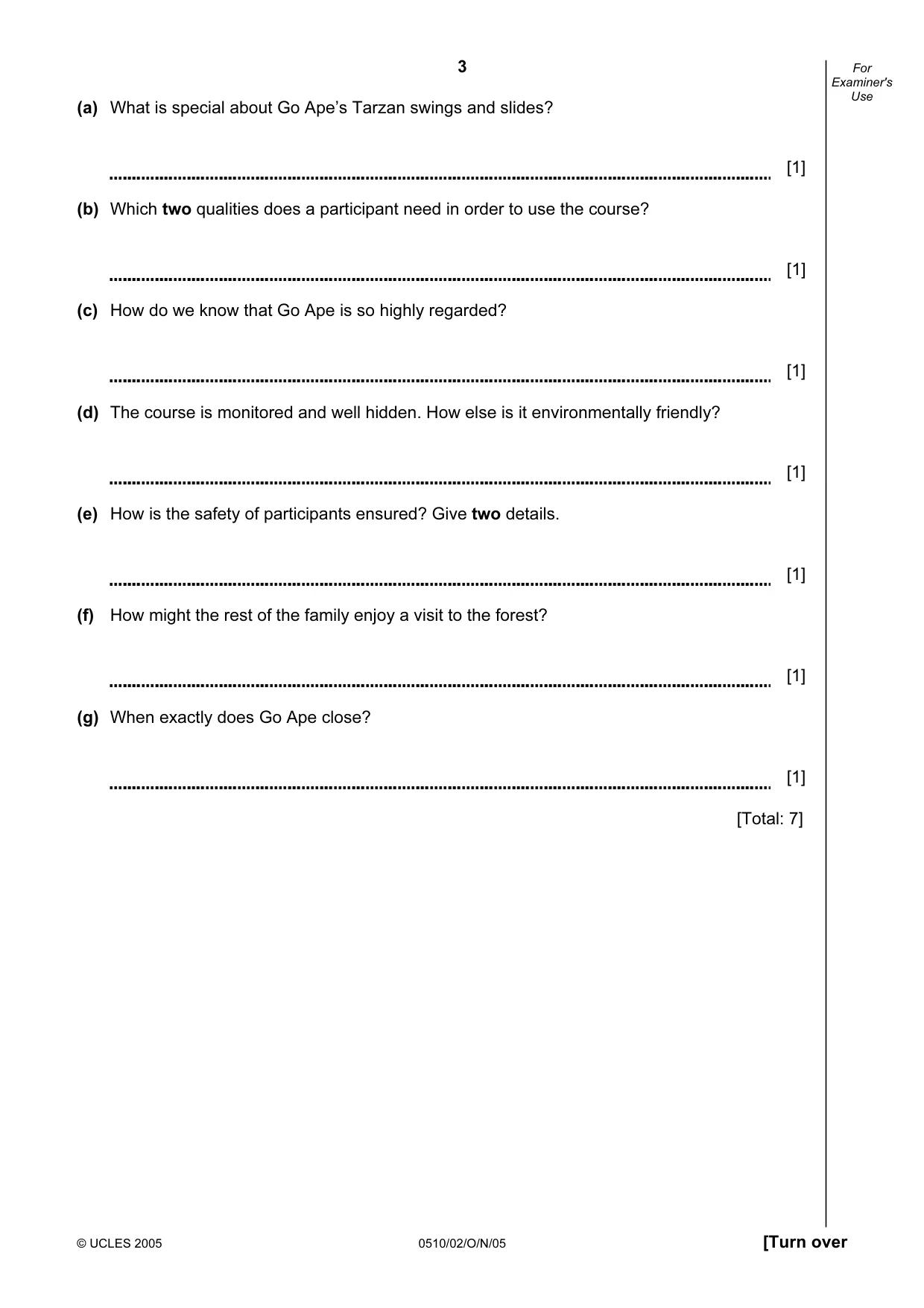
4 © UCLES 2005 0510/02/O/N/05 Part 1: Exercise 2 Read the following article about special airline seats, and then answer the questions on the opposite page. ALERT LIFE-SAVING CHAIRS? An airline chair has been developed to monitor passengers and let them know when they have been sitting in one position for too long. It is believed that the risk of DVT increases with age as your circulation flow tends to become less effective. Other risks may be smoking or dehydration. This new 'sensing chair' is fitted with tiny movement sensors, which can be linked to the in-flight entertainment systems in the plane. It can show if a passenger has been sitting still for a long time. It does this by flashing a warning on the screen on the seat in front of the passenger, telling her or him to get up and walk about or stretch. Lighting in the aeroplane's cabin could also be programmed to respond to the passengers’ movements so that the lighting dims whilst they are asleep and brightens when they wake up. These sensors could also show if a passenger is restless or agitated. These special chairs may eventually be fitted to all aircraft. The reason for these precautions is because even super-fit athletes can suffer from DVT. A few years ago, three coaches on the British Olympic team suffered from blood clots in their legs on the long flight from Australia to the UK. A group of Australia's top swimmers, on their way to the next Olympics, will be wearing special clothing and equipment to try to prevent DVT. These include wearing face masks, decompression socks and special tights. A new generation of 'intelligent' airline seats could save lives by warning passengers that they may be at risk from a potential killer condition, Deep Vein Thrombosis (DVT). This disease is caused by sitting for too long in one position and can cause blood clots in the body (often the legs), which can sometimes cause death. About 2,000 air passengers every year suffer from DVT, and this may be linked to their journeys by air.
Question paper, page 5
5 © UCLES 2005 0510/02/O/N/05 [Turn over For Examiner's Use (a) What is the probable cause of DVT? [1] (b) Apart from age, what are the other factors which might lead a person to be more likely to suffer from DVT? Give two details. [1] (c) How can the ‘sensing chair’ help airline passengers to reduce the risk of DVT? [1] (d) Why will athletes also be taking these precautions? [1] (e) Give one thing that the Australian swimming team will be doing to keep healthy on their long flight. [1] [Total: 5]
Question paper, page 6
6 © UCLES 2005 0510/02/O/N/05 Part 1: Exercise 3 Read the following article about life on underwater mountains, and then answer the questions on the opposite page. A group of marine scientists is becoming increasingly concerned at the threat that deep-water fishing poses to life on deep-sea mountains. Deep-sea mountains are commonly known as 'seamounts', and are fully submerged mountains rising 1,000 or more metres from the ocean floor. They are found throughout the world and are home to many unusual sea creatures. Recent studies suggest that up to 40% of all species found on seamounts are new to science. Some of these sea creatures are living fossils from groups believed to have been extinct since the time of the dinosaurs. Seamounts support fragile creatures, which live for a very long time but can be harmed by even the slightest disturbance in habitat. Included here are coral communities and species of fish such as the "orange roughy", which can live for over 100 years. Unfortunately, this type of fish, as well as the "deep water red", are sought after and fished far too much by deep-sea fishing boats. Seamounts have become threatened habitats which support unique communities of sea-life. Seamounts have always been credited with the role of acting as stepping stones for the dispersal of species throughout the world's oceans. Certainly, new species are often discovered in these regions. The Pacific Ocean is home to most seamounts because of the high level of volcanic activity in the area. This is not the case in the Atlantic Ocean, which has a quantity of its own seamounts yet to be researched. Species which live on seamounts survive on food carried by currents. Nutrient- rich water is pushed upwards by the seamount, picking up speed as it races over the summit. Sea creatures which live near the summit of a seamount, such as corals and sponges, filter organic matter from this water as it passes. Orange roughy, for example, feed on prawns, shrimps, squid and other small fish that drift by. Also, lobsters and sea spiders live among the coral outcrops. Whales and tuna fish also visit these undersea mountains on their migratory routes. Scientists warn that many species of sea creature may become extinct before being even identified if relentless deep-sea fishing continues. Undersea lost worlds threatened
Question paper, page 7
7 © UCLES 2005 0510/02/O/N/05 [Turn over For Examiner's Use (a) Where is the base of a deep-sea mountain? [1] (b) What is surprising about the proportion of species discovered on seamounts? [1] (c) Why are the living fossils found on seamounts historically interesting? [1] (d) How are the seamount fish being threatened? [1] (e) Why are there fewer seamounts found in the Atlantic Ocean? [1] (f) Why are scientists so worried about the future of life on the seamounts? [1] [Total: 6]
Question paper, page 8
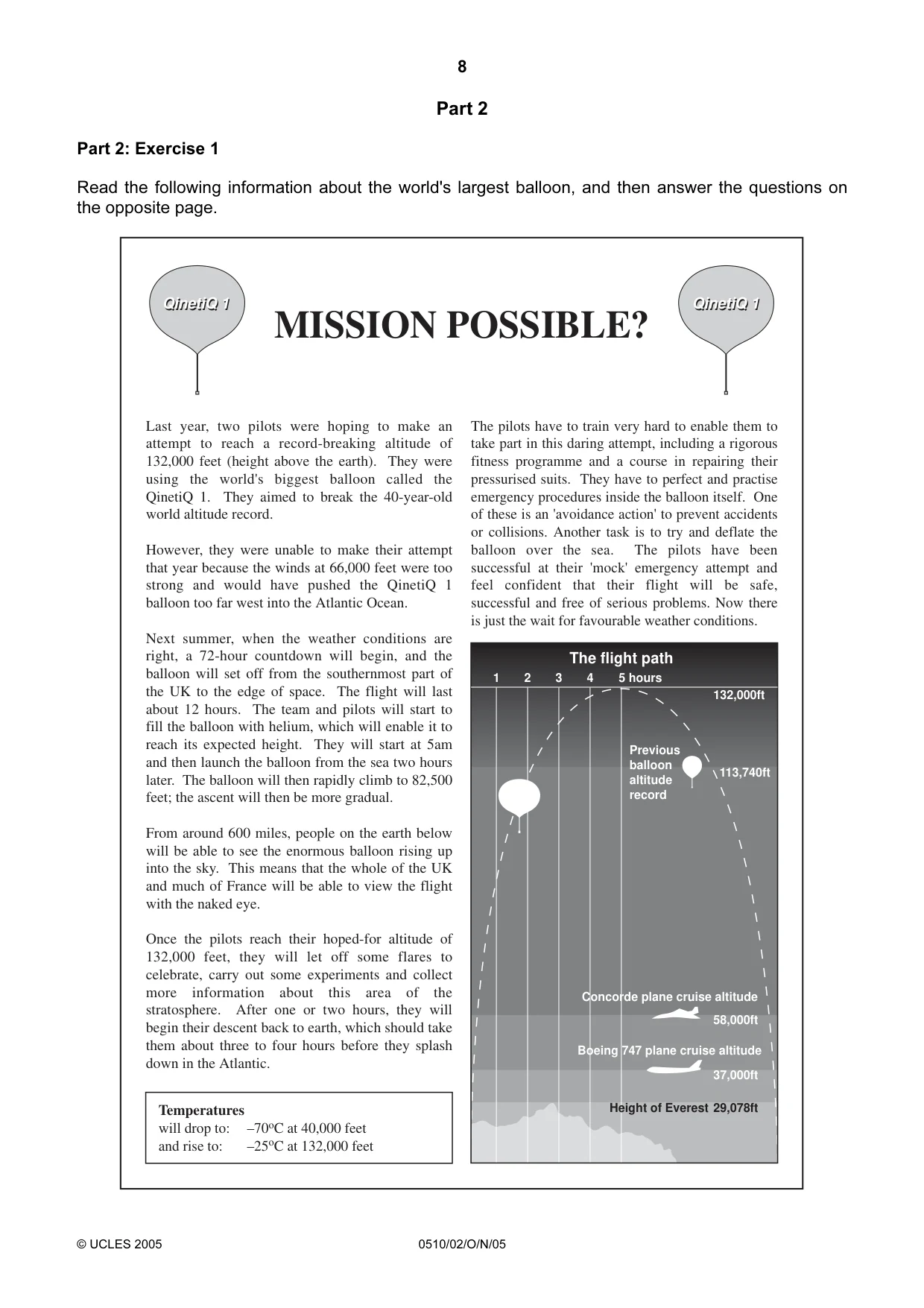
8 © UCLES 2005 0510/02/O/N/05 Part 2 Part 2: Exercise 1 Read the following information about the world's largest balloon, and then answer the questions on the opposite page. Last year, two pilots were hoping to make an attempt to reach a record-breaking altitude of 132,000 feet (height above the earth). They were using the world's biggest balloon called the QinetiQ 1. They aimed to break the 40-year-old world altitude record. However, they were unable to make their attempt that year because the winds at 66,000 feet were too strong and would have pushed the QinetiQ 1 balloon too far west into the Atlantic Ocean. Next summer, when the weather conditions are right, a 72-hour countdown will begin, and the balloon will set off from the southernmost part of the UK to the edge of space. The flight will last about 12 hours. The team and pilots will start to fill the balloon with helium, which will enable it to reach its expected height. They will start at 5am and then launch the balloon from the sea two hours later. The balloon will then rapidly climb to 82,500 feet; the ascent will then be more gradual. From around 600 miles, people on the earth below will be able to see the enormous balloon rising up into the sky. This means that the whole of the UK and much of France will be able to view the flight with the naked eye. Once the pilots reach their hoped-for altitude of 132,000 feet, they will let off some flares to celebrate, carry out some experiments and collect more information about this area of the stratosphere. After one or two hours, they will begin their descent back to earth, which should take them about three to four hours before they splash down in the Atlantic. The pilots have to train very hard to enable them to take part in this daring attempt, including a rigorous fitness programme and a course in repairing their pressurised suits. They have to perfect and practise emergency procedures inside the balloon itself. One of these is an 'avoidance action' to prevent accidents or collisions. Another task is to try and deflate the balloon over the sea. The pilots have been successful at their 'mock' emergency attempt and feel confident that their flight will be safe, successful and free of serious problems. Now there is just the wait for favourable weather conditions. MISSION POSSIBLE? QinetiQ 1 QinetiQ 1 QinetiQ 1 QinetiQ 1 58,000ft 132,000ft 113,740ft 37,000ft 29,078ft Height of Everest Boeing 747 plane cruise altitude Concorde plane cruise altitude 1 2 3 4 5 hours Previous balloon altitude record The flight path Temperatures will drop to: –70oC at 40,000 feet and rise to: –25oC at 132,000 feet
Question paper, page 9
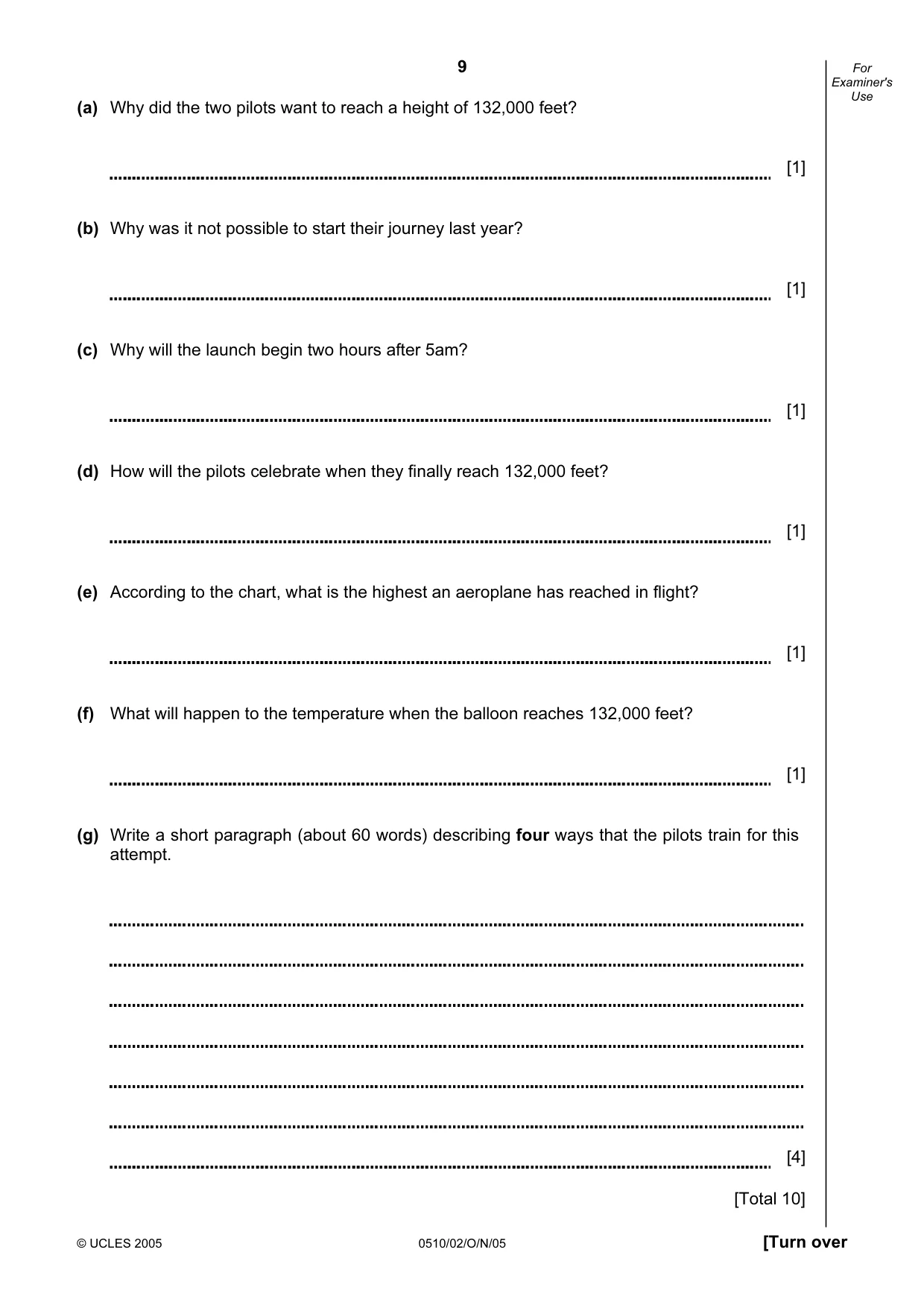
9 © UCLES 2005 0510/02/O/N/05 [Turn over For Examiner's Use (a) Why did the two pilots want to reach a height of 132,000 feet? [1] (b) Why was it not possible to start their journey last year? [1] (c) Why will the launch begin two hours after 5am? [1] (d) How will the pilots celebrate when they finally reach 132,000 feet? [1] (e) According to the chart, what is the highest an aeroplane has reached in flight? [1] (f) What will happen to the temperature when the balloon reaches 132,000 feet? [1] (g) Write a short paragraph (about 60 words) describing four ways that the pilots train for this attempt. [4] [Total 10]
Question paper, page 10
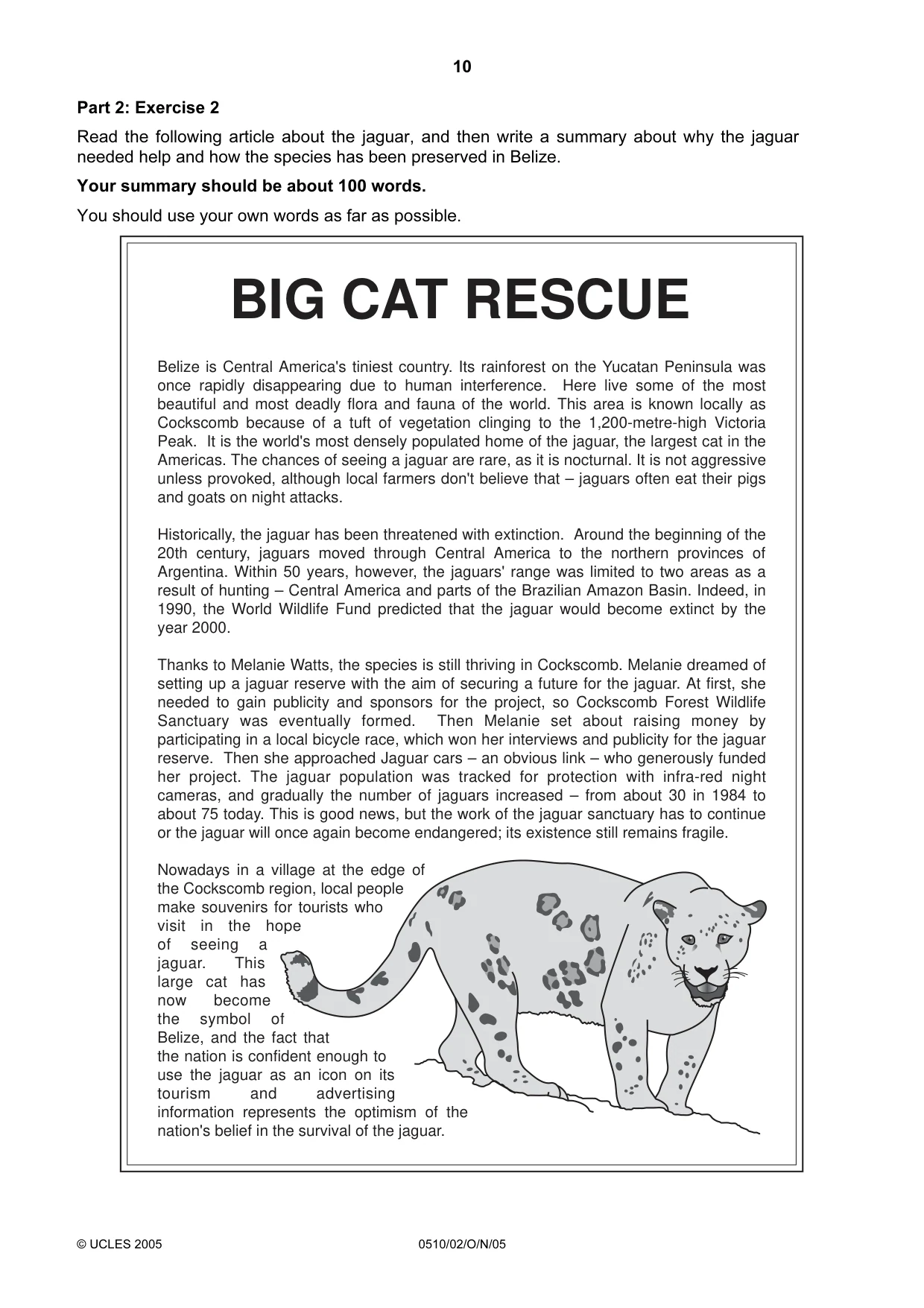
10 © UCLES 2005 0510/02/O/N/05 Part 2: Exercise 2 Read the following article about the jaguar, and then write a summary about why the jaguar needed help and how the species has been preserved in Belize. Your summary should be about 100 words. You should use your own words as far as possible. BIG CAT RESCUE Belize is Central America's tiniest country. Its rainforest on the Yucatan Peninsula was once rapidly disappearing due to human interference. Here live some of the most beautiful and most deadly flora and fauna of the world. This area is known locally as Cockscomb because of a tuft of vegetation clinging to the 1,200-metre-high Victoria Peak. It is the world's most densely populated home of the jaguar, the largest cat in the Americas. The chances of seeing a jaguar are rare, as it is nocturnal. It is not aggressive unless provoked, although local farmers don't believe that – jaguars often eat their pigs and goats on night attacks. Historically, the jaguar has been threatened with extinction. Around the beginning of the 20th century, jaguars moved through Central America to the northern provinces of Argentina. Within 50 years, however, the jaguars' range was limited to two areas as a result of hunting – Central America and parts of the Brazilian Amazon Basin. Indeed, in 1990, the World Wildlife Fund predicted that the jaguar would become extinct by the year 2000. Thanks to Melanie Watts, the species is still thriving in Cockscomb. Melanie dreamed of setting up a jaguar reserve with the aim of securing a future for the jaguar. At first, she needed to gain publicity and sponsors for the project, so Cockscomb Forest Wildlife Sanctuary was eventually formed. Then Melanie set about raising money by participating in a local bicycle race, which won her interviews and publicity for the jaguar reserve. Then she approached Jaguar cars – an obvious link – who generously funded her project. The jaguar population was tracked for protection with infra-red night cameras, and gradually the number of jaguars increased – from about 30 in 1984 to about 75 today. This is good news, but the work of the jaguar sanctuary has to continue or the jaguar will once again become endangered; its existence still remains fragile. Nowadays in a village at the edge of the Cockscomb region, local people make souvenirs for tourists who visit in the hope of seeing a jaguar. This large cat has now become the symbol of Belize, and the fact that the nation is confident enough to use the jaguar as an icon on its tourism and advertising information represents the optimism of the nation's belief in the survival of the jaguar.
Question paper, page 11
11 © UCLES 2005 0510/02/O/N/05 [Turn over For Examiner's Use [8]
Question paper, page 12
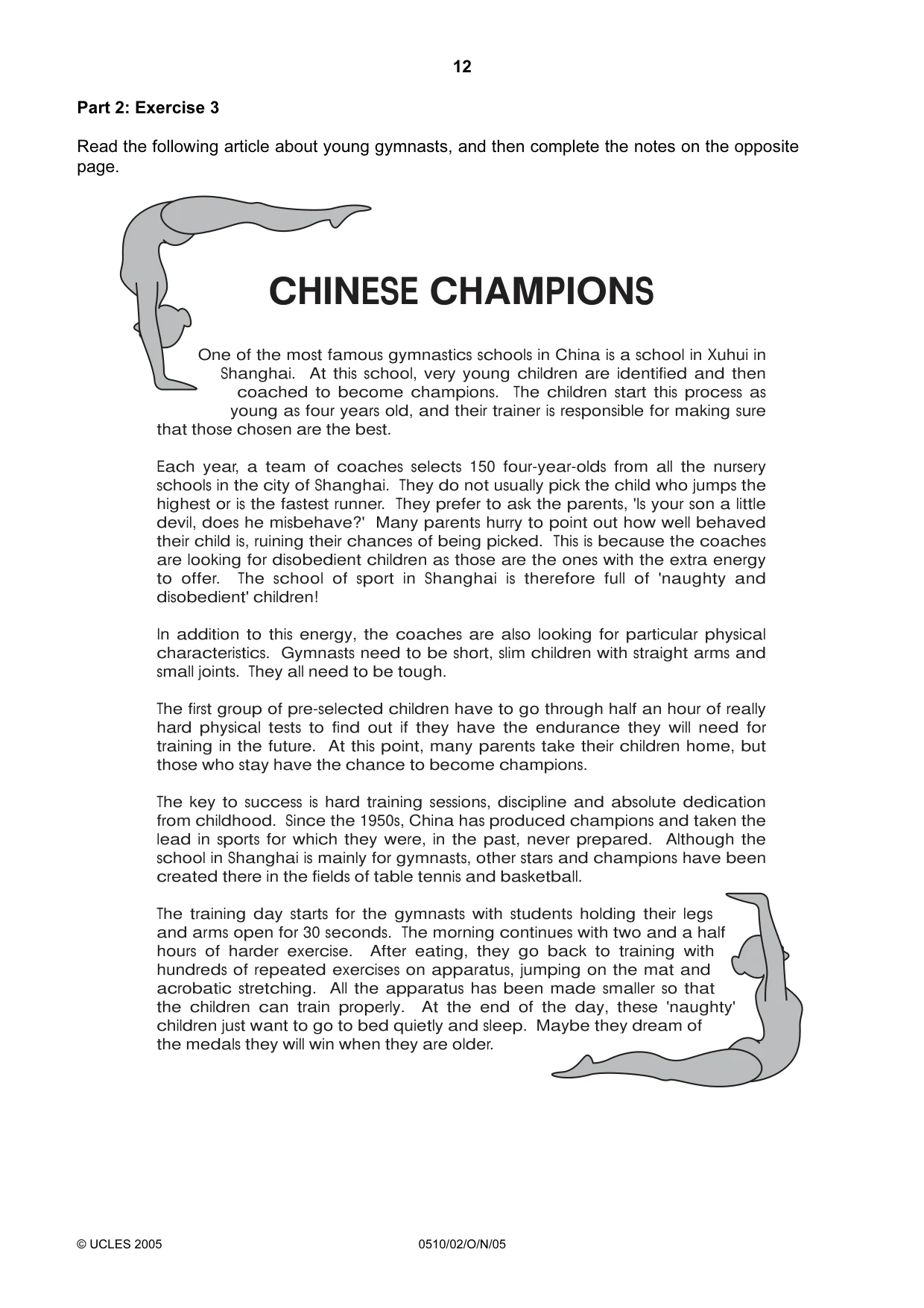
12 © UCLES 2005 0510/02/O/N/05 Part 2: Exercise 3 Read the following article about young gymnasts, and then complete the notes on the opposite page. CHINESE CHAMPIONS One of the most famous gymnastics schools in China is a school in Xuhui in Shanghai. At this school, very young children are identified and then coached to become champions. The children start this process as young as four years old, and their trainer is responsible for making sure that those chosen are the best. Each year, a team of coaches selects 150 four-year-olds from all the nursery schools in the city of Shanghai. They do not usually pick the child who jumps the highest or is the fastest runner. They prefer to ask the parents, 'Is your son a little devil, does he misbehave?' Many parents hurry to point out how well behaved their child is, ruining their chances of being picked. This is because the coaches are looking for disobedient children as those are the ones with the extra energy to offer. The school of sport in Shanghai is therefore full of 'naughty and disobedient' children! In addition to this energy, the coaches are also looking for particular physical characteristics. Gymnasts need to be short, slim children with straight arms and small joints. They all need to be tough. The first group of pre-selected children have to go through half an hour of really hard physical tests to find out if they have the endurance they will need for training in the future. At this point, many parents take their children home, but those who stay have the chance to become champions. The key to success is hard training sessions, discipline and absolute dedication from childhood. Since the 1950s, China has produced champions and taken the lead in sports for which they were, in the past, never prepared. Although the school in Shanghai is mainly for gymnasts, other stars and champions have been created there in the fields of table tennis and basketball. The training day starts for the gymnasts with students holding their legs and arms open for 30 seconds. The morning continues with two and a half hours of harder exercise. After eating, they go back to training with hundreds of repeated exercises on apparatus, jumping on the mat and acrobatic stretching. All the apparatus has been made smaller so that the children can train properly. At the end of the day, these 'naughty' children just want to go to bed quietly and sleep. Maybe they dream of the medals they will win when they are older.
Question paper, page 13
13 © UCLES 2005 0510/02/O/N/05 [Turn over For Examiner's Use YOUNG GYMNASTS (a) Selection procedure: • When: • Who: (b) Three physical requirements for gymnasts: • • • (c) Three details of training programme: • • • [Total: 8]
Question paper, page 14
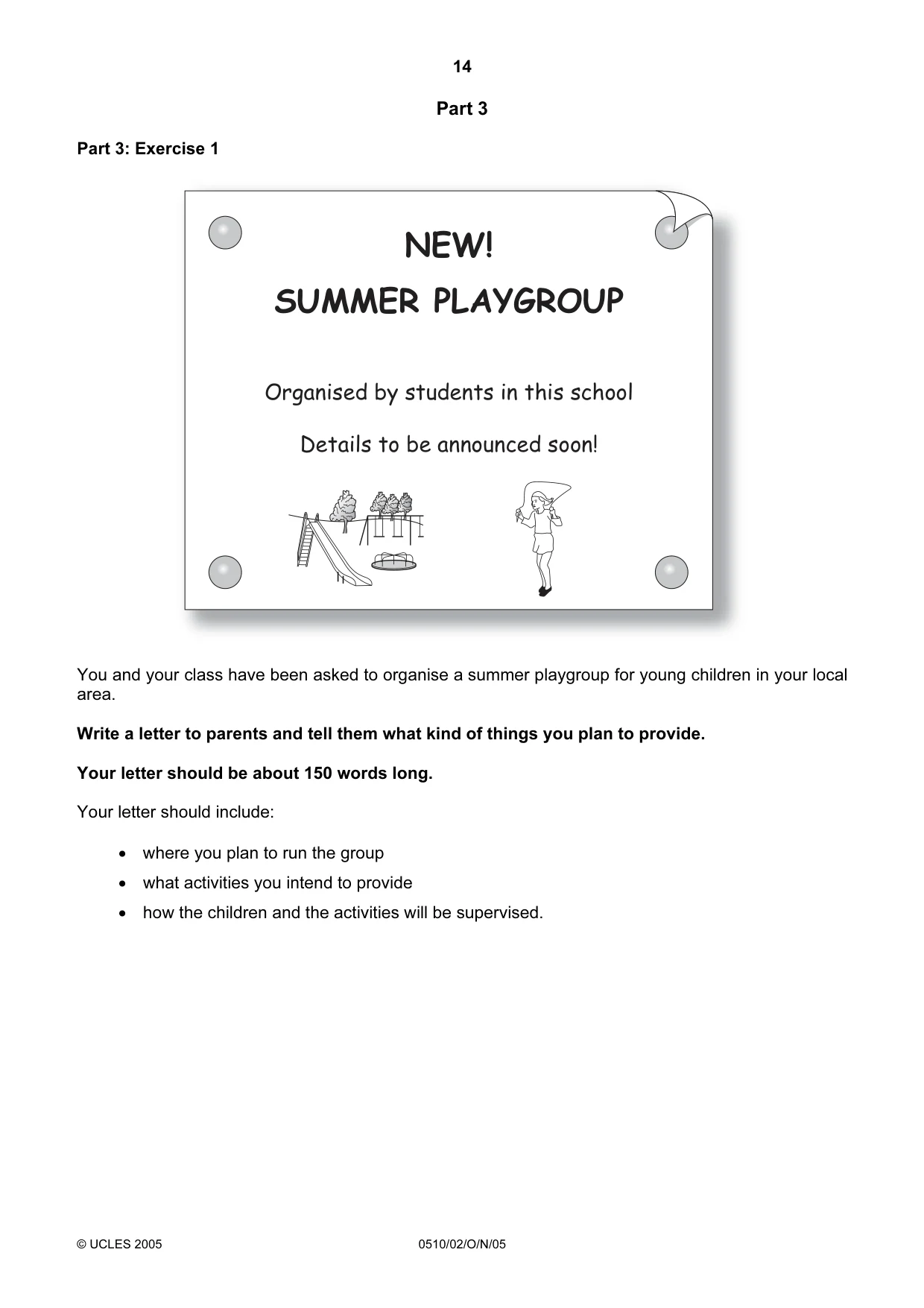
14 © UCLES 2005 0510/02/O/N/05 Part 3 Part 3: Exercise 1 NEW! SUMMER PLAYGROUP Organised by students in this school Details to be announced soon! You and your class have been asked to organise a summer playgroup for young children in your local area. Write a letter to parents and tell them what kind of things you plan to provide. Your letter should be about 150 words long. Your letter should include: • where you plan to run the group • what activities you intend to provide • how the children and the activities will be supervised.
Question paper, page 15
15 © UCLES 2005 0510/02/O/N/05 [Turn over For Examiner's Use Dear Parents, [12]
Question paper, page 16
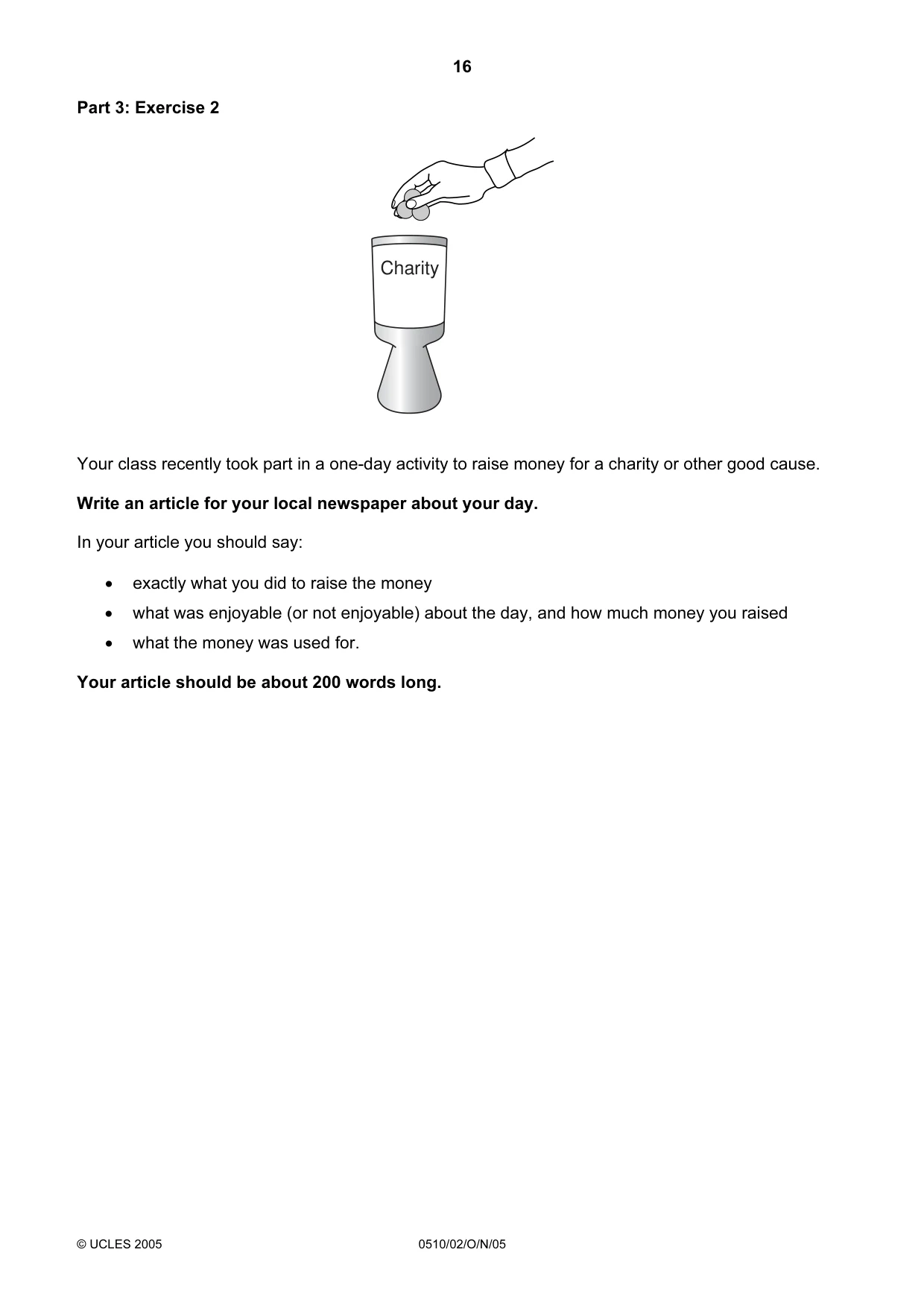
16 © UCLES 2005 0510/02/O/N/05 Part 3: Exercise 2 Charity Your class recently took part in a one-day activity to raise money for a charity or other good cause. Write an article for your local newspaper about your day. In your article you should say: • exactly what you did to raise the money • what was enjoyable (or not enjoyable) about the day, and how much money you raised • what the money was used for. Your article should be about 200 words long.
Question paper, page 17
17 © UCLES 2005 0510/02/O/N/05 [Turn over For Examiner's Use [12]
Question paper, page 18
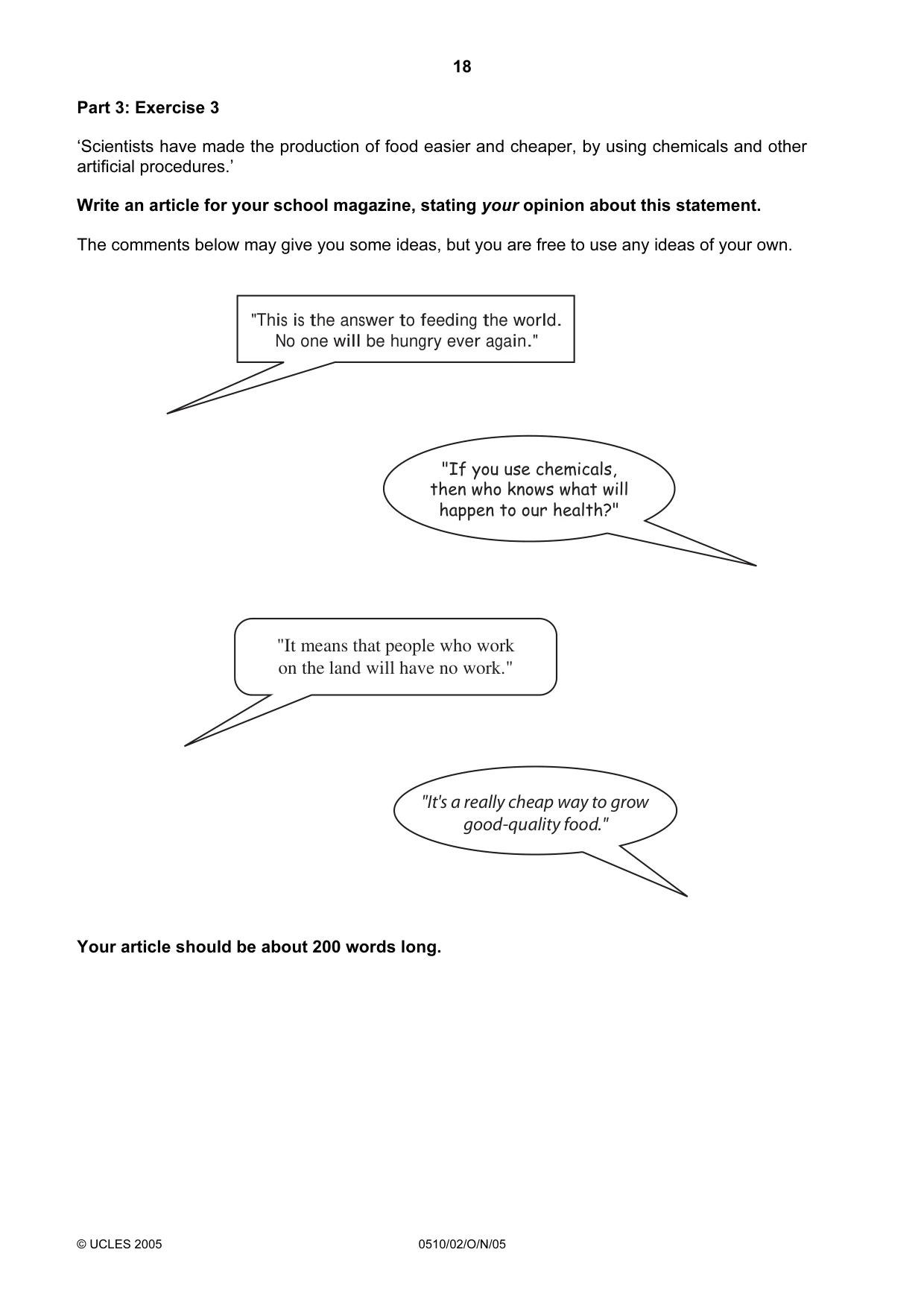
18 © UCLES 2005 0510/02/O/N/05 Part 3: Exercise 3 ‘Scientists have made the production of food easier and cheaper, by using chemicals and other artificial procedures.’ Write an article for your school magazine, stating your opinion about this statement. The comments below may give you some ideas, but you are free to use any ideas of your own. "It's a really cheap way to grow good-quality food." "This is the answer to feeding the world. No one will be hungry ever again." "If you use chemicals, then who knows what will happen to our health?" "It means that people who work on the land will have no work." Your article should be about 200 words long.
Question paper, page 19
19 © UCLES 2005 0510/02/O/N/05 For Examiner's Use [16]
Question paper, page 20
20 Copyright Acknowledgements: Part 1 Exercise 1 © Forestry Commission. Exercise 2 Beezy Marsh; Airline Seat that warns if you are at risk of DVT; © Daily Mail, 2002. Exercise 3 © Telegraph Group Limited 2003. Part 2 Exercise 1 © John Crace; Qinetiq; The Guardian, 2002. Exercise 2 © Jeremy Hart; Big Cat Rescue; Saga Magazine; 2002. Exercise 3 David Jiminez; Chinese Burn. © Copyright Guardian Newspapers Limited 2002. Permission to reproduce items where third-party owned material protected by copyright is included has been sought and cleared where possible. Every reasonable effort has been made by the publisher (UCLES) to trace copyright holders, but if any items requiring clearance have unwittingly been included, the publisher will be pleased to make amends at the earliest possible opportunity. University of Cambridge International Examinations is part of the University of Cambridge Local Examinations Syndicate (UCLES), which is itself a department of the University of Cambridge. 0510/02/O/N/05 BLANK PAGE
Mark scheme, page 1
UNIVERSITY OF CAMBRIDGE INTERNATIONAL EXAMINATIONS International General Certificate of Secondary Education MARK SCHEME for the November 2005 question paper 0510 ENGLISH AS A SECOND LANGUAGE 0510/02 Paper 2 (Reading and Writing – Extended), maximum mark 84 These mark schemes are published as an aid to teachers and students, to indicate the requirements of the examination. They show the basis on which Examiners were initially instructed to award marks. They do not indicate the details of the discussions that took place at an Examiners’ meeting before marking began. Any substantial changes to the mark scheme that arose from these discussions will be recorded in the published Report on the Examination. All Examiners are instructed that alternative correct answers and unexpected approaches in candidates’ scripts must be given marks that fairly reflect the relevant knowledge and skills demonstrated. Mark schemes must be read in conjunction with the question papers and the Report on the Examination. The minimum marks in these components needed for various grades were previously published with these mark schemes, but are now instead included in the Report on the Examination for this session. • CIE will not enter into discussion or correspondence in connection with these mark schemes. CIE is publishing the mark schemes for the November 2005 question papers for most IGCSE and GCE Advanced Level and Advanced Subsidiary Level syllabuses and some Ordinary Level syllabuses www.XtremePapers.com
Mark scheme, page 2
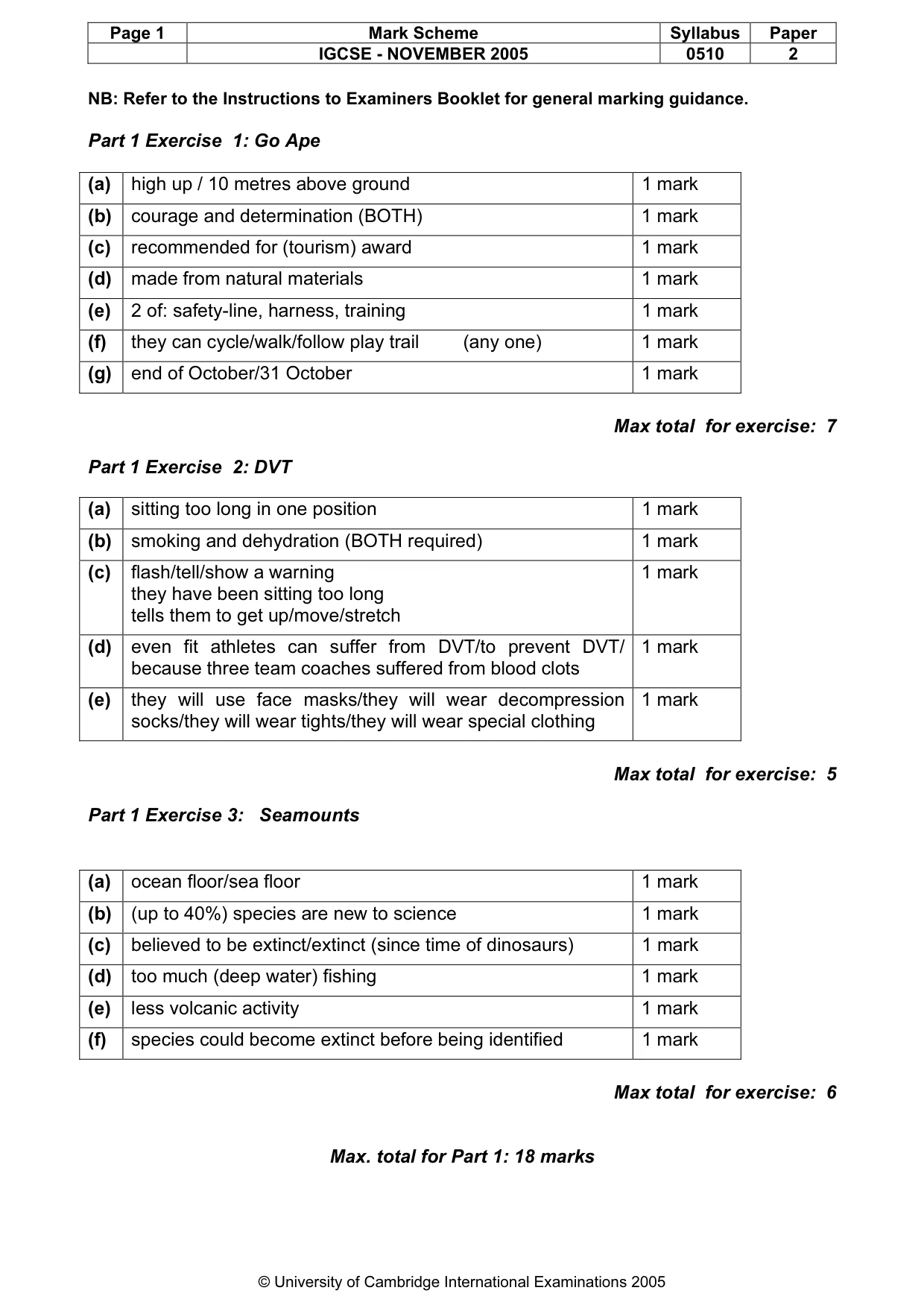
Page 1 Mark Scheme Syllabus Paper IGCSE - NOVEMBER 2005 0510 2 © University of Cambridge International Examinations 2005 NB: Refer to the Instructions to Examiners Booklet for general marking guidance. Part 1 Exercise 1: Go Ape (a) high up / 10 metres above ground 1 mark (b) courage and determination (BOTH) 1 mark (c) recommended for (tourism) award 1 mark (d) made from natural materials 1 mark (e) 2 of: safety-line, harness, training 1 mark (f) they can cycle/walk/follow play trail (any one) 1 mark (g) end of October/31 October 1 mark Max total for exercise: 7 Part 1 Exercise 2: DVT (a) sitting too long in one position 1 mark (b) smoking and dehydration (BOTH required) 1 mark (c) flash/tell/show a warning they have been sitting too long tells them to get up/move/stretch 1 mark (d) even fit athletes can suffer from DVT/to prevent DVT/ because three team coaches suffered from blood clots 1 mark (e) they will use face masks/they will wear decompression socks/they will wear tights/they will wear special clothing 1 mark Max total for exercise: 5 Part 1 Exercise 3: Seamounts (a) ocean floor/sea floor 1 mark (b) (up to 40%) species are new to science 1 mark (c) believed to be extinct/extinct (since time of dinosaurs) 1 mark (d) too much (deep water) fishing 1 mark (e) less volcanic activity 1 mark (f) species could become extinct before being identified 1 mark Max total for exercise: 6 Max. total for Part 1: 18 marks
Mark scheme, page 3
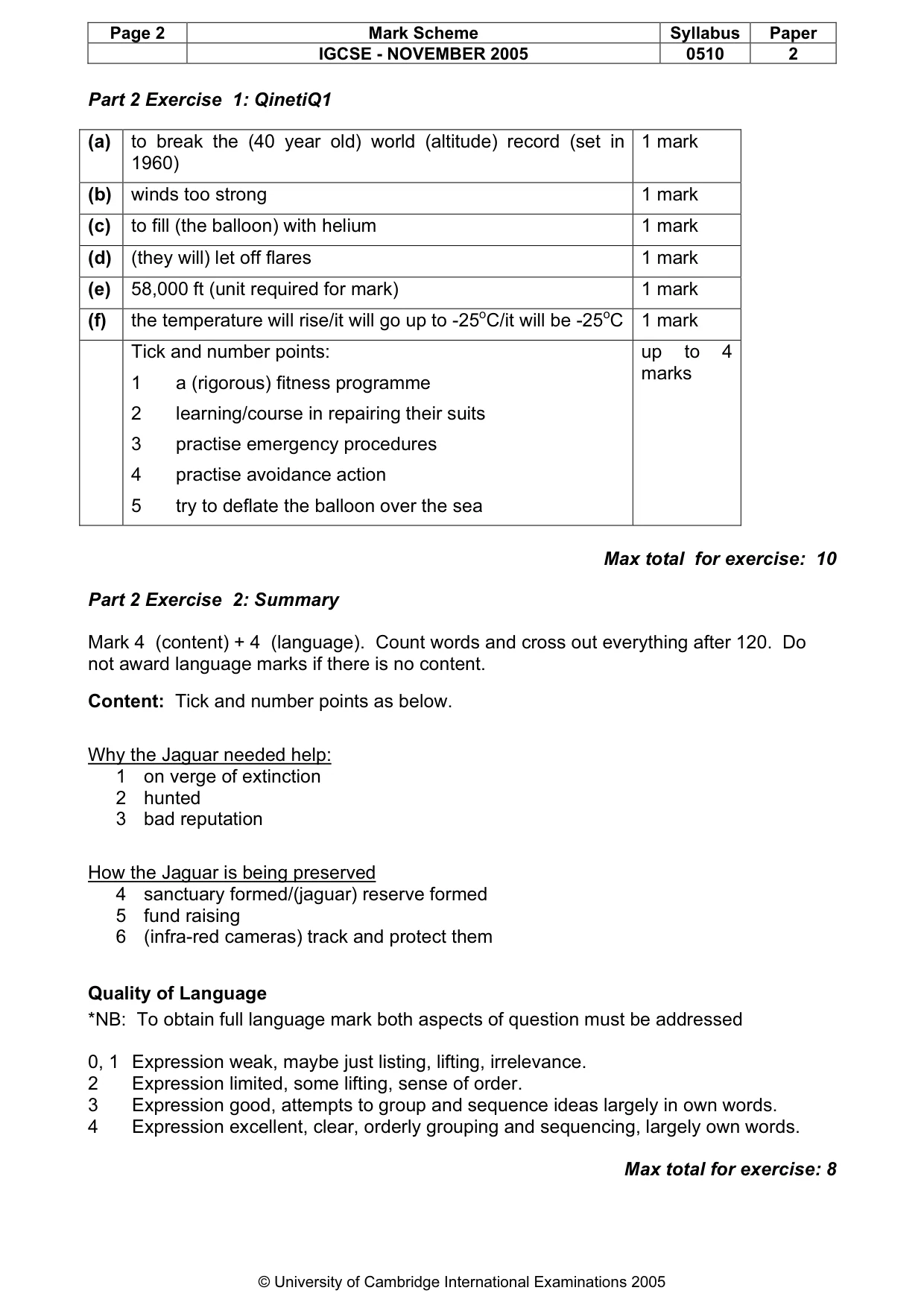
Page 2 Mark Scheme Syllabus Paper IGCSE - NOVEMBER 2005 0510 2 © University of Cambridge International Examinations 2005 Part 2 Exercise 1: QinetiQ1 (a) to break the (40 year old) world (altitude) record (set in 1960) 1 mark (b) winds too strong 1 mark (c) to fill (the balloon) with helium 1 mark (d) (they will) let off flares 1 mark (e) 58,000 ft (unit required for mark) 1 mark (f) the temperature will rise/it will go up to -25oC/it will be -25oC 1 mark Tick and number points: 1 a (rigorous) fitness programme 2 learning/course in repairing their suits 3 practise emergency procedures 4 practise avoidance action 5 try to deflate the balloon over the sea up to 4 marks Max total for exercise: 10 Part 2 Exercise 2: Summary Mark 4 (content) + 4 (language). Count words and cross out everything after 120. Do not award language marks if there is no content. Content: Tick and number points as below. Why the Jaguar needed help: 1 on verge of extinction 2 hunted 3 bad reputation How the Jaguar is being preserved 4 sanctuary formed/(jaguar) reserve formed 5 fund raising 6 (infra-red cameras) track and protect them Quality of Language *NB: To obtain full language mark both aspects of question must be addressed 0, 1 Expression weak, maybe just listing, lifting, irrelevance. 2 Expression limited, some lifting, sense of order. 3 Expression good, attempts to group and sequence ideas largely in own words. 4 Expression excellent, clear, orderly grouping and sequencing, largely own words. Max total for exercise: 8
Mark scheme, page 4
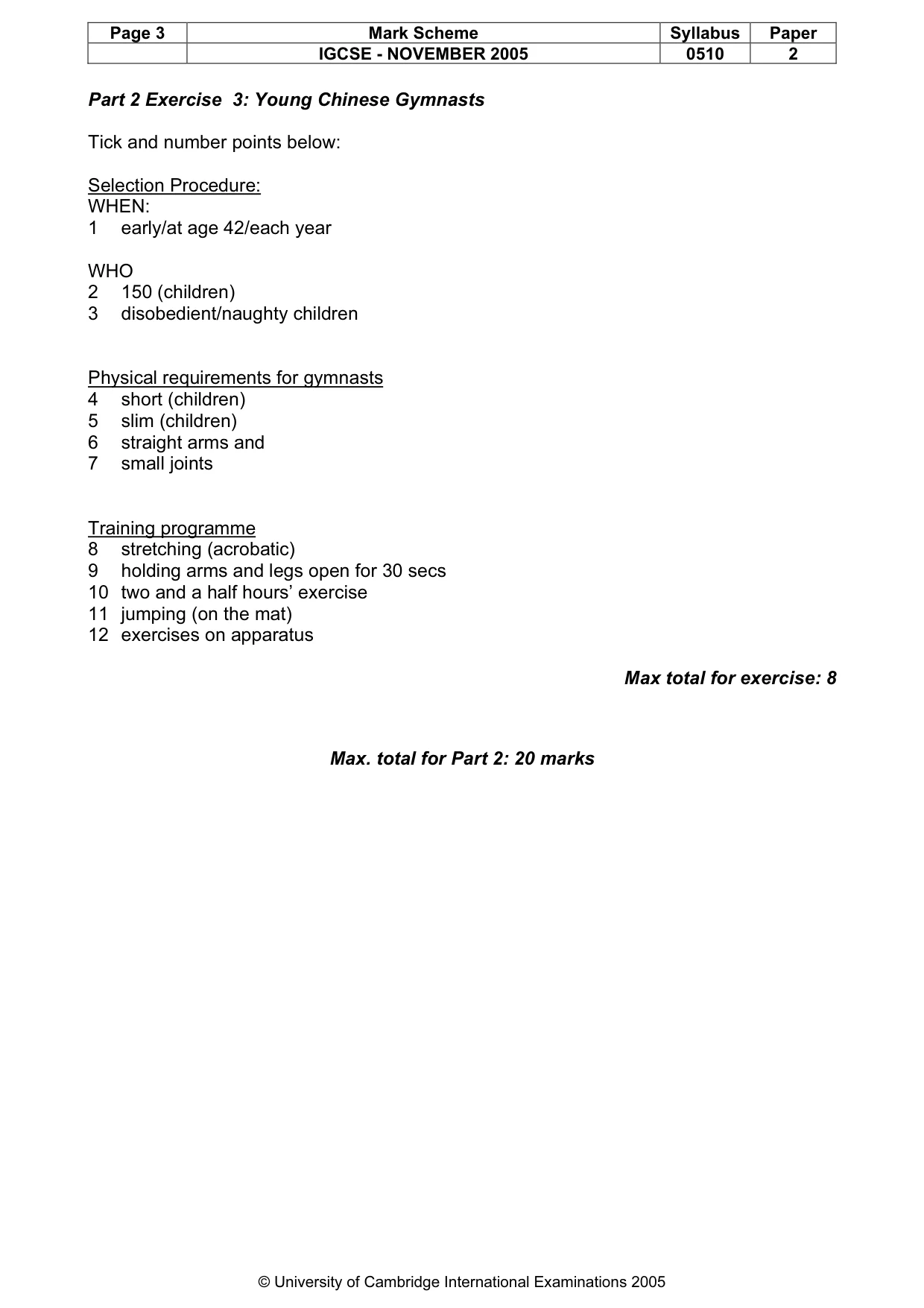
Page 3 Mark Scheme Syllabus Paper IGCSE - NOVEMBER 2005 0510 2 © University of Cambridge International Examinations 2005 Part 2 Exercise 3: Young Chinese Gymnasts Tick and number points below: Selection Procedure: WHEN: 1 early/at age 42/each year WHO 2 150 (children) 3 disobedient/naughty children Physical requirements for gymnasts 4 short (children) 5 slim (children) 6 straight arms and 7 small joints Training programme 8 stretching (acrobatic) 9 holding arms and legs open for 30 secs 10 two and a half hours’ exercise 11 jumping (on the mat) 12 exercises on apparatus Max total for exercise: 8 Max. total for Part 2: 20 marks
Mark scheme, page 5
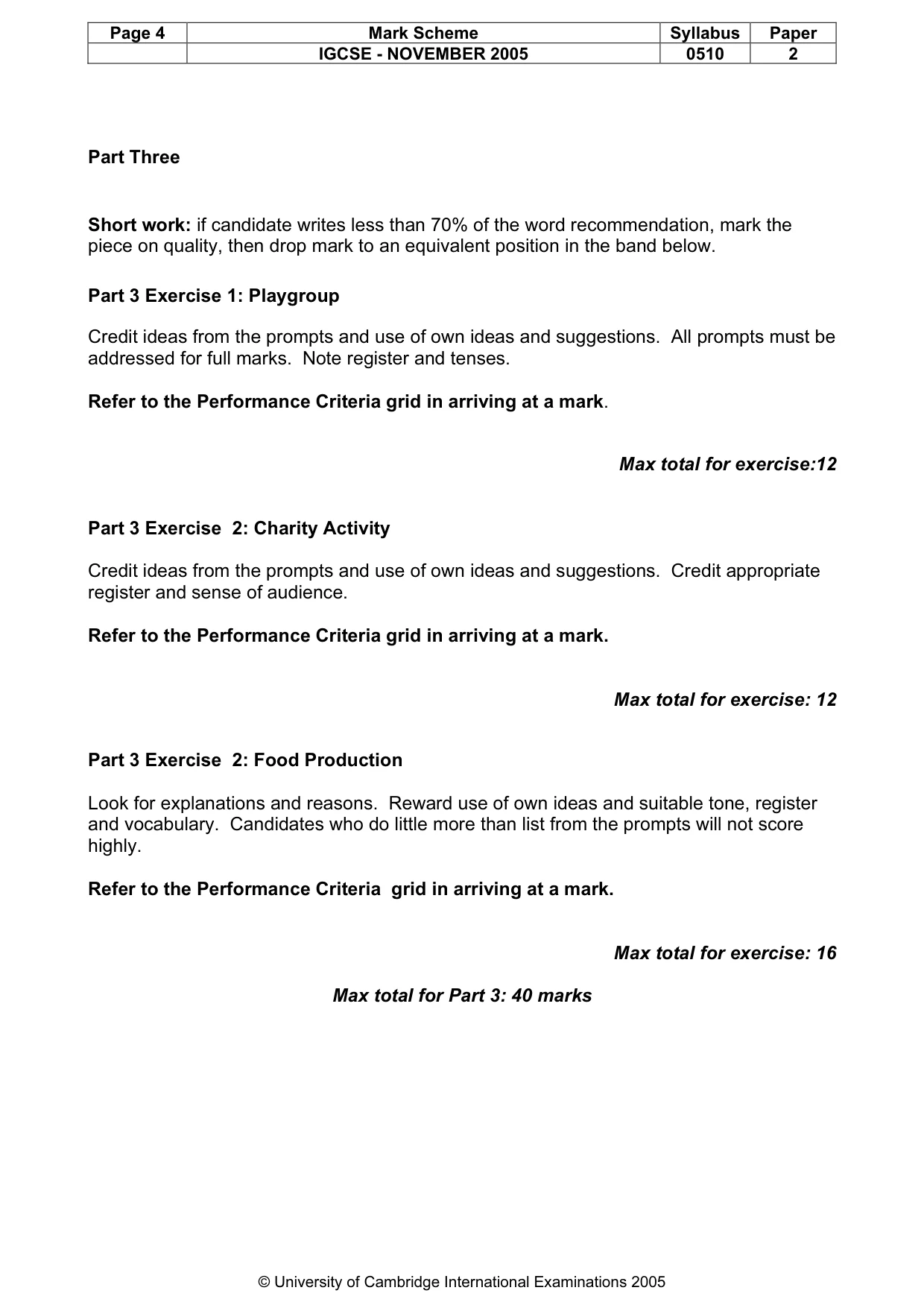
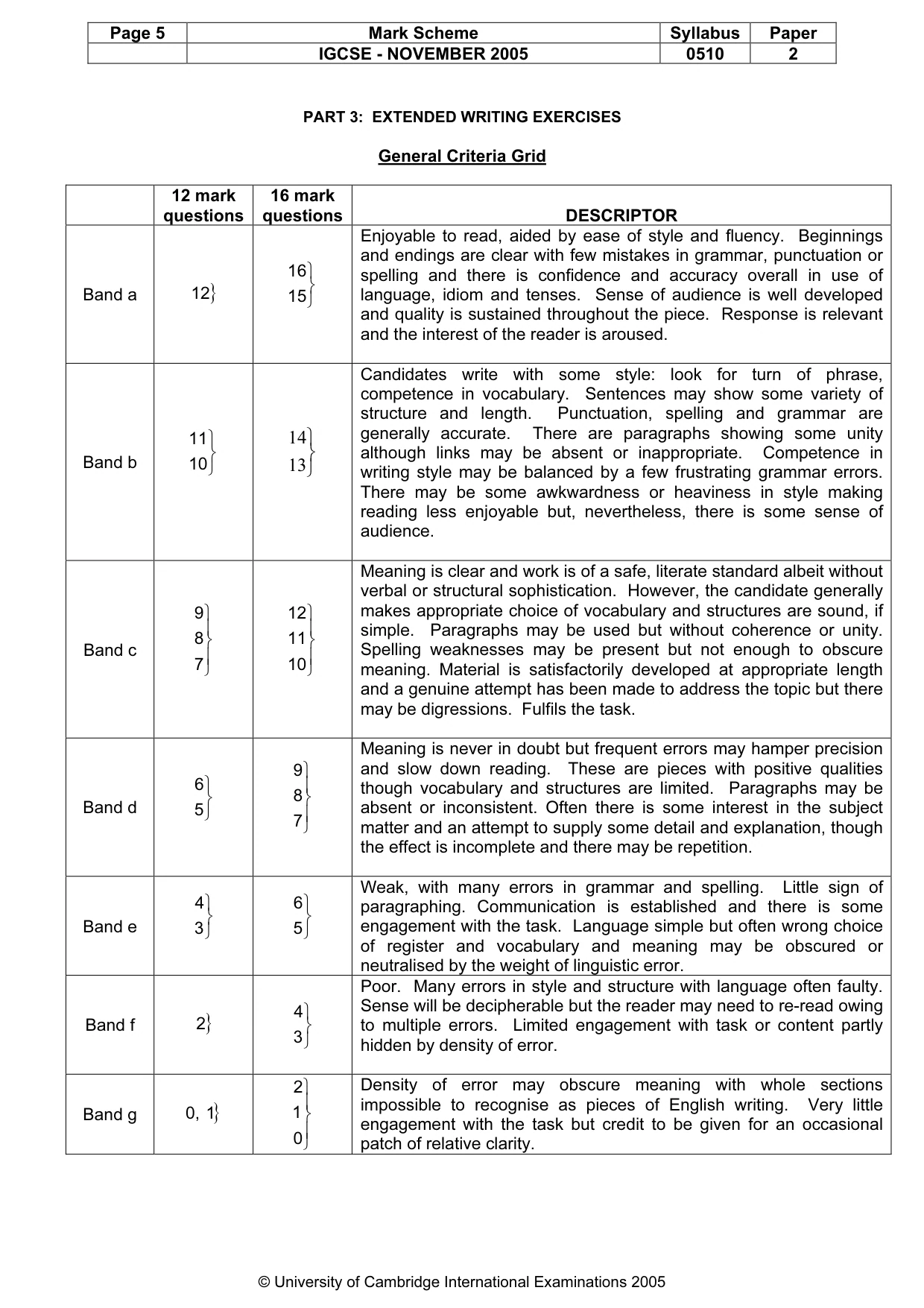
Page 4 Mark Scheme Syllabus Paper IGCSE - NOVEMBER 2005 0510 2 © University of Cambridge International Examinations 2005 Part Three Short work: if candidate writes less than 70% of the word recommendation, mark the piece on quality, then drop mark to an equivalent position in the band below. Part 3 Exercise 1: Playgroup Credit ideas from the prompts and use of own ideas and suggestions. All prompts must be addressed for full marks. Note register and tenses. Refer to the Performance Criteria grid in arriving at a mark. Max total for exercise:12 Part 3 Exercise 2: Charity Activity Credit ideas from the prompts and use of own ideas and suggestions. Credit appropriate register and sense of audience. Refer to the Performance Criteria grid in arriving at a mark. Max total for exercise: 12 Part 3 Exercise 2: Food Production Look for explanations and reasons. Reward use of own ideas and suitable tone, register and vocabulary. Candidates who do little more than list from the prompts will not score highly. Refer to the Performance Criteria grid in arriving at a mark. Max total for exercise: 16 Max total for Part 3: 40 marks
Mark scheme, page 6
Page 5 Mark Scheme Syllabus Paper IGCSE - NOVEMBER 2005 0510 2 © University of Cambridge International Examinations 2005 PART 3: EXTENDED WRITING EXERCISES General Criteria Grid 12 mark questions 16 mark questions DESCRIPTOR Band a } 12 15 16 Enjoyable to read, aided by ease of style and fluency. Beginnings and endings are clear with few mistakes in grammar, punctuation or spelling and there is confidence and accuracy overall in use of language, idiom and tenses. Sense of audience is well developed and quality is sustained throughout the piece. Response is relevant and the interest of the reader is aroused. Band b 10 11 13 14 Candidates write with some style: look for turn of phrase, competence in vocabulary. Sentences may show some variety of structure and length. Punctuation, spelling and grammar are generally accurate. There are paragraphs showing some unity although links may be absent or inappropriate. Competence in writing style may be balanced by a few frustrating grammar errors. There may be some awkwardness or heaviness in style making reading less enjoyable but, nevertheless, there is some sense of audience. Band c 7 8 9 10 11 12 Meaning is clear and work is of a safe, literate standard albeit without verbal or structural sophistication. However, the candidate generally makes appropriate choice of vocabulary and structures are sound, if simple. Paragraphs may be used but without coherence or unity. Spelling weaknesses may be present but not enough to obscure meaning. Material is satisfactorily developed at appropriate length and a genuine attempt has been made to address the topic but there may be digressions. Fulfils the task. Band d 5 6 7 8 9 Meaning is never in doubt but frequent errors may hamper precision and slow down reading. These are pieces with positive qualities though vocabulary and structures are limited. Paragraphs may be absent or inconsistent. Often there is some interest in the subject matter and an attempt to supply some detail and explanation, though the effect is incomplete and there may be repetition. Band e 3 4 5 6 Weak, with many errors in grammar and spelling. Little sign of paragraphing. Communication is established and there is some engagement with the task. Language simple but often wrong choice of register and vocabulary and meaning may be obscured or neutralised by the weight of linguistic error. Band f } 2 3 4 Poor. Many errors in style and structure with language often faulty. Sense will be decipherable but the reader may need to re-read owing to multiple errors. Limited engagement with task or content partly hidden by density of error. Band g 0, } 1 0 1 2 Density of error may obscure meaning with whole sections impossible to recognise as pieces of English writing. Very little engagement with the task but credit to be given for an occasional patch of relative clarity.