Cambridge IGCSE English - Second Language (oral endorsement) 0510 — 2005 May/June Paper 2 · Variant 1
0510/21/M/J/05
The question paper and its mark scheme, free to read here and free to download. This is Cambridge’s own paper, exactly as it was sat.
Question paper20 pages






Mark scheme8 pages
Answers below. Sit the paper first if you are practising.
Paper as text
Question paper, page 1
Centre Number Candidate Number Name UNIVERSITY OF CAMBRIDGE INTERNATIONAL EXAMINATIONS International General Certificate of Secondary Education ENGLISH AS A SECOND LANGUAGE 0510/02 Paper 2 Reading and Writing May/June 2005 2 hours Candidates answer on the Question Paper. No Additional Materials are required. READ THESE INSTRUCTIONS FIRST Write your Centre number, candidate number and name on all the work you hand in. Write in dark blue or black pen in the spaces provided on the Question Paper. Do not use staples, paper clips, glue or correction fluid. Answer all questions. The number of marks is given in brackets [ ] at the end of each question or part question. At the end of the examination, fasten all your work securely together. Dictionaries are not allowed. FOR EXAMINER’S USE Part 1 Part 2 Part 3 TOTAL This document consists of 19 printed pages and 1 blank page. IB05 06_0510_02/4RP UCLES 2005 [Turn over If you have been given a label, look at the details. If any are incorrect or missing, please fill in your correct details in the space given at the top of this page. Stick your personal label here, if provided. www.XtremePapers.com
Question paper, page 2
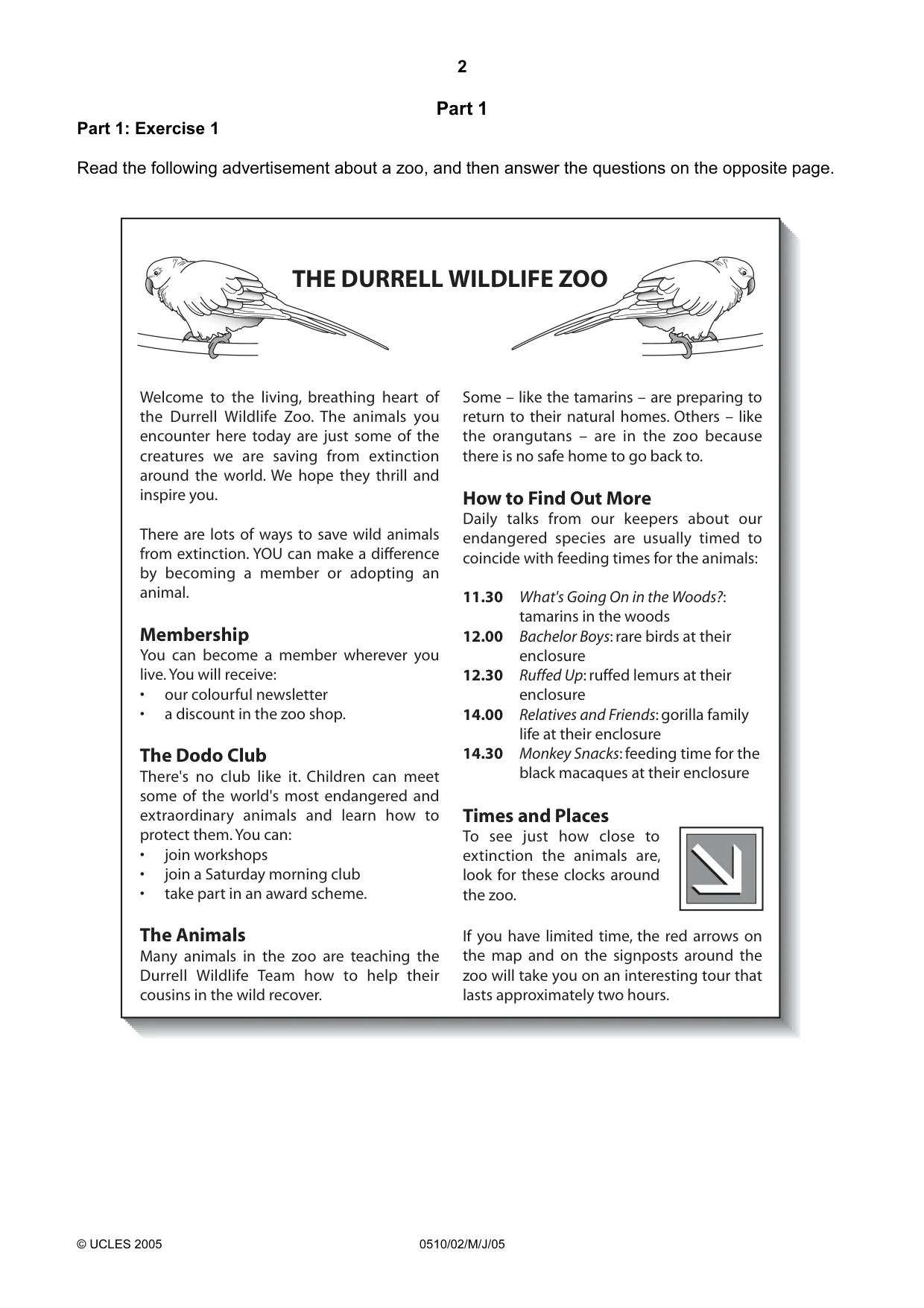
2 © UCLES 2005 0510/02/M/J/05 Part 1 Part 1: Exercise 1 Read the following advertisement about a zoo, and then answer the questions on the opposite page. THE DURRELL WILDLIFE ZOO Welcome to the living, breathing heart of the Durrell Wildlife Zoo. The animals you encounter here today are just some of the creatures we are saving from extinction around the world. We hope they thrill and inspire you. There are lots of ways to save wild animals from extinction. YOU can make a difference by becoming a member or adopting an animal. Membership You can become a member wherever you live. You will receive: • our colourful newsletter • a discount in the zoo shop. The Dodo Club There's no club like it. Children can meet some of the world's most endangered and extraordinary animals and learn how to protect them. You can: • join workshops • join a Saturday morning club • take part in an award scheme. The Animals Many animals in the zoo are teaching the Durrell Wildlife Team how to help their cousins in the wild recover. Some – like the tamarins – are preparing to return to their natural homes. Others – like the orangutans – are in the zoo because there is no safe home to go back to. How to Find Out More Daily talks from our keepers about our endangered species are usually timed to coincide with feeding times for the animals: 11.30 What's Going On in the Woods?: tamarins in the woods 12.00 Bachelor Boys: rare birds at their enclosure 12.30 Ruffed Up: ruffed lemurs at their enclosure 14.00 Relatives and Friends: gorilla family life at their enclosure 14.30 Monkey Snacks: feeding time for the black macaques at their enclosure Times and Places To see just how close to extinction the animals are, look for these clocks around the zoo. If you have limited time, the red arrows on the map and on the signposts around the zoo will take you on an interesting tour that lasts approximately two hours.
Question paper, page 3
3 © UCLES 2005 0510/02/M/J/05 [Turn over For Examiner's Use (a) What is the role of the Durrell Wildlife Zoo? [1] (b) Give one benefit of being a member of the Durrell Wildlife Zoo. [1] (c) What does the Dodo Club offer? Mention one thing. [1] (d) Why are the orangutans in the Durrell Wildlife Zoo? [1] (e) When can you find out about gorillas? [1] (f) If you don’t have much time, how can you have an interesting walk around the zoo? [1] [Total: 6]
Question paper, page 4
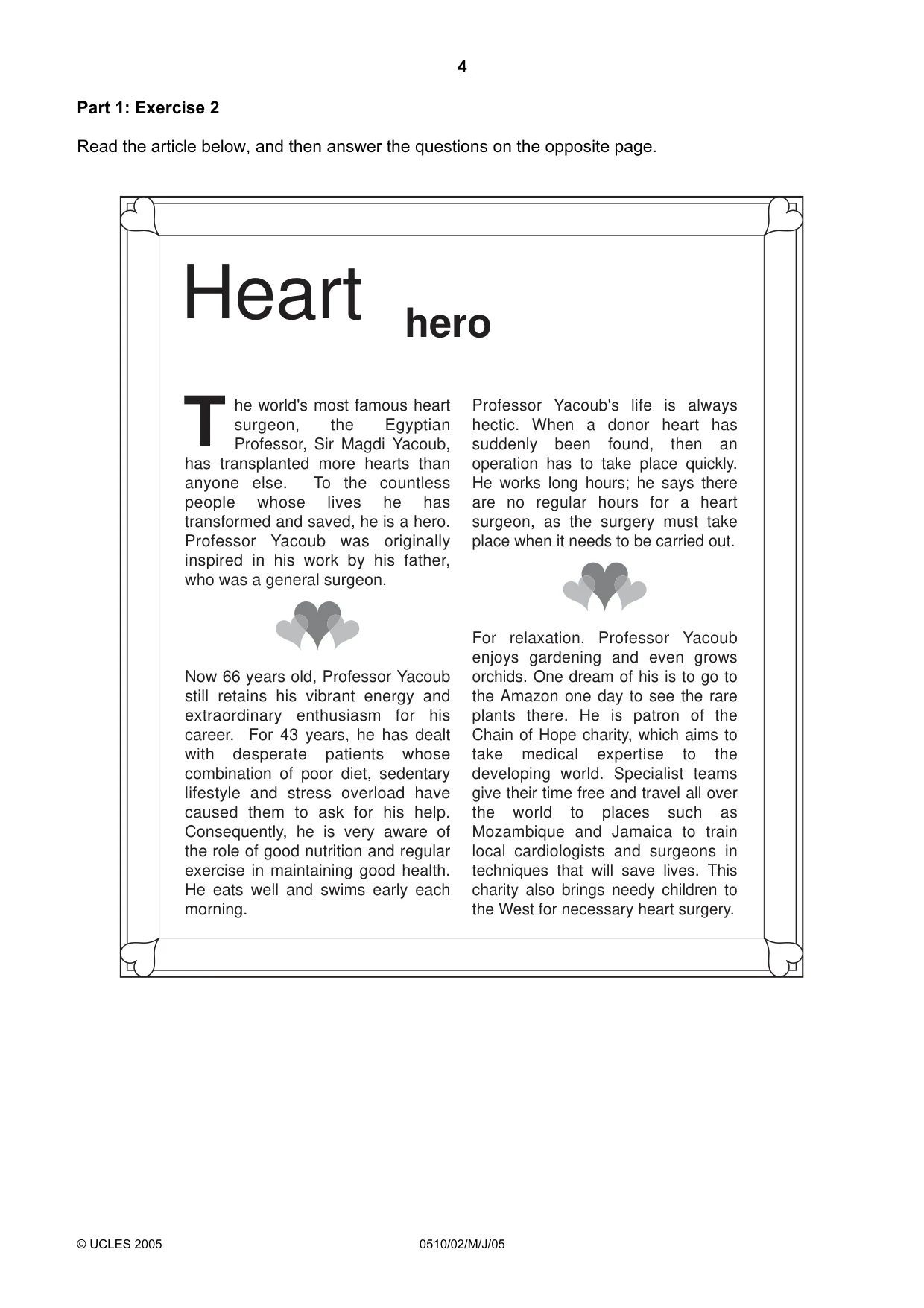
4 © UCLES 2005 0510/02/M/J/05 Part 1: Exercise 2 Read the article below, and then answer the questions on the opposite page. Heart hero he world's most famous heart surgeon, the Egyptian Professor, Sir Magdi Yacoub, has transplanted more hearts than anyone else. To the countless people whose lives he has transformed and saved, he is a hero. Professor Yacoub was originally inspired in his work by his father, who was a general surgeon. Now 66 years old, Professor Yacoub still retains his vibrant energy and extraordinary enthusiasm for his career. For 43 years, he has dealt with desperate patients whose combination of poor diet, sedentary lifestyle and stress overload have caused them to ask for his help. Consequently, he is very aware of the role of good nutrition and regular exercise in maintaining good health. He eats well and swims early each morning. Professor Yacoub's life is always hectic. When a donor heart has suddenly been found, then an operation has to take place quickly. He works long hours; he says there are no regular hours for a heart surgeon, as the surgery must take place when it needs to be carried out. For relaxation, Professor Yacoub enjoys gardening and even grows orchids. One dream of his is to go to the Amazon one day to see the rare plants there. He is patron of the Chain of Hope charity, which aims to take medical expertise to the developing world. Specialist teams give their time free and travel all over the world to places such as Mozambique and Jamaica to train local cardiologists and surgeons in techniques that will save lives. This charity also brings needy children to the West for necessary heart surgery. T
Question paper, page 5
5 © UCLES 2005 0510/02/M/J/05 [Turn over For Examiner's Use (a) Why is the famous surgeon a hero to many people? [1] (b) How does Magdi Yacoub keep himself healthy? Give two details. [1] (c) Why is a heart surgeon always on duty? [1] (d) What is Professor Yacoub’s personal ambition? [1] (e) What medical expertise does the charity take to the developing world? [1] [Total: 5]
Question paper, page 6
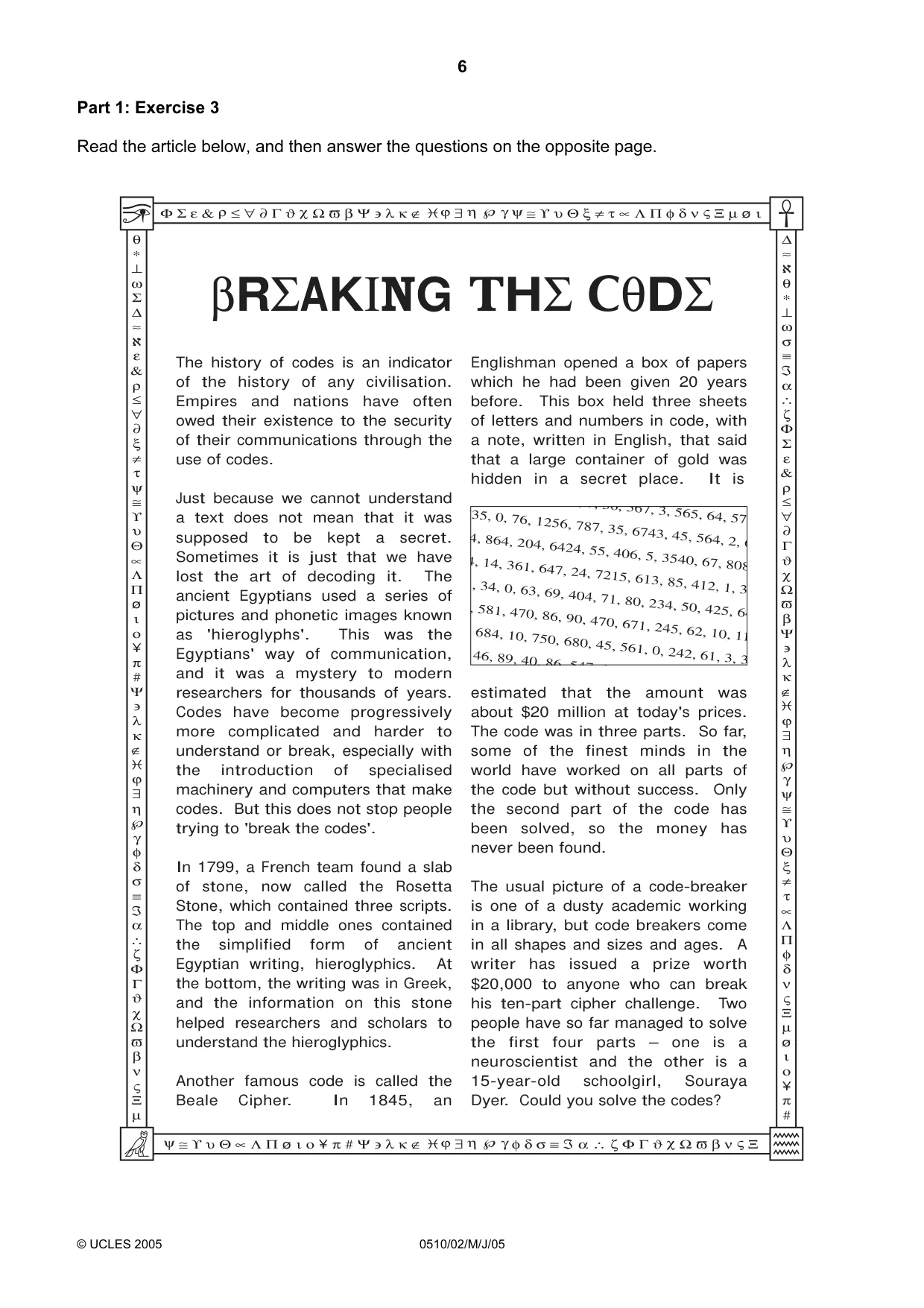
6 © UCLES 2005 0510/02/M/J/05 Part 1: Exercise 3 Read the article below, and then answer the questions on the opposite page. βRΣAKΙNG THΣ CθDΣ The history of codes is an indicator of the history of any civilisation. Empires and nations have often owed their existence to the security of their communications through the use of codes. Just because we cannot understand a text does not mean that it was supposed to be kept a secret. Sometimes it is just that we have lost the art of decoding it. The ancient Egyptians used a series of pictures and phonetic images known as 'hieroglyphs'. This was the Egyptians' way of communication, and it was a mystery to modern researchers for thousands of years. Codes have become progressively more complicated and harder to understand or break, especially with the introduction of specialised machinery and computers that make codes. But this does not stop people trying to 'break the codes'. In 1799, a French team found a slab of stone, now called the Rosetta Stone, which contained three scripts. The top and middle ones contained the simplified form of ancient Egyptian writing, hieroglyphics. At the bottom, the writing was in Greek, and the information on this stone helped researchers and scholars to understand the hieroglyphics. Another famous code is called the Beale Cipher. In 1845, an Englishman opened a box of papers which he had been given 20 years before. This box held three sheets of letters and numbers in code, with a note, written in English, that said that a large container of gold was hidden in a secret place. It is estimated that the amount was about $20 million at today's prices. The code was in three parts. So far, some of the finest minds in the world have worked on all parts of the code but without success. Only the second part of the code has been solved, so the money has never been found. The usual picture of a code-breaker is one of a dusty academic working in a library, but code breakers come in all shapes and sizes and ages. A writer has issued a prize worth $20,000 to anyone who can break his ten-part cipher challenge. Two people have so far managed to solve the first four parts – one is a neuroscientist and the other is a 15-year-old schoolgirl, Souraya Dyer. Could you solve the codes? , 7, 36, 567, 3, 565, 64, 57 735, 0, 76, 1256, 787, 35, 6743, 45, 564, 2, 6 4, 864, 204, 6424, 55, 406, 5, 3540, 67, 808 4, 14, 361, 647, 24, 7215, 613, 85, 412, 1, 3 1, 34, 0, 63, 69, 404, 71, 80, 234, 50, 425, 64 , 581, 470, 86, 90, 470, 671, 245, 62, 10, 11 684, 10, 750, 680, 45, 561, 0, 242, 61, 3, 3 46, 89, 40, 86 547 1 θ ∗ ⊥ ω Σ ∆ ≈ ℵ ε & ρ ≤ ∀ ∂ ξ ≠ τ ψ ≅ ϒ υ Θ ∝ Λ Π ø ι ο ¥ π # Ψ ∋ λ κ ∉ ϕ ∃ η ℘ γ φ δ σ ≡ ℑ α ∴ ζ Φ Γ ϑ χ Ω ϖ β ν ς Ξ µ ψ ≅ ϒ υ Θ ∝ Λ Π ø ι ο ¥ π # Ψ ∋ λ κ ∉ ϕ ∃ η ℘ γ φ δ σ ≡ ℑ α ∴ ζ Φ Γ ϑ χ Ω ϖ β ν ς Ξ ∆ ≈ ℵ θ ∗ ⊥ ω σ ≡ ℑ α ∴ ζ Φ Σ ε & ρ ≤ ∀ ∂ Γ ϑ χ Ω ϖ β Ψ ∋ λ κ ∉ ϕ ∃ η ℘ γ ψ ≅ ϒ υ Θ ξ ≠ τ ∝ Λ Π φ δ ν ς Ξ µ ø ι ο ¥ π # Φ Σ ε & ρ ≤ ∀ ∂ Γ ϑ χ Ω ϖ β Ψ ∋ λ κ ∉ ϕ ∃ η ℘ γ ψ ≅ ϒ υ Θ ξ ≠ τ ∝ Λ Π φ δ ν ς Ξ µ ø ι
Question paper, page 7
7 © UCLES 2005 0510/02/M/J/05 [Turn over For Examiner's Use (a) Why have nations and civilisations used codes? [1] (b) Give two reasons why we find understanding codes more difficult these days. (i) [1] (ii) [1] (c) What name was given to the object which enabled people to understand the ancient Egyptian way of communication? [1] (d) What is thought to be the reward of solving the Beale Cipher? [1] (e) How much of the Beale Cipher has been solved? [1] (f) Which two people have partly solved the ten-part cipher challenge? [1] [Total: 7]
Question paper, page 8
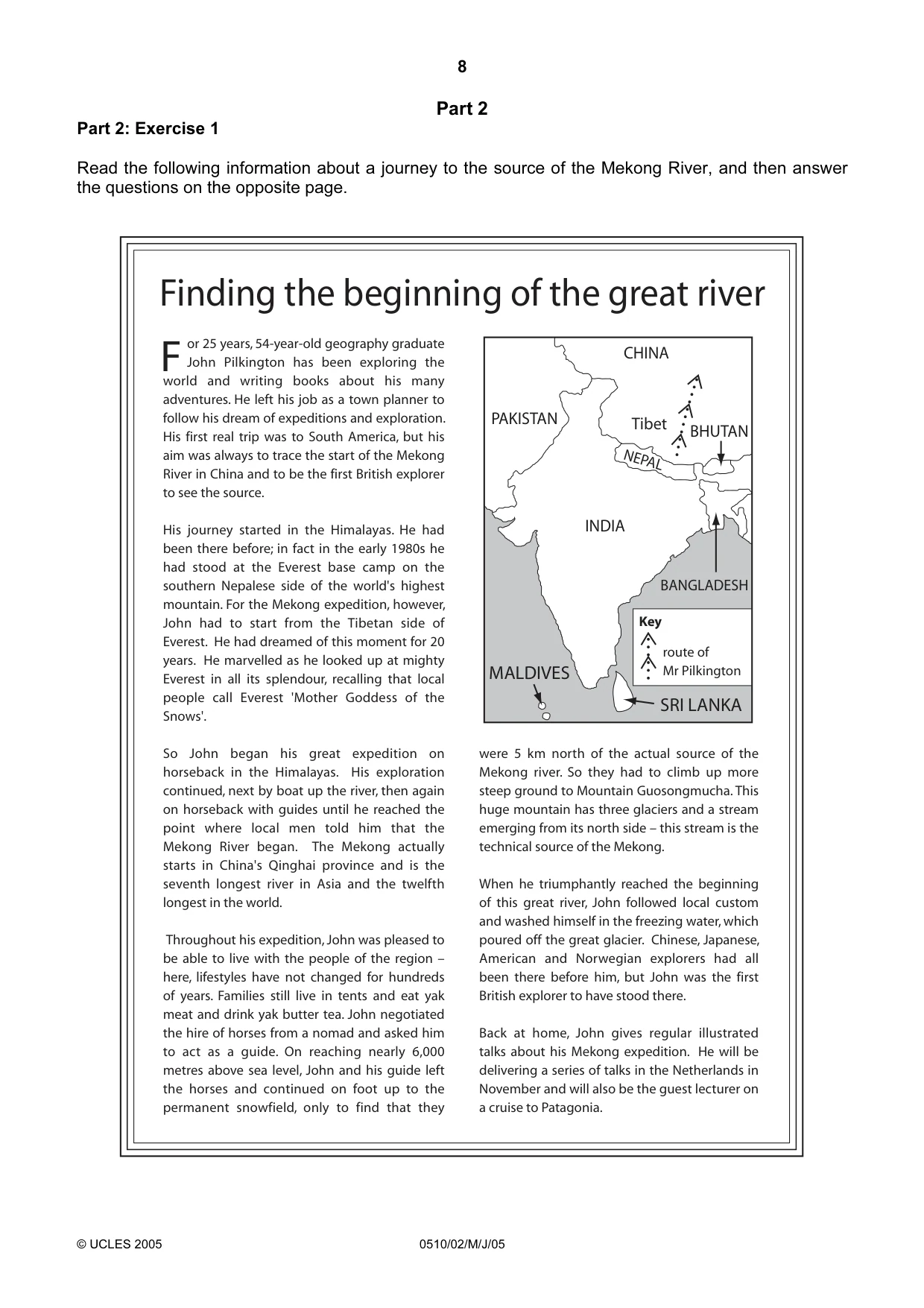
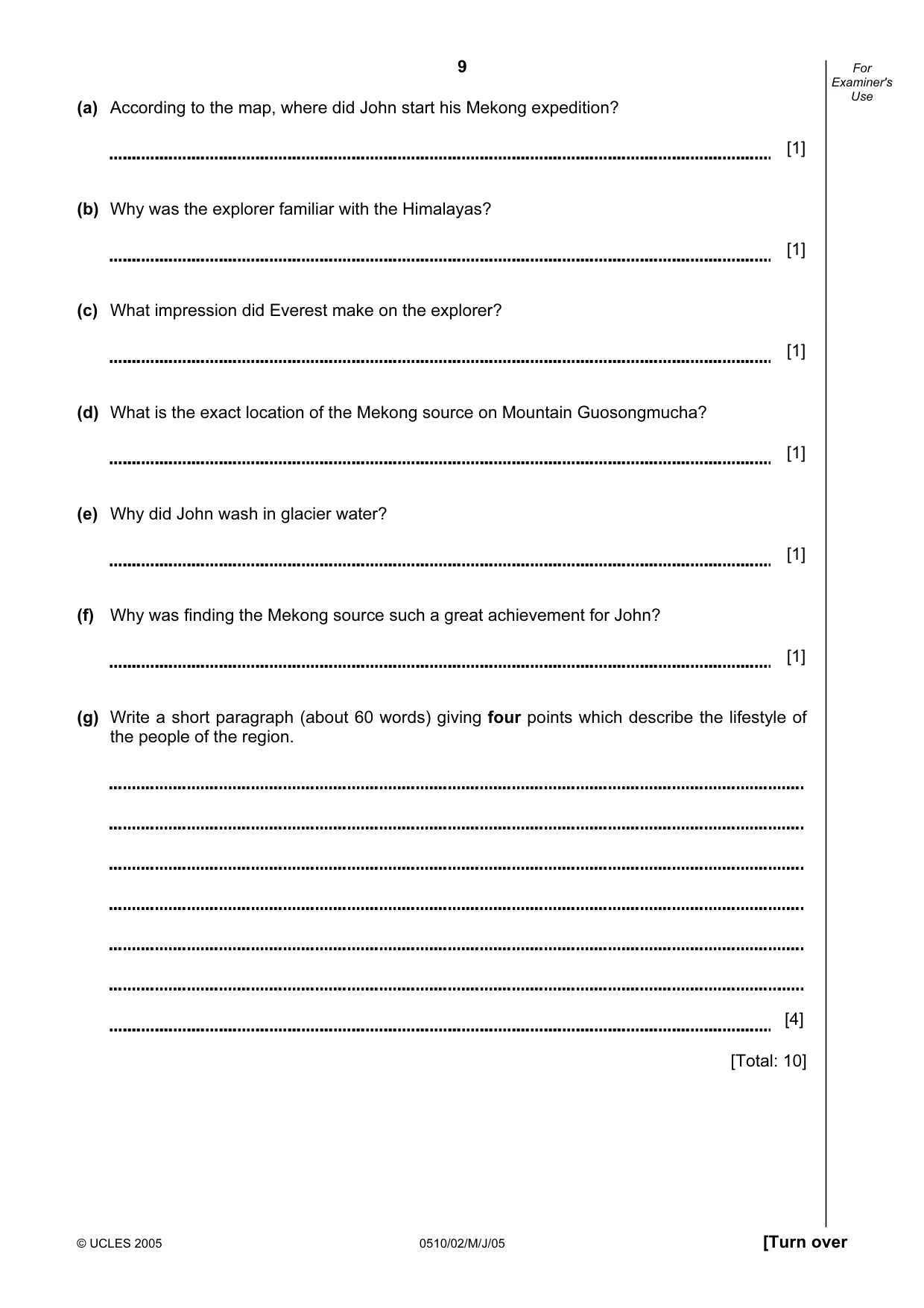
8 © UCLES 2005 0510/02/M/J/05 Part 2 Part 2: Exercise 1 Read the following information about a journey to the source of the Mekong River, and then answer the questions on the opposite page. or 25 years, 54-year-old geography graduate John Pilkington has been exploring the world and writing books about his many adventures. He left his job as a town planner to follow his dream of expeditions and exploration. His first real trip was to South America, but his aim was always to trace the start of the Mekong River in China and to be the first British explorer to see the source. His journey started in the Himalayas. He had been there before; in fact in the early 1980s he had stood at the Everest base camp on the southern Nepalese side of the world's highest mountain. For the Mekong expedition, however, John had to start from the Tibetan side of Everest. He had dreamed of this moment for 20 years. He marvelled as he looked up at mighty Everest in all its splendour, recalling that local people call Everest 'Mother Goddess of the Snows'. So John began his great expedition on horseback in the Himalayas. His exploration continued, next by boat up the river, then again on horseback with guides until he reached the point where local men told him that the Mekong River began. The Mekong actually starts in China's Qinghai province and is the seventh longest river in Asia and the twelfth longest in the world. Throughout his expedition, John was pleased to be able to live with the people of the region – here, lifestyles have not changed for hundreds of years. Families still live in tents and eat yak meat and drink yak butter tea. John negotiated the hire of horses from a nomad and asked him to act as a guide. On reaching nearly 6,000 metres above sea level, John and his guide left the horses and continued on foot up to the permanent snowfield, only to find that they were 5 km north of the actual source of the Mekong river. So they had to climb up more steep ground to Mountain Guosongmucha. This huge mountain has three glaciers and a stream emerging from its north side – this stream is the technical source of the Mekong. When he triumphantly reached the beginning of this great river, John followed local custom and washed himself in the freezing water, which poured off the great glacier. Chinese, Japanese, American and Norwegian explorers had all been there before him, but John was the first British explorer to have stood there. Back at home, John gives regular illustrated talks about his Mekong expedition. He will be delivering a series of talks in the Netherlands in November and will also be the guest lecturer on a cruise to Patagonia. Finding the beginning of the great river F CHINA Tibet INDIA BHUTAN PAKISTAN NEPAL BANGLADESH route of Mr Pilkington Key SRI LANKA MALDIVES
Question paper, page 9
9 © UCLES 2005 0510/02/M/J/05 [Turn over For Examiner's Use (a) According to the map, where did John start his Mekong expedition? [1] (b) Why was the explorer familiar with the Himalayas? [1] (c) What impression did Everest make on the explorer? [1] (d) What is the exact location of the Mekong source on Mountain Guosongmucha? [1] (e) Why did John wash in glacier water? [1] (f) Why was finding the Mekong source such a great achievement for John? [1] (g) Write a short paragraph (about 60 words) giving four points which describe the lifestyle of the people of the region. [4] [Total: 10]
Question paper, page 10
10 © UCLES 2005 0510/02/M/J/05 Part 2: Exercise 2 Read the following article about boys’ education and computers. Then write a summary of the article explaining how computers can help boys. Your summary should be about 100 words. You should use your own words as far as possible. HITTING THE RIGHT BUTTON t has been found that in some countries, achievement in some subjects at school is not always as good for boys as it is for girls. It is possible that using computers may be a way to solve this problem. Many boys seem to have a natural liking for computers, but it can often be hard to leave the screen and concentrate on the work the teacher wants them to do. As computers are becoming more and more important in the world of education today, it is natural to assume that computers can help greatly with boys who do not do too well at school and need to raise their general educational standards. There is growing research that shows studying ICT (Information Communications Technology) is very motivating for boys in particular. Many boys appear to be more confident than girls in using it, and they tend to use computers more frequently, especially at home. Researchers at universities now think that it could be a really good way of re-engaging under-achieving boys in the learning process, and teachers have indicated that it does work. They have found that, although lots of boys do not seem to like writing in the classroom, when they use a computer they are more willing to compose longer pieces of writing and use different styles. The issue of unintelligible handwriting is no longer a problem, either, as the neatness and presentation standards rise when boys use a computer to print out their work. Many boys welcome the 'hands on' approach of computers. However, researchers and teachers need to be careful that boys don't just 'cut and paste' things that they have found on the Internet, but haven't read, and hand it in as a completed assignment. Some boys overestimate how good they are and think they can do things without any effort. They need to develop proper research skills and make their written work more structured. Indeed, everyone needs to understand how to use computers to get the best results. They should always be clear about the aims and outcomes of the classroom work they are being asked to do. If they don't see the point, then they are less inclined to make an effort. Some boys take short cuts, or look at Internet sites they haven't been asked to look at. They may not plan or think carefully about their work, or they may try to finish their work quickly. This tendency is not going to be completely cured by using computers. One way to get boys to concentrate properly on the work they have been asked to do may be to encourage them to use their computers at home. However, they also need to be set tasks that are interesting and relevant to them. As in all things, the interaction between the pupil, the teacher and the computer is crucial. I
Question paper, page 11
11 © UCLES 2005 0510/02/M/J/05 [Turn over For Examiner's Use [8]
Question paper, page 12
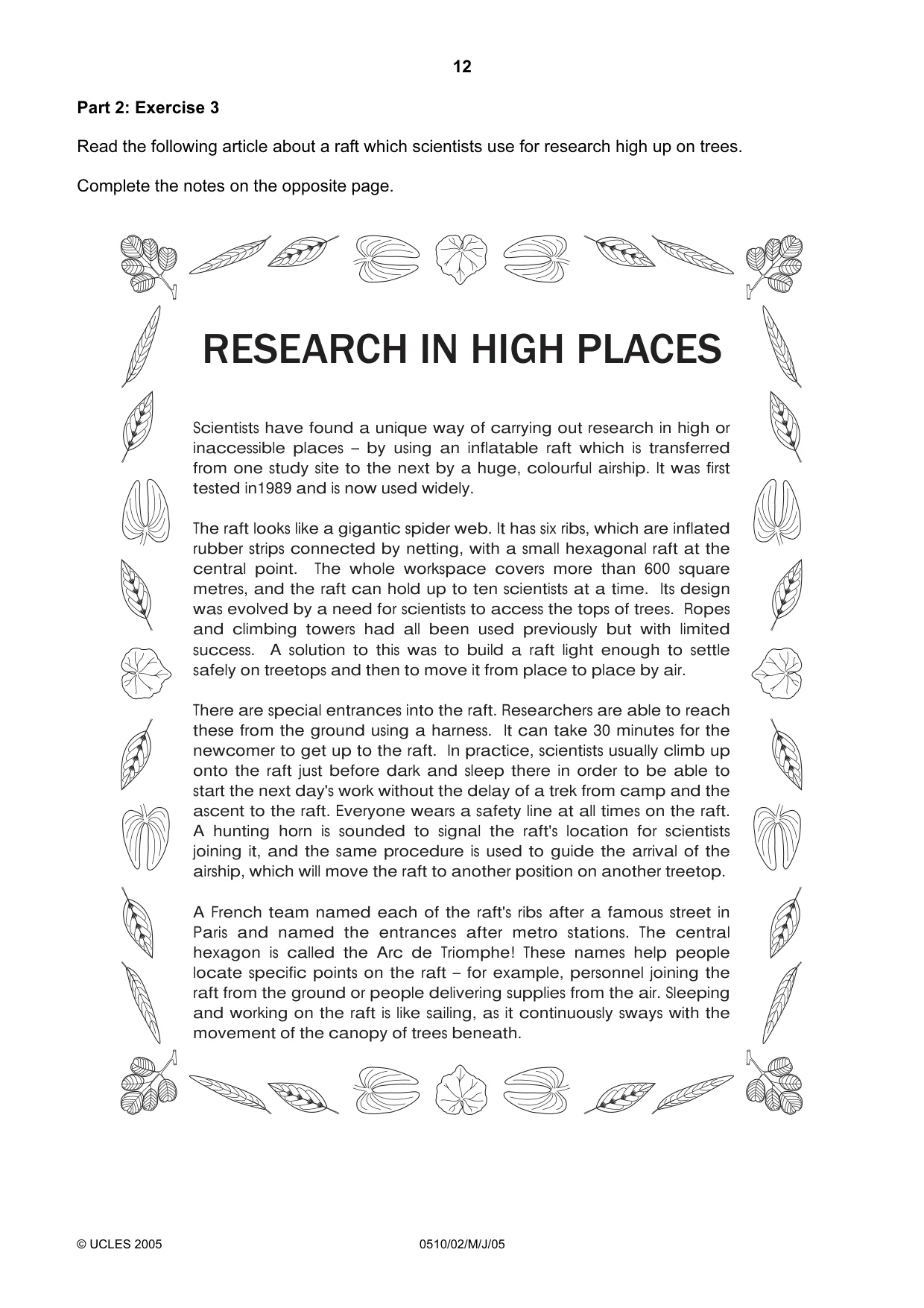
12 © UCLES 2005 0510/02/M/J/05 Part 2: Exercise 3 Read the following article about a raft which scientists use for research high up on trees. Complete the notes on the opposite page. Scientists have found a unique way of carrying out research in high or inaccessible places – by using an inflatable raft which is transferred from one study site to the next by a huge, colourful airship. It was first tested in1989 and is now used widely. The raft looks like a gigantic spider web. It has six ribs, which are inflated rubber strips connected by netting, with a small hexagonal raft at the central point. The whole workspace covers more than 600 square metres, and the raft can hold up to ten scientists at a time. Its design was evolved by a need for scientists to access the tops of trees. Ropes and climbing towers had all been used previously but with limited success. A solution to this was to build a raft light enough to settle safely on treetops and then to move it from place to place by air. There are special entrances into the raft. Researchers are able to reach these from the ground using a harness. It can take 30 minutes for the newcomer to get up to the raft. In practice, scientists usually climb up onto the raft just before dark and sleep there in order to be able to start the next day's work without the delay of a trek from camp and the ascent to the raft. Everyone wears a safety line at all times on the raft. A hunting horn is sounded to signal the raft's location for scientists joining it, and the same procedure is used to guide the arrival of the airship, which will move the raft to another position on another treetop. A French team named each of the raft's ribs after a famous street in Paris and named the entrances after metro stations. The central hexagon is called the Arc de Triomphe! These names help people locate specific points on the raft – for example, personnel joining the raft from the ground or people delivering supplies from the air. Sleeping and working on the raft is like sailing, as it continuously sways with the movement of the canopy of trees beneath. RESEARCH IN HIGH PLACES
Question paper, page 13
13 © UCLES 2005 0510/02/M/J/05 [Turn over For Examiner's Use You are going to give a short talk about the treetop raft to your class. Make two short notes under each heading below as a basis for your presentation. THE TREETOP RAFT (a) Design: • • (b) Size/capacity: • • (c) Means of access: • • (d) Raft moving requirements: • • [Total: 8]
Question paper, page 14
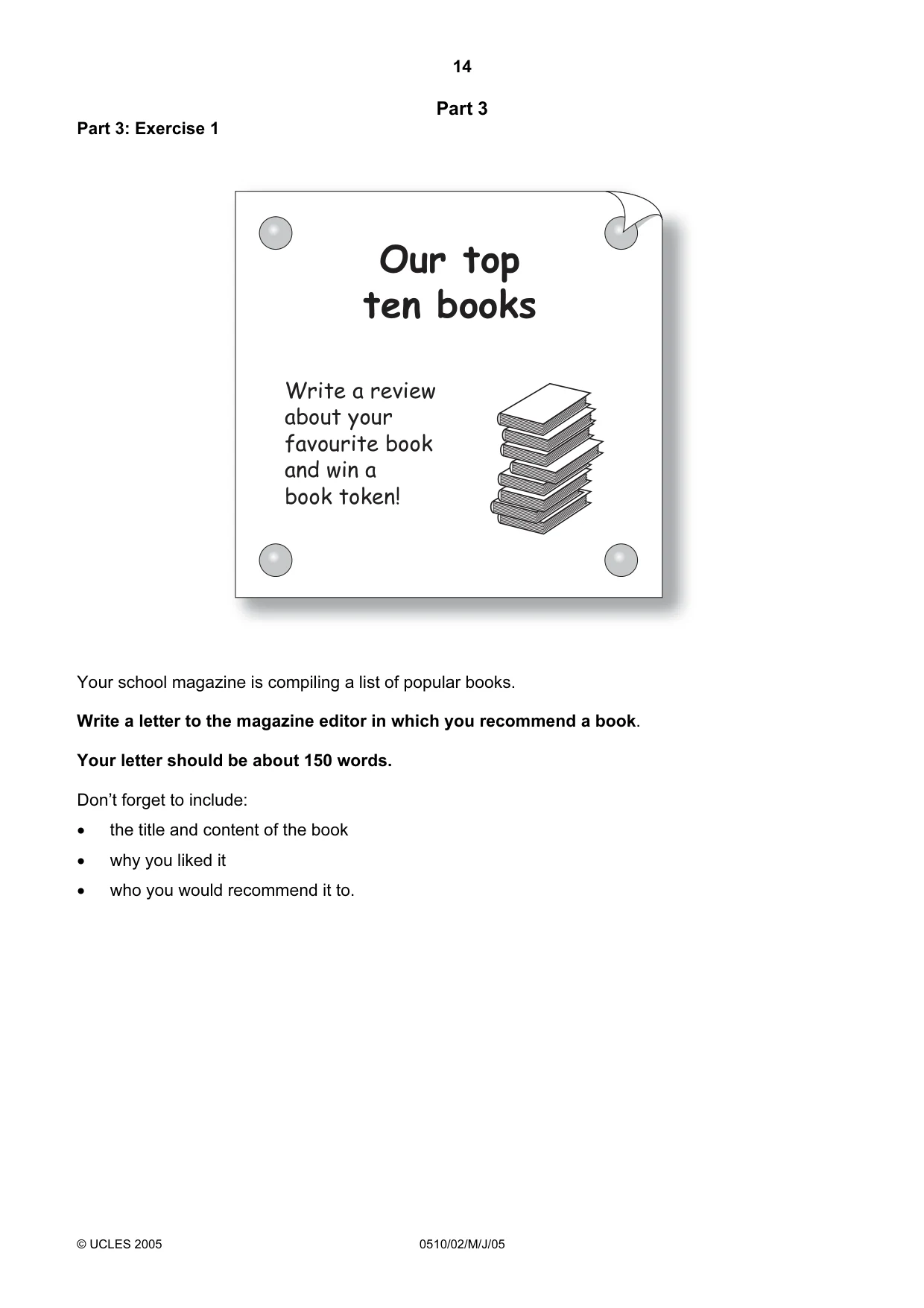
14 © UCLES 2005 0510/02/M/J/05 Part 3 Part 3: Exercise 1 Our top ten books Write a review about your favourite book and win a book token! Your school magazine is compiling a list of popular books. Write a letter to the magazine editor in which you recommend a book. Your letter should be about 150 words. Don’t forget to include: • the title and content of the book • why you liked it • who you would recommend it to.
Question paper, page 15
15 © UCLES 2005 0510/02/M/J/05 [Turn over For Examiner's Use Dear Editor, [12]
Question paper, page 16
16 © UCLES 2005 0510/02/M/J/05 Part 3: Exercise 2 VOLUNTEERS WANTED See article for further details. ADVERTISEMENT TO WELCOME VISITORS TO OUR SCHOOL Your school is arranging a visit to the school for students from other places or other countries. You have been asked to write an article for the school magazine asking for volunteers to welcome the visitors. In the article you should include the following: • who the visitors are • how they will be welcomed and included in the school's everyday life • what kinds of things the volunteers will be expected to do for the visitors. Your article should be about 200 words long.
Question paper, page 17
17 © UCLES 2005 0510/02/M/J/05 [Turn over For Examiner's Use [12]
Question paper, page 18
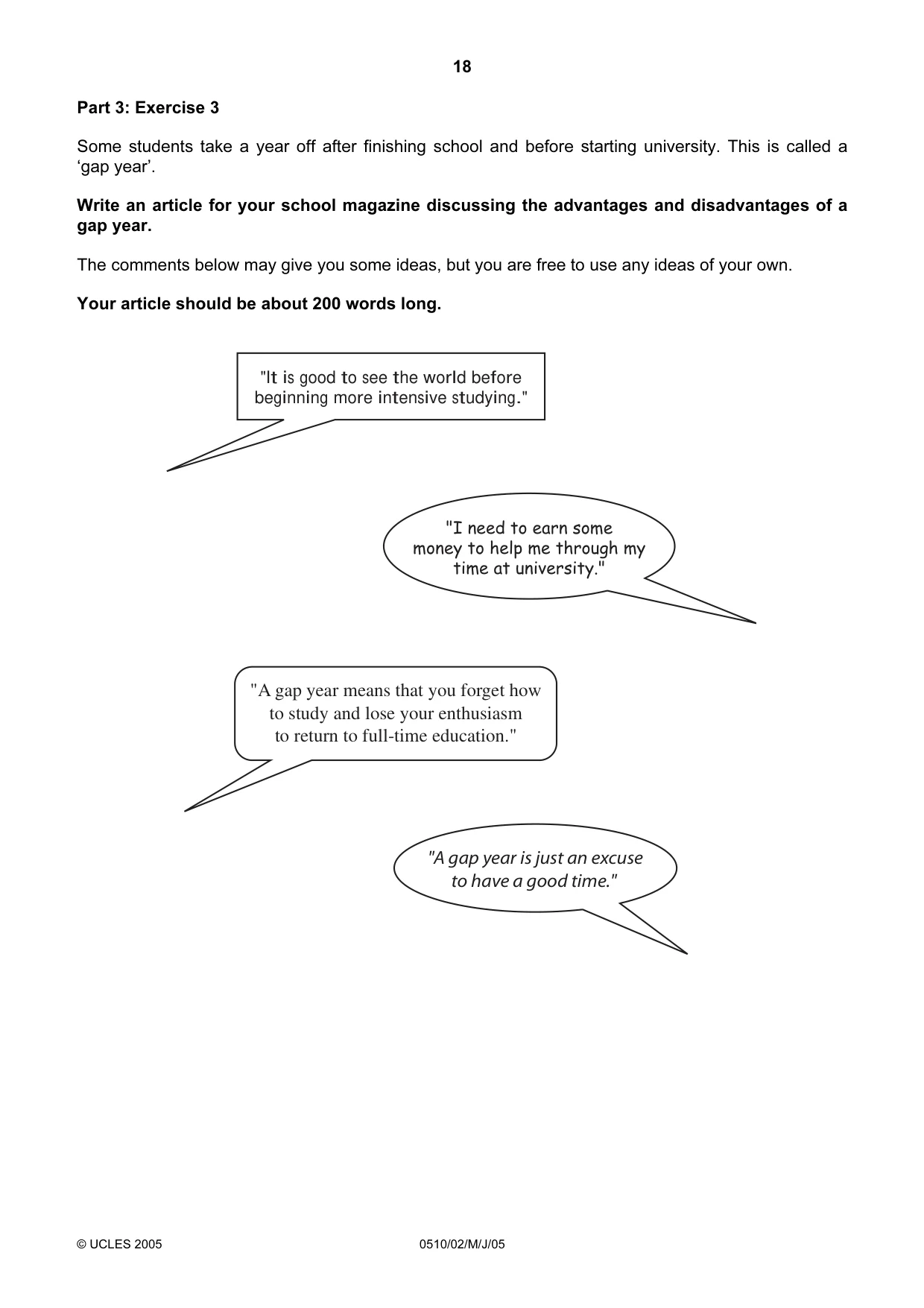
18 © UCLES 2005 0510/02/M/J/05 Part 3: Exercise 3 Some students take a year off after finishing school and before starting university. This is called a ‘gap year’. Write an article for your school magazine discussing the advantages and disadvantages of a gap year. The comments below may give you some ideas, but you are free to use any ideas of your own. Your article should be about 200 words long. "A gap year is just an excuse to have a good time." "It is good to see the world before beginning more intensive studying." "I need to earn some money to help me through my time at university." "A gap year means that you forget how to study and lose your enthusiasm to return to full-time education."
Question paper, page 19
19 © UCLES 2005 0510/02/M/J/05 For Examiner's Use [16]
Question paper, page 20
20 Copyright Acknowledgements: Part 1 Exercise 1 Welcome to Durrell Wildlife; © Jersey Zoo/Durrell Wildlife Conservation Trust. Exercise 2 © Kevin Gould. Exercise 3 © John Crace; Breaking The Code; Guardian Education, 1999. Part 2 Exercise 1 Explorer John traces the source of his inspiration; © The Hampshire Chronicle, 2003. Exercise 2 © Emma Haughton; Hitting the Right Button; Guardian Education, 2002. Exercise 3 Raft Atop the Rooftops; © National Geographic Magazine, 1990. Permission to reproduce items where third-party owned material protected by copyright is included has been sought and cleared where possible. Every reasonable effort has been made by the publisher (UCLES) to trace copyright holders, but if any items requiring clearance have unwittingly been included, the publisher will be pleased to make amends at the earliest possible opportunity. University of Cambridge International Examinations is part of the University of Cambridge Local Examinations Syndicate (UCLES), which is itself a department of the University of Cambridge. 0510/02/M/J/05 BLANK PAGE
Mark scheme, page 1
UNIVERSITY OF CAMBRIDGE INTERNATIONAL EXAMINATIONS International General Certificate of Secondary Education MARK SCHEME for the June 2005 question paper 0510 ENGLISH AS A SECOND LANGUAGE 0510/02 Paper 2 (Reading and Writing – Extended), maximum mark 84 These mark schemes are published as an aid to teachers and students, to indicate the requirements of the examination. They show the basis on which Examiners were initially instructed to award marks. They do not indicate the details of the discussions that took place at an Examiners’ meeting before marking began. Any substantial changes to the mark scheme that arose from these discussions will be recorded in the published Report on the Examination. All Examiners are instructed that alternative correct answers and unexpected approaches in candidates’ scripts must be given marks that fairly reflect the relevant knowledge and skills demonstrated. Mark schemes must be read in conjunction with the question papers and the Report on the Examination. • CIE will not enter into discussion or correspondence in connection with these mark schemes. CIE is publishing the mark schemes for the June 2005 question papers for most IGCSE and GCE Advanced Level and Advanced Subsidiary Level syllabuses and some Ordinary Level syllabuses www.XtremePapers.com
Mark scheme, page 2
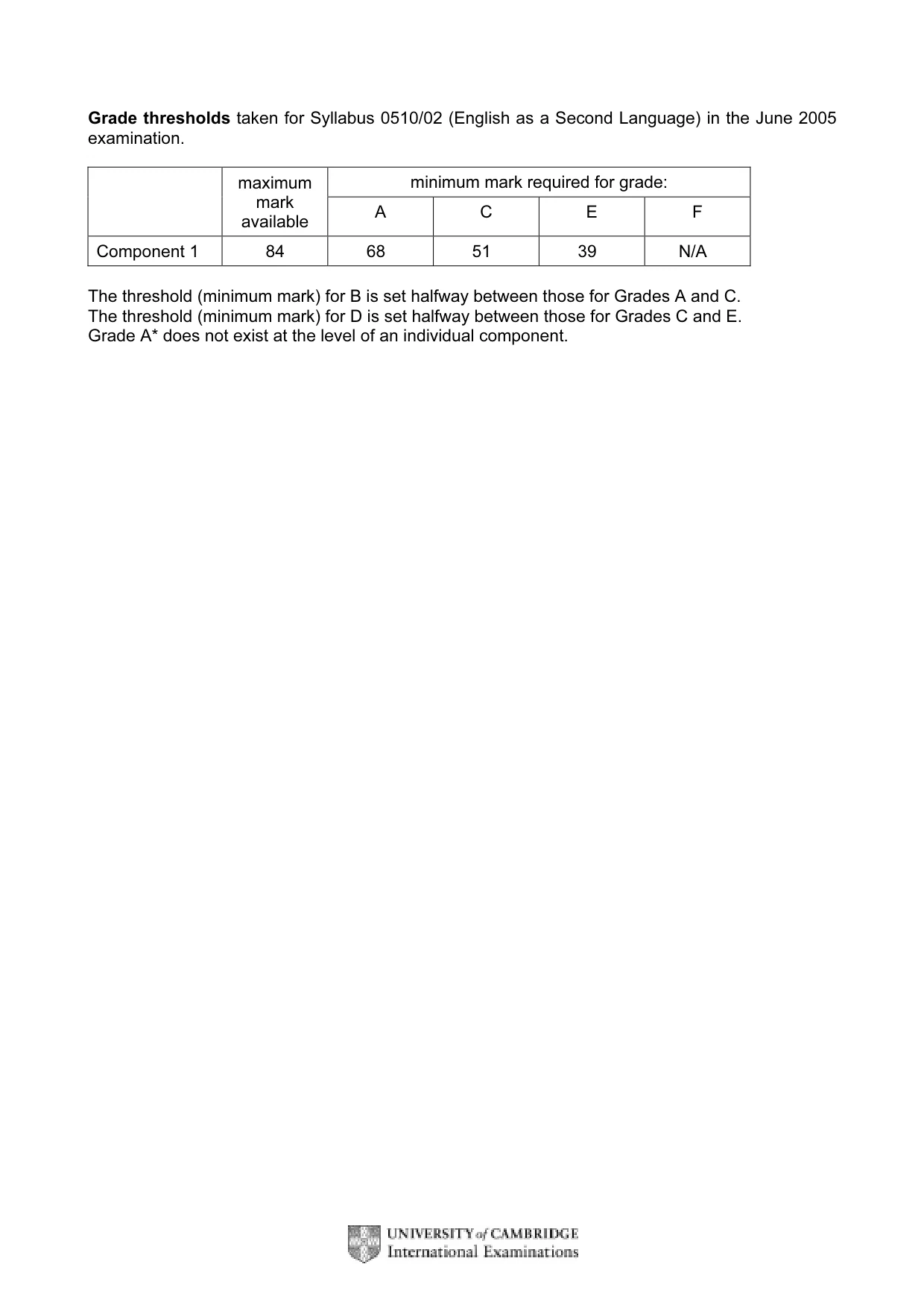
Grade thresholds taken for Syllabus 0510/02 (English as a Second Language) in the June 2005 examination. minimum mark required for grade: maximum mark available A C E F Component 1 84 68 51 39 N/A The threshold (minimum mark) for B is set halfway between those for Grades A and C. The threshold (minimum mark) for D is set halfway between those for Grades C and E. Grade A* does not exist at the level of an individual component.
Mark scheme, page 3
June 2005 IGCSE MARK SCHEME MAXIMUM MARK: 84 SYLLABUS/COMPONENT: 0510/02 ENGLISH AS A SECOND LANGUAGE Paper 2 (Reading and Writing - Extended)
Mark scheme, page 4
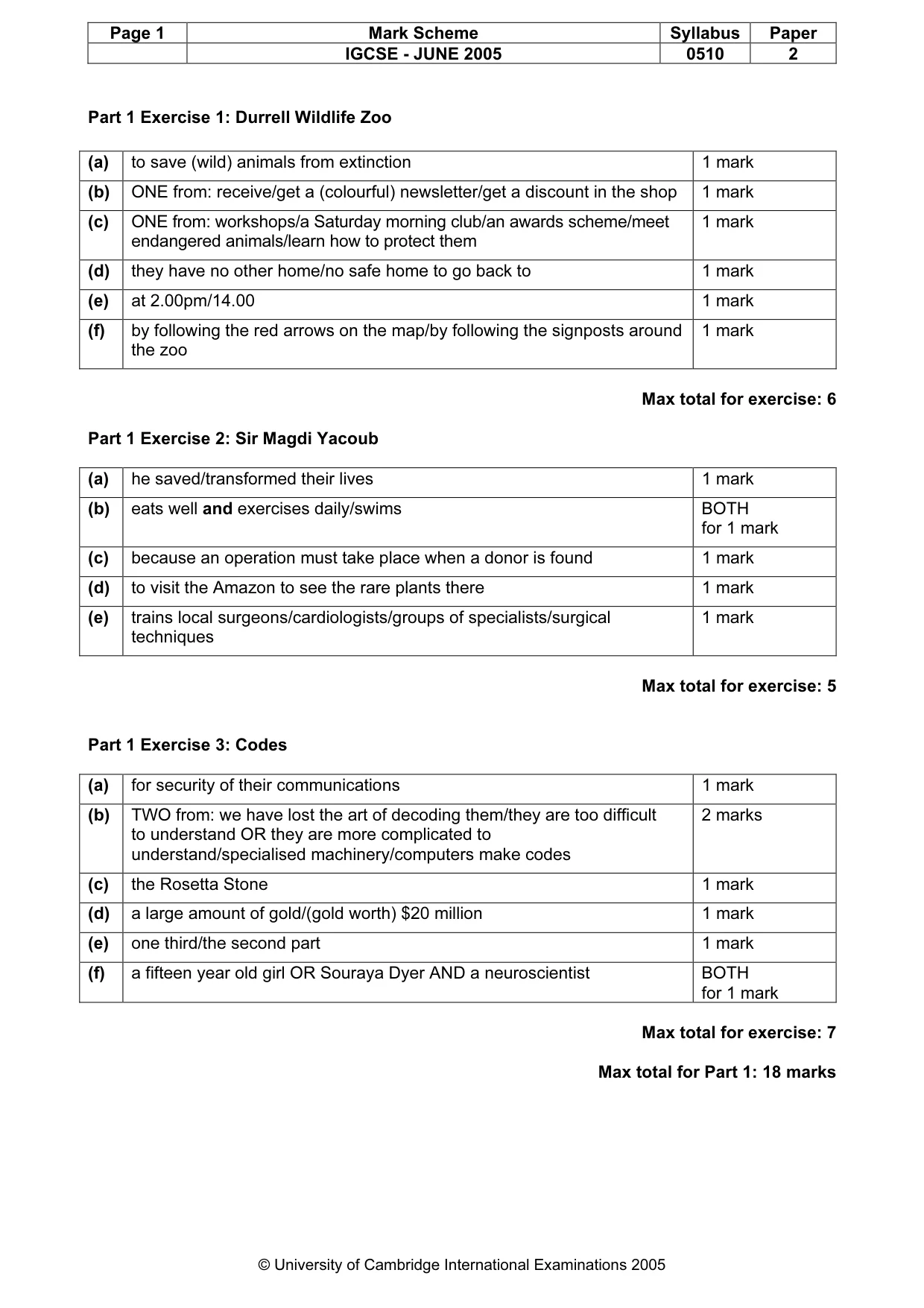
Page 1 Mark Scheme Syllabus Paper IGCSE - JUNE 2005 0510 2 © University of Cambridge International Examinations 2005 Part 1 Exercise 1: Durrell Wildlife Zoo (a) to save (wild) animals from extinction 1 mark (b) ONE from: receive/get a (colourful) newsletter/get a discount in the shop 1 mark (c) ONE from: workshops/a Saturday morning club/an awards scheme/meet endangered animals/learn how to protect them 1 mark (d) they have no other home/no safe home to go back to 1 mark (e) at 2.00pm/14.00 1 mark (f) by following the red arrows on the map/by following the signposts around the zoo 1 mark Max total for exercise: 6 Part 1 Exercise 2: Sir Magdi Yacoub (a) he saved/transformed their lives 1 mark (b) eats well and exercises daily/swims BOTH for 1 mark (c) because an operation must take place when a donor is found 1 mark (d) to visit the Amazon to see the rare plants there 1 mark (e) trains local surgeons/cardiologists/groups of specialists/surgical techniques 1 mark Max total for exercise: 5 Part 1 Exercise 3: Codes (a) for security of their communications 1 mark (b) TWO from: we have lost the art of decoding them/they are too difficult to understand OR they are more complicated to understand/specialised machinery/computers make codes 2 marks (c) the Rosetta Stone 1 mark (d) a large amount of gold/(gold worth) $20 million 1 mark (e) one third/the second part 1 mark (f) a fifteen year old girl OR Souraya Dyer AND a neuroscientist BOTH for 1 mark Max total for exercise: 7 Max total for Part 1: 18 marks
Mark scheme, page 5
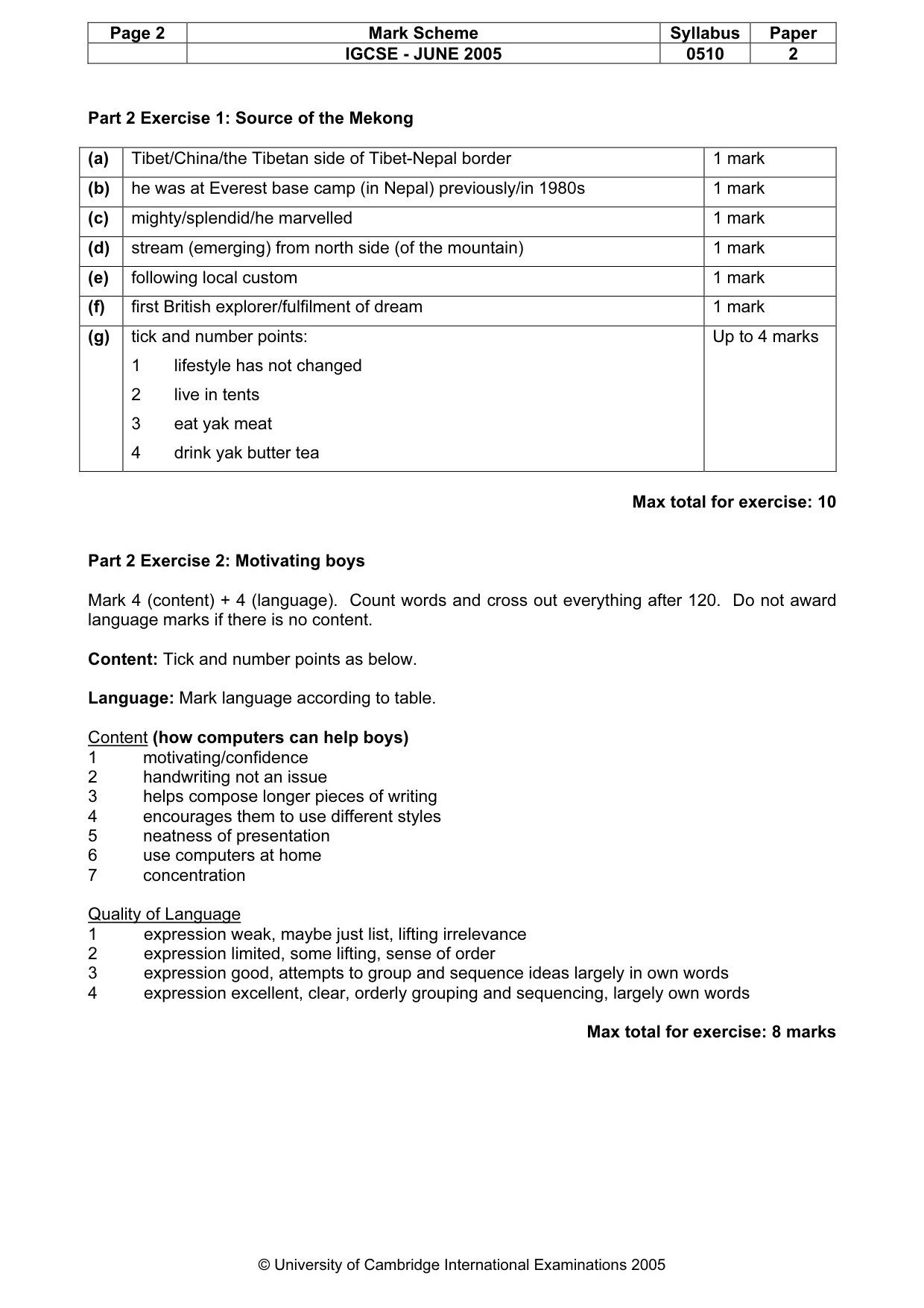
Page 2 Mark Scheme Syllabus Paper IGCSE - JUNE 2005 0510 2 © University of Cambridge International Examinations 2005 Part 2 Exercise 1: Source of the Mekong (a) Tibet/China/the Tibetan side of Tibet-Nepal border 1 mark (b) he was at Everest base camp (in Nepal) previously/in 1980s 1 mark (c) mighty/splendid/he marvelled 1 mark (d) stream (emerging) from north side (of the mountain) 1 mark (e) following local custom 1 mark (f) first British explorer/fulfilment of dream 1 mark (g) tick and number points: 1 lifestyle has not changed 2 live in tents 3 eat yak meat 4 drink yak butter tea Up to 4 marks Max total for exercise: 10 Part 2 Exercise 2: Motivating boys Mark 4 (content) + 4 (language). Count words and cross out everything after 120. Do not award language marks if there is no content. Content: Tick and number points as below. Language: Mark language according to table. Content (how computers can help boys) 1 motivating/confidence 2 handwriting not an issue 3 helps compose longer pieces of writing 4 encourages them to use different styles 5 neatness of presentation 6 use computers at home 7 concentration Quality of Language 1 expression weak, maybe just list, lifting irrelevance 2 expression limited, some lifting, sense of order 3 expression good, attempts to group and sequence ideas largely in own words 4 expression excellent, clear, orderly grouping and sequencing, largely own words Max total for exercise: 8 marks
Mark scheme, page 6
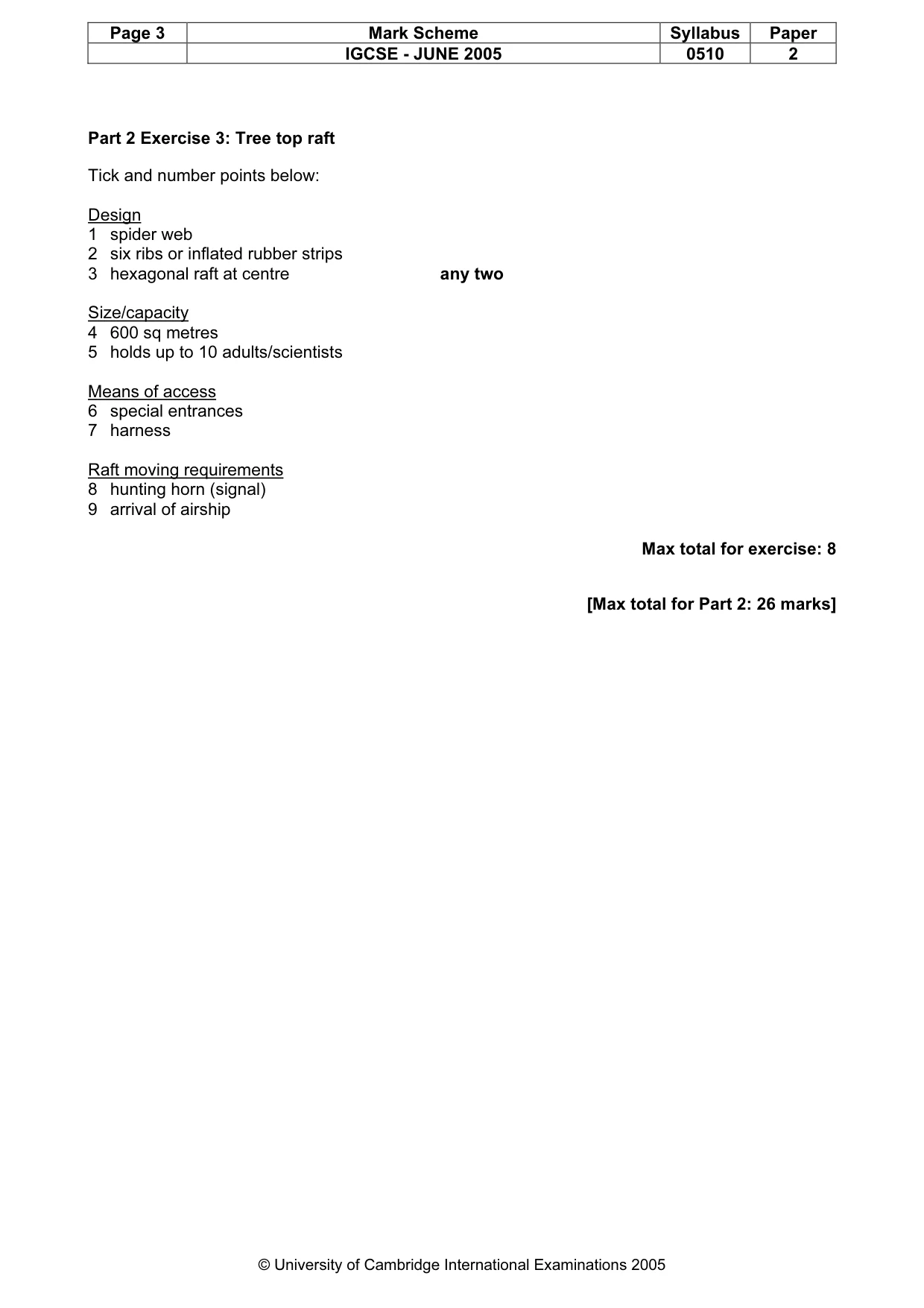
Page 3 Mark Scheme Syllabus Paper IGCSE - JUNE 2005 0510 2 © University of Cambridge International Examinations 2005 Part 2 Exercise 3: Tree top raft Tick and number points below: Design 1 spider web 2 six ribs or inflated rubber strips 3 hexagonal raft at centre any two Size/capacity 4 600 sq metres 5 holds up to 10 adults/scientists Means of access 6 special entrances 7 harness Raft moving requirements 8 hunting horn (signal) 9 arrival of airship Max total for exercise: 8 [Max total for Part 2: 26 marks]
Mark scheme, page 7
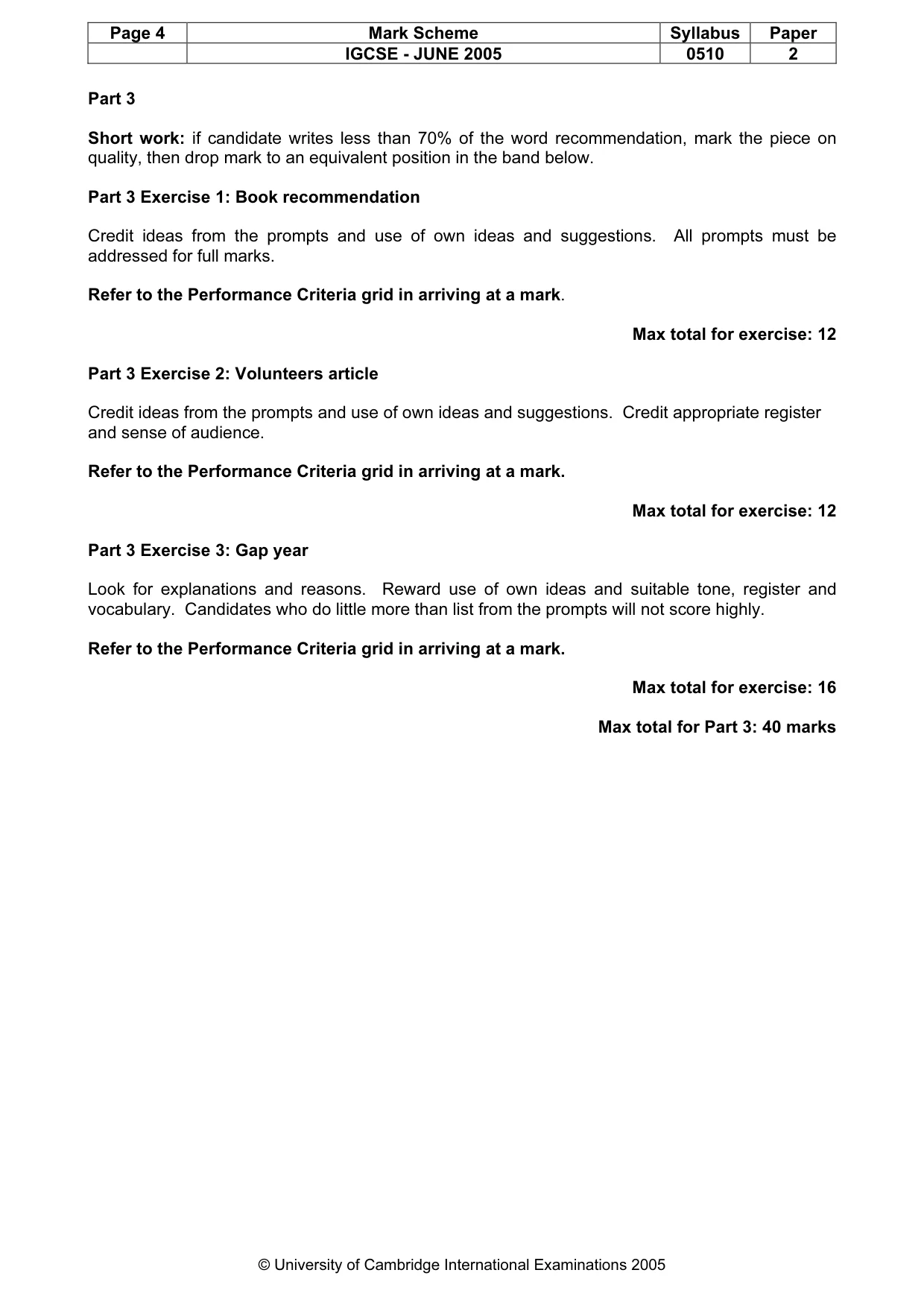
Page 4 Mark Scheme Syllabus Paper IGCSE - JUNE 2005 0510 2 © University of Cambridge International Examinations 2005 Part 3 Short work: if candidate writes less than 70% of the word recommendation, mark the piece on quality, then drop mark to an equivalent position in the band below. Part 3 Exercise 1: Book recommendation Credit ideas from the prompts and use of own ideas and suggestions. All prompts must be addressed for full marks. Refer to the Performance Criteria grid in arriving at a mark. Max total for exercise: 12 Part 3 Exercise 2: Volunteers article Credit ideas from the prompts and use of own ideas and suggestions. Credit appropriate register and sense of audience. Refer to the Performance Criteria grid in arriving at a mark. Max total for exercise: 12 Part 3 Exercise 3: Gap year Look for explanations and reasons. Reward use of own ideas and suitable tone, register and vocabulary. Candidates who do little more than list from the prompts will not score highly. Refer to the Performance Criteria grid in arriving at a mark. Max total for exercise: 16 Max total for Part 3: 40 marks
Mark scheme, page 8
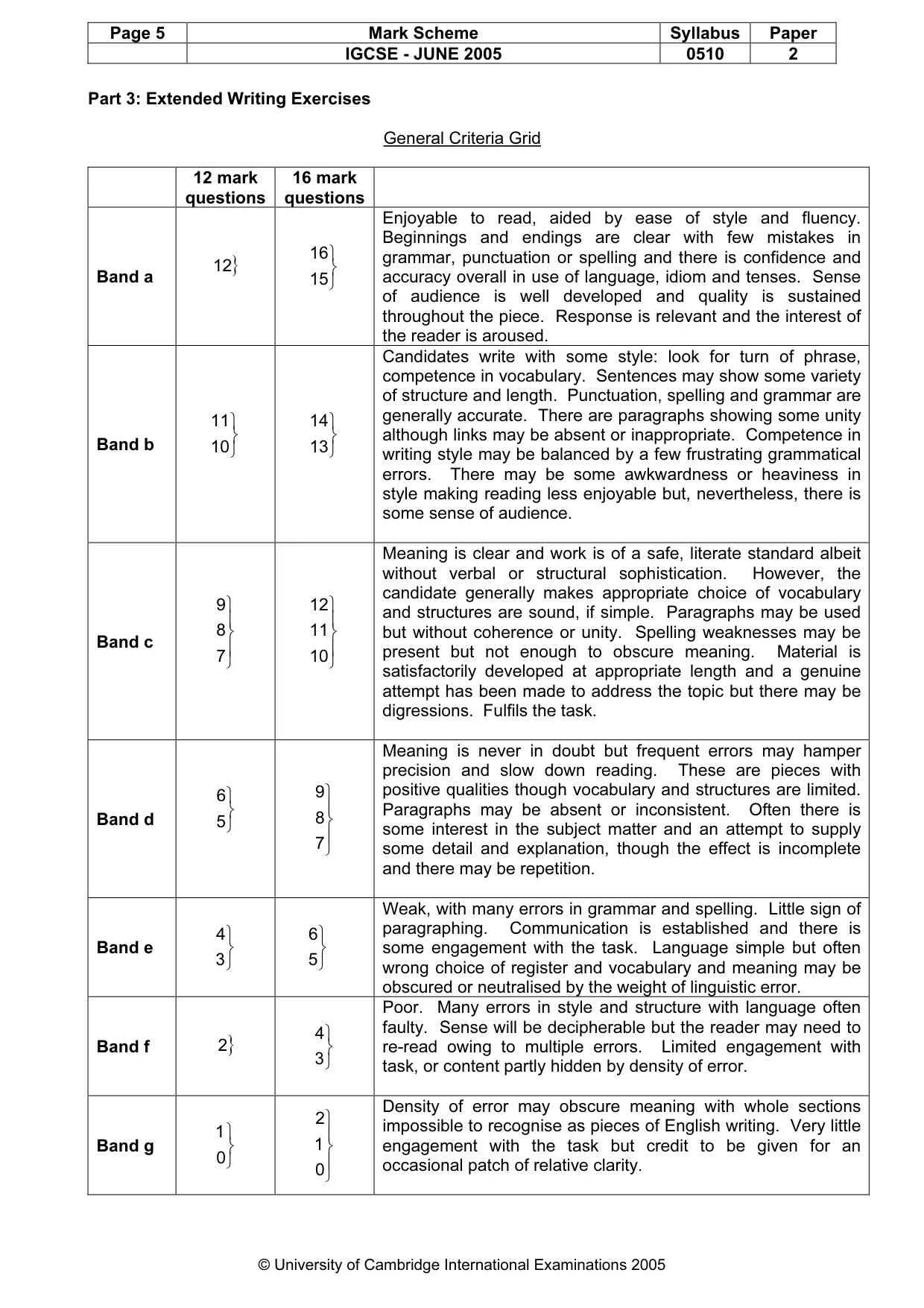
Page 5 Mark Scheme Syllabus Paper IGCSE - JUNE 2005 0510 2 © University of Cambridge International Examinations 2005 Part 3: Extended Writing Exercises General Criteria Grid 12 mark questions 16 mark questions Band a } 12 15 16 Enjoyable to read, aided by ease of style and fluency. Beginnings and endings are clear with few mistakes in grammar, punctuation or spelling and there is confidence and accuracy overall in use of language, idiom and tenses. Sense of audience is well developed and quality is sustained throughout the piece. Response is relevant and the interest of the reader is aroused. Band b 10 11 13 14 Candidates write with some style: look for turn of phrase, competence in vocabulary. Sentences may show some variety of structure and length. Punctuation, spelling and grammar are generally accurate. There are paragraphs showing some unity although links may be absent or inappropriate. Competence in writing style may be balanced by a few frustrating grammatical errors. There may be some awkwardness or heaviness in style making reading less enjoyable but, nevertheless, there is some sense of audience. Band c 7 8 9 10 11 12 Meaning is clear and work is of a safe, literate standard albeit without verbal or structural sophistication. However, the candidate generally makes appropriate choice of vocabulary and structures are sound, if simple. Paragraphs may be used but without coherence or unity. Spelling weaknesses may be present but not enough to obscure meaning. Material is satisfactorily developed at appropriate length and a genuine attempt has been made to address the topic but there may be digressions. Fulfils the task. Band d 5 6 7 8 9 Meaning is never in doubt but frequent errors may hamper precision and slow down reading. These are pieces with positive qualities though vocabulary and structures are limited. Paragraphs may be absent or inconsistent. Often there is some interest in the subject matter and an attempt to supply some detail and explanation, though the effect is incomplete and there may be repetition. Band e 3 4 5 6 Weak, with many errors in grammar and spelling. Little sign of paragraphing. Communication is established and there is some engagement with the task. Language simple but often wrong choice of register and vocabulary and meaning may be obscured or neutralised by the weight of linguistic error. Band f } 2 3 4 Poor. Many errors in style and structure with language often faulty. Sense will be decipherable but the reader may need to re-read owing to multiple errors. Limited engagement with task, or content partly hidden by density of error. Band g 0 1 0 1 2 Density of error may obscure meaning with whole sections impossible to recognise as pieces of English writing. Very little engagement with the task but credit to be given for an occasional patch of relative clarity.