Cambridge IGCSE English - Second Language (oral endorsement) 0510 — 2004 Oct/Nov Paper 2 · Variant 1
0510/21/O/N/04
The question paper and its mark scheme, free to read here and free to download. This is Cambridge’s own paper, exactly as it was sat.
Question paper20 pages







Mark scheme7 pages
Answers below. Sit the paper first if you are practising.

Paper as text
Question paper, page 1
Centre Number Candidate Number Name UNIVERSITY OF CAMBRIDGE INTERNATIONAL EXAMINATIONS International General Certificate of Secondary Education ENGLISH AS A SECOND LANGUAGE Paper 2 Reading and Writing October/November 2004 2 hours Candidates answer on the Question Paper. No Additional Materials are required. READ THESE INSTRUCTIONS FIRST Write your Centre number, candidate number and name on all the work you hand in. Write in dark blue or black pen in the spaces provided on the Question Paper. Do not use staples, paper clips, highlighters, glue or correction fluid. Answer all questions. The number of marks is given in brackets [ ] at the end of each question or part question. At the end of the examination, fasten all your work securely together. Dictionaries are not allowed. FOR EXAMINER’S USE Part 1 Part 2 Part 3 TOTAL This document consists of 19 printed pages and 1 blank page. IB04 11_0510_02/4RP UCLES 2004 [Turn over If you have been given a label, look at the details. If any are incorrect or missing, please fill in your correct details in the space given at the top of this page. Stick your personal label here, if provided.
Question paper, page 2
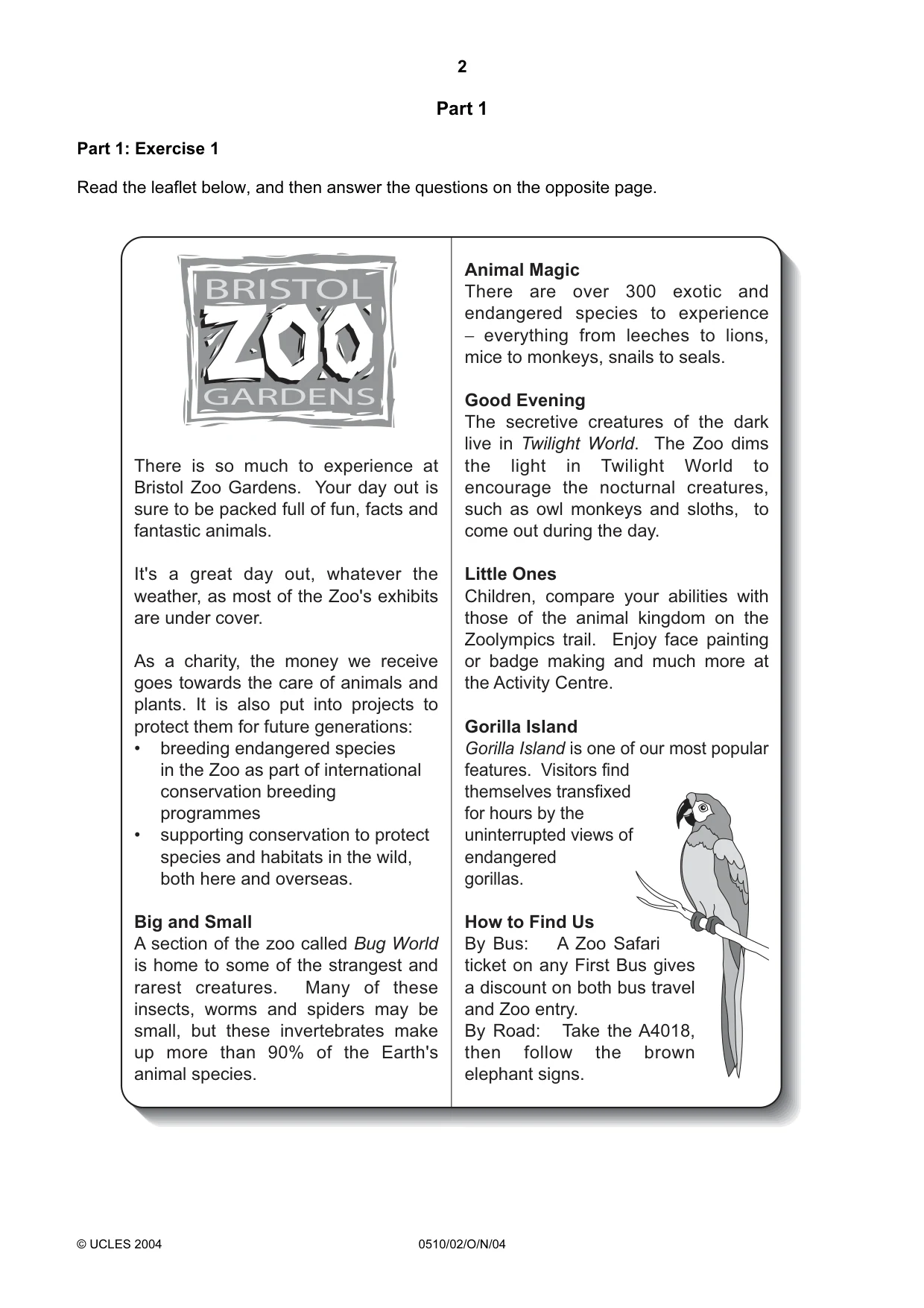
2 © UCLES 2004 0510/02/O/N/04 Part 1 Part 1: Exercise 1 Read the leaflet below, and then answer the questions on the opposite page. BRISTOL GARDENS There is so much to experience at Bristol Zoo Gardens. Your day out is sure to be packed full of fun, facts and fantastic animals. It's a great day out, whatever the weather, as most of the Zoo's exhibits are under cover. As a charity, the money we receive goes towards the care of animals and plants. It is also put into projects to protect them for future generations: • breeding endangered species in the Zoo as part of international conservation breeding programmes • supporting conservation to protect species and habitats in the wild, both here and overseas. Big and Small A section of the zoo called Bug World is home to some of the strangest and rarest creatures. Many of these insects, worms and spiders may be small, but these invertebrates make up more than 90% of the Earth's animal species. Animal Magic There are over 300 exotic and endangered species to experience − everything from leeches to lions, mice to monkeys, snails to seals. Good Evening The secretive creatures of the dark live in Twilight World. The Zoo dims the light in Twilight World to encourage the nocturnal creatures, such as owl monkeys and sloths, to come out during the day. Little Ones Children, compare your abilities with those of the animal kingdom on the Zoolympics trail. Enjoy face painting or badge making and much more at the Activity Centre. Gorilla Island Gorilla Island is one of our most popular features. Visitors find themselves transfixed for hours by the uninterrupted views of endangered gorillas. How to Find Us By Bus: A Zoo Safari ticket on any First Bus gives a discount on both bus travel and Zoo entry. By Road: Take the A4018, then follow the brown elephant signs.
Question paper, page 3
3 © UCLES 2004 0510/02/O/N/04 [Turn over For Examiner's Use (a) Give two projects involving the work at Bristol Zoo. (i) [1] (ii) [1] (b) Where in the Zoo can you find interesting invertebrates? [1] (c) What play activities are there for children? [1] (d) Why is Gorilla Island so popular with visitors? [1] (e) How can you save money on entry to the Zoo? [1] [Total: 6]
Question paper, page 4
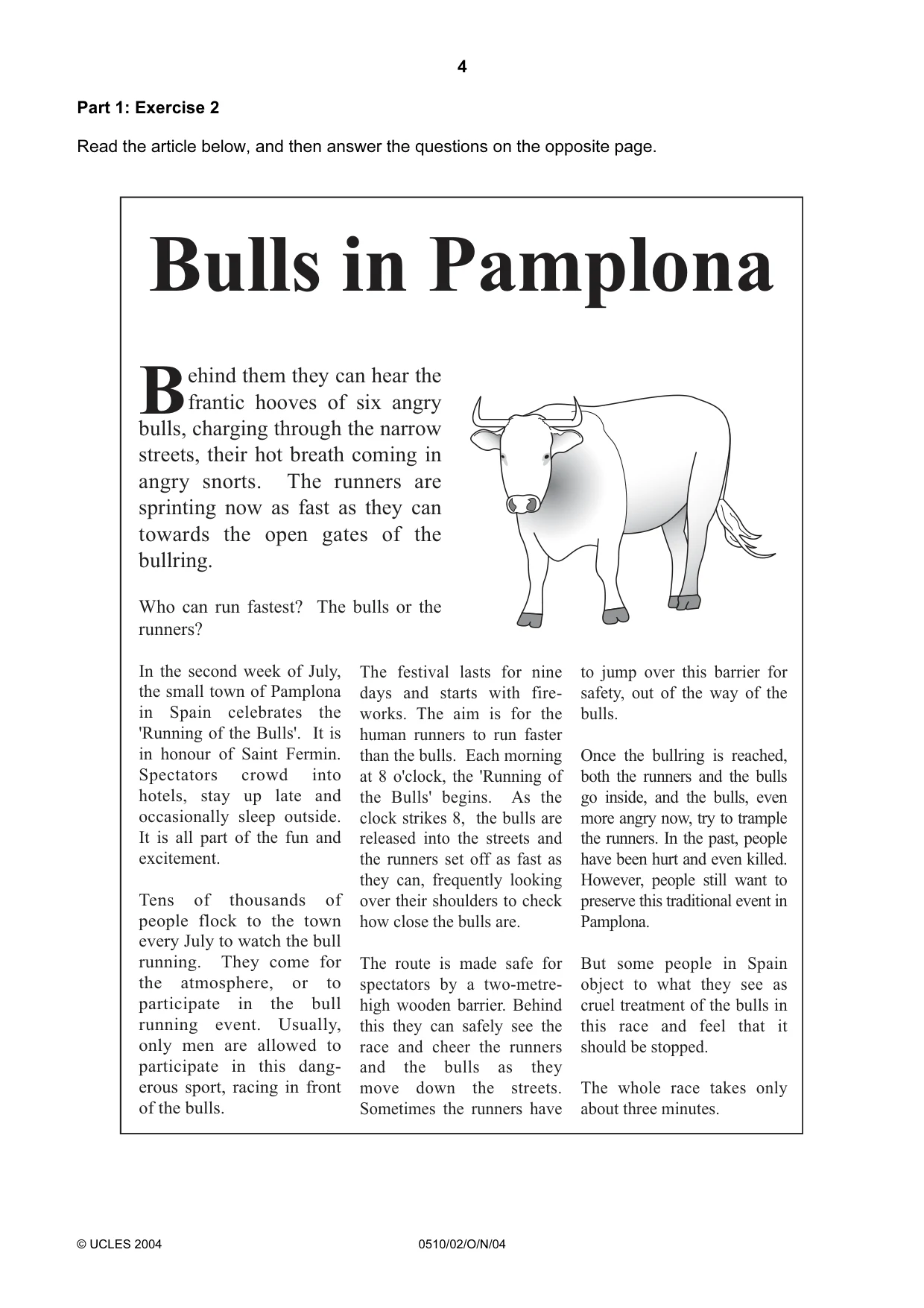
4 © UCLES 2004 0510/02/O/N/04 Part 1: Exercise 2 Read the article below, and then answer the questions on the opposite page. Bulls in Pamplona ehind them they can hear the frantic hooves of six angry bulls, charging through the narrow streets, their hot breath coming in angry snorts. The runners are sprinting now as fast as they can towards the open gates of the bullring. Who can run fastest? The bulls or the runners? In the second week of July, the small town of Pamplona in Spain celebrates the 'Running of the Bulls'. It is in honour of Saint Fermin. Spectators crowd into hotels, stay up late and occasionally sleep outside. It is all part of the fun and excitement. Tens of thousands of people flock to the town every July to watch the bull running. They come for the atmosphere, or to participate in the bull running event. Usually, only men are allowed to participate in this dang- erous sport, racing in front of the bulls. The festival lasts for nine days and starts with fire- works. The aim is for the human runners to run faster than the bulls. Each morning at 8 o'clock, the 'Running of the Bulls' begins. As the clock strikes 8, the bulls are released into the streets and the runners set off as fast as they can, frequently looking over their shoulders to check how close the bulls are. The route is made safe for spectators by a two-metre- high wooden barrier. Behind this they can safely see the race and cheer the runners and the bulls as they move down the streets. Sometimes the runners have to jump over this barrier for safety, out of the way of the bulls. Once the bullring is reached, both the runners and the bulls go inside, and the bulls, even more angry now, try to trample the runners. In the past, people have been hurt and even killed. However, people still want to preserve this traditional event in Pamplona. But some people in Spain object to what they see as cruel treatment of the bulls in this race and feel that it should be stopped. The whole race takes only about three minutes. B
Question paper, page 5
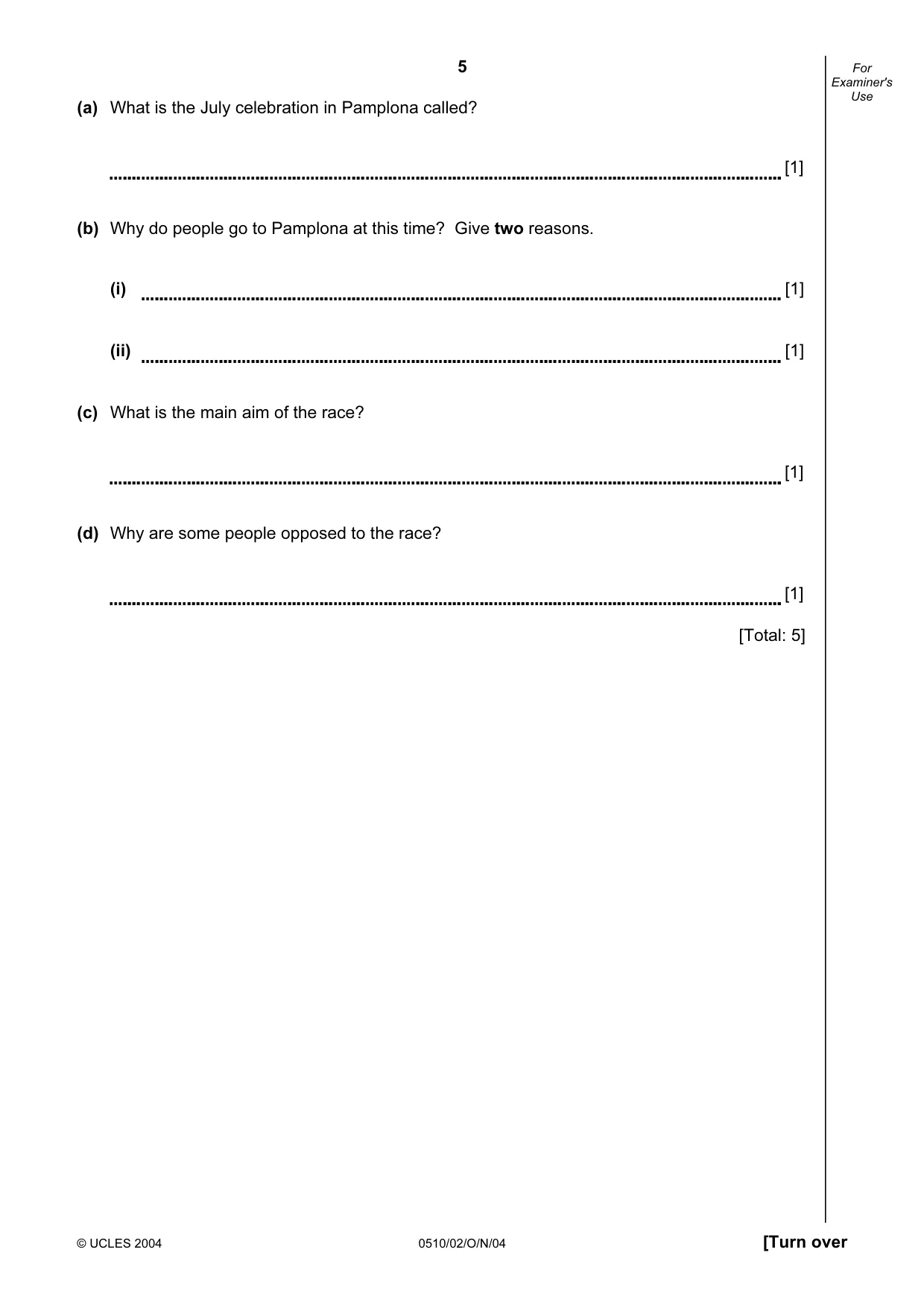
5 © UCLES 2004 0510/02/O/N/04 [Turn over For Examiner's Use (a) What is the July celebration in Pamplona called? [1] (b) Why do people go to Pamplona at this time? Give two reasons. (i) [1] (ii) [1] (c) What is the main aim of the race? [1] (d) Why are some people opposed to the race? [1] [Total: 5]
Question paper, page 6
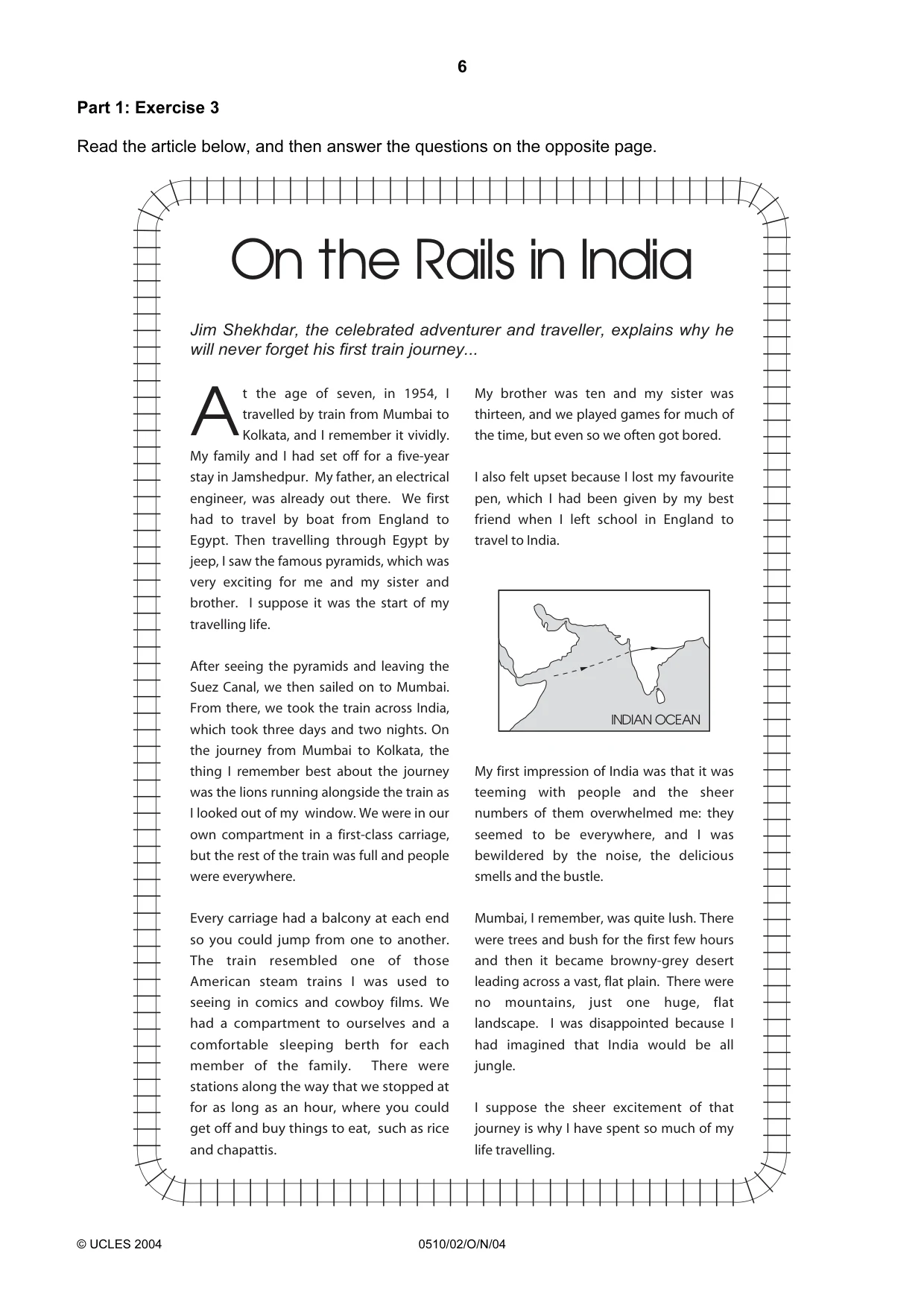
6 © UCLES 2004 0510/02/O/N/04 Part 1: Exercise 3 Read the article below, and then answer the questions on the opposite page. Jim Shekhdar, the celebrated adventurer and traveller, explains why he will never forget his first train journey... On the Rails in India t the age of seven, in 1954, I travelled by train from Mumbai to Kolkata, and I remember it vividly. My family and I had set off for a five-year stay in Jamshedpur. My father, an electrical engineer, was already out there. We first had to travel by boat from England to Egypt. Then travelling through Egypt by jeep, I saw the famous pyramids, which was very exciting for me and my sister and brother. I suppose it was the start of my travelling life. After seeing the pyramids and leaving the Suez Canal, we then sailed on to Mumbai. From there, we took the train across India, which took three days and two nights. On the journey from Mumbai to Kolkata, the thing I remember best about the journey was the lions running alongside the train as I looked out of my window. We were in our own compartment in a first-class carriage, but the rest of the train was full and people were everywhere. Every carriage had a balcony at each end so you could jump from one to another. The train resembled one of those American steam trains I was used to seeing in comics and cowboy films. We had a compartment to ourselves and a comfortable sleeping berth for each member of the family. There were stations along the way that we stopped at for as long as an hour, where you could get off and buy things to eat, such as rice and chapattis. My brother was ten and my sister was thirteen, and we played games for much of the time, but even so we often got bored. I also felt upset because I lost my favourite pen, which I had been given by my best friend when I left school in England to travel to India. My first impression of India was that it was teeming with people and the sheer numbers of them overwhelmed me: they seemed to be everywhere, and I was bewildered by the noise, the delicious smells and the bustle. Mumbai, I remember, was quite lush. There were trees and bush for the first few hours and then it became browny-grey desert leading across a vast, flat plain. There were no mountains, just one huge, flat landscape. I was disappointed because I had imagined that India would be all jungle. I suppose the sheer excitement of that journey is why I have spent so much of my life travelling. A INDIAN OCEAN
Question paper, page 7
7 © UCLES 2004 0510/02/O/N/04 [Turn over For Examiner's Use (a) Where exactly in India did Jim Shekhdar and his family go to live? And for how long? [1] (b) What is Jim’s best memory of the train journey? [1] (c) What did the train make Jim Shekhdar think of? [1] (d) What made the train journey comfortable? [1] (e) How did Jim’s first impressions of India affect him? [1] (f) Why did the writer feel disappointed by the Indian landscape? [1] (g) Say why the journey wasn’t always exciting. [1] [Total: 7]
Question paper, page 8
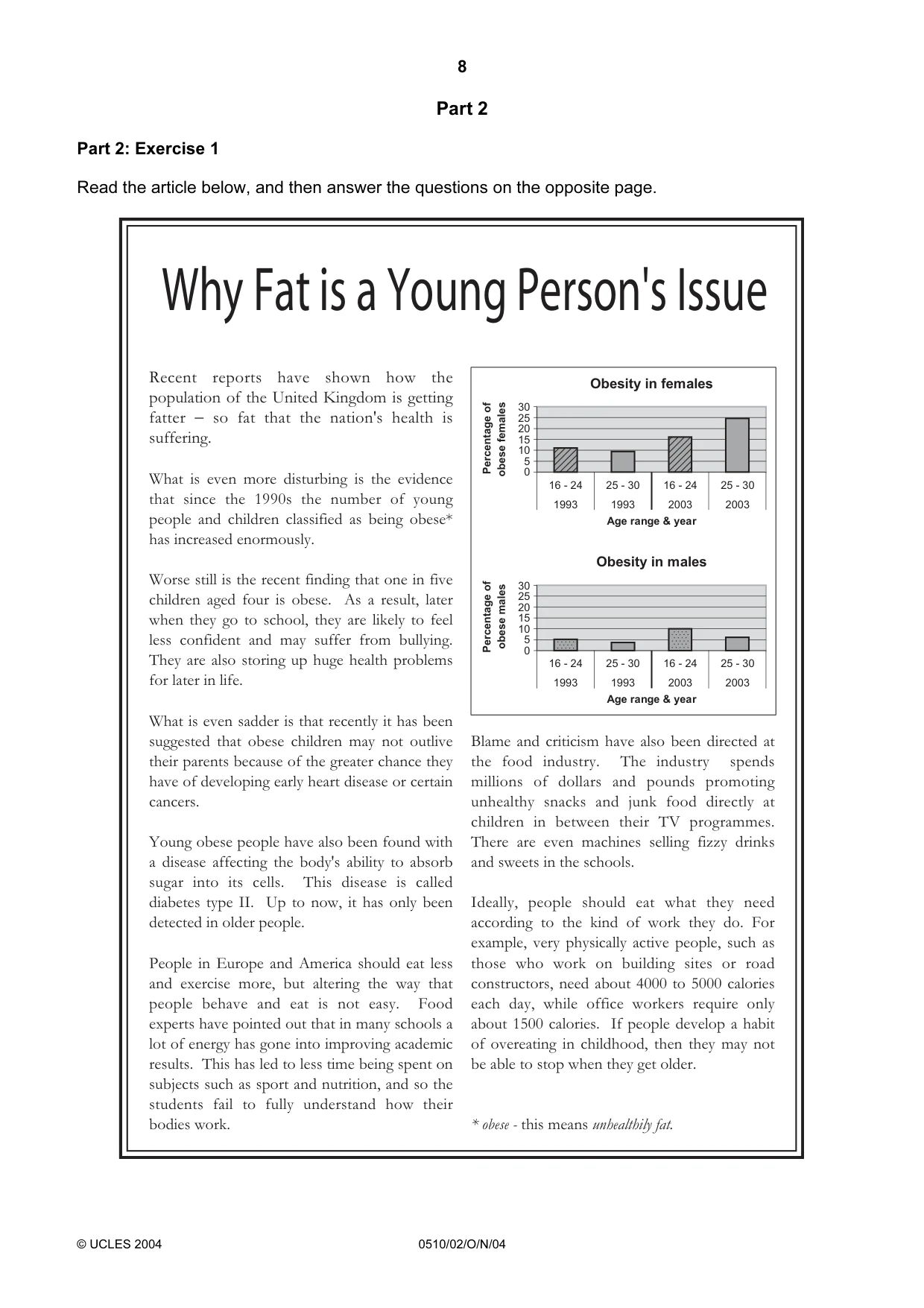
8 © UCLES 2004 0510/02/O/N/04 Part 2 Part 2: Exercise 1 Read the article below, and then answer the questions on the opposite page. Recent reports have shown how the population of the United Kingdom is getting fatter − so fat that the nation's health is suffering. What is even more disturbing is the evidence that since the 1990s the number of young people and children classified as being obese* has increased enormously. Worse still is the recent finding that one in five children aged four is obese. As a result, later when they go to school, they are likely to feel less confident and may suffer from bullying. They are also storing up huge health problems for later in life. What is even sadder is that recently it has been suggested that obese children may not outlive their parents because of the greater chance they have of developing early heart disease or certain cancers. Young obese people have also been found with a disease affecting the body's ability to absorb sugar into its cells. This disease is called diabetes type II. Up to now, it has only been detected in older people. People in Europe and America should eat less and exercise more, but altering the way that people behave and eat is not easy. Food experts have pointed out that in many schools a lot of energy has gone into improving academic results. This has led to less time being spent on subjects such as sport and nutrition, and so the students fail to fully understand how their bodies work. Blame and criticism have also been directed at the food industry. The industry spends millions of dollars and pounds promoting unhealthy snacks and junk food directly at children in between their TV programmes. There are even machines selling fizzy drinks and sweets in the schools. Ideally, people should eat what they need according to the kind of work they do. For example, very physically active people, such as those who work on building sites or road constructors, need about 4000 to 5000 calories each day, while office workers require only about 1500 calories. If people develop a habit of overeating in childhood, then they may not be able to stop when they get older. * obese - this means unhealthily fat. Why Fat is a Young Person's Issue Obesity in females 30 25 20 15 10 5 0 16 - 24 25 - 30 16 - 24 25 - 30 1993 1993 2003 2003 Age range & year Percentage of obese females Obesity in males 30 25 20 15 10 5 0 16 - 24 25 - 30 16 - 24 25 - 30 1993 1993 2003 2003 Age range & year Percentage of obese males
Question paper, page 9
9 © UCLES 2004 0510/02/O/N/04 [Turn over For Examiner's Use (a) What do the recent findings about young people in the UK show? [1] (b) What can happen to obese children at school? Give two examples. (i) [1] (ii) [1] (c) According to the diagram, how has obesity in 16 to 24 year-old men changed between 1993 and 2003? [1] (d) According to the article, why have schools in the UK failed to encourage and help children to eat healthily? [1] (e) Why should an office worker eat less than a builder? [1] (f) Write a short paragraph of about 60 words explaining the effects of obesity on children in the UK. [4] [Total: 10]
Question paper, page 10
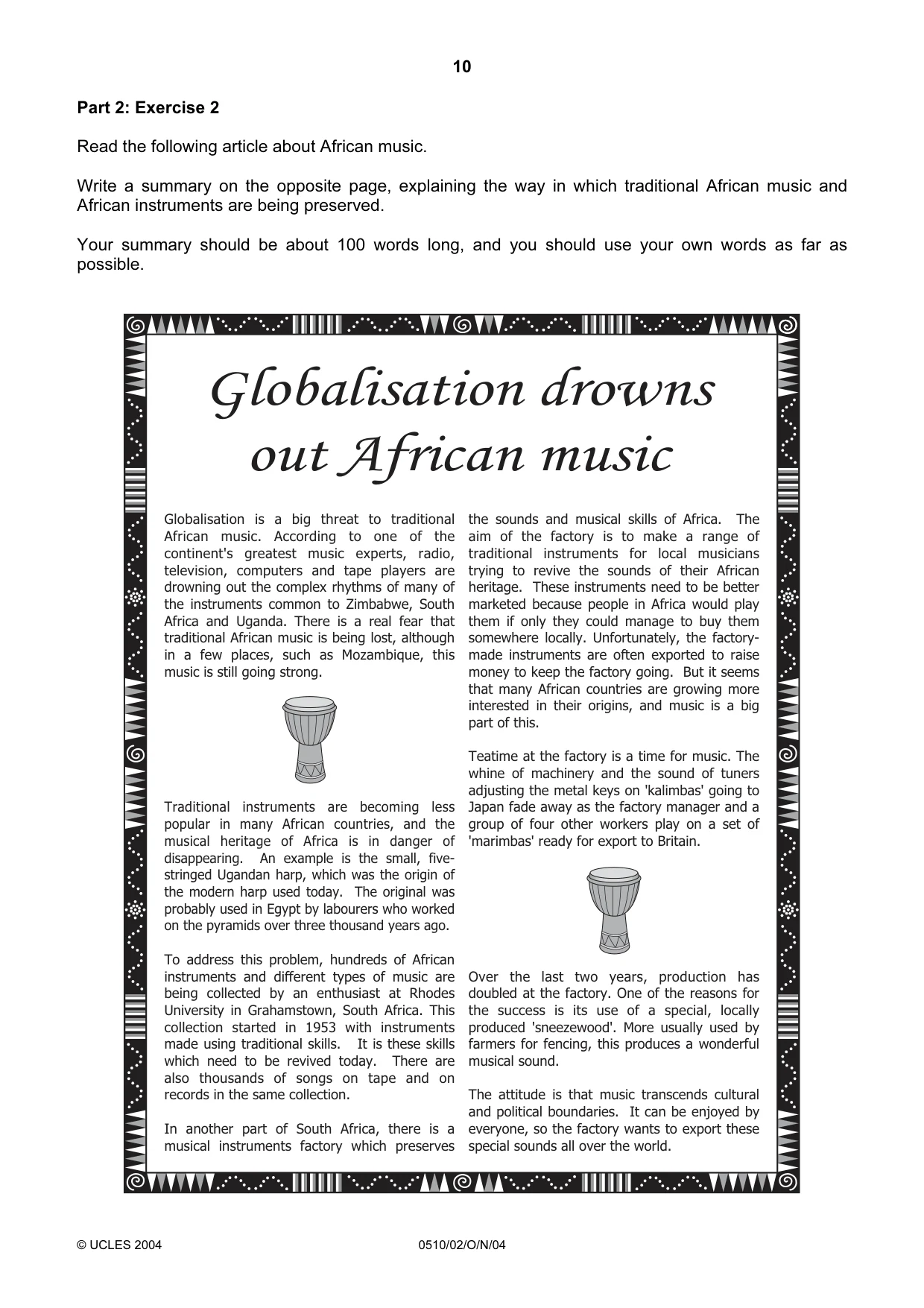
10 © UCLES 2004 0510/02/O/N/04 Part 2: Exercise 2 Read the following article about African music. Write a summary on the opposite page, explaining the way in which traditional African music and African instruments are being preserved. Your summary should be about 100 words long, and you should use your own words as far as possible. Globalisation drowns out African music Globalisation is a big threat to traditional African music. According to one of the continent's greatest music experts, radio, television, computers and tape players are drowning out the complex rhythms of many of the instruments common to Zimbabwe, South Africa and Uganda. There is a real fear that traditional African music is being lost, although in a few places, such as Mozambique, this music is still going strong. Traditional instruments are becoming less popular in many African countries, and the musical heritage of Africa is in danger of disappearing. An example is the small, five- stringed Ugandan harp, which was the origin of the modern harp used today. The original was probably used in Egypt by labourers who worked on the pyramids over three thousand years ago. To address this problem, hundreds of African instruments and different types of music are being collected by an enthusiast at Rhodes University in Grahamstown, South Africa. This collection started in 1953 with instruments made using traditional skills. It is these skills which need to be revived today. There are also thousands of songs on tape and on records in the same collection. In another part of South Africa, there is a musical instruments factory which preserves the sounds and musical skills of Africa. The aim of the factory is to make a range of traditional instruments for local musicians trying to revive the sounds of their African heritage. These instruments need to be better marketed because people in Africa would play them if only they could manage to buy them somewhere locally. Unfortunately, the factory- made instruments are often exported to raise money to keep the factory going. But it seems that many African countries are growing more interested in their origins, and music is a big part of this. Teatime at the factory is a time for music. The whine of machinery and the sound of tuners adjusting the metal keys on 'kalimbas' going to Japan fade away as the factory manager and a group of four other workers play on a set of 'marimbas' ready for export to Britain. Over the last two years, production has doubled at the factory. One of the reasons for the success is its use of a special, locally produced 'sneezewood'. More usually used by farmers for fencing, this produces a wonderful musical sound. The attitude is that music transcends cultural and political boundaries. It can be enjoyed by everyone, so the factory wants to export these special sounds all over the world.
Question paper, page 11
11 © UCLES 2004 0510/02/O/N/04 [Turn over For Examiner's Use [8]
Question paper, page 12
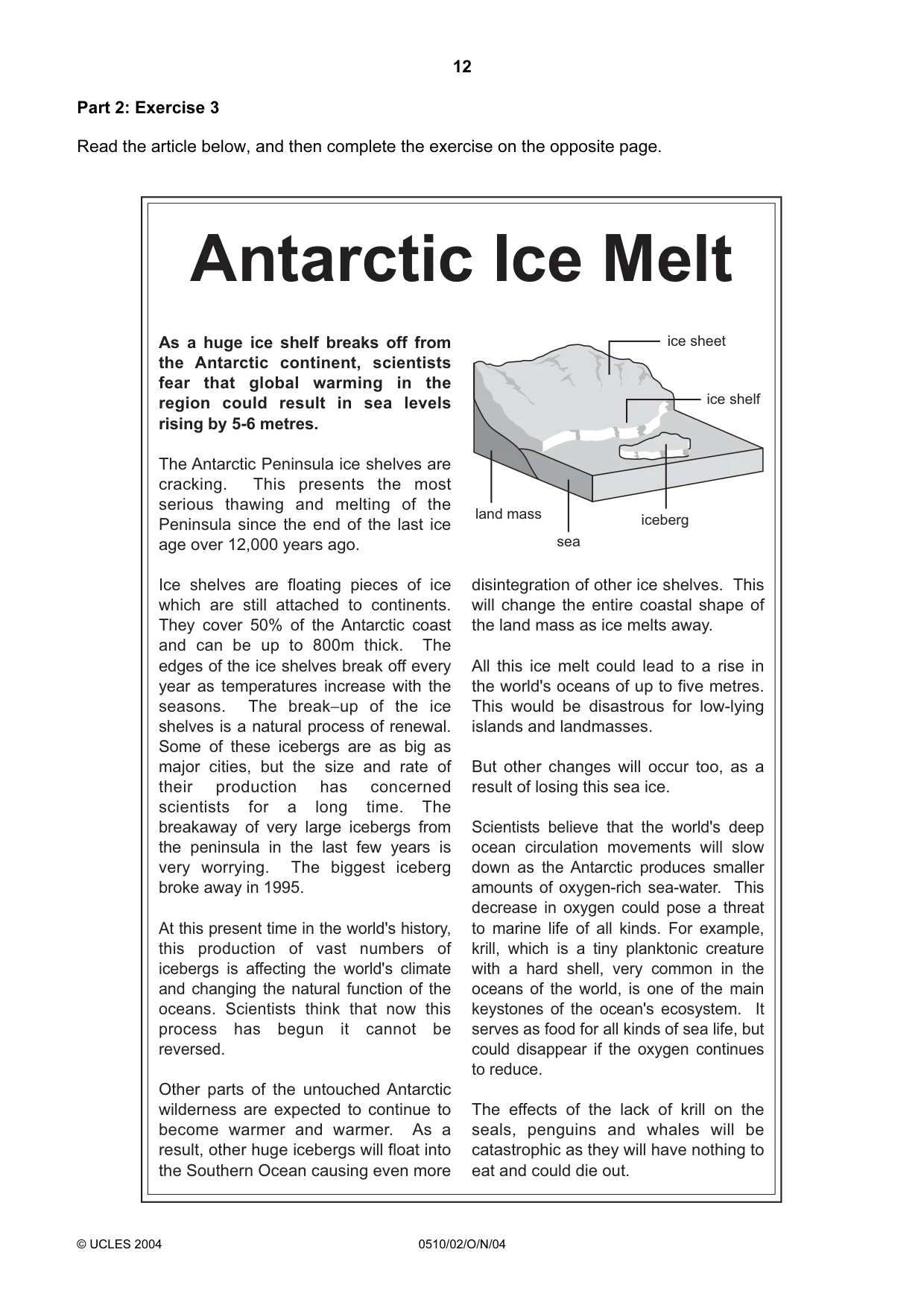
12 © UCLES 2004 0510/02/O/N/04 Part 2: Exercise 3 Read the article below, and then complete the exercise on the opposite page. Antarctic Ice Melt As a huge ice shelf breaks off from the Antarctic continent, scientists fear that global warming in the region could result in sea levels rising by 5-6 metres. The Antarctic Peninsula ice shelves are cracking. This presents the most serious thawing and melting of the Peninsula since the end of the last ice age over 12,000 years ago. Ice shelves are floating pieces of ice which are still attached to continents. They cover 50% of the Antarctic coast and can be up to 800m thick. The edges of the ice shelves break off every year as temperatures increase with the seasons. The break−up of the ice shelves is a natural process of renewal. Some of these icebergs are as big as major cities, but the size and rate of their production has concerned scientists for a long time. The breakaway of very large icebergs from the peninsula in the last few years is very worrying. The biggest iceberg broke away in 1995. At this present time in the world's history, this production of vast numbers of icebergs is affecting the world's climate and changing the natural function of the oceans. Scientists think that now this process has begun it cannot be reversed. Other parts of the untouched Antarctic wilderness are expected to continue to become warmer and warmer. As a result, other huge icebergs will float into the Southern Ocean causing even more disintegration of other ice shelves. This will change the entire coastal shape of the land mass as ice melts away. All this ice melt could lead to a rise in the world's oceans of up to five metres. This would be disastrous for low-lying islands and landmasses. But other changes will occur too, as a result of losing this sea ice. Scientists believe that the world's deep ocean circulation movements will slow down as the Antarctic produces smaller amounts of oxygen-rich sea-water. This decrease in oxygen could pose a threat to marine life of all kinds. For example, krill, which is a tiny planktonic creature with a hard shell, very common in the oceans of the world, is one of the main keystones of the ocean's ecosystem. It serves as food for all kinds of sea life, but could disappear if the oxygen continues to reduce. The effects of the lack of krill on the seals, penguins and whales will be catastrophic as they will have nothing to eat and could die out. ice sheet ice shelf land mass iceberg sea
Question paper, page 13
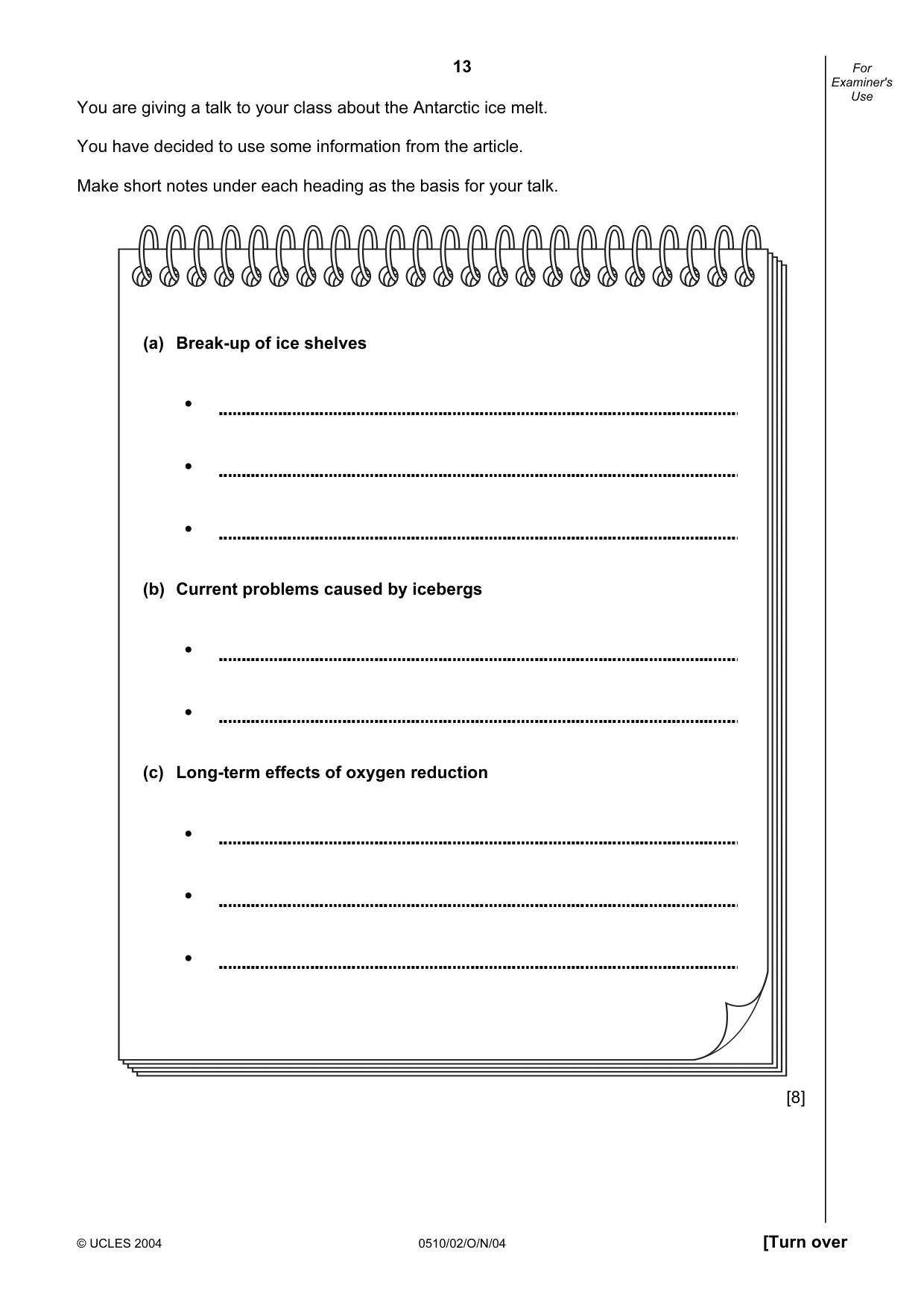
13 © UCLES 2004 0510/02/O/N/04 [Turn over For Examiner's Use You are giving a talk to your class about the Antarctic ice melt. You have decided to use some information from the article. Make short notes under each heading as the basis for your talk. (a) Break-up of ice shelves • • • (b) Current problems caused by icebergs • • (c) Long-term effects of oxygen reduction • • • [8]
Question paper, page 14
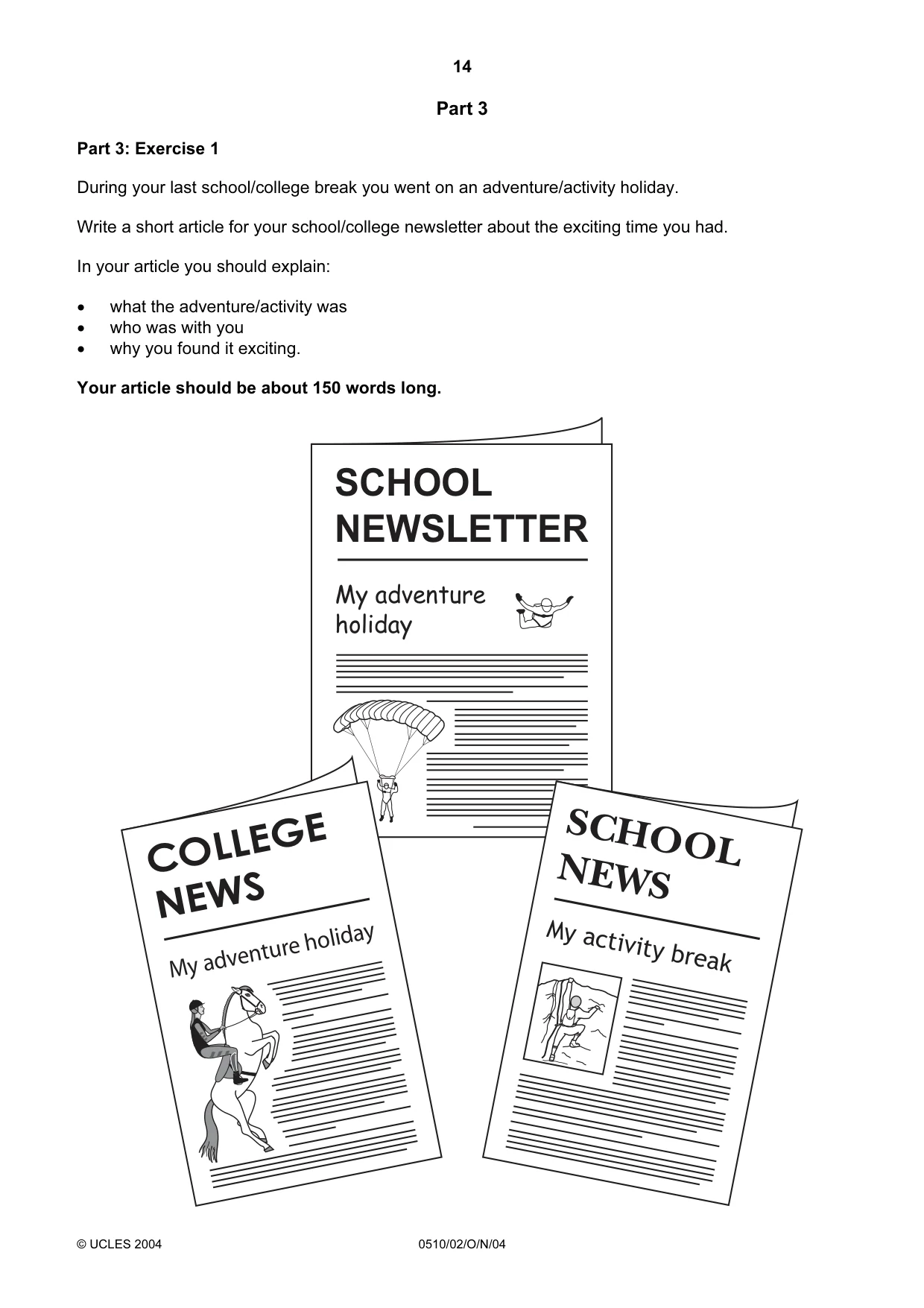
14 © UCLES 2004 0510/02/O/N/04 Part 3 Part 3: Exercise 1 During your last school/college break you went on an adventure/activity holiday. Write a short article for your school/college newsletter about the exciting time you had. In your article you should explain: • what the adventure/activity was • who was with you • why you found it exciting. Your article should be about 150 words long. SCHOOL NEWSLETTER My adventure holiday SCHOOL NEWS My activity break COLLEGE NEWS My adventure holiday
Question paper, page 15
15 © UCLES 2004 0510/02/O/N/04 [Turn over For Examiner's Use [12]
Question paper, page 16
16 © UCLES 2004 0510/02/O/N/04 Part 3: Exercise 2 Your school has been encouraged to enter a competition giving an opportunity to win a trip abroad as the first prize. You are the Headteacher of the school. Write a letter to your students telling them: • what the competition is all about – for example, it may be a sports competition or connected with study or community service • what they have to do to enter (either alone or in a group) • why you think they should enter. Your letter should be about 200 words long.
Question paper, page 17
17 © UCLES 2004 0510/02/O/N/04 [Turn over For Examiner's Use Dear Students, [12]
Question paper, page 18
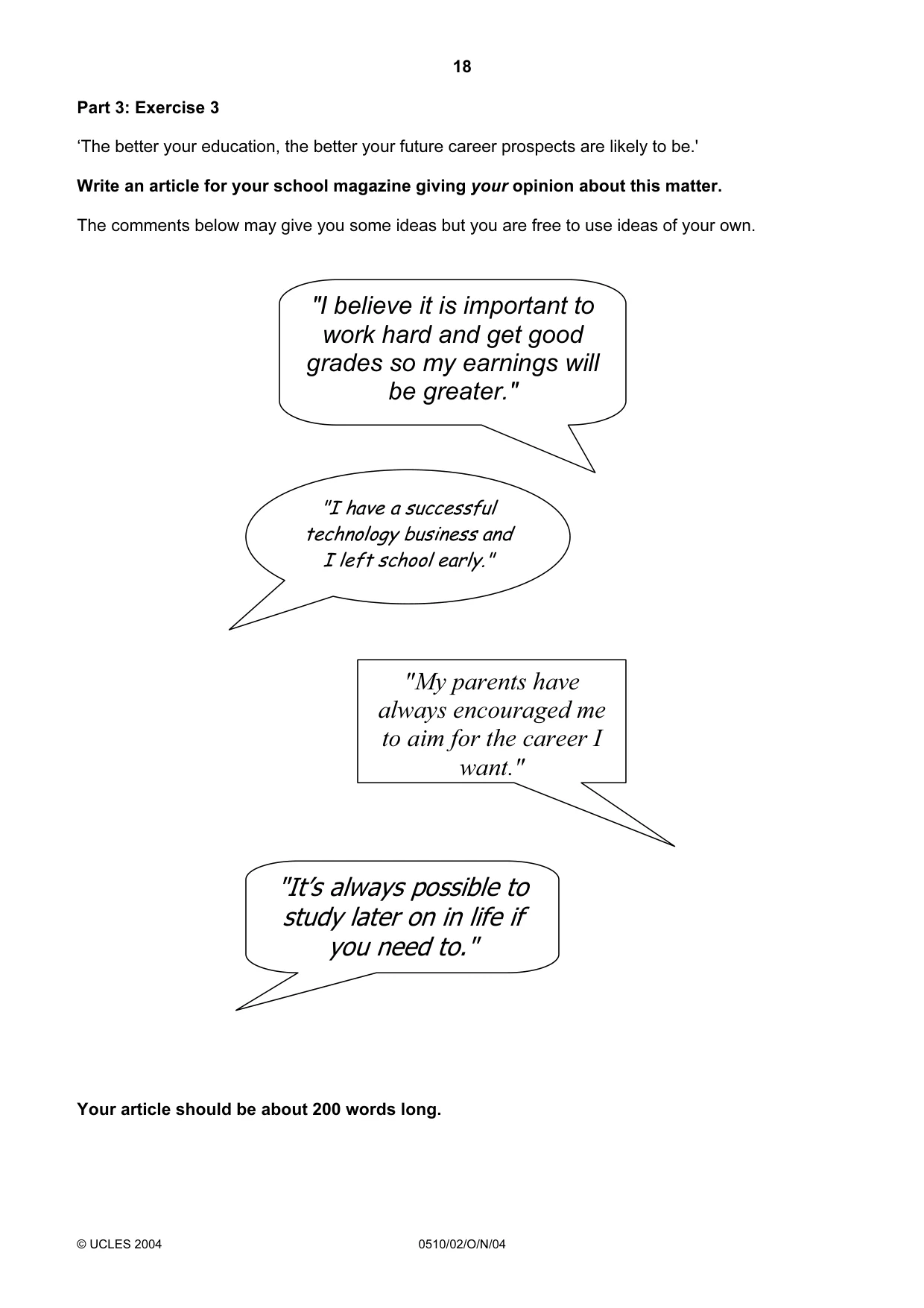
18 © UCLES 2004 0510/02/O/N/04 Part 3: Exercise 3 ‘The better your education, the better your future career prospects are likely to be.' Write an article for your school magazine giving your opinion about this matter. The comments below may give you some ideas but you are free to use ideas of your own. Your article should be about 200 words long. "I believe it is important to work hard and get good grades so my earnings will be greater." "I have a successful technology business and I left school early." "My parents have always encouraged me to aim for the career I want." "It’s always possible to study later on in life if you need to."
Question paper, page 19
19 © UCLES 2004 0510/02/O/N/04 For Examiner's Use [16]
Question paper, page 20
20 Every reasonable effort has been made to trace all copyright holders where the publishers (i.e. UCLES) are aware that third-party material has been reproduced. The publishers would be pleased to hear from anyone whose rights they have unwittingly infringed. University of Cambridge International Examinations is part of the University of Cambridge Local Examinations Syndicate (UCLES), which is itself a department of the University of Cambridge. 0510/02/O/N/04 BLANK PAGE
Mark scheme, page 1
UNIVERSITY OF CAMBRIDGE INTERNATIONAL EXAMINATIONS International General Certificate of Secondary Education MARK SCHEME for the November 2004 question papers 0510 ENGLISH AS A SECOND LANGUAGE 0510/02 Paper 2 (Reading and Writing – Extended), maximum mark 84 These mark schemes are published as an aid to teachers and students, to indicate the requirements of the examination. They show the basis on which Examiners were initially instructed to award marks. They do not indicate the details of the discussions that took place at an Examiners’ meeting before marking began. Any substantial changes to the mark scheme that arose from these discussions will be recorded in the published Report on the Examination. All Examiners are instructed that alternative correct answers and unexpected approaches in candidates’ scripts must be given marks that fairly reflect the relevant knowledge and skills demonstrated. Mark schemes must be read in conjunction with the question papers and the Report on the Examination. • CIE will not enter into discussion or correspondence in connection with these mark schemes. CIE is publishing the mark schemes for the November 2004 question papers for most IGCSE and GCE Advanced Level syllabuses.
Mark scheme, page 2
Grade thresholds taken for Syllabus 0510/01 (English as a Second Language) in the November 2004 examination. minimum mark required for grade: maximum mark available A C E F Component 2 84 66 54 36 n/a The threshold (minimum mark) for B is set halfway between those for Grades A and C. The threshold (minimum mark) for D is set halfway between those for Grades C and E. Grade A* does not exist at the level of an individual component.
Mark scheme, page 3
November 2004 INTERNATIONAL GCSE MARK SCHEME MAXIMUM MARK: 84 SYLLABUS/COMPONENT: 0510/02 ENGLISH AS A SECOND LANGUAGE Paper 2 (Reading and Writing - Extended)
Mark scheme, page 4
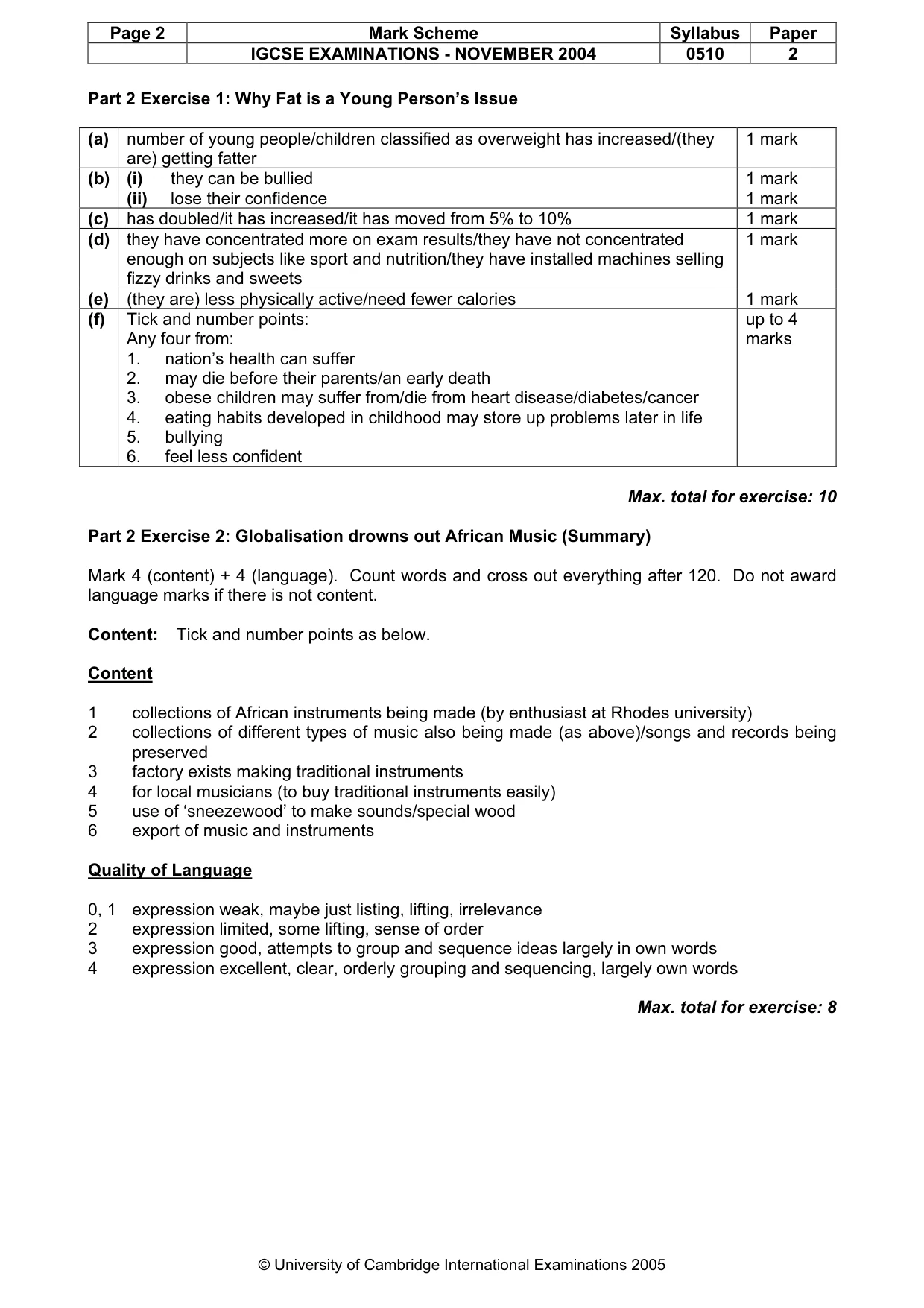
Page 1 Mark Scheme Syllabus Paper IGCSE EXAMINATIONS - NOVEMBER 2004 0510 2 © University of Cambridge International Examinations 2005 Part 1 Exercise 1: Bristol Zoo Gardens (a) 1 mark for each of: breeding endangered species (supporting) conservation projects 1 mark 1 mark (b) (at) Bug World 1 mark (c) ONE from Zoolympics trail/face painting/badge making 1 mark (d) they can watch/see (endangered) gorillas 1 mark (e) by buying a Zoo Safari ticket 1 mark Max. total for exercise: 6 Part 1 Exercise 2: Bulls in Pamplona (a) The Running of the Bulls 1 mark (b) TWO from the following: for the excitement/fun/atmosphere to watch (the bull running) to participate (in the bull running) to honour Saint Fermain 2 marks (c) for runner/a man to race the bulls 1 mark (d) cruelty to bulls/treatment of the bulls in this race 1 mark Max. total for exercise: 5 Part 1 Exercise 3: On the Rails in India (a) Jamshedpur AND 5 years (both needed) 1 mark (b) seeing lions running alongside the train 1 mark (c) ONE from: (an) American steam train/one (a train) he was used to seeing in comics/one (a train) he was used to seeing in cowboy films 1 mark (d) Separate compartment/sleeping berths/stations where you could stop to eat/drink/first class carriage 1 mark (e) overwhelmed/bewildered 1 mark (f) he imagined it would be all jungle 1 mark (g) they got bored/he lost his favourite pen/flatness of landscape 1 mark Max. total for exercise: 7 Max. total for Part 1 = 18 marks
Mark scheme, page 5
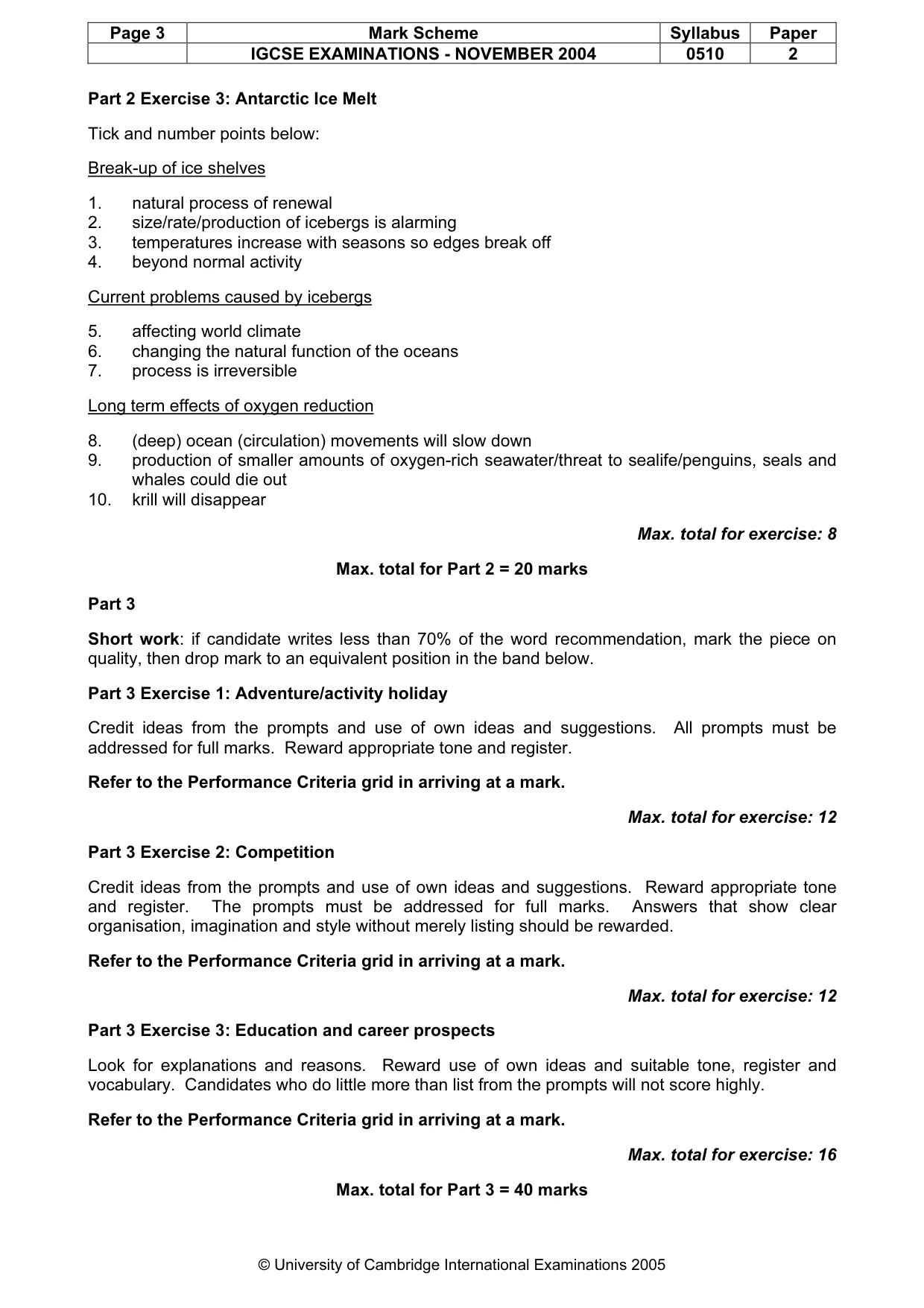
Page 2 Mark Scheme Syllabus Paper IGCSE EXAMINATIONS - NOVEMBER 2004 0510 2 © University of Cambridge International Examinations 2005 Part 2 Exercise 1: Why Fat is a Young Person’s Issue (a) number of young people/children classified as overweight has increased/(they are) getting fatter 1 mark (b) (i) they can be bullied (ii) lose their confidence 1 mark 1 mark (c) has doubled/it has increased/it has moved from 5% to 10% 1 mark (d) they have concentrated more on exam results/they have not concentrated enough on subjects like sport and nutrition/they have installed machines selling fizzy drinks and sweets 1 mark (e) (they are) less physically active/need fewer calories 1 mark (f) Tick and number points: Any four from: 1. nation’s health can suffer 2. may die before their parents/an early death 3. obese children may suffer from/die from heart disease/diabetes/cancer 4. eating habits developed in childhood may store up problems later in life 5. bullying 6. feel less confident up to 4 marks Max. total for exercise: 10 Part 2 Exercise 2: Globalisation drowns out African Music (Summary) Mark 4 (content) + 4 (language). Count words and cross out everything after 120. Do not award language marks if there is not content. Content: Tick and number points as below. Content 1 collections of African instruments being made (by enthusiast at Rhodes university) 2 collections of different types of music also being made (as above)/songs and records being preserved 3 factory exists making traditional instruments 4 for local musicians (to buy traditional instruments easily) 5 use of ‘sneezewood’ to make sounds/special wood 6 export of music and instruments Quality of Language 0, 1 expression weak, maybe just listing, lifting, irrelevance 2 expression limited, some lifting, sense of order 3 expression good, attempts to group and sequence ideas largely in own words 4 expression excellent, clear, orderly grouping and sequencing, largely own words Max. total for exercise: 8
Mark scheme, page 6
Page 3 Mark Scheme Syllabus Paper IGCSE EXAMINATIONS - NOVEMBER 2004 0510 2 © University of Cambridge International Examinations 2005 Part 2 Exercise 3: Antarctic Ice Melt Tick and number points below: Break-up of ice shelves 1. natural process of renewal 2. size/rate/production of icebergs is alarming 3. temperatures increase with seasons so edges break off 4. beyond normal activity Current problems caused by icebergs 5. affecting world climate 6. changing the natural function of the oceans 7. process is irreversible Long term effects of oxygen reduction 8. (deep) ocean (circulation) movements will slow down 9. production of smaller amounts of oxygen-rich seawater/threat to sealife/penguins, seals and whales could die out 10. krill will disappear Max. total for exercise: 8 Max. total for Part 2 = 20 marks Part 3 Short work: if candidate writes less than 70% of the word recommendation, mark the piece on quality, then drop mark to an equivalent position in the band below. Part 3 Exercise 1: Adventure/activity holiday Credit ideas from the prompts and use of own ideas and suggestions. All prompts must be addressed for full marks. Reward appropriate tone and register. Refer to the Performance Criteria grid in arriving at a mark. Max. total for exercise: 12 Part 3 Exercise 2: Competition Credit ideas from the prompts and use of own ideas and suggestions. Reward appropriate tone and register. The prompts must be addressed for full marks. Answers that show clear organisation, imagination and style without merely listing should be rewarded. Refer to the Performance Criteria grid in arriving at a mark. Max. total for exercise: 12 Part 3 Exercise 3: Education and career prospects Look for explanations and reasons. Reward use of own ideas and suitable tone, register and vocabulary. Candidates who do little more than list from the prompts will not score highly. Refer to the Performance Criteria grid in arriving at a mark. Max. total for exercise: 16 Max. total for Part 3 = 40 marks
Mark scheme, page 7
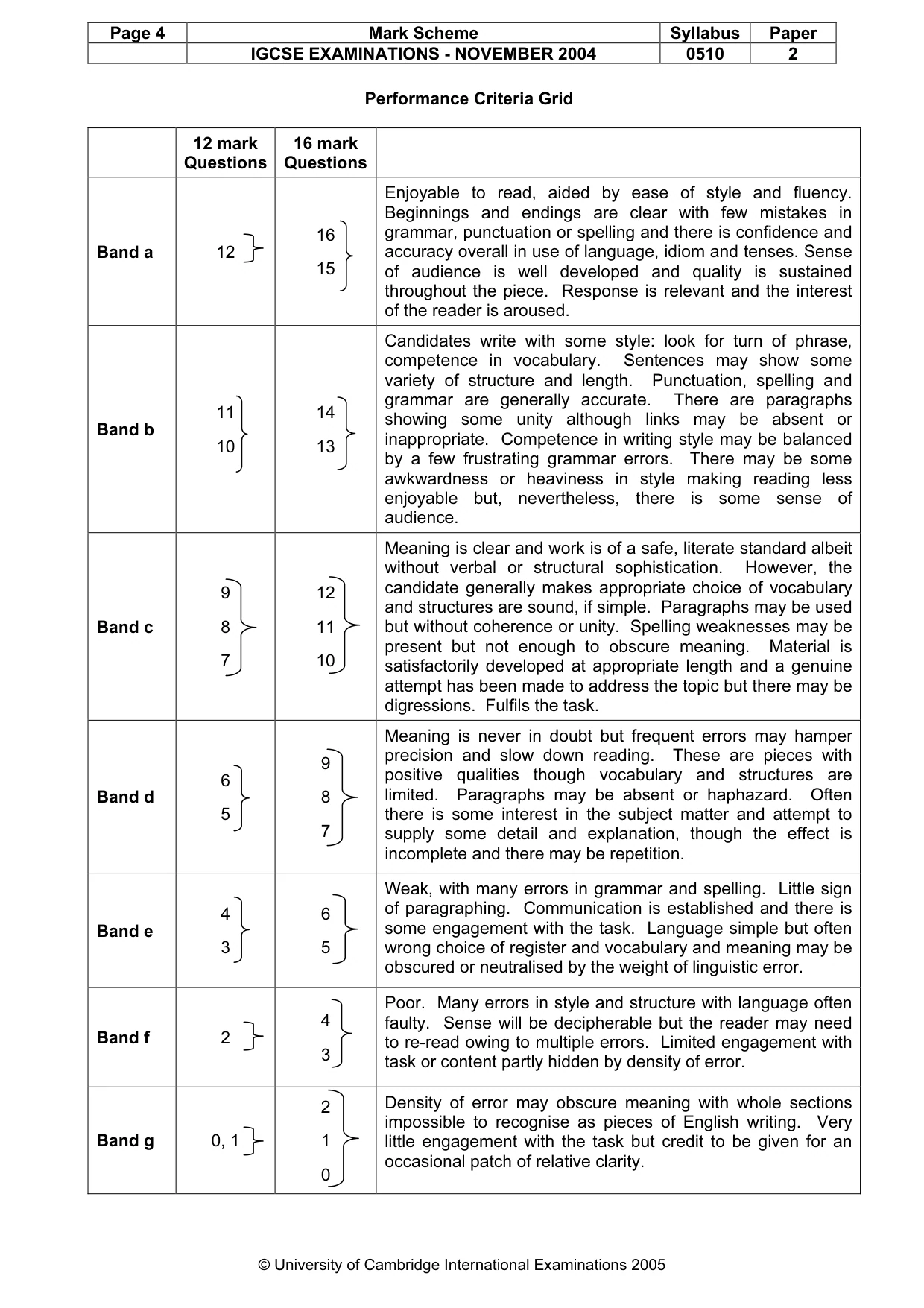
Page 4 Mark Scheme Syllabus Paper IGCSE EXAMINATIONS - NOVEMBER 2004 0510 2 © University of Cambridge International Examinations 2005 Performance Criteria Grid 12 mark Questions 16 mark Questions Band a 12 16 15 Enjoyable to read, aided by ease of style and fluency. Beginnings and endings are clear with few mistakes in grammar, punctuation or spelling and there is confidence and accuracy overall in use of language, idiom and tenses. Sense of audience is well developed and quality is sustained throughout the piece. Response is relevant and the interest of the reader is aroused. Band b 11 10 14 13 Candidates write with some style: look for turn of phrase, competence in vocabulary. Sentences may show some variety of structure and length. Punctuation, spelling and grammar are generally accurate. There are paragraphs showing some unity although links may be absent or inappropriate. Competence in writing style may be balanced by a few frustrating grammar errors. There may be some awkwardness or heaviness in style making reading less enjoyable but, nevertheless, there is some sense of audience. Band c 9 8 7 12 11 10 Meaning is clear and work is of a safe, literate standard albeit without verbal or structural sophistication. However, the candidate generally makes appropriate choice of vocabulary and structures are sound, if simple. Paragraphs may be used but without coherence or unity. Spelling weaknesses may be present but not enough to obscure meaning. Material is satisfactorily developed at appropriate length and a genuine attempt has been made to address the topic but there may be digressions. Fulfils the task. Band d 6 5 9 8 7 Meaning is never in doubt but frequent errors may hamper precision and slow down reading. These are pieces with positive qualities though vocabulary and structures are limited. Paragraphs may be absent or haphazard. Often there is some interest in the subject matter and attempt to supply some detail and explanation, though the effect is incomplete and there may be repetition. Band e 4 3 6 5 Weak, with many errors in grammar and spelling. Little sign of paragraphing. Communication is established and there is some engagement with the task. Language simple but often wrong choice of register and vocabulary and meaning may be obscured or neutralised by the weight of linguistic error. Band f 2 4 3 Poor. Many errors in style and structure with language often faulty. Sense will be decipherable but the reader may need to re-read owing to multiple errors. Limited engagement with task or content partly hidden by density of error. Band g 0, 1 2 1 0 Density of error may obscure meaning with whole sections impossible to recognise as pieces of English writing. Very little engagement with the task but credit to be given for an occasional patch of relative clarity.