Cambridge IGCSE English - Second Language (oral endorsement) 0510 — 2003 May/June Paper 2 · Variant 1
0510/21/M/J/03
The question paper and its mark scheme, free to read here and free to download. This is Cambridge’s own paper, exactly as it was sat.
Question paper20 pages

Mark scheme
No mark scheme is in the library for this paper.
Paper as text
Question paper, page 1
1985 Centre Number Candidate Number | Name CAMBRIDGE INTERNATIONAL EXAMINATIONS International General Certificate of Secondary Education ENGLISH AS A SECOND LANGUAGE 0510/02 Paper 2 Reading and Writing May/June 2003 2 hours Candidates answer on the Question Paper. No Additional Materials are required. READ THESE INSTRUCTIONS FIRST Write your Centre number, candidate number and name on all the work you hand in. Write in dark blue or black pen in the spaces provided on the Question Paper. Do not use staples, paper clips, highlighters, glue or correction fluid. Answer all questions. The number of marks is given in brackets [ ] at the end of each question or part question. At the end of the examination, fasten all your work securely together. Dictionaries are not allowed. If you have been given a label, look at FOR EXAMINER’S USE the details. If any are incorrect or missing, please fill in your correct details Part 1 in the space given at the top of this page. Part 2 Stick your personal label here, if Part 3 - provided. TOTAL This document consists of 19 printed pages and 1 blank page. UNIVERSITY of CAMBRIDGE Local Examinations Syndicate [Turn over
Question paper, page 2
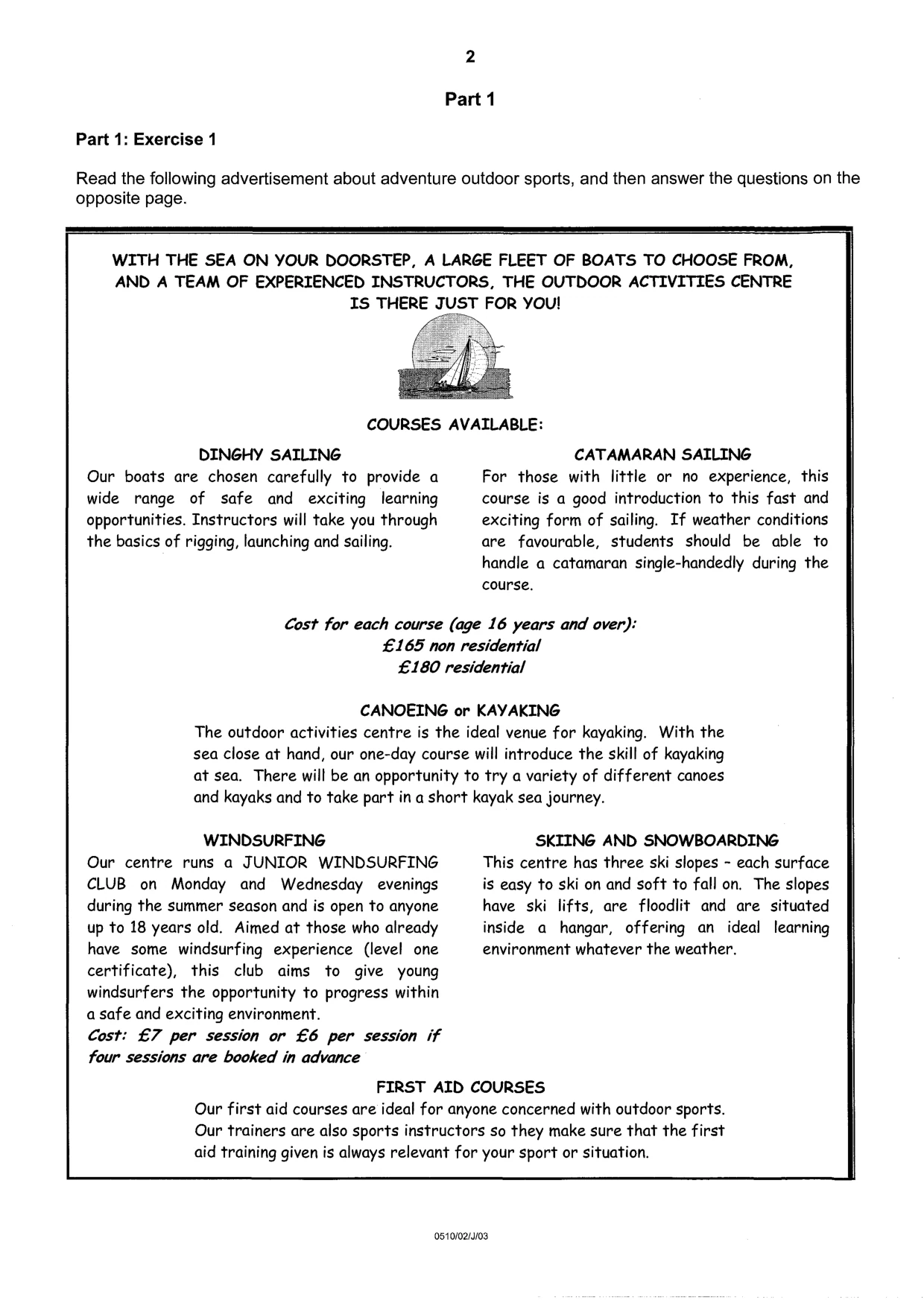
Part 1: Exercise 1 Read the following advertisement about adventure outdoor sports, and then answer the questions on the opposite page. Part 1 WITH THE SEA ON YOUR DOORSTEP, A LARGE FLEET OF BOATS TO CHOOSE FROM, AND A TEAM OF EXPERIENCED INSTRUCTORS, THE OUTDOOR ACTIVITIES CENTRE IS THERE JUST FOR YOU! COURSES AVAILABLE: DINGHY SAILING Our boats are chosen carefully to provide a wide range of safe and exciting learning opportunities. Instructors will take you through the basics of rigging, launching and sailing. CATAMARAN SAILING For those with little or no experience, this course is a good introduction to this fast and exciting form of sailing. If weather conditions are favourable, students should be able to handle a catamaran single-handedly during the course. Cost for each course (age 16 years and over): £165 non residential £180 residential CANOEING or KAYAKING The outdoor activities centre is the ideal venue for kayaking. With the sea close at hand, our one-day course will introduce the skill of kayaking at sea. There will be an opportunity to try a variety of different canoes and kayaks and to take part in a short kayak sea journey. WINDSURFING Our centre runs a JUNIOR WINDSURFING CLUB on Monday and Wednesday evenings during the summer season and is open to anyone up to 18 years old. Aimed at those who already have some windsurfing experience (level one certificate), this club aims to give young windsurfers the opportunity to progress within a safe and exciting environment. Cost: £7 per session or £6 per session if four sessions are booked in advance SKIING AND SNOWBOARDING This centre has three ski slopes - each surface is easy to ski on and soft to fall on. The slopes have ski lifts, are floodlit and are situated inside a hangar, offering an ideal learning environment whatever the weather. FIRST AID COURSES Our first aid courses are ideal for anyone concerned with outdoor sports. Our trainers are also sports instructors so they make sure that the first aid training given is always relevant for your sport or situation. 0510/0214/03
Question paper, page 3
3 For Examiner's (a) How much would it cost someone staying at the centre to learn to sail? se ceeseeeceeeeaeeeceeeeeuaececseeecessceccesaeeesessaesenauecceesecceaeeeceesaeeseseueeseseeecenseeeesseeesenseeens [1] (b) If the weather is fine, what could the learner achieve on the catamaran course? ceceusssutvevassessssssvscvasstessassseaevassavsssassevasusessvassssssiteasssasiscateassseasateasstetsateatereaseees [1] (c) How long does it take to complete the introduction to sea kayaking course? ceeeseeeeeeestseeeseeeesuaessssuaeseeaeeeeeesuaessessassensatesensuaesssssestcueteeeersseseraeesssttesecssacesaeey 11] (d) How can a junior windsurfer save money? SEES EEE SEES SSS SEESSSSSESSSSSESSSOOSSOSSSSSONSSSOSSOSSSSSEOSSOSESSSSSSSOSSSSOES [1] (e) Give one reason why a complete beginner could not join the windsurfing club. vucevescvssvasuccsesecsecsscescesccaccaccateessasesuesuessseasersseucsscessessestesrevasesecasessvsnsatessersased 1] (f) Why wouldn’t a skiing lesson at the centre be cancelled in bad weather? cece eeeeeeeseeeceeeeeeeeeeceuaeeeeneeeeceseueeseseeaesceeeeeccesesesseseeeseeeeescsseseseesseeeseeseeeeneaeeeniea [1] (g) What other useful experience do the first aid instructors have? cece eeeeeesaueeeeeeeeueccesueececsseeecesucesceseeesceeateceesueeseaeeseeseeeesessiueseneeseesaeesensaeesened [1] [Total: 7] (0510/02/4/03 [Turn over
Question paper, page 4
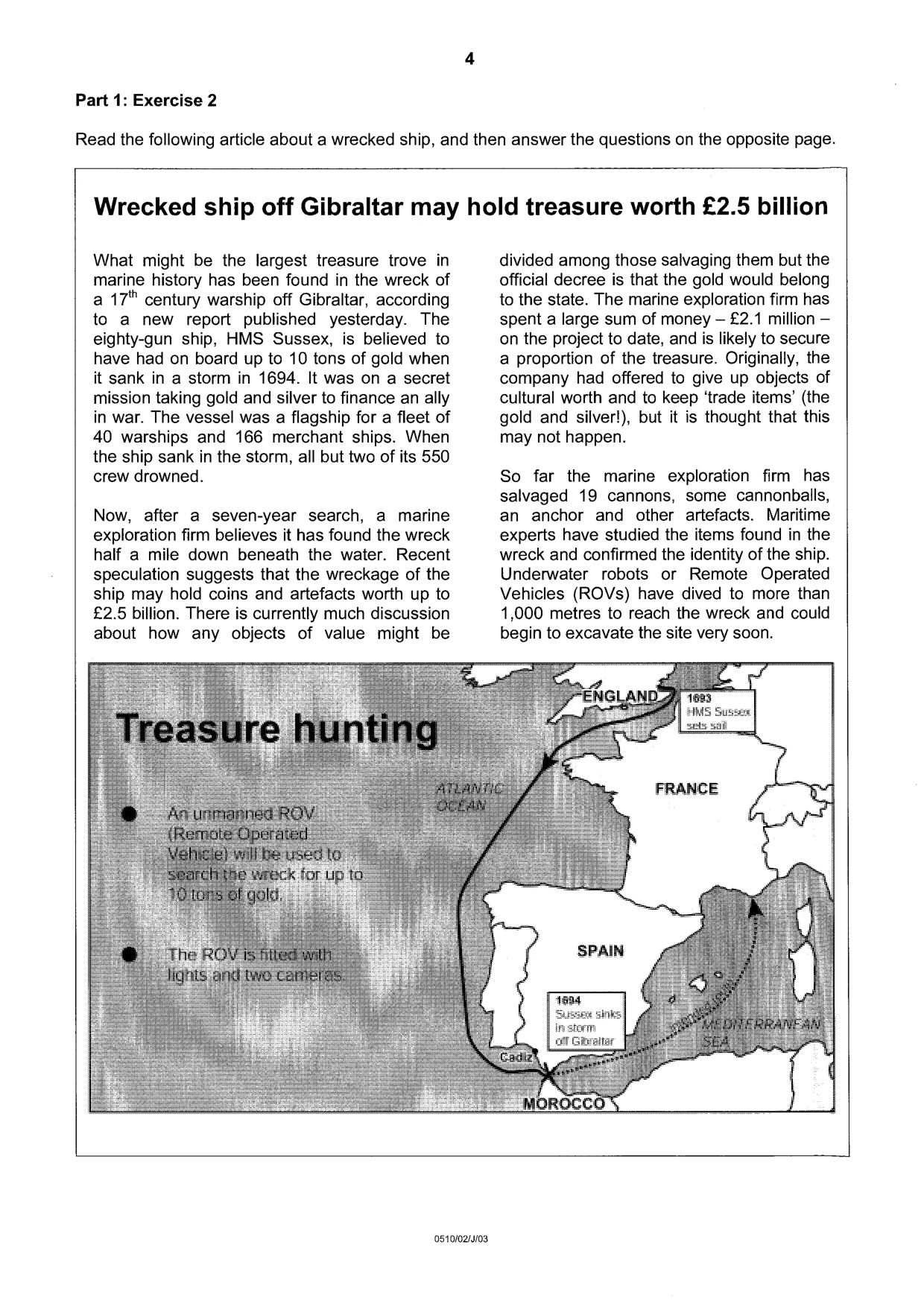
Part 1: Exercise 2 Read the following article about a wrecked ship, and then answer the questions on the opposite page. Wrecked ship off Gibraltar may hold treasure worth £2.5 billion What might be the largest treasure trove in divided among those salvaging them but the marine history has been found in the wreck of official decree is that the gold would belong a 17" century warship off Gibraltar, according to the state. The marine exploration firm has to a new report published yesterday. The spent a large sum of money — £2.1 million — eighty-gun ship, HMS Sussex, is believed to on the project to date, and is likely to secure have had on board up to 10 tons of gold when a proportion of the treasure. Originally, the it sank in a storm in 1694. It was on a secret company had offered to give up objects of mission taking gold and silver to finance an ally cultural worth and to keep ‘trade items’ (the in war. The vessel was a flagship for a fleet of gold and silver!), but it is thought that this 40 warships and 166 merchant ships. When may not happen. the ship sank in the storm, all but two of its 550 crew drowned. So far the marine exploration firm has salvaged 19 cannons, some cannonballs, Now, after a seven-year search, a marine an anchor and other artefacts. Maritime exploration firm believes it has found the wreck experts have studied the items found in the half a mile down beneath the water. Recent wreck and confirmed the identity of the ship. speculation suggests that the wreckage of the Underwater robots or Remote Operated ship may hold coins and artefacts worth up to Vehicles (ROVs) have dived to more than £2.5 billion. There is currently much discussion 1,000 metres to reach the wreck and could about how any objects of value might be begin to excavate the site very soon. EA r NG 1883 : HMS Sussex sets se ost0/021N/03
Question paper, page 5
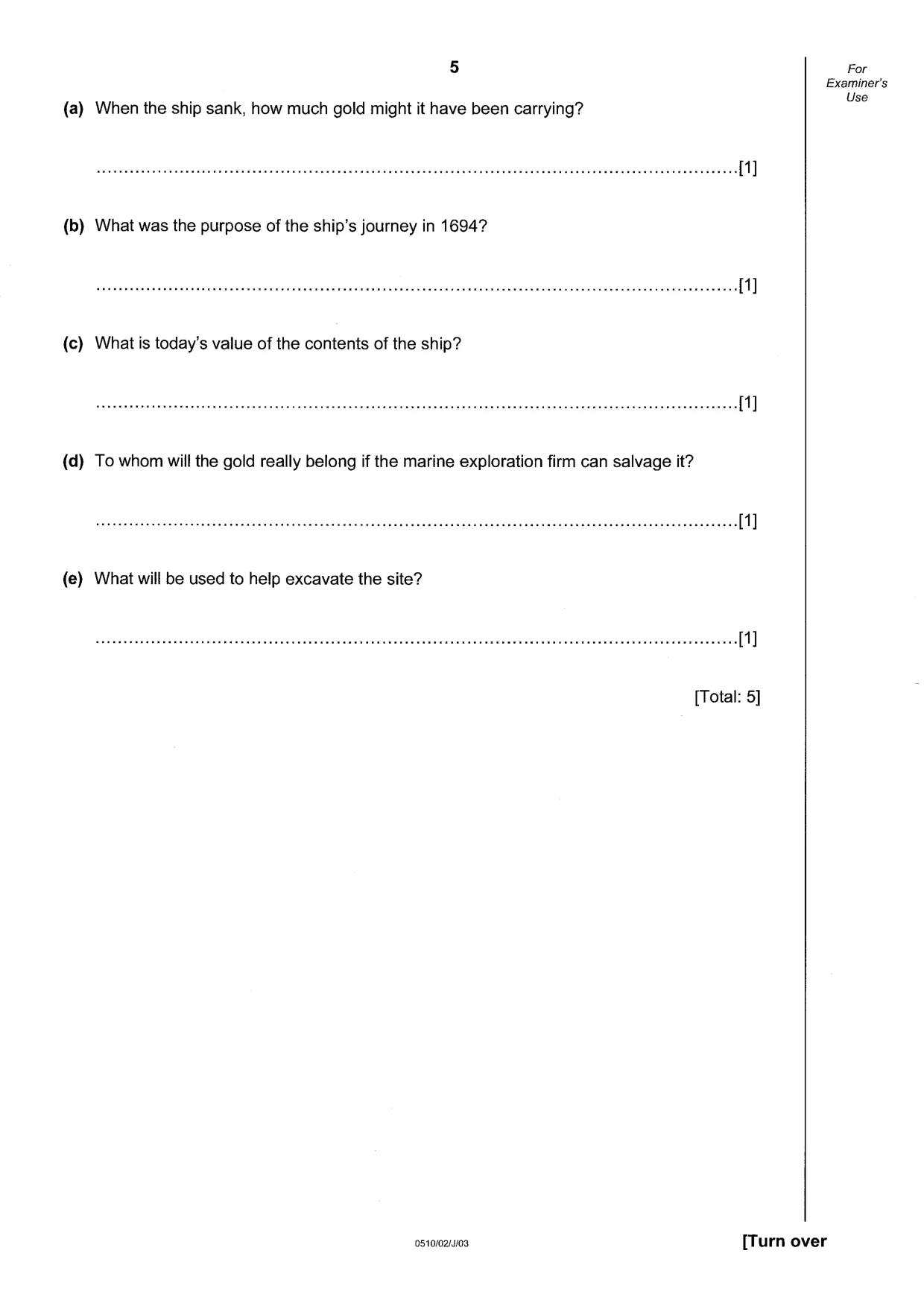
5 For Examiner's Us (a) When the ship sank, how much gold might it have been carrying? “e (b) What was the purpose of the ship’s journey in 1694? (c) What is today’s value of the contents of the ship? [Total: 5] 0510/02/4/03, [Turn over
Question paper, page 6
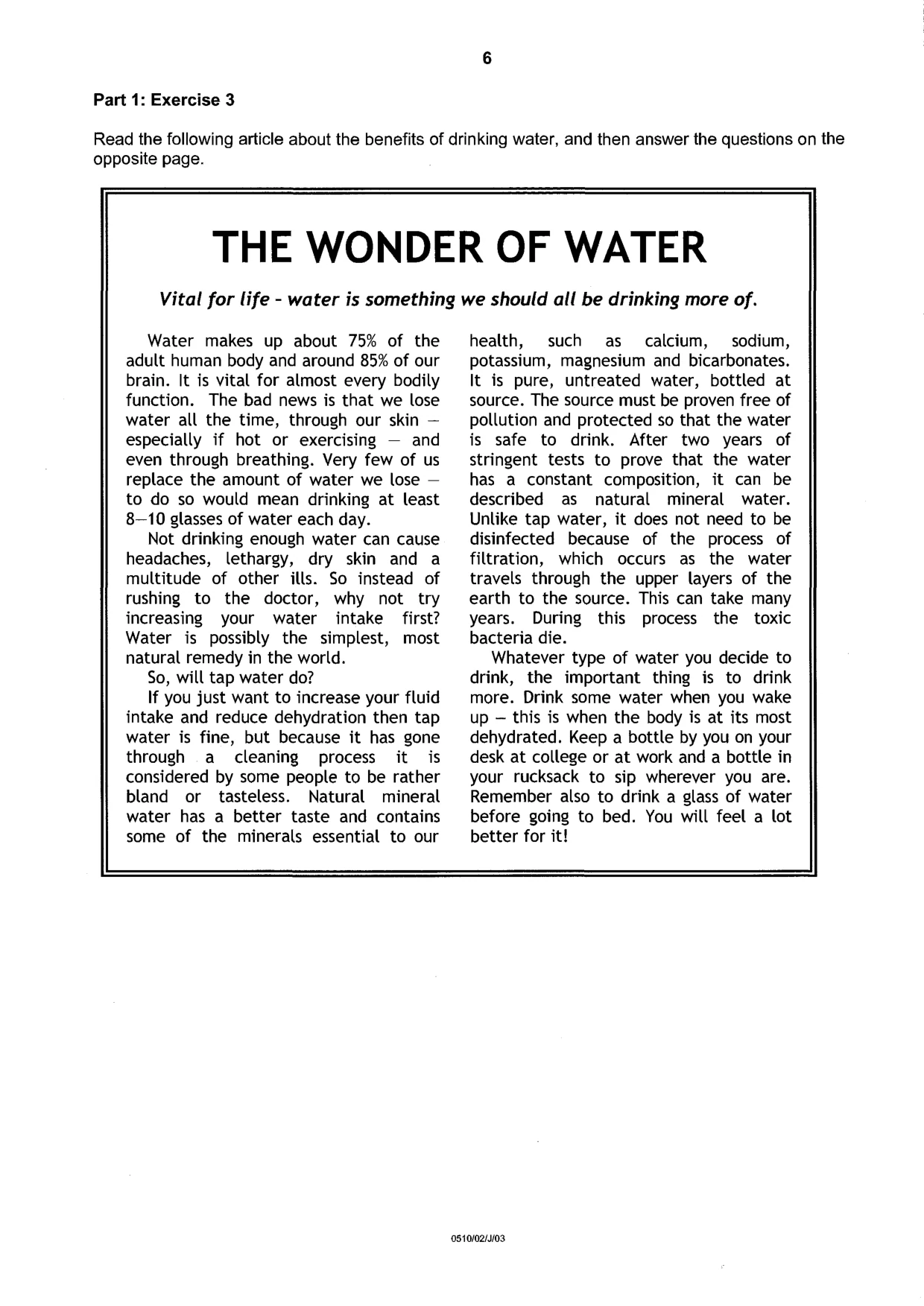
Part 1: Exercise 3 Read the following article about the benefits of drinking water, and then answer the questions on the opposite page. THE WONDER OF WATER Vital for life - water is something we should all be drinking more of. Water makes up about 75% of the adult human body and around 85% of our brain. It is vital for almost every bodily function. The bad news is that we lose water all the time, through our skin — especially if hot or exercising — and even through breathing. Very few of us replace the amount of water we lose — to do so would mean drinking at least 8—10 glasses of water each day. Not drinking enough water can cause headaches, lethargy, dry skin and a multitude of other ills. So instead of rushing to the doctor, why not try increasing your water intake first? Water is possibly the simplest, most natural remedy in the world. So, will tap water do? If you just want to increase your fluid intake and reduce dehydration then tap water is fine, but because it has gone through a cleaning process it is considered by some people to be rather bland or tasteless. Natural mineral water has a better taste and contains some of the minerals essential to our health, such as_ calcium, sodium, potassium, magnesium and bicarbonates. It is pure, untreated water, bottled at source. The source must be proven free of pollution and protected so that the water is safe to drink. After two years of stringent tests to prove that the water has a constant composition, it can be described as natural mineral water. Unlike tap water, it does not need to be disinfected because of the process of filtration, which occurs as the water travels through the upper layers of the earth to the source. This can take many years. During this process the toxic bacteria die. Whatever type of water you decide to drink, the important thing is to drink more. Drink some water when you wake up — this is when the body is at its most dehydrated. Keep a bottle by you on your desk at college or at work and a bottle in your rucksack to sip wherever you are. Remember also to drink a glass of water before going to bed. You will feel a lot better for it! 0510/02/03
Question paper, page 7
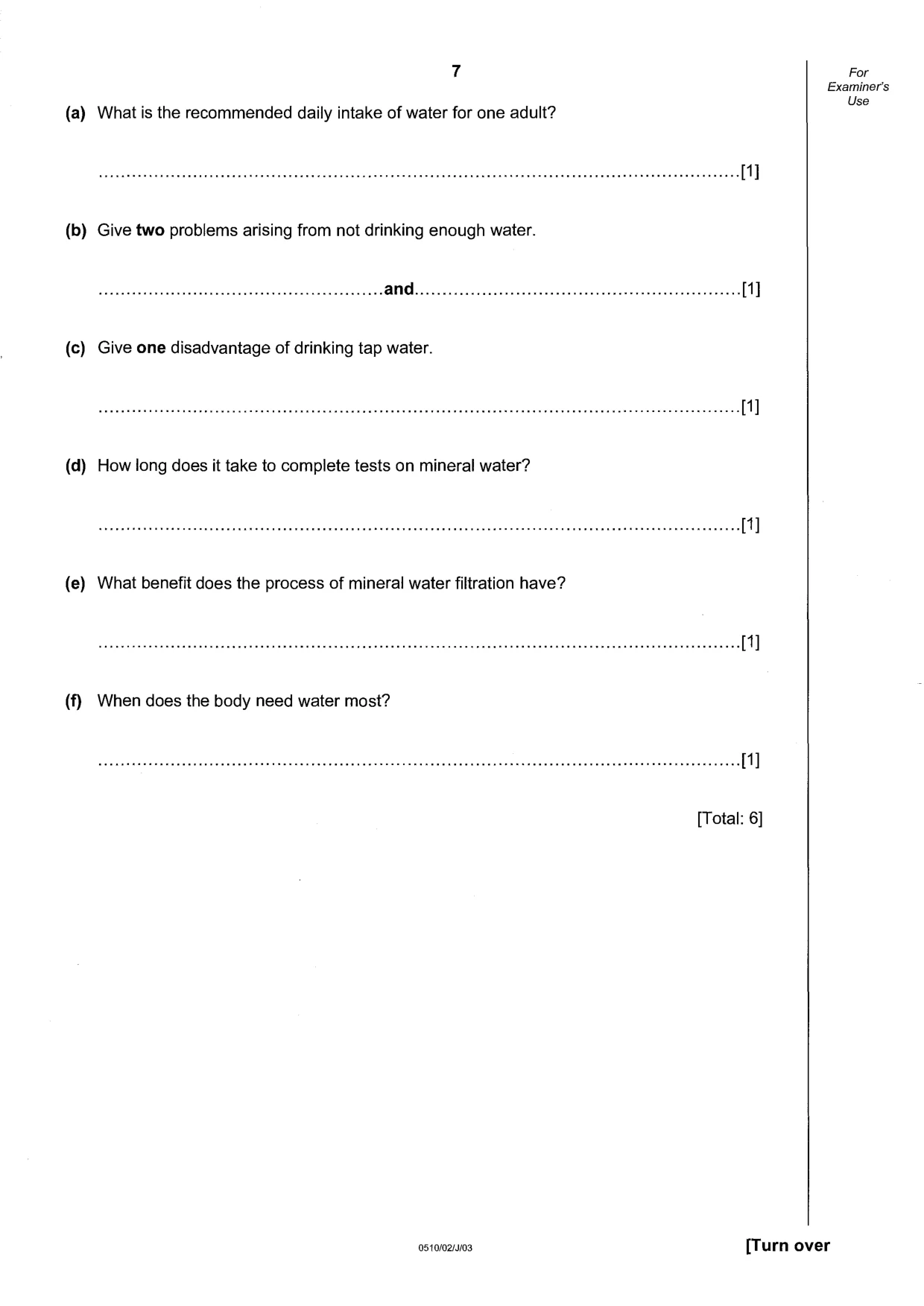
7 For Examiner's (a) What is the recommended daily intake of water for one adult? ise esssuesevessssecavecassesassesesaessssscassavscssssessssasassesaesasassessesecseseesecseacateeseiecseeeseaeees [1] (b) Give two problems arising from not drinking enough water. ceenaeaeeeeeeeeeeeeeeeeeeeeeeeersneeaeeneeeeseeeee# ANG. eee cece cece ee teteeeeeeeeeeeeeeeeeeeeerseeeeeeeeeeLT] (c) Give one disadvantage of drinking tap water. ceeeseeeeeeecsseeeeeccesececeseeesecsaeeccesaeeecesaeeeenseesesaeeseesaeecssseesessaaeeseiseteceuseeeeteeeoesees 1] (d) How long does it take to complete tests on mineral water? cheese eeeeecscceceeeeesueeseseuesecueeeessueessesecesseseesessaaeessceecesssesecssaeesiseeeeseaeesereseennes 1] (e) What benefit does the process of mineral water filtration have? ceeeceeeseeecsaeeneceeueesesaeesecaueececsueesesseeesenseeeecesceseseeseeaeesessasensseesetseeserssesensaes 1] (f) When does the body need water most? veceyesuceuccucusvscsessacsuseutesscasvascsecsussscascssevasueesevaesssssasvesaeeatesseasessestesseevetersess [1] [Total: 6] o510/02/4/03, [Turn over
Question paper, page 8
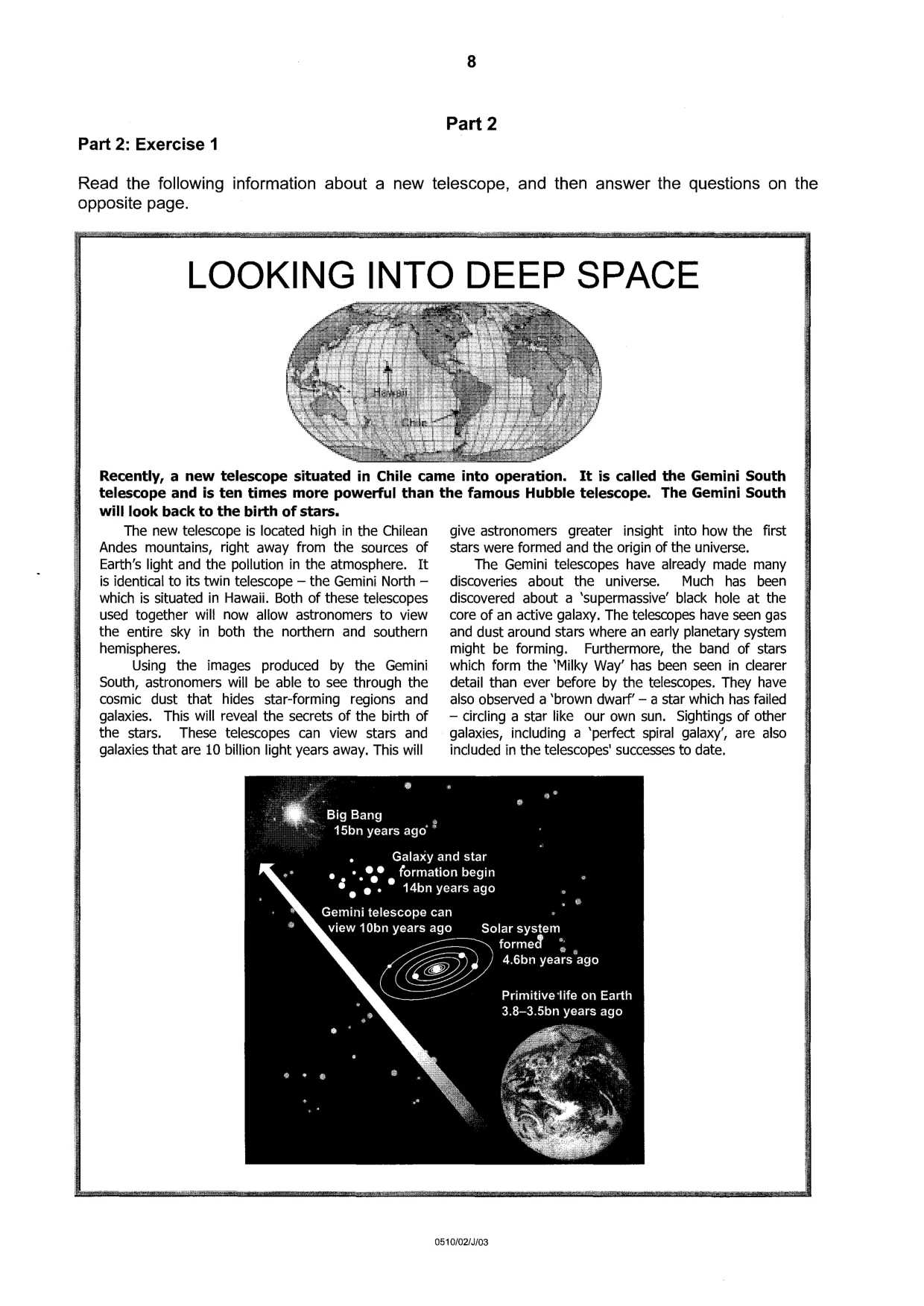
Part 2: Exercise 1 Read the following information about a new telescope, and then answer the questions on the opposite page. Part 2 LOOKING INTO DEEP SPACE telescope and is ten times more powerful than the famous Hubble telescope. The Gemini South will look back to the birth of stars. The new telescope is located high in the Chilean Andes mountains, right away from the sources of Earth’s light and the pollution in the atmosphere. It is identical to its twin telescope — the Gemini North — which is situated in Hawaii. Both of these telescopes used together will now allow astronomers to view the entire sky in both the northern and southern hemispheres. Using the images produced by the Gemini South, astronomers will be able to see through the cosmic dust that hides star-forming regions and galaxies. This will reveal the secrets of the birth of the stars. These telescopes can view stars and galaxies that are 10 billion light years away. This will . Big Bang 15bn years ago” give astronomers greater insight into how the first stars were formed and the origin of the universe. The Gemini telescopes have already made many discoveries about the universe. Much has been discovered about a ‘supermassive’ black hole at the core of an active galaxy. The telescopes have seen gas and dust around stars where an early planetary system might be forming. Furthermore, the band of stars which form the ‘Milky Way’ has been seen in clearer detail than ever before by the telescopes. They have also observed a ‘brown dwarf’ — a star which has failed — circling a star like our own sun. Sightings of other galaxies, including a ‘perfect spiral galaxy’, are also included in the telescopes' successes to date, Galaxy and star ee. formation begin +e e e @+” 14bn years ago Gemini telescope can view 10bn years ago Solar system formed % 4.6bn years ‘ago Primitive ‘life on Earth 3.8-3.5bn years ago 0510/02/03,
Question paper, page 9
9 (a) How does the new telescope compare in strength with the Hubble telescope? coset ceca ceaeceeceeceeeeeeccesesesesceesessceseenseeeeeecseeseeseenectnescuseeeseesesesersceieesresersenseeeed [1] (b) Give one reason why the Gemini South telescope has been located in a high place. ossesesesasssuscasevasessassasssvassesassseassssassssussssssessstsassesiseasitescsteasiteasstessesesteatitereates 1] (c) What is the benefit of using both Gemini telescopes together? ses eeeeseeeseeeesaeeeueeceseeeeeecsereesesuescseueeeeeeeesseuescesseeeceesececseseesenseeeeeeseeesseeesenneeess 1] (d) What will astronomers learn from viewing distant galaxies? cece cae ee eeceeeeceeeseeaseaeeecaeeeseseeeseseeceeesesesceecneeesecceesseeeseeeessessieesereeseseneeeseseeeens 1] (e) According to the diagram: (i) how long ago did galaxies and stars begin to be formed? cose ee cceceeeeeeeeseceeecceeeeaeecaeecseeseeeeeeeseseseseaesensecesecesseensasseeseescneseneesinentesenaeees [1] (ii) what took place 4.6 billion years ago? bessesesesseseuesssessssessesessessssessssesssesssesassessssesassassesassessteesessesieeesstestetiseeceeestetees [1] (f) Write a short paragraph (about 60 words) giving four points about the discoveries made by the telescopes. [Total: 10] For Examiner's Use 05107021003 [Turn over
Question paper, page 10
10 Part 2: Exercise 2 Read the following article about a snake park, and then write a summary of its aims. Your summary should be about 100 words. You should use your own words as far as possible. SNAKES ALIVE! In the middle of Katraj Snake Park, Mr Khaire, the director of the park, and his team look after a host of poisonous and non-poisonous snakes which live in specially dug pits. The aim of the park is to educate visitors about snakes. Mr Khaire’s interest in snakes began during the monsoon of 1969 when he saved the life of a poisonous snake in a holiday camp he was managing at the time. He later released the snake safely into the wild. Khaire then bought a book about snakes and began to study. He rescued snakes which were in danger of being beaten to death and released them. As a result, he realised that 85% of snakes are not poisonous. They are largely harmless and generally only bite when provoked or threatened. Khaire realised that he had found his mission in life: to educate people about snakes. To reinforce this idea, Mr Khaire carried out a stunt. This involved spending 72 hours in a glass enclosure with 72 poisonous snakes. He was hoping to clear up misconceptions about snakes. His experiment attracted a lot of attention and created awareness about these reptiles. Following this, he approached the authorities for a space in which to create a snake park. Here snakes could be kept to educate the public and rescued snakes could find shelter. Four snakepits were dug and an exhibition hall was built. The park was opened in 1986 and since then Mr Khaire and his team of volunteers have been looking after the snakes. They maintain the park, give lectures, create exhibitions and conduct research about snakes. They also identify rare types of snake and study their breeding patterns. Although the initial objectives of the snake park were to rescue, release, breed and create awareness about snakes, the team also nurse and release other lost and injured animals and birds. All can find a shelter there and become part of the snake park family until fully recovered. An orphanage was created in order to nurse these extra creatures back to health. The snake park team is always busy. Zoos with reptile problems often contact the park for information, and people who have spotted a snake near their homes call the snake park frequently for help! 0510/02/4/03
Question paper, page 11
11 For Examiner's Use 0510/02/03, [Turn over
Question paper, page 12
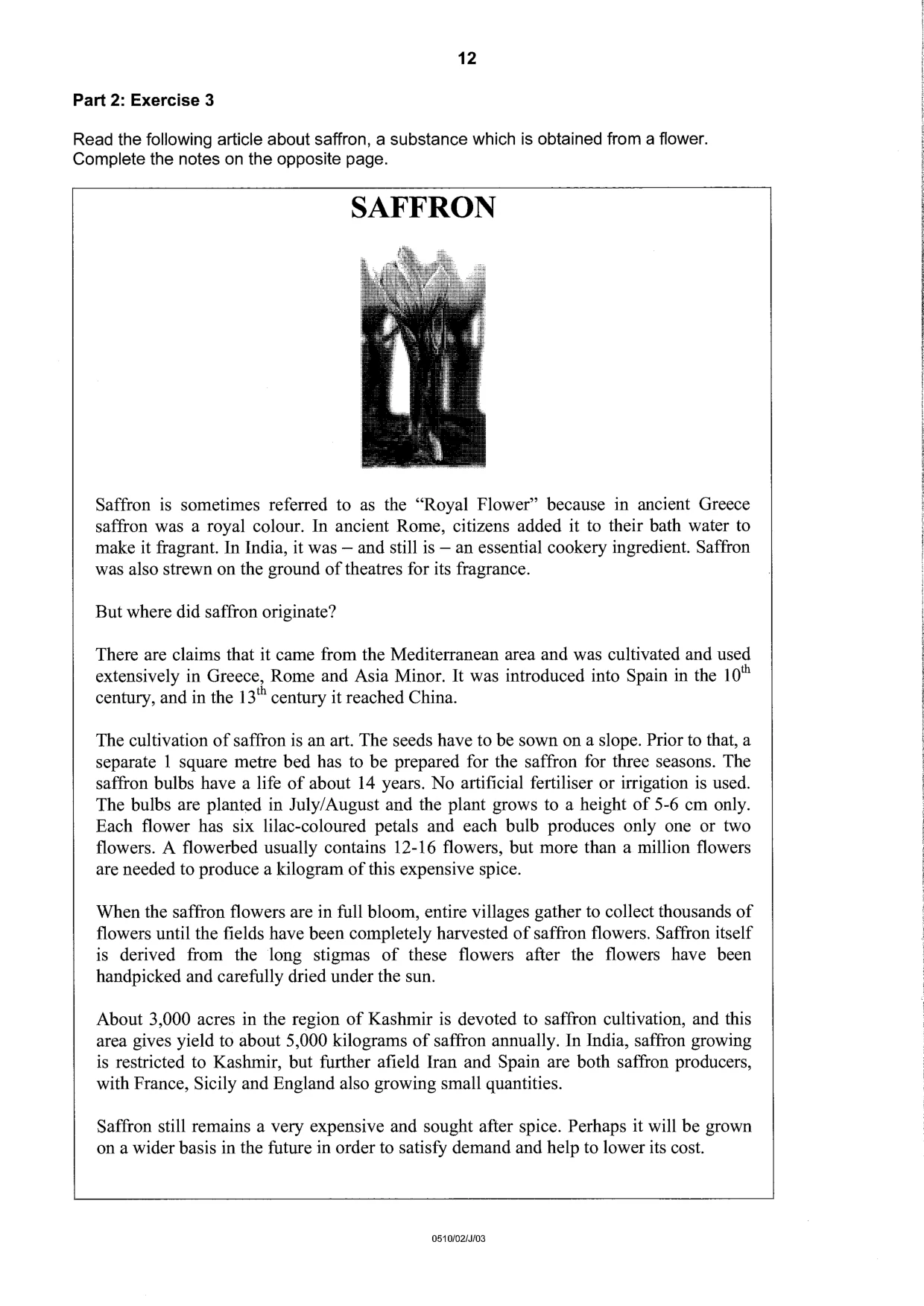
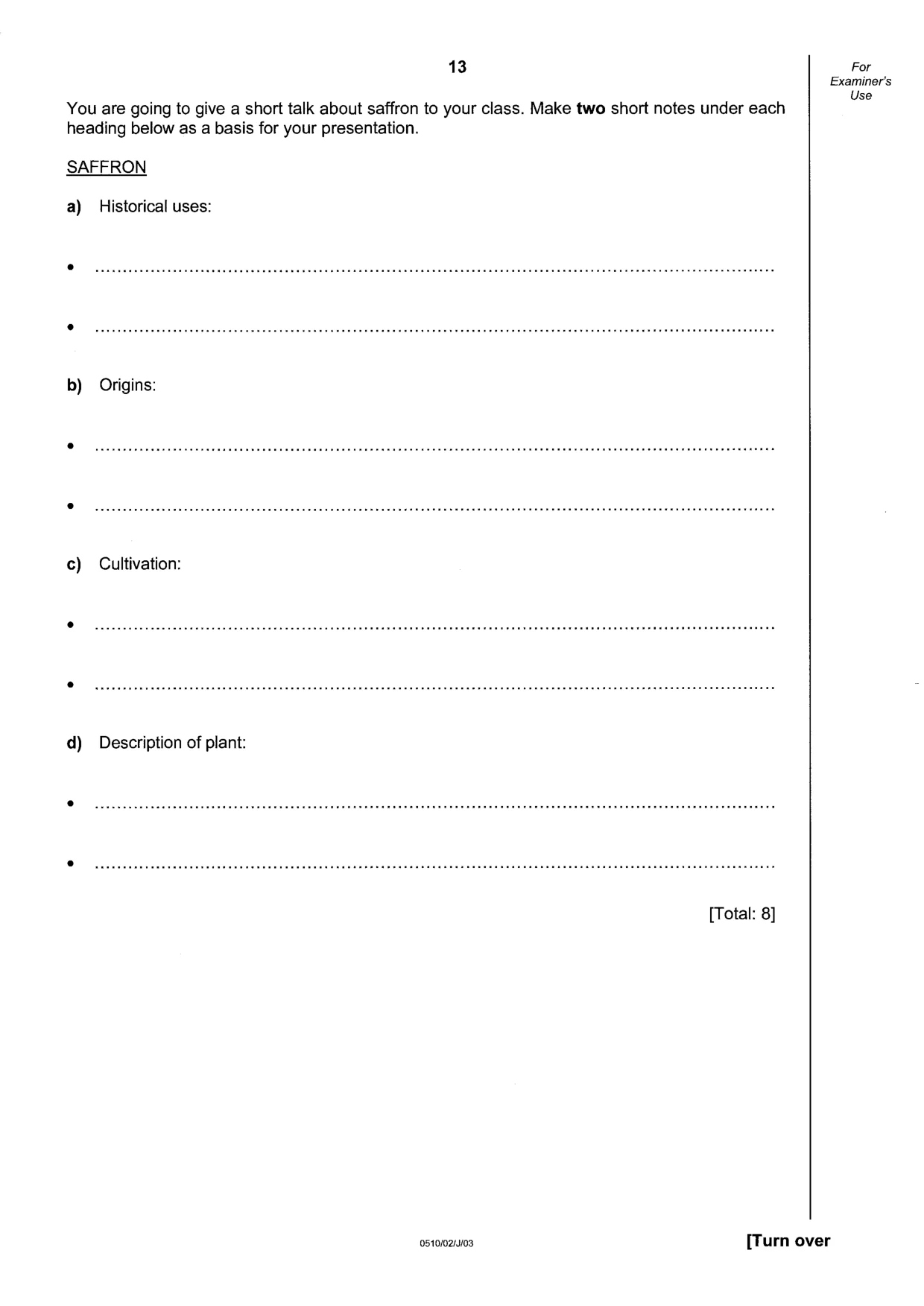
12 Part 2: Exercise 3 Read the following article about saffron, a substance which is obtained from a flower. Complete the notes on the opposite page. SAFFRON Saffron is sometimes referred to as the “Royal Flower” because in ancient Greece saffron was a royal colour. In ancient Rome, citizens added it to their bath water to make it fragrant. In India, it was — and still is — an essential cookery ingredient. Saffron was also strewn on the ground of theatres for its fragrance. But where did saffron originate? There are claims that it came from the Mediterranean area and was cultivated and used extensively in Greece, Rome and Asia Minor. It was introduced into Spain in the 10" century, and in the 13 century it reached China. The cultivation of saffron is an art. The seeds have to be sown on a slope. Prior to that, a separate 1 square metre bed has to be prepared for the saffron for three seasons. The saffron bulbs have a life of about 14 years. No artificial fertiliser or irrigation is used. The bulbs are planted in July/August and the plant grows to a height of 5-6 cm only. Each flower has six lilac-coloured petals and each bulb produces only one or two flowers. A flowerbed usually contains 12-16 flowers, but more than a million flowers are needed to produce a kilogram of this expensive spice. When the saffron flowers are in full bloom, entire villages gather to collect thousands of flowers until the fields have been completely harvested of saffron flowers. Saffron itself is derived from the long stigmas of these flowers after the flowers have been handpicked and carefully dried under the sun. About 3,000 acres in the region of Kashmir is devoted to saffron cultivation, and this area gives yield to about 5,000 kilograms of saffron annually. In India, saffron growing is restricted to Kashmir, but further afield Iran and Spain are both saffron producers, with France, Sicily and England also growing small quantities. Saffron still remains a very expensive and sought after spice. Perhaps it will be grown on a wider basis in the future in order to satisfy demand and help to lower its cost. ost0/02//03, y |
Question paper, page 13
13 For Examiner's Us You are going to give a short talk about saffron to your class. Make two short notes under each ne heading below as a basis for your presentation. SAFFRON a) Historical uses: [Total: 8] 0510/02/4/03 [Turn over
Question paper, page 14
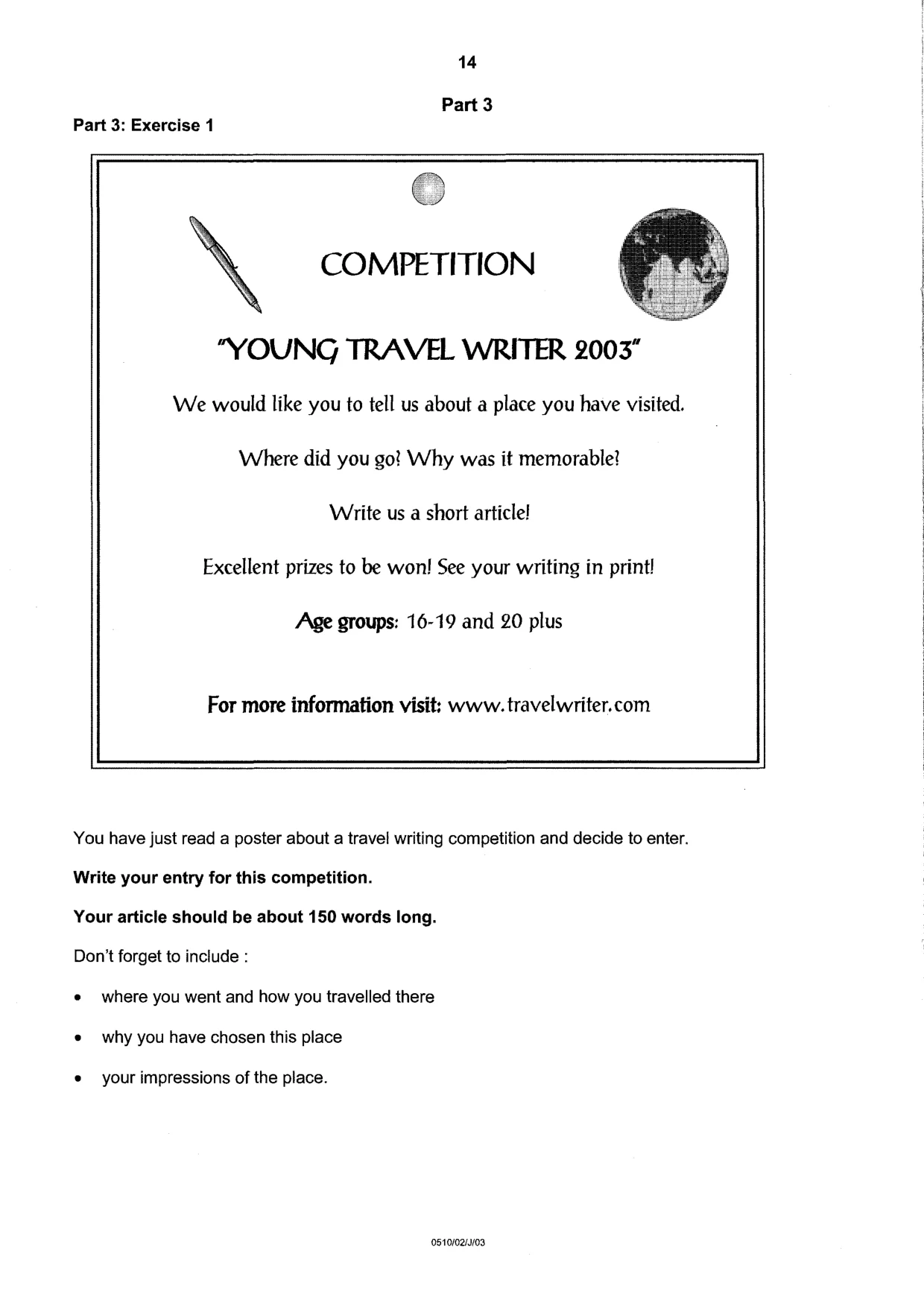
14 Part 3 Part 3: Exercise 1 COMPETITION “YOUNG TRAVEL WRITER 2003" We would like you to tell us about a place you have visited. Where did you go! Why was it memorable? Write us a short article! Excellent prizes to be won! See your writing in print! Age groups: 16-19 and 20 plus | For more information visit: www. travelwriter.com | You have just read a poster about a travel writing competition and decide to enter. Write your entry for this competition. Your article should be about 150 words long. Don't forget to include : e where you went and how you travelled there e why you have chosen this place * your impressions of the place. o510/021N/03
Question paper, page 15
15 For Examiner's Use [12] 0510/02/03 {Turn over
Question paper, page 16
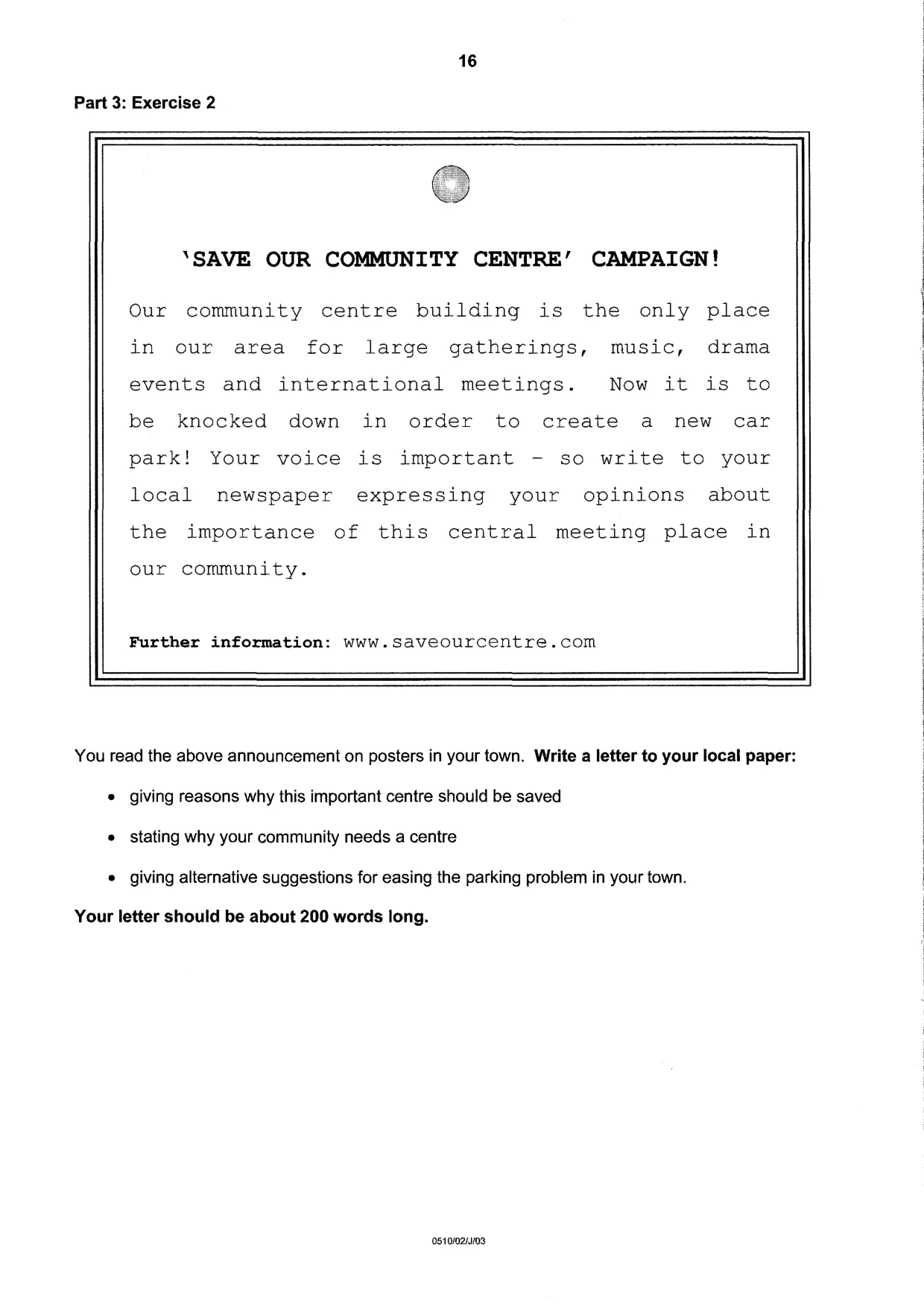
16 Part 3: Exercise 2 ‘SAVE OUR COMMUNITY CENTRE’ CAMPAIGN! Our community centre building is the only place in our area for large gatherings, music, drama events and international meetings. Now it is to be knocked down in order to create a new car park! Your voice is important - so write to your local newspaper expressing your opinions about the importance of this central meeting place in our community. | | | | Further information: www.saveourcentre.com You read the above announcement on posters in your town. Write a letter to your local paper: * giving reasons why this important centre should be saved * stating why your community needs a centre ¢ giving alternative suggestions for easing the parking problem in your town. Your letter should be about 200 words long. 0510/02/03
Question paper, page 17
17 For Examiner's Dear Editor, Use 0510/0218/03, [Turn over
Question paper, page 18
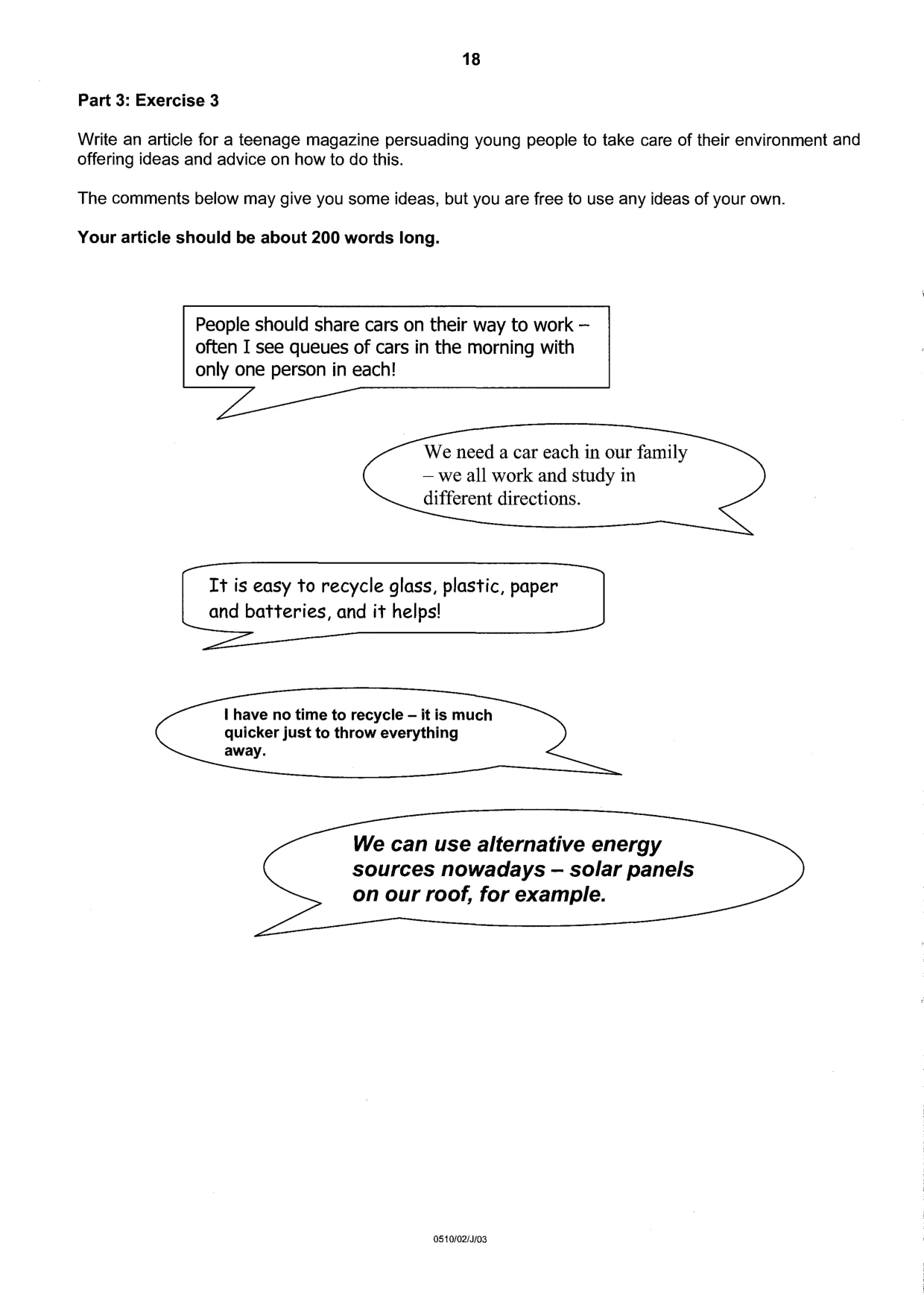
18 Part 3: Exercise 3 Write an article for a teenage magazine persuading young people to take care of their environment and offering ideas and advice on how to do this. The comments below may give you some ideas, but you are free to use any ideas of your own. Your article should be about 200 words long. People should share cars on their way to work — often I see queues of cars in the morning with only one person in each! We need a car each in our family — we all work and study in different directions. It is easy to recycle glass, plastic, paper and batteries, and it helps! I have no time to recycle — it is much quicker just to throw everything away. We can use alternative energy sources nowadays — solar panels on our roof, for example. osto/02//03,
Question paper, page 20
20 BLANK PAGE Copyright Acknowledgements: Part 1: Exercise 2 © The Guardian Part 1: Exercise 3 © John Lewis Part 2: Exercise 1 © John Crace. Looking Deep into Space. The Guardian Part 2: Exercise 2 Air India Part 2: Exercise 3 Air India Cambridge International Examinations has made every effort to trace copyright holders, but if we have inadvertently overlooked any we will be pleased to make the necessary arrangements at the first opportunity. 0510/02/03