Cambridge IGCSE English - Second Language (oral endorsement) 0510 — 2002 Oct/Nov Paper 2 · Variant 1
0510/21/O/N/02
The question paper and its mark scheme, free to read here and free to download. This is Cambridge’s own paper, exactly as it was sat.
Question paper20 pages






Mark scheme7 pages
Answers below. Sit the paper first if you are practising.
Paper as text
Question paper, page 1
This question paper consists of 19 printed pages and 1 blank page. SJF2572 S30894/3 © CIE 2002 [Turn over International General Certificate of Secondary Education CAMBRIDGE INTERNATIONAL EXAMINATIONS ENGLISH AS A SECOND LANGUAGE 0510/2 PAPER 2 Reading and Writing OCTOBER/NOVEMBER SESSION 2002 2 hours Candidates answer on the question paper. No additional materials are required. TIME 2 hours INSTRUCTIONS TO CANDIDATES Write your name, Centre number and candidate number in the spaces at the top of this page. Answer all questions. Write your answers in the spaces provided on the question paper. INFORMATION FOR CANDIDATES The number of marks is given in brackets [ ] at the end of each question or part question. Dictionaries are not permitted. Candidate Centre Number Number Candidate Name FOR EXAMINER’S USE Part 1 Part 2 Part 3 TOTAL www.XtremePapers.com
Question paper, page 2
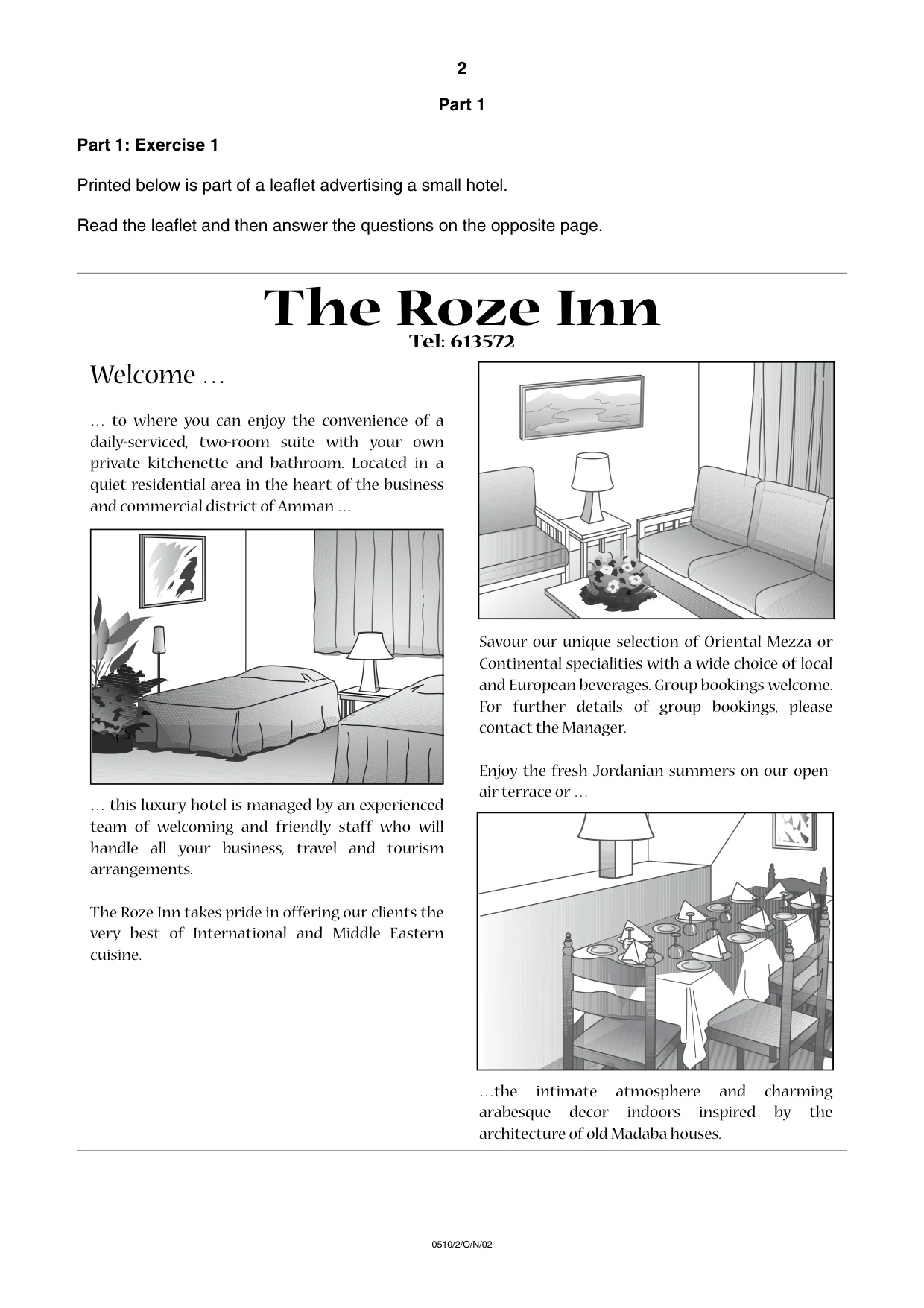
2 0510/2/O/N/02 Part 1 Part 1: Exercise 1 Printed below is part of a leaflet advertising a small hotel. Read the leaflet and then answer the questions on the opposite page. The Roze Inn Tel: 613572 Welcome … … to where you can enjoy the convenience of a daily-serviced, two-room suite with your own private kitchenette and bathroom. Located in a quiet residential area in the heart of the business and commercial district of Amman … … this luxury hotel is managed by an experienced team of welcoming and friendly staff who will handle all your business, travel and tourism arrangements. The Roze Inn takes pride in offering our clients the very best of International and Middle Eastern cuisine. Savour our unique selection of Oriental Mezza or Continental specialities with a wide choice of local and European beverages. Group bookings welcome. For further details of group bookings, please contact the Manager. Enjoy the fresh Jordanian summers on our open- air terrace or … …the intimate atmosphere and charming arabesque decor indoors inspired by the architecture of old Madaba houses.
Question paper, page 3
3 0510/2/O/N/02 [Turn over (a) Why is the hotel convenient for visiting businessmen/businesswomen? … [1] (b) What is good about the people who work in the hotel? … [1] (c) How does the restaurant try to make sure everyone will enjoy the food and drink? … [1] (d) What is it in the leaflet that clearly shows that the owners want to attract parties of guests? … [1] (e) Where would visitors be most likely to eat dinner when the weather is cold? … [1] (f) Why is the decoration of the dining room of particular interest? … [1] [Total: 6] For Examiner’s Use
Question paper, page 4
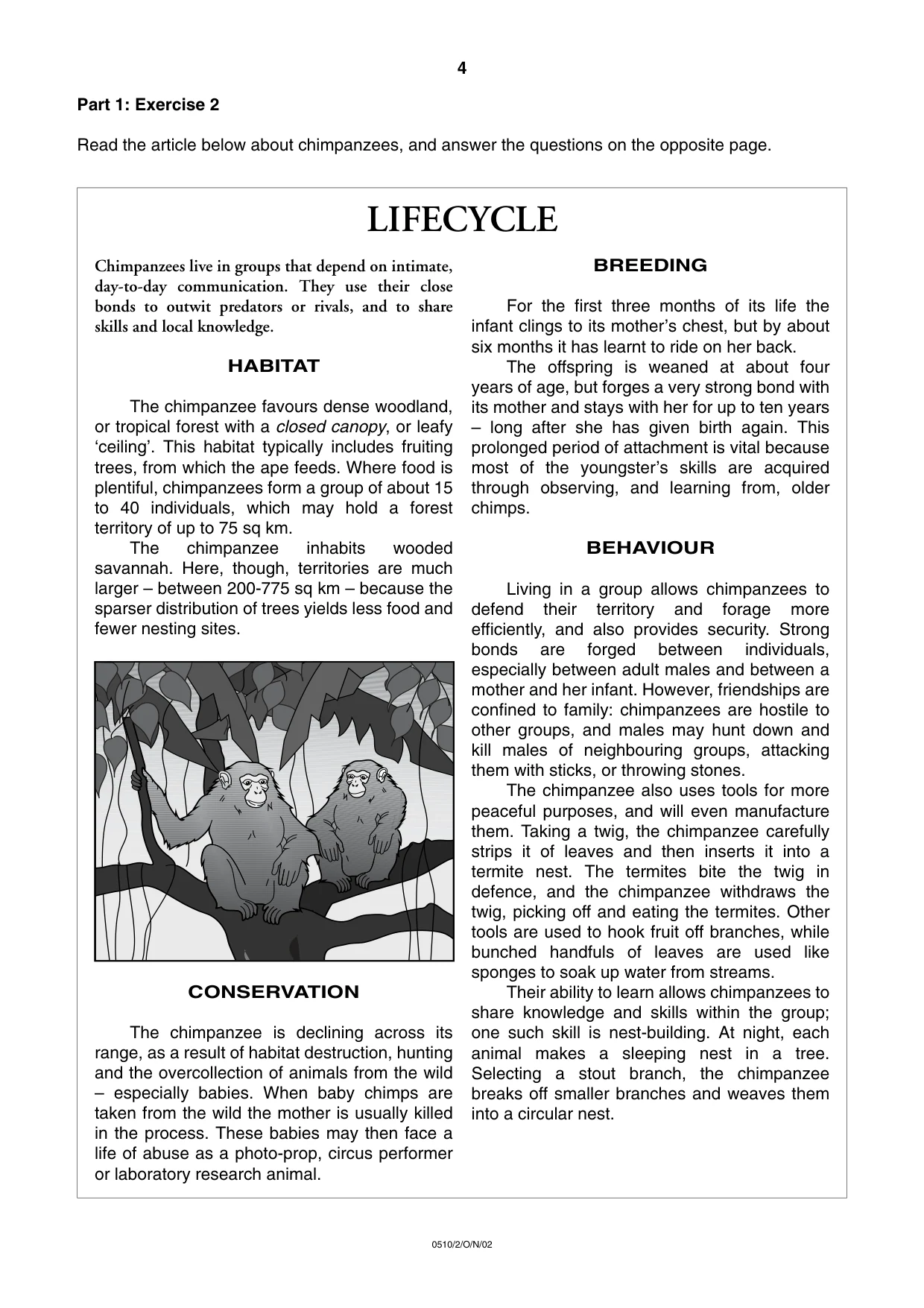
4 0510/2/O/N/02 Part 1: Exercise 2 Read the article below about chimpanzees, and answer the questions on the opposite page. LIFECYCLE Chimpanzees live in groups that depend on intimate, day-to-day communication. They use their close bonds to outwit predators or rivals, and to share skills and local knowledge. HABITAT The chimpanzee favours dense woodland, or tropical forest with a closed canopy, or leafy ‘ceiling’. This habitat typically includes fruiting trees, from which the ape feeds. Where food is plentiful, chimpanzees form a group of about 15 to 40 individuals, which may hold a forest territory of up to 75 sq km. The chimpanzee inhabits wooded savannah. Here, though, territories are much larger – between 200-775 sq km – because the sparser distribution of trees yields less food and fewer nesting sites. CONSERVATION The chimpanzee is declining across its range, as a result of habitat destruction, hunting and the overcollection of animals from the wild – especially babies. When baby chimps are taken from the wild the mother is usually killed in the process. These babies may then face a life of abuse as a photo-prop, circus performer or laboratory research animal. BREEDING For the first three months of its life the infant clings to its mother’s chest, but by about six months it has learnt to ride on her back. The offspring is weaned at about four years of age, but forges a very strong bond with its mother and stays with her for up to ten years – long after she has given birth again. This prolonged period of attachment is vital because most of the youngster’s skills are acquired through observing, and learning from, older chimps. BEHAVIOUR Living in a group allows chimpanzees to defend their territory and forage more efficiently, and also provides security. Strong bonds are forged between individuals, especially between adult males and between a mother and her infant. However, friendships are confined to family: chimpanzees are hostile to other groups, and males may hunt down and kill males of neighbouring groups, attacking them with sticks, or throwing stones. The chimpanzee also uses tools for more peaceful purposes, and will even manufacture them. Taking a twig, the chimpanzee carefully strips it of leaves and then inserts it into a termite nest. The termites bite the twig in defence, and the chimpanzee withdraws the twig, picking off and eating the termites. Other tools are used to hook fruit off branches, while bunched handfuls of leaves are used like sponges to soak up water from streams. Their ability to learn allows chimpanzees to share knowledge and skills within the group; one such skill is nest-building. At night, each animal makes a sleeping nest in a tree. Selecting a stout branch, the chimpanzee breaks off smaller branches and weaves them into a circular nest.
Question paper, page 5
5 0510/2/O/N/02 [Turn over (a) Where do chimpanzees prefer to live? … [1] (b) Why do chimpanzees remain with their mothers for long periods of time? … [1] (c) Why do chimpanzees live in groups? Give two reasons. … … [2] (d) Why are numbers of chimpanzees in the wild falling? … [1] [Total: 5] For Examiner’s Use
Question paper, page 6
6 0510/2/O/N/02 Part 1: Exercise 3 The passage printed below tells the story of a small tribe in Nepal. Read what it has to say and then answer the questions on the opposite page. Ram Puti sits with her baby and a few of her extended family near the evening fire in her small wooden house. Some of the women smoke, and two men repair fishnets in the corner. A debate arises about an arranged marriage that has turned sour. When it comes to matters of the heart, the lazy laughter of the women transforms into a spiral of opinion that rises with the smoke. One legend says it was a matter of the heart that brought the Tharu people to their isolated homeland in southern Nepal. Lal Bahadur, an old man, told me that after the Moguls invaded India in the 16th century, his people found themselves in conflict with a King because he wanted to marry a Rajput girl. To prevent this happening and to avoid the fighting which broke out between the Rajputs and the King’s supporters, the Rajput women and children fled east across India while their men stayed behind to fight. The Tharus, as the refugees came to be known, settled in a forested region called the tarai, which spreads across 550 miles of Himalayan foothills along what is now the Nepal-India border. When word arrived that the Rajput men had all been killed, the women began to marry the slaves who had accompanied them to the tarai. The Tharus remained separate from the outside world – protected, ironically, by malaria-bearing mosquitoes that prompted outsiders to give the region a wide berth. Though not immune, the Tharus developed some resistance to the deadly disease. They carved their homes from the forest, and farmed and fished in swiftly flowing rivers. The lives of the Tharus have remained simple for four centuries. Except for a few bicycles, tools, and tractors, I see little around them that they have not made with their hands. The walls of their homes are plastered inside and out with mud and cow dung, so smooth that they look and feel like skin. Their clay containers, their embroidered garments, the fishnets they weave – all the things they touch – are works of art. What touches the Tharus, however – even in the name of progress – is less benign. Foreigners brought DDT to the tarai in the 1950s. Malaria was eradicated, but so too was the barrier to outside encroachment. Borrowing money to pay for goods that outsiders brought them, many Tharus signed documents they could not read – and that ultimately forced them to become tenants on the very land they had owned. Overcutting and poor management of the forestland cast a shadow over the future of the Tharus as well. Still, the days follow one another. Rain comes in the night. I wake to find the mornings moist and gray. In the evenings I return in the languishing sun to my tent, pitched under a lemon tree. One such evening an old woman named Chanda calls to me and brings me to her house. She wants to thank me for helping her get medicine. Chanda disappears into her garden. I hear the sounds of a scuffle, and she returns with one of her fattest chickens, its feet tied with a rope. Those who have almost nothing give everything. I do not need the chicken, but Chanda will not listen to my protest and pushes the bird toward my stomach, motioning that it is for eating. For some minutes we push the upside-down chicken back and forth – until it ceases to struggle and closes its eyes. I must accept something and point to a fishing pot hanging from a ceiling beam. Chanda raises her eyebrows with suspicion over why I would choose an object with no value in place of a hot meal. As she unties the pot, her daughter Kurowa comes out of the house and tells me to take the pot and the chicken. I am happy with the pot. I squeeze Chanda’s hand and leave mother and daughter standing with the chicken.
Question paper, page 7
7 0510/2/O/N/02 [Turn over (a) Why did the women marry their slaves? … [1] (b) Why were the Tharus quite safe in the region they lived in? … [1] (c) Make one point about the huts of the Tharus. … [1] (d) Why does Chanda want to give the chicken to the writer? … [1] (e) Why does Chanda not consider the fishing pot to be a suitable present? … [1] (f) What was the good effect of DDT being brought to the region? … [1] (g) What was the bad effect of DDT being brought to the region? … [1] [Total: 7] For Examiner’s Use
Question paper, page 8
8 0510/2/O/N/02 Part 2 Part 2: Exercise 1 Read the article below, and then answer the questions on the opposite page. Stars throw light on old Egyptian mystery One of the great puzzles of Egyptology is how the builders of the pyramids lined them up to the north. Now Kate Spence says she has the exact answer, writes PATRICIA REANEY. It is a mystery that has worried the world’s top scientists for more than a century because no one knows how they did it or exactly when. But a British Egyptologist believes she may have solved the puzzle and figured out how the ancient Egyptians lined the pyramids of Giza up to the north and roughly when they did it. The heavenly alignment of the pyramids, one of the seven wonders of the world, is precise enough that scientists were convinced that Egyptians had to have a good knowledge of astronomy even though there is no record of it in ancient texts. The best estimate of the age of the royal tombs, roughly 4,500 years old, is based on histories of the period and the reign of kings, and is only accurate to within 100 years. Dr Kate Spence, of the University of Cambridge, estimates the building of the pyramids began between 2,485 BC - 2,375 BC and that two stars helped the Egyptians to line them to the north, important to them for religious reasons. “The exact link between the archaeological information and the astronomical calculations is very precise. It is very rare in archaeology that you get things that match that closely,” she said in a telephone interview. “This is a much more convincing argument than has been put forward in the past,” she added. In addition to solving a long-standing mystery, Spence’s findings, reported in the science journal Nature, add to our understanding of the history of the ancient Egyptians and the understanding of their technical ability. The Egyptians were trying to find north but they didn’t have a star marking the pole. So they used two stars, Kochab in Ursa Minor (or the ‘Little Dipper’), and Mizar in Ursa Major (or the ‘Big Dipper’) to find the pole. “The pole is on a line between those two stars. You measure when the two stars are basically on top of one another – and if you line them up with a plumb line that you will give you true north,” Spence said. According to astronomical data, 2,467 BC is the year in which the line that goes between the two stars passes exactly through the north pole. “If they had started building on that date we would have a pyramid which is absolutely lined up to north. But the fact is they seemed to have started work about 11 years before that, which means it is still a little way from north,” Spence said.
Question paper, page 9
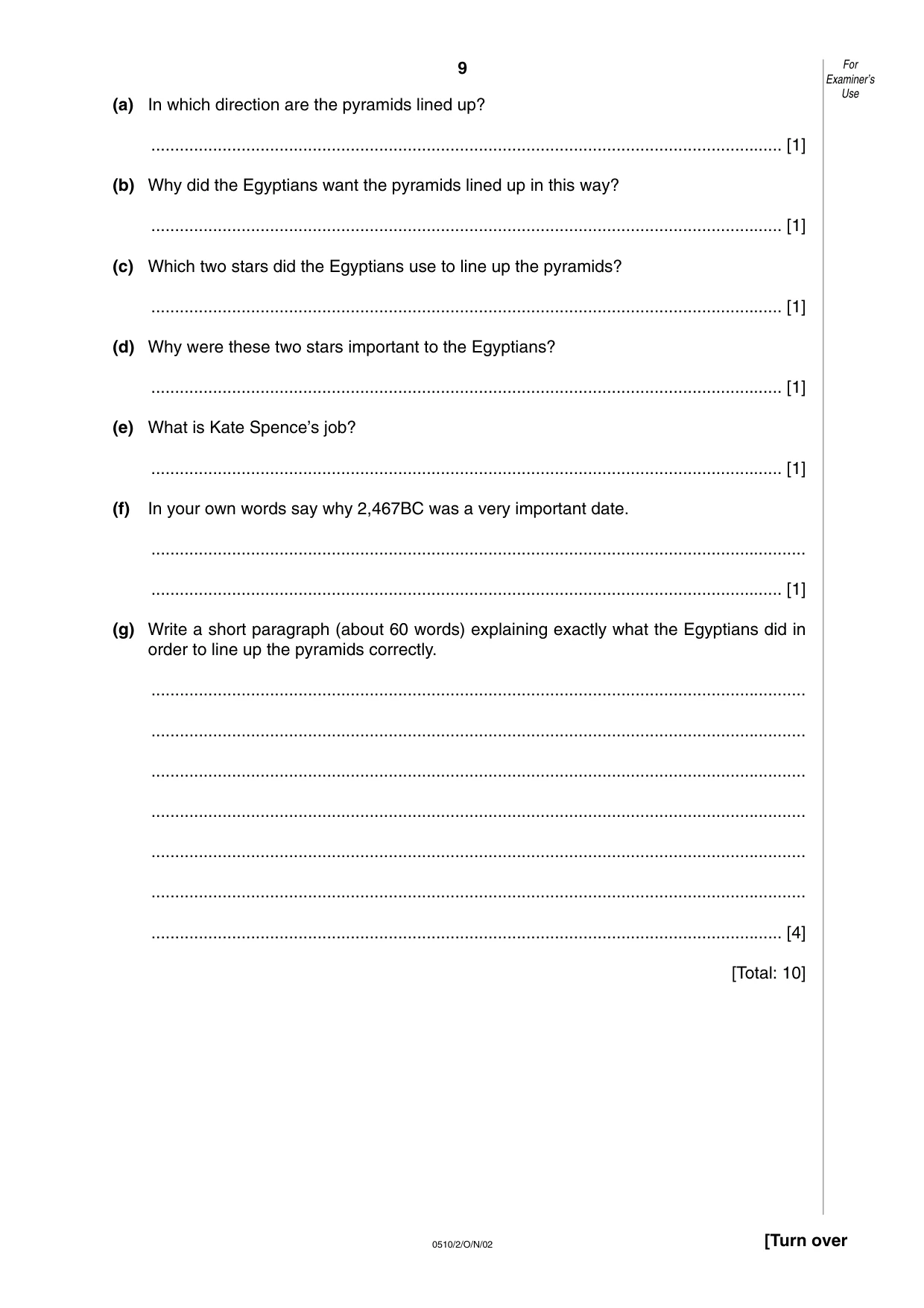
9 0510/2/O/N/02 [Turn over (a) In which direction are the pyramids lined up? … [1] (b) Why did the Egyptians want the pyramids lined up in this way? … [1] (c) Which two stars did the Egyptians use to line up the pyramids? … [1] (d) Why were these two stars important to the Egyptians? … [1] (e) What is Kate Spence’s job? … [1] (f) In your own words say why 2,467BC was a very important date. … … [1] (g) Write a short paragraph (about 60 words) explaining exactly what the Egyptians did in order to line up the pyramids correctly. … … … … … … … [4] [Total: 10] For Examiner’s Use
Question paper, page 10
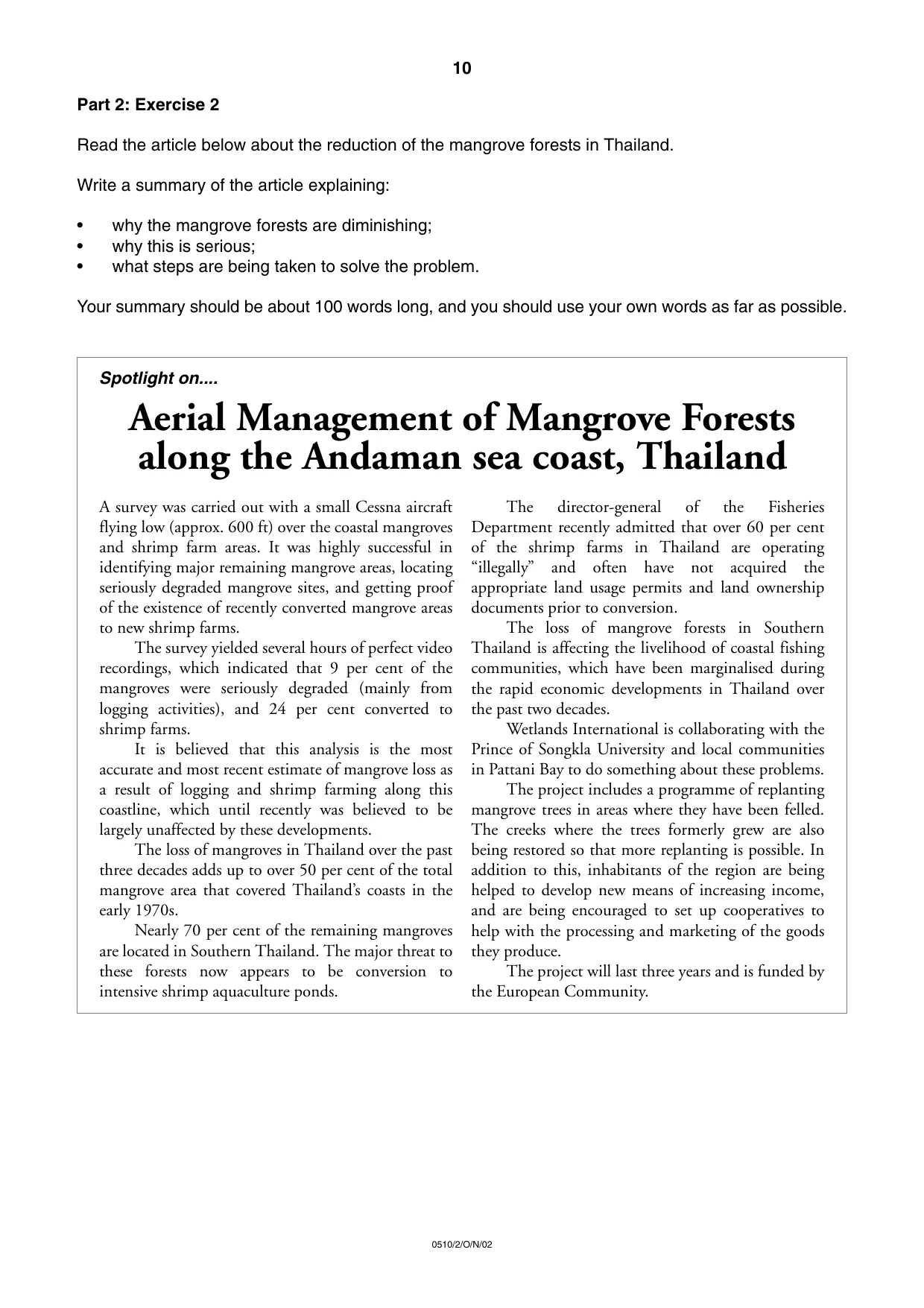
10 0510/2/O/N/02 Part 2: Exercise 2 Read the article below about the reduction of the mangrove forests in Thailand. Write a summary of the article explaining: • why the mangrove forests are diminishing; • why this is serious; • what steps are being taken to solve the problem. Your summary should be about 100 words long, and you should use your own words as far as possible. Spotlight on… Aerial Management of Mangrove Forests along the Andaman sea coast, Thailand A survey was carried out with a small Cessna aircraft flying low (approx. 600 ft) over the coastal mangroves and shrimp farm areas. It was highly successful in identifying major remaining mangrove areas, locating seriously degraded mangrove sites, and getting proof of the existence of recently converted mangrove areas to new shrimp farms. The survey yielded several hours of perfect video recordings, which indicated that 9 per cent of the mangroves were seriously degraded (mainly from logging activities), and 24 per cent converted to shrimp farms. It is believed that this analysis is the most accurate and most recent estimate of mangrove loss as a result of logging and shrimp farming along this coastline, which until recently was believed to be largely unaffected by these developments. The loss of mangroves in Thailand over the past three decades adds up to over 50 per cent of the total mangrove area that covered Thailand’s coasts in the early 1970s. Nearly 70 per cent of the remaining mangroves are located in Southern Thailand. The major threat to these forests now appears to be conversion to intensive shrimp aquaculture ponds. The director-general of the Fisheries Department recently admitted that over 60 per cent of the shrimp farms in Thailand are operating “illegally” and often have not acquired the appropriate land usage permits and land ownership documents prior to conversion. The loss of mangrove forests in Southern Thailand is affecting the livelihood of coastal fishing communities, which have been marginalised during the rapid economic developments in Thailand over the past two decades. Wetlands International is collaborating with the Prince of Songkla University and local communities in Pattani Bay to do something about these problems. The project includes a programme of replanting mangrove trees in areas where they have been felled. The creeks where the trees formerly grew are also being restored so that more replanting is possible. In addition to this, inhabitants of the region are being helped to develop new means of increasing income, and are being encouraged to set up cooperatives to help with the processing and marketing of the goods they produce. The project will last three years and is funded by the European Community.
Question paper, page 11
11 0510/2/O/N/02 [Turn over … … … … … … … … … … … … … [8] For Examiner’s Use
Question paper, page 12
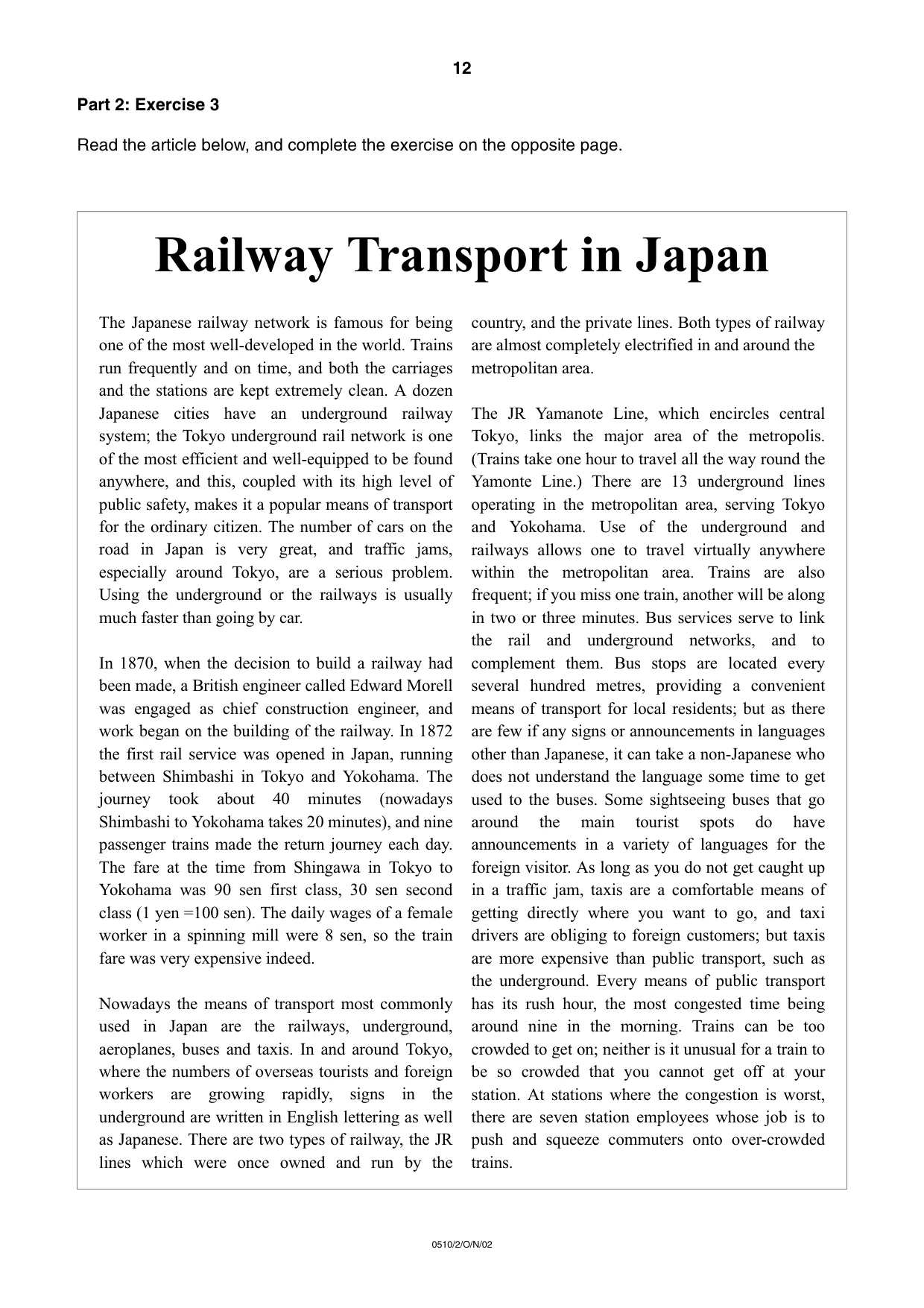
12 0510/2/O/N/02 Part 2: Exercise 3 Read the article below, and complete the exercise on the opposite page. Railway Transport in Japan The Japanese railway network is famous for being one of the most well-developed in the world. Trains run frequently and on time, and both the carriages and the stations are kept extremely clean. A dozen Japanese cities have an underground railway system; the Tokyo underground rail network is one of the most efficient and well-equipped to be found anywhere, and this, coupled with its high level of public safety, makes it a popular means of transport for the ordinary citizen. The number of cars on the road in Japan is very great, and traffic jams, especially around Tokyo, are a serious problem. Using the underground or the railways is usually much faster than going by car. In 1870, when the decision to build a railway had been made, a British engineer called Edward Morell was engaged as chief construction engineer, and work began on the building of the railway. In 1872 the first rail service was opened in Japan, running between Shimbashi in Tokyo and Yokohama. The journey took about 40 minutes (nowadays Shimbashi to Yokohama takes 20 minutes), and nine passenger trains made the return journey each day. The fare at the time from Shingawa in Tokyo to Yokohama was 90 sen first class, 30 sen second class (1 yen =100 sen). The daily wages of a female worker in a spinning mill were 8 sen, so the train fare was very expensive indeed. Nowadays the means of transport most commonly used in Japan are the railways, underground, aeroplanes, buses and taxis. In and around Tokyo, where the numbers of overseas tourists and foreign workers are growing rapidly, signs in the underground are written in English lettering as well as Japanese. There are two types of railway, the JR lines which were once owned and run by the country, and the private lines. Both types of railway are almost completely electrified in and around the metropolitan area. The JR Yamanote Line, which encircles central Tokyo, links the major area of the metropolis. (Trains take one hour to travel all the way round the Yamonte Line.) There are 13 underground lines operating in the metropolitan area, serving Tokyo and Yokohama. Use of the underground and railways allows one to travel virtually anywhere within the metropolitan area. Trains are also frequent; if you miss one train, another will be along in two or three minutes. Bus services serve to link the rail and underground networks, and to complement them. Bus stops are located every several hundred metres, providing a convenient means of transport for local residents; but as there are few if any signs or announcements in languages other than Japanese, it can take a non-Japanese who does not understand the language some time to get used to the buses. Some sightseeing buses that go around the main tourist spots do have announcements in a variety of languages for the foreign visitor. As long as you do not get caught up in a traffic jam, taxis are a comfortable means of getting directly where you want to go, and taxi drivers are obliging to foreign customers; but taxis are more expensive than public transport, such as the underground. Every means of public transport has its rush hour, the most congested time being around nine in the morning. Trains can be too crowded to get on; neither is it unusual for a train to be so crowded that you cannot get off at your station. At stations where the congestion is worst, there are seven station employees whose job is to push and squeeze commuters onto over-crowded trains.
Question paper, page 13
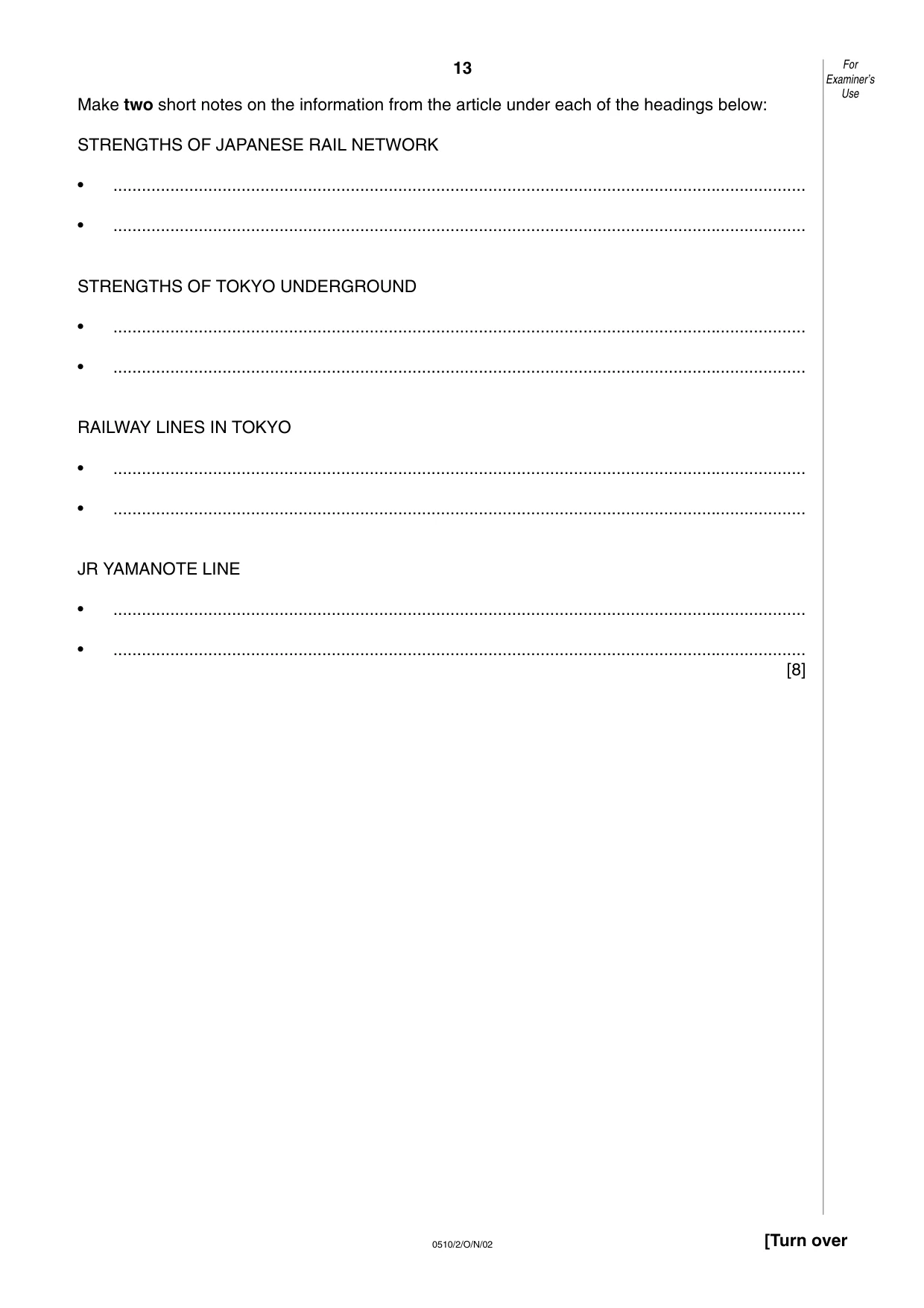
13 0510/2/O/N/02 [Turn over Make two short notes on the information from the article under each of the headings below: STRENGTHS OF JAPANESE RAIL NETWORK • … • … STRENGTHS OF TOKYO UNDERGROUND • … • … RAILWAY LINES IN TOKYO • … • … JR YAMANOTE LINE • … • … [8] For Examiner’s Use
Question paper, page 14
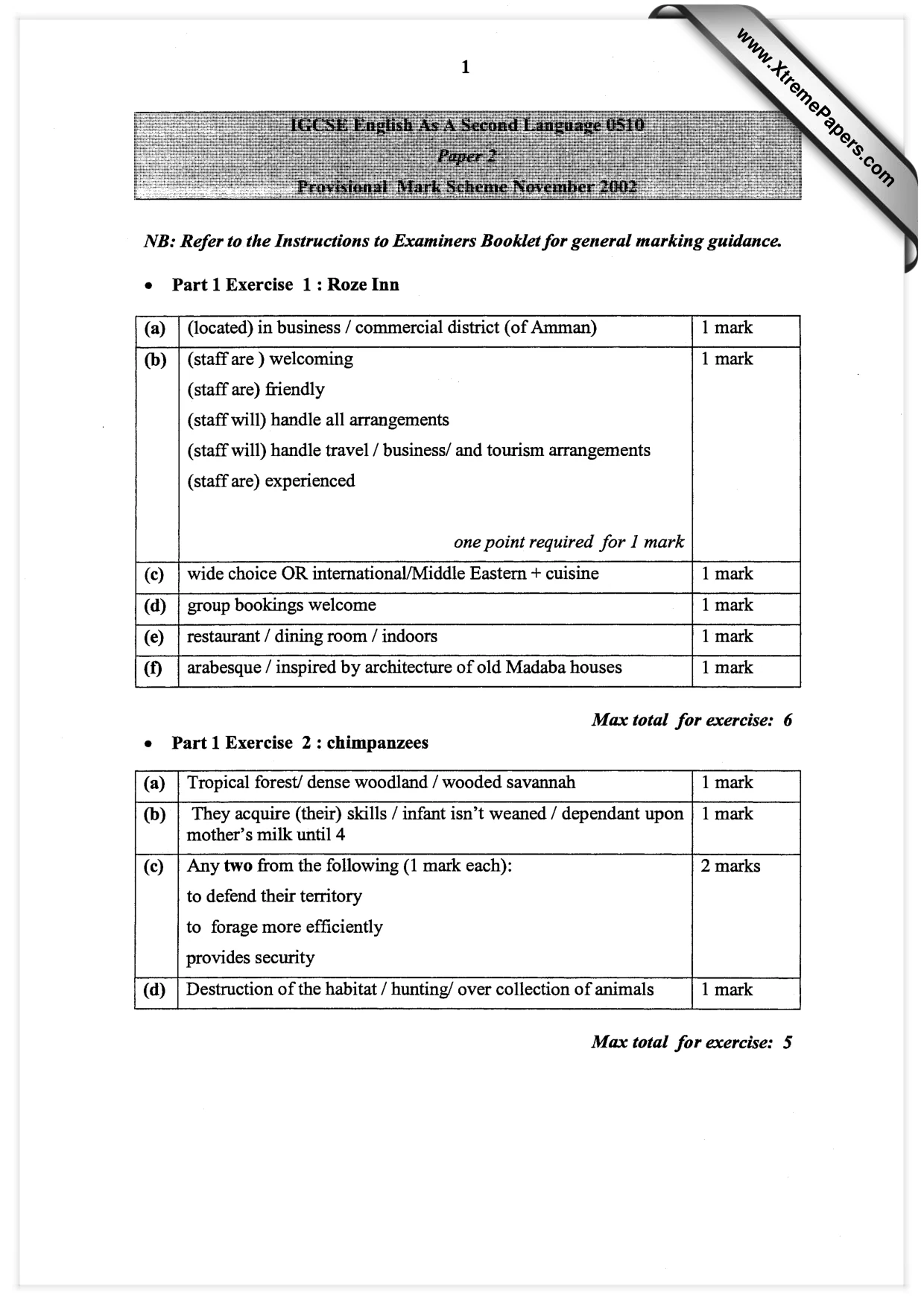
14 0510/2/O/N/02 Part 3 Part 3: Exercise 1 DID YOU SEE A UFO IN THE SKY LAST NIGHT? For our investigations we need a statement from everyone who thinks that they did. Please contact: Detective Inspector Smith at the Police Station, Main Street. Last night you saw an unidentified flying object (UFO) in the sky. You have been to see Detective Inspector Smith, and he has asked you to write an account of your experience. In your account you should: • say where you were and what you were doing when you saw the UFO • describe the UFO briefly (and say what you think the object was if it was not a spaceship) • say how you felt at the time. Your account should be about 150 words long.
Question paper, page 15
15 0510/2/O/N/02 [Turn over … … … … … … … … … … … … … … … … … … … … … … … … [12] For Examiner’s Use
Question paper, page 16
16 0510/2/O/N/02 Part 3: Exercise 2 You and your friends are very excited because a famous person from the world of music/film/fashion is coming to visit a local shopping centre. A number of people from the community, including a student, will be presented to the famous person. You desperately want to be that student. Write a letter to the organiser of the event, Ms Smith, to persuade her to select you. You should write about 200 words.
Question paper, page 17
17 0510/2/O/N/02 [Turn over Dear Ms Smith … … … … … … … … … … … … … … … … … … … … … … … … [12] For Examiner’s Use
Question paper, page 18
18 0510/2/O/N/02 Part 3: Exercise 3 Your school/college is planning to introduce compulsory sport/PE for all students, every day. Here are some comments from some students in your class: Write an article for your school/college magazine giving your views about the issue. The comments above may give you some ideas, but you are free to use any ideas of your own. Your article should be about 200 words long. “I can’t stand doing sport, especially team games.” “It’s great – we’ll all become much healthier because of this.” “A bad idea – we will lose vital time to prepare for exams!” “I don’t mind – just as long as we have a good choice of things to do.”
Question paper, page 19
19 0510/2/O/N/02 … … … … … … … … … … … … … … … … … … … … … … … … … [16] For Examiner’s Use
Question paper, page 20
20 0510/2/O/N/02 BLANK PAGE Copyright Acknowledgements: Part 1. Exercise 2 Wildlife Explorer. International Masters Publishers Ltd. Part 1. Exercise 3 The National Geographic. 2000 Part 2. Exercise 1 New Sunday Times. 2000 Part 2. Exercise 2 Sunday Style. 1998 Cambridge International Examinations has made every effort to trace copyright holders, but if we have inadvertently overlooked any we will be pleased to make the necessary arrangements at the first opportunity.
Mark scheme, page 1
NB: Refer to the Instructions to Examiners Booklet for general marking guidance. Part 1 Exercise 1: Roze Inn (a) | (located) in business / commercial district (of Amman) 1 mark (b) | (staff are ) welcoming 1 mark (staff are) friendly (staff will) handle all arrangements (staff will) handle travel / business/ and tourism arrangements (staff are) experienced one point required for 1 mark (c) | wide choice OR international/Middle Eastern + cuisine 1 mark (d) | group bookings welcome 1 mark (e) | restaurant / dining room / indoors | 1 mark (f) | arabesque / inspired by architecture of old Madaba houses 1 mark Max total for exercise: 6 Part 1 Exercise 2 : chimpanzees (a) | Tropical forest/ dense woodland / wooded savannah 1 mark (b) | They acquire (their) skills / infant isn’t weaned / dependant upon | 1 mark mother’s milk until 4 (c) | Any two from the following (1 mark each): 2 marks to defend their territory to forage more efficiently provides security (d) | Destruction of the habitat / hunting/ over collection of animals 1 mark Max total for exercise: 5
Mark scheme, page 2
Part 1 Exercise 3: The Tharus of Nepal (a) | Rajput men/their husbands had (all) been killed 1 mark (b) | outsiders would not enter OR because of mosquitos/malaria 1 mark (c) | walls: smooth/plastered / (they feel like) skin / mud and cow | 1 mark dung OR wood (d) | to thank / as present / for getting medicine 1 mark (e) | (because of) no value 1 mark (f) | malaria eradicated 1 mark (g) | removed the barrier to outsiders /to outside encroachment 1 mark Max. total for Part 1 =18 Max total for exercise: 7
Mark scheme, page 3
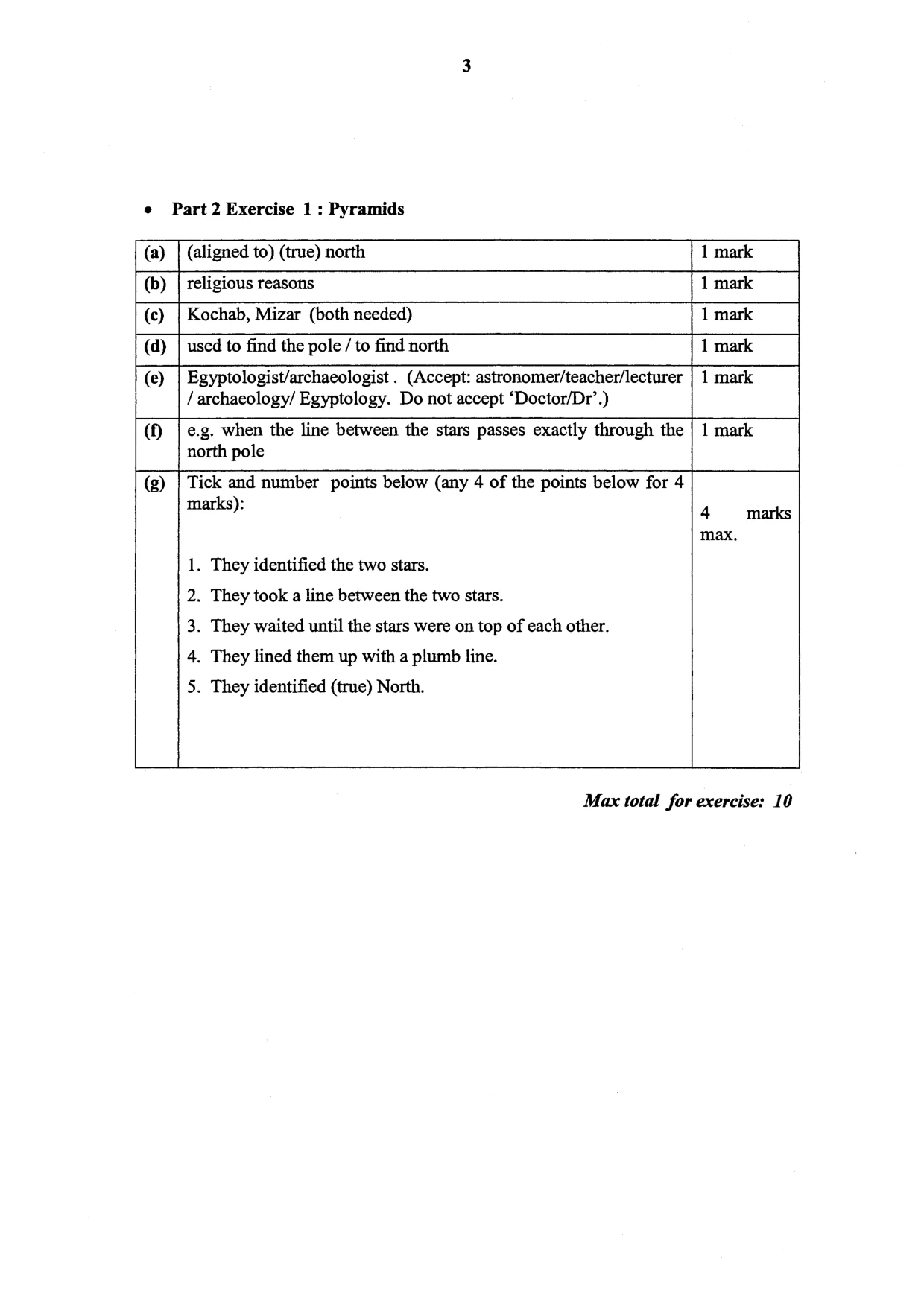
Part 2 Exercise 1 : Pyramids (a) | (aligned to) (true) north 1 mark (b) | religious reasons 1 mark (c) | Kochab, Mizar (both needed) 1 mark (d) | used to find the pole / to find north 1 mark (e) | Egyptologist/archaeologist . (Accept: astronomer/teacher/lecturer | 1 mark / archaeology/ Egyptology. Do not accept ‘Doctor/Dr’.) (f) | e.g. when the line between the stars passes exactly through the | 1 mark north pole (g) | Tick and number points below (any 4 of the points below for 4 marks): 4 marks max. 1. They identified the two stars. 2. They took a line between the two stars. 3. They waited until the stars were on top of each other. 4. They lined them up with a plumb line. 5. They identified (true) North. Max total for exercise: 10
Mark scheme, page 4
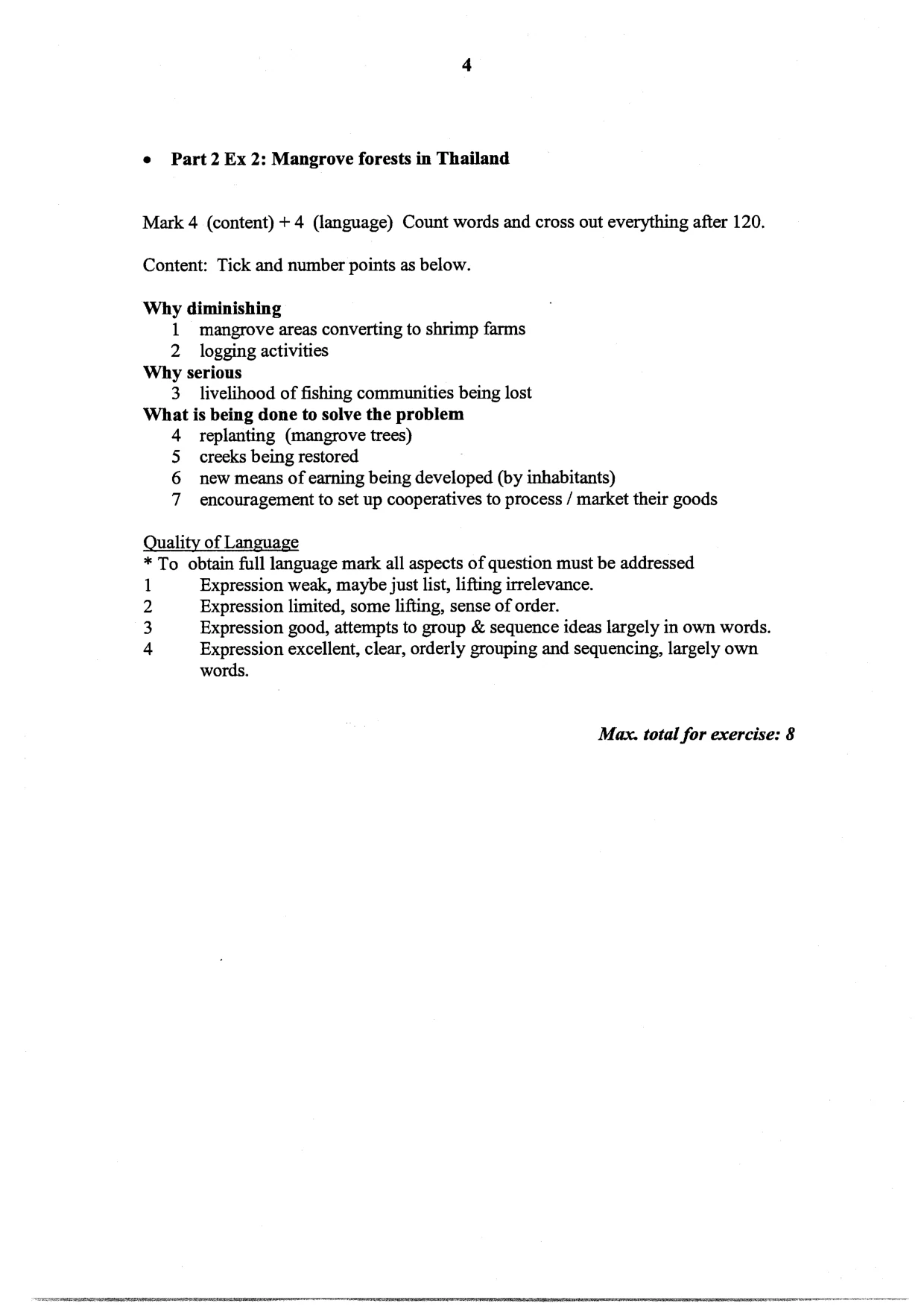
e Part 2 Ex 2: Mangrove forests in Thailand Mark 4 (content) + 4 (language) Count words and cross out everything after 120. Content: Tick and number points as below. Why diminishing 1 mangrove areas converting to shrimp farms 2 logging activities Why serious 3 livelihood of fishing communities being lost What is being done to solve the problem 4 replanting (mangrove trees) 5 creeks being restored 6 new means of earning being developed (by inhabitants) 7 encouragement to set up cooperatives to process / market their goods Quality of Language *To obtain full language mark all aspects of question must be addressed. 1 Expression weak, maybe just list, lifting irrelevance. 2 Expression limited, some lifting, sense of order. 3 Expression good, attempts to group & sequence ideas largely in own words. 4 Expression excellent, clear, orderly grouping and sequencing, largely own words. Max. total for exercise: 8
Mark scheme, page 5
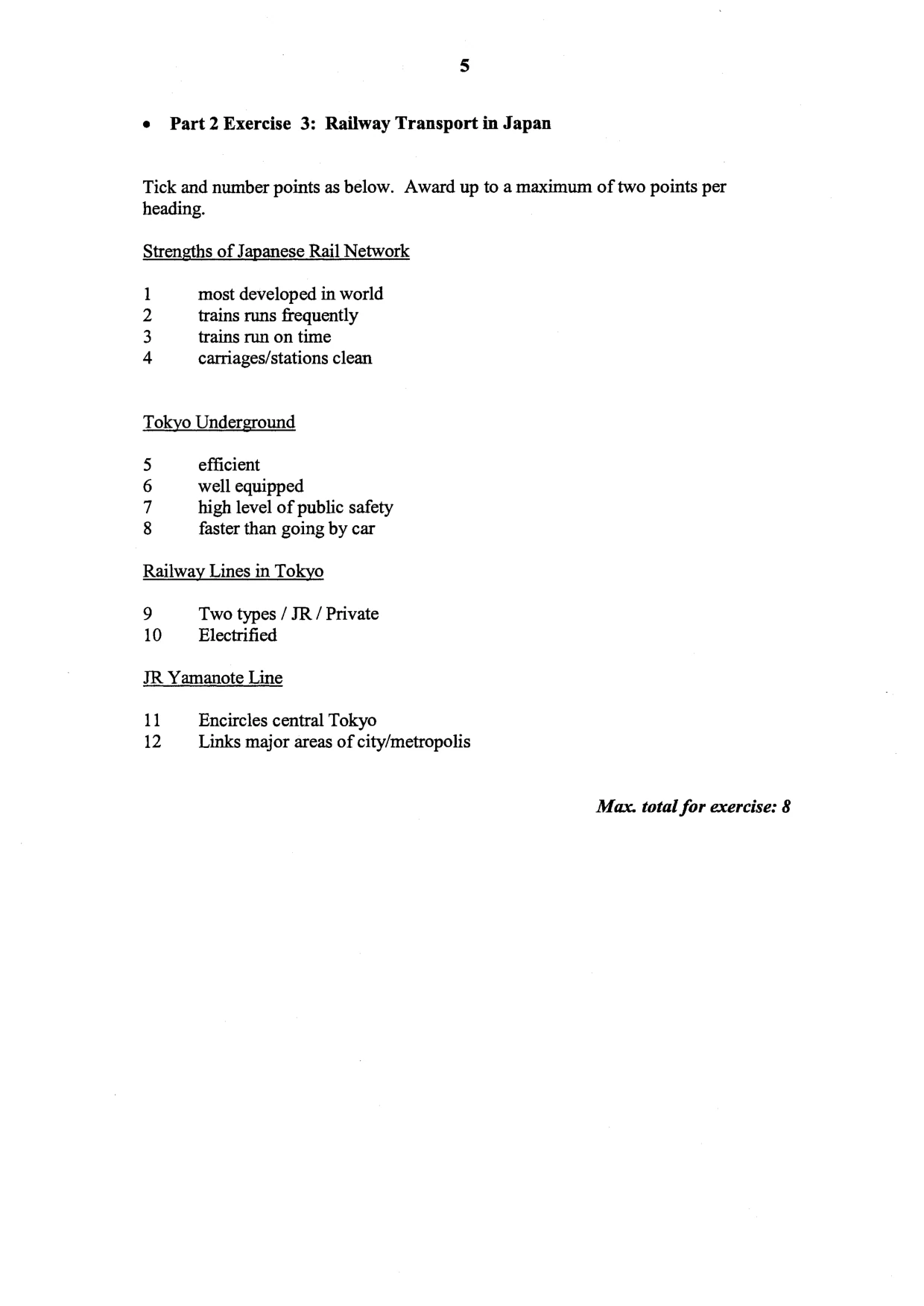
e Part 2 Exercise 3: Railway Transport in Japan Tick and number points as below. Award up to a maximum of two points per heading. Strengths of Japanese Rail Network most developed in world trains runs frequently trains run on time carriages/stations clean WN Tokyo Underground efficient well equipped high level of public safety faster than going by car OIAUH Railway Lines in Tokyo 9 Two types / JR / Private 10 Electrified JR Yamanote Line ll Encircles central Tokyo 12 Links major areas of city/metropolis Max. total for exercise: 8
Mark scheme, page 6
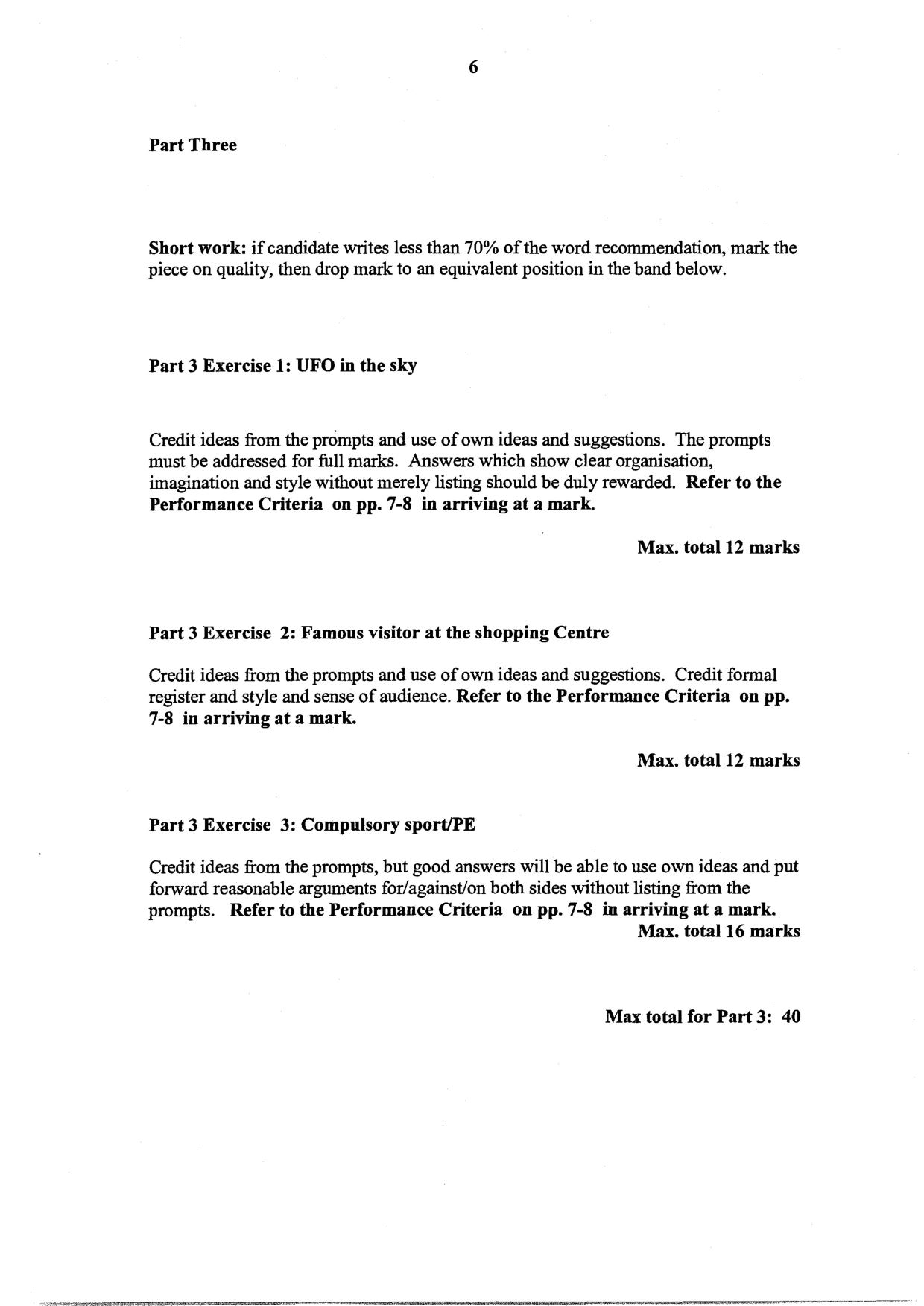
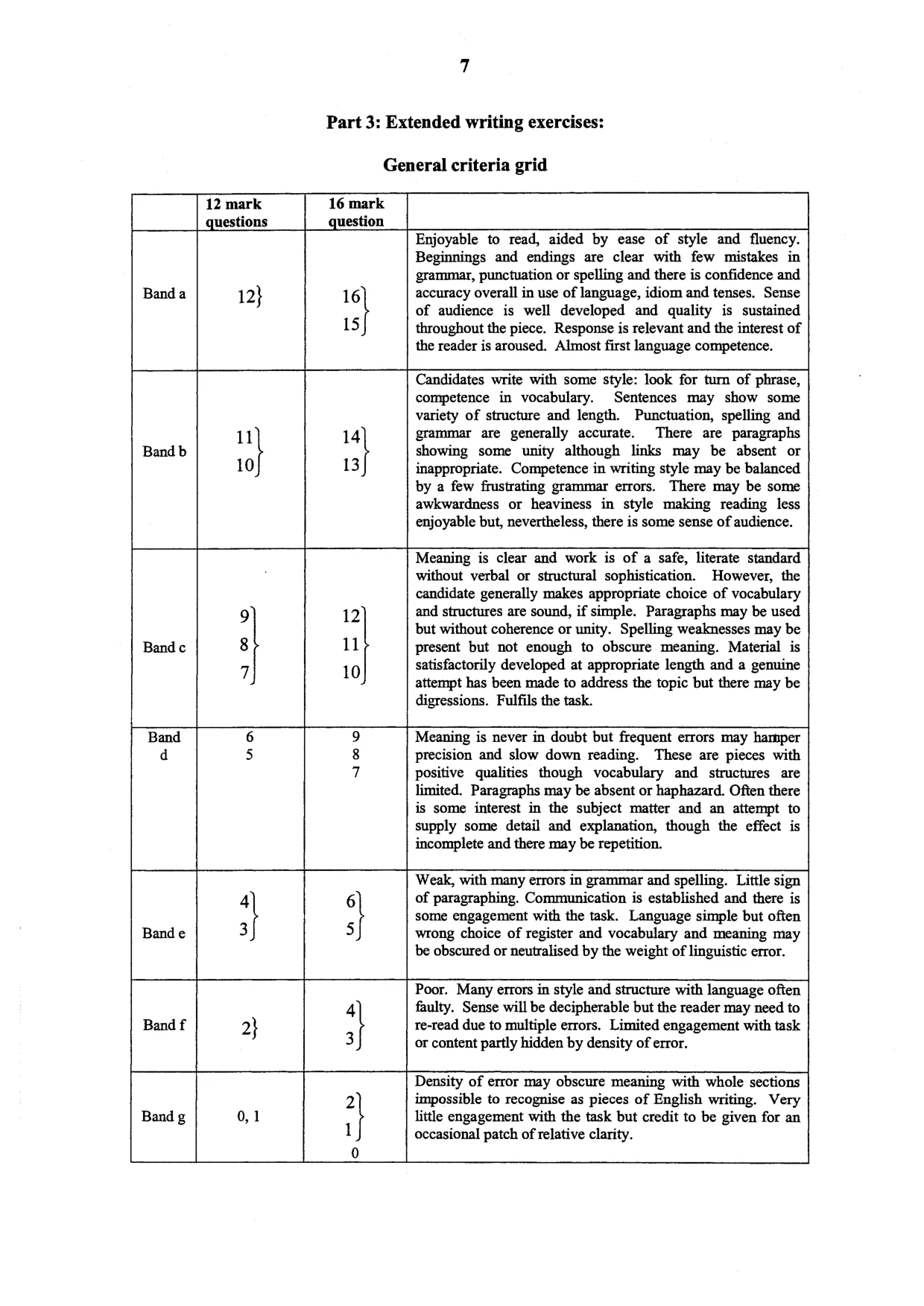
Part Three Short work: if candidate writes less than 70% of the word recommendation, mark the piece on quality, then drop mark to an equivalent position in the band below. Part 3 Exercise 1: UFO in the sky Credit ideas from the prompts and use of own ideas and suggestions. The prompts must be addressed for full marks. Answers which show clear organisation, imagination and style without merely listing should be duly rewarded. Refer to the Performance Criteria on pp. 7-8 in arriving at a mark. Max. total 12 marks Part 3 Exercise 2: Famous visitor at the shopping Centre Credit ideas from the prompts and use of own ideas and suggestions. Credit formal register and style and sense of audience. Refer to the Performance Criteria on pp. 7-8 in arriving at a mark. Max. total 12 marks Part 3 Exercise 3: Compulsory sport/PE Credit ideas from the prompts, but good answers will be able to use own ideas and put forward reasonable arguments for/against/on both sides without listing from the prompts. Refer to the Performance Criteria on pp. 7-8 in arriving at a mark. Max. total 16 marks Max total for Part 3: 40
Mark scheme, page 7
Part 3: Extended writing exercises: General criteria grid 12 mark questions 16 mark question Banda 12} | __ 16 15 Enjoyable to read, aided by ease of style and fluency. Beginnings and endings are clear with few mistakes in grammar, punctuation or spelling and there is confidence and accuracy overall in use of language, idiom and tenses. Sense of audience is well developed and quality is sustained throughout the piece. Response is relevant and the interest of the reader is aroused. Almost first language competence. Band b i 10 14 13 Candidates write with some style: look for turn of phrase, competence in vocabulary. Sentences may show some variety of structure and length. Punctuation, spelling and grammar are generally accurate. There are paragraphs showing some unity although links may be absent or inappropriate. Competence in writing style may be balanced by a few frustrating grammar errors. There may be some awkwardness or heaviness in style making reading less enjoyable but, nevertheless, there is some sense of audience. Band c 12 11 10 Meaning is clear and work is of a safe, literate standard without verbal or structural sophistication. However, the candidate generally makes appropriate choice of vocabulary and structures are sound, if simple. Paragraphs may be used but without coherence or unity. Spelling weaknesses may be present but not enough to obscure meaning. Material is satisfactorily developed at appropriate length and a genuine attempt has been made to address the topic but there may be digressions. Fulfils the task. Band Bande aan 00 Meaning is never in doubt but frequent errors may hamper precision and slow down reading. These are pieces with positive qualities though vocabulary and structures are limited. Paragraphs may be absent or haphazard. Often there is some interest in the subject matter and an attempt to supply some detail and explanation, though the effect is incomplete and there may be repetition. Weak, with many errors in grammar and spelling. Little sign of paragraphing. Communication is established and there is some engagement with the task. Language simple but often wrong choice of register and vocabulary and meaning may be obscured or neutralised by the weight of linguistic error. Band f Poor. Many errors in style and structure with language often faulty. Sense will be decipherable but the reader may need to re-read due to multiple errors. Limited engagement with task or content partly hidden by density of error. Band g Density of error may obscure meaning with whole sections impossible to recognise as pieces of English writing. Very little engagement with the task but credit to be given for an occasional patch of relative clarity.