Cambridge IGCSE English - Second Language (oral endorsement) 0510 — 2002 May/June Paper 3 · Variant 1
0510/31/M/J/02
The question paper and its mark scheme, free to read here and free to download. This is Cambridge’s own paper, exactly as it was sat.
Question paper8 pages


Mark scheme14 pages
Answers below. Sit the paper first if you are practising.
Paper as text
Question paper, page 1
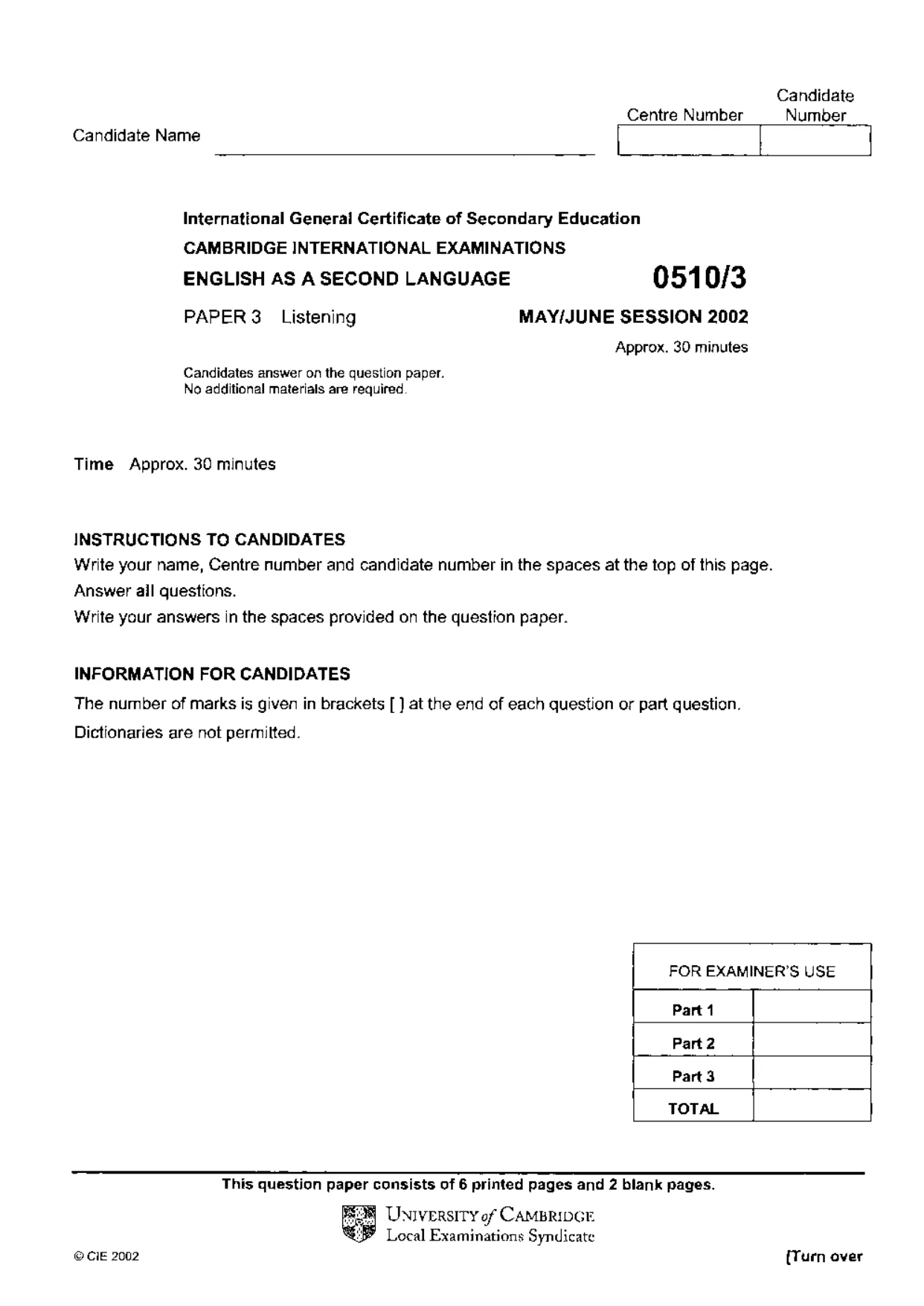
Candidate Centre Number Number Candidate Name International Generai Certificate of Secondary Education CAMBRIDGE INTERNATIONAL EXAMINATIONS ENGLISH AS A SECOND LANGUAGE 0510/3 PAPER 3 Listening MAY/JUNE SESSION 2002 Approx. 30 minutes Candidates answer on the question paper. No additional materials are required Time Approx. 30 minutes INSTRUCTIONS TO CANDIDATES Write your name, Centre number and candidate number in the spaces at the top of this page. Answer ail questions. Write your answers in the spaces provided on the question paper. INFORMATION FOR CANDIDATES The number of marks is given in brackets [ ] at the end of each question or part question. Dictionaries are not permilted. FOR EXAMINER’S USE TOTAL This question paper consists of 6 printed pages and 2 blank pages. UNIVERSITY of CAMBRIDGE Local Examinations Syndicate © CIE 2002 {Turn over
Question paper, page 2
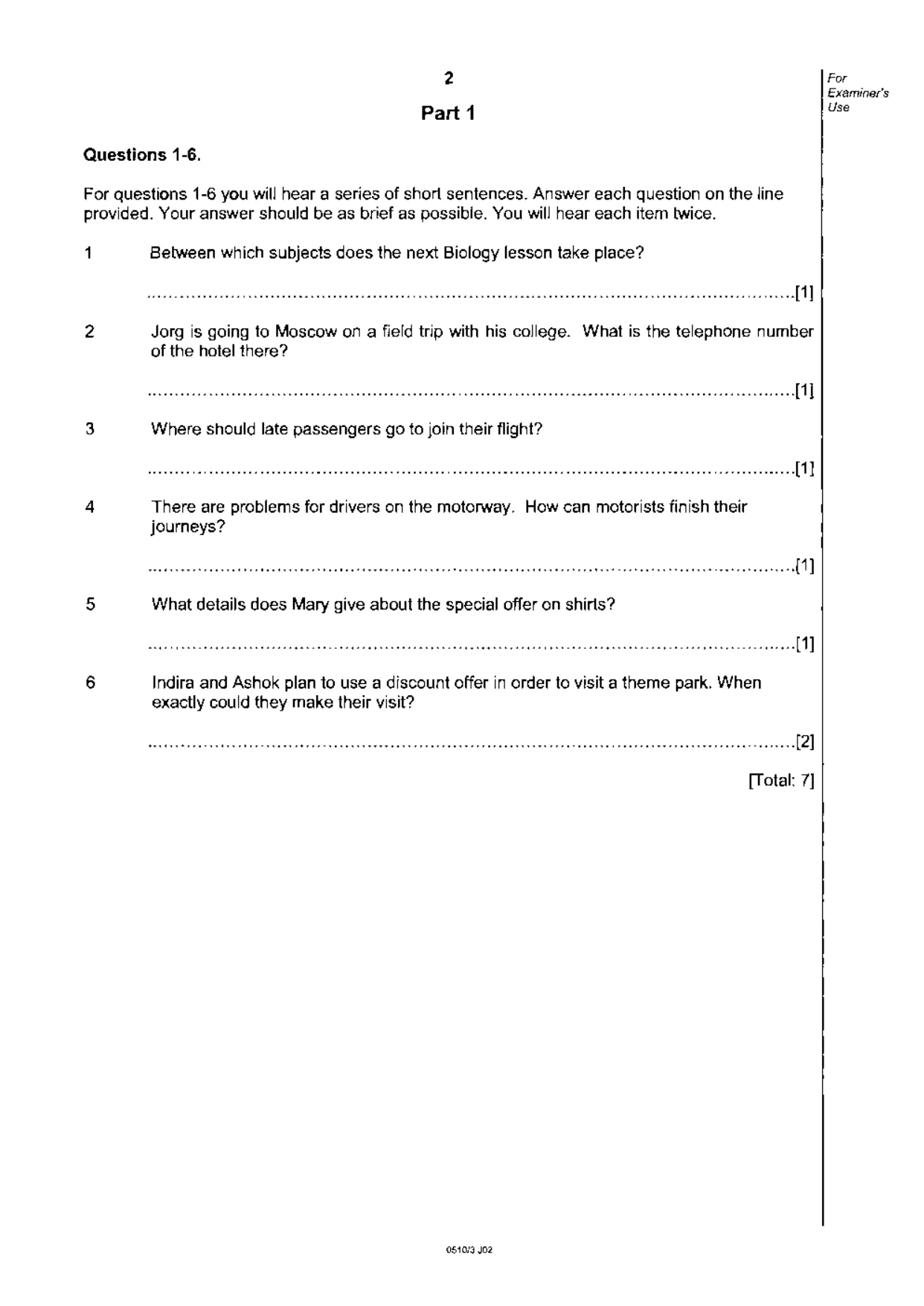
Part 1 Questions 1-6. For questions 1-6 you will hear a series of shorl sentences. Answer each question on the line provided. Your answer should be as brief as possible. You will hear each item twice. 1 Between which subjects does the next Biology lesson take place? Jorg is going to Moscow on a field trip with his college. What is the telephone number of the hotel there? ceveecessusscavacstssssaustvssasssscasaeseeasaseceasuessteatatsssessatieessusseeatsseatersssciteetsstscneatsered [1] Where should late passengers go to join their flight? ceetecsesaeseueesescusesensnsnesessaesessesceeeseeseseesuesesasaesesseseceesuesessasaesensrasesenssseesesaeenes ey [1] There are problems for drivers on the motorway. How can motorists finish their journeys? ceeteceretecevsaeeeetestecetestheetaas¢eeseetsettactertestcepvestecsteetertratectcretestoatteetesteretsetaeeseesal {1] What details does Mary give about the special offer on shirls? cece ycceceseeapeeeeeseceeeccaecceaesepeeeeseneyeeceeeigeccussseeesaeceecseseccueeeccapcacesepeapecceseeesees (1] Indira and Ashok plan to use a discount offer in order to visit a theme park. When exactly could they make their visit? ses tevbeeececdaneteecuseeecheneccevauecerenaeeecreaereeurersesenacecers serecsiaececsnaesecererseccrrtareeceeetess [2] [Total: 7] 0510'3 Jo2 For Examiner's Use
Question paper, page 3
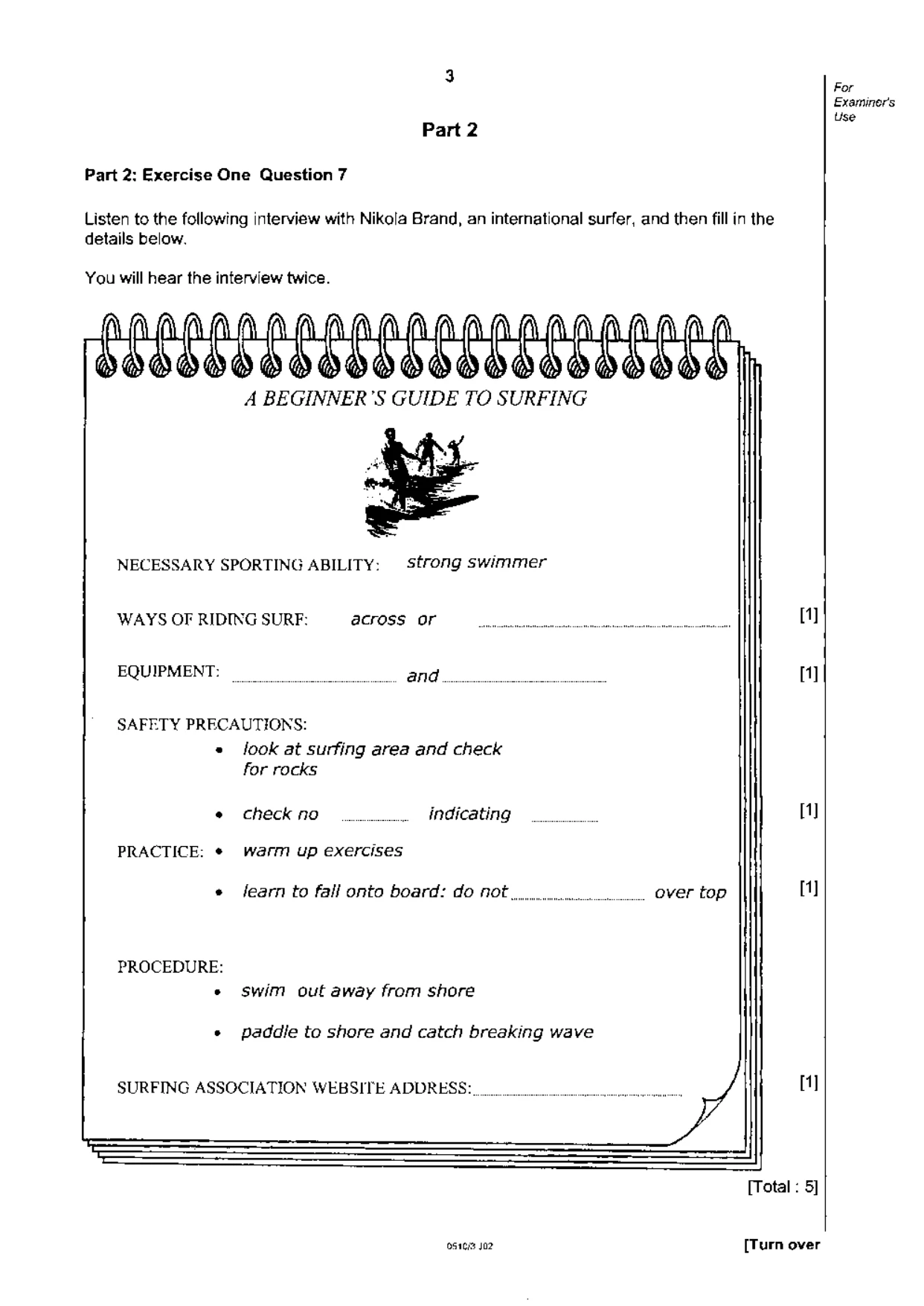
For Examiner's use Part 2 Part 2: Exercise One Question 7 Listen to the following interview with Nikola Brand, an international surfer, and then fill in the You will hear the interview twice. fl @ @ details below. GHOBDODBDO™ OO ODOOOOOOOOO@ y YG in A BEGINNER'S GUIDE TO SURFING . @ iy g Ny NECESSARY SPORTING ABILITY: strong swimmer WAYS OF RIDING SURF: across or [1] EQUIPMENT: _ [1] and... SAFETY PRECAUTIONS: * look at surfing area and check for rocks ¢ check no wun dndicating 11) PRACTICE: ¢ warm up exercises learn to fall onto board: do noi _. over top 11] PROCEDURE: ¢ swim out away from shore paddle to shore and catch breaking wave SURFING ASSOCIATION WEBSITE ADDRESS: i) [Total : 5] saci 402 [Turn over
Question paper, page 4
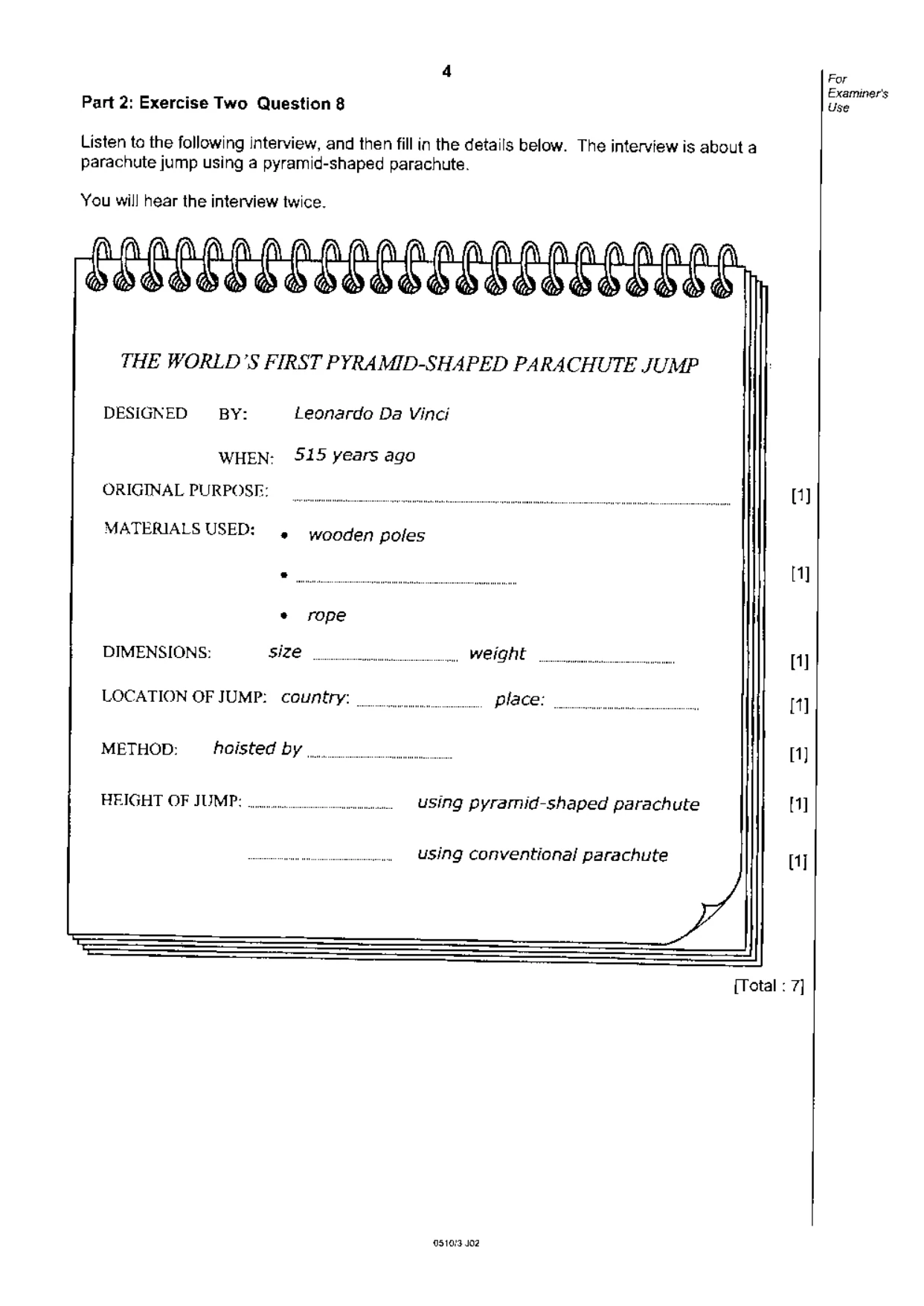
Part 2: Exercise Two Question 8 Listen to the following interview, and then fill in the details below. The interview is about a parachute jump using a pyramid-shaped parachute. You will hear the interview twice. THE WORLD'S FIRST PYRAMID-SHAPED PARACHUTE JUMP. DESIGNED BY: Leonardo Da Vinci WHEN: 515 years ago ORIGINAL PURPOSE: MATERIALS USED: , wooden poles * rope DIMENSIONS: SIZE LOCATION OF JUMP: country: METHOD: hoisted by HEIGHT OF JUMP: woccoccnnnmnmmnne USING pyramid-shaped parachute using conventional parachute (1] 11] [1] {] i} 0510:3 402 {Total : 7] For Examiner's Use
Question paper, page 5
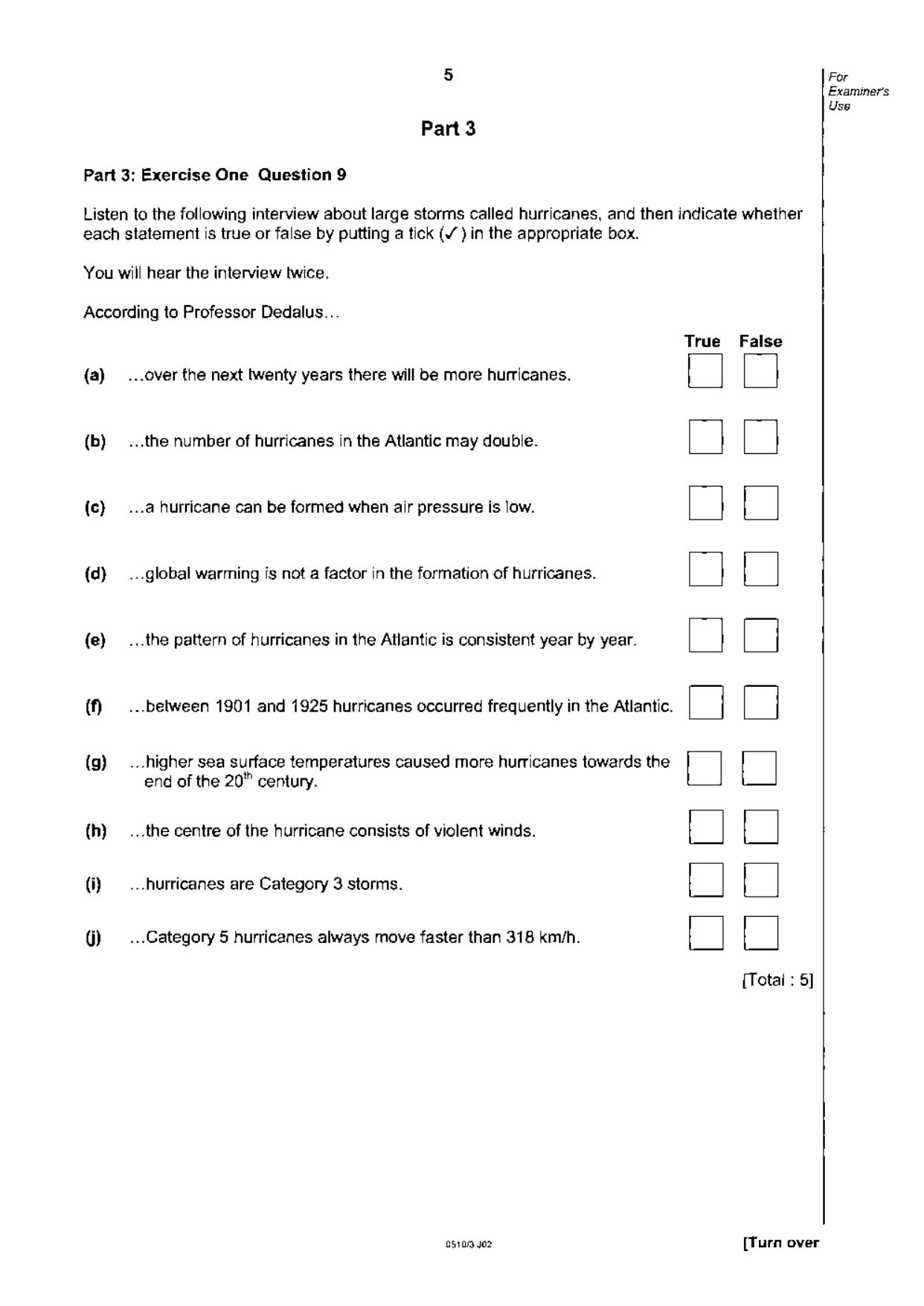
5 For Examiner's Use Part3 Part 3; Exercise One Question 9 Listen to the following interview about large storms called hurricanes, and then indicate whether each statement is true or false by putting a tick (¥ ) in the appropriate box. You will hear the interview twice. According to Professor Dedalus... True False (a) ...over the next twenty years there will be more hurricanes. (b) _ ...the number of hurricanes in the Atlantic may double. (c} ...a hurricane can be formed when air pressure is low. | (d} —...global warming is not a factor in the formation of hurricanes. (e) _ ...the pattern of hurricanes in the Atlantic is consistent year by year. (f) ...between 1901 and 1925 hurricanes occurred frequently in the Atlantic. (g) _...higher sea surface temperatures caused more hurricanes towards the end of the 20" century. L_] (h) _...the centre of the hurricane consists of violent winds. (i) ...hurricanes are Category 3 storms. (j) _ ...Category 5 hurricanes always move faster than 318 km/h. {Total : 5] 510% Jo2 [Turn over
Question paper, page 6
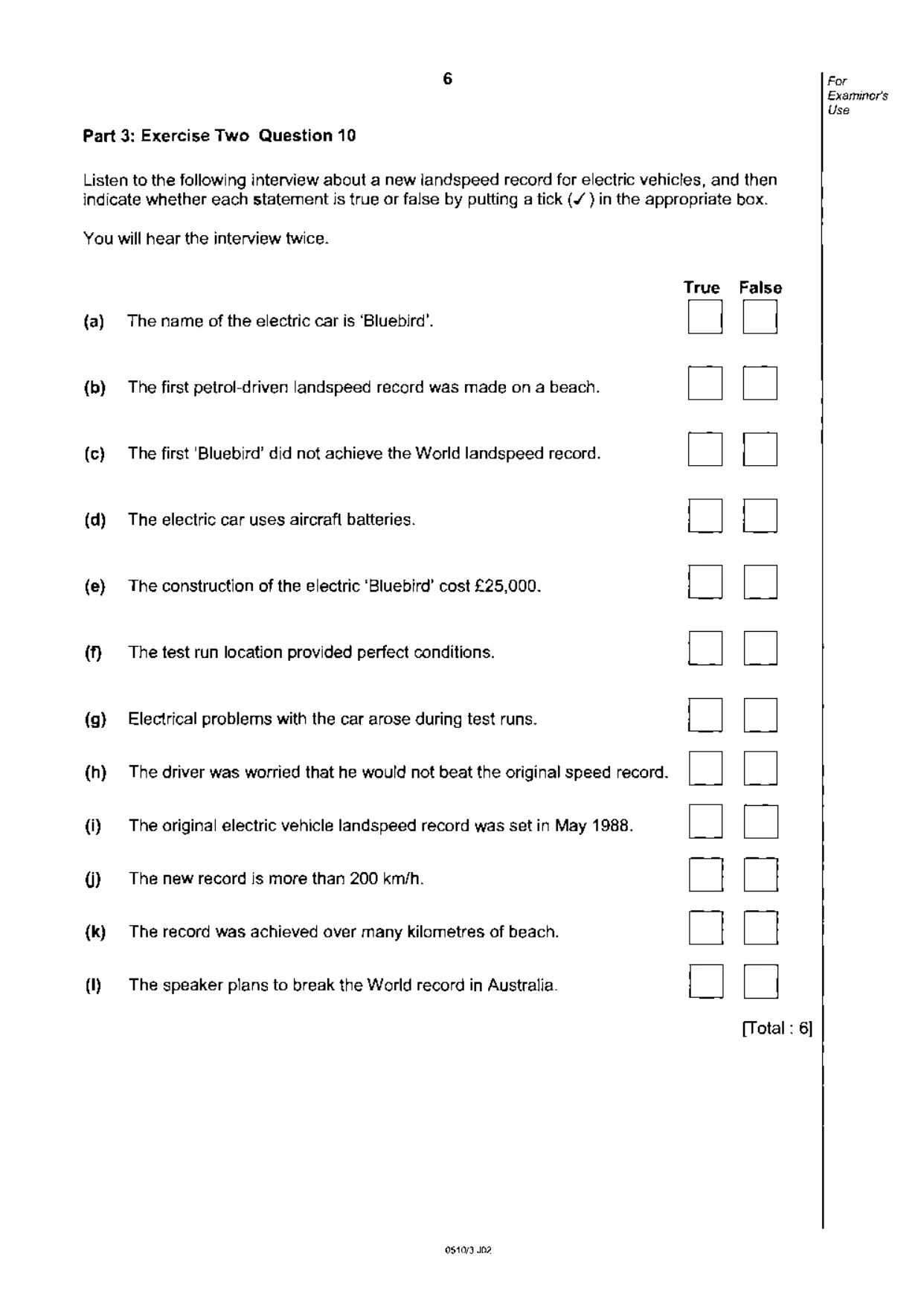
Part 3: Exercise Two Question 10 Listen to the following interview about a new landspeed record for electric vehictes, and then indicate whether each statement is true or false by putting a tick (¥ ) in the appropriate box. You will hear the interview twice. (a) (b) (c} (d) (e} tu} (g) (h) (i) a) {k) ) The name of the electric car is ‘Bluebird’. The first petrol-driven landspeed record was made on a beach. The first ‘Bluebird’ did not achieve the World landspeed record. The electric car uses aircrafi batteries. The construction of the electric ‘Bluebird’ cost £25,000. The test run location provided perfect conditions. Electrical problems with the car arose during test runs. The driver was worried that he would not beat the original speed record. The original electric vehicle landspeed record was set in May 1988. The new record is more than 200 km/h. The record was achieved over many kilometres of beach. The speaker plans to break the World record in Australia. 0540/9 J02 True False PI LILI [Total : 6] For Examiner's Use
Mark scheme, page 1
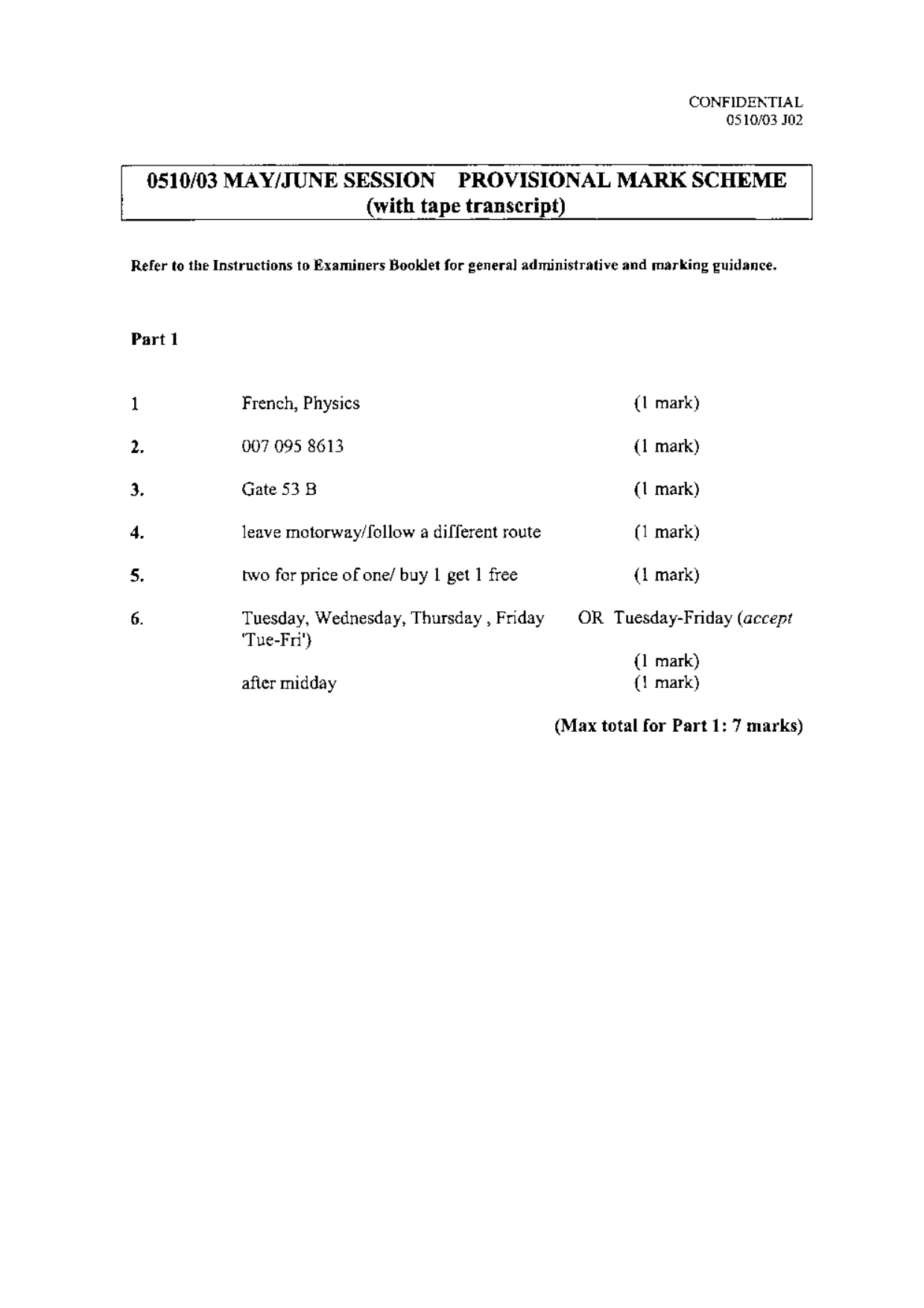
CONFIDENTIAL 0510/03 JO2 0510/03 MAY/JUNE SESSION PROVISIONAL MARK SCHEME (with tape transcript) Refer to the Instructions to Examiners Booklet for genera] administrative and marking guidance, Part 1 French, Physics 007 095 8613 Gate 53 B leave motorway/Tollow a different route two for price of one/ buy | get 1 free Tuesday, Wednesday, Thursday , Friday ‘Tue-Fri'} afler midday {1 mark) {1 mark) {1 mark) (1 mark) {1 mark) OR Tuesday-Friday (accept {1 mark) {1 mark) (Max total for Part 1: 7 marks)
Mark scheme, page 2
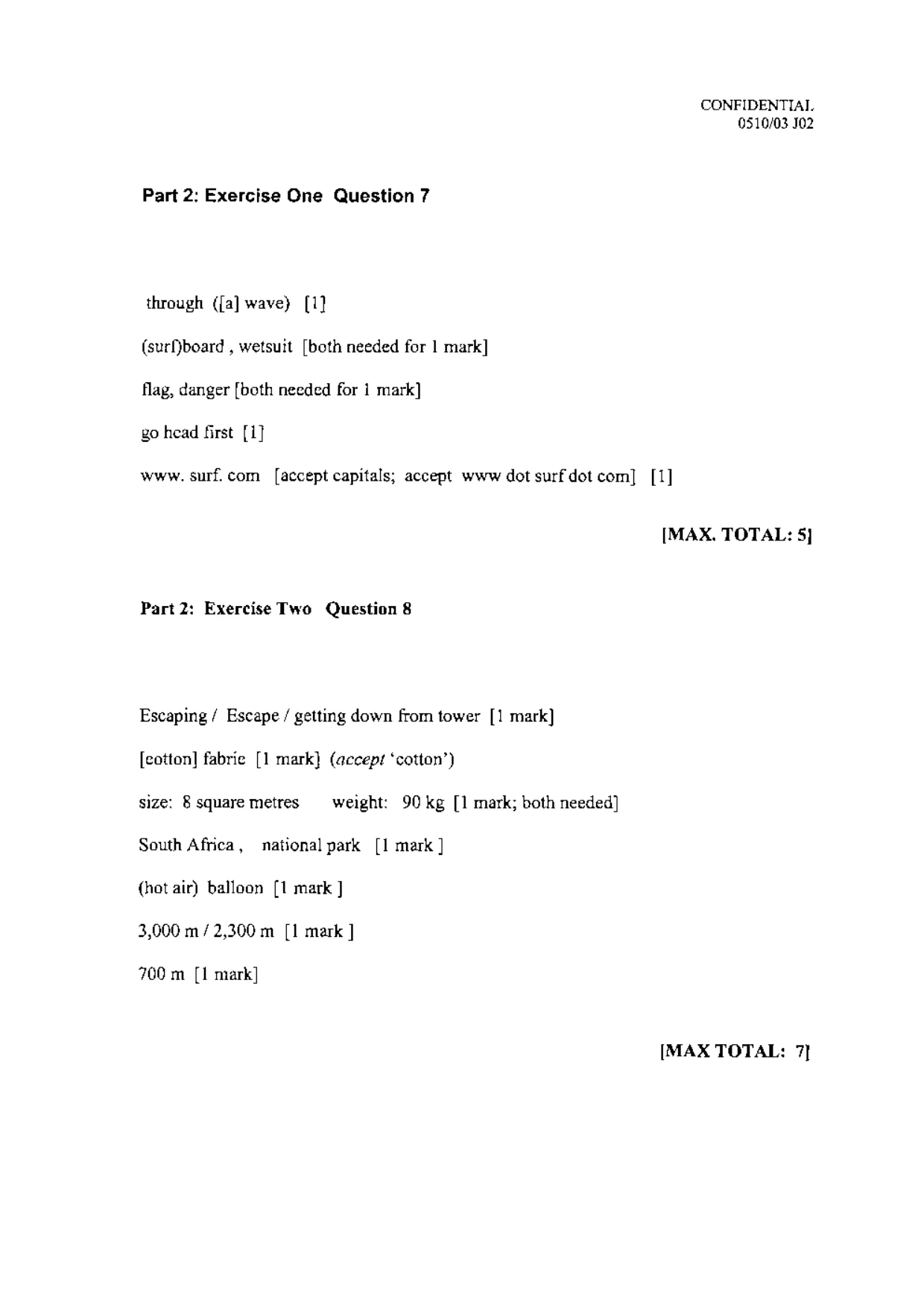
CONFIDENTIAI. 0510/03 JO2 Part 2: Exercise One Question 7 through ({a] wave) [1] (surfboard , wetsuit [both needed for 1 mark] flag, danger [both needed for i mark] go head first [1] www. surf.com [accept capitals; accept www dot surfdot com] [1] [MAX. TOTAL: 5] Part 2: Exercise Two Question 8 Escaping / Escape / getting down from tower [1 mark] [cotton] fabrie [1 mark} (accept ‘cotton’) size: 8 square metres weight: 90 kg [1 mark; both needed] South Africa, national park [1 mark ] (hot air) balloon [1 mark J 3,000 m / 2,300 m [1 mark ] 700 m [1 mark] [MAX TOTAL: 7|
Mark scheme, page 3
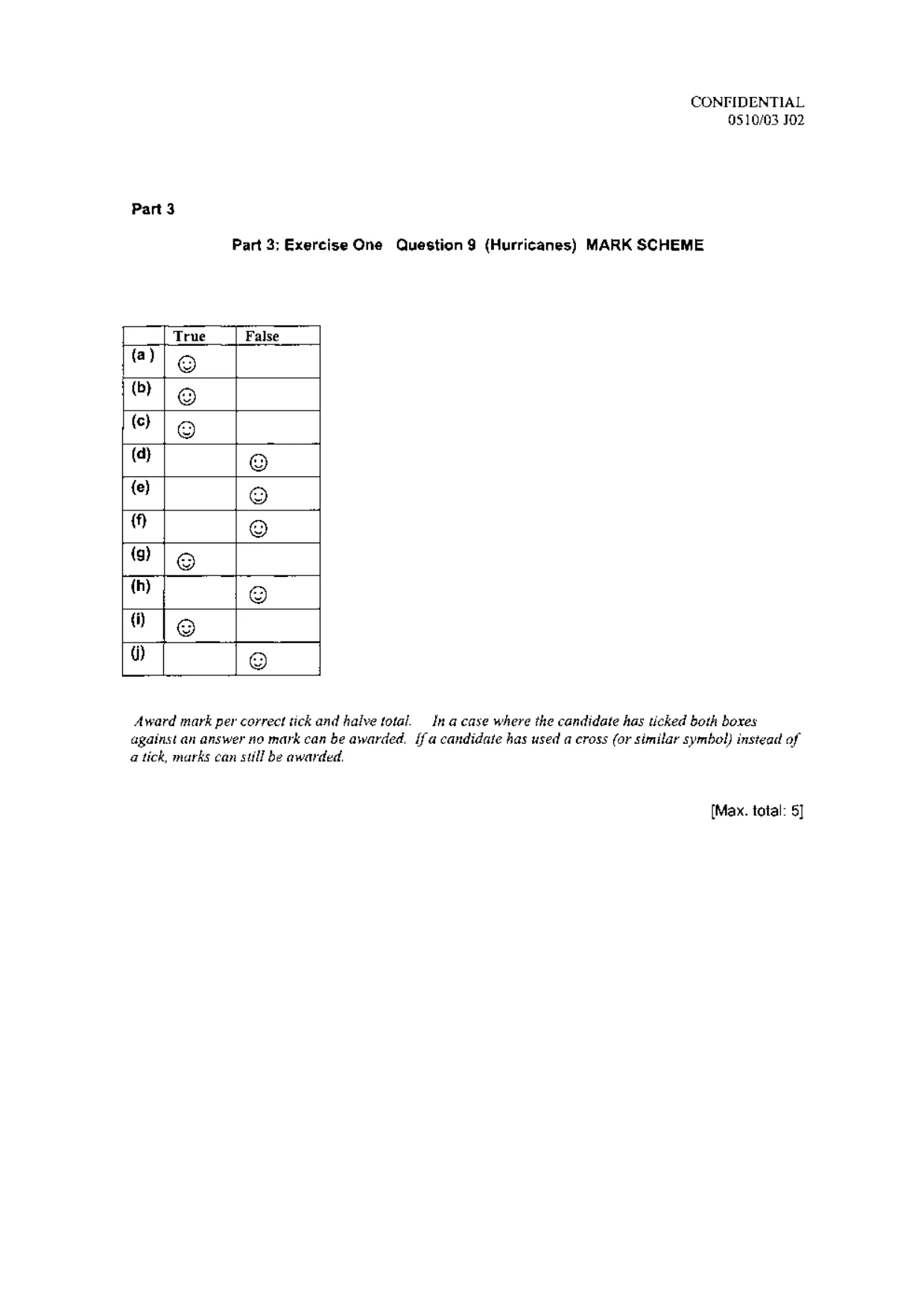
CONFIDENTIAL 0510/03 JO2 Part 3; Exercise One Question 9 (Hurricanes) MARK SCHEME Part 3 True False (a) ro) © (c} © (a) © {e} ro) {f} ro) {g) (e) {hy re) (i) 0) © Award mark per correct tick and haive total. Ina case where the candidate has ticked both boxes against an answer no mark can be awarded. if a candidate has used a cross (or similar symbol) instead of a tick, marks can still be awarded. [Max. total: 5]
Mark scheme, page 4
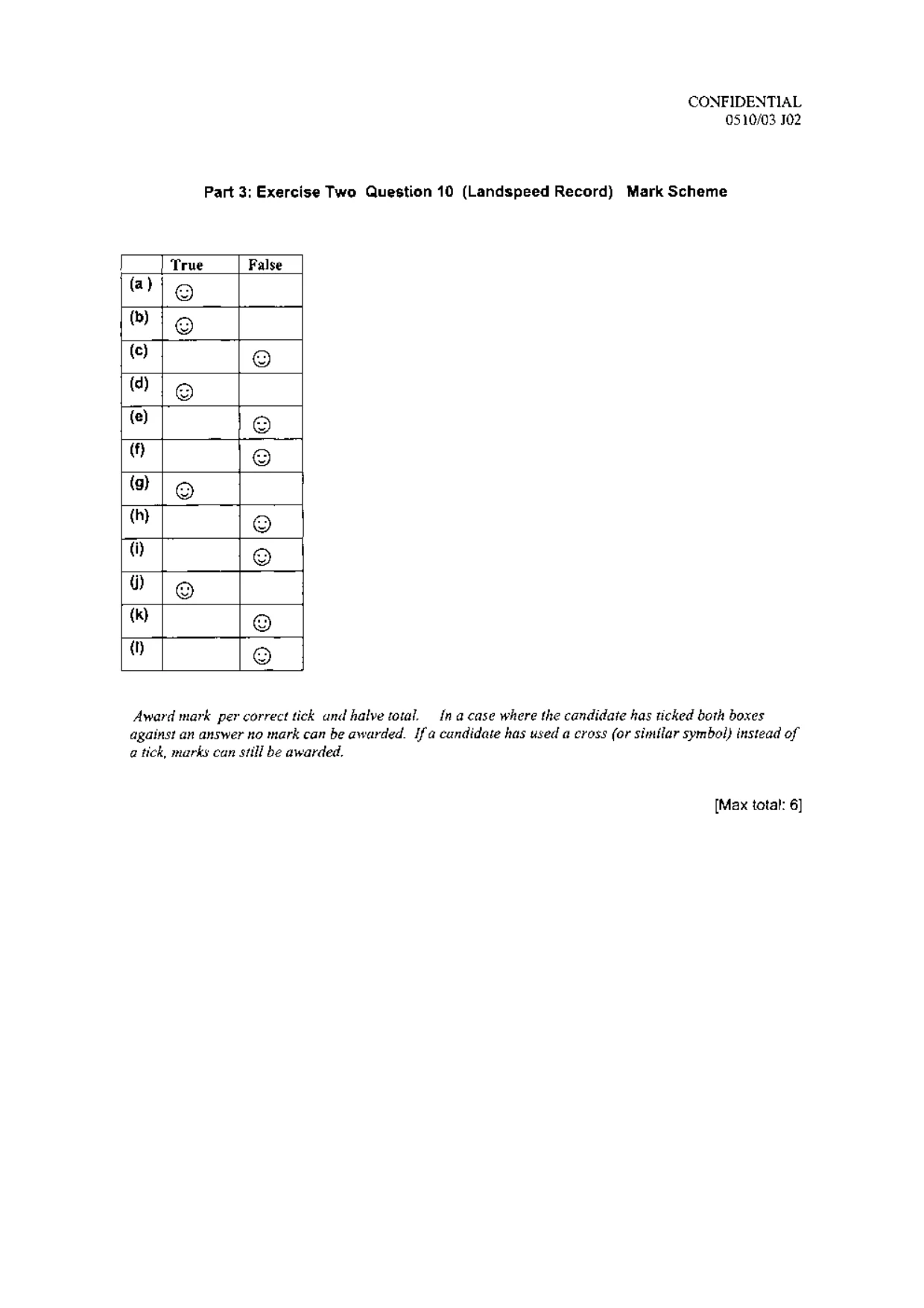
CONFIDENTIAL 0510/03 JO2 Part 3: Exercise Two Question 10 (Landspeed Record) Mark Scheme True False (a) a) (b) © (c) © (d) Q (e) ie) (f © (g} @ (h} © (i) Q ) © (k) © (0) © Award mark per correct tick and halve total. Ina case where the candidate has ticked both boxes against an answer no mark can be awarded. If a candidate has used a cross (or similar symbol) instead of @ tick, marks can still be awarded, [Max total: 6]
Mark scheme, page 5
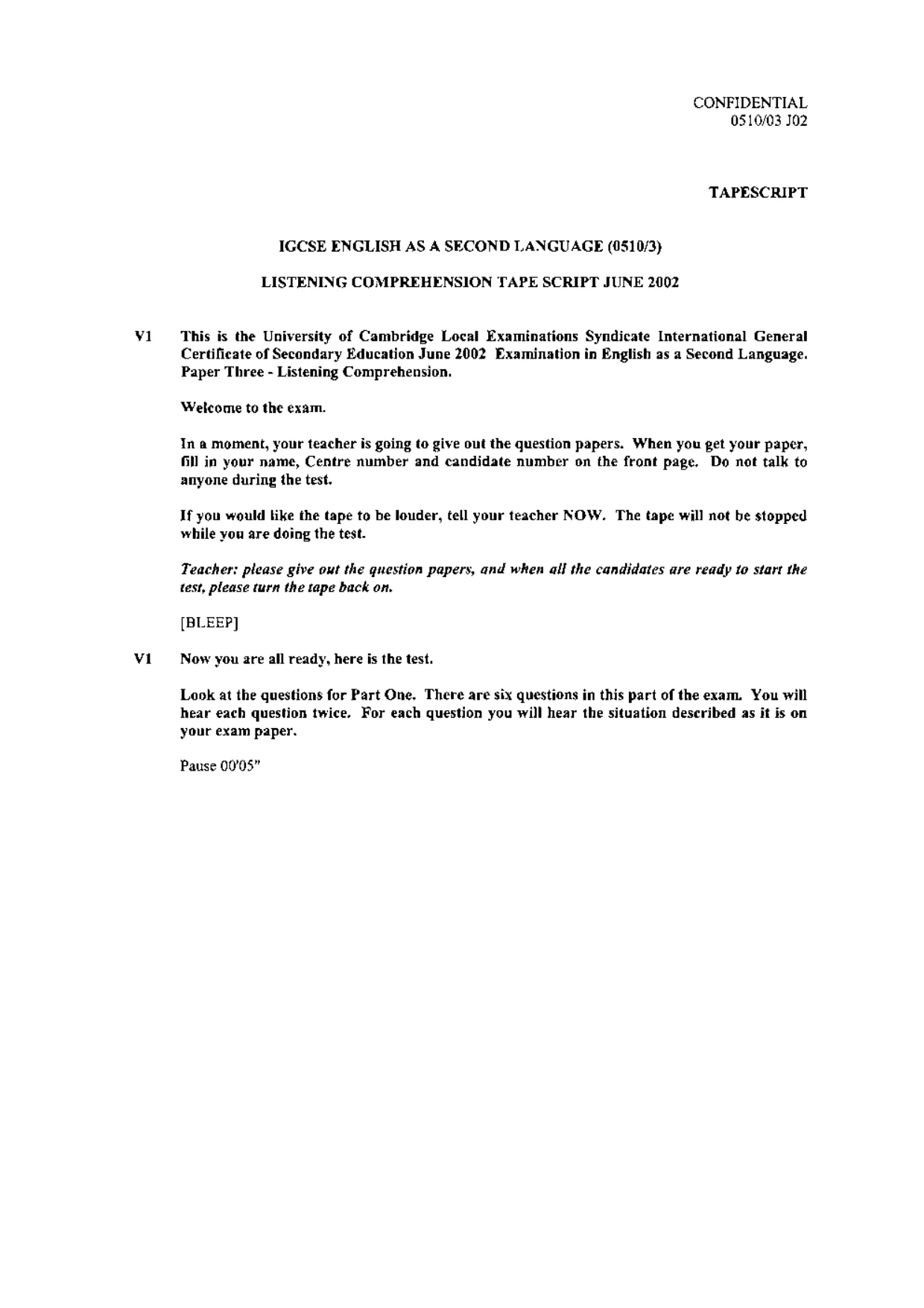
yi Vi CONFIDENTIAL 0510/03 JO2 TAPESCRIPT IGCSE ENGLISH AS A SECOND LANGUAGE (0510/3) LISTENING COMPREHENSION TAPE SCRIPT JUNE 2002 This is the University of Cambridge Local Examinations Syndicate International General Certificate of Secondary Education June 2002 Examination in English as a Second Language. Paper Three - Listening Comprehension. Welcome to the exam. In a moment, your teacher is going to give out the question papers. When you get your paper, Hil in your name, Centre number and candidate number on the front page. Do not talk to anyone during the test. If you would like the tape to be louder, tell your teacher NOW. The tape will not be stopped while you are doing the test. Teacher: please give out the question papers, and when all the candidates are ready to start the test, please turn the tape back on. [BLEEP] Now you are all ready, here is the test. Look at the questions for Part One, There are six questions in this part of the exam. You will hear each question twice. For each question you will hear the situation described as it is on your exam paper. Pause 00'05”
Mark scheme, page 6
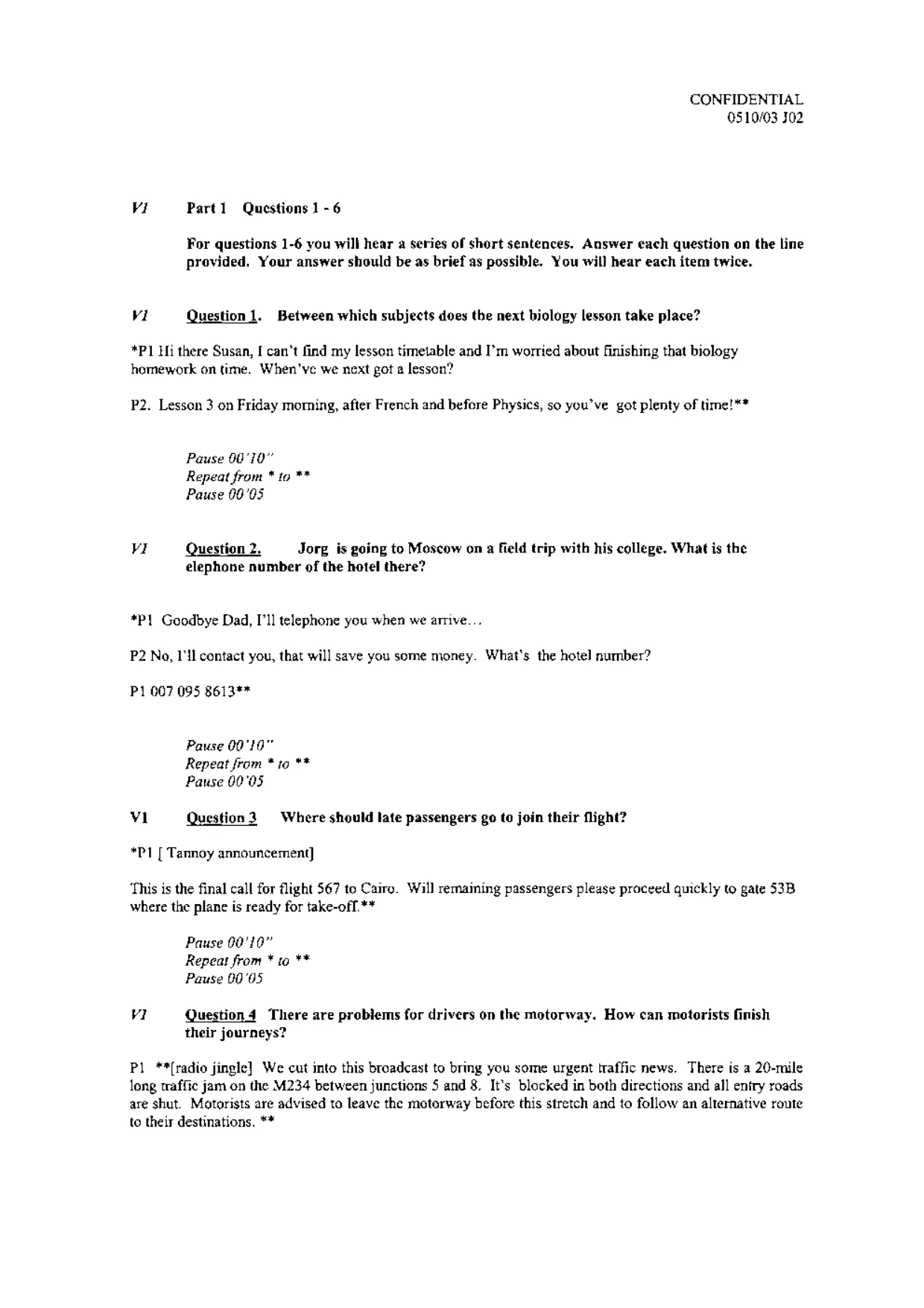
CONFIDENTIAL 0510/03 302 Vi Part1 Questions 1-6 For questions 1-6 you will hear a series of short sentences, Answer each question on the line provided. Your answer should be as brief as possible. You will hear each item twice. vi Question 1. Between which subjects does the next biology lesson take place? *P1 Hi there Susan, [ can't find my lesson timetable and I’m worried about finishing that biology homework on time. When've we next got a lesson? P2. Lesson 3 on Friday morning, after French and before Physics, so you’ve got plenty of time!** Pause 00'10" Repeat from * to ** Pause 00'05 VI Question 2. Jorg is going to Moscow on a field trip with his college. What is the elephone number of the hotel there? *P1 Goodbye Dad, I’ll telephone you when we arrive... P2 No, I'll contact you, that will save you some money. What's the hotel number? Pi 007 095 8613** Pause 00°10" Repeat from * ta ** Pause 00°05 vi Question 3 Where should late passengers go to join their flight? *P1 [ Tannoy announcement] ‘This is the final call for flight 567 to Cairo. Will remaining passengers please proceed quickly to gate 53B where the plane is ready for take-off.** Pause 00°10” Repeat from * to ** Pause 00’05 vi Question 4 There are probiems for drivers on the motorway. How can motorists finish their journeys? Pl **(radio jingle] We cut into this broadcast to bring you some urgent traffic news. There is a 20-mile long traffic jam on the M234 between junctions 5 and 8. It's blocked in both directions and all entry roads are shut. Motorists are advised to leave the motorway before this stretch and to follow an alternative route to their destinations, **
Mark scheme, page 7
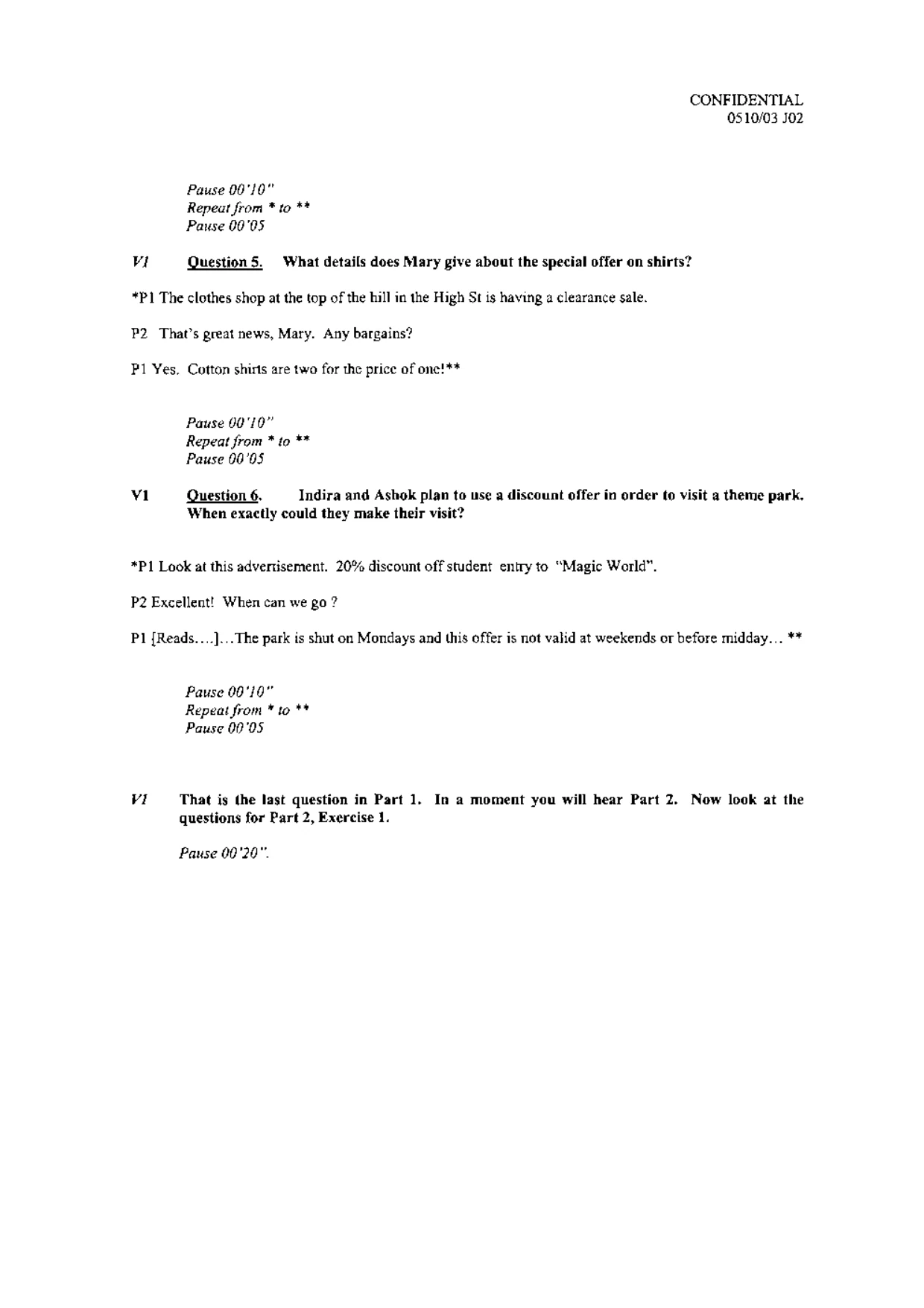
Vi CONFIDENTIAL 0510/03 JO2 Pause 00°10" Repeat from * to ** Pause 00°05 Question 5. What details does Mary give about the special offer on shirts? *P1 The clothes shop at the top of the hill in the High St is having a clearance sale. P2 That's great news, Mary. Any bargains? P1 Yes. Cotton shirts are two for the price of one!** Yi Pause 00°10” Repeat from * to ** Pause 00'05 Question 6. Indira and Ashok plan to use a discount offer in order to visit a theme park, When exactly could they make their visit? *P1 Look at this advertisement. 20% discount off student entry to “Magic World”. P2 Excellent! When can we go ? P1 {Reads…]... The park is shut on Mondays and this offer is not valid at weekends or before midday... ** VI Pause 00°10" Repeat from * to ** Pause 09 '0S That is the last question in Part 1. In a moment you will hear Part 2. Now look at the questions for Part 2, Exercise 1. Pause 00'20".
Mark scheme, page 8
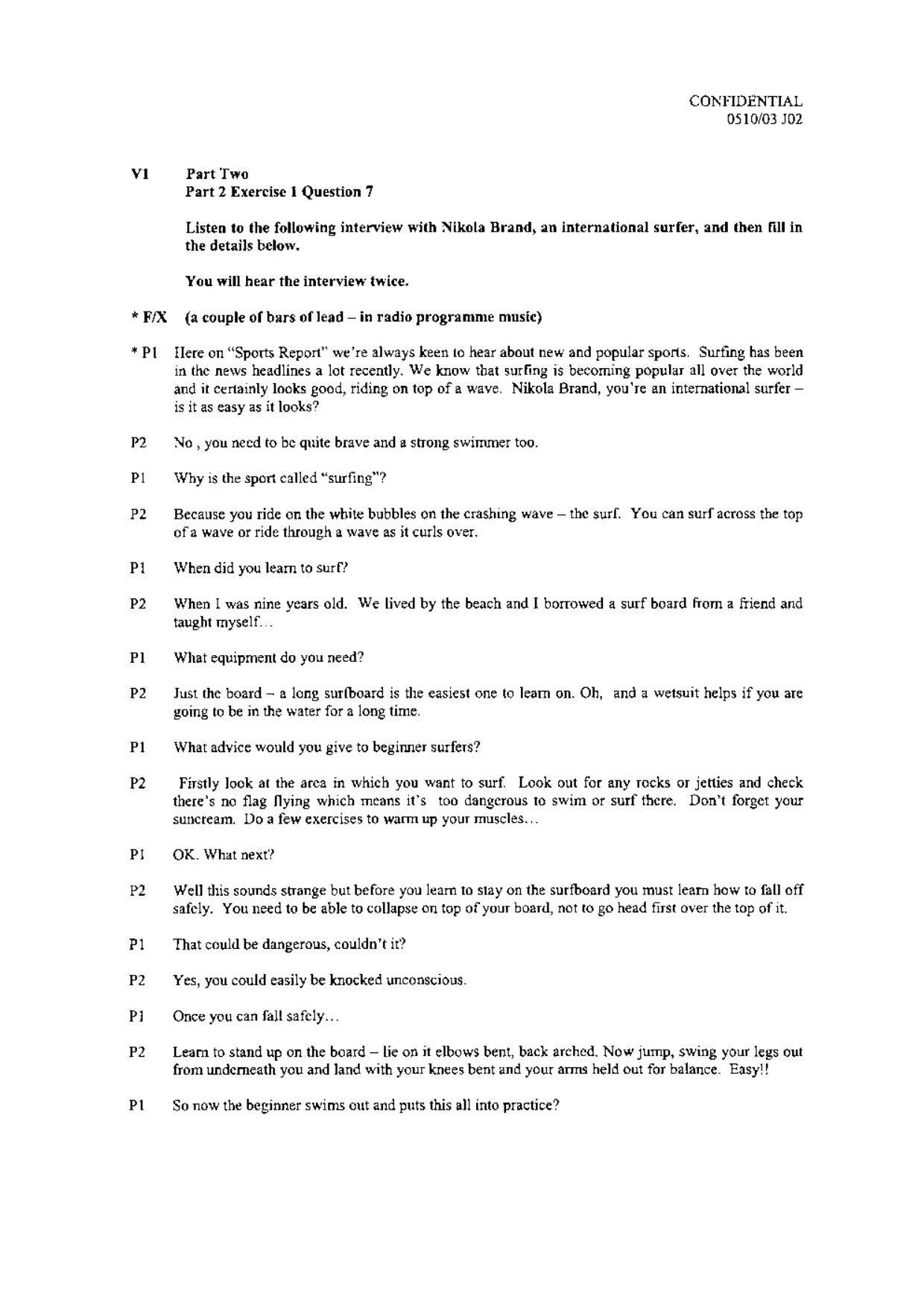
vi CONFIDENTIAL 0510/03 J02 Part Two Part 2 Exercise 1 Question 7 Listen to the following interview with Nikola Brand, an international surfer, and then fill in the details below. You will hear the interview twice. *F/X = (a couple of burs of lead — in radio programme music) *PL P2 Pl P2 Pi P2 Pl P2 Pl P2 Pi P2 Pl P2 Pi P2 Pl Here on “Sports Report” we're always keen to hear about new and popular sporis. Surfing has been in the news headlines a lot recently. We know that surfing is becoming popular all over the world and it certainly looks good, riding on top of a wave. Nikola Brand, you're an international surfer — is it as easy as it looks? No , you need to be quite brave and a strong swimmer too. Why is the sport called “surfing”? Because you ride on the white bubbles on the crashing wave — the surf. You can surf across the top ofa wave or ride through a wave as it curls over. When did you leam to surf? When I was nine years old. We lived by the beach and I borrowed a surf board from a friend and taught myself... What equipment do you need? Just the board — a long surfboard is the easiest one to learn on. Oh, and a wetsuit helps if you are going to be in the water for a long time. What advice would you give to beginner surfers? Firstly lock at the area in which you want to surf. Look out for any rocks or jetties and check there’s no flag flying which means it’s too dangerous to swim or surf there. Don’t forget your suncream. Do a few exercises to warm up your muscles... OK. What next? Well this sounds strange but before you learn to stay on the surfboard you must learn how to fall off safely. You need to be able to collapse on top of your board, not to go head first over the top of it. That could be dangerous, couldn't it? Yes, you could easily be knocked unconscious. Once you can fall safely... Lear to stand up on the board — lie on it elbows bent, back arched, Now jump, swing your legs out from undemeath you and land with your knees bent and your arms held out for balance. Easy!! So now the beginner swims out and puts this all into practice?
Mark scheme, page 9
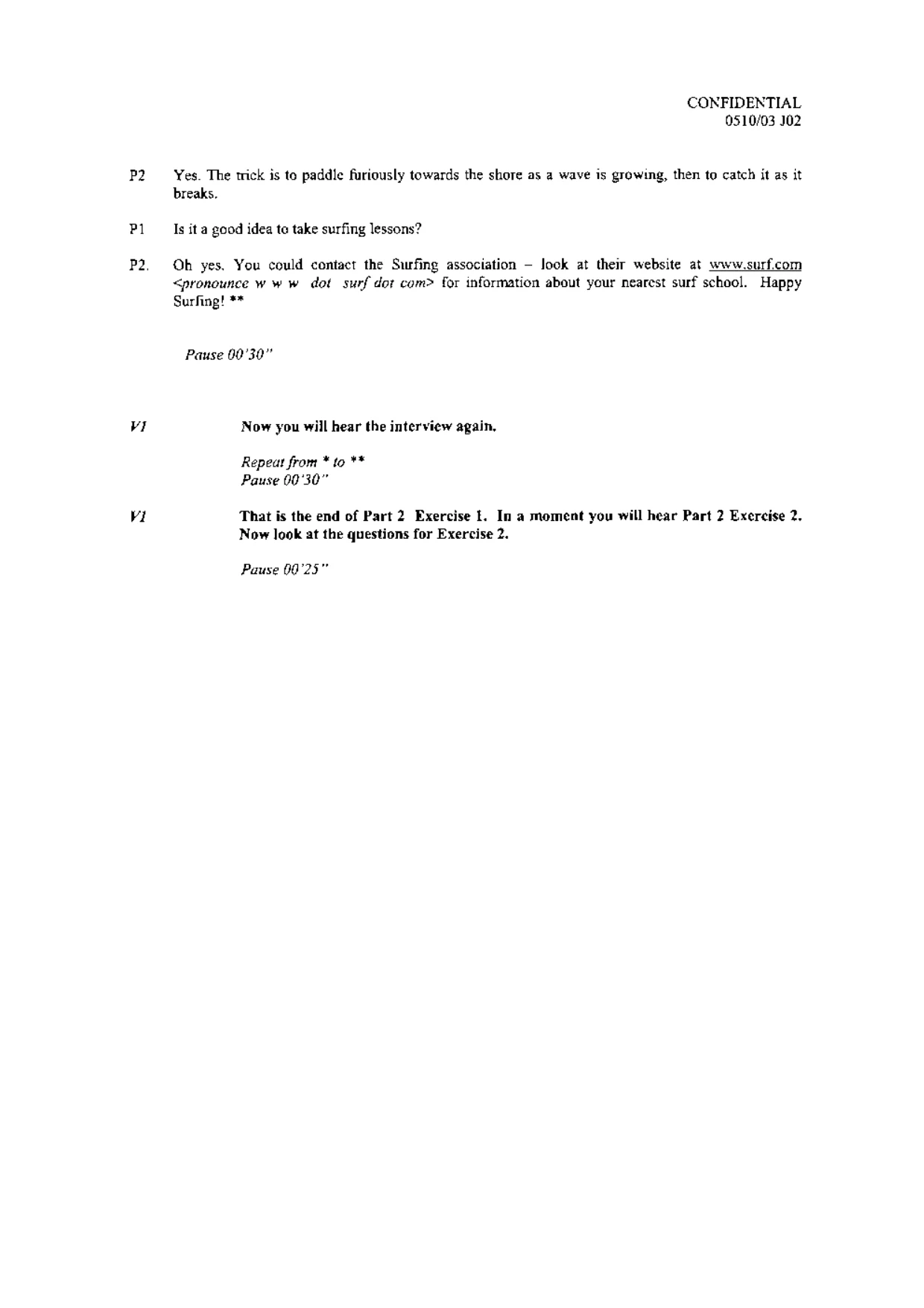
P2 Pl P2. Vi VI CONFIDENTIAL 0510/03 J02 Yes. The trick is to paddle furiously towards the shore as a wave is growing, then to catch it as it breaks. Is it a good idea te take surfing lessons? Oh yes. You could contact the Surfing association - lock at their website at www.surf.com <pronounce www dot surf dot com> for information about your nearest surf school. Happy Surfing! ** Pause 00'30” Now you will hear the interview again, Repeat from * to ** Pause 00°30” That is the end of Part 2 Exercise t. In a moment you will hear Part 2 Exercise 2. Now look at the questions for Exercise 2. Pause 00°25"
Mark scheme, page 10
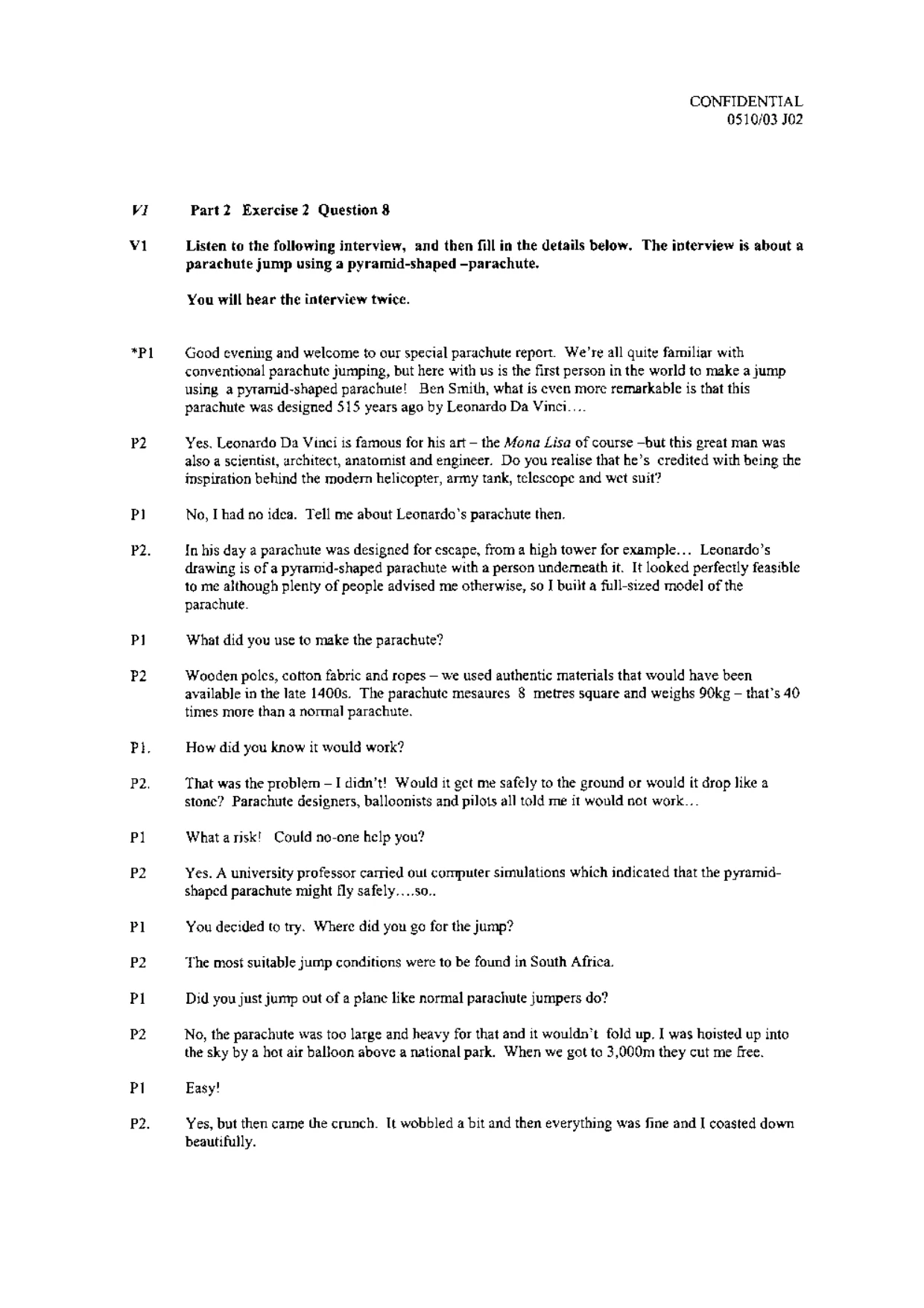
VI vi *PL P2 Pl P2. Pl P2 Pi P2. Pl P2 Pl P2 Pl P2 PI P2. CONFIDENTIAL 0510/03 JO2 Part2 Exercise 2 Question 8 Listen to the following interview, and then fill in the details below. The interview is about a parachute jump using a pyramid-shaped —parachute. You will hear the interview twice. Good evening and welcome to our special parachute report. We're all quite familiar with conventional parachute jumping, but here with us is the first person in the world to make a jump using a pytamid-shaped parachute! Ben Smith, what is even more remarkable is that this parachute was designed 515 years ago by Leonardo Da Vinci... Yes, Leonardo Da Vinci is famous for his art — the Mona Lisa of course —but this great man was also a scientist, architect, anatomist and engineer. Do you realise that he’s credited with being the inspiration behind the modem helicopter, army tank, telescope and wet suit? No, I had no idea. Tell me about Leonardo's parachute then. In his day a parachute was designed for escape, from a high tower for example... Leonardo’s drawing is of a pyramid-shaped parachute with a person undemeath it. It looked perfectly feasible to me although plenty of people advised me otherwise, so I built a full-sized model of the parachute. What did you use to make the parachute? Wooden poles, cotton fabric and ropes — we used authentic materials that would have been available in the late 1400s. The parachute mesaures 8 metres square and weighs 90kg — that’s 40 times more than a normal parachute. How did you know it would work? That was the problem —I didn’t! Would it get me safely to the ground or would it drop like a stone? Parachute designers, balloonists and pilots all told me it would not work... What arisk! Could no-one help you? Yes. A university professor carried oul computer simulations which indicated that the pyramid- shaped parachute might fly safely…so.. You decided to try. Where did you go for the jump? ‘The most suitable jump conditions were to be found in South Africa. Did you just jump out of a plane like normal parachute jumpers do? No, the parachute was too large and heavy for that and it wouldn’t fold up. I was hoisted up into the sky by a hot air balloon above a national park. When we got to 3,000m they cut me free. Easy! Yes, but then came the crunch. It wobbled a bit and then everything was fine and I coasted down. beautifully.
Mark scheme, page 11
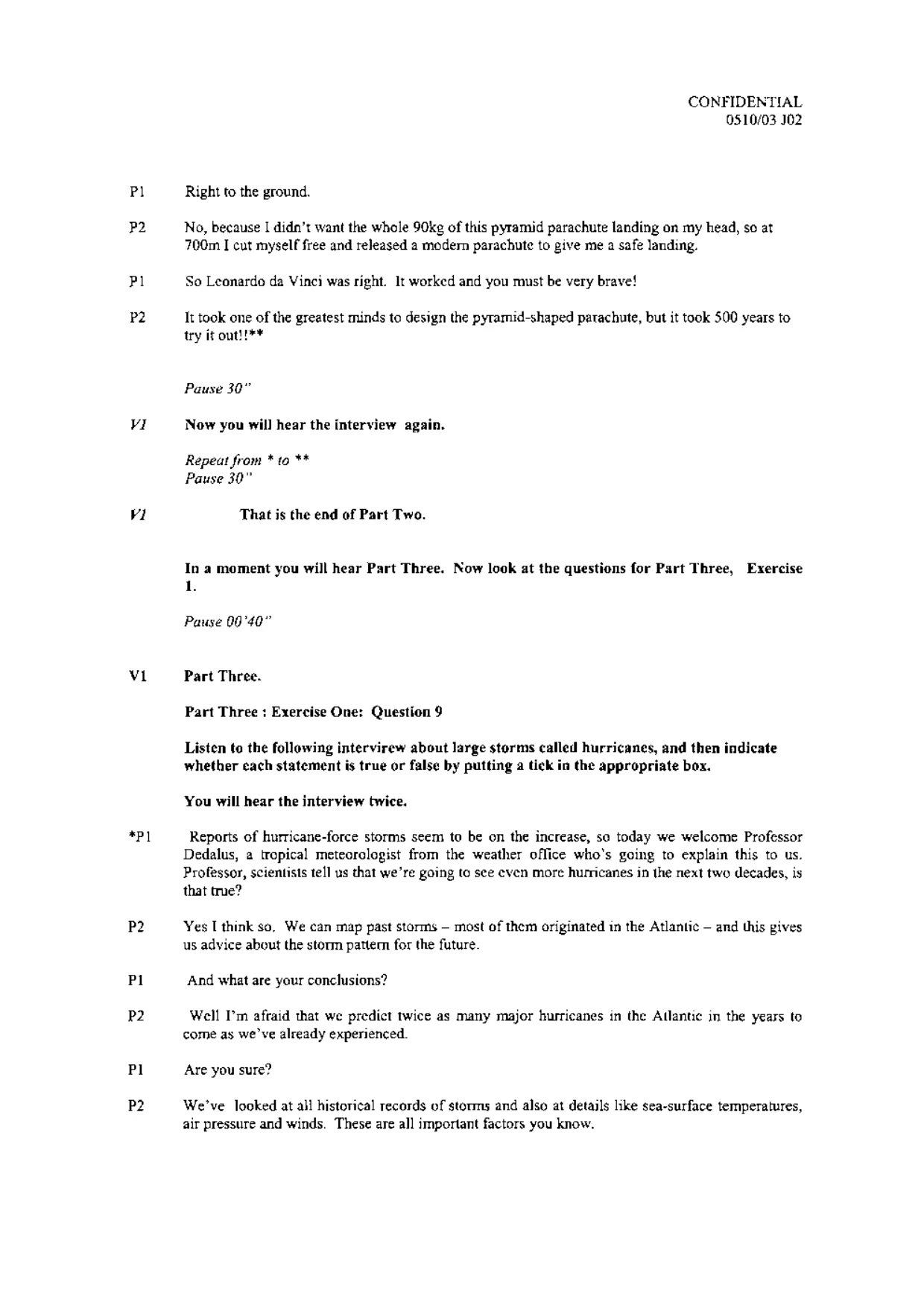
Pl P2 Pl P2 VI VI Vi *P] P2 P1 P2 Pl P2 CONFIDENTIAL 0510/03 JO2 Right to the ground. No, because | didn’t want the whole 90kg of this pyramid parachute landing on my head, so at 700m I cut myself free and released a modern parachute to give me a safe landing. So Leonardo da Vinci was right. It worked and you must be very brave! It took one of the greatest minds to design the pyramid-shaped parachute, but it took 500 years to try it out!!** Pause 30” Now you will hear the interview again. Repeat from * to ** Pause 30” That is the end of Part Two. In a moment you will hear Part Three. Now look at the questions for Part Three, Exercise 1. Pause 00°40” Part Three. Part Three : Exercise One: Question 9 Listen to the following intervirew about large storms called hurricanes, and then indicate whether each statement is true or false by putting a tick in the appropriate box. You will hear the interview twice. Reports of hurricane-force storms seem to be on the increase, se today we welcome Professor Dedalus, a tropical meteorologist from the weather office who's going to explain this to us. Professor, scientists tell us that we're going to sce even more hurricanes in the next two decades, is that true? Yes I think so, We can map past storms — most of them originated in the Atlantic — and this gives us advice about the storm pattem for the future. And what are your conclusions? Well I’m afraid that we predict twice as many major hurricanes in the Atlantic in the years to come as we've already experienced. Are you sure? We’ve looked at all historical records of storms and also at details like sea-surface temperatures, air pressure and winds. These are all important factors you know.
Mark scheme, page 12
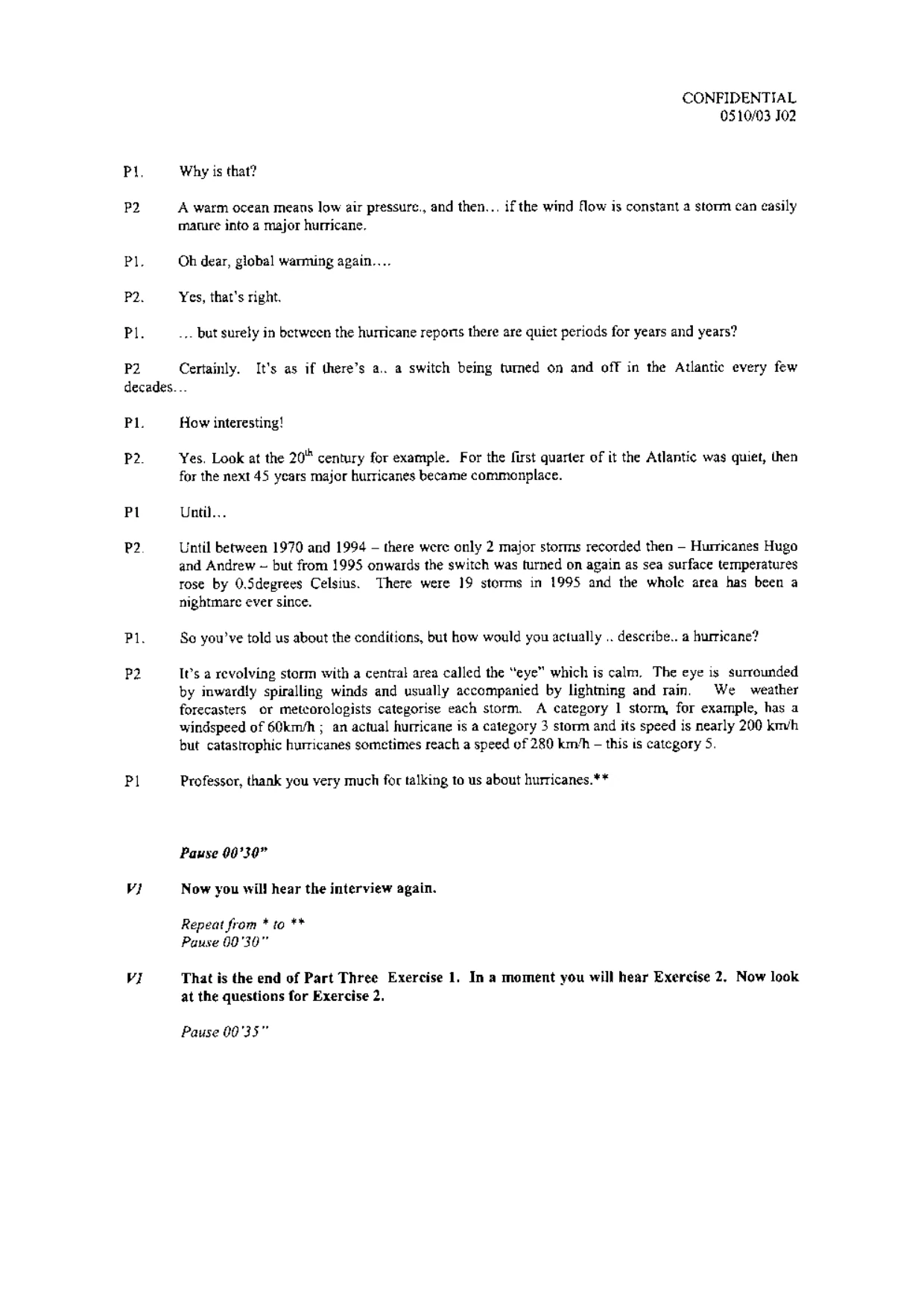
Pi, P2 Pl. P2. Pi. P2 CONFIDENTIAL 0510/03 J02 Why is that? A warm ocean means low air pressure., and then... if the wind flow is constant a storm can easily manure into a major hurricane. Oh dear, giobal warming again… Yes, that's right. ... but surely in between the hurricane reports there are quiet periods for years and years? Certainly. It's as if there’s a.. a switch being tumed on and off in the Atlantic every few decades... PL P2. Pl P2 Pi. P2 Pl vi WI How interesting! Yes, Look at the 20" century for example. For the first quarter of it the Atlantic was quiet, then for the next 45 years major hurricanes became commonplace. Until... Until between 1970 and 1994 — there were only 2 major storms recorded then — Hurricanes Hugo and Andrew ~ but from 1995 onwards the switch was turned on again as sea surface temperatures rose by O.Sdegrees Celsius. There were 19 storms in 1995 and the whole area has been a nightmare ever since. So you've told us about the conditions, but how would you actually .. describe. a hurricane? It’s a revolving storm with a central area called the “eye” which is calm. The eye is surrounded by inwardly spiralling winds and usually accompanied by lighting and rain. We weather forecasters or meteorologists categorise each storm. A category 1 storm, for example, has a windspeed of 60km/h ; an actual hurricane is a category 3 storm and its speed is nearly 200 knvh but catastrophic hurricanes sometimes reach a speed of 280 km/h — this is category 5. Professor, thank you very much for talking to us about hurricanes.** Pause 00°30” Now you will hear the interview again. Repeat from * to ** Pause 00°30" That is the end of Part Three Exercise 1. In a moment you will hear Exercise 2, Now look at the questions for Exercise 2. Pause 00°35"
Mark scheme, page 13
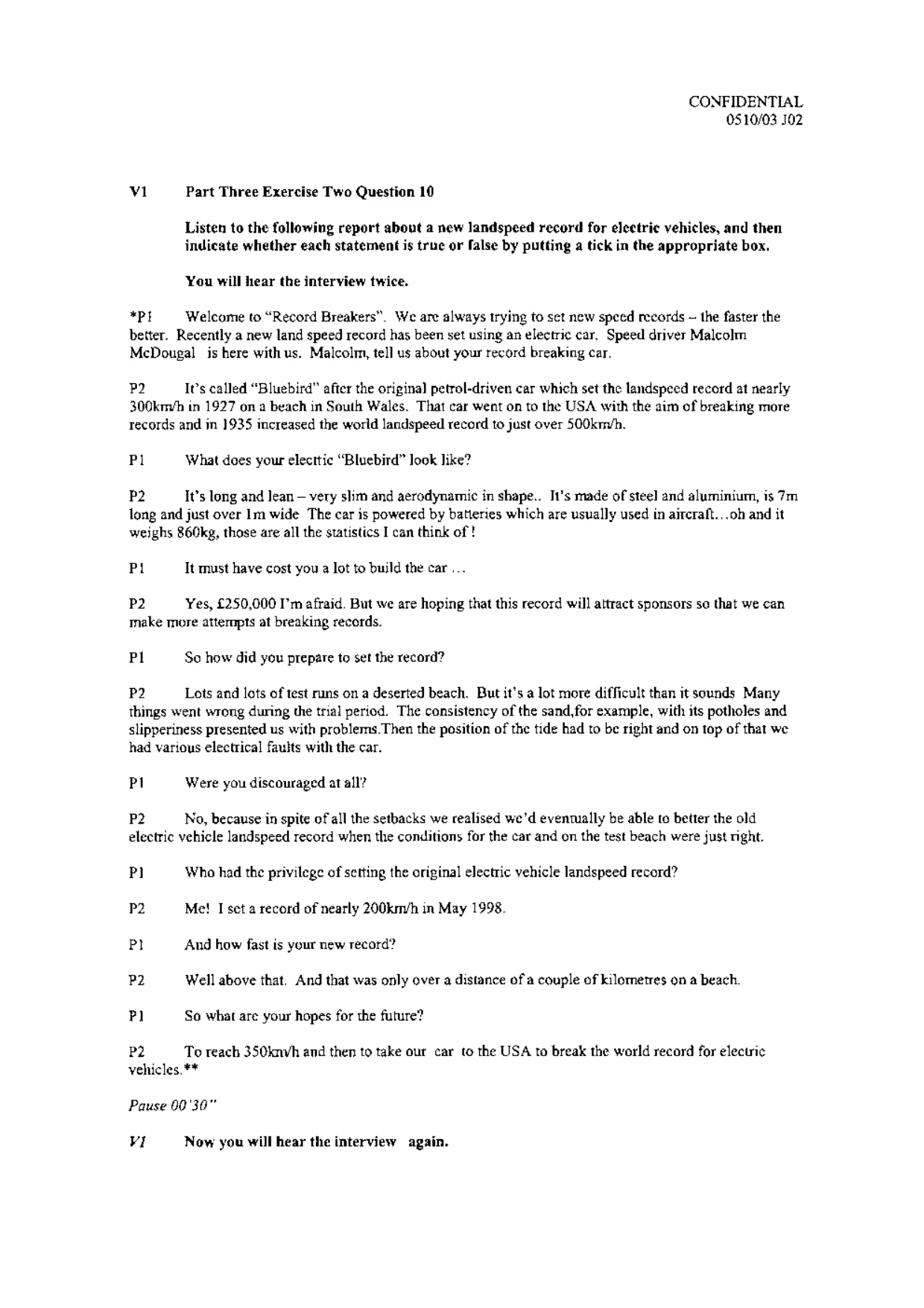
CONFIDENTIAL 0510/03 J02 vi Part Three Exercise Two Question 10 Listen to the following report about a new landspeed record for electric vehicles, and then indicate whether each statement is true or false by putting a tick in the appropriate box. You will hear the interview twice. *PE Welcome to “Record Breakers”. We are always trying to set new speed records ~ the faster the better. Recently a new land speed record has been set using an electric car, Speed driver Malcolm McDougal is here with us. Malcolm, tell us about your record breaking car P2 It’s called “Bluebird” after the original petrol-driven car which set the landspeed record at nearly 300krvh in 1927 ona beach in South Wales. That car went on to the USA with the aim of breaking more records and in 1935 increased the world landspeed record to just over 500kmvh. Pl What does your electtic “Bluebird” look like? P2 It’s long and Jean — very slim and aerodynamic in shape.. It's made of steel and aluminium, is 7m long and just over 1m wide The car is powered by batteries which are usually used in aircraft...oh and it weighs 860kg, those are all the statistics I can think of ! PL It must have cost you a lot to build the car ... P2 Yes, £250,000 I’m afraid. But we are hoping that this record will attract sponsors se that we can make more attempts at breaking records. Pl So how did you prepare to set the record? P2 Lots and lots of test runs on a deserted beach. But it's a lot more difficult than it sounds Many things went wrong during the trial period. The consistency of the sand,for example, with its potholes and slipperiness presented us with problems.Then the position of the tide had to be right and on top of that we had various electrical faults with the car. Pi Were you discouraged at all? P2 No, because in spite of all the setbacks we realised we'd eventually be able to better the old electric vehicle landspeed record when the conditions for the car and on the test beach were just right. Pil Who had the privilege of setting the original electric vehicle landspeed record? P2 Me! I set a record of nearly 200kmv/h in May 1998. Pl Aud how fast is your new record? P2 Well above that. And that was only over a distance ofa couple of kilometres on a beach. Pi So what are your hopes for the future? P2 To reach 350knvh and then to take our car to the USA to break the world record for elecuic vehicles.** Pause 00°30" VI Now you will hear the interview again.
Mark scheme, page 14
vi I CONFIDENTIAL 0510/03 J02 Repeat from * to ** Pause 00'30" That is the end of Part Three and of the test. In a moment your teacher will stop the tape and collect your papers. Please check that you have written your name, Centre number and candidate number on the front of your question paper. Remember, you must not talk until all the papers have been collected. Pause 00°10" Teacher, the tape should now be stopped and all the papers collected. Thank you everyone. (BLEEP}