Cambridge IGCSE English - Second Language (oral endorsement) 0510 — 2002 May/June Paper 1 · Variant 1
0510/11/M/J/02
The question paper and its mark scheme, free to read here and free to download. This is Cambridge’s own paper, exactly as it was sat.
Question paper20 pages






Mark scheme6 pages
Answers below. Sit the paper first if you are practising.
Paper as text
Question paper, page 1
TIME 1 hour 30 minutes INSTRUCTIONS TO CANDIDATES Write your name, Centre number and candidate number in the spaces at the top of this page. Answer all questions. Write your answers in the spaces provided on the question paper. INFORMATION FOR CANDIDATES The number of marks is given in brackets [ ] at the end of each question or part question. Dictionaries are not allowed. International General Certificate of Secondary Education CAMBRIDGE INTERNATIONAL EXAMINATIONS ENGLISH AS A SECOND LANGUAGE 0510/1 PAPER 1 Reading and Writing MAY/JUNE SESSION 2002 1 hour 30 minutes Candidates answer on the question paper. No additional materials are required. This question paper consists of 18 printed pages and 2 blank pages. SP (AT/OX/JG) S27629/2 © CIE 2002 [Turn over Candidate Centre Number Number Candidate Name FOR EXAMINER’S USE Part 1 Part 2 Part 3 TOTAL
Question paper, page 2
2 0510/1/M/J/02 Part 1: Exercise 1 Read the advertisement below about ‘Skateworld’, and then answer the questions on the opposite page. 17th AVENUE, EDENVALE SPORT CENTRE CHILDREN’S BIRTHDAY PARTY VENUE PROFESSIONAL ENTERTAINMENT, VARIETY OF PARTY PLANS AND DECOR, SUPERVISION DISCO PARTIES FOR TEENS HELD IN EVENINGS, ADULT SUPERVISION EASTER HOLIDAY CLINICS 6 - 9 APRIL OR 20 - 23 APRIL INCLUDES FUN ACTIVITIES FOR SKATERS AND NON-SKATERS SUPERVISION BY TRAINED MARSHALS ROLLER-BLADING DAILY MON - FRI 3 - 6 pm • SAT & SUN 10 am - 6 pm ROLLER HOCKEY COACHING RUN BY S.A. NATIONAL TEAM COACH SPORTS SHOP OPEN DAILY MOMS & DADS: WE DO THE WORK, WE CLEAN THE MESS, YOU HAVE THE FUN ENTRANCE FEE R5 INCLUDES A FREE COKE ON PRESENTATION OF THIS LEAFLET (ONLY ONE PER PERSON) PLEASE BOOK EARLY BY CALLING YVONNE 453-6503
Question paper, page 3
3 0510/1/M/J/02 [Turn over (a) What does the centre offer for children under 10 in addition to sport? …[1] (b) What might encourage parents to feel happy that their children would be safe at a disco party? …[1] (c) Give two sports which can be done at Edenvale Sport Centre. …[1] (d) How does Skateworld try to attract parents to send their children? …[1] (e) What do visitors have to show to get their free drink? …[1] [Total: 5] For Examiner’s Use
Question paper, page 4
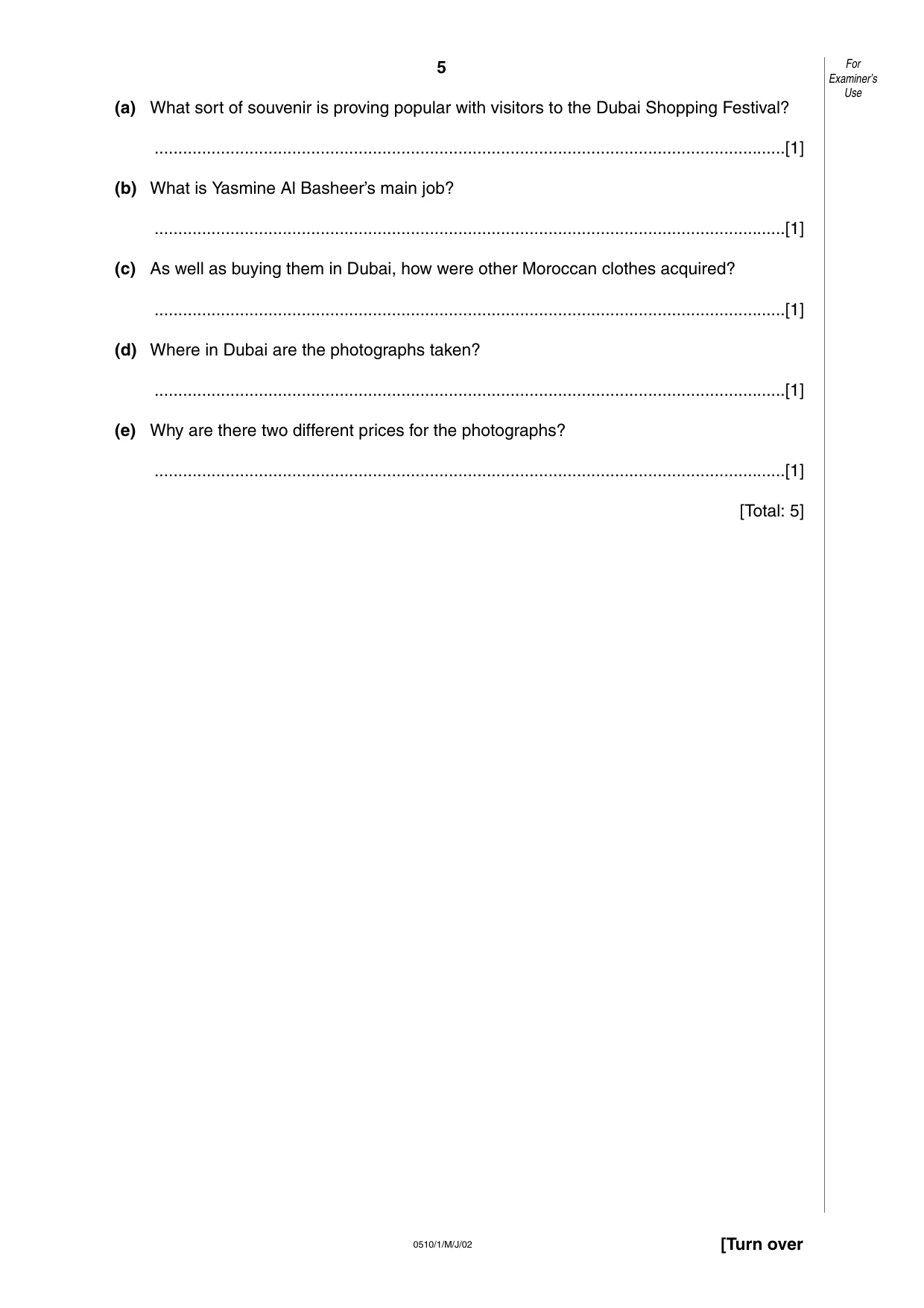
4 0510/1/M/J/02 Part 1: Exercise 2 Read the article below, and then answer the questions on the opposite page. V isitors to the Dubai Shopping Festival are carrying back with them a novel memento of their trip to Dubai – their own pictures looking like ‘traditional’ Moroccans. ‘It’s an unusual way of saying “I’ve been there”. And it is attracting Arabs from all the Gulf States, and Europeans and Asians,’ says Yasmine Al Basheer, a Moroccan school teacher resident in Dubai, who hit upon the idea as the best way to spread awareness of this westernmost Arab country. The traditional attire of men, women and children in Morocco is colourful and exotic, representing the various regions of the country. Yasmine set about acquiring the dresses along with cultural artefacts from different stores in the city – and even had some flown in to create a truly exotic setting. Then she got in touch with a professional photo studio to take the pictures. Part of the Moroccan Pavilion at the Global Village, the Seema Studio stall provides the glossy colour prints for $15 or $25 depending on the size of the enlargements. “I’ve been to Morocco in Dubai” ,
Question paper, page 5
5 0510/1/M/J/02 [Turn over (a) What sort of souvenir is proving popular with visitors to the Dubai Shopping Festival? …[1] (b) What is Yasmine Al Basheer’s main job? …[1] (c) As well as buying them in Dubai, how were other Moroccan clothes acquired? …[1] (d) Where in Dubai are the photographs taken? …[1] (e) Why are there two different prices for the photographs? …[1] [Total: 5] For Examiner’s Use
Question paper, page 6
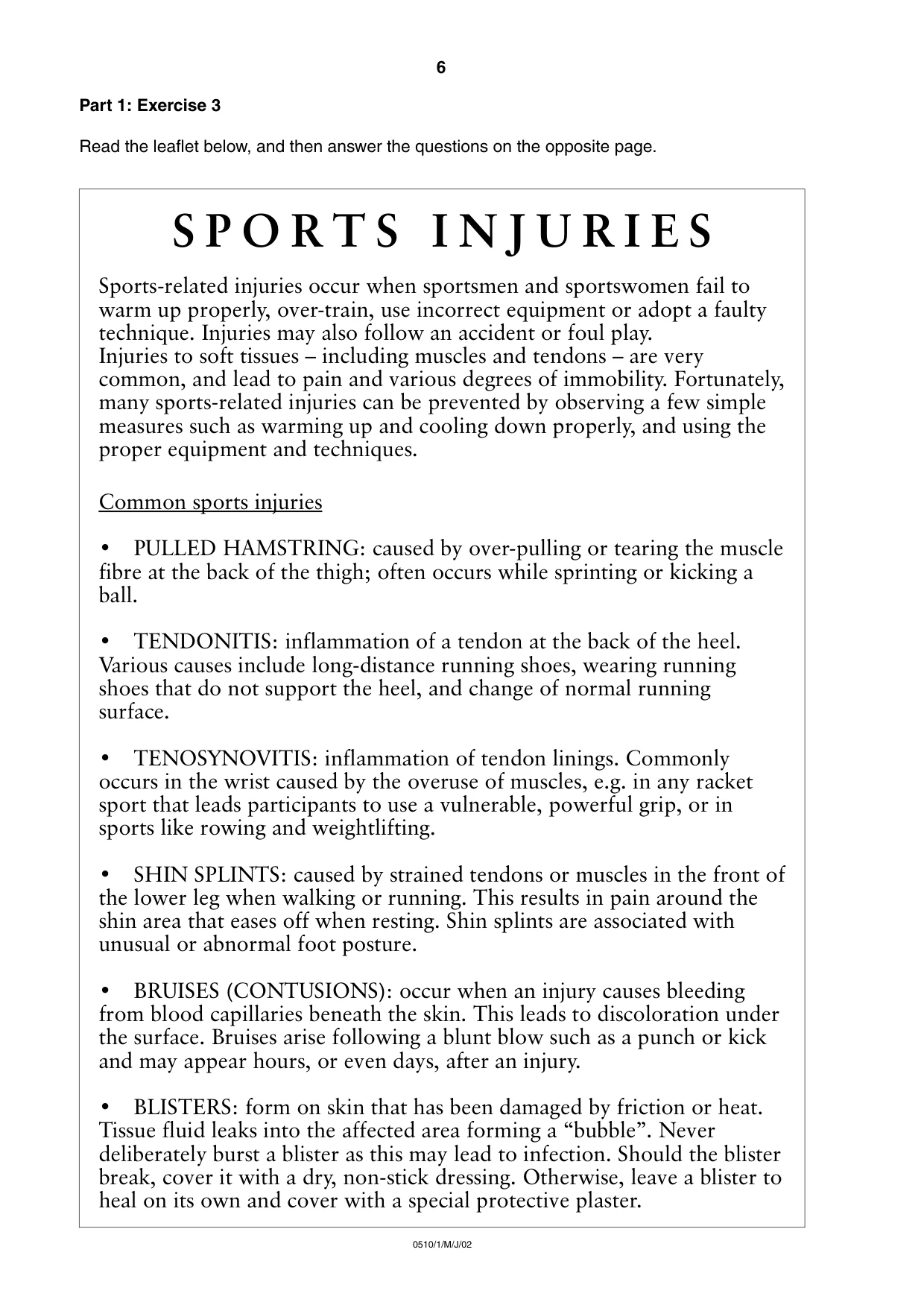
6 0510/1/M/J/02 Part 1: Exercise 3 Read the leaflet below, and then answer the questions on the opposite page. S P O R T S I N J U R I E S Sports-related injuries occur when sportsmen and sportswomen fail to warm up properly, over-train, use incorrect equipment or adopt a faulty technique. Injuries may also follow an accident or foul play. Injuries to soft tissues – including muscles and tendons – are very common, and lead to pain and various degrees of immobility. Fortunately, many sports-related injuries can be prevented by observing a few simple measures such as warming up and cooling down properly, and using the proper equipment and techniques. Common sports injuries • PULLED HAMSTRING: caused by over-pulling or tearing the muscle fibre at the back of the thigh; often occurs while sprinting or kicking a ball. • TENDONITIS: inflammation of a tendon at the back of the heel. Various causes include long-distance running shoes, wearing running shoes that do not support the heel, and change of normal running surface. • TENOSYNOVITIS: inflammation of tendon linings. Commonly occurs in the wrist caused by the overuse of muscles, e.g. in any racket sport that leads participants to use a vulnerable, powerful grip, or in sports like rowing and weightlifting. • SHIN SPLINTS: caused by strained tendons or muscles in the front of the lower leg when walking or running. This results in pain around the shin area that eases off when resting. Shin splints are associated with unusual or abnormal foot posture. • BRUISES (CONTUSIONS): occur when an injury causes bleeding from blood capillaries beneath the skin. This leads to discoloration under the surface. Bruises arise following a blunt blow such as a punch or kick and may appear hours, or even days, after an injury. • BLISTERS: form on skin that has been damaged by friction or heat. Tissue fluid leaks into the affected area forming a “bubble”. Never deliberately burst a blister as this may lead to infection. Should the blister break, cover it with a dry, non-stick dressing. Otherwise, leave a blister to heal on its own and cover with a special protective plaster.
Question paper, page 7
7 0510/1/M/J/02 [Turn over (a) Using information from the first paragraph, give one way in which sports-related injuries may occur. …[1] (b) Which phrase describes both muscles and tendons? …[1] (c) What is the common name for the muscle fibre at the back of the thigh? …[1] (d) What causes the dark colour of a bruise? …[1] (e) Why must you not burst a blister? …[1] [Total: 5] For Examiner’s Use
Question paper, page 8
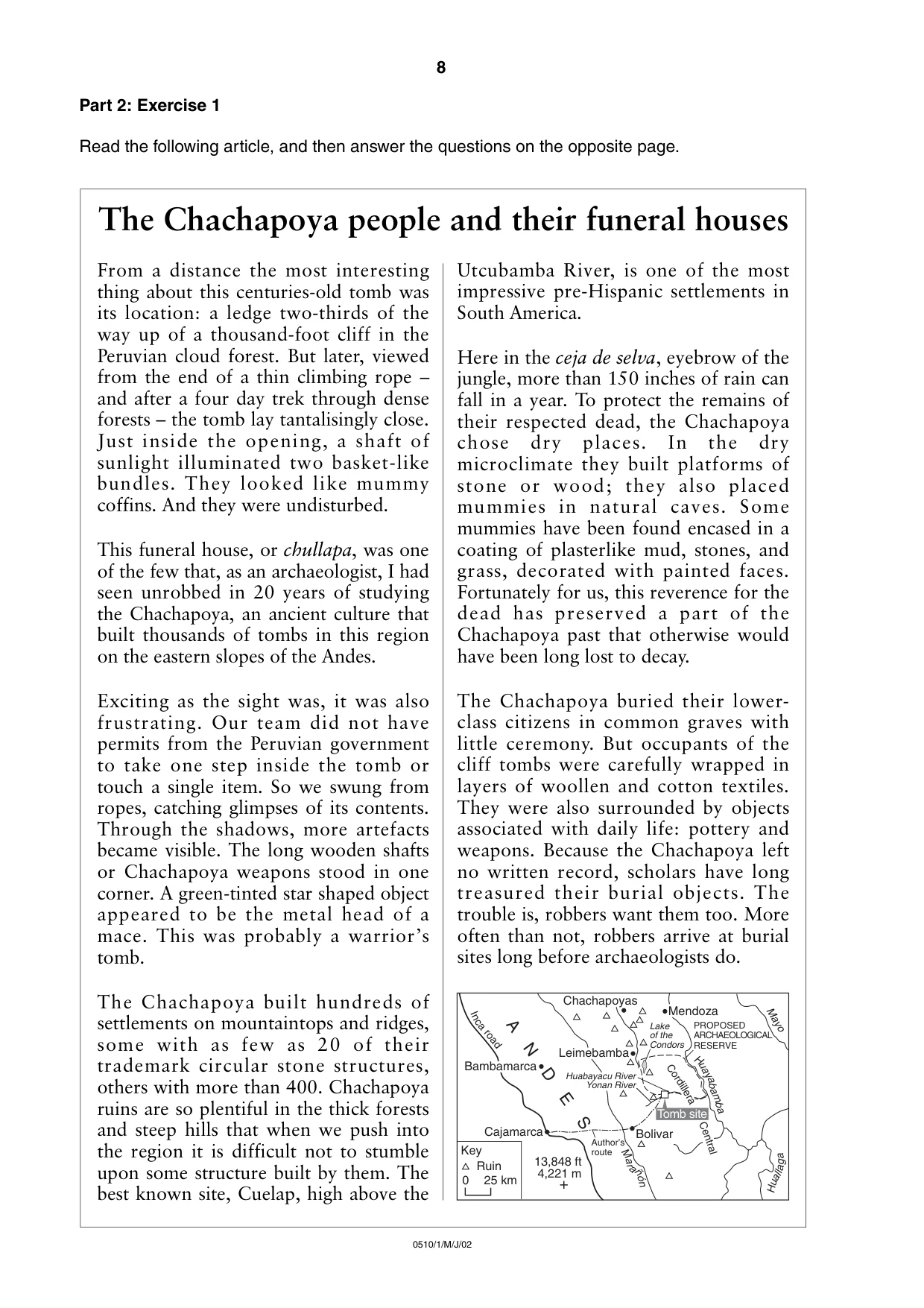
8 0510/1/M/J/02 Part 2: Exercise 1 Read the following article, and then answer the questions on the opposite page. The Chachapoya people and their funeral houses From a distance the most interesting thing about this centuries-old tomb was its location: a ledge two-thirds of the way up of a thousand-foot cliff in the Peruvian cloud forest. But later, viewed from the end of a thin climbing rope – and after a four day trek through dense forests – the tomb lay tantalisingly close. Just inside the opening, a shaft of sunlight illuminated two basket-like bundles. They looked like mummy coffins. And they were undisturbed. This funeral house, or chullapa, was one of the few that, as an archaeologist, I had seen unrobbed in 20 years of studying the Chachapoya, an ancient culture that built thousands of tombs in this region on the eastern slopes of the Andes. Exciting as the sight was, it was also frustrating. Our team did not have permits from the Peruvian government to take one step inside the tomb or touch a single item. So we swung from ropes, catching glimpses of its contents. Through the shadows, more artefacts became visible. The long wooden shafts or Chachapoya weapons stood in one corner. A green-tinted star shaped object appeared to be the metal head of a mace. This was probably a warrior’s tomb. The Chachapoya built hundreds of settlements on mountaintops and ridges, some with as few as 20 of their trademark circular stone structures, others with more than 400. Chachapoya ruins are so plentiful in the thick forests and steep hills that when we push into the region it is difficult not to stumble upon some structure built by them. The best known site, Cuelap, high above the Utcubamba River, is one of the most impressive pre-Hispanic settlements in South America. Here in the ceja de selva, eyebrow of the jungle, more than 150 inches of rain can fall in a year. To protect the remains of their respected dead, the Chachapoya chose dry places. In the dry microclimate they built platforms of stone or wood; they also placed mummies in natural caves. Some mummies have been found encased in a coating of plasterlike mud, stones, and grass, decorated with painted faces. Fortunately for us, this reverence for the dead has preserved a part of the Chachapoya past that otherwise would have been long lost to decay. The Chachapoya buried their lower- class citizens in common graves with little ceremony. But occupants of the cliff tombs were carefully wrapped in layers of woollen and cotton textiles. They were also surrounded by objects associated with daily life: pottery and weapons. Because the Chachapoya left no written record, scholars have long treasured their burial objects. The trouble is, robbers want them too. More often than not, robbers arrive at burial sites long before archaeologists do. A N D E S 0 25 km Key Bambamarca Cajamarca Bolivar Mendoza Chachapoyas Leimebamba Tomb site Mayo PROPOSED ARCHAEOLOGICAL RESERVE Author’s route I n c a roa d H ua y a b am b a H u a l l a g a + 13,848 ft 4,221 m Huabayacu River Yonan River Lake of the Condors Co rdil ler a Ce ntr al Ruin M a r a ñ ó n
Question paper, page 9
9 0510/1/M/J/02 [Turn over (a) What was special about this funeral house? …[1] (b) Why did the archaeologists have to swing from ropes? …[1] (c) Why did the Chachapoya build their funeral houses high on the cliffs? …[1] (d) Why are the everyday objects found in the funeral houses important? …[1] (e) Which two natural obstacles did the author have to cross during his journey from Cajamarca to the tomb site? … …[2] [Total: 6] For Examiner’s Use
Question paper, page 10
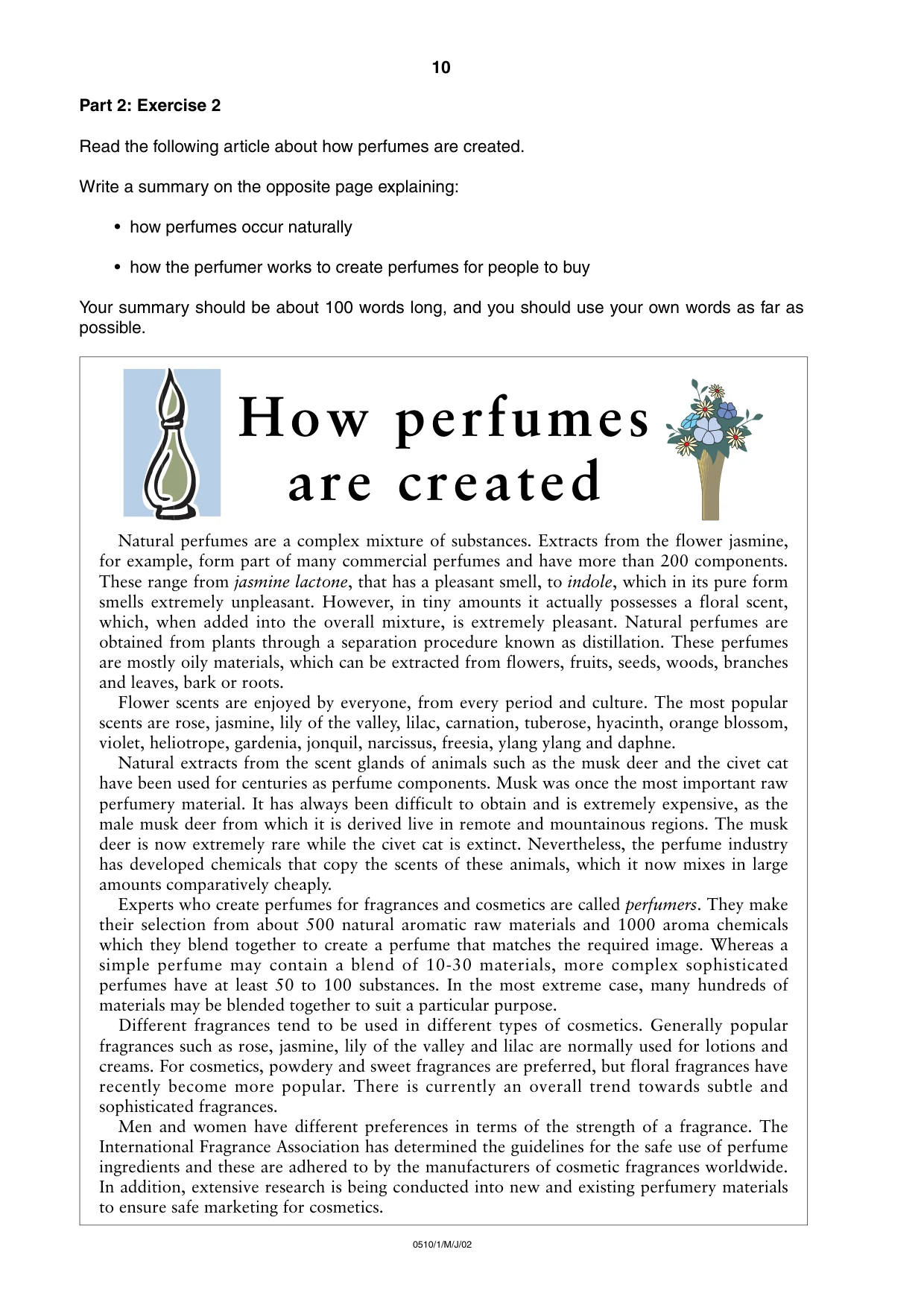
10 0510/1/M/J/02 Part 2: Exercise 2 Read the following article about how perfumes are created. Write a summary on the opposite page explaining: • how perfumes occur naturally • how the perfumer works to create perfumes for people to buy Your summary should be about 100 words long, and you should use your own words as far as possible. How perfumes are created Natural perfumes are a complex mixture of substances. Extracts from the flower jasmine, for example, form part of many commercial perfumes and have more than 200 components. These range from jasmine lactone, that has a pleasant smell, to indole, which in its pure form smells extremely unpleasant. However, in tiny amounts it actually possesses a floral scent, which, when added into the overall mixture, is extremely pleasant. Natural perfumes are obtained from plants through a separation procedure known as distillation. These perfumes are mostly oily materials, which can be extracted from flowers, fruits, seeds, woods, branches and leaves, bark or roots. Flower scents are enjoyed by everyone, from every period and culture. The most popular scents are rose, jasmine, lily of the valley, lilac, carnation, tuberose, hyacinth, orange blossom, violet, heliotrope, gardenia, jonquil, narcissus, freesia, ylang ylang and daphne. Natural extracts from the scent glands of animals such as the musk deer and the civet cat have been used for centuries as perfume components. Musk was once the most important raw perfumery material. It has always been difficult to obtain and is extremely expensive, as the male musk deer from which it is derived live in remote and mountainous regions. The musk deer is now extremely rare while the civet cat is extinct. Nevertheless, the perfume industry has developed chemicals that copy the scents of these animals, which it now mixes in large amounts comparatively cheaply. Experts who create perfumes for fragrances and cosmetics are called perfumers. They make their selection from about 500 natural aromatic raw materials and 1000 aroma chemicals which they blend together to create a perfume that matches the required image. Whereas a simple perfume may contain a blend of 10-30 materials, more complex sophisticated perfumes have at least 50 to 100 substances. In the most extreme case, many hundreds of materials may be blended together to suit a particular purpose. Different fragrances tend to be used in different types of cosmetics. Generally popular fragrances such as rose, jasmine, lily of the valley and lilac are normally used for lotions and creams. For cosmetics, powdery and sweet fragrances are preferred, but floral fragrances have recently become more popular. There is currently an overall trend towards subtle and sophisticated fragrances. Men and women have different preferences in terms of the strength of a fragrance. The International Fragrance Association has determined the guidelines for the safe use of perfume ingredients and these are adhered to by the manufacturers of cosmetic fragrances worldwide. In addition, extensive research is being conducted into new and existing perfumery materials to ensure safe marketing for cosmetics.
Question paper, page 11
11 0510/1/M/J/02 [Turn over … … … … … … … … … … … … … … … [8] For Examiner’s Use
Question paper, page 12
12 0510/1/M/J/02 Part 2: Exercise 3 Wesley Lablache is a very ambitious young man and wants to gain as many qualifications as possible. He lives in Victoria, the capital of Seychelles, at Flat 12, Main Avenue, with his parents and younger brother and sister. Their telephone number is 9714-2973410. His email address is weslablache@hotmail.co.sc. He doesn’t own a computer of his own, but his brother who is away studying in the USA has allowed him to borrow his IBM Model 1234 laptop computer whenever he likes, and he is reasonably proficient in using it, although he still has a lot to learn. He is 17, having been born on March 12 1985, and he wants to be able to show future employers that he has a recognised ICT (Information and Communications Technology) qualification. He has seen an advertisement in his local newspaper, the Mahe Times, advertising a course for young people over 16 in preparation for a Cambridge certificate in ICT, and he decides to apply. The course code is ICT999. Imagine you are Wesley, and fill in the form on the opposite page, using the information above. [6]
Question paper, page 13
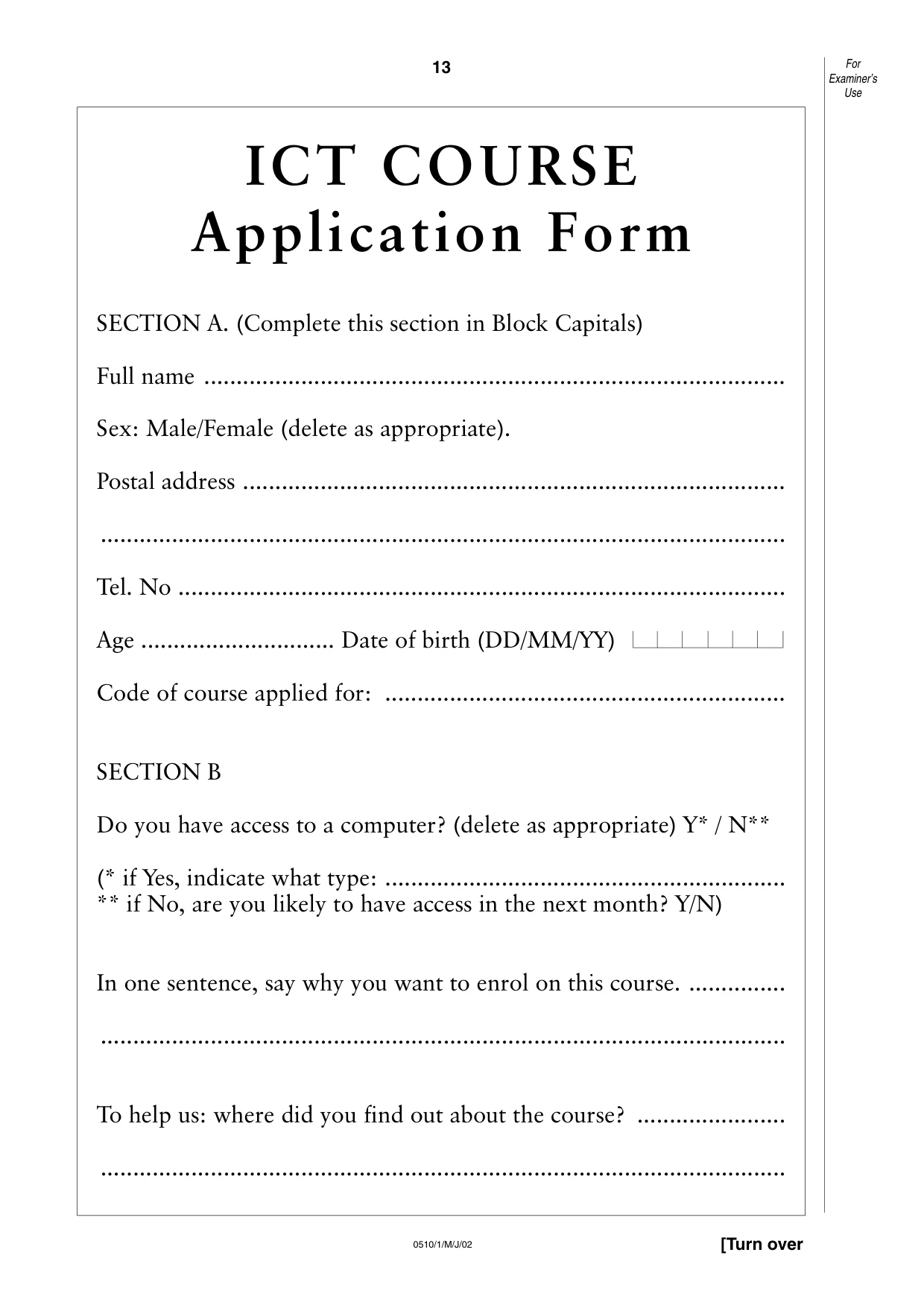
13 0510/1/M/J/02 [Turn over For Examiner’s Use ICT COURSE Application Form SECTION A. (Complete this section in Block Capitals) Full name … Sex: Male/Female (delete as appropriate). Postal address … … Tel. No … Age … Date of birth (DD/MM/YY) Code of course applied for: … SECTION B Do you have access to a computer? (delete as appropriate) Y* / N** (* if Yes, indicate what type: … ** if No, are you likely to have access in the next month? Y/N) In one sentence, say why you want to enrol on this course. … … To help us: where did you find out about the course? … …
Question paper, page 14
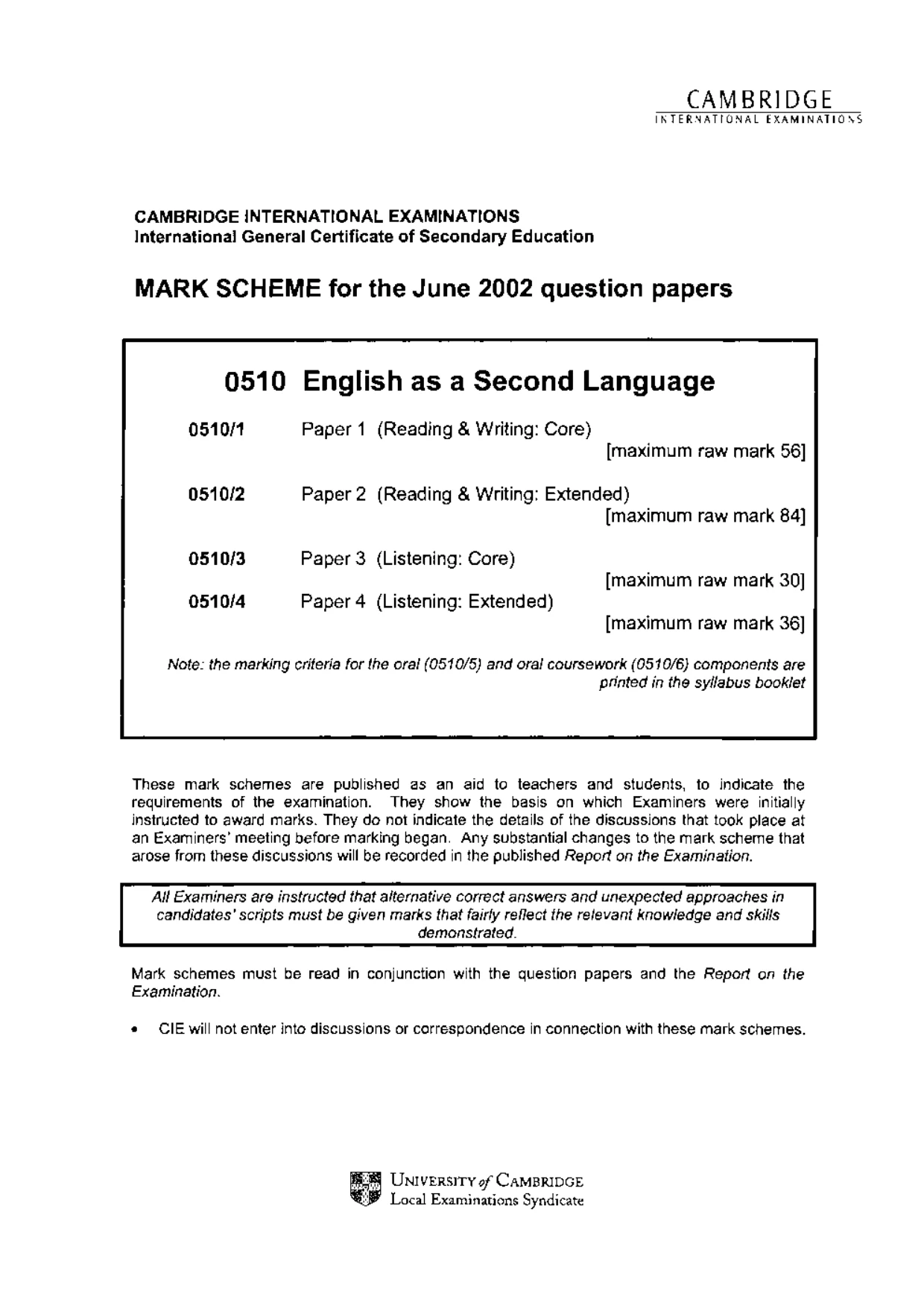
14 0510/1/M/J/02 Part 3: Exercise 1 Write an article for your school/college magazine about what you consider to be the most important invention in the past 150 years. The pictures above may give you some ideas, but you are free to choose something different. In your article you should include the following: • the name of the invention, and what it does • what its benefits to people have been • why you have chosen it Your article should be about 100 words long.
Question paper, page 15
15 0510/1/M/J/02 [Turn over For Examiner’s Use … … … … … … … … … … … … … … … … … … … … … … … … … [9]
Question paper, page 16
16 0510/1/M/J/02 Part 3: Exercise 2 You have been asked by your Principal for ideas about making your school/college buildings and grounds more pleasant for students. Write a letter to your Principal in which you give your ideas for improvements. Your letter should include the following areas: • what to do about rubbish (litter) • encouraging students to keep the school/college tidy and in good order • creating a leisure/quiet/garden area for students. Begin your letter ‘Dear Principal, … ’. (You do not need to write an address at the top.) Your letter should be about 150 words long.
Question paper, page 17
17 0510/1/M/J/02 For Examiner’s Use … … … … … … … … … … … … … … … … … … … … … … … … … [12]
Question paper, page 20
20 0510/1/M/J/02 Copyright acknowledgements: Part 1 Exercise 2 © Patrick Michael. Newspaper Article. Khaleej Times. 1998 Part 1 Exercise 3 © Extract from Leaflet ‘Sports Injuries’. Reproduced by permission of Unichem. Part 2 Exercise 1 © Peter Lerche. Lost Tombs of Peru. Reproduced by permission of National Geographical Society. 2001 © Cambridge International Examinations has made every effort to trace copyright holders, but it we have inadvertently overlooked any we will be pleased to make the necessary arrangements at the first opportunity.
Mark scheme, page 1
CAMBRIDGE INTERNATIONAL EXAMINATIONS CAMBRIDGE INTERNATIONAL EXAMINATIONS International General Certificate of Secondary Education MARK SCHEME for the June 2002 question papers 0510 English as a Second Language 0510/1 Paper 1 (Reading & Writing: Core) [maximum raw mark 56] 0510/2 Paper 2 (Reading & Writing: Extended) [maximum raw mark 84] 0510/3 Paper 3 (Listening: Core) [maximum raw mark 30] 0510/4 Paper 4 (Listening: Extended) [maximum raw mark 36] Note: the marking criteria for the oral (0510/5) and oral coursework (0510/6) components are plnted in the syllabus booklet These mark schemes are published as an aid to teachers and students, to indicate the requirements of the examination. They show the basis on which Examiners were initially instructed to award marks. They de not indicate the details of the discussions that took place at an Examiners’ meeting before marking began. Any substantial changes to the mark scheme that arose from these discussions will be recorded in the published Report on the Examination. All Examiners are instructed that alternative correct answers and unexpected approaches in candidates’ scripts must be given marks that fairly reflect the relevant knowledge and skills demonstrated. Mark schemes must be read in conjunction with the question papers and the Report on the Examination. « CIE will not enter inte discussions or correspondence in connection with these mark schemes. § UNIVERSITY of CAMBRIDGE F Local Examinations Syndicate
Mark scheme, page 2
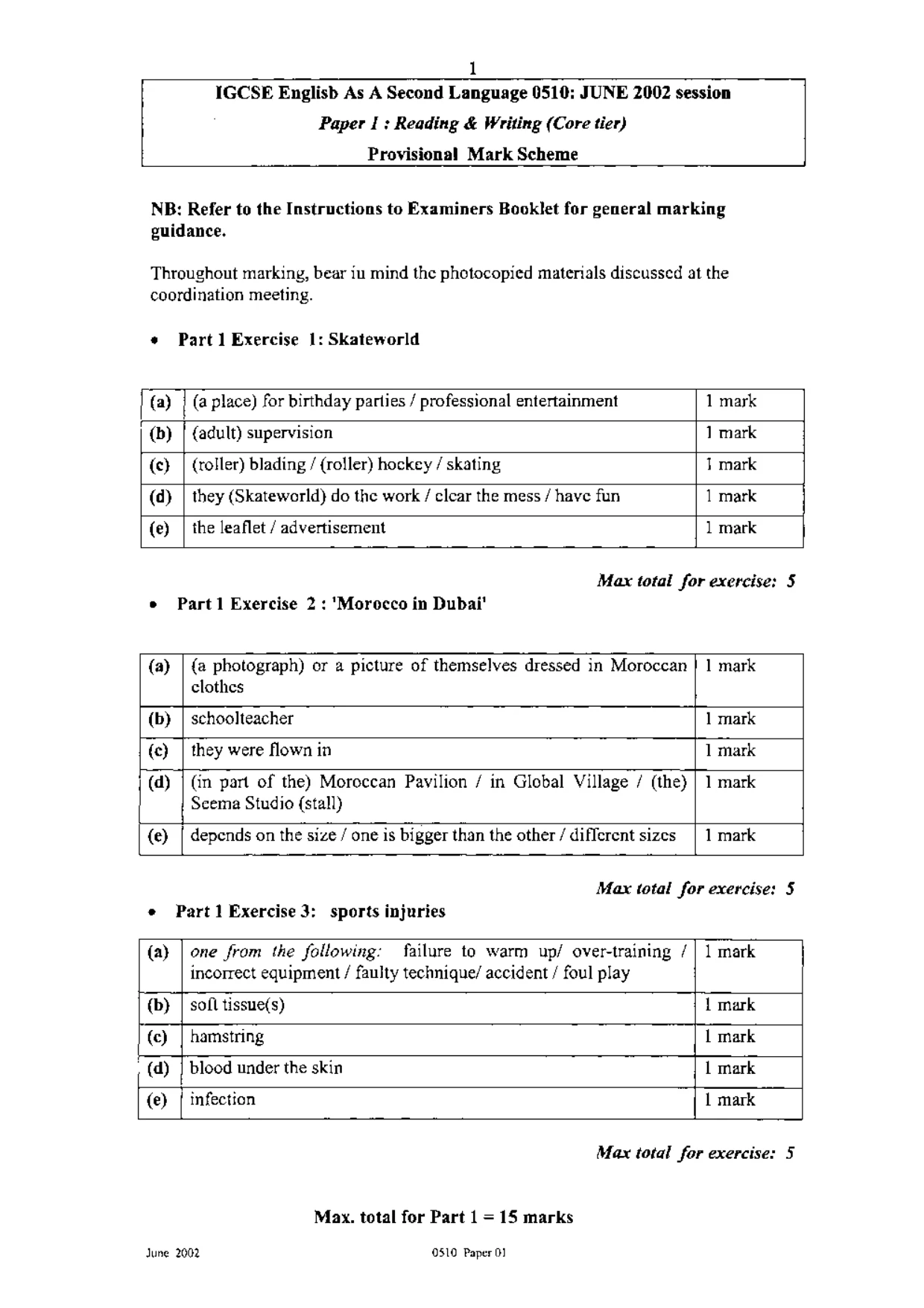
1 IGCSE Englisb As A Second Language 0510; JUNE 2002 session Paper | : Reading & Writing (Core tier) Provisional Mark Scheme NB: Refer to the Instructions to Examiners Booklet for general marking guidance. Throughout marking, bear iu mind the photocopied materials discussed at the coordination meeting. « Part 1 Exercise 1: Skateworld (a) } (a place) for birthday parties / professional entertainment 1 mark | (b) | (adult) supervision 1 mark (c} | (roller) blading / (roller) hockey / skating 1 mark (d) | they (Skateworld) do the work / clear the mess / have fun 1 mark (e) | the leaflet / advertisement 1 mark Max total for exercise: 5 e Part 1 Exercise 2: ‘Morocco in Dubai’ (a) | {a photograph) or a picture of themselves dressed in Moroccan } 1 mark clothes (b) | schoolteacher 1 mark (c) | they were flown in 1 mark (d) | (in part of the) Moroccan Pavilion / in Global Village / (the) | 1 mark Seema Studio (stall) {e) | depends on the size / one is bigger than the other / different sizes | 1 mark Max total for exercise: 5 e Part 1 Exercise 3: sports injuries (a) | one from the following: failure to warm up/ over-training /| 1 mark incorrect equipment / faulty technique/ accident / foul play (b) | sofl tissue(s) 1 mark (c) | hamstring 1 mark t : | , (d) | blood under the skin 1 mark (e) | infection I mark Max total for exercise: 5 Max. total for Part 1 = 15 marks June 2002 0510 Paper 01
Mark scheme, page 3
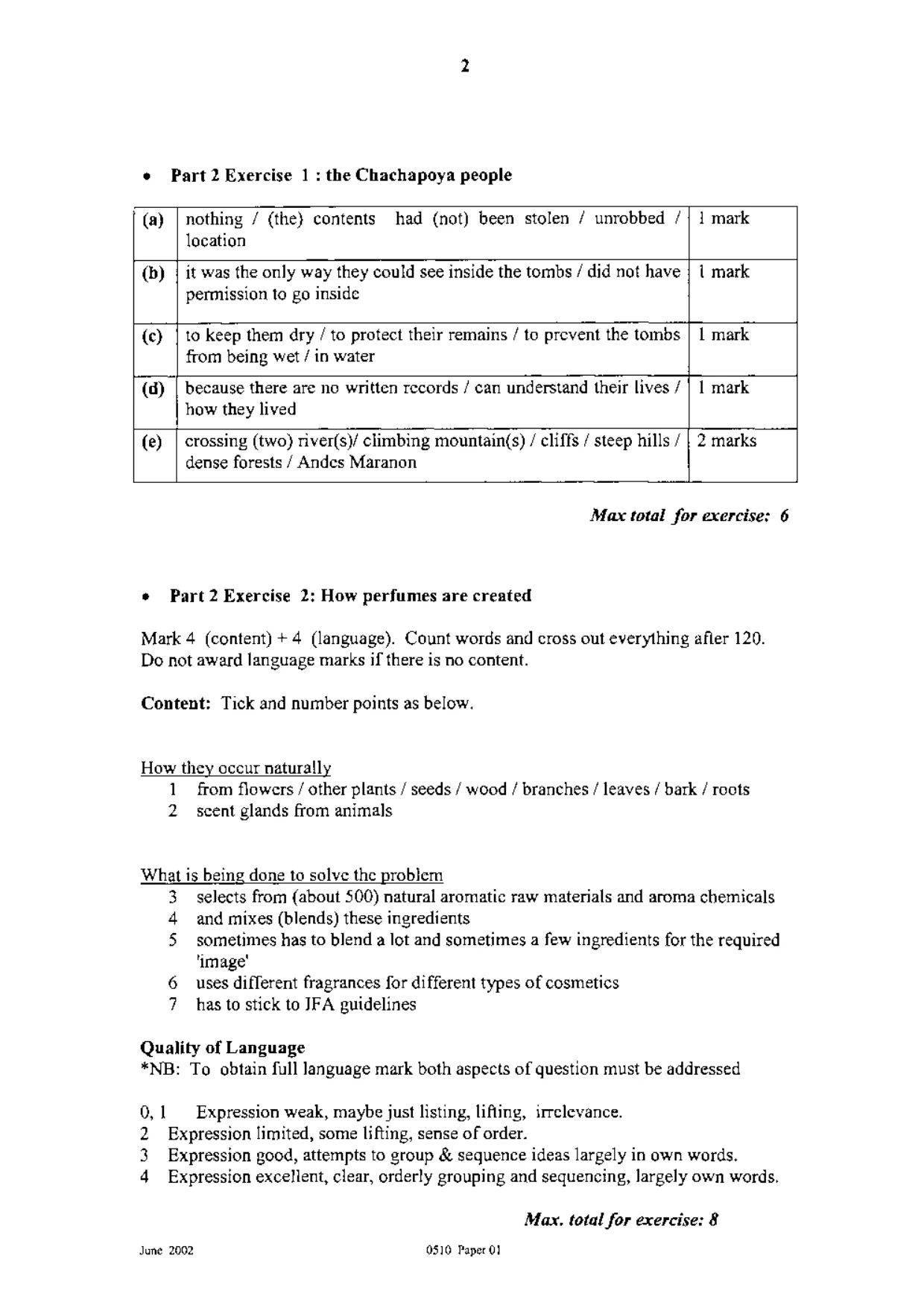
e Part 2 Exercise 1 : the Chachapoya people (a) | nothing / (the) contents had (not) been stolen / unrobbed /] 1 mark location (b) j it was the only way they could see inside the tombs / did not have | 1 mark permission to go inside (c) | to keep them dry / to protect their remains / to prevent the tombs | | mark from being wet / in water (d) | because there are no written records / can understand their lives / | 1 mark how they lived (e) | crossing (two) river(s)/ climbing mountain(s) / cliffs / steep hills / | 2 marks dense forests / Andes Maranon Max total for exercise: 6 * Part 2 Exercise 2: How perfumes are created Mark 4 (content) + 4 (language). Count words and cross out everything afler 120. Do not award language marks if there is no content. Content: Tick and number points as below. How they occur naturally 1 from flowers / other plants / seeds / wood / branches / leaves / bark / roots 2 scent glands from animals What is being done to solve the problem 3 selects from {about 500) natural aromatic raw materials and aroma chemicals 4 and mixes (blends) these ingredients 5 sometimes has to blend a lot and sometimes a few ingredients for the required ‘image’ 6 uses different fragrances for different types of cosmetics 7 has to stick to JFA guidelines Quality of Language *NB: To obtain full language mark both aspects of question must be addressed 0,1 Expression weak, maybe just listing, lifling, irrelevance. 2 Expression limited, some lifting, sense of order. 3 Expression good, attempts to group & sequence ideas largely in own words. 4 Expression excellent, clear, orderly grouping and sequencing, largely own words. Max. total for exercise: 8 June 2002 0510 Paper 01
Mark scheme, page 4
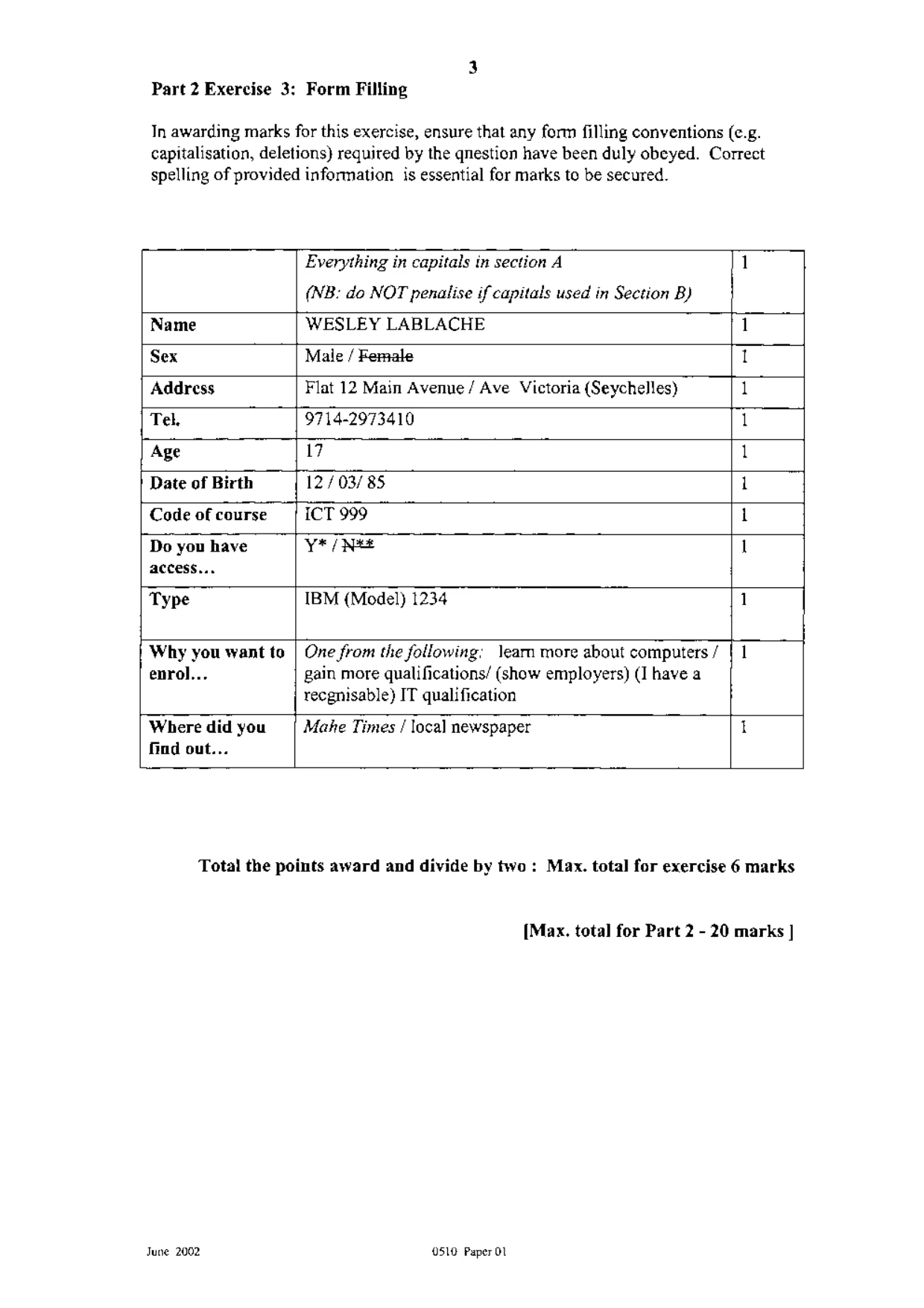
Part 2 Exercise 3: Form Filling In awarding marks for this exercise, ensure that any form filling conventions (c.g. capitalisation, deletions) required by the qnestion have been duly obeyed. Correct spelling of provided information is essential for marks to be secured. Everything in capitals in section A 1 (NB: do NOT penalise if capitals used in Section B) Name WESLEY LABLACHE 1 Sex Male / Female 1 Address Flat 12 Main Avenue / Ave Victoria (Seychelles) 1 Tel, 9714-2973410 1 Age 17 1 Date of Birth 12 / 03/ 85 1 Code of course ICT 999 1 Do you have Y* (NE 1 access... Type IBM (Model) 1234 1 Why you want to | One from the following; learn more about computers / | 1 enrol... gain more qualifications/ (show employers) (I have a recgnisable) IT qualification Where did you Mahe Times / local newspaper t find out... Total the points award and divide by two: Max. total for exercise 6 marks {Max. total for Part 2 - 20 marks | June 2002 0510 Paper 01
Mark scheme, page 5
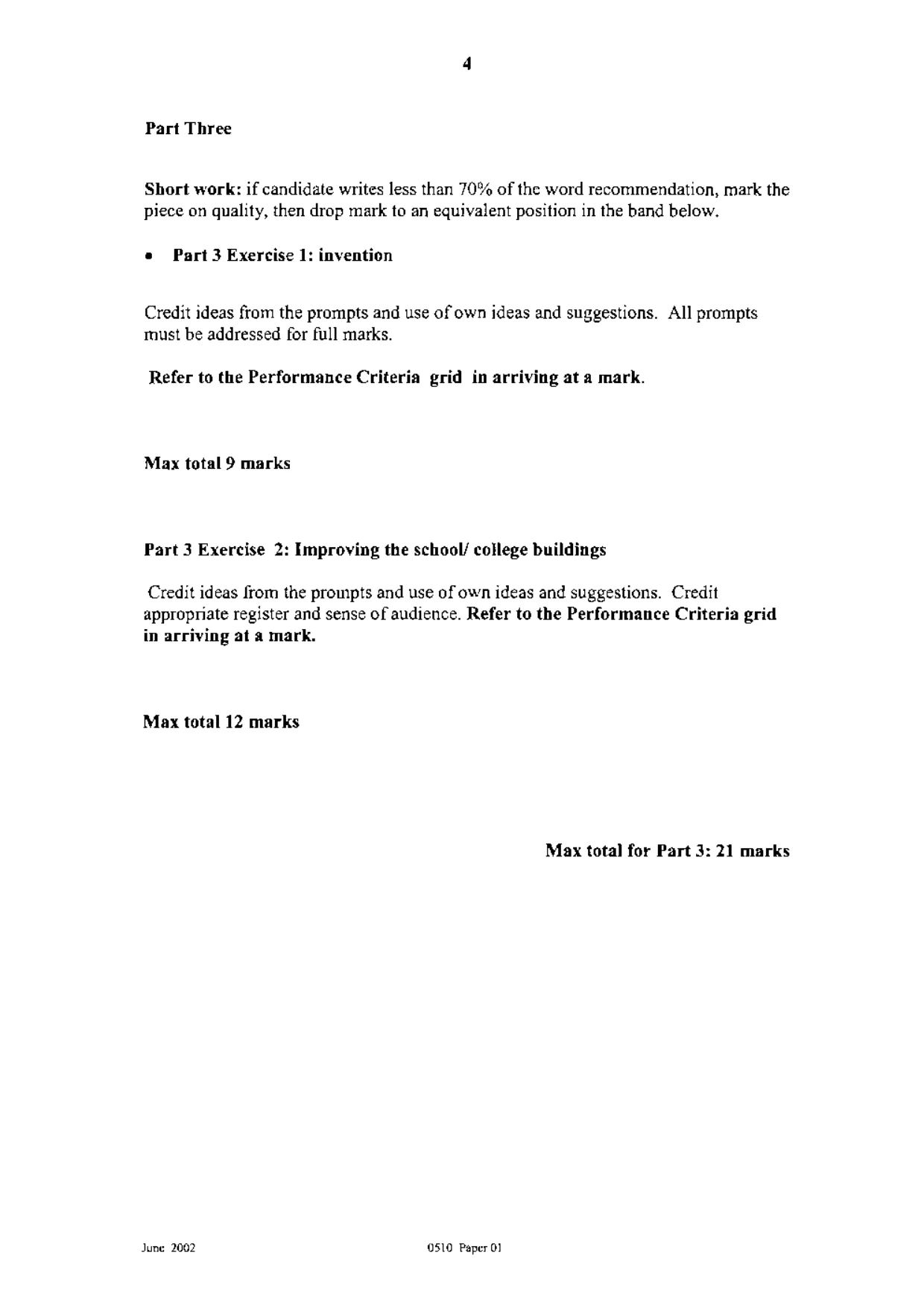
Part Three Short work: if candidate writes less than 70% of the word recommendation, mark the piece on quality, then drop mark to an equivalent position in the band below. « Part 3 Exercise 1: invention Credit ideas from the prompts and use of own ideas and suggestions. All prompts must be addressed for full marks. Refer to the Performance Criteria grid in arriving at a mark. Max total 9 marks Part 3 Exercise 2: Improving the school/ college buildings Credit ideas from the prompts and use of own ideas and suggestions. Credit appropriate register and sense of audience. Refer to the Performance Criteria grid in arriving at a mark. Max total 12 marks Max total for Part 3: 21 marks June 2002 0510 Paper 0)
Mark scheme, page 6
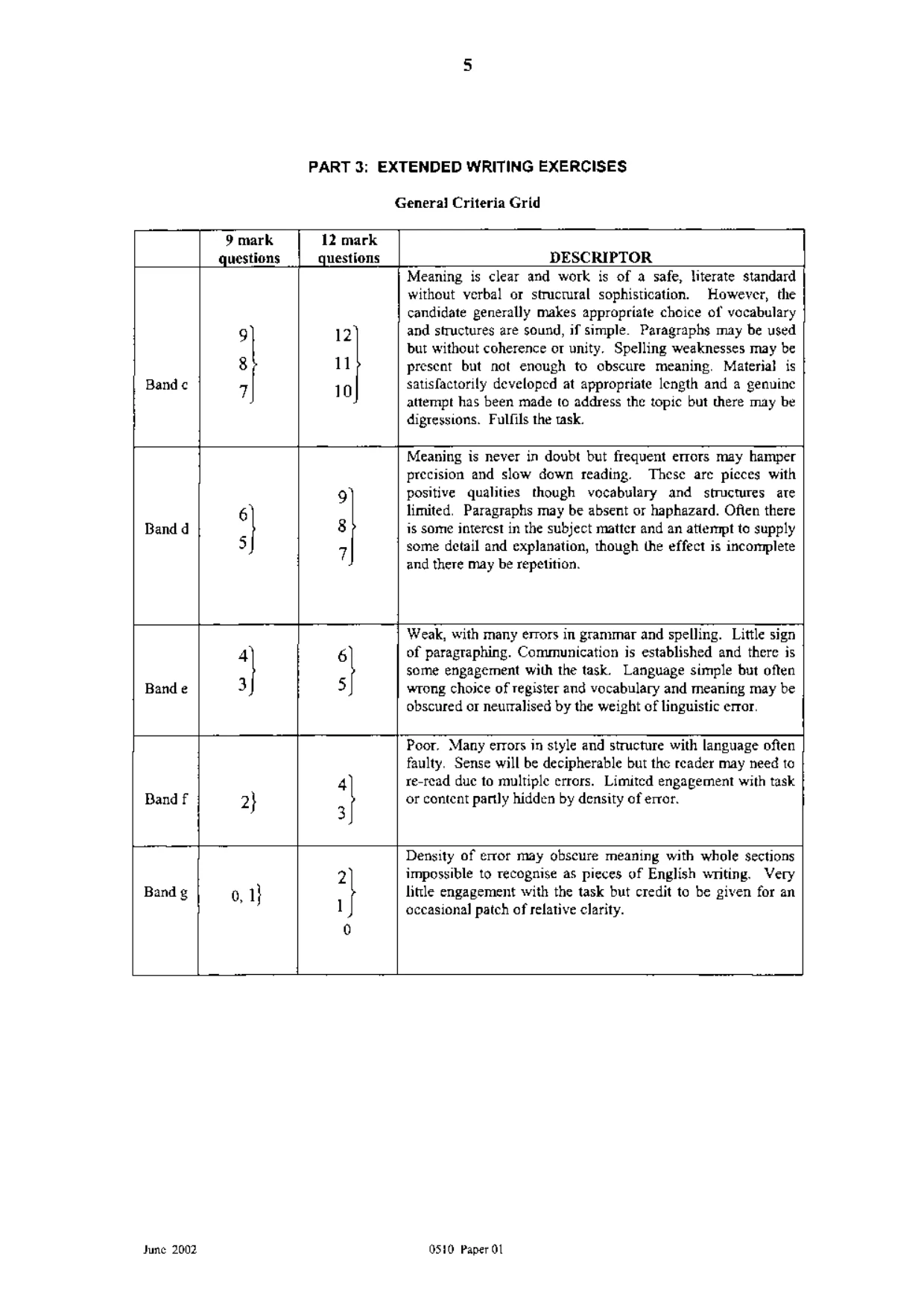
PART 3: EXTENDED WRITING EXERCISES General Criteria Grid 9 mark questions Band c 12 mark juestions 12 11 10 DESCRIPTOR | Meaning is clear and work is of a safe, literate standard without verbal or structural sophistication. However, the candidate generally makes appropriate choice of vocabulary and structures are sound, if simple. Paragraphs may be used but without coherence ot unity. Spelling weaknesses may be present but not enough to obscure meaning. Material is satisfactorily developed at appropriate length and a genuine attempt has been made to address the topic but there may be digressions. Fulfils the task. Band d Meaning is never in doubt but frequent errors may hamper precision and slow down reading. These are pieces with positive qualities though vocabulary and structures ate limited. Paragraphs may be absent or haphazard. Often there is some interest in the subject matter and an attempt to supply some detail and explanation, though the effect is incomplete and there may be repetition. Band e Band f Weak, with many errors in grammar and spelling. Little sign of paragraphing. Communication is established and there is some engagement with the task. Language simple but often wrong choice of register and vocabulary and meaning may be obscured or neutralised by the weight of linguistic error. Poor. Many errors in style and structure with language often faulty. Sense will be decipherable but the reader may need to re-read due to multiple errors. Limited engagement with task or conteat partly hidden by density of error. Band g 0,1} Density of error may obscure meaning with whole sections impossible to recognise as pieces of English writing. Very little engagement with the task but credit to be given for an occasional patch of relative clarity. June 2002 0510 Paper OL