Cambridge IGCSE English - Second Language (count-in oral) 0511 — 2017 May/June Paper 1 · Variant 1
0511/11/M/J/17 · 70 marks · ≈79 min
The question paper and its mark scheme, free to read here and free to download. This is Cambridge’s own paper, exactly as it was sat.
Question paper16 pages



Mark scheme11 pages
Answers below. Sit the paper first if you are practising.
Paper as text
Question paper, page 1
* 8 7 0 9 2 1 6 9 1 1 * This document consists of 13 printed pages and 3 blank pages. DC (SC) 144704 © UCLES 2017 [Turn over Cambridge International Examinations Cambridge International General Certificate of Secondary Education ENGLISH AS A SECOND LANGUAGE 0511/11 Paper 1 Reading and Writing (Core) May/June 2017 1 hour 30 minutes Candidates answer on the Question Paper. No Additional Materials are required. READ THESE INSTRUCTIONS FIRST Write your Centre number, candidate number and name on all the work you hand in. Write in dark blue or black pen. Do not use staples, paper clips, glue or correction fluid. DO NOT WRITE IN ANY BARCODES. Answer all questions. Dictionaries are not allowed. At the end of the examination, fasten all your work securely together. The number of marks is given in brackets [ ] at the end of each question or part question. The syllabus is approved for use in England, Wales and Northern Ireland as a Cambridge International Level 1/Level 2 Certificate.
Question paper, page 2
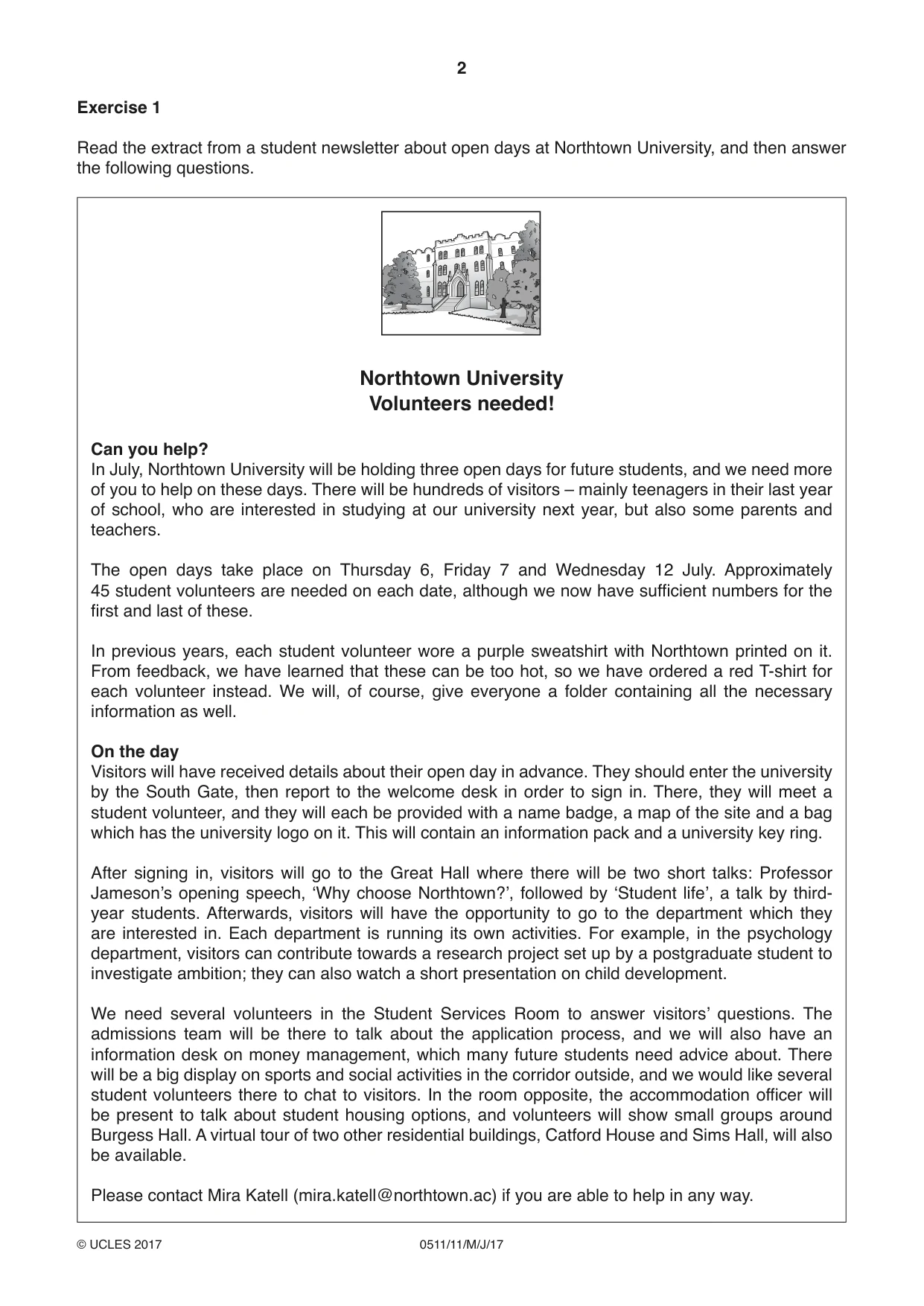
2 0511/11/M/J/17 © UCLES 2017 Exercise 1 Read the extract from a student newsletter about open days at Northtown University, and then answer the following questions. Northtown University Volunteers needed! Can you help? In July, Northtown University will be holding three open days for future students, and we need more of you to help on these days. There will be hundreds of visitors – mainly teenagers in their last year of school, who are interested in studying at our university next year, but also some parents and teachers. The open days take place on Thursday 6, Friday 7 and Wednesday 12 July. Approximately 45 student volunteers are needed on each date, although we now have sufficient numbers for the first and last of these. In previous years, each student volunteer wore a purple sweatshirt with Northtown printed on it. From feedback, we have learned that these can be too hot, so we have ordered a red T-shirt for each volunteer instead. We will, of course, give everyone a folder containing all the necessary information as well. On the day Visitors will have received details about their open day in advance. They should enter the university by the South Gate, then report to the welcome desk in order to sign in. There, they will meet a student volunteer, and they will each be provided with a name badge, a map of the site and a bag which has the university logo on it. This will contain an information pack and a university key ring. After signing in, visitors will go to the Great Hall where there will be two short talks: Professor Jameson’s opening speech, ‘Why choose Northtown?’, followed by ‘Student life’, a talk by third- year students. Afterwards, visitors will have the opportunity to go to the department which they are interested in. Each department is running its own activities. For example, in the psychology department, visitors can contribute towards a research project set up by a postgraduate student to investigate ambition; they can also watch a short presentation on child development. We need several volunteers in the Student Services Room to answer visitors’ questions. The admissions team will be there to talk about the application process, and we will also have an information desk on money management, which many future students need advice about. There will be a big display on sports and social activities in the corridor outside, and we would like several student volunteers there to chat to visitors. In the room opposite, the accommodation officer will be present to talk about student housing options, and volunteers will show small groups around Burgess Hall. A virtual tour of two other residential buildings, Catford House and Sims Hall, will also be available. Please contact Mira Katell (mira.katell@northtown.ac) if you are able to help in any way.
Question paper, page 3
3 0511/11/M/J/17 © UCLES 2017 [Turn over (a) On which date in July are student volunteers still needed? …[1] (b) What will the student volunteers wear? …[1] (c) What will all visitors receive inside their bag? Give two details. … …[1] (d) What is the title of the first talk on each open day? …[1] (e) What is the topic of the psychology experiment that visitors can take part in? …[1] (f) What can visitors find out about in the Student Services Room? Give two details. … …[2] [Total: 7]
Question paper, page 4
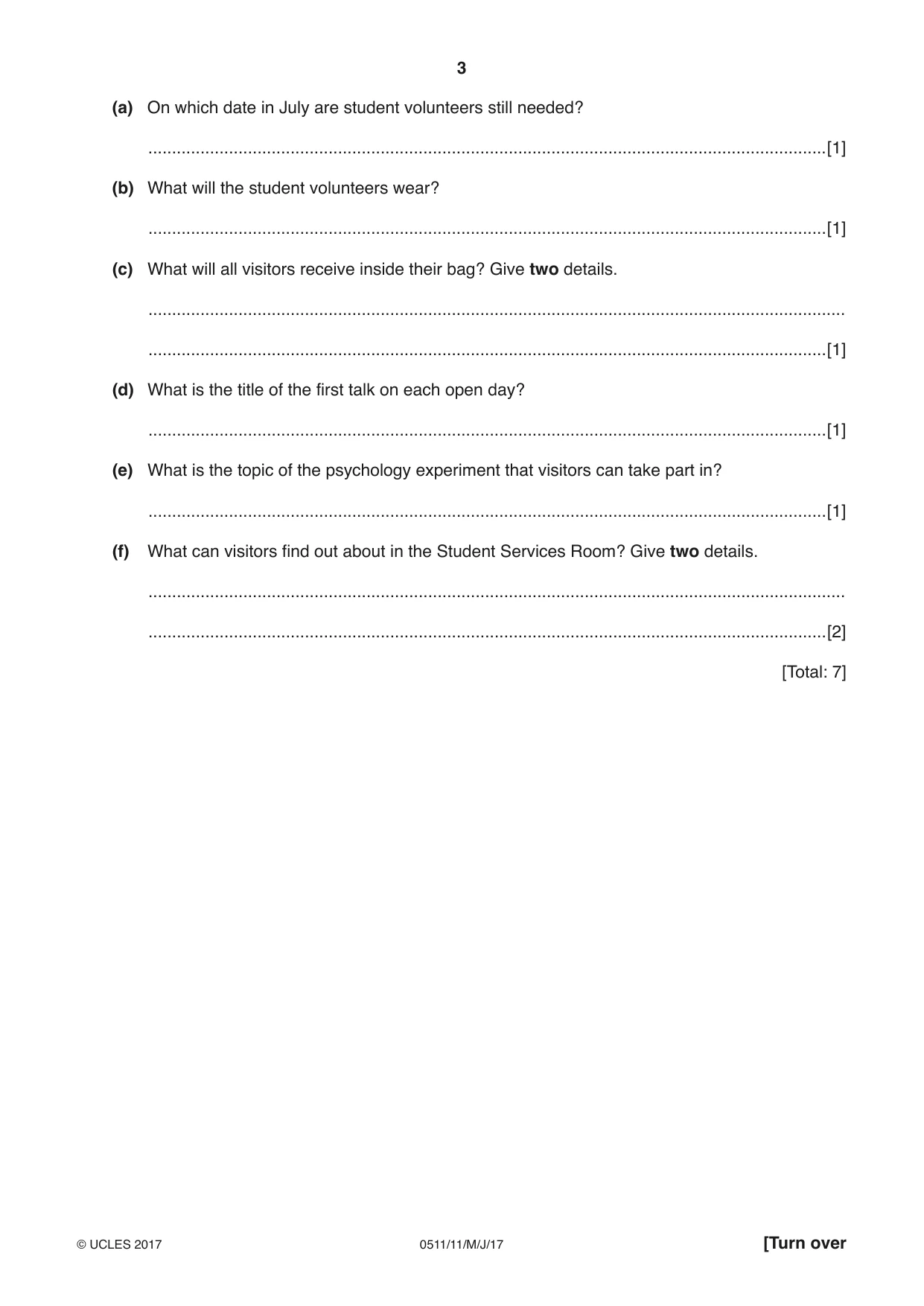
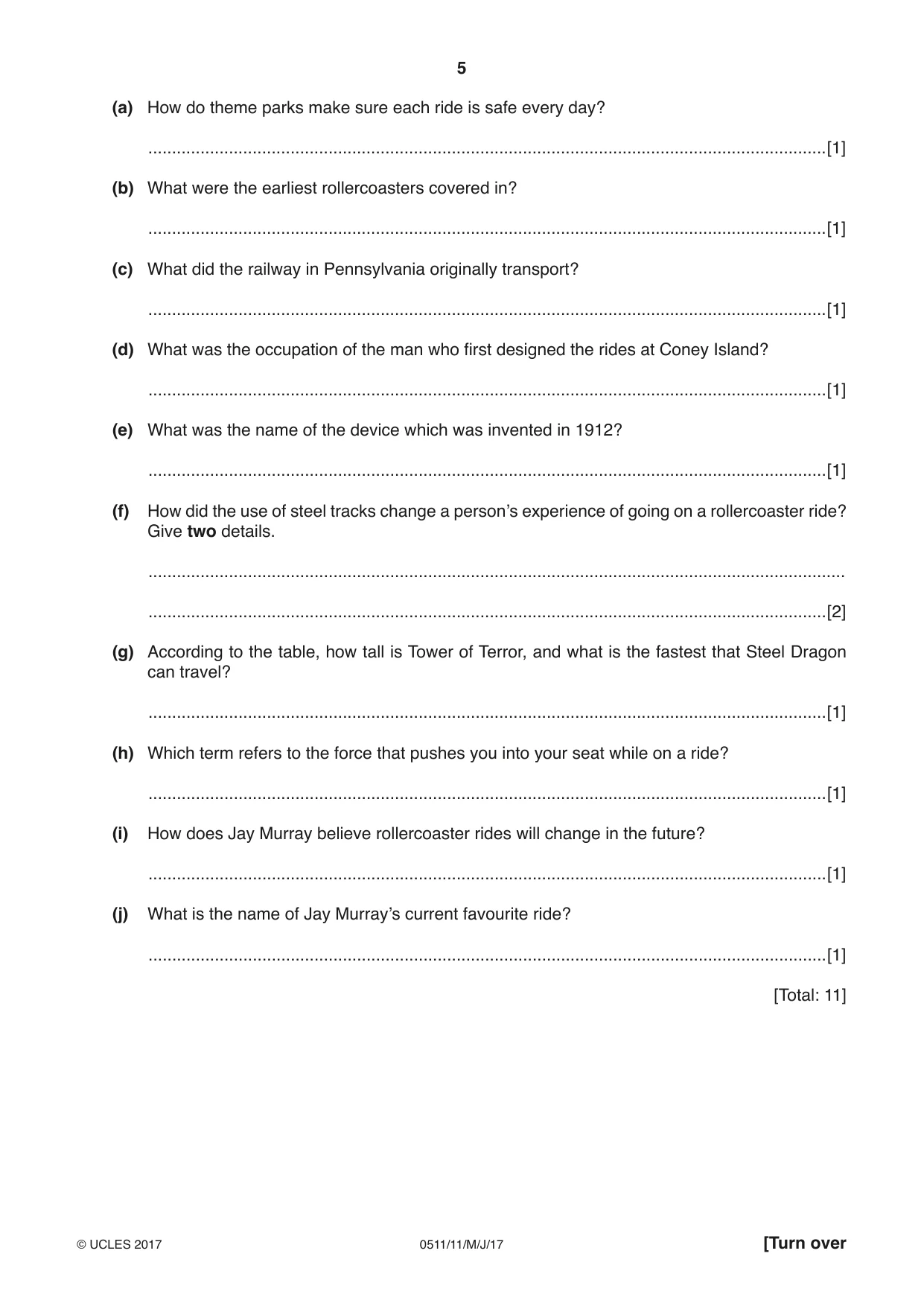
4 0511/11/M/J/17 © UCLES 2017 Exercise 2 Read the article about rollercoasters, and then answer the following questions. My first ever rollercoaster ride I have come to a theme park to meet rollercoaster enthusiast Jay Murray, to find out what makes these rides so popular. Jay estimates he has been on 700 rides in the past 10 years, and is surprised that I have never been on one. He says that one of the attractions of these rides is that you feel out of control, but safe. Jay really wanted to emphasise the importance of safety. “All rides are tested for 1,000 hours before they open to the public,” he said. “They also do a test run on every ride each morning, and there’s a thorough annual inspection too.” Rollercoasters first appeared in 17th-century Russia. These were sloping structures up to 15 metres high, built of wood, with a layer of ice on the surface which people would slide down. Rollercoasters with wheeled sledges were developed soon afterwards. Later, in Pennsylvania, in the USA, a train that had been used to deliver coal was converted to carry passengers on day trips. This gave a man called LaMarcus Thompson the idea to open a park with pleasure rides at Coney Island, New York. A school teacher by profession, he had the eye of a designer, and the mind of a businessman. In just three weeks, he raised enough money from the rides to pay for the cost of building the park. By 1888, Thompson had built nearly 50 rollercoasters around the USA and Europe. He introduced new technologies such as cables to pull trains uphill, but it was another man, John Miller, who came up with a design for an under-friction wheel, which kept trains firmly attached to the rails. This meant that they could go faster and on steeper tracks, without falling off. This invention appeared in 1912. The introduction of steel tracks meant that the structures were significantly stronger, making rides safer. This also enabled engineers to be more ambitious in their designs, with the knowledge that the rides would still feel smoother. The tracks became quieter too, which was another bonus. Modern rides have a range of features, including floorless trains, free-fall drops, rolls and loops – all of which mean that if you go on a ride these days, the experience is so intense. “That’s why I love them,” said Jay. “You forget who you are for a minute.” The names of some famous rides reflect these features – Tower of Terror, Formula Rossa and Steel Dragon are just some examples. Name of ride: Country: Height: Total cost: Maximum speed: Tower of Terror Australia 115 metres A $ 16 million 161 kilometres per hour Formula Rossa United Arab Emirates 52 metres £19.5 million 240 kilometres per hour Steel Dragon Japan 97 metres US $ 52 million 153 kilometres per hour However, there are limits to the physical forces that a person can tolerate on a ride. People can cope more easily with the positive vertical – the feeling of being pressed into their seat – than the negative vertical, which pushes them out of it. Interestingly, Jay points out that the desire to make rollercoaster rides higher and faster is slowly being replaced by a trend towards more complex rides, which offer a more lasting experience. Jay explains: “A world-famous ride such as Kingda Ka (in the USA) is over in less than ten seconds. Although such a ride is thrilling, and gives you a rush of adrenaline, there is an alternative. You can try a ride like Helix (in Sweden), which lasts for two minutes – it’s my number one at the moment.” All the same, Jay was eager for me to experience ‘air time’ – the moment when you reach the top and hang, weightless, before plunging down the other side. And when I finally did, I had to admit that it was fantastic!
Question paper, page 5
5 0511/11/M/J/17 © UCLES 2017 [Turn over (a) How do theme parks make sure each ride is safe every day? …[1] (b) What were the earliest rollercoasters covered in? …[1] (c) What did the railway in Pennsylvania originally transport? …[1] (d) What was the occupation of the man who first designed the rides at Coney Island? …[1] (e) What was the name of the device which was invented in 1912? …[1] (f) How did the use of steel tracks change a person’s experience of going on a rollercoaster ride? Give two details. … …[2] (g) According to the table, how tall is Tower of Terror, and what is the fastest that Steel Dragon can travel? …[1] (h) Which term refers to the force that pushes you into your seat while on a ride? …[1] (i) How does Jay Murray believe rollercoaster rides will change in the future? …[1] (j) What is the name of Jay Murray’s current favourite ride? …[1] [Total: 11]
Question paper, page 6
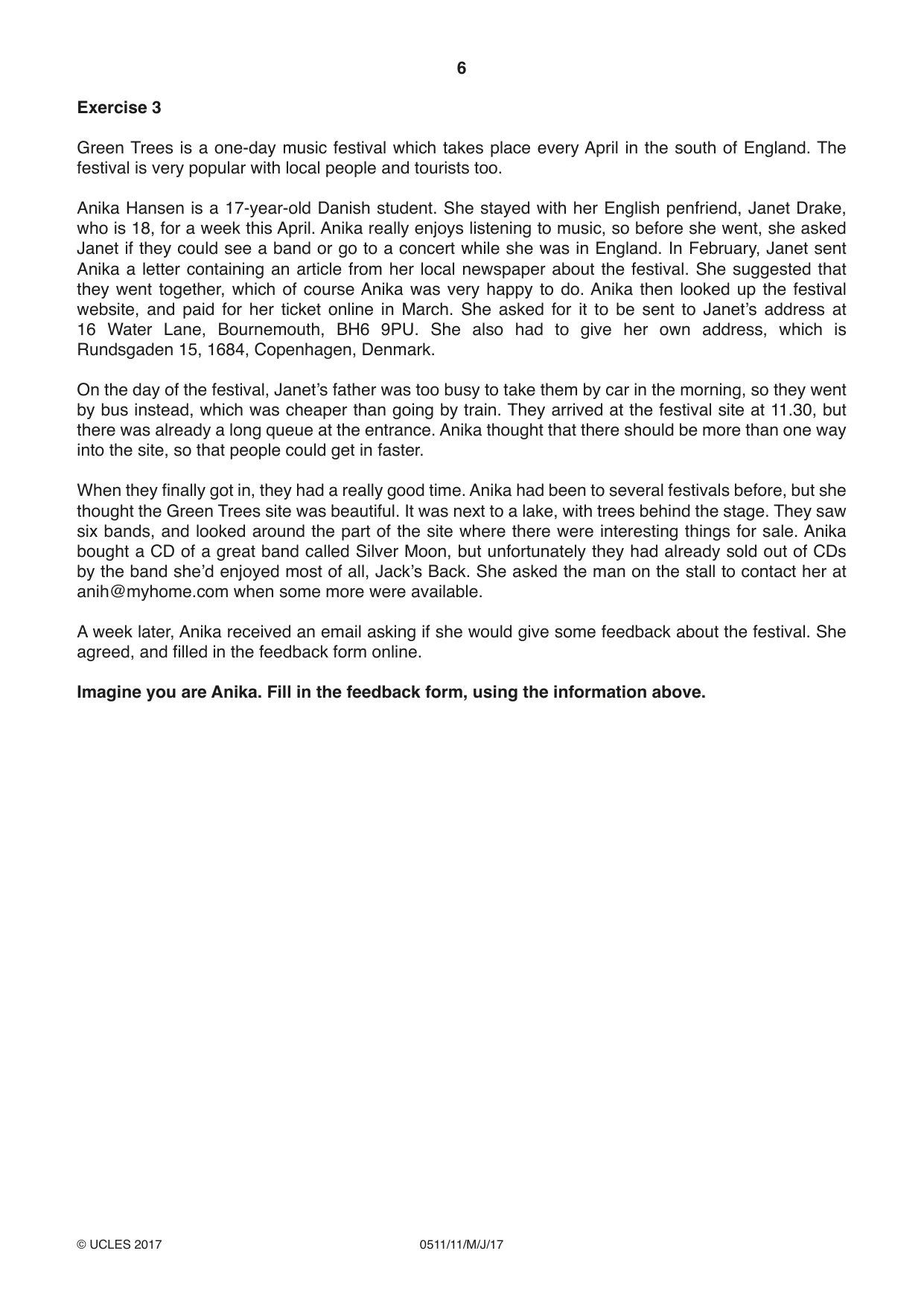
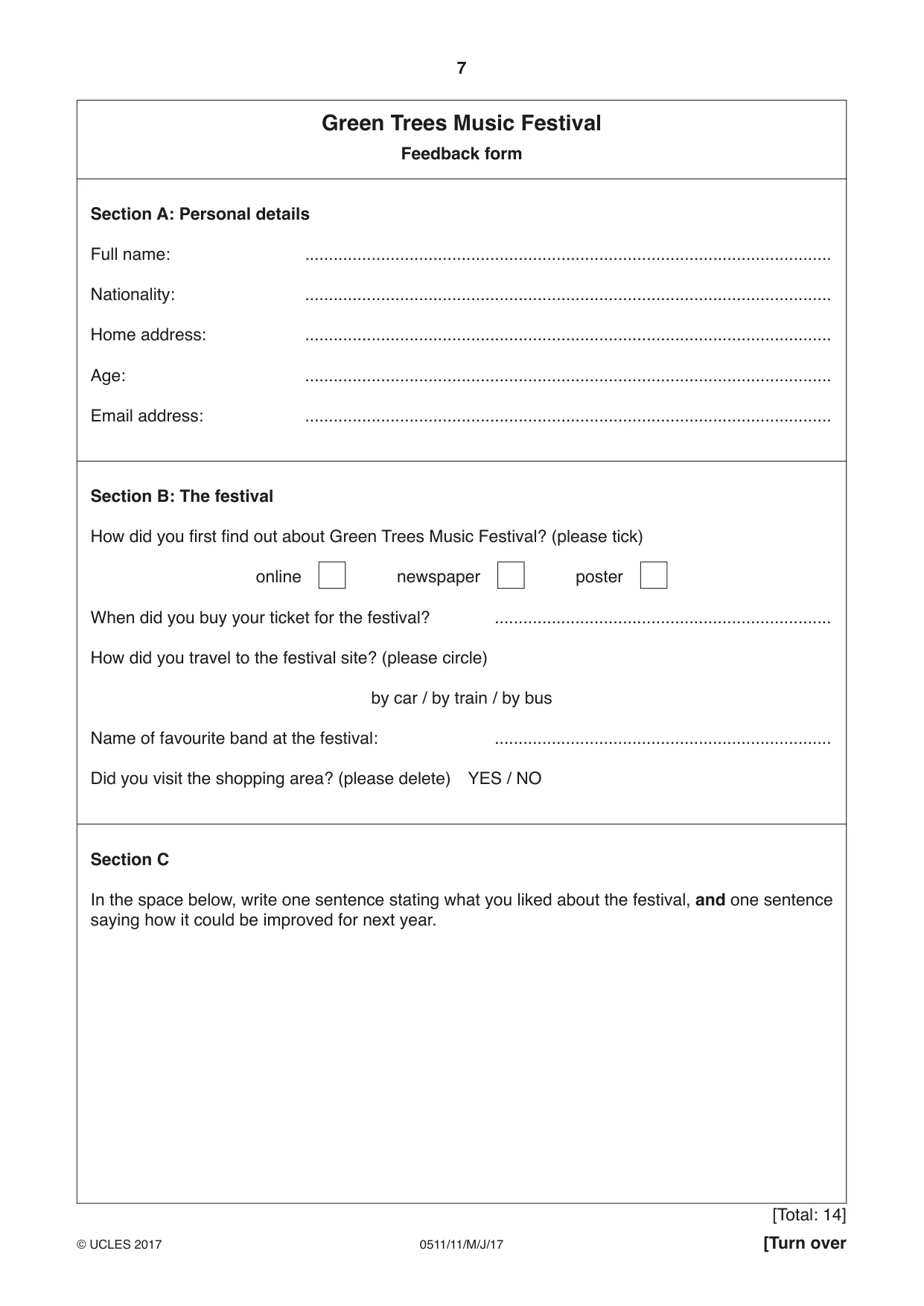
6 0511/11/M/J/17 © UCLES 2017 Exercise 3 Green Trees is a one-day music festival which takes place every April in the south of England. The festival is very popular with local people and tourists too. Anika Hansen is a 17-year-old Danish student. She stayed with her English penfriend, Janet Drake, who is 18, for a week this April. Anika really enjoys listening to music, so before she went, she asked Janet if they could see a band or go to a concert while she was in England. In February, Janet sent Anika a letter containing an article from her local newspaper about the festival. She suggested that they went together, which of course Anika was very happy to do. Anika then looked up the festival website, and paid for her ticket online in March. She asked for it to be sent to Janet’s address at 16 Water Lane, Bournemouth, BH6 9PU. She also had to give her own address, which is Rundsgaden 15, 1684, Copenhagen, Denmark. On the day of the festival, Janet’s father was too busy to take them by car in the morning, so they went by bus instead, which was cheaper than going by train. They arrived at the festival site at 11.30, but there was already a long queue at the entrance. Anika thought that there should be more than one way into the site, so that people could get in faster. When they finally got in, they had a really good time. Anika had been to several festivals before, but she thought the Green Trees site was beautiful. It was next to a lake, with trees behind the stage. They saw six bands, and looked around the part of the site where there were interesting things for sale. Anika bought a CD of a great band called Silver Moon, but unfortunately they had already sold out of CDs by the band she’d enjoyed most of all, Jack’s Back. She asked the man on the stall to contact her at anih@myhome.com when some more were available. A week later, Anika received an email asking if she would give some feedback about the festival. She agreed, and filled in the feedback form online. Imagine you are Anika. Fill in the feedback form, using the information above.
Question paper, page 7
7 0511/11/M/J/17 © UCLES 2017 [Turn over Green Trees Music Festival Feedback form Section A: Personal details Full name: … Nationality: … Home address: … Age: … Email address: … Section B: The festival How did you first find out about Green Trees Music Festival? (please tick) online newspaper poster When did you buy your ticket for the festival? … How did you travel to the festival site? (please circle) by car / by train / by bus Name of favourite band at the festival: … Did you visit the shopping area? (please delete) YES / NO Section C In the space below, write one sentence stating what you liked about the festival, and one sentence saying how it could be improved for next year. [Total: 14]
Question paper, page 8
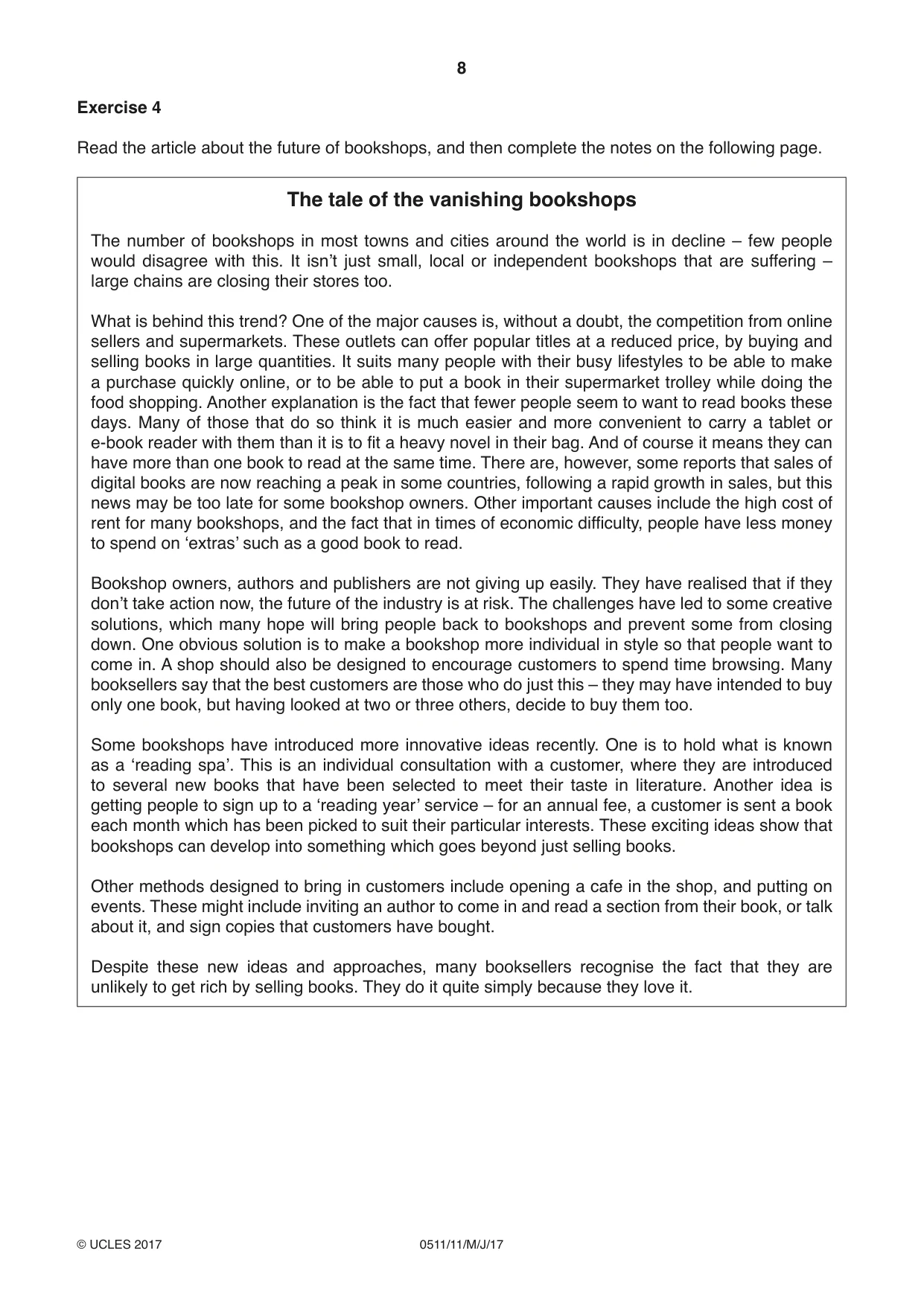
8 0511/11/M/J/17 © UCLES 2017 Exercise 4 Read the article about the future of bookshops, and then complete the notes on the following page. The tale of the vanishing bookshops The number of bookshops in most towns and cities around the world is in decline – few people would disagree with this. It isn’t just small, local or independent bookshops that are suffering – large chains are closing their stores too. What is behind this trend? One of the major causes is, without a doubt, the competition from online sellers and supermarkets. These outlets can offer popular titles at a reduced price, by buying and selling books in large quantities. It suits many people with their busy lifestyles to be able to make a purchase quickly online, or to be able to put a book in their supermarket trolley while doing the food shopping. Another explanation is the fact that fewer people seem to want to read books these days. Many of those that do so think it is much easier and more convenient to carry a tablet or e-book reader with them than it is to fit a heavy novel in their bag. And of course it means they can have more than one book to read at the same time. There are, however, some reports that sales of digital books are now reaching a peak in some countries, following a rapid growth in sales, but this news may be too late for some bookshop owners. Other important causes include the high cost of rent for many bookshops, and the fact that in times of economic difficulty, people have less money to spend on ‘extras’ such as a good book to read. Bookshop owners, authors and publishers are not giving up easily. They have realised that if they don’t take action now, the future of the industry is at risk. The challenges have led to some creative solutions, which many hope will bring people back to bookshops and prevent some from closing down. One obvious solution is to make a bookshop more individual in style so that people want to come in. A shop should also be designed to encourage customers to spend time browsing. Many booksellers say that the best customers are those who do just this – they may have intended to buy only one book, but having looked at two or three others, decide to buy them too. Some bookshops have introduced more innovative ideas recently. One is to hold what is known as a ‘reading spa’. This is an individual consultation with a customer, where they are introduced to several new books that have been selected to meet their taste in literature. Another idea is getting people to sign up to a ‘reading year’ service – for an annual fee, a customer is sent a book each month which has been picked to suit their particular interests. These exciting ideas show that bookshops can develop into something which goes beyond just selling books. Other methods designed to bring in customers include opening a cafe in the shop, and putting on events. These might include inviting an author to come in and read a section from their book, or talk about it, and sign copies that customers have bought. Despite these new ideas and approaches, many booksellers recognise the fact that they are unlikely to get rich by selling books. They do it quite simply because they love it.
Question paper, page 9
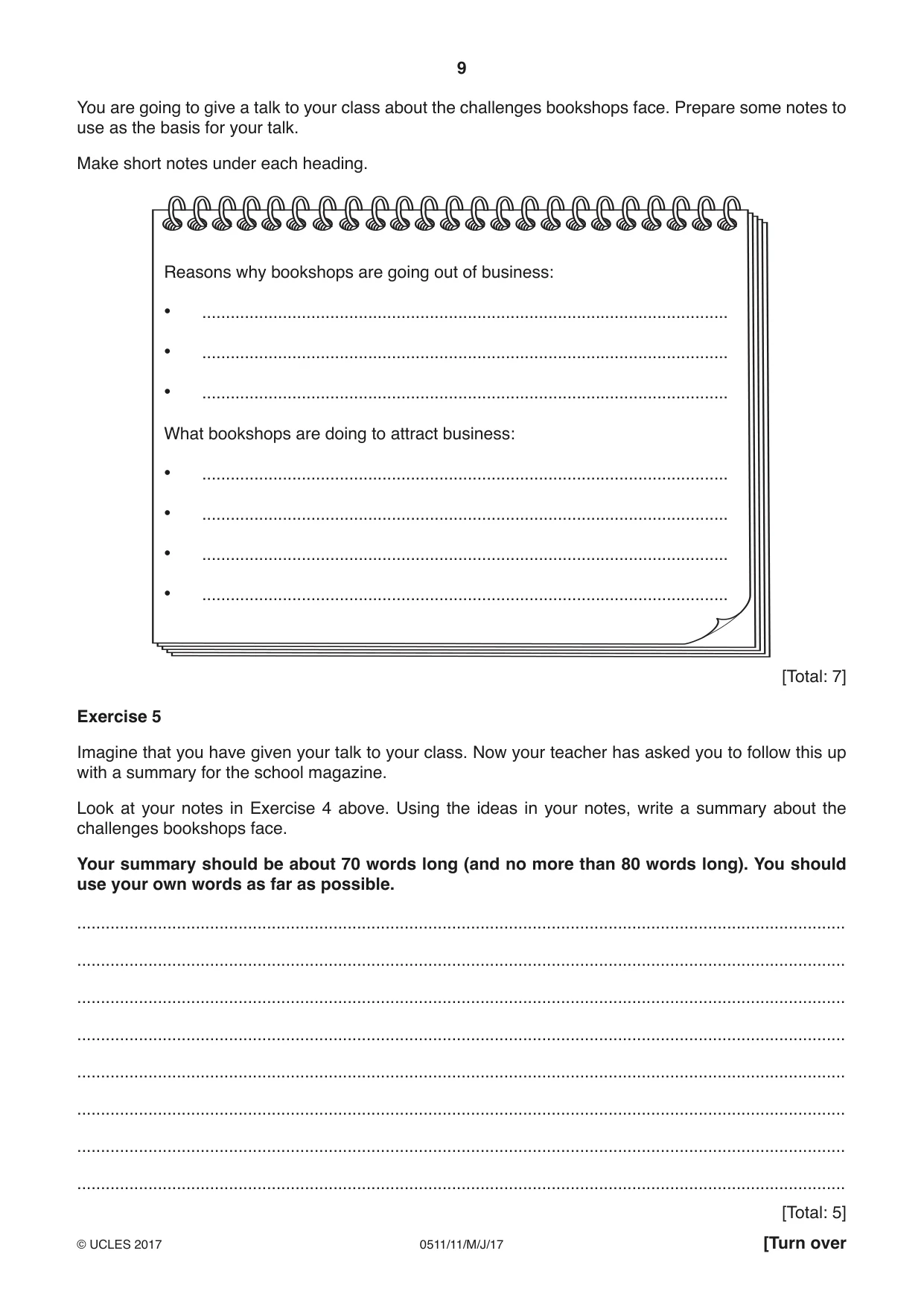
9 0511/11/M/J/17 © UCLES 2017 [Turn over You are going to give a talk to your class about the challenges bookshops face. Prepare some notes to use as the basis for your talk. Make short notes under each heading. Reasons why bookshops are going out of business: • … • … • … What bookshops are doing to attract business: • … • … • … • … [Total: 7] Exercise 5 Imagine that you have given your talk to your class. Now your teacher has asked you to follow this up with a summary for the school magazine. Look at your notes in Exercise 4 above. Using the ideas in your notes, write a summary about the challenges bookshops face. Your summary should be about 70 words long (and no more than 80 words long). You should use your own words as far as possible. … … … … … … … … [Total: 5]
Question paper, page 10
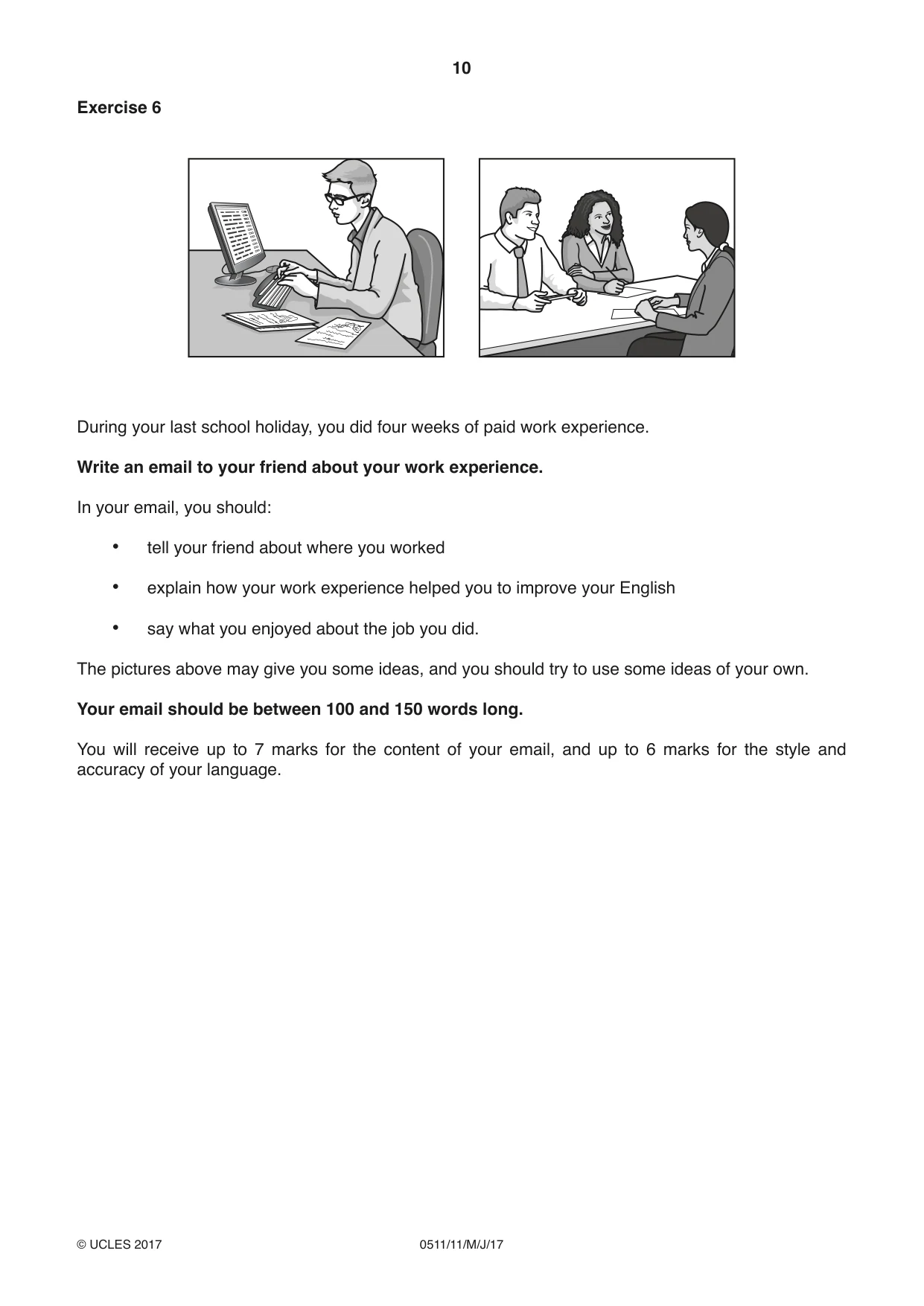
10 0511/11/M/J/17 © UCLES 2017 Exercise 6 During your last school holiday, you did four weeks of paid work experience. Write an email to your friend about your work experience. In your email, you should: • tell your friend about where you worked • explain how your work experience helped you to improve your English • say what you enjoyed about the job you did. The pictures above may give you some ideas, and you should try to use some ideas of your own. Your email should be between 100 and 150 words long. You will receive up to 7 marks for the content of your email, and up to 6 marks for the style and accuracy of your language.
Question paper, page 11
11 0511/11/M/J/17 © UCLES 2017 [Turn over … … … … … … … … … … … … … … … … … … … … … … … … … [Total: 13]
Question paper, page 12
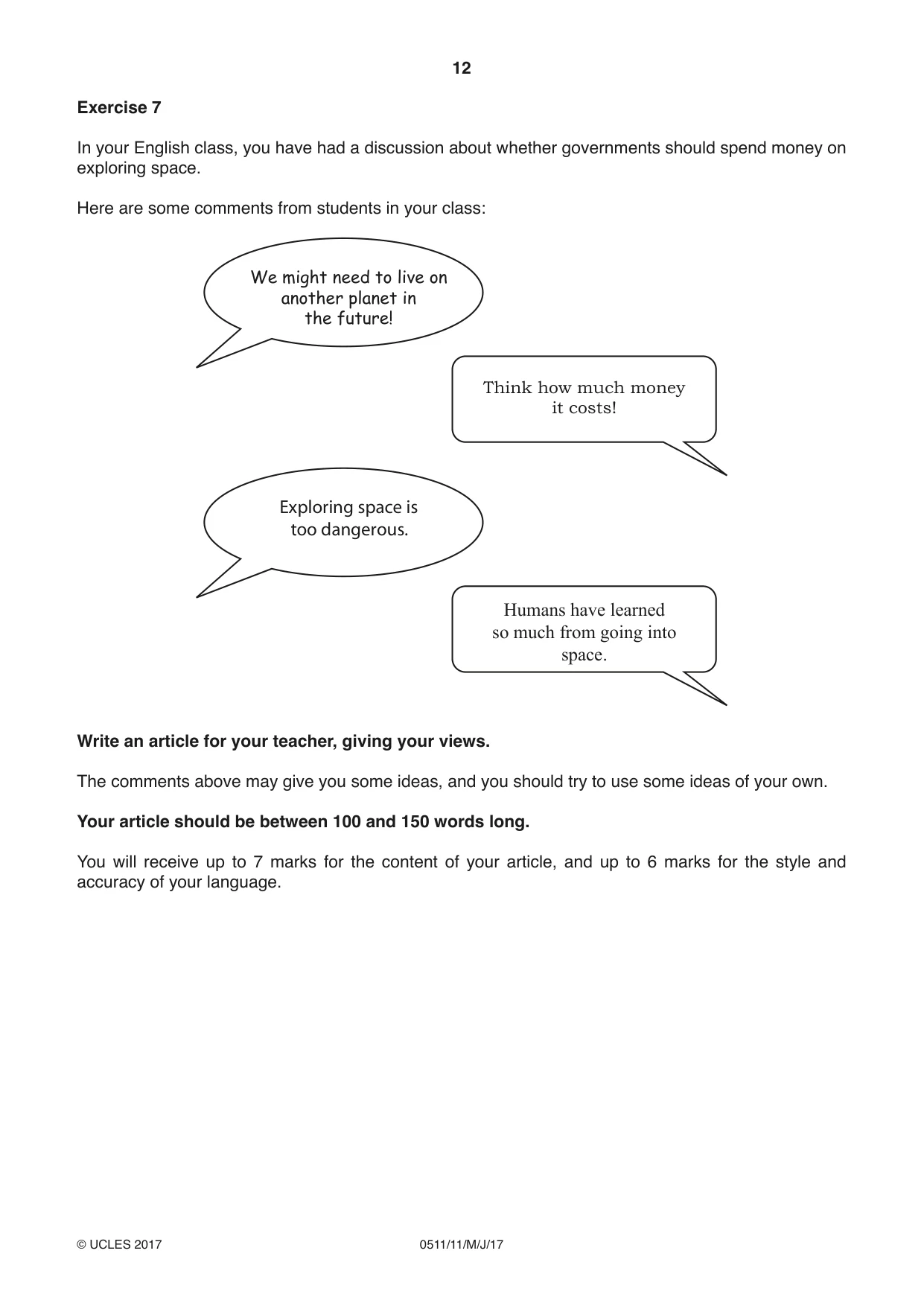
12 0511/11/M/J/17 © UCLES 2017 Exercise 7 In your English class, you have had a discussion about whether governments should spend money on exploring space. Here are some comments from students in your class: Exploring space is too dangerous. Humans have learned so much from going into space. We might need to live on another planet in the future! Think how much money it costs! Write an article for your teacher, giving your views. The comments above may give you some ideas, and you should try to use some ideas of your own. Your article should be between 100 and 150 words long. You will receive up to 7 marks for the content of your article, and up to 6 marks for the style and accuracy of your language.
Question paper, page 13
13 0511/11/M/J/17 © UCLES 2017 … … … … … … … … … … … … … … … … … … … … … … … … … [Total: 13]
Question paper, page 14
14 0511/11/M/J/17 © UCLES 2017 BLANK PAGE
Question paper, page 15
15 0511/11/M/J/17 © UCLES 2017 BLANK PAGE
Question paper, page 16
16 0511/11/M/J/17 © UCLES 2017 Permission to reproduce items where third-party owned material protected by copyright is included has been sought and cleared where possible. Every reasonable effort has been made by the publisher (UCLES) to trace copyright holders, but if any items requiring clearance have unwittingly been included, the publisher will be pleased to make amends at the earliest possible opportunity. To avoid the issue of disclosure of answer-related information to candidates, all copyright acknowledgements are reproduced online in the Cambridge International Examinations Copyright Acknowledgements Booklet. This is produced for each series of examinations and is freely available to download at www.cie.org.uk after the live examination series. Cambridge International Examinations is part of the Cambridge Assessment Group. Cambridge Assessment is the brand name of University of Cambridge Local Examinations Syndicate (UCLES), which is itself a department of the University of Cambridge. BLANK PAGE
Mark scheme, page 1
® IGCSE is a registered trademark. This syllabus is approved for use in England, Wales and Northern Ireland as a Cambridge International Level 1/Level 2 Certificate. This document consists of 11 printed pages. © UCLES 2017 [Turn over Cambridge International Examinations Cambridge International General Certificate of Secondary Education ENGLISH AS A SECOND LANGUAGE 0511/11 Paper 1 Reading and Writing (Core) May/June 2017 MARK SCHEME Maximum Mark: 70 Published This mark scheme is published as an aid to teachers and candidates, to indicate the requirements of the examination. It shows the basis on which Examiners were instructed to award marks. It does not indicate the details of the discussions that took place at an Examiners’ meeting before marking began, which would have considered the acceptability of alternative answers. Mark schemes should be read in conjunction with the question paper and the Principal Examiner Report for Teachers. Cambridge will not enter into discussions about these mark schemes. Cambridge is publishing the mark schemes for the May/June 2017 series for most Cambridge IGCSE®, Cambridge International A and AS Level and Cambridge Pre-U components, and some Cambridge O Level components.
Mark scheme, page 2
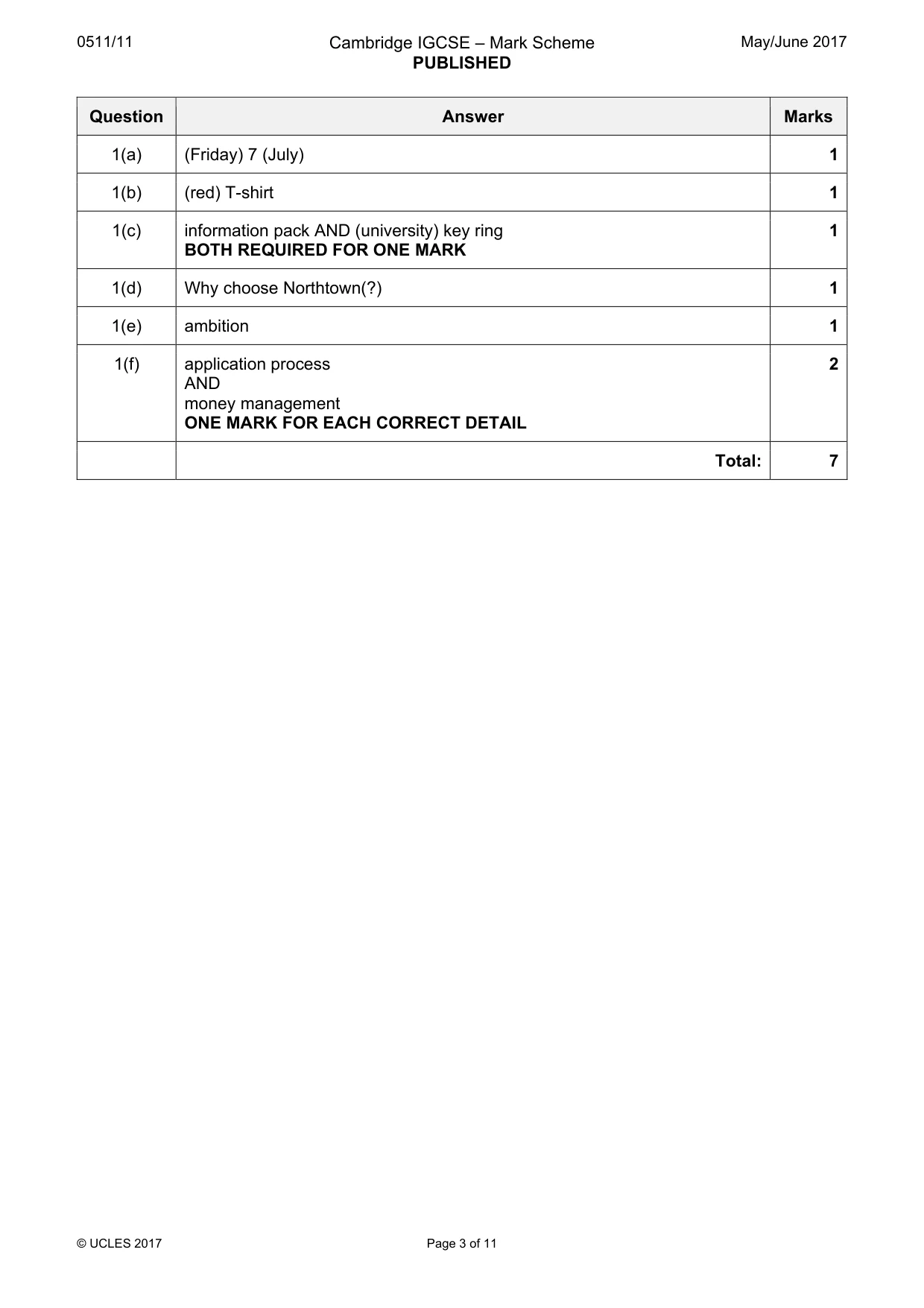
0511/11 Cambridge IGCSE – Mark Scheme PUBLISHED May/June 2017 © UCLES 2017 Page 2 of 11 IGCSE English as a Second Language Core tier Reading/Writing (Paper 1) This component forms part of the Core tier assessment of IGCSE English as a Second Language and tests the following Assessment Objectives: AO1: Reading R1 identify and retrieve facts and details R2 understand and select relevant information R3 recognise, understand ideas, opinions and attitudes and the connections between the related ideas R4 understand what is implied but not actually written, e.g. gist, relationships, writer’s purpose/intention, writer’s feelings, situation or place AO2: Writing W1 communicate clearly, accurately and appropriately W2 convey information and express opinions effectively W3 employ and control a variety of grammatical structures W4 demonstrate knowledge and understanding of a range of appropriate vocabulary W5 observe conventions of paragraphing, punctuation and spelling W6 employ appropriate register/style Overview of exercises on Paper 1 Reading objectives tested Marks for reading objectives Writing objectives tested Marks for writing objectives Total available marks Exercise 1 Reading (1) R1 R2 7 7 Exercise 2 Reading (2) R1 R2 R4 11 11 Exercise 3 Information transfer R1, R2 10 W1, W5 4 14 Exercise 4 Note-making R1, R2, R3 7 7 Exercise 5 Summary W1, W2, W3, W4, W5 5 5 Exercise 6 Writing (1) W1, W2, W3, W4, W5, W6 13 13 Exercise 7 Writing (2) W1, W2, W3, W4, W5, W6 13 13 70
Mark scheme, page 3
0511/11 Cambridge IGCSE – Mark Scheme PUBLISHED May/June 2017 © UCLES 2017 Page 3 of 11 Question Answer Marks 1(a) (Friday) 7 (July) 1 1(b) (red) T-shirt 1 1(c) information pack AND (university) key ring BOTH REQUIRED FOR ONE MARK 1 1(d) Why choose Northtown(?) 1 1(e) ambition 1 1(f) application process AND money management ONE MARK FOR EACH CORRECT DETAIL 2 Total: 7
Mark scheme, page 4
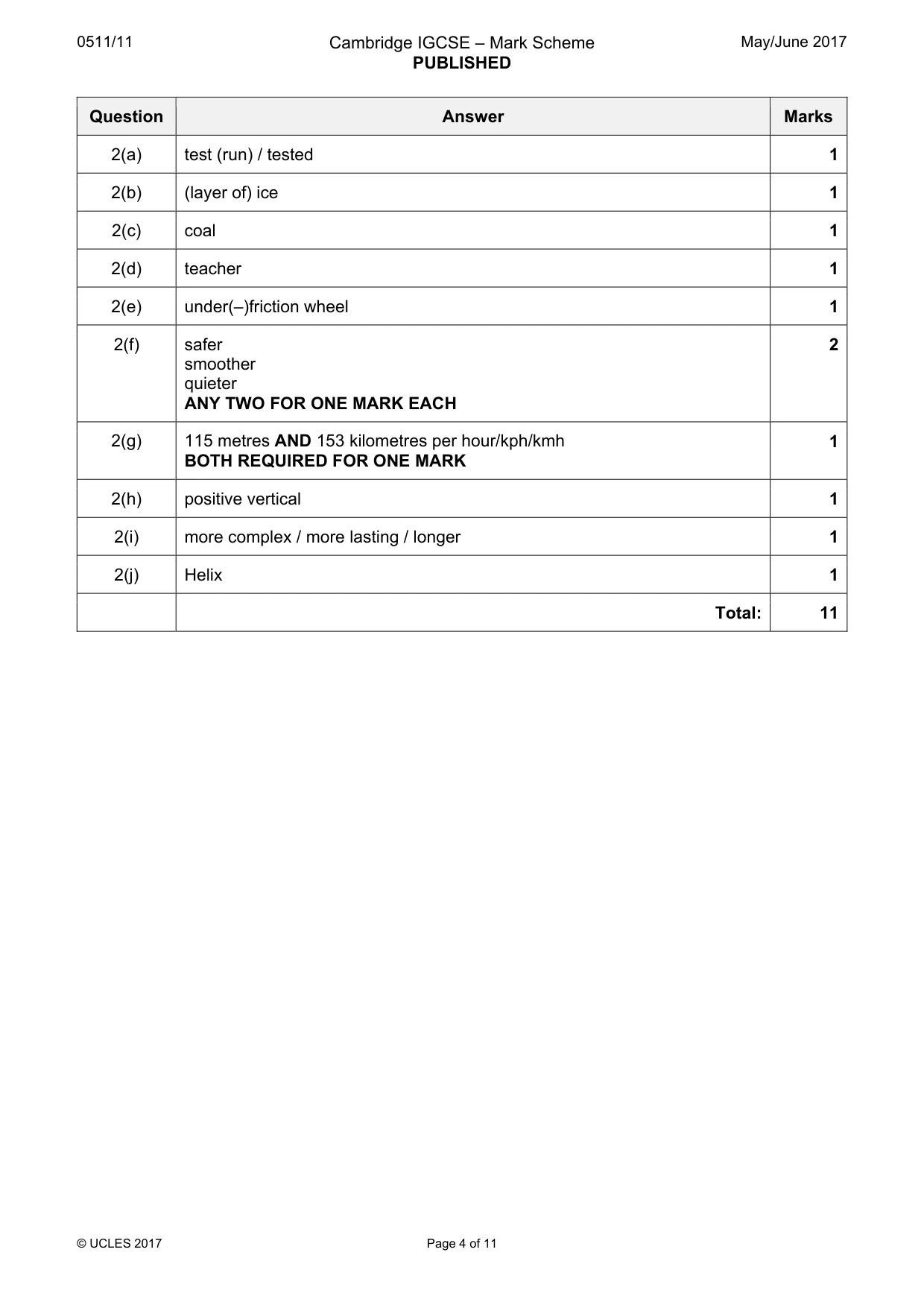
0511/11 Cambridge IGCSE – Mark Scheme PUBLISHED May/June 2017 © UCLES 2017 Page 4 of 11 Question Answer Marks 2(a) test (run) / tested 1 2(b) (layer of) ice 1 2(c) coal 1 2(d) teacher 1 2(e) under(–)friction wheel 1 2(f) safer smoother quieter ANY TWO FOR ONE MARK EACH 2 2(g) 115 metres AND 153 kilometres per hour/kph/kmh BOTH REQUIRED FOR ONE MARK 1 2(h) positive vertical 1 2(i) more complex / more lasting / longer 1 2(j) Helix 1 Total: 11
Mark scheme, page 5
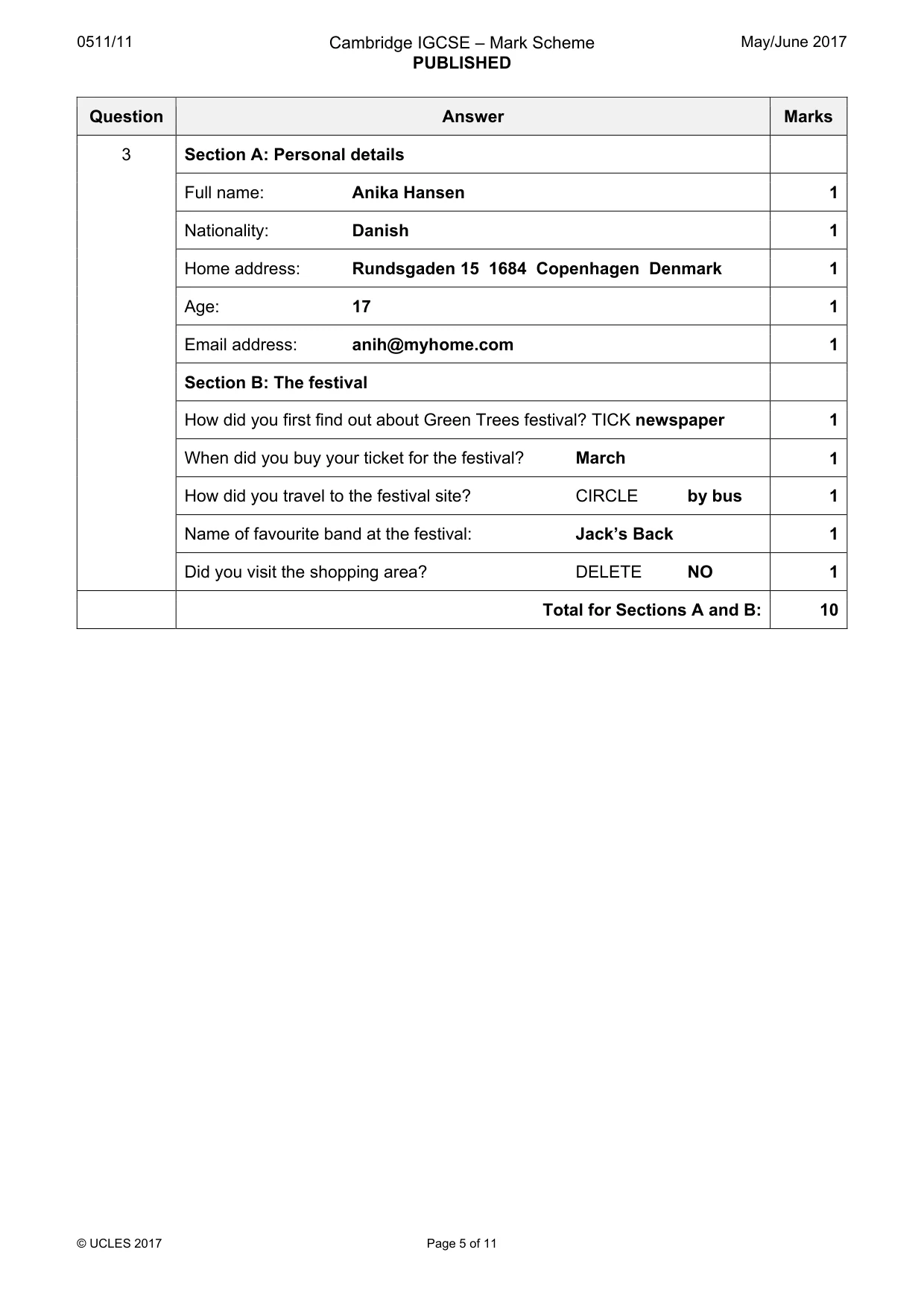
0511/11 Cambridge IGCSE – Mark Scheme PUBLISHED May/June 2017 © UCLES 2017 Page 5 of 11 Question Answer Marks 3 Section A: Personal details Full name: Anika Hansen 1 Nationality: Danish 1 Home address: Rundsgaden 15 1684 Copenhagen Denmark 1 Age: 17 1 Email address: anih@myhome.com 1 Section B: The festival How did you first find out about Green Trees festival? TICK newspaper 1 When did you buy your ticket for the festival? March 1 How did you travel to the festival site? CIRCLE by bus 1 Name of favourite band at the festival: Jack’s Back 1 Did you visit the shopping area? DELETE NO 1 Total for Sections A and B: 10
Mark scheme, page 6
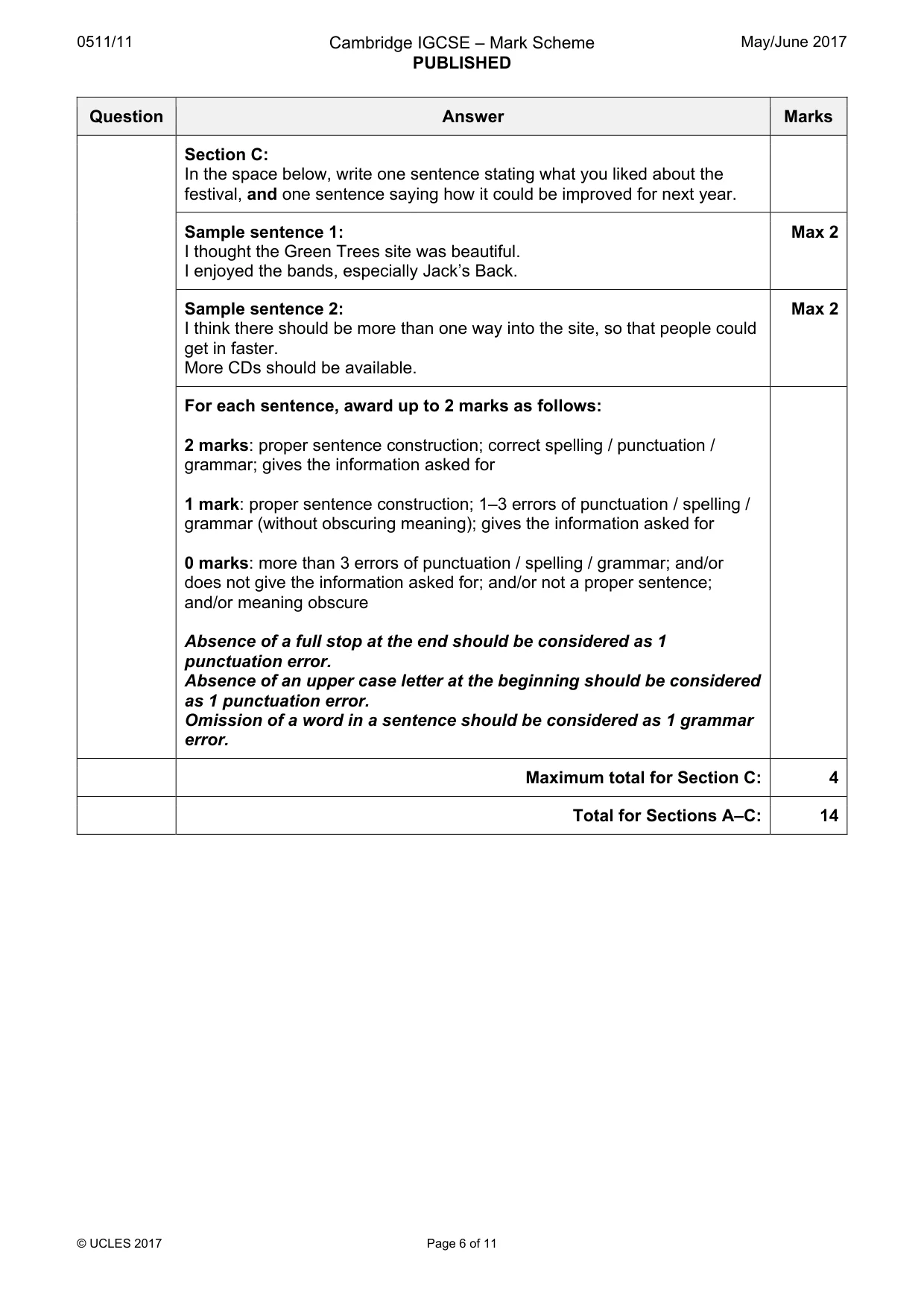
0511/11 Cambridge IGCSE – Mark Scheme PUBLISHED May/June 2017 © UCLES 2017 Page 6 of 11 Question Answer Marks Section C: In the space below, write one sentence stating what you liked about the festival, and one sentence saying how it could be improved for next year. Sample sentence 1: I thought the Green Trees site was beautiful. I enjoyed the bands, especially Jack’s Back. Max 2 Sample sentence 2: I think there should be more than one way into the site, so that people could get in faster. More CDs should be available. Max 2 For each sentence, award up to 2 marks as follows: 2 marks: proper sentence construction; correct spelling / punctuation / grammar; gives the information asked for 1 mark: proper sentence construction; 1–3 errors of punctuation / spelling / grammar (without obscuring meaning); gives the information asked for 0 marks: more than 3 errors of punctuation / spelling / grammar; and/or does not give the information asked for; and/or not a proper sentence; and/or meaning obscure Absence of a full stop at the end should be considered as 1 punctuation error. Absence of an upper case letter at the beginning should be considered as 1 punctuation error. Omission of a word in a sentence should be considered as 1 grammar error. Maximum total for Section C: 4 Total for Sections A–C: 14
Mark scheme, page 7
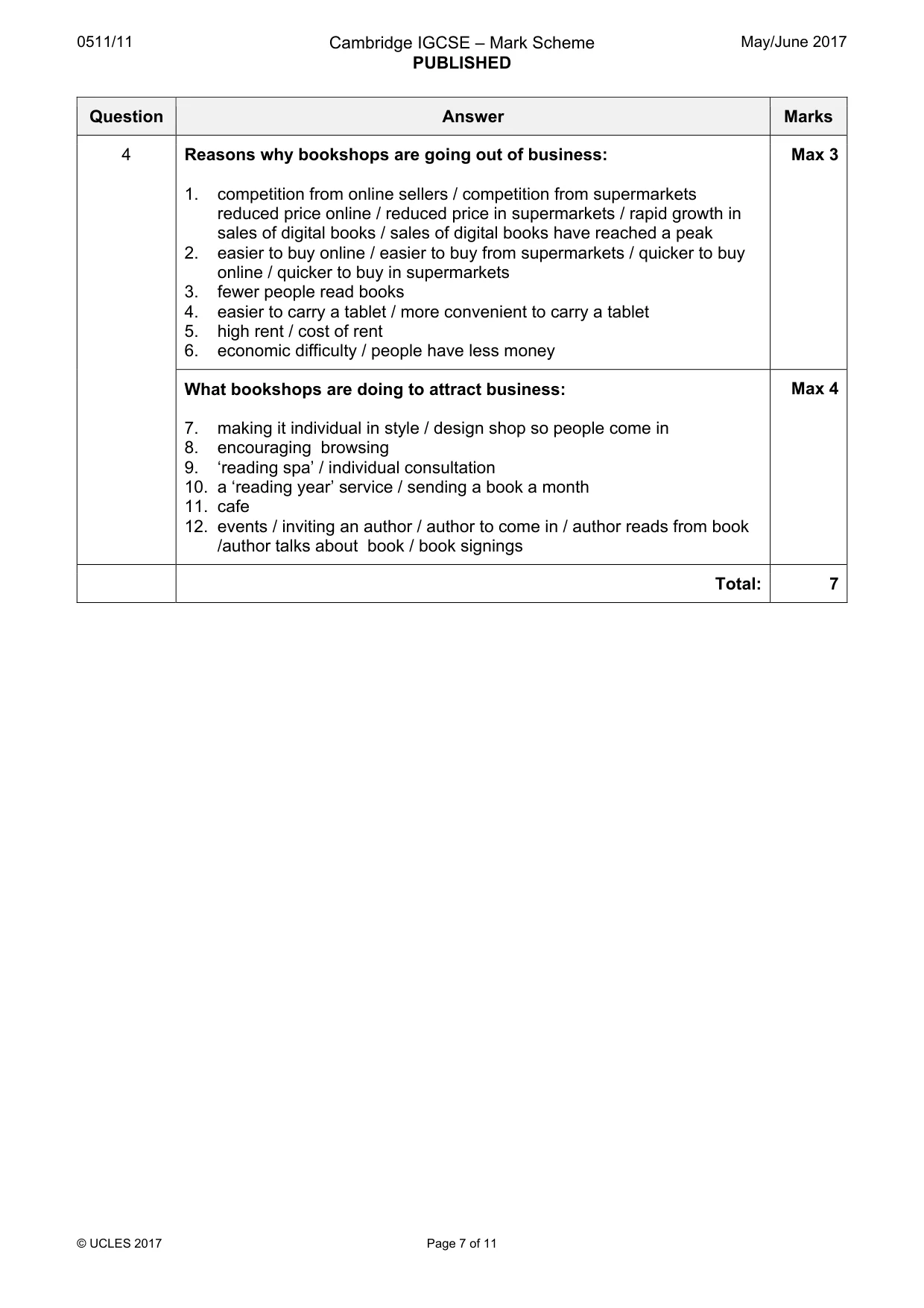
0511/11 Cambridge IGCSE – Mark Scheme PUBLISHED May/June 2017 © UCLES 2017 Page 7 of 11 Question Answer Marks 4 Reasons why bookshops are going out of business: 1. competition from online sellers / competition from supermarkets reduced price online / reduced price in supermarkets / rapid growth in sales of digital books / sales of digital books have reached a peak 2. easier to buy online / easier to buy from supermarkets / quicker to buy online / quicker to buy in supermarkets 3. fewer people read books 4. easier to carry a tablet / more convenient to carry a tablet 5. high rent / cost of rent 6. economic difficulty / people have less money Max 3 What bookshops are doing to attract business: 7. making it individual in style / design shop so people come in 8. encouraging browsing 9. ‘reading spa’ / individual consultation 10. a ‘reading year’ service / sending a book a month 11. cafe 12. events / inviting an author / author to come in / author reads from book /author talks about book / book signings Max 4 Total: 7
Mark scheme, page 8
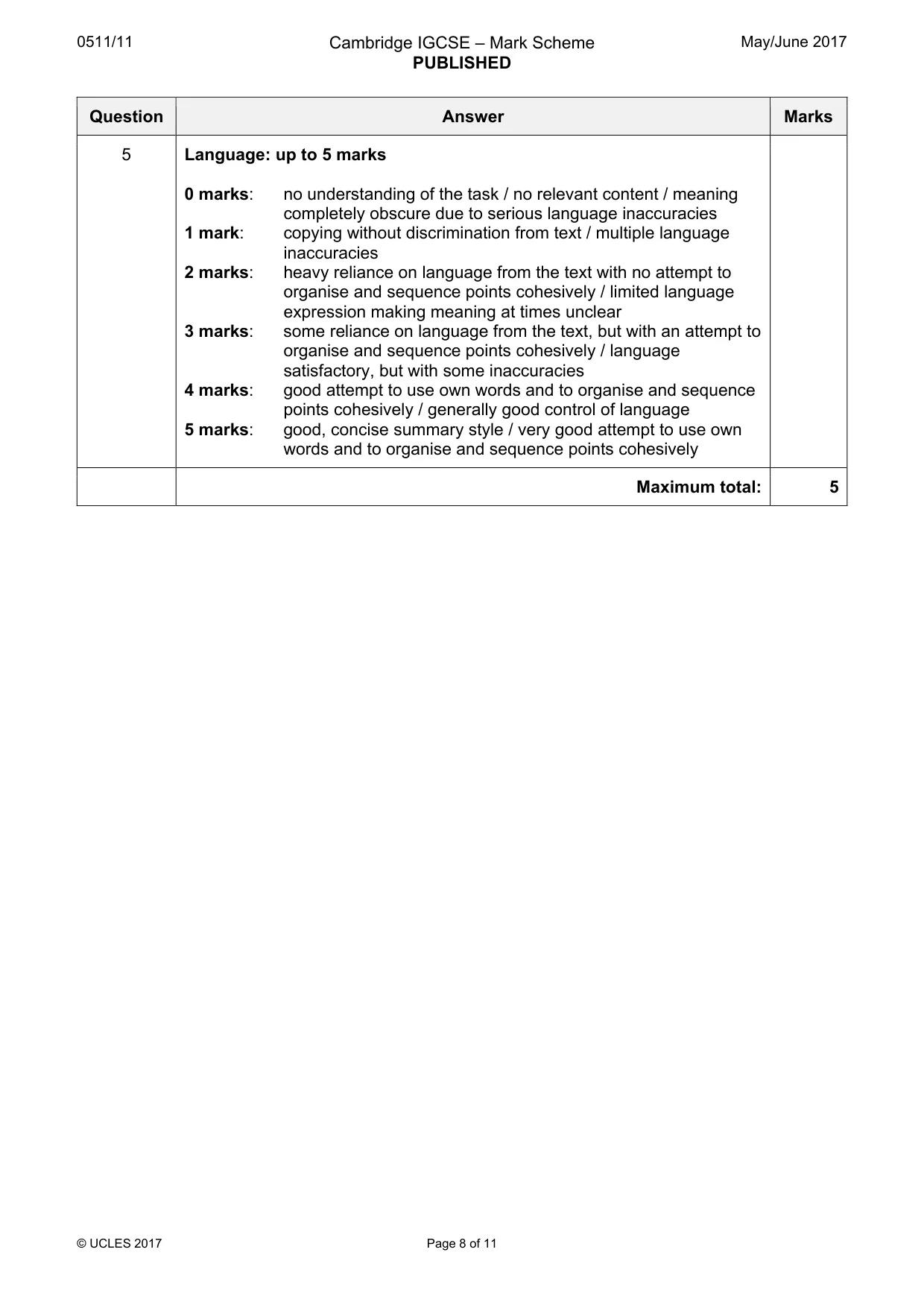
0511/11 Cambridge IGCSE – Mark Scheme PUBLISHED May/June 2017 © UCLES 2017 Page 8 of 11 Question Answer Marks 5 Language: up to 5 marks 0 marks: no understanding of the task / no relevant content / meaning completely obscure due to serious language inaccuracies 1 mark: copying without discrimination from text / multiple language inaccuracies 2 marks: heavy reliance on language from the text with no attempt to organise and sequence points cohesively / limited language expression making meaning at times unclear 3 marks: some reliance on language from the text, but with an attempt to organise and sequence points cohesively / language satisfactory, but with some inaccuracies 4 marks: good attempt to use own words and to organise and sequence points cohesively / generally good control of language 5 marks: good, concise summary style / very good attempt to use own words and to organise and sequence points cohesively Maximum total: 5
Mark scheme, page 9
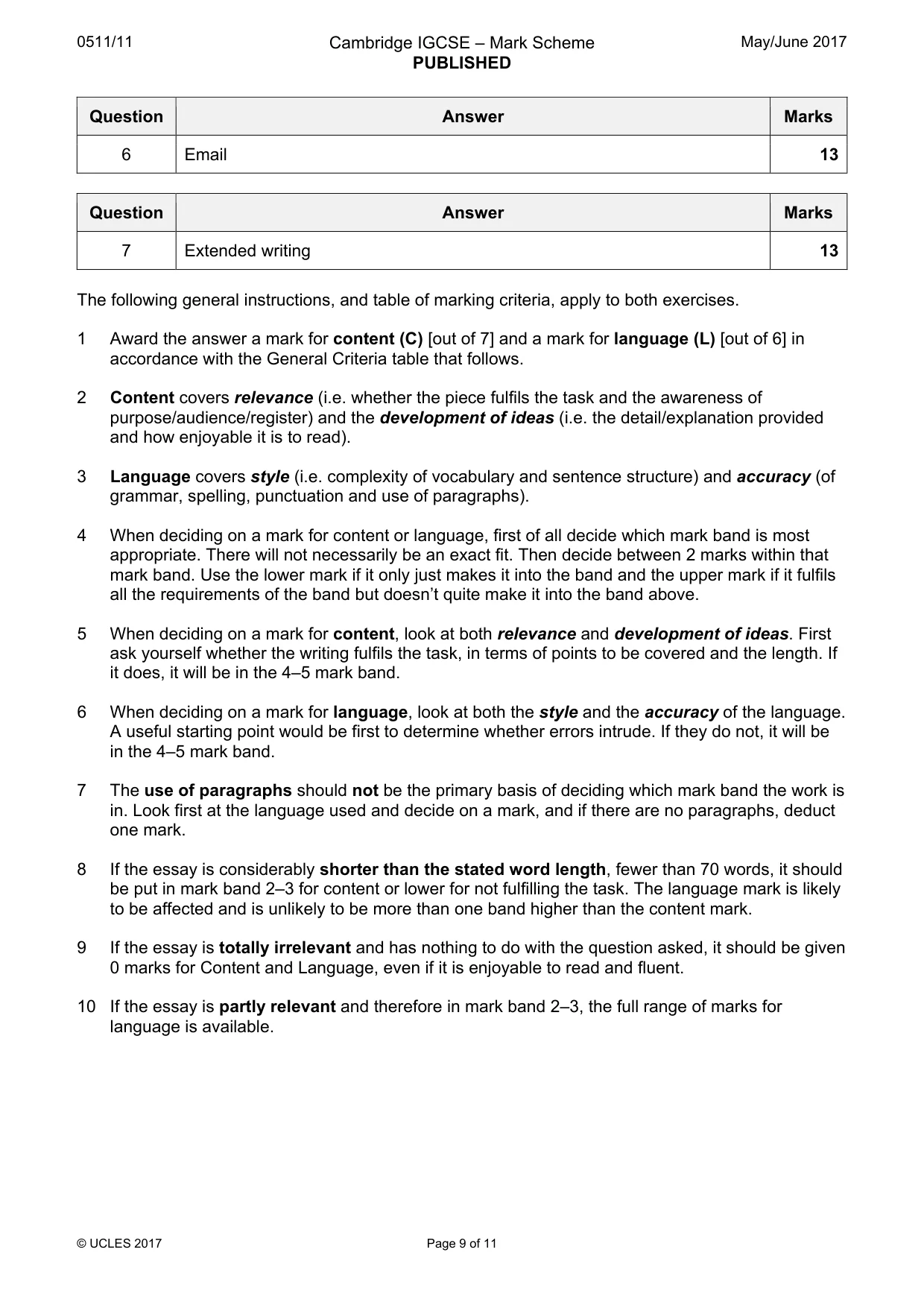
0511/11 Cambridge IGCSE – Mark Scheme PUBLISHED May/June 2017 © UCLES 2017 Page 9 of 11 Question Answer Marks 6 Email 13 Question Answer Marks 7 Extended writing 13 The following general instructions, and table of marking criteria, apply to both exercises. 1 Award the answer a mark for content (C) [out of 7] and a mark for language (L) [out of 6] in accordance with the General Criteria table that follows. 2 Content covers relevance (i.e. whether the piece fulfils the task and the awareness of purpose/audience/register) and the development of ideas (i.e. the detail/explanation provided and how enjoyable it is to read). 3 Language covers style (i.e. complexity of vocabulary and sentence structure) and accuracy (of grammar, spelling, punctuation and use of paragraphs). 4 When deciding on a mark for content or language, first of all decide which mark band is most appropriate. There will not necessarily be an exact fit. Then decide between 2 marks within that mark band. Use the lower mark if it only just makes it into the band and the upper mark if it fulfils all the requirements of the band but doesn’t quite make it into the band above. 5 When deciding on a mark for content, look at both relevance and development of ideas. First ask yourself whether the writing fulfils the task, in terms of points to be covered and the length. If it does, it will be in the 4–5 mark band. 6 When deciding on a mark for language, look at both the style and the accuracy of the language. A useful starting point would be first to determine whether errors intrude. If they do not, it will be in the 4–5 mark band. 7 The use of paragraphs should not be the primary basis of deciding which mark band the work is in. Look first at the language used and decide on a mark, and if there are no paragraphs, deduct one mark. 8 If the essay is considerably shorter than the stated word length, fewer than 70 words, it should be put in mark band 2–3 for content or lower for not fulfilling the task. The language mark is likely to be affected and is unlikely to be more than one band higher than the content mark. 9 If the essay is totally irrelevant and has nothing to do with the question asked, it should be given 0 marks for Content and Language, even if it is enjoyable to read and fluent. 10 If the essay is partly relevant and therefore in mark band 2–3, the full range of marks for language is available.
Mark scheme, page 10
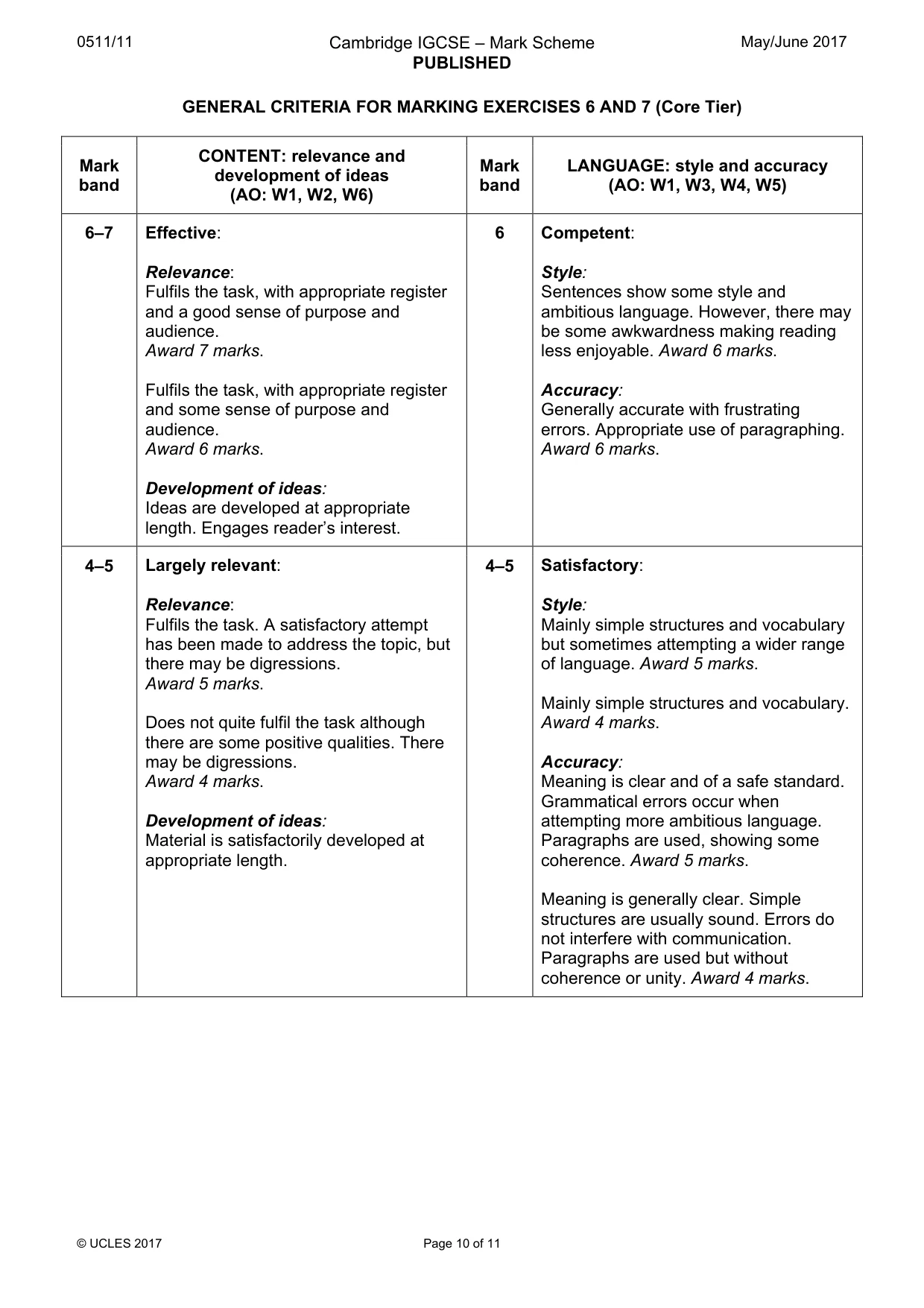
0511/11 Cambridge IGCSE – Mark Scheme PUBLISHED May/June 2017 © UCLES 2017 Page 10 of 11 GENERAL CRITERIA FOR MARKING EXERCISES 6 AND 7 (Core Tier) Mark band CONTENT: relevance and development of ideas (AO: W1, W2, W6) Mark band LANGUAGE: style and accuracy (AO: W1, W3, W4, W5) 6–7 Effective: Relevance: Fulfils the task, with appropriate register and a good sense of purpose and audience. Award 7 marks. Fulfils the task, with appropriate register and some sense of purpose and audience. Award 6 marks. Development of ideas: Ideas are developed at appropriate length. Engages reader’s interest. 6 Competent: Style: Sentences show some style and ambitious language. However, there may be some awkwardness making reading less enjoyable. Award 6 marks. Accuracy: Generally accurate with frustrating errors. Appropriate use of paragraphing. Award 6 marks. 4–5 Largely relevant: Relevance: Fulfils the task. A satisfactory attempt has been made to address the topic, but there may be digressions. Award 5 marks. Does not quite fulfil the task although there are some positive qualities. There may be digressions. Award 4 marks. Development of ideas: Material is satisfactorily developed at appropriate length. 4–5 Satisfactory: Style: Mainly simple structures and vocabulary but sometimes attempting a wider range of language. Award 5 marks. Mainly simple structures and vocabulary. Award 4 marks. Accuracy: Meaning is clear and of a safe standard. Grammatical errors occur when attempting more ambitious language. Paragraphs are used, showing some coherence. Award 5 marks. Meaning is generally clear. Simple structures are usually sound. Errors do not interfere with communication. Paragraphs are used but without coherence or unity. Award 4 marks.
Mark scheme, page 11
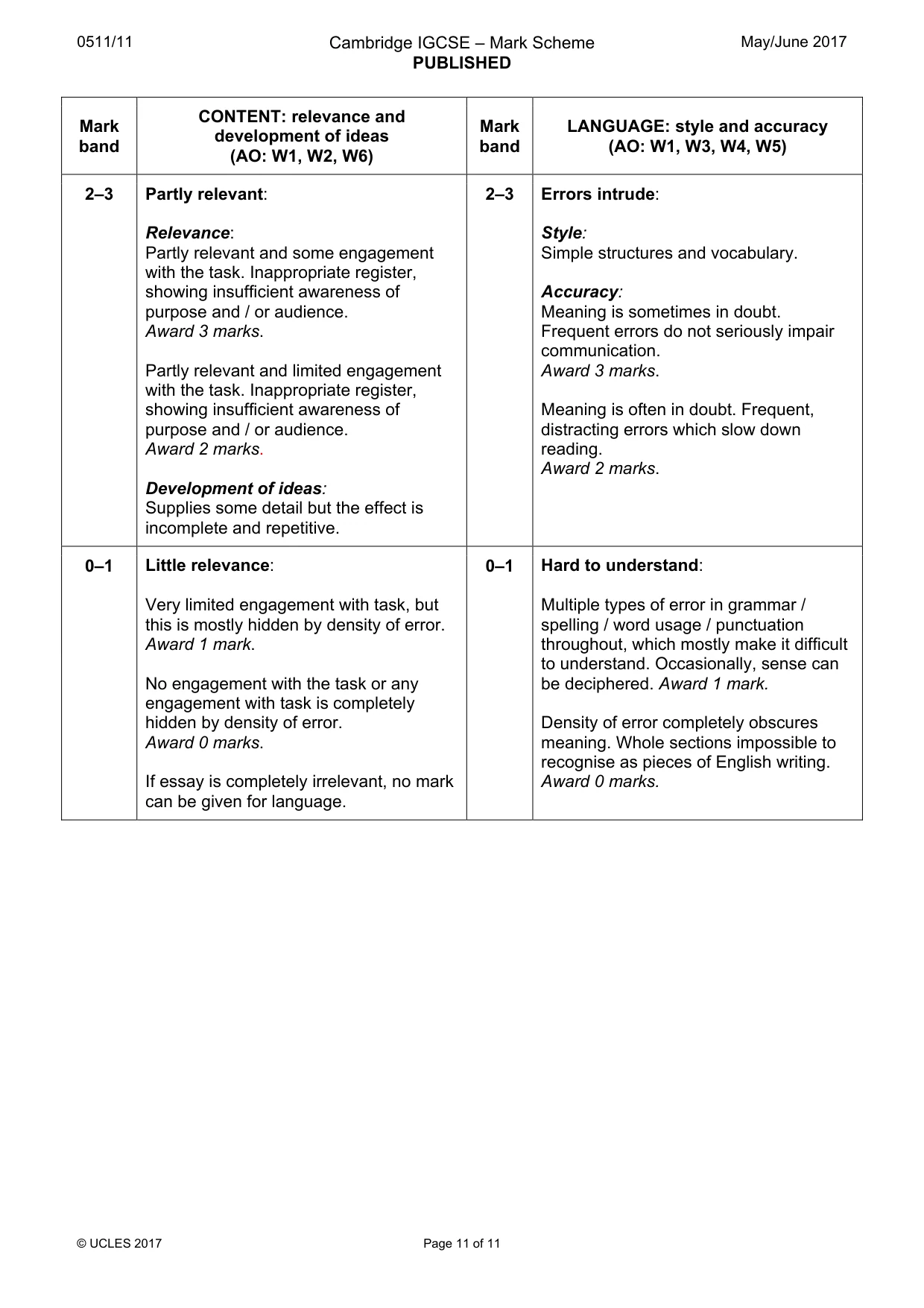
0511/11 Cambridge IGCSE – Mark Scheme PUBLISHED May/June 2017 © UCLES 2017 Page 11 of 11 Mark band CONTENT: relevance and development of ideas (AO: W1, W2, W6) Mark band LANGUAGE: style and accuracy (AO: W1, W3, W4, W5) 2–3 Partly relevant: Relevance: Partly relevant and some engagement with the task. Inappropriate register, showing insufficient awareness of purpose and / or audience. Award 3 marks. Partly relevant and limited engagement with the task. Inappropriate register, showing insufficient awareness of purpose and / or audience. Award 2 marks. Development of ideas: Supplies some detail but the effect is incomplete and repetitive. 2–3 Errors intrude: Style: Simple structures and vocabulary. Accuracy: Meaning is sometimes in doubt. Frequent errors do not seriously impair communication. Award 3 marks. Meaning is often in doubt. Frequent, distracting errors which slow down reading. Award 2 marks. 0–1 Little relevance: Very limited engagement with task, but this is mostly hidden by density of error. Award 1 mark. No engagement with the task or any engagement with task is completely hidden by density of error. Award 0 marks. If essay is completely irrelevant, no mark can be given for language. 0–1 Hard to understand: Multiple types of error in grammar / spelling / word usage / punctuation throughout, which mostly make it difficult to understand. Occasionally, sense can be deciphered. Award 1 mark. Density of error completely obscures meaning. Whole sections impossible to recognise as pieces of English writing. Award 0 marks.
What you needed in this session
Cambridge’s own grade thresholds for 2017 May/June, Paper 1 · Variant 1. A higher threshold means an easier paper — the bar moves with how the cohort did.