Cambridge IGCSE English - Second Language (count-in oral) 0511 — 2014 Oct/Nov Paper 3 · Variant 1
0511/31/O/N/14 · 30 marks · ≈34 min
The question paper and its mark scheme, free to read here and free to download. This is Cambridge’s own paper, exactly as it was sat.
Question paper8 pages

Mark scheme
No mark scheme is in the library for this paper.
Paper as text
Question paper, page 1
This document consists of 7 printed pages and 1 blank page. DC (SJF/JG) 100082 © UCLES 2014 [Turn over Cambridge International Examinations Cambridge International General Certificate of Secondary Education * 7 0 9 2 3 8 9 9 9 6 * ENGLISH AS A SECOND LANGUAGE 0511/31 Paper 3 Listening (Core) October/November 2014 Approx. 30–40 minutes Candidates answer on the Question Paper. Additional Materials: As listed in Instructions to Supervisors. READ THESE INSTRUCTIONS FIRST Write your Centre number, candidate number and name on all the work you hand in. Write in dark blue or black pen. Do not use staples, paper clips, highlighters, glue or correction fluid. DO NOT WRITE IN ANY BARCODES. Answer all questions. Dictionaries are not permitted. At the end of the examination, fasten all your work securely together. The number of marks is given in brackets [ ] at the end of each question or part question. PAPA CAMBRIDGE
Question paper, page 2
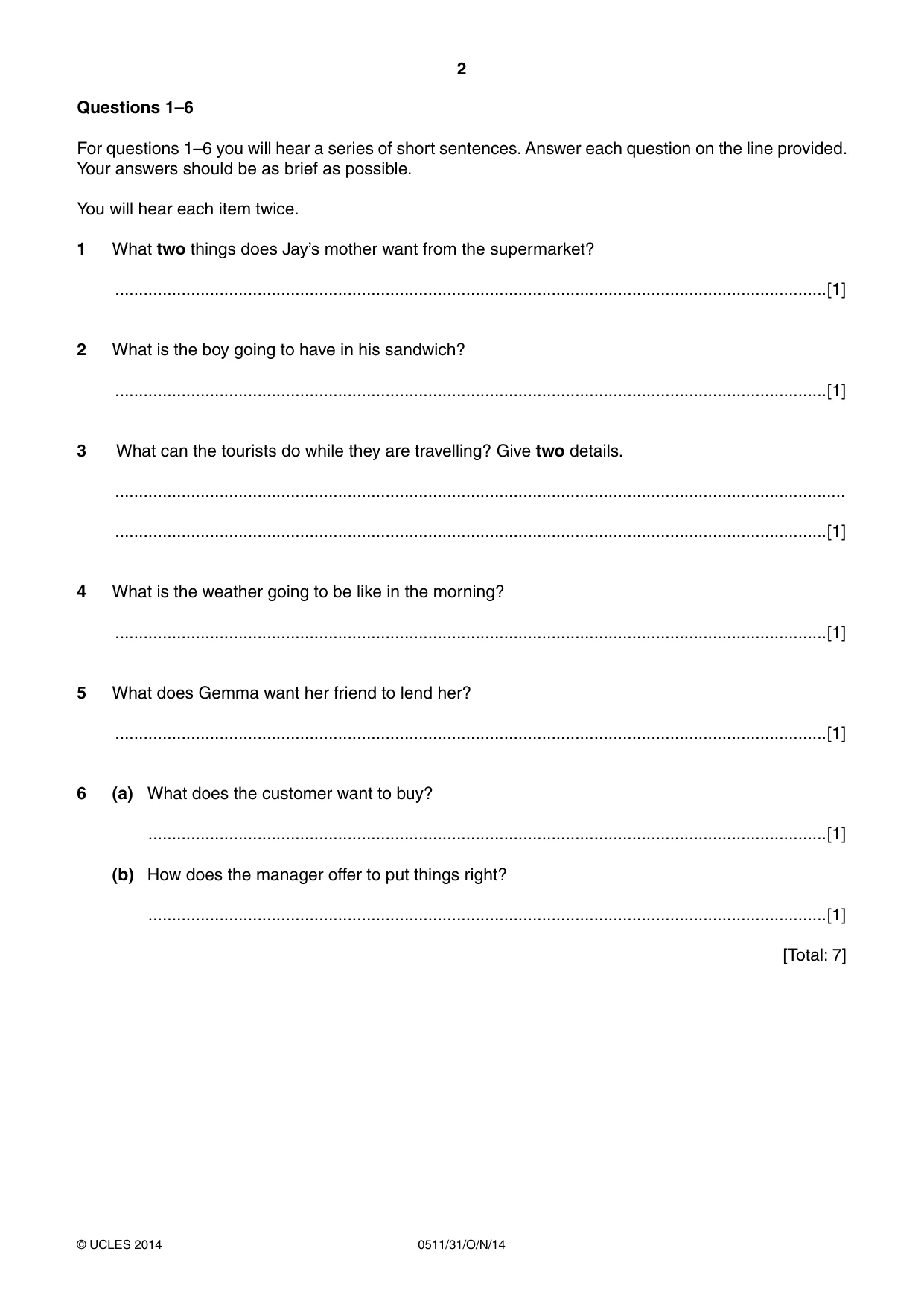
2 0511/31/O/N/14 © UCLES 2014 Questions 1–6 For questions 1–6 you will hear a series of short sentences. Answer each question on the line provided. Your answers should be as brief as possible. You will hear each item twice. 1 What two things does Jay’s mother want from the supermarket? …[1] 2 What is the boy going to have in his sandwich? …[1] 3 What can the tourists do while they are travelling? Give two details. … …[1] 4 What is the weather going to be like in the morning? …[1] 5 What does Gemma want her friend to lend her? …[1] 6 (a) What does the customer want to buy? …[1] (b) How does the manager offer to put things right? …[1] [Total: 7]
Question paper, page 3
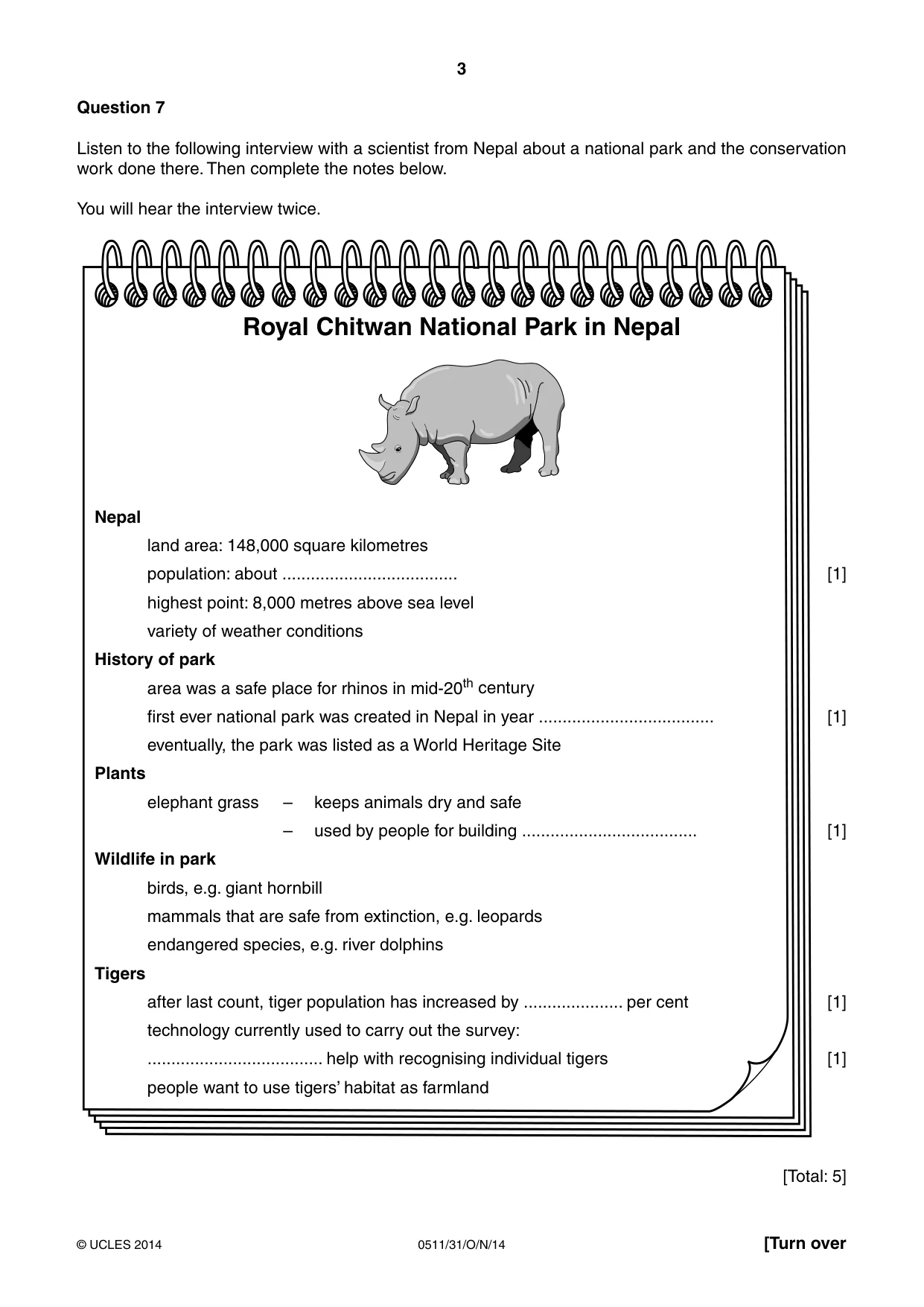
3 0511/31/O/N/14 © UCLES 2014 [Turn over Question 7 Listen to the following interview with a scientist from Nepal about a national park and the conservation work done there. Then complete the notes below. You will hear the interview twice. Royal Chitwan National Park in Nepal Nepal land area: 148,000 square kilometres population: about … [1] highest point: 8,000 metres above sea level variety of weather conditions History of park area was a safe place for rhinos in mid-20th century first ever national park was created in Nepal in year … [1] eventually, the park was listed as a World Heritage Site Plants elephant grass – keeps animals dry and safe – used by people for building … [1] Wildlife in park birds, e.g. giant hornbill mammals that are safe from extinction, e.g. leopards endangered species, e.g. river dolphins Tigers after last count, tiger population has increased by … per cent [1] technology currently used to carry out the survey: … help with recognising individual tigers [1] people want to use tigers’ habitat as farmland [Total: 5]
Question paper, page 4
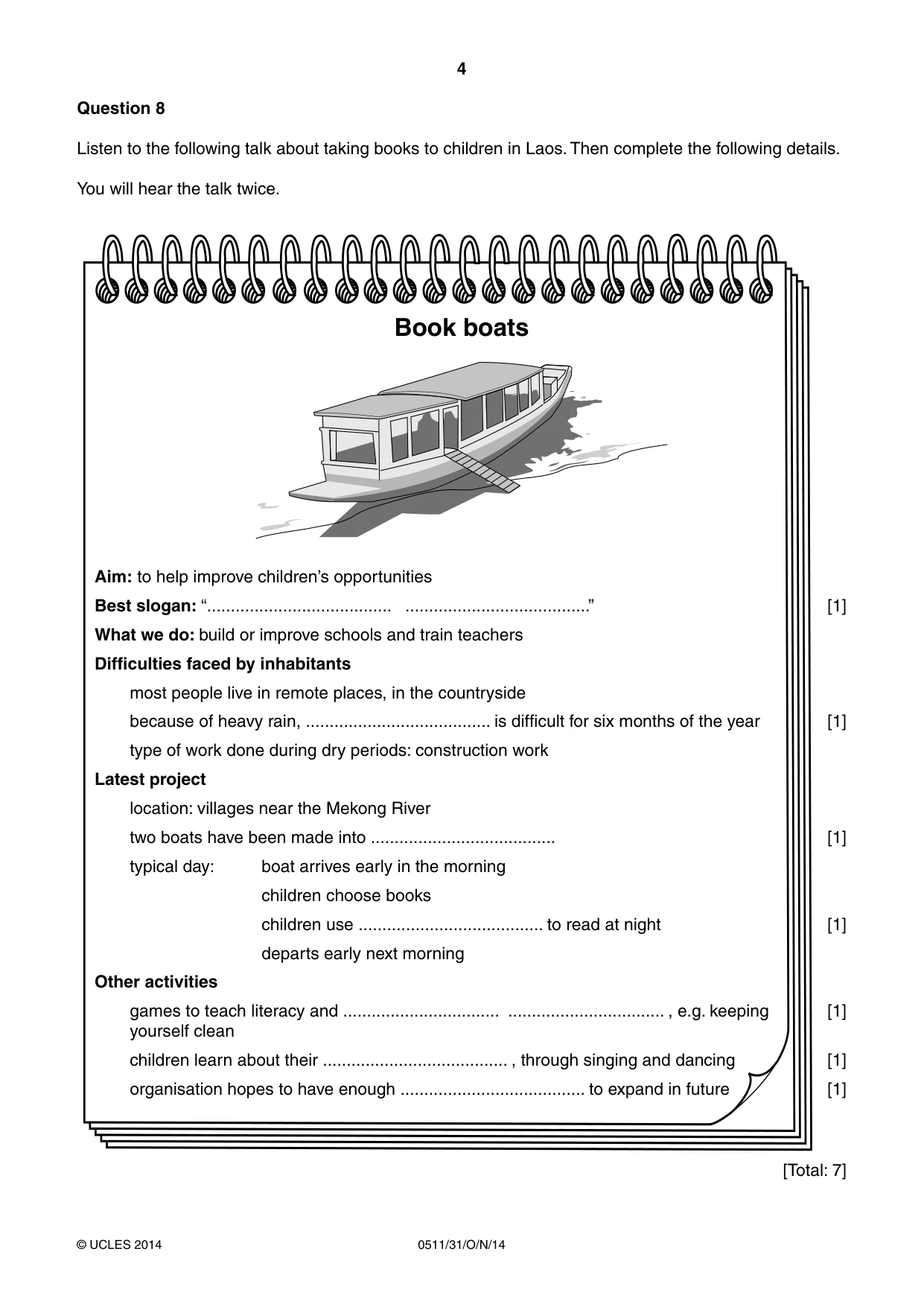
4 0511/31/O/N/14 © UCLES 2014 Question 8 Listen to the following talk about taking books to children in Laos. Then complete the following details. You will hear the talk twice. Book boats Aim: to help improve children’s opportunities Best slogan: “… …” [1] What we do: build or improve schools and train teachers Difficulties faced by inhabitants most people live in remote places, in the countryside because of heavy rain, … is difficult for six months of the year [1] type of work done during dry periods: construction work Latest project location: villages near the Mekong River two boats have been made into … [1] typical day: boat arrives early in the morning children choose books children use … to read at night [1] departs early next morning Other activities games to teach literacy and … … , e.g. keeping [1] yourself clean children learn about their … , through singing and dancing [1] organisation hopes to have enough … to expand in future [1] [Total: 7]
Question paper, page 5
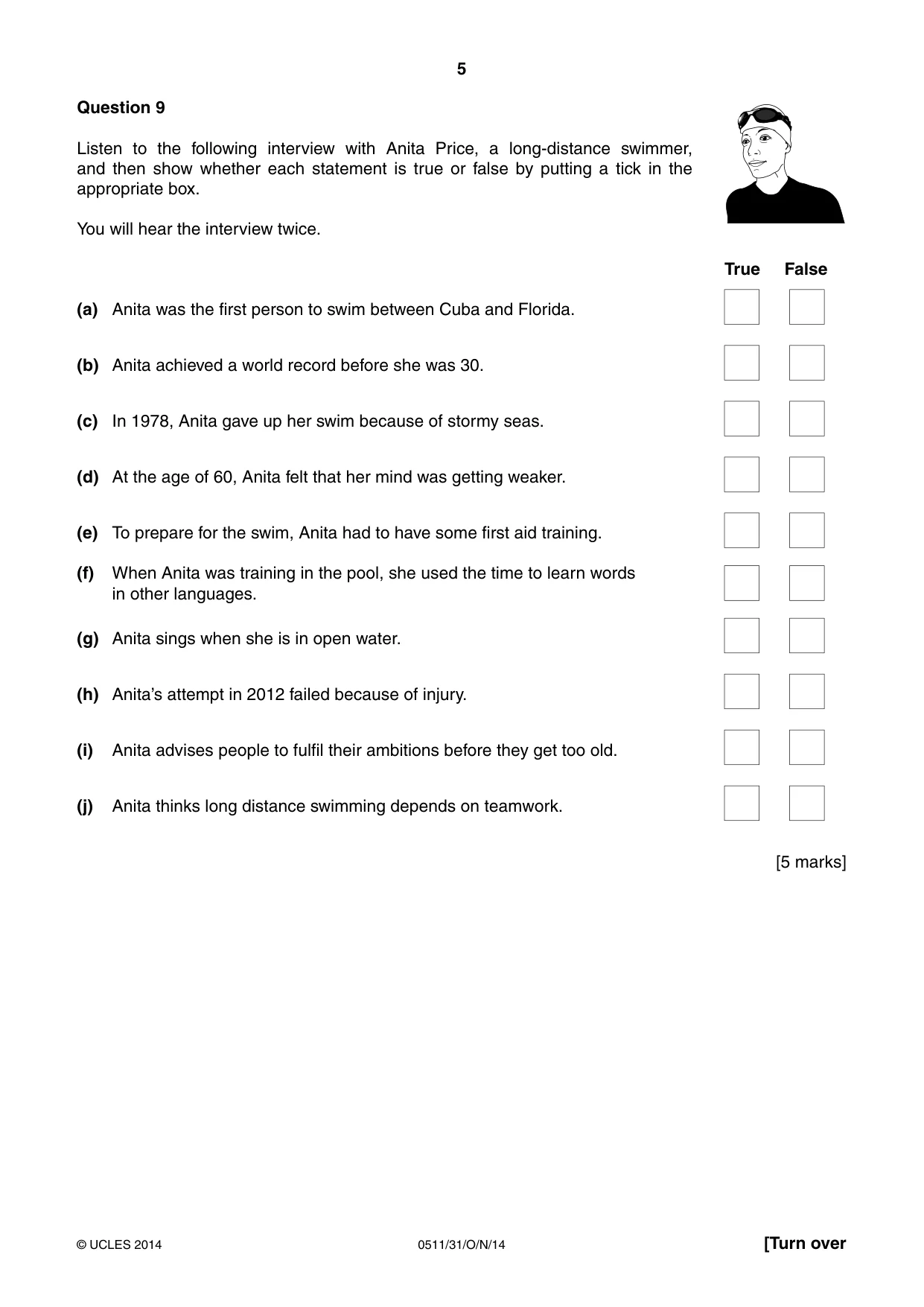
5 0511/31/O/N/14 © UCLES 2014 [Turn over Question 9 Listen to the following interview with Anita Price, a long-distance swimmer, and then show whether each statement is true or false by putting a tick in the appropriate box. You will hear the interview twice. True False (a) Anita was the first person to swim between Cuba and Florida. (b) Anita achieved a world record before she was 30. (c) In 1978, Anita gave up her swim because of stormy seas. (d) At the age of 60, Anita felt that her mind was getting weaker. (e) To prepare for the swim, Anita had to have some first aid training. (f) When Anita was training in the pool, she used the time to learn words in other languages. (g) Anita sings when she is in open water. (h) Anita’s attempt in 2012 failed because of injury. (i) Anita advises people to fulfil their ambitions before they get too old. (j) Anita thinks long distance swimming depends on teamwork. [5 marks]
Question paper, page 6
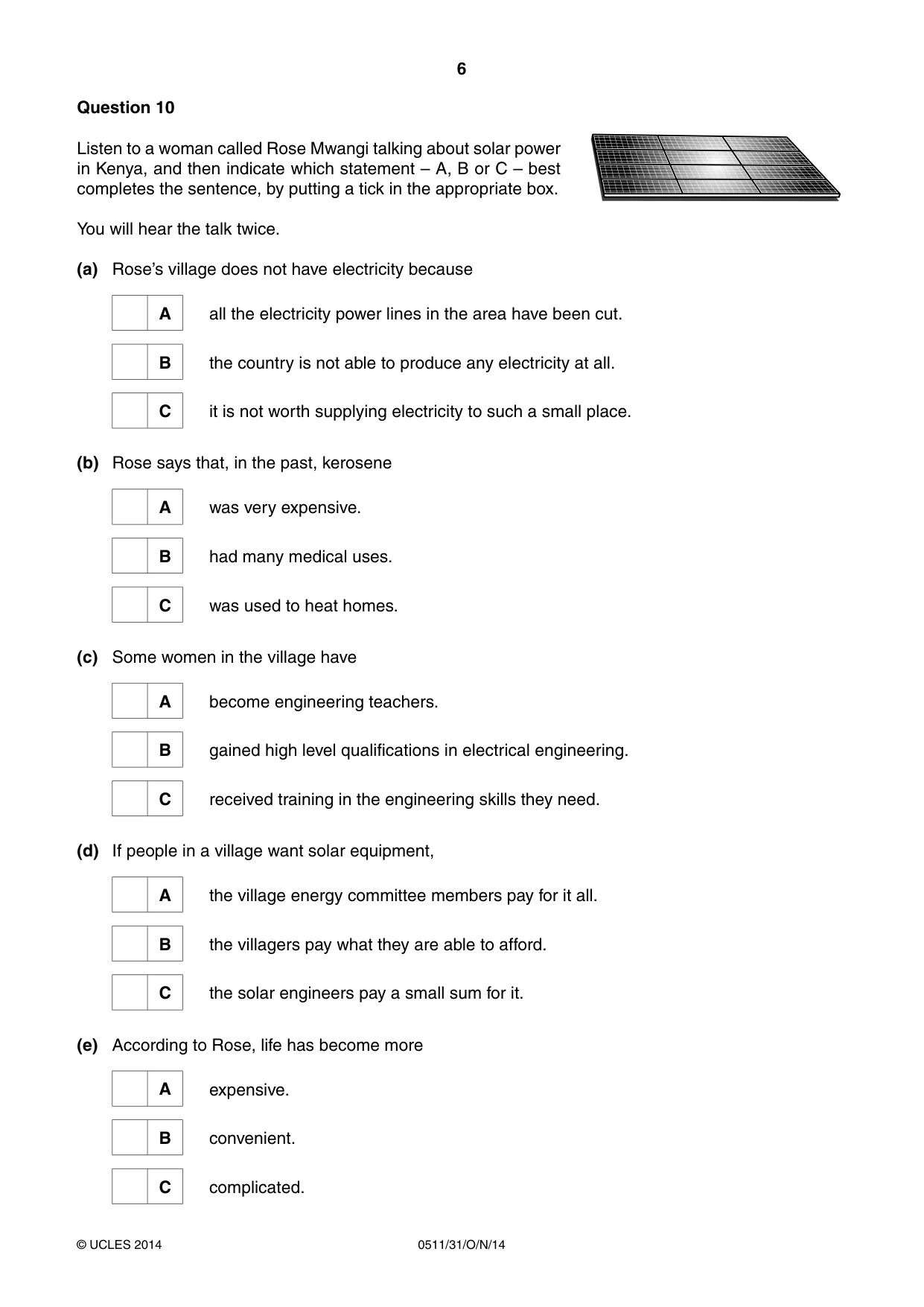
6 0511/31/O/N/14 © UCLES 2014 Question 10 Listen to a woman called Rose Mwangi talking about solar power in Kenya, and then indicate which statement – A, B or C – best completes the sentence, by putting a tick in the appropriate box. You will hear the talk twice. (a) Rose’s village does not have electricity because A all the electricity power lines in the area have been cut. B the country is not able to produce any electricity at all. C it is not worth supplying electricity to such a small place. (b) Rose says that, in the past, kerosene A was very expensive. B had many medical uses. C was used to heat homes. (c) Some women in the village have A become engineering teachers. B gained high level qualifications in electrical engineering. C received training in the engineering skills they need. (d) If people in a village want solar equipment, A the village energy committee members pay for it all. B the villagers pay what they are able to afford. C the solar engineers pay a small sum for it. (e) According to Rose, life has become more A expensive. B convenient. C complicated.
Question paper, page 7
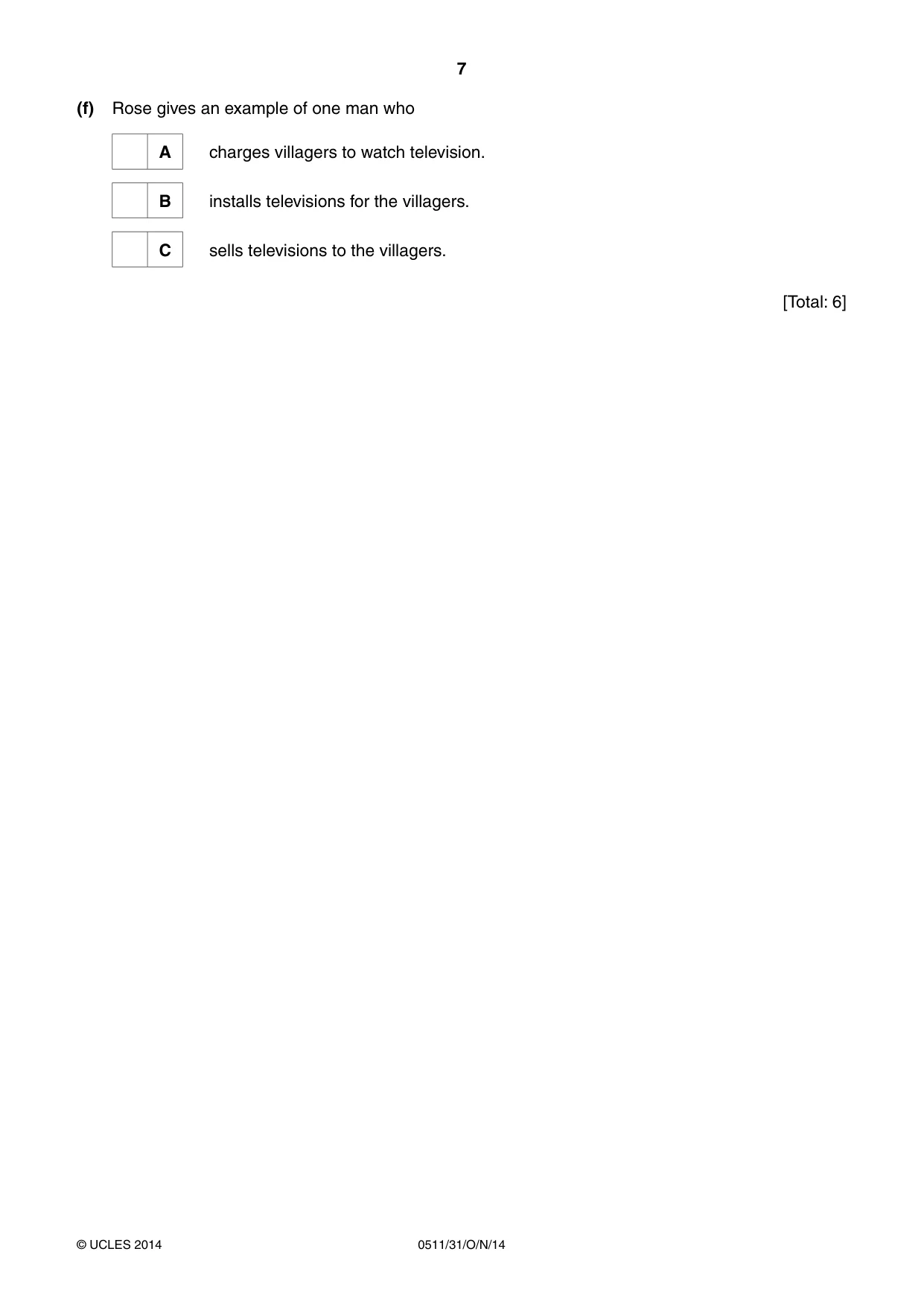
7 0511/31/O/N/14 © UCLES 2014 (f) Rose gives an example of one man who A charges villagers to watch television. B installs televisions for the villagers. C sells televisions to the villagers. [Total: 6]
Question paper, page 8
8 0511/31/O/N/14 © UCLES 2014 Permission to reproduce items where third-party owned material protected by copyright is included has been sought and cleared where possible. Every reasonable effort has been made by the publisher (UCLES) to trace copyright holders, but if any items requiring clearance have unwittingly been included, the publisher will be pleased to make amends at the earliest possible opportunity. Cambridge International Examinations is part of the Cambridge Assessment Group. Cambridge Assessment is the brand name of University of Cambridge Local Examinations Syndicate (UCLES), which is itself a department of the University of Cambridge. BLANK PAGE
What you needed in this session
Cambridge’s own grade thresholds for 2014 Oct/Nov, Paper 3 · Variant 1. A higher threshold means an easier paper — the bar moves with how the cohort did.