Cambridge IGCSE English - Second Language (count-in oral) 0511 — 2011 May/June Paper 1 · Variant 1
0511/11/M/J/11 · 56 marks · ≈63 min
The question paper and its mark scheme, free to read here and free to download. This is Cambridge’s own paper, exactly as it was sat.
Question paper16 pages




Mark scheme7 pages
Answers below. Sit the paper first if you are practising.
Paper as text
Question paper, page 1
This document consists of 13 printed pages and 3 blank pages. IB11 06_0511_11/FP © UCLES 2011 [Turn over *8778922641* UNIVERSITY OF CAMBRIDGE INTERNATIONAL EXAMINATIONS International General Certificate of Secondary Education ENGLISH AS A SECOND LANGUAGE 0511/11 Paper 1 Reading and Writing (Core) May/June 2011 1 hour 30 minutes Candidates answer on the Question Paper. No Additional Materials are required. READ THESE INSTRUCTIONS FIRST Write your Centre number, candidate number and name on all the work you hand in. Write in dark blue or black pen. Do not use staples, paper clips, highlighters, glue or correction fluid. DO NOT WRITE IN ANY BARCODES. Answer all questions. Dictionaries are not allowed. The number of marks is given in brackets [ ] at the end of each question or part question. www.XtremePapers.com
Question paper, page 2
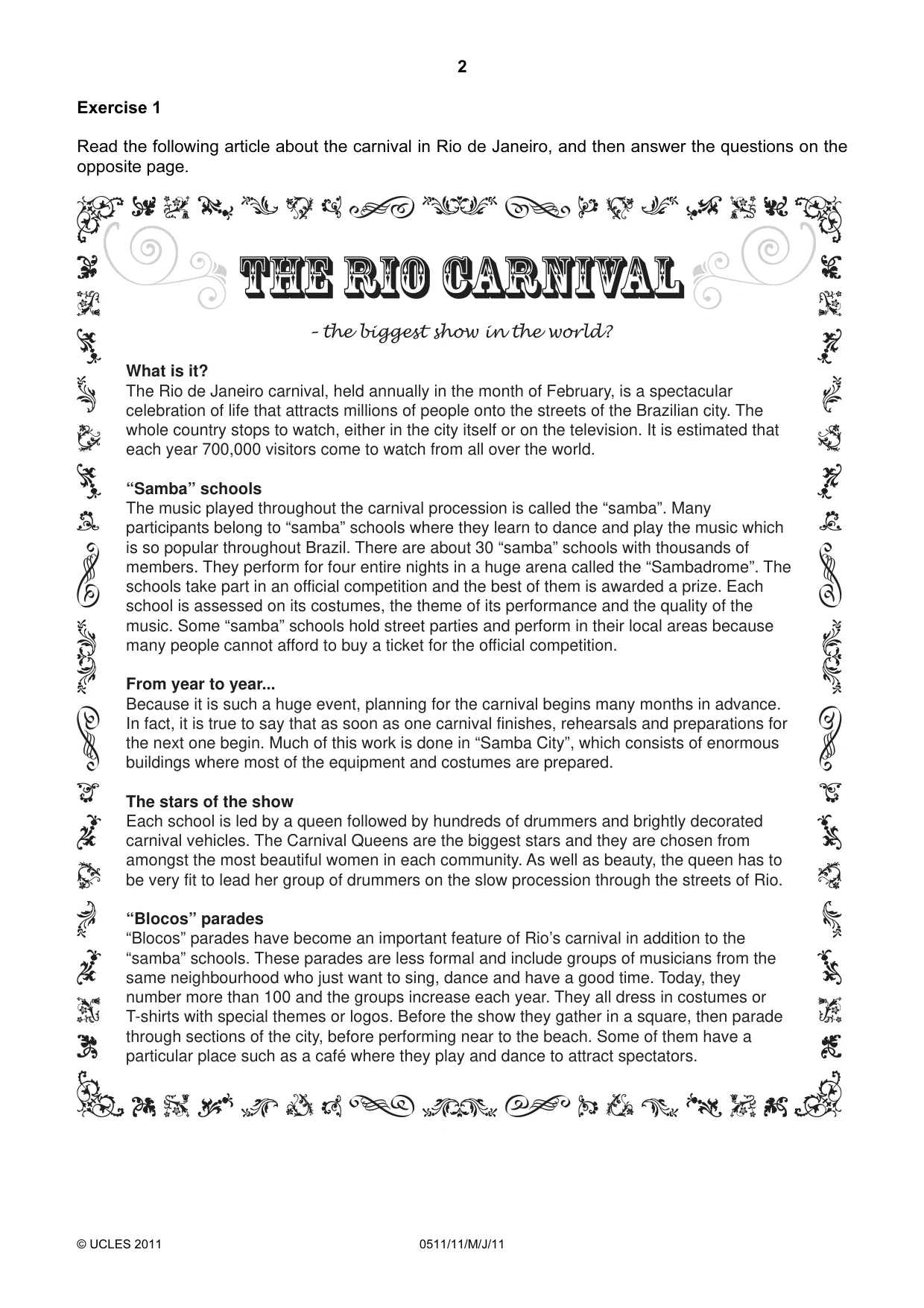
2 © UCLES 2011 0511/11/M/J/11 Exercise 1 Read the following article about the carnival in Rio de Janeiro, and then answer the questions on the opposite page. – the biggest show in the world? What is it? The Rio de Janeiro carnival, held annually in the month of February, is a spectacular celebration of life that attracts millions of people onto the streets of the Brazilian city. The whole country stops to watch, either in the city itself or on the television. It is estimated that each year 700,000 visitors come to watch from all over the world. “Samba” schools The music played throughout the carnival procession is called the “samba”. Many participants belong to “samba” schools where they learn to dance and play the music which is so popular throughout Brazil. There are about 30 “samba” schools with thousands of members. They perform for four entire nights in a huge arena called the “Sambadrome”. The schools take part in an official competition and the best of them is awarded a prize. Each school is assessed on its costumes, the theme of its performance and the quality of the music. Some “samba” schools hold street parties and perform in their local areas because many people cannot afford to buy a ticket for the official competition. From year to year... Because it is such a huge event, planning for the carnival begins many months in advance. In fact, it is true to say that as soon as one carnival finishes, rehearsals and preparations for the next one begin. Much of this work is done in “Samba City”, which consists of enormous buildings where most of the equipment and costumes are prepared. The stars of the show Each school is led by a queen followed by hundreds of drummers and brightly decorated carnival vehicles. The Carnival Queens are the biggest stars and they are chosen from amongst the most beautiful women in each community. As well as beauty, the queen has to be very fit to lead her group of drummers on the slow procession through the streets of Rio. “Blocos” parades “Blocos” parades have become an important feature of Rio’s carnival in addition to the “samba” schools. These parades are less formal and include groups of musicians from the same neighbourhood who just want to sing, dance and have a good time. Today, they number more than 100 and the groups increase each year. They all dress in costumes or T-shirts with special themes or logos. Before the show they gather in a square, then parade through sections of the city, before performing near to the beach. Some of them have a particular place such as a café where they play and dance to attract spectators.
Question paper, page 3
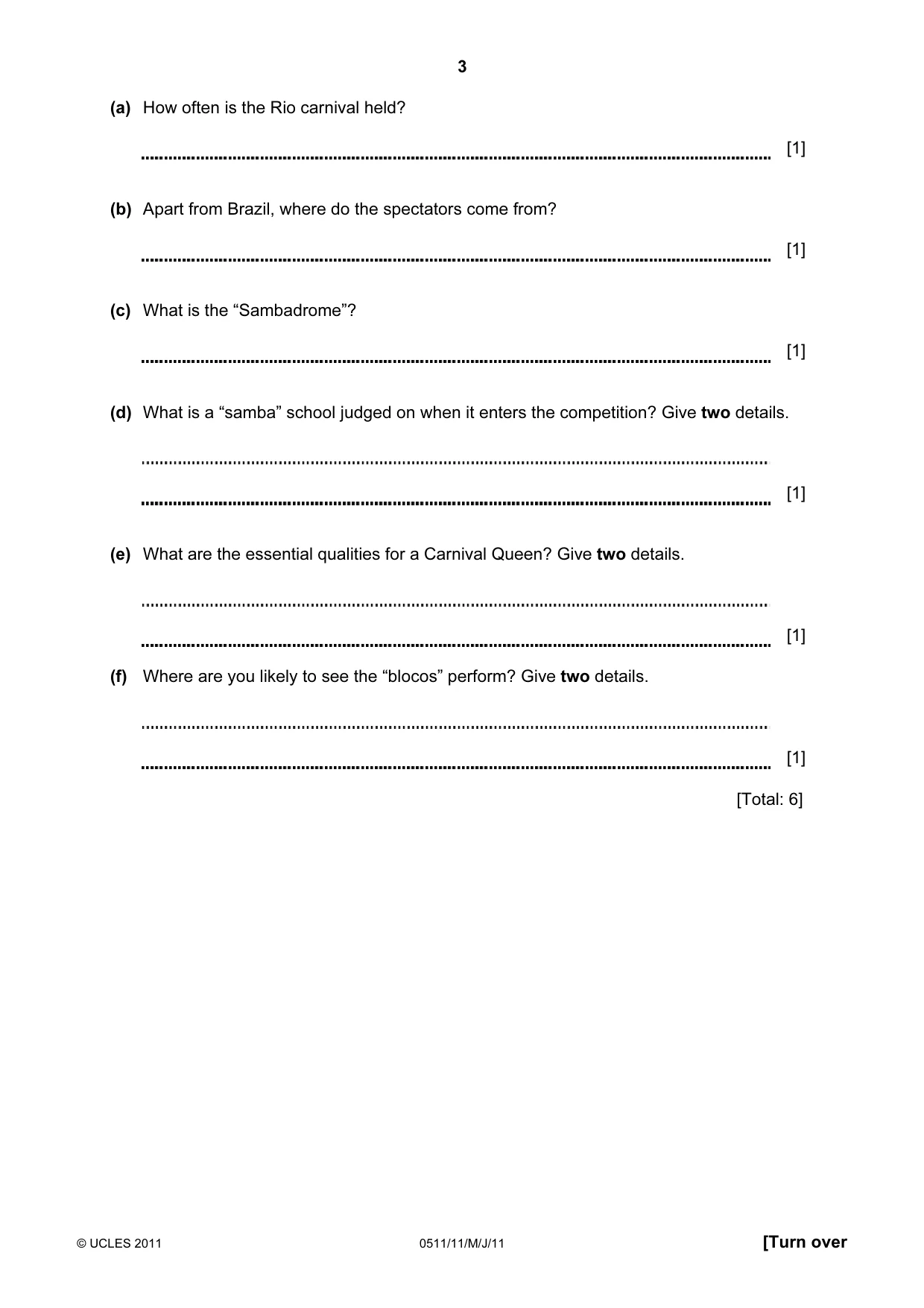
3 © UCLES 2011 0511/11/M/J/11 [Turn over (a) How often is the Rio carnival held? [1] (b) Apart from Brazil, where do the spectators come from? [1] (c) What is the “Sambadrome”? [1] (d) What is a “samba” school judged on when it enters the competition? Give two details. [1] (e) What are the essential qualities for a Carnival Queen? Give two details. [1] (f) Where are you likely to see the “blocos” perform? Give two details. [1] [Total: 6]
Question paper, page 4
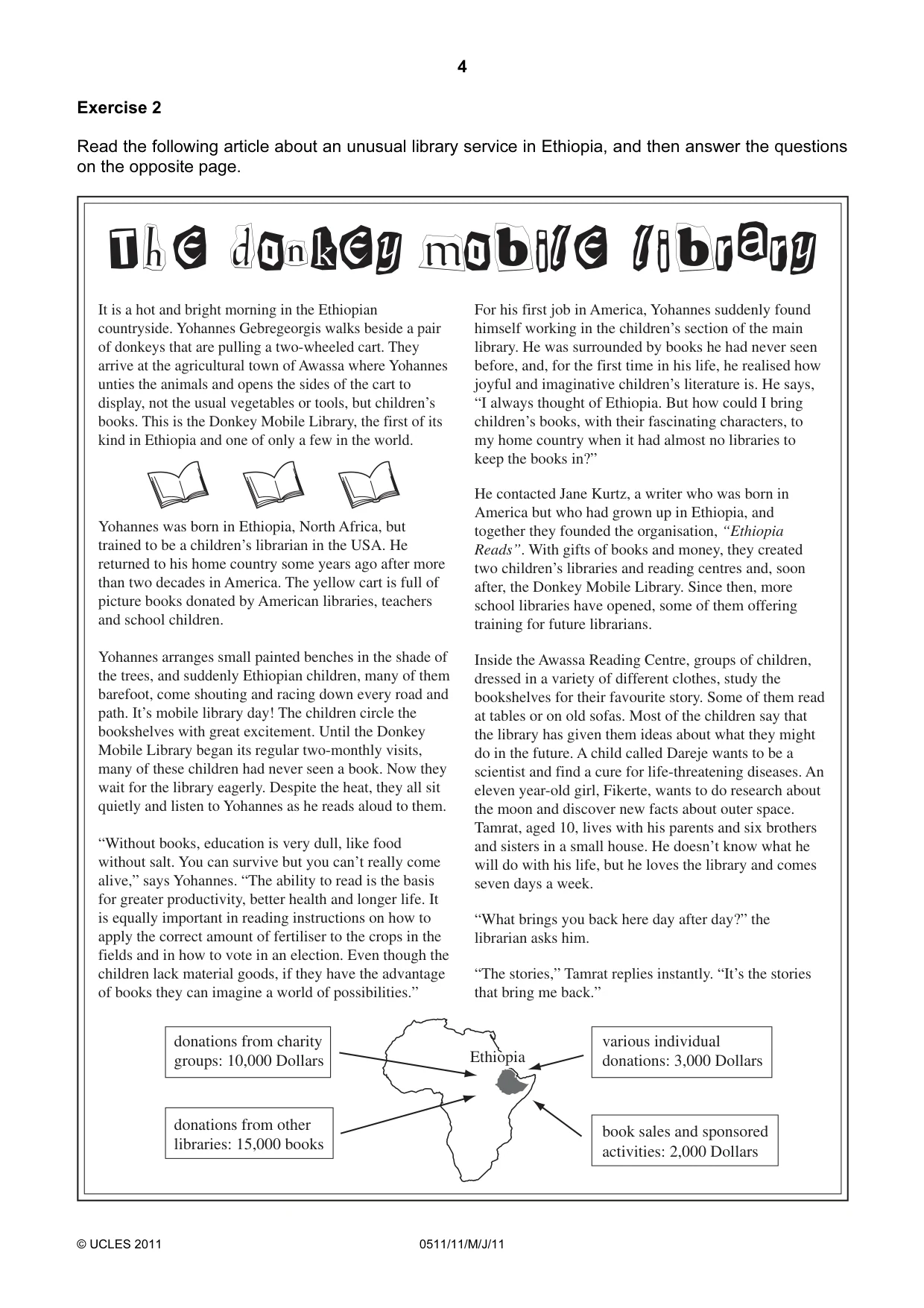
4 © UCLES 2011 0511/11/M/J/11 Exercise 2 Read the following article about an unusual library service in Ethiopia, and then answer the questions on the opposite page. It is a hot and bright morning in the Ethiopian countryside. Yohannes Gebregeorgis walks beside a pair of donkeys that are pulling a two-wheeled cart. They arrive at the agricultural town of Awassa where Yohannes unties the animals and opens the sides of the cart to display, not the usual vegetables or tools, but children’s books. This is the Donkey Mobile Library, the first of its kind in Ethiopia and one of only a few in the world. Yohannes was born in Ethiopia, North Africa, but trained to be a children’s librarian in the USA. He returned to his home country some years ago after more than two decades in America. The yellow cart is full of picture books donated by American libraries, teachers and school children. Yohannes arranges small painted benches in the shade of the trees, and suddenly Ethiopian children, many of them barefoot, come shouting and racing down every road and path. It’s mobile library day! The children circle the bookshelves with great excitement. Until the Donkey Mobile Library began its regular two-monthly visits, many of these children had never seen a book. Now they wait for the library eagerly. Despite the heat, they all sit quietly and listen to Yohannes as he reads aloud to them. “Without books, education is very dull, like food without salt. You can survive but you can’t really come alive,” says Yohannes. “The ability to read is the basis for greater productivity, better health and longer life. It is equally important in reading instructions on how to apply the correct amount of fertiliser to the crops in the fields and in how to vote in an election. Even though the children lack material goods, if they have the advantage of books they can imagine a world of possibilities.” For his first job in America, Yohannes suddenly found himself working in the children’s section of the main library. He was surrounded by books he had never seen before, and, for the first time in his life, he realised how joyful and imaginative children’s literature is. He says, “I always thought of Ethiopia. But how could I bring children’s books, with their fascinating characters, to my home country when it had almost no libraries to keep the books in?” He contacted Jane Kurtz, a writer who was born in America but who had grown up in Ethiopia, and together they founded the organisation, “Ethiopia Reads”. With gifts of books and money, they created two children’s libraries and reading centres and, soon after, the Donkey Mobile Library. Since then, more school libraries have opened, some of them offering training for future librarians. Inside the Awassa Reading Centre, groups of children, dressed in a variety of different clothes, study the bookshelves for their favourite story. Some of them read at tables or on old sofas. Most of the children say that the library has given them ideas about what they might do in the future. A child called Dareje wants to be a scientist and find a cure for life-threatening diseases. An eleven year-old girl, Fikerte, wants to do research about the moon and discover new facts about outer space. Tamrat, aged 10, lives with his parents and six brothers and sisters in a small house. He doesn’t know what he will do with his life, but he loves the library and comes seven days a week. “What brings you back here day after day?” the librarian asks him. “The stories,” Tamrat replies instantly. “It’s the stories that bring me back.” The donkey mobile library donations from charity groups: 10,000 Dollars Ethiopia Ethiopia donations from other libraries: 15,000 books various individual donations: 3,000 Dollars book sales and sponsored activities: 2,000 Dollars Ethiopia
Question paper, page 5
5 © UCLES 2011 0511/11/M/J/11 [Turn over (a) How does the mobile library move from place to place? [1] (b) How many mobile donkey libraries are there in the world? [1] (c) How long did Yohannes spend in America? [1] (d) How do the children behave while Yohannes is storytelling? [1] (e) Apart from health factors, what advantages are there for these children in being able to read? Give two details. [2] (f) According to the diagram, which organisations donated the most money to the mobile library? [1] (g) What was the main problem about bringing books back to Ethiopia? [1] (h) Apart from books, what may be available at school libraries? [1] (i) Why does Tamrat visit the library every day? [1] [Total: 10]
Question paper, page 6
6 © UCLES 2011 0511/11/M/J/11 Exercise 3 A new arts centre will soon open in Paris, the capital city of France. Jacques Pascaud, a 16-year-old student at the International College of Montmartre, is very keen to become a member of the centre. He lives in Apartment 12C, Rue Lazare in Paris, which is about 10 kilometres away from the arts centre. Public transport is very easy and convenient from his home to the centre, even in the evening. He has therefore decided to apply for membership, but not including the weekends because he has too much studying to do. Jacques saw the advertisement for the new centre on the college noticeboard. The centre has produced an application form specifically for student members. The form includes the opportunity to offer suggestions as to what members would like to see on the artistic programme in the future. Jacques thinks that it is an excellent idea to try and influence the choice of the artistic directors. Firstly, he would like to see regular exhibitions of modern art in one of the three galleries. Secondly, he loves rock music and would welcome the chance to see concerts by world-famous performers at least twice a year. There is also an opera hall, a small theatre and a cinema, but he is not so keen on these artistic forms. Jacques has some experience of both oil and watercolour painting. He has been a member of the college Art Society for the past five years and has had his paintings displayed on college open days. He has also worked part-time in the local art gallery near to his home. The new arts centre is very interested in inviting student members to become volunteer helpers. Jacques would very much like to help out with the organisation of the art exhibitions at the new centre. His art teacher, Claude Dubois, has agreed to be a referee for him and support his application. Claude can be contacted on the college telephone 75763209. The arts centre is eager to send out a weekly newsletter to all its members by email. Jacques is very happy to receive as much information as possible about the centre on jacko123@mtmt.fr or on his mobile/cell phone 274083617. Imagine you are Jacques. Fill in the form on the opposite page, using the information above.
Question paper, page 7
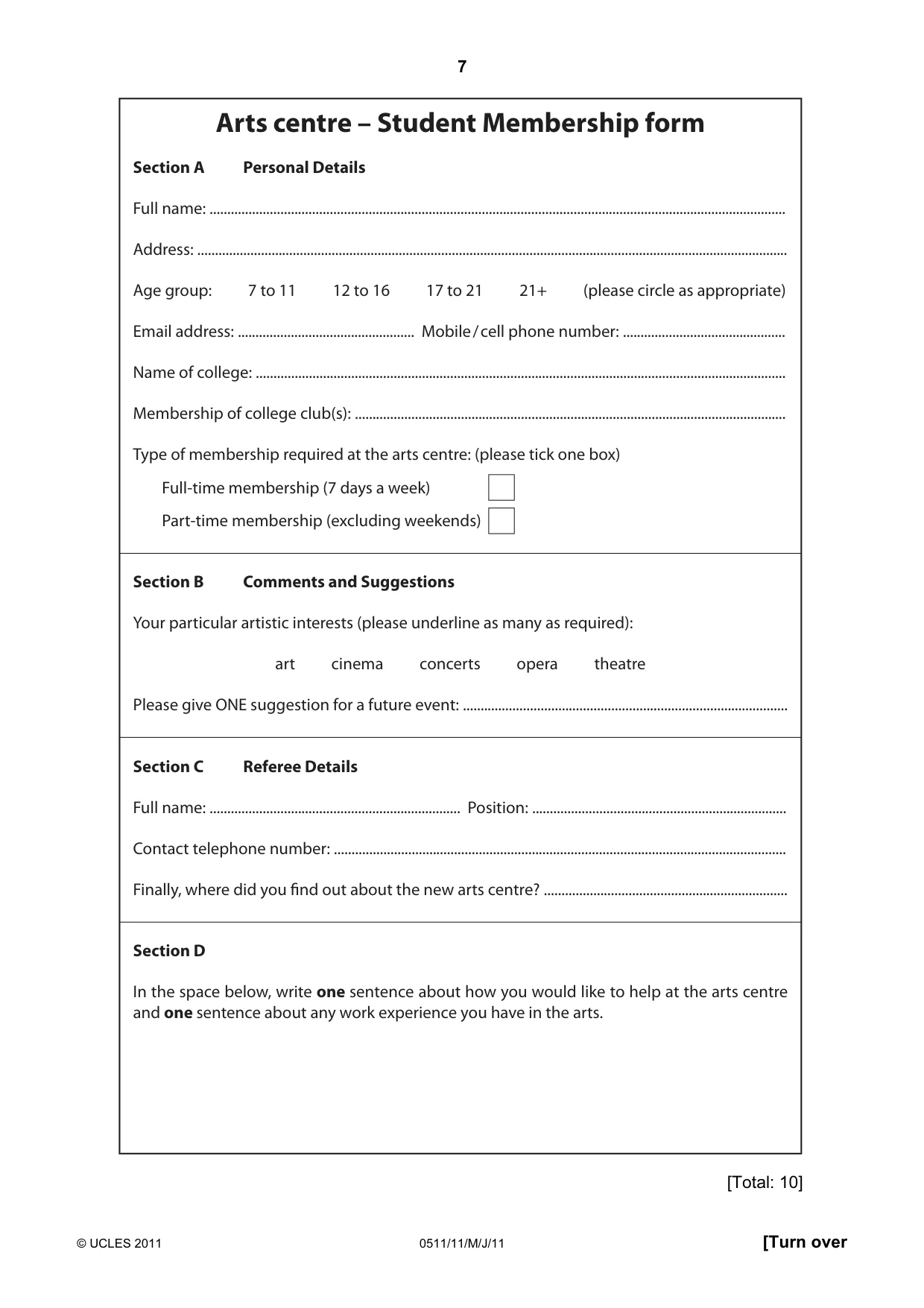
7 © UCLES 2011 0511/11/M/J/11 [Turn over Arts centre – Student Membership form Section A Personal Details Full name: … Address: … Age group: 7 to 11 12 to 16 17 to 21 21+ (please circle as appropriate) Email address: … Mobile / cell phone number: … Name of college: … Membership of college club(s): … Type of membership required at the arts centre: (please tick one box) Full-time membership (7 days a week) Part-time membership (excluding weekends) Section B Comments and Suggestions Your particular artistic interests (please underline as many as required): art cinema concerts opera theatre Please give ONE suggestion for a future event: … Section C Referee Details Full name: … Position: … Contact telephone number: … Finally, where did you find out about the new arts centre? … Section D In the space below, write one sentence about how you would like to help at the arts centre and one sentence about any work experience you have in the arts. [Total: 10]
Question paper, page 8
8 © UCLES 2011 0511/11/M/J/11 Exercise 4 Read the following article about the development of a flying car, and then complete the notes on the opposite page. The flying car has been talked about for many years, but now it appears that the idea is about to become a reality. An international company has built a two-seater plane that, at the touch of a button, converts into a car which is perfectly suitable for driving on public roads. It has been designed so that the wings fold up automatically, and it takes just 15 seconds to switch between flying and driving. With its wings fully open and the propeller spinning, the flying car can take off from any airfield. The hope is that it will eventually take off from roads, but at the moment that is still illegal. New technology means that the inside of the plane’s cockpit is quite similar to the inside of a car. Reaching your destination can be made easier by satellite navigation systems, and weather patterns can be displayed on a simple colour screen. The lightweight engine means that it can fly up to 500 miles without the need to refuel. It would seem that cars which can fly make complete sense. They are quicker than conventional cars for travelling from city to city, and they can run on ordinary unleaded fuel. They have another big advantage. Flying cars are cool, like something you would see in an action film. At the moment, however, the flying car’s wheels have not left the ground. That is not because of technical reasons or problems with the design. It is because the various road and aircraft authorities simply cannot agree on whether it is a car or a plane. “The Government and the authorities have never thought seriously about a flying car,” says Alan Price, the president of the company that has developed it. “I wanted a car that could fly and drive, but it is difficult to find an organisation prepared to insure the vehicle against accidents.” Nevertheless, the company hopes to produce and deliver its first flying car soon. The company already has orders for 40 of them. The majority of the potential customers are older and some are retired. They have worked hard all their lives and now they can have a flying car... a form of technology that they have been promised in films and on television since they were children. There have even been orders from some people who have no pilot’s licence, but are willing to learn to fly because of the excitement of owning such a vehicle. The flying car will cost around $200,000. “For an airplane, that’s a very reasonable price, but for a car, it’s quite expensive,” explains Alan Price. “But it just is not possible to make a $10,000 flying car yet.” This latest means of transport will not become a mass-market item at any time in the near future. But in the long term it has the potential to change the way you travel. It will become no more expensive than driving your car on the motorway. Journey times could be reduced by more than half. So the next time you are told to fasten your seat belt, it may be to prepare for take-off. Passengers... your car is ready for take-off
Question paper, page 9
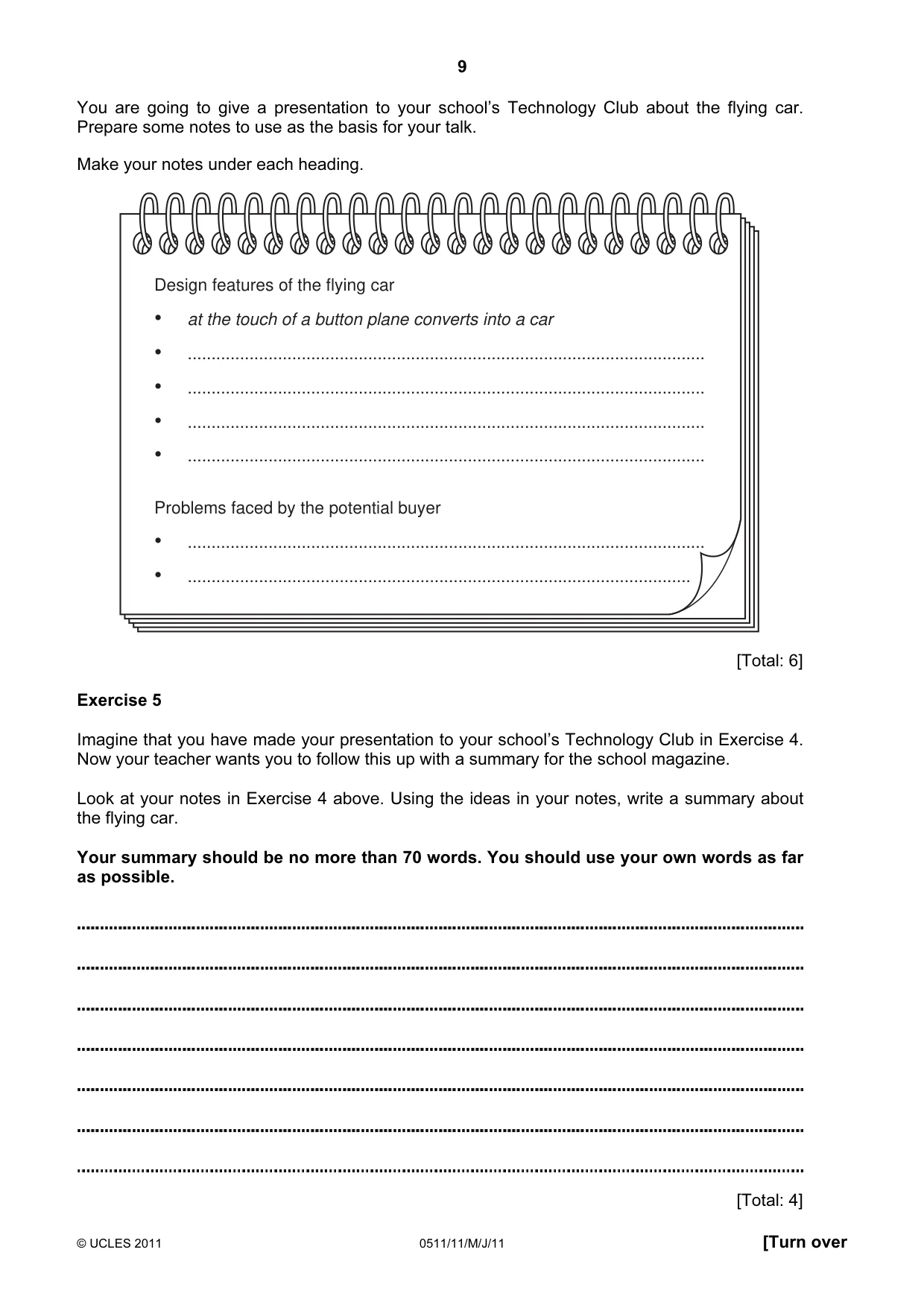
9 © UCLES 2011 0511/11/M/J/11 [Turn over You are going to give a presentation to your school’s Technology Club about the flying car. Prepare some notes to use as the basis for your talk. Make your notes under each heading. Design features of the flying car • at the touch of a button plane converts into a car • … • … • … • … Problems faced by the potential buyer • … • … [Total: 6] Exercise 5 Imagine that you have made your presentation to your school’s Technology Club in Exercise 4. Now your teacher wants you to follow this up with a summary for the school magazine. Look at your notes in Exercise 4 above. Using the ideas in your notes, write a summary about the flying car. Your summary should be no more than 70 words. You should use your own words as far as possible. [Total: 4]
Question paper, page 10
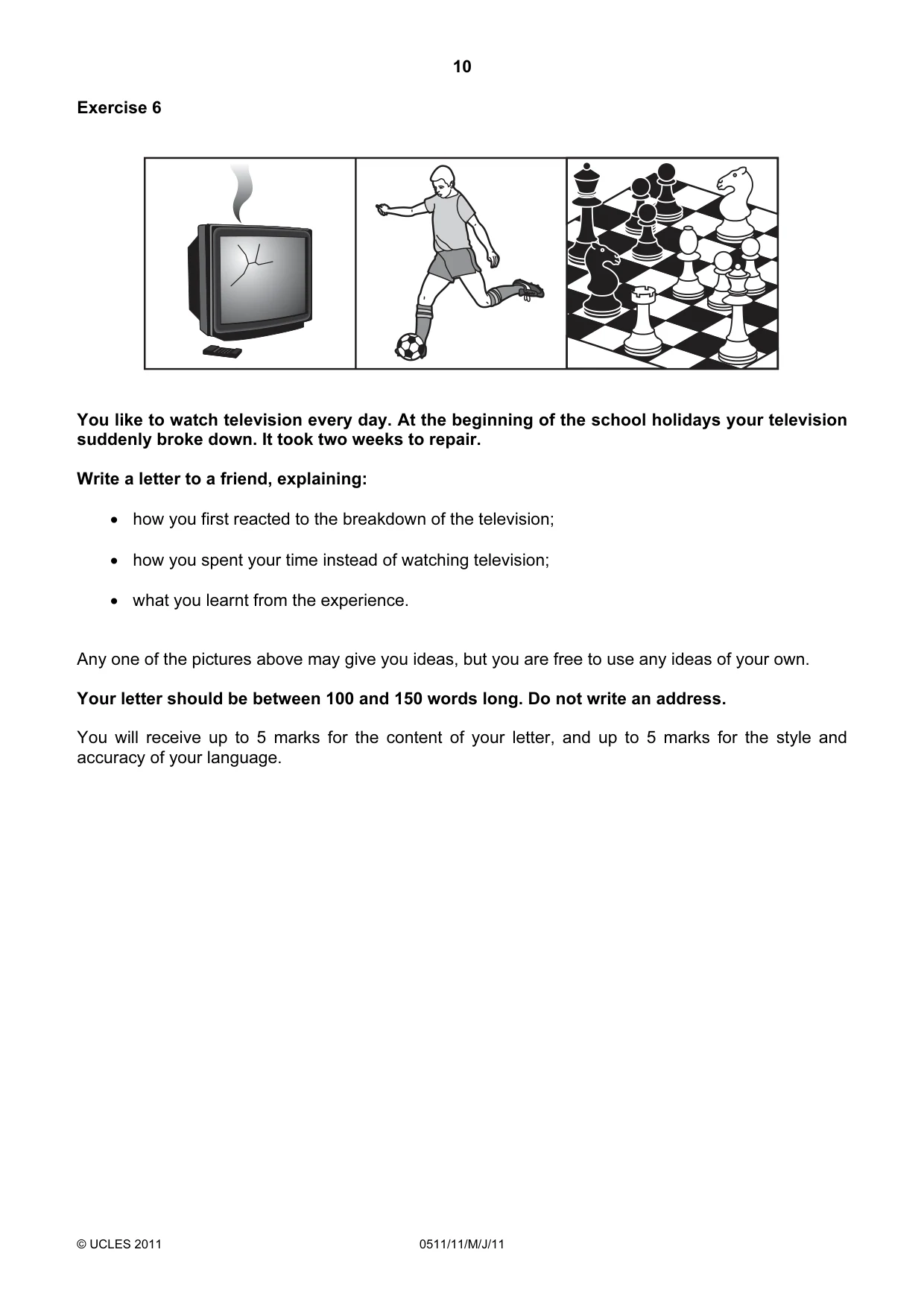
10 © UCLES 2011 0511/11/M/J/11 Exercise 6 You like to watch television every day. At the beginning of the school holidays your television suddenly broke down. It took two weeks to repair. Write a letter to a friend, explaining: • how you first reacted to the breakdown of the television; • how you spent your time instead of watching television; • what you learnt from the experience. Any one of the pictures above may give you ideas, but you are free to use any ideas of your own. Your letter should be between 100 and 150 words long. Do not write an address. You will receive up to 5 marks for the content of your letter, and up to 5 marks for the style and accuracy of your language.
Question paper, page 11
11 © UCLES 2011 0511/11/M/J/11 [Turn over [Total: 10]
Question paper, page 12
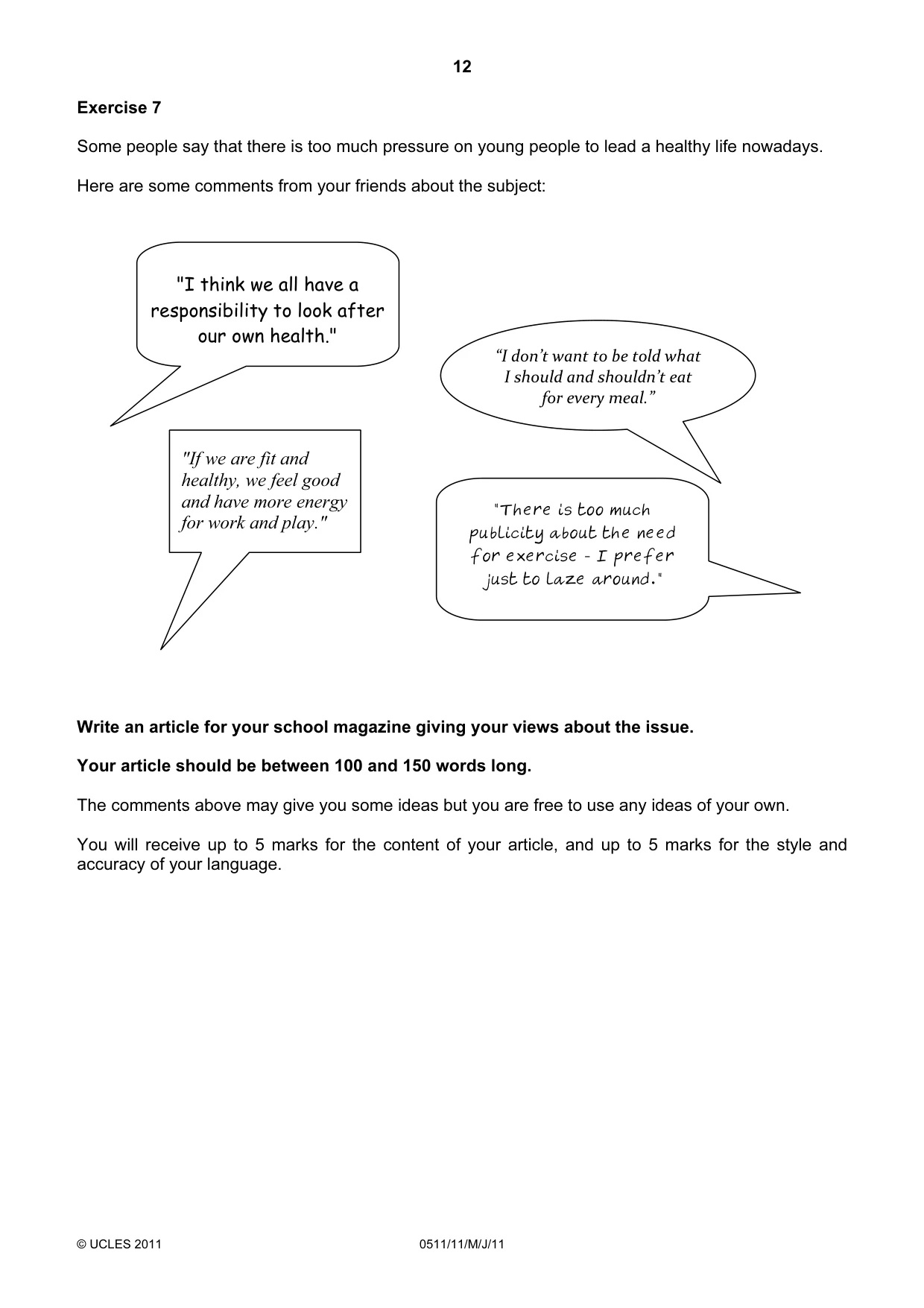
12 © UCLES 2011 0511/11/M/J/11 Exercise 7 Some people say that there is too much pressure on young people to lead a healthy life nowadays. Here are some comments from your friends about the subject: Write an article for your school magazine giving your views about the issue. Your article should be between 100 and 150 words long. The comments above may give you some ideas but you are free to use any ideas of your own. You will receive up to 5 marks for the content of your article, and up to 5 marks for the style and accuracy of your language. "I think we all have a responsibility to look after our own health." “I don’t want to be told what I should and shouldn’t eat for every meal.” "If we are fit and healthy, we feel good and have more energy for work and play." "There is too much publicity about the need for exercise – I prefer just to laze around."
Question paper, page 13
13 © UCLES 2011 0510/11/M/J/11 [Total: 10]
Question paper, page 14
14 © UCLES 2011 0511/11/M/J/11 BLANK PAGE
Question paper, page 15
15 © UCLES 2011 0510/11/M/J/11 BLANK PAGE
Question paper, page 16
16 Permission to reproduce items where third-party owned material protected by copyright is included has been sought and cleared where possible. Every reasonable effort has been made by the publisher (UCLES) to trace copyright holders, but if any items requiring clearance have unwittingly been included, the publisher will be pleased to make amends at the earliest possible opportunity. University of Cambridge International Examinations is part of the Cambridge Assessment Group. Cambridge Assessment is the brand name of University of Cambridge Local Examinations Syndicate (UCLES), which is itself a department of the University of Cambridge. © UCLES 2011 0511/11/M/J/11 BLANK PAGE
Mark scheme, page 1
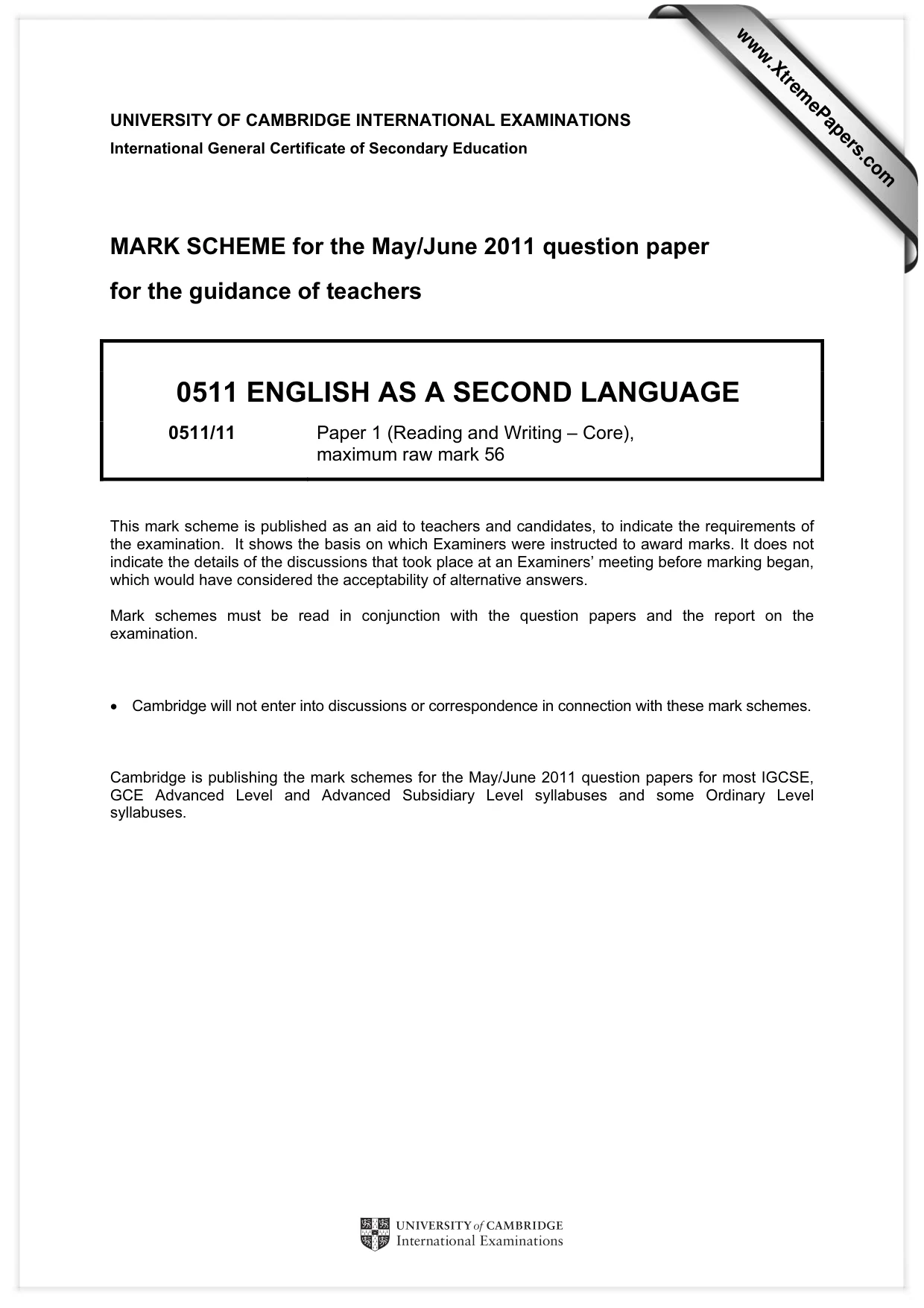
UNIVERSITY OF CAMBRIDGE INTERNATIONAL EXAMINATIONS International General Certificate of Secondary Education MARK SCHEME for the May/June 2011 question paper for the guidance of teachers 0511 ENGLISH AS A SECOND LANGUAGE 0511/11 Paper 1 (Reading and Writing – Core), maximum raw mark 56 This mark scheme is published as an aid to teachers and candidates, to indicate the requirements of the examination. It shows the basis on which Examiners were instructed to award marks. It does not indicate the details of the discussions that took place at an Examiners’ meeting before marking began, which would have considered the acceptability of alternative answers. Mark schemes must be read in conjunction with the question papers and the report on the examination. • Cambridge will not enter into discussions or correspondence in connection with these mark schemes. Cambridge is publishing the mark schemes for the May/June 2011 question papers for most IGCSE, GCE Advanced Level and Advanced Subsidiary Level syllabuses and some Ordinary Level syllabuses. www.XtremePapers.com
Mark scheme, page 2
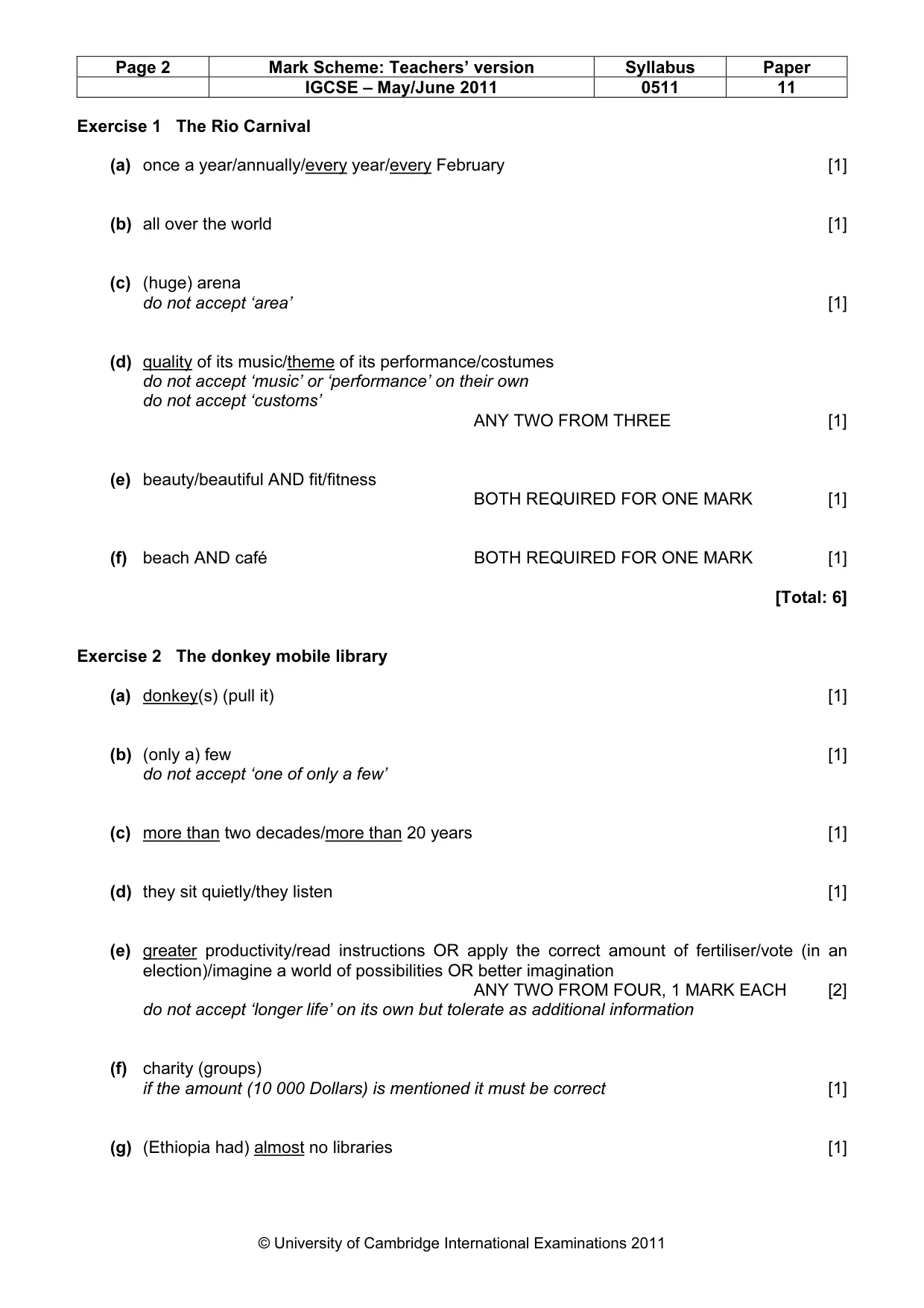
Page 2 Mark Scheme: Teachers’ version Syllabus Paper IGCSE – May/June 2011 0511 11 © University of Cambridge International Examinations 2011 Exercise 1 The Rio Carnival (a) once a year/annually/every year/every February [1] (b) all over the world [1] (c) (huge) arena do not accept ‘area’ [1] (d) quality of its music/theme of its performance/costumes do not accept ‘music’ or ‘performance’ on their own do not accept ‘customs’ ANY TWO FROM THREE [1] (e) beauty/beautiful AND fit/fitness BOTH REQUIRED FOR ONE MARK [1] (f) beach AND café BOTH REQUIRED FOR ONE MARK [1] [Total: 6] Exercise 2 The donkey mobile library (a) donkey(s) (pull it) [1] (b) (only a) few [1] do not accept ‘one of only a few’ (c) more than two decades/more than 20 years [1] (d) they sit quietly/they listen [1] (e) greater productivity/read instructions OR apply the correct amount of fertiliser/vote (in an election)/imagine a world of possibilities OR better imagination ANY TWO FROM FOUR, 1 MARK EACH [2] do not accept ‘longer life’ on its own but tolerate as additional information (f) charity (groups) if the amount (10 000 Dollars) is mentioned it must be correct [1] (g) (Ethiopia had) almost no libraries [1]
Mark scheme, page 3
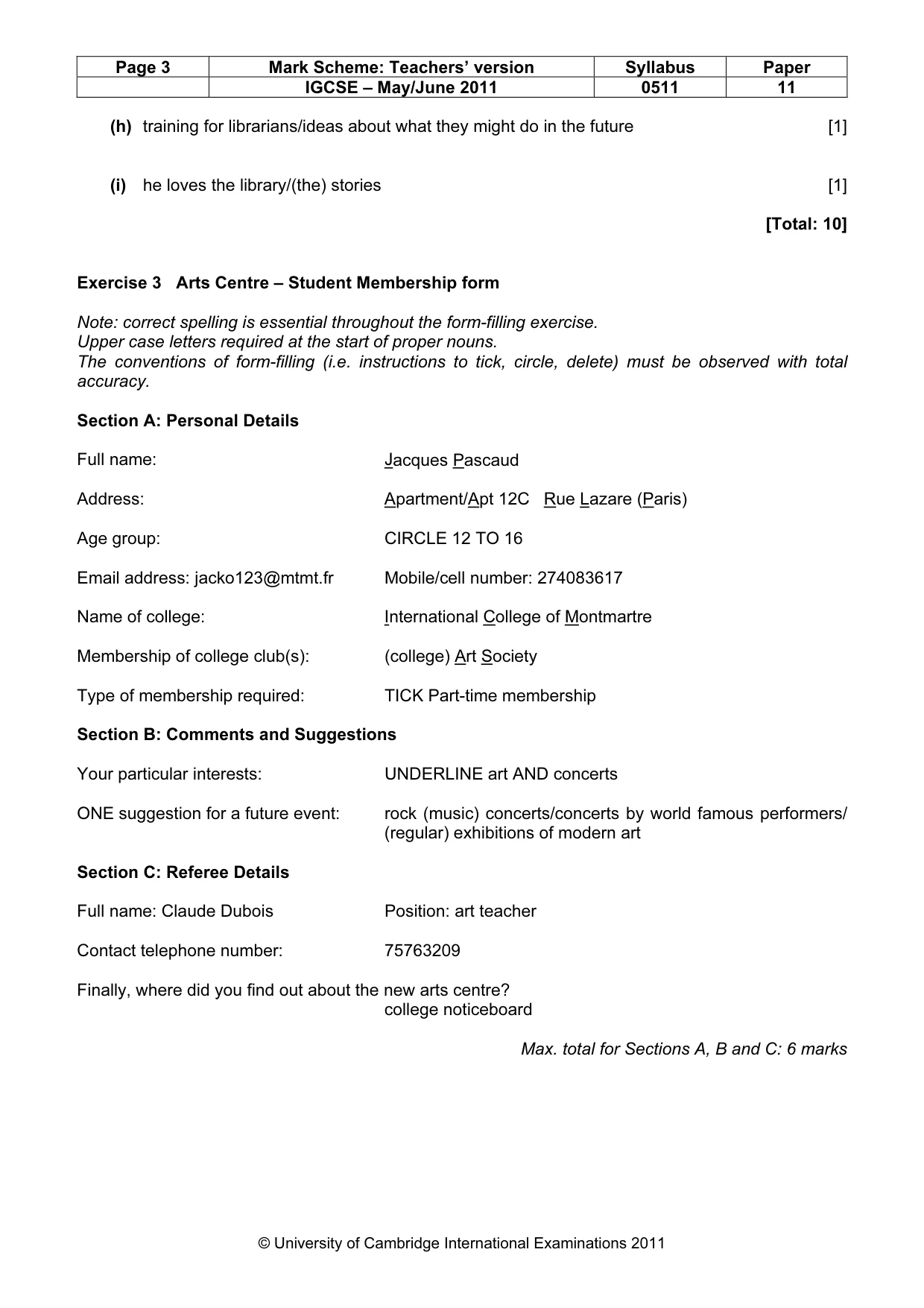
Page 3 Mark Scheme: Teachers’ version Syllabus Paper IGCSE – May/June 2011 0511 11 © University of Cambridge International Examinations 2011 (h) training for librarians/ideas about what they might do in the future [1] (i) he loves the library/(the) stories [1] [Total: 10] Exercise 3 Arts Centre – Student Membership form Note: correct spelling is essential throughout the form-filling exercise. Upper case letters required at the start of proper nouns. The conventions of form-filling (i.e. instructions to tick, circle, delete) must be observed with total accuracy. Section A: Personal Details Full name: Jacques Pascaud Address: Apartment/Apt 12C Rue Lazare (Paris) Age group: CIRCLE 12 TO 16 Email address: jacko123@mtmt.fr Mobile/cell number: 274083617 Name of college: International College of Montmartre Membership of college club(s): (college) Art Society Type of membership required: TICK Part-time membership Section B: Comments and Suggestions Your particular interests: UNDERLINE art AND concerts ONE suggestion for a future event: rock (music) concerts/concerts by world famous performers/ (regular) exhibitions of modern art Section C: Referee Details Full name: Claude Dubois Position: art teacher Contact telephone number: 75763209 Finally, where did you find out about the new arts centre? college noticeboard Max. total for Sections A, B and C: 6 marks
Mark scheme, page 4
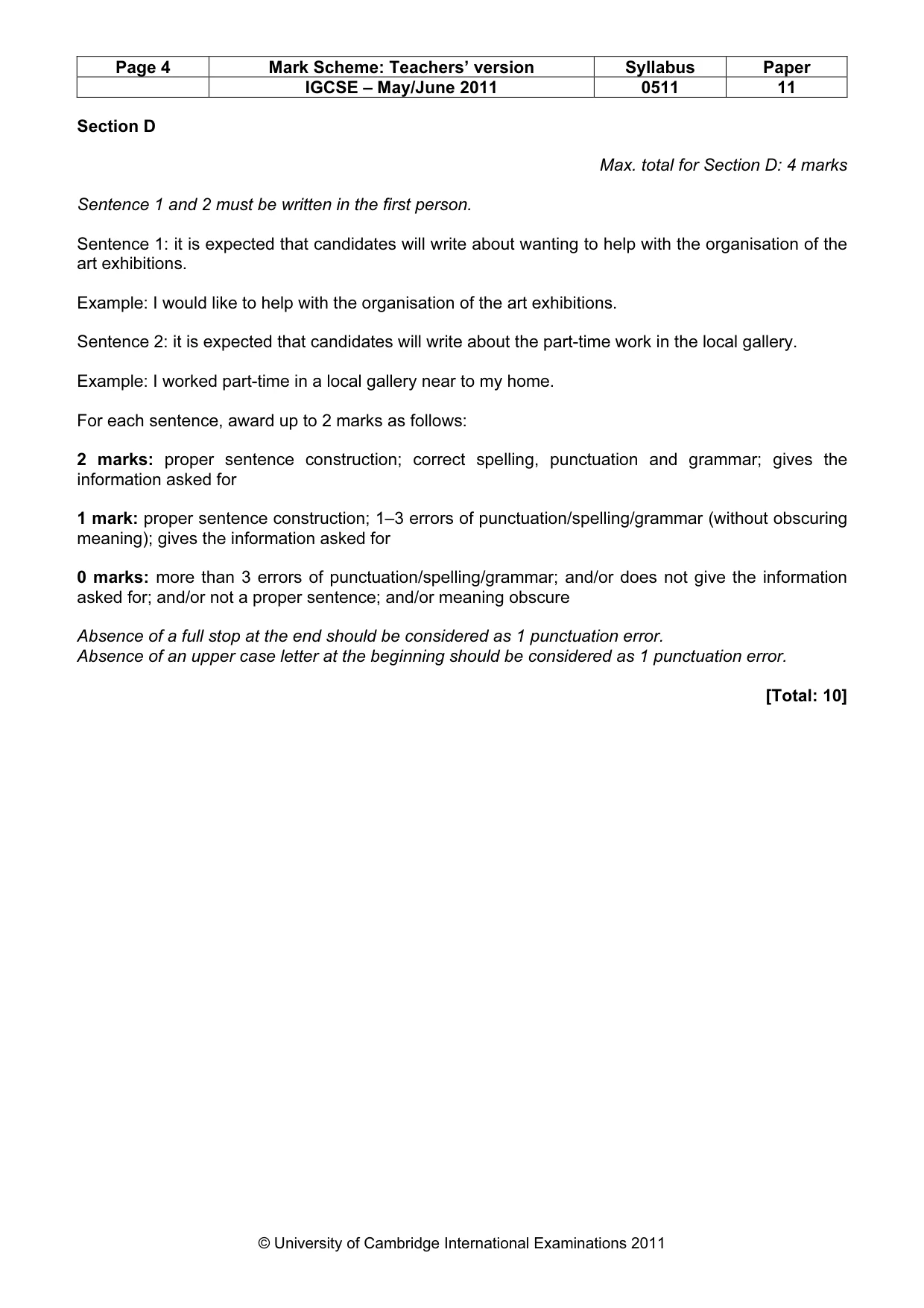
Page 4 Mark Scheme: Teachers’ version Syllabus Paper IGCSE – May/June 2011 0511 11 © University of Cambridge International Examinations 2011 Section D Max. total for Section D: 4 marks Sentence 1 and 2 must be written in the first person. Sentence 1: it is expected that candidates will write about wanting to help with the organisation of the art exhibitions. Example: I would like to help with the organisation of the art exhibitions. Sentence 2: it is expected that candidates will write about the part-time work in the local gallery. Example: I worked part-time in a local gallery near to my home. For each sentence, award up to 2 marks as follows: 2 marks: proper sentence construction; correct spelling, punctuation and grammar; gives the information asked for 1 mark: proper sentence construction; 1–3 errors of punctuation/spelling/grammar (without obscuring meaning); gives the information asked for 0 marks: more than 3 errors of punctuation/spelling/grammar; and/or does not give the information asked for; and/or not a proper sentence; and/or meaning obscure Absence of a full stop at the end should be considered as 1 punctuation error. Absence of an upper case letter at the beginning should be considered as 1 punctuation error. [Total: 10]
Mark scheme, page 5
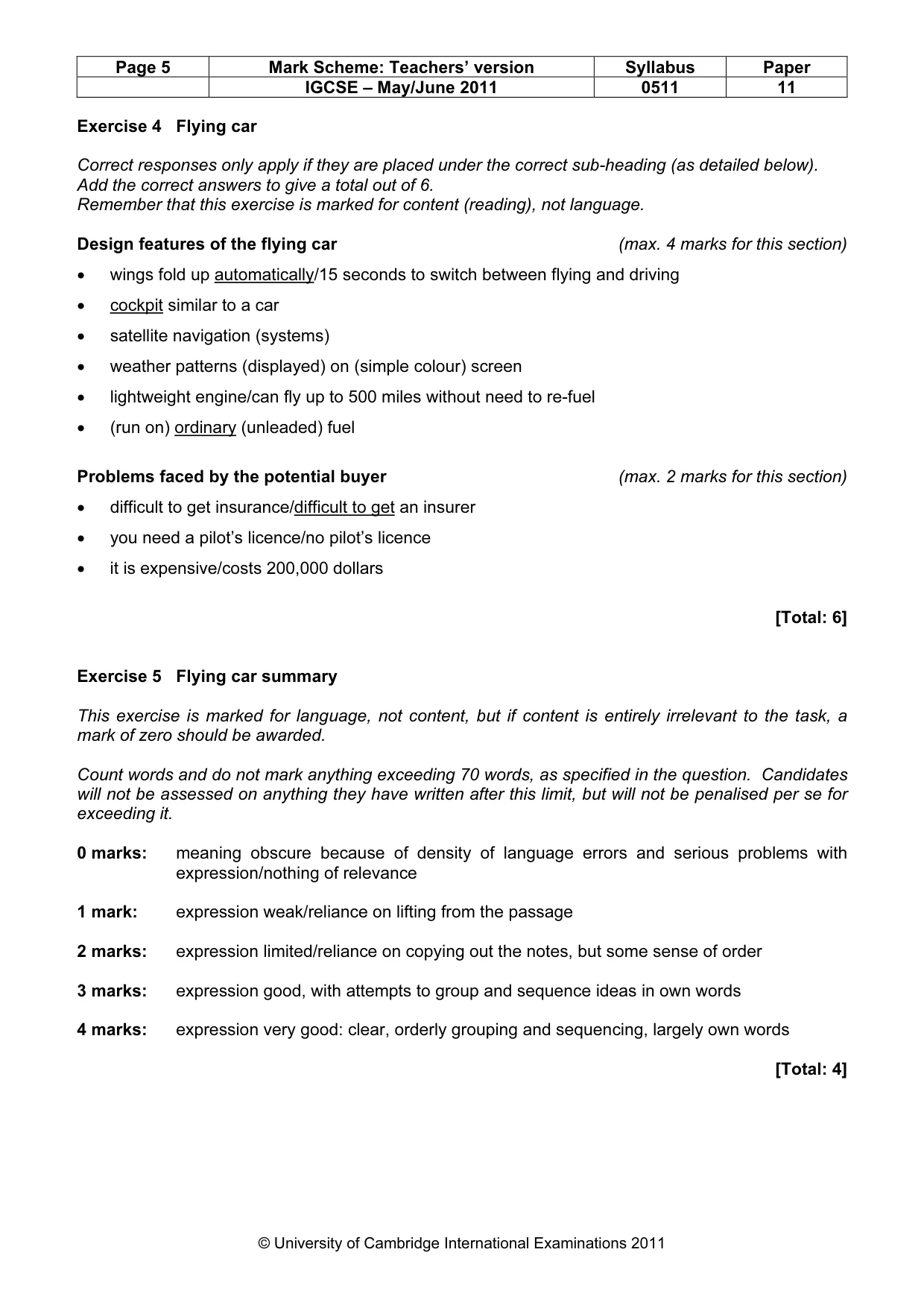
Page 5 Mark Scheme: Teachers’ version Syllabus Paper IGCSE – May/June 2011 0511 11 © University of Cambridge International Examinations 2011 Exercise 4 Flying car Correct responses only apply if they are placed under the correct sub-heading (as detailed below). Add the correct answers to give a total out of 6. Remember that this exercise is marked for content (reading), not language. Design features of the flying car (max. 4 marks for this section) • wings fold up automatically/15 seconds to switch between flying and driving • cockpit similar to a car • satellite navigation (systems) • weather patterns (displayed) on (simple colour) screen • lightweight engine/can fly up to 500 miles without need to re-fuel • (run on) ordinary (unleaded) fuel Problems faced by the potential buyer (max. 2 marks for this section) • difficult to get insurance/difficult to get an insurer • you need a pilot’s licence/no pilot’s licence • it is expensive/costs 200,000 dollars [Total: 6] Exercise 5 Flying car summary This exercise is marked for language, not content, but if content is entirely irrelevant to the task, a mark of zero should be awarded. Count words and do not mark anything exceeding 70 words, as specified in the question. Candidates will not be assessed on anything they have written after this limit, but will not be penalised per se for exceeding it. 0 marks: meaning obscure because of density of language errors and serious problems with expression/nothing of relevance 1 mark: expression weak/reliance on lifting from the passage 2 marks: expression limited/reliance on copying out the notes, but some sense of order 3 marks: expression good, with attempts to group and sequence ideas in own words 4 marks: expression very good: clear, orderly grouping and sequencing, largely own words [Total: 4]
Mark scheme, page 6
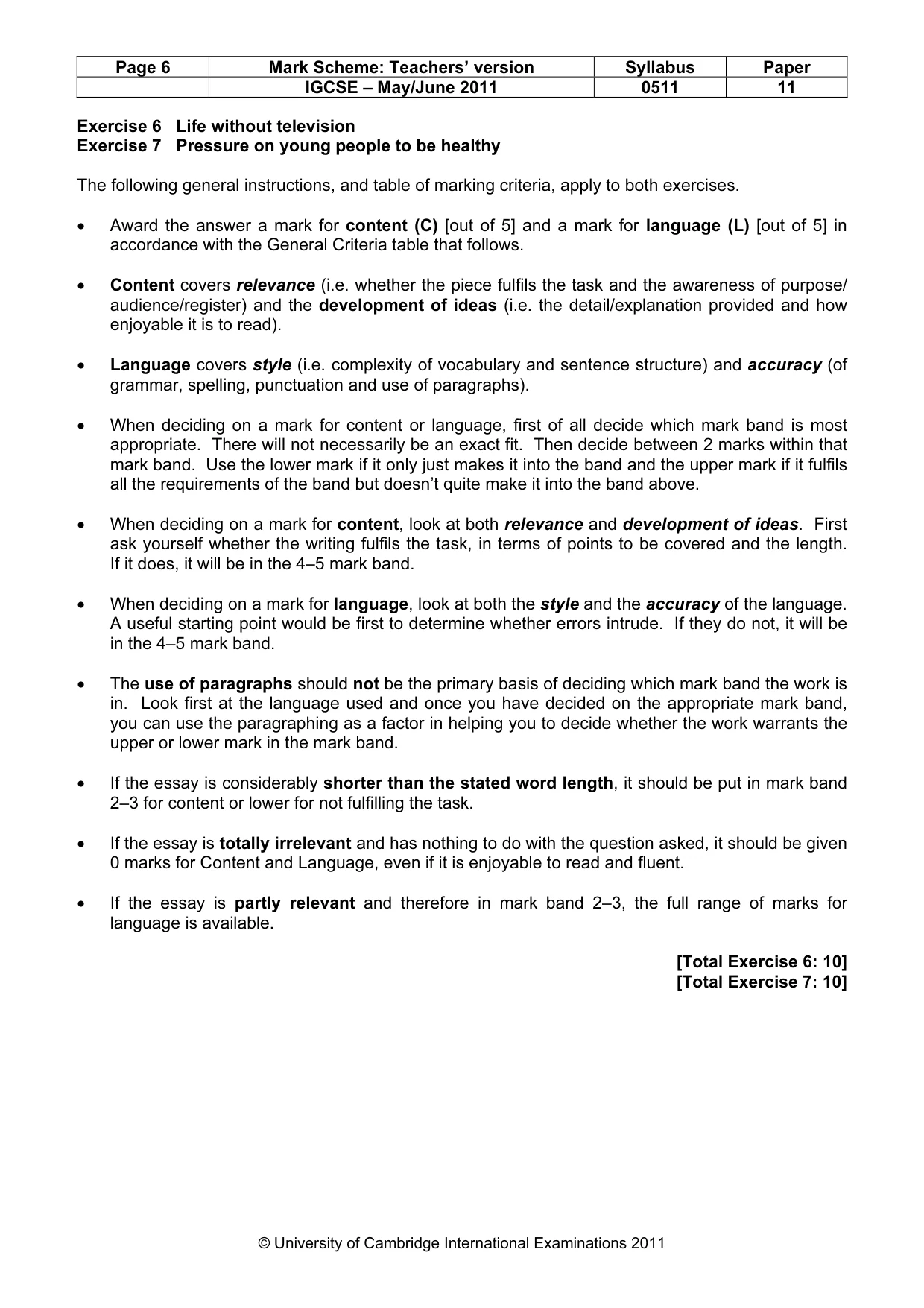
Page 6 Mark Scheme: Teachers’ version Syllabus Paper IGCSE – May/June 2011 0511 11 © University of Cambridge International Examinations 2011 Exercise 6 Life without television Exercise 7 Pressure on young people to be healthy The following general instructions, and table of marking criteria, apply to both exercises. • Award the answer a mark for content (C) [out of 5] and a mark for language (L) [out of 5] in accordance with the General Criteria table that follows. • Content covers relevance (i.e. whether the piece fulfils the task and the awareness of purpose/ audience/register) and the development of ideas (i.e. the detail/explanation provided and how enjoyable it is to read). • Language covers style (i.e. complexity of vocabulary and sentence structure) and accuracy (of grammar, spelling, punctuation and use of paragraphs). • When deciding on a mark for content or language, first of all decide which mark band is most appropriate. There will not necessarily be an exact fit. Then decide between 2 marks within that mark band. Use the lower mark if it only just makes it into the band and the upper mark if it fulfils all the requirements of the band but doesn’t quite make it into the band above. • When deciding on a mark for content, look at both relevance and development of ideas. First ask yourself whether the writing fulfils the task, in terms of points to be covered and the length. If it does, it will be in the 4–5 mark band. • When deciding on a mark for language, look at both the style and the accuracy of the language. A useful starting point would be first to determine whether errors intrude. If they do not, it will be in the 4–5 mark band. • The use of paragraphs should not be the primary basis of deciding which mark band the work is in. Look first at the language used and once you have decided on the appropriate mark band, you can use the paragraphing as a factor in helping you to decide whether the work warrants the upper or lower mark in the mark band. • If the essay is considerably shorter than the stated word length, it should be put in mark band 2–3 for content or lower for not fulfilling the task. • If the essay is totally irrelevant and has nothing to do with the question asked, it should be given 0 marks for Content and Language, even if it is enjoyable to read and fluent. • If the essay is partly relevant and therefore in mark band 2–3, the full range of marks for language is available. [Total Exercise 6: 10] [Total Exercise 7: 10]
Mark scheme, page 7
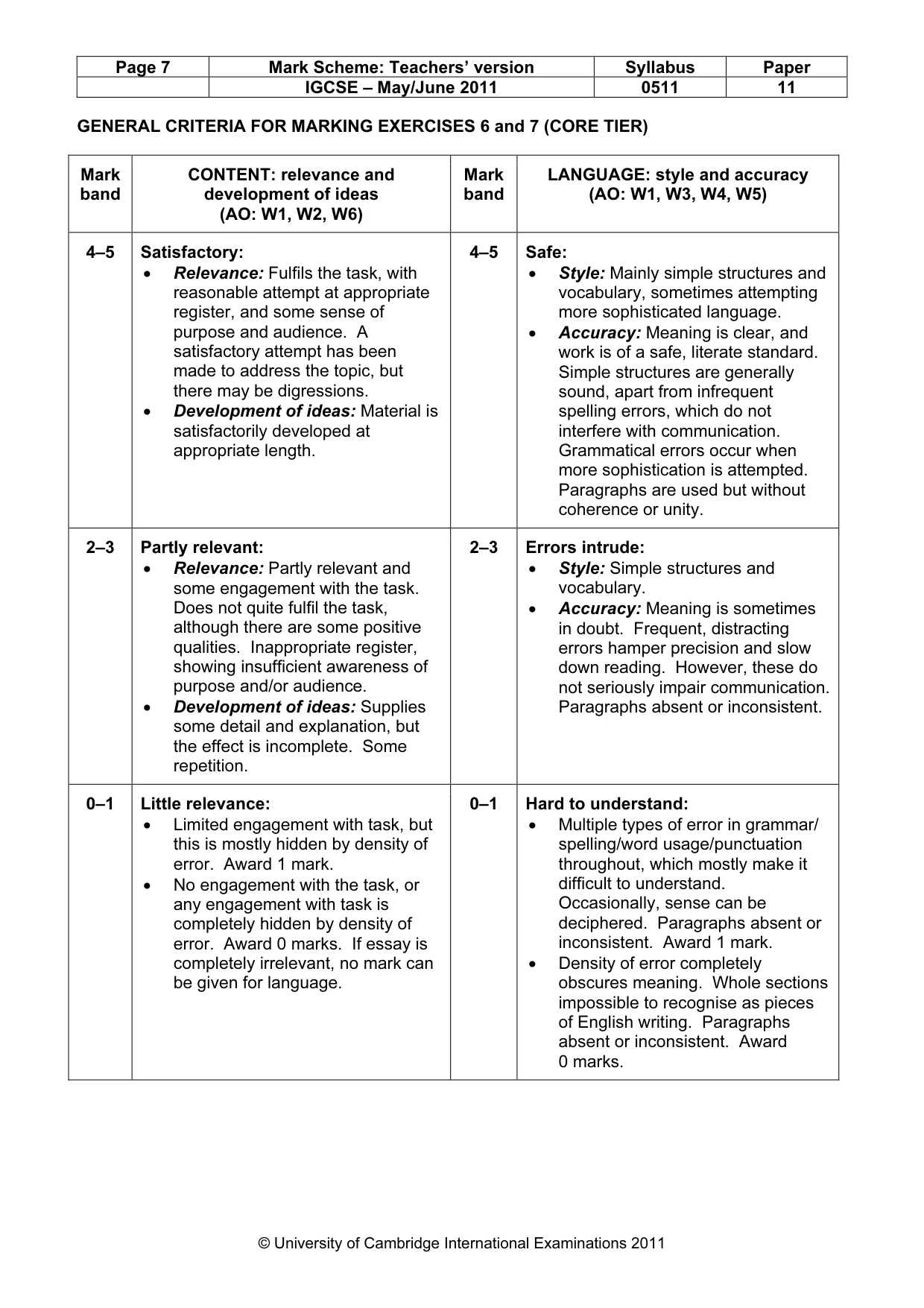
Page 7 Mark Scheme: Teachers’ version Syllabus Paper IGCSE – May/June 2011 0511 11 © University of Cambridge International Examinations 2011 GENERAL CRITERIA FOR MARKING EXERCISES 6 and 7 (CORE TIER) Mark band CONTENT: relevance and development of ideas (AO: W1, W2, W6) Mark band LANGUAGE: style and accuracy (AO: W1, W3, W4, W5) 4–5 Satisfactory: • Relevance: Fulfils the task, with reasonable attempt at appropriate register, and some sense of purpose and audience. A satisfactory attempt has been made to address the topic, but there may be digressions. • Development of ideas: Material is satisfactorily developed at appropriate length. 4–5 Safe: • Style: Mainly simple structures and vocabulary, sometimes attempting more sophisticated language. • Accuracy: Meaning is clear, and work is of a safe, literate standard. Simple structures are generally sound, apart from infrequent spelling errors, which do not interfere with communication. Grammatical errors occur when more sophistication is attempted. Paragraphs are used but without coherence or unity. 2–3 Partly relevant: • Relevance: Partly relevant and some engagement with the task. Does not quite fulfil the task, although there are some positive qualities. Inappropriate register, showing insufficient awareness of purpose and/or audience. • Development of ideas: Supplies some detail and explanation, but the effect is incomplete. Some repetition. 2–3 Errors intrude: • Style: Simple structures and vocabulary. • Accuracy: Meaning is sometimes in doubt. Frequent, distracting errors hamper precision and slow down reading. However, these do not seriously impair communication. Paragraphs absent or inconsistent. 0–1 Little relevance: • Limited engagement with task, but this is mostly hidden by density of error. Award 1 mark. • No engagement with the task, or any engagement with task is completely hidden by density of error. Award 0 marks. If essay is completely irrelevant, no mark can be given for language. 0–1 Hard to understand: • Multiple types of error in grammar/ spelling/word usage/punctuation throughout, which mostly make it difficult to understand. Occasionally, sense can be deciphered. Paragraphs absent or inconsistent. Award 1 mark. • Density of error completely obscures meaning. Whole sections impossible to recognise as pieces of English writing. Paragraphs absent or inconsistent. Award 0 marks.
What you needed in this session
Cambridge’s own grade thresholds for 2011 May/June, Paper 1 · Variant 1. A higher threshold means an easier paper — the bar moves with how the cohort did.