Cambridge IGCSE English - Literature in English (9-1) 0992 — 2022 Oct/Nov Paper 2 · Variant 2
0992/22/O/N/22 · 50 marks · ≈56 min
The question paper and its mark scheme, free to read here and free to download. This is Cambridge’s own paper, exactly as it was sat.
Question paper12 pages

Mark scheme5 pages
Answers below. Sit the paper first if you are practising.
Paper as text
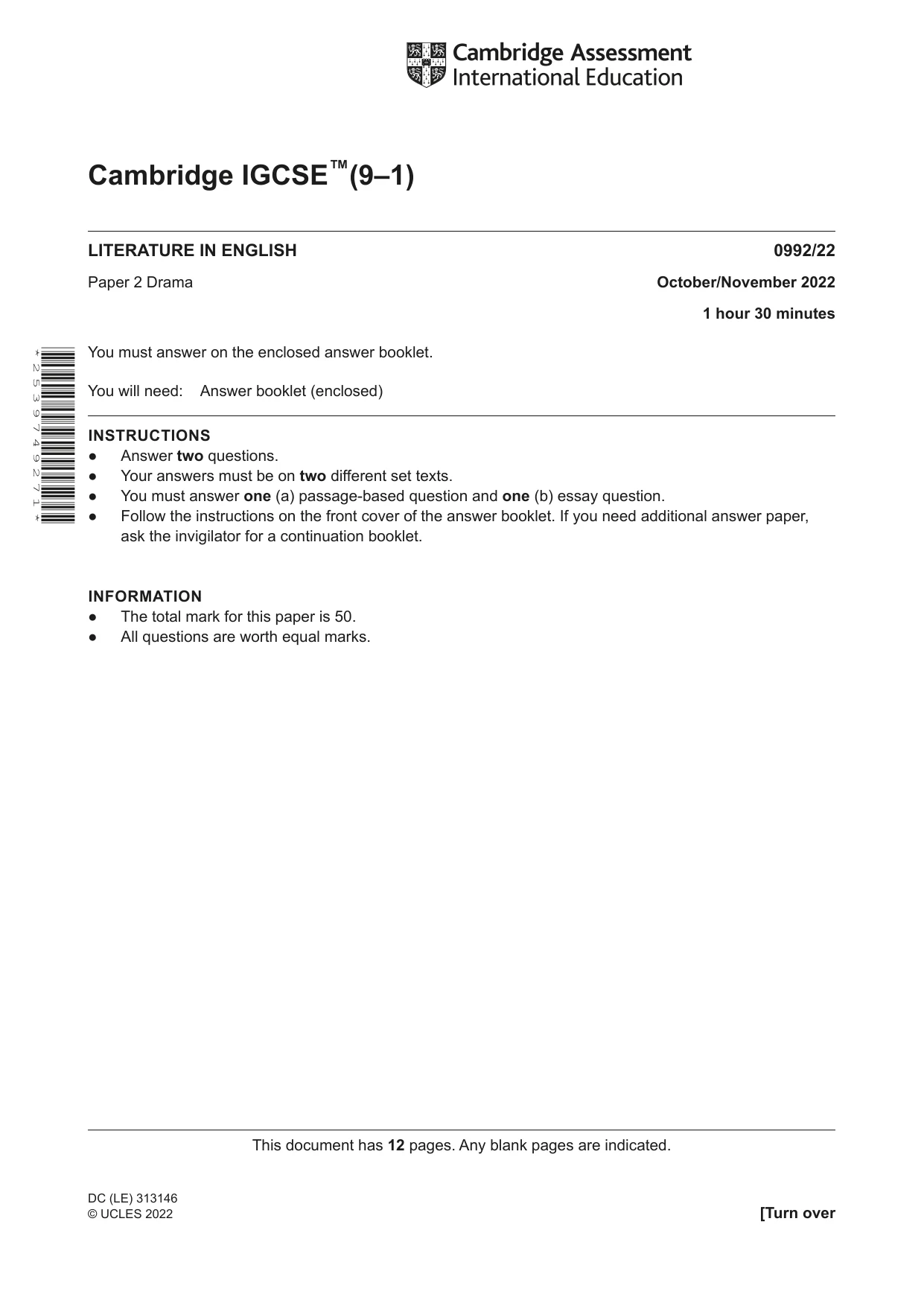
Question paper, page 1
This document has 12 pages. Any blank pages are indicated. Cambridge IGCSE™(9–1) * 2 5 3 9 7 4 9 2 7 1 * LITERATURE IN ENGLISH 0992/22 Paper 2 Drama October/November 2022 1 hour 30 minutes You must answer on the enclosed answer booklet. You will need: Answer booklet (enclosed) INSTRUCTIONS ● Answer two questions. ● Your answers must be on two different set texts. ● You must answer one (a) passage-based question and one (b) essay question. ● Follow the instructions on the front cover of the answer booklet. If you need additional answer paper, ask the invigilator for a continuation booklet. INFORMATION ● The total mark for this paper is 50. ● All questions are worth equal marks. DC (LE) 313146 © UCLES 2022 [Turn over
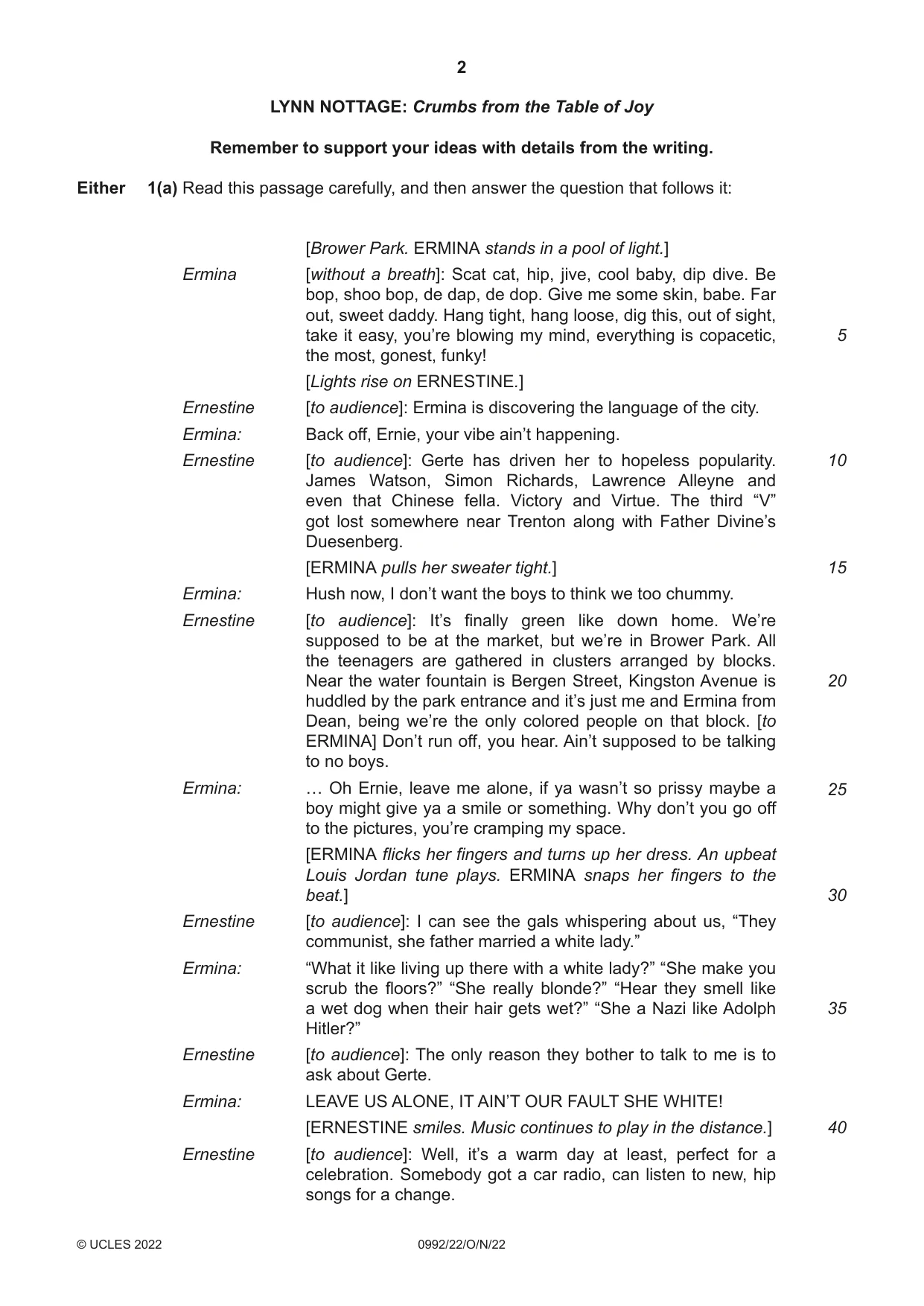
Question paper, page 2
2 0992/22/O/N/22 © UCLES 2022 LYNN NOTTAGE: Crumbs from the Table of Joy Remember to support your ideas with details from the writing. Either 1(a) Read this passage carefully, and then answer the question that follows it: [Brower Park. ERMINA stands in a pool of light.] Ermina [without a breath]: Scat cat, hip, jive, cool baby, dip dive. Be bop, shoo bop, de dap, de dop. Give me some skin, babe. Far out, sweet daddy. Hang tight, hang loose, dig this, out of sight, take it easy, you’re blowing my mind, everything is copacetic, the most, gonest, funky! [Lights rise on ERNESTINE.] Ernestine [to audience]: Ermina is discovering the language of the city. Ermina: Back off, Ernie, your vibe ain’t happening. Ernestine [to audience]: Gerte has driven her to hopeless popularity. James Watson, Simon Richards, Lawrence Alleyne and even that Chinese fella. Victory and Virtue. The third “V” got lost somewhere near Trenton along with Father Divine’s Duesenberg. [ERMINA pulls her sweater tight.] Ermina: Hush now, I don’t want the boys to think we too chummy. Ernestine [to audience]: It’s finally green like down home. We’re supposed to be at the market, but we’re in Brower Park. All the teenagers are gathered in clusters arranged by blocks. Near the water fountain is Bergen Street, Kingston Avenue is huddled by the park entrance and it’s just me and Ermina from Dean, being we’re the only colored people on that block. [to ERMINA] Don’t run off, you hear. Ain’t supposed to be talking to no boys. Ermina: … Oh Ernie, leave me alone, if ya wasn’t so prissy maybe a boy might give ya a smile or something. Why don’t you go off to the pictures, you’re cramping my space. [ERMINA flicks her fingers and turns up her dress. An upbeat Louis Jordan tune plays. ERMINA snaps her fingers to the beat.] Ernestine [to audience]: I can see the gals whispering about us, “They communist, she father married a white lady.” Ermina: “What it like living up there with a white lady?” “She make you scrub the floors?” “She really blonde?” “Hear they smell like a wet dog when their hair gets wet?” “She a Nazi like Adolph Hitler?” Ernestine [to audience]: The only reason they bother to talk to me is to ask about Gerte. Ermina: LEAVE US ALONE, IT AIN’T OUR FAULT SHE WHITE! [ERNESTINE smiles. Music continues to play in the distance.] Ernestine [to audience]: Well, it’s a warm day at least, perfect for a celebration. Somebody got a car radio, can listen to new, hip songs for a change. 5 10 15 20 25 30 35 40
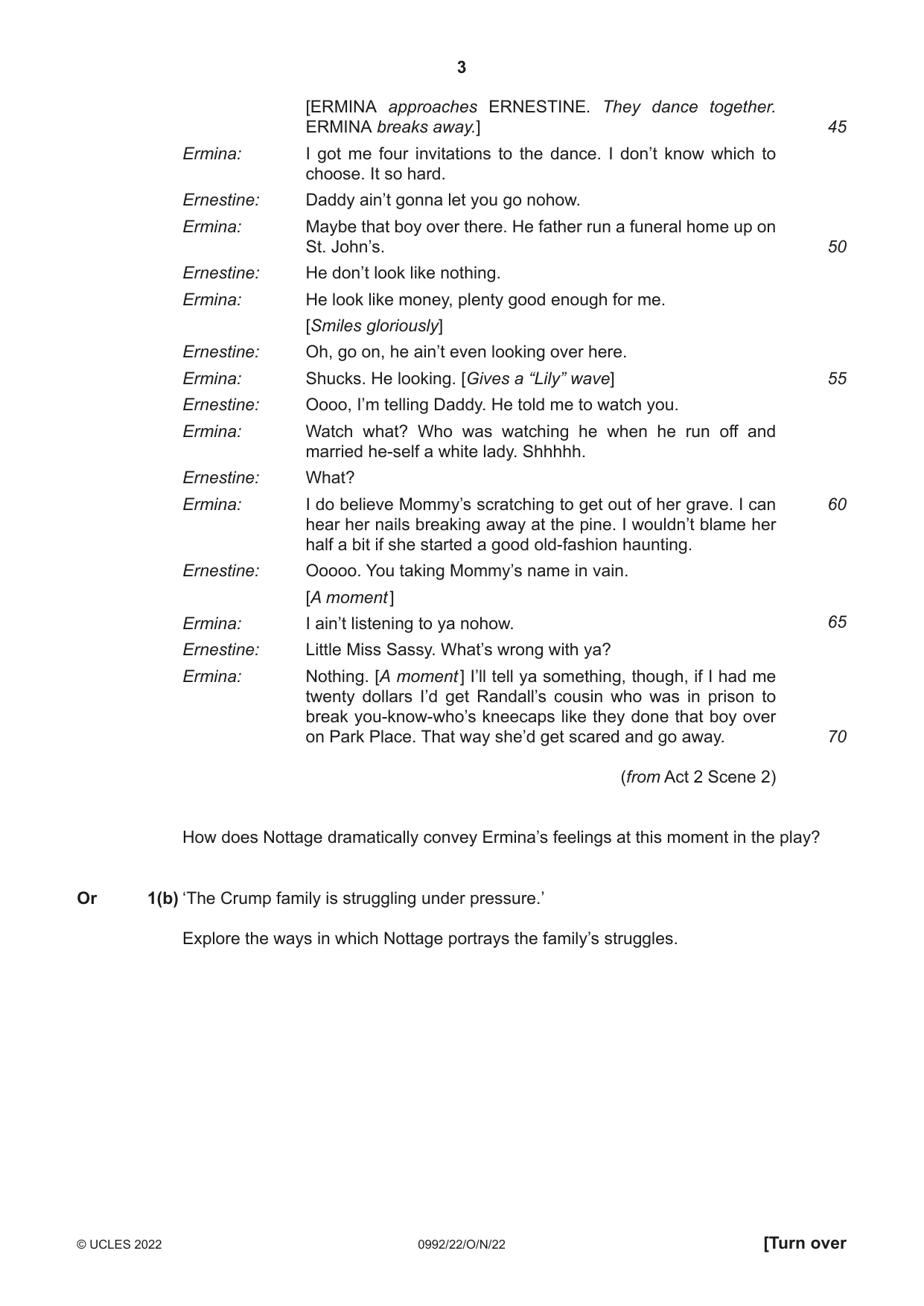
Question paper, page 3
3 0992/22/O/N/22 © UCLES 2022 [Turn over [ERMINA approaches ERNESTINE. They dance together. ERMINA breaks away.] Ermina: I got me four invitations to the dance. I don’t know which to choose. It so hard. Ernestine: Daddy ain’t gonna let you go nohow. Ermina: Maybe that boy over there. He father run a funeral home up on St. John’s. Ernestine: He don’t look like nothing. Ermina: He look like money, plenty good enough for me. [Smiles gloriously] Ernestine: Oh, go on, he ain’t even looking over here. Ermina: Shucks. He looking. [Gives a “Lily” wave] Ernestine: Oooo, I’m telling Daddy. He told me to watch you. Ermina: Watch what? Who was watching he when he run off and married he-self a white lady. Shhhhh. Ernestine: What? Ermina: I do believe Mommy’s scratching to get out of her grave. I can hear her nails breaking away at the pine. I wouldn’t blame her half a bit if she started a good old-fashion haunting. Ernestine: Ooooo. You taking Mommy’s name in vain. [A moment ] Ermina: I ain’t listening to ya nohow. Ernestine: Little Miss Sassy. What’s wrong with ya? Ermina: Nothing. [A moment ] I’ll tell ya something, though, if I had me twenty dollars I’d get Randall’s cousin who was in prison to break you-know-who’s kneecaps like they done that boy over on Park Place. That way she’d get scared and go away. (from Act 2 Scene 2) How does Nottage dramatically convey Ermina’s feelings at this moment in the play? Or 1(b) ‘The Crump family is struggling under pressure.’ Explore the ways in which Nottage portrays the family’s struggles. 45 50 55 60 65 70
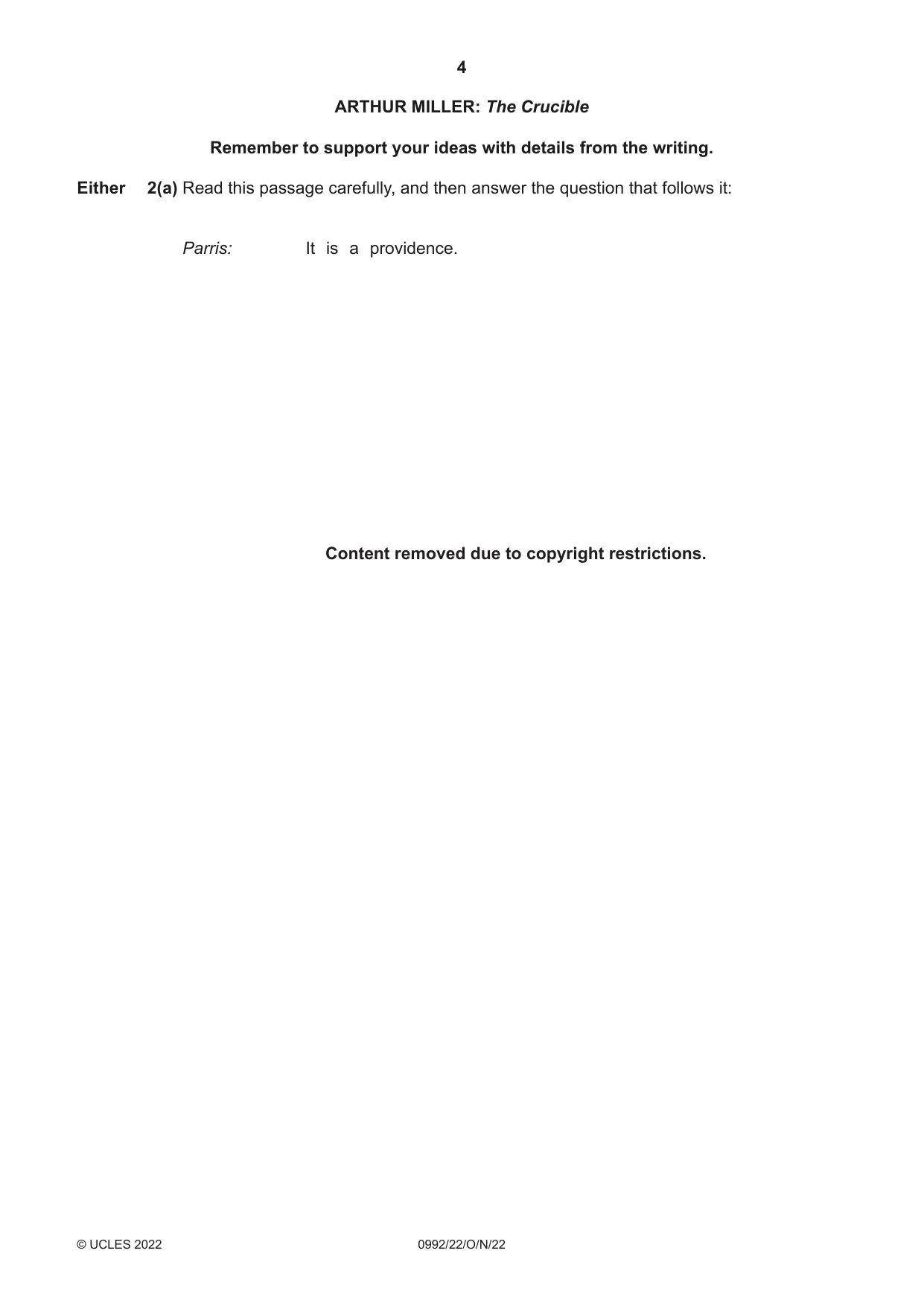
Question paper, page 4
4 0992/22/O/N/22 © UCLES 2022 ARTHUR MILLER: The Crucible Remember to support your ideas with details from the writing. Either 2(a) Read this passage carefully, and then answer the question that follows it: Parris: It is a providence. Content removed due to copyright restrictions.
Question paper, page 5
5 0992/22/O/N/22 © UCLES 2022 [Turn over Let Rebecca stand upon the gibbet and send up some righteous prayer, and I fear she’ll wake a vengeance on you. (from Act 4) How does Miller make this moment in the play so dramatic and revealing? Or 2(b) Explore two moments in the play where Miller vividly portrays the power of the belief in witchcraft. Content removed due to copyright restrictions.
Question paper, page 6
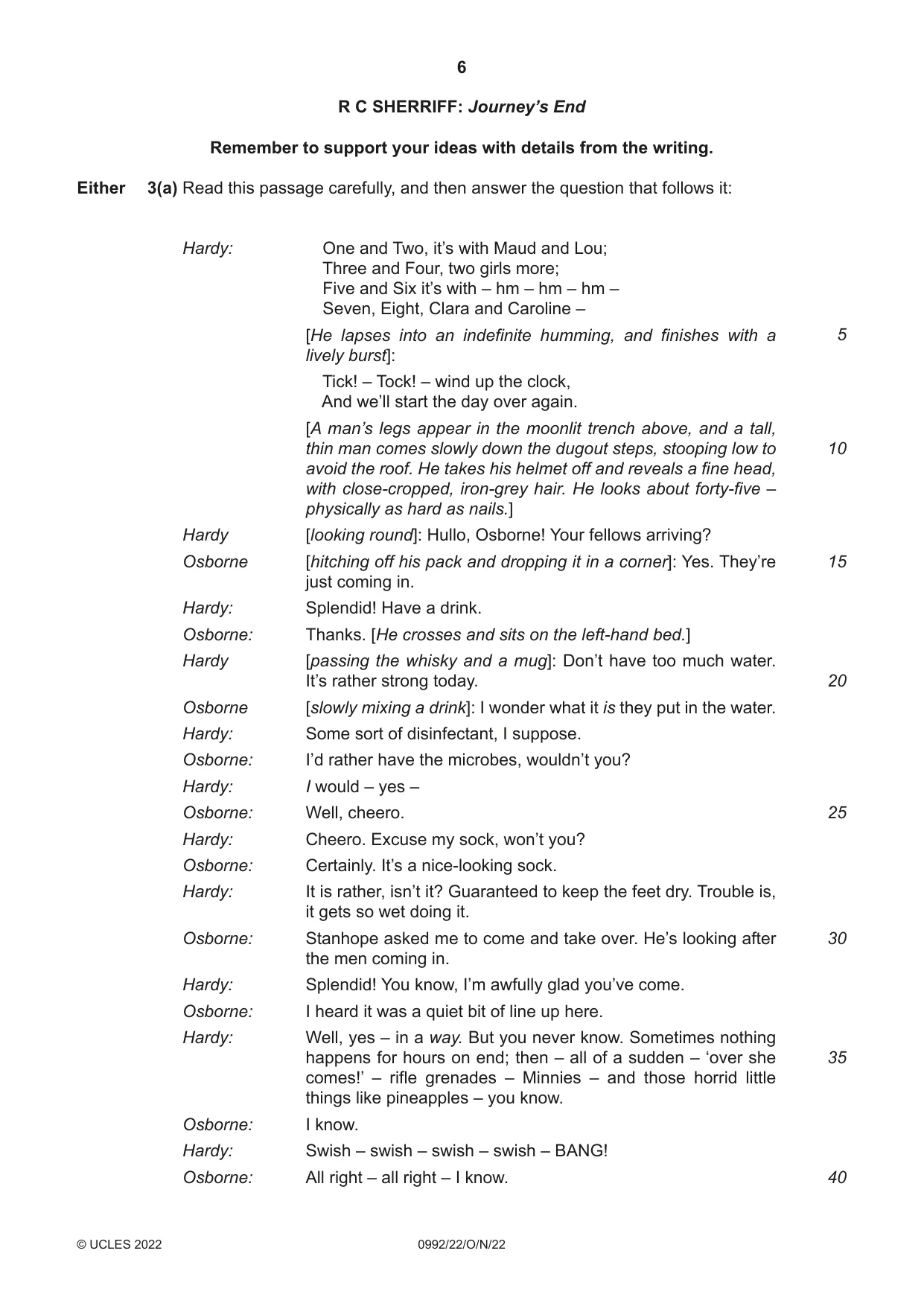
6 0992/22/O/N/22 © UCLES 2022 R C SHERRIFF: Journey’s End Remember to support your ideas with details from the writing. Either 3(a) Read this passage carefully, and then answer the question that follows it: Hardy: One and Two, it’s with Maud and Lou; Three and Four, two girls more; Five and Six it’s with – hm – hm – hm – Seven, Eight, Clara and Caroline – [He lapses into an indefinite humming, and finishes with a lively burst]: Tick! – Tock! – wind up the clock, And we’ll start the day over again. [A man’s legs appear in the moonlit trench above, and a tall, thin man comes slowly down the dugout steps, stooping low to avoid the roof. He takes his helmet off and reveals a fine head, with close-cropped, iron-grey hair. He looks about forty-five – physically as hard as nails.] Hardy [looking round]: Hullo, Osborne! Your fellows arriving? Osborne [hitching off his pack and dropping it in a corner]: Yes. They’re just coming in. Hardy: Splendid! Have a drink. Osborne: Thanks. [He crosses and sits on the left-hand bed.] Hardy [passing the whisky and a mug]: Don’t have too much water. It’s rather strong today. Osborne [slowly mixing a drink]: I wonder what it is they put in the water. Hardy: Some sort of disinfectant, I suppose. Osborne: I’d rather have the microbes, wouldn’t you? Hardy: I would – yes – Osborne: Well, cheero. Hardy: Cheero. Excuse my sock, won’t you? Osborne: Certainly. It’s a nice-looking sock. Hardy: It is rather, isn’t it? Guaranteed to keep the feet dry. Trouble is, it gets so wet doing it. Osborne: Stanhope asked me to come and take over. He’s looking after the men coming in. Hardy: Splendid! You know, I’m awfully glad you’ve come. Osborne: I heard it was a quiet bit of line up here. Hardy: Well, yes – in a way. But you never know. Sometimes nothing happens for hours on end; then – all of a sudden – ‘over she comes!’ – rifle grenades – Minnies – and those horrid little things like pineapples – you know. Osborne: I know. Hardy: Swish – swish – swish – swish – BANG! Osborne: All right – all right – I know. 5 10 15 20 25 30 35 40
Question paper, page 7
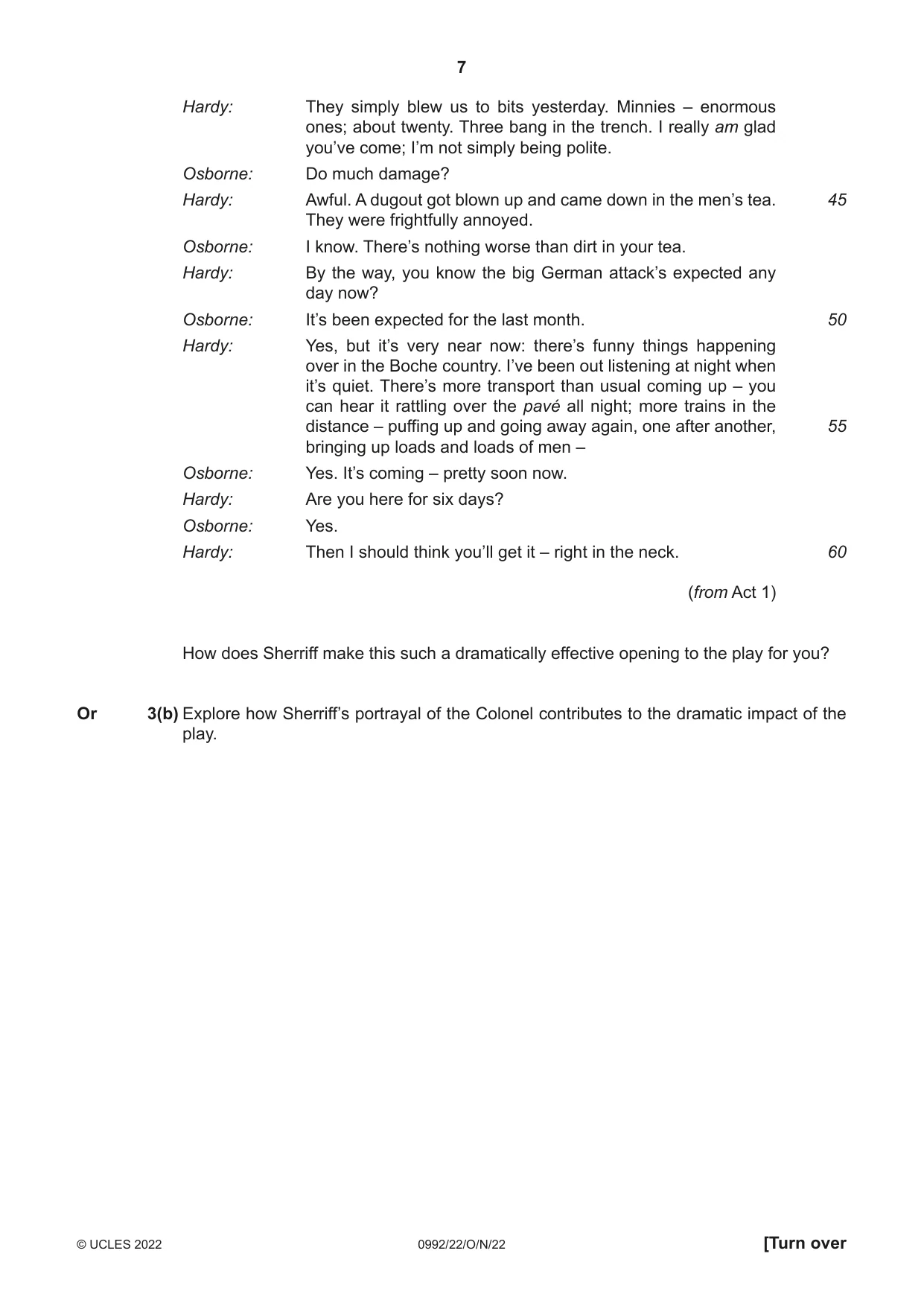
7 0992/22/O/N/22 © UCLES 2022 [Turn over Hardy: They simply blew us to bits yesterday. Minnies – enormous ones; about twenty. Three bang in the trench. I really am glad you’ve come; I’m not simply being polite. Osborne: Do much damage? Hardy: Awful. A dugout got blown up and came down in the men’s tea. They were frightfully annoyed. Osborne: I know. There’s nothing worse than dirt in your tea. Hardy: By the way, you know the big German attack’s expected any day now? Osborne: It’s been expected for the last month. Hardy: Yes, but it’s very near now: there’s funny things happening over in the Boche country. I’ve been out listening at night when it’s quiet. There’s more transport than usual coming up – you can hear it rattling over the pavé all night; more trains in the distance – puffing up and going away again, one after another, bringing up loads and loads of men – Osborne: Yes. It’s coming – pretty soon now. Hardy: Are you here for six days? Osborne: Yes. Hardy: Then I should think you’ll get it – right in the neck. (from Act 1) How does Sherriff make this such a dramatically effective opening to the play for you? Or 3(b) Explore how Sherriff’s portrayal of the Colonel contributes to the dramatic impact of the play. 45 50 55 60
Question paper, page 8
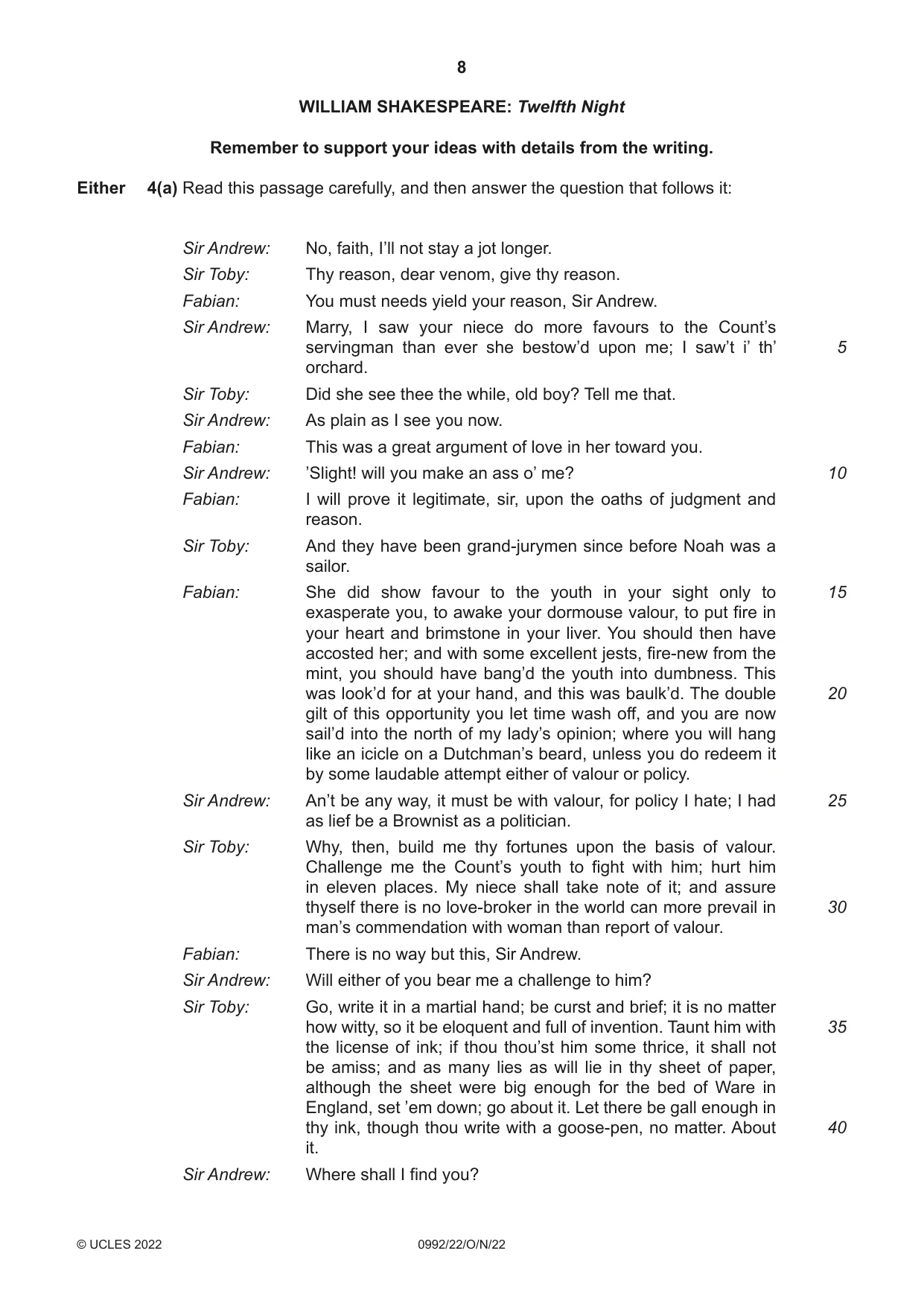
8 0992/22/O/N/22 © UCLES 2022 WILLIAM SHAKESPEARE: Twelfth Night Remember to support your ideas with details from the writing. Either 4(a) Read this passage carefully, and then answer the question that follows it: Sir Andrew: No, faith, I’ll not stay a jot longer. Sir Toby: Thy reason, dear venom, give thy reason. Fabian: You must needs yield your reason, Sir Andrew. Sir Andrew: Marry, I saw your niece do more favours to the Count’s servingman than ever she bestow’d upon me; I saw’t i’ th’ orchard. Sir Toby: Did she see thee the while, old boy? Tell me that. Sir Andrew: As plain as I see you now. Fabian: This was a great argument of love in her toward you. Sir Andrew: ’Slight! will you make an ass o’ me? Fabian: I will prove it legitimate, sir, upon the oaths of judgment and reason. Sir Toby: And they have been grand-jurymen since before Noah was a sailor. Fabian: She did show favour to the youth in your sight only to exasperate you, to awake your dormouse valour, to put fire in your heart and brimstone in your liver. You should then have accosted her; and with some excellent jests, fire-new from the mint, you should have bang’d the youth into dumbness. This was look’d for at your hand, and this was baulk’d. The double gilt of this opportunity you let time wash off, and you are now sail’d into the north of my lady’s opinion; where you will hang like an icicle on a Dutchman’s beard, unless you do redeem it by some laudable attempt either of valour or policy. Sir Andrew: An’t be any way, it must be with valour, for policy I hate; I had as lief be a Brownist as a politician. Sir Toby: Why, then, build me thy fortunes upon the basis of valour. Challenge me the Count’s youth to fight with him; hurt him in eleven places. My niece shall take note of it; and assure thyself there is no love-broker in the world can more prevail in man’s commendation with woman than report of valour. Fabian: There is no way but this, Sir Andrew. Sir Andrew: Will either of you bear me a challenge to him? Sir Toby: Go, write it in a martial hand; be curst and brief; it is no matter how witty, so it be eloquent and full of invention. Taunt him with the license of ink; if thou thou’st him some thrice, it shall not be amiss; and as many lies as will lie in thy sheet of paper, although the sheet were big enough for the bed of Ware in England, set ’em down; go about it. Let there be gall enough in thy ink, though thou write with a goose-pen, no matter. About it. Sir Andrew: Where shall I find you? 5 10 15 20 25 30 35 40
Question paper, page 9
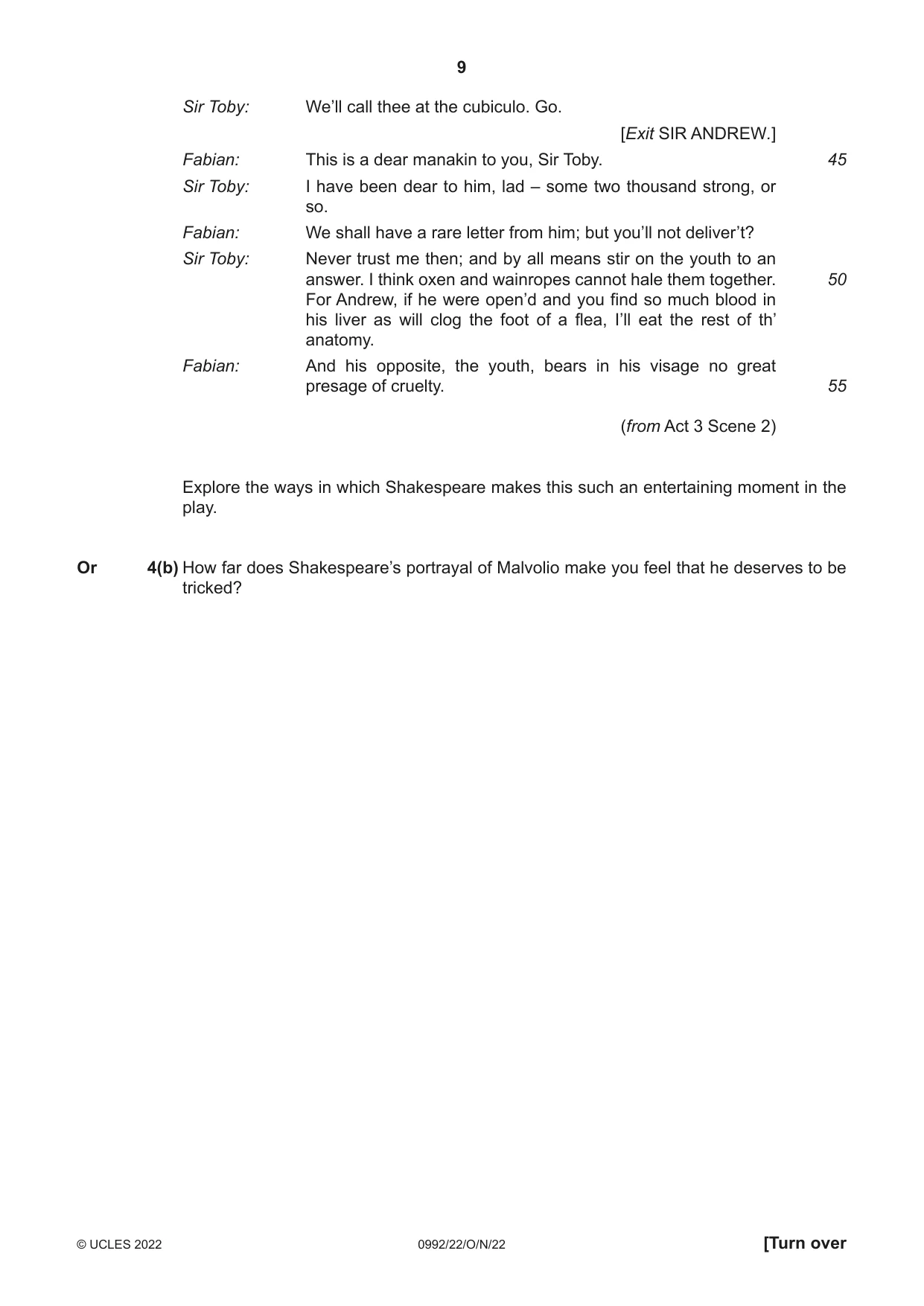
9 0992/22/O/N/22 © UCLES 2022 [Turn over Sir Toby: We’ll call thee at the cubiculo. Go. [Exit SIR ANDREW.] Fabian: This is a dear manakin to you, Sir Toby. Sir Toby: I have been dear to him, lad – some two thousand strong, or so. Fabian: We shall have a rare letter from him; but you’ll not deliver’t? Sir Toby: Never trust me then; and by all means stir on the youth to an answer. I think oxen and wainropes cannot hale them together. For Andrew, if he were open’d and you find so much blood in his liver as will clog the foot of a flea, I’ll eat the rest of th’ anatomy. Fabian: And his opposite, the youth, bears in his visage no great presage of cruelty. (from Act 3 Scene 2) Explore the ways in which Shakespeare makes this such an entertaining moment in the play. Or 4(b) How far does Shakespeare’s portrayal of Malvolio make you feel that he deserves to be tricked? 45 50 55
Question paper, page 10
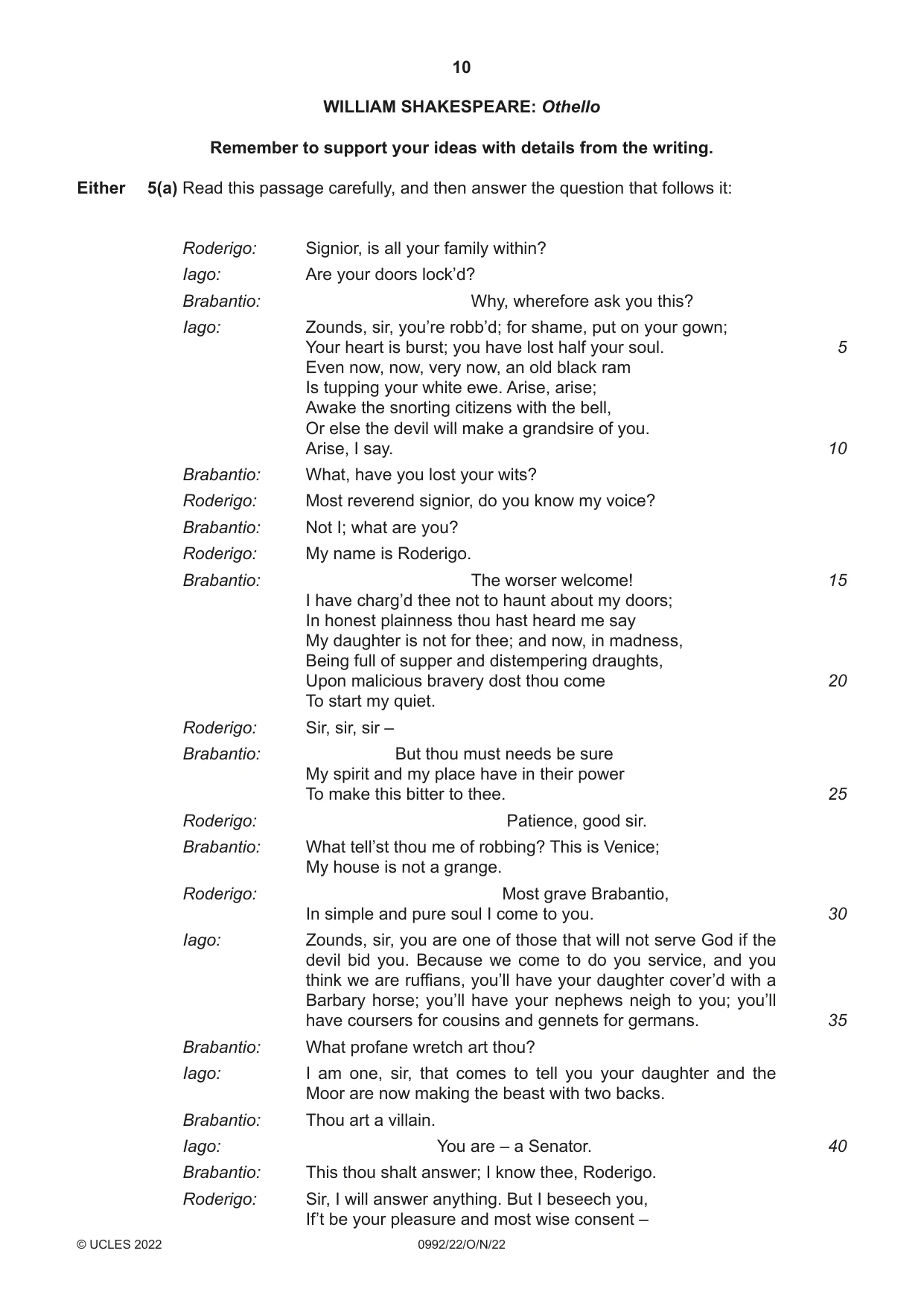
10 0992/22/O/N/22 © UCLES 2022 WILLIAM SHAKESPEARE: Othello Remember to support your ideas with details from the writing. Either 5(a) Read this passage carefully, and then answer the question that follows it: Roderigo: Signior, is all your family within? Iago: Are your doors lock’d? Brabantio: Why, wherefore ask you this? Iago: Zounds, sir, you’re robb’d; for shame, put on your gown; Your heart is burst; you have lost half your soul. Even now, now, very now, an old black ram Is tupping your white ewe. Arise, arise; Awake the snorting citizens with the bell, Or else the devil will make a grandsire of you. Arise, I say. Brabantio: What, have you lost your wits? Roderigo: Most reverend signior, do you know my voice? Brabantio: Not I; what are you? Roderigo: My name is Roderigo. Brabantio: The worser welcome! I have charg’d thee not to haunt about my doors; In honest plainness thou hast heard me say My daughter is not for thee; and now, in madness, Being full of supper and distempering draughts, Upon malicious bravery dost thou come To start my quiet. Roderigo: Sir, sir, sir – Brabantio: But thou must needs be sure My spirit and my place have in their power To make this bitter to thee. Roderigo: Patience, good sir. Brabantio: What tell’st thou me of robbing? This is Venice; My house is not a grange. Roderigo: Most grave Brabantio, In simple and pure soul I come to you. Iago: Zounds, sir, you are one of those that will not serve God if the devil bid you. Because we come to do you service, and you think we are ruffians, you’ll have your daughter cover’d with a Barbary horse; you’ll have your nephews neigh to you; you’ll have coursers for cousins and gennets for germans. Brabantio: What profane wretch art thou? Iago: I am one, sir, that comes to tell you your daughter and the Moor are now making the beast with two backs. Brabantio: Thou art a villain. Iago: You are – a Senator. Brabantio: This thou shalt answer; I know thee, Roderigo. Roderigo: Sir, I will answer anything. But I beseech you, If’t be your pleasure and most wise consent – 5 10 15 20 25 30 35 40
Question paper, page 11
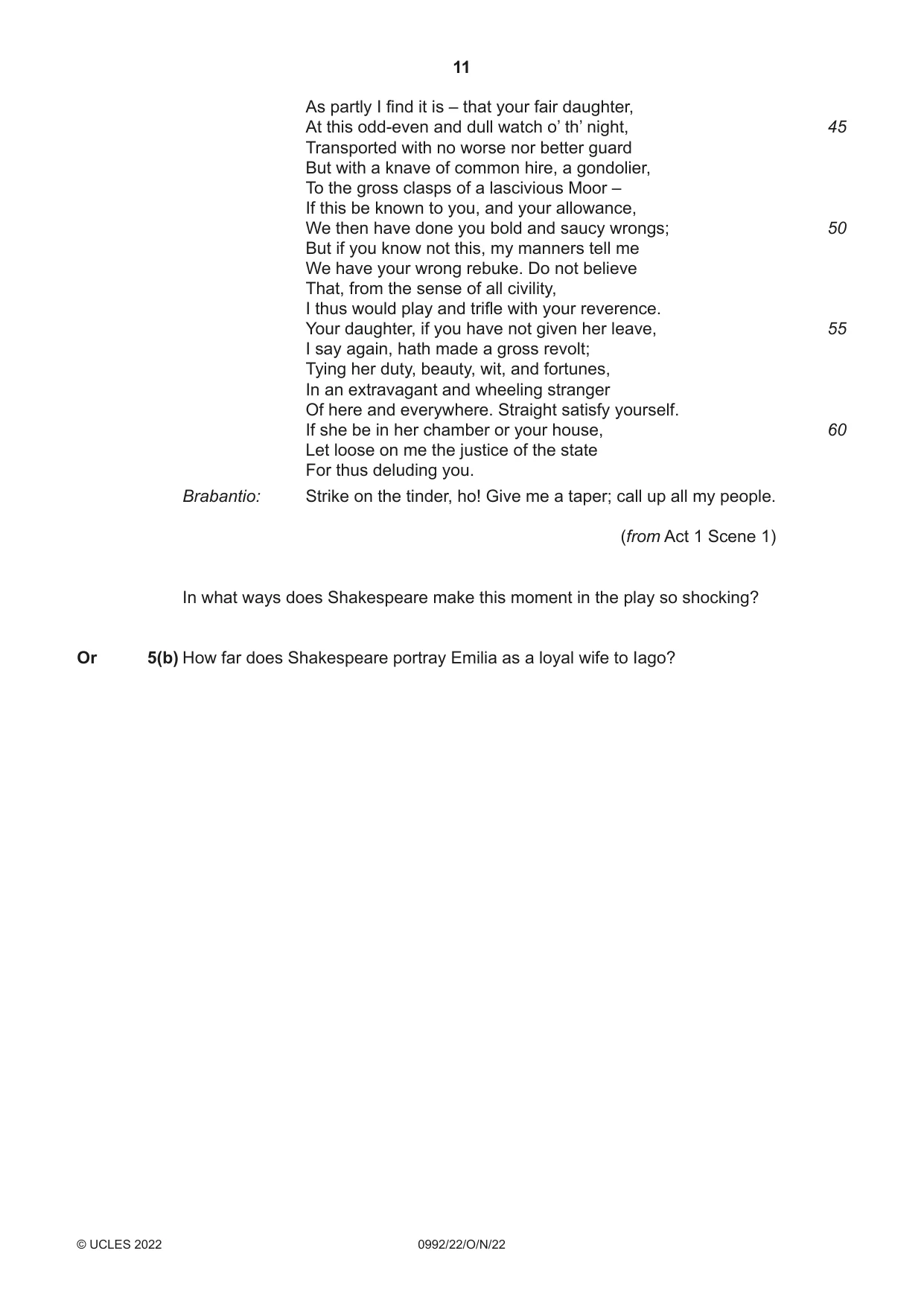
11 0992/22/O/N/22 © UCLES 2022 As partly I find it is – that your fair daughter, At this odd-even and dull watch o’ th’ night, Transported with no worse nor better guard But with a knave of common hire, a gondolier, To the gross clasps of a lascivious Moor – If this be known to you, and your allowance, We then have done you bold and saucy wrongs; But if you know not this, my manners tell me We have your wrong rebuke. Do not believe That, from the sense of all civility, I thus would play and trifle with your reverence. Your daughter, if you have not given her leave, I say again, hath made a gross revolt; Tying her duty, beauty, wit, and fortunes, In an extravagant and wheeling stranger Of here and everywhere. Straight satisfy yourself. If she be in her chamber or your house, Let loose on me the justice of the state For thus deluding you. Brabantio: Strike on the tinder, ho! Give me a taper; call up all my people. (from Act 1 Scene 1) In what ways does Shakespeare make this moment in the play so shocking? Or 5(b) How far does Shakespeare portray Emilia as a loyal wife to Iago? 45 50 55 60
Question paper, page 12
12 0992/22/O/N/22 © UCLES 2022 Permission to reproduce items where third-party owned material protected by copyright is included has been sought and cleared where possible. Every reasonable effort has been made by the publisher (UCLES) to trace copyright holders, but if any items requiring clearance have unwittingly been included, the publisher will be pleased to make amends at the earliest possible opportunity. To avoid the issue of disclosure of answer-related information to candidates, all copyright acknowledgements are reproduced online in the Cambridge Assessment International Education Copyright Acknowledgements Booklet. This is produced for each series of examinations and is freely available to download at www.cambridgeinternational.org after the live examination series. Cambridge Assessment International Education is part of Cambridge Assessment. Cambridge Assessment is the brand name of the University of Cambridge Local Examinations Syndicate (UCLES), which is a department of the University of Cambridge. BLANK PAGE
Mark scheme, page 1
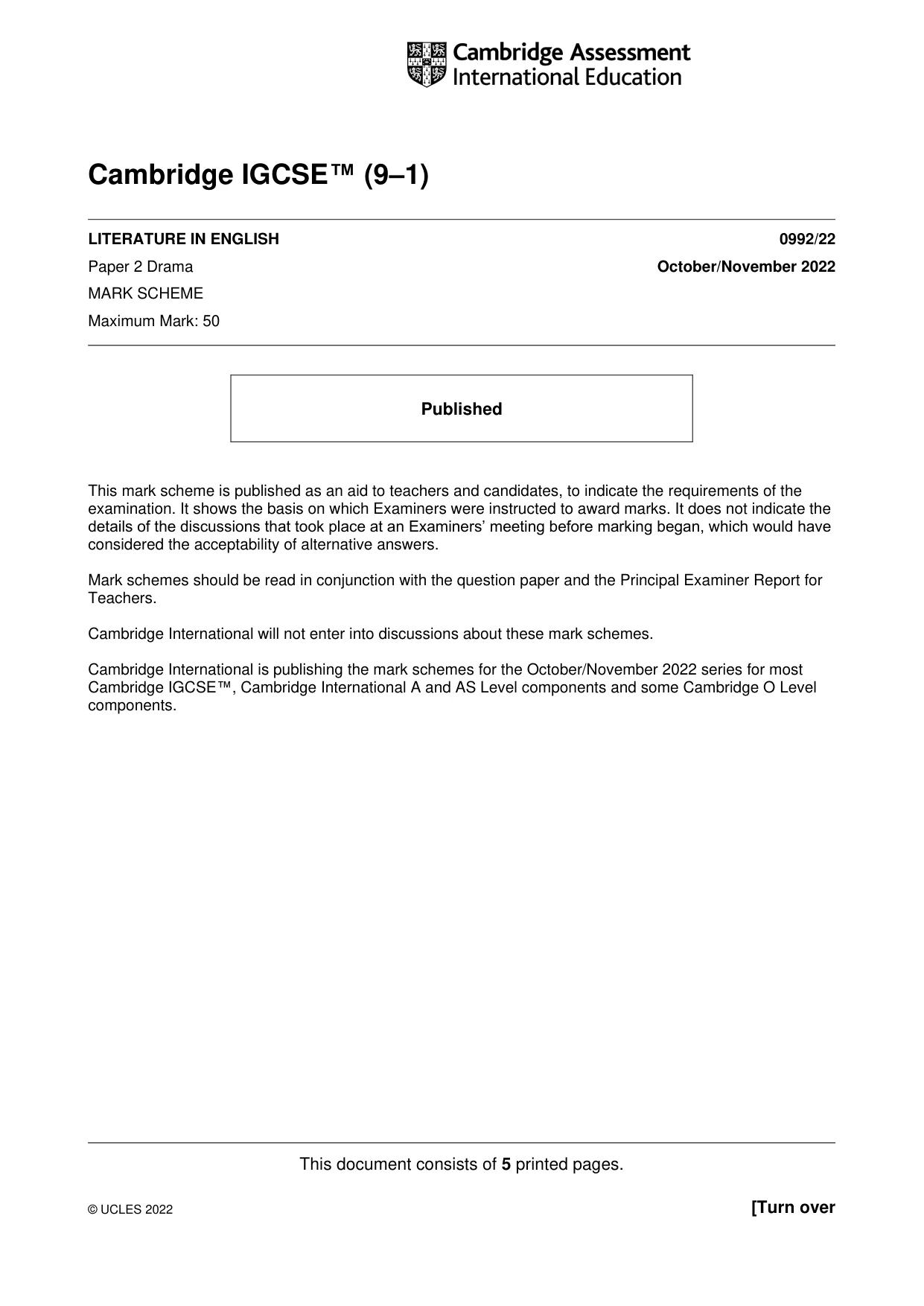
This document consists of 5 printed pages. © UCLES 2022 [Turn over Cambridge IGCSE™ (9–1) LITERATURE IN ENGLISH 0992/22 Paper 2 Drama October/November 2022 MARK SCHEME Maximum Mark: 50 Published This mark scheme is published as an aid to teachers and candidates, to indicate the requirements of the examination. It shows the basis on which Examiners were instructed to award marks. It does not indicate the details of the discussions that took place at an Examiners’ meeting before marking began, which would have considered the acceptability of alternative answers. Mark schemes should be read in conjunction with the question paper and the Principal Examiner Report for Teachers. Cambridge International will not enter into discussions about these mark schemes. Cambridge International is publishing the mark schemes for the October/November 2022 series for most Cambridge IGCSE™, Cambridge International A and AS Level components and some Cambridge O Level components.
Mark scheme, page 2
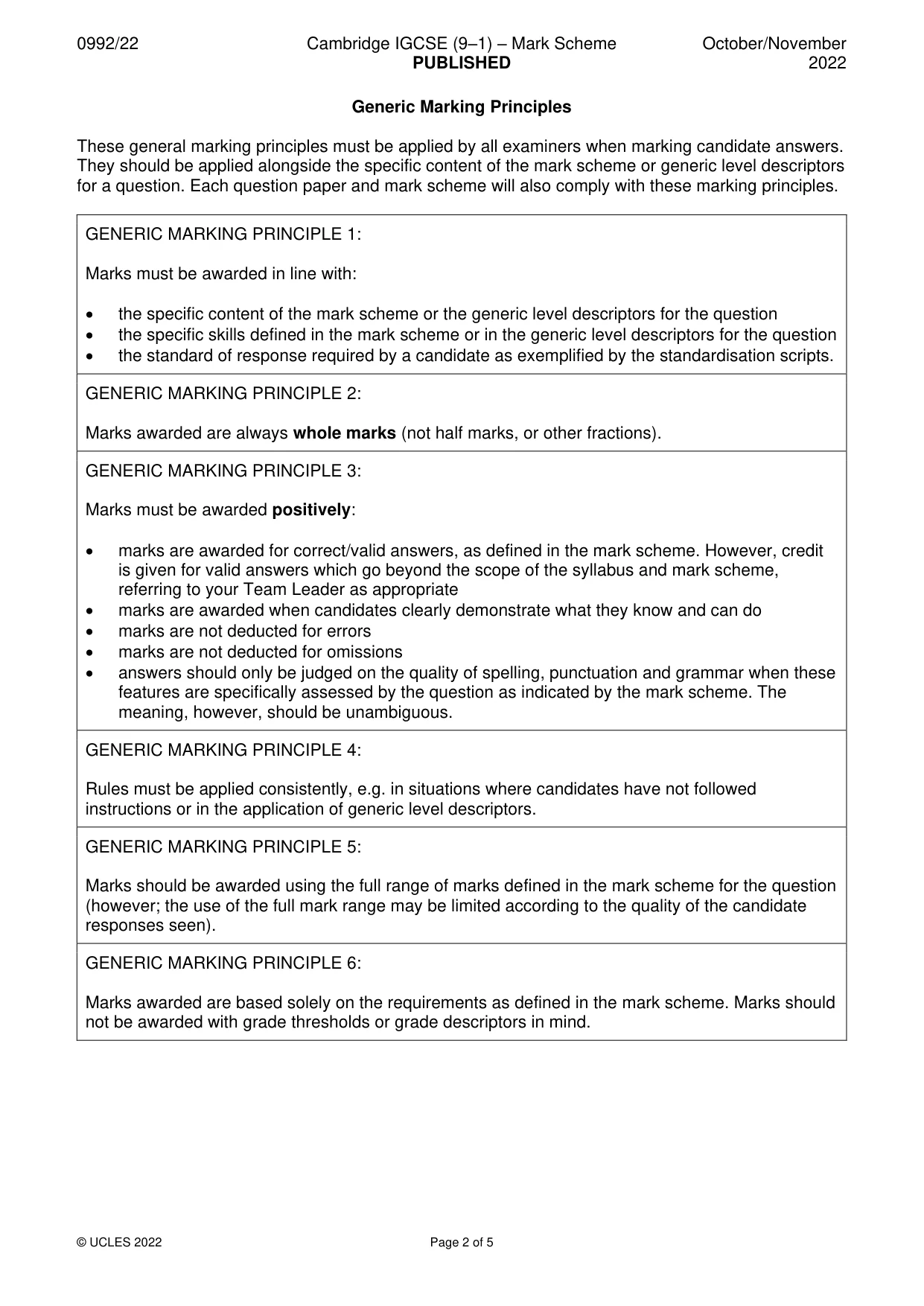
0992/22 Cambridge IGCSE (9–1) – Mark Scheme PUBLISHED October/November 2022 © UCLES 2022 Page 2 of 5 Generic Marking Principles These general marking principles must be applied by all examiners when marking candidate answers. They should be applied alongside the specific content of the mark scheme or generic level descriptors for a question. Each question paper and mark scheme will also comply with these marking principles. GENERIC MARKING PRINCIPLE 1: Marks must be awarded in line with: • the specific content of the mark scheme or the generic level descriptors for the question • the specific skills defined in the mark scheme or in the generic level descriptors for the question • the standard of response required by a candidate as exemplified by the standardisation scripts. GENERIC MARKING PRINCIPLE 2: Marks awarded are always whole marks (not half marks, or other fractions). GENERIC MARKING PRINCIPLE 3: Marks must be awarded positively: • marks are awarded for correct/valid answers, as defined in the mark scheme. However, credit is given for valid answers which go beyond the scope of the syllabus and mark scheme, referring to your Team Leader as appropriate • marks are awarded when candidates clearly demonstrate what they know and can do • marks are not deducted for errors • marks are not deducted for omissions • answers should only be judged on the quality of spelling, punctuation and grammar when these features are specifically assessed by the question as indicated by the mark scheme. The meaning, however, should be unambiguous. GENERIC MARKING PRINCIPLE 4: Rules must be applied consistently, e.g. in situations where candidates have not followed instructions or in the application of generic level descriptors. GENERIC MARKING PRINCIPLE 5: Marks should be awarded using the full range of marks defined in the mark scheme for the question (however; the use of the full mark range may be limited according to the quality of the candidate responses seen). GENERIC MARKING PRINCIPLE 6: Marks awarded are based solely on the requirements as defined in the mark scheme. Marks should not be awarded with grade thresholds or grade descriptors in mind.
Mark scheme, page 3
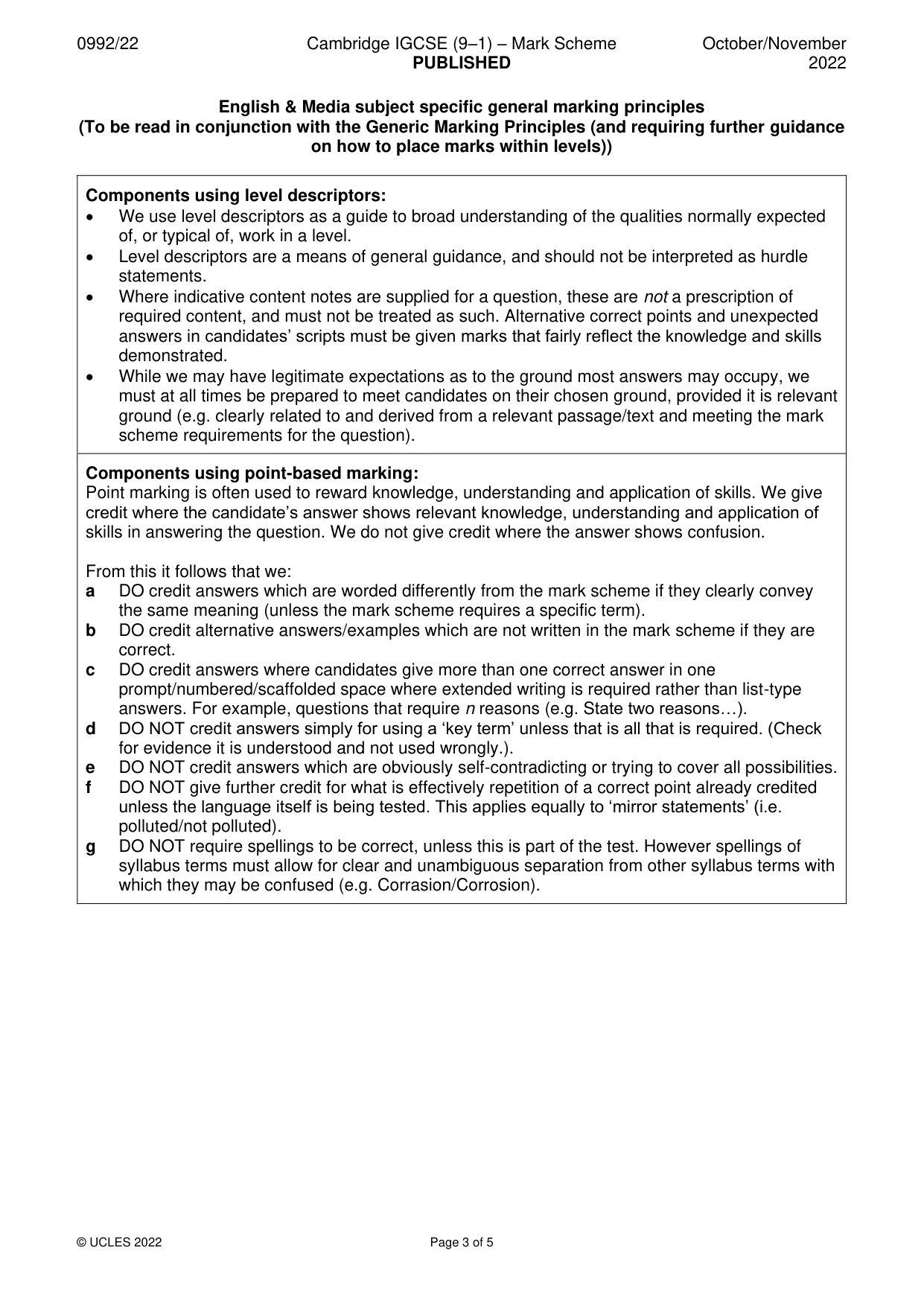
0992/22 Cambridge IGCSE (9–1) – Mark Scheme PUBLISHED October/November 2022 © UCLES 2022 Page 3 of 5 English & Media subject specific general marking principles (To be read in conjunction with the Generic Marking Principles (and requiring further guidance on how to place marks within levels)) Components using level descriptors: • We use level descriptors as a guide to broad understanding of the qualities normally expected of, or typical of, work in a level. • Level descriptors are a means of general guidance, and should not be interpreted as hurdle statements. • Where indicative content notes are supplied for a question, these are not a prescription of required content, and must not be treated as such. Alternative correct points and unexpected answers in candidates’ scripts must be given marks that fairly reflect the knowledge and skills demonstrated. • While we may have legitimate expectations as to the ground most answers may occupy, we must at all times be prepared to meet candidates on their chosen ground, provided it is relevant ground (e.g. clearly related to and derived from a relevant passage/text and meeting the mark scheme requirements for the question). Components using point-based marking: Point marking is often used to reward knowledge, understanding and application of skills. We give credit where the candidate’s answer shows relevant knowledge, understanding and application of skills in answering the question. We do not give credit where the answer shows confusion. From this it follows that we: a DO credit answers which are worded differently from the mark scheme if they clearly convey the same meaning (unless the mark scheme requires a specific term). b DO credit alternative answers/examples which are not written in the mark scheme if they are correct. c DO credit answers where candidates give more than one correct answer in one prompt/numbered/scaffolded space where extended writing is required rather than list-type answers. For example, questions that require n reasons (e.g. State two reasons…). d DO NOT credit answers simply for using a ‘key term’ unless that is all that is required. (Check for evidence it is understood and not used wrongly.). e DO NOT credit answers which are obviously self-contradicting or trying to cover all possibilities. f DO NOT give further credit for what is effectively repetition of a correct point already credited unless the language itself is being tested. This applies equally to ‘mirror statements’ (i.e. polluted/not polluted). g DO NOT require spellings to be correct, unless this is part of the test. However spellings of syllabus terms must allow for clear and unambiguous separation from other syllabus terms with which they may be confused (e.g. Corrasion/Corrosion).
Mark scheme, page 4
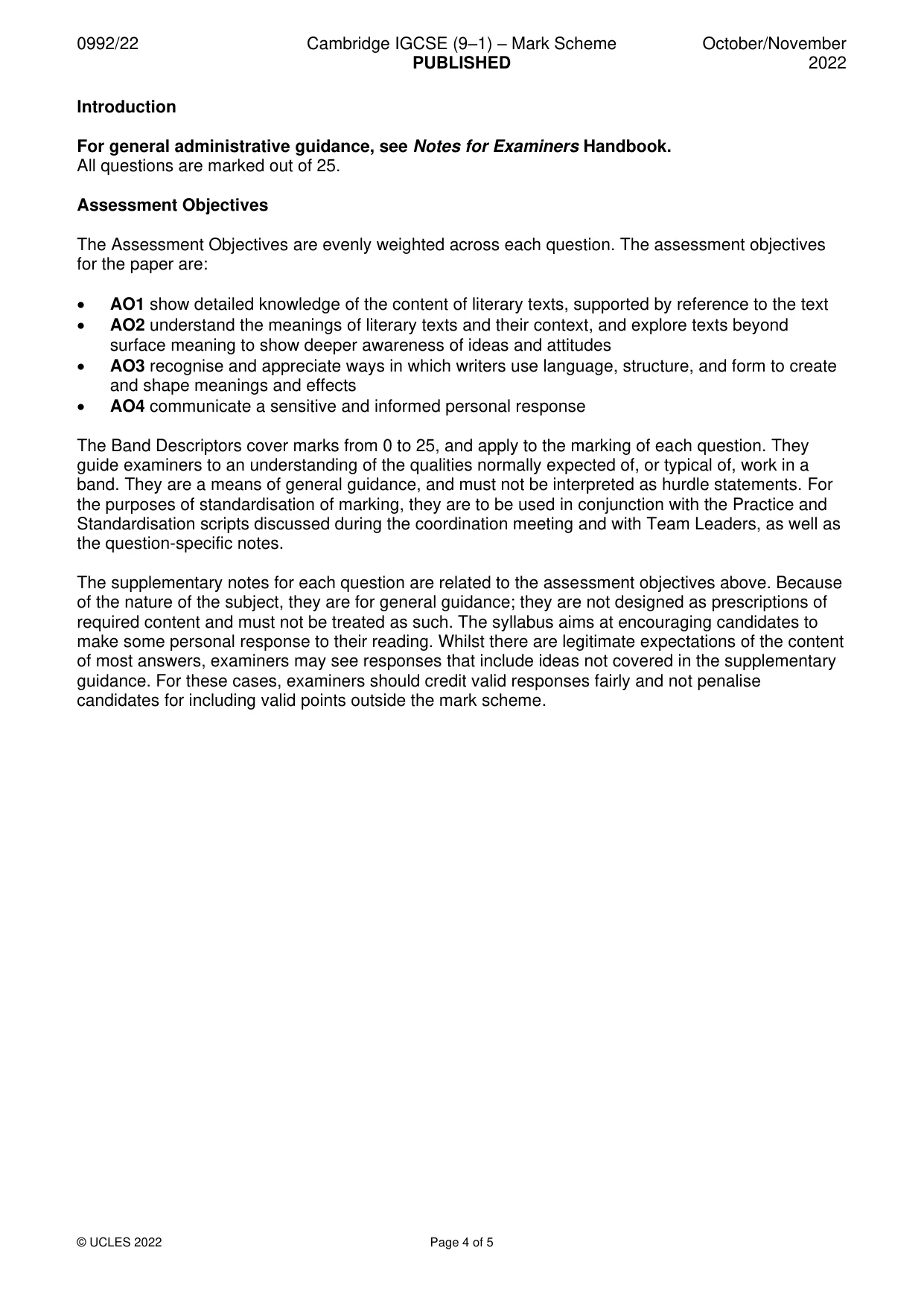
0992/22 Cambridge IGCSE (9–1) – Mark Scheme PUBLISHED October/November 2022 © UCLES 2022 Page 4 of 5 Introduction For general administrative guidance, see Notes for Examiners Handbook. All questions are marked out of 25. Assessment Objectives The Assessment Objectives are evenly weighted across each question. The assessment objectives for the paper are: • AO1 show detailed knowledge of the content of literary texts, supported by reference to the text • AO2 understand the meanings of literary texts and their context, and explore texts beyond surface meaning to show deeper awareness of ideas and attitudes • AO3 recognise and appreciate ways in which writers use language, structure, and form to create and shape meanings and effects • AO4 communicate a sensitive and informed personal response The Band Descriptors cover marks from 0 to 25, and apply to the marking of each question. They guide examiners to an understanding of the qualities normally expected of, or typical of, work in a band. They are a means of general guidance, and must not be interpreted as hurdle statements. For the purposes of standardisation of marking, they are to be used in conjunction with the Practice and Standardisation scripts discussed during the coordination meeting and with Team Leaders, as well as the question-specific notes. The supplementary notes for each question are related to the assessment objectives above. Because of the nature of the subject, they are for general guidance; they are not designed as prescriptions of required content and must not be treated as such. The syllabus aims at encouraging candidates to make some personal response to their reading. Whilst there are legitimate expectations of the content of most answers, examiners may see responses that include ideas not covered in the supplementary guidance. For these cases, examiners should credit valid responses fairly and not penalise candidates for including valid points outside the mark scheme.
Mark scheme, page 5
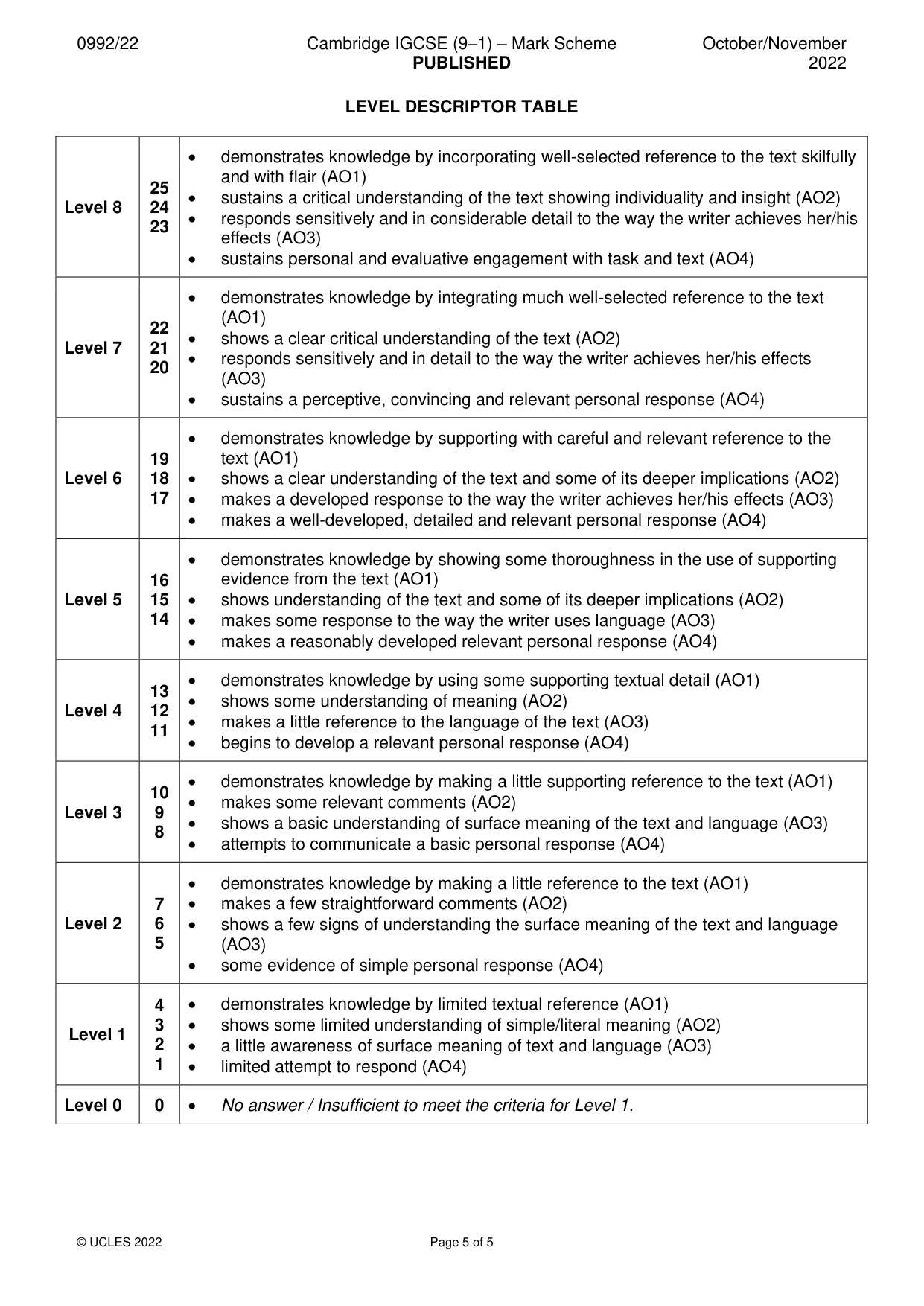
0992/22 Cambridge IGCSE (9–1) – Mark Scheme PUBLISHED October/November 2022 © UCLES 2022 Page 5 of 5 LEVEL DESCRIPTOR TABLE Level 8 25 24 23 • demonstrates knowledge by incorporating well-selected reference to the text skilfully and with flair (AO1) • sustains a critical understanding of the text showing individuality and insight (AO2) • responds sensitively and in considerable detail to the way the writer achieves her/his effects (AO3) • sustains personal and evaluative engagement with task and text (AO4) Level 7 22 21 20 • demonstrates knowledge by integrating much well-selected reference to the text (AO1) • shows a clear critical understanding of the text (AO2) • responds sensitively and in detail to the way the writer achieves her/his effects (AO3) • sustains a perceptive, convincing and relevant personal response (AO4) Level 6 19 18 17 • demonstrates knowledge by supporting with careful and relevant reference to the text (AO1) • shows a clear understanding of the text and some of its deeper implications (AO2) • makes a developed response to the way the writer achieves her/his effects (AO3) • makes a well-developed, detailed and relevant personal response (AO4) Level 5 16 15 14 • demonstrates knowledge by showing some thoroughness in the use of supporting evidence from the text (AO1) • shows understanding of the text and some of its deeper implications (AO2) • makes some response to the way the writer uses language (AO3) • makes a reasonably developed relevant personal response (AO4) Level 4 13 12 11 • demonstrates knowledge by using some supporting textual detail (AO1) • shows some understanding of meaning (AO2) • makes a little reference to the language of the text (AO3) • begins to develop a relevant personal response (AO4) Level 3 10 9 8 • demonstrates knowledge by making a little supporting reference to the text (AO1) • makes some relevant comments (AO2) • shows a basic understanding of surface meaning of the text and language (AO3) • attempts to communicate a basic personal response (AO4) Level 2 7 6 5 • demonstrates knowledge by making a little reference to the text (AO1) • makes a few straightforward comments (AO2) • shows a few signs of understanding the surface meaning of the text and language (AO3) • some evidence of simple personal response (AO4) Level 1 4 3 2 1 • demonstrates knowledge by limited textual reference (AO1) • shows some limited understanding of simple/literal meaning (AO2) • a little awareness of surface meaning of text and language (AO3) • limited attempt to respond (AO4) Level 0 0 • No answer / Insufficient to meet the criteria for Level 1.
What you needed in this session
Cambridge’s own grade thresholds for 2022 Oct/Nov, Paper 2 · Variant 2. A higher threshold means an easier paper — the bar moves with how the cohort did.